Chapter VI - Gilded Age and Progressive Era Page 140
Chapter VII - WWI, Depression and WWII Page 176
Chapter VIII - Cold War and Social Change Page 232
Chapter IX - Modern Era Page 264
Chapter X - Condensed Timeline Page 278
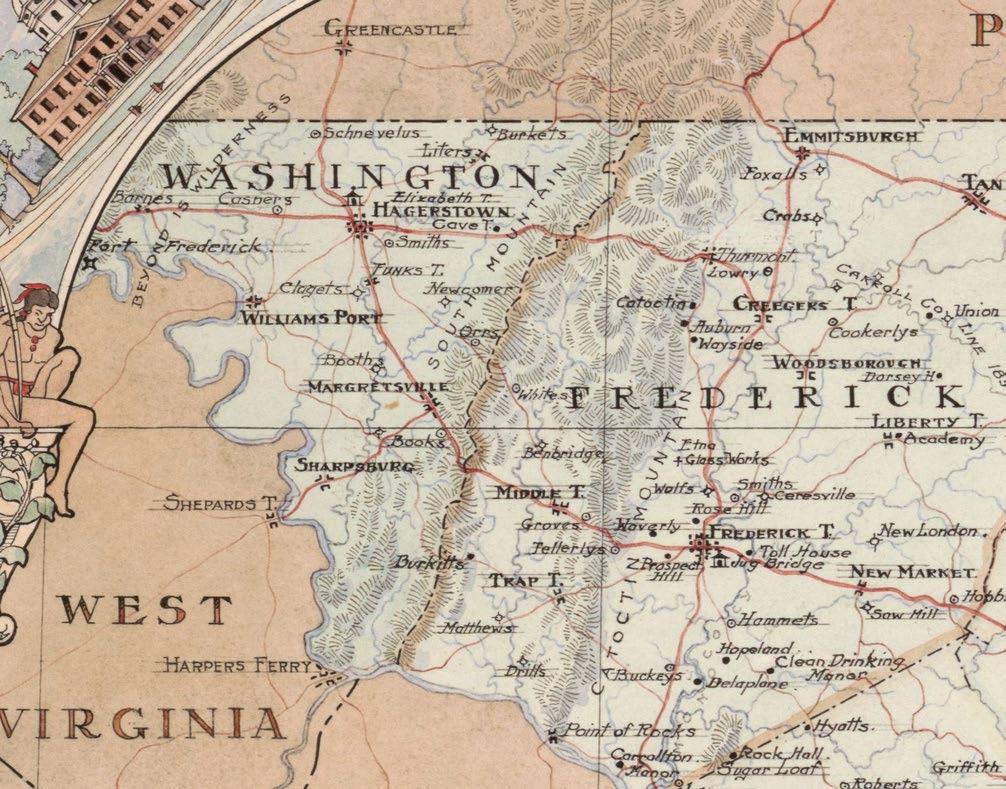
This region contains Washington County and extends from Pennsylvania through Maryland and down the length of Virginia.
In Pennsylvania, the Great Valley was given two names-- to the East near Philadelphia, it is called the Lancaster Valley, but west of Gettysburg, where the valley bends southward, it is called the Cumberland Valley. This name technically applies to the Maryland part of the same valley, but in more recent years, locals tend to call it “the Hagerstown Valley”. Across the Potomac, this very same valley that started in Pennsylvania is called the Shenandoah Valley after the river that runs north to the Potomac.
Before the colonization of the English, this valley was full of open meadows and grasslands, and the Native American peoples moved up and down the valley according to the seasons along established routes. They also developed trading paths, and “warrior paths”. In Washington County, the earliest European settlers traveled to this region along pre-existing Indian trails when they entered the Washington County region after 1722. Some made their way up the Potomac River from Southern Maryland, but there were no Indian trails suitable for ox carts or covered wagons to travel on through the ridges of the Catoctin mountains that lie on the Eastern edge of Washington County.
Most of the 18th century pioneers in this region of “The Great Valley” entered by an easier but longer route. They arrived in the port of Philadelphia and headed westward through Pennsylvania along the Great Valley, and down into Maryland and Virginia along the first major inland highway, called “The Great Philadelphia Wagon Road”. The route patched together many existing Indian trails. Gradually as the area became more settled and roads were improved, The Great Philadelphia Wagon Road became a collection of roads, feeder roads, and “shortcuts” up and down the Great Valley.
Today, travelers can trace much of the original wagon road by traveling up U.S. Route 11 through Virginia and Pennsylvania, but
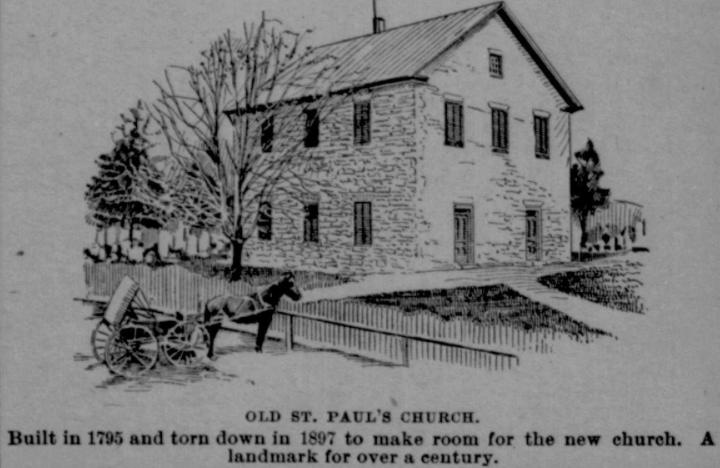
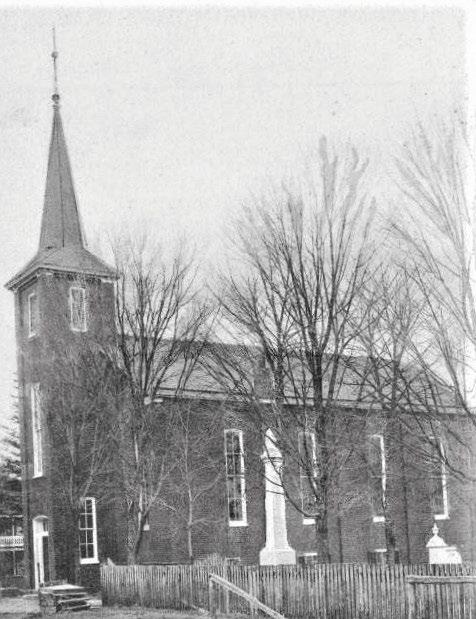
1738. A settlement dating as early as 1738 existed along the Conococheague Creek 4.5 miles from what is now the town of Clear Spring. The German Reformed and Lutherans built a log church called St. Paul’s. The log church remained active until 1795 when the congregations built a stone church a few miles west. The stone church was demolished in 1897 to build a modern stone church. I-70 plowed through the first settlement location at Cedar Ridge Road in the 1960’s.
1738. Joseph Chapline, later to be founder of Sharpsburg, followed his father to frontier of Western Maryland settling on the Maryland side of the Potomac.
1738. The first land grant where Keedysville would later emerge was recorded. It was named “Gordon’s Purchase”.
1738. Thomas Cresap patented land on the south side of Conococheague Creek, near the Potomac River, which he called Leeds. There, he established a frontier trading post and several taverns.
old st. paul’s ChurCh, Clear sprinG historiCal assoCiation
1749. Joseph Hancock arrives in the County, likely as an indentured servant, but is later killed in a conflict with indigenous people. He left a son, Joseph Hancock, Jr., who fought with General Washington, under Captain Andrew Mann. Hancock Jr. later operated a ferry on the Potomac and is the person after whom the Town of Hancock is named.
1750. October. Maryland frontiersman and explorer Christopher Gist is credited with providing the first detailed description of the Ohio Valley to the colonists in the thirteen states. Gist accompanied Col. George Washington on excursions into the wilderness and twice saved his life. French and Indian War historian Allan Powell wrote in his book Forgotten Heroes of the Maryland Frontier “late October 1750 Christopher Gist set out from Col. Thomas Cresap’s at the old Town on the Potomac River (Williamsport) in Maryland along an old Indian path.” Gist relied on well-established warrior paths and trails used by the traders as he left Williamsport to explore the Ohio Country.
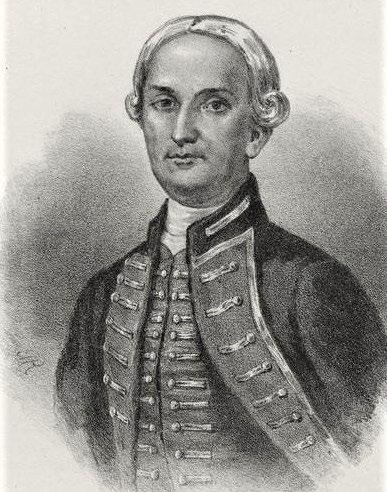
Governor horatio sharpe, Clear sprinG historiCal assoCiation
1754. Maryland Governor Horatio Sharpe prevailed upon the Maryland Assembly to vote for the funds to build a major fort on the colony’s frontier, eventually to become Fort Frederick. Along with this, was construction of a more direct route with easier passage of the colony’s current road from Frederick, MD to cross South Mountain at Turner’s Gap. This road would eventually become the National Road and replaced the previous crossings at Fox’s Gap to Keedysville, Geeting Road to Sharpsburg and Old Keedysville Road-Bakersville Road to Conococheague route.
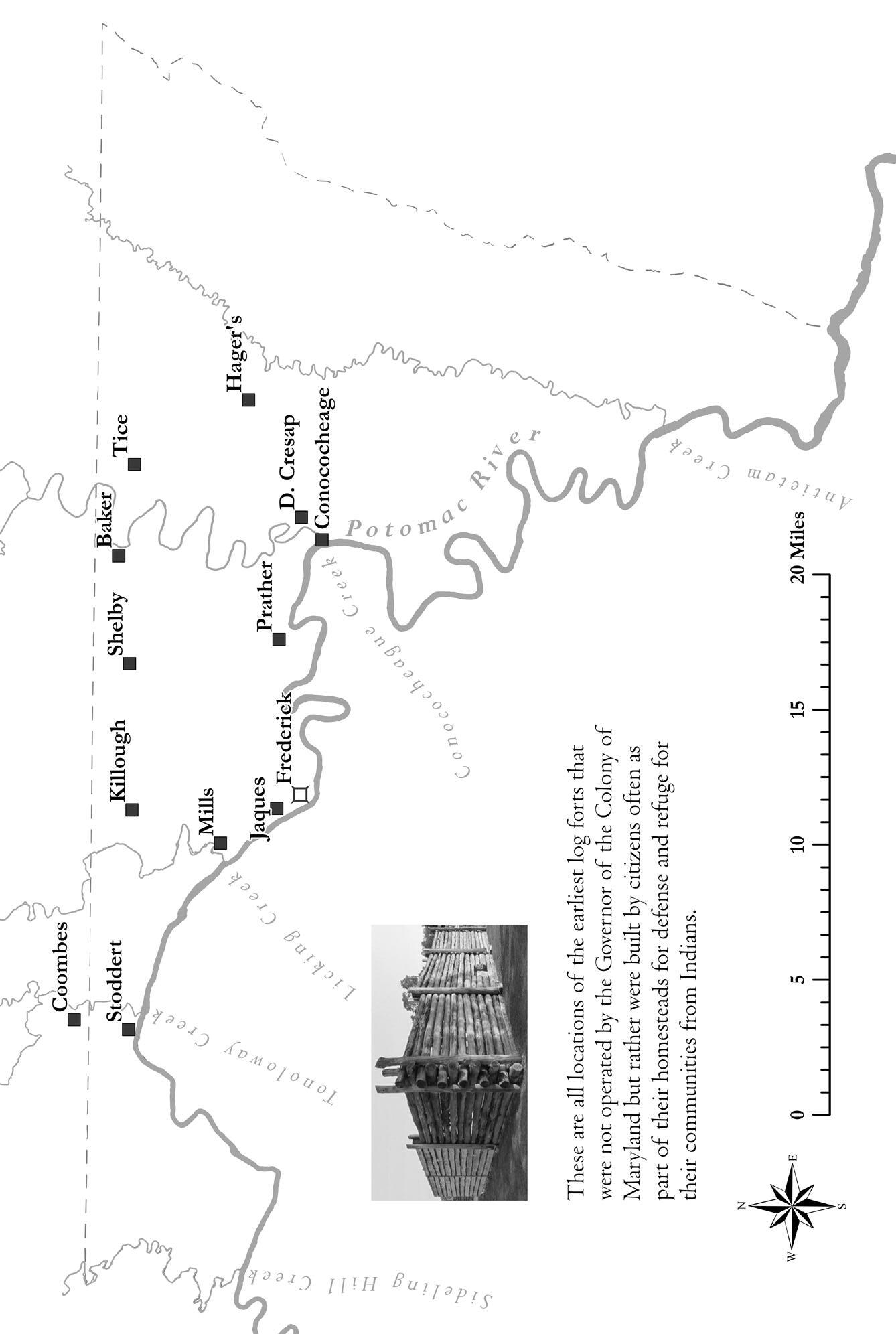
1754. Several log forts or wood blockades can be traced to this time period. These forts were not operated by the Governor of the Colony of Maryland but rather were built by citizens, often as part of their homesteads for defense and refuge for their communities from Indians. These forts include:
• Fort Killough, located in the Indian Springs Area.
• Fort Mills was operated by Thomas Mills, located in the Parkhead area.
• Fort Tice, lost in our county history, was in the Cearfoss area.
1755. Several more forts were constructed including:
• Fort Tonoloway or Fort Stoddert, built by Lt. Thomas Stoddert. Thomas Stoddert was the father of Benjamin Stoddert, the first Secretary of the U.S. Navy.
• Fort Baker, constructed under the direction of Isaac Baker, was located along the Conococheague Creek in the Fairview area.
• Fort Coombs, located close to the Tonoloways, was built at the home of Edward Coombs. While part of the Maryland fort system, Fort Coombs was actually in Pennsylvania, just barely across the Mason Dixon Line, which wasn’t established until 1767.
• Fort Shelby, located just north of Clear Spring on Broad Fording Road. This fort was operated by Evan Shelby, who along with son Isaac Shelby, became national figures in early American history.
issaC shelby, first Governor of k entuCky, Clear sprinG historiCal assoCiation
1755. Governor Sharpe of Maryland appointed Thomas Creasp, who maintained storehouses at the mouth of Conococheague and Wills Creek, to fulfill the contracts for the necessary flour, meat, blankets, and other supplies demanded by General Edward Braddock for his army. Cresap and his sons ran a small frontier storehouse at Conococheague for trappers, traders, and settlers. Suddenly, they were tasked with gathering, receiving, packing, and shipping perishable supplies, horses, wagons, and livestock to supply an army of a thousand British regulars and seven hundred militia. This would have been a huge job even for the most organized trader. Much has been written about the Cresaps’ inefficiency, thievery, and problems as commissary suppliers during that time. When shipments were short, delayed, or spoiled because of poor packing, Cresaps took full blame. Some of those accusations might have been justified. Still, most of it can be blamed on Braddock and his officers’ disregard for the Colonial militia and colonials in general - “here lives on Colonel Cresap a Rattle Snake Colonel, and a vile Rascal: calls himself a Frontier man.”
By the fall of 1755, Governor Sharpe, seeking to restore order, replaced Cresap with Annapolis merchants David and George Ross as agents in charge of supplies at Conococheague. This arrangement is logical given that Springfield was constructed as a storehouse set back from the river’s edge and as a residence for George Ross. It is also reasonable that the province of Maryland paid for the construction of Springfield, as it was built on manor land—land that was the property of Lord Baltimore.
1755. The first bridge over Antietam Creek was built nearby Keedysville for “The Braddock Expedition”. The Expedition started in Alexandria, VA and his troops were split into three groups on their westward mission to capture Ft. Duquesne. The Northernmost troops in his command traveled across through Frederick, MD and crossed at South Mountain at Fox’s Gap near Keedysville. The road improvements made on this journey collectively became known as Braddock’s Road.
1756. May 8-9. War (the French and Indian) Declared between Great Britain and France. The war was essentially the conflict of the colonizing French and British for land and the taking away of the Native Americans Territories to the point where the natives had less land to support their semi-nomadic life. This conflict is sometimes considered the first world war, because the British and French were fighting in other parts of the world over colonization rights. Native Americans chose to make treaty alliances with either the French or the British. In our area a treaty was made with the Cherokee Nation that allowed for peaceful settlement of Appalachia.
1756. Fort Prather was used as a military depot and was located near Big Spring. It was under the command of Thomas Prather.
1756. It was reported in a 1756 newspaper that a Dutchman and a woman were found deceased in the road between Isaac Baker’s fort at Broad Fording and the temporary line (Mason-Dixon Line). That same article noted William Gilliland was shot through the head about one mile from Fort Frederick, at the Thomson plantation. Both deaths were a result of clashes with Native Americans.
1756. February 26. “We are in great distress here” writes a settler of living in the pioneer settlement along the Conococheague. One of the reasons is the “shortness of crops” and fears that their provisions put up from the previous summer will not last the winter. The Conococheague settlement was “now full of people who have been obliged to leave their plantations to avoid falling into the hands of
the savages” the letter to the Maryland Gazette continues. Some of the settlers were reduced to begging for bread from other farmers who had a better harvest. Indian raids will escalate in the region. Source: the Maryland Gazette, Feb. 26, 1756.
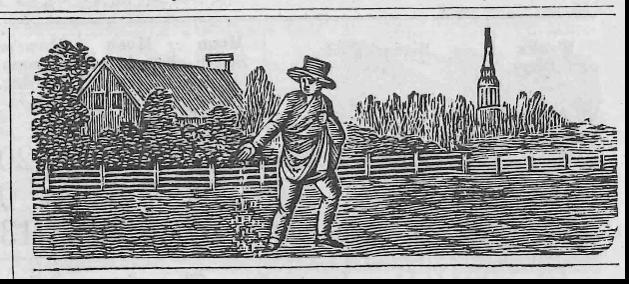
far Mer’s a lManaC iMaGe of seed soWinG
1756. June 13. Evan Shelby sold the tract of land called Locust Thickett to Nathaniel Nesbitt. A portion of this land would later become the Town of Clear Spring.
1756. June 14. Ground was broken on the County’s most notable fort and its largest, Fort Frederick (Sharpe’s Fort at North Mountain). Governor Horatio Sharpe ordered Fort Frederick to be built and named after Frederick Calvert. The fort was to be manned by 400 troops, plus militia, who patrolled the area. Nearby Fort Stoddert and Fort Coombs were closed. It was planned to house troops and during attacks from Indians it would shelter the entire community. Because of its significant size, ironically, it was never attacked, probably because the French and Indians did not want to risk an attempt to take it. They focused their raids in other places in Virginia and Pennsylvania. Strategically for moving troop and supplies Fort Frederick was much needed on the frontier.
fort frederiCk noveMber 1877, Clear sprinG historiCal assoCiation
1756. August 20. Horatio Sharpe, governor of the Colony of Maryland, writes to Lord Baltimore to tell him that the decision to construct Fort Frederick of stone rather than the usual timbers was a well-justified choice, for just days earlier in August, Fort Granville PA, a about 80 miles north along the frontier, was burned to the ground in a raid by the Indians and French. Construction of the fort on a bluff along the Potomac near the base of North Mountain (Fairview Mtn. today) was only two months’ along, the first stones being laid on June 14th. Fort Frederick is the only stone fort built by the British Army in the American colonies. Source: Powell, Allan. Fort Frederick: Potomac Outpost. Parsons WV: Maclain Printing 1988.
1756. August 21. A band of grieving settlers along the Conococheague in a funeral procession were attacked by Indians killing 39 of the mourners. This is the largest attack by the Indians in the area of Washington County during the French & Indian War. Source: Powell, Allan. Fort Frederick: Potomac Outpost. Parsons WV: Maclain Printing 1988.
1756. September. Reported in the Annapolis newspaper, settler Margaret Hood was abducted by the Native Americans. She lived along the Conococheague Creek. In many cases kidnapped women and children were taken by Indians to the far north near Canada. Some never returned to their families when the war ended.
1757. June. Based in Philadelphia, the Pennsylvania Gazette publication reported that two wagoners, Peter Falkner and George Long, were attacked by Native Americans one mile from Fort Frederick.
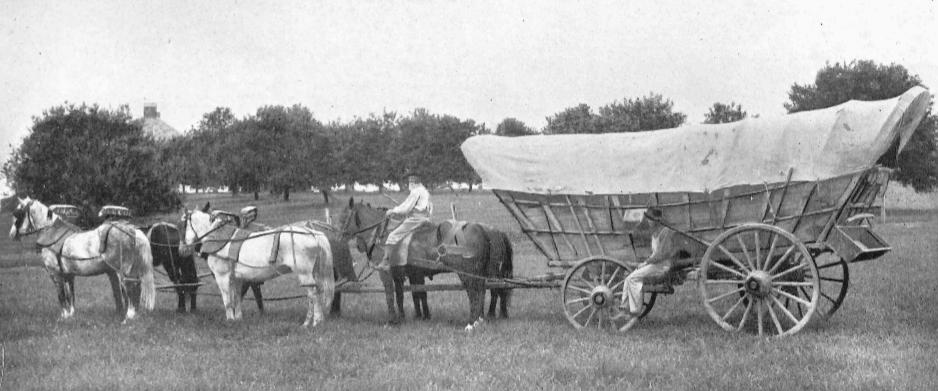
WaGon exaMple, history of the h aGerstoWn bank
1759 (through 1812). George Adam Geeting was a prominent early settler, farmer, schoolteacher and pastor in Keedysville. He built the Geeting Meeting House, the first church structure of the United Brethren in Christ denomination.
GeetinG MeetinG house, M aryland inventory of historiC properties (Wa-ii-300)
1761. Mount Aetna Furnace operations begin. The Hughes brothers would develop this furnace into a major industrial site, along with the land they acquired on the Antietam Creek where his sons set up an iron forge. At the start of the American Revolution, the Hughes brothers’ furnace, originally called Antietam Furnace but later called Mt. Etna, was one of the only furnaces in the thirteen colonies capable of making cannons for the Continental Army. By the end of the Revolutionary war, over 75 cannon were cast and proved at their ironworks. At the time of the Revolution, eight enslaved adults, seven men and one woman, worked there, along with seven English indentured servants. The Hughes’ ironworks also provided cannon balls and grape shot for the war of 1812. Source: Fry, Susan Winter. Archaeological Excavations at the Antietam Iron Furnace Complex. Maryland Historic Trust Manuscript Series No. 37, 1984.
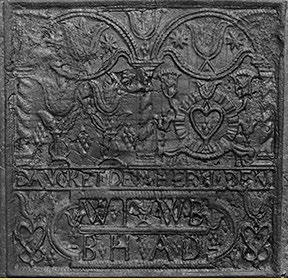
Conserved stove plate froM the a ntietaM furnaCe site, part of a five-plate or JaMb stove, note the Ger Man insCription “danCket deM hern deM”, WhiCh translate “Give thanks unto the lord” and the initials of b.h. for barnabas huGhes, these stoves Were used prevalently by Ger Man iMMiGrants around the Great valley reGion, Jefferson patterson park and MuseuM.
1762. Jonathan Hager founds Elizabethtown, which later becomes incorporated as Hagerstown in 1813. For decades Elizabethtown was often called Hagerstown but usually spelled Hagar’s Town which can be confusing to modern researchers. It was not until incorporation in 1813 that the dual names ended and Hagerstown, the modern spelling, became the chosen name.
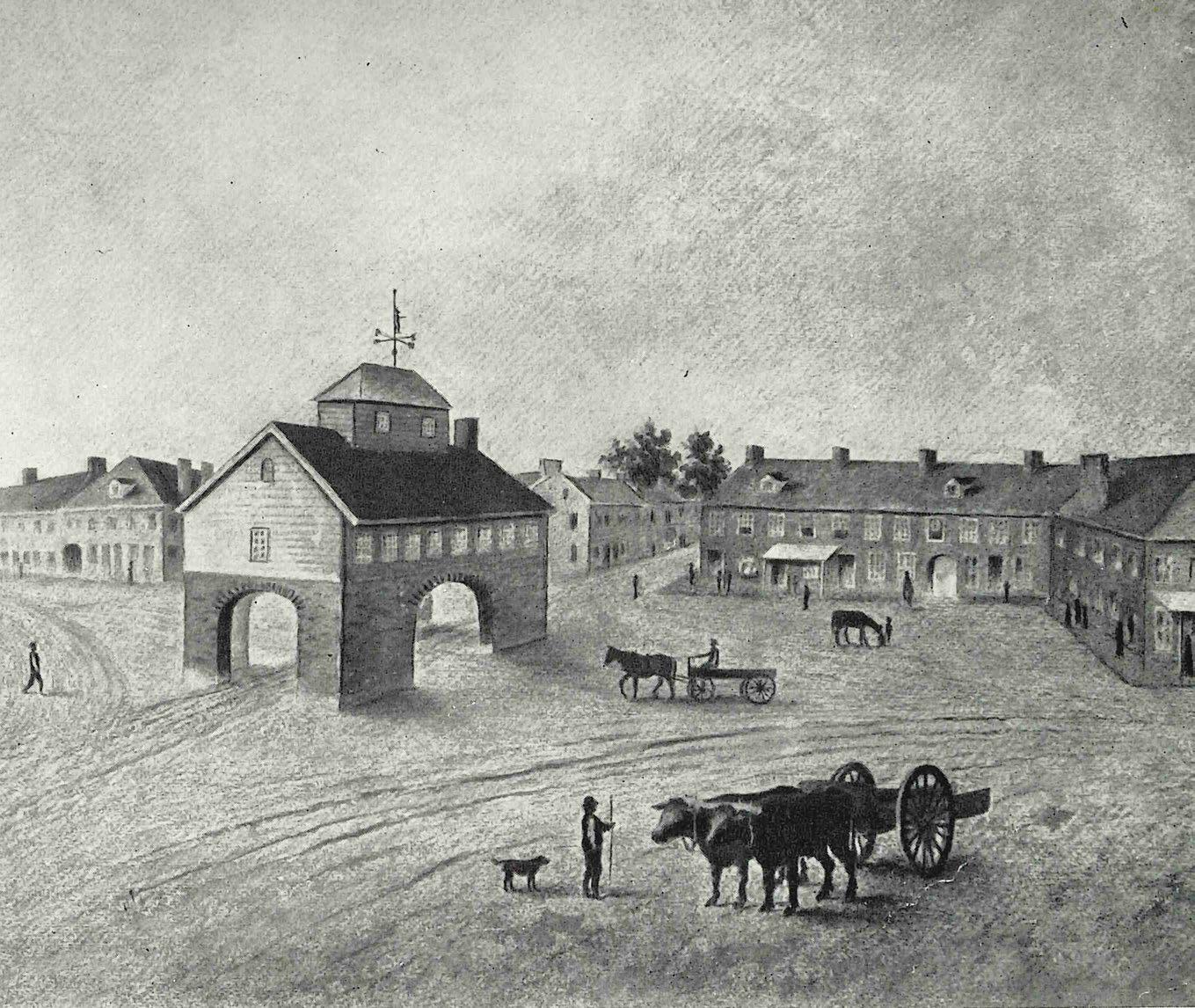
first Courthouse | M arket, publiC square, h aGerstoWn, history of the h aGerstoWn bank (1910)
The American Revolution
(1763 - 1783)
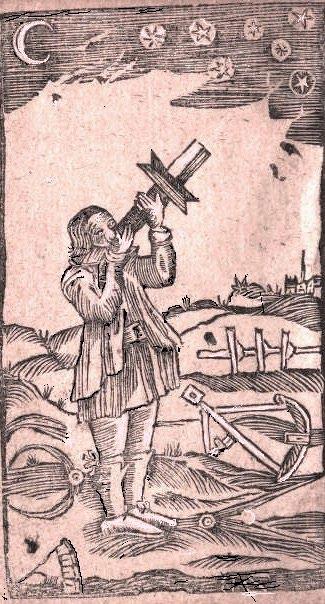
1763. July 9. Using an astrologer’s to divine the right calculations for the most optimum alignment of the stars, Joseph Chapline of the lower Antietam District starts selling town lots for a burgh he named after Maryland’s Governor Horatio Sharpe.
Hagerstown had just been founded the year before. The French & Indian War had recently ended, and Sharpe had been governor of Maryland all through the conflict. Joseph Chapline himself was a captain in this war and played a large part in the construction of Fort Frederick, the only stone fort built by the British in North America, which still stands today in Washington County. Interestingly, in 1776, Sharpsburg was in the running to be designated the county seat of the newly formed Washington County, but the village lost the bid for county seat to Hagerstown by just one vote. Source: Lee and Barbara Barron. The History of Sharpsburg, Maryland. Privately printed. 1972.
this is an astroloGer searChinG the heavens froM a 1757 edition of erra pater’s the book of k noWledGe treatinG the WisdoM of the a nCients
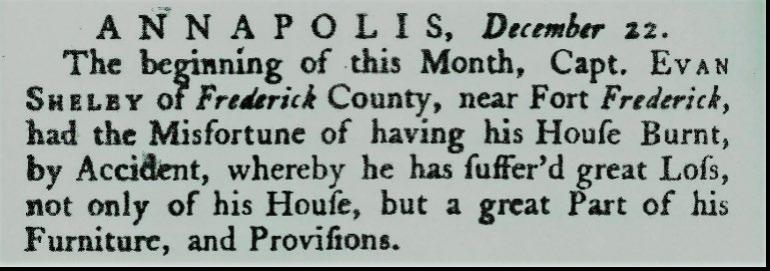
1763. December 22. “Capt. Evan Shelby of Frederick County, near Fort Frederick, had the misfortune of having his house burn by accident, whereby he suffered great loss not only of his house but a great part of his furniture and possessions.” This property is approximately one mile north of Clear Spring and is known as Montpelier.
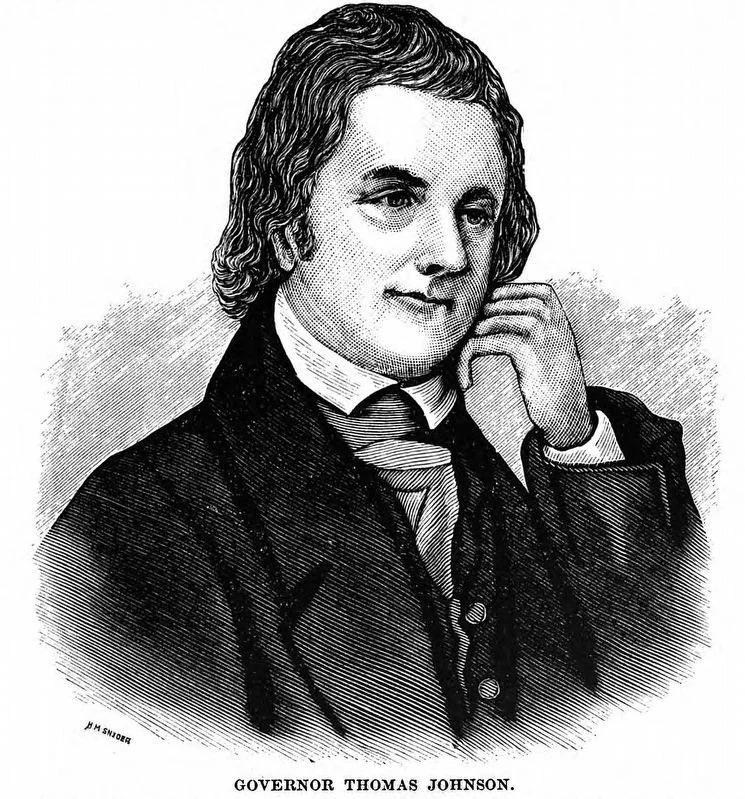
1764. Thomas Johnson, later to become the first elected governor of Maryland, and Lancelot Jacques purchased 9,860 acres of land from Evan Shelby, in the Fort Frederick area and started the Green Spring Furnace business. The business owned eighty slaves ranging in age from nine to fifty.
neWspaper ClippinG, Clear sprinG historiCal assoCiation
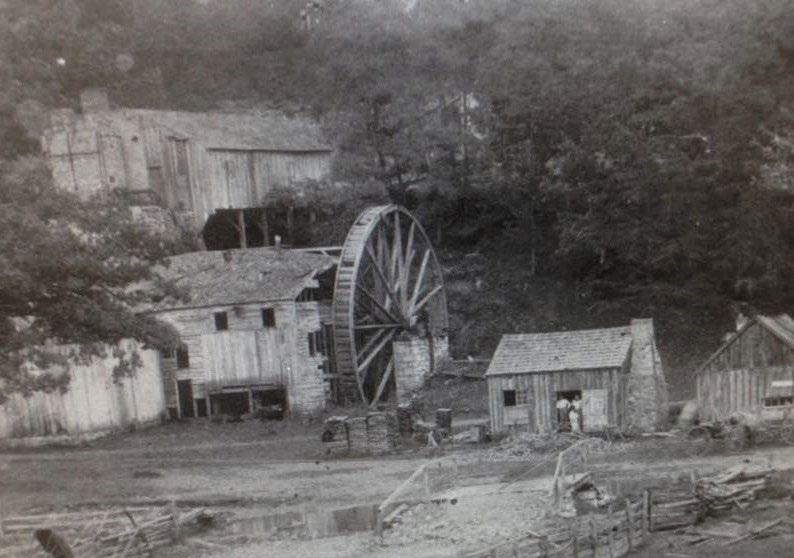
Green sprinG furnaCe CoMplex, Clear sprinG historiCal assoCiation
Governor thoMas Johnson, Clear sprinG historiCal assoCiation
1764. Barnabas Hughes, an Irish immigrant, a former Indian trader, the founder of Elizabethtown, PA, and lately a merchant of Baltimore, along with his sons John, Samuel and Daniel Hughes, purchases a property called “Long Tract”… being 2,533 and a half acres more or less.” An iron furnace built by William James already existed on the property as early as 1761. The Hughes brothers would develop this furnace into a major industrial site. His sons set up an iron forge on the Antietam Creek. At the start of the American Revolution, the Hughes brothers’ furnace, originally called Antietam Furnace but later called Mt. Etna, was one of the few iron furnaces in the thirteen colonies capable of making cannons for the Continental Army. Over 75 cannons used in the Revolutionary War were cast and proved at the Hughes’ ironworks. At the time of the Revolution, eight enslaved adults--seven men and one woman--worked there, along with seven English indentured servants. The Hughes’ ironworks also provided cannon balls and grape shot for the war of 1812. Fry, Susan Winter. Archaeological Excavations at the Antietam Iron Furnace Complex. Source: Maryland Historic Trust Manuscript Series No. 37, 1984.
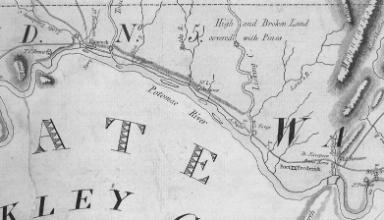
“a M ap of frederiCk and WashinGton Counties, state of M aryland” exCerpt shoWinG liCkinG Creek, 1808, Charles varlé
1764. The Fort Frederick Forge started on land purchased from Thomas Mills along Licking Creek by Thomas Johnson and Lancelot Jacques. Johnson later sold his half of the business to Denton Jacques and the business name was changed to Parkhead Forge. A grist mill and sawmill were also added.
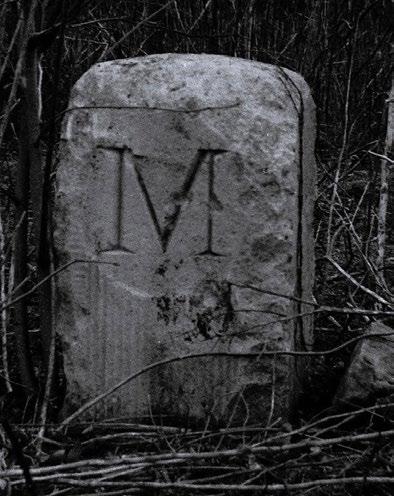
1765. August 1. Charles Mason and Jeremiah Dixon surveyed the Northern border of what will eventually be Washington County, the Mason Dixon Line. They finished the work in April of 1766.
M ason dixon M arker, blairs valley, Clear sprinG historiCal assoCiation
1767. Jacob Funck plans the village of Jerusalem which later becomes Funkstown in 1840.
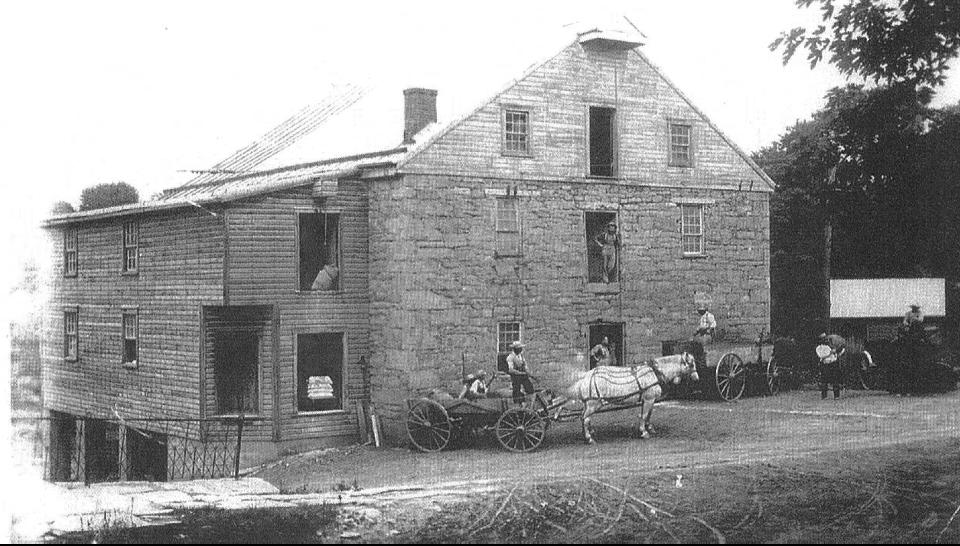
1768. Establishment of Jacob Hess’s grist mill on Little Antietam Creek, which would spawn a small village known as “Hess’s Mill”. (Keedysville)
21 south M ain street, k eedysville, JaCob hess’s oriGinal Mill on little a ntietaM Creek Was replaCed by this larGe stone Mill in the Mid -1800’s. this struCture Was razed in 1953. this loCation is noW the k eedysville post offiCe., toWn of k eedysville
1768. George Ross married Mercy Williams, the eldest daughter of his former neighbor, Joseph Williams. It’s likely that Mercy brought her orphaned younger siblings—Otho, Elie, Cassandra, Priscilla, Sarah, Cynthia, and Emelia—to the marriage and to her home. George and Mercy had two daughters. Source: Sandra Izer
1770. December 25. The Maryland Gazette reported that the owners of Green Spring Furnace Jacques and Johnson, were searching for an escaped enslaved man named Jacob. The article included a detailed description and offered fifty shillings for his return to the Furnace.
Many of the slaves in the colonies came from West Africa, where there was an existing iron industry. The West Africans smelted and forged iron in the same way Europeans did and thus any enslaved West African with iron-working skills was considered more valuable. All of the early iron furnaces and forges in Washington County used extensive slave labor in their operations.
1772. March 18. The deed is recorded for the “union church” in Funkstown. Union churches were common in our area. They were a co-operative venture where one church was shared by two denominations. German Reformed congregation and the Lutheran congregation in shared the space. The price for the building lot was “five shillings current money.” The church was a log church with box pews and was later rebuilt. Source: Brake, Donald. For Five Shillings Current (The story of the Lutheran Church at Funkstown)“ Shippensburg: Beidgel Printing, 1981.
1773. September. Mercy Williams Ross married John Stull of Hagerstown, and the entire family moved from Ross’s Purchase to Stull’s plantation in Millsborogh. When Otho Holland Williams wrote home to his sister Mercy during the war, he mentioned that he hoped to see his warhorse Liberty at home, running through the fields of Millsborogh. Source: Sandra Izer
1774. Committee of Observation formed for Upper Frederick County at Elizabethtown. Christian Orndorff, Jacob Hess’s fatherin-law, is elected representative for the Antietam Hundred.
1774. David Ross placed advertisements in the Maryland Gazette for two land tracts totaling about 530 acres. The ad notes that Ross purchased them at the manor sale, “where Mr. Minor keeps a tavern and where my brother George lived.” It describes a two-story clapboard house with brick chimneys and other outbuildings. The property did not sell. The tavern keeper “Mr Minor” is believed to be John Minor, who, in 1776, married Cassandra Williams, a younger sister of Otho Holland Williams.
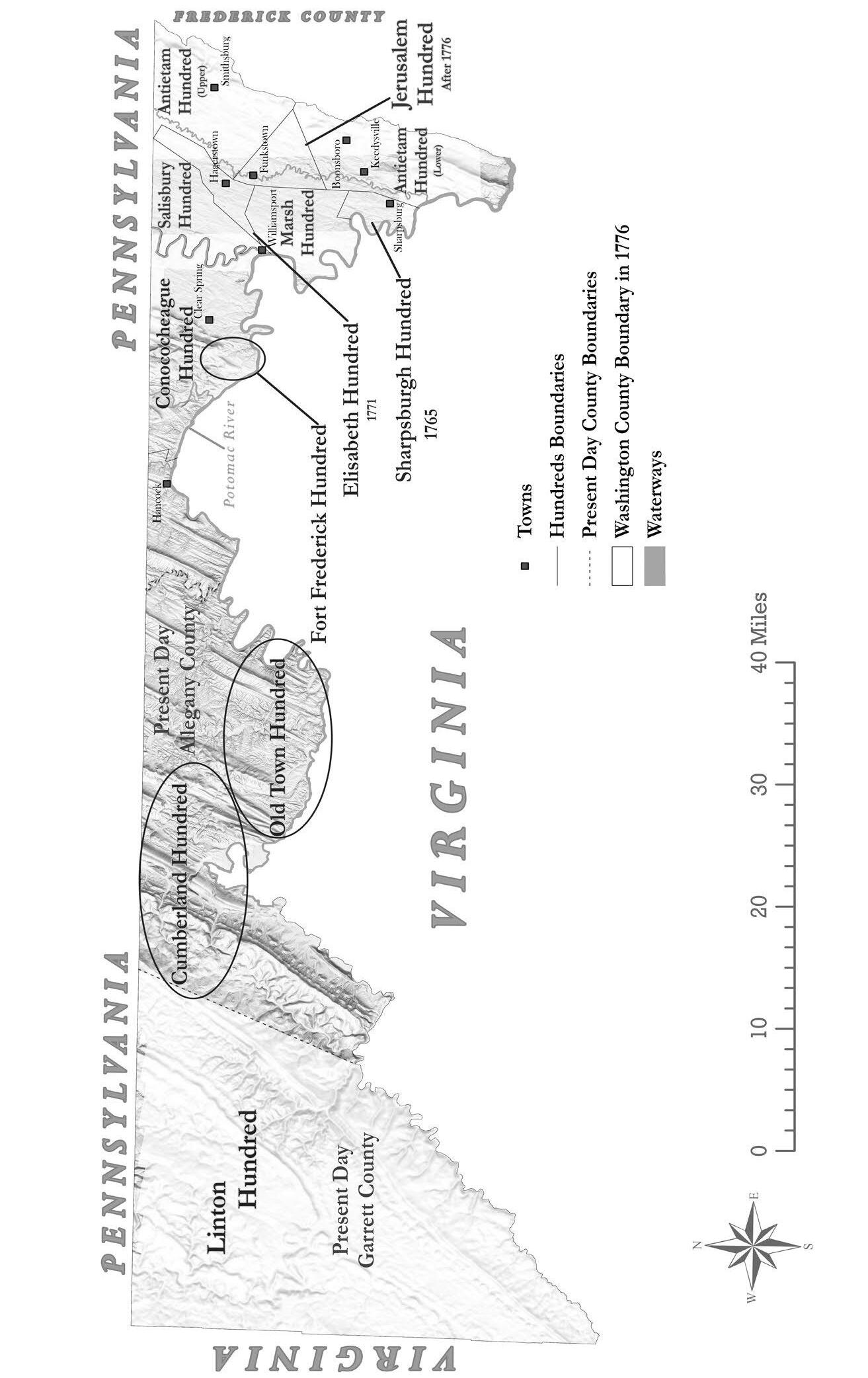
WashinGton County as it existed in 1776, With the 100’s
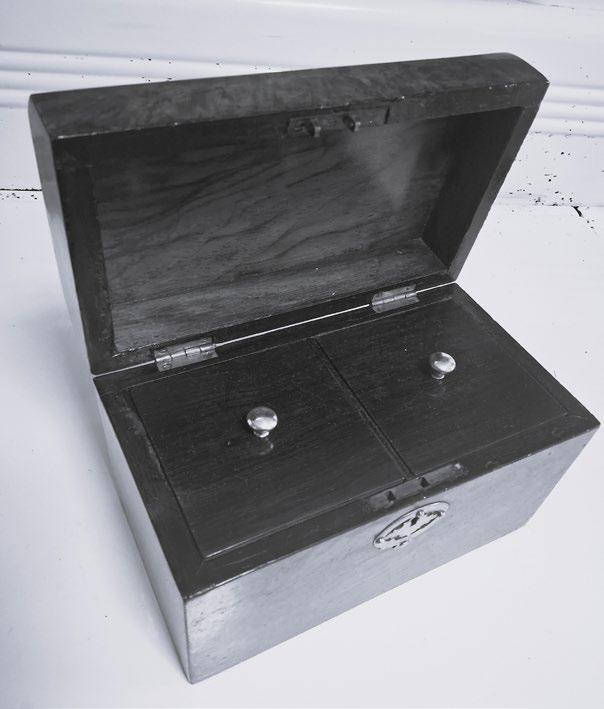
1774. November 26. The Hagerstown Tea Party. When it is discovered that John Parks, who kept a store at “Elizabeth Town”, had illegally sold a chest of banned tea to a fellow citizen of Elizabeth Town he was brought before committee of “the upper part of Frederick county” to be tried for his act of defiance of the total boycott imported tea, which included any tea that was in the Colonies before the law went into effect. John Parks was found guilty “after a mature deliberation”, and the court pronounced after laying out his sentence that they had no further reason to engage in conversation with the man, and advised the crowd at the proceedings to do likewise. The punishment for John Parks was that he was to leave the court and “go with his hat off” (probably so that he was not protected from things pelted at him by the crowd), and then he was to walk with “ lighted torches in each hand, and set fire to the tea, which he accordingly did” while the jeering crowd surrounded him. He was made to stand there until the tea was reduced to ashes. Apparently, the townsfolk thought that the sentence was too lenient, and later “satisfied themselves by breaking down his door and smashing his windows.” Source: The Maryland Gazette, December 22, 1774
a 19th Century tea Chest at pluMb Grove MuseuM, used to hold valuable tea, Clear sprinG historiCal assoCiation
1774. December 8. Maryland Men Ordered to Form Militias. The Provincial Convention of the Revolutionary Government of Maryland orders all men from ages sixteen to fifty years of age must form themselves into companies. Each company is to have 68 men and elect a captain. Additionally, they must elect two lieutenants, an ensign, four sergeants, four corporals, and a drummer, and are expected to do their utmost to make themselves masters of military exercise. Source: The Maryland Gazette, December 8, 1774.
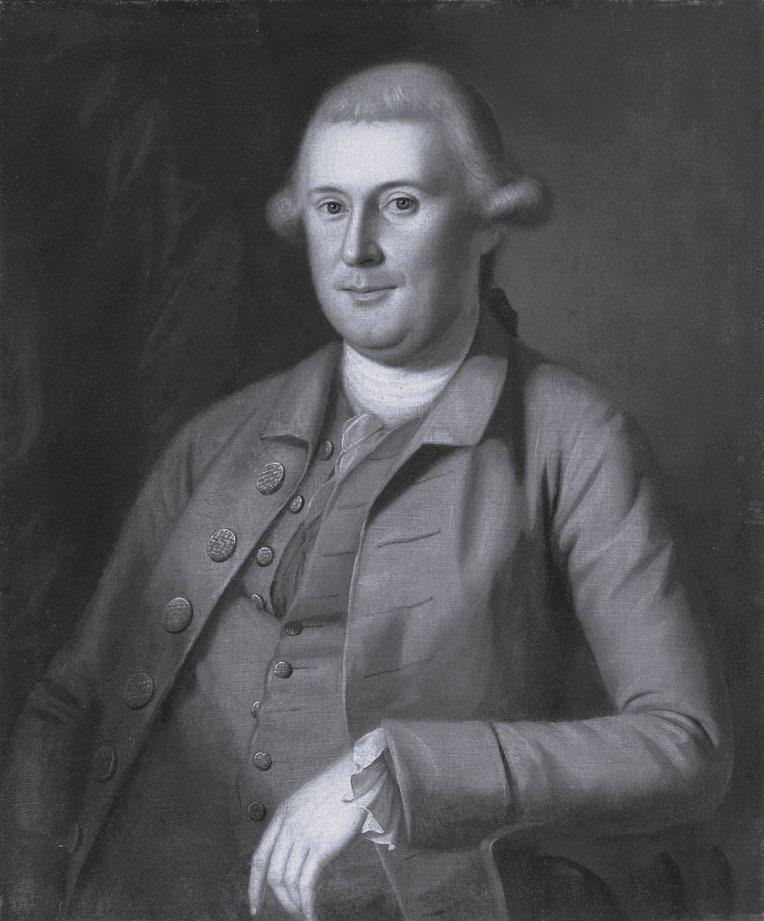
1775. October 27. A renowned American artist, Charles Willson Peale, recorded in his diary “Finished Mr. John Barnes portrait”. John Barnes’s father was Col. Abraham Barnes. John served in the Maryland Assembly in 1777 and 1779. Due to his incurring large debts. Col. Barnes cut his son out of his will and left his estate to his other son, Richard. John Barnes never married and died at his brother’s estate at Clear Spring, known as Montpelier.
John barnes, lived at Montpelier plantation on broadfordinG road one Mile north of Clear sprinG., Clear sprinG historiCal assoCiation
1776. The Fort Frederick Furnace, also known as the Green Spring Furnace run by Denton Jacques and Johnson was seeking another runaway enslaved named Stephen Richards who was described as a convict servant who was hard featured and pitted with the smallpox.
1776. Denton Jacques was requesting in newspaper ads for slave owners to “hire-out” their slaves to him to cut cord wood for the furnace near Fort Frederick. Before this discovery of coal further west local forges and furnaces used charcoal to fire their furnaces. With an axe, slaves had to cut one acre of trees to produce the eight hundred bushels of charcoal needed to operate the furnace for just one day.
1776. January 6. Six months before the Declaration of Independence, the first patriot militia in Hagerstown forms for the Revolutionary War. Washington County was not yet created so it was based in Hagerstown. The men pledged to “march to such places within this province and at such times we shall be commanded.” At the time, the Revolutionary Government in the Maryland Colony was run by the Provincial Convention. This militia was formed six months before the Declaration of Independence. Washington County was formed later that year. It is thought that the creation of Washington and Frederick Counties happened at the same time in 1776, because Frederick County was so large it would be easier to administrate the military enrollment, etc. for the war. Source: Scharf, History of Western Maryland, vol. II, page 1189.
1776. March 10. Journal of the Maryland Convention: We are sorry to inform you that four out of five cannon at Mr. Hughes burst and killed poor Matthews. Mr. Smith is just ret’d. [Mr. George Matthews, who with Capt. Nathaniel Smith were appointed to prove the cannons “furnished by Messrs. Samuel and Daniel Hughes for the use of the Province” on February 27. The Hughes brothers operated the Mt. Etna Furnace, which was in its early years called the Antietam Furnace, being that it was located in the “Antietam Hundred” or district of Frederick County.
Source: Archives of Maryland, Calendar of State Papers: The Red Books. March 10, 1776.
1776. May 7. The Elizabeth Town Committee of Observation interviewed 116 non-enrollees who were refusing to enter into military service. Around forty-five of them were Mennonites. Two days later these non-enrollees were ordered to pay a fine and deliver any firearms they had, except pistols, to the militia captains.
1776. June 27. The war-time government, called the Convention of the Province of Maryland, resolves that an army needs to be raised for Maryland “for the flying camp” needed to fight the British. Each company of the flying camp would consist of 76 privates, one drummer, one fife player, four corporals, one ensign, two lieutenants and one Captain. While most of Maryland’s counties must form only one or two companies, Anne Arundel County was to furnish five, Frederick County was to furnish a whopping nine companies for the flying camp. It is thought that because Frederick County was of such an enormous size, that only a few months later, it was broken up into three counties to ease military administration and recruitment. This resulted in the “Middle District” of the county remaining Frederick County, while the “Lower District” became Montgomery County, and “Upper District” became Washington County.
1776. July 1. (Monday) The Convention of the Province of Maryland votes to advance the necessary funds (not to exceed 2,000 pounds) out of the public treasury “for the encouragement of Daniel and Samuel Hughes to prosecute their cannon foundry with spirit and diligence.” In this case the word prosecute means “to charge” them with the task of producing cannons for the militia.
1776. July 4. The Convention of the Province of Maryland, not yet aware that independence had been declared by the convention in Philadelphia, resolved that by August 5, any persons “bearing arms or employed in the service of Great Britain” and fighting against the independence of the United Colonies, shall after a trial by jury
“suffer death without the benefit of clergy” and the entire estates of those found guilty shall be seized and applied to the use of the colony of Maryland.
1776. August 31. On motion, leave given to bring in an ordinance for the division of Frederick County into three distinct and separate counties. Mr. Wooton reads the proposal to divide Frederick into three counties. It is ordered to “lie on the table” and be picked up again for a vote when the session resumes on September 2. In the Maryland Convention proceedings, it never states clearly why there was a need to divide Frederick County into three. However, it had already been broken up into three districts for the matter of appointing Sheriffs and of impending arrests and seizures of the property of anyone found to be supporting the British crown, that went into effect August 5.
1776. September 6. Washington County was portioned from Frederick County.
“Washington County was organized by the Convention of 1776 and was named after the great leader of the American armies, whose fame was then in the dawn of its brilliancy. Its territory was taken from Frederick County.”
Source: Edwards, Richard. Statistical Gazetteer of the State of Maryland the District of Columbia… etc. Baltimore: J. S. Waters, 1856. Archive.org
1776. September 6. Christian Orndorff’s sons, elected representative for the Antietam Hundred, including son-in-law Jacob Hess, volunteer from Antietam Hundred. While home on furlough, Christian Orndorff III, discovers and exposes a conspiracy to raise a Torry force in western Maryland. Several of the conspirators are hanged in Frederick.
1778. As the War for Independence was raging, Nathaniel Nesbitt of North Mountain was appointed “Collector of Provisions for Washington County”. His family was aware that this appointment would have placed his neck in a noose had the Colonists been defeated. Grandson Otho Nesbitt recorded that his father Jonathan Nesbitt had recollections of provisions being hauled to Fort Frederick to feed the British prisoners. The part of North Mountain where they lived is now called Fairview Mountain.
1782. Brethren Denounce Slavery. At the annual meeting of the Church of the Brethren, a motion was made denouncing “the un-Christian negro slave trade, and members were not permitted to purchase or keep slaves.” Source: Wallace, Edith B. Reclaiming Forgotten History: Preserving Rural African American Culture. (Master’s Thesis). Goucher College, 2003. Copy in the Western Maryland Room of the Washington County Free library.
1782. June 20. The Maryland Gazette announces that “the laying off and clearing of a road” will soon begin on a road that will run from Elizabeth Town (Hagerstown) through “Charlton’s Gap in the South Mountain” until it intersects with a road in Frederick County that runs from Frederick Town to York Town in Pennsylvania. Charlton’s Gap is the road that leads up to Wolfsville, Md., and connects over to Thurmont. It is now called Harman’s Gap. Source: the Maryland Gazette, June 20, 1782.
Expansion and Reform
(1783-1860)
1783. There was a three-pound reward offered in the newspaper for a fifty-year-old negro named Charles Gamby who escaped from the forge at Parkhead, located in the Fort Frederick area. Gamby had a “remarkable long head, and was remarkable for lying, and had a deceitful tongue, being a very artful villain”, stated the newspaper. Before the 13th Amendment in December 1865, apprenticeships for learning a trade or domestic work were a form of enslavement called indentured servitude. A person was legally bound to serve a master for seven years and was then free. Running away was a serious punishable offense.
1783. Bartholomew Booth was an Oxford educated pioneer in American education. He was an ordained Anglican priest and offered a wide curriculum broadly following the educational philosophy of Ben Franklin. The Patriot leadership pressured him to develop academies on the frontier. About 1783 he chose a site on the Antietam Creek at Devil’s Back Bone, at the stone bridge, for the new De le mere Academy. It operated for about 10 years and launched other educational careers while advancing Franklin’s theory of instruction. Prestigious parents sent their sons to Booth with “Delemere” becoming the first educational institution in Washington County, Maryland.
1785. January 15. The first Washington County Courthouse was authorized by the General Assembly to be paid by fees imposed on residents, by the County’s justices. It was located on the public square of Hagerstown.
1786. January 25. Ariana, David Horiato, and Archibald Ross, heirs of Dr. David Ross’s estate, sold Rosses Purchase, 528.75 acres, to Denton Jacques for 15 tons of pig iron, 15 tons of bar iron, plus 5 shillings. The unusual terms of the sale were intended to comply with the stipulations in David Ross’s will that his property be sold in iron. Denton Jacques was an executor of Ross’s estate. This deed paved the way for the sale of the same lands to Otho Holland Williams.
1786. April 25 (occurred) April 26 (recorded). Cruel and Unusual Punishments…Dr. Christian Boerstler of Funkstown attends court in Hagerstown on April 25, 1786 and records in his diary the next day (April 26) that a man who had killed someone in a quarrel was punished by having an “M” branded on his head with a hot iron. A blasphemer’s punishment in that same court session was to have a hole bored through his tongue. Maryland at the time was still operating under the Colonial system of Justice. The U.S. Constitution which prohibits cruel and unusual punishment, was drafted the following year, 1787. Source: Five Shillings Current.
1786. June. General Otho Holland Williams purchased land at Conococheague from the Ross and Cresap families and established a port town on the Potomac River. Williams and his brother Elie leased the fields and meadows of Springfield to local farmers, aiming to develop it into a “pleasant & profitable” working plantation. They likely continued renting the house as a tavern.
1786. November 6. The Maryland General Assembly passed an act establishing the town of Williams-Port. This legislative act was both unusual and important. Williams-Port and the town of Cumberland, which was also created shortly thereafter by a similar legislative act, are the only two towns in colonial Maryland established by legislation. Both towns were instructed to plan main streets 80 feet wide and side streets 60 feet wide. These acts resulted in two port towns on the Potomac River, reinforcing Maryland’s role as an active participant and financial benefactor in the westward expansion led by the Potomack Company.
There is no evidence of who lived or worked on the Springfield farm from 1778 until it was purchased by Otho Holland Williams in 1786. After 1774, when Mercy Williams Ross Stull left the farm, the house at Ross’s Purchase served as a colonial tavern under Mr. Minor’s management. At some point, John Minor and his wife, Cassandra Williams, moved to Pennsylvania or Ohio. It is reasonable that the house continued as a colonial tavern until it was purchased by Williams in 1786. Source: Sandra Izer
1786. December 3. Denton Jacques finalized the sale of 528.75 acres of Ross’s Purchase to Gen. Otho Holland Williams for £2900, or about £5.48 per acre. This is a high price; however, had Maryland not been flooded with excessive confiscated property offered for sale, the cost would most likely have been significantly higher.
Otho Holland Williams patented all his lands at Conococheague into one tract he named The Garden of Eden. His town was surveyed on the part adjoining the river at Conococheague Creek,
and the remainder was the Garden of Eden/Springfield Farm. Source: Sandra Izer
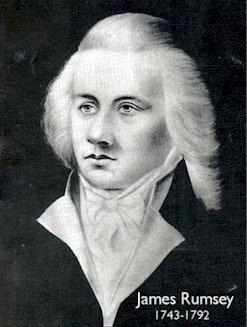
1787. December 3. James Rumsey successfully pilots his steamboat on the Potomac River at Shepherdstown. This steamboat operation was successful a full 20 years before Robert Fulton’s famous maiden voyage of the Clermont on the Hudson River in New York. James Rumsey’s design featured the paddlewheel at the bow of the boat, so it would pull the boat up the river. Components for the steam engine were made at the Antietam Iron Works, located three miles down the Potomac from Sharpsburg. Since the Potomac River is part of Washington County, we can claim that the steamboat made its debut here. Source: Lee and Barbara Barron. The History of Sharpsburg, Maryland. Privately printed. 1972.
1788. May 10. Three children of Peter Newcomer of Beaver Creek are inoculated against smallpox by Dr. Christian Boerstler, as recorded in his journal. The process at the time involved “variolation”, primitive, but effective, whereby a physician used dried scab material from a pox blister inserted into a small cut in the skin, triggering a mild case of pox. The inoculation procedure had been in use for decades, but many people objected to the procedure because there was no guidance about it in the Bible. Nearly three quarters of all children who got smallpox died. The adult ratio was
JaMes ruMsey, Clear sprinG historiCal assoCiation
one in six fatalities. Source: Perini, Luigi. History of Beaver Creek. 2004.
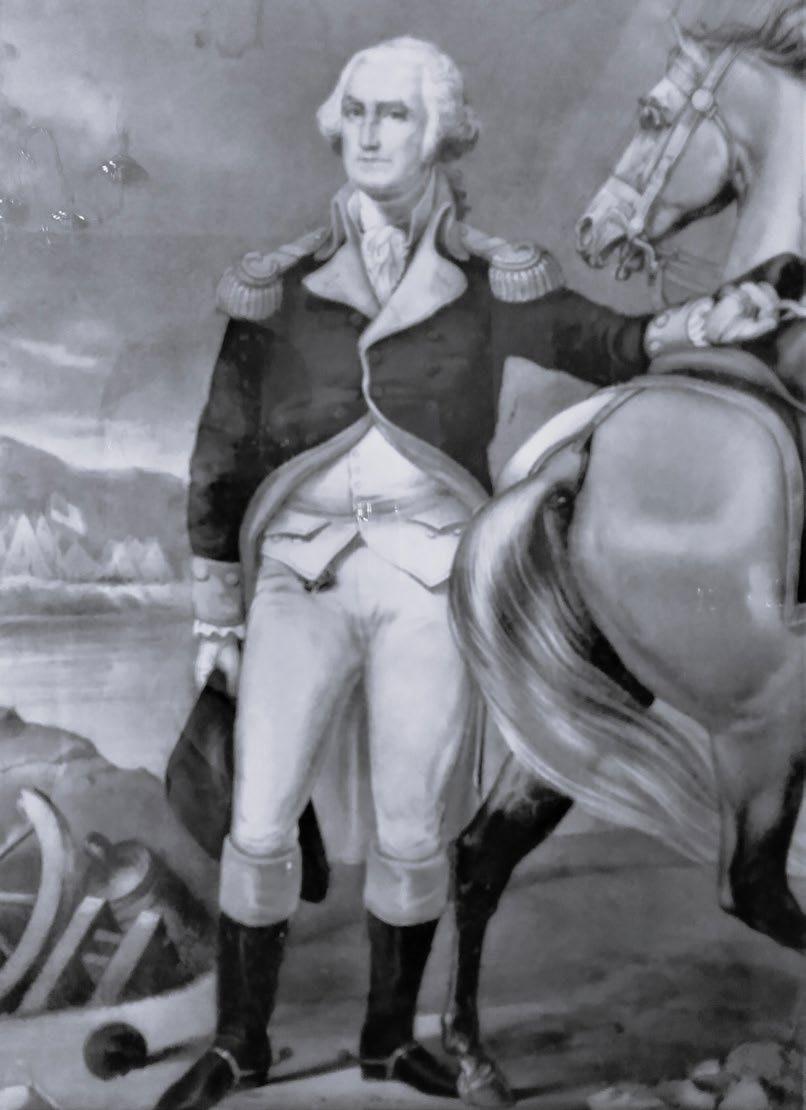
1789. When George Washington became President of the United States of America in 1789, he looked at the area between Sharpsburg and Shepherdstown (Virginia) as a possible site for the permanent location of the U.S. Capital. It would have occupied both sides of the Potomac River in the same manner as the site that was eventually chosen by Congress further down the river at Georgetown and closer to his home at Mount Vernon.
1789. July 7. A contract with the devil was broken through a rite of exorcism at St. Paul’s (Beard’s Church) on Old Forge Road. Thomas Solvan had made a pact with the devil who gave him a silver coin, that if spent for wicked pursuits always returned to his pocket, but disappeared from his pocket if he planned to purchase something useful or good. The devil gave him 18 years before he would collect Solvan’s soul. He appealed to the minister of Beard’s Church and Johann Hehl and Georg Schroeder performed an exorcism by prayer. The appointed hour passed and the devil never came to collect Thomas Solvan’s soul. Source: Smithsburg Historical Society Ghost Files
1790. April. Stewart Herbert, JR. began printing Elizabethtown Washington Spy, the first newspaper west of the Blue Ridge Mountains.
1790. October 21. There are many glorified accounts of George Washington’s visit to Williamsport in October of 1790; most tell how he was lavishly entertained at Otho Holland Williams’ estate of Springfield Farm by Elie Williams, where he spent the night before touring the town the following morning. Sadly, none of these accounts are true.
News reporters followed the President’s movements, eager to report any preferences for the new National Capital he might inadvertently disclose. George Washington’s inspection of the three
final sites began with an inspection of the Eastern Branch site, followed by a brief stopover in Frederick, finally arriving in Hager ’s Town on October 21, 1790. After much fanfare, speech-making, dining, and toasting, the President spent the night at Beltzhoovers’ Globe Tavern on W. Washington Street. The following morning the cavalcade rode south into Williamsport, where Elie Williams met them for a tour of the town.
Whether George Washington ever considered a site other than across the river from Mt. Vernon is debatable. Most scholars agree Washington announced and viewed the different locations along the Potomac River to con-fuse land speculators.
Why didn’t the President stay in Williamsport? Quite simply, because there was virtually nothing there. In October 1790, the town was just three years old. Source: Sandra Izer
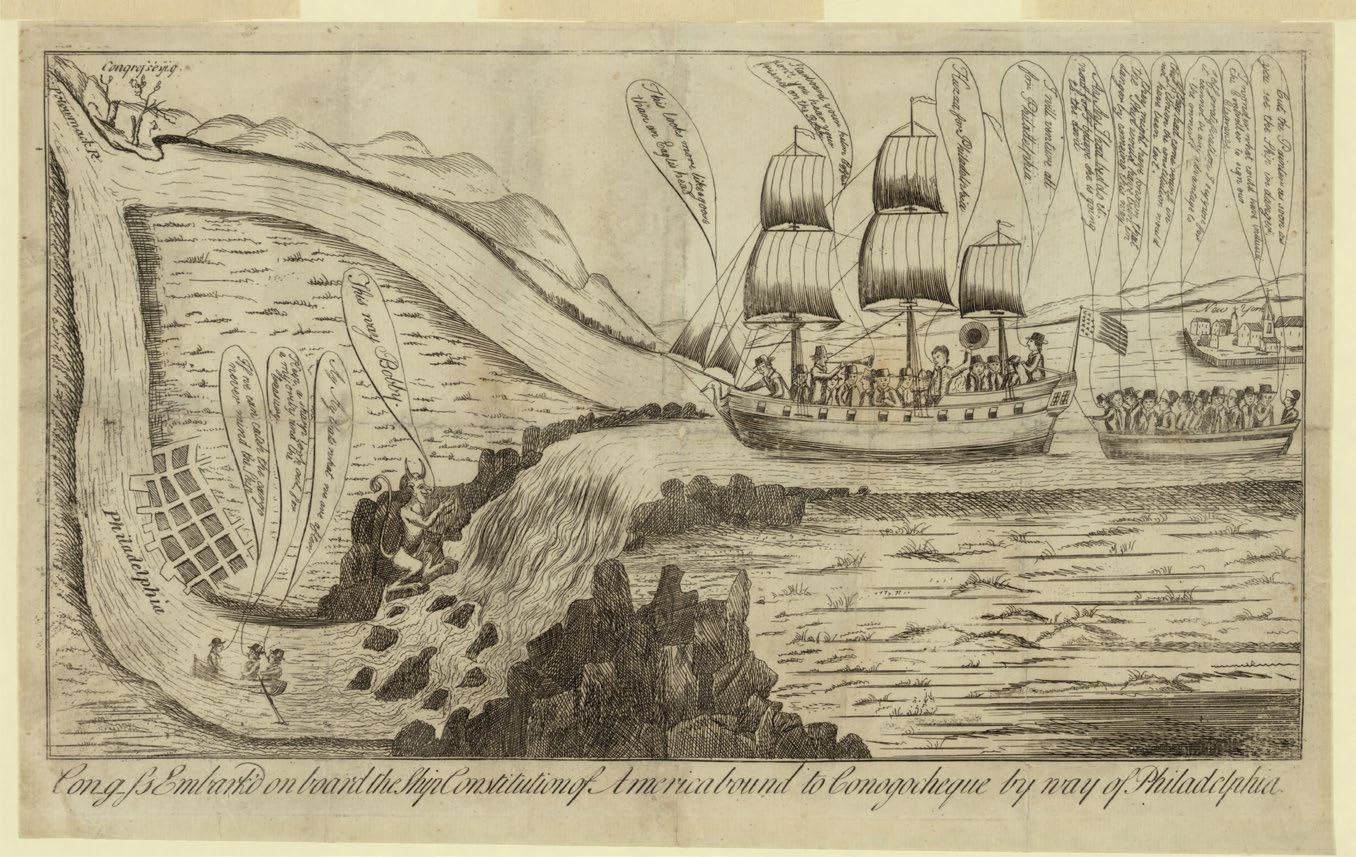
Con- G -ss eMbark’d on board the ship Constitution of a MeriCa bound to ConoGoCheque by Way of philadelphia, 1790 loC.Gov 1792. George and William Boone found Boonsborough. The Town was called Margaretsville for a time which was the name of George Boone’s wife. Later when incorporated in 1831 it would be called Boonsboro.
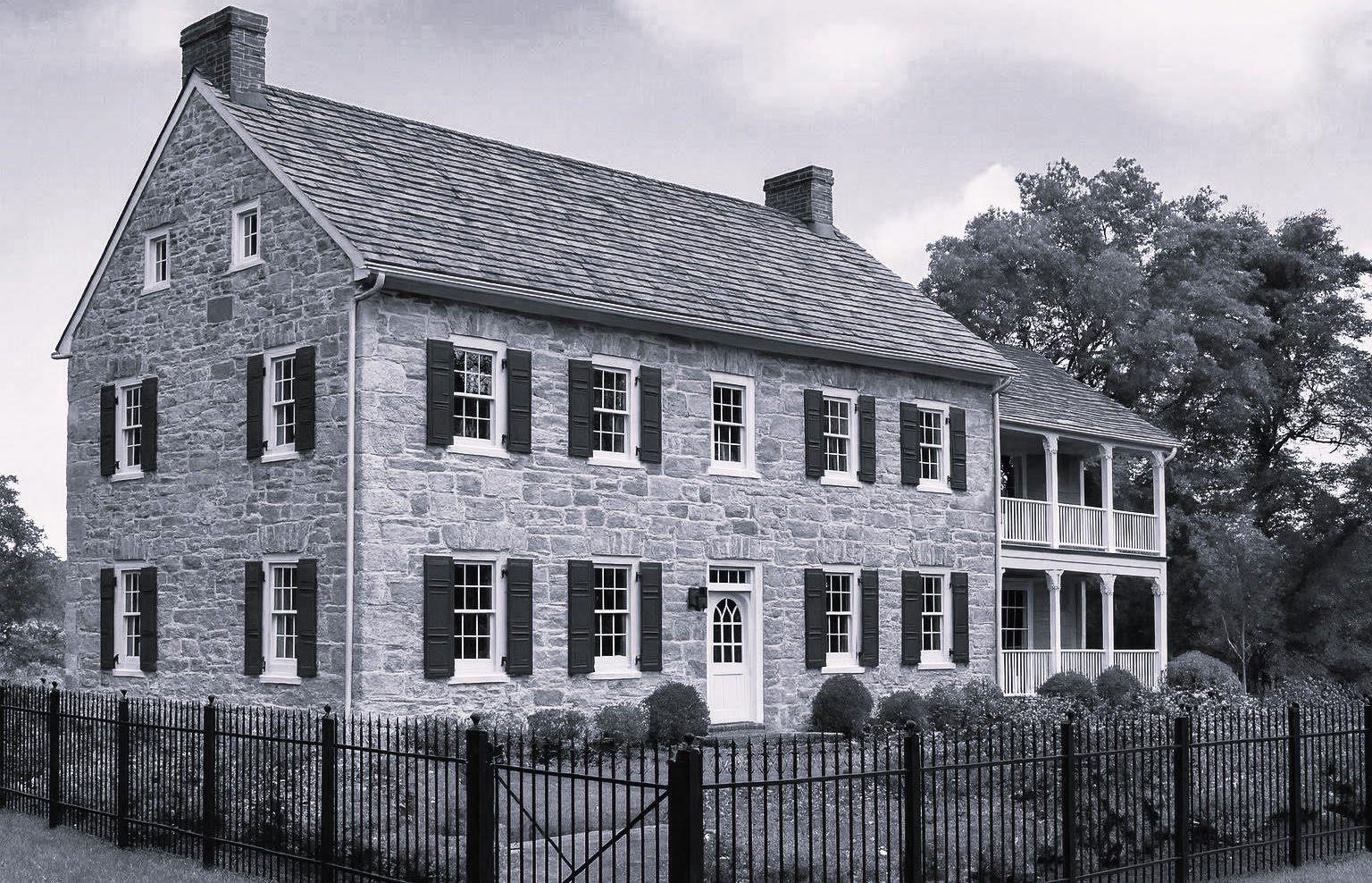
1792. March 1. Washington County Revolutionary War soldier Peter Brewer began construction on his stone house located west of the Conococheague and east of North Mountain.
breWer house, illustration by toM freeMan
1792. December 7. James Owens was found guilty of “willful felony” and as punishment, the sheriff was directed to immediately burn him (brand him with a red-hot iron) on the left hand. As Owens, a white man, could not pay the court costs, he was “to be sold at public sale for a term not exceeding two years.” This seems to be another remnant of the British Colonial justice system, where indentured servitude was common for working off debt. He was purchased by Molly Lodderskin for “nine shillings current money.”
1792. December 12. The Negro Kitty age four, with the consent of her mother the Negro Tobitha, is bound to Daniel Hughes until the age of 16. Hughes is one of the owners of the Mt. Aetna Furnace and Old Forge iron works. Hughes was to “provide for her in such manner and to learn her such business as is customary for girls to learnt and to allow her the customary freedoms.” In the same court, Tobitha is petitioning the court that Hughes promised to give her, her freedom some time ago. Sources: Sword, Gerald. Minutes and Proceedings of Washington County Court Held in Elizabeth Town 1776-1810. 1983. from Wash. Co. Free Library genealogy section.
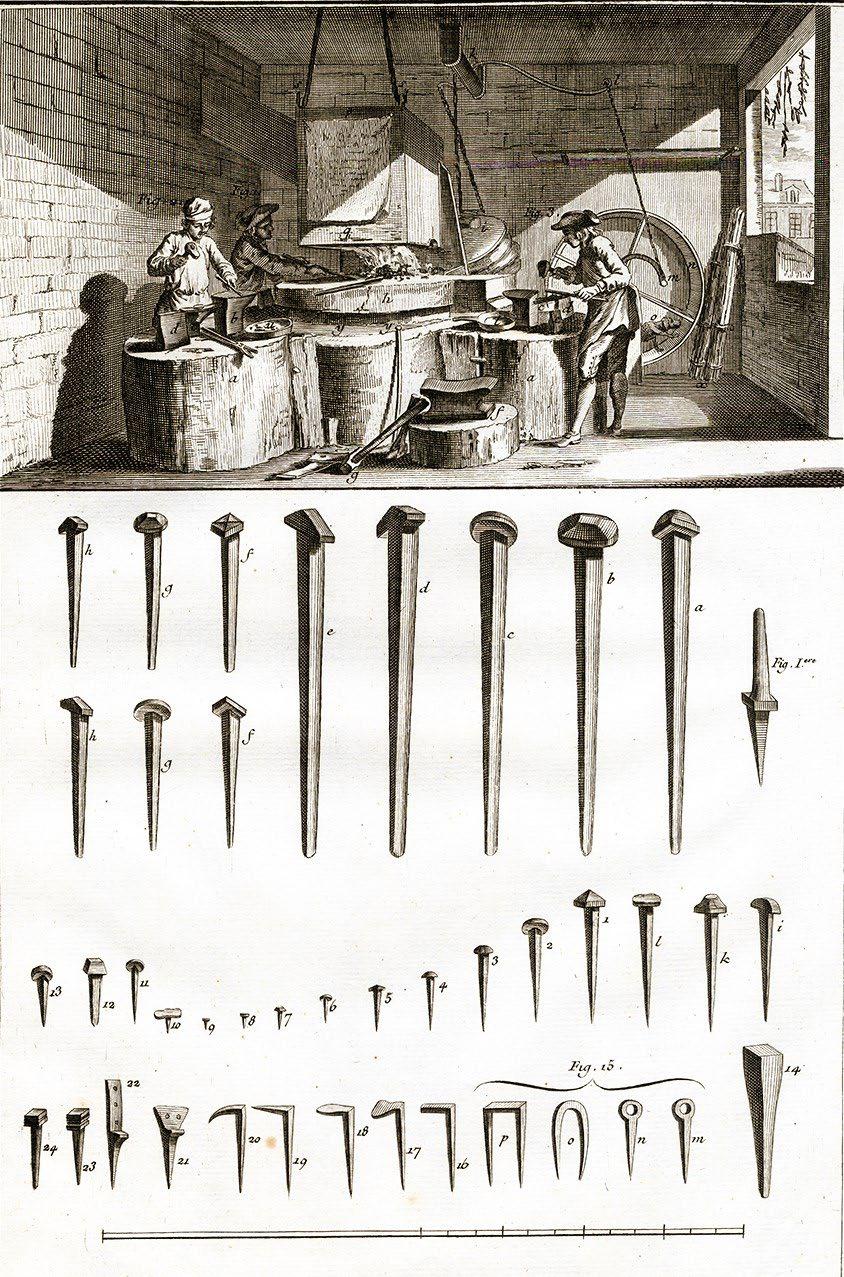
1792. December 12. Negro George age 5, is bound to Daniel Hughes, the co-owner of Old Forge and Mt Aetna Furnace. He is to be trained as a nailor (the maker of nails). In addition to lodging, food and clothing, the enslaved George is to be taught to read. George is the sister of Kitty, also bound, and their mother is Tobitha. Although it was discouraged it was actually not illegal for African Americans to be taught to read in Maryland as this court document shows. Sources: Sword, Gerald. Minutes and Proceedings of Washington County Court Held in Elizabeth Town 17761810. 1983. from Wash. Co. Free Library genealogy section.
at Work With nail types; Clear sprinG historiCal assoCiation
nailor
1793. October 3. An epidemic of yellow fever that came in through the port of Philadelphia spreads in America. It is thought that French colonists fleeing the revolution in Santo Domingo brought it with them. The seat of the U.S. Government was in Philadelphia at the time.
The Citizens of Hagerstown, at a meeting led by Col. Henry Shryock, made the following resolution: “That no citizen of this town shall receive into his house any person coming from Philadelphia or other place, supposed to be infected with that contagious fever now raging in Philadelphia, until such person produces a certificate from some one of the health officers.”
The health officers included Peter Waltz, Samuel Young, Richard Pindell, and Jacob Schnebly. The quarantine included notifying people on the health committee of any person from Philadelphia known to be traveling through Hagerstown. At the time, it was not known that yellow fever was a viral disease spread by mosquitoes.
Earlier in September, a proclamation of the Governor of Maryland empowered local authorities to enact such measures necessary to halt the approach of the yellow fever into their community. One of the more interesting restrictions imposed on Hagerstown residents was to make sure that “the clothing from Philadelphia lent forward to the troops now in this place, shall not be received in this town or suffered to come within seven miles thereof”—this was the time of the Whiskey Rebellion, which was finally ended the next year by George Washington.
Additionally, patrols were established on all roads and mountain passes to guard against “that calamitous disorder which is at this time depopulating the city of Philadelphia.”
Source: The Western Repository of Knowledge, Carlisle, PA, October 16, 1793
1793. December. Henry Colling, “a negro boy judged by the court to be 10 years of age” is bound to Nathaniel Rochester “to learn the trade and occupation of a nailor.” Rochester is to teach Henry to read, and provide him with “meat, drink, washing, and lodging” until his apprenticeship was completed. Other slave owners who had African-American males bound to apprenticeship at this time in Washington County were also told by the courts to teach indentured servants to read. Rochester owned a nail factory at this time in Hagerstown. Sources: Sword, Gerald. Minutes and Proceedings of Washington County Court Held in Elizabeth Town 1776-1810. 1983. from Wash. Co. Free Library genealogy section.
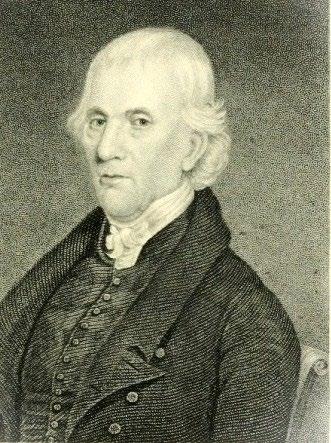
nathaniel roChester froM 1880’s history of roChester neW york, sMithsburG historiCal soCiety
1794. Whiskey Rebellion insurrectionists erected at the Market House in the town square a Liberty Pole (a tall flagpole which were later used locally in the Civil War to express Union allegiance), which was cut down at night. A poster then appeared at the Market House (the town hall was upstairs in this building built over the crossroads) naming the men who took down the flagpole and commanding them to erect another one or they will surely be put
up the threatening poster (written in German). The reward was to be paid “upon conviction.” Source: Scharf, History of Western Maryland. Page 1069. Scharf says this is in the Washington Spy, so the date should be looked up.
1794. October 13. (Tuesday) George Washington, having just spent the night in Williamsport, Md. Breakfasts about 12 miles west before going onwards to Cumberland to meet up with armed forces there for the Whiskey Rebellion, according to his daily journal entry. Although it is not proven, he most likely stopped at the Green Spring Furnace as he knew the owners. Source: Library of Congress, George Washington Journals
1795. June 14. The tickets for a lottery to raise funds to erect an Episcopal Church for the congregation at Elizabeth Town [Hagerstown] go on sale. Tickets were two dollars each, with 2,000 tickets sold. Three thousand dollars was given in prizes, and $800 in profits was realized. The lottery managers were Daniel Hughes, Thomas Hart, Elie Williams, Henry Schryock, Frederick Rohrer, Alexander Claggett and Michael Fackler. Source: Scharf, History of Western Maryland page 1079.
1796. December 12. Joseph Clarke, the keeper of an ordinary (an inn) was charged with “permitting the playing of cards in his house on the Sabbath sometime in the summer of 1796.” Sources: Sword, Gerald. Minutes and Proceedings of Washington County Court Held in Elizabeth Town 1776-1810. 1983. from Wash. Co. Free Library genealogy section.
1797. January 1. President George Washington was about to return to Mt. Vernon when John Gruber began publishing the Hagerstown Almanac in 1797.
1797. July 4. “a number of citizens, and the Washington Blues, Capt. J. Schnebly, met at Mr. Hager’s, at Fountain Inn. After the usual celebrations evolutions they proceeded to Mr. Smith’s tavern to dinner, where a number of toasts were drunk.” [this must be a
newspaper account but Scharf doesn’t attribute it properly. Hager is, I believe, the OTHER Jonathan Hager, not the town founder. ] Source: Scharf, History of Western Maryland, page 1069.
1799. (through 1870), John Russel was the 13th bishop of the United Brethren in Christ denomination. He expanded the UBC into western states and promoted the opposition to slavery. He founded a seminary operating out of his house in Keedysville.
1799. “The Washington County Almshouse in Hagerstown was originally built in 1799 on Locust Street, Hagerstown. The Maryland Assembly in 1768 made provision for “poorhouses” in five counties. Bids for a brick “poorhouse” were advertised March 28, 1799 in the Hagerstown Herald and Elizabeth-Town Advertiser. Life at the Almshouse was hard, the trustees compelled the poor to work. In its early years many aged Revolutionary War veterans lived there. Over the years the almshouse was underfunded and overcrowded, charged with taking in “any rogues, vagrants, vagabonds, beggars and other idle dissolute and disorderly persons,” including the mentally ill. In 1830 Christopher Smith, the founder of Smithsburg, died here. In 1880 Bellevue, an “insane asylum” was built outside of town, on land that is now the Western Maryland Hospital Center.” Source: Western Maryland’s Historical Library (WHILBR.org)
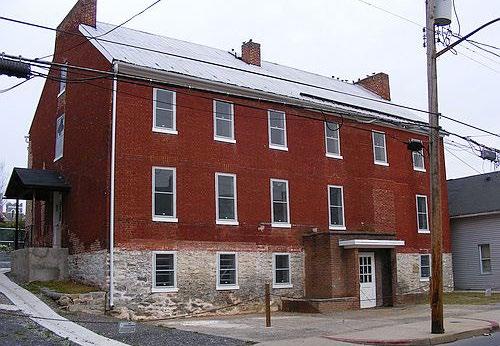
WashinGton County a lMshouse, loCust street, WashinGton County historiCal trust
1799. January 12. John Brandt, “a native of Germany” and gunsmith by trade, residing in Funkstown was naturalized as a U.S. citizen at the Washington County Courthouse. Sources: Sword, Gerald. Minutes and Proceedings of Washington County Court Held in Elizabeth Town 1776-1810. 1983. from Wash. Co. Free Library genealogy section.
1800. January 15. The citizens of Hagerstown meet to figure out how to pay tribute to the recently deceased President George Washington. They decided upon having a large ceremonial funeral procession through town to be held on January 24th, 1800.
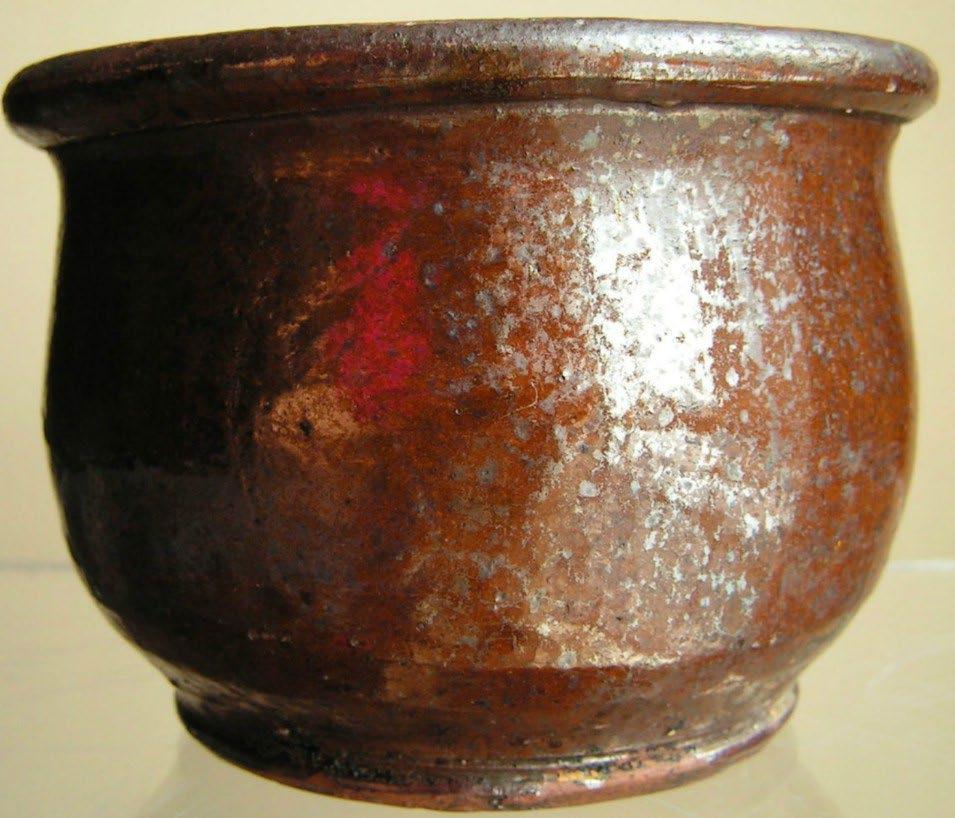
1800. April 20. John B. Bell, of Bell family pottery, was born in Hagerstown, Maryland. He worked as an apprentice of his father Peter Bell eventually moving to Waynesboro, PA and operating a pottery business there for nearly 50 years. Today his inexpensive “every day ware” brings high prices at auctions.
1801. The post office was established in Boonsboro, and Peter Conn, the proprietor of the newly constructed Eagle Hotel, became the first postmaster.
1801. March 14. Robert Johnson and his wife Mary sold to James Ford the Fort Frederick Farm for 500 pounds. Originally built for the French and Indian War, Fort Frederick became a prison for captured British soldiers in the Revolution. However, by 1790 it was declared obsolete and sold as surplus property. The property was used as a farm and the ground inside the fort was used as a walled garden. It contained an orchard and was suitable as a shield for tender vegetable crops in harsh weather. It continued to be a farm for over a century. Source: Sword, Gerald. Minutes & Proceedings
nathan WilliaMs’ barn at fort frederiCk built in the northWest Corner of the fort, Clear sprinG historiCal assoCiation
1802. February 17. The county orders the creation of a county seal and the purchase of a screw press for affixing the wax seal onto documents. The county seal’s device (or design) “is a scale, the plow, three sheafs of wheat and Washington County Maryland around the margin.” Sources: Sword, Gerald. Minutes and Proceedings of Washington County Court Held in Elizabeth Town 1776-1810. 1983. from Wash. Co. Free Library genealogy section.
1803. Tax records show the Town of Boonsborough contained twenty four houses growing from five taxable buildings in 1796.
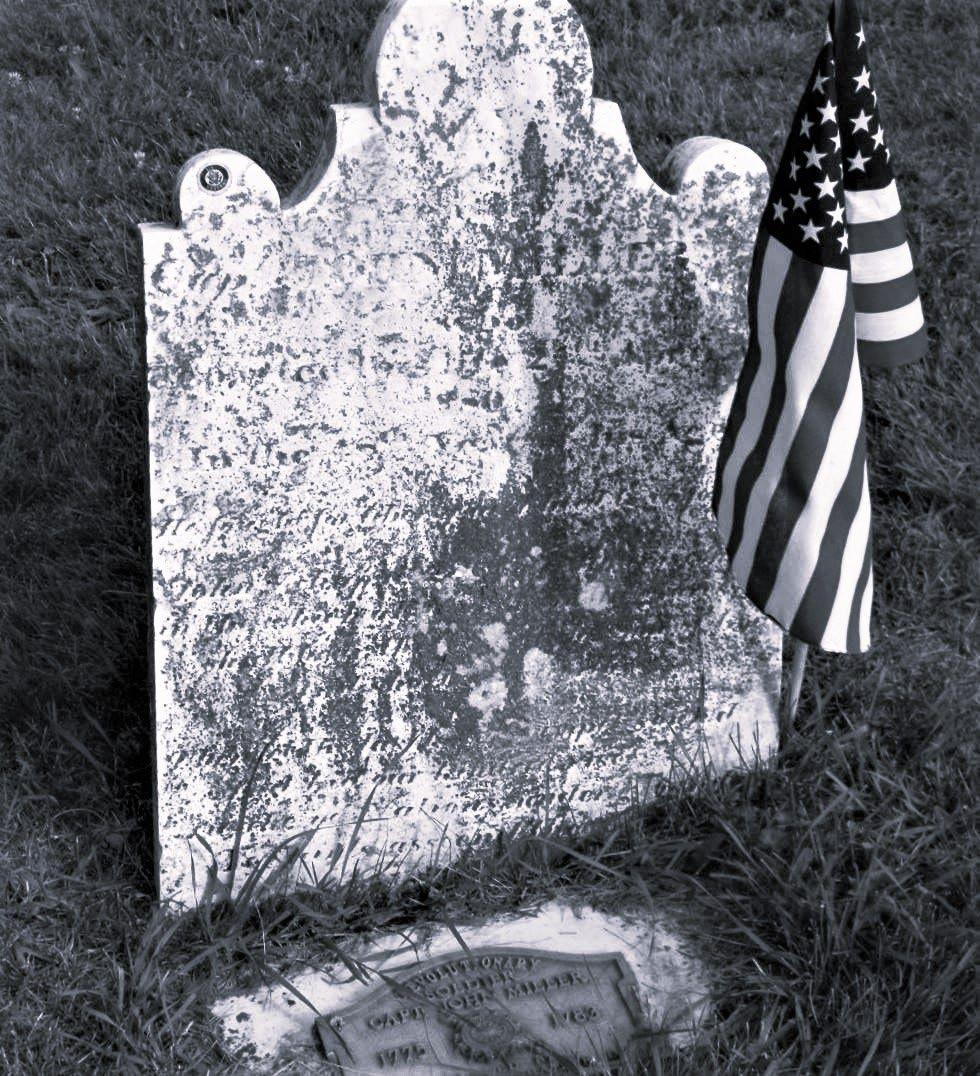
1804. Captain John Miller died. He was buried at St. Paul’s graveyard near Clear Spring. Capt. Miller served in the American Revolution. His tombstone epitaph reads, “He fought for liberty and lived to enjoy it.”
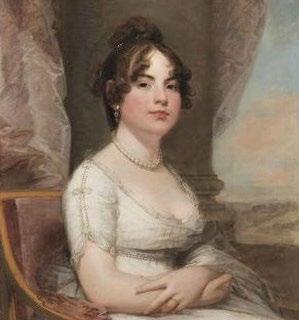
1804. American artist Gilbert Stuart best known for his portrait of George Washington on the dollar bill, painted Mrs. John Thomson Mason who resided at Montpelier located at Clear Spring. Elizabeth Beltzhoover Mason was married to John Thomson Mason. While living at Montpelier her husband twice declined the office of United States Attorney General when it was offered by Presidents Thomas Jefferson and James Madison.
Captain Millers Gravestone, Clear sprinG historiCal assoCiation
Mrs. John thoMson M ason portrait by Gilbert stuart, Clear sprinG historiCal assoCiation
1807. January 3. An act of the Maryland Legislature authorizes a public road from Greencastle “near Peter Baker’s to run through Charlton’s Gap at the foot of South Mountain near Robert Hughes.” This road provided the northeast section of Washington County with a shorter route across the mountains to Frederick, Westminster, Baltimore and Georgetown, DC. Previously, residents had to go up into Pennsylvania or down to Boonsboro to cross South Mountain. This road directly contributed to the founding of both Leitersburg and Smithsburg and was originally called The Georgetown Road on some deeds.
1808. March 29. William Lewis was appointed the crier of Washington County. Samuel Baker, the previous county crier, died creating the vacancy. The Crier was responsible for reporting the news of the court (and city) to the county before the widespread advent of newspapers. Sources: Sword, Gerald. Minutes and Proceedings of Washington County Court Held in Elizabeth Town 1776-1810. 1983. from Wash. Co. Free Library genealogy section.
1808. June 2. “To Be Sold…. A Valuable Plantation, Called Shadrach’s Lot, alias the Cave Land.” reads the ad posted in a Hagerstown paper. Consisting of 262 acres “about 8 miles from Hagers-Town” this property of the late Henry Charlton consists of 100 acres of cleared land, a good square log dwelling house and a barn, a spring of “excellent water” and an orchard. This first auction fails to find a buyer, and in March of 1809 it fails to find a buyer. Eventually it will be bought in 1813 by Christophel Smith, a veteran of the Revolutionary War, who divides the land into town lots, and calls the place “Smith Burgh”. Source: The Hagerstown Herald and Weekly Advertiser, June 2, 1808.
1808. November 1. Frederick Fechtig, from Wertenburgh, Germany, is naturalized. At the ceremony he stated, “I arrived in the United States in the year 1805. I immigrated from the place of my birth and intend settling in Washington County.” His signed statement was in German. Sources: Sword, Gerald. Minutes and Proceedings of Washington County Court Held in Elizabeth Town 1776-1810. 1983. from Wash. Co. Free Library genealogy section.
1810. An all-weather road, a highway that connects Boonsboro to Baltimore, was completed bringing rapid growth and prosperity to the area. The National Pike passed down Main Street. Many businesses were established to service the flourishing traffic. The population almost doubled as a result.
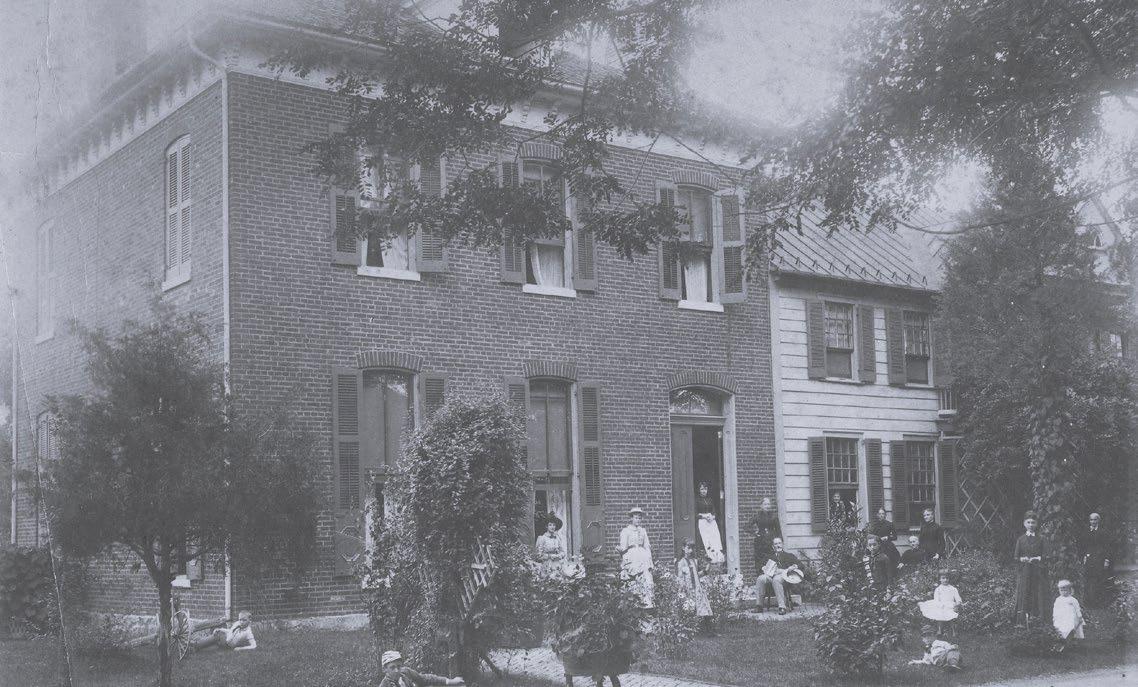
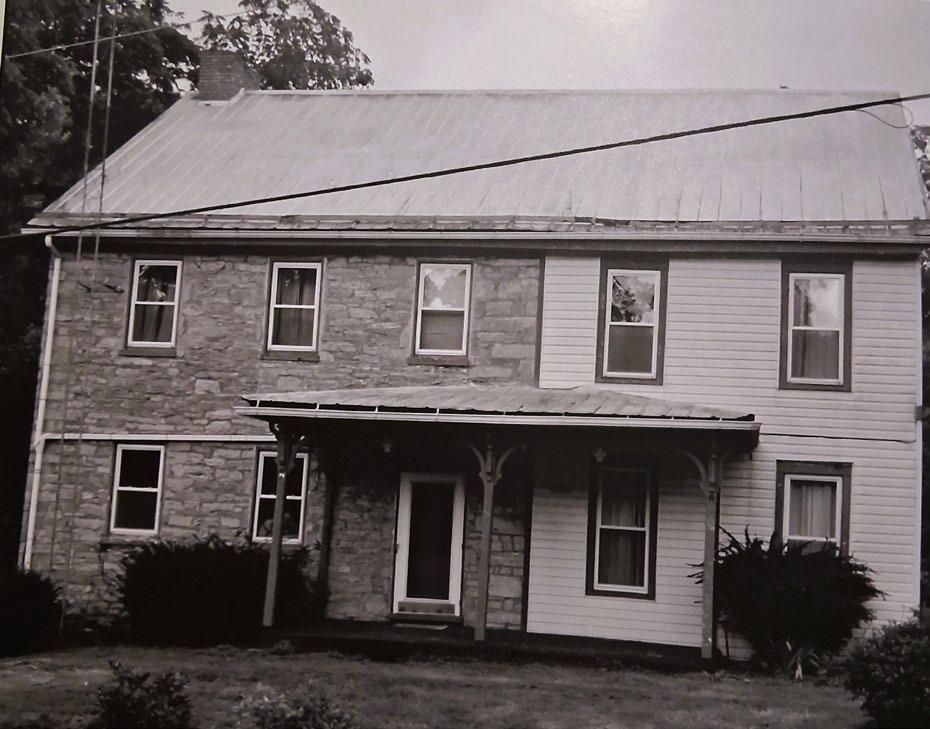
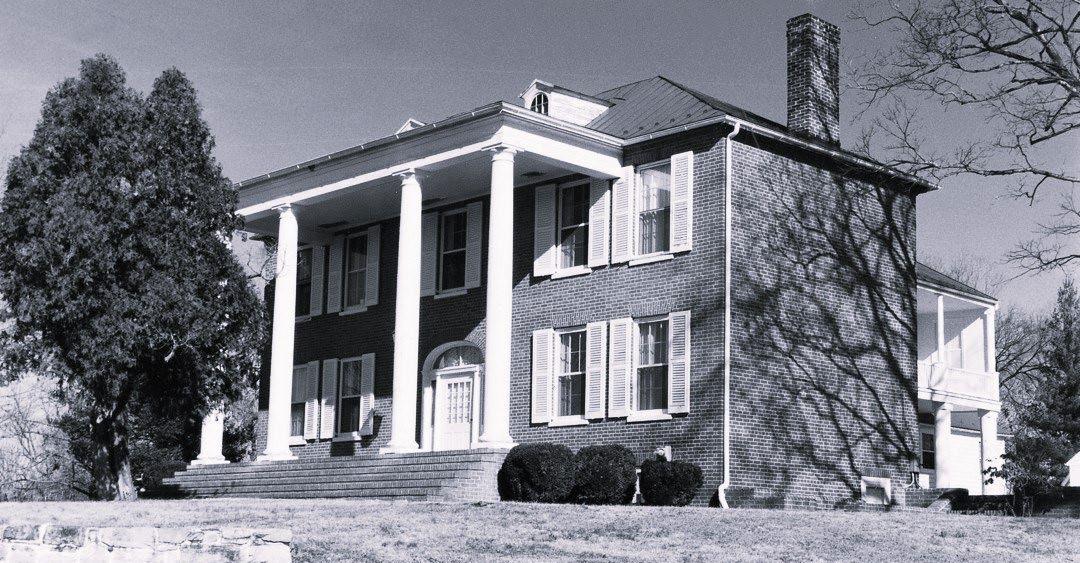
1810. Edward Greene Williams inherited the Springfield farm and most of the town of Williams-Port. He moved there in 1814 and continued improving the plantation. The stone springhouse and servants’ quarters/stillhouse were likely built during this period. Williams married in 1821 and added two wings to the house in 1822.
Springfield remained in the Williams family until 1864, when it was sold to the Hummrickhouse family.
Charles Hummrickhouse removed the south wing of the house and replaced it with a large two-story Victorian addition around 1879. After nearly ninety years of ownership, the Hummrickhouse family sold the farm in 1948 to the Kretsinger family. Under the Kretsingers’ ownership, the farm was significantly reduced in size, and the stillhouse was sold and converted into a residence.
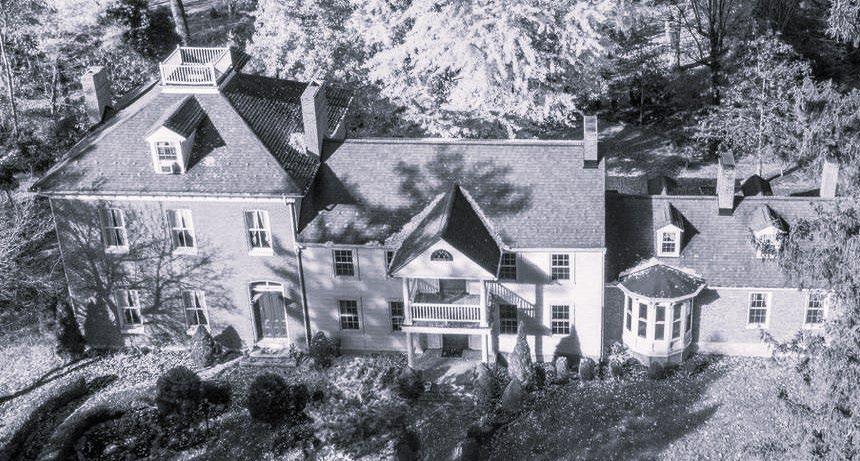
sprinGfield far M house, sandra izer
1810. March 27. Printed copies of “An Oration, delivered at Sharpsburg, on the twenty-second of February, in Commemoration of Washington’s Birthday, before the Company of Washington Greens, Commanded by Captain George Smith” delivered by Gabriel Nourse, and printed by William Brown, are available at the office of the Hagerstown Gazette. The oration contains “a summary, though comprehensive view of the Public, Private, Heroic and Beneficent acts of our dear departed friend, Commander in Chief and first President of the U. States. Source: Printed in the Hagerstown Gazette, Mar. 27, 1810. Archives of Maryland Online. Maryland imprints.
1810. April 4. James Kirkpatrick has taken over the Big Spring Hotel located near Fort Frederick.
biG sprinG hotel , Clear sprinG historiCal assoCiation
1810. July 4. Hagerstown celebrated Independence Day enthusiastically with a parade through town, volleys of artillery, and a dinner at the Cold Spring south of the town. The large cannon that was fired probably came from the Mt. Aetna Furnace, which cast cannon for the American Revolution. The cannon lay unmounted on the ground. During the firing of the cannon, a horrible accident occurred when the cannon burst, killing George Bower, and so
seriously wounding George Gelwig that his leg required amputation. Source: Scharf, History of Western Maryland, page 1067.
1810. December 25. A bill to “straighten, open, and amend the road from Hagar’s Town towards Hancock Town” introduced in the Maryland General Assembly by “sundry inhabitants of Washington County” passes. A committee will determine the location and construction of bridges “secure from freshets and high waters at the Conococheague Creek and at Licking Creek. This road will later become the leg of the National Road and later Route 40. The road is to be 60 ft. in width, “the practicality of making said road into a turnpike at some future period.” Source: Archives of Maryland Online, Vol. 599, page 85.
south potoMaC st. ( h aGerstoWn) lookinG north as it appeared When it Was the national road. at the far northern end stands zion Ger Man r efor Med ChurCh. the national road Made a left turn in the square onto West Wash. st., Clear sprinG historiCal assoCiation
1811-1812. John Blackford had the Ferry Hill Place built for him prior to his brief service in the War of 1812. The Ferry Hill plantation received its name from the ferry service across the Potomac River to Shepherdstown, VA that operated from about 1750 to 1850. He let two of his 25 slaves, Ned and Jupe run the ferry operations. The ferry began serving the people of Charles Town and Shepherdstown in Virginia and Hagerstown, Frederick and Baltimore in Maryland. The Blackford family sold some of the property to the Virginia and Maryland Bridge Company and by 1850 a tall bridge had been constructed. Blackford also owned interest in the Sharpsburg to Boonsboro Turnpike that was completed in 1820.
ferry hill , Clear sprinG historiCal assoCiation
1814. January 18. Smithsburg begins. “A Plan of Smith Burgh” drawn by Col. Jonas Hogmire, a surveyor is presented to Christophel Smith. In the previous year, Smith, an aging veteran of the Revolutionary war purchased over 200 acres of land known as “Shadrack’s Lot”. The original drawing has 96 lots and only two streets, “Greencastle” (now Main St.) and “Cave Street” (now Water St). Christophel or “Stophel” Smith was speculating on a real estate boom created by the War of 1812 that at that time gave rise to nearby towns such as Leitersburg. Fearing the British Invasion, many people bought small town lots as “insurance” – if they lost their lands they would still have a place to live. Sadly, the real
estate bubble burst and by the 1820s, and many lot buyers defaulted on their mortgages, and Smith went bankrupt and died in the county poorhouse. Andrew Leiter, who founded Leitersburg in 1815 was caught died almost penniless from the same situation. Source: inscription on the drawing of the original town plat of Smithsburg, Md. Smithsburg Historical Society.
1814. January 26. An act “to alter and change the name of Elizabeth Town, in Washington County, to Hager’s Town, and to incorporate the same” is passed by the Maryland State Legislature. For years, the seat of Washington County had been known alternately as “Hager’s Town” (sometimes written as “Hagar’s Town” and “Elizabeth Town.” Hagerstown at that time, perhaps 300 houses. To get an idea of just how sleepy Hagerstown was, the newly appointed town “moderator” and commissioners were required to meet at least four times a year to conduct town business. Scharf, History of Western Maryland, page 1065
1814. August 25. The militia of Washington County was called out en masse by General Samuel Ringgold and mobilized at Boonsboro. As the British had just fought at Bladensburg and then burned the U.S. Capitol and the White House, it was thought our county militia would be needed. However, at the last minute, the Secretary of War communicated that it was not necessary for the Washington County Militia to go east across South Mountain and contest the British. Bell, History of Leitersburg District, p. 64
1815. Sharpsburg to Boonsboro Turnpike is built (modern Route 34), including what would become Main Street in Keedysville. Construction lasted through 1820.
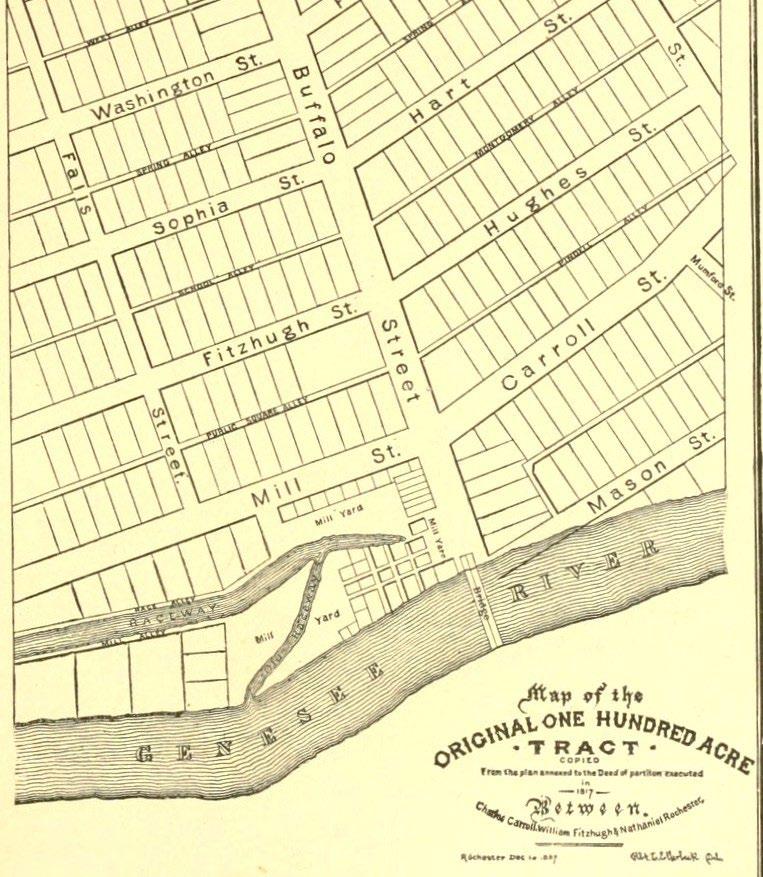
1817. The Streets of Rochester, NY have Washington County Connections. Just before the War of 1812, a group of three Washington County men travel north to the undeveloped lands of Upstate New York and Genesee County, where there were already plans to develop a canal to Lake Erie. Their names were Col. Nathaniel Rochester, Col. William Fitzhugh, and Charles Carroll of Bellevue.
They were interested in relocating there not just for the business opportunities the Erie Canal would create there, but also because some of them wanted their children to be raised away from the influences of the institution of slavery. After the War of 1812 ended, the development of the town of Rochester began in earnest, and the families of Rochester, Carroll, and Fitzhugh all traveled by caravan of covered Conestoga wagons-- nearly 40 people made the journey.
M ap of roChester, neW york, sMithsburG historiCal soCiety
By 1817 the streets were laid out, and their names are filed with connections to Washington County. At the top left on the map, there is a Washington Street. Once source said that Nathaniel Rochester named it thus because of the good friends he had left behind in Washington County. Fitzhugh Street was named after William Fitzhugh, who before coming to Rochester lived at “The Hive” a large working plantation and nail factory operation on the edge of Chewsville, MD. He had over five dozen enslaved workers, but left Maryland because he was against slavery and his two daughters married prominent Abolitionists, and had connections to the Underground Railroad. Hughes Street was named after Samuel and Daniel Hughes, who operated the Mt. Etna Furnace east of Hagerstown, and the Old Forge on the Antietam Creek. The Hughes brothers and their family were very close friends of Rochester and Fitzhugh. A daughter of one of the Hughes brothers moves to Rochester and marries Horatio Fenn, (Later, Hughes Street’s name was changed to Fitzhugh Street North.) Carroll Street, near the bottom left, is named after Charles Carroll of Bellevue, which was located where the Terrace and Oak Hill Ave neighborhoods are in present day Hagerstown. Carroll is the cousin of Charles Carroll of Carrollton, the Signer of the Declaration of Independence.
1817. January 15. The Town of Boonsboro is given permission to sell up to $1,200 in lottery tickets to “finish the schoolhouse and purchase church bells in said town.” Source: Archives of Maryland Online
1817. January 3. Election judges in the 5th election district of Washington County are empowered by a bill that passes in the Maryland Legislature today allowing them to hold elections “in any house in Hancock-Town.” Source: Archives of Maryland Online, Vol. 635, page 73.
h anCoCk, h anCoCk historiCal soCiety
1818. A building boom occurs when a store owner, named Thomas Brent, turns into a real estate man. Working with innkeeper John Donovan on laying out the town, Hancock sees stagecoach inns built, e.g. The Mountain House in 1818. The Barton House, on Main Street, cared for travelers including Henry Clay, Davy Crockett, Andrew Jackson, William Henry Harrison, Zachary Taylor, James Polk, and Generalissimo Antonio Lopes de Santa Anna. Harper’s Weekly accounts said no other road was as busy and because there was such a lack of services between Hancock and Cumberland, it was a boom town. Conestoga wagons and line teams from the West added to the activity that was truly historic, in Hancock.
1818. Town Founder Dies Almost Bankrupt. Andrew Leiter, the man who founded Leitersburg just seven years before, dies practically insolvent in Leitersburg . He had secured advances of cash from the Hagerstown Bank, and from the Farmer’s & Mechanics Bank in Greencastle, but he was unable to pay back the loans, and a lawsuit ensued. A number of building lots in Leitersburg were sold off at a Sheriff’s sale. Source: Bell, A History of Leitersburg District, p. 104.
1818. May 25. Conscientious objector fined. Jacob Newcomer of Leitersburg pays $3.00 in muster fines for not fulfilling his civic duties and serving as a member of the county militia. Newcomer was “belonging to the Mennonist society” and thus a conscientious objector to military service based on his faith. Bell, History of Leitersburg District, p. 66
1818. August 16. Jacob Gruber, the Methodist minister at Hagerstown and the presiding elder of the Carlisle District of the Methodist Episcopal Church meeting organizes a camp meeting at the Hogmire Farm, adjacent to the Conococheague Manor. In attendance were 3,000 whites and 400 to 500 blacks. Rev. Gruber preached on the evils of slavery and the need to abolish it, an unusual sermon topic for the time, and especially in a slave state. Rev. Gruber was charged with sedition several weeks later. The attorney who defended Rev. Gruber was Roger B. Taney, and he argued that because the Methodist cause of abolition was well known, and that those who held slaves in bondage could have prevented them from attending the meeting, there was no legitimate case against Gruber who was protected under freedom of speech to speak his conscience, and the jury acquitted Rev. Gruber. It is ironic that when Roger B. Taney ascended to the Supreme court years later, he delivered the infamous Dred Scott decision.
1818. December 31. An early Prohibition measure passes in the Maryland State Legislature. As of this day it became illegal for anyone to set up a booth or temporary roadside liquor stand within two miles of any Methodist camp meeting or quarterly meeting. “Whereas the Methodist society hath at different times sustained such vexation from disorderly persons who hath set up booths to sell liquors near their public meetings at time of divine service” such liquor vendors will be subject to a $100 fine. “Nothing in this act shall be contrived to hinder any ordinary (tavern) keeper or licensed retailer at their respective dwelling houses or stores.” [Note: Methodist were early advocates of the Prohibition of Alcohol]. Source: Archives of Maryland Online.
1819. March 1. The Maryland Gazette reports that an act introduced in December 1818 in the Maryland General Assembly preventing “swine and geese from going at large in the town of Sharpsburgh, Washington County” passed on this date. Anyone whose hog or geese are impounded is fined 35 cents per hog and 30 cents for every six geese for each day the livestock is impounded. Those impounding hogs and geese are obligated to post notices on the doors of two taverns in Sharpsburgh, and after three days, may have the authority to sell the swine or geese to the highest bidder. NOTE: the same banning of loose geese and swine applied to Hancock town, which is a separate line item passed in the same session of legislature. Source: The Maryland Gazette, Feb. 24, 1819, also Archives of Maryland Online, vol. 637, page 5.)
1820. In the early 1820’s, the Bank Road reached Cumberland from Conococheague. It joined with Baltimore to Frederick Turnpike and the National Road to become the National Highway. Also known as The National Pike, The Old Pack Horse Road, The East West Road, The Oldtown Road, including parts of the Nemacolin Trail and Braddock’s Road, and later named U.S. Route 40, now I-70 and I-68. This set the stage for the wildest of times in and around Hancock, as it became one of the busiest towns on “The Road”.
1820. The early residents of Sharpsburgh in the 1760s were primarily of English and German descent. Settlers continued to locate there throughout the remainder of the 18th century, establishing a flourishing commercial community. By 1820 the United States Census records the population as 650; the growth continued until about 1880 when the population was approximately 1260.
1820. Census records show Boonsboro’s population had grown considerably. There were 428 inhabitants: 395 whites, 7 free blacks, and 26 slaves. Through the years, some of the town’s more notable craftsmen included Peter Baker and John Welty, coverlet makers, Daniel and John Peterbenner, shoemakers, Leonard Weast and Peter Heck, carpet weavers, Abijah Smith and John Brining,
cabinetmakers, Charles Gabe and Frank Storm, tinners, Daniel Boone and Ephraim Davis, hatmakers, Aaron Pry, Henry Nyman and Jonathan Gelwicks, tailors and John Stonesifer and his son Christian gunsmiths.
earthenWare CroCk Made by John boWMan. these are usually unMarked and exCeedinGly rare today. boonsboro hisotoriCal soCiety
1820. August 24. Passed, September 4, recorded. It is now illegal for wagons, stagecoaches, or other vehicles to place themselves in a manner in which they occupy more than one half the width of a Hagerstown street. The new law was posted in the town newspaper by Daniel Schnebly, the town Moderator, and attested to by George Brumbaugh, town clerk. Source: A Newspaper History of Washington County 1820-1835. Compiled by Sandra K Warfiled. Hagerstown: Washington County Free Library, 1990.
1820. September 8. William T. Hamilton (1820-1888) is born in Boonsboro. The family later moved to Hagerstown. Hamilton became a supporter of restoring southern sovereignty following the Civil War. He voted against the 15th Amendment to the US Constitution, which granted voting rights to all men regardless of race. He would later become Governor of Maryland from 1880-84 and remained popular in Hagerstown until his death.
WilliaM t. h aMilton, Clear sprinG historiCal assoCiation 1821. March 1 (through 1826). Martin Myers of Lancaster, Pennsylvania, moved to the North Mountain area and afterwards, the National Road divided his farm. He then became a land developer, laying out the future town of Clear Spring in 1821. Less than 5 years later, the construction of log and brick dwellings created the following businesses: four stores, three hotels, two doctors, a post office, nine shoemaker shops, six tailor establishments, three wheelwright businesses, three wagon maker shops, three saddle making businesses, two tan yards, two carpenters living in town, four brick and stone masons, two men who did plastering, one preacher, one barber and one butcher. It took approximately 3 days in good weather for news to reach Clear Spring from Washington, D.C.
the national road passes throuGh Clear sprinG, Clear sprinG historiCal assoCiation
1822 – 1823. The first hard surface (macadam) road constructed in the United States was on the Boonsboro Turnpike Company’s road from Boonsboro to Hagerstown. This process provided a solid surface made of three sizes of stone packed tightly together. This later became a common process before concrete. The abundant local supply of limestone was a factor in experimenting with macadam in Washington County.
1822. July 23. Public foreclosure sale for “A Lot of Ground with a Log House” and improvements takes place on the premises of the property of Henry Marker is posted by Washington County Sheriff J. V. Swearingen on July 1. This is the first of many town lots in Smithsburg to be foreclosed upon, making matters complicated for Christophel “Stoffle” Smith, the town’s founder, who has not yet paid his mortgage for the entire town plot purchased in 1813. In a few years, as other lots are foreclosed, Smith winds up bankrupt and dies in the county poorhouse. Source: the Hagerstown Torch Light & Public Advertiser, July 23, 1822.
1823. Williamsport is incorporated.
1823. January. Boteler and Harley Store Closes in Clear Spring.
1823. March 17. Prior to the Irish Famine in 1845, many Irish immigrants were single men seeking working opportunities in Baltimore and later in western Maryland with the construction of the C&O Canal and National Road. By 1823, the turn-pike workers had created a temporary community of 200-300 men called “Cork” located south of Funkstown along Cool Hollow Road. With 500600 families in Funkstown, many of English and German heritage, interactions between the groups escalated as the “turn-pikers” awakened to find that someone had hung an offensive “Paddy” at a nearby tavern. The agitated Irish marched together into Funkstown soon meeting town residents. Heated quarreling ensued and one or two individuals on each side were severely cut and bruised and others slightly wounded.
Hagerstown militiamen of the 24th Maryland Regiment joined a portion of the “American Blues” Light Dragoon Calvary Troop were led by the Funkstown Rifle Corp approached the turn-pikers and “parlayed” with the result of the Irish workers dispersing. Thankfully, no one died.
1823. November. Clear Spring Post Office opens.
1824. January 14. A bill to incorporate a Sharpsburg community fire company is passed by the Maryland Legislature. Charter members of the Sharpsburg Fire Co. were Thomas Austin, Henry Beckley, George Bowers, George Cronise, Daniel Donnelly, George Edwards, David Highbarger, John D. Grove, Philip Grove, John M. Knode, John Miller, James Leggett, Philip Prickley, Jacob Rohrback, William Rohrback, Jacob Smith, and George Smith. Source: Archives of Maryland online, Volume 628, page 26, Chapter 58
1825. January 26. Although in 1810, an act in the Maryland Legislature was passed to establish the boundary line between Frederick and Washington counties, and each county was to appoint three commissioners from each county “to run and establish the line between said counties,” Washington County did not comply in supplying three men. Another bill in 1823 was a re-establishment of a committee, but nothing was done to settle the matter, so the Legislature again asked that the boundary line be determined. The eastern boundary of Washington County is basically that of the ridge line of South Mountain. Source: The Archives of Maryland Online, Volume 629, page 47.
1825. November. “TAVERN STAND FOR RENT. The House at the Ferry, opposite Shepherdstown, at present occupied by Sam Knode, will be let to a good tenant who will take care of the property, on accommodating terms. The house has lately been repaired, and considerably enlarged. Possession will be given on the first of April next. JOHN BLACKFORD”
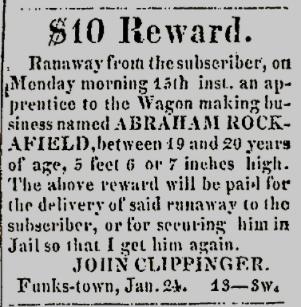
1826. February 4. Advertisement: $10 REWARD. Ran away from the subscriber, on Monday morning the 13th inst., an apprentice to the Wagon-making business named Abraham Rockafield, between 19 and 20 years of age, 5 feet 6 or 7 inches high. The above reward will be paid for the delivery of said runaway to the subscriber, or for securing him in Jail so that I can get him again. JOHN CLIPPINGER. Funks-town, Jan. 24. Source: The February 4, 1826 Hagerstown Torch Light & Public Advertiser.
1826. May 9. Joshua Grimes is appointed the first postmaster in Leitersburg. Source: Bell, History of Leitersburg district
bridGeport, potoMaC r iver lookinG toWard shepherdstoWn, C&o Canal a rChives | bruGh
1826. May 9. Joshua Grimes is appointed the first postmaster in Leitersburg. Source: Bell, History of Leitersburg district
1826. July 22. A “public tribute of respect to the memory of John Adams and Thomas Jefferson” was held the county courthouse. Both Washington and Adams died on July 4, exactly 50 years to the day after the Declaration of Independence was signed. It was resolved that for a period of 60 days mourning, all citizens should wear black crape bands on their left arms, and ladies should wear a badge of mourning. Local preachers were requested to preach “an appropriate sermon.”
On Tuesday, August 1 a parade was held through Hagerstown, during which businesses were to shut down all operations for the parade’s duration, and the church bells were to toll continuously for one hour in the morning and one hour in the evening for each of the deceased presidents. Source: Scharf, History of Western Maryland, page 1072.
1826. August 2. On this Tuesday a memorial procession was conducted through the streets of Hagerstown in memory of Thomas Jefferson and John Adams, who died on July 4, 50 years of after the Declaration of Independence was signed. For one hour in the morning and evening, church bells tolled, and out of respect, all businesses were to be closed and cease operations for the duration of the procession. Source: Scharf, History of Western Maryland, page 1072.
1827. April 12. Counterfeit Coins. The Hagerstown Torch Light newspaper warns its readers that fake half-dollar coins a composition that sounds like silver are being circulated in Hagerstown. People in a hurry of business should be on guard because they can be easily duped by them. Source: The Hagerstown Torch, April 12, 1827.
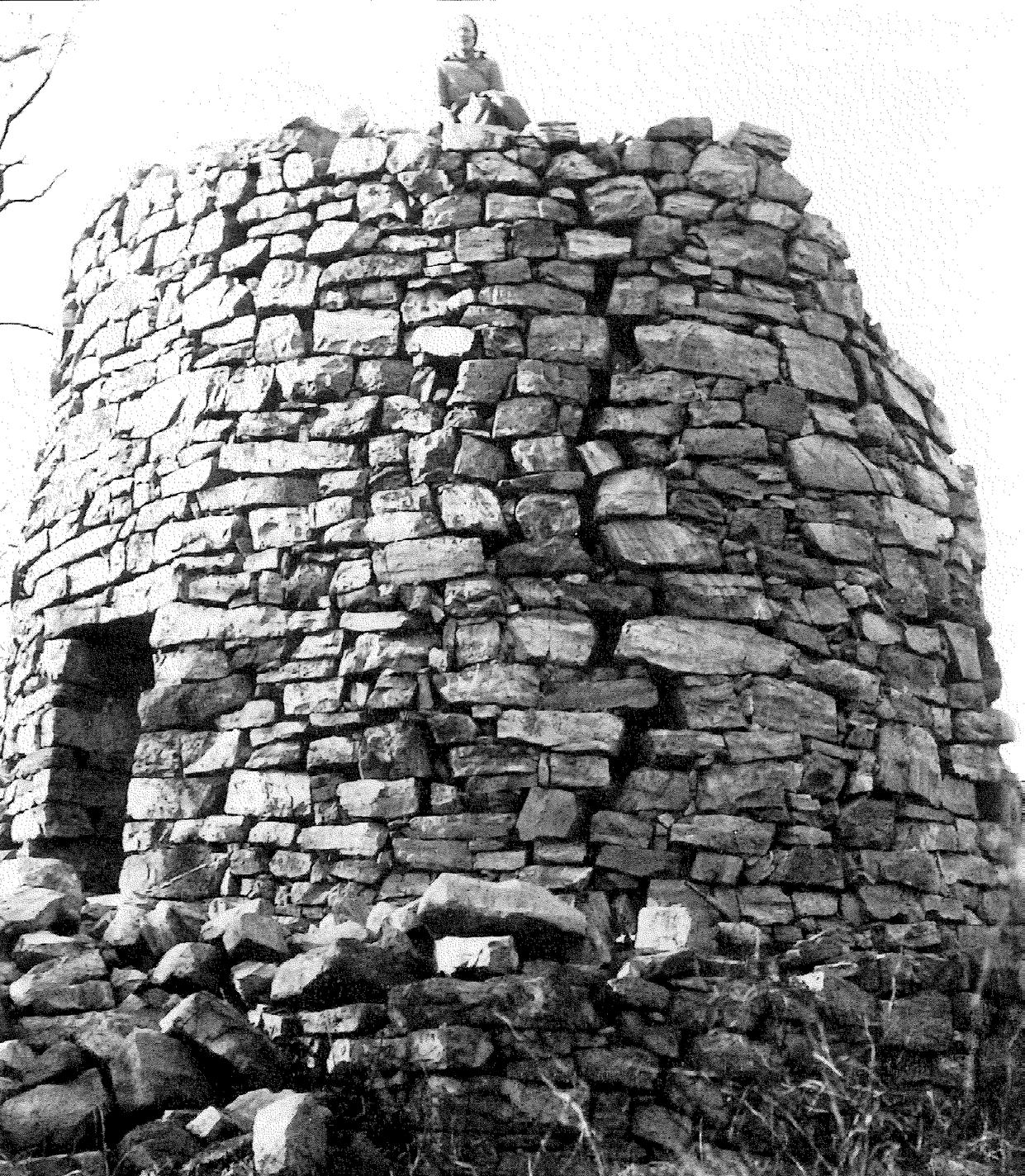
1827. July 4. On this date, nearly the entire village of Boonsboro trekked up South Mountain to build and dedicate the Washington Monument- the first completed monument in the United States to memorialize General and President George Washington. The town’s citizens erected half the monument that day using granite on site. At 4 pm they held a brief dedication ceremony where they read the Declaration of Independence aloud and four Revolutionary War veterans fired a ceremonial volley. The residents returned on a second day in September to complete the monument. It stood 30 feet in height with 54 feet in circumference at the base.
WoMan atop WashinGton MonuMent before its restoration C. 1915, WashinGton County free library
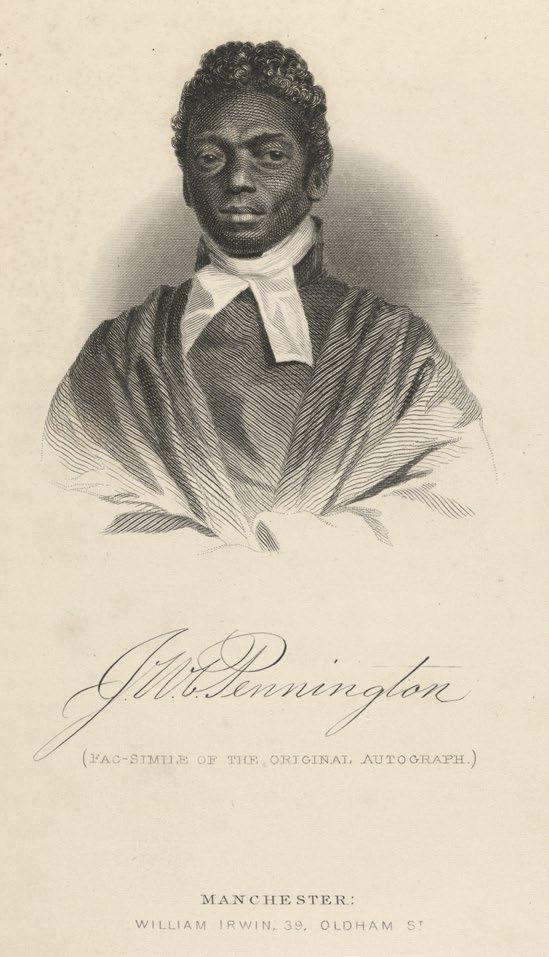
JaMes W. penninGton, 1848, national portrait Gallery
1827. October 28. James W.C. Pennington, formerly James Pembroke while enslaved, was born into slavery in 1807 at a Tilghman plantation on the Eastern shore. At age four, he and his mother were given to Frisby Tilghman as a gift and was taken to a new plantation called “Rockland Farm” near Hagerstown, MD. He was trained as a carpenter and blacksmith. In 1827 he escaped from the plantation and reached Adams County in PA and was taken in by Quakers William and Phoebe Wright. They assisted him from slavery while being illiterate and taught him how to read and write. Later in Brooklyn, New York he became the first known black to attend Yale University. He became an American historian, abolitionist, orator, minister, writer and social organizer. He wrote and published what is considered the first history of blacks in the U.S. “The Origin and History of the Colored People” in 1841. His memoir “The Fugitive Blacksmith” was first published in 1849 in London.
1828. July 4. The destiny of commerce in Washington County was affected by two events elsewhere on this day. In Washington, President John Quincy Adams turns the first shovelful of earth in the digging of the Chesapeake and Ohio Canal. In Baltimore a 91 year old Charles Carroll of Carrollton, then one of last surviving signers of the Declaration of Independence, lays the cornerstone for the Baltimore & Ohio Railroad, the very first railroad constructed in the U.S. Seven years later, in 1835, the C & O canal Reaches Williamsport. The B & O Railroad does not make it to Washington County until after the Civil War, when the depot opened in 1867.
Source: Radoff, Morris L. The Old Line State: A History of Maryland. Baltimore: The Historical Record Association. 1956.
GroundbreakinG for the C&o Canal , sMithsburG historiCal soCiety
layinG of the first stone of the b&o r ailroad, based on a paintinG in the b&o r ailroad MuseuM in baltiMore, sMithsburG historiCal soCiety
1829. January. Another doctor Mr. Grimes offered medicine and surgery and opened a practice in Clear Spring.
1829. January. Mr. Edelen’s store opened two doors west of Draper’s Tavern in Clear Spring. The store sold dry goods, groceries, liquors, hardware, and cutlery. The new store bought or traded for butter, eggs, flaxseed and rags. Used rags could be sold to paper mills to produce rag paper, greatly in demand during the 19th century.
1829. February. A newspaper had a unique advertisement concerning the Sarah Ford property. It mentioned a new transportation system soon to be a part of the Clear Spring community. Her 210acre farm called Rocky Neck Amended was being sold to settle her estate. It was situated at the neck of the Potomac River. The advertisement stated that the Chesapeake and Ohio Canal, which had commenced in the valley of the Potomac River, would pass through or near this land which would add very much to its value.
1829. February. Jacob Stine had a newspaper advertisement in February 1829 starting that he was moving west and selling his two-story log home located one and 3/4 miles from Clear Spring, and 200 yards from the big spring on the road leading from Williamsport to Cumberland. A few days later Mr. Stine ran an ad offering a reward for a run-away apprentice in the weaving trade.
1829. April 9. John Wharton married Elizabeth Mason of Clear Spring and resided at Avalon farm. In 1856 he was a co-founder of the Maryland Agriculture College which later became the University of Maryland.
1829. August 8. The Jacksonians of Clear Spring put the following men in charge of their committee: John Hall, Daniel Brewer, George Seibert, David Cushwa and John Feit.
1829. December 23. (occurred), January 7, 1830 (reported). Rev. Mr. Kurtz of the Hagerstown Lutheran church met with his congregation to form a Temperance Society, whereby 100 members immediately complied and pledged to abstain from alcohol and joined. Earlier that year, the first Temperance Society in Washington County was formed in Smithsburg when Dr. Elijah T. Bishop persuaded Lutheran Minister Samuel K. Houshour form one with him.
1830. Samuel Keedy helped secure the post office for the town of Keedysville. He was a merchant with a store in town and postmaster advocate. Originally called Centerville, the town changed its name to Keedysville to honor the Keedy family.
1830. Clear Spring undertaker Jimmy Welsh was called upon to provide burying services for a deceased neighbor in Clear Spring. Undertaker Welsh mismeasured the dead body and made a coffin that was too short. Upon realizing his mistake, he sat the short coffin aside and then built another coffin the correct size. When the town folks discovered (somebody told) that there was a spare coffin just waiting for someone to die -well, there was nearly a riot. The undertaker dismantled the coffin, and all was then fine in town.
benJaMin kurtz , sMithsburG historiCal soCiety
Coffin exaMple, Clear sprinG historiCal assoCiation
1830. February 1. The Smithsburg Temperance Society, the first anti-alcohol society in Washington County, is formed by Dr. Elijah T. Bishop, the town physician, who enlisted the recently appointed minister of Trinity Lutheran church, Samuel K. Hoshour, to join forces with him. Bishop, a Yale educated Connecticut Yankee, had in his family a tragic alcohol related death. Rev. Hoshour remarked that it was a tricky situation to preach temperance in a congregation where there were several prominent local whiskey distillers. The Hagerstown Torch Light, April 14, 1831.
1830. February 25. The Hagerstown Anti-Swearing Association is formed and posts its constitution in the town newspaper. “There is no vice to which man is addicted so appalling to the feelings of morality and Christianity … as that of Profane Swearing.” Source: A Newspaper History of Washington County 1820-1835. Compiled by Sandra K Warfield. Hagerstown: Washington County Free Library, 1990.
1830. August 26. Samuel K. Hoshour, the minister at Smithsburg’s Trinity Lutheran Church announces that he has opened a school in Smithsburg to teach reading, grammar, rhetoric, Geography, surveying, algebra, and the Latin and Greek languages. “The most rigid attention will be paid to the cultivation of morality
among the pupils. Boarding can be had on very moderate terms.” It appears that Hoshour’s school was a failed venture, and within a year or so after this was on to other posts as a minister. Source: advertisement in the Hagerstown Torch Light & Public Advertiser, Sept. 23, 1830.
1831. In the winter of 1831, the Maryland state legislature appropriated money to transport free blacks and ex-slaves from Maryland to Africa. This act helped to create the formation of The Maryland Colonization Society, founded for the purpose of sending free slaves to Africa. The Society was confident that this policy was the remedy to end slavery.
1831. The Town of Boonsboro was incorporated in 1831 and held the first town election. Jonathan Shafer was chosen as burgess (mayor) and Captain Lewis Fletcher assistant burgess. During this time, Boonsboro’s largest mercantile establishment conducted more than $90,000 a year in retail business. This was a tremendous amount for that era.
1832. In the winter of 1832, the Maryland legislature placed new restrictions on free blacks to encourage emigration out of the State. Maryland African Americans were not permitted to vote, serve on juries, or hold public office. Maryland unemployed ex-slaves could be re-enslaved at the discretion of local law enforcement. With these new slave laws, the Maryland Colonization Society hoped they could encourage free black residents to leave Maryland. St. Paul’s Lutheran Church east of Clear Spring invited the public to a lecture given by a member of the Maryland Colonization Society. The guest speaker would also later speak at St. Peter’s Lutheran Church in Clear Spring.
1832. May 4. An exhibition at the Hagerstown city hall is a demonstration of a diamond lens solar microscope capable of magnifications of “animalcules” to the power of “5 million times beyond normal size.” The apparatus is apparently a reflecting microscope with the means of projecting images onto a screen or
wall, for animalcule from pond water and “dust on figs” and vinegar were exhibited in lengths from 4 to twelve feet. Spectators were also shown magnifications of crystals of iodine, saltpeter, and the legs and wings of insects. Source: A Newspaper History of Washington County 1820-1835. Compiled by Sandra K Warfiled. Hagerstown: Washington County Free Library, 1990.
1832. July 4. A large crowd gathered in front of the hotel in Clear Spring to Celebrate the 56th Independence Day of the United States of America. The following toasts were offered:
*This day we celebrate – may each succeeding year render it more dear to Americans.
*To the President of the United States.
*The memory of George Washington
*The Heads of Departments
A toast was then offered by Montpelier owner John O. Whorton: “The United States, a pillar of fire by night and a cloud by day to guide the Nations of the earth to liberty and happiness.”
Samuel Tice of Big Spring offered a toast: “The present agitated State of our country – like the raging tempest, may it purify the political atmosphere, and restore health, vigor, and prosperity to the Union.”
Another toast came from Emanuel Tice: “To the soldiers of the American Revolution, few in numbers but filled with patriotism and love of country, may their short stay among us be crowned with peace and pleasure.”
James Miller added one last toast: “Washington the hero of our country – may he be forever remembered.”
From this spot at the intersection of Cumberland Street and Martin Street, the crowd proceeded south to the new church on top of the hill of South Martin Street. At this location the Declaration of Independence was read by John D. Sutton, esq. followed by an eloquent oration by Robert M. Tidball, esq.
1832. July 23. Public sale at the residence of Jacob Burks near Sharpsburg on August 23, 1832 includes the sale of nine Negro slaves, a woman and child, three girls, four boys as well as other property.
1832. November 13. It was on the night of November 13, 1833, and twelve-year-old Anson Buttles awoke to a night never to be forgotten. Anson’s father was Cephas Buttles, the owner of Buttles Inn in Clear Spring located at 102 Cumberland Street. Anson was awakened by a stage load of passengers who drove up to the door, making a great noise, and awakened me. When I opened my eyes, it seemed as if everything was on fire. I dressed immediately, wakened my parents, and went to the door, and such a magnificent sight I never for beheld and never expect to see again. I was afraid at first to step out on the street, but not seeing any danger, I walked out, and meteors or electric sparks were falling as fast as any heavy snowstorm. They appeared as large as a man’s fist, and immediately upon touching the earth, would disappear. They fell all around me and, on my head, but I only felt a slight sensation, or I may have only imagined it, for I examined closely many places where they had fallen but could not detect any marks upon the ground. It was about two o’clock in the morning when I went out, and I stayed until the shower was over, which was at daybreak. Those meteors fell just as thick all the time,
innkeeper Cephas buttles, Clear sprinG historiCal assoCiation
and as far and as far as the eye could reach, above and around the shower was just the same - the whole sky was one perfect blaze of fire. The townspeople were out on the street, and many were terribly frightened, particularly the slaves, thinking that the Day of Judgement had come. Of the number of incidents that took place, there was one that I cannot forget. A man borrowed a bridle from a neighbor quite a long time before the shower and denied and denied that he borrowed it but on the morning after the shower he brought the bridle back and begged for mercy with tears in his eyes.”
1833. December 13. William Johns opened a store in Clear Spring selling “ready-made clothing.” The store also stocked calf and seal skin boots, seal walking shoes, pantaloons, wool shirts and drawers, fine furs, and fancy caps. It was like shopping in fancy downtown Baltimore.
enGravinG nationally CirCulated shoWinG What toWns Witnessed on the niGht of the shootinG stars; Clear sprinG historiCal assoCiation
1834. July 29. When Henry Ream purchases lots #6 and #7 from Frisby Tilghman on this day, he becomes the first resident of Tilghmanton, a new community on the Sharpsburg Pike (Md. Rt. 65) a few miles below Hagerstown. Frisby Tilghman is part of the prominent and prosperous Tilghman family of Talbot Co. from which Tilghman Island, on the Chesapeake takes its name. Col. Frisby Tilghman served in the War of 1812, and his estate, Rockland, is where he lived in Washington County. Source: Anikis, George. Who Was Frisby Tilghman? Privately printed not dated, circa 2012.
roCkland, Clear sprinG historiCal assoCiation
1834. December 21. A fire broke out in the dye house of the Antietam Woolen Mill run by Messrs. Shafer in Funkstown. It quickly spread to the main building and in two hours reduced all but the stone walls of the building to ashes. In addition to 6 tons of unprocessed wool, there was also a large quantity of the carpeting and other types of wool cloth. The Hagerstown Hose company and another fire company were able to keep the fire spreading to the nearby grist mill, saw mill, and store house adjacent to the factory. Loss is estimated at $20,000. The factory was insured. Source: Stonebraker, Joseph R., A Rebel of ‘61, New York: Wynkoop Hallenbeck & Crawford Co. 1899.
the a ntietaM Woolen Mill on the Creek at funkstoWn, destroyed by fire. beside the bridGe Was a Grist Mill the fireMen froM h aGerstoWn Were able to spare.
1835. September 5. Maryland residents are subject to Jacob Gruber and Joab Bernard, of Hagerstown among the fourteen co-signers of a letter to the national Niles Weekly Register. In this unusual letter, they ask that Abolitionists from the North “desist from sending us any of that inflammatory periodicals” on immediate abolition “as we never ordered or desired them and are determined to have nothing to do with any of them of which we request all postmasters to take notice. In a carefully worded letter, they explain that “though we are neither slaveholders nor the friends of slavery,” they fear that when outside parties start agitating the subject in Maryland, it will only lead to murderous riots, and instead the Baltimore Conference advocates “gradual and ultimate emancipation.” Source: Niles Weekly, September 5, 1835.
1836. Clear Spring is incorporated.
1836. Construction of the Chesapeake and Ohio Canal began at Georgetown in the District of Columbia in 1828 and reached Sharpsburg around 1836. Working on the canal then became a welcome employment opportunity for many of the townspeople.
1836. Samuel Keedy constructs one of the earliest brick structures in Keedysville at 42 South Main Street. He operated a store at the location for 34 years. Buildings to the rear served as slave quarters
and the well on the property was used to water soldiers’ horses before the Battle of Antietam. The structure later served as a clock shop and cobbler in the 19th century. The last known commercial use was Wyand’s jewelry store.
1836. Welty Meeting House was built about two miles from Smithsburg in 1836 by John Welty. It was a structure made of rough cast field stone, and was as a non-denominational church shared by three different German protestant faiths. One end of the building was a church, the other end was a school, and folding doors could be opened to make it one large meeting house. Eventually a separate school was built beside it, and in the retreat from Gettysburg, General George Armstrong Custer and his men briefly stopped here for an hour’s nap before dawn on July 5th before going on to Smithsburg where the townsfolk there provided them and thousands of Union Soldiers who encamped there a makeshift meal. This picture was taken in May of 1898. In only a few weeks, the building’s corner began to crumble, and it was decided to demolish the building and make a new church. Stone from this church was used to build the new church’s foundation.
Welty MeetinG house (C.1836), sMithsburG historiCal soCiety ColleCtion
1837. A toll house, which is still standing and managed by the Hancock Historical Society, saw 4,129 riding horses, 32,816 cattle, 916 carriages, 7,296 broad and narrow wheeled wagons pass through in 1837. h anCoCk tollhouse, h anCoCk historiCal soCiety
1837. George Washington McCoy owned and operated McCoy’s Marble Works in Rohrersville. He founded and organized the Rohrersville Coronet Band of Washington County. In 1916 a new brick band hall building was built on site and replaced the former wood frame structure of the Marble Works. The Rohrersville Band is Maryland’s oldest community band in continual existence.
rohersville band (C.1906), Clear sprinG historiCal assoCiation
1837. John Crhistian Brining opens a cabinetmaker’s shop in Boonsboro offering hand-crafted furniture and custom-made coffins.
1839. November 14. The Williamsport Fire Company is formed.
1840. John J. Keedy builds a stone mill in what would become the town of Keedysville. He transformed the town from a mere settlement to a structured town by laying out the original plat for the town.
1841. The Odd Fellow (later the Boonsboro Odd Fellow) is published and was the equivalent to the town’s first newsletter or newspaper. It was operated by the local Independent Order of Odd Fellows (IOOF) and would run until the 1880’s.
1841. February 3. For the very first time, a railroad train pulled into Hagerstown from Chambersburg, cutting travel time between the two cities down to a record- wait for it-- two hours. The distance between the two cities is about 25 miles by todays roads. This early railroad had an uneasy history, and for a time it lacked a steam engine so it was reduced single horse pulling a passenger car down the tracks. A legend says that an engineer one day spotted a one-legged man up ahead limping alongside the railway on crutches, and when he stopped the train to offer him a ride, the man said: “Thanks, but I’m in a hurry.”
1841. March 14. Samuel K. Frankberry, owner of a boot and shoe store announces that he has “just returned from the Eastern Cities” with an assortment of shoes for ladies, gentlemen and children which he will sell very low for cash at his “Old Stand in Smithsburg.” Additionally he “keeps constantly on hand a good assortment of boots and shoes of his own manufacture” and does madeto-order work “at the shortest notice.” Source: The Hagerstown Mail, May 14, 1841.
1841. June 3. The Maryland Colonization Society holds its convention in Baltimore. The Colonization society created a Maryland Colony of freed African Americans in Cape Palmas, Africa, in what was to become Liberia in 1847. Seen by Abolitionists as a means of reparations for enslavement, the Colonization Society was-- odd as it seems-- widely supported by slaveholders who didn’t want free black people living near slave populations. Maryland’s role in the Liberia Movement is unique in that the creation of the Maryland Colony in Africa was funded by appropriations from the Maryland State Legislature. At this convention, Washington County had one of the highest member turnout of members -- sending thirty-four to Baltimore; by contrast, Frederick County sent only one member, and some counties high numbers of slaves like St. Mary’s, Caroline and Worcester had only one member each at the meeting. Perhaps there were transportation issues. These are the delegates from Washington County: Elias Baker, Peter Beelar, George Brent, Dr. F. Byer, Elie Crampton, Dr. Clagett, A. M. C. Cramer, Dr. Michael A. Finley, Charles H. Fletcher, Edward Garrett, Isaac Gehr, Jacob Grove, Horatio N. Harne, Daniel Hauer, John W. Kennedy, M. S. Van Lear, Rev. Jeremiah Mason, John T. Mason, Col. John Miller, John Miller, Isaac Nesbit, Michael Newcomer, Dr. Charles H. Ohr, Andrew Rentch, John Reynolds, Jacob Snively, Robert Wason, Daniel Weisel, Caspar W. Wever, Dr. John O. Wharton, Daniel Wilmer, Lewis Zeigler. Source: Maryland Colonization Journal. Baltimore: Maryland State Colonization Society, Vol. 1, No. 1 June 15th, 1841
1841. August 16. Citizens of Clear Spring burned President John Tyler in effigy at Federal Hill in front of the 160 Cumberland Street area. They were unhappy with the presidents’ views on banking. president tyler, Clear sprinG historiCal assoCiation
1843. February. Everyday winter life for farmers like Otho Nesbitt in Clear Spring had to deal with the bitter weather each day and on snow days battle through drifts to the barn and outbuildings to feed horses, cows, hogs, and chickens. Nesbitt was a slaveowner but on occasion he paid for additional farm help. He recorded in February of 1843 paying Jacob Watts twenty-five cents to assist for one day working on the farm.
1844. February. In Clear Spring farmer Otho Nesbitt paid men to trample wheat. Trampling wheat is the process of detaching the wheat kernels from the pods. Local farmers used two methods to achieve this. A farmer would first cover the upper barn floor with wheat. Horses or men were then used to walk over the wheat. Next the barn doors would be opened, and the wheat was tossed into the air with a fork. The straw would blow away and the kernels would drop to the floor. The kernels would then be gathered by the bushel and taken to one of the numerous local mills and sold or the miller would grind the wheat into flour for the farmer for his own household use.
h ayWaGon at the rohrer far M, sMithsburG historiCal soCiety
1844. July 4. The editor of the Hagerstown Torch Light takes the citizens of Hagerstown to task on the “68th Anniversary of American Independence” because the day has been permitted to pass by in Hagerstown without “any public demonstration on the part of our citizens.” The editor notes that other county chapters of the militia are parading and demonstrating in uniform. The Potomac Dragoons and the Hagerstown Horse Guards celebrated the day at Lappans Crossroads, and the “newly formed company, the Raven Rock Riflemen” of Smithsburg “have manifested more patriotism” than the others locally. At Smithsburg, the Washington Riflemen of Funkstown were guests for the day. Source: The Hagerstown Torch Light, July 4, 1844
. 1845. May 26. RUNAWAY
NEGROES – A BATTLE WITH WHITES.
“We learn from the Hagerstown that on Monday Morning Last” At three o’clock in the morning, ten runaway negroes were discovered passing through Smithsburg on their way to Pennsylvania. They met Adam Shank, jr. on the road and demanded why he was out so early, and appeared so insolent that Shank started off to procure help from neighbors, and when they overtook the fugitives on the road, the fugitives, who were all armed with weapons, immediately attacked the unarmed white men, who were severely dealt with. Constable Flora was twice knocked down, Mr. Price had his arm nearly severed, and the bone of which was broken by a blow from a tomahawk. He also had a pistol snapped in his face, which very fortunately failed to go off. Mr. McCoy had his shoulder dislocated. Mr. Lyday received a blow from a tomahawk. Adam Shank was several times struck to the ground, and the whole party more or less injured. The whites succeeded in carrying off one prisoner in an almost hopeless condition. Another negro was badly wounded, and after following his companions a mile or two upon the retreat, gave himself up. We also learn two more of the gang were arrested near Leitersburg. Source: This account is a paraphrase of the June 5, 1845 edition of Hill’s New Hampshire Patriot (Concord, NH).
1846. January. Clear Spring resident Otho Nesbitt purchased a woodstove, stovepipe, and a damper, in January of 1846. Woodstoves were just becoming popular around this time and Nesbitt Mansion had to be among the first in the Clear Spring area to have one. One stove certainly could not heat his large home, but it produced more heat than a fireplace. It took at least ten cords of wood to heat his house during the winter. Firewood was also needed for the wash house/summer kitchen and the slave cabins located on what is now North Mill Street in Clear Spring.
1846. November 4. Report on a freshet flooding Williamsport, Keedysville, Boonsboro descriptions of what residents did, report that canal is silted in and all the various things that floated down the river. Baltimore Sun. Searched by Keedysville. See also the Gettysburg compiler Nov. 9, searched by Keedysville.
1847. August 11. Camp Meetings. The Church of the United Brethren in Christ will hold its camp meeting “on the old ground” on the turnpike between Boonsboro and Sharpsburg, about 2/12 miles from Boonsboro. AT this date no date has been determined by the Methodists as to the date when there annual camp meeting at Col, Hogmire’s will be. [Col. Hogmire’s is large farm estate is near St. James.] Source: The Hagerstown Torch Light, August 11, 1847.
1848. The Reverend Robert Douglas married Helena Blackford, who was the youngest daughter of John Blackford builder of Ferry Hill. The couple would live at Ferry Hill. Reverend Douglas’ oldest son by a previous marriage was Henry Kyd Douglas. When the Civil War began in April 1861 Henry Kyd Douglas enlisted in the Confederate Army and became a scout and the youngest member of General Thomas “Stonewall” Jackson’s staff. Eighty years later he published his diary as the book, “I Rode With Stonewall”.
henry k douGlas, Clear sprinG historiCal assoCiation
1848. April 14. (Friday) A new Post Office was established at Keedysville. Edward Reily is the postmaster. On this same date Daniel P. Witmer became postmaster of Beaver Creek Post Office, after Larkin C. Cook resigned. Daily National Intelligencer and Washington Express
1848. December 23. It Doesn’t Pay to Slander. This week, John Unger obtained one cent in damages from Adam Shank of Smithsburg for calling him a “d----d perjured scoundrel.” Source: The Baltimore Sun, Sat. December 23, 1848
1849. To educate a child in Clear Spring prior to free public education parents had to pay to send their children to the Clear Spring Academy located on North Martin Street. Students attended school twelve months a year with a one week break between Christmas and New Year’s Day. The Clear Spring Academy provided a high standard of education to the children of the Clear Spring area. That elevated education level most likely led to the formation of the Clear Spring Lyceum, a society to be a provider of public lectures, concerts, and entertainments. During the cold months of 1849 the Lyceum held a debate at the academy.
The question was, “Ought Congress to pass laws prohibiting slavery in the territories?” Taking part in the debate were local residents Parmenter, Nesbitt, Ranger, Fiery, Doyle, McClannahan, and Witherow. The debate a few weeks later at Lyceum meeting was, “Is France capable of maintaining a free government?” The Lyceum debated every two weeks during the winter months
1849. October 30. The U. S. Patent Office in Washington grants William Furley of Smithsburg Maryland a patent for his invention of a barrel roller. His device, a set of sturdy wooden handlebars, and two adjustable wheels which mount over the outer edges of the barrel, when attached to a barrel, allow it to roll much like a twowheeled handcart. This invention is especially suited for liquids.
“A boy can transport from place to place “a much water or liquor in one of these ‘revolving barrels’ as a horse can draw upon a vehicle.” Source: “U.S Patent office patent no. 6, 826. dated Oct. 30, 1849”, Source: Hagerstown Herald Sept. 12 1849.
1850. February. “the Forsyth house in the neck burnt down” recorded Nesbitt. The neck Nesbitt was referring to is a bend in the Potomac River near what is now the Four Locks area.
1850. February. Aside from debates, the Clear Spring Lyceum also provided concerts. One particular concert did not go well. In February of 1850 Otho Nesbitt attended a Lyceum program at the academy. There was a ventriloquist and music provided on an accordion. This instrument was invented in Germany in the 1820’s and had become popular in the United States in the late 1840’s. In addition, there was singing and dancing. On the second night of the show there was an attendance of about thirty people. Nesbitt stated there were a lot of boys outside of the academy. During the performance stones started to roll over the roof. Ladders were placed up at the windows on the exterior and boys peeping in followed by boys slipping in the building creating a tremendous noise and causing confusion. Then the Clear Spring boys “tossed in the window a burning cayenne in a pint cup.” The performance stopped.
According to Nesbitt “many people almost suffocated.” A crowd of boys outside broke in. The adults began yelling for the boys to be “ridden out of town on a rail. “The boys went behind the curtain and spoke to some of the best citizens of Clear Spring to protect them. It worked.
1850. June 1. The Daguerrean shop in Clear Spring was advertising for business by taking photographs of dead people. The ad read, “Have images taken after death. The apparatus (camera) would be removed to where the corpse is.”
1850. June 20. The cornerstone of the Lutheran church of Funkstown is laid. For decades the Lutherans there had shared a “union church” with the German Reformed congregation, and the building was maintained by a vestry made up of members of each church. The work proceeded quickly: the church was consecrated six months later on Christmas Day, 1850. Source: Brake, Donald C., For Five Shillings’ Current, 1981
1850. July 4. The Old Town Cannon in Boonsboro was one of many cannons that were cast at Mt. Aetna Furnace during the Revolutionary War. Found to be defective, it was laid aside as a reject. In 1826 John Horine who had worked at the furnace, purchased the Mt. Aetna tract. Apparently, defective cannons were still there at that time. Horine or his son, gave the cannon to the Democratic Party of Boonsboro. Down through the years, the Democrats used it to fire salutes during elections and patriotic events. Unfortunately, on July 4, 1850 due to the supposed carelessness of Steve Coffee, a freedman who lived on Short Hill, the cannon was fired prematurely and killed John Parmelle. The cannon now reposes in Boonsboro’s Shafer Park.
1850. October 10. The C & O canal is fully opened from Cumberland, MD to Georgetown, DC.
1851. A “Barr” Feast. “We understand that 52 persons dined on a Bear at the house of Gideon Shirey in Cavetown on Friday last. The “wild beast” was served up in splendid style by the host and the guests enjoyed themselves hugely.” Source: The Hagerstown Herald, December 31, 1851.
1851. February 6. A meeting of citizens was held in Wolfsville, to discuss the formation of a new county, to be comprised of land in the Catoctin Mountain areas of Washington and Frederick counties. Although other districts in area of the proposed new county have expressed a favorable attitude to the new county proposal, the Wolfsville people unanimously opposed the new county. Source: The Baltimore Sun, February 13, 1851.
1852. January 1. Clear Spring farmer, Otho Nesbitt wrote in his diary about a Clear Spring businessman who fell dead in his stillhouse. Nesbitt somewhat described the deceased man’s life by writing, “If the Devil don’t get such a man, there is no use for a Devil.”
1852. March 2. “Election Excitement Got Up Pretty High.” In Sharpsburg’s town elections, two candidates got exactly the same amount of votes, and the tie was solved by holding a run-off election. John Snively was crossing the street of the town to vote “with his ticket in his hand.” Suddenly, G. W. Van Lear “slipped up behind him and snatched it out of his hand and tore it.” In return, John Snively pulled out his whip and pretended to strike Van Lear, making several lashes in the air when Van Lear pulled out a large Bowie knife and stabbed Snively twice in the abdomen, nearly taking out his entrails in the process. Dr. Hands the town physician tended Snively for three weeks and he recovered. Van Lear was for the same time jailed with bail set at $5,000. Source: The Letters of the Jacob Miller Family. Transcribed by Jan Wetterer. 1994.
1852. August 20. Reported, event occurs on August 27,. The cornerstone of the new German Reformed Church will be laid in Keedysville, Md. On August 27. Source: August 20 Baltimore Sun, August 20, 1852.
1852. September 13. Marshall College of Mercersburg holds commencement ceremonies. Two graduates of Smithsburg, E. Tracy Bishop and his brother Benjamin, receive bachelor of arts degrees. E. Tracy Bishop will go on to complete medical studies at Yale and come back to Smithsburg to practice medicine. He will work in field hospitals for weeks after Gettysburg. He also gave an oration on “The True End of Education. Also receiving degrees were two brothers from Boonsboro: Rev. P.S. Davis and W. E. Davis. Marshall College would later merge with Franklin College to become Franklin & Marshall College. Source: Franklin Repository and Chambersburg Whig, Sept. 23, 1852
1852. October. Henry Yesler of Leitersburg district moves to the territory of Washington in the Pacific Northwest. Having no luck after a year panning for gold in California Goldrush, he moved up to Oregon Territory and finally landed in what was to become Olympia, Washington. He literally paddled an Indian Canoe through Puget Sound looking for a place to start a sawmill. The mill began operating the following year. This sawmill and logging camp in short time became the prosperous city of Seattle. Yesler. Because of the hilly location, greased logs and “skids” were used to slide timber down to the mill. Yesler became a multimillionaire, and the path of the skids became “Skid Row.” Yesler died January 26, 1893. Source: Caldbrick, John. Henry Yesler’s Mill and Wharf (Seattle). HistoryLink.org Essay 22715.
1852. October 13. The first Hagerstown Fair opens on the grounds of John Heyser “a short distance from Hagerstown.” A “riding tournament” (a jousting tournament) was a feature of the first fair. Jousting tournaments by this time were a long tradition in Maryland, however in this case, when the Queen of the Tournament, Miss Ella Heyser, daughter of Capt. George Heyser and nephew of John, the owner of the fairgrounds, crowned the Knight of the Tournament, David L. Smith, one of the pair or both was struck by Cupid’s arrow: they were married in June of 1858. Source: Cruger, Leslie Ann. The Hagerstown City Park 1734-1916. Paper for Dr. Latkovski, Hood College, 1979.
1852. October 13. A Lost Boy. “A colored boy about 9 years of age, in the employ of Mr. Adam Shank in the vicinity of Smithsburg” left Mr. Shank that evening to go to visit his mother, who resides with Mr. John P. Shank, some ten miles away. The boy was picked up by a white man “and it is feared by his distressed mother that he has been carried to Baltimore and sold into slavery.” Note: there appears to be no follow-up on the young boy’s fate; he may have indeed been sold into slavery. Source: the October 13, 1852. Hagerstown Newspaper and multiple accounts in other papers.
1852. October 30. The first edition of The Trumpet, was published on this date. The newspaper, which was “A Family newspaper ~ Neutral in Politics”, became Smithsburg’s first newspaper. It was published by John Zittle who at the time was a newcomer to Smithsburg. His shop was set up near the town square. The Trumpet was printed every Saturday morning until October 22, 1853, after which Zittle relocates to Shepherdstown where he successfully runs The Shepherdstown Register for decades. Source: The November 3, 1852 Hagerstown Herald and various issues of the Trumpet, from the Smithsburg Historical Society files.
1853. Hancock is incorporated and was managed by a Burgess. Churches were established and hydraulic cement, argilla magnesium limestone, was discovered upstream from the town. The future was looking bright.
1853. February. “The bell rang up and down the streets in Clear Spring,” articulates Otho Nesbitt in February of 1853. The bell ringer was inviting people to an eagle and cat fight. The eagle belonged to Mr. Adams, and boys caught a cat in a nearby barn. With a string, the eagle was tied by the leg and the other end of the string was tied around the cat’s neck. Mr. Nesbitt wrote, “it was a rather cruel sport.”
1853. April 2. NOTICE: The Members of the Smithsburg Library Association will please pay their monthly dues, as funds are wanting to pay certain expenses due at this time. P. Oswald, treasurer. Source: Smithsburg Trumpet, April 2, 1853.
these blue and White phoenix Ware Cups and sauCers Were part of a tea set purChased by the WoMen’s r eadinG Club of sMithsburG. the ladies used Card parties and bridGe tournaMents to help pay off the MortGaGe of the library, noW hoMe to the sMithsburG historiCal soCiety.
1853. May 21. New Town Ordinance for Smithsburg. Samuel Houser, the town burgess, and Washington H. Eakle ,the town clerk announced that those persons with town lots who have not yet installed curbstones and paved sidewalks have until June 25th to do so, or the town will install the curbs and pavement and charge the negligent parties. This is in accordance with a town ordinance passed in 1851. Source: The Smithsburg Trumpet, May 23, 1853.
1853. May 23. Local citizens form The Smithsburg Turnpike Company for “making a turnpike road” beginning in Hagerstown and extended to Smithsburg so that it goes through Chewsville and Cavetown, using the “bed of the county road leading from Hagerstown” but allowing deviation wherever necessary “to avoid hills or shorten the distance.” The road is to be gravel, at least 16 feet wide, and to be completed within five years. Today this road is called Jefferson Boulevard / Maryland Rt. 64, which follows much of the original route. The founders of the turnpike include David Arby, Philip Beck, Dr. Elijah T. Bishop, Henry Colliflower, Isaac E. Davis, Joseph Garver, Daniel Huyett, Henry Liday, Joseph P. Mong, John D. Ridenour, James Spessard, and John Welty.
John Welty dauGerrotype, sMithburG historiCal soCiety
1853. May 27. Instrumental and Vocal Concert. In Hagerstown at Lyceum Hall. The Smithsburg Glee Club “will perform some of the most popular Airs, accompanied by many of the best sentimental songs of the day. It’s members are home musicians, and should be encouraged. Source: Smithsburg Trumpet or the Hagerstown Newspaper-- unlabeled photocopy of microfilm scan, Smithsburg Historical Society.
1853. August 6. A School of Higher Order. “A Large and respectable meeting of the citizens of Smithsburg and vicinity” as held at the school room on a Saturday evening to establish a school of higher order.” Dr. Elijah T. Bishop, the town physician lead meeting a long with George C. Pearson who had been teaching a grammar school. The school, informally known as “Pearson’s Academy” produced many graduates who sometimes found that when they took their college entrance exams, they were able to skip ahead to the second year of college study.
1853. September 21. Following a report of the birth of septuplets in Mississippi, the editor of the Hagerstown newspaper says that a lady from Leitersburg had sextuplets. “Make no mistake! It is positively true that a lady of Leitersburg in this county a short time since, had six children at one birth, but we suppress her name from motives of delicacy. This is obeying the Divine command to ‘multiply and replenish the earth,’ with a vengeance!” Source: The Hagerstown Herald of Freedom & Torch Light, Sept. 21, 1853.
1853. “This is a great year for chestnuts,” writes the editor of the Smithsburg weekly Trumpet newspaper. “The citizens of our town proceed in throngs into the Mountain for the purpose of gathering these delicious nuts.” Chestnuts have been selling for one cent per quart in Wolfsville (on the mountain above Smithsburg just over the county line). People are buying the chestnuts for the purpose of fattening their hogs in the weeks before slaughter. Source: the Smithsburg Trumpet, undated but from fall of 1853.)
1854. February. Otho Nesbitt reports that a Clear Spring man died, and the German Reformed and Lutheran graveyard located on South Martin Street refused to let him be buried there. The graveyard did not accept men of infidel principles. Fred Snyder allowed the man to be buried in his family graveyard near Licking Creek at Parkhead.
saint peter Graveyard, Clear sprinG historiCal assoiCation
1854. October 30. Mr. John Miller, Jr. who resides with Mr. Peter Eshleman “about 5 miles from Hagerstown near Henry Lehman’s mill” advertises that he has commenced the manufacture of pumps. He recently made a pump of 115 ft. for Dr. William Ragan near Zeigler’s Mill. Source: Hagerstown Herald of Freedom & Torch Light, August 30, 1854.
1855-1859. The Town of Clear Spring dealt with many changes during the last half of the 1850’s. The railroad replaced the National Pike and ended most of the stagecoaches and wagon trains passing through town, except for local travel. Many of the stores, hotels, and other businesses closed.
1856. February 4. Sleigh Incidents. On Tuesday last, Dr. Riddlemoser of Smithsburg’s team of horses ran away with his sleigh; the horses started to run with the doctor entangled with the sleigh, dragging him thirty or forty feet. He sustained no injury. On Wednesday, a fight between to sleighing parties started when one tried to run around the other. Andrew Boward was stabbed in the breast by David Winters, who in return received a blow in the chest from a brick thrown by John Hager, knocking him down, and he was hit again in the forehead, causing a severe gash. Both Winters and Boward are dangerously injured. Source: the Baltimore Sun, February 4, 1856.
1856. March. Fiery’s Inheritance, a farm near Clear Spring, had on Easter Sunday several of the farm slaves escape assisted by the Underground Railroad, guiding them to Canada. Documented in a book written in 1872 by William Still, an African American abolitionist based in Philadelphia, Pennsylvania. He wrote that the Taylor family escaped from the “prison-house” known as the Fiery farm.
“prison-house”, fiery far M, Clear sprinG historiCal assoCiation
1857. June 20. Mrs. Eliza Beard was commissioned the first female US Postmaster in Boonsborough, MD. She served during the 1859 John Brown Raid in Harpers Ferry and during the Battles of South Mountain and Antietam in 1862 and the Battle of Boonsboro in 1863. She served 28 years and 11 months until March 16, 1886. It is the longest time span for the Boonsboro Post Office that was established on May 4, 1819.
1857. August 29. Reported Sept. 12, Shepherdstown Register. “Musical Soiree and Pic Nic. “Upwards of 1,000 persons of all ages, sexes, and conditions attended the Musical Soiree and Pic Nic which took place at Bakersville.” Bands from Rohrersville, Keedysville, Buena Vista, Sharpsburg, Fair Play, and Bakersville, along with a large number of choirs “whose singing elicited a universal admiration.” A table, upwards of 200 feet in length was spread out and filled with an abundance of substantial fare, liberally contributed by the citizens of the surrounding neighborhood. Source: Shepherdstown Register, Sept. 12, 1857
1858. October 26. Frederick Dorsey, a legendary local doctor, dies in Hagerstown. He actively practiced medicine up to the hour of his death at age 82, at which time he had been practicing medicine for nearly 70 years. Dorsey was trained in medicine by Benjamin Rush. He was a skilled surgeon, obstetrician, and early proponent of the use of ether as an anesthesia, but still practiced blood-letting as a treatment when deemed necessary. He was particularly skilled at treating illness and disease in children. When he first moved to Hagerstown in the 1790s, the Anne Arundel native and Philadelphia-educated Dorsey “considered himself to have almost the furthest point of Western civilization. At his death, both his son, and grandson were associated with him in practice. Scharf, History of Western Maryland, page 134.
1859. May 26. “Work on the Franklin (county, PA) railroad is progressing rapidly. About one mile a week is graded and laid.” Chambersburg and Greencastle will be connected by rail by July 4, and the railroad will reach Hagerstown by October 1. Source: The
Waynesboro Record, May 26, 1859.
1859. July 3 – October 16. John Brown prepared for a raid on Harper’s Ferry from Kennedy Farmhouse near Sharpsburg. The raid October 16-18 in 1859 was unsuccessful. Later Brown was tried and hanged with six of his men on December, 2nd 1859.
k ennedy far Mhouse, Clear sprinG historiCal assoCiation
1859. August. 12. reported, August 6 (occurred). At 3 o’clock in the afternoon, Aeronaut John A. Light of Lebanon, PA launched the Eclipses, his giant silk, gas-filled balloon from Hagerstown’s public square. Although the basket was caught by telegraph wires on the ascent. Thousands packed the square “and occupied the windows and roofs of the houses in the vicinity. It landed five miles southeast of Hagerstown (two miles from South Mountain) at the field of Mr. Jacob Stotler. The grappling hook caught a fence post, the basket landing nicely on the road, and the balloon landing in a stubble field. Light will return to repeat the balloon stunt on September 14, the anniversary of the Battle of Baltimore.
Source: The Chambersburg Times, July 12, 1859.
a d for John liGht’s post-War return to h aGerstoWn, auG. 8, 1866 edition, h aGerstoWn’s herald and torCh liGht. Wash. Co. historiCal soCiety
1859. September 24. A tropical storm or hurricane floods the region by multiple accounts.
• From the Baltimore Sun. More Damage by the Freshet. The Hagerstown (Md.) Mail states that by the late freshet, three stone bridges built by the county, were swept away in the neighborhood of Keedysville. We understand that several mill dams were destroyed, among them Messrs. Pry’s, Eakel’s Miller’s Bartholow’s, and Clopper’s, also Adam Brown’s saw mill dam. Source: The Baltimore Sun, Sep. 24, 1859
• The Sept. 26, 1859. Baltimore Daily Exchange reports “The Boonsboro Oddfellow says of the effects of the late storm in Washington county that the bridge on the Sharpsburg and Boonsboro turnpike at Keedysville was washed away, also the county bridge between Baker’s and Line’s mill is somewhat injured, occasioned by the timber of the bridge above lodging on it. The new County bridge on the same stream about half a mile from Keedysville was also seriously impaired. Several stables at Keedysville near the stream were swept away, one of which was recently erected by the Rev. Stine. A house occupied by Elias Keplinger was perfectly inundated and the inmates were compelled to leave the house. Mr. Samuel Cost lost about 10 tons of hay. Mr. Samuel Pry’s mill-dam was literally demolished and other damages done to his mill gearing, &. His loss is estimated from $3,000 to $4,000. Source: the Baltimore Daily Exchange, September 26, 1859. 1859. October 29. Pistol from John Brown’s Raid Found on Mountain. Samuel Weddel of the Cavetown District found on the mountain one of the pistols lost by Capt. Cook, an accomplice of abolitionist John Brown and the October 16th raid on Harper’s Ferry. The six-barreled revolver had the name of Capt. Cook on it. Note: John Edwin Cook worked with Brown scouting out locations and planning the raid on Harper’s Ferry. He fled north after the raid and went up through South Mountain, and was finally captured near Mont Alto, PA. Source: The Baltimore Sun, October 29, 1859.
1860. February 23. (reported Feb. 25, 1860) A bill to make a turnpike from Hagerstown to Cearfoss Crossroads is introduced into the Maryland State Legislature. It would be many years later that such a turnpike was constructed. Source: The Baltimore Sun, February 25, 1860.
1860. August 16. Mr. Ambrose Ingram, census taker for Cavetown district reports that in the recent harvest, John Swope cut 13 ½ dozen sheaves of wheat in one day-- at age 93. He also bound and shocked the sheaves. This was Mr. Swope’s 80th harvest that he has participated in. Source: The Baltimore Sun, August 16, 1860. 1860. September 20. (occurred) / Sept 27 (reported) A corps of civil engineers arrived in Hagerstown. They had just completed a survey of one of the proposed routes of the Western Maryland railroad line from Raven Rock to Hagerstown. The line would eventually be completed several years after the war. The route from Pen Mar along Edgemont and into Smithsburg was eventually chosen. Source: The Baltimore Sun, September 27, 1860.
edGeMont train station, sMithsburG historiCal soCiety
1860. October 6. A day of festivity in Clear Spring featured a Balloon Ascension before a crowd of one to two thousand people. The balloon ascended 1,000 ft. “up from Gardner’s lot just below the graveyard and landed near Lesher’s there. In the evening there was a masquerade party in the streets of Clear Spring. Source: The Windmills of Time.
1860. December 18. Near Chewsville, Rev. Spessard, while digging a hole to store turnips for the winter, discovered a cache of eighty-eight cannonballs. Some weighed 11 pounds. Locals thought they were cast at the Mt. Aetna furnace for use in the War of 1812. Cannons for the Revolutionary War were cast at Mt. Aetna and then finished off at the Old Forge on the Antietam where there the Hughes Brothers, Samuel and Daniel had a testing range for cannons. The furnace and forge were in full operation during the War of 1812. They ceased operation circa 1820. Source: The Staunton (VA) Spectator, Dec. 16, 1860.
1860. December 5. In Washington County in 1860 the population was 31,000 people, but while there were thousands of men eligible to vote, just under 100 votes went to Abraham Lincoln. A man from Smithsburg, Isaac Gehr, was one of the six men who cast their Electoral College votes in Maryland to make Abraham Lincoln the 16th President of the United States.
Isaac Gehr (1801- 1875) kept a store on the square in Smithsburg for many years, he had extensive real estate holdings in the Smithsburg/ Ringgold area. He was born near Hagerstown at Wayside, where his father Andrew ran a prosperous plantation with slave labor-- until he realized the cruelty of enslavement, and freed his slaves while Isaac was still a young man. Isaac Gehr opened a store in Smithsburg in 1829 and seems to have kept a low profile except for his politics-- he was an early member of the Maryland Colonization Society, which led to the creation of Liberia, the African Nation founded by emancipated African-Americans. He tended to back candidates who were Abolitionist, and in 1860, actively campaigned for Lincoln even though there was much opposition to
Lincoln in the county. After the Civil War, Isaac Gehr retired from storekeeping and according to family, preferred to spend his time at home in the company of his library of books.
issaC Gehr Grave, sMithsburG historiCal soCiety
It was only decades later that a descendant of his revealed that Isaac Gehr, the storekeeper and owner of several rental farms from Beaver Creek to Ringgold, was secretly an operator on the Underground Railroad, one of the few such people to be identified in Washington County.
eleCtoral ColleGe “tiCket” froM the 1860 eleCtion. sMithsburG historiCal soCiety
Civil War and Reconstruction
(1861-1877)
1861. January 1. Loyal Citizens of Clear Spring put up a 120-ft. flagpole with balls on top, in front of Bovey’s Tavern, one of the first of several Liberty Poles (proclaiming loyalty to the Union) that were common across Maryland and the region in the Civil War. Source: Windmills of time, page 184
1861. January 16. “ It is reported that the people of Clear Spring have raised a Union Pole.” Although the Civil War will not officially begin until April, Union Poles—a very large United States flag flown on an extremely tall flag poles in a prominent location in a community—were raised early in 1861 in Maryland and flew proudly in many communities until the end of the Civil War although they were often subject to vandalism by Rebel soldiers. The Hagerstown Herald of Freedom and Torch Light’s editor commented of Clear Spring district’s patriotism that “They are always right in Old No. 4!” Source: The Hagerstown Herald of Freedom & Torchlight, Jan. 16, 1861.
1861. March 1. Union Pole Erected on Round Top Mountain. The Middletown Valley Register reports that “A Union pole has been raised on Round-top Mountain, a spur of the Blue Ridge in Wash-
-ington County Maryland, which is 1,000 feet high and overlooks seven counties in Viriginia and three states: Maryland, Virginia, and Pennsylvania.” Union Poles were super-tall flagpoles with over-sized flags put up to show support for the Union during the Civil War. Sometimes they a banner with sentiments like “The Union Must Be Preserved.” Was hung with the U.S. Flag. Source: The Middletown Valley Register, March 1, 1861.
1861. March 23. (reported Mar. 29) As an expression of their loyalty to the U.S., a Liberty Pole was raised by the Union men in Funkstown. Source: Crossroads of War Civil War database.
1861. May 10. “The wife of Mr. Ignatius Barber, a young man of Funkstown, Washington Co., committed suicide. She hung herself from tree on the property of Thomas Watts. She was distraught over news of the impending war.” Source: The Middletown Valley Register May 10, 1861.
1861. May 31. “No more Wheat is purchased by the Millers in Washinton Co. Md. One heavy miller near ClearSpring has sent word to his customers to come and remove their wheat which was left on storage at his mill as he will not hold himself responsible. The Virginia Rebels rob the people in that neighborhood of everything they can get their hands on. Source: The May 31, 1861 The Valley Register, Middletown, MD. Crossroads of War Civil War database.
Charles Mill at biG sprinG, Clear sprinG historiCal assoCiation
1861. July 4. (reported) Mr. Silas Hines of Rohrersville was shot and killed by a Union Army picket guard, who hailed him but apparently Mr. Hines did not hear the summons to stop, or misunderstood him. He was shot “through the body.” The July 4, 1861 Baltimore Sun. First casualty of the Civil war in Washington County .
1861. July 10. (occurred). July 15, 1861 reported. Union Pole Raising at Weverton. The Union flag was hoisted up the Union Pole by a committee of ladies from Weverton while the brass bands of the First Pennsylvania Regiment and the New York 9th played “as the emblem of Liberty unfurled in the breeze. This was a replacement flag for the one that had been torn down and carried away by a part of the rebel army stationed across the Potomac at Harper’s Ferry. “After giving three cheers for our Union and the Constitution, the audience returned to their respective homes highly gratified at having spent a short time in such a patriotic cause. Source: The Hagerstown Herald of Freedom & Torch Light, July 15, 1861.
1861. August 5. A cannon in the possession of some “Secesh” (Rebel) citizens of Cavetown was taken by a detachment of the Connecticut regiment stationed at Hagerstown. The regiment was enforcing martial law. The cannon was hidden under the floor of a smoke house. It was taken with the regiment to Hagerstown, to the regiment’s encampment there. Source: The Baltimore Sun, August 8, 1861.
1861. August 7. Over 1,500 mules, property of the U.S. Government, are now pastured in droves at farms surrounding Hagerstown at three cents per day “the night not being included in the contract.” Source: The Baltimore Sun, August 8, 1861.
1861. September 13. occurred, reported Sept. 18. Unionist Farmer’s Barn Torched at Chewsville. “A stable belonging to J. S. Bachtell, of Chewsville, was set on fire and burnt to the ground, together with about three tons of hay, on Thursday night.
It was evidently the work of an incendiary, and as Mr. Bachtell is a prominent Union Man, it is believed that some unknown scoundrel took this way of punishing him for his devotion to the stars and stripes. “Bridge-burning” very naturally leads to “barn-burning!” Source: Hagerstown Herald of Freedom & Torch Light, Sept. 18, 1861.
1861. December 16. A 21-year-old Elisha Manor, who lived a few miles across the Potomac river from Big Pool and McCoy’s ferry, notes in his diary that Confederate soldiers begin to tear down Dam No.5 along the Potomac in order to stop canal boats from reaching Washington DC with coal and building supplies. Source: Manor, Elisha. Four Years Along the Tilhance: The Private Diary of Elisha Manor. Transcribed by Wilmer Ray Manor, edited by Steve French. Berkeley Springs (WV), The Morgan Messenger, 2004.
1862. 51 North Main Street Keedysville is the home of Margaret Kitzemiller, it’s a log home with siding over it and this is where Oliver Wendell Holmes’ son was first hospitalized after surviving a shot through the neck at Antietam. It is mentioned in Oliver Wendell Holmes’ 1862 account in Atlantic Magazine (December 1862) called “My Hunt After the Captain.” Oliver Wendell Holmes, Jr. went on to become a justice of the U.S. Supreme Court, and is noteworthy for his clarification of the doctrine of Freedom of Speech, in that if someone creates a “clear and present danger” such a creating mayhem by yelling “Fire!” in a crowded theatre when there is no fire, then that speech is unprotected by the First Amendment. On Sept. 17, 1862, Holmes’ father was notified by telegram that his wounded son was in Keedysville. Holmes was one of our nation’s strongest supporters of Freedom.
1862. January 1862. In early January of 1862, General Stonewall Jackson, C.S.A. threatened to bombard the town, if it did not surrender. Union General F.W. Landers denied the threat and responded: “Bombard and be damned!” Shots were exchanged, with little damage done, until the worst winter snow storm on record, to date, forced Jackson to withdraw and move toward his winter camp in Romney. We in Hancock like to claim that WE stopped the South’s first invasion of the North!
1862. January 5. According to the Civil War Diary of Elisha Manor, the sound of cannon fire, or “cannonading” could be heard coming from the direction of Hancock. Source: Manor, Elisha. Four Years Along the Tilhance: The Private Diary of Elisha Manor. Transcribed by Wilmer Ray Manor, edited by Steve French. Berkeley Springs (WV), The Morgan Messenger, 2004.
1862. February 5. “A Contribution of Chewsville.” The “loyal ladies” of Chewsville and vicinity delivered a box of goods worth $15.26 to the Ladies Union Relief Association of Hagerstown, who in turn will distribute them “for the comfort and relief of our brave soldiers at this very inclement season of the year.” Among the goods were pairs of drawers, socks, pillows, and comforters. Source: The Hagerstown Herald and Torch Light, Feb, 5, 1862. Crossroads of War database. Source: The Hagerstown Herald and Torch Light, Feb, 5, 1862. Crossroads of War database.
1862. April 20. Jesse Wharton died on this day. He was born in Clear Spring in 1834. He attended Catonsville Academy where he became friends with John Wilkes Booth. Wharton was arrested at Two Locks near Dam#5 in 1861 and charged with being an armed Confederate spy. In prison he disobeyed an order and said a certain guard was too cowardly to shoot him. The guard shot and killed him. As for his friend, John Wilkes Booth, he assassinated President Abraham Lincoln on April 14, 1865.
1862. May 1. There was an illumination in Clear Spring a few nights since in honor of the taking of New Orleans. Source: Manor, Elisha. Four Years Along the Tilhance: The Private Diary of Elisha Manor. Transcribed by Wilmer Ray Manor, edited by Steve French. Berkeley Springs (WV), The Morgan Messenger, 2004.
1862. June 24. Although the Civil War was raging, the members of St. John’s German Reformed Church in Clear Spring (founded in 1828) decided to purchase the large Kershner Inn and demolish the 1820’s structure. Part of the inventory at the time of the sale included seven bedsteads with feather beds, five bedsteads with straw bedding, a chest with twelve blankets and eighteen sheets, five looking glasses, two Yankee clocks, and 36 bar chairs. The church waited until the war ended to build their new church in 1866.Over the years the church changed its name to the United Church of Christ but has remained in its current location for the past 160 years.
united ChurCh of Christ, Clear sprinG historiCal assoCiation
1862. July 14. The Detroit Free Press in Michigan is one of many national newspapers to have the following report from Cavetown. On July 12th Hagerstown was occupied by about nine in the morning with Kilpatrick’s army after only a slight resistance from the Rebels. The only evidence that the army occupied the town for so short a time was “partially explained from the fact they removed from the vicinity a large amount of fence rails.” Source: The Detroit Free Press, July 14, 1862.
1862. September 10. At 3:00 A.M. General Jackson’s division of the Rebel army left Frederick and marched west. Their route along the Boonsboro and Cavetown Roads toward Hagerstown “could be traced across the mountains by the dense cloud of dust that rose in the distance.” The army consisted of cavalry, artillery, and infantry, with ammunitions wagons but “few other vehicles.” Source: the Baltimore American, September 12, 1862
1862. September 12. (reported) General Lee issues a proclamation to Maryland saying that he has come “to redeem the ‘down trodden people of Maryland’ from the yoke of Uncle Sam, which is grinding them to the earth.” Hearing this, a number of young men in Frederick started out to joining the Rebel army, but upon seeing the forlorn condition of the men, came to the conclusion they could not stand to serve with them and prudently returned to their houses. Source: The (DC) National Republican, September 12, 1862.
a Copy of the proClaMation of Gen. lee Given to daniel Winter of sMithsburG, Clear sprinG historiCal assoCiation
1862. September 14. Confederate General Robert E. Lee’s Special Orders (191) were lost and discovered by Union troops near Frederick. The orders detailed troop movements as he divided his army during the Maryland Campaign. Three pitched battles were fought for possession of three passes at Crampton’s, Fox’s and Turner’s Gaps. Of the 28,000 Union forces there were 2,325 casualties with 443 killed and 1,875 wounded or missing. Of the 18,000 Confederates, 325 were killed and 2,360 were wounded or missing in action. Union General Jessie Reno and Brigadier General Samuel Garland Jr. of the confederates were both killed at Fox’s Gap.
1862. September 14. Battle of South Mountain
1862. September 14. The Confederates’ first foray into the North crossed South Mountain and occupied Boonsboro. General Robert E. Lee retreated during the night to Sharpsburg near the Antietam Creek.
1862. September 17. The Battle of Antietam, or Battle of Sharpsburg as it was referred to by the Confederate Army, began at dawn on September 17, 1862. About 40,000 Southerners under the command of General Robert E. Lee were pitted against 87,000 troops of the Federal Army of the Potomac commanded by General George B. McClellan.
At day’s end and the end of a pivotal event in the Civil War, 23,110 men and boys were dead, wounded, or missing. The sense of community shared by the people of Sharpsburg provided the strength by which they overcame the devastation of the battle and rebuilt their town. Veterans and families later made their pilgrimages, walking from the train station through the town to the National Cemetery. The battle marked the “bloodiest day” in the nation’s history. Shortly after this battle President Abraham Lincoln issued the Emancipation Proclamation that would free all enslaved people in the southern states.
after Math of a ntietaM lookinG toWard dunker ChurCh, Clear sprinG historiCal assoCiation
1862. October 15. Reported Oct. 22, 1862. General Pleasanton’s report on a rebel raid into Pennsylvania. The early reports said that the Rebels were headed to Mercersburg. He and his men headed to Clear Spring but were told to halt and change course because the Rebels were reported to moving along the road to Cavetown and ultimately through Harman’s Gap to Mechanicsburg [later renamed Thurmont. The Rebels were spotted five miles east of Mechanicsburg.The Valley Spirit Weekly, (Chambersburg, PA) Oct. 22, 1862.
1862. December 7. “We still have 2 regiments along the canal. Their headquarters are in Billy Blackford’s and our woods, and they are strung along the canal up and down. They have got our barn and wagon shed for their Commissary stores and the field back of the barn for a wagon yard and an encampment there.
They commit all kinds of depredations, burn our rails, board and pale fences, now and then milk our cows, use our sleigh shed and chicken house for horses’ stables and our basement story for a
provost yard of 40 –odd soldiers, and our wash house to cook and wash in. There are 50 or 60 odd wagons, employed here to bring in and haul away their stores…. I think by spring I will not have any fence left except around my home far and one field fenced off.” –Letter from Jacob Miller
1862. December 29. A New Year’s Card of Thanks. Forty-three Union soldiers still recovering from wounds at the Battle of Antietam and Turner’s Gap send a “Happy New Year’s Card of Thanks” card to Angela Kirkham Davis “and the ladies of Funkstown” who cared for 43 wounded soldiers in the hospital at the Female Seminary building. The soldiers, appreciative of the comforts given by the ladies, said of the ladies “May their paths be strewn with prosperity’s choicest flowers as they journey on through life.”
1862. December 31. Allen Zacharias was born in Clear Spring in 1833 and later moved to Ohio. He returned to Washington County as a captain in the US Army to fight at the Battle of Antietam in September of 1862. He was wounded at the Battle and later died from the wounds received on December 31, 1862. a llen zaCharias, Clear sprinG historiCal assoCiation
1863. January 1. As a direct result of the U.S. victory in the Battle of Antietam, which remains America’s bloodiest one-day battle, President Abraham Lincoln would issue the Preliminary Emancipation Proclamation. This document, and the final proclamation that followed on January 1, 1863, changed the stated war aims of the United States: a war to preserve the United States expanded to include a fight for the freedom of four million enslaved African Americans. Source: Antietam National Battlefield
1863. February 6. Seven hundred acres of land belonging to the late Levi Moore will be sold. This land in the Indian Springs district joined the village of Mooresville consisting of five log houses, a store, and a schoolhouse. Mr. Moore’s property included a fine two-story log mansion, a new log bank barn, and a sawmill.
1863. February 20. The Hagerstown Herald reports that another bout of “Emigration Fever” has returned among the people of Washington County. The recent “proximity to the seat of war” has caused people to think about leaving for the West. “During the ensuing spring, a number of our substantial citizens will follow the Star of Empire in its westward course. The editor of the Herald says that in the coming months, there are to be many estate sales from the people heading West. Source: The Hagerstown Herald. Feb. 20th 1863.
1863. February 28. Sales-Crier Jacob Boward held an auction for F.T. Spickler near Cunningham Crossroads blacksmith shop (now known as Cearfoss). Aside from horses and milch cows, Mr. Spickler sold eighty barrels of whiskey, 75 cords of wood, one hundred bushels of oats for seed, thirty bushels of apples, five tons of hay, and many other useful farm and household items.
1863. March 4. Captain A. B. Martin of Smithsburg, serving in Company II of the 6th Maryland Regiment at Harper’s Ferry reports that the following men are DESERTERS: John Sweitzer of Clear Spring, Michael Bower of Cavetown, and from Smithsburg, Frank Gossard, James H. Harne, Lewis Flory, Abraham Stoner. A
reward of $5 each will be given for their arrest. Source: Hagerstown Herald of Freedom & Torchlight, March 4, 1863.
1863. June 20. James Ripley Smith, of Hancock records in his diary a brief but startling entry: “June 20. Busy. Rebs left here burnt railroad and property at St. John’s Run. Took my boots from me before they left.” Source: Diary of James Ripley Smith, excerpted in Emily M. Leatherman’s Hancock: 1776-1976. Privately printed, 1984.
1863. July 8. As part of the retreat from Gettysburg, the Battle of Boonsboro, occurred as part of the Gettysburg Campaign. The Confederate Calvary commanded by Major General J.E.B. Stuart was responsible for locating the Union Calvary and preventing it from servicing General Lee’s avenue of retreat to Williamsport and the Potomac River. The result was the biggest and most sustained calvary battle in Maryland along the National Road which resulted in about 100 total casualties for both sides.
1863. July 10. (Occurred) July 11, 1863 (recorded). In the battle of Funkstown, a badly wounded young rebel soldier from Georgia, lay unconscious on the sidewalk of the Keller’s house the morning after. A local man recalled the youth’s entrails were protruding “to an alarming extent” and after attempting to aid him, an army doctor pronounced him dying. The town physician, Dr. Boteler, “who was about half drunk” dilated the wound and dressed it. After serving in a Union prison, Major Henry Dickerson McDaniel returned to his native Georgia, went into politics and became Governor of the State of Georgia. Source: Jos. R. Stonebraker, A Rebel of ‘61. New York: Wynkoop Hallenbeck Crawford Co. 1899
1863. July 13. Union Army Lights Beacon Atop Mountain at Boonsboro at News of Lee’s Retreat. Weary and homesick Union soldiers of the 23rd Regiment of NY, who have been constantly on the move each day since Gettysburg, make a temporary encampment a few miles from Boonsboro at sunset. As darkness settles in, they see the area is lit by scores of campfires, all Union encamp-
ments, and above them, on South Mountain, an immense firewood beacon is lit. “That spot of fire, hanging aloft there in the pitchy darkness like a great meteor, had in it somewhat of portentous awe to us. It seemed rather like the eye of a Cyclops watching the foe. Source: Soldiers of the 23rd Regiment of New York (N.Y.S.N.G.) 141-142. Brooklyn, NY: A. H. Rome, 1864.
1863. July 13. Letter from a Lancaster Soldier travelling through Leitersburg, Cavetown, Greencastle in the Retreat from Gettysburg, July 1863.
LOCAL INTELLIGENCE.
Capt. Leonard’s Company: This fine company, recruited in this city, and at last accounts was at Clear Spring, Md., and has assumed the name of the City Troop. We have a letter from a member, which gives the following brief history of its movements since leaving Harrisburg. The Writer says:
“The City Troop left Camp Couch, Harrisburg, on Tuesday, July 7th, all well equipped and armed with sabre and pistol.
We arrived at Carlisle at 8 ½ o’clock in the evening, remained until the 9th, when we resumed our line of march. As nothing worth mentioning took place on the route, will pass on to the time of our arrival at Greencastle, which was at about 1 ½ .m. on the 11th. The column, under command of Capt. Crumly, took possession of the town in the dead of night, and when day dawned, and the inhabitants realized the fact that they were again under the protection of the “Yankees,” their joy can be better imagined than described. On the same morning the Troop went on picket; were relieved at noon on Sunday the 12th, took dinner, and then started for Cavetown, Md., on a reconnaissance, where we arrived safely at 9 p.m. the same day.
On the route we passed through Middleburg, Leitersburg and Smithsburg. All along the road we were cheered by the people, being the first Union troops they had seen since the rebs passed through that section of the county.
“We remained here over night, when we again were on the move for the camp at Greencastle, where we arrived in the evening about 8. Next day at noon we started out on a scout and returned the same evening. On Wednesday, the 15th, packed up and started for Falling Waters. We stopped over night near Williamsport, Md. And the next day arrived at our place of destination, and in my opinion a more God forsaken looking country cannot be found this side of Bull Run.
Wheat fields have been used as camp-grounds, fences all torn away, everything used by an army can be seen scattered around in plentiness, all combined makes up a picture at which one involuntarily feels sad. We were assigned to picket duty on the 17th. Our pickets were on this side of the river, the rebs on the other, withing speaking distance.
“We were relieved on the 18th. On the 19th we broke camp and arriving at Clear Spring about 2 p.m. Since here we have been drilling twice daily—at 9 a.m. and 2 p.m., two hours each time. The men are improving rapidly in the use of the sabre, also in the drill with the horses, under the instructions of 1st Serg’t. Chas. Adams, who is in every way qualified for the position he holds.
“I think you will admit that we have been kept pretty busy since we left Harrisburg; but it suits us all very well. We are well provided for at present in every way. We have officers of the right kind, men who will make it their business to see that each and every one is treated right. Our 1st Leiut., John Landis, especially, is a man in whom we place great reliance, always at his post and ready for duty. J. W. A. Source: The (Lancaster, PA) Daily Evening Express, Wed. July 29, 1863. Source: Soldiers of the 23rd Regiment of New York (N.Y.S.N.G.) 141-142. Brooklyn, NY: A. H. Rome, 1864.
1863. July 14. At 1:00 pm on this day, the floating pontoon bridge put up across the Potomac by General Lee’s Army was removed at Williamsport. When the last of the Rebel Army marched across the bridge, the 10-day Retreat from Gettysburg came to an end, and local residents could begin restoring order to the great chaos that was created in the region. Source: Lockwood, John. Our Campaign Around Gettysburg : being a memorial of what was endured, suffered, and accomplished by the 23rd Regiment (N.Y.S.N.G.) and other regiments… Brooklyn, NY: A. H. Rome, 1864.
1864. February 24. A group of 30-40 men thought to be rebel deserters passed through Ringgold en route to Gettysburg. They appeared “wretchedly clad.” It was later learned they were 25 men who are refugees from Rockingham Co., VA and more people are on the way. Throughout the Civil War, it was common for Washington County residents to have to contend with Rebel soldiers coming across the Potomac to forage and pillage provisions, horses and supplies. Source: Waynesboro Record Feb. 24, 1864.
1864. May 12. Former Clear Spring Cumberland Street resident, the Rev. Joshua Peterkin, was at the bedside of Confederate General J.E.B. Stuart and had those in the room sing to the general before giving him his Last Rites. Confederate President Jefferson Davis was among those in the room.
r ev. Joshua peterkin portrait, Clear sprinG historiCal assoCiation
1864. July 7- 8th. In the aftermath McCausland’s Raid and the Ransom of Hagerstown, rebel soldiers down in Boonsboro broke into the office of the Boonsboro Odd Fellow newspaper, smashed all the fixtures and scattered the drawers of lead type letters in the street. The publications was “a spirited paper” and thoroughly supported the cause of the Union. Source: The Waynesboro Record, July 22, 1864
1864. July 22. The Waynesboro Record newspaper reports that in the aftermath of General McCausland’s raid of Washington County and the Ransom of Hagerstown in early July “a large steam distillery” of whiskey owned by Mrs. Dahl near Williamsport was fired upon and destroyed by Rebel troops in the area. Source: The Waynesboro Record, July 22, 1864.
1864. August 27. Edward Gladfelter was murdered by four rebel soldiers who blew his brains out with a pistol about a mile from Leitersburg on the Leitersburg turnpike. Gladfelter was taking horses to safety in Pennsylvania for his employer, Mr. Claggett when he was accosted and killed. The incident was witnessed by Elizabeth Justice Garver, who had been the tollgate keeper in Leitersburg since the death of her husband, Jacob Garver in 1859. Two of the soldiers were executed. One of the others turned out to be secretly a Union soldier who was travelling with them until he could safely join up with Union forces. Source: The Waynesboro (PA) Record, April 7, 1865.
1864. October 8. Large numbers of homeless refugees, old and young, male and female are passing through our county from the Shenandoah Valley. “Their property burned and not having sufficient to sustain life, they are seeking more favored regions.”
Source: The Baltimore Sun, October 8, 1864.
1864. October 19. Henry Speaker of Clear Spring was one of nearly 13,000 Union soldiers who died at Andersonville Prison between February 1864 and April 1865.
henry speaker, Clear sprinG historiCal assoCiation
1865. April 10. “Locals celebration of Lee’s Surrender at Appomattox cause injury” On Monday last, when the news of the surrender of the Rebel army was received at Smithsburg, and the Union men and boys at that place were giving vent to their feeling in hearty shouts of rejoicing, a Rebel citizen of Cavetown declared in the presence of the crowd that if any person came about his house cheering he would fire upon them. That evening as a crowd was passing his house cheering he carried out his threat, and firing. Several shots lodged in the ear of one of the boys. It was not the fault of this rebel that he did not kill the boy. Source: Herald & Torch Light, April 19, 1865. Washington County Free Library: Hagerstown (Md.), Newspapers; Maryland, History, Civil War, 1861-1865.
1865. April 14. Hancock resident James Ripley Smith writes in his diary: Friday. President Lincoln killed tonight in the theater. Secretary Seward and son stabbed. Andrew Johnson took his [Lincoln’s] seat. - Diary of James Ripley Smith, excerpted in Emily M. Leatherman’s Hancock: 1776-1976. Privately printed, 1984.
1865. April 23. Alleged Lincoln Conspirator Turns Himself in at Hagerstown Jail. He was conveyed under guard to Washington and interrogated and kept in jail for months. In Hagerstown he was a known Secessionist and had been telling people they needed to raise $100,000 toward Lincoln’s assassination. He had been keeping a store and was facing threats and violence from an angry mob . Note: He may have been falsely accused of this-- a witness after his death said that it may have been a customer in Reamer’s store that he overheard, and not actually Reamer who mentioned the plot to assassinate Lincoln. Reamer died in jail in DC the next year and after his death some say he was badly treated for his southern Rebel sympathies and for having “the wrong idea” so to speak. …
Source: The Valley Spirit April 26th 1865. From Newspapers.com
1865. June 5. Mr. Henry Beamer of Smithsburg demonstrated one of his celebrated fruit drying devices on the street in front of the Eagle Hotel on West Washington Street. . front of the Eagle Hotel. In ten hours it will dry fruit ready for putting away, and in such a manner as to not destroy its flavor. “The season is approaching when farmers will want to prepare their small fruits for preservation. This apparatus is the best possible one for the purpose.”
Source: the Hagerstown Herald & Torch Light, June 7, 1865.
1865. July 5. The first commissioners of the Washington County School Board were appointed. One of the tasks of the first school board was to commission log cabin schoolhouses to be built.
1865. July 12. Homecoming Dinner for Civil War Soldiers held in Hagerstown. The loyal citizens of Washington County gave their returned soldiers a public welcome on Wednesday of last week at Hagerstown. The procession marched to a grove near the town where a sumptuous dinner had been prepared. Addresses were delivered by Judge French and the Honorable Montgomery Blair— some five thousand persons are supposed to have been present at the occasion. Source: The Waynesboro Record, July 21, 1865.
1865. November 20-25. Hagerstown Ladies Fair— it went on “Every evening last week” to benefit the Methodist Episcopal Church. This is a very interesting long account of the activities like the “Post Office” at the Bazaar, oyster table, New England kitchen of 100 years ago. A silver tea set is offered – people pay a “Poll Tax” to vote on it—like a raffle—it must be a way around the raffle law? There are “Pulse Warmers” for sale, mentions the band playing, the “Soldier’s dinner last July. Source: Hagerstown Herald and Torch Light Nov. 29, 1865.
1866. April 28. The Boonsboro, Md. Odd-Fellow newspaper reports that “they have a Copperhead in that town, who is so bitter against the Negroes, that he won’t eat ham for the reason that Africans are descendants of Ham. [Copperheads were those people— mostly in the North who thought the Civil War should not have been fought because the costs of the war to the nation outweighed the benefits—the chief one being freedom for enslaved African Americans. During the Civil War they often tried to thwart the efforts of the Union Army, and were generally denounced in Union states. Source: the Junction City (Kansas) Weekly Union, April 28, 1866.
1866. October 20. The cornerstone of Tolson’s Chapel is laid in Sharpsburg. The September 1862 blood bath near Sharpsburg led to the Emancipation Proclamation. This marked the beginnings after the Civil War of a free African American community. Construction of Tolson’s Chapel began in 1866 two years after Maryland abolished slavery. The chapel was dedicated in 1867 as part of the Methodist denomination. Under the auspices of the Freedom’s Bureau, a federal agency that established public schools for the children of former slaves and free blacks, it became a schoolhouse for 31 years. The children would attend during the day and the town’s black residents during the evening, many of whom had been slaves. Tolson’s Chapel became both a worship center and a school as well as a social gathering place for the community’s black residents. Source: Barron, Lee and Barbara. The History or Sharpsburg, Maryland and George Messner
tolson’s Chapel , noW a national historiC landMark, tolson’s Chapel
1867. May. The Town of Sharpsburg started its Memorial Day Parade, which began this year, and continues today as an occasion of solemn remembrance.
1867. November 19. “On Tuesday night while the Democracy of Cavetown were jollifying” over the news that Oden Bowie had been elected Governor, the cannon that was being fired bursted,” fracturing the leg of Mr. John Campbell, a laborer working on the construction of the Western Maryland railway there. Dr. Riddlemoser of Smithsburg attended and removed several portions of bones and set the fracture. Postscript: Although he initially fared well, he died a week and was buried in the Catholic Cemetery, Hagerstown. Source: The Hagerstown Herald & Torchlight, November 29, issue, December 13th issue, plus other research into dates.
1868. John Eavey Bowman was born in 1841 near Benevola. He was an apprenticed potter under his father until he joined the Union Army in 1862. He served for three years until he was wounded and discharged. In 1868 he established his own pottery at 323 North
Main Street in Boonsboro and named it “Boonsboro Pottery”. He worked at his pottery until his death in 1906. The business closed about the same time, unable to compete with a growing market of cheap, mass-produced household goods.
boWMan house, boonsboro historiCal soCiety
1868. May 30. The first national Memorial Day is held in the Nation, after a proclamation by Gen. John A. Logan of the Grand Army of the Republic, a veteran’s group formed by Union veterans of the Civil War. Sharpsburg starts its first Memorial Day celebration. Source: Barron, Lee and Barbara. The History or Sharpsburg, Maryland.
1868. June 17. The Nation Cemetery Association at Sharpsburg has authorized Dr. A. A. Biggs, the Civil War Cemetery Superintendent to remove a rock outcropping from the cemetery which has been the subject of a controversy since 1865, which has been erroneously been said to be the spot where Gen. Robert E. Lee watched the Battle of Antietam. “The Rebels are considerably distressed in consequence of the removal of the rock, because they suppose it was hallowed by the feet of General Lee,” writes the Hagerstown Herald. This is despite that fact that even Confederate officers who have visited Antietam since the close of the war have discredited the apocryphal story, saying if Lee had stood there, he would have
the
been caught in a deadly crossfire and not survived the battle. The Hagerstown Herald & Torchlight published this on Sept. 16, on the eve of the 5th anniversary of Antietam.
1868. August 11-15. The Ladies of Smithsburg hold a fair to benefit the Smithsburg Band. It featured a bazaar and also a musical competition with prizes for bands. In 1873 a similar fair was held of “numerous and beautiful,” articles of fancy sewing-- women’s and children’s apparel and accessories and household linens. Live music was played all through the even along with music and an evening concert. In Washington County, “ladies fairs” were common, and many of the civic projects in small communities were funded by women’s efforts like this. Source: The Hagerstown Herald & Torch Light, August 19, 1865.
1869. March 2. LADIES’ FAIR Benefits NEW BRASS BAND. A week-long fair given at the Lyceum Hall in Hagerstown opens today, with bazaar of many “useful, as well as fancy” sewn articles at reasonable prices. A raffle will be held for the following articles: single harnesses, saddle and bridle, tea sets of French china, beautiful pictures. Attendees will also be able to vote on the most popular minister in Hagerstown, who will be given a gold-headed cane. “Lunch at all hours will be served to those who desire it.” Oysters, raw and cooked will be constantly on hand. The band will play every evening and have assistance from Prof. Pampeil’s string band,“who will entertain the audience with their most choice selections of music. Source” The Hagerstown Herald & Torch Light, Feb. 24, 1869.
1869. May 9. Hagerstown storekeeper Samuel Artz advertises that he currently has Potomac Herring, North Carolina Shad, three grades of Mackerel, hams, dried beef, and “Round Top Cement by the barrel or bushel.” This cement was a local product, made from special sand from Round Top mountain along the river west of Hancock. It was a highly prized cement. For decades, contracts for public works projects in DC and Baltimore specified the builders were to use Round Top Cement. The cement works were adjacent
to the C & O canal, and later the Western Maryland Railroad ran by the plant. - the Hagerstown Herald, May 19, 1869.
1869. August 11. The Hartle House opens in Leitersburg. According to a newspaper ad, the popular Leitersburg watering hole “long known as Hick’s House is now kept by D. S. Hartle. He is now fixed to sell whiskey by the pint, quart, half gallon and gallon. Any way to accommodate people. They just want it.” Source: Hagerstown Herald & Torch Light, August 11, 1869.
1869. December 25. Christmas in Smithsburg 1869. On Christmas Day, a Christmas Festival was held at Trinity Lutheran Church which had been “handsomely trimmed with evergreen.” Two beautiful Christmas Trees adorned the Church. In the morning, pastor M.C. Horine “endeavored to press upon the minds of the children what this day was about “and a distribution of candies to the children was very acceptable to the little folks. The evening exercises of the festival consisted of singing “which was excellent, far better than we ever hear in a Sunday School in Hagerstown.” Source: The Hagerstown Mail, January 8, 1869.
1870. Proposal to build a railroad from Weverton to Hagerstown with a depot in Keedysville. The Baltimore and Ohio spur to Hagerstown became a great economic boost for the county with faster and more efficient shipping of local factory goods. It created another option for travel for county residents.
1870. The Woodmont Rod and Gun Club was established outside of town, at the base of Sideling Hill. Known as the “Hunting Club of Presidents”, it was a haven for a Who’s Who for government officials and celebrities into the 20th century. Guest included presidents Garfield, Arthur, Cleveland, Harrison, Hoover, and FDR. Other notables included radio stars from Amos and Andy, as well as Babe Ruth.
f.d. roosevelt arrivinG at WoodMont rod and Gun Club, Clear sprinG historiCal assoCiation
1870. January 6. Big Load. occurred; reported Jan 14. On Thursday last week, Mr. John A. Barr hauled one hundred thirty three hundredweight of coal (7.5 tons) with six draught horses from Williamsport to Middleburg [now State Line, PA]. Source: The Waynesboro Record, January 14, 1870.
1870. February 12. State Delegate Alexander Neill, III, of Hagerstown introduces the following bills in the Maryland State Legislature: to authorize the corporation of Smithsburg to introduce a full supply of water into that town; to authorize the city of Hagerstown to aid and assist the fire department of that town; to authorize the city of Hagerstown to levy a tax on dogs in that towns. Note: Alexander Neill lived at what is now the Miller House, on West Washington Street, in Hagerstown, which is now the home of the Washington County Historical Society. Source: The Baltimore Sun, February 14, 1870.
1870. May 31. (Memorial Day) More dead soldiers are buried here than anywhere else except for Gettysburg... “The remains of 5,000 of our brave soldiers are reposing within the enclosure of Antietam Cemetery, and we are glad to learn form a letter from Dr. A. A. Biggs, the efficient Superintendent, that arrangements are being made in Sharpsburg to decorate the graves of these fallen heroes… we trust that in Hagerstown, as well as elsewhere throughout the county, those whose “hearts beat in unison” with the great cause for which these soldiers fought and died, will make an effort to join the citizens of Sharpsburg in this observance of the National Memorial Day. Except at Gettysburg, there is no spot on earth in this vast country which holds so many of our departed braves as Antietam Cemetery, and therefore a display commensurate with the magnitude of the work should be made. Source: The Hagerstown Herald and Torch Light, May 18,1870.
1871. December 17. As parts of the city of Hagerstown, including the Washington county courthouse and the Episcopal catch fire in December 1871, citizens of Keedysville could see the flames in the night sky. Hagerstown Herald and Torch Light Dec. 13,1871.
1872. The Western Maryland Railroad completed the Hagerstown-Baltimore Line.
1872 – 1873. The Pry Quilt was a memory quilt made for the Pry family by local Keedysville residents as a going away gift for their move to Tennessee. The quilt includes signatures and notes from congregants of the German Reform Church and friends of the family. It traveled out of state with the family for many generations but now it is proudly displayed in Keedysville.
1872. February 28. A bill to incorporate the town of Keedysville was read for the first time in the Maryland Legislature. Sources: Archives of Md. Online, also found in Hagerstown Herald and Torch Light, Feb. 28, 1872
1872. Christian M. Keedy was the town’s first burgess after Keedysville is incorporated in 1872. He also developed the first railroad warehouse and served as the first ticket agent for the railroad. There were so many farms sending strawberries, blueberries and raspberries that the train from the area was referred to as “the Berry Train”.
treGo station C.1930, this buildinG Contained the post offiCe, treGo store and elevator Co. and Was a frequent stop of the “berry train”. oWned by l .h. Colbert, GeorGe Messner
1872. February 29. Passenger trains are now running from Smithsburg on the newly completed stretch of the Western Maryland Railroad Co., having started the previous Sunday, according to the Baltimore Sun. Passenger trains between Smithsburg and Baltimore will run daily in the future. Source: The Baltimore Sun, February 29, 1872.
1872. June 6. The first Western Maryland Railroad train arrived in Hagerstown. The WM established a connection with the Baltimore & Ohio Railroad in 1892 with the opening of the Potomac Valley Railroad, controlled by the WM, between Williamsport and Big Pool.
1874. The Wyand House, located adjacent to the Washington County branch of the B&O Railroad tracks in Keedysville (now removed) was built by David H. Wyand and operated as a hotel. Wyand was a local businessman who branded his hotel as a temperance hotel aligning his business with the 19th-century reform movement, appealing to church and family groups who sought alcohol-free lodging. Around 1900 the building was sold and operated as the “The Line House” until the 1950’s when it became a tavern under the name “The Dawson House”. It is currently a rental property.
1874. February 7. According to the gossips in Thurmont, “the beautiful young ladies of Smithsburg” are getting up another fair. “They know how to make themselves agreeable and attract customers,” says the Catoctin Clarion newspaper. Note: A Ladies Fair is very similar to a church bazaar, or a PTA festival, with games and a variety of homemade goods and sewn items. Source: The Catoctin Clarion, Feb. 7, 1874.
1874. September 17. (reported September 18) Smithsburg’s Exodus: 200 people board a special train for a Day Trip to Baltimore. A special Western Maryland Rail Road excursion train was scheduled for the benefit of the citizens of Smithsburg, who were not able to make a similar day trip to Baltimore in August on account of bad weather. Many of the excursionists stayed overnight in Baltimore “to inspect the places of interest in the city and to visit Barnum’s Hippodrome”. Source: The Baltimore Sun, Sept. 18, 1874.
1875. February 4. Civil War veteran Samual Lake Caution, a black man, was elected to the Clear Spring town council by a large majority. By trade he was a plasterer. He died in 1884 and is buried in Clear Spring at the Little Metropolitan AME graveyard.
1875. February 14. Lightning struck St. Peter’s Lutheran Church in Clear Spring and the 1828 structure burned to the ground. The
congregation immediately pledged to build a new church on the same spot on South Martin Street.
1875. April 7. John A. Wagoner, an African-American, advertises that he now owns a property on West Church St. in Hagerstown “Where he will favor all persons who may favor him with their custom.” Freed from enslavement in 1844, over the years Wagoner built or significantly improved several properties in the African American community in the Jonathan Street area in Hagerstown. Source: Hagerstown Herald and Advertiser April 7, 1875. Found in Lynn Bowman’s Ten Weeks on Jonathan Street: The Legacy of African-American Hagerstown. Frostburg, MD: Lynn Bowman, 2019.
1876. J.A. Miller’s general store was constructed at 7 South Main Street in Keedysville. The business was open for 59 years. Miller also served as an official weather reporter for the U.S. Weather Bureau. He ran a printing service for the community and published the Antietam Wavelet, Keedysville’s first and only newspaper. The Masons bought the building for a lodge in 1921.
1876. December 16. Baby Salmon Released into Antietam Creek. In a curious experiment, the State Fish Commissioner released hatchlings of Pacific salmon into various Maryland streams. On the Antietam Creek, near Chewsville, 37,000 baby salmon were released. An additional 87,000 were sent via the B & O Railroad for release in the Potomac. Given that several dams and the Great Falls of the Potomac served as barriers to returning to their home upstream to spawn, there were consequently no salmon runs in Washington County –ever! Source: The Cecil Whig (Elkton, MD) December 16, 1876.
CHAPTER VI
Gilded Age and Progressive Era
(1877-1914)
1877. A scientist from the Smithsonian Institution has recently made a full investigation of the cave at Cavetown, Washington County. Remarkable specimens of prehistoric animals were found there. Source: The Baltimore Sun, April 28, 1877.
1879. January 17. “Last Monday a wagon which was hauling a hogshead of syrup for Mr. Josephus Ground of Leitersburg slipped sideways out of the road and the hogshead rolled out. The greater portion of the syrup was lost. Mr. Ground sold what could be saved...the whole stock being bought as fast as it could be served.” A hogshead is equivalent to 52 gallons. Source: The Hagerstown Mail, Jan. 17, 1879.
1879. April 29. Frederick Douglass, who escaped from slavery in Maryland and went on to become a newspaper publisher and famous orator and spokesperson for the Abolitionist movement speaks at the Court House in Hagerstown as a benefit for the Bethel A.M.E. church. He was greeted upon his arrival by the regionally famous Moxley’s brass band, and his reprise of his famous speech “The Self-Made” man was very favorably received by the audience made up of both African American and white citizens.
frederiCk douGlas, Clear sprinG historiCal assoCiation
1880. Keedysville’s first organized housing development “Keedy’s addition to Keedysville” begins and develops through 1900.
1881. The Baldwin House was built on West Washington Street in Hagerstown on the site of the Globe Tavern and the Washington House. George Washington is said to have stayed at the Globe during a 1792 visit to Hagerstown. In 1859 John Brown is reported visiting the Washington House signing in as I. Smith.
The new Baldwin House opens an 800 seat “Academy of Music” with a debut of Planquette’s opera “The Chimes of Normandy” performed by Baltimore and New York City artists. Source: Page forty-one Centennial edition of Herald Mail.
baldWin house, Clear sprinG historiCal assoCiation
1880. July 9. Train whistles were heard for the first time in Sharpsburg at the first run of the Shenandoah Valley Railroad line which Stretched from Hagerstown, MD down to Waynesboro, VA. Previously, folks in Sharpsburg had to go to Hagerstown or Shepherdstown to catch the nearest railcars. Source: Barron, Lee and Barbara. The History or Sharpsburg, Maryland.
1881. John Christian Brining dies, passing the Boonsboro cabinetmaker business to his son, John Calhoun Brining.
1881. February 9. Williamsport: “Our youths, male and female, are making good use of the snow by coasting down the hills in the town and vicinity. As yet they have met with no serious accidents. The reason probably for their exemption from injury is the fact that the Williamsport youth is tougher and less liable to physical injury than the average youngster in our land. Source: The Hagerstown Herald and Torch Light, February 9, 1881.
1882. The Water Works. The laying of the pipes of the Washington County Water Works between Hagerstown and the reservoir near Cavetown has been completed as far as Chewsville, and as pipes will continue to be laid toward the reservoir while “a new lot of hands” will begin laying out the pipes on the streets of Hagerstown and connecting the water line to houses. Rates for water hookup vary. On residential streets, it is $6.25, but on Washington, East Antietam, Potomac and Franklin St. excavation and hookups will cost property owners $8.00. Source: The Hagerstown Herald and Torch Light, April 19, 1882.
1882. The Washington Monument was restored to its former glory by the Boonsboro’s South Mountain Encampment No. 25 of the Independent Order of Odd Fellows. It was financed by the Odd Fellows and a public donation drive. A canopy was added and a road was built up the mountainside.
WashinGton MonuMent froM a ntietaM sCenes r evisited publiCation
1882. July 20. The Ladies Fair at Smithsburg, Md. has been progressing since Friday Last, in the interest of building a Town Hall, and we are told under the most favorable auspices. Their sales on Saturday evening amounted to nearly $100. Source: The Waynesboro Record July 20, 1882.
1883. January 4. Telephone Service Expands Outside the City of Hagerstown. “Poles are being erected and wires strung for a telephone line between Hagerstown and Williamsport. The intention is to extend the lines to Hancock, Clear Spring, Boonsboro, Leitersburg, Smithsburg and other towns in the county. Source: The Baltimore Sun January. 4, 1883.
1883. January 5. Youths Chuck Rocks at Passenger Trains. Warrants have been issued for the arrest of a party of young men who have been amusing themselves in the suburbs of Hagerstown by stoning passenger trains on the Western Maryland Railroad. Source: The Baltimore Sun, Jan. 5, 1883
1883. February 2. The No-Show Ground. A curious resident of Chewsville, who in early winter secured a groundhog and kept him in boxed up found that contrary to superstition, observed that instead of waking up and hunting for his shadow that day, his hogship continued to sleep as if he had properly paid for his bed. Persuasion and poking with a stick failed to rouse him. The residents of Chewsville consider the fabled powers of the groundhog to be a “thing of story.” from the Alexandria Gazette. February. 9, 1883.
1883. May 16. Hagerstown to Connect to Waynesboro Telephone system. The Hagerstown Telephone Exchange will visit Waynesboro to establish a phone line between the two cities. “The system connects with Cumberland, Williamsport, Boonsboro, Smithsburg, and intermediate places”. “The telephone is the greatest invention of the day and destined to be the medium of communication in the future.” The (Waynesboro) Keystone Gazette May 16, 1883.
1883. September 13. Over Sixty Subscribers to Telephone Service in Washington County. It was advertised that Manoah Metz, the postmaster of Smithsburg, and Abner Betts, the grain merchant in Chewsville had telephone “exchanges “also had a “telephone exchange” at the Smithsburg Post Office. At first telephones operated much like telegraphs-- with messages being delivered to people, or appointments to call were set up. Similar to a “pay phone” or public phone booth later on, anyone could make a telephone call at a phone exchange, provided one announced one’s name at the start of a call so that the proper billing could be made. In 1883, telephone calls cost 15 cents “including delivery”, and there were just over 60 subscribers in the county. In fact, the entire 1883 Washington County phone directory was printed as an ad in the Hagerstown Newspaper.
1883. September 20. The telephone line to Boonsboro is completed, and the Keedysville and Sharpsburg telephone is being put in right now. Source: The Hagerstown Herald & Torch Light September 20, 1883.
1883. September 27. A “telephone office” at Beaver Creek was established at John M. Newcomer’s mill , and D. B. Stouffer’s near Mt. Pleasant. Note: Phone lines in homes were a many years away—people could go to the office to make phone calls or receive them, and reserved for urgent business. Source: The Hagerstown Herald & Torch Light, September 27, 1883.
1883. November 3. Election Returns Delivered by Telephone. Election officials will use the telephone lines to report early election results in the gubernatorial election on Tuesday, November 6. The voting districts of Cavetown, Chewsville, Hagerstown, Antietam, Williamsport, Beaver Creek and Boonsboro will deliver the votes to the press by phone. In other districts, special couriers on fast horses will be engaged to ride to Rohrersville, Keedysville, Sharpsburg, Downsville, and Ringgold to the nearest telephones.
Source: The Baltimore Sun, November 3, 1883.
1884. March 7. Emigration from Western Maryland. The Maryland Independent reports “the usual spring emigration westward from Hagerstown and neighboring counties has again set in.” A total of 113 people left Hagerstown to relocate in the West. The emigrants were “farmers of moderate means and their families who expect to better their condition in the West. Special excursion trains will leave every Tuesday until the last of April.” Kansas and Nebraska are the favored destinations for relocation. “Every year a large number of Western Marylanders, dissatisfied with their prospects at home, set out for the West, and sooner or later many of them drift back again. Source: The Maryland Independent (Port Tobacco, MD), March 7, 1884.
1884. September 4. Number of Telephone Calls in County Increases Dramatically Each Month. “During the month of August there were 13, 822 calls by telephone received at the central office in this city, being an increase of 1,673 calls over those in July. Source: Hagerstown Herald & Torch Light, Sept. 4, 1884.
1884. October 4. (occurred), Sept. 14, 1884 (reported). A “jousting tournament, picnic and hop” is held on Oct. 4th at Hartle’s Grove ¼ of a mile from Leitersburg. The knights at the joust competed for a silver pocket watch and other prizes. The winning knights crowned a queen and 3 maids of honor. The Ringgold Cornet band supplied music. Source: The Hagerstown Herald and Torch Light, Sept. 14, 1884.
1886. Something new and wonderful was discovered in Hancock. Edmund P. Cohill discovers that the soil is right for fruit growing and he begins to plant orchards. Others followed and by 1925, over 5,000 acres of mainly apples and peaches had been planted. For the next century, Hancock was known as “Maryland’s Fruit Basket”.
1886. July 1. Prosperous Chicken Farm. Romanus Reynolds has a chicken farm three miles west of Smithsburg. He has a “small town of neat little huts, or cabins” for his poultry, and has procured an egg incubating apparatus that can hold 1,000 eggs for incubation at a time. The device only needs “a few minutes’ attention once a day.” After hatching the chicks are raised in “The American Brooder” coop, manufactured at Leitersburg. “This season he has raised 3,000 chickens” for market. Source: The Hagerstown Herald & Torch Light, July 1, 1886.
1886. July 29. A man who advertised a tightrope walking stunt across Potomac Street from the Franklin house to D. S. Hartles was thwarted by a city ordinance forbidding dangerous performances or exhibitions. Source: Hagerstown Herald and Torch Light, July 29, 1886.
1886. December 21. Promising Young Poet From Smithsburg Drowns Skating at Yale University. Edgar Irving Brenner, son of Smithsburg merchant L. B. Brenner was ice skating with friends at Lake Whitney near the Yale Campus when the ice broke, and he fell in the water along with another student, who survived him.
Young Brenner was a recent graduate of Pennsylvania College of Gettysburg [Now Gettysburg College] and was already a promising young poet. He was a member of the Junior Class in the Theological Department of Yale. Source: Hagerstown Herald & Torch Light, December 23, 1886
1887. February 1. Doctors Operate on child with Diptheric Croup. In Smithsburg, Dr. I. N. Snively assisted by Dr. William Riddlemoser performed a successful operation to restore breathing to the 5 year-old child of Mr. Pamer, who had just lost a small child with the same croup the previous night. The false membrane associated with the illness had blocked the child’s breathing and he was in “the agonies of death” and begged for something to be done to save him. The two doctors cut open his windpipe and removed the false membrane through the opening, fully restoring the breathing. The child is thought to recover “all laborious breathing having ceased.” Source: The Waynesboro Village Record, Feb. 3, 1887.
1887. April 14. A quantity of hardware and stationery stolen from Charles Hitechew’s stores and J. T. Towson’s warehouse in Smithsburg a year or more ago was found last week in the reservoir of the Washington County Water Company near Cavetown. David Wolfe was arrested for robbing the stores. Justice Bitner set bail for $400 for both counts of theft. Source: Hagerstown Herald, April 14, 1887
1887. August 16. Baseball Called Off. At the end of the sixth inning, the baseball game between the Leitersburg club and Smithsburg club at the field in Leitersburg was called off “owing to some dissatisfaction” when the score stood 16 to 18 in favor of Leitersburg. Source: Hagerstown Herald & Torch Light, August 11, 1887.
1887. August 14. A Modern Nineveh. Eight workmen at work putting in a pumps the Washington County Water Company’s well at the reservoir at Cavetown on Sunday the 5th were arrested for Sabbath Breaking, and on this day Justice Oswald of Smithsburg imposed a fine of five dollars and costs on each worker. An appeal
has been filed. Source: The Frederick Daily News, August 14, 1887.
1888. William F. Bast begins an apprenticeship at Boonsboro based Brining cabinetry business where he would become the sole owner in 1908.
1888. April 24. Electric Street Lights Coming. Hagerstown city street commissioners Wm. T Hamilton, Lawrence N. Cox, and John W. Stonebraker contract with the Schuyler Electric Company of Connecticut to install a minimum of 1,000 incandescent streetlights to be completed in July 1889. The company will build a power plant equipped with two 125 horse power steam engines to supply electricity for the lights, which will be lit from 30 minutes after sunset until 30 minutes before sunrise. Source: Hagerstown Herald and Torch Light, July 12, 1888.
1888 – September 27. Sheriff of Dodge City Kansas hails from Leitersburg. Local papers report that Hamilton Bell, born in Leitersburg, went to Kansas in his youth, and now has become the Sheriff of Dodge City. Well known Western heroes Bat Masterson and Wyatt Earp also wore the badge of Dodge City sheriff. Hamilton owned a prosperous livery business and owns a cattle ranch. Source: The Waynesboro Village Record, Sept. 27, 1888.
1889. With the first flood on record coming in 1889, Hancock was able to restore the canal and main street businesses. But as construction grew, with water and sewer in 1910, street paving in 1916, and so on, flooding became more of a threat. And so began a history of Potomac River Floods that, forever, left their mark on Hancock. In 1924, in March and May, two floods put and end to the C&O Canal Company. Again in 1929, floods come.
1889. July 4. The Maryland State Bicycle Meet was held in the public square of Hagerstown. Most of the cyclists rode high wheel bicycles with front wheels 40-48 inches high with the rear wheels 16 inches high.
1889. July 12. Dr. William Lechler, a well-known citizen of Smithsburg, died in his 81st year. Originally a dentist who specialized in the making of dentures, in later years he devoted most of his time to portrait painting. Source: Gettysburg Star & Sentinel, July 23, 1889.
1889. August 5. Sunday Schools Feast at Several Local Picnic Grounds. The Keedysville Reformed Church Sunday school will picnic in Island Park on August 17. The Sunday School Picnics for Smithsburg, Greensburg, and Ringgold will meet August 17 in Shank’s Grove, near Welty’s Church, Greensburg. On August 24, Sunday School classes of the United Brethren, Chewsville, along with the Cavetown and White Hall Rd. schools will meet at Houk’s Grove between Chewsville and Cavetown. The Union school at Middleburg (State Line) will meet at Miller’s Grove, one mile northeast of town, on August 31. Source: Hagerstown Herald & Torch Light August 5, 1889.
1890. Hancock’s first school was constructed.
1890. June 27. “The lowering of the 1,200 lb. Bell of the Smithsburg Lutheran Church was accomplished last Tuesday by Mr. Barnhart, of Leitersburg. A crowd witnessed the achievement. During the remodeling of the Lutheran Church, its Sunday services will be held in the Methodist church which was kindly offered by that congregation. Source: Jun 27, 1890 Hagerstown Herald & Torch Light, June 27, 1890.
1890. September 3. An Immense Picnic on the Mountain Top: 16,000 Gather at Pen-Mar in Lutheran Throng. Lutherans from several states gathered at Pen-Mar in the northeast corner of Washington County for a day of sermons, inspirational music and general fellowship. Special excursion trains brought visitors from places as far as Roanoke, Winchester, and Martinsburg VA. Three thousand came by excursion trains from Carlisle, Shippensburg, and Chambersburg. “To move this mass of humanity required great care and coolness on the part of the officials of the railroad.”
Those who did not come by train arrived by “difference sorts of conveyances” that were seen forming a steady procession up the mountain from daybreak until 9:00 A.M. Source: The Baltimore Sun, September 4, 1890.
the buena vista sprinGs hotel Was one of several lodGinG plaCes in pen M ar. Clear sprinG historiCal assoCiation
1892. The Women’s Christian Temperance Union dedicated 40 N. Main Street to serve as both Keedysville town hall and their meeting place. Carrie Nation, the radical member of the Temperance Movement visited the town of Keedysville. The structure was later occupied as the Pythian Hall and was the site of many community events.
1892. May 26. Farmer Plowing Field Finds Mass Grave. Luther Warrenfeltz unearthed seven skeletons of soldiers who fell in the Battle of South Mountain and were buried side by side in a shallow grave in the field he was plowing. Fourteen bullets were found with the remains. Some bullets were embedded in the skulls. It is supposed the bones are the remains of Confederate soldiers. They were found on Warrenfeltz’s farm, located about a mile north of Mrs. Dahlgren’s home on South Mountain. Source: The Keystone Gazette (Waynesboro PA), May 26, 1892.
1893. February 22 (occurred) Feb. 24 (reported). The women of Keedysville dedicate the Women’s Christian Temperance Union Hall, for non-alcoholic civic functions. Source: The Baltimore Sun, February 24, 1893.
1893. December 14. (reported) Will the Towns Merge? “Cavetown and Smithsburg are growing towards each other and would make a good-sized village. Cavetown has the advantage of having better water works and a less hilly location than Smithsburg. It is probably supplying a larger proportion of school teachers than any place its size in the county. Its chief industry is the manufacture of immense quantities of lime of a superior quality. Source: The Hagerstown Herald and Torch Light, Dec. 14, 1893.
1894. March 9. Smithsburg Wants a Name Change. Civic leaders of Smithsburg met in Annapolis with the Washington County delegation to request a bill to enable them to change the name of Smithsburg to that of Waldorf. Upon finding out that there already was a Waldorf, Maryland, they quickly decided upon Geneva as the new name. At some point the bill died and Smithsburg’s name never changed. Source: The Hagerstown Herald & Torch Light, March 15, 1894.
1895. Boonsboro “Heart of Gold” melon was developed by Roland Morril. It entered the market for sale in 1914. It’s a sweet juicy cantaloupe variety that grows in Washington County. heart of Gold Cantaloupes, 1959, photo by JaMes b. MinniCh, WashinGton County free library
1895. January 12. Citizens Meet in Smithsburg to Protest Policy of ‘Promiscuous Immigration.’ A group of citizens organized and signed an endorsement of the bill now pending in Congress to correct the problems created by unregulated immigration. Source: The Baltimore Sun, January 15, 1895, the Hagerstown Herald and Torch Light, January 17, 1895.
1895. January 17. Ice gorged on the Conococheague at Kemp’s mill-dam as cold snap ends. The pile up of ice on the dam is so great it creates a jam, and ice overflows the Conococheague and blocks the county road.
1895. January 17. ELECTRIFYING THE CANAL. It is estimated that if electrical power were employed on the C & O Canal, it will cost $3 million. The use of mules currently to move boats on the canal costs about $450,000. Source: The Hagerstown Herald & Torch Light, January 17, 1895.
1895. January 17. Hearse Brakes Down on Way to Jugtown. While taking the body of Mrs. Sophia Williams, who died at Bellevue, the county almshouse, the hearse of undertaker L. F. Reecher, of Funkstown broke down before the body of Mrs. Williams could be interred at Jugtown. Source: The Hagerstown Herald and Torch Light, January 17, 1895.
1895. April 15. On Easter Monday, young people combed the mountainside above Smithsburg to gather arbutus. Members of John W. Cable’s family in Greensburg, the Betts family of Chewsville, and the Bikle family were pleased with the quantity they gathered. In the evening the party was hospitably entertained at the residence of Mr. John W. Cable of Greensburg. Note: Trailing arbutus blooms in runners, like cords. It is a fragrant flower nowadays-- it resists being transplanted, and can only be grown from seed. It is a woodland plant, and comparatively rare now; the blooms on long runners were twisted and made into fashionable “maiden wreaths” for hair, or table runners. Large parties from the cities would flock to South Mountain by train and arbutus became
a scarce commodity, as it appears to have been overharvested. Source: Hagerstown Herald and Torch Light, April 18, 1895
GatherinG a rbutus, sMithsburG historiCal soCiety
1896. Baseball comes to Hagerstown! The first team to play in Hagerstown was the Hagerstown Lions in 1896. The team played at the old Municipal Stadium, which served as the home to several other pro teams including the Hagerstown Suns, and was a member of the Cumberland Valley League. Municipal stadium saw several noteworthy players and figures, including Hall of Famer Willie Mays, Bryce Harper, Juan Soto and Lucas Giolito, as well as opposing players like Tim Tebow. Notable attendees included George Bush and Cal Ripken. It wasn’t until 2024, that the Boxcars and Meritus Park celebrated their inaugural season.
1896. February 22. DYNAMITE ON THE STOVE. Samuel Welty was sinking a new and needed to blast through some rock. The dynamite he had on hand at his place near Smithsburg was damp and frozen, so he put it in a pan on the stove to thaw and dry out and he asked his wife Anna to keep an eye on it while she did housework and cared for three children. When the sticks of dynamite unexpectedly began to burn, she grabbed the hot pan and was going out the back door when it exploded. Her hands were blown off and over 500 holes which looked as if nails had pierced her covered her upper body, and she lost one eye. The child’s crib nearby was blown apart, but the child in it was only knocked unconscious. Mrs. Welty’s hands required amputation. Dr. J. H. Wishard of Smithsburg and Dr. J. M. Steck of Smithsburg operated on her and treated her wounds. Anna Welty survived and died in 1936, 40 years later. Her husband survived her two years.
1896. March 12. The Hagerstown Railway Company (trolley) was incorporated with service beginning in 1896.
1896. August 7. The first commuter trolley line opens up between Hagerstown and Williamsport. By Christmastime of that year, branch lines were put in on South Potomac St., West Washington Street, and a “loop route” was functioning. This trolley line closed in 1947.
1896. August 14. Hagerstown Increases Water Supply by a Million Gallons A Day. The new water supply from the dams at Warner Gap and Raven Rock Springs near Edgemont, were turned on today by Alber Heard, the superintendent of the Hagerstown water company. Powered only by gravitational flow, the water took one hour to run down to the receiving dam at Cavetown. According to the Baltimore Sun, “the volume is strong and the water pure.” No leaks were discovered, and the city of Hagerstown will receive 1 million gallons of water daily. Source: The Baltimore Sun, August 14, 1896.
1896. October 23. At Hagerstown Fair, Pickpockets Arrested, Marriage Licenses Granted as Usual on Last Day of Event. Despite the hiring of detectives from Baltimore, dozens of empty purses were found today tossed in secluded places about the Hagerstown Tri-State Fairgrounds, the work of pickpockets. The sideshow feature of the fair was condemned by respectable people. Clerk of Court George B. Oswald issued numerous marriage licenses “as he always does” on the last day of the fair. Among the couples were many Virginia runaways who came to visit the fair and get married. One couple was married by a parson in a carriage on the way to the fairgrounds. Source: the Washington Post, October 24, 1896.
1897. January 1. An attempt to start a trolly service in Hagerstown began in this year. The trollies were to be drawn by horses.
1897. January 14. The daughters of Dr. Bishop, Smithsburg, set sail recently for Europe where they will spend two months in Paris, France, visiting Mrs. Rudyard Kipling, wife of the well-known author. Source: The Waynesboro Village Record, January 14, 1897. 1897. July 27. Celebrated Archaeologist Explores Cavetown Cave. Prof. Henry Chapman Mercer, University of Pennsylvania is at Cavetown conducting an exploration of the cave. Henry C. Mercer was one of the “fathers of archaeology” in America and was very interested in Native American culture. At the time he was an expert at “culture beds”, the artifacts to be found in dirt of cave floors. He was a founder of the Mercer Museum in Doylestown, PA., dedicated rural Pennsylvania’s cultural heritage. Source: the Baltimore Sun, the Chambersburg Register, late July 1897.
1897. September 1. When Miss Ada Kuhn started teaching in the one-room schoolhouse at Lanes Run, she had two students in the school older than her.
lanes run sChoolhouse, Clear sprinG historiCal assoCiation
1897. October 28. The Clear Spring Methodist Church located on North Mill Street is being recarpeted and the windows are being made to resemble stained glass.
1898. June 3. Gambling for Turkeys Must Stop. Judge Edward Stake, in imposing a sentence on person who had been “keeping a place where turkeys and other fowls were raffled with dice, cards, and pennies. Many people of the community participated, and the judge warned that all raffles and games of chance are “gambling devices” including those sponsored by local church fairs and fire companies who hold games of chance at their fairs. Source: The Item, June 3, 1898.
1899. June 1. Although Hancock is in a different watershed, the same torrential rains that produced the Johnstown Flood affect tributaries in Washington County. In 1899 Hancock resident James Ripley Smith records in his diary: “June 1, Saturday. The Potomac River higher than ever known. Mrs. Jonathan Rowland and her two little children drowned at Johnstown, Pa. with 8,000 others by the breaking of the reservoir. June 2/ Bridges on the canal, railroad, and [National] Pike washed away. Rebuilding of the various bridg-
es at Hancock commenced in October and November of that year. - Leatherman, Emily. Hancock: 1776-1976. Privately published, 1984
1899. July 14. Sure Cure for Freckles. A Cavetown girl sent a dollar to a smart New York man who advertised a “sure cure for freckles.” This is what she got: “Remove the freckles carefully with a pocket knife; soak them overnight in salt water; then hang up in the smoke house in a good strong smoke made of sawdust and slippery elm bark for a week. Freckles thus treated never fail to be thoroughly cured. Source: The Hagerstown Mail, July 14, 1899.
1900. December 7. Ida Logan’s hair catches fire. This incident that occurred in West Virginia started by an overturned oil lamp proved fatal, but also was an occasion for a newspaper editor to remember the infamous occupation of her husband and brother-in-law, the infamous Logan Brothers, who operated in the northeast section of Washington County. The Logans were bounty hunters of the worst kind, who tracked down freedom seekers—slaves from the South—who were just about to cross the Mason Dixon line into the free state of Pennsylvania. Rewards for fugitives were on average two or three hundred dollars and upwards. The Logans worked in tandem with a black man who would approach suspected runaways, chat them up, and make a signal whereby the Logans would move in to capture them. Staunch advocates for slavery, they were forced South by local people at the start of the Civil War.
1901. January 1. New Year’s Night Wine Larceny. In Smithsburg, two young men used an auger to bore a hole through the side of the railroad freight warehouse and into a barrel of blackberry wine that was slated to be delivered to the Hotel Wishard on the square of that town. As the wine ran out, they caught it in buckets “and many of the men in the town became intoxicated.” Sherman Bachtel was arrested in Smithsburg, and Charles Zeigler was caught near Beaver Creek, where he was boring an artesian well on the Shiffler farm. They were brought to Hagerstown and committed by Justice Hoffman. The case however was dropped after citizens of Smiths-
burg appeared in court, calling the newspaper account a “gross misrepresentation of the facts” which “placed the law-abiding citizens of the town in a false light.” Source: The Hagerstown Mail, January 25, 1901.
1901. February 7. Anthony Bradenall, also known as Anthony Hull of Millstone, who disappeared fifteen years ago after a sensational trial for stealing chickens, has been found living in a hut in West Virginia where he survives by living on herbs and wild meat, and sleeps in a bed of straw. He has not worn shoes in 15 years. Twenty-five years ago, he stole a blind girl who was living in the Indian Springs district and carried her ten miles to the home of a preacher and forced him to perform the marriage at the point of an old army pistol.
1901. June 11. POLICEMAN TOOK BOY’S Marbles. Walter A. Clarke, the newly elected burgess of Smithsburg, this county, was sworn into office today and his first action was to request the resignation of the town’s policeman Albert Phetteplace. A few days ago the officer was playing marbles with a boy named William Rudisill. A dispute occurred, and the officer is alleged to have run away with the boy’s marbles. The lad threw a stone at the officer, it struck him on the head, and the boy was then arrested by officer Phetteplace, who put him in the town lockup. Upon hearing of this, a number of citizens, outraged by this, went to the newly elected mayor demanding the policeman’s resignation. The mother of young Rudisill threatens to bring suit against officer Phetteplace. Sources: The Baltimore Sun, Washington Post, June 12, 1901.
1901. August 21. Community Shocked When Pleasure Boating in Lake Ends in Drowning. Two young local men, Frank Rinehart and Allen Geiser dined at the Hotel Melvue in Cascade with two young women vacationing there from Pennsylvania, a Miss Finnifrock, and a Mrs. Berkheimer two years her senior. Afterward, they went boating on Lake Royer, and as it often happens with young people, the two men rocked the boat which created much gaiety with everyone until the boat upset and all were thrown into the mountain lake. Miss Finnifrock however was drowned. Source: The August 21, 1901 Baltimore Sun.
1902. Mary Lemist Titcomb joins the staff of the Washington County Free Library which had opened in 1901 as the second county library in the nation. Titcomb and the board wanted to make books accessible to the whole community including rural citizens living far away. She set up 66+ book stations in general stores and post offices. The stations were overwhelmingly busy by townspeople but not by the rural community. She suggested an early form of a bookmobile. The first Library Wagon was horse drawn and could transport 2,560 volumes. The library’s Board of Trustees believed in Titcomb’s vision and obtained $2,500 for the wagon. In the first six months the wagon made 31 trips, averaged 30 miles a day in travel and distributed 1,000 books.
WashinGton County free library, suMMit avenue, Clear sprinG historiCal assoCiation
1902. April 18. A blast at the Western Maryland stone quarry at Pinesburg killed Luther Davis of Four Locks. His body was put on a train and sent home. C. Harry Rubeck of St. Paul’s was also badly hurt having both of his hands blown off. Within months he was working as a flagman for the Western Maryland Railroad. The man who replaced Mr. Davis at the quarry was killed there less than a year later.
1902. June 24. Electrified Church. The Lutheran church of Funkstown and its Sunday school have been electrified with 43 electric lights. Source: Brake, Donald C., For Five Shillings’ Current, 1981.
1902. July 10. A fire destroyed a two-story house and general store of Frank Wine in the village of Two Locks. Mr. Wine had the fortune of a Chesapeake and Ohio Canal boat passing by and the men on the boat helped him get some items out of the burning house.
liMestone quarry at pinesburG Clear sprinG historiCal assoCiation
1902. August 7. The Washington County Commissioners appointed doctors for the winter vaccine shots at schools. This list only covers the western portion of the county. Pinesburg and Walnut Point schools will be covered by Dr. Sam Sniveley. Clear Spring, Wilson and St. Paul’s will be Dr. Jonathan Perry. Millstone and Pigskin Ridge schools will be covered by Dr. West. Independence and Rockdale schools to be covered by Dr. Miller. Indian Springs school will be handled by Dr. Charles Mason.
1902. December 8. Oliver Wendell Holmes, Jr. was appointed Justice of the Supreme Court of the United States. Holmes was wounded at the Battle of Antietam in 1862. Oliver Wendell Holmes, Jr. who was almost declared dead due to a serious neck wound, went on to be an associate Justice of the United States Supreme Court. Holmes was one of our nation’s strongest supporters of Freedom of Speech, saying famously that a person falsely yelling fire in a crowded theater was not protected by Freedom of Speech.
Walnut point sChool students, Clear sprinG historiCal assoCiation
1903. March 20. The first carriers of Rural Free Delivery of the U.S. Mail began their routes today in Washington County. The Smithsburg RFD carriers were Samuel Welty, Samuel D. Newman, B. Frank Shank, with substitute carriers being Joseph C. Masters, Hoy D. Newman, and George H. Shank. Source: the Hagerstown Mail, March 20, 1903.
GeorGe boWard, Clear sprinG MailMan deliverinG rural Mail , Clear sprinG historiCal assoCiation
oliver Wendell holMes, Jr., national portrait Gallery
leitersburG (C.1910) shoWinG rural delivery Mailboexs, the Closest beinG “a nderson”, sMithsburG historiCal soCiety
1903. April 24. (reported) Two-Headed Stillborn Calf Displayed. “A Monstrosity in the shape of a two-headed calf that was born dead on the farm of David Phettiplace, near Smithburg was displayed in Waynesboro by Charles Sigler, constable of Smithsburg. He was taking the odd specimen to J. S. Lesher the well-known taxidermist south of town. It has two well-developed heads joined together, with four ears, four eyes, and two mouths. Source: The Waynesboro Herald, April 24, 1903.
1903. August 20. “Real tragedy struck again while honors to the men who fought at Antietam were being prepared. “When the New Jersey State monument was being erected, Charles Crowl of Sharpsburg was assisting and while he was climbing up on a derrick, he and the derrick fell, injuring Mr. Crowl so that he died from it.” This fatal accident was followed by another on almost the same spot: “A short time after this Mr. and Mrs. Aaron K. McGraw were driving over the battlefield and they had just driven past the monument when Mrs. McGraw asked her husband where it was Mr. Crowl was killed, and just as they turned around the horse they were driving shied at a couple of tablets on Starke Avenue near the pike, throwing Mrs. McGraw and her little babe out and breaking
Mrs. McGraw’s neck. She was quickly taken to the house nearby and a doctor sent for, but death had been instantaneous.” Source: The Morning Herald, Hagerstown, MD, Tuesday March 25, 1980
dediCation of neW Jersey state MonuMent, nps a ntietaM library
1904. January 5. Police Officer Nearly Runs Over Children Sledding; Citizen Strikes Him Twice with Fists. On a snowy evening many boys and girls were out sledding in the streets of Smithsburg and a small crowd of people were watching them when the town constable Charles Seigler drove down the middle of the street, making no effort to drive to the side, nearly running over several children in the process. Outraged, Walter Clark, a former town councilman, with several men ran out in the street and took hold of the constable’s horse. When Officer Seigler became abusive, Walter Clark promptly knocked him down, not once, but twice. The officer immediately went to the justice of the peace, seeking the immediate arrest of Mr. Clark for assault and battery, but when told the facts of the incident by the eye witnesses, J. H. Ferguson, the local justice of the peace refused to issue a warrant on Walter Clark. Source: The Baltimore Sun, Jan. 7 1904.
1904. July 4. The Deadly Cracker. “A deaf mute exploded a cannon cracker in Smithsburg and a passing team containing Miss Mabel Towson and her friends, Misses Childs and Clarke, or Baltimore, ran off and threw the occupants to the ground, more or less injuring them. This is another pointer for Fourth of July lawlessness. Source: The Waynesboro (PA) Herald, July 7, 1904.
1904. August 31. (Wednesday) Bride, Groom Held Up On Highway after marriage. Libbie Martin of West Beaver Creek and J. Keller Martin of near Smithsburg were married at the Lutheran parsonage in Leitersburg by pastor Victor Miller. As they started for home in a team carriage, at the end of town they found the roadway was blocked by ropes and a chain stretched across the street. This is in accordance to an old Washington County wedding custom that as a prank, the bride and groom are “held up” by their friends who are expecting a treat (usually a drink at the local inn). However, Mr. Martin, the groom, upon getting out of his vehicle and finding the crowd of friends “silent as to their intentions” became disgusted and “whipped out a knife and cut the rope” driving off triumphantly with his bride. Source: the Hagerstown Mail, Sept. 2, 1904.
1904. December 1. The first trolley trip from Hagerstown to Frederick took place on this date.
1905. April 1. Washington County successfully operates a horsedrawn bookmobile.
book Mobile at blaCksMith shop, Cearfoss, Clear sprinG historiCal assoCiation
books, GreensprinG, Clear sprinG historiCal assoCiation
1905. Fahrney-Keedy Nursing Home opens in Mapleville.
1905. May 11. Professors Explore Local Cave for Indian Relics. Two Harvard University archaeologist, Prof. W. K. Morehead and Dr. Charles Peabody have hired a dozen men to explore the cave in search of Indian artifacts. They expect to be there a month and are excavating with the permission of F. M. Bushey, who is in charge of the land in Cavetown where the cave is located. [Note: A full report of the dig was published in 1908.] Sources: the Shepherdstown Register May 11, 1905.
1905. October 26. Washington County Hospital opens in Hagerstown. The first hospital was in the former home of M.P.Moller located at Potomac and Fairground Avenues. The hospital had ten beds and the average cost of a stay was $2.39 per day.
first WashinGton County hospital , Clear sprinG historiCal assoCiation
1906. July 19. Moonlight Train Excursions to Pen Mar begin. The installation of 50 outdoor electric lights at Pen Mar Park on South Mountain has allowed the music, dancing, and other entertainments to continue in the evening until 10p.m. every other Saturday night starting July 31 until the end of the season. Among the places illuminated by incandescent lights are the Ferris wheel, the carousel, and the shooing gallery and the telegraph office. Sources: The Waynesboro Record Herald, July 19, 1906, The Franklin Repository July 7, 1906.
pen M ar train, at its peak, tWenty thousand visitors per day Were CoMinG to pen M ar by train. Clear sprinG historiCal assoCiation
1906. August 17. Trains Collide on Steep Grade Near Edgemont. At midnight, a train rushing down South Mountain from Pen Mar struck the rear of stopped train near Edgemont, whose engine had broken down, causing a serious wreck. The engine was badly damaged and the caboose and several other cars of the front train were demolished. Only two people were injured, the Engineman Roy Stouffer, and Fireman W. C. Clapp of Baltimore. The track was torn up and traffic blocked until late the next day. Source: The Washington Post, August 18, 1906.
1907. January 6-7. Nationally known temperance lecturer and saloon smasher” delivered two talks on temperance. The next night, Carrie A. Nation was forced to cancel her engagement at Boonsboro. At Keedysville, she spoke at the Women’s Christian
Temperance Union Hall and was the guest of town resident John A. Miller a “well-known” temperance worker. Source: the Baltimore Sun, Jan. 28, 1907. Temperance Union Hall and was the guest of town resident John A. Miller a “well-known” temperance worker. Source: The Baltimore Sun, Jan. 28, 1907.
Carrie nation, national portrait Gallery
1907. June 23. The residents living near the stone bridge over the Conococheague along the National Road east of Clear Spring would gather on Sunday afternoons and sit on the bridge hoping that an autocar might pass by. The Wilson Bridge is one of two original National Road bridges still standing in Maryland.
r esidents of the Wilson CoMMunity Were exCited to see a Motor Car travelinG the national road CrossinG the ConoCoCheaGue, Clear sprinG historiCal assoCiation
1908. December 6. Potomac River Bridge Collapses. At least eight construction workers on “Washington & Berkeley County Bridge” over the Potomac river at Williamsport were killed and many more were seriously injured when the concrete at the top of pier 11 of the bridge gave way, sending a 70 foot span of steel girders being laid atop it crashing into the river below. The thunderous noise startled people all over Williamsport. Reports said the concrete was too “green” and needed more time to cure and reach full strength. Contractors were warned of this danger but were motivated to ignore it in order to get further on the bridge construction before winter set in. Source: The Baltimore Sun
the neW potoMaC r iver bridGe at WilliaMsport Collapsed killinG eiGht Workers, Clear sprinG historiCal distriCt
1909. March 9. Josephus Ground, the last Forty Niner in Washington County dies at age 79. Born in 1830, Ground was 19 when he boarded a ship and went on a 5-month voyage around Cape Horn to the California Gold Rush. He returned with enough money to set up a general store in Leitersburg, which he continued to run for the next 56 years. Source: Bell, History of Leitersburg District.
1909. August 3. Catches a Rattler in His Hands. Albert Reynolds, living in South Mountain near Smithsburg captured a 5-foot rattlesnake that was about to seize a guinea fowl. He crept behind the snake and seized the back of its head. Judging by the number of rattles on the snake’s tail it was at least 18 years old. Previous to this, Reynolds captured a huge blacksnake with his hands and brought it into Hagerstown, where he paraded about the streets, handling it so recklessly that he was arrested for disorderly conduct and fined $5. Source: The Washington Post, August 9, 1909.
1909. August 5. Funkstown Horse is Ridden by Witch. A thirtyyear-old mare owned by Richard Furley of Funkstown has been discovered by him to have plaits in her amber mane when he entered the stable in the morning. The plaits are put on horses’ manes by witches who ride them at night, according to local superstition. Yesterday he was in Hagerstown to show three plaits that appeared. Mr. Furley is not superstitious, but cannot explain how the mane is styled in plaits at night. The mare is placed in her stall every night and the stable is locked. The plaiting is done with such skill that it appears to have been the work of human hands. Source: The Waynesboro Public Opinion, August 5, 1909.
1909. August 10. The new 1,700-foot-long highway bridge across the Potomac opened to the public. The bridge is 1,700 ft. long and the deck is about sixty feet above the surface of the river. Opening was delayed by many months due to a freak accident in late 1908 when a concrete pier gave way, killing eight and injuring many more. The total cost of the bridge was $105,000.
Sources: various newspaper reports.
1909. November 20. After Lutheran church minister Ferdinand Hess in Smithsburg preached several strong sermons advocating Temperance, several persons “thought to be intoxicated” pelted the church with whiskey and beer bottles in the middle of the night. Source: The Baltimore Sun, November 21, 1909.
1910. May 17. Oldest House in Smithsburg torn down. Claimed to be the home of Christopher Smith, the founder of Smithsburg, the log building on the northwest corner of the square of Smithsburg owned by Walter D. Brenner has been taken down. It is thought to be about 150 years old. Brenner, however, plans to re-assemble the logs, many of which are black walnut, will relocate the building at a lot he owns about a half mile below Cavetown. The house still stands on Republican Ave. in 2026. Source: The Waynesboro Record, May 17, 1910.
e. Water street., sMithsburG beinG raised and Graded (C.1904), sMithsburG historiCal soCiety
1910. December 27. A Dime For Each Year. Miss Sophia Flora, a member of the Reformed Church of Cavetown, was given a surprise party by the members of the Mite Society for her 91st birthday. They presented her with a dime for each year of her age.
1911. January 20. It was a good winter for D. A. Bloyer of the Dry Run community. He announced that his icehouse was full.
1911. March 24. School Children Observe Maryland Day. The students of the “two upper rooms” of the Smithsburg School, taught by Mr. Brown and Mr. Spessard celebrated the anniversary of the founding of Maryland. They opened by singing the Star-Spangled Banner, while student Rachel Norford read her essay “The Great Field of Maryland. Nellie Murray then told of the burning of the ship Peggy Stewart (Maryland’s Tea Party), Lillian Murray gave an oration on Elias Singer. Ethel Kimler read “Tell of the Settlement of Maryland.” Bertha Reynolds’ topic for oration was “Name the Industries of Maryland,” and Ray Doyle gave an address. Irene Pike read her essay “Prize of Western Maryland.” The ceremony ended with the singing of the state anthem “Maryland, My Maryland.” Source: The Morning Herald, March 25, 1911.
1911. April 5. John S. Magruder, 73, dies of acute indigestion. He was a farmer for many years near Chewsville, but he was also the keeper of a toll gate on the Hagerstown and Smithsburg turnpike at Bridgeport. The turnpike is now Jefferson Blvd.; Bridgeport is where the highway crosses the Antietam Creek. Source: The Balti more Sun April 5, 1911.
1911. April 18. Civil War Cigars. Leitersburg storekeeper Joseph Martin showed his clerk Fred Hartman two black and ancient cigars, which he had kept since the Retreat from Gettysburg, when a Rebel soldier traded him two cigars and $15 cash for his horse. Fred Hartman tasted the cigar and found it to his liking, and his boss let keep it, saving the other for another friend. Source: The Atlantic Daily Telegraph (Iowa) April 18, 1911.
1911. October 13. A funeral was about to take place in the village of Mill Stone Point in the Indian Springs district when the minister discovered the dead man was dressed in his regalia outfit. The preacher refused to proceed with the funeral.
1912. February 18. Scarlet Fever at Smithsburg. The scarlet fever epidemic is worst that at first reported in Smithsburg. State and county health officials made a site visit and found eight cases, the probability of others developing was serious, and an order was posted ordering all churches, schools and public buildings to be closed in the neighborhood including the school at Cheese Hollow. Mark Rowe, age 6, the child of Statton and Mamie Rowe died of scarlet fever after taking sick at school. Source: various articles in papers of the time in February-March 1912.
1912. April 1. Chestnut Blight Discussed. F. W. Besley, the head of the Maryland Forestry Department gave a talk at Smithsburg to discuss the threat of the “Chestnut Blight” in the region. The meeting was fairly well attended and local interest in the topic was keen. The Misses Bishop, Smithsburg, agree to give a plot of land over to the government for experiments on saving trees from the blight. The property is situated on the Smithsburg and Pondsville turnpike. Source: The Baltimore Sun, the Waynesboro record, etc. early April, 1912
1912. April 11. The Burgess and Council of Boonsboro are authorized to raise $1,200 by selling lottery tickets to complete the construction of town hall. Source: Maryland Session Laws 1912. Archives of Maryland Online, Volume 370, page 885.
1913. January 21. “Poison Pen” Author Arrested in Smithsburg. Anna Zimmerman, “a middle aged spinster” was served warrants by a U.S. Marshall from Baltimore. Miss Zimmerman’s crime was “making the lovely hamlet of Smithsburg a sink of unhappy homes” by writing nasty and vicious letters directed at various townsfolk and locals over a period of several years. Miss Zimmerman typically signed the letters with the names of prominent townsfolk who were too mannered, it seems to confront one another in person. Just as often the would impersonate a fictitious “other woman” and tattle via a letter causing much distress to many men’s wives. She would even break up teenagers, telling them by letter that each one was untrue to the other. Miss Zimmerman created many cold shoulders and estrangements between people of the town. She was finally caught when Smithsburg postmaster Lancelot Jacques, suspecting Zimmerman, created a sheet of marked postage stamps and only sold stamps from that sheet to Miss Zimmerman, and when she dropped off bills to send, her handwriting was compared to that of the poison pen letters by professional handwriting experts who concluded the poison pen and Miss Zimmerman were one and the same. The arrest and trial made national news. Various news accounts. January 21, 1913.
1913. April 7. The Hagerstown Railway Company and Frederick Railroad merged into the Hagerstown and Frederick Railway.
1913. April 30. Waynesboro Fellows Regret Trip to Hagerstown. Two men from Waynesboro who were visiting “lady friends” in Hagerstown were ejected from the house “because of some trouble” by the ladies. The two fellows then retaliated by hurling a big monkey wrench at the house of the ladies. They left, but returned with some bricks to throw, whereupon they were met by the women and Hagerstown “beau” of theirs with a fusillade of bottles hurled at them. The men left and returned with a revolver, which was discharged twice, whereupon three shots were fired from the Hagerstown crowd. “This ended the trouble and the strangers started for home. Source: The Waynesboro Record, Wed. April 30, 1913.
1913. June 14. Town Streets Electrified. In the last week, Smithsburg “has joined the progressive towns of the county in adding electric lighting for the streets.” Lines connected to the city light plant at Security was made. The town is lit by 24 “large incandescent lamps” that will cost $21 a year to keep in operation. “A number of residents are having their business places and homes wired for electric lighting. Source: The Frederick Daily Record, June 14, 1913.
WWI, Depression and WWII
(1914-1945)
1914. July 4. Italian Anarchist on Rampage Tramples U.S. Flag. Prisoner Fights Sheriff After Arrest. Having spent the day of the Fourth of July in Smithsburg, the (unnamed) Italian who worked at Bushey’s limestone quarry began shouting and tearing down the flags displayed in Cavetown houses and trampling them in the dust on the street and headed back to Smithsburg on a rampage. It was not known if he had been drinking but his actions “were those of a maniac.” Sheriff King was notified by telephone and was called back from patrolling at Pen Mar Park. The sheriff found him in Smithsburg where he had entered the house where a flag was flown outside, and pretended to be passed out when the Sheriff spied him. When placed in the police car he woke up kicking, biting, scratching and slugging. He was then handcuffed, and while in transit to Hagerstown the Sheriff had to stop and chain the Italian’s feet. On the way he swore and made various oaths, and said that when he had served his prison sentence he’d come back and kill the sheriff and his employer Frank Bushey, too. While passing through Chewsville, he saw an American flag, and roared “Lemme tear down that ____ _____ old rag; I’se an anarchist, and an anarchist through and through; understand!”.
When he was placed in the county jail two hours later, “he proceeded to divest himself of every stitch of clothing.” The Morning Herald Reporter wrote, “at times the Italian showed plainly that he was not crazy. Undoubtedly it was simply a case of strong hatred against the flag that caused his violent action.” Source: The Morning Herald, July 6, 1914.
1914. August 8. A festival was held at Huyett’s Crossroads to raise money for the Mt. Tabor United Brethren Church.
1914. August 10. Two boys were killed and twelve people stunned in the small hamlet of Green Spring Furnace when a bolt of lightning struck during the Union picnic of the Green Spring Furnace Chapel and the Shanktown Sunday School picnic held in the woods owned by Charles Hassett. Dead were Joe Courtney, age 20, who resided with his uncle, Lawrence Hull, and Claude Roof, age 10 of McCoy’s Ferry.
1914. August 12. The South Mountain Fruit Growers Association are requesting that another train stop there daily to pick up peaches for early morning delivery to the Baltimore markets. Currently there are five boxcar loads of peaches leaving from the depot at Smithsburg, and the bulk of this year’s peach crop has not yet ripened. Source: The Waynesboro Record, August 12, 1914.
traCtion enGine at the freiGht station on M aple avenue in sMithsburG durinG the fruit shippinG season. a “traCtion enGine” Was a preCursor to the Modern traCtor. the first steaM enGines used to propel harvestinG equipMent on far Ms Were aCtually on Carts pulled by horses, and only later did the idea of havinG an enGine “pull itself” around the far M. in the baCkGround to the riGht of the unidentified boy, one Can spot an iMMense pile of paCkinG Crates. the photo dates early 1900s. sMithsburG historiCal soCiety ColleCtion.
1914. November 28. Benj. Miller, who escaped from the State Mental Asylum, Harrisburg on June 10, 1913 was discovered at Smithsburg Maryland last week where he was posing as an apple buyer and had made deals with several local fruit growers. He was turned over to an officer of the State Institution. Source: The Gettysburg Compiler, Nov. 28, 1914.
1914. December 13. Handkerchief Shower for Birthday Girl. Miss Anna Barnhart, of Smithsburg was given a handkerchief shower in honor of her nineteenth birthday last week. In all she received 71 handkerchiefs. In ladies fashion of the day, women carried two kinds of hankies: “showers” and “blowers”. Showers were worn for fashion, and blowers tucked out of sight. At a handkerchief shower, gifts included bandanas and head cloths for cleaning, to kerchiefs and ladies ties for their blouses.
1915. May 10. The Maryland Theater on South Potomac Street in Hagerstown opens. It was designed by the nationally famous theatre architect and cost $125,000 to build. The Guzman Trio “A unique balancing act” performed as such other vaudeville acts as “The Tiller Sisters”, George Brown “the clown juggler,” and two short plays. Admission prices were 10 cents, 15 cents and 25 cents. Box seats for the performances cost 35 cents. Source: The Herald Mail, May 7, 1915.
1915. November 17. Physician Wins Lawsuit for Non-Payment Against City of Hagerstown for Treating Smallpox Patients. Dr. George Kohler was compensated $287 for services rendered for attending to patients suffering from an outbreak of smallpox last fall. The city refused to pay on the grounds that the bill was excessive. Source: The Harrisburg Telegraph, Nov. 17, 1915.
1915. December 4. Henry V. School, a veteran of the Civil War who had been living recently in the home of his foster daughter, Mrs. John Moats of Greensburg committed suicide by hanging himself in the attic; no reason can be assigned for it. December 3, 1915. Source: the Alexandria (VA) gazette, December 4, 1915 and the Middletown (DE) Transcript.
1916. March 23. Armstrong’s Woods is purchased by the City of Hagerstown for the purpose of making a city park. The land, which had been used as an early site for the Hagerstown Fair, served also as a Union Soldier camp in the Civil War. Source: Cruger, Leslie Anne. The Hagerstown City Park 1734- 1916. College history paper for Dr. Latkovski, Hood College, 1979.
1916. April 7. Smithsburg Debates Women’s Suffrage at Town Hall. A man from the Smithsburg Booster Club and a team of women from the county women’s suffrage league meet in the Smithsburg town hall to debate the subject of a woman’s right to vote.[ Note: Although the right of women to vote was much discussed by men and women in small-town America, it was rarely subject to a formal public debate in Maryland, or across the na-
tion.] Source: The Baltimore Sun, March 23, 1916.
a erial vieW of sMithsburG C.1920, sMithsburG historiCal soCiety
1916. May. Boonsboro’s Washington Monument again fell victim to neglect and vandalism. In May 1916 the Hagerstown Daily Mail reported it had been damaged by dynamite at least once and that “mountaineers” most likely were responsible for this incident that reduced the structure to half its original size.
1916. June 30. The last person to hang from the gallows in Washington County took place on June 30, when a John Brown (not the abolitionist) was sentenced to die after murdering an elderly woman in the Mt Briar area. The gallows stand was taken to Chambersburg over 50 years ago, and used for a permanent display there. Source: The Hagerstown Daily Mail, April 12, 1977.
testinG Was done on the h aGerstoWn GalloWs before usinG sandbaGs, Clear sprinG historiCal assoCiation
1916. December 25. Early Christmas Morning Street Serenade. The civic Booster Club paraded through town singing Christmas carols and hymns “which was enjoyed immensely” by town residents. At the break of day, the Smithsburg Band again paraded the streets and played Christmas carols and hymns on their instruments. Source: The Morning Herald December. 27, 1916.
1917. February 1. The Clear Spring constable confiscated an Excelsior motorcycle from Bruce C. Hull for traveling through town at a high rate of speed. The constable told Hull that he was going to place the motorcycle in his storefront window for thirty days to show everyone what happens to repeat speeders. When the thirty days were up, Hull, along with some witnesses, went to the constable’s store to get the bike. He politely said to the constable “since the bike is in a tight place, would he take responsibility for any damage done to the building while taking the bike outside and he (Hull) would cover any damages to the bike.” The constable agreed saying, “of course.” Once the constable agreed to cover any damage, Hull put the kick stand up and let the motorcycle roll through the large storefront window. He had witnesses to the agreement.
WW i veteran bruCe hull , Clear sprinG historiCal assoCiation
snyder Constable WindoW, Clear sprinG historiCal assoCiation
1917. April 8. What a Year Can Bring. On this day in 1917, teenager Harry E. Stottlemyer was confirmed by Pastor Remsburg in the Funkstown Lutheran Church. Shortly after, young Harry enlists in the U.S. army. A year later, the pastor wrote in the church register beside the lad’s name “Died on the Field of Battle.” Over 60 men from the Funkstown area served overseas in World War One. One woman, Blanche Hoffmaster, went overseas as an army nurse. Source: Brake, Donald C., For Five Shillings’ Current, 1981
1917. July 24. The Boy Scouts of the Smithsburg Troop returned today from a week-long camping trip at Big Pool Lake on the C & O Canal west of Clear Spring. On Sunday they had quite a party of visitors who brought them “dainties to eat”. Source: The Morning Herald, July 24, 1915.
1917. July 22. (Convicted Feb. 26, 1918) Jailed for Using U.S. Mail to Sell Love Cures. Francis Brown, living in a cabin in the mountains near Smithsburg was charged with mail fraud. He had been marketing alleged “love cures”-- powders that when sprinkled over a person, would restore his or her love it was waning, or would make a person stop loving someone else, and would bring together parted lovers, sweethearts and spouses. Source: various newspaper accounts from July 1917- to Feb. 26, 1918.
1917. October. Cavetown Homemakers Club begins as we enter the First World War. Home demonstration agents from the County Agricultural Bureau began that same year programs to teach home economics to local housewives and farmer’s wives. The group learned modern methods of canning, and food preparation and storage, formed sewing circles and knitting groups, and sent care packages of woolens, etc. to soldiers on the war front. Later they began a scholarship fund. The Cavetown Homemakers met monthly until 2017, when after a century, the club disbanded. Although many other communities like Williamsport, Leitersburg, and Dry Run had chapters of their own homemakers club, only the Cavetown Club made it to the century mark.
1918. April 18. Senator Harvey Bomberger of Boonsboro introduced a bill to make the black-eyed Susan Maryland’s State Flower. The black and yellow matched the color of the Calvert family crest and the state flag. It took two decades from initial discussions at the Maryland Agricultural College “Women’s Section” in 1898 until its approval on April 18, 1918.
1918. June 12. (Wednesday) On this day 415 young men of the county registered with the Exemption board to be excluded from the draft due to health, family circumstances, or religious beliefs.
1918. June 18. Victory Kitchen established. Wartime efforts to ease food shortages create a need for workshops in home economics. The “Forward Club of United Women” are looking to establish a Victory Kitchen in Hagerstown where demonstrations of different methods of preparing food will be given. The group has a steam pressure canner that can produce up to 300 jars of canned food a day. Later in November of that that year the Grand Pandemic reaches Washington County and the kitchen is put to use supplying meals for families so sick with influenza that they cannot prepare their own meals. Source: The Daily Record and Blue Ridge Zephyr, June 8, 1918.
1918. June 15. For a day and a half, “consternation reigned” in Williamsport and the surrounding countryside near Byron’s Tannery, when a large and very agitated red steer held in the stock yard of the Williamsport Canning Company went mad and broke out of the stockade. The animal made dashes at anything it came near and when it reached the tannery, workmen climbed atop fences, stood on roofs of small buildings, and nearby trees. This took place the previous Saturday and Sunday. Source: Daily Record and Blue Ridge Zephyr, Wed. June 19, 1918
1918. October 5. The Great Pandemic of 1918 reaches Washington County. The first cases of the outbreak of “Spanish Influenza” are reported in Washington County. Throughout the ensuing months, schools and public events are canceled throughout the county due to outbreaks of the flu and quarantines were put in place.
1918. November 6. (occurred) Nov. 7, 1918 (reported). “Flu Ban is Lifted—Business and Amusements in Full Swing in Hagerstown.” The influenza closings and bans put in place in October were lifted by the County Health Board as it is reported that the influenza epidemic has practically been wiped out.” An emergency nursery for children established in City Park has been closed, and there are only ten patients with influenza being cared for at the emergency hospital set up at the Hagerstown Country Club and only 13 flu patients at the County Hospital. The Western Maryland Railway however, still reports that 167 employees are ill, but the numbers of cases are going down. The military draft board will reopen its two draft offices in Washington County again, as the flu had delayed the enlistment of men in the county. Source: The Baltimore Sun, November 7, 1918.
1919. March 20. School Overcrowding Solutions Debated. The county Agriculture Club met at the Hotel Hamilton today. On the agenda was a formal debate on whether or not funding for new schoolhouses to ease overcrowding should be funded by immediate taxation, or a by issuing bonds. Opinion was divided. H. H. R. Brechbill, J. Forney Young, J. A. Cohill, L.W. Leiter, John Kyd
Beckenbaugh, Harry Grossnickle, Arthur L. Towson an Harry E. Bester were among the panelists. Source: The Baltimore Sun, March 21 1919.
h aMilton hotel shoWn deCorated for a fireMan’s Convention in 1905, Clear sprinG historiCal assoCiation
1919. April 16-17. This years Cumberland Valley Tractor Demonstration Days to be Largest ever in the Mid-Atlantic region, and will include all demonstrations of plowing, discing, oat and clover seeding, lime spreading and belt work. Sponsored by the Washington County Agriculture Committee, the annual tractor demonstration days will be April 16 and 17 at the McKee Farm near Hagerstown. This years appears to be the largest ever held on the East Coast, with exhibitors from Md., Pa., Va., and West, Va. The event is accessible by road and trolley. Machinery specialist S. A. Wirt of Maryland State College would also cooperate at the event this year. Source: The Baltimore Sun, March 21, 1919.
1919. May 28. A large tent is up for a tabernacle meeting lasting two weeks in the village of Hopewell.
1919. October 3. The Sunday School class of the Little Metropolitan Church located on South Mill Street in Clear Spring, under the leadership of Mrs. Ransome Briscoe, is in a flourishing condition. Misses Bertha Craig and Grace Dixon were the leading ones in having a successful festival for their pastor, J.J. Baker.
1920. April 29. Frank Myers canal boat no. 73 entered the Conococheague Aqueduct in Williamsport. As he was in the aqueduct its berm side wall collapsed after the boat nudged it, sending the boat and Myers into the water below.
1920. July 14. A massive bolt of lightning claimed the life of a 23-year-old wife and mother at her farm at Shanktown located near Fort Frederick. A violent thunderstorm swept through the area and farmer Garrett Shank and his wife Ethel Shank attempted to gather peeps in the field area in front of their home and take them to the chicken house.
As Mrs. Shank, with an apron full of peeps and holding up an umbrella with a medal tip neared the garden gate, she was struck from the sky and knocked to the ground. Her husband was at her side and was also knocked to the ground but was not electrocuted. He suffered hearing loss for the rest of his life.
Mrs. Shank left behind two sons, two-year-old Garrett Medford Shank and one-year-old Harold Isaac Shank. Harold Shank was killed in WWII in 1945.
shank far M, Clear sprinG historiCal assoCiation
1920. August 17. Civil War Matches Sell Like Hot Cakes. Finding a crate of several hundred boxes of Civil War Era matches in the attic of his store on the square, Lucien B. Brenner put the old-fashioned sulphur matches for sale in his general store. The building itself has been a store for almost a century; Brenner is at least the third person to operate a store in the building. Source: The Washington Herald, August 18, 1920.
1920. August 22. Oiling of Roads Scheduled. Oiling Outfit No. 3 roads department is working on oiling the road between Smithsburg and the Pennsylvania State Line. Next on the schedule will be the oiling of the road from Lappans Crossroad to Millpoint. At the time, oiling a road was done to keep down dust. Roadways were sprayed with untold gallons of oil, which formed a hard surface keeping down the dust. Source: The Baltimore Sun, August 22, 1920.
1920. August 29. Infantile Paralysis Spreads. Health authorities report several new cases of infantile paralysis (polio). Wayne Mease, the 11-year-old son of George Mease of Hagerstown died, and Paul Sterling and Charles Hose, jr. of Williamsport are victims of the disease. Two cases of polio are reported in Smithsburg.
1920. October 31. A member of the Hagerstown Alsatia Club was all dressed up for a night on the town. On his was to visit his date he encountered several teenagers “out for an evening of devilment.” One of the teenagers doused the Alsatian with a can of paint. It was later suggested that the club start a Mummer’s Parade on Halloween night to help lower mischievous acts by young residents. The 100th anniversary of the Mummer’s Parade will be October 31, 2026.
1921. The Smithsburg Library Building opened in 1921. The small stone cottage building that served as the first official branch library of the Washington County Free Library was built as a residence but for decades prior to it becoming a library, it was used as the town council’s meeting room and in a corner was the town lockup for drunks.
oriGinal hand painted tin siGn for the sMithsburG library C. 1921, sMithsburG historiCal soCiety
Miss barkdoll , the first libarian of the sMithsburG library, stands With her doG outside the door CirCa 1924. the buildinG is thouGht to date to the 1830s. it is loCated at 20 east Water st. and noW is the headquarters of the sMithsburG historiCal soCiety
1921. February 23. Smithsburg Woman May Run for Mayor. The upcoming town election in March would be the first in which the women of Smithsburg could vote; the 19th Amendment to the Constitution giving women the right to vote was passed in August the year before. There was a strong sentiment in the town that women should be duly elected to office. The current mayor, John Ferguson, in his third term has not announced if he will run, but many in the town think that Mrs. Mazie Jacques is in every way qualified for the position. Other women are also thinking of putting their names on the ballot. [Note: there were no women on the ballot, but later that year a group of civic minded women in the town buy the old jail building in March, and make it the town library.] Source: The Daily Mail , the Sun, and other regional papers.
1921. July 23. The four most famous men in the United States started arriving at Pecktonville to camp for three days. Arriving first was Thomas A. Edison, Henry Ford, and Harvey Firestone. On the following day President Warren Harding joined the campers. Local residents enjoyed mingling with the campers.
president Warren h ardinG (in Center) at peCktonville CrossinG liCkinG Creek, Clear sprinG historiCal soCiety
1922. The first Keedysville town park is donated by Etta Keedy Taylor.
1922. July. The Hagerstown-built luxury 70 hp Dagmar automobile went on exhibit in New York City.
1922 daGMar on display, WashinGton County rural heritaGe MuseuM
1921. Halloween. The first Alsatia Mummers Parade was held, What started as a modest gathering soon grew into one of the city’s most beloved celebrations. The tradition continues to this day on the last Saturday in October. Source: Hagerstown Through Time Story Map
1923. January 9. Fire breaks out at the two-story elementary school building on Church St. during school hours. Fourth grade teacher Mamie Schnebly is credited with ensuring that all the students got out of the building unharmed. Flames from the fire were so hot that it scorched the belltower of the nearby Methodist Church. Source: Rubin, Mary H. Images of America: Williamsport.
1923. November 13. Newspapers announce to all “canallers” –those who operate boats and ship good via the C & O Canal-- that the canal would close for business the following week. It would never reopen as a canal. Storm flooding that year on the Potomac badly damaged various parts of the canal. Once a vital shipping route for flour, cement, and all kinds of goods produced in Washington County, in its last few years of operation boatloads of coal bound for Washington, DC was the only thing shipped in large quantities. Source: Secrets of Washington County.
1923. December 18. KKK Sends Warning Note Before Using Dynamite on Sawmill Near Smithsburg. John W. Cline, suffered another serious setback when his sawmill in the mountains above Smithsburg was dynamited last night. About 10 days prior, Cline’s home was riddle with bullets and two days later it was burned to the ground. Cline knows who is responsible-- about six of seven men-- but refuses to swear warrants because he says he cannot prove a case. The warning note was signed “K. K. K.” but Cline does not think it was not actually the Ku Klux Klan but a band of terrorists who are responsible for the deeds. Note: A week later the county Sheriff Richard Duffey reports that this was just one of a series of violent attacks, shootings and other destruction of property attributed to gang rivalries of the moonshiners. Various papers in region-- December 28, 1933.
1923. December 28. Hen Lays Egg That Looks Like Woodrow Wilson. A big black hen owned by Mrs. Samuel Doyle of Smithsburg laid an immense double egg on December 28th which had on one side a portrait of President Wilson on one side of the egg, and a perfect “W” on the other side. The egg was laid the morning of
the C&o Canal Was a MaJor transportation route in WashinGton County, Clear sprinG historiCal assoCiation
Woodrow Wilson’s 67th birthday. Mrs. Doyle will send the freak to Mrs. Wilson. Source: The New York Times, December 31, 1923, also in the Baltimore Sun.
1923. December 29. Moonshining Gangs Terror in Maryland, Use Lawless Methods to Serve Notice to Prohibition. In Washington County, moonshining during prohibition has caused outbreaks of old-time mountain feuds, night raiding, indiscriminate shooting, and free-for-all fights that have terrorized this section of Maryland. County Sheriff Richard Duffy says the situation is almost beyond control. In the Smithsburg area, moonshiners have been running wild. They are accused of dynamiting a sawmill, wrecking a church, killing one man and wounding four, and endeavoring one night to shoot up the town of Smithsburg. Moonshiners intend to keep making whiskey the way their fathers did before them, while others point out their fathers did not export hundreds of gallons to big cities for profit-- their fathers only made whiskey for their own use and for that of neighbors. Source: The Omaha (NE) World Herald, Dec. 30, 1923.
1923. December 31. What had been the Hagerstown and Frederick Railway took the name Potomac Edison Company.
1924. July 4. A highlight of the holiday festivities included a three mile bicycle race at the Hagerstown fair grounds.
1924 (through 1959). Charles K. Taylor was mayor of Keedysville. He was a descendant of the Keedy family and worked to secure the installation of public water He also donated 5 acres of land for Taylor Park. He was the co-founder and presided over the Keedysville Homecoming Association. He is remembered for his long and steady leadership.
1925. American Water Works consolidates its electrical, bus, rail, and natural gas companies under the name of West Penn Electric Co. The Maryland Corporation, took charge of the three operating companies, West Penn Power, Washington County Light and Pow-
er and Potomac Edison. Source: The Herald Mail Archives
1925. April 18. Heavy fire damage was done to the top floor of the home of Dr. and Mrs. Henry Foster at 168 Cumberland Street in Clear Spring. A bucket brigade was formed to try to save the house until a fire truck from Hagerstown arrived. The local hardware storekeeper said he handed out every bucket he had in stock but not one bucket was returned.
1926. Williamsport Mayor William D. Byron purchased seven acres of Springfield Farm from the Hummrickhosue family to create a town park. After Byron died in a plane crash in 1941, the park was named Byron Memorial Park in his honor. Source: Sandra Izer
1926. February 22. Pleasant Quilting Party With Radio Music. Mrs. Arthur Herbert of West Franklin St, Hagerstown had quilting party at her home followed by a dinner. A radio furnished music, and several vocal selections were performed by the “Harmonic Four”, three of which were Edwin, Lowell, and T. W. Broomall, jr. and the fourth was Russell Herbert. Source: The Daily Mail, February 26, 1926.
1926. May 31. Capt. Robert F. Barrick of the 1st Maryland Infantry arrives at the site of the Buena Vista ice plant by Lake Royer in Cascade, a village in the northeast corner of Washington County. He marked the occasion with a photo of him posing at the site, captioning it “The challenge was “Go Ahead, make a camp out of this place.” It was to become Camp Ritchie, a Maryland National Guard training camp. During World War two, Camp Ritchie had been taken over by the U.S. Army and was used for training “The Ritchie Boys” – who were involved in intelligence-gathering operations in Europe in World War II. Source: Fotheringham, Kathy and Steve Blizard. Fort Ritchie 1926-1998. Gettysburg: HerffJones Yearbooks, Inc.
1926. July 1. Masked Bandits Rob Taxi in Cheese Hollow. Casey Lehr, a Hagerstown taxi driver was hired to take J. A. Houser to Smithsburg and back. On the return trip Houser suggested that they return to Hagerstown through Cheese Hollow. Upon stopping to admire a patch of flowers there, the two men left the taxi to pick some flowers when masked bandits with guns appeared on the scene and ordered the two men to hold up their hands while the two masked men searched them for money. A total of $31 was taken from Houser and 40 cents was taken from the taxi driver. The masked men ordered them to return to Hagerstown, whereupon they went to the police. Deputy sheriff Smauel C. Kaylor and detective Chapman returned to the scene of the crime, but could find no evidence of the hold-up men. Source: Morning Herald July 2, 1926.
1927. July 2. Barn Fire Threatens buildings in downtown Smithsburg. When the barn of Lewis Hershberger in the center of Smithsburg catches fire, for at time it appeared that the whole center section of the town might go up in flame. The Hagerstown fired department was called in to extinguish the blaze. This is the only known instance in its history where Smithsburg came close to a catastrophic fire. Smithsburg formed its own volunteer fire company in 1931. Source: The Washington Post, other papers, July 3, 1927.
1927. October 11. British Starlings Devastate Apple Crop. Flocks of millions of British starlings have attacked peach and apple orchards in the county, particularly at the South Mountain orchards. A few years back a few pairs of the birds were introduced to North America from England. Now flocks of in the United States number in the millions. At the beginning of the fruit season, at packing houses in the Smithsburg section nearly every other apple has seen damage. Fruits have been pierced to a depth of a half an inch to an inch, as if by the bill of a woodpecker, a bird not known to eat fruits. Upon setting watchmen in the orchards it was observed that starlings were doing the damage. Nearly every other fruit on some trees was damaged. Fruit that otherwise would have ranked
as “firsts” were downgraded to “seconds” or “thirds”. Millions of bushels of apples are shipped from the Hancock and Smithsburg each year. Source: The Baltimore Sun, other papers, October 11, 1927.
apples froM the M aples fruit far M, sMithsburG historiCal soCiety
1928. April 26. Marion Newlin purchased a lot in Huyett Heights located along Route 40 at Huyett Crossroads west of Hagerstown. These lots have just opened to the public by Groh Reality Company and has broken ground to erect a brick and frame Dutch colonial home. Groh is also developing Cedar Lawn Park in the village of Hopewell which is one of the finest residential sections near Hagerstown. Rapid growth is projected in this near development. A school is proposed at Huyett.
huyett
Crossroads West of h aGerstoWn alonG route 40. Clear sprinG historiCal assoCiation
1928. May 18. The Hancock Volunteer Fire Co. is formed. The president of the fire company was Dr. H. B. Tabler with F. R. Beard and G. D. Sampson as vice-presidents. Fire insurance in towns without fire companies had recently skyrocketed, and to lower premiums, the company had to comprise of at least 25 active volunteer firemen and have at least 250 feet of canvas fire hose. Source: Leatherman, Emily M. Hancock: 1776- 1976. Privately printed, 1984.
1928. June 1. A Sycamore tree near Funkstown measured by a representative from the Maryland State Department of forestry had a circumference of 23 feet, 3 inches, a height of 103 feet, and a branch spread of 100 feet.
A black walnut near Chewsville measured 19 feet 7 inches in circumference, stood 100 feet high, and had a branch spread of 132 feet.
A black willow tree near Chewsville was 14 ½ feet in circumference, 61 feet high, and had a branch spread of 66 feet. Source: Randall, Charles E. and Priscilla D. Edgerton. Famous Trees. Washington, DC: U.S. Department of Agriculture, 1938.
1928. June 16. Talking Pictures arrive in Hagerstown. The Maryland Theatre on South Potomac Street has installed a new high-tech “Vitaphone System” in advance of the Hagerstown premiere of The Jazz Singer, the first “all-talking” picture, featuring Al Jolson’s singing. Hagerstown is the only other city in Maryland equipped to show motion pictures with soundtracks. Source: news clipping reproduced in the Maryland theater book.
1928. June 19. Calamitous Storm. Rainfall record broken, Thunderbolts stun youth, Families Flee as City Reservoir Dam Partially Collapses. A powerful and heavy early morning storm endangered residents in the county in the Smithsburg area. D. Paul Oswald, the government weather observer at Chewsville reported 4.5 inches of water fell there, but estimates on South Mountain were between 5 and 6 inches of rain. The Diffendahl dam south of Smithsburg on
Wolfsville road broke, sending a deluge downstream. On the lower street of Cavetown, the flash floods poured in front doors. On the mountain above Greensburg, the sizable Edgemont reservoir had two feet of water pouring over the top of the dam. At eight in the morning, everyone in the path of the dam in the Smithsburg area was ordered to flee immediately. The dam held but a nine-foot section at the side of the dam collapsed. If it had broken in the center, the entire dam would likely have collapsed. In Smithsburg, a fierce lightning strike knocked Lloyd Masters to the ground as he stood in the Smithsburg Sanitary Store, while another thunderbolt knocked DeBrutz Jacques off a chair at his home. The older people of the town say that there has never been a storm and flooding like this.
sCulptor eMily bishop at edGeMont r eservoir, sMithsburG historiCal soCiety
1929. January 22. H. S. Ditto of Dy Run announced he is remodeling his home in the newest fashions of the 1920’s.
1929. April 3. The Hagerstown Civic League, headed by Mrs. James Findlay, met with the city’s Crime Reduction Committee, headed by M. P. Moeller, Sr. (of the pipe organ factory), and proposed that the city build public playgrounds in order to reduce the rates of juvenile delinquency. Source: The Morning Herald, April 4, 1939.
1929. April 3. A proposal to reduce juvenile delinquency in Hagerstown by building public playgrounds was presented by the Hagerstown Civic League, headed by Mrs. James Findlay, to the city’s Crime Reduction Committee, headed by M. P. Moeller, Sr. (of the pipe organ factory). Source: The Hagerstown Morning Herald, April 4, 1939.
1929. June 24. Death of Smithsburg’s “Boy Mayor” a Suicide. John Ferguson, 46, was found dead in a bedroom of his home by his wife. A shot gun was close by and he had been shot through the heart. First elected mayor of Smithsburg in 1904 when he was just 21, locals called Ferguson “the boy mayor,” and was re-elected several times. He recently had been running a barbershop and served as the local justice of the peace. Although they had just recently moved to a small farm where he was making improvements, wife said he had been suffering from despondency. He is survived by his widow and seven children. Source: AP wire, printed in many newspapers, June 25-30, 1929.
1929. June 26. Two unmasked men entered the Maugansville Bank and forced the teller, Edward Riggs, alone in the bank at the time, to face the wall while they scooped $813 out of the till. As they fled, one of the men struck Riggs over the head with a mallet. The robbers fled in a small coupe. Source: The Trenton NJ Times, June 26, 1929
1929. June 27. Two schoolteachers, Nora McDonald and Ted Snyder quietly left their Clear Spring homes and traveled to Virginia to get married. They returned home and continued to live in separate houses for about one year. It was illegal for a female teacher to be married in Washington County and the word got out about the secret marriage. Mrs. Snyder was immediately fired. At about this same time this law was taken to court, and Mrs. Snyder got her job back. However, Mrs. Snyder was assigned to one-year stints at the schools the longest distance from her home in Clear Spring. Cars and roads were not the best back then, but she stuck it out. The times changed and Mrs. Snyder spent many years as principal at
Clear Spring Elementary School.
1929. August 5. Helen Cox (Clohecy) Bikle (1902-1992) was one of many “firsts” for women in aviation. She was the first licensed woman pilot in Maryland, the first woman with a commercial license, and for a while she was the co-manager of the Hagerstown Airport with her first husband. She was one of “The 99”-- the first 99 licensed women pilots in the United States. Another member of that group was Amelia Earhart. She even taught Richard A. Henson (founder of Piedmont Airlines) how to fly. She also ran her own flight training school in Florida before circumstances changed and she had to come home to help support the family and put her flying days behind her. She became a teacher at Smithsburg High School and few people knew that she was one of the pioneers of American aviation.
helen Cox (CloheCy) bikle (1902-1992) in her aviator Gear, sMithsburG historiCal soCiety
1929. August 8. 24 passengers first to ride over Hagerstown in blimp. The Goodyear zeppelin, on a promotional tour, came to Hagerstown airfield, and ten blimp rides were given during the day. One included a longer trip over Hagerstown. It was guided by Helen Cox, the first licensed airplane pilot in Maryland. Source: the Morning Herald, Aug. 7, 1924.
1930. January 2. Money loaning companies were reprocessing cars during the night in the Shady Bower area for non-payment. To outsmart the money loaners from driving off with their cars, men would take the tires off their cars and put the tires in their homes before going to bed.
1930. March 10. Farmers sign on to Co-Op venture, and Plant 600 acres in Vegetables This Year. The Smithsburg Fruit Cooperage and Evaporating Company plans produced 1.5 million cans this season at their canning facility in nearby Cavetown, which begins operations for the season on June 15. Farmers have been contracted to grow 150 acres of peas, 400 acres in green beans, and 100 acres of tomatoes. For the last three years, the average annual production has been 1.5 million cans, which are shipped across the country. The co-operative venture employs 100 people. This fall, the farmer’s co-op will can apples as well. Source: Herald Mail, Daily Mail, AP wire stories across country March 11-12, 1930.
1930. April 21. First Annual Easter Egg Hunt in Sharpsburg. “Half a hundred kids of the town” turned out Easter Monday in C. G. Dorsey’s field at the edge of town. The hunt was organized by Mrs. D. R. Newcomer who acted as Master of Ceremonies for the event and handed out candy rabbits and candy eggs to the winners. Source: the Herald Mail, April 22, 1930.
1930. May 8. Municipal Stadium opens in Hagerstown for the Hagerstown Lions to play baseball.
1930. June 19. A Feast is Held in the Airport Hangar. A “Dedicatorial Dinner” is held at 7:30 P.M. in the Hangar. Speakers at the dinner included Hagerstown’s Mayor Elgin and Richard Henson, a test pilot at Fairchild Aircraft who later became the founder of Piedmont Airlines. Source: program for the event copy in Western Md. Room of public library.
1930. July 1. The Chewsville Cooperative Association, made up of local grain farmers, is formed. It would grow to form a second granary co-op in Smithsburg. The first directors were J. Kieffer Funk, president; Robert C. Hartle, vice president; G. William Gardenhour, treasurer, and R. B. Wyand, secretary and manager. Source: Chewsville Co-op Annual report, 1930. elected July 1, 1930.
1930. December 7. The Potomac chapter of the Appalachian Trail Club met at Raven Rock Hollow near Edgemont to mark out a path for the Appalachian Trail to run in Washington County. Two State Foresters assisted. The trail blazes were created from Raven Rock to Pen Mar. This is the first section of the trail to be blazed in Washington County. The Appalachian Trail was completed in 1937. Source: The Morning Herald, Dec. 8, 1930.
1931. February 28. Located in the village of Fairview, the Fairview Roses baseball team was formed. Ted Snyder of Clear Spring, a former State Normal star, was assigned as coach.
lynn spiCkler, player on the fairvieW roses, Clear sprinG historiCal assoCiation
1931. March 4. The Potomac Playmakers present their production of Henrik Ibsen’s drama A Doll’s House. Mrs. Philip Statton plays Nora Helmer, the central character of the play while Allan Myers plays Torvald, her controlling husband. This is the Playmaker’s first classical play since the production of Sheridan’s comedy of manners, The Rivals, two years ago. Morning Herald/ Daily Mail advertisements.
1931. May 15. Richard A. Henson, a test pilot for Fairchild aircraft in Hagerstown, is issued his airplane transport pilot’s license. In time he will rise to become the founder of the Henson Commuter, and later Piedmont airlines, and in his later years was known for his generous philanthropy in education and in civic institutions such as the YMCA. Source: Hagerstown: Remembering Our Aviation Heritage. Greencastle, PA: Historymania Publishing, Inc.
1931. September 16. The Washington County Museum of Fine Arts building was completed.
WashinGton County MuseuM of fine a rts, Clear sprinG historiCal assoCiation
1931. December 5. Local Boy Becomes Paige on Capitol Hill. Earl Lee Morton, son of Mrs. Bertha Hiteshew Morton, of Smithsburg, has been appointed as a page in the U.S. Senate by Senator Goldsborough. He is the youngest page at the present time. Three of his ancestors on the Morton side of the family have been memorialized at the Capitol including John Morton, signer of the Declaration of Independence, Senator Oliver P. Morton of Illinois, a friend of Lincoln, and Levi P. Morton who as Vice-President for Benjamin Harrison.
1932. June 3. A program in celebration of Washington’s Bicentennial was presented by the students of the one-room school at Four Locks. The program included patriotic songs, recitations, and a play, “Washington at Valley Forge.”
1932. July 23. Water Battle Held at Fire Company Fair. Because of a successful all out water battle last Saturday at the Smithsburg Volunteer Fire Company’s fair with the Hagerstown Junior company, a repeat water battle will be held in the evening today. Source: The Morning Herald, The Daily Mail, July 19, 21, etc.
1932. July 25. Tilghmanton, Md. Mrs. O. B. Lowery who lives “beyond Breatheds” and two little “fresh air children” of New York, spent a day recently with Mrs. Fred Stouffer. Note: Fresh Air Kids, as they came to be called, where kids from the inner city of New York who are placed with host families for 2-week stays in rural areas. Fresh Air Kids were common in Washington County through the 1950s. In many cases, the children returned to stay with the same families for several summers. The “Fresh Air” program is still in operation today, and still does family placement. It runs several large summer camps for kids in Upstate New York each year. The Hagerstown Daily Mail, July 28, 1832.
1932. November 18. A large straw stack on the farm of Carl Price near Rockdale was blown over and imprisoned eight cows. Two of the cows smothered to death before they could be rescued.
1932. December 22. (Friday) Death of a Snallygaster. In the Frog Hollow Section of eastern Washington county near Myersville Valley a snallygaster “attracted to the fumes arising from a 2,500 gallon moonshine liquor vat” and flew over it, and was overcome by alcohol fumes and fell directly into the mash. “There were five attendants at the liquor plant at the time the monster arrived, but none of them waited long enough to witness the fatal ending of the beast.” George T. Danforth, who is in charge of the Hagerstown Prohibition office, accompanied by agent Charles E. Cushwa, arrived at the scene Thursday morning and found the illegal still operation abandoned. They found that the snallygaster had been skeletonized overnight by the mash. The Prohibition officers used 500 pounds of dynamite to blow up the still “with the result that the remains of the great monster were blown into tiny bits.” The Snallygaster, or “Go-Devil” is a monster bird which first began appearing in the area of South Mountain in both Frederick and Washington County. Some reports claimed it was a Canadian owl, but the Snallygaster legend has been around since the early 1900s. Source: The Hagerstown Daily Mail, Dec. 2, 1932
1933. July 20. Annual Fireman’s Wiener Roast. The Smithsburg Community Volunteer Fire Co. will hold their annual wiener roast today at Martin’s Meadow, near Bowman’s Mill on the Smithsburg-Leitersburg Road. Source: The Daily Mail July 18, 1933.
1934. June 7. The News (Frederick, Md). 4-lane Dual Highway for U.S. Route 40 Urged. A report published by an engineer working for the Keystone Automobile Club recommended that that the highway on U.S. Route 40 between Boonsboro and Hagerstown “should be widened by all means” into a four-lane highway that should be paved with “bituminous concrete.” Ultimately concrete made from nearby limestone quarries was used to pave the highway from Hagerstown to Mt. Lena and blacktop/ asphalt used for the rest. The Keystone Club also recommended that the route should be relocated in areas to avoid winding S curves and that grades should be reduced with cut-through passes on hills. The current two-lane Route 40 averages 4,500 vehicles daily, but during peak travel times can be as high as 69,000 vehicles per day. Source: The (Frederick) News, June 7, 1934. Survey Work on Route 40 from Frederick to Clear Spring begins in early July of the following year, 1935. Source: the Daily Mail, July 8, 1935.
Work proCessinG on route 40 to reMove Curves in the road like shoWn Just West of huyett’s Crossroads, Clear sprinG historiCal assoCiation
1935. Homecoming celebrations started in Keedysville. A news article from that year noted “Prizes will be awarded for best float, organized body, trimmed automobile, boy’s bicycle and individual costumes.” These celebrations ran through 1950. The Keedysville Ruritan Club ran the Homecoming as the Community Fair and Ox Roast from 1951 through 2011.
1935. January 1. The Clear Spring Volunteer Fire Department was organized. At first the fire hall did not have a telephone and during cold months the radiator water had to be drained to keep the firetruck engine from freezing overnight. Anti-freeze was later invented.
1935. April 11. “The Rockville Tragedy”…On this date twenty-five high school students, two alumni of the school and teacher Miss Louise Funk boarded a bus to view a chemistry exhibit in College Park. At a little before 11:30 p.m. in drizzly weather conditions, the bus crossed an at-grade crossing in Rockville, MD where it was clipped by a St. Louis Flyer train. Fourteen students were killed and 13 were injured. Williamsport’s memorial library was later erected in memory of the students. Source: The Rockville Tragedy, Debra Carbaugh Robinson
Clear sprinG volunteer fire CoMpany, Clear sprinG historiCal assoCiation
MorninG herald headline, april 12, 1935
1935. May 12. The President Franklin D. Roosevelt and party arrived at the Woodmont Rod and Gun Club for lunch on Saturday and went trout fishing Saturday afternoon. The Club gave them a special dinner that night in honor of The President. Henry P. Bridges was toast master. After dinner The President sat in the famous chair making the sixth President to occupy this chair. The chair was brought out of the library into the large room adjoining it and everybody watched The President sit in it--- The President’s party stayed at the club until midday dinner on Sunday, returning to Washington, D.C. Sunday Evening.
Signatures in the guest book from the stay include President Franklin D. Roosevelt, and “Cactus Jack” John Nance Gardner, his vice-president, Speaker of the House Joseph T. Byrns, and Senate Majority Leader Joseph T. Robinson. Accompanying them were the United States Postmaster James Farley, often called Roosevelt’s “kingmaker”.
Also part of the Presidential entourage were Pat Harrison, a politician from Mississippi who was one of four co-creators of the Social Security System; James Farley, Roosevelt’s campaign manager; Stephen Early, White House Press Secretary; Marvin McIntyre, secretary to the President.
the invitation book of the WoodMont rod & Gun Club of baltiMore City entry for M ay 12, 1935, fort frederiCk a rChives
1935. Firemen Plan For “Street Carnival” this is a very long discussion of the Fireman’s carnival and 30 permanent concessions, there is a contest in the town for decorating houses and businesses for the event, a square dance, bathing beauty contest, carnival king and queen, bands a Ferris wheel, boxing and wrestling matches etc. The Daily Mail, July 20, 1935.
1935. November 20. Skunks are making front page news so often in Hagerstown lately that folks in the east end of Hagerstown have started to declare the animals first public enemies, and their activities are centered around the 300 block of East Franklin Street. A lady on Liberty Street mistook one for a cat, and as the report goes “had to do away with her duds.” Source: The Daily Mail, November 30, 1935.
1935.December 10. (occurred), December 11, 1935 (reported) A delegation of Boonsboro residents petitions the chairman of the state Roads Commission to abandon plans to relocate the path of U.S. Route 40 across South Mountain so that it bypasses Boonsboro. The citizens were “deeply concerned about the possible injury to the economic welfare of residents of Washington County along Route 40.” The day before this meeting, a group of residents in the areas of Beaver Creek, Mount Lena, Wagner’s Crossroads and Myersville petitioned the relocation of Route 40 (to the present day 2026 location, because in these areas prosperous farmers have no direct access to highways and would benefit greatly by the relocation. It was also noted that the new highway bypass the dangerous “Death Curve” between Boonsboro and Funkstown (now Alternate Route 40). Source: The Frederick County News, December 9, 1940.
1936. The worst flood in Hancock’s history, takes out the river bridge, washes out businesses all up and down Main Street, halts the railroad, and leaves scars and stories that are recounted well into the next millennium. Two more floods in ’37 finish out the decade. A new river bridge is constructed in 1939. In 1941, the elementary school is remodeled and a high school in the park is built in time to be flooded in 1942.
a flood destroyed this bridGe ConneCtinG h anCoCk to West virGinia, h anCoCk historiCal soCiety (see photo on previous paGe as Well)
1936. Daniel Martin opens a produce stand selling vegetables and fruits, which mostly came from their family-owned orchard and his sons Maurice and Menno assisted at their Pennsylvania Avenue location. In 1949, they opened their first full service supermarket, and “baked from scratch” bake shop which was a rarity back then. Today it is a franchise of supermarkets throughout the Cumberland Valley in Maryland and Pennsylvania.
1936. March 18. The iron bridge across the Potomac is washed away by intense springtime flooding. It took three years for its replacement, the James Rumsey Bridge, to provide travel at Sharpsburg across the Potomac. Source: Barron, Lee and Barbara. The History or Sharpsburg, Maryland
1936. July 4. With the Great Depression in 1934 the Washington County Historical Society deeded the Washington Monument to the MD State Department of Forestry. The Civilian Conservation Corp rebuilt the monument. After nearly a year and a half of labor, the Washington Monument was rededicated a third time in a grand ceremony on July 4, 1936.
1936. July 25. Groundbreaking ceremonies were held in Williamsport for its Memorial Library, so named because of the tragic April 1935 school bus accident that killed 26 of the town high school students when a bus was struck at a railroad crossing by an express train in the fog. Source: Rubin, Mary H. Images of America: Williamsport.
WashinGton MonuMent r edediCation CereMony. boonsborouGh MuseuM of history
WilliaMsport MeMorial library, Clear sprinG historiCal assoCiation
1937. February 3. The new route 40 now under construction between Hagerstown and Frederick is to have two concrete lanes each 22 feet wide, according to the State Roads Commission. Citing the large number of head-on collisions, sideswipes and collisions with fixed objects off the road, the Roads Commission said that current 20-foot standards are too narrow, and that from henceforth all state highways will be built 22 feet wide. Source: The Hagerstown Daily Mail, February 3, 1937.
1937. February 5. (reported) Federal WPA Puts $100,000 into Airport Expansion. Blueprints of the expansion of the new Hagerstown airport will be placed in the front window of the city chamber of commerce. The city has purchased land which will allow for two 2,400 feet hard surface runways, one running north-south, the other east-west, along the Middleburg Pike [U.S. Route 11] Middleburg is the Maryland side of State Line, PA. Also included: night lighting on the airstrip, a new hangar for aircraft. Source: Herald mail, other news sources February 5, 1937.
1937. March 30. Rapid progress is being made on the completion of the 240 long granite and limestone bridge across the Antietam creek on the new dual highway (U.S. Route 40) in Hagerstown. Not to be delayed by recent bad weather, the work on pouring the concrete footings for the bridge continued through the night. Work on pouring the concrete on a stretch of the road from the bridge for a distance of three miles is being done by Roberts Paving Company. The Daily Mail, March 30, 1937.
1937. March 29. Antietam Coin Approved. The U.S. Senate approves the coining of 50,000 silver half-dollar coins commemorating the 75th anniversary of the Battle of Antietam. The premiums derived from the sale of the coins will be used to help fund the celebrations planned at Antietam Battlefield in September. The Hagerstown Daily Mail, Mar. 30, 1939
1937. September 17. President Roosevelt Receives Civil War Relic. Franklin Roosevelt was presented with unusual piece of polished wood that came from a tree that until recently stood near Burnside Bridge on the Antietam Creek. Embedded in the wood is a bullet that struck tree during the Battle of Antietam. This Civil War Relic was presented to President Franklin Roosevelt by the people of Sharpsburg. The bullet can be seen through a piece glass affixed to the wood. President Roosevelt was in Sharpsburg for the day to speak at the commemoration of the 75th anniversary of the Battle of Antietam. Source: The Hagerstown Globe, September 17, 1937. Library of Congress database
1937. September 17. Antietam commemorative Half dollar struck by U.S. Mint. Much sought after by coin collectors, the rare commemorative half-dollars are worth over $500 for coins in poor condition. Mint condition Antietam Half Dollars can sell for as much as $1,700.
1938. March 27. Senator Harry S Truman failed to stop at a stop sign and his car was hit by a car traveling west on Howard Street in Hagerstown. His car was demolished. The future President of the United States received minor injuries.
1938. April 18. Egg Hunt and Softball Game. Keedysville holds its annual Easter Egg Hunt in C. V. Taylor’s field on Easter Monday at 1:30. It is sponsored by the Sunday schools of the town. The boy or girl who finds the most eggs will get a silver loving cup. Following the hunt, a softball game will be played between the married men and the single men. The double event was organized by Robert
Line, George Buxton, Paul Cronise, Harold Kretzer, Lester Hines, Jr. and Charles Taylor. Source: The Daily Mail, April 16, 1938.
1938. June 4. Developers Divvy up land along Dual Highway. The D. H. Benedict real estate agency advertises the selling of building lots along the “Dual Highway” being built east of Hagerstown. Prices range from $150 to $300 per lot. “Buy now while prices are low—why wait until highway is completed and pay for more?” Sales representative are on the grounds, east of Hagerstown at all times. Source: The Daily Mail, June 4, 1938.
1938. June 19. The Hagerstown Municipal Airport is dedicated by Fairchild Test Pilot Richard A. Henson. Private aircraft companies had used the site as an airport for many years prior to it’s becoming an entity of the City of Hagerstown. Source: Hagerstown: Remembering Our Aviation Heritage. Greencastle, PA: Historymania Publishing, Inc.
1938. October 7. Last trolley between Hagerstown and Frederick makes its last run across South Mountain. The re-routing of Rt. 40 across the mountain (where it runs today) and the increasing use of automobile use made the trolley service, which began 1902, obsolete. The last trolley was driven by Martin Rothenhoefer. Source: Perini, Luigi L. History of Beaver Creek. 2004.
1939. April 4. It was “show your Hobby Day” at the one-room school at Four Locks. Bruce Mason brought fossils, Vivian Hart brought her collection of match covers, Ray Hart brought pieces of native wood, Geraldine McAllister brought her rock collection, Ed Shirley brought a collection of feathers, Glen Toston brought seed packets, and Edith Rubeck brought her collection of hair.
1939. July 5. Bridge Completed at Beaver Creek. At a cost of $36,000 the new bridge on the new stretch of Route 40 at Beaver Creek has been completed. It is one of the last bridges to be completed on the new highway that connects Frederick and Hagerstown. The stone and concrete span is located “at a point adjacent
to the Moller albino frog farm.” Source: The Daily Mail, July 5, 1939.
1939. June 10. Pangborn Park Dedicated. The municipal park on Pangborn Boulevard had been in the works since late 1935, when the Pangborn Corporation donated 12 acres of land across from its factory located on the Eastern outskirts of Hagerstown. Although it was the Great Depression, the city was able to get the park completed using funds and laborers from the Works Progress Administration (WPA).
Initially 100 WPA workers labored to build the park, including an artificial lake 320 ft. long and 180 ft. wide, tennis courts, a softball diamond, picnic areas and an elegant formal garden that even included water lily ponds. The lake was stocked with sunfish so that children could enjoy fishing in the summer, and it was shallow enough that it froze over and was used for ice skating in the winter.
The Pangborn Corporation was an unusual enterprise. Founded in 1912, it was born in the modern industrial age in New York City in 1904. Its founders, Thomas and John Pangborn, developed ways to clean the rust and debris off if industrial cast metal parts when they came out of molds. They used abrasives sprayed under high pressure, a process now generally known as sandblasting. The corporation also specialized in making dust control systems for factories. At its height, the factory comprised eleven buildings which covered seven acres and employed 500 people. The factory closed in 2000.
1940s postCard iMaGe of the park. sMithsburG historiCal soCiety
1939. July 15. Shafer Memorial Park in Boonsboro was dedicated. As most of the land was donated by the Shafer family, the swampy land was originally the site of a tannery. Financing was provided by the federal government (WPA) at 70% and the Boonsboro Lions Club at 30%. The construction was completed by the Civilian Conservation Corps. The Corps members lived in a nearby camp and divided their work on projects in Boonsboro, Keedysville and Antietam Battlefield.
1939. September 22. Fairchild wins a competition for Army training craft with the PT-19 in 1939.
WoMen Work on the asseMbly line of the fairChild plant, h aGerstoWn aviation MuseuM, kurtis Meyers
1939. October 7. The first cars cross over the new bridge across the Potomac River at Hancock, built to replace the old bridge, washed away three years before in the disastrous flooding of the Potomac River in 1936. The center spans of the steel bridge are 193 feet across and rest on giant Art Deco style concrete piers. Source: Leatherman, Emily M. Hancock: 1776- 1976. Privately printed, 1984.
1940. August 27. Row’s Park located at the Route 40 new bridge over the Conococheague has announced the first ever Washington County Homecoming. According to the announcement made by G. W. Row, owner of the park located 4.5 miles east of Clear Spring. It will be an opportunity for Washington County residents to meet their friends and for former residents to shake their hands again with old friends. Many new attractions will be secured for the event including seaplanes, flying horses, a ferris wheel, and many games. There will be band concerts and free moving picture shows. Also swimming and dancing and boxing on two different nights. Sunday night there will be fireworks.
roW’s park east of Clear sprinG had aMuseMent rides, MusiC, boxinG, sWiMMinG and More, Clear sprinG historiCal assoCiation
1940. August 27. New U.S. 40 Constructions Halted. The construction of the new U.S. Route 40 highway from Frederick to Hagerstown is at a standstill due to limited funds. Bridges along the route have been finished, but the new roadway connecting them has not been completed except for a three-mile stretch east of
Hagerstown; 20 miles of highway is yet to be completed. Currently there are only plans to complete a one-mile stretch of highway in Hagerstown from Cannon Avenue east to the corporate limits of Hagerstown where a bridge across the Antietam has been completed. This would now be the stretch from Cannon Ave. to Eastern Blvd. Source: The Daily Mail, August 27 1940
1940. August 30. Over 3,000 people (and counting) have signed a petition asking that they begin construction again to complete the dual-lane highway (Route 40) between Hagerstown and Frederick. Work had been halted for over three years because of limited funds in the State road budget. As the petition circulates from Hagerstown to Myersville and Frederick, it is expected that the number of signatures will reach 5,000. “The petitioners are only interested in having the remaining twenty miles of a one lane of Concrete Highway started in a reasonable time,” reports the Hagerstown Daily Mail. Ultimately this plan was adopted. U.S. Route 40 was never made a dual-lane highway all the way to Frederick, and so that is how “The Dual Highway” came into existence. Source: The Hagerstown Daily Mail, August 30, 1940.
1941. Taylor Park in Keedysville was donated by Charles Taylor and dedicated to his parents.
1941. January 18. A dual highway is being urged in the north end of town to improve traffic flow and eliminate congestion. The proposal is to make the Fountain Head section of town make Northern Avenue there, or Country Club Lane a dual highway. Expansion of Northern Avenue will cost little as the county presently owns much of the land bordering the south side of the present road. Northern Avenue was made into a four-lane roadway, but never ‘dualized.’ Traffic flow is still not fully improved because of the location of the two public schools on Northern Avenue, where speed limits are restricted. Country Club Lane is not actually now a route to get to Fountain Head Country Club but is instead a three-block long road that runs from Potomac Ave. across Oak Hill and the Terrace. Source: The Daily Mail, January 18, 1941.
1941.October 27. A movement is under way with the Frederick County Commissioners to start legal proceedings against the state of Maryland to finish the new Route 40 highway between Frederick and Hagerstown. The road is poured concrete. Work was begun in 1937 and was stalled by the State due to budgetary constraints and difficulties funding the purchase of land and right of way. Only 4 miles of the dual-lane highway has been completed from Hagerstown east, and another one lane portion has been completed to Beaver Creek. The unpaved parts of the road are described as large mud-holes or the sources of large clouds of dust that blow all over the local territory. (Motorists were still using the old Route 40, what is now Route 40 Alternate, to travel between Hagerstown and Frederick. Source: The Hagerstown Daily Mail, October 27, 1941.
1941. October 28. Work begins installing the decking on a bridge across Sideling Hill Creek, the western boundary of Washington County, at Pearre Rd. The bridge was actually moved by the W.P.A. (Works Progress Administration) from in Allegany County, when the W.P.A. built a 2-lane bridge upgrade on Rt. 40. Before this bridge was installed, vehicles had to ford the stream at that point, and during high water, the creek was impassible. Source: The Hagerstown Daily Mail, October 20, 1941.
1941. December 7. Clear Spring resident Joseph C. Herbert was killed at Pearl Harbor becoming the first Maryland soldier to be killed in World War II.
Joseph C. herbert portrait
1941. December 8.
• Just one day after the surprise attack on Pearl Harbor, a draftsman at Fairchild Aircraft in Hagerstown finalizes the design of the F-78 military fighter plane, which began production the following year. Source: Hagerstown: Remembering Our Aviation Heritage. Greencastle, PA: Historymania Publishing, Inc.
• Walter Herbert of Clear Spring’s son Army Staff Sargeant Joseph C. Herbert has been killed in the Japanese attack on Pearl Harbor, December 7, 1941. He was Maryland’s first casualty of World War II. The Governor of Maryland spoke to service clubs in Hagerstown on December 19, proclaiming “The memory of Sgt. Joseph Herbert will remain as long as Maryland’s archives endures.”
• One day after Pearl Harbor was attacked a massive caravan of 1,500 army trucks pass through downtown Hagerstown headed to camps in the North.
• To make room for defense officials and workers at Fairchild, all civilian parking is banned at the Hagerstown Airport.
• The town of Williamsport votes to purchase $1,000 in Defense Bonds-- the day after the attack on Pearl Harbor.
• Chestnut Grove schoolkids put their parents on notice that they will destroy any “made in Japan” Christmas presents.
• Sixty-Five men in Washington County report to Baltimore to receive a final physical exam before being inducted into the armed forces.
badGe of fairChild eMployee, n.e. Messner, h aGerstoWn aviation MuseuM, kurtis Meyers
1941. December 11. To stop a sudden buyer’s panic, all tire sales are banned for eleven days.
1941. December 12. Hagerstown Police Chief William H. Peters say plans are under way to fingerprint all school children, in case children become lost or confused in the event of an evacuation or blackout. Assurances were made that the prints were to be kept in civilian files and not entered into criminal files.
1941. December 12 (Friday). Dual Highway Completion Urged for National Defense. Influential citizens of Hagerstown and Frederick say that the time is here to finish the dual highway between here and Frederick. The W.P.A authorities in this area say that the dual highway could easily be completed with WPA labor and can supply 300 men available immediately to complete the pouring of concrete on the 17 miles of roadbed yet to be completed. “The present road between Frederick and Hagerstown (now Alt. U.S. 40) “is so winding and mountainous that is it actually hazardous for ordinary travel let alone defense movement.” Source: The Daily Mail, Dec. 12, 1941.
1941. December 13. The FBI nabs two suspicious foreigners in Washington County. Labeled as “dangerous aliens” they were sent to the Baltimore County jail before being remanded to U.S. Immigration Authorities.
1941. December 13. (Reported December 14) The city of Hagerstown’s first blackout drill was held, and 90 percent of the city was dark. City officials call the drill a success.
1941. December 16. The National Defense Training Center is put into operation on a 24-hour a day schedule to train women to work with sheet metal, welding, woodworking and learn machine shop skills.
1941. December 18. Armed guards are stationed at the Edgemont Reservoir above Smithsburg and the Hagerstown water works to prevent sabotage to the water supply. Civilians enlisted as enemy aircraft observers are given rifles to defend their posts watching the water supply.
1941. December 21. Boonsboro and Williamsport stage their first total blackout tests, and it was reported that the results were 99.0 percent perfect.
1941. December 22. All owners of ambulances or panel trucks that could be converted into ambulances are made to register at City Hall in Hagerstown.
1941. December 26. An artificial shortage of sugar was created by the hoarders buying large quantities of sugar.
WoMen at Work at fairChild, h aGerstoWn aviation MuseuM, kurtis Meyers
1941. December 26. U.S. Route 11 is designated a “strategic” highway the Federal Government, and a plan is being made to upgrade the highway to military standards.
1941. December 30. Local newspapers advertise for the purchase of Liberty Bonds for the war efforts, with slogans like “There’s a job to be done. It’s the defense of our country—a job that demands the united effort of everyone.” Source: The Cumberland Evening Times Dec. 30 1941.
1941. December 31. Hagerstown’s mayor Sweeney reports that unlike Cumberland, which passed a law forcing citizens to darken their homes during blackout drills, it is not necessary : We Hagerstown folks are too patriotic not to cooperate.”
1942. January 4. Five inches of snowfall do not keep several thousand employees of Fairchild from reporting for three shifts of work in which staff contributed their entire day’s pay to purchase primary trainers for the U.S. Air Corps.
1942. January 5. A Defense Savings Stamps Drive begins in Public Square of Hagerstown. Organizers set a goal of $35,000. A week later, officials are stunned when the total reaches $210,503.
1942. January 6. Eight guns, six radios and six cameras were surrendered by “enemy aliens”-- immigrants for Germany and Italy who were resident aliens. At the time of the outbreak of the war, there were 53 Germans and 78 Italians living in Washington County.
1942. January 8. Clear Spring residents raise enough funds to sponsor a medical field unit.
1942. January 8. Smithsburg has begun offering Civilian Defense training classes so locals will know how to deal with gas bombs, sabotage, incendiary bombs, and high explosives.
1942. March 28. Wartime conscientious objectors of the Mennonite and Amish faiths stationed at a public service camp at Smithsburg put out a forest fire near Lantz, near Cascade, Md. Twenty-five men have been trained with firefighting equipment from abandoned CCC camps. The mountain fire burned about 35 acres before it was brought under control. Other camps for conscientious objectors are planned for Boonsboro, Williamsport, and near Clear Spring. Source: The Baltimore Sun, March 29, 1942
1942. November 18. Hometown Kids Meet Up by Coincidence in Farthest Africa. Smithsburg Boy Lieutenant Meets Hometown Girl Lieutenant In Far Off Cape Town South Africa. While on leave and meeting up with his parents in Baltimore, Navy Lieutenant Edward Wolfe of Smithsburg, son of Rev. and Mrs. Clarence Wolfe, told of his globe-trotting. He experienced not only the Attack on Pearl Harbor, but also the Battle of Midway and the North African campaign. A month ago, at “the bottom of the world”, he was on shore leave in Cape Town, South Africa and a bad storm delayed his return to the ship. The captain of a transport ship docked in the harbor invited Wolfe to take shelter aboard their ship until the storm subsided. On board, to the Lieutenant’s surprise, were more than 100 U.S. Army nurses bound for Cairo, Egypt. One of them was Margaret Pound, also a lieutenant in Army Nurse Corps, who lived on Water St. in Cavetown, but close enough that they knew each other growing up Lt. Margaret Pound is the daughter of Mr. and Mrs. David Pound. At first, they were both speechless upon seeing each other but had a fine time talking about friends back home in Smithsburg. Source: The Hagerstown Daily Mail, November 18, 1942.
1942. November 20. Because of the rapid recruitment of men into the armed services has created a labor shortage, several thousand more women in Washington County are needed to fill factory jobs for the war effort. Currently there are between 2,500 and 3,000 serving in the armed forces from Washington County and in the next year, as many more are expected to join up. The Washington County Board of Education is establishing nurseries in local
public schools to take of the women who will be expected to take the places vacated by men who joined the armed forces. “Unless women and older men are trained immediately and put to work… the places of those inducted will be vacant.” Source: The Daily Mail, November 30, 1942.
1942. December 30. Begun in 1937, the completion of the new Route 40 highway is halted for the duration of the war. Only a portion of the new concrete highway between Hagerstown and Beaver Creek has been paved. Grading and bridges on the rest of the route across the mountain to Frederick are finished, but it is essentially dirt and “a road that goes nowhere.” Source: The Hagerstown Daily Mail, Wednesday, Dec. 31, 1942.
1943. January 22. Federally funded nursery schools established by Roosevelt’s Works Progress Administration were set to close on January 29, however, the outbreak of World War II created a situation where many more women were needed in the workplace to help with the war effort, and this in turn brought about a release of federal emergency funds, Over 40 Washington County women are employed in the WPA funded nursery schools. Source: The Daily Mail, January 22, 1943.
1943. July 25. The fruit harvests this year will use labor from conscientious objectors to bring in the peach and apple. A good harvest is expected in Western Md. To house these workers, buildings from former Civilian Conservation Corps camps in West Virginia and Maryland will be dismantled and rebuilt near Smithsburg and Hancock. Conscientious objectors from camps at Clear Spring, Williamsport, and Leitersburg will be assigned to the harvest. Additionally, the Federal Government will send several hundred Bahaman agricultural workers to Washington County to help pick fruit. Source: The Baltimore Sun, July 25, 1943
1943. November 25. Thanksgiving dinner is celebrated by the Ritchie Boys of the U.S. Army being trained at Camp Ritchie (Cascade, Md.) for secret military intelligence operations in Europe.
The menu items were named after various arenas of World War II: United Nations roast turkey with Gauadalcanal dressing, Attu cranberry sauce, Bizerte mashed potatoes, Safi peas, salad with Russian dressing, , New England pumpkin pie, English fruitcake, Macedonian grapes, and Balkan coffee. Source: Fotheringham, Kathy and Steve Blizard. Fort Ritchie 1926-1998. Gettysburg: Herff-Jones Yearbooks, Inc.
1944. March 15. Emma Lou Walden (later Schwagel) is mentioned in the International Organization of Women Pilots Ninety Nine Newsletter as “The only Primary Instructor among us –Emma Lou Walden – is pounding the rudiments of flying into the heads of Navy V-5 chillun, in Conway, and that is in Arkansas”. Emma Lou was a pilot instructor through WWII and later married Lt. Rome Schwagel who would become mayor of Keedysville and a County Commissioner. After WWII she became home economics teacher and counselor in Boonsboro.
1944. April 14. Citizens unite in Myersville to urge the completion of “the road that begins nowhere and ends nowhere” – the new leg of U.S. Route 40 between Hagerstown and Frederick that was begun in 1937 and put on hold until the end of the war. At least 250 men and women employed in war plants in Hagerstown have pointed out that when completed, the route to work – currently 25 miles would be shortened by half that distance, and that finishing the road would mean substantial savings in gasoline which is still being rationed. Source: The Hagerstown Morning Herald April 14, 1944.
1944. September 10. Test pilot Richard A. Henson flies the first Fairchild C-82 cargo plane at the Hagerstown airport. These planes could hold 41 paratroopers or 34 injured on stretchers. After the war half a dozen of these planes were used in the historic Berlin Airlift. The design features of this plane were improved by Fairchild and the result was the “Flying Boxcar” plans used during the Cold War and Korean War. Source: Hagerstown: Remembering Our Aviation Heritage. Greencastle, PA: Historymania Publishing, Inc.
boxCar” C-82, h aGerstoWn aviation MuseuM,
fiGure 128: “flyinG boxCar” detail , h aGerstoWn aviation MuseuM, kurtis Meyers
“flyinG
kurtis Meyers
1944. November 30. Lunchbox Food for Wartime Shortages. In order to keep a worker in the war effort healthy, a lunch box containing whole wheat or enriched bread sandwiches filled with a vegetable or animal protein such as cheese with green peppers, baked beans with chili sauce, peanut butter, chopped egg, chopped ham and pickle or variety meats” will go a long way. “Fresh fruit or a crisp raw vegetable should be put in the lunch box ahead of that chocolate layer cake or those two doughnuts.” Source: The Globe Independent, November 30, 1944.
1944. December 13. In a single day, students at Smithsburg High School raised $4,764 in war bonds. It as the sixth bond drive the school has held since the war began, and raises the total amount raised since September this year to $5618. Smithsburg students purchase their bonds each Wednesday morning. Junior class members Dorothy Kuhn and Richard Huff are responsible for going to the Smithsburg Post Office to purchase the stamps and bonds and making the deliveries the same day. Source: The Morning Herald, Dec. 15, 1944.
1944. December 19. The keel is laid for the “U.S.S. Hagerstown Victory” in the Bethlehem-Fairfax shipyards in Baltimore. This 455ft. long steamship was launched on Feb. 13, 1945, tested on the Chesapeake Bay, and put into service on March 13, 1945. The boat was owned by the United States War Shipping Administration, and brought war materials to Allied ports in the Mediterranean and Black seas. At the end of World War II, she was used to transport German and Italian POWs in Europe, and it’s final job for the United States was to bring American soldiers home from Europe. In all, 5, 280 veterans were brought home aboard Hagerstown Victory. The ship was named in honor of the Hagerstown’s exemplary wartime effort where local machine shops and industries augmented Fairchild Aircraft’s ability to produce airplanes for the war by converting their business and using their employees for making parts and components—a practice which became a model for other cities in the nation producing weapons, aircraft, and other war materials.
1945. February 10. Resolution “The People and the City of Hagerstown have made an outstanding and meritorious contribution to the all-out war effort, and in recognition of this achievement, the city has been signally honored by having one of the Victory Ships named for it.” Source: Feb. 10, 1945 Daily Mail
1945. February 13. The U.S.S. Hagerstown Victory is launched in Baltimore. Built to ship cargo in the war effort, this 455ft. long ship was designed to move faster than the existing fleet of Liberty Ships, and could outrun attacks from German U-Boats. The boat was used to bring war materials over to Europe on its first run. Before being taken out of service, this steamship ran over 20 junkets to and from Europe. At the launching were H. D. Mills, president of the Hagerstown Chamber of Commerce, and Paul Horst, secretary. Miss Josephine Sweeney, the Mayor of Hagerstown’s sister christened the vessel by crashing a bottle of champagne against its bow. Over fifty people of Washington County were present including Hagerstown Mayor Richard H. Sweeney, Herman L. Mills of the Chamber of Commerce, and Judge Joseph D. Mish.
1945. March 15. The people of Hancock put out a small monthly “to aid the advancement of Freedom.” Edited by Miss Emily Mason, it came about because local men and women serving overseas requested more news from home and news about other Hancock area people serving in various arenas of World War II. The newsletter had a short run—just seven monthly issues, ending in September’s “Victory Issue”, a month after World War II ended. The last edition was published Sept. 15, 1945. Source: Leatherman, Emily M. Hancock: 1776- 1976. Privately printed, 1984.
1945. May 14. The Hagerstown Victory Garden Committee has invited Dr. Castillo Graham of the University of Maryland to speak about the control of “insects and diseases common to Garden Plants, shrubbery, and lawns. Dr. Graham showed color slides of the pests and advised what sprays and chemical dusts were the best to use. Mrs. J. Alvey Long, president of the Victory Garden Club, has cooperated with the county Victory Garden Committee and the
local home demonstration agent, Miss Ardath Martin. As a way to help the war effort and supply vegetables to local markets, all U.S. citizens were encouraged to have vegetable gardens during the war.
1945. July 16. Special Holiday Wed. July 11 and Thurs July 12. Various Places in Hagerstown celebrate Parents Night. Reservoir park – tetherball, jacks, checkers, horseshoes. Patriotic songs. Flag relay sang John Browns Baby (has a cold upon his chest) “shuttle flag” also activities at South Potomac, East End, Woodland Way, Wheaton Park , Kemp Park and City park.
1945. October 4. A heavy frost and a morning low of 28 degrees was reported by D. Paul Oswald, who operates a government weather station at Chewsville. Farmers surveyed crop damage and found tomatoes and the bean crop were destroyed, but the corn crop was largely unhurt. The early frost actually helped the apple crops, according to county agriculture agent Mark Miller, who said it generally gives the fruits good color. Source: The Hagerstown Herald, October 5, 1945.
osWald brothers paCkinG shed, sMithsburG historiCal soCiety
1945. October 22. “Outlook Rosy for Thanksgiving dinner.” The end of World War II has eased shortages and rationings. “A festive Thanksgiving Day table, such as hasn’t been seen since 1941 is due for the homes of Hagerstown on November 23rd, local grocers believe. They point to the ample turkey supply as the biggest single contributing factor… the scarcity of the fowl during the war years put a damper on things, but the Maryland crop this year is scheduled to reach an all-time high of 480,00 birds. Source: The Herald Mail, November 23, 1945
1945. November 14. The Hagerstown Herald Mail Headline reads “Walnut Crop Ruined by Frost in Spring. Christmas Supplies Reported Very Scarce Locally. Whether in the city market or anywhere else, black walnut kernels, an essential ingredient in fruit cakes, cookies, and cakes are few and far between. A late spring frost this year literally zapped the nut crop in the budding stage. Local farm wives and children who gathered the nuts did well during the wartime years supplementing their income. Yields from hickory nut and English walnut trees in the local area have low yields this year, too. Source: the Herald Mail, November 14, 1945.
Cold War and Social Change
(1946-1989)
1946. July 30. A much-traveled fruit cake. Ten months ago, Mrs. Charles H. Slick of Smithsburg sent a Christmas package with a fruit cake and candy to her son, Sgt. Richard Slick, who was then serving on far off le Shima island in the Pacific north of Okinawa. The end of the war brought about some re-deployment for Sgt. Slick, who was eventually discharged in December 1945, and shortly thereafter returned home to Smithsburg. On this date, the package with all its contents intact, finally caught up with Sgt. Slick after crossing the ocean twice.
1946. August 12. Dr. A. M. Isanogle begins interviewing prospective students for a new two-year college in Hagerstown that is being formed by the Washington County Board of Education. Classes for Hagerstown Junior College will begin in the fall. The Board of Education announced that the classes “will be on a parity with any accredited college in the state or elsewhere… students will be getting absolutely the same course they would get in any accredited college.” The term ‘junior college’ is antiquated today but it referred to the fact that a graduating student would enter a 4 year college as a first-semester junior. Source: The Hagerstown Daily Mail, August 9, 1946.
1946. August 13. Dorothy Heckman of Hagerstown becomes the very first student enrolled at Hagerstown Junior College. A graduate of Hagerstown High School Class of 1939, she was employed at Kauffman Manufacturing and Supply as a bookkeeper/ secretary. The second student to be admitted was Robert Lewis Beard, of Salem Ave. A member of the Hagerstown High School Class of 1941, Beard served 16 months in the army during World War II, has been working at Tri-State Electrical Supply Company. He plans to study electrical engineering, and is using the benefits due him according to the newly created G.I. Bill of Rights to fund his education. Tuesday, August 13, 1946. Source: Crowl, Vaughn. History of HJC / Hopkins dissertation.
1946. August 12. On July 25, 1946, joint task force of the U.S. Army and Navy sets off a nuclear bomb 90 feet below the surface of the water in the lagoon of a large atoll in the South Pacific. Seven major vessels were sunk or knocked out by the bomb. Shortly thereafter a French bathing suit designer, faced with a shortage of fabric brought on by the war, invents a skimpy two-piece bathing suit dubbed ‘the bikini’ after the bomb blast at Bikini Atoll. During the week of August 12, audiences at the Maryland Theater in Hagerstown are fascinated by newsreel footage of the bomb blast and its aftermath. Source: Morning Herald/ Daily Mail advertisements.
1947. January 29. The Ladies Mite Society of the Cavetown Reformed Church held an “all-day sew” at the home of Mrs. John Pound, Smithsburg. Source: The Globe Independent (Hagerstown), February 6, 1947.
1947. August 4. The last trolley trip to leave Hagerstown for Williamsport took place.
1947. September 13. The long-in-the-making highway between Hagerstown and Frederick this evening (a Saturday) Originally begun in 1937, the work of building bridges and grading the new dual-lane highway came to a halt when the state Roads Commission ran out of funding. Only a 4-mile stretch of dual-lane concrete highway was completed by the beginning of World War II east of Hagerstown when construction was halted for the duration of the war. From time-to-time arguments were made that the road should be completed for national defense (old Route 40 was twisty and windy and unsafe in some places for fast transport). After the war, steel for guardrails and such was in short supply and kept the road from completion. The new highway was for the immediate future called “Alternate route 40.” At some point after that, the old stretch of Route 40 from Hagerstown to Frederick switched to “Alternate Route 40.” Drivers praised the much shorter driving time to Frederick and the smoother ride with fewer curves and turns.
1947. October 6. Rail removal of the abandoned Williamsport to Hagerstown trolley line begins today in the Public Square of Hagerstown. Source: The Daily Mail, Oct. 4, 1947.
1948. June 1. First graduating class: 25 students receive degrees from Hagerstown Junior College, now called Hagerstown Community College. The community college was formed in 1946. It and Montgomery college were formed by the same act of the Maryland Legislature, and both claim to be the oldest community college in the state. Hagerstown’s graduation was the first scheduled that year, so technically Hagerstown Community College gave out its diplomas first. The quest speaker at commencement was Dr. J. A. Brumbaugh, president of the American Council on Education in Washington DC. Given that there was no U.S. Department of Education at the time, Dr. Brumbaugh was perhaps the most notable advocate for higher education in the nation. Washington county superintendent William Brish handed out diplomas. Music for the occasion was supplied by an electronic organ especially installed for the occasion and played by HJC student Hilten Bennett, a freshman at HJC. The ceremonies were held at the auditorium of
Hagerstown High School.
In his speech Brumbaugh warned that we must realize that education is “inextricably interlocked with freedom and democracy, and that clear thinking must prevail over actions made based on emotional impulses, He noted that the primary goal of education is to guide persons to see things in their true light rather than under the influence of emotion and prejudice, and noted that there are those whose emotional impulses want to destroy works of civilization like libraries and schools “as fast as we are rebuilding ones that bombs destroyed only a few years ago” in Europe and Asia.
Source: The Daily Mail June 2 1948.
1948. September 13. Protesting Parents of Raven Rock Boycott Buses. Earlier in the summer, the county commissioners were visited by the parents of the Raven Rock area above Smithsburg that unless the county fixed the rutted bumpy road, they were not going to allow their children to attend school in Smithsburg. Loren Fritz, the school bus driver there joined in the boycott. One of the bridges on the bus route is made of lashed together logs, one of which has rotted away, and the bridge sways when the bus crosses it. Forty-one students were part of the boycott. The Board of Education had no comment regarding the students who missed school. [Note: The strike ended Sept. 21., but a year later the bus boycott resumed because the county had not made sufficient repairs to the road.]
Source: The Baltimore Sun, other papers-- AP wire story. This is a compilation of several days reporting.
1948. October 1. Escaped Piggy wins reprieve from livestock auction at Smithsburg Fair. Mr. and Mrs. Arthur Towson, of “Cloverly” their farm just outside of town had their hired hand Charlie Early deliver an 8-week-old pig to the fairground near the Fire Hall. The pig was tied in a burlap bag, and then placed in a crate about noon. In preparing for that evening’s livestock auction, Smithsburg Fair officials discovered the pig had escaped from its crate, leaving behind the bag in which it was tied. Apparently, the pig trotted up Main Street unnoticed, crossed the Western Mary-
land Railroad tracks, and then turned down Henrietta St. to the lane to the Towson home. After searching high and low, the fair committee finally reached “Cloverly” to find the pig had returned to its pen, a distance of about three quarters of a mile. Mr. Towson decided that since the pig had such a homing instinct, he would sent another pig instead to the auction following night, Source: The Daily Mail, October 2, 1948.
a dvertiseMent for aCtivities at the fairGround C.1926, sMithsburG historiCal soCiety
1949. “Quit Rents” a unique ground rent in perpetuity, was payable to the Chapline family and his heirs forever, with no way for the tenant to purchase the property in fee in Sharpsburg. The annual rent of three shillings 6 pence worked out to about $0.75/year for each lot in the town.
Mrs. Graham Allen, the sixth person to hold title to the “Quit Rent” system in the town, dissolved the obligation in 1949. The lots remaining under the system were sold off for 20 times the annual rent. Source: History of Sharpsburg Maryland , Lee and Barbara Barron, November 1962.
1949. February 9. C. J. Starzman and W. J. Lessig open up S & L Television at 1029 West Washington St. The shop is “Hagerstown’s first “exclusive” television store selling television receivers and television service only.” Source: Hagerstown Daily mail Feb. 9 1948 advertisement
1949. April 4. Brave Fox Nets Man $2 Bounty. While visiting the Robert Clopper farm near Smithsburg, Theodore Romesburg, Smithsburg, spied Clopper’s dog and a “scrappy gray fox that was less wily” was actually having the better of the battle with the farmer’s dog. Romesburg seized a club and killed the fox. The next day he went to the county Court House with the pelt, which measured three feet from nose to tail, and turned it in to collect a $2 bounty. Source: The Hagerstown Daily Mail, April 5, 1949.
1949. August 6. War Rages Against Japanese Beetles. Mrs. M.L. Snyder in Hagerstown reports that in their garden at Mt. Tammany that their traps have caught three bushels of beetles each week and their first crop of sweet corn was a total loss, and it appears their peach crop is lost. She picked sixty Japanese beetles from a single rose at her house in Hagerstown.
1949. August 27. Negro Elks Approve John Brown Shrine. The national convention of Negro Elks in San Francisco approved the development of the John Brown Farm, near Samples Manor, in Southern Washington County. Having purchased the house and 275-acre farm where abolitionist John Brown stayed for weeks prior to his raid on Harper’s Ferry, a celebration was held on July 4th including the announcement that a shrine to John Brown would be created to commemorate the site. In a few years’ time, the site would be developed into a concert venue for African American musicians, bands, and singers on what was called “The Chittlin’ Circuit”—where African American performers during times of segregation were often booked in smaller clubs and venues that lay in between major metropolitan musical venues, forming an unofficial Vaudeville circuit of sorts. Source: The Morning Herald, August 27, 1949.
1950. June 24. Baseball legend Willie Mays Greeted with Jeers From Crowd as he makes history in Hagerstown. Willie Mays played his first minor league game in Hagerstown. Mays played for the Trenton, NJ Giants. The mentality of the Jim Crow South was unfortunately present in Hagerstown in 1950. When Mays came out to bat, a voice in the crowed called him a common racial epithet, and racial slurs were heard from the crowd throughout the game. Another ironic aspect is that Willie Mays was the only racial minority on his team. Maryland segregation laws at the time meant that Mays could not stay in the same hotel with his team and instead had to spend the night in the Harmon Hotel on Jonathan Street, the historically black neighborhood of Hagerstown. Later in his autobiography he said that it was in Hagerstown that he received the worst treatment in his baseball career. However, years later, Willie Mays returned to Hagerstown.
1950. November 22-23. 2,000 Grand Lodge officers of the I. B. P.
O.E.W, the African American Elks Club dedicate the John Brown farmhouse in southern Washington County as a historic shrine to African American struggle for freedom. The dedication was followed by performances and dancing, thus establishing the black
Willie M ays, Clear sprinG historiCal assoCiation
Elks lodge there as part of the Chittlin Circuit, a network of performance venues used by nationally known African American performers and entertainers touring the country in the days of segregation. Well known to African Americans within a two hour drive, few white locals realized how many famous African Americans, like Etta James and James Brown, performed at the rural venue. Source: Maliskas, Ed. John Brown to James Brown. Hagerstown: Hamilton Run Press.
1951. Keedysville Ruritan assumed responsibility for the Homecoming, now known as the Ox and Bull Roast (ended in 2011).
1951. May 12. Miss Catherine Beachley was the guest speaker at the Clear Spring PTA. She discussed “Japan under Occupation.”
1951. November 1. As Fort Ritchie is re-activated for service in the Korean War, the 9422nd division of the Women’s Army Corps (the WACs) is brought in to the base. These enlisted women were trained in communications, personnel management, recruiting, and even psychological warfare. Source: Fotheringham, Kathy and Steve Blizard. Fort Ritchie 1926-1998. Gettysburg: Herff-Jones Yearbooks, Inc.
1952. September 26. A car with General and Mrs. Dwight D. Eisenhower stopped at the toll bridge at the Potomac River where the road leads into Williamsport, and the toll attendant, Oliver Britner, presented Mamie Eisenhower with red roses.
presidential Candidate dWiGht eisenhoWer reCeives roses, Clear sprinG historiCal soCiety
1952. December 20. Huyett’s Crossroads which locals had called the most dangerous intersection in Washington County, finally gets a traffic light. The new “Stop-Go” light for traffic will be installed in January. It will replace a set of blinker lights already installed at Huyett’s Crossroads, but traffic on Route 40 was so heavy for much of the day that it impeded north-south bound traffic making drivers get impatient and causing accidents. Source: The December 20, 1952 Hagerstown Daily Mail.
1953. April 1. It was announced that the Clear Spring district has reached the number of 460 home and business phones operating on the unattended dial office avoiding having to have an operator dial the call for you.
1953. June 21. Former President Harry S Truman and his wife drove through Hancock, Indian Springs, Clear Spring, and Hagerstown while vacating heading to Washington D.C. There were no Secret Service agents with them as they traveled Route 40 in their Chrysler.
1954. March 23. The greatest building boom of Hagerstown and Washington County is scheduled for 1954. New schools, a new Coca Cola plant, and the expansion of Jamison Door Company were a few of the projected projects.
1954. October 29. The first organized trick or treating night was held in Hagerstown. It was organized by the Hagerstown Jaycees, responding to citizen complaints that in recent years that had been far too much vandalism going on in the city. It was held the night before the Mummer’s Parade, and was four hours long and pronounced a great success. At the Mummer’s parade the next day (Oct. 30) , part of the pre-parade ceremonies in Public Square included the crowning of the Parade Queen, and remarks by Maryland’s Governor McKeldin, and Hagerstown’s Mayor W. F. Burhans handing the ceremonial keys to the city to Mayor Helmud P. A. Berckle of Wesel Germany, Hagerstown’s Sister City, and the brigade of citizens of Wesel, Germany who were here for a week
long visit. Source: The Hagerstown Herald Mail, Oct. 30 1954.
1955. June 3. School Superintendent says school integration here is “no great problem. While the state Superintendent of Schools reported that desegregation could take longer in some Maryland counties because of “local problems,” no projections were made for a date for statewide desegregation. However, Washington county was decidedly proactive in the matter. William M. Brish, superintendent of Washington County schools said that it would present “no great problem”, and shortly thereafter formed a committee to work on integrating the public schools here. Source: The Daily Mail, June 3, 1955.
1955. September 2. Counties Integrating students this year. By September of 1955, Allegany, Anne Arundel, Baltimore, Carroll, Cecil, Montgomery, Prince George’s and Washington County were making steps toward fully integrating schools. Schools in Washington County opened on September 6 without incident. In 1955 only two percent of school age children in the county were African-American. Source: The Daily Mail
1955. September 6. County Schools Desegregate. On the first day of school 73 black students attended previously all-white schools. Already faced with severe school overcrowding from the Post-War Baby Boom, city of Hagerstown’s Schools were not integrated in 1954 after the Brown vs. The Board of Education ruling was made because county wide, the schools were seriously overcrowded by the Baby Boom children who were now in elementary school. In 1954 several new schools were under completion and if integration were delayed a year, it would make for a smoother transition as the shortage of classroom seats would be eased. Several other counties in Maryland were faced with the same situation with integration and delayed it by a year. In 1955 a few special exceptions to desegregation were in the high schools where course availability differed. Only two percent of the school-age population in Washington County in 1955 was African American. Washington County was one of the first counties to integrate; others on the Eastern
Shore of Maryland did not do so until the 1960s. Source: The Morning Herald, Sept. 8, 1955.
1955. October 27. New Fort Ritchie Road Opens to Car Traffic. A two and a half mile section of the new highway to Fort Ritchie has been opened to traffic has been opened. It will be paved with black-top next spring. The road connects all the way up to the Frederick County line, where it connects to a hard surfaced road leading to Fort Ritchie. A contract has been awarded to build a bypass around Smithsburg. The surfacing of the new Downsville pike will be finished by fall. The Leitersburg by-pass construction has reached the rough-grading stage; it not be completed until next year. Between Cavetown and Chewsville, where the highway is being relocated the surface will not be put down until next springs, as the cuts through the hills for the new road has caused the water lines to be lowered and adjusted to the new grades of the road. Source: The Herald Mail, October 28, 1955.
1956. August 20. The Clear Spring Homemakers Club held their picnic at the Krass Clubhouse near the village of Four Locks.
1957. Summer. Cloud Seeding. The Blue Ridge Weather Modification Association has a plane ready at the Martinsburg WV airport that flies into storm clouds and sprinkles silver iodide crystals to break up hailstorms, and for the course of the summer, no damaging hailstorms affected fruit crops. It is the first time that silver iodide was used to control the weather in the Tri-State area. Source: The Daily Mail, Feb. 1, 1958
1958. May 15. Cloud Seeding and Radar Used Locally to Prevent Bruised Fruit. For the second year, fruit growers in Hancock and Smithsburg have signed up with the Blue Ridge Weather Modification Association for a so they can receive severe weather alerts. A top concern of the orchardists is preventing hail damage to their fruit crops. When the associations special radar detection system indicates hailstorms nearby, airplanes will be sent to the orchards at Smithsburg and Hancock, and sprinkle the thunder clouds with
silver iodide crystals. A light seeding at high altitudes in drought areas has been found to produce rain, while a heavy seeding of the same crystals has been found to break up clouds that produce hail. The protection system is aided by teletype service from National Weather Bureau that will warn orchardists through their home phones whenever hailstorms have been detected on radar. The protection program runs through September 15th.
1958. June 10. Washington County Mennonites agreed to a meeting of all the married Mennonite men to consider taking steps to having their own schools. The introduction of television in public schools was the basis for the meeting, but other issues included athletics, gymnastics, movies, entertainments, listening to radio programs, saluting the flag, and excursion trips. The Mennonites followed through on opening their own private schools.
1959. Future populations of Washington county predicted: in 1970, the population of Washington County was projected to be 101, 040. (The population according to the U.S. Census for 1970 was very close -- 103, 829 lived in Washington County. ) By 1980, the population was projected to reach 113, 686; according to the 1980 census the prediction was even closer—the actual population of the county was (113, 086). The 1980 census data was released in March of 1982 Source: Fred W Tuemmler & Associates, Population: Past, Present Future Washington County Maryland. Commissioned for the Washington County Planning and Zoning Commission, 1959.
1959. March 29. Boy Falls to His Death at Cavetown Quarry Cliff. A 13- year-old boy, John Myers, Jr., playing with his friend at the top of the abandoned Cavetown quarry bent to pick up a stone to throw over the edge when had lost his footing and fell to his death 200 ft. to the bottom of the empty stone pit. State Trooper Ronald Norford said that the boy’s playmate Rodney Smith, was in such a state of shock that he ran all the way back to Smithsburg to seek help from a neighbor, Stanely Smith, and the boy was unable to coherently discuss what happened. John Myers was the son of John
and Grace Reynolds, and active in the Valley Babe Ruth Baseball League in Smithsburg. Source: Daily Mail March 30, 1959.
1960. This busy year in Keedysville saw the Route 34 “bypass” built, a municipal water system installed and the Red Byrd Restaurant and Motel built.
1960 (through 1966). Rome Schwagel laid the groundwork for the infrastructure improvements in the Town of Keedysville. He also founded the Keedysville Ruritan Club and would go on to be a County Commissioner from 1966-1974. He received the Humanitarian Award for community service.
1960. May 13. Democratic presidential candidate John F. Kennedy campaigned on the streets of Williamsport, Funkstown, and Boonsboro.
presidential Candidate John f. k ennedy in WilliaMsport, Clear sprinG historiCal assoCiation
1960. October 1. The Mack Truck Information Center opens on South Potomac Street to provide information to the public while the automotive plant was under construction. The center’s key services included arranging housing and schooling for the families moving to the area the old Mack Truck plant in Fairfield, New Jersey. The center would operate for another 13 months at that location before transferring to the Mack plant on Pennsylvania Avenue when it opened in fall of 1961. Source: The Hagerstown Morning Herald, Nov. 11, 1961.
1960. November 19. Over 400 citizens and community leaders celebrate the town doctor for his 48th year of practicing medicine in Smithsburg. In an unusual gesture, the town of Smithsburg honored one of its own, Dr. G. A. Kohler, but the event also served as a welcome and introduction to newcomers to the town. Greetings from Stanley Hauver, the mayor, with remarks by noted county historian and educator E. Russell Hicks, and Elwood Hauver, many aspects of Kohler’s contributions to the community were reviewed. Mrs. Carolyn Bachtell sang “Getting to Know You” and other music was provided by the school glee club. [Kohler however, was not retiring, and kept his practice-- and his habit of smoking cigars in his examining rooms-- well into his eighties.] Source: The Morning Herald and Daily Mail, from Nov. 12 -20, 1960.
1961. Mack Truck. The 250-acre Mack Truck facility near Maugansville opens in 1961. The assembly plant was 1 million square feet of manufacturing space, and cost $45 to build. Now a subsidiary of Volvo.
1961. March 9. Dr. William Fitzjohn, a diplomat representing a country on the west coast of Africia, was headed to Washington, DC for a meeting with the United States State Department. He stopped at the Howard Johnson’s Restaurant in Hagerstown. Dr. Fitzjohn said he and his driver were refused service because of their color. Upon hearing the news, the State Department apologized and sent a letter to Howard Johnson’s requesting the company explain its policy on serving Negroes.
1962. Interstate 70 construction leads to a left exit ramp for the Town of Hancock
1962. January 13. State troopers are needed on Pennsylvania Ave (Route 11) every morning and evening at the newly opened Mack Truck plant. So much northbound traffic turns left to go into the plant that police must halt traffic so that southbound travelers on Rt.11 can drive into Hagerstown. There is an immediate movement to get the State Roads Commission to make a third lane at the Mack entrance for workers entering and exiting at rush hour. The Mack Truck plant employs over 2,000 people. Source: The Hagerstown Daily Mail.
1962. April 1. The 7th Signal Command establishes a branch of the Continental United States Regional Command at Fort Ritchie. Large communication towers at the summit of Mt. Quirauk just above the army base were built and Fort Ritchie served for years as a communications “switchboard” for all military bases in the U.S. Source: Fotheringham, Kathy and Steve Blizard. Fort Ritchie 1926-1998. Gettysburg: Herff-Jones Yearbooks, Inc.
1962. April 23. Inaugural flight of the Hagerstown Commuter, piloted by Richard A. Henson. What began as a shuttle that ran from Hagerstown to DC National Aiport four times daily would in eventually grow into Piedmont Airlines, at one time the third largest commuter airline in the U.S. After retiring, Henson continued to fly his own private plane into his 90s. Source: Hagerstown: Remembering Our Aviation Heritage. Greencastle, PA: Historymania Publishing, Inc.
1962. September 7. Extremely rare for this area, an earthquake measuring 3.3 on the Richter scale hits Hancock in the early afternoon.
1963. April 7. President John F. Kennedy and his party including Lem (Kirck LeMoyne) Billings, Special Assistant Secretary of the Army Ralph Horton and Under Secretary of the Treasury James A. Reed, fly from Camp David by helicopter to Antietam National Battlefield. Also included is footage of the Acting Superintendent of the Antietam National Battlefield site Robert L. Lagemann. President Kennedy’s wife and kids as well as brother Ted Kennedy’s wife and kids also toured. The visit was filmed and is in the Kennedy Archives.
president John f. k ennedy and his entouraGe tour a ntietaM national battlefield near M ansfield avenue.
1963. June 22. Sharpsburg Turns 200 by Minting Medals. Special commemorative golden bronze medals go on sale today in advance of the July 9th anniversary of the town’s founding by Joseph Chapline. The medals, designed by Clifton L. Smith and the town bicentennial committee show the great spring for which the town was originally named, an Indian village, and soldiers of Antietam. On the reverse of the medal important dates of Sharpsburg History are recorded. Advertisement newspaper, Various newspaper accounts
1963. November 13. The Committee to Fight Zoning sponsors a meeting in the Smithsburg Community Center, in which zoning codes as they apply to housing subdivision were discussed. County Commissioners were invited and both sides of the subject were discussed and questions were taken from the audience. Advertisements for the meeting urged people to attend and “get the true facts.” Source: The Herald Mail, Nov. 13th, 1963.
1964. The funeral and furniture aspects of the Bast business in Boonsboro separate. John Harlan Bast buys the funeral home and Gerald D. Bast buys the furniture store to operate with his son Douglas Bast.
1964. January 29. Maugansville threatens to sue Washington County over delays in hooking up to Hagerstown City water. “There’ll be a permit or a suit by the 15th,” say attorney John Hollyday, representing the citizens of Maugansville. For years, the residents of the village of Maugansville have had rainwater cisterns as their water supply, but recent efforts to create a water line from the Hagerstown municipal supply was complicated when the county agencies got involved and want to create a water sub-station for the nearby Conococheague area as well, delaying the process. Just a few days before on Jan. 26, a large fire left eleven families homeless when a Maugansville apartment building on Dewey Ave. burned in the night. The building had been a former chicken hatchery that was converted into apartment units by Alvey Baer, and residents felt that if the village had been hooked up to city water the fire damage could have been greatly reduced.
1965. The Potomac Edison Company announces it will construct a general office building on Downsville Pike. By 1996 Allegheny also moves it corporate offices from New York City to the Downsville Pike location. Source: The Herald Mail Archives
1965. May 16. President and First Lady Surprises Churchgoers. Smithsburg--- As he was about to deliver a post-Easter sermon on the Resurrection, pastor William Speer stood at the pulpit of St. Anne’s Episcopal Church and looked out the open front door to see a large limousine pull up in front of the church. Everyone in the small church was surprised and excited to find that President Lyndon B. Johnson and his wife Ladybird, the First Lady, took seats near the front. The Johnsons’ visit was totally unannounced, and a total surprise to the pastor. News in a small town travels fast. By the end of the service, as the President and First Lady signed the guest book, a crowd of 300 people had assembled in front of the church. The organist, Pat Gardenhour, said that Rev. Speer was only a little shaken by the surprise.
1965. June 25. The new I-70 link from Clear Spring to Hancock was scheduled to be open by the end of 1965.
1965. (Labor Day). The legendary James Brown performs “I feel Good” and “Papa’s Got a Brand New Bag” at the African American Elk’s Lodge in Southern Washington County. A crowd of 1,000 people drove back roads to listen and dance at the concert venue that was built on the grounds of the historic farm where John Brown stayed for several weeks before his historic raid on Harper’s Ferry in 1859. For over twenty years, the club of the Improved Benevolent Protective Order of Elks of the World operated as part of The Chittlin’ Circuit, the informal name of the network of African American clubs and performance venues in cities and small towns that evolved in the era of racial segregation. James Brown was one of many nationally famous entertainers who performed there. Source: Maliskas, Ed. John Brown to James Brown. Hagerstown: Hamilton Run Press.
1965. September 14. St. John’s United Church of Christ in Clear Spring was one of several groups wanting to picket the Maryland State Roads Department concerning the high number of deaths on Fairview Mountain since it was regraded causing twelve deaths in one year.
billboard on fairvieW Mountain east of indian sprinGs WarninG route 40 travelers about the road, Clear sprinG historiCal assoCiation
1966 (through 1998) Ralph B. Taylor, Jr. was mayor of Keedysville. He was a descendent of the Keedy family and oversaw the continued expansion of water and sewer services to support the suburbanization of the area. During his time as mayor the Town Park and Town Hall (1972) were completed. He was known for hands-on leadership.
1966. March 18. The recently formed Smithsburg Little Sluggers Baseball League holds a Record Hop at the Smithsburg Community Center tonight from 8 p.m. until 11 p.m. The league is for boys between the age of 8 and 13. Three sponsored teams so far have been named: Rosen’s, Holiday Acres, and Robert Chevrolet. Glen Dull will be the manager of the Holiday Acres team. A fourth sponsored team is sought. Thomas Barron is president of the league, and Herb Guessford is first vice-president, Mrs. Mary Conley, second vice-president, Mrs. Chris Harris, Treasurer.
1966. May 1. Maugansville May Baskets. Bright and early on May Day baskets of fresh cut flowers adorn the front doors, porches and lamp posts of Maugansville once more as a May Day celebration. The custom was started in 1959 by Mrs. Harvey Miller of the Maugansville Homemakers Club. By the mid-1960s, literally hundreds of May Day baskets were to be seen in the village. The custom continued well into the 1970s. Maugansville was the only community in Washington County to promote the ancient “baskets of May” tradition so enthusiastically.
1966. May 28. In his commencement remarks at the new campus of HJC, Dr. Atlee Kepler told the graduates that as the college celebrated it’s 20th year of existence, and now had a proper campus, the next step was to become an accredited college (a form of certification that the quality of classes at the school were equal to those at other colleges in the Mid-Atlantic region). Quoting a famous speech by British Prime Minister Winston Churchill, Kepler said to the class of 1966 “this is not even the beginning of the end—this is the end of the beginning.” May 28, 1966. Commencement speech by Dr. Atlee C. Kepler, quoted in Educating rural Maryland: A historical and anecdotal record of Hagerstown Junior College, 1946-1987. Source: Crowl, Vaughn Dana. American University ProQuest Dissertations & Theses, 1987. 8805457.
1966. August 26. Plans were in the air to re-name Greenbrier, Maryland’s newest state park, to honor Maryland Governor Millard J. Tawes were changed just three days before the opening ceremony, due to a combination of public protest and the wishes of the Governor himself. The name Greenbrier is the historic name for the area where the park was created. The park with a lake for swimming opened earlier in the year and crowds have packed the parks beaches and created traffic backups entering the park on weekends.
1966. September 19. (Monday) Hagerstown Junior College was the first day of classes at its new campus at 751 Robinwood Drive. Previously the college classes were held in a small building adjacent to South Hagerstown High School. Source: Crowl, Vaughn Dana. American University ProQuest Dissertations & Theses, 1987. Doc. ID 8805457.
1967. May 6. The Campus of Hagerstown Junior College is officially dedicated. Source: Crowl, Vaughn Dana. American University ProQuest Dissertations & Theses, 1987. Doc. ID 8805457.
1969. Sharpsburg has “city water.” Source: Barron, Lee and Barbara. The History or Sharpsburg, Maryland
1969. December 15. The first television station in Hagerstown, WHAG, begins broadcasting. The ballroom of the Hagerstown Motor Inn (the Alexander Hotel building) was converted into the television studio. . It was an NBC network affiliate. Local news and programming was in black and white, but full-color broadcasts from NBC. The receiving and transporting signal tower was placed on Fairview Mountain.
1969. December 18. City police have been plagued by a rash of thefts involving Christmas tree lights. Homes on Chestnut St., Washington Ave., and West Church St. are areas that have been hard hit by this crime. Source: The Daily Mail, December 18, 1969.
1970. November 20. The S.S. Hagerstown Victory, built in Baltimore shipyards, sinks off the coast of India. Built to transport war materials to the European war zone in World War II, it ran over 20 junkets. At the end of World War II it shipped American soldiers home. Retired to the James River, VA ‘ghost fleet’ on June 15, 1946, the boat was sold as surplus in 1967 and renamed the Chatham.
1971. June 1. As of this date, Myron Blooms Store was still the hub of everything in the village of St. James. A few of the items offered for sale in the store included balls of twine, coal buckets, shoes, boots, and washboards. The store still had a candy counter worn smoothly from tiny hands of school children who pressed their noses against the glass case.
1972. Keedysville’s Centennial. First stand-alone town hall and library were built.
1973. The Maryland Theater Closes Its Doors. Citing low attendance in recent years, owners announce the closing of the theatre, built as a theatre and vaudeville house when it opened in 1915. The Colonial Theater across the street had closed only a short time before this.
1973. In Maryland, Interstate 70 was officially designated as the Eisenhower Memorial Highway from west of Hancock to I-270 in Frederick. This act commemorated the 1919 Army convoy in which then Lieutenant Colonial Dwight Eisenhower participated. Hagerstown resident Maurice “Bud” Blocher is credited with sending a letter to the United States Congress suggesting this honor to the late President Eisenhower.
1973. May 31. Yo-Yo Mania hits Hagerstown hard. Local merchants at Juvenile Sales, Kings and Zayres stores report that since April, that at least 13,700 yo-yos have been sold. This was brought on in part by a give-away campaign by the Burger Chef fast food restaurants on Pennsylvania and Virginia Ave. The new craze features best-sellers like The Butterfly yo-yo and the Sonic Screamer. The year before, the hottest selling toy item locally were the soft plastic likenesses of Pop’n Fresh the Pillsbury Dough Boy and Mrs. Pop’N Fresh. Two years before Nerf Balls “the balls that won’t break windows” were all the rage with children and parents. Source: The Daily Mail, May 31, 1973.
1973. June 6. (occurred) June 9 (reported). Advice Columnist Dear Abby Speaks at 100th Birth Columnist Dear of the Morning Herald. As part of the Morning Herald’s 100th birthday, a ballroom party was held at the Venice Inn on the Dual Highway. Dignitaries at the event included the Mayor of Hagerstown, U.S. Senator Goodloe E. Byron, the county commissioners, and state Senator George Snyder. Speaking at a time when the nation was reeling from Nixon’s Watergate Scandal, editor Joseph M. Harp remarked that the press in the United States was the best protector of our freedoms in America. Newspaper staff past and present were there. A total of 360 people attended. The highlight of the evening was a talk nationally syndicated advice columnist Abigail Van Buren, aka “Dear Abby” who read a selection of letters written to her and her advice to them. When the column Dear Abby went into syndication the Hagerstown Morning Herald was one of the first newspapers to carry the column. Source: The Morning Herald, June 6, 1973 and accounts of Mrs. Billie Boyer
1973. June 23-24. The two-day City Park Arts festival is held and attracts over 10,000 people to the two-day event. The County Library kicked off its 75th Anniversary year by installing a geodesic dome in city park. Inside, 16 mm movies were shown for kids, and there were other displays. The graphics and decorations this year took on pre-Columbian these. In the arts and crafts section Zada Kay a “macrame-ologist” demonstrated and sold her wares. Oth-
er music included bluegrass, hammered dulcimer, and local folk musicians Al McKegg and Tom McFarland. Music included steel drummers from Trinidad, the Paula Hatcher Jazz quintet, Ericka Thimey’s Washington Dance Theatre.
1974. February 8. At 1:30 in the morning, a huge fire erupted at the Maryland Theatre, which burned through the night. As Hagerstown firemen hosed the building, the marquee above the sidewalk collapsed, pinning two people underneath. Several stories of apartments above the lobby of the Maryland Theatre collapsed in the blaze, which sent columns of hot ash, sparks, and orange flame high into the air. Remarkably, it seemed, entire house and stage of the theatre were unharmed by the flames; however when it was built in 1915, the theatre owners promoted the fact that the Maryland Theatre was built of fireproof bricks.
1975. June 4. Fatal Accident at Bowman’s Mill Bridge Makes Bridge Replacement More Urgent. The bridge over the Little Antietam on the Smithsburg-Leitersburg Road has been a safety concern. It the original bridge was swept away by the flooding of Hurricane Agnes in 1972, and replaced with an army surplus steel “Bailey Bridge” as a temporary measure by county roads engineer Glenn Dull. The placement of the one-lane temporary bridge and the existing curves in the road make it similar to “threading a needle” according to Ted Wolford of the county engineering department. The Smithsburg-Leitersburg road is a favorite place for youth to “hill hop” in their automobiles. A recent fatal accident involving a Chambersburg youth who failed to negotiate the turn, ran off the road and was thrown from his car to his death has again raised safety issues. Currently the replacement of the temporary bridge with a standard sized two lane bridge is scheduled for 1978.
1975. November 6. The Washington County Tavern Association along with similar organizations in Garrett, Allegany, and Frederick counties are asking the state to change the Sunday “Blue Laws” and other statues restricting the sale of alcohol. In Washington county the group wants to change the last call from 1 a.m. to 2
a.m., allow for liquor sales on Election Day, and unrestricted Sunday liquor sales. Source: The Daily Mail, November 6, 1975.
1975. December 13. (Reported Dec. 15). Merle Unger, an escapee from a prison in Chambersburg shot and killed Donald Kline, an off-duty Hagerstown police officer, in an alley near Kim’s Corner, a small food market on South Mulberry Street, a few blocks south of the Hagerstown Public Square. Unger, the five-time jail escapee, age 26, had been shot once in the chest after robbing the owner of the market at gunpoint and making away with $4,200 cash. Unger, first jailed at age 17, gained a national reputation as a Houdini-like prison escape artist, eventually making seven escapes from jails in Pennsylvanian and Maryland. After he escaped from the Washington County detention center in 1976, and later Maryland Penitentiary in Jessup, Maryland, in 1977, there were manhunts that put many Washington County residents in fear. Before he fatally shot officer Kline, there were “Run, Merle, Run!” bumper stickers found on cars and “Merle Unger Fan Club” T-shirts. After Unger fatally shot officer Kline, public opinion of him soured, and he was no longer viewed as a folk hero. Unger spent the next 47 years in Maryland prisons before being released in 2022.
1976. August 20. Charles Dutton is paroled from Maryland Correction Institute near Hagerstown. In May he graduated with an A.A. degree from Hagerstown Junior College. A repeat offender who had been jailed for manslaughter at age 16, during a week stint in solitary confinement he read a book of works by African American playwrights, which inspired Dutton to form a theatre group at the prison. After his release he completed a degree at Towson and later another at the Yale School of Drama. Dutton went on to become a Tony Award nominated Broadway actor, and won two Emmy Awards for his work in television. Source: Charles Dutton Wikipedia page
1976. August 25. The Putt Putt Benefit Tournament at Raven Rock Campground Aug. 22 until September 5th at the Raven Rock Campground, 4 miles east of Smithsburg on Route 491, “on the road to Fort Ritchie.” Proceeds will benefit the fight against Muscular Dystrophy and go toward community projects sponsored by the Catoctin Area Exchange Club. Open to anyone, the “Putt Putt Course” or miniature golf course is open to the public every evening and on weekends 9 a.m. to 9 p.m. Top prizes include savings bonds and cash. Source: The Frederick News, August 25, 1976.
1976. December 19. Groundbreaking ceremonies in Williamsport were held for the Lutheran retirement complex, Ravenwood Village. Source: For Five Shillings’ Current, Shippensburg, PA: Beidel Printing House, 1992.
1977. March 27. President Jimmy Carter and First Lady Rosalynn attended church services at the First Baptist Church on Washington Square on Hagerstown’s West End. March 27, 1977. Reported in the Hagerstown herald Mail Jan. 2, 2025.
1977. September 7. The Blue Grass Music Festival to be held at the Raven Rock Campground near Smithsburg was cancelled because the Community Action Council was unable to raise the $25,000 cash bond the Washington County requires organizers of such music events to post. The event was expected to attract 1,500 visitors according to Ron Harsh, the youth services coordinator of Community Action Council. A similar event that was to be held in August, the “Grandaddy Jam Bluegrass Festival” was cancelled because the promoter Hal Brown failed to provide the required bond. The county chief health officer Dr. Paul Joliet says the bond is necessary for covering any damage that music festival crowds might cause to nearby property owners and has no plans to change the requirement or lower the bond amount. The cash bonds policies for outdoor events seem to be a requirement enacted by many local governments as a response to mammoth multi-day music event where 500,000 young people (aka Flower Children and Hippies) descended on a small community in upstate New York called Woodstock. Source: The Daily Mail September 7, 1977
1977. October 24. “Made with cider, sauce, sugar, spice, and goodness” Bud Grossnickle’s apple butter has been coveted the region for generations. Originally from Wolfsville, the Grossnickle family has had a cider press and made apple butter since the 1800s. In 1907, it moved to Hagerstown locating at the mill on the Antietam at Mt. Etna Road, and then in 1922, it moved to Smithsburg, locating just across the creek from Ingram’s Mill. Bud Grossnickle, along with some nephews and an in-law, run the press for 3 months each year on the outskirts of Smithsburg, October – December. Grossnickle sticks with tradition using largely wooden cider pressing equipment and wooden barrels for storing fruit. He doesn’t use additives or preservatives either. Like his grandfather he says “I want the real thing or nothing.” In his 70s, Bud Grossnickle says he plans to stay in business as long as he remains healthy. Source: The Daily Mail, October 24, 1977.
1977. November 29. Washington County Planning Director Al Musselman says that the county’s growth rate will “accelerate sharply” from its current growth rate of 1 percent a year and will face “a great deal of immigration from the Washington DC area.” Frederick County recently enacted very tough zoning laws targeted to slow growth, resulting in “the trickle of outsiders now settling in the Sharpsburg, Keedysville, and Boonsboro area.” Musselman says the growth will result in a “steady stream” of people moving there. Source: The Daily Mail, Nov. 29, 1977.
Cider press, far Mer’s a lManaC
1977. December 19. The town of Williamsport breaks ground on a new fire department building. Source: Rubin, Mary H. Images of America: Williamsport.
1977. December 20. But It Wouldn’t Hurt To Learn. The editor of the Daily Mail newspaper takes the school officials of Washington County to task for allowing a Boonsboro middle school student to skip “home arts” class on the grounds that the Bible “puts women in the home and men in the labor force. The county’s middle school curriculum went “co-ed” in shop, mechanical drawing, and home economics classes in the 1960s. All students were taught the basic skills of woodworking, cooking and sewing. “How does any boy know that someday he may be called on to cook a hot dog or a hamburger or even whip up a chocolate souffle? Or sew on a button, or mend a rip? Training him in household basics could very well prepare a male to take over when the wife is laid up with a headache or more serious temporary ailment.” The editor said that as women “enter a work ethic which has been reserved for men for generations” that “it wouldn’t hurt the men to learn some of the skills women have acquired.” Source: The Daily Mail December 20, 1977.
1978. April 28. The first live performance in decades was held at the Maryland Theatre when the Hagerstown Exchange Club held its annual “Madcap Follies” there. A professional director from New York City’s theatre guild was brought in to direct the local Exchange Club’s annual variety show, and a variety of entertainments were held similar to the theatre’s original grand opening back in 1915. The doors of the Maryland Theater had been closed since late 1973, and in early 1974, a fire broke out in the middle of the night in the front of the building, destroying the theater’s lobby and the street front apartments on the stories above the lobby.
the M aryland theatre, present, Clear sprinG historiCal assoCiation
1978. July 6. A modest motorcade arrives at Antietam Battlefield including President Jimmy Carter and members of the First Family as well as cousins from Georgia to trace family connections to the Civil War. Previous to this they toured Gettysburg. Their guide at the time was Shelby Foote, the noted Southern Historian who became an international star for his commentary in Ken Burn’s 1990 documentary series The Civil War. The Carters were spending the July 4th holiday at Camp David, just over the county’s northeast border, and had previously toured the Gettysburg Battlefield as well. July 6, 1978. Reported in the Jan. 2, 2025 Herald Mail.
1978. November 4. The grand re-opening of the Maryland Theatre was held on South Potomac Street. The curtain went up at 8:15. The ornate auditorium and stage were miraculously spared in a February 1974 fire that destroyed the lobby and several floors above it. Several years of citizen-based grassroots fundraising allowed the theater to re-open with a new (smaller) lobby area. Source: Maryland Theatre commemorative booklet
1979. February 18-20. A big blizzard over the President’s Day weekend dumped 20 inches of snow in Washington County. A single mother living on the mountain near Boonsboro is snowbound with two boys. She starts writing, and after a few initial rejections, publishes her first novel in 1981. Today, Nora Roberts is …one of the most successful living authors in America, who has published over 200 novels under several pen-names.
1980. January 1. The Clear Spring District Historical Association was formed to preserve Plumb Grove Mansion.
pluMb Grove (C.1831) before rehabilitation, Clear sprinG historiCal assoCiation
1980. September 5. In a secretly pre-arranged visit, the Presidential Helicopter “Marine One” lands on Jack and Ginny Slick’s farm field on the Potomac near Dam 5. Earlier that day Jack Slick cooked up a batch of “steamers”, that sandwich peculiar to Washington County, similar but different to a Sloppy Joe. At the time, Carter wanted to get out of Washington DC briefly for an afternoon. This was during the Iran Hostage Crisis, when President Carter famously said he would stay close to Washington and not go on the campaign trail until the crisis was resolved. Jimmy Carter and First Lady Rosalynn went for a few hours of fishing on the Potomac that afternoon. Sept. 5, 1980. Reported in the Herald Mail, Jan. 2, 2025.
JiMMy Carter fishinG at daM 5. Mrs. Carter ChattinG With loCal resident Wilber Wiles, Clear sprinG historiCal assoCiation
1984. March 20. The very last aircraft rolled off the assembly line at Fairchild aircraft, effectively ending the aircraft manufacturing industry in Hagerstown that traces back to 1916. The last plane was a Fairchild A-1-10A Thunderbolt II. As no new orders had come in for planes, Fairchild Industries closed after 60 years of production. Source: Hagerstown: Remembering Our Aviation Heritage. Greencastle, PA: Historymania Publishing, Inc.
1986. Citicorp opens its doors in Hagerstown, MD. This facility was built to handle Visa and Mastercard operations. The campus was located along Citicorp Drive. It served as a major employer in the region with approximately 2,400 employees by 1999. The campus was closed by 2023.
president
1988. June 14. (Flag Day) The flag of Washington County, Maryland was formally adopted. “The most outstanding element of the design is the portrait of George Washington. This represents not only the person our County was named after, but the faith in the cause our forefathers were fighting for. The courage it took to name our County after a general so early in a war where the outcome was so uncertain was tremendous. The portrait of Washington and the W formed by the red stripe will continually remind us of that confidence and the future he envisioned. Of the thirty-one Washington Counties across the nation, we were the first to officially adopt his name.
The stars stand for the nine incorporated towns in Washington County. The larger star is for Hagerstown, our County Seat, while the small stars represent Boonsboro, Clear Spring, Funkstown, Hancock, Keedysville, Sharpsburg, Smithsburg and Williamsport.
In addition, the colors used in the design are meaningful. The green background indicates agriculture, the mountains and wooded areas – a green and pleasant land in which to live. The blue portion of the background depicts the Potomac River and other streams and bodies of water. It also reminds us of our industry and transportation because water power first turned our wheels of industry and carried our goods and travelers. Water was the magnet that drew early settlers to this valley. Thus you can say it nurtured the roots of our County. The red stands for the blood shed by our good citizens over the years for the cause of freedom.
The heritage that our flag illustrates is one rich in meaning and courage. We feel this portrays not only Washington County and its people of the past, but Washington County and its people, present.” Source: Washington County, MD Government website
Modern Era
(1989-Present)
1989. December 22. Pipe bomb disguised as Christmas gift blows up in Judge’s hands. County Circuit Court Judge John P. Corderman was in his Hagerstown apartment and went to open what appeared to be a holiday gift sampler of sausage and cheese delivered to his door with a note from a friend attached, but it was a pipe bomb which exploded injuring his hands and groin. He was able to pull the fire alarm before collapsing. Police found a second unexploded bomb in his apartment. The event happened shortly after a rash of 4 bombings in The South, aimed at an office of the NAACP, a judge, an attorney, and an elected official and seemed to be related to decisions regarding race and civil rights. The Corderman case was unrelated and never solved, although it is suspected that he was targeted by someone affected by one of Judge Corderman’s rulings. He died in 2012, over 20 years after the bombing.
1990. Drawings for Keedysville’s municipal sewer system were completed and recorded.
1991. February 22. Historic “Fox Deceived Farm” Destroyed. Shortly after midnight, bulldozers appeared at the stately stone farmhouse and large stone bank barn that dated to the late 1790s.
Built as the retirement home of Conrad Hogmire, a Revolutionary War Veteran and one of the very early Washington County Commissioners. He was appointed in September of 1776. The farm as also a site of Civil War encampment and action in the Retreat from Gettysburg. The farm was located on the southeast corner of where Edgewood Drive crosses the Dual Highway on the east side of Hagerstown. The farm complex is now a shopping center. Although preservationists were trying to work to save the farmhouse and barn, the developers who owned the property at the time decided to secure a demolition permit and set to work quickly in the night to level the structures. Source: Schooley, Pat. Architectural Treasures of Washington County.
fox deCeived and its outbuildinGs, Clear sprinG historiCal assoCiation
1998. (through 2006) Kenneth Lee Brandenburg was mayor of Keedysville during a continued expansion of municipal services to accommodate new residential subdivisions of Stonecrest and Cannon Ridge. He helped to guide town zoning and annexation during this period of rapid population growth.
2000. January 1. Washington County residents had alarming y2k fear that the turn of the 21st century would cause computers to go crazy and cause clocks to stop, prison doors to fly open, traffic signals stop, including all functions controlled by computers, all ended in the early hours of January 1, 2000, when nothing went wrong.
2000. November 17. World Handball Championship title won by Smithsburg Man. Rick Anderson of Smithsburg and his game partner Roger Berry of Rockville, Md. Competed in Des Plaines, Illinois for the Waterford Crystal World Handball Championships, winning the Men’s 40+ doubles division title. There were 850 players, and the pair competed in several division of play. In 1999, the team won the U.S. National Handball championships in the same division. All four of Anderson’s sons, Erick, Shane, and Kyle are former state handball championship winners, and Shane and Kyle have captured national honors.
2001. Keedysville is placed on the National Register of Historic Places.
2001. September 15. Just four days after the 9/11 attacks, Smithsburg High School was closed to students, and served as a temporary news media headquarters for White House correspondents because President George W. Bush was staying at nearby Camp David. Many major network and media reporters were at the high school while White House press secretary Ari Fleischer gave a daily briefing to the press. Source: Yale University transcript of Fleishcer’s press conference available online.
2003. February 21. A portion of the Civil War movie, “God’s and Generals,” was filmed at Plumb Grove in Clear Spring and at Blairs Valley Lake. Three of the stars in the movie included Jeff Daniels, Mira Sorvino, (both were in Clear Spring) and the late Robert Duvall.
2004. Allegheny Energy moves its headquarters from the Downsville Pike location to Greensburg, PA.
2004. August 9. Willie Mays Returns to Hagerstown 54 Years After His first Game Here. Fifty years after Willie May’s professional baseball debut in Hagerstown, he returned at age 73, and was met by many baseball fans too young to know of how historic the event was. Willie Mays was invited back to Hagerstown as a form of
apology for the poor treatment he received in 1950, when as a new player for the Trenton, NJ Giants, Mays played his first professional game of baseball. The laws of the Jim Crow Era meant that Willie Mays, the only person of color on the team, could not stay at their hotel, and in stead stayed at the Harmon Hotel on Jonathan street in the historically black district of Hagerstown. When Mays walked to the home plate for his very first time at bat in a professional baseball game, the man who was to become one of the greatest baseball players of all time was jeered loudly with racial epithets. Mays said it was the worst treatment he ever received anywhere in his baseball career, but when asked to return, Mays said that all was forgiven. “You just don’t hold that against a town because the town isn’t the person who hurt you,” Mays said. This time, 54 years later, Mays walked into the Hagerstown baseball stadium to find it packed full of fans who gave the Baseball Hall of Famer a thunderous and long standing ovation which brought tears to his eyes.
2007. March 30. Charlotte Winters of Boonsboro passed away March 27 at the age of 109. She was believed to be the country’s last living female veteran of WWI. Her funeral illustrated how much the world changed and how much she helped to change it, throughout her lifetime. Winters met with the Secretary of the Navy Josephus Daniels in 1916 to persuade him to allow women into service. Winters enlisted, along with 12,000 other female yeoman, and worked at the Navy Yard in D.C. She received full honors from the president’s Navy Honor Guard upon her passing with her longtime friend Douglas Bast receiving the flag that draped her coffin. Source: Herald Mail, Saturday March 31, 2007.
2007. November 30. Hagerstown Regional Airport’s $62 million project that extended its runway by 1,500 feet was complete. The runway now totaled 7,000-foot, which would allow fully loaded regional jets and charter planes to fly to places like St. Louis or Atlanta. Source: Hagerstown Regional Airport, History
2007. December 19. Twenty-four year old Smithsburg police officer was shot in the line of duty by the subject he was in the process of apprehending, a young Smithsburg man who had just killed his girlfriend in the Halfway area and had returned home. The suspect was finally apprehended in a high speed chase that ended near a cemetery in Ringgold.
2009. September 12. The Boonsboro Trolley Station was saved from demolition in 2005 and opened as a museum.
2011. April 24. Bast of Boonsboro announces plans to close around July 1st after 174 years in business.
2011. May 13. World Trade Center artifact finds a new home in Hagerstown. Washington County Emergency Services officials drove to New York City to pick up a 6-foot steel beam that had been part of the World Trade Center buildings when terrorists attacked on Sept. 11, 2001. The beam was unveiled on Sept. 13 at 7 p.m. during a public ceremony at the Emergency Services Remembrance Garden in Hagerstown’s City Park. Source: Herald Mail article, May 13, 2011.
2013. February 18. Segments of the movie, Lincoln’s Washington at War, produced by the Smithsonian, was filmed at Plumb Grove in Clear Spring.
photo of herald M ail artiCle about the World trade Center artifaCt
2013. November 20. A farmer on Keedysville road was trapped up to his armpits by a sudden avalanche of grain inside a silo in Keedysville when he and a coworker were removing corn. An unusually large blockage occurred and as broke it up, grain fell so fast that it quickly buried one worker nearly up to his neck. County rescue workers used a rope harness rope around his shoulders to keep him from sinking further, and spent five hours trying various methods to remove the man safely before they succeeded. Afterward, when it was recognized that rescue workers in general were not trained for such situations, Washington County rescue officials held a special training day in March 2024, in which 80 rescue workers from the Tri-state were trained by experts from three state Universities—MD, PA, and DE—provided instruction. Various reports from 2013.
2014. January. Washington County Public Schools moved its administration to Downsville Pike.
2014. June 12. Clear Spring received between 3-5 inches in of heavy rain in a short period of time, causing water to spill over the walls of Toms Run, rush across Cumberland Street and through numerous homes and businesses along the town’s main street.
Source: Herald Mail, Jan.1, 2015
2016. (through present) Kenneth E. Lord, current mayor of Keedysville, worked to add electric vehicle charging stations and has upgraded park security. He is known for being active in community development and focusing on historic preservation in the town.
2017. The National Park Service began restoration of the Conococheague Aqueduct in Williamsport and completed the project in August of 2019.
2017. September 5. “Rosies – Riveters, welders and more – honored”, an event was held in Harpers Ferry, WV to honor the women who worked in factories and shipyards replacing men during WWII. Source: The Herald Mail, Tuesday September 5, 2017.
WoMen at Work fairChild, h aGerstoWn aviation MuseuM, kurtis Meyers
2018. May 15. At approximately 8:45 p.m., on Tuesday, May 15, 2018, strong thunderstorms moved across southern Washington County causing severe flooding in the areas south of Sharpsburg and the area of Rt. 67 south of Gapland Road to the County line. Washington County Fire and EMS deployed multiple swift water rescue teams to assist with active rescues. 10 rescues that included 7 adults, 2 horses and 1 dog. The bridge over Israel Creek on Garretts Mills was severely damaged during the flood and was restored.
2018. July 12. Smithsburg native Kathy Warden, who grew up in Smithsburg and graduated from Smithsburg High School was elected by the board of directors of Northrop Grumman to be its new CEO. known for designing and manufacturing aerospace and defenses systems, and one of largest contractors with the Federal Government. Early on, she became known for her expertise in cybersecurity and information technology, and prior to assuming top leadership at Northrop Grumman, she had ranked in Fortune Magazine’s annual Most Powerful Women list, and named by Washingtonian as one of the Most Powerful Women in Washington, DC. In 2022 she was named to Forbes’ list of Most Powerful Women.
2019. June 15. Smithsburg Town Hall Tower Rebuilt and Dedicated. After a multi-year effort of fundraising, and months of scaffolding about the tower, the restored mansard-style turret of the Smithsburg town Hall was rebuilt in the past year and dedicated that afternoon. Billie Sue Boyer, of Smithsburg led the efforts to restore the tower of town hall to its original appearance and height.
sMithsburG toWn Call C.1940 by saMuel “tuCker” dusinG, sMithsburG historiCal soCiety
2020. April 10. The first confirmed fatality from COVID-19 virus in Washington County occurred.
2021. June. The first Washington County Ice Cream Trail was introduced in the summer of 2021 by the Washington County Public Relations and Marketing Department. Created to support local businesses, support agriculture and boost tourism, the trail is a summer favorite for citizens that continues to this day.
2021. August 13. The revealing of Marty’s Mythical Woods took place with a ceremony. Revealing a magical, fairytale-esque environment complete with: intricate wood carvings of trolls, gnomes, and whimsical woodland animals and wooden play elements. Carvings were created by Jason Stoner a professional chain saw carver. Since its opening, it has drawn thousands of visitors, becoming one of the most unique and highly-photographed natural playground in Maryland. CarvinG at M arty’s MythiCal Woods
2022. January 10. Local deaths from pandemic reach all-time high. Almost two years since its arrival in the U.S. COVID 19 deaths have experienced an increase. In the two week period of January 10th- 23rd, and despite the fact that for weeks, free vaccines have been widely available in pop-up clinics all over the county, in the next week the number of beds occupied by COVID-19 patients at Meritus Medical Center will reach 99, the all-time high. Additionally, 28 people in this two-week time frame will die from the coronavirus. Source: Covid 19 Joint Information Center Update for Washington county Jan. 24., 2022.
2022. May 9. Municipal Stadium is demolished and Meritus Park breaks ground on October 18 of that same year.
deMolition of the MuniCipal stadiuM ( herald -M ail) and the finished Meritus park (penduluM studio)
2022. September 21. The Washington County Public Safety Training Center officially opened with a ribbon-cutting ceremony and open house on September 20, 2022. Located on a 48.9-acre campus at 18350 Public Safety Place in Hagerstown (directly off Sharpsburg Pike), the $12 million facility serves as a shared training hub for police, fire, and emergency medical services (EMS). A focal point inside the center includes a large mural titled “We Will Never Forget,” created by Katie Yoder, the Multimedia Specialist for Washington County Government.
WashinGton County publiC safety traininG Center buildinG (shoWn above). siGninG of the Mural loCated inside of the publiC safety traininG Center (shoWn left).
2022. June 9. Mass Shooting Stuns Smithsburg community. In the mid-afternoon, an employee at a small manufacturing business on Bikle Rd. near Smithsburg opened fire on his co-workers inside the building, killing three and injuring three more, before leaving the scene. He was apprehended after a high speed chase at the Mt. Etna turnabout south of town on Rt. 66. His motive for the attack has never been explained.
2023. October 19. Washington County Circuit Court Judge Andrew F. Wilkinson was shot to death in the driveway of his home. The Washington County Courthouse was later renamed in his memory.
WashinGton County Courthouse, photo taken by k atie yoder, WashinGton County GovernMent
2024. May 3. The first baseball game at the new Meritus Park was played.
2024. May 17. Grand Opening for the Meritus Park Baseball Stadium.
2024. December 14. The National Road Museum, Maryland’s first museum dedicated exclusively to the Historic National Road, opened its doors.
2025. April 23. A Press Release from Washington County Government reported the loss of the cherished Chinkapin Oak Tree located in Woodland Way Park, which was severely damaged during the recent Easter Weekend storm. This notable tree stood at 84 feet tall with a circumference of 14 feet 6 inches and was recognized on the Maryland Department of Natural Resources – Maryland Big Tree Program. Estimated to be over 200 years old, the Chinkapin Oak was not only a local landmark but also a symbol of strength and longevity in our community. Due to the size and historical significance of the tree, the wood from the tree will be used for park upgrades at Woodland Way Park.
A tree cookie was also taken to be repurposed to include a timeline of significant events that occurred in Washington County and displayed at the 250th Anniversary Event and then at a county property. Photos of before and after the fall shown below.
2025. November 11. The Potomac Playmakers Community Theater looks forward to next year and their anniversary on November 11, 2026 when they will be turning 100 years old. The group is the second oldest community theatre in the State of Maryland.
2026. February 1. Discussions continue with historic preservationists to save the 18th century Reichard farm located south of Huyett’s Crossroads. The group hopes to relocate the house and farm buildings to the Rural Heritage Village.
r eiChard far M, barn illustration, toM freeMan and r eiChard far M, Clear sprinG historiCal assoCiation
2026. May 19. Saint Michaels Catholic Church built in 1866 in Clear Spring closed its doors.
st. MiChael’s ChurCh, Clear sprinG historiCal assoCiation
2026. July 4. The United States of America and Washington County celebrates the historic milestone of their 250th anniversaries. To commemorate the signing of the Declaration of Independence, Washington County Government hosted a 250th Anniversary Celebration on Saturday, July 4, 2026 at the Washington County Agricultural Education Center. This event was planned and organized by Washington County Government, Public Relations & Marketing Department and the 250th Committee. The historic all-day event included a drone show, a first for Washington County and a fireworks display. An exclusive logo was created by the Public Relations & Marketing Department to honor this milestone and a commemorative coin set that features all nine municipalities in Washington County was created as a keepsake.
Condensed Timeline
A timeline of Washington County, Maryland events categorized by year
Sharpsburg Incorporated
Clear
Funkstown Incorporated
Smithsburg Incorporated
Hancock Incorporated
John Brown Raid
Battle of Hancock & South Mountain
Battle of Antietam
Railroad Expansion - B&O Railroad Completed in Hagerstown
Courthouse Destroyed By Fire and Rebuilt
Keedysville Incorporated
Western Maryland Railroad Opens
Pen Mar Park
Antietam National Battlefield Created
Washington County Hospital Opened
Nation’s First Book Wagon
Maryland Theatre Constructed
Kreider-Reisner Aircraft Company Opened
Appalachian Trail Constructed
Fairchild Airplane Manufacturing Moves to Hagerstown
Washington County Museum of Fine Arts Opens
Western Maryland Railroad Opens Hagerstown Roadhouse
US Army Acquires Camp Ritchie and Creates Fort Ritchie
Hagerstown Junior College Founded
I-81 Constructed
I-70 Constructed
Valley Mall in Hagerstown Opens
Fairview Outdoor School Opens
Roxbury Correctional Institution Opens
I-68 Sideling Hill Mountain Road Constructed
Hagerstown Suns Baseball Team Established and Ended 2020
Maryland Acquires and Created Woodmont National Resource Area
Western Maryland Rail Trail Opens
Barbara Ingram School Opens and Maryland Theatre Renovation
Flying Boxcar Baseball and Meritus Park Opens in Hagerstown
Storm Topples the Chinkapin Oak Tree in Woodland Way Park
250th Anniversary of America and Washington County Takes Place