Volume 12, No.1, December 2022 – January 2023
International Journal of Wireless Communications and Networking Technologies
Available Online at http://warse.org/IJWCNT/static/pdf/file/ijwcnt011212023.pdf https://doi.org/10.30534/ijwcnt/2023/011212023

Volume 12, No.1, December 2022 – January 2023
Available Online at http://warse.org/IJWCNT/static/pdf/file/ijwcnt011212023.pdf https://doi.org/10.30534/ijwcnt/2023/011212023
BasavarajM.Angadi, MahabaleshwarS.Kakkasageri Electronics and Communication Engineering Department Basaveshwar Engineering College, Bagalkote, Karnataka, INDIA bmaec@becbgk.edu, mskec@becbgk
Received Date: November 11, 2022 Accepted Date: December 09, 2022 Published Date : January 07, 2023
Wireless Sensor Network (WSN) is collection of thousands of randomly, spatially distributed low-cost Sensor Nodes (SN) deployed normally in harsh environments. These deployed SNscollectsdataanddeliversto BaseStation(BS)locatedina remote region. In a sensor network it is necessary to know about the location of sensor node and data collected by that node as it has a strong impact on overall performance of the WSN. An algorithm to transfer data using energy efficient mobile anchor based localization mechanism is presented in this paper. Firstly, the distance between anchor node and unknown node is determined using Received Signal Strength (RSS) and then using Trilateration method location of the unknown node is identified. Proposed algorithm aims to decrease the consumable energy that improves life of the network. Simulation results are compared with the existing localization technique to evaluate performance of the proposed algorithm in terms of energy consumption, packet delivery ratio and control overheads. The proposed scheme performs better than the existing Mobile Anchor Assisted Localization algorithm based on Regular Hexagon (MAALRH) for WSNs.
Key words: Wireless Sensor Network (WSN), Localization, Mobile Anchor, Trilateration, Received Signal Strength Indicator

Inmost of the applications Wireless Sensor Networks (WSNs) are used to simplifythe management of complex problems [1]. For wireless Sensor Nodes (SNs), energy conservation is one oftheprimeconcerninmostofitsapplications because the life time of network mainly depends on the energy consumption in SNs. Therefore, it is very important to conserve and balance the energy consumption. In WSN designing algorithms with minimum energy expenditure [2] is the main challenge.
The main goal of localization is to assign geographic coordinates to every SN in the deployment region [3] that has an unknown position. Location information of the Sensor Node (SN) can be obtained either by recording the location while deploying or using built in Global Positioning System (GPS)forthenodes[4].It is not possible to record the location information manually, especially for large scale networks.
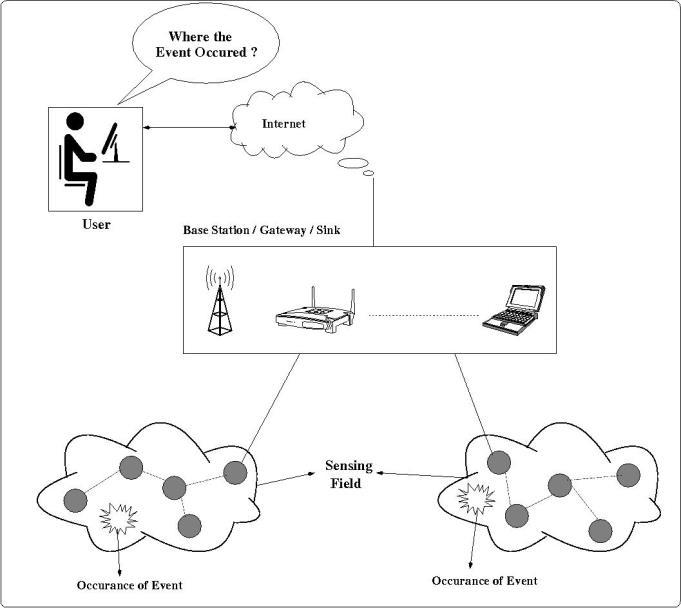
One of the most important issues in WSN is localization, because location information is necessary for deployment, coverage and target tracking, rescues, routing and location service [5] [6] as showninfigure 1. For example, sensor nodes sense the occurrence of event in sensing region and the sensed information is disseminated via satellite/internet and base station/sink/gatewaytotheenduser. Ifthe event locationis not in association with the sensed data, then the user cannot take the immediate action. So the users need to know not only occurrence of the event but also where the interested event is occurring. Because of this reason, node localization is considered as critical issue for WSN.
Determining the localization of nodes in a WSN involves collaboration between sensor nodes. Since localization is essential for routing application, several routing protocols based on the localization are presented in [7] - [10]. The protocols use location information to maintain a gradient field and also utilize multiple paths simultaneously for creating route diversity resulting in increased robustness.
Transmission of data in WSN is more effective when the sensor nodes location is correctly located. Several schemes introduced in [11] - [15] deal with localization and can be classified into two main categories: range free and range based schemes. With known distance or angles between the nodes localization can be achieved in range based mechanisms. Range free mechanisms localize the sensor nodes without the knowledge of angle/distance.
Since localizationis such an important factor for sensor nodes, increasing its precision is a critical issue that allows for efficient data transmission between SNs of WSNs and thus reduces energy consumption that enhances network lifetime. Our contributions in the proposed work are as follows:
accuracy of SNs localization in order to reduce the maximum movement distance of the beacon node. The NLAMB algorithm splits the movement area of beacon node into hexagonal grids and creates an optimization model for reducing localization errors based on the beacon node's movement route and distance constraints. This algorithm is ideal for sensor node distribution scenarios and also lowers average sensor node localization error.
It has been suggested that movable beacons can be used to assist WSN nodes in estimating their locations. A beacon is a node that knows its location (via GPS) and moves around the sensor area. The work in [17] provides a brief description of the various localization strategies used in WSN, as well as an V curve based obstacle avoidance route planning localization algorithm. In the mobile anchor nodes aided localization, mobile path planning is critical. The better the mobile path planning process, the more effectively and reliably the nodes in the monitoring area will estimate their own location.
• Received Signal Strength Indicator (RSSI) or free space path loss between two nodes is estimated using Friis transmission formula. Among various path-loss models, the log-normal model (single-slope model) is used for estimating RSSI. The distance between the known and unknown node is calculated by converting the free space path loss or RSSI to distance.
• Trilaterationmethodisusedtoestimatexy-coordinates (position) of unknown node using three known nodes and their distances from the unknown node.
• A Mobile Anchor (MA) node is considered that moves around a circular sensing field. Position information collected by cluster head is transferred to base station via MA.
• The mobility of MA is varied at different levels and simulated. The performance of proposed work is found to be better with respect to performance metrics such as end to end delay, energy consumption and throughput.
Rest of the paper is organized as follows. Section II presents related works and section III presents proposed work. Simulation model for proposed scheme and result analysis are discussed insection IV and V respectively. Finallyour work is concluded in section VI.
The Node Localization Algorithm for WSNs with Mobile Beacon node (NLAMB) is presented in [16] to enhance the
There are many path planning methods for node localization such as SCAN, Double-SCAN (D-SCAN), Hilbert, MAALRH, Z-Curves, Localization mechanism with a Mobile Anchor node based on Trilateration (LMAT), D-connect and S-CURVES are proposed [18] - [22]. Comparisons of some of the mobile anchor assisted path planning schemes are provided in table 1
The SCAN model's key advantage is its ease of implementation;however,itsuffersfromthecollinearityissue, which has a major impact onits accuracy[23]. So to overcome the weakness of SCAN and avoid collinearity, Hilbert is proposed [24] which work with division of total area into four identical squares and connecting points between the squares. But the coverage problemis one of the major issues in Hilbert. S-CURVES swap the SCAN model's straight line with an S-shaped curve, essentially reducing collinearity while increasing the length of the moving direction [25].
D-connect is a novel path planning method that assures the localization of all SNs with the shortest possible trajectory length [26]. LMAT is proposed to overcome collinearity and improve accuracy in which is made up of a series of symmetrical triangles [27]. MAALRH is a recent model in which the path begins at the middle and travels in a hexagonal pattern. MAALRH performance is very poor in terms of both localization ratio and error since the mobile anchor is not able to reach corners of the hexagonal area.
In Z-Curves, as name implies the network is covered by mobile anchors in a Z-shape and it works using the concept of trilateration to overcome collinearity problem [28]. Combining SCAN algorithm and mobile anchor based localization algorithm using Trilateration method [29] is proposed to save the mobile anchor node energy by reducing the number of corners along the planned path.
Many localization schemes combine computational intelligence techniques with RSSI and trilateration methods to improve the performance and accuracy. The use of Particle Swarm Optimization (PSO) to propose a new concept of virtual anchor nodes used for localizing target nodes by one anchor node moving in a Hilbert trajectoryis presented in [30] - [32].
The Binary-PSO algorithm is employed [33] to assemble a dynamic anchor node set for localizing the unknown nodes. Comparing with the PSO based mechanisms, Salp Swarm Algorithm (SSA) [34] performs better in terms of computing time, localization accuracy and number of localized nodes. The aim of work proposed in [35] is to develop a velocity adaptation based PSO for minimizing localization error.
A novel target tracking algorithm that combines a learning regression tree approach with RSSI-based filtering methods presented in [36] [37]. The work mentioned in [38] [39] is based on the centroid algorithm uses a fuzzy Mamdani and Sugeno inference method that improves the localization accuracy which helps in geographic routing.
The butterfly optimization algorithm, a nature-inspired meta-heuristic algorithm based node localization scheme [40] performance is better when it comes to accuracy and computingtime compared to PSO. Animproved versionof the shuffled frog leaping algorithm is presented in [41] for precise sensor node localization especially in noisy environments. It performs better compared with PSO and artificial bee colony algorithms.
This work deals with efficient anchor based node localization to transfer data in WSN. As we knowthat energy consumption of sensor node directly proportional to the distance. If the distance between source and destination is more, then the energy consumption will increase. So multi-hop technique is employed to reduce the distance. Then energy consumption is reduced by eliminating direct communication from source node to base station. Since Cluster Head (CH) is involved in the process of position information transmission, it is very much important to update the CH periodically. If CH deploys then network fails quickly, so node with highest residual energy selected as CH. Here mobile anchor node is used as intermediate node between CH and base station for transmitting location information.
The sensor nodes are deployed in circular sensing field and these sensor nodes are divided into three clusters. Depending on the residual energy CH is selected for each cluster. The node with the highest residual energy will be the CH and in case multiple nodes have same residual energy, lowest ID node will become CH. To avoid direct communication
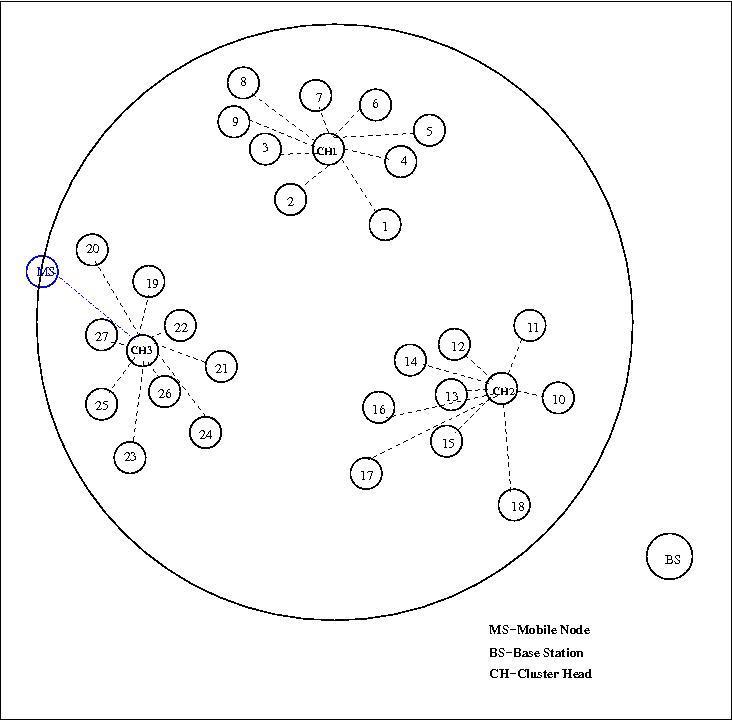
between the CH and base station, an intermediate mobile anchor node is considered which moves as shown in figure 2 around the circular sensing field. Calculated position information is collected by CH and in turn transferred to Base Station (BS) via intermediate mobile anchor node.
Table 1: Attributes of Cleveland dataset
Sl. No .
Prot ocol Locali zation Proce ss
1 SCA N [23]
2 Hilb ert [24]
3 MA ALR H [48]
4 Z-Ci ruve [28]
5 LM AT [27]
6 S-Cu rves [25]
7 D-C onne ct [26]
8 NLA -MB [16]
Locali zation Metho d
Are a Path Move ment
Path Leng th
Acc urac y
Distrib uted Rangefree 2-D Static Less Low
Distrib uted Rangefree 2-D Static Medi um Low
Distrib uted Rangefree 2-D Static More Med ium
Distrib uted Rangefree 2-D Static Medi um High
Distrib uted Rangefree 2-D Static Medi um High
Distrib uted Rangefree 2-D Static More Med ium
Distrib uted Rangefree 2-D Static Less Med ium
Distrib uted Rangefree 2-D Dyna mic Medi um High
Figure 2: Movement of MA node
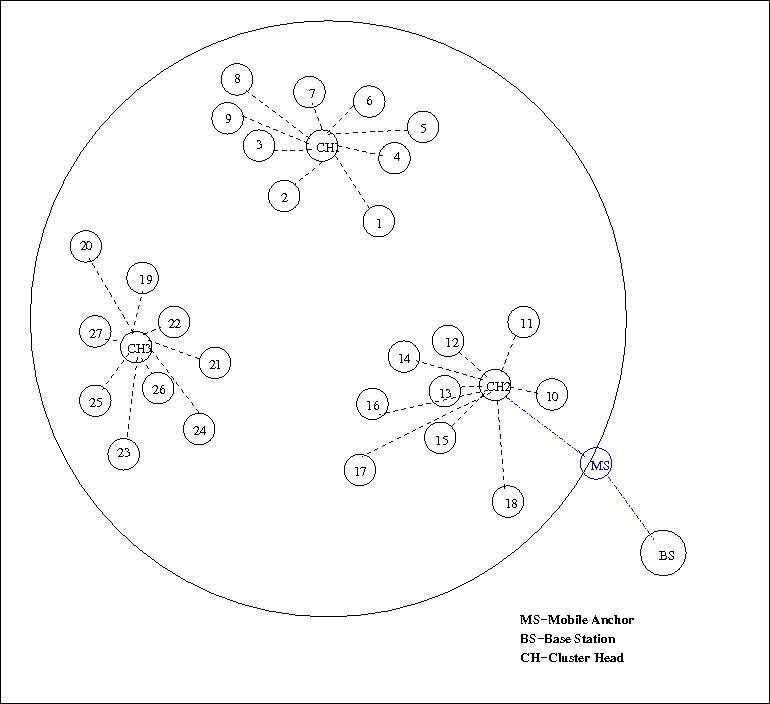
When Mobile Anchor (MA) comes nearer to the base station while moving along circular sensing field, it transfers all the position information collected from the CHs of all three clusters which is shown in figure 3. MA speed can be varied according to our convenience for the effective data transmission. In the proposed scheme, initially the distance between known and unknown node is calculated using RSSI. Then trilateration method is used to determine the coordinates of the unknown node using the calculated distance. Then the calculated position information is transferred to base station via intermediate MA node moving around the circular sensing field.
Model, Stanford University Interim (SUI) Model, and Okumura's Model. (random variable that predicts the variation in the received signal in obstructed environment) large scale fading also known as shadowing and is small scale fading also known as multi-path caused due to attenuation, scattering diffraction of the receiving signal.
• Let us consider anchor or known node P(x, y) and unknown node U(x, y). Free space path loss or RSSI can be calculated using Friis Transmission formula [43] using equation (3).
Figure 3: Transfer of Data to BS via MA node
Usually the signal received at receiver is observed as a function of distance, frequency and antenna properties [42] which is represented using in equation (1) as: ) , , ( a Rxd P f d f P (1)
Where RxdP is strength of the received signal (power), f is operating frequency, d is the distance between the transmitter and receiver, and a P indicates properties of antenna such as gain.
Since RxdP has several components such as scattering, shadowing, reflection including Line-of-Sight (LOS), RSSI can be modeled using equation (2).
PRxd (2)
Where ) (d PL is the probabilistic element of the signal, which can be represented by a variety of path-loss models, including the single-slope model (log-normal model), Hata
0 0 log 10 ) ( ) ( d d n d PL d PL (3)
Where ) (d PL is the RSSI or free space path loss at the receiver in dB, ) ( 0d PL is the average RSSI strength at the reference distance 0d [44] [45] in dB, n is the path loss exponent, and d is the distance [46] ) ( 0d PL is governed by transmitted power and operating frequency and is given by equation (4).
0 0 ) ( d d K P d PL Txd (4) Where
0 4 20log d K
(5) TxdP is the transmitted power and the wavelength of the signal being transmitted. • Once the free space path loss is known, then it can be converted to distance as shown in equation (6). 20 ) ( ) ( 0 10 d PL d PL d (6)
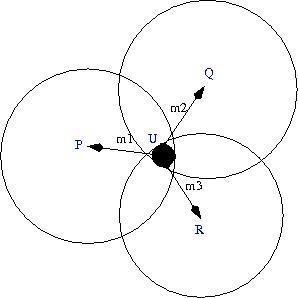
Let us consider the known or static anchor nodes P(x1, y1), Q(x2, y2) and R(x3, y3) as shown in figure 4 with distance m1, m2 and m3 respectively from the unknown node U(x, y).
The distance betweenknown and unknown nodes is calculated using equation (6). Applying Trilateration method position (xy-coordinates) of unknown node U(x, y) is estimated by determining the intersection of three circles as follows: 2 1 2 1 2 1 ) ( ) ( m y y x x (7) 2 2 2 2 2 2 ) ( ) ( m y y x x (8) 2 3 2 3 2 3 ) ( ) ( m y y x x (9)
We have used “C++” programming language as discrete event simulator to simulate the proposed scheme. Initially appropriate network environment is created with random deployment of the sensor nodes. The ‘N’ numbers of deployed Sensor Nodes (SN) are grouped in three clusters by dividing into 3 integer parts and left out nodes will be added to third cluster. Energy is allocated to sensor nodes randomly and clustered nodes made into to fall in a circular sensing area. With the help of MA (as intermediate node between CH and BS), the location information of the unknown node is communicated to BS or end user. Depend upon the residual energy of the SN, CH updated periodically. Simulation procedure and performance parameters are presented in this section.
Figure 4: Intersection of circles in Trilateration method
Further solutionfor the equations (7), (8) and (9) is as follows: 2 3 2 1 2 1
2 3 2 1 2 1 2 3 2 1 ) 2( ) 2( m m y y y y y x x x x x (10) 2 3 2 2 3 2
Some of the parameters considered for simulation are listed in table 2 and simulation procedure for the proposed scheme is summarized in Algorithm 1.
2 3 2 2 3 2 2 3 2 2 ) 2( ) 2( m m y y y y y x x x x x (11)
The equations (10) and (11) can be represented in matrix form as SX=W, where S, X and W are given by equations (12) - (14) respectively as:
(13)
(14)
The equationcan be solved using the least square method. The location (xy coordinate) of the unknown node U(x, y) is determined using equation (15) as: W S S S X T T 1 )
(15)
In the proposed scheme, the location information of the sensor node is communicated to the base station effectively using the MA node that moves around the circular sensing field with predefined convenient speed.
Algorithm 1: Simulation Procedure 1: Begin 2: Calculation of RSSI Using equation (3) 3: Computation of distance (d) using equation (6) 4: Enter the co-ordinates of three anchor nodes 5: Enter the distance (d) of anchor nodes 6: Computation of position (xy coordinates) 7: Enter the number of nodes 8: Create clusters 9: if energy of SN ≥ threshold value then 10: Select CH 11: elseif Choose SN with energy ≥ threshold value then 12: Update the CH 13: endif 14: if Mobile Anchor nearer to CH then 15: Transfer Position information to MA 16: elseif Collect position information from SNs then 17: Sleep until MA arrival 18: endif 19: if MA nearer to BS then 20: Transfer information to BS 21: endif 22: Compute the performance metrics
To evaluate the performance of proposed work, the following performance metrics are considered.
Sl.No. Parameters
Specifications
1 Number of nodes [N] 10 - 60
2 Simulation area in meters [A] 100 * 100
3 Packet size [Ps] 128Kbyte
4 Transmission Range 100m
5 Number of mobile Anchors [MA] 01
6 Anchor Mobility (Minimum) 5m/s
7 Anchor Mobility (Maximum) 15m/s
8 Channel Type Wireless 9 Number of Clusters 03 10 Sensing Field Circular
Endtoenddelay: It is the time taken for a network to transmit data from CH to BS via mobile anchor, measured in milliseconds (ms).
Packet Delivery Ratio (PDR): It is defined as the ratio of total number of packets successfully received by base station to the total number of packets sent by mobile anchor node including retransmissions. PDR is expressed in percentage.
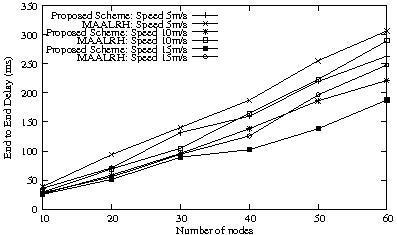
mobility of the anchor increases due to faster transmission of data from anchor to base station.
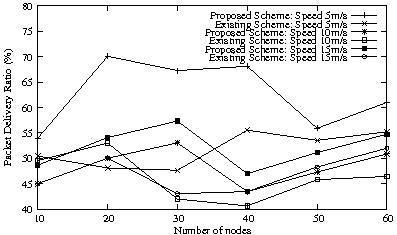
The total number of packets received (PDR) by the base station fromthe source node for both proposed and MAALRH schemeisshowninfigure6.Sincerotationspeed ofthe mobile anchor around the sensing field increases, CH will get less time to transfer the data to the mobile anchor. So as we increase the mobility of the anchor node, number of packet dropwillbemorewhich results inreductionofPDR. When we compare the results, it is seen that the total number of packets received for the proposed scheme is higher than MAALRH.
Energy consumption: It is the energy used by the sensor nodes, cluster heads, and mobile sinks to transfer data from source node to BS via mobile anchor. The amount of energy consumed is measured in milli Joules (mJ).
Overhead: Control overhead (ratio of control packet bits to data packet bits) and packet overhead (fraction ofbitsineverysensor data packet that are not data) are the two types of overhead. When it comes to determining the position of nodes, overhead becomes one of the major issues [47]. In general, overhead is considered as the total number of bits transmitted per successfully delivered data and expressed in bits (b).
Throughput: It is the ratio of total number of bits received successfully to the total simulation time and expressed in bits/milliseconds (b/ms). It gives the average rate at which data packets are delivered successfully over a communication network.
Bandwidth Utilization: It is the percentage of bandwidth utilized out of the total available bandwidth. Effective utilization of the available of the bandwidthleads to reduction in network congestion. It is expressed in terms of percentage.
The simulation results of proposed work are compared with the Mobile Anchor Assisted Localization algorithm based on Regular Hexagon for Wireless Sensor Networks [48] referred as MAALRH in the graphs. End to end delay with varying number of nodes and anchor mobilityis depicted in figure 5. It is observed that, end to end delay for the proposed scheme is less than the MAALRH. There is reduction in the delay as the
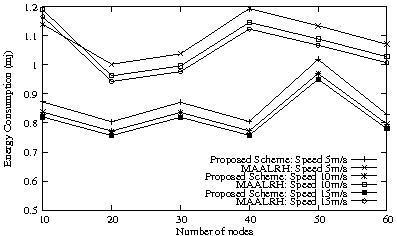
Conventionally, as network grows (increased number of nodes) the amount of energy consumed will also increase. The energy consumption by both proposed and MAALRH scheme with varying anchor mobility is shown in figure 7. It is seen that, performance of the proposed scheme is better than the MAALRH in terms of energy consumption and increase in mobility lowers energy consumption which is due to the reduction in PDR. As a result of the lower energy consumption, the network lifetime can be extended.
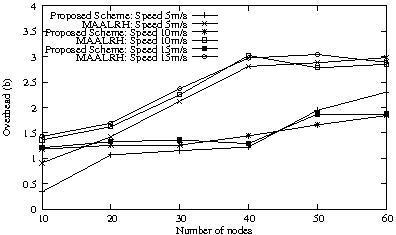
Figure 8 outlines the overheads for varying number of nodes along at different mobile anchor speed for proposed and MAALRH schemes. It is observed that the overheads
increases as number of node increases but comparing to existing scheme there is reduction in overheads for the proposed scheme. As the mobility of the mobile anchor increases, overheads will also increase due to reduction in PDR.
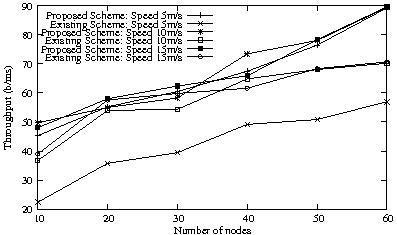
Throughput for various number of nodes under different speed levels of the mobile anchor is illustrated in figure 9. As the number of nodes increase, throughput also increases gradually. It is observed that there is reduction in throughput as increase in mobility because of decrease in the delay at higher mobility levels of mobile anchor. Comparing with the MAALRH scheme, there is improvement in the throughput of the proposed scheme.
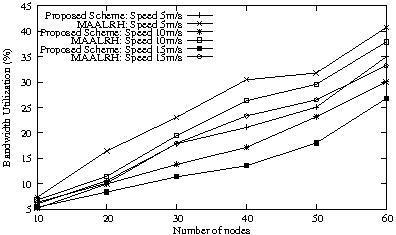
Utilization of the available bandwidth for different number nodes with variation in the mobility of mobile anchor is depicted infigure 10. Usuallythe bandwidthutilization will be more for higher number nodes but it decreases as mobility of mobile anchor increases as shown in the graph. This is due to increase in the overheads. The bandwidth utilization is less for the proposed scheme as compared with MAALRH scheme.
WSN is essential in a various fields that include defense, health, agriculture, the environment, and communication. Our proposed scheme i.e., mobile anchor assisted effective node localizationalgorithmfor position information transmission in wireless sensor networks depicts efficient way to reduce energy consumption by using multi-hop technique since energy is a critical parameter among the available resources which has to be used effectively. We have also analyzed the performance metrics such as end to end delay, overhead, throughput, bandwidth utilized and packet delivery ratio by varying different number of nodes. It is observed that, our proposed scheme performance is better as compared to the MAALRH algorithm.
Mobile anchor speed is varied at different levels and it is seen that, at higher speed levels throughput, end to end delay, energy consumption is improved compared with existing MAALRH scheme. In our work, only one mobile anchor and three clusters are considered. In future increased number of clusters and mobile anchor node can be considered to improve the network performance.
1. I .F. Akyildiz, W. Su, Y. Sankarasubramaniam, E. Cayirci Wireless Sensor Networks: A Survey, Computer Networks, pp. 393-422, 2002.
2. A.K. Paul, T. Sato, Localization in Wireless Sensor Networks: A Survey on Algorithms, Measurement Techniques, Applications and Challenges, Journal of Sensor and Actuator Networks, vol. 6, no. 24, pp. 1-23, 2017.
3. N. Saeed, H. Nam, T. Y. Al-Naffouri and M. Alouini, A State-of-the-Art Survey on Multidimensional Scaling-Based Localization Techniques' , IEEE Communications Surveys and Tutorials, Vol. 21, No. 4, pp. 3565-3583, 2019.
4. D. Pescaru and D. Curiac, Anchor Node Localization for Wireless Sensor Networks Using Video and Compass Information Fusion', Sensors, vol. 14, no. 3, pp. 4211-4224, 2014.
5. N. A. Alrajeh, M. Bashir and B. Shams, Localization Techniques in Wireless Sensor Networks, International Journal of Distributed Sensor Networks, vol. 2013, pp. 1-9, 2013.
6. B. M. Angadi, M. S. Kakkasageri, Anchor based Effective Node Localization Algorithm for Wireless Sensor Networks, Proceedings of IEEE International conference on Recent Trendsin Machine Learning, IOT, SmartCitiesandApplications, 2020.
7. Gaurav, Sharma and Ashok Kumar, Modified Energy-Efficient Range Free Localization Using Teaching-Learning-Based Optimization for Wireless Sensor Networks, IETE Journal of Research, vol. 64, no.1, pp. 124-138, 2018.
8. P. Raghu Vamsi and Krishna Kant, Trust and Location-Aware Routing Protocol for Wireless SensorNetworks, IETEJournalofResearch,vol. 62, no. 5, pp. 634-644, 2016.
9. Hayes, Tom and Falah H. Ali, Location aware sensor routingprotocolformobilewirelesssensornetworks, IET Wireless Sensor Systems, vol. 6, no. 2, pp. 49-57, 2016.
10. S. Amri, F. Khelifi, A. Bradai, A. Rachedi, M. L. Kaddachi and M. Atri, ANewFuzzyLogicBasedNode Localization Mechanism for Wireless Sensor Networks, Future Generation Computer Systems, vol. 93, pp. 799-813, 2019.
11. Slavisa Tomic, Marko Beko, Rui Dinis and Paulo Montezuma, Distributed algorithm for target localization in wireless sensor networks using RSS and AoA measurements, Pervasive and Mobile Computing, vol. 37, pp. 63-77, 2017.
12. Chelouah, Leila, Fouzi Semchedine and Louiza Bouallouche-Medjkoune, Localization protocols for mobilewirelesssensornetworks:Asurvey,Computers andElectricalEngineering, vol. 71, pp. 733-751, 2018.
13. Sharma, Gaurav and Ashok Kumar, Improved range-freelocalizationforthree-dimensionalwireless
sensor networks using genetic algorithm, Computers andElectricalEngineering, vol. 72 pp. 808-827, 2018.
14. Tuna Gurkan, and V. Cagri Gungor, A survey on deployment techniques, localization algorithms, and research challenges for underwater acoustic sensor networks, International Journal of Communication Systems, vol. 30, no. 17, pp. 1-21, 2017.
15. Tawfik Najeh, Hichem Sassi and Noureddine Liouane,A NovelRangeFreeLocalizationAlgorithminWireless Sensor Networks Based on Connectivity and Genetic Algorithms, International Journal of Wireless InformationNetworks, vol. 25, pp. 88-97, 2018.
16. Chen, Yourong, Siyi Lu, Junjie Chen, and Tiaojuan Ren, Node Localization Algorithm of Wireless Sensor Networks with Mobile Beacon Node, Peer-to-Peer NetworkingandApplications, vol. 10, no. 3, pp. 795-807, 2017.
17. N. Magadevi and V. Jawahar Senthil Kumar, Energy Efficient Obstacle Avoidance Path Planning Trajectory for Localization in Wireless Sensor Network,ClusterComputing, vol. 22, pp. 10529-10535, 2019.
18. Abdullah Alomari, Frank Comeau, William Phillips and Nauman Aslam, NewPathPlanningModelforMobile Anchor-Assisted Localization in Wireless Sensor Networks, Wireless Networks, vol. 24, pp. 2589-2607, 2018.
19. Boukhari, Nawel, SalimBouamama and Adel Moussaoui, Path Parameters Effect on Localization Using a Mobile Anchor in WSN, International Journal of Informatics and Applied Mathematics, vol. 3, no. 2, pp. 12–22, 2018.
20. A. Alomari, W. Phillips, N. Aslam, and F. Comeau, Dynamic Fuzzy Logic Based Path Planning for Mobility-Assisted Localization in Wireless Sensor Networks, Sensors, vol. 17, no. 8, pp. 1-26, 2017.
21. S. Halder , A. Ghosal, A Survey on Mobile Anchor Assisted Localization Techniques in Wireless Sensor Networks, Wireless Networks, vol. 22, pp. 2317-2336, 2016.
22. L. Cheng, J. Hang, Y. Wang and Y. Bi, A Fuzzy C-Means and Hierarchical Voting Based RSSI Quantify Localization Method for Wireless Sensor Network,IEEE Access, vol. 7, pp. 47411-47422, 2019.
23. Mishra, Tapas Kumar, Ashish Kumar Dass, and Sanjaya Kumar Panda, Enhanced Path Planning Model for Anchor-Free Distributed Localization in Wireless Sensor Networks, IEEE Fifth International Conference on Parallel, Distributed and Grid Computing (PDGC), 2018.
24. P. Singh, A. Khosla, A. Kumar, and M. Khosla, OptimizedLocalizationofTargetNodesUsingSingle Mobile Anchor Node in Wireless Sensor Network, AEU-International Journal of Electronics and Communications, vol. 91, pp. 55-65, 2018.
25. Farhanda Javed, Samiullah Khan, Asfandyar Khan, Alweena Javed, On Precise Path Planning Algorithm
in Wireless Sensor Network, International Journal of DistributedSensorNetworks, vol. 14, no. 7, 2018.
26. Sabale,Ketan,andS.Mini,AnchorNodePathPlanning For Localization in Wireless Sensor Networks, WirelessNetworks, vol. 25, no. 1, pp. 49-61, 2019.
27. Xu, Tingting, Jingjing Wang, Wei Shi, Jianfeng Wang, and Zhe Chen, A Localization Algorithm Using a MobileAnchorNodeBasedonRegionDetermination in Underwater Wireless Sensor Networks, Journal of Ocean University of China, vol. 18, no. 2, pp. 394-402, 2019.
28. Subramanian, C. Bala, M. Maragatharajan, and S. P. Balakannan, Inventive Approach of Path Planning Mechanism for Mobile Anchors in WSN, Journal of Ambient Intelligence and Humanized Computing, vol. 2020, pp. 1-9, 2020.
29. G. Han, X. Yang, L. Liu, W. Zhang and M. Guizani, A Disaster Management-Oriented Path Planning for Mobile Anchor Node-Based Localization in Wireless Sensor Networks, IEEE Transactions on Emerging TopicsinComputing, vol. 8, no. 1, pp. 115-125, 2020.
30. P. Singh, A. Khosla, A. Kumar, M. Khosla, Optimized Localization of Target Nodes using Single Mobile Anchor Node in Wireless Sensor Network, International Journal of Electronics and Communications, vol. 91, pp. 55-65, 2018.
31. B. M. Angadi, M. S. Kakkasageri, and S. S. Manvi. Computational Intelligence Techniques for Localization and Clustering in Wireless Sensor Networks, in Recent Trends in Computational Intelligence Enabled Research, Academic Press, Elsevier, ch. 2, pp. 23-40, 2021
32. Alomari, Abdullah, et al. Swarm Intelligence Optimization Techniques for Obstacle-Avoidance Mobility-Assisted Localization in Wireless Sensor Networks, IEEEAccess , vol. 6 pp. 22368-22385, 2017.
33. Y. Cao and Z. Wang, Improved DV-Hop Localization Algorithm Based on Dynamic Anchor Node Set for Wireless Sensor Networks, IEEE Access, vol. 7, pp. 124876-124890, 2019.
34. Huthaifa M. Kanoosh, Essam HalimHoussein and Mazen M. Selim, Salp Swarm Algorithm for Node Localization in Wireless Sensor Networks, Journal of ComputerNetworksandCommunications , vol. 2019, pp. 1-12, 2019.
35. Nagireddy, Vyshnavi, Pritee Parwekar and Tusar Kanti Mishra, Velocity Adaptation Based PSO for Localization in Wireless Sensor Networks, EvolutionaryIntelligence vol. 2018, pp. 1-9, 2018.
36. Hanen Ahmadi, Federico Viani and Ridha Bouallegue, An Accurate Prediction Method for Moving Target Localization and Tracking in Wireless Sensor Networks, Ad Hoc Networks, vol. 70, no. 70, pp. 14-22, 2018.
37. L.Gui,X.Zhang,Q.Ding,F.Shuand A. Wei, Reference AnchorSelectionAnd Global Optimized Solution for DV-Hop Localization in Wireless Sensor Networks,
Wireless Personal Communications, vol. 96, no. 4, pp. 5995-6005, 2017.
38. Saber Amri, Fekher Khelifi, Abbas Bradai, Abderrezak Rachedi, Med Lassaad Kaddachi and Mohamed Atri, A new fuzzy logic based node localization mechanism for Wireless Sensor Networks, Future Generation ComputerSystems , vol. 93, pp. 799-813, 2019.
39. Rout, Saroj Kumar, et al., A Fuzzy Optimization Technique for Energy Efficient Node Localization in Wireless Sensor Network Using Dynamic Trilateration Method, Progress in Computing, AnalyticsandNetworking,Springer, pp. 325-338, 2018.
40. Arora, Sankalap and Satvir Singh, NodeLocalizationin Wireless Sensor Networks Using Butterfly Optimization Algorithm, Arabian Journal for Science andEngineering, vol. 42, no. 8, pp. 3325-3335, 2017.
41. V. R. Kulkarni, V. Desai, and R. V. Kulkarni, “A Comparative Investigation Of Deterministic and Metaheuristic Algorithms for Node Localization in WirelessSensor Networks, Wireless Networks, vol. 25, no. 5, pp.2789 - 2803, 2019.
42. Kwasme, Hussein and Sabit Ekin, RSSI-based localization using LoRaWAN technology, IEEE Access, vol. 7, pp. 99856 - 99866, 2019.
43. Dezhi Han, Yunping Yu, Kuan-Ching Li and Rodrigo Fernandes de Mello, Enhancing the Sensor Node Localization Algorithm Based on Improved DV-Hop and DE Algorithms in Wireless Sensor Networks, Sensors, pp. 1-24, 2020.
44. S. Kurt and B. Tavli, Path-LossModeling for Wireless Sensor Networks: A Review of Models and Comparative Evaluations, IEEE Antennas and PropagationMagazine, vol. 59, no. 1, pp. 18-37, 2017.
45. Klaina H, Vazquez Alejos A, Aghzout O, Falcone F. Narrowband, CharacterizationofNear-GroundRadio Channel for Wireless Sensors Networks at 5G-IoT Bands, Sensors(Basel), vol. 18, no. 1, 2018.
46. Amir KarimiAlavijeh, Mohammad Hossein Ramezani and Ali Karimi Alavijeh, Localization Improvement in Wireless Sensor Networks Using A New Statistical Channel Model, Sensors and Actuators, vol. 271, pp. 283-289, 2018.
47. G. Kiruthiga and M. Mohanapriya, An Adaptive Signal Strength Based Localization Approach for Wireless Sensor Networks, Cluster Computing, vol. 22, pp. 10439-10448, 2019.
48. Guangjie Han, Chenyu Zhang, Jaime Lloret, Lei Shu, and J. P. C. Rodrigues, A Mobile Anchor Assisted LocalizationAlgorithmBasedonRegularHexagonin Wireless Sensor Networks, The Scientific World Journal , pp. 1-13, 2014