International Journal of Emerging Trends in Engineering Research
Available Online at http://www.warse.org/IJETER/static/pdf/file/ijeter051122023.pdf

https://doi.org/10.30534/ijeter/2023/051122023

Available Online at http://www.warse.org/IJETER/static/pdf/file/ijeter051122023.pdf
https://doi.org/10.30534/ijeter/2023/051122023
Received Date:
This study analyzes the effect of magnetic fields on premixed flame behavior in a bunsen burner. The fuel used is pure Calophyllum Inophyllum (B100), a mixture of Calophyllum Inophyllum with diesel oil (B50) and pure diesel oil (B0) which is heated to a temperature of 553 (K). The test uses variations of magnetic field poles N-S, S-N, N-N, and S-S, with variations in equivalent ratios of 0.7, 0.8, 0.9, 1, 1.1, and 1.2.Theexperimental results reveal that the magnetic field can affect the premixed flame behavior by analyzing the RGB color intensity and laminar burning velocity. In the flame of the B100 fuel, the intensity of the red color decreases when it is influenced by a magnetic field. The highest reduction in red color intensity occurred at the variation of the N-S magnetic poles at an equivalent ratio of 0.7. From non-magnetic B100 fuel, the average laminar burning velocity in all variations of the equivalent ratio with the influence of the N-S magnetic field increased by 28.81%, on non-magnetic B50 fuel by 34.78%, and B50 N-S fuel by 46.96% The improvement in the quality of combustion under the influence of a magnetic field is caused by the movement of O2 around the magnetic field which becomes more active towards the combustion reaction zone and the weakening of the bonds between hydrocarbonmolecules which causes O2 to bind more easilyto the hydrocarbons so that the combustion becomes more optimal.
Key words: Biodiesel, laminar burning velocity, magnetic field, premixed flame, RGB color.
The increase in world fuel prices occurred due to a limited supply of fossil energy and increasing market demand. This problem has led to the increased exploration of renewable energy alternatives to ensure energy security and can solve environmental pollution problems [1]. Among renewable and alternative fuels, biodiesel is the most representative fuel as a substitute for fossil fuels because it is produced from sustainable vegetable oil raw materials. However, the use of raw materials from vegetable oils in the long term raises
concerns because they compete with food raw materials. Therefore biodiesel from inedible raw materials is gaining world wide attention because it is easily available in many parts of the world, especially on abandoned lands that are not suitable for food crops [2]. Biodiesel has emissions that are more environmentally friendly and can be directly applied to diesel engines without any modifications [3]. Biodiesel is a mono-alkyl ester derived from vegetable oils and fats produced through an esterification, transesterification process which has been widely used to reduce high viscosity and FFA (Free Fatty Acid) [4]
One of the non-edible potential biodiesel feedstocks is C. Inophyllum (Calophyllum Inophyllum) [1]. C. Inophyllum grows a lot in countries with tropical and sub-tropical climates [5]. The advantage of C. Inophyllum as a raw material for biodiesel is that its seeds have a high oil yield of 65.8%, which is higher than the yield of palm oil and castor oil of 40-60% [6]. Several researchers have tested C. Inophyllum biodiesel on diesel engines to determine engine performance and emissions. The results of the study stated that a 10% C. Inophyllum biodiesel mixture in diesel oil resulted in a 2.3% increase in thermal braking and a 3.06% decrease in fuel consumption compared to pure diesel oil [1]. In addition, a mixture of C. Inophyllum can reduce CO opacity and smoke compared to pure diesel oil [1]
The fatty acid composition of biodiesel is a very important parameter for selecting an efficient method for producing biodiesel. The impact of biodiesel fuel properties is strongly influenced by the nature of the unsaturated fatty methyl esters in biodiesel. The chemical composition of Fatty Acid Methyl Ester is directly related to fuel properties such as viscosity, cetane number, cloud point, iodine value, and distillation [7] Increasing the average unsaturation helps to improve the low-temperature performance but creates some negative effects such as decreased cetane number and poor oxidation stability [8]. Biodiesel C. Inophyllum has a higher density, viscosity, and flashpoint than diesel oil [9]. The high viscosity of the fuel causes carbon deposits on the fuel filter, injectors, and piston rings [10]. In addition, high viscosity also affects injector sprayatomization, evaporation, and the formation of a mixture between fuel and air [7]. Meanwhile, a higher flash
point affects the level of ignition in the combustion process. Several solutions have been offered to overcome the shortcomings of biodiesel such as adding additives, heating biodiesel, mixing with diesel oil, modifying the combustion chamber, etc [1], [11].
Several researchers have focused on and attempted to apply magnetic fields to diesel engines to improve engine performance, reduce pollution and save fuel. The use of a magnetic field in the fuel pipe can improve the combustion processandreducetheresultingpollution [12]. Experiments at different positions of the fuel lines using neodymium permanent magnets with a strength of 3,000 gauss resulted in better performance at a position closer to the combustion chamber. The average reduction in fuel consumption is 4% and an increase in brake thermal efficiency is 4% [13]. In another study using a 9,000 gauss magnetic field on the fuel line can reduce fuel consumption by 8% and can reduce NOX, HC, and CO2 emissions [14]. The application of a magnetic field to the fuel line results in a fuel ionization process so that the fuel combines more easily with oxygen molecules and burns effectively [15]. The higher the magnetic strength used can have a higher impact on reducing emissions and fuel consumption [16]. The method of using a magnetic field is very effective and efficient because the construction is simple, raw materials are easy to obtain, and only require initial manufacturing costs.
Theperformanceofinternalcombustionenginessuchas diesel engines is highly dependent on the quality of combustion where the mixture of fuel and air is completely burned resulting in high efficiency and lower emissions. Research on diesel engines only analyzes performance and emissions from the combustion process in the engine. While the behavior of the flame which plays an important role in the combustion process greatly determines engine performance has not been discussed in depth. Therefore, this study aimed to observe and investigate the effect of a magnetic field on the behavior of a premixed flame using C. Inophyllum biodiesel fuel with various variations in the equivalent ratio. To get the best flame characteristics, this studyused a mixture of C. Inophyllumfuel and diesel oil, variations of the magnetic field poles, and variations of the equivalent ratio.
The fuel to be used in this research is pure C. Inophyllum biodiesel, pure diesel oil, and a mixture of C. Inophyllum biodiesel, and diesel oil. C.Inophyllum seeds were obtained from Kebondalem village, Bangorejo sub-district, Banyuwangi. While diesel oil is obtained from PT. Pertamina Tanjung Wangi, Kalipuro sub-district, Banyuwangi Regency. The materials used for the manufacture of biodiesel are methanol, H3PO4, H2SO4, and distilled water.

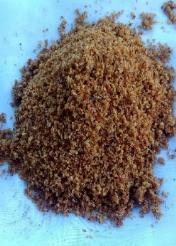

The seed extract of C. Inophyllum was carried out at the EnergyConversionLaboratoryofthe Universityof Jember. C. Inophyllum seeds that have been peeled from their shells are shown in Figure 1(a). Then the seeds are dried in the sun until theseedsarebrowntoreducetheirwatercontent.After drying, the seeds of C. Inophyllum are crushed into small granules using a grinding machine to make them easier to extract as shown in Figure 1(b). Oil extraction is carried out using the screwpress shown in Figure 1(c). Then the extracted crude oil is filtered using a filter to remove impurities contained in the crude oil. The resulting oil is expressed as a percentage using Equation (1)
Crude oil contains impurities and high FFA levels which can interfere with the combustion process. Therefore degumming, esterification, and transesterification processes are needed to convert crude oil into methyl ester [17], [18]. The degumming process aims to separate the latex or impurities in crude oil. Thedegummingprocesswascarried out byadding1% volume of H3PO4 to C. Inophyllum oil. Then after being added it was stirred with a magnetic stirrer for 30 minutes at a temperature of 600 C and after it was finished it was allowed to stand for 4 hours. The esterification process aims to reduce FFA in C. Inophyllum oil. The esterification process was carried out by adding 1% H2SO4 by volume of C. Inophyllum oil after the degumming process and adding methanol with a ratio of 1: 22 mol. Then it was stirred using a magnetic stirrer for 2 hours at a temperature of 600 C and after it was finished, let it stand for 8 hours so that the methanol and oil separated. The transesterification process is the final process of making biodiesel. Transesterification aims to convert fatty acids into methyl esters. Transesterification was carried out by adding 1% NaOH by weight of C. Inophyllum oil. Then added methanol with a ratio of 1: 6 mol. One mole of C. Inophyllum oil and 6 moles of methanol. The next step was to stir the mixture usinga magnetic stirrer for 3 hours at a temperature of 600 C and after it was finished, leave it for 8 hours so that the methanol and biodiesel separated.
After obtaining pure biodiesel, biodiesel is mixed with diesel oil at 280 C witha breaker glass based on volume and stirred at 2,000 rpm for 30 minutes to ensure homogeneity of the fuel. 0%, 50%, and 100% biodiesel are used for the mixture of diesel fuel oil which is labeled B0, B50, and B100 respectively.
The fatty acid composition of pure C. Inophyllum was identified using the GCMS (Gas Chromatography mass spectrometry) test conducted at the Jember Polytechnic Biosciences Laboratory. The percentage composition of C. Inophyllum biodiesel molecules from the GCMS test is shown in Table
into image form using the DVD Video Soft Free Studio application.

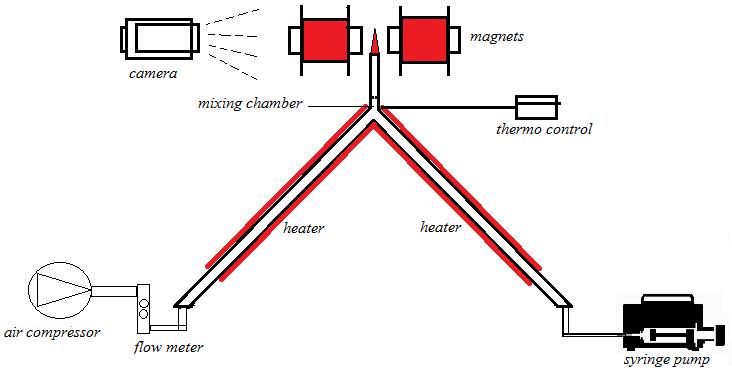
Testing the characteristics of the flame was carried out on a bunsen burner research tool with the Y-Juction geometry shown in Figure 2. The bunsen burner uses a stainless steel pipe with a diameter of 0.6 cm. The fuel is supplied using a syringe pump and heated to a temperature of 553 (K) to vaporize the fuel. Meanwhile, the air is circulated using an air compressor and the pressure is regulated using a flowmeter. To maintain the temperature of the fuel vapor in the mixing chamber, the air in the Bunsen pipe is also heated to a temperature of 553 (K). The air and fuel discharges are regulated according to a predetermined equivalent ratio, namely 0.7, 0.8, 0.9, 1, 1.1, and 1.2. A magnetic field of 11,000 gauss is used to test the flame behavior with variations in the magnetic field poles N-S, S-N, N-N, and S-S. The magnetic field is placed on both sides of the flame with a magnetic distance of 0.3 cm. Then the flame is recorded using a camera with full high-definition specifications of 1080, and 64megapixelswhichareplacedparallelto the tip ofthe burner with a distance between the camera and the burner of 18 cm. Video capture was carried out for each variation in as many as 3 trials to obtain valid data. The obtained video is converted

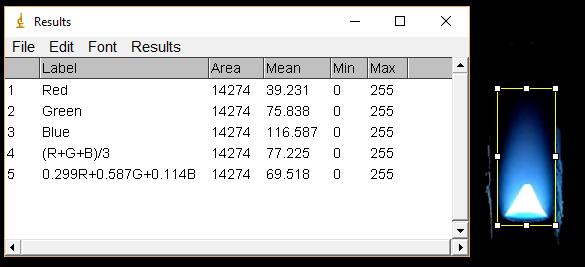
After obtaining the visual data of the flame, then the data is processed to make it easier to analyze the combustion characteristics. The first method uses an analysis of the red, green, and blue (RGB) color intensity of each flame. This study focuses on analyzing the intensity of the red color formed inthe flame. Intensityis a level or size that refers to the amount of color contained in the flame. Color intensity measurement uses the Image-J program shown in Figure 3(a) The second method is the measurement of the flame angle as the primary data which will later be used to determine the laminar spreading velocity. Figure 3(b) shows the measurement of the flame angle using the image-J program. The flame angle data used is half the angle of the premixed flame.
To calculate the laminar burning velocity, it is necessary to knowthe value of the speed of the reactants at each equivalent ratio using equation (2). After obtaining the speed of the reactants and the angle of flame, the speed of laminar combustion can be calculated using equation (3)
With:
SL = Laminar burning velocity (cm/s)












V = Speed of reactants (cm/s)
Sin α = Half the angle of fire
The flames formed with variations in equivalent ratios of 0.7, 0.8, 0.9, 1, 1.1, and 1.2, with variations of magnetic field poles N-S, S-N, S-S, and N-N have different flame characteristics. The intensity value of the red color on the flame was collected to determine the combustion characteristics of B100 biodiesel fuel under the influence of a magnetic field. The flame transformation of premixed B100 fuel is shown in Figure 4 B100 non-magnetic, Figure 5 B100 S-S magnets, Figure 6 B100 N-N magnets, Figure 7 B100 S-N magnets, and Figure 8 B100 N-S magnets.


















TheRGB colorintensitydataofeach flame is calculated using the Image-J application. The data taken focuses on the intensity of the red color because the red color in the flame indicates that the combustion process of the air and fuel mixture is not burning optimally. So that the red color of the flame can be used as a parameter to determine the quality of combustion. The equivalent ratio plays a very important role in influencing the optimal or failure of a combustion process [19]. Figure 9 shows the results of measuring the intensity of the red color on the flame of B100 fuel. From the data presented, it can be seen that the average non-magnetic B100 fuel has the highest red intensity which occurs at the equivalent ratio of φ=1.2, namely 70.31. The value of the intensity of the red color on non-magnetic B100 fuel decreased sequentially φ = 1.1 (65.24), φ = 1 (62.51), φ = 0.9 (58.3), φ = 0.8 (55.23) and φ = 0.7 (50.5). This indicates that a flame that is richer in fuel has a less than ideal mixture of fuel and air so that the combustion process becomes less than optimal. There is some fuel that burns by diffusion, causing a higher red color. Whereas poor flames have a higher percentage of air than fuel so the flames that are formed tend to be thinner and approach the blow-off condition.
The decrease in the intensity of the red color also occurs due to the influence of variations in the magnetic field. The variation of the magnetic poles has decreased the intensity of the red color sequentially from the magnetic poles S-S, N-N, S-N, and N-S which have the greatest impact. The lowest red intensity value occurs at the magnetic pole N-S 36.29 with an equivalent ratio of φ = 0.7. The decrease in the intensityof the red color in the presence of a magnetic field is due to the movement of O2 which is paramagnetic to be more active. O2 which is outside the combustion reaction zone will move actively following the direction of the magnetic field through the combustion reaction zone. The supply of O2 from outside the flame, allows O2 to optimally oxidize unburned fuel. Thus causing the intensity of the red color on the flame with the influence of the magnetic field to be lower.
Figure 10 shows the laminar burning velocity of the fuel B0 and B100 with variations in the magnetic field and equivalent ratio. From the data presented, it can be observed that non-magnetic B100 fuel has the lowest combustion speed on average, while B0 fuel has the highest combustion speed in all variations of the equivalent ratio. This is because the B100 fuel has a higher viscosity and density than B0 fuel, causing the fuel to evaporate more difficult and the combustion to be less than optimal [9], [20]. Under the influence of a magnetic field, the laminar burning velocity of B100 fuel has increased at all variations of the magnetic poles. The highest increase occurred atthemagneticpolesN-S27.08cm/satan equivalent ratio of φ=0.9, followed by the magnetic poles S-N 25.42 cm/s, N-N 19.89 cm/s, S-S 19.34 cm/s, and non-magnetic 18.24 cm/s. The laminar burning velocity increases with the influence of the magnetic field because the magnetic field affects the behavior of O2 and fuel in the combustion process. The magnetic field has properties that can attract objects or compounds that are paramagnetic. In addition, the magnetic field has a variation of the north and south magnetic poles which can provide attractive and repulsive forces. According to molecular orbital theory, O2 has 2 unbonded free electrons, so O2 is a paramagnetic compound. O2 plays an important role in the combustion process as an oxidizing agent. In the presence of a magnetic field, O2 which is around the flame experiences movement following the direction of the magnetic field and enters the combustion reaction zone. So that the oxidation process between fuel and O2 occurs more optimally. In another study, it was explained that when the fuel passed through a magnetic field, the hydrocarbons changed their orientation and switched from the para state to the ortho state [14]. In the ortho state the forces between the hydrocarbon molecules are much reduced, making it easier for O2 to enter the hydrocarbon bonds which causes more optimal combustion.
Figure11 showsagraphofthelaminarburningvelocityoffuel B0, B50, and B100 with non-magnetic and magnetic N-S variations. A mixture of biodiesel and diesel oil has been proven to improve combustion quality and reduce emissions [21], [22]. From the data presented it can be observed that the laminar burning velocity of non-magnetic B50 fuel has increased. This is because a mixture of biodiesel and diesel oil can improve the characteristics of the fuel so that it has an impact on the quality of its combustion. With the addition of a magnetic field to the B50 fuel, it has increased close to that of the B0 fuel. From non-magnetic B100 fuel, the average laminar burning velocity in all variations of the equivalent ratio increased by 28.81% under the influence of the N-S magnetic field, on non-magnetic B50 fuel by 34.78%, and on B50 N-S fuel 46.96%.
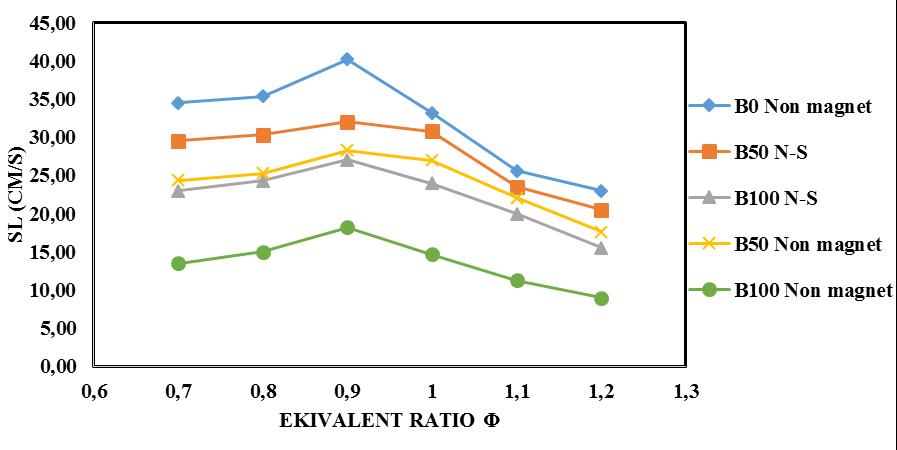
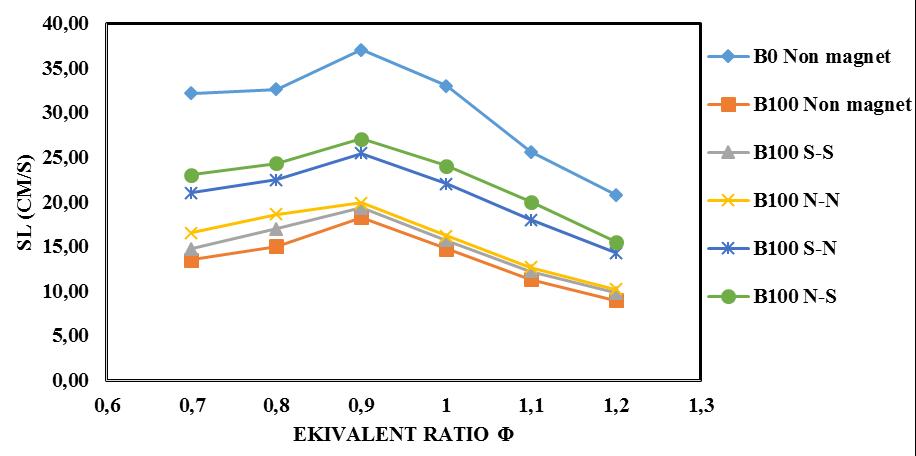
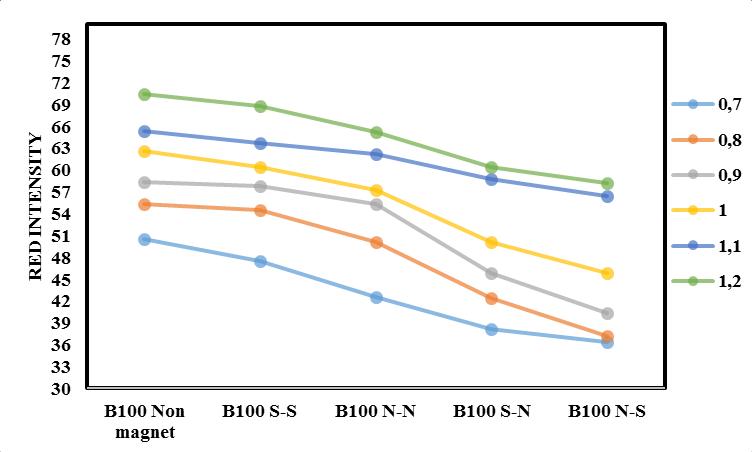
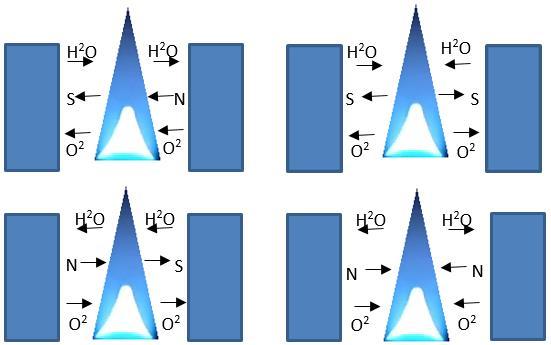
Figure 12 shows an illustration of the magnetic field affecting a premixed flame. The magnetic field force will always point from the north pole to the south pole. In the S-N magnetic field, the movement of O2 follows the magnetic field force from the N pole to the S pole, so that the O2 around the N magnet will be carried into the combustion reaction zone. Whiletheheatgenerated fromH2O which is diamagnetic leads
opposite the magnetic force from the S pole to the N pole and tends to pull H2O out of the flame. This event causes the combustionprocess to be more optimal. Whereas the N-S pole has a stronger impact, maybe because during the data collection process, the direction of the pole is parallel to the earth's magnetic field so the N-S pole has a stronger power. At theN-Npoles,themagneticfieldis directed outwards fromthe magnetic poles so that it pushes O2 from both sides of the magnet toward the combustion reaction zone. Meanwhile, H2O is pulled out of the flame by the two poles. On the other hand, at the S-S pole, the direction is towards the pole which causes O2 to be attracted from the flame while H2O as a heat source is pushed into the flame. This event causes a less than optimal combustion reaction.
[1] H. C. Ong, H. H. Masjuki, T. M. I. Mahlia, A. S. Silitonga, W. T. Chong, and K. Y. Leong, “Optimization of biodiesel production and engine performance from high free fatty acid Calophyllum inophyllum oil in CI diesel engine,” Energy Convers. Manag., vol. 81, pp. 30–40, 2014, doi: 10.1016/j.enconman.2014.01.065.
[2] A. E. Atabani et al., "Non-edible vegetable oils: A critical evaluation of oil extraction, fatty acid compositions, biodiesel production, characteristics,engineperformance,andemissions production," Renew. Sustain. Energy Rev., vol. 18, pp. 211–245, 2013, doi: 10.1016/j.rser.2012.10.013.
[3] S. Mohite, S. Kumar, and S. Maji, “Performance characteristics of mix oil biodiesel blends with smoke emissions,” Int. J. Renew. Energy Dev., vol. 5, no. 2, pp. 163–170, 2016, doi: 10.14710/ijred.5.2.163-170.
[4] A. Demirbas, “Progress and recent trends in biodiesel fuels,” Energy Convers. Manag., vol. 50, no. 1, pp. 14–34, 2009, doi: 10.1016/j.enconman.2008.09.001.
[5] H. C. Ong, T. M. I. Mahlia, H. H. Masjuki, and R. S. Norhasyima, “Comparison of palm oil, Jatropha curcas and Calophyllum inophyllum for biodiesel: A review,” Renew. Sustain. Energy Rev., vol. 15, no. 8, pp. 3501–3515, 2011, doi: 10.1016/j.rser.2011.05.005.
From the experimental results and analysis that have been done, it can be concluded that the magnetic field can affect the flame behavior of premixed C. inophyllum fuel and a mixture of C. inophyllumand diesel oil. In the RGB color analysis, the B100 N-S fuel shows that the average red color intensity on the flame has decreased. With a decrease in the intensityof the red color, it proves that the magnetic field can optimize the combustion process. From non-magnetic B100 fuel, the average laminar burning velocity in all variations of the equivalent ratio with the influence of the N-S magnetic field increased by 28.81%, on non-magnetic B50 fuel by 34.78%, and on B50 N-S fuel by 46.96%. The highest increase in laminar burning velocity for all fuel variations, magnetic poles, and equivalent ratios occurred in B50 fuel with N-S magnets. Variations in magnetic poles and the right fuel mixture greatly determines the increase in the quality of combustion.
The author thanks PT. Pertamina Tanjung Wangi which has helped a lot in supplying pure diesel oil as a research material in this study.
[6] I. W. Muderawan and N. K. P. Daiwataningsih, “Pembuatan Biodesel dari Minyak Nyamplung (Calophyllum Inophylum L,) dan Analisis Metil Esternya dengan GC-MS,” J. FMIPA, pp. 324–331, 2016.
[7] H. M. Mahmudul, F. Y. Hagos, R. Mamat, A. A. Adam, W. F. W. Ishak, and R. Alenezi, “Production, characterization and performance of biodiesel as an alternative fuel in diesel engines – A review,” Renew. Sustain. Energy Rev., vol. 72, no. April 2016, pp. 497–509, 2017, doi: 10.1016/j.rser.2017.01.001.
[8] S. K. Hoekman, A. Broch, C. Robbins, E. Ceniceros, andM.Natarajan,“Reviewofbiodieselcomposition, properties, and specifications,” Renew. Sustain. Energy Rev., vol. 16, no. 1, pp. 143–169, 2012, doi: 10.1016/j.rser.2011.07.143.
[9] S. Pambudi, N. Ilminnafik, S. Junus, and M. N. Kustanto, “Experimental study on the effect of nano additives γal2o3 and equivalence ratio to Bunsen flame characteristic of biodiesel from nyamplung (Calophyllum Inophyllum),” Automot. Exp., vol. 4, no. 2, pp. 51–61, 2021, doi: 10.31603/ae.4569.
[10] D. Y. C. Leung, X. Wu, and M. K. H. Leung, “A review on biodiesel production using catalyzed transesterification,” Appl. Energy, vol. 87, no. 4, pp. 1083–1095, 2010, doi: 10.1016/j.apenergy.2009.10.006.
[11] B. Ashok, K. Nanthagopal, A. K. Jeevanantham, P. Bhowmick, D. Malhotra, and P. Agarwal, “An assessment of calophyllum inophyllum biodiesel fuelled diesel engine characteristics using novel antioxidant additives,” Energy Convers. Manag., vol. 148, pp. 935–943, 2017, doi: 10.1016/j.enconman.2017.06.049.
[12] Y. Al Ali, M. Hrairi, and I. Al Kattan, “Potential for improving vehicle fuel efficiency and reducing the environmental pollution via fuel ionization,” Int. J. Environ. Sci. Technol., vol. 9, no. 3, pp. 495–502, 2012, doi: 10.1007/s13762-012-0053-7.
[13] R. R. Sahoo and A. Jain, “Experimental analysis of nanofuel additives with magnetic fuel conditioning for diesel engine performance and emissions,” Fuel, vol. 236, pp. 365–372, Jan. 2019, doi: 10.1016/j.fuel.2018.09.027.
[14]
P. M. Patel, G. P. Rathod, and T. M. Patel, “Performance and Emission Analysis of Single Cylinder Diesel Engine under the influence of MagneticFuelEnergizer,” IOSR J. Mech. Civ. Eng., vol. 11, no. 2, pp. 34–39, 2014, doi: 10.9790/1684-11283439.
[15] P.V.Kumar,S.K.Patro,and V. Pudi, “Experimental studyofanovelmagneticfuelionization method in four stroke diesel engines,” Int. J. Mech Eng. Rob. Res., vol. 3, no. 1, pp. 151–159, 2014.
[16] A. S. Faris et al., “Effects of magnetic field on fuel consumption and exhaust emissions in two-stroke engine,” in Energy Procedia, 2012, vol. 18, pp. 327–338. doi: 10.1016/j.egypro.2012.05.044.
[17] A. Demirbas, “Comparison of transesterification methods for production of biodiesel from vegetable oils and fats,” Energy Convers. Manag., vol. 49, no. 1, pp. 125–130, 2008, doi: 10.1016/j.enconman.2007.05.002.
[18] B. K. Venkanna and C. Venkataramana Reddy, “Biodiesel production and optimization from Calophyllum inophyllum linn oil (honne oil) - A three stage method,” Bioresour. Technol., vol. 100, no. 21, pp. 5122–5125, Nov. 2009, doi: 10.1016/j.biortech.2009.05.023.
[19] D. L. Setyadi, N. Ilminnafik, H. Sutjahjono, T. V. Kusumadewi, and R. Raka, “Analysis of mixed premixed combustion characteristics of biodiesel candlenut oil (Aleurites Moluccana) with biodiesel fuel,” AIP Conf. Proc., vol. 2278, no. October, 2020, doi: 10.1063/12.0001259.
[20] H. Venu and V. Madhavan, “Effect of Al2O3 nanoparticles in biodiesel-diesel-ethanol blends at various injection strategies: Performance, combustion and emission characteristics,” Fuel, vol. 186, pp. 176–189, 2016, doi: 10.1016/j.fuel.2016.08.046.
[21] S. M. A. Rahman, H. H. Masjuki, M. A. Kalam, M. J. Abedin, A. Sanjid, and H. Sajjad, “Production of palmand Calophylluminophyllumbased biodiesel and investigation of blend performance and
exhaust emission in an unmodified diesel engine at high idling conditions,” Energy Convers. Manag., vol. 76, pp. 362–367, 2013, doi: 10.1016/j.enconman.2013.07.061.
[22] A. C. Arifin, A. Aminudin, and R. M. Putra, “Diesel-biodiesel blend on engine performance: an experimentalstudy,” Automot. Exp.,vol.2,no. 3, pp. 91–96, 2019, doi: 10.31603/ae.v2i3.2995.