International Journal of Emerging Trends in Engineering Research
Available Online at http://www.warse.org/IJETER/static/pdf/file/ijeter021122023.pdf

https://doi.org/10.30534/ijeter/2023/021122023

Available Online at http://www.warse.org/IJETER/static/pdf/file/ijeter021122023.pdf
https://doi.org/10.30534/ijeter/2023/021122023
RikiRizkiansyah,Muh. NurkoyimKustanto*, GagukJatisukamto, AndiSanata, MahrosDarsin
Received
University of Jember Indonesia, nurkoyin@unej.ac.id
The sugarcane mill is an industrythat processes sugarcane into sugar. Bagasse is a by-product of this process. Bagasse can be usedasasolidfuel.Dryingbagasseatthefirstofanyprocesses is essential to reduce the moisture content. The highest moisture content reduction is achieved using higher mass and flue gas temperature. Flue gas can be used as a drying agent and will give an advantage to the mill with attention to the combustion process to handle the distribution of ash content onflue gas. As a drying agent, flue gas makes ashcontent from the flue gas component trapped at the bagasse feed. The high amount of ash content at bagasse makes the combustion efficiency decrease. This study is focused on discussing the ash production of flue gas and their effect as a drying agent on the bagasse combustion efficiency in sugarcane mills. The answer for the problem is solved by makes a simulation of the energy-generating plant using the software Aspen Plus. The condition of the plant is set with 1000 kg/h bagasse and 50 wt.% dried until 10 wt.% moisture content with one point two equivalence ratio. The result of this works is the decrease of combustion efficiency was reported at around 0.57% per hour periodically.
Key words: sugarcane, bagasse, dryer, flue gas
The sugarcane mill is an industry that processes sugarcane into sugar. Bagasse is a by-product of this process. Bagasse can be used as a solid fuel. The use of bagasse as fuel is reported to have a high moisture content, about 50-60 wt.%, which impacts to decrease in energy efficiency [1], [2]. The decrease in moisture content can be done by adding a drying process. The addition of a drying process before combustion shows an increase in the energyqualityand reduces emissions. Therefore efficiency can be increased by about 15-25% [3]–[5].
Biomass drying usually operates with hot or flue gas from the combustion furnace as the drying agent [6]. Not only using flue gases but also research on drying agents has been carried

out using superheated steam. The results show that the advantage of using superheated steam is that it can reduce the hazard of flue gas content but has an impact on increasing fuel consumption. Because of that, flue gas as a drying agent is still the best method that can be used [7]–[10].
In 2009, a study analysed flue gas as a drying agent. The results of the study reported that the use of flue gas as a drying agent has the potential to cause hazards. Previous researchers reported that two types of hazards could be caused, hazards due to the content of flue gases that are not environmentally friendly and fire hazards due to high temperatures with large mass flows [11]. Subsequent research was conducted to analyse the flue gas content as a drying agent. Researchers in the olive oil industry reported that flue gases carry ash particles that can mix with fuel and affect combustion [12]. The ash carried by the flue gas will melt at a specific temperature and cause slag so that it can deflate combustion efficiency and deflate the quality of heat transfer [13]–[15]. However,fluegas as a dryingagent is still a research object. In this study, we will focus on discussing the ash production of flue gas and their effect as a drying agent on the bagasse combustion efficiency in sugarcane mills. The answer for the problem is solved by makes a simulation of the energy-generating plant at sugarcane mill by software Aspen Plus.
The method ofthis works is simulation bysoftware. A dryer and energy-generating plant was simulated on Aspen Plus, as seeninFigure 1 then Table 1 describes the blocks and streams.
The main component in this simulation is bagasse and flue gas. With proximate and ultimate analysis of sugarcane bagasse are ash content 2.94%; carbon 46.96%; hydrogen 5.72%; nitrogen 0.27%; chlorine 0.04%; sulphur 0.02%; oxygen 44.05%; fixed carbon 18%; volatile matter 79.06%; and moisture content of bagasse is 50 wt.% [2]. DRYER is equipment that dries bagasse from WET-BAGNC to DRY-BAGNC using DRY-AGN. DRY-AGN is a stream as a drying agent as a part of hot gases from combustion (PRODUCT) or the other named with flue gas. DRY-AGN temperature depends on the equivalence ratio (ER) on BURNER. DRY-AGN composition depends on the value adopted on PRODUCT as hot gas. In this works, DRY-AGN compositions are known bythe stream result information from the software.
Streama/Blockb Description
aWET-BAG Wet bagasse for drying, 1 bar, 25 °C, 50 wt.%
aDRY-AGN PRODUCT
aFG-DRYER Flue gas after drying
aAIR Air, 1 bar, 25 °C
aINBURN Similar to DRY-BAG, used for combustion
bDRYER Convective dryer, 10 m, 5 min solid residence time
bDECOMP RYield, 1 bar, 25 °C
bBURNER Rstoic, combustion
bPRODUCT Hot gas from combustion
bDRY-BAG Dry bagasse after drying
For example, an equivalence ratio one point two produce H2O 4.61%; N2 70.23%; O2 11.80%; NO2 0.000877%; NO

0.38%; S 7.51x10⁻¹²%; SO2 0.0023%; SO3 1.02x10⁻⁵%; H2



0.00015%; Cl2 7.74x10⁻⁹%; CO 0.009356%; CO2 12.74% and ash content 0.22% by mass. DRYER block converts a part of moisture content from NC WET-BAG is evaporated moisture content and will separate from the sugarcane bagasse stream. The evaporated moisture content canbe found on FG-DRYER flow parameters. The plant was made by containing DECOMP, which is set up to convert DRY-BAG to conventional stream INBURN developed by heat on Q-DECOMP. BURNER will burn the bagasse and generate hot gas named PRODUCT with AIR as a complementary combustion reaction. As a result, the combustion efficiency was known with a parameter from software and compared with a parameter from the calculation approach [16]
The efficiency of bagasse combustion will be analysed by comparing fuel energywith energy on hot gas as a combustion product, as mentioned in equation (18). The bagasse heating value is estimated using the equation approach (19) adopted by the chemical component [8]
The works will analyse: (i) the influence of flue gas temperature and flue gas/wet bagasse flow ratio on the dryer performance; (ii) the effect of air/fuel ratio (AFR) on flue gas properties and dryer performance; and (iii) the effect of using flue gas as a drying agent on to combustion performance. Especially for the third case, the specific heat of flue gas will beanalysed withthecalculationequation(1)-(17) [16].For the case with using specific heat of superheated steam, the value was known by REFPROP (Reference Fluid Thermodynamic and Transport Properties) by NIST Standard Reference Database 23, Version 9.1.




The four crucial things on the flue gas dryer are the drying agent temperature, the drying agent/wet bagasse ratio, evaporated moisture, and the bagasse final moisture content. Figure 2 shows that variations of drying agent temperature and drying agent/wet bagasse are proportional inverse to moisture content, which can produce different bagasse moisture.
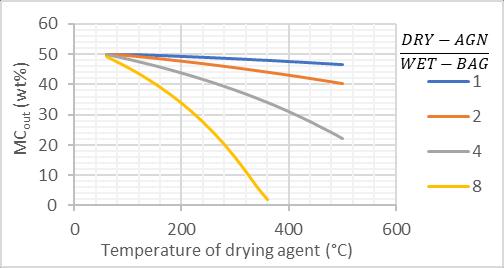
Since the drying agent is picked up from flue gas or hot gas (PRODUCT) that is contain H2O of 0.04816; N2 of 0.70145; O2 of 0.05784; NO2 of 4.59358x10-06; NO of 0.00313; S of 2.62497x10⁻¹¹; SO2 of 0.00198; SO3 of 4.15193x10-06; H2 of 2.84214x10-06; Cl2 of3.67930x10-10; HCl of 7.84392x10-05; of CO 0.00031; of CO2 0.18704 bya mass fraction. For example, while DRY-AGN at 300 °C and DRY-AGN/WET-BAG ratio are eight, the moisture achieves at 15.9 wt.%, but at the same temperature with DRY-AGN/WET-BAG ratio is two then the moisture content achieves at 45.7 wt.%. The ratio of DRY-AGN/WET-BAG is a simplified value to express the mass flow of both. At the same temperature DRY-AGN, the biggest ratio shows the biggest heat deviation between DRY-AGN compared with a WET-BAG. The chart shows a higher moisture content decrease followed by an increased heat energy from DRY-AGN.


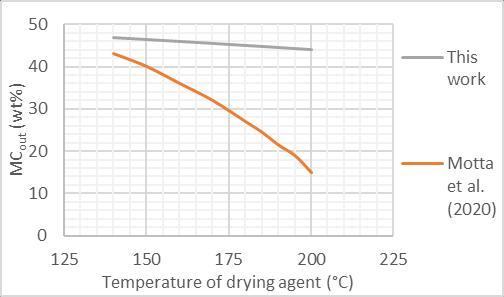
The result is close to previous research by Motta et al. (2020). Figure 3 shows the relationship between the drying agent's temperature and the moisture content outlet dryer from this work and the work by Motta et al. (2020).

In comparing the data, the drying agent/wet bagasse ratio is chosen at four. At the same ratio and temperature, data from Motta et al. (2020) are better and have good performance for drying. From Error! Reference source not found. , we can see that at a temperature of 150°C, Motta (2020) reported achieving moisture content until 39%. Also, this work is about 45%. The heat energy causes it at the same mass, and the temperature can differ. Since heat energy is affected by mass, specific heat, and temperature, even though the mass and temperature are alike, specific heat can differ. Motta et al. (2020) reported that the drying agent uses superheated steam, in this case, flue gas. The possibility factor that makes it like that is that superheated steam's specific heat is higher than flue gas.
Fagernäs has explained that forced evaporative drying requires a lot of energy [6] Error! Reference source not found.isachart ofevaporated water fromwet bagasse, known from the software stream result as H2O mass flow at FG-DRYER, subtracting H2O mass flow at DRY-AGN.
Figure 4 shows the exact value of the drying agent/wet bagasse ratio, the highest temperature followed by a large amount of bagasse water evaporated by the dryer.
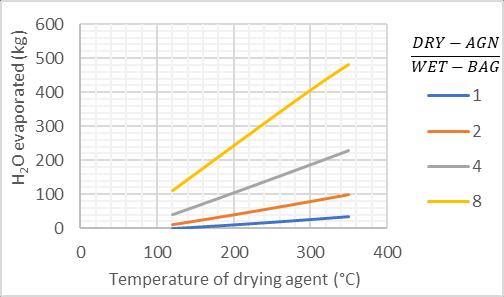
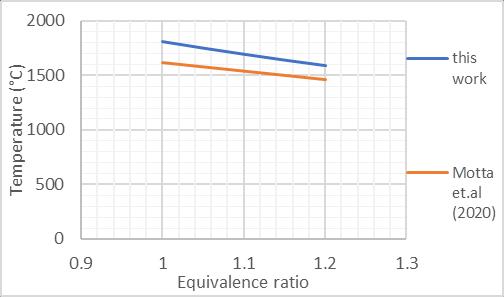
At the same temperature with different ratios of drying agent/wet bagasse, the highest ratio following by a large amount of bagasse water evaporated by the dryer. It is explained that the dryer evaporates the highest heat from the drying agent, followed by a large amount of H2O formed on bagasse [9]. The temperature ofhot gas byflame is affected by an equivalence ratio, as shown in Figure 5.
The higher equivalence ratio will decrease hot gas temperature. It is the effect of the low temperature from the air is enter and mixing with it. The other research reported that increasing the equivalence ratio reduces the flue gas temperature at the furnace due to the excess air that does not react, thus diluting the produced flue gas [9]. Figure 5 compares the data from this work and the data by Motta et al. (2020) as a reference; there are differences between Motta approaches lower temperatures than this work at the same equivalence ratio. It is because of moisture content on feed by Motta is lower than this works, 50% and 10%, respectively.
Figure 6 shows the relation between AFR to ash content and CO production on combustion. Since AFR is a function of bagasse used, the higher ratio means either less fuel used or higher equivalence ratio. The highest ratio affected less ash content and CO production.
The chart shows that AFR is inverse to CO and ash. It is because more Air on combustion will reduce CO production, which is affected by lean combustion[2][17]. The equivalence ratio shows the air used and the air needed by stoichiometry.

Excess air is needed to burn more carbon and reduce CO emissions. The ash content is affecting to the temperature of hot gas inthe furnace. The highest ash content is followed bya decrease in temperature at the furnace.
Figure 7 show the relation between ash content and gas temperature on the furnace for this work and was reported by Sami [17]. The difference between both is caused by the moisture content from sawdust being lower than bagasse, which raises the temperature. Bagasse moisture content in this work is 50 wt.% and dries to 10 wt.%; then, sawdust moisture content by Sami is 7.5 wt.%.
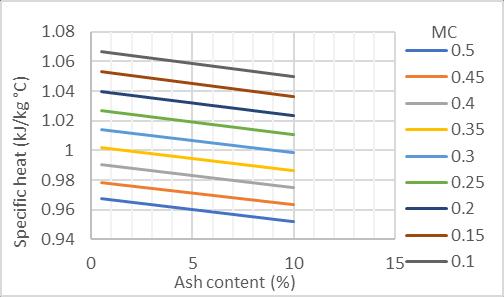
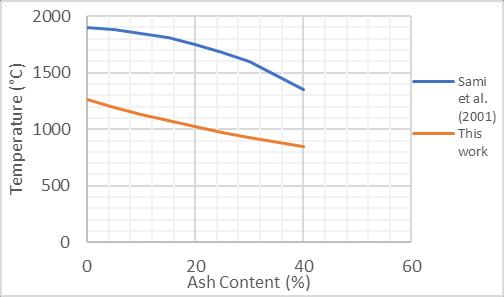
Figure 8 shows that specific heat is affected by the compositionofashand bagasse moisture content, higher value ofboth will decrease the value of specific heat. It is the answer to Error! Reference source not found.; on that chart at the same temperature, the mass flow drying agent by superheated steamreducedmoisturecontentmorethanfluegas.Itiscaused by the specific heat of superheated steam being higher than flue gas.
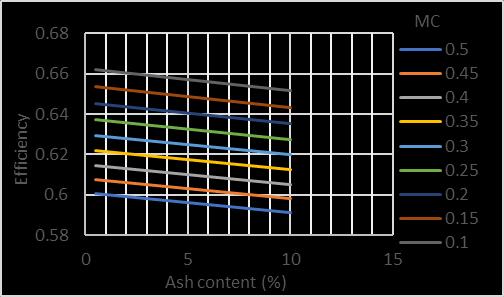
The specific heat of 300°C flue gas from bagasse combustion with MC 10-50% and ash content 0-10% just around 0.9-1.1 kJ/kg °C and the specific heat of superheated steam, extracted from REFPROP by NIST at 260°C and 2 bar is 2.0125 kJ/kg °C. Figure 9 shows that the combustion efficiency is affected by the composition of ash and moisture content bagasse, higher value of both will decrease the efficiency value.
The decrease in efficiency because the higher moisture content will cause a lot of energy loss at bagasse burning; it happenswhentoburnthe bagasse, the heat energyshould have to evaporate water on bagasse as moisture content. The other research was done by analyzing moisture and ash content on sawdust combustion efficiency. There is a similarity between the sawdust and bagasse case, which explain that since the specific heat and efficiency were affected by temperature, this case relates, as mentioned, as the adiabatic flame temperature can decrease if the ash and/or moisture content increase [17]
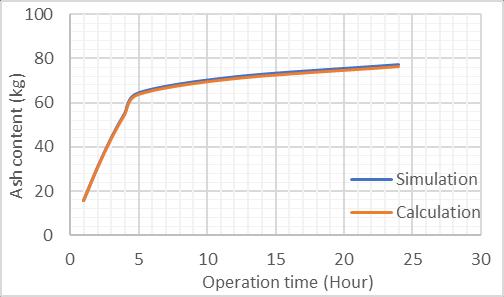
The ash content is produced by the net of fuel used; the higher fuel consumption is affected by the higher ash produced. When flue gas is used as a drying agent, all components including ash content of flue gas will enter the dryer and through the bagasse. Assuming all solids (ash content) are trapped in the bagasse, it will make the bagasse mix with ash. Mixing ash content and bagasse as feed will increase the ash content on the feed. As long as the mill operates with a drying agent using flue gas through the feed directly, ash content on flue gas will continuously increase, as showninFigure 10 . Since the amount of ash content on fuel is high, the combustion efficiency will decrease as shown in Figure 11.
For example, on operation time with 1000 kg/h bagasse (WET-BAG) and 50 wt.% dried until 10 wt.% (DRY-BAG) moisture content and equivalence ratio is one point two. At the 1st, 3rd, 12th, and 24th time operations, the flue gas component measured bysoftware contained 15.768 kg, 43.919 kg, 71.573 kg,77.089kgofash,followedbycombustionefficiencyat that time 53.395%, 51.293%, 49.123%, 48.679%.
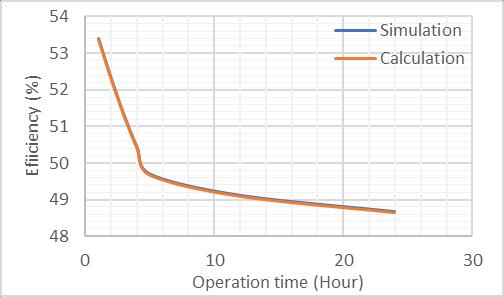
Furthermore, the flue gas component measured by calculation contains 15.611 kg, 43.460 kg, 70.790 kg, and 76.238 kg of ash then, followed by combustion efficiency at that time is 53.359%, 51.262%, 49.098%, 48.654%. This work shows that using flue gas as a direct dryer agent for bagasse decreases combustion efficiency while the amount of ash content on feed is increasing [12]. Combustion efficiency is decreased by around 0.57% per hour with an error value betweensoftwareand calculationequationapproachofaround 0.058%.
Based on the simulation on this work is known that highest decrease of moisture content on bagasse is reached by higher heat of drying agent and the higher of ash content makes the efficiency of combustion decreases. At a cycle with 1000 kg/h feed (WET-BAG) and equivalence ratio is one point two, the decrease of combustion efficiency was reported at around 0.57% per hour periodically.


Specific heat of flue gas (kJ/kg °C)
Specific heat of carbon (kJ/kg °C)
The percentage ratio of hydrogen in chemical composition (%)
The percentage ratio of oxygen in chemical composition (%)
The percentage ratio of sulfur in chemical composition (%)
The percentage ratio of carbon in chemical composition (%)
The percentage ratio of ash content in
chemical composition (%)
The percentage ratio of moisture in chemical composition (%)
Specific heat of the air (kJ/kg °C)
ER Anequivalenceratioisaratioofairused to air needed for stoichiometry combustion


Efficiency (%)
T Temperature (°C)
Mass flow (kg/h)
HHV High Heating Value (kJ/kg)

NC Non-conventional
[1] J. G. Brammer and A. V. Bridgwater, The influence of feedstock drying on the performance and economics of a biomass gasifier - Engine CHP system, Biomass and Bioenergy, vol. 22, no. 4, pp. 271–281, 2002
[2] I. L. Motta, N. T. Miranda, R. M. Filho, and M. R. W. Maciel, Sugarcane bagasse gasification: thermodynamic modelling and analysis of operating effects in a steam-oxygen-blown fluidized bed using Aspen Plus TM, Chem. Eng. Trans., vol. 65, 2018
[3] D. Y. Chen, D. Zhang, and X. F. Zhu, Heat/mass transfer characteristics and nonisothermal drying kinetics at the first stage of biomass pyrolysis, J. Therm. Anal. Calorim., vol. 109, no. 2, pp. 847
854, 2012.
[4] D. Chen, Y. Zheng, and X. Zhu, Determination of effective moisture diffusivity and drying kinetics for poplar sawdust by thermogravimetric analysis under isothermal condition, Bioresour. Technol., vol. 107, pp. 451–455, 2012
[5] S. Pang and A. S. Mujumdar, Drying of woody biomass for bioenergy: Drying technologies and optimization for an integrated bioenergy plant, Dry. Technol., vol. 28, no. 5, pp. 690–701, 2010.
[6] L. Fagernäs, J. Brammer, C. Wilén, M. Lauer, and F. Verhoeff, Drying of biomass for second generation synfuelproduction, Biomass and Bioenergy, vol. 34, no. 9, pp. 1267–1277, 2010
[7] E. Andersson, S. Harvey, and T. Berntsson, Energy efficient upgrading of biofuel integrated with a pulpmill, Energy, vol. 31, no. 10
11, pp. 1384
1394, 2006
[8] J. Barroso, F. Barreras, H. Amaveda, and A. Lozano, On the optimization of boiler efficiency using bagasseasfuel, Fuel, vol. 82, no. 12, pp. 1451–1463, 2003
[9] I.L.Motta,A.N.Marchesan,R.M.I.Filho,andM.R. W. Maciel, Thermodynamic analysis of superheated steam and flue gas as drying agents for biomass dryers, Chem. Eng. Trans., vol. 80, pp. 187–192, 2020.
[10] H. Song, F. Starfelt, L. Daianova, and J. Yan,
Influence of drying process on the biomass-based polygeneration system of bioethanol, power and heat, Appl. Energy, vol. 90, no. 1, pp. 32–37, 2012.
[11] R. M. Swanson, A. Platon, J. A. Satrio, and R. C. Brown, Techno-economic analysis of biomass-to-liquids production based on gasificationscenarios, Springfield, 2010.
[12] E. Romero, M. Quirantes, and R. Nogales, Characterization of biomass ashes produced at differenttemperaturesfromolive-oil-industry and greenhouse vegetable wastes, Fuel, vol. 208, pp. 1–9, 2017
[13] J. Horák et al., “Effects of the type of biomass and ashing temperature on the properties of solid fuel ashes, Polish J. Chem. Technol., vol. 21, no. 2, pp. 43–51, 2019
[14] Y. Niu et al., Study on fusion characteristics of biomass ash, Bioresour. Technol , vol. 101, no. 23, pp. 9373–9381, 2010.
[15] M. Zhai, X. Li, D. Yang, Z. Ma, and P. Dong, Ash fusion characteristics of biomass pellets during combustion,J.Clean.Prod.,vol.336,p. 130361, Feb. 2022
[16] C. Coskun, Z. Oktay, and N. Ilten, A new approach for simplifying the calculation of flue gas specific heat and specific exergy value depending on fuel composition, Energy, vol. 34, no. 11, pp. 1898–1902, 2009.
[17] M. Sami, K. Annamalai, and M. Wooldridge, Co-firing of coal and biomass fuel blends, Prog. Energy Combust. Sci., vol. 27, no. 2, pp. 171–214, 2001