International Journal of Advanced Trends in Computer Science and Engineering
Available Online at http://www.warse.org/IJATCSE/static/pdf/file/ijatcse051222023.pdf

https://doi.org/10.30534/ijatcse/2023/051222023

Available Online at http://www.warse.org/IJATCSE/static/pdf/file/ijatcse051222023.pdf
https://doi.org/10.30534/ijatcse/2023/051222023
Patel Urvaben Nitin1, Dankhara Jigar Jentibhai2, Dr. Priya Swaminarayan3
1Student of MSc IT, Parul University, India, urupatel818@gmail.com
2Student of MCA, Parul University, India, 123jigardakhara@gmail.com
3Dean of MCA and MSc IT, FITCS , Parul University, India
Received Date February 21, 2023 Accepted Date: March 27, 2023 Published Date: April 06, 2023
Water could be a basic necessity always and also the foremost important resource for agriculture. The standard of water determines the standard of food, which encompasses a crucial role in people's health. The use of IoT in agriculture has helped to resolve this problem by ensuring that the water used for irrigation is clean and safe for crops. Purifying of water manually becomes hectic and time consuming procedure to be done, which needs lot of manpower too. And, once we discuss machines and automation, it becomes easy and time saving procedure for the farmers, which helps in farming. A process called decentralization process is employed to treat the economic waste water. This treated water is employed for agriculture.
Purifier for water is already available but there aren't any applications where farmer could automate the purifier from their home, so it becomes time consuming for them. The use of IoT sensors can also provide real-time data on crop growth and health, helping farmers make informed decision.
Key words : Smart Purifier, IoT, Water Body Monitoring, Smart Farming, Sensors
The agriculture industry has been revolutionized by the integration of IoT technology. This integration has led to an increased focus on sustainability and efficiency in the production of food. By using IoT devices and applications, farmers are now able to monitor and control various aspects of agriculture, from water quality to soil moisturelevelsandcropgrowth.TheuseofIoT hasenabled farmers to make informed decisions about irrigation, fertilization, and pest management, ultimately leading to improved yields and a more sustainable future for agriculture. Precision agriculture, using drones, and decentralization processes are just a few of the many ways that IoT has impacted the agriculture industry. By harnessing the power of technology, farmers can now provide the world with a safer and more abundant food supply.
One of the most significant benefits of using IoT in agriculture is the ability to reduce waste and conserve resources. The use of sensors and real-time data can help farmers optimize water usage, avoid over-fertilization, and reduce the amount of pesticides needed to maintain crop health. Thisleads to a more sustainable use ofresources and a reduction in the environmental impact of agriculture. Another way that IoT is changing the agriculture industry is through the use of predictive analytic s. With the vast amount of data collected by IoT devices, farmers can now analyze patterns and trends in crop growth and weather patterns, allowing them to make informed decisions about when and how to plant, water, and fertilize their crops. This results in a more efficient use of resources and a reduction in the risk of crop failure.
The use of IoT in agriculture also offers new opportunities for the distribution and marketing of agricultural products. With real-time information on crop health and production, farmers can now make informed decisions about when to harvest and sell their crops, leading to improved profitability. Additionally, the use of blockchain technology in combination with IoT can help to increase transparency in the food supply chain, allowing consumers to make informed decisions about where their food comes from and how it was produced.
In summary, the integration of IoT into the agriculture industry is leading to a more efficient, sustainable, and profitable future for farmers. With the abilityto monitor and control various aspectsofagriculture, farmers can now provide the world with a safer and more abundant food supply, while reducing waste and conserving resources.
Another important aspect of IoT in agriculture is the potential to improve food safety. By using sensors and real-time monitoring, farmers canensure that their crops are free from contaminants and meet the necessary food safety standards. This helps to protect public health and prevent food-borne illnesses, which can have serious consequences for both consumers and the agriculture industry as a whole.
In addition to improving food safety, IoT can also help to increase the resilience of agriculture against natural disasters and climate change. For example, real-time monitoring can provide early warning of extreme weather events, allowing farmers to take proactive measures to
protect their crops and minimize damage. Additionally, the use of IoT can help farmers to adapt to changing weather patterns and soil conditions, making agriculture more resilient in the face of a rapidly changing climate.
Electric conductivity sensors are used to detect total dissolved solids in water, and node MCUs are used to wirelesslytransport data to mobile phones. Sensors are used to monitor water quality in real time. To monitor water quality, metrics including total dissolved solids, pH, turbidity, and temperature are measured using sensors like conductivity sensors, pH sensors, turbidity sensors, and thermistor. All ofthe data istransferred over the internet via IOT and displayed in real time.
Waterqualityisanessentialaspectofpublichealth and environmental conservation. Monitoring the quality of water in real-time is critical to detect any changes that may affectitssuitabilityforconsumptionorotherpurposes.Data on many aspects of water quality are gathered using a variety of sensors to achieve this.
For instance, electric conductivity sensors are utilized to measure the total dissolved solids in the water, while pH sensors monitor the water's acidity or basicity. Turbidity sensors measure the level of suspended particles, while thermistors record the temperature of the water. Thesesensorsprovidereal-timedataonthequalityofwater, which is then wirelessly transmitted to mobile phones for easy monitoring.
One example of such a system is the use of NodeMCU to transfer water qualitydata wirelesslyover the internet. The data collected from sensors on parameters such as pH, turbidity, temperature, and total dissolved solids is displayed on a screen for real-time monitoring. This system allows for efficient and accurate detection of changes in water quality.
In purifier tanks, water quality monitoring is another use. Sensors are employed in this situation to keep an eye on variables like conductivity, pH, temperature, turbidity, and total dissolved solids. The gathered information is shown on an LCD display and sent to mobile devices using a Wi-Fi module. This makes it possible to keep an eye on how well the water is being filtered in real time.
The SWAMP initiative is dedicated to creating a cutting-edge that employs Internet of Things (IoT) technology to facilitate precision irrigation in the agricultural sector. Our testing has yielded promising results, with the platform demonstrating sufficient performance during the SWAMP pilot studies. However, to maximize its benefits while minimizing resource consumption, we must engage in targeted configurations and re-engineer select components. This will enable us to achieve superior quantifiable outcomes that align with our goals for sustainable water usage in agriculture.
The utilization of urban wastewater in agricultural practices presents a prudent solution for evaluating the water quality through the use of sensor technology. The gathered data is then displayed in a readable format. The purpose of this study is to evaluate the water's quality by taking measurements of crucial factors including pH and temperature. These parameters can help identify any variations in the water quality.
The smart water metering market has experienced significant growth since the 2000s, the growth of real-time data analytic s and predictive maintenance services is largely to blame.According to, the Internet of Things (IoT) has the capability to become an increasingly sophisticated utility, thanks to advancements in sensing, actuation, communication, and data management. As a result, massive amounts of data can be collected, analyzed, and utilized to inform decision-making processes.[3]
ZigBee technology has revolutionized the Automated Meter Reading (AMR) system, allowing meters to accurately measure electricity and water usage in households and transmit the recorded data to a central station. In addition, it enables the use of GSM communication to send SMS notifications to users regarding their bills and due dates. Furthermore, Wireless Sensor Networks play a vital role in creating such wireless networks, with sensors serving as the primary components that facilitate seamless data transmission.[5], [6]
An innovative approach to managing the usage of water, electricity, and gas involves the utilization of Wireless Sensor Networks (WSN). This system involves a series of processes, including meter reading, bill distribution, issuing notices, as well as cutting and reconnecting the flow of utilities. To enable this, the meters are outfitted with GPS and wireless transceivers for effective communication.[7]
One important consideration when using these systems is the limited range over which information can be accessed. For example, a ZigBee-based meter may only be able to transmit data within a range of 30-50 meters, while Bluetooth has a range of up to 100 meters, and GSM can transmit data up to 1-10 kilometers. It is important to keep these limitations in mind when designingand implementing these systems, and to explore alternative technologies and approaches that may be able to overcome these limitations.
The objective of this research is to design leveraging the Internet of Things, an automated system for monitoring water quality(IoT). Various sensors are utilized to measure and analyze several aspects of water quality. An Arduino board is included in the system to connect the sensors, and a GSM module allows for remote data monitoring. The system uses solar energy as well, which
makes it eco-friendly and energy-efficient.This device is highly beneficial in evaluating and maintaining the quality of water.[4]
An innovative solution for real-time monitoring of water bodies, which enables the tracking of physical and chemical properties of water. Our system is cost-effective and features various modules such as turbines, pH sensors, temperature and TDS sensors that are connected with Ardurino. Ardurino converts the signals from these sensors into a system-friendly format and sends it to a GSM module. This allows for real-time data tracking, enabling us to stay updated on the state of different water bodies.
The GSM module has the capability to utilizing an IoT platform, send the acquired data to smart devices or the cloud. The results are accessible daily, weekly, or monthly. Chemical and biological parameters are required to be extracted for water quality measurement. Turbidity, TDS, pH,calcium, dissolvedsolids, copper,manganese,sulphate, fluoride, zinc, phenolic compounds, alkalinity, cadmium, arsenic, lead, chromium, pesticides, and aluminium are some of these characteristics. However, for our system, we have selected some of the most significant and commonly occurring parameters for our research.[9]
One option for monitoring multiple locations is to install individual nodes at each location. These nodes can then be centrally controlled from a single base station. Sensor groups are typically connected to each node, and data collected from the sensors can be transmitted to the base station using Wireless Sensor Network technology. This approach enables efficient and effective monitoring of various sites while minimizing the need for extensive physical infrastructure.
Looking ahead, we can develop a flexible system that allows us to deploy additional sensor nodes as needed. We can also expand the number of base stations to cover the entire monitoring area. To enhance data accessibility, we may consider integrating Ethernet connectivity, which enables users to access real-time water quality information from remote locations. Furthermore, we can strive to improve the device's functionality, durability, and efficiency to meet the evolving needs of our users.
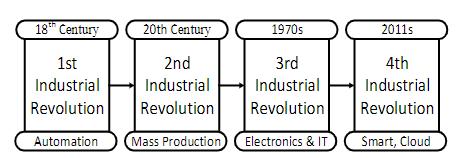
As mentioned in Figure 1, the current pace of technological advancements and the evolving demands of consumers have marked the beginning of a Industry 4.0 is a brand-new age. Since water is a limited resource and a necessary component for all living things, it must be used effectively. Monitoring several aspects of water quality is crucial to promote a healthy living and prevent water waste. The Internet of Things (IoT), which offers real-time monitoring and control of water quality, enters the picture at this point.[8]
The application of the Internet of Things (IoT) technology in food supply ecosystems has an impact on various industries involved in production, distribution,
storage, consumption, and waste management.IoT integration can result in an effective distribution of food supply chains, thereby eliminating process inefficiencies.
Cyber Physical Systems (CPS), along with a network of services and technology advancements, are leading the way for machines to become more intelligent and communicate with each other from various locations via the internet. This development paves the way for the creation of smart cities that minimize human interactions, resulting in reduced labor and operational costs. Additionally, the technology can be applied to improve water quality by using filters only when necessary, leading to more efficient usage.
This method promotes the development of a smart city that minimizes the need for human interactions while also reducing labor and operating expenses. It also employs a variety of filters to efficiently improve water quality. The filters are used only when necessary, rather than constantly, resulting in more efficient usage.
The proposed system will revolutionize water management by implementing an autonomous system that will result in a smart building. This will need tying multiple civic structures together into an unified network and continuously tracking water use and quality in various locations. Also, the system will look into the reasons for water quality variations and make timely adjustments. This will enhance the ability to manage water resources effectively and ensure efficient water usage.
In this, till 18th century there was a phase of Automation considered as a 1st Industrial Revolution, then came the phase of mass production during 20th century named as 2nd Industrial Revolution and then came the 3rd Industrial Revolution where the major focus was on Electronics & IT and the last or the current Industrial Revolution named 4th Industrial Revolution is mainly for the Cloud organization of data.
The methodology used for “Smart Water Purifier Using IoT in Agriculture” research paper is by going through different research papers and mainly its experimental based where we are trying to experiment of connecting already developed device to an application
which is mainly based on programming aspects. The main aspect followed here is “Pre - Experimental Design” where firstly all the important measures that need to be taken into considerations are highly focused like water quality, soil fertilization, amount to water to be released, availability of water as preferred by the farmer. [1]
We have also followed “Research Paper Study” methodology to have some idea about what are the feature enhancement could be provided and what are the features that we could take from the already developed devices. From, our concept of using this methodology has helped us in many ways like what type of sensors could be used, or how IoT can be used for connecting agriculture to applications fromthe concept ofusing “Smart Agriculture"
Integrating AI technology into the water purification sector could revolutionize the industry, allowing for real-time water quality monitoring and analysis data to identify and address potential contaminants before they become a problem, ultimately ensuring that all water is safe for consumption In exchange, a capex-free subscription model makes total transparency and guaranteed purity available to the customer around-theclock, providing assurance and peace of mind.
There is an evident demand for precision and openness to prevent the aforementioned problems of malfunctions and frequent maintenance. The primary requirement is to ascertain the safety and absence of disease-causing pathogens in the water processed by the water purification system.
As shown in Figure 3, we carefully placed 15 sensors in Cloud tap to track the flow and quality of water. Furthermore, these sensors monitor part degradation, including critical components like the RO membrane and UV light. CLOUDTAP's job is to monitor the purity of the ultimate product, which is water. And to make certain that every drop of water leaving the system is completely pure. The data acquired bythese sensors will be transmitted to the cloud via the internet. AI (Artificial Intelligence) will crunch and analyze the data. Cloud tap will receive notifications, allowing for predictive measures to be taken at the customer's end.
This figure 2 shows the status Of ON / OFF operation using Bitwise Logic, where it states the status of the system w.r.t pH level of the water, w.r.t TDS which is Total Dissolved Salts and in which condition the system will be ON and OFF.
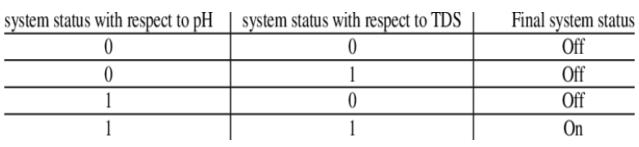
The field of water purification has seen a significant transformation with the advancements in net technology and AI. Several industries, including the hospitality, food services, hotels, workplaces, and hospitals that are highly dependent on the quality of water can now utilize thisinnovative solution to ensure the safetyand wellbeing of their customers. As shown in Figure 2, with realtime monitoring, userscanbeassuredofthequalityofwater being purified. This advanced technology also eliminates the need for frequent replacement ofconsumables and spare parts, leading to cost savings. The transparencyprovided by AI in the water purification process is undoubtedlythe most significant advantage for businesses.
Figure 3 states the working of IoT based Monitoring, that depicts the full connection of the system from water equipment to the notification on the mobile phone via Web Application, where two ways of water monitoring could be seen : Web-based and Real-time.
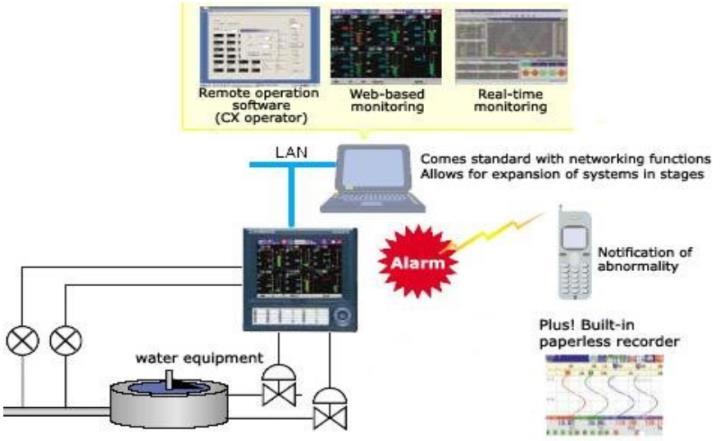
Smart water purification techniques involve the use of sensors and float sensors to measure the storage tank's water level. This helps conserve energy, which is essential for the system's sustainability and longevity. Moreover, the pH, conductivity, and temperature of the water are all monitored using the sensors to ensure that it is clean and safe for consumption.
In addition, the system sends data wirelessly to mobile phones using Node MCU to notify users of the water's quality. A color-changing LED is also used to indicate whether the water is fit for consumption or not. When all metrics are within permissible ranges, the LED is green. When the water is unsafe to drink, it is red.
To calculate the total dissolved solids in the water, the system uses two TDS meters. This helps to determine the amount of dissolved salts in parts per million, which indicates the level of impurities in the water. To guarantee
the correctness of the data, the readings collected from the TDS meters are kept in variables.
In summary, smart water purification techniques use sensors to monitor various parameters to ensure that the water is always clean and safe for consumption. The use of TDS meters, float sensors, and Node MCU helps conserve energy and ensure the system's sustainability.
pHdevice -hydrogenionconcentrationisa crucial parameter to be measured and controlled. The hydrogen ion concentration of an answer indicates however acidic or basic (alkaline) it's. hydrogen ion concentration device elements square measure typically combined into one device referred to as a mixture hydrogen ion concentration conductor. The measurement conductor is often glass and quite fragile.
Solid-state sensors are increasingly becoming the preferred choice over fragile glass sensors in modern technology. The instrument or transmitter contains a manmachine interface for calibratingthe device and configuring outputs and alarms, if hydrogen ion concentration management is being done.
essential in determining the cleanliness of the water, which is critical in protecting agricultural produce.
A turbidity sensor is a digital monitoring device that is commonly used with micro-controllers. It is capable of detecting and measuring the quality of water by estimating its turbidity levels. This can be achieved through the use of digital or analog signals, along with corresponding pins and electronic modules.
The sensor emits infrared radiation that is not visible to the human eye. It is intended to identify particles suspended in water by measuring light transmission and indicating the concentration of Total Suspended Solids (TSS). As the level of TSS increases, the turbidity of the liquid also increases. The sensor then sends this data to the micro-controller through its digital module.
To summarize, a turbidity sensor is a digital monitoring device that calculates the turbidity levels of water to determine its quality. It does this by emitting infrared radiation, which is then used to detect particles that are suspended in the water. The data is then sent to the micro-controller for analysis.
Conductivity measurements area unit applied in industrial processes primarily to get info on total ionic concentrations (e.g. dissolved compounds) in binary compound solutions. wide used applications area unit water purification, clean in situ (CIP) management, and therefore the measure of concentration levels in solutions. The measuring instrument consists of associate acceptable inline detector directly inserted or in an exceedingly housing, a cable connected to a transmitter changing the received signals to a measure result or forwarding it to a DCS.
Sensors presents the Multi particle System, a revolutionary conception of victimization Ion-selective electrodes (ISE) duringa multi -parameter instrumentation. Multi particle Probe could be a multiple head probe that enables for up to seven (7) totally different ISE in its housing. Straight forward to use, customizable and similar by the user.
A TDS sensor is a versatile device that can effectively measure the TDS value in water. It provides accurate information on the number of milligrams of dissolved solids that have dispersed in the water. The control system that keeps track of the water's quality receives this data after that. The resulting analysis is
A temperature meter is a device used to measure the temperature of living organisms or objects. Although the most common temperature meter is the thermometer, which is used to measure the temperature of humans, modern temperature meters offer a diverse collection of thermal elements and Type-K sensors to meet various industrial requirements. Many of these temperature meters come with ISO calibration certificates that include a laboratory calibration.
These digital sensors provide accurate measurements between 9-bit to 12-bit resolution. They require "parasitic power," or a data cable that can interface directly with a central microprocessor, which eliminates the need for an external control. Moreover, these sensors use a distinct 64-bit serial code that enables the use of various digital sensors on a single 1-wire route. Systems that need to be monitored and controlled can employ this technique.
In summary, a temperature meter is a crucial device used to measure the temperature of objects or living organisms. With modern advancements, temperature meters now offer a variety of thermal elements and Type-K sensors, providing more accurate measurements to cater to industrial needs. Additionally, digital sensors have made the process of temperature measurement simpler and more efficient, making it easier for monitoring and control systems to operate effectively.
When it comes to computing systems, online applications can take on different forms, including those that run on the client-side or server-side. The former refers to software applications that are executed or requested
througha webbrowser, while thelatterpertainstoprograms that run on a remote server and are accessed through a network connection.
Nowadays, web-basedapplicationscomeina wide range of functionalities, including email, e-commerce, online auctions, wikis, instant messaging, and more. These services are designed to cater to various needs and preferences of users in today's digital age.
Web applications offer users the convenience of accessing them from anywhere, using popular web browsers such as Microsoft Explorer, Google Chrome, or Apple Safari. The user has the freedomto choose the device he wishes to use to access the web application. With centralized updates, web applications are always kept current. In addition, security measures can be easily implemented centrally to ensure data protection.
We can make use of Web Application for “Smart Water Purifier Using IoT” to draw in more users by developing websites and also desktop application.
IoT technology can revolutionize the agricultural industry by providing innovative solutions to increase efficiency and sustainability. This technology can enhance crop management by monitoring environmental factors such as temperature, humidity, and soil moisture. IoT devices can also help farmers optimize the use of resources, including water and fertilizer, to reduce waste and enhance crop yields. Furthermore, IoT can contribute to global food security by enabling sustainable and efficient agriculture as the world's population continues to grow. By using IoT to optimize resource usage and increase food production, farmers can help to meet the growing demand for food, while also reducing waste and protecting the environment.
In conclusion, IoT application in agriculture has many advantages, from reducing waste and conserving resources, to improving food safety and increasing food security. With each passing day, the advancements in technology are transforming every industry in their own unique way. One such field that is poised to benefit significantly from these technological innovations is agriculture. As this industry continues to evolve, we are witnessing a new dawn in farming that promises to bring about sustainable and profitable outcomes for all stakeholders involved.
The integration of IoT technology into agriculture has the potential to revolutionize the way food is produced. By providing real-time data and automation capabilities, IoT allows farmers to make informed decisions, increase efficiency, and improve yields. The use of algorithms and techniques such as machine learning, predictive analytical, decision tree analysis, and optimization algorithms further enhances the capabilities of IoT in agriculture.However, it is important to note that the implementation of IoT technology in agriculture must be done with caution and consideration. Ensuring the security and privacy of data as
well as resolving the potential environmental impact of increased technology use, are crucial in ensuring a sustainable future for agriculture.
The incorporation of IoT technology in the agricultural sector offers numerous benefits, including improved food production quality and quantity, reduced waste, and increased sustainability. By harnessing the power of IoT devices, farmers can optimize their farming practices and achieve better crop yields while minimizing resource usage. This, in turn, leads to higher-quality produce, reduced environmental impact, and more efficient use of resources. Overall, the integration of IoT technology holds significant promise for revolutionizing agriculture and transforming the global food system.
As technology continues to advance, the possibilities for IoT in agriculture are endless and it is an exciting time for the industry. Additionally, IoT in agriculture can also lead to more cost-effective and effective use of resources like fertilizers and water. By using sensors and automation to monitor and control resource use, farmers can minimize waste and improve productivity.
Another important aspect of IoT in agriculture is the ability to gather and analyze large amounts of data. This data can be used to make predictions about weather patterns, crop yields, and market trends. This information can then be used to make informed decisions about planting and harvesting, leading to increased profits and a more sustainable agriculture industry.IoT technology can also improve the lives of farmers by reducing the physical workload associated with farming. Automation and remote monitoring systems can perform tasks such as watering and fertilizing, freeing up time and energy for farmers to focus on other tasks. IoT technology in agriculture has the potential to greatly improve food safety and quality. By monitoring water and soil quality, as well as monitoring crop growth and health, farmers can ensure that their products meet the highest standards for safety and quality. This can lead to increased consumer confidence in the safetyand qualityof food products, and a brighter future for the agriculture industry as a whole.
This work was carried out under the esteem guidance of Dr. Priya Swaminarayan, dean of the MCA department of Parul University in Vadodara faculty of information technology & computer science. Dr. Priya Swaminarayanhasalarge numberofresearchpublications in the different areas.
1. S.K. Mashhadi, H. Yadollahi and A.M. Mashhad, "Design and manufacture of TDS measurement and control system for water purification in reverse osmosis by PID fuzzy logic controller with the ability to compensate effects of temperature on measurement", Turkish Journal of Electrical Engineering and Computer Sciences, vol. 24.
2. N. A. Cloete, R. Malekian and L. Nair, "Design of Smart Sensors for Real-Time Water Quality Monitoring".
3. J. A. Stankovic, "Research directions for the Internet of Things", vol. 1, no. 1.
4. M. W. Rahman, M. T. Rahman, T. H. Khan and S. M. L.l. Kabir, ‘Design of an intelligent SMS based remote metering system'.
5. A. H. Primicanta, M. Y. Nayan and M. Awan, "ZigBeeGSM based Automatic Meter Reading system".
6. L. Cao, W. Jiang and Z. Zhang, "‘Networked wireless meter reading system based on ZigBee technology'".
7. C. P. Kruger and G.P. Hancke, "Implementing the Internet of Things vision in industrial Wireless Sensor Networks".
8. T. Perumal, M.N. Sulaiman and C. Y. Leong, "Internet of Things (IoT)enabled water monitoring system".
9. R. Accorsi, M. Bortolini, G. Baruffaldi, F. Pilati, and E. Ferrari, “Internet-of-things Paradigm in Food Supply Chains Control and Management,” Procedia Manuf., vol. 11, no.