International Journal of Advances in Computer Science and Technology
Available Online at http://www.warse.org/IJACST/static/pdf/file/ijacst0111122022.pdf https://doi.org/10.30534/ijacst/2022/0111122022

Available Online at http://www.warse.org/IJACST/static/pdf/file/ijacst0111122022.pdf https://doi.org/10.30534/ijacst/2022/0111122022
Adel A. Alzahrani, Hassan A. Alsereihy King Abdulaziz Medical City- Jeddah, MNGHA, Saudi Arabia King Abdulaziz University, Jeddah, Saudi Arabia
Received Date : November 10, 2022 Accepted Date : November 29, 2022 Published Date : December 07, 2022

According to a recent Big Data analysis, the potential value of healthcare data is close to $300 billion [21]
Recent advances in ubiquitous computing have already transformed how people access vital medical services. Particularly important to these computer systems is data analytics. When integrated into healthcare data, analytic solutions have tremendous potential to shift healthcare delivery from reactive to proactive. Analytics' influence in the healthcare sector will increase over the next few years. Through studying health records, we can deduce the underlying trends. In addition, it will aid doctors in creating a unique profile for each patient, from which they may properly predict the probability that the person will have a health problem shortly. Thus, the current study aims to shed the light on the role of knowledge extraction from big data to enhance healthcare services by presenting the challengesandadvantagesofusingbigdatainthehealthcare sector. The research aim try to solve the major problems given by:
Q1: What are the major challenges and benefits of big data analytics in the healthcare sector?
Q2: What is the role of big data analytic in extracting the knowledge of healthcare? 2- Literature review 2-1.
2-2.
All knowledge management methods and activities are meaningless unless knowledge is generated for effective various applications. Based on this fact, the aim of this article is to shed the light on the function of knowledge extraction from big data in improving healthcare services. The research derives various results after conducting this survey and examining several studies based on the descriptive analytical approach that is based on examining several scholarly papers from 2011 to 2022. The main achieved results revealed that most keybenefits of using big data in healthcare include traceability, analytical capability, speeds to decisions capability, predictive analytics capability, interoperability capability, quicker clinical research progress, a more personalized approach to patient care, and earlier illness identification. On the other hand, high dimensionality, inconsistency, sparseness, distortion, and bias are some characteristics of healthcare big data that make their management and processing difficult. In addition, barriers to adopting big data technology include skepticism about its benefits, the necessity for a substantial initial investment, and difficulty reengineering healthcare systems and gaining approval for disruptive technologies. Finally concluded, it was shown that knowledge extraction from big data had altered healthcare practice and revolutionized the link between sickness and health.
Key words: Knowledge Extraction, Big Data, Challenges, Benefits, Healthcare, EHR, ECG, EEG, ICU
While healthcare prices have been steadily growing [33], the quality of treatment offered to patients in Saudi Arabia has mostly stayed the same. Several studies have recently shown that researchers can cut death rates, healthcare expenses, and medical issues at different institutions by adopting contemporary healthcare technology[20][22][32][34) Recent developments in information technology have greatly simplified the process of gathering numerous types of healthcare data [33]. Data plays an increasingly important role in modern medicine.
In the 1990s, while contemplating visualization as a huge data challenge, [9] first coined the term "big data." [43]were the first authors to uncover key references to big dataintheacademicliteratureofcomputer science.Bigdata was first used in the context of statistics and econometrics by [12] in the year 2000. Douglas Laney of Gartner expanded upon the idea in 2001 but never published a study [18]. Big data refers to very massive and complicated datasets that strain the capabilities of conventional information processing methods [34]. Capturing, storing, sharing, and analyzing data and visualizing, updating, or querying information privately are the primary obstacles or challenges related to big data. As shown by [27], big data deal with massive amounts of information that cannot be stored in traditional databases, necessitating the selection of an alternate method for data extraction and processing.
Data analytics is a portmanteau of "data" and "analytics," where "data" refers to raw facts, statistics, and information and "analytics" indicates the use of multiple tools to evaluate this data, regardless of its size [34]. Although, all software designed to analyze data fall under the analytics umbrella[42]. "Big data analytics" refers to applying various methods to massive data. Since huge amounts of data come from various sources, big data analytics is used to discover previously unseen beneficial patterns and associations [34]. To put it another way, big data analytics is nothing more than examining, modeling, cleaning, and manipulating Big data to gather information and facilitate conclusion-making [34]
2.1 Structure of the healthcare big data analytics
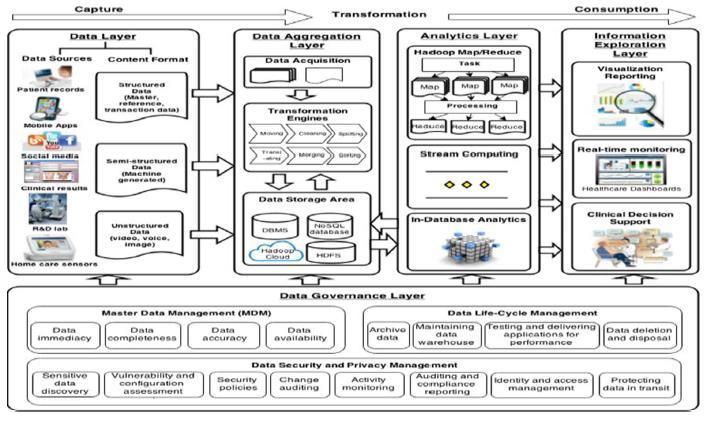
Using the data life cycle paradigm, [40] created architecture for analyzing large amounts of data, beginning with itscollectionand continuing throughitstransformation and final use. The suggested best-practice big data analytics architecture is shown in Figure 1; it is composed of five main architectural layers given by: Data, aggregation of data,analytics,explorationofinformation,and management of data are all components of these layers. To better understand how to turn healthcare data from multiple sources into relevant clinical information, healthcare managers may take advantage of the big data analytics elements that are organized in logical levels to serve certain purposes.
Figure 1: Structure of the healthcare big data analytics [40]
2.2
This section will focus on the effects of different data sources on analytical algorithms. Medical data mining sources are very diverse, necessitating a wide range of methods from various areas of data analytics. The various data sources of healthcare are given by:
A patient's medical history is recorded in EHRs or electronic health records. It includes everything from the patient's demographic to their medical history, test results,
x-ray images, and billing information. In addition to a patient's medical or treatment history, many EHRs provide other, more holistic viewpoints on their care [33]. EHRs allow easy communication between healthcare professionals and institutions because of their useful features. EHRs are built for the modern healthcare environment, where authorized users constantly add and update data in real-time. The use of an EHR improves efficiency since staff may have instantaneous access to the most up-to-date patient information [15]. It helps with
quality monitoring, patient outcomes reporting, and evidence-based decision support, all while creating a comprehensive record of a patient's clinical experience. EHRs simplify the archiving and retrieval of medical records. Improved care coordination, more precise diagnoses, better health outcomes, and a more positive patient experience are all benefits of this trend [11]
Medicalimaging makeshigh-qualityphotographsof human anatomical features possible, which plays a crucial role in contemporary healthcare [33]. Magnetic resonance imaging, computed tomography, positron emission tomography, and ultrasound are the most common imaging modalitiesutilizedtoobtainabiologicalpicture.Theability to examine human organs from the inside the body without causing harm to the patient has profound implications for medical practice. Without opening the patient physically, doctors may have a deeper understanding of what's happening withintheir bodyand whythey're sickorinjured [33].Still,seeingtheseorgans visuallyisjustthebeginning of the process. To get a deeper understanding of a medical condition, biomedical image analysis ultimately aims to collect quantitative information and drawconclusions from the pictures [33]. Research issues that occur while studying photosfallinto manybroadareas[33] Theseincludeobject identification, segmentation techniques, image restoration, and feature extraction. When these problems are fixed, healthcare data analytics will have the necessary inputs to provide useful analytical measures.
Whether for diagnostic purposes in the present or historical research purposes in the past, sensor data [5] is omnipresent in the medical sphere. Many medical datagathering tools, such as electrocardiograms (ECGs) and electroencephalograms (EEGs) are simply sensors that collect signals from different regions of the human body (1]. The most crucial use of real-time analysis is in the setting of intensive care units (ICUs) and the real-time remote surveillance of patients with particular medical problems [33]. The amount of information that has to be processed might be substantial in any of these scenarios. Forinstance,inanintensivecareunit(ICU),thesensormay collect data from hundreds of sources, and alerts must be activated instantly [33]. Big data frameworks and specific hardware platforms are required for such applications. The current state of affairs and a more comprehensive study of trends and potential treatments over time are of significant interest in remote monitoring applications.
Despite the promising potential for increased healthcare efficiency brought about by the explosion of sensordata,theresultingdatadelugeposesanewdifficulty.
As a result, it is crucial to create cutting-edge data analytics tools capable of turning these massive datasets into actionable insights [33]. These analytic approaches will improve our ability to monitor patient's physiological signals and provide more situational awareness at the
bedside [33]). They will also shed the light on the inefficiency of the health service that may be at the heart of rising costs.
The biomedical signal analysis involves quantitatively evaluating biological signals with their roots in various physiologic procedures. Among the different types of such signals are the electrocardiogram (ECG), electromyogram (EMG), electrocardiogram (ECGs), electroencephalogram (EEG), electrogastrogram (EGGs), phonocardiogram(PCG),and others.Itiscrucialto analyze these signals to correctly identify pathological disorders and choose the best course of treatment [33].
Depending on the kind of treatment or severity of a medical condition, these signals might be either discrete or continuous. Low signal-to-noise ratio (SNR) and system interdependencemakeitdifficulttoanalyzeandunderstand physiological information [33].. Principal Component Analytical(PCAs),SingularValueDecomposition(SVDs), andWaveletTransformationsarejustafewexamplesofthe more advanced analytical approaches that have been extensivelystudied intheliterature. Thesemethodsarealso detailed in [3][4]. The techniques for analyzing time series are further upon in [24][29].
Manyillnesses havea hereditarycomponent,but the exact relationship between certain genetic markers and illness is still unclear. Diabetes, for instance, is recognized to have a hereditary component; nevertheless, the whole collection of genetic markers predisposing a person to develop diabetes remains unclear [33].The development of diverse gene treatments to heal these disorders will benefit greatly from a deeper understanding of the connections between specific genes, mutations, and diseases. Typically, data-driven studies are conducted with the primary goal of elucidating what kinds of health-related questions may be answered byanalyzing genetic datainacomputer [33].Not only are those but there are also various obstacles to be overcomeinthelongandarduousprocessofputtinggenetic findings into tailored therapy. Genomic landscapes of illnesses like cancer, which include several interconnected factors, are notoriously complex and demonstrate a high orderofvariabilityacrosspatients.Iftheseproblemscanbe resolved, it will be a great step toward making tailored medicine a reality [33]
Recent developments in biotechnologies have facilitated the quick production of vast quantities of medical and biological data, allowing for more in-depth studies in genomics. This has also opened up new possibilities and raised expectations for studying complex issues in life science on a genomic scale. For instance, the full genetic landscape of healthy people may now be studied for complicated disorders[38], thanks to advancements in genomic technology. Promising findings have been found in several of these research avenues,
suggesting that they will lead to new understandings of the physiologyofhumanillnessandimprovedabilitytopredict individual response to therapy. Furthermore, genetic information is often represented as sequences or networks. Thus, proficiency in sequencing and network mining methods is essential for working in this area. Key research difficultiesin medicine, suchasidentifying methods and targeted therapies and predicting clinical outcomes, are being addressed by developing various solutions based on data analytics [33].
For the most part, patients' records are stored as text in the shape of clinical notes. Most healthcare information is based on these notes, often kept in an unstructured data format. Clinical data through dictation transcription, direct provider input, or voice recognition software are all included here. When it comes to untapped data resources, they may be the best. The human decoding of this free-text form on a wide variety of clinical information is, needless to say, too expensive and time intensive [33].This is why it is restricted to main and secondary diagnoses and treatments for billing reasons. Clinical writing is often only provided in a free-form style, making it very difficult to interpret such notes mechanically [33]. Their lack of uniformity, variety in form and content, and contextual differencesbetweenpatientsandhealthcareprovidersmake this task challenging.
Thefastand accurateautomated encodingofclinical information relies heavily on natural language processing (NLP) techniques such as entity extraction [23]. Data preparation approaches are often more crucial than mining procedures in these situations. Short and telegraphic sentences,dictations,shorthand lexiconslikeacronymsand abbreviations, and often misspelled clinical terminology analyze clinical text using NLP approaches more difficult than processing other texts. The complexity of clinical text processing is increased because all these issues will indirectlyaffect the manytypical NLP tasks like shallowor complete parsing, phrase segmentation, text classification, etc. [33]
scientists typically choose IUPAC-compliant names or unambiguous identifiers like International Chemical Identifiers [33]. Text mining techniques provide novel possibilities for efficiently populating, updating, and integrating such datasets, which would otherwise be prohibitively expensive to maintain. Biological research also benefits from text mining since it helps to generate ideas, save money on expert knowledge validation, and connect textual data to biomedical pathways [33]. The technique offers a standardized procedure for illuminating unrecognized connections and improving the structure of existing biological data.
Rapid growth in social sources such as social networking websites, blogs/microblogs, platforms, queryansweringservices,and virtual communities hasresulted in a plethora of data regarding public opinion on numerous healthcare issues. Data collected from social media platforms may be exploited for insights into health promotion and public health surveillance [33]. Public health experts may learn a great deal from the comments and suggestions of people on social media. Although most social media postings and messages are not very informative, when aggregated from millions of them, valuable insights may be gained [1][35]. Time lags associated with amassing such intricate data may be drasticallycut in half with careful analysis of these massive hunks of information.
Capturing aggregate health patterns like infectious disease epidemics, reporting bad medication interactions, and enhancing interventional capacities are all areas where a prior study of social media insights for health has concentrated. Examining the evolution of social media material may provide light on illness outbreaks, making it a usefultoolforearlydetection [33].Onlinecommunitiesare a rich resource for information on a wide range of medical topics due to the high prevalence of common medical disordersamongthegeneralpopulation.Duetotheinherent unreliabilityof social media data, researchers must proceed with care when interpreting study findings [33]
Evidence from scientific publications is used in a wide variety of contexts. The latter is abundant and has increased dramatically over time. Biomedical applications that depend on data from scientific literature recognize the value of text-mining techniques for the long-term conservation, availability, and usefulness of digitally accessible resources. Innovative applications of new knowledge discovery techniques in the biomedical sector are possible with the help of text-mining methods and tools [23][46]. Supporting scholars in their quests for new insights, these technologies effectively search, extract, combine, analyze, and summarize textual data. The interdisciplinary character of biomedical text mining presents a significant hurdle. Biologists often use brand names to characterize chemical compounds, whereas
Descriptive studies are often classified as qualitative descriptions within qualitative research [17]. This research is often used in qualitative analyses of healthcare and nursing practices [30][31]. The who, what, and where of events or experiences, as well as gathering insights from informants about a poorly understood phenomenon,areallareaswherequalitativedescriptionhas been acknowledged as relevant and acceptable for research inquiries [17]. Qualitative description is appropriate when developing and refining surveys or treatments or when a straightforward explanation of phenomena is wanted [26][36]
Sometimes, researchers in the health sciences conduct qualitative studies without formally documenting their approach. To distinguish itself from the more specific
"methods," the article here uses the word "approach." This demonstrates a consistent epistemological perspective on the character of inquiry, the types of knowledge that may be found or created, and the appropriate methods for achieving these ends [14][16].As a result, the current study dependsonaqualitativedescriptiveapproachto investigate various articles to determine the challenges and benefits related to using knowledge extracted from big data analytics in the healthcare sector.
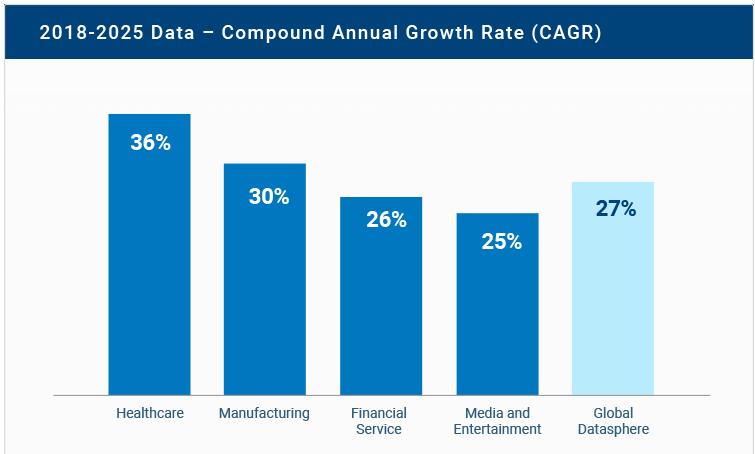
Healthcare information is being created exponentially and analyzed for insights every second. The healthcare sector accounts for around 30% of the world's data volume. Figure 2 illustrate that the compound annual growth rate of healthcare data will reach 36% by 2025. That's a rate that's 11% higher than the media and entertainment industry, 10% over the financial sector, and 6% above the industrial sector.
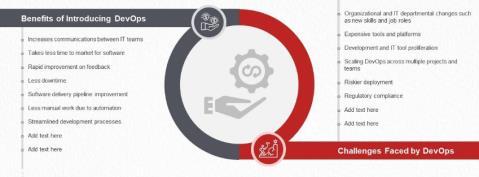
In this section, the authors will describe the benefits and challenges that emerged in the investigated research. Figure 3 shows benefits and challenges of knowledge extraction from healthcare big data.
Providing high-quality treatment
Saving lives
Reducing healthcare costs
Improving economic and administrative performance
Improving readmission rates while decreasing pharmaceutical
Estimate and predict things like the length of stay, the percentage of patients who opt for elective surgery, the percentage of patients who would not benefit from surgery, the likelihood of complications, etc.
Traceability
Analytical capability
Speeds to decisions capability
Predictive analytics capability
Interoperability capability
The healthcare business has yet to realize the potential advantages of big data analytics. According to the descriptive study conducted by the authors, the most relevant benefits of extracting information from big data in the healthcare industry include:
Possible advantages include early illness detection, which allows for more effective treatment, improved personal and community health management and the detection of healthcare fraud [32]
Massive amounts of data can be used to estimate and predict things like the length of stay, the percentage of patients who opt for elective surgery, the percentage of patients who would not benefit from surgery, the likelihood of complications, the percentage of highrisk patients for medical complications, the likelihood ofsepsis,MRSA,C.difficile, oranyother carefacility illness, the likelihood of illness progression, the percentage of patients at risk for progress in disease states, and the causes of illness [32]



Healthcare data is seldom standardized, fragmented, high dimensionality, inconsistency, sparseness, distortion, bias, and frequent.
Volume, complexity, and velocity: storage, analysis, and financial stability
Missing value, the constraint of diversity, and prejudice control.
Skepticism about its benefits
The necessity for a substantial initial investment
Difficulty reengineering healthcare systems
Gaining approval for disruptive technologies
Security and privacy of patient information are critical in the healthcare industry
Extreme heterogeneity and analytical obscurity
Traceability, analytical capability, speeds to decisions capability, predictive analytics capability, and interoperability capability [39].
Possible advantages include quicker clinical research progress,amorepersonalizedapproachtopatientcare, and earlier illness identification [20]
Benefits of IT infrastructure, operational benefits, managerial benefits, strategic benefits, and organizational benefits [39][40]
Implementing big data techniques in healthcare settings can enhance the standard of careprovided and save lives by allowing for the early detection of highrisk patients via basic analytics [22]
Care quality and patient outcomes may be enhanced while keeping healthcare costs down. Extracting information from big data pave the way for a change from treating patients based on their own experiences to treating them based on scientific facts [22]
The increased prices of health insurance benefits may be mitigated by implementing an electronic health record system that relies on big data to give meaningful data on the quality of treatment for the
participants of employee health insurance programs [10].
Data obtained from IoT-reliant chips or sensors might shed light on important insights that could lead to better living, more efficient energy use, more convenient travel, and better health care [10]
infrastructure (8] [13], Kung, & Byrd, 2018) also provide significant difficulties for the healthcare industry.
The healthcare industry stands to gain from applying the insights and actionable data made possible by the advent of big data, which will, in turn, facilitate the evolution of descriptive studies into prescriptive and predictive ones (Aceto et al., 2020)
Barriers to adopting big data technology include skepticismaboutitsbenefits[25][41],thenecessityfor a substantial initial investment[37] [44], and difficulty reengineering healthcare systems and gaining approval for disruptive technologies.
From a technological perspective, problems arise when combining data with different levels of an organization and coming from different sources[6]
Finding connections and trends in this data aids medical professionals in providing high-quality treatment, saving lives and reducing healthcare costs [34.
Securityand privacyof patient information are critical in the healthcare industry [22]
Big data is part of a healthcare organization's business intelligence approach to look at patient acceptance rates and employee productivity.
Healthcare organizations face three main problems due to the rise in data volume, complexity, and velocity: storage, analysis, and financial stability[40]
Analyzing massive amounts of data, "big data analytics" may reveal previously unseen relationships and insights [34]
Implementing cutting-edge computing techniques, protocols, and hardware in the clinical environment is another significant challenge when dealing with healthcare data [10]
Additionally, big data improves economic and administrative performance and readmission rates while decreasing pharmaceutical mistakes[34]
4.2 Challenges and limitation of knowledge extraction from healthcare big data
According to the authors' descriptive analysis, the following points represent the most important challenges of extracting knowledge from big data in the healthcare industry:
Many developers of natural language processing tools find clinical documentation's specific nature and sophistication to be a formidable obstacle [10].
Big data presents a significant challenge in the healthcare industry when received without an ideal data structure [10]
Because of the severity of the consequences of a data breach,healthcareinstitutionsmusttakeprecautionsto protect their patients' personal information from hackers, phishing, and ransom ware [10]
Big data analytics platforms in healthcare should at least be able to perform the fundamental tasks involved inanalyzingthedata. Mostoftoday'soptions are open source, but all include the usual caveats associated with that model [32]
Extreme heterogeneityand analyticalobscurityarethe greatestchallengestoextractingknowledgefromlarge data in healthcare [2].
Unfortunately, healthcare data is seldomstandardized, fragmented, and frequently produced in incompatible forms by antiquated IT systems [32]
Data-related problems in the realm of large medical data include things like missing value, the constraint of diversity, and prejudice control [19]
Dealing with massive amounts of complex data presentsuniquedifficultiesinchemicalanalytics.Data sophistication, access to data, compliance with regulations, data security, optimal analytics methodologies,compatibility,administration,privacy, improvement, re-usability, open data, incomplete information, and data heterogeneity are all examples of such challenges [34]
To achieve the potential of big medical data in the healthcare industry, several obstacles must be addressed, such as the need for more proof of the practical advantages of big data, technical concerns (such as legal and ethical issues), and clinical incorporation and usability issues [19]
High dimensionality, inconsistency, sparseness, distortion, and bias are some characteristics of healthcare data that make their management and processing difficult [20]
Despite the abundance of data, it is sometimes unclear which data should be used and why [37].
Transitioning from paper-based records to dispersed data processing [28] [45] and a need for sufficient IT
There are few limitations for this kind of research at the present time. First, although this research did conduct a descriptive assessment of a subset of relevant publications, it did not conduct a comprehensive analysis of the literature. So, future studies can use a systematic review to investigate a comprehensive analysis of the literature. Second, although this review provides an overview of the state of knowledge extraction from healthcare big data, it does not get into the specifics of how each research was implemented, how its conclusions were derived, and how challenges can be solved.
Improvinghealthcaredeliveryviaknowledge extraction from big data is the next frontier. The information and digital revolution has provided the healthcare business with chances to reap the benefits of big data technologies while avoiding its challenges. The healthcare industry may benefit from knowledge extraction from big data in two main ways: by enhancing healthcare quality and results and by offering cost-effective treatment. Evidence-based medicine may replace experience-based medicine due to the prediction nature and pattern-recognition component of extracting information from big data. The study's descriptive method provides a solid foundation for incorporating big data analytics into future healthcare studies by elucidating the most salient benefits and difficulties of doing so. In addition, the research shows that using big data techniques would boost healthcare value by encouragingwidespreaduseofinsightsaftertheextent of knowledge extraction from big data is defined, its characteristics and attributes are known, and challenges are adequately solved.
As a result, future studies can examine how challenges can be avoided. Third, the literature on knowledgeextractionfrombig dataand its advantages and problems in healthcare are fragmented, with information coming from a wide variety of different places. Finally, this review used a descriptive method; however the selection of papers on healthcare big data analytics was made on the basis of the authors' own preferences. So, further systematic reviews are needed.
[1] Acampora, G., Cook, D. J., Rashidi, P., & Vasilakos, A. V. (2013). A Survey on Ambient Intelligence in Healthcare. Proceedings of the IEEE, 101(12), 2470–2494. https://doi.org/10.1109/JPROC.2013.2262913
[2] Aceto, G., Persico, V., & Pescapé, A. (2020). Industry 4.0 and Health: Internet of Things, Big Data, and Cloud Computing for Healthcare 4.0. Journal of Industrial Information Integration, 18, 100129. https://doi.org/https://doi.org/10.1016/j.jii.2020.1001
29
[3] Aggarwal,C.C.(2007). Datastreams:modelsand algorithms (Vol. 31). Springer.
[4] Aggarwal, C. C. (2011). An Introduction to Social Network Data Analytics. In C. C. Aggarwal (Ed.), Social Network Data Analytics (pp. 1–15). Springer US. https://doi.org/10.1007/978-1-4419-8462-3_1
[5] Aggarwal, C. C. (2013). Managing and mining sensordata. Springer Science \& Business Media.
[6] Auffray, C., Balling, R., Barroso, I., Bencze, L., Benson, M., Bergeron, J., Bernal-Delgado, E.,
Blomberg, N., Bock, C., Conesa, A., Del Signore, S., Delogne, C., Devilee, P., Di Meglio, A., Eijkemans, M., Flicek, P., Graf, N., Grimm, V., Guchelaar, H.-J., … Zanetti, G. (2016). Making sense of big data in health research: Towards an EU action plan. Genome Medicine, 8(1), 71. https://doi.org/10.1186/s13073016-0323-y
[7] Capital Markets. (2018). The Convergence of Healthcare and Technology. Capital Markets https://www.rbccm.com/en/gib/healthcare/episode/th e_healthcare_data_explosion#content-panel
[8] Costa, F. F. (2014). Big data in biomedicine. Drug Discovery Today, 19(4), 433–440. https://doi.org/https://doi.org/10.1016/j.drudis.2013.1 0.012
[9] Cox, M., & Ellsworth, D. (1997). Applicationcontrolled demand paging for out-of-core visualization. Proceedings. Visualization ’97 (Cat. No. 97CB36155), 235–244. https://doi.org/10.1109/VISUAL.1997.663888
[10] Dash, S., Shakyawar, S. K., Sharma, M., & Kaushik, S. (2019). Big data in healthcare: management,analysisand futureprospects. Journalof Big Data, 6(1), 54. https://doi.org/10.1186/s40537019-0217-0
[11] DesRoches, C. M., Campbell, E. G., Rao, S. R., Donelan, K., Ferris, T. G., Jha, A., Kaushal, R., Levy, D. E., Rosenbaum, S., Shields, A. E., & Blumenthal, D. (2008). Electronic Health Records in Ambulatory Care A National Survey of Physicians. New England Journal of Medicine, 359(1), 50–60. https://doi.org/10.1056/NEJMsa0802005
[12] Diebold, F. X. (2003). Big data dynamic factor models for macroeconomic measurement and forecasting. Advances in Economics and Econometrics:TheoryandApplications,EighthWorld Congress of the Econometric Society,”(Edited by M. Dewatripont,LPHansenandS.Turnovsky), 115–122.
[13] Fodeh, S., & Zeng, Q. (2016). Mining Big Data in biomedicine and health care JournalofBiomedical Informatics, 63(C), 400–403. https://doi.org/10.1016/j.jbi.2016.09.014
[14] Giorgi, A. (1970). Psychology as a Human Science:aPhenomenologicallyBasedApproach.New York: Harper & Row.
[15] Hillestad, R., Bigelow, J., Bower, A., Girosi, F., Meili, R., Scoville, R., & Taylor, R. (2005). Can Electronic Medical Record Systems TransformHealth Care? Potential Health Benefits, Savings, And Costs. Health Affairs, 24(5), 1103–1117. https://doi.org/10.1377/hlthaff.24.5.1103
]16] Holloway, I. (2005). EBOOK: Qualitative Research in Health Care. McGraw-Hill Education (UK).
[17] Kim, H., Sefcik, J. S., & Bradway, C. (2017). Characteristics of Qualitative Descriptive Studies: A
Systematic Review. Research in Nursing & Health, 40(1), 23–42. https://doi.org/https://doi.org/10.1002/nur.21768
[18] Laney, D., & others. (2001). 3D data management: Controlling data volume, velocity and variety. METAGroupResearchNote, 6(70), 1.
[19] Lee, C. H., & Yoon, H.-J. (2017). Medical big data: promise and challenges. Kidney Research and Clinical Practice, 36(1), 3–11. https://doi.org/10.23876/j.krcp.2017.36.1.3
[20]Lee,C.,Luo,Z.,Ngiam,K.Y.,Zhang,M.,Zheng, K., Chen, G., Ooi, B. C., & Yip, W. L. J. (2017). Big Healthcare Data Analytics: Challenges and Applications. In S. U. Khan, A. Y. Zomaya, & A. Abbas (Eds.), Handbook of Large-Scale Distributed ComputinginSmartHealthcare (pp. 11–41). Springer International Publishing. https://doi.org/10.1007/9783-319-58280-1_2
[21] Manyika, J., Chui, M., Brown, B., Bughin, J., Dobbs, R., Roxburgh, C., Hung Byers, A., & others. (2011). Big data: The next frontier for innovation, competition, and productivity. McKinsey Global Institute.
[22] Mehta, N., & Pandit, A. (2018). Concurrence of bigdataanalyticsandhealthcare:Asystematicreview. International Journal of Medical Informatics, 114, 57–65. https://doi.org/https://doi.org/10.1016/j.ijmedinf.2018 .03.013
[23] Meystre, S. M., Savova, G. K., Kipper-Schuler, K. C., & Hurdle, J. F. (2008). Extracting information fromtextualdocumentsintheelectronichealthrecord: a review of recent research. Yearbook of Medical Informatics, 17(01), 128–144.
[24] Mitsa, T. (2010). Temporal data mining. Chapman and Hall/CRC.
[25] Mohammed, E. A., Far, B. H., & Naugler, C. (2014). Applications of the MapReduce programming framework to clinical big data analysis: current landscapeand futuretrends. BioDataMining, 7(1),22. https://doi.org/10.1186/1756-0381-7-22
[26] Neergaard, M. A., Olesen, F., Andersen, R. S., & Sondergaard, J. (2009). Qualitative description – the poor cousin of health research? BMC Medical Research Methodology, 9(1), 52. https://doi.org/10.1186/1471-2288-9-52
[27] O’Reilly, T., Steele, J., Loukides, M., & Hill, C. (2012). Solving the Wanamaker Problem for Healthcare. BigDataNow:2012Edition, 83–96.
[28] Peek, N., Holmes, J. H., & Sun, J. (2014). Technical challenges for big data in biomedicine and health: data sources, infrastructure, and analytics. YearbookofMedicalInformatics, 23(01), 42–47.
[29] Polasek, W. (2013). Time series analysis and its applications: With r examples. International Statistical Review / Revue Internationale de
Statistique, 81(2), 323–325. http://www.jstor.org/stable/43298885
[30] Polit, D., & Beck, C. (2009). International Differences in Nursing Research, 2005–2006. Journal of Nursing Scholarship, 41(1), 44–53. https://doi.org/https://doi.org/10.1111/j.15475069.2009.01250.x
[31]Polit,D.,&Beck,C.(2020). Essentialsofnursing research: Appraising evidence for nursing practice Lippincott Williams \& Wilkins.
[32] Raghupathi, W., & Raghupathi, V. (2014). Big data analytics in healthcare: promise and potential. Health Information Science and Systems, 2(1), 3. https://doi.org/10.1186/2047-2501-2-3
[33] Reddy, C. K., & Aggarwal, C. C. (2015). An Introduction to Healthcare Data Analytics. In C. C. A. handan K. Reddy (Ed.), Healthcare Data Analytics London, UK:
[34] Rehman, A., Naz, S., & Razzak, I. (2022). Leveraging big data analytics in healthcare enhancement: trends, challenges and opportunities. Multimedia Systems, 28(4), 1339–1371. https://doi.org/10.1007/s00530-020-00736-8
[35] Sadilek, A., Kautz, H., & Silenzio, V. (2012). Modeling spread of disease from social interactions. SixthInternationalAAAIConferenceonWeblogsand SocialMedia, 322–329.
[36] Sullivan-Bolyai, S., Bova, C., & Harper, D. (2005). Developing and refining interventions in persons with health disparities: The use of Qualitative Description. Nursing Outlook, 53(3), 127–133. https://doi.org/https://doi.org/10.1016/j.outlook.2005. 03.005
[37] Szlezák, N., Evers, M., Wang, J., & Pérez, L. (2014).TheRoleofBigDataand Advanced Analytics in Drug Discovery, Development, and Commercialization. Clinical Pharmacology & Therapeutics, 95(5), 492–495. https://doi.org/https://doi.org/10.1038/clpt.2014.29
[38] Vogelstein, B., Papadopoulos, N., Velculescu, V. E., Zhou, S., Diaz, L. A., & Kinzler, K. W. (2013). Cancer Genome Landscapes. Science, 339(6127), 1546–1558. https://doi.org/10.1126/science.1235122
[39] Wang, Y., & Hajli, N. (2017). Exploring the path to big data analytics success in healthcare. Journalof Business Research, 70, 287–299. https://doi.org/https://doi.org/10.1016/j.jbusres.2016. 08.002
[40] Wang, Y., Kung, L., & Byrd, T. A. (2018). Big data analytics: Understanding its capabilities and potential benefits for healthcare organizations. Technological Forecasting and Social Change, 126, 3–13.
https://doi.org/https://doi.org/10.1016/j.techfore.2015 .12.019
[41] Wang, Y., Kung, L., Wang, W., & Cegielski, C.
G. (2018). An integrated big data analytics-enabled transformation model: Application to health care. Information & Management, 55(1), 64–79. https://doi.org/https://doi.org/10.1016/j.im.2017.04.0 01
[42]Watson,H.J.(2014).Tutorial:Bigdataanalytics: Concepts, technologies, and applications. Communications of the Association for Information Systems, 34(1), 65.
[43] Weiss, S. M., & Indurkhya, N. (1998). Predictive datamining:apracticalguide. Morgan Kaufmann.
[44] Wu, J., Li, H., Cheng, S., & Lin, Z. (2016). The promisingfutureofhealthcareservices:Whenbigdata analytics meets wearable technology. Information & Management, 53(8), 1020–1033. https://doi.org/https://doi.org/10.1016/j.im.2016.07.0 03
[45] Zhang, F., Cao, J., Khan, S. U., Li, K., & Hwang, K. (2015). A task-level adaptive MapReduce framework for real-time streaming data in healthcare applications. Future Generation Computer Systems, 43–44, 149–160. https://doi.org/https://doi.org/10.1016/j.future.2014.0 6.009
[46] Zweigenbaum, P., Demner-Fushman, D., Yu, H., & Cohen, K. B. (2007). Frontiers of biomedical text mining: current progress. BriefingsinBioinformatics, 8(5), 358–375. https://doi.org/10.1093/bib/bbm045