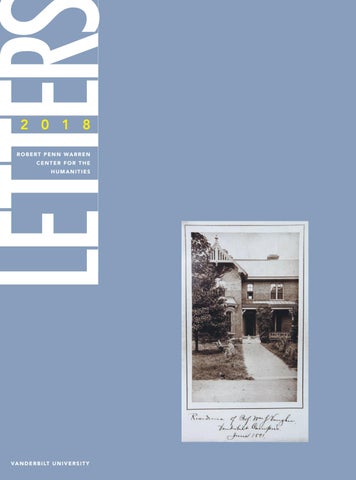
2 0 1 8 ROBERT PENN WARREN CENTER FOR THE HUMANITIES
VA N D E R B I LT U N I V E R S I T Y
RPW Letters brochure 2018-rev.indd 1
8/7/18 8:53 AM
CONTENTS
RPW Letters brochure 2018-rev.indd 2
Executive Director Report
1
2017/18 Warren Center Faculty Fellows Program
4
2017/18 Robert Penn Warren Center for the Humanities Seminars
5
Warren Center Special Events 2017/18
8
2017/2018 Women’s Center Mentoring Award
12
Graduate Student Fellows Present 2018 Public Lectures
13
Innocence Punished: An Old Story
14
What We Are Writing
20
2018/19 Warren Center Faculty Fellows Program
23
Warren Center Graduate Student Fellows Program
26
Coming Events 2018/19
28
8/7/18 8:53 AM
EXECUTIVE DIRECTOR REPORT
T
his year marks the thirtieth anniversary of the Robert Penn Warren Center for the Humanities at Vanderbilt University. Located in the Vaughn Home in the heart of our campus, the center is an intellectual hub for colleagues from around the campus and around the world. The original mission statement for the new program noted that its intent was to “enhance the growth and development of the study of the humanities at Vanderbilt by promoting research, teaching, and writing within disciplines and across disciplinary lines by bringing scholars with kindred scholarly interests together in a stimulating and supporting environment.” Clearly the Warren Center has succeeded in its mission at the very highest levels.
Since its inception, the Warren Center has sponsored 192 Vanderbilt Faculty Fellows through its annual Faculty Fellows Program. These scholars represent 33 areas of study at Vanderbilt: African American and diaspora studies; anthropology; art; Asian studies; the Blair School of Music; European studies; classical studies; communication studies; comparative literature, the Divinity School; economics; English; French and Italian; geology; German, Russian and East European studies; history; history of art; Latin American studies; the Law
ROBER T P ENN WARRE N CE NTE R FO R THE HUMANITIE S
RPW Letters brochure 2018-rev.indd 1
School; mathematics; the School of Medicine; medicine, health, and society; molecular biology; the Owen Graduate School of Management; the Peabody College of Education and Human Development; philosophy; physics and astronomy; political science; psychology; religious studies; sociology; Spanish and Portuguese; and women’s and gender studies. Two of the internal fellowships are currently endowed: the Jacque Voegeli Fellowship and the Spence and Rebecca Webb Wilson Fellowship. Jacque Voegeli, professor of history and dean of
1
8/7/18 8:53 AM
EXECUTIVE DIRECTOR REPORT
the College of Arts and Science, emeritus, was instrumental in the design and founding of the program in 1988. Upon his retirement, friends and colleagues contributed generously to endow a fellowship in his honor. Spence Lee Wilson and Rebecca Webb Wilson are both graduates of Vanderbilt’s College of Arts and Science and longtime supporters of the university. Rebecca Webb Wilson served on the Vanderbilt University Board of Trust from 1989 through 2013. Beginning in 1994, when its permanent endowment had been secured, the Warren Center was able to include a year-long visiting scholar as part of the Faculty Fellows Program. The center has hosted twenty-five distinguished scholars from twenty academic institutions representing nine scholarly disciplines. The visiting fellowship is named in honor of Vanderbilt alumnus William S. Vaughn. A member of the Vanderbilt University Board of Trust from 1952 to 1995, he served as board president from 1968 to 1975. In 1985, he and his brother Houghton Vaughn, grandsons of the original faculty occupant William J. Vaughn, donated $350,000 to restore the Vaughn Home on the Vanderbilt campus. In 1991, William S. Vaughn donated additional funds to endow a fellowship at the Warren Center. Initially envisaged as a faculty development program, the Warren Center expanded its scope in 2005 to include graduate student programming. That year, the Warren Center initiated its first annual Graduate Student Fellows Program to fund seven graduate students in humanistic disciplines in the College of Arts and Science who are at the dissertation completion stage. Since that date, the Warren
2
RPW Letters brochure 2018-rev.indd 2
Center has supported 101 young scholars from eleven disciplines. There are currently four named fellowships of the seven that are funded each year: the Joe and Mary Harper Fellowship; the Elizabeth E. Fleming Fellowship; the George J. Graham Jr. Fellowship; and the American Studies Fellowship. Our former Warren Center Graduate Student Fellows are now representing Vanderbilt University and the Warren Center at the highest possible levels at institutions such as Brigham Young University, Michigan State University, Portland State University, University of the Andes, University of California-Merced, University of Illinois at Urbana-Champaign, University of Oregon, and the University of Virginia, to name but a few. Two of our Graduate Student Fellows were recent recipients of prestigious Mellon-ACLS Public Fellows awards. There are many other highlights in the Warren Center’s thirty-year history. In 1994, friends of Vanderbilt University alumnus Harry C. Howard Jr. initially endowed a lecture in his honor to be held under the auspices of the Warren Center; additional gifts over the years have greatly increased the value of this fund. To date, twenty-three eminent scholars have delivered the Howard Lecture, including such luminaries as Kwame Anthony Appiah, Kay Redfield Jamison, Van Jones, Edward Ayers, and Quiara Alegría Hudes. Furthermore, the Warren Center sponsors roughly a dozen monthly seminars and reading groups; many hundreds of distinguished speakers have been brought to our campus under the sponsorship of these groups. During the past five years alone, the Warren Center has hosted 283 visiting speakers from around the world.
2018 | LETTERS
8/7/18 8:53 AM
We are extremely grateful to the National Endowment for the Humanities for its early support of the fledgling program. In 1989, the NEH awarded the center a $480,000 Challenge Grant. This grant provided strong endorsement to the mission and the underpinnings of the program; it required, however, $1.9 million in matching funds from the private sector. Due to the strength of the humanities at Vanderbilt, the unswerving support of the university leadership, and contributions from Vanderbilt alumni and others, the program secured the required matching funds, thus establishing a $2.4 million permanent endowment and ensuring the longterm future of this vibrant program. Over the years, the endowment has continued to grow and the program has continued to thrive and to expand.
The current chairman of the National Endowment for the Humanities, Jon Parrish Peede, is a Vanderbilt alumnus, earning his undergraduate degree in English in 1991. We are thrilled that Chairman Peede will be returning to his alma mater to deliver the Warren Center’s 2018/2019 Harry C. Howard Jr. Lecture in the spring of 2019. We look forward to acknowledging the central role that the NEH has played in ensuring the Warren Center’s longtime future at Vanderbilt and to celebrating with his visit the tremendous success of the Warren Center and our unparalleled scholarly community. His talk will be held April 2, 2019. Please join us for this significant event. More details will soon be available.
Mona Frederick Executive Director Robert Penn Warren Center for the Humanities
American poet, novelist, and literary critic Robert Penn Warren at home on February 17, 1964, in Fairfield, Connecticut.
ROBER T P ENN WARRE N CE NTE R FO R THE HUMANITIE S
RPW Letters brochure 2018-rev.indd 3
3
8/7/18 8:53 AM
2017/18 WARREN CENTER FACULTY FELLOWS PROGRAM TELLING STORIES: MODES, MEDIA, AND MEANINGS
S
torytelling served as the theme for the 2017/18 Faculty Fellows Program, co-directed by Laura Carpenter (sociology) and Catherine Molineux (history). The group explored how different modes of storytelling impacted the stories and what they accomplished; the relationship between traditional and emerging storytelling modes; and in what ways media matters.
Sasha Waters Freyer, chair of photography and film at the Virginia Commonwealth University School of the Arts, offered a screening of some of her short films and discussed her work on September 28, 2017. Freyer is a moving image artist trained in photography and the documentary tradition who fuses original and found footage in film and digital media. She is an award-winning filmmaker of experimental and documentary films, and her latest project is a documentary about the American photographer Garry Winograd which was broadcast as part of the PBS series American Masters. Nicholas Mirzoeff, professor of media, culture
and communication at New York University, met with the group on March 28, 2018. He shared his research into social media and social justice movements such as Occupy Wall Street, Black Lives Matter, and All Monuments Must Fall. Currently, he is working on a project entitled The Visual Commons #BlackLivesMatter. The group is also collaborating with an artist on a mixed media art project and program related to their seminar and individual research. Check the Warren Center website or sign up for the weekly email newsletter for more information.
Front row: Ellen Armour (Divinity School), Jonathan Rattner (cinema and media arts), Haerin Shin (English), and Catherine Molineux (history). Back row: Shaul Kelner (sociology), Stanley Link (Blair School of Music), John Janusek (anthropology), Laura Carpenter (sociology), James Brooks (history), and Letizia Modena (Italian). (photo by Kelsey Norris)
4 4
RPW Letters brochure 2018-rev.indd 4
2018 | LETTERS
8/7/18 8:53 AM
2017/18 ROBERT PENN WARREN CENTER FOR THE HUMANITIES SEMINARS
L
ast year, the Warren Center hosted fourteen seminars, four of them led by graduate students and the remainder led by faculty and staff. The seminars facilitated interdisciplinary exchange on a wide array of topics. Below is a list of the seminar topics, coordinators, and, if relevant, speakers from outside Vanderbilt University who met with the groups.
18th-/19th-Century Colloquium
Circum-Atlantic Studies Seminar
Seminar coordinators: Rachel Teukolsky (English) and Scott Juengel (English)
Seminar coordinators: Celso Castilho (history) and Jane Landers (history)
• Monique Allewaert, associate professor of English, University of Wisconsin
• Madison Smartt Bell, Chair for Distinguished Achievement and professor of English, Goucher College
• William H. Galperin, Distinguished Professor of English, Rutgers University • Nicholas Rogers, Distinguished Research Professor, York University of Toronto • Susan Zieger, professor of English, University of California, Riverside Brazilian Studies Reading Group
Seminar coordinators: Jacob C. Brown (Spanish and Portuguese), Tiago Maranhão (history), and Kalliopi Samiotou (Spanish and Portuguese) • Marcus Carvalho, professor of history, Universidade Federal de Pernambuco • M. Elizabeth Ginway, associate professor of Spanish and Portuguese studies, University of Florida • Suma Ikeuchi, assistant professor of religious studies, University of Alabama • Jeffrey Lesser, Samuel Candler Dobbs Professor of History, Emory University • Caio Padilha, musical artist • Carlos Eduardo Suprinyak, professor of economics, Federal University of Minas Gerais • Joel Wolfe, professor of history, University of Massachusetts Amherst
ROBER T P ENN WARRE N CE NTE R FO R THE HUMANITIE S
RPW Letters brochure 2018-rev.indd 5
• Marcella Echeverri, assistant professor of history, Yale University • Tâmis Parron, professor of history, Universidade Federal Fluminense Contemporary in Theory Seminar
Seminar coordinators: Alex Dubilet (English), Haerin Shin (English), and Ben Tran (Asian Studies) • Seb Franklin, lecturer in contemporary literature, King’s College London Erotics of Race
Seminar coordinators: Leonard Curry (graduate department of religion) and Terrell Taylor (English) Faculty/Staff Connections Reading Group
Seminar coordinators: Emma Furman (Warren Center) and Jeana Poindexter (English) Film Theory and Visual Culture
Seminar coordinators: Jennifer Fay (English, cinema & media arts), Lutz Koepnick (German, cinema & media arts), and James McFarland (German, Russian and East European Studies) • Marco Abel, professor of English, University of Nebraska-Lincoln
5
8/7/18 8:53 AM
2017/18 ROBERT PENN WARREN CENTER FOR THE HUMANITIES SEMINARS
BAD HEALTH IN A GOOD RETREAT: LIFE AND DEATH IN THE "WORST" NEIGHBORHOOD OF SÃO PAULO, BRAZIL
6
RPW Letters brochure 2018-rev.indd 6
2018 | LETTERS
8/7/18 8:53 AM
• Michael Gillespie, associate professor of black studies, City College of New York
• Valeria Finucci, professor of Romance studies, Duke University
• Lisa Gitelman, professor of media and English, New York University
• Valerie Traub, Frederick G. L. Huetwell Professor of English and Women’s Studies, University of Michigan
• Brian Jacobson, assistant professor of history, University of Toronto • Joseph J. Jeon, associate professor of English, Pomona College • Rob King, associate professor of film, Columbia University French/Francophone Cultural Studies
Seminar coordinators: Lauren Clay (history) and Holly Tucker (French and Italian) • Rebecca L. Spang, professor of history, Indiana University Bloomington Group for Pre-Modern Cultural Studies
Seminar coordinators: Bill Caferro (history), Jessie Hock (English), and Bryan D. Lowe (religious studies) • Torquil Duthie, associate professor of Asian languages and culture, University of California, Los Angeles • Richard Eaton, professor of history, University of Arizona • Rhiannon Graybill, Millard Professor of Religion, associate professor of religious studies, Rhodes College • Suzanne Sutherland, assistant professor of history, Middle Tennessee State University Literature and Law
Seminar coordinators: Robert Barsky (French and Italian) and Daniel Gervais (law) • James C. Hathaway, James E. and Sarah A. Degan Professor of Law, University of Michigan Making Knowledge in Early-Modern Europe
Seminar coordinators: Kirsten Mendoza (English) and Anna Young (history)
ROBER T P ENN WARRE N CE NTE R FO R THE HUMANITIE S
RPW Letters brochure 2018-rev.indd 7
Science Studies
Seminar coordinators: Ole Molvig (history) and Tasha Rijke-Epstein (history) • Matthew Klingle, associate professor of history and environmental studies, Bowdoin College • Mary Terrall, professor of history, University of California, Los Angeles Sports and Civil Rights Reading Group
Seminar coordinators: Andrew Maraniss (visiting scholar and writer-in-residence, The Commons), Candice Storey Lee (associate vice chancellor for university affairs and deputy athletic director), and Mona Frederick (Warren Center) • Susan K. Cahn, professor of history, State University of New York at Buffalo • Keith Cartwright, journalist • Louis Moore, associate professor of history, Grand Valley State University Taking Play Seriously
Seminar coordinators: Derek Price (German, Russian and East European studies) and Boomer Trujillo (philosophy) • Stephanie Boluk, assistant professor of English, University of California, Davis • Dante Douglas, journalist • William Harms, writer and game developer • Patrick LeMieux, assistant professor of cinema and digital media, University of California, Davis • Adrienne Shaw, assistant professor of media studies and production, Temple University • Mark Silcox, professor of humanities and philosophy, University of Central Oklahoma
7
8/7/18 8:53 AM
WARREN CENTER SPECIAL EVENTS 2017/18
A
conference on “Speech and Space: Discursive Environments across Non-Arab Islam” was held September 7-9, 2017. The conference, which included scholars from around the world, was developed as part of the Warren Center’s 2015/16 Andrew W. Mellon John E. Sawyer Seminar, “When the Fringe Dwarfs the Center: Vernacular Islam beyond the Arab World.” Samira Sheikh (history), Tony Stewart (religious studies), and David Wasserstein (history and Jewish studies) co-directed the group. Shahzad Bashir (Aga Khan Professor of Islamic Humanities in the Department of Religious Studies, Brown University), Mohamad Tavakoli-Targhi (professor of history and Near and Middle Eastern civilizations, University of Toronto), and Faisal Devji (professor of history, University of Oxford) were among some of the twenty speakers. Workshop themes examined the broad topics “Speech,” “Space,” and “Integration” in relation to the conference theme. The session on “Speech” examined the intricacies of language adaptation and appropriation for Islamic expression and how local expression generates unique affective responses. The exploration of “Space” focused on ways the environment yielded to Muslim inhabitants and the concomitant repurposing of local material culture and new technologies to reflect these ideas. Finally, the unit related to “Integration” looked at ways that networks of local and regional pilgrimage consolidated conceptions of being Islamic in locally meaningful ways.
On September 18, 2017, Sebastiaan Faber, chair and professor of Hispanic studies at Oberlin College, presented a program entitled “¿Qué he hecho yo para
8
RPW Letters brochure 2018-rev.indd 8
merecer esto? The Curious Place of Foreign Hispanists in the Spanish Public Sphere.” Faber is the author of Memory Battles of the Spanish Civil War: History, Fiction, Photography (2018). This program was cosponsored by the 2016–2017 Warren Center Fellows and the Department of Spanish and Portuguese.
Author George Estreich (photo by Kristi Irving Photography)
Members of the community gathered for the Alison Piepmeier Memorial Lecture with George Estreich on September 25, 2017. Piepmeier was a renowned feminist scholar and author who died in 2016 at the age of 43. She completed her Ph.D. in English at Vanderbilt and taught in English and women’s and gender studies before becoming the director of the Women’s and Gender Studies Program at the College of Charleston. Estreich is the author of The Shape of the Eye, a memoir about raising his daughter Laura, who has Down Syndrome. He had worked closely with Piepmeier and shared stories that conveyed her intelligence, honesty, compassion, and sharp humor. With the help of another scholar, Estreich is completing a manuscript on prenatal testing that Piepmeier had been writing prior to her death. This event was co-sponsored by the Warren Center, the Margaret Cuninggim Women’s Center, the Department of English, and the Program in Women’s and Gender Studies.
2018 | LETTERS
8/7/18 8:53 AM
The Warren Center continued its partnership with Humanities Tennessee and co-sponsored a series of panels at the 2017 Southern Festival of Books held October 13–15. Paralleling the Warren Center’s 2017/18 Faculty Fellows Program, the thematic focus of the Warren Center-sponsored panels at the book festival was “Telling Our Stories: Media, Methods, and Meaning.” Panelists discussed topics covering a wide range of media such as film, poetry, podcasts, graphic novels, music, video games, and photography. Speakers included Jonathan Gottschall (The Storytelling Animal: How Stories Make Us Human), Andrew Ervin (Bit by Bit: How Video Games Transformed Our World), and Kristen Radtke (Imagine Wanting Only This).
Award-winning filmmaker Raoul Peck discussed his documentary I Am Not Your Negro, on October 18, 2017. The documentary, which examines the lives and deaths of civil rights leaders Reverend Martin Luther King Jr., Medgar Evers, and Malcolm X is based on James Baldwin’s unfinished manuscript “Remember This House.” Associate Dean of Students Frank Dobson led an armchair discussion with Peck about the film as well as its resonance today. Their rich conversation was followed by questions from the audience. Leading up to the program, Moses Ochonu (history) presented a screening of Peck’s film Lumumba on October 4, and Hortense Spillers (English) and Jennifer Fay (cinema and media arts) led a post-screening discussion of I Am Not Your Negro on October 16. In addition to the Warren Center, this program was co-sponsored by: African American and Diaspora Studies; Bishop Joseph Johnson Black Cultural Center; Callie House Research Center; Cinema & Media Arts; English Department; History Department; Jean and Alexander Heard Library; Office of Lesbian, Gay, Bisexual, Transgender, Queer, and Intersex Life; The Curb Center for Art, Enterprise, & Public Policy; and The Martha Rivers Ingram Commons.
Filmmaker Raoul Peck with Associate Dean of Students Frank Dobson (photo by Kristi Irving Photography)
ROBER T P ENN WARRE N CE NTE R FO R THE HUMANITIE S
RPW Letters brochure 2018-rev.indd 9
9
8/7/18 8:53 AM
WARREN CENTER SPECIAL EVENTS 2017/18
Celso Castilho (history), author Madison Smartt Bell (Chair for Distinguished Achievement at Goucher College), and Jane Landers (history) (photo by Kristi Irving Photography)
“Don Quixote in a Day” was a workshop open to those who were familiar with the work or who were interested in learning about it on October 21, 2017. It was co-directed by Edward Friedman, Gertrude Conaway Vanderbilt Professor of the Humanities and director of the Warren Center, and Kirsten Mendoza, doctoral candidate in the Department of English. The featured speaker was Cory Duclos, director of the Keck Center for Language Studies at Colgate University. Duclos received his Ph.D. from Vanderbilt and was a Warren Center 2012/13 Graduate Student Fellow. “Race and Social Justice: What’s Love Got to do with It?” featured guest speaker John L. Jackson Jr., on October 30, 2017. Jackson is dean of the University of Pennsylvania’s School of Social Policy and Practice, and his lecture highlighted five common misconceptions about race and racism that can impact the way society views social justice in a diverse and interconnected world. Jackson is a renowned cultural anthropologist and filmmaker, as well as the author of several books, most recently Televised Redemption: Black Religious Media and Racial Empowerment, co-authored with Carolyn M. Rouse and Marla F. Frederick (2016). This program was presented by the 2016–2017 Warren Center Fellows. 10
RPW Letters brochure 2018-rev.indd 10
This year’s Black Atlantic History Lecture, “White Southern Identity and the Haitian Revolution” was presented by Madison Smartt Bell on February 5, 2018. Bell holds the Chair for Distinguished Achievement at Goucher College, where he is a professor of English and co-director of the Kratz Center for Creative Writing. He is best known for his trilogy of novels about Toussaint Louverture and the Haitian Revolution, including All Souls’ Rising, which was a finalist for the National Book Award and the PEN/Faulkner Award. The Black Atlantic History Lecture is co-sponsored by the Warren Center’s Circum-Atlantic Studies Seminar, the Center for Latin American Studies, and the Bishop Joseph Johnson Black Cultural Center in honor of Black History Month. A panel discussion on “Technology and Civil Liberties in the Trump Era” was held on February 8, 2018. Panelists included Sarah Igo (history and American studies); Jay Stanley (senior policy analyst for the Speech, Privacy and Technology Project,
2018 | LETTERS
8/7/18 8:54 AM
American Civil Liberties Union); and Hedy Weinberg, (executive director, American Civil Liberties Union of Tennessee). This event was co-sponsored by the ACLU-TN, Program in American Studies, and the Warren Center. In honor of Frederick Douglass’ 200th birthday, members of the Vanderbilt community joined an online transcribe-a-thon. (Although Douglass never knew his actual birthdate, he chose February 14 as the day to celebrate his birthday.) Participants of all experience levels took part in the Freedmen’s Bureau Transcription Project, which is the largest crowdsourcing initiative sponsored by the Smithsonian. There are nearly two million image files from the Freedmen’s Bureau records. The Warren Center co-sponsored this event with the Vanderbilt University Center for Digital Humanities.
Peter Guardino (history, Indiana University Bloomington) and Erika Pani (history, Colegio de México) spoke at the “Between the Law and Action: Citizenship in Mexico and the U.S. in the Nineteenth Century” program on March 20, 2018. Guardino’s lecture was entitled “Democracy in the Other America: Citizenship in Mexico and the United States,” and Pani’s lecture was entitled “Legislating Citizenship, Imagining the Nation: México and the United States.” This program was co-sponsored by the Center for Latin American Studies and the Warren Center’s Mexican Studies Seminar.
Kelsey Norris (Warren Center), Kristina Lee (anthropology and Warren Center), Angela Sutton (Center for Digital Humanities), Juliet Larkin-Gilmore (Center for Digital Humanities), and Emma Furman (Warren Center) (photo by Sean J. Cardell)
Fort Negley Descendants Project: Nashville’s Black Legacies of the Civil War is an oral history digital archive aimed at preserving the stories of the descendants of the African-American laborers and soldiers who built the fort in 1862 under the direction of US Federal troops and later defended Fort Negley against Confederate forces. On Saturday, April 28, 2018, participants involved in creating this important archival treasure premiered two of the video interviews with descendants Gary Burke and Eleanor Fleming. Held at the Visitor’s Center at Fort Negley, a standing-room only crowd gathered to hear these significant stories. The project was directed by Angela Sutton (Center for Digital Humanities), and the event was co-sponsored by the Vanderbilt University Center for Digital Humanities, the Robert Penn Warren Center for the Humanities, and the Friends of Fort Negley. For more information, visit https://wp0.vanderbilt.edu/fndp/about-us/
ROBER T P ENN WARRE N CE NTE R FO R THE HUMANITIE S
RPW Letters brochure 2018-rev.indd 11
11
8/7/18 8:54 AM
2017/2018 WOMEN’S CENTER MENTORING AWARD
On March 27, 2018, the Margaret Cuninggim Women’s Center honored several members of the Vanderbilt community for their leadership in the advancement of women. Mona Frederick, executive director of the Warren Center, and Laura Carpenter, associate professor of sociology, were co-recipients of the 2017/2018 Mentoring Award. Carpenter has been a very active member of the Warren Center community; for example, she codirected with Catherine Molineux the 2017/2018 Fellows Program on “Telling Stories: Modes, Media, and Meaning.”
Carpenter was acknowledged for her feminist mentorship in her work with undergraduates, graduate students, and fellow faculty members. One of her nominators wrote that Carpenter “is both an adviser and an ally to female graduate students as we navigate through a department with a predominantly male faculty.” Frederick has been mentoring Vanderbilt graduate students, faculty, and staff for more than 30 years. A nominator wrote that Frederick has taught her how to “build networks and reach outside the silos of academic disciplines. Through the Warren Center Graduate Fellows program, Mona has provided a structure enabling more than 60 women with the tools to build extensive interdisciplinary networks, contributing to their professional and scholarly development.”
Rory C. Dicker (Women’s Center) presents Mona Frederick (Warren Center) with the Margaret Cuninggim Women’s Center 2017/2018 Mentoring Award (photo by Steve Green)
12
RPW Letters brochure 2018-rev.indd 12
2018 | LETTERS
8/7/18 8:54 AM
GRADUATE STUDENT FELLOWS PRESENT 2018 PUBLIC LECTURES
During the spring semester, the Graduate Student Fellows present a public lecture related to their work. This serves as a capstone to their year and is also a chance to share their research, not just with their peers, but with other students, faculty, staff, and the public.
THE ROBERT PENN WARREN
CENTER FOR THE HUMANITIES presents the 2017–2018 Warren Center
Graduate Student Fellows LECTURE SERIES
“The Victorian Posthuman: Monstrous Bodies in Science and Literature”
Wietske M. Smeele, Elizabeth E. Fleming Fellow, Department of English Friday, March 16 “From Hegel to Spinoza: Ideology as the Social Pathology of Desire”
Alexandra Alekseyeva, George J. Graham Jr. Fellow,
“The Writer of Encyclopedic Life: Ulysses, Annotation, and the Literature of Information Overload”
James Phelan,
Department of English
Wednesday, April 4 “Writing Up: Commercial Success, Reputation, and the Career Pathways of Nashville Songwriters”
Rachel E. Skaggs, American Studies Fellow, Department of Sociology Monday, April 9 “Resisting Robots: Analyzing the Human Factor in British Industrial Psychology, 1919–1939”
Danielle R. Picard, Department of History Tuesday, April 10 “Punk in Democratic Spain: Resisting Franco’s Legacy since 1975”
David Vila Diéguez,
Joe and Mary Harper Fellow, Department of Spanish and Portuguese
Friday, April 13 “’All Persons Shall Be Equal Before the Camera’: Everyday Surveillance and the Value of Privacy Through the German Lens”
Sarah K. Koellner, Department of German, Russian and East European Studies Wednesday, April 18
All lectures take place at the
Warren Center at 4:10 p.m. and are free and open to the public
For more information, call 615-343-6060 or visit vanderbilt.edu/rpw_center.
RPW_Grad Student Fellow Poster 2018_P1.indd 1
ROBER T P ENN WARRE N CE NTE R FO R THE HUMANITIE S
RPW Letters brochure 2018-rev.indd 13
Department of Philosophy
Monday, March 26
Vanderbilt University is committed to principles of equal opportunity and affirmative action. Vanderbilt® and the Vanderbilt logos are registered trademarks of The Vanderbilt University. © 2018 Vanderbilt University. All rights reserved. Produced by Vanderbilt University Marketing Solutions and Vanderbilt Printing Services. Printed on paper with 10% post-consumer recycled content, as part of the university’s commitment to environmental stewardship and natural resource protection. This publication is recyclable. Please recycle it.
2/20/18 9:16 AM
13
8/7/18 8:54 AM
Innocence Punished: An Old Story EDWARD H. FRIEDMAN
T
he study of literature has changed over the last decades. What critics “look for” is often different from what previous critics sought, and the canon has become comprehensive and more diverse. The flourishing of interdisciplinarity, the “boom” in theory, the trend toward inclusiveness, and self-consciousness concerning particular approaches to texts have resulted in what could be called a new playing field, richer and more varied than its predecessors. The critic can move in seemingly limitless directions, but always—it could be argued—with the obligation to justify and defend methodologies and specific points of view. A key element of a comparative focus is the juxtaposition of texts by a range of authors, times, and places. Current literary production can use the past as a guide, marker, and model (or counter-model). Knowledge and creativity in the present can clarify and enhance our understanding of the past, in part because everything old is new again and in part because nothing is entirely new.
As a bit of an academic idealist, I tend to think of literature as the macrocosm from which we learn to view the world and the reality, or realities, around us. I see rhetoric as a type of toolkit from which we make sense of our surroundings and of both the present and the past. A given literary text points inward and outward, and what is communicated 14
RPW Letters brochure 2018-rev.indd 14
can have double, triple, or quadruple meanings; the number will grow exponentially as new texts are produced, as new events transpire, and as new paradigms affect our readings. Over the last decades, the literary canon has intensified, most dramatically by virtue of the incorporation of previously excluded women and minorities. The important 2018 | LETTERS
8/7/18 8:54 AM
Portrait of a Lady, seventeenth century, artist unknown
ROBER T P ENN WARRE N CE NTE R FO R THE HUMANITIE S
RPW Letters brochure 2018-rev.indd 15
15
8/7/18 8:54 AM
INNOCENCE PUNISHED: AN OLD STORY
shift coincided with poststructuralism’s inversion of traditional dichotomies to favor the “discounted” element: man/woman, center/margin, and so forth. Some years ago, I undertook an analysis of the figure of the antiheroine, starting with the female protagonists of Spanish picaresque narratives, which draw attention to both women and the lower depths of society, and moving to contemporary novels. My intention was to show that fictional works narrated in the first person feature a dialectical relation between the narrator and what Wayne C. Booth, in The Rhetoric of Fiction, calls “the implied author,” and that this interaction transforms a single point of view into multiperspectivism. A marker of the implied author—an abstraction rather than a concrete presence—is irony, that is, a deconstruction of sorts of the narrator’s discourse. The act of narration becomes a give-and-take phenomenon, and the counterpart of the implied author is an implied reader, one who will note the contradictions, discrepancies, and ambiguities of the storytelling. I chose the texts about pícaras of the sixteenth and seventeenth centuries because the narratives built around these female characters are almost exclusively written by men, and thus the gap between the narrator and the implied author is especially glaring. As predecessors to later works such as Miguel de Cervantes’s Don Quixote, the picaresque narratives, which highlight men and women, offer profound content within a complex form—as well as solid examples of self-conscious writing—and thereby generate ample space for the reader, as the consumer and potential critic of texts. The fully engaged reader replaces the moreor-less passive reader of pastoral, chivalric, and sentimental romance. As a consequence, reading becomes a more captivating, more nuanced, and more satisfying experience, not coincidentally at a time in which the printing press makes books more accessible and leads to higher levels of literacy.
16
RPW Letters brochure 2018-rev.indd 16
A paradox of Spanish picaresque fiction is that while the antiheroic characters can never succeed in a society that does not sanction the concept of upward mobility, the marginalized protagonists occupy the center of their narratives, even when ventriloquized by an authorial voice-over. It may be an insecure and awkward center, but the pícara’s name, like that of the pícaro, is on the title of the tome. Other female characters are not as fortunate. There is a theatrical subgenre categorized as the wife-murder plays, in which husbands are allowed to kill their wives in order to protect their own honor. Not only is dishonor considered to be worse than death, but the sacrificial victim need not be guilty, but rather perceived as guilty, to justify drastic measures. Within this system, appearance becomes more powerful than reality. The scholar Matthew Stroud has written a book on the topic, with the title Fatal Union. The best known of this brand of tragedies is Pedro Calderón de la Barca’s
The act of narration becomes a give-and-take phenomenon, and the counterpart of the implied author is an implied reader, one who will note the contradictions, discrepancies, and ambiguities of the storytelling.
The Surgeon of His Honor (1637), in which the protagonist must “cure” his ailing, or jeopardized, honor by having his innocent wife killed in secret. The tragic role here is that of the husband. Some commentators on the play point to the blatant rigidity of the representation of the honor code as a critique of its extremes, but rules—social and
2018 | LETTERS
8/7/18 8:54 AM
literary—must be followed in this age of restraints and censorship. To a degree, writers may insert a subversive edge into their works, but they must do so with care and with discretion. A common convention of Spanish theater, as well as of Elizabethan theater, is that of the cross-dressing woman. Women who try to regain their lost honor will confront, at great risk to their personal safety, the men who wronged them. To reduce the hardships and perils of travel, women regularly take to the road dressed as men. If they are lucky in this endeavor, their “prize” is marriage to the men who seduced and abandoned them. Some women set out to kill those who have blemished their honor—thereby becoming widows and eligible for marriage—but those cases are rare. This is a man’s world, needless to say. One option for release from strict regulations is comedy, in which reality can take a break, and, to cite one instance, women can be more assertive and can achieve their goals. They become metaphorical playwrights, usually to win the husbands of their choice. There are hundreds of comedies in this lighter vein, although they are classified as “tragicomedies” because the threat of dishonor is never completely absent. Still, the daring and accomplished women as comic leads provide a ray of hope. Their triumphs take them to the happy ending of betrothal or marriage, and, alas, then project them into the “real” world of serious drama and, not so exceptionally, into “fatal unions.” As in all literature and drama, there is more here than meets the eye, and individual writers can put their signature on variations of serious and comic themes Women writers, for obvious reasons, are key factors in the depiction of female characters and social situations. I would like to discuss briefly two short fictional works that illustrate the trials of women during the early modern period in Spain. When I taught these texts in a recent seminar on baroque literature, they
ROBER T P ENN WARRE N CE NTE R FO R THE HUMANITIE S
RPW Letters brochure 2018-rev.indd 17
seemed anything but anachronistic or irrelevant for today’s students. The first, The Force of Blood, is from Cervantes’ collection of twelve “exemplary novellas” (1613), and the other, Innocence Punished, is from The Disenchantments of Love (1647) by María de Zayas y Sotomayor. In The Force of Blood, a brazen and self-absorbed nobleman (Rodolfo) kidnaps a humble young woman (Leocadia) who is returning from a day at the river with her family. He takes her to his home, where he rapes and abandons her. When she is reunited with her family, her father recognizes her innocence and seeks to keep her dishonor private. She becomes pregnant and gives birth to a son, who is passed off as an adopted nephew. The child has an accident and is taken, by pure coincidence, to the house where the rape took place. The other grandparents are surprised at
One option for release from strict regulations is comedy, in which reality can take a break, and, to cite one instance, women can be more assertive and can achieve their goals.
the boy’s resemblance to their son, who has spent a substantial amount of time in Italy. Made aware of the violation—Leocadia produces a crucifix that she took on the night of the incident—the grandmother plots to promote the marriage of the couple, in order to right the wrong that has been committed. The plan is successful. Rodolfo and Leocadia marry and, the narrator informs us, live happily ever after. In The Force of Blood, Cervantes seems to prompt the reader to respond to the narrative events, to see that something is wrong with this picture, as it were. Seven years after the rape, Rodolfo is conspicuously
17
8/7/18 8:54 AM
INNOCENCE PUNISHED: AN OLD STORY
unremorseful; it is Leocadia’s dazzling beauty alone that attracts him. Leocadia’s options, in turn, are to continue to suffer humiliation or to marry the man who violated her. The “force” of the little boy’s spilled blood and the religious significance of the crucifix suggest a directed interpretation that belies the thrust of the story. The novella can be read as idealistic fiction, but I believe that Cervantes (as “implied author”) promotes—perhaps too subtly, in light of some critical responses to the ending—an ironic reading of a disturbing text whose female protagonist faces a blind alley. Cervantes seems to want to trust the reader to discern the irony and to note the unfairness of the circumstances, despite the assurances contained in the final paragraph of the novella. In her two collections of ten novellas each, María de Zayas, a newly canonical author, takes the Cervantine template of the “exemplary novella” and the frame story from works such as Geoffrey Chaucer’s Canterbury Tales and Giovanni Boccaccio’s Decameron. The majority of Zayas’s narrators are women, who tend to include editorial comments meant to inspire women and to chastise men.
In Innocence Punished, unlike the society reflected in the text, Zayas treats innocence as absolute.
Because they reflect social reality, the stories may emphasize justice (or injustice) over happy endings. At the end of The Disenchantments of Love, the second collection, all but one of the women of the frame story take refuge in a convent. Living in society—with men—has proven to be disappointing and dangerous. This denouement can be seen as a happy ending of sorts, but hardly a long-term or
18
RPW Letters brochure 2018-rev.indd 18
universal remedy for inequality. Innocence Punished is a superb example of the intricacies of baroque art. Doña Inés, the protagonist, marries at a young age to escape the cruelty of her sister-in-law, but her husband neglects her and is frequently away from home. A gentleman named Don Diego sees Inés on her way to mass and becomes fixated on her. She does nothing to encourage him, but his pursuit is obsessive and unrelenting. When his initial attempts fail, Diego employs a Moorish necromancer, who casts a spell on Inés, with the result that she leaves home in a trance-like state for nocturnal rendezvous with Diego. One evening, a magistrate, Inés’s brother, and other men see her walking out of Diego’s house. The enlightened magistrate understands her mental state and her lack of complicity in the scheme, and he pardons her. Not so the brother, sister-in-law, and husband, who take Inés to Seville and keep her locked in a secluded and filthy room for six years, at which point she is discovered by a neighbor and rescued. The guilty parties are executed. Living in a convent, Inés recovers her health and remains beautiful, but at age thirty she has white hair and is completely blind. The narrator reports that twenty years later she still lives with grace and dignity in the convent. In Innocence Punished, unlike the society reflected in the text, Zayas treats innocence as absolute. The officers of the law clear Doña Inés even when the facts implicate her. There is no mention of the damage that she has done, if unwittingly, to the honor of her family. Her punishment at the hands of her relatives is deemed to be unjust, and it is they who are punished for their betrayal. Zayas rewrites that portion of literary history (and of life) that places appearances before reality and predetermined and biased codes of conduct before ethical behavior. She prefigures the ending of the frame story, but with the symbolic touch of blindness. As I read the narrative, I can contemplate Zayas struggling with questions of psychology without the benefit of
2018 | LETTERS
8/7/18 8:54 AM
lessons (and a lexicon) to be learned from Sigmund Freud and his successors. The magician’s spell “conjures” neither realism nor idealism, but occurs in a kind of ideological limbo, which augurs that there is more to be written. Mindful of the literary past and of a precarious present, Zayas demonstrates, in an innovative way, that there are no easy victories for women. The interplay of text, subtext, and context in literature can expand the scope of investigation and can underscore the broad bases of research and, accordingly, the benefits of the discipline. The fact that history, philosophy, sociology, political science, etc., are encoded in an artistic design only heightens the value of literature as medium and message. The texts to which I have alluded address, among other issues, matters of control, agency, and subject/ object positions in narrative, in the theater, and in life. In The Antiheroine’s Voice, I followed the inquiry into the Spanish pícaras with an examination of subsequent narratives that portray women of modest backgrounds from more positive vantage points and more progressive stances. These characters have greater opportunities for social redemption, and, finally, they emerge in texts written by women. The later chapters accentuate narratives with a twentieth-century feminist cast and with more prominent signs of hope for the future. One would like to think that as time marches on, things get better and better for women and for everyone, but, as we know, chronological movement does not always indicate advancement. As I was writing this essay, I took a quick break to check on the some of the latest news stories. They included references to (1) a court appearance by Harvey Weinstein; (2) Senator Elizabeth Warren and “the Pocahontas slur”; (3) the photographing of a plus-size model and commentary on body-shaming; (4) an opinion piece on “the erosion of American rights”; and (5)
ROBER T P ENN WARRE N CE NTE R FO R THE HUMANITIE S
RPW Letters brochure 2018-rev.indd 19
a U.S. congressman who says that “people should have the right not to sell their homes to gay people.” A single day, a random sample. Yes, we have come a long way. (I will not say “baby.”) But we still have a ways to go. Educators must synthesize theory and praxis, business and aesthetics, the transitory and the permanent. I cannot imagine exempting the humanities and the humanitarian spirit from the struggle for civil rights and civil discourse, nor can I imagine a yearning for the glories of the past that would excuse the punishment of innocents. The pragmatic and the scientific are fundamental to social development, but the humanities— indispensable, irreplaceable, unique—lie at the heart of the enterprise.
The fact that history, philosophy, sociology, political science, etc., are encoded in an artistic design only heightens the value of literature as medium and message.
Bibliographical note: See Calderón, The Physician of His Honour, trans. Dian Fox (Aris and Phillips, 1997); Cervantes, Exemplary Novels, trans. Edith Grossman (Yale, 2016); Zayas, The Disenchantments of Love, trans. H. Patsy Boyer (SUNY Press, 1997); Booth, The Rhetoric of Fiction (2nd ed., Chicago, 1983); Stroud, Fatal Union (Bucknell, 1991); and Friedman, The Antiheroine’s Voice (Missouri, 1987). Edward H. Friedman is Gertrude Conaway Vanderbilt Professor of the Humanities and director of the Robert Penn Warren Center for the Humanities at Vanderbilt.
19
8/7/18 8:54 AM
WHAT WE ARE WRITING
T
he following is a list of books published in 2017 by our colleagues in the humanities and social science departments.
Celia Applegate, The Necessity of Music: Variations on a German Theme, University of Toronto Press. Scott F. Aikin and Robert B. Talisse, Pragmatism, Pluralism, and the Nature of Philosophy, Routledge. Candice Amich, co-editor, Performance, Feminism and Affect in Neoliberal Times, Palgrave Macmillan. Lauren Benton, co-editor, Protection and Empire: A Global History, Cambridge University Press. William Caferro, The Routledge History of the Renaissance, Routledge. Arthur Demarest, co-editor, The Cancuen Regional Archaeology Project: Discoveries of the 2016-17 Investigations. Tom D. Dillehay, La Organización Política Temprana de los Mapuche: Materialidad y Patriarcado Andino, Pehuén. Tom D. Dillehay, Where the Land Meets the Sea: Fourteen Millennia of Human History at Huaca Prieta, Peru, University of Texas Press. Tom D. Dillehay, co-author, Vuriloche: Ruta de Los Jesuitas, Prensa de la Universidad Austral de Chile. Marshall C. Eakin, Becoming Brazilians: Race and National Identity in Twentieth-Century Brazil, Cambridge University Press. Markus Eberl, War Owl Falling: Innovation, Creativity, and Culture Change in Ancient Maya Society, University Press of Florida. Earl E. Fitz, Inter-American Literary History: Six Critical Periods, Peter Lang. Leonard Folgarait, Painting 1909: Pablo Picasso, Gertrude Stein, Henri Bergson, Comics, Albert Einstein, and Anarchy, Yale University Press.
20
RPW Letters brochure 2018-rev.indd 20
2018 | LETTERS
8/7/18 8:54 AM
William Franke, A Theology of Literature: The Bible as Revelation in the Tradition of the Humanities, Cascade Books. Jay Geller, Bestiarium Judaicum: Unnatural Histories of the Jews, Fordham University Press. Jaco J. Hamman, Growing Down: Theology and Human Nature in the Virtual Age, Baylor University Press. Jana Harper, New Walks in an Old Field. David Ikard, Lovable Racists, Magical Negroes, and White Messiahs, University of Chicago Press. Alan Itkin, Underworlds of Memory: W.G. Sebald’s Epic Journeys through the Past, Northwestern University Press. Mark Jarman, The Heronry, Sarabande Books. Jonathan D. Klingler, co-editor, More Than a Feeling: Personality, Polarization, and the Transformation of the US Congress, University of Chicago Press. Lutz Koepnick, The Long Take: Art Cinema and the Wondrous, University of Minnesota Press. Jane Landers, Slavery and Abolition in the Atlantic World: New Sources and New Findings, Routledge. Amy-Jill Levine, Who Counts? 100 Sheep, 10 Coins, and 2 Sons, Westminster John Knox Press. Amy-Jill Levine, co-editor, The Jewish Annotated New Testament, 2nd ed., Oxford University Press. Bryan D. Lowe, Ritualized Writing: Buddhist Practice and Scriptural Cultures in Ancient Japan, University of Hawaii Press. Leah S. Marcus, How Shakespeare Became Colonial: Editorial Tradition and the British Empire, Routledge. Holly J. McCammon, co-editor, The Oxford Handbook of U.S. Women’s Social Movement Activism, Oxford University Press. Thomas McGinn, co-author, Ancient Law, Ancient Society, University of Michigan Press. Bonnie Miller-McLemore, co-author, Calling All Years Good: Christian Vocation throughout Life’s Seasons, William B. Eerdmans Publishing Company.
ROBER T P ENN WARRE N CE NTE R FO R THE HUMANITIE S
RPW Letters brochure 2018-rev.indd 21
21
8/7/18 8:54 AM
WHAT WE ARE WRITING
Andrea Mirabile, Piaceri invisibili. Retorica della cecità in D’Annunzio, Pasolini, Calvino, Carocci. Kevin D. Murphy, co-editor, Skyscraper Gothic: Medieval Style and Modernist Buildings, University of Virginia Press. Kevin D. Murphy, American Modernism at Mid-Century: The Work of Morris Davidson, University of Massachusetts Press. Emanuelle K. F. Oliveira-Monte, Barack Obama Is Brazilian: (Re) Signifying Race Relations in Contemporary Brazil, Palgrave Macmillan. Kelly Oliver, Carceral Humanitarianism: Logics of Refugee Detention, University of Minnesota Press. Kelly Oliver, FOX: A Jessica James Mystery, KAOS Press. Bruce I. Oppenheimer, co-editor, Congress Reconsidered, 11th edition, CQ Press. Vesna Pavlović, Vesna Pavlović’s Lost Art: Photography, Display, and the Archive, Hanes Art Gallery, Wake Forest University. Tracy Sharpley-Whiting, Paris à Go Go: Book 2 of Havilah Gaie International Mystery Series, booksBnimble Publishing. Nancy McGuire Roche, co-editor, Conversations with Edmund White, University Press of Mississippi. Edward L. Rubin, co-editor, Rethinking Legal Scholarship: A Transatlantic Dialogue, Cambridge University Press. Daniel J. Sharfstein, Thunder in the Mountains: Chief Joseph, Oliver Otis Howard, and the Nez Perce War, W. W. Norton & Company, Inc. Anand Vivek Taneja, Jinnealogy: Time, Islam, and Ecological Thought in the Medieval Ruins of Delhi, Stanford University Press. Ben Tran, Post-Mandarin: Masculinity and Aesthetic Modernity in Colonial Vietnam, Fordham University Press. Holly Tucker, City of Light, City of Poison: Murder, Magic, and the First Police Chief of Paris, W. W. Norton & Company, Inc. David J. Wasserstein, Black Banners of ISIS: The Roots of the New Caliphate, Yale University Press.
22
RPW Letters brochure 2018-rev.indd 22
2018 | LETTERS
8/7/18 8:54 AM
2018/19 WARREN CENTER FACULTY FELLOWS PROGRAM THE WORLD OF PRINT(S): MULTIPLES AND MEANINGS IN EARLY MODERN EUROPE AND NORTH AMERICA
W
hile the current age is often considered unique in terms of the amount of information constantly flooding the airwaves and the Internet, it is important to historicize the current phenomenon in comparison to the Early Modern period when there was an explosion of printed materials that similarly saturated the West. The advent of cheap print in the late seventeenth and early eighteenth centuries meant that larger audiences than ever before had access to the marketplace of written words, some serious and thoughtful, some salacious and sensational. This yearlong Warren Center Faculty Fellows Seminar, co-directed by Mark Hosford and Kevin Murphy, will put printed works—comprising both textual and visual elements—at the center of an analysis that sees them as representations of discourses external to the objects and, at the same time, as material things. Seminar participants will draw upon contemporary scholarship through various disciplinary lenses, including literary theory and art history. By bridging a variety of disciplines, scholars in the seminar will produce a synthetic view of Early Modern visual culture and its role in shaping political and social opinion. This collaborative work will lead to new perspectives on current debates regarding the presentation and circulation of information and images in the twenty-first century.
2018/19 FACULTY FELLOWS:
José Cárdenas Bunsen is associate professor of Spanish. He received his undergraduate degree from the Catholic University in Peru and his Ph.D. in Spanish literature from Yale University. Focusing on the intellectual and cultural history of Latin America during the Spanish colonial period, Cárdenas has published monographs on the influence of canon law in early modern political thought. He is currently at work on a book about societal reforms advanced by Amerindian and mestizo writers of the colonial period. This study reveals a little-known aspect of the life of the famous mestizo historian
ROBER T P ENN WARRE N CE NTE R FO R THE HUMANITIE S
RPW Letters brochure 2018-rev.indd 23
Garcilaso Inca de la Vega (1539-1616): his notions about the Christian principles of restitution as expressed in his support of foundlings, the poor, and the sick. Patricia Fumerton, the 2018/19 William S. Vaughn Visiting Fellow, is professor of English at the University of California, Santa Barbara. She is director of UCSB’s English Broadside Ballad Archive, http://ebba.english. ucsb.edu, for which she recently won her seventh Collections and Resources Grant from the National Endowment for the Humanities.
23
8/7/18 8:54 AM
2018/19 WARREN CENTER FACULTY FELLOWS PROGRAM
Fumerton is also director of the Maker Lab, http://dahc.ucsb.edu/maker_lab/, devoted to practicing and experimenting with the “hands-on” history and making of print. In addition to having edited or co-edited six collections of essays on early modern broadside ballads and popular culture, she is the author of several monographs, including “Moving Media, Tactical Publics: The English Broadside Ballad in Early Modern England” (forthcoming, University of Pennsylvania Press, 2019). Her current project is dedicated to thinking about the circle of the history and making of print. Jana Harper is associate professor of the practice of art. She is an interdisciplinary artist whose work explores the themes and tensions between materiality and transcendence, chance encounters and human willfulness, relationships and connectivity, and human acts of meaning making. Originally trained as a printmaker, her work takes many forms, and she works both individually and in collaborative settings. Her work has been shown in group and solo shows both nationally and internationally and is held in several public collections including the Library of Congress, the Sackner Archive for Visual and Concrete Poetry, J.S. Blanton Museum, Proyecto Ace Print Collection, and the Janet Turner Print Collection. Her most recent project This Holding, a collaboration with New Dialect dancers and musician Moksha Sommer, explores the emotional, cultural, and political qualities of weight and will be performed as a main-stage production at OZ Arts Nashville in fall 2019. She is also the current president of COOP curatorial collective and gallery.
24
RPW Letters brochure 2018-rev.indd 24
Mark Hosford, Jacque Voegeli Fellow, is associate professor of art. A native of Kansas, Hosford received his BFA in Studio Arts from the University of Kansas in 1998 and his MFA from the University of Tennessee, Knoxville in 2001. Hosford has a national and international exhibition record, including exhibitions in Poland, Germany, South Korea, China, New York, Boston, and California. His work is included in numerous public and private collections. He is represented by Cumberland Gallery in Nashville, Tennessee and LeMieux Galleries in New Orleans, Louisiana. Specializing in printmaking, drawing and animation, Hosford’s work draws from a fascination with counter-culture imagery, spiritualism, curiosities, obsolete technology, stream of consciousness, and personal narratives. Paul C. H. Lim is associate professor of the history of Christianity and associate professor of history. Lim is a historian of early modern England, focusing on religious and intellectual changes around and after the Civil War. Among his books are Mystery Unveiled: The Crisis of the Trinity in Early Modern England (Oxford University Press, 2012) and In Pursuit of Purity, Unity and Liberty: Richard Baxter’s Puritan Ecclesiology in Its Seventeenth-century Context (Brill, 2004). Future projects include: a study of the Protestant and Catholic attitude toward Islam in lateseventeenth century England; an intellectual biography of Isaac Watts; and the editorial project of the Reliquiae Baxterianae, a key source in our understanding of seventeenth-century English culture, politics and religion.
2018 | LETTERS
8/7/18 8:54 AM
Kevin D. Murphy, Spence and Rebecca Webb Wilson Fellow, is Andrew W. Mellon Chair in the Humanities and professor and chair of history of art. His work focuses on the material and visual culture of the eighteenth and nineteenth centuries, principally in Europe and North America. Among his books are Jonathan Fisher of Blue Hill, Maine: Commerce, Culture and Community on the Eastern Frontier (UMass Press, 2010) and Memory and Modernity: Viollet-le-Duc at Vezelay (Penn State Press, 2000), as well as several edited and co-edited volumes. Prior to coming to Vanderbilt in 2013, Murphy taught at the Graduate Center of the City University of New York and in the School of Architecture at the University of Virginia. David H. Price is professor of religious studies, Jewish studies, and history. He specializes in the history of early modern Europe. After receiving his Ph.D. from Yale University, he has been a professor at Yale, the University of Texas at Austin, and the University of Illinois at Urbana-Champaign. He is the author of books and articles on a variety of topics, including Renaissance theater, Latin poetry, Renaissance visual art, the English Bible, and the
ROBER T P ENN WARRE N CE NTE R FO R THE HUMANITIE S
RPW Letters brochure 2018-rev.indd 25
history of Christian-Jewish relations. Among his recent books are The Works of Hrotsvit of Gandersheim (2015), Johannes Reuchlin and the Campaign to Destroy Jewish Books (2012), and Albrecht Dürer’s Renaissance: Humanism, Reformation and the Art of Faith (2003). His current projects pertain to Christian-Jewish relations during the period 1500-1789 as well as the Bible in early modern visual art. Rebecca K. VanDiver is assistant professor of history of art. Her research centers on twentiethcentury black women artists, African American artistic engagements with Africa, and the politics of ephemerality. At present, VanDiver is completing a manuscript on the painter Loïs Mailou Jones. VanDiver’s work has been published in American Art, the Archives of American Art Journal, Space and Culture, and Transition. She has received fellowships and support from the University of Virginia’s Carter G. Woodson Institute for African and African American Studies, the ACLS/Henry Luce Foundation, and Smithsonian Institution, among others. While associated with the Warren Center, VanDiver will begin work on a new project that probes the intersection between ephemerality and race in prints and posters from the civil rights movement of the late 1960s.
25
8/7/18 8:54 AM
WARREN CENTER GRADUATE STUDENT FELLOWS PROGRAM
E
ach year, the Warren Center sponsors an interdisciplinary Graduate Student Fellows Program. Vanderbilt University graduate students in the traditional humanities departments or those whose work is of a humanistic nature are invited to apply for the seven dissertationcompletion fellowships. The fellowship provides a stipend, as well as a modest research fund. Students are not allowed to hold any other form of employment during the term of the fellowship and are expected to complete and defend their dissertations before the start of the next academic year. They meet weekly at the Warren Center, giving presentations on their work to the seminar and discussing texts of common interest. The Warren Center also arranges for speakers to meet with the group during the year to provide opportunities for discussion of issues pertinent to scholarly life, such as the art of writing, successful strategies for publication, funding opportunities, grant writing, and workshops on delivering academic presentations. Each Warren Center Graduate Student Fellow gives a public lecture in the spring term. Fellows are active participants in the life of the Warren Center during their fellowship year. The application deadline for 2019-2020 graduate student fellowships is January 30, 2019. Further information is available on the Warren Center’s website. 2018/19 WARREN CENTER GRADUATE STUDENT FELLOWS
Amaryah Shaye Armstrong, the 2018-2019 American Studies Fellow, is a doctoral candidate in the Graduate Department of Religion with an emphasis on black studies and political theology. Her dissertation, “Blackness and the Problem of Belonging: Political Theological Readings of the Family,” rethinks how blackness and belonging are related and how, in the late 19th and early 20th centuries, black women retool theological concepts to stage their critiques of white supremacy in terms of the family. By focusing on black people’s precarious position outside the boundaries of the family, Armstrong reads their work as interventions in political and theological discourses of domesticity that are used to manage claims of racial, religious, and national belonging.
26
RPW Letters brochure 2018-rev.indd 26
Emma Banks is a doctoral candidate in anthropology. Her dissertation, “Mining at the Margins: Afro-Descendant and Indigenous Struggles for Sovereignty and Resettlement at a Colombian Coal Mine,” focuses on how indigenous and Afro-descendant communities adapt to being forcibly displaced and resettled by the Cerrejón Coal Company in La Guajira, Colombia. This research demonstrates that corporations often take on state-like responsibilities and power in natural resource frontier zones. At the same time, historically marginalized communities leverage their rights, history, and culture to question the legitimacy of corporate power. Banks examines resettlement negotiations as a struggle to legitimize distinct visions of social order.
2018 | LETTERS
8/7/18 8:54 AM
Iyaxel Cojti is a doctoral candidate in anthropology. Her dissertation, “The Emergence of the Ancient Kaqchikel Political Unit: A Case of Ethnogenesis in Guatemalan Highlands,” explores the process of ethnogenesis experienced by the Kaqchikel political community in the highlands of Guatemala during the Postclassic period (1200-1524 CE). Cojti seeks to understand the internal and external factors that fostered the inception of the Kaqchikel political unit and to trace how this social group managed to go from being dependent allies of the K’iche’ elite to becoming an expansionist polity through ethnohistorical, archaeological, and linguistic studies. Sarah Gorman, the 2018-2019 George J. Graham Jr. Fellow, is a doctoral candidate in philosophy. Her dissertation, “The Role of Waste in Modern Philosophy,” traces discourses of waste in the thought of John Locke, Jean-Jacques Rousseau, and Immanuel Kant, framing her readings through an analysis of Julia Kristeva’s concept of the abject. Gorman argues that conceptions of waste are central to understanding the political, pedagogical, and biological frameworks of these three thinkers. At the end of each chapter, she relates modern discourses on waste to a contemporary issue of waste-making which demonstrates the political repercussions of each thinker’s writings on the topic. Katherine McKenna is a doctoral candidate in history. Her dissertation, “Breaking Silence: Women’s Radicalization of the Querelle des Femmes in Venice, 1550-1650,” explores the movement of respectable Venetian women into print and the rise of social criticism in the Venetian querelle in
ROBER T P ENN WARRE N CE NTE R FO R THE HUMANITIE S
RPW Letters brochure 2018-rev.indd 27
connection with civic myth, state politics, and the relocation of female writing from bordello to casa. She has presented on this project at the Newberry Library, the Sixteenth Century Society and Conference, and the Renaissance Society of America. McKenna also received the Ahmanson Research Fellowship at UCLA for the summer of 2018. Lauren Mitchell, the 2018-2019 Elizabeth E. Fleming Fellow, is a doctoral candidate in English. Her dissertation, “Alienating Aesthetics and the Medical Imagination,” critically considers contemporary performance art and literature that alienate spectators by projecting images of embodiment that have aesthetic roots in early medical atlases and museums. Mitchell argues that the sense of discomfort provoked by these images has the potential to elicit a useful praxis of empathy: what is the spectator’s ethical obligation to not turn away from that which is disturbing? Kadiri J. Vaquer Fernández, the 2018-2019 Joe and Mary Harper Fellow, is a doctoral candidate in Spanish and Portuguese. Her dissertation, “Atrévete te-te salte del clóset: Political and Sexual Provocations in Puerto Rican Cultural Production,” studies provocation as a recurrent feature and strategy utilized in Puerto Rican contemporary cultural production to draw attention to marginal subjects and experiences. The dissertation looks at a sample of works of narrative, poetry, music, and street art from the island and the diaspora in New York City in order to consider how artists and cultural agents have often relied on strategies of provocation to convey dissidence and social malaise.
27
8/7/18 8:54 AM
COMING EVENTS 2018/19
2017/2018 Harry C. Howard Jr. Lecture* AUGUST 30, 2018, 4:10 P.M. Community Room, Vanderbilt Central Library Danielle Allen, James Bryant Conant University Professor, professor of education, and director of the Edmond J. Safra Center for Ethics at Harvard University. A political theorist who has published broadly in democratic theory, political sociology, and the history of political thought, Allen is widely known for her work on justice and citizenship in both ancient Athens and modern America. Allen will discuss her latest book Cuz: The Life and Times of Michael A., a family memoir regarding the life and tragic death of her cousin. *Rescheduled from original March 2018 date 2018 Southern Festival of Books Presented by Humanities Tennessee OCTOBER 12-14, 2018 The Warren Center is cosponsoring a dedicated track related to the theme of “Democracy and the Informed Citizen.” Programs will examine the relationship between active and productive civic participation and access to information. Confirmed authors include: Loka Ashwood, For-Profit Democracy: Why the Government Is Losing the Trust of Rural America; Ben Fountain, Beautiful Country Burn Again: Democracy, Rebellion, and Revolution; and Eric Barnes, president of the Tennessee Press Association Board.
28
RPW Letters brochure 2018-rev.indd 28
Association of Literary Scholars, Critics, and Writers Annual Conference NOVEMBER 1-4, 2018 The Warren Center will participate in a plenary panel entitled “Humanities Centers and the Future of Literary Studies” at the 2018 ALSCW Conference which will be held at Vanderbilt University. Speakers in this session include former Warren Center Fellows Deborah N. Cohn, professor of Spanish and associate director of the College Arts and Humanities Institute, Indiana University, Bloomington; Susan Hegeman, professor of English, University of Florida; and Derrick R. Spires, assistant professor of English, University of Illinois at Urbana-Champaign. Cohn was William S. Vaughn Visiting Fellow at the Warren Center in 2000/2001; Hegeman was William S. Vaughn Visiting Fellow in 1996/97. Spires, who earned his Ph.D. at Vanderbilt, was the American Studies Fellow in the Warren Center’s Graduate Student Fellows Program in 2008/2009. Mona Frederick will chair the plenary panel. Kate Daniels, Edward Mims Professor of English and director of creative writing at Vanderbilt, is vice president of the ALSCW and a member of the conference planning committee. More information about the program is available here: http://alscw.org/ events/annual-conference/alscw-2018-conference.
2018 | LETTERS
8/7/18 8:54 AM
2018 National Humanities Conference NOVEMBER 8-11, 2018, New Orleans, LA The National Humanities Conference brings together the public humanities and academia to explore local and national opportunities and challenges, discover new ideas and research, learn about collaborations and best practices, and strengthen America’s humanities network. National Humanities Conference is co-hosted by the National Humanities Alliance, of which Vanderbilt is a member institution, and the Federation of State Humanities Councils. Warren Center Executive Director Mona Frederick is the chair of the 2018 Conference Planning Committee. More information about the conference and registration information can be found here: https://www.nhalliance. org/2018_national_humanities_conference Among the speakers at the conference will be a panel from Vanderbilt University who will be addressing the topic “Protecting Our Stories through Collaboration.” They will present material related to the collaborative efforts of scholars at Vanderbilt and members of the public humanities community who voiced opposition to proposed development that would have adversely affected Nashville landmark Fort Negley. Presenters on the panel will be Krista Castillo (museum coordinator, Fort Negley Visitors Center and Park); Jane Landers (Gertrude Conaway Vanderbilt Professor of History); and Angela Sutton (Vanderbilt University Ph.D. and founder, Fort Negley Descendants Project). The panel moderator will be Madeline Casad (associate director, Vanderbilt Center for Digital Humanities and lecturer, Cinema and Media Arts).
Several Vanderbilt University representatives are also taking part in a session entitled “Humanities Ph.D. and Public Humanities” that is co-convened by Frederick and Teresa Mangum (professor of women’s and gender studies, University of Iowa). Participants from Vanderbilt in this working group include Elizabeth Meadows (assistant director, Curb Center for Art, Enterprise and Public Policy) and Ruth Schemmer (associate dean, Graduate School). More information about this working group, which is meeting for the third year at the conference, can be found at: https:// phdpublichumanities.com/ 2018/2019 Harry C. Howard Jr. Lecture APRIL 2, 2019, 4:10 P.M. Jon Parrish Peede, Chairman of the National Endowment for the Humanities A Vanderbilt University alumnus, Peede is chair of the National Endowment for the Humanities. His previous positions include publisher of the Virginia Quarterly Review (VQR) at the University of Virginia, literature grants director at the National Endowment for the Arts, counselor to NEA Chairman Dana Gioia, director of the NEA Operation Homecoming: Writing the Wartime Experience program, director of the NEA Big Read program, director of communications at Millsaps College, founding editor of Millsaps Magazine, and editor at Mercer University Press, with a focus on the humanities.
Please check our website for additional programming information, including locations for upcoming events.
ROBER T P ENN WARRE N CE NTE R FO R THE HUMANITIE S
RPW Letters brochure 2018-rev.indd 29
29
8/7/18 8:54 AM
Robert Penn Warren Center for the Humanities VU Station B 351534 2301 Vanderbilt Place Nashville, TN 37235-1534
vanderbilt.edu/rpw_center THE ROBERT PENN WARREN CENTER FOR THE HUMANITIES 2017/2018 Warren Center Staff Edward H. Friedman, Director Mona C. Frederick, Executive Director Terry Tripp, Activities Coordinator, Letters editor Emma Furman, Seminar Coordinator Kristina Lee, HASTAC Scholar Kevin Lubin, Graduate Student Worker Kelsey Norris, Research Fellow The Warren Center welcomes Patrick Artus, our Seminar Coordinator beginning July 2018. 2017/18 EXECUTIVE COMMITTEE: Edward H. Friedman, Gertrude Conaway Vanderbilt Professor of the Humanities Director, Robert Penn Warren Center for the Humanities Jeffrey A. Bennett, Associate Professor of Communication Studies Robert Campany, Professor of Asian Studies Marshall C. Eakin, Professor of History; Professor of American Studies James Hudnut-Beumler, Anne Potter Distinguished Professor of American Religious History; Professor of History Kathryn Schwarz, Professor of English Laura Stark, Associate Professor of Medicine, Health and Society; Associate Professor of History Arleen M. Tuchman, Professor of History Letters is the yearly publication of the Robert PennWarren Center for the Humanities at Vanderbilt University VU Station B #351534 2301 Vanderbilt Place Nashville, Tennessee 37235-1534 (615) 343-6060 | Fax (615) 343-2248
RPW Letters brochure 2018-rev.indd 30
Statement of Purpose Established under the sponsorship of the College of Arts and Science in 1987 and named the Robert Penn Warren Center for the Humanities in 1989 in honor of Robert Penn Warren, Vanderbilt alumnus class of 1925, the center promotes interdisciplinary research and study in the humanities, social sciences, and, when appropriate, natural sciences. Members of the Vanderbilt community representing a wide variety of specializations take part in the Warren Center’s programs, which are designed to intensify and increase interdisciplinary discussion of academic, social, and cultural issues.
In compliance with federal law, including the provisions of Title VII of the Civil Rights Act of 1964, Title IX of the Education Amendment of 1972, Sections 503 and 504 of the Rehabilitation Act of 1973, the Americans with Disabilities Act (ADA) of 1990,the ADA Amendments Act of 2008, Executive Order 11246, the Vietnam Era Veterans Readjustment Assistance Act of 1974 as amended by the Jobs for Veterans Act, and the Uniformed Services Employment and Reemployment Rights Act, as amended, and the Genetic Information Nondiscrimination Act of 2008, Vanderbilt University does not discriminate against individuals on the basis of their race, sex, sexual orientation, gender identity, religion, color, national or ethnic origin, age, disability, military service, covered veterans status, or genetic information in its administration of educational policies, programs, or activities; admissions policies; scholarship and loan programs; athletic or other university-administered programs; or employment. In addition, the university does not discriminate against individuals on the basis of their gender expression consistent with the university’s nondiscrimination policy. Inquiries or complaints should be directed to Anita J. Jenious, J.D., Director; the Equal Employment Opportunity Office; Baker Building; PMB 401809, 2301 Vanderbilt Place; Nashville, TN 37240-1809. Telephone (615) 343-9336; FAX (615) 343-4969. Vanderbilt® and the Vanderbilt logos are registered trademarks of The Vanderbilt University. © 2018 Vanderbilt University. All rights reserved. Produced by Vanderbilt University Marketing Solutions. Printed on paper with 10% percent post-consumer recycled content, as part of the university’s commitment to environmental stewardship and natural resource protection. This publication is recyclable. Please recycle it.
8/7/18 8:54 AM