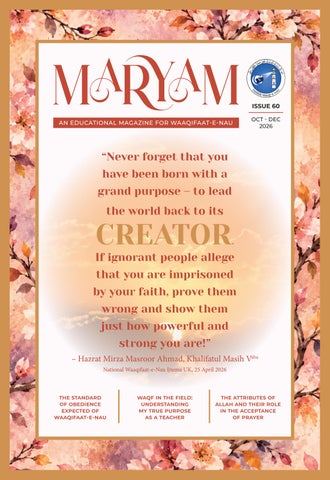
ISSUE 60 AN EDUCATIONAL MAGAZINE FOR WAAQIFAAT-E-NAU
OCT - DEC 2026
“Never forget that you have been born with a grand purpose – to lead the world back to its
CREATOR
. If ignorant people allege that you are imprisoned by your faith, prove them wrong and show them just how powerful and strong you are!” – Hazrat Mirza Masroor Ahmad, Khalifatul Masih Vaba National Waaqifaat-e-Nau Ijtema UK, 25 April 2026
The Standard of Obedience Expected of Waaqifaat-e-Nau
Waqf in the Field: Understanding My True Purpose as a Teacher
The Attributes of Allah and Their Role in the Acceptance of Prayer
“Be confident in yourselves and who you are. Always remember that true peace and contentment lie in the nearness of Allah the Almighty. And to attain this, you must fulfil His rights and those of humanity. If you act with such piety and goodness, you will become true beacons of light, illuminating the path towards success and salvation Insha'Allah.”
Hazrat Mirza Masroor Ahmad, Khalifatul Masih Vaba National Waaqifaat-e-Nau Ijtema UK, 25 April 2026
from the editor History has borne witness to countless examples of the unwavering obedience and exceptional moral standards of the Companions of the Holy Prophet Muhammadsaw. Their love and devotion knew no bounds; they would eagerly await an instruction, ready to act upon it immediately and without hesitation. In this day and age, we are constantly surrounded by worldly distractions that can draw us away from our faith. However, as members of the Jama’at of the Promised Messiahas and as Waaqifaat-e-Nau, we must strive to emulate the same spirit of obedience and devotion demonstrated by the Companionsra. We should give priority to our faith and remain ever ready to act upon the guidance of the Khalifatul Masih, responding with eagerness and sincerity the moment his words reach our ears. At the National Waaqifaat-e-Nau Ijtema UK 2026, Hazrat Mirza Masroor Ahmad, Khalifatul Masih Vaba said: “Certainly, throughout Islamic history, countless Muslim women have made incredible sacrifices. They understood their personal responsibilities towards bringing forth the spiritual victory of Islam… Some Muslim women even fought on the front lines, while others nursed the wounded with unwavering compassion and diligence. These noble precedents are not just stories from history for you to read about; rather, they should serve as a profound example to all of you and demonstrate the extremely high status of women in Islam. Now, it is your duty to protect this status and to follow in their footsteps by embodying Islam’s true teachings and being ready to make every sacrifice required for the sake of your faith. This is the duty of all Ahmadi women and girls, but especially for those who have pledged to serve the cause of Islam until their last breath.” (Address by Hazrat Khalifatul Masih Vaba at the National Waaqifaat-e-Nau Ijtema UK, 25 April 2026)
May Allah enable Waaqifaat-e-Nau to achieve exemplary levels of obedience and to follow the blessed guidance of beloved Hazooraba. Ameen. This edition of Maryam Magazine readers can also enjoy insightful articles written by Waaqifaat-e-Nau, such as ‘The Standard of Obedience Expected of Waaqifaat-e-Nau’, ‘Waqf in the Field: Understanding My True Purpose as a Teacher’ and ‘The Attributes of Allah and their Role in the Acceptance of Prayer’.
di
me H ina A h
ENGLISH EDITOR
Do you have any comments, suggestions or want your article featured in our next edition? Email us at: chiefeditor@maryammagazine.org
meet the team CHIEF EDITOR Zanubia Ahmad ASSISTANT CHIEF EDITORS Dure Jamal Mala Nayla Muzamil ENGLISH EDITOR Hina Ahmedi ENGLISH SUB-EDITOR Hamooda Arif EDITORIAL BOARD Sabah Un Noor Tahir Hibba-Tul Mussawir Maleeha Mansur Meliha Hayat Salma Manahil Malik Tahmeena Shamim Tahir Mashel Chaudhry Samina Yasmeen Arif Amatul Wakeel Maha Sameera Mirza Kashifa Qamar Safina Nabeel Maham COVER DESIGN Soumbal Qureshi PAGE DESIGN & SETTING Soumbal Qureshi Atiyya Wasee Hina Farooqi Zara Tahir Ahmad Wardah Burhan Fatihah Saif Khan Printed Under The Central Waqf-E-Nau Department MANAGER Luqman Ahmad Kishwar PRINTERS Warner Midlands
con tents OCTOBER - DECEMBER 2026 | ISSUE 60
03. The Holy Qur’an
21. Pearls of Wisdom by Hazrat
04. Hadith
and Its Impact on Human Privacy
Khalifatul Masih Vaba | Social Media
05. Writings of the
22. Kids’ Spread: My Tabligh
06. Introducing the World to
28. Waqf in the Field:
Promised Messiahas
Islam’s Spiritual and Economic System | Guidance from Hazrat Mirza Masroor Ahmad, Khalifatul Masih Vaba
08. Book Recommendation:
Toolkit
Understanding My True Purpose as a Teacher | Farhana Mian
32. Comic: Afia and Zayd Keeping Good Company
The New World Order | By Hazrat Mirza Bashir-ud-Din Mahmud Ahmad, Khalifatul Masih IIra
36. Pearls of Wisdom by Hazrat
09. The Standard of Obedience
Company Protects Faith, While Harmful Company Should Be Left
Tooba Khokhar
37. “Humility is the Key to Mutual
Expected of Waaqifaat-e-Nau |
12. Focus: The True Nature of
the Mahdi | By Hazrat Mirza Ghulam Ahmad, the Promised Messiah and Mahdias
16. Report: Mauritius National Waaqifaat-e-Nau Ijtema 2026
Khalifatul Masih Vaba | Good
Respect” | Quote by Hazrat Mirza
Masroor Ahmad, Khalifatul Masih Vaba
38. Story: The Farmer’s Hidden Treasure
42. The Attributes of Allah and
Their Role in the Acceptance of Prayer | Mashel Chaudhry
The Holy ﷽
Qur’an قرا ٓن جمید
ُ َٰ َ َ َ َ ُ َ َُ َ َ ََ ََ َ َ ان انۤ ٰا ِم ۤنوْا ِبرَ ِبک ۤم فا َمناۖ٭ َربنافاغ ِفرلَنا ی ل ِلاِیم ِ ۤ َربن ۤا ِانن ۤا َس ِم ۤعن ۤا ُمنا ِد ًی ۤا ینا ِد ۤ ُُ َ َ َ ٰ َ َ ََ َ َ ََ ََ َ َ ذنوبَن ۤا َوک ِفرۤ َعن ۤا َس ِیا ِتن ۤا َوتوَفن ۤا َمعۤ الابرَا ۤرِۤۤ َربنا َۤو ٰا ِتنا َۤما َۤو َعدتنا َۤعلٰی ُۤر ُس ِلکۤ َولَاۤتُخ ِزنَاۤیَو َمۤال ِق ٰیمَ ِۃۤؕۤ ِان َ َکۤلَاۤتُخ ِل ُفۤال ِمی َع َ ادۤ )(Aal-e-Imran: 194-195
(وسرۃالرمعان)195-194:
ربرپ faith,ہکاےنپ انمدیرکراہاھت yeوجاامینیک inوکانُس واےل انمدیرکےن andاکی �مہےن رب! believed.امہرے ہمج :اے رترتہمج ‘Believe your ’Lord, we ّ unto ّ have Translation: Our Lord, we have heard a Crier calling us
Our Lord, forgive us, therefore, our errors and remove from
رباایئںدور evils,امہری andاورمہےس شخبدے سپامہرے رب! theےل ”righteous.اامین اامینےلآؤ۔سپمہ اےامہرے ّ us our انگہin death number آےئ۔us with what Thou hast promised ںیمہus through “Ourاےنپ Lord,وج ُ وت ےن وکینںtoےک اسھت ومت رکدے اور giveرک دے usودعہ اطع ںیمہ وہ رب! اور دے۔اے امہرے ّ Thy Messengers; and disgrace us not on the Day ل ن ب ofامہرےقحںیمرفضرکدایاھت(ینعیاثیمقا ّنب � ُ وتودعہ ن روسولںرپ رکان۔ ہن وسا ر دن ےک ایقتم ںیمہ اور )۔ ُ Resurrection. ”Surely, Thou breakest not Thy promise.
الخیفںیہنرکات۔
)(English translation by Hazrat Maulvi Sher Ali sahibra
(رتہمجازرضحترمزااطرہادمح،ۃفیلخاحیسملارلاعبرہمحاہللاعتٰیل)
MARYAM | 3
Hadith دحثیایبنلﷺ
)(Sayings of The Holy Prophetsaw َ َّ ُ َ َعن ْابن َع َّباس َ ض َي ُ ال َ :ق َ ُ ُ هللا َع ْن ُه َما َق َ هللا َعل ْي ِه هللا صلى ال َرسول ِ ٍ رِ ِ ِ َ َّ هللا ل ٗه م ْن ُكل َ ’’م ْن َلز َم ْاْل ْست ْغ َف َار َج َع َل ُ ض ْيق َم ْخ َر ًجا َ ،ومنْ َ َو َسل َم ِ ِ ِ ِ ِ ِ ٍ َ َ ُ َ َ ُ ك ِل َه ٍم ف َر ًجا َ ،و َر َزق ٗه ِم ْن َح ْيث ْل َي ْحت ِس ُب۔‘‘ (أ ُبو َداؤد ،کتاب الوتر ،باب في اْلستغفار)
رتہمج
Translation:آرضحنتیلصاہللہیلعوملسےنرفامی :رضحتانبابعسریضاہللامہنعروایرکےتیہہک
Ibn relates said: Hazratدتی ےئلراہدیپارک Abbasےک وتقاسےکےنلکن thatیگنتےک theاعتٰیلرہ Holyےہاہلل Prophetرکاتراتہ صخشہمہ وتقاافغتسر ہکوج saw
ra
him راہin supplicating Allah for Forکس۔ یھبہنرک whoامگن constantےہisسجکوہ ےسرزقاطعرفامات اجنتدتیےہاوراےساس مغےس ےہاوررہ forgiveness He provides deliverance from every straightness and relief from every suffering and endows him whence he knows not.
(Garden؍یئم2004ء) ازعلزیرفومدہ14 Righteous,رصنبہ ااخلسمادیہاہللاعتٰیل ۃفیلخاحیسمل )No.1879رضحت (رتہمجدحثیازہبطخہعمج of the pg.320, Hadith
4 | MARYAM
Writings of the
Promised Messiahas MAN TURNS TO GOD WITH REMORSE A ND GO D TURNS TO MAN WIT H MER CY In Arabic idiom, Taubah (repentance) means ‘returning’, and that is why in the Holy Qur’an God’s name is also Tawwab, that is to say, He Who is Oft-Returning. This means that when a person discarding sin turns to God with a sincere heart, God Almighty turns even more to him. This is altogether in accord with the law of nature. God Almighty has made it part of human nature that when a person turns to another with a sincere heart, the latter’s heart is also softened for him. Then how can reason accept that when a servant turns towards God Almighty with a true heart God should not turn to him? Indeed God, Who is Benevolent and Merciful, turns even more towards His servant. That is why in the Holy Qur’an, God’s name, as we have just mentioned, is also Tawwab, meaning OftReturning. Man’s turning to God is through remorse and humility and meekness, and God’s turning to man is with mercy and forgiveness. If mercy were not one of the attributes of God Almighty, no one would be delivered. It is a pity that people do not ponder over the attributes of God Almighty and depend entirely upon their own actions. Hazrat Mirza Ghulam Ahmad, Promised Messiahas, The Essence of Islam, Vol.II, p.239
MARYAM | 5
Introducing the World to Islam’s Spiritual and Economic System A Waqf-e-Nau boy asked Hazrat Mirza Masroor Ahmad, Khalifatul Masih Vaba, about the statement of Hazrat Musleh Maudra that a time would come when the world would seek a new system and the Ahmadiyya Muslim Community would present a Nizam-e-Nau. The questioner asked whether, in light of present world conditions and the possibility of global war, such a system could be established after a future war.
6 | MARYAM
In response, Hazooraba explained that he had long been drawing the Jama’at’s attention to this matter. He said, “I have been saying this to the Jama’at for quite some time: when war takes place and devastation comes upon the world, then people will ask and seek [answers].” For this reason, Hazooraba said, Ahmadis should begin introducing people to Jama’at-e-Ahmadiyya and the teachings of Islam before such circumstances arise. Hazooraba further explained that Ahmadis should tell the world, “It is through the teachings of Islam alone that your world can be saved, and it is through this system alone that the world will benefit. Therefore, you should turn towards Allah the Almighty.” He said that when people turn towards Allah the Almighty and Jama’at-e-Ahmadiyya presents this system, that is when this matter will come to pass. Referring to what he had stated previously in addresses to non-Muslim audiences, Hazooraba said,
“You have seen socialism, you have seen communism and you have seen capitalism, yet everywhere you see only disorder. Now adopt the true system of Islam as well and see; then you will come to know that the true system of Islam guarantees the betterment of the poor, the betterment of orphans, the betterment of widows and the economic condition of the world.” Hazooraba advised that Ahmadis should begin explaining both the economic and spiritual systems of Islam to people from now. He said that Ahmadis should tell them, “If you follow both of these, therein lies your protection; otherwise, there is none.” Hazooraba added that after people witness the consequences of worldly systems, Ahmadis should do tabligh to those who remain and tell them, “Now come towards this system. Having seen that system, you brought destruction upon yourselves; now come towards this one.”
Belgium Waqf-e-Nau Boys Mulaqat with Hazrat Mirza Masroor Ahmad, Khalifatul Masih Vaba, Islamabad, 31 May 2026. www.alhakam.org/waqifeen-e-nau-belgium-31-may-2026
MARYAM | 7
Book Recommendation The New World Order of Islam by Hazrat Mirza Bashir-ud-Din Mahmud Ahmad, Khalifatul Masih IIra
Against the backdrop of the then-prevailing ideologies of communism and capitalist democracy, Hazrat Mirza Bashir-ud-Din Mahmud Ahmad, Khalifatul Masih IIra, delivered this lecture at Jalsa Salana on December 28, 1942. The address answers the question, ‘How does Ahmadiyyat, the True Islam, propose to deal with the grave problem of socio-economic inequality in the world?’ The Ahmadiyya solution is the solution of Islam shaped under divine guidance for present needs by the Holy Founderas of the Ahmadiyya movement. Hazrat Khalifatul Masih IIra examined and analysed the role played by different movements to alleviate poverty and sufferings, such as, Socialism, International Socialism, Marxism, Bolshevism, Nazism and Fascism and so on. Hazoorra also explored the major religions of the world regarding the basic question “social inequality a serious problem.” Hazrat Mirza Ghulam Ahmad, the Promised Messiah and Mahdias, laid down the foundations of the New World Order, by initiating the scheme of Wasiyyat based on Islamic teachings and under the Divine guidance in his book Al-Wassiyat written in 1905. Later in 1934 Hazrat Mirza Bashir-udDin Mahmud Ahmadra inaugurated Tahrik-e-Jadid to prepare the ground for the full implementation of the New World Order of the institution of Wasiyyat. In the present lecture, Hazoorra elaborates the aims and objectives of Tahrik-e-Jadid and claims that the New World Order in all its aspects, economic, social and religious, as introduced by Nizam-e-Wassiyat, will in the end prevail and a new and genuine revolution will take place.
8 | MARYAM
The Standard of Obedience Expected of
Waaqifaat-e-Nau To o ba K ho khar
…and they say, ‘We hear, and we obey. We implore Thy forgiveness, O our Lord, and to Thee is the returning.’ - The Holy Qur’an, Chapter 2, Verse 286
What does freedom truly mean? In theory, we are all ‘free’ to eat ice cream for breakfast every day. We are also ‘free’ to drink ten cups of coffee a day alongside that. However, is the person who does both exercising their freedom or simply obeying their own desires? Is there really such a thing as true, absolute freedom? The dilemma we face is this: in the modern world, freedom is often taken as the freedom to follow our own desires. In the words of English philosopher Bertrand Russell, “Freedom in general may be defined as the absence of obstacles to the realization of desires”.i However, the reality of the human condition is that we are free to choose which path we take. We can either obey the whisperings of the khannasii who calls to lowly desires, or obey the teachings of our Lord and fulfil the desire of our higher selves. The Promised Messiahas wrote: In His kingdom of heaven, God has given no choice to the angels. Obedience is inherent in their nature. They are not able to disobey. They are not subject to error or forgetfulness. But human nature has been given the choice of obedience and disobedience.iii
MARYAM | 9
In today’s age, disobedience of religious virtues is often celebrated. The lifestyle promoted by beauty influencers and celebrities is by and large one of lavishness and excess. Modesty and contentment have no role in the theatre of modernity. The Islamic faith is the last remaining fortress guarding these values in the capitalist era. The Promised Messiahas writes: The necessary consequence of following in the footsteps of the Holy Prophet [peace and blessings of Allah be on him] the essentials of which are his love, respect and obedience, is that a person becomes the beloved of God and his sins are forgiven, and if he has swallowed the poison of sin, that poison is rendered harmless through the antidote of love and obedience. As a person can get rid of a disease by the use of medicine, in the same way, a sinner can be purified of sin. As light dispels darkness and an antidote destroys the effect of poison and fire consumes, in the same way true obedience and love prove their effect. As fire consumes in an instant, the eager doing of good for the manifestation of God’s glory acts like fire in consuming the fuel of sin.iv In this way, obedience is not a burden but a relief, as it offers freedom from the base self. As English poet William Wordsworth so beautifully put:
Nuns fret not at their convent’s narrow room; And hermits are contented with their cells; And students with their pensive citadels; Maids at the wheel, the weaver at his loom, Sit blithe and happy; bees that soar for bloom, High as the highest Peak of Furness-fells, Will murmur by the hour in foxglove bells: In truth the prison, into which we doom Ourselves, no prison is:v
10 | MARYAM
As Waaqifaat-e-Nau, our bond of devotion should be one of love. In describing the highest form of obedience, the Promised Messiahas writes: That stage is reached only when obedience ceases to be an effort, and the green and waving branches of obedience sprout forth from the heart like a natural growth and all that is considered one's own truly becomes God's, and just as other people delight in indulgence, such a person's whole delight centres on worship and remembrance of God, and the pleasures of God take the place of his personal desires.vi The Promised Messiahas further writes: Such a one gives proof by his devotion that he belongs to God and conceives himself to have been created for the obedience of the Creator and the service of His creatures. He performs all good actions that are related to every faculty with such eagerness and sincerity of heart as if he beholds the True Beloved in the mirror of his obedience, his will conforms to the will of God Almighty and all his delight is in obedience to Him.vii As Waaqifaat-e-Nau, our acts of obedience can lead us to this ultimate state by the will of God. In obeying the rulings of our faith and the verdicts of Khilafat, we are following the path that leads us back to our own fitrah (innate human nature). In a sermon delivered on 28th October 2016, Hazrat Mirza Masroor Ahmad, Khalifatul Masih VMay Allah be his Helper expounded upon the philosophy of Waqf. In describing the qualities that members of this scheme must inculcate, Hazoore-Aqdasaba said: If they are obedient to Khilafat and are the foremost of acting upon its decisions, then they are special....If they are such that they do all of these things and all those things which Allah the Almighty loves and avoid all those things which Allah the Almighty does not like and has forbidden, then they definitely are special—in fact, they are very special.viii
Bertrand Russell, ‘Freedom and Government’ Hazrat Mirza Ghulam Ahmadas, Malfuzat, Vol II, p. 199 iii Hazrat Mirza Ghulam Ahmadas, The Essence of Islam, Vol I, p. 153 iv Hazrat Mirza Ghulam Ahmadas, The Essence of Islam, Vol I, p. 220 v William Wordsworth, ‘The Sonnet’s Scanty Plot’ vi Hazrat Mirza Ghulam Ahmadas, The Essence of Islam, Vol III, p. 64 vii Hazrat Mirza Ghulam Ahmadas, The Essence of Islam, Vol II, p. 428 viii Hazrat Mirza Masroor Ahmadaba, The Essence of Waqf-e-Nau, p. 18 i
ii
MARYAM | 11
FO CU S B OOKS OF TH E PR O M I S E D M E S S I A H A S This section of the magazine aims to provide a brief insight into one of the books of the Promised Messiahas. In this issue we introduce “The True Nature of the Mahdi” (Haqiqat-ul-Mahdi).
TITLE: Haqiqat-ul-Mahdi AUTHOR: Hazrat Mirza Ghulam Ahmadas LANGUAGE: Urdu ENGLISH VERSION: The True Nature of the Mahdi NUMBER OF PAGES: Approximately 70 YEAR PRINTED: 1899 PRINTERS: Zia-ul-Islam Press, Qadian
12 | MARYAM
THE TRUE NATURE OF THE MAHDI The True Nature of the Mahdi is the English translation of the Urdu book Haqiqat-ulMahdi (Urdu), written by the Holy Founder of the Ahmadiyya Muslim Jama’at, The Promised Messiah and Mahdi, Hazrat Mirza Ghulam Ahmad of Qadian (on whom be peace) in 1899. First published in Urdu in Qadian, India, 1899, the first English translation was published in the UK in 2017 by Islam International Publications Ltd.
ABOUT THE AUTHOR Born in 1835 in Qadian, India, Hazrat Mirza Ghulam Ahmadas, the Promised Messiah and Mahdi, devoted his life to the service of Islam. Through his writings, speeches and debates, he defended Islam against attacks from all sides and demonstrated that Islam is a living faith through which man can establish communion with his Creator. In 1889, he founded the Ahmadiyya Muslim Community, which has since spread to more than two hundred and ten nations and territories. He authored over eighty books in Urdu, Arabic and Persian, covering a wide range of religious and spiritual subjects. Throughout his life, he sought to revive the true teachings of Islam and guide mankind towards a living relationship with God. His mission was one of peace, righteousness and the spiritual reformation of humanity, and his works continue to inspire millions of people around the world today.
BACKGROUND Towards the close of the nineteenth century, Muslims held differing views regarding the advent of the Promised Messiah and Mahdi. Many expected the appearance of a separate Mahdi who would establish Islam through warfare and political dominance. In response to these misconceptions and in light of increasing attacks against Islam from various quarters, Hazrat Mirza Ghulam Ahmadas wrote Haqiqat-ul-Mahdi to clarify the true Islamic teachings concerning the awaited reformer.
INTRODUCTION In The True Nature of the Mahdi, the Promised Messiahas presents a comprehensive explanation of his claim to be the awaited Mahdi and Messiah, drawing upon the Holy
MARYAM | 13
Qur’an, Ahadith and divine revelations as evidence. More than a defence of his claim, the book serves as a profound exposition of the purpose behind his advent and the spiritual revival that he was commissioned to bring about. Through a series of reasoned arguments, he addresses prevailing misconceptions regarding the Mahdi and explains that the triumph of Islam in the latter days would be achieved not through force, but through prayer, heavenly signs and intellectual persuasion. A central theme of the book is the unity of the offices of the Messiah and the Mahdi in one individual. The Promised Messiahas explains how the prophecies concerning the latter days have been fulfilled and demonstrates that his mission was to restore the true teachings of Islam and re-establish the relationship between mankind and its Creator. He repeatedly emphasises that the age of religious warfare has passed and that the real jihad of this era is the struggle to purify one’s soul and spread the message of Islam through wisdom and compassion. Throughout the book, the Promised Messiahas calls upon mankind to abandon sectarianism and materialism and to return to God with sincerity and righteousness. In doing so, The True Nature of the Mahdi stands as an important testimony to his divine mission and provides readers with a deeper understanding of the spiritual objectives underlying his advent.
14 | MARYAM
SPECIMENS OF WRITING FROM THE BOOK “I have been informed by God Almighty that I am the Promised Mahdi, and He has appointed me for the guidance of mankind. But I have not brought any new law, nor have I abrogated any commandment of the Holy Qur’an. I am merely a servant and follower of the Holy Prophet Muhammadsaw, and whatever grace has been bestowed upon me has been granted through complete obedience to him.” (The True Nature of the Mahdi, pp. 8–9)
“God desires that mankind should recognise Him and establish a sincere relationship with Him. Therefore, He sends His Messengers and Reformers whenever corruption becomes widespread and faith becomes weak. Thus, I too have been sent in accordance with this everlasting practice of God, so that people may once again turn towards righteousness and attain nearness to their Creator.” (The True Nature of the Mahdi, pp. 6–7)
“This age is not the age of religious wars. Rather, the victory of Islam in this era is destined to be achieved through prayers, heavenly signs and convincing arguments. Therefore, it is wrong to suppose that the Promised Mahdi will spread religion through the sword and bloodshed.” (The True Nature of the Mahdi, p. 9)
“The Mahdi and the Messiah are not two separate individuals. The same person who has been designated as the Messiah has also been named the Mahdi. This is the truth which has been disclosed to me by God Almighty, and I have been commissioned to proclaim it to the world.”
Masih (Messiah): The Anointed One. A title given to the Promised Messiahas, signifying his mission to revive spirituality and reform mankind. Mujaddid: A divinely appointed reformer raised at the beginning of a century to revive the true teachings of Islam.
(The True Nature of the Mahdi, pp. 5–6)
“Whatever honour and blessings have been bestowed upon me have been granted solely because of my complete devotion and obedience to the Holy Prophet Muhammadsaw. Without following him, no person can attain the favour of God.” (The True Nature of the Mahdi, p. 9)
SAMPLE GLOSSARY Bai‘at: Oath of allegiance taken at the hand of a spiritual guide. Haqiqat-ul-Mahdi: Literally, The True Nature of the Mahdi Hijrah: Migration. In Islamic terminology, migration for the sake of preserving and promoting faith.
Shirk: The act of associating partners with Allah or attributing divine qualities to others besides Him. Sunnah: The practice and example of the Holy Prophet Muhammadsaw. Taqwa: Righteousness and fear of God. It signifies a state in which a believer strives to avoid earning God’s displeasure and seeks to attain His pleasure. Tauhid: The Unity and Oneness of God; the fundamental principle of Islamic belief. Zill: Reflection or manifestation. A term used by the Promised Messiahas to describe the spiritual blessings attained through perfect obedience to the Holy Prophet Muhammadsaw.
Jihad: Literally means ‘striving’ or ‘struggle’. In its broadest sense, it refers to striving in the cause of God. In the present age, the Promised Messiahas emphasised the jihad of the pen, prayer and self-reformation. Mahdi: Literally, ‘the Guided One’. A title given to the reformer raised by God to revive the faith and guide mankind.
SCAN TO READ ONLINE
MARYAM | 15
REPORT:
MAURITIUS NATIONAL WAAQIFAAT-E-NAU IJTEMA 2026 INTRODUCTION By the grace of Allah, the Mauritius National Waaqifaat-eNau Ijtema 2026 was held on 27th and 28th June 2026, bringing together Waaqifaat-eNau from across Mauritius for a weekend of learning, reflection, and spiritual growth.
16 | MARYAM
DAY 1
LITERARY AND NON-LITERARY COMPETITIONS Organised across six age categories, the competitions provided Waaqifaat-e-Nau with an opportunity to develop their abilities while showcasing the diverse talents with which Allah has blessed them. The non-literary competitions provided participants with a platform to showcase their creativity and talents across a variety of disciplines, including dessert-making, photography, handicrafts, and calligraphy. Other non-literary competitions included a variety of indoor games. The literary competitions focused on nurturing confidence, knowledge, and eloquence. Participants competed in Tilawat, Nazm, the Attributes of Allah competition, prepared speech, extempore speech and a group quiz. Through careful preparation and confident delivery, the Waaqifaate-Nau demonstrated not only their abilities but also their commitment to learning and self-improvement.
MARYAM | 17
INTERACTIVE FORUM: ‘WAQF IN ACTION’ This session was held for Waaqifaat-e-Nau aged 12 years and above in the late afternoon. Following Tilawat, Nazm and a welcome address by Mu’awina Sadr Waqf-e-Nau, Waaqifaat-e-Nau engaged in an interactive forum around the theme
“Waqf in Action: Strengthening Our Service to the Jama’at.” Using the ‘World Café’ approach, participants brainstormed on three subtopics of the forum:
1
Rising Above the Ordinary: Self-Reformation and Discipline as Waaqifaat-e-Nau
2
From Pledge to Practice: Living the Spirit of Waqf and Serving the Jama’at
3
Overcoming Obstacles in Fulfilling Our Pledge: Challenges Facing Waaqifaat and Their Solutions
DAY 2
This allowed participants to truly reflect on their responsibilities as Waaqifaat-e-Nau and inspired them to dedicate themselves to the service of the Jama’at with renewed commitment. The workshop emphasised that participating in Jama’at events and carrying out every responsibility entrusted to them are both a privilege and an obligation. At the end, moderators of the three groups summarised what was discussed, giving participants important take-home messages.
18 | MARYAM
PROGRAMME WITH THE HEAD OF INTERNATIONAL WAQF-E-NAU: The first session on Sunday featured a livestream programme with Respected Luqman Ahmed Kishwar Sahib, Head of International Waqf-e-Nau. Practical guidance was shared for different age groups, as well as for parents, emphasising their vital role in nurturing children with strong moral and spiritual values. Particular attention was given to making career choices that enable one to serve the Jama’at, while also ensuring that Jama’at responsibilities remain a priority alongside personal and professional commitments.
CLOSING SESSION Following Tilawat and Nazm, Waaqifaat -e-Nau were addressed by Sadr Lajna Sahiba, who imparted heartfelt guidance and cherished words of wisdom on the role of Waaqifaat-eNau in shaping the future, focusing on Namaz, good conduct and good company. Afterwards, the address of Ameer Sahib was read out which centred on the vital responsibility of Tabligh. This was followed by the much-awaited prize-giving ceremony, celebrating the multifarious talents, dedication and efforts of members from all age groups. The annual report, highlights of the year’s activities, and a closing address were then presented by Naib Muawina Sadr Waqf-e-Nau. While nostalgic, her address also encompassed valuable reminders and practical advice for every Waqifa-e-Nau. A heartfelt message received from Beloved Hazooraba for this year’s Ijtema was read. In his gracious message, Beloved Hazooraba prayed that the Ijtema would prove beneficial for all participants and urged the Waqf-e-Nau to uphold the highest standards of obedience, loyalty, and devotion to their faith. The session concluded with a soulful recitation of Qaseeda by a group of Waaqifaat-e-Nau. EXHIBITION: REFLECTION CHAMBER – A JOURNEY WITHIN Darkness. Silence. A single light. - Participants embarked on a journey unlike any other. The first light illuminated the blessed images of the Khulafa-eAhmadiyyat, before the room once again fell into darkness. Then came a familiar voice: “Assalamu Alaikum.” Instantly, the atmosphere changed. The heartfelt guidance of Hazrat Khalifatul Masihaba resonated through the room, reminding every listener of the immense blessing and responsibility of being a Waqf-e-Nau and of dedicating one’s abilities in the service of faith. The journey continued as participants were led from one point to another, each step carrying a deeper message. A powerful visual presentation portrayed the consequences of the choices we make in this world, contrasting the paths leading towards Jannah and away from it. As the words, “The choice is yours,” appeared on the screen, the room fell silent, allowing every participant a moment to reflect on the direction of their own life. MARYAM | 19
The final stage of the experience proved especially moving. Seated beneath a single light, with all distractions fading away, participants watched scenes from the Bai’at ceremony accompanied by the repeated recitation of Astaghfirullah. The guidance of Hazrat Khalifatul Masih IVrh and Hazrat Khalifatul Masih Vaba regarding career choices and living a life devoted to Waqf gave the experience a deeply personal meaning. As the words of the Nazm, “Yeh Bai’at Nahin Hai, Yeh Sauda Hai Dil Ka” (This Bai’at is not merely a pledge; it is the commitment of one’s heart), echoed through the room, participants were reminded that Waqf is far more than a promise...it is a lifelong offering of one’s heart, abilities, and life in the service of Allah. As the final words appeared on the screen... “Are you truly living your Waqf?”... the room was once again enveloped in darkness. Yet the question lingered long after participants stepped outside. The Reflection Chamber was more than an exhibition. It was an invitation to pause, look inward, and sincerely evaluate one’s relationship with Allah, Khilafat, and the sacred covenant of Waqf. For many, it became one of the most profound and memorable experiences of the Ijtema, leaving hearts inspired to renew their commitment with greater sincerity and purpose. The 2026 National Waaqifaat-e-Nau Ijtema drew its curtains with a collective dinner featuring delicious biryani served alongside the warmth of sisterhood. As Waaqifaat-e-Nau departed, they carried with them not only cherished memories of the past two days but also renewed faith, stronger bonds of sisterhood, and a deeper resolve to fulfil the sacred pledge of Waqf with sincerity and steadfastness. We pray that Allah enables every Waqifa-eNau to strengthen her faith, serve the Jama’at with sincerity, and fulfil her Waqf to the best of her ability. Ameen.
20 | MARYAM
Social Media and Its Impact on Human Privacy
Pearls OF
WISDOM
by Hazrat Khalifatul Masih Vaba
A group of Waaqifaat-e-Nau from Canada was blessed with the opportunity to meet Hazrat Mirza Masroor Ahmad, Khalifatul Masih Vaba in a virtual Mulaqat on 11 June 2023. During the Mulaqat a Waqifa-e-Nau stated that human privacy has been significantly impacted by social media. She asked for a solution to address the aftermath of this impact on human privacy caused by social media. Hazooraba explained that in the past, when people heard something about someone, they would pass it on to others. However, the extent of spreading rumours was limited at that time. “Now, with the advent of social media, rumours spread rapidly and widely.” Consequently, Hazooraba advised that that was the reason he had previously suggested turning off cameras, phones, and other devices during Jama’at events, especially for Lajna, and cautioned against unnecessarily posting everything on social media. Furthermore, Hazooraba added that Allah the Almighty has prohibited engaging in gossip, spreading false information, and speaking ill of others. It is essential to refrain from indulging in such negative behaviours. Privacy is being compromised, and it is due to the actions of humans themselves that this damage has occurred. Hazooraba emphasised the importance of being mindful in such circumstances. It is crucial to educate the Waaqifaat-e-Nau, those around us, children, students, and siblings about the negative implications of these actions. Hazooraba suggested that the Waaqifaat-e-Nau should write articles in local or national newspapers, raising awareness about the harmful effects of social media. By doing so, the Waaqifaat-e-Nau can effectively play their role in addressing this issue. Virtual Mulaqat with Waaqifaat-e-Nau from Canada, 11 June 2023 www.alhakam.org/canada-waqifaat-meet-huzoor
MARYAM | 21
Kids’ Spread MY TABLIGH TOOLKIT Have you ever been asked a question about your faith and suddenly not known what to say? Don’t worry! Tabligh can be as simple as being kind, conducting yourself with good manners and explaining what you believe with confidence and honesty. MY TABLIGH TOOLKIT
Hazrat Mirza Masroor Ahmad, Khalifatul Masih Vaba, said: “…even at your young age, you should be strong in your faith, never allow the opinions of others to influence your beliefs or make you feel embarrassed about your religion.” (National Waaqifaat-e-Nau Ijtema UK 2026) Complete the activities below and build your very own Tabligh Toolkit!
TOOL 1
WHY DO YOU WEAR A SCARF?
Someone asks: “Why do you wear a scarf?” Before you look at the answer, what would you say? .............................................................................................................................................. Put This in Your Toolkit:
1
Quick answer: “I wear a scarf because Islam teaches us to dress modestly. It is one way I practise my faith and follow Allah’s commands.” If they ask more… “Modesty isn’t only about wearing a scarf. Islam teaches both men and women to be modest in the way they dress and behave.” Your turn… Can you explain why you wear a scarf in just ONE sentence? .............................................................................................................................................
22 | MARYAM
Hazooraba has reminded us: “…The Holy Qur’an requires Muslim women to observe pardah, and as Waqifa-e-Nau, you should have the highest standard in this regard. If you set a positive example, you will be a source of confidence for others and a means of guiding them about the value of modesty.” (National Waaqifaat-e-Nau Ijtema UK 2026) “If you are ever teased or mocked for wearing modest clothing, do not let it shake your confidence.” (Hazrat Khalifatul Masih Vaba, National Waaqifaate-Nau Ijtema UK 2026)
TOOL 2
WHAT IS AN AHMADI MUSLIM?
Someone asks: “What’s the difference between an Ahmadi Muslim and other Muslims?” Which would be the best way to begin? 1.
“We’re completely different.”
2. “We’re Muslims too. We share the fundamental beliefs of Islam, but there are some differences in what we believe.” 3. “It’s too complicated to explain.” Answer: 2 Put This in Your Toolkit:
1 2
“Ahmadi Muslims believe in Allah, the Holy Qur’an and the Holy Prophet Muhammadsaw. We also believe that the Promised Messiah and Imam Mahdi foretold by the Holy Prophetsaw has come in the person of Hazrat Mirza Ghulam Ahmadas.” The 10-Second Challenge Imagine you only have 10 seconds to explain what an Ahmadi Muslim is. Write your own short answer: ....................................................................................................................................................
MARYAM | 23
TOOL 3
WHY DON’T MUSLIMS EAT PORK?
Lunchtime Challenge Your friend is eating a pepperoni pizza. Friend: “Why can’t you eat pork anyway?” What would you say? ................................................................................................................................... Put This in Your Toolkit:
1 2 3
“Muslims don’t eat pork because Allah has told us in the Holy Qur’an not to eat it. As Muslims, we try to follow Allah’s commands.” Can You Explain It? What does HALAL mean? .........................................................................................
Find the answers here:
What does TAYYAB mean? ......................................................................................... What does HARAM mean? .........................................................................................
TOOL 4
WHY DO YOU PRAY FIVE TIMES A DAY?
Someone asks: “Why do you have to pray so much?” Put these ideas together to make a good answer: Allah — five daily prayers — remember — connection — worship My answer: ......................................................................................................................................................... Put This in Your Toolkit
1 2 3 4
“Muslims pray five times a day because Allah has commanded us to. Salat helps us worship Allah, remember Him throughout our day and build a stronger connection with Him.”
24 | MARYAM
TOOL 5
WHO IS THE KHALIFA?
Your friend has seen a photograph of Hazooraba and asks: “Who is this person?” What would you say? .............................................................................................................................. Put This in Your Toolkit
1 2 3 4 5
“He is Hazrat Mirza Masroor Ahmadaba, the Khalifa and worldwide spiritual leader of the Ahmadiyya Muslim Community.” If They Ask More… “The Khalifa is divinely appointed. He guides members of our Community according to the teachings of Islam and unites all Ahmadi Muslims around the world.”
TOOL 6
WHY DON’T YOU CELEBRATE HALLOWEEN?
Someone asks: “Why don’t you celebrate Halloween? It’s just harmless fun.” Before you look at the answer, what would you say? ...................................................................................................................................... Put This in Your Toolkit
1 2 3 4 5 6
“As an Ahmadi Muslim, I don’t celebrate Halloween because its traditions are based on beliefs that go against Islamic teachings.” Hazooraba said: “…Modern advancements have greatly contributed to the spread of certain vices, and some people, along with their children, mindlessly indulge in such things without realising their true implications and understanding the true spirit behind it.”
Find out more about why we don’t celebrate Halloween:
(Friday Sermon, 29 October 2010)
MARYAM | 25
TOOL 7
CAN YOU BE FRIENDS WITH NON-MUSLIMS?
True or False? “Muslims can only be friends with other Muslims.” TRUE
FALSE
Answer: FALSE! Islam teaches us to treat others with kindness and respect. Your Turn Your friend asks: “Can we still be best friends even though I’m not Muslim?” Write what you would say: ....................................................................................................................................................
TOOL 8
WHAT IF YOU DON’T KNOW THE ANSWER?
Someone has just asked you a really difficult question about Islam or Ahmadiyyat. You don’t know the answer. What should you do? 1.
Make up an answer that sounds right.
2. Pretend you didn’t hear them. 3. Say you don’t know and find out the correct answer. 4. Quickly change the subject. Answer: 3! “That’s a really good question. I’m not sure of the answer, but I can find out and let you know.” It is always best to be honest. Hazooraba reminded us: “Alongside your work or studies, you must set aside time every day to increase your religious knowledge.” (National Waaqifaat-e-Nau Ijtema UK 2026) “As is often said, knowledge is power. So, if you have religious knowledge, it will not only strengthen your faith but will also empower you to respond to the opponents of Islam and to guide those who are weaker in faith.” (National Waaqifaat-e-Nau Ijtema UK 2025) 26 | MARYAM
WHAT’S IN YOUR TABLIGH TOOLKIT? There are four tools every young Da‘iyah ilallah [one who invites towards Allah] should carry with her: BE KIND
1 2 3 4 5 6 7 8
BE KIND Your behaviour and conduct can tell people just as much about Islam as your words.
KNOW YOUR FAITH
1 2 3 4 5 6 7 8
KNOW YOUR FAITH Learn not only what you believe, but why you believe it.
CHECK
1 2 3 4 5 6 7 8
CHECK Not sure? Don’t guess! Find the correct answer from a reliable source or ask someone who knows.
LISTEN
1 2 3 4 5 6 7 8
LISTEN Don’t just think about what you want to say. Listen carefully to what the other person is actually asking.
PACK YOUR TOOLKIT!
MY TABLIGH TOOLKIT
You’ve reached the end of the challenge!
1 2 3 MY 4 5 TABLIGH 6 TOOLKIT 7 8
The best Tabligh begins simply by being a good example. Make sincere intentions, pray, and write to beloved Hazooraba for prayers too. And remember: “Your good character, integrity, modesty and truthful words will serve as a magnet, drawing the hearts and minds of goodnatured people towards you. Thereafter, when you pray for them to be rightly guided, Allah will listen to and accept your prayers. In this way, Insha’Allah, you will become the gateway for many people to embrace Islam. Moreover, your words, deeds and high morals will serve to render futile the false criticism or allegations routinely directed at Islam.” (Hazrat Mirza Masroor Ahmad, Khalifatul Masih Vaba, National Waaqifaat-e-Nau Ijtema UK 2025)
MARYAM | 27
Waqf in the Field:
Understanding My True Purpose as a Teacher
Farhana Mian
I consider myself the lowest of the low. I consider many others to have more valuable experiences to offer. This humble and weak self shares her journey so far… During the Friday Sermon of 28th October 2016, I remember sitting somewhere in the first few rows crammed up in Tahir Hall, Peace Village, Canada—amongst the large crowd who had gathered to offer Friday Prayers behind Hazrat Mirza Masroor Ahmad, Khalifatul Masih Vaba. I was 21 at the time, but I recall every word of the Khalifa piercing through my heart and body, tears rolling down my face—because even though I was attending all Jama’at programs, offering my daily prayers and increasing my religious knowledge—I was feeling guilty and hurt that perhaps I was not living up to my Waqf. With every word Hazooraba said, Hazoor’saba expectations of us were 28 | MARYAM
becoming more and more ingrained in my soul, and I grew up a little from that day on and began to understand the spirit of sacrifice. Doctors, Teachers, Engineers, we heard again and again, these being amongst the professions beloved Hazooraba desired from his Waqfe-Nau children. Having a natural inclination for the teaching profession and a genuine interest in medicine, I could not quite make that decision. Keeping my options open within the guidelines of Hazooraba, I pursued university. In December 2016, my family was blessed to have a Mulaqat with Hazooraba in London, this being our first stop before journeying on
to Mecca for Umrah. My love and connection to beloved Hazooraba was changing in my heart as I was growing older. Of course, as children, we express our love to Hazooraba in an affectionate manner, but I could feel my love moulding to a love where I was listening to Hazoor’saba words more carefully, I could find myself wanting to obey his every instruction. With this new flame in my maturing heart, I attended this Mulaqat with my family. And of course, the non-stop tears. “Roney waali bachi, idhar aao” Hazooraba lovingly called me to give me a pen and asked what I wanted to become. Here, in this moment, a moment unrehearsed, teaching is what slipped out of my mouth. “Teacher banna hai? Roye begair hi ban jaogi”. I completed my undergraduate degree in Biomedical Science whilst loving the teaching opportunities within my university, whether teaching maths, biology, and of course taking any opportunity to talk about Islam, Ahmadiyyat, be it at a Lajna AMSA Stall or one-on-one discussion with peers (University offers golden moments in life to discuss religion!). An amazing experience all in all. To pursue my teaching certification, I enrolled in the Master of Teaching program at the University of Toronto, which did not prove easy for me. My teaching placements, by the grace of Allah, were exceptional and amazing—but I significantly struggled in my own classes. I struggled with making friendships with the people in this program; there was discomfort with some of the topics I had to
discuss as a professional teacher with other teachers. This did not feel like an environment where I could easily be myself and express my views. The academic environment challenged me in ways I had never experienced before, and there were many moments when I questioned whether I could continue. My mom still recalls that there would be many days I would cry—after 1.5 long years, I was at a point that I wanted to quit. But Hazooraba had said “Roye begair ban jao gi”, how was this statement going to be fulfilled? In March 2020, my final school placement was finishing, and all that was left was my research paper, which was proving to be very challenging for me. Covid hit, in-person classes were cancelled, I completed my paper from home, and the requirement to present my paper was absolved—and indeed, Alhamdolillah, roye begair ban gayi mai teacher, and since then Allah has removed any obstacles which have ever come in my teaching profession in Canada or the UK, and I am certain anywhere else I would ever have to go. There is so much to say when it comes to one’s relationship with beloved Hazooraba. And so many incidents all intertwined. But oh, this tender age was when the topic of marriage first began in our household. This was not an easy one for my parents. Somewhere, in my brain, I thought that as a Waqf, I would probably fulfill my waqf best if I marry a Murabbi or Waqf-e-Zindagi. So naive of me, and what happened next could not have happened in any better manner! In December 2019, my parents went for Mulaqat with Hazooraba in London and worryingly brought up the topic MARYAM | 29
of my marriage to request Hazooraba for prayers. Hazooraba said, “Agar Waqfe-Nau hai, toh shartey nahin honi chayi, jahan se acha rishta aye karlena chaya”. Wow! Hazooraba was, concerned with how I was fulfilling my own Waqf. And I love every moment of this because now I am married to a software engineer (not a Waqf-e-Nau), living in England, and blessed with opportunities to serve and fulfil my Waqf, so close to my beloved Hazooraba. How could I ever be grateful enough to my Lord for such a blessing? In April 2021, I get married, a simple marriage as I desired, in the middle of Covid. My beloved Hazooraba announced my Nikah at Mubarak Mosque, Islamabad, England, as was my heartfelt desire. In early 2022, we had our first Mulaqat with Hazooraba as a married couple. I prepare my husband for the Mulaqat, “Listen, I am Waqf-e-Nau, so if Hazooraba asks me if I am ready to go to Africa to teach, we have to say yes”. We enter Hazoor’saba office, in short, beloved Hazooraba graciously gives us both ٍ يـَْس ٱل�لـّ ُُه �بـَِك rings with the revelation ‘َاٍف ََع ب�ـْ ََد ُُه َ �َ’ َأََل. Hazooraba asks me what I do, and I answer that I am Waqf-e-Nau and that my credentials have been easily transferred to the UK. Hazooraba guides me to get experience in my field. Hence, I continue to teach, familiarising myself with a differently structured education system from the one I grew up in, journeying through secondary school and now to a college, cherishing every learning and teaching moment, always keeping the following guidance in mind: “In this context, Waaqifeene-Nau will have secular jobs, but the purpose of their work and knowledge will be to demonstrate the Oneness of God Almighty and the spread of His religion. In this manner, Waaqifeen-e-Nau can pursue other professional fields, but this will be their primary purpose, and that every acquaintance will recognize them as a Waqf-e-Zindagi and if ever they are instructed to leave secular work for the faith, they will present themselves without any excuse or argument.” (The Essence of Waqf-e-Nau, Friday Sermon delivered by Hazrat Mirza Masroor Ahmad, Khalifatul Masih Vaba on 28th October 2016) 30 | MARYAM
“... the purpose of their work and knowledge
will be to demonstrate the Oneness of God Almighty and the spread of His religion..”
There are many transferable skills my profession teaches me, which, by the grace of Allah, I am able to bring back to my Jama’at work. Designing presentations to deliver as a local Secretary Tarbiyyat, conducting classes for Waqifaat-e-Nau and Nasirat, writing lesson plans to organise field trips for Nasirat, etc. But even more, Jama’at work has taught me skills that can be transferred to all aspects of life. My public speaking skills do not come from being a teacher. They come from my childhood experiences of taking part in Tilawat, Nazm, and speech competitions at Ijtema, conducting mosque tours from the age of 12, delivering presentations at various programs at a young age (alongside reciting Durood Sharif, the prayer to open the knot of your tongue, and a letter to Hazooraba prior to every talk). Volunteering for MTA taught me how to use Premiere Pro to edit videos and subtitling skills. Resilience came from working under the shadow of various personalities in the Nizaam. The skill to tolerate and forgive through the guidance of our beloved Hazooraba. To my surprise, when people meet me here in this country, where I did not grow up and have only lived for the past five years, they recognise me as “the teacher”. How is that possible? It surprises me. I think to myself that perhaps people in the UK have good memories— I do not consider myself of any status or worthy of being recognised or remembered– in my heart I know it is only the grace of Allah, it is the fulfillment of the prayers of our beloved Khalifa, and it is a continuous sign for me and an opportunity for me to experience the fulfillment of my Waqf. I write before you, a person who is the lowest of the low, with many flaws and areas for improvement. There is only one way to fulfil our Waqf, and that is to stay loyal to Khilafat and have a spirit in our hearts to fulfil his heartfelt desire for us, which is to become exemplary Ahmadi Muslims in all aspects. May Allah forgive our shortcomings and enable us all to fulfil our Waqf in the best possible manner. Ameen.
MARYAM | 31
Afia and Zayd: Keeping Good Company You both look like you’ve got something on your minds. What happened?
Some girls at school keep making fun of the way I dress. They say my hijab looks funny and I should dress more like them.
And one of my friends has started using really bad words. He never used to talk like that. I try not to care, but when they keep saying it, I start wondering if I should just dress like everyone else.
I don’t want to stop being friends with him. I just want him to stop using those words.
Then perhaps both of you have an opportunity to be brave.
Brave?
32 | MARYAM
When a friend does something wrong, we should tell them clearly that it isn’t right. Zayd, being a good friend can mean helping your friend recognise a bad habit.
But Afia, if someone’s company begins to influence you away from what you know is right, you should have the courage to step away.
So I don’t have to change myself just so they’ll accept me? Of course not. Hazooraba has reminded us, never to have any kind of complex when it comes to dressing modestly.
MARYAM | 33
The next day Why? Everyone says them! !!!
Can you stop saying words like that?
Maybe, but they’re not good words. And you never used to speak like that. We are friends and we should be a good influence on each other. …Okay. I’ll try. I’m sorry.
Why do you always wear a scarf? It’s not cool. I’m happy dressing modestly. You don’t have to dress like me, and I don’t have to dress like you.
Come on, Afia. Sit with us.
34 | MARYAM
Back home I spoke to my friend, Ami. I thought it would be awkward, but he actually listened!
And I realised I’d rather have friends who respect me than change myself just to fit in.
Alhamdolillah. Good friends bring out the best in us, and we should try to bring out the best in them too. Later Ya Allah, always bless my children with good company. Give them friends with good character, protect them from harmful influences, and keep them on the right path. Ameen.
That night And help us to be good friends who encourage others towards what is right.
Ya Allah, bless us with good friends who respect us and help us stay close to You.
Ameen.
Illustrations: Wardah Burhan
MARYAM | 35
Good Company Protects Faith, While Harmful Company Should Be Left
Pearls OF
WISDOM
by Hazrat Khalifatul Masih Vaba
During a Mulaqat with Lajna and Nasirat members from Germany, a 15-year-old attendee asked how a person should stop a friend from doing something wrong and how to choose good friends. Hazooraba first asked her age and then replied that if a friend is doing something wrong, one should stop her by telling her clearly that it is wrong and should not be done. However, if that friend continues and the questioner feels that the bad conduct is beginning to influence her, then Allah’s command is that such company should be left and better friends should be made instead. Hazooraba explained that good friends are those who possess the spirit of sacrifice, listen well and have good morals. Even if they are not Muslims and even if they do not believe in God, if they do not mock others, do not abuse God and possess goodness in their nature, then friendship with them may be maintained and through one’s own righteousness, one may gradually influence them. To illustrate the effect of the company, Hazooraba related an incident from the time of the Promised Messiahas. A Sikh student once sent a message to the Promised Messiahas saying that although he had been a religious man, he was becoming an atheist and moving away from belief in God. The Promised Messiahas told him that the classmate sitting with him in college appeared to be an atheist and that he should leave that place and sit elsewhere. The man later wrote back saying that the Promised Messiahas had been right: simply through that company, even without much conversation, he had been influenced towards atheism. After leaving that seat, his religious thoughts returned. (Apnay Andar Yakjehti Payda Karo…, Anwar-ul-Ulum, Vol. 24, p. 422)
Hazooraba said that in the same way, when a person finds themselves in harmful gatherings with bad influences, they should leave them. Only then can they save themselves. He added that young Ahmadis should develop courage and confidence and should not live in fear of what others will say. They should make themselves leaders, for the world is to follow them, not the other way round. Lajna and Nasirat members from Germany Mulaqat with Hazrat Khalifatul Masih Vaba, 11 April 2026, www.alhakam.org/lajna-members-and-nasirat-germany-11-april-2026
36 | MARYAM
“Another virtue Allah has deemed necessary for a believing woman is humility. Humility is the key to mutual respect.
As Ahmadi women, if you are humble and instil humility in your children, you will raise future generations who can lead the world towards peace and prosperity. In this way, you will play a fundamental role in saving the world from destruction.” Hazrat Mirza Masroor Ahmad, Khalifatul Masih Vaba
Address at the National Lajna & Nasirat UK Ijtema, 27th September 2025 https://www.pressahmadiyya.com/press-releases/09/2025/headof-the-ahmadiyya-muslim-community-addresses-the-nationalijtema-of-lajna-imaillah-uk/
MARYAM | 37
The Farmer’ Farmer’s
Hidden Treasure
Once upon a time, in a village in Punjab, Pakistan, there lived a hardworking farmer and his four sons. The farmer was known throughout the village for his honesty and kindness. Every day, he worked from sunrise to sunset in his fields. But his four sons were very different. They were lazy and spent their time arguing, playing tricks, and avoiding work whenever they could. As the years passed, the boys grew into young men, but they still refused to help on the farm. This made their father very sad. He knew he would not be able to look after them forever. One day, the farmer became seriously ill. Feeling that his time was near, he called his sons to his bedside. “My sons,” he said softly, “I have a secret to tell you. Many years ago, I buried a treasure somewhere on our farm. After I am gone, search for it together.” The brothers’ eyes sparkled with excitement. “But remember,” the farmer continued, “never fight with one another. Stay united, respect your elders, and work together. And when you find the treasure, take it to your uncle. He will divide it fairly among you.” The sons promised they would do exactly as he said.
38 | MARYAM
Soon after, the old farmer passed away. After their father’s funeral, the brothers could think of nothing except the hidden treasure. Early the next morning, they took their spades to the farm and began digging. They dug near the trees. They dug beside the fences. They dug in every field and every corner of the land. Day after day, they searched. The work was hard. Their hands became sore, and their backs ached. But they kept going, certain that a chest of gold was waiting to be found. Weeks later, they had dug up the entire farm, yet they still had not found the treasure. At last, the youngest brother looked across the freshly turned soil and said, “We’ve dug every field. Why don’t we plant seeds before all this hard work goes to waste?” The others agreed. Together they planted seeds, watered them, and cared for the growing crops. For the first time in their lives, the brothers worked side by side. Slowly, green shoots appeared. Then the fields turned golden with grain. When harvest time arrived, the brothers gathered a huge crop and sold it at the village market. They earned more money than they had ever seen before. Remembering their father’s instructions, they took the money to their uncle. Their uncle listened to their story and smiled. “My nephews,” he said, “your father was a very wise man. There was never any buried chest of gold.” MARYAM | 39
The brothers stared at him in surprise. “The real treasure was the farm itself,” their uncle explained. “Your father knew that if you worked the land together, it would reward you far more than any hidden treasure. Through your hard work, you found the riches he wanted you to discover.” At last, the brothers understood. Their father had given them a gift greater than gold. He had taught them the value of hard work, teamwork, and respect for family. From that day on, the brothers worked together happily. Their farm flourished, and every year it brought them a rich harvest. Whenever they looked across their golden fields, they remembered their father’s wisdom and the treasure he had helped them find.
The greatest treasure is the reward earned through hard work and working together.
Images: Ai generated
A traditional folk tale from South Asia, inspired by Aesop’s “The Farmer and His Sons.”
40 | MARYAM
Subscription Contacts: To subscribe to the Maryam Magazine contact your National Secretary Waqf-e-Nau UK- Abdul Quddus Arif sec.waqfenau@ahmadiyyauk.org
Switzerland - Jariullah Zafarullah Sahib waqfenau@ahmadiyya.ch
Canada - Musleh Shanboor waqfnau@ahmadiyya.ca
Ireland - Attaur Rehman Khalid waqfenau@islamahmadiyya.ie
USA - Mirza Harris Ahmad national.wn@ahmadiyya.us
Mauritius - Mohsin Ahmad Ramjeet waqfenaumauritius@gmail.com
Australia - Syed Wadood Janud waqfenau.australia@amj.org.au
Sierra Leone - Shahid M. Korjie waqfenau.sl@gmail.com
Spain - Tarik Ataul Munim nac.sec.waqfenau@islamahmadia.es Belgium - Munir Ahmed Anjum waqfe.nau@ahmadiyya.be Ghana - Hafiz Abdullah Mohammad Sani waqf-e-nau@ahmadiyya.org.gh
New Zealand - Muhammad Yaseen yasinsec681@hotmail.com France - Usama Chaudhry waqfenau@ahmadiyya.fr
Follow the Central Waqf-e-Nau Department on:
@WAQFENAUINTL
@WAQFENAUINTL
WWW.WAQFENAUINTL.ORG
@WAQFENAUINTL
MARYAM | 41
THE ATTRIBUTES OF ALLAH AND THEIR ROLE IN THE ACCEPTANCE OF PRAYER Mashel Chaudhry
The Islamic name for God is Allah, the One Supreme Being. Alongside this blessed name, Allah has many other names known as Asmaa-ulHusnaa — the Most Beautiful Names. These attributes are perfect and eternal. They embody Allah’s perfection, as His attributes are constant and will never diminish or depart from Him. To know Allah through His attributes is essential for every believer, because as the Holy Qur’an teaches, mankind was created to worship Allah, and true worship cannot be complete unless one knows and understands the attributes of the One being worshipped. Allah says in the Holy Qur’an: “And to Allah alone belong all perfect attributes. So call on Him by these.” (Surah Al-A`raf, v.181) When a person prays to Allah, they should invoke the attribute most relevant to their need. For example, when seeking forgiveness, one should call upon Allah as Al-Ghaffar; when asking for protection, one should remember Him as Al-Hafiz. In the same way, when a believer desires that their prayers be accepted, they should call upon Allah through those attributes that increase hope, humility, and certainty in His response. The Promised Messiahas also explained that part of the etiquette of prayer is to praise and revere Allah before making one’s request. Just as a person praises a king before asking for something, a believer should turn to Allah with reverence, humility, and recognition of His attributes. Calling upon Allah as worthy of all praise, Gracious, Merciful, and Powerful, makes prayer more sincere and meaningful. It helps a person pray with greater submission and stronger faith, and this increases the likelihood of acceptance. Among the many beautiful attributes of Allah, there are some that especially strengthen a believer’s trust in prayer. Three such attributes are As-Sami, Al-Mujeeb, and Ar-Raheem. 42 | MARYAM
AS-SAMI – THE ALL-HEARING Allah is As-Sami, the All-Hearing. He has full knowledge of all that can be heard and responds accordingly. He hears every word uttered by His servants and is aware even of what lies hidden within their hearts. Allah knows our needs before we even express them, and He knows better than we do what is right for us at any given time. This attribute is especially important in relation to prayer. Sometimes people repeatedly ask Allah for the same thing and begin to feel disappointed, thinking that perhaps Allah is not listening. However, the reality is that Allah is never unaware of our pleas. He already knows what we need and what is best for us. Therefore, when praying, a believer should never think that their voice goes unheard. Rather, they should continue to pray with certainty, patience, and trust in Allah’s perfect knowledge. AL-MUJEEB – THE ANSWERER OF PRAYERS Allah is also the Answerer of Prayers, AlMujeeb. This attribute fills the believer with hope and certainty. Allah is so noble and generous that when a person raises their hands in prayer, He does not turn them away unanswered. The Holy Prophetsaw said: Allah, the Exalted, said: I am to a servant of Mine as he imagines Me to be. I am with him when he remembers Me. If he remembers Me in his mind I remember him in My mind; and if he remembers Me in company I remember him in better company (Bukhari and Muslim) To believe in Allah as Al-Mujeeb means never falling into despair. However, acceptance of prayer does not always mean that Allah grants exactly what we ask for in the exact form we imagined. At times, Allah answers in the way we hope, and at other times, He makes us content with His will and leads us to submit to what is better for us. In both cases, the prayer is not wasted or unanswered. The Promised Messiahas explained that prayer requires patience, steadfastness, humility, and a good opinion of Allah. Many people become hasty and lose heart if they do not see immediate results. Yet prayer is like planting a seed: it requires time, nourishment, and perseverance before the fruit appears. Therefore, one who believes in Allah as Al-Mujeeb continues to supplicate with sincerity, without becoming tired or hopeless. MARYAM | 43
AR-RAHEEM – THE MERCIFUL Allah responds with mercy to human effort, prayer, and righteousness. By virtue of this, Allah is also known by the attribute Ar-Raheem. When a person turns to Allah sincerely, prays earnestly, repents, and strives to do good, Allah’s mercy responds to that effort and makes it fruitful. Even when a person has weaknesses and faults, if they turn to Allah in repentance and humility, His mercy can overcome His wrath. Through istighfar, taubah, and sincere supplication, a believer seeks Allah’s protection, forgiveness, and help. It is this special mercy of Ar-Raheem that allows prayers to be accepted and shortcomings to be covered. When a believer remembers Allah as As-Sami, they are reassured that every prayer is heard. When they call upon Him as Al-Mujeeb, they gain certainty that no sincere supplication is ever wasted. When they turn to Him as ArRaheem, they find hope in His boundless mercy and compassion. Thus, the attributes of Allah are not merely names to be memorised; they are a means of strengthening our faith in Allah, deepening our worship, and drawing a person closer to acceptance in prayer. References • • • • • • • • •
“The Attributes of God (Asmaa-ul-Husnaa)” – www.alislam.org/articles/attributesof-god-asmaa-ul-husnaa/3/ Hazrat Mirza Masroor Ahmadaba, Friday Sermon, 25 April 2003 – www.alislam.org/ friday-sermon/2003-04-25.html Hazrat Mirza Masroor Ahmadaba, Friday Sermon, 6 June 2003 – www.alislam.org/ friday-sermon/2003-06-06.html Hazrat Mirza Masroor Ahmadaba, Friday Sermon, 18 April 2014 – www.alislam.org/ friday-sermon/2014-04-18.html Hazrat Mirza Masroor Ahmadaba, Friday Sermon, 16 December 2022 – www. alislam.org/friday-sermon/2022-12-16.html Chaudhry Muhammad Zafrulla Khan, Gardens of the Righteous, p.240, Hadith no.1440 – https://new.alislam.org/library/books/gardens-of-righteous “Demystifying Mercy and Grace” – www.alislam.org/articles/demystifying-mercygrace/ Hazrat Mirza Masroor Ahmadaba, Friday Sermon, 8 June 2018 – www.alislam.org/ friday-sermon/2018-06-08.html “Two Aspects of the Mercy of God” – www.alislam.org/articles/two-aspects-ofmercy-of-god/
44 | MARYAM