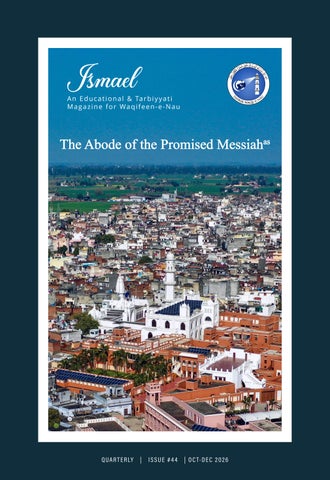
Ismael
A n E d u c a t i o n a l & Ta r b i y y a t i M a g a z i n e f o r Wa q i f e e n - e - N a u
The Abode of the Promised Messiahas
Q U A R T E R LY
|
ISSUE #44
| O C T-D E C 2 0 2 6
“The magazine has been named as “ISMAEL ISMAEL”, which reminds us of the sacrifices made by Hazrat Ismaelas and by Hazrat Hajiraas” Hazrat Mirza Masroor Ahmadaba Download our App
Contact Details: WAQF-E-NAU (CENTRAL) 22 DEER PARK ROAD, LONDON SW19 3TL (UK) +44 (0)20 8544 7633 +44 (0)20 8544 7643 manager@ismaelmagazine.org editorenglish@ismaelmagazine.org editorurdu@ismaelmagazine.org
Subscription Contacts: To subscribe to the Ismael Magazine contact your National Secretary Waqf-e-Nau UK- Abdul Quddus Arif sec.waqfenau@ahmadiyyauk.org Canada - Musleh Shanboor waqfnau@ahmadiyya.ca
Switzerland - Jariullah Zafarullah Sahib waqfenau@ahmadiyya.ch Ireland - Attaur Rehman Khalid waqfenau@islamahmadiyya.ie
USA - Mirza Harris Ahmad national.wn@ahmadiyya.us Australia - Syed Wadood Janud waqfenau.australia@amj.org.au
Mauritius - Mohsin Ahmad Ramjeet waqfenaumauritius@gmail.com
Spain - Tarik Ataul Munim nac.sec.waqfenau@islamahmadia.es
Sierra Leone - Shahid M. Korjie waqfenau.sl@gmail.com
Belgium - Munir Ahmed Anjum waqfe.nau@ahmadiyya.be
New Zealand - Muhammad Yaseen yasinsec681@hotmail.com
Ghana - Hafiz Abdullah Mohammad Sani waqf-e-nau@ahmadiyya.org.gh
France - Usama Chaudhry waqfenau@ahmadiyya.fr
Follow the Central Waqf-e-Nau Department on:
@ WA Q F E N AU I N T L
@ WA Q F E NAU I N T L
@ WA Q F E N AU I N T L
WAQF-E-NAU INTL
WAQF-E-NAU INTL
WAQFENAUINTL.ORG
Contents In every issue
08
The Holy Quran
10
The Holy Prophetsa
11
The Promised Messiahas
12
Pearls of Wisdom
Meet the Team Chief Editor & Manager
Editorial Team
Cover Design
Luqman Ahmed Kishwar
Farukh Arshad Dr. Mubariz Ahmad Rabbani Kamran Qaisar Musharaf Ahmed
Picture by Makhzan-e-Tasaweer
Assistant Manager & Assistant Chief Editor
Farrukh Raheel English Editor
Touqeer Tanvir Urdu Editor
Farrukh Raheel Content Manager
Noman Ahmed
Proofreading
Sadiq Ahmed Humza Sikander Noman Ahmed
Designing Team
Aleem Ahmad (Lead Designer) Rameez Ahmad Fazle Umar Shahid Printers
Warners Midlands
Features
13
The guiding stars of Islam
Hazrat Umar Ibn Al-Khattabra
16
In his own words
24
Prophesies regarding Qadian
27
The History of Jalsa Salana Qadian 1891 The Seed Sown in December
31
The Darweshan of Qadian and their Sacrifice
35
The Khulafa and Their Visits to Qadian
40
My visit to Qadian
46 49
Guiding light for Waqifeen-e-Nau Answers from Beloved Huzooraba
Jalsa Salana UK A Blessed Convention
Inside this issue
24 Prophecies regarding Qadian
27 The History of Jalsa Salana Qadian
31 The Darweshan of Qadian
35 The Khulafa and Their Visits to Qadian
ISMAEL
CALLING ALL
WAQIFEEN-E-NAU
We welcome all Waqifeen-e-Nau to volunteer for Ismael magazine and join our editorial team ARTICLE WRITERS, PROOFREADERS, DESIGNERS, SOCIAL MEDIA TEAM Contact: editorenglish@ismaelmagazine.org
What is Ismael Magazine?
By the grace of Allah Ta'ala, Waqifeen-e-Nau are now spread across the globe, many of whom are studying in their respective fields while others have already fulfilled their pledge of dedicating their lives for the Jama’at. There are many who are Missionaries, practising Doctors, Television producers, Architects, Graphic designers, Engineers, Accountants and much more. Ismael is an international magazine, which was launched in 2012 by Hazrat Khalifatul-Masih the fifthaba specifically for the Waqifeen-e-Nau around the world. At this auspicious occasion, addressing the Waqifeen-e-Nau Huzoor-e-Anwaraba wrote: “The magazine has been named as “ISMAEL”, which reminds us of the sacrifices made by Hazrat Ismaelas and by Hazrat Hajiraas who spent their lives in a desolate and barren place and instituted exceptional standards of sacrifices for the sake of religion. Likewise, it is expected of every Waqf to uphold the covenant of Waqf (dedication) made by their parents even before their birth, who have in turn themselves reaffirmed the same.” Waqifeen-e-Nau can contribute by sending articles regarding their respective fields of studies. This magazine is published on a quarterly basis as a platform for the Waqifeen-e-Nau to get in touch and express what they have always wanted to. To subscribe to this magazine, you can contact your National Waqf-e-Nau Secretary. You can also read and download the magazine online at: www.waqfenauintl.org/ resources/ismael Remember, this magazine is for the Waqifeen-e-Nau, prepared by the Waqifeen-eNau. Everyone is welcome to send their articles, contributions and comments. Ismael magazine is the central magazine for Waqifeen-e-Nau from around the globe.
The Holy Quran َ � َ �ٰ ُ ُ َ َ َ � يِم ِ َأُعوُذ ِِبالّٰل ِِه ِِمَن الَّشيَط ِ اِن الَّر ِِج � الَّرَ ۡۡح ٰٰمِن � ِب ۡۡسِم ال ٰ�ّٰل ِِہ ۡالَّرَ ِِحۡیِم ِ ِ ِ ِ
ۡ ۡ َ � ً ۡ َ ۡ َ ٰ ۡ َ ۤ�ُ ۡ ٰ َ �َ ۤۡی َ َ ۡ َ ُسۡبٰحَن اَّل ِِذ َاۡسٰری ِِبَعۡب ِِد ٖٖہ َلۡیًلا ِِّمَن اۡلَمۡس ِِج ِِد اۡلَحَرا ِِم َ ٰ ٰ ۡ ٗ َ ُ ٗ َ ۡ َ َ ۡ َ ٰ ۡ َ� َ ۡ َ ۡ ۡ َ َ ۡ �ِِاَلی اۡلَمۡس ِِج ِِد اۡلَاۡقَصا اَّل ِِذۡی ٰبَرۡکَنا َحۡوَلٗہ ِلُِنِرَِیٗہ ِِمۡن ٰاٰی ِِتَنا ۡ َ ۡ ُ ۡ َ� َ ُ ٗ َ� ُ ﴾۲﴿ ِِاَّنٗہ ُہَو الَّس ِِمۡیُع اۡلَب ِِصۡیُر Glory be to Him Who carried His servant by night from the Sacred Mosque to the Distant Mosque, the environs of which We have blessed, that We might show him some of Our Signs. Surely, He alone is the Hearing, the Seeing. Surah Bani Isra’il (17:2)
8
Commenting on this verse the Promised Messiahas writes: “It has now been about twenty years since I wrote this in Barahine-Ahmadiyya.’ Now, at the time of writing this treatise, it was revealed to me that whatever I had written in Barahin-e-Ahmadiyya concerning Qadian being mentioned in the Holy Quran on the basis of a vision, is in fact true. Because there can be no doubt that the Quranic verse:
time also God took him from his own time, which was the time of the demonstration of Islam’s glory, to the time of the Promised Messiah, which is the time of the demonstration of Islam’s blessings. Hence, in this respect, the vision seen by the Holy Prophet, may peace and blessings of Allah be upon him, whereby he was shown events happening towards the Latter Days of Islam, shows that ٰ [ مسجدMasjid Aqsa] the term اقٰصی refers to the mosque of the Promised Messiah, which is situated in Qadian. The Divine words recorded in Barahin-eAhmadiyya concerning this mosque are as follows:
ۡ َ ۤ َ� ُُس ۡۡب ٰٰح ََن اَّل ِِذۤۡی� َا ۡۡس ٰٰری ِِب ََع ۡۡب ِِد ٖٖہ َل َ ۡۡیًلًا �ِِّم ََن اۡل ََم ۡۡس ِِج ِِد َ� ۡ َ َۡ ۡ َ ۡ اۡل ََح ََرا ِِم ِِاَلی اۡل ََم ۡۡس ِِج ِِد اۡلَۡاۡق ََصا اَّل ِِذ ۡۡی ٰٰبَرَۡکَنا ََحۡوَۡل َ ٗٗہ
Glory be to Him Who carried His servant by night from the Sacred Mosque to the Distant Mosque, the environs of which We have blessed. (Surah Bani lsra’il, 17:2) comprehends both kinds of Mi’raj, the Mi’raj in time and the Mi’raj in space. Without this, the Mi’raj would be rendered deficient. Thus, just as by way of Mi’raj in space God took the Holy Prophet, may peace and blessings of Allah be upon him, from the Masjid al-Haram to the Masjid BaitulMuqaddas, by way of Mi’raj in
ُ َ َُ ٌ ُ َ ٌ ُُم ََباِرٌِک �َّو ُُم ََب َاَرٌک �َّو ُک �ُُّل َا ْْم ٍٍر �ُّم ََب َاَر ٍٍک �ُّی ْْج ََع ُُل ِفِ ْْی ِِہ
[This mosque is a source of blessings, and is blessed itself. In it will be performed every blessed deed.]
And this word, ‘[ ’مبارکmubarak], which has been used here both as a subject and an object, is in accordance with the verse of the (Countinued on page 23)
9
The Holy Prophetsa َٰاَ ٰ�لّٰل ُُه �ََّم ََص �ِّل ََعٰلٰی ُُم ََح �ََّمٍد �ََّو ََعٰلٰی آِل ُُم ََح �ََّمٍد ََک ََما ََص �ََّل ْْی ََت ََعٰلٰی ِِابَرَاِه ْْی ََم ََو ََعٰلی ِ ٍ ٍ ِ ِ ٰ َ � � َ َ� َ ُ َ َ َ َ َ ٰ َ � � َ ُ ٰ َ َ � ُ ٌ � ٌ ْ ٓاِل ِِابَرَاِه ْْی ََم ِِاَّنَک ََح آِل ُمَحَّم ٍٍد ِ ِ ِ مْیٌد َّم ِِج ْْیٌد۔َالّٰلُهَّم َباِرِک َعٰلی ُمَحَّم ٍٍد َّو َعٰلی َ َ َ� ٰ ََک ََما َبَ َاَر ْْک ََت ََعٰلٰی ِِابَرَاِه ْْی ََم ََو ََعٰل آِل ِِا ْْبَرَا ِِه ْْی ََم ِِاَّنَک ََح ِِم ْْی ٌٌد �َّم ِِج ْْی ٌٌد ی ِ ِ Among the many prophecies relating to the advent of the Promised Messiah, as found in the traditions of the Holy Prophet Muhammadsa, it is recorded:
َ ِإ ْْذ َبَ ََع ََث ال �َّلَ ُُه اْل ْ ََمِس َيَح ْاْب ََن ََم ْْرَيَ ََم ََف ََيْنِْز ُُل ِع ْْنَد ِ ِ ِ ِ َاْل ْ ََم ََن َاَر ِِة اْل ْ ََب ْْي ََضاِء ََش ْْرِق �َّيَ ِد ََم ْْشَق ِ ِ ِ
“Allah would send Christ, son of Mary, and he will descend at the white minaret East of Damascus ” (Sahih Muslim 2937 a) 10
The Promised Messiahas Now, my friends! This minaret is being built to commemorate the era of the Promised Messiah in accord with the hadith and also to fulfil the great prophecy mentioned in this verse of the Holy Quran:
َُُس ۡۡب ٰٰح ََن اَّل�َ ِِذۤۡی�ۤ َاَ ۡۡس ٰٰری ِب ََع ۡۡب ِِد ٖٖہ َل َ ۡۡیًلًا �ِِّمَن ِ َۡ ۡ َ ۡ ۡ اۡل ََم ۡۡس ِِج ِِد اۡل ََح ََرا ِِم ِِاَلی اۡل ََم ۡۡس ِِج ِِد اۡلَۡاۡق ََصا ٗاَّل�َِذ ۡۡی ٰٰبَرَۡک ۡ ََنا ََحۡوَۡلَٗہ ِ (Surah Bani Isra’il 17:2)
The minaret of whom is also mentioned in the hadith that the descent of the Messiah would be near the minaret. The hadith narrated by Muslim speaks of Damascus because the concept of making three gods first took root in Damascus, and the descent of the Promised Messiah is for the purpose of eradicating the idea of three [deities] and reestablishing the glory of the One God in the world. To indicate this, it was stated that the Minaret of the Messiah, near which he would descend, would be located in the east of Damascus. Moreover, this is true because Qadian, which is situated in District Gurdaspur in Punjab, from where Lahore is in the southwest, is exactly east of Damascus. So
this proves that this ManaratulMasih is also located in the east of Damascus. Every seeker of truth should reflect carefully upon the word ‘Damascus’ and discover the wisdom behind the statement that the Promised Messiah would descend in the east of Damascus. This is because God’s words cannot be mere coincidences; they contain secrets and wisdom because all words of God Almighty are full of secrets and points of wisdom. (Khutbah Ilhamiyya – The revealed Sermon, pages 35)
11
PEARLS OF WISDOM
Hazrat Yaqub Ali Sahib Irfanira writes that on one occasion, a beggar came to Qadian. He would make a round through the town every morning, reciting a poem by Hazrat Mir Hamid Shah Sahibra whilst walking through the streets. Making a round means that he would walk around the village and its streets, reciting the couplet:
“God is your Helper, O inhabitant of Qadian. You have granted us peace, O inhabitant of the citadel of peace.” He would recite this, and with it he would also recite the poetic verse:
�رہرط�فرکفوکد� �وڑ�اےکاکھت�ایمہےن
“I exhausted all my efforts in pondering deeply in all directions …”
�وہ�ا ان�رص دخ�ا ریت�ا رم�ے ا�ے اق�د�ای�ں و�ا�ےل �ںیمہیشخب ا�ام�ںوت ےن ےہ ا�ے د�ا�ر ا�ال�ام�ں و�ا�ےل
Friday Sermon, June 26, 2026, delivered at Mubarak Mosque, Islamabad, Tilford, UK
12
THE GUIDING STARS OF ISLAM
In this section of the issue, we will explore the incredible lives of the noble Companions of the Holy Prophet Muhammadsa, providing inspiring accounts of faith, courage, righteousness, devotion, and sacrifice that continue to guide and encourage us today.
HAZRAT UMARRA IBN AL-KHATTAB Hazrat Umarra belonged to the tribe of Banu Adi bin Ka’ab bin Lu‘ayy. He was among the nobles of the Quraish, being extremely influential, brave and courageous. Prior to Islam, he was the designated envoy of the Quraish. It was the practise of the Quraish that whenever there would be feuds among them
or with others, they would send Hazrat Umarra as their representative. At the time of his acceptance of Islam, he was 33 years old. After he accepted Islam, it strengthened the Muslims and they came out and offered prayers openly in Masjid al-Haram.1 Hazrat Umarra participated in all the battles alongside the
13
see that someone’s needs from among his people were not being fulfilled, he would become restless as a result of it.5 Saeed bin Musayyab and Abu Salama bin Abdir Rahman narrate, ‘By God, whatever Hazrat Umarra said, he truly fulfilled it. When it was time to be strict, he showed strictness and when it was time to show leniency and compassion, he did so and became a father figure for the children. Those women whose husbands were away, he would personally visit their homes and offer his greetings of peace from the door and then ask them if they needed anything.’2 Hazrat Umarra was very much against lavish and extravagant clothes that he did not even like it if an enemy who had been captured was brought before him in such clothing.6 Whenever Hazrat Umarra encountered a certain issue, he would gather the children and seek their suggestions as well and he did this with the aim of sharpening their minds.7 Hazrat Alira relates, ‘I saw that Hazrat Umarra was once holding the saddle of a camel and was quickly going. Upon seeing him, I said, ‘O Leader of the Faithful! Where are you going?’ Hazrat Umarra replied, ‘One of the camels which had been donated for charity is missing and I am going to search for it.’ Upon this, I said to Hazrat Umarra, ‘You have set such examples for those Khulafa who shall come after you which will not be easy to follow.’ Hazrat Umarra replied, ‘O Abul Hasan! Do not say anything against me for I swear by Him Who sent Muhammadsa as a prophet, even if a baby goat went miss-
Holy Prophetsa, including the battles of Badr, Uhud and Khandaq.8 There are, moreover, many narrations with regards to Hazrat Umar’sra financial sacrifices and spending in the way of Allah the Almighty. For example, when Hazrat Umarra obtained some land in Khaibar, he went to consult with the Holy Prophetsa about this land. The Holy Prophetsa advised him, ‘If you wish, you can devote the land in the way of Allah and whatever income it yields you can spend it on the poor.’ Hazrat Umarra agreed and devoted that land for the sake of the needy, his relatives, to free slaves, for any service in the way of Allah, for travellers and guests.5 During his Khilafat, Hazrat Umarra adopted various initiatives for the betterment and progression of the general public. For improvements in agriculture and sourcing water, he arranged for canals to be dug. He also had various buildings built for the ease of the people. These included mosques, courts, military cantonments, barracks, roads, bridges, guest houses, watch posts, springs, inns among others. Many new cities were founded including Basra, Kufa and Fustat. He established schools in all the countries under Muslim rule wherein the Holy Quran, hadith and fiqh were taught.4 Hazrat Umarra would also walk in the nights in order to observe the state of affairs, in particular, of the common people.2 There are, in fact, many narrations which demonstrate that Hazrat Umarra looked after the poor, women and children, and how owing to his fear of Allah, he would support them and become anxious to help. If he would
14
Zaid bin Thabitra. Hazrat Zaidra invited Hazrat Umarra and Hazrat Ubayra and showed great respect to Hazrat Umarra, but upon this, Hazrat Umarra stated, ‘This is the first injustice you have committed.’ And after saying this, he went and sat next to Hazrat Ubayra.4 Furthermore, Hazrat Umarra took great care of non-Muslims [dhimmi] living under Muslim rule and at the time of collecting taxes, he regularly asked if any injustice had been committed against them. He would ask the opinion of his non-Muslim subjects, who were either Zoroastrians or Christians and he would also regard their opinions.3 Hazrat Umarra was 63 years old when he passed away.10 His era of Khilafat spanned approximately 10 and a half years.9
ing near the Euphrates River, Umar will be asked about it on the Day of Judgment.’2 Hazrat Umarra was, similarly, once distributing wealth from the treasury when his daughter came and took a dirham. Hazrat Umarra stood to retrieve it from her. The girl raced home crying and put the dirham in her mouth. Hazrat Umarra used his finger to remove the dirham from her mouth and returned it to the treasury and said, ‘O people, Umar and his family, whether closely related or distantly, have the same rights as any Muslim does and nothing more.’4 Hazrat Umarra would always instruct to uphold equality and justice. On one occasion, he had a disagreement with Hazrat Ubay bin Ka’abra over something. Subsequently, Hazrat Ubayra took his case to the court of Hazrat
References: 1. Men of Excellence: Hazrat Umar ibn al-Khattab Friday Sermon delivered by Hazrat Khalifatul Masih Vaba April 23, 2021 ra
2. Men of Excellence: Hazrat Umarra ibn al-Khattab Friday Sermon delivered by Hazrat Khalifatul Masih Vaba June 25, 2021 3. Men of Excellence: Hazrat Umarra ibn al-Khattab Friday Sermon delivered by Hazrat Khalifatul Masih Vaba July 2, 2021 4. Men of Excellence: Hazrat Umarra ibn al-Khattab Friday Sermon delivered by Hazrat Khalifatul Masih Vaba July 9, 2021 5. Men of Excellence: Hazrat Umarra ibn al-Khattab Friday Sermon delivered by Hazrat Khalifatul Masih Vaba November 19, 2021 6. Men of Excellence: Hazrat Umarra ibn al-Khattab Friday Sermon delivered by Hazrat Khalifatul Masih Vaba November 12, 2021 7. Men of Excellence: Hazrat Umarra ibn al-Khattab Friday Sermon delivered by Hazrat Khalifatul Masih Vaba November 26, 2021 8. Men of Excellence: Hazrat Umarra ibn al-Khattab Friday Sermon delivered by Hazrat Khalifatul Masih Vaba May 21, 2021 9. Men of Excellence: Hazrat Umarra ibn al-Khattab Friday Sermon delivered by Hazrat Khalifatul Masih Vaba July 16, 2021
15
IN HIS OWN WORDS
Family History H A Z R AT M I R Z A G H U L A M A H M A D as
The Promised Messiah and Mahdi
The Ismael magazine team is pleased to publish, in his own words, an early account by the Promised Messiah, Hazrat Mirza Ghulam Ahmadas, detailing his blessed family and personal background.
M
y family history is as follows: My name is Ghulam Ahmad and my father's name was Ghulam Murtada and my grandfather's name was ‘Ata Muhammad and my great grandfather's name was Gul Muhammad. As stated elsewhere, our family is Mughal Barlas and it appears from my ancestral documents, which are preserved to this day, that they arrived in this country from Samarqand and that they were accompanied by about two hundred followers and servants and members of the family.
lampur Qadi Majhi. In the course of time people forgot the word Islampur, and Majhi was also dropped and the name remained simply as Qadi, which later became Qadi and was finally converted to Qadian. The reason why this place was called Qadi Majhi was that this tract of land, which was about 60 kose in length, was known as Majha probably because buffaloes abounded here, and buffalo is majh in Hindi. As our ancestors were not only the landlords of the whole of this tract but were also invested with ruling powers over this area, they became known as Qadi. I am not aware why our ancestors migrated to this country from Samarqand, but ancient documents indicate that in their county of origin they were also respected chieftains and rulers and that they had to leave their country on account of some tribal rivalry and conflict. On their arrival
Our ancestor arrived here in the capacity of a respected chieftain and settled down in this place, which was at that time an uninhabited wasteland, situated approximately 50 kose North-East of Lahore. He established at this place a town, which he called Islampur and which subsequently became known as Is17
F O U R G E N E R AT I O N S
G R E AT - G R A N D F AT H E R
G R A N D F AT H E R
Mirza Gul Muhammad
Mirza ‘Ata Muhammad
A chieftain whose estate comprised eighty-five villages; about five hundred people were fed at his table
The Sikhs took his estate; the family was expelled from Qadian
here, the reigning monarchs granted them several villages by way of estate and they established a permanent state in this neighbourhood.
as a gesture of sympathy, he gifted several of his remaining villages to some Muslim landlords who had been evicted from their land, and these remain in their possession till this day. In those disturbed times he was an independent chieftain and about five hundred people were entertained at his table. About one hundred scholars, divines and Huffaz stayed with him and were paid sufficient stipends. In his company the talk mostly revolved around religious subjects. All his dependents and relatives were regular in their worship of God. Even the maidservants who ground corn were regular in their five daily prayers and Tahajjud. The respectable Muslims of the neighbourhood, most of whom
In the early days of Sikh rule, my great grandfather Mirza Gul Muhammad was a well-known chieftain in this area and his estate comprised eighty-five villages. In consequence of continuous raids by the Sikhs, he lost several of his villages and yet such was his generosity that, WORDS TO KNOW
Kose an old Indian measure of distance, roughly two miles Majh buffalo, in Hindi Huffaz people who have memorised the whole of the Holy Qur’an Dharamsala here, a Sikh place of worship
18
F AT H E R
T H E P R O M I S E D M E S S I A H as
Mirza Ghulam Murtada
Hazrat Mirza Ghulam Ahmad
Returned to Qadian late in Ranjit Singh’s rule; five villages were restored to him
The Promised Messiah and Mahdi, who wrote this account
ceeded many astonishing acts which bordered on the miraculous. Many seekers after God, scholars and pious men had come to Qadian to be among his associates. It is surprising that some of his near miraculous actions are so well-known that they were vouched for by a large number of irreligious people. In short, in addition to this position as chieftain,
were Afghans, referred to Qadian, which was then called Islampur, as Mecca, because in those disturbed times this blessed town was a place of refuge for every Muslim. Most other places were full of disbelief, disobedience and tyranny, while Qadian was well-known for its adherence to Islam, piety, purity and justice. I have myself heard from those who had lived close to that time that in those days Qadian was like a garden in which flourished hundreds of supporters of the faith, divines, scholars and brave and respectable men.
HOW QADIAN GOT ITS NAME
Islampur
Islampur Qadi Majhi
There were many tales current in this neighbourhood that Mirza Gul Muhammad Sahib, the late, was an outstanding personality among the righteous people from whom pro-
Qadi
Qadian About 50 kose north-east of Lahore
19
he had great reputation for integrity, righteousness, manly courage, high resolve, support of the faith, and sympathy for the Muslims. All his associates were pious people of good conduct, jealous for the faith, averse to disobedience and evil, and possessing courageous and commanding personalities.
“
In those days Qadian was like a garden in which flourished hundreds of supporters of the faith, divines, scholars and brave and respectable men. T H E P R O M I S E D M E S S I A H as
20
I have often heard my father relate that on one occasion a Minister of the Mughal Government—whose title was Ghiath-ud-Daulah—came to Qadian. Having observed the statesmanship, intelligence, courage, high resolve, perseverance and wisdom of Mirza Gul Muhammad Sahib, and having witnessed his righteousness and piety and the decorum of his audience, and finding him inspired by the spirit of support for Islam and help for the faith, and seeing that those who were associated with him were pious and courageous people and carried themselves with dignity, he was much overcome with emotion. He said that if he had known that in this backward tract there lived a member of the Mughal family who was well equipped with all the royal qualities, he would have endeavoured that in these times, when the royal family was afflicted
with indolence, inability and corruption, such a one should have been seated on the throne at Delhi to fully safeguard the Islamic Kingdom. It might be of interest to mention that my great grandfather, the said Mirza Gul Muhammad, died of hiccups and some other complications. When his illness overpowered him, his physicians became unanimous in their opinion that if he were to use liquor for a few days, it might prove helpful in his treatment, but no one had the courage to mention this to him. Finally some of them indicated this to him indirectly. He replied that if God Almighty desired to heal him He could bring about the healing through any of several medicines and that he was not willing to seek his recovery through the use of such a vile thing as liquor. He added that he was quite reconciled to the Divine decree. He finally died after a few days of the same disorder. His death had been decreed but he left behind the pious memory that he preferred death to the use of liquor. People have recourse to every kind of device in order to escape death but he preferred death to disobedience of God. Sad indeed is the plight of some Nawabs and some wealthy and affluent people who, during
“
People have recourse to every kind of device in order to escape death but he preferred death to disobedience of God. T H E P R O M I S E D M E S S I A H as
21
treacherously took possession of it. At that time our family faced ruin. They were taken captives like the Israelites, and all their belongings and properties were looted. Several mosques and fine houses were demolished and gardens were cut down out of ignorance and bigotry. Some of the mosques were turned into Dharamsalas . One of these is still in their possession. A library belonging to our family was burnt down. It contained five hundred manualscript copies of the Holy Qur’an, which were disrespectfully burnt. In the end, upon second thoughts, the Sikhs directed our family to depart from Qadian and all men and women were seated in carts and expelled, whereafter they took refuge in one of the Punjab states. After a short while my grandfather was poisoned by his enemies. Then, during the latter part of Ranjit Singh's rule, my father Mirza Ghulam Murtada returned to Qadian and five of the villages, which had belonged to his father, were restored to him. In the meantime, Ranjit Singh had suppressed the smaller states and had consolidated them into a large state for himself. He had also captured all our villages and his rule now
their brief span of life, set at naught God and His commandments, sever all relationships with Him and disobey Him openly and use liquor like water. Thus they not only lead sinful lives but also cut down their days on earth and die quickly in consequence of various fearful disorders and leave behind an ill example for coming generations. In short, when my great grandfather died he was succeeded by his talented son, my grandfather Mirza ‘Ata Muhammad. During his time, in God’s wisdom, the Sikhs overcame him after a struggle. My late grandfather had recourse to various devices for the safeguarding of his estate but as the Divine decree was not favourable he failed of his purpose and none of his projects were fulfilled and the Sikhs gradually deprived him of all his estate, leaving him in occupation of Qadian alone. Qadian at that time was like a citadel with four towers, which were manned by soldiers and a few cannons. It was surrounded by a wall twenty-two feet high and wide enough for three carts being driven along it side by side. It came to pass that a party of Sikhs known as Ram Garhias obtained entrance into Qadian by permission and then 22
extended from Lahore to Peshawar and down to Ludhiana. Thus, after having been dispossessed of our estate, the remaining villages were also taken over by Ranjit Singh and we were left with only five of them. Nevertheless, as head of an ancient family, my father Mirza Ghulam Murtada was a well-known
Chieftain in this neighbourhood..... Sir Lepel Griffin in his book Chiefs of Punjab has made mention of my father. He was very popular with the officials of Government and, as a gesture of approbation, the Deputy Commissioner and Commissioner often came to visit him. This is a brief account of my family.
Essence of Islam, pages 1–8 (Countinued from page 9)
َۡ Holy Quran which says, ‘ٰٰبَرَۡکَنا َ [barakna hawlahu] — ’َحۡوَۡل َ ٗٗہ the environs of which We have blessed. There is, therefore, no doubt that the term ‘Qadian’ finds mention in the Holy Quran, as Allah the Exalted says:
refers to the spatial Mi’raj of the Holy Prophet, may peace and blessings of Allah be upon him. However, there can be no doubt that the Holy Prophet, may peace and blessings of Allah be upon him, also undertook a temporal Mi’raj. The purpose of this was to demonstrate his visionary excellence and also prove that the blessings of the time of the Promised Messiah were actually also due to him and came into being because of his attention and resolve.
َ ۤ َ� ُُس ۡۡب ٰٰح ََن اَّل ِِذۤۡی� َا ۡۡس ٰٰری ِِب ََع ۡۡب ِِد ٖٖہ َل َ ۡۡیًلًا �ِِّم ََن َ� ۡ َ ۡ َ ۡ ۡ اۡل ََم ۡۡس ِِج ِِد اۡل ََح ََرا ِِم ِِاَلی اۡل ََم ۡۡس ِِج ِِد اۡلَۡاۡق ََصا اَّل ِِذ ۡۡی َۡ ٰٰبَرَۡکَنا ََحۡوَۡل َ ٗٗہ [Surah Bani Isra’il, 17:2]
One meaning of this verse is that which is quite famous among scholars; that is, this
Khutbah Ilhamiyya – The revealed Sermon, pages 29 -30
23
PROPHESIES REGARDING QADIAN by Tahir Ahmed | Waqf-e-Nau Serving as a Waqf-e-Zindagi in office Zaireen Qadian
It was prophesied around a century and a half ago that this small village would one day grow into a thriving city. And quite remarkably so, given the circumstances in which this prophecy was made. In the 19th century, Qadian was an even more remote and undeveloped hamlet. The journey from the nearest railway station in Batala was long and difficult, usually covered by cart or on foot. It was regarding this most unlikely of places that Allah informed the Promised Messiahas, saying:
hospitality. So many people will come to you that the track by which they will come will deepen with excessive travel.” Tadhkirah; see also Khutbat-e-Mahmud, Vol. 10, pp. 246
This extraordinary prophecy is being realised in the most spectacular fashion. What once was a village in an unknown part of the world is slowly turning into a bustling town where people from nearby villages come to purchase various commodities ranging from textiles to heavy farm machinery. At the same time, people from faraway countries, whose names the locals have not even heard of, visit this spiritual
“People will come to you from every distant track. Presents will come to you by every distant track. Great arrangements will be made for
24
land where a prophet once lived and preached the message of Oneness of Allah.
“I love you. I will give you a large party of Islam.” Barahin-e-Ahmadiyya, Part V, Chapter Two pp130
Hazrat Musleh-e-Maud narrated that Hazrat Mirza Ghulam Ahmadas saw a vision of Qadian expanding towards the River Beas. At the time, Qadian was only a small village. Hazrat Muslehe-Maudra stated: ra
The gathering in Qadian, however, was never meant to remain confined to Qadian. The same prophecies point towards a much greater fulfillment: the spread of the message throughout the world. Hazrat Mirza Ghulam Ahmadas was given the promise:
“Hazrat Aqdas was told that the village of Qadian, progressing, would become a very large city like the city of Bombay and Calcutta and its population, spreading north and east, would reach Beas.”
“God shall exalt your praise and perfect His bounty upon you in this world and the Hereafter.” And:
Khutbat-e-Mahmud, Vol. 28, p. 35; Al-Fazl, 11 February 1947.
“Thus has the time come when you will be helped and your name will be proclaimed throughout the world.”
But the vision of Qadian was not confined to its physical expansion. Alongside it came prophecies about the people who would gather there and the message that would spread from there. Hazrat Mirza Ghulam Ahmadas received the revelation:
Barahin-e-Ahmadiyya, Part V, Chapter Two, pp. 93
This was followed by the well-known promise: “I shall cause thy message to reach the corners of the earth.”
“Many people shall migrate from their homelands and come to me in Qadian.”
Tadhkirah, trans. Muhammad Zafrulla Khan, 1976, p. 184.
This was the promise of Allah, and we see that promise coming true. We see that the embers of faith have indeed travelled across great oceans and vast lands to reach all corners of the world. How can one who has lived his whole life in a tiny hamlet make such great claims? The message that started from a small village would grow, people would come to it from distant lands, a large community would gather, and the message that began here would
Barahin-e-Ahmadiyya, Part V, Chapter Two, pp. 95.
These words were remarkable when considered against the Qadian of the nineteenth century. It was a small and relatively unknown village, yet the prophecies spoke of people leaving their homes, travelling from distant lands and gathering there in large numbers. This was accompanied by the divine promise:
25
The small village of Qadian became the home of the Promised Messiahas. People came to it from distant lands. A message that began here travelled across oceans and continents. A town once scarcely known beyond its immediate surroundings became a name recognised by people across the world.
ultimately reach the corners of the earth. We are blessed to witness the gathering of his followers in the thousands of distant lands, far, far away from Qadian. The connection of Qadian with the advent of the Promised Messiah also brings to mind the prophecy of the White Minaret. The Holy Prophet Muhammadsa is reported to have said:
Qadian remains a developing town surrounded by villages, but its story is much larger than its physical boundaries. For those who believe in the prophecies of the Promised Messiahas, its story is the story of a promise that began in a small village and continues to unfold before our eyes.
“The Messiah, son of Mary, will descend at the white minaret east of Damascus.” Sahih Muslim, Kitab al-Fitan wa Ashrat alSa‘ah.
Hazrat Mirza Ghulam Ahmadas understood this prophecy in relation to his advent, and the Minarat-ul-Masih was subsequently constructed in Qadian as a visible symbol associated with this prophecy.
Perhaps one day, when the roads of Qadian have stretched far beyond what we can imagine today, people will look back at this little town and marvel at how much began here.
26
The History of Jalsa Salana in Qadian
Recognizing the vital need for regular spiritual rejuvenation, Hazrat Ahmadas subsequently issued an official announcement inviting his followers to convene in Qadian annually:
by Tahir Ahmed | Waqif-e-Nau & Waqif-e-Zindagi
“The primary purpose of this Convention is to enable every sincere individual to personally experience religious benefits; they may enhance their knowledge and due to their being blessed and enabled by Allah, The Exalted their perception [of Allah] may progress. Among its secondary benefits is that this congregational meeting together will promote mutual introduction among all brothers, and it will strengthen the fraternal ties within this Community.”
Serving at Add. Nazarat Noorul Islam as Outreach Coordinator for the State of Kerala, India
The Seed Sown in December 1891 On a cold December afternoon in 1891, inside the quiet walls of Masjid Aqsa in Qadian, seventy-five men sat closely together, unaware that they were witnessing the birth of an enduring divine global tradition - The Jalsa Salana. Just two years prior, Hazrat Mirza Ghulam Ahmadas had founded the Ahmadiyya Muslim Jama‘at, and now he held in his hands a newly penned manuscript titled Asmani Faislah (The Heavenly Decree).
(Ishtihar 7 Dec. 1892, Majmoo‘ah Ishtiharat, Vol. I, p. 340)
Driven by a profound desire to demonstrate the living truth of Islam, Hazrat Ahmadas envisioned a remarkable proposition: an open invitation to spiritual leaders, scholars, and ascetics of all faiths to join in a collective trial of prayer, allowing divine mercy and accepted prayers to reveal God’s chosen representative.
He envisioned a convention designed not for worldly pageantry or political discourse, but purely for religious self-reformation, the cultivation of piety, and brotherhood.
The Big Jalsa of 1892
To consult his devoted companions on putting this grand vision into motion, he called them together on 27th December 1891 for a historic consultative gathering. Following the Zuhr prayer, the quiet sanctuary filled with the voice of Hazrat Maulvi Abdul Karim Sialkotira as he read Asmani Faislah aloud to the assembly. When the meeting drew to a close, each of those fortunate seventy-five believers stepped forward, feeling the warmth of faith as they had the honor of shaking hands with the Promised Messiahas.
In December 1892, members gathered beside a village pond in Qadian for what became fondly known as “The Big Jalsa”, the second annual convention with attendance rising sharply to 327 participants. Seated upon a simple, carpeted earth-raised stage, Hazrat Mirza Ghulam Ahmadas delivered a powerful lecture on spiritual truths from his book Tauzeh-e-Maram. The following day marked the Jama‘at’s first formal Majlis-e-Shura, where around forty prominent companions
(Al Hakam, 14 April 1935)
27
deliberated on grand initiatives, including publishing free literature for Europe and America, establishing a printing press, launching a newspaper, and forming an organizational committee under Hazrat Maulana Nooruddinra.
gravitated toward Hazrat Ahmadas as he stood beneath a tree for hours greeting every seeker. On 27th December, inside the packed Masjid Aqsa after Friday prayers, the Promised Messiahas delivered an address expounding upon Surah al-Fatihah, drawing the attention of listeners toward purifying themselves (Al Hakam, 2–14 January 1908). On 28th December, he delivered his second address, instructing his followers to practice tolerance and perseverance. He concluded his speech with the solemn words:
The historic “Big Jalsa” concluded leaving behind the blueprint for a global mission.
The 1907 Final Jalsa of the Promised Messiahas By late December 1907, an unprecedented wave of over three thousand believers flooded into Qadian for what would become the final Jalsa Salana attended by the Promised Messiahas. The village buzzed with deep spiritual intensity as attendees took part in youth conferences, scholarly lectures, and morning walks where followers
“Now, that time has come regarding which the prophets have been announcing from the beginning. The time of God Almighty’s judgment is near, so fear Him and repent.” (Al Hakam, 18 January 1908)
28
As vast crowds surged to pledge Bai’at (allegiance), attendees unfurled long turbans to create a continuous network of fabric touching his hand (Al Badr, 9th January 1908, p. 3) a striking image of unity that closed the final convention of his life.
Khilafat. Yet a message sent by Hazrat Musleh Maudra transformed their grief into hope. Speaking of those who had occupied their homes in the chaos of Partition, he issued a breathtaking call to compassion:
A Beacon in the Storm:
“We consider them to be our guests. Show them... love and forgiveness. I see the finger of God Almighty spell out glad tidings for the victory of Ahmadiyyat in the heavens.”
Jalsa Salana 1947 When Partition tore the Indian subcontinent apart in 1947, the sacred pulse of Jalsa Salana refused to cease. Separated by a newly drawn border, the gathering unfolded across two parallel worlds: thousands convened in Lahore, while in Qadian, a brave contingent of 315 souls including 62 Sikh and non-Ahmadi Muslim neighbours assembled inside Masjid Aqsa.
(Source:https://www.alhakam.org/jalsasalana-during-the-partition)
Where the world saw borders, bloodshed, and loss, that tiny gathering inside Masjid Aqsa chose love, hospitality, and unwavering faith proving that no earthly turmoil can ever extinguish the spirit of Jalsa Salana.
For the first time in 56 years, the gathering in Qadian took place without
29
A Sacred Homecoming: Khilafat Returns to Qadian
From Seventy-Five Seeds to a
Through decades of geopolitical restrictions, small but devout gatherings carefully maintained the spiritual flame upon Qadian’s blessed soil.
Today, Jalsa Salana Qadian stands fully re-established as a grand international convention, drawing tens of thousands annually. What began in 1891 with seventy-five men in a rural Punjab village has expanded into a global canopy, replicated worldwide
Global Canopy
A historical turning point arrived in December 1991, when Hazrat Khalifatul Masih IVrh set foot in Qadian for Jalsa, reuniting Khilafat with the birthplace of the Promised Messiahas after four decades of separation. This golden era reached another milestone in December 2005, when Hazrat Khalifatul Masih Vaba graced Jalsa Salana Qadian on his first visit as Caliph, reaffirming the unbroken bond between Khilafat and its spiritual origin.
Yet Qadian retains its sacred status as the heart of this tradition: an enduring testament to faith, resilience through upheaval, and a spiritual vision that continues to unite hearts across every continent. The seed was sown in Qadian and its branches continue to reach the world. Alhamdulillah
30
THE DARWESHAN OF QADIAN AND THEIR SACRIFICE by Dr. Mohammad Badar | MD, Homoeopathy Waqf-e-Nau serving in Noor hospital Qadian
The Partition of the Indian subcontinent in 1947 was a geopolitical earthquake that left a trail of unprecedented devastation, mass migration, and communal bloodshed. Amidst the raging fires of sectarian violence, when East Punjab was largely emptied of its Muslim population and historic spiritual centers in Batala, Pathankot, and Jalandhar were abandoned, one town stood as an enduring anomaly: Qadian. Following the divine premonition known as the “Dagh-e-Hijrat” (the
scar of migration), the spiritual head of the Ahmadiyya Muslim Community, Hazrat Khalifatul Masih II, migrated to Pakistan. However, a devoted vanguard of exactly 313 men voluntarily remained behind. Known as the Darweshan-e-Qadian. These individuals chose a life of extreme peril and asceticism to protect the sacred sites of Ahmadiyyat, ultimately authoring a legacy of unmatched sacrifice, patience, and love.
31
The Crucible of Siege and Hardship
incite government crackdowns. Yet, completely encircled by hostility, the Darweshan remained remarkably resolute, tethering their survival solely to their unwavering faith in God and absolute obedience to Khilafat.
The decision to remain in Qadian was tantamount to embracing death. In the tumultuous aftermath of Partition, the town was entirely cut off from the rest of the world—devoid of postal services, railways, and telecommunications. The 313 Dervishes, a number bearing profound spiritual resonance with the historic Companions of Badr, found themselves besieged in a hostile environment. They endured grueling socio-economic boycotts and survived on meager rations, often subsisting on boiled wheat.
Repelling Evil with Good The conduct of the Darweshan during this perilous era was a living manifestation of the Quranic injunction: “Repel evil with that which is best, and lo, he between whom and thyself was enmity will become as though he were a warm friend” (41:35). When stones were pelted at the Aqsa Mosque, they did not retaliate. When they were subjected to vile verbal abuse on public buses, they responded with dignified silence. An extraordinary incident from this era recounts a group of Darweshan arrived at the Batala railway station under police escort. A
Their physical safety was under constant threat. Historical records note that on multiple occasions in October 1947, bombs were hurled at the Minarat-ul-Masih. Furthermore, false police reports were frequently lodged against them by agitated refugees to
32
hostile local threatened them, declaring that if they stepped toward Ludhiana, he would “send them to heaven” in a second. A Darweshcalmly replied with a smile, “We already live in heaven; you need not take the trouble.”
in 1948 that despite the government’s initial skepticism and the enmity of non-Muslim refugees, the Darweshan remained steadfast. Remarkably, despite their own crippling poverty, the Darweshan continued to provide financial stipends to Hindu and Sikh orphans in Qadian—a testament to their doctrine of universal love. Prominent political figures, including the Chief Minister of Punjab, Partap Singh Kairon, and Education Minister Lala Jagat Narain, publicly acknowledged the community’s exemplary tolerance, truthfulness, and high moral standing.
Their bravery was not rooted in aggression, but in a profound fearlessness of death. In another instance, several Darweshan openly offered congregational Islamic prayers on the platform of the Amritsar railway station—a deeply perilous act at the time. A terrified Muslim military officer from Madras, who was hiding his own religious identity due to the surrounding violence, approached them in awe. They reminded him that true courage stems from a living faith, not just a military uniform.
Spiritual Melancholy and the Epoch of Reunion While the Darweshan conquered physical hardships, their greatest trial was the agonizing separation from their beloved Imam. They survived this spiritual melancholy through continuous prayers, night vigils (Tahajjud), and the profound paternal care of Hazrat Sahibzada Mirza Bashir Ahmad, who was appointed as the head of their welfare.
Foes Turned Friends: The Verdict of the Observers The alchemy of their patience gradually transformed the hostile atmosphere. The very individuals who had orchestrated their boycotts eventually approached them with remorse. This extraordinary moral victory drew the attention of prominent journalists and politicians.
Their decades of patience bore magnificent fruit in December 1991, when Hazrat Khalifatul Masih IV returned to Qadian after forty-four years to inaugurate the centenary of the Jalsa Salana. During this historic visit, he redefined the concept of victory, referencing Surah An-Nasr. He explained that true Islamic victory is not the geographical conquest of lands, but the conquering of human hearts through peace and love.
The editor of the Riyasat newspaper, reflecting on their sacrifices in 1957, wrote: “These people should be declared angels, not humans, who placed their lives in their hands to uphold their faith without fear of death... Future history will take pride in them.” Furthermore, a special correspondent for The Statesman (New Delhi) noted
33
Conclusion
preserved a sanctuary of peace in a region consumed by fire. Today, as the message of Ahmadiyyat resonates across the globe, history stands witness that the seeds of this global spiritual triumph were watered by the silent tears, enduring patience, and monumental sacrifices of the 313 Dervishes of Qadian.
The Darweshan of Qadian were not merely guards of brick and mortar; they were the custodians of the Ahmadiyya Muslim Community’s spiritual epicenter. Through their asceticism, their refusal to answer violence with violence, and their unwavering loyalty to Khilafat, they
References: Tadhkirah (English Edition), compilation of the revelations of the Promised Messiahas. Malfuzat, Vol. 2, Sayings of the Promised Messiahas. Weekly Badr, Qadian (Special Dervish Numbers: Dec 2011, Dec 1997, Oct 1956). Al-Furqan, Rabwah (Special Dervish Numbers: 1963). Tarikh-e-Ahmadiyyat (Volumes 4, 11, 13). The Statesman, New Delhi (November 17-18, 1948 & February 12, 1949). Akhbar Riyasat (December 2, 1957). Akhbar Ghareeb Janta, Gurdaspur (February 8, 1954). The 1991 Tour of Qadian by Hazrat Khalifatul Masih IV, compiled by Hadi Ali Chaudhary.
34
THE KHULAFA AND THEIR VISITS TO QADIAN by Dr. Mohammad Ali Jinha Talha Serving as Teacher Jamia Ahmadiyya Qadian
Qadian — Where history still lives
far more than just a visit to a historic town. It is a living reminder of the mission entrusted to the Promised Messiahas and the institution of the Khilafat that has carried that mission forward.
Qadian is not just a town in the plains of Punjab. For Ahmadi Muslims around the world, it holds a unique place in history and in their hearts. It was here that Hazrat Mirza Ghulam Ahmad, the Promised Messiah and Mahdias, spent much of his blessed life, established the Ahmadiyya Muslim Community and raised the banner of the revival of Islam.
A homecoming after 44 years Following the Partition of India in 1947, the headquarters of the Ahmadiyya Muslim Community moved from Qadian to Rabwah. For more than four decades, Khalifat remained physically separated from Qadian, the town where the Promised Messiahas had spent his life and where
The history of Qadian is inseparably connected with the history of Khilafat. Whenever a Khalifa visits Qadian, it is
35
the foundations of the Community had been laid.
For the Ahmadis of Qadian, the arrival of their beloved Khalifa was an unforgettable moment. The streets that had once witnessed the blessed footsteps of the Promised Messiahas and his successors were once again filled with the presence of Khilafat.
Then, in 1991, an extraordinary chapter in the history of Qadian was written. On the occasion of the Centenary Jalsa Salana, Hazrat Mirza Tahir Ahmad, Khalifatul Masih IVrh, travelled to Qadian. His journey itself became part of the history of the Community. Huzoorrh travelled by train from Delhi to Qadian, with himself travelling in the front carriage while Ahmadis occupied the carriages behind.
Huzoorrh would walk through the streets with his arms extended, continuously greeting people with “Assalamo Alaikum.” People gathered around him from every direction, eager to meet him and shake his hand. So many people came forward that, according to Naseer Ahmad Qamar Sahib ( who travelled along with Huzoorrh on that tour as his private secretary), Huzoor’s fingers actually became swollen from the continuous handshaking.
The emotions of this historic journey were so profound that during the train journey Huzoorrh wrote his famous Urdu poem:
Such scenes demonstrated the extraordinary love of the Khalifa for his people and also the love of the people for Khilafat. Allah Almighty grants the Khulafa a remarkable ability to meet
“Apney des mein, apni basti mein” (In my country, in my town.) After 44 years, a Khalifatul Masih was once again travelling towards Qadian.
36
people, listen to them and show affection towards them despite their busy schedule.
address the Jalsa Salana. His opening address was delivered on 26 December 2005, and the concluding address on 28 December 2005.
The affection was not limited to the Ahmadis. The Hindu and Sikh residents of Qadian also expressed great happiness at the arrival of Huzoorrh. His presence touched people beyond the boundaries of the Community.
In his inaugural address at Jalsa Salana Qadian, Hazrat Khalifatul Masih Vaba drew attention to the fact that: The year 1905 occupies a distinctive place in the history of the Jamaat-eAhmadiyya. It was in this significant year that the Promised Messiahas, through the blessings and guidance of Almighty Allah, initiated the system of Al-Wasiyyat and laid the foundations of the Bahishti Maqbara in Qadian.
During his stay, Huzoorrh would visit Bahishti Maqbara after Fajr prayer. People would gather along the sides of the pathways simply for the opportunity to see him, greet him or receive his prayers.
Another beautiful coincidence is that, according to the lunar calendar, the institution of Khilafat was founded in 1908, which is equivalent to 1326 AH, and in 2005, it was 1426 AH. Thus, a full century of lunar years had been completed.
The Historic Visit of Hazrat Khalifatul Masih Vaba Fourteen years later, Qadian witnessed another extraordinary moment. In December 2005, Hazrat Mirza Masroor Ahmad, Khalifatul Masih Vaba, travelled to Qadian to attend and
Reflecting upon the significance of
37
granted personal meetings to thousands of people and families. Huzooraba also met guests from outside the Community. Dignitaries and other visitors had the opportunity to meet him and experience his warmth and compassion.
these two historic occurrences, Huzooraba explained that although he had not originally planned his visit with this particular coincidence in mind, Allah Almighty had created circumstances whereby the Khalifa of the time could be present in Qadian at such a significant moment.
But his attention was not limited to distinguished guests or those who had travelled from distant places. He also took time to visit the homes of the local Ahmadi residents of Qadian. Huzooraba visited almost every Ahmadi household in Qadian, enquiring about the wellbeing of families, praying for them and giving them the opportunity to have photographs with him. These visits reflected a quality repeatedly witnessed in the Khulafa: despite their immense responsibilities, they remain deeply concerned about the individual members of the Community.
It was a remarkable coincidence: The Khalifa was present in the very town where the Promised Messiahas had established the Community and where the institution of Khilafat had been foretold and established.
A Khalifa among his people The visit of Hazrat Khalifatul Masih Vaba was also remembered for the extraordinary love and personal attention that Huzooraba showed towards the people. Ahmadis travelled from far and wide, hoping for the opportunity to meet their beloved Imam. Despite his extremely busy schedule, Huzooraba
After spending much of the day meeting people and fulfilling numerous
38
engagements, Huzooraba continued to examine official correspondence and give necessary instructions. Those around him were amazed when they realised that, despite the exhausting engagements of the day, Huzooraba had continued to review local and international mail and official papers.
would eventually spread across the world. When Khalifatul Masih walks through those same streets, history seems to come alive again. The physical circumstances of the Community have changed. The headquarters have moved, generations have passed, and the Community has spread across continents. Yet, the fundamental mission remains unchanged.
More than a Journey The streets of Qadian have witnessed the life of the Promised Messiahas, the struggles of his early companions, the establishment of the Jalsa Salana and the beginning of a movement that
From Qadian, the message of the Promised Messiahas began its journey. Through Khilafat, that mission continues to reach the world.
References Naseer Ahmad Qamar, “Retracing Blessed Steps,” Al Hakam, 28 December 2018, https://www.alhakam.org/retracing-blessed-steps Muhammad Inam Ghauri, “Historical Importance of Jalsa Salana Qadian 2005,” Al Hakam, 28 December 2018, https://www.alhakam.org/historical-importance-of-jalsa-salana-qadian-2005
39
یاتیک من کل فج عمیق،فّج عميق ّ يأتون من ّ كّل “ P E O P L E W I L L C O M E T O YO U B Y E V E R Y D I S TA N T T R A C K . P R E S E N T S W I L L C O M E T O Y O U B Y E V E R Y D I S T A N T T R A C K .” (Tadhkirah [English translation], p. 911)
My Visit to Qadian
A missionary’s first visit to Qadian, and a walk through the places where the Promised Messiahas lived, worshipped and received revelation by Maulvi Abdul Rauf Omoyele | Murrabi Silsila
I
Serving at Jamia Ahmadiyya Ghana
had the opportunity to visit the blessed home town of the Promised Messiahas in Qadian for the first time in 2024, along with nine other colleague missionaries. While going, I was reflecting over the prophecy of the Promised Messiahas that “They will come to you from every distant track”1, and was trying to be conscious of how distant Qadian itself is. Upon arrival at the Delhi airport, we were received very well by the local Jama’at members and made to have a day rest before proceeding to Qadian the next day.
midnight while already exhausted. However, I felt a renewed sense of energy as I alighted and moved within the premises of the current Dar-ul-Ziafat. The feeling of tiredness appeared to be gone and I could experience the surge of enthusiasm from within myself. After familiarising myself with my place of accommodation, I proceeded to Masjid Mubarak to offer two rak’at of Nawafil and express my gratitude to Allah the Almighty for my safe arrival in Qadian. We arrived there during the last days of the month of Ramadan and there were obviously individuals who were observing the I’tikaaf.
We arrived in Qadian around 40
In blessed footsteps
The purpose of the journey was for education and training purposes. It was truly an enlightening and educational experience as it afforded me the opportunity to witness the various sites in Qadian I had earlier only read about in the literature of the Jama’at. Many a time I did say to myself that I am currently at a place where Almighty Allah manifested Himself to his prophet, the Messiah and Imam of the age, where he spoke to him, where he showed numerous signs in his support. I had never been to any such place before (I wished I can also visit the blessed city of our beloved master, Hazrat Muham-
mad Mustafa-peace and blessings of Allah be upon him).I tried as much as possible to consciously navigate through those blessed areas which have been mentioned in our literature to be where the Promised Messiahas stayed, resided, sat in the company of his companions and so on. For instance, I spent time especially around Masjid Mubarak, Bait-ulFikr, Bait-uz-Zikr, Bait-ar-Riyada (which is the room where the Promised Messiahas stayed and engaged in worship during the six-month period of fasting), then the room where the famous miracle of the Red Drops was manifested, the rooftop of Masjid 41
MASJID MUBARAK
Mubarak where the evening gatherings with the companions used to be held.
From that room, he challenged the entire world, only with the definite support of the Almighty Allah. He was certain of the divine origin of the revelations he received from Allah the Almighty that he bravely challenged his opponents. He called out 40 well-known scholars of the time to gather and pray against him, asking Allah to take his life if the revelations he ascribed to him were not actually from him.6 I could not help but imagine how he challenged the opponents on these points, declaring that they cannot compete with him in expressing the hidden truths of
I regularly visited the blessed graveyard of the Promised Messiahas to offer my Salam and make supplications. I also went to the final resting places of some known elders of our Jama’at. Their names have been inscribed within Bahishti Maqbara. Spending time within Bait-ul-Fikr, I did reflect on how busy the Promised Messiahas was and what the situation of that time was when he was engaged in writing his literary work. 42
the Holy Quran, in the acceptance of prayers, and the disclosure of the unseen.
The word used in the revelation indicates that although the plague would reach Qadian ,its severity would be reduced and ultimately be insignificant compared to the devastation cause in other places.3 The Promised Messiahas said: “And the All-Powerful God shall protect Qadian against the ravages of the plague, in order to show you that it was spared only because a Messenger of God was present in it.”4 He received the revelation3:
The Promised Messiahas said: “I have been given plentiful signs of the acceptance of prayers, and no one can challenge me on this. I have been vouchsafed the sign of the knowledge of the unseen, and no one can challenge me on this. These are the Divine testimonies granted to me.” 2
َ� َ َْ ِِاَّن ُُه ٰٰا ََوی اْلَق ْْرَيََة
Signs that endure
and
َُلَْوَْلَا اْلِْاِ ْكْ ََر ُاُم َل َ ََھ ََل ََك اْل ْ ُُمَقَاُم
Visiting Qadian was faith inspiring for me. Qadian is actually a very remote village and despite its remoteness, it keeps gaining relevance day in day out as more people keep joining the community which the Promised Messiahas established under the direction of Almighty Allah. While in Qadian, I remembered the divine promise that it will be protected from the devastating effects of the plague that was ravaging the country at the time.
This means that God will protect the village of Qadian from the plague in order to manifest the true standing of this Intercessor.
Then I also remembered the threat that the Ahrar movement posed to the Jama’at. They threatened to obliterate every brick of the Ahmadiyya Jama’at’s properties in Qadian.5 However, 90 years later I am witnessing every brick 43
in Qadian intact and in place, testifying to the truthfulness of the Promised Messiahas. The place, in fact, continues to be visited by devotees from all over the world.
“
And the All-Powerful God shall protect Qadian against the ravages of the plague, in order to show you that it was spared only because a Messenger of God was present in it. H A Z R AT M I R Z A G H U L A M A H M A D as
The Promised Messiah and Mahdi The Essence of Islam, Vol. V, p. 94
44
I was shown pictures of Qadian before the recent renovations and one could only but marvel at the level of sacrifices that had to be made by the people who remained and lived in Qadian after the partition of the subcontinent. Masjid Mubarak was later expanded and did not remain the very small mosque it used to be during the time of the Promised Messiahas. I personally tried to spend more time engaged in Nawafil and Zikr-e-Ilahi, within that small portion, just to give myself that wishful feeling of being present during that time of the Promised Messiahas. I felt that while the inhabitants of Qadian are blessed with regular access to the various holy sites within Qadian, those of us who travel from a distant location naturally cherish every moment to
spend more time there. Yes, we do not always have access to the physical location, but we can always have access to the spiritual bounties that flow from heaven after accepting the Promised Messiahas and following his teachings to the best of our abilities. We can also become part of his family in the same way. This is the main reason for which he appeared and for which he consistently invited people. May Almighty Allah grant us the strength to be able to truly strive to attain that spiritual status, which the Promised Messiahas wanted to see in all of us. Ameen. REFERENCES
1. Haqiqatul-Wahi, English edition, p. 821 2. The Need for the Imam (Darurat-ulImam), English edition, p. 42 3. Haqiqatul-Wahi, English edition, pp. 297–298 4. The Essence of Islam, Volume V, p. 94 5. Friday Sermon delivered by Hazrat Khalifatul Masih Vaba, 7 November 2025 6. Arba’in - Forty Announcements to Convey the Message Conclusively to the Opponents, pp 46-49
Guiding light for Waqifeen-e-Nau Answers from Beloved Huzooraba One of the greatest blessings for Waqifeen-e-Nau is the opportunity to meet Hazrat Khalifatul Masih Vaba and seek his invaluable guidance on matters relating to faith, spirituality and daily life. These blessed mulaqats provide a unique opportunity for Waqifeen-e-Nau and Waqifaat-e-Nau to ask questions, gain wisdom and strengthen their connection with Khilafat. In this new feature of Ismael magazine, we share selected questions and answers from the blessed meetings of Waqifeen-eNau members with Huzoor-e-Anwaraba: On 15th February 2026, a delegation of Waqf-e-Nau khuddam from France had the blessed opportunity to meet with Hazrat Mirza Masroor Ahmad, Khalifatul Masih Vaba. The group, led by Sadr Majlis Khuddam-ulAhmadiyya France, met with Huzooraba at Islamabad, Tilford, UK.
conveyed his salaam to the attendees. Upon taking his seat, Huzooraba asked the group where they had come from, to which they replied that they were from France. The members then had the opportunity to introduce themselves individually. Following the introductions, the khuddam were granted permission to ask questions.
Huzooraba arrived at the meeting and
46
Spiritual fluctuations
Promised Messiahas regarding the development of attentiveness in prayer. It so happened that once, the Promised Messiahas sought to develop greater attentiveness in prayer.
A khadim asked about the “ups and downs” in one’s spiritual journey and how to identify true spiritual progress. He mentioned experiencing times of intense focus in Tahajjud, followed by periods of lesser concentration.
Consequently, he went out to find a secluded place to offer his supplications. Along the way, he encountered a drunkard who was saying that he had started drinking but had not yet become intoxicated, so he would continue drinking until he finally got drunk. The Promised Messiahas reflected that, in a similar manner, he would continue offering voluntary prayers until he developed the desired attentiveness and fervour. Huzooraba advised the khadim to adopt this persistence and recommended repeatedly reciting the prayer for guidance to the straight path (i.e., ihdina s-sirat l-mustaqim) during nawafil to rejuvenate spiritual focus.
Huzooraba reassured him that such fluctuations are natural for human beings. He explained that moments of tenderness [riqqat], where prayers flow from the heart, are times of acceptance and should be cherished. However, when one experiences a state of spiritual constriction [qabz], one must not abandon worship. Instead, one should strive to offer the obligatory prayers and Tahajjud, praying to Allah to open the heart once more. Huzooraba referred to his recent Friday sermon, wherein he mentioned an incident related by the
(Al Hakam 17th February 2026)
Islamabad, Tilford, UK, 31 May 47
2026: Waqf-e-Nau boys from Belgium were blessed with a mulaqat with Hazrat Mirza Masroor Ahmad, Khalifatul Masih Vaba.
inappropriate films, fighting, using bad language or other wrong actions, then such company should be avoided. A person should also look at whether a friend is honest and sincere.
During the mulaqat, each had the opportunity to introduce himself and seek guidance from Huzooraba on matters relating to science, salat, concentration, forgiveness, the future world order, good company, Eid-ul-Adha and balancing hifz with studies.
Huzooraba gave a practical example, explaining that if someone only treats a person well because that person has money and can buy food for them, such as taking them to Nando’s and then insults them when they have no money to spend, then that is not true friendship. Such people are not good companions. Good friends are those who are sincere, morally upright, good in their studies and conduct and who encourage what is right. Similarly, elders who advise children towards good deeds are also a form of good company.
Recognising good company A boy asked how one can recognise good company. Huzooraba explained that good company means having good friends and being around people who encourage righteousness. Those who advise a person to offer prayers, do good deeds, avoid mischief, refrain from fighting and show good morals are examples of good company. He said that if a friend is involved in smoking, vaping, watching
(Al Hakam 31st May 2026)
48
Jalsa Salana UK A Blessed Convention by Hazeem Ahmad South Virginia
A silent farm, buried in heat, Seemingly bland, completely fruitless, Little did it know, there was a fleet, Of hundreds, thousands, swarming from around the globe; endless, Flags stood tall, welcoming the crowd, To a different world, an elevated land, where salams ring loud, While everybody around, smiling, proud. Huzoor comes, a beacon of humility, Drawing thousands, with hidden spiritual ability, Slogans slice the air wherever he goes, But in speeches and sermons, silence flows, His eloquence guides, his character shows us all, His prayers for us all have infinite help, the entire hall; He weeps and cries to our Allah, full of favors, Cleaning our souls and leading a nation of prayers. And when the prayers end, our hearts complete, Of Allah’s blessings, spread in the Jalsa’s heat, The tents disappear, the cars vanish, the signs are taken down, But Allah’s blessings, no matter what, will always remain in renown. The guests of the Promised Messiah disperse, newfound light in their eyes, For Huzoor’s words and the atmosphere created happiness throughout the skies, Hadeeqatul Mahdi will always be special; a renowned beacon of light, People wish they never leave the blessed harmony and delight. 49
Al Shirkatul Islamiyyah is seeking an experienced, detail-focused Accountant to support its finance team.
ACCOUNTANT – SAGE 200
South Wimbledon, London | Full-time | Competitive salary (DOE)
THE ROLE ▪ ▪ ▪ ▪ ▪
Process financial transactions, expenses and sales/purchase ledger entries Manage banking transactions and bank reconciliations Prepare account reconciliations, financial reports and management account support Investigate discrepancies and support month-end/year-end processes Assist with credit control, departmental allocations and financial analysis
WHAT YOU’LL BRING ▪
Proven accounting or finance experience
▪
Hands-on Sage 200 experience is essential
▪
Strong bookkeeping, nominal ledger and reconciliation skills
▪
Graduate-level qualification in Accounting, Finance, Business or related field, or AAT/ACCA/CIMA (or equivalent)
▪
Strong Excel, analytical, organisational and communication skills
Email your CV and a brief covering letter to info@alshirkat.org
Use the subject line: Accountant – Sage 200