




FOCUS // BANKING LAW//GOVERNMENT SUFFOLK IDA GIVES PRELIMINARY OK TO SCHEIN TRANSACTION ›› 8 FINDING WAYS TO MAKE BANKING MORE PERSONAL ›› 15 OPINION MIDWAY CROSSING IS GAME CHANGER FOR LONG ISLAND ›› 12 LIBN.COM VOLUME 68 NUMBER 6 ■ LIBN.COM FEBRUARY 5-11, 2021 ■ $2.00 Part of the network NEW OPPORTUNITIES For Blackowned businesses, a new PPP assist ›› Page 4 REAL ESTATE LIA PANEL HOSTS WIDE-RANGING DISCUSSION ON LI MARKET ›› 6
Photo by Judy Walker
LONG LIVE LONG ISLAND
When we see Long Island, before all else, we see you— every unique, astounding one of you.
Because it’s your rich and vibrant lives that breathe life into our island. So, at every Catholic Health hospital, practice, and care facility, we’re able to provide the highest quality, most innovative care for your body because our culture cherishes your humanity. For more information, visit LongLiveLongIsland.org

2 LONG ISLAND BUSINESS NEWS February 5-11 , 20 21 LIBN.COM
™
Virtual_Ryan_Madden_2-19-21_Layout 1 2/3/2021 12:37 PM Page 1

volorest velento volupta hilliquo que ut dolores rehenduci equunt, ressita officia tiatet adit mo inctatatin quaeptat offic vellestiae doluptium occabore inimus quiatiusant. Quam iustistio evernatibus dolupta consedi enihici eicatur? lit quiatustia moluptaspero occus. que sapedi volesti quatur? ullibustis prates inverum volorpori experatur, Equasi alitatur alitatio. eturerferios iliquis dolorent apient imolorio. Sequi ium molum onsequo
atNiftyfifty
W W WHO’s WHO in Women in Professional Services mA 1965 50 li n.com John Doe is turning 50, e’s not over the hill!









neW reachedmilstone Happy Birthday


THE PARTY ‘ROUNDHEARD WORLD
Friday, February 19, 2021 9:00 - 10:00 am Ryan Madden - Sustainability Organizer, Long Island Progressive Coalition Reimagining LIPA & the Municipalization of Power Ryan joined LIPC in September 2015 as a Community Organizer for PowerUp Communities. As the Sustainability Organizer, Ryan leads LIPCs efforts for energy democracy and climate justice locally and statewide. Before joining LIPC, he served as a delegate to the United Nations Framework Convention on Climate Change with SustainUS, and as the Special Assistant for Policy at Dental Recycling International, a mercury recycling company, while also serving as the Policy Coordinator on SustainUS’ Steering Committee.

No fee to attend! Get zoom link at limba.net/calendar Hosted by Ernie Fazio, Bill Miller, Ken Nevor, Marguerite Moore & Frank Imburgio

2021 Premiere Sponsors: Meeting Sponsors:


VIAJOINUS ZOOM Since 1968, LIMBA has been Long Island’s catalyst for economic investment and improvement, sponsoring lively breakfast forums featuring Long Island business activists and government officials. DONATE AT WWW.LIMBA.NET For sponsorship information please contact info@limba.net or (631) 757-1698




LONG ISLAND BUSINESS NEWS February 5-11 , 20 21 LIBN.COM 3 EVERY WEEK 11 From LIBN.com 12 Opinion 14 Movers & Shakers 1B Public/Legal Notices 23 Classifieds THIS WEEK Events Long Island Business News hosts an array of award programs, panel discussions, educational forums and more throughout the year. To view the full event lineup, nominate, and register to attend at libn.com/eventsdirectory. Nominations Nominations for our 2021 award programs are now open: libn.com/eventsdirectory Reprints Capitalize on positive news and grow your business. Get the word on with reprints, e-prints and commemorative plaques. We are the only authorized provider of reprinted LIBN products. Call us today at 631.737.1700 ›› Diversity in Business — March 2 ›› Achievements in Healthcare — March 18 ›› Real Estate, Architecture & Engineering Awards — April 6 ›› Executive Circle Awards — May 6 ›› Corporate Citizenship Awards — June 10 ›› Business & Finance Awards — June 25 COVER STORY 4 NEW OPPORTUNITIES For black-owned businesses, a PPP assist Real Estate 6 NEXT-GEN REAL ESTATE LIA panel holds wide-ranging discussion of the state of LI market Law & Government 8 SUFFOLK IDA GIVES PRELIMINARY OK TO SCHEIN TRANSACTION Have you found more or less business opportunities during the pandemic? • Less 48% • About the same 34% • More 18% LAST WEEK’S POLL: BUSINESS Visit www.libn.com to cast your vote for next week’s poll: Is it too early to bring back in-person weddings on Long Island? Movers & Shakers LISTS: WINERIES: 16 Find us on: Circle 14 GRASSI NAMES NEW CHIEF MARKETING OFFICER Focus: Banking 15 MAKING BANKING PERSONAL The pandemic and working remotely has made the banking industry rethink its priorities PDF REPRINTS Articles and news items can add depth and style to your marketing program. CUSTOM PLAQUES Display your achievements and recognitions. ELECTRONIC REPRINTS Specially formatted webpages that you can link to from your website. PERSONALIZED NEWSPAPER Custom made from photo, headline & tagline provided by you. Great for any occasion. PHOTOS If we captured your best side now you can hold on to that moment. Contact Lisa Arnold at LArnold@BridgeTowerMedia.com or 717-323-5213 for more information. CELEBRATE POSITIVE PRESS & YOUR ACCOMPLISHMENTS W W WHO’s WHO in Women in Professional Services August 2015 n.com Ane doe Tibearchilla Vellabo nonsed beria plignim tem everum alitis natur? Feribusciur reperumque speribero moditatur cienditate autatusdae faccusciis is sitatem. sim voluptionsed mo dignimi, quidendant recto molesed dolore, volorepe iur atem fugiassunt, quiaeribusa aboribe verspero alignatisci lacesto conseru iistiis odistis quate maione fugiatem odit es disimenisqui consequi nihil recatque aute idessunti doloriatem ni vellabo fugit volorerae sinctempor eius, dipsaepe ilibus. Um, ommolorumque dellumque corum duciur evenihit, delitat volor ma voluptatur? quaspit ipideri parundis vero sequaerrum optatem sitat volorerovid opta officipsanis aerferatquia vernatem Obitate untiossint
blandae volupit, voluptatios quatus suntibusda officae quatusda otaspitiam sit, escitio solupta aliquuntiis volupta moluptat quibusa ssequat voluptam accuptatem remporest, omniatae. volorporpore et quiatas ullende quo ptionsequas nem perfere duciis velesti poriorio. fugiam audae torepel expe arum
NEW OPPORTUNITIES
By ADINA GENN
Phil Andrews has seen Black small-business owners struggle ever since the pandemic first hit Long Island.
During the early days of the Paycheck Protection Program in 2020, many of these “sole proprietors didn’t know they could qualify” for the program, said Andrews, the president of the Long Island African American Chamber of Commerce, or LIAACC.

In the last go-round, many of the chamber’s “members didn’t have banking relationships and didn’t know about the PPP,” Andrews said. “If you don’t know the rules, you don’t reach out” to apply for that much-needed financial lifeline.
But since the PPP reopened on Jan. 11, Andrews is working overtime to encourage the chamber’s 350 members – they are based mostly on Long Island, but also in Queens and Brooklyn – to apply.
This time around, LIAACC is partnering with Customers Bank, where Miguel Alban serves as its director of multicultural banking.
“Small businesses, unfortunately last year, were really badly left out,” Alban said.
But partnering with the bank’s white label PPP program enables the chamber to support its members and other local businesses with PPP loan origination, funding, and forgiveness.
The partnership may prove essential in helping minority owned businesses getting that crucial assistance. An analysis of PPP data released in December showed that many minority owners desperate for a relief loan didn’t receive one until the PPP’s last few weeks while many more white business owners were able to get loans earlier in the program.
The program, which in 2020 began April 3 and ended Aug. 8 and handed out 5.2 million loans worth $525 billion, helped many businesses stay on their feet during a period when government measures to control the coronavirus forced many to shut down or operate at a diminished capacity. But it struggled to meet its promise of aiding communities that historically haven’t gotten the help they needed.
This year, the U.S. Small Business Administration increased access to PPP for minority, underserved-, veteran-, and women-owned businesses by opening the program first to this community.
Now, the year-old multicultural division of Customer Bank is working with more than 25 organizations similar to LIAACC to help their small-business members access funding through the new round of PPP loans. The bank is working with SmartBiz, a fintech company that helps organizations streamline the application process.
The bank, which has a location in Melville, “believes that multi-cultural markets are big,” said Alban, an expert in this sector. But, “this underserved market needs help,” which is why he joined the organization.
Customers Bank is touting its previous success with the PPP. Last year, Alban said, the bank assisted in more than 100,000 PPP loans whose value totaled more than $5 billion.
Already, for the current round of PPP loans
4 LONG ISLAND BUSINESS NEWS February 5-11 , 20 21 LIBN.COM COVER STORY
For Blackowned businesses, a new PPP assist
‘I definitely need it - but it’s still not enough.’
as of Jan. 22, Customers Bank had more than 50,000 applications in process with an average loan size of under $50,000 and trending lower, according to the bank. More than 70 percent of the pipeline represents first-draw PPP applicants with a less than $40,000 average loan size and with second-draw PPP applicants with approximately $72,000 average loan size.
Throughout, the bank has aimed to help “customers regardless of being customers,” Alban said.
And while other banks might have sought to assist those organizations that were applying for large loans, which generated bigger fees, “we wanted to help everyone – loan size didn’t matter,” he said.
Now, the bank, in partnering with chambers of commerce, tells their leaders: “We want to help your members, but we don’t have the outreach you have,” Alban said. He added that through this agreement, the bank handles “the approval process and the forgiveness piece.”
All of this sounds good to Paul Williams, the owner of Absolutely Trophies, a Bayside- based provider of trophies, awards and similar items. Most of Williams clients were school districts, which largely went virtual and where many sports programs were put on hold.
Williams said he received PPP funding last year though it “took a while” through a process in which at times he wondered if he would even get a response.


In the current iteration of the program, as Williams was determining which bank to apply to, he heard from Andrews.
“He told me about the partnership they had with the bank,” Williams said. “I was able to process the application within a day.” And he’s since been in touch with the bank, giving him “at least a little hope.”
Like other sole proprietors, Williams said of the PPP program, “I definitely need it – but it’s still not enough.”
To keep Absolutely Trophies running, “I had to get myself off the payroll, and took a job outside while my store is open – I can’t pay [employees] and rent with lots of business lost while the schools are closed,” Williams said.
Linda Michelle Baron has not yet applied for PPP this year. A Hempstead-based education consultant who also built a business as a poet and performing artist, Baron had received funding last year as an independent contractor.

She need that funding, adding, “I had lost over $24,000” because of cancelled presentations for which she had been contracted for on Black History Month and Women’s History Month.
Now, she said, PPP money would help her with operational expenses and supplier costs.
Still, applying for PPP may remain more challenging for sole proprietors than for larger companies whose accounting departments can navigate the nuances of the program. Sole proprietors may operate in a model in which they retain independent contractors rather than full-time staff, adding a complexity to their PPP applications.
And even with assistance in applying for PPP, business owners might consider first the costs involved.
Teresa Taylor Williams, the founder of the publication “New York Trend” who also offers consulting through TTW Associates, said there are still barriers to accessing funding to “help us keep going.”
Williams said hoped to access $25,000 through the program but was told she would get $3,000. She declined to go further with the process because “I would have to pay my accountant $1,500 to pull [the required documents] together.”
“It was not cost-effective,” she said.
Right now companies have until March 31 to apply for the latest round of PPP. And Customers Bank provides LIAACC a small fee for each of the loans referred to the bank.
“It’s important for us to give back to the community,” Alban said. “Nonprofits are also needing help.”
“It’s tremendous for us,” Andrews said. “We put that money back into the chamber to support our members.”
The Associated Press contributed to this report.
LONG ISLAND BUSINESS NEWS February 5-11 , 20 21 LIBN.COM 5
■ AGENN@LIBN.COM
PAUL WILLIAMS said of the PPP:
TERESA TAYLOR WILLIAMS said she still sees barriers to access funding.
MIGUEL ALBAN: ‘It’s important for us to give back to the community.’
REAL ESTATE
Next-gen real estate
LIA panel holds wide-ranging discussion of the state of LI market
By ADINA GENN
The COVID-19 crisis continues to impact the region’s real estate industry. Shifting dynamics in how we live, work and play have changed what we want from our homes, retail and workspaces. These influences are triggering new opportunities and challenges both now and in the post-pandemic world to come.
This was the consensus of an expert panel discussion held Tuesday morning on Zoom from the Long Island Association’s Economic Development and Infrastructure Committee.

Mike Maturo, the president of RXR Realty, moderated the discussion. Panelists included Jeffrey Olson, the chairman and CEO of Urban Edge Properties; Christopher Capece, president of Heatherwood Luxury Rentals; Deirdre O’Connell, CEO of Daniel Gale Sotheby’s International Real Estate; and Robert Coughlan, principal of Tritec Real Estate Company.
As companies reevaluate the need to be in New York City, people look increasingly to the suburbs and even Florida, experts say.
Still, “Long Island has always been steady Eddie. We’ve seen stability, we’ve seen rent growth above historic levels,” Capece said. “We’re working in the same trend line as the single-family home for-sale market. We see opportunity there.”
And, he said, people’s living preferences may change over the years, something his company is monitoring.
As people work from home, transit-oriented development and walkable communities continue to grow in appeal as the benefits –including a higher tax base, and new vibrancies to downtowns – gain more recognition, Coughlan said. Still, supply is short on Long Island.
Quality multi-family housing is at about 40 percent in Westchester, while on Long Island it’s about 20 percent, he said.
And while there’s an imbalance between supply and demand, there remain hurdles.
“We only go to communities that want these kinds of projects,” Coughlan said. “Long Island is a very tough place to do business.”
Still, the company has seen a lot of demand for new development, including in Ronkon-
koma. That demand stems from people in New York City and from couples where one person works in the city, the other on Long Island. And there are people selling homes on Long Island that want to stay in the region. “We’re seeing strong rental numbers,” he said.
He expects to see more TOD along train lines. And as people continue to work from home, he sees those living in one bedrooms looking for two bedrooms and for spaces with lounge areas to provide additional space.
COVID-19 has sparked demand in East End real estate, O’Connell said.


This includes people who want a Manhattan pied a terre and a larger home out east, she said.
“We saw a great demand that we haven’t had in years for our larger properties, our estates that have been sitting on the sidelines, because people didn’t want to take care of them,” she said.
Previously, people didn’t want those properties because of the taxes and management requirements for a sizable property, pool and tennis court, she said.

Now, “we continue to have a demand for that, which is refreshing because that was a product we couldn’t sell,” she said.
“A lot of that has to go with people shifting their lifestyle,” she added “Pre-COVID people were looking to live in their houses for shelter, but did they everything else outside their homes,” including work, school and dining.
Now they’re doing these activities inside,
and seek to address new needs.
New York City and Long Island residents are “rethinking their space,” she said. “That’s created a drive for housing from parts of Queens all the way out to the East End.”
The demand is across the board, she said.
Millennials are choosing not to remain in the city, while baby boomers, fed up with taxes, are seeking to leave. Meanwhile, she said, affiliates from Florida are “crazed with inquiries from Yew Yorkers.” And now, she said, there are buyers for their homes as interest rates remain low.
“The inventory for Nassau and Suffolk is down to 30 percent – it’s just not enough,” she said.
Maturo said that RXR’s Ritz Carlton North Hills is also seeing a “reopening of sales” as supply has tightened.
Technology, too, is playing a stronger role in how the industry is serving clients.
“In a very short amount of time, we’ve had to think about behavioral acceleration,” Capece said. People are more inclined to work remotely, and “the volume of the delivery to the home has spiked 30 percent,” he said. That’s prompted the company to look at its amount of package storage and other anticipations for “communities as we build them and as resident behavior changes” to “understand what they want on a deeper level.”

RXR works with 20 to 25 experts who gather data to understand consumer behavior in order “to better serve our tenants” and to “know what they want just from their actions,”
Maturo said. Retail needs are changing too.
“Our general view is about 25 percent of the retails space around the country is going to have to be either repurposed or perhaps even demolished with either better retail or other types of uses,” Olson said, adding that this approach would provide the greatest opportunity in retail real estate.
And while people are now shopping more online, many of the largest online retailers still retain a brick and mortar presence.
“The digital world and the physical world are merging together,” Olson said. Many retailers use their stores for last mile fulfillment, he added.

Though there are retailers who struggle, Olson said some have done really well, including sporting goods stores. “I think Modell’s would be alive today had it had another year in existence.”
Pet stores and office supply stores are faring well, even if they were at risk before, he said.
For retail centers, “it’s critical to pick the right retailers because a lot of retailers are not going to survive this climate,” he said.
Office space, too, may transform.
The next iteration may comprise spaces that are easily accessed by workers. Here, rather than travel daily to accomplish tasks, people would more likely come in to meet, collaborate and innovate, Maturo said.
6 LONG ISLAND BUSINESS NEWS February 5-11 , 20 21 LIBN.COM DWINZELBERG@LIBN.COM 631.913.4247 @DAVIDWINZELBERG
■ AGENN@LIBN.COM
There’s new interest in large homes like this one in Orient, listed by Daniel Gale Sotheby’s International Realty
MIKE MATURO
JEFFREY OLSON
CHRISTOPHER CAPECE
DEIRDRE O’CONNELL
ROBERT COUGHLAN
Taking care of teammates
In a year unlike any other, our company and teammates were called upon to address unprecedented challenges and headwinds in the broader environment, working in support of each other, our clients and the communities where we work and live.

In appreciation of these outstanding efforts, we are recognizing eligible employees with Delivering Together compensation awards. A cash bonus of $750 or additional stock award is the latest step our company has taken to invest in our employees during the health crisis.
We’ve also significantly invested in industry-leading solutions and resources. To help many of our teammates balancing family and work, we provided an enhanced benefit of up to $100 per day for in-home childcare — funding nearly 3 million days of support. And in 2020, we accelerated the move of our U.S. minimum hourly rate of pay to $20, more than a year earlier than originally planned.
Here on Long Island, my teammates and I are here to help. We’re proud of this community and remain committed to making it a better place for us all.
Isaksen Long Island Market President


To learn more, please visit bankofamerica.com/community
For the fourth time since 2017, Bank of America is recognizing teammates with a special award in cash or restricted stock.
This year, approximately 97% of teammates will receive a Delivering Together award.
These awards are in addition to any regular annual incentives that eligible employees may receive.





LONG ISLAND BUSINESS NEWS February 5-11 , 20 21 LIBN.COM 7
Bank of America, N.A. Member FDIC. Equal Credit Opportunity Lender. © 2021 Bank of America Corporation. All rights reserved.
Bob
LAW & GOVERNMENT
Suffolk IDA preliminarily
OKs Schein transaction
 By ADINA GENN
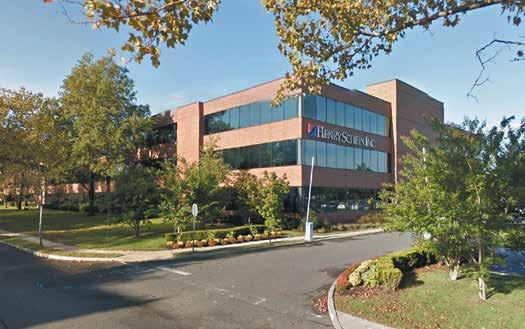
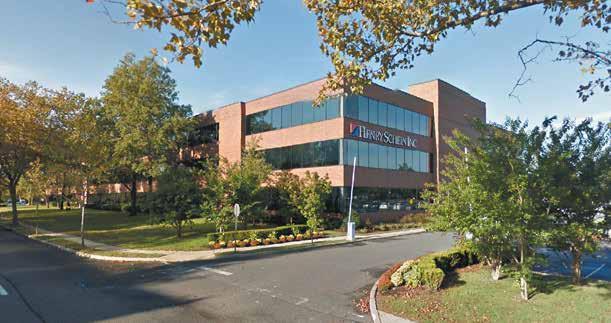
In Melville, Henry Schein, a provider of healthcare products and services to dental and medical professionals, is seeking to upgrade its facilities.
The company plans to invest $15 million to improve two of its facilities, one at 135 Duryea Road, the other at 80 Baylis Road.
The company would modernize the buildings with new telecommunications and information technology equipment as well as incorporate other applicable upgrades. Such upgrades would help the company attract and retain “high-caliber talent,” officials said.
The company is working with the Suffolk County Industrial Development Agency, which on Thursday announced that it had preliminary approved a transaction with the company.
“Retaining Henry Schein is so important for the overall health of our local and regional economies,” Suffolk County IDA Executive Director Tony Catapano said in a statement.
“This is not the first time the agency has assisted the company with its growth and investments in Suffolk County, which go back to 28 years,” he added. “Henry Schein has global reach and had real options to
move its operations off of Long Island” he added. “The IDA is pleased that its assistance means 1,200 Long Islanders will now stay here and continue supporting our economy in many different and significant ways.”
The company, which reached $10 billion in sales in 2019, would maintain its annual payroll of more than $160 million.
“The IDA has played an important role in our growth and we are excited for the next chapter of our company’s development here
in Suffolk County,” Jim Mullins, senior vice president of global services at Henry Schein, said in a statement. “We are grateful once again that the IDA has made staying here in Suffolk County the right choice for our company and Team Schein members.”
Adelphi, Farmingdale partner on graduate programs
Farmingdale State College and Adelphi University are partnering to guarantee eligible students admission to four graduate programs.
Through this partnership, Farmingdale students, who qualify for admission, can pursue graduate studies at Adelphi in several master’s programs: business analytics, computer science, general psychology – with a human resource management concentration – and sports management (offering both in-person and online options).
“As Long Island’s oldest private university, we are pleased to offer this unique opportunity to Farmingdale State students,” Steve Everett, Adelphi’s provost and executive vice president, said in a statement.
The students, he said, “will be welcomed into our diverse and close-knit community, where they will benefit from their experiences with our outstanding faculty and Adelphi’s personalized support services. We have launched this partnership with four highly ranked graduate programs in
high-demand career fields. We hope to expand this program with Farmingdale State College to offer additional master’s degrees in the future.”
This new partnership guarantees admissions to the stated graduate programs upon completion of certain pre-requisite classes and maintenance of minimum grade point averages. The program also allows several of the master’s requirements to be satisfied with specific undergraduate courses, saving time and tuition while earning a graduate degree.
“Farmingdale State College values the role that these partnerships play in providing students with designated pathways to continue their education at the graduate level,” Farmingdale State Provost Laura Joseph said in a statement.
“Through the seamless alignment of specialized programs, students are provided with advance standing opportunities that decrease the time needed for degree attainment,” she added.
Adelphi enrolls more than 2,500 graduate students in 62 master’s programs and advanced certificates along with seven doctoral degrees. Farmingdale State, with nearly 10,000 students, has 44 bachelor’s programs in addition to certificates and a master’s
program in technology management.
Farmingdale students who qualify for admission to the Adelphi master’s programs automatically will be considered for a variety of Adelphi graduate scholarship opportunities.
8 LONG ISLAND BUSINESS NEWS February 5-11 , 20 21 LIBN.COM
— ADINA GENN
Moderator: Jeffrey S. Davoli, CPA Partner, PKF O’Connor Davies





Speaker: Kevin J. Keane, CPA Managing Partner, PKF O’Connor Davies


LONG ISLAND BUSINESS NEWS February 5-11 , 20 21 LIBN.COM 9
us
Please join
for the presentation of this highly-regarded survey, a compelling analysis of how Long Island businesses are faring and the outlook for the year ahead.
Tuesday, February 23, 2021 10:00 a.m. to 11:30 a.m.
Panelists: Angie Carpenter Islip Town Supervisor Kenneth Kaushansky, MD, MACP Senior Vice President for Health Sciences and Dean Emeritus of the Renaissance School of Medicine at Stony Brook University
OUTLOOK: 2021 27TH ANNUAL LONG ISLAND ECONOMIC SURVEY AND OPINION POLL REGISTER NOW for this Complimentary Virtual Event at pkfod.com/outlook2021
Geraldine Hart Suffolk County Police Commissioner Thomas Riggs, JD, CPA, MAS, Partner Head of Financial Services Tax and Advisory, PKF O’Connor Davies
INVEST IN YOUR STAFF
@HOFSTRA
Hofstra University Continuing Education offers a variety of Professional Development courses designed to help current employees learn and enhance their skills to better assist in the ever-changing workplace. Current spring offerings include:

• Bookkeeping Principles and Practices Using QuickBooks
• Information Technology (including Cisco Networking, Data Analytics, and Microsoft Office Applications)
• Insurance Studies and Licensing (Pre-licensing classes and Continuing Education [CEU] options for license renewal)
• Project Management and Implementation
• Real Estate Studies
Spring courses begin soon, but there is still time to register! Select courses are offered in person or virtually. Visit ce.hofstra.edu/advance or call 516-463-7200 for more information.
10 LONG ISLAND BUSINESS NEWS February 5-11 , 20 21 LIBN.COM
Ad_CE_InvestInYourStaff_LIBN.indd 1 2/2/21 1:00 PM
Catering halls look to safely reopen
Catering halls – get ready to “restart the party – safely.”
That’s the message from Nassau County Executive Laura Curran, who on Wednesday held a press conference outside the Crest Hollow Country Club in Woodbury to talk about how catering venues can look to safely reopen.
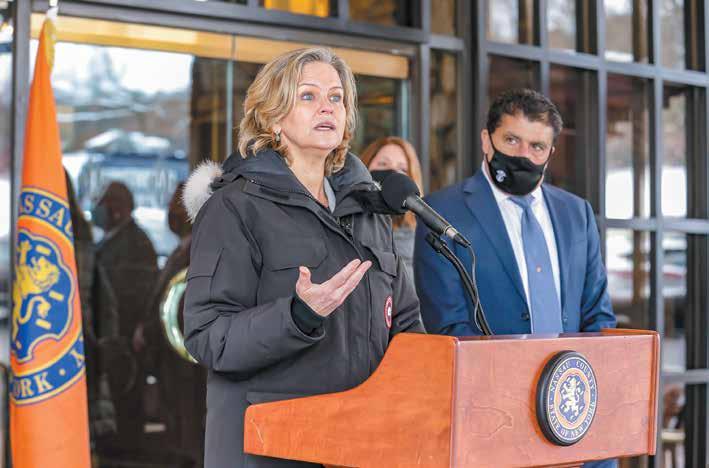
And that could help to restore Long Island’s economy, which has taken a hit in the pandemic.
“More than 80,000 hospitality jobs were lost on Long Island,” Curran said.
In addition to bringing back jobs, reopening would restore a host of affiliated businesses, including musicians, DJs, dressmakers, hair stylists, florists and more, officials pointed out.
The reopening of the catering industry was announced on Friday, when Gov. Andrew Cuomo said that beginning March 15, venues could host wedding for up to 150 guests. Still, those guests would also have to test negative for COVID-19 in order to be admitted into the venue.
But many of the details remain unclear. Curran said she was “eagerly awaiting” a “refresh” from the state on guidelines and protocols to ascertain whether the reopening also included other social gathering such as bar and bat mitzvahs, Sweet 16s and additional types of celebrations.
Catering halls still need to sort out
other finite points, Curran said, including “how does dancing work, what does a cocktail hour look like? What does the testing operation look like?”
And while these details are incomplete, the current state guidelines would allow for multiple events to take place in a venue at the same time, so long as the events are staggered, and there are separate entrances and exits for the various events so as to prevent bottlenecks of people within a space.
Hosting simultaenous events would help caterers begin to restore their business.
“These larger venues would have a very hard time surviving one event at a time,” Curran said.

Curran was joined by Crest Hollow’s CEO Richard Monti and other county officials. Monti could no longer employ 400 of the venue’s 425 employees since the onset of COVID-19. Ever since, Monti has provided an estimated 25,000 meals to feed the employees he let go and their
families.
“It’s been a long journey,” Monti said. Monti said that he’s taking care of the employees that he could no longer retain because they are part of “a family” that “took decades to build.”
And, with vaccines in the pipeline “right now I see light at the end of the tunnel,” he said.
“Safety first,” he said, pointing to the need to “follow the science.”
Still, on Wednesday, the limited details about reopening seemed to temper enthusiasm.
Testing, for example, could prove “logistically difficult,” said Alan Feinstein, whose H on the Harbor catering venue is in Port Washington.
“How does the venue and host deal with these uncertainties?” he asked.
“I know that many vendors, including myself, are happy to hear some positive news,” he said, “but the reality is, I don’t see this current plan working.”
— ADINA GENN

LONG ISLAND BUSINESS NEWS February 5-11 , 20 21 LIBN.COM 11
FROM LIBN.COM
RAISE VOICES RAISE
RAISE
the status quo actually makes us sick Raise Health When where we live determines how long we live Raise Health When thoughts and prayers aren’t enough Raise Health
time to raise our expectations Because when we Raise Health we raise everyone Be a Health Raiser at RaiseHealth.com
ALAN FEINSTEIN
HOPE
HEALTH When
It’s
Midway Crossing is an economic game changer for Long Island
tail, entertainment and recreational venue.
Martin R. CANTOR
As New York State and Long Island begin to recover the jobs lost and an economy ravaged by the pandemic, we will have to think big and engage the private sector in game-changing economic development projects that can not only recapture the jobs lost but create high paying jobs that will reinvigorate the local economy and keep the Millennial workforce here.
One such project is Midway Crossing at MacArthur Airport.
In the economic impact analysis I prepared, I found Midway Crossing in Ronkonkoma to be a transformative $2 billion, 2.1 million-squarefoot, mixed use transit oriented, public-private partnership development initiative. Located adjacent to Long Island MacArthur Airport, Midway Crossing is a low-rise development that will bring to Ronkonkoma a national and international life sciences and rapid technology transfer hub, a youth sports tourism and convention destination, and a local community re-
ECONOMIC OUTLOOK:
At the very time that Long Islanders want to get back to work and replenish their depleted household budgets, the construction of Midway Crossing will create nearly 13,750 much needed primary and secondary jobs with a combined $756.3 of primary wages and secondary economic activity.
The real value is that when completed, Midway Crossing will generate nearly $1.77 billion of recurring economic activity from the 5,534 permanent and secondary recurring jobs with direct payroll of $659 million. The economic development there will generate a permanent stream of millions of dollars of local sales and property tax revenues.
Midway Crossing also addresses the role that regional airports, such as Long Island MacArthur Airport, play in the regions they serve. They spur economic development through job creation, facilitate and attract tourism and both establish and encourage business links between their home territory and other geographic areas.
Compared to other regional airports, and integral to attracting a next generation air carrier, MacArthur has untapped economic potential that a North Terminal Expansion with direct linkage to the Long Island Rail Road would fill.
For example, a next generation carrier offering more non-stop flights to more destinations would attract more travelers and their economic impact to Long Island. Consider that a next generation carrier offering 59 daily flights to MacArthur, integrated with the LIRR, would generate 2.2 million annual enplanements and $982 million of annual economic activity.
All this could happen on the land adjacent to MacArthur Airport. Parcels controlled by Suffolk County and the Town of Islip, are convenient to the Ronkonkoma LIRR Station and a North Terminal Extension.
The Long Island Association, recognizing this economic potential, included Midway Crossing in its 2021 priorities. The LIA wrote that it supports the efforts of Suffolk County and the Town of Islip to redevelop the south side of the Ronkonkoma Hub and to build regional support for the expansion of MacArthur with new airlines and destinations.
Midway Crossing will turn economic potential into realty, at the very time that the region is seeking new life for its ailing economy.
Cantor is director of the Long Island Center for Socio-Economic Policy and a former Suffolk County economic development commissioner. He can be reached at EcoDev1@aol.com.


EDITOR & ASSOCIATE PUBLISHER
Joe Dowd jdowd@libn.com 631-913-4238
ASSOCIATE PUBLISHER, SALES

Ali Jabbour ajabbour@libn.com 631-913-4233
EVENTS MANAGER
Jenna Natale jnatale@libn.com 631-913-4246
PUBLIC NOTICE
Robin Burgio publicnotice@libn.com 631-737-1700
ACCOUNT MANAGERS
Barbara Pescuma bpescuma@libn.com 631-913-4249
Jackie Douglas jdouglas@libn.com 631-913-4259
LAW & GOVERNMENT
Adina Genn agenn@libn.com 631-913-4241
REAL ESTATE / RETAIL / FRANCHISING
David Winzelberg dwinzelberg@libn.com 631-913-4247
RESEARCH MANAGER
Kathy Lombardo klombardo@libn.com 631-913-4248
Why does the economy need more federal stimulus?
ed by 3.5 percent in 2020, the largest decline since 1946. State and local governments have received little federal aid to date and are hard pressed to provide basic services such as police and fire protection, and to cover the costs of distributing Covid-19 vaccinations.
As the coronavirus persists, debate has escalated over the need for further federal economic stimulus. Critics argue that the recent $900 billion stimulus is sufficient, and that further stimulus will needlessly increase the already enormous federal debt.
At the very least, they argue, one should wait and see what the most recent stimulus package accomplishes before taking further action.
These are serious concerns. Certainly, the national debt has risen to an alarming extent. And this will inevitably lead to higher taxes to pay for fiscal spending. But despite very substantial stimulus both in terms of monetary and fiscal policy, the US economy contract -
Small business has been hit hard as well, with many of the smallest businesses lacking sufficient capitalization and access to loans to survive.
So, despite substantial efforts, the economy, both at the national level and on Long Island, remains in a fragile state. It seems clear that, in the short term at least, the economy would benefit from further fiscal stimulus. But critics note that the long-term consequences may make matters even worse, as increasing debt and rising interest rates throw the economy into recession or worse.
The case for further federal assistance thus rests, not just on short-term benefits (which seem clear) but on addressing potential long-
term adverse effects. The quick and less convincing argument is that we simply do not have the luxury of worrying about the long term because the current situation is so dire. A more convincing argument, as espoused by Treasury Secretary Janet Yellin, is that the absolute size of debt is not so important as 1) the size of the interest payments and 2) the ratio of debt to GDP. In other words, if fiscal stimulus promotes economic growth such that interest payments and the debt to GDP ratio remain manageable, then we can deal with the longterm consequences of further fiscal stimulus. Failure to provide more stimulus risks further slowing of the economy and rising unemployment over the short term and gloomier prospects for the long term as well. But further federal assistance now gives the economy a fighting chance, both in the short term and the long term, which would seem to be the better bet.
NEWS DESIGNER
Anna Otto
AD PRODUCTION
Wilhelm
Send address corrections to service@bridgetowermedia.com
Customer Service For inquiries, call 877-615-9536 or email service@bridgetowermedia.com
To locate your nearest LIBN newsstand call (718) 937-0402
Long Island Business News (ISSN 08944806), (USPS No. 318-380) is published weekly by Long Island Business News Inc., 2150 Smithtown Ave., Suite 7, Ronkonkoma, N.Y. 11779-7348. Periodicals, 52 issues in 2021 plus 4 additional issues in the months of March, October, November and December mailed separately and periodicals postage paid at Ronkonkoma, N.Y. 11779 at additional entries. Phone: 631-737-1700, Fax: 631-737-1890.
12 LONG ISLAND BUSINESS NEWS February 5-11 , 20 21 LIBN.COM
Abby
LI B N.COM OPINION
Rizzo is chief economist for the Long Island Association.
John RIZZO
LONG ISLAND BUSINESS NEWS February 5-11 , 20 21 LIBN.COM 13 ACHIEVEMENTS IN HEALTHCARE IS A LONG ISLAND BUSINESS NEWS EVENT Long Islanders from all walks of life rely on our healthcare industry to keep our communities strong. Dedication, creativity and diligence is the formula for quality care. The Long Island Business News Achievements in Healthcare Awards aims to recognize excellence, promote innovation, and highlight professionals and organizations whose tireless work, contributions and dedication to health ensure the well-being of everyone on Long Island. EVENT DATE MARCH 18, 2021 REGISTER NOW! EVENT OR SPONSORSHIP QUESTIONS? Please contact Jenna Natale, Events Manager 631.913.4246 • jnatale@libn.com
u SPOTLIGHT
GRASSI NAMES NEW CHIEF MARKETING OFFICER
SARAH CIRELLI
Grassi & Co. a provider of advisory, tax and accounting services, has named Sarah Cirelli as chief marketing officer.

Cirelli joined Grassi in 2017 as marketing practice leader, overseeing the marketing and business Development initiatives of the firm. Among her accomplishments in that role were the spearheading of the firm’s rebranding
in 2020, restructuring of the firm’s marketing and business development team and the implementation of a state-ofthe-art marketing automation platform. At the start of the COVID-19 crisis, she led the rapid pivoting of Grassi’s growth strategy to bring crisis recovery and other niche services to market and meet the immediate needs of the firm’s clients and community.
As chief marketing officer, Cirelli

will take on an expanded leadership role in shaping and executing the firm’s go-to-market strategies. She will continue to work alongside the firm’s partners and professionals to develop and achieve the growth goals of each service line and industry practice, including construction, manufacturing & distribution, nonprofit, healthcare, financial services, business consulting and tax advisory.
u EDUCATION u LAW u ACCOUNTING
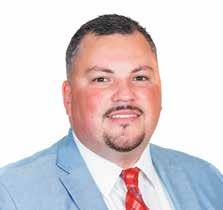
The Herricks Public Schools Board of Education and administration appointed James Zervas as the new director of mathematics K-12. Previously he served as department chairperson for math, business, technology and science in the East Rockaway School District.



u CONSULTANTS
u SUBMISSIONS
Jack Macejka
Melissa
a member of Cullen and Dykman LLP’s General, tort and insurance litigation department, has been promoted to partner. She is a resident of Garden City.

Brian Doyle has been promoted to partner at Margolin, Winer & Evens LLP. He is an accounting and auditing specialist whose practice is focused on the real estate and financial services industries.
The Advance Group welcomed Jack Macejka as vice president of national accounts. Most recently, Macejka was employed at WeWork, managing office openings throughout their east coast territories, including Minneapolis, Nashville, Boston, Philadelphia and New York City.
Grassi & Co. has promoted Aaron Rupper to partner. Previously he was an audit principal in the construction practice, specializing in industry-specific audit, accounting and advisory services for construction companies and architectural and engineering (A&E) firms.
We welcome announcements for businesspeople who work in Nassau or Suffolk. Please include your title and the name and town of your company. Also, include the title, company name and town for your most recent position. Submit your Movers & Shakers releases to jdowd@libn.com or online at www.libn.com. You must send a photo to be considered for publication. The photos must be high-resolution, color JPEGs of at least 200 dpi in size.
JONATHAN R. BLAU President & CEO
February 19, 2020 brought us a new all-time closing high for the S & P 500 of 3,386.15. Panicked by COVID, the market closed down an unprecedented 34% just 33 days after hitting those highs. What immediately followed was the best 50 day run ever. Many investors sold some or all of their stock portfolio into the temporary decline (thereby creating a permanent loss, the only way possible)! Such irrational money behavior results from investors’ and advisors’ deeply human and always fatal misperception of risk.
Our investment culture defines risk as volatility or temporary sharp up and down movements around
the permanent long-term uptrend.
In the 1950s, Nobel prize-winning economist Harry Markowitz created an academic model to identify the “most efficient” stock portfolio from among a number of alternatives.
By efficient, he meant the one that would offer the best “risk-adjusted” return -- his novel contribution was adding a risk variable – which he defined as adjusted for volatility.
The trouble is, volatility is not risk any more than temporary decline is permanent loss.
Risk is the chance of a permanent loss of capital/money. Believing volatility is risk leads investors to own and advisors to recommend owning too many bonds (to minimize portfolio movement) believing their goal is to reduce volatility. Bond exposure freezes principal and the income it generates, thereby
killing purchasing power. The real challenge is to protect purchasing power. For the last almost 100 years stock -- S & P 500 -- dividends (having grown about 6% annually) are a peerless and consistent source of an income that not only keeps up with inflation, but historically has grown twice as much.
The market’s increase is permanent and each decline is temporary. Volatility is not risk any more than a temporary decline is a permanent loss. That which diminishes or destroys purchasing power in a 30 year retirement – bonds/ fixed income -- is risky. That which preserves or increases purchasing power – (stocks/ S& P 500) is safe. As such, successful investing is not a financial market problem, but a problem of psychology. The myth of the risk of stocks is a result of a
deep belief in something (the S & P 500 causing a permanent loss) that can overwhelmingly be proven to not exist!
Wealth preservation is a problem of purchasing power NOT of principal and the only rational role of bonds is to ensure enough liquidity so we needn’t sell stocks during temporary declines. THAT’S IT!
Please see Important Disclosures at www.fusionfamilywealth.com/ disclosures.
If you are planning for personal investments of at least $3 million and would like to learn more about how our unique, behavior-based approach can meaningfully enhance your chances of success, please call us at 516-206-1301 or email us at j.blau@fusionfamilywealth.com.
14 LONG ISLAND BUSINESS NEWS February 5-11 , 20 21 LIBN.COM
James Zervas
Melissa Manna
Manna,
Brian Doyle
Aaron Rupper
MOVERS & SHAKERS
2021: THE YEAR TO CRUSH THE GREATEST OF ALL INVESTMENT MYTHS – THE “RISK” OF STOCKS & THE “SAFETY” OF BONDS
Fusion Family Wealth, LLC
OPPORTUNITY FOR ACCOUNTING AND LAW FIRMS We offer a very compelling CPE/CLE approved 30 minute presentation on succeeding with high-net-worth behavioral investment counseling. Please email j.pena@fusionfamilywealth.com for more information. HELPING INVESTORS BEHAVE THEIR WAY TO WEALTH
SPONSORED CONTENT
By JULIANNE MOSHER
Like other institutions, organizations and businesses, banks have had to change shape to adjust to the new, socially distanced normal. Before the pandemic, online banking was widely used and available, but the coronavirus heightened the need for it, causing more banks to rethink the entire online banking experience.
That was one of the key takeaways from Long Island Business News’ webinar series, LIBN/NOW, last week, when two banking and wealth management experts offered their projections about the “State of Banking.”
Panelists Kevin O’Connor, the president and CEO of BNB Bank, and Mark Gusinov, the east coast regional manager at City National Bank, agreed that change is coming to the way banks view customer service.
O’Connor, who is also the newly named president and CEO of Dime Community Bank, said the pandemic has changed the normal standard for bankers, and the public.

“Who would have thought that as bankers we’d be able to work remote?” he said during the webinar, which aired on Thursday, Feb. 28. “When we first put drive-throughs in branches people were using those, now they’re going remote.”
Gusinov agreed, and noted that the ability of working remote has, in fact, enhanced the customer experience.
“I think we’ve all had to take a step back
on how we interact with clients,” he said. “They still need us as a resource. This medium, whether it be Zoom or Teams has really bridged a lot of that gap — a phone call only goes so far.”
He said that as bankers, “we had to look at how we interact with clients” especially during such an unprecedented time. He noted there is “now a deeper understanding of a client more now than ever… It’s not about today, it’s not about the next six months, it’s about the next three years.”
“Checking in on a client more now than ever its more about the relationship and the connectivity,” Gusinov said. “It’s not about the transaction anymore — that’s the biproduct.”
And while connecting with the client in a video call or creating an easy-to-access online platform are just some aspects of the changing customer experience, Gusinov said that gaining their trust is key and many banks, including City National, are working towards hyper-personalization for each and every person.

“We’re not a retail heavy business, but we’re still in touch with our clients,” he said. “Their world is changing far more frequently, so you have to stay connected to them.”
O’Connor agreed, saying that at BNB one of his top priorities is to be there for their customer.
“We’re entrusted with peoples finances, their wealth,” he said. “We make sure we don’t lose sight of that.”
A recent Forbes article, citing a 2020 McKinsey & Company report, expounded on this point.
“One of the biggest challenges in the post-Covid-19 era is the ability to connect the financial brand with its customers, the Forbes article said. “During the crisis, 57% of customers switched brands due to the value provided, according to McKinsey & Company. Empathy, value and emotional
Making banking personal


connection are the three cornerstones to building successful relationships with customers.”
The story also said “in 2021, simple functionality and basic level usability will not be enough to attract and retain customers. Incorporating a user-centered design methodology to create demanded digital products is a prerequisite to strive and succeed in the digital age.”
While many banks already had mobile apps and solid websites in place, clients who were afraid of change were thrown into the trenches throughout the pandemic. For example, business owners who had to apply for PPP loans were unable to do so in-person.
“People were changing their business models, pivoting to be more digital,” O’Connor said. “Think about PPP — we used DocuSign — we’d email the form for them to fill out, and money would go into their account… For a lot of people that was a first
time for them.”
And optimizing the customer experience will help with that.
“There’s always face-to-face, but I think you can be a digitally transformed institution,” Gusinov said. “The client engagement level has to be at an all-time high.”
While he said that there is always going to be a difference between interacting with someone on Zoom and being next to someone inside a branch, evolution is going to happen.
“Brick and mortar still have a place, but you have to evolve on how you engage with clients,” he said. “The client experience, as a banker and as an institution, you really have to invest the time of what’s important to them and understanding that.”
As for the actual building of a bank going away? O’Connor said it’s up to you.
“The consumer will ultimately dictate what happens,” he said.
LI FOCUS BANKING/WEALTH MANAGEMENT
The pandemic and working remotely has made the banking industry rethink its priorities
KEVIN O’CONNER: ‘Who would have thought that as bankers we’d be able to work remote.’
MARK GUSINOV: ‘I think we’ve all had to take a step back on how we interact with clients.’
Photo by Wavebreakmedia
T H E L I S T
WINERIES/VINEYARDS
Anthony Napa Wines/The Winemaker Studio, Peconic
2885 Peconic Lane Peconic, NY 11958 (774) 641-7448 www.anthonynappawines.com info@anthonynappawines.com
Bedell Cellars
36225 Main Road, Route 25 Cutchogue, NY 11935 (631) 734-7537; Fax (631) 734-5788 www.bedellcellars.com wine@bedellcellars.com
Bridge Lane Wine
35 Cox Neck Road Mattituck, NY 11952 (631) 298-1942 www.bridgelanewine.com customerservice@liebcellars.com
Castello Di Borghese Vineyard and Winery
17150 County Road, 48 at Alvahs Lane PO Box 957 Cutchogue, NY 11935 (631) 734-5111; Fax (631) 734-5485 www.castellodiborghese.com info@castellodiborghese.com
Channing Daughters Winery
1927 Scuttlehole Road, PO Box 2202 Bridgehampton, NY 11932 (631) 537-7224; Fax (631) 537-7243 www.channingdaughters.com info@channingdaughters.com
Chronicle Wines at Peconic Cellar Door 2885 Peconic Lane Peconic, NY 11958 (631) 488-0046 https://www.chroniclewines.co/
Clovis Point
1935 Main Road, PO Box 669 Jamesport, NY 11947 (631) 722-4222 www.clovispointwines.com mark@clovispointwines.com
Coffee Pot Cellars
31855 Main Road Cutchogue, NY 11935 (631) 765-8929 www.coffeepotcellars.com info@coffeepotcellars.com
Corey Creek Tap Room 45470 Main Road, Route 25 Southold, NY 11971 (631) 765-4168; Fax (631) 765-1845 www.coreycreektaproom.com wine@bedellcellars.com
Croteaux Vineyards
1450 South Harbor Road Southold, NY 11971 (631) 765-6099 www.croteaux.com wine@croteaux.com
Del Vino Vineyards 29 Norwood Road Northport, NY 11768 1-844-DEL-VINO www.delvinovineyards.com/ info@delvino.net
Diliberto Winery
250 Manor Lane Jamesport, NY 11947 (631) 722-3416 www.dilibertowinery.com info@dilibertowinery.com
Duck Walk North 44535 Main Road Southold, NY 11971 (631) 765-3500 www.duckwalk.com
Duck Walk Vineyards 231 Montauk Hwy., PO Box 962 Water Mill, NY 11976 (631) 726-7555 ext. 4 Fax (631) 726-4395 www.duckwalk.com info@duckwalk.com
Harbes Vineyard 715 Sound Ave., PO Box 1431 Mattituck, NY 11952 (631) 298-0800 (631) 298-9463 Fax (631) 298-1332 www.harbesfamilyfarm.com harbesfamilyfarm@gmail.com
Harmony Vineyards
169 Harbor Road Head of the Harbor, NY 11780 (631) 291-9900 www.harmonyvineyards.com info@harmonyvineyards.com
Jamesport Vineyards
1216 Main Road, Route 25 PO Box 842 Jamesport, NY 11947 (631) 722-5256; Fax (631) 722-5256 www.jamesportwines.com jamesportwines@gmail.com
Jason’s Vineyard
1785 Main Road, Route 25 Jamesport, NY 11947 (631) 238-5801 www.jasonsvineyard.com jasonsvineyard@gmail.com
Kontokosta Winery
825 North Road, Route 48 Greenport, NY 11944 (631) 477-6977; Fax (631) 477-9680 www.kontokostawinery.com/ info@kontokostawinery.com
Laurel Lake Vineyards
3165 Main Road, Route 25 Laurel, NY 11948 (631) 298-1420; Fax (631) 298-1405 www.llwines.com info@llwines.com
The Lenz Winery 38355 Main Road, Route 25 PO Box 28 Peconic, NY 11958 (631) 734-6010; Fax (631) 734-6069 www.lenzwine.com office@lenzwine.com
Lieb Cellars 13050 Oregon Road Cutchogue, NY 11935 (631) 734-1100; Fax (631) 734-1113 www.liebcellars.com customerservice@liebcellars.com
Loughlin Vineyards 299 South Main St. Meadowcroft Estate Sayville, NY 11782 (631) 589-0027 www.loughlinvineyardny.com info@loughlinvineyardny.com
Macari Vineyards
150 Bergen Ave., PO Box 2 Mattituck, NY 11952 (631) 298-0100; Fax (631) 298-8373 www.macariwines.com info@macariwines.com
Mattebella Vineyards
46005 Main Road, (Route 25) Southold, NY 11971 (631) 655-9554 (888) 628-8323 www.mattebella.com inquiry@mattebella.com
McCall Wines
22600 Main Road Cutchogue, NY 11935 (631) 734-5764 www.mccallwines.com info@mccallwines.com
The Old Field Vineyards 59600 Main Road, Route 25 PO Box 726 Southold, NY 11971 (631) 765-0004 www.theoldfield.com livinifera@aol.com
Onabay Vineyards
PO Box 476 Southold, NY 11971 (917) 715-0605 www.onabayvineyards.com
One Woman Vineyards 5195 Old North Road Southold, NY 11971 (631) 765-1200 www.onewomanwines.com info@onewomanwines.com
Osprey’s Dominion
44075 Main Road, PO Box 198 Peconic, NY 11958 (631) 765-6188; Fax (631) 765-1903 www.ospreysdominion.com winemkr@ospreysdominion.com
Palmer Vineyards
5120 Sound Ave., PO Box 741 Aquebogue, NY 11931 (631) 722-9463; Fax (631) 722-5364 www.palmervineyards.com palmervineyard@gmail.com
Paumanok Vineyards
1074 Main Road (Route 25) PO Box 741 Aquebogue, NY 11931 (631) 722-8800; Fax (631) 722-5110 www.paumanok.com info@paumanok.com
Pellegrini Vineyard
23005 Main Road Cutchogue, NY 11935 (631) 734-4111 ext. 207 Fax (631) 734-4159 www.pellegrinivineyards.com johnl@pellegrinivineyards.com
Pindar Vineyards
37645 Main Road, Route 25 PO Box 332 Peconic, NY 11958 (631) 734-6200; Fax (631) 734-6205 www.pindar.net info@pindar.net
Pugliese Vineyards
34515 Main Road, Route 25 PO Box 467 Cutchogue, NY 11935 (631) 734-4057; Fax (631) 734-5668 www.pugliesevineyards.com
Raphael
39390 Main Road, Route 25 Peconic, NY 11958 (631) 765-1100 www.raphaelwine.com tastingroom@raphaelwine.com
16 LONG ISLAND BUSINESS NEWS February 5-11 , 20 21 LIBN.COM
Relationships count now more than ever.
Let’s work together.
As part of a global bank with $1.5 trillion in assets and over 145 million customers worldwide, Santander offers financial and working capital solutions and diverse industry experience to help your business prosper.
Business Banking • Commercial Banking • Personal Banking santanderbank.com
01/2021
LONG ISLAND BUSINESS NEWS February 5-11 , 20 21 LIBN.COM 17
Santander Bank, N.A. is a Member FDIC. ©2021 Santander Bank, N.A. All rights reserved. Santander, Santander Bank and the Flame Logo are trademarks of Banco Santander, S.A. or its subsidiaries in the United States or other countries. All other trademarks are the property of their respective owners. 532401_LIBN
T H E L I S T
WINERIES/VINEYARDS
RGNY 6025 Sound Ave. Riverhead, NY 11901 (631) 298-0075; Fax (631) 298-5502 https://rgnywine.com info@rgnywine.com
Roanoke Vineyards
165 Love Lane Mattituck, NY 11952 (631) 727-4161; Fax (631) 727-5602 www.roanokevineyards.com
Sannino Vineyard
15975 County Route 48 Cutchogue, NY 11935 (631) 734-8282 www.sanninovineyard.com info@sanninovineyard.com
Scarola Vineyards Inc. 4850 Sound Ave. Mattituck, NY 11952 (631) 298-7676; Fax (516) 747-5178 www.scarolavineyards.com frank@scarolavineyards.com
Shinn Estate Vineyards 2000 Oregon Road Mattituck, NY 11952 (631) 804-0367 www.shinnestatevineyards.com info@shinnestate.com
Sparkling Pointe Vineyards and Winery
39750 County Route 48 Southold, NY 11971 (631) 765-0200; Fax (631) 765-5264 www.sparklingpointe.com
info@sparklingpointe.com
Suhru Wines 28735 Main Road Cutchogue, NY 11935 (631) 603-8127; Fax (631) 298-3588 www.suhruwines.com info@suhruwines.com
T’jara Vineyards 35 Cox Neck Road Mattituck, NY 11952 (631) 905-7550 www.tjaravineyards.com info@tjaravineyards.com
The Vineyard at Baiting Hollow d/b/a Baiting Hollow Farm Vineyard 2114 Sound Ave.
Baiting Hollow, NY 11933 (631) 369-0100; Fax (631) 208-0800 www.baitinghollowfarmvineyard.com info@bhfvineyard.com
Whisper Vineyards
485 Edgewood Ave. St. James, NY 11780 (631) 257-5222; Fax (631) 257-5223 www.whispervineyards.com info@whispervineyards.com
Wölffer Estate Vineyard
139 Sagg Road, PO Box 9002 Sagaponack, NY 11962 (631) 537-5106; Fax (631) 537-5107 www.wolffer.com info@wolffer.com
Looking to reach an exclusive audience?
us help. Long Island Business News now offers co-branded emails, proven lead generators that will bring attendees to events and webinars, attention to professional announcements and downloads of whitepapers and other services that you offer. These emails are sent to an exclusive list of subscribers to our highly popular daily email newsletter.


a limited time, were offering a trial at the special prices below

18 LONG ISLAND BUSINESS NEWS February 5-11 , 20 21 LIBN.COM
$1,500
[1x buy] 631.737.1700
Let
For
for 30,000 emails
In pandemic, 1-800 Flowers sees growth
By ADINA GENN

Amid the pandemic, when people turn to e-commerce and purchase flowers and other cheery items to brighten the home, 1-800-Flowers is continuing to see growth.

The Carle Place-based company released its latest revenue and earnings reports Thursday. In that report, the company said total net revenues increase 44.8 percent, or $271.6 million to $877.3 million. That’s up from total revenues of $605.6 million in the prior year period, driven by ecommerce growth of 59.7 percent, according to the company.


“We are very pleased to report the highest quarterly revenue and profit in our company’s history,” Chris McCann, 1-800-Flowers CEO, said in a statement.
“Our record top and bottom-line results represent the seventh consecutive quarter of strong revenue growth across our three business segments and reflects a continuation of the momentum that we have been building over the past several years,” he said.
The results, he said, “were primarily driven by strong, double-digit ecommerce growth across our gourmet food and gift basket brands,” as well as its floral business, and one of its new brands, PersonalizationMall.com.
McCann told LIBN that in the pandemic, as people are isolated, the company “continued to see a rise in demand nationwide in gifting and self-consumption. Everyday occasions, which have always been a big
part of our business, have taken on new meaning – as people want to reach out to celebrate birthdays, new babies, anniversaries and more – from afar – not wanting the recipient to celebrate the occasion alone. We’ve found ourselves in a unique position to be able to help our customers connect with others who they cannot be with in person.”
McCann credited the company’s “significant investments in our brands, our technology stack, our digital marketing and cross-brand merchandising programs, our fast-growing customer files and our customer care platform.”
The company said net income for the quarter increased 53.3 percent, or $39.5 million, to $113.7 million, or $1.71 per diluted share, compared with net income of $74.2 million, or $1.12 per diluted share in the prior year period.
And adjusted EBITDA for the quarter increased 48.4 percent, or $53.6 million, to $164.3 million compared with $110.7 million in the prior year period, according to 1-800-Flowers.
The company anticipates seeing strong ecommerce demand in the immediate future.

“While we are cognizant of continuing uncertainty in the overall environment due to the COVID-19 pandemic, we believe we are well positioned to deliver solid results for the current fiscal third quarter and the full year,” McCann said.


WINNING ON THE FIELD, THRIVING IN THE



When the New York Crusaders needed a financial partner, they turned to their neighbor: Ridgewood Savings Bank. Just like the football-based nonprofit, Ridgewood is committed to supporting financial wellness and opportunity in our community.


LONG ISLAND BUSINESS NEWS February 5-11 , 20 21 LIBN.COM 19
© 2021 Ridgewood Savings Bank
We chose Ridgewood because they’re
You can
COMMUNITY. “
front and center in our community.
sense their commitment.”
Connect with our local team today. www.ridgewoodbank.com | (844) 772-4722
Brian O.F. Peterkin VP of Operations & Programming New York Crusaders
FROM LIBN.COM
Photo by Judy Walker
The company anticipates strong ecommerce demand in the immediate future.
Find us on: Circle

20 LONG ISLAND BUSINESS NEWS February 5-11 , 20 21 LIBN.COM DIVERSITY IN BUSINESS AWARDS IS A LONG ISLAND BUSINESS NEWS EVENT JOIN US ONLINE! TUESDAY, MARCH 2, 2021 4 PM - 5 PM Register now to attend LIBN’s web-based celebration, highlighting those who actively support the growth of diversity and equality in our community! REGISTER NOW: https://libn.com/diversityinbusiness EVENT OR SPONSORSHIP QUESTIONS? Contact Jenna Natale at jnatale@libn.com or 631.913.4246 HONOREES VALERIE ANDERSON CAMPBELL Anderson Campbell Enterprises, LLC ANDREW AYODEJI Bolden Mack Basketball LLC DEBBIE BAUER Brookhaven National Laboratory PAISLEY DEMBY Goldman Sachs 10,000 Small Businesses BRIAN HARPER, M.D., M.P.H. New York Institute of Technology ABBAS JAFFER Architectural Sign Group Inc. RAO ALI SHAAN KHAN Charles Rutenberg Realty Inc. ANDREW LIEB Lieb Compliance, LLC TRACEY MCINTYRE Rivkin Radler LLP ALI NAZIR Office of Suffolk County Legislator Leslie Kennedy DEREK PETERSON Soter Technologies RAJIB SANYAL, PHD Adelphi University TONYA THOMAS Long Island Community Foundation DINA VESPIA Cullen and Dykman LLP ELIZABETH WELLINGTON Wellie The Transporter EDNA WHITE Edna White Life Coaching & Consulting ADVOCATE OF THE YEAR MICHAEL CAPLICE Office of the State Comptroller EDUCATING COMMUNITIES AWARD MELISSA MCCARDLE, PHD, LCSW & AMY MEYERS, PHD Molloy College FAMILY & CHILDREN’S ASSOCIATION “WALKING THE WALK” AWARD LONG ISLAND ELITE DIVERSITY COMMITTEE HELEN KELLER SERVICES CONTRIBUTING SPONSOR
Online shopping surge delivers record revenue for UPS
The ASSOCIATED PRESS
A surge in online shopping helped UPS post record revenue during the last three months of 2020, the company said Tuesday. Its stock rose nearly 5% in morning trading.
UPS and other delivery companies have seen demand spike as more people shop online during the pandemic and avoid going to physical stores. Not only was the Atlanta company working to deliver gifts and online orders during the holiday season, but it also started shipping COVID-19 vaccines at the same time. To keep up, it hired thousands of more workers and saved space for the vaccines, which need to be kept in deep freezers.
During the quarter, UPS said the daily average number of packages it delivered rose nearly 11%.
CEO Carol Tome expects pandemic-fueled online shopping habits to stick, even as more stores reopen.
“We’re in a new normal,” said Tome. “Even my relatives, who are older, are shopping online. Before, they would never do that.”

UPS said Tuesday revenue rose 21% to $24.9 billion in the three months ending Dec. 31, a record for the company.
However, it posted a loss of $3.26 billion, or $3.75 per share, as costs rose and it
took charges on pension obligations and the sale of its UPS freight business. The year before, it reported a much smaller loss of $106 million.
But when adjusted to remove charges, UPS said it earned $2.66 per share, easily beating Wall Street expectations.
Full-year revenue totaled $84.6 billion,

with adjusted profit of $8.23 per share. Both were records for UPS.
Shares of United Parcel Service Inc. rose $7.33, or 4.7%, to $163.59 Tuesday morning.

LONG ISLAND BUSINESS NEWS February 5-11 , 20 21 LIBN.COM 21
LIBN.COM
FROM
AP Photo/Wilfredo Lee, File
UPS is reporting strong profits and revenue in its most recent quarter.

















LONG ISLAND BUSINESS NEWS February 5-11 , 20 21 LIBN.COM 23 Nassau Industrial ON THE MARKET Real Estate BIZ MARKET BUSINESS SERVICES REAL ESTATE HOTELS & MEETING PLACES Category: Industrial County: Nassau Location: 15 Grumman Rd W, Bethpage Available Sq. Ft. 12,000 sq. ft. for Sublease Asking Price for Lease: $16.00 Gross Agent: James Parnes Brokerage: Schacker Real Estate Corp. Phone: 631-293-3700, x45 Additional: Class “A” warehouse space. Column free space. 2 Ton crane in the warehouse. Proximity to Long Island Expressway, Seaford Oyster Bay Expressway & Northern State Parkway. BUSINESS CARDS MICHAEL D SAPRAICONE FOUNDER & CEO 50 Char es Lindbergh B vd Suite 608 Un onda e NY 11553 5777 West Century B vd Suite 960 Los Angeles CA 90045 O: 212-485-8520 C 917-881-3677 E msapra cone@squadsecu i y com MICHAEL D. SAPRAICONE FOUNDER & CEO 50 Charles Lindbergh Blvd Su te 608 Uniondale NY 11553 5777 West Century Blvd Suite 960 Los Angeles CA 90045 SQUAD SECURITY O: 212-485-8520 C 917-881-3677 E: msapraicone@squadsecur ty com MICHAEL D. SAPRAICONE FOUNDER & CEO 50 Char es Lindbergh Blvd Su te 608 Uniondale NY 11553 5777 West Century B vd Su te 960 Los Angeles CA 90045 O 212-485-8520 C: 917-881-3677 E msapra cone@squadsecur y com $125,000,000+ in Annual Real Estate Sales Want a Definitive Date Your Property will Sell? Now Accepting Consignments (Bridge Loans Available) MaltzAuctions.com • 516.349.7022 • Richard B. Maltz www.LIConstructionLaw.com (516) 462-7051 Offices Uniondale, Melville, Ft Lauderdale Construction Contract preparation, review and negotiation Defective / Incomplete construction Post-Sandy House Raisings Non payment – Lien filings – Bond Claims Lien Foreclosures Union Hearings Construction Arbitrations, Mediation, Litigation Background Investigations for Hiring Purposes Criminal History Checks - Reference Checks - Drug Screening Due Diligence Investigations Nassau Office Category: Office County: Nassau Location: 111 East Shore Road, Manhasset Available Sq. Ft. +/- 43,000 rsf Asking Price: $33.00 – 1 YEAR FREE RENT Agent: Brian Lee, Michael Silver Brokerage: Newmark Knight Frank Phone: 631-424-4800 WHO WILL TELL YOUR STORY? Are you ready to write your book? Want to enlighten and inspire others with your experiences and insights? We’re a team of LI-based book pros who have written, edited, designed and published over 30 titles. Many have won awards - all have had an impact. If you want your story told, and told well, talk to us first. COMMUNICATIONS LLC EnhancedCommunicationsLLC@Gmail.com • Pre-Disability Filing Strategy • Disability Claim Management • Appeals for Denied or Terminated Disability Claims • Disability and ERISA Litigation • Lump Sum Settlements 516.222.1600 • www.frankelnewfield.com Practice Exclusive to Disability Insurance Matters Frankel & newField, PC P EER RATED Peer Rated for Highest Level of Professional Excellence

24 LONG ISLAND BUSINESS NEWS February 5-11 , 20 21 LIBN.COM Start taking card payments anytime, anywhere in the US with QuickAccept SM using the Chase Mobile® app. Plus, receive same-day deposits at no extra cost. It’s more than a bank account. It’s the tools to help get your business up and running. The new Chase Business Complete Banking ℠ account Summer & Kam Johnson Owners, Zach & Zoë Chase for Business customers Learn more at chase.com/business-complete-banking QuickAccept is available in the Chase Mobile® app on select devices and not in US territories. Enrollment required. Usage subject to approval. Message and data rates may apply. Same-day deposits available for payments before 8pm ET Sunday–Friday. No cost for sameday deposits, but rates and fees apply for checking and processing. Deposits limits, verification, fraud monitoring, and other restrictions of WePay terms of service may apply. Participants compensated. Merchant services are provided by Paymentech, LLC and WePay Inc., subsidiaries of JPMorgan Chase Bank, N.A. Member FDIC. ©2021 JPMorgan Chase & Co. T:10" T:13.875"
