carhartt-wip.com @carharttwip carhartt-wip.com @carharttwip
www.fabianapigna.com
A
f u l l
s e r v i c e
p h o t o
s t u d i o
LOS ANGELES
f i l m
s c a n n i n g e q u i p m e n t
s t u d i o
d i g i t a l
t e c h s
DRINKONLYWATER.CO
IG: @ONLYWATER
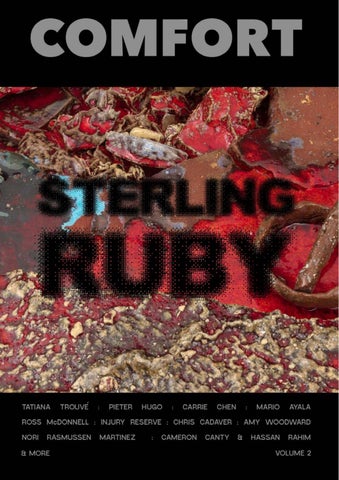
Sakura Bready : Caje Covaire : Matia Emsellem: Anna Kato : Allie Miks : Helen Reavy : Sterling Ruby : Mamie Green : Shaye Fear : Tatiana Trouve : Carla Acevedo Yates : Mario Ayala : Cameron Canty :
Hassan
Rahim : Carrie Chen : Anthony Trevino : Alex Ceballos : Virginie Pineda : Paul Blanch : Justine Mae Biticon : AJ Wilson : Byron Nickleberry : Amy Woodward : Samuel J Roberts : James Elliot Bailey : Allen Jang : Cameron Morse : Corein Carter : Shawn Kolani : Ivy Sole : Nayquan Shuler : Bobby Cabbagestalk : Gabby Giuliano : Gabby Alas : Reggie Colvin : Jacob Krugmire : Lizzie Armanto : Andre Tarasov : Jiharri Terry : Isabella Rojas : Hiram Trejo : Jess Cuevas : Quintana Hoyne : Kat James : Adrian Lopez : Kevin Acevedo : Alia Ssemakula : Tiana Amani : Nicole Bueno : Ricky Asa : Chiki Uno : Christian Hicks : Norrel Blair : Matthew Schroeder : Bruno Ceci : Marco Aurelio Mendia :
Donovan Novotny :
Chris Cadaver : Keith Charles : Nina Carelli : Ant Bright : Destiny Moore : Shelby Macklin : Theresa Kusumadjaja : Sam Abell : Nori Rasmussen Martinez : Pieter Hugo : Stacy Hardy : Injury Reserve : Ross McDonnell
www.comfortmagazine.world @comfortmagazine
Creative & Editorial Director Yudo Kurita Editor-in-Chief Robert LeBlanc Beauty Editor at Large Sara Tagaloa Associate Editors Morian Thomas Nicholas Amato Contributing Fashion Editor Shaojun Chen Logo Design Lucas Grassmay
COMFORT is & always will be FREE.
INDEX
27
110
124
138
200
220
238
308
324
332
404
420
442
60
96
84
168
178
190
242
280
292
342
360
384
472
496
516
BASIN TH
HEOLOGY
La Brea 2
CRL-40.941 NOMAD
CHC
CRYPTOCRYTALLINE
Celebrex + Vioxx
MAFIC
STYX BOAT
Celebrex + Vioxx
STRESS REEF
HELIOS BOAT
Logistical Nightmare
Talwin + Ritalin
Camp Karl Holton
La Brea 3
SACRUM SACRAL
Thebaine
ERTA ALE
MAFIC
HELIOS BOAT
MADAME PELE
PASADENA
Photography: Yudo Kurita Styling: Shaojun Chen Make Up: Sara Tagaloa (using GUCCI Beauty) Assisted by: Anna Kato Hair: Helen Reavey (using ACT + ACRE) Assisted by: Matia Emsellem Art Direction: Sakura Bready Featuring: Caje Covaire Allie Miks Mamie Green Shaye Fear all clothing SR STUDIO LA CA
The Residents 2021 Installation view Orford Ness, Suffolk, England Commissioned and produced by Artangel. Presented by Artangel in partnership with the National Trust
Tatiana Trouvé
THE RESIDENTS in conversation with
CARLA ACEVEDO YATES
Photo: © Francesco Russo. Courtesy of Gagosian. Portrait: © Alastair Miller. Courtesy of Gagosian. © Tatiana Trouvé ADAGP Paris 2022
Carla Aceveedo Yates Let’s start at the beginning. How did this project come to your attention? Can you talk about your process, the research and thinking that led to The Residents? Tatiana Trouvé This project was born in a very particular way, because I could discover the place only at the time of the installation. This situation, linked to the health crisis, was very singular and new for me. Generally, my ideas or intuitions find their source in a relationship with the place. My first visit to Orford Ness was the day I was installing my work. I began to work with photographic and film documents and stories that James Lingwood brought back to me as we talked and developed the project. It was also a path strewn with constraints, because this place, under the guardianship of the National Trust, is both a nature reserve and an archaeological site frequented by scientists. In short, in this landscape which seems to come straight out of a Tarkovski film, one cannot move the slightest stone, the slightest piece of rusty iron, not even drive a nail or walk outside the marked paths in order to preserve the delicate ecosystem which has developed there since the departure of man. A whole fragile and abundant plant, animal and bacterial life, in the middle of this mineral and maritime environment, has taken its rights. This was the starting point of my project. CAY Did you choose the Lab for your installation ? What is it about that particular space at Orford Ness that was of interest to you ? TT I chose this space for all that it has lost and gained over time. Lab 1 was intended for testing with a large 3 meter deep tank that runs laterally through the entire space, much
like a small pool with two lines. Over time, the roof collapsed, insulation materials such as cork fell into the tank. Over the years, rainwater filled the pool to the brim, partially flooding the ground. The vegetation has settled on the cork sheets and floats according to the seasons, creating like reinvented archipelagos. On this artificial/natural pond tiny creatures live in the water. The organization of this universe gave rise to a most disconcerting reality, where several worlds intertwine and coexist, actually quite close to my drawings. I was literally captured. CAY Can you talk about some of the sculptural elements that you created in the space? For example, the gate that visitors first encounter? TT For the reasons I just mentioned, but also for practical reasons associated with public safety, Lab 1, where I was working, could not be accessed. A guardrail was needed. It would have been imposed if I had not proposed it myself. This element was particularly important, since it was the first thing you would see when approaching. So I thought of the Stickcharts, that wonderful navigation system from the Marshall Islands made from wooden sticks and shells. It found its place in this environment, in an echo between the Marshall Islands and Orford Ness Island, all of which were subject to military secrecy and bomb testing and experimentation, to evils whose consequences are not yet known. But this system also produced a navigational map for the installation, a point of departure given to the visitor that directed a movement of his gaze and a shift of his imagination. The shells indicated the position of the works in the space and the bamboo rods the different possible routes. The territory of Lab 1 became as if mapped by
my installation. CAY Orford Ness is an enigmatic place, inhabited by odd concrete structures and discarded materials abound. It seems like the ideal place for an aspect of your work that you have described as “a fossilized narrative.” How has place informed the development of this installation? What does the mystery surround the site, and what potentially occurred there, bring to the work? TT I think that a breath has, little by little, subtly reshaped this place: the wind has sculpted the dunes, eroded the concrete of the bunkers and the rain has created water reserves inside laboratories whose ceilings have been washed away. The site has become a work of inverted land art, since this proposal is not associated with the gesture of a man in the landscape, but with the work of the elements on a landscape that bears the trace of the gestures of men and the tragic events that took place there. My installation evokes this departure of men, but also projects the life of a past community of which we know little, since it seems at the same time archaic and contemporary, in dialogue with the nature which surrounds it and which grows through the sculptures, pierced aluminum covers bearing the patterns of marine cells or diagrams of drops of water. CAY Many of the sculptural elements in The Residents reference previous works of yours, such as the shoe or the blankets. I have always been interested in the archival aspect of your work – how your sculptures become themselves a type of archive of your own practice. Can you talk about your interest and engagement with the archive in relation to your work, as an accumulation of your life
and artistic practice, but also of time and memory? TT There are certain objects that I use very often in my installations and sculptures, cushions, blankets, mattresses, shoes, cardboard boxes, radios... These are generic objects of ordinary life, simple and that testify to a modest way of inhabiting places. I don’t believe that their circulation in my work refers to a desire for an archive, but to the presence and the indices of these modest lives. Then, that these clues circulate from one place to another within my work, that is, that they have also come to inhabit my sculptures, installations and drawings, is true. And perhaps they have become the inhabitants of my works. CAY In your project in upstate New York, Between sky and earth, the unexpected encounter with your sculptures seems important to their interpretation and continued existence as an evolving narrative. The Residents, however, denies complete physical access to the viewer. You can’t really get close to the works and there is a privileged point of view. What does this physical distance afford to public sculpture and, considering the history of the site, who is your ideal viewer? What are you hoping viewers take away from the work? TT At Orford Ness, the distance from the viewer was a given imposed by the place that I made my own, by integrating it into my proposal. This distance allowed me to develop a vision close to the drawing with the installation. But I do not conceive of an ideal spectator. And I don’t think about developing a point of view either. I try to leave things open to a form of disorientation and a
possibility of navigation. I am more sensitive to the physical and mental floating that the works can produce, even for the drawings, than to a position from which one should see or understand them in a certain way. It is by changing our points of reference that we can discover or rediscover things differently. CAY Still, some viewers might not discern or identify some of your sculptures as artworks, but instead elements that are part of the environment of the site. It seems they are meant to be apprehended as if they have always been there, traces of human activity. Can you speak to that potential experience ? TT I don’t think there is any ambiguity. You can see that the hanging jacket is made of stone, that the radio is made of bronze and that the books are made of stone. Everything is transformed materially and plastically. Even if the modus operandi of these sculptures plays on subtle differences that can confuse the visitor’s perceptions, there is no possible mistake about the nature of what we see. But it seems to me that the fact of apprehending my sculptures, not as artifacts, but as remains of human activity, says something else. It is that the environment as a whole has been transformed and that the transformations that my interventions bring about are integrated into it and participate in this coherence.
CAY Nature seems to be an important, and rather uncontrollable, material in The Residents. How do you imagine the materiality of the work evolving over time? TT As it ages, concrete crumbles, moss and stains cover it, but it also carries new life: organisms live in it, come to inhabit it, it enters new cycles. But at Orford Ness these cycles seem to accelerate, because the alterations of the elements are more violent. It is an anti-white cube, the nightmare of every conservative. I think that this intensity guides the way we look at things when we are in these places and we project the altered states of what we see there all the more. However, these works were only temporarily exhibited there and will only have known these conditions for the time of an encounter.
On June 8th 2022 Tatiana will be opening two new shows in Paris: 1. An immersive installation at Centre Pompidou. 2. A feature of complimentary works to run adjacent to the installation at Centre Pompidou at Gagosian’s newest Parisian gallery at rue de Castiglione.
MARIO AYALA A native to Los Angeles , Mario’s work focuses on airbrush paintings that draw from the city’s car culture. Beyond painting he works in sculpture to help in creating his personal narrative and vision while exhibiting. Ayala finds particular inspiration in the materials of his culture, championing California’s vernacular styles.
portraits by Yudo Kurita
Untitled 2021 Acrylic on canvas 60” x 48” < Earth Angel 2020 Acrylic on Canvas 88” x 68”
Gangster Soul Harmony 2021 Acrylic on Canvas 62” x 72”
Sundancer 2022 Acrylic on Canvas 72” x 68”
Classic Tow Service 2020 Acrylic on panel 16” x 20” > Reunion 2021 Acrylic on Canvas 88” x 68”
CAMERO IN CONVERSATION with HASSAN RAHIM
CANTY
portraits by Allen Jiang
RON
HR: I just wanted to start with a few questions about your origins. Where are you from and how did you get to New York? CC: I’m from Allen, Texas. It’s a small town, like 30 minutes outside of Dallas. I moved to New York in 2018, two years after I graduated high school. While living in Allen I was working at Apple at the time and one of the things that I heard when I first got there was how supportive they are of people’s lives outside of Apple and how common it is for people to literally transfer anywhere in the world, as long as there’s an Apple store they’ll get you there. So I had this crazy idea of going to New York, being closer to street wear and the leaders of that world. I had that idea and was delusional enough to believe that it could happen. Like I’m going to move there and work with Supreme and Noah. So I moved there with like $3k to my name and got a room, a shoe box room, from my friend which was like $1k a month and started trying to meet people. HR: Were you already making graphics at this point? Can you remember what the first piece of design work you ever made was? CC: The first one I made was at home back in Texas and it was like this crystal ball graphic. It literally was the first thing I made on Photoshop. I was trying out all these different tricks. I was so new to Photoshop, like Googling how to crop, how to move, how to use the transform feature….. HR: Like YouTube tutorials? CC: Yeah exactly. So I made that graphic and printed it on some shirts, like less than 10 shirts I think and I started DMing it to all these people that I looked up to. HR: What year was this? CC: This was 2017. HR: Was this the shirt that had a kind of pharmaceutical aesthetic? CC: No that was the third one I that I made. HR: Okay sick because that was the one that I saw when I first found you. What even got you into design? Like what lured you
into it? For me it was skateboarding, I grew up skateboarding. All my friends were kind of knuckleheads. It was keeping me outta trouble but I wasn’t extremely good at skating. All my friends were really into Baker, like Andrew Reynolds and all those dudes. They were skating like 20 stair handrails. I just wanted to skate flat and ledges essentially. But I remember just being more attracted to the art and the graphics and the music and the lifestyle and how these videos were made, how they were edited, how the magazines were designed, how the boards looked…you know. The athletic side of it. So I naturally got into graphics from skateboarding. But how did you get into it? CC: I guess with an ode to Virgil it was being a tourist from the outside of the skate world. I always admired it and had a deep appreciation for skate culture. The art that came out of it was huge inspiration. I had friends that skated and I was just obsessed with their style, the way they dressed, the shoes, the designs. I wanted to skate, but I also knew that I didn’t have the heart to pick it up and get good at it. So I saw design as a way for me to infiltrate and for awhile it was just my way to see if I could earn the respect of the people in that community. That was just my world at the time, a lot of people in my neighborhood growing up skated. I saw it all and just wondered if I could making something as good as Supreme or FA, something that my friends would appreciate. So I guess yeah what really inspired me the most was Supreme, as cliche as that sounds. But nobody was making graphics like them, you know, and they really made it feel like it was achievable. So many of their graphics were re-purposed and re-contextualized images. It was very inviting to me as opposed to seeing something that is clearly illustrated. HR: For sure like the art school guy that does super hand done graphics sets a really high barrier for entry, like a stylistic thing that you obviously can’t achieve without the means. But with Supreme it was the vibe and the energy that made it. A lot of it, like you’re saying, is referential to cultural moments. So everything ,in a lot of ways, with Supreme stuff is a reference. I thought that was cool because it felt like something we can all appreciate and relate to. CC: Exactly. HR: So in a lot of ways it was skateboarding for both of us. CC: Yeah…but you were more involved than I was.
was able to start experimenting with mixing them and seeing how I could achieve new textures and new things hidden behind the tools. Which led me to keep learning. Like how certain images just have their own characteristics and you’ll just naturally get a certain texture just from the image on its own. When I realized that I was able to start really leaning into that and making more things based off that realization. Just learning to work with what you got you know? HR: Compositional harmony and stuff like that….So you now understand all these things the nuances of textures, juxtaposition of images, iconography, color theory, etc. But can you tell me more about that starting phase of trial and error? Like at what point did you get a understanding of all the tools and where did that put you?
HR: But in ways it was the same thing. It wasn’t like I was thinking I would try to go pro. It was about the community, the lifestyle, and the good times that skateboarding brought us. But I think that Supreme is a really good reference. I didn’t really have access to Supreme at the time, I was more so into like Girl and Chocolate. Supreme was maybe less of a skate company then. It was like really expensive. Mostly I knew it for being like huge in Japan, but we didn’t have it anywhere around here. But it was definitely rad to go on the website and see Slick Rick videos or the Raekwon and Ghost Face shit. So another thing is that neither of us went to design school. Tell me about tutorials (laughs) CC: YouTube, YouTube, YouTube (laughing) HR: Tell me about trial and error (laughs) CC: Oh my gosh. I’m still in it. But from the start I think the biggest challenge was learning the basics. You actually talked about this in another interview said something like when you’re first learning the tools that’s the struggle. Then eventually you get to a place where you learn them. Once you have learned them then the interesting part comes….like you said it’s like using a hammer, you can use it for its literal purpose or you can use it to carve glass. So really I took about a year of learning basics then
CC: Maybe like early 2020 it started to click. I was just learning by reference at that point. Like trying to remake pre-existing graphics to figure out how they did it. I would try to not ask anyone for help or anything, I reached out to you once and you gave me some advice which I will always appreciate. I was just super determined to figure it out just using Google and YouTube. So when I learned something new I would blend it with something I already knew to see what I could get out of it. Just messing with thresholds and stuff like that. That was a big way for me to continue teaching myself….like build a tool box of techniques and build from that. HR: That’s the best thing…like you see something and you’re like, how did they achieve this? You see a texture or a technique and you’re trying to figure it out. Because often the sort of high barrier entry stuff that as a computer first designer you aren’t really working on. Like I’m not gonna draw the entire tiger, scan it, color it, etc…..you know not like a “traditional artist”, but instead you’re teaching yourself through trial and error. That process showed me that a lot of this stuff is totally achievable in computer. You know like, combining different grains, gradient maps, all those things kind of add up. Eventually you can make things that don’t look like they were created by a computer. You know? CC: Totally…I always tell my friends Photoshop is like a universe. You can constantly be exploring and there’s always different techniques, which in a way you could equate to life in general. The updates feel so minor but maybe two years you notice something
and it becomes something you’re using on a regular basis. HR: Exactly. I mean I still learning so much. I watch these kids on TikTok doing tutorials now and I find things I have missing this whole time. Which makes me think about this process for you and how you kind of design by learning, in ways creating your own tutorials. It reminds me of this quote from Ira Glass: “ Nobody tells this to people who are beginners. And I really wish somebody had told this to me, all of us who do creative work, who get into it because we have good taste. There is this gap for the first couple years that you’re making stuff. What you’re making isn’t so good. It’s not that great. It’s trying to be good. It has ambition to be good, but it’s not that good. But your taste, the thing that got you into the game is still killer. And your taste is good enough that you can tell that what you’re making is kind of a disappointment to you. So a lot of people never get past that phase and they quit. …. Everybody I know who does interesting creative work went through years where they had really good taste and they could tell that what they were making wasn’t as good as what they wanted it to be. They knew it fell short and everybody goes through that. If you’re just starting out or you’re still in this space, you gotta know it’s normal. The most important thing you can do is do a lot of work, do a huge volume of work, put yourself on a deadline so that every week or every month, you know you’re going to finish one piece or one story. It’s only by going through a volume of work that you’ll be able to catch up and close that gap. And the work you’re making will be as good
as your ambitions. I took longer to figure out how to do this than anyone I’ve ever met. It takes a while. It’s gonna take you a while. It’s normal to take a while. You just have to fight your way through that.” Growing up on the internet I was exposed to so much shit. I came in just a little bit before Tumblr and we were using FFFFOUND, which later on my buddy Justin named JJJJOUND after. Then came Tumblr and MySpace, which I was using a lot. Just being bombarded with references. I was really drawn towards watching Palm Pictures, Chris Cunningham and Spike Jones dvd’s, Girl and Chocolate videos, that kind of thing when I was like 15. These things really inspired me and made we want to make things of that nature. At that time I think I was actually making pretty good work but then I had to get a job. I worked at a magazine and a street wear brand, which actually made my gap grow bigger. I wasn’t able to be insular and discover my thing. So eventually my gap closed at like 29. That process showed me how much I hated corporate politics, which made me lean into my art practice over my design practice. That closed the gap for me. I’m really curious about your gap, where you’re at and how you’re feeling about the process you’ve been making. CC: I appreciate you sharing that, because from the outside I would have assumed you’ve had this level of success forever. I think we need to hear things like this to really understand what “success” takes. For me currently I see my gap in typography. For awhile I just didn’t like putting type in my work. It felt like I had to make fake context for images….it just felt
so corny. So I just continued focusing on my photo treatment and collage skills, the things that originally inspired me to get into design. It feels like there are designers that are good at one or the other. I want to get good enough at it that it compliments my work. I don’t feel the need to become a master like Eric Hu or something, but I want it to be good enough to compliment my graphics and treatments properly. I realized that just having good photo treatments and graphics is like having a good beat with no vocals. HR: Right you want to give them the full song.
(Both laugh) I personally won’t use it anymore….oh actually I use it sometimes. I just used for this Kendrick live thing. Like some Vegas thing. There’s some Old English in there. CC: Yeah I saw that, that was sick. HR: Thanks yeah I pulled it out the bag for that one. I took it mostly off my site I just use the compact bold one now. But can you tell me more about what you’re trying to convey with your work?
HR: I hear you. I will say that I think image making is crucial when it comes to world building. Sometimes designers who are very focused purely design can miss that. But at the same time you see people who aren’t so good at it bringing in type and it devalues the image. So I guess honing both skills parallel is important, but so hard.
CC: If you had asked me a few months ago when I was working on that series of images that look like they were scanned in I would tell you that I really wanna recreate that look of ephemera, like things that have a little bit more of a story to it. That series was about creating things that looked like items you would find in a vintage shop or your grandmother’s basement. I added some illustration and graffiti to add depth to them, like maybe you found it after someone had scribbled or drawn on it.
You know too type is just words. You need to have good words to work with….you can’t just throw any rapper on your beat. I go in and out with type sometimes I really feel like we don’t need it at all…but….
But I hit a point where I couldn’t expand on that idea the way I wanted to. Now I just want to create work that has something for everybody. I want to show people that I can do that too.
CC: Your choice of fonts just works though. So I think that saves you, or anyone. People don’t care if you spent hours creating it in illustrator.
I think about Tyler the Creator or Kendrick, artists that are always challenging themselves within their genre…trying to expand what it means to be a “rapper.” Like Kendrick has said he wants to be able to make an album that’s jazz or funk inspired or a classic hip-hop album…now I think he’s working on a rock album…I love that. I like the idea of being able to make a whimsical playful graphic and turn around and make something dark as fuck. I want different types of artists to see themselves in my work.
CC: Exactly.
HR: No one cares how long it took. I gotta say I’ve seen people do amazing work and it looks like it’s incredible. But then I go in and notice things like it’s not symmetrical. I see these things and can be impressed but to a non-designer it might just look busy. I think iconography is really what I try to be good at, that’s the focus I really want. The idea of being iconic or not being able to pinpoint when it’s from. That’s why I use certain typefaces because they’re classics. I don’t use all that new shit that just dropped. I want this to feel like forever not 2020 specific. CC: Exactly. I mean you can’t go wrong with something like Old English, like Old English is always going to be that bitch, I don’t care. Old English will always elevate a hard ass graphic. HR: It will, but I’ve seen people fucking abuse that.
HR: You want range. You don’t want to be in a box. You want to be able to be versatile. You want people to see something and know it’s yours. But it doesn’t have to be a graphic. It doesn’t have to be because of the colors. It doesn’t have to be because of the certain type you’re using or the hand style. You want that authorship so when people see your work they know Cam made it. Just like how you hear a Pharrell beat, regardless of what he is using, you know it’s his. Peter Seville is probably one of the legends when it comes to that for me. I want to be Bo Jackson. I wanna play all the sports, I wanna be a triathlete. I don’t
want to just do the fucking 5k or whatever I want to do all this shit. I want to be a Navy seal, you know. I’ve had the chance to direct film a bit on top of the graphic and type work…as you sharpen all your skills it kind of unifies into this sort of global vision for your work and how your create in general. So I agree that range and versatility is more important than being locked into a specific style. I mean yes, people who do lock themselves in probably are more successful because it’s easy to digest clients understand it. But it’s like what’s that meme…?
HR: (Laughs) That’s what I really gotta do. That’s kind of like my M.O. I want people constantly being surprised by what I make. I guess that’s a goal for both of us. You don’t really know what the next thing could be, but you’re going to figure it out and it’s gonna be yours. CC: Exactly, exactly. Is there anything that you think someone would find surprising that is inspiring you right now that comes from outside of design? HR: I don’t know if it would surprise anyone to hear this but I listen to a lot of music, I have my NTS show and I work within music a lot. But I don’t listen to music when I’m making work anymore. I listen to like brain FM, which is just this ambient sort of focused science backed sound frequencies that are helpful for your creativity or focus or to just like accomplish a task. I really just try to make it more meditative. I try to get into this flow state where I’m not dependent on anything. I just have my bottle of water and Brain FM, or silence, and I try to just put myself in a vacuum. It really forces you to look at your own thoughts. Just like opening a blank file 14 x 14. No mood board or direction or references. It’s a really interesting exercise. Another interesting exercise is just making a folder with 10 images you like and make a collage with them, no preset ideas. That’s been more inspiring to me because you start to realize your own idiosyncrasies as a person. There was a moment where I realized I was using hands in like everything. So now I’m like, oh hands are important. What does that mean? Let me talk to my therapist about that (laughs) But you start to catch onto these things that…you know…umm
CC: That have some sort of subconscious meaning? HR: Yeah or even it doesn’t have a meaning you’re learning more about yourself. That’s been really inspiring for me. Another thing too, not so surprising, but I like to go for a drive. If I have a creative block I’ll just go for a drive and play music, it’s like a think tank for me. It might not be a specific creative ideation but more so higher level conceptual thought. Connecting things together and having epiphanies. That’s kind of been my inspo currently. How about you? CC: Those who know me would say it’s not a surprise but photography and music…I’m really inspired by artist creative journey. Just any artist that is constantly pushing themselves. Like people wanting to reinvent themselves and being okay with people not accepting it. For example Yeezus is my favorite Kanye album, because of the time it came out and that he just stayed true to himself artistically and how he felt in that moment. So that mentality really inspires me. Like for example, the series I just did was going well. I was getting more followers, engagement etc. but it’s important for me to continue to do something that challenges me. HR: Yeah yeah CC: Is there any pieces of art that you wish you created? HR: It’s funny because I used to think like that a lot. But I realized it was much healthier for me to not think like that anymore. I also had moments of getting sucked into Instagram like you said and when you’re at a low point comparison is the devil…and getting sucked into the algorithm really shows that. I had to remind myself that I was looking at the highlight reel. 2018 was a particularly hard year, mainly due to personal stuff, but with work I was really burnt out and I hadn’t adapted the skill of saying “no” yet. So with that I really had to shift my thinking away from comparison. Instead being able to feel happy for the other person and keep pushing for myself. For awhile I couldn’t even look at other work (laughs), but now I can and genuinely be happy for people. I’m more confident with where I’m at. But with that aside what do I really wish I made….
CC: It can even be like a childhood thing. Like you posted your favorite album cover the other day I assumed that would be your answer (laughs.) HR: I mean the Cybertron clear is perfect. But I don’t think I have the desire to have created it, I just want to like buy it and put it on my wall. Even with that there’s like this hint of jealously which is something I really had to work past. I guess it would have to be stuff that is by hand. Like painting or airbrush work, I wish I could bring that into my stuff. Like and amazing airbrush artist is Pater Sato, a Japanese airbrush artist, he has a really amazing book with Parco. CC: Oh yeah its hot…no other way to describe it than sexy. HR: Shit I’m trying to find this fucking book….can you hear me?….I have this Japanese airbrush book….I’m not gonna find it. I wish I could do that stuff. If I was able to it would bring this whole other level of photo realism to my shit. I also would love to be doing motion. The gap for that is pretty big….I mean I could take a couple nice weekends and learn…but like your boys 35 you know (laughs) I’m gonna have to get really shitty before I get good (laughs.) CC: (Laughs) Whenever I think about exploring new mediums I gotta decipher how much time it’s gonna take and if I have that in me. Like I love music, but not enough to try and learn how to write songs. HR: Yeah I’m not gonna go buy a synthesizer. You gotta get that 10,000 hours. That’s really what it comes down to. Damn! Okay! Jack Goldstein! I wish I made the paintings he made. They were so surreal and psychedelic. A lot of them had this crazy element of the sky, like aerial phenomena, space and thermal looking nebulas. I think they have one at LACMA…. wait no it’s at the Broad now I guess it’s Eli Broad’s painting he took it with him (laughs.) I just texted it to you. CC: Oh yeah this is crazy. HR: When you zoom in you’ll realize it’s all poster. It looks like it’s all gradient and blended, but it’s not, every layer is a different color. It’s a different shade of blue into blue, darker blue into purple, into dark-
er purple into black. It’s super sick it’s fire. It’s like topographic, I guess is the word. But Jack Goldstein paintings are something I wish I could do. You know, It feels like graphic. It’s not painterly in the sense of the word. I’m really attracted to that. How about you? CC: For me it’s Sampha’s Timmy’s Prayer single cover. That shit is fucking perfect. Just that little laser beam in the middle. I love when people kill simplicity. I love that shit. HR: I see it now. This is actually a really nice cover. That little nuance. You’re like, what is this detail? Is this, is that supposed to be there? What is that line? Why is it glowing? What does it mean? It presents all these questions that you don’t necessarily have the answer to. It actually makes you use your imagination, you know? That’s what the best work does. It genuinely pulls you in and makes you use your imagination as to why everything is what it is. I think the work that we were talking about earlier, where it’s very busy, it looks like it took forever. A lot of that work doesn’t really do that. It also leaves less to the imagination when it’s so cool and dense and full of different details. But this is a great example of simplicity. I like that this is the one thing you wish you made. CC: It’s so fucking good. For you how do you overcome fighting and internalizing perfectionism? HR: Brooooo (both laugh) You know what? I’m still doing that. I have to let go. I had to be more pragmatic. I think that I started giving myself these standards, this bar, the bar kept getting higher. So you couldn’t actually track your own progress because you just keep raising the bar on yourself. Like I said in like 2018, it was really hard. I kind of got burnt out. I was dealing with like severe burnouts, because of the amount of pressure I would put on myself for every little thing. Like every decision had to have a reason and that’s also like some sort of neurosis, ADHD, OCD shit. Like why would I use red? What’s the theory? And I found myself overthinking over conceptualizing. So all my work has that layer to it though. But eventually I was like OK you’re allowed to just use fucking red dude. So I don’t gotta conceptualize using red. I wouldn’t just run a black and white photo, people think I just in-
vert pictures. That’s not it. They’re solarized so if you invert it back, it’s not really the same picture. It’s still got some inversions in it. They’re just hidden things that didn’t matter, really. There’s a certain pragmatism that comes with realizing that you are making design and not art….professionally speaking…I think all work is personal work and I always say that. But at the end of the day, when you’re working for others and you’re not making it for yourself, those details gotta go. Like I noticed it’s nice to leave easter eggs in stuff… there’s ones in the art works for NIN, and Manson, and Jaques Green. But it got to a point where that stuff was holding me back from delivering. So I have to get a head of myself and if I’m not, because I can
procrastinate so much, I gotta let myself get out of the way so I’m not effecting their roll-outs or stunting my own growth. CC: Yeah so insane dude. I feel like that’s what’s kept me from being more prolific. That’s my biggest goal this year, I wanna become a more prolific artist and just get shit out. Since the majority of my work is personal it’s easier for me to spend too much time on it. HR: I have a good friend named Alan You that did this experiment every day for two years he made a poster. It could have been scribbles, it could have type anything, but he’d make a poster every day. After the two years you could see how much better his work had become.
But it’s about giving yourself that volume like forcing yourself to create through volume, as Ira Glass said “ through volume you’re able to figure it out.” You’ll let go of being a perfectionist because you’re gonna enter what I call the flow state. Everything is just gonna be like when Neo eventually realizes that he’s the one, you know, you’re like blocking bullets, and you’re not even thinking about it. It’s just second nature. All those little details, all those refinements and things you overthink will just happen, it’s just second nature. It’s funny Bill Gate’s had this TED talk and in it he said “if you ever want to find the most efficient way as a business owner to get some, a specific thing done, hire the late person.” That’s kinda me. Like for the 8 hour day, I’ll fuck off for 7, and in the last hour I’ll do everything. I’ll figure it out and be like “shit I just did 8 hours of work in an hour.” CC: Yeah I get that. Something I was thinking about too is that like the biggest loss that a lot of self-taught designers lose from not going to school is community. Having like minded people that are also on the same journey as you. People you confide in and, you encourage each other. Cause a lot of my friends don’t design and like the ones that do design that’s their life…so they don’t want to talk about it when they’re not working on shit. So having these conversations are really important…like seeing through it all and feeling solidarity in the fact that no matter what stage you’re at you’re going through the same shit to an extent. HR: Totally. I mean, dude. Toms Sachs was doing some interview on you YouTube…they asked him what advice do you have for young artists? And he was like “be good at what you’re doing.” He had gotten fired from a construction job of some sort and had to take a job as a janitor. While he was there he realized he can either spend eight hours resenting it or make that place shine. Eventually that same place bought sculptures from him. I think this was important to me when I see myself getting stuck on all these little things. Also for young people I have come and intern something to pay attention to. Like a lot of them don’t want to clean up Dropbox files, or pick up paper, or make tech packs they just want to be a creative director with no work put it. Like we all were the janitor at one point. CC: Damn that’s a good one to end on. But I do have one more for you.
HR: I have one more too…but you go first. (Laughs) CC: When you leave this planet and go where everyone else goes, wherever that is, what would you ultimately like to be remembered as an artist? HR: I don’t want to be remembered as an artist. I want to be remembered as a human. The sort of illustrious obituary….I don’t really care. I want to be remembered by all the people that knew me as a person and knew that I had their back and that I was there for them and by how much I might have touched them or inspired them or helped them figure things out and supported them. Like the work shit I don’t really care it doesn’t matter that shit don’t go to the grave with you. CC: That reminded me of Virgil. I didn’t realize how kind of a person this man was until he died. His kindness overshadowed his work. Ultimately that’s what mattered more, or just as much, as his creative legacy. HR: He was always the good guy. All respect to Virgil. He touched a lot of people. Like one text from this guy was all you needed. He started an unimaginable amount of brands or companies or projects just based off those motivational words. Like even with that you would hear people saying like “how much stuff did he design.” That was always a conversation. He responded to that in one of his lectures he’s like “People say that I’m not a designer, like rather than answer that question, hold that question and ask yourself what is a design? What does that mean? Like, how am I not a designer?” And I think that he questioned… CC: Everything. HR: Everything. Its very fucking clear what his role was now that he’s gone unfortunately, he had the brain an absolute enigma. But I think that more importantly he was a motivator and a good guy. It’s so nice that you thought of him when I said that as a response. I hope that’s how I can be remembered with respect from the people that really knew me. What about you? CC: Ultimately to inspire people that look like me and that are also part of the LGBTQ community, Black Queer people especially, maybe I can help make them feel comfortable and confident in these industries. But yeah, honestly just inspire people to create good things, regardless of where they’re from.
CARRIE
Drawing from a background in Psychology and Art History, Chen takes a phe-
phantasms caught in the lifespan and container of their simulations.
cess of remembering. Chen considers them to be surrogates of experience,
ality. Inside of these mediums she creates digital entities inspired by the pro-
memory. Her work currently focuses on simulation, projection, and virtual re-
nomenological approach to investigating sublime experiences, nature and
CHEN
GLORYLAND
by Robert LeBlanc
West Virginia and the Appalachian Mountains have an allure about them that is almost impossible to ignore. The country is rugged and so are the individuals who inhabit these mountains. As you ascend into the deep mountain of Appalachia, the roads begin to wind almost unimaginably. As you drive, sharp left and right turns seem to never end as Empress trees and Black Pines hug the roads like guardians of a passageway. Large metal structures from coal mines stand like old ruins. As you continue to drive deeper and deeper within the mountains, small towns start to pop up, not more than 1/2 mile in length alongside Route 16. For every ten homes, there seems to be a church, affirming that the presence of religion is strong and deeply rooted in these mountains. A small church by the name “The House of The Lord Jesus” sits on the side of the road in the quiet and humble town of Squire, with a population of fewer than 300 people. If you didn’t know any better, you’d think it’s just like all the other churches you pass by while driving up the windy mountain roads. This Holiness church practices what is called “signs following.” The church is small and is run by pastor Chris Wolford. Twelve church pews (six on each side) take up the majority of the space. Old wood panels cover the walls, and red burgundy carpet melds with a wood floor at the front of the church. As you walk down the center of the church, you see women lying on their knees bent over the pews praying and crying before the service begins. The sound of rattlesnake rattlers fill the air and multiple boxes are laid out behind the pulpit, while the guitar begins to blare over the speakers at full volume. The music is incredible...with a
Welcome
to
GLORYLAND.
mix of delta blues and bluegrass, it’s a style of its own and specific to this type of worship within the applications. Women are spinning in their flowing dresses and their long hair is wrapped up in cloths. Chris grabs a mason jar. Within it is a mixture of water and strychnine poison. Small dixie cups line the front of the pulpit as he fills one and takes a shot. A bottle is brought out, stuffed with alcohol and homemade wick. He lights the top and flames rise above the glass bottle. He screams passionately in praises as he holds the bottle underneath his chin. He eventually passes the lit bottle to his mother as she also holds it under her chin and begins to spin in circles. Chris jumps and dances in a stomping manner and praises the Lord as beads of sweat and tears stream down his head and face. He reaches and grabs one of the wooden boxes from behind him, and flips open the plexiglass lid. He pulls out a diamondback rattlesnake and holds it straight into the air. He jumps around, dances, and screams in praise as the serpent rests in his hand and looks over the church. The energy is so palpable it makes the hair on the back of your neck stand up and the feeling is almost unexplainable. There is death in this, as well as a lot of suffering for the church and this whole region of West Virginia. But I came to understand why the Appalachians have this mystic quality. They’re full of love and compassion...you just have to sift through all the coal dust to find it.
Lighting: Byron Nickleberry
Digital Tech: Aj Wilson
Creative Direction: Sakura Bready
Featuring: Justine Mae Biticon
Make Up: Paul Blanch
Hair: Virginie Pineda
Styling: Alex Ceballos
Photography: Anthony Trevino
ICY
170
jacket DINGYUN ZHANG x AREA
jacket DINGYUN ZHANG x AREA skirt AREA boot PRADA jewelry VITALY
all clothing RUI ZHOU jewelry VITALY
bra JACQUEMUS all other clothing stylists own
AMY WOODWARD
201
After the birth of my first child, I found myself increasingly drawn to documenting the lives and the journeys of other mothers. My own maternity was clouded with postpartum depression, anxiety, an overwhelming sense of loneliness and invisibility - like so many others - and this really drove my desire to dig deeper into the motherhood experience, to see it in all of its multi-faceted and complex nature; to witness the intensity and the beauty of it all. During the early postpartum period I desperately tried to make sense of the unraveling that had occurred within my own identity. I clung onto echoes of my old self whilst trying to move through my own rebirth, scrambling to try and understand what all of this meant for the rest of my life. Almost instantly, I realized the version of motherhood was sold to me was a complete mirage; it was far messier, more intense and more magnificent than I ever could have imagined. Within the confines of the domestic space with a brand new being, the invisibility of motherhood quickly became apparent to me; those unseen rhythms and rituals, the bone-deep exhaustion, the mental load that gets heavier by the minute, and the sense of having your whole identity swallowed up almost overnight - I began to truly understand why honest depictions of motherhood and parenthood are so often excluded from visual media. Mothering feels so enormous, and at times impossibly heavy and all-consuming - yet so full to the brim with moments of incredible joy and an immense kind of love that threatens to take over. That duality, the constant push and pull, the shrinking and expanding of time and the deep, primal rawness of it all is difficult to put into words. When I picked up my camera again after a long break, I was met with a sense of re-balancing and familiarity. I was able to start integrating some of those massive changes I had been through, and to start holding space for the contradictions and tension visually. Witnessing other mothers in an honest way, with reverence and a deep humanness, is a privilege. I am driven to continue exploring motherhood from a diverse range of angles and perspectives, aiming to represent the varied ways in which motherhood can play out along the intersections of gender identity, family structure, race, socioeconomic status, disability, mental health, and other factors that impact this journey. The stories of mothers deserve to be witnessed - and this is what my work is about at its core. Amy Woodward
THE OFFERING
photography: NAYQUAN SHULER featuring: KEITH CHARLES makeup: NINA CARELLI set: ANT BRIGHT floral: Destiny Moore prop: SHELBY MACKLIN production: Theresa Kusumadjaja
Christo and Jeanne - Claude L’Arc de Triomphe, Wrapped by James Elliot Bailey
When I exited the tunnel that passed beneath the roundabout and led up to the base of the Arc, I felt small. The giant towered over me. It was enveloped in a soft-shell of silver fabric and more than a mile of red rope. I’d been there once before, but this experience was instantly different. This time, instead of cold limestone and tradition, I found the structure shining and alive. It moved gently in the sun and breeze of a clear late-afternoon sky. It seemed tranquil high above, but all around its legs the great mass of people that had gathered there were energized with a vivid ardor. They spoke with a happiness you could hear no matter the language used. Maybe they’d found their exhilaration in the presence of the awe-inspiring installation, or drawn from inner praise for the artists’ last achievement, or maybe their excitement came from the understanding that all of this would exist for only two weeks.
L’Arc de Triomphe, Wrapped, was visited by six-million people during its short life. These visitors walked all around and under it. They photographed the Arc and themselves and each other from every angle, including the middle of busy streets. They ran their hands over the silver cloth until large sections were worn down to the blue plastic backing. Children played and rolled around on top of it. Elderly attendees sat and basked in its reflected light as if the piece itself were a sunset. Whenever exhibition staff arrived with new supplies of small square fabric souvenirs, people swarmed with their hands out, as if asking for alms. Some for themselves and some to bring home. Visitors stood close to the Arc. They inspected it and pushed their hands against it and felt for the stone monument underneath, testing to see if it was still there behind the draping textile and binding lines. They considered the Arc’s presence, possibly for the first time, because it was now hidden. Christo and Jeanne-Claude shared a great knowledge. They recognized the importance of scale relating to the human figure, and how their art could create an emotional response that correlated to the size or scope of their efforts. Their work was planned with immense purpose and intent and precision. Their medium was grand additions of common materials and color, but attached to environments where these things were unknown. Every piece was designed to enhance our focus upon what is expected. They achieved this by removing that expectation as a possibility of our view. Of all those who took part in this experience, I won’t believe that any could walk away from it and feel nothing. This notion comes from everything I saw at the Arc, and from the people around me when I left it — how we all continued to turn and look back at it for as long as we could. The following pages will not offer an explanation behind the installation or meaning in its design. I leave that to those with a better knowledge of art and history. I only hope to share with you my photographs and the thoughts that came to me over the three days I spent in the presence of Christo and Jeanne-Claude’s final transitory artwork.
Sept. 30th 2:00pm When something is an expected sight, is it missed more when it’s gone. When something special is encountered that is known to be only temporary, is its experience improved or tarnished by the foreknown impermanence. Can you miss something that’s right in front of you when you know a day will come when it will forever be unreachable. Expectations are integral to a life when anxiety is sought to be managed. Plans against the unknowable future, can only conceivably be made when there are foundations to support them. Foundations that we can expect not to change.
3:30pm Every experience is temporary. The longest that can be known is the span of one’s own life. The emotions we feel come only through what we experience. They cannot come without catalyst. The formation of an emotion that comes not from nature, not by our own actions or missteps, but by the effort of another human being — this is a feeling that should be received with great respect.
Oct. 1st, 10:20am When the future arrives to meet you, it brings with it events that change the world you know. Some alter existence through direct contact, and others through the expectation of that contact one day occurring. Though we understand fully that our world is one of constant and endless change, we still expect certain things to be immune to change — eternal and static. We are taught how wrong this is by our own experience, through the results of the past changes that have occurred to ourselves and to our entire human history. Our history is nothing but the notation of change. And yet we choose not to believe in the impermanence of all things. We continue to be taken by complete surprise when change comes into our path. This is our shared madness. Alone, we are less susceptible to the changes that can occur when we surround ourselves with others. When we are isolated, we have more control. We can choose where we live, how we work, what we eat, when we sleep. We can choose any action we make, again and again and again if we’d like — repetition until death. It is when we choose to let other lives become an essential part of our own, that we lose choice to that of change. When the distance between people closes, change abounds. Other people’s desires influence our own when two lives blend. There is no longer the possibility for the endless same, because people are particular. When any two come together, it is a rare instance to encounter a true and passioned unison of choice. There is generally only power, or compromise. One to want and one to concede.
2:35pm The longer your focus is sustained upon something ugly or plain, the more you can find something beautiful or interesting about it. Is the inverse true with something first considered to be enthralling or of note. How does time relate an emotional response to a person or an experience. Quick encounters with something we love, leave us with a residual feeling that fades as time elapses. If enough time passes, we begin to hunger for more of what we love. We miss it. We do not miss that which we consider ugly. As soon as it’s gone, we feel relief. Our mind moves on. On beauty, our mind lingers.
Oct. 8th 7:17 - back home, in review In a deterministic universe, where change can only occur through causality, where changes from the movements of the weather system to the movements of distant galaxies, are as inconsequential in their relation to each other as they are to that of all existence — there is only one way to assign meaning to these events, observation by a conscious life. A being aware enough to have a reaction to all that happens around it, and one that uses its emotion and its mind to assign significance to all that can change.
Of this world that we are bound to, if we seek its touch, all we can ever do is touch back.
The broad cloth eats any light held by the sky. In the morning, all is cool and blue. When the light is soft, so are the shapes of the fabric. As the sun rises, the Arc feeds on its first visible edge and hard lines begin to form. Midday, the sun is high and the sky is clear, and the fabric’s reflection is clean and white. When the light is all around and at its strongest, so is the arc. Even its shade is bright. The structure begins to rouse with the afternoon wind, breathing and twisting in place. The clouds move with speed to block the sky and the walls shiver while waiting for the light to return. The sun’s angle is now low, in this hour it is beyond any obstruction. It can finally reach deep into the places hidden by the shadow it had made throughout the day. Dusk arrives, and the warmth of gold it brings is grabbed at and held tightly by the cloth. Less and less light is let go as the sun recedes. The fabric wants to keep as much as it can. But the glow of orange soon returns to blue and then to black, and I leave it here.
Cameron Morse
ARTICLE OO1
A Glimpse of SKO photography by ROBERT LeBLANC
words by
COREIN CARTER
In many aspects of her life, Shawn “Sko” Kolani exemplifies the role of a leader. She was born and raised in Los Angeles, California, and currently resides there as a basketball enthusiast, master teacher, and player development coach. Sko began her basketball career at Taft High School in Woodland Hills, where she attended from 2008 to 2012. After graduating from Taft, she continued her basketball career at College of the Canyons, a junior college in Santa Clarita. She went on to earn a Bachelor’s in Exercise Science at Transylvania University in Lexington, Kentucky, where she continued her academic and playing career. Sko took a gap year after graduation to gain clinical hours in order to continue her education and pursue her goal of becoming a physical therapist. Her experiences as a physical therapist tech and coach altered the course of her life, introducing her to the possibilities of coaching and being around basketball. “My heart belonged to basketball. It was what made me want to get up in the morning, what I anticipated, what occupied my thoughts, and ultimately, where I felt most alive.” Her vision eventually led her to the position of Coaching Associate with the Los Angeles Lakers in 2017-2018. Sko’s experience allowed her to assist in on-court player workouts, work as a video coordinator cutting, editing, and gathering clips, run drills for draft workouts, and serve as a member of the coaching staff for the 2018 summer league team. As a result, she decided to start her own player development company. When she first started, she trained for free for about a year, volunteering at camps to learn and assist other trainers/ coaches who needed help. Sko now works with over 40 clients. She is currently the Head Coach of the Glendale Academy High School Boys Basketball Team. Sko made a vow to herself early on as a woman in a male-dominated industry that if she wanted to stay in the industry, she would never box herself in or limit herself as a woman. Her ultimate goal, regardless of gender, was to be the best coach.
“I told myself early on that the only way I was going to make it in this industry was to embrace who I am and not try to be someone or something else. Instead, I concentrated on what I could learn from other coaches, players, and trainers. I immersed myself in the game, worked to improve my social media presence, and tried to help as many people as possible.” The matriarch earned respect in the industry by remaining true to herself. “I made it a point to do my homework and be prepared at all times.” I go above and beyond for my current and former clients. I believe how you make people feel is very important.”
IN THE COMFORT ZONE True comfort, according to Sko, comes from within. The powerhouse coach goes on to say that when she is most aligned, she feels at ease and content, allowing her to be her most authentic self. “Comfort is the ability to be present in the moment. Accepting the situation as it is, working toward the next goal, embracing failure, learning and investing time in growth, remaining curious, asking questions, and being grateful.” Sko believes If you are at ease in your own skin, you are more likely to welcome the teaching moments. For her, comfort is synonymous with vulnerability. “It entails limiting the amount of time spent worrying about what others may think/feel/say. It necessitates inner and outer self-confidence.” When it comes to on-court coaching there must be some level of comfort. According to Sko, it all starts with the way you dress. “It’s definitely true when they say ‘look good, play good.’ Putting on a new workout outfit or pair of shoes brings back memories of how it felt to put on your uniform on game day. The excitement I feel at the start of a game or a session comes from the energy in the gym, which fuels my own energy. It instills confidence in one’s ability to perform.” Sko describes her coaching approach as intense. Helping
her players develop mental/emotional stamina is one of her main priorities. The mindset, which is crucial to success, is second to skill development. “Too often, players focus on their failures rather than celebrating their victories. I can attest to the value of shortterm memory as a former player. In my experience, the mind must work in tandem with the body to be successful in sports. Whether the ball goes in the basket or not, I teach my players to remain confident.” Sko strives to keep her sessions intimate by challenging her players to grow not only as individuals but also as a group. “Creating a family atmosphere where everyone is excited to see one another, where we all look forward to getting better, where we all have a safe space to fail, and where we all cheer for each other’s success as if they were our own,” Sko explains. “This is the pinnacle of luxury, and it’s why sports are so special.”
com·fort /ˈkəmfərt/ 1. A state of physical ease and freedom from pain or constraint. “Room for four people to travel in comfort” 2. The easing or alleviation of a person’s feelings of grief or distress. “A few words of comfort”
DEREK
Quincy
Kaiz
Age: 20
Age: 20
Age: 20
Position: Point Guard
Position: Shooting Guard
Position: Point Guard
Place of Birth: California, USA
Place of Birth: California, USA
Place of Birth: Pasig City, Philippines
CALEB
Kendall
Polina
Age: 21
Age: 18
Age: 22
Position: Guard
Position: Point Guard
Position: Shooting Guard
Place of Birth: California, USA
Place of Birth: California, USA
Place of Birth: Sochi, Russia
AVIEL
Evan
Kahiel
Age: 17
Age: 26
Age: 25
Position: Guard
Position: Guard
Position: Wing
Place of Birth: California, USA
Place of Birth: California, USA
Place of Birth: California, USA
DEFINING COMFORT CARE-FREE On the court, it’s nice to be carefree, but you also need to be locked in. Using a combination of the two will help you stay calm and play better. - Caleb
opponent is twice my size or even better. It makes no difference. I’d still enter the race. Being fearless exemplifies your tenacity as a person. To me, being fearless means not being afraid or being relentless. - Aviel
OPTIMISTIC Optimism refers to a person’s ability to believe in something. No matter what challenges life throws my way, I try to see the bright side of things. I moved to the United States in search of great opportunities. I never knew what that would entail for me, but I’ve always maintained a positive attitude and a positive outlook on my future. - Kaizz
To me, the word fearless evokes a sense of assurance. Being self-assured is a state of mind as well as an action. It’s not being afraid of failure, but rather accepting it as a necessary part of the journey. Being so confident in oneself that nothing anyone says or does can derail you from achieving greatness. Fearlessness means never being satisfied, having an insatiable desire to get what you deserve. - Kendall
To me, the word optimistic signifies a feeling of hope that something will turn out well. When I’m optimistic about something, it means I’m confident that it will produce the desired outcome. In both good and bad situations, I can be optimistic. When confronted with adversity, I consider myself to be a positive person. Being upbeat stems from a positive outlook on life. - Quincy Optimism represents hopefulness and confidence in the future. Optimism can manifest itself in a variety of forms. To me, optimism represents someone who isn’t sure what’s going to happen but is confident that it will go their way. I believe that being optimistic is an excellent way for a person to go about their daily lives and stay positive in a range of situations. - Kahliel MINDFUL Mindfulness, in my opinion, is all about being aware. Being mindful is being aware in all environments, whether on the basketball court or in daily life. Mindfulness entails thinking about yourself while also considering others and ensuring that everyone benefits. - Evan Being mindful is a term to which I strongly relate. Every day, I make an effort to be mindful of what I am doing. Mindfulness is an essential part of my daily life, whether it’s being mindful of what I’m wearing or how I’m feeling that day. It’s not always easy to be mindful but I believe everyone should strive to master it. - Quincy The word mindful evokes images of inner peace for me. To be completely relaxed and confident in my ability to do what I know how to do. It’s the act of observing without passing judgment and returning to a calm state before making any further decisions. On the court, being mindful puts me in a locked-in state. Being so focused on the task at hand that everything else fades away. Being consciously unconscious is a practice. - Kendall FEARLESS Fearlessness characterizes me as a player on the court. To me, being fearless means not being afraid of anyone or anything. I never back down from a challenge, even if the
RESPECT Respect, in my opinion, is equivalent to showing love to your elders. Giving credit to who and where it belongs is what respect entails. Respect is a sign of love and concern for another person or thing. When you love and care for someone, you want to acknowledge what they have done or will do for you. Respect for me also means listening and taking in what others have to say, even if you don’t agree with them. Respect is one of the purest forms of love that can be expressed in the smallest or most significant of ways.- Polina Respect, to me, means admiring someone or something for their qualities, abilities, or accomplishments. I have a great deal of respect for the journey I’m on. All of the hard work and dedication I’ve put into basketball is admirable in my opinion. I enjoy the process and everything that it entails. I trust the process because I respect it. - Derek TRUST Consistent devotion is required to earn trust. Trust takes time for me to develop. It is simple for me to put my trust in the hands of others. I demonstrate to them that they can rely on me in good times and bad. In exchange, I request the same. The faith I have in others is similar to relying on a teammate to make the game-winning shot. To me, trust is earned by never letting me down. - Polina In any relationship, trust is essential. In any endeavor, the ability to trust and rely on others is critical. I want people around me who I can trust and rely on because we live in a world where no one can do everything on their own. Respect, good communication, authenticity, and openness all contribute to trust. I believe that in any environment, having relationships built on mutual trust provides the best opportunity for people to improve. - Evan
TEAMWORK IS THE DREAMWORK When it comes to teamwork on the court, the majority of the players agreed that communication and trust are the most important ingredients. Warming up before a game puts me in the zone - Polina You may miss the right play if you can’t communicate effectively -Derek Be selfless; when you sacrifice yourself for the team, everything works out smoothly - Quincy The connection is crucial because it enhances the game’s flow -Kaiiz It’s all about being yourself on the court and having fun with it when it comes to streetball. It’s all about working together as a family to create bonds that allow us to compete at a higher level - Kendall It’s critical When we all come together to devise a winning strategy - Kendall Working on your game both on and off the court is pivotal, as is the energy we bring to the game - Aviel Trust and chemistry are important because it makes it easier to play when we have faith in each other’s abilities to get the job done - Brennan Coming into your own and being able to give your all for your teammates shows in the growth of one’s profile on and off the court - Khaliel Confidence in yourself and your teammates to make the right play will lead to the ability to give up the ball or take the shot in high-pressure situations. As a coach, you must create a safe environment for your players to make mistakes and ask questions, allowing them to build trust. -Sko
IVY SOLE
How Are You Feeling?
256
1/8
Portrait by Nayquan Shuler
Ivy is a musician & creative theorist. Their work sheds light on the oppressive state and a life lived navigating the constraints of it’s system. Recently Ivy released CANDID, a 14 track full length album accompanied by a narrative podcast & curated digital archive.
How are you feeling? Feeling a bunch of anticipation for the release of my album, looking forward to feeling relieved that it’ll be out of my hands soon. Where is home? I call myself a Philadelphian by way of Charlotte, but most of all, I’m a New Afrikan––a descendant of the continent raised in the imperial core. Where did you first find your love for music? My first love of music was the radio, followed soon thereafter by the blog era of hip hop. Throughout my childhood, music was all-encompassing––piano lessons, school band, my church choir, and of course, watching my mother and father sing at their respective churches. Is there anyone in particular who has inspired you the most throughout your life? I’ve always been inspired by and committed to making music that lent itself well to visual art. Artists like Romare Bearden, Barbara Chase Riboud, and Betye Saar, as well as filmmakers like Julie Dash and Kasi Lemmons, are folks I come back to when my musical inspirations don’t give me a boost. What does utopia look like to you? I’ve always been inspired by and committed to making music that lent itself well to visual art. Artists like Romare Bearden, Barbara Chase Riboud, and Betye Saar, as well as filmmakers like Julie Dash and Kasi Lemmons, are folks I come back to when my musical inspirations don’t give me a boost.
How do you stay sane? I don’t (lol). I think it’s completely natural to feel off kilter in a world designed to kill you. Instead of trying to fight the feeling, I’ve been trying to allow it to help steer me towards a liberatory work ethic that prioritizes both rest and reaching out. Grateful to my friends and comrades who keep me honest in this practice. What does originality look like to you in the 21st century? The transformation of what exists into something new or the combination of inspirations in a way that hasn’t yet existed. I don’t know if I place a high value on originality, but if I had to name a definition, that would be it. I’m more concerned with ideas executed well with positive intentions than making something novel for the sake of novelty. What advice do you have for anyone pursuing music? Figure out what you like and why you’re doing it first, and then remind yourself as often as possible that the answers to these prompts are reason enough for you to pursue them. What makes you uncomfortable? Individualism and overly familiar strangers! Whats next? My second studio album CANDID is set to release February 2nd. In March, a new music video and an experimental podcast will accompany it. After that, I’m hoping to take some time to myself and hopefully by the time I’m ready to tour, the world will be safe enough for me to do so.
BOBBY CABBAGESTALK
How Are You Feeling?
258
2/8
Portrait by Yudo Kurita
After
a
focusing working
stent on
at his
with
YEEZY,
Cabbagestalk
personal brands
brand such
has
and as
moved
freelance FUCKING
and
on
to
practice, AWESOME NIKE.
How are you feeling? Like I’m searching for something, but also like something is searching for me.
How do you stay sane? Very long runs sound-tracked to very old drum’n’bass mixes.
Where is home? Buffalo, NY.
What does originality look like to you in the 21st century? Being able to translate your spirit into something tangible.
Where did you first find your love for design? On a pair of stone washed Tommy Hilfiger jeans when I was 10 years old. Is there anyone in particular who has inspired you the most throughout your life? My mom. She is incredibly smart, versatile, witty, and makes everything look easy. I try each day to be as cool, calm, and collected as her. What does utopia look like to you? Ample time compounded with ample resources.
What advice do you have for anyone pursuing design? Absorb and release on a regular basis. Every answer you’re looking for is on the other side of repetition. What makes you uncomfortable? Airplanes, gossip, and natural wine. Whats next? Dresses.
GABBY GIULIANO
How Are You Feeling?
260
3/8
Portrait by Gabby Alas
One
half
artist,
of
the
Giuliano
catharsis
via
of
inside
calm
duo
Girl
carries her the
work,
Pusher an
Where is home? I live in the valley (oh!) but I’m very proud to say I’m from Bakersfield Where did you first find your love for music? My dad. Music is another language, a means of communication, a motivational tool, a reason to live, the list goes on. But he helped me discover all these meanings. He gave me his collection of vinyl records, encouraged me to play music, took me to shows. One of my favorite memories with him is when i was a teenager, he was late picking me up from soccer practice at a big church and it was late at night and raining. He eventually shows up, i get in the car and The Fragile by NIN was playing. This car was no regular car, it was modded, had a boomin sound system, was low to the ground and had a spoiler, Tokyo drift style. We were doing donuts in the parking lot to The Left. I understood then the mystical bonding powers of a perfect moment accompanied by a perfect soundtrack. He showed me the light, I’ve been chasing it ever since. Is there anyone in particular who has inspired you the most throughout your life? No. I feel like i can find inspiration in a lot of things, not just people, and what I’m inspired by always changes. There are definitely people out there I respect and admire and look up to and maybe have been influenced by, also those i would do anything for. But I think idolizing any one person too much can be dangerous to yourself and so unfair to that person. Not that inspiration and idolization are intertwined, but i think one can precariously become the other. I believe at the end of it all, we are all equal. What does utopia look like to you? A place where people don’t have to live to work and work to live, a place where people don’t have to fight and suffer just for comfort and shelter, but instead can pursue life and travel and happiness.
multi-disciplinary
ideology
finding
relentless
How are you feeling? Haha, people usually know better than to ask me this question and the ones that don’t will learn to refrain.
and
her absurdity
of
finding
own
moments
of
humanity.
How do you stay sane? Haha....I don’t. What does originality look like to you in the 21st century? Originality is not about doing something that has never been done before, but it is about having your own stylistic flare and swagger that bleeds your personality. It’s like making a painting and not having to sign it (on the front— you should sign your paintings) because there is no doubt it was done by your hand, recognizably and undeniably yours. What advice do you have for anyone pursuing music? You have to do it because you love it and you think you make the hardest shit ever. It makes your heart sing (or scream). You will work hours, days, just on one song that might not even be a minute long, but because that’s what it takes. If you cringe and get frustrated at what you make you’ll only learn to hate it. Why is it cringe? How can you make it better? Take the time to make what YOU think is the sickest shit ever. Build. Enjoy the ride. Send your demos to people you know won’t kiss your ass, but give you honest feedback. Take breaks and go back to it. Anyone can do it you just can’t self sabotage. It’s the biggest body count killer in music making I think. Besides being undercut by the industry itself if you wont succumb. Your favorite artists, their best music came from their hardest struggles. Some of my favorite artist’s music wasn’t even their career, it was just what they had to do. p.s. That’s also not to say you wont cringe at yourself along the way, it means you can only get better if you give yourself the chance. Just put it out! p.s.s. fuck labels :) What makes you uncomfortable? People. You don’t know someone until you actually know them, and even then they can still change. Whats next? DYSML. 003153. SONIC CHRONIC ELECTRONICS. BLACKLUCKCAT.
LIA LIAO
How Are You Feeling?
262
廖真
4/8
Image courtesy of artist
Liao
is
brand
the
Fax
updated everyday
founder Copy
take
on
comfort.
and
Express. classic A
lead
designer
Her
design’s
silhouettes
new
take
on
of
the
focus and
the
the urban
emerging on
an
idea
of
uniform.
How are you feeling? Calm, as always.
每个人都很善良,吃再多的美食都不会长过 量的脂肪。
和往常一样,平静。
How do you stay sane? A good night of sleep.
Where is home? Hainan, an island in the South China Sea. 中国海南 Where did you first find your love for design? On the street. When I was in junior high, I saw many people wearing a T-shirt with a heart with two eyes on it. I desperately wanted to get this T-shirt. That made me realize how much I was into fashion. 马路上。在我上初中的时候,发现街上有 很多人都在穿一个爱心上面有两个眼睛的 T-shirt,那段时间我疯狂的想要得到这件衣 服。 Is there anyone in particular who has inspired you the most throughout your life? Almost everyone inspires me in one way or another. There is a Chinese saying: There must be one out of three who can be your teacher. 没有,几乎每个人都能给我各种各样的启 发,中国有句话叫:三人行必有我师焉。 What does utopia look like to you? Everyone is kind, and whatever amount of delicious food we eat, we don’t gain weight.
每天保持足够的睡眠。 What does originality look like to you in the 21st century? When you see something and immediately know who made it, that’s originality. 当大家一看到这个产品,就能猜到这是源自 于哪个团队或品牌。 What advice do you have for anyone pursuing design? Fashion is a practice of humanity. It allows me to study human nature by learning what makes a person unique through their style choices. 我觉得时尚是一种人文科学,可以尝试去包 容和了解不同的时尚风格和不同风格下人们 的性格和生活方式。 What makes you uncomfortable? Not sleeping well & being misunderstood. 没睡好和被误解。 Whats next? Keep evolving. 继续成长
REGGIE COLVIN
How Are You Feeling?
262
5/8
Portrait by Yudo Kurita
Colvin recently launched CORPORATE SKATEBOARDS which already has solidified it’s self in the Los Angeles skate scene and is creeping into the global community. Beyond CORPORATE, Colvin operates HUEY LEWIS a brand that specializes in one off custom apparel.
How are you feeling? I’m feeling tired as always, but here I am... AWAKE and turnt up. Where is home? If you mean where I’m from: Saint Louis, MO. But I currently reside in Atwater in Los Angeles, CA. Where did you first find your love for design? I think in most black families you see your older siblings and parents being really into material things, so I naturally got into it. It took years though. I was always a dirty dude with no regard for what looked good but, I did me. Eventually I started taking cues from skateboarding. Mainly Habitat MOSAIC (brown shirt / black pants). A sense of uniform has always been important to me. Is there anyone in particular who has inspired you the most throughout your life? Skateboarding and American history over all things. I really enjoy bloodshed in history because it always leads to advancement in the future. What does utopia look like to you? I don’t believe it exists. I live to work and make sure people are enjoying themselves. I don’t care much about my personal happiness. How do you stay sane? I don’t. I’ve found great comfort in just letting my brain go nuts. It’s given me an edge on things I do that I think no one else can tap into nor copy even if they wanted to. It will probably lead to a fast demise, but I’ll have a lot of great work done before that happens. I hope (haaaa)!
What does originality look like to you in the 21st century? As it seems to be quite hard to be original in the 21st century I have found that you can take the most mundane things or things from the past; research deeply and put your own values, imagination and constantly trial and error things. You’ll be able to make something original. I think the most original things currently just come from having a unique point of view of already existing life. What advice do you have for anyone pursuing design? I would say research beyond just photos on the internet and clothing. Learn about your family history and go deeper into things. Maybe your grandfather was born in 1913 and died 1972; maybe research events in those years and let your mind run wild with questions. Another good thing to do is know that nothing is the first try and you don’t always need a reference. Sometimes the brain goes further but I can’t say that’s the truth for too many people in the 21st century. What makes you uncomfortable? I’m never uncomfortable. I’ve been the odd man out most of my life. You either get with it or get rolled over. If you scared, go to church. Whats next? Working on putting Huey Lewis USA collections out and an art show/ pop up in March. Also working on pissing off and offending more people with my skateboard company, Corporate Skateboards. And keeping my white boy/black boy swag alive.
JACOB KRUGMIRE
How Are You Feeling?
264
6/8
Portrait courtesy of Krugmire :)
With explosive style and a well curated trick selection, Krugmire embodies the best sides of what snowboarding can be. In 2020 he opened Videograss’s GUTTERBALL and has been on a run ever since. Currently he is working on a 2 year part which is aimed to release Winter 2022. How are you feeling? I’m feeling pretty good, I just spent over a month on the road in Europe. I went to Helsinki, Paris, the French Alps and Switzerland and now my last stop is NYC. It was a lot of fun but I’m pretty ready to go home and sleep in my own bed finally.
How do you stay sane? I try to just keep myself occupied with things I enjoy like, going for a bike ride or going skating. Cruising around Seattle when I’m home is kinda my go to thing to do if I’m stressed out or something.
Where is home? I’ve called Seattle home for about 8 years now but originally I’m from Tacoma. In the last 2 years though I haven’t spent much time there, I’ve been trying to be on the road as much as possible. It is nice having a home base to come back to after a long trip though.
What does originality look like to you in the 21st century? I think just staying true to things that you actually believe are cool, and like obviously everyone draws influence from something or someone but it’s usually pretty obvious when you are just fully copying someone’s look or style.
Where did you first find your love for snowboarding? I’ve been hooked on snowboarding since I was 3 years old haha. I guess my parents tried to get me on skis but I wouldn’t have it because I saw my older brother on a snowboard and I wanted to do what he was doing. The last 2 years have made me really appreciate it though because of all the new opportunities that have come about because of it.
What advice do you have for anyone pursuing snowboarding? Don’t do it haha. This a hard one to answer tho because of how crazy the snowboard industry is. Sometimes the people you think deserve it the most don’t make it at all and ones you think don’t deserve it go the farthest…so I think just having fun with it is kinda the most important thing even though that’s like the most cliche answer haha.
Is there anyone in particular who has inspired you the most throughout your life? My brother, Austin Hironaka, has definitely been a huge inspiration in my life. I got to watch him make a name for himself in the snowboard industry and become pro and now I’m trying to follow in his foot steps. Also, just seeing how he’s handled anything that life throws at him and being able to bounce back from it no matter what is very inspiring, he’s a hustler haha. All my friends making a name for themselves doing what they love whether it’s fashion, skating, art, etc are also big inspirations to me.
What makes you uncomfortable? Hearing myself talk on video haha, awkward silences, people that don’t pick up on social cues, not knowing anyone at the function…there’s a lot of things that make me uncomfortable but those are the first that come to mind haha.
What does utopia look like to you? I think a world where everyone has access to free reliable healthcare, reasonably priced rent, no racism, no homophobia or transphobia, none of these fucked up wars going on, and everyone is getting to their bag is an ideal world.
Whats next? I still got like a month left of snowboard season and then after that it’s time to relax and figure out what I’m gonna do for the summer. I’d like to spend more time in New York and also try and spend some more time in Europe if I have the money haha. But I’ve got a 2 year video part in the works so I’m excited to keep working on that , it comes out next winter, which is crazy to think about since this season hasn’t even ended.
LIZZIE ARMANTO
How Are You Feeling?
266
7/8
Portrait by Andrey Tarasov
It’s surprising that it took till 2016 for Transworld Magazine to feature a non-male skater on a cover, Lizzie was the one who broke that barrier. She recently released a new pro model with VANS. With a career full of mile stones Lizzie continues to push skateboarding forwards.
How are you feeling? I’m good. Enjoying the sun and birds chirping while doing this little interview. Where is home? I live in Los Angeles. Although home is being with the people I love. Where did you first find your love for skating? I think I first felt the spark at my home skate park, The Cove, in Santa Monica. I saw someone cruising the clover bowl and they made skating look so easy. I felt like I understood it but at the time I could barely push on flat Is there anyone in particular who has inspired you the most throughout your life? My mom. What does utopia look like to you? More love & understanding.
How do you stay sane? I’m not sure that I do. Water, sleep, being around people you love, and stopping to smell the flowers help. What does originality look like to you in the 21st century? It’s all in your perspective. Aren’t we all copying or doing the opposites of each other? What advice do you have for anyone pursuing skating? You have to go for it. There’s no better time than right now. Learning how to fall is the key to longevity. What makes you uncomfortable? Rude people and wedgies. Whats next? Working on a video part. Going to spend the summer traveling, a luxury we’ve all missed these past two years.
JIHAARI TERRY
How Are You Feeling?
268
8/8
Portrait courtesy of artist
Terry curates sound for some of Los Angeles’s most influential spaces, such as HAUSER & WIRTH. With a spot solidified as one of the cities most coveted DJ’s he pushes his music forward with his on-going projects: CHUCK and BLACK PEACE STRATEGIES for the FUTURE of HUMANKIND
How are you feeling? I feel wonderful right now. I’m accepting of the abundance of wealth and prosperity in my life through the divine source. It’s going great. Where is home? Oakland, CA is home. But I’ve been in LA for 7 years now. Where did you first find your love for music? My mom said that I’ve always had a rhythm since I was super young. Beating on the table, singing, or dancing. I was in the children’s choir and would practice with my dad sitting next to him on our baby grand piano. I think I came out the womb with music and sound as my coping strategy. My comfort was my love for music. Is there anyone in particular who has inspired you the most throughout your life? I feel like skateboarding and music keep me inspired to try new things old things again and just keep pushing my comfort level. What does utopia look like to you? I believe there is such a place. But it’s really hard to see it in my head. I like where I am right now though. How do you stay sane? I skateboard like 2-3 times a week. I also lis-
ten and create playlist in my head that I will either DJ live or make for my BLACK PEACE STRATEGIES FOR THE FUTURE OF HUMANKIND mixes I post online. Also my 2 year old brings light to my world. My partner Essence continues to push me into uncharted waters. What does originality look like to you in the 21st century? I feel like if you have trade and are excellent at that trade. That’s original. What advice do you have for anyone pursuing skating? Just keep making music. No matter what. And fuck with new styles. Put stuff out there. Don’t sit in everything. Get feedback. Put in the time and make mistakes. Go back and fix it when you’ve learned more. What makes you uncomfortable? White people in black neighborhoods with baby strollers. Whats next? Another CHUCK beat tape. More Black Peace Strategies for the Future of Humankind mixes. More Black people cosigning my dedication to music and DJing. More fun parties where people wanna really dance and let loose. All doors open. All vinyl always.
featuring: Isabella Rojas
photography: Hiram Trejo
photography: Jess Cuevas
all clothing: Willy Chavarria
photography YUDO KURITA styling SHAOJUN CHEN featuring QUINTANA HOYNE & KAT JAMES
RELENTLESS BEAUTY
inside the TRASH COMPACTOR
of the world
Kat wears Bottega Veneta
Quinn wears Moncler by Dingyun Zhang
Kat wears Gucci
Quinn wears Loewe
A.D. 2020
photography: ADRIAN LOPEZ & KEVIN ACEVEDO styling: ALIA SSEMAKULA hair: TIANA AMANI make up: NICOLE BUENO lighting: RICKY ASA featuring: CHIKI UNO & CHRISTIAN HICKS
0oo0O0oOoO0
photography: Norrel Blair styling: Shaojun Chen featuring: Matthew Schroeder
top RUI
jumpsuit NIHL
top and jeans NIHL
top RUI and jeans NIHL
top RUI jeans NIHL
jumpsuit NIHL
jumpsuit NIHL
top RUI jeans NIHL
193
IN THE SKY I SAW GOD
Robert LeBlanc
all clothing ARC’TERYX
LINCOLN NAUTILUS black label edition
jacket MOUNTAIN HARDWARE
sleeping bag MOUNTAIN HARDWARE
jacket MOUNTAIN HARDWARE
JOURNAL entry:002
Donovan Novotny
JAY January 2022
PICO UNION January 2022
JAY January 2022
SAMONE SEPTEMBER 2021
OLIVE September 2021
ARTHUR June 2021
JIANGHU July 2021
TEHACHAPI July 2021
PACOIMA September 2021
TCHAD July 2021
ELYSIAN PARK September 2021
GRIFFITH PARK January 2022
PACOIMA September 2021
ALLEK & MEI July 2021
VIVS BACKYARD October 2021
BOYLE HEIGHTS October 2021
SILAS May 2021
VENICE July 2021
DRAWING HEARTS IN THE SAND September 2021
in conversation with MORIAN THOMAS
CHRIS
CADAVER
Morian Thomas Thanks for taking some time out to sit with us. Normally I’m just organizing these things, but I felt it was important for me to be in on the conversation today, given our relationship. If my memory serves me right– we met around 2017? Chris Cadaver Yeah. I even feel like I met you cause we always joked about me, you, and Keith[Charles] being family. But I actually think I met you not with Keith at all, but actually at a Stonie Blue DJ set with Yeek. MT So how long were you in New York at that point? CC I had been in New York since 2015. So only like two years. I moved to New York from Miami. I wasn’t born in Miami, but that’s where I was raised my whole life pretty much since I was like three. I moved over from the US Virgin islands. That’s where I was born. That’s where both my parents were born. MT Which one of the islands? CC Saint Croix! Spelled like LA Croix. MT Okaaay! Wait, so did we talk about this? I had a stint in elementary where I lived in St Croix for a bit. CC Oh, For Real? That’s so fire. I was born in Christiansted and I was actually just there last month. It’s dope to be on an island as a black man with dreadlocks.
MT Yo facts, [laughs] full formation achieved. CC It was very welcoming. No one’s looking at you with those eyes, like when you’re out and about as a black man in America and people look at you. It’s not a hateful look, It’s just very curious, almost like, who are you or where are you from or why are you here? You know. But definitely being at home on an island I did not feel that at all, I felt very amongst my people. MT I know that feeling. Since you have moved around so much where do you consider home? CC That’s a great question, that’s funny too. I just realized after going back that even though I was born there and I’ve always said that’s my home, it’s not Saint Croix. I would definitely say home is Miami. Landing back in Miami and like going out that week with my friends and being dipped in that Latin culture, like that’s my whole life. That’s what I was raised with. My parents grew up speaking Spanish around Puerto Ricans and Dominicans. I think that’s why Miami was a natural place for them to migrate to. Miami is home for sure. MT True. I just peeped that you started a hot sauce company called Hxmegrxwn and you partnered with your dad on that, how did that collaboration come about? CC You know, that’s like a long time coming collaboration, like seven years. It started like right out of college, I went to design school for a bit. And when I came back home to Miami, I was just applying all these concepts
that I’d been learning. I think one day my dad saw me making all these random graphics that I would just give to friends on shirts. And he was like wow, that’s a home grown ting. I’d be like in the corner, experimenting with shirts and running in and out of the house trying new shit. One thing led to the next, I drew up this logo, at the time this is 2012. So like replacing O’S with X’s were really big, like 10 deep used to do it, Blvck Scvle used to flip the A into a V, even ASAP mob. That whole era was about creating your own language. So, I came up with it at that time MT Kaws was heavy on Tumblr at the time, Original Fake. CC Yeah, exactly! The X was big. Fast forward two years down the line the brand is like mad, localized. A lot of people in Miami know me as the guy that does Home Grown, it was a clothing brand, but at the same time I was using it as an outlet to freelance video and graphic work. And with that skill that I was developing, I got opportunities to leave Miami. So I put the brand to rest and my dad, being an island man, loves to make hot sauce and he made his own. I remember it being in the fridge and us using it at the dinner table. My dad’s way showing love from afar is gifts. So when I moved to New York he would package up the hot sauce for me whenever I came to visit. I left behind all these stickers from that brand and he would just slap a sticker on the front and give it to me. And that was his way of packaging it, you know? And then he started giving it to friends and family the sticker was just on there and I was laughing at the idea of it. Cuz one time he gave it to me in a Voss bottle, like the huge Voss bottle and had the sticker on there. (Laughs) I was like why don’t you just like, let me do the
packaging like for real, for real. It’s funny that you prefaced this question with a question about what’s home cause I feel like that brand to me is like my roots to Miami and the fact that it’s called homegrown is a testament to me being Miami bred through and through. MT I think also the cool part of that story is your dad was a part of it from day one, and you guys just kind of made it a little bit more official now, but him coming in, naming it at that point, to it being a thing. Very cool. CC Yeah. I definitely see it as a family business. I know I’m gonna probably share that same moment I’m having with my dad with my son or my daughter one day like this is the family business, what’s your take on it? MT Facts. Yeah. Legacy is definitely an interesting subject. You start pivoting into that frame of thought instead of, I’m just making shit, you know? But yeah man, that’s sick. Another thing we bonded over was our love for Snubnose Frankenstein. CC Snubnose Frankenstein. Yeah. (Laughs) MT Rappin Ass Nigga was early days. Like that shit influenced me. And I remembered us making that connection. You also talked about getting the opportunity to go to New York. Can you share what that was? CC Yeah. After this call, I’m going to put on Rappin Ass Nigga. Cause that album really
changed my whole perspective on the internet. Dude, that cover art!? So good. The opportunity to move to New York came via my good homie, Julian Consuegra, he’s the founder of Stray Rats and is also from Miami. I met him around 2014 and he became like a mentor for a long time. So when he made the move to NYC I started coming out there. I hadn’t been since I was a kid, being there as a 20 year old blew my mind...like this exists?! It was like a playground for adults Through that I met J.R. who does operations at this production company called Atlas Opera. He used to do all the creative direction and I want to say production at the brand FUCT. He was really another mentor to me, and really pushed me to make the move. Then I met Kumasi from The Good Company. It was one of the first stores I walked into.
I had only seen it around online, on Tumblr and shit. Kumasi was there just working behind the register. He was super nice which was a surprise cause, New York is dope, but no one gives a fuck about you (laughs.) That was all in the first trip with Julien, so I kept going back and eventually made the move. When I did I got hooked up by Mellany Sanchez with a in-house graphic design job at KITH. That was first ever salary job. That blew my parents away... when i finished school I was just working at a skate shop so I think they didn’t get what I went to school for. So getting that job really made it click for them. MT I mean, that’s crazy as hell. Cause that’s kind of the moment where your parents give you that nod where they’re like, “oh, this is actu-
ally a real thing.” CC Yeah, exactly. MT So then were you freelance up until the job at Kith? CC Yeah. I was just freelancing while working random jobs. Like I used to work at Banana Republic and then this skate shop. I had a hard time keeping jobs cause I would just quit cause it would be so wack and it felt like it was waisting my time. But the skate shop I held onto for a bit cause I was into skating, it’s what I grew up on. MT Right? Yeah. It’s kind of a common lineage I find. Skaters just knew the dopest shit. CC Yeah. They go hand in hand for sure. Skate is punk and punk is everything that’s anti society or establishment. And I feel like art, fashion and culture, straddles the line of upsetting the status quo, but appeasing it at the same time. So anything punk-esc affects the wave of what’s about to be cool.
cially now that I’m older. For so long, I was trying to uphold this concept that punk can’t exist with society at the same time. So, like trying to gate keep what’s cool to me and thinking certain brands are wack and thinking only specific ones are super dope, but you know, with the internet and the access to knowledge that we have and access to culture, it’s unparalleled. There’s no way around it. Now we’re at this converging point where, streetwear fashion, skate, commodity, everything is just one fucking algorithm. And it’s like, everything can go together. Doesn’t matter how you do it. Cuz you can just make money off everything. That’s why skateboarding is in the Olympics now, or a brand like Supreme was bought out by LVMH and it’s worth millions of dollars and dictates fashion houses, you know? A brand based around streetwear and skate culture and art. Like I don’t know if it’s cool. It’s exciting. I think for now all we can do is enjoy the bubble before it bursts and then there’s a whole new wave of something else. MT Right, so it’s just us reaping the benefits for those unpaid days?
CC Take advantage of it right now. If anything that’s the most punk shit. Like, oh yeah, everything’s in style now, everything’s just cool MT now. Fuck it, let me make some money off of True...it’s an interesting thing to navigate. it. Like how do we approach these things with capitalism rearing its head around every That’s what me and Kumasi were talking corner? As we grow into our careers and about last week. Cause he has The Good brands are throwing money at us, which we Company and we were talking about back need to survive, but it also can go against in the day when I first visited. We were trywhat we believe in and all these brands just ing to uphold these unspoken rules of cool want to bank on the lifestyle. culture and streetwear and [being] like that brand’s wack, I’m not taking a million dollars CC from this mall brand, because that would be I don’t know. It’s hard to maneuver it, espe- wack of me. I’d be selling out. Yeah. And just
last week we’re like nah, fuck that shit nigga, that shit fire, that’s punk. That’s punk to take a million dollars from Pacsun and throw my shit in there! MT Yeah. I’m familiar with the finesse man. That being a thing in Atlanta where you got people that were super talented with no real resources or outlets so a lot of the time we just got by finessing. I had homies that blew up off of a one shot music video, that’s cause niggas didn’t know how to edit, you know what I’m saying? CC When I think of the word, finesse I actually think of Atlanta, cuz I think that’s where I learned it, from Atlanta homies. MT Scooter! You worked with Marc Jacobs recently, how was that and how did that come about? CC It came about through a really good friend of mine, Ava. She’s the creative director at Heaven. Kinda like what we were just talking about. A brand like Marc Jacobs has a street wear line. But Marc Jacobs, he comes from that downtown scene. MT Yeah. Don’t play with that boy! He was a party animal. CC Don’t play with that boy! Exactly, Ava hit me up in the beginning of 2019 before the pandemic. She liked what I was doing for Stray Rats, she started Rat Girl. At the time there
was no name...or maybe it was going to be called Registered or something. Anyways she asked me to send over some graphics. So I just sent her like five graphics. They’re all very different. One was really grungy and punk, one was really clean, one was colorful. At the time I had just been getting back into illustration and my own style. Drawing was more art to me rather than design. I was just drawing the word Marc Jacob in my style & was like, okay, this looks cool, but it needs a graphic that matches that aesthetic, let me look in my sketchbook at all this art I’ve been doing. I took this head of a guy that I drew and I put Marc Jacobs under it. I was like, damn, they might not like this head of a guy, so let me find something else and I’ll tuck it on the side and be like, “Hey, if you want to use this instead, that could be cool.” And it was this drawing of a flower. Ava responded back to me and
she said, “Hey, we want this graphic. I think we can make something really cool with this. Like if you could just take the guy’s face and put the flower there instead, let’s work with that.” And I was like, ”cool, fuck it”. Then the pandemic happened and throughout, they started getting samples in and it was just some really cool shit. I was like, damn, I like how you guys re-imagined my graphic. They were kind of playing with the colorways and the application on garments and they would send it to me, like, “Do you think this is cool?” I’m like, let’s go with that. It was a really cool experience in the moment cuz I wasn’t thinking anything of it, the brand wasn’t even Heaven yet. MT Were these samples you got to keep? CC No. I would go to the office in Soho and look at it. I wish! But yeah, the brand finally launched in October mid- Pandemic and it went crazy instantly, a whole new wave of kids, fed. I was lucky my graphics were on everything from rugs to hoodies and it was shot by the founder of one of my favorite magazines Fruits, Shoichi Aoki. I had been going to Japan a lot so it felt full circle. Zendaya was wearing my shit it was wild. My aunt come from the fashion world, she tailors clothing, we hadn’t spoken in a while and she hit me up like “Marc Jacobs that’s huge congrats.” So many people were hitting up it was weird. I didn’t think anything of it. But Marc Jacobs is a household name, don’t play with that
boy. It was cool. It’s definitely opened up a lot of doors for me. MT Damn that’s sick. You were saying your sketchbook is kind of what inspired the final graphic and deviating from the computer to your sketchbook. Which reminded me of the time that I saw you post, that you did some sketches for Frank Ocean’s stage design. How did that come about? CC Yeah. I love how you connected those two moments. Cuz I think that was the catalyst for me getting back into drawing. That’s super crazy actually. That story then diagrams another story. That’s really crazy. MT Go ahead. Let us have it. CC Well at the time I was working at this ad agency, this was after KITH. We were doing stuff for big brands like Adidas and ZICO Coconut Water, stupid ad shit. But it was paying the bills as a designer. I was at a party and Kumasi introduced me to this guy and we talked for hours. We were just talking about animation and shit. Cause he went to school for animation, I went to school for animation. At the end of our long ass talk, he just reaches in his pocket and gives me his Supreme business card. Like “we’re looking for designers over there, so if you ever wanna apply, hit me up dude.” And I was just holding the Grail, you know? When I first moved to New York, being a young designer based in skate streetwear, working at Supreme was my Magnum Opus. Like if I get there, then I made it. And that
actually plays into a lot of the reason why a lot of my early works and even now have red and it was kind of my mantra slash manifestation of like, all right. If I just use red every time I design and draw things in red and wear red every day, (I wore red every day for like, half a year once) I was like, I’m gonna attract that moment to be there. And it was kind of this silly magic book, kid mentality that I have sometimes like if you really wish hard enough, it could happen, you know?
lot, which was giving me so much room to travel. I had been to Japan hella times. I was planning to either start a studio there or move there. I was going to Korea, I was going to London, shit that I’d only dreamed of.
MT Bro. But it’s like that sense of illusion is what manifests everything. I read when I was younger, that “it takes a fool to make it.”
It was really hard to make the choice, I was hitting everyone up asking advice. Like I’m getting paid by Supreme but I for some reason don’t want it. In the end I had to tell them I couldn’t do it. They were super understanding about it all.
It’s a crazy way to look at things, but if you stayed realistic all the time you would be in a realistically sad place. CC Yeah. For sure. You gotta like fake it until you make it or smile through the hardship. You know? That childlike mentality is super strong. Like when a five year old comes up to you and says I’m gonna be a doctor. They mean that shit because they are naive. Deep down that kind of belief creates that drive .....I’m gonna be a doctor. MT Yeah. Like buy that kid a stethoscope, like right now CC Yeah. Life is just hard, but if you can keep that silliness or that foolishness of a child, you’re unbreakable. But yeah the Supreme thing went through and I was sending a few designs. They were sending me my salary. And I was like, damn I really made it, I came to New York for this reason. At the time I was still freelancing a
When I told Supreme that I wanted to keep that momentum up...like bouncing around everywhere, they were straight up and told me I needed to do a year in the office before going full on into that mode.
The next morning I got hit up to work with Frank on that project. I got a ride to the Brooklyn Navy Yard where they were working, just brought my sketch book with me since the project was all drawing based. When I got there my friend immediately took me to meet Frank. I told him how much I loved his work and he just said: “Hell yeah. I hope you came to draw.” There was this huge wooden stage that they had already assembled inside of this airplane hanger and like three people sitting on the stage and huge pile of crayons and markers. I walked over and introduced myself and one of them was super nice and we talked a bunch, Joe who is Vegyn. He draws a lot too but was producing for Frank at the time, he actually produced Nights. I didn’t even know who he was till
we had been talking forever (laughs.) The day flew by we just sat and drew together till midnight.
lot of shit for me. That was probably one of the catalysts that took me to the Marc Jacobs thing.
It sounds so mundane and easy. Like just draw on 50 pieces of large wood. But yo, after like four drawings, you don’t know what to draw anymore. So you gotta really go inside your brain and like just pull shit out.,for 12 hours on end. I remember I would go home every night so drained, like so empty. I didn’t have words and then I would dream in drawings and come back the next day ready.
MT Was it?
It was a really dope experience. I got to know Frank really well by the of that week. He was practicing in the space too, so I got to hear all my favorite songs live and then he would take breaks and come and draw with us. Sometimes he wouldn’t say anything cuz I’m sure he was doing the same thing, you know, just pulling out so much of himself. It was an exchange of a lot of energy happening, niggas are drawing, niggas were singing, niggas were making music, you know, but art requires a different fuel, different currency. It’s emotional. And that’s how, you know, it’s good. MT That’s it really, I think motivation is our fuel, but motivation is so fleeting, you know what I’m saying? So you can run on E very easily. CC I’ve been tapping into feelings that I probably haven’t felt in a while just to be inspired, you know? But it was dope, fast forward to Frank finally came to the Panorama Festival, which was at Randall’s Island in New York. The stage was set up and it was the first time I got to see it. That was another moment that changed a
CC Definitely. After that, I started drawing way more because that job forced me to empty my brain of so much. Maybe blockage is a good word to use. Just shit that was in the way. But I started drawing in that specific style. And it’s funny, that style was developed because I was trying not to use my brain. MT Yeah. CC As you know, if you’re left brain, you’re logical thinking. If your right brain, your creative thinking, when you’re using your right side of your body, specifically your right hand, you’re using that like logic on the left side. So I started drawing with my left hand at that drawing camp that we were doing. So I wouldn’t think. All the drawings had a really shaky and childlike look to them, you know? A few people have told me, oh, your stuff reminds me of Coco Capitan or Mermaid Hair. These are other artists that kind of have that shitty handwriting look. Tom Sachs does it. I don’t know how they all achieve it, but the way I achieve mine is by just using my left hand. MT That is so sick! CC Yeah, it kind of turns off the thinking part of my brain just let’s me like just vomit, whatever the fuck is happening. It’s cool. MT
Man. That’s a super sick story and a lot of it is things that I’ve personally felt before. One of the really cool things you just said was that Frank project was basically like a drawing camp. CC Yeah. It was a drawing camp. I got a lot of shots off. Shit that shouldn’t have ever seen the light of day, I just got to like to let it all out. MT Right. So it’s like a form of therapy. CC: Yeah. It was therapy bro. I think that’s why I felt so drained every day. And that’s probably why the last day I was feeling like I shared too much. I felt too vulnerable. Like I can’t give anymore of myself to this, I’m on the verge of emotions I can’t explain. MT How is it balancing your personal work and your client work? Which, like at the Frank project, it seems like a lot of your personal crosses over into your client work. CC Yeah. A lot of it was personal stuff. Plus we were listening to fucking Frank Ocean. Like that’s the most MT The most heartfelt nigga on the planet. CC The most, exactly. I was drawing pieces that were inspired by past relationships or even traumas and even just things that I don’t want people to know about. MT Valid. So how is it balancing personal and client work now?
CC Um, it’s good. I would say I’m blessed to be at a point where I just wake up and kind of do what I want for the most part. Whether it’s like, okay, I wanna make something for myself today. Or actually, I only got like four more weeks left to send in this like final for this project. I choose to do that today. I think it will always be a balancing act. Sometimes the personal stuff will outweigh and I’ll be behind on jobs or sometimes it’ll swing the other way. MT Right. CC One day I’d love to be a contemporary artist and only make art, but that stuff has to be kind of stirred up by the discomfort of life. And I think that discomfort for me right now is like, alright, I gotta pay bills or I gotta be on top of this, so I need to take this job. So they both need each other, you know? MT Right. That’s candid. I heard this other saying like “...the age you find success is the age you are for the rest of your life.” CC Whoa! That’s actually really crazy to think about, especially working in music and knowing music artists, it’s like, oh yeah, you were discovered when you were like 19. That’s why you’re like that. It’s like this nigga got his shit together when he was 30, so okay. That’s why you’re a little bit more...together. MT But then you also kind of have a certain disdain for certain people who spent the majority of their lives trying to get on, cuz it’s like people who were doing this shit as art and
at some point got discovered doing what they were doing. And then there were people who were trying to make it to a certain height. And some of those people, when they achieve it at that later age, it comes across as contrived sometimes. You know what I mean? CC Yeah. Yeah. It took them too long to get their flowers so they can’t enjoy them. MT You feel me? It’s like this certain disdain like man, “these young niggas don’t even know how to hustle.” CC Yeah. I feel that. I was like feeling bitter as fuck my last years in New York. I would definitely share that. MT And what would you say that stemmed from. CC It stemmed from me not doing my own shit. I was working under all these really dope brands, it was always me next to the brand
and it was never, like that’s him. I think my pride got in the way of that. I have to fight my pride so much being a Leo. I think that’s one of the reasons why I moved, I was like, I need to go to LA and just start new. I’m like too affiliated with this brand, that person, this group of friends in New York that I felt a little boxed in, but by myself. Of course, you know, I made that box. So I decided to move myself and my box to LA to dismantle it. MT You know what, that ability to pivot is what got you a lot of those achievements. Like that decision you had to make after Supreme, created a shift. Like damn, this was my main goal, but now there’s a new goal at hand, you know what I mean? I saw a tweet cuz you know, Twitter’s golden, and they were saying. “If a plan fails, switch the plan, but never switch the goal,” And so at that point, you had to switch up the plan. CC Yeah. That’s all it was. I like that. Like, don’t switch the goal, just switch the plan. MT Right?
CC I have a homie that makes music, do you know Paris, Texas. MT Oh yeah. The homies. Well I know one of them. Yeah. CC I’m good friends with Wale and he always tells me, “life is an experiment.” And I never really got it. But one time he went deeper into the analogy. He was like, I’m just in here, in the lab, mixing potions and whatever comes out of it....that’s the experiment. Wale doesn’t take himself too seriously and he sees life as this game. If it’s not hitting for you right now, just experiment, try something. Switch it up. MT What would, what would you say, inspired your style more than anything. What made you want to get into animation and design? CC Yeah. There’s so many things. I always wanted to animate deep down. I feel like whenever I go back to Miami and I’m in my childhood room. I’m looking at all my old VHS box sets and for some reason I just have a shit load of Looney Tunes tapes. I feel like my parents probably just found it at Costco, you know? So I would watch all those on repeat when I was like six or seven. I could still feel the way the room felt. I’d put a pop tart in the toaster and I would sit and watch all these animated shows. But I wasn’t laughing so much at the dialogue. Because I was a kid, I didn’t really know what they were saying. I was really looking at the animations of how Wylie Coyote would fall off a cliff, but his whole body would fall and his head would still be there a bit before falling.
That shit was blowing my mind. Cause that’s not how real life works. I hope I can see it for myself one day, like Space Jam. I watched that so much. MT Rinsed it! CC And that was like the 3D version of the cartoons I grew up on. I think I really got into animation because I had a deep love for video games. Like deep, deep love. It may not look that way now, but I was like a nerd growing up, luckily I liked a lot of stuff. I was able to find common ground with everyone in my school. I was never the castaway kind of nerd, but the nerd that just knew everybody and everyone fucked with me, but no one really knew too much about me except for like three people. I used to draw on people’s uniform shirts. Since we all had to wear uniform. One day I came to school, I drew this huge fish on my shirt and it had scales on it. I don’t know. If everyone was doing this, I wanted to do that. If everyone was being told to do it this way, I would do it that way. But I would change something up about it. The fact that we had uniforms, I would draw on our uniforms and kids would ask me to draw on their shit. Girls would ask me to draw a butterfly and then other dude’s are like, yo draw this specific Pokemon, you know? MT That’s the equivalent of when I first, as a Caribbean kid, saw Will Smith turn his blazer inside out on Fresh Prince. And I come from uniforms as well. So I’m watching this dude just flip his uniform on his head and I was like,
oh that’s hard. Like I’m going that way. CC It’s like the whole idea of the punk mentality, if we’re all being told to be this way, I’m gonna do it one degree that way, just to say that I didn’t do it the way that everyone was being told to do it. You know. MT Facts. Along with design you’ve now added music to your repertoire. I knew you were doing some branding stuff with Yeek. Then I saw you were touring in the band as well. Like, oh shit, this fool does music too! And then you released your own record just recently. How long were you doing music? CC I grew up loving music, I have island parents. They listen to music so loud you can’t hear them talk. I sang in the children’s choir when I was younger. Played trumpet in my junior high band. Then stopped with music for a couple of years. But eventually I picked up guitar and one of my good friends showed me Fruity Loops. This was in like 2007. And he showed me how to make beats. MySpace was around at the time and we started making music together. I used to love Justice and Sebastian, all the Ed Banger dudes from France. It’s funny when I look back at that, cuz like that part of me feels so lost, but it shows up when I go to make music now. The skill that hung around the most was guitar. It’s just a very personal instrument. I would be playing guitar hero so much and be like I wanna learn this song for real. I already had that agility from playing the game. Then I would just transfer to the guitar. That’s how I saw Fruity Loops and all the DAW’s. I just saw that as like a video game.
MT I think more than anything, that kind of teaches you a certain focus, now it’s transferring to your actual life skill things that feeds you. It’s crazy cuz that focus you get from video games is different. CC I know it’s crazy. I would’ve been sitting there for hours. MT Like your mom telling you, yo I called you like 10 times. CC You’re like, no you didn’t. I was not there. I did not hear you. I was in the metaverse before the metaverse. But yea Yeek wanted to start playing with a band and he had a bass player already, but the bass player was his own artist and he eventually left and Yeek had a show in New York. It was like just divine timing. He asked me if I was down to play so I went on Craigslist, bought the cheapest bass guitar I could find, took it home and just started learning all the songs that we were gonna play. That was really inspiring seeing Yeek do his thing and all the other artists, especially the ones that I get to help. I always wanted to do my own thing regardless of the medium. So when it came to the music part, I was like, I just gotta do what I do for these guys for myself. I need to make a cover art. I need to make a track list. I need to make it available for purchase. I gotta share it on social media, all these things. I was like do I put it on Spotify?
Do I make it available? Do I want people to know what my music sounds like, and being a designer at heart, so much of designing a product is when you actually get it and you’re holding it, that’s what designers designed for, that experience. So I was like, I can’t make a song that’s easily available online. That’ll kill the design part of it. It’ll just be like, oh cool. Chris dropped something? They’ll open up the song, listen to it. Oh, that was cool, then close it and never open it up again. But me making it a physical record, that kind of changed the path to experience it. MT Right. CC: But at the same time, I didn’t realize I had such a niche following, that shit sold out so fast and I restocked it twice and they sold through. It was just cool to share that part of myself. It still feels very unshared, cause only a select few have heard it or own the vinyl. MT Between all the mediums that you dabble in, which one do you prioritize now?
CC: At the moment I’m trying to prioritize the personal art stuff. Cause I’m just like fixing up for an art show that I want to eventually do. I was planning for the end of this year, but we’ll see. But that and music, I’m trying to figure out a world where they can all be together. As you can tell, I’m still figuring out what it means to be able to do all this stuff. It’s a blessing and I’m really thankful that COMFORT Mag is interested in hearing about it or Marc Jacobs want’s to collab etc. Like I don’t know, I’m just a kid from St. Croix. If I can just stay that kid that used to eat pop tarts and watch Bugs Bunny. Whatever makes that kid happy. If I can do that, it’s all that matters. But really...trying to make sense of it only confuses me more. I think the more I make, the more it makes sense.
SAM ABELL
280
0
new works
Nori Rasmussen Martinez
IDENTITY
This
series
is
consist
about
while
of
exploring
people,
showcasing the intersectionalities in
overlap
that
and they
embracing what
RAKIYA “I’m a 23 year old black fashion designer from Los Angeles, California. I have a goal to inspire others with my brand Genius Wrldwide. The top isn’t too far, the only person stopping me is me.”
featuring: RAKIYA TROUT styling: BREZHANNE TOWNSEND beauty: LAURA DUDLEY asst. lighting: SAUL BARRERA & CARLOS GARCIA stylist asst: JACOB DAVIS beauty asst: MAYA HILL
TACO “My name is Taco Guillen, a performer, buddy ol pal to all, a lover & feel most comfort in smiles with honest intent. I like to please others and give energy to others, sometimes even more than I give myself, but it’s what I feel was why I was brought into this universe. Just like my mother, who’s heart is connected to mine - I am a healer of pain.”
featuring: TACO GUILLEN styling: TACO GUILLEN asst. lighting: ALEC LUU, ZURI GUTIERREZ-MARTINEZ, LINDA YANEZ, & AARON SUGIYAMA
JEAN HSI “Being a Taiwanese immigrant living in America while also a child who grew up in the inception of the Internet, I am fascinated with the paradoxical relationship between the real and virtual world that parallels the immigrant identities as they occupy spaces between preserving roots and embracing changes. To explore new perspectives of the Asian American immigrant identity in post-COVID-19 reality, I use digital distortion in video art to further signify the divide in modern reality between digital and analog, that parallel the limbo state of Asian American identity between the East and the West. The subjectivity of video art encourages diverse interpretations. As subliminal messages evoked by the abstract medium disarm inhibition and apprehension of the audience, they welcome a more open mentality to contemplate the content, which leads to a gradual step toward empathy.”
featuring: JEAN HSI styling: JEAN HSI asst: CATRINA ESPERANZA
KALYN “I’m a person who’s continuously striving to be the best version of myself. Every time I unlock a different level of myself it reflects the outside. From what I wear to how I act. At this time in my life transparency is key. It helps others get to know me & vice versa.”
featuring: KAYLN MITCHELL styling: KAYLN MITCHELL beauty: DIALLO MITCH asst. lighting: JULIET LAMBERT & JEAN HSI
BECOMIN STACY
Pieter Hugo
Stacy Hardy
Pieter Hugo is no stranger to photographing the uncomfortable. His work impacts the viewer and leaves a lingering power that can’t be ignored. Pieter can look right into his subject’s soul in a way of clarity that most can not accomplish. For this issue, Pieter has collaborated with Stacy Hardy, a South African writer, and editor. She regularly collaborates with Angolan composer Victor Gama on multimedia works that have been performed worldwide and her experimental performance piece, “Museum of Lungs.” She just completed a libretto for a new opera with Lebanese composer Bushra El-Turk, which will premiere at Festival d’Aix-en-Provence in July 2022. Pieter and Stacy dive into a visual journey that touches on discomfort, disease, and disability but through the window of Stacy’s multiple personas. The story brings awareness and sparks discussion about atypical bodies, exploitation, and the fine line between beauty and ugliness. - Robert LeBlanc
[7:14 PM, 1/16/2022] Pieter Hugo: You alive? [7:14 PM, 1/16/2022] Pieter Hugo: I got us a nice gig. [7:14 PM, 1/16/2022] Pieter Hugo: If you keen… ?. [7:23 PM, 1/16/2022] Stacy Hardy: Hello. Just back from Kigali.... Love to hear more.. [7:23 PM, 1/16/2022] Stacy Hardy: And how is your crazed movie life going? [7:24 PM, 1/16/2022] Pieter Hugo: Actually [7:24 PM, 1/16/2022] Pieter Hugo: Pretty good [7:24 PM, 1/16/2022] Pieter Hugo: Had to rush back from Europe coz of Omicron. [7:24 PM, 1/16/2022] Stacy Hardy: Even Rwanda banned us [7:24 PM, 1/16/2022] Pieter Hugo: Which sounds like a Transformer. [7:24 PM, 1/16/2022] Stacy Hardy:
[7:24 PM, 1/16/2022] Pieter Hugo: Who defeated Deceptiocon. [7:30 PM, 1/16/2022] Stacy Hardy: So what’s the gig..? Or is this a voight-kampff test… ? Or a Bene Gesserit test of humanity… a box where I have to put my hand in without knowing what’s inside? [7:30 PM, 1/16/2022] Pieter Hugo: No no sorry [7:30 PM, 1/16/2022] Pieter Hugo: I’ll call you tomorrow [7:30 PM, 1/16/2022] Pieter Hugo: It’s a magazine editorial [7:30 PM, 1/16/2022] Pieter Hugo: They’ve given me 30 pages [7:30 PM, 1/16/2022] Pieter Hugo: No budget obviously [7:30 PM, 1/16/2022] Pieter Hugo: Time to do the Stacy project. [7:31 PM, 1/16/2022] Stacy Hardy: Oh wow... Okay yes (still without knowing) [7:31 PM, 1/16/2022] Pieter Hugo: I’ve figured it out.
[7:31 PM, 1/16/2022] Stacy Hardy: Okay… [1:26 PM, 1/17/2022] Stacy Hardy: Forgot to ask which magazine? [1:29 PM, 1/17/2022] Pieter Hugo: Comfort magazine [1:31 PM, 1/17/2022] Stacy Hardy: We’ll have to do dis-comfort, diease, dis-ability… [1:35 PM, 1/17/2022] Pieter Hugo: Speaking of which… we have to navigate the issue of exploitation… [1:39 PM, 1/17/2022] Stacy Hardy: You mean cos you want to exploit me?... or because I look anorexic? [1:40 PM, 1/17/2022] Stacy Hardy: But the whole point is to celebrate atypical bodies right?? Challenge the ways social normalcy is maintained and expected… etc etc… reclamations and tactical repositioning of beauty / ugliness…. [1:45 PM, 1/17/2022] Stacy Hardy: … and not all skinny bodies are anorexic… there are metabolic freaks and dysfunctional bodies and broken bodies like mine cos of the long term TB complications.. Right?
[1:48 PM, 1/17/2022] Pieter Hugo: Well I’m thinking of shooting multiple yous… [1:49 PM, 1/17/2022] Stacy Hardy: Oh! Like personas? Yes yes I like that. Thinking about Brenda Fassie - who was a little girl, a mother, a slut, a lover, a junkie, a babe, a monster etc.. [1:53 PM, 1/17/2022] Pieter Hugo: Ja, it’s that Ulysses line … we walk through ourselves… meeting robbers, ghosts, giants… but always meeting ourselves [1:56 PM, 1/17/2022] Stacy Hardy: Yes!!! and also the body as performative right? and me as a performer working against the disposability of bodies by valuing vulnerability….. So not running from ugliness, fragility and illness… [1:59 PM, 1/17/2022] Stacy Hardy: …. but rather moving towards them? [2.08 PM, 1/17/2022] Exactly!
Pieter Hugo:
[6.34 AM, 2/07/2022] Pieter Hugo: You awake? I’ll come past to pick you up. [6.58 AM, 2/072022] Pieter Hugo: Bring the grey clothes you wore the evening we had drinks with Jaco. [7.01 AM, 2/07/2022] Stacy Hardy: Okay. Cool [8.03 AM, 2/07/2022] Pieter Hugo: Outside [8.08 AM, 2/07/2022] Stacy Hardy: Coming! 10.53 PM, 2/07/2022] Stacy Hardy: How was the rest of your day? [11.22 PM, 2/07/2022] Pieter Hugo: Fuck today did not go as planned. [11.31 PM, 2/07/2022] Stacy Hardy: [11.32 PM, 2/07/2022] Stacy Hardy: Great title
[11.46 PM, 2/07/2022] Pieter Hugo: Story of my life. [11.49 PM, 2/07/2022] Stacy Hardy: Look forward to hearing about it at tomorrow’s shoot…. [11.54 PM, 2/07/2022] Stacy Hardy: And talking of life … and death… today I really felt like we were excavating all my ghosts - I mean like the histories that haunts me.. ? The monsters from my (and your) past the evil of our ancestors but also our bad decisions, our misfortunes, our unattained dreams… those fucked up ghosts we have to live with … [12.06 AM, 2/08/2022] Stacy Hardy: But then also those other ghosts like the possible and impossible me’s - the part that has been unexplored or unconsummated, starved, stripped, killed, stolen, disappeared…. a part that has died? Does that make sense??? [12.06 AM, 2/08/2022] Pieter Hugo: Totally, I often feel like our bodies are just a shelter grabbed but never owned by our souls.
all clothing CARHARTT WIP
Styling: NICHOLAS AMATO
Photography: Yudo Kurita
INJURY RESERVE
in conversation with
NICHOLAS AMATO
Injury Reserve lunged toward exploration and ultimately found peace in creating their sophomore album By the Time I Get to Phoenix. A piece that lives as an extension of the sonic tale illustrated by many of it’s predecessors, involving the likes of Glen Campbell and Isaac Hayes. While touring Europe in 2019–the trio (Parker, Ritchie and Groggs) struck new inspiration during an impromptu DJ set in Stockholm, from the recordings the group took home an exemplary performance, which featured an original demo with Superman That. Flush with new ideas, the band began recording for their next project. Experimenting with a fashion of left-field, avant-garde hip-hop, they were ready to release a new album. However, this was something their record label felt hesitant about getting behind. Due to this disagreement they would sunder from their record deal with Loma Vista, to independently release their next project. In this time of uncertainty, worldwide lock downs were sanctioned. Protests became the new “norm”, and the storm was only to grow for the band. Long-time friend and key member of the trio, Stepa J Groggs passed away June 29th, 2020. Groggs recorded a handful of verses, and was an integral part in crafting By the I Time Get to Phoenix. When I first heard the singles for Superman That and the heartfelt Knees, it was clear that Injury Reserve’s focus wasn’t to create a repetition of their previous work. By the Time Get to Phoenix is a tone-melting 41-minute journey that ascends from the hip hop tradition, and displays modern day western idealism beside reality. In our conversation Parker notes : “I think the approach was the most extreme version of something that we had always tried to do. For one reason or another, it was just the most self-evident this time, because we were able to approach it with more outside perspective on what the context of making something weird is like or why one would even want to make something like that in the first place”. I had the pleasure of speaking with the remaining Parker and Ritchie as they prepared to hit the road with Armand Hammer & Black Midi. In the course of our conversation, IR lifts the veil on BTTIGTP, we get a look at the process and mindset going into creating inside and outside of their comfort zones. As Parker and Ritchie consider Injury Reserve’s future, they seem to be content in the moment. – Nicholas Amato
Nicholas Amato Congratulations on the new album. Injury Reserve Thanks Nicholas Amato So legend is, By the Time I Get to Phoenix’s inception was sparked in 2019, by an improvisatory take on a DJ set while on tour in Stockholm–What was it about the show’s energy that resonated with the band that night? Parker Corey It was more of a lack of production capacity, I guess–like the room, not having the things that we were used to having, forced us to loosen it up a bit. We didn’t feel right playing a full show. So the loosening up of like what it is this show gonna be, and like just random shit opened up a space to like find some interesting stuff to then circle back on. Ritchie with a T Yeah, I think the loosening up, like you said. It’s actually something that we haven’t really spoken on at or to at all, but that really did carry on over to a lot of the process and a lot of like the decision making and how a lot of things happen super organically. NA Could you describe what you were imagining when designing this album’s sonic landscape and setting? PC So this is a rare thing for us to do, or at
least at the time it was, and maybe now we appreciate it a bit more. Superman That was kind of like the one that really stuck out from Stockholm. We really, really liked that demo. So we focused on turning that into an actual studio version of the song. It was probably one of the first times that it was very consciously, like this thing is really singular and interesting. So instead of just making lots of other stuff we picked songs that we like a little more, like trying to make things that would go with it. I think every song from the album has something that it can like loosely connect back to that one sonically. The landscape and everything else is like variations on that. NA Wow you really struck something there. I’ve read that amidst the thick of COVID the band relocated from Los Angeles to your hometown of Phoenix, Arizona. Did this change of scenery and isolation provide the band any type of intangibles? R Well, we had made most of it before we had actually come back. During the pandemic, me and my girl were staying at her parent’s house, and I did a lot of vocals or a good amount of the vocals in their basement there. In regards to the intangibles–at least for me on my end of the creative side– it was really just like isolation really inspiring everything. It probably didn’t have any specific relationship with Phoenix itself. The basement probably could have been anywhere. You know what I mean?
PC One of the main things Phoenix offered temporarily, until we got forced out by the landlord, was that we had a house instead of an apartment. So I had a studio space for that eight months or whatever again. The music being able to be played loud when finishing the album helped. R We shot the Superman That video at his house, and the Knees video at The Van Buren–which is the venue that we play when we play out here. Arcosanti is north of Phoenix. So I guess in regards to the post roll out, when we were doing the visuals it ended up being very helpful. We had a lot of spaces of our own to create visuals that were personal to us. In regards to locations that weren’t already shot. You know, when you live in certain areas, it’s like almost everything that’s cool in your lane has been shot. PC Like with the Superman That video, inside the one room with the ceiling lights– that miserable that like…ceiling lights in the concrete floor and like every music video slash credit card commercial slash– R Now there’ll be like a Netflix documentary, and they’ll do one of the person’s interviews in there. That’s good (laughs). NA Fantastic (laughs). Your other two videos, Knees and Outside share a grip-
ping, slow-moving, cinematic feel. Both vividly illustrate the album’s themes, and tastefully consider the heavy nature of the Groggs’ life, emphasis in the band, and your personal lives–How did you wrap your head around creating the visual formula for BTTIGTP? PC Well for Knees, it was just like a necessity . Doing any other type of music video would’ve been, I don’t know, even more difficult than it already was and probably not for any good reason, other than sticking to most music video conventions. Forcing some sort of normalcy or something that would be kind of gross. So once we considered what we were trying to do, there wasn’t even much thought about doing anything else with it. Like there was no room for a montage editing style there. Even Superman That, at one point, could have gone that way. Yeah. Like there was a, there was at least there was the idea that there was a possibility that there would be a video with just the shot and the rest of the videos all inside of the ball. That’s where all of the editing happens, and you never move in and out of that. It ended up feeling better going in and out, I think. NA Considering the hectic sonic nature of Superman That– it’s visuals weren’t very transition heavy, and felt like it still held close to the other two compositionally. PC I think that one is playing with a lot of ten-
sion between the things the other videos are sitting in for the album, and more like a typical music video. It’s like a lot of that video is going back and forth between the two. So the Outside video was kind of having a mixture of having the freedom to lean into what Superman That was pointing towards in its own right. We really didn’t have to have to critically engage with the other images, spectacles and more just lean towards staking its own productive capacity.
ing from these genres, and the way you approached storytelling and explored different vocal ranges brought something completely new to this project and the band’s sound. How did you consider Injury Reserve’s lineage and trademarks, while shaping this new experience?
NA I’ve gone back to that Stockholm performance, and there’s this mashup of sorts, you play with an acapella vocal track on YMCA that reminds me of BTTIGTP. It sounds like a dystopian hip hop relic, with stark blues undertones. What inspired you to take on this spectrum of hip hop’s history?
NA I think so, but slightly less evident and not super in your face. The production has some new elements, and the approach to storytelling seemed more like commentary. But you were able to stay true to your characteristics and mentality on previous records.
PC It’s something I haven’t really seen anyone get to. I feel like it’s right there with the whole like post rap thing, and pointing out all the like post funk samples or post rock samples or whatever, and that being shocking to people. The idea of like rap songs sampling that stuff is by all accounts, one of the most foundational tiebacks for hip hop production. Hip hop music would be like dub music, and that’s also what post-punk was like, mostly based off of. It was like a dub approach to rock music. So they’re very full circle. Like two spin-offs kind of like relining a little bit. NA I’m hyped that you guys have been pull-
R How about I ask you the question. Do you feel like there still are some of that, like those trademarks?
R That’s honestly that’s fire because, I feel like this turned into so much more of like our conversation, or how we are if we’re just hanging out in a room. Things will get a little too off the edge and we’ll build a joke out into this lineage of a story. It’s a lot more honest in regards to how we live our everyday lives and make it through the days, and have fun. I think it’s just a maturity thing. I think also just in regards to the way that the deliveries were coming off and the way that things were being laid out for me personally. It was just as honest as it was me just trying to have the most organic, fun as possible. If not, I don’t think I would’ve been able to just get through like trying to do this shit calculatedly. It’s funny, I was just with my friend who was with us when I made
Outside originally. And he was like,“it’s so weird because I remember when you were doing it, it was like a joke”. Like we were just fucking around. I was like, dude, that’s how I made the whole album. Like it was all a joke. But then we’d listen to it, and were like this is kind of hard. So we dove into it and then turned it into something a lot more purposeful. That was the best way for me personally, to make something that I felt was fun and different and interesting. You mentioned funky deliveries and stuff like that. I mean it’s honestly just me fucking around. I’m just happy that it’s been well received. That’s super liberating, because I don’t have to go back to just, you know, when we first came on, I was rapping the same on every single song and it’s super opened up, which has allowed. I feel like it allows the production to open up. It allows everything to open up. Now I have all these different angles that I can come from emotionally, and like just off the cuff, you know what I mean? NA Whatever is at the core, I guess. R Yeah. Because that’s what it is. It’s just all reactionary. It’s like some things are just strange, you know? Like he makes something strange and then you just fall into it, instead of trying to pull it back closer your way and do something more straightforward to it. Felt more like falling into everything, instead of trying to pull it back in place. NA Some aspects of the songs felt like you
couldn’t grab a hold of a lot. Once something was within grasp, then it was gone. R That’s crazy because it’s literally how I made the album though. The song arrangements are a lot different than before. I feel like the younger me would’ve tried to reel ‘em in at the end and find this more full circle thing, and try to make it make more sense. Now I’m less worried about that. People are talking about freaking time signatures for the drops and shit. Like it’s not time signatures when the mic’s on and you’re just doing shit. You’re not thinking at all, like, you know what I mean? Instead of trying to take that extra second to figure something out, it’s like, why don’t I just lean into it? PC I think the approach was just the most extreme version of something that we had always tried to do for one reason or another. It was just the most self-evident this time because we were able to approach it with more outside perspective on what the context of making something is like or why one would even want to make something like that in the first place. So I think that inspired us to search what we were already somewhat inclined towards. But like in staying that, if anything of that is knowing that what you’ve done is already like part of the musical cannon to some degree too. If you’re going to wake up and do something, then it better not be that. I guess trying to will music that didn’t exist into existence was the main thing.
NA The album did have a very experimental nature, but there were some tracks on the back end that really blended with IR’s previous releases. Post Postpartum, and Knees felt reminiscent of some of your songs like TTKV, and North Pole. In regards to the album’s first single Knees–it bears one of the longer, more heartfelt verses by Groggs before his passing– Did that hold any weight into why this would be the first piece of representation of the roll out? PC A little, it was always gonna be a single. The order was going to be Superman That, and Knees. Then for obvious reasons we decided to flip the two, so people got that first. It was pretty necessary in context, but yeah, it was always one of the standouts. NA Was Outside initially intended to be a single? R That was a shocker man! PC I thought that was gonna be like a bit of a filter, a bit of a test. Maybe it was gonna cause a lot of people who might like some of the other parts of the album to tap it out immediately. Then when we were just casually showing our friends, kind of like building up to the release. For whatever reason it was the one that they were remembering. So I was like, oh, okay maybe this isn’t gonna be the song that people think these guys lost their
fucking minds making. R That’s when we thought, wow, like we actually made it–cause you gotta remember, we got dropped for this album. Everything that happened with this album, we thought shit, man. We knew that we were doing something different and we also knew that our fans are fucking weird sometimes. So our expectations were really low, which is, which I think obviously was a good thing, especially after the last record. Then when people started liking that one, we were like, shit, we may have something. We knew that we had a lot of confidence in the first two singles. So I was starting to get in the zone where I was like, people are maybe just gonna only like those songs. We always joked about that, that people would be like, oh, like the singles and then Post Postpartum or whatever. People probably like footwork and are gonna hate Wild, Wild West and like Ground Zero shit. I honestly like the way that this turned out, we were just like, shit, okay. Word. NA I can’t put my finger on anyone’s favorite. I’ve heard a lot of people say Wild, Wild West, Footwork in the Forest Fire, and obviously Knees and Superman That. I think that everybody gravitates to something different. R Which is cool. I feel like that’s one of the best feelings, but to be honest with you I think the landscape’s really changed within the past four years. JPEG, one of
RESERVE . INJURY RESERVE . INJURY RESERVE . I the biggest rappers. A lot of this stuff has really changed where I feel like we’ve done things leaning towards this prior, and people haven’t really gotten that it’s on purpose. Tracks like Rap Song Tutorial, or you know, we’ll look back at the old album, and we always say, Oh, Hello ?! is probably one of our favorite songs, if not our favorite song. It’s just like an interlude, but we’ve been kind of like hinting at things like this. People didn’t know that these were songs that we cared about, and made at the same degree as you know, their– PC Unexplored or like leftovers or something NA I wondered if that was the case, because the lead-ups sounded like they were leaning towards new areas for the band. In regards to releasing this album yourselves–Among all the samples on this LP–How difficult was it to have something like a Brian Eno sample cleared?. PC That was funny. It never got really hot or heated, but that was like maybe one of the closest tense things that happened in the roll-out was like a disagreement on whether or not we should try to clear things. NA Was it like a do-now and figuring it out
later situation? PC Yeah. I was like an absolute mortal terror about the idea of not being able to clear something like that, and then not being able to put it like– R Rightfully so, because at this point we have been through so much with this album. This album was one piece as is. So it was hard to consider it not being on the album. The only song we were willing to get rid of was Post Postpartum (laughs). I feel like that’s the only one where that shit wasn’t cleared. We were like, okay. NA I mean yeah...that’s a good song (laughs). PC It’s a good song. I think it works in context. R When you play it live though, they love that shit live. NA Are you noticing that people are starting to remember the new lyrics at the shows? R We have Yeah. They can really hop on em.
RESERVE . INJURY RESERVE . INJURY RESERVE . I
. INJURY RESERVE . INJURY RESERVE . NA I repeat some of them around the house sometimes, but they’re rarely right. R That’s awesome. I’ve been really fucking with that. I saw that Mach-Hommy doesn’t allow his lyrics to be published anywhere else. Like you can’t read them on genius and shit, only on his end. I guess Genius makes off of the artist and the artist doesn’t make any money. So you know, he’s all about his paper. I’ve been more into if people are wrong about the lyrics, they’re kind of just leaning into it because it’s kind of fun. NA I think you could enjoy it, and take it for what it is. PC Well people prioritize the written lyrics a little too much. It’s like looking at a photo of a painting. So you’re losing like half of the information at least. NA Something like the ZelooperZ feature on SS San Francisco might read totally different than it would sound. R When you read it and you’re like, fuck, this is crazy. He did that shit in like five seconds, it was disgusting (laughs).
INJURY
NA A true professional (laughs). So I looked up the title, and read up more about the SS San Francisco after first listening. Interesting that it was an actual nuclear, naval submarine. PC I don’t know. We were just making fun of Silicon Valley a little. R But that shit tied in with the actual content of the song, and how well it lines up is crazy. NA Interesting. Was this the same case with the Shellac sample? PC Yeah, that was a little more on purpose. R The Wild Wild West sample though, he literally wrote bars with the beat too. The vocals for the song were already done and he built a beat around the song, so that you’re aligning the sample with the lyrics is like actually for one of the few times, like very purposeful, often like as a, like the right of the relationship between the writing and the sample often you’re trying to manipulate the listener to hear the sample as meaning something else because you wrote something separate to it. You know what I mean? Like Through the Wire and all this, you know,
. INJURY RESERVE . INJURY RESERVE .
INJURY
we’ve done it before where it’s like, you’re manipulating the way that the sample sounds and feels to the narrative that you’re going with. Parker actually built that song around those vocals, because I had done those vocals for this group in the UK, this group in the UK, Chinatown Shalom. They sent me a beat and I wrote that song to it and they never said anything about it. NA It seems like all aspects of your art share close relation to each other. R That’s the best thing about having someone on your team that does everything. It’s almost impossible for it to not be aligned. It’s like when you start bringing in other people. Obviously you’re gonna try to dial it all in, but if it’s all coming from the same source. I mean, unless the person is just fucking out of their mind, it’s gonna have those correlations, that’s gonna actually make it feel like you’re staying linear and it has a relationship, and one thing is through another. It gels so well in the roll-out and overall sound of the album, because it’s literally all coming from the same source. You know, when you hear an album, you can tell that there’s eight different producers on it. There’s nothing wrong with it. I’m just saying in regards to the record that we’re making, but also, you know, when the producer can do the cover art, the videos, and the live stage design, it makes the roll-out like one ecosystem. It’s really a luxury on my end, and helps how the band’s perceived. It only communicates so much more and so much clearer.
PC They’re all intimately connected in some way. You just do it, then someone asks you after the fact– And you’re like, oh, well, yeah. I mean, we had the lights and this is just something we do. So we figured we were coming up with visuals. We just went there with it because it made sense. They have become that related, where you’re not really thinking about it even so much. NA Have you always shared a similar taste and mindset–in terms of visuals? R It’s pretty easy for me to trust Parker with all this shit at this point. Maybe it’d be a little bit harder before we were like good at this shit. Parker is one of those people where he’s always had interest in all these areas. He’s also not someone that’s gonna half-ass something. So if you instill the trust into the idea, it’s only gonna just empower and allow it to be fully actualized. He’s at the point now where if he wants to do something, it’s gonna be exactly how he wants to do it. It’s just whether we end up liking what it is. You know, it’s funny, he was doing a video for somebody else. So, I said, well the one thing that I know for sure is that exactly how you’re describing the video to them is how it’s going to be. So if they don’t like it, that’s their fault for agreeing to do it. The execution now has gotten to the point where it’s like, we know we want to do something and it’s like, wow, you can actually do it. So much of coming up and starting to make shit is just learning how to do things. Even now
with Ableton, I’m at the point where I’m at doing vocals and never trying to figure something out, so I’m never hitting road bumps during the creative process. It’s like anything that I want to do, or try is happening because I’ve now figured it out and am able to go, go, go and kind of catch that momentum. When we’re doing these creative things, all we have to wonder is like, is this practical? Is this realistic? Are we gonna be able to do this financially and physically? It really just allows me to just feel like I’m perfecting what I do. NA It seems like it allows everyone involved to be more intentional and focused. R Yeah, super focused. I wonder sometimes if other people would be insecure about it. You know what I mean? But we’ve been in the game long enough though, to where you know that at the end of the day our stamp is our stamp, and no one is holding anything over anybody else. We all know what we do, and we’re confident in each other. You know what I mean? We’re all grown and know more about how art is made. I think it’s so much fun now. NA Are there any moments from BTTIGTP that you personally are most proud of? R I just remember we just played a college show and we played the whole album front-to-back, and Bye Storm started, I looked at Parker. I was like, it’s probably
the best song we ever made, bro. We always say though, it’s like the singles, and Bye Storm are the songs that we really love. It’s funny because before, when I felt like we made the best song we’ve ever made, I’ve always been intimidated by it, but this is the first time where I’m inspired by it. I’m like, okay, well hopefully we can make something as crazy as this. At the time, I’d hear Superman That and be like, I don’t know if we could ever make anything better than this song. I felt like that before the show. NA So this album wasn’t necessarily a permanent shift in direction, but maybe the new teachings of this process may bleed into future experiences? R Yeah. I think that’s a perfect way of saying it. I mean, obviously we’re never gonna be like one thing. I mean, that’s just, I think it’s just maybe like our mentality and, how we’ve always talked and approached things, but I mean, there is also something to learn about how we feel about the process and how we feel about the decision making process and how that’s really affected us in the long term. It’s very much been a lot more liberating. It’s made it a lot more peaceful of a post album roll-out because you kind of just know that you just did it, and laid it out there. I think for me, that’s the most that’s gonna rub off from the previous project more than any type of musical approach or type of sound or anything. You know what I mean?
JOYRIDER
by Ross McDonnell
Pigeons swarmed around in large flocks in front of the gray sky backdrop, moving from rooftop to rooftop as a young boy pokes his head out of the broken window on the 8th floor of the 15-floor building locally known as The Block, to the rest of the world Dublin’s infamous Ballymun Flats. The smell of burning rubber and car upholstery thickened the air from teens burning cars and motorcycles in front of the large housing block. A world constructed of a combination of the lawlessness of it’s youth heightened by individual poverty and an overall absence of resources in the community. Carjacking, joyriding, and arson were normal in Ballymun. Over six years, Ross McDonnell shot Dublin’s infamous flats. Now demolished, he’s publishing Joyrider, an intimate and honest retelling of it’s story. From 2007 to 2013, Ross created a visual journey by letting the youth of Ballymun tell their own story. Starting on a Halloween night in 2005 when a young teen came across Ross while walking the neighborhood. He told Ross to follow him and for the following 6 years he did. The boy led him to a roaring bonfire composed of cars and other scraps they had gathered up to create more fuel for the fire. This was the beginning of the rabbit hole for Ross. As the year’s progressed, the intimacy of his images grew. Through the eyes of these young men, you witness a world of survival. Through Ross’s lens, you see a young man on a couch cradling a double-barrel shotgun, another young man is sitting in the front seat of a car admiring his Scarface action doll, another bagging up crack, and a young man glancing over at Ross while holding a small handgun. You begin to realize that these boys had very little options to move forward with their lives while trapped on this concrete island on the north side of Dublin. At first, Ballymun was greeted with open arms and high hopes of a beautiful neighborhood, the population numbering roughly 13,000 by the late 60’s. But problems quickly arose: constant issues with heating, broken lifts, vandalism, and social isolation emerged. The flats had only one access road. They were promised infrastructure in the form of a swimming pool, dance hall, bowling alley, restaurant, clinic, and gas station, but these promises were never kept. By 1974, the Architects’ Journal had declared the tower blocks “a disastrous solution to mass housing.” Many “wealthier” residents decided to move to neighborhoods outside Ballymun in the decade that followed. Opioid addiction and mass unemployment crept their way into the community and rose as high as 45% by the mid-80’s. Then, in 1984, the Bank of Ireland announced it was closing it’s single Ballymun branch, a sign of a decaying region with no hope for the residents of the towers. As the Ballymun Task Force noted in 1987, vacant flats, drug problems, and vandalism “all combined to give the impression of a community falling apart at the seams…a purgatory of unfortunate souls had to pass through before moving on to greener pastures.” As you dive into Ross’s Joyrider, you see Ballymun’s youth run throughout the flats at night, in their matching Nike AirMaxs and Adidas tracksuits, while tiny slivers of warm glowing light poor out of the broken windows of a burning car. A world that appears to be too surreal to be an actual lived experience, like a Hollywood film, but this world was far from fiction. A real world that most outsiders could never have been given access to. Joyrider is a story that will be treasured in Ireland’s history for decades to come. For us on the outside it stands as cautionary example of how a community without foundation and unfulfilled promises can become a bleak, dry, and resourceless planet of it’s own. - Robert LeBlanc