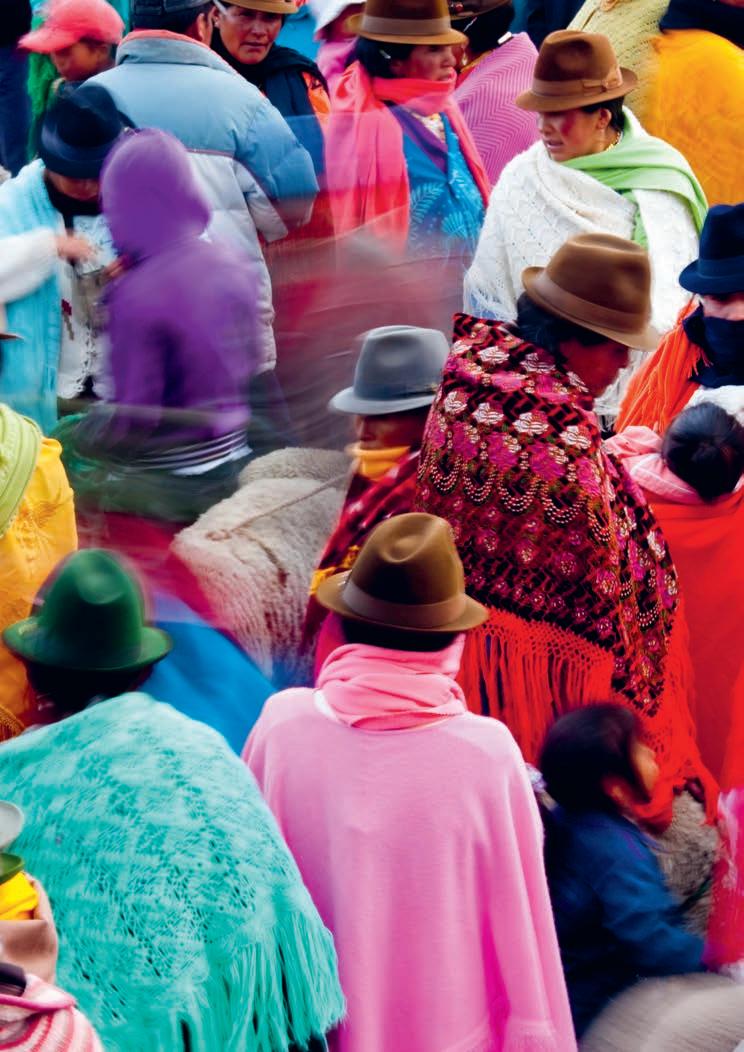
ECUADOR
& the Galápagos Islands













¡Qué chévere!
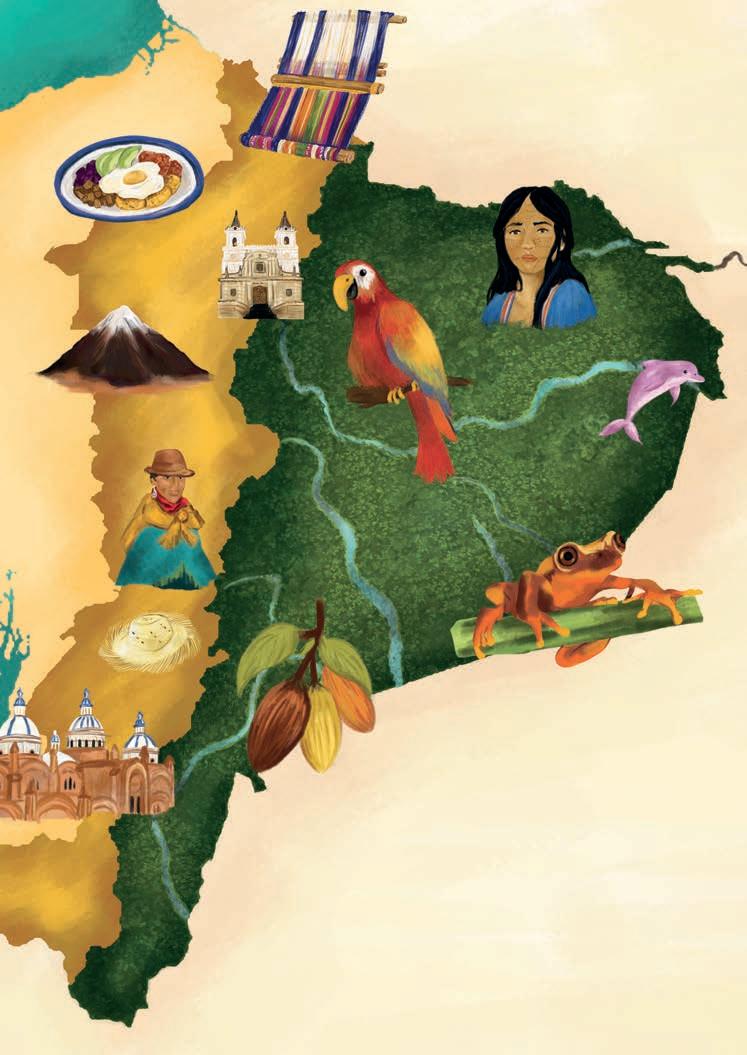
Ecuador’s unique geographical location, straddling the equator, has not only given the country its name but also a spectacular diversity of cultures and topography. This is a land defined by four worlds: Amazon, Andes, Coast and Galápagos. Here, travellers can venture from sky-high colonial-era cities to deep, verdant jungle, and from temperate, scenic beaches to the world’s most iconic archipelago. Among the majestic mountains, ancient rainforest and coastal towns, you’ll also encounter Indigenous and Afro-Ecuadorian communities, whose cultures and crafts tell another side to the country’s story – one that most visitors, drawn to the far-o wildlife of the Galápagos, don’t see. Travelling among these communities not only o ers unique encounters and experiences but also helps to support traditions and crafts that outlasted even colonisation. History, culture and nature all collide in the four worlds of Ecuador.
Vice Ministry of Tourism of Ecuador
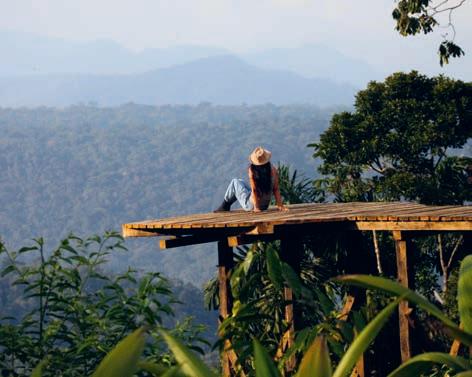
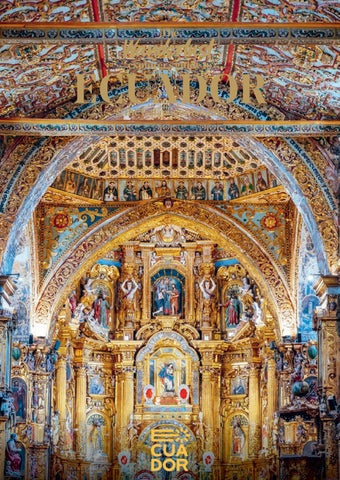
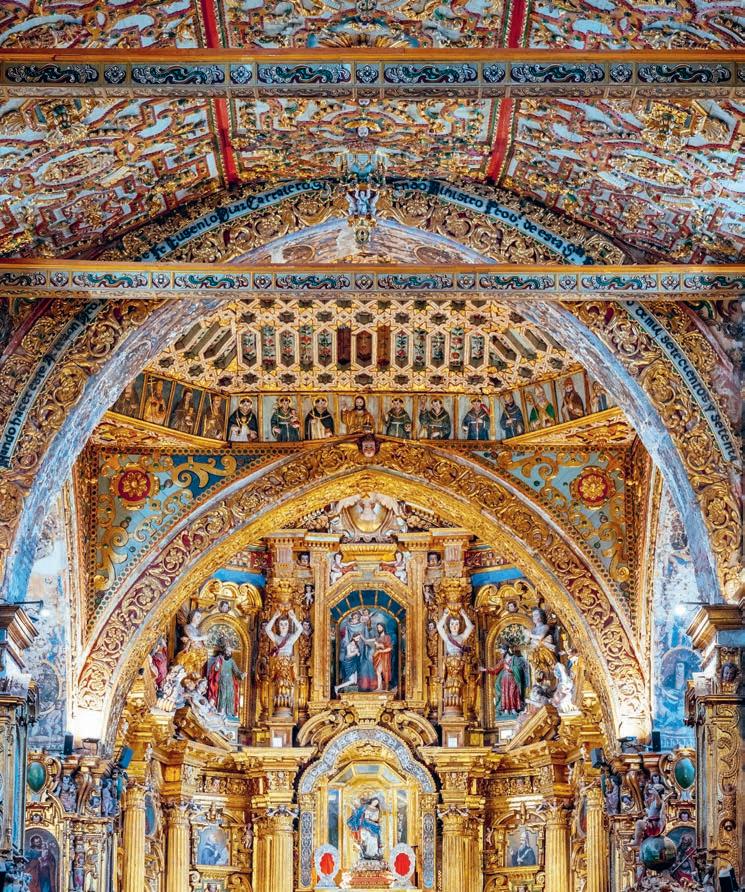
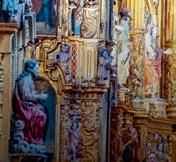
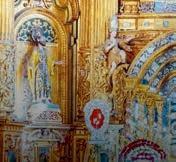
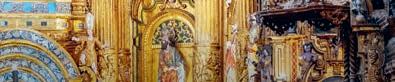
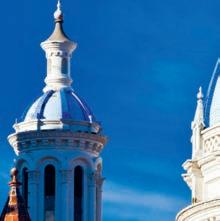
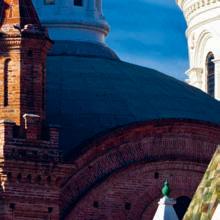
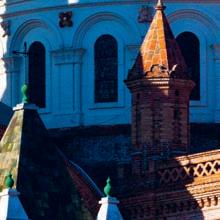
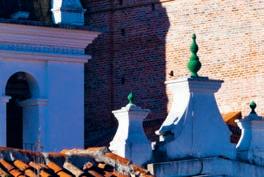
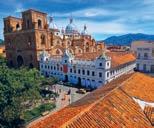
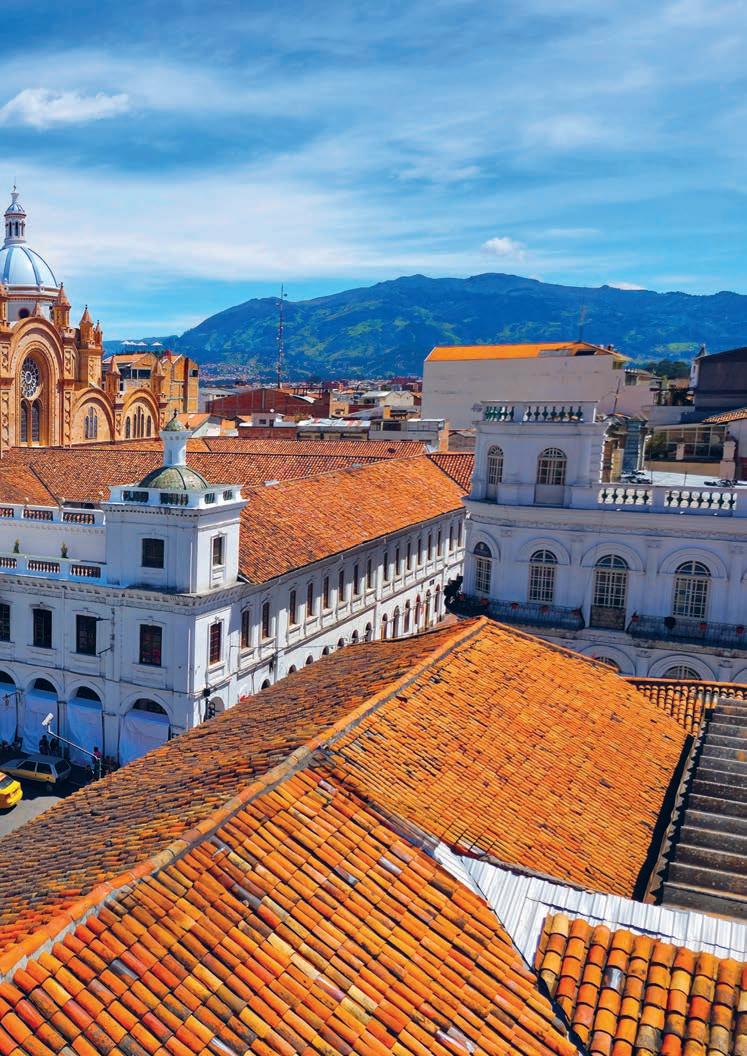
Worlds collide (this spread, from opposite page) The pale-blue domes of the Cathedral of the Immaculate Conception in Cuenca punctuate the picturesque city’s skyline; Tamandúa Ecolodge in Puyo has a spectacular viewing platform (front cover) the interior of Quito’s Basilica and Convent of San Francisco beguiles with its golden details
The Wanderlust Explorer’s Guide to Ecuador & the Galápagos Islands
6 The birth of Wanderlust
How a trip to Ecuador sparked the idea for a unique travel magazine over 30 years ago
10 Viewfinder
Unforgettable shots of Ecuador’s spectacular wildlife and nature in each of its four regions
18 Pre-Columbian past of Ecuador
Ancient history, cultures and traditions collide at Ecuador’s iconic museums in Quito and Cuenca
22 Quito
The capital puts the Andes, cultural history and cloud forests on your doorstep
160 Festivals
Plot your visit around Ecuador’s liveliest fiestas
32 Art and creativity in Cuenca
Explore a historic city where art mixes local traditions with an experimental vibe
40 The history of the Panamá hat
Trace the origins of the Ecuadorian toquilla straw hat to discover a tradition that has filtered down the generations
42 Roam the Avenue of the Volcanoes
Lace up! Savour treks to reach teal-blue lakes and challenging climbs up glacial summits
48 Interview: Lucas Bustamante
Meet an Ecuadorian biologist and photojournalist who uses his camera to communicate environmental stories to people around the world
The Amazon
68 Indigenous people of the Amazon
Why visits to Indigenous communities offer some rare insights into ancestral traditions
76 Interview: Nina Gualinga
The Indigenous rights activist on how travellers can contribute to protecting this region
78 A wildlife guide to the Amazon
From pink dolphins to macaws and marmosets, here’s what to look for on a rainforest escape
84 Expand your Amazon palate
Try colourful fruits and produce, from rare plants to tiny insects
50 Taste the flavours of the Andes
From sizzling meats and corn to sweet treats, one of the best things about the Andes region is its variety of dishes
56 Interview: Paola Lema
Paola shares the story behind the Casa Matico workshop and why it’s so important to maintain artisanal practices
58 Local stays in the Ecuadorian Andes
Whether sleeping in a cloud forest on a reserve or a historic Quito casa, here’s where to stay
64 The significance of Naif folk art
The folk art of Tigua, created using materials and tools that come to hand, tells the story of an art revolution in the Andes
90 Interview: Oscar Tapuy
Tips from an Indigenous Kichwa birdwatching guide who works at Sacha Lodge
92
Forest sleeps
How to find the perfect stay for immersing yourself in the rainforest
98 The story of cacao
The origins of this cherished global delicacy lie in Ecuador’s Amazon region
Galápagos Islands
128 Preserving the islands for locals
From educational initiatives in schools to turning plastic into art, protecting the rare wildlife of the Galápagos starts with engaging and inspiring the local communities
136
Interview: Ana Moya
When Ana moved from Quito to Santa Cruz to work at the Finch Bay Galápagos Hotel, she soon found herself becoming a part of a close-knit Galapagueño community
138 The wildlife of the Galápagos
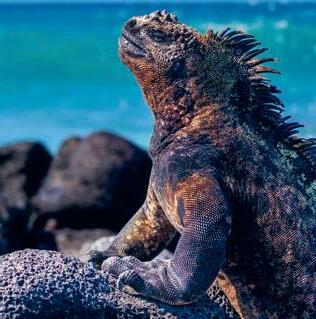
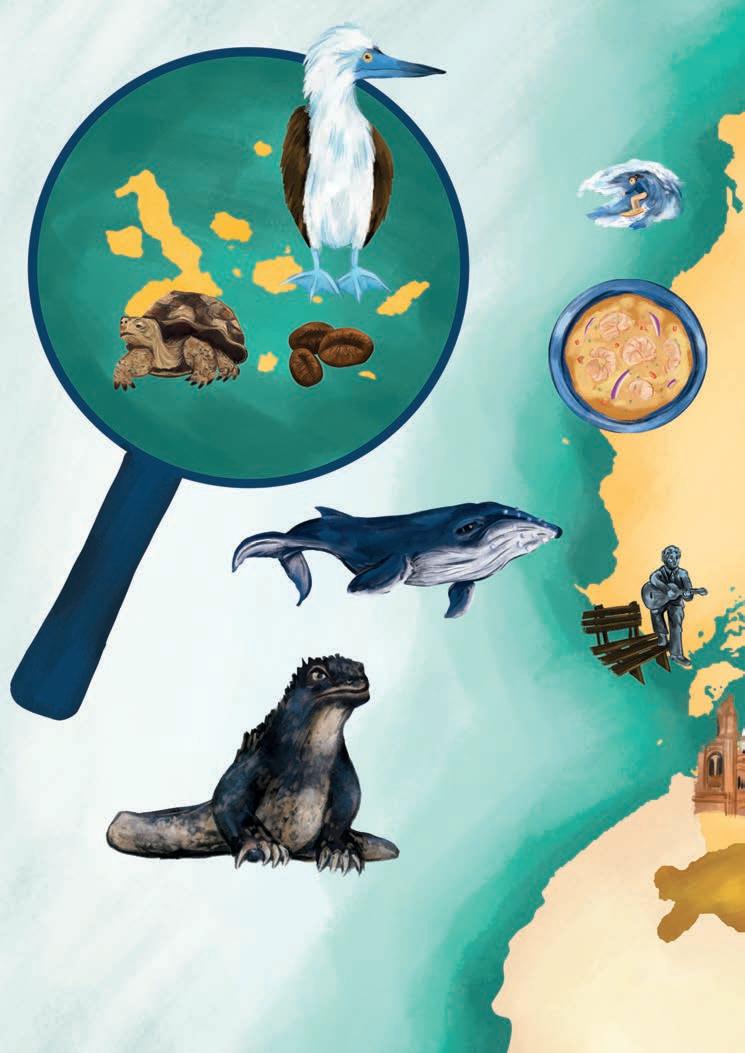
The islands offer travellers a chance to see rare species, such as giant tortoises and blue-footed boobies, and help support their conservation
144 Making the most of local produce
The gastronomy of the islands is as diverse as the wildlife, with everything from tasty fried seafood to earthy coffees
150 Interview: Carlos Carrión
Carlos Carrión has been guiding tourists in the islands for more than two decades, inviting them to form a deeper connection with its wildlife
152 Waking up to the islands
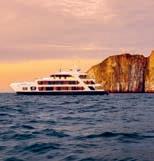
From boat trips that support conservation projects to safari-style lodges in secluded forests, these stays prioritise nature
158 Why the Galápagos Islands are still evolving
This world-famous archipelago might be known for its role in inspiring Charles Darwin’s theory of evolution, but many of us forget that the islands are still changing
102 The rhythms of the shores
The rhythms, music and dances of coastal Ecuador are unlike anything else you’ll hear in the country. They tell a tale rooted in the stories of its Indigenous and Afro-Ecuadorian people
110 Interview: Valentina Álvarez
The self-taught chef from Manabí province on what makes Ecuador’s coastal region so special, plus the tastes and flavours to try there
112 Wildlife of the coast
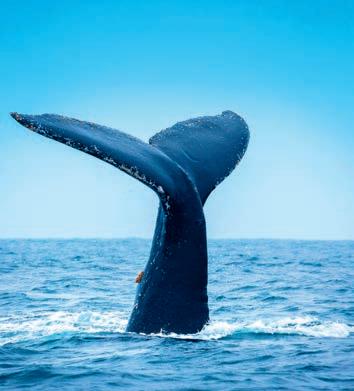
While the Galápagos gets all the attention when it comes to wildlife, the coast’s endangered mangroves and tropical dry forests offer a playground for migrating birds and whales
116 Coastal flavours to savour
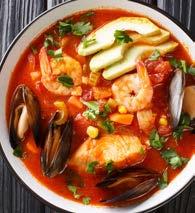
From a quick street snack of corviche to a salty fish stew and a sweet bite of cacao, the coastline offers a diverse menu of treats worth savouring
120
Interview: Willam ‘Willie’ Torres
The veteran tour guide explains why a visit to the island of La Tolita is as much about the treasures that surround it as the history of its inhabitants, who vanished 2,000 years ago
122 A night on the coast
There are many ways to take in the magical coast. From restful sanctuaries just steps from the beach to historic haciendas with pastoral charm, soak up the coast at these amazing stays
How Ecuador inspired a travel icon
A trip to Ecuador at the turn of 1993 set Lyn Hughes and her late husband, Paul Morrison, on the path to creating the UK’s longest-running and number-one travel magazine
Words Lyn Hughes
The man at the airport had a distinctive face, a long braid and wore a fedora, a blue poncho and calf-length white trousers. On the flight to Quito, there were a couple more people dressed this way. When I eventually landed, I asked a local guide who they would have been. “They’re from Otavalo!” she said. Intrigued, I knew that I was going to like Ecuador.
I didn’t realise it at the time, but that journey to Ecuador was not only going to change my life but also result in the birth of the UK’s number-one travel magazine.
My late husband, Paul Morrison, and I had decided to spend the winter of
1992/93 in South America. We had little idea of where to go, but as wildlife lovers, we wanted to visit the Galápagos. We knew little about Ecuador, but why not explore it?
On the plane journey there, we came up with the idea of starting a travel magazine. It would be for travellers like us: people who were intrigued by other cultures, beautiful landscapes, wildlife and nature.
Our travels in Ecuador were to inspire our plans. We explored the magical cities of Quito and Cuenca, stayed in Andean villages, rode the Devil’s Nose railway, took a river cruise into the Amazon and trekked into remote cloud forest. And we went to the Galápagos, of course.




We had to keep pinching ourselves. How had we not known about Ecuador, about the diversity of its cultures and its habitats, and about its many worlds?
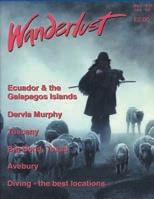
When we got back to the UK, we started writing Wanderlust, and we knew that Ecuador had to be the star of our fi rst issue. We wanted to show that we were about authentic and meaningful travel, so, for our front cover, we chose an atmospheric shot of an Ecuadorian shepherd.
I have been fortunate enough to return several times since, and it’s always been an energising experience that has left me wanting to discover more. To me, Ecuador encapsulates what Wanderlust is all about.
Alamy; Lyn Hughes; Shutterstock; Ecuador Ministry of Tourism
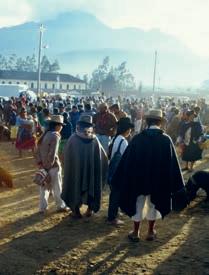
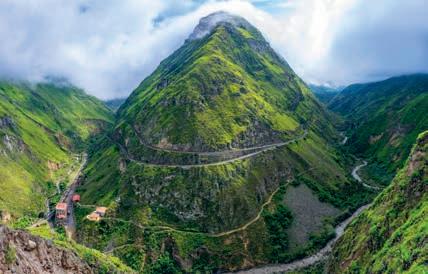
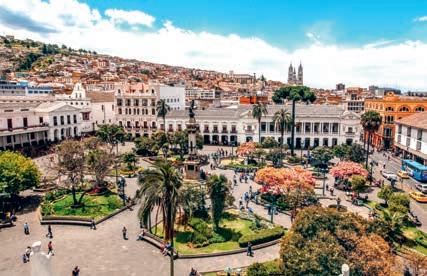
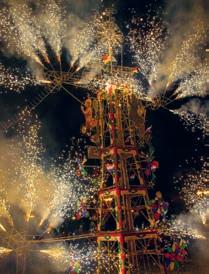
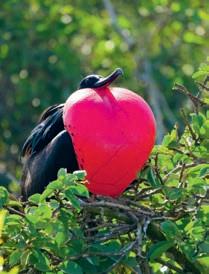
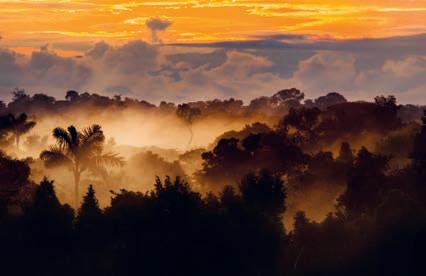
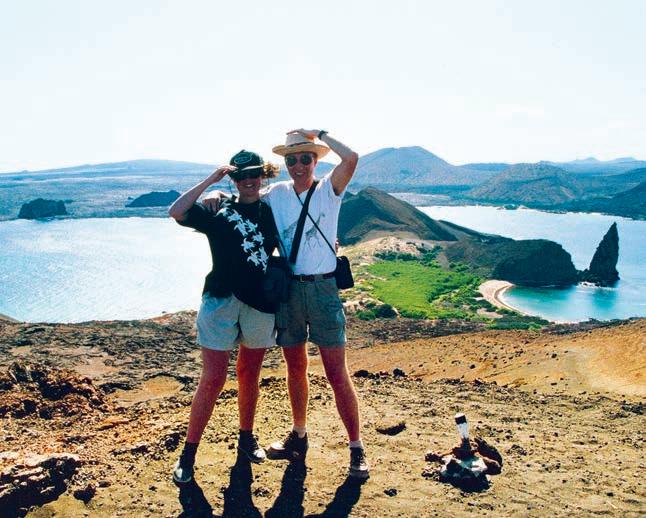
The four worlds of Ecuador (this page; clockwise from opposite top left) Market day in Otavalo; the Devil’s Nose section of railway is so steep that passengers were said to have fainted when it first began operating; a castillo (tower) of fireworks; the Amazon covers more than 120,000 sq km of Ecuador and is home to incredible wildlife and cultures; a male frigatebird puffs out his chest in mating season – one of many wonders in the Galápagos; colonial-era cities scatter the peaks of the Andes; (opposite page; top) Lyn Hughes [left] and Paul Morrison [right] were inspired to start Wanderlust magazine after a trip to Ecuador
Galápagos
ECUADOR
&
the Galápagos Islands
Isabela
Santa Cruz
San Cristóbal
Puerto López
Fernandina
Bartolomé
Colombia
Andes
Amazon
Cuenca
Yasuní National Park
Cotopaxi National Park
Quito
Otavalo
Perú
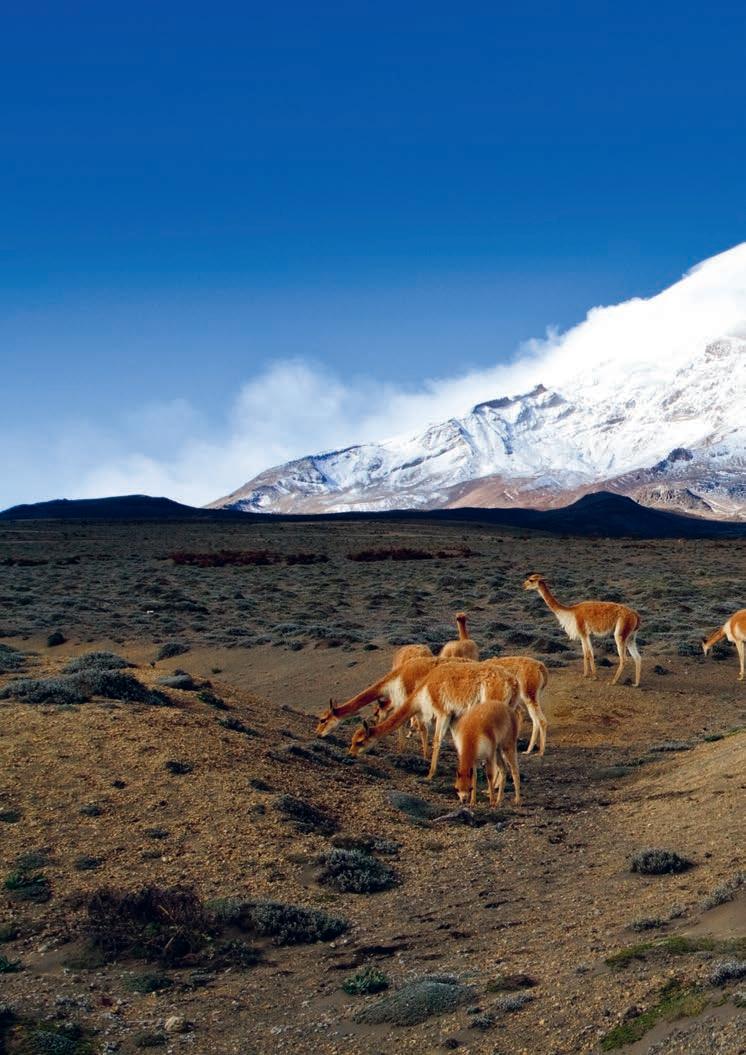
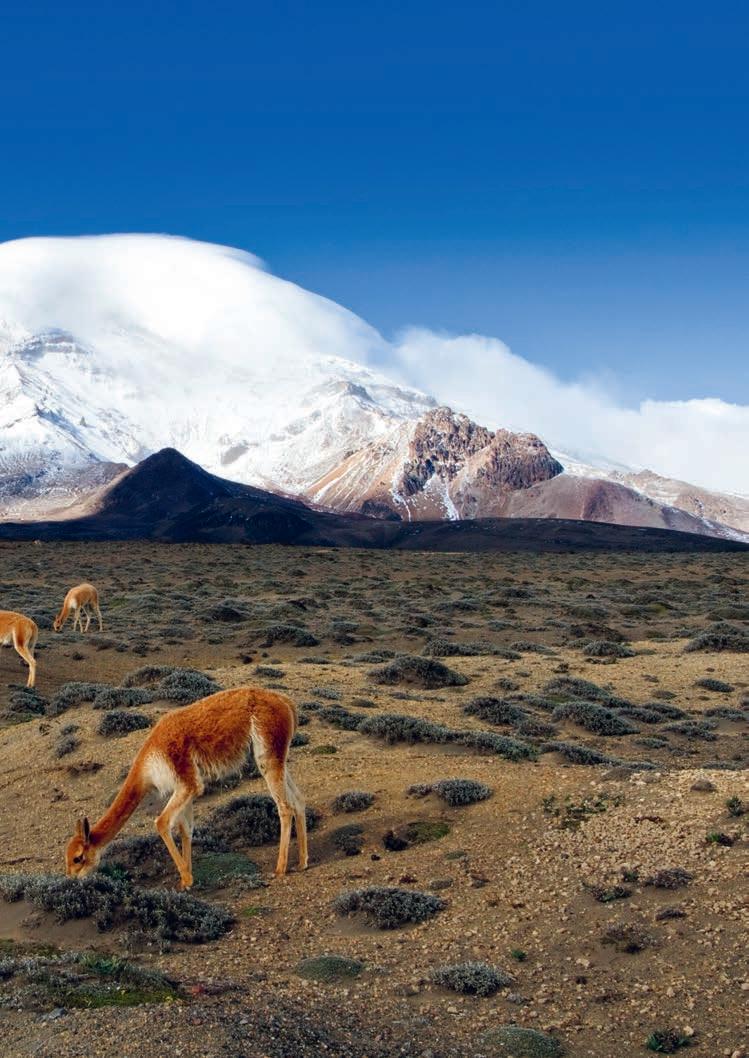
Chimborazo Volcano

Standing at 6,263m high, this ice-capped stratovolcano is Ecuador’s highest peak. However, few people realise that, despite Chimborazo’s summit being more than 2,500m shorter than Everest, it is actually the highest peak in the world if measured from the Earth’s core. This is due to a peculiar geological phenomenon known as an equatorial bulge, which is caused by the centrifugal force of the Earth’s rotation. For visitors who make the challenging ascent to the top, it’s a truly remarkable thing to be literally standing on top of the world.
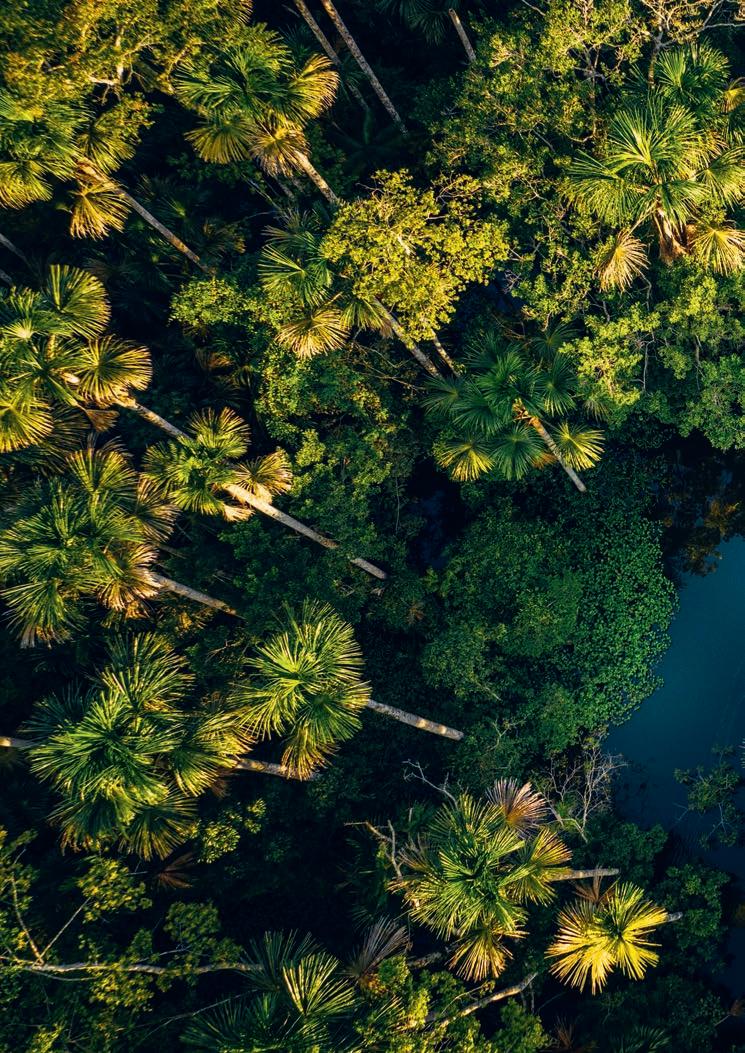
Yasuní National Park, Orellana and Pastaza Provinces
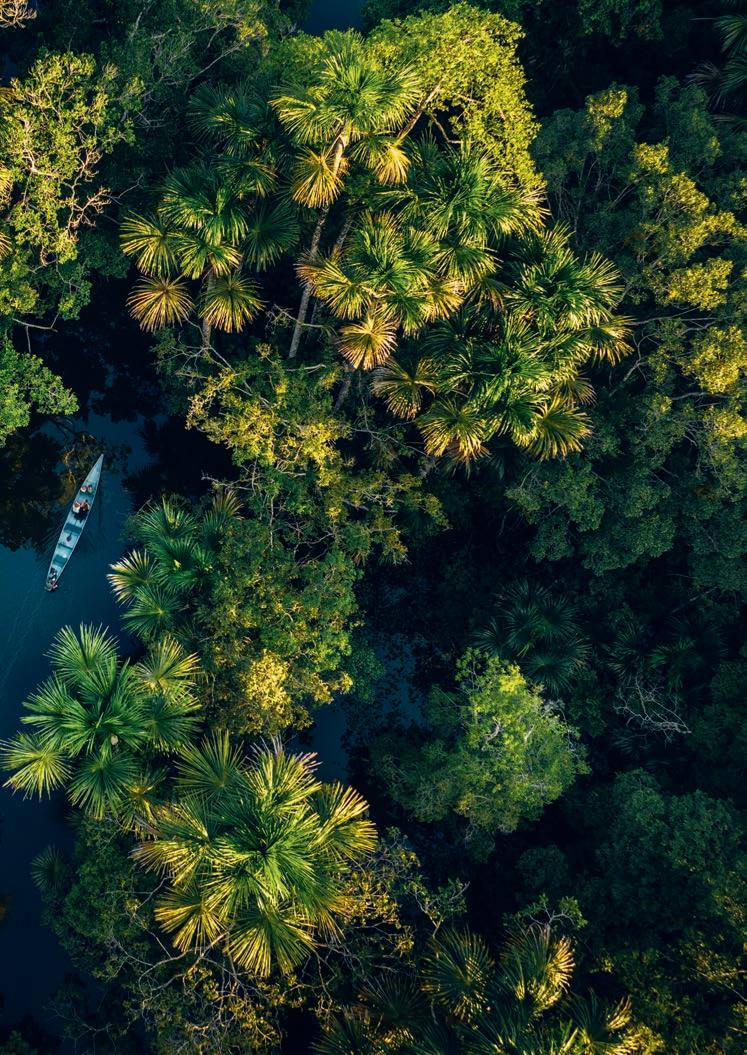
While the Galápagos Islands are renowned for their wildlife, the Amazon, which covers around 40% of Ecuador’s territory, has one of the most diverse ecosystems on the planet. The largest park in this region is the 10,000 sq km Yasuní National Park, a UNESCO Biosphere Reserve home to 600 bird and 130 tree species. It also spans the territories of a number of Indigenous peoples, including the Huaorani and Kichwa, whose communities have lived in and protected these forests for generations. To truly understand life in the Amazon, tours with Indigenous guides let you see far more than just wildlife.

Coastal Ecuador
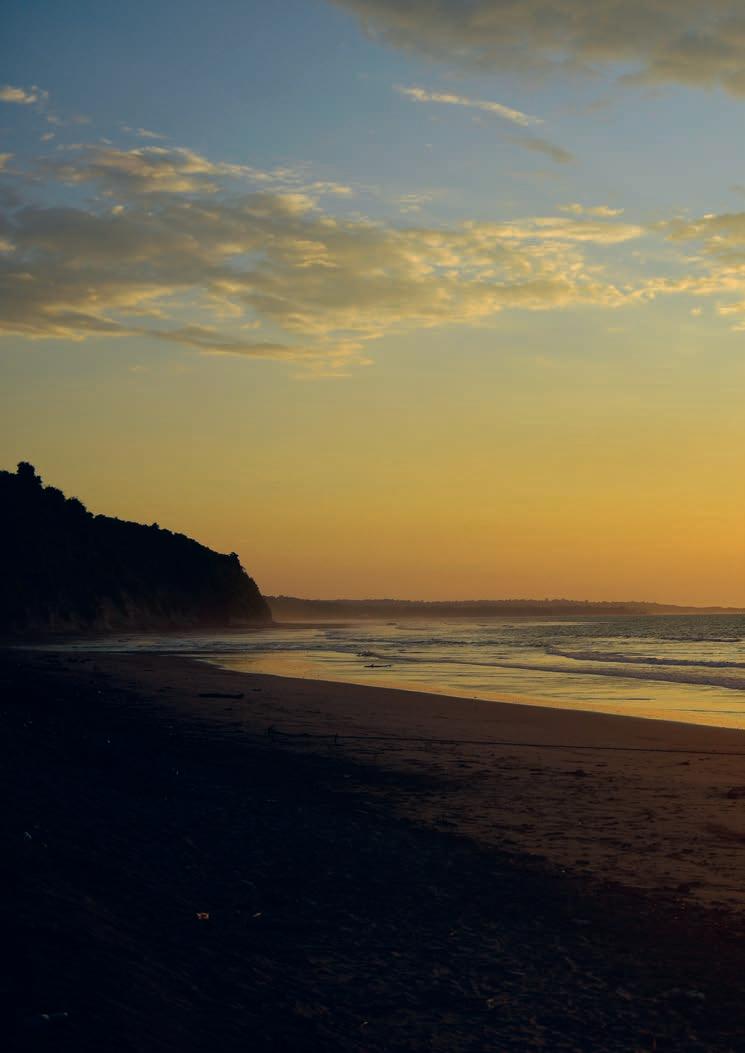
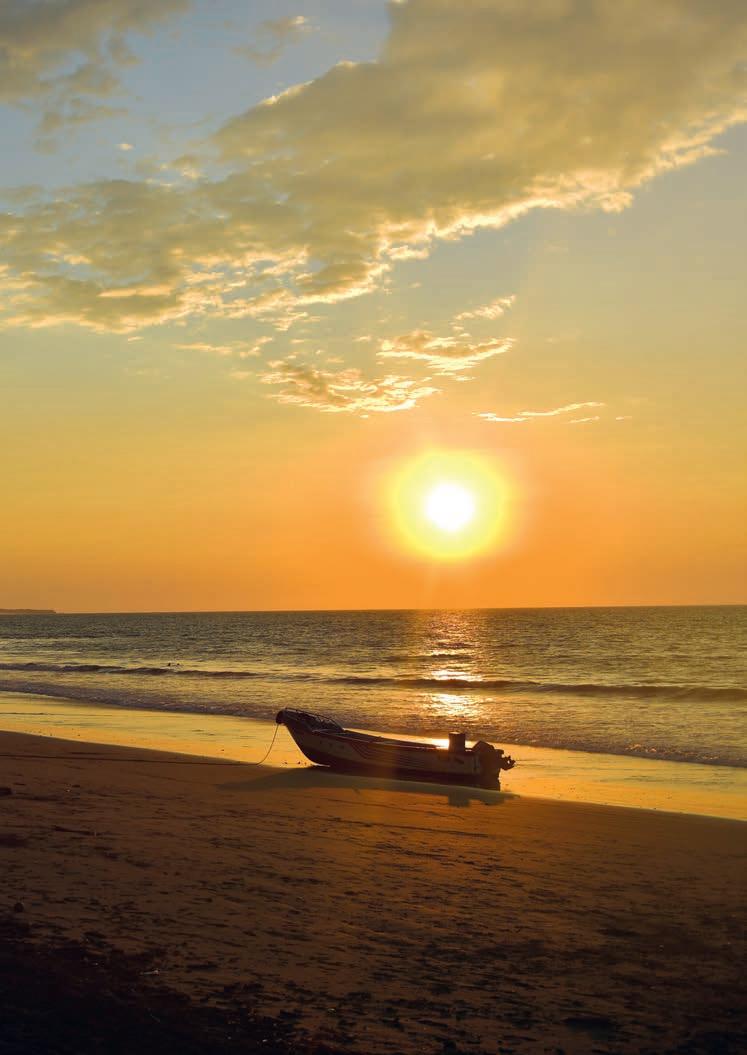
Ecuador’s 2,000km-long Pacific coastline is home to everything from tropical dry forests to lush mangroves. But that barely scratches the surface. For all the pristine beaches and empty skies you’ll find along the fringes of the country, it’s the myriad cultures that make it feel like nowhere else in Ecuador. In Esmeraldas, the legacy of the escaped enslaved Africans who established free communities in the 16th century still resonates in the rhythms and cuisine of the region. And over in Manabí, the crafts and weaving traditions of its communities gave birth to the Ecuadorian toquilla straw hat.
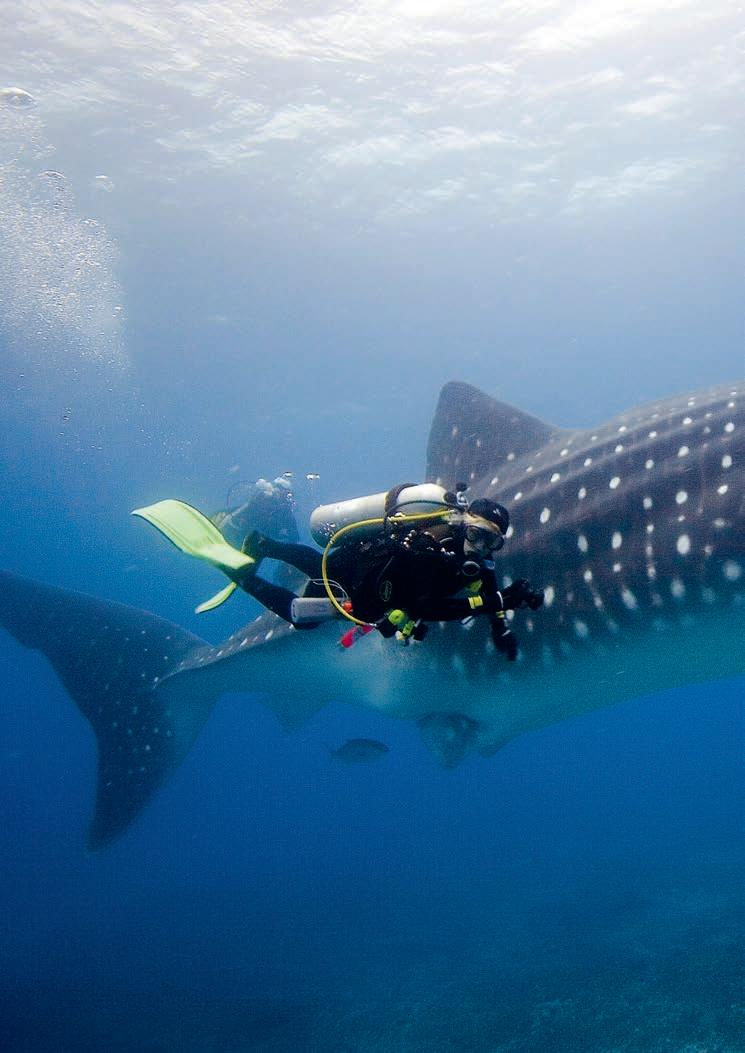

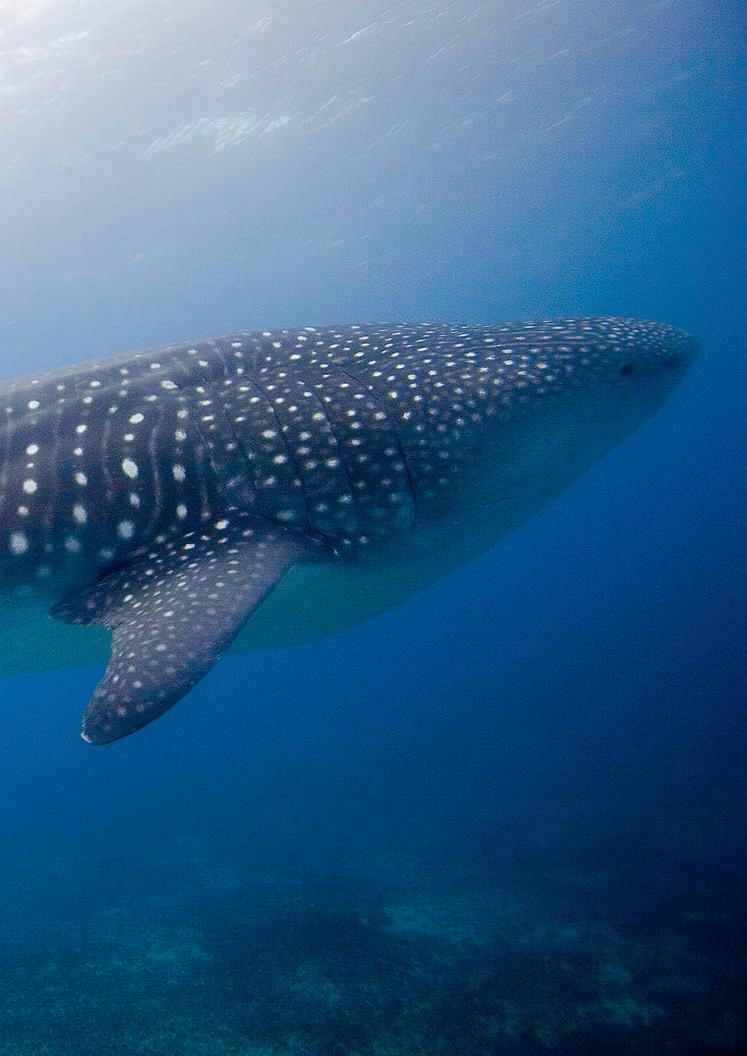
Whale sharks in the Galápagos Whale sharks, the largest fish in the world, are being seen in increasing numbers in the open ocean around Wolf and Darwin islands in the Galápagos between June and November. Drawn to the nutrient-rich waters caused by the convergence of major oceanic currents, it is a positive sign for the region’s aquatic health. Their growing presence is also opening up more opportunities for visitors to reliably (and responsibly) see them in the wild, with the increased opportunities for study enabling boats to better predict their movements.
Michael D Shope
Tracing Ecuador’s pre-Columbian past through its museums
Long before the Inca Empire, and centuries before the Spanish set foot here, the land now known as Ecuador was home to some of the continent’s most enduring civilisations
Words & photographs George Kipouros
Along the Pacific coast, up in the high Andean valleys and deep within the Amazon basin, Ecuador’s cultures flourished independently for thousands of years, creating sophisticated societies rooted in agriculture, astronomy, trade and spiritual ceremony.
Archaeological evidence dates Ecuador’s earliest human settlements to nearly 10,000 years ago. Among the most ancient cultures is the Valdivia (circa 4000–1500 BC), considered one of the oldest ceramic-producing civilisations in the Americas. They left behind enigmatic female figurines, often referred to as the ‘Venuses of Valdivia’, symbols of fertility and reverence for the Earth. Later, coastal cultures such as the Machalilla, Chorrera and JamaCoaque (flourishing from 1500 BC to 500 AD) developed elaborate artistry, maritime trade routes and religious practices that celebrated the natural world.
In the highlands, cultures such as the Cañari, who occupied the area around what is now Cuenca and Ingapirca, built ceremonial centres aligned with celestial events. Meanwhile, Amazonian groups cultivated diverse crops and developed spiritual traditions centred around the forest and the moon. Many of these civilisations exchanged goods such as cacao, obsidian and the prized spondylus shell, which served as both currency and a symbol of divine connection.
By the time the Inca began expanding into Ecuadorian territory around the late
15th century, they encountered a mosaic of well-established peoples. The conquest, however, was relatively brief, lasting only about 80 years before the arrival of the Spanish in the 1530s. Yet in that short time, the Inca built stone roads, temples and fortresses, incorporating local knowledge and infrastructure into their imperial framework.
Today, Ecuador’s pre-Columbian story is being told not only through archaeological digs at its famed sites of Ingapirca, Cochasquí and Pumapungo, but also through its revitalised museums. These dynamic spaces are giving the artefacts in their collections new life and meaning.
During a recent journey through Ecuador, I visited three such institutions and
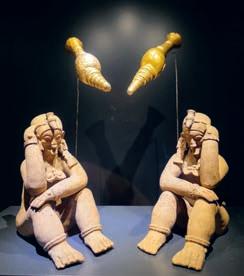
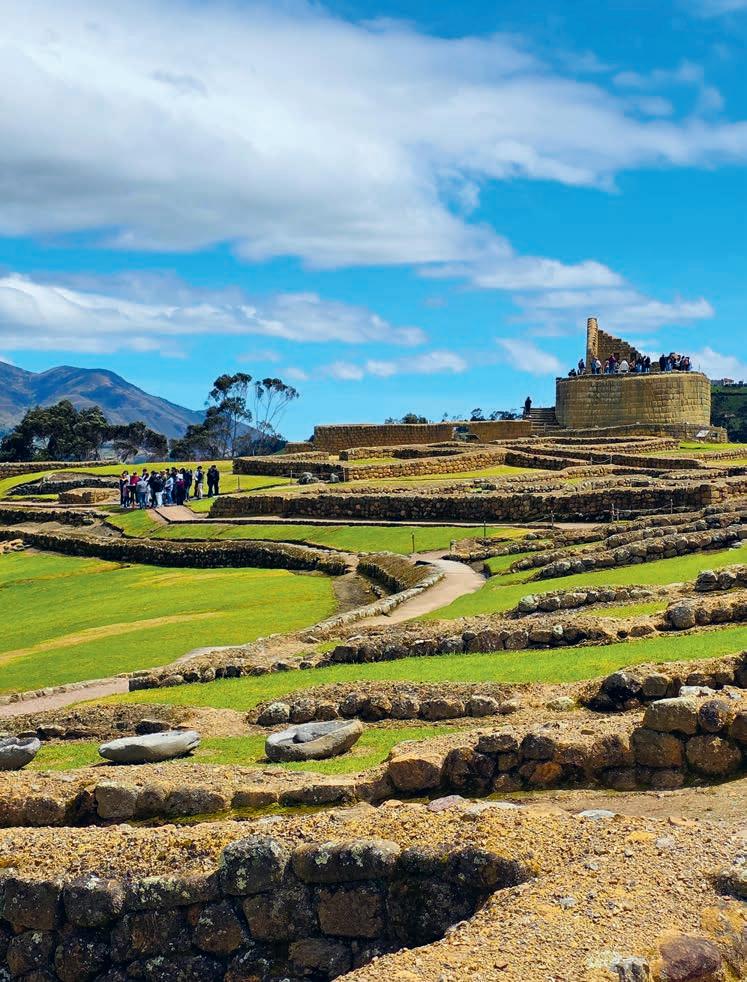
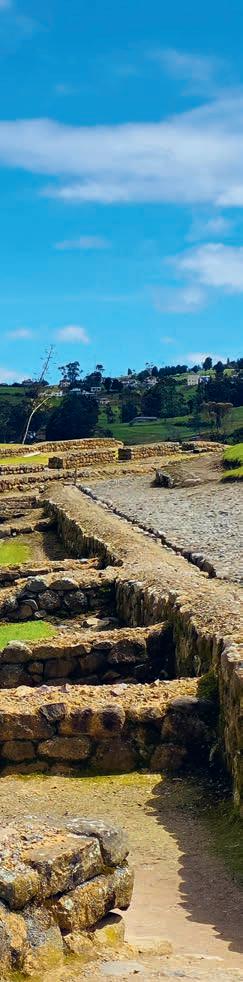
As old as time (left to right) The archaeological site of Ingapirca displays a unique blend of Cañari and Inca architectural styles; works from the Jama-Coaque culture on display at the Casa del Alabado
met the visionaries working to reclaim and reframe the country’s ancestral heritage: the Vice Minister of Culture, the director of Quito’s Alabado Museum and the custodian of a remarkable private collection of Indigenous pieces in Cuenca.
A NEW CHAPTER AT MUNA
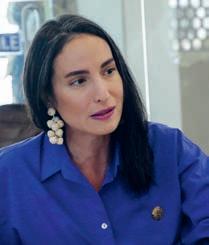
“My mission,” said Romina Muñoz Procel, Ecuador’s Vice Minister of Culture, “is to bring the traditions of our people back into the centre of our national identity, and to make them something Ecuadorians can feel proud of.”
When we met inside the newly revived National Museum of Ecuador (MUNA) in Quito, she walked me past archival
photographs of its 1969 inauguration (when it was part of the Central Bank’s collection of museums) and MUNA’s later move into a space humming with fresh intent.
“This is the first time in years that a president even mentioned culture in an inaugural speech,” Muñoz Procel noted, pointing to the sweeping reforms her ministry has undertaken since the pandemic forced the museum’s closure.
Muñoz Procel, formerly MUNA’s director, reopened the museum with a bold move: abandoning the old thematic structure for a chronological journey through the country’s 10,000 years of human history. She also initiated the repatriation and reorganisation of Ecuador’s vast national collection – 2.4 million items, of which less than 1% is currently on display.
“We are cataloguing everything properly for the first time,” she said. “It’s painstaking, but it will become the foundation of a cultural system built to last.”
Mesoamerican ritual practices) and a collection of 5,400 Kichwa artworks are now safeguarded after a 1979 law restricted their sale. Efforts are also underway to establish a new public-private partnership for a world-class museum site near La Carolina Park, adjacent to Quito’s commercial heart.
“It will be like the Met for Ecuador,” Muñoz Procel said with a smile, pointing to the encyclopaedic approach to its collections and exhibitions. “It’s time Ecuador told its own story, on its own terms.”
THE ALABADO: AN ARTISTIC, NOT ARCHAEOLOGICAL, VISION
“My mission is to bring the traditions of our people back into the centre of our national identity”
The museum’s most significant holdings include 66,000 archaeological pieces. Standouts such as the Jama-Coaque ‘tongue of the priest’ (an artefact that links Ecuador to
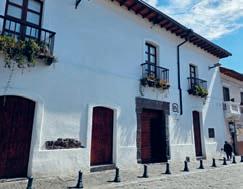
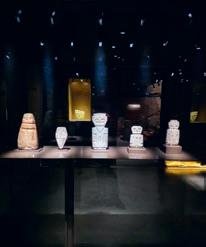
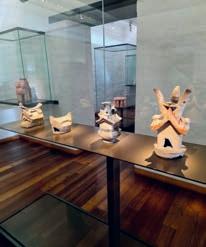
In the San Roque neighbourhood of Quito’s historic centre, housed in one of the city’s oldest colonial homes, sits the Casa del Alabado, an impressive museum of pre-Columbian art. This elegant institution has a resolutely thematic and artistic approach to its pre-Columbian heritage.
“We are an art museum, not only an archaeological one,” said director Lucía Durán as she guided me through a luminous courtyard framed by pre-Hispanic statuary.
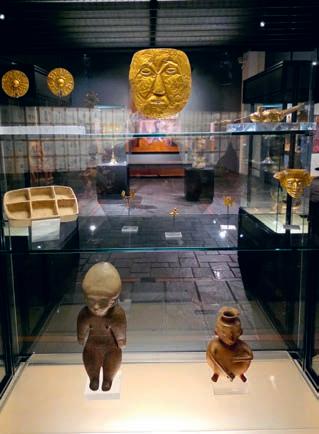
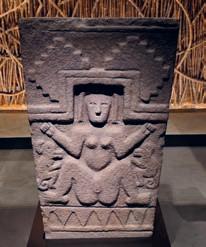
Only 700 works are on display from a collection of 7,000 and these are shown in a minimal, understated way. The journey begins with the Valdivia (one of the oldest cultures in the Americas) and includes rare figurines known as the ‘Venuses of Valdivia’. Further along, visitors encounter a ceramic pot bearing the world’s oldest known cacao residues, a subtle reminder that chocolate’s spiritual and culinary journey began here.
Durán described to me the museum’s 15th anniversary exhibition, which united two once-private collections: “We want to show how Ecuador’s Indigenous cultures – coastal, highland and Amazonian – each expressed identity in unique ways. But also, how they’re all connected.”
That circularity is a theme that the Alabado returns to often. “In these cultures,” Durán added, “the past isn’t linear. It’s something you carry with you, like a thread that doesn’t break.”
CUENCA’S INDIGENOUS LEGACY
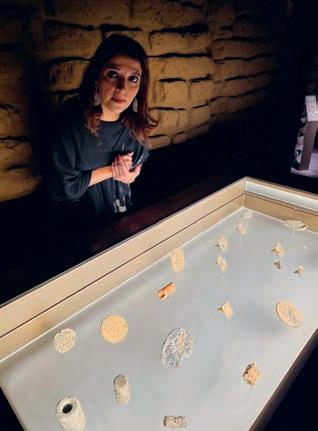
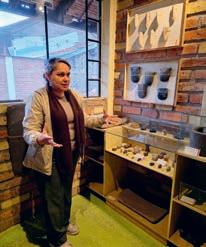
In the southern city of Cuenca, where the terraces of Pumapungo rise from the highlands, Carmen Lucía Cordero is preserving a different kind of inheritance. Her grandfather founded the Museo de Arte Indígena, a private institution that now displays 5,000 pieces from across Ecuador’s Indigenous cultures, with another 10,000 in reserve.
“Everyone talks about the Inca,” said Cordero as we stood before a case of ceremonial axes and carved pestle and mortar sets. “But they were only here for about 80 years. The real story is what came before.”
Here, that story unfolds across millennia. From 5,000-year-old cacao pots to the statuary of the Jama-Coaque, the museum is a trove of pre-Inca civilisation artefacts. Standouts in the collection include Pachamama figures and spondylus shell jewellery.
Cordero emphasised the museum’s educational role. “People forget how advanced
these societies were. We had 29 varieties of corn, complex cosmologies and trade networks that stretched into northern Perú and beyond. This is not ‘primitive’ history; it’s sophisticated, and it’s ours.”
REWRITING THE NARRATIVE
Across these conversations, one theme emerged consistently: Ecuador’s pre-Columbian heritage is not just a matter of archaeology or museum preservation; it’s a living cultural and political act. Whether through digitisation efforts that will give Ecuadorians access to 200,000 works online, or by ensuring exhibitions remain accessible to the public, leaders like Muñoz Procel, Durán and Cordero are redefining what heritage means.
“Culture is not a luxury,” Vice Minister Muñoz Procel told me as we wrapped up our tour. “It’s a right. And it’s time the world, and Ecuadorians themselves, saw just how rich our story really is.”
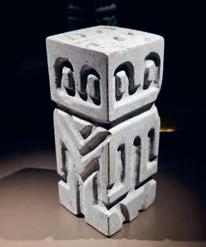
World heritage (this page; clockwise from top left) The Casa del Alabado has a collection of 7,000 artefacts; Carmen Lucía Cordero is the director of Cuenca’s Museo de Arte Indígena; the Casa del Alabado lies in Quito’s San Roque neighbourhood; a Valdivian monolith representing an ancestor with six faces; pre-Hispanic statuary on display at the Casa del Alabado; Romina Muñoz Procel is Ecuador’s Vice Minister of Culture and Heritage; (opposite page; clockwise from top left) the exterior of the Casa del Alabado; the National Museum showcases Ecuador’s 10,000 years of human history; Lucía Durán is the director of the Casa del Alabado
Touchdown in Quito: Arriving in the middle of the world
Ecuador’s high-altitude capital weaves its rich history and culture into everything, from its architecture to food, and it is within easy reach of the Andes mountains and cloud forests
Words Karen Edwards
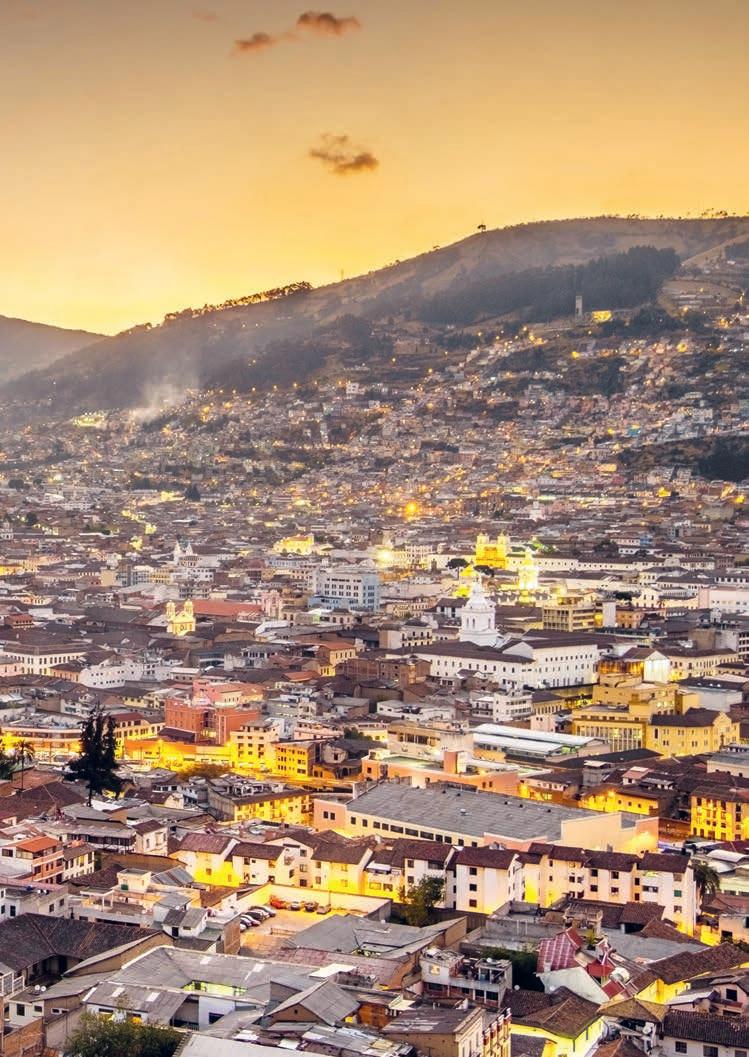
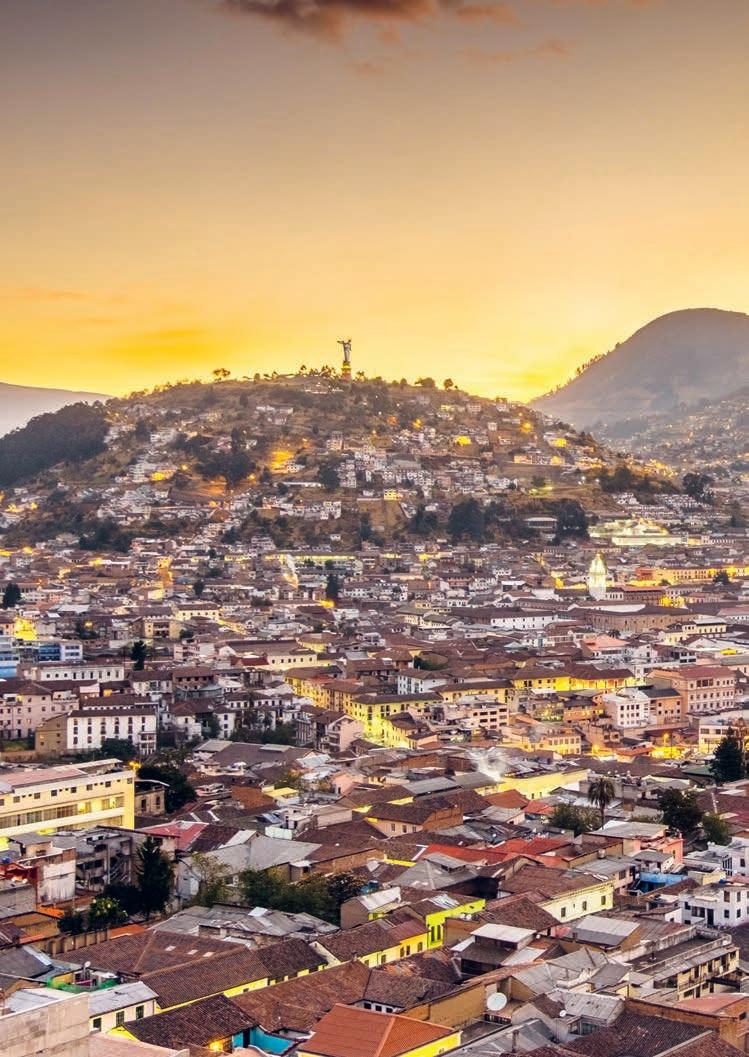
Low-lying candyfloss clouds typically garnish the sky on approach to Mariscal Sucre International Airport. It’s a typical Quito welcome. Set on the high-altitude slopes of the snow-dusted Pichincha volcano, and impressively straddling the northern and southern hemispheres, the Ecuadorian capital is an unassuming city with an extraordinary backstory.
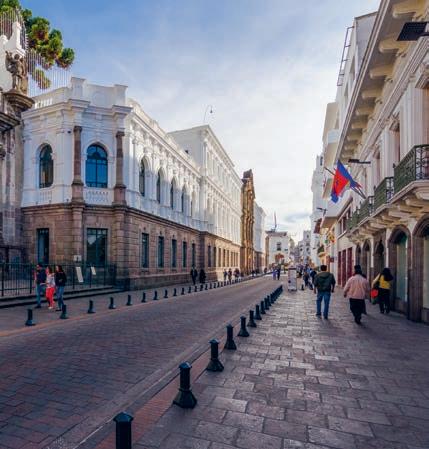
The city was founded by the Spanish in 1534, on the old ruins of an Inca settlement. Today, the region’s ancient and colonial histories are instilled in everyday life. Across the historic old town, cobblestone streets lead into expansive squares, peppered with fruit-laden street stalls and pastel-coloured family-run stores. At almost every corner, humble dwellings stand proudly next to grand Baroque churches and low-lit monasteries – and it is this distinct, integrated heritage that makes Quito so special.
TAKE A CULTURAL DEEP DIVE
Setting off on foot through the old town, you’ll find a slice of Quito’s complex history artistically woven into the city’s varied
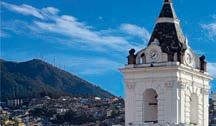
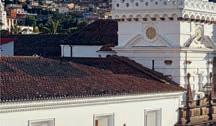
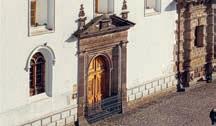
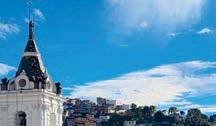
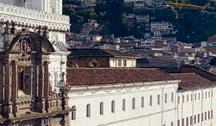
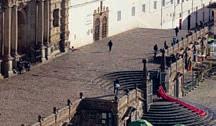
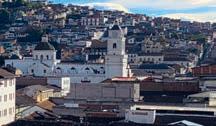
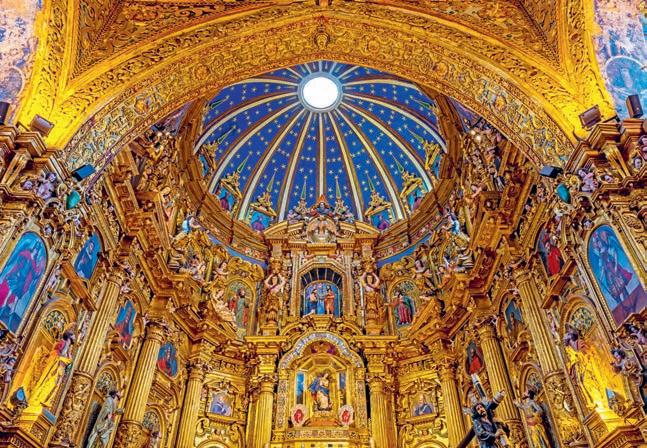
architecture. In the centre, the largest colonial-era building – the grand 16th-century Church and Convent of San Francisco – is vast and alluring. The complex’s lofty white walls house a Catholic church – the oldest in Quito – a monastery, a museum and even a library. Inside, the arches of a goldleaf altar are decorated with colourful r eligious depictions, while outside, a manicured courtyard of palms and roses is a reminder that the compound has been renovated over the centuries, usually following earthquakes.
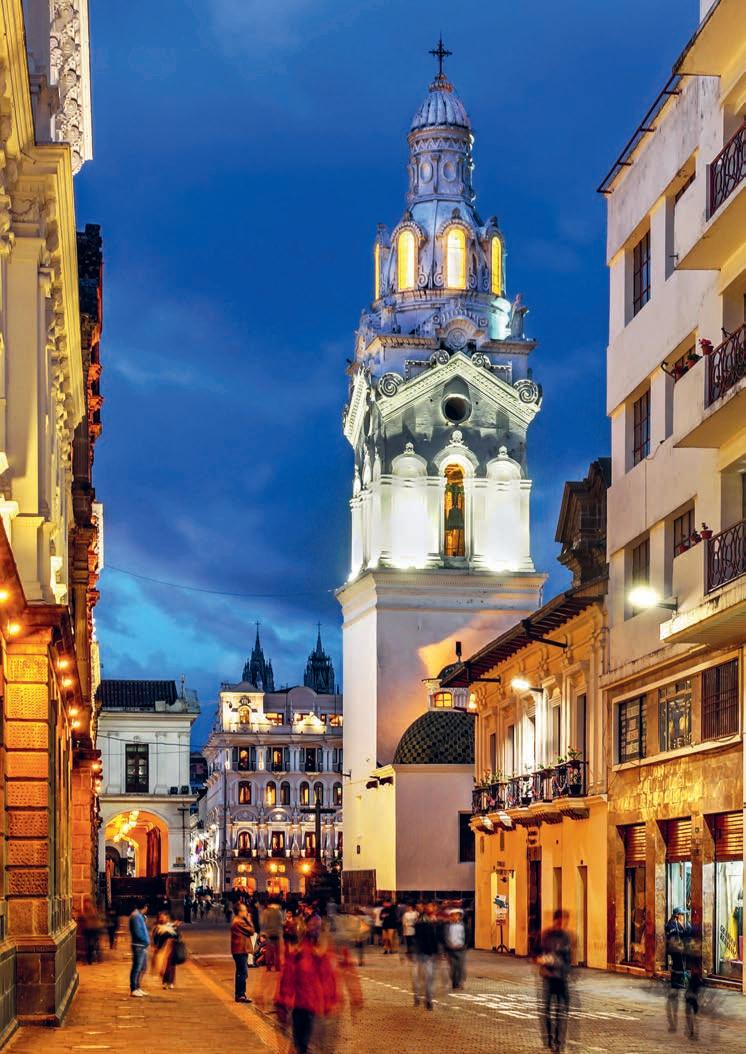
to catch the Santo Domingo under the hue of its gentle yellow floodlights.
By contrast, La Compañía’s main temple is created entirely of volcanic stone, displaying an antiquated grace. However, step inside its doors and into the central nave of the church, and you’ll be greeted by a decadent array of arches drizzled unsparingly in dazzling gold leaf – a sign of the changing times, as the church was completed over a period spanning more than 160 years, as Baroque came into fashion.
Perhaps the city’s most breathtaking religious building is the neo-Gothic Basílica del Voto Nacional. It is known not only for its eye-opening decorative collection of gargoyles (cleverly incorporating local wildlife such as the iguana, blue and red-footed boobies and puma), but also for its dramatic presence. Those who climb its towers will also have unparalleled panoramic views over the city and beyond.
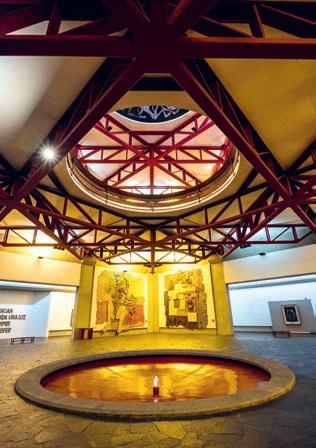
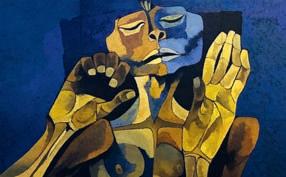
On the back streets of the Bellavista neighbourhood, Casa Museo Guayasamín, once the home of the painter Oswaldo Guayasamín, showcases the collection of one of Ecuador’s most revered artists and his portrayals of social injustice. Born and raised in Quito, Guayasamín grew up in poverty yet his work platformed the suffering of others, including the oppression of Indigenous communities at that time. At the centre of the museum is La Capilla del Hombre (Chapel of Man), a dedication to the challenges and triumphs of Latin American communities and an acknowledgement of the struggles baked into Quito’s history.
“It is an unassuming city with an extraordinary backstory. It was founded by the Spanish in 1534, on the old ruins of an Inca settlement”
To the north, the Santo Domingo church is evidence of the diverse cultural influences that were introduced to the region during Spanish colonisation. Baroque, Neoclassical and Moorish themes can be found throughout the interior of the building, with the latter bringing to the forefront the lesser recognised Arabian-Iberian influences of the time. Open until dusk, it’s worth visiting later in the day
Step into ancient traditions at Mercado Central, with a cleansing by a traditional healer. The tiny storefronts, often draped in flowers, are generational businesses, and visitors brave enough to step into the small back rooms and strip down to their underwear will experience the curanderas (healers) at work as they dust you down with bunches of dried herbs and rose petals. The aim? To cure the body of life’s stresses, banish bad spirits and bolster immunity.
To reflect on Quito’s history through a broader lens, visit Casa del Alabado, an art institution dedicated to the capital’s pre-Columbian era. It has around 500 archaeological remnants on display across the eight-room exhibit. In addition, the National Museum of Ecuador, which
is home to a profuse collection of paintings, crystals, sculptures, textiles, jewellery and even ceremonial figures, contemplates the deeper contexts of Ecuador’s convoluted heritage.
TASTE THE INNOVATIVE GASTRONOMY
Kick off your foodie journey at the San Francisco Plaza, visiting the wealth of streetfood vendors that dot the square. Here, you’ll be able to taste the traditional and much-loved maduros con queso (fried plantain with cheese) – a snack staple – while the sugary swirls of espumilla , made of a fluffy meringue, make for an ideal treat.
At Mercado Central, the oldest and busiest market in town, a host of vendors showcase homemade delicacies, including ceviche de chochos (lupin beans mixed with avocado, onion, tomato and hot sauce) and hornado (roast pork carved off a whole pig, served with stuffed potato patties). Fritada,
a tortilla stuffed with mashed potato and spiced pork, is considered a lunch essential, while Quito’s unique empanada de viento is a crunchy cheese-filled parcel dusted with sugar – and it is not to be missed.
“Nuema offers a tasting menu that blends native plant-based components – such as Amazonian u’kuisi and sacha inchi –into each dish”
For extra flair, visit Kriollo por Ikaro, a Michelin-starred restaurant run by Chef Carolina Sánchez and her husband Iñaki Murua, whose dishes typically encompass elements of generations-strong family recipes. Carolina also fuses regional flavours with techniques garnered from haute cuisine , resulting in a mouthwatering blend of tastes. Give the green plantain and cheese soaked in honeyed chilli and a nutty salprieta a try. Likewise, family-run restaurant Nuema offers a delectable seven-course tasting menu that blends native plant-based components – such as Amazonian u’kuisi and sacha inchi – into each dish. Elegant steak-centred Tributo, meanwhile, grounds itself in Andean culture, with owner Luis Maldonado’s livestock reared at
Did you know?
In 1978, Quito was recognised as one of the best-preserved and ‘least altered’ historic centres in Latin America and became the first city to be listed as a UNESCO World Heritage site. The accolade highlighted the Ecuadorean capital’s unique ability to bring both Indigenous and European traditions together through food, art and architecture
4,000m. With its wild fruit cocktails made from regional spirits and local herbs, this is also the place to test out Quito’s vibrant cocktail scene.
At Somos, chef and owner Alejandra Espinoza integrates childhood favourites with culinary practices she learnt in Europe, creating an à la carte menu that positively bursts with originality. The purple corn-dough empanadas are a particularly popular pick, as is the irresistible pineapple pina colada dessert. The restaurant itself, located in the Bellavista neighbourhood, oozes deep cultural know-how, thanks

Alamy; George
Kipouros
Heritage across the ages (this page) The Church and Convent of San Francisco is a popular visitor attraction, and there are still Franciscan monks living there; (opposite page; clockwise from top) the Baroque altar at the Church and Convent of San Francisco is adorned with gold; Quito has one of the best-preserved and least-altered historic centres in Latin America; art by Ecuadorian artist Guayasamín (1919-90) often deals with social injustice; the Guayasamín Museum in Quito houses the artist’s work and also his collection of pre-Columbian artefacts and religious art
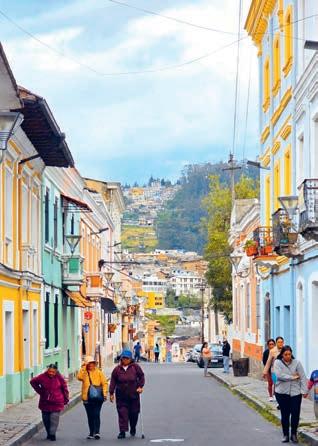
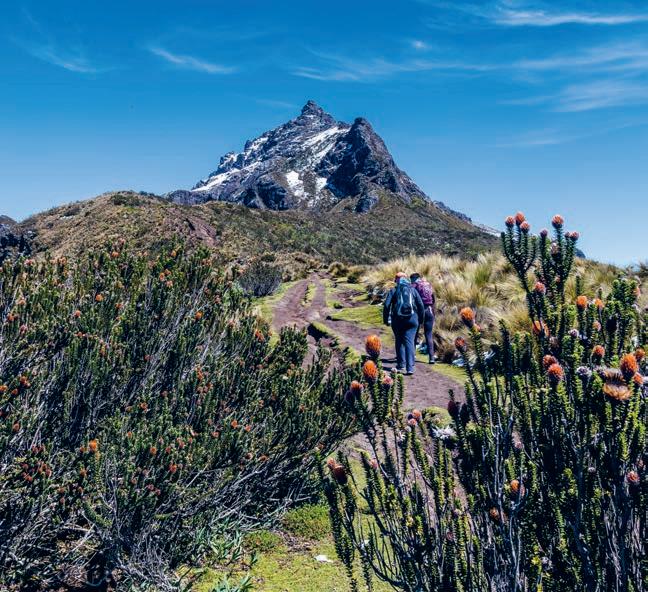
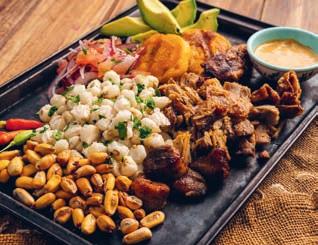
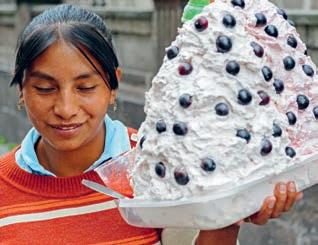
Colours and flavours (this page; clockwise from top) Hikers can see unique wildflowers on the slopes of the Rucu Pichincha volcano; the fluffy meringue known as espumilla looks like ice cream and is a popular street food; hornado pork often comes with mote, corn, potato tortillas and a tangy vinaigrette called agrio; (opposite page) you can stand in both of the Earth’s hemispheres at the 30m-high Mitad del Mundo monument (Middle of the World), which marks the location of the equator and is also home to museums, chapels and a planetarium Alamy; Ecuador Ministry of Tourism
Bear in mind
At an altitude of 2,850m above sea level, altitude sickness in visitors isn’t uncommon. Spend a few days enjoying Quito while your body acclimatises. Drink plenty of water to keep hydrated and be aware that you might get out of breath quickly – especially when climbing hills or stairs. Locals also recommend drinking coca-leaf tea – served in some eateries – to soothe symptoms.
to the depictions of Ecuadorian ingredients and heritage framing its entrance.
EXPERIENCE THE NATURAL HIGHLIGHTS
For uninterrupted views over Quito and the Andean ranges, take the TelefériQo cable car to the top of the Cruz Loma mountain, where, at an altitude of 3,945m, you can admire the scenery. You can also embark on a 4km (five-hour) return hike to the summit of Rucu Pichincha, which towers nearby at a dizzying 4,680m. While many people take the moderate hike, go with a qualified guide if you’re still acclimatising to the altitude.
Alternatively, get active on the Sunday Ciclopaseo, when 30km of roads across the city are closed to vehicles, making way for cyclists instead. The initiative, set up in 2003, is a popular weekend pastime for families, young professionals and travellers alike, with skateboarders, rollerbladers and joggers also joining the fun.
At Quito’s treasured Jardín Botánico, its 4,300 species of orchid are a reminder of Latin America’s diverse catalogue of Indigenous flora.
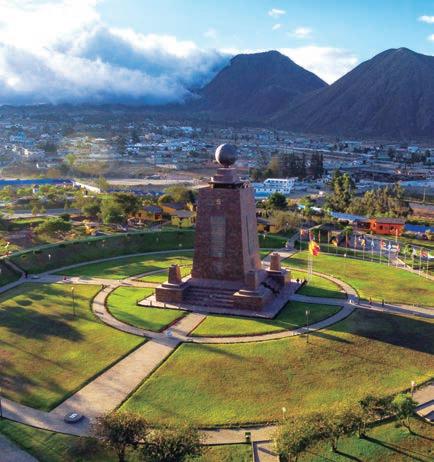
“Mitad del Mundo provides a rare and wonderful opportunity to visit the northern and southern hemispheres at the same time”
Bordering the north-central neighbourhoods, Guangüiltangua Metropolitan Park is the go-to for hikers, with scores of trails winding through the 570-hectare area. Lined with evergreen eucalyptus, the park has become a natural haven for bird species. For something more adventurous, head south to Cotopaxi, a popular national park that is home to one of the world’s highest active volcanoes. At almost 5,900m, Cotopaxi has erupted 50 times since 1738; its iconic cone and vegetation-rich slopes are ideal for spotting wildlife near the city. Andean condors, llamas, wild horses and the odd spectacled bear have all been sighted here.
Further afield, the picturesque Andean Chocó and its thriving cloud forests provide
important conservation zones for endemic wildlife, including multiple hummingbird and frog species. They also act as safe corridors for megafauna – the giant anteater, spectacled bear and puma – that migrate between the mountains and the Pacific coast. Bellavista, Tandayapa and Mashpi are revered reserves, each providing luxe eco-lodge basecamps for exploring hiking trails, flowing rivers and plunging waterfalls. Every reserve has a special draw: Tandayapa is for birdwatching, offering a chance to see some iconic species, including the toucan barbet, while Bellavista is the place to go to spy colourful orchids, ferns and bromeliads, as well as the hummingbirds and butterflies that flitter among them. Impressively, Mashpi’s in-house scientists have discovered 22 new species (including the Mashpi glass frog and Mashpi magnolia) since its inception.
VENTURE TO THE MIDDLE OF THE WORLD
An ideal day trip from the city centre is to the Mitad del Mundo (Middle of the World), 10km from Quito. It provides a rare and wonderful opportunity to visit the northern and southern hemispheres at the same
time, all while learning about the fascinating geodesy missions that landed in this region. It was 1736 when a team of European explorers and scientists – from Spain and France – visited the Ecuadorian equator to prove the Earth wasn’t perfectly round. Paying homage to those on that mission (and also symbolising the point at which the hemispheres meet) is a 30m-high stone monument housing a museum. Inside, you can learn about the mechanics of geodesy, how gravity works and the specialist techniques that were once used to determine the dimensions and shape of the planet.
As a part of the learning experience, visitors can take part in the ‘water down the plughole’ experiment – to see which way the water spins, if at all, when standing at the equator. Tales are even shared about the Indigenous communities that once inhabited the land, the clothes they wore and how ways of life gradually transformed through the eras.
Also located on-site is a reimagined viviendas ancestrales (ancestral village), which replicates traditional architecture and life across the Andes, Amazon and coastal Ecuador, including a showcase of ancestral tools that were once used for farming, food preservation and trading. The Museo de Cacao examines the Ecuadorian production and trade of chocolate, while the Museo de la Cerveza teaches visitors about the beer-brewing process.
The Andes
Whether you explore frosty volcanic peaks, learn about traditional crafts, see pre-Columbian artefacts or admire colourful murals, the Andes region offers experiences rich in culture and colour
Delving into the art and creativity of Cuenca
Art in this historic city mixes local traditions with experimental energy, whether it is displayed on murals or in museum spaces
Words Sinead Mulhern
We were standing on a busy street corner in Cuenca’s historic centre. Music blared from an adjacent park as a crowd gathered. Here, under an archway, local artist Cristian León paused: “Look at the colours of the fruit, the corn and the tiles,” he said, framed against a backdrop of pedestrians weaving between street vendors selling fruit.
Where we were standing was full of colour, culture and history specific to Cuenca – the kind of details that artists like León are attuned to. This pearly white corn?
The traditional wear of the local women? These marbled tiles? It was all very Cuenca. León was giving me a tour of the murals and street art as part of a larger look at Cuenca’s arts culture. He is one of the best people to speak to on this, as he has been an artist here for 26 years. Minutes ago, I had stood in his studio looking at pieces that captured the soul of the city: street vendors, Indigenous women’s bright red skirts, the Andean chuquiraga flower. Now I was eyeing Cuenca’s walls and talking about the ongoing dialogue that happens when artists use the city as both subject and canvas.
Cuenca is Ecuador’s third-largest city, and it is known for its well-preserved Spanish colonial architecture (its historic centre is a UNESCO World Heritage site), ancestral traditions and mountains that frame the city. Sitting at cloud-level in the country’s south, Cuenca has year-round spring-like weather, buildings from long-gone eras and four sparkling rivers that flow beneath eucalyptus trees. It’s undeniably beautiful, and it has always been worth visiting for its creativity and tradition. Weavers, potters, metalworkers and jewellers continue to thrive here, as they always have.
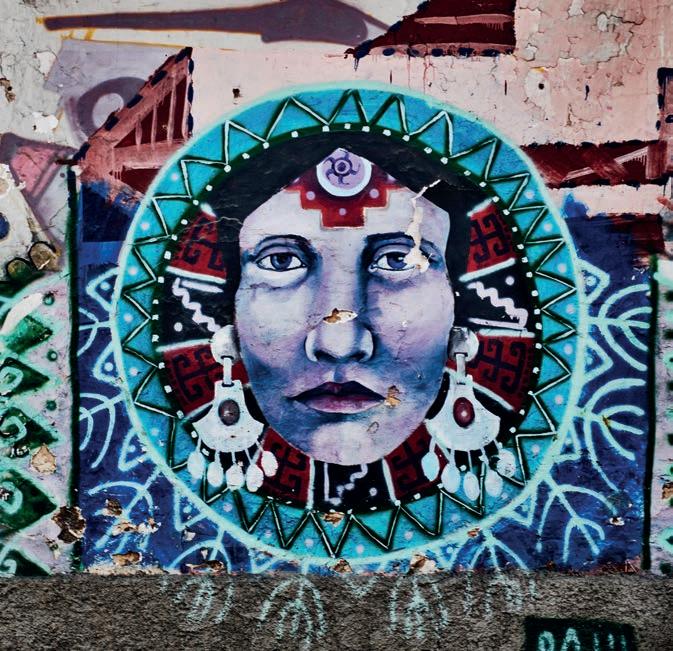

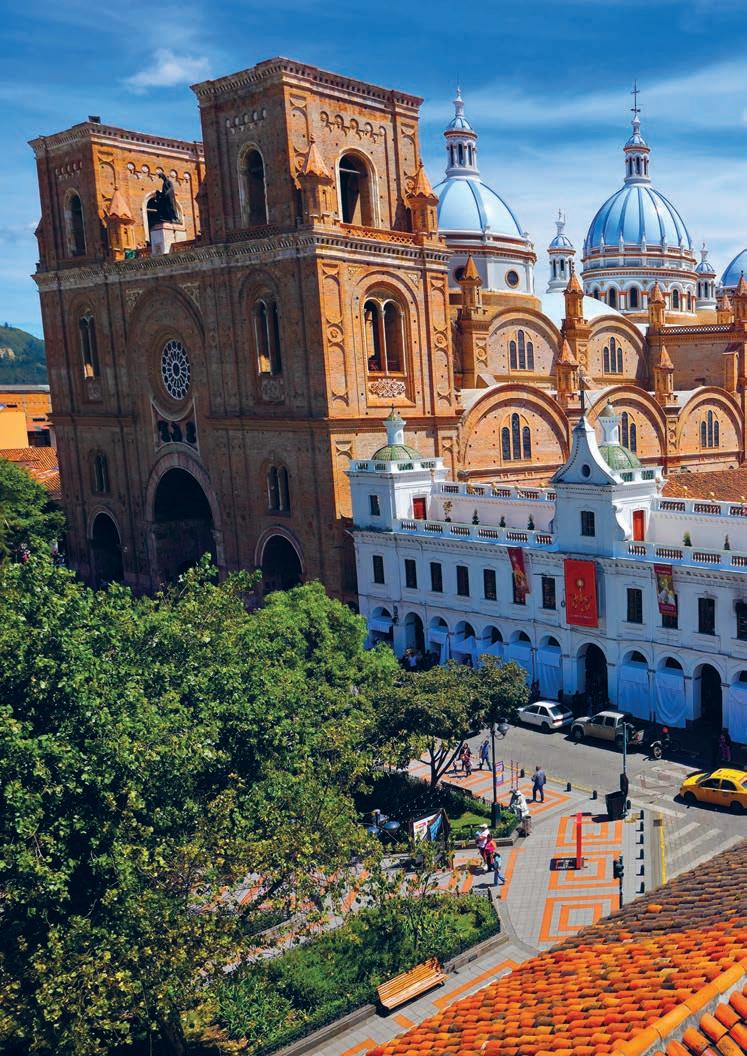
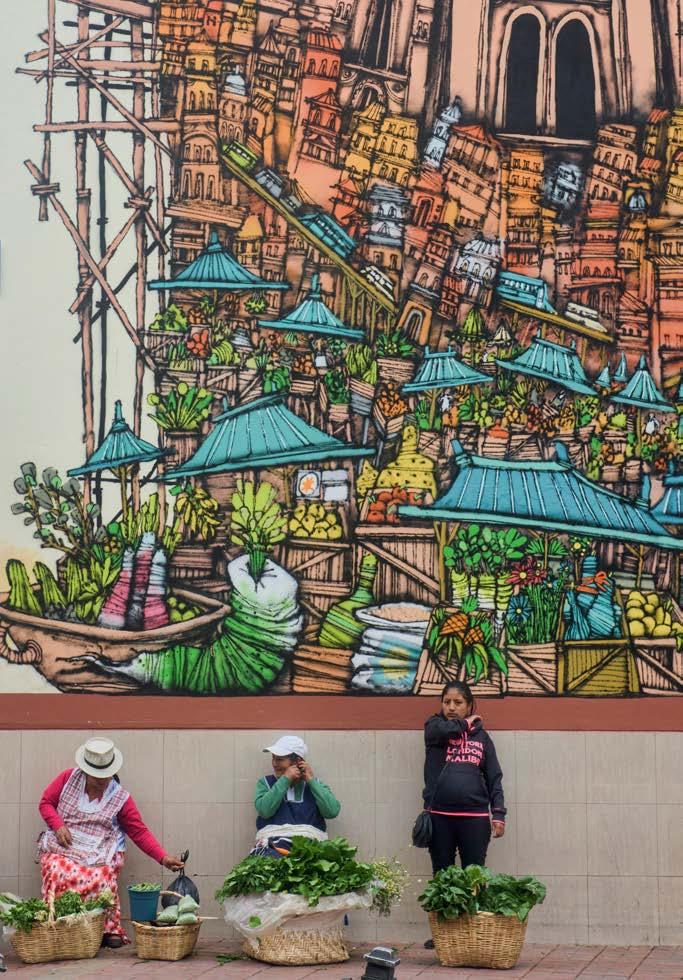
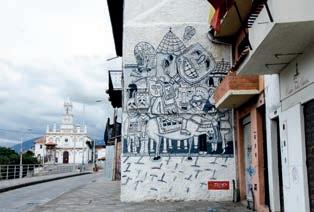
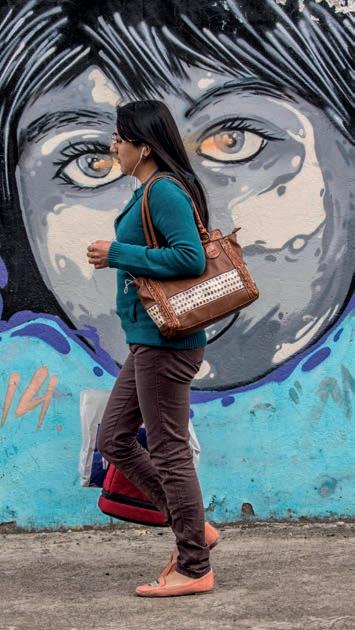
Layers of life (previous page) Architecture like the Cathedral of the Immaculate Conception in Cuenca’s historic centre is protected; (this page) street art, such as this mural of an Indigenous person, is a big part of the thriving Cuenca arts scene; (opposite page) vendors line up under an artwork at the colourful Mercado 10 de Agosto market, which has everything from fresh produce and street food stalls to traditional healers offering spiritual cleansings
But Cuenca doesn’t just preserve its past; it plays with it too, layering on top bold new murals, experimental spaces and fresh creative energy. Its arts scene has seen a notable shift in recent years. New street murals have brightened neighbourhoods downtown. Iconic graffiti artist Lady Pink came here to paint, and creatives have migrated from elsewhere in Ecuador and Latin America, bringing their talents with them. Spaces such as InFormal have
also opened, displaying exhibits that threaten to shock this largely conservative city.
Yes, its art draws from ancestral roots, but it also adds something new to the conversation. In other words: this isn’t just your grandmother’s Cuenca anymore.
“Art draws from ancestral roots but adds something new to the conversation. This isn’t just your grandmother’s Cuenca anymore”
There are many reasons for this, explained Sarah Hanen Bauer, director of idiomARTE, a creative centre and gallery in Cuenca. “As the city has shifted to become more metropolitan, so have the arts,” she told
me. “ You’ll find emerging young artists. It’s more of an equal playing ground than in the past, and there’s a lot of social commentary tied to artists’ roots and background.”
For a visitor new to this cobblestoned city, it’s easy to see local art. There are museums and galleries such as the Pumapungo Museum, the Museum of Modern Art, the Museum of Aboriginal Cultures, El Prohibido’s dark arts exhibit, the galleries of Miguel Illescas and Julio Machado, OFF Arte Contemporaneo and the aforementioned IdioimARTE. Sucré Saleé is known for jazz and live music concerts; Pumapungo Theatre hosts film festivals and thought-provoking documentaries;
Alamy







cafés double as galleries; and a wave of Venezuelan immigration has brought new talent to the city’s orchestra. There’s also the rotary market – a jackpot for artisanal crafts (think handcrafted clay mugs, woven rainbow rugs and wicker baskets). This curation of crafts has taken generations to perfect. And that just scratches the surface.
“Cuenca is known as the part of the country that heralds the arts,” Hanen Bauer said, adding that because it’s a small city growing in big-city offerings, you can easily take in several things in one evening. Plus, there’s
always a mural tour to the soundtrack of Cuenca’s gas truck melody and church bells to savour. Like the one I was currently on.
Walking through the city, I saw murals that proudly displayed key aspects of the culture. In Plaza Otorongo, a vibrant red vaca loca (crazy cow) wall illustrated a common symbol in Cuenca celebrations. Outside the main market, there was a storeys-high mural of Cuenca’s iconic blue-domed cathedral. Between bustling stalls inside, one wall showed a character in an Aya Huma sun festival mask getting
a spiritual cleansing from a healer. Outside, on the busy strip of Calle Larga, an artist had placed a painting of a woman with swirling ebony hair underneath the Juliet balcony of a timeworn facade. Here, León reminded me that since Cuenca’s colonial architecture is protected, artists need more than just the permission of the building’s owner to paint. It looked like this one had bent the rules. We walked along the strip, past a patrimonial home, and I saw a city I loved through León’s lens. At a stairwell connecting the downtown to the rest of the city, we paused
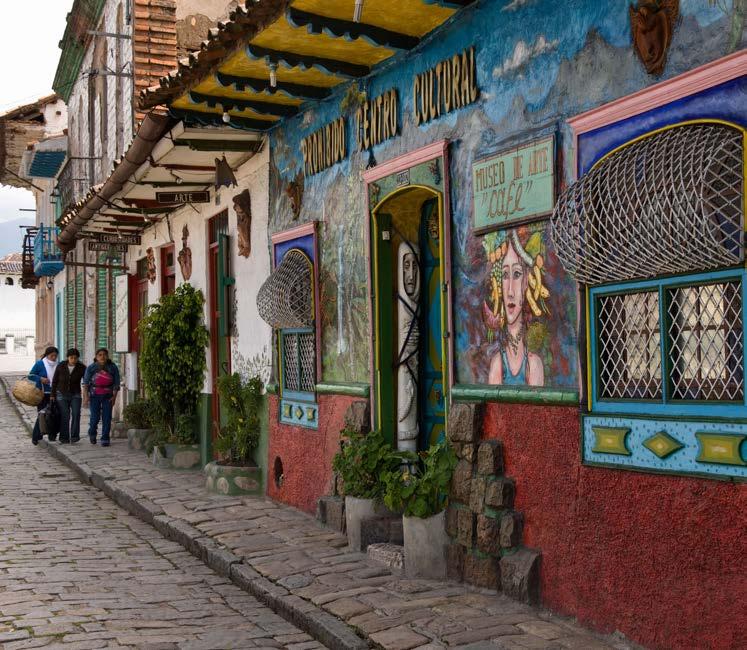
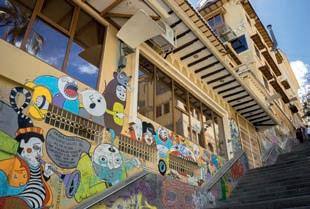
Creative energy (clockwise from left) The El Prohibido Cultural Centre supports alternative art about prohibited themes such as death, sexuality and fetishes; just wandering through Cuenca’s streets offers ample opportunities to admire colourful murals; a wall near the Todos Santos Church provides another canvas for art; some wild characters depicted on a city stairwell
to admire a painting of a woman whose face was made of vibrant pink, green and yellow leaves. I had seen it before, but what I didn’t know was that it was painted by Lady Pink, an Ecuadorian street-art legend. She’s one of many artists who have made their mark on Cuenca, but there was another whose work caught my eye.
“I call it my language of communication – drawing through pattern. It’s like instead of drawing, I’m weaving.”
This artist’s distinctive style featured both indoors and out, his realistic scenes made up of thousands of thin, cross-hatched lines.You can’t mistake his murals, which feature across hubs such as Cuenca, Quito and Guayaquil, as well as on the unassuming walls of his Amazonian
town. In one scene, women worked in an old street market drying flowers and selling carrots. Another showed a hand clutching fruit against a mountain backdrop. “Ama las manos del campo,” it read: ‘Love the hands of the countryside.’ Others showed workers of eras past in Amazonian fields, depicting real moments of Andean-Amazonian migration in Ecuadorian history.
These murals – including one in the highly regarded restaurant El Mercado – are by Paul Castro, who goes by the artist name Rraspa. They’re not just pretty to look at; they’re genius, and if a lot of local artwork feels like it’s referencing the past while reaching forward, Rraspa’s murals
are a perfect study of that. There are a couple of reasons for this. Firstly, his work draws on themes of Andean migration to the Amazon over a century ago. Secondly, those crosshatched patterns mimic the design found in traditional Andean weaving – most notably in Ecuador’s iconic ‘Panamá’ hats, an art form passed down through generations.
“I call it my language of communication –drawing through pattern,” said Rraspa. “It’s a legacy from my grandparents. They’re from the highlands and migrated to the Amazon in the early 1900s. They brought their culture with them. My grandmother had the custom of working with paja toquilla (straw weaving). I recognised that pattern and transferred it to my drawings – it’s like instead of drawing, I’m weaving.”
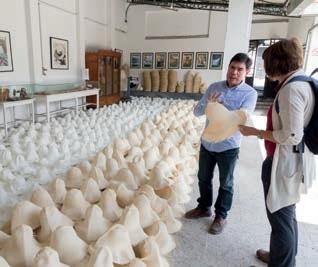
Later, in a quiet corner of the Homero Ortega Panamá Hat Museum, a woman
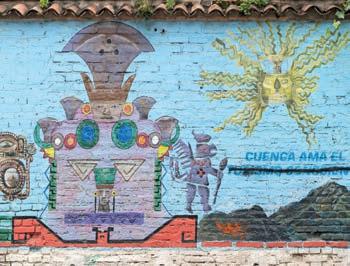


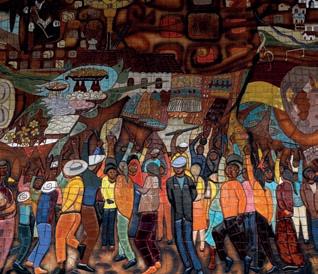
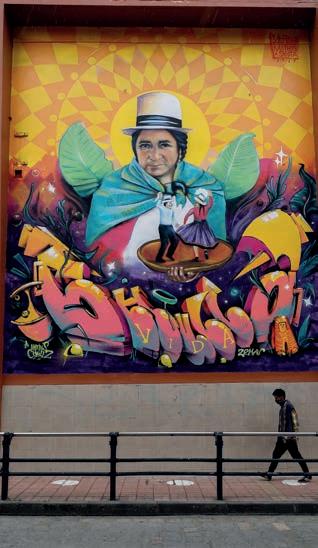
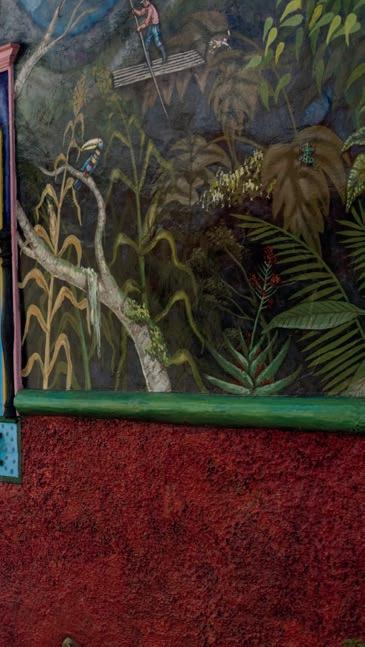
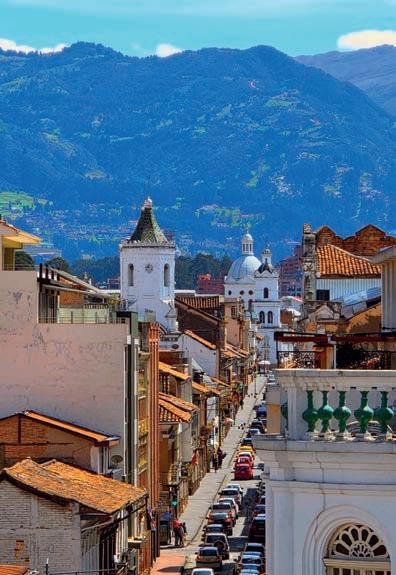
History and tradition (this page; clockwise from top left) A mural near the Tomebamba River in Cuenca shows some of the symbols from Inca culture; traditional characters are depicted in a colourful mural; the city becomes both the subject and the canvas in this mosaic depicting local life, which is full of interesting details; (opposite page; left to right) Cuenca’s historic centre has well-preserved Spanish colonial architecture; Panamá hats aplenty
Alamy; George Kipouros
practised exactly that craft: weaving. She laced the straw between her fingertips, almost effortlessly creating the structure of a wide-brimmed hat. Her movements were graceful and automatic as the light threads of straw fell into place. Down the hall, a trio of men contributed to her process. One dyed straw into shades of terracotta, sage green, fuchsia and turquoise; one pressed them into shape. Another placed the newly washed hats out to dry in the sunshine – although it was a chilly day in the Andes, with cold morning breezes blowing in from the mountains.
Gabriela Molina, a granddaughter of Homero Ortega, noted the cold weather, exclaiming that the hats wouldn’t dry quickly on a day like today. Together we wandered through her family’s museum, which doubled as a boutique selling row after row of Panamá hats, ranging from functional to high-end. Some were classic and

“I started digging into the history of my past, of migrations and everything that involves reconnecting with my ancestral story,” Rraspa told me. “What interests me in my work is showing that it’s possible to belong in both the Amazon and the Andes. It’s a dual identity.”
That’s what it’s all about. In a place with so many stories to tell, it’s not just about the medium – murals, woven hats, fine art – but the identity of those who create it.
Once León and I had reached the end of our tour and seen our last mural (fittingly, an Andean woman donning a Panamá hat), we diverted into a café known as Taita. This café and gallery had the smell of fresh bread, a DJ setting up in a corner and many of León’s art pieces hanging on its walls. Here, I asked him my final question: Cuencano creativity has been apparent to me since day one, but what continues to inspire it?
simple, others commanded the attention of the room with bright hues and bold accents. Off to the side, a group of dapper men were deliberating over which to buy.
Molina’s grandfather – like Rraspa’s grandmother – was born into a time in Ecuador’s Andes when Panamá hat-making was thriving. Despite the name (the story goes that it came about thanks to the sea of men who wore straw hats to protect themselves from the sun during the Panamá Canal’s construction), these hats were once Ecuador’s top export. Now it’s an art form and, quite literally, part of the fabric of the city.
I found the art in Cuenca to be refreshing in that it referenced ancestral roots like this while reshaping them into something new that spoke to both past and present. In Rraspa’s case, this paja toquilla pattern was the canvas on which he painted images that recalled Ecuador’s past and explored its identity.
“Look where we are,” he said. “There are four rivers that run through Cuenca, and look at the mountains.” He gestured outside, explaining the ancient civilisations that stretched south to Peru. When they found Cuenca, they stayed because, as any local will tell you, it’s a shockingly beautiful city. Those who live here have always found inspiration in its beauty –that’s why. We discussed how setting and lifestyle will always be important for creatives – and here, a riverside walk or mountain escape is never far away.
We left the café and walked onto the street. It was dusk by now, and Cuenca’s sky bled violet against the black mountaintops. “Look at this purple!” León said. It’s the colour of the piles of mora blackberries the women sell in the markets down the street. A jugo de mora sky after sunset. This city is a genuine work of art.
Did y know?
The Panamá hat is actually from Ecuador
Trace the origins of the Ecuadorian toquilla straw hat and you will find a tradition that has been passed down through the generations
Words George Kipouros
It’s one of the most persistent misnomers in the fashion world. The elegant, hand-woven, natural straw hat known globally as the ‘Panamá hat’ is not from Panamá at all – it’s Ecuadorian. And not just loosely so: the art of weaving toquilla straw hats was born, perfected and passed down through the generations in Ecuador, long before the world misbranded it.
Wander Cuenca’s colonial centre or the coastal town of Montecristi and you’ll soon see why Ecuador remains at the heart of this tradition. In 2012, UNESCO recognised the weaving of toquilla straw hats as part of the Intangible Cultural Heritage of Humanity, a rming what locals have always known: this is more than a fashion item; it’s an ancestral craft – one that is deeply tied to place, people and identity.
these finely woven hats were practical, stylish and perfect for the tropical sun.
“This is more than a fashion item; it’s an ancestral craft – one that is deeply tied to place, people and identity”
By the 19th century, the nearby Andean city of Cuenca had become another hub of production. Easier to access from Ecuador’s interior, it o ered a broader base of weavers and a growing market. Hat-making became such an essential part of local life that schools introduced it as a formal subject. Locals learnt how to split and soften the palm fibres, how to weave the crown and brim, and how to tighten and shape each strand with precision. In some areas, this education was less a choice and more a necessity.
“It was obligatory in many schools,” said Gabi Molina Ortega, the fourth-generation manager of the renowned Homero Ortega hat workshop in Cuenca. “For parts of the population, it wasn’t just a tradition, it was a livelihood you were expected to learn.”
FROM MONTECRISTI TO THE WORLD
The story begins in Montecristi, an Ecuadorian coastal town where, as early as the 17th century, local artisans were weaving hats from the pliable fibres of the Carludovica palmata, a plant that grows in the humid lowlands. Known for their durability and breathability,

A WOMAN’S WEAVE
I met Gabi in the family’s Cuenca workshop, along with her husband and daughter – part of a new generation already immersed in the business. Her grandfather, Homero Ortega, founded the company, but her great-grandfather was already skilled in the craft. Today, the business exports hats to Europe, the US and beyond, continuing a family tradition spanning five generations.
Perhaps one of the most quietly revolutionary aspects of the toquilla straw trade was the way it opened doors for women.Weaving hats became one of the first ways that Ecuadorian women could earn an income independently.
“This was the first time in our local history that women had a way to make their own money,” Gabi told me. “It gave them freedom, status and a sense of pride. Some became the best weavers in the region.”
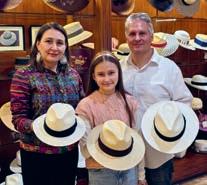

Walking through the workshop today, you can see the di erent stages of production –from soaking the fibres to shaping the crown and carefully ironing each finished piece. No two hats are quite the same, and many take weeks to make, especially the high-end Montecristi finos, whose weave is so tight and intricate that they feel like linen to the touch.
WHY AN ECUADORIAN ICON IS KNOWN AS A PANAMÁ HAT
Gabi explained how the mislabel traced back to the 19th century, when Ecuadorian hats were exported via Panamá, then a busy trade hub en route to North America and Europe. Workers digging the Panamá Canal wore these breathable straw hats, and when US President Theodore Roosevelt was photographed wearing one during a 1906 visit to the canal construction, the association stuck. From then on, the name ‘Panamá hat’ went global, obscuring the hat’s true origins and eclipsing the communities that made them.
Today, Ecuador is reclaiming its heritage with confidence. Visitors to Cuenca and Montecristi can see the weaving process firsthand, purchase hats directly from artisans and join workshops. For Gabi and the Ortega family, education and appreciation are key.
“We don’t mind if people still call them Panamá hats,” she said with a smile. “But we want them to understand the history. We want them to value the work, the culture, the time it takes. These hats aren’t just something you wear; they’re something you carry from generations of Ecuadorian hands.”
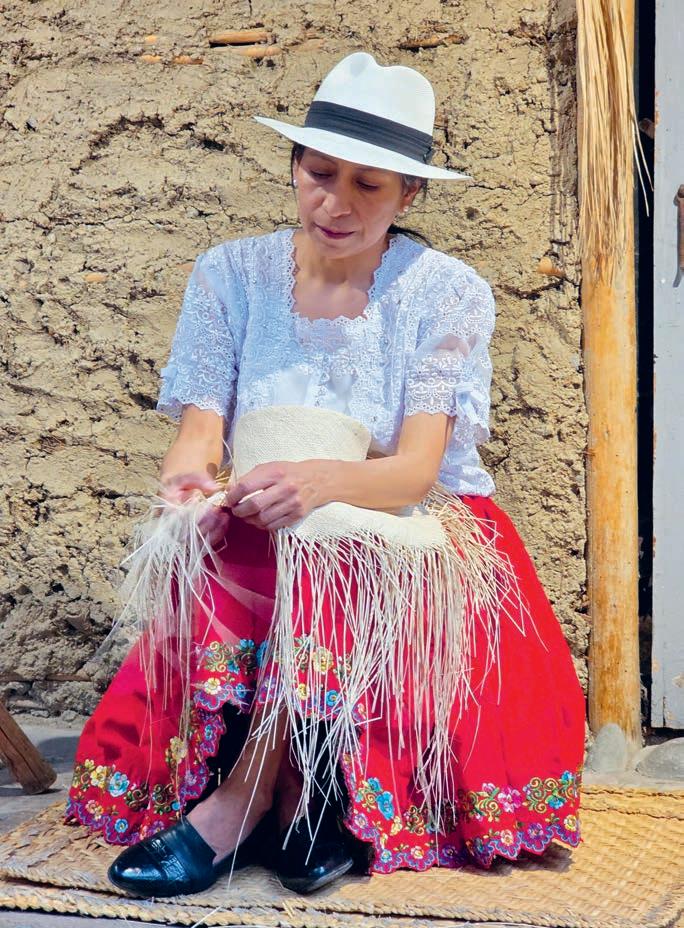
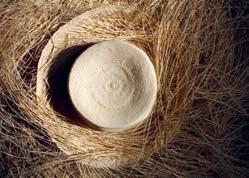
Ancestral heritage (clockwise from above) Panamá hats are hand-woven from natural straw using a tradition that was born, perfected and passed down through the generations in Ecuador, long before these hats were misbranded as being from Panamá; they are made from the fibres of the Carludovica palmata plant; Gabi Molin Ortega, the fourth-generation manager of the Homero Ortega hat workshop in Cuenca, with her husband and daughter
Discover the Avenue of the Volcanoes
The volcanic peaks of this region are an adventurer’s paradise. Savour treks to reach teal-blue lakes and challenging climbs up glacial summits
Words Sinead Mulhern
Ecuador’s north is home to what’s known as the Avenue of Volcanoes. It’s a majestic part of the country where vicuñas gather and heavy mists blow in from peaks that loom large against rugged landscapes.
The reason why Ecuador has so many volcanoes is because it sits along the ‘Pacific Ring of Fire’, a zone where earthquakes and volcanic eruptions happen regularly. Here, two tectonic plates – the Nazca and South America plates – are literally colliding, creating pressure and heat that causes magma to rise and form volcanoes. This is where you’ll find the likes of Cotopaxi, Chimborazo, Tungurahua and other volcanoes that play significant roles in local culture and leave travellers feeling tiny in their shadows.
For those looking for a breathless adventure, climbing these summits would be a notable achievement. Up for the challenge? Don’t miss these ones.
Cotopaxi
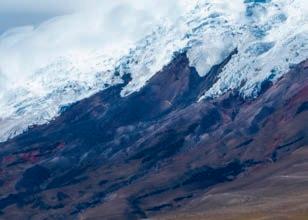
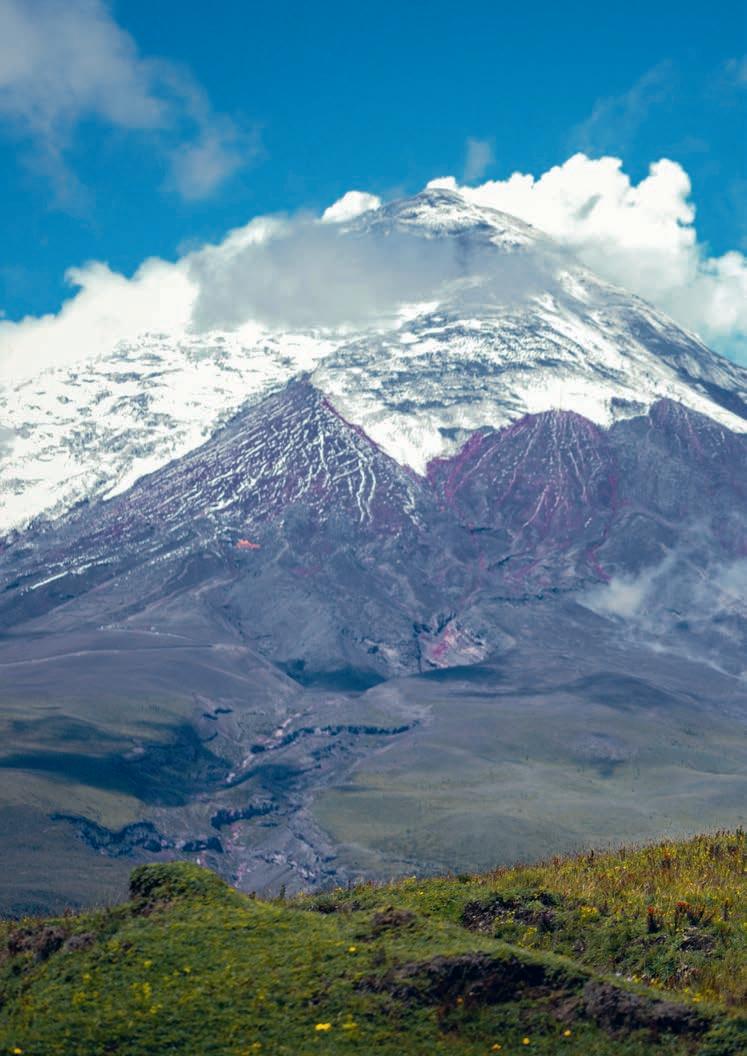
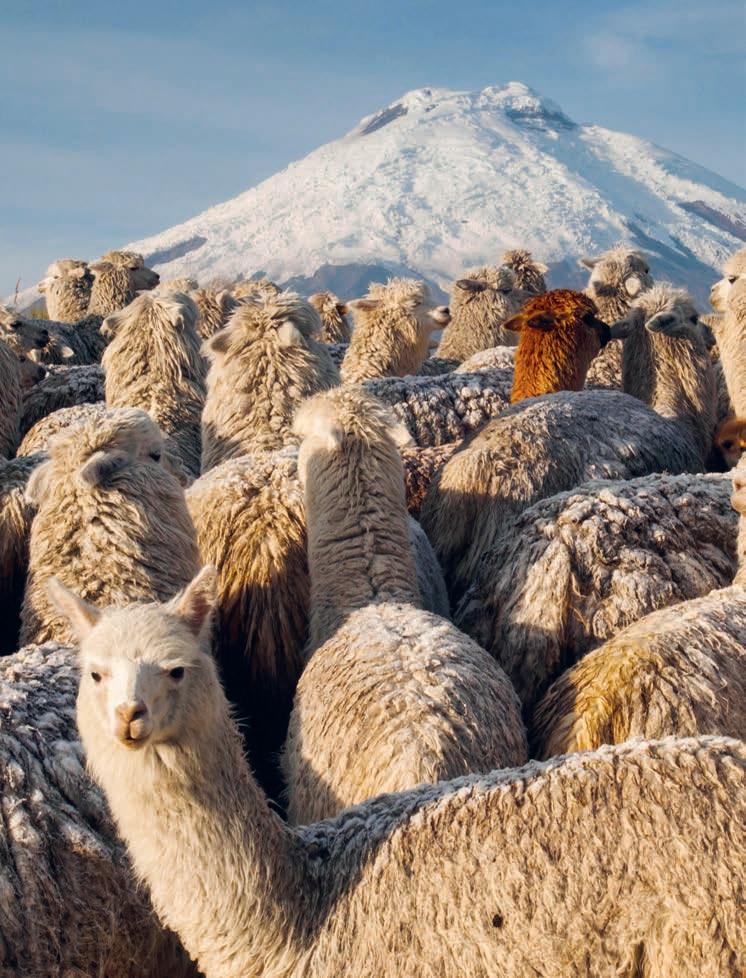
Spend any length of time in Ecuador and you’re bound to see Cotopaxi’s image everywhere, from local art to a bottle of Güitig, Ecuador’s beloved sparkling mineral water that comes from the volcano’s glacial melt. Cotopaxi is an iconic symbol of Ecuador for its stunning beauty, frozen peak, near-perfectly symmetrical cone and height.
This behemoth of a volcano sits above the clouds at 5,897m, making it the country’s second-highest summit. While Cotopaxi regularly leaks emissions, its last major eruption was in 2015, when it spouted heavy ash across nearby mountains in the Avenue of Volcanoes, and it even affected parts of Quito, nearly 50km away.
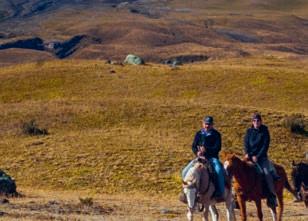
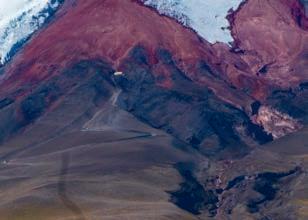
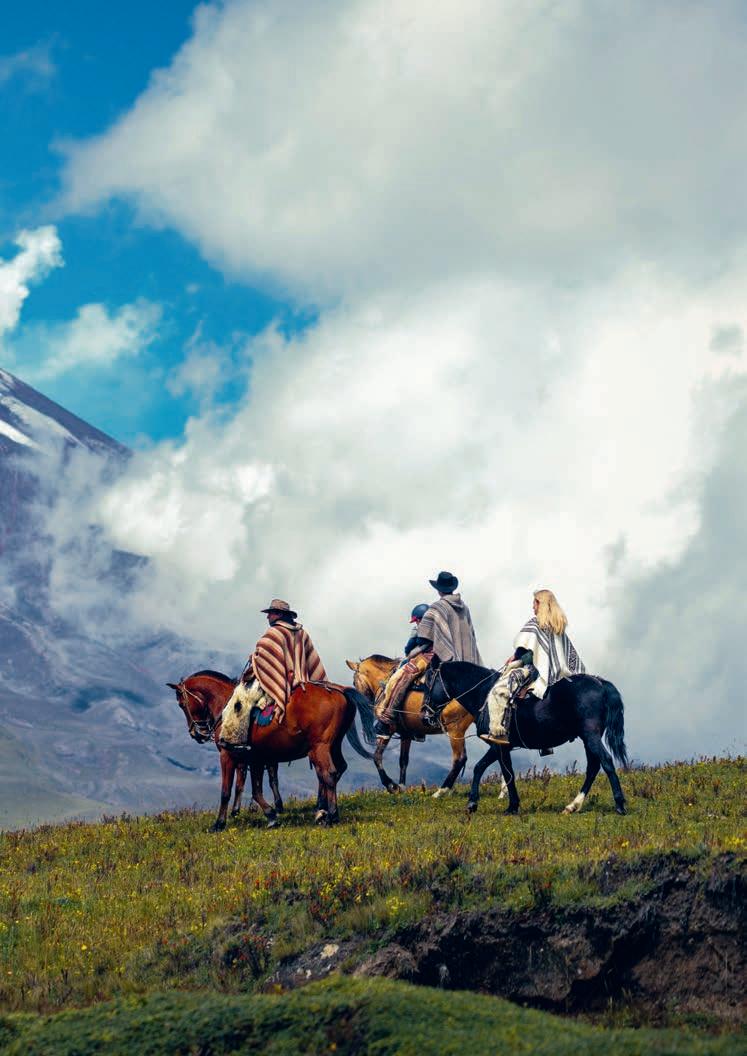
The biggest draw for Cotopaxi – for locals and foreigners alike – is its summit. At just shy of 6,000m, climbing this is a major achievement for mountaineers while being less technical than others of its kind. The journey starts at midnight, which means catching sunrise on the top of one of the highest active volcanoes in the world. Those newer to trekking can do the shorter hike to the lodge just at the edge of the glacier. Take in the views of the moorland below and consider yourself lucky if you spot a fox darting across Cotopaxi’s red ashy terrain. If trekking isn’t your thing, Cotopaxi is one of Ecuador’s best places for horseback riding. Gallop past boulders that were once hurled from deep inside the volcano.
Alamy
ANDES
Chimborazo
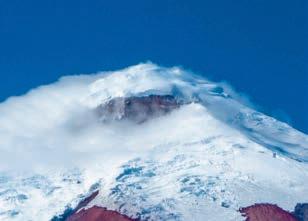
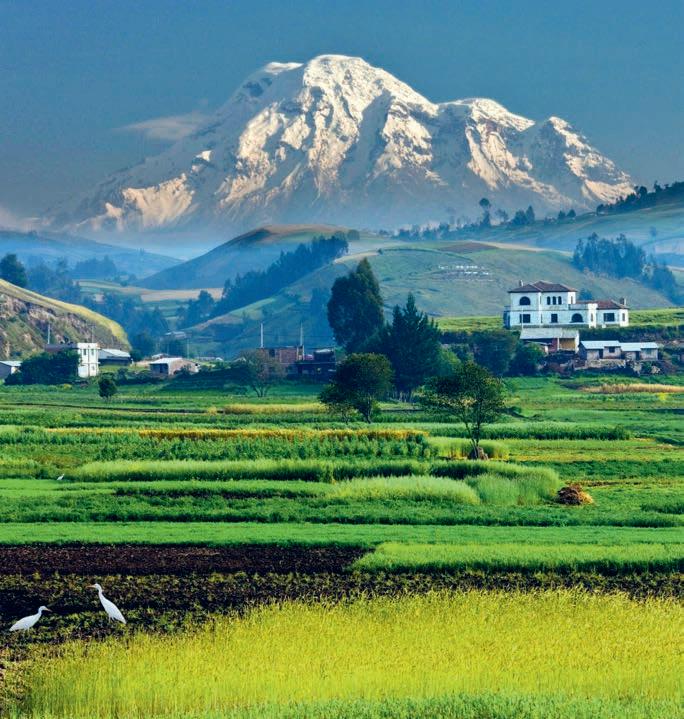
The view of Chimborazo’s white icy glacier against the blue sky is truly awe-inspiring. That image is enough to stop any bystander – and even the locals who tend to goats in tiny rural towns near its base.
Ecuador is known for its volcanoes, but Chimborazo is one of the most famous. It even features in the Ecuadorian coat of arms on the country’s flag. Standing at a chilling altitude of 6,263m, Chimborazo isn’t just a
really high peak – it’s Ecuador’s tallest. But a casual conversation with a local will reveal yet another point of Ecuadorian pride: Chimborazo isn’t just the tallest summit in Ecuador, it would actually be the tallest in the world... if you were to measure from the Earth’s core instead of from sea level. That means that Chimborazo’s top is also the closest point on Earth to the sun.
Most people would be impressed by a climb to a summit stretching more than
6,000m into the sky, which is why Chimborazo draws mountaineers from all over the world and cultivates a mountaineering culture within Ecuador. But one group of people in the history of this region who deserve higher accolades are the hieleros, or ice merchants, who – before refrigeration was readily available – used to climb to Chimborazo’s glacier to collect ice to sell in markets in the nearby city of Riobamba. The last hielero, Baltazar Ushca, died in late 2024.
Alamy
Tungurahua
Tungurahua gets its name from the Kichwa language, where it translates to ‘throat of fire’, a rather intimidating name for an active volcano.
In recent history, between 1999 and 2016, Tungurahua had many volcanic events where it spewed plumes of volcanic ash and scorching lava flows into the foothills and nearby towns, calling for hasty

evacuations. This year, though, it has been a good news story for Ecuador after UNESCO named it a Global Geopark (joining two others in the country).
Tungurahua earned this label not just for its landscape and gorgeous features, but for the communities that have shaped it, rebuilding after its destruction, and who live with deep respect and a culture influenced by its powerful presence.
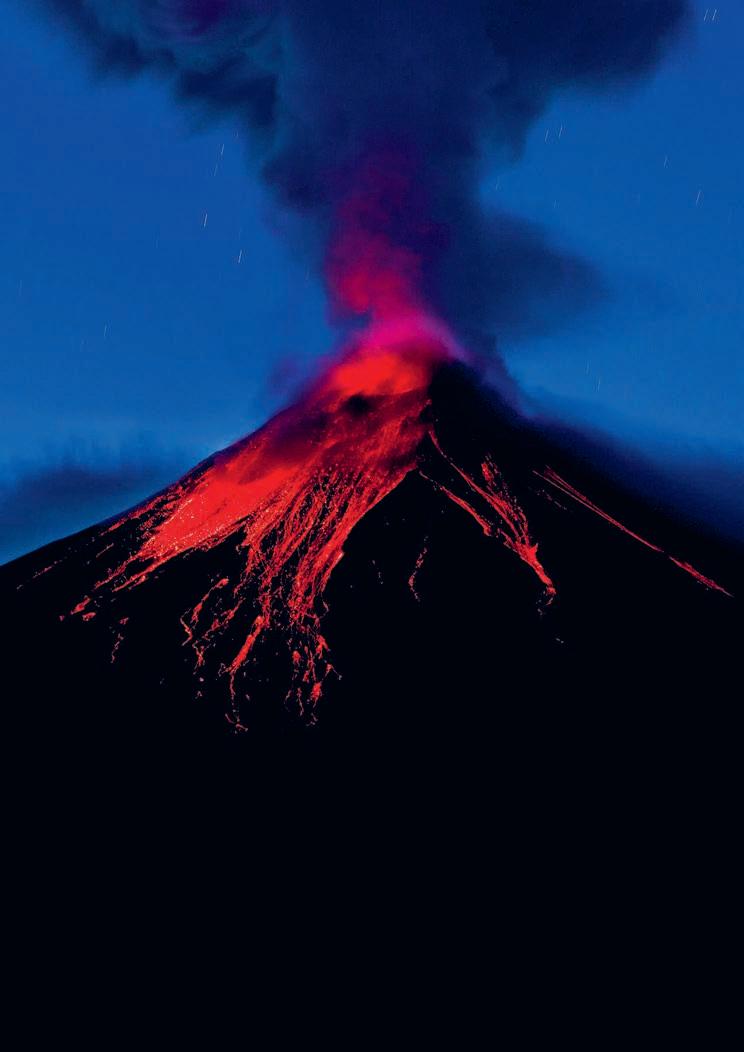
At 5,023m, it towers over the town of Baños, a popular spot for hiking, hot springs, cycling and white water kayaking. That this area is a capital for adventure sports in Ecuador makes sense, as it’s a powerful example of nature’s extremes, featuring everything from thermal springs to steep mountains, deep canyons, rushing rivers and waterfalls billowing with ice-cold water. ⊲


The Quilotoa Loop



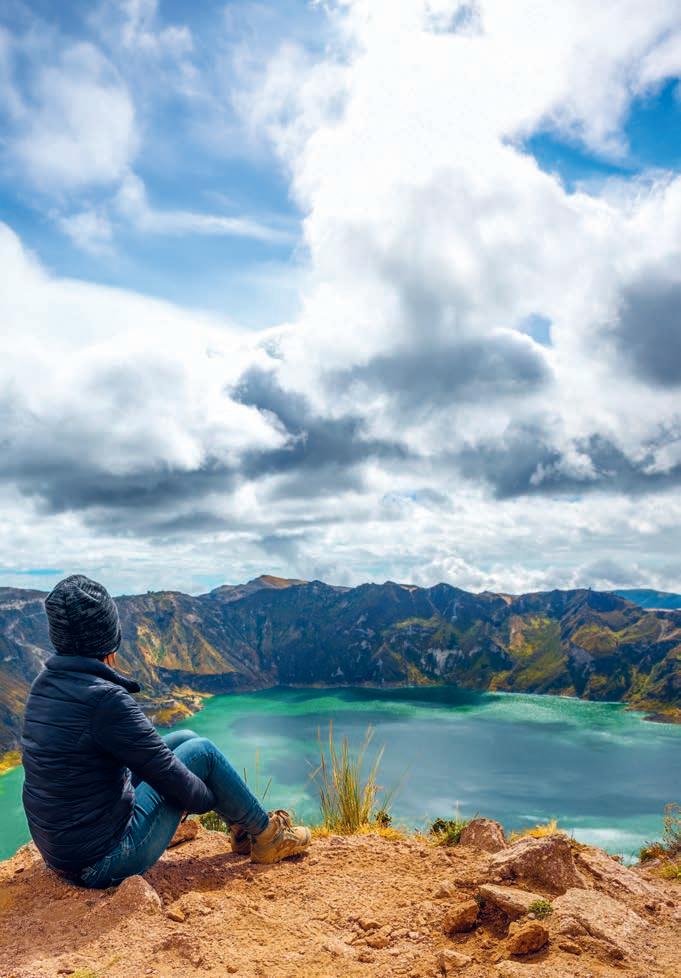
The Quilotoa Loop is one of Ecuador’s best-known multi-day treks, and for good reason. This is one of the best ways to get to know Ecuador’s rural Andean landscape, and the grand finale is a teal blue lake inside the crater of a volcano. It’s an avid hiker’s dream. This is a route of verdant valleys, steep gorges cut into the earth, cattle, sheep, lonely school houses in the middle of nowhere, and early mornings where the clouds settle in the Andes like small wads of alpaca fluff.


While there are variations of the route, hikers typically do the three-day version that starts in the tiny Indigenous town of Sigchos, accessible via bus or private transport from the city of Latacunga (recommendation: check out its market before starting the trek).

From there, the trail weaves through other small towns with plenty of hostels and hiker’s lodges set up along the way. Sure, some of the inclines will be steep, but that fi rst peep of turquoise water on day three makes it well worth your while.




As for the Quilotoa crater itself, this is a lake inside the crater of the volcano, which stands at 3,914m. If you still have some energy after the trek, consider climbing down the gravel trail to the lake’s edge, where you can even rent a kayak and go out on the water.

For travellers pressed for time, there’s also the option to visit Quilotoa for a day or just hike the circumference of the lake. Afterwards, warm up with canelazo – an Andean drink famous in this part of Ecuador.


Alamy
Cayambe
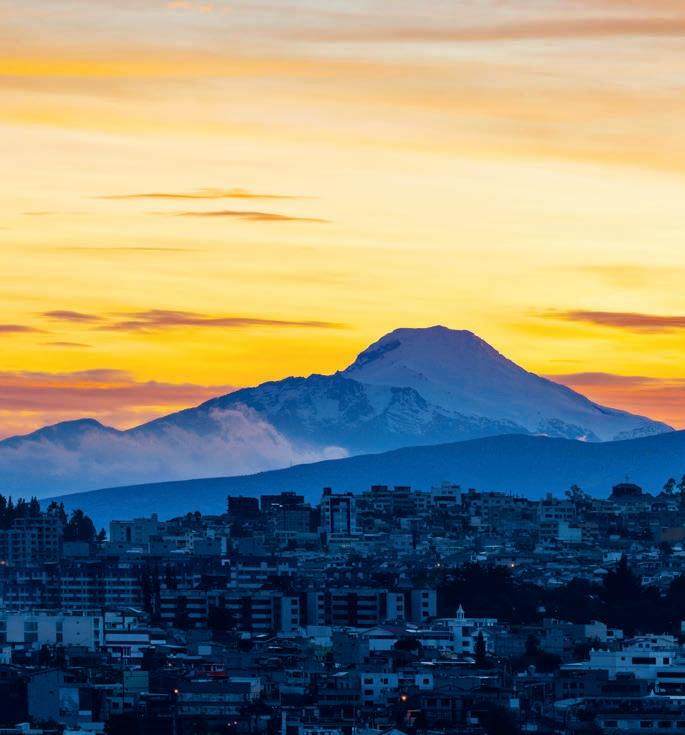
Thinking of magical places on the equator would rarely conjure up images of snowy slopes and mountaineers layered up to protect themselves against a wind-whipped landscape and yet, that’s exactly what you’ll find on Cayambe. Located 70 kilometres north-east of Quito, this is a snow-covered patch of Ecuador that might feel better suited to ski destinations in North America,
but part of the charm about Ecuador’s geography is that it always surprises. Since this volcano has been quiet for centuries, now it’s just a playground for those who love physical vertical challenges… but in a country that has plenty of staggeringly tall summits, Cayambe offers a twist with icy, technical terrain. This is Ecuador’s third-highest mountain, so it’s unsurprising that views from the journey up Cayambe
are impeccable: imagine Andean highlands, glimpses of neighbouring glacial peaks and valleys of agricultural communities below. After a surprisingly wintery climb, consider a soak in the steaming Papallacta hot springs or take a visit to the bustling markets of Otavalo, where the country’s expert artisans sell everything from leather jackets to woven ponchos. Either could be done on a recovery day after visiting Cayambe.


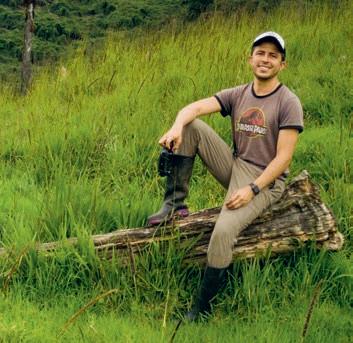

Conserving the Ecuadorian Andes with Lucas Bustamante
Interview by Jessica Reid
While the G alápagos Islands and the Amazon rainforest often steal the spotlight when it comes to Ecuador’s most popular wildlife destinations, the Andes mountain range – including the cloud forests that lie along its foothills – boasts some of the richest biodiversity on the planet. From hummingbirds to howler monkeys, a number of the creatures seen here can be found nowhere else on Earth, and many are sadly endangered. With habitat loss still a major issue, conservation efforts are more crucial than ever.
Educating us on this precious ecosystem is Lucas Bustamante, an Ecuadorian biologist and conservation photojournalist
who has spent the past 16 years using his camera as a tool for communicating environmental stories to people around the world.
What does the role of a conservation photojournalist actually entail?
Unlike nature photography, conservation photojournalism looks at the interactions between humans and nature and tells the whole story. There are positive stories – for example, those on sustainability, scientific discoveries and Indigenous people. Then there are ‘bad’ interactions, like extractivism, poachers, deforestation and pollution. With my camera, the idea is to document all of these things.
Science does the same with data and numbers, but this can be hard for people to connect with. Humans are emotional beings, and there’s a power in photography that connects us universally, regardless of religion, country, language or culture.
What are some of the most crucial species you have documented living in Ecuador’s cloud forest?
In Ecuador, we are super lucky to live among the most biodiverse hotspot in the world: the Tropical Andes. It’s home to
every single animal group, and the cloud forest areas nearly always win global bird count competitions.
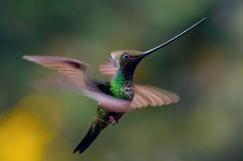
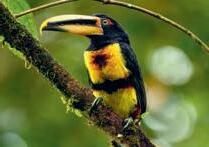
Some species that I love include the different endemic mountain toucans, such as the plate-billed mountain toucan and the greybreasted mountain toucan. There are also incredible hummingbirds. Across the world, we have around 400 species of hummingbird, and Ecuador hosts nearly half of them. One of my favourites is the sword-billed hummingbird – the only bird on the planet that has a beak longer than its body.
Beyond birdlife, what other unique wildlife can you �ind here?
There are so many amazing endemic species, particularly smaller creatures. There are frogs the size of a human hand,
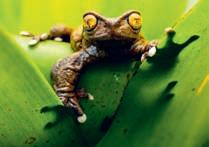
with different patterns on their bodies and coloured toes – like nail polish. Another example is the pinocchio lizard. It lives in the canopy and is completely camouflaged. The males have an appendage on top of their nose, but scientists still don’t know what they use it for. They can be found in the Valley of Mindo, a region that’s home to 10% of the country’s amphibian and reptile species.
Have you discovered any new species in the cloud forest during your career?
Together with teams of biologists, I have discovered 13 new species – mainly amphibians and reptiles. One that comes to mind is the Mashpi torrenteer frog that lives in the western part of the Ecuadorian Andes. We were very happy to name that tree frog in honour of the Mashpi community that it lives close to. It has helped to bring a
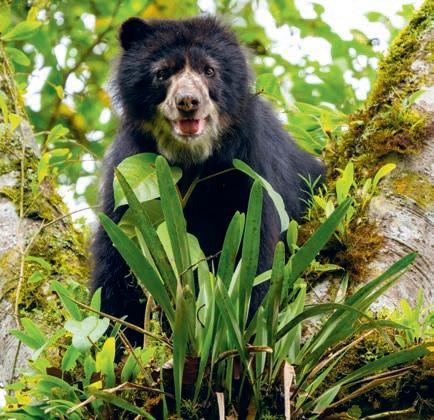
little more ecotourism to that area, and it has encouraged communities to team up to protect the forest and its unique species.
What is the greatest threat to the Ecuadorian cloud forests today?
Deforestation. All these massive, exuberant
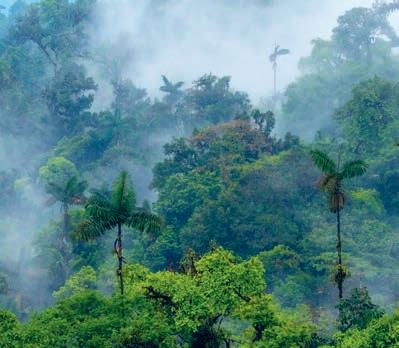
forests, full of plants and trees, are what keep the biodiversity so strong. So any time there is deforestation – whether for mining, oil production, cattle ranching or logging – there is a direct threat. If you cut down all the vegetation on one mountain, you will most likely lose endemic species, and could even bring a species to extinction. For example, a spider living on one mountain likely won’t be living in the next, as they only survive at specific altitudes.
For people wanting to visit the Ecuadorian Andes and don’t know where to start, what would you advise?
Travel with local people, have community-based experiences or stay at eco-lodges that really care about the environment. This offers the most genuine experience of the cloud forests. I also always tell photographers that the most important thing is to respect the wildlife. Just have patience and perseverance, and go with the flow of nature.
What do you hope to achieve in the future with your work?
I consider myself a messenger: somebody with a camera that can enhance the voice of researchers, conservationists, Indigenous people and local people. I want to continue showing people all over the world that this area is really unique and needs to be protected – not just for Ecuadorians but for the heritage of humanity.
Follow Lucas on Instagram @luksth
Taking his shot (this page; clockwise from top left) The tapichalaca treefrog is endemic to Ecuador; fewer than 10,000 Andean bears are left in the northern Andes; the misty cloudforests of Western Ecuador; (opposite page; top to bottom) Lucas has been an environmental photographer for 16 years; the small collared aracari is known for its big bill; the remarkable sword-billed hummingbird
Taste the flavours of the Ecuadorian Andes
One of the best things about this region is the variety of dishes, from sizzling meats and corns to sweet treats, writes Sarah Gillespie
It’s often said that in Ecuador, if the conditions aren’t right, all you need to do is go higher or lower. The Ecuadorian Andes range from the frosted peak of the Chimborazo volcano (6,263m) to the edge of the steamy Amazon rainforest, providing a native pantry of incredible diversity.
You’ll find haciendas with working animal farms and herb gardens, where ingredient origin is measured in metres There’s markets filled with the scent of annatto seeds and sizzling pork, and Indigenous communities who sit down to feasts of roasted meats, corns and beans. Here are 11 flavours you’re likely to encounter on your travels.
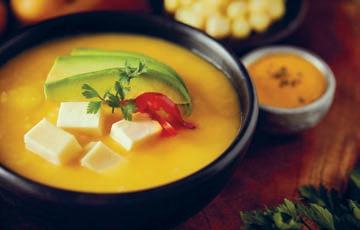
Locro de papa
Ecuador has around 350 species of potato, and this beloved soup puts them to good use. The most common is the native papa chola – a creamy potato with yellow flesh – but chefs may combine it with other varieties, such as Esperanza and Maria, both developed by Ecuador’s National Institute of Agricultural Research (INIAP) to resist disease. Warming, chunky and filling, locro de papa is the ultimate comfort food for chilly highland days, and one that’s on the menu of most Ecuadorian restaurants in the Andes. Garnishes include grated white cheese, sliced avocado and toasted corn; you may also find chunks of cheese stirred through the soup.
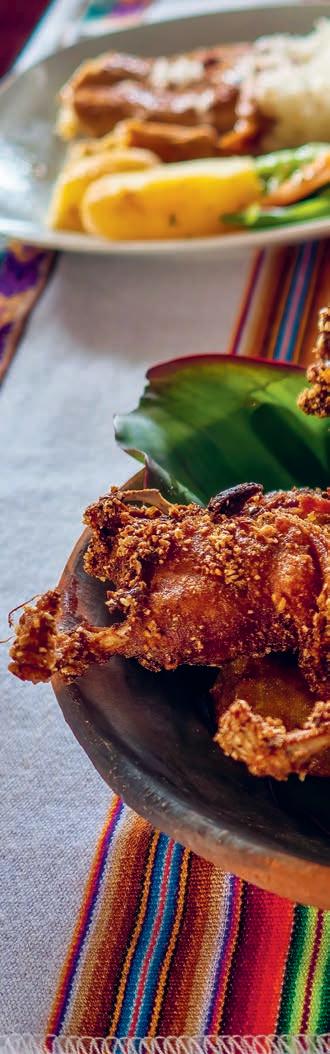
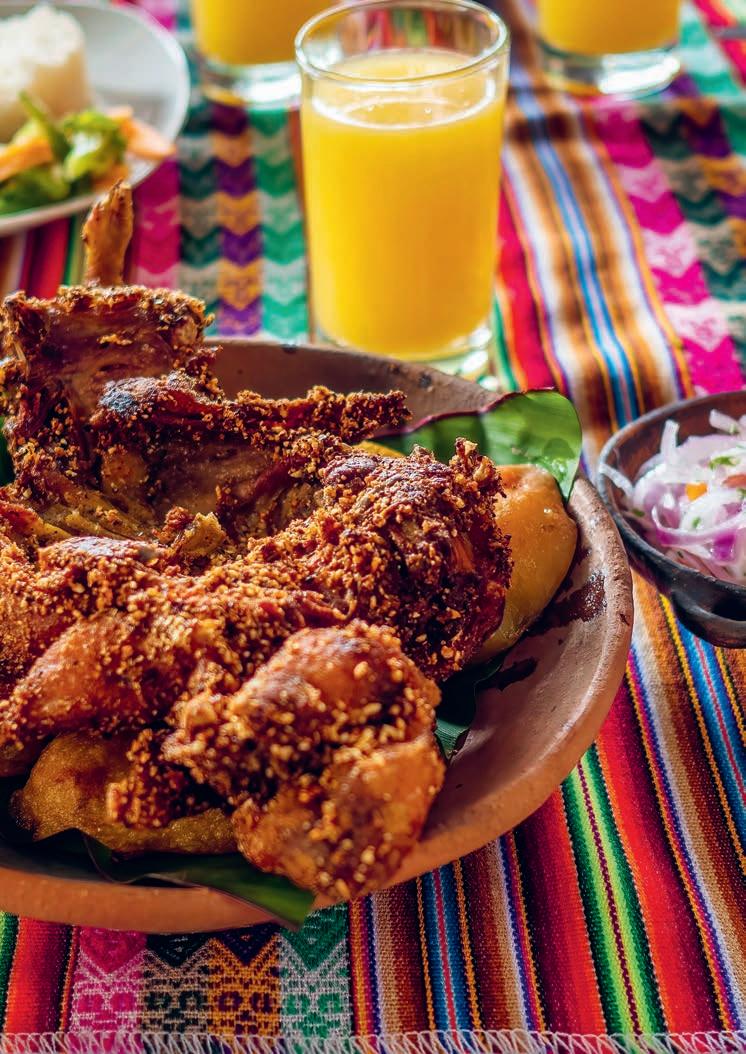
Cuy
Few Ecuadorian dishes arouse as much traveller curiosity as cuy, or roasted guinea pig, which has a gamey taste similar to rabbit. These creatures have been a part of Indigenous Ecuadorian culture for millennia and are used for everything from traditional medicine to wedding dowries. This is an everyday and festive dish, and you’ll often see sellers roasting cuy on street corners.You’ll also find it at a pambamesa: a celebratory meal where cuy, potatoes and beans are served on a cloth laid on the ground. Many rural Andean communities offer pambamesa experiences to travellers, or you can try a fine-dining version with broccolini and amaranth crackers at Quito’s Quitu restaurant. ⊲
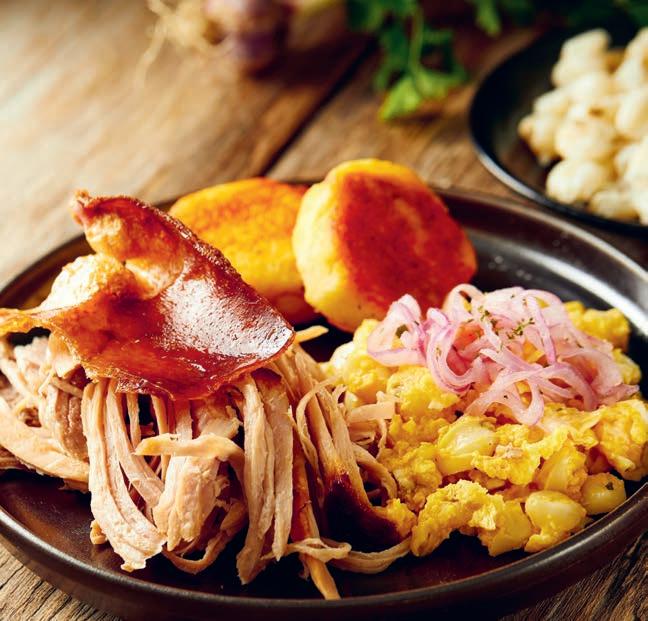
Hornado
Time to loosen your belt – this fantastically fatty pork dish is a staple at covered markets across the highlands. It involves a whole pig – possibly basted or injected with beer or chicha (corn beer), plus spices such as cumin and annatto. It’s roasted for several hours in a wood oven
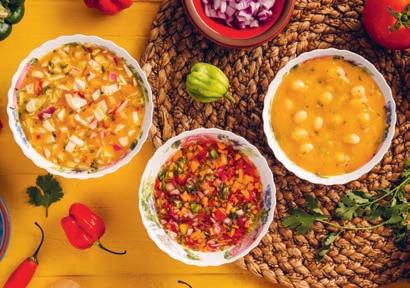
Ají sauce
You’ll see Ecuadorians tipping ají onto their soups and stews by the bowlful, but don’t be tempted to copy them – at least, not at first. This seemingly innocuous hot sauce creeps up on you – and before you know it, your mouth’s on fire. The heat is delivered by peppers (often the Criollo variety) but there’s also a sour kick from native tomate de árbol, also known as tree tomato or tamarillo. Ají criollo, a popular variation, skips the tomate de árbol and adds coriander; it’s green and fresh but still seriously spicy.
until the skin crackles; then it’s pulled and plated. The accompaniments vary by seller and region: you might see boiled mote (grains), potatoes, llapingachos (potato patties), tostado (toasted corn) or fried sweet plantain. Most, though, will add a tomato and onion salsa, which cuts the grease nicely.
Shutterstock; Ecuador Ministry of Tourism
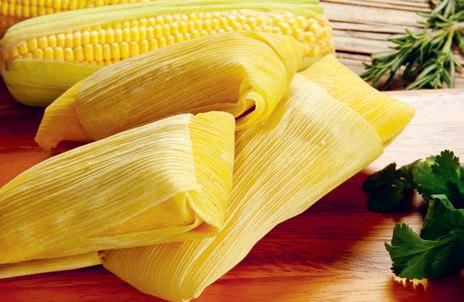
Humitas
There are 29 native varieties of corn in Ecuador, including maíz negro (black), chulpe (sweet), morocho (floury; chewy), and choclo (large kernels). Not only that, you’ll taste it in more forms than you ever thought possible: popped, roasted, pounded into tortillas, or boiled to make drinks such as morocho (a spiced sweet drink) or chicha (a fermented corn beer used for rituals). Humitas are one such form: these corn cakes are found in restaurants all over the highlands. Making them is often a community experience, where Indigenous Kichwa people will come together and tell stories as they peel the corn husks. They then mash the kernels with cheese, onions, garlic, coriander, cream and eggs, then re-wrap them in the corn husk and steam them. They can be eaten at any time of day, though they’re typically consumed with a coffee at breakfast.
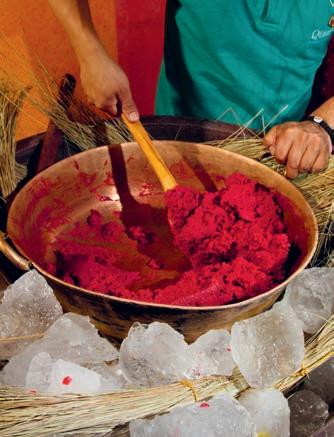
Helados de paila
The preparation of this traditional sorbet is mesmerising to watch. Fruit juices, sugar and water are poured into a cold copper pan on a bed of ice, which is churned until it achieves a soft, snow-like consistency. Popular flavours include mora (blackberry), guanábana (soursop), strawberry, tomate de árbol and naranjilla (a tart tomato relative). You’ll find it at street stalls throughout Ecuador, but its home is Ibarra, where the 16-year-old Rosalía Suárez made the first helados after harvesting snow from the Imbabura volcano in 1896.
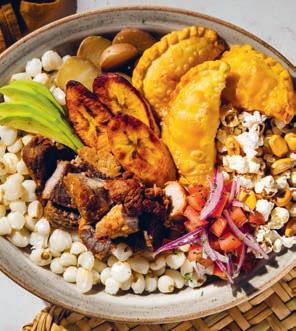
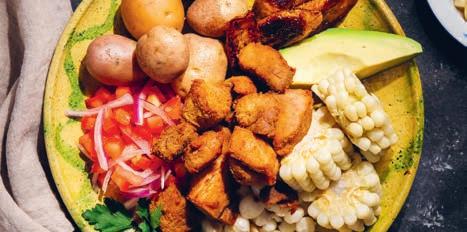
Chugchucara
This stacked pork dish originates from Latacunga, the volcano-ringed capital of Cotopaxi Province. On the ‘chugchucara street’ of Calle Quijano y Ordóñez, a smoky, savoury smell emanates from family-run restaurants, each serving their own take. It combines boiled mote (hominy) corn with fried potatoes, plantains, empanadas and popcorn. The highlight, though, is the pork. In Kichwa, chugchucara means ‘trembling pork skin’: skin that is, traditionally, taken from the pig’s chest and deep-fried to a golden crisp. One plate costs just a few dollars and will fill you up for the day.
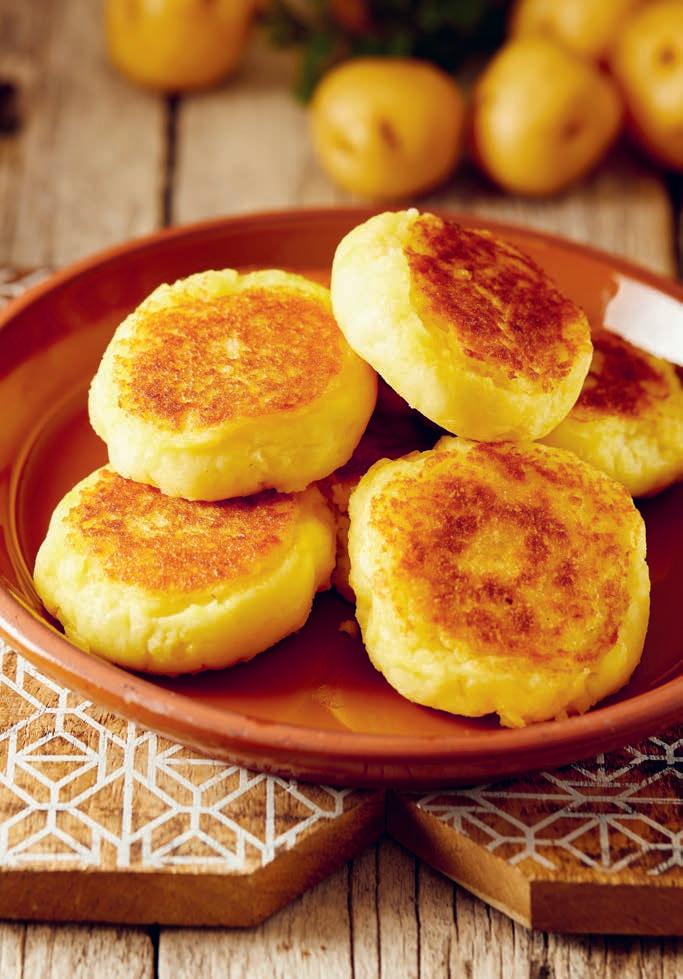
Llapingachos
You’ll see these addictive, crispy potato patties on the side of many Ecuadorian dishes, or sold at street stalls where they are drenched in red annatto oil (oil infused with the pigmented seeds of the achiote tree). They derive their name from the Indigenous Kichwa word llapina (to crush) and the Spanish gacha (dough), though they’ve been around since pre-colonial times, originating in the central Andean province of Tungurahua. They’re made from potatoes and onions mashed together and stuffed with a mild white cheese, which adds chewiness to an already satisfying crunch.
Shutterstock; Ecuador Ministry of Tourism
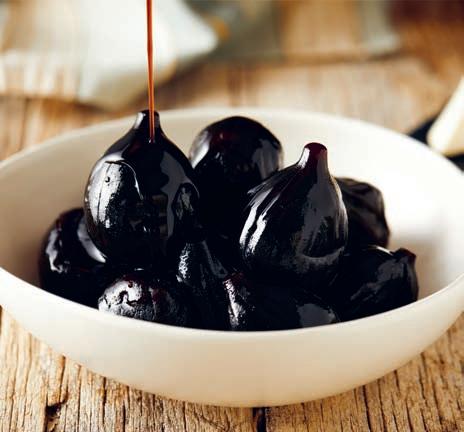
Dulce de higos
This delectable fig-and-cheese dessert doesn’t discriminate: you’ll find it everywhere, from the humblest family tables to the finest of fine-dining restaurants. It’s thought to have originated in the colonial period, since sugarcane was introduced by the Spanish; however, the use of panela, or unrefined cane sugar, was popularised by native South Americans. Here, ripe figs are slowly simmered in a fragrant mixture of panela, white sugar, cinnamon and cloves until they become tender and chewy. They’re then served with white cheese for the satisfying contrast of sweet and salty that is characteristic of so many Ecuadorian desserts.
Fritada
This is the ultimate in cheap and delicious street eats, which you can try at markets such as Quito’s Mercado de Santa Clara. Pork is marinated in garlic, onions and salt, then shallow-boiled until the water evaporates and it cooks in its own lard, turning a deep golden shade that is very satisfying. It’s then served with mote, corn and fried sweet plantain. Other regional accompaniments include mashua (a root vegetable similar to nasturtium) or ají de queso (a thick, cheesy take on ají).
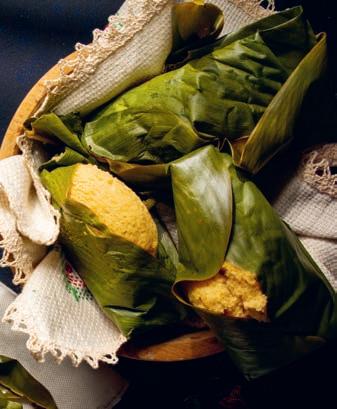
Quimbolito
These soft, pillowy steamed cakes are perfectly paired with a warming cup of tea or coffee and are often enjoyed in people’s homes in the Andes – but you can also taste them at roadside cafes at any time of year. They’re cooked using an Indigenous technique of steaming in plantain or achira (canna) leaves, but have been modernised by the colonial addition of wheat flour, sugar and butter. Raisins or cheese are sometimes added, too, and the leaves infuse the quimbolito with a faintly bitter (though pleasant) vegetal flavour.


Preserving Indigenous artisanal practices with Paola Lema
Interview by Laura Field
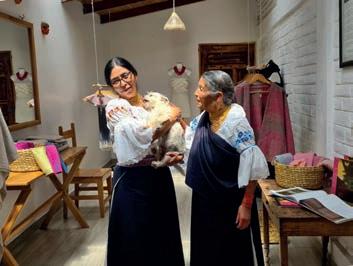
As processes, including those used in various crafts, become increasingly mechanised around the world, artisans in Ecuador are working hard to preserve their traditions. Paola Lema is one such artisan who, alongside her mother, Matilde Lema Jimbo, runs Casa Matico/ Huarmi Maqui in the pueblo of Peguche, just outside Otavalo in northern Ecuador. Paola shares the story behind Casa Matico/ Huarmi Maqui, why it’s so important to maintain artisanal practices and how travellers can experience the centuries-old heritage of loom weaving when visiting Ecuador.
Can you tell us about Casa Matico/ Huarmi Maqui? And what does the name Huarmi Maqui mean?
Huarmi Maqui are two Kichwa words which mean “woman’s hand” – because it’s a business that’s directed by women, my mother and I. My mother, Matilde Lema Jimbo (Matico), started this project; today, she’s 80 years old. It’s a workshop that’s dedicated to loom weaving, and it’s entirely artisanal because everything we make is by
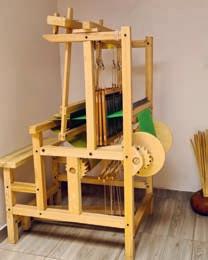
hand. The workshop was founded in 1999 by name, but our traditions have existed in our community (the Indigenous community of Peguche in northern Ecuador) for much longer than that.
What kinds of artisanal crafts do you create?
Traditionally, weaving has always existed in our community. We always try to weave with natural fibres, such as sheep’s wool, cotton threads or alpaca wool, because we want everything that’s created in the workshop to be natural. We weave blankets, scarves and shawls. By weaving, we’re also able to tell
Casa
Matico/Huarmi Maqui
our story. We weave artisanal garments, but we also believe that our pieces tell stories and recount lives. When I speak about the story of Huarmi Maqui, I’m also speaking about my mother’s life because she’s the founder of this project.
How did you learn this craft?
My mother used the loom from a very young age because she’s the eldest daughter. It was more a responsibility for her to learn; no one had to tell her to pick it up. It’s the primary job at home, and one that helps economically. In my case, I grew up watching and observing textures, colours and forms. When I first had a go on the loom as a little girl, it wasn’t difficult for me because I was creating patterns that I’d already lived and were already in my memory.
Why are these artisanal crafts important for the community in Otavalo?
These crafts and workshops come from generations who are now leaving us and dying. Our weaving culture isn’t written down; we’re more of an oral culture. The designs from our ancestors were never recorded; they were only committed to memory. Today, we have very few textile patterns in our workshop because my grandmother died.
My mother is the one who continued this tradition as part of her heritage, and now I’m doing the same. It makes me realise that manual artisanal workshops encourage us to look back and understand where we come from, which pueblo we belong to, what we’ve lived through. I feel that artisanal workshops safeguard stories that enrich us as an Indigenous culture, and they enrich us as humans.
How can travellers visit Casa Matico/Huarmi Maqui and take part in workshops to learn more?
People can come and visit us. We are in the province of Imbabura, just 10 minutes north of the town of Otavalo. We’re based in the village of Peguche. If people want to participate in a workshop to learn more about the craft, they can contact us, and we will create a tailor-made workshop for them. We work in a reserved way because we only want to do the workshops with groups of four or five people at a time, so we don’t have fixed times for workshops. We’re very active on Instagram, and visitors often find us that way, so travellers can also contact us there (@huarmimaquicasamatico). Visitors know that we’re responsible in how we create things and that our crafts are of high quality. Our work is my community’s legacy.
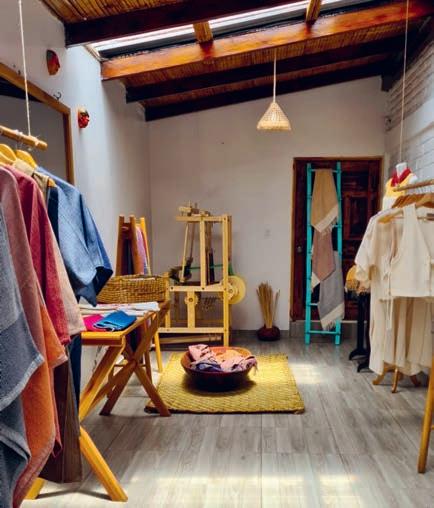
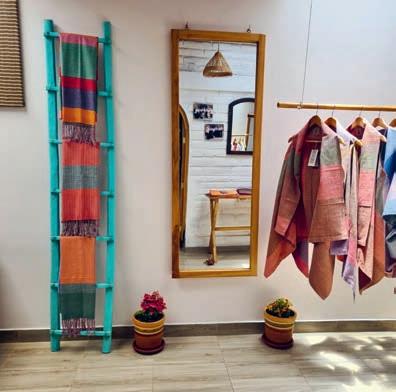
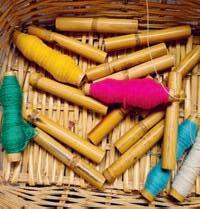
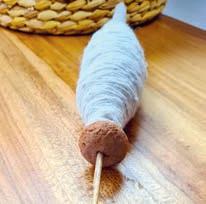
Passed down (opposite page; clockwise from top) Paola Lema [left] and her 80-year-old mother, Matilde Lema Jimbo [right], who founded Casa Matico/Huarmi Maqui in 1999 as a way to keep alive the traditions of loom weaving that are passed down in her community; the spindles, loom and threads that are the tools of their trade; (this page; top to bottom) Casa Matico/Huarmi Maqui sell a variety of garments; as well as browsing clothes, visitors can take part in workshops
Sleeps in the Ecuadorian Andes
Whether sleeping in a cloud forest on a reserve, a glamping dome below a volcano or a historic Quito casa, here are some of the best places to stay
The Andes mountains are Ecuador’s spine, running north to south and acting as its cultural and culinary nerve centre.You’ll find unimaginable variety on their slopes , including a pair of UNESCO-listed cities (Quito and Cuenca), snowcloaked volcanoes, sultry cloud forests and fincas that grow coffee, herbs and more potato varieties than you could imagine.
Ecuadorians’ pride in their heritage shows in their hotels: many are carefully conserved ancestral homes or haciendas. You’ll also encounter conservation projects, fragile ecosystems and Indigenous and mestizo traditions. Here are ten of the most characterful sleeps in the Ecuadorian Andes region.
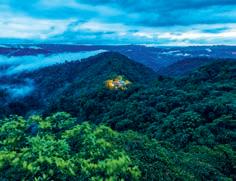
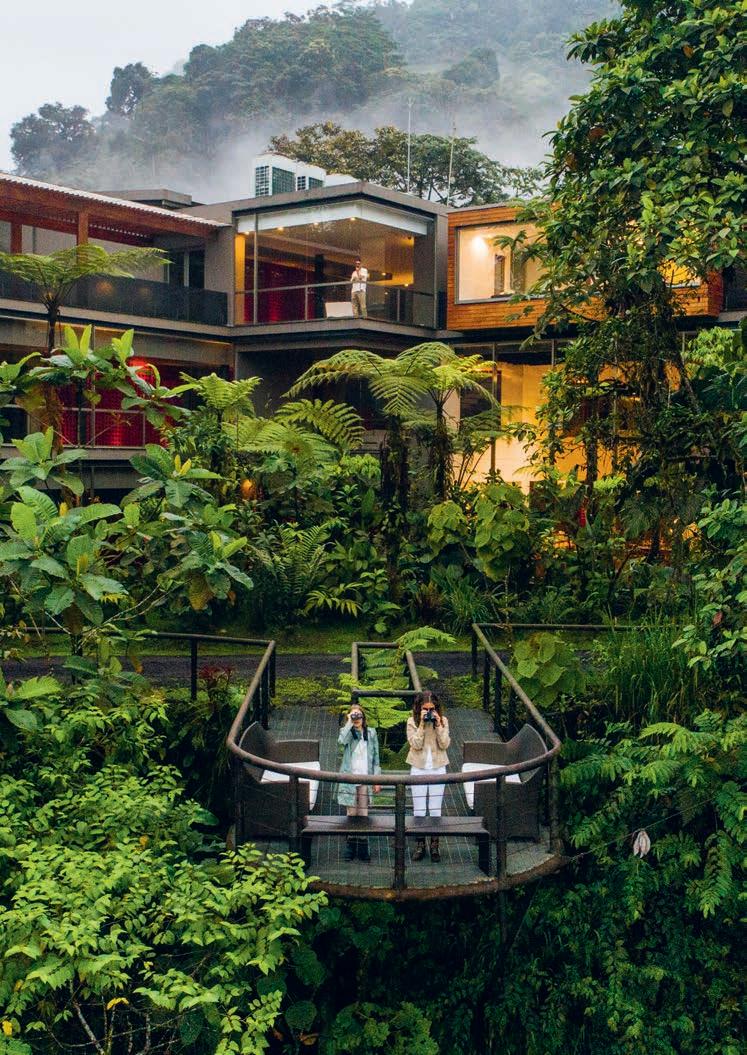
Mashpi Lodge, Mashpi
This is truly the stuff of bucket lists: a stay in the pristine primary cloud forest of the Mashpi reserve. Its glass walls and remote-controlled blinds ensure you wake to the sight of steamy jungle every morning. Funds from the lodge’s high price tag go into researching and conserving the unique ecosystem, which has 1,700 species, including ten found nowhere else. Experienced naturalist guides will lead you on hikes and night walks to reveal jewel-like Mashpi frogs and acid-green vine snakes, or take you up in the ‘Dragonfly’ cable car to get a look down on the canopy and its myriad butterflies. If you’re up to it, wake at 3am for the chance to see the mating dance of the scarlet-plumed cock of the rock.
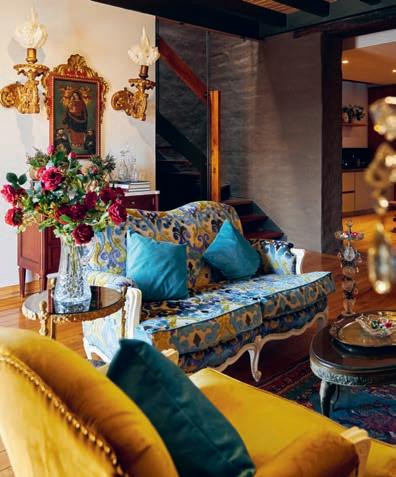
Casa Santa Clara, Quito
This 19th-century colonial residence was once part of Quito’s Santa Clara market. It’s since been lovingly restored – a process that uncovered details from different eras, revived the central patio and won it a clutch of architectural awards. It now comprises four loft apartments, each of different size and character, with their own kitchen, washer-dryer, Indigenous-themed artworks and furniture collections that blend Spanish-era sumptuousness with mid-century minimalism. Three of the apartments are for two guests; the largest, Loft Arupo, is for four. A breakfast basket of fresh eggs, warm bread, local cheese, jam and orange juice is delivered daily; otherwise, you’re left in constant, blissful solitude (unless you plump for the optional housekeeping service).
Words Sarah Gillespie
ANDES
Cotopaxi Sanctuary Lodge, Cotopaxi
With their alien-like flora and ever-changing skies, the páramo landscapes of Cotopaxi National Park could well be described as “otherworldly” – it’s appropriate, then, that this glamping lodge looks like the set of a science fiction movie. On the slopes of Sincholagua volcano, four dome-shaped pods orbit the central lodge like satellites, each with double and twin beds, a bathtub, a desk and a coffee machine. But what you’re really here for is the view of the cloudhazed Cotopaxi volcano (5,897m), which the large windows of each dome are conveniently turned towards. At the main lodge, you’ll dine on Andean dishes and coordinate excursions such as horse riding, hiking and biking.
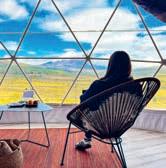
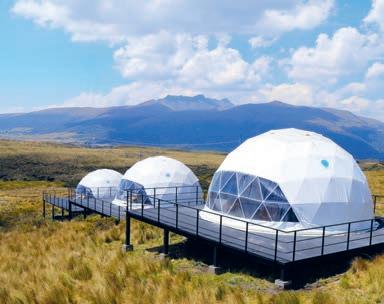
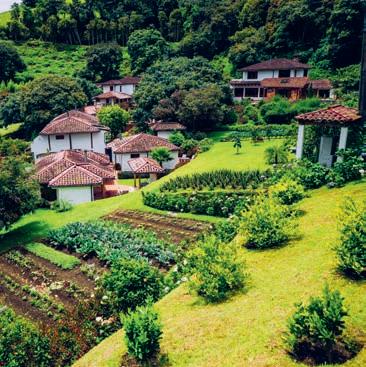
Luna Volcán, Baños
With hot springs, waterfalls and hiking trails on the active Tungurahua volcano, the city of Baños is both Ecuador’s adventure capital and spa capital. It’ll make your heart race and your shoulders loosen. Luna Volcán, a spa resort 400m above Baños, excels at both. The 20-strong menu of excursions includes whitewater rafting, canopy walks in Sangay National Park (a UNESCO World Heritage site) and canyoning in the Pastaza Amazon conservation region. After all that, you’ll need a chocolate massage at the spa, or perhaps a bath infused with herbs from the organic garden. Rooms come with floor-to-ceiling, volcano-view windows and outdoor terraces, and there’s a restaurant serving fresh ceviches and heartier beef dishes.
Mansión Alcázar, Cuenca
The old towns of Quito and Cuenca have UNESCO World Heritage status in common; otherwise, they could not look more different. Where Quito has rows of Spanish townhouses, Cuenca’s architecture is inspired by trips to France taken by the post-independence elite. One of the most emblematic is the 19th-century Mansión Alcázar – originally the residence of Enrique Cordero, son of former president Luis Cordero. The facade has the friezes, pilasters and wrought-iron balconies typical of the time; inside is a bloom-filled courtyard, French restaurant and a two-storey atrium where you can sip your complimentary glass of wine while listening to the nightly piano performance. Just three blocks away, you’ll find Parque Calderón (Cuenca’s main square), ringed by churches and chic cafés.
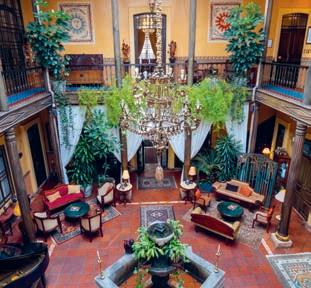
Alamy; Cotopaxi Sanctuary Lodge; Luna Volcán; Mansión Alcázar; Casa Gangotena
Casa Gangotena, Quito
After being gutted by a fire in 1914, the ancestral home of the Gangotenas – a wealthy and influential Quiteño family – was rebuilt to a design by the Italian Russo brothers. The result was less Spanish townhouse than palazzo, with columns, fountains and frescoes. In 2007, former Quito mayor Roque Sevilla bought the building, asserting that its location would
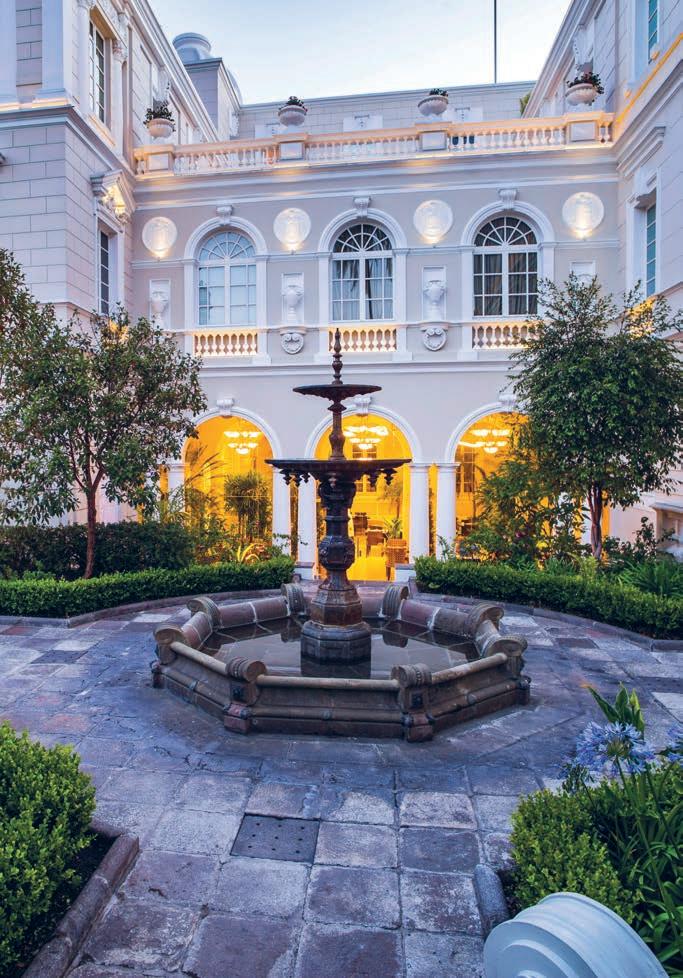
make an ideal hotel. And what a location: looming over Plaza San Francisco, with views of its eponymous Baroque church from the rooftop terrace. The interior views are almost as grand, with sun-filled, leafy atria, high-ceilinged bedrooms and huge, all-marble bathrooms. The Ecuadorian-European restaurant serves specialities such as cacao-crusted chicken, and truffle and chaucha potato soup.
Hacienda El Porvenir, Cotopaxi
Just south of Quito stretches one of South America’s most extraordinary landscapes: the Avenue of Volcanoes. A dozen or so peaks flank the Pan-American Highway, their slopes blanketed by the unique Andean ecosystem known as páramo. On one of these volcanoes, Rumiñahui, is the colonial-era Hacienda El Porvenir. Within its 1,000 hectares
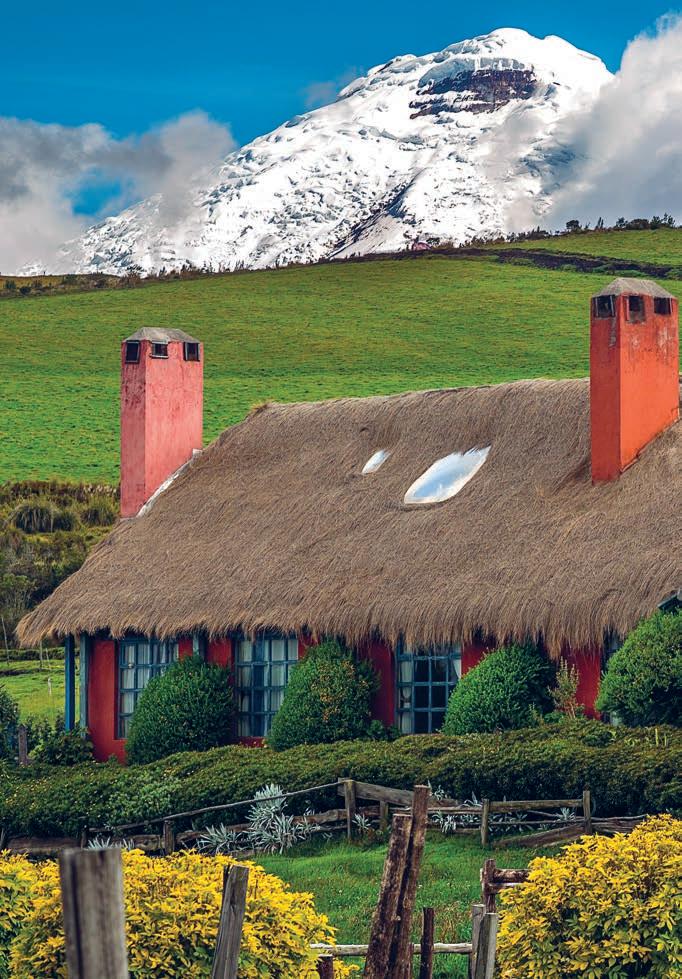
is a farm and herb garden, which supplies the restaurant. Traditional dishes served here include humitas (steamed corn cakes) and ceviche with chochos (lupini beans). Rooms range from ‘traditional hacienda’ to suites, which are warmed by in-room fireplaces. The spa uses local plants and volcanic hot stones, and activities include farming, riding and archery with the chagras, the mestizo ‘cowboys of the Andes’.
Hacienda Zuleta; Hotel Otavalo; Juan Fernando Ayora; Hacienda Abraspungo
Hacienda Zuleta, Imbabura
It’s not every day that you stay at the home of two former Ecuadorian presidents. Both Leónidas Plaza and his son, Galo Plaza Lasso, lived at this 17th-century hacienda, which is today managed by the younger Plaza’s children and grandchildren. In total, it spans 2,000 hectares of pastures and forests in the province of Imbabura. Within this area are projects supported by the Galo Plaza Lasso Foundation, such as a condor conservation centre and an Indigenous-run embroidery school. But you’ll find it hard to leave the main, colonial-style house, with its carved antique furniture, fireplaces in every room and endless corners in which to curl up with a book on a rocking chair.
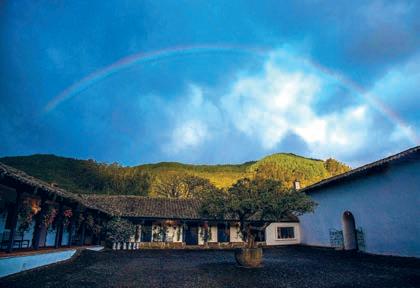
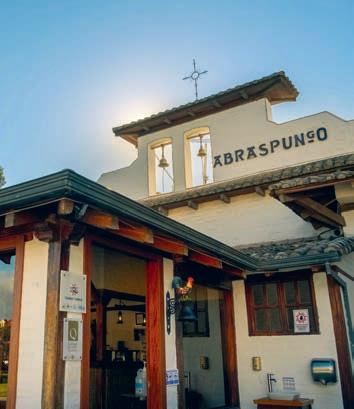
Hacienda Abraspungo, Riobamba
The town of Riobamba, in the centre of Ecuador, is the main jumping-off point for visits to the 6,263m-high Chimborazo volcano. Reaching its summit is a popular goal among climbers – not only is Chimborazo Ecuador’s highest peak, it’s also the closest point on Earth to the Sun, due to an equatorial bulge. It’s a long way to the summit, so if you’re satisfied with a view of it from your room (or from a hammock in the garden), Hacienda Abraspungo is the place to stay. Fill up on ceviche and steaks at the restaurant, or indulge in an hour-long massage. Should you get itchy feet, you can go on horse-riding or trekking excursions on Chimborazo’s slopes.
Hotel Otavalo, Otavalo
This Spanish colonial-inspired apartment block was originally built in the 1930s. In 2015, it was bought by Ecuador’s Art Hotels group, which also manages properties in Quito, Guayaquil and Cuenca. The brand’s ethos is built around cultural immersion, and you’ll find plenty of that here: cookery lessons, Paccari chocolate tastings, Andean cocktail classes, storytelling sessions and Indigenous musical instrument workshops. Ten minutes’ walk away, you’ll find Otavalo Market, where you can stock up on alpaca ponchos, handmade jewellery and felt hats. Between activities, relax in your room – each one is individually styled with local artworks – or take in Otavalo’s red roofs and church spires from the rooftop bar.
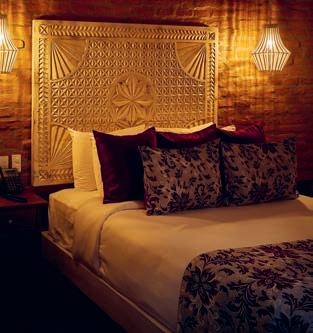
Did y know?
The significance of naïf folk art in the Ecuadorian Andes
The folk art of Tigua, created using materials and tools that come to hand, tell the story of rural life and an artistic revolution in the Andes
Words Jessica Reid
In artist Luis Millingalli’s vision of Ecuador, the mountains have perfect peaks, fields form patchworks of vivid red and orange irregular rectangles, and trees and grasslands glow in shades of apple-green underneath a royal-blue sky. Clusters of people scatter the landscape, usually working, playing instruments or taking part in traditional festivals. His scenes of communal life in the rural Andes are simple, bold and joyous. It’s these characteristics that are the essence of naïf art: a cherished painting tradition that holds deep cultural significance for Ecuador’s Indigenous communities.
“ Traditional artists continue to paint on sheepskin and use chicken feathers as brushes”
The distinctive style originated in the highland villages of Tigua, located in the Andean province of Cotopaxi, south-west of Quito. In these rural villages, surrounded by valleys and mountain slopes dedicated to livestock husbandry and crop cultivation, agriculture has been a way of life for centuries. Alongside farming, craftsmanship is also deeply embedded within the community’s heritage. People have decorated ceremonial objects, such as
drums and masks, for hundreds of years. But the distinctive folk art of this region only gained widespread attention in the 1970s, when pioneering artist Julio Toaquiza was commissioned to paint on a flat surface for the first time. He used a sheep hide stretched out across a wooden frame as the canvas. From this moment, naïf art started to flourish in Ecuador. Tigua’s self-taught artists paint the world they know. The most common backdrop of their work is the mountainous landscape of Cotopaxi, with its active stratovolcano often depicted puffing smoke from its top. Indigenous figures are also commonly depicted wearing ponchos and Panamá hats, usually harvesting crops, herding llamas and sheep, weaving textiles or just performing the chores of daily life in the mountains. More naïf art subjects include musicians, ancient ceremonies and festivals, as well as Andean legends. One famous myth that is often portrayed in paintings depicts a person riding on a giant condor as it soars through the sky.
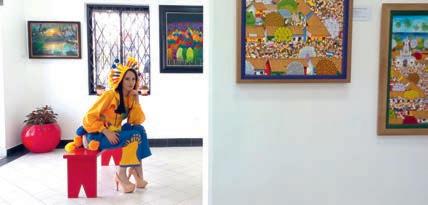

Utilising the materials that come to hand, traditional artists continue to paint on sheepskin and use chicken feathers as brushes, while bright-coloured acrylic and oil paints are essential for creating the vibrant compositions. Alongside the bold colours, the distortions of scale and innocent subject matter bring a simplistic feel to the paintings, yet artists still require a great level of creative skill and storytelling ability to produce such works.
Today, Luis Millingalli is considered one of Ecuador’s most influential artists of the naïf style. Born in the small town of Pujilí in Cotopaxi, he started painting at just 12 years old. After moving to Quito and developing
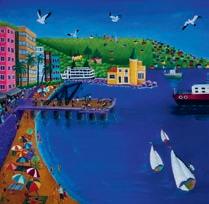
Alamy; MANLA (Museo de Arte Naif Latinoamericano)
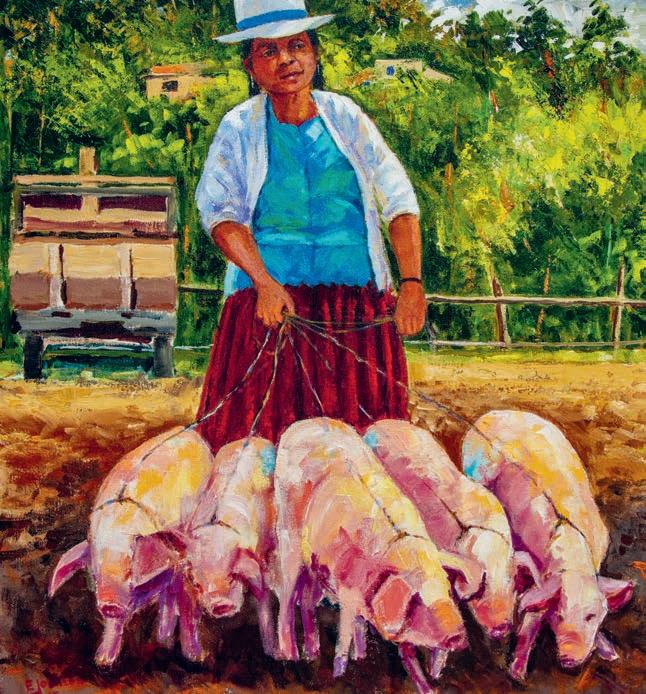
his talent, he went on to showcase his artworks globally, celebrating Andean culture and nature through his creations, displaying a particular flair for painting flowers.
While naïf art doesn’t traditionally evoke conversations around social issues, Millingalli’s exhibits have often confronted observers with the endangered traditions of Ecuador’s Indigenous peoples and the disappearing natural beauty of the mountains,
threatened by activities such as mining and agricultural exploitation.
Varying styles and degrees of quality of naïf folk art can be found in markets and tourist shops across Ecuador, especially in busy urban centres such as Quito and Otavalo. But to experience its authentic roots and to explore the bucolic settings that inspired such work, a visit to Tigua offers something truly special.
Here, a cooperative has been established where visitors can meet local artists, purchase original works, take in workshops and explore small galleries, including that of the renowned Toaquiza family. The initiative not only helps preserve the Indigenous identity of this art form but also supports the economy of Tigua and encourages younger generations here to follow in the brushstrokes of their ancestors.
Genius masked as simplicity (this page) Ecuadorian naïf art originated among the highland communities of Tigua and depicts scenes from everyday life in the rural villages of the Andes, from looking after livestock to weaving; (opposite page; clockwise from top) musicians are commonly depicted in the colourful world of naïf art; this style of art is not confined to the mountains of Ecuador and can be seen across Latin America and beyond, including this example from Chile’s Cecilia Byrne; the galleries, markets and tourist shops of Ecuador’s big cities, Quito and Otavalo, are a good place to find naïf artworks for sale
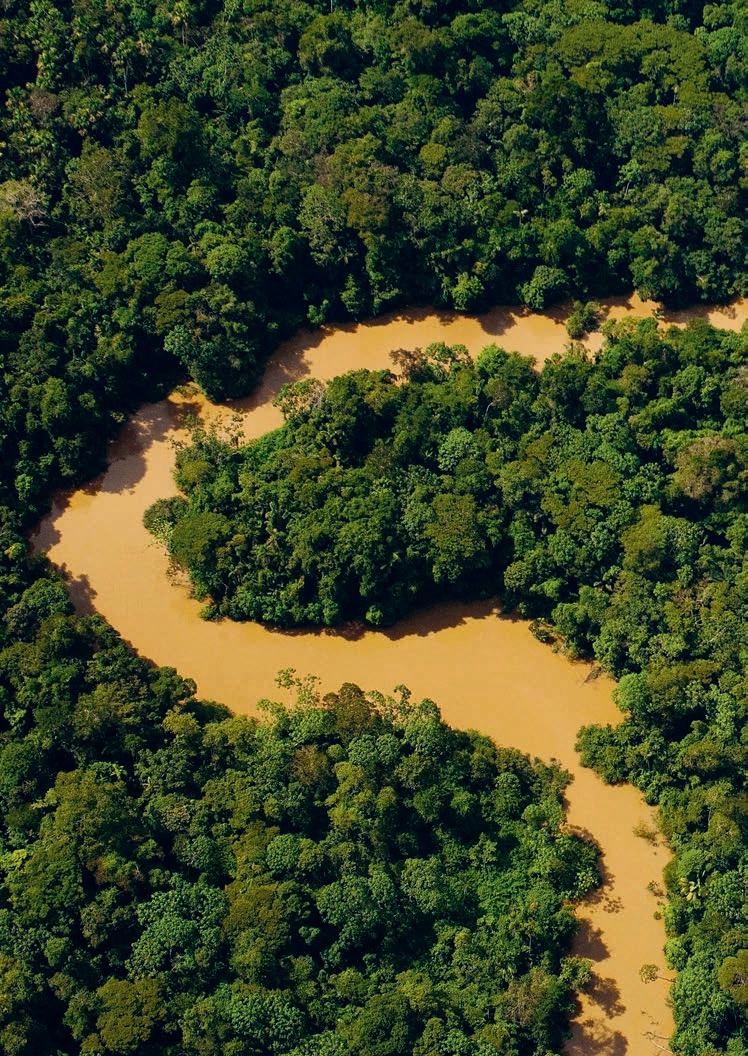
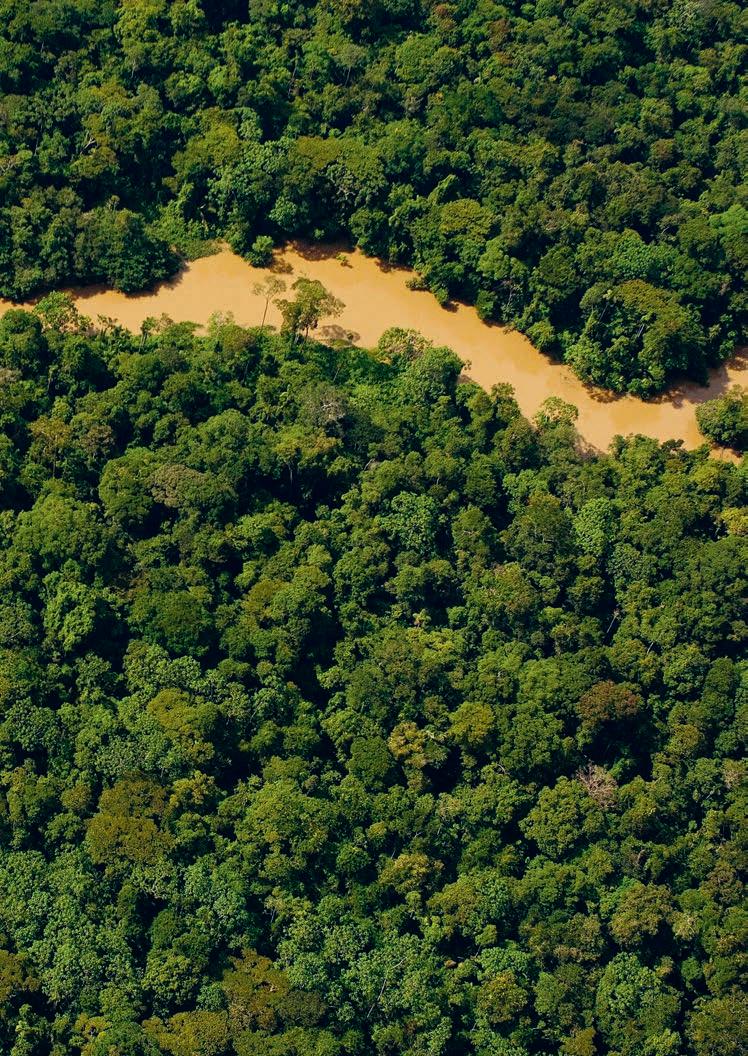
The Amazon
See everything from monkeys to macaws, sleep in a rainforest lodge and spend time with Indigenous communities here, for an insight into the ancient traditions and wisdom found in the forest
Alamy
Le ning from e
Indigenous communities of the Ecuadorian Amazon
Visits to Indigenous communities o er insights into ancestral traditions around crafts, storytelling, farming and cuisine, plus a deep respect for nature’s wisdom
Words Sarah Gillespie
One quarter of Ecuador’s 1.1 million Indigenous people live in the Amazon – far fewer than in the Andes, but far greater in their diversity. Of the country’s 14 o cially recognised Indigenous peoples, 10 live here, from the Kichwa of Napo Province to the endangered groups living within the Cuyabeno Wildlife Reserve. Though they have distinct cuisines, dress and traditions, what unites them is the cosmovision: a holistic view of

the earth and humanity’s place in it. Nature is not just a resource to be exploited, but a source of wisdom and energy that must be preserved: among some groups, this philosophy extends to belief in deities such as Kanjansi (the boa) and the Añuchu pûshe’sû (river people). The cosmovision guides all aspects of Indigenous life – most of all, their commitment to protecting the forest. Staying at an Indigenous-run Amazon lodge channels funding into these communities, where they can continue their vital work.

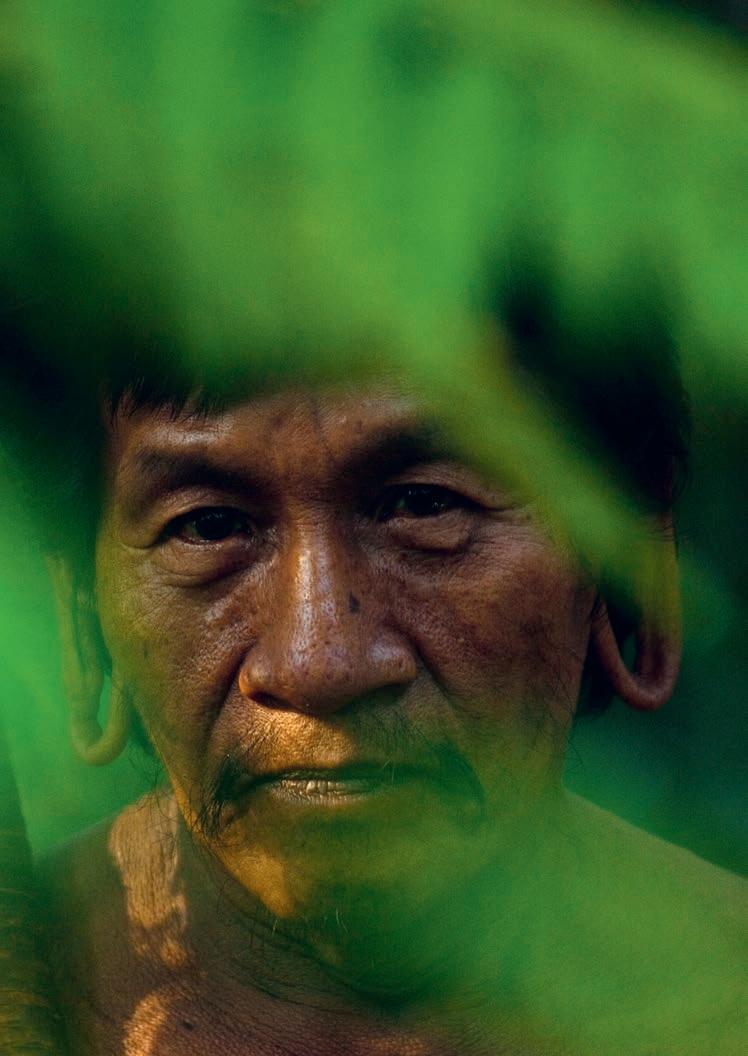
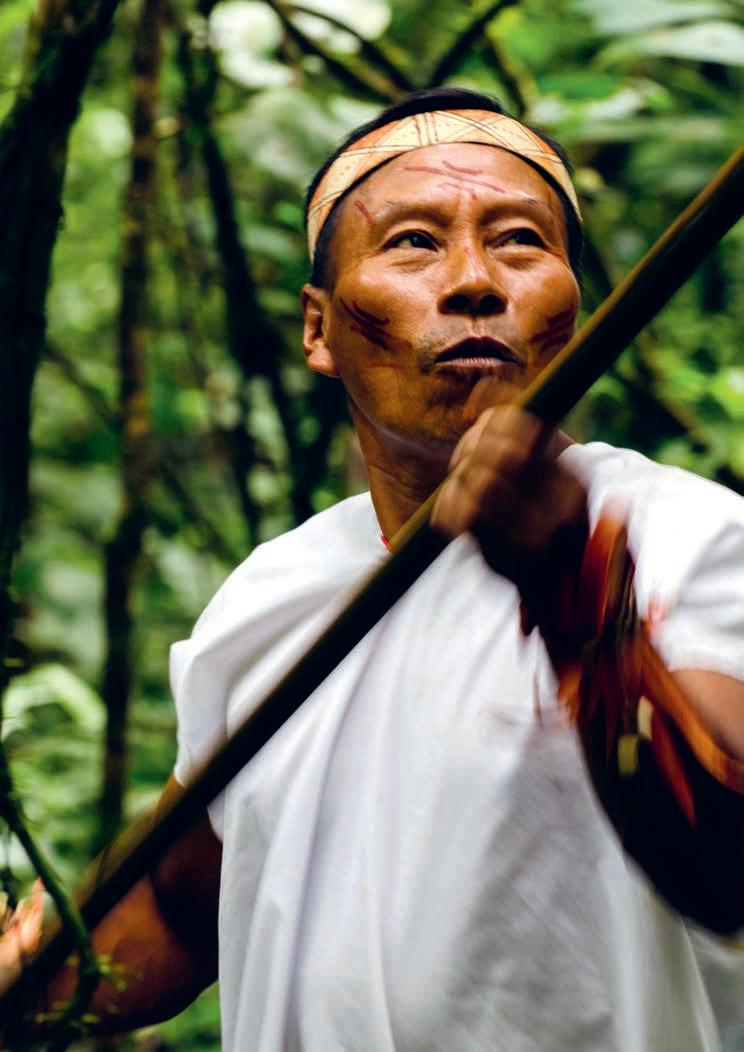
Siekopai (Secoya)

In their native language, Pai’koka, the name Siekopai means ‘multicoloured people’ – a reference to their geometric body paint, animal-tooth necklaces and feather adornments. This name is considered more respectful than the exonym Secoya, though you’ll still see both being used. According to their beliefs, they once lived underground but were liberated by the sky god, Ñañëpaina; today, they retain a strong shamanic culture, and use ayahuasca for spiritual guidance. They are among Ecuador’s most endangered groups, with only 689 members. You can visit them – and support them – at Siekoya

Remolino: a community of 53 families on the banks of the Aguarico River, who o er five-day packages including handicraft-making, fireside storytelling, farming yuca (cassava) and trying traditional medicines such as yokó, a vine-based co ee alternative. While there, you might taste the ancestral chilli paste known as neapia (literally ‘black chilli’). It’s made mostly by women, using smoked ají chilli peppers and yuca harvested from the chakra (a small, polycultural plot of farmland). Non-profits such as Fundación Raíz-Caemba work with the Siekopai to bring neapia to a wider market – you’ll find it in souvenir and deli stores such as Napo Emprende in Tena.

A’i (Cofán)
The A’i people, sometimes known by the exonym Cofán, are the historical guardians of the northern part of the Ecuadorian Amazon, near the Colombian border. They speak a language called A’ingae, and their culture is founded on mutual reciprocity: food and resources are shared among the community. Although they embrace
modern medicine, they complement it with plant-based medicines and shamanism. Among their traditional foods is cui’ccu, a high-calorie drink made from mashed plantain. In many ways, they are pioneers of Indigenous tourism; the first A’i-led community tourism project took place as far back as 1978. In 1999, a group of A’i founded the Fundación Sobrevivencia Cofán (FSC), dedicated


to the preservation of the A’i Indigenous culture and their Amazon rainforest home. They run a lodge on A’i lands within the Cuyabeno Wildlife Reserve. Five-day tour programmes are led by A’i guides and include overnight camping in the forest, fishing with homemade nets and gliding in a traditional long canoe on the river, with the chance to spot tapirs, turtles and dolphins.


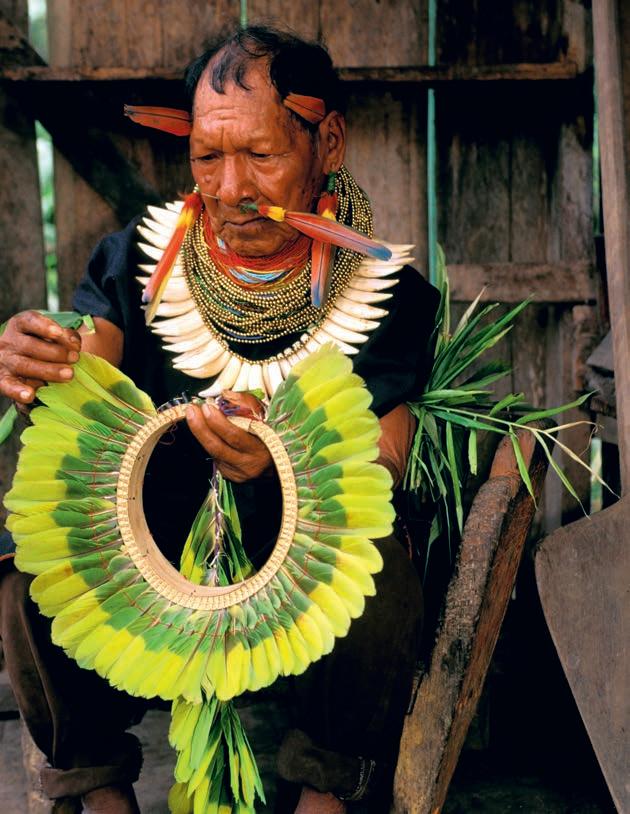
Huaorani (Waorani)
Of all Ecuador’s Indigenous peoples, the Huaorani (also known as Waorani) have the least contact with the outside world. They live in an unmarked area between the Napo and Curacay tributaries of the Amazon River and number around 3,000 people, including the voluntarily isolated Tagaeri and Taromenani communities (below). Their Huao Terero language is an isolate, meaning that it has no relation to any other existing language; they have maintained many traditional ways. In fact, researchers have discovered that they naturally resist infection due to the vast variety of fruits they eat – around 80 throughout the year. For reasons not fully understood, they also eat more meat than thought possible for humans: around 500g a day, which they catch using spears and blowpipes. They have an egalitarian rather than a hierarchical society; even children are largely self-sufficient. Body modifications such as stretched earlobes – increasingly rare with other groups – are still common here. Shamans are highly regarded; the Huaorani believe that they can turn into jaguars and speak with the other animals. Despite their isolation, it’s still possible for travellers to spend time with them. Operators such as Huaorani Expeditions o er adventures of up to eight days, where you’ll spend time hiking, hunting, eating, making weapons and dancing with Huaorani warriors.



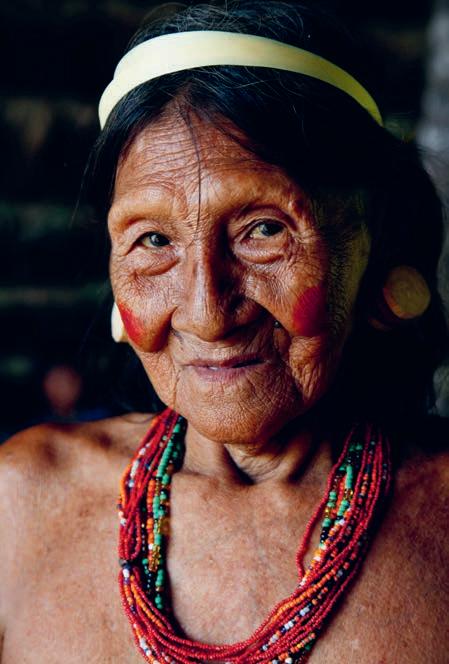
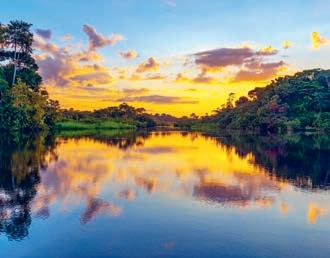


Tagaeri
The Taromenane and Tagaeri are two voluntarily isolated Huaorani communities living in and around the eastern part of Yasuní National Park: a UNESCO Biosphere Reserve, considered to be the wildest and most untouched part of the Ecuadorian Amazon. Little is known about either group due to their isolation, but it is thought that the Tagaeri were named for their leader, Tagae, and broke away in the mid-20th century due to increasing intrusion from Christian missionaries.
Taromenane
The Taromenane are thought to speak a language similar to Huao Terero, and – like the Tagaeri – they live within a protected 818,501-hectare area known as the Zona Intangible Tagaeri–Taromenane (ZITT), defined by the Ecuadorian government and partially within Yasuní National Park.
It is prohibited for anyone, even other Indigenous communities, to enter the ZITT or to attempt to make contact with either of these groups. Alamy
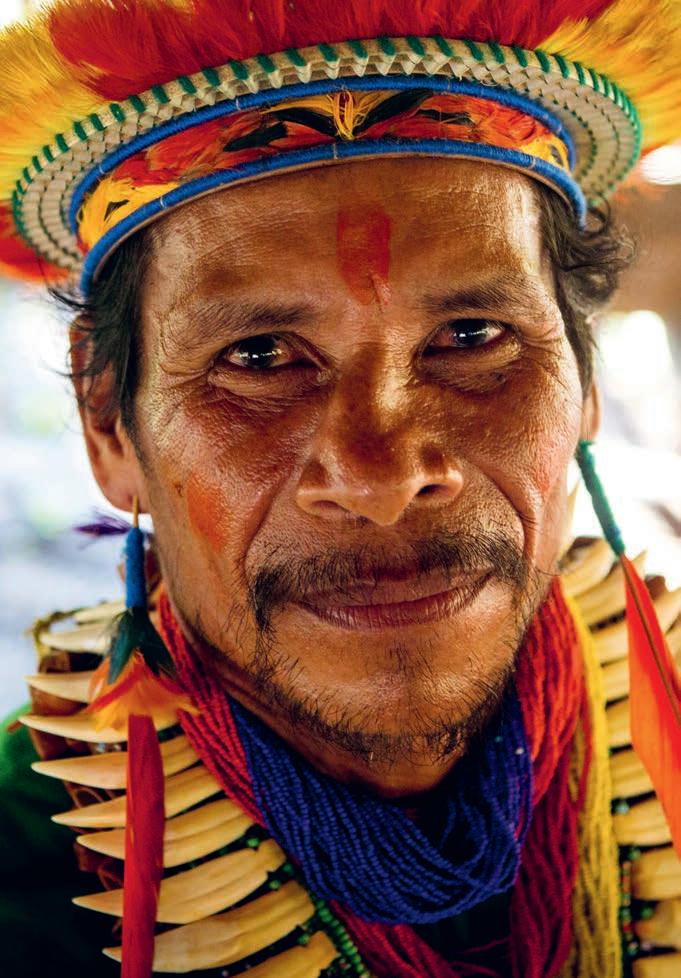
Siona
The Siona people also live along the banks of the Aguarico River, which partly runs along the border between Ecuador and Peru. Although they have separate governance and leadership structures, they share many similarities with the Siekopai and are often considered by ethnographers to be one people. They, too, are endangered, with only 611 Siona people reported in the last census. Their language, known as Baicoca or Siona, is mutually intelligible with Pai’coca; and, like the Siekopai, they use ayahuasca in rituals. Historically,

the Siekopai and Siona have worked together to defend their land from threats; today, much of it is protected by the Cuyabeno Wildlife Reserve. This 2,330-square-mile reserve is Ecuador’s second-largest protected area and comprises a unique wetlands ecosystem of swamps and lagoons, which is home to piranhas, black caimans and pink river dolphins. There are many Indigenous-owned lodges within the park, including Siona Lodge, where you can participate in activities such as canoeing, visiting the shaman and making the local, yuca-based bread known as casabe.

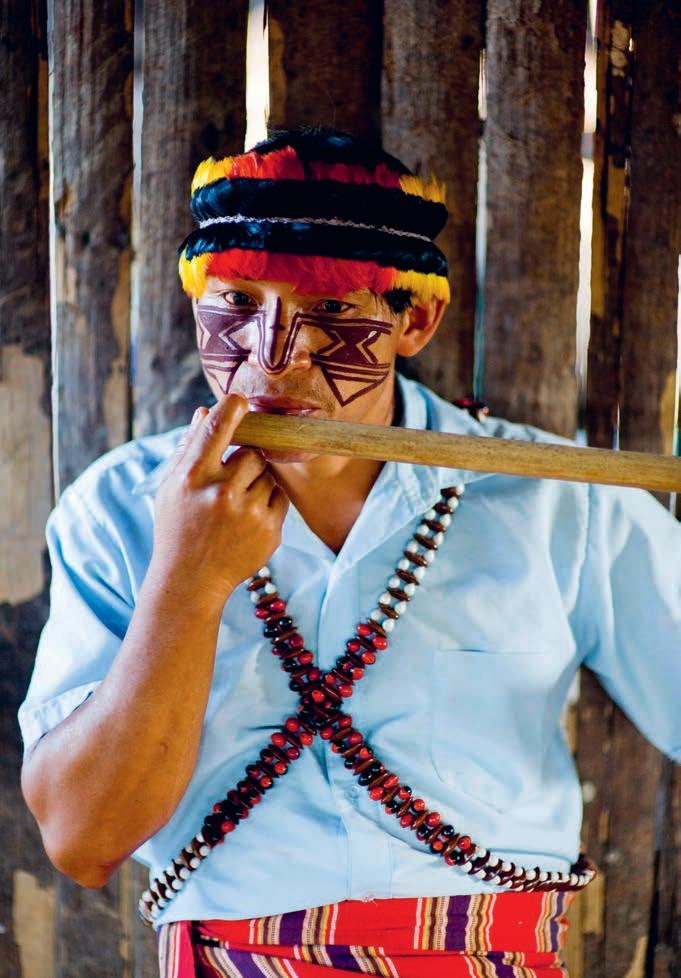
Achuar

The Achuar believe that dreams have power: the power to foretell events, or to make sense of current challenges. Every morning before sunrise – as early as 3 or 4am – they gather for a guayusa ceremony around the fire. There, they drink the ca einated extract of the guayusa tree, and recount their dreams for interpretation by community elders. They live in the very east of Ecuador, deep in the forest; their name, meaning ‘people of the aguaje palm’, symbolises their close ties with the Amazon. Three Achuar communities – Kapawi, Kusutkau and Suwa, around 500 people in total – own and operate Kapawi Lodge, near the Peruvian border. It’s

so remote, it can only be accessed by a 50-minute light aircraft flight from Shell Airport, near Puyo. Tour packages are three, four or seven nights – there are also custom options available. As well as the usual Amazon birdspotting and river expeditions, there’s an extensive selection of cultural immersion activities. You might start your day by sharing your dreams at the guayusa ceremony, then learn about medicinal plants on a guided hike. You may also be able to stay overnight in an Achuar village, eating with local families and seeing their homes and gardens. All revenue is invested in the community, helping to preserve Achuar culture and the rainforest.

Alamy
Shuar
The Shuar, who number around 100,000 people in Ecuador, are ethnolinguistically related to the Achuar and occupy territories just south of them, mainly in the Ecuadorian provinces of Morona Santiago and Zamora-Chinchipe, as well as northern Peru. Both groups belong to the larger cultural group known as Jivaroan peoples, who live on both sides of the Ecuador-Peru border. Historically, the Shuar were known for tsantsas, or shrunken heads, made by peeling the skin and hair from the skull and then treating it with a combination of hot water and sand. This was believed to capture the power of a person’s soul, which would strengthen the group and improve harvests. Tsantsas have not been made since the mid-20th century, but the Shuar traditions of egalitarianism, shamanism, hunting and farming chakras have endured. In 2018, three Shuar people – Patricio Juank, Carmelina Mashumar and Pedro Ganan – founded the Shuar Cultural Center in Orellana Province. They operate Indigenous tourism initiatives in and around Yasuní National Park, including the Shuar Wildlife Camp, where you’ll be welcomed with a traditional tsaant-tabaco spear ritual and have personalised designs painted on your face by the community’s women.


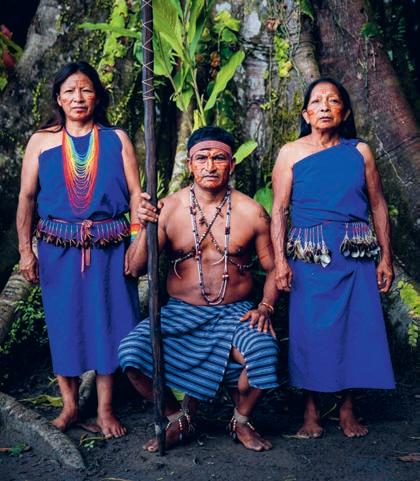
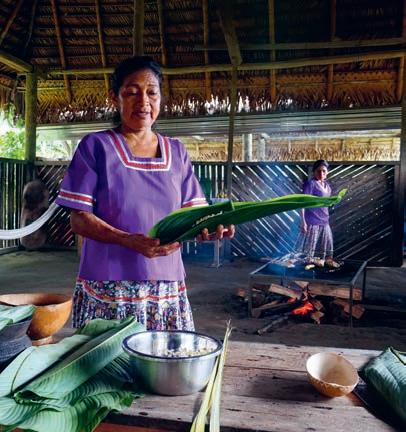

Kichwa
The Kichwa are Ecuador’s most numerous Indigenous group, with a population of around 800,000 nationwide – 86% of Ecuador’s Indigenous population. Most live in the Andes, but there are significant communities along the Napo River, which are more accessible for travellers due to their proximity to Quito. What distinguishes the Kichwa from other groups is that they are descended from peoples who came under the influence of the Incas –their language, Kichwa, is related to the Incan Quechua language. Most of their customs, however, are rooted in pre-Inca animism and shamanism. Sinchi Warmi, meaning ‘brave woman’ in Kichwa, is a female-run lodge in Napo Province that educates travellers on the abundant resources of the forest. You’ll take part in a guayusa ceremony, receiving treatment with tobacco or singalichina (a guayusa-based herbal medicine); you’ll also get the chance to make your own jewellery using seeds from Amazonian plants such as chirimoya and achiote.

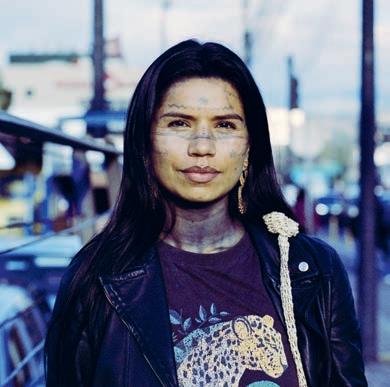


Protecting the Ecuadorian Amazon and its Indigenous communities with Nina Gualinga
Interview by Laura Field
Nina Gualinga is deeply devoted to protecting the lands, cultures, languages and way of life in the Ecuadorian Amazon. Here, she shares more about her work, her inspiration and how travellers to Ecuador can contribute to protecting this remarkable region.
What was it like growing up in the Amazon? What skills and knowledge did you learn there?
I learnt from a very early age that everything around us is alive. That shapes the way that I see things and understand the world. The plants, mountains and rivers around us are alive. There’s a system of life that we’re part of, and through the teachings of my grandparents and my mother, I developed a very deep love for what was surrounding me. That’s the foundation of my life.
Since I was a child, my community has battled against extractive industries such
as oil companies – and successfully so. We managed to kick out an oil company in 2003 and win an international court case that established that our human rights had been violated. In that way, at least legally, our territory has been protected since then. That has shaped my life and my outlook. I then realised that this wasn’t only happening in my community; it was happening across the Amazon.
Why are Indigenous communities vital to maintaining the health of the Ecuadorian Amazon?
The power of coming from an Indigenous community is that these people have been living and coexisting with these lands and all the living beings there for so many generations. They know these lands, rivers, mountains and animals intimately. They understand the cycles of the land and the impact of human presence – the roads and extractive industries. There’s so much
knowledge and power in that, because people who live so closely with the land can identify when changes occur. This is because they directly impact us.
It’s crucial to listen to the people who coexist with the land. Globally, the Amazon has always been a place that people are quick to admire, but it’s important to remember that it’s not just a vast, wild forest; it’s also home to people.
What do you feel are the biggest threats to the Ecuadorian Amazon in the modern world?
Today, we are up against the mining industry. Both legal and illegal mining are devastating our rivers across the Ecuadorian Amazon. There is also illegal logging, agrobusiness and road building. It’s contradictory, because Ecuador is such a rich country in terms of biodiversity, yet there is a very extractive agenda that could destroy the habitats of all these different species, and
Alamy; Boloh Miranda; Shutterstock; Yesid Achicue
also the cultures and people that live in these territories.
How are you working to protect the Amazon, its ecosystems and the communities living there?
The work is collective. It’s not individuals who protect the Amazon; this comes from the communities and the families who live in these territories. They do this through planting seeds, eating fruits, practising our culture and our language. The Amazon is home to many cultures, communities and children with dreams. It’s through this co-existence that these ecosystems are protected.
A lot of the work I do is to ensure that the rights of our peoples are being respected, especially the right to land, because not only do we depend on our land, but these lands also depend on us living here and protecting them too. We are working to raise awareness on a national and international level to create conversations around the importance of Indigenous people and their role in protecting these places.
What makes the Amazon so special for you, and what inspires you most? It’s my home. It’s where I grew up. It’s where my worldview was shaped, and it’s the place that I feel the safest and happiest. It’s a vibrant place full of life and wisdom. I think it deserves to continue living. It inspires me to imagine a future where all that life is able to continue thriving.
What are the most valuable things that visitors to Ecuador can do to contribute to protecting the Amazon and its lands?
Ecuador has such a huge gift in the shape of its biodiversity. People travelling to the country should research the areas that they want to visit and whether they’re going to places that are on Indigenous land. Go to community-led projects and make sure that resources are being channelled directly to the people from that area.
Another very important thing is to consume responsibly. Visitors should not buy any souvenirs made from feathers, jaguar skin, jaguar teeth, dolphin teeth or other endangered species, as this only contributes to the continued illegal poaching of these animals and the decline of biodiversity in our forests. It’s also important not to romanticise the experience and to acknowledge our communities’ challenges and difficult histories.
People should support efforts to strengthen Indigenous rights and livelihoods where possible, so the interaction is reciprocal and not extractive.
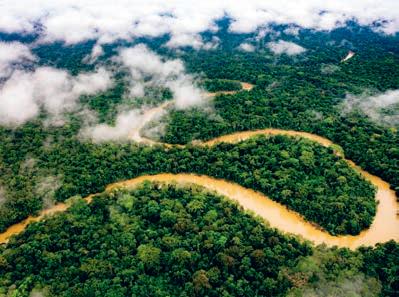
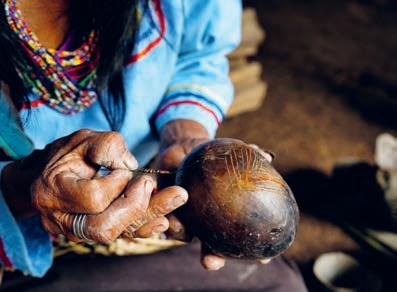
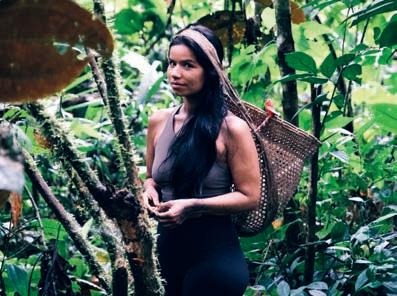
Fighting for the future (opposite page) Nina Gualinga is an Ecuadorian environmentalist and Indigenous rights activist who has dedicated her life to advocating for better environmental protection of the Ecuadorian Amazon, its wildlife and its peoples; (this page; top to bottom) the Ecuadorian Amazon (or Oriente) covers around 120,000 sq km; nearly a quarter of Ecuador’s Indigenous peoples live in this region; Nina Gualinga in the Amazon
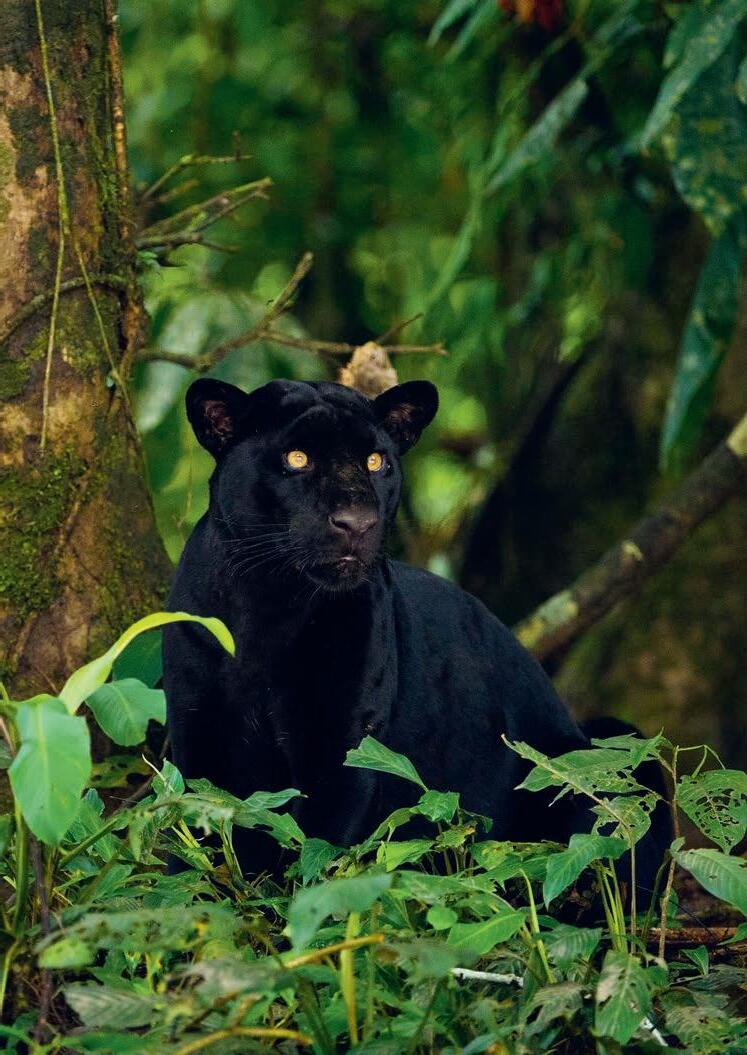
A wildlife lover’s guide to the Ecuadorian Amazon
Pink dolphins glide, while monkeys, macaws, marmosets and more inhabit the treetops, which you can observe on rainforest adventures
Beyond the riverside town of Nuevo Rocafuerte, two forms appeared, arching from the sediment-cloyed fl ow of the murky River Napo. Both were a vivid bubblegum pink. “Look, pink river dolphins,” I heard our guide say, precipitating a flurry of camera-grabbing that rocked our small launch.
“They’re very pink in the mating season to attract females,” said Avel, our Kichwa guide, as we watched three of the dolphins

Jaguars
splash around us. In Kichwa they call them boto. “In the past they would’ve been hunted because old beliefs said they turn into men and seduce the women. But not now,” said Avel, with a smile. “They bring visitors, which helps local communities.”
Ecuador has stellar biodiversity across a dazzling array of ecosystems. It’s more renowned to wildlife-watchers for the Galápagos. Yet its sector of the Amazon rainforest, some 40% of Ecuador’s territory, receives only a fraction of rainforest ecot-

These phantom cats are shy and reclusive. The third-largest feline on Earth, jaguars are agilely adapted to rainforest life, being great climbers and swimmers who move through the tangled rainforest understory camouflaged by pale yellow fur and black rosettes. The likeliest location to see them is Yasuní National Park in Ecuador’s eastern Amazon, where camera traps suggest they are part of one of the densest jaguar populations in South America. Estimates suggest Ecuador has around 2,000 jaguars. The best opportunities to see them require immersive stays at local eco-lodges. Travellers to Caiman Eco-Lodge, which is located within the species-rich Cuyabeno Wildlife Reserve, can join tracking tours on foot through the jungle with Indigenous guides to find signs of the jaguars’ solitary progress, or perhaps have a chance encounter with one in the flesh.



ourism by comparison with Brazil. Ecuador’s small size, however, makes its Amazon adventures far more accessible. Immersion into the 900,000-hectare Yasuní National Park, a UNESCO Biosphere Reserve with some 600 bird species, takes just a few hours from the capital Quito. Here travellers will find secluded lodges and riverboat trips to encounter its fabulous nature and traditional Indigenous communities.
This brief guide lists its cornerstone species, and where and how to see them…
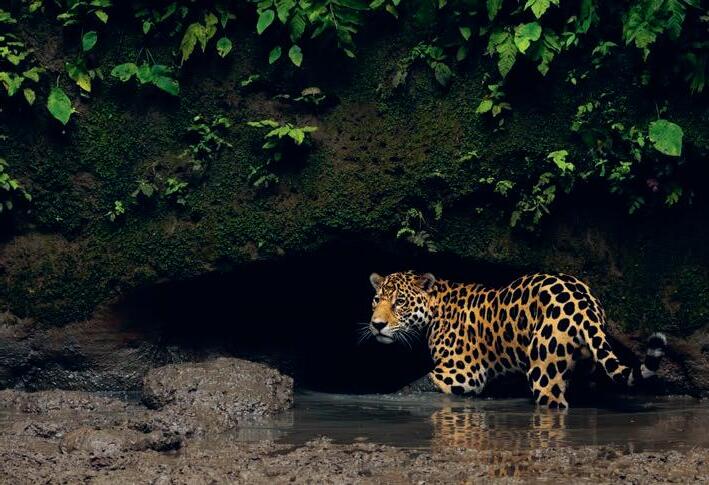
Words Mark Stratton
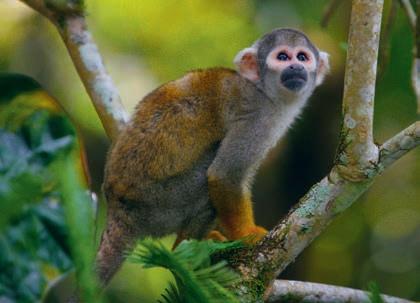
Macaws
I once saw a kaleidoscopic flurry of dazzling plumage around a tall tree near Sani Lodge, as three di erent species of macaws clung to the bark of a tall mora tree. From a rustic hide, where Kichwa villagers charged $10 to watch, we saw red-bellied, blue-and-yellow and chestnut-fronted macaws appear to focus on extracting tree sap which counteracts toxins from forest fruits in their diet. The same self-medication occurs with macaws obtaining minerals at clay licks. The Saladero de Pericos lick on the lands of the Napo Wildlife Center hosts the remarkable spectacle of not only macaws, but thousands of cobalt-winged parakeets and orange-cheeked parrots.

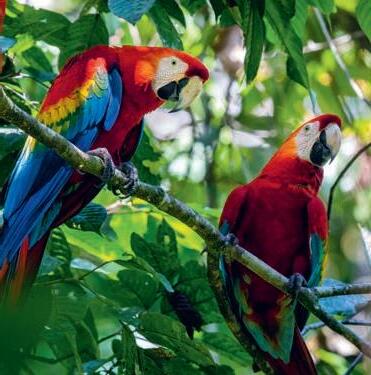
Monkeys
‘Monkeys’ is a bit of a catch-all category because the Ecuadorian Amazon features many types, including five very special variations. Brown-mantled tamarins are tiny little critters who will pilfer human food. Common squirrel monkeys are little lightweight primates with large brown eyes, who live in large groups. Black-headed spider monkeys are shaggy-coated and long-limbed but hard to see. They’re classified as critically endangered – as are pale-furred Ecuadorian capuchins. Noisiest of all are hefty Ecuadorian mantled howlers, who make themselves known with huge booming howls. Eyeball encounters are possible by ascending the 40m-high canopy tower at the community-run Napo Wildlife Center.
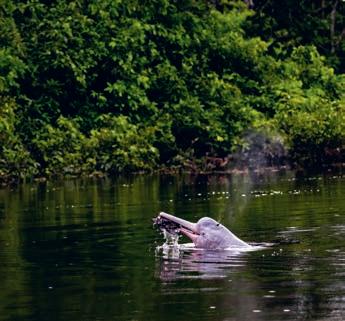




Pink river dolphins
Spend long enough cruising the Napo River between Orellana province and the border with Perú and these extraordinary dolphins will make an appearance. Sightings are hardly commonplace for a species spread thinly throughout the great Amazon River basin. The most likely encounters with these lithe cetaceans, which can reach 3m in length, occur on river trips with the likes of Anakonda Amazon Cruises, who regularly sight them heading upriver. They work with local communities to protect these endangered creatures, helping the Martinica community in the Cocaya region to create a protected area free of hunting. Accordingly, this community has benefited from tourism as their numbers have increased. One glorious by-product of such river journeys is encountering giant river otters and freshwater turtles.

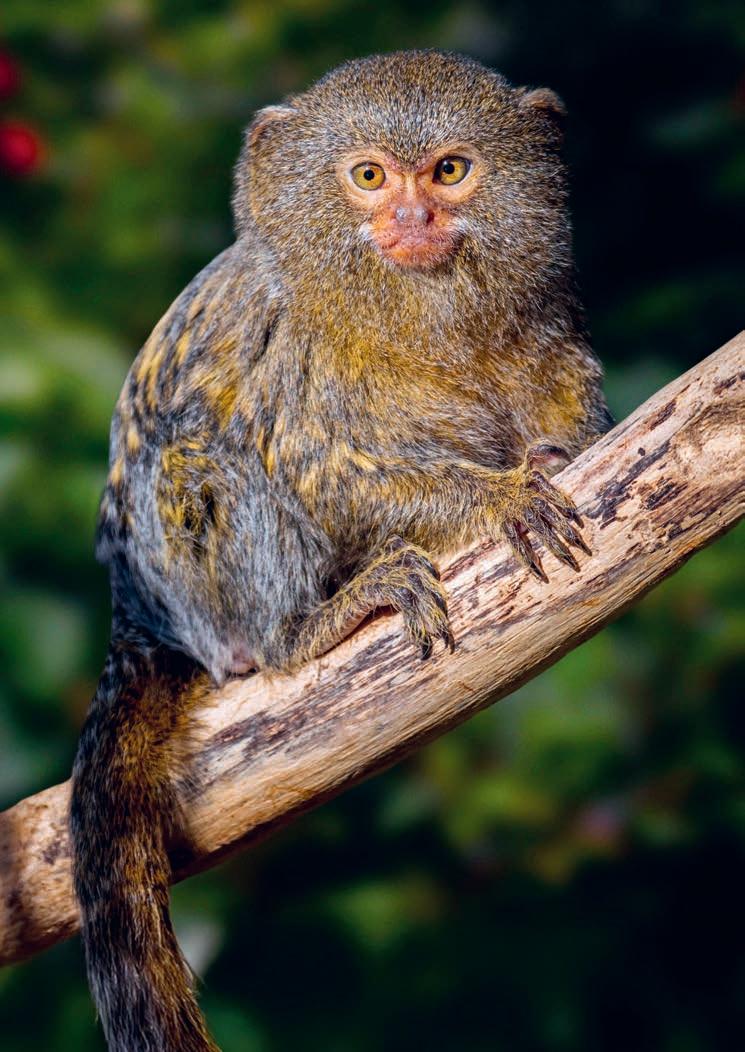
Pygmy marmosets
When a pygmy marmoset was first pointed out to me in Yasuní, I told my Kichwa guide that I couldn’t see anything. It was partly obscured by a small leaf and I eventually spotted its wide-eyed stare and grasped the true meaning of pygmy. These diminutive pocket rockets are the world’s smallest monkeys, at just 8-16cm tall. Endearingly, they’re locally nicknamed leoncito – literally

small lion – on account of their furry manes. Specialist guides will know how to find them as they’re not averse to living cheek by jowl with humans. On a voyage with Anakonda Amazon Cruises, our guide took us to a riverside Kichwa family who had marmosets living outside in the gallery forest. They weren’t as mischievous, or tipsy, however, as the black tamarin monkeys sipping yuca-fermented chicha beer from the family’s kitchen. ⊲

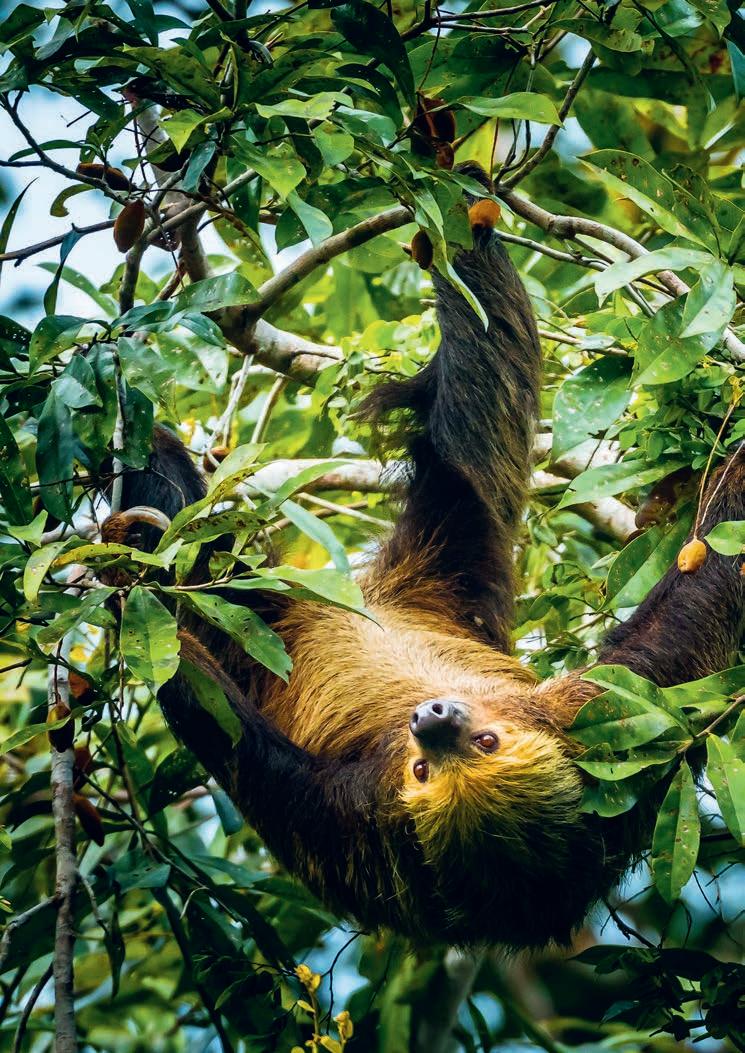
Sloths
In the torpor of a hot Amazon day, there is a mammal so inactively drowsy, it’s liable to put oneself to sleep. Sloths are very much a random sighting, often seen when on a river voyage, as these motionless primates dwell high up their favoured tree. With curved claws and muscular limbs, they live an entirely arboreal existence. Ecuador has three sloth species, including both the two-toed and threetoed varieties. Lodges within Cuyabeno Wildlife Reserve and Yasuní National Park will have known locations for seeing them, with success rates highest during June to September’s dry season, when vegetation is less dense.
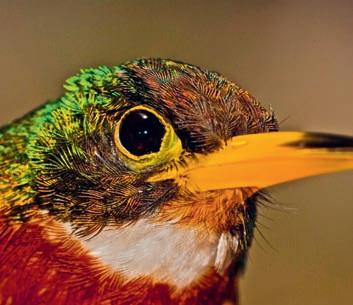
Yellow-billed jacamars
This lovely little rainforest denizen has a hint of kingfisher about it. Its gorgeous crimson underbody is shielded by an emerald-green plumage and an exaggeratedly pointed yellow bill as sharp as the cone of an Apollo space rocket. One for any twitcher’s checklist, the jacamar can be found deep in the rainforest interior, along river edges, or even at higher elevations. Insectivores, their nests are constructed by burrowing into earth riverbanks and even termite nests. With a skilled local ornithologist, they are not hard to see. Birdwatchers will need a base to watch them from, and with a checklist of hundreds of bird species, north of the Napo River adjacent to Yasuní National Park is La Selva Amazon Eco Lodge, which runs four-day birdwatching programmes, or Sacha Lodge, which has an aerial canopy walkway.
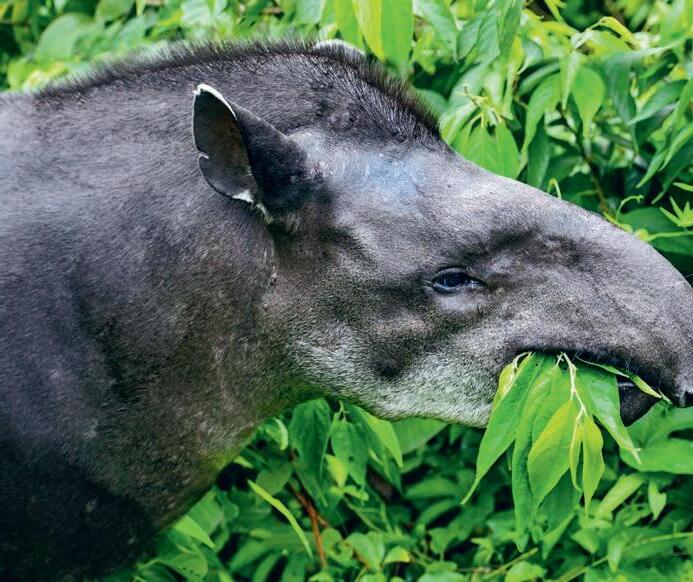
Tapirs


Tapirs are big beasts. Sporting a porcine physique, these hairless rainforest herbivores can weigh up to a third of a metric tonne. Evolution has also bestowed them with flexible proboscis snouts to wrap around low-hanging leaves that might otherwise be out of reach. South American tapirs will always be around water, but being nocturnal, they’re di cult to see within their thick forest habitat. Thus, sightings are entirely random. A good place to start looking is within Cuyabeno Wildlife Reserve, where the eco-friendly Tapir Lodge, built in tandem with the local Siona community, is set in pristine flooded forest. Local guides lead forest hikes and from twin 15m observation towers, it’s possible at first light or dusk to see a tapir, snout wiggling, on the move.


Taste the flavours of the Ecuadorian Amazon
Colourful fruits and produce, from rare plants to tiny insects, get used in the menu of tasty traditional dishes from this region
About half of Ecuador is covered in rainforest, one of the most biodiverse ecosystems on the planet. Here, Indigenous people fish using hand-woven nets and they
farm small polyculture plots called chakras, working with the forest’s natural rhythms. Many Amazonian food traditions are thousands of years old. Taking part in them is an authentic (and delicious) way to get to know local cultures.
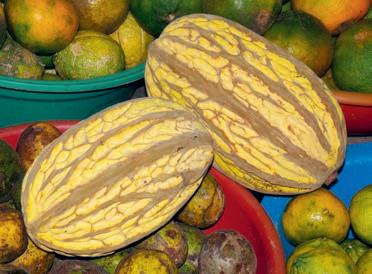
Macambo
The macambo tree is part of the theobroma genus – which includes the much better-known theobroma cacao. It was cultivated alongside cacao in pre-colonial times, but was considered by the Spanish to be a ‘lesser’ product and soon faded into obscurity. However, this could soon change thanks to Canopy Bridge: a food lab in Archidona, Napo, which works with community farmers to bring Amazonian products to a wider market. Its range of macambo snacks includes roasted, salted and cacao-dusted varieties, which you’ll find at delis throughout Ecuador and abroad. With advance notice, you can arrange to visit the food lab itself.
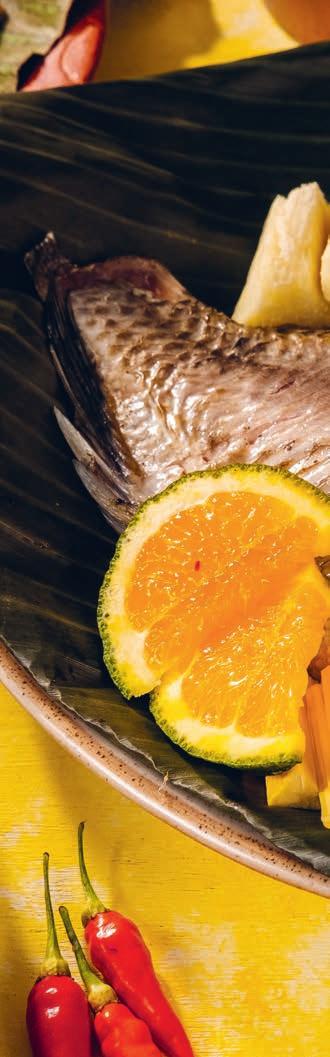
Shutterstock; Ecuador Ministry of Tourism
Words Sarah Gillespie
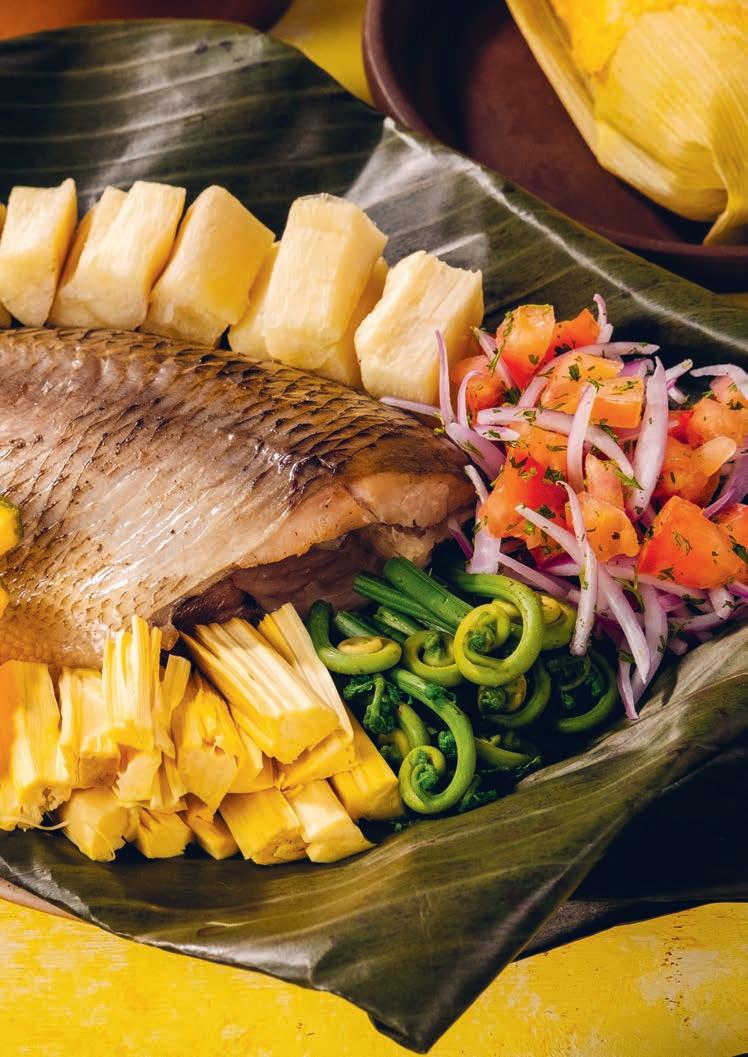
Maito
The word maito means ‘to wrap’ in Kichwa, the most common Indigenous Ecuadorian language. It refers to any Indigenous dish wrapped in a banana or bijao (calathea) leaf, which keeps the filling tender and imparts a vegetal flavour as it’s seared over a wood fire. The contents can be anything from chicken to chontacuro grubs, but are most often Amazon river fish such as carachama, bocachico or tilapia which is most common in Ecuador. Once done, it’s served up on its leaf wrapper alongside cassava and plantain. See how it’s made at Sinchi Warmi: an Indigenous, female-run lodge in Napo Province, which offers diverse cultural experiences from guayusa ceremonies to chocolate-making.
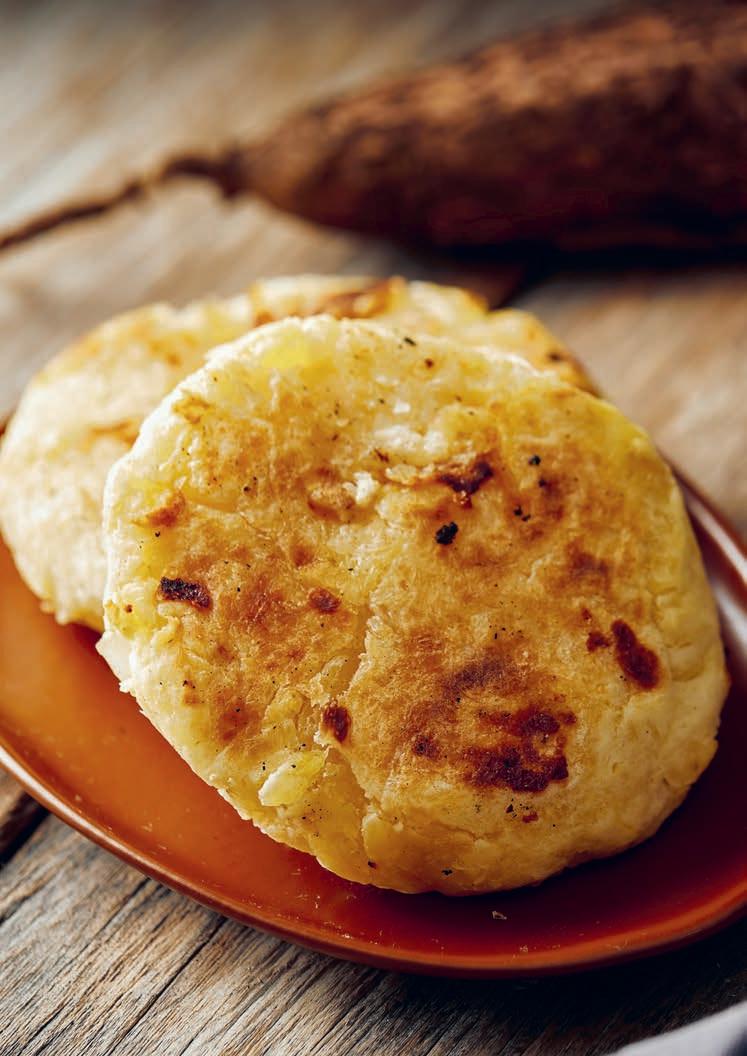
Yuca
Yuca is the Ecuadorian word for cassava – now eaten as a staple food across the world, but native to the Amazon. Yuca is to Amazonians what corn is to Andeans: it’s eaten in every conceivable form, with virtually every meal. It’s most often boiled, roasted or fried as a side dish, but can also be found in little pan de yuca bread rolls, best enjoyed soft and steaming straight from the oven. Its most culturally significant use, however, is in the drink known as chicha, consumed during ceremonies and special occasions. To make it, Indigenous women mash and ferment the yuca; traditionally, they chewed and spat it out (using the salival enzymes for fermentation), but most modern Ecuadorians prefer hand-grating and using yeast.
Pitahaya
Along with Arriba cacao, pitahaya (dragon fruit) from the region of Palora is one of two Ecuadorian Amazonian fruits to have received the Denominación de Origen , or DO. This prestigious appellation safeguards the characteristics and production methods of gastronomic products, certifying them as unique to that region. Unlike the more common red dragon fruit, pitahaya Amazónica de Palora has golden skin and is larger, sweeter and more acidic. Fully ripe pitahaya de Palora can reach 24 on the Brix (sweetness) scale, making it sweeter than honeydew melon (14) or strawberries (16). It’s harvested almost year-round – you’ll find it at markets throughout the Palora region, and possibly at your lodge breakfast buffet.
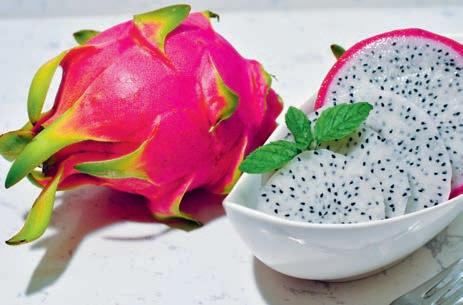
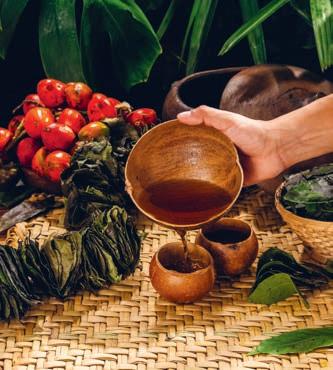
Guayusa
Guayusa, a caffeine-rich holly tree, is much more than an ingredient in energy drinks. It’s one of the Amazon’s most sacred plants, cultivated by Indigenous communities for more than 1,000 years. Most still begin their day with a fireside guayusa ceremony, where they take the drink from a central cauldron while swapping stories and practising healing rituals. Many have opened the ceremony to travellers, both as a source of income and to preserve the practice. One of the most enthralling is hosted by the Amupakin birthing centre in Napo Province: there, the Asociación de Mujeres Parteras (Midwives’ Association) provides shelter to victims of domestic violence and teaches traditional medicine, midwifery and cooking. Feeling brave? Try their traditional headache cure: liquid tobacco, dropped right into the eye.
Lemon ants
Even among the wild and wonderful critters of the Ecuadorian Amazon, lemon ants are particularly unusual. Their bodies contain formic acid and citronella, which release a lemony scent when the ant is crushed or bitten. They’re not farmed but are eaten as a novelty snack by both locals and tourists – the To’ak chocolate brand has even put them into its bars.You’ll likely encounter them on a forest walk such as the ones offered by Gaia Amazon Eco-Lodge: an integrated lodge and Spanish school near Ahuano, Napo.
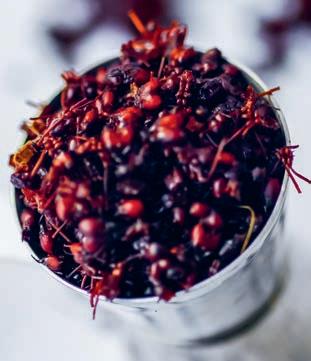
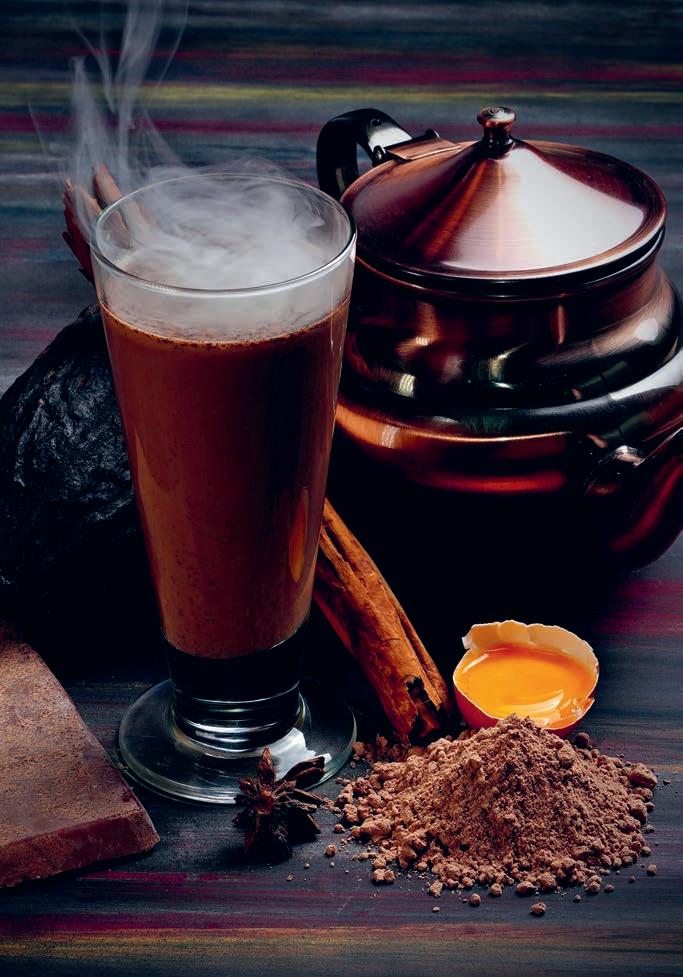
Cacao
In the 2010s, chocolate lovers were shocked by archaeological discoveries that placed cacao’s origins not in Mexico, but in the Zamora-Chinchipe province of the Ecuadorian Amazon. Among these original varieties was the exquisite Nacional : a floral and fruity cacao that was once exported in huge quantities but was nearly wiped out by disease in the early 20th century. To taste the purest form of Nacional, you’ll need to find a bar by To’ak, among the world’s most expensive chocolate. A conservationist team founded the To’ak brand in 2013 and, through genetic testing and breeding programmes, increased the number of pure Nacional trees from a few dozen to around 1,000. To’ak hosts chocolate tastings in the former home of Ecuadorian national artist Oswaldo Guayasamín in Quito – the experiences comprise five ‘vintages’ plus a wine, spirit or non-alcoholic pairing.
Alamy; Shutterstock; Ecuador Ministry of Tourism
Guaba and Guayaba
A common confusion about Ecuadorian food is between guabas and guavas (locally known as guayabas) – two fruits both grown in the Amazon but completely unrelated. Guayabas are the better-known of the two –small and green, with tart pink flesh. They’re eaten fresh or in the street-food treat known as espumilla: a fluffy guava meringue served in an ice-cream cone. Guabas, on the other hand, are also known as ‘ice-cream beans’: they’re long green pods filled with cottony white fruits, which have a vanilla-like taste. They’re sold at roadside stalls and usually eaten fresh out of the pod. They’re also used to decorate place settings for Indigenous welcome or thanksgiving rituals.
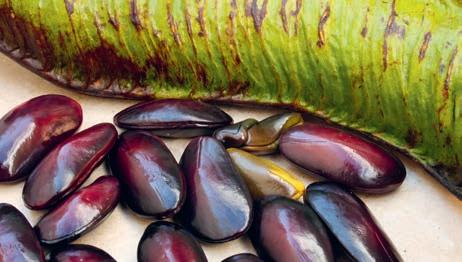
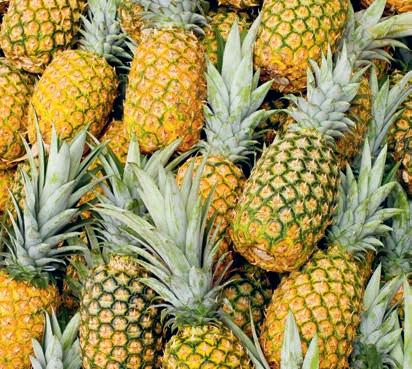
Chontacuro
These fat, wriggling grubs are an endless source of fascination for travellers to Ecuador. They’re the larvae of the black palm weevil and feed on the Amazonian chonta tree – itself an important part of Ecuadorian culture. Indigenous people use the whole tree from root to fruit to leaf, transforming it into buildings, dyes and chicha de chonta, a fermented drink used for rituals and celebrations. When the tree grows too tall to harvest from, it’s chopped down and used to farm chontacuro, which have a buttery taste and can be eaten raw or roasted on skewers. Try them – if you dare – at Archidona Market, which also sells a range of maito dishes (tilapia, carachama fish and chicken) and chicha de chonta.
Pineapples
Pineapples originated in an area that is now south Brazil and Paraguay, where they were cultivated by the Indigenous Tupi-Guarani people. From there, pineapples spread north – by the time Christopher Columbus encountered them in 1493, they covered swathes of the Americas and Caribbean. Today, Ecuador exports around $2 million of pineapples annually, mostly of the Smooth Cayenne and Golden Sweet varieties. They’re a staple of Amazon lodge breakfasts, as well as in traditional desserts such as flan de piña (pineapple flan). The leftover skins and core are simmered with cinnamon and panela (unrefined cane sugar) and sometimes lightly fermented to make chicha de piña, a drink that’s delicious hot or cold.
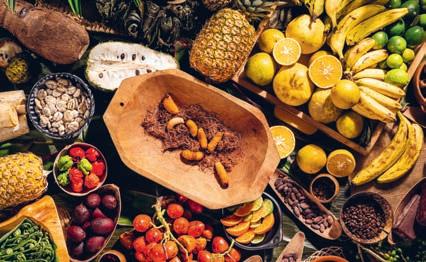
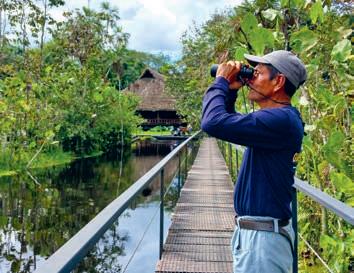
Birdwatching in the Ecuadorian Amazon with Oscar Tapuy
Interview by Russell Maddicks
Home to the Yasuní National Park, a UNESCO Biosphere Reserve considered one of the most biodiverse places on the planet, Ecuador’s Amazon region is alive with birds, from majestic scarlet macaws to prehistoric hoatzins with punk-rock crests.
Oscar Tapuy, an Indigenous Kichwa birdwatching guide, has been working at Sacha Lodge eco-reserve on the Napo River for 30 years. With nearly 600 species of birds to be found within the 5,000-acre private ecological reserve, as well as eight species of monkeys, Oscar is passionate about preserving the forest for future generations.
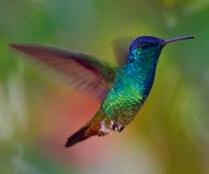
Ecuador is wonderfully biodiverse, with over 1,600 species of birds recorded in the country, more birds per square km than any other country. How many birds do you have in Sacha Lodge?
Sacha is in a privileged position between the Yasuní and the Cuyabeno Wildlife Reserve and we have 580 species of birds in the reserve, some of which are easy to see, others that are harder. Sacha has observation towers, a canopy walkway and a crane, so you can get closer to the tops of the trees or above them, and visitors don’t get a wobbly neck looking up and down to see the birds! I see about 60 species a day when I am out guiding.
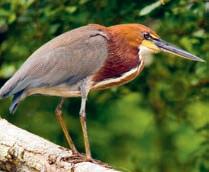
How did you become a birdwatching guide?
I started as a wildlife guide in La Selva Lodge. I was working as a mechanic, and the owner, a North American, gave me an opportunity to work as a guide. He said if you can remember all the parts for the engine, you can learn the names of all the birds. That’s exactly how I started. In 1995, I came to Sacha and have been here ever since.
What are the easiest birds to spot?
Some of the first birds that people see from the canoe as they come into Sacha across Lake Pilchicocha are the hoatzins that roost in trees by the water. These are iconic
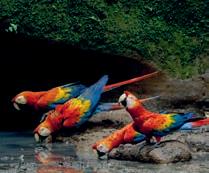
Alamy; Dorian Cerda
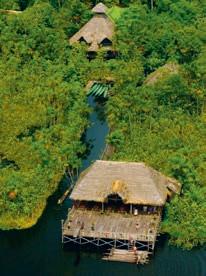
Amazonian birds that look prehistoric, with a spiky crest. They eat leaves and digest them like a cow; sometimes they make a sound like a cow. To me they smell like cows too. Here in the Amazon, we call them the pava hedionda (stinky turkey).
What are the birds that birdwatchers come to see?
People come with lists and very often want to see puffbirds, like the pied puffbird or the collared puffbird, which you can see from the towers, and jacamars, which are very colourful like hummingbirds. Antpittas, with big eyes and long thin legs, are also popular but they are tricky to spot and sometimes you have to be content with listening to their call.
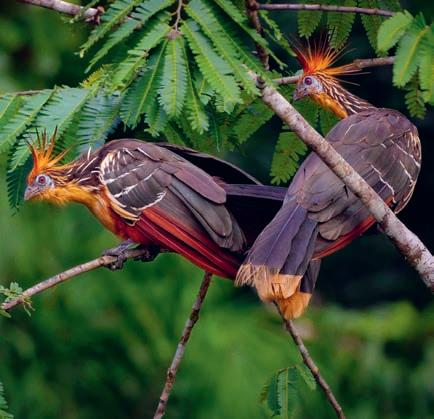
You also have the famous clay lick in the river, where you can see the incredible spectacle of hundreds of parakeets, parrots and macaws gathering to eat the mineral-rich clay.
We have two clay licks – one that you can visit in the boat and see dusky-headed parakeets, blue-headed parrots and sometimes white-eyed parakeets. The other clay lick is on a trail inside the Yasuní National Park, where scarlet macaws, orange-cheeked
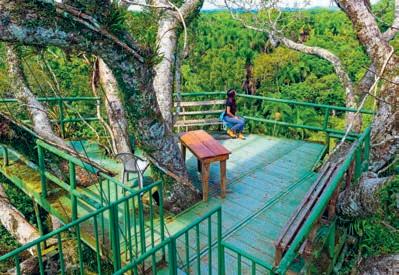
parakeets and others come to drink the water at the foot of the clay wall. The clay is rich in sodium and helps neutralise the acid in their stomachs from eating green fruits. The clay lick is a fun, easy way to see many large, colourful birds all together. For the young birds, the boys and girls, it’s also like a village fiesta and they come to meet their other half.
You grew up in Nuevo Rocafuerte, an Amazonian town on the border with Peru. Did you already know many of the birds and animals in the rainforest?
We knew many of the birds, of course, but back then, we hunted them for food. I have learnt so much working as a guide – a complete change in mindset from hunter to conservationist. Now I see why we must preserve the environment and protect all the species that live in it. I used to be a hunter but now I am not, and I tell all my neighbours not to hunt, to leave the trees so the birds have fruit. I have learnt so much about this from the guides who come from Field Guide Tours, who help me to see the bigger picture, just as I show them the birds at Sacha. We all have to work together – the managers, the guides, the visitors, everybody – to raise awareness about the importance of protecting these forests for the birds, or we will have no birds to watch.
Taking flight (this page; clockwise from top left) Sacha Lodge blends into the forest at Lake Pilchicocha, off Napo River; hoatzin birds with spiky crests make hoarse calls like croaks and hisses; views over the treetops of Yasuní National Park from a bird-watching observation tower; (opposite page; clockwise from top) birdwatching guide Oscar Tapuy; scarlet macaws drink water at a clay lick in the park, which they visit for supplements of sodium and other minerals; the rufescent tiger heron is seen around the park’s marshes and swamps; the golden-tailed sapphire, a species of hummingbird, lives at the forest’s edge
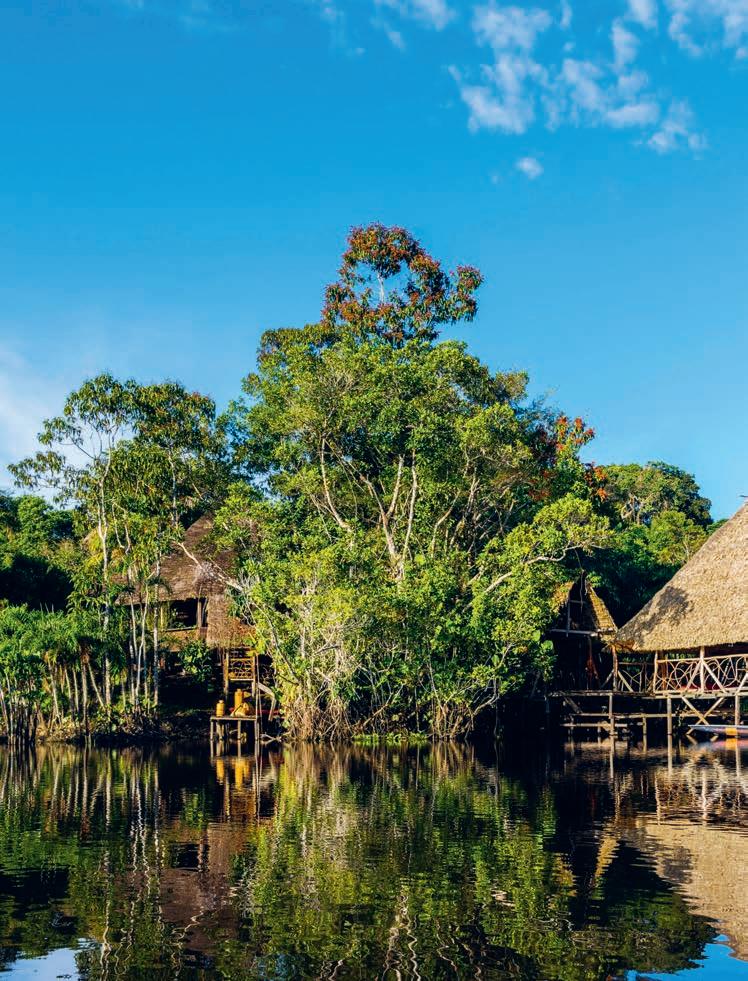
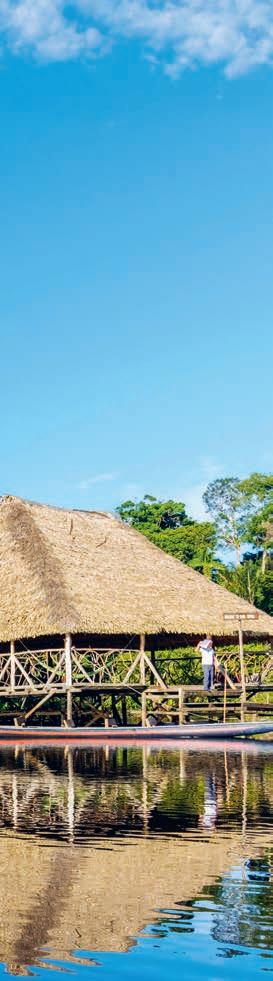
Sleeps in the Ecuadorian Amazon
An immersive stay in a rainforest lodge, exploring wildlife and meeting local communities, offers a memorable, nature-immersed experience
Words Mark Stratton
What should tick the boxes for the perfect stay in Ecuador’s biodiversity-rich Amazon?
To be immersed in rainforest, for sure, so the howls of monkeys and electrifying birdsong can permeate the senses. It would also be hoped that in such a sensitive environment, accommodation is powered by alternative energy such as solar and that lodges are constructed
from sustainable, natural materials. And that owners and staff will come from Indigenous communities who benefit from your stay and impart the knowledge and wisdom of their past generations. Happily, many lodges centred around Yasuní National Park and Cuyabeno Wildlife Reserve offer this, and importantly so, because they form a sustainable economic bulwark against regional pressures from oil exploration, intensive farming and timber exploitation.
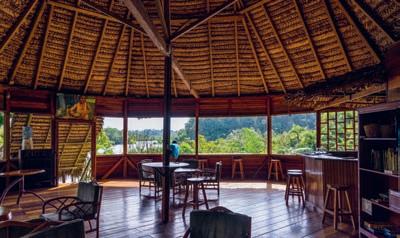
Sani Lodge
The backstory of Sani Lodge makes for an inspiring stay. In 2000, the Sani Isla Kichwa took a stance against oil exploration on their lands to create this ten-cabin lodge in a corridor between Yasuní National Park and Cuyabeno Wildlife Reserve. The lodge now protects 31,000 hectares, home to 2,274 flora species and 580 bird varieties. The rustic cabins are fashioned from locally sourced sustainable wood with thatched triangular roofs woven from toquilla leaves. Guides take visitors out walking on 20km of trails and the observation tower hugs a giant kapok tree, which is magnificent for birding – the keen-eyed might sight the curiously camouflaged potoo bird and occasional harpy eagles. Guests can buy fine handicrafts and try homemade chicha beer as part of the Sani Warmi project which enables women to enjoy greater financial independence.
AMAZON
Anakonda Amazon Cruises
Absolutely the best way to explore Ecuador’s Amazon is by river. The award-winning Anakonda Amazon Cruises has not only pioneered riverboat trips down the Napo River, but works diligently on local conservation projects for freshwater turtles and pink river dolphins and it has also helped the Indigenous community to establish tourism projects. Its two cosy riverboats, the Anakonda and the Manatee, with bright air-conditioned cabins, possess the ambience of Mississippi steamers. From Coca, its slow cruises adjacent to Yasuní National Park head up the Napo to the Peruvian border. En route, expect visits to Kichwa communities who will guide guests to see the world’s smallest monkeys – pygmy marmosets, and to buy handicrafts. Motor launch excursions will seek pink river dolphins and caimans in lakes full of piranha.
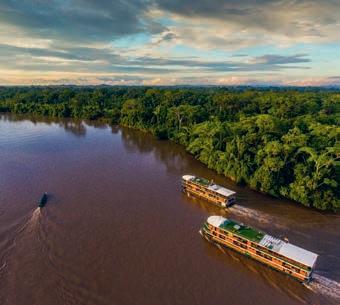
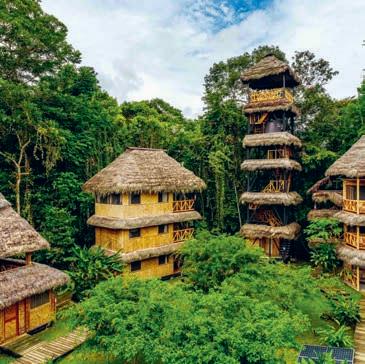
Bamboo Lodge
A journey into the remarkable Cuyabeno Wildlife Reserve touches the heart of biodiversity in the Ecuadorian Amazon. Snuggled within rainforest which boasts access to over 500 bird and 167 mammal species is a clearing alongside the Laguna Grande which is home to the immersed cabins of Bamboo Lodge. The lodge has rooms with penetrating rainforest views and a birdwatching observation tower resembling a pagoda. Its eco credentials feature treating all wastewater and running power from solar. Trips out include guided walks and canoe journeys through flooded igapo forest swamps, as well as a visit to a Siona Indigenous community to learn about their lifestyle. Their rainforest walk either side of dusk reveals how the fauna transitions during the crepuscular hours.
Kapawi Lodge
Days begin at around 4am for guests in the Achuar community with a guayusa ceremony around a lit hearth, to sip tea made from the ilex guayusa plant. Of all the experiences with Indigenous peoples in Ecuador’s Amazon, Kapawi Lodge emerges as the most complete cultural immersion. Its thatched scarab-shaped bungalows are found in a clearing amid 50,000 hectares of Achuar territory in a community ecotourism project owned and operated wholly by three neighbouring villages. It’s reached via a small aeroplane flight from the town of Shell to Ecuador’s far southeast border with Peru. Each day, visitors head out from the communal gathering hut, on canoes or hikes, perhaps sighting pink river dolphins, tapirs and capybara.You will experience how the Achuar live harmoniously with the rainforest and you’ll meet families to talk about their agriculture and use of medicinal plants. Guests get to try their cuisine, such as maitos – often fish and heart of palm which is wrapped and cooked in leaves.
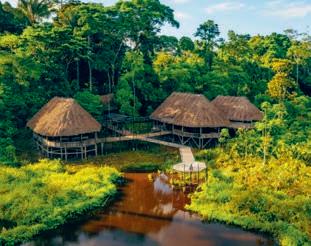
Alamy; Bamboo Lodge; Kapawi Lodge; Anakonda Amazon Cruises
La Selva Eco-Lodge & Retreat
Accessed by canoe several hours from Coca up the Napo River, La Selva’s luxury staterooms are arranged around Lake Garzacocha’s shore in the Yasuní Biosphere Reserve. The ancient rainforest here is part of a global biodiversity hotspot and guests are encouraged to book packages to explore the stellar wildlife and interact with the surrounding Indigenous Pilchi
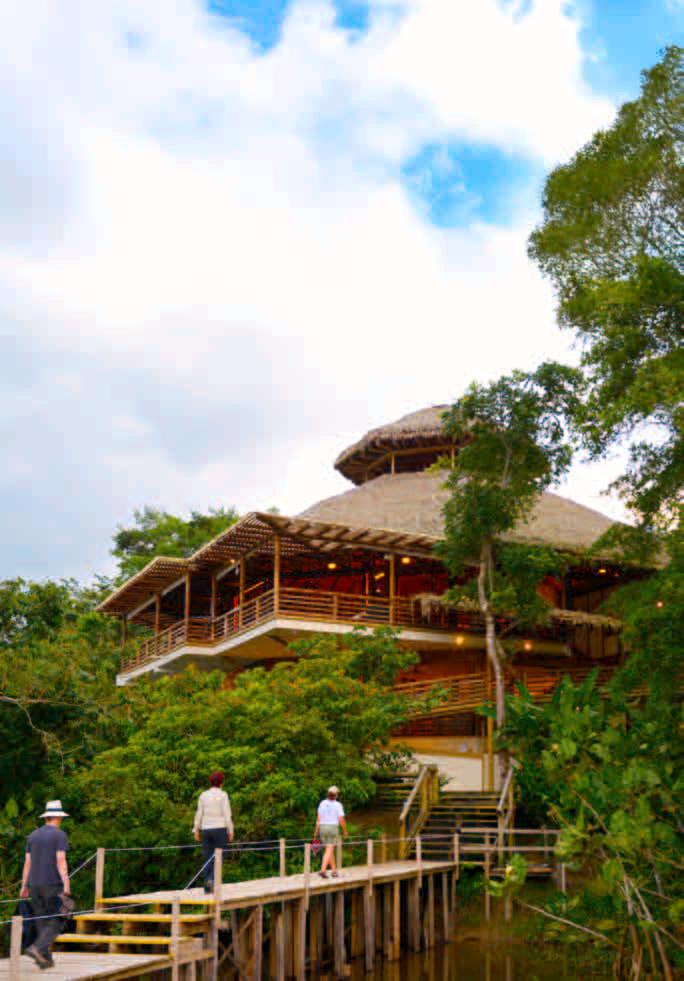
community, who comprise 80% of the staff. The young men lead nature walks around hiking trails and on lake canoes, while Pilchi women host cultural events and produce handicrafts for guests to purchase. This money supports their school and conservation. On the lake during canoe adventures, expect caimans and giant river otters, while the 38m-high canopy tower can yield sightings of feeding capuchins and squirrel monkeys. ⊲
Sacha Lodge
This beautiful and remote lodge on the shores of the black water Lake Pilchicocha is two hours upriver from Coca. The vision of a Swiss investor in 1992, the lodge has over the years accumulated degraded land surrounding its luxury cabins and created a flourishing reserve spanning 2,000 hectares. The tall windows of the cabins allow an intimate connection for inspecting the surrounding rainforest, while verandas are
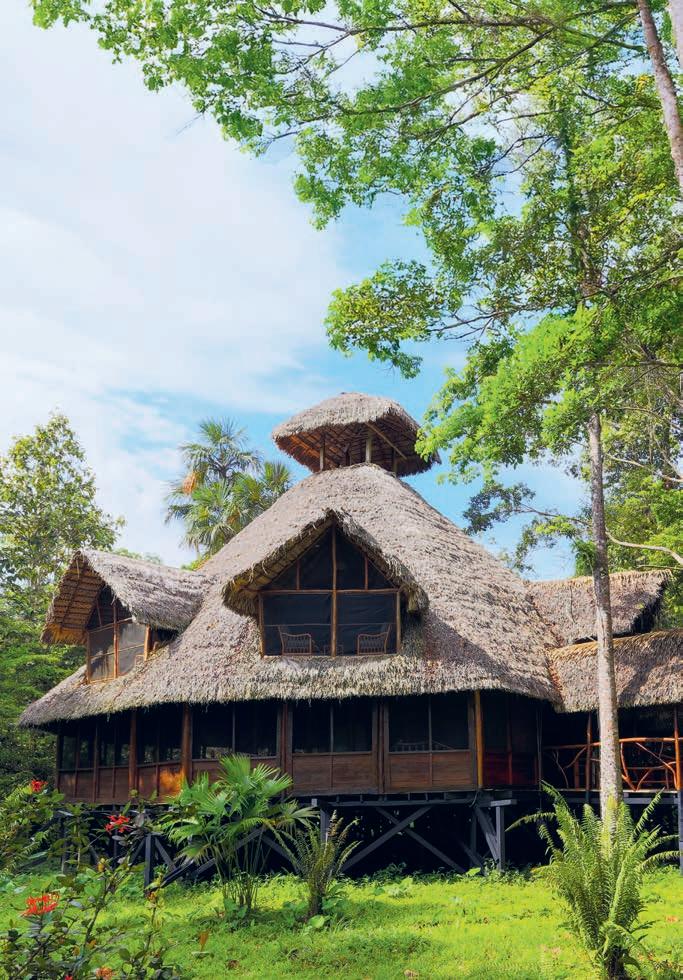
replete with hammocks. Diners in the lake-facing restaurant can look out for sloths in the nearby canopy. The lodge generates employment for 60 local families. Of its natural highlights, it is a birding hotspot with 587 recorded species such as toucans and hummingbirds. Pygmy marmosets are often seen, thanks to conservation work from overseas research projects. A 275m treetop canopy walkway along a suspended bridge proves a fine altitude for eye-level simian encounters.
Alamy; Cuyabeno Lodge
Cuyabeno Lodge
If you’re brave enough, despite the presence of anaconda and caiman around the water’s edge, one of Cuyabeno Lodge’s activities is a lagoon swim. This cosy lodge pioneered ecotourism inside Cuyabeno Wildlife Reserve in 1988 and it perches on raised ground above the flooded Laguna Grande shoreline. Guests arrive to simple wood and thatched huts by motorised canoes, which have been fitted with quiet electric motors to optimise wildlife sightings. The whole lodge is powered by solar electricity. All the day’s hours would be required to fit in myriad activities: hiking in the terra firma rainforest spotting monkeys and exotic birdlife; night walks to seek owls and garish frogs; fishing for piranhas (another reason to think twice about swimming) and visits to a local Indigenous community to learn to make the Cuyabeno staple – yuca-flour casabe flatbreads.
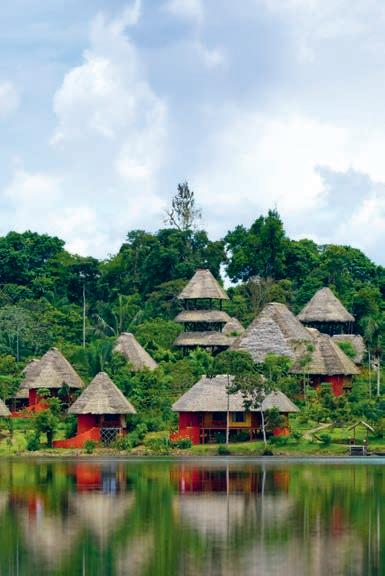
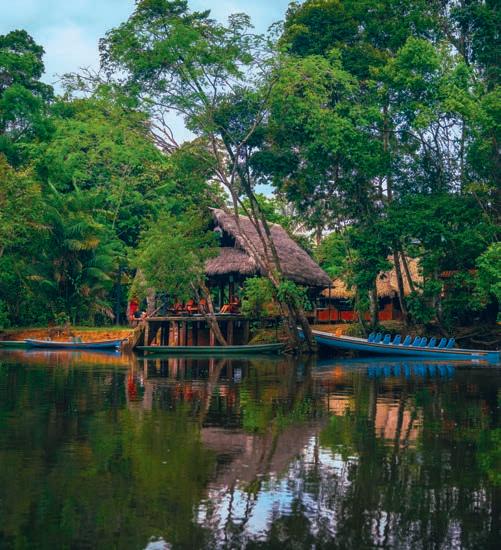
Napo Wildlife Center
This Kichwa Añangu community’s lodge is gloriously located within the richly biodiverse Yasuní National Park rainforest, where over 600 bird species have been recorded plus ever-elusive jaguars. It’s a micro-adventure just reaching it. Take a fast-boat for 2.5 hours down the Napo River, and then a quiet canoe paddle with Añangu guides on a backwater tributary creek to the lodge. It has comfortable small thatched cabins plus more luxurious suites with polished teak floors, all built around a tall observation tower with a topiary-looking roof. Napo is best known for two clay licks, which attract five different parrot species plus macaws. Canoe rides and rainforest walks deliver sightings of elusive golden tamarin monkeys and giant otters. The community’s women’s association has created the Kuri Muyu centre where they sell brightly decorative handicrafts.
Did y know?
Cacao originated in the Ecuadorian Amazon
For
centuries, Ecuador
has been the
world’s
leading
exporter
in high quality chocolate – but its origins date back to ancient cultivations…
Words Karen Edwards
The thick, creamy chocolate poured onto the ice-cold metal tray, as each swirling layer made the pool even more abundant and enticing. “There’s not long to wait until you can taste it,” said Marcos, the chocolatier-turned guide leading the tour at Yumbos Chocolate Artesanal, as if he could read my mind. I clearly wasn’t the first visitor to be craving the finished product, long before the chocolate-making experience was over.
Our human love a air with chocolate is a story for the ages.
– known locally as cocoa – was grown for sustenance in the region. The seeds came from the pods of the small Theobroma tree, which thrives in tropical climates like the Amazon. Residues found in old pottery relics unearthed in the surrounding area, suggest cacao was a source of nourishment or medicine in ancient times – likely brewed with water and consumed in liquid form.
“The chocolate produced from the Amazon is always woody and flowery in taste, and from the coast, it’s salty with a fruity flavour”
The mouth-wateringly sweet food, which originates from the cacao plant, was widely assumed to have stemmed from Central America. However recent research, confirmed in 2024, shows that cacao was likely first grown in the Upper Amazonian Basin, in what we now know as Ecuador – with traces of the domesticated cacao tree dating back to 3,300BCE. For thousands of years, cacao
“It was the Indigenous Yumbo (a population of pre-Inca farmers, traders and merchants) that began transporting cacao seedlings and beans outside of Ecuador,” said Marcos, explaining how they hauled produce from the Amazon to the coast, and then north into a region known as Mesoamerica (today’s Mexico and Central America), where its value grew.
For the Yumbo, this meant cacao could be used as a form of currency and diplomacy. After all, this rare and precious seed was, at that time, only cultivated in the depths of the tropical Amazon. As their trade

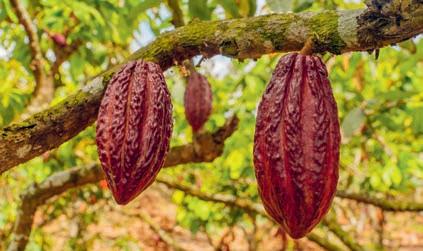

networks spread north, cacao was delivered to the Mayan, Olmec and Aztec civilisations of Mesoamerica, who established plants in their own orchards. “Cacao was considered a very precious seed,” explained Marcos. “The Olmec would brew, toast and grind the seeds for food and drink, and the Maya felt it was the ‘food of the Gods’.”
Indeed, cacao soon became the Yumbo’s very own magic beans. It enabled much of the population to endure the Inca settlement of the 1400s and the early-day invasion of the Spanish conquistadors. By the time the latter arrived in the 1530s, healthy cacao crops were found across Central America. Impressed by what they found, the Spanish transported cacao to Europe, adding honey and vanilla to placate its bitter taste and fashioning the blocks of chocolate we know today. However, colonisation slowly brought disease – the witches’ broom and frosty pod plagues of the early 1900s are the most notorious – decimating Ecuador’s cacao production. Between the 1800s and the 1950s, Ecuador went from being the number one cacao producer in the world to being a minimal exporter. Today, Ecuador continues to produce over 70% of the world’s highest quality cacao, Nacional Fino y de Aroma, although it no longer holds the title of the number one global producer.
Yet, cacao farming remains a lifeline for over 150,000 family-run farms across Ecuador – many of which have been planting and harvesting cacao for generations in the Amazon and coastal regions. What’s more, traditional practices continue: Banana leaves are still used for the fermentation of the cacao seeds and beans are manually dried for 12-24 days before they are finely ground. “The chocolate produced from the Amazon is always woody and flowery in taste, and from the coast, it’s salty with a fruity flavour,” said Marcos. “To this day, our cacao resembles the special environment in which it grows.”
Ecuador Ministry of Tourism; Hacienda Las Cañas

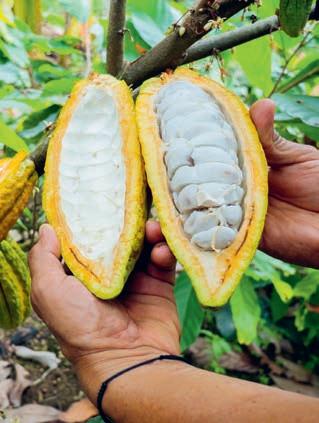

When in Ecuador, visit these local chocolatiers…
To’ak
Sourced deep in the valley of Piedra de Plata, To’ak harvests its cacao from the 100-year-old trees that have resisted the plagues brought in by colonisation. The To’ak Quito Chocolate and Art Experience is a tasting session within the home of artist, Oswaldo Guaysamín, showcasing his renowned works on social injustice. toakchocolate.com
República del Cacao República del Cacao ensures farmers are paid fairly for their work – while preserving traditional techniques. Enjoy homemade blends in Quito’s historic centre, on the corner of Venezuela and Mejía. republicadelcacao.com/en
Paccari
Paccari collaborates with family-run producers to generate dark chocolate, using biodynamic agricultural practices. Don’t miss the infused options, including passionfruit, Andean rose and ‘guayusa’ (from the ca einated Amazonian tree) at the Paccari Experience in Quito. paccari.com
Yumbos Chocolate
Yumbos founders, Claudia Ponce and Pierre Alain Molinari, source their Nacional Fino y de Aroma from generational Amazonian farming communities. Learn more at the Yumbos shop in Plaza de San Francisco, Quito. yumboschocolate.com
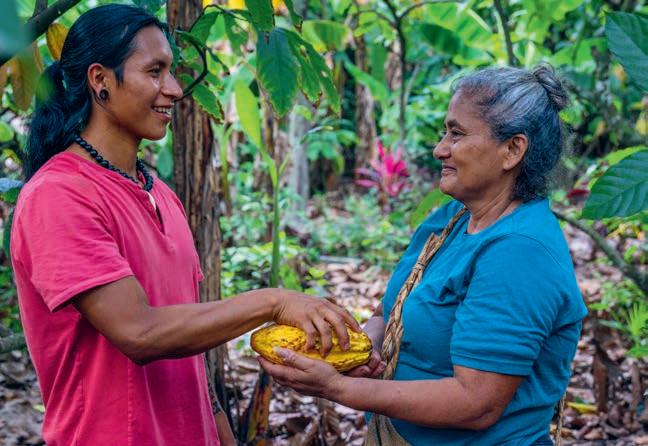
Traditional methods (clockwise from above) Chocolate is made after cacao beans are dried and roasted; ecosystems like the Amazon forest are ideal for growing cacao, where a tree can take up to five years to produce beans; it takes between 300
chocolate
The Coast
Whether dancing to the rhythms of coastal communities, savouring the salty tang of a fish stew, watching migrating whales or taking in the history of a lost civilisation, there are countless ways to soak up the magic of the Ecuadorian coast
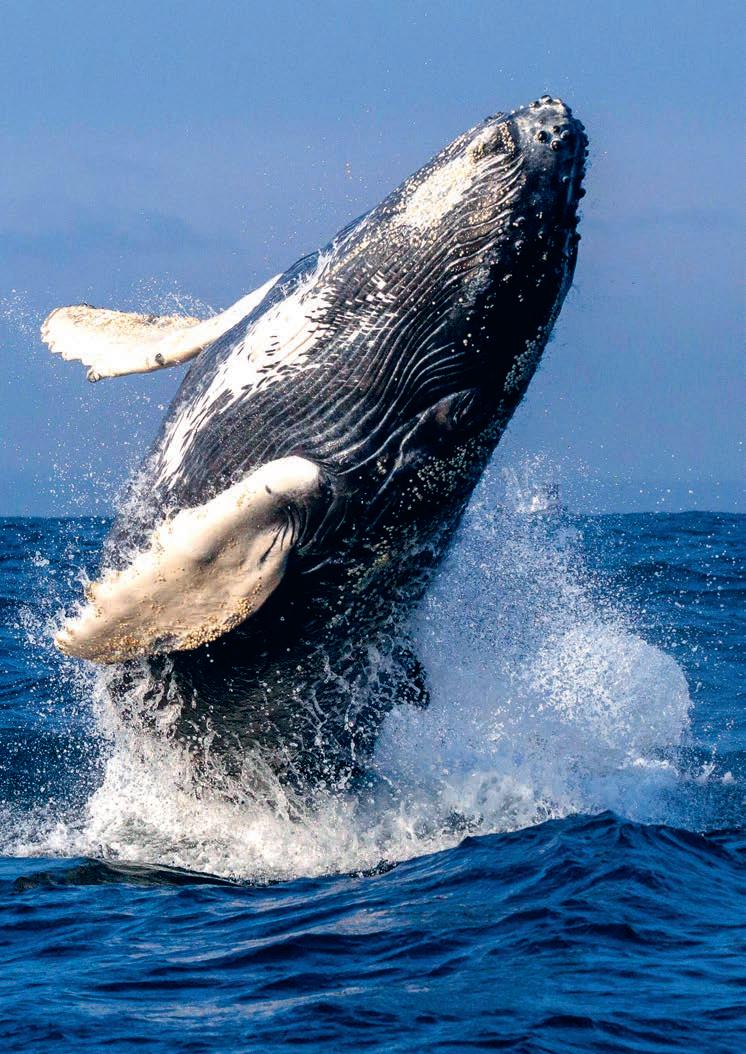
Alamy
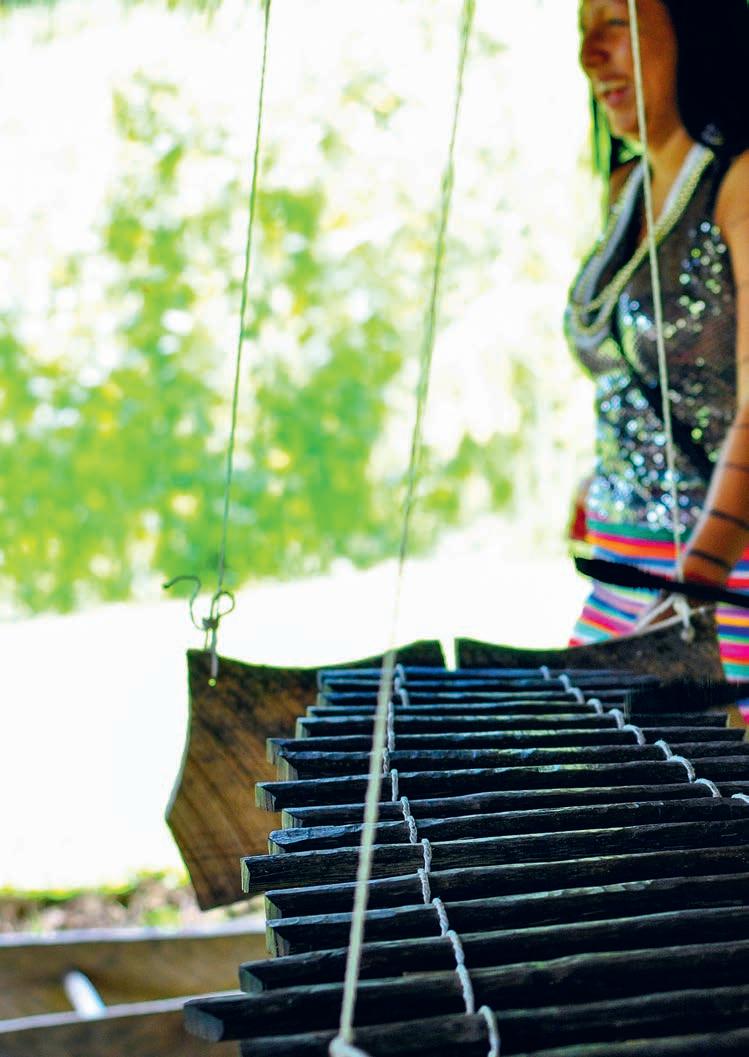
Discovering the rhythms of the coast
The rhythms, music and dances of coastal Ecuador are unlike anything else you’ll hear in the country. They tell a tale rooted in the stories of its Indigenous and Afro-Ecuadorian people
Words Sinead Mulhern
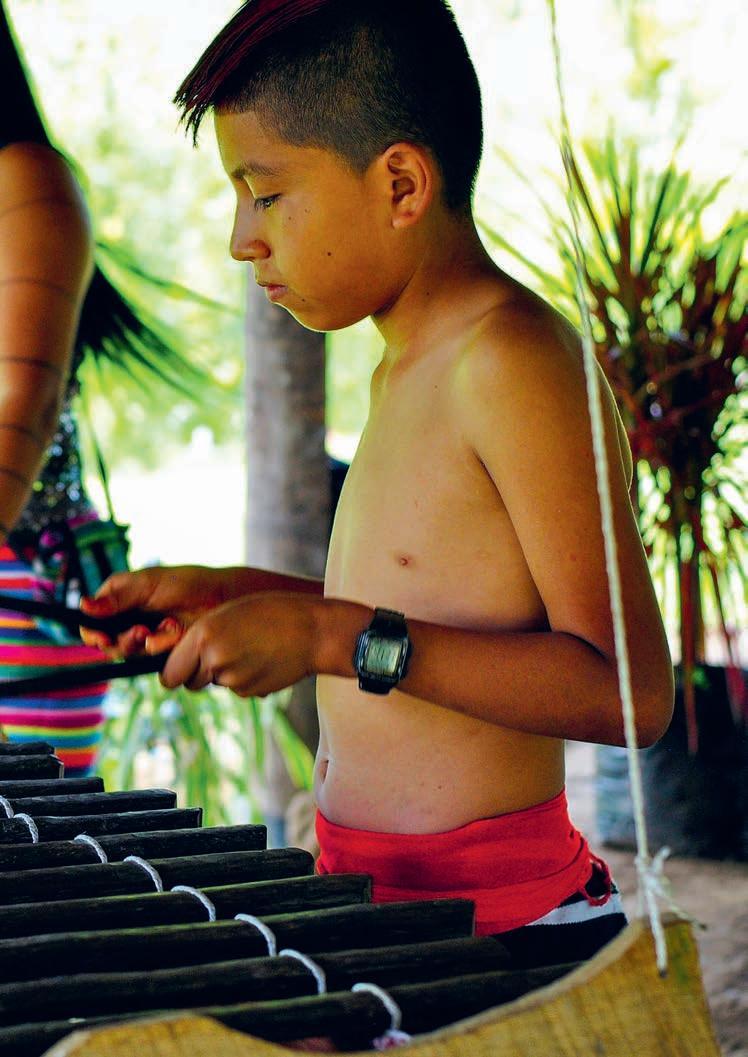
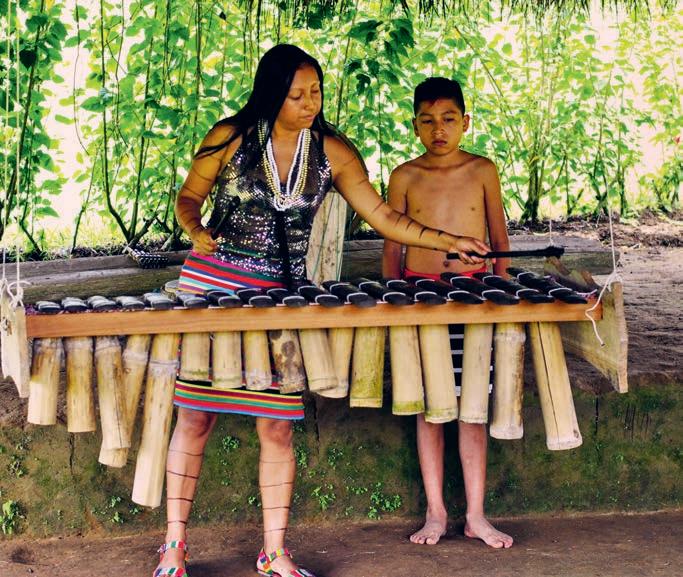
Off a sandy road in the town of Muisne, the drum beat of a marimba song drowned out ocean breezes. Four dancers moved in unison to a playful xylophone melody. The gentle clinking of the instrument (called a marimba, like the music) was rhythmic, joyful and easy.
If the sunshine on Ecuador’s coast had a sound, I imagined it would sound a lot like this. It was happy, energising, pretty and fun. The dancers’ bare feet slid against the floor, creating a quiet wish-wash sound in time with the rhythm. Through an open door, neighbourhood kids giggled as they played with a dog in the dusty road. These sounds, though not an orchestrated component of the performance, are a part of Ecuador’s coastal marimba music too.
and I could feel it from my place metres from the stage. The mallets dashed across the instrument forcefully like the heavy raindrops of a tropical storm beating against a tin roof. The dancers moved faster, twirling their emerald-green dresses like pinwheels. Their movements were graceful and natural – it was like they didn’t even have to think. They didn’t really; the marimba’s in their bones.
“The people in this part of Ecuador are known for their warmth and openness; the music probably has something to do with that”
This unfolded in front of me in the little coastal town of Muisne in the province of Esmeraldas. I was there to learn more about the music of the Ecuadorian coast, and not just there but all along the balmy Pacific, down to the port city of Guayaquil and in towns tucked in green foothills.
The people in this part of Ecuador are known for their warmth and openness; the music probably has something to do with that. The below genres aren’t the only ones you’ll hear while staying somewhere on the coast, but they do play a significant role in shaping the coastal identity.
During energy-filled nights that shift to pale blue mornings, these are the songs which play as the roosters crow.
MARIMBA
One of the dancers flashed a smile and the drum beat picked up. It was like thunder
That night’s performance was just one glimpse into the notes, instruments and melodies that make the coast the boisterous and exciting place that it is.
That vibrant marimba music, performed by the Casa de la Marimba under the direction of Linver Nazareno, captivated the small audience I sat among, and it represents a big part of the musical identity in Esmeraldas. Muisne is the kind of place where Pacific breezes shake palm tree leaves and tides crash against piles of driftwood. Together with the barks of stray dogs and rattle of tuk-tuks, they create a soundtrack – the daily rhythms of island life in what’s often described as Ecuador’s forgotten province. Marimba brings that soundtrack to life during big events, celebrations, holidays
Alamy ⊲
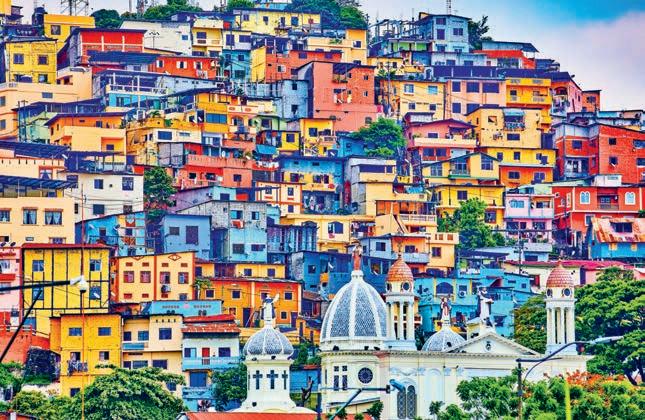
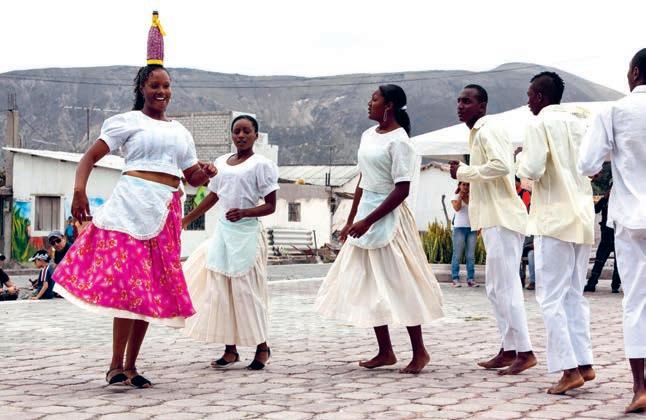
The sound of music (this page; top to bottom) Colourful houses lines the slopes of Santa Ana Hill in the Las Penas district of Guayaquil, setting the scene for the bright and lively rhythms that emanate from the area; the ‘Bottle Dance’ sees performers dance to a rhythm while balancing a bottle on their heads; (opposite page) a pair of Indigenous Tsáchila musicians perform on a traditional marimba, a type of xylophone with bamboo resonators; (previous spread) the sounds of the coast are rooted in the rhythms and music of Indigenous peoples and the enslaved Africans who were washed up on these shores
and parties. It’s a big deal here, a crucial part of the social fabric, and a point of pride – understandably so.
It also tells a story revealing something important about the history of this region. This was a type of music brought to (and preserved in) this part of the world in the 16th century, during the time of the slave trade. Esmeraldas is the country’s northernmost coastal province, and culturally speaking, it’s different from many places in Ecuador thanks to its Afro-Ecuadorian culture.
“A decade ago, UNESCO listed the marimba genre on its Intangible Cultural Heritage of Humanity list”
These African roots trace back to hundreds of years to when ships bringing slaves from Africa were wrecked here and their inhabitants settled in this region. Today, Esmeraldas’ dances, celebrations, food and music stand apart from the rest of Ecuador. Marimba is one of the markers of that culture, meaning that it’s not just beautiful to listen to: this genre has always been an embodiment of resilience, pride and determination.
The energising melody that sent smiling dancers whirling across the stage is played on a palm wood or bamboo marimba with mallets, with bamboo tube resonators, drums and maracas. Depending on the song, it sometimes also features vocals as musicians call out over the thundering drumbeat. A decade ago, UNESCO listed the genre on its Intangible Cultural Heritage of Humanity list. A marimba show isn’t complete without the dancers clad in floorlength ruffled dresses and men twirling handkerchiefs throughout the performance. The result? Truly mesmerising.
DECIMAS
Where marimba sounds upbeat and energising, decimas (likely part of the same performance, as it was in my case) ground the show, often offering an insightful but sobering perspective on local history or social issues. This is spoken-word poetry, performed to a constant background beat,
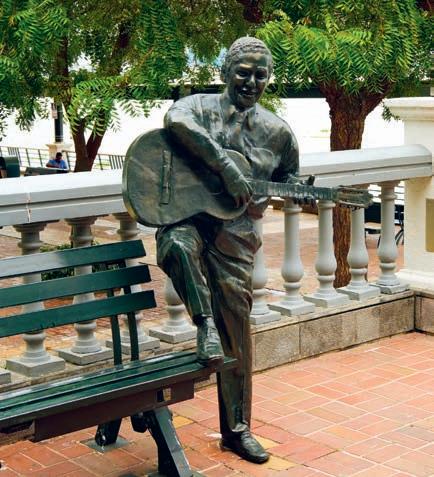
and its purpose is to tell stories, comment on past or current events, express a personal experience, or is sometimes used in jest to tease friends. Decimas are organised into stanzas of ten lines and are common in this part of Latin America. They are often improvised on the spot.
Linver Nazareno, the teacher of the marimba school, is known for his decimas. Whenever he takes to the stage, it’s clear he has a message. Esmeraldas, though beautiful, has experienced hard times and crippling poverty. Nazareno’s decima was about the effects that shrimp farming have had on the local community – the environmental impact and the way it devastated the delicate mangrove ecosystem and the fish population, leaving the community with contaminated water. The tone in the room was serious: Nazareno’s art is spectacular and teaches us more about the context of this region.
PASILLO
Pasillo is the national music of Ecuador, and its sentimental lyrics will be heard throughout the country and on many occasions: weddings, family gatherings, restaurants, parties or on the radio during a taxi drive through a dusty beach town. Pasillo sounds hauntingly beautiful and, at times, delicate, with emotionally charged lyrics and sentimental messaging. Ecuadorians love it, having both a museum and festival dedicated to Pasillo in Quito. It has also been added to UNESCO’s Intangible Cultural Heritage of Humanity list in 2021.
The roots of this waltz-like music go back to the 19th century in Ecuador during the wars for Ecuadorian independence. As such, it’s a genre that is also prominent in the other countries that once made up Gran Colombia (Venezuela, Colombia and Panama).That pasillo was born during this time in history makes it the music of Ecuadorian nationalism.
So, what does it sound like? Travellers familiar with this part of Latin America would instantly recognise the genre’s iconic requinto: a high-pitched small guitar with a sharp sound. The pasillo Ecuadorians have come to adore is a mix of a few things: the waltz, the Spanish bolero and elements of Indigenous music like the yaraví . Its sound relies on string instruments, usually with guitars or a mandolin accompanying the requinto (often you’ll hear piano and flute notes too). As for the lyrics, pasillo is emotional, focusing on love, loss, hardships or family. Think poetry put to goosebump-causing melodies.
The best examples of Ecuadorian pasillo are the songs by Julio Jaramillo. In fact,
Alamy ⊲
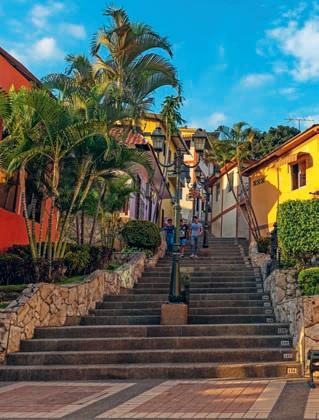
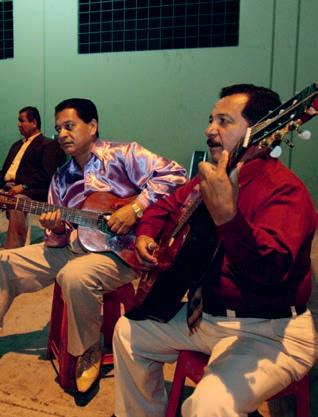
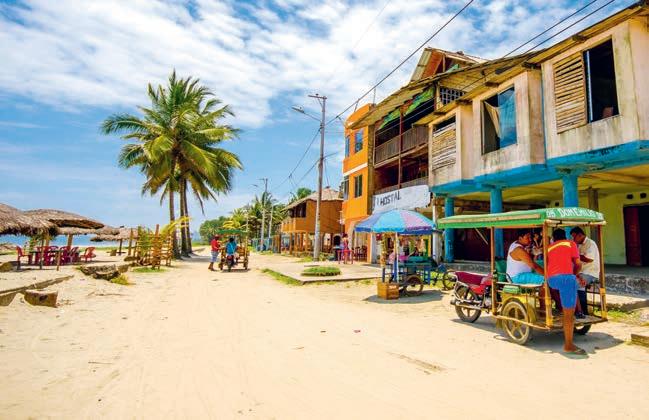
Let the rhythm take you (this page; clockwise from top) Locals stroll down the famous 444 steps of the Santa Ana Hill in Guayaquil, an area known for its music bars; live music accompanies most nights out on the coast, where it’s wise to know a dance move or two; Esmereldas, where you’ll find the island town of Muisne, is often described as Ecuador’s forgotten province; a statue of Julio Jaramillo, who worked in a shoe shop before he began touring the villages of Esmeraldas and Manabí provinces, eventually making it big with his first hit, Fatalidad
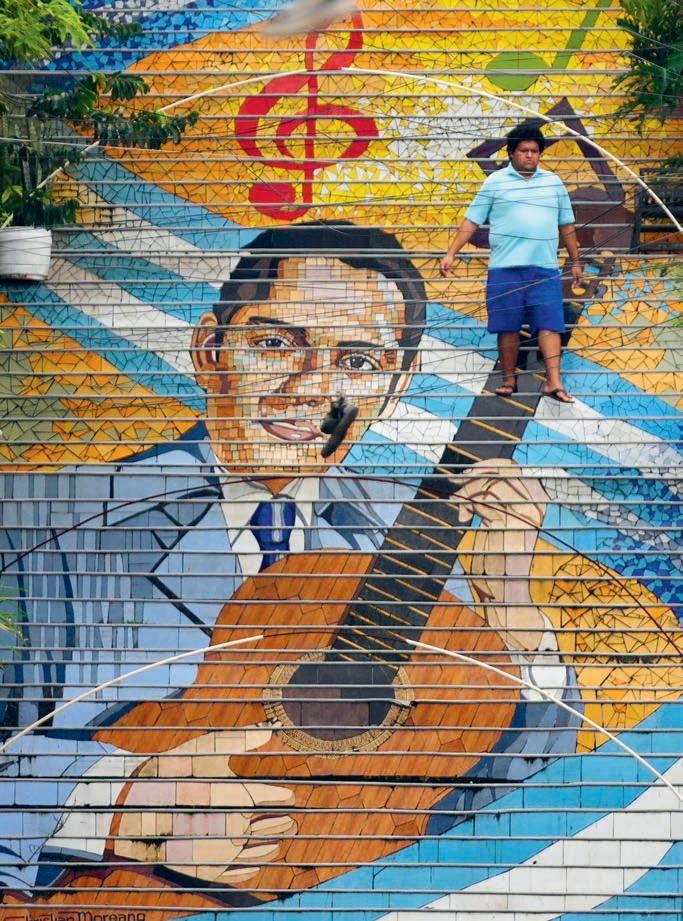
at the esteem with which the
most
is held. Most Ecuadorians – even those outside the coast – will admit that he remains – even four decades after his death – one of the most iconic singers in the country’s history, having been labelled the ‘Frank Sinatra of Latin America’ in his heyday; (opposite page) music takes
The golden voice (this page) A mural of the Ecuadorian pasillo singer Julio Jaramillo in the Mapasingue neighbourhood of Guayaquil hints
city’s
famous musical son
centre stage at the Fiestas Julianas in Guayaquil, taking place every July in honour of the city’s patron saint, Santiago el Mayor Alamy; Ecuador Ministry of Tourism
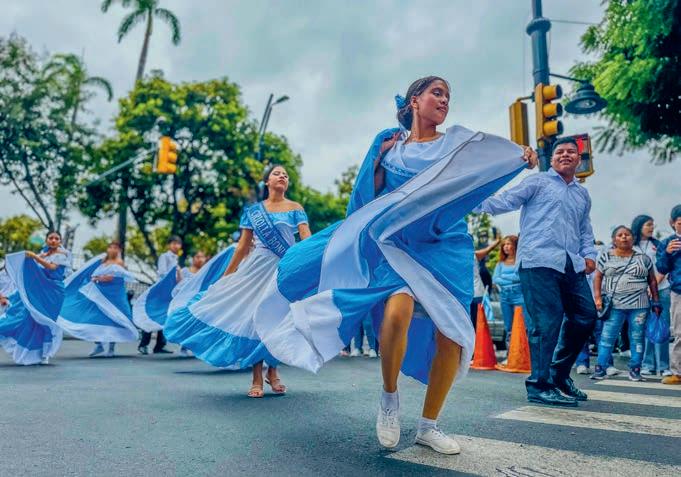
most Ecuadorians will tell you that’s not even a contest. The singer from the coastal city of Guayaquil popularised pasillo, breaking through in the mid-1950s and even being called the ‘Frank Sinatra of Latin America’. His voice could break hearts even decades after his passing, and as I listened to it while looking out onto a field of banana trees, his presence sent a chill up my spine.
“These three genres are very similar for a few reasons: they’re rhythmic, lively, upbeat and are a staple in any party or event”
wild party. Costeños have a reputation in Ecuador for being the best dancers, and parties in Guayaquil, Manabi and Esmeraldas draw guests who automatically know how to keep the beat to salsa, merengue and cumbia.
the Colombian cousin of these genres, and it feels folksy, slower and more relaxed, not that that’s saying much.
Jaramillo performed in venues throughout Guayaquil and beyond. He’s still known as one of Ecuador’s greatest singers and is largely responsible for putting Ecuadorian music and pasillo on the map. Songs like Ayer y Hoy, Nuestro Juramento and Ódiame are tender and nothing short of perfect.
CUMBIA, MERENGUE AND SALSA
The people who live on Ecuador’s coast are known for being open, friendly and able to dance all night after throwing a
These three genres are very similar for a few reasons: they’re rhythmic, lively, upbeat and are a staple in any party or event, such as a wedding or birthday. These are three of the most popular genres you’ll hear during a celebration – especially on the coast, where upbeat music and dancing are core parts of daily life and identity.
But these beats, while they play a significant role along the Ecuadorian coast, don’t originate from Ecuador. They’re transplants here, with salsa originating in Latin enclaves of New York in the 1960s but rooted in Cuban, Afro and Puerto Rican cultures. Merengue, a rapid two-step style that commands the entire room to dance (probably breathlessly and sweating), comes from the Dominican Republic. Finally, Cumbia is
Even though this music wasn’t born in Ecuador, it lives here through larger-thanlife fiestas that preferably don’t have an end time. Many Ecuadorian musicians have put their own spin on these classic Latin styles. For example, salsa para partirte is an addictive salsa-meets-rock tune put out by Los Corrientes, an alternative band from Guayaquil, in 2014. Swing Original Monks, a hugely popular Ecuadorian band, is also known for blending – and putting their own twist on – genres including merengue, cumbia and pasillo (Merengue Delfín and Caminito being two examples of their genre fusions worth listening to).
By the time that I left the coast and retreated to the mountains, I’d listened to and felt the rhythms that played out on hot nights steps from the ocean. I’d danced while my host poured coconut water drinks and listened to the heartfelt words of pasillo recorded decades ago under moody Guayaquil skies. I also understood more about coastal music and would have kept listening had the volume not been turned down.

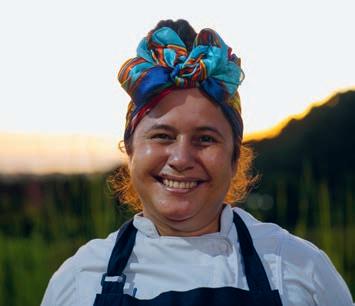

Culinary traditions of the Ecuadorian coast with Valentina Álvarez
Interview by Laura Field
Valentina Álvarez is a revered, self-taught chef from Manabí province who runs Iche and Montuvia restaurants.
Here, she shares what makes Ecuador’s coastal region so special and recommends what to taste there.
What inspired you to become a chef, and how did you learn to cook?
I’ve never called myself a chef. I see myself more as a cook, an open-fire cook. Everything started with the horno manabita – the Manabí oven. My great-grandmother had a typical rural house, and in the
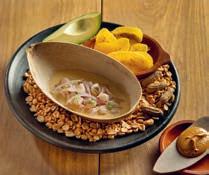
kitchen, there was a giant open-fire oven. I was always cooking with her. I learnt about the foods she was preparing from her. I can vividly remember the smells of her kitchen.
My mother is also a great home cook. I used to prepare corviche (a fried or ovenbaked savoury treat made with plantain, peanut dough and a fish filling) with her, and we would sell them in the local community to help our family financially. In the coastal region of Ecuador, we tend to eat corviche with co ee in the afternoon; we call it café mascado.
I was always my mother’s uno cial sous chef. I remember one day, when I was eight
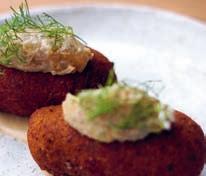
years old, my mother was so exhausted that she couldn’t get out of bed, so I decided that I would cook that day. I’ve always loved cooking for others. Whenever I went to friends’ houses as a kid, I loved going into their kitchens and seeing the produce they had. They always had more than my family did at home. My passion is to change the Manabí province through food.
Why are you so passionate about Manabí and the coastal region?
Manabí has been known for its social problems and its poverty, but it’s rich in so many ways. It’s right on the equator. There are
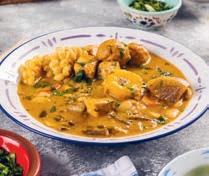
Valentina
Álvarez
two marine currents that flow past: the Humboldt Current, which is cold and flows north, and the El Niño Current, which is warm and flows south. Add to that the coastal mountains and you get the microclimates that make Manabí so abundant in terms of its produce and ingredients. The soil quality is rich too. This rich soil makes for special pottery and ceramics, and it is what we use to build our Manabí ovens.
In 2016, Ecuador su ered an earthquake, and Manabí was at its epicentre. At the time, I was running the restaurant at my in-laws’ hotel, Cocosolo, and the hotel was severely damaged. After the earthquake, I was scared to go into the kitchen, so I decided I wanted an outdoor kitchen with a big outdoor oven.
After the earthquake, several initiatives surged to encourage local people to transform Manabí. One of them was the foundation FUEGOS in my town of San Vicente, which seeks to turn culinary endeavours into a driving force for social transformation.
We focus on young people from rural areas, particularly women. They work alongside me and fuel my passions, which are to cook, teach and study. My life goal is to continue showing women in Manabí that they are capable of being whoever they want to be and that they should show their identity through food.
Tell us about your restaurant, Iche.
Iche is a restaurant, a school, a laboratory and an incubator. It’s a really interesting ecosystem. We’ve created a network of cooks who learn together and develop their skills. We focus on Manabí cuisine and work to bring ingredients that might have been forgotten to the fore again in our ever-changing dishes.
In our ancestral culture, the word ‘iche’ means peanut. In Manabí, we have 18 di erent varieties of peanuts and more than 300 recipes that include peanuts. We eat a lot of peanuts in Manabí, and they have been credited with improving the health and cognitive function of our people.
What dish do you recommend people try when visiting Ecuador?
Everyone should try viche soup. It has more than 25 ingredients, including pumpkin, four types of beans, cucumber, seafood, yuca, sweet potato and herbs. For me, it’s the queen of Ecuadorian soups. We say that you must come and try a viche at Iche!
How can people taste your cooking?
People should come to Iche in San Vicente to try Manabí’s ancestral flavours for themselves. They can also experience Manabí flavours and comfort food at Montuvia Raíces Ancestrales, my restaurant in Quito.
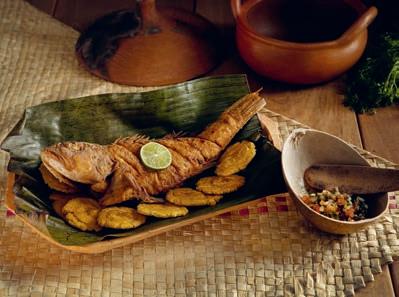
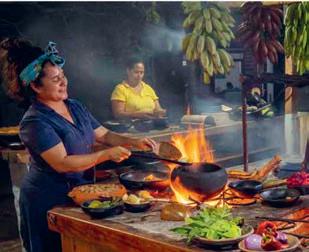


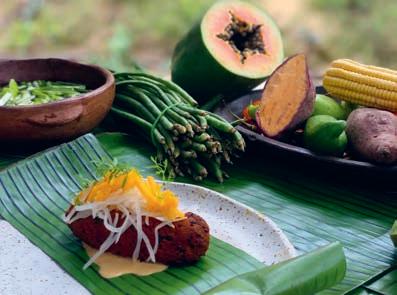
Coast with the most (opposite page; left to right) Ceviche Jipijapa is a Manabí take on the classic South American dish, typically made with sea bass ’cooked’ in citrus juice, and with a powerful peanut flavour; corviche is a beloved local street food; viche soup is made with more than 25 ingredients; (this page; top to bottom) the camotillo frito is another classic coastal fried-fish dish; Valentina at her horno Manabita; Manabí cuisine focuses on seafood, plantains, corn and peanuts
A nature lover’s guide to the Ecuadorian Coast
Outdoors types can choose between watching birds or whales, tackling the surfing waves, cruising the mangroves or snorkelling beside turtles
Words Sinead Mulhern
Along Ecuador’s coastline, foamy waves crash onto the shore and seabirds glide above soothing sandy beaches. Mornings in the north bring flu y clouds that cling to green foothills lined with lush cacao and co ee trees. There, at dawn, you may hear the roar of howler monkeys bellowing from treetops. When the sun shines, it coaxes iguanas out to play and adventurous souls to surf and snorkel.
While coastal towns like Montañita are magnets for travellers seeking festivities that last until sunrise, there’s a whole world of wildlife and outdoor adventures for nature lovers.
The Galápagos alone is a wild world of misfi ts of the sea, and the Ecuadorian coast also hosts endangered mangroves, tropical dry forests, a migration path for birds and an incredible whale watching season. If you’re outdoorsy, here are some great coastal experiences:


Bird watch in Salinas
Salinas is a coastal city known for its beachfront stays and visitors from Guayaquil that come for weekends. Birdwatching might not be the first thing that comes to mind when thinking of Salinas, but ECUASAL, an Ecuadorian salt company dedicated to protecting bird species, has created pools nearby to form a protected area where birdwatchers can spot more than 500 registered species as they migrate from north to south. These include flamingos, pelicans, gulls, herons and cormorants. To spot these pink-feathered and long-legged birds, it’s best to cycle or drive from one salt pool to another. One word of advice: take sun protection seriously here, as Ecuador’s sun is strong, especially when reflecting against the salt pools.
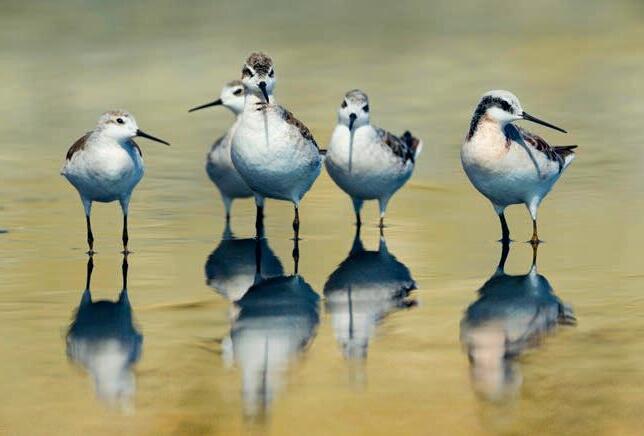




Alamy
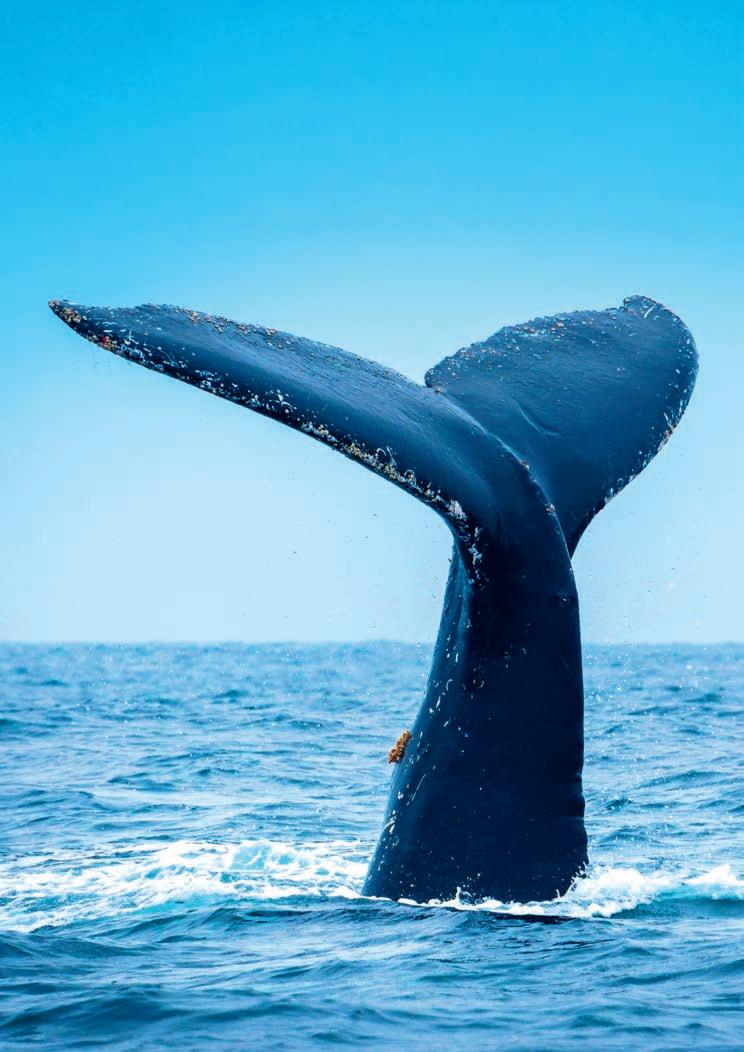
Whale watch in Puerto López
Ecuador’s coast is a breeding ground for humpback whales that migrate here from June to October. For visitors looking to engage with wildlife, this is one of the top things to do in this part of Ecuador during this time of year.
Puerto López is the best place to spot these friendly giants. Sure, it’s easy enough to see the whales from the beach, but the best way to

meet them up close is to take a boat tour out onto the ocean, where you’ll see them jump, slap their tails against the ocean’s surface and swim through the salty waves. While you’re on the water, keep your eyes out for other creatures that live in this part of the world. While the humpback whales will be the star of the show, you may also spot blue-footed boobies, frigatebirds and herons.

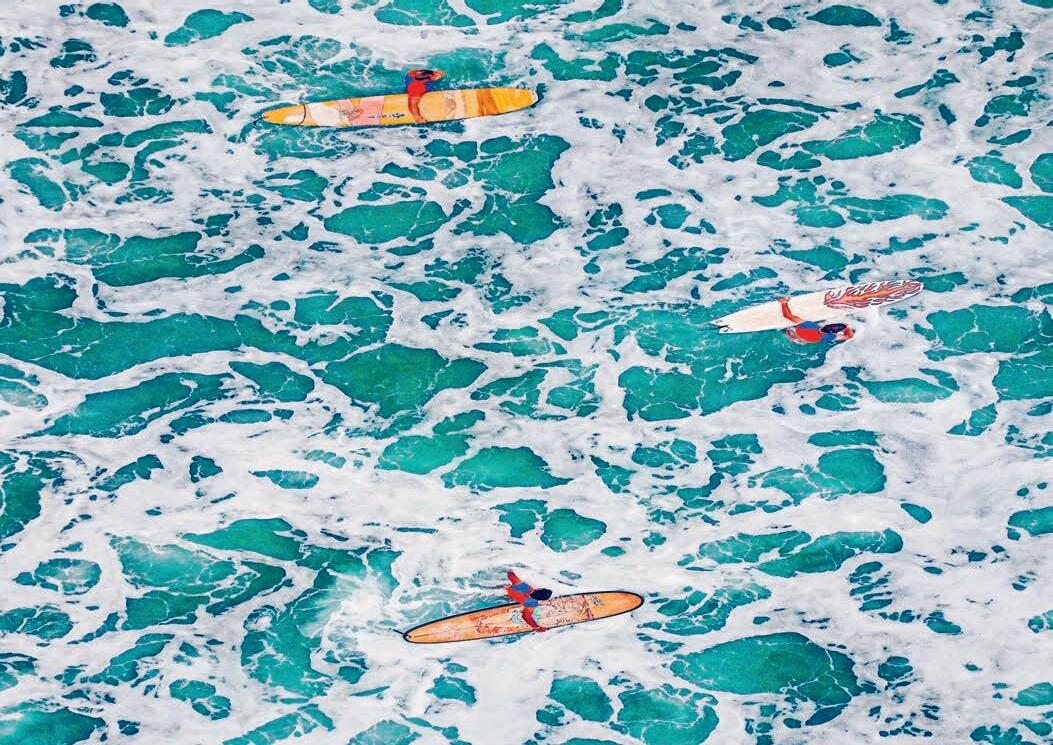

Surf in Montañita
Montañita may be known as the spot where the party can tip over into the early hours, but there’s so much to savour beyond cocktail sipping. Those who want to spend their travels outdoors enjoying nature’s elements should rent a surfboard and watch the waves that glitter under sun-dappled skies. While this lively beach town is known for its surfing, it can get rough out there and you should also be cautious of riptides. The town next door, Olon, is understood to have calmer waters for beginners. Spend the day catching waves and stay out until sunset: Montañita’s skies are known to turn tangerine orange and magenta as the fireball sun sinks below the horizon.
Tour the mangroves in Mompiche
In the province of Esmeraldas, thick forests of spiky mangroves reach their long roots into teal waters. Lush green leaves cling to their branches and white herons fly low, weaving through the tangled canopy in search of fish. This gnarled wetland ecosystem is captivating to look at, especially if you view it by boat from the sleepy, bohemian town of Mompiche. There, fishing boats line the beach, toucans perch on power lines and clothes flap in the breeze. From the beach, you can get a boat tour which will take you onto choppy waters before ducking into the still, intertidal areas and weaving through the mangroves.
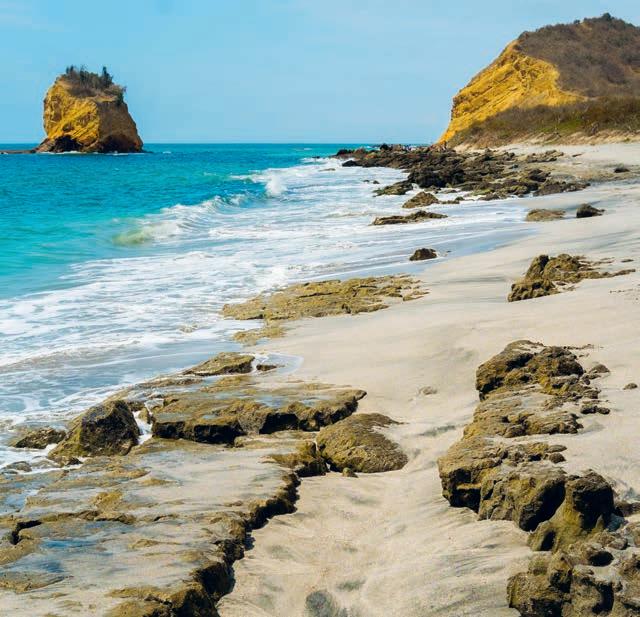
Explore secluded areas of Machalilla National Park
Machalilla is the country’s only mainland coastal national park and a habitat for wetlands, picturesque beaches, sea turtles and several species of birds. This is a special little corner of Ecuador with spectacularly scenic spots like Los Frailes beach and Isla de la Plata. Machalilla is peaceful and a space where you can share the beach or trails with just a few others. If you’re the type of traveller looking for quieter, more secluded adventures, consider walks along Los Frailes’ sugary beaches, a hike through tropical dry forest while birdwatching, or even snorkelling near the shores of Isla de la Plata where you can swim with the sea turtles.


Taste the flavours of the Ecuadorian coast
Whether it’s a tasty corviche street snack, a salty fish stew or a sweet bite of cacao, the coastline offers a diverse menu of treats
Ecuador’s coast ranges from parched sandy beaches to jungle farms bursting at the seams with bananas and cacao. The cuisine here takes flavours from the ocean, the mangroves and the rolling green farmland, using recipes brought from Afro and Spanish cultures and passed down through the generations.
This Latin American country’s cuisine is as diverse as its landscape and many agree that the costeños (people from the coast) are the best chefs in the country
– specifically those from the province of Manabí. That Manabí cuisine, famous for its peanut-flavoured dishes, was just named the World Region of Gastronomy for 2026 by The International Institute for Gastronomy, Culture, Art and Tourism (IGCAT).
So, what’s on the menu? From Guayaquil to Esmeraldas, coastal families enjoy plates packed with seafood, fish, plantain, rice and menestra (a bean or lentil side dish), often costing $3 (around £2.25) for a typical almuerzo (lunch) plate at midday. Here are some dishes to order:
Ceviche
Ceviche is a point of pride for Ecuadorians and totally different from the better-known Peruvian kind. This is a zesty dish bursting with seafood and citrus flavours, and it will be on the menu of most coastal restaurants.With a base of diced tomatoes, onion, bell peppers, green onion, coriander and lime juice, Ecuadorian ceviche is fresh, juicy and tangy. If you’re trying an Ecuadorian ceviche for the first time, you can usually choose between shrimp, fish, cockles, octopus or mixed.
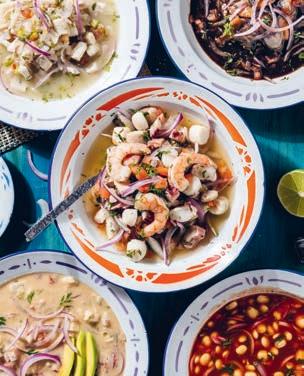
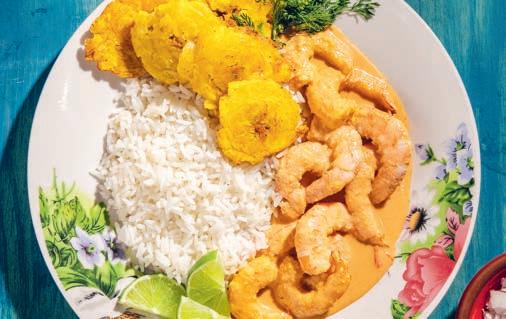
Encocado de pescado
It would be a crime to visit Manabí or Esmeraldas and not sit down to a rich encocado de pescado dinner. All along the coast, palm trees sway in gentle breezes and the coconuts they produce are a crucial part of Ecuador’s gastronomic identity. Encocado de pescado gets its name from the sweet coconut sauce it’s served in. Chefs create this from a base of onion, tomato, bell peppers and chillangua (a leaf with a coriander-like flavour) with a coconut milk sauce and white fish. The fish variation is the most common, but you’ll also get versions featuring lobster, shrimp, crab or a mix.
Words Sinead Mulhern
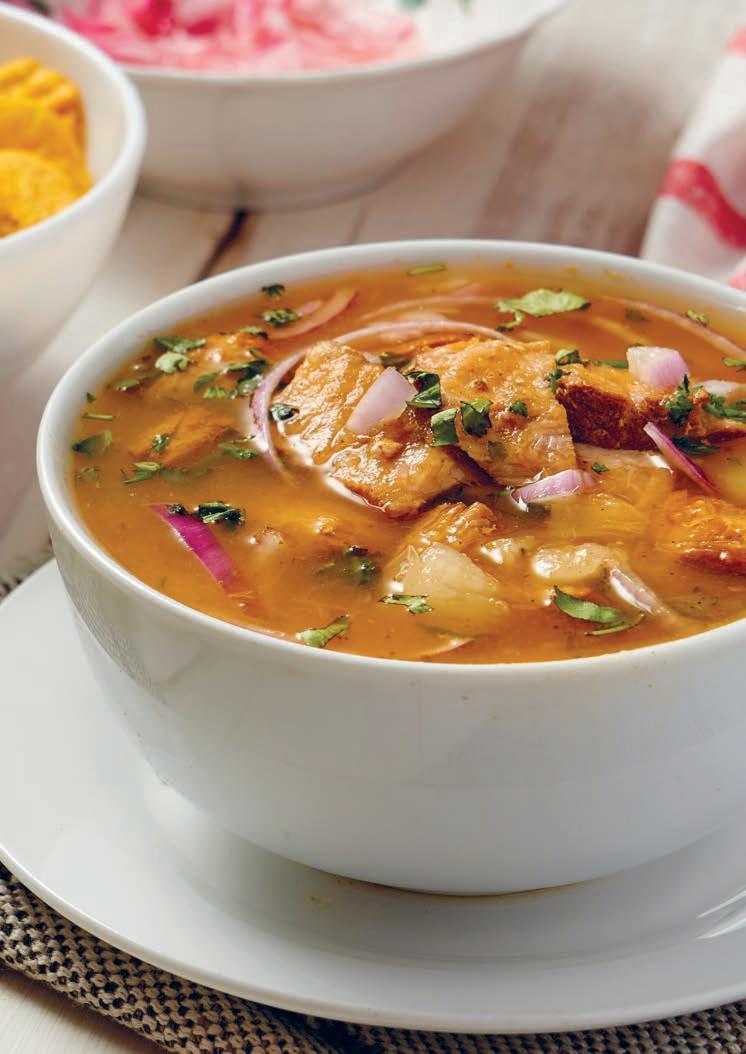
Encebollado
Encebollado is a fish, onion and yuca soup served with popcorn, rice, plantain, lime and toasted corn kernels. It’s one of the most popular dishes in Ecuador, with the best ones found on the coast made with freshly caught fish. It was even recognised as the world’s second best fish soup by TasteAtlas in 2023. After a late night of dancing, Ecuadorians also rely on this as a hangover cure (no greasy brunches or fast food here).
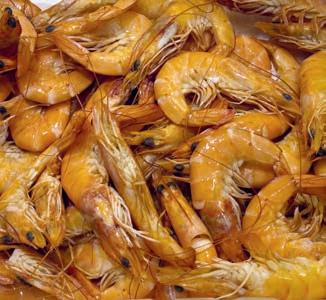
Shrimp
Shrimp is important, not just to Ecuador’s culinary identity, but also for its economic health as it’s one of the country’s main exports. This is why the still waters of the camaroneras (shrimp farms) are a common sight during a visit to northern beaches. Shrimp is a main feature on lunch plates, served with the usual suspects: white rice, plantain, beans, salad and often in a garlic or coconut cream sauce.
Corviche
Nothing beats Manabí street food after a morning of surfing or exploring sleepy beach towns. Corviche has everything: fried carbs, fresh fish, Manabí’s signature peanut flavour and Ecuador’s bell pepper, onion and coriander trio. This local snack is made of mashed plantains stuffed with the fish, veggie and peanut mix, and fried. The result is crunchy torpedo bursting with all the best flavours of the Ecuadorian coast rooted in African-influenced tradition.
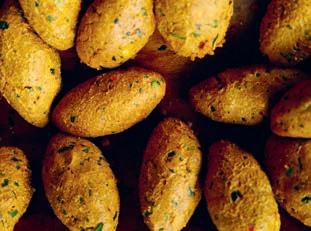
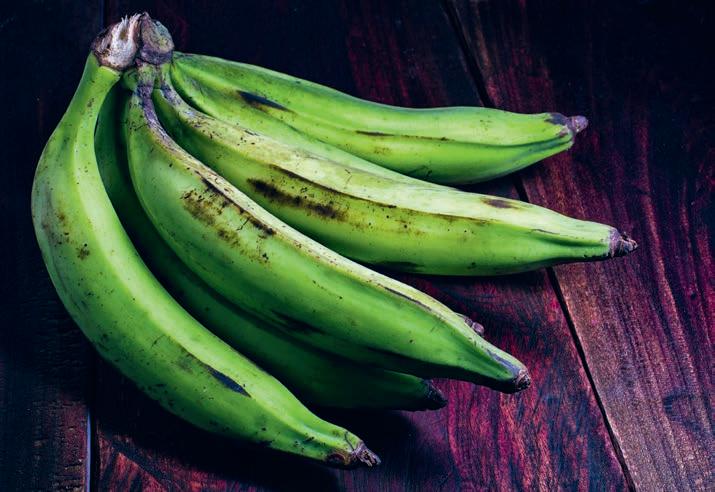
Plantain
Plantain is a staple in the Ecuadorian diet. It’s referred to as verde (green) for the colour of the underripe fruit which is boiled and fried. It’s also one of Ecuador’s most significant exports. The most popular ways to eat plantain are by making patacones or bolones The former is like an Ecuadorian version of fries: slices of plantain fried, smashed and salted. Bolones, balls of mashed plantain stuffed with cheese or pork meat, are a popular breakfast food.
Cacao
Cacao is one of Ecuador’s top exports and grows especially well in the lush province of Esmeraldas that borders Colombia. The country produces award-winning chocolate like Paccari and República del Cacao, which you’ll find all over Ecuador. Witnessing the chocolate-making process first-hand is an engaging and memorable experience. Green and orange leafy trees produce purple pods filled with gooey beans which are fermented, dried, ground, roasted and finally turned into cocoa.
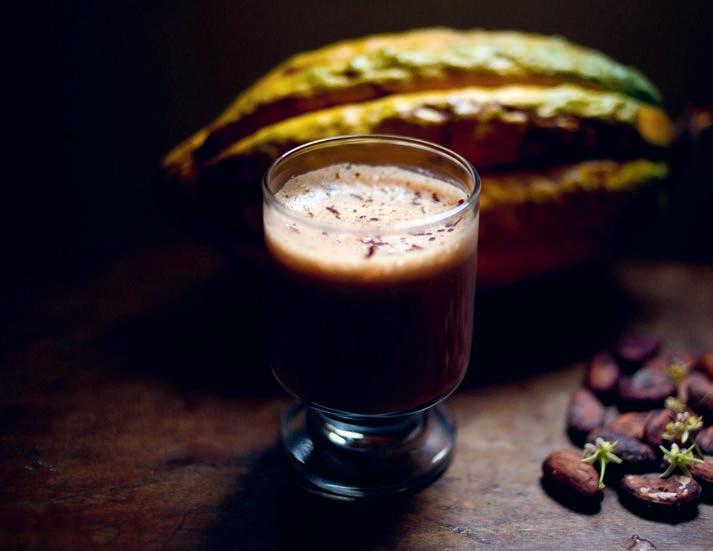
Cocada
Cocada is a local sugary treat. Originating from the province of Esmeraldas, these confectionary balls are made with shredded coconut and sweetened condensed milk. The coast’s abundant coconut trees lend themselves perfectly to the creation of cocadas. Soft and chewy in texture, they are the ideal snack to enjoy during a sunny day at the beach or to help revive energy levels while hiking, surfing or swimming.
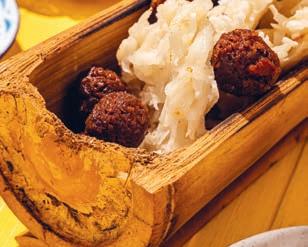
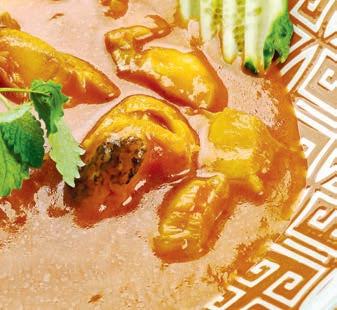
Tapado
Esmeraldas province is where you’ll find a lot of the Afro-Ecuadorian influences in local cuisine. One dish which embodies these beautiful flavours is tapado (also called tapao). This is a fish stew cooked by layering the massive plantain leaves, salty white fish, plantain fruit, a generous amount of the chillangua herb, which grows plentifully in this part of Ecuador, and water.

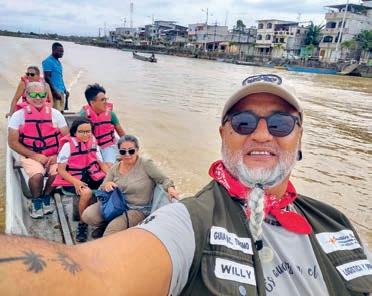


Tumaco-La Tolita and Afro-Ecuadorian cultures with guide Willam
‘Willie’ Torres
Interview by Russell Maddicks
The remote archaeological site of La Tolita lies on the island of the same name on the Pacific coast of Ecuador’s northern Esmeraldas Province. Once the beating heart of a culture dedicated to producing intricate objects in gold and platinum, its people vanished around 2,000 years ago, and little of Tolita’s past grandeur remains on the island today.
However, for veteran tour guide Willam ‘Willie’ Torres, a visit to La Tolita is an immersion in the treasures that surround it: the tangled labyrinths of some of the tallest mangroves on Earth, the keening song of the humpback whales that migrate here and the creamy coconut flavours of the local Afro-Ecuadorian cuisine.
How did you begin your career in tourism, and what drew you to Esmeraldas?
I am originally from the Andes, and I came to the northern part of Esmeraldas 28 years ago, looking for a place where the air was
fresh, the food was healthy and I could be among nature. I settled in Las Peñas and fell in love with it, working first as a tour guide. I opened my tour company, Camiteos Adventure Tours, about ten years ago.
We offer nature tours, whale- and dolphin-watching boat tours and cultural tours that allow you to experience the food and music of local Afro-Ecuadorian communities. We also take people to the island of La Tolita, a key archaeological site in Ecuador.
Why is La Tolita such an important place for you?
La Tolita Pampa de Oro is not an archaeological site like Ingapirca [large Inca and Cañari ruins near Cuenca], but it is an incredibly special place. It was the centre of the Tolita cultural group, which was active from about 600 BC to 400 AD.
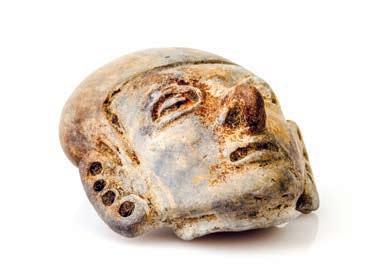
This culture is renowned for its intricate metalworking, as one of the only people on the planet at the time who were able to make alloys of gold and platinum, which requires extremely high temperatures. Their most important cultural centre lay on the island of Tolita, at the mouth of the Río Cayapas.
What can visitors see if they go to the island?
La Tolita is a wild place. There is no interpretation centre or museum. The ancient grave mounds found there are known as ‘tolas’, hence the name, but most of the graves were plundered in the 16th century and in more recent times for the gold and ceramics they contained.
Alamy; Shutterstock; Willam Torres
As you walk around the island beneath the palms, you will come across wooden houses where local people have their own little museums of pieces found on their land or exposed on the beach by the tides.
Much of the gold was melted down, resulting in a huge loss to archaeology. If you are coming to Ecuador and want to learn more about this culture, you must first visit the National Museum of Ecuador in Quito, which has a very important collection of pieces from La Tolita, including the so-called ‘Golden Sun of La Tolita’.
So, what is the attraction of La Tolita to visitors today?
This is a special place that was once a huge ceremonial centre. Everywhere you walk on the island, you are walking on our ancient past and learning our history.
A visit to La Tolita is also an opportunity to immerse yourself in wild nature. Close to La Tolita, we have the mangroves of Majagual within the Manglares Cayapas-Mataje Ecological Reserve, which are among the tallest mangroves in the world. We are also visited by humpback whales.
When is the whale-watching season?
The whales arrive in these calm waters to breed from July to September. Visitors come to enjoy the magnificent spectacle as the whales breach in the water or play with their calves. We also have a large population of grey bottlenose dolphins that live in the mouth of the Río Cayapas all year round. I work with the Environment Ministry because these dolphins are declining in some parts of the Pacific coast, and there is not much money to monitor the dolphins weekly. When I take out a tour group, they help monitor the dolphin numbers and location, so the tours help conservation efforts.
What is it about bringing people to La Tolita that fires your passion for your adopted home?
The Afro-Ecuadorian culture of Esmeraldas is unique, with magical music made on the marimba and bombo drums, and fantastic flavours found only here.
I take people to visit Mi Capricho, an Afro-Ecuadorian community on the banks of the Río Cayapas, which is only accessible by boat. There we try the spectacular cocada (coconut candy), as well as soups and stews made with creamy coconut and verde (plantains) by my friend Jacinta Cabezas and a female-run community group. Taking tourists to these remote communities, where the income from a visit makes a huge difference to their circumstances, is what fires my passion.
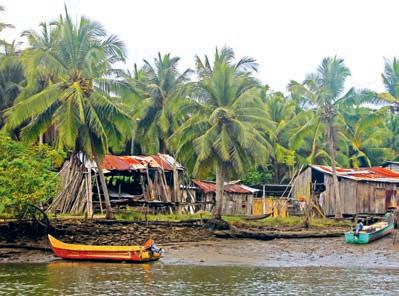
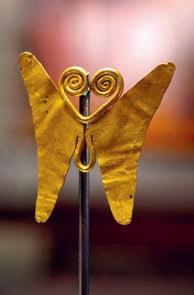
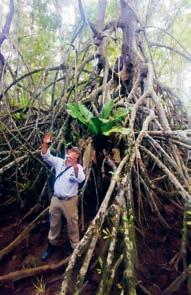
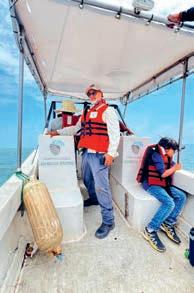
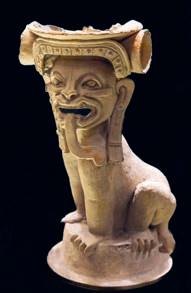
A coast with a past (this page; clockwise from top left) Traditional fishing boats and houses on the Río Cayapas; the giant mangroves of Majagual; an early Tolita incense burner in the National Museum of Ecuador in Quito; Willam Torres on a wildlife-watching trip; the Tolita were one of the earliest cultures to work with gold; (opposite page; top to bottom) ‘Willie’ takes the lead on a riverboat tour; a relic from Vadivia culture, which existed in Esmereldas province long before the Tolita
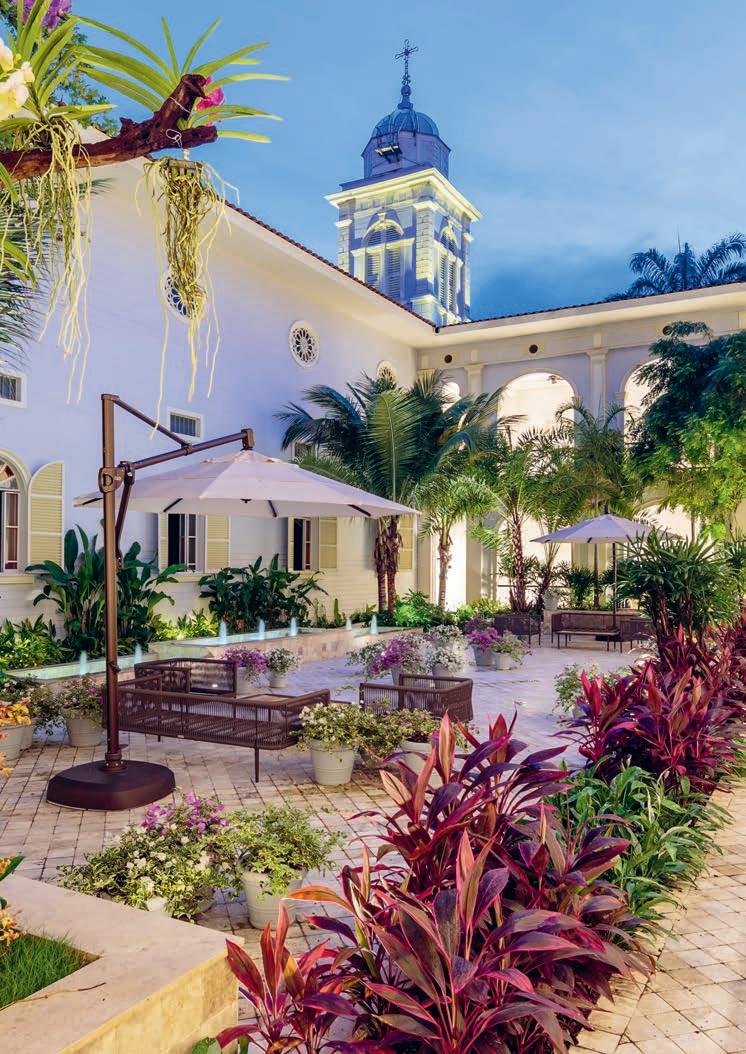
Sleeps on the Ecuadorian Coast
Ranging from restful sanctuaries steps from the beach, to historic haciendas with pastoral charm, these are ideal places to stay in Ecuador’s coast region
Overshadowed by the vast Andean peaks and Amazonian jungles of Ecuador’s wild interior, the stretching shoreline is often underestimated. The verdant country’s golden fringe is mostly filled with laid-back local surfers and rustic seafront huts with straw-thatched roofs. Spanning north from the major, well-connected coastal city of Guayaquil, the barely-disturbed Pacific region conceals some of Ecuador’s best stays. Ranging from bucolic idylls tucked away in historic haciendas to low-key luxury beach hotels, this diverse, unsung region is best explored through its inviting accommodations.

Hotel del Parque, Guayaquil
A colonial time capsule on the cusp of a tropical botanical garden, Hotel del Parque evokes the grandeur of Guayaquil’s economic heyday. Encased within the walls of a meticulously restored 19th-century building, the hotel’s stately rooms are adorned with antique Ecuadorian accoutrements. They wrap around a sheltered main plaza; a lavish lounging area brightened by orchids and tropical plants that mimic the lush Parque Histórico just outside the hotel bounds. Joined by a waterfront restaurant with sumptuous, fresh seafood and a massage parlour tucked into a former chapel bell tower, the property centres the history and heritage of the storied port city.
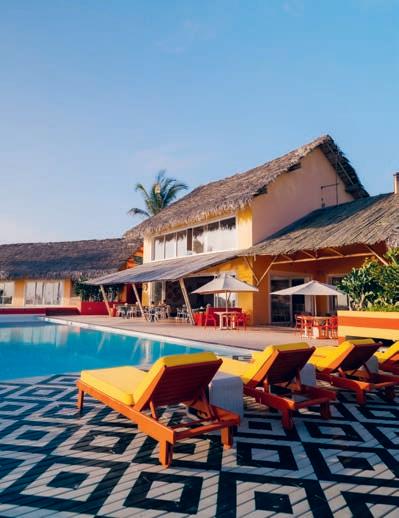
Tanusas, Manabí
Shrouded by swathes of untouched vegetation and situated steps away from the Pacifi c shore, Tanusas is an isolated coastal idyll. It’s a wild hideaway – monkeys scamper in the tree boughs that drift above the thatch-topped villas, while humpback whales skim the shoreline just a short boat ride away from the main property. Its untouched setting doesn’t detract from its luxury offering, though. With a serene spa, private pools with beach views and a renowned restaurant, it’s an ideal option for travellers looking for a lavish shorefront stay.
Words SJ Armstrong
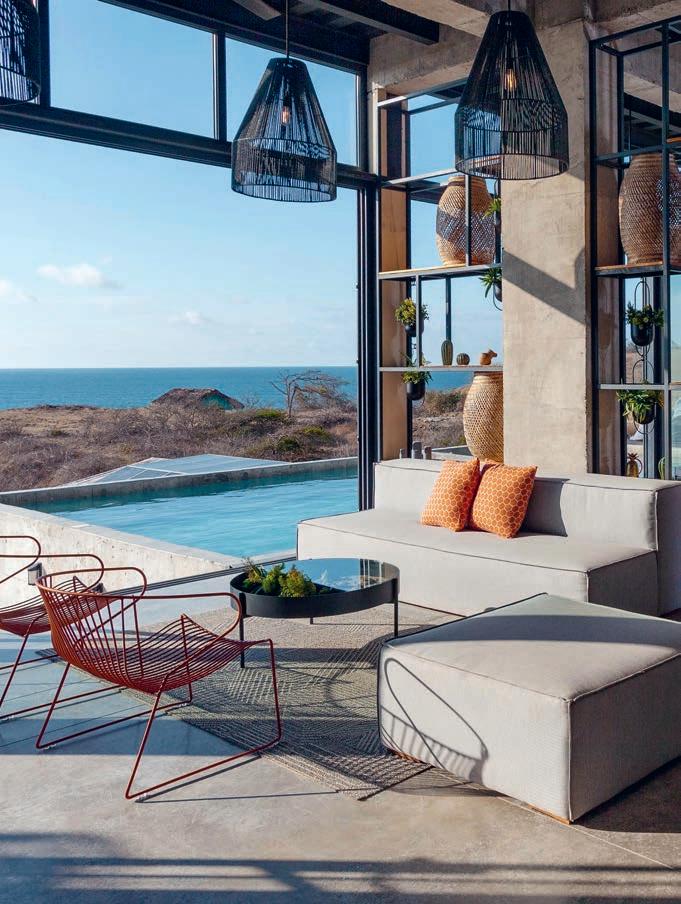
Eolia, Manta
Right on the cusp of the Pacific coast, Eolia’s chic, minimalist façade blends into its beach’s soft flaxen sands. Each of its spacious shoreside rooms fuses beachside luxury with earthen, stripped-back stylings. From the balconies and private pools that accompany each room, guests can watch as windsurfers and kiteboarders tackle

the Pacific waves. Between May and January, visitors can try their hand at the adrenaline-pumping wind sports themselves, or simply sit back and watch the humpback whales that migrate along the Ecuadorian shore from June to October. They can be spied from the hotel’s rooftop terrace or while guests are enjoying a regional delicacy in the on-site restaurant.

Eolia; Hacienda La Danesa; Hotel Río Guayas
Hacienda La Danesa, Naranjito
Spread across acres of functioning farmland, the stately Hacienda La Danesa has grown from a 19th-century farmhouse to a rural hideaway just an hour and a half east of Guayaquil. The exclusivity of the hotel adds to its peaceful pastoral charm, with a small smattering of guest cabins situated across the property. All six rustic rooms

are fashioned with traditional Ecuadorian flair, featuring furnishings made on the plantation itself and embellishments created by local artists. Immersing guests in the farmyard setting, the on-site restaurant dishes up farm-to-table fare, while the broad range of activities lets guests try their hand at milking cows or touring the working cocoa plantation.

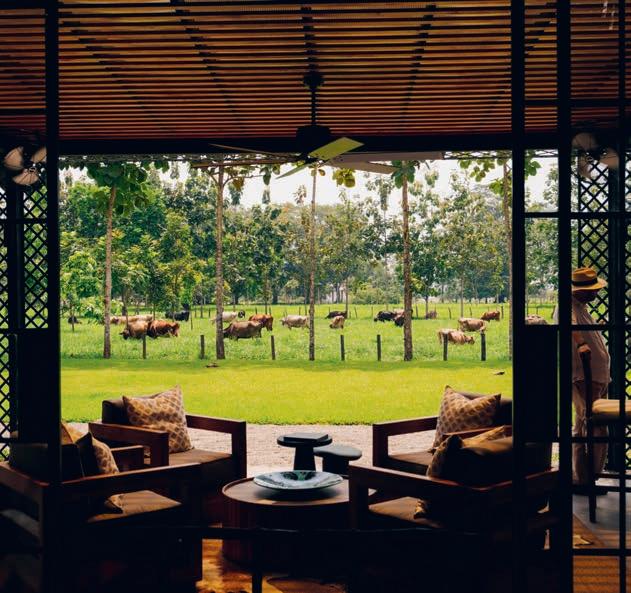
Hotel Río Guayas, Guayaquil
Swapping seafront scenes for riverside views is Guayaquil’s Hotel Río Guayas, a carefully appointed art hotel tucked into the city sprawl. This urban oasis blends seamlessly into the pastel-painted façades of Guayaquil’s historic Las Peñas district and its riverfront vistas. In just 15 minutes from José Joaquín de Olmedo International Airport, guests can settle into the comfortable rooms or head straight to the hotel’s fine dining restaurant, Ballet del Río. Dishing up delicacies from each of Ecuador’s distinct regions, it carries diners on a tasty tour through the soaring Andes, wild rainforest and salt-kissed Pacific coast.
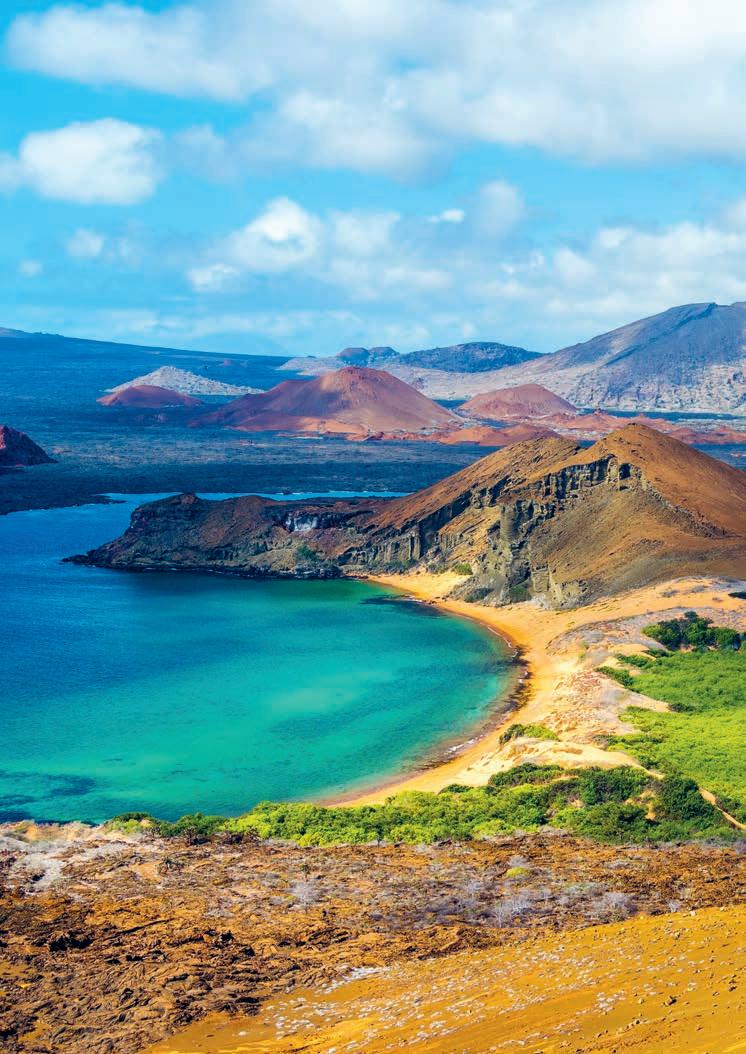
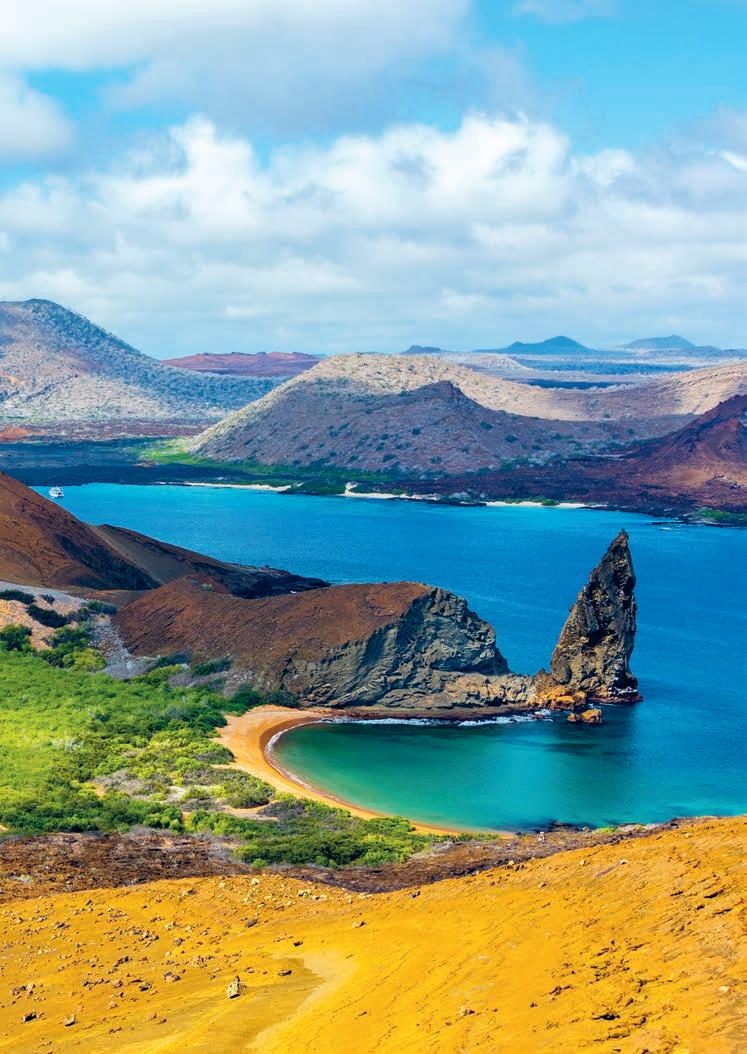
The Galápagos
This ever-evolving archipelago is a living laboratory, and many of the wonders found here are seen nowhere else. As well as incredible wildlife, you’ll also encounter a close-knit community that has learnt to live in tandem with nature
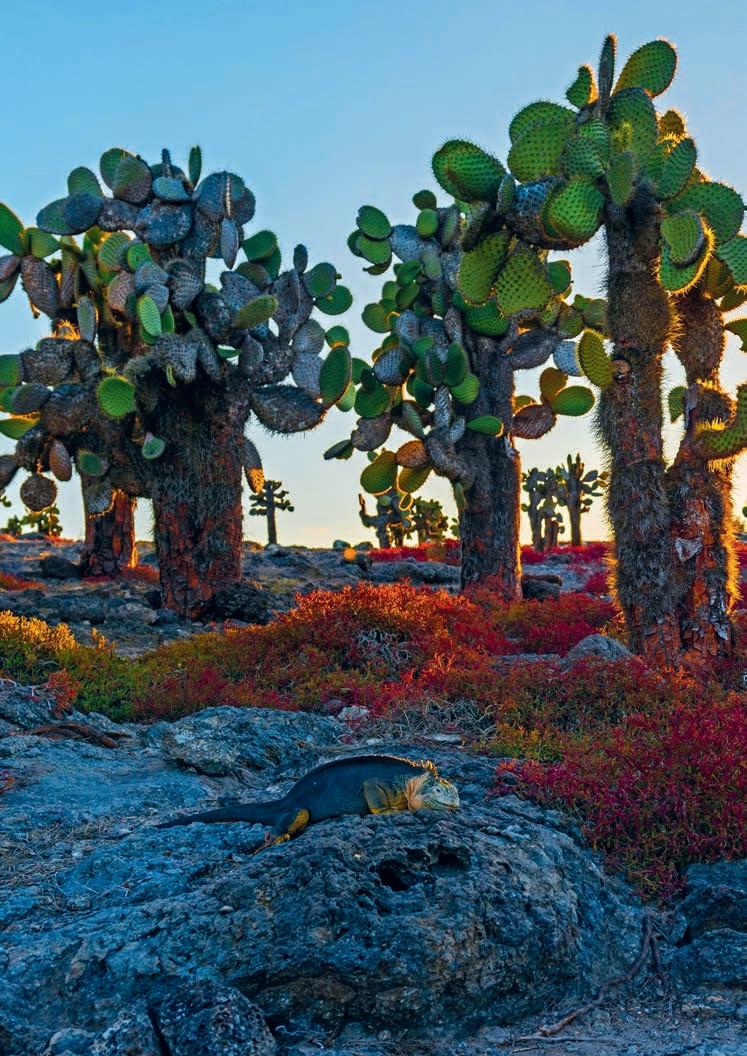
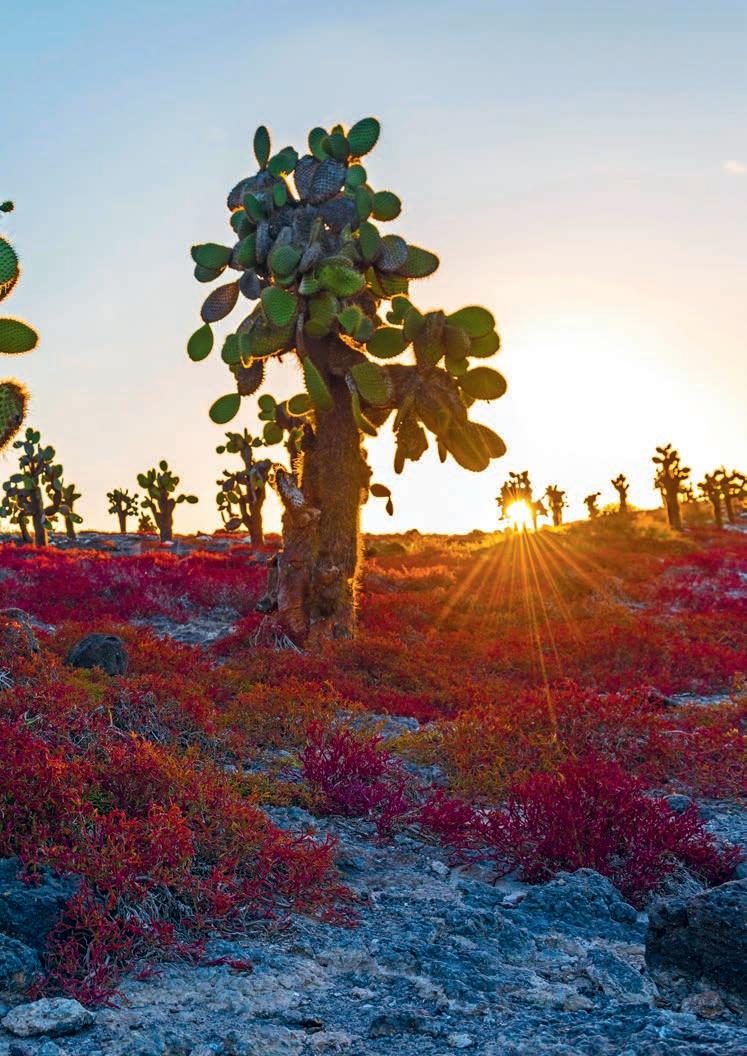
Preserving the islands for local people
From educational initiatives in schools to turning plastic into art, protecting the rare wildlife of the Galápagos starts with engaging and inspiring the local communities
Words Karen Edwards
“It’s not the strongest or the most intelligent who will survive, but those who can best manage change.” This quotation is often attributed to Charles Darwin, although he never actually said it. Nevertheless, its words echoed in my mind as the Zodiac I’d joined pulled up against the stone steps of San Cristóbal Island. One by one, its passengers clambered onto the pier.
To my left, an out-of-use concrete staircase descended into the water. Each of its 12 steps had a Galápagos sea lion snoozing on it. Towards the bottom, a calf was suck-
ling from its mother. On the road, a handful of tourists had gathered to take pictures.
Under the shelter of the pier, another Galápagos sea lion was sprawled across the wooden floor, his eyes closed, deep in slumber. The tip of his nose was almost touching the bench, where a local family – shopping bags in hand – was awaiting their boat taxi. It didn’t take me long to learn that this was simply the way of life across the inhabited islands.
In the Galápagos, people and wildlife coexist within metres of each other, and that’s an everyday normality.
HOW THE GALÁPAGOS ISLANDS CAME TO BE INHABITED
It was a Panamanian Bishop, named Tomás de Berlanga, who first documented the existence of the Galápagos Islands in 1535. From then on, the pristine bays of the islands offered whalers, sealers and even pirates a place of sanctuary and rest.
The pirates – often referred to as buccaneers and supported by governments in Britain, France and Holland – were encouraged to disrupt and attack the Spanish trade routes. The islands, to their delight, provided a sufficient food supply
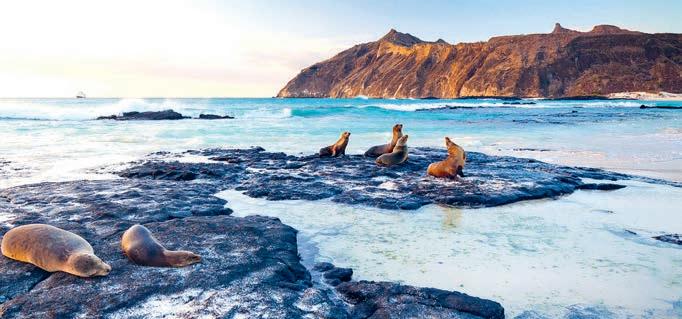
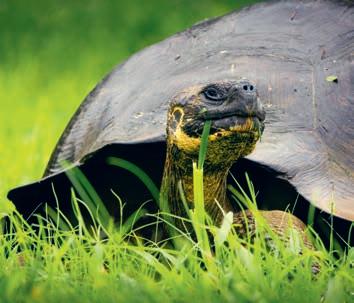
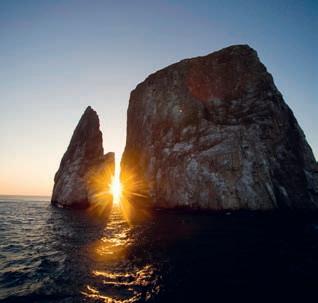
Island wonders (previous spread) Galápagos land iguanas are cold-blooded and raise their body temperature by basking on volcanic rocks; (this page, clockwise from top) sea lions on San Cristóbal Island are often playful; sunset off Genovesa Island, known for its rock formations; the Galápagos giant tortoise can weigh over 400kg; (opposite page) sea lions lounge on benches on San Cristóbal Island, which is home to the islands’ largest sea lion colony
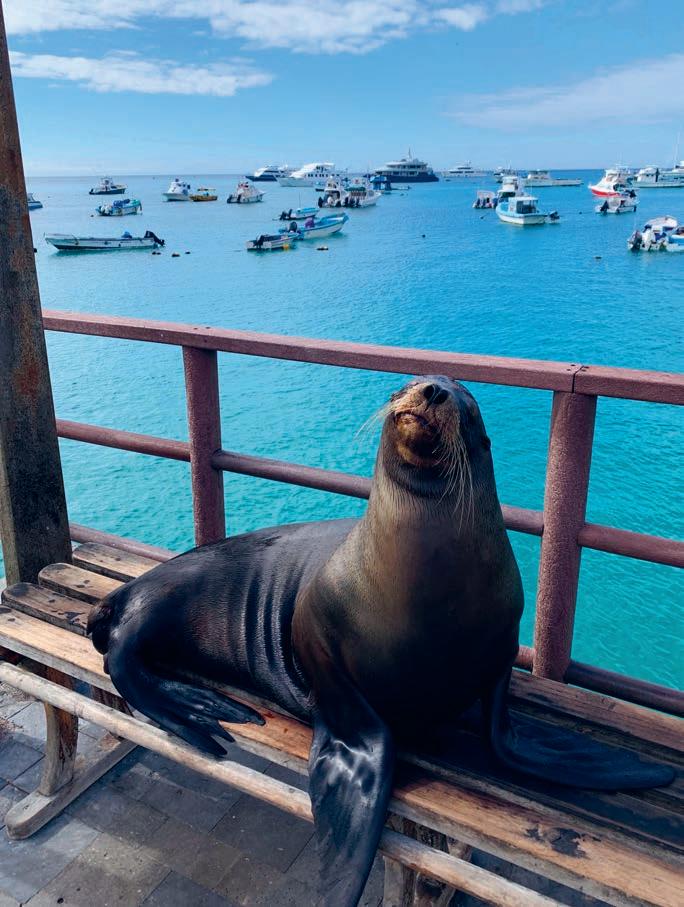
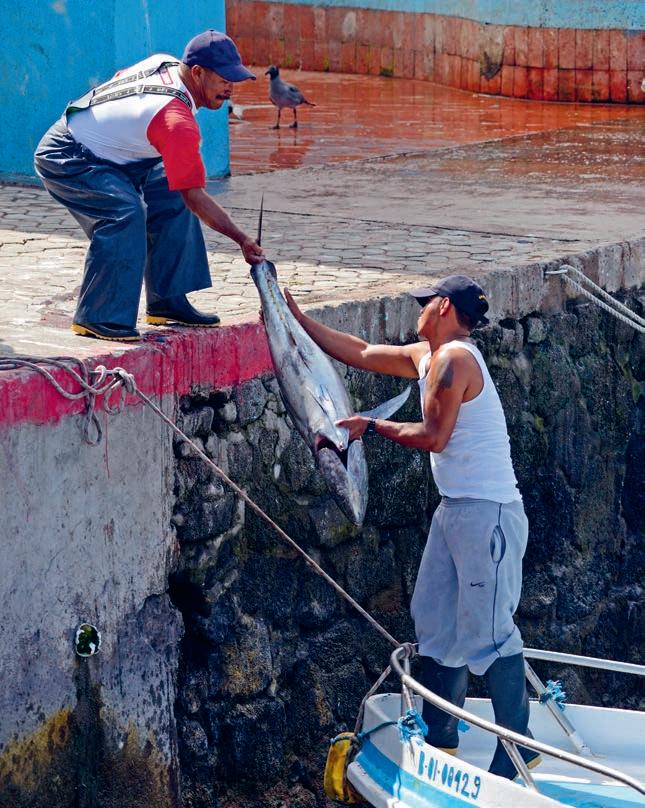
(giant tortoises) and limited water – a useful and neutral base to survey the region.
When European explorers William Dampier and William Ambrosia Crowley arrived in the 1680s, the charting of the Galápagos began. Their notes suggest that Crowley originally named the islands after British royalty and nobility (though Spanish names are now used), while Dampier, a naturalist, devised over 1,000 words (such as ‘sea
lion’) to describe what they saw. Although pre-Columbian era relics have since been found, there is no evidence that the islands were settled prior to the arrival of Europeans.
After gaining independence from Spain in 1832, Ecuador annexed the Galápagos archipelago, sending a general to Floreana to establish the first of three penal colonies here. By the time Charles Darwin arrived on the HMS Beagle in 1835, small settlements
had already been established in pockets of Isabela and San Cristóbal. Immigrants from Norway, Germany and other Western European nations followed.
Yet, until the 1960s, the islands’ population was fewer than 2,000 people. Since then, an increasing number of families have migrated to the Galápagos from mainland Ecuador – including the Salasacas, an Indigenous community from the Andes. Alamy;
Of the 18 major islands, only four – Santa Cruz, San Cristóbal, Isabela and Floreana – are now permanently inhabited, and the combined population of the islands is estimated to be around 35,000. Most people work as fisherfolk, farmers and in tourism. The landmass designated to local communities equates to just 3% of the island’s area.
INVESTING IN NATURE MEANS INVESTING IN PEOPLE
The establishment and development of the Galápagos National Park in 1959 has, over
time, meant 97% of the land is preserved for its many species. Together with the Galápagos Marine Reserve, over 198,000 sq km are protected around the islands.
By the time the Galápagos became the world’s first UNESCO World Heritage site in 1978, tourism was growing. However, the influx of both visitors and migrants from the mainland meant these vulnerable ecosystems faced serious threats, including from invasive species and environmental degradation through human impact. Soon, however, it became apparent that success-
fully preserving the islands’ biodiversity wouldn’t result from keeping residents away from nature, but rather nurturing their connection with it.
Now, the entrance fee paid by every visitor (US$200 for adults, US$100 for children) goes towards some of the most essential conservation initiatives in the region. The Galápagos Conservation Trust runs projects that help educate young people growing up alongside significant species and ecosystems. Its ‘Connecting with Nature’ programme is a great example, as it enables young
“The establishment and development of the Galápagos National Park has, over time, meant that 97% of the land is preserved for its many species” ⊲
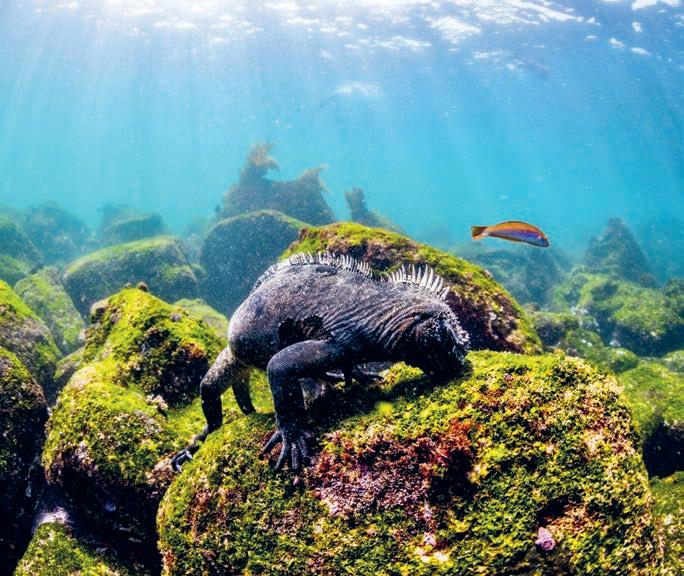
What lies beneath the ocean’s surface? (opposite page) Large yellowfin tuna, which are caught year-round in the Galápagos Islands, are unloaded at Puerto Ayora, a fishing port on Santa Cruz – these gigantic fish can weigh as much as 180kg; (this page) the marine iguana is indigenous to the Galápagos Islands and can dive underwater for up to 40 minutes at a time to forage for marine algae
people, from primary-school age to undergraduate level, to experience uninhabited islands for themselves.
With tour prices often unaffordable to locals due to tourism demand, and many islands only accessible by boat, the reality is that most young people wouldn’t be able to experience the islands without support. Through this programme, a relationship with the natural world is cemented early on, allowing children to grow up appreciating and valuing the vast biodiversity that surrounds them.
AN EDUCATION IN BIODIVERSITY AND LIFE
Thanks to the success of the ‘Connecting with Nature’ programme, being out in the field is now widely recognised as an effective way to teach young people about conservation.
Significantly, even local tourism businesses have realised its importance.
Local tour operator Metropolitan Touring also invests in young people’s development by inviting children and teenagers on board its expedition vessels, La Pinta, Isabela II and Sea Lion. This rare opportunity to receive the same teaching and guidance as tourists – with experienced naturalists leading the adventure – is renowned across the islands. It’s also reassuring for visitors to know their hard-earned income is being used wisely.
As well as learning about nature, the children also learn about Darwin and his theory of evolution, which was derived from the species that they see around them today, with the hope that it might inspire a new generation of scientists or guides, who can continue to share their local knowledge with others. Prioritising local employment
– where possible – brings income to the surrounding communities and ensures that knowledge is homegrown.
On Santa Cruz, the Gills Girls Club is specifically designed to educate local girls (from ages eight to 12) on their marine environment by enabling them to take part in ocean conservation work. However, the project has another unofficial but important goal: to help these young girls overcome their fear of the ocean.
Generational disconnection with nature, high living costs, a dearth of swimming lessons, misinformation about shark species and a lack of understanding about ocean safety mean young children tend to grow up nervous around the water. The Gills Girls Club, led by marine biologist Sofía Green –and supported by Metropolitan Touring and the Finch Bay Galápagos Hotel – addresses
“Researchers estimate over 95% of waste plastic comes from outside the Galápagos National Park and Marine Reserve, but locally generated plastic waste is an issue”
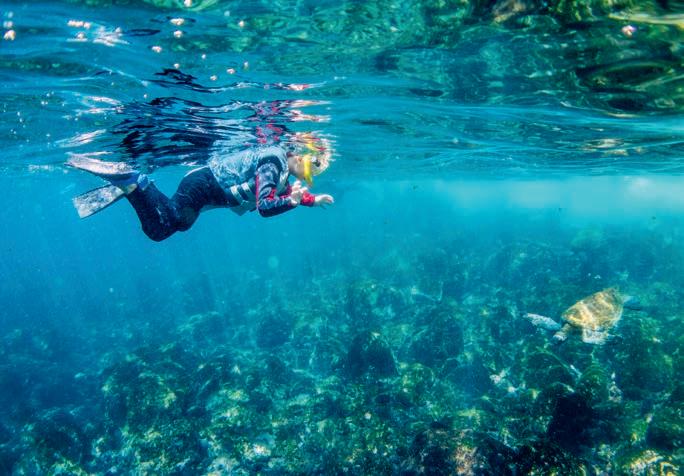
Observing rare species (this page) Snorkelling is a good way to spot sea turtles in the waters around Isabela Island; (opposite page; top to bottom) the meticulously preserved islands are home to lava rocks and white-sand beaches; farmer Sandra Simbana and tour guide Juan Garcia assist scientists in collecting plant samples as part of the Barcode Galápagos project, an attempt to create a genetic catalogue of all life in the Galápagos Islands
these worries. Plus, with women-led teachers demonstrating the wealth of science-based careers available, Sofía hopes to inspire her students to go on to study marine science.
BUILDING COMMUNITY RESILIENCE
In 2021, the Galápagos Conservation Trust expanded its grants programme to serve more local people. In doing so, it made the statement that community-led conservation can be as impactful in ensuring the preservation of the islands as direct conservation projects. Since then, 198 local projects have been supported through around US$5 million in funding. Among these is the ‘More art, less garbage’ initiative, which sees local artisan Mayra Hernández run craft workshops that share tips on how waste plastics can be melted, recycled and remodelled into artwork and toys for purchase.
While bringing joy, learning and creativity to communities, the project also offers hope in a plastic crisis that has long been unfolding. While researchers estimate that over 95% of waste plastic comes from outside the Galápagos National Park and Marine Reserve, locally generated plastic waste –typically from tourist-bought water bottles –is an issue. ‘More art, less garbage’ is just one initiative that encourages a circular economy mindset, allowing as many waste products as possible to be reused and recycled, while also bringing money directly into the community.
Similarly, Santa Cruz painter Vanesa del Valle Enrique uses old fabric scraps and clothes to design tote bags, T-shirts and sun hats, which she then sells via her organisation, Arte + Vida. At the Temporal ceramics workshop, local youths can try their hand at ceramics and pottery while incorporating the wild spirit of the Galápagos into their work.
On San Cristóbal, souvenir shop Nua Ecoregalos – which sells recycled, sustainability-conscious gifts – has become a must-see for visitors. These Galap agueño-run enterprises – which receive grant funding from the Galápagos Conservation Trust – are becoming thriving businesses and are helping to develop life skills and business know-how far beyond each project.
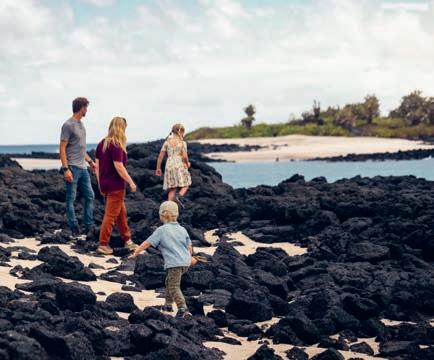
And while the first settlers of the Galápagos Islands might have been unaware of the fragile ecosystem in which they were living, an incredible drive for education, understanding and resilience has developed across Galapagueño society, allowing today’s island inhabitants to live alongside nature in a coherent and organic way.
Moreover, tourism businesses are taking more responsibility for the environments that allow them to flourish, with an increasing number of operators, hotels and guides adhering to the Galápagos Conservation Trust’s responsible tourism guidelines, while also collaborating with s pecies-specific conservation projects.
One of the biggest citizen science projects, ‘Barcode Galápagos’, relies on local tour guides to gather and document samples of species on both the islands and in their surrounding waters. This allows scientists to better understand lesser-studied organisms, such as reef fish.
A PERENNIAL ECOSYSTEM OF CONSERVATION
At the heart of coexistence is the desire and enthusiasm to work towards a common goal.
With communities old and new coming together to preserve the unique ecosystems of the Galápagos, there is evidence to suggest the plan is working.
To the north-west of the archipelago, an increasing number of whale sharks have been spotted during June and November. A vital species in tropical environments, the presence of whale sharks is an indicator of healthy, nutrient-filled waters.
As a result, the decade-old ‘Galápagos Whale Shark’ project, which maps the migratory routes of these 18m-long ocean giants by using satellite tagging and photo identification, has recently been rejuvenated as a joint venture between the Galápagos National Park’s Directorate, Universidad San Francisco de Quito (USFQ) and Metropolitan Touring.
With knowledge about these majestic creatures growing, the opportunity to locate and see them is becoming more common. With whale sharks drawing visitors who hope to catch a glimpse of the world’s biggest fish, sightseeing tours can generate more income towards conservation – and the cycle of preservation continues.
Earlier this year, signs that one of the world’s most threatened species, the Galápagos pink iguana, is not only reproducing in the wild but surviving to a juvenile age. It has given hope that the hard work across the islands is working. The unexpected sighting of a young, healthy pink iguana means that the species is defying introduced predation in a way that hasn’t been seen before.
It is a sign, perhaps, that when everyone comes together, nothing can hold back the incredible biodiversity of these islands.


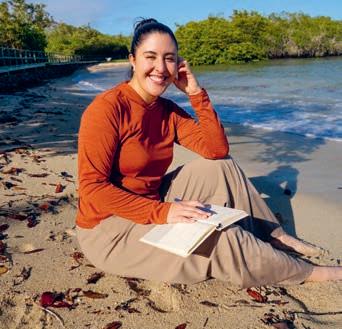

Everyday life in a wildlife haven with Ana Moya
Interview by Karen Edwards
While most people who live and work in the Galápagos were born on the islands, occasionally mainland Ecuadorians also fi nd their way to this extraordinary archipelago. When Ana Moya moved from Quito to Santa Cruz to take on the role of operations manager at the popular Finch Bay Galápagos Hotel, she soon found herself becoming a part of a close-knit and long-standing Galapagueño community – one that she now calls home.
Ana, what is your connection with the Galápagos Islands?
I’ve been in love with the Galápagos since I was 11 years old. I am from Quito, but I was able to visit Santa Cruz Island on a sixth-grade school trip – an opportunity that many schools offered at the time. While the trip wasn’t focused on the wildlife, I still had a sense of how special this place was.
After working at Mashpi Lodge in Ecuador’s cloud forest, I moved here in 2021 to work as a manager at Finch Bay. This was a rare opportunity, as most of the jobs here
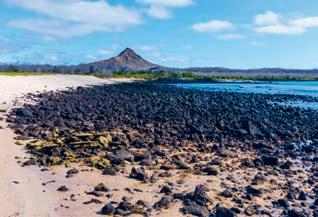
rightly go to Galapagueños. I feel fortunate to be a part of a company that sponsored me to be here – it’s an honour to live and work on the islands.
Can you remember your �irst Galápagos wildlife experience?
Yes, in my early days at Finch Bay Galápagos Hotel, I was up early and walking by the bay when I saw male and female blue-footed boobies changing over duties while looking after an egg. As one flew in from hunting, the other rose from the nest, which was on
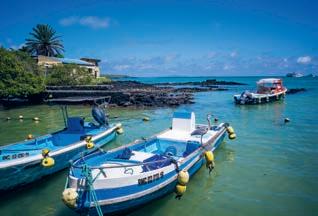
Alamy; Bicubiuk; Shutterstock
the ground, and they met. Watching them dance together and communicate was very special to see.
Moving to the Galápagos is something very few people do. What was that experience like for you?
Unlike in Quito, most people here have known each other since they were born, so their bonds are strong. As someone who grew up on the mainland and then moved here, it can be a hard community to get to know. But now that I’ve settled in, I feel I have made good friends. I spend time with my neighbours, other business owners in the area, those who work at the national park and even some local guests who live elsewhere on the island. They often invite me for dinner, where we share stories of our lives living and working here. I have a good local network now.
What do you enjoy about life on Santa Cruz?
I love having my own space. I enjoy walking to the beach to watch the sunrise and writing in my journal or reading as the sky lightens. I usually head to Playa los Alemanes (German’s Beach), right by Finch Bay. It’s the perfect spot. I go for a swim before everyone wakes up, or sometimes I take my journal with me and write while I’m there. These small moments with nature make me feel like I belong here and that I have a connection to the islands. It makes me feel at home.
What is your neighbourhood like?
I live in Punta Estrada, near Puerto Ayora; there’s a strong community here. I love going for walks in the early evening, around 6pm, because that’s when the temperature starts to fall and many of my elderly neighbours also go outside for a walk.
We all stop, say hello and have a little gossip. I treasure that community spirit. Many of the people who live here are descendants of the founding families of Santa Cruz – the Angermeyers, the Wittmers and the Balfours – who were among the settlers that developed the island.
Where do you take your friends when they come to visit?
I usually take them to Tortuga Bay for a swim in the beautiful water, or we go to The Point by Midori – which is a restaurant that does good local food and overlooks the sea. Sometimes, we even take a boat to visit another island called Isabela. It’s a good opportunity to show them the wildlife and to experience a different style of island life to Santa Cruz.
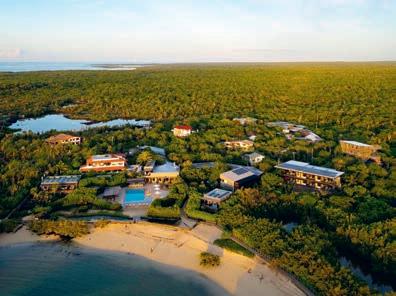
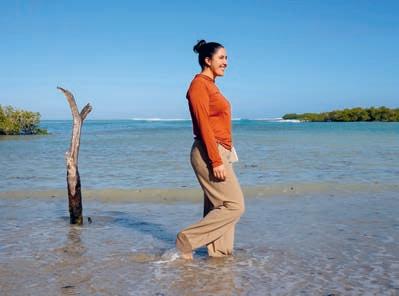
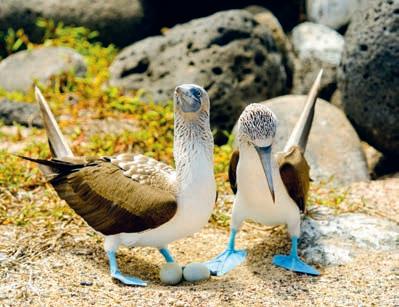
Island connections (opposite page; top to bottom) Ana likes to write her journal on the beach; volcanic rocks on Santa Cruz Island; Puerto Ayora is the hub for boat trips from Santa Cruz; (this page; top to bottom) an aerial shot of the Finch Bay Galápagos Hotel; Ana loves the quiet of the early morning; blue-footed boobies mate for life and share tasks such as incubating eggs
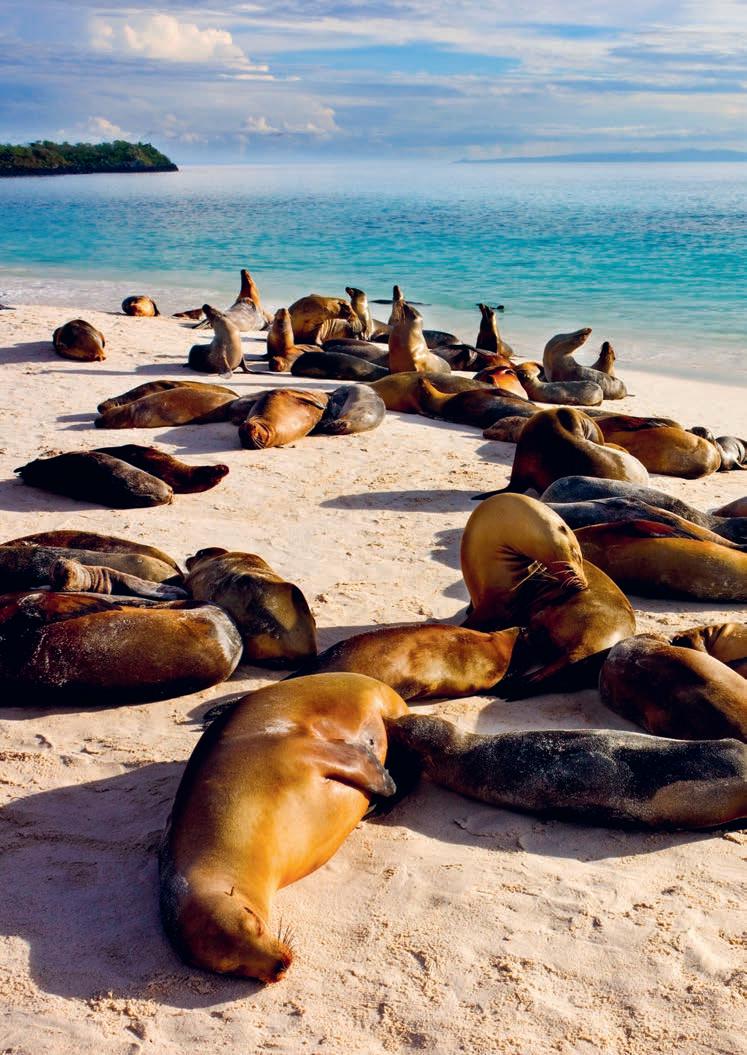
A guide to the unique wildlife of the Galápagos
The islands o er a chance to see rare species, such as marine iguanas, giant tortoises and blue-footed boobies, while supporting conservation
Words David Horwell
The Galápagos Islands are a living showcase of evolution, where extraordinary wildlife exists amid otherworldly scenery. From Charles Darwin’s key visit in 1835 to today’s conservation-focused tourism, these islands have inspired generations of scientists and nature lovers alike. Home to iconic species such as Darwin’s finches, blue-footed boobies, giant tortoises and marine iguanas, each island reveals unique ecological wonders.
Here, we share which key species to spot and responsible ways to do so, including must-see day trips from Santa Cruz, San Cristóbal and Isabela. Discover how to witness nature’s marvels while supporting conservation and respecting this fragile paradise.
CHARLES DARWIN’S VISIT
Charles Darwin was captivated by the Galápagos Islands because of the uniqueness of the species found there. During his short 1835 visit aboard the HMS Beagle, he
observed mockingbirds, finches, tortoises and iguanas that varied subtly from island to island. These observations sparked his curiosity and later played a crucial role in developing his theory of natural selection. The islands were like a living laboratory, revealing how isolation and environment could shape life in distinct ways. Darwin found the Galápagos both scientifi cally fascinating and geologically spectacular; they were instrumental in influencing biology forever.
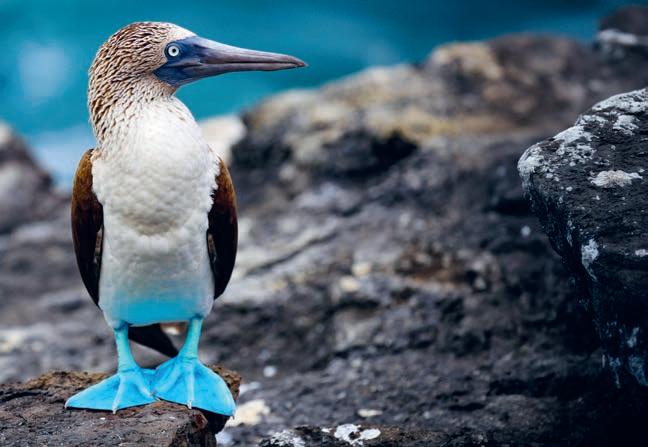

Blue-footed, red-footed and Nazca boobies



There are three booby (Sulidae) species: bluefooted, red-footed and Nazca boobies. Bluefooted boobies are famous for their turquoise feet and comical mating dance. They can be spotted year-round, especially on Española and North Seymour islands. Red-footed boobies, the smallest, perch in trees and thrive on Genovesa and San Cristóbal islands. Nazca boobies, the largest, have white plumage, orange beaks and grey feet and are often seen on Española and Genovesa islands. All three species are expert divers, feeding on fish by plunge-diving, but they feed in di erent regions, so they do not compete. Their distinct traits and behaviours make spotting them a highlight of wildlife travel around the islands.



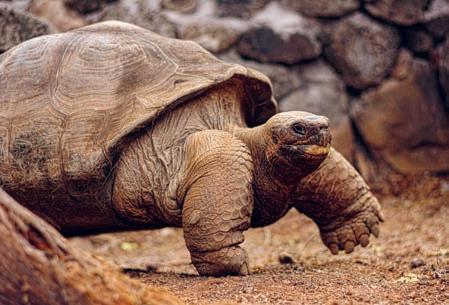
Fur seals
Galápagos fur seals (Arctocephalus galapagoensis) are the smallest species of fur seal and are found primarily on the rocky shores of the western islands, including Fernandina and Isabela, or on the northern island of Genovesa. They feed mostly on fish and squid at night. They have dense, plush fur and large eyes adapted for low light. Unlike the more social sea lions, fur seals are shy and often hide in crevices during the day, making them harder for visitors to spot.

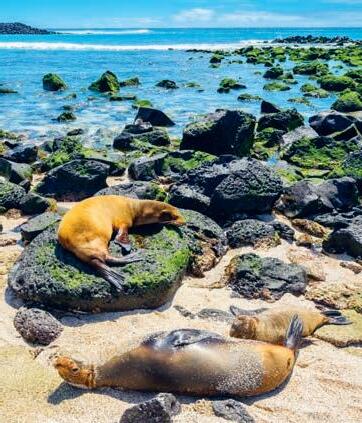

Giant tortoises
Galápagos giant tortoises are the largest living tortoise species, weighing up to 320kg and living over 100 years. Found on several islands, they vary in shell shape – domed tortoises inhabit humid highlands, while saddle-backed ones live in arid lowlands. These gentle giants spend most of their time resting or grazing on vegetation. Charles Darwin noted their island-specific shell shapes in 1835, contributing to his theory of evolution. Conservation e orts have helped restore populations after centuries of decline due to hunting and habitat loss. The most famous giant tortoise was ‘Lonesome George’, the last tortoise on Pinta Island.
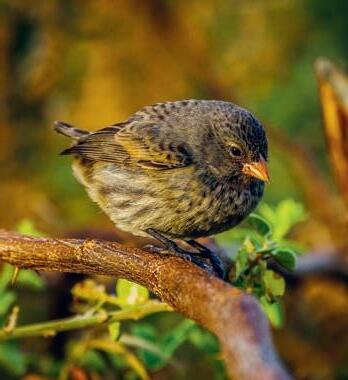

Darwin’s finches
Darwin’s finches span around 17 bird species native to the Galápagos Islands. Although they share a common ancestor, their beak shapes di er, each suited to specific diets such as seeds, insects or fruit. These variations helped inspire Darwin’s theory of natural selection, illustrating adaptive radiation – how species evolve to fill ecological niches. Finches are found across the Galápagos, especially on Santa Cruz, Española and Genovesa, in habitats ranging from arid lowlands to humid highlands and are often seen in trees, shrubs and near settlements.
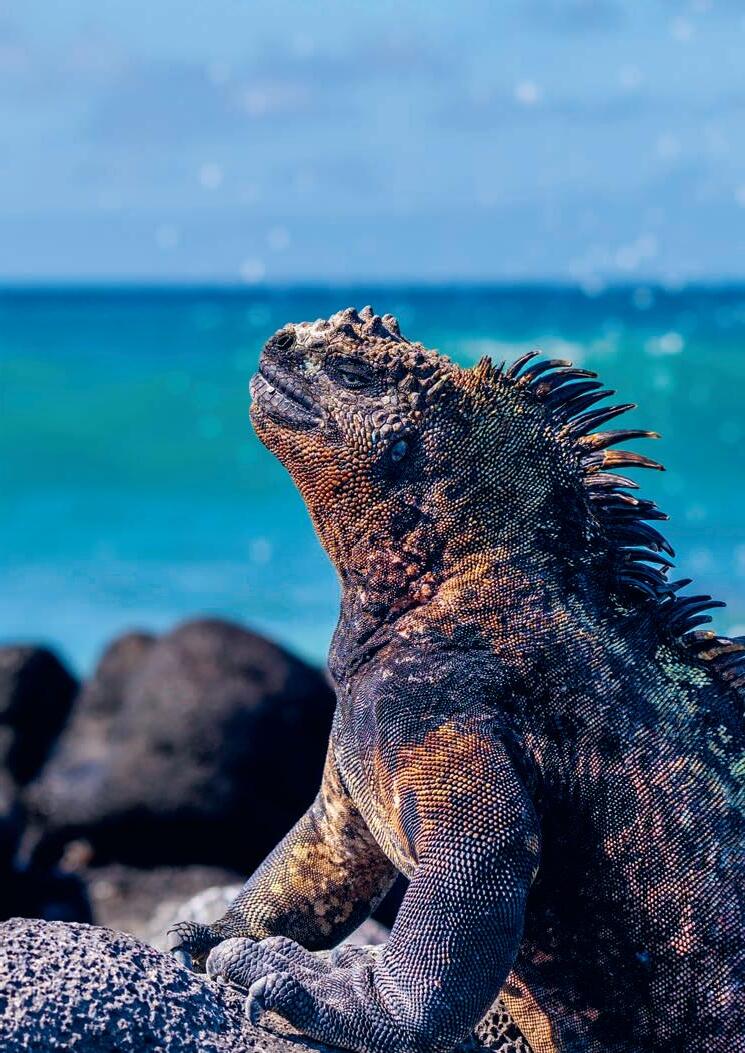
Iguanas (marine & land)

The Galápagos Islands host two iguana types: marine and land iguanas. Marine iguanas are the world’s only sea-going lizards, diving to graze on algae and basking on volcanic rocks to warm up. Land iguanas, found on islands such as Santa Cruz and Isabela, inhabit arid zones and feed on cactus and other plants. Both species are endemic and evolved from a common ancestor. Their adaptations – salt-sneezing glands, powerful claws and varied colouration – make them living symbols of evolution and conservation in the archipelago.
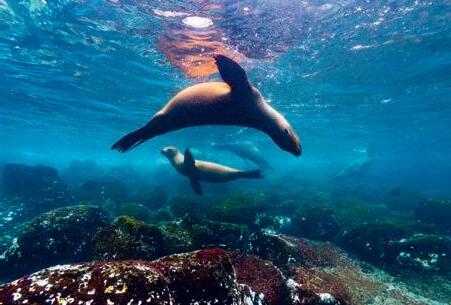
Sea lions
The most abundant marine mammal in the archipelago is the Galápagos sea lion (Zalophus wollebaeki), the smallest sea lion species. Endemic to the islands, sea lions are playful, social and are often seen sunbathing on beaches or gliding through coastal waters. Males can weigh up to 250kg. When mature, they are distinguished by a bump on their foreheads. Beachmasters (dominant males) fiercely defend their territories during mating season. Agile swimmers, sea lions dive for fish and can reach great depths. Threats include climate change, disease and human disturbance, making conservation e orts increasingly vital.
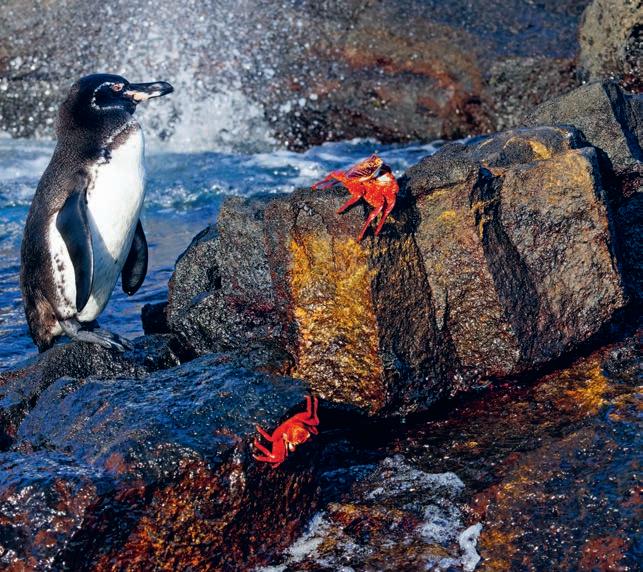
Galápagos penguins
Galápagos penguins (Spheniscus mendiculus) are the only penguin species found north of the equator. Endemic to the Galápagos Islands, they thrive on Fernandina and the west coast of Isabela, where cool currents such as the Cromwell provide ideal conditions. Small and agile, they feed on fish and nest in shaded crevices to avoid heat. Monogamous and endangered, their population is under 2,000. Climate change, pollution and introduced predators threaten their survival, making conservation e orts vital to their future.
Frigatebirds
The Galápagos Islands are home to two frigatebird species: the magnificent frigatebird and the great frigatebird, both known as ‘kleptoparasites’, as they snatch food mid-air from other seabirds. Males inflate bright-red throat pouches to attract mates, while females sport white underbellies and blue or red eye rings. With the highest wing-to-body ratio of any bird, they glide e ortlessly for days. Commonly seen on North Seymour, Genovesa and San Cristóbal, they nest in low shrubs and forage over coastal waters.

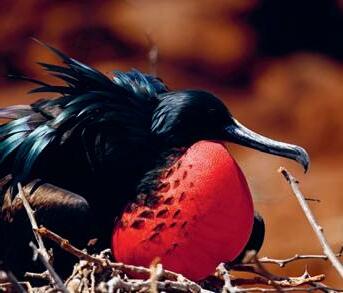


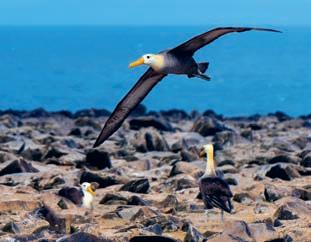
The waved albatross (Phoebastria irrorata) is the largest bird in the Galápagos, with a wingspan up to 2.5m. They breed almost exclusively on Española Island. They are famed for their dramatic courtship dance and lifelong pair bond. These graceful gliders forage o Peru and Ecuador, feeding on squid and fish, often at night. Named for the wave-like feather patterns on adults, they’re critically endangered due to habitat loss and longline fishing threats. Their chicks fledge after five months, then spend six years at sea before returning to breed.
Make it happen
Exploring the Galápagos Islands respectfully is essential to preserving fragile ecosystems and supporting local communities. These tours all follow guidelines set by the Galápagos National Park, tracing designated paths, and are accompanied by certified naturalist guides. Book in advance. Here’s just a selection of day tours for the three main inhabited islands:
Santa Cruz Island - Puerto Ayora North Seymour Tour: Blue-footed boobies, frigatebirds, land iguanas. Activities include hiking and snorkelling.
Bartolomé Island Tour: Galápagos penguins, hawks, sea lions, sharks and rays. You’ll also hike to Pinnacle Rock and snorkel.
El Chato Reserve: See giant tortoises in their natural habitat, Darwin’s finches and endemic flycatchers. Join a highland hike and lava tunnel exploration.
Tortuga Bay: A walk to two pristine mangrove-fringed beaches – a wave-lapped ‘brava’ beach and a calmer ‘mansa’ beach. It takes about 45 minutes over rough lava, so beware of the sun. Take a water taxi back.
BOOK WITH: Galapagos Best (galapagosbest. com); Uniquely Galápagos (uniquelygalapagos. com); GalaKiwi: (galakiwi.com); and Semilla Verde boutique hotel, where British owner Robert Grimstone can book day tours for guests (gps.ec).
San Cristóbal Island – Puerto Baquerizo Moreno
Kicker Rock: Deep water snorkelling and/or diving.
Sea lions, white-tipped reef sharks, rays and turtles. Española Island: (April–Dec). See waved albatross, marine iguanas and sea lions.
360° Island Tour: Sea lions, turtles, rays, boobies and gulls are the highlights here. Snorkelling and hiking. San Cristóbal Interpretation Centre is a hub for conservation education.
BOOK WITH: SharkSky Eco Adventures (sharksky. com); Come to Galapagos (cometogalapagos.com).
Isabela Island – Puerto Villamil
For beach relaxation plus activities on land and sea. Los Túneles Tour: Reef sharks, tropical fish and sea turtles. Activities include snorkelling in lava tunnels. Tintoreras Islet Tour: Marine iguanas, penguins and reef sharks. Activities include kayaking, hiking and snorkelling.
Sierra Negra Volcano Hike: Spot hawks, lava lizards and native flora. Guided hike to volcanic calderas.
BOOK WITH: Galapagos Native (galapagosnative.com)
FOR MULTI-DAY ISLAND HOPPING TOURS:
Galapagos Elements operates its own small boats, (galapagoselements.com); Geo Boutique o ers both land-based and island-hopping tours (georeisen-ecuador.com).
Waved albatross
Evoluti y gastr omy How the Galápagos Islands make the most of local produce
The gastronomy of the islands is as diverse as the wildlife, with everything from tasty fried seafood and plantain patties to earthy co ees
Words
Positioned at a confluence of ocean currents, Ecuador’s volcanic Galápagos Islands are one of the most biodiverse regions of the planet. In turn, this biodiversity has fostered a diverse gastronomy which is, rather fittingly for the islands that inspired Charles Darwin, ever-evolving. Unique Galápagos ingredients range from native seafood – such as the
Sarah Gillespie Alamy; Shutterstock
prized red and green spiny lobsters – to culturally significant species that were introduced to the islands, such as the protected Galápagos co ee plant, which first arrived on the archipelago in 1866. Chefs on the islands are inspired by Ecuadorian coastal cuisine. You’ll fi nd fresh fl avours such as starchy green plantain, red achiote and avocado, all reimagined for the discerning modern diner.
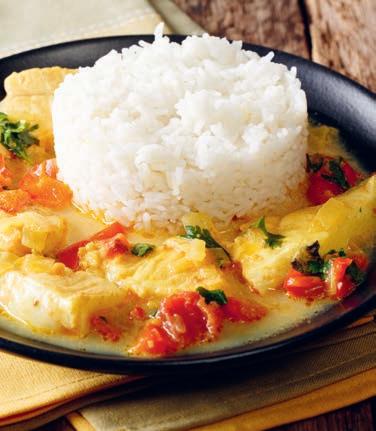

Langostino encocado
Encocado originated among Afro-Ecuadorian communities in the mainland coastal province of Esmeraldas, and it combines Ecuadorian ingredients with African cooking techniques. Fish or seafood –typically sea bass – is stir-fried with coconut milk, aromatics (onion, garlic and bell pepper) and herbs such as culantro and chirarán (mountain basil) to make a fragrant, creamy sauce. The Galápagos version, made with locally caught red and green spiny lobsters, is among the islands’ most beloved dishes. But you’ll need to time it right: to avoid overfishing, the season for catching these crustaceans is restricted to the period of September to December. Only those with a licence are permitted to catch lobsters.

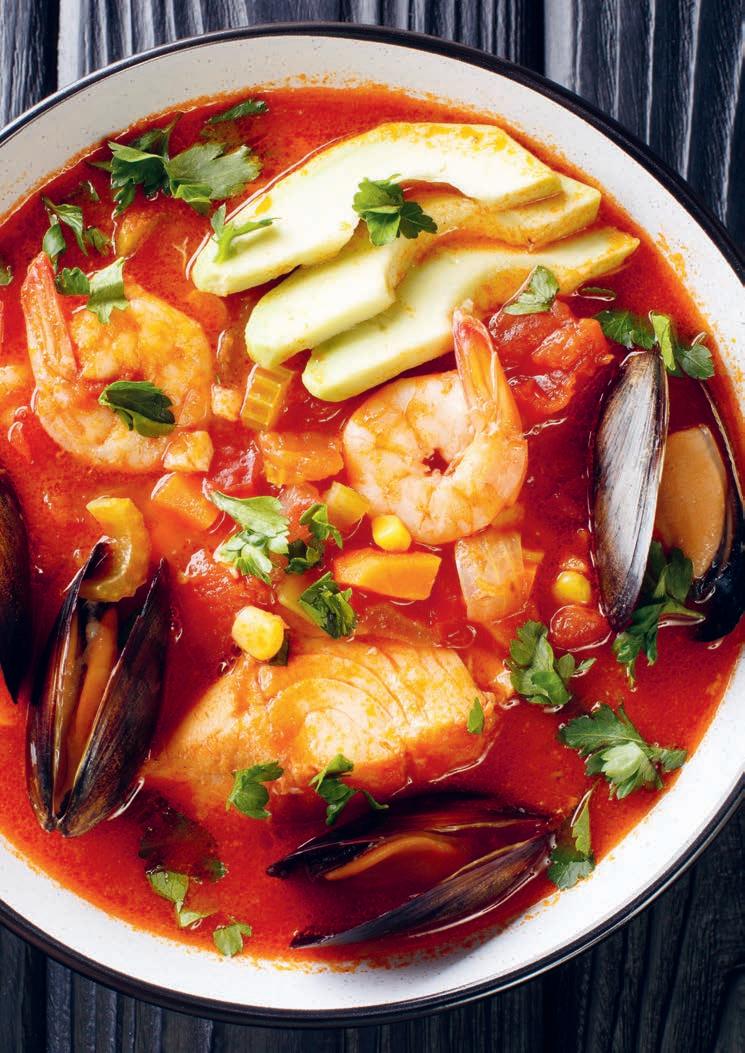
Sopa marinera
Also known as sopa de mariscos, sopa marinera is the classic seafood soup of Ecuador; you’ll find it on just about every restaurant menu in the Galápagos. Like many Ecuadorian dishes, it starts with a sofrito: a base of fried aromatics with Spanish origins but adapted in Ecuador to include annatto and
herbs such as bay and coriander. Fish and seafood are then added, followed by peanuts (and sometimes white wine) to finish. Versions vary by restaurant and season, but may include clams, shrimps, crabs and fish. It’s perfect for warming up after a day of snorkelling or diving among the islands’ rays, sharks and turtles.

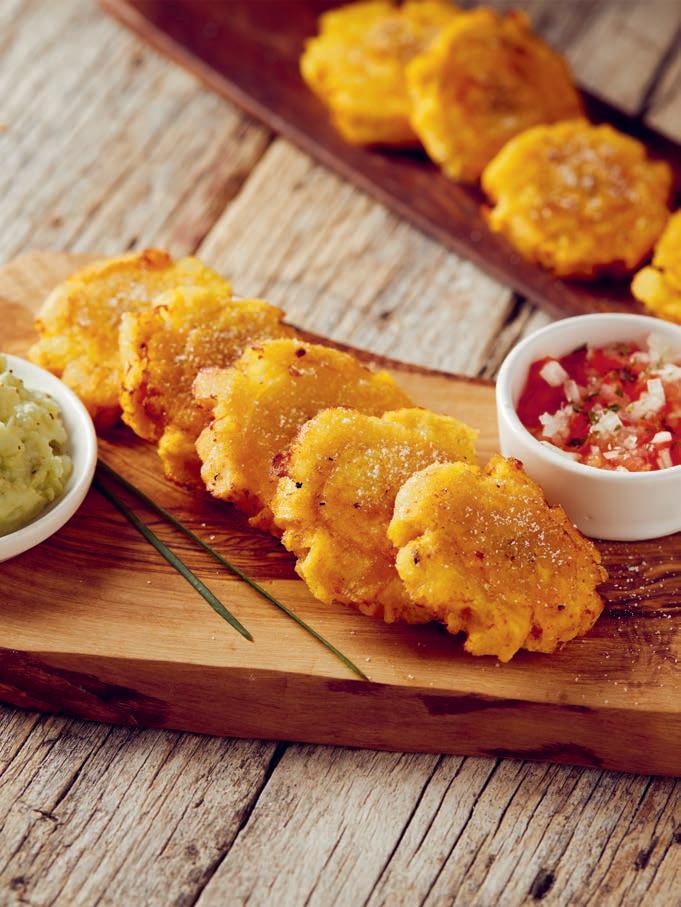
Patacones

You’ll find these lightly salted, twice-fried green plantain slices on the side of most plates in coastal Ecuador and the Galápagos. They’re particularly popular for breakfast, alongside a cup of native co ee and eggs served either fritos (fried) or revueltos (scrambled). They’re crispy on the outside,

soft on the inside; thicker than chifles (plantain chips) but just as addictive. The smashing (flattening) of the plantain into patties might be done with the heel of a bottle or a wooden tostonera, also known as a plantain press. The double-fry-and-smash technique originated with coastal Afro-Ecuadorian communities.

Arroz marinero


This analogue to paella likely originated in the Spanish colonial period but has since evolved into a distinctly Ecuadorian dish that combines the coastal larder with Indigenous traditions. The main di erences from paella are the use of long-grain rice instead of shortgrain rice, and annatto instead of sa ron. Annatto, locally known as achiote, is made from the powdered seeds of the achiote tree, which imparts both a red colour and a nutty flavour. Arroz marinero also uses only seafood rather than chicken and chorizo, making the most of the abundant Galápagos seas. Try it at La Pescadería in Puerto Baquerizo Moreno on the island of San Cristóbal.
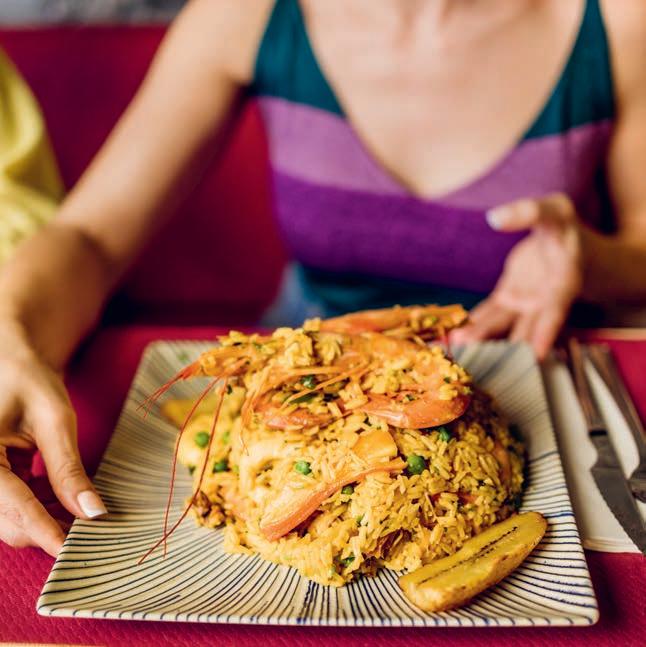


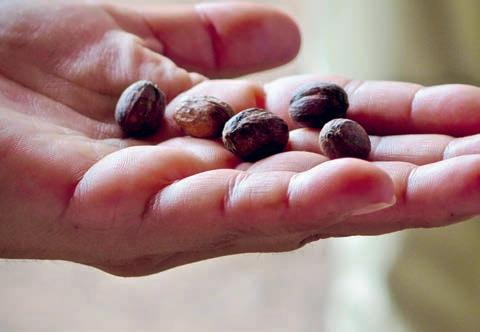

Galápagos Coffee
Galápagos co ee is one of seven Ecuadorian products to have received the Denominación de Origen (DO), an appellation used in Spain and Latin America to protect the origins, production and traditions of a product. Cuenca-born entrepreneur Manuel Cobos first brought Arabica Bourbon coffee beans to San Cristóbal island in the late 19th century. It’s now also grown on the islands of Santa Cruz, Isabela and Floreana, and includes cultivars such as Typica, Caturra and Villalobo. The volcanic soils and sea air impart an earthy aroma and fruity notes to the co ee; try it at 1835 Restaurant & Coffee in Puerto Ayora (see next page).
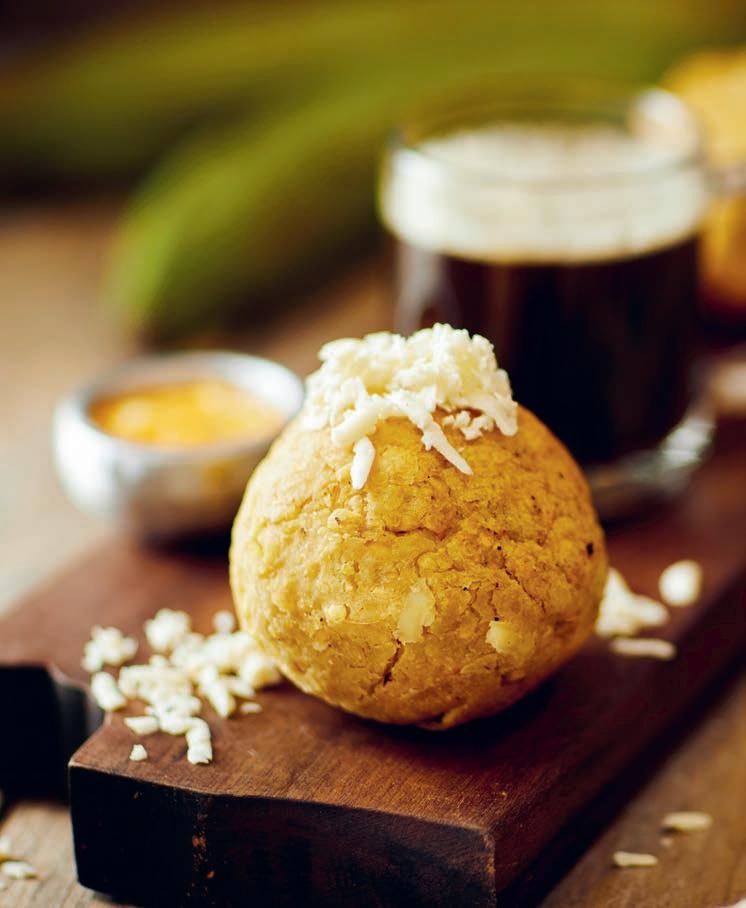

Bolón de verde
These globes of goodness originated with the Montuvios – people with mixed European, Indigenous and African heritage, who were recognised as a distinct Ecuadorian ethno-cultural group in 2001. As with many coastal dishes, it’s based around green plantain, which is boiled (or fried) and mashed into a sphere with cheese, chicharrón (pork rinds) and sometimes peanuts. In the Galápagos, lobster might be added when in season. It’s a typical breakfast dish, often served alongside co ee, eggs and perhaps beef and rice; try it at El Descanso Del Guía in Puerto Ayora.

Restaurants to visit
Øy restaurant
There’s more than a dash of Scandinavian flair about Øy (‘island’ in Norwegian): the wicker lampshades, soft neutrals, cleanlined furniture and artful small plates. But the experimental ethos of this Puerto Ayora restaurant is distinctly Ecuadorian. Dulce de higos (sweet figs with cheese) is typically a humble dish; here, it’s elevated with a brown sugar tuile, white chocolate foam and a Greek yoghurt sauce. Øy is also known for its ceviche jipijapa: a peanut-based ceviche from the town of Jipijapa in Manabí, here using Galápagos yellowfin tuna, criolla hot sauce and fried green plantain chips. Short on time? Try cookies and a ‘coldbrewcha’ – a cold-brew co ee kombucha.
1835
Co ee – top-quality Denominación de Origen Galápagos co ee – is at the heart of this relaxed, bohemian restaurant in Puerto Ayora. Alongside the regular orders, you’ll find a dulce de leche (caramelised milk) latte and a selection of co ee brewing methods for the purists: Aeropress, V60, French Press and Chemex. Not into co ee? No matter; there are tropical juices, made with Ecuador-grown fruits such as pineapple, avocado and passion fruit. The food menu highlights local fish and seafood, and there’s a long cocktail list, including, of course, an espresso martini.
Finch Bay Galápagos Restaurant
Most restaurants in the Galápagos have a casual, laid-back feel. But if you want something more ‘white tablecloth’ for a special occasion, you’ll want this poolside Puerto Ayora restaurant, with views stretching to Academy Bay. Executive chef Andrés Orlando pairs native ingredients and dishes with high-end techniques – the (seasonal) Galápagos lobster is bathed in hazelnut butter and bisque sauce; the tuna corviche (green plantain croquettes) comes with an avocado emulsion. To finish, try the ice cream made with palo santo, a sacred incense tree that grows on the islands.
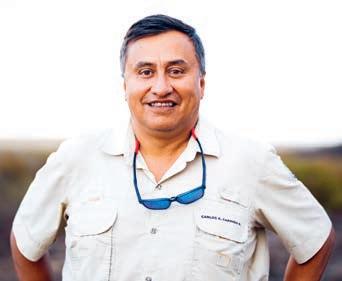
Through the lens of a Galápagos guide with Carlos Carrión
Interview by Karen Edwards
With a deep knowledge of the physiology and behaviour of the endemic species found on the Galápagos Islands, as well as a passion for exploration, Carlos Carrión has been teaching and guiding tourists here for more than 20 years. Typically welcoming visitors on expedition cruises, he invites them to form a deeper connection with a unique archipelago that is packed with closeknit communities and incredible wildlife.
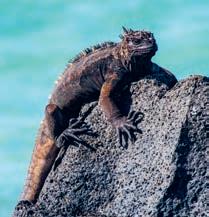
How did your relationship with nature begin?
Undoubtedly, my desire to do this job came from growing up on the islands. My grandparents lived on a farm in the highlands of Santa Cruz island. When I was a carefree young boy, I’d go out looking for tortoises and spot finches in the trees on the farm.
My grandmother loved walking outside, and I’d often go with her. That simple life, growing up around nature, was the best. Having these close encounters with wildlife, and discovering that the animals were
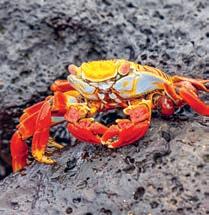
not afraid of me from a young age, made me curious to learn more about them.
How long have your family lived on the islands?
My grandfather’s family arrived in the Galápagos in 1952. They were farmers from Loja in southern Ecuador, and they decided to move to Santa Cruz to construct a new farm. My dad was just 11 years old when they arrived. They bought a piece of land and built a house using lava blocks. Their goal was simple: to find a way to survive by
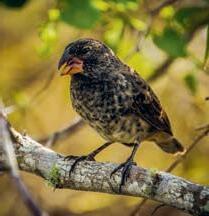
Alamy; Carlos Carrión; Shutterstock
relying on basic agriculture. Back then, they planted plantains and yuca, and there was already a lot of feral cattle on the islands, so they farmed dairy and beef. It’s still a working farm, actually – mainly for dairy, but we now grow pineapples, yuca and coffee, and we rear poultry.
What was your journey to becoming a naturalist like?
While I spent my younger years on the islands, I went to college in Quito, where I studied biology. Then, I went to New Mexico in the USA to get my PhD. During my practical learning phase, I was invited to explore the western islands with scientists. That was the first time I was able to see a side of the Galápagos beyond the version that the residents and tourists normally see.
I still remember the moment that I saw an advertisement from an operator saying, ‘We’re looking for naturalists’. I thought: I can do this! Now I work as a freelance expedition leader and guide [primarily for expedition cruise companies such as Metropolitan Touring and Lindblad Expeditions]. My qualifications have allowed me to work in conservation research, consulting and guiding.
After all these years, what do you love most about your job?
I love guiding and meeting different people, personalities and cultures from all over the world. But at the core of my passion is the place itself. It’s so special to let visitors see the Galápagos through my eyes. Over the years, the tour sites we visit haven’t changed. They still have that pristine beauty that I remember from when I began exploring. The Galápagos is like a microcosm of the entire planet, composed of species that show how life works. It’s fascinating for me to be able to share that with people.
How do you spend your spare time?
My contracts as a guide tend to last about six weeks. I always tell my guests that I spend more time with them than with my own family. My wife is from Quito, and our children are in school there, so I am with them when I’m not working. When I go home, I try to have a normal life: getting involved around the house and hearing how my kids are doing at school.
When my children are on holiday, we all spend time at our family farm on Santa Cruz. On Sundays, we have these big gatherings; we invite family over and go for a walk outside. My uncles, cousins and everyone else join in. It’s a nice, traditional Galapagueño way to spend time together, and we love that.
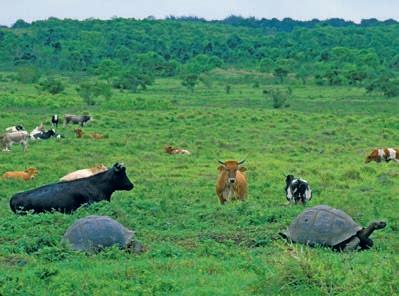
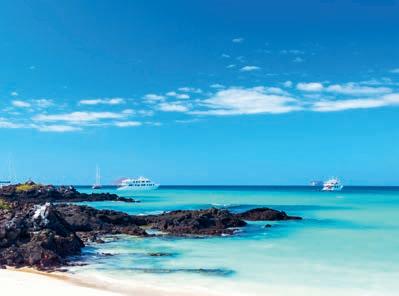
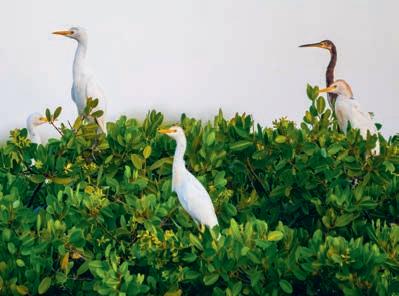
Passed down (opposite page; clockwise from top) Carlos Carrión has been guiding visitors to the Galápagos for over 20 years; the Darwin finch was named after Charles Darwin, who observed traits in this species that helped form his theory of evolution; a sally lightfoot crab; the marine iguana is the only lizard to live and forage at sea; (this page; top to bottom) cattle and giant tortoises, side by side; the pristine sands of Santa Cruz; cattle egrets are typically found on pastureland
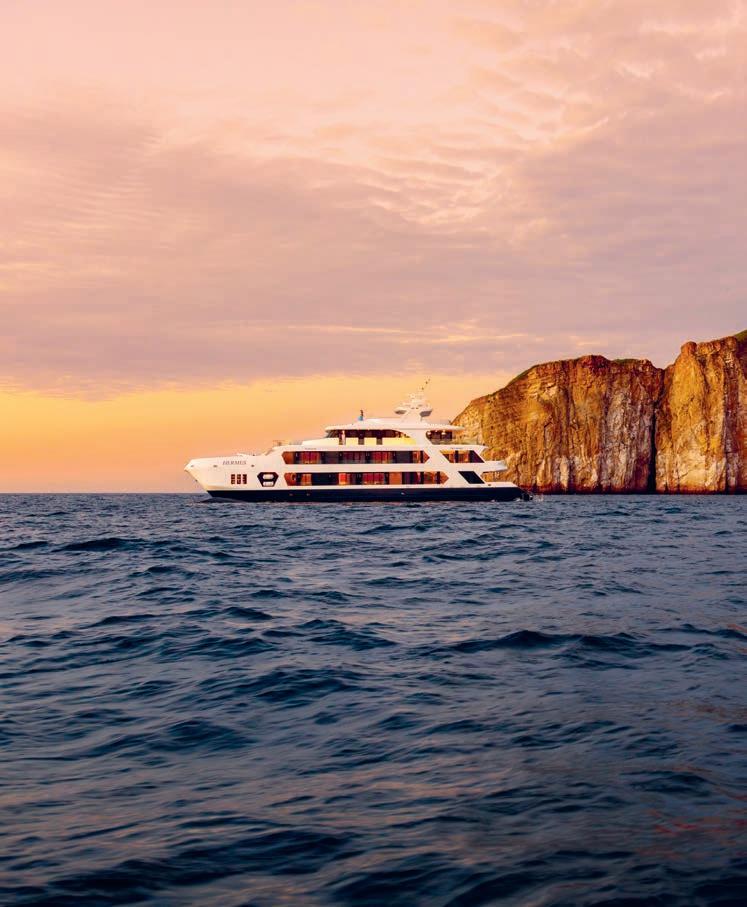
Waking up to the islands in style
From boat trips that support conservation projects to safari-style lodges in secluded forests, these stays prioritise nature in this unique environment
Words David Horwell
The Galápagos Islands, a UNESCO World Heritage site, are renowned for their unique wildlife and volcanic landscapes. To help preserve the archipelago, eco-conscious travel is vital. These sleeps o er a blend of proximity to nature and comfort. From eco-luxury yachts to conservation-minded lodges and boutique hotels,
each property is committed to preserving the archipelago’s fragile ecosystem. Whether cruising on a vessel incorporating solar power or relaxing at a beachfront retreat built with local materials, travellers can aim to explore more responsibly, without compromising on experience. Discover how these impressive lodgings redefine indulgence through innovation and a deep respect for nature.


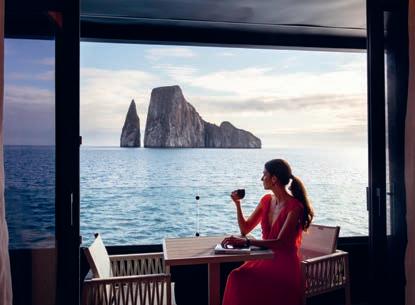



Hermes Catamaran
The Hermes Mega Catamaran, launched earlier this year, is a luxurious vessel carrying just 20 guests. Its nearly one-to-one crew-to-guest ratio ensures personalised service, including a concierge. Each spacious suite o ers floor-to-ceiling windows, a jacuzzi and a private balcony. Communal spaces include lounges, a library and al-fresco dining. Responsible travel is built into its ethos, with small group excursions led by certified naturalist guides and their limited capacity ensuring that wildlife disturbance is minimised. Eco-practices onboard cover water and waste management, and well-designed itineraries aim to reduce fuel use and ecological impact. Guests can also support local conservation e orts such as Santa Cruz Island’s endemic reforestation program, and can even visit the project or plant a tree.
Golden Bay, San Cristóbal Island
Golden Bay Galapagos is a five-star eco-boutique retreat located on Playa de Oro, San Cristóbal. Alongside its 19 elegantly designed rooms and suites, guests can enjoy a restaurant, spa, outdoor pool and personal service. Among its eco-minded features are solar-heated water, eco-friendly architecture, locally sourced ingredients and a dedication to community engagement. It also o ers direct access to a beach frequented by sea lions, iguanas, blue-footed boobies and frigate birds. Stays here blend conservation, ethics and high standards, ensuring that guests experience the Galápagos with reduced impact and maximum care.
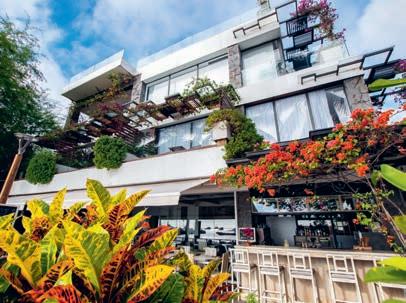

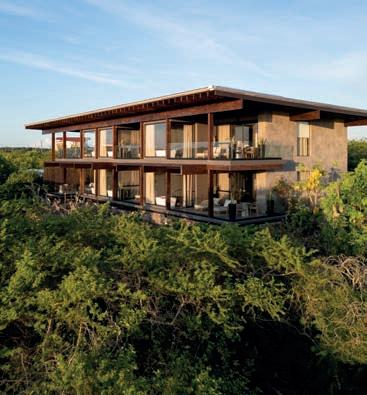

Finch Bay Galápagos Hotel, Santa Cruz Island

Enjoying a secluded location as the only beachfront hotel in Puerto Ayora on Santa Cruz Island, Finch Bay o ers an eco-luxury escape in the heart of the islands. The hotel is committed to responsible tourism, and it generates a large percentage of its electricity through 364 solar panels. It also grows organic produce in its own garden. Guests can also enjoy plush comfort (including an outdoor pool and a spa) while actively contributing to conservation and community empowerment, as Finch Bay also supports local education through science clubs and hires from within the islands. Every stay is an opportunity to explore the archipelago’s biodiversity while helping to preserve its future.
Ecoventura Luxury Cruise
Ecoventura’s award-winning fleet – Origin, Theory and Evolve – o ers an intimate way to explore the Galápagos Islands, with each yacht limited to just 20 guests. These Relais & Châteaux-certified vessels combine five-star comfort with eco-minded innovation. From solar-powered systems and reduced emissions to locally sourced cuisine and the elimination of single-use plastics, the owners are working to reduce the impact of their vessels. This was, after all, the first company in the region to o set its carbon emissions, and it partners with the Charles Darwin Foundation to support local conservation.
There are two seven-night itineraries, or you can combine both for a two-week trip. Guests can also enjoy guided excursions led by naturalists.
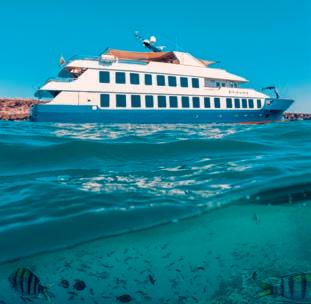
Bicubik; Ecoventura; Golden Bay; Pikaia Lodge
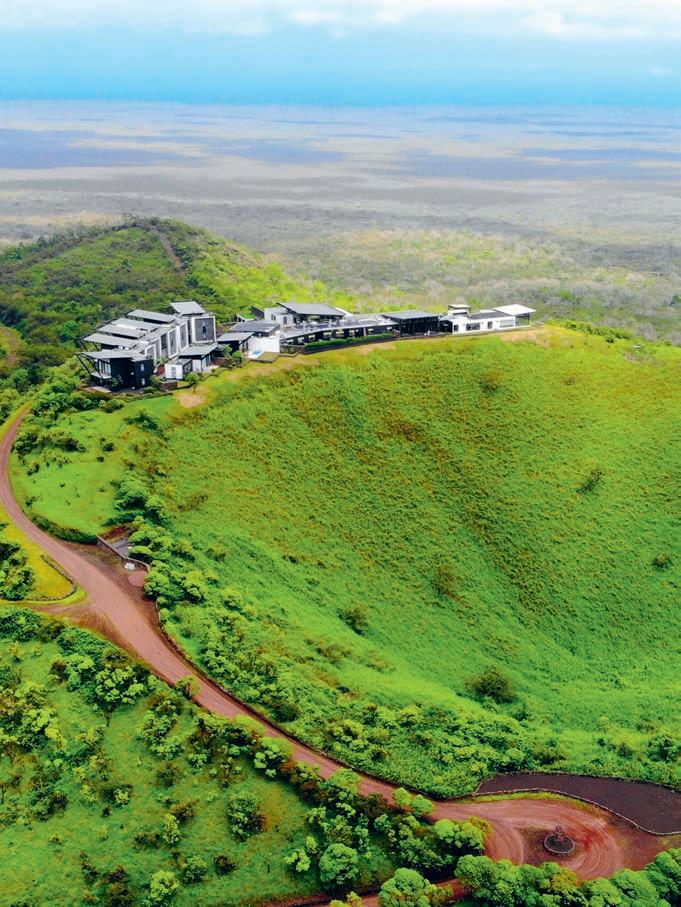
Pikaia Lodge, Santa Cruz Island
Pikaia Lodge is a luxury eco-retreat perched in the highlands of Santa Cruz Island, o ering panoramic views of the archipelago and a high level of comfort. With 14 refined rooms and suites, some featuring private plunge pools, guests can enjoy an infinity pool, gourmet dining, a wellness spa and curated excursions via a private yacht. Built with reducing its impact in

mind, the lodge operates with a low-carbon footprint and supports land-based tourism to reduce marine impact. It houses a private giant tortoise reserve and promotes conservation through education and responsible travel. Pikaia’s Relais & Châteaux-certified model blends luxury with responsibility, offering guests an immersive Galápagos experience that respects the islands’ fragile ecosystem.

Infinity Yacht

The Royal Galápagos Infinity Yacht o ers a unique way to experience the islands and is designed with both luxury and eco-consciousness in mind. Infinity boasts spacious cabins for 20 guests, as well as gourmet cuisine and two expert naturalist guides onboard. The boat features spacious social areas, such as an al-fresco dining area and a living room. Infinity’s itineraries o er access to hidden coves and wildlife

encounters with minimal disruption, so you can enjoy an immersive journey through one of the world’s most extraordinary environments.
The yacht is designed especially for cruising in this area, and initiatives include employing locals, minimising singleuse plastic and contributing to a shark-tracking programme. In addition, its CO2 consumption is measured, and carbon credits are o set through the UN Carbon O set Platform.

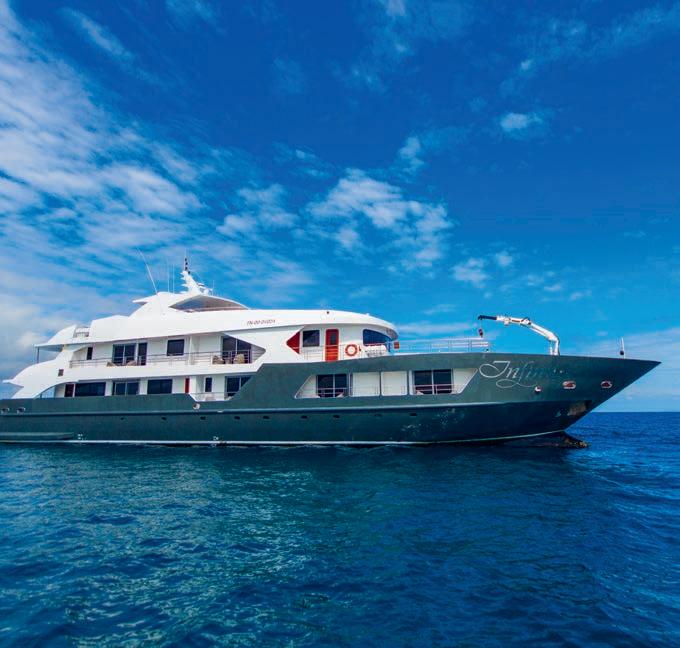
Lava Lodge, Floreana Island
Floreana Lava Lodge o ers a peaceful escape on the least populated island in the Galápagos, Floreana. It is owned by the Cruz family, one of the earliest to have settled on the island. Nestled on black lava shores, the lodge features ten oceanfront cabins built from sustainably sourced wood. Each cabin has a private bathroom, a shaded porch and a reading area, blending comfort with nature. Guests can enjoy a communal lounge, guided hikes, snorkelling and easy access to sea lion colonies just minutes away.
Committed to responsible tourism, Lava Lodge partners with the local community and operates under Galápagos National Park guidelines. Its support for ‘slow tourism’ promotes conservation and cultural connection.
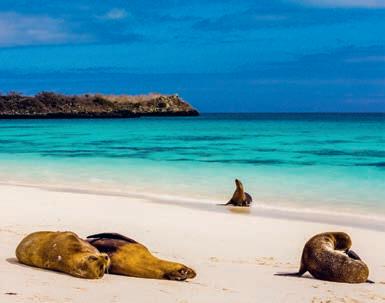
Galápagos Safari Camp; Iguana Crossing; Infinity Yacht; Scalesia Lodge; Alamy
Galápagos Safari Camp, Santa Cruz Island
Set in the lush highlands of Santa Cruz Island, Galápagos Safari Camp o ers an African-inspired eco-glamping experience on a 55-hectare property. It borders the Galápagos National Park, and giant tortoises frequently wander through the grounds. Guests stay in ten luxury safari tents with en-suite facilities and panoramic views. The lodge features gourmet dining, a yoga deck, a pool and a pleasant social lounge.
The camp uses solar-heated water, rainwater harvesting and natural ventilation.Waste is carefully managed, and locally sourced food and community employment further reduce its footprint. There’s also a reforestation programme. With tailor-made safaris combining land and sea adventures, Galápagos Safari Camp aims to deliver intimate, responsibly minded travel in one of the world’s most extraordinary ecosystems.
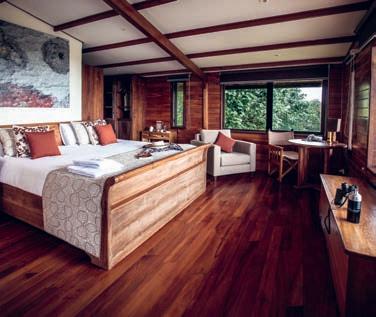
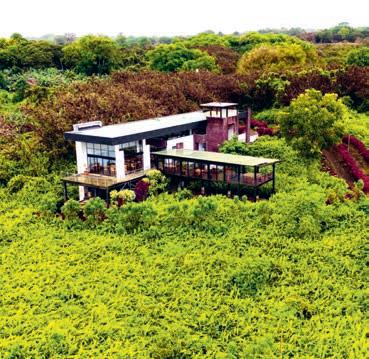

Scalesia Lodge, Isabela Island
Scalesia Lodge o ers a unique blend of adventure and comfort in the lush highlands of Isabela. Named after the surrounding native forest, these stylish safari-style tents enjoy panoramic views of the Pacific and nearby volcanoes. Each lodge has a private bathroom with hot water, and there’s also a guest jacuzzi. Visitors can enjoy gourmet dining cooked with local ingredients, a spacious lounge and a programme of daily guided excursions to Sierra Negra volcano, beaches and wildlife sites on the islands. To help mitigate its impact on the archipelago and its wildlife, the lodge uses solar energy, minimises its waste and supports local conservation initiatives. Its low-impact design allows guests to connect with nature while helping to preserve the fragile Galápagos ecosystem.
Iguana Crossing, Isabela Island
Located between a pristine beach and a wildlife-rich lagoon, Iguana Crossing is one of Isabela’s leading boutique hotels. With 12 elegant rooms and a master suite, guests can enjoy oceanfront views, a swimming pool, a jacuzzi and steam and massage rooms, as well as gourmet dining at the hands of Chef Diego Catarino. The hotel plays its part in protecting the islands through its energy-e cient systems, incorporating water-saving fixtures. It was also constructed using local materials by local artisans. Its minimalist design blends with the natural surroundings, o ering a tranquil, low-impact retreat. And as the name suggests, native wildlife often visits the grounds, including some of the biggest marine iguanas on the islands. There is also plenty to see and do, including a day trip to Tintoreras Island to see friendly sharks.
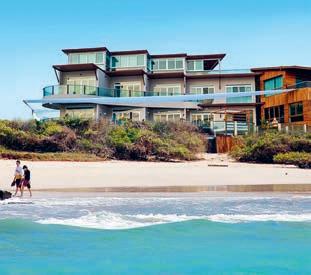
Did y know?
The Galápagos Islands are still evolving
This world-famous archipelago is known for its role in forming the theory of evolution, but many of us forget that the islands are still changing
Words Jessica Reid
It was just over 165 years ago that Charles Darwin published On the Origin of Species, revealing his revolutionary theory of evolution to the world. Inspired by his visits to the Galápagos in the 1830s, his fi ndings resulted from his observations on how the islands’ unique wildlife had adapted to the conditions of this volcanic archipelago.
Isolated in the Pacific Ocean, almost 1,000km o the coast of mainland Ecuador, the Galápagos remains one of the world’s most unique geographical regions, with powerful forces of nature below the ocean’s floor driving the continued evolution of its geological and biological story even today.
THE FORMATION OF THE GALÁPAGOS
a hole through a tectonic plate. Across the millennia, molten rock repeatedly burst through the Earth’s crust to form hardened layer upon layer until, eventually, islands formed above sea level.
“Having emerged in the last 5 million years, the islands are still infants in terms of the Earth’s geological history”
Having only emerged within the past five million years, the archipelago is practically an infant in terms of the Earth’s geological history. The eastern islands of San Cristóbal and Española are the oldest, while the younger western islands, including Isabela and Fernandina, are thought to be less than one million years old.
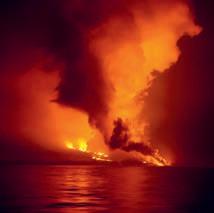
this might have on the islands’ endemic species, but without volcanic activity, the Galápagos would never have even existed.
Volcanoes are often formed at the edges of tectonic plates, but the Galápagos are different. Their creation is thanks to a volcanic hotspot that lies underneath the Nazca Plate: an intense area of heat so powerful that it can force magma to pierce
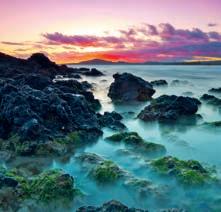

The age of each island has shaped its environment. Younger islands are more barren, while older ones have had time for their volcanic rock to erode into nutrient-rich soil, supporting dense forests and more diverse plant life. The varied landscapes mean different ecosystems have formed across the archipelago.
VOLCANIC ACTIVITY ON THE GALÁPAGOS
The Galápagos’ geological activity is far from over. Its western islands still experience frequent volcanic episodes, with more than 50 eruptions recorded in the past 200 years. La Cumbre on Fernandina is the youngest, most active volcano on the islands, and it has boiled over several times in the 21st century alone – its lava rivers are often so abundant that they meander down to the sea.
The cooled basaltic lava can reshape coastlines, create new terrain and even form new habitats. That said, eruptions here are considered gentle compared with other volcanoes of the world, but geologists have suggested this could change. Conservationists are concerned about the impact
ONGOING EVOLUTION IN THE GALÁPAGOS
Today, the archipelago consists of 19 main islands and dozens of smaller islets. However, this number isn’t fixed. With every volcanic eruption, the map can subtly change, introducing new formations and erasing old ones. Evolving alongside the archipelago are flora and fauna. Each island’s geology, elevation and ocean currents create distinct environments, causing species to evolve in extraordinary ways to bring us the unusual plants and creatures of the Galápagos that we know today, from long-living tortoises to the world’s most northerly penguin species.
One of the best examples of how an animal has adapted is the marine iguana –the world’s only lizard to swim and forage at sea. Another is the towering Opuntia cactus – also known as prickly pear cactus – which can survive in periods of severe drought after developing unique water storage systems.
As was the case for Darwin, finches point the way for scientists. In some of the most recent studies, records show the beak and body of a local species of finch have shrunk in a matter of decades, proving evolution isn’t just a historical concept, but a process that is happening right here, right now.
Alamy
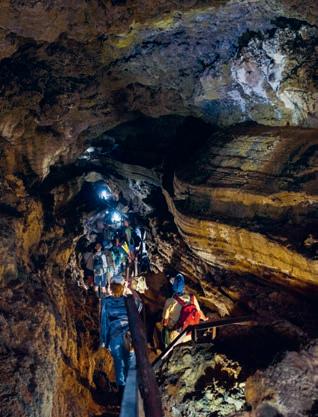
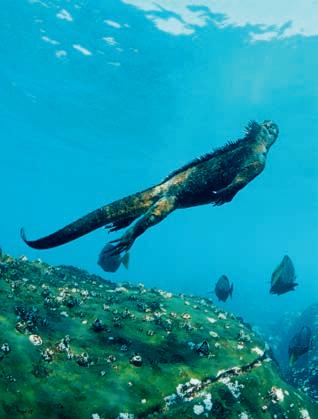
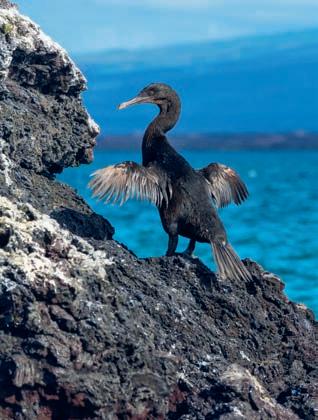
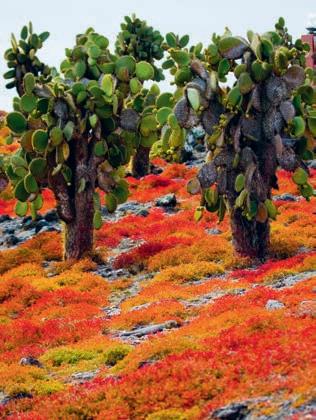
Evolving power (clockwise from opposite page; top) The 2009 eruption of Fernandina volcano was particularly dramatic, as was its impact on the marine life offshore; travellers can visit the lava tunnels at the El Chato Reserve on Santa Cruz Island; admire unique species such as the Galápagos flightless cormorant in Elizabeth Bay on Isabela Island; the islands are home to vibrant colours and flora species, including the prickly pear cactus; diving will reveal rich marine life, such as the marine iguana; Puerto Villamil on Isabela Island is the largest settlement in the Galápagos, and it is also home to wild beaches and rock formations
Festivities in Ecuador
Fiestas are an integral part of life in South America, and Ecuador’s vibrant celebrations o er insight into its cultural traditions and beliefs
Words Sinead Mulhern
To experience Ecuador’s true identity, you need to visit during one of its many festive periods. This country doesn’t celebrate in half measures, and it tends to mark significant events with parades, parties, dancing, lashings of street food and, in particular, fire… tonnes of it.
Ecuador’s love of bonfires, fireworks and airborne lanterns is ingrained in local culture. The country’s fascination with fire stems from Andean Indigenous tradition, in which it symbolises renewal and transformation. For visitors, its fiery displays never fail to impress.
The following are six holidays that o er a glimpse into Ecuador’s culture.
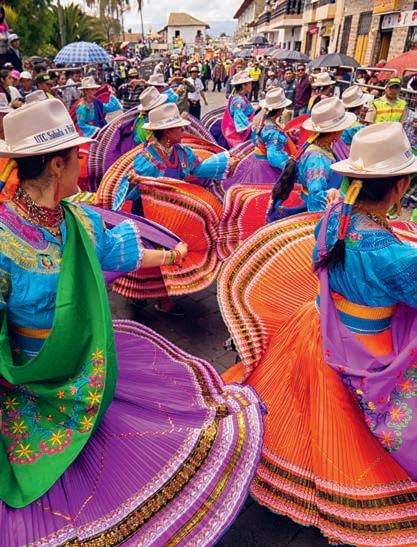


Fiestas de Cuenca
Because Ecuador didn’t achieve freedom from Spain all at once, it has three independence days (plus foundation date holidays), celebrating when each major city – Quito, Cuenca and Guayaquil – broke away from Spanish rule.The Fiestas de Cuenca (held around Cuenca’s independence day on 3 November) are particularly exciting. Expect a week of concerts, parties and stalls selling artisanal pottery and woven ponchos, accompanied by castillo fireworks and classic Cuenca dishes such as roasted guinea pig, llapingachos (potato patties) and pork.
New Year’s Eve

Corpus Christi
Every June, during Corpus Christi, Ecuador’s streets turn into a real-life Willy Wonka wonderland as vendors in the main squares sell piles of cookies, candies, chocolate and pastries. Corpus Christi is a holiday rooted in Catholicism and centred on reflection, but Ecuador elevates it with nightly firework displays – and not your standard kind. During this time, public squares are set ablaze with castillos (towers embedded with fireworks) and flaming windmills. As if that spectacle isn’t enough, locals will take on the role of the vaca loca (crazy cow), which involves dancing while wearing papier-mâché cows on their heads that shoot fireworks at the finale. It’s an incredible sight.


New Year’s Eve in Ecuador is wild and full of unique end-of-year celebrations. For starters, there are the viudas (widows), men dressed in women’s clothing who take on the symbolic role of a widow grieving the year just passed. They’ll stop traffic – literally – to collect donations for that evening’s party. Another key sight is the monigotes, papier-mâché egies often modelled after famous people or cartoon characters, which are thrown into bonfires at midnight to burn away the bad parts of the old year while welcoming in the new. Other superstitious traditions you’ll see on 31 December include: walking around the block with a suitcase to encourage good travels in the forthcoming year, eating 12 grapes for good luck, and jumping over street bonfires to leave behind bad luck.


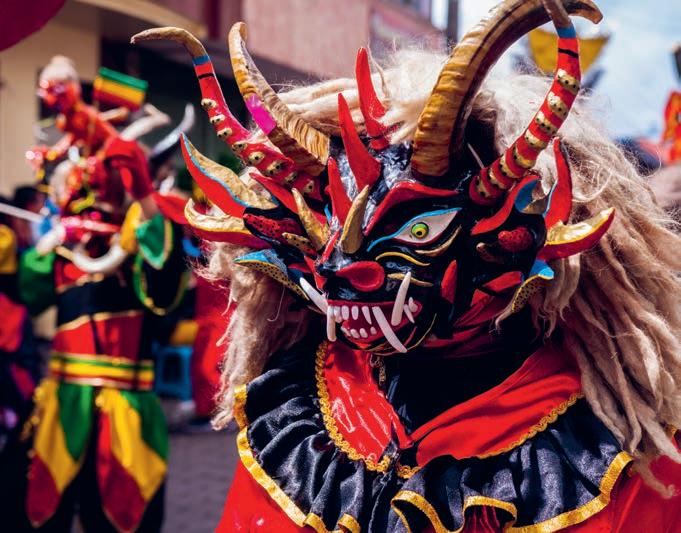
La Diablada de Píllaro


For the fi rst six days of January, the tiny Andean town of Píllaro, south of Quito, hosts a wild parade of devils. The Diablada de Píllaro brings a loud and lively procession to these sleepy streets, accompanied by booming live music, expressive dancing and fearless costumes. The faces of these devils are sharp-toothed and horned. To look them in the eye is a fun cultural experience in Ecuador’s north, but they were born from a rebellious spirit. Indigenous locals once donned these masks as a form of protest against Spanish colonial rule.

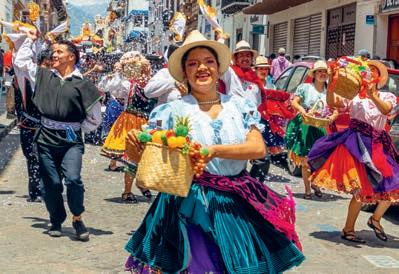
Carnival
When thinking of Carnival, perhaps Brazil’s samba dancing and ornate feathered attire first come to mind. But in Ecuador, Carnival is totally di erent. In this part of South America, you can expect giant, messy foam parties complete with water guns, flour fights and maybe even a dunk in the river. Everyone takes part in the chaos – elderly grandmothers included.
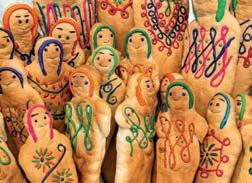

All Saints’ Day
While Día de los Muertos isn’t as big here as it is in Mexico, Ecuador still celebrates this day in its own way, and it does so with rituals that you won’t see elsewhere. On 1 November, bakeries serve baby-shaped bread alongside colada morada, a purple berry and cornflower drink. The name of this bread, guaguas de pan (bread babies), blends Spanish with the Indigenous Kichwa language. Guagua (meaning ‘baby’ in Kichwa) is a word that has worked its way into Ecuadorian highland Spanish. And while All Saints’ Day is associated with Catholicism, this way of paying homage to the deceased dates back to pre-Columbian times in the Andes.
The Wanderlust Team
Editor-in-Chief
George Kipouros
Founding Editor Lyn Hughes
Writers
Karen Edwards, Sinead Mulhern, Jessica Reid, Sarah Gillespie, Russell Maddicks, Mark Stratton, SJ Armstrong, David Horwell, George Kipouros, Laura Field
Special Features Managing Editor Rosie Fitzgerald
Regional Editor Laura Field
Associate Editor Gareth Clark
Sub-Editor Yvonne Gordon
Editorial Projects Manager
Tom Bennedik
North America Editor Jacqui Agate
Senior Digital Editor Dianne Apen-Sadler
Art Director
Graham Berridge
Digital Creative Director Todd Padwick
Digital Designer Connor Dyer
Chief Commercial O cer Adam Lloyds
VP Brand Partnerships
David Read
VP Destination Partnerships
James A Smith
International Partnerships Manager
Jack Brown
COO & Head of Creative Elliot Wellsteed-Crook
Wanderlust Club Manager Maria Manta
Illustrator
Sneha Alexander (snehalexander.com)


Published by Wanderlust Travel Media, Capital House, 25 Chapel St, Marylebone, London NW1 5DH. All rights are reserved. Reproduction in any manner, in whole or in part, is strictly forbidden without the prior written consent of the publishers. All prices are correct at time of press. No responsibility for incorrect information can be accepted. Views expressed in articles are those of the authors, and not necessarily the publishers. Wanderlust is a registered trademark.