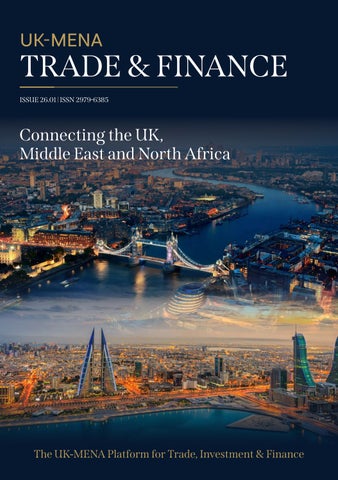
UK-MENA
TRADE & FINANCE ISSUE 26.01 | ISSN 2979-6385
Connecting the UK, Middle East and North Africa
The UK-MENA Platform for Trade, Investment & Finance
The UK-MENA Platform for Trade, Investment & Finance
NEXT ISSUE JANUARY 2027
UK-MENA
TRADE & FINANCE ISSUE 26.01
PUT YOUR BUSINESS IN FRONT OF THE UK-MENA MARKET
Connecting the UK, Middle East and North Africa
The UK-MENA Platform for Trade, Investment & Finance
Reach a targeted audience of decision-makers, investors, exporters and business leaders across the United Kingdom, Middle East and North Africa through our quarterly digital magazine and year-round online platform.
Integrated platform visibility
Quarterly digital editions
Present your organisation across our digital edition, website, email campaigns and LinkedIn for maximum visibility.
Maintain year-round visibility through four interactive editions featuring UK-MENA business insight and commercial content.
Direct digital engagement
Senior business audience
Use clickable website, email and content links to create direct routes between audiences and your organisation.
Reach executives, investors, exporters, chambers and organisations involved in UK-MENA trade and investment.
Established Business Networks
Continuing digital presence
Benefit from established business relationships and targeted audiences developed through years of UK-Arab publishing.
Extend your exposure through archived editions and online content that remains accessible long after publication.
BOOK YOUR SPACE IN THE NEXT ISSUE WENDY CHAPMAN ADVERTISING & PARTNERSHIP ENQUIRIES Phone +44 1472 599903 Email wendy@ukmenatradeandfinance.com Website ukmenatradeandfinance.com
January 2027
WELCOME TO UK-MENA TRADE & FINANCE
Welcome to UK-MENA Trade & Finance, an independent business platform created to connect the United Kingdom with the Middle East and North Africa through trade, investment, finance and commercial insight. The relationship between the UK and the MENA region is broad, fast-moving and increasingly important. New investment, major infrastructure projects, changing regulation, expanding financial links, technology growth and evolving supply chains are creating opportunities across a wide range of sectors. Our role is to help businesses understand those developments and what they could mean in practical commercial terms. UK-MENA Trade & Finance brings together business news, in-depth features, market analysis, executive insight and sector-focused editorial covering the industries shaping cross-border trade and investment. From finance, energy and construction to technology, manufacturing, property, food, logistics and professional services, we focus on the issues that matter to businesses operating across these markets. But UK-MENA Trade & Finance is more than a magazine. The publication forms part of a wider year-round platform that includes a dedicated website, regularly updated business content, targeted email distribution and professional social media promotion. This gives our readers an ongoing source of relevant information while providing businesses with opportunities to build visibility around the markets, sectors and conversations that matter to them. Our editorial approach is independent, commercially aware and focused on substance. We look beyond announcements to examine the implications behind them: where investment is moving, how markets are changing, which sectors are opening up, what regulatory developments businesses need to understand and where new commercial relationships may be forming. For companies, advisers, investors and organisations looking to engage with the UK-MENA business community, the platform also provides opportunities to contribute expertise, share company developments, participate in relevant features and build visibility through sponsorship and advertising. Whether you are already active across the region or exploring new opportunities, UK-MENA Trade & Finance is designed to help you stay informed, understand the market and connect with the businesses and ideas shaping the next phase of UK-MENA trade and investment.
CONNECT YOUR BUSINESS ACROSS THE UK, MIDDLE EAST AND NORTH AFRICA Contact us to discuss digital advertising, sponsored content, executive interviews, editorial contributions, sector sponsorship or tailored commercial partnerships.
CONNECTING THE UK, MIDDLE EAST AND NORTH AFRICA
03
ISSUE 26.01 | UKMENATRADEANDFINANCE.COM
ISSUE 26.01
10
Contents CONNECTING THE UK, MIDDLE EAST AND NORTH AFRICA
05
12
SPOTLIGHT UKMENA Abdeslam El-Idrissi Four Decades Building Bridges Between Britain and the Arab World
06
TRADE & INVESTMENT
10
LEGAL
12
BANKING & FINANCE
15
LEGAL & INVESTMENT / KUWAIT
The Gulf Deal: What Business Needs to Know
15
Investing in Egypt: What to Get Right Bahrain’s Financial Edge
22
Kuwait Opens Up: The Legal Changes Investors Need to Watch
18
CONSTRUCTION & PROJECT DEVELOPMENT
20
PROPERTY & REAL ESTATE
22
LOGISTICS
24
OIL & GAS
26
MINING
28
AI & AUTOMATION
32
EDUCATION
36
FOOD & DRINK
38
MANUFACTURING
Saudi Arabia’s Delivery Decade Abu Dhabi’s Property Reset
26
Oman’s Logistics Advantage Qatar LNG’s Next Growth Phase
32
Oman’s Mining Opportunity The UK-UAE AI Corridor Why the Gulf Wants More UK Education
36
North Africa on Britain’s Plate Tunisia’s Manufacturing Moment
PUBLISHED BY: WALTONS PUBLICATIONS LTD. 46 HENEAGE ROAD, GRIMSBY, NORTH EAST LINCOLNSHIRE DN32 9ES
ADVERTISING: WENDY CHAPMAN (Sales Manager) E-MAIL: wendy@ukmenatradeandfinance.com TELEPHONE: +44 (0)1472 599903
GRAPHICS STUDIO: RACHEL RILEY - Manager
All rights reserved. No part of UK-MENA Trade & Finance Magazine may be reproduced or stored in a retrieval system or transmitted in any form, electronic, mechanical or photocopying, without prior written permission of the publishers. The publishers do not accept responsibility for views expressed, or statements made, or in those reproduced from any other source. No responsibility is borne by the publishers for any errors made in any advertisement, or for claims made by any advertiser which are incorrect. The publishers cannot be held responsible for any breach of copyright arising from any material supplied. This includes editorial and/or advertisement copy, design and/or images.
UKMENATRADEANDFINANCE.COM | ISSUE 26.01
04
UK-MENA TRADE & FINANCE IS PART OF
ACCOUNTS & ADMINISTRATION: AMANDA WALMSLEY EVELYN WOOLSTON
Copyright© 2026 All Rights Reserved
CONNECTING THE UK, MIDDLE EAST AND NORTH AFRICA
SPOTLIGHT
UKMENA Abdeslam El-Idrissi Four Decades Building Bridges Between Britain and the Arab World Founder & CEO of UKMENA · formerly Deputy CEO & Secretary General of the Arab-British Chamber of Commerce · one of the UK’s leading authorities on UK–Arab trade relations. Few individuals have had such a sustained view of UK–Arab commercial relations as Abdeslam El-Idrissi. Over a career spanning more than four decades, he has become a respected figure within the UK–Arab business community, supporting companies seeking international opportunities and encouraging stronger commercial connections between Britain and the Arab world. Much of that career was spent with the Arab-British Chamber of Commerce (ABCC), where El-Idrissi held senior positions including Director of Trade Services, Acting General Manager and Deputy CEO & Secretary General. His work placed him at the intersection of business, government and international trade, connecting him with companies, chambers of commerce, government departments, diplomatic missions and trade organisations across both regions. It also gave him a front-row seat to a remarkable period of economic change. Across the Middle East and North Africa, economies have evolved. While traditional industries remain important, diversification is creating opportunities across infrastructure, financial services, technology, advanced manufacturing, renewable energy, healthcare, tourism and education.
For British businesses, that transformation has created an increasingly diverse marketplace with significant potential for future growth. Yet identifying an opportunity is only one part of building a successful international business.
After more than 40 years supporting UK–Arab commercial relations, El-Idrissi announced his retirement in 2026. His career spans a period in which the scale, sophistication and international ambitions of Arab economies have changed enormously.
Throughout his career, El-Idrissi has highlighted the value of understanding the markets in which companies operate. Commercial relationships between the UK and the Arab world are strengthened by knowledge, cultural awareness, personal connections and a willingness to develop trust over time.
His contribution also reflects something at the heart of UK-MENA Trade & Finance.
That experience is particularly relevant as a new generation of British businesses looks towards the MENA region. Major investment programmes and national development strategies are opening doors for international expertise, while British companies bring strengths ranging from financial and professional services to engineering, technology, education and advanced manufacturing. But sustainable trade is rarely created by a single meeting or transaction. The most successful international partnerships are built with a long-term perspective and an understanding of the people and priorities behind the opportunity.
CONNECTING THE UK, MIDDLE EAST AND NORTH AFRICA
05
Trade figures, investment announcements and major projects tell an important part of the UKMENA story. Behind them are the individuals and organisations that create connections, share knowledge and build confidence between markets. As a new era of UKMENA economic cooperation takes shape, Abdeslam El-Idrissi’s career is a timely reminder that enduring commercial partnerships begin with something much simpler: people who understand one another and are prepared to build for the long term. TELEPHONE 07850 251182 EMAIL elidrissi@ukmena.com WEB www.ukmena.com
ISSUE 26.01 | UKMENATRADEANDFINANCE.COM
TRADE & INVESTMENT
The Gulf Deal: What Business Needs to Know The UK-Gulf Cooperation Council Free Trade Agreement has moved from negotiation to commercial reality, but not yet to implementation. The deal was concluded on 20 May 2026 after almost four years of talks between the UK and Bahrain, Kuwait, Oman, Qatar, Saudi Arabia and the United Arab Emirates. It still has to pass legal finalisation, signature and domestic procedures before businesses can use its preferential terms.
UKMENATRADEANDFINANCE.COM | ISSUE 26.01
06
CONNECTING THE UK, MIDDLE EAST AND NORTH AFRICA
TRADE & INVESTMENT
That distinction matters. The opportunity is real, but companies planning around the agreement need to understand what changes, what does not, and where the commercial advantages are most likely to appear. This is not simply a tariff story. It reaches into services, investment, customs, digital trade and the operating environment for companies building a long-term presence across the Gulf.
That could matter to sectors where time and landed cost directly influence competitiveness, including food and drink, industrial equipment, automotive products, healthcare supplies and consumer goods. But preferential access will not remove the need to understand local product standards, registration, distribution, labelling and sector-specific regulation in individual Gulf markets.
A DEAL BUILT AROUND AN EXISTING RELATIONSHIP
For many British businesses, the most valuable part of the agreement may sit outside physical trade. Financial services, legal services, engineering, construction and other professional activities are covered by commitments intended to give service suppliers greater certainty. Investment provisions also seek to strengthen protections around long-term capital commitments.
Britain is not entering a new market. UK-GCC trade was already worth tens of billions of pounds before the agreement was concluded, while Gulf investors have long held substantial positions in British property, infrastructure, technology and companies. British professional services, engineering, education, healthcare and financial firms are equally established across the region. The agreement therefore matters because it can reduce friction inside an already active commercial relationship. The UK Government estimates that tariffs will eventually be removed on around 93 per cent of current UK goods exports to the GCC. Its modelling also suggests significant long-term gains to trade and GDP, although those forecasts are not guarantees. The value will depend on how businesses respond once the agreement enters into force.
WHERE EXPORTERS COULD FEEL THE DIFFERENCE For goods exporters, lower tariffs are only part of the equation. Rules of origin will determine which products qualify for preferential treatment, while customs provisions are intended to make procedures more predictable and increasingly digital. Where requirements are met and no physical inspection is needed, the agreement sets expectations for goods to clear within 48 hours, with a shorter period for perishables.
CONNECTING THE UK, MIDDLE EAST AND NORTH AFRICA
07
SERVICES MAY BE THE BIGGER COMMERCIAL PRIZE
This is not simply a tariff story. It reaches into services, investment, customs, digital trade and long-term Gulf growth. That fits the direction of Gulf economic policy. Saudi Arabia, the UAE, Oman, Bahrain and Qatar are all pursuing investment-led diversification in different ways. Their demand is increasingly for specialist capability, technology, finance, professional advice and international partnerships rather than simply imported goods. >>>
ISSUE 26.01 | UKMENATRADEANDFINANCE.COM
TRADE & INVESTMENT
CONTINUED FROM PAGE 07... For UK firms, the question is less ‘Can we export to the Gulf?’ and more ‘Where should we establish, partner and build local capability?’
DIGITAL TRADE CHANGES THE CONVERSATION The agreement also reflects a commercial relationship being reshaped by data and technology. Its digital provisions support paperless trade and cross-border data flows, including commitments relevant to financial services and emerging technologies. That matters to banks, fintech firms, professional services, ecommerce businesses and technology companies whose operating models depend on moving information securely between jurisdictions. It does not create one common GCC regulatory system. Data protection, licensing, tax, employment and sector rules will still vary by country. The strongest businesses will use the agreement as a framework while continuing to treat Bahrain, Kuwait, Oman, Qatar, Saudi Arabia and the UAE as distinct markets.
WHAT BUSINESSES SHOULD DO BEFORE IT ENTERS INTO FORCE The most useful response now is preparation. Exporters should map where tariff reductions could change
pricing, review likely rules-of-origin requirements and identify products where faster customs could materially improve the proposition. Service businesses should examine licensing, local presence, partnership and investment options in the markets where demand is strongest.
The immediate opportunity is to understand the framework early enough to be ready when it enters into force. The deal should also prompt companies already active in the Gulf to revisit their structure. A business that entered one GCC market as a small exporter may now have a stronger case for regional distribution, a local office, a joint venture or a wider services operation. Likewise, Gulf businesses using Britain as a
UKMENATRADEANDFINANCE.COM | ISSUE 26.01
08
European investment, finance or technology base may find a more formal framework strengthens the strategic logic of that relationship.
A FRAMEWORK, NOT A SHORTCUT The UK-GCC agreement is significant precisely because it sits across so many commercial decisions. It can lower barriers and improve certainty, but it cannot replace market knowledge, due diligence or local relationships. Businesses still have to choose the right market, partner, structure and route to customer. For companies prepared to do that work, the agreement creates something valuable: a clearer platform on which the next phase of UK-Gulf trade and investment can be built. The immediate opportunity is not to claim benefits that are not yet in force. It is to understand the framework early enough to be ready when they are.
REFERENCES UK Government: UK-GCC trade deal conclusion summary UK Government: UK-GCC Free Trade Agreement technical note UK Government: UK-GCC trade deal collection
CONNECTING THE UK, MIDDLE EAST AND NORTH AFRICA
Connect to Egypt With NBE UK Our clients around the globe benefit from our unparalleled knowledge of Egypt. We work in partnership with them to unlock the potential of the Egyptian market by delivering bespoke financial solutions. Our core expertise is trade finance and we are focused on long term relationships. We take the time to understand your business, your requirements, and collaborate to find the most efficient solutions for you whether you are an importer or exporter to Egypt.
National Bank of Egypt (UK) Limited is authorised by the Prudential Regulation Authority (PRA) and regulated by the Financial Conduct Authority (FCA) and by the PRA. (PRA reference no:204520) National Bank of Egypt (UK) Limited is a wholly owned subsidiary of National Bank of Egypt (Registered in England no:2743734) Registered Address & Head Office: National Bank of Egypt House, 8-9 Stratton Street, London, WIJ 8LF Email: Businessenquiries@nbeuk.com Website: www.nbeuk.com Telephone: +44 (0) 20 7389 1200
LEGAL
Investing in Egypt: What to Get Right Egypt is trying to make a clearer case to international investors: set up faster, navigate government more easily and put private capital at the centre of economic growth. For UK companies looking at manufacturing, logistics, energy, technology or consumer markets, the opportunity is significant, but the market-entry decisions still need careful handling.
The timing is notable. The UK and Egypt used their June 2026 Association Council to deepen economic cooperation, while the UK later announced an £8.7 million partnership with the World Bank to support Egyptian reforms intended to make it easier for businesses to invest, trade and expand. That makes 2026 a useful point to reassess how an investor should enter the market.
START WITH THE RIGHT STRUCTURE Egypt offers several routes for foreign businesses, from establishing a company under the general investment framework to operating through free zones, investment zones or sectorspecific regimes. The correct structure depends on what the company will actually do: manufacture, import, export, provide services, hold assets or participate in a regulated sector.
problems later if it does not match licensing, customs, tax or employment requirements. Investors should therefore work backwards from the commercial model before choosing the legal vehicle.
The right route into Egypt starts with the commercial model, not simply the quickest route to incorporation.
A structure chosen only because it is quick to establish can create
UKMENATRADEANDFINANCE.COM | ISSUE 26.01
10
COMPANY FORMATION IS BECOMING FASTER Egypt’s General Authority for Investment and Free Zones has been simplifying the investor journey. Its current investor services promote same-day company establishment and digital processes, while its centres bring several approvals and services into one route. That is commercially useful, but speed should not be confused with simplicity. Incorporation is one step. A business may still need operating licences, sector approvals, premises, tax registration, social-insurance arrangements, import or export registrations and other permissions before it can trade as intended.
ZONES CAN CHANGE THE INVESTMENT CASE For industrial and export-focused companies, location can materially alter the proposition. GAFI operates investment and free-zone frameworks,
CONNECTING THE UK, MIDDLE EAST AND NORTH AFRICA
LEGAL
while the Suez Canal Economic Zone offers industrial zones and ports built around manufacturing, logistics and international trade. SCZONE promotes one-stop services and rapid incorporation alongside access to maritime routes. The attraction is not only tax or customs treatment. A zone can affect infrastructure, port access, land, utilities, supplier networks and the practical speed of getting a project operational. Investors should compare the full operating model rather than treating a zone incentive as a standalone saving.
THE GOLDEN LICENCE IS DESIGNED FOR STRATEGIC PROJECTS Egypt’s Golden Licence provides a single approval route for qualifying strategic or national projects, combining establishment and operating permissions. It can be valuable for larger investments, but it is not a general shortcut for every foreign company. The commercial question is eligibility and fit. A project should be assessed against the current requirements before the investor builds a timetable or financial model around receiving the licence.
TAX, CONTRACTS AND PEOPLE NEED EARLY ATTENTION Market entry can fail in the detail. Tax treatment, transfer pricing, customs, employment contracts, social insurance and profit repatriation can affect the economics of an investment. So can the way contracts deal with payment,
governing law, dispute resolution and foreign currency exposure. Those issues are particularly important for companies relocating staff or building a local management team. Immigration, work permits, payroll and employee obligations should be considered alongside corporate registration rather than after the business has committed to premises and hiring. Foreign exchange and cash planning also deserve attention. An investment may be profitable on paper but still face pressure if imported inputs, debt service or dividend expectations are exposed to currency movements. Companies should model how local revenues, foreign-currency costs and repatriation interact before committing capital. That is a financial question, but it is also a legal and structuring question because contracts, financing arrangements and corporate design determine where those risks sit.
THE UK-EGYPT RELATIONSHIP IS BECOMING MORE PRACTICAL The June 2026 UK-Egypt Association Council put trade, investment and economic reform firmly on the bilateral agenda, including work around tariffs and a stronger private-sector relationship. The UK’s World Bank partnership adds support for reforms intended to improve the business environment through 2029. None of that eliminates investor risk. Egypt remains a market where sector regulation, currency, contracting and
CONNECTING THE UK, MIDDLE EAST AND NORTH AFRICA
11
execution require careful due diligence. What it does create is a stronger policy backdrop for British businesses prepared to approach the market with the right local advice and a realistic operating plan.
THE OPPORTUNITY STARTS WITH GETTING ENTRY RIGHT Egypt’s scale, location and industrial ambitions make it difficult to ignore in any serious UK-Arab investment strategy. But attractive markets do not reward rushed structures. The companies most likely to succeed will be those that treat legal, tax and regulatory planning as part of commercial strategy from day one. For advisers and investors alike, that is the real 2026 story. Egypt is working to reduce friction at the front door. Businesses still need to make sure they enter through the right one.
REFERENCES UK Government: UK-Egypt Association Council 2026 UK Government: UK-World Bank partnership supporting Egypt reform GAFI: Invest in Egypt Suez Canal Economic Zone: Investment and one-stop services UK Government: Exporting from the UK to Egypt
Egypt is reducing friction at the front door, but investors still need to make sure they enter through the right one.
ISSUE 26.01 | UKMENATRADEANDFINANCE.COM
BANKING & FINANCE
Bahrain’s Financial Edge
Financial centres succeed through networks, regulation, expertise and access as much as domestic demand.
Bahrain rarely attracts the same volume of headlines as Dubai or Riyadh, yet for financial businesses looking at the Gulf it remains one of the region’s most deliberately built financial centres. The proposition is not sheer domestic-market size. It is regulation, financial depth, operating experience and access to the wider Gulf, including neighbouring Saudi Arabia. That combination makes Bahrain commercially interesting at a time when UK-Gulf finance is becoming more integrated. UK exports to Bahrain reached around £1 billion in the four quarters to the end of 2025, according to the UK Government, and financial and professional services remain among the areas identified for further growth.
A FINANCIAL CENTRE BUILT FOR CROSS-BORDER BUSINESS Bahrain has spent decades positioning finance as a core part of its economy. The Central Bank of Bahrain acts as a single regulator across banking, insurance, investment business and capital markets. Its February 2026 fact sheet put banking-system assets at more than US$250 billion at the end of 2025 and showed a market that spans conventional banking, Islamic
UKMENATRADEANDFINANCE.COM | ISSUE 26.01
12
CONNECTING THE UK, MIDDLE EAST AND NORTH AFRICA
BANKING & FINANCE
finance, investment firms and a large authorised-funds sector. For an international firm, that matters because market entry is rarely only about finding customers. Regulatory clarity, access to skilled staff, professional advisers and counterparties can determine whether a regional operation is viable. Bahrain’s established financial infrastructure gives firms a base from which to serve clients across multiple Gulf markets. Cost also matters, particularly for specialist firms that do not need the scale of a large regional headquarters. Bahrain’s value proposition has traditionally combined a developed financial ecosystem with a comparatively compact operating environment. That can be attractive to businesses testing Gulf demand, building a regulated function or serving institutional clients across several markets. The decision still needs a full cost and licensing comparison, but Bahrain deserves to be assessed on the economics of the operating model, not dismissed because it is a smaller domestic market.
THE SAUDI CONNECTION IS PART OF THE PROPOSITION Bahrain’s geography gives its financial story a wider commercial dimension. The King Fahd Causeway provides a direct road link to Saudi Arabia, the GCC’s largest economy, and Bahrain has long marketed itself as a gateway for businesses that need regional reach without locating every function in one market. That does not make Bahrain a substitute for a Saudi licence or local presence where one is required. It does, however, create options. Treasury, regional management, specialist finance, insurance, advisory and support functions can be structured around where regulation, talent, customers and cost make the most sense.
CONNECTING THE UK, MIDDLE EAST AND NORTH AFRICA
13
ISLAMIC FINANCE REMAINS A COMPETITIVE STRENGTH Bahrain also has a mature Islamic-finance ecosystem. For UK institutions, that creates opportunities that go beyond retail banking. Sukuk, asset management, insurance, advisory, fintech and Sharia-compliant investment products all sit within a market where specialist knowledge is already embedded. London’s own position in Islamic finance makes the connection particularly relevant. British law firms, banks, asset managers and advisers have experience structuring cross-border Islamicfinance transactions, while Gulf institutions continue to use London for capital raising and investment. Bahrain can sit naturally inside that relationship.
Bahrain’s opportunity lies where established financial expertise meets the next generation of digital finance.
FINTECH IS CHANGING WHAT A FINANCE HUB NEEDS TO OFFER The next phase is increasingly digital. Bahrain has used regulatory initiatives and a concentrated financial-services sector to encourage fintech development, >>>
ISSUE 26.01 | UKMENATRADEANDFINANCE.COM
BANKING & FINANCE
CONTINUED FROM PAGE 13... while banks across the Gulf are investing in digital onboarding, payments, open finance, cybersecurity and data-led services. For British technology providers, the opportunity is less about selling generic software and more about solving regulated problems: compliance, fraud, payments, wealth technology, customer verification and secure data use. Firms that can combine technical capability with financial-sector understanding have a clearer route into the market.
THE UK-GCC AGREEMENT STRENGTHENS THE BACKDROP The concluded UK-GCC Free Trade Agreement is relevant because financial services and cross-border data sit within its wider services framework. Once in force, it is intended to provide greater certainty for firms operating between the UK and GCC and to protect important financial-data flows.
It will not remove Central Bank of Bahrain licensing requirements or turn six Gulf states into one financial market. Its value is in reducing some of the friction around a relationship that is already active, giving firms another reason to assess where a Gulf presence could be commercially justified.
In some cases, a smaller but highly specialised financial centre may provide the stronger regional platform.
UKMENATRADEANDFINANCE.COM | ISSUE 26.01
WHY BAHRAIN DESERVES A PLACE IN REGIONAL PLANNING Bahrain’s appeal is easy to underestimate if market selection is based only on population or headline investment projects. Financial centres succeed through networks, regulation, expertise and access as much as domestic demand. For banks, insurers, fintechs, asset managers and professional advisers, Bahrain offers a useful question: does the best route into Gulf finance have to begin in the biggest market? In some cases, a smaller but highly specialised financial centre may provide the stronger regional platform.
REFERENCES UK Government: Exporting from the UK to Bahrain Central Bank of Bahrain: Financial sector fact sheet Central Bank of Bahrain: About the CBB UK Government: UK-GCC trade deal conclusion summary
14
CONNECTING THE UK, MIDDLE EAST AND NORTH AFRICA
LEGAL & INVESTMENT / KUWAIT
Kuwait Opens Up: The Legal Changes Investors Need to Watch For international investors, Kuwait’s 2026 story is not about one dramatic new law. It is about several legal and regulatory changes beginning to point in the same direction. Longer investor residency, new tax rules for large multinational groups, capitalmarket reforms and tighter beneficialownership requirements are changing the framework around international investment. Kuwait is also considering changes to its public-private partnership regime as it seeks greater private-sector participation in strategic projects. For businesses looking at Kuwait, the legal structure around an investment is becoming increasingly important to the investment case itself.
FOREIGN OWNERSHIP WAS ONLY THE BEGINNING Kuwait’s direct-investment regime already gives qualifying foreign investors more flexibility than is sometimes assumed. Under Law No. 116 of 2013, a foreign investor can hold up to 100 per cent of the capital of certain Kuwaiti investment entities licensed through the Kuwait Direct Investment Promotion Authority. The framework also allows a licensed branch of a foreign company and a representative office, although a representative office cannot conduct commercial activity. >>>
CONNECTING THE UK, MIDDLE EAST AND NORTH AFRICA
The legal structure around an investment is becoming increasingly important to the investment case itself.
15
ISSUE 26.01 | UKMENATRADEANDFINANCE.COM
LEGAL & INVESTMENT / KUWAIT
Establishing a regional operation requires more than capital. CONTINUED FROM PAGE 15... Full foreign ownership is possible under the KDIPA framework, but it is not a blanket rule for every business or sector. Licensing, activity and the form of investment still determine the route available. Qualifying investment entities can also access incentives including tax exemptions for up to ten years and full or partial relief from certain customs duties and charges on imports required for the investment.
LONG-TERM RESIDENCY CHANGES THE PRACTICAL COMMITMENT In June 2026, Kuwait introduced a framework allowing eligible KDIPAlicensed investors and key executives to obtain residency for up to 15 years. That matters because establishing a regional operation requires more than capital. Senior management, governance and local relationships all depend on whether key decisionmakers can maintain a stable presence in the country.
The change strengthens the proposition for companies that want to establish and manage a business in Kuwait rather than simply sell into the market from abroad.
CAPITAL MARKETS ARE OPENING WHILE SCRUTINY IS RISING
THE TAX PICTURE IS BECOMING MORE INTERNATIONAL Kuwait’s tax environment has also changed for the largest multinational groups. Decree-Law No. 157 of 2024 introduced a domestic minimum top-up tax aligned with the OECD’s global minimum tax framework. It applies to multinational enterprise groups meeting the €750 million consolidated revenue threshold in at least two of the previous four financial years and to financial years beginning on or after 1 January 2025. The effective minimum rate is 15 per cent for in-scope multinational groups operating in Kuwait. This is not a general 15 per cent corporation tax on every foreign investor. For
UKMENATRADEANDFINANCE.COM | ISSUE 26.01
16
large groups, however, tax structuring, reporting and compliance now form a more important part of the investment decision.
Some of the clearest 2026 changes are appearing in Kuwait’s capital markets. In June, the Capital Markets Authority introduced a regulatory framework for exchange-traded funds. In August, it granted Goldman Sachs International the first permission for institutional marketing of an overseas collective investment scheme. But greater access is being accompanied by closer scrutiny. In August, the CMA also updated its supervisory guidance on beneficial ownership, strengthening requirements around identifying the individuals who ultimately own or control legal entities and arrangements.
CONNECTING THE UK, MIDDLE EAST AND NORTH AFRICA
LEGAL & INVESTMENT / KUWAIT
THE UK CONNECTION ADDS ANOTHER LAYER In the four quarters to the end of March 2026, UK-Kuwait trade in goods and services was worth £5.0 billion. UK exports to Kuwait were £2.3 billion, with services accounting for £1.8 billion. The concluded UK-GCC Free Trade Agreement could strengthen the legal framework further. Its investment chapter includes protections around fair treatment, discrimination and expropriation, together with an investor-state dispute settlement mechanism. It also contains commitments intended to improve regulatory transparency and certainty for services businesses. The agreement is not yet in force. Businesses should therefore treat it as a framework to prepare for, not a current legal entitlement. For investors and advisers, those developments belong together. Kuwait is widening parts of its investment market while making transparency and compliance more important.
PROJECTS COULD BE PART OF THE NEXT LEGAL SHIFT The direction of travel is also visible in public-private investment. At a KDIPA seminar in June, the Kuwait Authority for Partnership Projects presented proposed amendments to the Public-Private Partnership Law intended to support development projects and expand private-sector participation in strategic projects. The amendments were proposals, not law already in force. Even so, changes to procurement, project structures, risk allocation and contractual frameworks could materially affect whether private capital participates in major projects.
Why the legal detail now matters Kuwait is not replacing its investment system overnight. What is changing is the number of legal and regulatory developments converging around international capital. Foreign ownership routes, longer investor residency, global minimum tax rules, capital-market reform, beneficial-ownership requirements, possible PPP changes and the future UK-GCC framework all affect how an investment is structured, managed and protected. For businesses considering Kuwait, the question is becoming more sophisticated than simply whether there is an opportunity. It is whether the legal, tax and regulatory structure around that opportunity is strong enough to support it over the long term. That is where Kuwait’s next investment story is beginning to take shape.
CONNECTING THE UK, MIDDLE EAST AND NORTH AFRICA
17
Kuwait is widening parts of its investment market while making transparency and compliance more important.
REFERENCES Kuwait Direct Investment Promotion Authority, Law No. 116 of 2013 and Executive Regulations. KDIPA Law & Decisions Kuwait Direct Investment Promotion Authority, investor guarantees, tax and customs incentives. KDIPA Guarantees & Incentives Kuwait Direct Investment Promotion Authority, long-term residency for investors and key executives, 14 June 2026. KDIPA Long-Term Residency Kuwait Ministry of Finance, Domestic Minimum Top-up Tax framework and multinational enterprise threshold. Kuwait Ministry of Finance DMTT guidance Kuwait Capital Markets Authority, Resolution No. 80 of 2026 concerning exchange-traded funds, 18 June 2026. CMA ETF Regulation Kuwait Capital Markets Authority, first institutional marketing permission granted to Goldman Sachs International, 6 August 2026. CMA Institutional Marketing Announcement Kuwait Capital Markets Authority, Circular No. 14 of 2026 concerning beneficial ownership, 26 August 2026. CMA Beneficial Ownership Guidance KDIPA and Kuwait Authority for Partnership Projects, proposed amendments to the Public-Private Partnership Law, 24 June 2026. KDIPA Investment and PPP Legislative Update Department for Business and Trade, Kuwait UK Trade and Investment Factsheet, 31 July 2026. (GOV.UK Assets) Department for Business and Trade, UKGCC Free Trade Agreement conclusion summary, updated 10 June 2026. UK-GCC FTA Conclusion Summary
ISSUE 26.01 | UKMENATRADEANDFINANCE.COM
CONSTRUCTION & PROJECT DEVELOPMENT
Saudi Arabia’s Delivery Decade Saudi Arabia’s construction opportunity is entering a more demanding phase. The Kingdom still has one of the world’s most visible development pipelines, but the commercial conversation is shifting from what will be announced to what can actually be delivered, financed, coordinated and operated.
That shift matters to British firms. The opportunity is no longer confined to landmark architecture or headline megaprojects. Programme management, engineering, cost control, digital construction, specialist systems, sustainability, materials and supply-chain capability are becoming increasingly important as complex projects move through procurement and execution.
THE OPPORTUNITY IS IN DELIVERY CAPABILITY Large-scale programmes create a different market from conventional real estate development. Airports, transport, entertainment districts, tourism destinations and mixed-use schemes have multiple packages moving at once. Utilities, public realm, buildings and transport links must work as one system.
while design decisions can change procurement, logistics and cost across the programme. Firms that can identify risk early, integrate data and manage interfaces have a proposition that goes well beyond supplying professional hours.
The opportunity is shifting from what will be announced to what can actually be delivered, financed, coordinated and operated.
That makes project controls commercially valuable. Delays in one package can affect several others,
UKMENATRADEANDFINANCE.COM | ISSUE 26.01
UK EXPERTISE ALREADY HAS A FOOTHOLD British architecture, engineering and technical services already have a substantial commercial relationship with Saudi Arabia. The UK Government’s 2026 Gulf construction campaign highlights British capability in sustainable infrastructure, design, regulation, low-carbon delivery and specialist construction services. The GREAT FUTURES programme has also been used to deepen business links between the two countries. For a UK consultancy or supplier, that existing network reduces one barrier: the market understands British technical capability. The harder task is proving that capability can be delivered locally at the pace and scale Saudi clients require.
LOCAL PRESENCE IS BECOMING PART OF THE BID Saudi Arabia is not simply importing a finished construction industry.
18
CONNECTING THE UK, MIDDLE EAST AND NORTH AFRICA
CONSTRUCTION & PROJECT DEVELOPMENT
Local-content requirements, skills development and domestic supplychain growth are central to the economic model. International firms increasingly need to show how they will build local teams, transfer knowledge and contribute to Saudi capability. That changes market entry. A flyin advisory model may work for a narrow specialist task, but long-term programme opportunities are more likely to reward firms with appropriate licensing, local partners, Saudi-based staff and a clear understanding of procurement and contracting practice. Commercial discipline is equally important. Large programmes can attract suppliers on the assumption that scale guarantees margin, but complex contracting, payment terms, mobilisation costs and resource commitments can change the economics quickly. UK businesses need to price the cost of local establishment, working capital, insurance, guarantees and compliance before chasing a prestigious project. The best opportunity is not necessarily the largest contract. It is the package where specialist capability, risk appetite and local delivery model are properly aligned.
potential, but clients will judge them on whether they improve certainty. The strongest technology suppliers will therefore sell outcomes rather than novelty: fewer clashes, better cost visibility, faster approvals, safer sites, improved handover information or lower operating costs. Saudi Arabia’s scale gives proven solutions room to grow, but it also exposes weak implementation quickly. There is a similar opportunity in specialist systems that sit between design and operation: fire and life safety, façade engineering, transport systems, security, energy management and commissioning. These packages may be smaller than the headline construction contracts, but they can demand exactly the kind of specialist expertise for which UK firms compete internationally. They also create repeatable opportunities across several projects rather than tying a supplier to a single landmark scheme.
TECHNOLOGY CAN SOLVE EXPENSIVE PROBLEMS
The UK-GCC Free Trade Agreement gives this relationship a useful supporting framework. Engineering and construction services sit within the agreement’s services provisions, which are intended to give suppliers greater certainty once the deal enters into force.
Construction technology becomes valuable when it tackles delivery risk. Building information modelling, digital twins, programme analytics, off-site manufacture, asset monitoring and AI-enabled project controls all have
It does not override Saudi licensing, localisation or procurement rules, and it will not win a contract for any firm. Its commercial value is more subtle: businesses deciding whether to invest
19
The next advantage will be credibility Saudi construction remains a major opportunity, but the market is becoming more selective. Ambition is abundant. What clients need now is disciplined execution, specialist capability and partners able to work inside increasingly sophisticated local delivery structures. For UK businesses, that is a favourable change if they approach the market correctly. The strongest opportunity is not to attach a British name to a megaproject. It is to become useful to the organisations responsible for getting that project built, commissioned and operating. In Saudi Arabia’s next construction phase, delivery will be the real differentiator. REFERENCES UK Government: GCC construction and infrastructure opportunities
WHERE THE TRADE AGREEMENT FITS
CONNECTING THE UK, MIDDLE EAST AND NORTH AFRICA
in people, offices and long-term Gulf capability can make those decisions inside a more formal UK-GCC trade framework.
UK Government: Exporting from the UK to Saudi Arabia UK Government: GREAT FUTURES UK-Saudi business programme UK Government: UK-GCC trade deal conclusion summary
The strongest opportunities will go to firms combining specialist expertise with local presence and understanding of Saudi delivery.
ISSUE 26.01 | UKMENATRADEANDFINANCE.COM
PROPERTY & REAL ESTATE
Abu Dhabi’s Property Reset Abu Dhabi’s property market is entering a phase where regulation may be as important to international investors as new development. In March 2026, the emirate’s Department of Municipalities and Transport issued a package of regulatory decisions designed to strengthen transparency and governance across the real estate sector.
For British and other international investors, that matters because property markets compete on trust as well as yield. Ownership rights, registration, disclosure, escrow, broker conduct and the quality of market information all influence whether capital feels comfortable entering a market and staying there.
A MARKET THAT WANTS LONGTERM CAPITAL Abu Dhabi has spent years widening the role of private and foreign investment in its real estate market. Non-UAE nationals can own and acquire property rights in designated investment areas, giving international individuals and companies a route into selected parts of the market. The 2026 regulatory package is significant because it sits on top of that opening. As a market attracts more institutional and cross-border
capital, clearer rules become part of the investment proposition. Investors want to understand not only what they can buy, but how rights are registered, how projects are governed and what protections exist around transactions.
Clearer rules are becoming an important part of Abu Dhabi’s investment proposition.
UKMENATRADEANDFINANCE.COM | ISSUE 26.01
WHY GOVERNANCE MATTERS TO UK INVESTORS British investors are familiar with a mature professional-services environment around property. Surveyors, lenders, lawyers, agents, asset managers and advisers all contribute to due diligence. Entering Abu Dhabi requires the same discipline, but within a different legal and regulatory system. That is where an apparently technical regulatory change becomes commercially important. Better governance can support more consistent valuation, financing and institutional participation. It also creates demand for professional advice because investors still need to understand designated investment areas, transaction structures, local fees, ownership rules and the obligations attached to particular assets.
THE OPPORTUNITY GOES BEYOND RESIDENTIAL SALES Abu Dhabi’s real estate story is not simply about expatriate homebuyers. Economic
20
CONNECTING THE UK, MIDDLE EAST AND NORTH AFRICA
PROPERTY & REAL ESTATE
diversification is creating demand across offices, hospitality, logistics, industrial property and mixed-use development. Capital is also being drawn to assets linked to tourism, technology, advanced industry and population growth. For UK property businesses, that creates several routes to market: development partnerships, investment management, brokerage, architecture, valuation, financing, legal work and specialist advisory. The commercial fit depends on the asset class and investor, not on a generic view that ‘UAE property is growing’.
DUE DILIGENCE SHOULD COME BEFORE THE BROCHURE International property marketing can make cross-border investment look deceptively simple. In practice, investors need to establish who owns the asset or development rights, what can legally be acquired, how payments are protected, what service charges or operating obligations apply and whether projected income assumptions are realistic. Corporate investors face additional questions around structure, tax, financing and exit. Family offices may be more concerned with succession, currency exposure and portfolio
concentration. A strong market-entry decision starts with those questions rather than with a headline rental yield. Financing deserves the same scrutiny. Mortgage availability, loan-to-value requirements, interest rates and lender appetite can change the practical return on a property investment. Institutional buyers also need to understand how valuation, security and exit routes work locally. This is where banks, wealth managers and property advisers become part of the investment decision rather than an afterthought. A more transparent regulatory environment is valuable because it gives those professionals a clearer foundation for assessing risk.
A WIDER UK-UAE COMMERCIAL RELATIONSHIP HELPS The property relationship sits inside a much larger UK-UAE economic corridor. UK exports to the UAE reached £15.7 billion in 2025, according to the UK Government, and the two countries have deep links across finance, professional services, technology and investment. The UK-GCC Free Trade Agreement could strengthen that surrounding environment once it enters into force, particularly in services and investment. It will not replace Abu Dhabi property
law, but it can reinforce a broader relationship in which investors and advisers are already comfortable operating across both markets.
REGULATION CAN BE A GROWTH STORY Property regulation is sometimes treated as a constraint on investment. In a maturing international market, the opposite can be true. Clearer rules can make serious capital more comfortable because expectations are easier to understand and poor practice is easier to challenge. Abu Dhabi’s 2026 changes should therefore be read as part of the emirate’s effort to make real estate a deeper, more investable market. For UK investors and property businesses, the opportunity is not simply to follow development activity. It is to understand the governance framework well enough to participate with confidence. REFERENCES Abu Dhabi DMT: 2026 real estate regulatory decisions Abu Dhabi Real Estate Centre: Property ownership rules UAE Government: Expatriates buying property in the UAE UK Government: Exporting from the UK to the UAE
A more transparent market gives investors a stronger foundation for assessing risk.
CONNECTING THE UK, MIDDLE EAST AND NORTH AFRICA
21
ISSUE 26.01 | UKMENATRADEANDFINANCE.COM
LOGISTICS
Oman’s Logistics Advantage Oman’s logistics proposition is built on geography, but geography alone does not create a trade hub. What makes the market increasingly relevant to UK businesses is the combination of deep-water ports, industrial zones, new investment and direct access to the Arabian Sea outside the Strait of Hormuz.
For exporters and supplychain businesses assessing the Gulf, that creates a different proposition from the major hubs inside the Arabian Gulf. Oman can serve domestic demand, connect with Saudi Arabia and the UAE, and provide routes towards India, Asia and East Africa while giving cargo owners more options when regional shipping patterns are under pressure.
INVESTMENT IS MOVING FROM STRATEGY INTO INFRASTRUCTURE Oman has been building logistics into its economic-diversification plans for years, with Duqm, Sohar and Salalah forming the backbone of a network that links ports with industrial activity. In 2026, that strategy moved further into execution. Oman Logistics Day in April included 24 investment agreements across ports, airports, transport, storage and smart technologies.
In June, major agreements around the Special Economic Zone at Duqm added another layer of investment. The importance is not the headline value alone. Duqm is being developed as an integrated industrial and logistics location, so port capacity, manufacturing, energy, warehousing and investment can reinforce one another.
WHY DUQM MATTERS TO AN EXPORTER For a British manufacturer or distributor, a port is only useful if it improves the route to customer. Duqm’s location on the Arabian Sea means vessels can reach it without entering the Strait of Hormuz. That creates potential value for companies thinking about resilience, regional distribution and access to markets beyond the GCC. The opportunity extends beyond container movement. Industrial businesses need project cargo, storage, customs services, maintenance, inland transport and specialist handling. As more manufacturing and energy
UKMENATRADEANDFINANCE.COM | ISSUE 26.01
22
projects locate around Duqm, logistics demand can grow with the industrial base rather than depending solely on transhipment. The same logic applies to companies considering light manufacturing or final assembly in the region. A location that combines port access, industrial land and routes into Gulf and overseas markets can change the economics of where value is added. Instead of shipping a finished product from Britain, some businesses may find that regional assembly, packaging or processing creates a more competitive route to customer. That makes Oman’s logistics investment relevant to market-entry strategy as well as freight procurement.
OMAN CAN BE A COMPLEMENT, NOT A RIVAL, TO UAE HUBS It is tempting to frame Gulf logistics as a contest between ports. For many businesses, the better question is how different gateways can work together. Jebel Ali remains a dominant regional hub, while Saudi Arabia is investing heavily in its own logistics network.
CONNECTING THE UK, MIDDLE EAST AND NORTH AFRICA
LOGISTICS
Oman’s strongest logistics proposition may be the resilience and optionality it adds to a wider Gulf supply chain.
Oman offers another route with a different geographic position and cost structure. A company serving several Gulf markets may therefore use more than one gateway. Inventory could be positioned according to customer location, lead time, product type and shipping risk. That is particularly relevant to industrial components, food, energy equipment and project supply chains where disruption or delay carries a high commercial cost.
THE UK OPPORTUNITY IS BROADER THAN SHIPPING UK capability fits several layers of this market. Port and logistics technology, engineering, customs advice, marine services, insurance, supply-chain consultancy and specialist equipment can all sit around Oman’s infrastructure build-out. The UK Government currently highlights logistics and infrastructure among the opportunities for British exporters to Oman. The commercial advantage will go to firms that understand where the
value chain is being built. Selling into a port operator is one route. Supporting manufacturers, freezone tenants, energy projects and distributors that depend on the port may create a much larger customer base.
TRADE FACILITATION COULD SHARPEN THE PROPOSITION The UK-GCC Free Trade Agreement could strengthen this physical network once it enters into force. Its customs provisions are intended to make cross-border procedures more predictable and digital, while lower tariffs could improve the economics of selected UK exports. That does not make Oman automatically the right gateway for every product. Import rules, product registration, rules of origin and local distribution still matter. But when infrastructure investment is combined with more efficient trade procedures, the case for using Oman as part of a regional supply chain becomes more commercially interesting.
CONNECTING THE UK, MIDDLE EAST AND NORTH AFRICA
23
A LOGISTICS DECISION IS REALLY A MARKET-ENTRY DECISION For businesses entering the Gulf, logistics should be considered before the first shipment, not after the sales strategy is complete. The choice of port affects landed cost, customer service, inventory, working capital and the ability to absorb disruption. Oman’s investment is giving companies another credible option. Its strongest selling point may not be that it can replace established Gulf hubs, but that it can add resilience, industrial connectivity and access to routes those hubs serve differently. For UK exporters building a long-term Gulf presence, that optionality has real commercial value.
REFERENCES UK Government: Exporting from the UK to Oman Oman Foreign Ministry: Oman Logistics Day 2026 Special Economic Zone at Duqm: Major investor agreements Special Economic Zone at Duqm: Invest in Duqm
ISSUE 26.01 | UKMENATRADEANDFINANCE.COM
OIL & GAS
Qatar LNG’s Next Growth Phase Qatar is building an LNG system for a larger global role. Through the North Field East, South and West developments, QatarEnergy is expanding liquefied natural gas capacity towards 142 million tonnes per annum by the end of 2030, with further growth ambitions beyond that point.
For UK businesses, the opportunity is not simply to buy Qatari gas. The larger commercial story sits around the infrastructure, engineering, shipping, finance, technology and specialist services required to build, operate and insure one of the world’s most significant LNG expansion programmes.
SCALE CREATES A LONG SUPPLIER RUNWAY
The headline commodity may be gas, but the accessible commercial market is often the web of services and equipment around it.
UKMENATRADEANDFINANCE.COM | ISSUE 26.01
24
Large LNG projects generate procurement years before new production reaches the market. Engineering, compressors, valves, process systems, marine equipment, maintenance, digital monitoring, safety services and specialist materials all sit around the core liquefaction trains. That creates an important distinction for suppliers. The headline commodity may be gas, but the accessible commercial market is often the web of services and equipment around
CONNECTING THE UK, MIDDLE EAST AND NORTH AFRICA
OIL & GAS
it. British engineering firms, marine specialists, insurers and professional advisers can participate without owning reserves or taking equity in the projects. Procurement strategy will matter to British SMEs as much as it does to global contractors. Large energy programmes are often delivered through major EPC packages, which means smaller specialist companies may need to enter through approved vendor lists, local agents or tier-one supply chains rather than contracting directly with QatarEnergy. Understanding that route early can save years of unproductive business development. A technically strong product still needs the right certification, local representation and procurement pathway to reach the project.
ENERGY SECURITY IS BACK IN THE BOARDROOM The strategic value of flexible gas supply has become harder to ignore after repeated shocks to global energy markets. Qatar’s expansion increases long-term LNG availability at a time when buyers are balancing security, price and decarbonisation. The UK should not overstate its direct dependence on Qatar. Government data said Qatar supplied around one per cent of UK gas in 2025. But Britain is connected to international gas and LNG markets, so changes in global supply, shipping risk and Asian or European demand can still influence wholesale conditions at home.
THE UK-QATAR RELATIONSHIP IS WIDER THAN MOLECULES Qatar and the UK already have a deep investment and energy relationship. The two countries have highlighted Qatari investment in Britain and long-term LNG infrastructure arrangements as part of their strategic economic partnership. That relationship gives British firms commercial familiarity with Qatari institutions while giving Qatari businesses access to London’s finance,
legal, insurance and professionalservices ecosystem. For an energy project measured in decades, those relationships can be as important as the initial engineering contract.
LOWER-CARBON LNG WILL SHAPE COMPETITIVENESS Gas may support energy security, but emissions performance is becoming part of the commercial proposition. QatarEnergy has set out plans around methane reduction, carbon capture and lower-carbon operations as it expands LNG capacity.
Energy security depends on transport routes as well as production capacity.
The UK-GCC Free Trade Agreement does not drive Qatar’s North Field expansion. Those investment decisions stand on their own economics and long-term demand. The agreement is relevant around the edges, where services, equipment, investment and digital trade connect UK suppliers with Gulf customers.
THE OPPORTUNITY IS THE ECOSYSTEM
SHIPPING AND RESILIENCE MATTER AS MUCH AS PRODUCTION Additional LNG capacity only has value if cargoes can move reliably. That makes shipping, marine insurance, port access and geopolitical risk part of the investment story. The Gulf’s recent periods of tension have reminded buyers that energy security depends on transport routes as well as production capacity.
25
THE TRADE AGREEMENT IS SUPPORTING CONTEXT
That is the right way to view the opportunity. The FTA can make the commercial corridor easier to navigate, but companies still need to qualify for projects, meet technical standards, establish the right local relationships and compete on performance.
For suppliers, that opens another market. Emissions monitoring, energy efficiency, carbon-management technology, electrification, digital optimisation and environmental assurance are becoming part of conventional oil-and-gas procurement rather than a separate ‘green’ category.
CONNECTING THE UK, MIDDLE EAST AND NORTH AFRICA
For UK maritime and insurance businesses, this is a natural area of expertise. LNG shipping requires specialist vessels, technical management, risk modelling and contractual structures. As Qatar’s export system grows, the surrounding maritime ecosystem grows with it.
Qatar’s next LNG phase is a reminder that energy investment should not be read only through production figures. Each additional train creates years of demand across engineering, technology, finance, logistics, risk and operations. For British businesses, that is where the practical opportunity lies. The companies most likely to benefit will be those that can solve a specific problem inside Qatar’s expanding energy system, from reducing emissions to improving reliability, rather than simply positioning themselves around a global LNG headline. REFERENCES QatarEnergy: LNG and North Field expansion QatarEnergy: Climate change and lowercarbon operations UK Government: Middle East and UK energy factsheet UK Government: UK-Qatar strategic partnership
ISSUE 26.01 | UKMENATRADEANDFINANCE.COM
MINING
Oman’s Mining Opportunity Oman wants mining to become more than an extraction business. The country’s investment strategy increasingly links copper, gypsum, limestone and other mineral resources with processing, manufacturing, logistics and export infrastructure. For UK companies, that makes the opportunity broader than exploration alone. The commercial attraction is the potential to participate across the chain: geology and mine development at one end, engineering, equipment, environmental services, finance and value-added processing in the middle, and ports and export logistics at the other.
WHY OMAN IS LOOKING BELOW GROUND Economic diversification sits behind the push. Hydrocarbons remain important to Oman, but Vision 2040 places greater emphasis on sectors capable of creating private investment, industrial employment and non-oil exports. Mining is one of those sectors because the country has established reserves and significant areas that remain comparatively underdeveloped. Government investment material highlights opportunities in copper, gypsum and limestone as well as processing and downstream activity. The objective is not simply to increase tonnes extracted. It is to capture more value domestically before minerals leave the country.
PROCESSING CHANGES THE ECONOMICS A mineral exported in raw form supports a different economy from one that is processed into an industrial input. Crushing, concentration, smelting, fabrication and specialist materials can create additional investment, jobs and supplier demand.
That shift is commercially relevant to British firms because UK capability is strongest in many of the services around the mine: engineering design, process technology, automation, health and safety, environmental management, finance, legal services and equipment. The opportunity is therefore tied to how Oman’s value chain develops, not only to who holds a mining licence.
PORTS GIVE OMAN A STRUCTURAL ADVANTAGE
Resource potential is the starting point; bankability is what turns it into an investment proposition.
UKMENATRADEANDFINANCE.COM | ISSUE 26.01
26
Mining also connects naturally with Oman’s logistics strategy. Duqm, Sohar and Salalah provide deep-water access to international shipping routes, while industrial zones around ports can accommodate processing and manufacturing. That allows mine planning, processing location and export logistics to be considered as one system. For bulk minerals, transport can materially affect project economics. A resource with poor access to port, power or processing may be less attractive
CONNECTING THE UK, MIDDLE EAST AND NORTH AFRICA
MINING
advisers and technology companies, it creates demand for environmental assessment, monitoring, mine planning, safety systems and more efficient processing.
WHERE THE UK-GCC DEAL COULD HELP The UK-GCC Free Trade Agreement is supporting context rather than the main mining story. Once in force, lower trade friction, investment protections and improved access for professional services could make it easier for British suppliers and investors to participate in Omani projects. The harder work remains projectspecific: proving the resource, securing permits, financing infrastructure and building a market for the output. That is also where the most valuable commercial services sit.
than a smaller deposit connected to existing infrastructure.
FOREIGN INVESTORS NEED MORE THAN GEOLOGY Oman permits full foreign ownership in most industries, but that does not remove the need for careful market entry. Mining projects require licences, land access, environmental approvals, water and power planning, workforce arrangements and long development timelines. Investors also need confidence in offtake. A mine is easier to finance when there is a credible customer for the material. That creates opportunities for UK manufacturers, commodity businesses and investors to engage earlier in the project cycle through supply agreements, technical partnerships or project finance rather than waiting for production. Financing structure will be a decisive issue for many projects. Exploration capital can tolerate uncertainty that construction finance cannot. Once a
project moves towards development, lenders and investors will expect reliable resource data, permits, infrastructure plans, credible cost assumptions and a route to market. That creates a role for London’s mining-finance ecosystem, but only where projects can withstand serious due diligence. Resource potential is the starting point; bankability is what turns it into an investment proposition.
RESPONSIBLE MINING WILL INFLUENCE ACCESS TO CAPITAL Environmental and social performance is increasingly part of mining finance. Water use, rehabilitation, emissions, community impact and worker safety can affect both project approval and the willingness of international capital to participate. For Oman, stronger standards can support the ambition to attract long-term investors rather than purely speculative capital. For UK
CONNECTING THE UK, MIDDLE EAST AND NORTH AFRICA
27
FROM RESOURCE POTENTIAL TO INDUSTRIAL OPPORTUNITY Oman’s mining opportunity is compelling because it links several national priorities at once: diversification, industrialisation, logistics and foreign investment. The strongest projects will be those that connect those pieces rather than treating extraction as an isolated activity. For UK businesses, that opens a broad field. The opportunity can begin with geology, but it does not have to end at the mine gate. Processing, technology, finance and logistics may ultimately be where the deeper UK-Oman commercial relationship is built.
REFERENCES UK Government: Exporting from the UK to Oman Oman Ministry of Commerce, Industry and Investment Promotion: Invest in Oman Oman Investment Authority: Investment sectors and opportunities Oman Government: Investor services and licensing
ISSUE 26.01 | UKMENATRADEANDFINANCE.COM
AI & AUTOMATION
The UK-UAE AI Corridor The next UK-UAE investment corridor may be built as much around computing power and artificial intelligence as around property or energy. In July 2026, the UK Prime Minister and the President of the UAE explicitly discussed stepping up cooperation on technology and AI alongside trade.
That political signal sits on top of a commercial fit that is already visible. The UAE brings capital, fast-moving deployment markets and an ambition to become a global AI centre. The UK brings research, software, financial services, cybersecurity, universities and a growing push to strengthen domestic AI infrastructure. The opportunity is not one-way investment. It is a corridor in which capital, technology and deployment can move in both directions.
THE UAE WANTS AI EMBEDDED ACROSS THE ECONOMY
“AI may be the headline, but execution will determine who captures the value.”
The UAE’s AI policy is no longer about isolated innovation projects. Government strategy links AI to economic diversification, public services, research, international cooperation and responsible technology. That creates demand for infrastructure and implementation as well as models. For British firms, this matters because the addressable market includes cloud, data centres, cybersecurity, data engineering, sector software, governance, training and consulting. A company does not need to build a frontier model to participate in the UAE’s AI economy.
UKMENATRADEANDFINANCE.COM | ISSUE 26.01
28
CONNECTING THE UK, MIDDLE EAST AND NORTH AFRICA
AI & AUTOMATION
BRITAIN IS STRENGTHENING THE INFRASTRUCTURE SIDE The UK is also putting more emphasis on the physical foundations of AI. Its 2026 AI hardware plan and related investment measures focus on compute capacity, advanced hardware and the infrastructure needed to support growing demand. That creates areas of strategic overlap with Gulf investors. AI infrastructure is capital intensive, energy intensive and built over long timelines. UAE investment capability can complement UK technology and research, while British companies can bring software, engineering and governance expertise into Gulf deployment programmes. There is also an energy question behind every AI infrastructure plan. High-performance computing requires reliable power, cooling, connectivity and long-term capital. The UAE’s experience in energy and infrastructure investment gives it an advantage when building at scale, while the UK has strengths in research, chip design, software and advanced engineering. Partnerships that connect those complementary capabilities are more commercially interesting than headline investment announcements because they can create operating assets and recurring demand on both sides.
SECTOR KNOWLEDGE IS THE REAL ROUTE TO REVENUE The most commercially credible AI opportunities are likely to be sector-specific. Banks want fraud detection and compliant automation. Ports want predictive maintenance and better cargo decisions. Energy companies want asset monitoring. Healthcare systems need tools that work inside clinical and privacy rules.
This favours providers that understand the operating environment, not only the technology. A British AI firm with deep expertise in insurance, logistics or industrial systems may have a stronger proposition than a larger generalist platform with no Gulf implementation experience.
DATA AND CYBER RULES CANNOT BE AN AFTERTHOUGHT AI expansion makes governance more important. Companies working across the UK and UAE need to understand where data is stored, how it can be transferred, what sector regulators require and how cyber risk is controlled. The UAE’s international AI policy explicitly includes responsible governance and international cooperation. For businesses, that means trust and compliance can become commercial differentiators. Providers able to demonstrate secure deployment, auditability and appropriate data handling will be better positioned in regulated sectors.
TALENT IS PART OF THE INVESTMENT CASE AI clusters are built around people as well as capital. Universities, training providers and specialist recruiters therefore sit inside the same commercial ecosystem as cloud and software companies. The UAE wants to attract global expertise while developing domestic capability; the UK wants to commercialise research and grow high-value technology exports. Joint research, executive education, skills programmes and cross-border hiring can all support the corridor. For universities and professional institutes, that turns AI cooperation into an educationexport opportunity as well as a technology story.
CONNECTING THE UK, MIDDLE EAST AND NORTH AFRICA
29
THE TRADE AGREEMENT ADDS DIGITAL INFRASTRUCTURE The concluded UK-GCC Free Trade Agreement provides useful supporting context through digital-trade and data provisions. Once in force, those commitments could make parts of cross-border digital business more predictable. They do not create a common AI regulatory regime, and firms should not assume UK compliance automatically satisfies UAE requirements. The value is a stronger commercial framework around a relationship that governments and businesses are already deepening.
FROM ANNOUNCEMENTS TO AN INVESTABLE CORRIDOR The UK-UAE AI relationship becomes compelling when it is viewed as an ecosystem rather than a series of technology announcements. Capital needs projects. Technology companies need deployment markets. Data centres need energy and connectivity. Employers need skills, and regulated industries need trusted implementation. That interdependence is what makes the corridor commercially attractive. The businesses most likely to benefit will be those able to identify where they fit inside the system and solve a real operational problem. AI may be the headline, but execution will determine who captures the value. REFERENCES UK Government: Prime Minister call with the President of the UAE, July 2026 UAE Government: International AI policy UAE Government: The UAE as an investment destination UK Government: UK AI Hardware Plan
ISSUE 26.01 | UKMENATRADEANDFINANCE.COM
A WORLD-CLASS EDUCATION IS WITHIN REACH At AUS, students from more than 100 nationalities come together in a diverse global community built on future foresight and academic excellence.
AT AUS YOUR AMBITION HAS OPTIONS 33 undergraduate majors 49 undergraduate minors 24 master’s programs 8 PhD programs
Explore AUS
ROOTED IN THE UAE. CONNECTED TO THE WORLD. www.aus.edu
#1 in the UAE for employer reputation*
TOP 5 IN THE UAE for international students*
TOP 17% of ranked universities worldwide*
RESEARCH WITH REAL-WORLD IMPACT AUS research centers advance work in artificial intelligence and robotics, biomedical innovation, sustainability, advanced materials, entrepreneurship, Arab studies and geospatial intelligence. *QS World University Rankings 2027
EDUCATION
Why the Gulf Wants More UK Education The Gulf’s education opportunity is moving beyond sending students to Britain. Governments and employers increasingly want UK education delivered closer to where skills are needed, through university partnerships, schools, vocational training, professional qualifications, digital learning and research collaboration.
That shift aligns closely with Britain’s International Education Strategy 2026. The UK wants education exports to reach £40 billion a year by 2030 and is placing greater emphasis on overseas delivery and long-term partnerships, not simply international recruitment into UK campuses.
ECONOMIC DIVERSIFICATION IS DRIVING DEMAND Across the Gulf, national transformation programmes are creating skills gaps faster than traditional education systems can always fill them. Engineering, AI, healthcare, tourism, logistics, finance and advanced manufacturing all need specialist talent. Education therefore sits inside economic policy. A new industrial cluster may need technicians and engineers. A financial centre needs professional qualifications. A tourism destination needs hospitality training. A digital economy needs cyber and data
skills. For UK providers, the strongest proposition is to connect directly to those workforce needs.
A partnership can create deeper and more recurring value, establishing an institution inmarket rather than depending on one annual intake.
UKMENATRADEANDFINANCE.COM | ISSUE 26.01
32
PARTNERSHIP CAN BE MORE DURABLE THAN RECRUITMENT Student recruitment remains commercially important, but a partnership can create deeper and more recurring value. Joint degrees, franchise programmes, branch campuses, executive education, research projects and professional training can establish an institution in-market rather than depending on one annual intake. It can also spread risk. Visa policy, currency movements and student mobility can change. A provider with several delivery models is less exposed to a single recruitment channel and can build relationships with employers, ministries and local education institutions. Employers can be the missing third party in these partnerships. A university-to-university agreement may carry academic value, but programmes linked to real workforce demand can be easier to sustain commercially.
CONNECTING THE UK, MIDDLE EAST AND NORTH AFRICA
EDUCATION
Construction groups, hospitals, banks, tourism operators and technology companies all have skills requirements that education providers can help meet. Bringing employers into curriculum design, placements or executive training can turn an institutional relationship into a wider talent pipeline and give sponsors a clear reason to participate.
SAUDI ARABIA IS ONE MARKET, NOT THE WHOLE STORY Saudi Arabia has major demand across universities, vocational education, teacher training, EdTech and specialist skills, and UK providers are already active there. But the wider Gulf offers different models. Bahrain has a longestablished private education and financial-services ecosystem. The UAE is a hub for international schools and universities. Oman and Qatar are investing in workforce capability tied to diversification. That geographic variety matters commercially. A model that works in Dubai may not fit Riyadh or Muscat. Providers need to assess licensing, ownership, curriculum rules, demand, pricing and local partners market by market.
British reputation can open the door; relevance will determine whether the relationship lasts.
EDTECH IS USEFUL WHEN IT SOLVES A DELIVERY PROBLEM Digital learning is an obvious growth area, but technology alone is not the product. Gulf employers and institutions need platforms that can deliver measurable learning, support assessment, work in Arabic and English where required, and integrate with existing education systems. UK EdTech companies with strong content, assessment or workforcelearning capability can therefore compete around outcomes. The same applies to AI in education: institutions are more likely to value tools that improve teaching, administration or skills development than products built around novelty.
QUALITY AND RECOGNITION PROTECT THE BRAND International education is highly reputation-sensitive. Providers entering Gulf markets need to protect academic standards, faculty quality, assessment integrity and the recognition of qualifications. Local licensing and accreditation requirements remain central. That creates a wider professionalservices market around education: accreditation support, campus design, recruitment, student services, technology, quality assurance and specialist legal advice. A university partnership can become the centre of a much broader B2B ecosystem. The FTA is a supporting framework The UK-GCC Free Trade Agreement is relevant because education is a service
CONNECTING THE UK, MIDDLE EAST AND NORTH AFRICA
33
and because the wider agreement supports a deeper professional and digital relationship between Britain and the Gulf. It should not be presented as the reason Gulf governments are investing in skills. The demand already exists. The agreement’s value is to sit behind a relationship that is becoming more formal, while the UK’s own education strategy gives providers a clear policy signal to build international delivery models.
THE OPPORTUNITY IS TO BUILD CAPABILITY IN-MARKET The most important change is conceptual. UK education exports are no longer only about attracting Gulf students to Britain. They are increasingly about helping Gulf institutions, employers and governments build capability where economic transformation is happening. For universities, colleges, EdTech firms and training providers, that creates a larger and potentially more durable market. The strongest partnerships will be those that start with a genuine skills or education need and then design the delivery model around it. British reputation can open the door; relevance will determine whether the relationship lasts. REFERENCES UK Government: International Education Strategy 2026 UK Government: International education opportunities UK Government: Exporting from the UK to Saudi Arabia UK Government: Exporting from the UK to Bahrain
ISSUE 26.01 | UKMENATRADEANDFINANCE.COM
EDUCATION
American University of Sharjah: A global university built on trust For families choosing a university, two questions matter. Will the degree open doors? Will my child be supported along the way? American University of Sharjah (AUS) is built to answer both. AUS offers an American-style liberal arts education, combining depth in a chosen major with breadth across other fields. An interdisciplinary general education program complements undergraduate majors with study across the humanities, sciences, arts and quantitative disciplines. Students learn alongside peers from more than 100 nationalities and faculty educated at leading universities worldwide. Studying in the UAE gives students the cultural fluency and global outlook that careers across borders demand. This academic approach is supported by locally and internationally recognized standards. AUS holds institutional accreditation from the Middle States Commission on Higher Education in the United States, and its degree programs are accredited by the UAE’s Commission for Academic Accreditation. Selected engineering and computing programs hold ABET accreditation, while the School of Business Administration is accredited by AACSB. Within this framework, students have the flexibility to shape their education
around their interests and ambitions, choosing from 33 undergraduate majors, 49 minors, 24 master’s programs and eight PhD programs. “What distinguishes AUS is its ability to offer the reach of a global university with the closeness of a community that knows and supports its students. Academic rigor and a deep connection to the UAE come together here in a way that prepares students for the world while giving them a strong sense of belonging. Families place their trust in AUS because they know we care deeply about the people their children become and the futures they are prepared to build,” said Dr. Tod A. Laursen, Chancellor of AUS. Starting university means finding your feet in a new environment. At AUS, orientation and Undergraduate Peer Leaders help new students settle in, while graduate students receive an orientation tailored to their needs. The First Year Experience Program helps undergraduates build friendships and study skills. Individual coaching at the Academic Support Center addresses
UKMENATRADEANDFINANCE.COM | ISSUE 26.01
34
academic challenges, while the One Stop Solution Center provides practical assistance for students and parents. As students settle in, more than 130 student-led clubs and organizations and 33 sports teams help them find their place within the AUS community.
Students choose AUS for the futures they can build. Families choose it knowing their children will have the support they need.
CONNECTING THE UK, MIDDLE EAST AND NORTH AFRICA
EDUCATION
Students benefit from a learning environment that encourages curiosity, creativity and critical thinking.
A residential campus brings academic, social and daily life together, with dedicated residential staff and around-the-clock security. On-campus health services, counseling and accessibility support help students manage their needs. Families can feel reassured as their children grow more independent. Support also includes financial grants and scholarships for eligible undergraduates, while graduate students can apply for competitive assistantships.
Personalized career advising, internships and on-campus employment help students prepare for professional life. Employer connections and alumni mentors offer insights into the workplace, while guidance on applications and interviews helps students present their abilities with confidence. Career support continues after graduation. AUS ranks among the top 17 percent of ranked universities worldwide and first in the UAE for employer reputation in the QS World University Rankings 2027.
CONNECTING THE UK, MIDDLE EAST AND NORTH AFRICA
35
Graduation does not have to mark the end of a student’s education at AUS. Graduates can pursue master’s study in fields ranging from business and engineering to translation and design, with opportunities to deepen their expertise through research alongside faculty. Doctoral programs provide a further path toward advanced research or academic careers. Students choose AUS for the futures they can build. Families choose it knowing their children will have the support they need as they find their own way. To discover how you can become part of the AUS community, visit www.aus.edu.
ISSUE 26.01 | UKMENATRADEANDFINANCE.COM
FOOD & DRINK
North Africa on Britain’s Plate Britain’s food supply chain is becoming more international at the point where resilience matters most. Fresh produce remains one of the country’s largest import categories, and North Africa is increasingly important to the mix.
In 2025, UK imports of food, feed and drink reached £67.8 billion, with fresh fruit and vegetables alone worth £8.2 billion. Importers are under pressure to balance price, continuity, quality and seasonality while reducing exposure to disruption in any single supply route. Morocco and Egypt both have the climate, production base and geographic position to play a larger role. Their opportunities are different. Morocco already has a relatively mature route into the British fresh-produce market. Egypt has significant agricultural capacity and a live policy opportunity that could improve bilateral trade further. For UK buyers, the question is where the strongest, most reliable commercial partnerships can be built.
MOROCCO HAS AN OPERATIONAL ADVANTAGE UK goods imports from Morocco reached £1.7 billion in 2025, reflecting a bilateral relationship that has expanded materially since 2021. Fresh produce is one area where Morocco has a practical advantage.
It is one of only four African countries with Great Britain Authorised Inspection Service status for all fresh fruit and vegetables. Moroccan authorities can issue certificates of conformity for produce covered by UK specific marketing standards, reducing conformity checks at the British border when the correct documentation accompanies the shipment. For time-sensitive produce, that matters. Tomatoes, peppers, citrus, berries and other fresh lines compete not simply on price but on how predictably they reach distribution centres and shelves. The UK-Morocco Association Agreement provides the wider trade framework, and in March 2026 the two countries amended its rules-oforigin protocol. Origin rules determine whether goods qualify for preferential treatment and can influence sourcing, processing and packaging decisions. Morocco’s strength is increasingly a combination of agriculture, logistics and trade infrastructure.
UKMENATRADEANDFINANCE.COM | ISSUE 26.01
36
EGYPT HAS A DIFFERENT OPENING UK goods imports from Egypt reached about £1.6 billion in 2025, up from £932 million in 2021. More importantly for food businesses, agriculture is now explicitly on the bilateral trade agenda.
Britain’s food supply chain is becoming more international at the point where resilience matters most.
CONNECTING THE UK, MIDDLE EAST AND NORTH AFRICA
FOOD & DRINK
At the UK-Egypt Association Council in June 2026, both governments said they were working to finalise a tariff review intended to enhance agricultural trade and investment.
simple. A competitive purchase price can disappear quickly if documentation is wrong, inspection is delayed or quality deteriorates while a shipment is held.
That creates a potentially important commercial moment. Egypt has established export capability across citrus, grapes, potatoes, onions, dates and other crops. If the tariff review improves access for relevant products, UK importers could gain another competitive source for seasonal and high-volume produce.
This makes logistics, certification and importer capability part of the sourcing decision. It also creates a wider commercial ecosystem. Freight forwarders, cold-chain operators, ports, packaging suppliers, certification specialists, laboratories, insurers and trade-finance providers all influence whether produce arrives in saleable condition and on schedule.
The important word is “if”. Until changes are finalised, companies must work with the tariffs, quotas and rules currently in force under the UK-Egypt Association Agreement. Buyers should treat the review as a development to plan around, not a benefit that can already be claimed.
COMPLIANCE CAN DECIDE WHETHER THE MARGIN SURVIVES Fresh produce from non-EU countries entering Great Britain may require phytosanitary certification, prenotification, plant-health controls and compliance with UK marketing standards. Certain higher-risk foods can only enter through authorised Border Control Posts. The commercial consequence is
A BROADER SOURCING STRATEGY Morocco and Egypt should not be viewed simply as cheaper alternatives to established European suppliers. Their stronger proposition is diversification. Morocco combines proximity, established UK trade links and recognised inspection arrangements. Egypt brings scale, agricultural breadth and the prospect of a more supportive bilateral tariff framework. For UK retailers, wholesalers and manufacturers, the opportunity is to build sourcing relationships that complement existing supply chains. For Moroccan and Egyptian producers, the opportunity is to
CONNECTING THE UK, MIDDLE EAST AND NORTH AFRICA
37
compete on reliability, standards, packaging, traceability and long-term buyer relationships.
CONCLUSION North Africa’s role in Britain’s food supply is likely to become more commercially important as buyers seek greater resilience and a broader supplier base. Morocco currently has the clearer operational advantage, while Egypt may be approaching a policy-driven opening in agricultural trade. In both markets, success will depend on more than growing the right product. The businesses that win will understand UK standards, control the cold chain, manage documentation properly and build confidence with buyers over time.
REFERENCES UK Government: Agriculture in the United Kingdom 2025, Overseas Trade Office for National Statistics: UK goods imports from Morocco Office for National Statistics: UK goods imports from Egypt UK Government: UK-Egypt Association Council, June 2026 UK Government: UK-Morocco Association Council Decision No. 1/2026 UK Government: Trade with Egypt UK Government: Exporting fruit and vegetables from Africa to Great Britain Food Standards Agency: Importing fruit and vegetables
ISSUE 26.01 | UKMENATRADEANDFINANCE.COM
MANUFACTURING
Tunisia’s Manufacturing Moment Tunisia is attracting a new wave of industrial attention, and the story is moving beyond traditional low-cost production. Automotive components, electronics, aerospace and advanced materials are increasingly placing the country inside international supply chains that demand technical capability, export discipline and proximity to major markets.
For UK businesses, that matters because Tunisia is not simply another North African sales market. It is developing as a manufacturing base positioned between Europe, Africa and the wider Mediterranean, with an existing trade agreement with the UK and a growing concentration of exportoriented industrial suppliers.
FROM ASSEMBLY BASE TO INDUSTRIAL ECOSYSTEM Tunisia already has significant scale in automotive manufacturing. The sector includes more than 250 companies, employs over 100,000 people and generates billions of dinars in exports. Around two thirds of those companies are fully export-oriented. The more interesting development is the type of investment now being pursued.
including components for electric vehicle batteries and charging systems. Japanese group NTN has also selected Tunisia for its first industrial project in Africa, focused on automotive components.
Tunisia is moving beyond low-cost production to become a centre for advanced manufacturing and international supply chains.
Chinese automotive technology group JETTY has established operations in Tunisia to produce automotive cables,
UKMENATRADEANDFINANCE.COM | ISSUE 26.01
38
German automotive supplier GRAMMER has explored a substantial production project in the country, while South Korean automotive suppliers have been examining sourcing and investment opportunities within Tunisia’s industrial ecosystem. The direction is important. Tunisia is seeking a larger role in higher-value component production rather than competing purely on labour cost.
AEROSPACE ADDS ANOTHER LAYER The same pattern is visible in aerospace. Tunisia has developed an established aerospace cluster supported by specialist industrial zones, engineering capabilities, training infrastructure and an international supplier network. Activities extend across precision engineering, electronics, composite materials and aircraft components.
CONNECTING THE UK, MIDDLE EAST AND NORTH AFRICA
MANUFACTURING
Recent investment interest in advanced composite materials has added to an existing base of international manufacturers operating in the country.
networks, details such as these can be as commercially important as headline tariff rates.
competitive production close to European customers while maintaining access to skilled technical labour.
WHY BUSINESSES SHOULD LOOK BEYOND COST
Companies involved in aerospace, automotive electronics and precision engineering are increasingly creating overlapping industrial capabilities. This gives Tunisia something more valuable than a collection of individual factories. It creates the foundations of a broader advanced manufacturing ecosystem.
Tunisia’s proposition should not be reduced to cheaper production. The stronger argument is its combination of location, technical capability, export experience and an industrial base already accustomed to supplying international manufacturers.
The continuing interest from automotive, electronics and aerospace businesses suggests international manufacturers are already testing that proposition with real investment.
For international companies looking at regional production, that concentration of skills and suppliers can become an important part of the investment decision.
THE UK CONNECTION IS ALREADY IN PLACE The bilateral relationship between the UK and Tunisia remains smaller than Britain’s trade with the largest Gulf economies, but the commercial foundations are established. Total UK-Tunisia trade in goods and services reached hundreds of millions of pounds in 2025, with British exports increasing compared with the previous year. Vehicles are already an important component of UK goods exports to Tunisia. The UK-Tunisia Association Agreement also provides an established framework for bilateral trade. It covers areas including goods, services, intellectual property and government procurement while maintaining preferential trading arrangements between the two markets. Rules of origin are particularly relevant to manufacturers. Under certain conditions, materials or processing connected to European supply chains can be taken into account when determining origin. For companies operating across interconnected UK, European and Mediterranean manufacturing
For UK companies, the opportunity may therefore extend well beyond selling products into Tunisia.
For companies reassessing supplychain resilience, this may create opportunities around component sourcing, contract manufacturing, engineering partnerships and direct investment.
It could mean sourcing components from the country, manufacturing through Tunisian partners, establishing technical operations there or incorporating Tunisia into a wider UKEurope-MENA production strategy.
Its position close to European markets can also make Tunisia relevant to companies seeking alternatives to long-distance supply chains without moving production entirely back into higher-cost manufacturing locations.
That makes Tunisia worth watching not because it is the region’s largest economy, but because its role within international manufacturing supply chains may be becoming considerably more important than its size suggests.
There are, however, practical considerations.
REFERENCES
Investment and sourcing decisions still require assessment of customs procedures, taxation, rules of origin, currency exposure, infrastructure, energy availability, workforce requirements and contractual protections. The existence of an attractive industrial base does not automatically make every project commercially viable. Proper legal, financial and operational due diligence remains essential.
THE OPPORTUNITY IS IN THE SUPPLY CHAIN
Foreign Investment Promotion Agency Tunisia, Automotive Industries in Tunisia https://investintunisia.tn/ Foreign Investment Promotion Agency Tunisia, JETTY Automotive Technology investment in Tunisia https://investintunisia.tn/ Foreign Investment Promotion Agency Tunisia, GRAMMER AG industrial investment developments https://investintunisia.tn/ Foreign Investment Promotion Agency Tunisia, Korean automotive suppliers and Tunisia investment opportunities https://investintunisia.tn/ Foreign Investment Promotion Agency Tunisia, Aerospace sector and international investment https://investintunisia.tn/
Tunisia is unlikely to replace Europe’s established manufacturing centres. That is not the opportunity.
UK Department for Business and Trade, Tunisia Trade and Investment Factsheet
Its potential lies in becoming more deeply integrated into the supply chains surrounding them, particularly where manufacturers require
UK Government, Summary of the UK-Tunisia Association Agreement
CONNECTING THE UK, MIDDLE EAST AND NORTH AFRICA
39
https://www.gov.uk/government/statistics/ trade-and-investment-factsheets-countryby-country
https://www.gov.uk/guidance/summary-ofthe-uk-tunisia-association-agreement
ISSUE 26.01 | UKMENATRADEANDFINANCE.COM
The UK-MENA Platform for Trade, Investment & Finance
UK-MENA
TRADE & FINANCE ISSUE 26.01
Connecting the UK, Middle East and North Africa
The UK-MENA Platform for Trade, Investment & Finance
PUT YOUR BUSINESS IN FRONT OF THE UK-MENA MARKET
ADVERTISE IN THE NEXT ISSUE
January 2027
WENDY CHAPMAN ADVERTISING & PARTNERSHIP ENQUIRIES Phone +44 1472 599903 Email wendy@ukmenatradeandfinance.com Website ukmenatradeandfinance.com
TRADE
|
INVESTMENT UNITED KINGDOM
-
|
PA RT N E R S H I P
MIDDLE EAST
-
|
PRO SPERITY
N O RT H A F R I C A