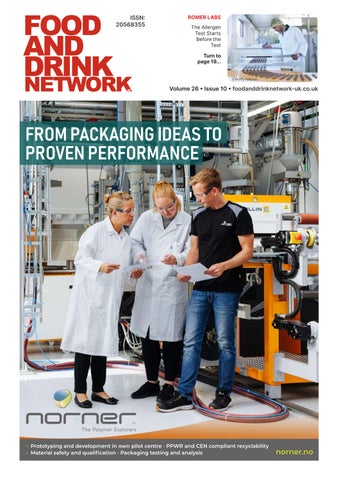
FOOD AND DRINK
ISSN: 20568355
ROMER LABS The Allergen Test Starts Before the Test Turn to page 19...
NETWORK UK
©Monty Rakusen
Volume 26 • Issue 10 • foodanddrinknetwork-uk.co.uk
FROM PACKAGING IDEAS TO PROVEN PERFORMANCE
• Prototyping and development in own pilot centre • PPWR and CEN compliant recyclability • Material safety and qualification • Packaging testing and analysis
norner.no
THE PACKAGING LANDSCAPE IS CHANGING FAST.
WHATEVER COMES NEXT, OPRL HAS YOU COVERED. Through trusted expertise, practical tools and dedicated support, we help businesses navigate packaging recyclability, compliance and changing regulations with confidence. From recyclability assessments and labelling requirements to legislative updates, industry insights and future-ready solutions, we help you stay informed, prepared and one step ahead.
Because OPRL goes beyond the label.
WITH OPRL, YOU CAN; Create recycling labels for your packaging
Run recyclability assessments for pEPR
Stay up to date with packaging legislation and industry changes
Discover more about membership : oprl.org.uk/join
Receive practical guidance and expert support
Access industry insights, webinars and exclusive resources
Make clearer, more confident packaging decisions
EDITORIAL:
ALB Communications BrauBeviale Business Show Media Dakota Digital Harford Control Ltd. - Specialist Writer Henry Pepper PR M1 Marketing Make More Noise Purple Pilchard PR Redwood Comms Smart Food Safe Spring and Tonic PR The PHA Group Tunley Environmental Westmount 360
ADVERTISEMENT SALES:
VOLUME 26 • ISSUE 10 Produced in Europe’s Food Town
02 06
NEWS NETWORK
AMANDA WALMSLEY EVELYN WOOLSTON
GRAPHICS STUDIO:
RACHEL RILEY - Manager
TELEPHONE: 01472 359036 EMAIL:
Kimberley Read at: kimberley@foodanddrinknetwork-uk.co.uk or Joanne Murphy at: joanne@foodanddrinknetwork-uk.co.uk
WEBSITE:
Even The Best Real-Time System Can Only Take You So Far Thinking Is Expensive: Moving Beyond Motion on the Factory Floor
09
An article By Roy Green, Harford Control Ltd.
BRAUBEVIALE 2026
16
METAL DETECTION
How Metal Detection Can Help Improve Processes and Performance
17
FOOD SAFETY, QUALITY & COMPLIANCE
Why Food Manufacturers Need a Structured Approach to Managing Change
TWITTER:
@fdnetworkuk
PRINT SUBSCRIPTION:
From hidden losses to smarter production at BrauBeviale 2026
10
24
SUSTAINABILITY
WHITE & PRIVATE LABEL EXPO
18
ALLERGENS
25. Apsley Dry Ice - Sustainable dry ice you can trust
26
27
SUPPLY CHAIN
Building a Stronger Supply Chain
11
18. Keeping Allergen Control Strong in a Changing Factory
WATER MANAGEMENT
11. Building resilience into production 12. Xylem From Wastewater to Resource: Copyright © 2026 All Rights Reserved.
23. Responding to packaging legislation
24. EU Carbon Neutral Claims: What Changes from September 2026?
Find us on LinkedIn
All rights reserved. No part of Food and Drink Network UK Magazine may be reproduced or stored in a retrieval system or transmitted in any form, electronic, mechanical or photocopying, without prior written permission of the publishers. The publishers do not accept responsibility for views expressed, or statements made, or in those reproduced from any other source. No responsibility is borne by the publishers for any errors made in any advertisement, or for claims made by any advertiser which are incorrect. The publishers cannot be held responsible for any breach of copyright arising from any material supplied. This includes copy, design and/or images.
PACKAGING & LABELLING
22. How to swerve the Emissions Trading hit
foodanddrinknetwork.co.uk
12 issues - £84.00 (inc. postage)
22
Keep the taste, cut the alcohol: the role of heat exchangers in AF brewing
ACCOUNTS & ADMINISTRATION:
WALTONS PUBLICATIONS LTD 46 HENEAGE ROAD, GRIMSBY N.E. LINCOLNSHIRE DN32 9ES
BREWING & BEVERAGES
SPECIALIST VIEW
KIMBERLEY READ (Advertisement Sales Manager) JOANNE MURPHY
PUBLISHED BY:
14
Is Water Reuse the Next Big Opportunity for Food & Beverage?
19. The Allergen Test Starts Before the Test
20
FOOD INNOVATION
Five forces reshaping the future of food in Europe: from AI-driven innovation to the rise of sensory indulgence
SUPPLY CHAIN & LOGISTICS
Rising Warehouse Rates Put Pressure on Operators to Make Better use of Existing Space
28
FOOD MACHINERY AUCTIONS
Circular economy: Acquire quality machinery through online auctions
News Network
General
Superfood drinks brand Revibed obtains offer of investment from TV entrepreneur The founders of superfood drinks brand, Revibed, have obtained an offer of investment of £50,000 and the backing of Dragons’ Den investor, Steven Bartlett.
Ivor and Eugene Patterson appeared on the latest series of the BBC hit show, which Speaking about the offer aired on 10th September, to present their alternative drinks brand that was created of investment, Eugene to encourage people to embrace a healthier and happier lifestyle. Patterson, founder of Revibed, said: “Appearing Following discussions about the company’s impressive growth to date and on Dragons’ Den was an current retail listings, the Dragons were given the opportunity to try the products extremely exciting opportunity, and to have secured the backing of themselves, which led to Steven Bartlett making an offer of £50,000 for a 15% stake Steven Bartlett made it even better. in the business. “We’re tremendously grateful for Steven’s offer of investment, and we The father and son duo founded the business in their family kitchen, inspired by have exciting plans in place to bring Revibed to even more consumers flavours from their Caribbean roots, such as hibiscus, ginger and lime. What began across the UK. We can’t wait to see what the future holds.” as a traditional festive drink for family and friends to enjoy became a passion for Eugene, who wanted to share his father’s beloved drink in the UK and beyond. For more information, visit: https://revibedrinks.com
Holie’s launches Wake Up Big Cereal campaign A European initiative for major manufacturers to remove added sugar from cereals
Holie’s, the Dutch disruptive challenger brand and the #2 cereal brand in both the Netherlands and Belgium, is launching Wake Up, Big Cereal; a European initiative challenging major cereal manufacturers to remove added sugar from their entire product ranges and use their scale to help make breakfast healthier across Europe. At wakeupbigcereal. today, manufacturers can see how Holie’s makes cereals without added sugar and find out more about the initiative. Europe is still consuming too much added sugar. Recent European research shows that adults across nine European countries consume an average of around 55 grams of added sugar per day. That is equivalent to almost 20 kilograms a year, or around 5,000 sugar cubes per person. A high intake of added sugar is not without consequences. Excessive sugar consumption contributes to overweight and tooth decay and has been associated with an increased risk of chronic conditions, including type 2 diabetes and cardiovascular disease. Valentijn van Santvoort, co-founder of Holie’s says: “Big brands are slowly starting to move in the right direction with products that contain no added sugar. Great. But the rest of their portfolios are being left behind. With their scale comes responsibility. It’s time to step things up. Less sugar should be the standard, not the alternative,” Already outselling Kellogg’s in its home market, Holie’s is now running at a £1 million annual run rate, up 300% year on year in the UK. Following the recent nationwide Morrisons listing the brand is driving more than 38% of category growth and has become the #1 brand in low sugar, high protein granola. Holie’s is already outselling more established challengers like Bio&Me and SURREAL. Find our more: www.wakeupbigcereal.today and www.holies.com
Nourished launches Sleep Pro - the UK’s first gummy powered by Pepti Sleep® as poor sleep affects millions across the UK Personalised nutrition brand, Nourished, has today announced the launch of Sleep Pro - an advanced sleep support gummy designed to help people achieve deeper, longer and more restorative sleep through an innovative, science-led formulation. The launch comes as poor sleep continues to affect millions of people across the UK. In fact, new research from Nourished found that 91% of UK adults wake during the night at least once a week, leaving just 9% fortunate enough to enjoy uninterrupted sleep. The research painted a worrying picture of a nation struggling to switch off, with more than half of Britons (56%) concerned poor sleep could have a long-term impact on their health. Developed using Nourished’s patented precision manufacturing technology, the formula combines a clinically studied dose of 250mg PeptiSleep® with vitamin C, Tart Cherry extract, zinc and vitamins B1, B6, B12 and D3 in a convenient sugar-free gummy designed to support healthy sleep as part of a nightly routine. In a clinical study involving adults with mild to moderate sleep impairment, participants taking 250mg of PeptiSleep® daily experienced a 17% increase in deep sleep, a 13% increase in REM sleep, around 40 additional minutes of total sleep per night, alongside improvements in next-day recovery measured using wearable sleep technology. Dr. Nora Khaldi, Founder and CEO of Nuritas, said: By combining advanced AI-powered discovery with rigorous scientific validation, we’ve identified a plant-derived peptide that has been clinically shown to improve key measures of sleep quality. We’re delighted to partner with Nourished to bring Sleep Pro - the first UK gummy featuring PeptiSleep® - to consumers. Together, we’re demonstrating how breakthrough science and innovative product development can make the latest advances in sleep support more accessible to everyday consumers. Sleep Pro is available now from get-nourished.com and selected Holland & Barrett stores nationwide, with an RRP of £29.99 for a tube containing 30 gummies.
02 | foodanddrinknetwork.co.uk
News Network
General
From alcohol-free to digital: Krones at BrauBeviale 2026 Alcohol-free beers, increasing demands for energy and resource efficiency, and the ongoing advance of digitalisation: the brewing industry is undergoing significant change. Krones will demonstrate how these developments can be translated into practice at BrauBeviale 2026. From 10 to 12 November, the company will present solutions covering the entire value chain in Hall 7A, from process technology and filling and packaging technology through to digital applications. Process technology: New requirements, new solutions One focus of Krones’ trade fair appearance will be process technology. In response to growing global demand for alcohol-free beers, Steinecker is continuously advancing its dynamic fermentation process. Based on the Poseidon circulation unit and combined with Crabtree-negative NEER yeasts from Novonesis, the solution is now in operation at several customer sites around the world. The experience gained from these projects is feeding directly into the further development of the process.
addition to improvements in operator convenience, hygiene and footprint, product quality was a key priority throughout the redesign. Low oxygen pickup values contribute to a longer shelf life for beer. Flexibility in the dry end
In palletising technology, Krones will present a newly developed layer pusher at BrauBeviale for the first time. The new machine combines a range of features from the existing portfolio in a single solution.
Whether alcohol-free beers, resourcePackaging requirements are also evolving. efficient production or digitalisation, the A growing variety of products and changing key themes of BrauBeviale 2026 reflect pack formats call for highly flexible solutions. the challenges currently facing breweries. The Smartpac NXT addresses precisely this Krones is addressing these developments trend. The packaging machine is designed to and will showcase practical solutions in handle bottle formatsUK, and133 secondary Fooddifferent and Drink Network x 186 mm, Digitalization andhelp AI, CC-en35-AZ036 Hall 7A that companies make 09/36 their packaging types. In addition to glass production operations efficient, flexible and containers, it can also process PET bottles. future-ready.
Alongside the brewing industry, Steinecker is also placing an increasing focus on other sectors. At BrauBeviale, the company will present for the first time an application example from the field of special vessel manufacturing for spirits production. This demonstrates how Steinecker’s expertise in stainless steel processing can be leveraged beyond the brewing industry, including applications in spirits and cheese production. In addition, Krones and Steinecker will provide insights into their own extraction system. This solution is particularly suitable for flavour extraction in tea beverages as well as alcoholic and non-alcoholic readyto-drink products. The technology enables the gentle recovery of valuable ingredients and further expands the portfolio of process solutions for the beverage industry. The exhibition programme will be complemented by solutions from Evoguard and further process technology developments, demonstrating how efficiency, product quality and flexibility can be enhanced simultaneously. Glass remains the benchmark in beer filling
More output. Less downtime.
Current brewery requirements are also at the heart of developments in filling and packaging technology. Glass remains the most important packaging type in the beer segment, which is why numerous innovations are focused on enabling the most resource-efficient and cost-effective handling of this container type.
Digital services, from analysis tools and intelligent operator guidance to AI, help to manage complexity, reduce costs and increase output. We connect data, technologies and processes for efficient, sustainable production – with less downtime.
With the Lavasonic HI, Krones offers the next generation of bottle cleaning technology. The new high-intensity module uses ultrasound to achieve highly efficient cleaning while reducing both energy and water consumption.
BrauBeviale 2026 Nuremberg, 10-12 November Hall 7A, Stand 503/521
In filling technology, the spotlight will be on the further developed Modulfill HES. The development project will be completed at the end of the year, with the new generation of fillers entering serial production. The system achieves outputs of up to 78,000 glass bottles per hour. In
krones.com
foodanddrinknetwork.co.uk | 03
News Network
General
Popcorn Kitchen Introduces Seasonal Boxes With Added Gifting Swagger As the gourmet popcorn for every occasion, it was perhaps inevitable that when it came to seasonal gifting this Autumn that Popcorn Kitchen would have something a little extra special hidden up its sleeves. The thinking was simple enough, create three luxurious offers overflowing with seasonal swagger; compelling seasonal flavours packed neatly in well-heeled, dapper packs that can be shared between friends and family throughout the festive period This latest batch of extra-festive, palatial flavours includes an immersive White Chocolate & Cranberry, a gloriously mischievous Double Chocolate Caramel Cookie and a timeless classic Gingerbread. According to brand spokesperson, Louise Webb, “Over the years Popcorn Kitchen has enjoyed a proud reputation for delivering both magnificently moreish gourmet popcorn and thoughtful gifting options. The thinking
Nourished continues UK retail expansion with Costco launch Costco UK selects Nourished as its only UK-manufactured functional gummy brand, rolling out across 29 warehouses nationwide Birmingham-based supplement brand strengthens UK retail footprint with Costco launch across 29 warehouses nationwide. British health-tech brand , Nourished, has today announced the nationwide launch of two of its science-backed functional supplements into Costco UK. Creatine+ Mind and Collagen+ Gut are now available across all 29 Costco warehouses from 31st August 2026. The launch continues Nourished’s rapid retail expansion following successful listings in Boots, Ocado and Holland & Barrett, bringing its science-led functional nutrition to millions more UK consumers. The listing also marks a significant milestone for Nourished as it becomes the first British-made gummy supplement brand to be stocked by Costco UK, further cementing the brand’s position as a leader in innovative functional nutrition. Manufactured at the advanced Birmingham facility of parent company Rem3dy Health, Nourished’s products showcase British innovation and manufacturing excellence on one of the UK’s largest retail stages. Nourished’s Creatine Mind has been developed to meet growing consumer interest in creatine beyond traditional sports nutrition, combining creatine monohydrate with citicoline, zinc and a vitamin B complex in a convenient sugar-free gummy format. A recommended daily serving delivers the clinically recognised 3g of creatine to support both physical and cognitive performance. Also launching into Costco is Collagen Gut, a science-led formula featuring Ovoderm®, a clinically studied eggshell membrane ingredient naturally containing collagen types I, V and X, elastin and hyaluronic acid. Combined with a Tribiotic Complex and vitamins C and D3,the formula is designed to support gut health, skin health and overall wellbeing and is delivered in Nourished’s signature sugar-free gummy format. It offers consumers a convenient and enjoyable way to incorporate clinically backed nutrition into their daily routine. As one of the world’s leading warehouse retailers, Costco is recognised for carefully selecting trusted, high-quality brands that offer strong value and innovation to its members. The partnership reflects growing demand for science-backed, clean-label nutritional products manufactured in the UK, alongside increasing consumer interest in convenient functional gummies. For further information, please visit: https://get-nourished.com/
04 | foodanddrinknetwork.co.uk
this year was to provide some added seasonal pizzazz at a keen, pocketfriendly price point in keeping with our long-term pledge to keep spreading pure popcorn happiness.” £4.99 (100g)
KB Event expands Krone fleet with 60 bespoke Dry Liners Event logistics specialist KB Event has taken delivery of 60 new Krone Dry Liner box trailers for use across its UK and European operations. Based in Nottinghamshire, KB Event provides logistics and transport services for the live events, exhibitions, broadcast, entertainment and touring industries. The company now operates a fleet of 200 Krone trailers. Designed to meet KB Event’s operational requirements, the new trailers incorporate a number of bespoke features to improve loading flexibility, cargo security and vehicle operation. Among the key specifications is dual ride height, allowing the trailers to operate with different tractor unit coupling heights while maintaining a level load platform, together with dedicated ramp carriers designed to accommodate 3,750 mm x 1,000 mm loading ramps. The trailers also feature Krone’s keyhole side wall loading system, providing multiple load restraint and load bar positioning options to help secure a wide variety of event equipment safely and efficiently. An insulated roof helps protect valuable cargo from temperature extremes, while full-length internal LED strip lighting provides excellent visibility during loading and unloading, particularly in low-light conditions. The trailers are finished in KB Event fleet livery. “We’ve worked closely with Krone to develop a trailer specification that reflects the specialist demands of our operation,” says Richard Burnett, CEO of KB Event. “The trailers combine the durability and build quality we expect with a number of bespoke features that make day-to-day loading, unloading and transporting equipment more efficient for our teams and for the crew onsite.” Chris Coxon, Regional Sales Manager at Krone Trailer UK, says: “KB Event has been a valued Krone customer for many years and this latest delivery demonstrates the strength of the relationship between our two businesses. “By working closely with the customer, we’ve been able to specify a trailer that meets its operational requirements, providing a combination of durability, practicality and long-term reliability.”
News Network
General
Cribbs continues F&B evolution with Pho letting Vietnamese street food operator Pho has become the latest new dining arrival at Cribbs after signing a 15-year lease for a 3,681 sq ft space. Pho will replace Carluccio’s when it opens later this year and follows the recent openings of Picaro Lounge, Joe & The Juice, Pizza Express, Honest Burgers, and Wingstop as Cribbs continues to evolve its F&B offering. This is set to become Pho’s second location in Bristol as it continues its UK expansion and will join favourites Wagamama, Nando’s, and Itsu, to cement Cribbs’ position as the South West’s leading retail and leisure destination which offers visitors a full day out experience.
Brabazon development set to deliver 6,500 homes and 2,000 student rooms. Meanwhile, the 19,500-capacity arena at the site, which is set to open in 2028, will see many eventgoers choose Cribbs for pre-concert meals and drinks.
Offering freshly made Vietnamese street food ranging from signature pho noodle soups to curry, rice bowls and salads, Pho will benefit from the growing residential community across the Cribbs Causeway area with the
Libby Andrews, Marketing Director from Pho said: “We have been operating in Bristol for just over ten years now and absolutely love the city. We are really pleased to have partnered with Cribbs’ to open soon in what is becoming a very exciting and diverse F&B offering in the region.”
AI-driven CVs create recruitment headache for employers
DASH Launches in Greggs as Brand Builds on Record-Breaking Summer
A Midlands recruitment firm has urged businesses to rethink how they screen jobseekers as AI is making it easier for candidates to submit large volumes of job applications at the click of a button.
DASH rolls out to over 500 Greggs shops nationwide as demand grows for soft drinks without sugar or sweeteners
The recent run of new F&B arrivals comes as Cribbs looks to refresh its dining offer to cater for its growing Gen Z audience, which rose by 13% over 2025.
Joanna Pennell, divisional manager at Worcester-based Pineapple Recruitment, which recruits candidates for the hospitality and catering sectors, says that while the rapid development of AI is transforming the recruitment landscape, employers need to ensure technology does not come at the expense of identifying genuine experience and capability. Mrs Pennell said: “Despite the technological shifts, people still genuinely want to build successful careers, but the way candidates apply for roles has fundamentally changed, meaning hiring managers also need to evolve how they assess applications. “Sadly, modern AI tools and automated bots allow jobseekers to send hundreds of polished CVs across job portals in a matter of minutes. This has created a frustrating paradox for hiring managers: an overwhelming volume of applications alongside a shortage of candidates with the practical experience, skills and capabilities required.” Mrs Pennell added that AI-generated CVs can display several tell-tale signs once employers know what to look for, including buzzwords and identical tone, but said there is a way employers can deal with the growing issue without creating unnecessary barriers for genuine applicants. She added: “One way employers can reduce bot-driven applications is to introduce a small amount of intentional friction at the initial application stage. For example, screening questions can help deter automated bots and mass-applicants. A locationbased question can also be particularly useful, with geography providing a simple way to identify applications that may not reflect genuine interest in the role. “More than anything, technology should streamline recruitment, not complicate it. By adding a little intentional friction upfront, or by using smart tools without losing the human touch, employers can protect their time without penalising great applicants.” For more information readers and businesses can visit https://www.pineapple-recruitment.co.uk, or call 0333 070 5981.
The UK’s fastest-growing soft drink brand*, DASH is celebrating a major new milestone with its launch into 550 Greggs shops nationwide, bringing its range of drinks made with simple ingredients, no sugar and no sweeteners to millions more consumers across the UK. The nationwide rollout comes off the back of DASH’s biggest summer ever, with the brand recording 48% YoY growth. DASH sold more than 20 million cans this summer, putting the brand on track to sell more than 60 million cans in 2026. The Greggs launch marks another significant step in DASH’s mission to make healthier soft drinks more accessible, bringing the brand into one of the UK’s most recognisable food-to-go retailers. Since launching in 2017, co-founders Alex Wright and Jack Scott have set out to challenge the conventional soft drinks category with great-tasting drinks made without added sugar or artificial sweeteners. Using wonky fruit that others say no to, DASH creates refreshing drinks that prove healthier choices don’t have to mean compromising on taste. For the founders, the launch into Greggs marks an exciting milestone for DASH, bringing the brand to even more customers across the UK. “Greggs feels like a big milestone for DASH,” said Alex Wright, CEO and Co-Founder of DASH Water. “When Jack and I started DASH, we wanted to create a drink made with simple ingredients that tastes great. We’re proud that DASH offers customers another choice when they’re looking for a refreshing soft drink, with no added sugar or sweeteners. “We’re thrilled to be working with Greggs, one of the UK’s most loved food-on-the-go brands. As consumer preferences continue to evolve, it’s important that people have plenty of choice, and we’re delighted that DASH is now part of Greggs drinks offering. And personally, I think DASH and a sausage roll make a pretty great pairing!” The launch builds on DASH’s rapid expansion in the UK and internationally. Today, the brand is sold in 12 countries and is on track to generate more than £60 million RSV in 2026.
foodanddrinknetwork.co.uk | 05
Specialist View
Even The Best Real-Time System Can Only Take You So Far Thinking Is Expensive: Moving Beyond Motion on the Factory Floor An article by Roy Green, Harford Control Ltd. October 2026 Having just returned from the PPMA Show, our team at Harford Control spent three busy days in conversations with operations directors, quality heads, plant engineers and others. Walking the halls, the sheer volume of hardware on display was impressive: highspeed lines, sophisticated vision inspection systems, advanced checkweighers with robots and AI everywhere. The capital investment across processing and packaging is clearly high. Yet, sitting down with senior leadership to talk about day-to-day plant reality, a recurring theme surfaced. One of the easiest traps in manufacturing management is assuming that high operational motion means actual progress. Walk almost any packing hall, and you will see relentless activity: operators pacing between scales, supervisors ticking off clipboards, shift handovers happening on schedule, and engineering teams tweaking settings. Everyone is working hard. Yet at the end of the month, OEE stagnates, giveaway remains high, and rework costs continue to erode margins.
06 | foodanddrinknetwork.co.uk
Motion is everywhere, but real progress is hard to find.
The High Cost of Critical Thinking Activity is a convenient proxy for Progress. It feels good because it looks productive. But often, high operational noise is simply easier than making the uncomfortable strategic choices about what needs to stop and what needs to be done differently. Real operational improvement requires deep thinking. It demands that management step back, challenge long-standing habits, analyse root causes and accept uncomfortable trade-offs. Thinking takes time, context, crossdepartmental debate, and a willingness to confront systemic flaws. Filling out another paper log or holding another operational review is far less taxing than fundamentally changing how a plant operates.
Consider the classic paperbased quality audit. An operator stops production every 30 minutes to record batch codes, write down seal temperatures, or log checkweigher readings onto a clipboard sheet. On paper, the plant looks disciplined, compliant and tightly controlled.
In reality, paper recording is postmortem documentation disguised as quality control. It consumes valuable operator time, introduces human transcription errors, and buries critical trends in filing cabinets. More importantly, paper only tells you what has already gone wrong. By the time a supervisor notices a drift in target weight or a subtle shift in seal integrity on a handwritten sheet, thousands of non-compliant units have already passed down the line. The result? Mass giveaway, expensive rework or outright scrap.
If Data Isn’t Actionable, It’s Just History To break the cycle of pointless motion, manufacturing leaders must separate retrospective record-keeping from real-time, actionable control. Data collected hours, or even minutes, after a run offers zero operational value to the operator standing on the line right now. True control requires real-time intelligence: data captured automatically at the exact point of action, analysed instantly against limits, and presented directly to the line team before a defect occurs.
Harford Control Ltd. When you replace manual paper logs with automated, real-time feedback, the role of your shop-floor team changes overnight: Manual Paper Audits
Real-Time Actionable Data
Retrospective reporting Uncontrolled weight giveaway Instant line-level alerts Defect prevention at source
High risk of transcription errors Operator as data clerk Automated compliance checks Operator as decision-maker
Operators stop acting as manual data entry clerks chasing historic mistakes. Instead, they are empowered to make immediate, precise adjustments that preserve product quality, protect brand integrity and safeguard margins.
Where Human Leadership Actually Adds Value As production lines become increasingly automated and digital systems take over line monitoring, senior directors face a strategic question: Where do human teams create genuine value on the modern factory floor? It is certainly not in copying scale readings onto paper, checking packaging dates by eye, or manually calculating average weights across a shift. The real human advantage lies in context, judgment, and strategic decision-making: • Challenging Systemic Targets: Questioning why a specific target weight or line speed was set, rather than simply monitoring compliance against an outdated benchmark. • Understanding Root Causes: Distinguishing between a minor environmental fluctuation and a recurring mechanical fault that requires engineering intervention, incidentally differentiating between common and special causes of variations. • Managing Operational Trade-offs: Knowing precisely when to pause a high-
speed line to preserve long-term asset health versus pushing throughput to meet short-term dispatch deadlines. Automated systems excel at capturing operational facts and flagging variance. But technology cannot replace executive judgment: the responsibility of deciding what is actually worth doing to drive bottom-line performance.
Eliminating Busywork with Harford Control For leaders looking to turn post-show reflection into bottom-line progress, Harford Control provides the end-to-end management infrastructure needed to transform plant operations. Harford’s integrated Manufacturing Execution System (MES) eliminates paper recording across the factory floor, replacing unreliable manual logs with dynamic, automated quality control. By directly interfacing touchscreen terminals with production hardware (weighing scales, vision systems, autocoders, lab equipment and more), Harford captures precise operational data automatically at the source.
interval control alerts. Operators receive visual guidance on the production line, preventing giveaway, coding errors, and out-of-spec packaging before waste occurs. By automating routine compliance and data capture, Harford removes administrative busywork from your team, freeing your managers and operators to focus on problem-solving, continuous improvement, and margin protection. All enquiries and discussions gathered at the PPMA Show are currently being followed up by our team. If you missed us at the exhibition, you can request a tailored, plant-specific evaluation and demonstration on your own premises.
Contact harfordcontrol.com or call us directly on +44 (0)1225 764461.
Instead of flooding management with static spreadsheets and retrospective OEE reports, Harford translates raw shop-floor data into immediate, short
foodanddrinknetwork.co.uk | 07
Specialist View
Harford Control Ltd.
Is your factory floor driving progress, or just highly active? Before
After
Paper logs, manual checks, and shift-end reports feel productive. But retrospective data only tells you what you have already lost in giveaway, coding errors, and lost line performance. Harford Control replaces administrative busywork with Full Factory MES solutions:
Paperless Quality
Autocoding & Label Verification
Weight & Volume Control
Reduce giveaway. No more paperwork! Cut materials loss. Scheduled quality Lower the total packagassurance checks with ing weight you place on instant verification and corrective action advice to the market, legally and improve quality consistency. safely & reduce the risk of product recalls.
Remove human error Expose hidden downtime from coding and labelling. and energy drains. Avoid recalls, rework, Reduce cost per unit while and increased EPR energy prices remain penalties. excessive.
Why Choose Harford? We have more than 60 years' experience gained through helping companies achieve optimal control, reduce wastage, ensure consistent quality compliance and improve efficiency. Our on-site service support is provided 24/7, by our global network of Field Service Engineers. 08 | foodanddrinknetwork.co.uk
Real-time OEE & Energy Tracking
Get In Touch +44 (0)1225 764461 +44 (0)1225 764461 info@harfordcontrol.com info@harfordcontrol.com www.harfordcontrol.com www.harfordcontrol.com
Explore Harford SPC Explore Harford MES and book a discovery call and request a demo
BrauBeviale 2026
Exhibitions
From hidden losses to smarter production at BrauBeviale 2026 From resource consumption to predictive maintenance, BrauBeviale 2026 puts the focus on the detail behind more efficient production. Most conversations about the future of drinks production are conducted at the level of strategy, which is a pity, because efficiency is rarely won there. It is won by finding small losses, measuring them properly and fixing them consistently, several levels below where the strategy is written. Consider a conductivity meter on a CIP line with faulty cable routing. An unreliable electrical signal can result in cleaning agent being over- or under-dosed, while something as simple as a worn seal on an electromagnetic flow meter can allow liquid ingress over time and eventually lead to incorrect measurements, insufficient cleaning and, in the worst case, product recalls. Writing for BrauBeviale’s Industry Insights, food technologist Thomas Birus notes that the cost of an unplanned production stoppage can run into tens of thousands of euros within hours once staff time and product losses are taken into account, before potential penalties for non-delivery. Finding those losses starts with measuring what is actually being consumed. Litres of water per litre of beverage, kilowatt-hours per cubic metre, detergent consumption, packaging units per thousand litres and product loss rates all provide meaningful benchmarks when tracked consistently. Water and wastewater can produce measurable results particularly quickly, while improvements in resource efficiency can reduce operating and disposal costs alongside environmental impact. The same principle applies further down the line, where apparently minor variables can have an outsized effect on reliability. In robotic packaging applications, repeatability can be more important than absolute accuracy, while even subtle changes to a cardboard surface or printing ink can affect the way
a gripper handles a product and increase error rates. These are precisely the kinds of details worth discussing directly with equipment and automation suppliers. Artificial intelligence is also changing how quickly such issues can surface. Machine learning can identify known faults such as poorly applied labels or illegible best-before dates, while unsupervised systems can flag hidden anomalies in process data. Predictive maintenance and real-time analysis offer further opportunities to reduce downtime and wastage. Whether that delivers value, however, depends on using AI where the benefit is clear and, as Barbara Engels of the German Economic Institute argues, considering implementation and cybersecurity together from the outset. These are questions that can be easier to explore face to face than through a specification sheet. From 10 to 12 November, BrauBeviale 2026 will bring together suppliers across process technology, automation, energy, packaging, analytics and the wider beverage-production chain, giving producers the opportunity to examine what these incremental gains could mean for their own operations.
New routes to Nuremberg Getting there is also becoming easier for UK visitors. easyJet begins its new Manchester to Nuremberg service on 2 November, operating Mondays and Fridays, while Ryanair continues to connect London Stansted with Nuremberg. From Nuremberg Airport, the exhibition centre can be reached by U-Bahn in around 20 minutes. foodanddrinknetwork.co.uk | 09
THE UK’S LEADING PRODUCT SOURCING EVENT. The White & Private Label Expo is London’s leading retail event, bringing together hundreds of manufacturers with thousands of retailers, online sellers, and e-commerce professionals.
Join us at Excel London on 11th & 12th November,
where the show connects you with trusted white label suppliers and private label manufacturers across key sectors. From low MOQ white label products to large-scale custom private label production, you will find the ideal supplier for your business.
Listen to our hand-selected group of industry experts delivering seminars
and keynote sessions on e-commerce, retail, white label, and logistics. You
will gain the knowledge you need to start, grow, or scale your retail or e-commerce business.
BOOK YOUR FREE TICKETS
RUNNING ALONGSIDE
Water Management
Building resilience into production Water is fundamental to food and drink production, but managing it effectively is becoming increasingly important. From reducing demand to recovering and reusing water, a more flexible approach can help manufacturers control costs, protect production and strengthen operational resilience. For food and drink manufacturers, reliable access to water is essential. It supports processing, cleaning, cooling, heating and hygiene, while also forming part of many finished products. Any disruption to supply or treatment can therefore have consequences far beyond the water system itself. Managing water effectively starts with understanding how it moves through a site. Overall consumption figures provide a useful benchmark, but greater visibility across individual processes can reveal where water is being used inefficiently, where losses are occurring and where improvements could make the greatest difference.
Finding value in wastewater Attention is increasingly turning to what happens after water has been used. Rather than automatically treating wastewater as something to be discharged, manufacturers can consider whether some streams could be treated and used again elsewhere within the site for other suitable purposes. The opportunities will vary between facilities and processes. Water quality, hygiene requirements and its intended next use all need careful consideration. However, recovering suitable water for appropriate non-product applications can reduce demand for fresh supplies while also lowering the volume requiring disposal. There can be wider efficiencies too. Water frequently requires pumping, heating, cooling or treatment as it passes through production. Reducing unnecessary demand or recovering water can therefore influence energy consumption and operating costs as well as overall water use.
Preparing for disruption Efficiency is only one part of good water management. Manufacturers also need to consider what happens when equipment fails, maintenance is required or production demand temporarily exceeds existing treatment capacity. Building flexibility into water and wastewater systems can help facilities respond without unnecessarily interrupting production. This could involve reviewing available treatment capacity, identifying critical equipment and establishing contingency arrangements before they are needed. The approach is particularly relevant to facilities where production volumes fluctuate. Additional capacity may be required during seasonal peaks, new product launches or periods of expansion, without necessarily becoming a permanent requirement.
Looking at the whole process Water management works best when considered as part of the wider production strategy. Engineering, production, hygiene and environmental teams may view water differently, but each can identify opportunities to improve its use and management. The objective is not simply to reduce the litres entering a factory. It is to make better use of available water while maintaining hygiene, product quality and reliable output. As manufacturers face pressure to control costs, improve resource efficiency and protect production from disruption, treating water as a valuable operational resource rather than simply a utility can provide a stronger foundation for the future.
foodanddrinknetwork.co.uk | 11
From Wastewater to Resource: Is Water Reuse the Next Big Opportunity for Food & Beverage? Water has long been treated as a disposable input in the food and beverage industry — drawn in, used once, and discharged. That model is breaking down. Tighter discharge limits, rising tariffs, and growing water-stress are pushing manufacturers to rethink wastewater as a recoverable resource rather than a cost line. The question is no longer whether water reuse makes sense, but how to make it operationally and financially resilient. Why distributed operation matters A single centralized treatment system looks elegant on a flow diagram, but it introduces a single point of failure that food and beverage plants can ill afford. Production schedules are unforgiving, and a treatment upset can cascade into downtime, spoiled batches, or compliance breaches. Distributed operation — multiple, smaller treatment units placed closer to the point of generation — changes the risk profile. Each module handles a specific stream, so an upset at one node doesn’t cripple the whole facility. Maintenance can be staged without halting output, and capacity scales incrementally as production grows.
Rental services: when flexibility beats ownership Even the best-distributed architecture has bad days. A membrane fouls, a pump fails, or a regulatory deadline lands mid-project. Many of these situations require an immediate response but don’t justify a permanent investment — a capital project can take 12 to 24 months from concept to commissioning, while a rental solution can be mobilized within weeks. Rental modular treatment systems bridge the gap fast. Mobile DAF units, containerized MBRs, and filtration skids deploy quickly, hold effluent quality steady, and scale up or down as requirements
change. Manufacturers preserve capital and redirect investment toward growth and profitability, rather than tying up funds in assets needed only periodically.
Outsourcing water management Food and beverage manufacturers should focus on what they do best: producing high-quality products and responding to market demand. Production lines shift, new products launch with little notice, and volumes fluctuate. Water treatment should support that flexibility, not limit it. By outsourcing water management to specialists, manufacturers gain expertise, rapid response, and adaptable capacity without owning and maintaining treatment assets. The question shifts from “How do we build this?” to “What is the fastest, lowest-risk, most flexible way to achieve our water objectives?”
The bottom line Water reuse is a genuine opportunity — but the value is realized only when the system keeps running and the cost model stays flexible. Distributed operation reduces single-point risk. Rental services protect the operation when breakdown or maintenance intervene. Outsourcing lets manufacturers stay focused on their core business. Together, they turn water reuse from a sustainability initiative into a dependable production advantage.
12 | foodanddrinknetwork.co.uk
Water Management
Reduce downtime. Increase capacity. Temporary water treatment solutions to ensure continuous operation in case of emergency or maintenance.
Scan to Learn More
© 2026 Xylem Inc. or its subsidiaries or affiliates.
foodanddrinknetwork.co.uk | 13
HRS Heat Exchangers
Keep the taste, cut the alcohol: the role of heat exchangers in AF brewing
By Matt Hale, Global Business Development Director, HRS Heat Exchangers The popularity of low alcohol and alcohol-free (AF) beers and ciders has increased massively in recent years, driven by health and social considerations. Many of these drinks are produced in a similar way to conventional beers and ciders, so the equipment required, such as heat exchangers, remains the same and the same factors must be considered during the selection process.
IWSR forecasts that global consumption of no-alcohol analogue drinks (including no-alcohol beer, wine, ready-to-drink products, and spirits) will grow 36% by volume between 2024 and 2029, ‘reaching over 18 billion servings of no-alcohol analogues’.1 Market Research Future goes further, suggesting that the global market for low alcohol beer will be worth US$ 36.22 billion by 2035, with a compound annual growth rate (CAGR) of 6.12%.2 This trend builds on the growth seen in the previous decade, with Brewers of Europe stating that consumption of low and no-alcohol beer across the continent rose from 3.5% of the total beer market in 2012 to just over 6% by 20213. “No-alcohol analogues like no-alcohol beer and wine are an increasingly popular way for drinkers to moderate their alcohol intake,” explains Susie Goldspink, Head of No & Low Alcohol at IWSR. “By mimicking the taste and appearance of alcoholic beverages, drinkers who want to moderate can participate fully in occasions without feeling left out.”
strain of yeast (particularly those which are maltose-negative) to limit fermentation. In the past, a lack of commercial availability, together with knowledge gaps, have proved challenging. Over the last few years, however, there have been some major breakthroughs in overcoming the flavour and aroma weaknesses of biological methods. The most common physical method of removing alcohol is dealcoholisation through distillation, either using vacuum evaporation, or reverse osmosis via a membrane. The technology associated with membranes has advanced significantly in recent years, but the technique is still expensive and therefore is mostly used by larger breweries. Vacuum distillation and evaporation require
Overcoming production challenges Accounting for 93% of Europe’s low and no-alcohol beverage market in terms of value, beer is the most popular beverage in this growing sector. However, traditionally it has been difficult for producers to make high-quality low and no-alcohol beer alternatives. That is now changing, with brewers following two main approaches, both of which have their pros and cons. The first is to restrict alcohol formation during fermentation, and the second is to remove the alcohol after the beer has been produced. Restricting the production of alcohol during fermentation either involves stopping the process prematurely, or using a specific 14 | foodanddrinknetwork.co.uk
After boiling the wort must be cooled rapidly to prevent off flavours
Brewing & Beverages tight temperature control to maintain quality, but often provide the best result when a brewery is trying to replicate the taste of an existing standard beer. As well as the technical aspects, historically, quality factors associated with low and no-alcohol beers, such as taste, mouth feel and shelf life, have also proved challenging as many are directly or indirectly dependent on the ethanol itself. This means that the best alcohol-free beers are often specifically formulated as yeast, hops and sweeteners can all be used in the recipe to compensate for the lack of alcohol.
The role of heat exchangers The increasing availability of better yeast strains means that it is now possible to produce better tasting and higher quality low and no-alcohol beers using standard equipment. However, it is generally recognised that the recipe design, process control and packaging management of low and no-alcohol beers are even more important than with traditional products. That means that temperature control is crucial at several key stages. For example, maintaining higher mash temperatures (>72°C) and reducing mash time will lower beta-amylase activity and fermentation (and therefore alcohol level in the final product). After boiling, the wort must be cooled rapidly to prevent off flavours caused by the production of dimethyl sulphide (DMS) – typically achieved by reducing temperatures from ~95°C to ~12°C. Both plate and tubular heat exchangers can be used here, but tubular heat exchangers often have a larger capacity and can therefore chill the wort more quickly. Where vacuum distillation is used to remove alcohol, specific temperature regimes are essential to prevent the formation of undesirable off flavours. Evaporation systems based on heat exchangers, such as the corrugated tube HRS K Series, are ideal given the low viscosity and fouling potential of most beers. Using chilled water or other coolants can also cool fermented beer prior to maturation or bottling. Again, heat exchangers are ideal for this, offering high levels of temperature control together with continuous processing. As many low and no-alcohol beers lack the typical microbial deterrents found in regular beer – as well as lacking the preservative effects of alcohol – pasteurisation is even more important. In particular, the use of High-Temperature, Short-Time (HTST) pasteurisation techniques will help to preserve the refreshing taste which is so distinctive to many such products.
The HRS Thermblock Series provides an integrated pasteurisation solution
Not only does pasteurisation ensure microbial stability and extend shelf life, but in most cases it also helps to preserve the taste of the product over time. Either integrated heat exchangers, such as the HRS MI Series of multitube corrugated tube technology, or integrated systems – like the HRS Thermblock Series – are ideal for this stage of production. Heat exchangers can also play an important role in treating the waste products of brewing. Anaerobic digestion (AD) is a popular way of treating the wastewater and slurry from breweries as they often have a high concentration of yeast and sugars, making them an ideal feedstock. Heat exchangers have many uses in AD including digester heating, pasteurisation so that the resulting digestate can be sold as a valuable biofertiliser, and evaporation to reduce the water content of digestate.
Energy recovery and energy efficiency Many stages of the brewing process also offer excellent opportunities to recover heat (also known as heat regeneration), helping brewers increase energy efficiency while saving money and boosting their green credentials at the same time. For example, the warmed water (or other cooling medium) produced after the wort has been cooled often has a temperature of around 80°C, making it ideal for pre-heating the steeped wort before boiling, and reducing the overall energy inputs required for the boiling process. Later in the process, evaporation using heat exchangers is also an energy efficient method for reducing the water content of spent grains, which can then be used as animal feed or bioenergy feedstock. Recapturing and reusing heat from other sources (such as surplus heat from cooling operations or spare boiler capacity) can be an effective way of increasing capacity or adding a new production process without the need for major new heating or energy infrastructure. Depending on the application, HRS Heat Exchangers’ equipment has been shown to recover as much as 50 per cent of previously wasted heat, which can then be used for water, space or process heating, waste treatment or other thermal applications. To discuss the numerous ways that heat exchangers can be used in conventional and low and no-alcohol brewing, as well as discover the projects that HRS Heat Exchangers have undertaken around the world, please contact us today.
Where pasteurisation is required, the HRS MI Series is ideal
1 No-alcohol and functional drinks both booming but for different reasons: https://www.theiwsr.com/ insight/press-release/no-alcohol-and-functional-drinks-both-booming-but-for-different-reasons/ 2 https://www.marketresearchfuture.com/reports/low-alcohol-beer-market-27484 3 World Brewing Alliance: https://worldbrewingalliance.org/a-sobering-look-at-beers-new-trend/
foodanddrinknetwork.co.uk | 15
Metal Detection
Mettler Toledo
How Metal Detection Can Help Improve Processes and Performance By Stuart Preston, Business Development Manager, Mettler Toledo On a fast-moving food production line, metal detection is seen as a vital check before product leaves the site. Its job is clear. Stop contaminated product from reaching consumers, protect brand reputation and support compliance with GFSI-recognised standards and retailer requirements. Yet the latest systems can do more than act as a final barrier. Used well, metal detection can improve process control, support productivity, and compliance. For many food manufacturers, the pain points fall into three connected areas. Performance, productivity, and protection. Performance means detecting the smallest metal contaminants with greater consistency, including difficult contaminants such as fine wire and swarf. Productivity means reducing product waste, limiting false rejects, removing unnecessary stoppages, and helping operators keep lines moving. Protection is increasingly about secure access, data capture, traceability and reporting, all of which now play a greater role in audits and customer requirements. Sensitivity sits at the heart of performance, but higher sensitivity alone is not the answer. There are different ways of increasing sensitivity depending on the product. This is because in real production environments products can vary significantly. Wet, conductive, chilled, partially frozen, and metallised film products can all create signals that make inspection more complex. When a metal detector is working close to its sensitivity limit, that variability can increase false rejects, creating waste, disruption, and additional checks. Modern metal detection systems with better performance are designed to give manufacturers more headroom plus fewer false rejects. For dry, non-conductive products such as biscuits, confectionery, sugar and flour, higher tuned frequencies can amplify the signal from smaller metal contaminants. When combined with stronger field technologies, this can make small fragments easier to identify while keeping good product moving.
such as ready meals, meat, poultry, seafood, partially frozen foods, and products in metallised packaging. Productivity also depends on how quickly people can use and respond to the system. Large touchscreen interfaces that can be operated without the removal of gloves, can aid with ease of use and save time and improve productivity. RFID login simplifies the login process making it quicker and more compliant than traditional password-based access. Diagnostic support can also reduce unplanned downtime. Software that identifies the cause of a line stoppage and guides the operator through the next step can help production recover faster. If service support is needed, QR codes can help teams access fault codes in advance, supporting a quicker response and a stronger first-time fix rate. The third area is protection. Today, inspection data is becoming as important as the inspection event itself. Individual logins support accountability, while access logs, alarm logs, detection logs, performance monitoring records, and diagnostic logs help create a stronger audit trail. Data logs can be transferred by Wi-Fi, whilst all data can be transferred directly to MES and ERP systems through OPC UA, Ethernet/IP or managed through dedicated data capture software such as ProdXTM from Mettler Toledo. For food manufacturers under pressure to reduce waste, maintain compliance and keep lines running efficiently, modern and advanced metal detection can make a measurable difference. By improving sensitivity, reducing false rejects, simplifying operator interaction and strengthening data capture and management, it can help turn a necessary inspection step into a source of better performance, stronger protection, and long-term production value.
Wet and conductive products bring a different challenge because the product itself can behave like a contaminant signal. This is known as product effect. Multi-Simultaneous Frequency systems and Product Signal Suppression algorithms help remove product effect, leading to a clearer contaminant signal, and creating a more accurate inspection result. A simple analogy is noise cancelling technology. Reduce the background interference and the signal you need becomes clearer. In metal detection terms, reducing the product signal makes smaller residual signals, especially potential contaminants, easier to identify. One example is the M56R from Mettler Toledo, which uses product signal suppression technology, the 3S PLUS algorithm and AI-driven machine learning to help reduce product effect in applications To find out more, download the M50 R-Series metal detection brochure visit: www.mt.com/md-m50r-brochure-pr
16 | foodanddrinknetwork.co.uk
Smart Food Safe
Food Safety, Quality & Compliance
Why Food Manufacturers Need a Structured Approach to Managing Change Changes are a regular part of food and beverage manufacturing. Ingredients are replaced, suppliers change, products are reformulated, packaging is updated, equipment is upgraded and production processes evolve. While these changes may appear routine, they can affect multiple parts of manufacturing. The focus should be on understanding and coordinating a change before final implementation in practice.
Start by Defining the Change Every change should begin with a clear understanding of what is being changed and why. The request can identify the affected product, process, site or function. For example, replacing an ingredient supplier may involve more than updating purchasing information. Teams may need to review specifications, product characteristics, packaging information or related production requirements. Clearly defining the change gives everyone a common starting point.
Assess What Else Could Be Affected Before a change moves forward, teams can ask: What else could this change affect? Depending on the type of change, areas for consideration may include ingredients and suppliers, processes and equipment, food safety and quality activities, packaging and labelling, documents, customer requirements and employee training. A practical approach is: Change → Impact → Required Action. For each identified impact, teams can determine what needs to be reviewed, updated, communicated or completed before implementation.
Turn Assessment Into a Controlled Workflow
Once impacts are understood, the change can then move through a structured workflow Request → Assess → Review → Approve → Implement → Verify → Record.
Appropriate people can review a proposed change, while designated individuals can approve it and take responsibility for actions. After implementation, verification can confirm that planned actions were completed. Keeping these details together also creates a useful history of the decision and actions.
Digitalize the Change Management Managing change through emails, spreadsheets and separate documents can make it harder to follow requests, responsibilities and actions. Digital change management systems can bring these activities into a more structured workflow, covering change requests, impact assessments, reviews, approvals, implementation and change history in one centralised system. Platforms such as Smart Food Safe provide this type of structured approach to managing change.
Making Change More Structured Our goal is definitely not to stop change but rather to provide a clear process for every change. In fact, when a change is announced, the affected areas are identified, the tasks are given to people and the implementation is documented, then the teams have a very straightforward way to follow the changes from the initial request to the finishing point. So, a change that is well documented should provide a clear trace of what was changed, the reasons for the change, the people involved, the actions required, and the verification of how the implementation was done. Though, the change methods and the procedures may differ for various manufacturing sectors and industries.
Author Credits : 1. Prasant Prusty (Founder & CEO, Smart Food Safe) 2. Mahmad Aseef (Digital Marketing Analyst, Smart Food Safe )
foodanddrinknetwork.co.uk | 17
Allergens
Keeping Allergen Control Strong in a Changing Factory Allergen management is firmly established within food manufacturing, but maintaining effective controls is rarely a case of putting procedures in place and leaving them unchanged. Production environments continually evolve. New ingredients arrive, recipes are reformulated, suppliers change, equipment is modified and production schedules become more demanding. Each change has the potential to alter the allergen risks within a facility. For manufacturers producing multiple products on shared lines, the challenge is particularly complex. An ingredient containing one of the regulated allergens may be used for only a small proportion of the production schedule, yet its movement through storage, weighing, processing and packing can create opportunities for unintended cross-contact.
People are equally important. Clear procedures can quickly lose effectiveness if employees do not understand why they exist. Training should extend beyond identifying allergenic ingredients to explaining how everyday actions, such as changing utensils, moving containers, handling rework or failing to follow clothing controls, can introduce risk elsewhere in production.
Good control therefore starts with understanding how allergens move through the entire site. Ingredient intake and storage are obvious areas, but attention is also required around decanting, weighing stations, utensils, rework, waste handling and the movement of employees between production areas. Powders and small particulates can be especially difficult to contain, making segregation and wellplanned production practices important.
Labelling provides the final important safeguard, but it cannot compensate for weaknesses earlier in the process. Packaging changeovers, label verification and recipe information all require close control to ensure the correct information reaches the consumer.
Cleaning remains another critical control. A cleaning procedure that works effectively on one piece of equipment or product may not automatically deliver the same result elsewhere. Equipment design, inaccessible areas, product characteristics and the type of allergenic material involved can all influence how easily residues are removed. Manufacturers consequently need cleaning procedures that reflect the realities of their individual processes rather than relying solely on standard routines.
18 | foodanddrinknetwork.co.uk
Ultimately, effective allergen management depends on maintaining visibility across the whole operation. Regularly reviewing processes following changes to ingredients, suppliers, equipment or production patterns can help manufacturers identify emerging risks before they become established problems. In a busy factory, strong allergen control is not a single activity but a connected system stretching from goods-in to the finished pack.
Allergens
Romer Labs
Complete Allergen The Allergen Test Starts Before the Test Management Solutions in the UK For food manufacturers, allergen testing has become an essential part of food safety programmes. Yet one of the most important influences on test reliability often receives less attention than the analytical method itself: the sampling strategy. analysis – From on-site rapid testing to accredited UK laboratory
total confidence across yourdistributed production environment. Many allergen contamination events are unevenly throughout a product or production environment. Milk powder carried over after a changeover, sesame remaining in a seeder or on a depositor, or nut particles that have travelled as dust from an adjacent line may only be present in isolated areas of the production process. As a result, a sample can test negative without fully reflecting the actual allergen risk. This creates a challenge for quality and technical teams. While modern analytical methods are highly sensitive, they can only detect what is present in the sample submitted for testing. If contamination is missed during sampling or sample preparation, even the most advanced test cannot identify it. For this reason, allergen testing should be viewed as one component of a wider allergen management strategy rather than as a stand-alone verification activity. Effective programmes begin with a risk assessment that identifies where allergen cross-contact is most likely to occur. Sampling plans should then be designed around those risks, whether in raw materials, production changeovers, equipment surfaces, powder and dust handling areas, rinse waters from liquid systems or finished products. Sample preparation is equally important. Poor homogenisation, insufficient sample size or extraction issues can all affect the ability to detect allergenic proteins. This matters particularly in baked and thermally processed products, where proteins may be denatured or become less soluble, meaning a finished product can test negative even when allergenic material is present. Environmental
AgraStrip® Pro Fast and Reliable Allergen Testing Easy-to-use lateral flow devices for quick, on-site detection of allergens in raw materials, rinse waters and finished products.
©Monty Rakusen
© Romer Labs
swabs at defined high-risk sites and ingredient-level controls therefore often provide more reliable evidence of cleaning effectiveness than testing the finished baked product alone. At Romer Labs, discussions with food manufacturers frequently highlight a common theme: considerable attention is given to selecting the right test method, while less focus is placed on the representativeness of the sample itself. Yet sampling strategy is often the factor that has the greatest impact on confidence in the final result. This applies whether testing is conducted on-site using rapid allergen tests or through accredited laboratory analysis.
As allergen management requirements continue to evolve, regularly reviewing sampling plans can be just as valuable as Two UKAS-Accredited Cleaning investing in new analytical technologies. AfterValidation all, the reliability & of any allergen result starts long before the sample reaches UK Labs Verification the test kit. A combination of representative sampling, fit-forpurpose rapid testing at the points where cross-contact is most likely, and quantitative laboratory analysis where measurement and allergen documentation requirements call for testing it, can help Full-service laboratory Integrated andstrengthen expert support confidence in allergen management programmes across the testing powered by two ISO17025 / to verify cleaning performance, supply chain. UKAS-accredited facilities in the UK. validate allergen control measures, Providing high-throughput and build confidence your food To learn analytical more about improving confidence in allergenintesting, rapid testing and laboratory support and expert including guidance.best practices for both safety program. analysis, scan the QR code to access Romer Labs’ whitepaper, The Allergen Test Starts Before the Test: Sampling and SamplePreparation Mistakes That Create False Confidence.
Scan to discover why allergen confidence starts long before the test! www.romerlabs.com foodanddrinknetwork.co.uk | 19
Corbion
Five forces reshaping the future of food in Europe: from AI-driven innovation to the rise of sensory indulgence The European food industry is undergoing rapid transformation. Consumers increasingly expect healthier products, transparency, superior sensory experiences, and tailored solutions, while remaining highly sensitive to price. At the same time, manufacturers face rising cost pressures as they work to reformulate, improve sustainability, adapt to new technologies and deliver greater value without compromising product quality or performance.
Based on market intelligence, customer insights, consumer trends and industry expertise, Corbion has identified five key developments shaping innovation across food categories. While challenges vary by sector, common themes include trust, clean-label expectations, sensory differentiation, digitalization and product performance. This annual analysis forms part of Corbion’s ongoing effort to keep its innovation and business priorities aligned with changing market realities. By combining customer insight with category expertise, Corbion seeks to identify not only where food trends are heading, but also what manufacturers will need to succeed in an increasingly complex regulatory, technical and evolving consumer expectations.
Artificial intelligence is becoming a new innovation partner
Artificial intelligence is moving well beyond operational efficiency and is now beginning to influence product design, consumer understanding and purchasing choices, flavor development, quality control, and personalization. Almost 30% of European consumers say they would be likely to purchase food or beverages based on recommendations from artificial intelligence[1]. Across the food value chain, companies are using increasingly sophisticated data analysis tools to gain deeper insights into consumer preferences, anticipate purchasing behaviors, and accelerate innovation cycles. At the same time, the growing use of AI raises important questions around transparency, trust, and how consumers interact with food brands in an increasingly digital environment. As AI becomes more integrated into food innovation and retail experiences, companies will need to balance technological advancement with consumer confidence and authenticity. “We believe AI will increasingly help food companies move from reacting to consumer needs to anticipating them. The real opportunity lies not only in greater efficiency, but in creating smarter innovation processes that connect consumer insights, product development and purchasing behavior more closely than ever before.” Soledad Santarossa – Sr. Manager Global Insights at Corbion. 20 | foodanddrinknetwork.co.uk
Confectionery is experiencing a shift toward “meaningful indulgence”
Indulgence remains a powerful driver of food purchasing decisions, but the way consumers define indulgence is changing. Rather than seeking simple treats, many consumers are looking for unique experiences that deliver emotional reward through flavor, texture, and sensory enjoyment while still aligning with broader expectations around wellbeing and ingredient quality. One of the most interesting developments is the growing importance of texture and multisensory experiences. Corbion expects texture combinations, layered flavor delivery and contrasting sensory experiences to become increasingly important differentiators in confectionery development during 2026 and 2027. Sour flavor profiles continue to attract attention, while clean-label expectations are reshaping how manufacturers approach product development and formulation. The result is a growing opportunity for brands that can combine emotional satisfaction and sensory impact with recognizable ingredients and trusted product credentials. “Consumers are no longer looking for indulgence alone. They are looking for an experience. Texture, flavor layering and sensory contrasts are becoming just as important as taste itself. Brands that can combine those experiences with recognizable ingredients and clean labels will be best positioned to stand out in a crowded confectionery market.” Jasper Kappelle – Confectionery Manager EMEA, at Corbion.
Meat manufacturers are balancing clean labels with technical realities
The meat sector illustrates one of the industry’s most complex innovation challenges. Consumer expectations continue to intensify. Almost half of consumers globally report preferring products with as few ingredients as possible, while growing scrutiny of processing methods, ingredient transparency and product provenance is pushing manufacturers to simplify formulations without sacrificing performance.
Food Innovation This tension is driving significant investment in alternative preservation strategies and reformulation efforts. Across Europe, manufacturers are exploring new ways to address demand for cleaner labels while maintaining the functionality that traditional preservation systems have historically provided. The challenge is no longer whether clean-label solutions are desirable; increasingly, they are becoming an expectation. The real question is how manufacturers can meet these expectations without compromising product quality, safety, or consumer experience. “The challenge facing meat manufacturers today is not whether consumers want cleaner labels. The challenge is how to deliver those labels while maintaining the safety, shelf life and eating quality consumers expect. Success will depend on finding solutions that balance consumer expectations with technical and operational realities.” – Stephan Dobbelstein, Senior Director Business Development at Corbion.
The next chapter for alternative proteins: scaling maturity
The next chapter of alternative proteins is likely to look very different from the first. Although the alternative protein category has faced commercial and formulation challenges, consumer expectations of taste, texture, nutrition and value have continued to rise. The pressure to improve product quality comes at a time when clean-label expectations are rising across protein categories. According to GlobalData consumer research, 46% of consumers prefer products with as few ingredients as possible, while concerns about processing and transparency are increasingly influencing purchasing decisions.
New food safety requirements are reshaping the ready-to-eat meat industry
As demand for ready-to-eat meat products continues to grow, manufacturers are preparing for a major shift in food safety requirements across Europe. The new European regulations which came into force on July 1st are increasing expectations around Listeria control and placing greater emphasis on product safety throughout the entire shelf life of ready-to-eat foods, rather than compliance at a single point in time. These changes are prompting manufacturers to rethink formulations, preservation strategies, packaging, and shelf-life management while continuing to meet consumer expectations for convenience, freshness, and taste. The discussion is extending beyond compliance to broader questions around food waste, supply chain resilience, and the future of food preservation. The tightening regulatory environment is also driving increased investment in verification and testing. The global food safety testing market is projected to reach $44.1 billion by 2033, reflecting growing industry focus on validation, monitoring and compliance throughout the food production chain. As the industry adapts, manufacturers are increasingly looking for solutions that combine regulatory confidence, food safety expertise, and product performance under real-world conditions. “The new Listeria requirements are encouraging manufacturers to take a broader view of food safety. The conversation is expanding beyond compliance to include shelf life, food waste, operational efficiency and product performance. Companies that proactively adapt their preservation strategies will be better positioned to navigate both regulatory and commercial challenges.” – Saffiera Karleen, Business Development Manager at Corbion.
As a result, manufacturers are facing pressure to simplify formulations, improve sensory appeal to create new consumer experiences, and communicate product benefits more clearly. At the same time, hybrid approaches that combine plant and animal proteins are emerging as a promising pathway for consumers seeking a balance between nutrition, familiarity, affordability and sustainability.
What food producers need to do next
The sector is moving beyond novelty and entering a period where product quality and consumer trust will become decisive competitive factors.
Linda continued “At the same time, they continue to demand enjoyable eating experiences, convenience, affordability, and strong product safety. The companies that successfully balance these competing priorities will shape the future of food innovation in Europe.
“The alternative protein market is entering a more mature phase. Consumers are no longer willing to compromise on taste, texture or simplicity of ingredients. Going forward, the winners will be those companies that can deliver products that perform as well as traditional options while providing clear nutritional and sustainability benefits.” – Stephan Dobbelstein, Senior Director Business Development at Corbion.
“Whether discussing artificial intelligence, confectionery, meat products, alternative proteins, or culinary applications, a common thread connects all categories. Consumers increasingly expect products that are transparent, understandable, and aligned with their personal values”, said Linda Tomaselli, Senior Manager Marketing at Corbion.
As the industry evolves, the ability to combine scientific expertise, consumer understanding, and formulation capabilities will become increasingly important in helping manufacturers navigate a more complex and demanding marketplace.” [1] Source: GlobalData 2025 Q4 Consumer Survey Results – Europe
foodanddrinknetwork.co.uk | 21
Packaging & Labelling
Packsize
How to swerve the Emissions Trading hit
Chris More UK SALES DIRECTOR AT PACKSIZE
You may have heard of the EU’s ETS1 for major users of fossil fuels, but are you aware of ETS2 and its UK equivalent, which is set for 2028 and aimed at smaller businesses? The implications for transport and transit packaging are significant – firmly raising the specter of oversized boxes as a financial liability. Chris More, UK Sales Director at Packsize, looks ahead at how packers and transport companies can lessen the blow. The European Union has been operating an Emissions Trading System for a number of years. Under this, major emitters of Greenhouse Gases – principally but not solely CO2 – have to ‘pay’ for their emissions through credits, and if they haven’t got enough, they can buy more in a marketplace from other businesses with a surplus. This has been aimed at electricity generation and other major users of fossil fuels including many producers of packaging materials including board, production of which involves a number of energy-intensive processes. While some producers may enjoy ‘net zero’ energy such as hydroelectricity, and thus not need to buy credits, pulp and board are internationally traded commodities, so any savings may not necessarily be passed on to to the customer. In a further step in line with the EU’s ‘Fit for 55’ climate package, the EU is ramping up for ‘ETS2’, to be in full operation from 2028, which targets energy use in transport, buildings, and industries below the threshold for ETS1. The scheme is similar to ETS1, except that the credits are required from fuel suppliers, rather than from end users. And besides the cost of acquiring credits, companies within the scope of ETS will face quite significant compliance and administrative costs which will also be reflected in fuel pricing.
What does it all mean for packers? Well, firstly the UK has its own carbon trading system, similar though not identical to ETS, and government policy is to converge on, or even integrate with, the European carbon trading regime – subject to domestic politics, of course, but talks are already under way as part of the proposed ‘reset’ of UK-EU relations. Second, a lot of the card and board we use comes from Europe. World Bank figures show that in 2024 we imported cartons, boxes, cases and board worth US$ 331 million, with over US$ 30 million coming from each of Poland, Ireland, Germany and The Netherlands. Pricing includes the costs of ETS, but bear in mind that this is not a one-off increase – the trading market is being progressively tightened so that the increasing cost of credits continues to incentivise the transition to net zero. This has already shown significant progress, but the snag is that switching the energy source for large scale industrial processes (such as pulp and board manufacture) is a ‘once in a generation’ investment. Until that investment can be justified, industries, and therefore their customers such as packers, will just have to suck up the increasing cost of credits. 22 | foodanddrinknetwork.co.uk
Impact on transport businesses Meanwhile, ETS2 will similarly load costs unto transport operators and therefore on the carriage charges that our parcels and packages, and thus our end customers, incur. It will also impact the cost of fuel for space heating, which may be relevant to the climate control of packaging material storage. Again, the credits market is designed to ratchet up over time and so, to the extent that transport firms delay a switch to, for example, electric vehicles, the extra costs will become increasingly significant. What to do? Well, the obvious solution is to use less board and less transport. That may sound flippant, but in fact there is a ready route to achieving this – right size packing. It is commonplace that orders are often despatched in oversized, sometimes grossly oversized, boxes. This is not only annoying for consumers but a waste of increasingly expensive material – already subject to other charges under rules such as the Extended Producer Responsibility regulations. There are further costs in unnecessary void fill in materials such as bubble wrap that will also have been affected by ETS. Additionally, it means that a significant proportion of transport costs may be incurred essentially to ship empty space.
Size matters The Packsize approach – using sophisticated scanning to calculate, cut and erect boxes that are just the ‘right size’ for each individual consignment, of single or multiple items, directly addresses all these wastes. Users of Packsize automated lines report savings of up to 30% in board use – combined with the virtual elimination of void fill, that can mean a third off packaging material costs. Some businesses may even find that by using one or a few standard feedstocks for a packing line, rather than an array of preforms or pre-assembled boxes, there are economies to be made in the space, and thus space heating, requirements for their packaging materials. That is quite apart from the very significant gains in productivity, labour utilisation, and damage and error reduction that on their own make a strong investment case. Normally, the authorities frown on tax avoidance, but ETS is a case where they really do want us to reduce our liabilities. In time, as material manufacturers, transport operators and others transition to net zero operations, the hope is that regimes such as ETS will become redundant. But that time is some way, perhaps decades off. Meanwhile, ETS provides yet another incentive, if one should be needed, to invest in right size packing solutions. For more information www.packsize.co.uk
Packaging & Labelling
OPRL
RESPONDING THE PACKAGING LANDSCAPE IS CHANGING FAST. TO PACKAGING WHATEVER COMES NEXT, LEGISLATION OPRL HAS YOU COVERED. As brands transition new packaging regulations, Through trusted to expertise, uncertainty and theand complexity of change bring new challenges. practical tools dedicated Judesupport, Allan, MD OPRL weathelp businesses navigate packaging recyclability, and changing Keeping up compliance with regulations is always challenging, but for anyone involved in the packaging industry, the current rate of regulations with confidence.
change can be dizzying. As UK brands transition to Extended Producer Responsibility for Packaging (pEPR), across the recyclability assessments Channel, theFrom European Union’s PPWR has also come into and effect. Asidelabelling from the taskrequirements of meeting ambitiousto targets around legislative recyclability and reuse, OPRL members are reporting challenges updates, industry insights and with complex data gathering and preparation for future demands. future-ready solutions, we help you
stay &informed, prepared PPWR (Packaging Packaging Waste Regulations)and cameone into effect in August. The headline obligations under the act are a step ahead. requirement for all packaging placed on the European market to be recyclable by 2030, as well as measures to reduce waste. Because goes– any switch in For some businesses this willOPRL prove challenging format will still need to ensure that the new material will protect label. and help tobeyond preserve food the and drink. However, at this stage, OPRL’s experience suggests that navigating the changes to reporting obligations is a more pressing issue. The PPWR Declaration of Conformity applies to every packaging format placed on the market by a specific manufacturer. It is a self-declaration, backed up by evidence, that the product complies with the rules around areas like recyclability and recycled content, reuse, minimisation, substance restrictions and innovative packaging.
WITH OPRL, YOU CAN;
While we wait for the finalised labelling instructions, OPRL has applied the differing requirements to develop an EU labelling tool that works just like our existing UK tool. It will guide members through the process, to ensure that they choose the correct label for the correct territory.
As producers navigate the first phase of PPWR and Declarations In markets with complex supply chains, gathering the of Conformity, we are seeing the level of complexity that will information is hugely challenging. Brands coming to OPRL for apply to labelling. Harmonisation doesn’t come easily and advice are struggling with confusion around the format, as well Receive Access industry clearer, Run Create can feel overwhelming, but is byMake no means impossible as sourcing the data from a wide range of suppliers. TheStay task up is to datecomplexity with packaging practical insights, more confident labels if we tackle it together. compounded for recycling retailers selling other recyclability brands in-store. Part of guidance and webinars and packaging legislation and assessments for for your the challenge comes from the self-certifying aspect, and we are expert support exclusive decisions industry pEPR packaging likely to see similar questions around labelling. changes
The harmonised waste sorting labelling for PPWR was due to be implemented in August, along with the main reporting aspects. While this has not yet happened, we are expecting a definitive announcement in the near future. This has a knock-on effect for the UK, which will then move towards its own aligned label.
https:oprl.org.uk
resources
Discover more about
In the EU, we predict that the greatest challenge around labelling will come from the needmembership to adapt labels to:meet the waste sorting systems of individual member states; if you trade oprl.org.uk/join in three different members states, for example, you will need to comply with the arrangements for each. foodanddrinknetwork.co.uk | 23
Sustainability
Tunley Environmental
EU Carbon Neutral Claims: What Changes from September 2026? From 27th September 2026, businesses marketing products and services to EU consumers will face stricter rules on claims such as “carbon neutral”, “climate neutral” and “carbon positive”. The changes come from Directive (EU) 2024/825, known as the Empowering Consumers Directive, which amends the Unfair Commercial Practices Directive (2005/29/EC).
Written by Ellis Clark, Head of Marketing, Tunley Environmental
www.tunley-environmental.com
Member States were required to incorporate the Directive into national law by 27th March 2026. The new rules do not universally ban “carbon neutral”, but significantly restrict how businesses can use it.
What Will Be Prohibited?
The amended Directive prohibits claims that a product has a neutral, reduced or positive greenhouse gas impact when based on offsetting outside its value chain. Under EU consumer law, “product” includes goods and services. A business cannot calculate a product’s emissions, purchase equivalent carbon credits and market it as “carbon neutral”. Independent certification or high-quality credits do not remove this restriction. Businesses can still communicate investments in carbon projects, provided they do not mislead consumers about the product’s impact. Generic environmental claims are also prohibited unless supported by recognised excellent environmental performance relevant to the claim. This has a specific legal meaning, including qualifying ecolabelling schemes; a carbon-neutrality certificate alone does not necessarily meet the requirement.
Future Claims Need Evidence Commitments such as “carbon neutral by 2030” require clear, publicly available, verifiable commitments and a realistic implementation plan. This must include measurable, time-bound targets and the resources needed for delivery. Progress must undergo regular verification by an independent expert, whose findings are available to consumers. An unsupported ambition is insufficient.
Can Businesses Still Communicate Carbon Reductions? Life Cycle Assessments can support specific claims about measured emissions reductions. For example, “30% lower cradle-to-gate greenhouse gas emissions than our 2023 equivalent” identifies a comparison and assessment boundary. Such claims still require consistent methods, current evidence and a clear explanation of scope. More detailed wording does not automatically establish compliance. Similarly, ISO 14068-1 supports a rigorous carbon-neutrality process but does not override EU consumer law. Following the standard cannot legitimise an offset-based product claim prohibited by the Directive.
What This Means for Food and Drink Companies UK food and drink businesses selling to EU consumers should review packaging, websites, retailer listings and advertising. Identify offset-based claims, check evidence behind reduction statements and coordinate revisions with retail partners. Claims about packaging improvements must not imply equivalent benefits across the whole product. This review should include existing stock and ensure that claims about ingredients, manufacturing, refrigeration and distribution reflect the evidence and assessment boundaries being used. Tunley Environmental supports organisations with carbon assessments, Life Cycle Assessments, ISO 14068 and sciencebased green marketing reviews, helping food and drink companies communicate measured progress accurately.
https://www.tunley-environmental.com/en/insights/is-carbon-neutral-banned-in-the-eu-from-september-2026 24 | foodanddrinknetwork.co.uk
Sustainability
Apsley Farms
Sustainable dry ice you can trust Food and drink manufacturers know the anxiety of potential delivery delays.
When the supply chain wobbles, the knock-on effects are immediate and often costly – and few products are as time-critical as dry ice. The commercial CO2 shortages of 2021 exposed just how vulnerable the wider supply chain could be. Apsley Farms was in a different position; its own on-site biodigestion process meant its CO2 supply remained secure, and that same reliability now underpins its dry ice. As one of the UK’s largest biomethane producers, the farm captures CO2 directly from its own anaerobic plant in Hampshire.
It is a genuinely circular process, where nothing goes to waste. Arable crops like grass, maize and rye draw CO2 from the air as they grow, and are then fed into the plant to create green electricity and enough biomethane to heat over 10,000 homes each year. The biogas is captured in concrete tanks, where the CO2 is purified, chilled, and pressurised on site, ready to use in your supply chain.
Because Apsley Farms’ dry ice starts life as Apsley’s own BRCGScertified liquid CO2, every stage of production happens on the farm, meaning Apsley controls the whole of the product supply chain, helping reduce the risk of disruption. Apsley is currently the only UK company to hold BRCGS certification for its liquid CO2, backed by an automated Uni Sensor Carboscan testing every batch before it leaves the farm. The CO₂ meets both ISBT and EIGA standards, with a guaranteed purity of 99.90%. It holds ISO 9001 and ISO 14001 accreditations, too.
Dry ice pellets come in 3mm, 10mm and custom sizes, for everything from product chilling and cold chain packaging to specialist blast cleaning of food production equipment. For procurement teams tired of managing CO2 supply risk, Apsley Farms offers a transparent supply chain, a lower-carbon source, and dry ice customers can count on – all underpinned by over 10 years’ experience supplying the food and drink industry.
foodanddrinknetwork.co.uk | 25
Supply Chain
Building a Stronger Supply Chain For the food and drink industry, keeping production moving depends on far more than what happens on the factory floor. Behind every finished product is a network of suppliers providing ingredients, packaging, equipment, energy, transport and other essential services. When just one part of that network is disrupted, the consequences can quickly be felt throughout the production process.
Recent years have highlighted how vulnerable supply chains can be. Shortages, transport disruption, rising costs and unexpected changes in demand have encouraged manufacturers to look more closely at where essential supplies come from and how dependable those sources really are.
which supplies are critical to production – and where alternative sources could be found – can prevent an unexpected shortage from becoming a much larger production problem.
For manufacturers operating to tight production schedules, downtime can be particularly costly. A delayed delivery of something that might appear to be a relatively small part of the process can result in production lines slowing or stopping altogether. This can lead to missed orders, wasted ingredients, additional labour costs and disappointed customers.
Supply chain resilience can also sit comfortably alongside sustainability goals. Understanding where products originate, how they are produced and how far they travel can give businesses greater visibility over both environmental impact and potential vulnerabilities.
As a result, effective supply chain management in the food and drink industry is increasingly about resilience as well as price.
Choosing suppliers with confidence Building relationships with secure and dependable suppliers can help manufacturers reduce their exposure to disruption. Price will always be important, but procurement decisions increasingly need to consider reliability, capacity, quality standards, traceability and how a supplier would respond if circumstances suddenly changed. Communication is equally valuable. Suppliers that provide transparency around availability and lead times allow manufacturers to plan more effectively and respond sooner when potential problems arise. For particularly important materials or services, businesses may also benefit from reviewing contingency arrangements. Understanding 26 | foodanddrinknetwork.co.uk
Sustainability and security
Reducing waste, improving efficiency and working with suppliers that can demonstrate responsible practices can contribute to wider sustainability objectives while creating a supply chain that is easier to understand and manage.
Planning for the unexpected No business can anticipate every disruption, but manufacturers can prepare better. Regularly reviewing suppliers, identifying critical materials, maintaining sensible stock levels where appropriate and developing contingency plans can all help. Ultimately, a successful food and drink supply chain works quietly in the background, ensuring the right materials and services are available when needed. For manufacturers, investing time in building secure supplier relationships today could help prevent costly downtime and supply disruption tomorrow.
Supply Chain & Logistics
Midland Pallet Trucks
Rising Warehouse Rates Put Pressure on Operators to Make Better Use of Existing Space Warehouse operators across the Midlands are facing another unwelcome rise in overheads, with business rates and other property costs putting fresh pressure on already tight margins. Data from the UK Warehousing Association shows that rates bills have risen by an average of 9% this year. Almost one in four sites reported rises of more than 20%, adding another significant cost for businesses already dealing with higher wages, energy bills and transport costs. For operators working with large amounts of floor space, the figures are likely to prompt a closer look at how efficiently that space is being used. Expanding into a larger unit might once have been the obvious answer to growing volumes, but higher fixed costs make that decision considerably harder to justify. Instead, businesses are increasingly looking at what can be done within the warehouse they already have. That can mean reviewing storage layouts, reducing unnecessary movement and making sure handling equipment is suited to the work being carried out. For Midlands operators in particular, where logistics and manufacturing remain important parts of the regional economy, relatively straightforward changes can make a difference. A pallet truck, stacker truck or lift table that is the right size and capacity
for a particular application, for example, can make routine movement of goods easier without requiring major investment in new infrastructure. Phil Chesworth, Managing Director of Kingswinford-based Midland Pallet Trucks, said that the current climate is making operators more conscious of the value already inside their warehouses.
“People are understandably cautious about taking on more space when the cost of running the space they already have is going up. It makes sense to look at the basics first - how goods are moved, where equipment is being used and whether the layout is helping or getting in the way.” He added, “There is often more capacity in an existing warehouse than people realise. That does not necessarily mean squeezing more stock into every available corner. It can be as simple as making better use of the space, cutting unnecessary journeys and having equipment that does the job properly.”
For more information, visit https://www.midlandpallettrucks.com. foodanddrinknetwork.co.uk | 27
Food Machinery Auctions
Industrial Auctions
Circular economy: Acquire quality machinery through online auctions
Industrial Auctions offers quality food and beverage processing machinery through online auctions across Europe and the UK. The selection changes every week, with auctions covering a wide range of machinery. This month, explore the following auctions: Meat & poultry Discover an extensive selection of machinery from GETI Wilba in Bremervörde (DE), including cutters, tumblers, frying installations, cooking vessels, separators, grinders, vacuum fillers, freezers and much more. The auction features machinery from leading brands such as K+G Wetter, Baader and Seydelmann, offering proven reliable performance. Fruit, vegetables & potatoes Two auctions featuring machinery from leading processors Marktfrisch in Rothenburg (DE) and Oerlemans Waalwijk (NL) offers a wide range of equipment and production lines. Highlights include bunker installations, sorting and separation lines, as well as peeling, slicing and sorting lines. Dairy Explore the auction in Reggio Emilia (IT), featuring machinery for dairy and butter processing. From tumbling and processing to packaging, you’ll find equipment covering every stage of production. Bakery & pastry These auctions of Eindhoven (NL) and Wielun (PL) offers equipment for bakeries of all sizes. Discover ovens, slicers, long moulders, dough sheeters, conical rounders and complete lines for producing buns, doughnuts and other products. Pasta A complete pasta and lasagne production line in Vörden (DE) is also available, including a dough cutter, refining machine, dough divider, mixers and much more. Browse the latest auctions today and discover how Industrial Auctions can help your business access reliable, cost-effective and sustainable machinery.
28 | foodanddrinknetwork.co.uk
STAND OUT.
BE SEEN.
THE LATEST ISSUE DELIVERED DIRECT TO YOUR INBOX
A dedicated publication for the food and drink industry
Insight, straight to your inbox
Recognised. Respected. Read by decision-makers across the food and drink industry.
MONTHLY DIGITAL EDITION
ADVERTISE WITH
Join thousands of professionals and get every issue delivered directly to your inbox.
Showcase your brand to a highly engaged audience of industry professionals.
FREE TO SUBSCRIBE
Be the first to access every issue
FOOD & DRINK NETWORK UK
SUBSCRIBE TODAY
Promote your products and services effectively
Stay up to date with the latest news, features and innovations
Benefit from print + digital multi-channel exposure
Convenient, quick and easy to read
£
Reach key decision-makers across the food and drink manufacturing sector
A respected platform for B2B visibility and growth
100% free subscription
NEED MORE THAN AN ADVERT? Ask about our bespoke targeted marketing packages and paid campaigns, designed to promote your business across print, digital, email, website, social media and Google Ads.
GET IN TOUCH
Kimberley Read Tel: (01472) 599904 kimberley@foodanddrinknetwork-uk.co.uk
to find out more about advertising or partnership opportunities.
Joanne Murphy Tel: (01472) 599914 joanne@foodanddrinknetwork-uk.co.uk
foodanddrinknetwork.co.uk
Complete Allergen Management Solutions in the UK From on-site rapid testing to accredited UK laboratory analysis – total confidence across your production environment.
AgraStrip® Pro Fast and Reliable Allergen Testing
Two UKAS-Accredited UK Labs
Cleaning Validation & Verification
Easy-to-use lateral flow devices for quick, on-site detection of allergens in raw materials, rinse waters and finished products.
Full-service laboratory allergen testing powered by two ISO17025 / UKAS-accredited facilities in the UK. Providing high-throughput analytical support and expert guidance.
Integrated testing and expert support to verify cleaning performance, validate allergen control measures, and build confidence in your food safety program.
Scan to discover why allergen confidence starts long before the test! www.romerlabs.com