



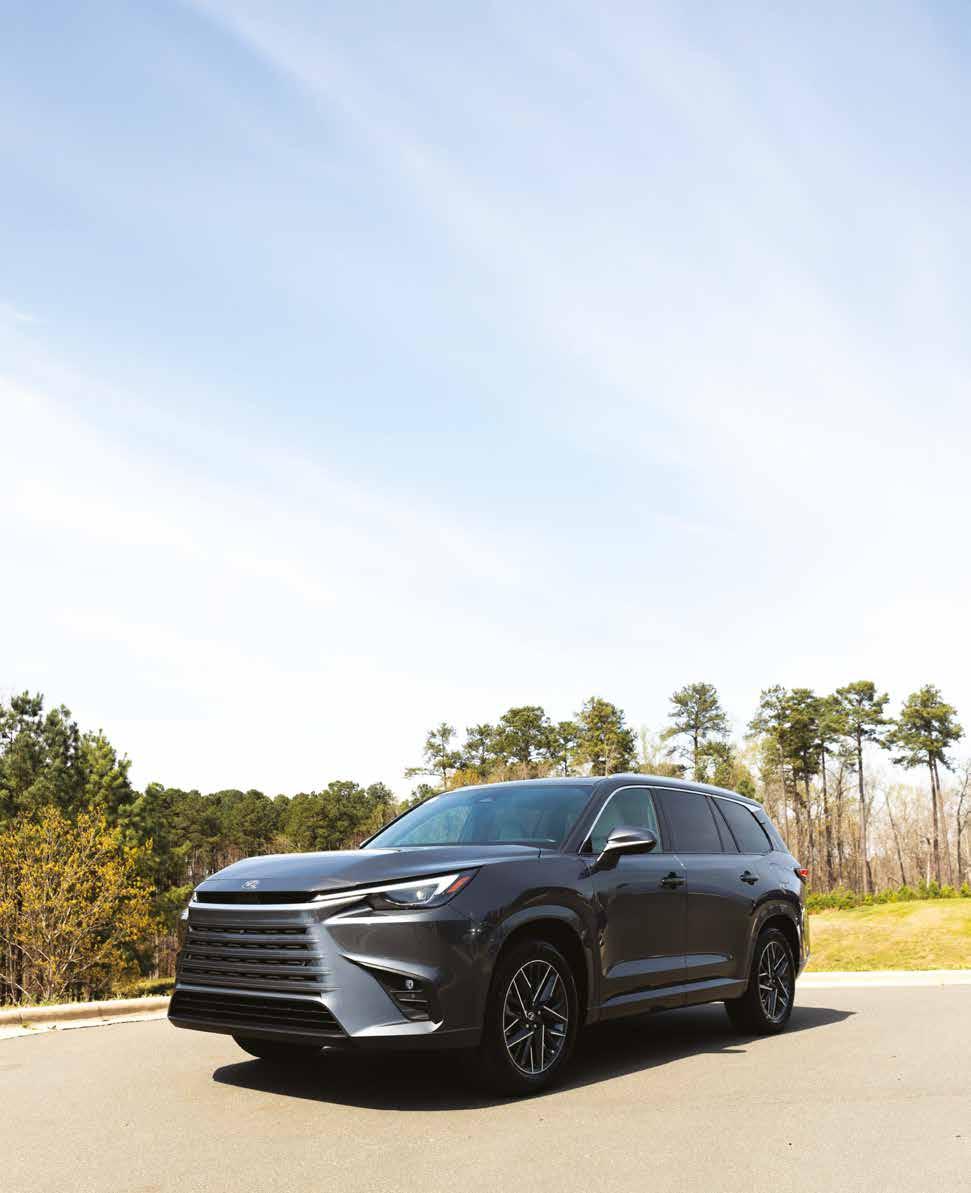
JOHNSON LEXUS OF RALEIGH
JOHNSON LEXUS OF DURHAM AT SOUTHPOINT


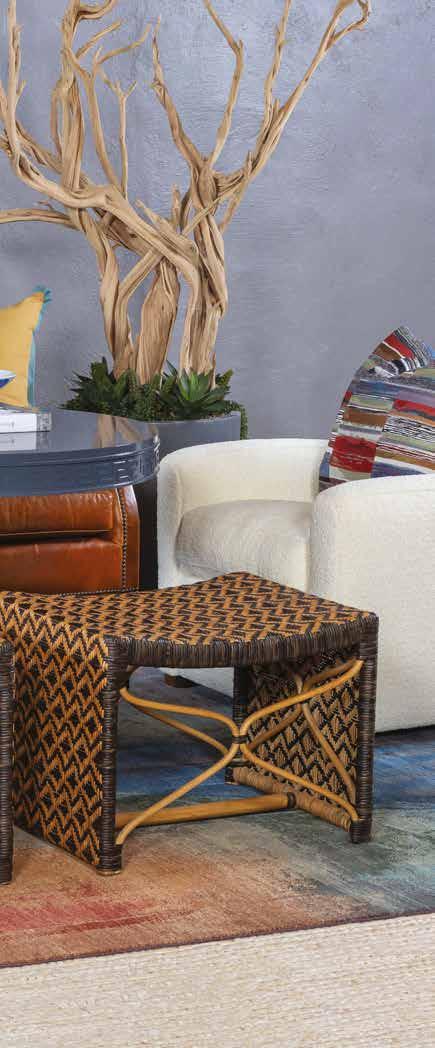

Western style interior design can be far more than an urban cowboy aesthetic when thoughtfully curated. Rooted in natural materials and time-honored craftsmanship, it draws on worn leather, aged finishes, vibrant patterns, and richly layered textures to evoke the true spirit of the American West.
The West has always been a study in contrasts— both vast and intimate, rugged yet refined. Supple leather, softened by time. Rattan, carefully handwoven. Color pulled from canyon walls and open sky.
These are not trends. They are a tradition.
In celebration of America’s 250th anniversary, Green Front draws inspiration from the soul of the American West with a special lounge installation, now on view in Raleigh at the North Carolina Museum of Art.


































EXHIBIT

Works by Charlie Silver and Lamar Whidbee that highlight the importance of art in mental health and honor Veterans in their journey to healing.
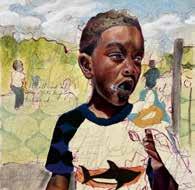
April 30 - May 31
OPENING RECEPTION: April 30th from 6-8 pm
ART AND HEALING: May 9th from 2-4 pm
ARTIST DESIGN EVENT: May 13th from 6-8 pm
ARTIST TALK: May 21st at 6 pm
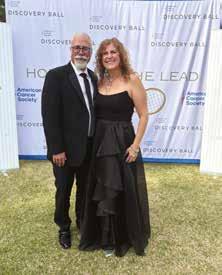


Laura and her husband Steven at the NC Discovery Ball; Cristina and Addie at the NC Opera Gala; my daughters and their besties support their friends in The Nutcracker.
Ihave a date with three 11-year-olds this weekend, none of which are my own.
Granted, I am taking them to see my kid in a play at Theatre Raleigh ACT, so it’s not quite as weird as it seems.
But I love that these kiddos, some of whom we’ve known since they were still in diapers, are interested in seeing her perform, not to mention happy to ride along with me. It’s a sweet tradition I’ve seen develop in the last few years: these kids want to support their friends. Over the last year or so, our family — at the urging of our children — has made the effort to support other kids in some big Raleigh traditions, like Carolina Ballet’s The Nutcracker and Raleigh Little Theatre’s Cinderella, as well as plenty of smaller productions, dance recitals, sports games and school events. (The 2024 Enloe High School production of Les Misérables, which featured one of their babysitters, was a highlight.)
Next month, we’ll wrap our last year at Conn Elementary, and hanging out with these kids has me reflecting on the wonderful relationships we’ve built through school. We started there with our oldest in 2018, back when it was
“Old Conn,” before they tore down the previous structure and built the shiny new one we have now. (Fun fact: our oldest was the last kindergarten class in the old school, and our youngest was the first kindergarten class in the new one.) We’ve been there through three principals, through the Covid remote years and the masking months; we’ve seen the number of neighborhood students there grow. (I’ve been deemed the “grumpy grandma” on the PTA for my joint contributions of institutional knowledge and aversion to committing to any more work than we need to.)
Our years at Conn have made a huge contribution to the wonderful community we have built here in Raleigh. That’s probably not unique; these elementary school years are foundational for many families. But even so, I’m grateful that alongside all that reading, writing and ‘rithmatic, our kids have been learning how to nurture great friendships.

Ayn-Monique Klahre Editor

MAY 2026
PUBLISHER
DAVID WORONOFF
EDITORIAL
Editor
AYN-MONIQUE KLAHRE ayn-monique@waltermagazine.com
Creative Director
LAURA PETRIDES WALL laura@waltermagazine.com
Associate Editor
ADDIE LADNER addie@waltermagazine.com
Contributing Poetry Editor Jaki Shelton Green
Contributing Copy Editor Finn Cohen
Contributing Writers
Sydney Brainard, Jim Dodson, Ian F. G. Dunn, Mike Dunn, Maeve Fox, Susanna Klingenberg, Colony Little, David Menconi, Rachel Simon, Tommy Tomlinson, Helen Yoest
Contributing Photographers
Liz Condo, Jared Harber, Aura Marzouk Lake, Jude McDonald, Joshua Steadman
Contributing Illustrators
Gerry O’Neill, Gary Palmer, Rani Ray
Editorial Intern Lily Kane
BUSINESS
Advertising Sales Manager JULIE NICKENS julie@waltermagazine.com
Senior Account Executive & Operations
CRISTINA BAKER cristina@waltermagazine.com
Finance HENRY HOGAN 910-693-2497
Distribution JAMES KAY
Owners
JACK ANDREWS, FRANK DANIELS III, DAVID WORONOFF In memoriam FRANK DANIELS JR.
GENERAL Inquiries
WALTER OFFICE 984-286-0928 info@waltermagazine.com
Address all correspondence to: WALTER magazine 421 Fayetteville Street, Suite 104 Raleigh, NC 27601
WALTER is available by paid subscriptions for $36 a year in the United States, as well as select rack and advertiser locations throughout the Triangle. Subscribe online at waltermagazine.com/subscribe
For subscription and customer service inquiries, please email us at customerservice@waltermagazine.com or call 984-286-0928. WALTER does not accept unsolicited manuscripts. Please contact Ayn-Monique Klahre at ayn-monique@waltermagazine.com for freelance guidelines.
© WALTER magazine. All rights reserved. No part of this publication may be reproduced in any form without the express written consent of the copyright owner. Published 12 times a year by The Pilot LLC.



Terms and Conditions: $300 off any order of $1198 or more,$200 off any order of $998-$1198 or $100 off any order of $698-$998, on any complete custom closet, garage,or home office unit. Not valid with any other offer. Freeinstallation with any complete unit order of $600 or more. With incoming order, at time of purchase only. For a limited time SPECIAL FINANCING for 18 months *with approved credit* Expires in 90 days. Offer not valid in all regions.






Maeve Fox is a trans poet from Western North Carolina. She has been published in the Kakalak Anthology and The Writing Fae magazine. Her first poetry collection, Letting Go of Me, debuted in 2025. Fox writes about the Appalachian LGBTQ experience. When not writing she is a district court mediator. “I was writing in the solarium when a sudden storm sprung up around me. I was surrounded by glass panels and I felt as if I were part of the storm itself.”
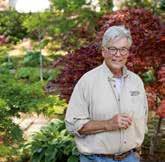
Jim Dodson is the author of 17 books and founding editor of O.Henry magazine in Greensboro. His latest book is The Road That Made America, which tells the story of his 6-year journey along the formerly lost Great Wagon Road — a track that brought thousands of European settlers to the South. “This Simple Life column is my love poem to grandchildren everywhere. I’m happy to report that June Sinclair Prescott, my first grandchild, is thriving.”

Rani Ray is a Cary-based watercolor artist and a partner at Rani & Joe’s Watercolors. A signature member of the Watercolor Society of North Carolina and the Fine Arts League of Cary, she is drawn to the medium’s spontaneity. She begins with a sketch but lets water and pigment lead the way — embracing the process as a lesson in letting go. “This painting was inspired by the especially brief nature of a spring storm, where the real beauty lies not in the storm itself, but in the softness and stillness it leaves behind.”

Aura Marzouk Lake is a photographer with 18 years behind the lens, beginning in weddings and expanding into high-end interior design photography over the past six years. Her work moves between two distinct rhythms — the instinctive, fleeting energy of weddings and the quiet, deliberate precision of interiors. “Working with Tula is always a creatively energizing experience. There’s a clear passion behind her use of color and form, and it translates beautifully on camera. I consistently find myself inspired by what she creates.”
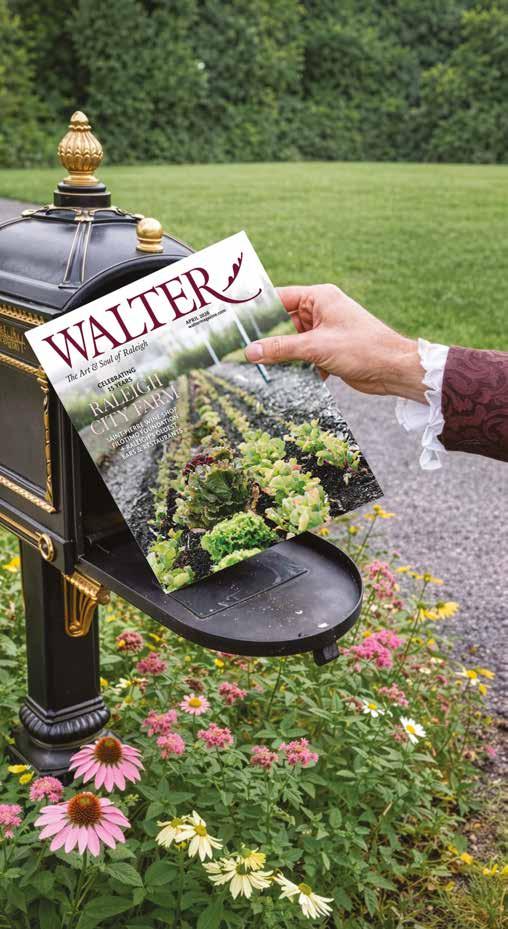
“Great story and wonderful cover of Raleigh City Farm.”
— Julia Einsetin
“This young man is the best weather person in NC and is on point every single time.”

We also got lots of comments on our annual April Fools headlines, especially the Schools Plan for “Pollen Days” one...
“You got me!”
— Jonathan Clark
“I was getting ready to rant then rememberd it is April 1.”
— Jean Wilder Waugh
“I was thinking good lord, can we baby these kids anymore than we do now? Haha! So funny. You got me!”
— Candice Roccia



This month enjoy outdoor music, classic fairy tales performed live on stage, food events and plenty of family-friendly fun
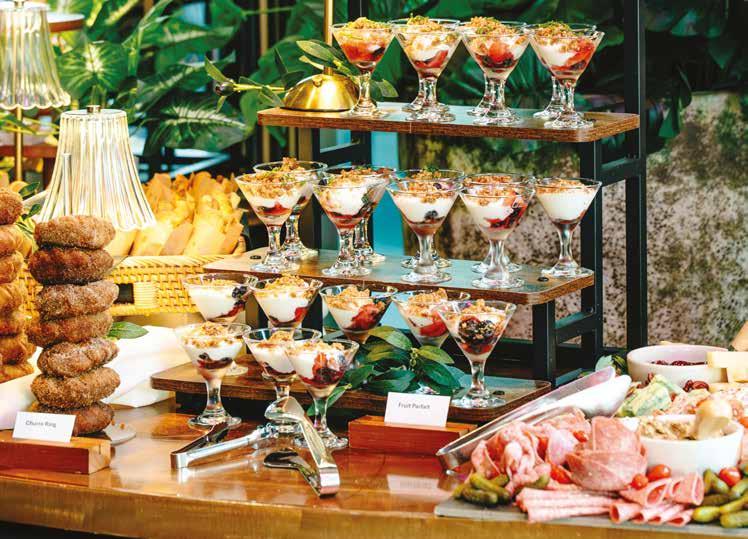
SEIZE THE DAY Flowing champagne, live music, flaky scones... May is the perfect time to settle in for brunch. And while Glenwood South is known for its nightlife, lately it’s getting buzz for its classy takes on this beloved weekend meal. Botanical Lounge hosts a Sunday Brunch Club where a ticket gets you a complimentary mimosa, all you can eat from their Insta-worthy buffet (think: herb-forward mini quiches, donuts, fresh fruit) and major day-party vibes within a gorgeous setting. They offer specialty cocktails for purchase, too (our pick: the Resting Peach Face, which is made with Lunazul Reposado, lime and peach syrup). (Sundays, 11 a.m. - 3 p.m.; $32; 419 Glenwood Avenue; botanicalraleigh.com) Vidrio offers an experiential Mediterranean spin on the meal with menu items like Pistachio Baklava French Toast and Lamb Hash with sunny-side-up eggs. Get a group together to try the Tableside Brunch Punch, a bubbly beverage made with lemon, sumac syrup, Aviation gin and sparkling wine. (Saturdays and Sundays, 11 a.m. - 3 p.m; 500 Glenwood Avenue, #100; vidrioraleigh.com) Along with the skyline views at The Willard Rooftop, enjoy an à la carte brunch with creative takes on classic dishes, like the BrunchCuterie, a spread of assorted pastries, fruit, deviled eggs, deli meats and cheese. For sipping, consider the Tableside Carafe: a bottle of bubbly paired with your choice of fresh juices. (Sundays, 12 - 4 p.m.; 9 Glenwood Avenue; thewillardraleigh.com) — Addie Ladner




WALTER’s list of things to see, do and experience this month
by ADDIE LADNER
May 3 | 10 - 11:30 a.m.
Seasoned local yoga instructor
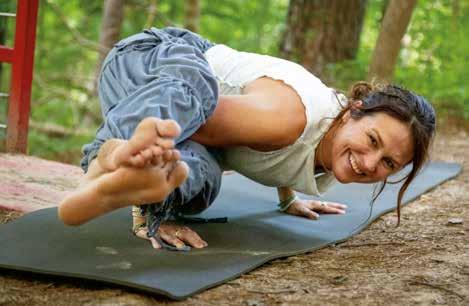
Jen Fisher and nationally known drummer and yoga instructor Brad Ellsworth of Druminyasa have come together for a rhythmic yoga class at Junction West. “The combination helps guide students to a more potent and powerful connection of self and deeper meditative state,” says Fisher. “Join us for a glorious celebration of movement and rhythm that will inspire joy and freedom!” $50; 310 S. West Street, #110; jenfisheryoganc.com
May 1 | 3:30 p.m.
Even the youngest cyclists can enjoy biking in Raleigh! Oaks & Spokes, a local group with a mission to make Raleigh more bike-friendly, is hosting this fun, family-friendly biking event at Dorothea Dix Park. Meet up at Middleton Drive in Dix Park with your children to enjoy a 2-mile loop around the park. It kicks off with a party and opportunities to decorate helmets, get free bike checks, win swag and more. After the ride, enjoy the City of Raleigh’s

Bike Bonanza festival. The rides last about an hour and include a snack midway through for motivation! Free; Middleton Drive; oaksandspokes.org
May 2 | 9 a.m. - 1 p.m.
Children aren’t the only ones who should get to enjoy an end-of-year field day! In partnership with Raleigh Parks and Recreation, Marbles Kids Museum is hosting this fun outdoor event for the whole family. Lace up your sneakers and head to the Marbles Playway and Moore Square for fun, active games for everyone from toddlers to grandparents. Participate in anything from three-legged races to family freeze dance to stroller games and more. Look forward to live
entertainment and food trucks after you’ve worked up an appetite. Free; 201 E. Hargett Street; marbleskidsmuseum.org
BEHIND YOU CLASSIC
May 4 | Various times
Local food and beverage pros Matt Fern, formerly of (ish) Delicatessen, Sam Ratto of Videri Chocolate Factory and Adam Cunningham of Longleaf Swine BBQ are co-hosting a charity golf tournament at MacGregor Downs Country Club. It will raise money for the Southern Smoke Foundation’s Behind You mental health program, which provides eligible candidates with mental health counseling at no cost. While Southern Smoke has chapters all over the country, including in North Carolina, this fundraiser is specifically
All information is accurate as of press time, but please check waltermagazine.com and the event websites for the latest updates.





-
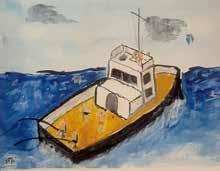
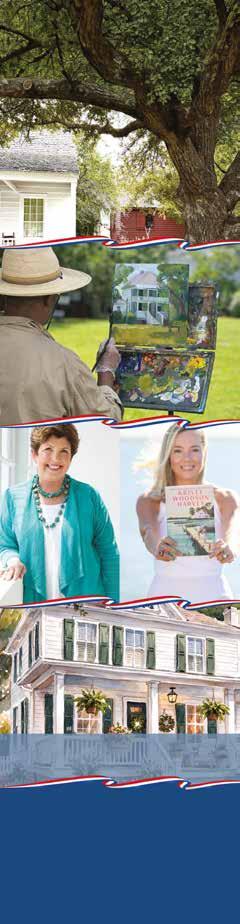
Charlie Silver’s pastel paintings reflect his experiences as a businessman, Vietnam veteran and person struggling with PTSD. This month, Frameworks gallery will host a joint show between Silver and his friend and mentor, acclaimed painter Lamar Whidbee. Titled Journey to Healing, the pieces will explore memory, creative expression and how it all intersects through art. Timed to coincide with Mental Health Awareness Month and National Military Appreciation Month, the exhibition honors veterans and raises awareness about the benefits of art therapy. Lamar and Silver’s relationship is a special one: Silver read about Whidbee’s work as an art therapist in a previous issue of WALTER and reached out to him for help. It turned into both a healing experience and creative connection. “What started as therapy became a friendship. Eventually, Lamar told me, I want to paint with you. I want us to be partners. That was one of the greatest compliments I could receive,” says Silver. The pieces in the show are a range of colorful yet calm landscapes and vivid depictions of nature. Throughout the month, enjoy free special events that coincide with the show, including an Artist Design Workshop on May 13 (5 - 7 p.m.) and an Artist Talk & Reception on May 21 (5 - 7 p.m.). Free; 1520 Dixie Trail; frameworksonline.com

to get ours invested in the Behind You program. “As a 30-year veteran of the food and beverage industry, I’ve seen that prioritizing mental health has often been pushed aside and viewed as a weakness,” says Fern. “We are delighted to help raise awareness about this amazing program. The excitement our group has to be a direct line of assistance for friends in a tough industry. That’s what keeps us pushing forward.” $250 for a single player, $1,000 for a team of four; 430 St. Andrews Lane, Cary; southernsmoke.org
Thursdays | 6 - 9 p.m.
Get ready to groove at this highenergy block party-style music series in North Hills every Thursday from April through July. Midtown Park transforms into a lively hub where locals and visitors alike vibe out while
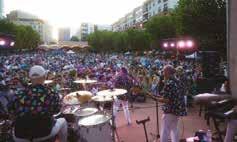
sipping cold beverages, trying out new food trucks and enjoying the warm weather. There are plenty of bars and restaurants nearby, too! You’ll recognize several favorite party bands on the lineup this month, including R&B and motown group Liquid Pleasure on May 14 and, inbound from Detroit, soul group Chairman of the Board on May 21. $9 per ticket or $90 for general admission to all 15 shows; 4011 Cardinal at North Hills Street; visitnorthhills.com
RALEIGH DINNER CLUB
May 7 | 6:30 p.m.
“We start in small groups to keep it low-pressure, and then all converge on a single spot. The concept aims to make it easier to meet new people in Raleigh, especially newer residents. It also supports restaurants on typically slow weeknights,” says Mason Brown, who runs the Raleighwood Inbox newsletter, on the supper club he launched this year. It starts with an online personality quiz, which he then sorts through to assemble groups of likeminded people at a selected restaurant to share a meal. Then, everyone participating is invited to a post-dinner after-party at a surprise location. $15 booking fee, plus the cost of dinner; locations vary; raleigh.dnnr.io
SHALL WE DANCE?
May 8 | 7:30 p.m.
A chamber group from the North Carolina Master Chorale is headed to
Hayes Barton United Methodist for a sweeping performance that explores human connection, art and movement through song. Shall We Dance? features a lively range of music from across the centuries — from Schubert and Brahms to Van Morrison, ABBA and musical theater productions (we’re pumped for a few selections from Wicked!). Be prepared to feel the urge to get out of your seat and dance! From $18; 2209 Fairview Road; ncmasterchorale.org
May 8 & 9 | Various times
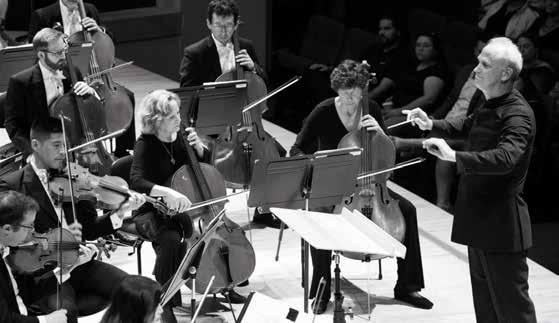
Revel in the beauty of the season with the NC Symphony’s performance of Appalachian Spring, composer Aaron Copland’s iconic celebration of the natural world, traditional American music and the lively spirit of springtime. First performed more than 80 years ago, this suite of music features gentle string arrangements that blossom into
an energetic allegro, a traditional fiddle section and a wedding day dance. From $15; 2 E. South Street; ncsymphony.org
May 9 | 1:30 & 5:30 p.m.
Cary Ballet Company presents its firstever production of Peter Pan, featuring an original score by David Ott. With close to 100 dancers being featured and original choreography by veteran ballerina and company artistic director Katia Garza, the performance will be captivating for all ages. “The process of creation is always both challenging and exciting,” says Garza. “When I revisit a ballet, I don’t simply repeat it — I refine and reimagine it. Creating this choreography was a beautiful challenge, especially in developing new characters so every dancer could shine on stage.” Purchase a VIP ticket for a post-show photo with the stars. From $57; 2 E. South Street; caryballetcompany.org





May 13 | 5:30 - 8 p.m.
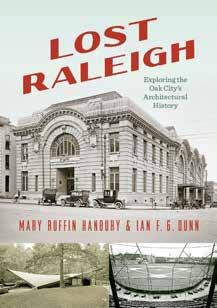
Join WALTER for an evening with preservation consultant Mary Ruffin Hanbury and archivist/historian Ian F.G. Dunn, the co-authors of the novel Lost Raleigh, at Theatre in the Park. The book shares photographs and stories of businesses, schools, churches and other buildings that are no longer part of the City of Oaks’ landscape — and offers a lesson about preservation for the next generation. Your ticket includes a book talk, hors d’oeuvres from Raleigh Cheesy, wine and beer and a signing opportunity with the authors. From $41; 107 Pullen Road; waltermagazine.com

BEAUTY AND THE BEAST
May 14 - 17 | Various times
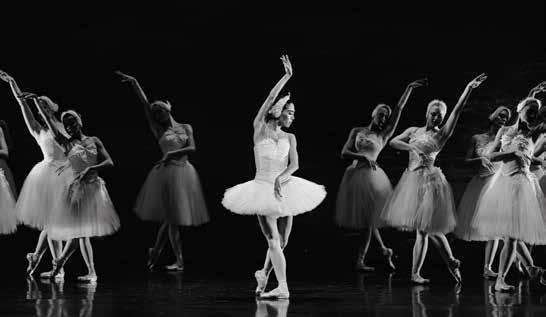
Carolina Ballet has taken the roots of Beauty and the Beast, the ancient French fairy tale originally written by Gabrielle-Suzanne Barbot de Villeneuve, and added an all-new original score by visiting composer Dr. David Goldstein. Together, they’ll create a live, mesmerizing production

featuring enchanting choreography and beautiful music. Watch the smart and kind-hearted Belle and her father, who share a deep love for one another, become entangled with the bitter, frightening, coldhearted Beast. It’s a classic story of transformation, bravery, love, loss and selflessness. From $44; 2 E. South Street; carolinaballet.com
May 16 & 17 | Various times
One of the longest-running arts festivals in North Carolina, Artsplosure takes over downtown for two days each year, celebrating art in all its forms. Enjoy bold, interactive art installations throughout downtown and a market featuring makers of everything from textiles to ceramics to sculpture, plus live music, food trucks, a Kids Zone and more. Free; downtown Raleigh; artsplosure.org
May 19 | 8 p.m.
What better way to kick off summer than with the high-energy thrum of a Pitbull concert? The artist is returning to Coastal Credit Union Music Park for the first time since 2022, bringing a show that promises fun, funk and hip-shaking beats. Joining Pitbull is Lil Jon, a rapper known for popularizing the crunk genre in the early 2000s. From $55; 3801 Rock Quarry Road; coastalcreditunionmusicpark.com
May 21 | 6 p.m.
Virginia-based band Palmyra will take the stage at North Carolina State University’s Centennial Campus as part of its family-friendly LIVE at Lake Raleigh series. Bring a picnic blanket to lay out on the shore of the lake while you hear their folk rock and Americana sounds. Food trucks will be on site at 5 p.m. before the show starts at 6 p.m. Free; corner of Main Campus Drive & Campus Shore Drive; live.arts.ncsu.edu

Campbell University invests in each student. We prepare each one to make a life, to make a living and to make a difference. Our students are welcomed into an inclusive community of family, and mentored to become leaders who will impact the world. Inspired by our Christian faith and belief in the power of education, we encourage each student to grow academically, spiritually and socially through the world of opportunities that surround them.
campbell.edu FAITH GUIDED. PURPOSE DRIVEN.

May 24 | 2 - 7 p.m.
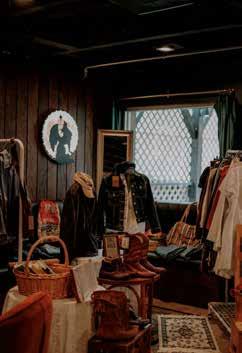
Neighborhood bar Wolfe & Porter is hosting a monthly allthings-vintage market on Sunday afternoons this spring and summer. Enjoy a cocktail (try the Velvet Elvis, a specialty drink inspired by the market) while shopping for retro home goods, arts, clothing and more. Regular vendors include small local businesses like preowned clothing purveyors Saige Kennedy Finds, Fetching Vintage and Viola Lee Vintage, as well as vintage book dealer Smut Stacks. Free; 905 W. Morgan Street; wolfeandporter.com/events
May 28 | 7 p.m
We can’t think of a better spot to see the band that coined the state’s unofficial anthem, “Wagon Wheel” than “in the land of the pines,” aka the wooded Koka Booth Amphitheatre. (Fun facts: The song was originally written in part by Bob Dylan and then covered and re-released by Hootie & the Blowfish frontman Darius Rucker.) The Grammy-winning band always attracts a passionate crowd to their Carolina shows with their bluegrass Americana sound. Joining Old Crow is longtime country-folk group Marty Stuart and His Fabulous Superlatives. From $41; 7 p.m.; 8003 Regency Parkway, Cary; boothamphitheatre.com
May 28 | 5 - 7 p.m.
Head to RTP to enjoy Glasshouse Kitchen’s lovely courtyard for this

ownership in this luxury community — with all the benefits that brings. You’ll have the flexibility to sell and move, designate your home as inheritance, and enjoy the equity gains that contribute to estate values. Visit HayesBartonPlace.com or call 919.803.6734 to learn more.

evening wine series, the last Thursday of the month until November. Each session, the restaurant will debut upand-coming wines from all over the world. Guests will taste pours alongside thoughtfully paired, chefdriven hors d’oeuvres from Glasshouse Kitchen chef de cuisine Kyle Fletcher. May’s wine social will focus on lesserknown rosés like the Vēvē Rosé Vinho Verde from Portugal. $50; 5 Laboratory Drive, Durham; glasshousekitchennc.com

Stories, ideas, and the people behind them — arriving

May 30 | 11:30 a.m - 6:30 p.m. In partnership with the Triangle Native American Society, Dorothea Dix Park is hosting its annual InterTribal Pow Wow. This celebrates North Carolina’s Indigenous communities, the Eastern Band of Cherokee Indians, the Coharie, the Lumbee, the HaliwaSaponi, the Meherrin, the Occaneechi Band of the Saponi Nation, the Sappony and the Waccamaw Siouan. Throughout the day, experience performances led by head dancers Faith Jacobs and Cameron Richardson, beats from Smokey River Coharie Drum, cultural competitions, vendors and more for a lively day honoring the largest American Indian population east of the Mississippi River. Free; Harvey Hill; dixpark.org/powwow

Mix it up on your next night out with a spot where you can grab a drink and a snack while you engage in some classic amusements
by RACHEL SIMON
Whether you’re a pinball pro, a billiards buff or an arcade aficionado, the Triangle has no shortage of spots for you to show off your gaming prowess while enjoying some tasty food and libations. “It turns a typical night out into something interactive and memorable,” says Amber Moshakos, the president of LM Restaurants, which owns the newly opened Smash Social Club. With Pins Mechanical set to bring duckpin bowling and foosball to Raleigh’s Seaboard Station later this year, the area’s roster of adult-friendly gaming spots continues to grow — but of course, there’s always the nostalgia factor from spots that have been there for ages (hello, Frankie’s Fun Park!). Consider one of these spots for your next group hang or date night.


The name says it all: this new Raleigh venue from the Partee Shack team specializes in competitive laser tag and neon mini golf, aimed primarily at adults (the under-21 crowd is asked to leave after 8 p.m.). The food menu is small but impressive and the drink selection includes cocktails and wine in addition to beer, all of which can be enjoyed in a cozy lounge overlooking the games. 7407 Six Forks Road; battleandbirdie.com
With a large assortment of arcade games, frequent live music and ample outdoor spaces, both Boxcar locations have become popular spots for those looking to fill a fun few hours in the Triangle. Play rowdy rounds of air hockey or race
your pals in Mario Kart while sipping on beers and eating pizza from the bar’s large kitchens. And did we mention there are weekly SkeeBall tournaments? 330 W. Davie Street & 621 Foster Street, Durham; theboxcarbar.com
A Raleigh institution, Frankie’s truly has something for everyone: arcade games, mini golf, go-kart racing, bumper cars, laser tag — even a roller coaster. It’s bound to be crowded with visitors of all ages whenever you go, but you can reserve your spot with a group party package and snack on burgers and beers while you wait in line for each fun activity. 11190 Fun Park Drive; frankies.com
Since its 2022 opening, this Chapel Hill shop has become a must-go for board and card game fans alike. “Where else can you look through a showcase of high-end, vintage Magic: The Gathering cards or fill out a deck you’re working on before sitting down to play with a limited-release, seasonal local beer?” says communications director Victor Lewis. “We’re a spot for everyone, and we’re glad to be here.” Choose from the Gathering Place’s big variety of options or bring your own games to enjoy on-site — don’t forget to check out its monthly Magic: The Gathering and D&D tournaments, too! With 30 beer taps, “far-flung offerings” like mead, cider and sake, plus a pizza kitchen, it’s a casual spot to get together with friends of all ages. 157 E. Rosemary Street, 2nd floor, Chapel Hill; gatheringplacegames.com
A haven for board game obsessives, Cary’s Gamers Geekery has a library stocked with hundreds of titles, from family-friendly classics like Scrabble and Trivial Pursuit to action-packed options like Exploding Kittens and Catan. There are regular evening events for D&D and Pokémon GO play, with a sizable food and drink menu to accompany the
entertainment. Thanks to the shop’s fun atmosphere and offerings, “Gamers is one of the premier places to come and play board games in an inviting setting,” says owner Lance Shrader. 107 Edinburgh South Drive, #213, Cary; gamersgeekery.com
Partee Shack’s original South Raleigh location keeps things sweet and simple with mini golf and an arcade, but the newer North Raleigh venue also includes VR laser tag and duckpin bowling. At either location, you’ll find fun and unique twists interwoven among the golf course, like cornhole and ziplines, to make things extra entertaining. “Each hole is built around interactive challenges and mini games that determine how close or far away you get to start your putt,” says chief marketing officer Danté Valor. “Instead of simply putting through a themed course, guests might have to sink a basketball shot, complete a physical challenge or win a quick game before they ever pick up the putter — and we’re constantly redesigning the holes.” Pub classics like pizza and wings are available to order, with beverages spanning light beers to sugary cocktails. 6231 Triangle Plantation Drive & 5300 Fayetteville Road; parteeshack.com
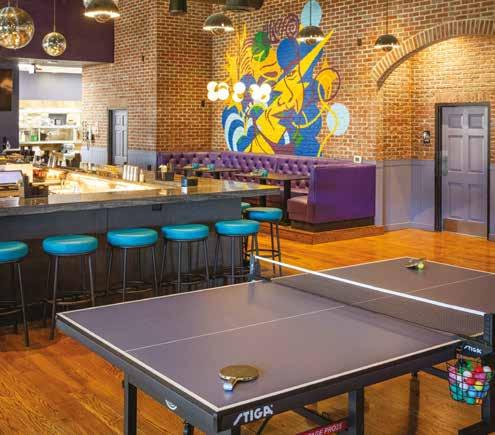
The newest addition to Raleigh’s game scene, Smash Social Club opened on Glenwood Avenue last December with a roster of party-friendly activities including table tennis, shuffleboard and electric darts. Cocktails and snacks (like pretzel bites and pizzas) can be enjoyed inside or outside within this 9,600-square-foot space. “We’ve layered in high-tech, approachable games and a rooftop atmosphere that give people a reason to connect,” says Amber Moshakos, president of parent company LM Restaurants. 500 Glenwood Avenue, Suite 300; smashraleigh.com
With over 400 games (ranging from card classics to complex RPGs) plus a sizable food and drink menu, downtown Raleigh’s Side Quest is really more like the main event. Visitors can purchase $5 “Play Passes” for unlimited all-day gaming, and nights can be spent learning how to play hits like Pokémon GO and D&D with friends and strangers alike. 317-113 W. Morgan Street; sidequestgameloungeandbar.com
If you’re bored of traditional games and want something more action-packed, Raleigh’s Stars and Strikes is the place for you. The 62,000-square-foot facility includes laser tag, bumper cars, bowling and even virtual reality, with low-priced nightly specials on many of its most popular options. And while the spot is absolutely family-friendly, there’s also a quieter corporate event space and a large menu that’ll appeal to visitors of every age. 4020 Capital Boulevard; starsandstrikes.com
Got some time to kill before your next flight at RDU? Stop by Triangle Pinball Collective, located inside the nearby bar/bottle shop Flight Deck NC. Founded by members of the Triangle Pinball Players last year, the shop has more than 20 pinball machines (the most of anywhere in the Triangle) with some vintage options dating back to the 1970s. Visitors can sign up for classes and tournaments or just enjoy some casual drinks and play. “Our mission is to create Raleigh and Durham’s premier pinball location,” says co-owner Ovid Dillard. 9521 Lumley Road, Morrisville; trianglepinballcollective.com

Local cycling aficionados share their favorite routes for exploring Raleigh and beyond
by AYN-MONIQUE KLAHRE
additional reporting by KAT DALE photography by JARED HARBER
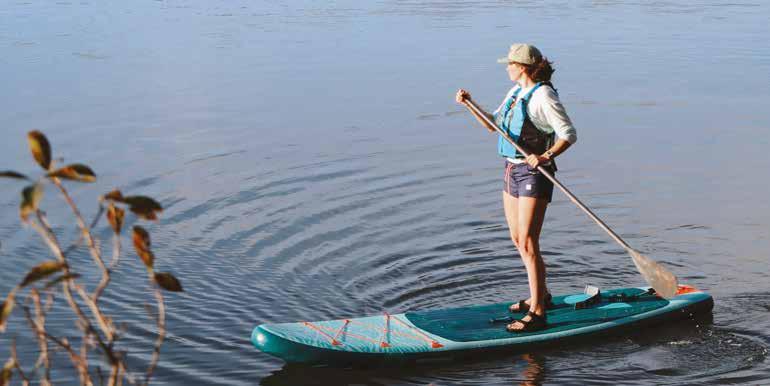
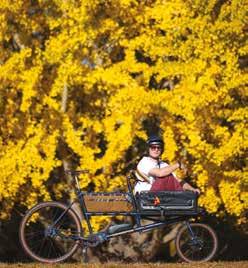
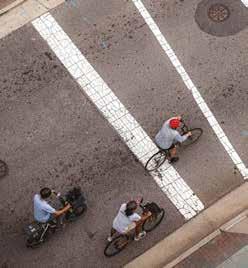
Spring weather may have you breaking out the helmet — but with Raleigh’s generally mild winters and tolerable summers (the mornings, anyway), you can bike year-round. “You can do the same loop all year and see the changes in the greenery and wildlife,” says Jared Harber, executive director of biking advocacy nonprofit Oaks and Spokes.
One of the easiest spots to do that is on the Capital Area Greenway, which debuted 50 years ago and now boasts more than 100 miles of trails. “Our greenway system is extremely well connected; it ribbons through the whole city and bumps up into a lot of neighborhoods, so it’s easily accessible for most folks,” Harber says.
Beyond being a mode of fitness or recreation, biking offers a chance to interact with your surroundings in a different way. “In a growing city like Raleigh, we can lose that Southern hospitality — but you connect with people when you ride a bike,” says Harber. “When I’m biking, I’ll run into a friend or work acquaintance and stop and chit-chat. You don’t do that when you’re driving.”
In honor of bike month, we connected with local biking aficionados to share some of their favorite routes.
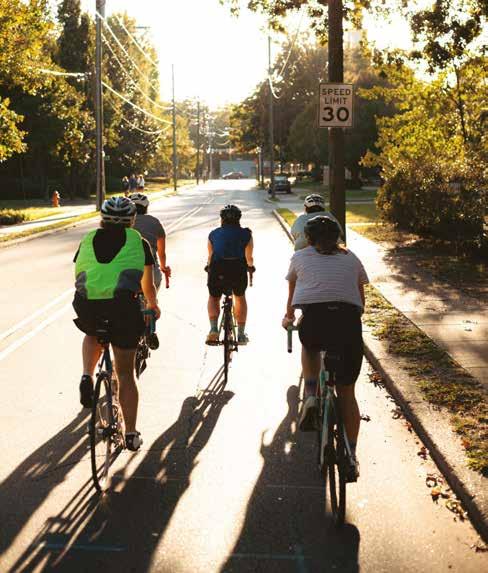
EXPLORE UMSTEAD STATE PARK, 18.5 MILES (OR ANY DISTANCE)
Paulina Simons, communications manager, Rescue Racing
“When it comes to cycling in Raleigh, Umstead State Park is my answer every single time. Tucked away from cars and busy streets, this gravel sanctuary laced with miles of trails and rolling hills is the perfect escape. Whether you’re looking to clear your head or push your limits, you can do it in Umstead — which is why you’ll find me out there most days of the week.”
The route: Park in one of the five lots around the park, or ride in via the
Crabtree Creek Greenway or Cary’s Black Creek Greenway. Then choose your own adventure! A route connecting the most accessible parking lots can create an 18.5-mile loop.
Lauren Blanch, co-owner, The Bike Library
“My favorite place to ride in Raleigh is the greenway network. It connects so many parts of the city and makes it easy to put together a long, scenic ride without dealing with much car traffic. My go-to route is a loop around the city, about 30 miles. It’s got a great
combination of paved, protected paths and beautiful scenery — you’re surrounded by trees and water most of the time — plus, there are enough hills to keep things interesting.”
The route: Start from The Bike Library Café (600 W. Cabarrus Street, Suite 113) or the Greenway Gear Collective Container (Lake Raleigh Dock, Centennial Campus) to get onto the Rocky Branch Trail. Ride east, then loop around the entire core of Raleigh via the Walnut Creek Greenway, Neuse River Trail, Crabtree Creek Greenway and House Creek Greenway.
NCMA TO CRABTREE LOOP, 12 MILES
Beverley Clark, co-founder and chair of Friends of the Raleigh Greenways
“One of my go-to loops is to head out from the NCMA on the Old Reedy Creek greenway, across the Crabtree Creek Greenway and back along the Reedy Creek Trail. Crabtree Creek is the newest greenway section and it takes you through mostly natural areas.”
The route: Park in the NCMA park’s lot, then head northwest along the Old Reedy Creek greenway, which enters Umstead Park at the junction of Trenton and Reedy Creek Roads. After the gate, make an immediate right onto Turkey Creek, which winds downhill to meet the Crabtree Creek Greenway extension. Ride east on this until it meets the House Creek greenway at Blue Ridge Road. (This junction is easy to miss; when you see the McDonalds, get on the sidewalk or road and ride southeast along Crabtree Valley Road until the intersection. House Creek greenway picks up on the southwest corner.) Follow House Creek to Reedy Creek Trail, cross over I-40 using the bridge, and you’ll be back on the art museum’s campus!
WILLIAMSON PRESERVE, 13.5 MILES (OR ANY DISTANCE)
Shaun King, executive director, the Triangle Off-Road Cyclists
“I love the off-road, natural surface
Avents Creek
trails in Williamson Preserve in eastern Wake County. It has a smart layout for trail design that coordinates traffic among hikers, runners and bikers to improve everyone’s ability to share the paths. The connected trail loops allow you to manage your time and effort by choosing how many loops to take on, and the navigation is made simple by the primarily north-south configuration.”
The route: Park at the North entrance at the Williamson Preserve Trailhead (4409 Old Country Mial Road), where you’ll find a well-managed and ADAaccessible porta potty on site. You can also get to the preserve via the Neuse River greenway. Then start on the trail, which offers various well-marked loops (including the Lily, Magnolia and Pine Warbler Loops) to achieve your preferred mileage. Note: The directionality of the trails switches depending on the day of the week. Bikers make all left turns on Sunday through Wednesday, and all right turns on Thursday through Saturday.
FALLS LAKE OUT-AND-BACK, 23 MILES
Yevette Yarborough-Trotman, Black Girls Do Bike Raleigh - Durham
“For me, what makes a ride truly special is the destination, whether it’s
discovering artwork or catching a sunrise or sunset over the water. Beautiful scenery makes me feel free, present and connected to my surroundings. This summer, we’re hosting the national meetup for Black Girls Do Bike right here in Raleigh, so I’ve developed a route out to Falls Lake to share one of my favorite views with our guests!” The route: Park at O2 Fitness in Brier Creek (7801 Alexander Prom Place). Head north on Brier Creek Parkway, then veer right to continue on Andrews Chapel Road. Cross Leesville Road to connect to Carpenter Pond Road. Head west when you hit Kemp Road, then north again at Southview Road until it dead-ends into Baptist Road; turn right. Follow that north, through the rolling view campground, until you hit the Rolling View Lookout over Falls Lake. To mix it up on the return trip, turn south off Kemp onto Coley Road, then turn off Carpenter Pond to continue south on Shady Grove Road, which will turn into Mt. Herman Road. Take a right to head west onto ACC Boulevard, which will bring you back to O2. Note: This is a road route, so use front/rear lights, wear bright colors and communicate with drivers through clear hand signals and eye contact.
AMERICAN TOBACCO TRAIL, UP TO 44 MILES
Simone Kellum Hamlett, Black Girls
Do Bike Raleigh - Durham
“My favorite cycling route is the American Tobacco Trail (ATT) from downtown Durham to the New Hope Church Road trail head. This stretch offers a beautiful tree canopy, peaceful wooded areas and a gradual transition away from the city. The out-and-back ride is low-stress and welcoming for different skill levels, plus it can be adjusted depending on your time or training goals. We often return to the Durham Farmers Market to enjoy fresh food, coffee and locally grown produce after the ride.”
The route: Start in Durham at the farmers market parking lot (501 Foster Street, Durham). This requires a brief road ride to get onto the ATT at the corner of Morehead and Blackwell Streets (just south of the Durham Bulls stadium). Once you’re on the trail, bike south until you’re ready to turn around, as far as the southern terminus at New Hill Olive Chapel Road. Note: There are restrooms available at several points along the way.
LAKE RALEIGH AND LAKE JOHNSON, 18 MILES
Amber Echevarria, organizer, Raleigh Critical Mass
“I really love riding on the greenway all the way from downtown Raleigh to Lake Johnson, because it’s so peaceful and the tree coverage makes it much cooler in the humid summer months! I usually get on the Little Rock Greenway near Transfer Co. Food Hall and Chavis Park, riding south until I reach the Wetlands Center. I’m a casual biker, and you can usually find me out on a single speed or fixie bike because I like to keep it simple!”
The route: Start in downtown Raleigh at the Little Rock trailhead, at the intersection of E. Lenoir Street and Chavis Way. Head south on the trail until you reach the Walnut Creek Wetland Center. From there, head east
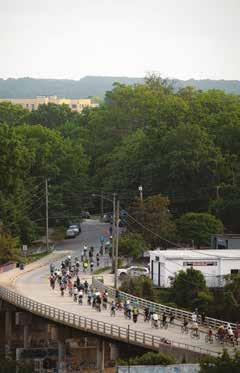
on the Walnut Creek greenway, past Lake Raleigh, until you reach Lake Johnson. Loop around the lake, then get back on Walnut Creek trail to head back the way you came.
Ken Metzger, owner, Oak City Cycling “I love biking the greenway route from downtown Raleigh to downtown Durham, then returning on the train. You ride along many different greenways, plus a gravel section of Umstead State Park, then you can get a bite and a beverage before grabbing the Amtrak back. Train tickets cost about $10 and they’ll load your bike for free.”
The route: Start on the Rocky Branch greenway near the intersection of Dorothea Drive and W. Cabarrus Street in Boylan Heights. Head northwest to pass through North Carolina State University, then continue on Reedy Creek Trail to pass by Meredith College and wind through the North Carolina Museum of Art’s campus. Continue onto Reedy Creek Road/Trail to Umstead State Park and the wide, gravel Old Reedy Creek
Trail. Ride through the Town of Cary using a combination of Crabtree Creek Greenway, Black Creek Greenway, and neighborhood streets, then continue onto the White Oak Greenway to its junction with the American Tobacco Trail, which is a mix of smooth, crushed limestone and paved path. Head north until you arrive right in downtown Durham.
Find maps of these routes on waltermagazine.com
Explore better with these websites recommended by our pros.
BikeRaleighGreenways.com A pandemic project from biking enthusiasts Craig Brown and Marjorie Salzman, this site outlines scenic routes of various distances. “It’s a fantastic library of fun rides, including ones that visit breweries, bakeries, trail art and other interesting parks,” says Clark.
Capital Area Greenway Explorer
This mobilefriendly web-based app allows you to pick a point on an interactive map to find the closest trailhead, parking, restroom or park. Search “greenway explorer” on RaleighNC.gov.

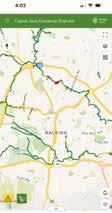
TrailForks.com A source for local natural trails that offers up-to-date information and more details about the trails themselves.
With gratitude for two of spring’s most beautiful flowers
May is vibrant with blooms and fills me with dreams of a wonderful forthcoming season. I’ve made a point to fill my garden with flowering plants to carry me from late spring into full summer.
Among these, peonies are a favorite of mine. Is there a more beautiful flower? Graceful, regal and floriferous, they’re a highlight once the spring bulbs fade. They may be droopy and short-lived, but if you cut them to bring inside, they will be indoor delight for a while.
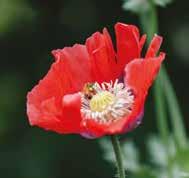
Peonies need cold weather to bloom, so they grow best in colder climates, up to our Zone 8. They prefer dry conditions with good drainage. There are three main types of peonies: herbaceous peonies, tree peonies and intersectional hybrids, also known as Itoh peonies. Tree peonies are woody shrubs with larger, earlier blooms that remain above ground all year, while herbaceous peonies die back each year. The Itoh peonies are a hybrid of both: they die back every year but offer a stunning display of larger, long-lasting blooms that you’d expect from a tree peony.
I also grow hot red poppies all over my garden for an annual flush. Also known as bread poppies (you might find the seeds on your morning bagel) they offer cheerful, long-lasting, colorful flowers. An added benefit is that the bees adore them and will busily collect pollen from their blooms. After the flowers fade, the seed heads provide food for foraging birds, especially goldfinches. I would grow them for the seed heads alone, so I can find delight as the birds alight! I leave the blooms once they’re done flowering so the seeds dry up and fall to the earth to re-seed for next year.
How grateful I am for these flowers! The color and excitement they bring to my garden are the perfect bridge between spring and summer.


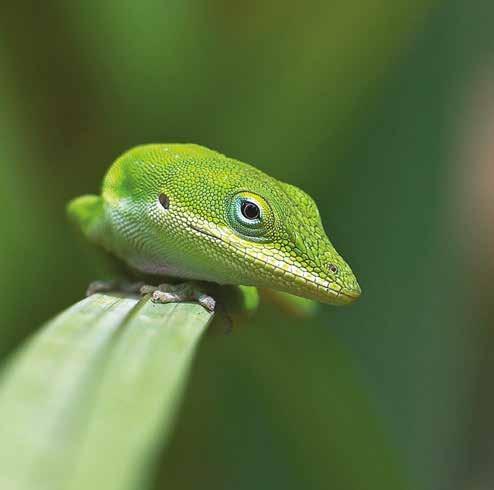
Carolina anoles are delightful lizards with some cool characteristics
words and photography by
MIKE DUNN
For many years, I had the pleasure of being one of the judges for the annual photo competition sponsored by Wildlife in North Carolina magazine. Each year we reviewed a few thousand photos submitted by photographers of all ages from across the state. Without fail, we would have some high-quality images of a particular lizard that always ended up in our final choices: the green anole, Anolis carolinensis.
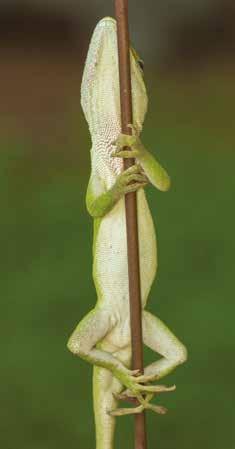
I think the reason they’re photographed so often — and so well — is that they are charismatic little critters. They can change colors from a vibrant green to a subdued brown, their eyes can move
independently (unlike our other lizards) and they are common in our area. They also tend to act in a curious manner that seems like they are engaging with us, rather than darting away the instant they see us.
Green anoles, which are sometimes called Carolina anoles, are the only native anole in the continental United States. (A cousin, the brown anole, was introduced into Florida from Cuba and islands in the West Indies and can be found in some North Carolina counties. That one cannot change color and is brown or grayish black with more distinctive patterning than the green anole.)
Our green anole is widespread in the southeast and can be seen in North Carolina from the foothills to the coast. Sometimes called the American chameleon because of their ability to change colors, anoles are not related to true chameleons. In fact, they are more closely related to iguanas.
Scientists have studied the mechanism of their color change and it is quite complex.
Basically, there are pigment-containing cells just beneath the skin, some of which contain melanin, a dark pigment. When the melanin is clumped together in their cells, the skin color is green. When the melanin expands and disperses, it blocks the other pigments and the skin changes to a brown color. Hormonal secretions cause the movement of melanin in response to factors such as stress, temperature, light and social interactions. This type of physiological color change can happen fairly rapidly; anoles are capable of changing their color completely in just a few minutes.
Color change benefits green anoles in terms of camouflage, social signaling and thermoregulation. The first ones I see in spring and the last ones in the fall are usually brown and blend in with the fallen leaves and twigs where I often find
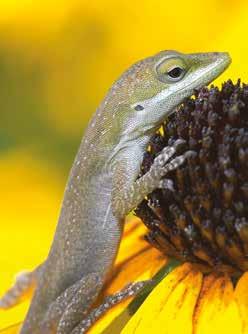
them. The darker color may also help these cold-blooded reptiles absorb more heat in cooler weather. In summer, I see more of them showcasing their green color — perhaps to match their verdant surroundings.
Males tend to be green more often than females. Scientists think the green may serve as a social signal of dominance. I read that when males battle for territory or mates, the winner usually ends up green and the loser brown. So, it seems cooler temperatures and higher stress levels are the primary drivers of the change to brown skin color. If you see one with black patches of skin behind the eyes, this also indicates a high level of stress caused by feeling threatened or confrontations between rival males.
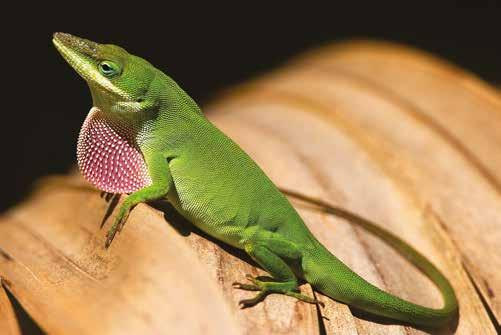
One of the things I love most about these lizards is their dewlap, a pink flap of skin on their throat that can be flared like a fan. Males display their dewlap to attract females and to ward off other males in territorial disputes. This display is usually accompanied by head bobbing and occasional pushups. Males often display in response to movement, which I’ve found helpful when I am trying to get a
Males display their dewlap to attract females and to ward off other males in territorial disputes.
photo. And I admit to having initiated their head bob and display by doing my own version: bobbing my head while simultaneously holding my hand on my throat and spreading my fingers. (Having no nearby neighbors is probably a good thing.) That may not be as goofy as the habit some kids learned: that you can have living green earrings by holding an anole up to your ear so it bites your earlobe and hangs for a few seconds. (I don’t recommend this as it must be stressful to the lizard and may cause shock to nearby adults).
Green anoles can reach approximately 8 inches in length, including the tail (males are larger than females). A female may lay one tiny egg (1/4-inch-long) every week or two from March to October in loose soil, under logs or in other protect-
ed areas. Young anoles hatch in about six weeks and are only about an inch long. Anoles periodically shed their skin, usually in patches that they then often consume.
Anoles are carnivorous, eating a wide variety of insects and spiders. In turn, green anoles are eaten by many birds, snakes and even other lizards. Outdoor cats are also very effective predators. I once had neighbors come over and comment on how many lizards we had in our yard. They never saw any in their own yard — but they had five outdoor cats. Like most of our lizards, anoles can drop part of their tail to escape a predator. The dropped tail portion will continue to wriggle on its own and serves to distract the predator while the lizard makes its escape. Tails can be partially regrown over time.
Green anoles have been used for a variety of studies in the biological sciences. Because of their importance, they were the first reptile to have its entire genome sequenced over a decade ago!
From their significant place in scientific research to their beauty and fascinating behaviors that anyone can observe,




green anoles are one of our most beloved reptiles. I’ll leave you with some praise for anoles from the famed naturalist and explorer, John Lawson. He wrote about his observations of the natural history of our state in his famous book entitled A New Voyage to Carolina, which was first published in 1709. He described green anoles in this way:
Green Lizards are very harmless and beautiful, having a little Bladder under their THroat, which they fill with Wind, and evacuate the same at Pleasure. THey are of a most glorious Green, and very tame. THey resort to the Walls of Houses in the Summer Season, and stand gazing on a Man, without any Concern or Fear. THere are several other Colours of these Lizards; but none so beautiful as the green ones are.
I couldn’t agree more.


The Oaks at Whitaker Glen is ushering in an exciting new chapter, elevating every aspect of the senior living experience in Raleigh.
We’re thrilled to introduce the centerpiece of our community, The Clubhouse, featuring 1-, 2-, and 3-bedroom penthouse-style apartments designed for those who expect the extraordinary.
Our community expansion will feature thoughtfully curated spaces for health and wellness, along with skilled nursing, assisted living, and pharmacy services, ensuring every resident receives seamless support and personalized care, now and for years to come.



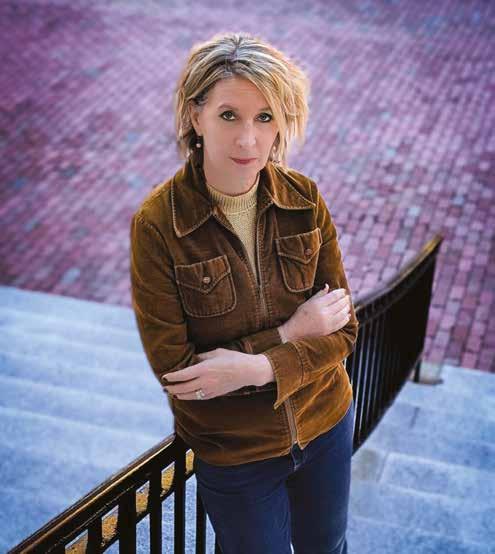
Rocking professor
Florence Dore shows the kids how it’s done
by DAVID MENCONI
You could say Dr. Florence Dore leads a double life, split between professor and rock musician — except those two pursuits are so interconnected, they’re happening simultaneously all the time. For example, consider “Twelve Great Minds (Department Meeting),” a stomp-along rocker on Dore’s fine new album, Hold the Spark The lyrics read like ones you might scrawl on a notepad during a particularly annoying work meeting.
There should be a class on petty insignificant battles
There should be a class on what to do when the ref throws a flag
There should be a way to know this is not revolution
There should be a class on what to do to not be a drag…
“On the road, people really dig that one,” Dore says. “Anybody who has had a job where you have to cope with the stupidest thing imaginable can relate to it.”
At this point, Dore pauses to laugh before adding a qualifier. “But I do want to say,” she deadpans, “that similarities to any person living or dead are purely coincidental.”
Dore has been “the rocking professor” in the English department of the University of North Carolina at Chapel Hill since 2010, teaching classes in literature and songwriting. Along with releasing multiple books and albums (three of each), she has toured the world and organized academic conferences about music and writing.
Organizing cool things might be her super power. When the pandemic shutdown hit in 2020, Dore used her connections to spearhead a benefit album. Cover Charge: NC Artists Go Under Cover to Benefit Cat’s Cradle featured Superchunk, Chatham County Line and other local acts, and it hit No. 1 on Billboard magazine’s compilation chart, even though it was a digital-only release on the Bandcamp website.
Teaching is an integral part of Dore’s artistic life, not least because it expands her network of collaborators. She regularly has students like Mipso fiddler Libby Rodenbough play on her albums. And Dore’s May 7 album-release show at Cat’s Cradle in Carrboro will feature various students as opening acts and collaborators, including the all-female band Juniper and folk-rock group Davie Circle, with folk
“This record reflects a certain irreverence that comes with getting older, because I got tired of talking about myself.”
— FLORENCE DORE
musician Bill Moore as master of ceremonies. Other students will join Dore for cameos during her headlining set.
“Our band is super excited to play her show,” says Warner Vaughan, a senior psychology major from High Point who plays in Juniper. “She really is a wonderful professor and musician, in my opinion a real badass who has done it all. I take a lot of inspiration from her example.”
Hold the Spark should appeal to anyone who wishes Tom Petty was still around to make records. Equal parts rocking pop tune-craft and Southern soulful vibes, it’s classic rock with roots in the pre-Nirvana alternative rock that made North Carolina a key outpost on the underground circuit.
Part of that comes from Dore’s drummer (and husband) Will Rigby, who’s a member of Winston-Salem new-wave legends The dB’s. On Dore’s album, Rigby is part of an all-star studio cast that includes former Steve Earle guitarist Chris Masterson and R.E.M.’s original co-producers, Don Dixon and Mitch Easter (a North Carolina Music Hall of Famer who contributes guitar here).
“Twelve Great Minds” aside, the majority of this album’s 12 songs are less autobiographical than invented. “Worst Mistake” is sung by a protagonist looking back on a lifetime of regret for roads not taken. “Can’t Come Down” and the rollicking album opener “Sunset Road” were inspired by Dore’s travels through America’s off-the-beaten-path districts, from the viewpoint of imagined characters there.


“This record reflects a certain irreverence that comes with getting older, because I got tired of talking about myself,” Dore says. “I wrote a lot of songs, finished 40 and started a lot more than that. I really worked on getting better from a musical point of view, and also to create characters that have nothing to do with me. Not that there isn’t any personal stuff. Hold the Spark is the feeling of contemplating your child growing up and moving on.”
Dore’s own music occasionally comes up during classroom discussion, but mostly as an example of how one might
solve songwriting problems (though it does give her credibility with students). At the beginning of her semester in Dore’s songwriting class last year, for example, Vaughan was struggling with writer’s block and asked Dore for advice on overcoming it.
“She told me something that was super funny in the moment, but I remember it now as very helpful,” Vaughan says. “She told me straight to my face, I don’t believe in writer’s block. If you don’t think you can write, just sit down and write something, even if it’s just sentences, phrases, words. Anything to get creative juices flowing. You might feel you have nothing to say, but you do. You just have to reach down far enough to find it. It was good advice.”
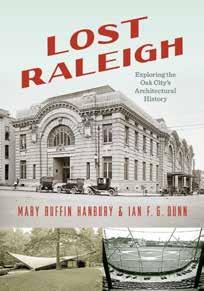


WEDNESDAY, MAY 13 5:30-8 P.M.
THEATRE IN THE PARK 107 Pullen Road, Raleigh
Join WALTER as we host preservation consultant Mary Ruffin Hanbury and archivist/ historian Ian F. G. Dunn, the co-authors of Lost Raleigh. The book shares photographs and stories of businesses, schools, churches and other buildings that are no longer a part of our landscape — and offers a lesson about preservation for the next generation. Your $35 ticket includes a book talk, hors d’oeuvres, wine and beer, and a signing with the authors. $65 for book and ticket




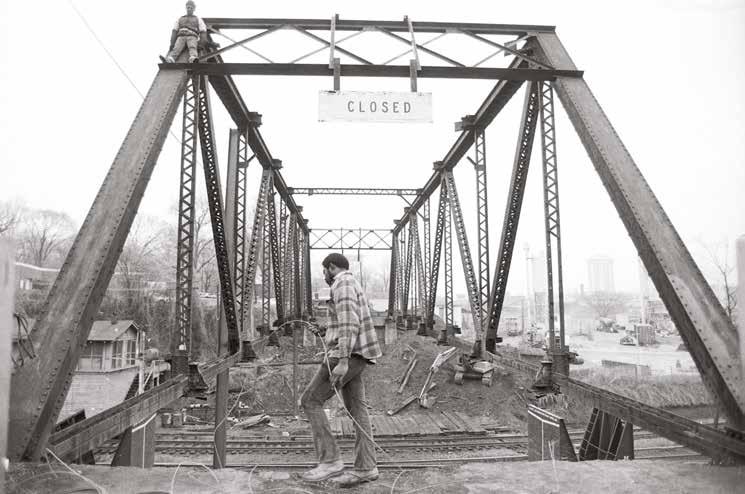
When the old Boylan Bridge was deemed unsafe, locals stepped in to say goodbye
by IAN F. G. DUNN
photography from the STATE ARCHIVES OF NORTH CAROLINA
In 1978, the old Boylan Avenue bridge — an aging steel truss bridge that spanned the 150-foot railroad cut at the Boylan Wye — was permanently closed. An engineering assessment deemed the beloved structure unsafe, overloaded and deteriorating.
Constructed in 1913, it was the second bridge to span this railroad cut. Its predecessor was a wooden structure built around 1858, which provided access to the sprawling estate and mansion belonging to William Montfort Boylan. (The area later became Boylan Heights, one of Raleigh’s first planned subdivisions, and the mansion has been reimagined as the
Heights House Hotel.)
In November of 1981 the fate of the Boylan Bridge was sealed. After a contentious fight by Raleigh residents to save the bridge, the North Carolina Department of Transportation ultimately prevailed and ordered its demolition.
Humans have a peculiar practice of humanizing the non-human. Cars, boats and buildings are common objects to anthropomorphize, but in this case it was a steel truss bridge.
Upon hearing the news of its imminent demolition, Raleigh historian and native son Karl Larson sent postcard invitations to several friends to attend a ceremony
honoring the landmark. Larson was a practicing Catholic, but he was also one part bohemian and two parts bon vivant. Each of the personality traits in this eccentric mix would play a role in creating an event never before seen in Raleigh: a last rites ceremony for a bridge.
What was initially intended as a performance art piece and personal observance involving a handful of friends evolved into a well-attended public event after word spread with both The News & Observer and WPTF-TV reporting on the story.
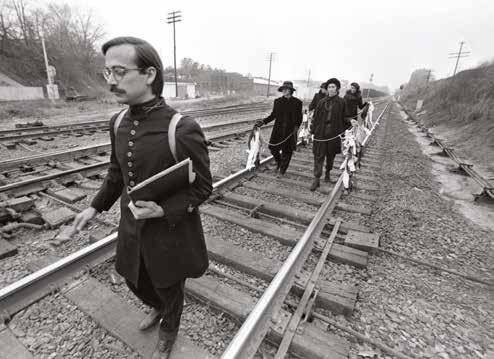
Larson and his entourage, each clad in black mourning garb, began the ceremony with a procession down the tracks approaching the bridge. In a personal letter from that year, held at the State Archive of NC, he described the event:
Our bridge traverses railroad tracks. We wanted to illustrate the relationship between the bridge and its function. Therefore, we began the performance with a procession down the tracks to the bridge. I led this procession ringing a hand bell followed by four women dressed in black. They dragged behind them towlines and streamers with railroad spikes attached. This made a wonderfully eerie and mournful clinking sound as we made our way to the bridge.
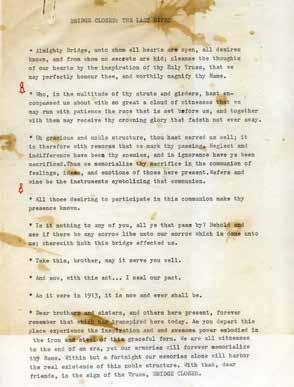
Meanwhile, on the bridge, another person in Larson’s group swept the road surface as a rite of purification prior to the ceremony. Once the procession climbed the stairs of the switch house and reached the bridge surface, Larson read the liturgy he’d written based on the funeral service found in the Episcopal Book of Common Prayer:
Almighty Bridge, unto whom all hearts are open, all desires known, and from whom no secrets are hid; cleanse the thoughts of our hearts by the inspiration of thy Holy Truss, that we may perfectly honour thee, and worthily magnify thy Name. Who, in the multitude of thy struts and girders, has encompassed us about with so great a cloud of witnesses that we may run with patience the race
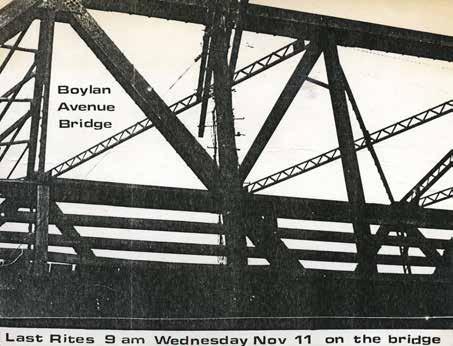
Raleigh historian and native son Karl Larson sent postcard invitations to several friends to attend a ceremony honoring the beloved landmark.
that is set before us, and together with them nay receive thy crowning glory that fadeth not ever away.
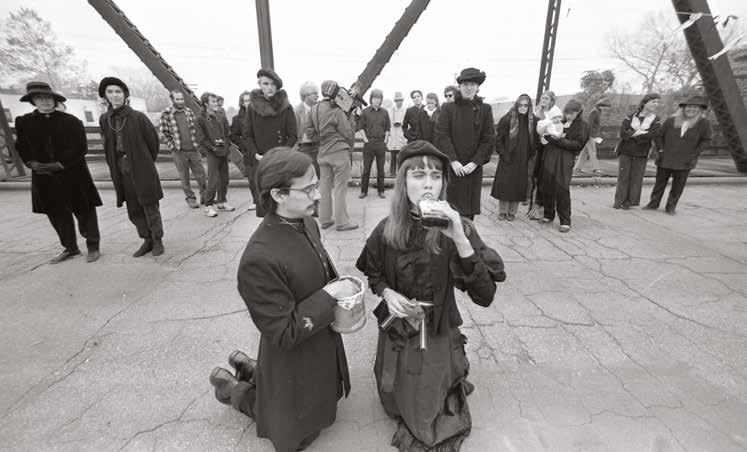
A “communion service” followed with Richards Wild Irish Rose wine and Nilla wafers as stand-ins for the real thing. The cheap wine was intended to be a respectful nod to the thousands of train-hoppers over the decades that made the underside of the bridge their temporary home. Following communion, Larson uttered, “And now, with this act… I seal our pact.” He then took a second bottle of Wild Irish Rose and shattered it on the metal bridge. Another person in the party announced the response, “As it were in 1913, it is now and ever shall be.”
After the ceremony, the bridge remained for another month before demolition began. It wouldn’t be until late March of 1982 that the last metal girder was removed. Construction began im-
mediately on the new concrete bridge, which opened to traffic 19 months later on Oct. 10, 1983. It remains there today, quietly performing the same duty as the old truss bridge, except now its work is silent and sanitary. Many enjoy its wide deck and sidewalks for easy travel and unobstructed, postcard views of our skyline. Still, others may not mind a girder or two getting in the way.
Top to bottom: Script read by Larson on the day of the ceremony (undoubtedly stained by errant drops of Wild Irish Rose); the ceremony at the bridge.
On May 13, WALTER will be hosting a book club event with Ian F.G. Dunn and Mary Ruffin Hanbury, the co-authors of Lost Raleigh: Exploring the Oak City’s Architectural History. The book, which was started by Karl Larson before his death, is a collection of photographs and stories about Raleigh landmarks of the past. Learn more at waltermagazine. com/savethedate.


All new and long awaited in the charming Village of Pinehurst – a collection of five free-flowing residences, from 2,600 to 3,800 sf, set among the pines of Pinewild Country Club. Pinewild is a welcoming community featuring exceptional amenities, including 48 holes of extraordinary golf and an expansive new clubhouse coming early 2027.




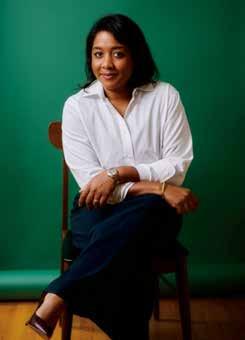

In her new memoir, Brigid Washington explores her rigorous studies at the Culinary Institute of America as told to ADDIE LADNER
uthor, writer and recipe developer Brigid Washington’s latest book, Salt, Sweat & Steam, explores her experiences at the Culinary Institute of America (CIA) in New York, the most prestigious cooking school in the country. Originally from Trinidad, Washington came to the United States to study journalism and psychology at North Carolina State University. After graduating in 2005, she worked in journalism for a few years, then decided to pivot to a career in food. That led her to the rigorous curriculum at the culinary college, where she learned the anatomy of fish, perfected a French omelet and ran the school’s newspaper. Through that experience, she evolved as a writer, chef and young adult, paving the way for a career working for publications like THe New York Times and Bon Appétit. We caught up with Washington to learn more.
WHAT DROVE THE CAREER PIVOT?
After graduating from NC State, I moved to New York to take a job at Meredith Corporation. But I missed Raleigh and the tight circles of Caribbean friends I had here. I returned to Raleigh and decided to learn what professional cooking entails, hoping that it could lead to a career that I’d be passionate about. I started working under the mentorship of a local chef, who allowed me to shadow his back-of-house team and eventually gave me hands-on experience. Noticing my eagerness to learn, he encouraged me to apply to culinary school.
DID YOU ANTICIPATE THE INSTITUTE BEING AS HIGH-STRESS AS IT WAS?
Yes and no. There’s a reason it’s branded the “World’s Premier Culinary College.”
IN THE BOOK, WE LEARN ABOUT THE HIGH-STRESS CONDITIONS AT THE
INSTITUTE. WERE THEY NECESSARY? There was a very high level of expected excellence. But I think the professors demand a lot because they know their students will experience that level of pressure if they want to work in a commercial kitchen or as professional chefs.
WHAT’S SOMETHING YOU LEARNED THAT COULD BENEFIT HOME COOKS?
Direct heat, like broiling, is an underutilized tool in many home cooks’ repertoires. It’s an efficient way to bring out new, different flavors in vegetables, even the gentler vegetables. Broiling bok choy, for example, compounds the power of its delicate, grassy flavors. So the next time you’re about to steam or boil a vegetable, consider what delicious possibilities might come from high, direct heat.
IN THE BOOK, YOU SAY YOU FELT THAT YOU WERE STARTING “LATE” BECAUSE YOU DIDN’T HAVE EVERYTHING FIGURED OUT AT 26. LOOKING BACK, DO YOU FEEL DIFFERENTLY? Absolutely. But it was also within context. So many of the friends in my orbit did have things figured out: I had been to countless weddings, people were buying their first homes, they were on their career trajectories. We compare ourselves to the people closest to us. I would have never imagined the career I’ve had over the past 20 years — now, I’m sharing Trinidadian recipes in THe New York Times and I’m the vice president of the James Beard Foundation journalism committee. Looking back, I was right where I needed to be.
WHAT MIGHT PEOPLE FIND SURPRISING AFTER READING THIS BOOK?
At the institute, I did so much of my cooking as an achievement or for a grade. For some people, a stressful environment like that, with so much pressure, could make you hate cooking. But I still truly enjoy it.
THis interview has been condensed and edited for clarity.



After facing the suicides of their loved ones, these mental health advocacy groups push for change
by SYDNEY BRAINARD
Sandy Bridger remembers the night that the Broughton High School wrestling team gathered in her den. It was 2019, and Kaleb Wright — their leader, team captain and friend — had just died by suicide.
“They didn’t know what to say,” Bridger says. “They didn’t have the words.”
Wright was a talented champion wrestler, whom many on the team and in the wrestling world looked up to. He was also known to be a skilled singer, even singing at Broughton’s annual Queen of Hearts dance. Those who got to know him describe him as kind, with a lot of love for his friends. Even individuals who interacted briefly with him at wrestling
tournaments or elsewhere remember his humble, caring nature.
Bridger’s son was Wright’s friend and teammate, and Bridger was friends with his mother. Even though she had been doing work in the mental health space for decades, Bridger didn’t know how to confront a tragedy that hit so close.
At the time, with these teenagers packed into her house, she remembers thinking, “I didn’t know how to offer these kids comfort, or to let them know that it’s going to be OK, or to give them back the innocence they had when they woke up this morning, before they knew that they could lose their friend like this.”
As incomprehensible as a loss like that
feels — confusing, destabilizing and unbearably tragic — it’s unfortunately not a rare feeling in the United States. Suicide is the 11th leading cause of death nationally and the second leading cause for individuals between the ages of 10 and 34, according to 2023 data from the Centers for Disease Control and Prevention.
Mental illness can affect anyone, from the high-achieving, social student athlete to the withdrawn, quiet co-worker.
Racial minority groups and members of the LGBTQ+ community often face a higher risk, particularly Native American individuals and trans people, as do men, who have long had a suicide rate multiple times that of women.


The link between suicide and mental health doesn’t discriminate, but it can easily compound under increased pressure, says Shelley Belk, executive director of the Foundation of Hope, a Raleigh-based nonprofit that invests in research and treatment of mental illness. Discrimination, racism, sexism and homophobia can all increase stress and negatively affect mental health. As can pressures from athletics, school or work — even when a person is, by outward measures, successful. Some people will show predictable warning signs, but others will shock friends and families who never saw it coming.
In May 2024, Raleigh native and two-time PGA Tour champion golfer Grayson Murray died by suicide at the age of 30, following a long battle with depression and anxiety. Murray had spoken openly about struggling with mental health and alcohol abuse and had received treatment in the past, even spending a month at the Betty Ford Center, an addiction and mental health treatment center in Minnesota.
Still, there were always ups and downs for Murray, just like anyone else.
Just a few months before his death,
Murray gave an interview at the Sony Open in Hawaii, sharing that he was more than eight months sober and thanking his friends and family for their support.
“I still have hard days,” he told them. “But I feel a lot more at peace inside the ropes now.”
Often, it will never really seem to make sense. For friends and family members left behind, the doubts, the questions, the “what-if’s” run in an endless cycle. Suicide and mental health are not simple issues, and nothing can be solved overnight. Still, the family and friends of Wright and Murray have taken up the mission of advocacy, attempting to defeat the stigma surrounding mental illness and provide tangible support to those who are struggling.
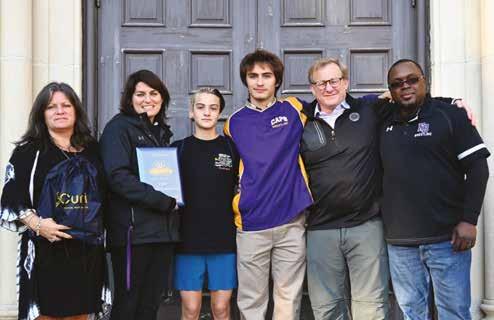
After the death of Wright, members of the Broughton wrestling team and other Broughton students carried his senior banner at the 2019 Walk For Hope, a charity 5K walk hosted by Foundation of Hope, for the purpose of raising money for mental health research. Among the sea of walkers wearing red “Walk For Hope” shirts, the Broughton students stood out in their signature purple. They
carried the banner, which showed Wright posing in his wrestling uniform, the whole way. The group ended up raising more money than any other high school team participating.
In the years that followed, more and more of Broughton Athletics joined the Walk For Hope — last year, they were recognized for raising $5,000 for the cause. This past October, Broughton Athletics partnered with Hilinski’s Hope, a mental health foundation formed after the death by suicide of Washington State University football player Tyler Hilinski, to highlight Student-Athlete Mental Health Week.
The movement had to grow beyond any single person, Bridger says. As the years crept by and new classes of students filtered through, fewer and fewer of the participants in the walk had a personal connection to Wright, but they still walked.
The Broughton community wouldn’t soon forget the loss of any of their students.
“It was gut-wrenching for the entire school, for not just a small amount of time, but for years,” Belk says. “It caused the Broughton community to want to rise up and take action and do something about it.”
In similar fashion, the Grayson Murray Foundation was formed by Murray’s
parents following his death in 2024. Much of the foundation, which conducts advocacy locally in Raleigh, is based on a blueprint that Murray himself had drawn up before he died.
Quietly generous during his lifetime, Murray would donate anonymously to charities, send clothes he received through sponsors to kids at his former high school and cover expenses for those in need. It’s not exactly surprising that he would already have envisioned creating a foundation in order to help people struggling just like him, who couldn’t afford the care that he could.
“Grayson’s family has a plan, written in his own hand, where he said that he wanted to help those that wanted to be helped but may not have the help they need financially,” says Jeff Maness, president of the Grayson Murray Foundation and a close friend of Murray’s. “Part of our foundation is to carry out Grayson’s wish to help fund treatment for people who are really interested in mental well being, and to get better.”
While he was in treatment, Maness says, Murray saw people struggling with mental health having to leave the treatment facility early and lose the care they needed and wanted because they couldn’t afford to keep paying for it. His plan grew out of frustration with what he witnessed there.
ship with the Hazelden Betty Ford Clinic in Minnesota to help provide patients with financial support. And they’re working with WakeMed to help create a new mental health hospital.
“The link between suicide and mental health doesn’t discriminate, but it can easily compound under increased pressure.”
–SHELLEY BELK
Now, the foundation formed in his name raises money so that people can afford treatment, along with raising awareness about mental health in general. The organization has expanded its reach through partnerships, like one with the Ben Hogan Foundation, to which they contributed $20,000 for a scholarship that provides educational support for a child who has lost a parent to suicide in Wake County. Murray’s foundation also has an ongoing partner-
For all the resources these projects need, the foundation has been working to raise money. Just last year, the foundation hosted their inaugural golf tournament in Murray’s honor, which was attended by dozens of top golf champions, like Brooks Koepka, Chesson Hadley and Jason Gore. All proceeds went to the foundation.
“For those of us that were very close to Grayson, it might be easier for us to just try to move on. But we’re not. We’re addressing these issues,” Maness says. “So we’re encouraged by the conversation around these topics.”
Awareness about mental health has increased drastically over the past few decades. According to CDC data, over half of U.S. adolescents reported talking
about their mental and emotional health with a health care provider in 2023, and 20% of adolescents reported receiving therapy. The World Health Organization reported that countries around the world have made significant strides in mental health policies since 2020.
Yet, the gaps in support and knowledge still loom large. That’s why the initiatives like the ones at Broughton and the Grayson Murray Foundation won’t be slowing down anytime soon.
“There are more opportunities to address these topics than there are resources to address them,” Maness says. Bridger believes that mental health advocacy is only going to expand as the new generations grow up and more people take up the cause. And she has big dreams for the future.
“We’re getting these kids in when they’re young, letting them see what it means to be part of a community and helping them understand that advocacy starts very small — it can start as small as signing up for a walk and walking for three hours,” says Bridger. “I think giving the students a voice, giving them a purpose, will go so far in our community and in their lives.”


At Wellington Reserve, outdoor living is an everyday indulgence. Thoughtfully designed homes feature expansive outdoor spaces with shimmering pools, relaxing sunning ledges, and serene spas—perfect for unwinding, entertaining, and enjoying resort-style living right at home.




by TOMMY TOMLINSON illustration by GARY PALMER
Recently we spent a fine Saturday afternoon in Mount Pleasant. I should specify that it was the Mount Pleasant in North Carolina. It turns out there are dozens of Mount Pleasants all over the country, sometimes more than one in the same state. You can see the appeal. Names can be destiny. Name yourself Mount Pleasant and you’re halfway to pleasantness itself.
The “Mount” part is trickier. I grew up near a Mount Pleasant in south Georgia that was as flat as a shuffleboard table. The North Carolina version doesn’t exactly require hiking poles either. Then again, the Piedmont is known for puffing itself up when it comes to height. One of the reasons Charlotte calls its downtown “uptown” is that there’s a slight rise from the edge of the center city to the main intersection of Trade and Tryon streets. You might not even notice it if you’re driving. But it is, technically, “up,” so “uptown” it is. And if Mount Pleasant, out on the eastern edge of Cabarrus County, sits on a patch of relative high ground… well, a mountain can be a state of mind.
It’s not far from where we live — less than an hour’s drive — but neither my wife, Alix, nor I had spent time there. Our loss. This time we made it there for a literary festival at the Mount Pleasant library, which
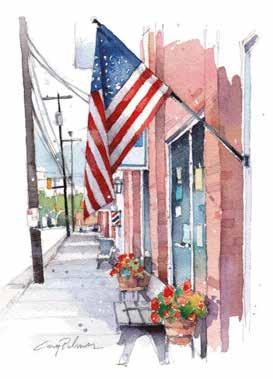
The truth, though, is that small towns have never been that different from everywhere else. The settings might be different, but our hearts are the same.
is bright and clean and beautiful. It doubles as a rec center. Kids were out on the fields playing baseball, and there was a line at a food truck. It was a busy spot in a busy town.
Not all small towns are like that. You’ve probably taken the back roads through some towns where you wonder if you wandered into the zombie apocalypse. Small towns have been hit hard over the last 50 or 60 years by everything from interstate highways to chain stores to the slow death of local manufacturing. Sometimes all you see is a bunch of boarded-up buildings and a Dollar General. It can make more sense to move, either into the city or out to the country. Sometimes the worst place to be is in between.
But other small towns figure out ways to thrive. Mount Pleasant has a crisp little downtown, old houses in good shape, a distillery housed in an old prison. (They make a bourbon called Conviction.) We met a guy who researches town history, a woman who worked in PR all over the country, and a flock of librarians I would follow into the deep stacks anywhere.
Ever y time we drive through a small town, my wife glances around at the houses and I can see her daydreaming. If Alix likes what she sees, sometimes she’ll say, “What would you think about buying a house and moving somewhere like here?”
She said that about Mount Pleasant.
I grew up in a midsized town — about 30,000 people — and got most of my perspective on small towns from watching TV. For the longest time I thought of small towns as being on either end of a wide range. One end was Mayberry, where almost nothing bad ever happened, except when Aunt Bee made pickles. The other end was Cabot Cove, Maine, where somebody got poisoned, stabbed or shot to death every damn week on Murder, She Wrote. (I still can’t believe nobody figured out that Jessica Fletcher was the most prolific serial killer in human history. None of that happened before she got to town!)
Modern life has flattened a lot of the differences between small towns and everywhere else. Streaming services bring the most obscure movies and shows to anyone with Wi-Fi. Worldwide delivery can put pretty much anything you want on
your doorstep by tomorrow morning. A small town might not have a fancy ramen place, but Amazon can send you the ingredients and YouTube can show you the instructions.
The truth, though, is that small towns have never been that different from everywhere else. The settings might be different, but our hearts are the same. We all need to love and be loved, to find pursuits that fulfill us, to grieve when life hands us losses, to reach for something bigger than ourselves.
Those things are true no matter whether you live in a hamlet of 200 or a city of 2 million.
Ever y person is complicated; every collection of people is even more so. It’s easy to write off a place for thinking or acting a certain way, but remember, that might be a majority, but it’s not a monolith. (I’m not sure I could get a two-thirds vote in my own
family on any subject except banana pudding.) Our love for one another brings us together, but our differences are what makes life interesting.
It took me a long time to learn that you can make your own Mount Pleasant wherever you are. You can just decide to live on higher ground, to be decent to others, to make a small town out of your friends and loved ones, even in the middle of a big city.
We are not likely to move to the actual Mount Pleasant, even though we enjoyed it. What we hope to do, though, is keep the little bits of it that we brought home with us — the warm feelings, the new friendships, the sense of discovery.
I’m sitting here looking at a North Carolina map right now. I’ve been all over this state but there are so many places I still haven’t been.
Time to gas up the car.

by JIM DODSON illustration by GERRY O’NEILL
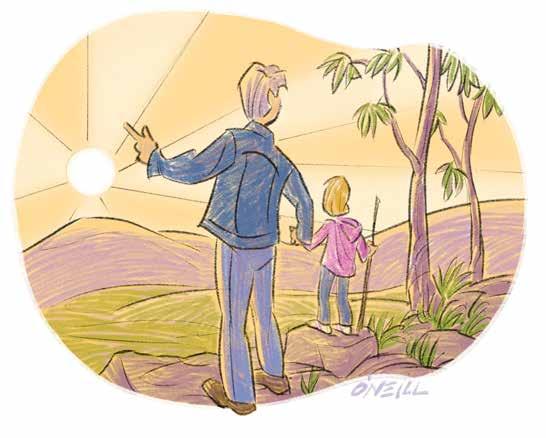
My daughter, Maggie, was born in 1989.
It was a year of revolutions, a turning point in world affairs that witnessed the opening of the Berlin Wall, a Velvet Revolution in Czechoslovakia and the end of communism in Europe’s eastern bloc. It also saw the birth of the World Wide Web and the first commercial internet providers — social revolutions of a different kind.
Mugs, as I called my beautiful baby girl from day one, was born in the aftermath of a huge snowstorm in Maine. We took her home to our cottage on Bailey Island on day two, after her paternal grandpar-
ents arrived from North Carolina.
One of my fondest memories is of sliding on my rump down the deep, snowy hill behind our cottage, my bundled-up papoose clutched to my chest. When I looked at my daughter’s tiny face, I swear she was almost smiling.
Upon returning home to Carolina, my dad, a veteran newspaperman with a poet’s heart, jotted me a note with a bit of whimsical verse attached. He fancied himself, I think, a homegrown Ogden Nash.
Sadly, I can only remember the opening lines of the ditty because I kept it in my office desk forever — until it apparently
migrated into attic boxes stuffed with half a century of manuscripts, letters and correspondence. Someday, I hope to unearth it. In the meantime, here’s the bit that I recall, advice from a happy grandpa:
There’s nothing in this whole wide world
As precious as a baby girl who someday soon will surely be A child as happy as can be Your job, my son, is take her hand… at which point my memory fails.
When Maggie and her husband Nate visited us in the autumn of 2024, she graciously offered to plow through my
mountains of archives and work papers, giving me hope that she might find my dad’s wise little verse.
Instead, she found a pile of letters from my early career that included an unopened one from legendary The New Yorker magazine editor William Shawn. In it, he complimented me for an investigative piece on a forgotten African American community I’d written for the Sunday magazine of The Atlanta Journal-Constitution, where I was a staff writer. He’d read it while waiting for a plane home to New York from Major League Baseball’s spring training in Florida. He also wondered if I had interest in writing for his magazine.
I laughed at this discovery because my career ambition in those early days was indeed to someday write my way into The New Yorker.
My daughter was incredulous. “Dad!” she playfully chided. “How could you have not opened this letter?”
Sheepishly, I explained that I had a habit in those days (and even today) of setting aside important letters to read and properly answer later. “I probably just put it in my cluttered desk and forgot about it,” I theorized. “Crazy, I know.”
But perhaps, I added, my mistake was a perfect, unanswered prayer.
If I’d achieved my ambition to work for The New Yorker, I probably never would have burned out covering crime, politics and racial justice in the socalled New South. I might not have fled to a winding trout stream in Vermont, where I’d become the first senior writer of Yankee Magazine, marry her mom, build a gorgeous house on a forested hill in Maine and become the father of two beautiful babies. Moreover, I might never have also found my way home to North Carolina, where I’ve written a dozen books and helped start arts-andculture magazines that are thriving today.
Last May, we were thrilled to learn that Maggie was pregnant with our first grandchild, a baby girl due on Christmas Eve.
June Sinclair Prescott arrived seven

June Sinclair Prescott arrived seven days early, weighing in at a healthy 9.9 pounds. I immediately nicknamed her “June Bug,” because they are said to bring good luck (and my spring garden is always full of them).
days early, weighing in at a healthy 9.9 pounds. I immediately nicknamed her “June Bug,” because they are said to bring good luck (and my spring garden is always full of them).
Maggie’s mom, and my first wife, Alison, flew to Los Angeles first to be with mother and baby as they got better acquainted.
The plan called for “Nana and PopPop,” aka Wendy and myself, to follow in early January. Unfortunately, a powerful ice storm struck the day before our flight was to depart. A flow of adorable photos and videos of June Bug had to suffice. In half of them, she appears to be smiling and even belly laughing. Like her mama at the same age.
Two weeks later, we tried again. This
time, it snowed 13 inches on the eve of departure and thousands of flights up and down the East Coast got canceled. Including ours.
The day after the big snowstorm — shades of Maggie’s own birthday in 1989 — the sun popped out and I stepped outside to fill the bird feeders and think about my spring garden. An old idea suddenly came to me.
Pushing the snow off my favorite wooden chair, I sat down and jotted a letter in light verse to my new grandchild like my father, the homegrown Ogden Nash who preceded me. I also asked the artist Harry Blair, my good friend, to illustrate it.
Dear June Bug,
Someday while you are still a tyke, I’ll take you on a wondrous hike
To see the world from on a hill
And all the places that will fill Your life ahead with joyful things — Like winter snows and golden springs. For nature is the ideal guide
To leafy paths that cannot hide
The glory of a world that’s wide — With loving souls so full of grace
Who’ll help you find your perfect place
To live the life your heart desires — With faith — and strength — that never tires.
With my love forever, PopPop
Our third effort to reach Los Angeles proved a charm.
We took the illustrated verse, lots of cute new baby clothes and a lovely Swedish bear to finally meet our beautiful new grandchild. All we did for five days was rock, hike, hold, cuddle, feed and play with June Bug and her mama.
Like her mother, baby June was born at a moment of revolutionary change and turmoil across the planet. But I have a feeling that our laughing June Bug will bring good luck and happiness to anyone she meets on her life’s journey, just as her mother has.




by MAEVE FOX
illustration by RANI RAY

I’m lulled by the sweet, thick smells of late spring. As the temperature dips like a sparrow, leaves turn their bellies up to the coming storm. Pouring rain sweeps in for a few precious minutes.
Carrying the sky’s booming voice, flashing temper. Leaving in its wake the weight of humidity. Flowers opening to drink deeply their gifts from the sky. Within the span of an hour all evidence of the storm will be gone.
Sidewalks bone dry, leaves no longer subjugating to the sky.
Once again I am enthralled by the sweet, thick smells of late spring.
Within white walls, shots of black, emerald green and vibrant orange add energy and contrast


For this St. Marys Street home, designer Tula Summerford played with color and pattern to suit the homeowners’ bold taste. The starting point in the living area was the tile around the fireplace, which was then complemented by furnishings in black, green and neutral tones. “We keep the scales different in a tile or fabric so they don’t fight each other,” says Summerford. “And I treat black as a grounding element as much as possible for clients that enjoy it.”

When Sunya Crofton and her husband, William, built their new home on St. Marys Street, they knew they’d need a designer. “We sold our previous home furnished, so we were starting from scratch,” she says. “I needed so much help!” For that, she enlisted designer Tula Summerford, whose children had gone to school with the Croftons’ three daughters. “I always loved Tula’s style, and knew that one day I’d like to work with her,” says Sunya.
The outside of the house, which was built by Allure Homes, is more traditional, designed to fit into the neighborhood. But for the inside, Sunya knew she wanted something different. “A lot of color, lots of patterns — they wanted it to be fun and comfortable,” says Summerford. Working closely with Sunya, Summerford suggested a palette of black, emerald and orange that repeats throughout the home in different ways. “I like to pick up one color line to go throughout the entire house and then accent it with
texture and art,” says Summerford. The scheme is established right at the entrance. Along one wall is flocked floral wallpaper from Designers Guild with bold, oversize blossoms on a black background. In front of it, a sculptural settee picks up the blues and aquas from the print in a vertical stripe. Then across the hall is the dining room, where the walls, trim and ceiling are all painted black. “For the curtains, we pulled the bright yellow from the fabric. That color adds depth and sophistication for a tailored, high contrast look,” says Summerford.
The colors continue as you get deeper into the house, which leads into an openplan living and kitchen area, but in a different composition. “If you start dark, it’s much easier to step those hues down as you move into the next room,” Summerford says. “You need things to flow and feel balanced.” In the living room, the fireplace surround is the star, outfitted with a black tile with gold striations. “When we saw that, we knew we needed to figure out where to use it so the whole family could enjoy it,” says Summerford.
“Once we had that, everything else in that room fell into place.”
With the fireplace as the focal point, Summerford brought in furnishings in neutral tones, shot with emerald green. “I love the whole setup,” says Sunya. “It’s a true family room.” Their daughters are out of the house now, and one was recently married, so the space is designed as a place to gather for special events as their family grows. “It’s so comfortable for a lot of people,” Sunya says.
The gold in the fireplace tile is also a visual echo to the gold elements across the room in the kitchen area: the trim on the vent hood, plumbing fixtures and chandeliers above the island, which are by Louise Gaskill, a local artisan. Sunya has found that she’s been cooking more for herself and her husband since moving in than ever before. “When my kids lived at home, we were running all over and they never wanted to eat the same thing,” she laughs. Now the two of them cozy up to the bar or breakfast table for meals and reserve the dining room for special occasions.

The mostly white kitchen gets some glitz from Louise Gaskill pendants and narrow hexagonal tile in tones of white and gold from Triangle Tile. The Croftons enlisted Summerford as soon as the floor plans were finalized.
“We worked with them from soup to nuts, choosing hardware, hinges, windows — the works,” Summerford says. In the breakfast area, navy-blue chairs balance the white walls and white shades; it also features a built-in bar with black-lacquered cabinetry. Behind the kitchen are a wine room and a scullery.
For her office, “I knew I wanted an orange room, and when we were going through wallpapers, I loved the texture on this one,” says Sunya Crofton. “It’s so bright and happy!” The static energy of the wallpaper is balanced by a cut-texture rug and white cabinetry.

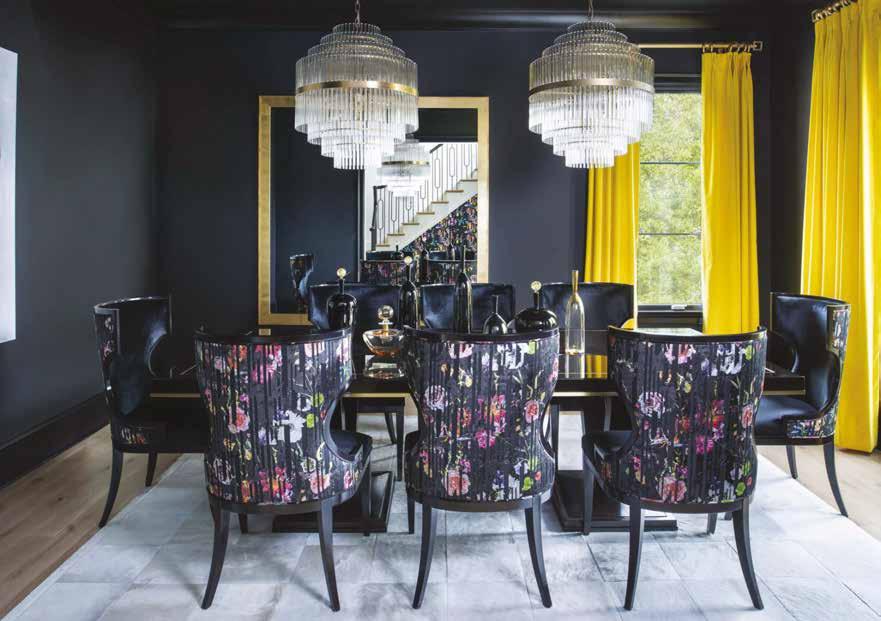
Sunya says she always wanted a black dining room: “It seemed crazy, but it’s just paint! I can always paint over it!” She and Summerford found the dining table together at High Point. “I saw it and was like, wow, this is really cool,” Sunya says. Over the table, Summerford hung two chandeliers. “When you have a long rectangular table, it takes the space up a notch,” she says.
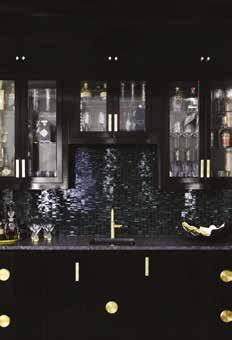


For the primary bathroom, Summerford used tile in four different scales and shapes of tile, but all in the same black, white and gold color scheme. “We wanted to create a focal moment from every angle,” she says. Navigating a wall of windows, she used two narrow mirrors and hanging sconces. “They’re small but it works — there’s so much light,” Sunya says.
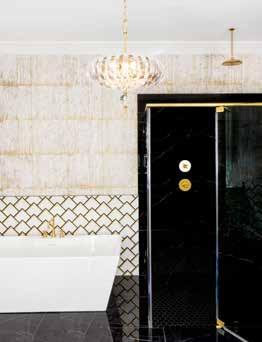


For the primary bedroom, they went with a lighter, spa-like scheme, incorporating shades of white, cream and warm metallics to add texture and glamour. The fan, bed and rug subtly play with form by repeating rectangles at different scales.

In the scullery, stacked smokyblue subway tiles with diagonal textures run up the walls, pulling in the blurred geometric feel of the curtains. “I use the scullery more than I thought I ever would,” says Sunya. Summerford did the laundry room floor in shades of navy blue, Sunya’s favorite color.
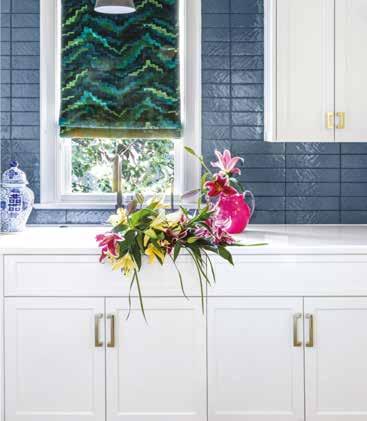
Beyond the kitchen, a dry bar with cabinetry done in a lacquered black ushers you into the breakfast area. “We wanted a lot of drama, and to showcase their fun collection of glasses, tequila and other liquors,” Summerford says. The backsplash is done in small tiles in tones of green and black for a moody oil-slick effect.
Off the living area, the primary bedroom is the lightest and brightest of the rooms, with just a touch of black in the ceiling fan and some burly wood dressers to warm up the space. “We wanted a clean, minimalist modern vibe,” says Summerford. To Sunya, it gives a spa feel. “It’s very calm and soothing,” says Crofton.
But for all the calm in the primary bedroom, the adjoining bathroom offers an energetic remix of the color scheme. The anchor pattern is mid-scale geometric tile that runs northward in overlapping peaks, serving as a wainscoting of sorts. Above it, large-format tile in a warm, shimmering finish pulls out the lighter tones, while the marble tile in the glass-enclosed shower — jet black with a hint of white veining— offers contrast. The room presented
a design challenge because it had three windows over the vanity, which meant there was not wall space for the traditional mirror-and-sconces combo. Summerford solved that by situating two narrow oval mirrors between the windows, with Louise Gaskill Murano glass pendants floating above them. That offered plenty of vanity space, plus access to natural light during the morning routine. On the counter, a white marble with black veining pulls in those darker colors from opposite the room.
Upstairs, the three daughters’ bedrooms work in roughly the same scheme (starting point: black and white), but Summerford worked with each of them to pull out their favorite colors. In one room, they went “color crazy” with a butterfly-print wallpaper and accents of yellow, magenta and electric blue. In another, a bold orange headboard shines against textural black, white and gray elements. For the girls’ bathrooms, they stuck to black, white and gold, playing in the vast range of tiles in that scheme.
Even within the scheme, there are a few
rooms that feel like worlds unto themselves. In the powder room, Summerford added a black-lacquered vintage vanity and pulled an antique chandelier from her collection as the final touch. A vibrant green wallpaper and matching Roman shades create a drenching effect. “We get tons of compliments on it — it’s not too wild, it’s just happy,” says Sunya. Similarly, for Sunya’s office, they leaned into a tangerine scheme. “Sunya wanted it to feel like a lady’s office, something fun that she wouldn’t mind seeing all the time,” says Summerford. To close it off, she designed custom barn doors — stacked hexagons within each panel, banded with gold — for a peekaboo effect from outside.
Throughout the home Sunya credits Summerford with not only making her vision come to life, but stretching her design sense with bold choices. “The foyer, for instance — I love the wallpaper and I love the fabric on the settee, but I never would have put them together on my own,” she says. “Now the settee’s my favorite thing.”

For their daughters’ bedrooms and bathrooms, they started with black and incorporated fun accents, like wallpaper with an interesting print or splashes of saturated textiles. “Each of the girls chose their own colors,” says Sunya. For the downstairs powder room (below right), Summerford pulled an antique chandelier from her collection as the final touch. “I save things like this for special projects, and this was the one,” she says. In this room, she also used an antique vanity, painted black, to continue the historic feel. The matching print on the wallpaper and shade creates a color drench effect.


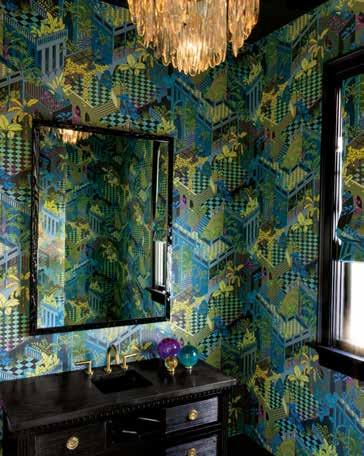
Beech Bluff County Park reimagines agriculture as a tool for education, sustainability and community connection
by SUSANNA
This page: The canopy walk. Opposite page: Along one of the trails and inside the visitor’s center.
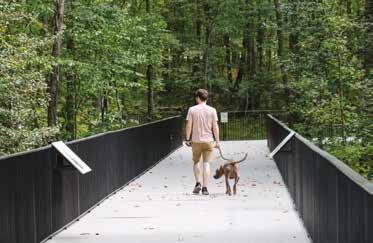
Step onto the 300 acres of Beech Bluff County Park in Willow Spring and you’ll feel the pace shift.
The sound of traffic fades, replaced by frogs calling and gravel crunching underfoot. The air smells of soil and fruit, and overhead, a pair of red-shouldered hawks circle as if in greeting. In the gardens, children kneel beside raised beds, tasting the basil and beans they’ve just picked. Nearby, adults wander the foraging forest and drift along the canopy walk. Opened in March 2025, Beech Bluff is a space meant for recreation — but it’s also a community-directed response to our modern disconnection from the land and the source of our food. When Wake County started acquiring the land, formerly a farm, they conducted a formal input process about what residents wanted to see there. “The community made it clear they really wanted an agriculture program,” says Christina Sorensen Hester, the park’s manager. “Which works well, since the land’s history was already leaning that way. Everything that happens here is our response to a real community desire to understand where our food comes from.”
It doesn’t take long to discover what makes the park special. Demonstration gardens burst with produce and an emerging foraging forest is dotted with plums, persimmons, berries, nuts and medicinal herbs. There’s a steady rhythm of programs for all ages on everything from composting to water conservation to regenerative farming practices. The park reimagines the land’s farming legacy at a scale you can try in your own backyard.
“Gardening is not as common as it once was,” says Chris Snow, Wake County’s director of parks, recreation and open space. “A lot of young people only know food from a store. They’ve never seen it grow or had the chance to pick it themselves.”
Beech Bluff’s mix of forests, wetlands, fields and rocky outcrops has a long history of sustaining people. “Before becoming a park, this land was farmed by seven generations of the Adams family and likely for thousands of years before that by the Tuscarora people,” says Will Ammons, assistant park manager and head of the park’s agriculture team.
The Adams family first farmed the land to feed themselves starting in the late 1700s. Slowly, they expanded from subsistence farming to a business that supported the family financially. Records show their crops included strawberries and, surprisingly, rice, a crop typically associated with the deeper South. The Adams also grew grapes that were fermented in a small winery on the property, which is now a church.
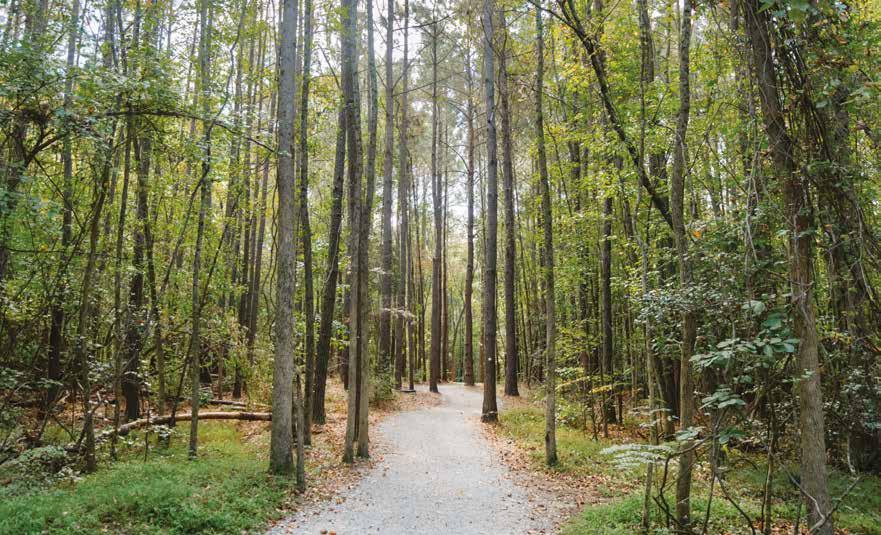
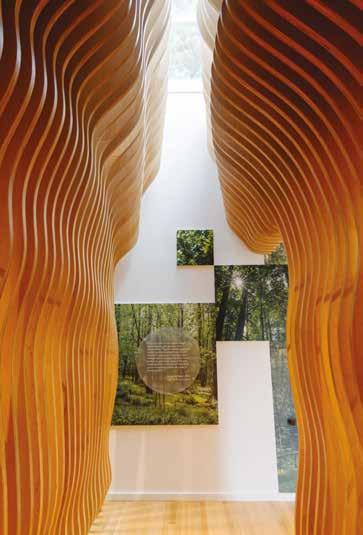
This and opposite page: Scenes from around Beech Bluff’s farm area, where staffers and volunteers help connect the land to its argricultural roots.
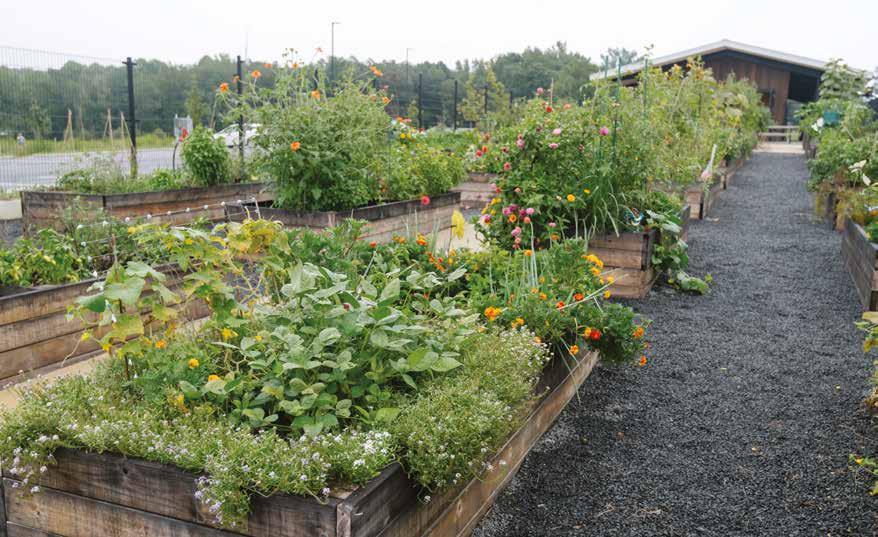
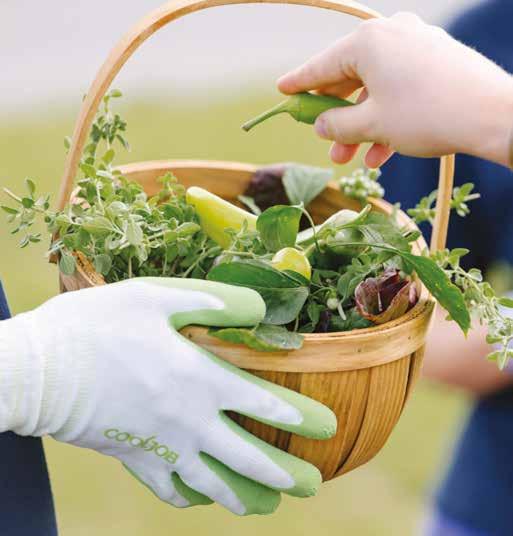

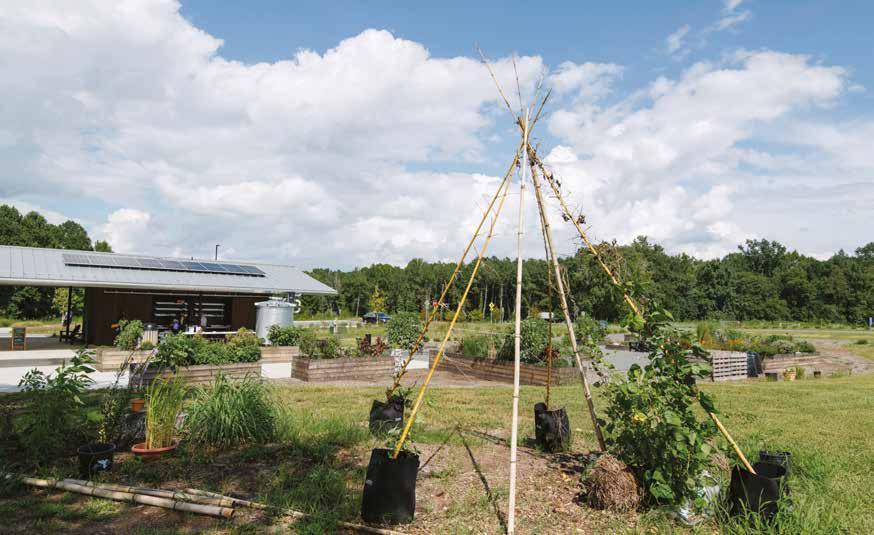
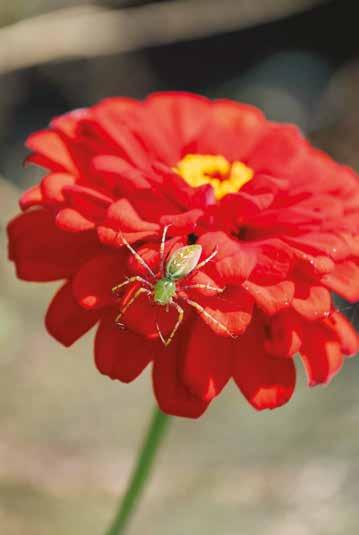
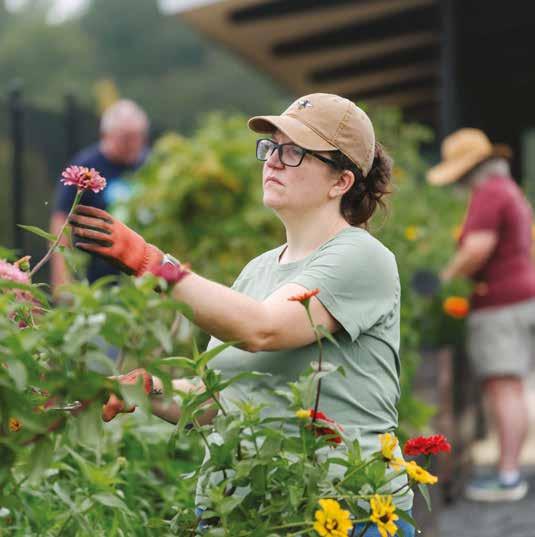

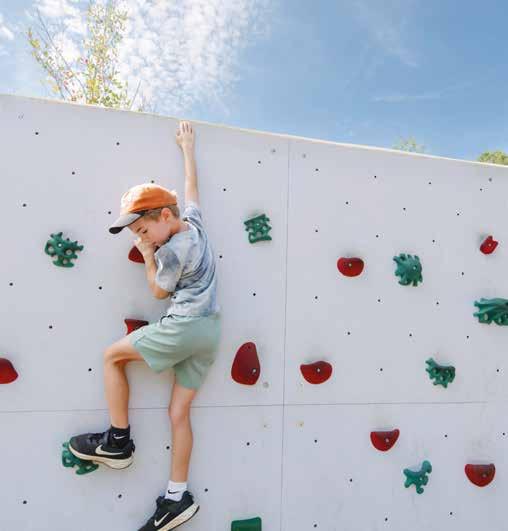

At many parks, that layered history would be tucked into a small exhibit in the visitor’s center. At Beech Bluff, though, the land’s agricultural history is its modus operandi. “By cultivating the land and teaching basic agriculture to the public here, we’re remembering the past and honoring it, even as we look toward the future,” says Ammons.
That involves teaching the next generation. In the learning gardens at Beech Bluff Park, the story of food comes alive for children, says Sierra Pantlin, one of the park’s agricultural technicians. Younger learners love the hands-on immediacy of tracing food from the soil to their palette.
“We talk about pollination and kids can immediately see a bee go from flower to flower,” says Pantlin. “We talk about decomposition and they can find worms in the compost. Seeing agriculture in action really connects the dots for them.” And the impact trickles up, she says: “Kids touch, smell and taste everything — sometimes it surprises their parents! But it inspires adults to get their hands in the soil, too.”
Even the park’s infrastructure reinforces the connection between people and the land. Beneath the parking lot, a geothermal system quietly powers the site, and rainwater is captured and reused. “We’ve got 4,500 gallons in tanks to care for our learning garden,” Ammons says. “Every last detail is focused on being natural and sustainable.”
And yet, for all its innovation, the park never loses its sense of place.
Venture beyond the demonstration gardens and the lively playground, and the 4 miles of wooded trails open into a softer, quieter space. Pale beech trees and loblollies filter the sunlight, and a hush settles that feels a world away from Raleigh, even though it’s just around the corner. It’s easy to imagine the generations who tended this land long before us. The rustle of deer, coyotes, possums and turkeys and the chorus of frogs are reminders that this land has always nourished more than just its human inhabitants.
Preserving Beech Bluff’s sense of place and history feels urgent in rapidly growing Wake County. “We live in a place where our connection to food and the natural environment can be lost if we don’t nurture it,” Ammons says. “Almost all of our ancestors relied on agriculture. It’s part of our human story, and it shouldn’t be forgotten.”
“Kids touch, smell and taste everything — sometimes it surprises their parents! But it inspires adults to get their hands in the soil, too.”
– Sierra Pantlin
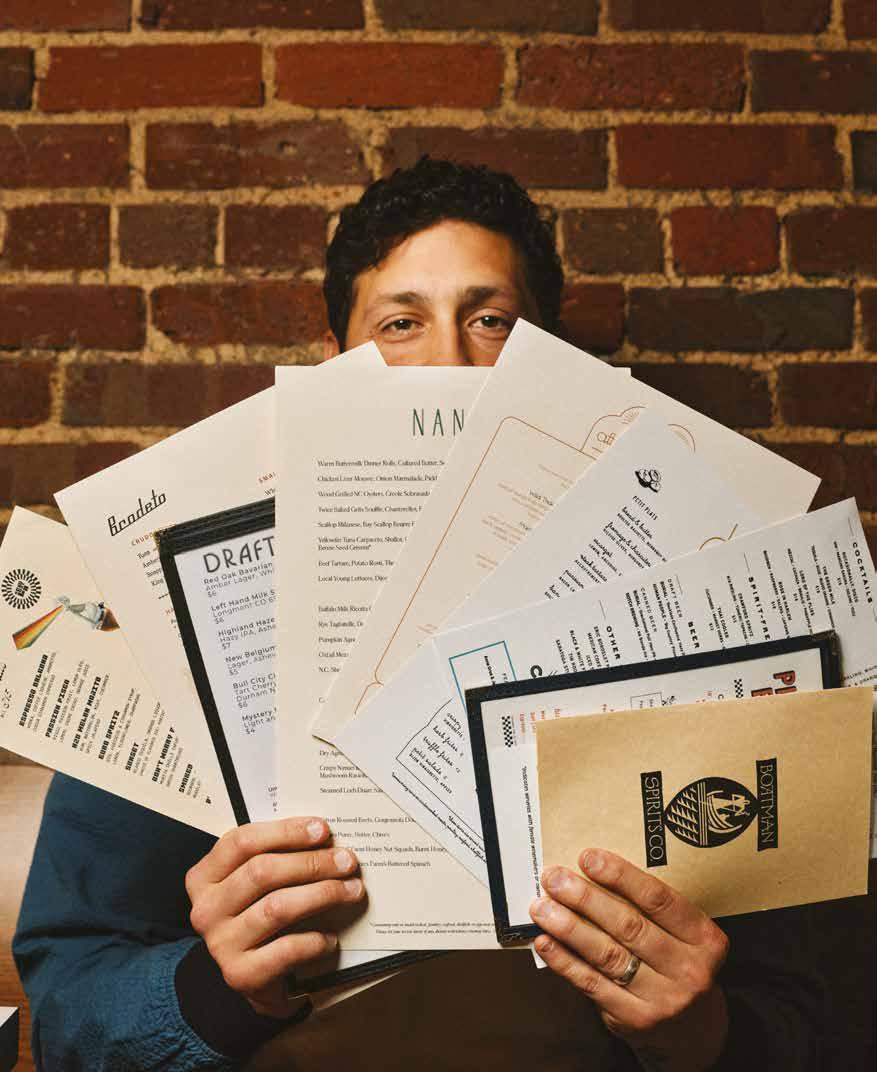
PAUL TUORTO works with local restaurants to create memorable first impressions
•••
by COLONY LITTLE photography by JOSHUA STEADMAN
When design is well executed, it tells a story — it creates a visual language that sets the tone for an experience. And in the competitive world of hospitality, first impressions can make or break a brand. Paul Tuorto is one of the people shaping the first impressions of bars and restaurants around Raleigh. If you get excited about that blocky “Union Special” stamped on the brown bag holding
your sourdough, or are tickled when you see the video-game monster gobbling up pizzas when you bring home a pie from Oakwood Pizza Box, you have Tuorto to thank.
“Chefs are really creative people, they’re dreamers,” Tuorto says. It’s this art director’s job to turn that dream into a world of visuals that tells a brand’s story from first glance.
Growing up in Long Island, New York, Tuorto’s home was full of Italian food, music and creativity. His mother is a
self-taught interior designer, his father studied art in college, and Tuorto and his two brothers were encouraged to play multiple instruments in school.
When he was 10 years old, Tuorto’s family moved to Cary for his father’s work. Tuorto had always loved drawing, and it’s around that age that he remembers being drawn to logos for surf and skate brands like Billabong and Quicksilver. “I specifically remember the Hawaiian Island Creations logo, I drew it on everything,” he says.

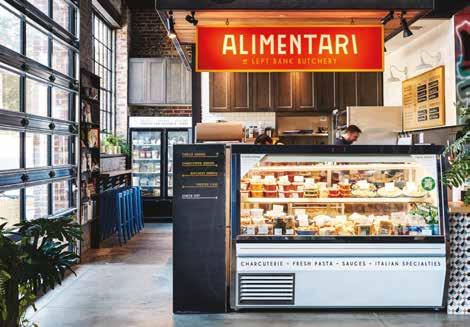
It was in an AP art class at Green Hope High School that Tuorto learned his interest could actually turn into a career. For one assignment, the students were challenged to redraw familiar logos in a pop-art style. “I made a three-dimensional version of this turtle design on a t-shirt I loved, then got curious about who made the original,” Tuorto says. His teacher explained that it was probably a graphic designer. “I asked, What’s that? And when she explained it to me, I thought, THat’s a thing?” he says. He’d found his path.
Tuorto attended Appalachian State University, graduating with a degree in graphic design. He returned to the Triangle in 2007 and began working in
a design firm, but when the economic collapse hit in 2008, his position was cut. He started freelancing, taking on design gigs and contract work to pay the bills, but he wasn’t passionate about the clients. “It was not rewarding at all,” he says. “I needed some other outlet to do something creative.”
So he started a food blog called GiustoGusto (it means “right taste” in Italian). “It was mostly recipes, along with monthly musings on favorite destinations, markets, products, that sort of thing,” he says. “And it led to some really fun collaborations and opportunities.” Through the blog, he ended up meeting people in the hospitality industry who would become both men-
tors and future clients, like Pizza Box’s Anthony Guerra, the award-winning restaurateur Scott Crawford and Trophy Brewing’s Chris Powers.
In 2011, Tuorto went back in-house, joining creative advertising agency Baldwin& as an art director. There, he says, he strengthened his account and project management skills working with corporate clients like Burt’s Bees and BMW. The process of pitching concepts and working with demanding clients challenged Tuorto and gave him an opportunity to grow. “You learn about selling your work in school — the process of sharing your decision-making is part of the crit — but it’s very different when you’re trying to sell things that have
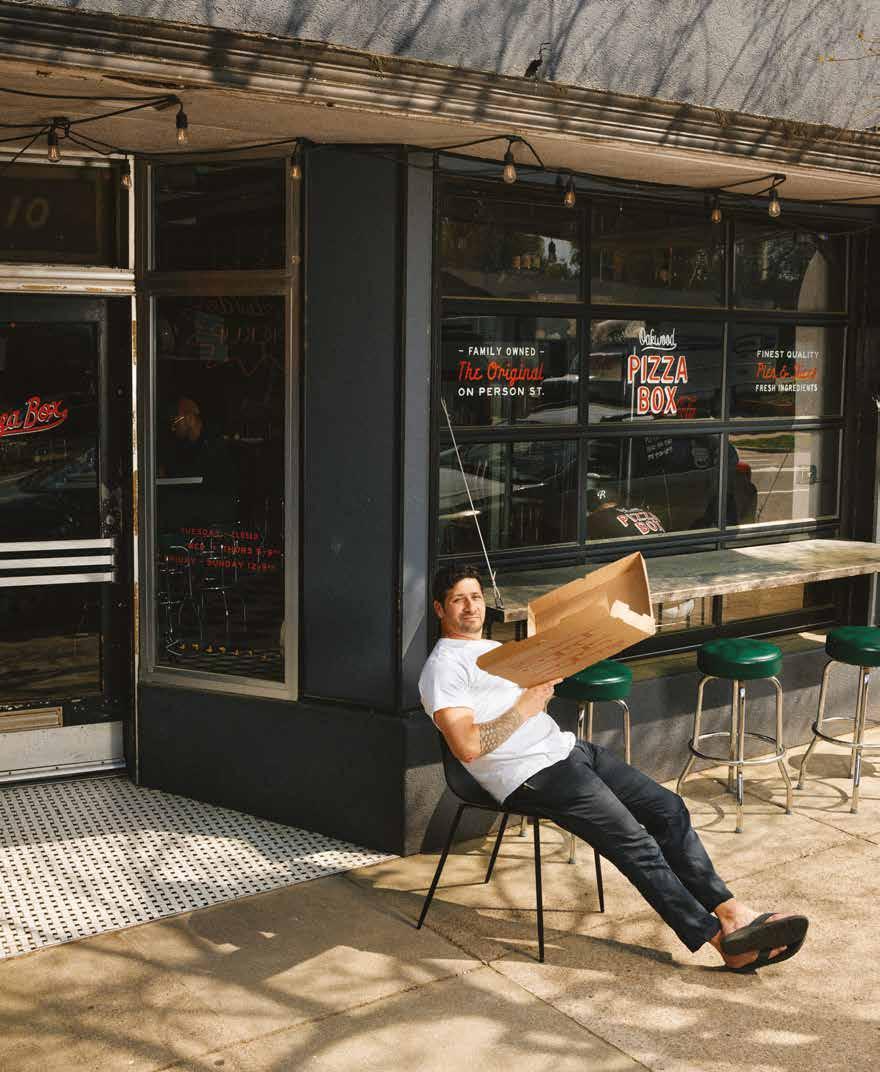
“People in hospitality pour their heart and soul into what they’re doing, and it’s super rewarding to be a part of these projects.”
— PAUL TUORTO
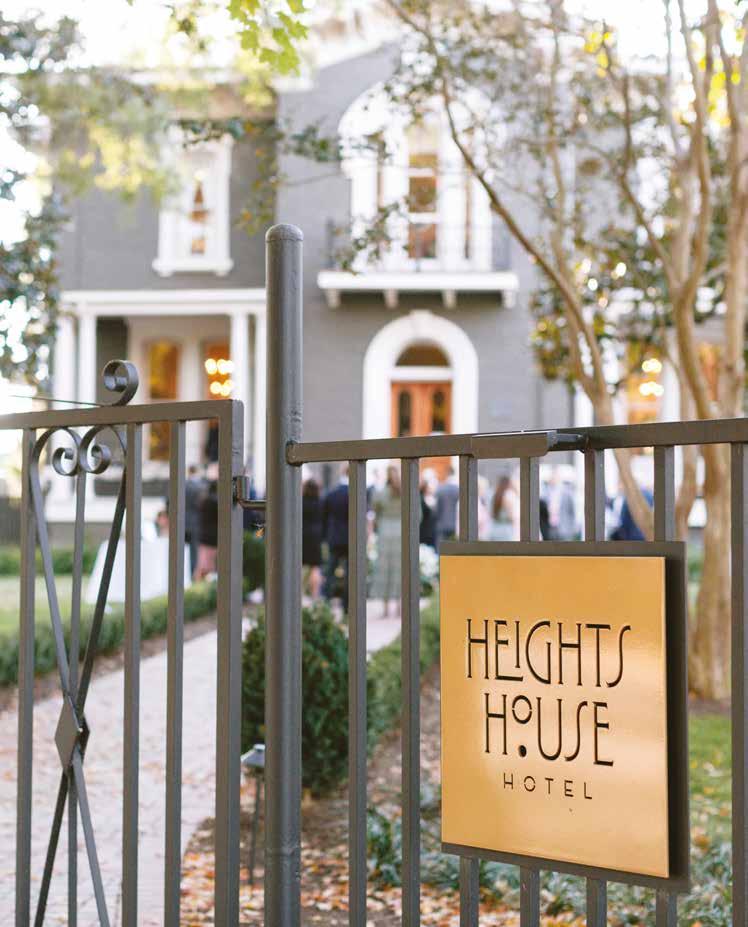

large dollars connected to them,” he says. “It makes you think about things completely differently.”
After five years with Baldwin&, Tuorto went out on his own. (He didn’t leave the agency too far behind; he still rents a desk at their office in the Warehouse district. “It’s always been a wonderful atmosphere,” he says.) The move coincided with a renaissance in downtown Raleigh. “It was absolutely flying — every week somebody was talking about a new opening, especially restaurants, and it was always in the back of my mind that the projects I liked most at Baldwin& were ones that were related to hospitality or the service industry,” he says.
In his solo practice, Tuorto synthesized his skills and interests in the restaurant industry more deliberately, working with friends and colleagues he knew in town and through his blog. Whiskey Kitchen was Tuorto’s first client on his own. He worked with the owners to orchestrate its design assets, from creating the logo and signage to shaping staff attire and event marketing graphics. That project catalyzed his freelance practice and became the blueprint for the design process with his clients. “It was like a spark plug,” he says. “That was so much fun, and we knew we had something kind of special — I could see the runway ahead of Raleigh, and how many of these establishments were
going to happen in the area.”
Each of his projects follows a similar process of discovery, strategy and design, often going through several iterations before finding the final look. Working with Crawford on Brodeto, for example, Tuorto channeled the chef’s love of tattoos and motorcycles, as well as the art found in the areas of Croatia and coastal Italy represented in the restaurant. “I shared several different styles of logotype of hand-drawn typography for the name, as well as illustration styles and ideas for the secondary logomark, the octopus,” he explains. “Once we landed on a mosaic style of type, I worked with a mosaic artist in New York to create it out of tile. We photographed the mosaic and
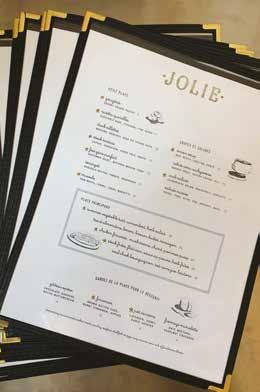

“Paul took so much thoughtful time to listen to my vision and values and transform what was in my head into a perfect reflection of what we wanted our branding to be.”– SARAH SHEPHERD
turned it into a working logo file for the restaurant.”
Once the primary identity is established, he develops all of the other visuals, including menus, signage, interior touches like artwork or wayfinding, merchandise, promo pieces and art direction for digital assets like the website and social media.
When Sarah Shepherd and her husband were turning a historic mansion in Boylan Heights into the Heights House Hotel, she turned to Tuorto for guidance on its new visual identity. “Branding is one of the most important steps for a small business,” she says. “Paul took so much thoughtful time to listen to my vision and values and
transform what was in my head into a perfect reflection of what we wanted our branding to be.”
For Heights House, Tuorto designed a minimalist sun and moonbeam logo that replicates the shapes found in arcs of the building’s windows. It’s complemented by a custom typographic font called Boylan Neue, a modernized interpretation of the Art Deco style typeface found on signs throughout the neighborhood. Elements of these motifs are found in small details throughout the hotel, from its business cards and stationery to the brass keychains on the room keys and the perfume bottles containing the hotel’s signature scent. “You can build a big experience, think
beyond a single logo to build an entire world,” he says. “It gets more rewarding as you stay engaged.” Shepherd has continued to work with Tuorto over the past five years as they’ve created new events and products. “He’s a pivotal extension of our team!” she says.
Entering his 10th year in his solo practice, Tuorto has seen the ebbs and flows in the industry he serves but continues to be inspired by the small businesses contributing to Raleigh’s unique landscape. “It may be selfish, but I love designing for local spots because I get to enjoy them myself,” he says. “People in hospitality pour their heart and soul into what they’re doing, and it’s super rewarding to be a part of these projects.”
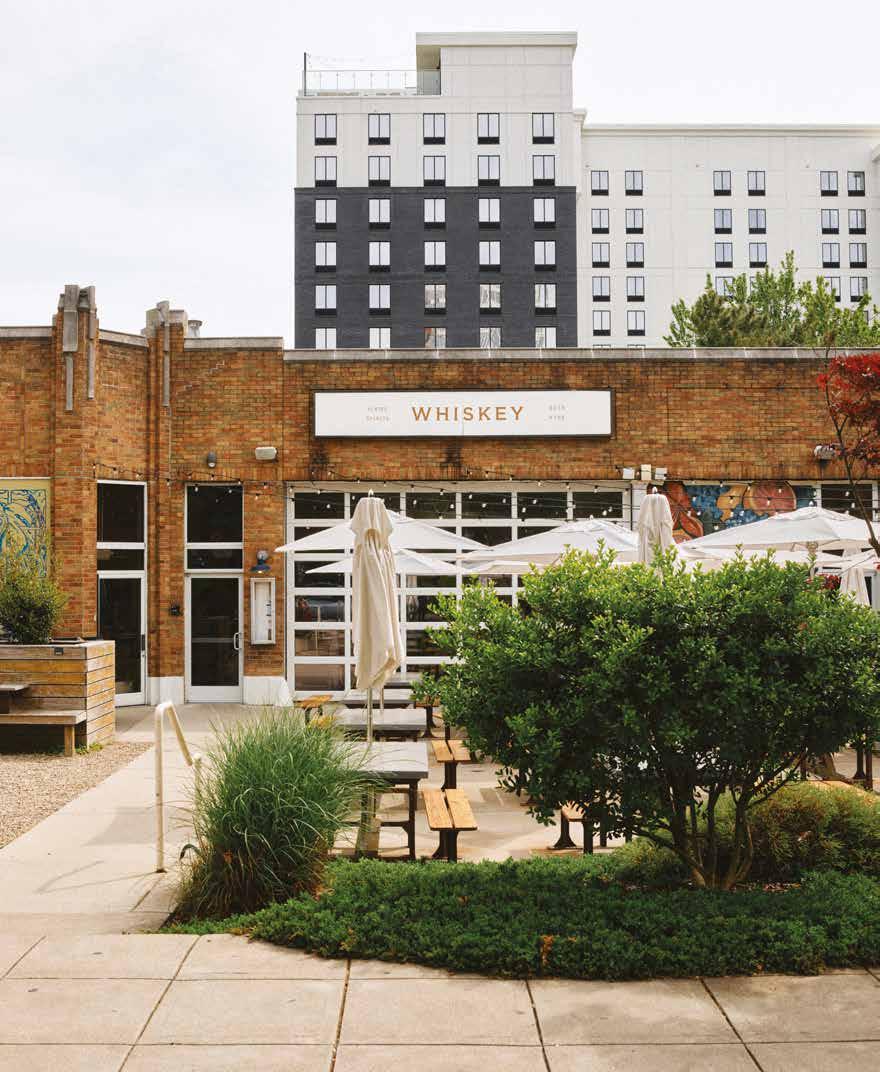
The most sought-after gifts from area retailers for spring occasions

1. GREEN FRONT FURNITURE
Finished in antique gold, this whimsical brass sculpture is great for holding items like keys in an entryway or business cards on a desk. $199
2. RELIABLE JEWELRY
These delicate flexible bangles work singly or as a trio, adding sparkle to any outfit. $3,250 for sapphires & diamonds; $2,450 for emeralds & diamonds; $3,450 for diamonds.
3. GREAT OUTDOOR PROVISION CO.
Debuting on a Grand Canyon raft in 1984, the Original Universal is one of Teva’s first sandals, a testament to its timeless comfort and style. $65
4. VIETRI
Tuscan artisans reimagine the delicacy of a flower in this mouthblown Hibiscus Glass Bud Vase, bringing elaborate beauty to even the simplest floral arrangement. $75
5. BEAUTY ETHICS
Achieve more luminous skin gently. Clarity Serum Sensitive with 10% Tranexamic Acid helps keep spring and summer dark spots at bay. Vegan, fragrance-free, non-comedogenic. $45







6. GREAT OUTDOOR PROVISION CO. Business in the front, party in the back! The Women’s Free Fly Bamboo Shade Crossover Long Sleeve shirt has an impressive UPF 50+ rating, plus a stylish fit and breezy crossover back. $74
7. FINK’S JEWELERS
This Sabel Collection 14-karat yellow gold pendant featuring .08 total carats of round diamonds is perfect on its own or in a stack. $1,350
8. FINK’S JEWELERS
With 7.17 carats of emerald-cut blue sapphires and 1.08 carats of round diamonds set in 14-karat white gold, this Sabel Collection bracelet is simply stunning. $9,995
9. DOGWOOD COUNTRY CLUB
Step up their golf game! An hourly rental allows for sophisticated practice or course play, while evaluations lay the groundwork for game improvement. $55 for hourly rental; $279 for evaluation.
10. WALTER MAGAZINE
Offer a loved one the gift of relaxation. WALTER shares beautiful, uplifting stories about our community, delivered to their doorstep every month. $36 for one year, $80 for three years.
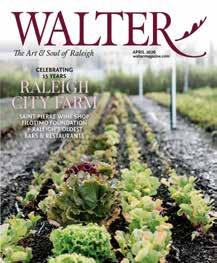

North Carolina, you deserve the spotlight. Day in and day out, PBS NC viewers in every corner of our state enjoy programs that celebrate our unique people and culture thanks to the support of our loyal members. Together, we ensure local shows like Shaped by Sound, Sci NC and NC Weekend continue to shine across all platforms free of charge. Join today at pbsnc.org/donate.
WALTER’s roundup of gatherings, celebrations, fundraisers and more around Raleigh
WAKE TECH IGNITE
Nearly 850 business and community leaders packed the Raleigh Convention Center on Feb. 24 at Wake Tech’s ninth-annual Ignite celebration. Hosted by the Wake Tech Foundation, the event showcased the life-changing impact of education and the innovative ways the college and its partners are helping learners. Wake Tech biotechnology instructor Dr. Mike Nicholson emceed the event, which featured speakers including students Armani Evans, Addison Brooks, Tiffany Harrell and José Fabre Jr., as well as East Carolina University chancellor Dr. Phillip Rogers and Filotimo Foundation founder Pete Proimos.
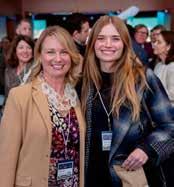


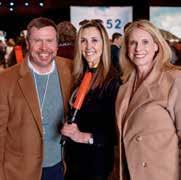





On Mar. 21, the American Cancer Society hosted its 2026 North Carolina Discovery Ball at The Bradford, welcoming 400 guests for an evening themed “Hope Takes the Lead.” Together, attendees raised $820,000 to support cancer research, treatment and patient services across North Carolina. The celebration highlighted the power of community partnership, with essential contributions from more than 40 local businesses.
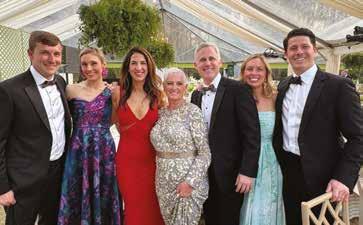
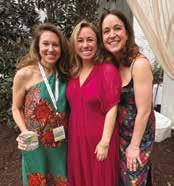
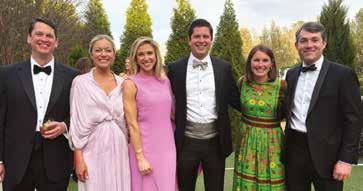

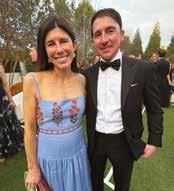
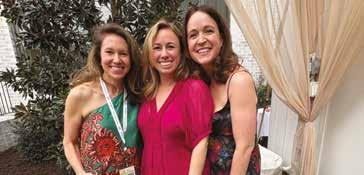






Friday, September 18

Boatman Spirits Co., the craft cocktail bar and restaurant that opened last summer at downtown Raleigh’s Seaboard Station, entered its next phase with the official launch of its on-site distillery. On Feb. 1 they released their first bottles of house-distilled vodka and two gins for retail sale. The distillery hosted a bottle launch party on Feb. 22 to celebrate this acheivement.
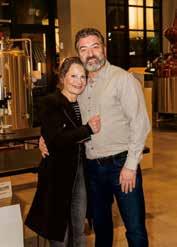
On Feb. 7, the Rotary Club of Wendell hosted its fifth annual Oyster Roast at the Wendell Country Club, bringing together 200 community members who braved the cold to make a positive difference. Proceeds from the fundraiser will empower projects, including a library book project for schools, building a bluebird trail at Wendell’s new Hollybrook Park, support for food pantries and youth development.



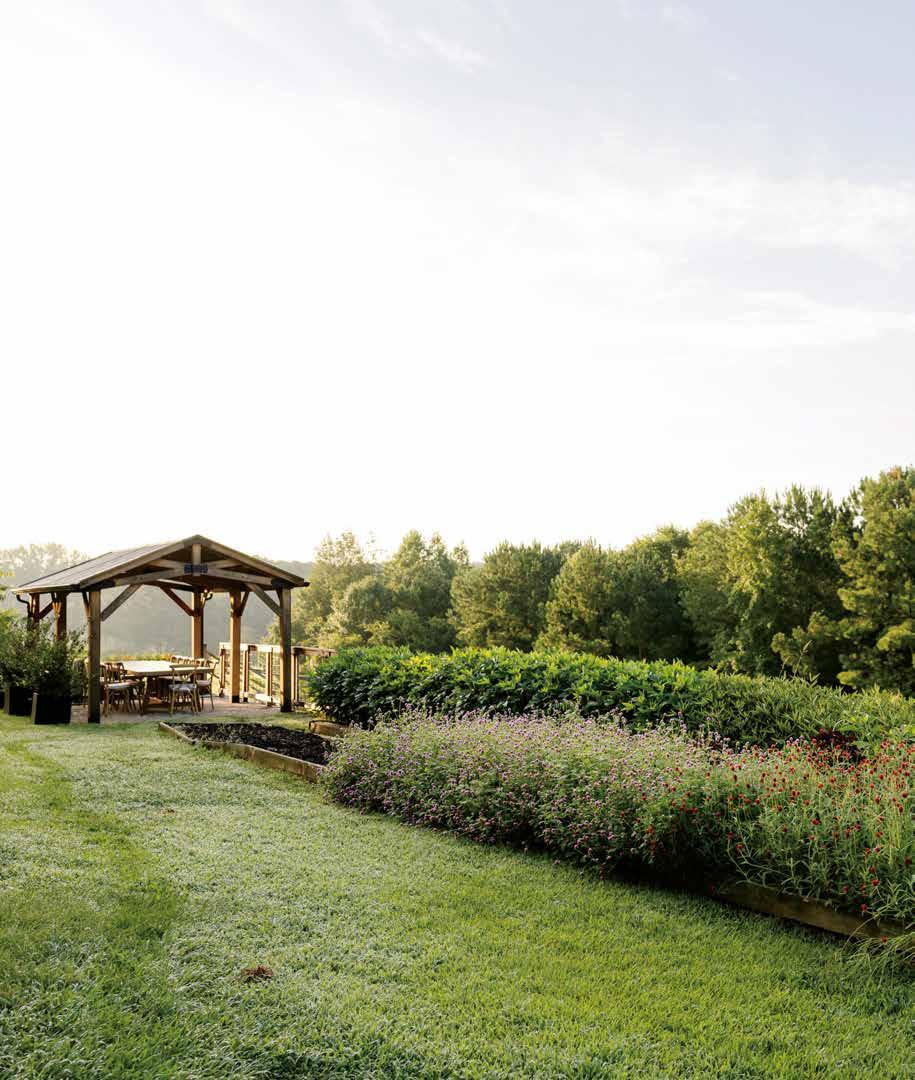




On Mar. 7, Visual Art Exchange, Arts Access, Artspace and PineCone celebrated the opening of the Jobe House, a new shared home in Raleigh for creativity, access and collaboration. This unique partnership creates a space for exhibitions, programs and community, including housing for emerging artists and musicians.
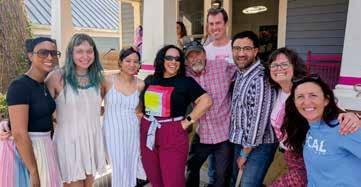
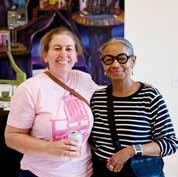

The Playmakers: Women in Football event at William Peace University on Mar. 19 was fueled by the growing momentum of women’s NFL Flag Football. Sponsored by Unither Therapeutics, the event brought together incredible women from different generations in sports to speak about visibility, opportunity and the future of women in football.




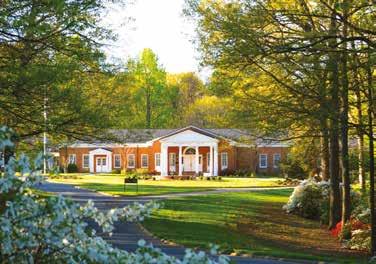









On Jan. 22, nearly 300 people attended the screening of “Origin of the Dream,” a documentary about Rev. Dr. Martin Luther King, Jr.’s first-ever use of the phrase “I Have a Dream.” This film wasmcreated by North Carolina State University Distinguished Professor W. Jason Miller and Emmy awardwinning filmmaker Neal Hutcheson. Following the film was a panel discussion featuring Miller, Cash Michaels and Dr. Everett Ward.
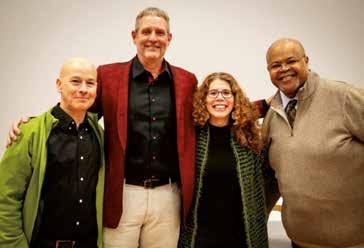


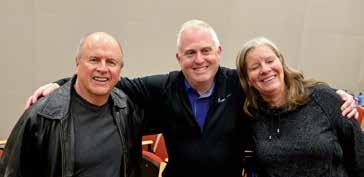



On Feb. 14, the neighborhood of Historic Oakwood held its annual Samedi Gras celebration. This year, the theme was “Groovy Gras.” They crowned Ethan Barger as King Leonidas XV and Dee Penven-Crew as the ninth Imperial Empress. As is customary, residents paraded through the neighborhood led by the Oakwood Awesomettes and the Oakwood Second Line.
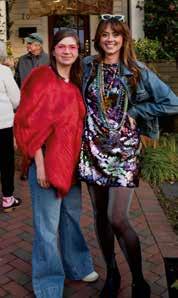

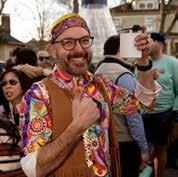
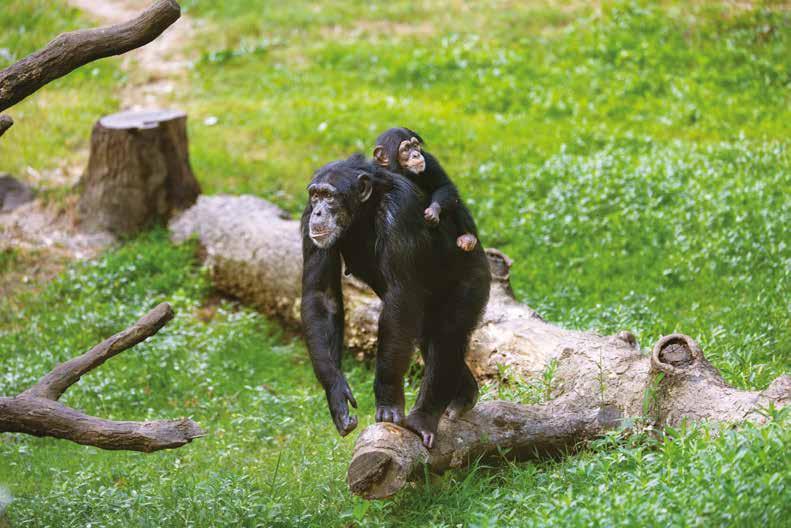

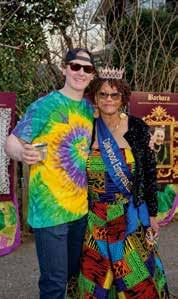
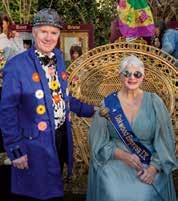
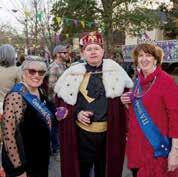
1929 2029
Celebrate the excellence of an iconic public institution. Show your support as we approach the 100th anniversary.





Great gifts for Mother’s Day, Graduation, and Father’s Day! Shipped to your door within days from our online shop in Raleigh. www.broughton1929.shop


A new artwork at Walnut Creek Wetland Center transforms plastic bags into something beautiful
by LILY KANE photography by JUDE MCDONALD
Draped between trees at the Walnut Creek Wetland Center, a colorful new installation flutters delicately in the breeze. The artwork, which at first glance looks to be adorned with rosettes, is cloth-like and lacy, catching light from the sun’s rays. But take a look closer and you’ll see it’s made entirely of plastic bags.
The piece, titled Air Chrysalis, is the work of Raleigh-based fiber artist Patrizia Ferreira. She was inspired to create the artwork after attending a program at the wetland center in 2023, where she learned about the history of Walnut Creek. The creek, which is in a historically Black neighborhood, was used as a dumping ground for nearly 70 years. Parishioners of the nearby St. Ambrose Episcopal Church began efforts to clean up the watershed in the 1990s. Others joined in and the community’s efforts grew, leading to the creation of the park as it exists today: 58 acres of preserved wetlands and a nature education center.
That history stayed with Ferreira. “There’s so much history and memories and all these things,” she says. “I’ve been very drawn to the stories in this place.”
In 2025, Ferreira submitted the concept for the project to the City of Raleigh’s SEEK program, which supports experimental public art projects in the city. After her application was selected, she launched a series of community workshops where she taught attendees how to turn plastic bags
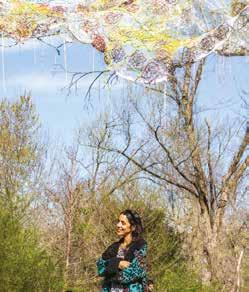
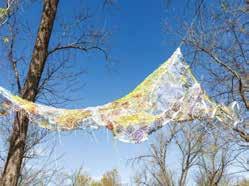
“When you think of a chrysalis, you think of the birth of a butterfly. It’s something ephemeral. I’m really drawn to that transformation.”
— PATRIZIA FERREIRA
into pieces of rope, then shape them into flowers. Ferreira estimates that more than 100 volunteers contributed to the work. “It’s kind of poetic, because each of these flowers is a person,” she says.
Jenn Hales, the public art coordinator for the City of Raleigh, was the project manager for Air Chrysalis. She says that while most SEEK projects involve the community in some way, Ferreira “went above and beyond” with the number of workshops she hosted. In addition to traditional workshops for adults, Ferreira hosted a joint workshop with Artspace, a collaboration with Arts Access — a nonprofit that supports people with disabilities — and a workshop for youth.
“I got a full range of ages and people from all walks of life,” Ferreira says.
The finished product, which was installed in March, is made from 415 plastic bags, which Ferreira stitched together by hand. Nearly 7 feet wide and 20 feet long, it hangs high over the entrance to Walnut Creek Trail.
Ferreira says she hopes that Air Chrysalis evokes a sense of hope and wonder, even as it speaks to environmental concerns of pollution and consumerism.
“When you think of a chrysalis, you think of the birth of a butterfly. It’s something ephemeral,” she says. “I’m really drawn to that transformation — turning something discarded into something meaningful.”
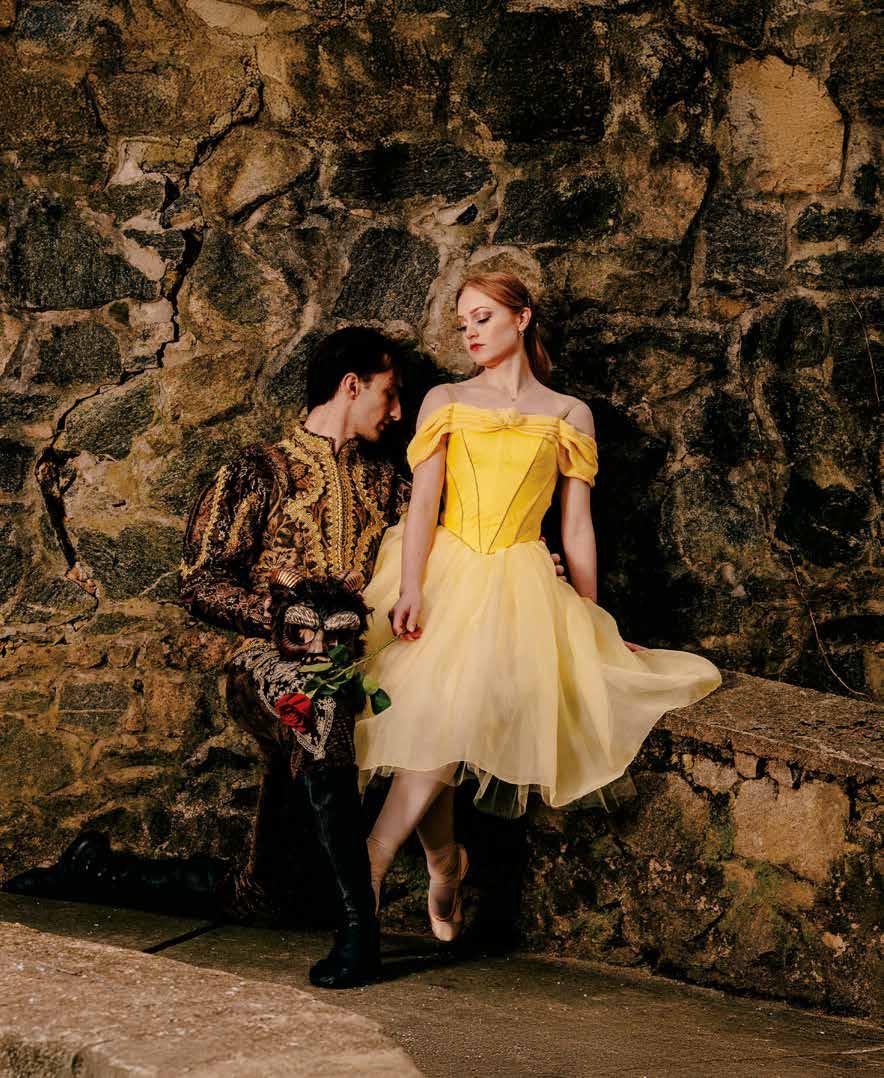




When it’s go for it in two.
Chase the shot, not the back pain. That part’s on us. Because your game deserves expert care that keeps you strong from tee to green.
Seeing patients within 48 hours. Learn more at wakemed.org/wake-ortho.