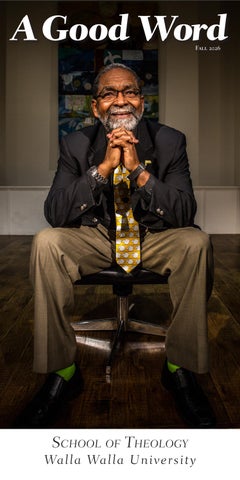
A Good Word Fall 2026
School of Theology Wa lla Walla Univ e r s ity
A Good Word
A word from the dean Since this year marks the 500th anniversary of William Tyndale’s 1526 New Testament, the first complete English New Testament to be printed and translated directly from Greek, I have spent considerable time over the past year reading about Tyndale and reflecting on his extraordinary legacy. I even worked my way through a facsimile of the original 1526 edition, with its dense Gothic type— no small challenge! The more I learned about his life and work, the more I was struck by why he did it. Tyndale’s great desire was to place the Bible in the hands of ordinary people so they could read it for themselves, encounter Jesus Christ through its pages, and allow its message to transform their lives. That conviction has led me to reflect again on our work in the School of Theology. What do we ultimately hope our students gain from studying Scripture? Certainly, we want them to understand the Bible and communicate its message faithfully. Like Tyndale, however, we also hope that Scripture will transform the lives of our students, and through their ministry, others will come to know Christ. Five hundred years ago, access to Scripture in English was neither simple nor safe. Tyndale endured exile, opposition, imprisonment, and ultimately death so ordinary people could hear God’s Word in their own language. His goal went beyond making the Bible available; he wanted people to read it personally, prayerfully, and with a willingness to obey. In his 1530 “A Prologue Showing the Use of Scripture,” Tyndale urged his readers: “As thou readest therefore think that every syllable pertaineth to thine own self, and suck out the pith of the scripture.”1
WWU School of Theology faculty Carl Cosaert, dean Early Christianity/ New Testament
Tiago Arrais Theology/Old Testament
Brant Berglin New Testament/Greek
Susan Bungard-Beck New Testament
Paul Dybdahl Mission/New Testament
Mathilde Frey Old Testament/Hebrew
Pedrito Maynard-Reid Biblical studies/Missiology
2
To “suck out the pith” meant to draw nourishment from Scripture’s vital center. Tyndale wanted Christians to read attentively, allowing its promises, warnings, commands, and stories to speak to their lives. For Tyndale, Scripture offered light for those seeking direction, medicine for wounded souls, and comfort in adversity. Through the Bible, people encountered the grace of God revealed in Jesus Christ. That vision speaks directly to the mission of the School of Theology. Our students study Scripture, theology, church history, biblical languages, and ministry. They learn to interpret biblical passages carefully, understand their historical settings, evaluate different interpretations, and communicate biblical truth clearly. Tyndale’s own work shows why this kind of study matters. He devoted years to mastering Greek and Hebrew so he could translate Scripture accurately and clearly for ordinary readers. His scholarship served the church, and that is the kind of scholarship we want our students to pursue. They may learn Greek words, reconstruct historical settings, and explain theological doctrines, but if that knowledge never reaches their hearts, shapes their character, or deepens their love for God and others, they have missed something essential. Our calling is therefore larger than conveying information. We seek to help students become careful readers of Scripture whose lives are shaped by what they study. We also prepare them to help others hear its message, whether from a pulpit, in a classroom, beside a hospital bed, around a kitchen table, or through a life devoted to service. Most of us now possess something Tyndale could only dream of: ready access to Scripture in a language we understand. Yet his deeper vision remains unfinished. Access does not guarantee that we will truly listen or have the courage to follow Scripture when doing so becomes costly. Perhaps the greatest way we can honor Tyndale’s legacy during this anniversary year is to read Scripture as he hoped we would—carefully, personally, prayerfully, and with a willingness to obey. May God help all of us to “suck out the pith of the scripture” and encounter Jesus Christ, the living Word, within its pages. Words from Scripture: “Open my eyes, that I may behold wondrous things out of your law.” Psalm 119:18, ESV
Carl P. Cosaert, dean School of Theology
Follow us on Instagram at
@wwuschooloftheology to see what our students are learning. 1 William Tyndale, “A Prologue Showing the Use of Scripture,” in Doctrinal Treatises and Introductions to Different Portions of the Holy Scriptures, ed. Henry Walter (Cambridge: Parker Society, 1848), 400.
3
A Good Word Expanding paths to ministry Women prepare to serve the church through pastoral ministry, chaplaincy, and other roles
Women are a growing presence in Walla Walla University’s School of Theology, with many preparing for chaplaincy and pastoral ministry. “We’re seeing a growing number of women in our program, especially in chaplaincy,” said Carl Cosaert, dean of the School of Theology. Recent action by the North Pacific Union Conference created new avenues for women to be recommended for ordination, while conferences throughout the Northwest are committed to hiring women for ministry roles, Cosaert said. Emily Ellis, a WWU theology graduate and the university’s new campus chaplain, represents one such path. Ellis previously served in local church ministry—work she loved and found difficult to leave—and now brings that pastoral experience to students. Ellis credits WWU with preparing her to think critically about theology while remaining rooted in Adventism and invested in the church. She values how her professors approached pastoral ministry as shepherding grounded in love for people. For women considering theology or chaplaincy, Ellis emphasizes the importance of trusted mentors, spiritual accountability, and a sincere commitment to those they serve. “Find really good mentors—people who will hold you accountable and speak truth into your life,” Ellis said. “And have a compassion and love for God’s people.”
Connecting across generations School of Theology faculty and alumni gather during NPUC Ministerial Convention
Walla Walla University School of Theology faculty shared their expertise and connected with pastors and alumni during the North Pacific Union Ministerial Convention on the WWU campus in August. Faculty members Paul Dybdahl, Mathilde Frey, Tiago Arrais, Brant Berglin, and Carl Cosaert each presented multiple seminars. Their workshops addressed subjects relevant to pastors and ministry leaders throughout the Northwest. Attendance was strong, and participants responded positively. “I really appreciate my colleagues,” said Cosaert, dean of the School of Theology. “They were willing to take the extra time to prepare workshops, and I feel like it was a great success.” The school also hosted a meet-and-greet with theology alumni and former faculty, including Alden Thompson, Dave Thomas, and Darold Bigger. Attendees reconnected with former professors and classmates and built relationships across generations. Through its seminars and alumni gathering, the School of Theology sought to support those serving in ministry while strengthening its connection with the wider church. The convention offered an opportunity to share resources, renew relationships, and celebrate the school’s influence throughout the Northwest.
4
An unexpected opportunity New executive secretary of the SDA Church shares how he’s seen God’s leading hand
Last year, Walla Walla University alum Rick McEdward was elected secretary of the Seventh-day Adventist Church, one of three executive officers of the church. His office oversees the bulk of the administrative process of the church and the officer over mission functions including the Office of Adventist Mission, the Office of Archives, Statistics, and Research, and the Institute of World Mission. After years of their work in the Middle East and North African Union, he and his wife Marcia were in the midst of transitioning from their overseas mission work back to pastoral work in the states. His nomination took them by surprise and prompted a very intense time of prayer, where he and his wife were led to accept. While he might not have described this role as his natural environment, past experiences and relationships have prepared him to understand it. His time as a pastor, church planter, and missionary, all of it. “I don’t believe God wastes anything,” said McEdward. “I have seen God’s hand steering over many many years,” said McEdward. He had already met and built friendships with many of the team he now works alongside. This community is the reason he has been able to thrive in his new role, even with the learning curve. After his first full year as secretary, his favorite part has been overseeing the mission work of the church and watching the impact the church is having around the world. He has loved visiting people serving on the frontlines of mission, seeing the places God is blessing in small but significant ways, and watching small ministries really connect with the community in places that are difficult to reach.
Leading the next theologists WWU alum now chair of religious studies at Burman University
In 2023, Burman University in Lacombe, Alberta, Canada, welcomed Jonathan Campbell, School of Theology alum, to their religious studies department faculty. Now, he is serving as program chair. Campbell was excited to accept the position for a number of reasons. After years gathering knowledge and expertise as a student, pastor, and missionary, he was ready to share his passions of reading and interpreting the New Testament in its original language. He loves how the university’s smaller size means he gets to make meaningful connections with students and how it’s created an “incredibly supportive environment for me and my wife.” Because Burman is the only Adventist university in Canada, “we feel a tremendous responsibility to serve the entire country,” said Campbell. “I love that we get to minister to all of Canada and prepare students to minister coastto-coast.” All the experiences he gained throughout the years has prepared him for this position, but he looks back at WWU as where it all started. “I learned to love Greek and ancient manuscripts because of Dr. Cosaert,” said Campbell. “That passion has brought me through my Ph.D. studies and into a career as a professor.”
5
A Good Word
Full throttle, full Pedrito Pedrito Maynard-Reid’s legacy is found in the students, university, church, and community he has challenged—and championed
A
nyone who knows Pedrito knows the energy he brings into a room.
Carl Cosaert, dean of the School of Theology, calls it “full throttle, full Pedrito.” There is the unmistakable voice, the humor, and the showmanship— but beneath it all, Cosaert said, is a deep passion for theology, teaching, and people. “How do you describe someone who is so comfortable in his skin, truly loves being himself, cares so deeply, and is just bulletproof?” said Emily Ellis, WWU campus chaplain and a former student of Pedrito. Over more than three decades at Walla Walla University, Pedrito has served as a professor of biblical studies and missiology, director of institutional mission, vice president for spiritual life and mission, ombudsman, and assistant to the president for diversity. Across those roles, he has shaped how WWU approaches theology, mission, worship, diversity, and service. Yet teaching has remained at the center of his work. Pedrito began teaching nearly 60 years ago and joined WWU in 1990. Even while carrying significant administrative responsibilities, he never entirely left the classroom. When he returned to full-time teaching in 2025, he described students as his “flock and friends.” Among his signature courses is History of Adventism, a favorite for Ellis and generations of other theology students. Rather than presenting an idealized version of the church’s past, Pedrito explores its complexity with honesty. “He was able to explain Adventism in a way where you could tell he cared very deeply about the church but was very honest about it,” Ellis said. That balance is central to his influence, Cosaert said. Pedrito does not examine the church’s failures merely to expose them. Instead, he helps students recognize the work still to be done and imagine how the church can continue growing into what God intends it to be. His teaching invites students to understand the humanity of the church while developing a deeper love for it. Pedrito brings that same candor and conviction to his work as an advocate. As one of WWU’s longtime diversity leaders, he has helped Black students and others from underrepresented backgrounds find their place on campus. He has also connected the university with communities across the wider Adventist constituency, helping prospective students and families see WWU as a place where they could belong.
6
“He is such an advocate for people, and he sees people,” Ellis said. “There are so many amazing advocates on this campus, but he genuinely sees people so deeply.” For Cosaert, Pedrito has also been a trusted source of institutional memory, wisdom, and discernment. His willingness to take on additional classes, offer advice, and contribute wherever needed reflects a commitment that extends beyond any single position. His advocacy has reached well beyond campus. Pedrito has served the Walla Walla Valley through Rotary International, United Way of Walla Walla County, the Union-Bulletin Community Advisory Council, and organizations promoting diversity, civility, and peace. Within the church, his work has included leadership with the Adventist Peace Fellowship and decades of scholarship and presentations on worship, mission, justice, race, and reconciliation. In 2026, WWU honored that work with its Community Service Award. President Alex Bryan described Pedrito as a humanitarian, champion for peace, and advocate for voices too often overlooked. The breadth of Pedrito’s work makes his legacy difficult to reduce to one title or accomplishment. It can be found in institutional changes, community organizations, theological scholarship, and the many conversations in which he has challenged WWU and the church to become more faithful, equitable, and compassionate. But perhaps it is most visible in his students: those he has taught to approach Adventism honestly, care deeply for the church, recognize the people around them, and believe that difficult truths can become invitations to growth. For Pedrito, the classroom has never been separate from ministry. It is where his scholarship, advocacy, pastoral care, and irrepressible energy come together— and where “full Pedrito” has left an enduring mark.
Honor Pedrito’s legacy Help raise $15,000 for a new evangelism tent for InTents —continuing a ministry Pedrito led for more than 20 years.
wallawalla.edu/intents-give
7
A Good Word Chaplaincy to the next step Students see benefits of a growing chaplaincy program
Chaplaincy plays a key role in today’s ministry. The School of Theology continues to strengthen and improve its chaplaincy concentration to meet the role’s increasing demand through partnerships, internship opportunities, and guest speakers. The partnership with AdventHealth University offers students dual credit classes to get a jump on their master’s in spiritual care. Maddie Condon, senior theology major, recently finished one of these classes, Spiritual Care Across Life Cycle. The class helped prepare her for a career in chaplaincy by opening her eyes to different realities, utilizing online course work supplemented by guest speakers with real field experience. “Chaplain ministry is a beautiful thing, and this program opens doors for people to learn more,” said Condon. Carl Cosaert, dean of the School of Theology, believes the partnership with AHU is important because it helps students see where this undergraduate education can lead them. This spring, Mike Rhynus, director of the Loma Linda University Masters in Chaplaincy program and WWU alum, also visited campus to help prepare students for their next steps towards chaplaincy. He gave a presentation about chaplaincy as a unique and powerful form of ministry and LLU’s master’s program. “My biggest hope is that the students were shown another way to serve God in ministry that is outside of the church setting,” said Rhynus. He felt this first visit was an important one that “laid the foundation for many more visits to come.” “At the School of Theology, we want to give students a strong theological and pastoral foundation that will prepare them for whatever area of ministry God may be calling them to,” said Cosart. For chaplaincy students, that means going beyond simply knowing theology. Classes like Introduction to Cross-Cultural Ministry teach them to communicate across cultures and backgrounds, Grief and Loss helps them explore the ministry of pastoral care in times of loss and grief from various perspectives, and more. The WWU chaplaincy concentration also gives students an advantage when they apply for chaplaincy internships. Over the years, many students have interned with Adventist Health and AdventHealth. Those experiences have been incredibly valuable, allowing students to experience chaplaincy firsthand as they work alongside professional chaplains and discover the real-world of providing spiritual care in a healthcare setting. While WWU recognizes students are not going to graduate as fully trained professional chaplains, the partnership with AHU, along with summer internship opportunities and guests like Rhynus, helps students move naturally from what they start at WWU into graduate study and eventually into professional chaplaincy. “At the School of Theology, we want to give our students a strong theological and pastoral foundation that will prepare them for whatever area of ministry God may be calling them to,” said Cosaert.
8
Investing in the School of Theology One of the greatest privileges of serving as dean of the School of Theology is welcoming students who sense God calling them to ministry. Answering that call takes faith and courage—and, for many, overcoming significant financial challenges. For several years, the NextGen Theology Scholarship has enabled gifted young men and women to prepare for ministry at Walla Walla University. This year, its funding has been reduced as the scholarship enters its final year, making us more dependent than ever on those who believe in preparing the next generation of pastors, chaplains, teachers, and other ministry leaders. Many students would not be here without our donors. Your gifts remove financial barriers, allowing talented young people to follow God’s call and influence others for Jesus on campus, in local churches, and throughout the wider community. We also invite you to support another ministry need. For more than 20 years, the studentled evangelistic series “InTents” has given students hands-on ministry and evangelism experience. After years of faithful use, its large tent is badly worn and must be replaced. A new tent will cost approximately $15,000 and allow this ministry to continue for years. Would you consider supporting one of these initiatives? • Give to the Dean’s Award. Donations go directly toward scholarships that help us attract and support the next generation of leaders our church urgently needs. Give by check or online. payment.wallawalla.edu/donate/THEODEPT#/ • Start a Named School of Theology Scholarship. Provide ongoing student support while honoring a friend or loved one. To establish a named scholarship, contact Alumni and Advancement Services at (800) 377-2586. • Donate to Pedrito's Evangelism Legacy. Your gift toward the the $15,000 purchase of a new InTents tent will give students practical ministry experience whiile helping them share the gospel across the Northwest. wallawalla.edu/intents-give Thank you for your prayers and financial support. Your generosity makes a real difference in our students’ lives and the communities they serve. Together, we can continue preparing committed men and women to answer God’s call and serve the church.
School of Theology scholarships Students in the School of Theology are deeply grateful for the scholarships that make their education possible. Thank you to our generous alumni and friends for providing these scholarships. • Alfred A. Ogden Endowed Theology Scholarship • Alice I. Bowden Memorial Scholarship • Bible Lands Theology Major Scholarship • Eva Stratton Vliet and Jess Vliet Scholarship • Gayle L. Saxby Memorial Scholarship • Dr. Alden Thompson Scholarship • Dr. John C. Brunt Scholarship Fund • Dr. Jon L. Dybdahl Scholarship • J. Paul Grove Memorial Scholarship
Support Us
• Lucille Knapp Scholarship Fund • Mary E. Marker Memorial Theology Scholarship • Matiko Theology Award • Oland F. Hubbs Memorial Theology Scholarship • Paul & Frances Heubach Theology Scholarship • Richard and Dena Hammill Scholarship • Thomas Theology Scholarship Fund
9
A Good Word
A way forward
L
ong before Rupert Etienne knew how he would become a pastor—or had heard much about Walla Walla University—he believed God was calling him to ministry.
Etienne grew up in a religious family with Catholic, Baptist, and Seventh-day Adventist influences. As a child, however, a stutter made speaking difficult. Even then, he knew he wanted to preach. “I prayed, ‘God, if you take this stutter away from me, I will serve you in ministry,’” Etienne said. “From that moment, the stuttering was gone. I’ve never had a stuttering problem from that day forward.” The calling felt clear. The path toward it did not. By 2022, Etienne was living with his family in Houston and struggling to find work. After praying, he found a job but soon lost it. Another opportunity emerged in New Mexico, only for the transmission in his truck to fail about half an hour from home. “There goes the New Mexico job,” he said. Without reliable transportation or another job lined up, Etienne reached a low point. He still felt called to ministry but could not see how to make it possible, especially while caring for a family. “Lord, what now?” he prayed. Etienne took what he described as a lonely walk with God. When he returned home and checked his phone, two messages were waiting. His sister-in-law had sent information about a scholarship for pastoral ministry at WWU. A friend had independently encouraged him to consider a program in Puerto Rico. Etienne knew little about WWU beyond possibly seeing its name in the Adventist Review. Still, he called to ask about the NextGen Pastoral Scholarship. The possibility raised as many questions as it answered. How would he get to Washington? What would the move mean for his family? His son offered a simple response: “If the Lord called you to ministry, then he will make a way.”
10
As Etienne explored the opportunity, that way began to appear. WWU staff spoke with his wife and helped her find a place within the university’s education program, while Etienne was accepted into the School of Theology. Even his truck was repaired in time for the family’s move. A repair expected to take six weeks was completed in three days at no charge. “God was so good at arranging everything to happen,” Etienne said. “The Lord opened ways and showed me that he wanted me to be here. I knew it was not a random decision. It was God saying I should be here.” Moving from Houston to College Place brought a new culture and significant adjustments, but Etienne came to value the atmosphere of learning and the people he encountered at WWU. Professors, classmates, and student tutors provided guidance and encouragement throughout his studies. “I didn’t get here on my own,” he said. “I’ve had help from angels I’ve met all along the way.” In 2025, another part of the path opened. Pedrito Maynard-Reid, professor of biblical studies and missiology, approached Etienne about a church in the Tri-Cities seeking a pastoral intern. Etienne began serving at New Movement church in August. He entered a congregation carrying hurt from past experiences and began by listening. Etienne sought to understand members’ needs and shape his sermons and ministry around what the congregation was experiencing. Since then, he has seen interest from former members considering a return and new people joining the congregation. The experience has also reshaped his understanding of pastoral leadership. “For me, ministry is growing with people,” Etienne said. “It’s sharing Jesus in such a way that we can experience it together—studying together, praying together, growing together, and experiencing life together with Jesus.” Serving in the Tri-Cities has confronted Etienne with his own humanity and reminded him that ministry does not place a pastor above those being served. “We’re in the same place, living life together,” he said. “We all have struggles, successes, and failures. Ministry is living life together, studying together, praying together, and growing together.” After graduation, Etienne hopes to be hired as a pastor, although he does not know where that opportunity may take him. After years of learning to follow a calling without seeing the entire path, he is comfortable leaving the destination open. “Wherever God will lead,” he said. For now, Etienne remains grateful for the opportunity to pursue the dream that began with a childhood prayer. “I am immensely grateful to my theology professors, my other professors, my classmates, and the student tutors who have helped me every step of the way,” he said. “I am forever grateful for the opportunity WWU has given me to experience my dream of being in pastoral ministry.”
11
A Good Word Recognized faculty Theology faculty honored at annual WWU Awards Celebration Ceremony Each year, Walla Walla University hosts its Awards Celebration to honor student scholarship and recognize the accomplishments of faculty, staff, and alumni. School of Theology faculty members received several of these honors. Mathilde Frey, professor of biblical studies, received the Distinguished Faculty Lecturer Award for her leadership and excellence in scholarship, teaching, and the campus community. This fall, her lecture, “The Art of Reading Scripture,” will examine patient and attentive reading of the Bible, highlighting how Scripture invites a deeper understanding of God, humanity, and the world. Susan Bungard-Beck, instructor of religion, received the Excellence in Theological Teaching Award. She was selected for her teaching excellence and strong positive feedback from students. The inaugural School of Theology Lifetime Achievement Award was presented to Alden Thompson, professor emeritus of biblical studies. The award commemorates his ministry and teaching career, influence on the Seventh-day Adventist Church, and work with the Good Word radio program. WWU also recognized Pedrito Maynard-Reid, professor of biblical studies and missiology, with its Community Service Award. Maynard-Reid volunteers on and off campus. At the university’s annual Fall Service Day, he explained, “Worship for me is a holistic experience, where I come to be blessed and I come to bless others.”
A lasting theological legacy Alden Thompson receives inaugural School of Theology Lifetime Achievement Award Alden Thompson, professor emeritus of biblical studies, received the inaugural School of Theology Lifetime Achievement Award during Walla Walla University’s annual Awards Celebration on April 24. “Alden is a legend,” said Carl Cosaert, dean of the School of Theology. The award recognized Thompson’s many years of service to the school and wider church. Since joining WWU in the 1970s, Thompson has become known for addressing difficult theological questions, particularly those involving Adventist history and the life and writings of Ellen G. White—subjects he has explored in multiple books. Thompson taught the School of Theology’s research writing course, a rite of passage for many students. The challenging course encouraged students to examine what they believed, understand why, and approach theological issues through critical thought rather than clichés. His influence extended beyond the classroom. Thompson regularly contributed to and led Good Word, a radio broadcast now offered as a podcast that explores themes from the church’s quarterly Bible study guide. “He had a vision for the School of Theology in a way nobody else had,” Cosaert said. That vision included establishing scholarship support for theology students and outreach that enabled faculty to share their work with churches and wider audiences. “We wanted to celebrate with him and recognize and honor what he’s done,” Cosaert said.
12
School of Theology
2026 graduates We are pleased to introduce the 2026 graduates of the WWU School of Theology.
Jonathan Alvarez, major in theology and religious studies, pastoral ministry concentration
Plans after graduation: I’ll continue serving as outreach pastor at Vancouver Adventist Community Church and hope to attend seminary at Andrews University within two years. Deih and I also look forward to growing our family. A meaningful portion of scripture: Revelation 21:3–4, which promises that God will dwell with his people and bring an end to death, mourning, crying, and pain.
Jeremias Cruz Jr., major in theology and
religious studies, pastoral ministry concentration
Plans after graduation: I’ll speak at a weeklong youth camp in Boston and help at my home church in Chicago. Long-term, I plan to pursue a Master of Divinity at Andrews University and serve in pastoral ministry or chaplaincy wherever God leads. A meaningful portion of scripture: Psalm 34, John 5:1– 15, and Psalm 20:7 remind me to experience God’s goodness, seek wholeness, and remember his faithfulness.
Shamara Daniels, major in theology and religious studies, pastoral ministry concentration Plans after graduation: I hope to work for one of our conferences or continue serving at WWU. A meaningful portion of scripture: Psalm 66:19 — “But God has surely listened and has heard my prayer.”
Ashley Dávila Ocañas, major in theology and religious studies
Plans after graduation: I’ll serve as an associate pastor for the Idaho Conference. A meaningful portion of scripture: 1 Corinthians 10:13.
Rupert Etienne, major in theology and
religious studies, pastoral ministry concentration Plans after graduation: I plan to enter full-time pastoral ministry and continue my theological training. A meaningful portion of scripture: 2 Corinthians 5:17 — “If anyone is in Christ, he is a new creation.”
13
A Good Word Jonathan Galindo, major in theology and religious studies, pastoral ministry concentration
Plans after graduation: I’ll take a break from school, spend time with family, and work with my home church pastor to gain more pastoral experience. A meaningful portion of scripture: Luke 6, where Jesus calls us to love and pray for our enemies. Because that is easier said than done, I continually pray for love and humility.
Eryn Haugsted, major in theology and
religious studies, pastoral ministry concentration Plans after graduation: I plan to get married and hope to become a hospice chaplain in Walla Walla.
A meaningful portion of scripture: Job 23:10 — “But he knows the path that I take; when he has tested me, I will come out as pure as gold.”
Joosung Kim, major in theology and religious studies
Plans after graduation: I plan to pursue further education in music and music production. A meaningful portion of scripture: John 11:35 — “Jesus wept.” It reminds me that Jesus also understands the pain of this life.
Logan Lennon, major in theology and
religious studies, pastoral ministry concentration Plans after graduation: I’ve been hired by the Upper Columbia Conference and will pursue a master’s degree at Andrews University. Afterward, I’ll serve alongside a pastor in Spokane, Washington.
A meaningful portion of scripture: Romans 1:16 challenges me to share Jesus without shame, while James 2 reminds me that faith must be lived out through action.
Bauer Meeks, major in theology and religious studies
Plans after graduation: I plan to teach Bible at a high school, building trust with students and pointing them toward a trusting relationship with their Creator. My wife, Kizy, and I hope to find an Adventist community in the U.S. or Brazil where I can preach and she can share her gift of music. A meaningful portion of scripture: 2 Corinthians 12:9 reminds me that God’s grace is sufficient and that even my weaknesses can be used for good.
14
Josue Mendez, major in theology and
religious studies, pastoral ministry concentration Plans after graduation: I’ll serve as a mission resident with AdventHealth’s Rocky Mountain Region while pursuing a hybrid Master of Divinity through the seminary at Andrews University.
A meaningful portion of scripture: Psalm 46:10.
MJ Metuli, major in theology and religious studies, pastoral ministry concentration
Plans after graduation: I’ll work as a pastoral intern for the Hawaii Conference. A meaningful portion of scripture: Acts 20:24 inspires me to finish the race and complete the work of sharing the good news of God’s grace.
Benjamin Somerville, major in
theology and religious studies and social work Plans after graduation: I’ll get married during summer 2026, then pursue a Master of Social Work at WWU. A meaningful portion of scripture: Amos 5:24.
Brandon Zorer, major in theology and
religious studies, pastoral ministry concentration Plans after graduation: I’m considering further education and teaching theology. God is faithful, and I trust that the doors he opens are the ones he is calling me to enter.
A meaningful portion of scripture: Psalm 84:10.
The Global Reach of the ‘Good Word’ Broadcast Good Word is a weekly radio program that serves as a supplement to the Seventh-day Adventist adult Sabbath school quarterly with content provided by professors in the WWU School of Theology. Listen at wallawalla.edu/ goodword and on Spotify.
15
SCHOOL OF THEOLOGY
204 S. College Ave. College Place, WA 99324 (509) 527-2194 (509) 527-2253 email: theology@wallawalla.edu
A Good Word Online wallawalla.edu/goodword
School of Theology wallawalla.edu/theology NON-PROFIT ORG U.S. POSTAGE PAID WALLA WALLA UNIVERSITY