BOTANIQMAG.COM | SPRING 2018
Inside a High-Tech Greenhouse Stylish Stash Boxes
Elevating the Modern Cannabis Conversation
The End of Prohibition
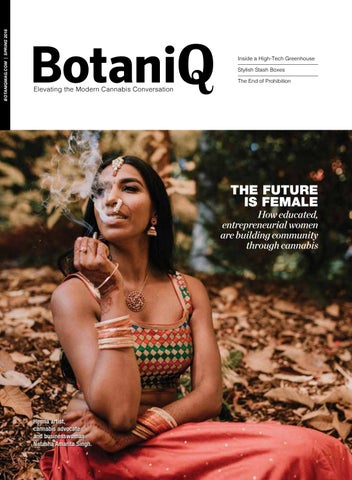
THE FUTURE IS FEMALE
How educated, entrepreneurial women are building community through cannabis
Henna artist, cannabis advocate and businesswoman Natasha Amarita Singh.
Helping companies demonstrate product quality... Â while helping cannabis consumers, and those working in the industry to recognize,understand and appreciate quality. The CannabisWise Product Assurance mark will encourage sustained product improvements and increase understanding and appreciation of cannabis quality. Designed to compliment existing regulatory systems, the CannabisWise seal indicates to the public which specific flowers have been grown, processed and cured in accordance with the traditional methods and quality standards observed by expert growers and breeders.Â
Licensed cannabis producers may apply online now at www.cannabiswise.com
Consumers can find out about CannabisWise quality products beginning in the summer
SPRING 2 018 VO LU M E 1 | N U M B ER 3
FEATURE
7
Let The Light In
422 Richards Street, Suite 170 Vancouver, BC V6B 2Z4 604-805-3272
Fraser Valley cannabis cultivator Tantalus Labs is breaking the mould with a hightech greenhouse operation.
CEO Barinder Rasode, brasode@nichecanada.com VP MARKETING Linda Stromberg, lstromberg@nichecanada.com
PUBLISHED BY WESTERN MEDIA GROUP 3rd Floor, 2025 Willingdon Avenue, Burnaby, BC, V5C 0J3 604-877-7732
COVER (NATASHA SINGH): GAGE ALLEN. THIS PAGE: TANTALUS L ABS/SUNL AB.
EDITOR Stacey McLachlan ART DIRECTOR Swin Nung Chai GENERAL MANAGER & PUBLISHER Dee Dhaliwal EDITORIAL DIRECTOR, VANCOUVER MAGAZINE Anicka Quin MARKETING & EVENTS COORDINATOR Kaitlyn Lush PRODUCTION MANAGER Lee Tidsbury ADVERTISING SALES ACCOUNT MANAGERS Caryl Dolinko, Margot Gauley SALES CO-ORDINATORS Karina Platon, Theresa Tran ADVERTISING EMAILS cdolinko@nichecanada.com mgauley@nichecanada.com YELLOW PAGES DIGITAL & MEDIA SOLUTIONS LTD. VICE-PRESIDENT & CHIEF PUBLISHING OFFICER Caroline Andrews
CONTENTS 4 First Take The safe transition to legal cannabis will eventually lead to a new normal: the subtle mainstreaming of cannabis consumption. 7 Who’s Who Tantalus Labs looks to shed some light on Canada’s marijuana industry. 10 The Good Stuff These stylish stash boxes from Canadian makers store your cannabis collection in high design. 12 Ones to Watch A romantic relationship blossoms into a lucrative cannabis branding business.
16 Personal Story A cannabis activist shares how the plant’s pain-reducing powers helped her through some of the darkest moments of her life. 18 The Expert The executive director of the Cannabis Trade Alliance of Canada speaks with BotaniQ on the future of legalization. 22 What Women Want A women-led community offers a hub for personal stories and entrepreneurial empowerment.
24 Full Circle Want to know what the future of cannabis legalization will hold? Just look back to the wine industry’s past. 29 The Lifeline Is cannabis a solution for Vancouver’s opioid overdose crisis? 32 What’s Cooking? Modern cookbooks that prove edibles can be more than just brownies. 34 By the Numbers Crunching the cannabis consumption stats.
B O TA N I Q M A G . C O M S P R I N G 2 018
3
First TAKE
THE NEW NORMAL by
Barinder Rasode
T
his summer, Canada will become the first advanced industrialized nation to legalize and regulate cannabis from production to consumption. As the federal government creates history this year, many are hoping that the safe transition to legal cannabis will lead to a new normal: the subtle mainstreaming of cannabis consumption. Because ending prohibition is only one part of the equation. We’re not just on the path to legalization, we’re on the path to normalization. A societal shift of generational significance needs to occur—one where people who consume cannabis don’t suffer stigmatization and aren’t forced to hide it or be discreet about it for fear of being shamed. Once cultural accommodation occurs with nonusers, cannabis will lose its taboo and the stoner jokes will fade away. Cannabis will take its place among more common commodities in our culture, and society will fully understand that, for some people, cannabis is medicine. And for others, it’s a lifestyle choice: their “glass of wine.” And we are all playing a role in this transition. We need to continue to have open conversations with our policy makers and law makers about how we can best regulate the industry, keep cannabis out of the hands of our youth and protect employers and employees in our workplaces. The industry is taking steps to shift its image and
convince the country that it is made of responsible entrepreneurs who are prioritizing health and safety. Licensed producers are giving tours of their heavily regulated, multimillion-dollar production facilities, and retail dispensaries are looking less like fringe players and more like high-end retailers. These changes are leading to a shift in culture and public opinion. It’s important to note that normalization does not mean an increase in usage, or tolerance toward its use by segments of society such as our youth. In fact, ending prohibition in Colorado has led to a decrease in cannabis consumption among teens. Normalization is about ending stereotypes and gaining acceptance among non-users. But we are still living in this pioneering time between prohibition and normalization, so there’s much more work to do. And, there’s more at stake than just ending the stigma associated with cannabis consumption. Groundbreaking research, advancements in post-secondary education, medical breakthroughs and patient options all serve to benefit from the cultural acceptance of cannabis. Once the mainstream opinion changes, so will the attitudes of professionals and industries that can help improve the product and health outcomes, ultimately transforming the cannabis sector even further. Only then will we truly see the long-lasting cultural implications of legalization.
Barinder Rasode is the chief executive officer of the National Institute for Cannabis Health and Education (NICHE), an independent umbrella organization bringing together academic research, government law makers, industry partners and public safety and public health partners to create a collaborative, transparent and fact-based approach to cannabis legalization in Canada.
4
B O TA N I Q M A G . C O M S P R I N G 2 018
It all unfolds this summer See how it takes shape at
CannaFacts.ca
WHEN PERFORMANCE MATTERS, TRUST THE EXTRACTION AND PURIFICATION EXPERTS. • • • • •
Extracting up to 98% of cannabinoids Preserving near full cannabinoid & terpene profiles Fast process (as little as five minutes) High purity levels Throughputs in excess of 1,500 kg per day
780-465-1318 x240 cannX@radientinc.com www.radientinc.com *Full details of MAP™ benefits can be found at http://radientinc.com/files/nr/41108.pdf
Radient is a world leader in continuous-flow extraction of natural molecules using its proprietary Microwave-Assisted Processing (MAP™) technology platform, which provides superior purity and yield at lower cost.
Who’s WHO
LET THE LIGHT IN
Tantalus Labs looks to shed some light on Canada’s marijuana industry. by Ryan
Hagen
Dan Sutton, CEO of Tantalus Labs
TANTUL AS L ABS: SUNL AB
W
hen it was announced in early 2017 that Canada would legalize recreational marijuana by summer 2018, there was bedlam in B.C. as investors, entrepreneurs and basement imbibers alike celebrated the second coming of cannabis and praised the passing of the prohibition. But through all the excitement and hype there was Tantalus Labs, a company that was already sitting on its own medical marijuana goldmine. However, this mine wasn’t underground—precisely the opposite, in fact, because the core philosophy at Tantalus Labs is “the future is sungrown.” SunLab, the golden child of Tantalus Labs, is a 120,000-square-foot, environmentally controlled greenhouse designed specifically for cannabis. Rooted in the province’s Fraser Valley “green belt,” SunLab is the largest operating cannabis cultivator in British Columbia, says CEO Dan Sutton.
Sutton calls it the first of its kind, a culmination of four years of design and construction that leverages the brilliant minds of British Columbian scientists, engineers and agriculturists. He’s banking on it revolutionizing the way Canada grows commercial marijuana. And the concept behind SunLab is simple: grow marijuana the way nature intended it to be grown—with sunlight. (One of SunLab’s mantras is, “You wouldn’t grow tomatoes in a closet, would you?”) The Maple Ridge facility features full-spectrum sunlight and an automated irrigation system that uses recycled rainwater from a 5.3-million-litre storage system that is then filtered and drip-fed into each plant. A filtration system cycles fresh air every seven minutes to keep mould and pests at bay. “We have one of the strongest greenhouse industries in this continent,” says Sutton. “The Fraser Valley is an ideal place to cultivate a variety of different crops, and the study of plant growth is
B O TA N I Q M A G . C O M S P R I N G 2 018
7
thriving at places like UBC and Simon Fraser.” At SunLab’s core is sustainability, which, says Sutton, hasn’t been present in an industry that has been underground for most of its existence. Indoor cannabis growers currently consume about one percent of North America’s energy, Sutton notes, and it’s an unnecessary waste of resources. The team at Tantalus believes that, thanks to advances in agricultural science and a strong stable of engineers and scientists, SunLab can reduce the electricity footprint by up to 90 percent compared to traditional indoor cannabis cultivation. Sutton has an educational background in economics and has always had an entrepreneurial spirit. After graduating from the University of Victoria, he began working in post-market energy entrepreneurship in his early 20s. A born and bred B.C. boy, Sutton says that marijuana culture has been part of his life since his teenage years. His “aha” moment came a few years back, as he was looking at medical marijuana grow operations. According to Stats Canada, at their apex there were 91 cannabis producers that had been licensed by the Canadian government. Sutton was bewildered that this was how we grew marijuana in the name of quality assurance. To him, a concentration on higher production environments like greenhouses seemed like the only logical way forward. “My early advisors and I realized that there was a substantial intersection of both economic self-interest in terms of production costs, and also sustainability and conservationism, which as a British Columbian is a core part of my heritage,” says Sutton. But the growing operation isn’t the only thing that makes SunLab unique in its field—it’s also the parent company’s detailed attention to the numbers. “SunLab is obsessed with data collection,” Sutton explains. “We’ve got off-theshelf and custom-designed sensors that are taking real-time data on 30 different environmental parameters that affect plant growth.” According to Sutton, the technology that the SunLab team is privy to allows them to study potency productivity at a granular level. Until now, Sutton says, the study of this plant in any datafied way has been limited because of the underground nature of the plant. Inspired by the likes of Elon Musk and Jim Collins, Sutton says sustainability and forward thinking have always been key values of the company, and something that Tantalus has worn on its sleeve from the beginning. He’s a strong believer that if cannabis is going to truly become legitimate, the industry must embrace environmental stewardship. “It’s widely become accepted that the future of cannabis cultivation in terms of industrial scale is going to happen in greenhouses, and I believe very strongly that Tantalus’ voice was a critical part in that conversation.”
8
B O TA N I Q M A G . C O M S P R I N G 2 018
At its present state, SunLab can produce thousands of kilograms of marijuana annually. Currently, it has eight different strains of marijuana in production that are focused on three different categories of product: a high CBD (cannabidiol) product that is said to have significant medical benefits without making the user feel “stoned”; a high THC (tetrahydrocannabinol) product that has heavy doses of psychoactivity and is also North America’s most popular; and a one-to-one-ratio CBD/THC product that balances the best of both worlds. Quality is assured on all levels through the ACMPR (Access to Cannabis for Medical Purposes Regulation) and SunLab itself defines quality metrics by bud size, plant health, smell, colouration and structure. Sutton is reserved when it comes to talking about his first harvest, saying he’d rather wait for the customers’ feedback, but adds that they have some “very, very exciting stuff going on.” For now, SunLab is focused specifically on medical marijuana, but with recreational legalization on its way, it will likely look to expand its market in the future, with a 45,000-squarefoot facility expansion planned over the next few years. “It’s safe to say that everybody on our team is in it for the long haul and is deeply committed to sungrown cultivation,” Sutton says. “There’s amazing potential for greenhouses to revolutionize this industry.”
TANTUL AS L ABS: SUNL AB
Who’s WHO
B O TA N I Q M A G . C O M S P R I N G 2 018
9
The Good STUFF
THE STOW-AWAYS Modern stash boxes to store your cannabis collection in high design. by
Sujinder Juneja
Let’s get rid of that shoebox. “It’s time for cannabis to come out of the closet and onto the coffee table,” says Emma Baron, designer and curator of cannabis accessories shop Milkweed in Toronto. “Canada is the gold standard for our industry, so we should serve it up in style.” With a design-positive Northern philosophy in mind, these modern stash boxes and containers reflect our heritage of progressive innovation.
10
Milkweed Provisions Tin
Stashlogix Silverton
Maitri Karuna Jar
$49 shopmilkweed.ca
$65 stashlogix.com
$92 staymaitri.com
Available in silver or copper, this custom-made replica of a 1790s-era Hudson Bay Company tobacco tin is lightweight but extremely durable, keeping its contents dry and fresh. A signature patina will develop over time, a nod to its historical provenance, and a grinder card (available separately) fits snugly into the tin, eliminating unwanted mess as you prepare for your next outdoor (or indoor) adventure.
Ruggedly built for the connoisseur-on-the-go, the new Silverton from Stashlogix in Colorado keeps your cannabis and tools organized with adjustable or removable silver-lined dividers. The linen exterior ups the class factor and keeps your stash safe and secure. Bonus: five percent of web sales are donated to a non-profit that provides education for children and adults seeking cannabinoid therapy.
The word “maitri” translates as “loving kindness” and this handmade, lightly textured ceramic jar (made in Montreal) showcases your love for the kind bud. Available in either black or white with a smooth cherrywood lid, the ultra-elegant, discreet and stylish Karuna keeps strains fresh within an airtight, smell- and UV-proof jar.
B O TA N I Q M A G . C O M S P R I N G 2 018
Cannaseur One Mahogany Lockable Two-Jar Humidor $399 cannaseur.io
Perfect herb storage means using a dark, airtight, temperatureand moisture-controlled container that keeps light and UV radiation out—and freshness and flavour in. These Europeandesigned mahogany cannabis humidors from Toronto-based Cannaseur are sustainably sourced, featuring two glass jars, a small lock and a precision hygrometer for measuring humidity. Expensive, but worth every loonie.
Ow
ner
Ado
lfo Go
nzalez
Ones to WATCH
id
Ch
en
Jenni Baynham
I
t’s a love story with a happy ending—though perhaps an unconventional one. Adolfo Gonzalez first met Enid Chen when she moved to Vancouver from Shanghai back in 2014. At the time, he was working as the marketing director of Green Island Naturals, a plant-based medicinal company producing tinctures for patients, and she was pursuing dreams of continuing her successful career in product design. As a romance developed between them, a business relationship started to blossom, too: Chen started to take an interest in Gonzalez’s work, passing comments here and there, helping him understand the process—and the importance—of design. Thus, in 2016, the same year Gonzalez and Chen got married, their new joint venture was born: Connekta, a cannabis design and marketing company.
12
En
B O TA N I Q M A G . C O M S P R I N G 2 018
“Enid was working on luxury brands in China,” says Gonzalez. “Luxury watches, luxury beauty products and so on. So when she saw what we were trying to do with cannabis brands, she laughed, and said the cannabis industry could really use a facelift.” Within two months, Chen had designed a brand-new set of packaging for Green Island, including a new logo, resulting in a look that could really connect with the people they were trying to reach. That brand went on to become the numberone tincture producer in Canada. But there was more to the success than pretty packaging. At first glance, Connekta’s website might look more like a business consulting firm than a graphic design service, but dig a little deeper and you’ll find that they live and breathe by the mantra that a true “brand” includes every public-facing element of a company. “Enid really
CONNEKTA DESIGN SOLUTIONS: ADOLFO GONZALEZ, ENID CHEN
by
er
n
A romantic relationship blossoms into a lucrative cannabis branding business.
Ow
LOVE AND OTHER DRUGS
PRESENTED BY
• NA ATIONAL REC CREEATIO ONAL LEGALIZA ATION SLATED FOR JULYY 1ST • CA ANADIAN SHARE PRICES REACHING RECORD HIGHS • LICENSED PRODUCERS EXPECTED TO GROW 250% BEFORE JULY 1ST
JOIN US IN TORONTO FOR HISTORY IN THE MAKING
VOTED #1 CANNABIS EVENT IN CANADA
THE FIRST ANNUAL BIZ O’CANNA
n o h t a Hac k presented by
CANADA’S FIRST CANNABIS COMPETITIVE INNOVATION TECH CREATION EVENT FOCUSING ON DISRUPTIVE DEVELOPMENTS IN OUR INDUSTRY
RESERVE YOUR BOOTH TODAY THE INTERNATIONAL CEN TRE, TORONTO, CANADA
VIP $599 MAIN CONFERENCE $499 PRE-CONFERENCE PASS $199
REGISTER ONLINE NOW TITLE SPONSOR
BY HIGH CANADA MAGAZINE
PRESENTED BY
PLATINUM SPONSORS
GOLD SPONSORS
occannabiz.c com
ocannabizconf
ocannabiz
ocannabiz
opened my eyes to the fact that you can’t just design a superficial product that looks good,” explains Gonzalez. “She made me understand that you have to work with the client on everything the brand touches, including staff training, product use and workplace culture. We want to build something that’s solid, and when you tap on it, there’s something in there. There’s a heart and it’s pumping.” Though Chen knew business inside and out as a result of her training in design management from the U.K., she was certainly less familiar with Gonzalez’s area of expertise. “When I moved here, I wasn’t really familiar with the cannabis culture,” says Chen. “I met this guy who was so passionate about this topic, and it was so foreign to me, I thought, ‘This guy is crazy!’” Once she had made the connection, though, it wasn’t long before she proved her merit. “Every other industry is full of professionals applying their knowledge and skills,” she explains, “but in the cannabis industry, people are building their skills in a very different way. I thought it was easier to start something
14
B O TA N I Q M A G . C O M S P R I N G 2 018
from scratch than to change people’s minds, so that’s what we did with Connekta.” Glancing at the company’s client list, it’s a who’s who of Canada’s biggest cannabis players. From Omni to Baked Edibles to CannaReps, Connekta is slowly but surely extending their reach across Canada’s budding industry. Now, the company is growing bigger than either could have dreamed, with the announcement of the launch of a new sister venture. Gonzalez and Chen have partnered up with Julie Domingo, a former manager for Apple, to launch Calixy, a cannabis-industry consultancy that will reach as far as refining the quality of the actual product. “We saw a niche where we have the experience to bring in financing, accounting, all the business elements that are required to navigate the transition of illegality to the legal field,” explains Gonzalez. “The natural result of that transition will be that people can walk into a store and choose a product that’s right for them— we have the know-how to make that brand alignment happen.”
CONNEKTA DESIGN SOLUTIONS
Ones to WATCH
TM
CANADA’S LARGEST INDOOR LICENSED PRODUCER OF PHARMACEUTICAL GRADE, HIGH QUALITY CANNABIS. INDOOR
#FindYourZen at Zenabis.com
PORTRAIT: CHARLES BRIAND; ST YLIST AND ART DIRECTOR: CINTHYA CHALIFOUX; MUA: K ARIMA VEZINA; SET TING: MARIEV RODRIG
Personal STORY
PAIN, RELIEVED
Cannabis activist Daphnée Elisma shares how cannabis’s pain-reducing powers helped her through some of the darkest moments of her life. as told to
Jenni Baynham
B
ack in 2010, I started having really bad headaches. I hadn’t been prone to migraines or anything before, so even though my vision began to blur, I didn’t take my symptoms very seriously. It wasn’t until I went to the doctor for something else (don’t they say that’s how it always happens?) and I mentioned my recent dizziness that the doctor sent me straight for an MRI, which revealed my brain aneurism. I ended up having emergency brain surgery, which left me with metal coils in my brain. You don’t realize the severity of postbrain-surgery headaches. But having metal coils in my brain means every time there’s a temperature change, or I feel tense, or there’s a pressure change, I’m in blinding pain. Both my neurosurgeon and neurologist prescribed me with a variety of opioids over the next two or three years, but after being rendered paralyzed in my home for a few hours one day after a bad reaction to the medication, I decided enough was enough. I’m the sort of person who works out, who listens to my body, so why was I pumping myself full of medication that made me gain weight, made me nauseous, and wasn’t even working? It was then that my family doctor introduced me to medical cannabis. I couldn’t believe the instant relief I felt; it was life changing. In Quebec you are only allowed access to medical cannabis if you agree to participate in a research trial—it’s really hard to get hold of it. Fortunately, I ended up at a clinic that was able to provide me with the dosage I needed, a demand that stepped
up in intensity after I was diagnosed with breast cancer in 2014. After my cancer surgery, I was diagnosed with lymphedema and chronic pain syndrome, and it was shortly after that I discovered CBD oil through Santé Cannabis, the first clinic specializing in cannabis and cannabinoids for therapeutic use in Quebec. It’s drastically reduced the stabbing pain I feel in my armpit after the extraction of my lymph nodes. When you’re dealing with chronic pain, you’re not just dealing with the effects of the actual pain, but also a really intense sleeping disorder. Medical cannabis has helped me deal with both sides of the symptoms, and I can only hope the government invests in research to find out the full extent of what CBD oil can really do. My biggest problem now is access to medical cannabis, and I’m worried that the legalization of cannabis this year won’t distinguish between medical cannabis and recreational cannabis. With the proposed excise tax, I will have to pay a sin tax on my pain relief—it’s the only prescription drug that will be the same as alcohol or cigarettes. Adding to that is the fact that medical cannabis is presently subject to sales tax. Just now I spend about $500 per month on medical cannabis pain relief, and that can vary depending on what producers I’m able to purchase the oils from. We need to find a way to improve access to medical cannabis—it’s literally a matter of life or death for people struggling with chronic pain such as myself. Cannabis is medicine.
B O TA N I Q M A G . C O M S P R I N G 2 018
17
The EXPERT
Q&A with ROSY MONDIN
The executive director of the Cannabis Trade Alliance of Canada speaks with BotaniQ on the future of legalization. by
Maia Odegaard
W
ith over 16 years of experience in business, entrepreneurship and law, Rosy Mondin has become one of the front-line advocates for cannabis legalization and regulation in Canada, as well as the president and CEO of a successful cannabis laboratory equipment company, Quadron Cannatech Corporation (CSE:QCC). Through advocacy, regulation and education, the Cannabis Trade Alliance of Canada (CTAC) and other industry leaders hope to change not only the laws around cannabis use and production, but also the perception of this product for all Canadians.
HAVE YOU ALWAYS BEEN PASSIONATE ABOUT THE CANNABIS INDUSTRY?
I’ve been an advocate for cannabis legalization pretty much my entire adult life. I started out in criminology at Simon Fraser University and that kind of entrenched a lot of my views as far as the constitutionality of access to the product. And then when I got into law school, it was definitely a research interest topic of mine, but not an area of law that I actually worked in—though it was always a personal interest. Over the years my friends would listen to me on my soapbox talking about why cannabis should be legal. They all laugh now and think it’s perfect that I’m working in this space after years and years and years of sending them articles and research on why cannabis should be legal. So for me, it’s just absolutely a dream come true to work in a field I’m actually passionate about as well.
HOW DID YOU DECIDE TO TRANSLATE THIS ENTHUSIASM AND KNOWLEDGE INTO A CAREER IN THE INDUSTRY?
It was early 2014 when I started going down the path of working in the industry as a founder of Soma Labs Scientific—we saw that there was going to be a need in the industry for laboratories, so we were looking at becoming licensed as an analytical cannabis testing lab. But there was a very long and comprehensive application process at the time, similar to those looking to become a Licensed Producer under the MMPR (Marijuana for Medical Purposes Regulations). Looking at the whole application process, looking at what it would take to even become a grower, let alone a laboratory, I got together with a few growers who were applying under the MMPR to become Licensed Producers. We looked at the landscape and realized there was an advocacy
B O TA N I Q M A G . C O M S P R I N G 2 018
19
The EXPERT
group speaking on behalf of dispensaries, which is CAMCD, the Canadian Association of Medical Cannabis Dispensaries, and Cannabis Canada, the industry association for Canada’s Licensed Producers. What there wasn’t at the time, however, was any sort of advocacy group that was speaking on behalf of licensed personal producers and those licensed to produce on behalf of others under the Marihuana Medical Access Regulations (MMAR), which had been in effect since 2001.
SO YOU SAW A VACANCY IN THE CANNABIS ADVOCACY LANDSCAPE AND DECIDED TO DO SOMETHING ABOUT IT.
Correct. Applying to become a Licensed Producer was such an onerous process—there were about 1,800 applicants in queue and we just thought, “Well, who’s speaking on their behalf?” We had the MMPR system—the predecessor to today’s ACMPR—but it was a seed-to-sale framework, so what that means is that applicants would have to specialize in all aspects of cultivation, processing, distribution and sales, in order to obtain a license. I would suggest that you’d be very hard pressed to find any industry that’s set up in that way. So we set out to lobby and advocate for a breaking up of the framework and our proposition was to break up the licensing framework thereby allowing a pathway for those currently operating in the under-regulated MMAR market to apply for, and participate in the legalized cannabis industry. We therefore proposed that there should be a nursery category, because starting with good, robust genetics is really important to the whole supply chain. Then the cultivation category, breaking that up to allow for processing, which should be segregated from cultivation because people who make the oil or people involved in packaging don’t necessarily want to be the growers.
CAN YOU GIVE US AN EXAMPLE ?
When you go to the liquor store to buy your wine, you tend to gravitate toward certain brands and you go to that brand because you know it delivers a nice consistent product hopefully every time you open that bottle. Whether that winemaker grows their own grapes or has an agent that can source excellent grapes to turn into a consistent, value-added product (ie. the bottle of wine), that’s all the consumer cares about. Whether the winemaker grows their own grapes, or is able to source excellent grapes doesn’t really matter to the consumer. In many ways it will be same thing with cannabis.
HOW HAS THIS TIME ADVOCATING FOR AND WORKING WITHIN THE CANNABIS INDUSTRY SHAPED YOUR PERCEPTION OF CANNABIS CULTURE IN CANADA? There is still a lot of myth-busting that needs to happen and so a lot of people still hold a lot of
20
B O TA N I Q M A G . C O M S P R I N G 2 018
stereotypes. We’re lucky here in British Columbia. We definitely do live in a bit of a bubble, but even here there are a lot of misunderstandings about cannabis itself, and that’s only because it’s been underground for so long. I believe the more people talk about it, the more they’re going to find that the face of cannabis is everyday Canadians. It’s people from all walks of life, from all socioeconomic classes …but everyone’s kept their consumption habits very quiet because it’s been illegal—people have been reticent to talk about it. Every opportunity that I have to speak is an opportunity to educate and an opportunity to show that I am one of those faces of cannabis that has been using this product for a long time. Just showing people that it’s not just a “bro culture” as it might be perceived—it’s much, much more than that.
WITH YOUR BACKGROUND IN LAW, HOW HAVE YOU WITNESSED THIS SYSTEM AFFECTING THE LIVES OF EVERYDAY CANADIANS?
Every time I consumed cannabis, every time I “lit a joint,” I was doing something illegal. Everyone that I know that’s been a cannabis consumer all of these years—unless they had applied to get their MMAR [Marihuana Medical Access Regulations] licence—they were engaging in illegal activities. Full stop. Every time I provided cannabis to a friend, I was engaging in illegal activities. Full stop. So, that is a big deal. I’m a lawyer, it’s a big deal. It had huge implications to my career had I ever been caught, arrested and charged. So it’s a big deal. Too many Canadians have been punished by way of criminal charges, and by being thrown in jail by virtue of possessing, consuming, gifting or selling cannabis (even in small amounts). And sadly, these liberty-impeding criminal sanctions will continue with legalization. For example, if a retailer is caught selling alcohol to a minor, they’re facing about a $550 fine in British Columbia. Under the Cannabis Act, if you are caught selling to minor, you’re looking at 14 years in jail. It’s very, very disproportionate.
FROM YOUR PERSPECTIVE, WHAT IS THE BIGGEST MISCONCEPTION ABOUT LEGALIZATION?
We need to explain to people the reality, we need to back it up with facts, we need to have evidencebased policies, we need research and to validate all the anecdotal evidence. We need to educate, show people the face of cannabis, show people that it’s everyday Canadians, and I think slowly, as we normalize the product, people are going to become more comfortable with it. It’s a fear of the unknown. Don’t forget, we are fighting against 95 years of prohibition. And 95 years allows for a lot of misinformation to go around.
NEW ON
: A CANNABIS COLUMNIST FOR MODERN TIMES VanMag’s Sujinder Juneja reviews the best strains and educates the cannabis-curious every other week on VanMag.com The best strains for sleeping The best bud for productivity What are hybrids, anyways? …and more insight and analysis, right on your screen
Cannabis & FEMINISM
WHAT WOMEN WANT A women-led community offers a hub for personal stories and entrepreneurial empowerment.
22
B O TA N I Q M A G . C O M S P R I N G 2 018
rJ
ess
ica
Assa f
and blog, which encourage them to attend and host sharing circles, bake sales and cannabis-themed socials of their own. “Now, because of where we are in our political climate, the world is finally ready to go back to the feminine roots of cannabis,” says Assaf. After finishing her MBA at Harvard Business School in 2016, she returned to California with the idea of bringing women into one room to medicate and feel safe sharing ideas. What began as 40 strangers in her Venice Beach living room has blossomed into community of thousands, with arms reaching across the United States. And while these Cannabis Feminist meetups started as an opportunity for support and socialization, they’ve since taken on an entrepreneurial life of their own. “Women started bringing products they created in their own kitchens to the gatherings, not
CANNABIS FEMINIST/JESSICA ASSAF
I
t’s as if the end of cannabis prohibition was timed perfectly to harmonize with the resurgence of a women’s movement. Discovered centuries ago by women in hunter-gatherer communities, cannabis was commonly used to treat a litany of labour, menstruation, menopause and postpartum complications. It was this inherently feminine, and forgotten, backstory that inspired Jessica Assaf, 28, to start a women’s collective that celebrates both the plant and the power of women: Cannabis Feminist. As a growing community of women connected through social media, Cannabis Feminist aims to transform cannabis into a universal wellness product, and empower women to lead the burgeoning industry. Members can join and follow the community through their vibrant social media platforms
de
un
Piper Courtenay
Fo
by
GAGE ALLEN
Natasha Amarita Singh, entrepreneur and activist
only because they love cannabis but because they want to contribute to the new economy,” Assaf explains. These events now transform ordinary residences into lively pot bazaars with hundreds of attendees shopping tables of assorted edibles, creams and elixirs infused with cannabis. While the gatherings are open to the public, they are run by the female entrepreneurs who are creating the products. Assaf says these DIY markets and smallbatch ventures are a crucial building block to what many predict will be the first billion-dollar industry led by women: an industry centered around empathy, knowledge and empowerment. As the Cannabis Feminist community grew, Assaf realized there is also a need for cannabis education. Using the CF website as her platform, she began publishing a series of stories called “Cannabis Coming Out,” which shares stories and photos of women who are actively selfmedicating—like entrepreneur and activist
Natasha Amarita Singh, a henna artist, who opens up about her personal experience. After several disappointments with pharmaceutical drugs, Singh turned to cannabis to ease her anxiety and PTSD. “I trust this plant more than any other drug a doctor has prescribed,” Singh says in the powerful post. She, among many other featured women, are using platforms like Cannabis Feminist to disseminate myths and advocate for cannabis. Assaf is launching her own line of CBD wellness products this year, and believes that the only way to combat the plant’s dark history of misinformation is through collective empowerment and entrepreneurship. “It is women’s voices that are now the [source of education] to how we can use cannabis,” she says. “The future of normalization lies in sharing the vulnerability and strength of the female experience to educate the masses.”
B O TA N I Q M A G . C O M S P R I N G 2 018
23
End of PROHIBITION
FULL CIRCLE
Want to know what the future of cannabis legalization will hold? Just look back to the wine industry’s past. by
Sujinder Juneja
E
ven without a firm date for the legalization of recreational cannabis in Canada, every province and territory across the country has announced a general framework for its wholesale distribution and retail. Perhaps unsurprisingly, every jurisdiction has placed authority over cannabis in the hands of government-controlled liquor commissions. While some experts maintain that the combination of the wine and weed industries is a far-from-perfect partnership, there’s no denying that the two share an incredible number of similarities, specifically in terms of history, regulation and competition for tourism and disposable dollars, as well as product and industry innovation.
HISTORY REPEATS
At different points in Canada’s history, both liquor and cannabis have been subjected to federal and provincial prohibition. Alcohol was restricted across most of the country starting in 1916 in Alberta, Manitoba and Ontario. All provinces except Nova Scotia and Prince Edward Island repealed prohibition by 1927. In contrast, cannabis was added to Canada’s controlled substance lists in 1923 under what was called the Narcotics Drug Act Amendment Bill, where it has remained for 95 years. Jeff Guignard, executive director of the Alliance of Beverage Licensees, which represents British Columbia’s private liquor industry, says that the moment when alcohol went from prohibition to full legalization is similar to cannabis, not just in terms of moving a controlled substance from the black or grey market, but also in discussions around appropriate public and social use, taxation and distribution. “Once upon a time, and just like cannabis today, you had to get a licence to buy liquor, or you could get a doctor to prescribe alcohol for you,” Guignard shares. “Doctors wrote more than 180,000 prescriptions a year. A licence would cost about five dollars—almost a full day’s wages at that point in time.”
24
B O TA N I Q M A G . C O M S P R I N G 2 018
The alcohol retail model in Canada also started with very strict rules. Guignard describes early provincial liquor stores as cold and uninviting, like a bank, with cordoned-off sections where a consumer would first have their licence checked before moving to the next area to place their order, finally receiving their product at a third checkpoint. “Over several decades the industry has evolved to become the vibrant system we see today,” Guignard continues. “We’ll see a similar evolution in the cannabis sector, where it will move from being tightly controlled, including current prescriptions and licences, to a more relaxed model.”
THE TASTE OF FREEDOM
Indeed, with a looming deadline, Canadian jurisdictions are limited not only by time and fiscal resources, but also by experience and talent, so each province must either re-invent the wheel or use systems that are already in place. Since the liquor system already supervises a recreational substance that carries concerns about public health, age restriction, training around responsible consumption and tax collection, it suggests that partnering cannabis with liquor corporations is the obvious choice. “The centralized procurement, supply chain and sales systems for cannabis can be directly modelled after alcohol, and once seed-to-sale data collection processes are in place, the government can also collect taxes as part of its core function,” explains Trace Hanlon, a founding partner at CannAvolve, which helps cannabis producers build retail sales opportunities for their brands in Canada. This idea is echoed by Damian Kettlewell, CEO of BlissCo Health, a late-stage ACMPR
End of PROHIBITION
(Access to Cannabis for Medical Purposes regulations) applicant company, and a fourthgeneration partner of JAK’s Beer Wine Spirits, which operates 11 private liquor stores across British Columbia. “There is already a very able, professional and effective workforce that runs liquor distribution and retail centres,” he says. “This allows public officials to get consumer, health and sales data in the fastest and most reliable way possible.”
HAVE CANNABIS, WILL TRAVEL
Despite suffering through temperance and prohibition in the 19th and 20th centuries, wine is now regarded as a luxury accessory, or at least a prestige commodity. Trained wine and beer professionals, known respectively as either sommeliers or cicerones (when certified), are respected champions of their industry. In response, cannabis advocates are working tirelessly to shake the red-eyed stigmas associated with stoner culture, and have branded industry experts as “cannoisseurs” and “budtenders.” Kettlewell notes that the two industries also share a consumer-driven thirst for education that already supports a vibrant tourism industry in legalized states like Colorado and Washington. “When our federal government allows or regulates the visitation of cannabis facilities, just like tastings and tours at boutique wineries or craft breweries, people will enjoy elevated and educational cannabis experiences,” he predicts. “There are currently 18 licensed cannabis producers in B.C. alone, versus nearly 350 wineries. In a short time, we’ll likely see more than 100 producers, including licensed microprocessors, which will help drive the tourist industry.” Cannabis tour companies in the U.S., especially those within close proximity to wine country or craft beer hubs, are becoming increasingly popular, as are cannabis-themed long-table dinners and fine dining experiences led by internationally trained chefs.
INNOVATION AND COLLABORATION
It’s only relatively recently that the centuries-old wine and spirits industry has expanded across other product lines, moving into creams, coffee, syrups, sauces, desserts and more. Already, we see a similar development happening in the world of cannabis. “The market is not just about smoking,” says Guignard. “Once oils, extracts and edibles are regulated, we’re likely to see rapid innovation in the sector, including diverse lines of edibles, meals and of course, cannabis-infused alcohol beverages.” In October 2017, alcohol giant Constellation Brands announced that it was purchasing an almost 10-percent stake in Canopy Growth Corp., a Canadian licensed producer, for approximately
26
B O TA N I Q M A G . C O M S P R I N G 2 018
$191 million, intending to produce cannabisbased drinks as soon as they are legally able to do so. A few months later, Edmonton-based Aurora Cannabis signed a deal to purchase nearly 20 percent of Liquor Stores N.A. Ltd., planning to convert some of its more than 230 private liquor stores to cannabis outlets, while building allnew cannabis retail locations. According to Hanlon, these moves prove that wine and weed companies are looking to diversify and strengthen their portfolios, rather than cannibalizing each other’s potential profits. “These are signals to the world that Canadian cannabis brands are big business and here to stay.” Companies like Aurora and Canopy are thinking long term, far ahead of regulatory confirmations. “The weed and wine industries are about creating complex consumer experiences,” says Guignard. “You can imagine in a few years that instead of a few friends enjoying a bottle of Prosecco, they might share a bottle of cannabisinfused liquid, that has some sort of shortterm euphoric experience, but without a hangover or any other deleterious effects.” Of course, another reason that liquor players are partnering with cannabis companies is because they are expecting their share of consumer disposable dollars to decline. Available reports already indicate that alcohol purchases have decreased between 15 and 20 percent in U.S. states where cannabis is regulated. “Evidence suggests that each substance is a strong substitute for one another,” Guignard believes. “If you have 20 bucks and walk into a store, you’ll pick one or the other. But since B.C. is a mature market for both liquor and cannabis, my guess is that consumers have already made that decision, so we don’t expect the sales disruption to be that significant.” While we may not see total freedom in the market right away, change is inevitable in the future. “From a common-sense persp-ective, for lovers of both cannabis and alcohol, let’s just celebrate that it’s legal first,” concludes Kettlewell. “Let’s reflect on the fact that liquor is legal in Canada and we’ve made a lot of strides in that industry. We’ll continue to engage with the government in a thoughtful and mindful way to see cannabis regulations progress. They will evolve much faster than beverage alcohol, which is a great thing on all sides.”
PERFECT PAIRINGS
The best wine and cannabis pairings for your next indulgent night in. by
Leah Bjornson
T
he days of blazing up whatever herb you can find are, well, blasé. Today, the sophisticated cannasseur knows how to appreciate the distinct tasting notes of different strains of marijuana, often preferring the flavours and aromas of certain ones over others—which leads, naturally, to thoughtfully pairing a cannabis experience with complementary items like wine, champagne and even coffee. To help you toast the anticipated legalization of recreational marijuana this summer, we’ve curated the following wine pairings—because quality cannabis should be savoured, not squandered.
1
RIESLING AND SOUR DIESEL
2
UNOAKED CHARDONNAY AND NORTHERN LIGHT/LEMON KUSH
3 4 5
Most people tend to become thirsty when smoking cannabis, which is why a refreshing Chardonnay is many smokers’ first choice. But the floral, fruity aromas of the Riesling cut through the sharpness of the Sour Diesel for a sweet-and-sour match made in heaven. RECOMMENDATION: Charles Smith Kung Fu Girl 2015
For a dry Chardonnay, you should choose a strain that complements rather than competes. The terpenes in Northern Light and Lemon Kush produce bright, citrusy notes, which go well with the smooth, buttery flavour of this white. RECOMMENDATION: Kendall-Jackson Vintner’s Reserve Chardonnay
ROSÉ AND JACK HERER Rose and Jack were a perfect match on the Titanic, and so too are they here. Thankfully, this love story between a summery rosé and an earthy, woody herb has a happier ending. RECOMMENDATION: Rose de Leoube
PINOT NOIR AND BLUE CHEESE INDICA How about a little cheese with that wine? Pick up a Pinot with rich, woody afternotes and enjoy it alongside this strain, which tastes strongly of blue cheese (and yet also boasts aromas of fresh blueberries). RECOMMENDATION: Arrowleaf Pinor Noir 2015
CABERNET SAUVIGNON AND GDP/GSC A bold red like a Cabernet Sauvignon needs to be paired with a strain that can keep pace. Opt for Granddaddy Purple, which gives off a complex grape and berry flavour, or Girl Scout Cookies, whose sweet and earthy flavours pack a punch. RECOMMENDATION: Wynns Black Label Cabernet Sauvignon 2012
They say opposites attract, especially when it comes to cannabis and wine. Keep that principle in mind as you experiment with your favourite strains and varietals until you find a perfect pairing of your very own.
The Vancouver e-newsletter brings you all the must-know intel about the city to your inbox four times a week, including: • Top restaurant recommendations • Thought-provoking long-reads • Awesome local events • Beauty and fashion tips • Real estate picks PLUS getaway guides, inspiring profiles, store openings, fantastic contests and everything else you might expect from the editors of Vancouver magazine.
RESTAURANT GUIDE
Opioid CRISIS
THE LIFELINE Is cannabis a solution for Vancouver’s opioid overdose crisis? Researchers and community advocates have high hopes for the plant’s potential. by
Leah Bjornson
S
arah Blyth has witnessed the progression of Vancouver’s opioid overdose epidemic firsthand. “We were seeing overdoses in the alley,” says Blyth, who manages the weekly Downtown Eastside (DTES) Street Market. “There were people dying in the alley in the Downtown Eastside.” With death tolls rising year over year, Blyth and other community advocates began looking for ways to deal with the ongoing crisis. Late this summer, they found promise in a novel (if perhaps controversial) solution: providing drug users with cannabis. Blyth is the founder of the Overdose Prevention Society, which provides drug users with safe supplies; she reports that their two tents see up to 700 people per day. In August, Blyth announced the creation of the High Hopes Foundation, which provides DTES residents with natural alternatives to hard drugs. “We offer a clean substitute that people can come and get for free or by donation,” she explains. “Instead of heading to the streets, we have an alternative. We can try to manage their pain through medical marijuana.” The High Hopes Foundation sells items like cannabis, pre-rolled joints and edible gummies. “We’re trying to make sure that people know what their options are. And make their options really affordable.” More than 1,400 people died of illicit drug overdoses in B.C. last year. That’s more than double the 607 deaths reported in the first 10 months of 2016, and triple the 349 deaths between January and September in 2015. Blyth hopes that increased access to cannabis will help spur new strategies around treating opioid dependency, and reduce the number of lives lost to opioid overdoses. And she isn’t the only one.
POT’S POTENTIAL FOR PAIN RELIEF
Following cannabis legalization in eight states in
the U.S., a body of research has begun to develop around the potential the drug has in preventing opioid abuse and dependency. An article published in The American Journal of Public Health this past summer showed that there was a a six percent reduction in opioid-related deaths over the last two years in Colorado following that state’s decision to legalize cannabis for recreational use— reversing the national trend. What makes cannabis a good opioid substitute is its pain-relieving qualities. Cannabidiol (CBD), one of the two most highly present cannabinoids in cannabis, is known for its therapeutic effects. Unlike THC, it doesn’t produce psychoactive effects, but rather binds to cell receptors to relieve pain in the body. Findings suggest that when pain patients use cannabis in combination with opioids, they require lower doses of opioids to feel relief. While research on the topic is still preliminary, legalization in Colorado has significantly opened up this area of study. Here in Canada, researchers are looking to these American studies and hoping that impending pot legalization at home will also mean an increase in research opportunities. “In terms of cannabis, scientists and the research community are trying to catch up with the therapeutic cannabis use of people who use drugs,” says Dr. M.J. Milloy, an infectious disease epidemiologist and a research scientist with the Urban Health Research Initiative (UHRI) at the British Columbia Centre for Excellence in HIV/AIDS. Milloy explains that while studies indicate that cannabis use can be helpful for those hoping to stop opioid use, more research needs to be done to determine how cannabis can be used most effectively. For example, it’s important to establish the most successful delivery method and opportunity for intervention, such as when a patient is first prescribed painkillers. “I think that a real priority…is to try to do a better job of untangling all of these issues and
B O TA N I Q M A G . C O M S P R I N G 2 018
29
Opioid CRISIS
seeing whether or not cannabis works, for what reasons does it work and, maybe most importantly, can we design cannabis-based therapies which will do the best job of helping people who are suffering from substance abuse.”
. . . BUT AT WHAT COST?
Others acknowledge that cannabis legalization is one potential solution to the opioid crisis, but caution that, in order for it to be effective, it first has to be affordable. “My experience of almost 20 years with this is that marijuana is used extensively by people who we think are using harder drugs,” says Mark Tyndall, executive director of the BC Centre for Disease Control, a professor of medicine at UBC, and deputy provincial health officer. For over a decade, he has led community-based research projects with a focus on HIV, poverty and drug use in Vancouver and Ottawa. Tyndall says that many people are poly-drug users who use cannabis in combination with other drugs. He argues that considering the ubiquity of marijuana in Vancouver, drug users will only turn to a regulated source of cannabis if the price is accessible. “The reality is that the availability of marijuana has never really been a question,” explains Tyndall. “Legalizing it is really not going to make that much difference to people who have been using it all along. The biggest thing we hope is that people will start using a regulated source rather than having to buy it from an illegal market. My feeling about that is that the only thing that really matters is how much it costs.”
BUDDING RESEARCH MAY HAVE THE ANSWER
As Canadians await new legislation around cannabis, which is expected for summer 2018, local scientists are doing their best to prepare for what happens next. One such person is Philippe Lucas, a research affiliate with the Centre for Addictions Research of British Columbia. Lucas has been performing investigations into the potential cannabis has in proactively combating opioid dependency, and recently published work on the subject in the Harm Reduction Journal. Lucas sees an unfortunate cycle recurring. Of the hundreds of thousands of people in North America who use opioids as an effective part of their course of care, a percentage of them are always at risk to develop an opioid dependence, and a percentage of those people are at increased risk of an overdose. But there is hope. “Cannabis can play a role in interrupting that cycle, in a number of ways,” says Lucas. First, there’s the introduction. If physicians offer a successful treatment plan that substitutes cannabis for opioids, the
30
B O TA N I Q M A G . C O M S P R I N G 2 018
risk of dependency is greatly reduced. Second, if the patient is already using prescription opioids, cannabis can be substituted or used alongside their current regimen, rather than increasing the dosage or potency of their opioid medication. Finally, and most relevant to the opioid crisis currently playing out on the streets of Vancouver, cannabis can be used by patients who have an opioid dependence and are seeking treatment with methadone or suboxone, drugs that are used to reduce withdrawal symptoms. “There’s a small amount of evidence that suggests that adding cannabis as an adjunct treatment to that therapy can increase the success rate measured by adherence and overall completion of that treatment modality,” explains Lucas. Lucas says that patients who fail out of treatment are the most vulnerable to overdose. “If we can increase the success rate overall of methadone and suboxone treatment by decreasing the cravings for opioids, which cannabis has been shown to do, by potentially increasing retention and adherence to that treatment, then we can literally see that lives can be saved.”
Cooking with CANNABIS
WHAT’S COOKING? These modern, cannabis-focused cookbooks prove edibles can be more than just brownies. by
Maia Odegaard
G
one are the days of the bone-dry pot brownie shared by college students in a rec room. As we move into an era of marijuana mainstreaming, renowned chefs and home cooks alike are learning about the endless possibilities of cooking with cannabis. From clever rendering techniques that eliminate unwanted herbal taste, to methods for carefully controlling dosing, these cookbooks are filled with recipes that appeal to a modern-day market that is clearly more culinarily aware adult and less basement stoner.
HERB: MASTERING THE ART OF COOKING WITH CANNABIS
Melissa Park, Laurie Wolf (Inkshares, 2015) Like any ingredient, cannabis needs to be treated according to how it will feature in each recipe, including flavours with which it pairs best and when to subdue its natural profile. Chef Melissa Parks has teamed up with perennial favourite Laurie Wolf—owner of award-winning, Oregon-based edibles company Laurie and MaryJane—to compile Herb, an authoritative tome on the art of cannabis cookery.
SWEET MARY JANE: 75 DELICIOUS CANNABIS-INFUSED HIGH-END DESSERTS
Karin Lazarus (Penguin Publishing Group, 2015) For those with a sophisticated sweet tooth, there’s Sweet Mary Jane, the cookbook from the Colorado bakery of the same name. Founder and author Karin Lazarus shares her methods for creating cannabis desserts (think mango sorbet and white chocolate pumpkin bars) aimed at the health-conscious consumer, using highquality ingredients and premium medicinal marijuana.
THE 420 GOURMET: THE ELEVATED ART OF CANNABIS CUISINE
JeffThe420Chef (HarperCollins, 2016) If the cover of The 420 Gourmet reminds you of Mastering the Art of French Cooking, it will come as no surprise that Jeff ‘The 420 Chef’ was nicknamed “the Julia Child of weed” by The Daily Beast. Jeff began his cannabis culinary journey creating recipes for a friend’s mother recently diagnosed with cancer. Now he has moved on to catering gourmet cannabis dinner parties and teaching others his methods. Learn to make Jeff’s light-tasting cannabutter and the possibilities are endless (eggs canna-dict, anyone?).
THE CANNABIS KITCHEN COOKBOOK: FEEL-GOOD FOOD FOR HOME COOKS
Robyn Griggs Lawrence (Skyhorse Publishing, 2015) Available in hardcover or ebook (for Kobo and Kindle), this comprehensive compilation of cannabis cooking combines wisdom from 12 chefs (and one barkeep). Together they bring decades of experience and enthusiasm for this powerful plant and recipes like cannabis-roasted chicken or a Buzzy Bee’s Knees cocktail, and everything in between.
32
B O TA N I Q M A G . C O M S P R I N G 2 018
By the NUMBERS
CANNABIS COUNTER A by-the-numbers look at how Canadian households are consuming cannabis on the cusp of legalization. by Melissa
Edwards
n o i li l b 90 7 . 5 $
d ne e bi f t h m o co ⅓ r a or de , f un r a t . ye s g e ’s ju din h r t at n ve . T h s p e o ot i n g h o l rp d fo e n l c o 0 p a 2 0 is s of , 1 b 1/4 t $ na d ou an , an id c la n co s n i ac r e o m illi to b 90% of Canadian household su .7 b on n o $5 g c cannabis spending is for f in , ge tal o n d non-medical purposes. a er to e av n a l l s p n O ati o o n a n at i n
25% of Canadians say they currently smoke pot medicinally, and 31% say they will once it is legalized.
percent
In an Ipsos survey asking Canadians how many marijuana plants an individual should be able to legally grow in their house, the average answer was 4.
4.9 million
In 2017, nearly 4.9 million Canadians between the ages of 16 and 64 consumed cannabis.
34
B O TA N I Q M A G . C O M S P R I N G 2 018
$6.85
The average price of a gram of pot in Canada (however it was purchased) as of January was $6.85. That’s compared to $5 in 1961 and $12 in 1989.
23%
In 1975, 45- to 64-yearolds represented just 4% of household pot purchasing in Canada. Last year, that number reached 23%.
Join the Conversation on Cannabis Legalization in Canada The National Institute for Cannabis Health and Education (NICHE) is a not-for-profit corporation created to support the safe transition to legalization. By partnering with government, academia and industry NICHE will support the design and implementation of legislation, regulations and business practices that protect the health and safety of Canadians. The role of NICHE is not to act as subject matter experts in any particular field, but rather to identify and bridge knowledge gaps that exist in the following areas: • Public Health and Safety • Education • Legislation and regulatory reforms • Research and best practices • Industry Standards and Accreditation NICHE is a vital resource in the transition to legalization. As an independent research and education facilitator, NICHE can bridge the gaps that often occur between government, industry and the public thereby assisting in a more efficient transition to legalization.
Visit our website www.nichecanada.com and join the conversation today.
Vancouver: 422 Richards Street, Suite 170 Vancouver, BC V6B 2Z4
Email: info@nichecanada.com Phone: 1-604-805-3272