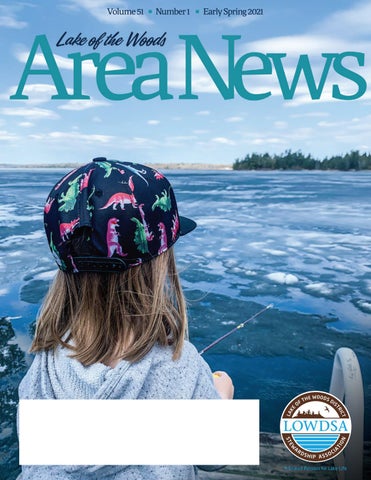
Volume 51
Number 1
Early Spring 2021
LISTINGS
•
M A R K E T E VA L U A T I O N S
•
B U Y E R R E P R E S E N TAT I O N
•
R E N TA L S
SELLER MARKET! With low inventory, and increasing demand, we’re now in Seller Market territory. It’s no secret the COVID-19 Pandemic has fueled an increase in demand for rural and recreational real estate and places are selling FAST. If you’ve been on the fence about selling, now could be the right time. There are buyers looking for a property just like yours. Give one of our Realtors a call for a no obligation and confidential opinion of market value and see for yourself how the market has changed.
138 MAIN ST S, KENORA, ONTARIO toll free
1.800.528.8848
INFO@CABINCOUNTRY.COM WWW.CABINCOUNTRY.COM
SOLD IN 2 DAYS
800 CONEY ISLAND | LOTW | $129,000 water access
GRAHAM CHAZE
CHRISTOPHER CLARK
DUSTIN SHORE
DOUG ARMSTRONG
broker of record
broker
broker
salesperson
807.407.5253 graham@cabincountry.com
807.466.8819 chris@cabincountry.com
807.407.3211 dustin@cabincountry.com
204.955.5080 doug@cabincountry.com
SOLD IN 6 DAYS
6 LITTLE WOODCHUCK BAY | LOTW | $579,000 road access
SOLD IN 5 DAYS
LOT 2 BR 5D STORM BAY ROAD | LOTW | $619,000 road access
In this issue 3
Cover photo by Wanda Kabel
LOWDSA
President's Message 3 Executive Director's Note 4 Our Contributors 5 Letters to the Editor 6
52
Mark Your Calendars 9 Lake of the Woods Summer Employment Opportunity 10
Living
Home & Cottage Energy Management, Part 3: Monitoring energy use 52
59th Annual General Meeting 11
Treading wisely: Engaging youth environmentally 54
Government Notes 15
Notes from Razberry Lane: Maple syrup, revisited 56
22
Member Recipe: Summertime and the living is easy 57
In the District
Hydro rate changes deliver a mix of savings and increases 22
38
Tips for amateurs, their phones, and shooting landscapes in portrait mode by Tim Armstrong
Water levels: Water levels continue to drop 23 What's happening on your lake: Let us know what you know! 24 Climate Change and Treaty #3 26
28
Jack McKenzie—Five decades of dedication to lake life by Jeff Polakoff
34
Life beneath the ice by Barry Corbett
41
58
Welcoming new life: Activities to help you savour the spring season by Jacob Rodenburg & Drew Monkman
Environment
Working together to eradicate flowering rush in the Lake of the Woods Area 41 LOWWSF: Put a plan in place— it is time to have your say! 44 LOWWSF: Sustainability— a misused concept that we need to think about 46 Be careful what you wish for 48 COVID-19 and the impact of single use plastics on our freshwater 50
60
Services
Real Estate Listings 60 Classifieds 61 Home & Cottage Services 62 Advertisers’ Directory 63
64
Captain Clifford Lewis and his boats by Lori Nelson
Lake of the Woods District Stewardship Association LOWDSA
1
BUILDING DREAM S
President's Message CHRIS SEMENCHUK
This is my first opportunity to say, ‘Happy New Year and all the best to you and your families for 2021’. 2020 was certainly a year of unprecedented change around the world. The same holds true for LOWDSA, from the last-minute cancellation of our AGM and LakeShow in April, to switching over to virtual delivery of our LakeSmart program and AGM. Thanks to the LOWDSA staff’s creativity and perseverance and Chris Semenchuk the support of many LOWDSA partners, the LakeSmart team were on the water in July doing dock visits. The new virtual component continued to compliment familiar programming, complete with delivery of webinars including one about the blue green algae discovered in Granite Lake. Mild temperatures earlier this winter enabled many of us to participate in outdoor activities—and even when the temperatures dropped many persevered. We applaud the efforts of the Sunset Trailer Riders in staking and grooming the trails so early in the season and all those who do so much work to prepare and maintain the ice roads! The lakes are in great shape for those who cross country ski and snowshoe. Getting outside is so important in light of the ongoing public health orders we’re all living under to stay safe and healthy. Although our renewal notices went out slightly later than they typically do, our renewals are continuing to come in at a good pace. Thank you to those of you who have renewed your membership and a special thank you for those gift memberships purchased! If you haven’t renewed yet, we encourage you to take advantage of our auto-renew function to simplify your annual renewal process.
emailed earlier this month or mailed if we didn’t have your email address. While we are disappointed that the 2021 LOWDSA LakeShow had to be cancelled due to public health restrictions, we remain hopeful that it will be back in 2022. Although the 2020 AGM was ‘just business’, we have had some great guest presentations at our AGMs over the years, and we’re continuing that tradition this year. We’re happy to announce the Water Brothers, Alex and Tyler Mifflin, will be joining us with a special presentation immediately preceding the regular business of the AGM. Join us and prepare to be engaged and informed for a half hour as they talk about threats (and solutions) to our precious lakes and rivers from climate change, invasive species and plastics, as well as time for a Q&A session. The AGM will immediately follow the presentation and we will also have some meeting participation prizes throughout the evening. All your LOWDSA committees—Membership, Environment, Government Affairs, and Finance—continue to work hard, each with many initiatives in the works. In addition to your directors we are fortunate to have about a dozen dedicated volunteers who also sit on the Environment and Government Affairs committees. Looking ahead, 2022 marks LOWDSA’s 60th anniversary! Watch for special events, programs and even a 60th anniversary video to celebrate the long standing history of this great association in the Lake of the Woods area. Plans are also well underway for another summer with the LakeSmart team on board. Hiring is underway and we’ve begun reaching out to our 2020 partners. Thank you to all those who have supported our award winning LakeSmart program; we hope you can provide continued support in 2021. We don’t yet know exactly how we will “deliver” the 2021 program, but we know it will definitely be a mix of virtual and in-person. Last year we explored new territory and proved that we can be flexible and adapt quickly, and that we’re ready to deliver the program in whatever means is necessary and possible given evolving health restrictions and regulations. Stay safe and hope to “see” you at the upcoming AGM.
As you read this, we will be finalizing plans for our 2021 Annual General Meeting on Wednesday April 7, 2021 at 7:00 pm. The AGM will be held virtually via Zoom, and your invitation was
Lake of the Woods District Stewardship Association LOWDSA
3
Executive Director's Note As you may recall reading in previous editions of the Lake of the Woods Area News, a very significant figure at the Lake of the Woods District Stewardship Association has decided to step away from the Executive Director role. Enter me. It is often said that introductions are never easy and farewells are always hard. Patrick Paolo Diane Schwartz-Williams' departure from LOWDSA will undoubtedly leave some rather large shoes to fill, and my introduction to LOWDSA and Area News is hard to describe— energizing, complex, challenging and interesting with the promise of being rewarding. I have read and re-read previous issues of the Lake of the Woods Area News, learning the history of LOWDSA, our members and the stories they have shared with a great deal of interest and curiosity. While doing so, I would find myself revisiting the Executive Director's Note, quite regularly, trying to capture a sense of what Diane was thinking and feeling. And here we are. This edition of Area News is complete, and somehow I have found my way into delivering my first ED note and couldn't be more thrilled. This edition will forever be near and dear to my heart as it is my first time introducing myself to you and my first time being involved in the process from content planning to editing to publishing. Learning how each edition of Area News is strategically designed and crafted has been an interesting process. Role changes aside, the 2021 calendar year is shaping up to be one of our best years yet, and I look toward the future with a great deal of enthusiasm.
Shelly Bujold is now in year three of her work with LOWDSA, and I have to say she is the unsung hero of our team. In addition to handling nearly all things membership related and managing our social media, Shelley has been an excellent resource for me as I transition into this new role. I would like to give her a special shout out as in the coming months, together, we will be working hard to enhance LOWDSA’s programs. That work started in late December, and since then we have spent countless hours via Zoom getting to know each other and discussing potential ideas for LOWDSA. Working together, I feel confident that this year LOWDSA will continue to shine brightly. Perhaps most noteworthy, we hired our first-ever Environment Program Coordinator Intern through the Northern Ontario Heritage Fund Corporation (NOHFC). Cassidy Mazur joined the LOWDSA team in January and will be helping us deliver and expand our environmental initiatives. Her passion and specialized study in environmental education and strong work experience in interpretation, outreach, and public relations will be an excellent fit for her internship with LOWDSA. Cassidy particularly enjoys working with the public on environmental topics and is looking forward to her involvement with the LakeSmart program and working with all our members. A Nestor Falls summer resident, the value of the area's beauty and sustainability is close to Cassidy's heart and will remain a top priority in her work with LOWDSA. Please go on reading our stories, articles, and reflections in this issue of Area News. I hope you find the same specialness that you have all come to love and expect with each issue and that you will also discover a unique freshness, too, as we grow in this next chapter together.
The official publication of the Lake of the Woods District Stewardship Association
PUBLISHED BY
DISTRIBUTION & MEMBERSHIP
Wake Marketing Inc. 140 Main St. S., Kenora, ON P9N 1S9 Phone: (807) 407-7252
Lake of the Woods Area News is published five times per year and is mailed to LOWDSA members. To receive Area News visit lowdsa.com and become a member today.
Publisher: Mike Greaves, mike@areanewsmagazine.ca Editor: Leanne Fournier, editor@areanewsmagazine.ca Art Director: Shayla Smith, shayla@wakemarketing.ca Design & Layout: Mike Newton, miken@wakemarketing.ca Advertising: Deb Polakoff, deb@areanewsmagazine.ca
Publication mail agreement #43107013. Printed in Canada.
UPCOMING EDITORIAL DEADLINES May 14 July 30 September 24
© 2021 LOWDSA. All rights reserved. The contents of this publication may not be reproduced by any means, in whole or in part, without prior written consent. Statements of fact or opinion are the responsibility of the author and may not represent the view of LOWDSA or Wake Marketing Inc.
4
LOWDSA Lake of the Woods Area News Early Spring 2021
Our Contributors
Tim Armstrong Garry Bolton Cecil Burns
Barry Corbett has lived in Kenora with his wife, two daughters and five grandchildren for over 30 years. He obtained a MSc. from Trent University and worked as a fisheries biologist in the NWT, Nunavut, Alberta, Manitoba, and Ontario. Retired now from the Ontario Ministry of Natural Resources, he divides his time between grandchildren, enjoying Kenora’s hinterland, consulting, commercial diving and volunteering at the Vernon Nature Area.
Bev Clark Barry Corbett Geneva Kejick LOWDSA Environment Committee Drew Monkman
Geneva Kejick is a First Nations woman from Asubpeeschoseewagong First Nation. In her role as Climate Specialist, Grand Council Treaty #3, Geneva has fallen in love with the science behind climate change. She has since been a part of several Treaty #3 climate change initiatives including the Climate Adaptation Study in partnership with Laurentian University, Emissions Reduction Project, Youth Climate Strategy Development Project, and the annual Treaty #3 Youth Climate Summit. Geneva has contributed to the development of the National Climate Strategy in partnership with Assembly of First Nations and recently accepted a position on the Sustainable Development Advisory Council of Canada. Geneva was one of the women highlighted for the “International Day For Women and Girls in Science,” held in February 2021.
Lori Nelson Jeff Polakoff Henry & Anita Rasmussen Rosemary Robertson Jacob Rodenburg Dave Schwartz
Lori Nelson has spent most of her life living on the shores of Lake of the Woods on Tunnel Island. The property on which she lives has been in her family for close to 90 years. Acquired by her grandparents, it was eventually developed into a tourist operation. Many weekends were spent cruising and racing on all parts of the lake, beginning when her family took up sailing in the early 1970s. Today, the explorations still continue but now by motorboat. Lori’s love of the lake has been deepened by learning the stories of this place and its people, which have come to her through her work of 32 years at the Lake of the Woods Museum. She’s happy to be able to share a few of them with you.
Diane Schwartz-Williams Bob Stewart Todd Sellers Catherine Van Reenen Bob and Susan Wilkes
LAKE OF THE WOODS DISTRICT STEWARDSHIP ASSOCIATION PRESIDENT Christine Semenchuk, Bigstone Bay
CHAIR, GOVERNMENT AFFAIRS Don Parfitt, Winnipeg River
VICE PRESIDENT Garth Collier, Ottermere Lake
CO-CHAIRS, ENVIRONMENT Lucas King, Woodchuck Bay Chelsea Lobson, Kendall Inlet
PAST PRESIDENT, CHAIR, MEMBERSHIP Hardy Bock, Black Sturgeon TREASURERS Carley Fyke, Welcome Channel Jeff Rempel, Pine Portage Bay
DIRECTORS AT LARGE Dave Christie, Granite Lake Jackie Lowe, Gun Club Island Trevor Templeton, Minaki
EXECUTIVE DIRECTOR Patrick Paulo 807-407-9182 patrick@lowdsa.com ASSIST. EXEC. DIRECTOR Shelley Bujold (807) 468-8715 shelley@lowdsa.com ENVIRONMENT PROGRAM COORDINATOR INTERN Cassidy Mazur 807-444-5176 cassidy@lowdsa.com
P.O. Box 1160 Kenora, ON P9N 3X7 EMAIL info@lowdsa.com
M LOWDistrictStewardshipAssoc N @lowdsaLakeTime P @lowdsa TOLL-FREE 1-888-265-9784 PHONE (807) 468-8715
Lake of the Woods District Stewardship Association LOWDSA
5
Letters to the Editor Dear LOWDSA members, Good news for the residents of Redditt— firefighting service returns As residents know, the Redditt Fire Department had been unable to respond to fires within its area of responsibility since February 8, 2020. Due to the dedication, hard work and efforts of our Fire Chief, Rick Hunt and his team, effective Friday, December 11, 2020, the Redditt Fire Department is now capable and able to respond to fires. Our thanks to the members of our Fire Department for stepping forward and volunteering to serve our community. They have volunteered significant time in training to reach this milestone. This would not have been possible without their efforts and dedication. We also want to note that the team has to maintain ongoing training each year which requires a further time commitment. The Fire Department will be distributing a Fire Team List by email to residents for use in the event of a fire emergency. Thanks, Bob Dolyniuk, Chair, Local Services Board of Redditt
Redditt volunteer fire department has worked hard to resume offering firefighting services to the community. Front row (L-R) Glenn Bowes (Deputy Chief ), Lorne Goodfellow, Jack Martin, Barb Hunt. Back row (L-R) Troy Judson, Rick Hunt (Chief ), Fred Allard, Austin Flegg, Murray Hall, Jodi Hall. Missing: Thomas Choong, Jamie Paterson, and Anne Anderson (Administrative Assistant).
Community based since 1971. 1666 Hwy 17 W | Keewatin, ON
Make it better
™
Make lake life better • 8’×16’ and 8’×20’ Pre-built Docks available • Built with MicroPro Sienna treated lumber and poly foamed filled billets Available at our Keewatin, ON Location only.
6
LOWDSA Lake of the Woods Area News Early Spring 2021
|
P0X 1C0 | 807.547.3366
We’d like to hear from you!
Letters to the Editor
Help us continue making this magazine great. Send us your comments, suggestions, pictures and story ideas: editor@areanewsmagazine.ca.
Greetings LOWDSA, The video RFP announced in a recent LOWDSA email to members has prompted me to share a small part of our memories of the Lake of the Woods.
LOWDSA,
Our family has been at Middle Lake for almost 65 years. We are now into the fourth generation of lake lovers. One of our recent traditions is to celebrate Canada Day with fireworks. I attached a photo of our 2020 Canada Day fireworks from our dock. We did a little more at the cottage because of the COVID cancellation in Kenora.
We are summer time residents for about 5-6 weeks every year. Many members of our family visit our cabin during the summer. We are trying to install a composting system for food waste, vegetables only, that won't attract animals.
Also, my wife has wanted to have a lake fly over since she was a little girl. She only had to wait 65 years but 2020 was the year it finally happened. I made a short video of the flight and it's on my YouTube channel. Even though it's quite short, I like to think it captures some of the awesomeness of the Lake of the Woods. I would be pleased to share this with other Lake of the Woods lovers: youtu.be/WMA-yI5LKA I'd like to thank LOWDSA for the important work you do and the fine production of Area News. I'm glad I can support these efforts through my membership. Regards and keep up the good work—it's appreciated now and in the future. Jim Kubas, Middle Lake
Do other property owners have a system or suggestions for us? Thanks, Susan Curry, Kenora area
Have a camp composting success story? We would love to hear your ideas for ecofriendly camp composting that doesn’t attract too many critters! Please send your ideas to editor@areanewsmagazine.ca so we can share them in future issues.
Lake of the Woods District Stewardship Association LOWDSA
7
Mark Your Calendars LOWDSA’s spring and summer calendar has been laid out below, but it is of course subject to change dependent the status of COVID-19. We will notify members of any changes and final decisions on events with as much advance notice as is possible. Any changes and updates will be posted on our website and social media platforms, but we will also send out eNews updates. Make sure we have your email address so that we can provide you with those updates.
23 AUG 25 JUN
APR
7
— TO —
59th Annual General Meeting Wednesday, April 7, 2021 at 7:00 p.m. Virtual via Zoom (page 11)
Overview of the association’s activities in 2020 and review of some of the issues on the horizon for the association with special presentation by The Water Brothers and Q & A session.
MAY
15 JUN
5
Last day to order seedlings Place your red pine seedling order—page 13! Online: lowdsa.com/cpages/seedlings Phone: 807-468-8715 or TF 1-888-265-9784
LakeSmart Team & LOWDSA at Matiowski Farmers’ Market
Whitecap Pavilion, Kenora Subject to change; look for us in the Pavilion or close by on the harbourfront 8:30 a.m. – 2:00 p.m. every Wednesday.
JUL
1
LakeSmart Team & LOWDSA at Matiowski Farmers’ Market Whitecap Pavilion, Kenora Subject to change; Look for us in the Pavilion or close by on the harbourfront 10:00 a.m.–4:00 p.m.
Seedling pick-up day 10:00 a.m. – 1:00 p.m. at 2 locations, Clearwater Bay & Longbow Lake firehalls
Plans in the works & dates pending • LakeSmart Team visits—let us know if you would like the LakeSmart team to visit your lake community. • LOWDKids activities including Storm Drain Painting to spread the message “A healthy lake starts here!” • IISD Experimental Lakes Area—virtual tours and webinars
SAT
TBD
Free Metal Waste Collection Day 10:00 a.m. – 12:00 p.m.
Get all the metal junk out of your yard, shed, garage and surrounding bush. Drop off by truck or boat. Volunteers will be on hand to help unload.
EMAIL info@lowdsa.com M LOWDistrictStewardshipAssoc N @lowdsaLakeTime P @lowdsa TOLL-FREE 1-888-265-9784
Lake of the Woods District Stewardship Association LOWDSA
9
Lake of the Woods Summer Employment Opportunity Position: Environmental Stewardship Technician (2)
Required Skills & Experience: • Strong organizational and people skills
Location: Kenora, Ontario
• Ability to work independently and with a team
Duration: May 3 start date, 14-18 weeks (Program length subject to funding)
• Knowledge of issues surrounding shoreline health • Excellent written and oral communication skills; e.g. public speaking, contributing articles to newspapers/newsletters/ magazines
Application Deadline: April 1 at 11:59 PM CST (Co-op credit at participating post-secondary institutions) Description: LakeSmart is an environmental outreach program managed by LOWDSA during summer. LakeSmart assists the Association with delivery of environmental education while raising LOWDSA’s profile in the watershed.
• Familiarity with the Lake of the Woods region including strong navigation skills is a key asset
Key Responsibilities:
• Plant, fish, and invertebrate identification skills
• Demonstrated proficiency in using marine equipment safely and according to legislation • Experience networking with professionals/agencies and engaging volunteers/public
• Act as LOWDSA ambassadors • Conduct visits by boat and car to waterfront residents to promote sustainable shoreline living & living green at the lake
• Demonstrated proficiency with social media and other related computer skills (MS Office programs, etc.) • Knowledge of field work principles (accurate data recording, use of equipment, reports)
• Expand LOWDSA’s virtual outreach programming • Liaise with community groups and resource professionals to assist in the development of invading species awareness initiatives
Other Requirements: • Valid driver's license
• Document invasive species (identification & mapping) and sampling to monitor water quality
• Valid Pleasure Craft Operators Card
• Coordinate community participation in stewardship and public monitoring activities
• Able to work flexible hours including weekends
• Deliver environmental education and public outreach programs to various community and lake organizations in addition to various community events
• Access to a personal vehicle for the duration of the position. Only those selected for an interview will be contacted. Program length subject to funding.
• Document and track analytics reports in real time Education & Qualifications: Education in job-related program and/or work experience in a related field (environmental science, biology, resource management).
10
• CPR/Standard First Aid Certificate is an asset
Please forward a resume and cover letter by April 1, 11:59 PM CST Mail to: Lake of the Woods District Stewardship Association PO Box 1160, Kenora, ON P9N 3X7 Email: info@lowdsa.com
LOWDSA Lake of the Woods Area News Early Spring 2021
59th Annual General Meeting 2021 Wednesday, April 7, 2021 at 7:00 pm CST on Zoom
Featuring special guest speakers...
Alex and Tyler Mifflin are the creators & hosts of the award winning television series, The Water Brothers, that takes them on adventures around the world exploring the most critical water challenges we face in the world today.
To attend the AGM: Register by Monday, April 5 at 11:59 p.m. CST at tinyurl.com/LOWDSA Then join us on Wednesday, April 7 at 7:00 p.m. CST via Zoom or by phone. To attend the AGM you must be a LOWDSA member. It’s easy to renew your membership or become a member, online or by phone! lowdsa.com N @lowdsaLakeTime M LOWDistrictStewardshipAssoc P lowdsa V lowdsa 807-468-8715 | 1-888-265-9784 | info@lowdsa.com | Box 1160, Kenora, Ontario P9N 3X7
319 2nd Street S, Kenora P: 807.468.3333
TF: 1.866.418.3672 info@standardinsurance.ca
standardinsurance.ca
One of the many benefits to LOWDSA membership...
Order your red pine seedlings today! Expand your own beautiful patch of forest at the lake... and help reduce our carbon footprint. Continuing the great work of LOWDSA members since the early 90s with over 300,000 trees planted and another 10,000 for 2021. Same great price—$10 for a bundle of 15 seedlings. Seedling orders are open to members only until May 15, 2021. After that date, we will open up sales to the public on a first come, first served basis.
Members of a team of young planters from St. Thomas Aquinas High School busy planting 2500 red pine seedlings in the Kenora Forest as part of LOWDSA’s partnership with LOW Brew Co (June 2018).
SEEDLING PICK UP—ONE DAY ONLY
Saturday, June 5, 2021 from 10:00 am–1:00 pm If you'd like to order seedlings but will be unable to pick up on June 5th, please know that we're working on a plan to make sure they get planted.
It's easy to order!
You can order your red pine seedlings online at lowdsa.com/cpages/seedlings. You can also order by mail (see page 21), call 888-265-9784 or email info@lowdsa.com.
Why red pines? A question we are often asked is, "Why red pines? Why not some other variety?" We went to the source for the answer and checked in with our supplier, PRT’s, Dryden operation. What we learned is that the red pine can tolerate poor, rocky and sandy soils along with a variety of moisture levels. They said they would call it the most flexible and versatile species to plant in Ontario. This means that the red pine is very well suited to the many different terrains and soils found in our watershed, and has the best rate of success overall when all variations are considered. The red pine possesses an unusually low level of genetic variation within and between populations (northwestern Ontario to southern Ontario for example). It is self-fertile and self-compatible. The possibility that the red pine is derived from a single population established sometime during the Pleistocene era is very likely. Simply put, the red pine is very well suited to the many different terrains and soils found in our watershed, and has the best rate of success overall when all variations are considered.
Did you know? Every edition of Area News is available to our members online, so you can catch up on what's happening whenever, wherever you are. Visit lowdsa.com to learn more!
You can easily purchase a gift membership—a great idea for birthday, graduation, and house warming gifts— online at lowdsa.com. You can also order by phone or email!
We love to hear from our members and we want to share your story! Help us continue to make this magazine great— send us your comments, suggestions, pictures and story ideas.
Lake of the Woods District Stewardship Association LOWDSA
13
RBC Dominion Securities Inc.
In every walk with nature one receives far more than he seeks. – John Muir
The Darcy Zaporzan Wealth Management Group of RBC Dominion Securities www.dzwmg.com
The DARCY
Zaporzan W E A LT H M A N A G E M E N T G R O U P
of RBC Dominion Securities RBC Dominion Securities Inc.* and Royal Bank of Canada are separate corporate entities which are affiliated. *Member-Canadian Investor Protection Fund. RBC Dominion Securities Inc. is a member company of RBC Wealth Management, a business segment of Royal Bank of Canada. ® / ™ Trademark(s) of Royal Bank of Canada. Used under licence. ©2019 RBC Dominion Securities Inc. All rights reserved. 19_90783_N4D_001
Government Notes BY DIANE SCHWARTZ-WILLIAMS moving everyone to the same billing basis. By comparison to Hydro One customers, Kenora residents are served by Synergy North where there is no separate seasonal class and the phase-in of a fixed monthly rate has been completed.
Federal COVID-19 updates and travel restrictions Early 2021 saw COVID-19 regulations, restrictions and recommendations continuing to change provincially and federally, and not always in the same direction. Given the many layers of information and differences from one province to another as well as the ongoing changes to the regulations and restrictions, we continue to recommend the official websites hosted by the governments of Manitoba, Ontario and Canada and the Northwestern Health Unit (Ontario) as your best source for current and accurate information. We have posted links to each website at tinyurl.com/4dfr2uzy.
DoKURA working for access to dependable high speed internet for all residents Access to dependable high speed internet is an issue for many people living in rural and remote areas across Canada. The District of Kenora Unincorporated Areas Ratepayers Association (DoKURA) has been working for months to determine how every resident in their catchment area will have access to highspeed internet at reasonable installation cost and monthly rates comparable to other jurisdictions. Their recent letter to DoKURA residents notes, "Currently, we have gaps in service, poor service, expensive service in some cases, and no evident leadership in finding the best solution for DoKURA residents. It is up to us, the residents of DoKURA, to protect our interests. There is not a federal or provincial lead to be sure that all residents are served. We propose to bring together those interested in joining us in our efforts. We must act now because government incentives to extend internet services are time limited.” DoKURA is now looking for comments, questions, feedback and volunteers to assist their efforts and can be contacted at dokuraorg@hotmail.com.
Provincial Hydro One seasonal class elimination moving forward The Ontario Energy Board (OEB) decision to maintain the seasonal rate elimination decision first made in 2015 will impact many LOWDSA members. The increases won’t be immediate but will be a phased in process that could take up to a decade. This change can be equated in some ways to the Provincial Land Tax (PLT) changes, ending the low non-school board tax rate and
Trying to make estimates of the cost impact, other than knowing low-volume users will certainly pay more and high-volume users less, is difficult until the OEB makes its final rate order. Even then, the long-term phase-in and unknown factors, such as government subsidies and electricity commodity price changes, make to-the-dollar bill estimates iffy at best. What is known for sure is that it is that it is going ahead and will result in higher monthly/quarterly bills for many current seasonal class customers in this region. There have been no new postings on the OEB website since October regarding seasonal rate class elimination. Your LOWDSA Government Affairs Committee is watching for updates, which will be passed on to members through the Area News and eNews as they become available. Additional information about this was included in our November eNews, thanks to Bob Stewart, member of our Government Affairs Committee. To obtain it, email membership@lowdsa.com. You can also read Bob’s latest article related to Ontario’s ever changing electricity landscape on page 22.
Lake of the Woods Fisheries Advisory Council (FAC) John Waterer, LOWDSA’s representative on the Fisheries Advisory Council, reported that after almost a year break due to COVID, the FAC meetings have resumed with renewed urgency and an aggressive timeline. The strong leadership of the Ministry of Natural Resources and Forestry (MNRF) staff, Steve Bobrowicz (Project Manager) and Scott McAughey (District Resource Management Supervisor), has focused on educating the council on the complex issues surrounding the status of the walleye fishery in Lake of the Woods. It was clarified that at this time the focus of the advisory committee is recreational walleye only. The initial meetings reviewed Ontario’s Provincial Fish Strategy document and how its goals will influence the FAC. The primary goals are “Healthy ecosystems that support self-sustaining native fish communities and sustainable fisheries that provide benefits for Ontarians.”
Lake of the Woods District Stewardship Association LOWDSA
15
The FAC is challenged by many competing interests and an extremely complex biological system. The January 19, 2021 meeting focused on reviewing the status of the fishery and what that tells us about how the resource has been utilized by various interests. While it is acknowledged that some data gaps do exist Bobrowicz emphasized that the MNRF sees it as critical that “informed transparent decision making using the best available science is used when creating workable solutions”. The review clearly showed that the walleye fishery on LOTW is in a fragile state and corrective action must be taken to avoid a collapse of the walleye fishery. The bottom line is that the population and size distribution of walleye on Lake of the Woods cannot continue to sustain the current harvest pressure. Now that the issues have been identified, upcoming meetings will focus on establishing objectives, and reviewing available options followed by consultation with interested parties. Bobrowicz also noted that if a change is implemented for January 1, 2022 that recommendations of the FAC must be completed no later than the end of May 2021 for other areas to complete the process.
Turtle Portage marine railway next steps In an effort to make the marine railway facility more userfriendly and reliable, MNRF has engaged an engineering firm to prepare drawings for potential upgrades. Construction cost estimates are expected by March 2021. Any potential upgrades are subject to Ministry approval and funding availability. In the absence of any upgrades, the Ministry hopes to continue operating the existing facility during the 2021 boating season.
Four-laning Highway 17 update The most recent requests for updates on the twinning of the highway was sent to the provincial project team January 16, 2021, copied to MP Eric Melillo, the Honourable Greg Rickford MPP, the City of Kenora and the Township of Sioux Narrows-Nestor Falls and included here. Submit your comments, suggestions or questions and your request to be added to the mailing list to the Ministry to project-team@4LaneHighway17Kenora.ca or online at 4lanehighway17kenora.ca. Thank you for your response. We appreciate your notice that “the ministry has continued to make progress in the design and in advancing the environmental approvals for the first planned twinning of Section 1” However, we hope that you can appreciate that this does not provide any real update from what we have understood to be the case for well over a year and a half with the chosen option for Section 1 yet to be confirmed. To follow-up, could you please provide any updates and/or timelines, even if only tentative, for the environmental process specific to Section 1? Our recollection is that there were environmental issues identified for all of the routes that were presented as under consideration in November 2018. However, and again as we recall, there were no significant environmental issues identified (at that time) on the "preferred route.” Given reports late in 2020 that sparked some hope that we just might see construction on Section 1 begin this spring, we would like to provide any kind of update, even a small one, to our members soon. LOWDSA’s content plan for our early spring issue of the Lake of the Woods Area News magazine is in place with content due in the first week of February. Should this timing be too tight, we would ask you to keep in mind that we have four other magazines going out to our members this year as well as periodic eNews bulletins. We are committed to keeping our members informed, updated, and knowledgeable about anything to do with this important topic whether it be proposed timelines, decisions made about environmental planning, community negotiations or opportunities for public consultation. There are very few, if any, issues that our members are more interested in (and passionate about) than the 4-laning/ twinning of that dangerous stretch of highway. It is a topic that we know is also very important to our provincial and federal elected representatives with both the Honourable Greg Rickford, MPP and MP Eric Melillo having advocated several times on our behalf specific to this issue.
The Ministry encourages anyone interested in assuming the facility’s operation to contact James Williams, IRM Technical Specialist, MNRF Kenora District at (807) 468-2543.
While the immediate and most pressing matter is the progress on Section 1, we are also very interested in any information you can provide about upcoming opportunities for scheduled public input and any updates regarding the planning and preliminary design work for Sections 2 and 3. We look forward to your reply and any updates or information that you can provide.
16
LOWDSA Lake of the Woods Area News Early Spring 2021
Forest Management
use of Btk. Btk naturally occurs in forest ecosystems and there are no known environmental concerns for its use as an insecticide. The MNRF fact sheets are available at lowdsa.com on our news page or email info@lowdsa.com. For further information contact Shannon Diehl, MNRF at 807-468-2501.
Jack pine budworm 2021 Insect Pest Management Program Opportunity for public review of the MNRF proposed insect pest management program and draft project proposals for specific aerial insecticide project(s) to control the jack pine budworm infestation in northwest Ontario, including the Kenora and Whiskey Jack forests ended February 15, 2021. Based upon the analysis of the available insect pest management options, the MNRF proposed course of action included aerial application of insecticide on selected forest stands. Details of the final plan were not available at time of writing.
2019-2020 logging updates Garth Collier, LOWDSA director and our representative on the Kenora Local Citizens’ Advisory Committee (LCAC), provided logging updates for the Kenora and Whiskey Jack Forests as discussed at the LCAC’s January 2021 meeting: Whiskey Jack Forest: Harvesting
Bacillus thuringiensis (Bt) is a naturally occurring bacterium whose different subspecies are used to control different insect pests. Bt subspecies kurstaki (Btk), is the active ingredient in the insecticides to control a group of insects called lepidopterans including destructive tree pests such as budworms and moths. It has been used for over 30 years as a biological control for a variety of agricultural and forestry insect pests. MNRF fact sheets advise that Btk does not affect humans or other vertebrate animals. It does not affect adult moths or butterflies, insects other than lepidopterans, insect predators or parasites. Further, there are no water or soil contamination concerns with
• 632 hectare (ha) harvested, 615 of that was regular harvest and then there was some block cleanup on Bug Lake. 632 hectares is 12 per cent of the annual allowable cut on the Whiskey Jack. • The main harvest areas were Witch Bay, Dirty Water, the 105 Highway, a few blocks off of Highway 804, and one big block by Ear Falls. • To date, the Whiskey Jack has had seven per cent of the planned area harvested, the average harvest block was 67.9 ha, the largest area was 215 ha (Ear Falls). • 32,000 cubic metres of conifer, and 42,000 cubic metres of hardwood was taken to local mills.
LOCALLY OWNED PROUDLY SERVING COTTAGE COUNTRY FOR OVER 50 YEARS!
STARBUILDING.CA 204.233.8687 or 1.888.782.7974 16 SPEERS RD. WINNIPEG, MB Lake of the Woods District Stewardship Association LOWDSA
17
Whiskey Jack Forest: Consumers
Kenora Forest: Consumers
• The largest conifer consumer was Kenora Forest Products (KFP) and the rest went to Eacom Timber. Notably, this was the year that KFP curtailed operations.
• There was a lot more operations in the Kenora area in the winter after KFP ceased operations. • The largest consumer of conifer was Eacom, and the largest hardwood consumer was Weyerhauser.
• The largest hardwood consumer was Weyerhauser. Whiskey Jack Forest: Planting
Kenora Forest: Planting
• In 2019-2020, all planting was done by TriTree. With just a crew of four, it took about five weeks, which is longer than usual. As usual, there was no aerial spray.
• The Kenora planting program was larger. Norway Lake just north of Redditt was planted as well as Malachi, Cameron and White Road. • There was no aerial seeding, and 160 ha was reported this year as being left for natural regeneration. This was cut the year previous and monitored to see if it would regenerate naturally before reporting it.
Kenora Forest: Harvesting • 980 ha harvested in the 2019-2020 operating period on the Kenora Forest. This represents just over ¼ of the allowable annual harvest area. • Most of the harvest occurred up the English River Road, just north of Redditt, back into Cygnet, continued operations on Talbot north of Coker Road, Cameron Lake Road and two blocks off the Shoal Lake Road. • The average block size was just over 40 ha, the largest actual block was just about 150 ha. 95,000 cubic metres was harvested: 56,000 was conifer, and 39,000 was hardwood.
18
• 421 ha of mechanical site prep was done; no tending or herbicide use occurred during this period. • 800,000 trees were planted, reflecting the cuts done last year. For more information Contact Kyle Myschowda, MNRF Kenora Management Forester, 807-468-2559 or kyle.myschowda@ontario.ca or Kaitlin Moncrief, MNRF Whiskey Jack Management Forester, 807-468-2597 or kaitlin.moncrief@ontario.ca. an
LOWDSA Lake of the Woods Area News Early Spring 2021
LOWDSA membership... Here's just some of what's in it for you!
LakeSmart One on one. Customized onsite visits. Living green at the lake. Info, tools and resources to help you protect your legacy.
Blue-Green Algae Blue-green algae can steal your precious lake time. How to keep your lake clean and safe for swimming, drinking and pets.
Stop Invasive Species Invasive species can take over your favourite fishing hole (and habitat), dock access and lake stops. Tips, tools & best practices to identify them and prevent their spread.
Lake Life Resources Area News Magazine Easy access to just about Connecting you to ’the anything you want to lake’ year round. In your know about lake life. hands or online. Local If we don’t have the stories, all about lake answer we’ll help you life, and issues you’re find it or connect you interested in. with the person who can.
There are four ways you can renew your membership, order seedlings, purchase gift memberships or contribute to the EISP fund: Online Login at lowdsa.com/login. Forgot your password? Contact us!
By email, mail or phone... See the form (and all relevant contact information) on the next page.
Questions? Need help to renew online? Shelley Bujold, Assistant E.D. & Membership Coordinator: Phone: 807-468-8715 or toll-free 1-888-265-9784 Email: shelley@lowdsa.com
Dedicated to Lakefront Property
Ian Carmichael Broker of Record
OFFICE
807-467-2323
CELL
807-466-2236
lakeofthewoods.net
carmichaelrealestate@lakeofthewoods.net
Thinking of Selling your Waterfront Property? Like us on Facebook
Do you own a mainland cottage, leisure home or condo? A private island or an island cabin? I remain at your service all 4 seasons! I am dedicated to helping you achieve your objectives. Call me directly for assistance and qualified experience at 807-466-2236.
Incredible private point boasts over 4 acres of titled lands having 1152’ of shoreline
West facing cottage on B.R. 3, 2600 sq ft 3 BR cottage, 850 sq ft guest cabin, boathouse, studio cabin & sand beach
Idyllic 2.29 acre year round island; stunning log cabin; double stall boathouse with living quarters.
$2,950,000 LOTW Private Point Build on your family’s legacy!
Storm Bay Road
Private Island
South facing property has 936 sq ft 3 bedroom cottage, sunroom, covered front deck and waterside deck & dock.
30 acres of land with 2200’ of shoreline! 90 sec. boat ride from landing. Steel dock, 30’ trailer + 20’ diameter yurt. Lots of potential!
Want to get off the Grid? Perfect destination that is new and equipped
Corkscrew Island
Winnipeg River
Cache Lake
$325,000 LOTW
20
$775,000 LOTW
$299,000
LOWDSA Lake of the Woods Area News Early Spring 2021
$729,000 +HST LOTW
$165,500
Your continued support of LOWDSA's programs & initiatives does make a difference.
2021 Membership Renewal
Thank you!
PLUS GIFT MEMBERSHIPS & SEEDLINGS YOUR MEMBERSHIP
Red Pine Seedlings
Select either a Full Membership (magazine mailed) or a Virtual Membership (digital magazine).
LOWDSA members planted 10,000 seedlings in 2020 and over 300,000 since this program was launched. Please indicate a pick-up location and how many bundles (each with 15 seedlings) you would like to order.
1 Year Full Membership ($60) 2 Year Full Membership ($120) 1 Year Virtual Membership ($52)
PICK-UP DATE: Saturday, June 5 from 10AM - 1PM
2 Year Virtual Membership ($104)
We’ve been listening to you &
Clearwater Bay (Firehall)
Not renewing? Please let us know why not...
Storm Bay Rd. (Firehall)
paying attention to what you’re
# OF BUNDLES __________ AT $10 EACH
telling us is important to you: 1. Responsive to member concerns
total $
total $
2. Familiar activities SEEDLINGS, METAL WASTE DAY
3. Relevant & informative magazine
EISP Fund
Gift Memberships Please fill out recipient’s information, and select Full or Virtual Membership.
4. Growing & moving forward beyond the status quo
Please take a moment to consider contributing to the EISP Fund.
5. New environmental initiatives
Your contribution to the Environmental Initiatives & Special Projects (EISP) Fund will allow us to continue providing our well-known and highly regarded programs and services.
MOBILE BOAT WASH STATION
6. New & enhanced programs LAKESMART, WEBINARS
7. Fiscally responsible All this comes at a cost. In order to meet LOWDSA’s commitment to
Contributions to the EISP Fund can also be made online any time at lowdsa.com/campaigns/eisp.
deliver on all this, combined with
$500 $250
the reality of basic operating cost
$100 $50
increases, the annual cost of LOWDSA membership has increased to $60 for full membership ($52 for virtual).
Other $______________
total $
LOGIN to lowdsa.com to renew online—auto-renew option now available. You can also mail completed form to the address below, or scan and email to shelley@lowdsa.com.
Payment Options
Name Email Address City State/Prov
Zip/PC
Country
Phone
Please send gift card with message:
FULL MEMBERSHIP ($60) VIRTUAL MEMBERSHIP ($52)
total $ GRAND TOTAL
$
PLEASE MAKE CHEQUES PAYABLE TO LOWDSA
Member Name Email Address City Prov/State Country Postal/ZIP Visa
Mastercard
American Express
Amount (Grand Total) $ (cad) _________________
Card #_______________________________ Name on card __________________________ Expiry (mm/yy) ____ / ____ CVC (required) _____ (3-4 digits back of card)
lowdsa.com N @lowdsaLakeTime M LOWDistrictStewardshipAssoc P lowdsa V lowdsa 807-468-8715 | 1-888-265-9784 | info@lowdsa.com | Box 1160, Kenora, Ontario P9N 3X7
Hydro rate changes deliver a mix of savings and increases BY BOB STEWART Recent changes in Ontario’s ever changing electricity landscape will provide a mix of savings and bill increases for Hydro One customers in the Lake of the Woods region and elsewhere in 2021. In December, the province announced changes to its Regulated Price Plan, removing a portion of the costs previously paid by electrical customers to direct provincial funding. This by itself didn’t result in any net savings as the province lowered its Ontario Electricity Rebate support to residential and small business customers, making the bill impact neutral. However, two changes that took effect January 1, 2021 did impact bills. The first was new delivery rates approved for Hydro One. With current provincial distribution rate subsidies, the only residential customer class to experience changes from this will be low volume Seasonal class customers—an approximate $5 a month increase in basic monthly service cost, or $15 on a quarterly bill, while high volume Seasonal users—those leaving power on and using it year-round—will experience some savings as the increase in the flat fee portion of the delivery charge was balanced with a reduction in the volume charge. The second is a short-term COVID related measure—a provincewide reduction in the per kwh electricity charge for the four weeks beginning January 1 and then extended on two occasions to February 22. The price of power was held to 8.5 cents per kwh during a province-wide lock down and stay-at-home order no matter how much electricity was consumed or when. Based on average use patterns it translated into a savings of about 1.7 cents per kwh used. Bill savings, balanced by the increase in delivery costs for some, will vary depending on customer class, local utility delivery rates, and electricity used. For example, a Hydro One Seasonal customer using 1,000 kwh saved about $20 with the COVID measure; a year-round R2 (Rural Rate) customer using the same 1,000 kwh saved about $40.
22
A Seasonal customer using minimal or zero kwh didn’t experience any savings. Those using electricity for home heating (4,000 kwh monthly) saved the most—about $160. Savings will be spread across multiple billing cycles for most customers as very few have billing periods that fall exactly within the time frame of the rate reduction.
Bill comparisons Using the OEB online bill calculator for Time of Use average bills including all costs, government support and taxes: Customer
Consumption
Dec 2020
Jan 2021
Hydro One R2
0 kwh
$ 34.59
$ 34.59
Hydro One R2
1,000 kwh
$ 162.87
$ 139.18
Hydro One R2
2,000 kwh
$ 295.70
$ 243.76
Hydro One Seasonal
0 kwh
$ 37.18
$ 42.74
Hydro One Seasonal
1,000 kwh
$ 217.22
$ 201.76
Hydro One Seasonal
2,000 kwh
$ 397.24
$ 360.78
For comparison—Synergy North (Kenora), which has only one residential class: Consumption 0 kwh
Jan 2021 $ 29.35
1,000 kwh
$ 122.82
2,000 kwh
$ 216.31
Note: Hydro One Seasonal customers are billed quarterly, so will have to divide their bills by three for average monthly amounts.
In the District Lake of the Woods Area News Early Spring 2021
WAT E R L E V E L S
Water levels continue to drop BY JEFF POLAKOFF, LOWDSA REPRESENTATIVE, LAKE OF THE WOODS CONTROL BOARD The water levels in the Winnipeg River Drainage Basin, including Lake of the Woods, are still exhibiting drought conditions with the level of water in the basin continuing to drop through fall and early winter. During discussions at the Water Control Board (LWCB) meeting in January, members were advised that precipitation for 2020 in the basin is now the 7th lowest in 115 years. This past year may have provided good evidence of the potential impacts of climate change and an indication of a trend toward an increasing variability of lake level conditions and less reliable predictability. Confirmation or redefinition of this trend will come with monitoring over a longer period; however, 2020 and the beginning of 2021 has been an interesting and unusual period for lake levels. Heading into winter, we were experiencing very dry and prolonged drought conditions. These conditions, combined with the potential lack of substantial precipitation, increase the risk of lake levels not rising to normal levels during the spring. In addition, should this trend in low precipitation levels persist, the dry ground will absorb more spring runoff and rainfall than would generally be the case. Historically, there has been a close relationship between inflow conditions and lake levels resulting from the presence of El Niño or La Niña in the equatorial Pacific. Typically, La Niña conditions, which appear approximately every three to five years, have produced wetter and colder weather and El Niño has resulted in warmer, drier conditions. This year’s La Niña has not had that effect through late fall and early winter, however these conditions are forecasted to continue through the late winter and into the spring. Since records have been kept on El Niño / La Niña trends beginning in 1950, below normal inflows have not persisted when La Niña conditions have been present over the fall, winter and spring. In addition, low spring inflows have only occurred twice before when La Niña conditions were present. In other words, under normal circumstances, we would anticipate increased precipitation for this spring. We will have to wait and see; however, it was noted that global stratospheric warming may be affecting the basin, and this could provide a partial explanation for why there is less precipitation than normal despite the current La Niña conditions. It may be that this increased variability and lack of consistency and predictability based on historic weather patterns, could reflect a “new normal”.
Low water levels over the last year may indicate lack of predictability in managing future lake levels.
Based on the LWCB consultation and the potential for continuing low lake conditions, it was agreed that conserving water in Lake of the Woods is a priority. It was also recognized that targets for winter retention may need to be revised upwards dependent on conditions as we approach spring. Lake levels will continue to be monitored closely including limiting winter drawdown on the lake and meeting minimum flow demands. One benefit in relation to lower drawdowns noted was that this would be beneficial for lake trout eggs for Lake of the Woods. It was also recognized that outflow reductions, if necessary, should be made gradually to minimize the disturbance of ice on the Winnipeg River, particularly near Kenora. The LWCB has recommended that regulation target an end-of-winter level within the normal range, or greater than 322.38 m / 1057.70 ft by March 31. This compares to the Lake of the Woods water levels as indicated on your nautical charts of 322.80 M / 1059.00 ft. Please remember that weather and temperature fluctuations also raise concerns about ice conditions within the basin. For those of you heading out onto the ice, please remember to check conditions and thicknesses regularly and particularly around the mouths of rivers and streams. A good general principle to remember is that snow machines typically require approximately 20 cm/8 inches of ice while vehicles require approximately 30 cm / 12 inches. Also, keep your eye out for pressure ridges, stress cracks and of course slush. If you would like to keep up to date on the status of lake levels, please visit the LWCB web site at lwcb.ca/waterflowdata.html.
Red and White Pine Specialty Products T&G Pine Paneling Log Siding / Shiplap / Flooring Timbers | Hardwoods | T&G Cedar Paneling 1-800-757-4797 Box 300 Emo Ontario P0W1E0 www.manitouforest.com
Lake of the Woods District Stewardship Association In the District
23
W H AT ’ S H A P P E N I N G AT Y O U R L A K E
Let us know what you know! The summer edition of Area News has traditionally featured a listing of upcoming live events throughout the region. We recognize that summer 2021 may still be a time of uncertainty, but we’d love to share any events for your area that are planned within the latest health guidelines—and we understand this may change with little notice.
values of the island. For generations, campers attending BB Camp and Camp Stephens, cottagers and community members have enjoyed connecting with nature on Town Island. NCC's goal is to work with these groups to ensure the conservation of the island's unique biodiversity, while still allowing them to maintain their important connections with the island.
At this point, all we can go with is what we know on a day to day basis, so along with your event details and photos (if available), please be sure to include contact information where our readers can get the latest updates. We can also post to our social media channels where we have the ability to share last minute changes (within reason of course!).
For more information visit natureconservancy.ca/townisland.
Email editor@areanewsmagazine.ca.
Nature Conservancy of Canada reaches deal with City of Kenora to purchase Town Island The Nature Conservancy of Canada (NCC) and the City of Kenora reached a deal in February regarding the future sale of Town Island. The two partners had been negotiating the terms of the sale since late last year. NCC is pleased to be able to move forward on this project and begin fundraising the $2.85 million needed to conserve Town Island. The 82 hectares (202 acres) on the island currently held by the city represent an opportunity for the national non-profit and the community to come together to protect the abundant natural
Interesting happenings for lake lovers everywhere Federation of Ontario Cottagers’ Associations (FOCA) FOCA is a not-for-profit organization representing over 50,000 families in more than 500 lake and road associations, from the very small to the very large, all across Ontario. FOCA effectively serves and represents Ontario’s lake associations, waterfront property owners and waterfront communities through education, communication and government advocacy. LOWDSA is proud to be FOCA’s most westerly member and largest member. We look forward to continuing our collaborations, which over the years have been both positive and mutually beneficial. The issues FOCA has addressed have evolved since its inception in 1963 (just one year after LOWDSA), but the motivation remains the same: To protect our waterfronts and freshwater resources for our kids, and for their kids. We are aligned in our advocacy for healthy lakes and rivers. FOCA has become the
Book your LakeSmart experience! Choose a virtual dock visit or an in-person visit to your lake, property or event in June, July or August. Take advantage of the knowledge and resources available from the LakeSmart team, including healthy shorelines, buffer zones, reducing run-off, invasive species, safe boating, septic systems and so much more. For more information or to book a visit: » Go online to lowdsa.com/cpages/lakesmart » Contact 807-468-8715, 888-265-9784 or info@lowdsa.com
24
In the District Lake of the Woods Area News Early Spring 2021
respected voice provincially of Ontario’s waterways, lake associations and 250,000+ waterfront property owners, and in many instances also for all who love and use our lakes and rivers. Its united voice carries weight on issues that matter! FOCA works with government and other partners on important policy and best practices, to make Ontario waterfront communities environmentally and financially sustainable, keeping its members informed on this work as well as changes in legislation and other timely cottage-country news. Even a quick look at foca.on.ca will provide an impressive overview of all the work that FOCA does on behalf of its members. Take a little time for a more in-depth look and you will find an extensive resource base with useful information on just about every topic related to lake life. All LOWDSA members are also able to access any members-only resources at foca.on.ca with this login: Username: focamember Password: Foc@M3mb3$2014. If you prefer to wait for the news to come to you, sign up for FOCA’s monthly Elerts. Safe Quiet Lakes Safe Quiet Lakes (SQL) is a group that is passionate about life near the water and determined to help sustain it. LOWDSA members have many interests in common with this group and we reached out to learn more about what they're doing for their area. Simply put, the organization’s goal is to make the Muskoka Lakes safer and quieter to ensure the sustainable enjoyment of a treasured shared resource. SQL’s outreach and education promoting safe and responsible boating with their stakeholders is multifaceted and includes many resources, projects and webinars that can be accessed online at safequiet.ca. This is something we have been hearing about from our members and LOWDSA looks forward to continuing conversations and sharing resources with SQL. Decibel Coalition The Decibel Coalition is a group of stakeholders whose objective is to enhance existing legislation in the Small Vessel Regulations SOR/2010-91 to include decibel limits for boat motor noise with efficient and effective enforcement procedures. The Coalition is run by Safe Quiet Lakes and was established in the Fall of 2019. As of January 2021, it had expanded its membership to 19 lake associations representing over 10,000 families located in Central BC, central and Eastern Ontario and the Eastern Townships in Quebec. The Coalition’s goal is to have current legislation enhanced to include performance standards for boat motor mufflers measured in decibels with efficient, effective enforcement procedures. More information about the Decibel Coalition can be found at safequiet.ca/decibel-coalition.
Minaki History Society still accepting submissions for its book project When the Minaki History Society began its journey towards the preparation of a book a few years ago, they had no idea of the amount of textural and photographic details that would be available through many sources, the number of story lines to be pursued, and the depth and quality of the stories that would be told by the community’s current and residents, cottagers, and employees of local businesses. Stories are centered along the lifeblood of the area, the historic Winnipeg River from Niisaachewan Anishinaabe Nation (Dalles) to Wabaseemoong Independent Nation (Whitedog). Entitled “The Minaki Area Chronicles—and Then there Was the Time,” the book will include a detailed chronology and many photos that will evoke memories and emotions, family recollections, and stories on a wide range of topics including our Indigenous Peoples, historical pre-1900 activity, the commercial lodges, and the transition from Winnipeg River Crossing to Minaki with the National Transcontinental Railway Commission’s decision in early 1906 to build their 400 feet long rail bridge crossing there. The coffee table style book is scheduled to go to print this summer but story submissions and advance orders are still being accepted. Contact Garry Bolton, Minaki History Society at gboltonsms@gmail.com. Top: Sailboat built by BW Parker. Boats were his passion and he built sailboats and inboards. Middle: Four Parker sisters in Bessie, an inboard wooden boat built by their father BW. Left to right: Nancy, Kitty, and Peggy with Nora in the back. Bottom: Rosemary Norrie’s grandfather, Dr. Charles C.S. Fremming passed on his love for paddling to his son Gerard. He built the cottage on Gun lake in Minaki in 1918
Lake of the Woods District Stewardship Association In the District
25
Climate Change and Treaty #3 BY GENEVA KEJICK, CLIMATE SPECIALIST, GRAND COUNCIL TREATY #3 Climate change has negatively affected the communities of Treaty #3 in many ways. Changes in storm frequency and severity including episodes of sudden heavy rainfalls have caused severe flooding, while changes in snow texture and amount of snow have knocked out electricity in many First Nations. The increasing length forest fire seasons have also impacted Treaty #3 First Nations. All of these occurrences have resulted in community disruptions including evacuations. This comes alongside droughts, which are becoming longer, putting First Nations peoples at risk for vector borne diseases and heat illnesses, and impacting local vegetation that plays a role in the daily lives of community members. The Territorial Planning Unit (TPU) of Grand Council Treaty #3 (GCT #3) has been working in partnership with its 28 First Nations, government, and universities on plans of adaptation and mitigation. The 28 communities span over 55,000 square miles/142,500 square kilometres in Northwestern Ontario, and also includes two communities in Manitoba. The effects of climate change vary from community to community.
The TPU has been coordinating the following projects: • Treaty #3 Emissions Reductions Project • Treaty #3 Adaptation Study in Partnership with Laurentian University • Treaty #3 Youth Climate Strategy Development Project • Teaching Our Keepers Climate Education Program • Treaty #3 Annual Youth Climate Summit • Building Regional Adaptation Capacity and Expertise in partnership with Laurentian University The Treaty #3 Emissions Reductions project was created to provide awareness to community members about greenhouse gases and what community members can do to decrease their carbon footprint. The project team works to conduct testing of surface water in First Nations, and to establish recycling and composting programs. The Treaty #3 Adaptation Study in partnership with Laurentian University involved hiring community members from multiple communities to conduct interviews with Elders. The purpose of the interviews was to gather traditional knowledge of how the First Nation community’s environment has changed from their childhood and adulthood to today. Changes have included birds and species diversity (pelicans weren’t around and ducks have been disappearing). Elders shared their memories of hearing “swamps” full of life throughout the night but now these same swamps are quiet due to being dried out or plants changing. The pussy willow tree has also been said to have disappeared from community areas. Berries have become less abundant and harder to find alongside the ability to hunt for moose and fishing for commercial purposes. Once interviews were completed and changes noted, suggestions for adaptation were provided and it was the role of the GCT #3 Climate Specialist to prepare a report for the community. The Teaching Our Keepers Climate Education program, established in 2017, is currently funded by Climate Change and Health Adaptation Canada (CCHAP). It provides climate change education to Treaty #3 youth in 12 community schools and workshops on climate change, emissions and emissions reductions projects, composting, and recycling. The
26
In the District Lake of the Woods Area News Early Spring 2021
program also provides supports on establishing community gardens, green houses, and compost programs. This assists schools in conducting waste audits, and establishing recycling programs.. It also includes equipment for high school students to learn more about climate change. New funding this year allowed the TPU to purchase weather stations for their schools, which will enable teachers to add more climate change related content into their lesson plans. The weather stations monitor everything from precipitation to temperature, wind, lightning, sunlight, and barometric pressure. The Treaty #3 Climate Strategy Development project was established in November 2019. The communities of Naotkamegwanning, Asubpeeschoseewagong, and Onigaming had volunteered their youth to participate in the project. The project, which was a branch of the Teaching Our Keepers Climate Education Program, allowed youth to gain an in depth education on climate change, adaptation, and mitigation. The youth participated in 24 weekly sessions around the following topics: • Greenhouse gases and their production
• Local adaptation ideas
• The greenhouse effect
• Climate change effects on health
• Emergency preparedness
• Global warming • Global climate change
• Climate change and effects on ecosystems
• Weather changes and weather monitoring
• Ecosystem adaptation
• Local climate change • Global adaptation efforts
A highlight of this project was not only the youth’s completed strategies, but that they were given the opportunity to join Adaptation Canada 2020 in Vancouver.
Ash Emerald are s r Bore at! a thre
a’s trees. b o it n a M t c e t ro P
The annual Treaty #3 Youth Climate Summit has had a variety of different funders and speakers. The event has had over 100 youth from all over Treaty #3 attend each year. Speakers from the University of Manitoba, University of ORESScience TI Winnipeg, Laurentian University, FF N O North, FireSmart, Experimental Lakes, and more. It aims to provide First Nations youth with technical information about climate change adaptation and mitigation. The youth that participated in the Climate Strategy Development Project also had the opportunity to present their draft strategies at the 2020 youth summit.
od. o w e ir f e v o m ’t n o DF FOREST IN SPREAD HE
OREST IN FF O ON’T
SPREAD HE
• STOP ES T CI
SPREAD HE
• STOP ES T CI
MOVEOD O FIREW
Invasive species threaten Manitoba’s trees. The emerald ash borer and other insects live in firewood. When firewood is moved between locations, so are the insects.
SIVE SPE VA
SIVE SPE VA
Dr. David Pearson of Laurentian University OREST said that the presentation from F Fthe youth IN O and that he was the highlight of the event can’t wait to attend again. an DON’T
SIVE SPE VA
O
SIVE SPE VA
SPREAD HE
GCT #3 Community Based Monitoring Coordinator Chris Herc teaches youth from Naotkamegwanning how to collect water samples.
• Governmental policy on climate change adaptation and mitigation
D MOVEOD FIREWO
One log can kill a million trees. Learn more at:
Manitoba.ca/stopthespread
• STOP ES T CI
• Water quality monitoring
HE STOP T
D OF SPREA
MOVE DON’TWOOD FIRE INVASIVE
ST Lake ofFthe District Stewardship Association In the District O R EWoods E C IE S SP
27
• STOP ES T CI
Jack McKenzie— Five decades of dedication to lake life BY JEFF POLAKOFF To say that Jack McKenzie demonstrates his passion for the Lake of the Woods and cottaging by getting involved would be an understatement. Jack has been an important voice regarding issues being faced by the Lake of the Woods District Stewardship Association (LOWDSA), its predecessor the Lake of the Woods District Property Owners Association (LOWDPOA), and cottagers in general for over 50 years. During this time, he has lent his experience, energy and force of personality to countless issues being faced by the lake and its residents. Jack began lake life in 1953 when his parents built a cottage on the south shore of Falcon Lake. “Those teenage years at Falcon Lake were lots of fun and a real learning experience!” he said. As the years passed, this introduction to cottaging resulted in Jack looking farther east to Lake of the Woods with its greater expanses of water and cottage areas. That dream was realized in 1970, when he acquired land on Thompson Island, Lake of the Woods. Here he built his first cottage that, together with his wife Barb, daughter Leigh and son Richard, was enjoyed for many years. “This was a great start to cottage life for our family with all the adventures that our children could experience growing up—enjoying the beautiful, natural surroundings, which of course included the lake,” said Jack. Eventually, in 1990-91, the McKenzie’s moved to the “Holmstrom Farm” property across the channel from Thompson Island, building a new lake home and access road. It is here that Jack and Barb planned to spend more time in their retirement (although it’s not clear if Jack will ever be fully “retired”). Throughout the family’s 50 years in the area, the lake has always been the focus.
“It was important for our family to become familiar with the entire lake,” Jack said. “We wanted to instill a passion for it that went beyond just enjoying it for leisure activities.” One way this was accomplished was through trips circumnavigating the lake as well as the McKenzie family’s involvement in the annual Exciting Scenic Canadian American Powerboat Excursion (ESCAPE).
28
Lake of the Woods Area News Early Spring 2021
Top: Jack, Barb and granddaughter Charli McKenzie pause for a photo after planting some red pine seedlings received during the very first year of LOWDPOA’s seedling program. Middle: The lake community got together and built an MNRapproved boat ramp for the neighbourhood. Jack is known for following through and making the impossible happen. Below: Three generations of McKenzie’s are grateful for the times spent together at the lake. L-R back row: Charli McKenzie, Darren Grunerud, Jack Grunerud, Jack McKenzie, Barb McKenzie, Camden McKenzie, Leslie McKenzie, Richard McKenzie. Front row: Leigh McKenzie, Sigrún Grunerud, Casey McKenzie.
Another was through involvement with organizations like LOWDSA, where Jack’s extensive lake knowledge has proven to be invaluable in countless ways. The Association, then LOWDPOA, was a much different organization in those early days. Its operation was conducted, for the most part, by Bryden and Rosa McRae. Bryden held the position of Executive Secretary of the Association and was also the founder, publisher and editor of the Lake of the Woods Area News. Rosa was responsible for advertising sales and maintaining membership and financial records. At that time the membership stood at about 1,200. Jack received a call from Bryden asking if he would be interested in joining the Association’s Board of Directors. He was only familiar with the Association by what he had read in the Area News, but happily agreed to join the Board. Unfortunately, both McRae’s passed away in 1983/84, leaving LOWDPOA Directors with the challenge of determining how to proceed without them and continuing the publication of the Area News. “Directors agreed that the publication was a priority and was essential for the success of the Association,” Jack said. He stepped in, taking over the publishing and editing responsibilities for the Area News in 1984. His role as editor and publisher began the transition of the Area News from a newsletter into a true magazine with greater geographic reach and content and a communication tool for members, which also presented opportunities for growth in new membership and related revenue. Jack recalled, “We used the area tax rolls, then publicly available, to reach out to all property owners in the area, adding them to our Area News mailing list. We saw membership growth as a result.” Jack also spearheaded initiatives to increase the ability of the Association to work proactively in the watershed. One example is the Association’s work with the Lake of the Woods Control Board (LWCB). LOWDPOA’s Water Control Board Committee petitioned government representatives from Canada, Ontario and Manitoba, for greater local input into the operation of the control board. This resulted in increased recognition, representation and input from local organizations at Control Board meetings at which decisions were made. Jack eventually agreed to take on the role of Association representative to the LWCB, which he continued until his retirement from the position in 2020. With increasing membership, the Association was able to hire a full time Executive Director (ED) to manage the organizations affairs and new programs. “We hired our first ED, Gerry Wilson in 1991,” shared Jack. Gerry worked closely with Jack on the editorial content and publication of the Area News, and she eventually took over its publication completely in 1993.
Top: Jack’s early experiences on Falcon Lake paved the way for a lifetime on the water. Bottom: Jack can usually be seen driving around the yard on his lawn tractor, checking to see everyone is doing their assigned tasks. Granddaughter Sigrún Grunerud is along for the ride!
Jack’s expanded vision for the Area News coupled with other complimentary initiatives played a key role in the Association’s continued growth to over 4,000 members and its distinction of being one of the largest cottage associations in Canada. “Growth of membership enabled the Association to make investments in a number of areas of priority” he said. “This included environmental/ stewardship programs, citizen science, the seedling program and initiatives focused on water quality and government affairs.”
Lake of the Woods District Stewardship Association
29
Expanding membership throughout the watershed was a continuing priority of the Association. In 1993, Jack became president and during his tenure new steps were taken to improve the Association’s presence through use of summer students visiting residents in all parts of the lake. This government-funded program focused on membership growth through direct engagement with potential members. Jack donated the use of his live aboard cruiser, captained by his son Richard, who was one of the students working in the program. The students primarily made calls around the north portion of the watershed, but also did a week-long trip to the southeast corner of the lake, which included Nestor Falls and Morson. The project was very well received by lake residents, many of whom were not as familiar with the organization. It was the precursor for the Association's flagship LakeSmart program. Following Jack’s tenure as president, he remained very active with the Association and continued his involvement with several initiatives very important to life on the lake. One such project occurred in direct response to the announcement by the Canada Coast Guard of their intention to remove 10% of the navigation aids from Lake of the Woods as a cost saving measure. “The Association did not support this proposal,” said Jack, the appointed representative charged with working with the Coast Guard as aids were identified for removal…. or not! This resulted in a five-year process, with Jack as a driving force, which saw the removal of navigation aids, but as noted by Jack, also resulted in “…the addition of probably as many new aids in areas where they were needed.” The navigation charts used today are a direct result of that project. Jack has continued to find ways to benefit the lake and its residents. He was supported by the Association to let his name stand for the Lake of the Woods South Ward on the newly formed Kenora District Services Board, a position he held for nine years. When the customs and immigration facilities at the south end of the lake on Oak Island (U.S.) and Cyclone Island (Canada) were scheduled to be de-commissioned, Jack was asked to participate on the committee of Canadians and Americans from around the lake to make recommendations. He said, “This led to the establishment of telephone check in/registering facilities in the Northwest Angle of the Lake.” In recognition of his work on this initiative, Jack was made an honorary Citizen of the Northwest Angle by the Northwest Angle Chamber of Commerce. The McKenzie family’s experiences as cottagers and champions on Lake of the Woods is truly a ‘pay it forward’ story, beginning with the family’s arrival in the area 50 years ago. Jack’s dedication, knowledge and commitment to the quality of life on Lake of the Woods leaves a lasting impression on seasonal and year round residents, visitors, the lake itself and organizations like LOWDSA. Richard McKenzie has been a sponsor of LOWDSA’s LakeSmart program since its inception in 2010 and has spent his summers since youth amending the charts with notes of unmarked beaches, hazards and alternative routes. He now spends his time at the lake sharing his boating knowledge with his wife and their three children. Leigh McKenzie has recently purchased property in Sioux Narrows where she looks forward to exploring some of those secret beaches her brother has marked and learning about great fishing spots with her husband and two children. “We all love the lake so much and are incredibly grateful to have grown up with this opportunity,” said Leigh. Rather than accept accolades, Jack offers his own appreciation. “My family and I have benefitted so much from the times we’ve spent on the lake enjoying what it gives us. It’s the least we could do to give something back.” an
30
Lake of the Woods Area News Early Spring 2021
Above: Jack and Barb relaxing on the dock is a rare and lovely sight. Below: Jack and Barb set to attend the Royal Lake of the Woods Yacht Club dance in the 1980s.
CLEARWATER BAY, LOW - $2,300,000
ANDREW BAY, LOW - $995,000
SNAKE BAY, LOW - $789,900
LONG BAY, LOW - $589,000
WHITEFISH BAY, LOW - $575,000
REGINA BAY, LOW - $489,000
WHITEFISH BAY, LOW - $375,000
SHOAL LAKE - $299,900
LITTLE SAND LAKE - $199,000
SO
SO
LD
THE HADES, LOW - $649,000
GREG KIRBY BROKER
FIRST CHOICE REALTY LTD. BROKERAGE Each Office Independently Owned and Operated
SO
LD
LONGBOW LAKE - $615,000
LD
CREST RESORT, LONGBOW LAKE - $175,000
Kenora /Lake of the Woods P
807-466-8266
E
sold@gregkirby.ca
w w w. g r e g k i r b y. c a
Dear LOWDSA Member, The Lake of the Woods District Stewardship Association (LOWDSA) and the Lake of the Woods Water Sustainability Foundation (LOWWSF) are inviting you to participate in Environment and Climate Change Canada’s (ECCC) upcoming public consultations on developing potential measures to control phosphorus entering Lake of the Woods. The following 12-page ECCC factsheet provides background information for these consultations. We urge you to read the factsheet and participate in these important discussions directly with ECCC. It is important for the decision makers to hear your local knowledge and perspectives when it comes to protecting Lake of the Woods water quality. Read on to see how you can participate in decisions about Lake of the Woods water quality. For over a decade, our two organizations, and many of you, have called on the Canadian government to take action to reduce the problem of blue-green algae blooms on Lake of the Woods. The ask was “simple” or at least we thought so at the time! Do the required science and then put a plan in place that sets water quality objectives and reduction targets for phosphorus that, in excessive quantities, can cause toxic blue-green algae. ECCC completed a 4-year nutrient and algae research program this past year. Now, it is taking the next steps towards developing a plan for Lake of the Woods. ECCC is sharing its key findings and wants to hear your feedback to help confirm proposed lake ecosystem objectives and identify which phosphorus reduction option(s) are supported by the community to meet those objectives. Please join us in these opportunities to get involved and have your say about Lake of the Woods’ future.
How to Get Involved 1. Sign up at ECCC’s Lake of the Woods public engagement website to review more information, submit your comments and respond to discussion questions placespeak.com/lakeofthewoods 2. Send comments by email to the ECCC Lake of the Woods team: ec.lacdesbois-lakeofthewoods.ec@canada.ca 3. Take part in online webinar meetings, organized by LOWWSF in partnership with LOWDSA to connect you directly to the Lake of the Woods team at ECCC. There are four times for you to meet with ECCC. Webinar registration (required) is at LOWWSF website: lowwsf.com/eccc-consultation • March 30, 2021 @ 12 pm CT (1 hr) or @ 7 pm CT (1 hr) • April 14, 2021 @ 12 pm CT (1 hr) or @ 7 pm CT (1 hr)
The Lake of the Woods Water Sustainability Foundation was formed in 2005, arising from efforts initiated by LOWDSA to address international concerns about deteriorating water quality of Lake of the Woods. LOWWSF’s mission is to put a plan in place for the Lake of the Woods watershed; ensure a science and management focus; and coordinate actions binationally. Since its inception, LOWWSF and LOWDSA have worked closely together on our common vision to preserve one of the most beautiful places on earth as a high-quality environment for future generations to enjoy. Yours Sincerely, Patrick Paulo
Todd Sellers
Executive Director Lake of the Woods District Stewardship Association
Executive Director Lake of the Woods Water Sustainability Foundation
All Who Love Lake of the Woods – Attention!
A Plan for Lake of the Woods Water Quality
Your Help is Needed
For over a decade, we have called on the Canadian government to take action to reduce the problem of blue-green algae blooms on Lake of the Woods. Environment & Climate Change Canada (ECCC) completed its nutrient and algae research program last year. Now, it is taking the next steps towards developing a plan for Lake of the Woods.
ECCC wants to year from you now – to help confirm proposed lake ecosystem objectives and identify which phosphorus reduction option(s) you support to meet those objectives. See details in the ECCC factsheet in this Area News.
How to Get Involved
1. Sign up at ECCC’s Lake of the Woods public engagement website to review more information, submit your comments and respond to discussion questions https://www.placespeak.com/lakeofthewoods 2. Send comments by email to the ECCC Lake of the Woods team: ec.lacdesbois-lakeofthewoods.ec@canada.ca 3. Take part in webinar meetings organized by LOWWSF and LOWDSA to connect you directly to the Lake of the Woods policy team at ECCC. Four times are available. Register for a webinar at the LOWWSF website: https://www.lowwsf.com/eccc-consultation • March 30, 2021: 12 pm or 7 pm (CT, 1 hr) • April 14, 2021: 12 pm or 7 pm (CT, 1 hr)
Please join us in these opportunities to get involved and have your say about Lake of the Woods’ future.
For more information contact:
Todd Sellers
Executive Director tsellers@lowwsf.com
Life beneath the ice by Barry Corbett
Sitting nervously on the ice edge, my eyes are riveted to the dark hole beneath me. The only sounds are my heart beating and a muffled voice saying, “Fill your mask with water and place it over your face.” The voice, belonging to dive instructor Dave Fraser, grows stronger, snapping me to attention. “Plunging your face into cold water will initiate the mammalian dive reflex, reducing your heart rate and oxygen consumption,” he informs the dive class. It’s a useful trick when scuba diving under the ice in frigid water. Wetting my face does not diminish my anxieties, but it’s too late to change my mind as Fraser slips down the hole and a friendly tug on the rope that links us pulls me into the abyss behind him. Over many years of scuba diving, I’ve come to view lakes as living organisms whose moods shift with the seasons. These changes have a profound influence on the seasonal abundance and distribution of plants and animals that dwell within a lake’s fluid boundaries. On this sunny, windless March afternoon, I will get my first glimpse of how the tenants of Silver Lake, a deep, clear lake just north of Kenora, adapt to winter’s big sleep. Once in the water, my apprehensions are immediately replaced by awe and an excruciating ice-cream headache caused by the frigid water. Fortunately, the pain subsides within minutes, allowing me to focus on the rainbow of unbelievable colours created by light streaming through the clear ice ceiling above us. I am struck by the water’s clarity—no sign of phytoplankton (algae) or zooplankton (small crustacean animals) that float by in clusters during summer dives. 34
Lake of the Woods Area News Early Spring 2021
Sunlight streaming through the clear ice mesmerizes the diver with a rainbow of colours. As the diver descends, his air bubbles are trapped beneath the ice ceiling resembling liquid mercury. Photo: Jay Siemens.
Barry pauses for an underwater selfie. After certifying as an ice diver, Barry continues to explore new lakes in the Kenora and Lake of the Woods area.
As we descend like slow-motion sky divers, Fraser inflates his dive vest, hovering above the bottom, while I opt for a hard landing. My dive computer shows a depth of 10 metres. We are on the cusp of the deep-water zone where light penetration is negligible and plant production ceases. As my eyes adjust to the twilight conditions, Fraser vigorously points at the bottom. I cannot believe my eyes; the bottom is literally crawling with hundreds of diminutive crustaceans called mysids. When Fraser had asked our group what we wanted to see on the dive, everyone replied in unison: “Fish!” Except for me; as a biologist, I’ve been fascinated by mysids’ incredible daily migrations. At night, they rise from the bottom into surface water to feed on zooplankton, then sink back at daylight, all the while running the gauntlet of fish predators. Here, they are no longer lifeless lab specimens but ghostlike, almost transparent creatures whose large stalked eyes remind me of cartoon characters. Deep water is also home to a variety of mussels, snails, amphipods and segmented worms. These invertebrates spend their entire existence here, while others, like chironomids, are only seasonal residents. The worm-like chironomid larvae live in mud tubes alone or in densities as great as 50,000 per square metre, waiting to emerge in spring as swarms of adult midges. As we swim lazily along the bottom, our flashlights searching for signs of life, I barely notice the cold. Only my numb lips remind me we are diving in ice-cold water. Suddenly, my tranquillity is shattered by a boom. Thunder? In winter? I quickly realize it’s the ice talking. Pressure changes caused by air temperature fluctuations and snow weight can make the ice ping, moan and groan. Sound is far louder in water than air—and the sound is not just heard, it is felt!
Ice diving safety • Divers enter and exit through a triangle or square cut in the ice. • The diver is attached to the surface with a rope secured in the ice with an ice screw. • The surface tender manages the rope, releasing lengths or taking up slack depending on the diver’s signals. • Divers and tenders communicate with each other through a series of coded tugs on the rope. • Ice diving is possible with a wet suit heated with warm water, but far more comfortable with a dry suit. This allows the diver to wear warm clothing under the suit.
Lake of the Woods District Stewardship Association
35
A tug on the rope ends my reflections, and we head up into shallower water, where light penetrates, and algae and rooted plants thrive. As I gently fan the bottom, a mayfly nymph emerges, slowly undulating back and forth, dancing in front of my mask before gracefully sinking to the bottom. Off to my left, a caddisfly larva is lumbering along with its mobile home. Many species of caddisflies spin ornate protective cases, strengthening them with twigs, sand, and pieces of plants or detritus. Here in the shallows, organisms adopt a variety of strategies to deal with the cold. Leeches burrow into the mud below the frost line, while crayfish and mussels retreat to deeper water to avoid being frozen.
Slowly we glide over a small precipice, descending 10 metres and settling on a boulderstrewn bottom that resembles a moonscape in the dim light. I blow some unwanted water from my mask. In the explosion of bubbles, a school of small silvery fish, ciscoes, darts away. I hold my breath and the ciscoes circle back. Lurking in the shadows I glimpse a lake trout, the apex predator of this lake. Perfectly camouflaged, with only the flash from its white underbelly giving its location away, it waits for us to move on before continuing its pursuit of the ciscoes. Like humans, fish react to winter in different ways. Warm-water species take the winter off, migrating to overwintering habitats and curtail their movements throughout the winter. Smallmouth bass, for example, congregate on humps in about eight to 18 metres of water, resting on the bottom or just above it, while largemouth bass seek out shallow vegetated bays and are only slightly more active. Both species remain in these locations for the entire winter, living off their fat reserves and conserving energy for spawning in the spring. Of course, if a forage fish swims by the bass quickly make a meal of it. Cold-water species, such as lake trout and whitefish embrace winter. During the summer months, their intolerance of warm water restricts them to deeper, colder areas, only venturing on short excursions into the warmer surface waters to feed. However, winter’s cold water allows them to roam freely throughout the lake and water column. In winter, metabolism slows down in all fish. Those that feed during the winter may take two or more days to digest prey—at least twice as long as in summer— allowing them to survive on less food. Burbot is the only freshwater fish species that spawns in winter. Few people have witnessed the dramatic spectacle of dozens of the eel-like fish spawning in mating balls under the ice.
36
Lake of the Woods Area News Early Spring 2021
Checking my air gauge, I see my tank is only one-third full. In ice diving, there is no room for error; the diver must reserve enough air to swim back to the exit hole.
Crayfish remain active during the winter, but retreat to deeper water to avoid freeze-out. Photo: Laureen Parsons.
Animals like frogs and turtles overcome this problem by undergoing brumation—the amphibian and reptile equivalent of hibernation. Their metabolism drops dramatically, allowing them to conserve energy and use less oxygen.
Dave Fraser and Scott Green move an ice block from the dive hole, which can be two to three feet thick. To prevent water contamination, the chain saw uses vegetable oil instead of bar oil. Photo: Jay Siemens.
Turtles burrow into the mud, which insulates them from the cold and camouflages them against predators. They absorb the little oxygen they require from the water through blood vessels in their throat and cloaca, a shared opening for the intestinal, urinary and genital tracts. Frogs, on the other hand, absorb oxygen through their skin and would suffocate if they burrowed in mud. Instead, they lay exposed on the bottom or under leaves and debris. No luck seeing any of these critters today—maybe next time.
Photos L-R: Dive Instructor Dave Fraser waits for the first student to take the plunge! Photo: Jay Siemens.
The ice diver’s lifeline to the surface is in the hands of the dive tender—in this case Barry’s wife Martha. Photo: Barry Corbett.
For most species, life under the ice is a struggle, and the focus is survival until spring. Over the millennia, aquatic plants and animals have adopted strategies to cope with winter conditions. Similarly, ice diving is far more demanding than open water diving but with training and the right equipment it can be a wonderful and enlightening experience. After slowly following our umbilical cord to the reassuring light flooding through our exit hole, I reluctantly climb out. “Will you be back?” Fraser asks. A grin spreads over my numb lips. “This is only the beginning.” an
DESIGN BUILD RECONSTRUCT
204-292-1526 (call or text) hello@clearwaterseptic.ca clearwaterseptic.ca
Contact us today to set up your free septic field evaluation!
Lake of the Woods District Stewardship Association
37
Tips for amateurs, their phones, and shooting landscapes in portrait mode
This picture of circular ice pans shows what happens when you aim the camera down from a higher vantage point. The bottom of the picture is looking almost straight down, showing the rounded plates of ice clearly from overhead, while the upper part of the picture gives context.
A horizontal version of this photograph could have included more trees, but would have been less striking, because away from the path, the woods were shadowy and the colours less vibrant. The close foreground puts the viewer’s feet right on that wet pathway. It feels less like you’re looking at a postcard, and more as if you are there, going for a walk.
BY TIM ARMSTRONG Professional photographers— with their expertise and bagful of expensive accessories—can usually achieve some magic in the pictures they take. But what about the rest of us? What are we to do?
38
For starters, click the button to turn your phone’s camera from selfie mode to the world around you. There are some tricks us amateurs can do to take attractive pictures, but it begins with paying attention to what you see and being ready to recognize the potential for a choice image. It used to take a special effort to have a camera with you at all times—you
Lake of the Woods Area News Early Spring 2021
had to acquire one, keep it loaded with film, and consciously decide to take it with you. That’s easy enough to do on vacations, but more often forgotten when simply taking the dog for a walk. Pretty much every smartphone has a capable camera and they are getting better and better with built-in features like facial
You can find beauty even in the weeds if you truly look. Here, I made sure the foreground was in sharp focus and brightly lit to show every detail of the frosted leaves. The background pond appears softer and lends colour without distraction.
This photograph takes advantage of how well new smartphones can take pictures in low light. Most people will use this feature to take better indoor photos, even in candlelight. But look what it can do outdoors before sunrise. The human eye was barely able to discern faint hints of red in the predawn light, while the camera captured vivid colour. Another good reason for holding the camera upright was that a lateral composition would have included a distracting radio tower and its supporting wires.
recognition, automatic depth of field control and the list goes on. You just have to remember to pull the phone out when great images unfold around you.
This isn’t the only way to do it, of course, but there are a number of advantages that might make you take a fresh look at landscape photography.
The landscape photographs featured in this article are all shot with a Samsung phone in portrait mode—that is to say, with the phone held upright.
Composition is a tool that’s available to the most casual photographer and it can make all the difference.
Keen photographers are always looking for the right light. Sunrise and sunset provide strong contrast between light and dark and shadows that add drama to a scene that might look flat midday.
Half the battle of taking pretty pictures is simply taking them in the first place. My favourite photography quote is misappropriated from Wayne Gretzky, “You miss one hundred percent of the shots you don’t take.”
an
Lake of the Woods District Stewardship Association
39
What brings richness to your life? Family:
nuclear, extended, blended, kin, clan, dynasty, tribe Their wellbeing, financial security and their future is your priority. We start with your goals and provide multi-generational wealth-planning services so your family can enjoy the rewards—for generations to come. BRANCH MANAGER
Allison Darroch
OUR ADVISORS
Bruce Bennett • Greg Bieber • Michelle Bradet-Simpson • Lou Caci • Dave Chipman • Ted Evans • Joanne Lee Jason MacDonald • Kenneth W.P. Martin • Kim McCartney • Benji Miles • John Nelson • Jeremy Ruban • Trevor Stark Matt Stevens • Jari Stromberg • Todd Tanchak • Valerie Wowryk
BRANCH LOCATION
One Lombard Place, Suite 1100, Winnipeg, Manitoba R3B 0X3 • 1.866.205.3549
Richardson Wealth Limited is a member of Canadian Investor Protection Fund. Richardson Wealth is a trademark of James Richardson & Sons, Limited used under license.
Working together to eradicate flowering rush in the Lake of the Woods Area BY LOWDSA ENVIRONMENT COMMITTEE Flowering rush is an aquatic invasive plant that can quickly colonize shallow water areas, blocking boat access, impacting important spawning areas for fish and other wildlife, and outcompeting ecologically important native plant species. Flowering rush grows in shallow freshwater environments at depths up to 10 feet, making large portions of the Lake of the Woods area ideal habitat for colonization. Flowering rush has been present in some Minaki area lakes and the Winnipeg River since it was first reported over 15 years ago. Over the last decade, flowering rush has spread significantly in this area, now covering entire bays and rendering channels unnavigable.
We recommend cutting out this photo and putting it on your fridge. Looking for flowering rush while we are out on the water is a small action we can all take to protect our waterways.
In 2020, LOWDSA heard from members who have identified flowering rush on Lake of the Woods, in Mink Bay and Clearwater Bay. Unfortunately, the patch in Clearwater Bay is well established.
It was previously thought that cutting the root below the sediments for full plant removal was effective at reducing the spread of flowering rush. However, at a subsequent meeting of aquatic invasive species experts, LOWDSA representatives were warned against this method as it has been shown to increase the spread of flowering rush if not done very carefully. Without great care, the plant can re-establish or even spread from the spread of seeds or remaining rhizomes.
Fall stakeholders meeting
Coordinated effort
Seasonal and year-round residents of the Winnipeg River, Minaki area Lakes and now Lake of the Woods recognized the concerning growth of flowering rush and the impacts it could have in their local areas. Many of these residents worked throughout the summer attempting to manually remove the flowering rush growth with little success. From these experiences, LOWDSA coordinated a stakeholders’ meeting for information and resource sharing.
In the regions where flowering rush is well established, the problem has grown beyond the capacity or jurisdiction of single cottagers. LOWDSA is coordinating efforts and stakeholders to gather and disseminate information on flowering rush to our members.
Concerned cottagers from Minaki and Clearwater Bay attended the meeting along with representatives from the Invasive Species Centre, Minaki Conservancy Association, the Ontario Ministry of Environment Conservation and Parks and Ministry of Natural Resources and Forestry, Lake of the Woods Water Sustainability Foundation, International Rainy Lake of the Woods Watershed Board, and LOWDSA Environment Committee. The meeting was facilitated by LOWDSA and additional input was received from the Ontario Federation of Anglers and Hunters and Minnesota’s Itasca Soil and Water Conservation District, whose representatives were unable to attend the meeting.
The good news is that aquatic herbicides have been successful in eradicating flowering rush from lakes and streams in Minnesota and there are approved pesticides for aquatic use in Canada. LOWDSA is working with Minnesota Department of Natural Resources and pesticide experts from the Ontario Ministry of Environment, Conservation and Parks to gather, simplify and disseminate clear information on the permit application process towards exterminating flowering rush with approved aquatic pesticides.
Approved pesticides must be applied
More harm than good Naturally, many who come across flowering rush attempt to eradicate the plant by pulling the roots and shoots out of the water by hand. This may only make the problem worse. Manually pulling the plant from the lake or river bottom dislodges bits of the rhizome stems and associated bulbs, resulting in the dislodged pieces spreading by current to other areas of the lake or waterway.
by registered aquatic exterminators in Ontario. It is against the law to apply pesticides to water without a permit.
Lake of the Woods District Stewardship Association Environment
41
Hiding in plain sight It is hard to believe that if flowering rush is well established in Clearwater Bay and Mink Bay it is not present in other parts of Lake of the Woods. It is more likely, however, that there is not enough awareness about this destructive flowering plant to result in identifications. As boaters, fishers, kayakers and perceptive observers of the waterways you care deeply about, LOWDSA implores you to be on the lookout for flowering rush this coming open water season. Look for emergent plants with the following characteristics: • Slender pointed green leaves visible 0.5 – 1 meter above the water’s surface • Narrower and shorter leaves than bulrush and grow further away from shore
Prevention remains our first line of defense against
• Triangular cross section when a leaf is cut off
aquatic invasive species. Clean, drain and dry boats,
• Umbrella-shaped clusters of pink upright flowers from July to September
kayaks and all water equipment to prevent further spread of flowering rush and other aquatic invasive
What to do if you find flowering rush
species to and from Lake of the Woods District.
If you find flowering rush report the sighting to the Early Detection and Distribution Mapping System (EDDMapS) at eddmaps.org/ Ontario and notify the Ontario Ministry of Environment Conservation and Parks via their website.
This summer, look for LOWDSA’s mobile boat wash
For more information on flowering rush, visit ontarioinvasiveplants.ca.
42
station at a boat launch near you to participate in this important initiative to protect our water from aquatic invasive species like flowering rush.
Environment Lake of the Woods Area News Early Spring 2021
L A K E O F T H E W O O D S WAT E R S U S TA I N A B I L I T Y F O U N D AT I O N
Put a plan in place—it is time to have your say! Put a plan in place. Ensure there's enough science and management expertise. Unite and coordinate actions binationally—communities, researchers and policy makers. That’s our mission. BY TODD SELLERS, EXECUTIVE DIRECTOR
Environment and Climate Change Canada public engagement on phosphorus targets For years, the Foundation and LOWDSA members have urged the federal government to commit to a plan for Lake of the Woods water quality—a plan that sets objectives and has measurable targets for phosphorus to combat harmful algae blooms.
Susie contemplates the algae bloom and wishes she could swim safely.
Environment and Climate Change Canada (ECCC) completed a four year $5.5 million Lake of the Woods nutrient / algae science program—aimed at coming up with answers to how to manage (reduce) harmful algae blooms on Lake of the Woods.
With the science now in hand, ECCC is taking the next step towards developing a plan and wants your input and advice. This is your chance to tell them what you think! In February, ECCC launched a public engagement about the potential establishment of Canadian phosphorus targets for Lake of the Woods. To support these discussions, ECCC released a set of proposed options, detailed in a factsheet “Proposed Ecosystem Objectives and Phosphorus Reduction Scenarios to Manage Algae Blooms in Lake of The Woods”—included as an insert to this issue of Area News. An engagement website was also launched (placespeak.com/ lakeofthewoods) where you can review the factsheet proposals and provide your comments to ECCC. The Foundation, in partnership with LOWDSA, has also organized a series of virtual webinars that will give the public the opportunity to engage directly with the team responsible for Lake
44
of the Woods at Environment and Climate Change Canada. We urge you to participate in one of these virtual meetings, review the proposed objectives and target options, and tell ECCC what you think and what you want done to protect Lake of the Woods: • Tuesday, March 30 at 12:00 p.m. CST • Tuesday March 30 at 7:00 p.m. CST • Wednesday, April 14 at 12:00 p.m. CST • Wednesday, April 14 at 7:00 p.m. CST Registration is required. Registration links for each session are on the ECCC PlaceSpeak site and also at the Foundation’s website, along with the ECCC factsheet and other information about the engagement opportunities: lowwsf.com/eccc-consultation.
2021 18th Annual Watershed Forum goes virtual Our annual International Rainy-Lake of the Woods Watershed Forum took place virtually on March 10 and 11. A huge thank you to our partners at St. Cloud State University who provided the technical expertise needed to make this virtual event run smoothly.
Twenty Zoom sessions in two days. A successful Forum but we cannot wait to get back to meeting in person!
In the next Area News, we’ll have a detailed report on the Forum, which featured 20 presentations, a keynote session on Aquatic Invasive Species (AIS) and a town hall style discussion with Environment and Climate Change Canada (ECCC). The keynote session on Day 1, featured Dr. Gretchen Hansen and her research findings on the impacts of spiny water fleas and zebra mussels on first-year growth of walleye and yellow perch in large Minnesota lakes. To learn more about her work, check out: gretchenhansen.squarespace.com/. The ECCC Town Hall session on Day 2 was an opportunity for the science community to ask
Environment Lake of the Woods Area News Early Spring 2021
questions and provide technical input to ECCC on its proposed ecosystem objectives and phosphorus reduction scenarios to manage algae blooms on Lake of the Woods. ECCC kicked off its consultation with the public on these proposals in February (details in the article noted previously). Six themed sessions featured a series of excellent presentations on Water Governance, Aquatic Invasive Species, Regulation, Nutrients, and Monitoring. Of particular interest, was a preview of the upcoming third edition of the Rainy-Lake of the Woods State of the Basin Report that is being produced in a partnership led by the Foundation, along with the International Joint Commission, the Territorial Planning Unit of Grand Council Treaty #3, and the International Multi-Agency collective of resource agencies. Despite being held virtually, several other groups held their meetings as usual on the margins of the Forum symposium sessions, including the International Joint Commission (IJC) Rainy-Lake of the Woods Watershed Board, the International Multi-Agency Arrangement, and a Civic Engagement workshop run by the Foundation’s watershed coordinator Kelli Saunders. More information about the 2021 Forum is available at the Foundation’s website lowwsf.com/watershed-forum and a proceedings report will be available in early April.
Towards a coordinated approach to aquatic invasive species The Foundation continues to work closely with the IJC watershed board and the International Multi-Agency (IMA) Arrangement on initiatives to build a coordinated approach to aquatic invasive species (AIS) research, prevention, and public education. In September, the IJC watershed board and the IMA began a joint project to conduct a high-level risk screening assessment to identify the highest priority species of concern in our watershed to inform development of common prevention strategies binationally among the agencies in our watershed. This project will be finished this spring and likely will lead to detailed assessments and strategies for species identified on the “most unwanted” list.
Thousands of spiny water flea collected on fishing line in front of trolling lure, Winnipeg River. Photo: Paul Odland.
The IMA AIS committee will develop a social media campaign again this year, to heighten awareness of invasive species in our basin, what to look out for and who to call if spotted. Watch for postings on Facebook and Instagram around the time that spring fishing kicks in! The IMA AIS committee has representation from Manitoba, Ontario and Minnesota and the Foundation provides secretariat support and a link to the IJC Watershed Board on this issue. If you are interested in more information and how you can help ensure that Lake of the Woods is a priority with governments, that research is completed, and that a sustainability plan is developed and implemented to restore and protect the water quality of Lake of the Woods, visit lowwsf.com.
Lake of the Woods District Stewardship Association Environment
45
L A K E O F T H E W O O D S WAT E R S U S TA I N A B I L I T Y F O U N D AT I O N
Sustainability—a misused concept that we need to think about BY BEV CLARK FOR THE LAKE OF THE WOODS WATER SUSTAINABILITY FOUNDATION
I recently heard an ad for a major bank that claimed its products were the key to a sustainable future. I also remember when a patch of cattails in the corner of a parking lot was passed off as sustainable development. That was, at best, an effort towards lower impact development. Is there even such a thing as sustainable development? I tend to doubt it. Still, we need to think about sustainability with each management decision that we make and especially as it relates to ecosystem integrity. To incorporate the concept of sustainability into management goals, it is important to be able to clearly define what you mean by “sustainable”. Sustainable development or sustainable futures are concepts that are lined on both sides by tiger traps. However, if you want to sustain ecosystem integrity then it might not be so difficult to come up with a definition of sustainable or to describe
what it is you are trying to sustain. The goal, in this case, would be to sustain the integrity of the ecosystem. In some theaters of resource management, such as with fisheries, the inclusion of the concept of sustainability is an integral part of the process. Fish should be allowed to recruit and grow to the best of their ability so that we can eat as many of them as possible. The goal to sustain a reasonable harvest is more or less straightforward. We need to monitor the situation to make sure that we don’t upset this apple cart by eating too many fish or by allowing some external process to affect the ability of the fish to maintain a high level of production—habitat loss and stuff like that. On the other hand, there are aspects of resource management that are difficult to assess within the context of sustainability. Invasive species is a good example. Your goal might be to have no further incidents of invasive species ,which would protect ecosystem integrity. The question is how far can we go with these invading species before we lose the ability to sustain the integrity of the ecosystems that we are trying to protect? The 2nd edition of the Rainy-Lake of the Woods State of the Basin Report (2014) listed five key concerns, namely: 1. Nutrients and algae 2. Climate change 3. Invasive species 4. Water levels and erosion, and 5. Contaminants These same concerns were carried forward into the International Joint Commission (IJC) Water Quality Plan of Study and into a recent IJC initiative to develop water quality objectives and alert levels for the watershed.
46
Environment Lake of the Woods Area News Early Spring 2021
Let’s look at each of these and see if there is a place for a conversation about sustainability. Nutrients and algae—There are several initiatives underway to identify target loads to the Rainy River that will improve water quality in the south end of Lake of the Woods and these would presumably involve an acceptable condition with respect to nuisance algal blooms. In this way an endpoint has been described that we hope can be sustained. The big question is whether or not climate change will play ball. Climate change—There are two parts to this climate change concern. In the first place, we don’t want to sustain it, we want to get rid of it to stop the devastation to our planet. That comes with a set of goals that limit warming. These are usually in the form of do-not-exceed temperature increases. Greenhouse effects have been noted since the late 1800s and continued alarm has been demonstrated through the 1950s to the 80s with the final push to protocols in the 1990s… and still the problem worsens. You might think we are not going to get a handle on this which brings us to the second part—which is dealing with the stress multiplying effects of climate change in every aspect of ecosystem integrity sustainability. The gigantic elephant in the science room. Invasive species—This is a tough challenge. It is noble to have a no invasives goal, but they are difficult to stop completely. They have potential to do great harm to the ecosystem and it is almost impossible to keep them out, such that we can’t really address the threats from the standpoint of sustainability. We can only direct our best efforts towards minimizing the potential for damage to the ecosystem.
Water levels and erosion—This one is a bit easier. We can adopt rule curves for water levels that describe water level envelopes that outline a sustainable condition. It’s about avoiding the extremes and these tools work well for the most part. Where is that elephant? Contaminants—Regulators can provide a list of concentrations that describe levels that would be considered too high for any given contaminant. It’s not really a sustainability thing but you could consider that any ecosystem that is free from contaminant exceedances is sustainable with respect to contaminants. Fisheries—I am going to throw fish in here because there is some recent evidence that they may be impacted in the northern sectors of Lake of the Woods. When it comes to fish, or anything else that is harvested, it is relatively easy to describe a sustainable condition. Fisheries managers use tools that describe recruitment, growth, yield, harvest, etc., and these are all designed to tell us how well the fish are doing and what the impacts are of us catching them and eating them. The goal is to sustain the best possible balance. To sum this up, sustainability is not a word that you can just throw out there because it sounds responsible. We need to think about how we want to use the concept of sustainability, and we should because no one wants to be in a position where it becomes obvious that “this is not sustainable!”
THE BEST TIME FOR INVENTORY SELECTION IS NOW!
WSLSPORT.COM
1272 Dugald Road, Winnipeg • 204.987.5640 || 832 Lakeview Drive, Kenora • +1 855-543-2167
Lake of the Woods District Stewardship Association Environment
47
Be careful what you wish for BY DAVE SCHWARTZ
One of the great pleasures of life in the Lake of the Woods area is watching our magnificent birds of prey. Bald eagles, osprey, great blue herons, and loons are our favourite charismatic megafauna, enhancing our observations of nature with their beauty, fascinating behaviour, dramatic aerial displays and, in the case of the loon, their calls ringing out over the water of our lakes and rivers. Personal observations and those of friends and acquaintances have led me to believe that eagle populations in our area have increased dramatically in the last couple decades while osprey and great blue heron populations have experienced a similar decline. I began to look for evidence to support or refute that belief, first by looking to the Ontario Ministry of Natural Resources and Forestry (MNRF) and Birds Canada for information.
Reliable evidence was hard to come by. Birds Canada verified that all three species were thriving in Canada as a whole but had no specific data for this area. MNRF did not appear to have specific information on those bird population trends in our area, their interest being more focused on populations in areas being considered for forest harvesting and other developments. What is well established is that populations of fish-eating avian top predators like bald eagles, osprey and great blue herons declined severely in the mid-1900s after DDT came into widespread use. It looked like they were headed for extinction until Rachel Carson’s discovery and revelation of the link between DDT and the decline of bald eagles and other top predators due to egg shell thinning. The result was a ban on the use of DDT in much of the developed world after 1970. Osprey and blue heron populations started to recover quickly with bald eagle populations recovering more slowly. Stringent extra
Clear and practical advice Over 40 years of experience in Lake of the Woods Real Estate
W. Randall F. Seller
Stephen R. Lundin
Cheryl C. M. Siran
Beth Allison White
Reid E. Thompson
Kimberly P. Mejia
Phaedra M. Olinyk
Laura M. Wheatley
rseller@hsllaw.ca
slundin@hsllaw.ca
csiran@hsllaw.ca
bwhite@hsllaw.ca
rthompson@hsllaw.ca
kmejia@hsllaw.ca
polinyk@hsllaw.ca
lwheatley@hsllaw.ca
B.A., LL.B
B.A., LL.B
B.A. (ADV), LL.B
B.H.Ec., LL.B
B.A., LL.B
HOOK SELLER LUNDIN
B.B.A., LL.B
LLP
BARRISTERS AND SOLICITORS
48
Environment Lake of the Woods Area News Early Spring 2021
B. Soc. Sc., J.D.
B.HSc., J.D.
1-833-447-5529
hsllaw.ca
protections were enacted for bald eagle nesting sites and the results have been spectacular. Bald eagles seem to be everywhere. Eagle populations could be well above the carrying capacity of our natural environment due to human activity. Much food for eagles is available from road-killed whitetail deer, landfills, remains of fish cleaned at tourist establishments which supplements their natural diet that consists primarily of fish. Since bald eagles compete with osprey and herons for nesting sites and are predators of eggs, chicks, and adults of both species, it seems probable that bald eagles are responsible for the perceived downward trend in those populations. A very similar situation was studied under the direction of Dr. Jennyffer Cruz of the University of Wisconsin-Madison. In Voyageurs National Park, Minnesota, osprey and blue heron populations were, as noted earlier, recovering much more quickly after the DDT ban but as noted than bald eagle. Here too, extra protections were enacted for bald eagle nesting sites and their population grew quickly. The resulting increase in eagles was accompanied by a drastic decline in populations of osprey and great blue herons. The study examined data on fish-eating bird numbers from 1973, when monitoring started, through 2012. They found that osprey numbers had reached a peak of about 20 breeding pairs in the 1980s while great blue herons were close to 300 breeding pairs. As the eagle protections were increased, their population increased from four breeding pairs to 20. Simultaneously, osprey numbers fell to a low of four breeding pairs in the park while the herons dropped to about 41 nests.
Of course, that the increase of eagles caused the decline of great blue herons and ospreys in Voyageur National Park doesn’t prove that’s what happened in the Lake of the Woods area. However, it seems entirely plausible that the heightened protection of eagles is the culprit here, as well, especially given the similarities and proximity of the two areas. It is also quite plausible that, in an area as suited to eagles as the Lake of the Woods area, eagles just naturally take over from the other two species. Whatever the cause, the apparent loss of so many herons and ospreys from our area is a blow to human enjoyment and biodiversity. It may be possible for wildlife biologists to bring populations back to a more pleasing balance from the perspective of nature lovers but who are we to determine what the population balance should be? Furthermore, human interventions in natural systems have a long history of disastrous results. In any case, it’s pretty arrogant to assume that the purpose of natural systems is to please people. However much we miss those beautiful herons and ospreys, it may be wisest to let nature take its course in determining the population balance and savour the abundance of eagles. an Title photos: Left: The sheer size and power of a bald eagle on the hunt is a wonder to behold. Photo by Robert Taylor. Middle: The treetop nests of osprey are highly vulnerable to predation by eagles. Photo by Robert Taylor. Right: The sight of beautiful great blue herons is always a delight as they forage with incredible patience along our waterways. Photo by Dave Schwartz.
Since that by itself doesn’t prove that eagles were the cause of the decline of the other two species, Cruz’s study went on to meticulously rule out more than a dozen other environmental factors which might have caused the loss of blue herons and ospreys. Factors analyzed included the effects of inclement weather, habitat quality, foraging areas, ice-out dates, fish resources, and potential nesting sites. Once it was shown that other environmental factors had not caused the loss of herons and osprey in Voyageur National Park, it was concluded that high eagle populations were definitely the biggest contributing factor. The practice of management of the area for a single species, in this case eagles, based on the belief that single species management would meet the needs of all other species turned out to be flawed. In a natural system, eagles compete with and prey on heron and osprey nests. It’s possible that if policy-makers hadn’t focused mainly on eagle recovery, the other two species might have continued to thrive in tandem with eagles.
Lake of the Woods District Stewardship Association Environment
49
COVID-19 and the impact of single use plastics on our freshwater BY CATHERINE VAN REENEN, WATER POLICY AND YOUTH ENGAGEMENT OFFICER, IISD-ELA Plastics are one of the most popular materials in existence. They are durable, relatively inexpensive to produce and versatile enough for use in a diverse range of products. Here in Canada, less than 10 per cent of plastics are recycled contributing to over three million tonnes of plastic being thrown into landfills or into the environment each year. Over a third of plastics produced in Canada are for single-use packaging or products—such as plastic bags, take-out containers, and bottlecaps—which constitute one of the largest sources of plastics found in fresh water.
What impact do plastics have on freshwater? Plastics are released into our freshwater systems in many different shapes and sizes and through various means, including wastewater treatment plants, landfill leakage, storm drainage, agricultural runoff, effluent and scraps from industry, inadequate waste management procedures, and litter. Over time, environmental conditions, such as wind, rain, waves, and sun, cause plastics to break down into smaller pieces (< 5 mm) called microplastics. Over the past few years, the study of microplastics has grown immensely, but much is still unknown about their short and long-term ecological effects. As an emerging threat to freshwater environments with potential human health implications, further scientific research on the sources, fate, and effects of microplastics is critical.
How has COVID-19 impacted plastics usage and the health of our fresh water? As part of the changes to our daily life brought about by COVID-19, Canadians’ reliance on certain types of single-use plastics has increased. Policymakers are also facing pressure to reverse or suspend legislation that would address plastic waste and pollution. This includes Canada’s plan to ban harmful singleuse plastics by 2021. COVID-19 has also brought a new source of plastic pollution in the form of single-use personal protective equipment (PPE), such as masks and gloves. Single-use PPE is a necessary and effective public health measure, but these products are not always discarded properly and may end up as litter that enters our waterways. Indeed, a recent study identifies plastic face masks as a potential source of microplastic fibres in the environment.
50
Researchers Lauren Hayhurst and Blake Cooney move and arrange fish so they can then sample them and analyse their health.
Although research is already underway to develop biodegradable or recyclable masks, even a temporary surge in plastic litter can lead to long-term impacts for freshwater environments.
What needs to happen now? First up, our researchers at IISD Experimental Lakes Area (IISDELA) have already proposed a whole-lake experiment (in this case, by carefully and safely adding microplastics and closely monitoring the ecosystem), to allow us to better understand the impacts on the whole lake and food web that it supports. More than 50 years of existing data about the chemistry, biology, and weather patterns at the site will help us understand and validate what we discover. Once we know more about what microplastics do to our freshwater lakes and the aquatic life residing within, we can then work directly with governments and industry to develop relevant and effective policies and procedures that protect our precious freshwater resources from plastics pollution. When it comes to larger policy changes to reduce the impacts of COVID-19 on plastic pollution in our fresh water, the Government of Canada needs to: • Move forward with the Canada-wide strategy on zero plastic waste. • Provide educational resources to the public on more sustainable PPE use and disposal. • Invest in research and innovation on plastic pollution in fresh water as part of sustainable recovery measures. • Support and develop sustainable plastic waste management systems. Protecting our freshwater systems is up to all of us. At IISD-ELA, we are in the process of planning for summer 2021, when we hope to start research on the impact of plastics on freshwater ecosystems. We are pleased to report that we have been able to conduct a standard winter season, after a pared-down 2020 summer season due to the COVID-19 pandemic. If you want to learn more about how we are braving the 2021 winter season, or our research on plastics, please visit iisd.org/ela.
Environment Lake of the Woods Area News Early Spring 2021
H O M E & C O T T A G E E N E R G Y M A N A G E M E N T, P A R T 3
Monitoring energy use BY CECIL BURNS There are numerous ways to monitor your energy usage and it all depends on your level of comfort or discomfort with technology. The easiest and least techie way is to look at your utility bill. I don’t mean just checking the amount and date due. Most utility bills these days include information that can be useful in assessing your energy use such as time of day use, use during peak hours, comparison with previous year or month, and comparisons with average local users. All very useful information, if you take the time to examine it and use that information to improve your performance or modify behaviours. For the techno-geeks, there are a variety of in-home gadgets and applications that can tap you into the nuts and bolts of your home’s energy use: • For under $15 you can install smart outlets that can report to your computer or cell phone and allow you to remotely adjust, turn-off or monitor electricity use.
• There are other devices that you can apply to your wholehouse energy supplies to do much the same thing. These devices tend to be somewhat expensive, costing anywhere from just over $100 to several thousand dollars. As improvements in technology advance, it is likely that prices will come down and the ease of use will improve.
Improving your energy management plan If you read part 1 and 2 of this series, by now you will have established baselines for the energy systems in your management plan and reviewed how improvements in equipment, changes in behaviour and other energy saving activities have impacted your energy consumption. Hopefully, the energy saving projects you implemented have garnered actual savings. This is the “CHECK” stage of your Energy Management Plan.
Reliable Monitoring
Reliable Backup
OmniMetrix 24/7/365 monitoring of backup generator
Generac standby generator with a 5-year warranty
(807) 468-8813 | bowmanelectric.com | 1025 Railway St., Kenora
52
Living Lake of the Woods Area News Early Spring 2021
It’s time now to look at those energy saving activities to determine if they can be tweaked or modified to gain additional savings. It is also the time to develop new energy saving projects, which brings you back to the “PLAN” and “DO” steps in your plan.
Energy saving tips When deciding what kind of energy saving projects you want to incorporate in your plan, you should always consider things that are “low hanging fruit” first, things that will get you the most energy savings for the least amount of cost or effort. Here are some easy and relatively inexpensive things you can do to reduce your energy footprint: • Convert existing incandescent or fluorescent (compact or tube) lights to LED. The savings gained are immediate and though initial costs of replacements may seem high, the extended life and energy savings will be more cost effective in the long run. In many jurisdictions there are rebates available to help defray the initial cost of the LEDs. • Turn down your thermostat in winter. A small change in your thermostat setting can significantly reduce your energy consumption. During the heating season set your thermostat at 19° or 20° C instead of 22° C and it’s unlikely that you’ll notice much difference except in your heating bills.
Online resources If you do a Google search for home energy savings, you will find millions of sites offering tips, guidance and sometimes scams. The following three utilities have interesting and practical information with respect to programs that will guide you or provide you with assistance for energy savings in your home or cottage: In Ontario, the Independent Electricity System Operator (IESO) has many tips and rebate/financial assistance programs that can be accessed here: saveonenergy.ca/For-Your-Home Manitoba Hydro has guidance and assistance programs similar to the IESO accessed here: hydro.mb.ca/your_home/ Enbridge Gas has similar guidance and programs related to natural gas here: enbridgegas.com/Using-Natural-Gas/Rebates This has been a very condensed discussion of energy management plans for homes and cottages. I hope that I have provided a spark of understanding of how to begin to manage your energy use in a practical and organized manner. If you have questions or would like to discuss your situation, please feel free to contact me at cecil.burns451@gmail.com. an
• If you have central air-conditioning set your thermostat so that your air-conditioner comes on at 22° or 23° C instead of 18° C or better yet, open your windows and let Mother Nature cool you down most nights. • Install a programmable thermostat to control both heating and airconditioning. Newer models can be remotely adjusted using phone apps. • Rent or buy a thermal imaging camera to check for air leakage. Outside walls, around door and window frames, electrical outlets/fixtures and floor/ ceiling/corner joints are all areas that should be checked. Seal or re-insulate leaky areas. • Use a solar/wind powered clothes dryer (an outdoor clothesline) to dry clothes whenever possible. It worked for our grandparents, it can work for us. • Use a timer on your car’s block heater. One that cycles is best so that there is always enough residual heat in the engine block to ease starting in extreme cold weather. Only use the block heater if temperatures are going to fall below minus 25° C or so (depending on your individual vehicle’s tolerance to cold). • Minimize a vehicle’s idle time, especially in cold weather. A vehicle’s engine will warm up quicker if the vehicle moves soon after start-up. Idling engines generate significantly more greenhouse gases than one running at speed.
Lake of the Woods District Stewardship Association Living
53
T R E A D I N G W I S E LY
Engaging youth environmentally BY ROSEMARY ROBERTSON Children, as present and future citizens are affected by environmental decision-making. Most youth recognize the importance and value of the natural environment for their own enjoyment and well-being. The question is how do we engage children as environmental learners and stakeholders? Which of the lessons you learned were your favourites and which did you remember most? Was it the ones taught by the lecture method (I talk, you listen) or those where you had some choice in what you studied and “did stuff”? Dollars to doughnuts it was the latter and you recall what it was about and who taught you. Our daughter Arleigh brought this supposed proverb home from school once because she was convinced of its merit. It illustrates what it takes to engage children as environmental stakeholders. “Tell me and I forget Show me and I remember Involve me and I understand” I have realized the error of my ways at times using the lecture method to teach, rather than embracing involvement. I am reminded of it when launching into some lengthy ecological explanation. The grandkids get this glazed, far off look. You know the one. In that instant, I’ve lost a perfect moment of environmental engagement. Lake country creates the perfect scenario for environmental learning. Unlike formal settings where teachers (bless them) follow curriculum, the great outdoors offer the freedom of
54
Living Lake of the Woods Area News Early Spring 2021
Maisey McCurdy, 3, will perhaps remember a pretty ox-eye daisy is actually invasive.
endless discovery. When kids are allowed some choice in being where they are and what and whether they will learn, learning can be profound and occur naturally. It is important that children’s voices are heard and we accept two-way discussion. Listening on our part allows us to understand their needs, wishes and what they are communicating about environmental interests. Children use experience to develop environmental understanding. Free play is critical. By presenting opportunities for safe learning experiences that are desired by the youth, we are creating the ultimate in environmental engagement. The only action we need to take is to provide locations that are rich for potential learning. Being observant ourselves enables us to point things out that may be appealing. I have found much success with child-centered environmental experiences simply by letting it happen. They are not predetermined or structured. They usually last as long as it holds the child’s attention. Sometimes they are brief as was one recently when a rainbow formed on the snow as sunlight shone through a glass panel on a deck railing. The discussion took place
Lennon's question "Why?" needs an answer to engage environmentally.
Freedom to play in and learn about leaves is a win-win. Levi and Teah Robertson's joy is evident.
about what rainbows were and how one could possibly form on the snow. It lasted until the rainbow disappeared. Others are lengthier, like a fall leaf collection that involved tree identification, pressing the leaves and eventually, a winter craft resulting in a leaf covered jar tea light.
dens dug into the sand identifiable by their footprints. Lennon spotted movement. On a rise, watching us from the trees was a solitary juvenile fox. We quietly took a few pictures and respectfully walked away. Lennon was enamoured and you can guess where the learning went next.
The tools needed to invoke this learning are simple. Frequently they are those of the kids’ design. Their play may include things like rocks, sticks and collections of weeds. Nothing more than reused, recyclable containers are required. To minimize harm to beasties, nets or enclosures are used for brief observations only, even if the child wants to take that caterpillar home… forever. A decent magnifying glass, binoculars that actually work and child sized garden tools are also good investments.
My message is to let positive environmental engagement be organic. Don’t try too hard. By virtue of being there to gently guide and listen, we will have succeeded. an
We are not expected to be environmental geniuses. Using books and technology is okay. It is alright to admit you don’t know something and to search for the answers with the child. Although it is desirable to reduce the screen-time of our already over-exposed youth (by necessity this year, granted) there is great value in employing it for research. For older youth, technology can be used wisely for environmental engagement through photography, videotaking and species identification. Other worthwhile strategies are map-making, diaries and drawing. On hand craft materials like glue, string, paper and the like help with projects.
SIOUX NARROWS
Bruce Bennett Broker of Record | Jake Bennett Broker 807-226-1024 Always Available
THE TRUSTED AND KNOWLEDGEABLE AREA REALTORS
Some of the neatest experiences I have encountered have been from child-guided tours. Exploring is a great motivator. On one adventure created by my granddaughter Lennon, the purpose was to collect “treasures”. Off to the former dump on Coney armed with gloves and a pail we went. We were looking at foxes’
Lake of the Woods District Stewardship Association Living
55
NOTES FROM RAZBERRY
Maple syrup, revisited BY ANITA & HENRY RASMUSSEN Another winter of quirky unseasonable temperatures has made it difficult to ignore the fact of climate change. While its causes are numerous and complex, carbon emissions generated by food transportation are almost certainly a culprit. Time to reflect on the importance of food security was one by-product of enforced isolation in a difficult year, resulting in a keener awareness of the availability of food produced locally, within a reasonable distance, or even from our own back yards. Folks who had never before baked a loaf of bread began swapping recipes, trading seeds and gardening advice, growing tomatoes and planning next season’s garden. People are increasingly questioning their food sources and how it’s produced and grown. One could say that a paradigm shift has occurred and is sweeping the nation. This area abounds with food in the wild like blueberries, choke cherries, mushrooms, cranberries and wild rice. The woods offer healing plants for those who learn their benefits. Trees produce sweet sap while lakes and rivers teem with fish and forests with game. At Razberry Lane, a longtime concern with food self-sufficiency encompasses maple syrup from late March to mid-April. Collecting, hauling and processing large amounts of sap to produce a relatively small amount of syrup may not be everyone’s idea of fun but for us, the taste is worth it. Our modest operation entails burning wood in a hefty unit that accommodates four large pots of sap at a time. The initial boil requires many hours and intensive labour as the clear sap slowly changes to amber. Transferring to a propane burner for the final stage demands vigilance to avoid the dreaded over boil. When the magic temperature (219°F) registers, it is ready for bottling. Sounds easy? Well, there are a few essential steps on the way. First, you’ll need a source of mature trees like red maple, sugar maple, birch, boxwood (or Manitoba maple) or the local silver maple imported from eastern Canada at the turn of the last century. We tap silver maples exclusively, mostly other people’s—with their permission of course. Holes are drilled in each trunk to which hoses are attached leading to closed containers. When filled, these are collected for processing. Rate of collection is entirely weather dependant and varies from tree to tree. When the sun is shining, the sap runs. As it cools down, the sap slows down. We’ve learned quite a lot about making maple syrup over the years, mostly by trial and error. To our relief and delight, we found that the initial stage of the evaporation process continues whether we watch over it 24 hours a day or go home to bed and return in the morning. Another welcome discovery resulted from our constant quest for less manual labour and pollution. Last spring, we devised a small electrically powered timed evaporator just outside the back door, which turned 600 litres of sap into 30
56
Living Lake of the Woods Area News Early Spring 2021
The silver maples we tap are mostly other people's.
litres of syrup. Plans are afoot this season to further streamline the operation by expanding this combination of hydro electricity and ingenuity. The faithful old woodburner is not about to be replaced any time soon by these innovations however, as our helpers tend to be traditionalists who, like most folks who enjoy making maple syrup, prefer the old methods. Last season’s combined efforts resulted in a little over 100 litres of prime maple syrup. Not bad for people with one lone silver maple to our name and thanks to the folks who allow us to tap their fine old trees and to the loyal friends who help with much of the work. We don’t quite aspire to compete with Eastern Canada’s maple syrup industry, which produced 14.9 million gallons last year and had sales of $320 million in 2019. While we are hardly in their league, when it comes to satisfaction and quality we take no prisoners. If you plan on making syrup yourself, a few words of caution: • Befriend those neighbours with mature maple trees in their yard. • If they let you tap them, be generous when sharing the final product. • Never turn your back on a hot pot of sap: it will either boil over making a terrible mess or turn into toffee. • Finally, never ever boil sap inside your dwelling or you may have to move. Sap is full of sugar, which as it boils down, inevitably escapes into the air and will cling to walls, curtains, furniture, pets, etc. Making maple syrup is a challenge but well worth the effort for you dreamers out there. Take a chance. Sources: • North American Maple Syrup Producers Manual: Ohio State University. • Kay-Nah-Chi-Wah-Nung (The Place of the Long Rapids): A Guide to Medicinal, Edible and Traditional Plants • Lake of the Woods Area News, “Love and maple syrup goes together,” Volume 47, Number 1, February/March 2017.
MEMBER RECIPE
Summertime and the living is easy BY BOB WILKES, GUN LAKE Back in the early 1940s, after renting a few cottages over several years my grandfather, in his infinite wisdom, purchased a cottage on half of a small island on Gun Lake in Minaki. Since that time, Minaki has been an annual summer retreat for our family. In those early days preparing meals on a wood stove and a small Coleman camp stove was a major undertaking. Perishables were stored in an icehouse and a small kerosene fridge. While the availability of hydro and a newer larger cottage on the island has made meal preparation more convenient, eating together remains a mainstay of our lake life. Our cottage numbers have grown over the years with three children their partners and eight grandchildren making 16 for a common family meal. Throw in extended families and their relatives and you have a crowd. Some would call it chaotic and I won’t lie, it is at times. In fact, our daughter Christie set up a system of posting a number on the cottage wall in the early afternoon to indicate how many people would be sitting down to dinner that evening. To give you an idea of the many moving parts, a couple of years ago we had the case of the mystery suitcase which sat in a corner of our living room for over a week. Finally, we requested that it be put away. The problem was it wasn’t anyone’s suitcase. It had been left on the marina dock near our luggage and loaded into our boat by mistake by a well-meaning relative. Fortunately, the suitcase was unlocked and we were able to locate the American tourists and return it. Now back to dinner. Flexibility and simplicity are the key elements in meal preparation at the lake. Dinners for us range 2 to 22 participants and occur somewhat late in the evening after enjoying a long summer day on the water, in the water or off on an adventurous hike. The recipe included here provides a great meal for any number of guests. This is good thing because (in non-COVID times) our kids have generally asked a couple of friends or relatives to join us for dinner, or as on one particularly busy day a few years ago, a family arrived in a canoe with one of their young daughters beautifully clad in a fairy dress. This prompted our son-in-law’s father to quip “Who put the bus stop on the dock?” Fortunately, there was even enough food for everyone.
Glazed Ham
with credit to Susan Wilkes Ham & Glaze: 1 half-ham, bone in 1/4 cup dark rum 3/4 cup marmalade 2 tbsp fresh lemon juice 1/4 cup whole-grain 1/4 cup pure maple syrup mustard Mix together all glaze ingredients. Brush the ham with some of the glaze and wrap loosely in foil (helps keep the pan from getting all gooped up and hard to clean). Bake at 325°F for 2-1/4 to 2-3/4 hours. Peel back the foil and brush with the rest of the glaze. Return to the oven. Keep glazing until the ham is shiny and golden. Remove the ham from the oven and tent loosely with foil. Let rest at least 20 minutes (can rest up to 2 hours before serving). Serve with curried fruit. Curried Fruit: 1 20 oz. can pears 1 20 oz. can peaches 1 20 oz. can pineapple rings
1/3 cup 3/4 cup 2 tsp
melted butter brown sugar curry
Drain fruit. Arrange on 12 x 9 inch baking dish. Mix butter, sugar and curry and pour over fruit. Bake at 325°F in oven for 15 minutes. Baste and bake another 15 minutes. (Bananas could be added in last 5 minutes). Not really a salad but a delicious side dish with any meat.
This ham recipe doesn’t need to stand alone. With the addition of curried fruit (see recipe), a baked potato and an available vegetable everyone has a hearty meal. If needed, there are always tins of pork’n beans and a crispy dinner roll fresh from the freezer. While all of the beauty and outdoor experiences draw us to the lake our family, meals are still a great time of family camaraderie, which includes preparation, eating and the dreaded cleanup. A time for everyone to pitch in. Many memories are built at the table as we share the adventures of the day. A Wilkes family shore lunch in 2019. (L-R) Back row: Christie, Bob, Mark, Mackenzie, Lane. Middle: Ketri, Susan, Margo, Dane, Rogan. Front: Grace, Sawyer, Jesse.
Lake of the Woods District Stewardship Association Living
57
Welcoming new life:
Activities to help you savour the spring season by Jacob Rodenburg & Drew Monkman
There are few things as fragile and beautiful as a bird egg. It holds the promise of new, feathered life. Eggs come in a surprising array of colours and patterns. Many ground-nesting birds rely on camouflaged eggs to protect them. Often they will mimic the microhabitat they are in. For example, the mottled, striped, and spotted pattern of a killdeer egg can mimic the surrounding vegetation and rocks.
There are two main egg pigments that create the amazing diversity of colour and pattern we see in eggs. The reddish-brown colour comes from a pigment called Protoporphyrin, while a pigment Biliverdin creates the hues of blue and green. By regulating how much of each pigment is laid down, each mother bird creates the unique and varied background colours and markings that are characteristic of her eggs.
Make your own camouflaged egg
You’ll need: 1 cup of white sugar, 1 can of non-alcoholic beer, 4-5 overripe bananas, water, 2 litre jar with lid.
n
km a
on
M
Living Lake of the Woods Area News Early Spring 2021
You’ll need a few paper cups and a small twig as a swivel stick. As you hike, encourage participants to selectively harvest tiny “bits” of the forest around you (e.g., a pinch of soil, a part of a leaf, a petal of a wildflower, a bud, a smidgen of moss ho or a flake of bark). Always talk about careful to :J and mindful harvesting (taking just a tiny bit a co b Rodenburg from here and a bit from there). And if you can, practice reciprocity by planting some seeds. I often take along native wildflower seeds that I’ll sprinkle near wherever we have been harvesting. .P us
58
Spring is a time of new fragrances. Few things are more uplifting than the smell of earth, of new wildflowers and of unfurling leaves. Why not train your nose to appreciate the lovely bouquet of new beginnings—the smells of spring? o lici ocktail Woodi
ow all -sw Tiger
We know spring is well and truly here when we spy the gentle flutter of a butterfly (or as one poetic person rephrased it: a “flutterby”) sailing from flower to flower. Butterfly visits, however, can be few and far between. But you can increase your chances of seeing butterflies by creating your very own magical potion. ta ilbu This recipe can attract such beauties as tter ay fly. Photo: Pixab mourning cloaks, viceroys, and swallowtail butterflies as well as a variety of moths. The concoction even works on a balcony. If you examine the ingredients you might think—hey, that’s a bit strange! It turns out that some butterflies love fermented fruit, tree sap, mud and even mammal dung. Beware, for this recipe may also attract yellow jackets and other stinging insects. But, with a bit of patience, you’ll be amazed by who visits your potent butterfly bait. Have a camera ready so you can take some pictures. Moths may visit the goop at night.
Smell Cocktail
ell C
Magic Butterfly Goop
Here is how: Mix sugar, bananas and a little water in a blender. Pour mixture and beer into jar. Top off with just enough water to make it gooey and sticky. Secure lid on jar loosely (mixture will ferment). Place mixture in shallow dish outside or paint on trees, rocks, etc. You can even soak a sponge in this mixture and hang it from a tree branch. Check your bait sites (at night, too) to see what winged splendours are enjoying your magic potion!
Sm
Hard boil a batch of both brown and white eggs. Find some markers and/or paint. Have each child take two or three eggs and using the markers/paint, encourage them to try to camouflage their eggs. If you can, show pictures of real eggs from ground nesting birds as examples. Think about the most effective colours and patterns. Once their eggs are painted, ask them to hide each within a designated area, selecting spots that offers the best camouflage. You can even w hide them in homemade bird nest that you re Tu :D o rke t make out of mud and grass. For comparison, ho y vu l ture eggs. P hide a few unpainted white eggs as well. Excluding their own eggs, how many other eggs can they find? Which eggs were the best camouflaged? How easy was it to find the white eggs?
Place each natural bit of nature in your cup. Add your swivel stick. Use the swivel stick to gently crush the material inside your cup. This will help release the odours. You now have created your very own smell cocktail. Give each smell cocktail creation a name, perhaps “Pinesappyness” or “Woodilicious.” Take time to smell each other’s creations. Can you identify the fragrances?
Real Estate Listings
Five Point Island, Lake of the Woods
Privacy and Investment
Winnipeg Avenue, Minaki
Starting at $159,000 + HST
Year round property with 2 homes on 1 lot. Each home offers: 768 sq.ft., 4 bdrms, 1–4pc bath, separate driveways, large yard, 2 septic field and a shared drilled well for the 2 houses. Live in one house and rent out the other or rent both.
Charming, history rich, private getaway in Minaki. 1667 sq. ft. living space, 3 bdrms/1 bath, eat-in kitchen and a spectacular 557 sq. ft. mess hall/great room with original hardwood floors. Services: Hydro, drilled well, septic field.
807-466-2236 / lakeofthewoods.net
$159,900
$169,000
807-468-4573 / remaxnorthwestrealty.com
807-468-4573 / remaxnorthwestrealty.com
Amazing 25 lot subdivision. Beaches, peninsulas, secluded bays and long views.
Carmichael Real Estate Inc.
Re/Max NorthWest Realty
Nestor Falls
39 Halverson Drive, Sioux Narrows
Five bedroom cabin; three stall boathouse. See location map, photos and video on our website.
$379,900
2 bedrooms, large living room area; low-profile property; sand beach and sandbar to nearby crown island. Two-storey boathouse with living quarters.
807-226-1024 / northwoodsrealtyltd.com
$669,000
Northwoods Realty
Cabin Country Realty
Re/Max NorthWest Realty
Kakagi (Crow) Lake Four bedrooms, three baths, 2,700 square feet on 1.50 acres with 300 feet of frontage.
$695,000
Greg Kirby, Re/Max First Choice Realty Ltd 807-466-8266 / gregkirby.ca
807-468-3541 / cabincountry.com
Regina Bay, Lake of the Woods
Green Ridge Road, Longbow Lake
Hay Island, Lake of the Woods
White Birch Lodge; Sioux Narrows. Two-storey main lodge and 12 cabins.
$995,000
Renovated top to bottom with high quality finishing. Oversize lot, low profile to the beach and docking area with south exposure. Separate guest house and double detached garage.
Custom-designed island cottage. Built in 2015. Open-concept floor plan. Maple flooring, immaculate kitchen, wood burning fireplace, amazing views. Rustic touches. Dream cottage.
807-466-8266 / gregkirby.ca
$995,000
$2,495,000
Independently Owned & Operated – Brokerage
807-468-3541 / cabincountry.com
Greg Kirby, Re/Max First Choice Realty Ltd
Century 21 Northern Choice Realty Ltd 807-468-3747 / century21kenora.com
60
Services Lake of the Woods Area News Early Spring 2021
Cabin Country Realty
Classifieds
Classified ads are a free service for LOWDSA members.
How to Submit Classifieds
Email: patrick@lowdsa.com | Mail: LOWDSA, Box 1160, Kenora, ON P9N 3X7 Next submission deadline: April 15, 2021 Please try to keep your listing to 35 words or less.
FOR RENT Quiet Bay Cottage Rental. This boat access property is in a secluded bay on Lake of the Woods approximately 10 minutes from town. 2 bedrooms, suitable for 2 couples or a family of 4-5. No pets or smokers please. Own boat transportation required, boat rentals and taxis available in Kenora. Furnished property includes large decks, sauna, and screen rooms. Contact Karla at karlatreadway@hotmail.com. Lakefront cottage, Storm Bay Rd. Road access 2 bedroom cottage. Deck with beautiful view, patio table/chairs, private dock and great swimming. Full kitchen, TV, satellite, wifi. Many good dates left. $850/week. Call Bob 807-464-2056. Lakefront, Clearwater Bay. S. exposure; road access; spacious docks. Lge great room, kitchen/dining with great lake view. 3 bdrm; master with ensuite. Full 2nd BR, shower & bath. Den -fireplace, sat. TV, pullout sofa. Dishwasher, microwave, washer, dryer. Lge deck; BBQ. Minutes from liquor store,gas, groceries. 1-2 wk stays, June -Sept $4000/wk. dpeever@ mymts.net Private Island Cottage. 2-acre island on Lake of the Woods, 17mi south of Kenora; 2 cabins & sand beach. 3 BR cottage with small sleeping cabin; sleeps up to 8 people. Spectacular view, quiet solar electricity, fully equipped kitchen, lg living room, fireplace, satellite TV, cell phone coverage, great deck, BBQ. Enjoy great fishing nearby! Non-smoking. $400/night, min 4 nights. $2,500/wk. Wendel Dafcik 807-733-2213 or info@crowrock.com Island property on LOW. 20 minutes from town. 3 bdrm, sleeps 6-8, full bath, hydro, sat TV, lots of decks, docking, hot tub, diving board, paddle board, kayaks, lakeside fire pit. Transportation to & from the property incl. Optional boat available. $1500/wk. Shorter or longer stays available. Brad at 807-464-1190 or brad@kmts.ca Lakefront property on Coney Island, LOW. Walking distance to Coney Island Beach & 5 min. boat ride from Kenora. Rustic 2 bdrm. cottage plus guest house. Dock, multi-level decks, fire pit, & beach. Full service hydro &water. June – Sept. $1,250/week, 1-week min. Discounts for multiple weeks. 310coney@gmail.com LOW Storm Bay Rd. 9 Large house with 9 bdrms, hot tub, multi level decks, granite kitchen, boathouse, sauna, WiFi, fireplace, washer & dryer, dishwasher. Kayak & boat are a possibility. $2500-$7000 weekly. Discounts available in the fall. mail@markmcgregor.ch Island rental Storm Bay Rd. near the rollers. 2 log homes, new mattresses, 1 king, 1 king, a double and a single. 2 kayaks & a boat can be included. $200-$375 per night. kaitlyn.mcgregor@gmail.com Bulman Bay Cottage, LOTW – Near Yacht Club/Keewatin, 10 min. down McKenzie Portage Rd. Lake front; large dock; great swimming. 4 bdrm; full bath; washer/ dryer; dishwasher; wood burning fireplace; sat. TV. Screened porch; lge deck; firepit. Recently renovated. Available Jan. – Dec.. Min. 2 week $3080/wk. hklapman@mwgapparel.com
Lakefront Island Property Brule Point - boat access only,16 m.from Kenora. Sand beach, dual docking facilities (with plugs), fully equipped; hydro/water; 3 bdrms. Ideal for families & fishing. Weekly rate (7 nights) - $1195.00. (Add individual nights $170/night). Donna Bell @ 204736-4555 or taketwo@taketwoinc.com Coney Island LOTW - W exposure. Open concept. 4 lge bdrms, 3 bathrms; separate master suite/bathrm/private deck. Full kitchen; all appliances, dishwasher, microwave, washer/dryer, lge island, dining area. Wood burning fireplace, sat. TV. Screened porch, wrap around decks, outdoor shower, gas BBQ. Lge main dock; 2 floaters with deep water docking. 2 wk. min. bill.ralph@shaw.ca Lakefront 3 BDRM cottage. Road access. 30 min. from Kenora. On beautiful quiet lake; lots of bays; swim – kayak – canoe – paddle board – fish – boat -blueberry picking – hike – bike. Modern, comfortable, clean & well-equipped; newly renovated kitchen, washer/dryer, 2 decks, floating dock. Good cell reception. Rent by week or longer.LakeforU@mymts.net or 204 941-0475. Lakefront - Trout Lake 20km North of Kenora. 2 or 3 bdrm Cabin available for rent weekends or weekly May-June. Full kitchen & bathrm, TV/DVD, BBQ. Comes with canoe, kayaks & 12 ft. alum. boat. Deck off front of cabin; private deck at water’s edge; your own sand beach. Spring fed lake with crystal clear water. troutlake596@gmail.com Lakefront Cottage on Lake of the Woods, near Kenora, road access. Includes 3 bedrooms, full kitchen, bath and laundry. 2 acres, private bay, sandy beach, floating dock and good fishing! Available June, July, August. $5,000/month. Text 204-951-5812
LAND FOR SALE 300 ft Water Front lot. On approx. 2 acres in Quiet Bay off McKenzie Portage Road via Northern Penninsula Road to Pine Meadows road. Hydro & Telephone at the lot line. Serious buyers only. Inquiries by e-mail to darord@mymts.net
All classified ads are posted online at lowdsa.com. Note that they are posted within a couple days of submission and not subject to magazine deadlines. & new floating dock (2019). 1500 watt solar power system & generator. Good cellphone reception. Comes furnished. Water access & winter road accessible. (204) 470-0140. Lake of the Woods - Pipestone Pt.: 1.2 acres,175 feet frontage, S exposure. Approx. 800 sq.ft.,2 bdrm. Lake access only, ice road in winter. Lge new deck; new walk-in porch/washroom with work to finish but functional; renovated kitchen; new countertops. Fixed/floating dock. New solar panels; solar fridge/freezer. Propane tank on site, hot water tank/ cooktop. lstebs@icloud.com; text/call 807-467-7664/807-467-7678 Cottage in beautiful NW Ontario? Lakefront on a pristine lake known for its clean, clear water; a great combination of seclusion & neighbours; Road access - 3 hrs. from Winnipeg; well maintained & equipped 3 bdrm. cottage; phone Internet & TV available; move in ready; $379,000. cottage4sale@mymts.net or (807)548-7702 for more info on this special property. Malachi Lake- Boat access cottage; 5-min. ride. S facing; 230 ft. lake frontage; 1,057 sq.ft. includes.160.sq.ft. 3 season sunroom & wrap around deck. Beautifully finished open concept. 2 bdrm, 4-piece bath w/tub & shower, composting toilet and bunkie. 100 amp. hydro, phone, sat. TV, electric baseboard heaters & wood stove. 2018 taxes $227.85. $298,900. escarlett@shaw.ca or (204) 896-3486. Golf Course Bay, Lake of the Woods. For sale by original owner, 3200 sq. ft. 2 story A/C home, 2.5 stall garage with heated workshop, on 2 lots with sand beach, dock, covered boat lift, municipal water & sewer, natural gas heat, paved driveway, many other features. (807) 468-8770.
WANT TO HIRE Qualified persons to lift and level our cottage on Rush Bay in August 2021. For work description and details please contact Brian @ rushbay2@gmail.com.
REAL ESTATE FOR SALE
FOR SALE: MISC.
Minaki Island Retreat. 4 BR, large wrap around screen porch, BBQ deck, upper deck off upstairs BR. Boathouse with spacious deck & swimming dock. S. half (1.12 acres) of island property, S, E, W exposures. Wood burning stove/glass front, baseboard heat, shower, hydro, phone, sat. TV, washer, dryer, composting toilet. 1975 sq. ft. 2 levels. Furnished, move in ready. 7 mins to Minaki marinas. Text / call 651-200-2217, 651-274-7278 Andrew Bay, Pipestone Point, LOTW. 255 ft. shore frontage, 277 ft. deep on west side, 319 feet deep on the east side and 104 ft across the rear. Lot nine. Sheltered Bay, well treed, gradual drop off. 20 minutes by boat from Kenora. Asking $175,000.00 migizi.bonnie@gmail.com Pipestone Peninsula. 2.19 acres, titled land w/ 280 ft. frontage, good water depths. Medium profile, 768 s/f 3 BR cottage, 99 s/f waterside bunky. Pipe dock
Free to Give Away! One WiFi Router Globe Surfer 3+ 3G GATEWAY Allansmeall@shaw.ca or call Allan Smeall 204-452-8765. Z-Dock 15’x18’ floating dock. With integral small boat ramp $5000. 204-292-3970. BOAT RAIL SYSTEM, Morson area. Approx. 100 ft. long with carriage for 17’ to 20’ boat (more or less) complete with winch system powered by a solar panel with charging system not including battery. Asking $4750. jaslaw1@shaw.ca. Boat trailer, for use on rails into the lake, built for boat up to 18 foot. Trailer has adjustable bunks with rubber rollers. Solid wheels of trailer fit into or onto the rails. Winch which will be sold separately if desired has a switch with approx. 10 ft. of cable. Price to be negotiated. 204-2532145 or jrcousin@hotmail.com
WANT TO BUY Building lot. Retired couple looking for building lot on LOW contact Richard at kaletzke@mymts.net . Microtouch Foot Pedal Control. To fit Minn Kota Power Drive bow-mount trolling motor. allansmeall@shaw.ca or 204-452-8765. Building lot on LOW. Wanted—retired couple looking for building lot on LOW’s contact Richard at kaletzke@mymts.net.
BOATS/MOTORS FOR SALE 1986 Invader 198 V6 205 Merc Cruiser. Mooring Cover, Canopy & Boot, Garmin GPS, Hummingbird Depth/Fish Finder with internal GPS, ICOM Marine 2 Way Radio, Marine Communication Antenna.Stored for 4 years. Trailer not safe for highway. $5,800 OBO. Photos & specs: (204) 944-9944 or sean@marketingcapitalinstitute.com Vanguard Calais 17.5 ft bowrider. With full conv top and travel tarp, seats 8, 4.3 chevy inboard 4 barrel 208 HP with Newer Yamaha outdrive, stainless prop, fish finder,GPS and Yacht Club trailer with all new tires and new spare. Multi pictures available. rushbay2@gmail.com. FOR SALE 2008 Baylliner 175 Bow Rider. Blue and white, with a 3 ltr - 135 horse power motor and a 2008 galvanized trailer. Boat is very clean and in very good condition. Seats 8 people. Asking $11,999.00. Call Luke 204-295-9309. 15 ft Albacore sailboat. Complete set of sails including main, jib, spinnaker and sail bag good shape. Custom built trailer included, needs lights rewired. Mast support for trailering. Asking $2500, call 204-4896787 or email brugin1@mymts.net Invader 16ft. 1988 economical 4cyl. Mercruiser. Always boathouse/port kept. Original top. Good upholstery. Includes 9.9. Merc, skis, tube, tow ropes, paddles and new fish finder. Trailer roadworthy, newer tires & spare. $4000 OBO. 807-7333089 (Kenora) 204-471-2515 (Wpg) 2012 Chaparral Xtreme 204 Boat-Ski/ Wakeboard. Excellent condition, clean, new custom carpet fitted for the floor. Purchased from US, imported to Canada. 260HP, 20 ft, single I/O, 105hrs, JBL speakers & stereo. Includes Eagle trailer. Winterized every year. Currently in storage/wrapped. 431 335 4240 campbell9@me.com Spindrift 13 sailboat. Centreboard dinghy built by Vandestadt & McGruer. Fully equipped with mast, boom, centreboard, rudder, tiller, mainsail and jib. Needs some fiberglass patching. Great fun for just $350. (Open to offers.) Call Bob at 204-474-0976. 1956 Lyman 19ft. with 100 H.P. Gray Marine inboard. Boathouse/garage kept. Original condition, runs great. Call 807-466-2578 or for pictures burchwell@ sympatico.ca. $9,500 or best offer.
MISCELLANEOUS LOVE DOGS? It's A Dog's Life needs foster and forever homes for their rescue dogs. Cottagers can help with short or long term fostering or adopting. Website: adogslife.cc or call 807-467-3647.
Lake of the Woods District Stewardship Association Services
61
Home & Cottage Services
A family business serving Lake of the Woods cottagers for over 30 years
Bob’s
ElEctric
ELECTRICAL CONTRACTING
• new construction/renovations/cottages
Owned/Operated by
• lake Work ready 24/7
rick Brignall
• acP contractor ESa/Ecra #7008852 • call anytime for a FrEE EStiMatE
COMMERCIAL
•
RESIDENTIAL
807.468.5915 rBrignall@yahOO.ca
•
INDUSTRIAL
•
COTTAGE
Security Systems, ULC Monitoring, CCTV, Intrusion, Smoke, Hi/Lo Temp, Flood & Fire • CCTV • Card Access • Electronic Door Controls • Lock Sales, Repairs, Rekeys • Deadbolts • Padlocks • Safe Opening & Repairs • Restricted Key Systems • Keys by Code •
•
PHONE: 807-468-7878 Toll Free: 1-888-893-6488
•
1221 HWY 17 W., Keewatin info@keystonelock.ca
Cottage & Marine Insurance Specialists Over thirty years of experience
Richard McKenzie, CAIB 204.410.1010 | richard@mckenzie.insure | mckenzie.insure
62
Services Lake of the Woods Area News Early Spring 2021
Advertisers’ Directory BUILDING SUPPLIES 23
Manitou Forest Products
Emo
807-482-2185
manitouforest.com
6
McMunn & Yates
1666 Highway 17 W, Keewatin
807-547-3366
mcmunnandyates.com
17
Star Building Materials
16 Speers Road, Winnipeg
204-233-8687
starbuilding.ca/winnipeg
27
Government of Manitoba
45
Lake of the Woods District Hospital Foundation 21 Sylvan Street W, Kenora
807-468-9861
33
Lake of the Woods Water Sustainability Foundation
COMMUNITY & PHILANTHROPY manitoba.ca/stopthespread lwdhf.com lwssf.com
CONTRACTORS 62
AK & Company
Highway 17 W, Keewatin
807-543-2493
26
Black Dog Design
Winnipeg
204-960-9979
blackdogdesign.ca
19
Black Fox Construction
225 Main Street North, Kenora
807-468-5915
blackfoxconstruction.com
49
Conquest Manufacturing
866-300-0222
conquestbuilt.com
Inside Back
Docks & Lifts
1940 Highway 17 East, Kenora
807-547-4444
docksandlifts.ca
2
DTL Carpentry
Keewatin
204-979-4055
dtlcarpentry.ca
36
Oakwood Roofing
Highway 17 East, Kenroa
807-467-8824
oakwoodroofing.com
53
REMR Roofing
2053 Hwy 17 E, Kenora
807-548-2811
remrroofing.com
54
Revco
950 5th Street West, Fort Frances
807-274-7918
revcocarpet.com
62
Bob's Electric
1025 Railway Street, Kenora
807-468-8813
rbrignall@yahoo.ca
52
Bowman Electric
Kenora
807-467-1022
bowmanelectric.com
ELECTRICAL
FINANCIAL SERVICES 14
RBC Darcy Zaporzan
3100-201 Portage Avenue, Winnipeg
204-982-2635
dzwmg.com
40
Richardson GMP
1 Lombard Place, Winnipeg
204-943-5263
richardsongmp.com
625 Wall Street, Winnipeg
204-957-4940
faveriswoodfurniture.com
Keewatin
807-219-9001
HOME & COTTAGE FURNISHINGS 46
Faveris Wood Furniture
HOME & COTTAGE MAINTENANCE 62
807 Refrigeration & Mechanical
37
Clearwater Septic System
62
Denver's Window Cleaning
35
Hitchinge
62
Keystone Security
18
204-292-1526
clearwaterseptic.ca
204-320-1935
denverswindowcleaning.com
705-933-8439
hitchinge.ca
1221 Highway 17 W, Keewatin
807-468-7878
keystonelock.ca
LOW Septic Barge / Bell's Septic
Kenora
807-464-3468
septicbarge.ca
7
Mantario Chimney
308 Elmhurst Rd, Winnipeg
204-881-0822
mantariochimney.com
62
Mason Plumbing & Heating
West Hawk Lake
204-349-2672
masonplumbing.ca
62
Penta Protective
39 Merit Crescent, West St. Paul
204-992-2603
penta.ca
12
Sunset Spray East
Kenora
807-464-3104
sunsetsprayinc.com
22
United Tree Service
Kenora
807-464-3602
62
Richard McKensize Insurance
57-99 Scurfield Boulevard, Winnipeg
204-410-1010
mckenzie.insure
12
Standard Insurance
319 Second Street South, Kenora
807-468-3333
thestandardonline.com
48
Hook Seller Lundin
203-301 First Avenue South, Kenora
807-468-9831
hsllawyers.com
42
PKF Lawyers
71 Main Street South, Carmen
204-745-2028
pkflawyers.com
Woodlake Marine
1956 Highway 17 West, Kenora
807-468-2628
woodlakemarine.com
WSL Sport & Leisure
832 Lakeview Drive, Kenora
807-468-5975
wslsport.com
30 Deerfield Trail, Steinbach
INSURANCE
LEGAL
MARINE & RECREATION Back 47 REAL ESTATE Inside Front
Cabin Country Realty
138 Main Street South, Kenora
807-468-3541
cabincountry.com
20
Carmichael Real Estate
625 Lakeview Drive, Kenora
807-467-2323
lakeofthewoods.net
8
Century 21 Northern Choice Realty Ltd
5-308 2nd Street South
807-468-3747
century21kenora.com
31
Greg Kirby, ReMax
Kenora
807-466-8266
gregkirby.ca
55
Northwoods Realty
5701A Highway 71, Sioux Narrows
807-226-1024
northwoodsrealtyltd.com
51
Oneida Island Estates
Lake of the Woods
204-795-9200
oneidalakeshore.ca
59
RE/MAX NorthWest Realty Ltd
334 Second Street S, Kenora
807-468-0101
remaxnorthwestrealty.com
43
Shelley Torrie Home & Cottage Realty
721 Beach Road, Kenora
807-547-4020
kenora-realestate.com
Winnipeg
204-633-5795
winnipegmoving.com
TRANSPORTATION 22
Winnipeg Moving
Lake of the Woods District Stewardship Association Services
63
Captain Clifford Lewis and his boats BY LORI NELSON For steamboat captains running the route between Rat Portage (now Kenora) and Fort Frances, the Rainy River presented two significant navigational challenges. The first was the Long Sault Rapids where the current is strong, tossing the rapidly flowing waters over submerged boulders with a strength that competed with the engine power of 90-foot steamers. The second was the depth of the water which, in years of low precipitation, meant that many steamboats could not navigate the river because of their draft. Still the transport was needed and was profitable.
built by the captain around 1890, also ran the route between the northern and southern lake communities. In early October of 1894, the steamer was heading up the river. To get up the rapids, a line was run to a snubbing post above the falls. The other end was secured to the capstan on the boat and then the work of winding the capstan began, literally pulling the steamer up the rapids. This time, however, that’s not what happened. The local newspaper headlined “Another Disaster” and recounted the stranding of the Highland Maid on the Soo (sic) Rapids.
Two steamboats belonging to Captain Clifford Lewis tell the stories of those navigational problems.
Years of experience had made the pilot familiar with the location of every one of those hard headed boulders A farm boy from Lucan, Ontario who had relocated in the bottom of the river at those disastrous rapids. Captain Clifford Lewis, to Rat Portage in the late 1880s, it was he who first Strong tow lines were brought into requisition and 1905. Photographer: G.E. addressed the problem of the shallow waters of the securely made fast. The staunch steamer attempted to Whiten, The Lake of the Woods Museum Collection. river. While some businessmen were lobbying the ascend, the strain of the winding capstan on the tow government to do something, Captain Lewis found line was too great. It broke and the Highland Maid was a solution by redesigning the boats used for river navigation. swung around with the current, stranded on a rock with a big hole In the fall of 1894 and into the winter of 1895, he built a sternin the bottom. wheeler. The Swallow, a 92-foot steamer with only a 4.5 foot Water flooded into the hull and while there was fear that the boat draft, was engaged in passenger traffic between the communities would turn over on her side, she remained stable. Passengers were of Rat Portage and Fort Frances. She could accommodate 100 transferred to canoes and as much of the freight as possible was passengers with berths, and the demand for her services was offloaded. The partly sunken Highland Maid closed navigation on such that she and her companion ship, the Shamrock, made the the river until she could be recovered. Records at the Lake of the trip three times weekly during the summer, stopping at points Woods Museum indicate that she suffered again at the capricious along the way. hands of the Sault Rapids in 1904. That was the end of her. While her shallow draft made her ideal for river travel, it also Despite the wrecking of the Highland Maid and the Swallow, made her relatively unstable compared to boats with a deeper draft and greater ballast, especially during the crossings of the Big Captain Lewis had others—Shamrock, Maple Leaf, Phantom— Traverse at the south end of the lake. The winds on the wide open and he continued to service the same route. stretches of the Big Traverse can whip up waves of a considerable Captain Clifford Lewis and his wife Mary eventually returned height as they did on an August day in 1896. The resulting storm to London, Ontario, c1910. For them it was farewell to Lake of wrecked the Swallow after only two summers of service. the Woods and the Rainy River where Captain Lewis had met Another of Captain Lewis’ vessels, the Highland Maid, had its run-ins with the Long Sault Rapids along the river. The steamer,
challenges head-on and persisted in providing the transportation services needed in those early days. an
Title photo: The Swallow, the lake’s first stern-wheeler was built 1895 and wrecked 1896. Lake of the Woods Museum Collection.
64
History Lake of the Woods Area News Early Spring 2021