Volume 50
Number 4
Fall 2020
RBC Dominion Securities Inc.
In every walk with nature one receives far more than he seeks. – John Muir
The Darcy Zaporzan Wealth Management Group of RBC Dominion Securities www.dzwmg.com
The DARCY
Zaporzan W E A LT H M A N A G E M E N T G R O U P
of RBC Dominion Securities RBC Dominion Securities Inc.* and Royal Bank of Canada are separate corporate entities which are affiliated. *Member-Canadian Investor Protection Fund. RBC Dominion Securities Inc. is a member company of RBC Wealth Management, a business segment of Royal Bank of Canada. ® / ™ Trademark(s) of Royal Bank of Canada. Used under licence. ©2019 RBC Dominion Securities Inc. All rights reserved. 19_90783_N4D_001
In this Issue 3
Cover photo by Kim Pirie-Milko
LOWDSA
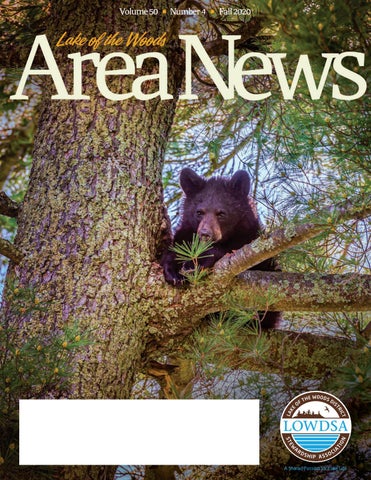
Black bears are an important and integral part of natural ecosystems. This year’s cub peeks out from a towering pine tree with wide open eyes.
President's Message 3 Executive Director's Note 4 Our Contributors 5 Letters to the Editor 7 Stewardship from our LakeSmart team’s point of view 10 LOWDSA 58th Special & Annual General Meeting 12 Government Notes 13 LakeSmart & Summer Events Recap 16 Mobile boat wash station plans move forward 18 Working together to reduce blooms of blue-green algae in Granite Lake 20
22
43 What's Your Story?
24
Lake of the Woods Control Board: A Balancing Act by Matt DeWolfe
30
In the District
Editor's Note: No fire department service: What do you do? 30 Water levels 31 Keeping good records saves tax 32 Grand Council Treaty #3 and the Territorial Planning Unit 34
38
Gentle Giant Returns by Barry Corbett
Environment
LakeSmart 2020: A year like no other 43 Lake of the Woods Water Sustainability Foundation 44 The world’s freshwater laboratory becomes the artist’s muse 47 Beetle release targets purple loosestrife on Coney Island 49
60
LOWDKids!
The Wonder of Seeds 60 Kat the Nature Dog: When the leaves "Fall" 62
64
Services
Real Estate Listings 64 Classifieds 65
50
Living
Home & Cottage Services 66 Advertisers’ Directory 67
Home & Cottage Energy Management, Part 1: How to save the planet without leaving home 50 Treading Wisely: Glimpses of the bright side 52
68
The 1910 NWIRA Regatta by Lori Nelson
Notes from Razberry Lane: A summer to remember 54 Member Recipe: COVIDough: A little more time, a lot of great taste! 56 Cottage winter shutdown checklist 58
Lake of the Woods District Stewardship Association
LOWDSA
1
BUILDING DREAM S
President's Message HARDY BOCK & CHRIS SEMENCHUK Hardy Bock, LOWDSA’s outgoing president and incoming president Chris Semenchuk share their perspectives during this time of change. Chris will take over as president at the LOWDSA Annual General meeting, scheduled for September 30, 2020. It has been a very different summer this year. COVID-19 remains a frequent topic of conversation and concern, and presented challenges and changes for LOWDSA‘s board and our summer plans. We worked hard to keep our members informed and up to date on events and with the key recommendations and protocols from the various levels of government. Changes came fast and furious and without enough notice to include in the Area News, but we made good use of our website, social media and Hardy Bock eNews bulletins. If we missed you, please ensure that we have your current email address so that you can receive the latest developments in the watershed. We were very fortunate to be able to launch our LakeSmart program this season. Thanks to our administrative team, Diane and Shelley, and a very enthusiastic, hard-working LakeSmart team, Jordan, Abbi, and Brie, LakeSmart is not only alive and well, but expanded with a new virtual component. The LakeSmart boat, generously supplied by our lead sponsor, Woodlake Marine, is key to the program. But LakeSmart is only possible with the additional support of LOWDSA members and sixteen other corporate sponsors, led by the Kenora and Lake of the Woods Regional Community Foundation. It has been amazing to see the teamwork that makes this possible! We were back at Pye’s Landing for another successful Free Metal Waste Collection Day on August 8. Although we woke up to a soggy morning our luck prevailed and we had a sunny warm day. We are grateful to Carleton Dent and Leanne Redden for allowing us to use their docks, green space and even loaning us their truck and one of their employees, Zack Johnson, to haul metal from the docks to the bins. It was great to speak with many of you when you dropped off washing machines, boat trailers, barbeques and dozens of other items. The volunteers, board members and staff who pitched in to unload boats, cars and trailers and make this event a success all deserve a heartfelt thanks. This is my final president’s message as, with the AGM taking place later this month, Chris Semenchuk will take over the “helm“ and guide the association into 2021.
Following the theme of changes and plans turned upside down, after having postponed the event twice, we now have a confirmed date for the Annual General Meeting— Wednesday, September 30, Chris Semenchuk 7 to 8 p.m., at the Victoria Inn, Winnipeg. This will be a face-to-face session that will follow social distancing precautions and all health guidelines in effect at the time of the event. We are also offering the opportunity to watch the AGM via Zoom. By now, you will have received the official notice by mail and possibly by email as well, but if not let us know. That notice includes registration details for attending in person or virtually. By the time you are reading this issue of Area News, your board and staff will have completed a strategic planning session. The session included revisiting and validation of the LOWDSA vision, mission and core values, and creating appropriate strategies with emphasis on membership. We always welcome member input, so please let us know if you have any ideas to incorporate. Looking ahead to 2021, we are considering tentative plans for the LOWDSA LakeShow and 2021 AGM—Sunday, April 11. We recognize that this is an important event for many LOWDSA members and our partner organizations in the community and hope to be able to resume this longstanding tradition. And finally, also in keeping with change, you will see some LOWDSA staffing changes ahead. With Diane’s impending departure at the end of the year, we are recruiting to fill the executive director role and looking to add an Environment Program Coordinator Intern pending funding approval. LOWDSA’S environment programming is a critical area that has expanded significantly in recent years to the point where we need a dedicated resource to manage it. We continue to rely on donations from members via the Environmental Initiatives and Special Projects (EISP) Fund to support these important programs, so appreciate your ongoing support. I am looking forward to officially taking the reins from Hardy as president of this outstanding organization. I hope you’ll join me in giving Hardy a round of applause for his steadfast leadership during his term and his ongoing passion and commitment to the lake and our community.
The association is in great hands and I look forward to continuing to work with Chris and the LOWDSA Board, committees and community in my role as past president.
Lake of the Woods District Stewardship Association
LOWDSA
3
Executive Director's Note
Diane Schwartz-Williams. Photo: Tom Thomson
September, with its transition from one season to another, marked with a shift in activities, routine, weather—and clothes —is always a time for reflection for me. I recognize the addition of another layer of contemplation each fall that comes as the executive director of Lake of the Woods District Stewardship Association (LOWDSA). That’s when I sit back and let my mind wander over the events of the summer, look at the issues that we addressed, and take stock of our summer initiatives, programs and the so very important outreach to LOWDSA members.
As always, that process began when I started sifting through all the photos taken by Assistant Executive Director Shelley Bujold, our LakeSmart team, LOWDSA members and me to choose some for the summer recap (page 16). There were dozens of photos, but familiar events were missing with a noticeable absence of photos including groups of LOWDSA members and friends; not surprising considering limitations on gatherings this summer. I missed those events and opportunities to meet with members in person at the market, at LOWDSA summer meetings, at other lake association events and in communities around the district. We all did. While it wasn’t the same, we made the most of other opportunities to connect by phone, email, Zoom, webinars and social media. In doing so, we added new dimensions to engage LOWDSA members and reach out beyond our membership.
PUBLISHED BY Wake Marketing Inc. 140 Main St. S., Kenora, ON P9N 1S9 Phone: (807) 407-7252 Publisher: Mike Greaves, mike@areanewsmagazine.ca Editor: Leanne Fournier, editor@areanewsmagazine.ca Art Director: Shayla Smith, shayla@wakemarketing.ca Design & Layout: Mike Newton, Ashley Pereira, Kendra Smith Advertising: Deb Polakoff, deb@areanewsmagazine.ca
Our traditional ways of communication and connecting with members will not go away, but the newly employed or enhanced ways were well received and are here to stay. Most notable on the new-to-us list are webinars. We started cautiously with a webinar that was recorded and then published (LakeSmart team and Ontario Federation of Anglers and Hunters; invasive species awareness) and soon after did a live webinar with four panelists and 13 participants (LakeSmart Team and IISD Experimental Lakes Area; research). We went bigger with our third webinar, live with six panelists and 71 participants (LOWDSA, LakeSmart, IISD-ELA, Lake of the Woods Water Sustainability Foundation; blue-green algae). As successful as our virtual engagement with members and friends was, the volume of my communication with members by phone and email was much higher than previous years, and it was interesting, rewarding and sometimes challenging, but always important. Some of my biggest take-aways and calls to action came from these. They are what will mark the summer of 2020 for me. Yes, it was a very different kind of summer for me, for the association, for all members, for everyone—with the impact felt in so many different ways. Our collective ability to adapt is one that we will continue to draw on in the coming months. One thing that has not changed is the Lake of the Woods Area News so sit back and enjoy this issue!
The official publication of the Lake of the Woods District Stewardship Association
DISTRIBUTION & MEMBERSHIP Lake of the Woods Area News is published five times per year and is mailed to LOWDSA members. To receive Area News visit lowdsa.com and become a member today. Publication mail agreement #43107013. Printed in Canada.
© 2020 LOWDSA. All rights reserved. The contents of this publication may not be reproduced by any means, in whole or in part, without prior written consent. Statements of fact or opinion are the responsibility of the author and may not represent the view of LOWDSA or Wake Marketing Inc.
4
LOWDSA
Lake of the Woods Area News Fall 2020
Our Contributors Mona Brown has been helping cottage owners and farmers succession plan for over 40 years. In addition to her B.A. and Law Degree, she also holds a Tax and Estate Practitioner designation and is a Chartered Arbitrator and Mediator. Mona and her husband Gord loved to canoe and cross-country ski in cottage country before buying on Poplar Bay in 1989, where they built their family cottages. They now have the pleasure of exploring Lake of the Woods on their houseboat with their grandsons. Mona enjoys helping people transition their cottage to the next generation. She is on the Government Affairs Committee for LOWDSA.
Jordan Amatuzio Sumeep Bath Phil Burke Cecil Burns Barry Corbett Matt DeWolfe Stéphane Warnock studied law in Thunder Bay and has been called to the bar. He is licenced to practice in both Manitoba and Ontario. However, it’s the “call of the lake” which has fuelled his passion for wanting to help others with their cottage succession and tax planning needs. When he’s not in the office at PKF Lawyers in Morden, Manitoba, Stéphane enjoys hiking, swimming and spending time by the lake with family.
Lucas King grew up spending summers on Lake of the Woods in Woodchuck Bay at the family cottage and continues enjoying as much time as possible on the water throughout all seasons. As a student, Lucas spent three summers as part of the LOWDSA LakeSmart team and now continues to work with LOWDSA as a member of the Board of Directors and the Chair of the Environment Committee. Currently, Lucas works as the Territorial Planning Unit Director at Grand Council Treaty #3 in Kenora, while pursuing a Masters in Water Resource Engineering at the University of Manitoba.
Leanne Fournier Abbi Friesen Brie McCardle Jack McKenzie Drew Monkman Lori Nelson Henry & Anita Rasmussen Rosemary Robertson Jacob Rodenburg Diane Schwartz-Williams Todd Sellers Christine Strike
LAKE OF THE WOODS DISTRICT STEWARDSHIP ASSOCIATION Executive Committee
Board Members
Staff
Contact
PRESIDENT Hardy Bock, Black Sturgeon
Dave Christie, Granite Lake Garth Collier, Ottermere Lake Jason Coreau, Big Traverse Bay Carley Fyke, Welcome Channel Lucas King, Woodchuck Bay Chelsea Lobson, Kendall Inlet Jackie Lowe, Gun Club Island Jeff Rempel, Pine Portage Bay Trevor Templeton, Minaki
EXECUTIVE DIRECTOR Diane Schwartz-Williams (807) 543-4287 diane@lowdsa.com
P.O. Box 1160 Kenora, ON P9N 3X7
VICE PRESIDENT & TREASURER Christine Semenchuk, Storm Bay PAST PRESIDENT Nancy Salmijarvi, Welcome Channel
ASSISTANT EXECUTIVE DIRECTOR Shelley Bujold (807) 468-8715 shelley@lowdsa.com
EMAIL info@lowdsa.com
M LOWDistrictStewardshipAssoc N @lowdsaLakeTime P @lowdsa TOLL-FREE 1-888-265-9784 PHONE (807) 468-8715
DIRECTOR Don Parfitt, Winnipeg River
Lake of the Woods District Stewardship Association
LOWDSA
5
CLEARWATER BAY, LOW - $799,900
SNAKE BAY, LOW - $789,900
POPLAR BAY, LOW - $719,900
LONG BAY, LOW - $695,000
WINNIPEG RIVER - $490,000
SNAKE BAY, LOW - $489,000
WINNIPEG RIVER - $329,000
SHOAL LAKE - $299,900
REGINA BAY, LOW - $275,000
LITTLE SAND LAKE - $229,000
WINNIPEG RIVER - $225,000
LAURENSON’S CREEK - $29,900
GREG KIRBY BROKER
FIRST CHOICE REALTY LTD. BROKERAGE Each Office Independently Owned and Operated
Kenora /Lake of the Woods P
807-466-8266
E
sold@gregkirby.ca
w w w. g r e g k i r b y. c a
We’d like to hear from you!
Letters to the Editor
Help us continue making this magazine great. Send us your comments, suggestions, pictures and story ideas: editor@areanewsmagazine.ca.
Dear LOWDSA, On June 4, 2020, my wife Susan and I were enjoying another beautiful day at our cottage at Tannis Lake. In the late morning we heard the sound of a helicopter, which was not unusual given the fire restrictions at the time. What makes it unusual is when the helicopter doesn’t leave the area, which is what happened that day. Not ten minutes later, a spotter plane flew over our cabin, followed by a water bomber. We raced down to the dock to see what was going on. Seeing no smoke in the sky, we figured whatever was happening had to be fairly far away. We were then shocked to see a water bomber flying low over the tree tops to the north of our lake, which meant it WASN’T far away at all. Imagine our amazement when the bomber turned and headed right for our lake to load up with water! Flying directly over our heads it felt like you could reach up and touch the plane. And then there were two! It was like watching a tag team of flight. As one plane dropped its load of water on the fire, the other was filling up with water from our lake. As we were standing on the dock, capturing this amazing feat on camera, the thought crossed our minds that maybe we shouldn’t be standing there in case the plane clipped a tree or something worse. I continued to take pictures and video as Susan backed off the dock onto the shore line, which in hindsight wouldn’t have been any better. We watched in stunned silence as the bombers continued to dip into the lake for another twenty minutes or so. It was very interesting that each plane took their own approach to the lake, one flying directly overhead or in front of us and the other taking a wider path over the trees. We were in awe of the amazing flying ability of the pilots as they manoeuvred these mighty aircraft. To put it in perspective, our lake is only one mile long and who knew a plane could drop, scoop and take off in that limited space. On what was to be his final pass, the pilot flew low and directly in front of us. I have a feeling he was giving me the shot of the day and boy did he! We discovered later that day that the fire was near Longpine Lake, which is approximately two miles from us. The fire was contained at approximately three hectares (7.4 acres) and we understand that no cottages were affected.
Sioux Narrows-Nestor Falls Men’s Breakfast Club continues to support community projects The Sioux Narrows-Nestor Falls Men’s Breakfast Club is alive and functioning in spite of the Canada/U.S.A border closure and COVID-19. The Club, with over sixty per cent of its members coming from the U.S.A., meets from early June to late September. Fortunately, both Canadian and U.S. leadership were in place to ensure the meetings and activities continued. Ken Wood, Co-Chair, and Keith Dowdall, Treasurer, are credited with keeping the diminished plans and activities going. The weekly Tuesday meetings continued on the new upper outside deck at Big John’s Bar & Grill in Sioux Narrows, conforming with government recommended gathering rules. While meetings are usually held over breakfast, they shifted to lunch to accommodate Big John’s adjusted hours (and not Ken’s golf game!). While the club’s main fundraiser, an annual fish fry and auction which raised $7,500 in 2019, was cancelled in 2020, the Club continues supporting other surviving local events, including Sioux Narrows Bassin for Bucks, which is planned for September 11–13, 2020. Also this year, $2,000 was donated to cover equipment for the Nestor Falls Fireboat, and $1,000 was given to the Sioux Narrows Canada Day fireworks fund for re-useable safety equipment for the crew on the fireworks barge. Weekly meetings typically include a financial report, updates on projects, and discussion on future speakers, trips and tours. Local experts and an active OPP member provide updates on happenings in the community. Last, and most important to the membership, is the ‘weekly fishing report’. Typically the report includes type and size of catches, depth of the fish and a general or made-up fishing location i.e., “out on the Lake”… The club operates on a casual drop in basis with no fees or dues. Those interested in joining, presenting or offering a local tour can contact Ken Wood at gigglepond@gmail.com, Keith Dowdall at kdowdall45@gmail.com, or Larry Yarham at larry.yarham@gmail.com.
We’d like to send our thanks to the dedicated individuals on the fire crews on the ground and in the air that serve the Ministry of Natural Resources and Forestry and keep our cottage country properties (and for some people, their permanent homes) safe. — Wayne and Susan Anderson, Tannis Lake Shelter and picnic tables, located at the government dock adjacent to the Northern Ontario Fishing Centre and children’s playground, is another Men’s Club project.
Lake of the Woods District Stewardship Association
LOWDSA
7
Letters to the Editor Wake-watch Our “members’ page” is generally reserved for letters we receive from LOWDSA members, published with their permission, but we do make exceptions on occasion and this would be one. Each summer we receive a number of calls and emails from members voicing concerns about the wakes from boats—concerns about damage to property, shoreline erosion and, most importantly, concerns about near-misses and personal injury.
for damage is reduced when water levels are low, but that is not the case and it actually leads to another problem with the waves disturbing lake bottom sediments, likely contributing to nutrient resuspension with a negative impact on water quality. Fish spawning habitat destruction also occurs as small rocks and sand that house eggs are scattered by wave action. Unfortunately, well established shoreline vegetation is helpful, but only to a degree, and does not prevent erosion.
Speeding across the lake, enjoying the wind in your hair and sun in your face, or the thrill (and challenge) of wakeboarding or wakesurfing may say “summer at the lake” to many. Oh, what fun they both are. But those left in the wake may have a much less enjoyable, even dangerous, experience. This summer alone we’ve been told about personal property being knocked off madly bouncing floating docks, damage to boats tied up to docks and to the dock itself (even breaking free in an extreme case), people (especially the elderly and the very young) losing their balance and barely avoiding falling into dock furniture or into the water, canoes and kayak’s capsizing, paddleboards flipping and near collisions between boats in narrow channels and busy areas. Thankfully, we haven’t heard of serious injuries resulting from any of these instances, but so many near misses that were terrifying and could have ended so badly for those left in the wake.
While the challenge and excitement wakeboarding and other motorized water sports provide are attractive, there are unintentional effects of the waves generated which may seriously impacting shorelines, lake water quality, fish and wildlife habitat, docks and boats—and people. Please consider choosing large open areas, areas where you can maintain a distance of at least 100m offshore, where waves will lose some of their energy before reaching the shoreline; and avoid small bays, channels and enclosed areas, especially during high water periods. And please give other boats, especially kayaks, canoes etc., a wide berth when passing or meeting them.
Even the shorelines of our lakes and ultimately the water quality are at risk from those powerful wakes. Wave action, especially along soft (non-rocky) shorelines, from large boats can cause erosion, particularly during high water levels, which over time can allow for unchecked run-off of nutrients directly into the lake. It might seem logical to assume that the potential
This is a tough subject to address, and not the first time some of you will have read about it in the Area News (May/June 2016) as well as in a flyer on wakeboarding the association published in 2006. Our request remains the same today as then. We share this beautiful watershed with its waterways here for all of us to enjoy and to preserve for the generations who follow to enjoy just as we do today. Let’s respect what we treasure and protect our lakes and water quality and the ecosystems they support. And let’s respect each other’s rights to enjoy the lakes and to do so safely. — Diane Schwartz-Williams, Executive Director, LOWDSA
The perfect gift for your adult children and grandchildren... LOWDSA membership! When they graduate, buy their first home, or celebrate a family milestone, give them the gift of a 1-year LOWDSA membership. Their gift membership provides some amazing things, including: • 5 editions of Area News magazine & eNews updates • Opportunity for LakeSmart visits • LOWDSA Rewards—special member pricing and discounts at local retailers and businesses • Information on preserving one of the most beautiful places on earth!
Order online, anytime! Visit lowdsa.com to order gift memberships for anyone, at any time! Or, just email info@lowdsa.com or call 888-265-9784.
8
LOWDSA
Lake of the Woods Area News Fall 2020
Stewardship from our LakeSmart team’s point of view For the fourth opinion piece on stewardship from different generations, we asked our LakeSmart team to share their perspectives.
Abbie Friesen My grandpa built our cottage on Coney Island in 1979, and every one of my 17 cousins had the opportunity to come and spend entire summers at the lake, where we would have more outdoor adventures than we could count. Lake of the Woods is home, it's about family and friends coming together to enjoy everything the lake and its shorelines provide. The connection I feel to the lake is what motivates me to reduce my impact on the environment – as is the case for many locals, summer residents and tourists alike who have experienced the beauty of these vast shorelines. Everyone who spends time here wants to keep the lake beautiful for their children just as their parents did for them and mine have done for me. This is what stewardship means to me, ensuring the lake and all life that calls this land home can thrive for generations to come. It is the understanding that the land and water are connected, so our activities on the land influence the health of the aquatic ecosystems and vice versa. Even though I have spent my whole life here, I still learn new strategies to reduce my personal footprint every single day. It was the beauty of this area that led me to Environmental Science at the University of Manitoba. My studies there have taught me how to live in a green and sustainable way. Having the opportunity
Visits to the family cottage on Coney Island helped Abbi develop a connection to the lake and the desire to reduce her footprint on the environment. She’s making her mark in positive ways like working with LakeSmart and completing her degree in Environmental Science.
to share my passion for the environment and learn from my fellow LakeSmart team members this summer has made it one of the best seasons I have had on the lake so far.
Brie McCardle I am fortunate enough to have grown up on beautiful Black Sturgeon Lake. I learned from an early age how special the lake was to me and my family. Endless adventures, laughs, mistakes and memories make Black Sturgeon home to all of us. Growing up in this way is what has made stewardship of the land and the lakes so important to me. I would wish for everyone to have something that is so special to them preserved and cherished forever. I want my kids and their kids to know, love and learn from the area like I did. I am in the Environmental Technician program at Niagara College, drawn to this course because of my love for the environment. I hope to continue with my studies and eventually do work related to conservation of aquatic species. My summer with LOWDSA and the LakeSmart team has been really great, allowing me to meet like-minded people that have a passion for preserving the environment for generations to come. They've inspired me to be the best steward I can be.
Title photo: LakeSmart team (from left): Abbie Friesen, Jordan Amatuzio and Brie McCardle testing the waters during their first trip to Granite Lake to check out blue-green algae.
10
LOWDSA
Lake of the Woods Area News Fall 2020
Jordan Amatuzio I believe stewardship is a love for protecting and preserving our environment for all species for years to come. I believe that every person has a unique connection to nature and a duty to protect our environment. I was never taught how to be a good steward nor was I raised in an outdoorsy family. However, I constantly found myself drawn to nature.
My biggest career goal is to make and inspire large scale change in the environment. I have had the opportunity to travel throughout my life, and each place I visit further fuels my passion to protect our spectacular planet.
At a young age, I became aware of the importance of protecting our environment. I never knew that this passion would turn into my career path, but in my first year of university I took an environmental science elective and I found myself reading the textbook in my free time. I knew this was something I had to pursue and so I decided to get a degree in Environmental Studies.
Growing up on beautiful Black Sturgeon Lake inspired Brie McCardle to pursue education and a future working with aquatic species. Preventing the spread invasive species like this rusty crayfish is definitely on her radar.
I am a recent graduate from the University of Manitoba, and throughout my degree, I have had the opportunity to work and learn in some amazing parts of Manitoba. I have experienced working in Churchill, Riding Mountain National Park, and now Lake of the Woods. Each place has been so unique and has reinforced my love for the career path I have chosen.
In her first year of university, Jordan Amatuzio was surprised to discover a passion for environmental sciences, which led to her completing a degree in Environmental Studies. Her work with LakeSmart and at sites throughout Manitoba have reinforced her career choice.
Reliable Monitoring
Reliable Backup
OmniMetrix 24/7/365 monitoring of backup generator
Generac standby generator with a 5-year warranty
(807) 468-8813 | bowmanelectric.com | 1025 Railway St., Kenora
Lake of the Woods District Stewardship Association
LOWDSA
11
LOWDSA 58th Special & Annual General Meeting Wednesday, September 30th: 7-8pm Victoria Inn, Winnipeg (1808 Wellington Ave.) This year’s Annual General Meeting (AGM) will be quite different than previous years, and not just because it is being held independent of the Cottage Show and at the end of summer rather than the beginning. We will be following Manitoba guidelines, current at the time of the event, and mandatory social distancing precautions will be in place (spaced chairs, masks where distancing not possible, sanitization, etc.). Also, pre-registration to attend the AGM in person will be required so that we can make special meeting room arrangements necessary due to COVID-19. What will be familiar is the review of your association’s activities and financials for 2019, and having the opportunity to connect with one another and share this information in person. The AGM will also be available to monitor on Zoom in real time, and possibly live on Facebook and YouTube. Official notice and details on how to register to attend the AGM in person or to monitor it virtually will have been emailed to you or mailed to those without a current email on file by the time you are reading this. It will also be posted on the LOWDSA website, on our social media platforms and included in an eNews.
To register to attend the AGM in person: Register before Wednesday, September 23, 2020 (midnight CST) at tinyurl.com/Attend-LOWDSA-AGM To register to monitor the AGM virtually: tinyurl.com/Watch-LOWDSA-AGM Questions about plans for the AGM? Need details on registering to attend in person or virtually? Email membership@lowdsa.com or call 807-468-8715 (TF 1-888-265-9784).
Online Member Directory on hold Over the past several months, using the Area News and eNews, we have asked LOWDSA members to let us know whether or not they wanted to be included in an online member-access-only directory. There has been very little response to date. With barely 50 responses actually received we are unable to move forward on our plan to create the directory at this time.
Providing insurance, protection and advice to Northwestern Ontario since 1897. Find the best coverage & rates for your peace of mind at standardinsurance.ca
12
LOWDSA
Lake of the Woods Area News Fall 2020
Government Notes Your LOWDSA directors and staff communicate regularly with representatives of a number of ministries and departments at all levels of government. Whether communicating via email, talking on the phone or meeting in person, we enjoy positive working relationships including collaboration on issues of concern to LOWDSA and our members. These open lines of communication make it possible for us to access and share government bulletins in a timely manner and go directly to the source with questions on your behalf. BY DIANE SCHWARTZ-WILLIAMS
COVID-19 updates We continue to monitor COVID-19 announcements and updates from all levels of government that have particular relevance to our members who travel to and from the Lake of the Woods district. On the federal front and just prior to the Area News going into print, it was announced that, by mutual agreement, the Canada-US border closure to nonessential travel would be extended until at least September 21. Given the many layers of information and differences from one province to another, the best and most current sources for all COVID-19 information are the official ones for individual provinces and federally. We have posted links to Ontario, Manitoba and Canada websites at lowdsa.com/articles/ keeping-up-with-covid-19-info-in-ontario-manitoba.
Turtle Portage turn around a welcome surprise When LOWDSA contacted the Ministry of Natural Resources and Forestry (MNRF) several months ago there was no new info on the status of Turtle Portage. Whether or not it would be operational for summer 2020 was still in question at that time. Everything to do with the marine railway had gone very silent after the public meetings held in August and September 2019 and remained that way until recently. That has changed, and it’s unexpected, even surprising, but great news. Turtle Portage is currently operational, open to the public, and has been since early July. At that time, Ministry staff in the Kenora district office received a significant one-time funding commitment from the ministry to perform modest upgrades at the facility, and the intent is to make the system safe, functional, reliable and user-friendly. While most of the work will not take place until fall 2020 at the earliest, a new dock and ramp have already been installed on the south side to improve access to the facility. The scope of the project has yet to be fully determined, but details on work planned will be shared as they become available. Potential upgrades may include certain items identified through the engineering inspection that was discussed during last summer's public open houses. Examples include improvements to the transfer system (cart and hand crank), the anchor system on the docks, and to the concrete walkway.
The same individual as last year has been contacted to provide routine maintenance, including tightening the cables. In addition to ensuring the system is functional, the contractor will also be cleaning up the area, removing brush and scrap wood from the site. Users are asked to contact Vic and Dot’s Camp (807-484-2325) with any maintenance-related questions or concerns. Ministry staff stressed that these are one-time repairs, possible only with the one-time funding. With the completion of the repairs and upgrades, Turtle Portage Marine Railway will essentially be a turn-key operation, and the Ministry is still seeking a private operator or group to assume all aspects of the facility's operation. Any individual or group interested in exploring the opportunity and discussing this with Ministry staff is encouraged to contact James Williams, IRM Technical Specialist at 807-468-2543 or James.Williams@ontario.ca. If we look back to the summer of 2017 and all indications in 2018 that Turtle Portage would close and be dismantled, a lot has changed—more than we imagined possible at the time. While LOWDSA definitely played a role in facilitating conversations and meetings with ministry staff, the calls and emails and participation of association members were huge factors in moving this forward from fear of closure to a happy ending.
Lake of the Woods District Stewardship Association
LOWDSA
13
Whiskey Jack Forest Management Plan (FMP) amendment
Four-laning Highway 17: no update We are currently unable to provide any new reports from official sources on the four-laning of Highway 17 with the most recent update to the official website made on April 28, 2020. Comments, suggestions or questions for the Ministry and consultant, or your request to be added to the study mailing list, can be emailed to project-team@4LaneHighway17Kenora.ca. Full contact information including mailing addresses are available online at 4lanehighway17kenora.ca.
Forestry and forest management The Kenora Local Citizens’ Advisory Committee (LCAC) will be meeting in September. We are looking forward to including an update from our representative on the committee, LOWDSA director Garth Collier, on two key items in the November issue of Area News: the just released Ontario Forest Sector Strategy and the Whiskey Jack Forest Management Plan amendment.
Sustainable Growth: Ontario’s Forest Sector Strategy The government of Ontario released a new 10-year forestry plan, Sustainable Growth: Ontario’s Forest Sector Strategy on August 20 just as content for this issue was finalized, not allowing time for any review of the strategy prior to printing. Look for more information on this strategy in future issues of Area News.
The Ontario Ministry of Natural Resources and Forestry (MNRF), Miisun Integrated Resource Management Company and the Kenora Local Citizens’ Advisory Committee (LCAC), invite you to participate in the review of a major amendment to a Forest Management Plan (FMP). This review is being held as part of the detailed planning of operations for the major amendment to the 2012-2022 Forest Management Plan (FMP) for the Whiskey Jack Forest. This amendment provides for operational planning to add new harvest area to the 2012-2022 Whiskey Jack FMP. According to the amendment notice, the new harvest area is required to ensure a secure and uninterrupted wood supply for the local mills as a result of the one-year delay in FMP planning on the Whiskey Jack Forest. A plan extension, up to two years if needed, to the 2012-2022 FMP will be implemented to extend the plan until the next Whiskey Jack Forest Management Plan is completed. This amendment request proposes to select new harvest areas from approved planned contingency areas and identified optional areas from the 2012-22 FMP planning process. To review the Ontario Forest Sector Strategy or the Whiskey Jack FMP amendment request, timelines and opportunities for submitting comments go to our ‘news’ page at lowdsa.com where we have posted an article with a link to both documents. The link will also be included in an eNews early September. Keep informed: Forest Management Plans ontario.ca/forestplans Get involved: Handbook for Getting Involved in Forest Management, files.ontario.ca/involvement_handbook_final_ english_2018_04_10.pdf "Useful tips on navigating the eFMP (electronic forest management plan) website" guide is available by contacting LOWDSA at info@lowdsa.com or (807) 468-8715. an
HitcHinge makes cottage living better. INNOVATIVE DOCK COUPLER OFFERS HASSLE-FREE SET-UP & TAKE-DOWN.
• Set up your dock solo • Child- and pet-friendly • Enjoy a quiet dock If you’re adding a new dock or updating an existing one, make sure to use HitcHinge’s unique dock couplers, designed and Canadian-made by Andy Assinck, CEO and founder. NOW SHIPPING TO THE USA
(705) 933-8439 | sales@hitchinge.ca | hitchinge.ca 14
LOWDSA
Lake of the Woods Area News Fall 2020
Shelley Torrie
Shelley Torrie
HOME and COTTAGE REALTY R E A L
Broker of Record
807.468.1120
Many more properties available. Please call.
Joey Katz
B R O K E R A G E
Buying or Selling? We’ll go the extra mile!
Broker
807.466.2770
807.547.4020 www.kenora-realestate.com Grassy Lake – Austin Lake Road $459,000
Winnipeg River – Villeneuve Road $450,000 NEW PRICE
E S T A T E
NEW PRICE
Black Sturgeon – James Road $355,000
LOTW – 170 Storm Bay Road $690,000
NEW PRICE
80+ acres, 2400' waterfrontage, north & south of by-pass
3 bed, 2 bath waterfront year round home offering extensive decking outbuildings, and a custom built pirate ship at waters edge.
5 bedroom, 2 bath home/cottage, offering a diverse waterfront and expansive views of Black Sturgeon.
3 bedroom, 2 bath year round home/cottage in addition to 3 season sunroom, 24 x 32 ft. wired & insulated garage & extensive decking.
Winnipeg River – Darlington Drive $649,500
LOTW – Storm Bay Road 16A $595,000
LOTW – Sioux Narrows $1,200,000
Pistol Lake – Charlesworth Road $695,000
NEW PRICE
NEW PRICE
4 BR, 1.5 baths, amazing open concept great room with water view. Only minutes from Kenora’s City Centre and on all City services.
Year round 3300 sq. ft. home/cottage on LOTW with separate suite, dock & many extras!
Private 3+ acre peninsula, 1000’+ of frontage, 2 cottages/2 garages/pipe dock
5 bed, 2 bath main, guest cottage, garages, 147' waterfrontage, extensive deck & dock.
LOTW – Lots 7, 13–16 Moore Bay $950,000
Black Sturgeon – Snow Drive $575,000
LOTW – Lot 1 Moore Bay $2,400,000
444 Rabbit Lake Road $289,900 + APPLIC HST
NEW PRICE
5 subdivided lots - 34 acres - 1000+ ft. waterfrontage, surrounded by crown land.
4+ bed/2 bath timberframe, 40' x 40' garage, decks, dock & sand beach.
5400 sq. ft. luxury log home on 6.7 acres with 227’ frontage, self sufficient off grid systems
Approximately 10.8 acres offering 67.23 ft. of frontage
LOTW – Andrew Bay $1,156,000
Winnipeg River – First West Bay $525,000
LOTW – Devils Gap $465,000
Winnipeg River – Tresoor Point Road $549,500
3BR cottage, bunkie, boathouse, 400 ft. waterfrontage & sand beach.
3 bed, 2 bath, 2 garages, guest cottage & beautiful low-profile waterfrontage.
NEW PRICE
LOTW – Moore Bay Condo Cabins $75,000 – $299,000
LOTW – Lot 2 Moore Bay $399,000
10 turnkey furnished condo cabins situated on 10 acres on LOTW. Isolation and social distancing at its finest! Transportation provided.
5 bed/2 bath seasonal, water access cottage built in 2001 - 3.94 acres & 203' waterfrontage.
2,
Otter Lake $92,000
5 bed/2 bath bi-level built in 2000 with suite potential, workshop & 229' waterfrontage
3, Co 4 nd & o 8 s SO LD
1/2 an island, 1.6 acres, 4 level cottage, pagoda style gazebo & magnificent sand beach.
Rustic cottage, 400' waterfrontage, 6.3 acres
LakeSmart & Summer Events LakeSmart’s Brie McCardle getting ready to head over to ‘day camp’ to take a group of youth through an enviroscape presentation, a fun and engaging way to show exactly how what we do in our daily life can impact on our watershed.
Recap
Since the early 1990's, LOWDSA members have planted approximately 300,000 trees, averaging 10,000 each spring. This year there were a few extra bundles of seedlings left for the LakeSmart team to distribute at the Matiowski Farmers’ Market. LakeSmart’s Jordan Amatuzio joined in to help promote Turtle Beach Clothing Co. gear. Through its “Save our lakes” campaign, the locally owned company has committed a portion of their sales to LOWDSA'S mobile boat wash station fund.
The LakeSmart team initiates and participates in many different activities related to their goal of sharing information on ways that we can live and play green at the lake. Shoreline cleanup is just one way the team gets their hands and feet wet while carrying out their duties! Invasive species samples are always a popular draw and the topic of many conversations for the LakeSmart team at the weekly Matiowski Farmers’ Market on the Kenora Harbourfront.
Storm drain stencilling is a fun activity that, in normal circumstances, is an opportunity for youth to get involved in sharing the message about healthy lakes. Flowering rush is an invasive aquatic plant that was first identified about fifteen years ago in a few sparse patches near Minaki on the Winnipeg River. It has since spread, growing in abundance along shorelines and in bays downstream and upstream from the town. LOWDSA continues to support efforts, working with Minaki Conservancy, to raise awareness about this invasive species and steps property owners can take to identify and report it and to reduce its spread.
16
LOWDSA
Lake of the Woods Area News Fall 2020
Things looked a little different out on the lake this year for the LakeSmart team, pictured here with Diane Schwartz-Williams, LOWDSA Executive Director.
LakeSmart 2020 brought to you by an amazing group of sponsors We are so very grateful to our lead sponsors for their support: Woodlake Marine who provides our beautiful LakeSmart boat, and the Kenora and Lake of the Woods Regional Community Foundation, a new sponsor, that has given a significant financial contribution. However, the LakeSmart program is only possible with the additional support of LOWDSA member donations to the Environmental Initiative and Special Projects (EISP) fund and seventeen other sponsors. As part of our collaboration to address the issue of blue-green algae on Granite Lake, LOWDSA staff, directors and the LakeSmart team conducted dock visits with property owners on the lake just west of Kenora. Information on ‘living green at the lake’ in general with specific attention to blue green algae was shared.
Thank you to our 2020 sponsors.
The beautiful LakeSmart boat, provided by Woodlake Marine is a key part of the LakeSmart program. From left: Team members Jordan Amatuzio, Abbi Friesen and Brie McCardle are raring to get out on the lake! LakeSmart’s Abbi Friesen and Brie McCardle enjoy their time conducting dock visits on Black Sturgeon Lake. They were happy to be there with the LakeSmart boat which is not often taken off Lake of the Woods unless the LakeSmart team is familiar with another lake.
We also gratefully acknowledge funding support received through the ECO Canada Co-op Student Work Placement and Canada Summer Jobs programs.
Get to know our 2020 LakeSmart sponsors at lowdsa.com/cpages/lakesmart
Lake of the Woods District Stewardship Association
LOWDSA
17
Mobile boat wash station plans move forward LOWDSA welcomes two new sponsors Your association is two steps closer to seeing its proposed mobile boat wash station become a reality. We are proud and so very excited to welcome 89.5 The Lake CJRL Kenora as a lead sponsor and the Laclu Environment Committee as the first area lake group to sign on with financial support for this initiative. They join Turtle Beach Clothing Co. who has aligned their “Save our lakes” campaign and committed a portion of their sales to the fund we are building for the mobile boat wash station. For years, LOWDSA has promoted the practice of Clean, Drain, Dry to boaters, sharing information and promoting every boating enthusiast’s responsibility to clean their watercraft, drain remaining water and allow the boat to dry before transferring it between water bodies. Our plan for a mobile boat wash station will take our existing program up several notches, providing opportunities to clean watercrafts in multiple locations throughout the summer months while spreading the word about Clean, Drain, Dry.
Clockwise from left: Lindsay Sutherland, Abbi Friesen (LakeSmart), Charlotte Tory, Cameron Scott (and puppy) join local entrepreneur Bob Firth to celebrate the launch of the “Save our Lakes” program and LOWDSA partnership.
Save our lakes! Turtle Beach Clothing Co. raises funds for mobile boat wash station LOWDSA is proud to partner with Turtle Beach Clothing Co. and their "Save our Lakes" program in which a portion of all Turtle Beach clothing sales will be donated to the fund we are building for the mobile boat wash station.
It would take dozens of mobile boat wash stations to decontaminate all of the boats entering or exiting our waterways in the Lake of the Woods watershed. However, we can make a real difference with one of them moving around the district cleaning dozens and dozens of boats each season, educating many hundreds of boaters and water enthusiasts on how to properly check and clean their watercrafts and reduce the impacts of invasive species to our water bodies.
The company, originally established in 1985 in Kenora, Ontario, by local entrepreneur Bob Firth, has made a return with a new eco-friendly message, focused on freshwater lake sustainability and preserving it for years to come. It aims to raise awareness about water pollution and the effects it has on local wildlife.
Throughout the summer months each year, LOWDSA will look to have board members, staff, students and volunteers work with the mobile wash station and with boaters interested in taking part, having their boat cleaned and walking through an inspection.
All clothing is proudly Canadian-made featuring the use of eco-friendly and sustainable materials such as organic cotton. It is available to purchase at turtlebeachclothing.ca, on Facebook, Instagram, or at Bob's Burger Bar, 152 Main St. South in Kenora, Ontario.
In addition to helping protect local waterbodies by reducing the spread of invasive species, the mobile boat wash station will serve as a selfcontained education program complementing our flagship LakeSmart program and focusing directly on the impacts of invasive species.
We applaud Turtle Beach Clothing Co.’s commitment to work with LOWDSA on this important initiative that ties in so directly to our mission to preserve the lakes that make our area one of the most beautiful places on earth!
GOOD
CLEAN, DRAIN
Clean off all visible mud, vegetation and other debris Pull and store the drain plug, lower your outboard to drain standing water and drain livewells before leaving the launch
BETTER
CLEAN, DRAIN, DRY
In addition to cleaning and draining: Dry your boat and equipment in hot or sunny weather for 2-7 days before transporting them to another body of water
Join in the fight against invasive species and protect your great outdoors.
Learn more at Ontario.ca/InvasionON 18
LOWDSA
Lake of the Woods Area News Fall 2020
BEST
CLEAN, DRAIN, DISINFECT Use a pressure washer to spray off your boat and trailer (250psi) OR rinse off your boat and trailer with hot water (greater than 50°C) To prevent the spread of viral hemorrhagic septicemia, rinse live wells with 10% household bleach/water solution (i.e. 100ml of bleach to 1L water). Rinse well with water to remove any residual chlorine
Winterization Boat Storage Boat Tops Secure Compound Large Boats Trailer Mechanical Repairs Gel Coat & Detailing
(807) 464-0345
info@theboatcentre.com
LOTW Docking
®
(807) 467-1644
info@lotwdocking.ca
New, improved Laundromat Building! SPRING 2021
5
Large Boat Slips KENORA BAY Two State of the Art Docking Facilities with Power
KEEWATIN BAY Two Bears Marina & Car Parking LAUNDROMAT MARINA ACTUAL RENDERINGS
NORMAN BAY Anchor Marina
LOCATIONS
Property owners + LOWDSA + LakeSmart + IISD Experimental Lakes Area
Working together to reduce blooms of blue-green algae in Granite Lake The appearance of a large blue-green algal bloom in Granite Lake in late July resulted in significant concern among residents, and a desire to take action to reduce the frequency of this occurring again. Granite Lake property owners reached out to LOWDSA setting in motion a series of initiatives to work together to equip residents with information on how they could reduce their impact on Granite Lake water quality.
Blue-green algae identified: • ~July 20, 2020: Large algae blooms began to appear along shorelines in Granite Lake. Ontario Ministry of Environment, Conservation and Parks (MECP) and the Northwestern Health Unit (NWHU) were contacted immediately by residents to report the bloom and its unusual nature.
What is good for Granite Lake is good for all lakes Key information shared during the webinar and dock visits is available at lowdsa.com/cpages/water and includes: • Precautions to take—keeping pets and people safe at the lake
• July 27, 2020: Samples were collected for both algal identification and algal toxin (microcystin) concentration.
• Why did blue-green algae show up in the lake this year?
• Results: The algal samples were dominated by blue-green algae types (primarily Plantothrix) that are capable of producing toxins that can be harmful to people and pets. Although toxins were not found in the sample collected by the Ministry on July 27, it should be noted that the bloom conditions had dissipated and the sample was not representative of the conditions that had appeared on the lake previously, and at times subsequent to July 27. Since this species is known to be capable of producing toxins, and may do so at different times in its life cycle, caution should always be taken to protect risk to pets and people.
• Turning concern into action—strategies to reduce nutrient loading
• August 5, 2020: LOWDSA and the LakeSmart team toured Granite Lake with property owners to observe the bloom and plan future action.
Information, Q&A sessions • August 22, 2020: LOWDSA staff, directors and LakeSmart team conducted dock visits with property owners on Granite Lake. Information on ‘living green at the lake’ in general with specific attention to blue green algae on Granite Lake was shared, with many questions asked and answered and others taken with responses to follow. • August 26, 2020: A webinar (via Zoom) was held to discuss the blue-green algae issue. Water quality specialists from IISD-Experimental Lakes Area and elsewhere provided guidance and answered questions. All Granite Lake residents were encouraged to join, and the webinar was also open to anyone concerned about blue-green algae on any lake. • Site visits to cottage properties: Property owners are encouraged to register for 2021 LakeSmart team site visits.
20
LOWDSA
Lake of the Woods Area News Fall 2020
• What are the sources of phosphorus (human/ natural)?
Everyone has a part to play—involve your family and guests in your efforts to reduce your impact on the water quality of your lake. Educate them and turn them into lake stewards and active participants. Historic phosphorus levels in Granite Lake are just slightly below levels that would support nuisance algal blooms. The presence of blue-green algae this summer in Granite Lake may be due to increased amounts of nutrients (phosphorus) getting into the lake. Seven inches of rainfall in June, which caused significant erosion in the watershed, is suspected to be a factor. Other factors may be warmer than normal water temperatures, and ongoing human impacts around the lake from septic systems, wave action/shoreline erosion, etc.
Additional Resources » LOWDSA - LakeSmart: lowdsa.com/cpages/lakesmart » Northwestern Health Unit: nwhu.on.ca/ourservices/ EnvironmentalHealth/Pages/Blue-Green-Algae.aspx » IISD Experimental Lakes Area: iisd.org/ela/blog/video/ things-iisd-ela-researching-eutrophication/ » Federation of Ontario Cottage Association (FOCA): foca.on.ca/wp-content/uploads/2014/10/Algae-QuickGuide.pdf » Ontario Lake Partner program: • data.ontario.ca/dataset/ontario-lake-partner • ontario.ca/page/water-sampling-and-testing-inland-lakes
Remember, membership is worth it for anyone who enjoys lake life—seasonal and year round residents, boaters, campers, visitors. Spread the word, consider a gift membership, share this package and grow our LOWDSA membership.
Your Lake of the Woods Area News magazine might be the most recognized and treasured benefit of LOWDSA membership, but many of you have had lots of great things to say about the other benefits you enjoy: 1. On the forefront of best practices ensuring our lakes & rivers are healthy 2. Staying informed—what’s happening in the Lake of the Woods district 3. Receiving eNews with updates between issues of Area News 4. Staying up to date on preventing the spread of invasive species 5. Recognized and respected voice with all levels of government 6. Living green at the lake with the LakeSmart team and at our events 7. Seedling program—over 300,000 seedlings planted by members and more to come
Four ways you can renew your membership, order seedlings, purchase gift memberships or contribute to the EISP fund: ONLINE... Login at lowdsa.com/login. Forgot your password? Contact us!
OR BY EMAIL, MAIL OR PHONE... All contact information below.
QUESTIONS? NEED ASSISTANCE TO RENEW ONLINE? Contact Shelley Bujold, Assistant Executive Director and Membership Coordinator at 807-468-8715, toll-free 1-888-265-9784 or by email at shelley@lowdsa.com.
8. LOWDSA Member Rewards savings
Add your voice to almost 3,000 other member families! As an association we can make a difference in protecting and preserving this unique and beautiful part of the world we care so much about, doing what we can individually and collectively to ensure it is enjoyed by generations to come.
lowdsa.com N @lowdsaLakeTime M LOWDistrictStewardshipAssoc P lowdsa V lowdsa 807-468-8715 | 1-888-265-9784 | info@lowdsa.com | Box 1160, Kenora, Ontario P9N 3X7
What’s your story? The member stories we feature in most issues of the Lake of the Woods Area News chronicle the diverse, heartwarming and sometimes downright thrilling experiences of life on the lake and throughout the region. Whether it’s a family’s historic journey to camp by railway, how the family patriarch realized their vision of owning a cottage on the lake, how the newer generation of camp owners are living the dream, or just the simple joys of family time off the grid—these are the stories of the past and present that bring us together and help make Area News a great read! Let us know if you have a story to tell. We would love to hear from you. Email editor@areanewsmagazine.ca.
22
23
Lake of the Woods Control Board:
The original Norman Dam under constru ction in the 1890s. The powerhouse wa s added in 1926.
A Balancing Act This article has been edited for length from the original article written by Matt DeWolfe, Executive Engineer of the Lake of the Woods Secretariat. Many property owners along Lake of the Woods and the Winnipeg River are keenly interested in water levels for good reason. Their shoreline and waterside structures may face a two- or three-metre rise or fall of water levels, so they wonder if anyone has any control.
Limits on control—Lake of the Woods Although the ‘C’ in LWCB (Lake of the Woods Control Board) stands for Control, true control of lake levels is sometimes not possible due either to very dry or very wet conditions. Low flow into Lake of the Woods occurs during droughts and often in the autumn when evaporation tends to be greatest. Evaporation can be so great that, even if the dams were completely closed, more water evaporates each day than flows into the lake. Practically speaking, the dams cannot be closed completely, as maintaining flow into the Winnipeg River is necessary for a variety of interests. Under such conditions, the lake level will decline until flows into the lake rise again with more precipitation. River interests may prefer to see higher flows in these dry periods, but the water stored in the lake is the reserve for future river flows and passing higher flows risks this supply for later in the year should dry conditions persist.
1.Kenora Powerhouse at Eastern Outlet. 2. Norman Dam at Western Outlet. 3. Mink Creek outlet (very small flow) 4. Former Mill C Outlet, now filled. 5. Former Mill A site, now filled.
24
Lake of the Woods Area News Fall 2020
es,
turbin rn Outlet, has ten rhouse, at the Easte ional water. The Kenora Powe dit ad e eas rel to s but no sluice
During high flow periods, water can be released out of Lake of the Woods into the Winnipeg River through turbines in the powerhouses at Kenora and Norman Generating Stations, and through 20 log sluices at Norman Dam. The lake level can rise even if the dams are fully open. This is because the natural channel at the western outlet of the lake, upstream of Norman Dam, is not able to pass water fast enough to keep up with the rate of water entering the lake. Only the rising lake level results in more flow out of the lake, by providing more pressure to push water through this channel. It’s a misconception that very high flows benefit hydropower production. In reality, power production is greatly reduced when the dam is fully opened. During the high water in the fall of 2019, no electricity was being generated at Norman Dam for a period of five weeks. Operating with such constraints along with the lack of accurate precipitation forecasts is challenging. The LWCB addresses these limitations by providing a margin of safety for both high and low extremes in flow.
Limits on control—Winnipeg River Along the Winnipeg River in Ontario, water levels are affected by flows out of the dams in Kenora, as well as local runoff and the operation of the hydroelectric dam at Whitedog. This dam is operated as a run-of-river facility, generally passing water at the
tion allow passage of itedog Generating Sta Spill gates at the Wh e capacity. bin s in excess of the tur Winnipeg River flow
same rate that it arrives at the dam. The dam owner is required by the LWCB to adjust the river level upstream of the dam (the headpond) to allow for stable levels further upstream at Minaki, by increasing or decreasing flow to lower or raise this local headpond area. The Whitedog dam keeps the average water level at Minaki higher than it was naturally, but the range of water level fluctuations is much less. In fact, the water level at Minaki is the most stable of the areas under the LWCB’s jurisdiction. Eighty per cent of the time the water level is now within a range of about 0.3 m (1 ft) compared to a pre-dam range of 1.3 m (4.3 ft).
Four of the twenty log sluices at Norman Dam used to adjust flow out of Lake of the Woods into the Winnipeg River. The Norman Powerhouse, right, passes water through five hydroelectric turbines.
Lake of the Woods District Stewardship Association
25
Lake of the Woods water level control history Until construction of the Rollerway Dam in 1887, the western outlet of carried three-quarters of the flow from the lake to the Winnipeg River. The Rollerway Dam, replaced by the Norman Dam in the 1890s, controlled the water flow out of Lake of the Woods and into the Winnipeg River and caused the lake level to rise by roughly 0.9 meters (3 ft).
The Canadian government established the Canadian Lake of the Woods Control Board (LWCB) in 1919. The International Lake of the Woods Control Board (ILWCB) was established after the signing of a treaty between Canada and the Unites States in 1925.
Establishment of the LWCB— An international decision Control of lake levels led to frequent flooding of some areas around the lake and occasional issues with low levels for navigation. Complaints about lake level management led the Canadian and the United States governments to refer the issue to the International Joint Commission (IJC) for study and recommendations in 1912. A 1909 Canada-USA treaty established the IJC to prevent and resolve disputes over shared waters.
Based on the recommendations from this study, the Canadian government established the Canadian Lake of the Woods Control Board (LWCB) in 1919, and the International Lake of the Woods Control Board (ILWCB) was established in 1925. The LWCB has four members, two from Ontario and one each from Manitoba and Canada. Each member also has an alternate. All are licensed water resource engineers.
The IJC conducted a five-year study looking at water supply, agriculture, sewage disposal, electric power, fishing and navigation. The aim was to “secure the most advantageous use of the waters of the Lake of the Woods and of the waters flowing into and from the lake on each side of the boundary.”
Mission and guidelines The LWCB’s mission is to regulate the water levels of Lake of the Woods and Lac Seul, and the flows in the Winnipeg River and English River downstream of these lakes to their junction (just upstream of the Ontario-Manitoba border) for the benefit of all users and interests.
SIOUX NARROWS
Bruce Bennett Broker of Record | Jake Bennett Broker 807-226-1024 Always Available
THE TRUSTED AND KNOWLEDGEABLE AREA REALTORS SIOUX NARROWS
AU LAC RETREATS
419,900
319,000
$
$
Cabin with docking space right in front and use of historic lodge. Downtown Sioux Narrows.
24ac wilderness getaway on Regina Bay. Road, power, likenew chalet-style cabin. Video & layout map on our website. SIOUX NARROWS
YELLOW GIRL BAY
375,000
235,000
$
$
Wonderful four bedroom family cabin just a short boat ride from Sioux Narrows
26
4.5 acres with 1,181 feet of shoreline + dock & screen room. Location map on our website.
Lake of the Woods Area News Fall 2020
The control points used include the dams at Lake of the Woods and Lac Seul, the principal reservoirs in the system, as well as run-of-river (no reservoir) dams at Whitedog on the Winnipeg River, and Manitou Falls and Caribou Falls on the English River.
Seasonal operating strategies—The Lake of the Woods Secretariat To address the interests in the watershed, the LWCB seeks input from First Nations, formally recognized specific interest groups (including the LOWDSA), and resource agencies from Ontario and Minnesota. It meets with these groups several times a year in the watershed to discuss conditions, forecasts, and water level preferences. Based on these discussions, the LWCB adopts an operating strategy for several months. Operating strategies define how the LWCB aims to respond to a range of inflow conditions, from very dry to very wet, should they develop.
The LWCB guidelines: » All decisions are made in accordance with international treaty, Canadian federal and provincial legislation, and sound water management principles. » All decisions are based on the most recent and extensive data and information available at the time. Winnipeg and the English and l, Lake of the Woods der. Seu bor Lac oba es nit lud Ma inc ioon tar The LWCB’s jurisdicti junction near the On of these lakes to their Rivers downstream
The Lake of the Woods Secretariat, established in 1981, is the board’s full-time staff and responsible for implementing these strategies. It consists of four engineers and a computer programmer. Housed at the headquarters of the National Hydrological Services, a division of Environment and Climate Change Canada, the secretariat performs the LWCB’s day-today operations, including: collecting and reviewing extensive meteorological and water level data from across the Winnipeg River drainage basin, developing inflow and water level forecasts, and directing the dam operators to adjust the water flow through their facilities. The secretariat updates the public on the latest water level and flow conditions through the LWCB’s website each working day, and is the main point of contact for the public.
Balancing Lake of the Woods and the Winnipeg River
» All decisions consider, and attempt to balance, all interests in the basin. These interests include property interests along lakes and rivers, recreational uses (such as boating and fishing), fish and wildlife protection, tourist outfitters, wild rice, electric power production/consumption (both within and outside the basin), local industry (power and water quality concerns), and domestic water supply. » When critical conditions exist for an interest, the LWCB may select the regulation strategy that best satisfies that interest.
This amazing solid wood bedroom takes the sting out of needing to have a staycation.
Comfortable under any circumstances, handcrafted in Canada, and built to last!
Water level management on Lake of the Woods starts with the requirements of the treaty and legislation. The normal operating range for the lake, a range of 1.33 m (5.25 ft), is defined by these, (see chart, following page) and the LWCB is required to keep lake levels in this range. When lake levels are approaching the top of this range, the decisions of the LWCB must be approved by the ILWCB. Normally, this means releasing water from the lake as quickly as possible to avoid reaching the flood limit. The difference in the geographical character of the south end of the lake compared to the north is also considered. Big Traverse Bay provides a long, uninterrupted fetch for the development of large waves during windy conditions, and the southern shorelines consist of fine soils, not the rugged Canadian Shield of the north, meaning the southern end of the lake is much more susceptible to erosion, particularly at higher water levels.
204.957.4940 faveriswoodfurniture.com
#i♥faveris
Lake of the Woods District Stewardship Association
27
More information online For more information visit the LWCB’s website, lwcb.ca. For questions or comments, call the Secretariat at 800-661-5922.
The Lake of the Woods operating range defined by Canada-USA Treaty, and Canada, Ontario and Manitoba Legislation.
The LWCB must also strike a balance between the lake and the river, which is difficult when conditions become unusually dry or wet. During dry conditions, reducing flow out of the lake to retain water results in lower river levels when conditions are already dry. In wet conditions, the opposite is often true: slowing the rate of lake level rise requires releasing more water into the river, often when it is already running high.
Matt DeWolfe worked on water level regulation in the Winnipeg River basin since 2008. He is Executive Engineer of the Lake of the Woods Secretariat, and served as co-chair of the International Rainy and Namakan Lakes Rule Curves Study Board. He is a licensed engineer in Ontario.
During the spring, the LWCB normally aims to limit flow changes that could harm spawning along the Winnipeg River. In the winter, large changes in lake outflow can cause ice damage to shoreline structures along the river, while maintaining minimum flows is important for hydropower both in Ontario and Manitoba. Finally, further downstream, in the Whiteshell region of Manitoba, the Winnipeg River combines the flows of the English River watershed and the Lake of the Woods watershed. The LWCB seeks to balance conditions here with upstream areas by adjusting the balance of flows out of both Lake of the Woods and Lac Seul. an
Digital Editions
!
Free with your LOWDSA membership Read Area News wherever you are! Access this issue as well as all previous issues since 2016.
Sign up for eNews Make sure we have your current email address & keep up to date on LOWDSA news & events
Visit lowdsa.com to view digital editions & login online! We enjoy your phone calls, emails and letters, and our member online community gives you one more way to stay informed, up-to-date and: Access your member profile
Contribute to the EISP Fund
Renew your membership
Purchase a gift membership
Register for events
Sign up for eNews
Email shelley@lowdsa.com or call (807) 468-8715 or 1-888-265-9784.
lowdsa.com 28
N lowdsaLakeTime
Lake of the Woods Area News Fall 2020
There’s always plenty going on with your association and sometimes getting updates and info out to you in a timely manner does not fit into our Area News publishing schedule. That’s where LOWDSA’s eNews fills the gap. Our eNews is sent periodically (but not too often) and includes breaking news that may be time sensitive, important reminders, event updates, and useful links. Three ways to sign up for eNews: • Email shelley@lowdsa.com, • Call 807-468-8715 or 1-888-265-9784, • Login & update your profile at lowdsa.com Problems with login? Call or email us!
M LOWDistrictStewardshipAssoc
P lowdsa
FROM CONCEPT TO COMPLETION NEW HOMES – COTTAGES – RENOVATIONS WINNIPEG & LOTW AREA
204.452.1106 | info@creativespacesltd.ca $ creativespaceswpg
www.creativespacesltd.ca
Editor’s Note
No fire department service: What do you do? In the summer issue of the Lake of the Woods Area News we wrote about the importance of knowing who to call and the details of your location when requesting emergency services. In response to some questions we received from members, we dug a little deeper to provide more information for property owners who may be in areas not served by municipal or volunteer fire departments. “While everyone in the province is guaranteed access to ambulance and police when calling 911, depending on your location, you may not have fire department coverage,” said Todd Skene, Fire Chief, City of Kenora Fire and Emergency Services. “Some examples include a large portion of Lake of the Woods and Winnipeg River cottages on islands. Several First Nations communities in our area also have no fire coverage.” “It’s up to the property owner to find out if they have fire response services,” he said. Keith Wells, Assistant Deputy Fire Marshall, Ontario Fire Marshalls Office, said this can be determined by reaching out to the municipality, Local Services Board (LSB) or the nearest fire department (see listing in sidebar). “Local fire services and community leaders have the local knowledge of fire protection delivery models in their areas. They really are the best first stop.” “Kenora Fire and Emergency Services respond to the City of Kenora only,” said Skene. “There are other fire departments in unorganized areas that cover certain townships, such as Minaki, McKenzie Clearwater, Longbow Lake, Sioux Narrows-Nestor Falls, and Pellatt.” Some of these departments are regulated by the Northern Services Boards Act that restricts them from responding outside the boundaries of their LSB, while those under the Fire Protection and Prevention Act, are permitted to respond to fires outside their LSB service area. Again, you can contact the fire departments nearest you for more information.
Prevention is the best defense Wells emphasizes the importance of having working smoke alarms in the house and outside all sleeping areas, working carbon monoxide detectors outside of all sleeping areas, and a fire escape plan. “The escape plan should be practiced regularly and include who will be responsible for those who can’t selfevacuate,” he said. Skene adds that cleaning brush and grass around the cottage or home is another line of defense. Trying to fight the fire on your own is never recommended. “It’s about get out and stay out,” said Wells.
30
In the District
Lake of the Woods Area News Fall 2020
In addition to these steps, property owners should be taking safety precautions as outlined in FireSmart (ontario.ca/page/ firesmart), which provides information on how to protect your property from wildland fires.
Ministry of Natural Resources and Forestry response Skene shares that in the event of a fire in cottage country or in areas where the forest is nearby, the Ministry of Natural Resources and Forestry (MNRF) will quite often fly over the structure fire to make sure it is not spreading to the surrounding forest. “They monitor our fire channels and self-deploy or are sometimes informed by our dispatchers of the structure fire,” he said. “They will take action on the forest fire but will not fight a structure fire as they are not trained for this.” A statement from the MNRF confirmed that the wildland fire crews’ role is to “limit fire spread from a structural fire to adjacent forest fuels to prevent a wildland fire from igniting or to protect intact structures from encroaching wildland fires by installing sprinklers on or around structures.” It also stated: “The Occupational Health and Safety Act prohibits our staff from entering into or on a burning building. There are numerous hazards associated with structural fires that pose health and safety risks to our wildland fire fighters such as hazardous smoke, propane tanks and electricity.” Wildland fire crews and helicopters are available during the fire season, which is April 1 to October 31. Due to its reliance on aircraft to respond to wildland fires, late night reports of a wildland fire are typically not responded to until the next morning when crews and helicopters can be safely mobilized.
Ambulance and police response It should also be noted that while ambulance and police will always find a way to reach property owners in distress, there can be delays due to location, weather, time of call, etc. that can affect the speed and conditions under which emergency services can respond. For more information visit: kenoracacc.ca.
As noted in the summer issue article, having a good description of your location is critical to assist in the deploying of emergency services. Knowing your GPS coordinates, a road name or number, branch road name or number, kilometres down a road and house number or name can be useful. Some branch roads are marked with numbers, some might have a listing of property owner’s last names. These can all be helpful if they are visible. It’s also a good practice that, once the situation has been assessed and emergency services have been called, to send someone to the shoreline or road to wave emergency responders in.
Fire prevention tips • Clean brush and grass around your cottage or home. • Install and maintain smoke alarms and carbon monoxide detectors.
Water levels BY JACK MCKENZIE
• Have and practice a fire escape plan. • Check out ontario.ca/page/firesmart for more information on how to protect your property from wildland fires.
To report a forest fire, call 310-FIRE (3473) Municipal and unorganized territory emergency numbers where fire services are available: Kenora Sioux NarrowsNestor Falls
Call 911 for fire, ambulance and police service emergencies
Currently, the average lake level (1,058.5) stands about six inches below the level upon which depths are shown on all the Navigation Charts. Allowing for the fact that the lake level at the north end of the lake is lower than the average and factoring in the variation in level that may occur daily due to strong winds, if you are heading out in your boat, pay attention to the levels shown on your chart and subtract a good foot, just to be on the safe side. What does it look like for the next couple of months, heading into freeze up? That’s a good guess but if dry conditions continue, we should be heading into freeze up with the lake well below where we are concerned about possible winter ice draw down damage.
Pellatt Longbow Lake Morson Clearwater Bay/ McKenzie Portage
Ambulance 807-468-3311 Fire 807-547-2400 Police 1-888-310-1122
Minaki
Ambulance 807-468-3311 Fire 807-224-1100 Police 1-888-310-1122
Redditt
Here we are entering the last week in August and we still see the lake conditions headed in a downward trend. That’s normal for the time of year, the only concern being that we have not had even average precipitation over the summer. Had we seen anything close to average in the way of rainfall, then we would not be concerned about what fall might bring.
Having said that, just think back to where we were at this time last fall. The lake level was slightly above where it stands today when the fall rains hit and just wouldn’t stop. So, if you are putting your boat away for the season early, and leaving it suspended in a boathouse or other boat port, pay attention to the fact that the water still can rise.
No 911 service and temporarily no fire call line Ambulance 807 468-3311 and 1-877-351-2345 (Ontario only) Police 1-888-310-1122 The Redditt Volunteer Fire Department is in the process of having all team members certified. Fire services will resume and a contact list will be made available to the community when this is completed.
We do get questioned, from time to time, as to why the Norman Dam in Kenora has not been closed more than it already is, to keep the level of the lake higher. The answer is that a certain flow rate is required for the health of the fish in the Winnipeg River, north from Kenora and in and around Minaki. Interested in following conditions and actions of the Water Control Board? Remember you can access the latest information from their website, lwcb.ca. Their next meeting is scheduled for October 15 in Kenora. Title photo: The Norman Dam
Lake of the Woods District Stewardship Association
In the District
31
Keeping good records saves tax BY MONA BROWN & STÉPHANE WARNOCK, PKF LAWYERS The cottage is our escape to peace and tranquillity and the call of the loons. Unfortunately, the tax man is always around the corner! Hopefully, while you enjoy your cottage it will also substantially increase in value. When you buy a cottage, it is important to understand that you are purchasing a capital property. You may be paying capital gains tax on any appreciation in value above your cost base when you dispose of your cottage or your estate upon your death. The Income Tax Act (Canada) deems you to dispose of all your property on death at fair market value except on a transfer to a spouse. Cottagers who do not keep good records will pay more capital gains tax than those who have kept receipts to prove to CRA their adjusted cost base (ACB).
What is ACB? ACB or adjusted cost base is what you initially paid for the property plus all capital improvements, supported by invoices and proof of payment. Improvements that are affixed to the property, which have increased the value of the property will qualify as capital improvements. Initial cost base: • The purchase price (if gifted or inherited, the fair market value at the time you acquired it) • Real estate commissions and legal fees • Inspection costs • Survey and/or title insurance costs • Land transfer tax Capital enhancements: A. Improvements to land: driveway, water drainage system, septic system, well, landscaping, hydro, plumbing, geothermal, out buildings, bunkies, hot tubs, railways, decks, boathouses, docks and items affixed to docks (as long as it’s affixed to the property—a floating raft likely would not qualify) B. External cottage improvements: doors, windows, shingles, siding, expansions, new rooms, bringing hydro to property including underwater cables, attached decks, sunrooms, etc. C. Interior cottage improvements: new floors, cupboards, ceilings, kitchen upgrades, sinks, plumbing and electrical system upgrades, replacing fixtures (anything that’s attached to the house), adding walls or partitions within the cottage, bathrooms including fixtures. Other additions to cost base: • The value of the cottage as of December 31, 1971 if owned prior to that date. Note: Capital gains tax was first introduced in Canada for gain after January 1,1972. Therefore the value of capital property to December 31, 1971 is sheltered from any tax. Thus, if you owned a cottage before this date you need to have a value as of December 31, 1971, which will be your initial cost base. • The bump by electing the $100,000 Capital Gains Exemption in 1994.
32
In the District
Lake of the Woods Area News Fall 2020
Ongoing maintenance or a capital improvement? Normal repairs, appliances and furnishings, area rugs, boats, toys, regular maintenance like opening and closing the cottage, are current expenses and don’t add to your cost base. For the do-it-yourselfer cottagers, your “sweat equity” also does not increase your cost base, but the cost of materials does. If you hire someone to make capital improvements, that labour will qualify although any “cash” transactions don’t qualify. While it is not always clear whether certain expenses are capital in nature, a good rule of thumb is to keep all your receipts and proof of payment. Your accountant can assess whether those expenses will add to your cost base when you sell or die. If you do your own taxes and aren’t sure, check with CRA. CRA auditors are increasingly requiring proper documentation to support your ACB. This includes offers of purchase or sale, appraisal for a gift or inheritance or 1971 value, as well as invoices and receipts for all capital improvements. Make sure your file is complete. It will reduce your stress if you are audited or receive an information request. In some cases, you may want to use your principal residence exemption on the sale or deemed sale of your cottage. Spouses are only entitled to one principal residence per couple since 1982. You will always want to calculate your cost base and the fair market value of all the properties that could qualify for the principal residence exemption before disposing of ANY of these properties. Cottages are frequently owned by multiple family members; a fractional interest makes use of the principal residence exemption less attractive. You should consult with a lawyer and accountant knowledgeable in this area before deciding which property to designate as your principal residence. Reporting the gain on your tax return and claiming the principal residence exemption is now required in the year of sale of the cottage, or on death. Hopefully these tips can help you enjoy your piece of paradise even more, knowing that unexpected “guests” like the tax man are all taken care of. The purpose of this article is for general education and interest of property owners. For questions or advice specific to your situation, contacting a professional is recommended.
“Dedicated to Lakefront Property”
Ian Carmichael Broker of Record
OFFICE
807-467-2323
807-466-2236
CELL
lakeofthewoods.net
carmichaelrealestate@lakeofthewoods.net
What is your property worth?
Like us on Facebook
Thinking of Selling? Call me for a no obligation fair market evaluation of your property. Thinking of Buying? I can provide Buyer Representation you deserve and can trust. Call me directly for assistance and qualified experience at 807-466-2236.
Incredible private point boasts over 4 acres of titled lands having 1152’ of shoreline
Private Point Inquire LOTW
83 dynamic acres with approx. 8448 ft frontage, 3 BR cottage beside beach
Storm Bay Road
Private Island
$1,690,000 LOTW
$1,245,000 LOTW
West facing cottage on B.R. 3, 2600 sq ft 3 BR cottage, 850 sq ft guest cabin, boathouse, studio cabin & sand beach
Lilypad Bay
Storm Bay Road
Lakeview Drive
Rush Bay
Channel Island
Castlerock Island
South facing property has 936 sq ft 3 bedroom cottage, sunroom, covered front deck and waterside deck & dock.
30 acres of land with 2200’ of shoreline! 90 sec. boat ride from landing. Steel dock, 30’ trailer + 20’ diameter yurt. Lots of potential!
Affordable island getaway! 900 sq ft log cottage, workshop/Bunkie & beach
Corkscrew Island
Winnipeg River
East Allie Island
South facing, 7 ac, 577 ft low profile shoreline
Amazing 25 lot subdivision!
Great destination! South facing with 170’ of shoreline, low profile, long views
Pipestone Point
Five Point Island
$1,069,000 LOTW
$499,000 LOTW
$325,000 LOTW
$799,000 LOTW
$409,000 LOTW
$399,000 LOTW
$325,000
$305,000 LOTW
5 t2 Lo 0 00 9, 21 -$
$179,000 LOTW
$825,000 LOTW
Starting at $159,000 +HST LOTW
Lot 2 French Narrows $119,000 LOTW
Anishinaabe Nation of Treaty #3 RED LAKE
EAR FALLS
Sagkeeng
Saugeen
Wabauskang
Anicinabe
Asubspeeschoseewagong Netum Anishinabek Wabaseemoong
Niisaachewan Wauzhusk Onigum Obashkaandagaang
KENORA
Lac Seul SIOUX LOOKOUT
DRYDEN
Migisi Sahgaigan Iskatewizaagegan #39 Waabigoniiw Shoal Lake #40 Saaga’iganiiw Northwest Naotkamegwanning Anishinaabeg Angle #33 SNNF Northwest Angle #33 Animakee Animakee Wa Zhing 37 Wa Zhing 37 Ojibway’s of Onigaming Buffalo Point Naongashiing Mishkosiminiziibiing
IGNACE
Nezaadiikaang
Naicatchewenin RAINY RIVER LEGEND
Treaty #3 Communities
Nigigoonsiminikaaning Mitaanjigaming Seine River Couchiching Rainy River FORT
ATIKOKAN
FRANCES
Zhingwaako
Towns/Cities
Zaaga’igan
N
Treaty #3 Territory Esri, HERE, Garmin, (c) OpenStreetMap contributors, and the GIS user community
Grand Council Treaty #3 and the Territorial Planning Unit BY LUCAS KING, DIRECTOR, TERRITORIAL PLANNING UNIT
The Anishinaabe Nation of Treaty #3 Treaty #3 is significant for many reasons. Located in Anishinaabe Territory, now known as Northwestern Ontario and Eastern Manitoba, Treaty #3 Territory provided a route between Fort Garry and Fort William (Winnipeg, MB and Thunder Bay, ON). This route was key to the British in continuing to develop the Canadian Confederation with the ability to transport goods along the route and opening doors to the west once reaching Winnipeg. After three years of negotiations, on October 3, 1873, Treaty #3 was signed between Anishinaabe First Nations and Queen Victoria. Having meant to be the first post-confederation treaty, the Anishinaabe held firm and would not cede lands, nor allow farming or settlement in their territory. The leadership of the Anishinaabe Nation negotiated that British business would be allowed within the entire territory, and that the land and resources would be shared between the Nations as “brothers”. Opening the doors to the west, Treaty #3 would then go on to provide the foundation and model for the remainder of the numbered Treaties.
Today, the Anishinaabe Nation of Treaty #3 is comprised of 28 First Nations over 55,000 square miles spanning from west of Thunder Bay to north of Sioux Lookout, along the international border and into Manitoba with an approximate population of 25,000.
Grand Council Treaty #3 Grand Council Treaty #3 is comprised of 28 Anishinaabe communities throughout the Territory and is the Traditional Government of the Anishinaabe Nation of Treaty #3. It is tasked with the mandate of protection, preservation and enhancement of inherent and treaty rights. The Chiefs of the Anishinaabe communities are the members of the Grand Council Treaty #3. Referred to as Chiefs in Assembly, they work together for the benefit of the nation to fulfil the mandate of Grand Council Treaty #3 and advance the unique interests of the Anishinaabe Nation and its people. Over four-day National Assemblies, Chiefs and citizens of Treaty #3 gather to discuss the business of the nation and pass resolutions, providing Grand Council Treaty #3 with its mandate and direction. National Assemblies occur in the spring and fall, October signifying the signing of the treaty.
Title photo: Map of Treaty #3 Territory with Treaty #3 Communities and area municipalities
34
In the District
Lake of the Woods Area News Fall 2020
Treaty #3 four direction governance model.
The leadership is exercised at assemblies through decision-making, participating on Councils and Committees and through the election of an Ogichidaa(kwe) (Grand Chief ) to act on behalf of and to represent the Grand Council in the political and administrative functions. The Ogichidaa(kwe) serve four year terms after which a traditional selection process is held during the Fall National Assembly. Here candidates are nominated through the offering of tobacco and have the opportunity to speak to all leadership in attendance (Chiefs and Councils) before the selection process takes place. Assemblies also incorporate each of the Treaty #3 councils and committees to ensure input and guidance from the nation in relation to all decisionmaking and flow of information as updates on past resolutions and emerging issues are discussed. In order to provide clear guidance, resolutions are passed through consensus resulting in the mandate to be undertaken by the Ogichidaa(kwe) and the staff at Grand Council.
Chiefs Committees: Kiiwetinong (North) – Social Committee Waabanong (East) – Environmental Committee Shaawanong (South) – Cultural Committee Ningabii’onong (West) – Economic Committee Councils: Gitiziminan (Elders Council) Gaagiidoo-Ikwewag (Women’s Council) Oshkiniigig (Youth Council) Mamawichi-Gabowitaa-Ininiwag (Men’s Council)
950 5th St. West, Fort Frances
807-275-5090 revcocarpet.com
CABINS, GAZEBOS, & SHEDS All of our buildings will ship to your build site and all pieces pre-cut and ready to assemble. We have many different styles of buildings and gazebo structures to choose from. Revco also carries an affordable selection of galvanized, weatherproof, and lockable storage containers. These units come shipped flat, so they are easy to transport, and assemble in minutes.
Lake of the Woods District Stewardship Association
In the District
35
Grand Council Treaty #3 functions through two branches. The political branch and administrative branch. The political branch, known as the political office or Office of the Ogichidaa includes the Ogichidaa(kwe), Executive Chiefs Committee (formed of the four chairs of the four Chiefs Committees) and the Political Advisors to the Ogichidaa. The administrative branch of Grand Council Treaty #3 is governed through a board of directors that provide administrative oversight of staff and budgets. The administrative section of Grand Council Treaty #3 includes seven units, each of these units provides a hub of information and expertise to the Territory while working towards the Grand Council Treaty #3 mandate through the development of policy, law-making and self governance. The units also work through partnerships with the Federal and Provincial Governments, NonGovernmental Organizations (NGOs), private corporations and academic institutions. The units at Grand Council Treaty #3 are: • Territorial Planning Unit (TPU) (Environment) • Health • Education • Economic Development • Treaty and Aboriginal Rights Research (TARR) • Justice • Indigenous Residential Schools (IRS)
The Territorial Planning Unit (TPU) The Anishinaabe Nation of Treaty #3 have rights and responsibilities in relation to the water, lands, air and all of creation in the Treaty #3 Territory. These responsibilities stem from a sacred relationship with creation and provide the inherent duties as stewards of the land. With this relationship at the forefront and in the guidance of Manito Aki Inakonigaawin (Great Earth Law), the Territorial Planning Unit (TPU) provides a hub of information and expertise
36
In the District
Lake of the Woods Area News Fall 2020
in relation to the environment in the Treaty #3 Territory. The vision of the TPU is working together to protect and preserve the environment for future generations. Our values are as follows: • We are guided by the eight Grandfather teachings: Respect, Love, Wisdom, Bravery, Truth, Honesty, Humility, and Forgiveness. • We integrate traditional knowledge and western science to support decision making. • We embrace diversity and inclusion to support a holistic team approach to our work. At the guidance of Chiefs in Assembly, Environmental Chiefs Committee and our Treaty #3 Councils, the TPU protects treaty and inherent rights, upholds Anishinaabe Laws and promotes stewardship of all of creation within the Territory. The TPU works on all natural resource development and activities within the territory, through partnerships with Governments, NGO’s, private corporations, academic institutions, Treaty #3 communities and other First Nations. This includes the participation on boards and committees as well as the development of monitoring programs and Anishinaabe law and policy as it relates to the natural environment. Currently, the TPU has programs in Water, Emergency Management, Climate Change, Nuclear Waste, Trapping and Natural Resources. In partnership with LOWDSA the Territorial Planning Unit is excited to share more of our work in articles to come in future issues of the Area News. We will continue to move forward and work together to protect and preserve the environment in Treaty #3 for our future generations. For more information on Grand Council Treaty #3 and the Territorial Planning Unit please go to our website gct3.ca or follow us on Facebook. an
RECREATIONAL PROPERTIES
TS US EE! LIP ER LA KE
MU RIE
TW LO
TER WA EA AR AR CLE BAY
LL AK E
TOOLES ISLAND $649,900
MURIEL LAKE ROAD $399,900
TW LO
ECK KN EA KE B R LA
TW LO
BREAKNECK LAKE $350,000
CHANNEL ISLAND $389,900
K KE AC LA BL EON RG STU
CA
TW LO
KELLY ROAD $749,900
22 SUNSET BOULEVARD $775,000
10 RUSH BAY ROAD $725,000
LOTS 4&5 PULFORDS ISLAND $255,000 & $275,000
AN
K KE AC LA BL EON RG STU
GR
TW LO
ITE LA KE
3 LOTS ON SCOTT ISLAND $200,000 - $265,000
9 MINNESOTA STREET $899,000
GREEN RIDGE ROAD, LONGBOW LAKE $995,000
STONE ROAD $799,900
TW LO
AM
TW LO
10 BAYRIDGE ROAD $1,145,000
LAKEVIEW SILVERBUSH $195,050
462A JAMES ROAD $169,900
Make us your choice - Century 21 Northern Choice Realty Ltd
5-308 Second St. South, Kenora | 807-468-3747 | century21kenora.com Independently Owned and Operated.
Angler Coel Forsyth caught a much bigger fish than he’d bargained for, possibly an Ontario record, measuring an estimated seven feet long and possibly weighing over 76 kg.
Gentle giant Returns By Barry Corbett
It started out like any other spring fishing day, but for one Kenora angler it turned into a journey into the past when gentle giants roamed the lake. Coel Forsyth, owner of Tightline Guide Service, had the fishing experience of his life when he accidentally hooked a giant lake sturgeon. In the late 1800s or early 1900s, this would have been a common experience on Lake of the Woods. In fact, Lake of the Woods was known as the “greatest sturgeon hole in the world!” Tragically, a combination of overfishing, dams fragmenting rivers and blocking spawning migrations, and water pollution including pulp and paper effluent fouling spawning habitat, dramatically reduced the sturgeon populations in Lake of the Woods, Rainy and Winnipeg Rivers. Today, sturgeon is considered threatened in these waterbodies and protected under Ontario’s Species at Risk Act. It is illegal to angle for or possess a sturgeon. On the day of Coel’s unexpected adventure, sturgeon was the last thing on his mind. Instead, he and his partner, Emily Enns, were checking out some of their favourite bass spots on Lake of the Woods. Initially, fishing was slow. Catching and releasing only a couple of three pound bass, they moved to a weedy back bay—always good for large bass in the past. After a few unproductive casts, Coel flicked his lure into a prime largemouth weed bed. Within seconds his line slowly moved sideways. Quickly setting the hook he anticipated a “good fight” with a largemouth bass. Instead, a large black object slowly broke the surface. Coel assumed it was an oddly behaving largemouth. But as the creature turned, this was no bass! His eyes registered something enormous. Anticipating the familiar burst of a musky or gigantic pike, he braced himself. Instead, like a page from The Old Man and the Sea, the giant fish slowly swam deeper into the middle of the bay pulling Coel and company along. Coel described it like “being pulled by a whale”.
38
Lake of the Woods Area News Fall 2020
After about 30 minutes of pulling by both man and fish, Coel finally coaxed it alongside the boat. His knees shaking from both the exertion and excitement, only then did he realize his adversary was the legendary lake sturgeon!
Fortunately, protected by law and released by an experienced angler her luck hadn’t run out. Still, Coel was concerned about the effect angling would have on the sturgeon. I reached out to Dr. Gary Anderson (University of Manitoba) who, with his graduate students, just completed a Concerned the long fight study examining the effects may have unduly stressed of catch and release angling Overfishing of sturgeon looked like this where 480 pounds of sturgeon was caught in one day, 1927. the fish, he knew it must on lake sturgeon. Anderson Photo courtesy of Lake of the Woods Museum. be released quickly. Emily said, “The fight does affect moved the boat into the the physiology of lake sturgeon—the longer the fight the greater shallows making it easier to handle the sturgeon. Coel, with the the effect, but one of the most important aspects is air exposure.” aid of a cottager who had witnessed the titanic struggle, removed Anglers typically take a picture of their big fish while holding it the hook easily, took a measurement and some pictures for out of water. Anderson stressed, “As with all fish, it's best to avoid posterity before successfully releasing it. Coel exclaimed, “Its or minimize air exposure.” He added, “Sturgeon, when compared head was probably twice the size of my head—I couldn’t even to other fish species, seem to be somewhat more robust to catch get my arms around it. The skin felt like sandpaper, its body was and release angling.” Furthermore, they recorded no mortalities covered with battle scars. I’ve measured lots of fish and my guess in their study. is this one was at least 84 inches or 7 feet long.” He advised if an angler accidentally hooks a sturgeon, “Bring it I contacted Lindsay Davidson of the Ministry of Environment, to boat side. If possible, remove the hook with the sturgeon in Conservation and Parks (MECP), the Ministry responsible for the water—avoid grabbing anywhere near the gills. If a picture is implementing the Species at Risk Act for more information about taken, best to keep the sturgeon in water. When releasing, keep a sturgeon this size. Davidson said, “A 215 cm (84 in.) sturgeon is it horizontal with its head oriented to the current (if any). Once not unheard of given this species growth potential”. The largest ready, the sturgeon will swim out of your hold.” lake sturgeon on record was captured with a pound net in Batchewana Bay (Lake Superior) in 1922, measuring 241 cm or just under 8 ft., weighing 140 kg (310 lbs.).” Davidson said, “Coel’s sturgeon is more than likely a female weighing well over 90 kg (200 lbs.).” She added that the female would be almost 30 per cent heavier if it was carrying eggs.”
You might be tempted to consider Coel’s sturgeon just “ordinary” in comparison to the Batchewana Bay behemoth but be aware the largest sturgeon ever angled in Ontario (Georgian Bay 1982) weighed 76 kg (168 lbs.). Coel may have unwittingly set a new Ontario record! It's difficult to age sturgeon, but Davidson speculated, “This sturgeon is certainly well over 100 years old.” Coincidently, the oldest sturgeon on record taken from Lake of the Woods was in 1953, aged at 154 years. Think about it, Coel’s sturgeon was born before or during the First World War, peacefully roamed the bottom of Lake of the Woods while we territorial dwellers experienced the Great Depression, Second World War, Korean war, Armstrong’s moon landing, Vietnam war and now COVID-19. For over 100 years she successfully eluded gillnets and jigs, no small feat, until this fateful spring day.
1 Willow Drive Falcon Lake, MB R0E 0N0
Your Project Is Our Passion
E: info@lumberone.ca W: www.lumberone.ca TF: 1-866-325-2661 P: 204-349-2294
Lake of the Woods District Stewardship Association
39
Although Coel’s sturgeon is a remnant from a past era and a sad reminder of how we almost brought this species to extinction, all is not doom and gloom for this ancient fish. There is a glimmer of hope on the horizon. Studies conducted by Ministry of Natural Resources and Forestry (MNRF) show a significant increase in juvenile and young sturgeon in Rainy River and Lake of the Woods indicating successful spawning and recruitment are occurring. This rebound is attributed to actions by Rainy River First Nation (RRFN) and Ontario government to improve water quality and reduce harvesting. Reducing effluent from the Fort Frances mill and ultimately its closure allowed the river to clean its spawning grounds of wood fibre. The First Nation implemented a Watershed Program increasing public awareness and promoting involvement in protection, conservation and revitalization of the Rainy River watershed. RRFN also built the first sturgeon hatchery, presently operated by Joe Hunter, Sustainable Sturgeon Culture (SSC) to accelerate the recovery. RRFN voluntarily placed a moratorium on their commercial quota for sturgeon and MNRF closed the sport fishery on the Canadian side of Rainy River and Lake of the Woods. Minnesota continues to harvest sturgeon through their sport fishery. Recently, the International Rainy-Lake of the Woods Watershed Board (IJC) developed a sturgeon protocol ensuring sufficient flows for successful sturgeon spawning and egg incubation below the Fort Frances dam. Similarly, Niisaachewan Anishaabe Nation has committed themselves to restoring sturgeon in the upper Winnipeg River. Partnering with RRFN, SSC, MNRF and Ontario Power Generation, they formed the Upper Winnipeg River Lake Sturgeon recovery team. The team has undertaken a number of projects including the release of 42 adult sturgeon gifted by RRFN. The sturgeons are equipped with sonar tags providing information on their movements and habitat use. This data will be used to determine the next steps in the recovery strategy. Hopefully with these initiatives, sturgeon will once again be abundant in these water bodies making Coel’s experience common place and no longer newsworthy! an
Coel Forsyth’s sturgeon catch is safely sent on its way. Hopefully the gentle giant will have many more years in the dark depths of Lake of the Woods.
40
Lake of the Woods Area News Fall 2020
Servicing the North Western Ontario Area I LA KE
$199,000
GR IPE
NN
TW LO
WI
E
IVE
LAK DY
R
Paddy Lake
$740,000
196 Eagle Bay
$739,900
$599,900
RG
STU
R
N EO
IVE
N EO
TW LO
CK BLA
GR IPE
NN
RG
STU
245 Tresoor Point Road
$399,900
504 Front Street
$649,900 WI
CK BLA
39 Snow Drive
Lot 15059 Malachi Lake
$240,000
D PA
TW LO
138 Storm Bay Road
$599,000
0 Corkscrew Island
$377,000
H LAC MA
PEP1705 Pipestone Point
TW LO
TW LO
TW LO
Island 53P
$1,175,000
41 Hidden Trail
$395,000
McLeod Island
$375,000
Passionate people working to make your dreams come true 334 Second St. S., Kenora, ON P9N 1G3 PH: 807-468-4573 | TF: 1-833-323-4573 info@remaxnorthwestrealty.com
remax.ca
Quality dock time Is there anything more precious than time spent out on the dock? Whether it’s with family, friends or solo, nothing matches time by the water’s edge. We are expert providers of carefree living. We will steward your wealth wisely so you can truly relax and enjoy life’s simple pleasures. We’ll design a tailored plan to grow and transfer your assets, serving even the most complex needs with clarity and transparency. Call us to discuss which of our highly-qualified Financial Advisors would be best suited to help you keep your family’s financial dreams afloat. Richardson GMP Limited One Lombard Place, Suite 1100 Winnipeg, MB R3B 0X3 Tel.: 204.957.7735 Toll-free: 1.866.205.3549 www.RichardsonGMP.com
Our advisors Bruce Bennett Greg Bieber Michelle Bradet Simpson Lou Caci Joanne Lee Jason MacDonald Kenneth W.P. Martin Kim McCartney Benji Miles John Nelson Jeremy Ruban Trevor Stark Jari Stromberg Todd Tanchak Valerie Wowryk
Richardson GMP Limited, Member Canadian Investor Protection Fund. Richardson and GMP are registered trademarks of their respective owners used under license by Richardson GMP Limited.
LakeSmart 2020: A year like no other BY LEANNE FOURNIER LOWDSA’s award-winning LakeSmart program is celebrating 10 years in 2020. Having this milestone occur in the midst of COVID-19 seemed to be a marker of how the program has always taken steps to be relevant and responsive in all circumstances. Admittedly, it’s never had to be quite so adaptable as evidenced by the myriad of adjustments the newly minted LakeSmart team of Abbi Friesen, Brie McCardle and Jordan Amatuzio had to make to deliver the program within COVID-19 health and safety guidelines. Once public health guidelines allowed, the LakeSmart team geared up to conduct safe, socially-
The foundation of LakeSmart has always been face to distanced dock visits to share information with shoreline property owners. The LakeSmart boat, generously provided by Woodlake Marine, is key to the program. From left: Abbi Friesen, Jordan face dock visits and events to help seasonal and year Amatuzio and Brie McCardle. round shoreline residents “live and play green on the lake”. Amatuzio said, “We were expecting a lot more the release of Neogalerucella beetles to reduce the population of in-person interactions for sure. Learning to use the social media purple loosestrife around Coney Island (page 49). platforms and getting engagement in that way was very different but exciting.” McCardle added, “The whole world was shifting They also can’t stress enough the importance of ensuring that because of COVID-19, so this just made sense.” Clean, Drain, Dry guidelines are followed (page 18) to reduce the chances of invasive species moving from one body of water Friesen, like the others, embraced the challenge to engage to another. “Zebra mussels can survive in a tiny drop of water,” people—whether they were lake users/enthusiasts, boaters, Amatuzio said. One pregnant rusty crayfish carried to another sailors, campers, visitors or residents—in new ways. “We lake can start a whole new colony. As Friesen said, “Once constantly had to come up with ideas, like stopping on the side of they’re there, they are really hard to get rid of.” Best to take the road when we saw something interesting and making a video the necessary steps to reduce the chance of these critters and to share on social media.” plants, like purple loosestrife, from hanging on once your boat is removed from the water. The trio conducted webinars on a variety of topics independently and in partnership with other organizations, including When blue-green algae reared it’s “slimy” (McCardle’s word) Ontario Federation of Anglers and Hunters (OFAH) and IISD head in Granite Lake, property owners on the lake reached out Experimental Lakes Area (IISD-ELA). “We got our footing with to LOWDSA for help. The team toured the small lake west of our first webinar with OFAH,” Amatuzio shared. “Then we did a Kenora to get a first-hand look. They subsequently did dock visits live Q & A style webinar with IISD-ELA on water quality and the around the entire lake and conducted a Zoom webinar to discuss engagement was awesome.” Another was done on blue-green the issue of the blue-green algal blooms, strategies to minimize algae. She sees the webinars, that will all be available online as a future algal blooms and safety precautions. way to share the LakeSmart message more broadly. Another topic the team did a lot of talking about online and Diane Schwartz-Williams, LOWDSA’s Executive Director, agreed. face to face related to shoreline health. “People need to “It’s been an eye opener for all of us. We’ve reached people we’ve understand the value of having about six feet of natural growth never reached before.” along the shoreline to help reduce nutrients going into the water,” said Friesen. She credits the team for their abundance of creativity, energy, commitment and ability to adapt. “They’ve had a ton of stuff Despite all the surprises, none of the team would have traded thrown at them,” she said. “Initially, COVID-19 protocols the summer for anything. “Where else do you get to do all your meant they couldn’t be in the boat together so everything was favourite hobbies all day while at work?” said Friesen. In addition going online. Then, with loosening restrictions in public health to their passion for all things water, the three drew on their postguidelines, team travel in the LakeSmart boat and dock visits secondary educations related to environment issues. were back on. They needed to regroup to get out on the water for dock visits while maintaining their social media presence. And They were also impressed by how passionate people are about then in early August, with the discovery of blue-green algae on the lake and shorelines. McCardle said, “Everyone is so respectful. Granite Lake, there was a whole new dimension to their work.” Generations of families want to keep their shoreline sustainable.” In addition to the webinar series, the team continued efforts to address issues like invasive species. This included activities like
Amatuzio adds, “People want to be good stewards, and are thirsty for information.”
Lake of the Woods District Stewardship Association
Environment
43
Lake of the Woods Water Sustainability Foundation Put a plan in place. Ensure there's enough science and management expertise. Unite and coordinate actions bi-nationally—communities, researchers and policy makers. That’s our mission. BY TODD SELLERS, EXECUTIVE DIRECTOR
A plan for Lake of the Woods— Environment and Climate Change Canada wants your help For over a decade, our Foundation has been advocating for a plan for Lake of the Woods—a plan that identifies water quality objectives and reduction targets, particularly for phosphorus, the primary nutrient stimulating algal blooms. Environment and Climate Change Canada (ECCC) is now taking the next step forward towards developing such a plan for Lake of the Woods, based on its science program completed last spring. ECCC and the Foundation want your help and input between now and the spring on developing a desired set of ecosystem objectives for the various regions of the lake and recommendations on phosphorus reduction scenarios. Unfortunately, plans for in-person public meetings last summer had to be shelved due to COVID-19. Over the next seven or eight months, there will be a variety of ways for the public to engage and provide input to ECCC with a series of online webinars and an online consultation website dedicated to Lake of the Woods. The focus of these sessions will be to communicate science and ecosystem conditions related to nutrients and algal blooms, as well as to receive input on desired ecosystem objectives and selected options towards reducing phosphorus loadings from Canadian sources to Lake of the Woods. The Foundation will be helping to organize these opportunities for public/stakeholder engagement with the ECCC team. Dates for these sessions have not been finalized as I write this in early August, so look to the Foundation’s website for more information about dates and ways to get involved: lowwsf.com.
Minnesota releases study of Rainy River’s health The Rainy River is a remarkable story of recovery from pollution. In decades gone by, pollution from paper mills and raw sewage severely harmed the river, its fish populations and recreational potential. Starting in the 1970s, pollution regulations have led to a dramatic change. It is now a “recovering river in need of protection”
44
Environment
Lake of the Woods Area News Fall 2020
according to a report released by the Minnesota Pollution Control Agency (MPCA) this past summer. The report summarizes the results of the MPCA’s three-year intensive monitoring study of this river that provides more than 70 per cent of the water to Lake of the Woods. In general, the report finds that the Rainy River is now a high-quality resource in Minnesota Health Department researchers good condition, although in the 1950s had to dig through paper mill waste clogging the Rainy River to find water is listed as impaired for (MPCA report wq-ws1-33). fish consumption due to elevated mercury in fish, similar to many lakes and rivers in our region. The report concludes that with restoration successful, it is now critical to protect this river and the streams and landscapes that feed it. The report can be downloaded from the MPCA website at pca.state.mn.us/featured/ rainy-river-recovering-river-now-need-protection
Trent University research focuses on phosphorus from Canadian streams with grant from LOWWSF Trent University has been monitoring nutrients flowing to Lake of the Woods via tributaries since April 2018. The research team, led by Dr. Catherine Eimers, continued this work this summer, with much of the heavy lifting being done by MSc. candidate Andrew Williams. We expect the results of Andrew’s thesis
Andrew Williams, MSc. candidate, Trent U. measuring stream flow on the Pigeon River.
research to be extremely useful in identifying concrete actions that can be taken to reduce phosphorus loading to Lake of the Woods, to combat the harmful algal blooms. The objectives of his thesis work will be as follows: 1. Update the phosphorus budget for Lake of the Woods with current measured values of phosphorus from tributaries with those only estimated previously. 2. Identify ‘hotspots’ (e.g., locations, landcovers/uses) and ‘hot moments’ (i.e., storm events, seasons) of nutrient delivery within the basin. 3. Use this information to recommend options for nutrient best management practices and a future monitoring strategy within the basin. Andrew’s thesis research is being supported by a grant from the LOWWSF to Trent University, with matching funds from Mitacs, a not-for-profit organization that supports training of researchers in Canada.
Satellite monitoring of algal blooms—tools now available to scientists and the public
14-day average chlorophyll concentration derived from Sentinel-3 satellite.
We’ve all seen the compelling satellite pictures of blue green algae blooms covering Lake of the Woods. Now there’s a way for you to see how they can be used. Dr. Caren Binding of ECCC has harnessed these images for near real-time tracking of algae blooms and has developed indices of bloom severity, intensity and extent across the lake. These indices will be extremely useful
in monitoring and measuring the effectiveness of efforts to cut phosphorus to reduce harmful algae blooms. Dr. Binding has also launched an online tool (ECCC’s EOLakeWatch), that provides a suite of interactive tools for algal bloom monitoring for Lake of the Woods, Lake Winnipeg and Lake Erie. I highly recommend that you check it out at canada.ca/en/environment-climate-change/services/wateroverview/satellite-earth-observations-lake-monitoring.html The site also features periodic and annual bloom summary reports. If you are interested in receiving updates and early release of the annual bloom reports, you can join Dr. Binding’s EOLakeWatch mailing list at: forms.gle/2HB2mS8mTb3hBMZD7
How you can help Your help now will ensure that we maintain the momentum for our lake. Sign up at the Foundation’s website to show your support and receive our email updates. Please consider donating to the Foundation: Canada: lowwsf.com/donate/Canada United States: lowwsf.com/donate/USA Your gift will help make sure that Lake of the Woods is a priority with governments, that research is completed, and that a sustainability plan is developed and implemented to restore and protect the water quality of Lake of the Woods. Note: In the summer issue we featured Part 1 of a 2-part series looking at phosphorous in Lake of the Woods. Part 2 has been delayed awaiting some important updates about phosphorous in the upstream waters that feed in to Lake of the Woods.
Lake of the Woods District Stewardship Association
Environment
45
All Who Love Lake of the Woods – Attention!
A Plan for Lake of the Woods Water Quality
Your Help is Needed
• Environment & Climate Change Canada (ECCC) has completed its nutrient and algae research on Lake of the Woods. The next step is developing a plan to reduce phosphorus from Canadian sources to combat algal blooms on Lake of the Woods. • The Lake of the Woods Water Sustainability Foundation is organizing a series of public engagement sessions this fall and winter for Environment and Climate Change Canada (ECCC) to: 1. Communicate science and ecosystem conditions related to nutrients and algal blooms on Lake of the Woods. 2. Seek input from the public on desired ecosystem objectives and a suite of options for reducing phosphorus loadings from Canadian sources. • Opportunities to participate will include webinars with ECCC policy and science staff, surveys and an online consultation website: www.placespeak.com/lakeofthewoods • Dates for webinars will be published in the next Area News Magazine and at the Foundation’s website: www.lowwsf.com • Sign up for email notifications at the Foundation’s website to stay informed and to make sure you are notified of upcoming consultation events. www.lowwsf.com/subscribe
For more information contact:
Todd Sellers
Executive Director tsellers@lowwsf.com
The world’s freshwater laboratory becomes the artist’s muse BY SUMEEP BATH, COMMUNICATIONS MANAGER, IISD EXPERIMENTAL LAKES AREA If you have ever been there, IISD Experimental Lakes Area is an artist’s dream. If you haven’t, photos reveal a space of great peace and tranquillity, vast expanses of untouched lakes bordered by dense forests, and a busy community of scientists working together towards common goals. Being there and experiencing it for yourself reveals so much more. A few years into the new era of the world’s freshwater laboratory as an independent entity (as opposed to a federal government facility), we realized we were ripe for an artist in residence program. We wanted to introduce our space and our work to new and non-traditional audiences through artistic pieces—a form of science communication on which we had not touched yet. After receiving (literally) hundreds of applications and many calls from media, our committee of local artists and team members managed to whittle it down to six applicants who represented vastly different forms of artistic expression. Throughout the summer of 2019, we welcomed Heather Hinam (a Winnipeg-based illustrator), Matt Foster (a Winnipeg-based singer/songwriter/musician), Lesley Nakonechny (a Winnipegbased graphic designer), Sean Landsman (a photographer from Ottawa), Todd Stewart (a silkscreener from Montreal who is now based in Scotland), and Walk&Talk (a lively theatre troupe from Winnipeg). The result was a resounding success. The artists were introduced to a space like no other and felt new kinds of inspiration, while
Furniture
Creaotuer y Image
Many of the artists in residence, including the Walk&Talk Theatre Company from Winnipeg, found inspiration sitting on the dock of Lake 240 at IISD Experimental Lakes Area.
our team of researchers welcomed the new blood onto the site who brought a fresh excitement and vigour to our work. As Matt Foster said to the Kenora Daily Miner and News, “As an artist I don’t get to engage with that kind of community, ever. I do have a strong interest in scientific thought and reasoning. I don’t really have a lot of people in my life I can have those conversations with so I’m excited to throw myself in there and hear what everyone’s thinking about and how they do their lives.” What’s next for the artist in residence program? At the beginning of 2020, we had excitedly pulled together a new crop of interesting and diverse artists to complete our second summer artist in residence program, but that has been postponed till next year due to the COVID-19 pandemic significantly restricting whom we can allow on site. And as for the first batch, we are still eagerly watching for the art that those artists will produce inspired by their residency. We are excited to show it off to the world, possibly even at Kenora’s new art centre. Be sure to watch this space for all the latest updates.
Area Rugs
Lighting
Blinds
Reupholstery
Before
After
Reduce, Reuse, Reupholster Bring in the Fall, Pick up in the Spring
1060 Railway Street, Kenora
TEL
(807)468-3641
TOLL FREE
imageonehome.com
Lake of the Woods District Stewardship Association
(800)834-8770
Environment
47
LAKE OF THE WOODS
*
RESERVE YOUR LOT NOW
HUGE ESTATE LOTS 2 TO 3.5 ACRES
KENORA KEEWATIN
CONEY ISLAND
TREATY ISLAND
SHRAGGES ISLAND
Oneida Lakeshore Estates Build Your Dream, Create Your Legacy
24 premium lots in a unique island development. 10 minutes from Kenora & 3 minutes from the Royal L.O.W. Yacht Club Early bird pricing and financing available. Complete cottage construction packages available.
oneidalakeshore.ca • (204) 795-9200 • oneidaisland@gmail.com
Beetle release targets purple loosestrife on Coney Island BY JORDAN AMATUZIO & DIANE SCHWARTZ-WILLIAMS On June 17, 2020, LakeSmart team members Abbi Friesen and Brie McCardle visited LOWDSA members Ferg and Kathy Devins to help bring purple loosestrife on their Coney Island property under control. Purple loosestrife is an invasive plant that is native to Europe, first introduced to Canada in the 19th century when seeds were carried over from Europe in the ballast tanks of cargo ships. Today it is one of Lake of the Woods most prominent invasive plants. These plants can be easily identified by their long, square, woody stems, and their characteristic purple flowers. Although purple loosestrife is quite beautiful, it has severe negative impacts on the surrounding ecosystem. They reproduce rapidly in wetland areas and can outcompete native wetland plants. They grow in dense congregations, essentially choking out other wetland species. Wetlands are highly productive ecosystems that are essential for the survival of many species of plants and animals. If purple loosestrife is left unchecked, it will eventually destroy this essential habitat. Purple loosestrife is resilient and incredibly difficult to eradicate because if the root system is not completely removed when you cut or pull the plant, it will often grow back. Digging and pulling the plant can be effective, however it requires a lot of time and effort and is not always a sustainable solution. The most effective and well established form of long term control is using Neogalerucella beetles, a species found in their native habitat, to act as a biocontrol. They feed on the leaves, shoots, and buds of the plants, severely weakening them and eventually causing them to die off, usually over a matter of several years. The beetles are a safe species to introduce because they feed exclusively on purple loosestrife; as the food supply diminishes so will the beetle population.
LakeSmart conducted a beetle release amongst the purple loosestrife infestation along a shoreline on Coney Island.
The purple loosestrife at the Devins’ property was concentrated around the shoreline and was completely accessible by land. Ferg accompanied the team to place the stalks loaded with larvae on a cluster of purple loosestrife plants. Once the immediate food source is consumed, the beetles will move on to find a new patch of loosestrife and can travel up to 12 kilometres to do so. The next patch of purple loosestrife was a large one located in the marsh on the crown land adjacent to the Devins’ property. This was the fourth beetle release that LOWDSA has done in as many years, and the first one on Lake of the Woods, all possible thanks to the contributions of members to the association’s Environmental Initiatives and Special Projects fund. These releases not only take steps towards controlling the spread of purple loosestrife in release areas, but serve to increase awareness. Each time we have released beetles we receive calls and emails asking about additional releases in other locations. If you have purple loosestrife (or any other invasive species) located on your property, the first step is to report it to EDDMaps, a web-based mapping system for documenting invasive species and pest distribution. Visit eddmaps.org/Ontario or download the app. Once the purple loosestrife has been reported and plant identification has been confirmed, you can take additional steps to manage the invasion, including ordering beetles for yourself. More information about dealing with purple loosestrife or other invasive species and arranging for your own beetle release is available by contacting LOWDSA by email at info@lowdsa.com or calling 1-807-468-8715 (TF 1-800-265-9784).
As soon as LOWDSA’s shipment of the beetle larvae arrived from Ontario Beetles, the LakeSmart team went directly to the Devins’ property to release them. Releasing the beetles is a time-sensitive matter because the sooner they are released the greater number will survive. The beetles were express shipped in a styrofoam container full of purple loosestrife stalks, leaves covered with beetle larvae, and kept cool with ice packs. The beetle release is as simple as placing the stalks of purple loosestrife with the larvae on just a few live plants in a relatively small area.
Lake of the Woods District Stewardship Association
Environment
49
Home & Cottage Energy Management, Part 1
How to save the planet without leaving home BY CECIL BURNS In the wake of climate change and now the COVID-19 pandemic, it is more important than ever to manage our energy consumption in order to reduce our carbon footprint and to save our hard-earned money for the necessities of life. In a previous lifetime (before I retired) I spent several years as the Environment and Energy Manager for a large multi-national forest products company in Kenora. A significant part of my job was to minimize the energy that we used to create our products and in doing so reduce our emissions and our costs. In order to be able to do that, we needed a plan, a plan that suited our production goals but also eliminated excessive energy consumption. The plan that we developed not only allowed us to save around $4M a year in energy costs but also reduced our carbon emissions by thousands of tonnes every year. By developing and implementing an energy management plan for your home or cottage you can reduce your personal carbon footprint and in the process reap substantial cost savings. In this series, I will try to provide you with the information and resources that you will need to develop a plan that will work for you.
Where do you start? We can all take a cue from the International Organization for Standardization, better known as ISO. This body develops standards for management systems of all sorts including Quality (ISO 9001), Environment (ISO 14001) and more recently Energy (ISO 50001). These standards prescribe the elements needed for a system to meet the requirements of the standard so that it can be certified. Complex processes but they all follow a very simple and basic principle:
Energy Review The most critical part of the planning phase is the Energy Review. This is where doing your homework and being as accurate as you can is the key to the success of your plan. This is where you look at how and where you use energy in your home or cottage. Most properties only tap at most two or three energy sources so it should be an easy task to identify those (e.g. electricity, natural gas, propane, fuel oil, wood). Once you have determined what sources you use, the next step will be to examine how you have used those energy sources in the past. This will mean digging out your old energy bills for at least the last two years and documenting how much energy your home or cottage consumed on a monthly, weekly or daily basis. This information will be key to formulating a baseline energy use and will be the foundation for calculating your energy savings. Knowing how you have used energy in the past will give you some insight on which equipment or appliances in your home or cottage use a significant amount of energy. Significant is a relative term and you get to decide what you consider significant. Things that could be considered significant energy users would include: • Furnaces or home heating and cooling systems • Hot water tanks • Pool, hot tub heaters and pumps • Stoves, refrigerators, freezers, home entertainment systems • Lighting, auxiliary buildings • Car block heater outlets, water system heating cables • Cars, trucks, boats, ATVs, snowmobiles
PLAN → DO → CHECK → ACT While I’m not advocating that you develop a formal Energy Management System for your home or cottage, the ISO Standard does provide an organized step-by-step process that can be adopted in developing a personal plan that suits your needs. By following the Plan, Do, Check, Act process you can develop, implement and maintain a successful plan for your home or cottage.
50
Living
Lake of the Woods Area News Fall 2020
By following the Plan → Do → Check → Act process you can develop, implement and maintain a successful plan for your home or cottage.
Left: These two light bulbs provide an equal amount of light; however the one on the left uses 100W of energy while the one on the right only uses 20W of energy and lasts about 20 times longer. Which one would you pick? Right: This is an in-line water heater. It only uses energy when hot water is being used. No need to keep 150 or 220 litres of water hot in case someone needs it.
Now that you know which energy users are significant, you should then figure out the current performance of those energy users. For instance you might look at lighting and find that you are using on average 16.5 kWh per day. (We’ll discuss how to do that and how to develop an energy baseline in Part 2). That would be considered your current performance. Knowing your current performance, you should then look to the future for things like renovations or home improvements and how that may affect your energy uses; things such as additional light fixtures or baseboard heaters.
Identifying opportunities and setting baselines With the information you have now gathered and reviewed, you should be able to identify a number of opportunities for improving your energy use. You should consider as many opportunities as you can at this stage so that you can prioritize them in accordance with your needs and your budget. Those that give the biggest return for the smallest investment should move to the top of the list.
Measuring performance against goals The final process is to look at the performance changes that your projects have made and determine if they have met your anticipated goals and if there may be ways that you can improve on that performance. Which brings you back to the planning stage and you continue the cycle, hopefully improving on the performance as you maintain the process. Since I have skimmed through this process quickly, it may seem like a daunting task, but in reality anyone can accomplish this process with a little bit of elbow grease and determination. In the next parts of this series, I will show you how to establish an energy baseline and develop some simple energy saving projects that will help reduce your carbon footprint and total energy costs. an
The only thing left to do in the planning phase now is to develop baseline energy uses for each of the opportunities you identified. From these baselines you will be able to identify performance indicators which will show how well or poorly an energy saving project is doing. Now the actual work can begin. Once you begin implementing your energy savings opportunities, you should also begin to monitor the progress so that it can be compared against the baseline to determine if any indicated savings are actually true savings. These are the “Do” and “Check” steps in the plan.
Lake of the Woods District Stewardship Association
Living
51
Treading Wisely
Glimpses of the bright side BY ROSEMARY ROBERTSON
We all need good news these days. Hearing it is reassuring in light of all the doom and gloom about the sad state of the land we choose to tread. Over the past months, many of you may have found great comfort and happiness in surrounding yourself in the joy of all things natural. Let me share some reasons for optimism. The Northern Leopard frog that many of us remember as being prolific in our youth began dying off here in 1975. As a child, I recall receiving five cents per frog of that species, to be used as fishing bait. While the practice of using frogs as bait is no longer allowed, it actually wasn’t the cause of its population decline, nor was the use of it in our high school dissection labs, or as frog legs in fancy restaurants. The drop in number was a result of habitat loss through road, dam, and cropland development and wetland drainage. In addition, invasive species disrupt environments where these frogs thrive. Add to that some environmental contamination, and you have a recipe for population decimation. With our increasing wisdom about the aforementioned threats and actions to reverse them—including restocking—we have managed to keep them from disappearing. Within the last few years, those spotted wonders have returned to the riparian zone on our waterfront and also have moved en masse to our pond. The “littles” love watching the tadpoles develop and then the adult frogs hanging about on the pond plants until moving to overwintering sites in the fall.
Both monarch butterflies and the yellow banded bumblebee which visit our area, are on the Species at Risk list in Canada. The culprits for this are the usual (climate change and widespread pesticide use). The encouraging news is that we have figured this out and may be able to do something about it as a collective. As an example, instead of focusing solely on supposed deerresistant plants for my garden, I am purchasing wild pollinator plants to assist butterflies and bees. Monarch butterflies must have milkweed to exist. It feeds them, provides a place to lay eggs, feeds the hatched larvae, provides a spot for chrysalis development and then from that surfaces an adult butterfly. Milkwood, known as Asclepias, has 14 types in Canada. Four of these are the best choices for your garden or roadway ditch: common milkweed, butterfly weed, swamp milkweed and whorled milkweed. There are many initiatives in place to encourage folks to step to the plate and help pollinators find food and shelter. This includes projects south of the border where milkweed is planted in highway ditches along the monarch’s migratory route. We need to catch up. The joyful news is that in 2019 the monarch staged a comeback. The population soared—cautious optimism because weather may have been a factor. Indications for 2020 have been positive. Our best move is to continue to plant large amounts of pollinatorfriendly plants and wild grasses. Our spaces should offer breaks from wind, exposure to sunlight, watering sources and above
Title photo: A northern leopard frog has taken up residence in the Robertson’s pond.
52
Living
Lake of the Woods Area News Fall 2020
all, no pesticides! We have had many different varieties of bees at our apple tree and raspberry bushes this year, although I am still waiting for my first monarch sighting on those tasty new milkweed plants.
Left: Yellow banded bumblebee enjoys dwarf blue allium. Below: Monarch butterfly is at home on common milkweed.
We have definitely observed an increase in wolf presence on Coney Island, due to the sky rocketing deer population and thinning of underbrush. The return of wolves, although concerning for families with young children and pets, is in fact excellent news as they are vital in maintaining the health, balance and structure of ecosystems. Their presence changes the foraging and browsing of prey animals. This adjustment trickles down to plant and animal communities. We just need to respect them and let them do their jobs. We are already noticing a better balance occurring between species. It is already known that biodiversity health has been helped immensely by the “quiet” of summer 2020. My favourite pastime this spring and summer was to listen to birdsong, made so much clearer by lack of transportation noise. Bird-life marks territory for food and mating through birdsong and calls. Prior to the pandemic, there had been a welcome effort by land use planners and developers to create more quiet spaces. Without it, human disruption in the life cycle of wildlife elicits breaks in the food chain. This period of increased quiet is revealing that our treasured lake spaces were on overload and we weren’t listening. Hopefully, now we are. an
WSLSPORT.COM
1272 Dugald Road, Winnipeg • 204.987.5640 || 832 Lakeview Drive, Kenora • 855.543.2167
Lake of the Woods District Stewardship Association
Living
53
Notes from Razberry Lane
A summer to remember BY ANITA & HENRY RASMUSSEN This past summer was unique in a number of ways. In years to come, many of us may call it the “summer of our discontent”. Normal warm weather activities, something we northerners look forward to all winter, were severely curtailed if not cancelled altogether. We interacted with friends by internet or phone, which is not quite the same. Important ties linking generations were strained as children and grandparents lost that precious time together. We missed the hugs a lot. Social contacts and events either disappeared or were restricted beyond recognition. To say that this was a lost summer would not be too great an exaggeration. It was certainly unusual, plagued by anxiety and uncertainty. The world had not seen anything like it since the pandemic of 1918, one hundred and two years ago. And yet was it really all bad? Most families hunkered down in an attempt to make the best of things, to keep things together financially, home schooling and working from home while staying abreast of the latest advice in order to stay safe and healthy.
grandfather’s farm. A few diehards persisted, growing tomatoes in pots on the balcony or renting a strip of precious soil in a community garden. Nostalgic folks paid lip service to the days when one could pick a tomato or a carrot outside the door. But mostly we ate produce that was grown far away and had travelled many miles to reach the local supermarket. Then came the spring of 2020 and suddenly people found themselves with hours of enforced leisure at home. How to fill it and keep the children busy, engaged and happy without summer camp, organized sports, time with their friends at the beach or the park to look forward to? This is when human ingenuity kicked in as the seed catalogues which kept arriving in the mail were pored over. Lists were compiled, orders sent out and gardening supplies purchased. Soon, window sills were bulging with rows of green sprouting things.
This fact was brought forcibly to our attention one April morning through an email from our favourite seed supplier. They regretted to inform us that due to an unusual number of orders, they had Governments and leaders, forced to face a completely run out of stock. This had never A little ingenuity takes gardening to new heights. situation no one could have predicted and happened before. What could possibly be that few were fully equipped to deal with, going on? Then we realized that something rose to the occasion by offering support where they could. Many we had long hoped for was actually happening in our lifetime: individuals performed selfless acts, helping neighbours, the people were rediscovering the joy and satisfaction of planting elderly and other vulnerable folks. One child in our community and growing their own food. went around taping drawings of rainbows on everyone’s windows. As spring turned to summer, more evidence of this phenomenon Artists, musicians and performers of all stripes found ways to sprang up all around. Responding to demand, our friends at share their talents in the face of mass cancellations, bringing Home Run Gardens in Keewatin donated 224 pails of earth, seeds pleasure and hope to those of us feeling isolated at home. and transplants to novice gardeners. And people who had never Health workers and professionals exhibited unusual courage by before grown an onion were out looking for soil, pots and plants, continuing to provide care under conditions that posed risk to determined to put something home grown on the table. What a themselves and their families. life lesson for a younger generation hitherto largely oblivious to It is an undeniable fact that human beings are resilient creatures the source of their food. and full of surprises. They will devise plans to get around Along with its many challenges the summer of 2020 will be problems and obstacles by finding something creative and remembered as more than a time of stress and uncertainty. constructive to do. This past summer has proven once again that Circumstances beyond our control prodded us to attempt new you can’t keep people down for long. and unusual things, like learning to bake bread and planting a Take gardening for instance. There was a time when almost garden plot with wonderful things to eat. everyone in this mostly rural country grew their own food. Then It may turn out to be the start of a new way of living as well as a things changed. People moved to cities en masse and gardening summer we will not soon forget. an became something one remembered doing as a child on
54
Living
Lake of the Woods Area News Fall 2020
Member Recipe
COVIDough: A little more time, a lot of great taste! BY CHRISTINE STRIKE, DARLINGTON BAY Our Lake of the Woods story started long ago with each of our five family members having our own individual experiences with the area before becoming a blended family eight years ago. I have been coming to Lake of the Woods since I was five, visiting family friends and staying at cottages our family rented. Aaron, my husband, had enjoyed canoe trips, visits with friends on the lake and our children, Jakub, Sefton and Genevieve spent their summers at Camp Stephens. We aspired to have our own place in the Canadian Shield and got the keys to our cottage and boat on Darlington Bay in the spring of 2019. There is something familiar about the rocks, vegetation, water, flora and fauna that make the area feel like home. We have experienced all the seasons at the cottage now, each with its own charms and surprises; from the magic of fireflies, sprouting of mushrooms and picking of berries to daily changes of colour in the fall and even to winter sledding down the dock ramp or lying on the ice at night looking at the stars and northern lights. Daily routines include peaceful mornings kayaking or canoeing, and perhaps a little fishing off the dock. We love the sunsets, which are uniquely beautiful in every season. As COVID-19 restrictions continued, home cooking and baking increased, including trying new recipes at the cottage. I was lucky to get from a friend some of the ‘Cornelius’ sourdough starter that originated in Basque over 150 years ago. It is a very forgiving sourdough starter that requires feeding once a day, although I have discovered that can be stretched out quite a bit when forgotten. “Gerry” as we named our batch of starter, can also be left in the fridge for a week and travels well between Winnipeg and the cottage. I was excited to make true sourdough boule, but soon discovered that was not to be my sourdough path. I find most of the recipes I use on Pinterest and joined a Sourdough Facebook group. There are so many recipes that include sourdough starter and I began trying as many as I could—muffins, cakes, English muffins, bread, pretzels, baguettes, crackers, buns, pancakes, doughnuts, and our family favourite, cinnamon buns. I made the cinnamon buns first at home and knew they would be a hit at the cottage. I smile thinking about morning tea or coffee on the deck with a fresh, warm cinnamon bun. They are a family pleaser with our children vying to get the last one, sometimes missing out when they have a late lake sleep in!
56
Living
Lake of the Woods Area News Fall 2020
Sourdough starter Day 1: Using a 4 cup container, such as a clean yogurt container or large mason jar, mix 1 cup whole wheat flour with 1/2 cup water using a fork to incorporate. It should be a thick paste. If you need to add a little more water to incorporate the flour, that is okay. Place the lid, a wet towel or plastic wrap on top to keep moisture in and let it sit at room temperature for 24–48 hours. Day 2: After 24 hours, there may or may not be a bit of bubbling. Let it rest until you see tiny bubbles, which can take 36–48 hours. When you see bubbling, discard all but 1/2 cup of the starter. Then, add 1 cup of white bread flour and 1/2 cup water, mixing well with a fork. Cover and sit at room temperature for 24 hours. Day 3: You should see some bubbling; if not, let it go a bit longer. Depending on how warm your house is and how active your starter, you may need to begin feeding more often. It is better to underfeed rather than overfeed here. For each feeding, discard all but 1/2 cup of the starter, add 1 cup bread flour and 1/2 cup water to the 1/2 cup starter and let this rest at room temperature for 12–24 hours or until the starter looks “hungry” again; you’ll see watery bubbles at the top, or even a layer of liquid. Overfeeding a starter makes it lethargic. Day 4 and 5: Feed 1–2 times, discarding all but 1/2 cup of starter each time. 1 cup bread flour, 1/2 cup water. On Day 5 use lukewarm water. Day 6: Give it one last feeding. Discard all but a 1/3 cup. Add 1 cup flour and 1/2 cup water, and place it in a clean jar so you can see the action. The starter should double in volume within 4–6 hours of feeding. Let the starter rest at room temperature for 8 hours; it should be active, bubbles throughout or breaking the surface. Try the float test: Place a teaspoon of starter (just from the top, don’t stir it down) in a glass full of water. If it floats, you’re ready to bake. If your starter does not double in size or pass the float test, keep going, it’ll just take longer. Follow with feeding 1–2 times a day until you see a consistent rise and fall, and it floats. If you need to take a break, put it in the fridge and try it again up to a week later. Don’t toss it! In order to keep your starter for future baking, divide the starter in half and feed both halves. Keep the master and use the other for baking. This is also how you can create starters for giving. • Always keep your starter covered and at room temperature • Use clean plastic or wood utensils • Feed everyday if possible, I have stretched this out to a few days and it always comes back • If there is a yellow discolouration on the surface scrape off and feed • If it looks grey it might be contaminated, scrape off the grey, try feeding and see if it re-starts
Overnight Sourdough Cinnamon Buns Ingredients for the sweet dough • 2/3 cup milk, whole or 2% • 2 tablespoons unsalted butter • 1 large egg room temperature • 1/2 cup bubbly, active sourdough starter • 2 tablespoons granulated white sugar • 2½ cups all-purpose flour • 1/2 teaspoon salt Ingredients for the filling (sometimes I make a bit more, never enough cinnamon and sugar) • 4 tablespoons unsalted butter very soft • 2/3 cup light brown sugar • 4 teaspoons cinnamon Ingredients for the glaze • 1 cup confectioners’ sugar • 1 tablespoon unsalted butter melted • 1 teaspoon vanilla extract • 2 tablespoons milk Instructions Make the dough 1. Warm the milk and 2 tablespoons of butter in a shallow pan or microwave. Cool slightly before using. 2. Add the egg, starter, and sugar to a large bowl. Mix to combine. While stirring, add the milk mixture. 3. Add the flour and salt, and continue mixing until a rough dough forms. Scrape down the sides of the bowl as needed. Cover with a damp towel and let rest for 30 minutes. 4. After the dough has rested, knead on a lightly floured surface for 6-8 minutes. Transfer the dough to a lightly oiled bowl. 5. Cover again with a damp towel, and let rise overnight at room temperature until double in size. This can take anywhere from 8-10 hours or more.
rdough starter s that include sou family table. Top: Many recipe ike Str way to the have made their ns are best bu n mo ugh cinna cottage. Bottom: Sourdo the at rm served wa
Roll and fill the dough 1. The following morning, lightly flour your countertop to prevent sticking. Gently coax the dough out of the bowl. Let it rest for 5-10 minutes to relax the gluten. It will be easier to roll out this way. 2. With a floured rolling pin, roll the dough into a large rectangle, 12 x 12 inches.
Final rise Depending on the number of rolls, place into a 9-inch or 9 x 13 inch buttered pan and let rest for about 1-2 hours, or until the dough puffs up. The time can vary depending on the temperature of your kitchen. Bake the rolls Preheat oven to 350°F. Place the dough onto the center rack and bake for 40-45 minutes. The tops should be light golden brown. Cool in the pan for 15 minutes.
3. In a small bowl, mix together the brown sugar and cinnamon. Spread the softened butter over the dough, and top with brown sugar and cinnamon mixture. Roll and cut the dough 1. Using lightly oiled or floured fingertips, roll the dough into a log pressing down as you go. Take your time with this step. You want the log to be somewhat tight so that the swirls stay together when baked. Once you get to the end, make sure the dough is facing seam side down.
Make the glaze While the rolls are cooling, whisk together the glaze ingredients in a small mixing bowl. You can adjust the consistency by adding a little more milk, or more sugar. Then spread the glaze on top of the rolls (I like to do this while they are still a bit warm).
2. Use a sharp knife to cut the log in half. If using a 9 x 9 inch pan, cut the log into 8 pieces; for a 9 x 13 inch pan, cut it into 12.
Lake of the Woods District Stewardship Association
Living
57
Cottage winter shutdown checklist It is a good idea to check your insurance policy or talk to your broker before shutting down for the season. Your insurance company may require you to check in on your property at regular intervals, have a monitored alarm system or other requirements. Have step by step instructions on closing down the cottage systems that everyone is aware of. That way if a key member of the shutdown “team” isn’t available, others know what to do. Keep it simple and in the form of a check list. Following are some suggestions, but the actual checklist will depend on the systems you have (i.e. hydroelectricity vs. solar, septic, grey water, etc.) Your checklist should also include the contact information for the service providers to call in case of any emergencies.
Plumbing
(Seek a plumber’s advice about your system)
If you’re relying on minimum electrical power to keep the cottage from freezing up, regularly check your power usage (usually available online) with your service provider while away to ensure it is operating as expected. Top up backup generators and ensure timers/connections are in working order.
Inside Turn the heat down (10 C) or off. If you choose to turn the heat off be sure to understand how to drain your water system to prevent pipes from freezing. Turn off the gas supply as well. Remove all food from cupboards and fridge, even canned or dry goods and take them home. Unplug and clean the fridge and prop the door open.
Drain and disconnect any outside tanks and pumps.
Spread a few mothballs around to discourage rodents.
Flush all toilets and remove any remaining water in the tank or toilet bowl. Some people choose to add RV antifreeze to prevent freezing.
Turn off or unplug baseboard heaters.
Check all pipes and connections before you drain – mark any leaks for repair. Check that supply lines all slope down to a low point outside the cottage. Turn off the power to the water pump and hot water tank. Drain the hot water tank.
Outside Unplug any unnecessary appliances (or turn off breakers). Turning the power main off is not a good idea if you have sump pump, exterior lights and/or alarms. Check for any openings mice, squirrels or other small animals can enter through. Clean outdoor furniture and move into the cottage or a shed.
Open all the taps inside and outside the cottage, then open the drain valves to let the water drain out. Leave them open through the winter.
Inspect the roof for damaged shingles. Replace if necessary.
Keep sump pump operating.
Remove water from outboard motors and empty gas from your lawnmower or other gas-powered tools. Run them dry so no fuel is left in lines or carburetor.
Electrical
(Seek an electrician’s advice about your system) If you choose to turn the electricity off to your cottage and let it freeze, be sure to understand how that affects your plumbing, alarms, monitoring systems, lighting and other systems the building might require.
Put away your water sports equipment.
Check the caulking around all windows and doors. Clean out the eaves troughs to allow melting snow to drain properly and inspect all fascia boards. Leave a spare key and your contact information with someone you trust who can check the cottage regularly. Cut back branches and trees as well as dead or damaged branches that overhang your cottage and outbuildings. Close any propane tank valves and remove all fire hazards from your property.
Red and White Pine Specialty Products T&G Pine Paneling Log Siding / Shiplap / Flooring Timbers | Hardwoods | T&G Cedar Paneling 1-800-757-4797 Box 300 Emo Ontario P0W1E0 www.manitouforest.com
58
Living
Lake of the Woods Area News Fall 2020
Lock all doors and windows. And don’t forget to take that last bag of garbage away with you. So long until spring!
3 SEASON ENCLOSURES
E X PA N S I V E S C R E E N PA N E L S
CUSTOM DESIGN & BUILD
V E RT I C A L M Y L A R W I N D OW SYS T E M
suncoastenclosures.com (204) 510-8900
Q U A L I T Y
Y O U
|
Serving Manitoba + NW Ontario
C A N
T R U S T
S I N C E
1 9 9 1
Seeds The Wonder of
It is a curious fact about plants—but this we know. Plants don’t move. They can’t walk. And yet every year, we see plants of all kinds—towering trees, colourful wildflowers, berry laden bushes, crawling vines—growing in all kinds of conditions, in meadows, wetlands and forests even in cracks between the pavement and on high mountain peaks. If a plant just dropped their seeds straight down, there wouldn’t be enough sun, water or even nutrients for a seedling to grow. So how do seeds find their way to new places? It turns out that plants have ingenious ways to disperse their seeds. Here are just a few examples.
Wind Dancers Some seeds ride the currents of the wind. They might float like a parachute (think of a dandelion, milkweed or goatsbeard’s seed). If you can, pick a dandelion head filled with fluffy, white seeds. Take a magnifying glass and study the plume or the pappus. See the delicate filaments that form a canopy over the seed. Release it and watch how it dances on the wind! Hanging from the pappus is a small seed coated in tiny spikes. Like football cleats, these spikes help the seed grab the ground when it finally makes its landing.
Try this! Can you make a paper maple key that actually spins? It is harder than it looks. Find a maple key and study its shape. Using layers of paper, scissors and glue, try to make a large version of a maple key. The key to the key is to imitate the weight that is distributed along the length of the seed, with layers of paper. Drop on – Choose your own maple key. Make sure it is wellwinged! At a given signal, drop your key from a high place—a balcony or the top of a stair well. It goes without saying to be careful! The winner is the person whose key took the longest to reach the ground.
Try this! Have a seed race! In the late fall, find a milkweed pod just starting to split. Take this inside and leave in a dry place until the pod is completely opened up. On a calm day (or inside a large empty space), have two people facing each other several meters apart. Take one ripe milkweed seed and place between the two of you. Now blow! The idea is to see who can blow the seed past the other person. Or run a seed race. Set up a course with starting line and a finish line about 10 meters apart. Line up at the starting line. Place one milkweed seed in front of each of you. On a given signal, see who can blow their milkweed seed past the finish line first. Maple keys (the seeds from maple trees) also take advantage of the wind. Maple seeds when they spin, create a small tornado-like vortex that generates lift—helping each key to sail even further than if it didn’t spin. Even pinecones have tiny winged seeds that are dropped when the cone opens.
60
LOWDKids
Lake of the Woods Area News Fall 2020
far and n here may travel The maple key show . nd wi e th of wide with the help
Exploding Seeds Jewelweed seeds are a wonderful example of seeds that literally explode! Jewelweed only lives for one year (called an annual), so spreading seeds is important to their survival. The flowers are a lovely orange snap-dragon. In early fall, their seeds are tightly tucked into small pods. The pods grow and stretch—creating pressure until they finally explode, casting seeds up to two meters away. All it takes is a gentle touch of your finger or an animal moving among the plants. Jewelweed also has the apt name of “touch-menots.” Other plants with exploding seeds are yellow wood sorrel, violets (their seeds are ejected in the same way your fingers can launch a wet watermelon seed by squeezing) and exploding cucumber. Try this! In early to mid-September, find a wet area that has plenty of jewelweed growing. Look closely and locate the plump seed pods hanging down. They are quite small, perhaps a ¼ to ½ an inch in length. Just touch the bottom of the pod, stand back and watch the seeds cast about in all directions!
eds Dandelion se
dance in the
wind.
Cling On's Seeds such as burdock have a series of tiny hooks that are remarkable at sticking to things—especially fur. In the 1940’s, a Swiss engineer by the name of George de Mestral came up with the idea of Velcro after spending a lot of time removing some very sticky burdock seeds from the coat of his dog. Other examples of sticky seeds include: tick trefoil, bidens and wild carrot. Try this! Sock walk: Place an old large sock over one shoe. Walk through the long grass of a field. Examine your socks. How many hitchhikers stuck on for a ride? Use a magnifying glass to study how the seed was able to stick to your sock. Seed scavenger hunt: Take an empty egg carton along and just wonder through fields and forests, parks or even your backyard. Carefully gather a few seeds from different locations (never too many from one spot), placing them in the empty egg carton. Try to sort them out by how they travel (floaters, stickers, berries etc.). Keep a few until next spring. Plant them in pots—what did they turn into? It is hard to believe that the promise of a new plant or even a towering tree, is locked inside that tiny seed, just waiting to grow!
Jewelweed a re annuals th at re spreading of their seeds fo ly on the r survival.
Ewe—in Pooh Many plants (blueberries, raspberries, strawberries) have colourful fruit that is eaten by birds, mammals and even insects. Digestive juices in birds and mammals break down the tough outside coating of the seed (an apple seed for example). After a bird or mammal has finished eating, the seeds are dispersed through, yes you guessed it, their scat or pooh; often far from the parent plant. A nice fertile pile provides the nutrients for seeds to begin a new life as plants.
Lake of the Woods District Stewardship Association
LOWDKids
61
Kat the Nature Dog When the leaves “Fall” It is Fall. Kat has four favourite seasons and Fall is definitely one of them. Some people call it Autumn but Kat likes the name Fall because that is what leaves do when Fall comes.
One fine day Kat skipped along the forest path leading to the pond and sang this song. “Oh I love Fall. Oh I love Fall. I’m just so happy after all, ‘cause I love Fall.” In the forest the leaves were turning red, yellow, orange and brown. Some birds were singing and the sky was beautiful with little white clouds floating by. Then she heard it. Someone was crying. Kat looked into the trees and saw her friend the blue jay.
“Are you crying?” asked Kat.
“No. It’s not me,” squawked the bird. “It’s little Bennet. He’s on the path over there. I tried to talk to him but I don’t speak skunk language.” Kat saw the young skunk crying beneath a tree.
“Why are you crying?” asked Kat. “Did you get hurt?”
The little skunk stopped crying and looked at Kat with tears in his eyes. “I’m crying because all the green leaves are gone. Where are my favourite green leaves?” Kat looked around and saw that they were standing near a huge birch tree with beautiful golden leaves. “Let’s ask the birch tree what happened to her leaves.” Bennet the skunk dried his eyes while Kat called to the birch tree. “Where did all your green leaves go?”
When the tree answered, it had a soft, quiet voice like wind rustling through its branches. “Why, hello Kat. And your friend must be little Bennet. You want to know where my green leaves went?” Bennet nodded shyly.
The tree laughed gently. “My leaves didn’t go anywhere. They are just changing colour. When they first come out in the springtime, they are green. We need our leaves to make food which is called sap. But before they can’t
make sap unless they wear a green apron.
“What do the leaves use to make food?” asked Kat.
“Well,” said the birch tree, “they use three things. First is sunlight. Without sunlight they can’t make sap. And they need water from the ground. I collect water with my roots and send some to each leaf. Oh, they also need air. And that’s it. The leaves use sap to make themselves grow and send sap to me so that my trunk and branches can grow too.” Little Bennet raised his paw. The birch tree asked, “Do you have a question, Bennet?”
The little skunk said, “But why do you make them change colour?”
The tree smiled which is quite hard for a tree to do. “Don’t you know? Winter is coming. The leaves would freeze to death. And if my leaves just break off, a lot of my sap would leak out and I would die too.” “Your leaves are going to fall off anyway, aren’t they?” asked Kat.
“Yes,” said the birch tree, “but this is what happens. The leaves lose the green colour that makes the food. When the green colour is gone, we see the colours underneath. In my kind of tree, the colour under the green is gold. Other trees may have other colours.” “But how do the leaves know when it is safe to fall off?” asked Kat. “Ahhh,” said the birch tree, nodding in the breeze. “Before the leaves fall off, the tiny pipes that send food to me from the leaves are plugged up so my sap doesn’t leak out.” “Will you get new leaves when winter is over?” asked Bennet. “Oh, yes,” laughed the birch tree. “In fact the new leaves are already on my branches. Take a good look. They are
What is your favourite summer bird? Contact Kat The Nature Dog at otter1@sympatico.ca and let her know. 62
LOWDKids
Lake of the Woods Area News Fall 2020
My name is Kat the Dog and I am a teenaged labradoodle. My parents are Pat and Phil Burke, retired teachers who love kids and nature. My dad helps me write this column because it is impossible to type with paws, and he has been writing nature columns for grown-ups for many years. I love living in the Lake of the Woods area because it gives me a chance to meet the plants and animals that share our lives. And I am thrilled to have you accompany me on my nature adventures.
very tiny, green pointed bumps that are called leaf buds. When warm weather comes again, they will start to make food, and grow, and make more food and grow some more.”
“Wait a minute,” said Kat. “Are you saying that you won’t be able to eat all winter because the leaves won’t be there to make food?” “That’s right,” said the birch tree. “But I don’t mind. I sleep during the winter so I don’t even know I’m hungry. In fact, you could say that I hibernate. During the warm weather I save a lot of extra food in my roots so that when spring comes I can help my new leaves get a good start.”
The tree smiled at the little skunk. “Thank you for caring about me and my leaves, Bennet. Now if you don’t mind, I have to help the leaves make those plugs so my sap doesn’t leak out.” Kat said goodbye and walked with little Bennet to the den where the skunk family stayed. Bennet thanked her for helping him learn about Fall leaves.
As Kat danced home along the forest path she smiled to herself. She was happy that she wasn’t a tree. Imagine, having to go all winter without eating!
Did you know? 1. This year Fall begins on Tuesday, September 22nd and lasts until four days before Christmas. Wow!
2. Fall, also called Autumn, takes us from summer to winter.
3. Christmas-type trees are called conifers because they grow seed cones. 4. Most conifer leaves are shaped like needles and they are called needles.
5. Just about all conifers lose their needles. But they don’t all fall off at the same time. Needles on a conifer last 2 to 4 or 5 years. That’s why those trees are never bare in the winter.
Find the FALL words BARK BIRCH CONIFERS DEN FROST HIBERNATE LEAF ROOTS SKUNK SUNSHINE H
I
B
E
R
N
A
A
O
Q
S
I
L
F
W
P
N
D
C
U
E
U
H
R
Q
N
C K
U K
S I
U
Y
G H
B
N E
I
R
O
L
E
R
N
M
V
G
D
I
S
K
A L
T
B
I
F
B
B
F
E
A
Z
T
T
O F
N B
C
O
T
D R
O
U
R
X
K
U
W B
S
E
S
T
U
F
S
N
V
I
E
E
V
S
Q
W
And now a little Fall nonsense Q: What’s the easiest way for an ant to get down from a tree? A: Sit on a leaf and wait for Fall to come. Q: Why do some birds fly south in the Fall? A: Because it’s too far to walk. Q: I’m tall when I’m young, I’m short when I’m old, and every Fall on Hallowe’en I stand up inside a Jack-o-lantern. What am I? A: A candle. Q: What is the best way to mend a broken jack-o-lantern? A: Use a pumpkin patch!
Lake of the Woods District Stewardship Association
LOWDKids
63
Real Estate Listings
Mclean Avenue
Laurenson Lake
Harbour Island, Little Sand Lake
Vacant lot with services available, backs onto green space and the Winnipeg River.
219’ water frontage on 1.5 acres. Access to LOTW.
720 s/f seasonal cabin, 4 bedrooms, one 2-pc bath on 2+ acres low profile lot. Water access.
$79,900
$95,000
$179,000
807-547-4020 / kenora-realestate.com
807-547-4020 / kenora-realestate.com
807-466-8266 / gregkirby.ca
Shelley Torrie Home & Cottage Realty
Shelley Torrie Home & Cottage Realty
Greg Kirby, Re/Max First Choice Realty Ltd
Pipestone Point, Sioux Narrows
Corkscrew Island
Rabbit Lake Rd.
A quiet retreat on Lake of the Woods. 3 bedroom main cottage with open kitchen and living area opening onto the deck. Winter road accessible.
On Lake of the Woods.
Approx. 10 acres offering 67 ft. rd. frontage.
$275,000
$289,900 + applic. HST
807-468-0101 / remaxnorthwestrealty.com
807-547-4020 / kenora-realestate.com
$249,000
Cabin Country Realty
Re/Max NorthWest Realty
Shelley Torrie Home & Cottage Realty
807-468-3541 / cabincountry.com
Corkscrew Island, LOTW
Nestor Falls
Channel Island
South facing property has 936 sq ft 3 bedroom cottage, sunroom, covered front deck and waterside deck & dock.
Five bedroom cabin plus a three stall floating boathouse. Well maintained log cabin with an addition. Road access, electricity, and great fishing! Photos and video on our website.
4.65 acres facing south on Channel Island, featuring massive white pines. 3 bedroom cottage plus guest cottage. 10 minutes to Kenora by boat.
$379,000
$389,900
807-226-1024 / northwoodsrealtyltd.com
Independently Owned & Operated – Brokerage
$325,000
Carmichael Real Estate Inc.
807-466-2236 / lakeofthewoods.net
64
Services
Northwoods Realty
Lake of the Woods Area News Fall 2020
Century 21 Northern Choice Realty Ltd 807-468-3747 / century21kenora.com
Classifieds
Classified ads are a free service for LOWDSA members.
How to Submit Classifieds
Email: diane@lowdsa.com | Mail: LOWDSA, Box 1160, Kenora, ON P9N 3X7 Next submission deadline: October 2, 2020 Please try to keep your listing to 35 words or less.
FOR RENT Lakefront cottage, Storm Bay Rd. Road access 2 bedroom cottage. Deck with beautiful view, patio table/chairs, private dock and great swimming. Full kitchen, TV, satellite, wifi. Many good dates left. $850/week. Call Bob 807-464-2056. Lakefront, Clearwater Bay. S. exposure; road access; spacious docks. Lge great room, kitchen/dining with great lake view. 3 bdrm; master with ensuite. Full 2nd BR, shower & bath. Den -fireplace, sat. TV, pullout sofa. Dishwasher, microwave, washer, dryer. Lge deck; BBQ. Minutes from liquor store,gas, groceries. 1-2 wk stays, June -Sept $4000/wk. dpeever@mymts.net Private Island Cottage. 2-acre island on Lake of the Woods, 17mi south of Kenora; 2 cabins & sand beach. 3 BR cottage with small sleeping cabin; sleeps up to 8 people. Spectacular view, quiet solar electricity, fully equipped kitchen, lg living room, fireplace, satellite TV, cell phone coverage, great deck, BBQ. Enjoy great fishing nearby! Non-smoking. $400/night, min 4 nights. $2,500/wk. Wendel Dafcik 807-733-2213 or info@crowrock.com Island property on LOW. 20 minutes from town. 3 bdrm, sleeps 6-8, full bath, hydro, sat TV, lots of decks, docking, hot tub, diving board, paddle board, kayaks, lakeside fire pit. Transportation to & from the property incl. Optional boat available. $1500/wk. Shorter or longer stays available. Brad at 807-464-1190 or brad@kmts.ca Lakefront property on Coney Island, LOW. Walking distance to Coney Island Beach & 5 min. boat ride from Kenora. Rustic 2 bdrm. cottage plus guest house. Dock, multi-level decks, fire pit, & beach. Full service hydro &water. June – Sept. $1,250/week, 1-week min. Discounts for multiple weeks. 310coney@gmail.com LOW Storm Bay Rd. 9 Large house with 9 bdrms, hot tub, multi level decks, granite kitchen, boathouse, sauna, WiFi, fireplace, washer & dryer, dishwasher. Kayak & boat are a possibility. $2500$7000 weekly. Discounts available in the fall. mail@markmcgregor.ch Island rental Storm Bay Rd. near the rollers. 2 log homes, new mattresses, 1 king, 1 king, a double and a single. 2 kayaks & a boat can be included. $200-$375 per night. kaitlyn.mcgregor@gmail.com Bulman Bay Cottage, LOTW – Near Yacht Club/Keewatin, 10 min. down McKenzie Portage Rd. Lake front; large dock; great swimming. 4 bdrm; full bath; washer/ dryer; dishwasher; wood burning fireplace; sat. TV. Screened porch; lge deck; firepit. Recently renovated. Available Jan. – Dec.. Min. 2 week $3080/ wk. hklapman@mwgapparel.com Lakefront Island Property Brule Point - boat access only,16 m.from Kenora. Sand beach, dual docking facilities (with plugs), fully equipped; hydro/water; 3 bdrms. Ideal for families & fishing. Weekly
rate (7 nights) - $1195.00. (Add individual nights $170/night). Donna Bell @ 204736-4555 or taketwo@taketwoinc.com Coney Island LOTW - W exposure. Open concept. 4 lge bdrms, 3 bathrms; separate master suite/bathrm/private deck. Full kitchen; all appliances, dishwasher, microwave, washer/dryer, lge island, dining area. Wood burning fireplace, sat. TV. Screened porch, wrap around decks, outdoor shower, gas BBQ. Lge main dock; 2 floaters with deep water docking. 2 wk. min. bill.ralph@shaw.ca Lakefront 3 BDRM cottage. Road access. 30 min. from Kenora. On beautiful quiet lake; lots of bays; swim – kayak – canoe – paddle board – fish – boat -blueberry picking – hike – bike. Modern, comfortable, clean & well-equipped; newly renovated kitchen, washer/dryer, 2 decks, floating dock. Good cell reception. Rent by week or longer.LakeforU@mymts. net or 204 941-0475. Lakefront - Trout Lake 20km North of Kenora. 2 or 3 bdrm Cabin available for rent weekends or weekly May-June. Full kitchen & bathrm, TV/DVD, BBQ. Comes with canoe, kayaks & 12 ft. alum. boat. Deck off front of cabin; private deck at water’s edge; your own sand beach. Spring fed lake with crystal clear water. huffgear@ hotmail.com Lakefront Cottage on Lake of the Woods, near Kenora, road access. Includes 3 bedrooms, full kitchen, bath. 2 acres, private bay, sandy beach, floating dock and good fishing! Available June, July, August. $5,000/month. 204-951-5812.
LAND FOR SALE 300 ft Water Front lot. On approx. 2 acres in Quiet Bay off McKenzie Portage Road via Northern Penninsula Road to Pine Meadows road. Hydro & Telephone at the lot line. Serious buyers only. Inquiries by e-mail to darord@mymts.net
REAL ESTATE FOR SALE Andrew Bay, Pipestone Point, LOTW. 255 ft. shore frontage, 277 ft. deep on west side, 319 feet deep on the east side and 104 ft across the rear. Lot nine. Sheltered Bay, well treed, gradual drop off. 20 minutes by boat from Kenora. Asking $175,000.00 migizi.bonnie@gmail.com Pipestone Peninsula. 2.19 acres, titled land w/ 280 ft. frontage, good water depths. Medium profile, 768 s/f 3 BR cottage, 99 s/f waterside bunky. Pipe dock & new floating dock (2019). 1500 watt solar power system & generator. Good cellphone reception. Comes furnished. Water access & winter road accessible. (204) 470-0140 Lake of the Woods - Pipestone Pt.: 1.2 acres,175 feet frontage, S exposure. Approx. 800 sq.ft.,2 bdrm. Lake access
All classified ads are posted online at lowdsa.com. Note that they are posted within a couple days of submission and not subject to magazine deadlines. only, ice road in winter. Lge new deck; new walk-in porch/washroom with work to finish but functional; renovated kitchen; new countertops. Fixed/floating dock. New solar panels; solar fridge/ freezer. Propane tank on site, hot water tank/cooktop. lstebs@icloud.com; text/ call 807-467-7664/807-467-7678 Cottage in beautiful NW Ontario? Lakefront on a pristine lake known for its clean, clear water; a great combination of seclusion & neighbours; Road access - 3 hrs. from Winnipeg; well maintained & equipped 3 bdrm. cottage; phone Internet & TV available; move in ready; $379,000. cottage4sale@mymts.net or (807)548-7702 for more info on this special property. Malachi Lake- Boat access cottage; 5-min. ride. S facing; 230 ft. lake frontage; 1,057 sq.ft. includes.160.sq.ft. 3 season sunroom & wrap around deck. Beautifully finished open concept. 2 bdrm, 4-piece bath w/tub & shower, composting toilet and bunkie. 100 amp. hydro, phone, sat. TV, electric baseboard heaters & wood stove. 2018 taxes $227.85. $298,900. escarlett@shaw.ca or (204) 896-3486. Golf Course Bay, Lake of the Woods. For sale by original owner, 3200 sq. ft. 2 story A/C home, 2.5 stall garage with heated workshop, on 2 lots with sand beach, dock, covered boat lift, municipal water & sewer, natural gas heat, paved driveway, many other features. (807) 468-8770.
FOR SALE: MISC. Free to Give Away! One WiFi Router Globe Surfer 3+ 3G GATEWAY Allansmeall@shaw.ca or call Allan Smeall 204-452-8765. Z-Dock 15’x18’ floating dock. With integral small boat ramp $5000. 204-292-3970. BOAT RAIL SYSTEM, Morson area. Approx. 100 ft. long with carriage for 17’ to 20’ boat (more or less) complete with winch system powered by a solar panel with charging system not including battery. Asking $4750. jaslaw1@shaw.ca. Boat trailer, for use on rails into the lake, built for boat up to 18 foot. Trailer has adjustable bunks with rubber rollers. Solid wheels of trailer fit into or onto the rails. Winch which will be sold separately if desired has a switch with approx. 10 ft. of cable. Price to be negotiated. 204-2532145 or jrcousin@hotmail.com
WANT TO BUY Microtouch Foot Pedal Control. To fit Minn Kota Power Drive bow-mount trolling motor. allansmeall@shaw.ca or 204-452-8765. Building lot on LOW. Wanted—retired couple looking for building lot on LOW’s contact Richard at kaletzke@mymts.net.
BOATS/MOTORS FOR SALE FOR SALE 2008 Baylliner 175 Bow Rider. Blue and white, with a 3 ltr - 135 horse power motor and a 2008 galvanized trailer. Boat is very clean and in very good condition. Seats 8 people. Asking $11,999.00. Call Luke 204-295-9309. 15 ft Albacore sailboat. Complete set of sails including main, jib, spinnaker and sail bag good shape. Custom built trailer included, needs lights rewired. Mast support for trailering. Asking $2500, call 204-489-6787 or email brugin1@mymts.net Invader 16ft. 1988 economical 4cyl. Mercruiser. Always boathouse/port kept. Original top. Good upholstery. Includes 9.9. Merc, skis, tube, tow ropes, paddles and new fish finder. Trailer roadworthy, newer tires & spare. $4000 OBO. 807-7333089 (Kenora) 204-471-2515 (Wpg) 2012 Chaparral Xtreme 204 Boat-Ski/ Wakeboard. Excellent condition, clean, new custom carpet fitted for the floor. Purchased from the US, imported to Canada. 260HP, 20 ft., single I/O, 105hrs, JBL Speakers and Stereo. Includes Eagle trailer. Winterized every year. Currently in Storage and wrapped. 431 335 4240 campbell9@me.com Pontoon Boat. 21-foot pontoon boat, 50 HP, trailer included. Excellent working order. Price reduced $10,900. wjathompson@gmail.com 19 ft Lightning sailboat. With 2 sets of sails, spinnaker and trailer. $3000 or best offer. Call Carole at 204 3341168. Spindrift 13 sailboat. Centreboard dinghy built by Vandestadt & McGruer. Fully equipped with mast, boom, centreboard, rudder, tiller, mainsail and jib. Needs some fiberglass patching. Great fun for just $350. (Open to offers.) Call Bob at 204-474-0976. 1956 Lyman 19ft, with 100HP Gray Marine inboard. Boathouse/garage kept. Original condition, runs great. Call 807-466-2578 or for pictures burchwell@ sympatico.ca. $15,500 or best offer.
MISCELLANEOUS LOVE DOGS? It's A Dog's Life needs foster and forever homes for their rescue dogs. Cottagers can help with short or long term fostering or adopting. Website: adogslife.cc or call 807-467-3647.
We’d like to hear from you! Help us continue making this magazine great. Send us your comments, suggestions, pictures and story ideas: editor@areanewsmagazine.ca.
Lake of the Woods District Stewardship Association
Services
65
Home & Cottage Services
COMMERCIAL
Over thirty years of experience
204.410.1010 | richard@mckenzie.insure | mckenzie.insure
RESIDENTIAL
•
INDUSTRIAL
•
COTTAGE
Security Systems, ULC Monitoring, CCTV, Intrusion, Smoke, Hi/Lo Temp, Flood & Fire
Cottage & Marine Insurance Specialists Richard McKenzie, CAIB
•
• CCTV • Card Access • Electronic Door Controls • Lock Sales, Repairs, Rekeys • Deadbolts • Padlocks • Safe Opening & Repairs • Restricted Key Systems • Keys by Code •
•
PHONE: 807-468-7878
•
1221 HWY 17 W., Keewatin info@keystonelock.ca
Toll Free: 1-888-893-6488
A family business serving Lake of the Woods cottagers for over 30 years
Bob’s
ElEctric
ELECTRICAL CONTRACTING
• new construction/renovations/cottages
Owned/Operated by
• lake Work ready 24/7
rick Brignall
• acP contractor ESa/Ecra #7008852 • call anytime for a FrEE EStiMatE
66
Services
Lake of the Woods Area News Fall 2020
807.468.5915 rBrignall@yahOO.ca
Advertisers’ Directory BUILDING SUPPLIES 39
Lumber One
1 Willow Drive, Falcon Lake
204-349-2294
lumberone.ca
58
Manitou Forest Products
Emo
807-482-2185
manitouforest.com
COMMUNITY & PHILANTHROPY 46
Environment and Climate Change Canada - LOWWSF
36
Lake of the Woods District Hospital Foundation 21 Sylvan Street W, Kenora
lwssf.com 807-468-9861
lwdhf.com
CONTRACTORS 66
AK & Company
Highway 17 W, Keewatin
807-543-2493
9
Black Fox Construction
225 Main Street North, Kenora
807-468-5915
blackfoxconstruction.com
29
Creative Spaces
Winnipeg
204-452-1106
creativespacesltd.ca
Docks & Lifts
1940 Highway 17 East, Kenora
807-547-4444
docksandlifts.ca
2
DTL Carpentry
Keewatin
204-979-4055
dtlcarpentry.ca
55
REMR Roofing
2053 Hwy 17 E, Kenora
807-548-2811
remrroofing.com
35
Revco
950 5th Street West, Fort Frances
807-274-7918
revcocarpet.com
66
Bob's Electric
1025 Railway Street, Kenora
807-468-8813
rbrignall@yahoo.ca
11
Bowman Electric
Kenora
807-467-1022
bowmanelectric.com
RBC Darcy Zaporzan
3100-201 Portage Avenue, Winnipeg
204-982-2635
dzwmg.com
Richardson GMP
1 Lombard Place, Winnipeg
204-943-5263
richardsongmp.com
Inside Back
ELECTRICAL
FINANCIAL SERVICES Inside Front 42
HOME & COTTAGE FURNISHINGS 27
Faveris Wood Furniture
625 Wall Street, Winnipeg
204-957-4940
faveriswoodfurniture.com
47
Image One Home & Cottage
1060 Railway Street, Kenora
807-468-3641
imageonehome.com
30 Deerfield Trail, Steinbach
204-320-1935
denverswindowcleaning.com
705-933-8439
hitchinge.ca
HOME & COTTAGE MAINTENANCE 66
Denver's Window Cleaning
14
Hitchinge
66
Keystone Security
1221 Highway 17 W, Keewatin
807-468-7878
keystonelock.ca
40
LOW Septic Barge / Bell's Septic
Kenora
807-464-3468
septicbarge.ca
51
Mantario Chimney Sweeps & Services
308 Elmhurst Rd, Winnipeg
204-881-0822
mantariochimney.com
66
Mason Plumbing & Heating
West Hawk Lake
204-349-2672
masonplumbing.ca
66
Penta Protective
39 Merit Crescent, West St. Paul
204-992-2603
penta.ca
66
United Tree Service
Kenora
807-464-3602
66
Richard McKenzie Insurance
57-99 Scurfield Boulevard, Winnipeg
204-410-1010
mckenzie.insure
12
Standard Insurance
319 Second Street South, Kenora
807-468-3333
thestandardonline.com
45
Brown & Associates
71 Main Street South, Carmen
204-745-2028
brownlawoffice.org
49
Shewchuk Ormiston Johnson
214 Main Street South, Kenora
807-468-5559
kenoralaw.com
INSURANCE
LEGAL
MARINE & RECREATION 19
The Boat Centre
Kenora
53
WSL Sport & Leisure
832 Lakeview Drive, Kenora
807-468-5975
wslsport.com
lotwdocking.ca
REAL ESTATE Back Cover
Cabin Country Realty
138 Main Street South, Kenora
807-468-3541
cabincountry.com
33
Carmichael Real Estate
625 Lakeview Drive, Kenora
807-467-2323
lakeofthewoods.net
37
Century 21 Northern Choice Realty Ltd
213 First Street South, Kenora
807-468-3747
century21kenora.com
6
Greg Kirby, ReMax
Kenora
807-466-8266
gregkirby.ca
26
Northwoods Realty
5701A Highway 71, Sioux Narrows
807-226-1024
northwoodsrealtyltd.com
48
Oneida Island Estates
Lake of the Woods
204-795-9200
oneidalakeshore.ca
41
RE/MAX NorthWest Realty Ltd
334 Second Street S, Kenora
807-468-0101
remaxnorthwestrealty.com
15
Shelley Torrie Home & Cottage Realty
721 Beach Road, Kenora
807-547-4020
kenora-realestate.com
Suncoast Enclosures
1106 Buchanan Boulevard, Winnipeg
204-292-2173
suncoastenclosures.com
SUNROOMS 59
Lake of the Woods District Stewardship Association
Services
67
The 1910 NWIRA Regatta BY LORI NELSON
The headline read “Rooms Wanted.” The press release requested that the citizens of Kenora offer up spare rooms in their homes to accommodate the out-of-town spectators anticipated for the two-day Northwestern International Rowing Association (NWIRA) regatta. With not a single vacancy at any of the local hotels, including the newly opened Tourist Hotel (now the Kenricia), the Accommodations Committee was counting on the hospitality of the local folk to ensure that all visitors had a comfortable place to stay. The NWIRA, formed in 1885, included clubs from the upper Midwest of the United States and western Canada. The year 1910 marked the 5th Annual Regatta and the first time that the Kenora Club was to host the event. Both the club and the town wanted to ensure that they were offering a premier event that showcased their excellent rowing facilities, the beauty of Lake of the Woods, the charms of the community, and their organizational expertise. Special transportation arrangements were also made with each club. The crews from Duluth, Fort William and Port Arthur travelled via Fort Frances to Rainy River where the competitors carefully loaded their shells and boarded the steamboat Keenora which brought them on an unforgettable lake trip to Kenora. The crews from St. Paul and Winnipeg arrived by CPR train. In all, over 125 athletes competed, more than any previous year. Stores decorated their windows, with one displaying the trophies and medals which were to be awarded, another displaying the oars used by world champion sculler Jake Gaudaur in his last race against George Towns in 1901, and others featuring decorations in the colours of each club. Special events were also organized including a motor boat race on the first morning of the regatta. Over 60 boats of all kinds, sizes, and motor power participated, drawing an incredible crowd that sought out every possible vantage point from which to view the spectacle. Sailing races were also held. The local Citizens’ Band set up near the Rowing Club to provide music.
Rowing was the main event. On day one, Friday, July 29, 1910, the rowing conditions were excellent. Although there was a slight choppiness to the water, the rain showers that threatened held off and the races went ahead as planned. There were sixteen rowers from the Kenora Rowing Club participating in the regatta. Their only race on the Friday was the Bantam Four and they put in an admirable showing, placing third behind the Winnipeg and Duluth crews, and beating out Port Arthur, Fort William and St. Paul. On Saturday, the ideal weather was highlighted by the impressive performance of the local club who won four of their races – two heats of the working boats, Junior Fours and Junior Doubles. The crowd, predominantly local, was ecstatic with the showing of the hometown boys. While the regatta went off without any notable hitches, the St. Paul club did have its challenges. Arriving on the Tuesday morning before, the bantam four decided to row the course. Unfortunately they took a buoy to the wrong side and ended up on a reef, causing considerable damage to their boat. Mr. Cossey, a boatbuilder in Keewatin, did the repairs and put them in good order for the races. A couple of days later, the St. Paul double and four were out in the bay near Coney Beach, going in opposite directions. Not aware of their proximity, the two shells collided with such a force that the bow of the double was completely torn off. The shell was sidelined and a boat from another club was borrowed for the race. Skilled rowers, avid spectators, and drama all contributed to the hosting of Kenora’s first NWIRA regatta. Four years later they did it again, hosting the Association’s clubs, scores of onlookers and even royalty, and putting on another memorable regatta. Over 100 years later, Kenora's tradition of hosting exceptional rowing regattas continues. an
Title photo: The steamer Clipper was engaged as the Judge’s boat for the 1910 NWIRA Regatta. Here it is pictured with other watercraft including motor launches and sailboats. The Kenora Rowing Clubhouse is the large building on the right with spectators filling the upper storey grandstand, the balcony and the docks. Photo courtesy of the Lake of the Woods Museum.
68
History
Lake of the Woods Area News Fall 2020
1940 Hwy 17 W, Kenora, On P9N 3X8
807-547-4444 SERVING NORTHWESTERN ONTARIO & MANITOBA SINCE 1986
Our business is your leisure!
STEEL OR WOOD FLOATING DOCKS
HYDRAULIC & CABLE BOAT LIFTS
PILE & HELICAL PILE DRILLING
STRUCTURAL
FLOATING BOAT LIFTS
FREE STANDING LIFTS
PILE DOCKS
PERSONAL CARRIER
VISIT OUR SHOWROOM
• CUSTOM WORK • CERTIFIED WELDERS • PATENTED FLOATATION SYSTEM • FULL LINE OF MARINE PRODUCTS
• IN HOUSE DIGITAL DRAWINGS • STRUCTURAL STEEL FABRICATION • PROJECT MANAGEMENT • CUSTOM POWDER COATED RAILINGS
www.docksandlifts.ca Info@docksandlifts.ca
L I S T I N G S • M A R K E T E VA L U A T I O N S B U Y E R R E P R E S E N TAT I O N • R E N TA L S
file 4237
road access
1545 REDDITT RD | BLACK STURGEON $ 899,000
file 4390
road access
634 ESSEX RD | BLACK STURGEON $ 299,000
file 4388
water access
1635 PIPESTONE POINT | LOTW $ 299,000
file 4427
water access
ISLAND S900 | MINAKI $ 249,000
file 8063
vacant land
19 SANDSTONE PLACE | KENORA $ 69,500
file 4255
file 4361
road access
LOT 25-27 MALACHI LAKE $ 199,000
file 4422
26 WORONA BAY RD | BLACK STURGEON $ 563,700
file 4429
road access
1820 HIGHWAY 17 W | KENORA $ 499,000
file 4412
file 4416
water access
file 4433
water access
385,000
file 8065
vacant land
water access
7 HAY ISLAND | LOTW $ 2,595,000
SUMMER RESORT LOCATION LK504 | SIOUX NARROWS $
road access
LOT 29 LILY PAD BAY | LOTW $ 715,000
610 CONEY ISLAND | LOTW $ 849,000
file 4432
road access
water access
S735 SAND LAKE | MINAKI $ 379,000
file 8067
vacant land
file 4370
road access
292 BRANCH RD 16 STORM BAY RD $ 789,000
file 4437
road access
24 PYE’S ROAD | CLEARWATER BAY $ 489,000
file 4421
water access
60 JOHNSON RD | SIOUX NARROWS $ 399,000
file 4436
water access
47-LOT 6 FR 5B STORM BAY ROAD | LOTW $ 674,000
file 8068
vacant land
file 4384
road access
307 BEAUTY BAY RD | BLACK STURGEON $ 499,000
file 4380
water access
560 CONEY ISLAND | LOTW $ 749,000
file 4424
water access
2505 PIPESTONE POINT | LOTW $ 249,000
file 8056
vacant land
LOT 11 GOLD CREEK TRAIL WESTVU DR | BLACK STURGEON
409,000
$
file 8069
vacant land
LOT 9 DARLINGTON TRAIL | WINNIPEG RIVER LOT 5 BELL’S POINT SUBDIV | BLACK STURGEON LOT 6 BELL’S POINT SUBDIV | BLACK STURGEON LOT 14 BELL’S POINT SUBDIV | BLACK STURGEON $ $ $ $ 199,000 219,000 219,000 219,000
138 MAIN ST S, KENORA, ONTARIO |
toll free
1.800.528.8848 | INFO@CABINCOUNTRY.COM | WWW.CABINCOUNTRY.COM