Volume 50
Number 1
Early Spring 2020
L I S T I N G S • M A R K E T E VA L U A T I O N S B U Y E R R E P R E S E N TAT I O N • R E N TA L S
file 4237
file 4297
file 4320
file 4358
file 4361
1545 REDDITT ROAD | BLACK STURGEON
5 ROCKERIES ROAD | CLEARWATER BAY
MCCALLUM POINT ROAD | CLEARWATER BAY
938 PETERSON ROAD | BLACK STURGEON
26 WORONA BAY ROAD | BLACK STURGEON
899,000
949,000
$
899,000
$
599,000
$
563,700
$
$
file 4368
file 4370
file 4371
file 4374
file 4379
1807 KENRICIA ROAD | CLEARWATER BAY
292 BRANCH ROAD 16 STORM BAY ROAD
LOT 1-55 LILY PAD BAY | LOTW
12A LORI-LEE BAY | WINNIPEG RIVER
MINAKI YURTS
$
1,690,000
789,000
785,000
$
595,000
$
$
$
770,000
file 4384
file 4388
file 4395
file 4403
file 4404
307 BEAUTY BAY ROAD | BLACK STURGEON
LOT 22 1635 PIPESTONE POINT | LOTW
5 ROCKY RIDGE ROAD | CLEARWATER BAY
391 WORONA ROAD | BLACK STURGEON
2B RILEY ROAD | CLEARWATER BAY
499,000
299,000
$
$
file 8045
file 8046
1,790,000
$
799,000
file 8048
file 8049
$
1,495,000
$
file 8056
LOT 3 BIRCHCLIFF ESTATES | BLACK STURGEON LOT 5 BIRCHCLIFF ESTATES | BLACK STURGEON LOT 7 BIRCHCLIFF ESTATES | BLACK STURGEON LOT 8 BIRCHCLIFF ESTATES | BLACK STURGEON LOT 11 GOLD CREEK TRAIL WESTVU DR | BLACK STURGEON
219,000
219,000
$
210,000
$
219,000
$
409,000
$
$
file 8059
file 8060
file 8063
file 8065
PT1 WARD ISLAND | LOTW
TJ3 BEAUTY BAY GOLF COURSE | BLACK STURGEON
19 SANDSTONE PLACE | KENORA
LOT 9 DARLINGTON TRAIL | MIDDLE LAKE
134,000
75,000
$
138 MAIN ST S, KENORA, ONTARIO |
$
toll free
79,000
$
199,000
$
1.800.528.8848 | INFO@CABINCOUNTRY.COM | WWW.CABINCOUNTRY.COM
In this Issue 3
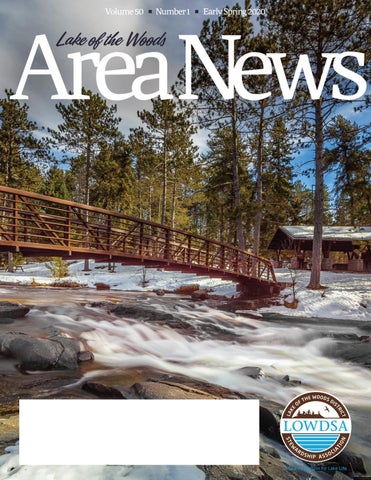
Cover photo by Kim Pirie-Milko
LOWDSA
President’s Message 3 Executive Director’s Note 4 Our Contributors 5 Letters to the Editor 7 Opinion: What on earth is Stewardship? 8
61
Hydro rate increases 10
Treading Wisely: Life in the Slow Lane 61
Dodging dock ice damage—maybe 11
Member Recipe: Living the Island Dream: Mama’s Meatballs 62
Mark Your Calendars 14 Online Member Directory 16
Notes from Razberry Lane: A lament for the vanishing moose 64
LOWDSA Rewards! 17 Summer Dreaming 19 Government Notes 20 IISD Experimental Lakes Area Tours 24
Living
44
More Ado-ing About Canoeing by Dave Schwartz
66
LOWDKids!
Taking climate action this spring 66
29
47
34
50
Buzzing in Lake Country by Shelley Bujold
In the District
In-depth, meaningful consultation: All Nations Hospital Project in Kenora 34 Lake of the Woods area residents count birds 36 Northern hawk owl headlines Rainy River Bird Count 37
Lake of the Woods Mines Revisited by Cecil Burns
Welcome Transition by Barry Corbett
52
Kat the Nature Dog: Searching for Spring 68
70
Services
Classifieds 70 Real Estate Listings 72
Environment
Silver Uncontrolled 52 On Track 54
What’s happening on your lake this summer? 38
Lake of the Woods Water Sustainability Foundation 56
Common Ground: A Sharing of Our Stories 38
Phosphorus loads to Lake of the Woods from Canadian tributaries 58
Home & Cottage Services 74 Advertisers’ Directory 75
76
William Butler: An 1870 account of Lake of the Woods by Lori Nelson
Ottermere Campers’ Association 40 Lake of the Woods Control Board: We’re making progress 41 An Unusual Freeze 42
Lake of the Woods District Stewardship Association
LOWDSA
1
The bountiful life As a cottage owner, you’ve created a sweet life for yourself and your family. We assist affluent families to build and preserve lasting wealth — not just to watch the numbers grow, but to help people live a richer quality of life without financial fears. We’ll design a tailored plan to grow and transfer your assets, serving even your most complex needs with clarity and transparency. Call us now to make an appointment with one of our highly qualified Financial Advisors to help you grow your portfolio. Richardson GMP Limited One Lombard Place, Suite 1100 Winnipeg, MB R3B 0X3 Tel.: 204.957.7735 Toll-free: 1.866.205.3549 www.RichardsonGMP.com
Our advisors Bruce Bennett Greg Bieber Michelle Bradet Simpson Lou Caci Joanne Lee Jason MacDonald Kenneth W.P. Martin Kim McCartney Benji Miles John Nelson Jeremy Ruban Trevor Stark Jari Stromberg Todd Tanchak Valerie Wowryk
The opinions expressed in this report are the opinions of the author and readers should not assume they reflect the opinions or recommendations of Richardson GMP Limited or its affiliates. Richardson GMP Limited, Member Canadian Investor Protection Fund. Richardson is a trade-mark of James Richardson & Sons, Limited. GMP is a registered trade-mark of GMP Securities L.P. Both used under license by Richardson GMP Limited.
President’s Message HARDY BOCK, LOWDSA PRESIDENT As I have mentioned in the past, cross-country skiing is a passion of mine so the late arrival of snow was a mixed blessing. I appreciated that I didn’t have to shovel for a while but I like snow for winter outdoor activities. There was no decent skiing until after New Year. Given the concerns about water levels on Lake of the Woods and Winnipeg River, snow accumulation is on our radar for more than just recreational reasons. The high water levels remain a concern for the spring. We are in close contact with the Lake of the Woods Control Board. We will post regular updates on our website, Facebook, Twitter and Instagram as spring approaches, and we will also send eNews updates to all LOWDSA members with valid email addresses on file. Please check your online profile or email info@lowdsa.com to ensure we have your current email address and phone number. We set up our second annual LOWDSA call centre January 15, and nine directors spent the evening on their phones contacting close to 300 members who had not yet renewed their membership for 2020. The evening was a great success and provided an opportunity to talk with many members about their ideas for LOWDSA initiatives and their concerns. With only a few exceptions, the members that we spoke with had already mailed their renewal, renewed that evening, or had forgotten to renew. They appreciated the reminder and had their renewal in their inbox or on that “pile of things to do” on the corner of their desk. We would have talked to more members, but many phone numbers on file are no longer active, likely because of the trend towards cell phones instead of landlines. We eagerly anticipate the LakeShow on Sunday, April 5. It’s a new name and a new day, but the same great show. The AGM is set for noon with the LakeShow opening at 1:00 p.m. The show is always the place to visit and renew acquaintances, but can also generate revenue for LOWDSA programs. We have added several exhibitors selling items at the show, and we encourage you to come prepared to do some shopping. Please drop by the LOWDSA booth and say hello. Your finance committee works diligently to keep the budget balanced despite some difficult circumstances. Our operating costs remain unchanged over the last several years thanks to the efforts of our administrative staff. The decrease in government funding we experienced in 2019 will probably remain unchanged for 2020 and we are seeking funding alternatives to make our programs self-sustaining, in particular LakeSmart.
Unit Director for Grand Council Treaty #3 in Northwestern Ontario and involved in a number of water-related projects in the area. Your help is needed to support and sustain LakeSmart. We welcome any ideas you have and ask you to consider making a donation to the Environmental Initiatives and Special Projects (EISP) fund (see page 27.) Our government affairs committee remains busy with a number of issues as summarized in our Government Notes on page 20. As long-time LOWDSA member, Al Mackling, reminded us recently, “LOWDSA does not have a mandate to change things, but it does have a mandate to be a watchdog, challenge, question, inform and educate.” Maintaining our good lines of communication with several ministries is the key to meeting this mandate. It has been a pleasure and privilege to serve as your president for the past two years. I have enjoyed working with my fellow board members and the LOWDSA staff. Meeting many LOWDSA members at the Cottage Shows, summer meetings and the farmers market was a highlight for me. The time has gone by quickly and my term will end at the AGM in April. It was filled with many exciting changes, implemented with your input, to keep our association vibrant. See you at the LakeShow! Until then, I hope to enjoy many more kilometres of cross-country skiing.
LakeSmart remains our flagship program. This award winning program promotes environmental stewardship, one of LOWDSA’s core values. The LakeSmart team connects with hundreds of people every season to educate and encourage sustainable lake living. In addition, the program has been a springboard for careers with several former team members finding careers in the environmental sciences. In fact, one of your directors, Lucas King, a former LakeSmart team member, is now Territorial Planning
Lake of the Woods District Stewardship Association
LOWDSA
3
Executive Director’s Note DIANE SCHWARTZ-WILLIAMS It’s that time again; time to tackle a task that comes regularly five times a year yet always seems to catch me off guard and unprepared. That task is this note I write for each issue of Lake of the Woods Area News. As I stare at my blank screen, willing my brain to be creative and my fingers to begin typing, I reflect on the path we move along that takes us from another blank screen, through some twists and turns and, with a lot of work by many, finishes with this beloved magazine to share with you. Photo: Tom Thomson
Producing the Area News is quite the process, sometimes a very smooth one and other times not so much, but it is always interesting and incredibly rewarding. Brainstorming ideas, planning the content for an issue, sourcing the writers, editing stories, designing the layout, reviewing and proofing every page several times, and two to three months after the first planning meeting, off to the printer it goes. The whole process is never really done, because before the layouts are even complete we’re already planning the next issue. I feel privileged to play a small role, but the credit for the first-class magazine you are enjoying now really goes to the editorial and design team and of course all the talented writers. The first section of the magazine is largely up to me to plan and deliver to the design team under, thankfully, the watchful eyes of our editor. It starts with the ‘member news’ section about topics we know will be of interest to you like ice damage, hydro rates, water levels, or it may be LOWDSA news keeping you up-to-date
on association programs and initiatives. We cover a lot of topics, but that doesn’t mean we get it all. So, if you think of something you would like us to write about or explore in this or any part of Area News, please let us know. We’re always looking for ideas, suggestions and feedback. There’s no question that Area News magazine is the most recognized benefit of membership, but we think LOWDSA is more than just a great magazine. You’ve told us what other benefits you recognize, and we’re excited to add one more— LOWDSA Rewards. Check it out; we’re off to a good start with confirmation of six businesses participating as of writing and more to come. See more about this program on page 17. LOWDSA is proud to be recognized as the largest lake association in Ontario. Thanks to you, our list of member families is indeed impressive. We know that in past years many members enjoyed being able to peruse our member directory, looking to see which friends and neighbours were also LOWDSA members. Plans are in place to create an online member directory to be available in August 2020. In order to do that we need to know by May 1 if you would like to be listed—or if you prefer not to be. Please be sure to complete the questionnaire on page 16 or online at surveymonkey.com/r/J6L9FSM. What a relief; my screen is no longer blank and this task behind me until next time. Now, I am free to let my mind happily wanders to a meeting this afternoon when we will be planning the content for the May issue of the Area News. What could be more enjoyable than a couple hours spent thinking about spring and planning summer related articles while we’re still buried in snow? Work that brings with it a pleasant diversion—sweet!
The official publication of the Lake of the Woods District Stewardship Association
PUBLISHED BY
DISTRIBUTION & MEMBERSHIP
Wake Marketing Inc. 140 Main St. S., Kenora, ON P9N 1S9 Phone: (807) 407-7252
Lake of the Woods Area News is published five times per year and is mailed to LOWDSA members. To receive Area News visit lowdsa.com and become a member today.
Publisher: Mike Greaves, mike@areanewsmagazine.ca Editor: Elsie Neufeld, editor@areanewsmagazine.ca Art Director: Shayla Smith, shayla@wakemarketing.ca Design & Layout: Mike Newton, Ashley Pereira Advertising: Deb Polakoff, deb@areanewsmagazine.ca
Publication mail agreement #43107013. Printed in Canada.
UPCOMING EDITORIAL DEADLINES March 23 May 6
July 29 Oct 7
© 2020 LOWDSA. All rights reserved. The contents of this publication may not be reproduced by any means, in whole or in part, without prior written consent. Statements of fact or opinion are the responsibility of the author and may not represent the view of LOWDSA or Wake Marketing Inc.
4
LOWDSA
Lake of the Woods Area News Early Spring 2020
Our Contributors
Lillian Anderson has retired from the MNRF and is enjoying life with her husband, Bruce Ranta, on their 230 acres of land. Based on her experiences as a wildlife custodian Lil has published two non-fiction books on wildlife rehabilitation, Beavers: Eh to Bea, and Pond Memories and had contributed nature-based articles in the past to the Lake of the Woods Area News. When time allows, she updates her rehabilitation blog iggy2014.wordpress.com on critters in care. She holds a BSc, Major in Biology. Her hobbies include wildlife photography, writing, and more recently dabbling in acrylics, watercolour and coloured pencils.
Tim Armstrong has been flying over Lake of the Woods for four decades, and he operates Lake of the Woods Ice Patrol, a popular website documenting the thaw each spring. Aerial photos, satellite images and commentary shed light on the yearly variations. Check it out at icepatrol.ca. He’s a regular hiker on the Tunnel Island trails, where he loves to take photographs. His other hobby is writing science fiction; he has four published short stories, and a novel, Avians, is available online and at Elizabeth Campbell Books on Main Street. On Twitter, he is @timothygwyn.
Sumeep Bath Shelley Bujold Phil Burke Cecil Burns Barry Corbett Michael Dawber Leanne Fournier Leo Heyens Garth Collier lives in Winnipeg and is part of a fifth generation family who first discovered Ottermere in the early 1920s. At that time, Garth’s parents, his grandmother, aunts and uncles built cabins in various locations around the lake. Now, his sister, brother, nephew and himself have cabins that they enjoy over the four seasons. Ottermere is a vibrant community of campers who share in projects, both large and small. Lake life certainly brings families and friends together. Garth was a public school teacher for over 30 years. Garth is a LOWDSA member and director on the board.
Jack McKenzie Drew Monkman Lori Nelson Henry & Anita Rasmussen Rosey Robertson Jacob Rodenburg Greg Roy Dave Schwartz Diane Schwartz-Williams Todd Sellers Dyke Williams
LAKE OF THE WOODS DISTRICT STEWARDSHIP ASSOCIATION Executive Committee
Board Members
Staff
Contact
PRESIDENT Hardy Bock, Black Sturgeon
Dave Christie, Granite Lake Garth Collier, Ottermere/ Schnarr Lake Jason Coreau, Big Traverse Bay Carley Fyke, Welcome Channel Anneke Gillis, Paddy Lake Lucas King, Woodchuck Bay Trevor Templeton, Minaki John Waterer, Clearwater Bay
EXECUTIVE DIRECTOR Diane Schwartz-Williams (807) 543-4287 diane@lowdsa.com
P.O. Box 1160 Kenora, ON P9N 3X7
VICE PRESIDENT & TREASURER Christine Semenchuk, Storm Bay PAST PRESIDENT Nancy Salmijarvi, Welcome Channel DIRECTOR Don Parfitt, Winnipeg River
ASSISTANT EXECUTIVE DIRECTOR Shelley Bujold (807) 468-8715 shelley@lowdsa.com
EMAIL info@lowdsa.com
M LOWDistrictStewardshipAssoc N @lowdsaLakeTime P @lowdsa TOLL-FREE 1-888-265-9784 PHONE (807) 468-8715
Lake of the Woods District Stewardship Association
LOWDSA
5
Dedicated to Lakefront Property
Ian Carmichael Broker of Record
OFFICE
807-467-2323
CELL
807-466-2236
lakeofthewoods.net
carmichaelrealestate@lakeofthewoods.net Thinking of Selling? Call me for a no obligation fair market evaluation of your property. Thinking of Buying? I can provide Buyer Representation you deserve and can trust. Call me directly for assistance and qualified experience at 807-466-2236. Like us on Facebook
Incredible private point boasts over 4 acres of titled lands having 1152’ of shoreline
Main cottage, guest, boathouse, beach & amazing views!
Absolute Perfection! Amazing leisure home, multiple structures & boathouse
Private Point
Private Island
Storm Bay Road
Completely remodeled year round cottage; 2150 sq ft, 4 BR, 2 baths & 2 garages
80.9 dynamic acres with approx. 8448 ft frontage, 3 BR cottage beside beach
Extremely private with 62 acres & 3 cottages near Crow Rock
Storm Bay Road
Private Island Retreat
Private Acreage
Upgraded leisure home in town; 1820 sqft, 3 BR, 2 baths, garage, car port & boat port.
Low profile lands with beach; 1080 sq ft main cabin, guest & boathouse
1240 sq ft modern cottage & 2 guest cabins
Lakeview Drive
Rush Bay
Winnipeg River
Affordable island getaway! 900 sq ft log cottage, workshop/Bunkie & beach
Varying profiles & views. Quiet private location.
Low profile vacant lot, owned docking, great views!
Inquire LOTW
$1,250,000 LOTW
$719,000 LOTW
East Allie Island $305,000 LOTW
$2,150,000 LOTW
$1,095,000 LOTW
$519,000 LOTW
5 Point Island Subdivision
Starting at $159,000 +HST LOTW
$1,890,000 LOTW
$799,000 LOTW
$309,000
Corkscrew Island $144,900 LOTW
Letters to the Editor
We’d like to hear from you! Help us continue making this magazine great. Send us your comments, suggestions, pictures and story ideas: editor@areanewsmagazine.ca.
Dear Friends, I read with interest your article concerning the creation of the Lake of the Woods Fisheries Council. Could you ask your representative to discuss “ghost nets” with the council? Ghost nets are nets that are either free floating or anchored (sometimes in layers) without identifying markers or signage. Usually they are found full of dead and decaying fish. And sometimes these nets are laid right across a navigable channel that all boaters use. So much so, that my friends and I are now carrying a sharp knife and scissors. We are afraid that someone soon will drown after being tangled up. It is a real safety issue, Particularly late in the boating season. These nets have been found all over Lake of the Woods from Poplar Bay and Treaty Island in the north to Sunset Channel and Monument Bay in the south. I know the Ministry of Natural Resources and the Canadian Coast Guard are concerned but I think they need some assistance. Having this issue brought up at the Fisheries Council should help and again save someone’s life. By the way no one disputes the right of First Nations to harvest. Thank you, Jim Ashdown, Coney Island
Congratulations to members Pam & Andrew Cooke and Lea & Lloyd Girman, each couple winning a gift membership to introduce someone to LOWDSA. We join Pam and Andrew in welcoming Katherine and John, and Lea and Lloyd in welcoming Anne and Doug to the association.
Dear Lake of the Woods Area News, In your winter issue, Jack Mackenzie urged readers to use caution venturing out onto the ice. Those of us who live on the river often think we know best, but I recently learned that may not always be so. My husband and I took a much travelled route on the ice to walk our dogs recently. It’s along a narrow creek that snowmobilers coming from Alcock Lake use to get to the Winnipeg River. I always assume if there’s snowmobile or quad tracks the ice should be safe for my weight. I’m not sure if I stepped right or left as I was chatting and walking or otherwise distracted by our two dogs at play. At any rate, that momentary lapse caused me to step where I shouldn’t have and into the water I went up to my chest. Fortunately I wasn’t alone. My partner dropped down on his hands and knees to reach for me. As I tried to get out through the front of the hole it started to cave in also so I rolled out sideways and then ran home, about a quarter mile away as the ice started to form on my clothes and my frozen legs became weaker and weaker. Many things to be thankful for and a few lessons learned. It’s definitely worth another warning to locals and seasonals to be careful out there, particularly in places you may have thought were always safe.
Top: Creek has always seemed safe for winter walking and skiing, late winter 2019. Bottom: Icy jacket—a cold run home!
Leanne Fournier, Long Bay, Winnipeg River
Lake of the Woods District Stewardship Association
LOWDSA
7
Opinion
What on earth is Stewardship? BY DYKE VAN ETTEN WILLIAMS
Is it just a matter of doing good? If so, what is good for today, for tomorrow, for decades from now? Good for whom? How is it measured? How can we envision the needs and then act decisively. Who benefits? Why should be we bother? So, I’m hitting 80 this year. Boy, does that ever make you think! Start with: How can this be? What really matters anyway? What on earth do I do now? And the key question—why? And right in the middle of all this, the climate crisis presents everybody on earth with their very first and existentially critical global challenge. In a very real sense, all of us must—right now— think about stewardship differently and act accordingly. But it seems that each of us brings to the table very different teachings, philosophies and learning experiences. In talking with folks of all ages, I found no clear consensus of what stewardship was in the past or what it must become now so there is a viable, sustainable and dignity-blessed future.
Congratulations to our woods-and-waters association for changing its name to Lake of the Woods District Stewardship Association (LOWDSA). Whatever stewardship meant to various of us in the past, it is in great need of becoming the common, global ethic now and in our future, and work through LOWDSA can be a key part of it. That word stewardship is interesting. For many of us it comes with biblical and other overtones of dominion over or control or mastery over. Is that what it really means today? Experts say that humans are the most dangerous and destructive animal on the planet. Why do we think we’re in charge if we actually are the problem and haven’t been willing or able to control ourselves? I’ll contend that there are different and more current connotations possible—and needed. The timing couldn’t be better. We are indeed living in "interesting times!" For the first time ever, every person, living thing and every other thing of any sort is being challenged perhaps for their very survival at a global level. We will find out if we can, (a) realize the risk; (b) rise to the challenge; and (c) act in time. And to this old guy’s mind, here’s where a re-imagined concept of stewardship comes in.
Title photo: It's the kids who may save it all! Greta Thunberg has said she could not "understand why grown-ups would choose to mock children and teenagers for just communicating and acting on the science when they could do something good instead."
8
LOWDSA
Lake of the Woods Area News Early Spring 2020
What do we bring with us? To date, most humans have been accustomed to taking and using or profiting from whatever resources we could control. Now we find that there are more demands and more people than there are some of those resources. We have also felt in the past that we could readily discard the leavings—the ashes—of our various uses with little thought as to the consequences. The climate crisis has abruptly notified us that this will no longer do. Studies prove that many folks do not imagine ahead in time more than about a year, so we are staring at a challenge that must be dealt with starting yesterday and lasting probably forever after. What to do? What, indeed, to do?
What might work—the big picture Philosopher William James (1842-1910) had what for me has been a life-guiding vision. He saw that disparate peoples and communities could be brought together in common purpose through the vital challenges, shared experiences and camaraderie of war. Could that also be true through other sorts of crises—bonding widely varying folks and nations in common purpose, working toward a good end? I can remember the profound sense of community focus and effort during and right after World War II. More of that might work for us now.
flourish or flounder in how we treat the earth from now on. Now is our chance to act in the best interests of the planet, its living beings, its resources and ourselves.
“You must take action. You must do the impossible. Because giving up can never be an option.” — Greta Thunberg
Let’s do this together! Some admittedly contentious issues need to be reexamined, re-imagined and acted on: universal human rights, global ethics, sustainability, government, capitalism, democracy, socialism, religious freedom, resource use, entitlements, shelter, food supply, fair play, work, financial equity, energy sources, population, clean air and water, soil regeneration, unnecessary stuff.
I believe that the climate crisis—climate emergency—could be just such a challenge. The globe joined in a new stewardship— indeed survivorship—might just rise to the occasion. We will
How About Sharing? If you’d like to, how about sharing your thoughts on the above (and much more) and sending them in? Brevity helps so we can print and share them. Email your thoughts to: editor@areanewsmagazine.ca. My bias as a beginning? A saintly man once told me that our job while we’re here is to help others. What do you think?
LOWDSA Red Pine Seedlings
ORDER BEFORE MAY 15
Over 300,000 seedlings planted by LOWDSA members to date; 10,000 to be planted in 2020. NEW PICK-UP DATE: Saturday, June 6 from 10AM - 1PM Clearwater Bay (Firehall) Kenora (Safeway) Laclu (PUFF Fire Hall) Minaki (Minaki Marina)
Morson (Spruce Creek Golf Course) Nestor Falls (Dalseg’s Trading Post) Sioux Narrows (Government Dock) Storm Bay Rd. (Firehall)
Order online lowdsa.com/ cpages/seedlings
# OF BUNDLES __________ AT $10 EACH (15 SEEDLINGS IN EACH BUNDLE)
Payment Information
PLEASE MAKE CHEQUES PAYABLE TO LOWDSA
Member Name Email Address City Prov/State Country Postal/ZIP Visa
Mastercard
American Express
Amount $ (cad) _________________
Card #_______________________________ Name on card __________________________ Expiry (mm/yy) ____ / ____ CVC (required) _____ (3-4 digits back of card)
lowdsa.com N @lowdsaLakeTime M LOWDistrictStewardshipAssoc P lowdsa 807-468-8715 • 1-888-265-9784 • info@lowdsa.com • Box 1160, Kenora, Ontario, P9N 3X7
Lake of the Woods District Stewardship Association
LOWDSA
9
Hydro rate increases The government affairs committee has taken a close look at the impact of the Ontario Electricity Rebate (OER), which came into effect November 1, 2019. Our concerns, shared by DoKURA, were presented to our MPP Greg Rickford, Minister of Energy, Northern Development and Mines and Indigenous Affairs by DoKURA in January and the minister made a commitment to further action, saying that the Hydro One bill issue would be addressed in some way. Running numbers through the OEB bill calculator available at its website confirmed that the bill increases in some cases are much greater than the 1.8 per cent announced in the October 2019 OEB news release and referenced in other government news releases. The impact affects high volume, low-density Hydro One customers most significantly, with potential increases as high as 15 per cent. There are two reasons for this. "First, removing the government Global Adjustment subsidy from the electricity cost line on the bill and incorporating it in the new Electricity Rebate which is applied it at the end of the bill substantially increased the dollar amount subject to the HST. While the province continues to provide full Provincial Sales Tax relief as part of the OER, it means a greater dollar amount is sent to the federal government in the form of the GST," said Bob Stewart, LOWDSA member, Longbow Lake resident, and member of LOWDSA’s government affairs committee, in a letter to MPPs Greg Rickford (Kenora) and Sol Mamakwa – (Kiiwetinoog).
time-of-use and tiered prices to reflect actual and projected costs; and moving provincial support for the GA (Global Adjustment) component of those costs to the new OER. The DRP (Distribution Rate Protection) cap for Hydro One R1 & R2 customers and several other small rural utilities was also moved—from the Distribution Line cost calculation to the OER, as was the PST (Provincial Sales Tax) credit. For instance, the RPP price for the Peak Period went from 13.4 cents to 20.8 cents per kWh, an increase of 55 per cent. Other time-of-use periods had similar increases. For those still on tiered use (mostly Hydro One R2/Seasonal customers) due to remoteness, the percentage increases were 35 per cent on the first tier (1,000 kWh monthly consumption) and 56 per cent per kWh over that. Bill increases are also impacted by general utility distribution rate increases as noted below the chart but even allowing for that, Hydro One high-use rural customers still experience a much higher percentage and dollar increase than other groups of users.
OEB bill calculator comparisons 1000 kwh WINTER '18-19
WINTER '19-20
Kenora - Synergy North
$138.99
$144.60
5.9%
"The second factor in the higher than average increases is also related to the use of actual/projected costs for Regulated Price Plan customers.
Hydro One R1
$149.77
$158.15
5.6%
Hydro One R2
$152.92
$160.74
5.1%
Hydro One Seasonal
$217.60
$221.67
1.9%
"In addition to paying for electricity as measured at the meter, customers must also pay for electricity lost during transmission to heat as electricity travels through electrical lines and transformers, and to cover billing errors and other costs as reflected in the difference between what local distributors purchase on behalf of their customers and what they actually bill them based on meter readings. In the case of Hydro One, due to generally lower than average customer densities in rural areas and other factors this ‘line loss’ is much higher than the industry average of 3 per cent. For low-density rural Hydro One customers it is 10.5 per cent." Stewart continued.
Sioux Lookout Hydro
$153.67
$147.82
(3.7%)
WINTER '18-19
WINTER '19-20
Kenora - Synergy North
$473.61
$501.58
5.7%
Hydro One R1
$478.45
$540.73
12.8%
Hydro One R2
$489.37
$551.26
12.8%
Hydro One Seasonal
$750.19
$786.73
4.9%
Sioux Lookout Hydro
$508.07
$498.93
(1.2%)
An increase of $75 to $100 a month in the winter heating season on a bill that was formerly $500 is significant and can represent a genuine financial hardship for some families.
Bill comparison chart The following chart was compiled using the OEB online calculator for winter 2018–19 (December 2018) vs winter 2019–20 (December 2019). Ontario Electricity Rebate changes instituted November 1, 2019 included an increase in the RPP (Regulated Price Plan)
10
LOWDSA
Lake of the Woods Area News Early Spring 2020
UTILITY
% INCREASE
4000 kwh UTILITY
% INCREASE
Notes: Sioux Lookout Hydro had a new rate structure approved by the OEB as May 1, 2019 that effectively lowered its distribution charge by $8.88 monthly for an average residential customer using 750 kwh monthly. Hydro One had a new rate structure approved and implemented as of July 1, 2019. It increased bills by $2.55 monthly for an average residential customer. Synergy North had new rates approved and implemented May 1, 2019. For Kenora zone customers average residential increases were calculated at $3.46 monthly.
Dodging dock ice damage—maybe Freeze-up this year was quite different than recent years and spring ice-out may also bring a few surprises. LOWDSA members shared their ideas on reducing the risk of damage to their docks in these unusual circumstances. BY LEANNE FOURNIER
Tried and true “You mentioned in your last Area News about using a chainsaw to have the ice drop away from the dock as water levels are lowered,” wrote Harley Hansen of Echo Bay, Lake of the Woods. “An old timer in Clearwater Bay would do this but he did not cut all the way through. If you do that, the water freezes in the cut. Instead, he measured the thickness of the ice and for example, if the ice was 12 inches thick, he would put a C clamp on his chain saw so he would only cut 10 inches. This way the crack would not fill and when the lake was lowered it would crack at the cut and break away from the dock.” He repeated the process as needed. Hansen used a different option. In early December, he modified a midsized pond pump, adding a T-coupler on the top of the pump and two three-foot poly pipes going out in Hansen can shut off his adapted pond pump system opposite directions. now that the water level is below the dock skirting. He then installed a 90 degree angle fitting to the ends of these pipes and angled them up to the surface to get the water moving. The pump is submersed about four feet in seven feet of water, and secured with ropes and cables. He figures the total cost of the system, including Hydro (about $27), was about $230. “My pond pump worked well for the size of the area I needed to keep clear. For larger docks or double boat houses you would need a larger pump or two pumps,” he said. As he’s not at the property full-time, Hansen checked his power usage every day or so on the Hydro One website to make sure the pump was still working. He also put up highly visible Beware of Thin Ice signs.
He added that a lot of people out his way have also bought bubblers that are working well. The bubbler’s high speed propeller brings the warmer, deep water to the surface creating open water. Such devices are allowed in Ontario but are strictly prohibited in Manitoba’s provincial parks, due to the risk they pose to neighbouring cottagers and ice users.
Pulling the pins Michael Fournier also took steps to reduce the potential damage to his dock on Long Bay on the Winnipeg River, where fluctuating water levels are the norm and most docks have floats. “We removed the connection Ice naturally broke away from Fournier’s shoreline structure. pins from the pole dock so that the floating portion of the dock could move freely with the ice,” he said. So far this appears to be holding up but he’s well aware that the power of Mother Nature during spring thaw will be the real test. “If it survived freeze-up hopefully it will be fine in the spring.” Joan and Hubert Chaput weren’t so lucky as the anchor pins for their ramp and boat ladder were deep under water at freeze-up. In early January, they hiked out to their water access cottage on Gun Lake, chainsaw in tow. “Our goal was to try and unhook the floating dock and raise the boat ramp to prevent spring breakup damage,” said Joan. They successfully cut away the ice, got to the pins, and plan to return before break up to secure the floating dock.
By mid-January the water levels were below Hansen’s dock skirting so he could disconnect the pump. As for spring thaw, the long-time cottager says he’ll do what he always has when there’s a big run-off, weighing down the docks with barrels of water if necessary.
Lake of the Woods District Stewardship Association
LOWDSA
11
Words from a pro The combination of fixed shoreline structures with floating docks, is the preferred approach used by Doug LeBlanc, DTL Carpentry, for the dock structures they build on Lake of the Woods and surrounding areas. “We typically build the fixed portions of docks well above the known high water mark.” He uses 2014 high water levels as a benchmark. With the water levels freezing high this year, LeBlanc used de-icer pumps on some of his clients’ structures. “It’s a submersible impeller pump pulling water from the bottom of the lake and pushing it above the surface.” Most of these units only needed to run during freeze up, and can be turned back on later in the season if signs of structure damage start to arise. He cautions that impellers or bubblers are not advised if the property owner plans to have an ice road and that neighbours should be notified if you’re using such a system. All is not lost if you’ve built a dock lower than you should have as you can have it raised. LeBlanc said the best time to do it is in winter so you can use the ice to your advantage. “If it’s a pipe dock, it’s pretty easy. We just cut the pipe, lift the dock and weld it back in at a higher elevation.” The same applies for cribs. “You just add more layers to the top of the cribs.”
You could be walking on thin ice—legally and literally Using any of these approaches comes with cautions. Section 263 (1) of Canada’s Criminal Code says: “Every one who makes or causes to be made an opening in ice…is under a legal duty to guard it in a manner that is adequate to prevent persons from falling in by accident and is adequate to warn them that the opening exists.” This clause suggests that you could be held liable if someone is injured or dies as a result of open water or thin ice you created using a bubbler, impeller or other means.
12
LOWDSA
Lake of the Woods Area News Early Spring 2020
Putting up highly visible signs or other markers that there’s the potential for open water or thin ice is a must. It’s also advisable to check with your local municipality before installing a de-icing system as there may be some restrictions. Anchor pins are accessible after ice is chiselled away. The bubblers also Photo: Joan Chaput come with an additional caution for those who use them to leave their large boats in the water. One story was shared about a boat sustaining ice damage in its Thru Hull when the bubbler stalled during a power outage. It sunk once power was restored and the bubbler started working again.
Finally, the Lake of the Woods Control board provides timely information about the changing water levels and ice conditions. It advises that there are potentially dangerous ice conditions even in areas that normally have reliable ice cover. an
What about insurance? A national insurance broker confirmed that insurance companies do not cover damage to docks caused by flooding or ice. This includes physical damage to docks, boathouses or any other permanent or temporary structures. They suggest that property owners take preventative steps like those mentioned.
RBC Dominion Securities Inc.
In every walk with nature one receives far more than he seeks. – John Muir
The Darcy Zaporzan Wealth Management Group of RBC Dominion Securities www.dzwmg.com
The DARCY
Zaporzan W E A LT H M A N A G E M E N T G R O U P
of RBC Dominion Securities RBC Dominion Securities Inc.* and Royal Bank of Canada are separate corporate entities which are affiliated. *Member-Canadian Investor Protection Fund. RBC Dominion Securities Inc. is a member company of RBC Wealth Management, a business segment of Royal Bank of Canada. ® / ™ Trademark(s) of Royal Bank of Canada. Used under licence. ©2019 RBC Dominion Securities Inc. All rights reserved. 19_90783_N4D_001
Mark Your Calendars LOWDSA’s spring and summer calendar is definitely filling up and we have more plans yet to be finalized and added. Look for updates in the next issue of Area News, and in the meantime follow us on Facebook, Twitter or Instagram to keep up to date. And don’t forget to let us know what’s happening at your lake! We’ll be launching the LakeSmart boat at the beginning of June, and our LakeSmart team will be on area waters for the 10th year in a row. Please welcome them if they drop by your dock in June, July or August. Let us know if you would like to arrange a visit to your neighbourhood for dock visits or presentations on living green at the lake, healthy shorelines, invasive species and more.
APR
5
58th Annual General Meeting & LOWDSA LakeShow
Sunday, April 5, 2020 Victoria Inn, Winnipeg, 1808 Wellington Ave. LOWDSA AGM 12:00 – 1:00 p.m. Overview of the association’s activities in 2019 and review of some of the issues on the horizon for the association. Doors open for the LakeShow 1:00 – 7:00 p.m. Over 80 exhibitors last year—on the way to matching that!
Register online at lowdsa.com/events— we don’t want to run out of cookies! MAY
15 JUN
Last Day to Order Seedlings Place your red pine seedling order! Online: lowdsa.com/cpages/seedlings Phone: 807-468-8715 or TF 1-888-265-9784
6
Seedling Pick-up Day
JUN
Get LakeSmart at the CWRA conference (with LOWDSA)
— TO —
LakeSmart Team & LOWDSA at Matiowski Farmers’ Market
Whitecap Pavilion, Kenora 8:30 a.m. – 2:00 p.m. every Wednesday.
JUL
1
LakeSmart Team & LOWDSA at Matiowski Farmers’ Market Whitecap Pavilion, Kenora 10:00 a.m. – 4:00 p.m.
10:00 a.m. – 1:00 p.m. at 8 locations
JUL
15
Canad Inns Polo Park, Winnipeg
Workshop at Canadian Water Resources Assoc. conference, taking LakeSmart dock talk from the dock to a workshop setting. EMAIL info@lowdsa.com
14
24 AUG 26 JUN
LOWDSA
6
LOWDSA Summer Meeting at the Lake – Kenora Location TBA 1:00 p.m.
If you miss the AGM in April, this is your opportunity to catch up on LOWDSA business over the past year, meet your LakeSmart team and learn about plans going forward. Plans for special presentation & exhibits underway; stay tuned for more details.
M LOWDistrictStewardshipAssoc N @lowdsaLakeTime
Lake of the Woods Area News Early Spring 2020
P @lowdsa
TOLL-FREE 1-888-265-9784
JUL
9 JUL
13
IISD Experimental Lakes Area full day visit & tour
AUG
6
Pre-registration required. Discounted rates for LOWDSA members. See registration form on page 24 for more details or contact LOWDSA.
IISD Experimental Lakes Area full day visit & tour Pre-registration required. Discounted rates for LOWDSA members. See registration form on page 24 for more details or contact LOWDSA.
LOWDSA Summer Meeting at the Lake – in the district Location TBA 1:00 p.m.
We’re planning a second summer meeting in the district, but location not yet confirmed. Watch for updates.
SAT
TBD
Free Metal Waste Collection Day 10:00 a.m. – 1:00 p.m.
Get all the metal junk out of your yard, shed, garage and surrounding bush. Drop off by truck or boat. Volunteers will be on hand to help unload.
Plans in the works & dates pending
JUL
23
• LOWDSA & LakeSmart Team visit to Morson
IISD Experimental Lakes Area full day visit & tour
Pre-registration required. Discounted rates for LOWDSA members. See registration form on page 24 for more details or contact LOWDSA.
• LakeSmart Team visits to area lakes Let us know if you would like the LakeSmart team to visit your lake community. • LOWDKids activities including Storm Drain Painting to spread the message “A healthy lake starts here!”
Book a visit from LOWDSA’s LakeSmart team to your lake, property or event in June, July or August Take advantage of the knowledge and resources available from the LakeSmart team, including healthy shorelines, buffer zones, reducing run-off, invasive species, safe boating, septic systems and so much more.
For more information or to book a visit: » Go online to lowdsa.com/cpages/lakesmart » Call 807-468-8715 or TF 888-265-9784 » Email info@lowdsa.com
Lake of the Woods District Stewardship Association
LOWDSA
15
Would you like to be listed (or not!) in the LOWDSA...
Online Member Directory It’s simple: complete a short online form (surveymonkey.com/r/J6L9FSM) or return this form to us by May 1, 2020. Distribution of the Member Directory is changing, both in terms of method and timing. After lengthy discussion and with consideration for the environment and management of association expenses, the LOWDSA board has decided that Member Directory will be available to members online only (i.e. not printed). Once logged in members will be able to view the directory online with the option to download and print it if desired. If you are not yet set up with online access to login to your member profile, we can assist you with that process. We plan to have the directory available online in August 2020. Please mail your completed survey to: Box 1160, Kenora, Ontario P9N 3X7 or email to membership@lowdsa.com
16
LOWDSA
If you do not wish to be listed in the LOWDSA Online Member Directory, it is very important that you let us know. Otherwise, in the absence of a response either way, members will be included in the directory. Name:________________________________________________________________ Phone:_______________________________________________________________ Email:________________________________________________________________ Yes, list me in the LOWDSA Member Directory Do NOT list me in the LOWDSA Member Directory If yes, what location would you like included with your name? (We may have one on your member profile; please include it here just in case we do not) ______________________________________________________________________
Lake of the Woods Area News Early Spring 2020
LOWDSA membership has its benefits, and of course the Lake of the Woods Area News might be the most recognized of many. Now, we’re excited to offer one more...
LOWDSA Rewards from: Donny B Green Adventures REMR Roofing Solar Solutions Canada WSL Sport & Leisure/ Tall Pines Marina ...and the list is growing! lowdsa.com/cpages/rewards
Rewards! L WDSA
So, what is it?
Rewards from participating businesses will include special pricing, free upgrades, gifts with purchase, discounts of course... and those are just the ones we know about at this point. Timing will vary from one reward to another; From June 1 – August 31 or any portion within those dates (and we know some rewards will be offered earlier and last beyond those dates).
Where are the rewards listed? Visit lowdsa.com/cpages/rewards to see a current list of all our participating businesses with links to their websites.
How to claim your rewards:
LOWDSA is making a
BIG SPLASH with Green Adventures this summer!
Get on board with a 20% discount for LOWDSA members on all Green Adventures services...
All you need is your LOWDSA membership card in print or electronic form to confirm your membership and eligibility for rewards.
How to get your Member Card: 1. Login at lowdsa.com/login 2. Select your name (top right corner) 3. Select Member Card in drop down menu. Your member card will be displayed as a PDF file you can print and/or save to your phone.
Visit greenadventures.ca!
STAND UP PADDLEBOARDING KAYAKING | ROCK CLIMBING SCUBA DIVING | CAMPING FISHING | CANOEING & MORE
Green Adventures services range from providing top-of-the-line rental equipment for your individual/group trip, to deluxe all-inclusive guided trips that include transportation, meals and all required gear. Trips vary in intensity—something for all different skill levels. Most importantly, we provide knowledgeable, experienced guides, guaranteeing your trip will be both safe & memorable. Green Adventures does commercial dive work and can fix docks, dive for equipment and check water pumps. Looking for instruction? Contact Green Adventures for next course info.
17
Register online at lowdsa.com/events—we don’t want to run out of cookies!
Lake of the Woods District Stewardship Association’s 58th Annual General Meeting
& LakeShow LOWDSA
2020
A shared passion for lake life
Sunday, April 5, 2020 at the Victoria Inn, Winnipeg AGM: 12:00 – 1:00 p.m. LakeShow: 1:00 – 7:00 p.m.
New date, new name—same great show! EXHIBITS
•
INFO SESSIONS
•
LOWDSA PROGRAMS
Over 70 exhibits offering a wide range of services, products and information—with many items available for purchase at the show. Accurate Fire and Safety Ltd.
Cottage Fire Safety Service
Agriculture & Resource Development Forestry and Peatlands Branch
Denver’s Windows
All Nations Hospital Project - LOTW District Hospital Artspan Inc. Bell’s Septic (Kenora) Inc. Bestway Rentals Cabin Country Realty Ltd. Canadian Tire - Kenora’s Store Canadian Water Resources Association Cararra Tile & Marble Carmichael Real Esstate Inc. Century 21 Northern Choice Realty Ltd. City of Kenora Cloverdale Forge Conquest Manufacturing Cottage Depot
18
Docks & Lifts Unlimited Inc. Donny B
Lake of the Woods District Stewardship Association Lake of the Woods Water Sustainability Foundation
Earth4U Consulting Inc
Lake of the Woods with Mike Grandmaison & Elizabeth Campbell
Faux Rocks Northwest
Partners for Home Penta Protective Coatings Ltd. Q104 Kenora Online Rainfresh Water Treatment ReMax NorthWest Realty Ltd.
Linwood Homes
REMR Roofing
Fresh Emblem
LOTW Septic Barge
Solar Solutions Canada
Grace Anne Residence Club
LOWDSA Environment
Springfield Woodworking
Green Adventures
LOWDSA LakeSmart
Star Building Materials
Harbourfront Oil and Vinegar IISD Experimental Lakes Area
LOWDSA Mobile Boat Wash & 89.5 The Lake
Sunset Spray East Ltd. Swimwear Express
Sunset Diving
Image One Designs
Lumber One Building Supplies
Keeman Local Services Board
LUXE Furniture Company
Treevival
Ken’s Carpets & Urban Homestyle Centre
McMunn & Yates
Turtle Beach - Save Our Lakes
Morgan Fuels
Wolframe’s World of Water
Lake of the Woods Control Board
Nature Conservancy of Canada (The)
WSL Sport & Leisure
Lake of the Woods Cottage Guide
Oakwood Roofing & Sheet Metal Co. Ltd.
Sponsored by
Lake of the Woods Docking
Summer Dreaming BY DIANE SCHWARTZ-WILLIAMS
Change is hard but this one you’ll like. For as long as most of us can remember, our AGM and Cottage Show have landed on the first Monday of May, and that time has worked all these years, but not as well as we thought it could. It wasn’t convenient for the members who work 9–5 Monday to Friday, and/or have young families. After much discussion and consideration of the options, we decided to hold the AGM and show on a weekend and a little earlier in the season. This gets us ahead of those football, soccer and baseball schedules many parents navigate later in the spring. Not to mention, the work of opening your cottage. As for the new name, LOWDSA LakeShow, it better reflects who our association members and friends are: cottagers, permanent residents, boaters, sailors, campers, and renters—all the people who love the lake. The exhibitors have taken the change in stride. With over 70 exhibits confirmed as we go to print for this magazine, you can expect to see that number increase by the time we open the LOWDSA LakeShow doors at 1:00 p.m. on Sunday, April 5. Whether you are looking for something for your cottage or home, a gift for someone special, water sports equipment, information on lake living or tips for living green at the lake, you will find it at the LakeShow, our 29th spring show. You can count on seeing a wide range of exhibitors eager to showcase their products, share their knowledge and answer your questions. Come prepared to do a little shopping as several exhibitors will be selling their products and services at the show. And, make sure to keep on the lookout for those exhibitors who have signed on to the brand new LOWDSA Rewards program, offering special discounts to LOWDSA members.
systems, personal and fire safety and more. The knowledge of our presenters and the relevance of the topics have made these sessions popular. Watch for updates on the info sessions on our website and social media. LOWDSA’s 58th Annual General Meeting will kick off the LakeShow schedule beginning at noon. The AGM is your opportunity to get an overview of the association’s activities in 2019 and to learn about some of the issues on the horizon for the association. The meeting will conclude by 1:00 p.m., coinciding with the LakeShow opening. If distance and time prevent you from attending, you can watch the AGM on a computer or listen to it on your phone in real time—email membership@lowdsa.com if you would like to do so. The LakeShow is your show, and you’re the reason LOWDSA directors and staff put in the hours required to make it happen. It is a great opportunity to introduce your friends and family to the association, share the benefits of LOWDSA membership, and support its programs and growth. Bring a guest or two (or more) with you to the LakeShow. If they treasure our lakes and rivers as much as we do, whether at a cottage, camping, sailing or visiting, they will find much of interest at the show. There is a happy social aspect to this event as the summer community comes together for the first time in several months. Stories flow, the laughter rings out and the shared anticipation of summer intensifies as lake friends and neighbours gather at the LOWDSA LakeShow 2020. You don’t want to miss it. See you on Sunday, April 5! Watch for updates on show exhibits and activities at lowdsa.com/cpages/lakeshow or on our social media accounts: P lowdsa M LOWDistrictStewardshipAssoc N lowdsaLakeTime
A series of info sessions will be held hourly on a number of topics, such as estate and cottage succession planning, water
19
Government Notes Your directors and staff communicate regularly with representatives of a number of ministries and departments at all levels of government. Whether communicating via email, talking on the phone or meeting in person, we enjoy positive working relationships including collaboration in some instances. This makes it possible for us to access and share government bulletins in a timely manner, and open lines of communication often allow us to go directly to the source with questions on your behalf. BY DIANE SCHWARTZ-WILLIAMS
Federal Meeting with MP Eric Melillo In March, LOWDSA directors and staff will meet with the Conservative MP Eric Melillo (Kenora District) and member of the Standing Committee on Natural Resources. This will be our first opportunity to sit down and meet face-to-face with our MP since he was elected, and we look forward to introducing him to our association and discussing key issues of interest to association members.
we will refer to the MTO as our official source for any updates we share. To date the plans and schedules as posted online in November 2018 at 4lanehighway17kenora.ca remain unchanged and direct communication with the ministry requesting updates elicits responses directing us to the website. Should any significant information be received before the next issue of Area News is published, we will send an eNews to all LOWDSA members who have a valid email on their profile. If you are not already receiving our eNews periodically and want to receive it, all you need to do is email info@lowdsa.com and let us know what email address to add to your profile.
Federal & Provincial Four-laning Highway 17 update For the first time in a year and a half we are able to provide some new and positive news that indicates that this project appears to finally be moving forward. On February 5, 2020, Caroline Mulroney, Minister of Transportation (MTO), and Greg Rickford, Minister of Energy, Northern Development and Mines and Indigenous Affairs took further steps to deliver on the province of Ontario’s commitment to widen and twin Highway 17 between Kenora and the Manitoba border by signing a Memorandum of Understanding with Niiwin Wendaanimok, a partnership of four First Nations with interests in the project area. According to the MTO media release, “Ontario remains committed to targeting shovels in the ground on section 1 of the project by summer 2020, while taking the time to hear and address any affected rights and interests and mitigate impacts related to the project.” This timing is at least a year off the schedule laid out by the MTO in November 2018; a schedule that has not yet been updated for public distribution. We will continue to watch for all updates and although we expect to see reports in the media from time to time,
20
LOWDSA
Lake of the Woods Area News Early Spring 2020
If you have comments, suggestions or questions for the ministry and consultant, or simply want to be added to the study mailing list, email project-team@4LaneHighway17Kenora.ca. Full contact info including mailing addresses are available online.
Provincial Lake of the Woods Fisheries Advisory Council The Lake of the Woods Fisheries Advisory Council held its first meeting in December 2019 and will have just met again as you read this. LOWDSA director and environment committee co-chair, John Waterer, is representing the association on the council. John reports that a great deal of information was presented and reviewed at their first meeting. He also notes that the council has its work cut out for it in their role to provide feedback and advice to the MNRF on development of the fisheries management
plan, including angling regulation options as well as assisting MNRF in engaging, educating, consulting and promoting this initiative with the public. He commends the ministry for bringing together a diverse group to make up the council that includes representatives of local anglers, angling guides, the angling tourism industry, Indigenous communities, municipalities and fishing/hunting organizations. No report was available from the council following their first meeting, but we hope to have more specifics to report on here for the next issue of the Area News.
2020 Fishing Ontario Recreational Fishing Regulations Pretty much anything you want or need to know about recreational fishing in Ontario can be found online at ontario.ca/fishing. For information on what to fish in a specific waterbody or where to fish a specific species, go online to Fish ON-Line for all that and easy access to regulations. If it is the 160-page 2020 Ontario fishing regulations you are after, as far as we know they are only available online in digital format just added to our resource page at lowdsa.com/cpages/resources.
Review of Jack Pine Budworm 2020 Insect Pest Management Program The Ontario Ministry of Natural Resources and Forestry (MNRF) held info sessions in January/February for public review and comments on a proposed insect pest management program to control the jack pine budworm infestation on the Red Lake, Trout Lake, Whitefeather, Kenora, Whiskey Jack, Dryden, Wabigoon, English River, Lac Seul and Caribou Forests in the Red Lake, Kenora, Dryden and Sioux Lookout Districts. The draft proposed operations were also on display in all MNRF district offices. The infestation did expand this past year and there are some new areas identified within the Kenora Forest and Whiskey Jack Forest. In total, throughout all districts, there are 1,033,378 hectares identified as having been defoliated as a result of the budworm and MNRF is only able to target approximately 80,000 ha for spray. Specific areas to be targeted for spray are not yet confirmed. The MNRF is considering a variety of options (e.g. redirected harvest and salvage harvest) but based upon the analysis of the available insect pest management options, the MNRF is proposing a course of action that would also include aerial spraying of insecticide on selected forest stands as part of an overall integrated strategy. The comment period on the proposed insect pest management program and associated project proposals closed February 12, 2020. Updates will be posted on lowdsa. com and in the Area News as they are made available.
NOW OFFERING A LARGER SELECTION OF TOP QUALITY BRAND TOOLS AND HARDWARE WITH OUR NEW 52,000 SQ FT FACILITY. We are Manitoba’s largest lumberyard with state of the art truss design and manufacturing. We offer a huge selection of lumber, finishing, building materials, a full service saw shop, and our new retail store featuring a large display area as well as all the tools and hardware you need to complete any project. We are what a lumberyard should be with great advice and service you can count on! Come see for yourself!
NEW STORE NOW OPEN! 1-888-STARWPG (782-7974) or 204-233-8687 · 16 SPEERS RD, WPG MB · MON - FRI 7AM - 5PM, SAT 8AM - 12PM · STARBUILDING.CA
Lake of the Woods District Stewardship Association
LOWDSA
21
Proposed decommissioning of Turtle Portage—public consultation As of the end of February 2020 no further updates on the future of Turtle Portage were available from the Ontario Ministry of Natural Resources and Forestry or the office MPP Greg Rickford. All we were able to confirm in response to our inquiries to the ministry is that a final decision has not been made but the recommendation/hope would be that a group of citizens who use the portage come together to help upgrade and maintain the system similar to what is done in other locations.
Land & Flooding Claims in the Lake of the Woods District
MNRF Local Citizens’ Committee Since taking on the role of LOWDSA’s representative on the Kenora Local Citizen’s Committee (LCC), LOWDSA Director Garth Collier has attended two meetings. This MNRF committee, comprised of 10 local citizens representing a range and balance of interests, assists the plan author, the interdisciplinary planning team and MNRF in the preparation and implementation of the Forest Management Plan. Garth has received a plethora of information to review and digest and has the interest and commitment required to meet the steep learning curve this LCC presents. No report is available from the LCC at this point, but we hope to have one for the next issue of the Area News. If you have questions or concerns you would like forwarded to Garth for presentation at his next LCC meeting please email them to info@lowdsa.com
At this time we do not have any new information to share on negotiations or decisions relative to the following land and flooding claims. As updates are made available we will include them here, in our eNews and online at lowdsa.com. The subject of the claims and ministry contact info for each are listed below. Animakee Wa Zhing #37 TLE Claim Treaty Land Entitlement (TLE): The First Nation did not receive the proper quantity of land according to the relevant treaty. Email AWZTLE@Ontario.ca or call 416-326-4381. Obashkaandagaang Garden Islands Claim Boundary: The current boundaries of a reserve are incorrect. Email OFNGardenIslands@Ontario.ca or call 416-327-9582. Lake of the Woods Flooding Claims Flooding: Reserve land was unlawfully taken or damaged from the construction of hydroelectric power facilities, dams, river diversions etc. Email LOTWFloodClaim@ontario.ca or call 416-326-4755.
22
LOWDSA
Lake of the Woods Area News Early Spring 2020
Public Access to MNRF forest management planning process If you have questions about forestry in the area, whether it is planting, harvesting or planning, the Ministry of Natural Resources and Forestry have several online tools that are very informative. Keep informed: efmp.lrc.gov.on.ca/eFMP/home.do Get involved: files.ontario.ca/involvement_handbook_final_english “Useful tips on navigating the eFMP (electronic forest management plan) website” guide is available by contacting LOWDSA: info@lowdsa.com or (807) 468-8715.
Whiskey Jack Forest & Kenora Forest Annual Work Schedule (2019-2020) available for review
LOWDSA sent a letter to MNRF with copies to the City of Kenora, MPP Greg Rickford, the Ministry of Municipal Affairs and Housing (MMAH) and the Ministry of Environment, Conservation and Parks on December 2.
The approved April 1, 2019 – March 31, 2020 Annual Work Schedule (AWS) for the Whiskey Jack Forest and the Kenora Forest is available at the MNRF Kenora District Office, Miisun Integrated Resource Management Company on behalf of the MNRF, and the Ontario government at ontario.ca/forestplans and will remain so for the one-year duration of the AWS.
This letter asked: (1) if the 2008 environmental inventory and impact assessment with respect to potential development on the island would be revisited and considered again; (2) what opportunities were available for consultation with stakeholders in the vicinity of Town Island, located in the unincorporated/ unorganized areas; (3) in the absence of consultation, where LOWDSA member questions and concerns related to development and environmental impacts should be directed.
The AWS describes forest operations such as road construction, maintenance and decommissioning, forestry aggregate pits, harvest, site preparation, tree planting and tending that are scheduled to occur during the year. The notices and maps are posted at lowdsa.com/articles.
Municipal Town Island On November 1, 2019 the City of Kenora issued a request for proposal (RFP) for the sale and potential development of Town Island with a closing date of January 30, 2020. When the City of Kenora’s intention to sell Town Island was made known to B’nai Brith Camp, a representative of the camp and two camp neighbours met with the city to ask that the RFP be suspended and that the city enter into negotiations with the committee to acquire the island. When this request was turned down, seasonal and year round residents and community camps formed the Friends of Town Island committee to create public awareness and gather public support for their efforts to urge the city to reconsider the process and to protect Town Island from big development.
The responses received by MNRF indicated that: (1) As this study was initiated by the city on their private land it remains a city matter and not an MNRF requirement to contact the city to discuss this. (2) As this is patent (private) land, MNRF has a limited or potentially no role in future development options. Any questions/concerns regarding planning within unincorporated areas are to be directed to MMAH. (3) MMAH is responsible for reviewing and approving development (i.e. private plan of subdivision approvals) applications in areas without municipal organization. The only response to our letter was the MNRF one (above). No comments or responses were received by other recipients. As of last notice, the RFP closed without any expressions of interest in the property being received by the city. The City of Kenora has owned Town Island since 1895. B’nai B’rith Camp began renting the campsite in 1954 and purchased the 30 acres in 2014. Camp Stephens has been using the campsites on the island since they started operation in the late 1880s. A decade ago the city and the MNRF entered into discussions about an exchange of lands between the ministry and the city that would move the island into the Lands for Life program. For a number of reasons, this exchange did not happen, and the city retained ownership. an
Lake of the Woods District Stewardship Association
LOWDSA
23
IISD Experimental Lakes Area IISD Experimental Lakes Area Tours (IISD-ELA) Tours July 9,July July August 6 9, July23 23 && August 6 IISD Experimental Lakes Area is one of the world’s most influential freshwater research facilities. Come take part in hands-on testing and learn about the importance of freshwater science for sustainable development. Cost: $35 for LOWDSA members and $42 for non-members (limited refunds).
Meet in Kenora at 8:00 a.m., return by approximately 5:00 p.m. Tour is on—rain or shine, and appropriate footwear and clothing is required. Tour participants are required to bring a lunch. Anyone under 18 must be accompanied by an adult. REGISTER BY MAIL, PHONE OR SCAN & EMAIL PO Box 1160, Kenora ON, P9N 3X7 | Toll Free: 1-888-265-9784 | Phone: 807-468-8715 | shelley@lowdsa.com REGISTRATION DETAILS
July 9
Member
July 23
PAYMENT INFORMATION
August 6
Non-Member # of Attendees
Name:
Prov/State:
Home Ph:
PC/Zip:
Cottage Ph:
Cheque (payable to LOWDSA) VISA/Mastercard
Card number: _ _ _ _ _ _ _ _ _ _ _ _ _ _ _ _ Expiry date: _ _ / _ _ CVC: _ _ _ Signature:
Email:
Attendees under 18 will be accompanied by an adult.
I would like to recieve email updates from IISD-ELA.
24
Total amount:
Mailing Address: City:
Cost: $35/member and $42/non-member
LOWDSA
Lake of the Woods Area News Early Spring 2020
Please email updates on LOWDKids events & registration
CWRA HOSTING NATIONAL CONFERENCE ON WATER, JUNE 15 TO 18
T
he C anad i a n Wa te r R e s o u rce s Association (CWRA) is excited to be hosting the 73rd National CWRA Conference, June 15 – 18, 2020 at the Canad Inns Destination Centre Polo Park in Winnipeg, Manitoba. Over 200 water resources students and professionals from Canada and abroad are expected to attend this conference and explore the question “How well is Canada managing its water resources?”. LOWDSA is a proud gold sponsor of this national water conference in our efforts to raise awareness of the value of water and to promote responsible and effective water resource management. This conference will highlight key water issues including those that we are dealing with in the Lake of the Woods region. CWRA has a variety of opportunities for sponsors and exhibitors at CWRA 2020. Find out more through the conference website and social media platforms.
Meet the Canadian Water Resources Association… Formed in 1947, the Canadian Water Resources Association is a national registered charity comprised of members from the public, private and academic sectors who are committed to promoting responsible, innovative and effective water resources management. CWRA is a heavily volunteer supported association with the majority of work being undertaken by members serving on various committees or CWRA boards. The CWRA is the only national organization addressing all water resources issues across all regions of Canada. They offer a range of services and programs focused on the following areas: • Professional Development • Conferences & Events • Expertise & Counsel • Education & Scholarships • Partnerships & Collaborations
conference.cwra.org
@CWRA_Flows
@cwranational
/Company/CWRA
CWRA’s mission is to promote effective water management. CWRA has a vision of managing water resources with a commitment to environmental, economic and social sustainability.
Photo courtesy Enviro Foto, Courtesy of Travel Manitoba
Lake of the Woods District Stewardship Association
2020 Membership Renewal PLUS GIFT MEMBERSHIPS & SEEDLINGS
2019 was a busy, eventful year for LOWDSA. Please renew today and add your voice to the association’s in 2020. Not sure when your membership is due for renewal? Call or email us to find out.
The Lake of the Woods Area News might be the most recognized benefit of membership, but we think LOWDSA membership is more than a great magazine. What more is there? Here’s what we’ve heard from members: 1. On the forefront of best practices ensuring your lakes and rivers are healthy 2. Keeping informed on what’s happening and important in the Lake of the Woods district 3. Receiving eNews with updates between issues of Lake of the Woods Area News 4. Staying up to date with the latest information on preventing the spread of invasive species 5. Recognized and respected voice with all levels of government 6. Living green at the lake with the LakeSmart team and at member events 7. Offsetting your carbon footprint by planting seedlings—over 300,000 planted by LOWDSA members since 1991 8. Preserving one of the most beautiful places on earth As an association we can make a difference in protecting and preserving this unique and beautiful part of the world we care so much about, doing what we can individually and collectively to ensure it is enjoyed by generations to come.
Four ways you can renew your membership, order seedlings, purchase gift memberships or contribute to the EISP fund; choose what works best for you. TO RENEW ONLINE Login at lowdsa.com/login using your email and your password. If you have forgotten your password or this is your first time to login, you can request a new password. Once logged in you can renew your membership, sign up for auto renewal going forward, order seedlings and gift memberships and make a contribution to the EISP fund. PREFER TO RENEW BY EMAIL, MAIL OR PHONE? Scan (or digitally photograph) your completed renewal form; email to shelley@lowdsa.com. Renew by mail (envelope enclosed) or phone; all contact information below. QUESTIONS? NEED ASSISTANCE TO RENEW ONLINE? Contact Shelley Bujold, Assistant Executive Director and Membership Coordinator at 807-468-8715, toll-free 1-888-265-9784 or by email at shelley@lowdsa.com.
Remember, membership is worth it for anyone who enjoys lake life— seasonal and year round residents, boaters, campers, visitors. Spread the word, consider a gift membership, share this package and grow our LOWDSA membership.
lowdsa.com N @lowdsaLakeTime M LOWDistrictStewardshipAssoc P lowdsa 807-468-8715 • 1-888-265-9784 • info@lowdsa.com • Box 1160, Kenora, Ontario, P9N 3X7
We need your help. Membership fees alone do not cover the costs of LakeSmart and other familiar LOWDSA programs. Environmental Initiatives & Special Projects (EISP) Fund Please take a moment to consider contributing to the EISP Fund. Your contribution to the Environmental Initiatives & Special Projects (EISP) Fund will allow us to continue providing our well-known and highly regarded programs and services. While we have been successful in securing corporate sponsorships and some government funding, that funding does not fill in the remaining gap and is variable from year to year. Contributions to the EISP Fund can also be made online any time at lowdsa.com/campaigns/eisp. $250
$100
$50
Other $__________
total $
YOUR MEMBERSHIP
Red Pine Seedlings
Gift Memberships
Select either a Full Membership (magazine mailed) or a Virtual Membership (digital magazine).
LOWDSA members planted 10,000 seedlings in 2019 and over 300,000 since this program was launched. Please indicate a pick-up location and how many bundles (each with 15 seedlings) you would like to order.
Please fill out recipient’s information, and select Full or Virtual Membership.
1 Year Full Membership ($50) 2 Year Full Membership ($100)
NEW PICK-UP DATE: Saturday, June 6 from 10AM - 1PM
1 Year Virtual Membership ($42)
Clearwater Bay (Firehall) Kenora (Safeway) Laclu (PUFF Fire Hall) Minaki (Minaki Marina) Morson (Spruce Creek Golf Course) Nestor Falls (Dalseg’s Trading Post) Sioux Narrows (Government Dock) Storm Bay Rd. (Firehall)
2 Year Virtual Membership ($84) Not renewing your membership? Please let us know why not...
total $
LOGIN to lowdsa.com to renew online—auto-renew option now available. You can also mail completed form to the address below, or scan and email to shelley@lowdsa.com.
Payment Options
Email Address City
# OF BUNDLES __________ AT $10 EACH
total $
Name
State/Prov
Zip/PC
Country
Phone
Please send gift card with message:
FULL MEMBERSHIP ($50) VIRTUAL MEMBERSHIP ($42)
total $ GRAND TOTAL
$
PLEASE MAKE CHEQUES PAYABLE TO LOWDSA
Member Name Email Address City Prov/State Country Postal/ZIP Visa
Mastercard
American Express
Amount (Grand Total) $ (cad) _________________
Card #_______________________________ Name on card __________________________ Expiry (mm/yy) ____ / ____ CVC (required) _____ (3-4 digits back of card)
lowdsa.com N @lowdsaLakeTime M LOWDistrictStewardshipAssoc P lowdsa 807-468-8715 • 1-888-265-9784 • info@lowdsa.com • Box 1160, Kenora, Ontario, P9N 3X7
CLEARWATER BAY, LOW - $2, 300,000
THE HADES, LOW - $699,000
ANDREW BAY, LOW - $995,000
REGINA BAY, LOW - $625,000
SHOAL LAKE - $389,900
LITTLE SAND LAKE - $229,000
SO
LD
PISTOL LAKE - $809,000
SO
LD
STORM BAY, LOW - $695,000
SO
SNAKE BAY, LOW - $495,000
LD
SO
LONG BAY, LOW - $349,000
SO
LD
BLACK STURGEON - $595,000
SO
LD
LD
PELICANPOUCH - $339,000
Lake of the Woods, Kenora
GREG KIRBY BROKER
807-466-8266 sold@gregkirby.ca
w w w . g r e g k i r b y . c a INDEPENDENTLY OWNED AND OPERATED
Buzzing IN LAKE COUNTRY
It’s interesting when you talk to beekeepers, one of the things we all seem to have in common is that we like to listen and watch. Camped out in front of the hives, really looking at the bees as they come and go through the entrance, you can see bees carrying pollen, delivering nectar, guarding and some, I’d like to think anyway, are just enjoying the day. “I love sitting in front of my hives and watching my honeybees go about their daily activities,” says Ingrid Braun, who is going into her fourth season of keeping bees on Black Sturgeon Lake. “The buzzing sound they make is very soothing.” I’m going into my third year of beekeeping in the Kenora area. Northern beekeeping comes with its challenges in our climate, but a long cold winter of hibernation can also make it an appealing lake hobby. Even though honeybees are not native insects here, they are not invasive species as they don’t take over any other insect habitat. They also don’t survive our winters unless they have a hive. Bees have been making headlines because they’re in some trouble. Native bees especially. Pesticides, loss of food— wildflower—and disease have hit bees pretty hard. Native bees and honeybees both serve a very important role: pollination. They spread pollen from flower to flower delivering nutrients as they go which allow fruits, vegetables and gardens to thrive. Maybe you’ve thought about starting a hive of your own or thought about planting more wildflowers to help the bees’ food sources, either way it’s great. The reason people keep bees varies. Vicky Donath, president of the Kenora Beekeeping Club, started with her mom in Alliston, Ontario, after they noticed their plum trees weren’t producing fruit. After a season of hand-pollinating flowers and having a lot of success, they decided to take a bee course and let them take over the job. After establishing their hives, the trees produced plenty of fruit and they were also able to harvest honey.
by Shelley Bujold
What does it take to keep bees? Planning, a bit of space and a bit of bravery goes a long way. Now is a good time to start because by the time May rolls around you will need to have everything in place to install your bees. You purchase a nucleus (or nuc) of bees from a beekeeper who sells them, but you have to reserve them ahead of time to ensure they’re available. This bee package consists of about 10,000 bees and a laying queen. You will likely get these bees from someone in Manitoba and to get them into Ontario you have to register your bees and get an import permit—it’s not as complicated as it sounds, but it’s a necessary step. Most people when they’re setting up a hive use a Langstroth setup which looks like a series of boxes stacked on top of each other. It breaks down to a bottom board, the first and second brood chambers or a ‘deep,’ a honey super, an inner cover and a top that is slightly bigger than the rest for ventilation. Inside each box is nine or ten frames that serve as home and storage for the bees. The frames are blank when they start, and the bees build them up with perfectly shaped six-sided wax cells they use to store eggs/brood, pollen and honey. They work up through the hive with the eggs and larvae usually concentrated closer to the middle. The 10,000 bees you start with will grow to as many as 70,000 bees. Part of the tasks a keeper is responsible for is monitoring the population and give them the space they need to grow. You can buy starter kits or you can buy each piece separately, it’s up to you how you start.
“We didn’t know what we were doing at first, but it was fun.” I started with bees to help pollination in our area at my friend Amanda Boucha’s farm, Beaver Creek Ranch. She grows pumpkins for her seasonal pumpkin hunt, vegetables for her family and fields of food for her animals. Long-time local keeper Gary Wiebe started because he needed help to create a more abundant garden. “It takes more than soil, water and sunshine to make the world green and to provide a sustainable food supply for mankind,” he said. “I love my bees because I know they help to provide food for my table.”
During a sugar water feed this bee got some sticky liquid on its wings. I put it back in the hive where others cleaned it off and she’ll be fit to fly again. Photo: Shelley Bujold Left: Gary Wiebe shows us a frame from his hive that has honey, capped brood, opened queen cells (the bigger cocoon-like cells) and eggs. Photo: Vicky Donath
Lake of the Woods District Stewardship Association
29
Life Cycle The average bee during the summer lives about five “It doesn’t bother me like it used to,” to six weeks and up to six months hibernating in he said, also noting the winter. A queen bee can live a few years. that he was once stung 24-times at once. The queen keeps the population growing in order for replacement bees to take Another basic if you live in over when they die. bear country is an electric
It’s time to suit up! You need safety gear—a bee jacket with a face veil and leather gloves with sleeves that go to your elbows, a hive tool and a smoker are essential. It keeps the bees and you safe. You’re probably thinking about being stung. Yes, you get stung, but hopefully not often. Most of the time it’s human error. Like the time I dropped a full frame of bees on the ground wearing shorts. Or when I took a ‘quick peek’ at the bees not wearing my veil and a bee got caught in my hair resulting in a rather nasty sting that swelled and itched like 100 mosquito bites for over a week. Braun laments that multiple stings have left her vulnerable. “So much so that I think I might have developed a mild reaction to bee stings,” she said. She’s very careful now to wear all her equipment. On the flip side, however, Wiebe thinks he’s built up a tolerance.
fence around your hives. In the 15-years Wiebe has kept bees, he’s seen complete destruction of his hives due to bears. You might think they’re going for the honey, but they’re really going for the larvae as a tasty protein treat.
“I have had plenty of problems with bears and skunks,” he said. “Wrapping sardines in foil on the electrified barbed wire I find is the best deterrent.” Skunks won’t necessarily destroy your entire hive, but they claw into the entrance and eat whatever they can get their paws on causing problems for your bee population. Bees are like cats and thus make a great lake hobby! Well sort of… If cats could fly and also feed themselves. Okay, not at all alike. What I’m getting at is that they don’t require constant attention. Once your bees are installed, you check them every 7-10 days by
Girls Rule the World Most of the bees are female and there’s only one queen bee, like Beyoncé. If she dies the bees are in trouble. She can lay up to 1,000 eggs in one day! Worker bees: All female. They guard and protect, they gather pollen and nectar, care for the young and the queen. They build cells, cap the honey and keep things tidy. Drone bees: Male. They mate with the queen, if they’re lucky, and if it’s hot, they flap their wings to help cool the hive. They are kicked out of the hive in early fall.
30
Lake of the Woods Area News Early Spring 2020
A little fun with the Winnie the Pooh way of spelling hunny… my two-year-old might have something to do with this one. Photo: Shelley Bujold
Threats in the North
doing a hive inspection. During the early spring and Not only are bears and skunks a problem, mites getting ready for winter is where the bulk of the work are also a worry. Varroa Mites are in every happens. You have to help the bees hibernate by climate of bee keeping and we treat for them insulating them, feed them sugar water before winter kicks in to build up their food and feed them again in the every fall. They attach to bees and larvae, spring to help them before the flowers go into bloom. You potentially taking out the hive at its core. also collect the honey in September, which takes about a full Moisture in the hive in our cold climate day. Side note: dandelions are a bee’s best friend in spring, so please don’t kill them! can freeze out bees who keep the hive I’m the type of person who jumps into things headfirst because I find being hands on the best way to learn. But if you do want to keep a hive do some research, read some books, watch videos on YouTube and talk to people who are keeping bees. They’re usually more than happy to chat or even show you their bees in action. It’s not a cheap hobby to start, but boy is it fascinating and rewarding.
temperature around 30 degrees Celsius year-round. Insulating is important but ventilation is equally essential to cycle out moisture.
Kenora Beekeeping Club: kenorabeekeepingclub@gmail.com Facebook: KenoraBeekeepingClub. This is the public group, if you join (for $20) you get into the closed group where we talk about bee stuff. an Editor’s Note: You can also support native bees in your yard by planting a pollinator garden and making homes for them. See Kids Activities on page 66 to find out how. Shelley Bujold has been writing and creating outdoor television in Northwestern Ontario for nearly 15 years and helps publish the Lake of the Woods Cottage Guide. She loves being outside whenever possible. Trail running is when life is at its best; taking in the smells and beauty of nature one step at a time. Heading towards an ever more eco friendly lifestyle she tries to cut plastics out of her life, uses better household products and is a beekeeper. Just like running the trails, it's one step at a time. Shelley is LOWDSA’s assistant executive director and membership coordinator.
How many LOWDSA members in your family?
Easy to order! Login online at lowdsa.com Call 807-468-8715 (TF 888-265-9784)
LOWDSA membership makes a great gift!
Email order form to info@lowdsa.com
For a graduation, first home, birthday celebration or just because… give the gift of member to your adult children and grandchildren. Share the benefits of being on the forefront of best practices to protect and sustain our lakes and keeping informed on what’s happening and important in the Lake of the Woods district.
Mail order form to LOWDSA PO Box 1160 Kenora ON P9N 3X7
Payment Information
PLEASE MAKE CHEQUES PAYABLE TO LOWDSA
Member Name Email Address City Prov/State Country Postal/ZIP Visa
Mastercard
American Express
Amount $ (cad) _________________
Card #_______________________________ Name on card __________________________ Expiry (mm/yy) ____ / ____ CVC (required) _____ (3-4 digits back of card)
Lake of the Woods District Stewardship Association
31
In-depth, meaningful consultation: All Nations Hospital Project in Kenora The Lake of the Woods District Hospital (LWDH) and Kenora Chiefs Advisory, along with a dedicated steering committee have partnered on a project called the All Nations Hospital to create a healing environment for everyone. This is the beginning of a real and important journey as work continues towards accessible and culturally safe health care across all sectors and services. The project will be the area’s first large development to take a reconciliation process and true partnership between all residents of Kenora, surrounding First Nations communities, municipalities, the Métis community and the Indigenous population. The partners have committed to a lengthy, in-depth, meaningful community consultation phase. The feedback gathered by this process will inform the design of the new hospital and campus in Kenora. Beginning in January of this year, this phase will offer all users a chance to share their vision for a new hospital.
A number of community forums have and will continue to take place across the region with discussion centring on hospital services, the physical space required to effectively deliver services and site priorities. In addition to the public forums, a number of presentations and meetings are taking place between the community project planners (CPPs) tasked with gathering the public’s input and various groups. The CPPs plan to attend several community events to reach the community members. An online survey is available and a new website—anh.lwdh.on.ca—shares information with the public. The dates of future community forums are posted on the website, along with the online survey, background information about the project, media releases as well as information about key stakeholders involved in the project. A video telling the All Nations Hospital Project story is in production. The public engagement phase will wrap up in July, 2020. All Nations Hospital Project will have a booth this year at the LOWDSA Lake Show, April 5, and an engagement session for members is being scheduled at the event. It is recognized that the summer residents are users of the hospital and make up a significant portion of the population. Their feedback is critical to the process. To-date, there have been 373 public forum and engagement session participants and 123 surveys have been submitted. Title photo: All Nations Hospital Project co-chairs, Chief Marilyn Sinclair and Wendy Peterson, speak together at the public consultation kick-off event in Kenora, January 7. Photo: ANH Project.
34
In the District
Lake of the Woods Area News Early Spring 2020
The incredible turnout at the All Nations Hospital Project’s Community Consultation phase kick off in Kenora, with over 150 in attendance. Photo: ANH Project.
A monthly update on the public consultation phase will be produced and can be found on the All Nations Hospital Project website. To be added to the update email distribution list or for more information, please contact either of the community project planners: Charlene Kissick, Community Project Planner Lake of the Woods District Hospital 807-464-1941 ckissick@lwdh.on.ca
Emerging themes from forums and surveys include: • Enhanced Dialysis Services • Walk-in Clinic • A welcoming environment • Comprehensive diagnostic imaging services • Cultural awareness and cultural sensitivity training for staff • Improved diabetes services & education • Family-centred care and communication • Utilizing volunteers and patient navigators • A modern, accessible campusstyle facility
• An accessible, comfortable, welcoming main entrance on level ground
Kathy Kishiqueb, Community Project Planner Kenora Chiefs Advisory 807-267-8956 kathy.kishiqueb@kenorachiefs.ca
• Improved ER • The ability to access a combination of modern medicine and traditional practices
Your voice is needed in the early planning
• Dedicated, separate palliative care ward
attend a public forum, book a presentation
stages as a new facility comes to life. Plan to for your community or group, take the online
• Rapid response to mental health crisis situations
survey or prepare a written submission. Share
• Accessible by water
your ideas to help build your new hospital!
• Enhanced maternity ward
#AllNationsHospitalProject
• Modern technology and access to specialist care via telemedicine
#BuildingOurHospital
suncoastenclosures.com (204) 510-8900 | West Hawk Lake
3 SEASON ENCLOSURES
E X PA N S I V E S C R E E N PA N E L S
Q U A L I T Y
CUSTOM DESIGN & BUILD
Y O U
C A N
T R U S T
V E RT I C A L M Y L A R C U RTA I N WA L L
S I N C E
1 9 9 1
Lake of the Woods District Stewardship Association
In the District
35
Lake of the Woods area residents count birds Kenora’s 40th Annual Christmas Bird Count BY LEO HEYENS A few weeks ahead of the Christmas Bird Count, December 21, an irruption of American goldfinch and purple finch into the Kenora area kept most feeder watchers relatively content. However, many kept asking: Where are all the grosbeaks, pine siskins, and redpolls?
Kenora Count Results American crow 53
Evening grosbeak 1
American goldfinch 195
Gray jay 34
American robin 1
Hairy woodpecker 27
Bald eagle 14
Mallard 1
With plenty of food available they have no need to venture further south. We may see these species later in the winter but don’t expect to see large numbers at your feeder. Pine siskin were the most numerous bird on last year’s count at 531, and this year 69 were tallied. Pine grosbeak numbered 364 last year and only nine this year. This demonstrates the ‘irruptive’ nature of these finches based on yearly available food supplies.
Black-billed magpie 2
Pileated woodpecker 8
Black-capped chickadee 373
Red-breasted nuthatch 127
Blue jay 145
Rock pigeon 159
Bohemian waxwing 20
Ruffed grouse 5
Brown creeper 1
Northern hawk owl 1
Common goldeneye 66
Northern shrike 2
Most volunteer Kenora Christmas Bird counters (34 in total) chose to participate in this annual event by watching their bird feeders from the comfort of their kitchen or living rooms.
Common grackle 3
Pine grosbeak 9
Common raven 161
Pine siskin 69
Common redpoll 1
Purple finch 165
Dark-eyed junco 8
White-breasted nuthatch 7
Downy woodpecker 15
White-winged crossbill 2
It turns out that a bumper conifer cone crop, as well as white birch and alder seed crops, in the far north of Ontario (Red Lake/ Sioux Lookout and north) is keeping these species in their home range this winter.
Total number of individual birds was 1,728, representing 31 species. Thanks to all the folks who continue to annually contribute to this long-standing Kenora holiday tradition.
36
In the District
European starling 53
Lake of the Woods Area News Early Spring 2020
A stranger in these parts, a northern hawk owl is sighted in Kenora and Rainy River during the Christmas Bird Count. Photo: Michael Dawber
Northern hawk owl headlines Rainy River Bird Count BY MICHAEL DAWBER, CEO/LIBRARIAN, RAINY RIVER PUBLIC LIBRARY An elusive northern hawk owl was bird of the day on the Rainy River Library’s Christmas Bird Count, Dec. 21.
Our final 2019 tally was 25 species and 434 individual birds, a little below average:
Unlike most of our owls, the hawk owl is adapted to hunt during the day, because the owl's summer home in the far north has almost continuous daylight. Hawk owls drift south to our area in the winter, hunting for mice and other rodents.
American crow 45 American goldfinch 2 Bald eagle 3 Black-billed magpie 9 Black-capped chickadee 55 Blue jay 24 Canada jay 10 Common raven 159 Downy woodpecker 5 European starling (count week) Evening grosbeak 2 Great gray owl (count week) Hairy woodpecker 13
The northern hawk owl was a new species added to our alltime list. The list now stands at 38 species. Our survey covered a 24-km circle stretching from Rainy River up to Storkson's Corner. This year’s count was the fifth included in the official Christmas Bird Count program run by the Audubon Society and Birds Canada. The 'count week' birds—European starling, great gray owl and white-winged crossbill—were seen within three days of our count. As many of the watchers noted, there are very few winter finches here this year. Species like pine grosbeak and common redpoll are apparently staying further north, as there is still plenty of food for them in the bush. In 2020, the Rainy River Library will be restarting the longdormant Morson Christmas Bird Count. This count, which has not been held for 10 years, covers a circle north of Highway 600 and west of the Tovell-Dewart township boundary. Dates for both the Rainy River and Morson counts will be posted next fall. Visit the Rainy River Library's website at rainyriverlibrary.com or our Facebook page for the latest. The library thanks our supporters and citizen science volunteers.
House sparrow 1 Northern hawk owl 1 Northern shrike 1 Pileated woodpecker 1 Red-bellied woodpecker 3 Red-breasted nuthatch 2 Rock pigeon (feral pigeon) 18 Ruffed grouse 10 Sharp-tailed grouse 33 Snow bunting 33 White-breasted nuthatch 4 White-winged crossbill (count week)
Audubon Christmas Bird Count The Audubon Christmas Bird Count program first began in 1900, when ornithologist Frank Chapman was disturbed, as were many conservationists, at the slaughter of birds in the annual holiday event called the “side hunt.” The team that shot the most birds and other small animals was the winner. As a protest, Chapman organized 27 friends in 25 locations on Christmas Day, 1900. Instead of shooting birds, they counted them. Each year, thousands of volunteers around the world help count the birds between December 14 and January 5.
Community based since 1971. 1666 Hwy 17 W | Keewatin, ON
|
P0X 1C0 | 807.547.3366
Make it better ™
The heart of every cottage DID YOU KNOW?
McMunn & Yates offers free in-home consultations, free design services, free estimates and professional installation services for Kitchen Cabinets and Countertops. Learn more at mcmunnandyates.com.
Lake of the Woods District Stewardship Association
In the District
37
Common Ground: A Sharing of Our Stories What’s happening on your lake this summer? If you and your lake community or association are making plans for gatherings, activities or meetings for spring and summer 2020, it is not too early to share those details with us. As your plans come together, be sure to let us know so that we can help spread the word, perhaps first with a ‘save the date’ notice to be followed with details when available. We’d like to attend as many of those events as possible and even bring the LakeSmart team too! We’ll be ready to swing into action and talk up your event(s) in Area News, on our website, and on Instagram, Facebook and Twitter too. Contact us at info@lowdsa.com or 807-468-8715.
This year marks the 15th anniversary of Common Ground: A Sharing of Our Stories. The day-long storytelling event is hosted by a community committee who has a passion for the stories of this area and who recognize the value of sharing and recording them. This year’s gathering will be held on April 4 at the Seven Generations Event Centre in Kenora. The stories from the past 14 years have touched on many aspects of life in this area—family histories, lake living and experiences, community organizations, traditions and teachings. Each has been offered from the unique perspective of the storyteller and each teaches us a little bit more about the people and places of this unique Lake of the Woods life.
This year’s Common Ground will include the following stories: • The Murphy Brothers, told by Dan Murphy • Dreams, Stories and Teachings: The Life and Art of John Paul Lavand, told by John Paul Lavand • Linda Shodin’s Childhood Memories, as shared by her sister-in-law Brenda Shodin • Embracing My Métis Heritage, told by Janis Seniw • Lake of the Woods Brewing Company: History in the Re-Making, told by Rob Dokuchie • The Morriseaus of Lake of the Woods, told by Mary Alice Smith • Lake of the Woods Ice Patrol, told by Tim Armstrong • At Your Service: The Kenora Rotary Club, told by Don Cameron Tickets are $30, or $35 if purchased at the door; cash or cheque only, payable to: Common Ground. They will be available at the Kenora Public Libraries and the Lake of the Woods Museum by March 4, 2020. Admission includes a full day of storytelling, lunch and coffee breaks. For more information or to make ticket arrangements if you are coming from out of town, please contact Lori Nelson at (807) 467-2202 or lnelson@themusekenora.ca.
38
In the District
Lake of the Woods Area News Early Spring 2020
Ottermere Campers’ Association BY GARTH COLLIER Ottermere is located on the Canadian National Railway line approximately 40 km northwest of Kenora or 20 km west of Minaki along the CNR mainline. From the oldest artifacts discovered along Ottermere’s shores (projectile points, scrapers, axe heads and pottery shards), it has been determined that the first people to inhabit the lake area date back about five thousand years. The first pioneers to the “Woodlands” gained access when the Grand Trunk Pacific Railway punched its way through the rock and granite. The rail line was declared ready for traffic in August 1910. Regular rail service was established and the cottagers soon followed. This bond between the cottagers and the railway lasted from the early 1920s until the late 1980s. The Campers’ Special and the Super Continental trains no longer exist. Back in the early days, cottagers were deposited on the rail embankment high above the lake. It quickly became clear that they needed to be organized. The Ottermere Campers’ Association was created in 1932. Bylaws were determined and projects were agreed upon. A shelter near the rail line was built as was a skid from the track to the water’s edge. A loading dock soon followed.
The Ottermere Campers’ Association has been active since 1932 and continues to be a vital force in the community taking on events and projects such as the snowmobile derby, renovating the train station and hosting the metal recycling day as well as maintaining the marine railroad. Photos by Garth Collier.
In 1937, a comprehensive constitution was adopted and campers’ fees were set at one dollar. In subsequent years, fundraising socials, ticket raffles and a snowmobile poker derby provided funding for more sophisticated projects. In 1956, members banded together to build a marine railway over the half kilometre portage between Ottermere and Pelican Pouch Lake. Boiler pipe was used as rails and was nailed onto logs. During the 1960s, most of the original pipe was replaced with galvanized and in the early 1970s railroad ties replaced the logs. In 1988, the Kenora 14 forest fire destroyed most of the line. Cottagers were faced with the daunting task of starting over again. A mountain of rail ties was hauled in and in 1990, new steel was brought in and welded to form continuous rails. The “dolly” as it is sometimes called, has been rebuilt many times to accommodate today’s larger boats. Now, annual work parties are set at our general meeting. This project, over the last 64 years, has been the result of members joining together in a very worthwhile way. Since train service has diminished, the Pelican Pouch has been our access route and the marine railway has been the key to easing the work over the portage. Additional examples of our cooperative efforts are seen in these projects: wiring the station for indoor and outdoor lights (2010), complete renovation of the train station (2018-19), loading dock at Pelican Pouch Landing (2018), establishment of an environment committee (1988), annual picnics (since 1948), annual horseshoe tournament (since 1980), annual snowmobile poker derby (since 1989), building of a community well, building of a supply storage garage (2000), annual cash donation to the Kenora District Hospital, annual fishing derby, annual scrap metal collection (since 2018), annual trail maintenance. Lots of work? You bet! Just consider it a labour of love. Our annual meetings provide a forum for discussion and enacting. As we enter into our fifth and in some cases sixth generations, we must give credit to our forefathers. Their foresight and vision provided us with a strong foundation. We have taken up the torch and will use it to light the way to the future.
40
In the District
Lake of the Woods Area News Early Spring 2020
Lake of the Woods Control Board: We’re making progress BY JACK MCKENZIE In so far as getting the lake level down in preparation for the spring melt and rainfall are concerned, we are making progress.
without having to open the Norman Dam to the point where the level in and around Minaki starts to rise.
Remember how wet it was last fall? Don’t expect the ground to absorb the snow melt.
In the bad news department, the ice roads have not been as good as in normal years, with slush reported in many areas. Part of the problem is contributed to the high outflow through the Norman Dam in an attempt to get the lake down. The high outflow undermines the ice, making areas that are considered safe in normal years, suspect this year.
The good new is that we have had below normal snow fall, to date. Unfortunately there is still some winter to come and experience reminds us that spring can bring with it some significant dumps of snow. Under “normal” conditions, the Lake of the Woods Water Control Board aims to have the lake level down to 1,059 feet elevation, or lower, by freeze up in the fall. As of this writing the lake level stands at approximately 1,058.5 feet with plans to continue the draw down, aiming to get the level down to somewhere around 1,057.5 feet come April 1. That’s at least another foot lower than current conditions. The rate of decline is running about two inches per week.
Reports from some areas put the ice thickness at about 50 per cent of normal. The unfortunate aspect of the draw down is the potential for ice damage to shore line structures. The ice formed higher than normal and with the draw down expected to be three to three and a half feet... it may be a year to plan for dock repairs. For more up-to-date information on the actual level, readers may refer to lwcb.ca. The website is updated on a daily basis.
By getting the level down, the board has room to handle the anticipated spring melt and normal (hopefully) spring rains,
FUELLING YOUR
WSLSPORT.COM
OUTDOOR PASSION
1272 Dugald Road, Winnipeg • 204.987.5640 || 832 Lakeview Drive, Kenora • 807.468.5975
Lake of the Woods District Stewardship Association
In the District
41
An Unusual Freeze ARTICLE AND PHOTOS BY TIM ARMSTRONG, LAKE OF THE WOODS ICE PATROL
Lake of the Woods Ice Patrol is about spring ice conditions. But this fall was extraordinary, and I started paying attention because there might be consequences for the spring thaw. Heavy rain in September raised water levels on the lake to abnormal levels, and the Lake of the Woods Control Board directed that the sluices at Norman Dam be opened all the way, a measure they usually only take during spring floods. The path to Bisson Point was flooded out by October 16, 2019.
The photo looks south. On the horizon, Big Traverse is covered in ice and snow, while closer to the plane, the middle part of the lake is open water.
The concern is that when the lake freezes with high water, spring run-off will push the breaking ice even higher. In cottage country, docks and boathouses would be destroyed, and cottages near the shoreline would be at risk. On the south side of the lake, the terrain is much flatter, and flooding would be widespread. Although the dam can affect outflow from the lake, there are limits on how much it can do. Heavy rainfall on the entire drainage basin of the Rainy River and Lake of the Woods can drive lake levels up faster than the dam can offset them. Naturally, opening the dam in fall raised water levels on the Winnipeg River sharply, and I had a day-by-day view from the hiking trails of Tunnel Island. By early October, some of the paths were under water. Beavers went into a frenzy of tree-felling near Sucker Rapids. I suspect their lodge was submerged, and they needed to build a new one.
Photo from December 1, 2019. The rings of ice on this tree just downstream of the dam show how the levels came down in stages. Normally, of course, the tree is not in the water at all.
In mid-November, I went for a look at the dam, which was still wide open. With the dam open and rainfall back to normal, the lake level began to drop. In late November, I was surprised to see that Lake of the Woods was starting to ice over from the south side.
By December 9, almost all of the lake was covered by at least thin ice. This photo centered on Norman shows weak new ice on Safety Bay and open water on the Winnipeg River. Afternoon sunlight makes the Norman Dam stand out on the left.
42
In the District
Lake of the Woods Area News Early Spring 2020
Water was rushing freely through the Norman Dam on November 14, 2019.
For the first time, I observed active ice formation from the air. Despite windy conditions, strings of ice were forming in choppy water. In the aerial photo of Big Traverse, you can see some of these ice trails near the propeller blade in the lower right corner. As water levels on the lake fell below crisis levels, the Norman Dam was gradually closed to lower the Winnipeg River before freeze-up. That’s essential because if there’s anything more damaging than high water on a surging river, it’s high ice. But there’s a trade-off: water levels on Lake of the Woods remained quite high. Meanwhile, although fast flowing water kept the river open, the lake continued to freeze.
Photo from December 29, 2019. Ice clinging to the masonry emphasizes how the flow has dropped. Compare this to the earlier photo, left.
At of the end of the year, lake levels were still well above winter normal; at the 85th percentile, according to the Lake of the Woods Control Board. So although the worst risks have been mitigated, the ice will be unreliable this winter. Areas that usually have solid ice, may not. By the beginning of February, ice on both Lake of the Woods and the Winnipeg River was not as thick as usual. Ice roads were open for light vehicles, but not strong enough for heavy trucks. From the air, I saw a lot of slush. As for the spring thaw, it’s too early to guess. It might be wild. an
My December 29 dam photo shows what it looks like with the stoplogs back in and the sluices running at a more normal level.
Reliable Monitoring
Reliable Backup
OmniMetrix 24/7/365 monitoring of backup generator
Generac standby generator with a 5-year warranty
(807) 468-8813 | bowmanelectric.com | 1025 Railway St., Kenora
Lake of the Woods District Stewardship Association
In the District
43
ROUTES 2:
More Ado-ing About Canoeing Photos & article by Dave Schwartz
Over the years, the shifting of the earth’s tectonic plates have made the hills steeper and higher. As if to mock me, nature has also tampered with the gravitational force constant, and my lightweight canoe has packed on the pounds. Canoeing wisdom dictates that the age of a canoeist plus the weight of his canoe should never exceed 100. Unfortunately, it's been a number of years since even the lightest of canoes met that guideline for me. Mother Nature has a wicked sense of humour and because of her nasty tricks, my taste in canoe routes no longer includes challenging portages. However, I still have fond memories of many routes and am eager to pass along that knowledge, hoping they continue to be used or re-established. I have always preferred canoe routes with long stretches of creeks, rivers and narrow lake channels. Most of those routes in our area are north of Highway 17, but because of nature’s pranks, I haven’t used them for a few years. They are great routes but may have fallen into disuse and users would run the risk of having to clear some portages. A bad blowdown or an overgrown trail can make this a Herculean task with axe and saw. The alternative to clearing the portage is to propel your canoe and gear through the morass of fallen trees or new growth with a toxic mix of sweat and profanity. To follow the ensuing route descriptions you will need maps for reference. 1:50,000 topographical maps are a great choice. Ontario’s fish online (ontario.ca/fishonline) website offers both aerial photographs and topographical maps and is hands-down the best online reference for canoeists that I have been able to find. One of my favourite routes is what I call the Scot River loop. You can start at the Cygnet Lake campground, about 25 km west of Minaki via Hwy 525 and Cygnet Lake Rd. From there you can paddle the length Cygnet Lake and enter the Cygnet River. Several kilometres of river and a few short portages will bring you to Ottermere Lake. After crossing Ottermere Lake you enter Malachi Creek. This is a fairly long, winding creek with great scenery and possibilities for spotting wildlife. As with most creeks, there could be some beaver dams to pull over. The creek takes
44
Lake of the Woods Area News Early Spring 2020
you to Malachi Lake. At the west side of Malachi Lake near the CNR track is an old logging road/portage to South Scot Lake. It’s an easy portage except for its length of about two kilometres. That’s just long enough to satisfy masochists starved for affliction. After reaching South Scot Lake you will be treated to a long stretch with no carries. There are a few nice campsites on South Scot. Paddling a few more kilometres of scenic creek (Scot River) will take you into Looking for a short outing? The pictographs on North Scot Lake, Blindfold Lake are just a short paddle from the which has pictographs Storm Bay Road. Photo: Dave Schwartz on a rock face on the west side and a beautiful waterfall at the outlet. There is room for a tent or two at the top of Scot Falls. It’s a lovely spot with places to sit in the rapids leading to the falls and in the falls itself with the water cascading over you. After a short, steep portage around the falls, there’s a great stretch of paddling with a few fairly short carries on the narrow, picturesque Scot River to Swan Lake.
A two-hour paddle on Swan Lake takes you to a lovely waterfall at the mouth of the Cygnet River. A couple of short portages and a bit of paddling bring you back to your vehicle and the possibility of some cold drinks and ice-cream at the campground store. This is a great four-to-seven day trip that, like all loop trips, can be travelled in either direction and doesn’t require a car shuttle.
The cost of accessing canoe trips by Via rail is regular fare for the passengers plus $100 for the canoe. You have to prearrange drop-off and pickup points and times with Via Rail. Another option is to launch in Minaki and paddle down the Winnipeg River through Little Sand and Rough Rock Lakes past the Whitedog dam to Swan Lake. From Swan Lake you can do the Scot River loop trip in either direction.
Just off the train at Rice Lake. You can arrange pickup or drop-off anywhere along Via’s route. Photo: Garry Scholotuk
If you would like more information on area canoe routes, I may be able to help or put you in touch with someone who can. You can contact me at schwartzpd@gmail.com.
For me, the Scot Lake and Scot River parts of this trip are the highlights and can be accessed in a number of other ways. You can take the Via train from Minaki, or any other Via station, and ask to be let off at Rice Lake, about a half hour ride west of Minaki. A short distance from the “station”, you can launch your canoe in Rice Creek and follow it to White Lake and onward to South Scot Lake. This would be best done when lake levels are fairly high.
The possibilities for canoe trips in this area are almost unlimited. Just talk to area other canoeists about their favourite trips or dig out some maps and conjure up your own canoeing adventure. It can start almost anywhere you can get your canoe to the water. an
Digital Editions
!
Free with your LOWDSA membership Read Area News wherever you are! Access this issue as well as all previous issues since 2016.
Sign up for eNews Make sure we have your current email address & keep up to date on LOWDSA news & events
Visit lowdsa.com to view digital editions & login online! We enjoy your phone calls, emails and letters, and our member online community gives you one more way to stay informed, up-to-date and: Access your member profile
Contribute to the EISP Fund
Renew your membership
Purchase a gift membership
Register for events
Sign up for eNews
Email shelley@lowdsa.com or call (807) 468-8715 or 1-888-265-9784.
lowdsa.com
N lowdsaLakeTime
There’s always plenty going on with your association and sometimes getting updates and info out to you in a timely manner does not fit into our Area News publishing schedule. That’s where LOWDSA’s eNews fills the gap. Our eNews is sent periodically (but not too often) and includes breaking news that may be time sensitive, important reminders, event updates, and useful links. Three ways to sign up for eNews: • Email shelley@lowdsa.com, • Call 807-468-8715 or 1-888-265-9784, • Login & update your profile at lowdsa.com Problems with login? Call or email us!
M LOWDistrictStewardshipAssoc
P lowdsa
Lake of the Woods District Stewardship Association
45
LAKE OF THE WOODS MINES REVISITED BY CECIL BURNS. PHOTOS COURTESY OF THE MUSE
This two-part series will look first at what mining looked like during those wild times and provide a bit of detail about some of the more successful operations that dotted the district.
attributes the first discovery to Frank Moore in 1873. In either case the building of the railway led to many of the early discoveries. As the clearing, blasting and laying of track made its way across the region more and more showings of gold drew the attention of would-be miners and entrepreneurs.
In the second part, we will look at some of the obvious and not so obvious hazards associated with those abandoned mines should you encounter them in your travels about the lake and to point out what resources are available to reduce their risks.
M
W
e have all heard tales of the most famous North American gold rushes: California in 1849 and the Klondike in 1898. Momentous events celebrated in story and song the world over. Not many people know that the Lake of the Woods area had not one but two gold rushes that rivalled both of their more famous or infamous cousins. The "Gold Fever" that hit so many hopeful miners seeking their fortune, resulted in the Lake of the Woods area being peppered with abandoned mine workings.
GOLD WAS FIRST DISCOVERED IN THE AREA IN THE 1870S WHEN SURVEY CREWS CAME THROUGH NORTHWESTERN ONTARIO LAYING OUT THE SURVEY FOR THE CANADIAN PACIFIC RAILWAY. One report attributes the first discovery to William Murdock in 1872 and another
ost of the gold showings discovered were particles or veins of visible gold in a quartz matrix unlike the placer gold (dust or nuggets) of California and the Klondike. Getting the gold out required mining the rock, crushing the resulting ore and separating the gold from the rock in which it was bound.
Hardrock mining was back-breaking work in the late 1800s. Before air compressors and diamond drills were common, most
THE SULTANA MINE WAS ONE OF THE EARLIEST MINES, STARTING OPERATION IN 1892. of the mining was done using hand tools and human muscle power. Rock drilling was accomplished with a hand steel, a chisel like tool that was struck by a sledge hammer. One can only imagine how long it took to drill a hole deep enough in the Precambrian Shield to place a charge of black powder, nitroglycerin or the newly developed dynamite.
The Muse (Lake of the Woods Museum) has an excellent collection of old mining artifacts and photographs from this period. It also has a wonderful display that depicts local mining activity in the late 1800s. It’s worth checking out.
S
ince most of the original discoveries were close to the surface, the initial stage of mining usually involved excavating ore from surface trenches. If after trenching it appeared that the ore bodies continued to depth, the next stage would involve the sinking of a shaft. Most of the shafts sunk in the early days were fairly shallow, seldom more than 200 feet. A drop in the bucket compared to current mines that reach depths of several thousand feet. Cross-cuts or drifts were then excavated at various levels to access the ore bodies. These drifts would “chase” the ore veins, seeking to minimize the excess rock that was excavated. Ore from the mining operations would then be fed into a steampowered stamp mill where the ore was pounded into smaller pieces before further processing. In the late 1800s the two main methods of recovering the gold from the pulverized ore were gravity separation and mercury amalgamation. Both of these methods were relatively efficient at removing so called “free-milling” gold from the ore.
Gravity separation could be achieved using various equipment such as sluice boxes, riffle tables or the old standard; the gold pan. These methods rely on the density of gold compared to the other substances in the ore to allow it to settle out while the remaining substances are washed away as tailings. The heavier particles of gold are left behind and recovered for further refining.
Lake of the Woods District Stewardship Association
47
MIKADO MINE 1922 Mercury amalgamation could also be used either on its own or in tandem with gravity separation. Free gold will amalgamate with mercury and remain bound to the mercury for further recovery. This was usually accomplished by passing the crushed ore through a mercury amalgam barrel where the crushed ore would come in contact with liquid mercury. Once sufficient ore was passed through the barrel, the mercury was removed and boiled off in a retort leaving the gold behind.
E
very prospector who staked his claim was sure his find would be an “Eldorado”. Not many even came close. Between 1884 and 1943 there were an estimated 165 operating gold mines in the Lake of the Woods area. Most lasted less than a year but a few operated for a lot longer. Of the 165 mines that operated only 22 actually produced any worthwhile quantity of gold. Of those, the following six mines produced the bulk of the gold that was recovered:
48
4 CAMERON ISLAND MINE
5 THE REGINA MINE 1 THE SULTANA MINE
6 THE WENDIGO MINE
2 THE MIKADO MINE 3 CEDAR ISLAND MINE
Lake of the Woods Area News Early Spring 2020
G
old production from these mines at the turn of the century accounted for the majority of the gold produced in Ontario. Production fell off in the early 1900s and ceased by 1912 as operations were shut down and abandoned. Not much happened until the early 1930s when the second rush occurred. More sophisticated exploration and mining/ milling methods helped to revive some of the old mines and production continued
sporadically until the mid-1940s when operations again ceased and the sites were closed and abandoned.
molybdenum, lithium and base metals are actively sought and there is always the potential for new mine development.
T
he Kenora Public Library has an excellent resource in the form of a three-volume report entitled “Klondike at Home – A History of Mining – Lake of the Woods”. The research was conducted by K. Nelson, P. Nelson and L. Vogrig under an Experience ’76 grant. These volumes contain a treasure trove of information on the mines and mining activities in the region. They include descriptions and detailed information on over 160 mines and along with maps, mine section drawings, newspaper and
DUPORT MINE WENT THROUGH SEVERAL NAME CHANGES INCLUDING CAMERON ISLAND MINE AND DAMASCUS MINE. government reports from the time and interviews with the people who actually participated in many of the operations and ventures. The mineral potential in the region continues to attract the attention of prospectors and mining companies to this day. As the old saying goes, “the best place to find a new mine is near an old mine”. Not only gold but other minerals such as
Although the wild heydays of mining operations around the Lake of the Woods are long gone, they are not forgotten. The scars on the landscape from abandoned mines can still be found all around the Lake of the Woods and many still present hazards to the public. an
The second part of this series will discuss how to recognize these hazards and what is and can be done to protect the public, and outline how the current Ontario Mining Act deals with mine closures and provide information on the Ontario Abandoned Mines program.
Lake of the Woods District Stewardship Association
49
WELCOME BY BARRY CORBETT
If you’ve never experienced transitional fishing here are a few tips for fishing the big three, walleye, perch and lake trout during last ice and first open water. Of course, your first decision is what and where to fish. The Ministry of Natural Resources and Forestry website Fish ON-Line is a good starting point. The website describes what species inhabit Ontario lakes including those surrounding Kenora. WHAT TO BRING With a snowmobile or quad, you have the luxury to bring as much as you want, but if you opt to walk, snowshoe or ski I recommend the minimalist approach—take only what you need. A small sleigh (1 to 1.5 m) is ideal, but with the right equipment everything can fit in a back pack.
I slouched in my lawn chair, eyes half shut, the sun beating mercilessly on my already red face. Clumsily, my hand fumbled through my backpack for sunscreen. For a brief moment I pondered how my friends were enduring winter in Arizona and Florida. These thoughts evaporated instantly with the cry “Fish on!”. Leaping from my chair I scrabbled across the ice saving my rod from being dragged down the hole. Setting the hook with a quick straight arm motion, I began reeling in what I hoped would be tonight’s dinner! It’s late spring—one of my favourite times for transitional fishing, whether it’s the last weeks of ice fishing or the first taste of open water fishing. After a long dark cold winter nothing rekindles the spirit more than fishing on a warm sunny spring day. Maybe its spring fever but what would be considered outrageous behaviour in late fall, like fishing in a t– shirt seems appropriate in the spring. Even fish welcome the longer days of sunlight, being more mobile, hungrier and some gearing up for spawning.
50
Lake of the Woods Area News Early Spring 2020
Although it is possible to drag in a power auger and gas, all you need at this time of year is a hand auger. A 6-inch hand auger with sharp blades will cut more than enough holes with minimal effort. A couple of ice rods, small tackle box, folding chair, ice scoop and you’re set to go. For safety I also carry an emergency kit with matches, ice picks and a rope just in case someone goes through the ice. It’s best to be prepared! If the ice is slippery consider bringing a walking stick and cleats for your boots. WHERE TO FISH For walleye and perch there’s no better place to start than Lake of the Woods. Check out the navigational maps for reefs, shoals or humps with depths of 8 m (25 ft.) surrounded by deeper water. During the day perch are often found feeding on top of the structure while walleyes hang around the edges in deeper water. As the sun sinks below the horizon, walleyes move up to the plateau preying upon perch before they retreat to the safety of deeper resting areas. Mud flats in depths 8 to 10 m (25 to 30 ft.) are also worth a try for perch. One of my favourite spots is south of Coney Island, aptly named the “perch flats”.
Today's menu, top to bottom: yellow perch, walleye and sauger.
of the hole dropping your bait down once again. Lake trout are sight feeders striking prey anywhere in the water column even just under the ice—jig here before pulling your bait out.
For walleye, seek out current areas where they are staging prior to spawning. But there’s a “catch 22” and caution is necessary—areas near current usually have thinner ice. A few springs ago, my special spring spot was taken by other anglers. I decided to try an adjacent area near current. As I approached it, I drilled a series of test holes to check thickness. My stomach dropped when the ice went from two-thirds of a metre to a few centimetres in a matter of a couple of metres. Gingerly, I back tracked and quickly made friends with the folks on my old spot. Jigs, 3/8 oz. or less tipped with a minnow are the standard tackle for walleye and perch. Most anglers believe colour makes a difference. I prefer white or glow jigs while friends swear by chartreuse or pink. Ironically, the colour we see on the surface is not what the fish sees below. As depth increases colours are absorbed and reds, yellows and oranges appear brownish, grey or black. Regardless, take a variety of colours and see what works for you. One of my favourite perch rigs is a 1/32 tube jig on 4-lb. test line. Attach a couple of split shots about half a metre (18 in.) from the jig to help sink it. Besides jigs, try tipping a jigging rapala or small spoon with a piece of minnow on your other rod. Whatever you use, jig about one-third metre (one foot) off the bottom. For last ice lake trout, we head up the Jones Road or down Highway 71 exploring small inland lakes. Again, a snowmobile or quad will increase your options, but why not combine ice fishing with another great winter activity—skiing. At this time of year, you can fly across the ice gaining access to lakes far off the beaten track. We drill holes near cliffs, drop off points or over a saddle between two lake basins. We’re traditionalists for trout, relying on white tube jigs and spoons tipped with minnows. Fish the entire water column for trout. Start jigging about one-third metre (one foot) off the bottom. If there’s no interest here, reel up three or four times jigging. Continue this technique until you reach the bottom
Once the ice retreats from shore, phase two of transitional fishing begins. Usually by this time walleye are off the menu. Walleye season closes from April 14 to the third weekend in May but you can still fish other species like perch or northern pike. I like to let all species have a chance to spawn uninterrupted, but taking a few perch or the occasional northern pike will not impact their numbers. For us, first open water is the time to indulge in the most relaxing, some might say laziest type of fishing—“beer canning for trout”. My friend Henry Rasmussen (Notes from Razberry Lane) introduced me to this grand old tradition. All you need is a rod, slip bobber, weight, treble hook, minnow or ideally a 5 to 8 cm (2 to 3 in.) piece of sucker meat preferably taken from the white under belly. Attach the baited hook approximately 1/2 m (18 in.) from the weight, then cast out from shore. Now, sit down, relax, enjoy the scenery, work on your sun tan, and occasionally watch your bobber. If it starts twitching or goes for a run like the barrel in Jaws get ready to set your hook. Too strenuous? Then lay your rod down, open the bail on your reel, wrap the line around a can, lay back, close your eyes and enjoy a Northwestern Ontario hot rock massage! If you doze off, the tinkling sound of the can rolling down the rock signals “FISH ON”. Set the hook and hold on! When the snow birds migrate back from the south, greet them with a fresh fish dinner and let them guess where your sun tan came from. an
TAKE THE KIDS! Spring is the perfect time to introduce children to ice fishing. With warmer temperatures there’s little chance of frostbitten toes and fingers and even tears don’t freeze! However, unlike adults who can stare down an empty hole for hours on end, children quickly lose interest if there’s no action. Be prepared for the inevitable rebellion with some activities. Build a snow person or bring along a soccer ball or frisbee. Pack in some hockey or mini sticks, a tennis ball and have a quick game between lulls in action. Or try my favourite activity—ice golf. Set up your mini course, drilling a series of shallow holes (not to the water) around your fishing area and let the kids putt away. Roasting marshmallows or better yet cooking your catch over a shore fire and you have the makings for a memorable day.
Lake of the Woods District Stewardship Association
51
Silver Uncontrolled How nanosilver gets into our fresh water, and what we need to do about it BY LAUREN HAYHURST, FISHERIES RESEARCH BIOLOGIST, IISD EXPERIMENTAL LAKES AREA
The Oxford Dictionary describes a ‘silver bullet’ as, “a simple and seemingly magical solution to a complicated problem”, or something that you should have in your arsenal if you want to kill a werewolf. The issue of silver in the environment represents a silver bullet in freshwater science and policy. Researchers at IISD Experimental Lakes Area (IISD-ELA)—the world’s freshwater laboratory, less than 100-km drive from Kenora—studied the effects of silver within a northwestern Ontario lake and compared the results to unaltered lakes in the area. We explain how silver enters aquatic ecosystems and what we think needs to happen to protect our lakes from it.
A hundred pieces of (nano)silver Particles of silver between 1 and 100 nanometres in size are known as “nanosilver” and are widely applied to consumer products and used in medical and agricultural industries. This is because nanosilver is inherently toxic to bacteria and microbes and thus a great antibacterial. Even so, nanosilver is mostly used and abused in an overwhelming number of consumer products. We contribute nanosilver into wastewater every day through wearing and washing underwear, socks, pants, shirts and athletic gear, and using personal care products. You can find nanosilver in everything from toothbrushes to vacuum cleaners.
We don’t mean to nAg Despite its widespread use, we still don’t fully understand the impact that nanosilver can have on the environment once it enters lakes.
Researchers at IISD-ELA introduced an ‘environmentally-relevant’ amount of nanosilver to one site on the shoreline of an experimental lake to mimic the discharge from a wastewater treatment plant.
52
Environment
While silver itself is regulated in Canada, the increasing and widespread application of nanosilver, and its subsequent release into aquatic ecosystems, is currently unregulated and is largely unknown, unrecognized and unheard of by consumers.
Lake of the Woods Area News Early Spring 2020
That’s so metal Researchers wanted to discover what effects nanosilver could have on the health and dynamics of an aquatic ecosystem, and where in the world could you intentionally pump 15 kilograms of nanosilver suspended in litres of filtered freshwater into a lake except at IISD-ELA! After each of the two years of nanosilver additions, researchers found the majority of nanosilver settled to the sediments. Despite this sinking and settling, nanosilver was not tightly bound to the sediments and was re-introduced into the lake’s water column after the ice melted in the spring each year. Results of these nanosilver additions were mixed across levels of the food chain; while algae, bacteria, benthic invertebrates and zooplankton showed few short-term impacts and were largely unaffected by the nanosilver additions, significant long-term results were observed in fish across cellular, individual and population levels. We looked for the ‘silver lining’… and found it on fish gills and guts. We found that silver bioaccumulated in fish tissues, and perch consumption, activity and populations declined during the nanosilver additions. Their pike predators shifted their feeding from nearshore to offshore locations and experienced stunted growth. Four years after we stopped adding nanosilver to the lake, pike continue to have silver in their tissues.
Hi-ho, Silver! Away! What we found has implications for the use of nanosilver in consumer products and the health of freshwater ecosystems across the globe. We have evidence of short-term impacts on fish after only two months of environmentally relevant nanosilver additions, and long-term impacts after two years. We also found that those impacts continued to manifest even after we stopped adding nanosilver to the lake.
Results of these nanosilver additions were mixed across levels of the food chain—significant long-term results were observed in fish across cellular, individual and population levels.
It’s important to remember that we stopped adding nanosilver to the lake after two years, which is not the case in the natural environment where nanosilver continues to enter aquatic ecosystems at greater-than-ever quantities.
“Only YOU can prevent nanosilver release” — Smokey the Fish While we await the Government of Canada's action on nanosilver in consumer products, the vast and growing extent of nanosilver in clothing and materials can be addressed by consumers embracing the eco/sustainable/slow fashion movement. By reducing the quantity of new clothing (capped with nanosilver) that we purchase, researching sustainable and ethical brands, and recycling clothing, we can make a conscious change that will benefit not only the fish in a lake but also improve social and environmental standards on a global scale. IISD Experimental Lakes Area is the world’s freshwater laboratory. A series of 58 lakes and their watersheds right here in northwestern Ontario, Canada, IISD-ELA is the only place in the world where scientists can research on and manipulate real lakes to build a more accurate and complete picture of what human activity is doing to freshwater lakes. The findings from its more than 50 years of ground-breaking research have rewritten environmental policy around the world—from mitigating algal blooms to reducing how much mercury gets into our waterways—and aim to keep fresh water clean around the world for generations to come. an
Countdown to summer starts now...
Hockey for Health 3 on 3
Q-Munity BBQ & Teddy Bear Picnic
Par 3 Charity Challenge
LifeSavers Dinner & Auction
April 16-19, 2020
Saturday, June 13, 2020
Thursday, July 16, 2020
Saturday, August 8, 2020
21 Sylvan Street West, Kenora, ON P9N 3W7 | (807) 468-9861 x2469 Physical address: 21 Wolsey Street, 1st Floor, St. Joseph’s Health Centre
lwdhf@lwdh.on.ca | www.lwdhf.com
Lake of the Woods District Stewardship Association
Charitable Registration (BN) 13710 5242 RR00001
Environment
53
On Track ARTICLE AND PHOTOS BY LIL ANDERSON
I may not have many flattering things to say about our winter snows, but I have to admit, as a writer, I look forward to wildlife stories written on a fresh, white sheet; their track patterns illustrating their lives as they go about their day. When I head out to do morning chores, I walk along, head bowed… not because I am tired or dejected, but rather to see what has visited during the night. A fox circled the chicken pen, hoping one didn’t make it to the coop before lockdown last night. A marten tested the screen on the rabbit hutch, then left in search of voles. A big splat in the snow followed by bounding tracks meant the flying squirrel leapt from the roof and headed over to the grain barrels. So many stories and so well documented.
Moose, deer, fox, coyote, lynx and bobcat are examples of ‘perfect walkers’ who conserve energy by placing rear to front feet. Bear, beaver, skunk, porcupine, groundhog, muskrat and voles are examples of ‘waddlers’, moving one side then the other in a rocking motion. Otter, fisher, mink, marten and weasel (mustelids) are ‘bounders’ who after placing front feet down, leap forward with rear feet landing in vacated track. Tracks will appear side by side. And everyone is familiar with the most common tracks we see around here, the ‘hoppers’. These are tracks made by snowshoe hare, red and flying squirrel, mice, and shrews.
My father taught me how to identify different wild animals by their tracks at a very early age. While he may not have used terms one finds My favourite areas to find tracks of several species include near in field guides on animal tracks, he pointed out the sliders and the the dam on beaver ponds, old logging roads, open water near gliders, the walkers and the stalkers, the pacers and the racers and creeks, hydro lines and of course, around the bird feeders. the bouncers and pouncers. He showed how track patterns changed I prefer my print field guides when tracks befuddle me. My depending on the animal’s activities. He made tracks so interesting I favourites include, from the Peterson Field Guide Series, A continue to this day to study the movements of local fauna. Field Guide to Animal Tracks by Olaus J. Murie, A Field Guide Each day when we walk the dogs, I watch the ground. At this time to the Mammals by Burt and Grossenheider, and Mammals of year, it is mostly to be on the lookout for fresh wolf tracks. They of Ontario by Tamara Eder. But there so many websites, too spell danger as they have learned that dogs are easy prey. On any many to list, full of information on common mammals and given walk on our trails, we can almost be guaranteed a fresh set their tracks, that I do visit from time to time. And guess what? of snowshoe hare, white-tailed deer, red squirrel, red fox, ermine, There are apps for this… which include iTrack Wildlife at ruffed grouse, vole, deer mouse, pygmy shrew and not as commonly, naturetracking.com/itrack-wildlife and MyNature Animal marten, fisher, lynx, wolf, coyote, and skunk. Even the bobcat has Tracks at mynatureapps.com/mynature-animal-tracks. passed through, but they are uncommon. So, after the next snow, put the bookmark in the novel, turn off The terms used for track patterns vary from guide to guide, but I like the electronics, and go out and read the signs. these descriptions of typical tracks.
54
Environment
Lake of the Woods Area News Early Spring 2020
The mammals in northwestern Ontario most commonly leaving their impressions... Deer
Felines
Moose, elk, white-tailed deer and caribou are clovenhoofed ungulates. Moose are obviously the largest, whitetails the most common, and caribou have a characteristic rounding of the toes. Elk tracks are like those of very large white-tails, and likely only seen in areas south of Kenora where they were reintroduced two decades ago. Pictured: Soft mud on old logging roads are great places to study tracks. Here a wolf and wolf pup follow a doe and her fawn.
Weasels These include ermine, mink, marten, fisher and otter. Marten and fisher develop thick furry snowshoes in winter so their characteristic five toes may not show well. The webs on the semi aquatic mink and otter often show on soft snow. This family are the typical bounders, using snowshoes or body slides to stay on top of the snow. Pictured: These fisher tracks show the distinctive five toes of the weasel family.
Hares Likely the most distinguishable forest track is that of the snowshoe hare. They rule the snow surface, snowshoes allowing them unfettered access to even the deepest snow. They are the true hoppers, but when feeding and making trails, the tracks may initially confuse. Pictured: When tracks befuddle me, I go to my field guides. This snowshoe hare’s track is not what we typically expect.
Rodents Of course, the tracks we really don’t want to see in our sheds or around our garages or house are those of the small rodents. The most common are deer mice, jumping mice, red-backed voles, bog lemmings, short-tailed shrews and pygmy shrews. Actually, it’s not bad to have the last two around as they are voracious carnivores that can and do take down mice and voles several times their size. These critters are hoppers and bounders as well and their track is a miniature version of the squirrels. And like squirrels, they make trails but more commonly tunnel into the snow to live in the relatively warm subnivean layer next to the ground.
They too have four toes. In Northwestern Ontario, possible tracks are those of bobcat, lynx and cougar. Lynx is most common, and their tracks often look deceivingly large due to their winter fluff. Bobcat and cougar show distinct pads, as a house cat would. Claws seldom show, unless animal is running or climbing. Heel pad resembles an ‘M’. Track looks round. Average width and length for bobcat: 5 cm by 5 cm. Lynx: 8.3 cm by 10 cm. Cougar: 7.5 cm to 11.4 cm. The furry ‘snowshoe’ on a lynx make their tracks look very large in proportion to its body. Folks will sometimes believe the tracks must be of the much larger cougar, while in fact, a cougar’s track appears smaller than the average lynx, with quite distinct pad and toe impressions. Pictured: The tiny bobcat track shows the welldefined toes and pad, while the lynx kit track is undefined due to the furry foot pads.
Squirrels The red squirrel is everywhere in the forest and backyards. The exquisite northern flying squirrel is seldom seen but will visit bird feeders with suet and black sunflower offerings. While the red squirrel has some snowshoe fur, the flying squirrel has little, making the track look smaller. If one sees a ‘splat’ in the snow some distance from a tree or building and then squirrel tracks… that would be this nocturnal fella. Squirrels are typically ‘hoppers’ but when in a hurry, become bounders. Squirrels are also known to make long trails or even tunnels in the deep snow. Pictured: Although red squirrels, deer mice and snowshoe hare have a similar track pattern, they are easily identified by their size.
Canines These four-toed members include fox, coyote or brush wolf, and timber (gray) wolf. All grow thicker fur on feet in the winter, but it’s most noticeable on the red fox which allows them to skim along the hare trails as easily as their prey does. Four distinct toenails usually show in clear tracks. Track longer than wide. Heel pad has two lobes and pad looks triangular. Average wide and length of red fox: 4.4 cm by 5.7 cm. Coyote: 5.1 cm by 6.3 cm. Wolf; 9.5 cm by 12.7 cm.
Lake of the Woods District Stewardship Association
Environment
55
Lake of the Woods Water Sustainability Foundation Put a plan in place. Ensure there's enough science and management expertise. Unite and coordinate actions bi-nationally—communities, researchers and policy makers. That’s our vision. BY TODD SELLERS, LOWWSF EXECUTIVE DIRECTOR
2020 Watershed Forum: preliminary report By the time you read this, our annual International Rainy-Lake of the Woods Watershed Forum will have just taken place in International Falls Minnesota (March 11-12). In the next Area News, we’ll have a detailed report on the forum, which featured 39 oral and poster presentations. Two major session themes took deep dives into algae toxin research and a full day was for Environment and Climate Change Canada (ECCC) report on the outcomes of its Lake of the Woods science program (2016-2020). The ECCC session included a presentation of what its research and lake modelling can say about possible phosphorus load reduction scenarios and impacts on reducing algae blooms.
ECCC also made a policy presentation on potential next steps towards developing a Canadian plan for phosphorus objectives and load reduction targets. Many other groups met on the margin of the forum symposium sessions, including the IJC Rainy-Lake of the Woods Watershed Board, the collective of agencies working together on nutrients and invasive species known as the International Multi-Agency Arrangement and a Civic Engagement Workshop run by the foundation’s watershed coordinator Kelli Saunders. In the next issues we’ll report on highlights and outcomes of the science presented and on the Civic Engagement workshop. More information about the 2020 Forum is available at the Foundation’s website lowwsf.com/ watershed-forum and a proceedings report will be available in early April at lowwsf.com/forum-proceedings.
Towards a coordinated approach to invasive species The foundation is working closely with Aquatic Invasive Species (AIS) committee of the International Multi-Agency (IMA) on a number of initiatives to build a coordinated approach to aquatic invasive species, including research, prevention and public education. This is all the more important with the detection of zebra mussel veligers (larvae) last fall by Minnesota DNR in a couple of locations in the southern basin of Lake of the Woods. While the multi-agency initiatives are at preliminary stages, these projects are focusing on developing a risk assessment that will help identify AIS prevention needs, developing coordinated communication strategies and providing updated mapping of species sightings in this watershed. The IMA AIS committee has representation from Manitoba, Ontario and Minnesota and the Foundation provides secretariat support and a link to the IJC Watershed Board on this issue.
56
Environment
Lake of the Woods Area News Early Spring 2020
Over 160 attended last year’s Forum—a detailed report on the science outcomes and updated pictures coming in the next Area News!
Phase I wraps up for IJC’s Water Quality Objectives and Alerts project
How You Can Help
The IJC has completed the first phase of a project to recommend international water quality objectives and alert levels for boundary waters of the Rainy-Lake of the Woods watershed.
Your help now will ensure that we maintain the momentum for our lake. Sign up at the Foundation’s website to show your support and receive our email updates.
Once finalized, and if approved by the Canadian and American governments, these guidelines would work to help protect water quality and the health of the ecosystem in the basin. Water quality objectives are standards that are agreed to by both Canada and the United States. Alert levels are advisory level triggers that can be brought to the attention of both governments by the IJC. They do not require international agreement—alert levels are used to advise of conditions that should be of concern to one jurisdiction or another (i.e., because they exceed one jurisdiction’s standards or guidelines). Water quality objectives and alerts currently only exist for the Rainy River and are outdated. This project works towards updating these guidelines to be more relevant to current conditions and more representative of the watershed, not just the river. The first phase of this project wrapped up this past fall with submission of a draft report and a public comment period that ended in December 2019.
Please consider donating to the Foundation: Canadian donors: lowwsf.com/donate/Canada American donors: lowwsf.com/donate/USA Your gift will help make sure that Lake of the Woods is a priority with governments, that research is completed and that a sustainability plan is developed and implemented to restore and protect the water quality of Lake of the Woods.
The report identified five key issues for attention: nutrients, contaminants, climate change, aquatic invasive species and erosion/water levels. The only issue identified as raising to the level of concern where international objectives should be developed was phosphorus on Lake of the Woods and the Rainy River and that different objectives be considered for the varies areas of the lake and segments of the river. The other four issues would be handled as alert levels, based on the most stringent guideline or standard of any of the jurisdictions. The board received public comments on the draft report, with general support for the recommendations and constructive comments and suggestions for incorporation in Phase 2, which is anticipated to start up soon. Phase 2 will define how each of these objectives and alerts will be measured and what to measure and will involve consultation with government agencies, indigenous communities and the broader public in the coming year. an
Lake of the Woods District Stewardship Association
Environment
57
Phosphorus loads to Lake of the Woods from Canadian tributaries WRITTEN BY BEV CLARK, PART OF THE LOWWSF'S PROJECT “ENHANCING CAPACITY FOR COLLABORATIVE GOVERNANCE IN THE LAKE OF THE WOODS BASIN” We need to know how much phosphorus is being delivered to Lake of the Woods from all sources for further understanding and management of phosphorus in Lake of the Woods. Minnesota is attempting to determine a total maximum daily load for phosphorus inputs to the southern portion of Lake of the Woods, and Environment and Climate Change Canada (ECCC) needs the information to build a computer model of the lake that will derive scenarios for phosphorus loads and/or concentrations. These scenarios will show how they can lessen the severity and duration of algal blooms. As well, the International Joint Commission (IJC) has a current initiative to determine water quality objectives for phosphorus for various sections of the waters shared between Canada and the United States. Knowing the quantity of phosphorus from all sources is called a phosphorus budget. A phosphorus budget allows you to determine where the best chances to reduce inputs lie if you are adding too much.
Several attempts have been made to develop phosphorus budgets for Lake of the Woods in recent years. These different budgets tend to agree with each other because the main source of phosphorus to the lake is via the Rainy River and this source is well measured. However, there are sources that are not well measured or understood, including phosphorus inputs from internal loads (historical phosphorus coming back from the lake bottom), from the atmosphere, and from numerous un-gauged Canadian tributaries in the watershed. So how do we get the numbers that we need for our budget from these sources? Let’s look at atmospheric deposition and loads from Canadian tributaries. If you don’t have a gauge or, ideally a set of gauges, close by to tell you how much phosphorus is in precipitation, then you need to get your data from the nearest gauge or gauges. Similarly, if you don’t have measured flow and phosphorus concentrations from a particular stream, then you need to use the data that are available for a stream that is most like the one that you are missing data for. This estimating is called pro-rating and it is a commonly used practice for filling in the blanks. That is what I call getting something for nothing. You get numbers for free. This is often why different modelling efforts provide similar results because the prorating process is well prescribed. The plot thickens however when someone decides to abandon this pro-rating stuff and make a few real measurements. Beginning in 2018, Dr. Catherine Eimers and her team of technicians and graduate students from Trent University were tasked with describing phosphorus inputs from the numerous un-gauged Canadian tributaries and to make more comprehensive estimates of atmospheric phosphorus inputs to Lake of the Woods. This is a big job because the Canadian portion of the watershed is 62 per cent of the total and there are two different types of landscape, namely the area made up of Canadian Shield and the area characterized by Agassiz glacial sediment deposits near the Rainy River. Okay, spoiler alert. Those free numbers that we talked about end up not being too useful. I guess you get what you pay for. So, what did Dr. Eimers and her team find?
58
Environment
Lake of the Woods Area News Early Spring 2020
The proper assessment of loads to any system requires an understanding of the landscape and how it transfers water from the atmosphere to surface and groundwater storage. You need to know the volume of precipitation and the fate of the water including, in this case, how much nutrients have been picked up along the way. Two things stand out here. First, there are two general landscape types in the Canadian portion of the watershed. The first is good old Canadian Shield and the second is an area of glacial deposits from Lake Agassiz near the Rainy River. These areas export nutrients in a different way. The second thing to note is that there are differences in how much it rains and snows, from less in the west to more in the east. These are things that you need to know when you are out on a pro-rating limb.
on lake phosphorus concentrations during the growing season. This would be especially relevant in a lake with an extensive convoluted shoreline like Lake of the Figure 3 Hydrographs of the Sturgeon River, ON and Woods. On the other the Big Fork River, MN hand, watershed phosphorus budgets should be based on the non-growing season to better reflect long range transport to the basin when there are less bugs in the collectors. Different numbers for different calculations. Tributary data indicate high total phosphorus concentrations in the Agassiz zone and lower but more consistent concentrations for the Shield tributaries. Relatively high concentrations of phosphorus were observed in all Agassiz tributaries including inflows considered to be natural, such as the Little Grassy River.
Figure 1 Canadian portion of the Rainy-Lake of the Woods Watershed showing landscape types
To better assess phosphorus loads from Canadian tributaries and from the atmosphere, Eimers and crew set to work making flow measurements and putting water into bottles. They did this for a set of basins including the Pickerel River, Atikokan River, Seine River, Trout River, Berry Creek Lake 239 outflow, McGinnis Creek, Little Grassy River, Pinewood River, Sturgeon River, Everett Creek and the LaVallee River. These inflows to the Rainy River represent a range in basin characteristics, including degree of forest harvesting. This was a comprehensive study with many steps required to arrive at conclusions. There is not enough space to outline it all here so we must jump to the conclusions. With respect to deposition of phosphorus from the atmosphere, Eimers found that previous estimates of annual deposition to Lake of the Woods are likely too low. In addition, growing season inputs due to pollen, bugs, etc. may have a large effect
Their comparisons showed that the Big Fork River in Minnesota (which has an extensive data record) cannot be used to pro-rate conditions in the Sturgeon River. This can be seen by comparing the hydrographs (seasonal flow graphs) of the Sturgeon and Big Fork Rivers (see Figure 3). They behave differently. It appears that quality and continuous flow data for Canadian tributaries are essential for estimating phosphorus loads to the Rainy River and Lake of the Woods. The data collected also indicate some management implications. They show that although the Shield areas are easier to measure with relatively low inputs of phosphorus to the lakes, the Agassiz zone has been seriously underestimated in its potential to export phosphorus to the Rainy River and Lake of the Woods such that future modelling efforts should be informed by direct measurements in these areas rather than through a prorating process. Finally, sometimes when you collect good data you can uncover useful information that was unexpected. Eimers found that Figure 4 total suspended solids concentrations are much higher in the Agassiz zone. These correlate with phosphorus concentrations (Figure 4) and with geogenic metals such as copper and nickel, which indicates that erosion is playing a role in the export of nutrients to Lake of the Woods. This implies that best management practices (BMPs) may be able to play a role in phosphorus load mitigation. With erosion being one of the priorities identified by the IJC’s Objectives and Alerts project, Eimers’ findings may provide additional data and relationships that can describe the effects of erosion in the basin and contribute to that IJC project. an
Figure 2 Locations for tributary sampling and precipitation collection
Lake of the Woods District Stewardship Association
Environment
59
Shelley Torrie
Shelley Torrie Broker of Record
HOME and COTTAGE REALTY
807.468.1120 Joey Katz Broker
807.466.2770 Becky Doucette Salesperson
807.407.8607
R E A L
Many more properties available. Please call.
E S T A T E
B R O K E R A G E
Buying or Selling? We’ll go the extra mile!
807.547.4020 www.kenora-realestate.com
Treading Wisely In this column, Rosemary Robertson will explore how we, as individuals, can tread wisely and with a lighter step in the natural world, incorporating small or simple changes in our consumer choices and behaviours.
Life in the Slow Lane BY ROSEY ROBERTSON
People are in such a rush these days. There are even bragging rights attached. Ask someone how they are doing and the stock answer will not include their health, success at work or in life, and how their family is, but instead, “Busy”.
to race around the lake in our water transportation, adding more discharge to the atmosphere and a little shoreline erosion.
Unfortunately, all of this “busyness” is costing us. It is inexorably connected to the health of so many things, not the least of which is our own personal wellbeing and the environment. The term for extreme cases is hurry sickness. It is when someone experiences excessive time urgency and it can take a toll on our lives.
Fun on the water is necessary, and we can minimize damage. Two hours of laps in a tinny is not how it’s done. A loon’s alarmed tremolo when its young are threatened or run across the water in agitation is a sure signal something is not right in the world. Going with the kids on a good long ride at moderate speed, stopping to look at the waterlilies or that turtle sunning on the rock is how it’s done.
We scramble down some highway or road with other folks trying to do the same thing—hurrying up to slow down. Have you ever passed by that speedster only to arrive at the destination right behind them? You have to wonder to what advantage that was, never mind the rise in blood pressure and lack of Zen it created.
Taking a walk and lingering to look at an interesting tree or chat with someone you meet is how it’s done. Going on a picnic with no end time other than the weather or darkness interfering, having the time to leave the spot in better shape than when you arrived, and a slow ride home with a bag of red licorice is how it’s done.
Unfortunately, since we still find reasons not to own electric cars, we are using gas guzzling, emission producing vehicles to do it. Reducing speed when driving an internal combustion engine vehicle reduces emissions, making slowing down healthier all around.
Doing the laundry can be a cathartic and healthy activity. Clothesline culture can be the epitome of lake living. Hanging clothes takes time and forces us to truly listen to the breeze and the sounds in nearby trees. It gives us a chance to reflect on how lucky we are to be in such a special place. A few big breaths of that air and you will feel a calm and peace not felt while rushing about elsewhere. It is such a treat to sleep in those sheets bathed in fresh air, while recognizing the energy saved by your actions.
Ride sharing to lake country is not yet—or is that, no longer—a thing. In fact, we now have multiple vehicles from one household heading in the same direction. The logic is no more complicated than because we can. It’s convenient when folks have different work schedules, or families own more vehicles. To be fair, many folks are endeavouring to do their best to reduce the number of cars on the road, trips to town by boat and gas consumed. We might stay put but we can’t slow down. Once we arrive in our little piece of paradise, we are quick to pull out the equipment needed to make short work of yard work and sadly add a little more stuff in the air besides. It allows us to get everything done faster with less physical exertion, even though that might be good for us. When done we are perhaps too quick
Many lake lovers are also big gardeners. Now, that’s one slow activity whose rewards are immeasurable for us in terms of mental, spiritual and physical health. The welfare of the wildlife, native plants and pollinators around us, which we so desperately need to preserve so as to sustain us as a civilization, is supported. It is key that we reflect on our requirement to learn to work towards a more deliberative life and a sustainable world, using much patience. That cannot happen when we hurry. an
Lake of the Woods District Stewardship Association
Living
61
Member Recipe
Living the Island Dream: Mama’s Meatballs BY GREG ROY, DOMINIQUE ISLAND – SHOAL LAKE In 1970 as a six year old boy, I remember cramming into a 12-foot tin boat with my family and beginning my love affair with Lake of the Woods. I clearly recall my father hitting two reefs with the little Elgin motor on our way for the first glimpse of our property on Clytie Bay. As the tin boat was tied off to a tree, we were all excited to climb out of the boat and explore our new homestead. The ensuing childhood adventures growing up on the lake could occupy many pages. I always felt just a little bit special and fortunate to be part of this wonderful community. Fast forward 30 years—got married, moved to Alberta, had a career and kids. In 2000, my family loaded into our 16-foot boat named after my Granny Joe, and we started our own adventure on Dominique Island. This time we decided to avoid hitting reefs. As with most island property owners, we discovered how hard it is to build in a remote location with very little money and absolutely no clue on challenges we would face. All the same excitement that I felt discovering the lake for the first time came gushing back and a new bond with the lake was born. Living in southern Alberta and building in Northwestern Ontario was an exercise in organization, planning, patience and matching expectations with our limited time and budget. After a short 17-hour journey, all that was left was to put the boat in water and navigate the 10 kms several times to transport our loads. For 15 summers, we made the journey across the provinces with our building supplies: trusses, windows, doors and the tools required to get the summer’s project done. After three generators, four boats and 20 years of sweat, tears and joy, we are almost done… but is a cottage ever truly done? Dominique Island is not dissimilar to most islands on Lake of the Woods: old growth forest, abundant wildlife and tremendous variety of bird species. In the off season, the silence is broken by loons and woodpeckers, and this one particular squirrel who sneaks up on me and goes into his rant à la Rick Mercer. The sunsets captivate me even after 50 years on the lake. It’s important to recognize the people and events that shape your life. In my life, the lake became my grounding rod. No matter what challenges life threw my way, the thought that one day I would be sitting on the shore soaking up the warm sun and looking over the unspoiled beauty of the lake was always comforting. My mother Gladys and my late father Fred introduced the lake to me 50 years ago and I am grateful. MAMA’S MEATBALLS is my take on my mother’s recipe. It became a favourite dish at #12 Fire Station in Calgary.
62
Living
Lake of the Woods Area News Early Spring 2020
Mama's Meatballs Meatballs: • 2 lb regular ground beef • 2 lb ground pork • 2 pkg onion soup mix • 1 tbsp black pepper • 6 cloves diced garlic In large bowl, combine ground beef, ground pork, onion soup mix, black pepper and diced garlic; mix well. Form meatballs to roughly the circumference of a toonie. Place meatballs half inch apart on high sided cookie sheets lined with tinfoil. Bake at 350°F for 30 minutes. Drain off fat. Sauce: • 2 red peppers, chopped • 2 yellow peppers, chopped • 2 cans pineapple chunks and juice • 2 cups brown sugar • 1 cup ketchup • 1 cup vinegar • 2 cans tomato soup • 2 tbsp Worcestershire sauce • Salt and pepper, to taste In a large roaster, combine brown sugar, ketchup, vinegar, tomato soup, Worcestershire sauce and salt and pepper. On stove top, whisk ingredients together. Do not boil. Add red peppers, yellow peppers, pineapple chunks and the pineapple juice to desired thickness. Gently add the cooked meatballs into the sauce and mix. Bake at 300°F for one hour with cover. Serve with white or brown rice.
Roy Cabin and family, Greg, Michael, Charlie and Brenda. Photo: Greg Roy
Notes from Razberry Lane
A lament for the vanishing moose BY ANITA AND HENRY RASMUSSEN The state of wildlife has long been a subject of concern and interest to us at Razberry Lane, so that we eagerly complied with an MNRF request for input on the state of the local moose and wolf population a few years ago. Though healthy in areas like Newfoundland and Saskatchewan, local moose numbers have since continued to decline, prodding us to examine its causes and ponder possible solutions. After a number of successful hunts, our hunting equipment now gathers dust, though the purchase of a yearly license continues on general principle. Shooting animals indiscriminately was never a personal philosophy, and our children learned early on
64
Living
Lake of the Woods Area News Early Spring 2020
that if you killed something you had to eat it, a life lesson and a boost to the local squirrel, rabbit and crow populations. The hairraising practice of howling up wolf and coyote packs however, remains a family tradition to this day. Sadly the coyotes that once replied from behind Razberry Lane are now only a memory, having succumbed to the dreaded mange. Our family’s relocation from Winnipeg to the heart of moose country in the 1960s was an eye opener. Moose numbers then were phenomenal as herds proliferated almost unchecked, the result of a hunting moratorium some twenty years earlier. In 1965 the game-checking station on Highway 105 recorded nearly 600 moose taken the first month of hunting season alone.
In spite of such intensive hunting and the large presence of predators, the moose population remained high, though during severe winters in the mid-60s, wolf predation did fluctuate to some degree. Today spotting moose in the area has become a rare occurrence, a decline of such severity concerns us. To us successful game management must take into account breeding stock as well as habitat and past hunting practices. Because its females take longer to become “smart” mothers, moose numbers tend to grow slowly. We feel the female in a wellmanaged herd not be harvested for sport. The spread of brain worm disease is yet another ongoing problem facing moose. Carried and spread by white-tailed deer, it is the bane of moose populations where both species exist in proximity. While deer do not seem affected, infected moose become disoriented and eventually perish. Frigid Ontario winters in the past deterred parasites to some degree but recent climate warming trends have allowed them to proliferate, further compromising the health of the moose herd and increasing its vulnerability to disease and predation. A well-managed eco-system could alleviate many of the challenges facing threatened animals. One of the many negative aspects of forest clear cutting is the increased exposure of wildlife to hunters for example. Placing these areas out of bounds to hunting for a period of time might help herds rebuild in relative safety. Although the predator’s role as part of nature keeps deer, elk and moose herds healthy by culling the old and weak, wolves in particular are widely viewed with suspicion and fear. And the bears who prey on newborn moose usually kill both calf and
mother, not a terribly significant factor in a healthy herd but stressful when numbers are dangerously low. On the other hand the proliferation of trucks and transports continues to take a terrible toll on wildlife especially at night on our highways. Strategies like fencing and underpasses have been proposed to stem the carnage. Located at known moose crossings, such pilot projects on the Trans-Canada Highway for instance could impact the future planning of highway construction. In winter the salt and grain scattered on railway tracks attracts wildlife, often with dire consequences. Mandatory reporting of the number and location of highway and railway kills could prove invaluable to management strategists. We don’t argue the licensed hunter’s right to harvest wildlife for food, the fact is an average live moose can weigh 800 pounds or so. The amount of edible meat you get from that will vary, but it would benefit the moose population if hunters shared with one another. Obtaining and filling a moose tag each year is not sustainable where the herd is under duress. Local MNRF surveys reveal that not one single moose was harvested between the years of 2016 and 2018 in this immediate area and active hunters we have spoken to have seen little evidence of moose on the landscape since then. A hunting moratorium may indeed be inevitable as numbers continue to plummet. Determined and courageous management decisions will ensure the future health of this unique Northern Ontario symbol in all its imposing majesty. The disappearance of our magnificent moose need not be inevitable. an
Providing insurance, protection and advice to Northwestern Ontario since 1897. Find the best coverage & rates for your peace of mind at standardinsurance.ca
Lake of the Woods District Stewardship Association
Living
65
kids Activities:
Taking climate action Climate experts believe that 2020 is a make or break year for climate action if we are to reach the United Nations’ goal of reducing greenhouse gas emissions 45 per cent by 2030. As environmental educators, we believe it is vitally important that young people everywhere have a sense of agency that their actions can make a difference. It is essential for their mental health. With Earth Day 2020 (Wednesday, April 22) quickly approaching, it only makes sense that climate change should be the focus of this year’s events. We have some great ideas on how to make this happen. Pollinators are extremely vulnerable to a changing climate. One of the most important actions we can take is planting gardens that sustain pollinator populations. Kids love gardening and can be involved in every stage of the project. We have some simple guidelines.
Earth Day First held in 1970, Earth Day brings people together to celebrate and protect the environment. With the help of their teachers, principal, and parent volunteers, students can plan and participate in inspiring Earth Day events, focusing on climate action. Many of the activities can also be scheduled for later in the spring. Many of these suggestions apply to school settings, but can be modified to be done at home or with friends and neighbours. An excellent starting point is to visit “Our Climate Our Future” at ourclimateourfuture.org.
School climate action plan Research what your school can do to reduce its carbon footprint and, with the assistance of the principal and parent council, make an action plan. A great resource can be found at climatechangeconnection.org/ resources/climate-friendlyschools/what-to-do. Planting a pollinator garden (see next page) could be one element of the school’s plan.
A pledge board Ask the students to make and record a personal or family climate action pledge for the coming year. Place the pledges on a classroom or hallway bulletin board for all to see. Possible pledges might include “I will walk to school at least three days a week” or "Our family will only eat red meat once a week”.
66
LOWDKids
Talk—climate change Experts agree: simply talking about climate change is a powerful personal action anyone can take. Conversations can have a huge impact on other people. Students should be encouraged to share their climate concerns with friends and family and discuss in class how these conversations went.
White elephant sale Students can bring in their old toys, video games, and books to sell. The money raised could then be donated to a climate action group or wildlife conservation project.
Lake of the Woods Area News Winter 2019
Walk/ride to school Encourage walking or riding a bicycle to and from school during Earth Week. Learn more at saferoutestoschool.ca.
Drew Monkman and Jacob Rodenburg co-authored The Big Book of Nature Activities: A year-round guide to outdoor learning (2016). It won a gold medal from the Green Book Festival, a double gold from Nautilus Book Awards, a silver medal from Moonbeam Children’s Award and was a finalist for the Indie Book Awards.
this spring
By Drew Monkman and Jacob Rodenburg
Plan a Pollinator Garden Pollinators are animals that transfer pollen. We can thank pollinators for our breakfast cereal, the apples in our snacks, and many of the wildflowers that carpet our forests and fields. Bees are our most important pollinators, but flies, moths, butterflies, beetles, hummingbirds and certain bats pollinate as well. When we think of bees, usually think of the honeybee, a species introduced from Europe. Many native bees, like mason bees, sweat bees, and bumblebees are actually more effective and efficient pollinators. Most of these bees are solitary, meaning each female makes her own nest, deposits some food, lays her eggs but provides little further care. Our native North American solitary bees and bumblebees are under threat because of habitat loss, pesticides, disease, and climate change. A pollinator-friendly garden provides nectar, pollen, and bee nesting sites, and helps our native pollinators.
Early spring is a good time to plan a garden. Here are some guidelines to follow:
Choose mostly native plants, since many exotics produce very little nectar and pollen. Select plants of diverse colours, heights, shapes, and bloom times. For some species, the best variety (in italics) has been indicated. Master Gardeners in your area can provide other suggestions.
Sketch a map: plant species, locations, numbers. Clusters of three to five for most species work best.
Spring-blooming: Wild strawberry, wild apple (Malus pumila), blueberry, pin cherry, serviceberry, staghorn sumac, dogwood, willow, lilac (Syringa meyeri ‘Palibin’)
Establish suitable nesting sites for bees. Growing raspberries? Provide nesting for Leafcutter bees: vertically bundle old stems in the garden for a year.
Summer-blooming: Bergamot, buttonbush, purple coneflower, meadowsweet, fireweed, New Jersey tea, swamp milkweed, hyssop, Joe-Pye weed, boneset, sunflower (Helianthus annus), squash, lamb’s ear, comfrey, Russian sage, nodding onion, prairie clover, fireweed, native roses Late summer and fall-blooming: Aster, goldenrod, cup plant, false sunflower, Mexican sunflower (Tithonia rotundifolia), obedient plant, butterfly bush (Buddleia), Verbena (Verbena bonairiensis)
Ready your site with rich soil and/or compost. Provide a shallow dish of water, with partly submerged stones as perches, and a muddy patch where bees can collect mud for nesting.
Make artificial nests for stem-dwelling species like mason bees by bundling together hollow stems of Phragmites. Cut 20 stems to different lengths (6–8"/15–20 cm), bundle together with string, place in a pail lying on its side. Attach the pail to a branch or post, with stems facing east or southeast. Visit xerces.org for more bee nesting structure ideas, or purchase pre-made structures. Try to identify the bees coming to your garden. “Pollinators of Native Plants” by Heather Holm is a great resource. Submit photos of bees to bumblebeewatch.org for identification.
Lake of the Woods District Stewardship Association
LOWDKids
67
Kat the Nature Dog
Searching for Spring It was finally March and Kat was so happy because this happens to be one of Kat’s favourite months! Spring was finally here because this year it arrived on Thursday, March 19. That’s one day earlier than it came last year. Kat isn’t a very good reader (most dogs aren’t) so she went to the town library to look at books about spring. She saw pictures of kids and dogs playing on green grass, flowers smiling at the sun, and leaves waving from all the trees. The kids were playing chase dressed in T-shirts and shorts, and white fluffy clouds raced in the blue sky. Kat looked out the library window and she didn’t see any green grass. She didn’t see any flowers or leaves on the trees. All she saw was white snow and ice even though Spring had come. When she got home she decided to go for a walk in the forest and search for Spring. The snow on the path was very crusty and Kat was able to walk on it. That happens when the top of the snow melts from the sun and then freezes when the sun goes down and the temperature turns very cold. She stuck her nose into some soft snow beside the path
and gave a big sniff. Maybe she would find Spring here. Then she heard her friend the blue jay calling. “Hey, Kat, what are you doing?” “I’m looking for signs of Spring,” answered the little dog. “Guess what,” cried the jay. “I saw some crows today. That’s a sign of Spring.” “And I saw geese,” replied Kat. “They’re in the river where there’s open water.”
The jay fluffed his wings. “It’s so nice today. Maybe it’s true when people say, “March comes in like a lion and goes out like a lamb.” A raven had stopped by and was listening to Kat and her friend. “You know what?” he said. “My mate and I have a nest with eggs that will hatch pretty soon so we are kind of busy.” It croaked a goodbye and flew away. Kat had heard that eagles, owls and Canada jays started their nests in late winter but now she could add ravens to the list. She smiled at the thought. Soon the new season would have a lot of new life to boast about.
Kat the Dog loves to get mail and she answers all her letters. Her address is otter1@sympatico.ca. 68
LOWDKids
Lake of the Woods Area News Winter 2019
My name is Kat the Dog and I am a teenaged labradoodle. My parents are Pat and Phil Burke, retired teachers who love kids and nature. My dad helps me write this column because it is impossible to type with paws, and he has been writing nature columns for grown-ups for many years. I love living in the Lake of the Woods area because it gives me a chance to meet the plants and animals that share our lives. And I am thrilled to have you accompany me on my nature adventures.
Kat's Spring Word Search
Fill in the blanks
Kat’s computer keyboard broke when she was typing this. Some of the words didn’t show up. Help Kat fill in the blanks using the list of words from Kat’s Spring Word Search (left). Each word may only be used once.
It is the month of __________ and the __________ of spring has just begun. The __________ is beginning to __________ and __________ runs onto the __________ on the frozen lakes. The __________ is shining brighter now but at night a frosty __________ forms on the snow. Under the snow near the ground, some __________ are sleeping and small __________ like mice and shrews feast on them.
Spring Jokes
Q. What season is it when you are on a trampoline? (A.) Spring-time!
Q. When do monkeys fall from the sky? (A.) During Ape-ril showers!
Q. Can February March?
(A.) No, but April May!
Q. What flowers grow on peoples’ faces? (A.) Tulips (Two-lips)!
Q. Why is the letter A like a flower? (A.) Because a ‘B’ goes after it.
Find these words:
SNOW ANIMALS THAW ICE MARCH CRUST SEASON SUN BUGS WATER
M
N
G
B
U
G
S
G
U
K
J
R
R
O
D
W
L
V
F
S
Q
H
E
R
B
N
Z
R
E
T
P
N
E
A
Q
H
X
S
H
T
N
C P L
K
C
F
A
M C
S
U
R
D
F
Y
U
N
S
L
J
U
Q
O
I
N
E
V
A
W
K
E
S
S
Y
P
S
H
Y
G
A
O
S
A
H
G
G
I
D
T
C
S Y
S
A
N T
R
A
W
Bringing on Spring
If you want to make Spring come a little faster, try this trick that Kat uses every year. 1. Look for some trees or bushes that had leaves on them last year. Don’t use Christmas-type trees. 2. Cut about eight ends of branches (about as big around as a pencil and as long as your arm.) 3. Place the branches into a vase (flower pot) and fill it with water. 4. Place the vase near a window where it can get lots of light. 5. After a few days the leaf buds will start to grow fatter and leaves will pop out. 6. Happy Spring.
Lake of the Woods District Stewardship Association
LOWDKids
69
Classifieds
Classified ads are a free service for LOWDSA members.
How to Submit Classifieds
All classified ads are posted online at lowdsa.com. Note that they are posted within a couple days of submission and not subject to magazine deadlines.
Email: diane@lowdsa.com | Mail: LOWDSA, Box 1160, Kenora, ON P9N 3X7 Next submission deadline: April 9, 2020 Please try to keep your listing to 35 words or less.
FOR RENT Clearwater Bay LOW. South facing, lakefront cottage, 2BR, fireplace, fully refurbished and renovated with all new appliances, boathouse, large deck, rd access, air conditioning, WiFi, cable, perfect water and dock, ideal for swimming. No smoking. Pet may be considered. July and Aug, (2 mo) $20,000 Full season (4mo) $32,000 Reply to bakman@aciproperties.ca Lakefront property on Coney Island, LOW. Walking distance to Coney Island Beach and 5- minute boat ride from Kenora. Rustic 2-bedroom cottage plus guest house. Dock, multi-level decks, fire pit, & beach. Full service hydro &water. Available June – Sept. $1,250/week, minimum 1-week. Discounts for multiple weeks. Contact 310coney@gmail.com for more info. LOTW Island Cottage. 5 Br./2 B.R. 2800 sq. All amenities. Long dock with sunshade. Deep water. Beach area. We want to rent it for 2 weeks. You pick the dates we will work around your schedule. 10 mins from Kenora near Keewatin Channel. $2500/ week, min. 2 weeks. 204 -229-2219. Road access lakefront cottage on LOW. Near Kenora (south down McKenzie Portage Rd). Cottage is fully modern; septic system/washer/dryer/dishwasher etc; 2 bedrooms, screened porch. Just one week left during summer of 2020 – August 14 thru 21 @ $835 for the week. For detailed information and pictures, contact lowcottage@hotmail.com. LOW Storm Bay Rd. 9 Large house with 9 bdrms, hot tub, multi level decks, granite kitchen, boathouse, sauna, WiFi, fireplace, washer & dryer, dishwasher. Kayak & boat are a possibility. $2500-$7000 weekly. Discounts available in the fall. mail@ markmcgregor.ch Island rental Storm Bay Rd. near the rollers. 2 log homes, new mattresses, 1 king, 1 king, a double and a single. 2 kayaks & a boat can be included. $200-$375 per night. kaitlyn.mcgregor@gmail.com Private Cottage in Bulman Bay, LOTW. Minutes from the Yacht Club. Near Keewatin, 10 minutes down McKenzie Portage Rd. Lake front with large dock & great swimming. 4 bdrm, full bath, washer & dryer, good size kitchen with dishwasher, wood burning fireplace & satellite TV. Screened porch, large deck and firepit. Lots of parking. Recently renovated. Available Jan through Dec. Min. 2 week stay. $3080/ wk. hklapman@mwgapparel.com Lakefront Island Property Brule Point. Boat access only, 16 miles from Kenora. Sand beach, dual docking facilities (with plugs), fully equipped & full service hydro/water. 3 bdrms - ideal for families & in ideal fishing area. Weekly rental rate for 7 nights - $1195.00 (Can extend your stay; add individual nights at $170/night) Donna Bell @ 204-736-4555 or taketwo@ taketwoinc.com
70
Services
Exceptional location on Coney Island… minutes from Kenora. Western exposure. Newer, open concept. 4 lge bdrms, 3 bathrooms; separate master suite/ bathroom/private deck. Full kitchen; all appliances, dishwasher, microwave, washer/dryer, large island, dining area. Wood burning fireplace, satellite TV. Screened porch, wrap around decks, outdoor shower, built-in gas barbecue. Lge main dock & 2 floaters that provide deep water docking. Min. 2 wk stay. Email bill. ralph@shaw.ca Lakefront 3 bedroom cottage – Road access. 30 mins from Kenora. On beautiful quiet lake with lots of bays; perfect for swimming, kayaking, canoeing, paddleboarding, fishing, boating, blueberry picking, hiking & biking. Modern, comfortable, clean and well-equipped; newly renovated kitchen, washer/dryer, 2 decks, floating dock. Good cell reception. Rented by the week or longer.LakeforU@ mymts.net or 204 941-0475. Lakefront on Trout Lake. 20km north of Kenora. 2 or 3 bdrm Cabin available for rent weekends or weekly in May and June. Full Kitchen & bathroom, TV/DVD, BBQ. Comes with canoe, kayaks & 12 ft. aluminum boat. Deck off front of cabin & private deck at water’s edge with your own sand beach. on spring fed lake with crystal clear water. huffgear@hotmail.com Lakefront Cottage on Lake of the Woods, near Kenora, road access. Includes 3 bedrooms, full kitchen, bath. 2 acres, private bay, sandy beach, floating dock and good fishing! Available June, July, August. $2,500/week. Email hkvoth@gmail.com
FOR SALE 300 ft Water Front lot. Approximately 2 acres in Quiet Bay off McKenzie Portage Road via Northern Penninsula Road to Pine Meadows road. Hydro & Telephone close by. Serious buyers only. Inquiries by e-mail to darord@mymts.net Andrew Bay, Pipestone Point, LOTW. 255 ft. shore frontage, 277 ft. deep on west side, 319 feet deep on the east side and 104 ft across the rear. Lot nine. Sheltered Bay, well treed, gradual drop off. 20 minutes by boat from Kenora. Asking $185,000.00 migizi.bonnie@gmail.com Malachi Lake. Boat access cottage with easy 5-minute ride. South facing; 230 ft. lake frontage; 1,057 sq. ft. including 160.sq. ft. 3 season sunroom with wrap around deck. Beautifully finished open concept. 2 bdrm, 4-piece bath w/tub & shower, composting toilet and Bunkie. 100 amp. hydro, phone, satellite TV, electric baseboard heaters and wood stove. Taxes $227.85 in 2018. Priced at $298,900. Esmeat escarlett@shaw.ca or (204) 896-3486. Golf Course Bay, Lake of the Woods. For sale by original owner, 3200 sq. ft. 2 story air conditioned home, 2.5 stall garage with heated workshop, on 2 lots with sand beach, dock, covered boat lift, municipal water & sewer, natural gas heat, paved driveway, many other features. (807) 468-8770.
WANT TO RENT
BOATS/MOTORS FOR SALE
Island property on Lake of the Woods. 20 minutes from town. 3 bdrm, sleeps 6-8, full bath, hydro, sat TV, lots of decks, docking, hot tub, diving board, paddle board, kayaks, lakeside fire pit, great sunrises and sunsets! Transportation to and from the property included. Optional boat available. Weekly rate $1500. Shorter or longer stays available also. Contact Brad 807-464-1190 or brad@kmts.ca
2012 Chaparral Xtreme 204 Boat-Ski/ Wakeboard. Excellent condition, clean, with the addition of a new custom carpet fitted for the floor. Purchased from the US, Imported to Canada. 260HP, 20 Feet, Single I/O, 105hrs, JBL Speakers and Stereo. Includes Eagle trailer. Winterized every year. Currently in Storage and wrapped. 431 335 4240 campbell9@me.com
Boat or road access cottage. To sleep 4 men (all retirees) for 2 consecutive nights, preferably 3rd week of August 2020 (but date is flexible). All very familiar with LOTW having done our fishing excursion for 22 years; one of us is a former cottage owner. Preference for areas south and/or west of Kenora. Boat or road access is fine. Wifi & TV required. Contact jim.coldwell@ mymts.net or phone 204-782-2808 (call) or 204-885-4275 . Road access cabin for former owner. Retired, responsible, clean, quiet N/S seeks modest (senior budget) drive up cabin, canoe & good swimming spot, within 20 minutes of Kenora (wifi and tv would be ideal). No kids, no pets. Flex dates May - Sept. 2019 (2 or 3 months). Excellent references. murrace@mymts.net Road access cottage for 2 to 3 weeks in July. Prefer west side of Kenora. No children, pets or houseguests. Just for two persons. Elskevin@hotmail.com
FOR SALE: MISC. Composting Toilet. Never used, mint condition, bought 2007. Sun-Mar Excel Electric model. Bone colour. See sun-mar.com for specs. $500. Free delivery to Minaki Marina. Contact: jane. moorespoint@gmail.com. Z-Dock 15’x18’ floating dock. With integral small boat ramp $5000. 204-292-3970. BOAT RAIL SYSTEM, Morson area. Approx. 100 ft. long with carriage for 17’ to 20’ boat (more or less) complete with winch system powered by a solar panel with charging system not including battery. Asking $4750.00. jaslaw1@shaw.ca. Boat trailer, for use on rails into the lake, built for boat up to 18 foot. Trailer has adjustable bunks with rubber rollers. Solid wheels of trailer fit into or onto the rails. Winch which will be sold separately if desired has a switch with approx. 10 ft. of cable. Price to be negotiated. 204-253-2145 or jrcousin@hotmail.com
Pontoon Boat. 21-foot pontoon boat, 50 HP, trailer included. Excellent working order. $12,800. 807-464-5842 19 ft Lightning sailboat. With 2 sets of sails, spinnaker and trailer. $3000 or best offer. Call Carole at 204 3341168. LAZY E SAILBOAT, Morson area. Approx. 16' centerboard fiberglass sloop style dinghy with wood deck. With supplied sails this boat is fully equipped for daysailing. Calkins trailer included. Scupper area requires some repair. Asking $1450. jaslaw1@shaw.ca. 1986 Doral 17.4 BowRider. 4.3L Cobra I/O, SunDeck Package, one owner, convertible top, travel cover, Calkin Trailer, stored near LOTW. Asking $6,500. Please call 807-543-2393 or email dmbrueckner@ gmail.com Prindle 16 Catamarin Sailboat. Sioux Narrows, June-September. Hobie type dual hull fiberglas sailboat with main & jib sails. Older, fast sailing comes with many replacement lines and rigging. No trailer $1200.00 larry.yarham@gmail.com Spindrift 13 sailboat. Centreboard dinghy built by Vandestadt & McGruer. Fully equipped with mast, boom, centreboard, rudder, tiller, mainsail and jib. Needs some fiberglass patching. Great fun for just $350. (Open to offers.) Call Bob at 204-474-0976. 1956 Lyman 19ft, with 100HP Gray Marine inboard. Boathouse/garage kept. Original condition, runs great. Call 807-466-2578 or for pictures burchwell@ sympatico.ca. $15,500 or best offer. C&C 24 1978. Sails main ,jib100 150, Honda 7.5 4 cycle, galley (sink,alcohol stove folding table), head, VHF radio, depth finder, compass,diaphragm bilge pump. Well maintained. 807 543-2018 gjwise10@gmail.com Asking price $6500
MISCELLANEOUS LOVE DOGS? It's A Dog's Life needs foster and forever homes for their rescue dogs. Cottagers can help with short or long term fostering or adopting. Website: adogslife.cc or call 807-467-3647.
WANT TO BUY LASER sailboat wanted. We are looking for one that is in good shape with sail, mast tiller and centreboard also in good shape. We can pick up at your location. Contact 204-471-0099. Building lot on LOW. Wanted—retired couple looking for building lot on LOW’s contact Richard at kaletzke@mymts.net.
Lake of the Woods Area News Early Spring 2020
We’d like to hear from you! Help us continue making this magazine great. Send us your comments, suggestions, pictures and story ideas: editor@areanewsmagazine.ca.
BUILDING DREAM S
Real Estate Listings
Gondola Pizza
Lake of the Woods Golf Course Estates
Pipestone Point, LOTW
Well established pizza business on Lakeview Drive—a few steps to LOTW.
Six lakeshore building lots ranging from 1.1 to 1.7 acres with south and southwest exposure on Long Bay. Year round road access.
7.1 acre vacant lot with approx. 577 ft of rocky frontage. The lower profile lot offers multiple building sites in which to enjoy the long southern lake views. Great tree cover provides privacy from the neighbours.
$149,900 + HST
Shelley Torrie Home & Cottage Realty 807-547-4020 / kenora-realestate.com
$175,000 + HST
Greg Kirby, Century 21 Northern Choice Realty Ltd
$179,000
807-547-5555 / kenoracottagecountry.com
Carmichael Real Estate Inc.
Craig Island, Lake of the Woods
Highway 641
Storm Bay Road, Lake of the Woods
Entire 13.9-acre island with more than a kilometre of shoreline. 25 km from Kenora; 27 km from Sioux Narrows. About 4 km south of French Narrows. Map on our website.
Located on the west side of Kenora and zoned Unorganized this property has the space for family and guests. Cottage life awaits you.
Approx. 3300 sq. ft. 4 bed/3 bath year-round duplex. Extras include: extensive decking, docks, low profile, 101’ of waterfrontage, sand beach & 1.6 acres.
$434,900
807-466-2236 / lakeofthewoods.net
Century 21 Northern Choice Realty Ltd
$595,000
807-226-1024 / northwoodsrealtyltd.com
807-468-3747 / century21kenora.com
807-547-4020 / kenora-realestate.com
Tooles Island
Worona Road, Black Sturgeon Lake
Rocky Ridge Road, Clearwater Bay
This private island is close to town and has a great profile. With southwest views and close to amenities.
Year-round home/cottage with approx. 3,200 s/f of living space over three levels, open concept living/dining area, large open kitchen, and a self-contained in-law suite for guests or family.
Quality post-and-beam construction, vaulted cedar ceiling, spectacular panoramic views of the lake and landscapes to the south, west and east. Prime location in Clearwater Bay, less than two hours from Winnipeg.
$359,000
Northwoods Realty
Independently Owned & Operated – Brokerage
$649,900
Century 21 Northern Choice Realty Ltd
$799,000
807-468-3747 / century21kenora.com
807-468-3541 / cabincountry.com
Independently Owned & Operated – Brokerage
Cabin Country Realty
Shelley Torrie Home & Cottage Realty
$1,790,000
Cabin Country Realty
807-468-3541 / cabincountry.com
72
Services
Lake of the Woods Area News Early Spring 2020
Home & Cottage Services
A family business serving Lake of the Woods cottagers for over 30 years
Bob’s
ElEctric
ELECTRICAL CONTRACTING
• new construction/renovations/cottages
Owned/Operated by
• lake Work ready 24/7
rick Brignall
• acP contractor ESa/Ecra #7008852 • call anytime for a FrEE EStiMatE
COMMERCIAL
•
RESIDENTIAL
807.468.5915 rBrignall@yahOO.ca
•
INDUSTRIAL
•
COTTAGE
ADVERTISE WITH
Security Systems, ULC Monitoring, CCTV, Intrusion, Smoke, Hi/Lo Temp, Flood & Fire • CCTV • Card Access • Electronic Door Controls • Lock Sales, Repairs, Rekeys • Deadbolts • Padlocks • Safe Opening & Repairs • Restricted Key Systems • Keys by Code •
•
PHONE: 807-468-7878 Toll Free: 1-888-893-6488
74
Services
•
1221 HWY 17 W., Keewatin info@keystonelock.ca
Lake of the Woods Area News Early Spring 2020
Deb Polakoffne.ca
deb@areanewsma
gazi
4
204-795-684
Advertisers’ Directory BUILDING SUPPLIES 37
McMunn & Yates
1666 Highway 17 W, Keewatin
807-547-3366
mcmunnandyates.com
21
Star Building Materials
16 Speers Road, Winnipeg
204-233-8687
starbuilding.ca/winnipeg
COMMUNITY & PHILANTHROPY 36
Lake of the Woods District Hospital
21 Sylvan Street W, Kenora
807-468-9861
lwdh.on.ca
53
Lake of the Woods District Hospital Foundation 21 Sylvan Street W, Kenora
807-468-9861
lwdhf.com
CONTRACTORS 74
AK & Company
Highway 17 W, Keewatin
807-543-2493
39
Black Fox Construction
225 Main Street North, Kenora
807-468-5915
11
Brian Dyck Carpentry
Kenora
807-467-1022
16
Carrara Tile
491 Warsaw Ave, Winnipeg
204-979-7708
carraratile.ca
23
Conquest Manufacturing
866-300-0222
conquestbuilt.com
Inside Back
blackfoxconstruction.com
Docks & Lifts
1940 Highway 17 East, Kenora
807-547-4444
docksandlifts.ca
71
DTL Carpentry
Keewatin
204-979-4055
dtlcarpentry.ca
12
Laclu Homes & Cottages
Kenora
30
Oakwood Roofing
Highway 17 East, Kenroa
807-467-8824
oakwoodroofing.com
46
REMR Roofing
2053 Hwy 17 E, Kenora
807-548-2811
remrroofing.com
74
Bob's Electric
1025 Railway Street, Kenora
807-468-8813
rbrignall@yahoo.ca
43
Bowman Electric
Kenora
807-467-1022
bowmanelectric.com
laclu.biz
ELECTRICAL
FINANCIAL SERVICES 13
RBC Darcy Zaporzan
3100-201 Portage Avenue, Winnipeg
204-982-2635
dzwmg.com
2
Richardson GMP
1 Lombard Place, Winnipeg
204-943-5263
richardsongmp.com
625 Wall Street, Winnipeg
204-957-4940
faveriswoodfurniture.com
30 Deerfield Trail, Steinbach
204-320-1935
denverswindowcleaning.com
705-933-8439
hitchinge.ca
HOME & COTTAGE FURNISHINGS 57
Faveris Wood Furniture
HOME & COTTAGE MAINTENANCE 74
Denver's Window Cleaning
63
Hitchinge
74
Keystone Security
1221 Highway 17 W, Keewatin
807-468-7878
keystonelock.ca
22
LOW Septic Barge / Bell's Septic
Kenora
807-464-3468
septicbarge.ca
74
Mason Plumbing & Heating
West Hawk Lake
204-349-2672
masonplumbing.ca
74
Penta Protective
39 Merit Crescent, West St. Paul
204-992-2603
penta.ca
51
Separett
855-402-9735
separett.ca
38
Sunset Spray East
Kenora
807-464-3104
sunsetsprayinc.com
64
Top Gun Chimney
Winnipeg
204-999-1466
topgunchimney.com
74
United Tree Service
Kenora
807-464-3602
58
Vertishade
Kenora
807-468-3980
verti-shade.com
54
Wolframe's World of Water
712 Lakeview Drive, Kenora
807-468-4338
worldofwateronline.ca
Standard Insurance
319 Second Street South, Kenora
807-468-3333
thestandardonline.com
52
Brown & Associates
71 Main Street South, Carmen
204-745-2028
brownlawoffice.org
34
Shewchuk Ormiston Johnson
214 Main Street South, Kenora
807-468-5559
kenoralaw.com
204-222-3301
fhsales.ca
INSURANCE 65 LEGAL
MARINE 40
Frank Hickling Sales
50
LOTW Docking
Kenora
48
The Boat Centre
Kenora
Woodlake Marine
1956 Highway 17 West, Kenora
807-468-2628
woodlakemarine.com
WSL Sport & Leisure
832 Lakeview Drive, Kenora
807-468-5975
wslsport.com
Cabin Country Realty
138 Main Street South, Kenora
807-468-3541
cabincountry.com
Carmichael Real Estate
625 Lakeview Drive, Kenora
807-467-2323
lakeofthewoods.net
Century 21 Northern Choice Realty Ltd
213 First Street South, Kenora
807-468-3747
century21kenora.com
28
Greg Kirby, Century 21
213 First Street South, Kenora
807-547-5555
kenoracottagecountry.com
56
Northwoods Realty
5701A Highway 71, Sioux Narrows
807-226-1024
northwoodsrealtyltd.com
73
Oneida Island Estates
Lake of the Woods
204-795-9200
oneidalakeshore.ca
49
RE/MAX NorthWest Realty Ltd
334 Second Street S, Kenora
807-468-0101
remaxnorthwestrealty.com
60
Shelley Torrie Home & Cottage Realty
721 Beach Road, Kenora
807-547-4020
kenora-realestate.com
Suncoast Enclosures
1106 Buchanan Boulevard, Winnipeg
204-292-2173
suncoastenclosures.com
Back Cover 41
lotwdocking.ca lotwdocking.ca
REAL ESTATE Inside Front 6 32-33
SUNROOMS 35
Lake of the Woods District Stewardship Association
Services
75
William Butler: An 1870 account of Lake of the Woods BY LORI NELSON
Early written accounts of Lake of the Woods provide unique perspectives of the lake in the days when the waters of the lake were pristine, the islands were well-treed, and the settlements were transient and seasonal. One of those who recorded his travels on Lake of the Woods in earlier days was William Butler, a young British army officer, who penned a book entitled The Great Lone Land in 1872. Butler greatly impressed Colonel Garnet Wolseley, commander of the military expedition to the Red River district whose mission was to quell the “Métis insurrection” led by Louis Riel. So confident was he of Butler’s abilities that Wolseley appointed him the intelligence officer for the Expedition. His commission was to travel on his own by way of the United States to the Red River and there to gather information about the state of affairs. He was to return and rendezvous with Colonel Wolseley and his troops somewhere near Lake of the Woods. In 1870, Butler journeyed west. He reached Fort Garry and met with Louis Riel at Riel’s request. Their conversation, as recounted by Butler, was dominated by the Métis leader who spoke of his peaceful intentions but who was also firm that he would retain power until a proper government had been formed. After their meeting, Butler departed with his canoe men to Lake Winnipeg, then to the Winnipeg River and onwards to Lake of the Woods where he hoped to join the westward-bound Expedition. Hearing no word of them upon his arrival at Rat Portage (now Kenora), he set out to cross Lake of the Woods to the Rainy River. He writes: …about midday on the 31st of July we stood away from Portage du Rat into the Lake of the Woods…The boat in which I now found myself was a large, roomy craft, capable of carrying about three tons of freight; it had a single tall mast carrying a large square lugsail, and also possessed of powerful sweeps, which were worked by men in standing positions… That portion of Lake of the Woods through which we now steered our way was a perfect maze and network of island and narrow channel; a light breeze from the north favoured us, and we passed gently along the rocky islet shores through unruffled water. In all directions there opened innumerable channels, some narrow and
76
History
Lake of the Woods Area News Early Spring 2020
winding, others straight and open, but all lying between shores clothed with a rich and luxuriant vegetation; shores that curved and twisted into mimic bays and tiny promontories, that rose in rocky masses abruptly from the water, that sloped down to meet the lake in gently swelling undulations, that seemed, in fine, to present in the compass of a single glance every varying feature of island scenery… We saw no trace of man or canoe, and nothing broke the stillness of the evening except the splash of a sturgeon in the lonely bays. About sunset we put ashore upon a large rock for supper. While it was being prepared I tried to count the islands around. From a projecting point I could see island upon island to the number of over a hundred – the wild cherry, the plum, the wild rose, the raspberry, intermixed with ferns and mosses in vast variety, covered every spot around me, and from rock and crevice the pine and the poplar hung their branches over the water… On the second morning after leaving Rat Portage we began to leave behind the thickly-studded islands and to get out into the open waters. A thunder-storm had swept the lake during the night, but the morning was calm, and the heavy sweeps were not able to make much way. Suddenly, while we were halted for breakfast, the wind veered around to the north-west and promised us a rapid passage across the Grande Traverse to the mouth of the Rainy River. Embarking hastily, we set sail… Within weeks, Butler was again making his way across Lake of the Woods, this time in the company of the Wolseley Expedition as they made their way west to the Red River country. In two days we entered the Lake of the Woods, and hoisting sail stood out across the waters. Never before had these lonely islands witnessed such a sight as they now beheld. Seventeen large boats close hauled to a splendid breeze swept in a great scattered mass through the high-running seas, dashing the foam from their bows as they slipped and rose under their large lug-sails…How the poor fellows enjoyed that day! No oar, no portage, no galling weight over rocky ledges, nothing but a grand day’s racing over the immense lake. They smoked all day, balancing themselves on the weather-side to steady the boats as they keeled over into the heavy seas. I think they would have given even Mr. Riel that day a pipeful of tobacco… an