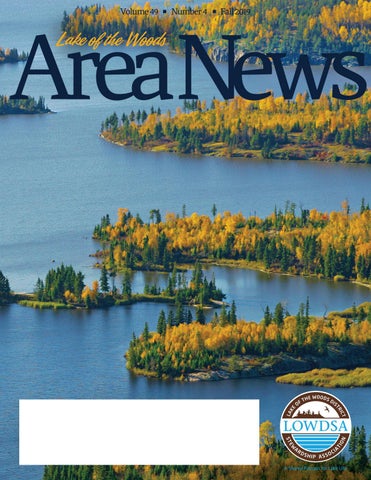
Volume 49
Number 4
Fall 2019
i k a n i M Yurt ADVENTURES TOP TEN LIST
FILE 4379 | MINAKI YURT ADVENTURES | $770,000 10 Surrendering yourself to nature with a hot cup of coffee in your hand.
5 Being inspired by the books you read in front of the masonry wood stove.
9 Sleeping in a structure that resembles a three-tier cake with a delicious surprise on each level.
4 Never really figuring out the direction of the trails but always finding your way home.
8 Telling your favorite campfire story around the fire with the aroma of pizza cooking in the outdoor pizza oven.
3 Skating on your own ice rink that you shoveled.
7 Watching your kids connect with nature instead of the Wi-Fi 6 Following the white and yellow dots on the trails and telling your kids that these lead to an alien space craft.
138 MAIN ST S, KENORA, ONTARIO |
toll free
2 Creating your own Scandinavian identity while enjoying a sauna. 1 Be the next owner and fabricate the life that you have dreamed of.
1.800.528.8848 | INFO@CABINCOUNTRY.COM | WWW.CABINCOUNTRY.COM
advertisement
138 MAIN ST S, KENORA, ONTARIO |
toll free
1.800.528.8848 | INFO@CABINCOUNTRY.COM | WWW.CABINCOUNTRY.COM
FILE 4388 | PIPESTONE POINT | LAKE OF THE WOODS | $299,000
FILE 4393 | LOT 16 FIREROAD 10 GUNDY LAKE ROAD | TANNIS LAKE | $439,000
If you are looking for a water accessible camp that is clean and has all the comforts to get you enjoying the lake, then look no further. There are nice size decks off both the front and back off the cottage with a 20 x 12 sunroom on the front overlooking the lake. Inquire today and start enjoying lake life and the privacy of Pipestone point.
Tannis Lake is located on the west side of Kenora minutes inside the Manitoba/Ontario border. This cottage was originally built in 1970 and offers 864 sq/ft of living space with an additional 216 sq/ft of attached sunroom. The vaulted ceilings in the main living space and the open concept living/dining area make for a nice size living area while taking in a wonderful view of the lake. Tannis Lake has the very best to offer the whole family!
FILE 4366 | LOT 2-50 POPLAR BAY | LAKE OF THE WOODS | $709,000
FILE 4384 | 307 BEAUTY BAY ROAD | BLACK STURGEON LAKE | $499,000
Year-round cottage on Poplar Bay offering 3 bedrooms and 2 bathrooms. This lowprofile lot has eastern exposure and good water depths at the dock with a small sand beach. Enjoy the clear water of Poplar Bay and explore Lake of the Woods from this amazing location with a short car/boat ride to downtown Kenora.
Attention Golfers! This year-round lakefront premium lot/home is located at the Beauty Bay Golf Course and is part of a share purchase agreement with Beauty Bay (Kenora) ltd. Being one of the premium lots on the development, you will find your very own private dock at the shoreline that is not shared and is great to take in some fishing and swimming, giving you a real feel for the resort life in your own backyard.
BRYCE WITHERSPOON, BBA
GRAHAM CHAZE
CHRISTOPHER CLARK
DUSTIN SHORE
broker of record
broker
broker
appraisal consultant aic candidate member
807.407.5253 graham@cabincountry.com
807.466.8819 chris@cabincountry.com
807.407.3211 dustin@cabincountry.com
807.468.3541 bryce@cabincountry.com
BUILDING DREAM S
In this Issue 5
Cover photo by Tom Thomson
LOWDSA
President’s Message
5
Executive Director’s Note Our Contributors Photo Submission
6
61
7 8
Cottage Show Survey
9
LOWDSA members ask…
Treading Wisely: Losing the Dark
10
Building Cedar Strip Kayaks: Part 2
Notes from Razberry Lane: The Kete Squash: Myth & Reality
14 18
Land trusts and the Nature Conservancy of Canada 23 Road Wars?
28
70
26
42
Boating in the Fall by Marianne & Rod Nuttall
In The District
Morson stories wanted for book
28
BSLPOA members keep up Thatcher Road 29
44
Environment
Blindfold Lake Tramway continues to serve boaters 30
Lake of the Woods Water Sustainability Foundation
What’s happening at your lake next summer? 31
LakeSmart 2019
32
Far Away from the Restless World by Shauna DeGagné
36
Waterways beg to be Explored by Dave Schwartz
63 64
Member Recipe: Life's Interests and Family Memories 67
MNRF, cottagers and resort owners tackle Turtle Portage’s future 13 Summer memories & highlights
61
Cottage Winter Shutdown Checklist
Coast Guard and LOWDSA discuss lake navigation 11
Government Notes
Home & Cottage
48
LakeSmart Highlights
LOWDKids!
Exploring the Wonder of the Fall Leaves 70 Kat the Nature Dog: Chippy the Chipmunk
74 44
LakeSmart team members: learning and informing 52 Engaging Canada’s First Nations Communities at the World’s Freshwater Laboratory 56 We’ve been invaded by dock spiders! 57
72
Services
Classifieds
74
Real Estate Listings 51
68
76
Home & Cottage Services Advertisers’ Directory
78
79
80
The Economy of Blueberries by Lori Nelson
Septic Systems: microbes we should nurture 58
Lake of the Woods District Stewardship Association
LOWDSA
3
Dedicated to Lakefront Property
Ian Carmichael
Broker of Record Cell 807-466-2236
807-467-2323 1-888-954-2323
lakeofthewoods.net
carmichaelrealestate@lakeofthewoods.net
Like us on Facebook
For over 25 years the Carmichael name has been helping families buy and sell waterfront properties in the lake of the Woods Vacation area, also known as Sunset Country. Kenora and surrounding area is a very special place. The waters are calming, the views are stunning and the people who share this passion are exceptional. I have been advising clients on their Real Estate needs for over 20 years. I know the area and the market. Every client is unique and deserves personal, professional service. Call me directly for assistance and qualified experience at 807-466-2236.
Incredible private point boasts over 4 acres of titled lands having 1152 ft of shoreline
Landmark Estate! 6.5 acres, 16 total BR’s, Amazing grounds
Main cottage, guest , boathouse, beach & amazing views!
Absolute Perfection! Amazing leisure home, multiple structures & boathouse
Private Point
Treaty Island
Private Island
Storm Bay Road
55 acres. The only site on a private lake!! 3000 sq ft home & guest
Competely remodeled year round cottage. 2150 sq ft, 4 BR, 2 baths & 2 garages
South facing private palace, 6000 deluxe sf - 3 levels
80.9 dynamic acres with approx. 8448 ft frontage, 3 BR cottage beside beach
King Lake
Storm Bay Road
Eagles Nest Poplar Bay
Private Island Retreat
Extremely private with 62 acres & 3 cottage near Crow Rock
Low profile lands with beach; 1080 sq ft main cabin, guest & boathouse
Private Acreage
Rush Bay
Inquire LOTW
$1,599,000
$899,000 LOTW
$2,450,000 LOTW
$1,250,000 LOTW
$519,000 LOTW
Affordable island getaway! 900 sq ft log cottage, workshop/Bunkie & beach
$2,150,000 LOTW
$1,195,000 LOTW
$2,095,000 LOTW
$1,150,000 LOTW
1240 sq ft modern cottage & 2 guest cabins
Private Island near Brule Point
Winnipeg River
Varying profiles & views. Quiet private location.
Low profile vacant lot, owned docking, great views!
$325,000 LOTW
$309,000
Corkscrew Island $144,900 LOTW
French Narrows $305,000 LOTW
Winnipeg River $195,000
5 Point Island Subdivision
Starting at $159,000 +HST LOTW
President’s Message HARDY BOCK, LOWDSA PRESIDENT This summer’s weather has been wonderful and the sunsets spectacular. As summer nears its end, I realize how quickly it all has flown by. As a child, summer seemed to last forever. Someone once told me that at age 10, time moves at 10 miles an hour. At age 60, it accelerates to 60 miles an hour, but sadly, our physical speed does not. I hope that some of you made it to the Matiowski Farmers' Market this summer. It’s a great place to meet friends and pick up some wonderful produce, baking, crafts and art pieces. Typically, the LOWDSA team and LakeSmart crew are on the move and on the lake, but market day is the one day each week you will know exactly where to find them to ask your questions and find out what they have been up to. I was pleased to attend both LOWDSA summer meetings in July, along with several of your directors in each location, Kenora and Morson. Attendees in both communities had the opportunity to hear Ontario Ministry of Indigenous Affairs negotiators, Dianne Woods and Zachary Gutfreund, explain the negotiation process for First Nations flooding claims and to ask questions following their presentation. Thanks to Dianne and Zach for attending; the opportunity to ask questions faceto-face was appreciated. If you missed the presentation, the Area News summer 2019 issue had an excellent article detailing the history and background of these claims. In Kenora, the LOWDSA meeting was followed by a public workshop held by the IJC International Rainy-Lake of the Woods Watershed Board to assist in developing recommendations for water quality ecosystem health Objectives and Alerts (advisory triggers) for the watershed. We are fortunate to have such a motivated and concerned group of individuals studying this complex ecosystem, and in turn, they were very impressed with the level of knowledge and quality of input provided by LOWDSA members. I would encourage all of us to become better informed and involved in preserving our watershed. The LOWDSA meeting in Morson was followed by the Ministry of Natural Resources and Forestry (MNRF) public discussion and consultation regarding the Turtle Portage Marine Railway system. MNRF supervisor, Abby Anderson, provided a history of the system and the challenges identified by MNRF in maintaining a safe and user-friendly system, information that can be found in earlier issues of Area News. The meeting allowed for frank discussion and identification of issues and concerns from various perspectives. Within minutes of the meeting ending, it was encouraging to see that a working group of concerned residents was taking shape. Given their knowledge and commitment, I am optimistic that a workable solution will be found. This is a very complex issue, and along with the three directors present I greatly appreciated the opportunity to meet with the concerned residents face-to-face.
This was my first visit to Morson and the south end of Lake of the Woods. It was a very interesting experience and the history of the area and the lighthouse were highlights for me. Thanks to Laurie Pentney, a former LOWDSA board member, for hosting us and introducing us to the area and the people of Morson. The coffee and homemade cookies and treats on our arrival were greatly appreciated! While most of us headed home right after the meetings, LakeSmart team member, Reed Cupeiro, and your executive director, Diane Schwartz-Williams, stayed on for two more days. Thanks to suggestions from members and Jason Coreau, one of your directors who cottages in the area, Reed and Diane were able to cover some key roads and delivered over 80 dock kits. My trip to Morson introduced me to a very different and beautiful part of the watershed. I hope to visit there again and get out on the water next time. In the meantime, it will rank high on my list of special summer memories to revisit in the months coming up when I am away from the lake. Thanks to Diane and Shelley and the LakeSmart team for making the summer meetings so successful. I am very fortunate to be surrounded by a great group of people. Now relax, find a shady spot, turn the page and enjoy another great edition of your Area News!
Lake of the Woods District Stewardship Association
LOWDSA
5
Executive Director’s Note DIANE SCHWARTZ-WILLIAMS
Four months ago, almost to the day, I wrote this note for the summer issue, full of anticipation and eager to bring on our summer events, programs and to meet with LOWDSA members face to face. As summer winds down, it’s time to write another note. Again I’m eager for the season ahead because fall is perhaps my favourite season. That eagerness is tempered with a little regret as I reflect on a busy, enjoyable, energizing and rewarding summer. Each event, visit and moment spent with members put memories, achievements and images to the huge mosaic, LOWDSA Summer 2019. (Page 18.) To say LOWDSA’s summer programs were a team effort is a huge understatement. What we achieved required a hands-on group of volunteers—and we had that—including your board of directors. Your directors answered the all-hands-on-deck call for seedling distribution day and again for metal waste collection day. Several directors and president, Hardy Bock, attended the summer meeting in Kenora, and three directors and president travelled to Morson for a second summer meeting. As well as helping at events, the directors provided feedback and suggestions as we rolled out our summer programs, and even came out several times to meet with visitors at our booth at the Kenora farmers’ market.
Beyond that valuable contribution, the commitment, energy, passion and knowledge of four LOWDSA staff made LOWDSA Summer 2019 memorable. Krista Robertson, Reed Cupeiro and Myles King (LakeSmart team) and Shelley Bujold, your assistant executive director (pictured left with Diane Schwartz-Williams), made a cohesive, effective team that worked hard and enthusiastically. It’s my pleasure to thank them on behalf of association members. They expanded the scope of dock visits, improved the dock kit content, created new resource materials, broadened the audience for LakeSmart presentations, and brought new ideas to the table. What they did will impact beyond this summer. Shelley jumped in with both feet for her first summer with LOWDSA. She was my right hand, and sometimes left one too. I asked what the summer was like for her. “Not only have I had a chance to meet a lot of members and see a lot of friendly faces at the markets, learning from the LakeSmart students all about what they do every day on the water has been wonderful. It truly is a vital program! Leadership with Diane and the board has made for a very successful summer season. And of course, our summer programs like the IISD-ELA tours have been fantastic, not just for me, but for the excited members and friends who participated.” A busy summer is over, but Shelley and I will not be slowing down yet. Member renewal time approaches; and it’s not too early to think about next summer.
The official publication of the Lake of the Woods District Stewardship Association
PUBLISHED BY
DISTRIBUTION & MEMBERSHIP
Wake Marketing Inc. 140 Main St. S., Kenora, ON P9N 1S9 Phone: (807) 407-7252
Lake of the Woods Area News is published five times per year and is mailed to LOWDSA members. To receive Area News visit lowdsa.com and become a member today.
Publisher: Mike Greaves, mike@areanewsmagazine.ca Editor: Elsie Neufeld, editor@areanewsmagazine.ca Art Director: Shayla Smith, shayla@wakemarketing.ca Design & Layout: Mike Newton, Ashley Pereira Advertising: Mike Greaves, Deb Polakoff
Publication mail agreement #43107013. Printed in Canada.
UPCOMING EDITORIAL DEADLINES: Early Spring (February): January 6, 2020 Spring (April): March 3, 2020
© 2019 LOWDSA. All rights reserved. The contents of this publication may not be reproduced by any means, in whole or in part, without prior written consent. Statements of fact or opinion are the responsibility of the author and may not represent the view of LOWDSA or Wake Marketing Inc.
6
LOWDSA
Lake of the Woods Area News Fall 2019
Our Contributors Robert Bulman
Shauna DeGagné lives in Kenora with her husband, Chris, and their three boys. In this issue, Shauna wrote about Claus Zindel and was delighted to visit him and his wife at their cottage on Split Rock. “Claus is a gem,” she said. “His love of the lake and the outdoors is genuine and infectious.”
Phil Burke Phil Burns Cecil Burns Reed Cupeiro Leanne Fournier Jim Hulagrocki
Marianne and Rod Nuttall are avid sailors and have been teaching boating safety courses to local boaters since the program was first introduced in 1999.
Myles King Jack McKenzie Drew Monkman Nature Conservancy of Canada Lori Nelson Elsie Neufeld Marianne & Rod Nuttall Raymond Oakes Henry & Anita Rasmussen
Rosemary Robertson is a Lake of the Woods “lifer”. As a happily retired teacher, she still adores learning and education. She was formerly an Environmental Coordinator for LOWDSA. Living the dream on Coney Island year round, she is an adamant proponent of our collective responsibility to preserve the natural environment. She is enjoying the absolute best job ever, grandparenting nine kiddos with her husband Jim.
Krista Robertson Jacob Rodenburg Rob Rummery Dave Schwartz Diane Schwartz-Williams Greg Seitz Todd Sellers Dilber Yunus
LAKE OF THE WOODS DISTRICT STEWARDSHIP ASSOCIATION Executive Committee
Board Members
Staff
Contact
PRESIDENT Hardy Bock, Black Sturgeon
Chris Boult, Mackies Island Dave Christie, Granite Lake Garth Collier, Ottermere/ Schnarr Lake Jason Coreau, Big Traverse Bay Carley Fyke, Welcome Channel Anneke Gillis, Paddy Lake Jean Anne Hallas, Lily Pad Bay Lucas King, Woodchuck Bay Trevor Templeton, Minaki John Waterer, Clearwater Bay
EXECUTIVE DIRECTOR Diane Schwartz-Williams (807) 543-4287 diane@lowdsa.com
P.O. Box 1160 Kenora, ON P9N 3X7
VICE PRESIDENT & TREASURER Christine Semenchuk, Storm Bay PAST PRESIDENT Nancy Salmijarvi, Welcome Channel DIRECTOR Don Parfitt, Winnipeg River
ASSISTANT EXECUTIVE DIRECTOR Shelley Bujold (807) 468-8715 shelley@lowdsa.com
EMAIL info@lowdsa.com
M LOWDistrictStewardshipAssoc N @lowdsaLakeTime P @lowdsa TOLL-FREE 1-888-265-9784 PHONE (807) 468-8715
Lake of the Woods District Stewardship Association
LOWDSA
7
Photo Submission Clara dives in for an evening swim. Submitted by Angela Baskerville, Clara’s mother.
We’d like to hear from you! Help us continue making this magazine great. Send us your comments, suggestions, pictures and story ideas: editor@areanewsmagazine.ca.
Digital Editions
!
Free with your LOWDSA membership Read Area News wherever you are! Access this issue as well as all previous issues since 2016.
Sign up for eNews Keep up to date on LOWDSA news & events
Visit lowdsa.com to view digital editions & login online! We enjoy your phone calls, emails and letters, and our member online community gives you one more way to stay informed, up-to-date and: Access your member profile
Contribute to the EISP Fund
Renew your membership
Purchase a gift membership
Register for events
Sign up for eNews
Email shelley@lowdsa.com or call (807) 468-8715 or 1-888-265-9784.
lowdsa.com 8
LOWDSA
N @lowdsaLakeTime
Lake of the Woods Area News Fall 2019
There’s always plenty going on with your association and sometimes getting updates and info out to you in a timely manner does not fit into our Area News publishing schedule. That’s where LOWDSA’s eNews fills the gap. Our eNews is sent periodically (but not too often) and includes breaking news that may be time sensitive, important reminders, event updates, and useful links. Three ways to sign up for eNews: • Email shelley@lowdsa.com, • Call 807-468-8715 or 1-888-265-9784, • Login & update your profile at lowdsa.com Problems with login? Call or email us!
M LOWDistrictStewardshipAssoc
Cottage Show Survey What you tell us will make a difference! The Lake of the Woods Cottage Show is a long-standing tradition for your association. While it has grown and changed over the years, there is always room for improvement. We are taking a hard look at the show format and need to know what you think. Please take a minute to complete this very short survey (email us your response) or fill out online at surveymonkey.com/r/FDQSQZX.
4. The show is traditionally held on the first Monday in May. This timing is being reviewed. Check all options that you like.
1. Did you attend the 2019 Cottage Show on May 6 in Winnipeg?
m Hold on another weekday
m Yes m No
m Other (please specify) ________________________________
2. If yes, for what reasons did you attend? Check all that apply. m To attend info sessions
5. The show typically runs from 1 – 7 p.m. and is followed by the AGM at 7 p.m. Please check any or all options that you like.
m To check out exhibits and products
m Maintain the timing without any change
m To attend AGM
m Hold the AGM at 1:30 p.m. with the Cottage Show to follow
m Do not change; continue on the first Monday in May. m Move to later in May or early June m Hold on a weekend
from 2:30 p.m. – 8:30 p.m.
m To learn about protecting and preserving the watershed m Other (please specify) ________________________________
3. If you did not attend, why not? Check all that apply to you.
m Hold the AGM and Cottage Show on two different dates m Other (please specify) _______________________________
6. Do you have any other comments you would like to share?
m Location not convenient for me m Timing did not work for me
_________________________________________________________
m Not interested m Other (please specify) _________________________________
Reliable Monitoring
Reliable Backup
OmniMetrix 24/7/365 monitoring of backup generator
Generac standby generator with a 5-year warranty
(807) 468-8813 | bowmanelectric.com | 1025 Railway St., Kenora
Lake of the Woods District Stewardship Association
LOWDSA
9
LOWDSA members ask… Q. We have a cottage on Longbow Lake. I see the phosphorus levels have been on average around 18 over the last few years. We don’t drink the water but phosphorus levels would be good as I monitor loons and am seeing a decline in young. I’ll sign up for the Lake Partner Program and see how I can help. I have never seen an algae bloom here and don’t want to, but am more and more concerned about it. I am interested in bacterial content too, so any help on how I test for this would be great. —Janet B.
Q. We are property owners on Lake of the Woods and wonder what the regulations are regarding a swim dock anchored in front of our cottage. How far out and what placement is allowed? Thanks for any information you can provide. —Sherri J.
A. If you were to sign up to participate in the Lake Partner program, that would definitely give you access to the phosphorus levels. There is of course a chance that someone on your lake is already participating so those levels may be on record. Here is the link for more information about the Lake Partner program, how to sign up and how to access results for your lake: foca.on.ca/lake-partner-program-overview
A. What seemed a fairly simple question turned out to have an answer that was anything but simple. We first checked with the Ministry of Natural Resources and Forestry (MNRF) and they referred us to Ontario Regulation 161/17 under Section 21.1 (Occupation for specified purposes) of the Public Lands Act, which states: Swim rafts, etc. 14. A person is authorized to occupy public lands under section 21.1 of the Act for the purpose of erecting, placing or using a swim raft near waterfront property only if the following conditions are met: 1. In any given year, the raft shall not be placed in the water before the ice breaks up in the spring and shall be removed from the water before November 1. 2. The person owns or occupies the waterfront property.
We checked with the Ontario Ministry of Environment, Conservation and Parks (MECP) and they advised that they typically only conduct sampling associated with algae blooms or responding to an incident.
The swim raft should be placed directly in front of the person’s property. The regulation does not specify a distance, but should not be out far enough so as to impede boat traffic.
The Northwestern Health Unit will provide bottles for bacterial sampling for drinking water purposes. For testing beyond that MECP staff indicated you would have to contact a private lab for a quote, bottles, sampling methodologies and the parameters you want analyzed i.e. metals, nutrients, general chemistry etc., which can get quite expensive. MECP also noted that you can’t make any determination from one lab sample on the water quality of an entire lake and the samples would have to be compared to Ontario’s standards to try and put them into context.
MNRF then directed us to Transport Canada, Navigable Waters Protection Program (NWPP), for information on any size restrictions, and this is where the answer became more complex. The Navigation Protection Program is responsible for the administration of the Navigation Protection Act, which prohibits the construction or placement of any “works” in a navigable waterway listed in the schedule to the Act that may interfere with the public right to navigation without first obtaining authorization from NWPP. A work is defined as any structure device, or thing, temporary or permanent, made or placed by humans. The official response from NWPP indicated that “a swimming platform clearly meets the definition of a ‘work’, and therefore the Act would apply to the placement of a swimming platform in Lake of the Woods. The owner of the raft is required to submit a ‘Notice of Work’ and receive approval prior to placing the raft in the water.” We were referred to tc.gc.ca/eng/programs-624. html for guidance material and the “Notice of Work” form. an
10
LOWDSA
Lake of the Woods Area News Fall 2019
Coast Guard and LOWDSA discuss lake navigation BY JACK MCKENZIE
In 2002, following five years of meetings of a committee led by LOWDPOA, new navigation charts were published covering the entire Lake of the Woods. This effort saw a detailed review of each and every navigation aid on the lake. Many were removed and numerous new ones added. The results brought the lake charts up to current Canadian Coast Guard standards, even though many involved did not agree with the deletions. The expectation was that the review committee would continue to meet regularly with the Coast Guard, looking at comments from the boating community and making adjustments as necessary. Following a meeting in 2004, the idea of a regular review meeting fell off the rails. Individuals retired and faces changed. Fast forward to 2019 and concerns raised by number of association members prompted a June 21 meeting in Kenora. The Coast Guard was represented by two individuals from southern Ontario and your association by myself, John Waterer (LOWDSA director), Bob Akman (LOWDSA member) and Diane Schwartz Williams (LOWDSA executive director). The meeting looked at the Mud Portage site and the number of accidents surrounding that channel. The Coast Guard representatives had attended the site prior to the meeting so were well versed on the problem. Following constructive debate on what and what not to do in an attempt to improve the site, it was generally agreed that an additional green Buoy be added at the north end of the channel. It was hoped that this addition might steer boaters into the correct channel.
The Coast Guard officials promised to study the site and see what could be done, if anything, to better warn boaters off the rocks. The meeting then moved to the placement of a buoy at the south end of the Devil's Gap channel, buoy #M13. A detailed discussion on the history of the area and the reasons for what is there today concluded that the present marking was the best for the site and boaters just had to pay more attention in reading their charts. At the same time, it was pointed out to the Coast Guard that there used to be a flashing navigation lite at the south end of the channel, but that it had been turned off for reasons that no longer applied. The Coast Guard was asked to look into either re-activating the fixed lite or replacing it with a floating lite. The meeting next turned to a rock on the side of the channel at the east end of Wolf Island, chart #6218. It was noted that the Coast Guard had located a green buoy there at one time, but high
Your Project Is Our Passion
FALCON LAKE, MB
204-349-2294 www.lumberone.ca
We have since heard that the additional buoy has been put in place and hopefully will improve the situation. The meeting next turned to a concern many had with respect to aids currently in position on chart #6217 at a site known as Moss Point. This hazard was currently marked by buoy #WB1. Discussion followed as to what might be done to improve the site. The committee discussed changing the marking to an Isolated Danger Buoy or a Cardinal Buoy, without reaching a conclusion of what was best for the site.
Lake of the Woods District Stewardship Association
LOWDSA
11
LOWDSA Director John Waterer (left) and member Jack McKenzie (centre) review lake charts and placement of navigational aids with Coast Guard representative.
The request to the Coast Guard is that they remove this “marker” so novice boaters have a better chance of staying where they belong.
waters had washed it out and it had never been replaced. Again, the Coast Guard promised to look into the site and get back to us. Aylmer Point—the end of Thompson Island on Chart #6218—was next on the agenda. Long time residents on the lake will recall the days of tugs pulling log booms into the mills at Kenora. The tugs had their own set of navigation aids that comprised mainly of fixed concrete markers on rocks with arrows similar to one way street signs, mounted on them. When the tugs and their log booms were removed from the lake, the arrows were removed as well, however in some areas, the concrete bases, many painted white, were left in place. One such concrete base remains to this day, on a rock off Aylmer Point and to the novice boater who is not familiar with the area, tends to act as a magnet to draw them off the proper route and on to rocks located between Wild Cat and Thompson Islands.
If boaters refer to the last edition of the old charts, chart #6212, they will note markings showing “Beacons in line” at Queer Island. It was pointed out that the Coast Guard representatives who were involved on the committee that produced the current navigation charts, that the Coast Guard had asked the committee for permission to remove the beacons. It was agreed at the time that they could be removed if a new set were established in the general area so boaters could understand how they worked. The said navigation aids are still in position although no longer marked on the charts. The Coast Guard was asked to either attend to the maintenance of the current fixed aids or replace them as originally promised. It was pointed out that the U.S. navigation chart of the south end of the lake contained two detailed inserts, one that dealt with the entry into the harbour at Warroad, Minnesota and the second, the entry into the Rainy River from the lake. The request was that both of the inserts be added to lake chart #6211 so boaters using that chart when navigating that portion of the lake would have this added aid. And finally, it was pointed out that all the depths shown on the charts were based upon a lake elevation reading of 1,059 feet. The question asked of the Coast Guard officials was what site was used in setting this reading? Was it 1,059 feet at Warroad or 1,059 feet at Kenora? When factoring in the wind tides on the lake, the difference can be easily 8 to 10 inches. Not much when we have years of higher water—such as the current year—however in can mean a great deal when navigating when the lake level is on the low side. Hopefully we’ll hear from the Coast Guard on some of our questions so we can let readers know. If any of our members have local concerns about boating hazards they feel should be addressed, please take a moment to put your thoughts down on paper and send them along to Diane. She will make sure they are on the agenda the next time we sit down with Coast Guard officials. an
12
LOWDSA
Lake of the Woods Area News Fall 2019
MNRF, cottagers and resort owners tackle Turtle Portage’s future BY ELSIE NEUFELD The future of the Turtle Portage Marine Railway is an issue that goes beyond the scope of the Ministry of Natural Resources and Forestry (MNRF) and should involve other departments. This seemed to be the conclusion reached by the attendees at two MNRF public meetings held this summer, one in Morson on July 15 and another in Sioux Narrows on August 14. The meetings hosted by MNRF stated that MNRF has no money available to upgrade, maintain and operate the marine railway and asked the interested people to express their concerns about the closing and explore other ways to keep the system working. The 75 or so cottage and resort owners who attended the meetings made it clear that they want the boat transfer system kept open and were organizing to advocate to achieve that. They are exploring ideas and options on how to do this, including operating the portage independently under a land use permit. In these early stages of organizing, no options are off the table MNRF intended to decommission the railway this year but postponed the decommissioning for one year while it called for proposals from interested bodies to take over the boat transfer system. “If there is a private company or organization that wants to take it over, we want to hear from you,” said Brian Kilgour, Kenora district manager, addressing the group of 15 individuals at the Sioux Narrows meeting. The Turtle Portage marine railway links Sabaskong Bay and Whitefish Bay and costs MNRF $25,000 to operate per year for the last three years and is expected to increase. It also needs upgrades. An independent engineering firm evaluated and assessed the system’s design, operation and safety. Its report stated that basic upgrades will cost $70,000 and a deluxe upgrades, making the system safer and more user-friendly will cost $200,000.
James Williams from the Kenora District MNRF office, presented MNRF’s position and, along with other MNRF staff, fielded questions and comments.
“I know a lot of my friends would come over it, if they knew it worked,” said one cottage owner. “All this talk is about the cost of the system. What about the benefits, the tourism and economic benefits? No one knows,” said one attendee. The economic benefits to tourism in the area have not been studied. Tourism is a major economic force in the Lake of the Woods area. Provincial ministries of tourism, northern development, and Indigenous affairs and relevant federal departments should be in on this discussion, participants agreed. From the meeting in Morson, where 50 interested people attended, a group to advocate for the future of the marine railway started to take shape. At the Sioux Narrows meeting, others agreed to support the group to explore alternative funding, and operating models, to keep the boat transfer system operating. The Turtle Portage is a traditional portage route used by the Indigenous people for hundreds of years. In the 1950s, the federal department of public works started to develop to for motorboats. Eventually it was blasted into an open channel with a lock system during the 60s and 70s. In the 1980s, a lock system was installed to mitigate the degradation of the trout habitat. It wasn’t effective, and the channel was closed in 1992 and a roller system went in. The present marine railway was installed in 2000 when MNRF had larger budgets and more staff.
Water access systems is not a line item in MNRF’s budget anymore, said James Williams, an integrated resource management technical specialist with Kenora MNRF.
The age of the structure, misuse, vandalism and the remote location all add to increased service costs. In past years, the ministry was able to find funds to cover the costs but now there is no money to be found. Other ways of maintaining and operating this boat transfer system, and others, must be found or they will be closed. Some of them have been taken over by individuals or associations.
Last year, MNRF put a counter on the system and found that it was used 479 times, $104.38 per round trip or $52 one-way.
“Thank you for holding the meeting in the summer when we can attend, instead of in February,” said one cottager.
Attendees said last year was not a good year to take the count. The MNRF’s threat to decommission it and the operating difficulties discouraged people from even trying to use it. It was said that MNRF should count the people who turn up but leave because the system isn’t working, or those who want to use the system but won’t use it because of its difficulties.
Also, James Williams thanked LOWDSA for getting the information about the meetings out to cottagers and others. (Two other meetings were planned for Kenora, September 14, and Nestor Falls, September 18, too late for our deadline.) an
Lake of the Woods District Stewardship Association
LOWDSA
13
Government Notes Your directors and staff communicate regularly with representatives of a number of ministries and departments at all levels of government. Whether communicating via email, talking on the phone or meeting in person, we enjoy positive working relationships including collaboration in some instances. This makes it possible for us to access and share government bulletins in a timely manner, and open lines of communication often allow us to go directly to the source with questions on your behalf. BY DIANE SCHWARTZ-WILLIAMS
Federal Navigational aids review LOWDSA contacted the Canadian Coast Guard in May about concerns raised by a number of members regarding navigational aid placements and related boating hazards. Our expectation for a written response was surpassed. The Aids to Navigation (AtoN) team planned to be in the Kenora area at the end of June and meet with us. Details of that meeting with Director John Waterer, Executive Director Diane Schwartz-Williams and two members, Jack McKenzie and Bob Akman, in attendance are covered in an article on page 11. It has been some time since the association met on a regular basis with the Coast Guard, and this is a practice we intend to resume. We are working with our Coast Guard contacts to schedule regular, annual meetings and encourage you to share any concerns about boating hazards with us so we can take them forward for review and resolution. Email info@lowdsa.com or phone 1-807-468-8715.
Federal and Provincial Four-laning Highway 17 update As of mid-August, there is no official update to the information we published previously in the Area News. There have been a number of reports in the media over the past few months, sometimes with conflicting details, but we continue to refer to Ministry of Transportation Ontario (MTO) for any updates we share. Recent communication with the MTO confirmed that the plans and schedules as posted online in November 2018 at 4lanehighway17kenora.ca remain unchanged. A preferred route for this section was identified in November 2018 online and at an open meeting in Kenora with 30-day period opened for public review and comments. Upon completion of the preliminary design for Section 1, MTO will prepare a Transportation Environmental Study Report (TESR) to be filed for a 30-day public review period. Based on information shared
14
LOWDSA
Lake of the Woods Area News Fall 2019
at the November meeting we expected to see this TESR filed in early spring 2019, but it has not yet been released and we have no indication of when it might be. This step in the process is important and must be completed before MTO can tender a construction contract for Section 1. Future work includes reviewing and selecting a preferred route between Highway 673 and Kenora. A public information centre (PIC) for Section 2 from Highway 673 to Rush Bay Road was initially expected late summer or the fall 2019, but we expect this may be delayed. A PIC for Section 3 from Rush Bay Road to Kenora is anticipated in winter or spring of 2020 with the start of construction work beyond 2022. We have received a number of inquiries about the status of plans for twinning the Trans-Canada between Falcon Lake and the Ontario/Manitoba border. After making our own inquiries and with the help of some LOWDSA members we received confirmation that Manitoba Infrastructure staff have been in contact with their Ontario counterparts regarding connecting the proposed four-lane Trans-Canada Highway (TCH) to the Manitoba four-lane at the weigh scale. The intent is to four-lane this short section in conjunction with Ontario, however the Manitoba piece of this project has not yet been approved. We were advised that no commitments have been made to-date regarding completion of the twinning between Falcon Lake and the border. If you have comments, suggestions or questions for the ministry and consultant, or simply want to be added to the study mailing list, email project-team@4LaneHighway17Kenora.ca. Full contact info including mailing addresses are available online.
Provincial Proposed decommissioning of Turtle Portage—public consultation
Lake of the Woods Flooding Claims
Public consultation took place July 15 at the Morson Community Hall and August 14 in Sioux Narrows. A report on the meetings is included on page 13.
Flooding: Reserve land was unlawfully taken or damaged from the construction of hydroelectric power facilities, dams, river diversions etc. Contact: LOTWFloodingClaim@Ontario.ca 416-326-4755
March 29, 2019
4
Representatives of the Ontario Ministry of Indigenous Affairs were on hand at the 2019 Cottage Show to share information and answer questions about land claims in the Lake of the Woods area currently in negotiation and public consultation. They also were on hand to give presentations and answer questions at LOWDSA summer meetings in Kenora and Morson Information provided by the ministry is posted at lowdsa.com/news
Land Claims in the Lake of the Woods Area Animakee Wa Zhing #37 TLE Claim Treaty Land Entitlement (TLE): The First Nation did not receive the proper quantity of land according to the relevant treaty. Contact: AWZTLE@ontario.ca or (416) 326-4381 Obashkaandagaang Garden Islands Claim Boundary: The current boundaries of a reserve are incorrect. Contact: OFNGardenIslands@ontario.ca or (416) 327-9582 At time of writing, two public information sessions are scheduled in Kenora on Saturday, August 31 at 2:00 - 4:00 p.m. and 6:00 – 8:00 p.m. Each session will include a presentation providing details of the Garden Islands boundary claim with a question period to follow.
Lake of the Woods District Stewardship Association
LOWDSA
15
Minaki Conservancy members and LOWDSA executive director Diane Schwartz-Williams tour Kenora Forest site harvested over 20 years earlier with Kurt Pochailo, Miisun and Charlotte Caron, MNRF.
Whiskey Jack Forest & Kenora Forest Annual Work Schedule (2019-2020) available for review
Access to MNRF forest management planning process Several LOWDSA members, staff and friends took a first-hand look at the results of forest harvest and regeneration process over a 20-year span. Two tours were arranged with a MNRF forest planner and Miisun Integrated Forest Management Company LLC., one by Minaki Conservancy in the Minaki area and another by LOWDSA in the Rush Bay–Shoal Lake area. The tours included a detailed packet of the forest planning and cutting process. Four conifer and broad leaf forest sites at different stages of regrowth post harvesting were toured including new harvest, natural regeneration, new plant and a plant from 2000. To keep informed: efmp.lrc.gov.on.ca/eFMP/home.do To get involved: files.ontario.ca/ involvement_handbook_final_english
The approved April 1, 2019 – March 31, 2020 Annual Work Schedule (AWS) for the Whiskey Jack Forest and the Kenora Forest is available at the MNRF Kenora District Office, Miisun Integrated Resource Management Company on behalf of the MNRF, and the Ontario government website at ontario.ca/forestplans and will remain so for the one-year duration of the AWS. The AWS describes forest operations such as road construction, maintenance and decommissioning, forestry aggregate pits, harvest, site preparation, tree planting and tending that are scheduled to occur during the year. The notices and maps are posted at lowdsa.com/articles and facebook.com/LOWDistrictStewardshipAssoc.
Municipal & Unincorporated The City of Kenora’s Environmental Advisory Committee has approved a draft Declaration of a Climate Emergency, which was presented at the August 13 council meeting. Kenora City Council will vote on the final draft of the declaration at its regular council meeting on September 17. an
“Useful tips on navigating the eFMP (electronic forest management plan) website” guide is available by contacting LOWDSA: info@lowdsa.com or (807) 468-8715
How many LOWDSA members in your family? Membership makes a great gift! Whether a graduation, first home, or birthday celebration… give the gift of LOWDSA membership to your adult children and grandchildren and share the benefits of being informed and educated about lake life!
16
LOWDSA
Lake of the Woods Area News Fall 2019
Easy to order! Login online at lowdsa.com or call 1-888-265-9784. You can also order by mail. See page 29 for details, or contact info@lowdsa.com or (807) 468-8715.
RBC Dominion Securities Inc.
In every walk with nature one receives far more than he seeks. – John Muir
The Darcy Zaporzan Wealth Management Group of RBC Dominion Securities www.dzwmg.com
The DARCY
Zaporzan W E A LT H M A N A G E M E N T G R O U P
of RBC Dominion Securities RBC Dominion Securities Inc.* and Royal Bank of Canada are separate corporate entities which are affiliated. *Member-Canadian Investor Protection Fund. RBC Dominion Securities Inc. is a member company of RBC Wealth Management, a business segment of Royal Bank of Canada. ® / ™ Trademark(s) of Royal Bank of Canada. Used under licence. ©2019 RBC Dominion Securities Inc. All rights reserved. 19_90783_N4D_001
Summer memories & highlights We could easily have filled several pages of this magazine with photos of LOWDSA events, activities and members that we spent time with this summer. Our calendar was a busy one from late June until the end of August. From summer member meetings to metal waste drop-off, IISD-ELA tours to storm drain stencilling, Matiowski Farmers’ Market to lake association events, and of course, hundreds of LakeSmart dock visits—we were on the go all across the district. Here is just a glimpse at another great summer at the lake with LOWDSA members and friends. PHOTOS BY JOHN BALDWIN, SHELLEY BUJOLD, REED CUPEIRO, MYLES KING, KRISTA ROBERTSON AND DIANE SCHWARTZ-WILLIAMS
Welcome back LakeSmart!
At the Matiowski Farmers’ Market
LakeSmart team ready to get on the water for 2019 season. (l-r) Reed Cupeiro, Krista Robertson, Myles King.
On the left, LOWDSA Director Chris Semenchuk (r) was on hand at the market with Krista and Myles. Right, Myles answers questions for a young audience interested in learning about invasive species.
Black Sturgeon Dock Visit The LakeSmart team made hundreds of dock visits, including one to LOWDSA President Hardy Bock’s cottage on Black Sturgeon. (l-r) Krista, Hardy, Myles, Reed.
Purple Loosestrife No sign of purple loosestrife blooms in area where beetles released in 2017! Looking closer, evidence of beetle activity can be seen in a 2018 release area.
18
LOWDSA
Lake of the Woods Area News Fall 2019
Day Camp
IISD-ELA Tours
Krista (l) and Myles (r) demonstrate how what we do on the land affects our watershed using the Enviroscape Watershed Model. Members of the LakeSmart team are frequent visitors and guest presenters at day camps in Kenora and on the lake.
Three exceptional day tours to IISD Experimental Lakes Area. Over 85 LOWDSA members and friends explore, learn and enjoy the amazing environment that is the IISD-Experimental Lake Area during the three full day tours organized by LOWDSA.
Learn at the Lake at Zig Zag Yacht Club LOWDSA Executive Director Diane Schwartz-Williams talks to Zig Zag Yacht Club members about highway twinning. Photo: Ivy Namaka, ZZYC.
Morson Dock Visits
Forest Tour
LOWDSA staff visited Morson and the south end of Lake of the Woods for meetings and dock visits. Executive Director Diane Schwartz-Williams met with Mike and Shirley Keen (bottom left) where the team stopped to look at weeds and reeds filling the bay. LOWDSA staff takes a timeout (bottom right) to explore the Pentney lighthouse in Morson with former LOWDSA Directory, Laurie Pentney.
Minaki Conservancy & LOWDSA members observed the process of forest harvest and regeneration over a 20-year span during a forest tour arranged by Minaki Conservancy, guided by Miisun and MNRF staff.
Lake of the Woods District Stewardship Association
LOWDSA
19
Storm Drain Stencilling
Checking out Invasive Flowering Rush in Minaki
The LakeSmart team and the MNRF Kenora based Stewardship Youth Rangers join forces to paint stencils by more than 50 storm drains in Keewatin. The message, “A healthy lake starts here”, was painted as a reminder that we need to keep things like soap from washing cars, fertilizers, and oils out of storm drains so that we keep it out of our lakes. A second group of storm drains were marked with the same message by the Kenora Recreation Centre’s day campers and the LakeSmart team.
A boat ride with Minaki Conservancy members gave LOWDSA and MNRF representatives an idea of the aggressive growth of flowering rush, an invasive species. The expanse of flowering rush on Minaki area lakes and the Winnipeg River has to be seen to believed, long stretches of shoreline covered with dense growth, bays filled and some passages closed with growth too thick to navigate through by boat. It is important to learn how to manage this invasive species that is choking out aquatic habitats, altering lake ecosystems and impacting fish stocks. Above, LOWDSA and Minaki Conservancy member, David Hewlett (L) shows Peter Hettinga from Ministry of Natural Resources and Forestry (MNRF) the area’s flowering rush infestation. Below, what used to be open waterway between two islands is now completely blocked by flowering rush and not navigable for boat traffic.
Free Metal Waste Collection Day LOWDSA’s 5th annual metal waste collection day moves to a new location for 2019— in Keewatin at the public dock adjacent to Beatty Park. The assortment of metal items dropped off was as diverse as ever, with final weights not yet available.
Ottermere AGM LOWDSA Executive Director Diane Schwartz-Williams joins Ottermere Lake Association members for their AGM at the Ottermere train station, and as if on cue a train rolled through just as the meeting was wrapping up. Part of the unique experience of being at Ottermere was walking along the track built by members to transport supplies and even boats across the portage.
20
LOWDSA
Lake of the Woods Area News Fall 2019
NEW
UR WHEN YO
ENEW ON
CONTACT INFORMATION
LINE
Name _________________________________________________________
AUTO-RENEW OPTION NOW AVAILABLE
Address _______________________________________________________
LOGIN to renew or call/email for details.
Please tell us a little about yourself for your confidential member profile.
City _______________________ State/Prov _________________________ Country _______________________ Postal/Zip ______________________ What you include here will help us better understand who our members are. This info will only be used by LOWDSA and will not be shared.
YES, email LOWDSA eNews (updates between issues of Area News) YES, send my renewal notice by email YES, email LOWDKids in the Wild notices and events
EMAIL ____________________________________________ Please do not print my name in the membership listing in the June issue of Lake of the Woods Area News. Please tell us how you enjoy the Lake of the Woods area. Check all that apply: Owned my own property in the Lake of the Woods area for ________ years. Part owner of a shared/family property for ________ years. Not a property owner; enjoyed Lake of the Woods area for ______ years as a camper sailor renter other: ______________________ When are you at the lake? Summer Only Permanent Part-time year round
Home Phone ____________________________ Cottage Phone ___________________________ Mobile Phone ___________________________ Please indicate where you cottage or you spend most of your time in the Lake of the Woods area (please select one only): Clearwater Bay area Kenora area Minaki area Morson area Sioux Narrows-Nestor Falls area Other_________________________________ What location would you like included with your name in the membership listing published annually in Area News? ___________________________________________
Your Age Range (check one): under 21 21-30 31-40 41-60 61-70 over 70
2019/2020 MEMBERSHIP Full Membership (Magazine Mailed) One Year Two Year
$50 $ ________ $100 $ ________
Virtual Membership (Digital Magazine) One Year Two Year
$42 $ ________ $84 $ ________
Seedlings (see right) $ ________ Gift membership (see right) $ ________ Donation Environmental Initiatives & Special Projects Fund $ ________ I will not be renewing my membership because: ____________________________________________
GIFT MEMBERSHIP Full Membership ($50 ea.) Virtual Membership ($42 ea.) Name ______________________________________ Address ____________________________________ City ______________________ State/Prov. ______ Country _______________ Postal/Zip __________ Email ______________________________________ Phone _____________________________________ Please send recipient a gift card with message: _________________________________________ _________________________________________
TOTAL AMOUNT DUE . . . . . . . . . . . . . . . . . . . . . . . . . . .. . . . . . . . . $ ________
PAYMENT OPTIONS Online: LOGIN at lowdsa.com to renew. By Cheque: Please make payable to LOWDSA. Visa
Mastercard
Amount $ ________(Cdn.)
Card # _______________________________________ Name on card ___________________________________________ Expiry date (mm/yy) ______ / ______
CVC (3 or 4 digits on back of card ) ______ (REQUIRED)
Mail completed form to Box 1160, Kenora, Ontario, P9N 3X7 or scan and email completed form to shelley@lowdsa.com. Questions? (807) 468-8715 or 1-888-265-9784
22
LOWDSA
Lake of the Woods Area News Fall 2019
Land trusts and the Nature Conservancy of Canada The Rainy Lake to Lake of the Woods Natural Area is the largest NCC’s priority areas in Ontario, spanning approximately 1.8 million hectares (4.5 million acres) and containing over 16,000 islands. BY THE NATURE CONSERVANCY OF CANADA (NCC)
When you think of land conservation you probably think of national or provincial parks like Banff or Algonquin. And it is true. For many years, conservation meant the designation of a specific piece of land as a park by government agencies.
most important natural areas and the species they sustain. NCC uses the best available conservation science to guide their planning, land securement and land management activities. Since 1962 NCC and its partners have helped to protect more than 1.1 million hectares (2.8 million acres) coast to coast.
Not so much anymore.
NCC has been working in Ontario since its inception. The non-profit’s first project was Cavan Swamp, just west of Peterborough, protected in 1969. NCC works in communities across the province, from Ottawa Valley in the east to the shores of Lake Huron in the west, and to Pelee Island in the south all the way north to Lake Superior and Rainy Lake and Lake of the Woods. With the help of its partners, NCC has protected more than 82,000 hectares (200,000 acres) in Ontario.
In a changing, growing world, ensuring that natural heritage is protected for future generations has become much more fluid and innovative. Enter land trusts. Land trusts are non-profit, charitable organizations, which acquire land or interests in land (like conservation easements) for the purpose of conservation. The hallmark of a land trust is the direct action they take to protect the local land base, and that they hold those lands or conservation easements in trust for future generations. Often this can be boiled down into one simple mission—purchase or solicit donations of private land and protect it forever. Private land owners have three options when working with land trusts—enter into a conservation agreement, sell their land or donate it. The Ecological Gifts Program (EGP) administered by Environment and Climate Change Canada has an important role to play in this process as well. Since 1995, the EGP has become a valuable tool in conserving threatened habitats and biodiversity. As a partnership among landowners, conservation organizations and government, it provides favourable income tax treatment for land or conservation easement donations, and greater recognition of the value of individual conservation actions. Land donors ensure permanent conservation and stewardship of their lands, while receiving a tax receipt for the fair market value of the gift. Land trusts and conservancies can be local, provincial, regional or even national. Most land trusts focus on conserving the biological values of land, but across the continent land trusts have been established to protect scenic, historical, agricultural and recreational lands as well. The Nature Conservancy of Canada (NCC) is one such organization. NCC is the nation’s leading not-for-profit private land conservation organization, working to protect Canada’s
NCC is: • Guided by the best available conservation science • Works in a non-confrontational manner • Manages lands and waters for their natural values • Respects and promotes nature’s own processes • Recognizes the need for people to sustain themselves and live productively, while conserving our country`s natural habitats and species One of the reasons that NCC is so effective in land conservation is the organization’s planning process. Firmly rooted in conservation science, staff take a landscape-scale approach to conservation across the country, carving it into priority natural areas. These are areas that have the most at-risk species, face the greatest risk of development and contain fragments of yet undeveloped habitat. The Rainy Lake to Lake of the Woods Natural Area is the largest of NCC’s priority areas in Ontario, spanning approximately 1.8 million hectares (4.5 million acres) and containing over 16,000 islands. This is a wilderness area defined by its vast and largely undisturbed ecosystems. Home to lakes, rivers and wetlands,
Lake of the Woods District Stewardship Association
LOWDSA
23
the area boasts a high diversity of species. The mature forest and undeveloped islands include core habitats for many wideranging mammals and bird species.
the American white pelican, lake sturgeon and the bald eagle. It is no wonder that this region of Ontario has been identified as a priority for conservation.
The biodiversity values found here are incredible, and the area contains many species that are nationally and provincially rare. Boreal Jack pine stands and maple swamps with southern Ontario characteristics occur next to prairie habitats supporting American badger and brittle prickly-pear, and stands of eastern white pine are found at the western limit of their range. Vast, pristine lakes and wetlands support such significant species as
For more information on land trusts in the Rainy Lake– Lake of the Woods area: natureconservancy.ca or contact gary.davies@natureconservancy.ca an
LOWDSA & Nature Conservancy Canada: In partnership Partnerships are essential to successful conservation, and the Lake of the Woods District Stewardship Association and Nature Conservancy Canada have established the groundwork for such a partnership. The two organizations have been working together informally on a number of fronts for a few years now. NCC is a familiar returning exhibitor at the Lake of the Woods Cottage Show each year, fellow participant at the annual Rainy –Lake of the Woods Watershed Forum and one of our 2019 LakeSmart sponsors. Representatives of LOWDSA and NCC met in May 2019 to discuss several aspects of land acquisition
24
LOWDSA
Lake of the Woods Area News Fall 2019
and trust in the Rainy Lake–Lake of the Woods area for presentation to the LOWDSA board. The board consensus was that the association does not have the resources, neither financial nor human, to create our own land trust but that a limited partnership with Nature Conservancy of Canada would be of interest and beneficial to our members. This article is our first step forward with this new partnership. Look for more information on land trusts and LOWDSA–NCC partnership initiatives in future issues of the Area News, on our website and in social media posts.
SNAKE BAY, LOW - $925,000
SNAKE BAY, LOW - $749,000
CLEARWATER BAY, LOW - $835,000
THE HADES, LOW - $699,000
BLACK STURGEON LAKE - $595,000
SNAKE BAY, LOW - $495,000
WINNIPEG RIVER - $490,000
PISTOL LAKE - $429,900
WINNIPEG RIVER - $329,000
REGINA BAY, LOW - $315,000
SNAKE BAY, LOW - $310,000
LONG BAY, LOW - $285,000
Lake of the Woods, Kenora w
w
w .
g
r
e
g
k
i
r
b
y .
c
GREG KIRBY BROKER
807-466-8266 sold@gregkirby.ca
a
Independently owned and operated
Road Wars? BY RAYMOND P. OAKES, B.A., LL.B. Being a good neighbour at the cottage is a valuable part of the wonderful experience we seek at our “get-away” seasonal homes. Too often, though, the shared use of a road or driveway becomes a problematic issue, sometimes resulting in the blocking of access unless there are registered easements or “Road Board” or Crown land authority over the road. The law in Ontario is different than the law in Manitoba on this issue. In Manitoba, The Prescription Act of 1832 and common law can establish a “Prescriptive Easement” to protect access where the owner has acquiesced for a period of 20 years to the movement across his or her land. These prescriptive rights are “overriding interests” which do not have to appear on the title in order to bind the owners to continue to permit access. In Ontario, rights of adverse possession and prescriptive easement for titles under the Land Titles system are specifically excluded by Section 51 of The Land Titles Act. The only protection for such access easements is for “old-system” lands that are titles under the old registry system. If the easement was acquired for 20 years without interruption (with acquiesce and not written consent) prior to conversion to the Land Titles system, then that claim may be preserved if it still existed on the date it was placed in Land titles—the PIN creation date. Most properties are now registered under the Land Titles system (are no longer Registry titles) and so this protection of easements in Ontario will soon be of historical interest to legal minds. There is also legislation in Ontario that, on first examination, would serve to protect this type of access usage. The Ontario Road Access Act was intended to allow parties with vested interests, that is, in need of access, to pass over the road without being trespassers, and to not be subject to road closures without a court hearing.
However, a relatively recent Court of Appeal decision in 992275 Ontario Inc. v. Krowczyk has rendered the Act mostly unusable. The Court seems to have considered the Act to be too intrusive into the rights of the person owning the land. Lawyers already have not been recommending applications under this statute for a long time given its uncertainty, but this case seems to have “shut the door” on any case for protecting access. Unfortunately, we have seen many situations where neighbours are restricting access on a cottage road that has carried on for decades, resulting in the adjacent owner being forced to build a road over elevated grades, swamps or rendering a property boat access only—or no access at all. Buyers of cottage properties should ask their lawyer to carefully investigate access arrangements for their new title. Title insurance with an “access endorsement” may be a worthwhile investment as the title insurance company will pay to acquire access or compensate the policy owner if access is blocked. It may be too optimistic to hope that everyone will get along in their Sunset Country paradise, so be prepared. an
Community based since 1971. 1666 Hwy 17 W | Keewatin, ON
|
P0X 1C0 | 807.547.3366
Make it better ™
A functional feature for your cottage Providing much more than just privacy, interior doors can freshen up your space, add style and character while adding value to your home.
Shop online, pick-up in store or get it delivered. Visit us at mcmunnandyates.com!
26
LOWDSA
Lake of the Woods Area News Fall 2019
HUGE ESTATE LOTS 2 TO 3.5 ACRES
KENORA KEEWATIN
CONEY ISLAND
TREATY ISLAND
SHRAGGES ISLAND
Oneida Lakeshore Estates Build Your Dream, Create Your Legacy
24 premium lots in a unique island development. 10 minutes from Kenora & 3 minutes from the Royal L.O.W. Yacht Club Early bird pricing and financing available.
oneidalakeshore.ca • (204) 795-9200 • oneidaisland@gmail.com
Morson stories wanted for book BY NANCY MILLER, MORSON HISTORY BOOK
The Morson History Book collection started in the early 1980s with JoAnn (Dalseg) Moen and a few longtime residents of the community including the late Lorraine (Moen) Almers and Leonard Treflin. Their goal was to capture history of both past and present people that lived in Morson and Minahico, both villages located in Morson Township. JoAnn and Lorraine mailed questionnaires to current and former residents asking them about their lives while living there, where they lived and any stories they may want to share. JoAnn and Leonard visited with several longtime residents and recorded interviews on cassette tapes. JoAnn researched articles, stories and obituaries from books and past newspapers and kept a record of the happenings in the community in scrapbooks. One goal was to capture life for residents in Morson back before Highway 621 reached Morson and boat or ice travel was necessary for transportation of goods and tourists. The late Ernie Calvert is credited for starting
tourism on Lake of the Woods in the 1910s and the first to have a tourist camp business in the Morson area. JoAnn was given family histories and photos in the form of letters, some causing transcription confusion as they just refer to a parent as Mom or Dad without a name. In late 2015, JoAnn and Nancy Miller started a concerted effort to combine these old stories and current stories into book form. Together with the help of members of the Morson Women’s Institute, they set forth a strategy to move forward with the collection. A Facebook page and brochures were created. Facebook has helped generate interest with photos and stories shared via this platform. Book submissions will be accepted until a deadline is published on the Facebook page with a big push for stories to be submitted summer 2019. You can find us under Morson Book. The book committee is working to complete the list of past and present businesses and continues to accept personal stories while completing this work. The book includes events, information about the schools and teachers, past and present organizations, building projects, telephone, hydro, township councils, and family stories. The current plan is to publish the book in the spring of 2020. Before printing, the book pricing will be set, and orders can be submitted. Anyone having stories and photos related to the Morson area for the book can email morsonbook@gmail.com. an
The photo was the July 1st celebration taken in 1932 with the Dalseg Store in Morson in the background.
28
In the District
Lake of the Woods Area News Fall 2019
BSLPOA members keep up Thatcher Road PHOTOS COURTESY OF MARNIE AND TED MELNYK On June 15, sixteen Black Sturgeon Lake Property Owners Association (BSLPOA) volunteers gave up a beautiful morning to fix up potholes, level ruts, clear brush and remove trees to maintain Thatcher Road to the boat launch on lower Black Sturgeon Lake. Laurence Maksymetz, with the help of Bill Scurfield, brought his tractor to assist in the work. Steve Garrett organized a barbecue BBQ and especially to the others who gave up their morning on the lake to help maintain the road. Afterwards, a barbecue at the landing celebrated a good day of work.
Back row (l to r): Jacob Micflikier, Mike Hermann, Steve Garrett, Laurence Maksymetz (on tractor), Glenn Woods, Brian Woods (visitor), John Lebtag, Ed Pitre, Bill Scurfield, Ted Melnyk, Trudy Provis, Peter Provis, Jim Quinn. Front (l to r): Marnie Melnyk, Roy Houston, Phil Burns
“It’s always great to get out and meet your neighbours while helping the community,” said Phil Burns, BSLPOA president. Next year will likely see a bigger need for volunteers and equipment, Burns predicted. Let you be warned. For more information on BSLPOA visit: blacksturgeonlakepoa.com.
Lake of the Woods District Stewardship Association
In the District
29
Blindfold Lake Tramway continues to serve boaters SUBMITTED BY ROB RUMMERY PHOTOS BY CHRIS SEMENCHUK The Blindfold Lake Tramway is a boat transfer system, which has been in place since the early 60s when the Blindfold Lake dam was built at the rapids where Blindfold Lake empties into Route Bay in the north east corner of the Lake of the Woods. Until that time, boaters were able to rope craft up through the rapids. The design is similar to the Turtle Portage Marine Railway with a cart attached to a central winch by a steel cable. The cart is winched up an incline from either lake onto a flat where it is pushed to the far side and let down the far incline under the control of a foot brake. This system operates efficiently for boats up to 17 ft with 75 hp motors. In the late 90s the residents of Blindfold Lake were informed that MNR would no longer maintain the tramway and that the system would be removed unless a group of residents was willing to take on the responsibility of maintaining the tram system. At that point the Blindfold Lake Cottagers Association was formed with the sole intention of maintaining the tramway.
30
In the District
Lake of the Woods Area News Fall 2019
The only officer is a treasurer who is responsible for maintaining the bank account and paying the bills. Donations are solicited from all property owners on a regular basis. Funds raised are used to pay for cable replacement, winch, tramcar, and rail repair. Over the last two decades volunteers amongst the cottage owners and resorts on the lake replaced and repaired the dock on the Lake of the Woods side, repaired and rebuilt the winch and pulley system. The cart wheels are greased weekly during the heavy-use month of June and on a less regular basis after that. If there is no major misuse, the cable will last two years before having to be replaced.
What’s happening at your lake next summer? Over the past few months we’ve shared an assortment of event notices for lake associations and organizations in the Area News, on our website, on Facebook, Twitter and Instagram— AGMs and seminars, barbecues, dances, regattas, association anniversary celebrations and special publications. It has been a busy summer and lots of fun across the entire Lake of the Woods district.
In general there have been two major causes of damage to the tramway. The first is user carelessness/abuse. People have neglected to use the foot brake while the unit is descending the slope, causing the cable to snap once there is no more slack. Sometimes boaters will tie their boat to the cart, which can cause the cart to float off the rails. The next users have to get in the water and lift the cart back onto the rails. This is a cold job in May and June. The cart had to undergo major repairs one year when someone managed to jam the cart between the tracks and supports in the water on the Blindfold side, while trying to launch a boat using the tram.
Although lake activities are slowing down now for this year, we know that many groups are already giving some thought to plans for Summer 2020. As those plans come together, be sure to let us know so that we can help spread the word, perhaps first with a ‘save the date’ notice to be followed with details when available. We’ll be ready to swing into action and talk up your event(s) in the Area News, on our website, and on Facebook and Twitter too. Contact us at info@lowdsa.com or 807-468-8715.
The second major source of problems is the Storm Bay Road, which crosses the rails. We have had to pay Docks and Lifts to replace rails, when they have been bent by trucks hauling heavy equipment trailers which snag the rails. Until about five years ago our people had to clean a half-ton truckload of sand from the rail bed each spring after the winter’s sanding of the steep hill on one side of the tramway. Thankfully, the Storm Bay Roads Board has taken over the responsibility for that task. The road salt that is a part of the winter sand mixture accumulates on the rail bed as the snowplow dumps snow over the course of the winter. When these piles melt in the spring, the salt causes the concrete to flake, which results in potholes appearing on the surface. Over the years the concrete surface has become soft and very uneven. an
Boat launches, landings, rollers, lifts, marine railways… What do you use? We are interested in learning more about docks, landings, and/or boat transfer systems are used by our members. To tell us about what you use on your lake email info@lowdsa.com and/or editor@areanewsmagazine.ca or call 807-543-4287.
On August 7, six swimmers did a 2.5 km open water swim in lower Black Sturgeon Lake. For over 10 years, a group of 6 to 10 swimmers from the Kenora Borealis Multi-sport Club and friends swim across the dark open water of Black Sturgeon Lake a part of its open water swim schedule. Watched over by spotters in motorboats and kayaks, the swimmers cover the distance in times varying from 43 to 70 minutes. Photo by Elsie Neufeld
Lake of the Woods District Stewardship Association
In the District
31
FAR AWAY FROM
Down by the Lakes at Minaki WORDS AND MUSIC BY WALTER S. YOUNG
Summer each year as vacation time draws near, There’s a wonderful place I wish it were here, ‘Tis a Paradise to see that’s where I long to be Down by the lakes at Minaki
This is a love story. The admired happens to be the Canadian wilderness, in all her glory, while the captivated man happens to come all the way from Germany. See, he’s never met a creature like her before, has only heard tales from friends, so the focus of the journey is anticipation, not the time it takes to reach her. She’s such a mystery to him that he would likely travel even further to get to her.
Down by the lake at Minaki That’s where I long to be, The pines are calling me.
The man is a young Claus Zindel and his journey began in August 1976. The destination—the place that would become the love of his life—was Sand Lake, near Minaki, about 45 kilometers north of Lake of the Woods.
‘Midst scenes and surroundings and lakes that are rare,
“This first trip into the unbelievable beauty of the Canadian wilderness impressed me so much that it had a decisive impact on my future,” said Claus, now 74 years old.
A beautiful spot no place can compare,
Claus was traveling with Otto Weidle, a friend he had made through his father’s textile company, along with Otto’s girlfriend. The trio stayed at the Canadian Wilderness Camp on Harbour Island, a fishing camp run by Wulf Lehnhoff, who had immigrated to Canada from Germany a few years earlier.
I await my vacation with anticipation
You must visit and see, come vacation with me, Down by the lakes at Minaki.
After 10 days at Wulf’s camp, they ventured even further into isolation, boarding a plane that would fly them to an outpost camp at Nic Nic Lake. “I will never forget the moment when the plane left and we were by ourselves, in the middle of nowhere,” Claus said. “Those couple of weeks in total seclusion in the stillness of nature, far away from
32
In the District
Lake of the Woods Area News Fall 2019
by Shauna DeGagné
THE RESTLESS WORLD Photos courtesy of Claus Zindel
the restless world, would captivate me for the rest of my life. I had fallen in love with this country, its—as it appeared to me— untouched wilderness, its wideness, its breathtaking beauty.”
Otto was just as enamoured as Claus, and a few years later, Otto bought land on Harbour Island, right around the corner from Wulf’s camp. Otto convinced other friends in the textile business in Germany to do the same, and eventually, Claus agreed, purchasing a lot he had never set eyes on.
“He told a lot of adventurous stories about Canada,” Claus said of Otto’s attempts to persuade friends to buy land near Minaki. “I think within one year, all the lots that were for sale… they were gone.” Things got serious after that. In relationship terms, they were committed men. In 1979, Claus and Otto, along with another friend, built Otto’s log cabin on Harbour Island. The following year, in May of 1980, Claus and Otto again traveled to Canada, this time with a crew of German friends—Friedel Kreuzberg, Ernst Schindler, and Karl Schmidtmeier—with the intention of completing a log cottage for Claus. Luckily, Wulf, now a friend of Claus and Otto’s, had built the foundation and the stone chimney before the men arrived, so they quickly got to work on the walls and the roof. They worked hard for two weeks, but weren’t able to finish the job, so Wulf would go on to complete the cottage as well.
“At the same time, two other log cottages were built next to my place which were also owned by Germans: the Minks and the Werthmann families,” Claus recalled. “Two other families from my home country bought older cottages at that time, around the corner, where the shining, red A-framed cottages of the Canadian Wilderness Camp offered a beautiful sight at the west end of the wide bay.” Claus refers to this section of Harbour Island as “Pala Point,” a name that hints at the history of the land and how it had been used decades before the German families began arriving. (See note, next page.) In 1981, with all the cabins built, the Zindels, the Weidels, the Minks, and the Werthmanns, enjoyed their first summer together. “Through all the years, we celebrated a close friendship and had much fun,” Claus said. “More and more, I fell in love with the simple way of life.”
Top: Undated, Claus drives a boat. Middle: Claus Zindel in 2019. a friend from Germany, Bottom: Claus and Karl Schmidtmeier, cottage. “A huge Jack the to up haul a rustic-style, heavy chair lled. "Karl cut it into reca s Clau m," pine had come down in a stor it. They even had backrests." pieces and chain-sawed chairs out of
For about a decade, Claus, along with his wife Monique and their son, enjoyed cottage life every summer with like-minded friends. But sometimes, even in love, things change. Eventually, Claus explained, the constant company “became a bit too much” for him and he purchased a four-acre island not too far from his original cottage. “Without hesitation, I bought the island that would become my ‘refuge for the soul,’ he said.
Lake of the Woods District Stewardship Association
In the District
33
PALA HISTORY etic and Literary P.A.L.A. stood for Presbyterian Athl doors to guests its ed open p cam the Association, and Minaki was to on July 1, 1916, long before the road way’s (C.N.R.) Rail l iona Nat constructed. The Canadian ular route pop a me beca ly tual “Camper Special” even for those heading to PAL A. owned by a group In the early days, PAL A Camp was ager John Smith, cott of shareholders, according to then . and was run by a Mr. Huggins
In 1988, Wulf introduced Claus to Dave Schneider and Jane Campbell, who lived on a stationary houseboat near Minaki. “After only one meeting, I asked them to build my cottage on Split Rock, my ‘dream island,’ as I like to call it.” Ken Heshka, a Winnipeg architect and a friend of Dave and Jane’s, designed the cottage, and Dave completed the build in 1990. “I guess it was his first bigger cottage, but he did a very, very good job,” Claus said of Dave’s craftsmanship.
the Winnipeg Free An ad in the July 17, 1933 edition of at Pala” for $2 Pals r You et “Me to Press, invites readers g meals. per day or $24 for two weeks, includin Camp was Ten years later, on June 12, 1943, Pala “Many Scenic tled featured in a Free Press article enti ” and includes ario Ont of Spots Found in Lake Section Camp has Pala p: Cam Pala of a detailed description s are shaded lawn The sts. gue 160 for s tion accommoda indulge in a or read , by tall trees and here one may rest piano, radio with hall on eati quiet afternoon’s nap. A recr parties. for us ezvo rend a ides prov e and ping-pong tabl beaches, the tennis It goes on to explain the meals, the ng other highlights. courts, and campfire singsongs, amo YMCA in March 1949. The camp was sold to the Winnipeg
Right: Summer 1979 on Harbour Island. Claus and friends from Germany work on Otto Weidle's log cabin.
Claus held onto his original log cabin for a few years so friends from Germany would have a place to stay when visiting him at the lake. Eventually, he sold it to Larry Penner, a Canadian farmer, and his wife Mary-Jean. (The photos in this story are part of a detailed scrapbook that Claus made and gifted to the Penner family.) Today, 40 years after the Canadian wilderness stole his heart, Claus, along with Monique, still makes the trek to Spilt Rock every summer. It’s a 20 hour journey: drive from Ahlen, where they live in Germany, to Münster; fly to Frankfurt; then fly to Toronto or Montreal, which is about eight and a half hours; then fly to Winnipeg; then drive from Winnipeg to Minaki; then boat to the cottage. They enjoy seven weeks together on the island, mostly keeping to themselves and venturing into town only when necessary. Monique enjoys fishing in quiet bays, while Claus spends his time reading, gardening, and taking photos.
Furniture Window Coverings
Creaotuer y Image
Reupholstery Winnipeg Delivery & Install
TEL
34
In the District
1060 Railway Street, Kenora (807)468-3641 TOLL FREE (800)834-8770 imageonehome.com
Lake of the Woods Area News Fall 2019
Remembering Dave Schneider BY CLAUS ZINDEL
Claus enjoys the catch of the day on the
shores of Sand Land.
(In 2010, he published a book of his photography called Refuge for the Soul: Colour and Light in the Canadian Shield. It’s a stunning collection of wildlife, waterways, and all types of weather. The simple dedication reads To the people who built your country.) After the seven weeks, Monique heads back to Germany, leaving Claus alone, usually until mid-October. “The three or four months I spend every year on the island is like medicine for me,” Claus said. “I just feel good. I feel totally happy, each time, when I can live my simple life at the lake. “What more could I want, particularly as I have arrived at an age when there is nothing more important than to enjoy each moment, each day, as if it were the last one in my life? I wish I could live forever… at exactly this heavenly peace on earth, the Sand Lake. “Like 40 years ago, I still feel the same when I merge into the stillness and beauty of nature. This love has never changed. There is a saying: ‘Love to nature is the only love that humans hope doesn’t disappoint.’ That sounds a bit negative to human relationships, but there is a grain of truth in it.” an
When I recall special moments that we spent together, I even refuse to believe what happened to Dave at the end of March. I will never forget the fall of 1990, when a friend of mine, Aleksander Kwiakowski, a painter, spent some time with me on Split Rock. It was Dave who recommended flying out into a certain area, where he used to catch minnows at that time to make a living. That was around the beginning of October. We landed in the deserted wilderness and Dave took care of everything. For instance, when he tied two canoes together, like a catamaran, to make it safer for us. Aleksander was not used to paddling in a shaky canoe. In the evening at the campfire, it started snowing and an icy cold wind blew wet snow in our faces. Dave knew how to escape from this uncomfortable wintry weather, at least a bit: He built a kind of fence around the campfire to protect us from the cold wind and snow, and then made bannock on the campfire. He was good at everything and thoughtful in all kinds of ways. Particularly, this wilderness adventure became unforgettable for me and is still present in my mind as if it had happened only yesterday. My painterfriend was so impressed that he captured the night with Dave at the campfire in an oil painting later on. Besides that, I remember quite a few early mornings, when Dave's plane appeared unexpectedly in a low-level flight above the island, then touched down to pick me up for an early morning flight above Sand Lake and surrounding areas. That was my friend Dave Schneider: Always helpful, always something in his mind to improve our time at the lake. Thank you, Dave. In our hearts, you will live forever.
Lake of the Woods District Stewardship Association
In the District
35
Waterways beg to be Explored
Photos & article by Dave Schwartz
Many of the prettiest sites in our area are best accessed by canoe. This is Scot River Falls, located near the outlet from North Scot Lake on the Scot River.
Everyone must believe in something. I believe I’ll go canoeing. — Henry David Thoreau Me, too! Our area is the perfect place for it. Whether you’re looking to go canoeing for a few hours or a few months, the Canadian Shield is a wonderful place for canoeing enthusiasts. Its many lakes and endless kilometres of rivers and streams are begging to be explored. When you look at our area you might conclude that Mother Nature designed the canoe first and then created the land for it. The suitability of this area for canoe travel is ancient news. For thousands of years before the arrival of Europeans, the indigenous people had used the birchbark canoe to trade, travel, hunt, fish, and gather food. Travel by water is the only practical way to move about this land when it’s not in the icy grip of winter. The landscape prohibits significant cross-country travel on foot except when the lakes, rivers and wetlands are frozen. Many of the area’s most beautiful waterfalls, quiet streams, rock paintings and great fishing spots are best accessed by canoe. Beautiful campsites abound and often you will have an entire lake to yourselves. Get at least one portage away from roads and you will probably have paradise to yourselves. Two portages almost guarantee it.
An hour, day, week or months of travel by canoe can reconnect you with nature and let you enjoy nature in its full glory. We crave experiences with nature. They are good for our bodies and minds and help us to appreciate and understand the importance of protecting the environment and biodiversity. My preference is to seek out smaller lakes, rivers and creeks to avoid the dangers of wind and waves on large stretches of open water. Sticking to smaller waterways also keeps you close to shore, avoiding long, tedious open-water slogs. The riparian zone, the interface between water and land, is where the biodiversity is highest
36
Lake of the Woods Area News Fall 2019
Lining your canoe through an unnavigable rapid is sometimes a welcome option to portaging.
There’s nothing like a beautiful sunset to end a perfect day on the water. That's incentive to camp on an easterly shore of a sizable lake. Masochists and other early risers can catch sunrises by setting up on the western shore.
and where you are most likely to have memorable experiences with wildlife. Even if you happen to be on a large waterbody, the best and safest experiences will be close to the shoreline. Slipping through the water by canoe can be almost silent, dramatically increasing the chance of close viewing of wildlife. If you are going exploring for a few hours or a day, take a look at some maps. Find a water body that you can access easily. A topographical map will tell you if it’s surrounded be magnificent cliffs or if there are potential portages to another lake. You can also look at satellite photographs on Google maps satellite to evaluate possible excursions. Rushing River Provincial Park is a fantastic place to start a canoe trip of any length: hours, days, weeks or months. Friends of Rushing River maintain a number of canoe routes and offer route descriptions. Most of their routes start and finish in the park but one of them originates in Nestor Falls. All are circular routes which simplifies logistics by eliminating the need for car shuttles. The Path of the Paddle Association (POPA) was formed to close the unhikeable gap in the Trans-Canada Trails network between the Manitoba border and Thunder Bay. Canoe routes were the only logical alternative. POPA’s Migisi route to Vermilion Bay follows the Rushing River for much of the route.
There are a number of possible access points along the route at which you can end (or begin) your trip to adjust its length. These include Ethelma Lake, Stewart Lake, the Pines Road (accesses the IISD Experimental Lakes Area research station), and roadaccessible tourist camps west of Vermilion Bay. Of course, you can always backtrack to your starting point to simplify logistics.
I single out the Migisi and Rushing River Parks routes because they are relatively well used and the portages should be clear. Also, they traverse some of the most majestic scenery around. The larger lakes are crystal clear, ringed by magnificent pines and blessed with beaches and flat rock outcroppings for swimming and camping. For the fishing enthusiast, these are mostly trout lakes but there are places to fish for other species, as well.
Lake of the Woods District Stewardship Association
37
Interesting photographs often lurk near the shoreline.
Slipping silently along the shoreline allows you to get up close to wildlife.
The Migisi route continues to Dryden and connects to 1,200 kilometres of Path of the Paddle routes between Kenora and Thunder Bay. Detailed information for the Migisi route is available on the Path of the Paddle website at pathofthepaddleassociation.com. The route follows the Rushing River system and takes you through a chain of beautiful crystal clear lakes including Dogtooth, Kilvert, Gale, Ethelma, Geejay, Manomin, Winnange and the West Arm of Eagle Lake. Most of the portages on this route are relatively short. The exception is the masochist’s delight between Gale Lake and Ethelma, which could be avoided by putting in (or taking out) at Ethelma Lake off the Highland Road.
ranger program and many routes were established, portages were cleared and maps were provided along with route descriptions. Austerity measures have cut into their efforts but some the more popular routes are still fairly well used. The water portions of the routes remain unchanged but some portages may be overgrown or blocked by fallen trees. There is no way of knowing if a particular route can be canoed without concern about portages being impassable without Herculean effort with axe and saw. In a future article I will describe some of the other canoe route opportunities in the area. an
There are many other established canoe routes in this area. Years ago, the Ontario Ministry of Natural Resources had a junior
Providing insurance, protection and advice to Northwestern Ontario since 1897. Find the best coverage & rates for your peace of mind at standardinsurance.ca
38
Lake of the Woods Area News Fall 2019
LISTINGS
|
M A R K E T E VA L U AT I O N S
|
B U Y E R R E P R E S E N TAT I O N
|
R E N TA L S
ROAD
ACCESS
file 3036
file 4150
file 4285
file 4297
JONES RD ACREAGE | BLACK STURGEON $ 539,000
1 LOST LAKE | MINAKI $ 399,000 + HST
MCCALLUM POINT | CLEARWATER BAY $ 1,695,000
ROCKERIES RD | CLEARWATER BAY $ 949,000
file 4320
file 4331
file 4353
file 4357
file 4358
MCCALLUM POINT RD | CLEARWATER BAY $ 925,000
1 OAK DRIVE | LOTW $ 395,000
LOT 16 LILY PAD BAY | LOTW $ 1,095,000
10 FORESTRY BAY | LOTW $ 799,000
938 PETERSON RD | BLACK STURGEON $ 599,000
file 4361
file 4366
file 4367
file 4368
file 4369
26 WORONA BAY | BLACK STURGEON $ 586,700
LOT 2-50 POPLAR BAY | LOTW $ 709,000
LOT 13, 14 WOODCHUCK WAY | LOTW $ 679,000
1807 KENRICIA RD | CLEARWATER BAY $ 1,949,000
10 RAILWAY ST. | MINAKI $ 220,000
file 4370
file 4371
file 4374
file 4377
file 4378
292 STORM BAY RD | LOTW $ 789,000
LOT 1-55 LILY PAD BAY | LOTW $ 785,000
12A LORI LEE BAY | WINNIPEG RIVER $ 609,000
262 WILLIAMS RD | BLACK STURGEON $ 660,000
24 RITCHIE RD | KENORA $ 399,000
file 4379
file 4384
file 4389
file 4390
file 4393
MINAKI YURTS $ 770,000
307 BEAUTY BAY RD | BLACK STURGEON $ 499,000
27 WINNIPEG RIVER DRIVE $ 499,000
634 ESSEX RD | BLACK STURGEON $ 350,000
LOT 16 FR 10 GUNDY LAKE RD | TANNIS LAKE $ 439,000
WATER
ACCESS
file 1945
file 4141
file 4255
file 4312
LOT 3-7 MALACHI LAKE $ 99,000
PTARMIGAN BAY | POPLAR BAY $ 330,000
LOT 25-27 MALACHI LAKE $ 199,000
PROFESSOR ISLAND | LOTW $ 345,000
file 4335
file 4380
file 4381
file 4385
file 4388
2 SCOTTY’S ISLAND | LOTW $ 399,000
560 CONEY ISLAND | LOTW $ 895,000
MUSKIE ISLAND | SIOUX NARROWS $ 2,400,000
156 SLATE ISLAND | LOTW $ 595,000
LOT 22 1635 PIPESTONE POINT | LOTW $ 299,000
file 1903
file 8043
file 8045
VACANT file 8038
LAND
ISLAND G896 | BIGSTONE BAY $ 275,000
file 8048
LOT 1 BIRCHCLIFF ESTATES | BLACK STURGEON LOT 3 BIRCHCLIFF ESTATES | BLACK STURGEON $ $ 279,900 219,000
LK81 MALACHI LAKE $ 99,000
file 8049
file 8050
LOT 7 BIRCHCLIFF ESTATES | BLACK STURGEON LOT 8 BIRCHCLIFF ESTATES | BLACK STURGEON LOT 10 BIRCHCLIFF ESTATES | BLACK STURGEON $ $ $ 210,000 219,000 95,000
file 8054
file 8056
LOT 8 EAGLE SHORE ESTATES $ 119,000
11 GOLD CREEK TRAIL WESTVU DRIVE $ 409,000
file 8057
file 8059
file 8060
file 8061
file 8062
452 CONEY ISLAND | LOTW $ 219,000
PT1 WARD ISLAND | LOTW $ 134,000
TJ2 BEAUTY BAY RD| BLACK STURGEON $ 75,000
EB532 ENA LAKE $ 90,000
927 AUSTIN LAKE ROAD $ 89,000
file 8063 19 SANDSTONE PLACE | KENORA $ 79,000
138 MAIN ST S, KENORA, ON |
toll free
1.800.528.8848 | INFO@CABINCOUNTRY.COM
WWW.CABINCOUNTRY.COM
BOATING
IN THE FALL
BY MARIANNE & ROD NUTTALL
2
Make sure your boat is in good operating condition and that you have all necessary safety equipment. The nights can be cold and the water even colder. The air and water temperatures can be cold at night even if warm during the day.
Boating in the fall can be quite different than the middle of the summer. The air temperatures might be very warm during the day and the fall colours can be spectacular. Or the weather can be cold, wet and gray or even white with snow. Most often we get a bit of both. You need to prepare for any situation that may arrive before heading out on the water. Here are a few things to consider:
1
Fewer people and boaters are out on the water. If you have any problems, warm or cold weather, there may not be anyone else around to help you. • That's why it's imperative to tell someone you trust what your plans are—specifically where you are going and how long you plan to be out. Tell that person that you'll call or text as soon as you get off the water. That way, they'll know if they don't hear from you that it's time to find out where you are, and whether you need help. Be sure that you let them know when you arrive at your destination and have them follow-up if you do not check in when you are supposed to. • This applies any time you are on the water—whether it is travelling to and from you’re your remote cottage location or fishing, hunting etc. (Review the trip planning procedures from your boating safety training and make sure you implement it even if just the informal version). • Have a way of keeping in touch with family or friends if you are living in a remote location and/or travelling in one. A VHF radio, cell phone service or even a satellite phone. Newer technology—includes locator beacons, messengers and trackers. • Make sure your cell phone and VHF radios are fully charged and keep it in a safe place in a sealed plastic bag. • If you have a VHF radio make sure you know of any channels (in addition to channel 16) that local lodges and resorts monitor. They may be monitoring 24 hours a day.
42
Lake of the Woods Area News Fall 2019
• Double-check everything. Before you leave the dock, make sure your boat is in good working condition and run through a complete safety checklist. • Ensure that in-date signal flares, sound-producing devices (horn, bell, whistle), and other safety equipment are on board. • Navigation lights are required to be on between sunset and sunrise, and during periods of restricted visibility (rain, snow, sleet, and fog). Turn the lights on at the first sign of bad weather. • Make sure the battery has a full charge. And keep it charged. The colder it gets, the more prone your boat's batteries are to losing their charge. On that note, if you're out on the water and you shut down the engine and the alternator isn't refreshing the battery, keep your electronics use to a minimum to ensure you have enough juice to get started again. • Be sure that the fuel tank is full.
3
Dress for the water, not the weather
• The old saying for boating in the off-season is to dress for the water, not the weather. Often it feels much colder on the water than it does on land. If it's +5°C/40°F degrees in the backyard, dress like it will be 0°C/32°F on the water. Secondly, water robs the body of heat 25 times faster than air does, and a person immersed in 10°C/50°F water can reach exhaustion in less than 30 minutes. • Wear the proper clothing. It may be chilly out there and boaters should be prepared to get wet even if they don’t plan on going in the water. Layer up with clothes made of synthetic materials so that way any moisture won’t linger. Wear layers with a waterproof and windproof outer layer. • Remember to keep your head, ears, neck, and hands protected. Keep in mind that most body heat loss is from the head. In cooler weather, wear a lined hat or stocking cap to retain heat. Wear gloves. • Pack some clothes in a waterproof bag and keep them on board in case someone in your party gets wet. Stow oversized blankets and tarps on board in a waterproof locker or compartment. • Also consider an insulated float coat, which will keep you warm and serve as a life jacket should you end up in the water.
4
Don’t forget your life jacket/PFD.
• Wearing a life jacket at all times is very important for boating safety in general, but especially in cold weather and/or when you are alone. Be sure to wear a life jacket in case of falling overboard, it will help to keep you afloat so you don’t use energy trying to swim. • While more boating accidents occur during warmer months, a larger number of boating fatalities occur during cold weather months because survival rates drop drastically in cold air and water temperatures.
5
Be prepared with food and drinks.
• It’s a good idea to bring some food (energy bars are a good choice) and an insulated container of a warm beverage. • Leave the alcohol at home. Refrain from bringing alcohol on board and save that for when you’ve safely returned. Boating safely means boating sober. Alcohol thins the blood and opens veins, causing the body to lose more heat.
6
Check local weather forecasts.
• Keep a sharp “weather eye” and head to shore at the first indication of bad weather. • Remember that weather information is also available on marine radios (the “Wx” button).
7
Have knowledge of cold-water immersion.
• Boaters out in cold weather and water have a greater exposure to the elements, which means a higher risk of suffering the effects of cold water immersion from wind-chill, capsizing, or even clothing that becomes damp while on board and possibly leading to hypothermia. • If you aren’t familiar with cold-water survival and hypothermia— please take the time to learn about it before you go out in cold water. • Hypothermia, the accelerated heat loss from the body, can cause death. It rapidly affects the brain and creates a dangerous situation mostly because a person in cold water may not realize they are in danger. Signs of hypothermia include intense shivering, slurred speech, slow pulse, and dilated pupils. Eventually, a hypothermic person will lose consciousness and may drown.
It doesn’t take frigid temperatures to make cold-weather boating dangerous without the proper precautions. Even if the water is over 15°C (60°F), falling in could put you at serious risk for shock and hypothermia. an
Powerful Performance and Natural Beauty NEO 2.5 offers elegant, modern lines and a practical tall profile design with a larger firebox and higher heat output. With no-stoop loading, a large glass door, and simplified air control, the NEO 2.5 is a practical wood stove with Pacific Energy’s clean-burning technology that reduces emissions while maximizing burn length and fuel efficiency. Installation is simplified with leveling legs for uneven surfaces.
204-943-5263 318 LOGAN AVE. LARGE SHOW ROOM FREE CUSTOMER PARKING
NEO 2.5
www.flameandcomfort.com
Lake of the Woods District Stewardship Association
43
Lake of the Woods Water Sustainability Foundation Put a plan in place. Ensure there's enough science and management expertise. Unite and coordinate actions binationally—communities, researchers and policy makers. That’s our vision. BY TODD SELLERS, LOWWSF EXECUTIVE DIRECTOR
I encourage you all to read this article—it's a good overview of our evolving understanding from research on Lake of the Woods into the causes and solutions to the algae blooms. Originally written by Greg Seitz in 2018 for Field Notes -Stories from the St. Croix Watershed Research Station of the Science Museum of Minnesota; it is used here with permission of the SCWRS. — Todd Sellers, LOWWSF Executive Director
Studies of Lake of the Woods show how water can struggle with a legacy of pollution
For much of the twentieth century, paper and lumber mills on the lake’s largest tributary, the Rainy River, dumped hundreds of tons of sawdust and other waste into the water. Cities and septic systems also emptied into the river. The lake was filled with nutrients that still feed blooms of nuisance algae today. The pollution mostly stopped in the 1970s, after Congress passed the Clean Water Act—but problems persist. Algae are poisoning pets, fouling the water, and hurting the region’s lake-based culture and economy. Now, scientists have started to explain why Lake of the Woods can’t get past its past: the nutrients dumped in decades ago have been slow to get buried or flow out. Several years of intensive study by the St. Croix Watershed Research Station and its partners, with funding from the Minnesota Pollution Control Agency, have included deploying monitoring buoys to take constant measurements, extracting cores of mud from its bottom, and creating computer simulations to understand connections between land and water and weather. It has also included bone-jarring boat rides and remote research, as well as head-scratching problems. The questions they seek to answer have big implications for the lake’s future—getting it back to its pre-polluted state could be complicated.
The Green Great Lake Dr. Adam Heathcote boating through a bloom of blue-green algae on Big Traverse Bay. (Courtesy Dr. Mark Edlund)
Spanning the U.S.-Canada border at the northern extremity of Minnesota and the northwestern corner of Ontario, vast Lake of the Woods has a storied relationship with humans: as home, as highway, as getaway. Its waters are full of fish, and its 6,500 miles of shoreline (including 14,000 islands) scattered with docks, beaches, and outposts.
Lake of the Woods is about 70 miles long by 50 miles wide. At 1,600 square miles, it’s larger than the state of Delaware. Its shoreline is longer than Lake Superior (it’s sometimes called the “Sixth Great Lake”). In a sense, it is two lakes—the shallow southern basin where the Rainy River enters, and the northern half, which is rocky, island-studded, and deeper. These facts and other elements of the lake’s unique history, geography, and function are inter-connected, and that makes it hard to restore the water quality.
There are big walleye, northern pike, and sturgeon, endangered piping plovers and terns nesting on islands, and visitors that come from afar and spend tens of millions of dollars in the area each year.
Together, the various forces at work mean the lake is sensitive to changes, with even slight increases in phosphorus in the water having a significant impact on how much algae grow. And the phosphorus that is still flowing into the lake is not easy to reduce.
Lake of the Woods is well-loved, and troubled.
Lastly, algae blooms are not new to Lake of the Woods. Fur traders and early European visitors even made note of it.
44
Environment
Lake of the Woods Area News Fall 2019
In July 1823, Lake of the Woods was described
Because of high nutrient levels and harmful algae resulting from the lake’s increased fertility, Minnesota declared the parts of Lake of the Woods within the state’s borders “impaired” in 2008. The designation kicked off intensive research, which informed a clean-up plan to be released by the Minnesota Pollution Control Agency this year.
as “foul, frequently covered with a green scum of vegetable matter.” In 1850, “always greenish.” In August 1857, the southern basin was described as “tinged with green deriving its colour from a minute vegetable growth, until it gave the appearance to the lake of a vast expanse of dirty green mud.” But yet, the algae are still a problem today. The reasons are “counterintuitive,” according to recent papers by Research Station staff and other scientists published in a special issue of the peerreviewed journal Lake and Reservoir Management.
A Growing Problem
Lake of the Woods spans an international border, but collaborative management efforts, which could be difficult, have been a major part of its past, and will be part of its future. Crossborder partnerships are fostered and coordinated by the Lake of the Woods Water Sustainability Foundation, with partners focused on protection and sustainability of the lake. Understanding the lake’s past and current condition and figuring out what forces affect the water quality are essential to setting clean-up goals and identifying the most effective ways to achieve them. Changes in how phosphorus moves through Lake of the Woods
Heathcote poses with a sediment core extracted through the ice. These tubes of mud provide important insights into historic water quality. (Photo courtesy Mark Edlund)
The lake’s prolific algae can have a big impact on the water and the people who use it. Cyanobacteria, also called blue-green algae, thrive in nutrient-rich waters and produce toxins that can poison pets and people. Dogs have died in recent years after being exposed to the toxins while swimming in the lake.
Lots more nutrients are being buried in the bottom sediments than before humans started to significantly affect the water quality. Some of it can be stirred up and returned to the water when wind and other conditions are right.
Clear and practical advice Providing services in recreational, residential and commercial real estate
W. Randall F. Seller
Stephen R. Lundin
Cheryl C. M. Siran
Beth Allison White
Reid E. Thompson
Kimberly P. Mejia
Phaedra M. Olinyk
rseller@hsllaw.ca
slundin@hsllaw.ca
csiran@hsllaw.ca
bwhite@hsllaw.ca
rthompson@hsllaw.ca
kmejia@hsllaw.ca
polinyk@hsllaw.ca
B.A., LL.B
B.A., LL.B
B.A. (ADV), LL.B
B.H.Ec., LL.B
HOOK SELLER LUNDIN
B.A., LL.B
LLP
BARRISTERS AND SOLICITORS
B.B.A., LL.B
B. Soc. Sc., J.D.
807-468-9831
hsllaw.ca
Lake of the Woods District Stewardship Association
Environment
45
What the researchers found was that the lake has a long history of algae blooms, and that six decades of dumping harmful substances into the water is still affecting the lake as nutrients are released from the bottom sediments. However, more than 40 years after stringent rules to reduce nutrient loading were put in place, the lake is possibly headed toward a new “steady state”—but that stable condition might not ever look quite like it did before being polluted. That’s because while the amount of phosphorus flowing into Lake of the Woods has been drastically reduced, the algae have not followed suit and can reach levels similar to what they were in the pollution hey-day of the 1960s.
Why Is It Worse? Cyanobacteria are always present in lakes. One of the oldest groups of organisms on Earth, they can survive a broad array of conditions. But when it is warm, sunny, and there are lots of nutrients in the water, their population can explode in what’s called a “bloom.” That’s when blue-green algae become a poisonous problem. Their toxins can harm skin, kidney, lung, and brain functions. Reducing the nutrients should reduce the algae, according to the same logic. But, forty years after turning off the faucet of pollution on the Rainy River, there’s been plenty of phosphorus to fuel algae blooms in Lake of the Woods.
Mark Edlund captured this picture of a rough return trip in a boat piloted by Jordan Donatell of the Minnesota Pollution Control Agency.
There are a few reasons for that, and they are complex and connected to each other. First, a lot of the nutrients from the decades of dumping have stayed in sediments on the bottom of the lake. This means they don’t stay suspended in the water and flow out of the lake at Kenora, Ontario, headed for Lake Winnipeg. In many lakes, those nutrients would be quickly buried in the mud, unavailable for growing algae. But not in Lake of the Woods, especially the vast southern basin. That’s because of the second factor is that a big expanse of water is subject to lots of winds and waves. Ask anyone who has fished the lake, or the scientists who study it. They have to plan trips with a close eye on the weather forecast, and have still been caught in rough conditions, with bruised tail bones and seasickness to show for it.
ADVICE YOU CAN TRUST, SERVICE YOU CAN COUNT ON Star Building Materials offers everyone the same expert advice Manitoba home builders and contractors have relied on for decades. We have Manitoba’s largest lumber yard, state of the art truss design and manufacturing equipment, a full service saw shop, and retail store with the tools and hardware you need to get the job done. Fast and affordable delivery to all of Manitoba and Northwestern Ontario 16 Speers Road - corner of Lagimodière Boulevard and Maginot Street Winnipeg: 204-233-8687 Toll Free: 1-888-782-7974 WWW.STARBUILDING.CA
46
Environment
Lake of the Woods Area News Fall 2019
Sea sick yet? Big waves don’t just make boating hard on bodies. If the water isn’t too deep, swells also stir up the bottom. This means nutrients are frequently returned to the water when the wind energy reaches the bottom sediments. In other words, the lake is still paying for the sins of its past
Southern Lake of the Woods, seen from Baudette, Minnesota. (Photo by Greg Seitz)
Where To From Here
It may not just be a phosphorus problem.
The upside of the phosphorus being returned to the water from the sediments is that the nutrients can ultimately flow north and out of the lake through the Winnipeg River. It takes one to two years for water to move through Lake of the Woods, a relatively fast pace.
Monitoring by the research station has uncovered another twist in the story: In most lakes in the Upper Midwest, the amount of algae that grows is limited by how much phosphorus is available. But in Lake of the Woods, nitrogen may be the key factor during the summer and fall seasons.
That is also why it appears the lake is headed for a new normal. The historic phosphorus is dwindling, and soon enough, there won’t be as much available in the sediments to get stirred up.
Cyanobacteria can take advantage of this. Some of these harmful organisms can overcome nitrogen limitation by getting it from atmospheric sources, taking the upper hand on other types of algae.
But other forces are at work.
This means that focusing only on managing phosphorus may not fully address the lake’s algae woes.
Climate is one of them. Thanks to shorter winters and frozen conditions, the growing season for algae is almost a month longer than fifty years ago in some parts of the lake. Less obvious is that climate change-connected shifts in wind and precipitation patterns could affect how nutrients move from the sediments to the water. Changes to how the lake’s water mixes together and moves nutrients upward, increases in the amount of nutrients that settle in the sediments but find their way back to the water, and a stronger divide in the lake between warmer, oxygen-rich upper waters and colder, low-oxygen waters on the bottom all play a part in Lake of the Woods’ unique and complicated behaviour.
And finally, there is the fact that the southern bays of Lake of the Woods have probably always been prone to algae blooms. By better understanding this history, the many people who want to keep the lake clean and healthy can set realistic goals and get to work meeting them. an
Our Board and Staff EXECUTIVE DIRECTOR Todd Sellers – Minaki, ON
BOARD OF DIRECTORS Tony Stephens – Toronto, ON Richard Sjoberg – Thief River Falls, MN Jim Dagg – Thief River Falls, MN Joan Richardson – Winnipeg, MB Bruce Ormiston – Kenora, ON Don Konantz – Vancouver, BC Art McKenzie – Sioux Narrows, ON Polly Craik – Winnipeg, MB
INTERNATIONAL WATERSHED COORDINATOR Kelli Saunders – Kenora, ON
CUSTOM DESIGN BUILDERS H O M E S , C O T TA G E S , G U E S T H O U S E S & B U N K I E S
R E L AT I O N S H I P S
•
SERVICE
•
VA LU E
• Enjoy Your Cottage Sooner Our Indoor Construction allows for 50% Decrease in Design and Build Time • All Inclusive Design Build Services Taking Your Vision from Design to Building to Furnishing! • Guaranteed Fixed Contract Pricing • Minimal On-Site Disruption • Quality Controlled, Efficient, Minimal Waste, and Guaranteed Dry Build = No Mold • A Team of Conquest Certified Professionals under one roof --------------------------------------------------------------------------------------------------------------------------------------------------------------------------------------------------------------------------------------------------------------------------------------------------------------
|
Toll Free 1.866.300.0222 conquestbuilt.com
Lake of the Woods District Stewardship Association
|
@conquestbuilt
Environment
47
LakeSmart 2019 Talking to people; protecting our lakes. PHOTOS AND ARTICLE BY LEANNE FOURNIER
Leanne travelled with the LakeSmart team on Lake of the Woods for a day to capture their interactions with property owners and to hear first-hand how much the program means to those who love the lake. Despite provincial government funding cuts that affected the LakeSmart program, team members Krista Robertson, Reed Cupeiro and Myles King continued to help those enjoying our waterways understand what they can do to support a healthier lake ecosystem. All three were LakeSmart ambassadors last year and are university students with special interest in environmental issues. The passion and experience they brought to the program this year helped to make it even stronger. “Knowing how to respect the land you’re using—by maintaining your septic system, not mowing your lawn right to the waterfront, not using pesticides, and not using products with phosphates— are some of the things that LakeSmart has always helped people understand,” said Robertson.
While they directly and indirectly put almost 1,000 LakeSmart information kits into the hands of cottage owners and visitors over the summer, they worry that the recent cuts in provincial funding may jeopardize its future. “People are willing to learn because they know it’s important,” said Cupeiro, but he fears that if they can’t get the information or resources readily, like through the LakeSmart program, they might not do so.
Funding cuts run deep “We had three major hits; two were a direct result of cuts to the provincial budget for the Ministry of Natural Resources and Forestry (MNRF), which resulted in a notable cut in funding MNRF provided to the Ontario Federation of Angler and Hunters (OFAH) and the Federation of Ontario Cottagers’ Association (FOCA). “With the loss of funding, OFAH made the difficult decision to cancel the Invading Species Awareness program (ISAP), which employed 39 students in 2018,” said Diane Schwartz-Williams, LOWDSA executive director. Krista Robertson held one of those positions along with her LakeSmart duties. As well, ISAP expense reimbursement and some printed information and resources OFAH provided for the LakeSmart dock kits were no longer available. “The cancellation of the ISAP meant that the water sampling kits and lab costs previously covered by OFAH were also not available,” said Schwartz-Williams. The second hit was $2,500 that was previously accessed for the LakeSmart program through the FOCA Invasive Species program. “That’s almost $8,000 of lost funding directly from government cuts. Added to that is the fact that we only received funding for one position through Canada Summer Jobs rather than two as we have in the past,” she said. “Altogether, we took about a $12,000 hit.”
Sue Graham, Mackies Island, and LakeSmart team
“They need consistent, current information about what they can do to be lake smart for the future, which includes everything from being environmentally friendly to understanding how to be respectful and safe around wildlife, to boat safety,” added King.
48
Environment
Lake of the Woods Area News Fall 2019
While this all happened at the eleventh hour, the LOWDSA board felt it was important to maintain its commitment to deliver the program to the members as well as provide employment for the three students who had already been hired. They decided to cover the shortfall from the Environmental Initiative and Special Projects fund, which isn’t a long-term solution. “The program needs to be self-sustaining,” said SchwartzWilliams. “Since we can no longer depend on government funding, we’re going to have to do concentrated fundraising in order to maintain LakeSmart in the future.”
Value of program recognized Dock visits on Mackies Island garnered many compliments for the LakeSmart program by LOWDSA members who are worried about its future. “Everybody’s concerned about the water quality,” said Jane Simpson who’s been a cottager on the Lake of the Woods island long enough to remember when they would drink the water right out of the lake. She credits the LakeSmart program for the work it does in promoting the health of the water ecosystem. “It’s a good reminder of all the things we should be doing.”
from one lake to another. “When you have that many boats coming in from everywhere, it’s like an infectious disease.” Dr. Ross said he hates to see our pristine wilderness and lakes deteriorate any further because of human carelessness. “We need to be reminded and encouraged and that’s what the LakeSmart program does,” he said. Allan and Thelma James on Storm Bay Road were sorry to hear that the program may be in jeopardy. “Everything helps when it comes to the lake,” said Allan.
You’re never too young to learn about being lake smart!
Sue Graham’s family has been on Mackies Island for over 70 years. When asked what the lake meant to her she had just one word, “Everything.” But with that, she’s certain the lake isn’t as healthy as it used to be as evidenced by dying crayfish and other changes she’s seen. “People still don’t know that you shouldn’t put all the phosphates into the lake,” she said. “Oversight and protection of the watershed is important for the ongoing health of our lake,” said Jim Graham. He pointed at the string of cottages along the shoreline that belong to other family members. “It’s been my family’s place of refuge since the early 1940s.” He credits the LakeSmart team for helping keep tabs on “what’s in the water” but has also seen changes. “Growing up here I used to see frogs and toads that you just don’t see any more and I’d guess we’re all at least partly to blame for that.” At Kenora’s Matiowski Farmer’s Market, where the LakeSmart team talked to visitors each week, Dr. Frederick Ross, from Shoal Lake, shared his concerns about the zebra mussel, an invasive species that is spread when boats carrying them are transported
Maintaining a natural vegetated buffer strip along the shoreline to reduce soil erosion and nutrient and pesticide runoff into lakes, rivers and streams is one of the lakefriendly practices the LakeSmart team promotes.
On the watch for invaders While worries about invasive species topped the list of concerns, there’s some light on the horizon as people are becoming more aware. Cupeiro shared how, while at a LakeSmart meeting in Morson, Ontario, he met someone who knew even more than he did about invasive species like hybrid cattails. “We started talking and he already knew all about them and was actively removing them.”
Lake of the Woods District Stewardship Association
Environment
49
Karen and Rob Chymy and family, seasonal residents from Redditt, collected information about invasive species and some fish sticker tattoos! LakeSmart team
Invasive cattails result when native broad-leaved cattails hybridize with the non-native narrowleaved cattails. Robertson explained, “This drowns out wetland areas, killing the native vegetation and aquatic habitat.” The invasive species display at Matiowski Market, which includes several aquatic specimens like rusty crayfish and zebra mussels is always a draw. “People are very concerned that there’s no checkpoints for boats that are being brought into the lakes and river systems from other areas,” said King.
A busy successful season The team had an exceptionally busy season, talking to hundreds of people every Wednesday at the Matiowski Market, visiting docks on the waterways most days, attending over 15 camp association meetings and other events, participating in three 2019 International Institute for Sustainable Development Experimental Lake Area tours, and running LOWDKids activities at day camps at two local schools and the Kenora Recreation Centre.
2019 LakeSmart Visits Black Sturgeon
Laurenson Creek
Route Bay
Crow Rock/ Allie Island
Long Bay
Scnarr Lake
Morson
West Track
Poplar Bay
Winnipeg River
Regina Bay
Yellow Girl Bay
Deception Bay Laclu
Clean Drain Dry The CLEAN + DRAIN + DRY information sheet in the LakeSmart dock kits and again prominently displayed at the Market shares the following tips:
“The value of the program and its impact across the Lake of the Woods district is being recognized and needs to be continued for the positive difference it’s making,” said Schwartz-Williams. an
»» CLEAN any plants, mud, mussels or debris from boat and equipment
fishing equipment
live-wells
bait bucket
motor
anchor
bilge
trolling motor
prop
wheel well axle
bunks trailer
rollers hull dock-lines
Help prevent the spread of invasive species, take a few simple steps to preserve Ontario’s waters and fisheries: CLEAN any plants, mud, mussels or debris from your boat and equipment DRAIN all standing water from your bilge, motor, and live well DRY your boat for 2-7 days or disinfect it with hot or pressurized water ZEBRA MUSSELS
ROUND GOBY
EURASIAN WATERMILFOIL
PHOTO CREDIT: GARY BLIGHT
2.0 cm
6 - 10 cm
DON’T LET THEM CATCH A RIDE STOP AQUATIC HITCHHIKERS
TO REPORT INVASIVE SPECIES:
1-800-563-7711 www.EDDMapS.org/Ontario
2 colour printing
4 colour printing
»» DRAIN all standing water from the bilge, motor and live well black only
»» DRY the boat for 2-7 days or disinfect it with hot or pressurized water
LAKE SEASON = 9 WEEKENDS GET THE MOST OUT OF THEM BY HEARING YOUR BEST L I S A
R E I D
AUD OLOGY
W E ’ R E
Make an appointment today 50
Environment
204.837.4327
412 Marion St • Winnipeg
Lake of the Woods Area News Fall 2019
204.482.3738
360 Eveline St • Selkirk
A L L
LisaReid.ca
E A R S
LakeSmart Highlights Year 1: 2011
2017
• Two university students hired to be first ever LakeSmart ambassadors.
• Three new LakeSmart team members came on board and made positive additions to the program.
• Met with more than 100 cottagers and dropped information kits to 300 more that were unavailable.
• Delivered over 550 dock kits on Lake of the Woods and five other area lakes.
• Travelled from the northern end of Lake of the Woods around Kenora to Sioux Narrows in the south, east to Bigstone Bay and Northern Harbour, and to Clearwater and Ptarmigan Bays in the west.
• Talked to hundreds more at the weekly Matiowski Farmers’ Market and other area and LOWDPOA events.
2012 • Delivered over 450 information kits across the region. • Expanded to more remote areas and smaller lakes including Minaki (Pistol Lake, Gunn Lake, Little Sand Lake), Laclu, Malachi, and Longbow Lake and east on Lake of the Woods to the Bigstone Bay area, west to Clearwater Bay, Echo Bay, Ptarmigan Bay, Deception Bay, and as far south as Sioux Narrows and Whitefish Bay.
2014 • Started LOWDKids program with a day trip to the Experimental Lakes Area and an outdoors day at Anicinabe Park. • Delivered over 400 dock kits and expanded dock visits to a few more smaller lakes, including Pickerel Lake, LacLu, Crow Lake and South Narrows Lake. Visited Clearwater, Deception, Woodchuck and Ptarmigan Bays, Wolf Island and Thompson Island on Lake of the Woods.
2015 • LakeSmart team expanded to include a third university student, the Invading Species Awareness Program (ISAP) outreach liaison, in partnership with Ontario Federation of Anglers and Hunters (OFAH). • LOWDKids program expanded to incorporate day camp program with B’nai Brith Camp on Lake of the Woods. • Dock visits on Lake of the Woods and area lakes continued to be a focus of the LakeSmart Program.
2016 • Season started with an experienced team as the full 2015 LakeSmart team returned for a second year, the third member again as the ISAP outreach liaison.
• LOWDKids program expanded with more presentations at day camps and new Storm Drain Stencilling event.
2018 • Two returning team members welcomed a new one, and they continued to make positive additions to the program. • Delivered 880 dock kits and conducted as many as 60 to 70 visits during full days on the lake. • Significant jump in number of dock kits delivered corresponded to expanded area covered on Lake of the Woods and area lakes, including Hilly, Lulu, Engineers, Winettka, Ottermere, Gunm, Laurenson, Shoal and Black Sturgeon Lakes. • 2017 LOWDKids programs continued with the addition of more day camp presentations and LakeSmart team involvement in Swim to Survive Program.
2019 • Significant loss of funding put continuation of the program at risk for 2019, but the decision was made to continue for 2019 with the recognition that concentrated fundraising necessary in order to maintain LakeSmart in the future. • Solid season start—all three 2018 team members returning. • Delivered over 900 dock kits. • Expanded dock visits to the Winnipeg River, Schnarr Lake, and Morson. • Connected with another 500 people at events like the Matiowski Farmer’s Market, Zig Zag Yacht Club Welcome Reception, summer meetings, Sioux Narrows Arts Festival, Laclu Regatta. • LOWDKids program expanded further with more day camp presentations and a second Storm Drain Stencilling event.
• Dock kits delivered by boat and by car in the Sioux Narrows -Nestor Falls area, and on Lake of the Woods and other area lakes including Deception, Longbow, Granite, LacLu and Black Sturgeon. • LakeSmart team on hand every week and a popular stop for many visitors to the Matiowski Farmers’ Market.
Lake of the Woods District Stewardship Association
Environment
51
LakeSmart team members: learning and informing BY KRISTA ROBERTSON, REED CUPEIRO AND MYLES KING Over the course of nine weeks this summer, we visited almost a thousand docks from Minaki to Morson and Sioux Narrows to the Winnipeg River, spoke at multiple events including summer meetings and children's day camps, and conversed with hundreds of people at the Matiowski Farmers’ Market. While traveling area lakes this summer, our best experiences occurred when talking to individuals who enjoy the lakes and lake life with all that they have to offer. It is always interesting to discover the diverse ways that individuals run their property and the methods they use in an attempt to reduce their impact on the lake environment. Moving from dock-to-dock, we were welcomed by cottage owners that operate without electricity and use a variety of water purification systems, conversed with others who camp here every year, and even met fishermen who came from across the world to experience Lake of the Woods and other area lakes. One experience that stands out for all of us was our annual meeting with the Ministry of Natural Resources and Forestry. During this meeting we acquired an extensive amount of information regarding the lake and changes that have occurred in the past year. With this information, we were able to answer some of the tough questions we received from cottagers when travelling from dock-to-dock and at the Matiowski Farmers’ Market. An interesting and useful piece of information that we received included details on the increased occurrence of bears in the Lake of the Woods area this year, as well as safe practices for cottagers on how to be bear-wise every day. Additionally, we learned more about the importance of promoting fire prevention and safety. The number of forest fires early in the season prompted us to
emphasize the need for safe fire practices to almost everyone we talked to and it was one of the key items we included in dock kits. We wanted to do our part to ensure the protection of residents, visitors and wildlife. A topical issue that is of concern and close to a lot of lake users’ hearts is the threat of zebra mussels. Every year, we learn more about this invasive species, including the damages that they cause and their spread. Zebra mussels have become one of the defining conversations during our time with the LakeSmart program, and we have learned the importance of educating the public concerning the prevention of zebra mussel spread, and the introduction or spread of any invasive species. Another familiar but standout experience of the summer was how welcoming and interested so many lake users are, wherever we go. For the first time ever, the LakeSmart team was able to travel to Morson on the south end of the Lake of the Woods for a summer meeting and to do dock visits. Across the Lake of the Woods district, the conversations we’ve had with all generations, on docks, meetings or at the market, have made it clear that everyone loves the lake for different reasons and the conservation of healthy lakes is important to all. This is the third year for two of us on the LakeSmart team and the second year for one of us. Over our collective eight seasons, not only have we spread knowledge to thousands regarding critical environmental issues in the Lake of the Woods area, we have learned and experienced so much more in the process. Each of us is extremely grateful for the amazing experience that has come out of the LakeSmart program. Getting to know the lake even further while spreading good lake practices is a once in a lifetime opportunity that we have not taken for granted. an
Title photo: LakeSmart team gets ready for another day of dock visits.
52
Environment
Lake of the Woods Area News Fall 2019
Thank you to our 2019 LakeSmart sponsors
It’s not too soon to book the LakeSmart team for a visit to your lake, property or event in 2020! Over 900 dock stops and events on more than 10 lakes in 2019 and we’re looking to top that record next summer
LOTW SEPTIC BARGE
Thank you to LOWDSA members who support LakeSmart with contributions to the EISP (Environmental Initiatives & Special Projects) Fund. With appreciation for the support received through the Canada Summer Jobs program.
Take advantage of the knowledge and resources available from the LakeSmart team, including healthy shorelines, buffer zones, reducing run-off, invasive species, safe boating, septic systems and so much more.
For more information or to book a visit call 807-468-8715 or 1-888-265-9784 or email info@lowdsa.com Invitations and bookings accepted from LOWDSA members and friends of the association.
Lake of the Woods District Stewardship Association
Environment
53
We need your help. Membership fees alone do not cover the costs of LakeSmart and other familiar LOWDSA programs. Your contribution to the Environmental Initiatives & Special Projects Fund (EISP) will allow us to continue providing our well-known and highly regarded programs and services.
Dear LOWDSA members, Your association needs your help. LOWDSA’s programs and services are well known, effective and highly regarded, perhaps most notably our LakeSmart program. The costs of maintaining these programs and services cannot be covered by membership fees alone. While we have been successful in securing corporate sponsorships and some government funding, that funding does not fill the remaining gap and we know that it is variable from year to year.
Consider making a contribution today.
The strength of our association comes from the commitment and support of you, our members. It is your support through a contribution to the Environmental Initiatives and Special Projects (EISP) Fund that we are asking for now. Your contributions today, and in the future, will allow us to continue providing and even grow these programs and services, ones you have come to expect from your association. Please consider making a contribution to the EISP fund. Yours sincerely, Hardy Bock, President
Contributions can be made online at lowdsa.com/campaigns/EISP, by mail, email or phone. Phone: 807-468-8715 or 1-888-265-9784
Email: info@lowdsa.com
Mail: Box 1160, Kenora, Ontario, P9N 3X7
Name _______________________________ Email: _____________________________________ Address: __________________________________________________________________________ Visa
Mastercard
Amount (CAD): $250
$100
$50
Other $_______
Card # __________________________________ Name on card __________________________________ Expiry date (mm/yy) ______ / ______ CVC (3 or 4 digits on back of card) ______ (REQUIRED)
54
Environment
Lake of the Woods Area News Fall 2019
Tranquility It’s what cottaging is all about. It’s also what wealth management is all about. When you have the right Investment Advisor stewarding your wealth, it’s easy to relax, unplug and take the time to really enjoy life’s simple moments. We’ll put a tailored plan in place to preserve and grow your assets so that you and your family are very well looked after for the long term. All you’ll need to navigate is the canoe. Call us to start the conversation. Richardson GMP Limited One Lombard Place, Suite 1100 Winnipeg, MB R3B 0X3 Tel.: 204.957.7735 Toll-free: 1.866.205.3549 www.RichardsonGMP.com
Our advisors Bruce Bennett Greg Bieber Michelle Bradet Simpson Lou Caci Joanne Lee Jason MacDonald Kenneth W.P. Martin Kim McCartney Benji Miles John Nelson Jari Stromberg Todd Tanchak Valerie Wowryk
The opinions expressed in this report are the opinions of the author and readers should not assume they reflect the opinions or recommendations of Richardson GMP Limited or its affiliates. Richardson GMP Limited, Member Canadian Investor Protection Fund. Richardson is a trade-mark of James Richardson & Sons, Limited. GMP is a registered trade-mark of GMP Securities L.P. Both used under license by Richardson GMP Limited.
Engaging Canada’s First Nations Communities at the World’s Freshwater Laboratory BY DILBER YUNUS, OUTREACH OFFICER, IISD-ELA Whether you are a concerned member of an Indigenous nation, a cottager, a landowner or a lake-lover, you may have wondered whether it’s safe to boat, fish or swim in your favourite lake. In recent years, scientific communities across Canada are witnessing increasing public interest in the impact of human activity on freshwater ecosystems and what that means for those who use them. As a result, community-based environmental monitoring, or simply community-based monitoring (CBM), groups are emerging as part of the citizen science movement. They encourage the public to get involved in tracking and collecting environmental parameters—water quality being the most monitored—for scientists and governments to use. Any concerned citizen can be part of a CBM group. In the case of water monitoring, it can be as simple as recording lake temperatures, testing lake clarity using a Secchi disk (a metal disk with alternating black and white quadrants), or reporting any abnormal lake conditions such as algal blooms. To fill gaps in knowledge and to address current environmental threats, CBM programs are being developed—in collaboration with scientists and researchers from both governmental and nongovernmental agencies—to enhance the quality, breadth and credibility of data collection. For example, in Manitoba, the Lake Winnipeg Foundation has put together monitoring protocols for CBM groups within the region to track and examine the effects of lake eutrophication. Indigenous communities are resource-dependent and therefore most vulnerable to environmental crises such as climate change. Indigenous people share strong culture ties to their land and water, and much of their livelihood is from trapping, fisheries, forestry and tourism, all of which can be affected by any adverse changes that could occur in their environment. Developing community baseline data can be particularly crucial for strategic adaptation planning and resources management. In the case of an environmental incident, whether it be mercury contamination, or an oil spill occurred on the land or the lake that the communities live on, the impact of the contaminants can be more accurately assessed when referenced against the baseline data. Grand Council Treaty 3 (GCT3) in Kenora developed a multi-year CBM program as part of their Treaty 3 Watershed Management Plan. Partnering with the University of Manitoba and IISD Experimental Lakes Area (IISD-ELA, where I work), GCT3’s CBM program focuses on building community capacity and baseline data in Treaty 3 Territory. The program prioritizes collecting basic water quality parameters and their analysis and aims to increase environmental knowledge and capacity of the community members through a four-day training session that takes place at IISD-ELA’s research site during summer.
56
Environment
Lake of the Woods Area News Fall 2019
Lee Hrenchuk, IISD-ELA scientist, teaches dissection technique to Len Gibbs and Dennis Copenace, CBM participants from Anishinaabeg of Naongashiing (Big Island First Nation)
Since the CBM program started in 2018, we have welcomed participants from three First Nations communities in Treaty 3. With an emphasis on water and fish, the course consists of hands-on training using a YSI (a digital measuring instrument for water quality monitoring) and conducting fish sampling for aging and mercury testing. The course also includes presentations and open discussions where researchers from IISD-ELA and the University of Manitoba talk about environmental issues that the participants are particularly concerned about. For example, CBM participants from last year were interested in learning about mercury contamination in fish, whereas this year, the community concern was aquatic invasive species. After the training wraps up, participants are encouraged to conduct sampling on their own to collect data and train the members of their communities to take part in CBM.
In these kinds of collaborations, we see a unique opportunity to build meaningful relationships and work more closely with local communities. The program not only provides first-hand experience working in an outdoor environment, but also creates a one-on-one open discussion and knowledge exchange between the community participants and the researchers. Developing CBM in First Nations communities has many advantages in engaging community members in a comprehensive approach protecting the land and the water by incorporating both western and Indigenous knowledge systems about the environment. However, like any CBM programs, it also faces challenges in data consistency. GCT3’s CBM program will continue to lead the existing monitoring of the community lakes, expand its reach to more communities in Treaty 3 for future training, and manage and maintain collected data that belongs to the communities. We are excited to continue to support CBM and plan to develop more materials and resources that complement the future training sessions. The collaborative community-based monitoring training program is an initial step moving towards a future where public engagement in environmental science helps produce more meaningful results and solutions. an
We’ve been invaded by dock spiders! PHOTO AND STORY BY ROBERT BULMAN Arachnophobia—an unreasonable fear of spiders and other arachnids such as scorpions. For years I have marvelled at the size of dock spiders on our dock on Lake of the Woods. They truly looked scary—a creature you would expect to find in a remote, exotic part of the world or in a horror movie where the spider was about to inflict a deadly bite on an unsuspecting hero or heroine. But not so. While the dock spider, also known as a fishing spider, is the largest spider found in Canada, they are harmless if left alone and even if you are bitten, the bites may sting but are far from fatal (unless you are allergic). But that provides small comfort when you happen upon one of these eight-legged beasts with its two rows of eyes and menacing appearance. Until this year, we would occasionally see a dock spider peaking from behind one of our skirting boards on the dock but they seemed very shy and territorial. We were more concerned about deer eating our gardens or otters making the boathouse their bathroom. But this year we have seen an explosion of dock spiders—in the pump house, resting under a broom in the hall, in the laundry room and even worse—hiding inside a shirt hanging on the clothesline. Before this article scares you away, a few facts about dock spiders: • They have brownish-grey colouring and have black and brown markings on their abdomens. • The females are the bigger of the sexes with size ranging from 15 to 26 mm in length. Males are typically half the size, averaging between 8 and 13 mm in length. • Their 8 legs are striped, widely spaced and have water repelling hairs on them
Why this huge increase in dock spiders this year? Is it climate change; the disappearance of their natural enemies; an environment that lends itself to the growth of the species? Whatever the reason, to ensure the family can sleep at night and reduce the anxiety and fear associated with these creatures, there are some options we are considering. The first one is to turn our island into a spider refuge and charging lake residents admission to brave “the world of the dock spider”. The second is to take the necessary steps to keep dock spiders away by removing piles of rock or wood debris from around the house, sheds or boathouses. To also keep all shoreline plants trimmed and removing standing water from the property. The third is to go the licensed pest control route to assist with a spider infestation. Attempting to use chemical and sprays around or on water however is not advised as this poses a serious safety risk to the environment. So, no matter what we do, we will have to overcome our fear, hope that the dock spiders retreat to their more traditional territory and numbers and learn to live in harmony. We have to remember they may be big and menacing looking, but we are bigger and our screams of terror are menacing in their own right. Is that something crawling down my back?
an
• They stalk their victims using two large fangs to inject them with venom, paralyzing them. Their webs are used not to catch prey but as “nurseries” for their hatched spiderlings. • They catch everything from insects to tadpoles and minnows—making them one of the few invertebrates that eat vertebrates. • Although they do not cause damage to property or harm people, attempting to remove dock spiders or detach their egg sacs by hand can result in a bite (not fatal but you can feel it.) • Even with their size they can walk on water as well as “scuba dive” for up to half an hour.
Lake of the Woods District Stewardship Association
Environment
57
Septic Systems: microbes we should nurture BY ELSIE NEUFELD You certainly don’t want to get up close and cuddly with them, but the microbes in your septic tank are a type of pet. Like your cat or dog, they need to be understood and nurtured, and you are responsible for their health. Yes, a microbe’s idea of a healthy nurturing environment would kill us, but what they do and when they do it in the septic system—the tank, field, biomass and soil—purifies sewage, making the water safe to return to the natural environment. These microbes are bacteria, fungi, and other microscopic beings that are found in a healthy human digestive system. None of the microorganisms in your septic tank come from additives. “All the bugs come from you,” said Doug Vergunst, the chief building inspector at Northwest Health Unit in Kenora. “The (septic system) starter is the first time someone goes number two.” Ironically, the feces septic fields are designed to purify hold the ecosystem for much of the purification.
Your septic tank pets Bacteria: Judging by our love of anti-bacterial soaps, detergents and whips, including natural anti-bacterial substances such as tea tree oil, our society is on a misguided mission to eradicate bacteria. Bacteria live in your lower intestine and are essential to our health. They help you digest your food and absorb important vitamins. In the septic system, they continue the digestion eating decomposing organic matter.
Fungi: If you are familiar with probiotics or brewer’s yeast, you know Saccharomyces cerevisiae. It has been used for thousands of years to brew beer and to ferment wine. It works in the winery, in your intestine and your septic tank, breaking down decaying matter. Protozoa: They are a diverse group of ciliates, amoebae, sporozoa, and flagellates. Non-pathogenic protozoa and pathogenic protozoa (parasites) pass through a human. Let’s not think too much about this. The good news, protozoa destroy pathogenic bacteria and digest them along with other suspended solids.
Algae: Algae up takes nitrogen and phosphorus, and supports good bacteria and discourages pathogenic bacteria. Okay, so your septic tank pets are a vicious bunch—one is attacking the other and then others feeds off the corpses. It’s the scene out of the underworld for sure, but when the septic tank effluent leaves the battlefield many pathogens are gone. For example, E. coli is reduced by at least 85 per cent. Septic tank outflow enters yet another battlefield, the biomass of the septic field where more microscopic organisms take on remaining pathogens. Later, as the water enters the soil, more purification takes place and the last impurities are eradicated. The water is now safe to join the cycle of water in nature. What does it take to nurture your septic system pets?
New Construction • Renovations • Equipped for Remote/Lake Access Serving Kenora, Dryden, Northwestern Ontario RESIDENTIAL | COMMERCIAL | INDUSTRIAL
sandh.electrical@gmail.com
807-221-9418 58
Environment
Our Septic Systems 101 brochure includes information installation and maintenance of septic systems, greywater systems and sewage disposal, signs that indicate the field is failing and tips to keep your septic system working. This content for this brochure was developed and vetted by LOWDSA’s Environment Committee with significant input from LOWDSA director and committee co-chair, John Waterer, and Doug Vergunst (Northwestern Health Unit).
Metazoa: Metazoa includes rotifer, nematodes and tartigrades that feed on plant cells, dead bacteria, algae, protozoans, small animals, fecal matter, dead organisms.
ACP CERTIFIED • FULLY LICENSED & INSURED • ECRA/ESA 7011123
KENORA AREA
Septic Systems 101 Septic systems can be an efficient and effective way to treat household wastewater. If properly designed and maintained, systems can last over 30 years, however if septic systems are not maintained they can quickly fail, causing damage to the environment and the potential for high maintenance or replacement costs.
DRYDEN AREA
807-938-7203
Lake of the Woods Area News Fall 2019
You guessed it: don’t use things that kill these microscopic residents—anti bacterial cleaners; don’t dilute the solution with loads and loads of water, pace your laundry and dishwasher loads; don’t pour oil, grease, solvents down the drain. If you want to know more about microbes in your septic system: » aem.asm.org/content/75/10/3348 » nwhu.on.ca an
Shelley Torrie
Shelley Torrie Broker of Record
HOME and COTTAGE REALTY
807.468.1120 Joey Katz Broker
807.466.2770 Becky Doucette Salesperson
807.407.8607
R E A L
Many more properties available. Please call.
E S T A T E
B R O K E R A G E
Buying or Selling? We’ll go the extra mile!
807.547.4020 www.kenora-realestate.com
Treading Wisely In this column, Rosemary Robertson will explore how we, as individuals, can tread wisely and with a lighter step in the natural world, incorporating small or simple changes in our consumer choices and behaviours.
Losing the Dark BY ROSEMARY ROBERTSON
It can take your breath away, that deep, dark starry night. If we are lucky the luminescent, ever-dancing Northern Lights that grace our neck of the woods might guide our way home as we drift across the water gazing upward. But we are fickle folks. We also want fancy landscape lights and outdoor deck lights to entertain well into the night. And there lies the conundrum because we can’t have both dark and light. In reality, it is not what is best for us that truly matters most. We are failing to consider the impact of our choices on the nature we all so love. We are losing our dark sky. One glimpse of a photo of the earth at night from space confirms this. Remote areas of dark tranquillity are disappearing. The changing night sky is having a profound impact on nocturnal wildlife. Animals and plants follow a Circadian rhythm around a 24-hour cycle of day and night influences. Growth, development, reproduction, foraging for food, sleep and locomotion all depend on the balance of day and night. Any artificial light can seriously alter the natural cycles of
living things. There is a growing body of evidence providing examples of what our light is doing to our beloved wildlife. Had you considered that light pollution around lakes keeps zooplankton from eating surface algae, which in turn leads to algal blooms that disrupt aquatic plant life and lower the quality of water? Did you know that your yard lights might change birds’ migration? How about the growing documentation of undernourishment of herbivores who do not forage at night in areas of artificial light as they would on a moonlit night to avoid predators? Or the realization that night predators are unable to hunt as their eyes are designed to work in the dark, as is the case with owls and others, not to leave out their confusion in negotiating through wildlife corridors or their disorientation due to the light. Even amphibians such as toads and frogs who croak at nighttime to attract mates are interrupted by light from this nocturnal activity. And the fireflies we joyfully watch in our dark yards use light signals to attract partners. If we can’t see them due to light, how are they ever going to be able to be an attraction?
Lake of the Woods District Stewardship Association
Home & Cottage
61
Many butterflies and moths become toast at night as they are deceived by our lights and fly up into our wall sconces at their peril. In addition their ability to pollinate is reduced. Plants are known to break into bud prematurely due to night light. These are but a few of the many examples caused by light pollution. So the question remains, what do we choose, them or us? The good news is that we can compromise. It would be unrealistic to ask lake dwellers to live less safely. We want to arrive at our docks and navigate our way up the path home or through the woods to the biffy. The solutions are easy fixes. Our outdoor lights should be fully shielded (downward facing). Timers turn off lighting when we no longer need it. Motion sensors allow for safety for movement and against intruders. We should use the lowest intensity lights possible only in the area that needs it, minimizing blue light and absolutely nixing spotlights. We may not return to our ancestors’ totally dark night skies, but we can reduce the amount of light pollution we have helped create. Having a good understanding about why the reduction is necessary should give lake lovers a kick start into keeping our night sky dark. an
THANK YOU
WSLSPORT.COM
62
Home & Cottage
FOR A GREAT SEASON
1272 Dugald Road, Winnipeg • 204.987.5640 || 832 Lakeview Drive, Kenora • 807.468.5975
Lake of the Woods Area News Fall 2019
Cottage Winter Shutdown Checklist It is a good idea to check your insurance policy or talk to your broker before shutting down for the season. Your insurance company may require you to check in on your property at regular time intervals or have a monitored alarm system or other requirements. If you choose to turn the electricity off to your cottage and let it freeze, be sure to understand how that affects your plumbing,
Outside Unplug any unnecessary appliances (or turn off breakers). Turning the power main off is not a good idea if you have sump pump, exterior lights and/or alarms.
alarms, monitoring systems, lighting and other systems the building might require.
Plumbing (seek a plumber’s advise about your system)
Check for any openings mice, squirrels or other small animals can enter through. Clean outdoor furniture; move inside the cottage or shed.
Drain and disconnect any outside tanks and pumps
Inspect the roof for damaged shingles. Replace if necessary.
Flush all toilets and remove any remaining water in the tank or toilet bowl. Some people choose to add RV antifreeze to prevent freezing.
Put away your water sports equipment.
Check all pipes and connections before you drain—mark any leaks for repair
Remove water from outboard motors and empty gas from your lawnmower or other gas-powered tools. Run them dry so no fuel is left in lines or carburetor. Check the caulking around all windows and doors.
Check that supply lines all slope down to a low point outside the cottage
Clean out the eaves troughs to allow melting snow to drain properly and inspect all fascia boards.
Turn off the power to the water pump and hot water tank. Drain the hot water tank
Leave a spare key and your contact information with someone you trust who can check the cottage regularly.
Open all the taps inside and outside the cottage, then open the drain valves to let the water drain out. Leave them open through the winter.
Cut back branches and trees as well as dead or damaged branches that overhang your cottage and outbuildings.
Keep sump pump operating.
Lock all doors and windows.
Inside
And don’t forget to take that last bag of garbage away with you. So long until spring! an
Turn the heat down (10°C) or off. If you choose to turn the heat off be sure to understand how to drain your water system to prevent pipes from freezing. Turn off the gas supply as well. Remove all food from cupboards and fridge, even canned or dry goods and take them home. Unplug and clean the fridge and prop the door open.
Close any propane tank valves and remove all fire hazards from your property.
PROPANE
FUELS
Residential
Gasoline
Commercial
Clear & Dyed Diesel
Industrial
PROPANE • FUELS • LUBRICANTS
Construction
Aviation
Spread a few mothballs around to discourage rodents. Turn off/unplug baseboard heaters. Bulk Fuel Delivery • Oils Lubes • Propane • Drummed Jets and Aviation Fuels Dryden 937-2149
Kenora 468-6050
Pickle Lake 928-2261
www.morganfuels.ca
Red Lake 735-9920
Sioux Lookout 737-2250
info@morganfuels.ca
Lake of the Woods District Stewardship Association
Winnipeg 204-832-2446
Thunder Bay 807-473-4449
1-(800)-661-3635
Home & Cottage
63
Building Cedar Strip Kayaks: Part 2 BY CECIL BURNS
In Part 1 we got as far as ripping the strips for the kayaks. In addition to the cedar we decided that an accent strip would enhance the look of our kayaks. We chose to laminate ¼-inch strips of Purpleheart (a dark purple coloured exotic hardwood) sandwiched between two ¼-inch strips of poplar and two ¼-inch strips of cedar. These were then ripped into ¼-inch thick strips and used as the deck centreline accent strip. We now had a tall stack of cedar strips and a mountain of sawdust for our efforts. We still needed to make more sawdust. Each strip now had to be shaped with a cove on one edge and a bead on the other. Using a router table set-up and “Canoe Bits” (1/8” radius matched cove and bead bits available from Lee Valley Tools), each strip was machined to its final shape. Manoeuvring an 18-foot long piece of ¼-inch by one-inch cedar is akin to pushing a rope, but with patience we managed to shape all of the strips in an afternoon. The next step was to cut out and assemble the strongback, which is the work platform on which the kayaks are built. The strongback is a simple box beam built of ¾-inch plywood attached to sturdy legs with evenly spaced stations anchored to the top of the beam. It took us one evening and several sheets of ¾-inch plywood. The critical part Two strongback setups. The one in the foreground is ready for a completed hull so that the deck can be planked. The one in the background shows all of the station molds in place and ready to have the stem/stern posts installed prior to planking.
of the strongback setup was to ensure that the top was level in all directions. Once it was level we could lay out the final centre line and accurately locate the station lines. Care in this process ensured that the forms would result in a symmetrically true and accurate kayak hull shape. Next came erecting of the station forms on the strongback. Each form was carefully positioned on the strongback, fastened with screws, levelled and squared into position. Using a batten (long flexible strip of wood) to check the fairing, minor adjustments were made so that every curve was smooth and continuous over the length of the form. Once everything was set, a pair of battens were loosely fastened to each station to secure them in place. Steaming and bending the stem and stern pieces came next. These are the curved posts at the bow and stern to which all of the strips would be attached. Each one was made up of steam bent cedar and ash ¼-inch thick, 1-inch wide and just over 4-foot long. Four pieces of cedar made up the inside stem/stern and two pieces of ash made up the outside stem/stern. All six stem/ stern pieces were placed in a homemade steam box for about 20 minutes, steamed and then formed over the stem/stern forms and clamped into place. It was quick, hot work but we didn’t break or crack a single stem/ stern piece. The hardest part of this process was finding a kettle that didn’t have an automatic shut-off. A garage sale find netted us an older kettle that fit the bill. The stem/stern pieces were allowed to cool and dry for about a week and then were unclamped. They were then glued using epoxy glue and re-clamped to the form. The only difference this
Title photo: Planking of the hull just before reaching the turn of the bilge. Note how the staples are slightly proud of the surface to allow for easy removal.
64
Home & Cottage
Lake of the Woods Area News Fall 2019
time was that there was a layer of waxed paper between the fourth and fifth layers (between the cedar and ash pieces) so that when the glue set, we had separate but form-matched inside and outside stem/ stern pieces. Once the glue set, the stem/ stern pieces were numbered, unclamped and then tied with cord to hold their shape until use. Before we could start planking the hull, we had to install the stem/stern pieces and the sheer clamps (the strip of wood running the length of the hull to which the deck is anchored). The stem/stern pieces were temporarily screwed to the stem/stern forms and the sheer clamp was fitted into notches in the hull forms, the ends fitted to the inside stem/stern pieces and attached with screws. Using a spokeshave the stem/stern pieces were shaped to accept the strips. It was important that the strips lay flat on the stem/stern pieces because this is the only place where the strips were permanently attached to the form. Without good contact here the strips might spring free during construction, or worse, later on in the water.
Inner stem piece has been installed and sheer clamp is being fitted to it.
perfectly. Once they were fitted, it was only a matter of applying the glue and stapling them to the form. The last strip was the hardest and always took several tries before it finally slipped into place. Once all of the glue set it was time to install the outer stem/stern pieces. Using a sharp plane the strips at the stem/stern were planed down to their final shape. Next a rabbet was cut into the stem/stern so that the outer stem/ stern pieces could be inset into the hull. These were then glued into place and secured with temporary screws. After the glue set the screws were removed and the holes filled with small plugs made of Purpleheart. In the third and final instalment, I will outline the remaining tasks required to complete the kayak. If you are thinking of building one of these kayaks and have any questions, please feel free to contact me cecil.burns451@gmail.com. an
The hull planking is complete and nearly ready for removing the staples, fairing the hull and sanding.
I found the next phase of construction the most satisfying of all—planking the hull and deck. Before planking we put a strip of packing tape on every form so that the strips wouldn’t stick to the form. Once the critical first strip was installed on either side, the work went quite quickly. The strips were installed with the cove side up. This allowed us to run a bead of wood glue in the cove using a small syringe. Once the glue was in place the bead of the next strip was fitted into the cove and secured to the molds using 9/16-inch staples left slightly proud (so they could be easily pulled out later). The strips were also glued to the stem/stern pieces. From then on it was a process of installing about three strips on one side, trimming the ends and then installing three strips on the other side until we reached the turn of the bilge. At this point installing the strips became a bit more complicated. Instead of just trimming the ends of the strips to the approximate length, we now had to fit each strip exactly to match up with its counterpart on the alternate side. This slowed down the planking process, but was not too difficult. Using a keen eye and a sharp chisel it usually only took a couple of tries before the strips would fit
Lake of the Woods District Stewardship Association
Home & Cottage
65
Member Recipe
Life's Interests and Family Memories BY JIM HULAGROCKI, HUNTER EDUCATION INSTRUCTOR Growing up in the 1950s seems plain by today's standards, but it was nonetheless exciting for us with trips to Coney Island for swim lessons, scrub baseball on the street and bike riding for basic transportation. It was 1965 when my dad invested in some bush property on Longbow Lake. A summer cottage and a wooden cedar strip boat filled me with never ending memories of fishing, hunting and exploring Longbow and Lake of the Woods. Helping out in the kitchen always was a good pastime as you got to see what the ingredients did to enhance the meal and it always tasted good. Fast forward 55 years and I recall how those early days as a young lad fuelled a passion for the basic life. As a family man I tried to give these same experiences on to my family and friends. Being involved with the shooting sports and my other out of doors interests, I was asked if I wanted to become a hunter education instructor. For over 25 years now I’ve been committed to passing this lifelong collection of information and experience on to the younger generations. We're expected to foster in the future hunter the traditional values of ethics, respect and responsibility towards wild game, the land, and companions among other things. The memories include experiencing the natural world and healthy exercise with good camaraderie. We emphasize not the shot and kill, but the healthiest natural food you can get—low in fat and, when prepared properly, the best tasting, too. Sharing of information between fellow enthusiasts comes naturally when it concerns preparation of wild game. There are many different ways to prepare a meal—some ways are better than others. Cooking can be a necessity, but we sometimes make it fun through experimentation.
Venison Burger Mix 1 lb 1 1 3 slices
Pure unfrozen burger—no pork fat added (Double ingredients if 2 lbs of burger is used) Egg Package of Italian shake and bake mix Corn flake crumbs lightly added (to add body) Splash of Worcestershire sauce Large onion finely chopped
• Mix thoroughly • Creates 8-9 patties approximately ½ in. thick • Cook at 350°F for about 25 minutes, flipping once » Oven: in a pan sprayed with Pam » BBQ: over a catch pan filled with water • Add a slice of cheese for last 3 minutes of cooking Value added condiments: • • • • • •
2 slices of cooked bacon for each burger patty Lettuce, relish or sliced pickle Sesame seed bun warmed and lightly buttered Miracle Whip Mustard Ketchup or slice of tomato
Served alone or with corn on the cob or fries. Enjoy! an
My advice is to always look for a good wild game cookbook or article in a sporting magazine, try them and find out what works for you. I remember on many occasions after the hunt or a good fishing trip, experiencing great satisfaction as I served a meal of breaded walleye, satè for the kabobs, or my famous venison burgers, grilled to perfection, to my mom and dad and seeing the pride in their eyes when they looked at me. They may be gone but the memories stay. Thanks Mom and Dad. My photos may be old and scratchy; the memories will remain sharp and clear.
Lake of the Woods District Stewardship Association
Home & Cottage
67
Notes from Razberry Lane
The Kete Squash: Myth & Reality BY ANITA AND HENRY RASMUSSEN
“AMAZING FIND: 800-year-old squash seeds discovered in the course of an archaeological dig in Wisconsin!" A few years ago, this intriguing headline was going the rounds on the Internet, triggering a buzz throughout the horticultural community. Pottery shards containing seeds lost and forgotten for centuries and once grown by an ancient people had been found. Best of
all these seeds were purported to be perfectly viable and when planted would produce a unique species of squash. This was news guaranteed to pique the interest of every gardener worth his salt. The only trouble with the story was that it turned out to be just that: a great story with little basis in fact. Several versions still float around the Internet, most of them as fictitious as the original. The truth is interesting enough in its own right. The find in question refers to the “Kete Okosominun” (giant ancient)—a large yellow or orange banana-like squash. The squash itself is real enough, and was recently reintroduced in
The Lake of the Woods District Hospital Foundation is your link to your hospital.
100% of your donation stays right here in your community. Ensuring quality medical care remains available where we live, work and play. Please donate today - www.lwdhf.com Charitable Registration (BN) 13710 5243 RR001
LWDHF 68
Home & Cottage
21 Sylvan Street West Kenora, ON
Lake of the Woods Area News Fall 2019
(807) 468-9861 x2469 lwdhf@lwdh.on.ca
lwdhf.com
the Great Lakes area, having been cultivated for centuries by indigenous people in that vicinity. It seems that members of the Miami Nation of Indiana had been growing Kete squash all along for some 1,000 years as a staple part of their diet, its unique characteristics preserved for generations through careful handpollination. There is even some suspicion that its continuous cultivation goes back as far as 5,000 years. We acquired a few seeds of this interesting specimen by chance through a friend and were naturally intrigued. They have since proven their worth and become a feature of our garden for the last eight years with varying degrees of success. The summer of 2016 produced the largest specimens ever, one of which weighed in at nineteen pounds. The plant from which it sprung covered the entire wall of a 10 ft by 15 ft outdoor plot with huge shiny green leaves and blossoms, threatening to take over the whole garden. It was a marvel to behold and obviously revelled in its location, going on to produce the best and biggest fruit ever. Like all other members of the squash family, the Kete thrives best in a sunny location with plenty of space to spread out. Each specimen will produce a large number of seeds, which can be easily dried and saved for future germination. Kete seeds have been widely distributed here among friends, family and through the Seed Bank at our local library. They are available to anyone in the area wishing to try growing this truly amazing vegetable. There are people who claim they don’t like squash and never eat it. We suspect the reason for this may lie in the way it has been prepared. Squash is very versatile and will lend itself to a wide variety of culinary experimentation, the more imaginative the better. If you’re not a squash enthusiast, you have probably never experienced it as a substitute in pumpkin pies. When you do, you will become an instant convert. We have found it to be infinitely superior to its pumpkin cousin, which can become very watery when cooked. The Kete, on the other hand, has thicker flesh, a creamier consistency and produces very little liquid to drain off. When used in a pumpkin pie recipe, it is virtually indistinguishable from the traditional version.
Like most squash, the Kete lends itself to any number of savoury recipes as well. It makes delicious soup when creamed with onions, milk and a dash of curry. Adding a dollop of sour cream to the soup bowl makes it extra special. It is an excellent main course when halved, seeded and stuffed with bread crumbs, ground beef, peppers, garlic and cheese and baked in the oven. Our chef d’oeuvre is perhaps the simplest method of all. Simply chop the peeled and seeded specimen into squares, sprinkle with brown sugar, drizzle with maple syrup and dot with butter. Bake until fork tender, about forty minutes. If this sounds more like dessert than a vegetable dish, well that’s because it is. And it makes a great side dish to accompany baked ham, pork roast or lamb. As with everything else in life and in gardening, moderation is always wise. A word of caution: should you be inspired to try your hand at growing these prolific beauties in your own garden, be prepared for a possible adjustment to your social life. Producing a squash of such lavish size and girth naturally necessitates sharing the bountiful harvest with friends, relatives and even casual acquaintances. We have noted that recipients of our excess harvest tend to lose their initial enthusiasm over time, some even crossing the street in an effort to avoid us. For that reason, we would caution prudent gardeners to limit themselves to no more than one or two plantings at a time. Over the years the Kete may take on different shapes and proportions, from the classic oblong to a more rounded pumpkin-like aspect and its colour can vary from a deep orange to yellow and shades in between. We have found every shape and colour to be equally delicious and satisfying. Here’s to the Kete Okosominun: a prolific species and welcome addition for the adventurous gardener with space enough to accommodate it and the imaginative skills to prepare it for the table. It is truly a squash guaranteed to nourish and satisfy both the soul and the body. an
Lake of the Woods District Stewardship Association
Home & Cottage
69
Exploring the
Wonder of the Fall Leaves
by Drew Monkman & Jacob Rodenburg
Activities to help you and your family get outside and discover the magic of trees If you’re like us, early fall can be the most wonderful time of year. The crisp air, low humidity, and radiant colours of the trees are not only energizing but seem to instill a sense of well-being. This is also a great time to learn to identify the trees and shrubs that light up both city and forest. We hope that the following activities will heighten your enjoyment of autumn and your knowledge and appreciation of trees. As Lauren Destefano wrote, “Everything bursts with its last beauty, as if nature had been saving up all year for the grand finale.”
A fall leaf collection The leaves of the trees and shrubs of the north woods come in a wonderful variety of shapes and colors. Making a leaf collection is a time-honoured way to get to know the most common species. Even the littlest of kids can take part. All you need is a roll of clear contact paper, scissors, and Scotch tape. Start by taking the children outside to collect a variety of leaves from deciduous (leaf-shedding) trees and shrubs. The leaves of shrubs are often the most brightly coloured. Only collect leaves that are fresh and pliable. Sort them—by species, if you wish—on a large table. Cut two sheets of contact paper to the desired size and place one of the sheets sticky side up. Arrange the leaves on the paper. Place the second sheet, sticky side down, on top. Press with your fingers to smooth away any air bubbles on the leaves, especially around the stems. An alternative way to preserve leaves is to place them between two sheets of waxed paper and go over the sheets with an iron.
70
LOWDKids
Lake of the Woods Area News Fall 2019
With the children’s help, you may also wish to identify the leaves and write the name of each species on a small piece of paper. The labels can then be taped onto the collection. A useful identification resource for both trees and shrubs can be found at borealforest.org. Click on Ontario’s Northwest Forest and then on Educational Resources. Some common native tree species you are likely to find include red maple, paper birch, black ash, trembling aspen, large-toothed aspen, and balsam poplar. Some common shrubs and small trees are mountain maple, Amelanchier (serviceberry), red-osier dogwood, pin cherry, currants, raspberries, mountain ash, and Viburnums like highbush cranberry. Tape your leaf collection to a sunny window and marvel at how the light makes the leaves glow. After a few days, you might wish to attach the collection to a piece of Bristol board and maybe put it up on the wall. Another option is to use the preserved leaves to make autumn-themed greeting cards. Using scissors, cut around each leaf, leaving a small border. Tape the leaf or leaves to greeting card-sized pieces of folded Bristol board. Decorate with markers. Share the beauty of fall by mailing the card to a friend or family member!
A conifer collection Anyone who spends time in the north woods knows that most of the trees are conifers. Also known as evergreens, conifers are trees with cones. Except for larch (tamarack), which turns
Photos by Drew Monkman & Jacob Rodenburg. Top to bottom: 1. Leaves ironed between two sheets of wax paper and taped to a window. 2. Learning to make debris shelter at the base of a paper birch can be a great fall activity and a survival skill. 3. It can be fun and educational to give trees nicknames. Paper birch, for example, could be called Toilet Paper Pete. 4. Needle leaves of white cedar (top), red pine and white pine. 5. As fall arrives the leaves of red maple gradually change colour.
a golden yellow before shedding all its needles, conifers are green all year. It’s important that children get to know these trees, as well. Although it’s a little more challenging, you can also use contact paper to make a conifer collection. In order to get the needle leaves to sit as flat as possible and not end up with too many air bubbles, only use a small sample from each species. For white pine, use one or two bundles of five needles; for red pine and jack pine, use bundles of two needles; for balsam fir, white spruce, larch (tamarack), and white cedar, use a small section of a leafy shoot. The spiralling needles on a spruce twig are the hardest to lay flat. Try to find the freshest, most pliable needle leaves you can. You’ll find all of our conifer species at borealforest.org.
A survival shelter In this late fall activity, not only will you have loads of fun, but you'll also learn how to survive should you ever become lost in the woods. All you need is an area with lots of fallen leaves and branches. This simple shelter uses a framework of intertwining branches to support an insulating layer of leaves and conifer boughs. Begin by making a 3 ft. (1 m) mound of leaves at the base of a tree. This will serve as your insulated floor. Prop a branch pole about 9 ft. (3 m) long over the mound and against the tree or a low branch. Use branches to create a frame on both sides of the pole. Criss-cross the branches as much as possible. Pile leaves, conifer boughs, and maybe even pieces of bark to cover the frame to a thickness of about 2 ft. (60 cm). Use as much fallen material as possible. Only cut as many evergreen boughs as necessary and never do this in a conservation area or park. Make sure you leave a pile of dead leaves or evergreen branches in front of the entrance. After you crawl in, seal your hut by enclosing the entrance with this leafy “plug.” You will have created a super insulated “sleeping bag”— just like a squirrel’s winter nest! A wellconstructed debris shelter can help people survive even in sub-zero temperatures.
Tree Tag When you can put names to the trees around you, it is as if you’re among friends. If you’re out for a nature walk, show the children the distinguishing characteristics (e.g., leaves, bark, shape) of some of the trees in the area. Designate a person as “it.” “It” shouts out the name of a tree, (e.g., “white pine!”). The children need to run and touch a branch or trunk of the correct species to be “safe.” Anyone tagged, or who runs to the wrong tree becomes “it.” As a variation, shout out “coniferous”/“deciduous” or even “opposite leaves”/“alternate leaves.” You might also want to take a picture of different trees in your area, including a close-up of the leaves. Label the pictures and post them on a wall as a reminder. You should also give each tree a nickname as a memory-aid. For example, “Five Finger Freddy” could be the name for the white pine, because of its bundles of five needles, or maybe “Toilet Paper Pete” for paper birch, whose bark looks like toilet paper. Make up your own nicknames! an
Conifer mnemonics Here are some useful mnemonics (memoryaids) to help you remember the different conifers. Each mnemonic begins with the same letters or sound as the species itself.
1. Spruce needles "spiral" along the branch, and the needles are sharp like "spikes." They are therefore painful to the touch. Because they are rounded, they roll or "spin" between your thumb and finger. 2. Fir needles are "flat" and very "flexible." They don't roll! 3. Pine needles are often long like "pins." White pine has five needles—like the number of letters in the word “white”. 4. Cedars have flattened leaves, which resemble scales—just like fish in the sea! ("sea"dar). 5. Larches (tamaracks) are "leafless" in winter. The rest of the year, they have tufts of up to 20 soft, "limp" needles.
Lake of the Woods District Stewardship Association
LOWDKids
71
Kat the Nature Dog Chippy the Chipmunk Oh I love Fall Oh I love Fall I love to run and play in Fall Oh I love Fall Kat the Dog skipped along the forest path singing the song about Fall that sounded a lot like Farmer in the Dell. She stopped by a small open grassy patch beside the path and saw movement in the grass near some trees. She trotted over to see what it was and saw a hole in the ground that was as big around as a golf ball. Kat smiled. So this is where her friend Chippy the Chipmunk lives. Kat called. “Chippy! Where are you?” She waited quietly and then heard a muffled voice say, “Hello Kat. I’m over here under this bur oak tree.” Kat looked around and saw the bur oak tree. It wasn’t very tall. In fact it wasn’t as tall as the house Kat lived in. But there were acorns on it. And on the ground below the tree was her friend Chippy the Chipmunk. Chippy’s cheeks were puffed out because she carried an acorn on each side. This was why her voice sounded funny. Chippy ran to the hole in the ground and disappeared. She came back a minute later but she was not carrying the acorns.
“Don’t you love Fall?” asked Kat. “The colour of the leaves is so pretty and the days are so cool. And did you know that Fall is one of my four favourite seasons?” The chipmunk sat up with her front feet held like she was a begging puppy. “I do like Fall. But I have a lot of work to do so I can’t talk for very long.” “What are you doing?” asked Kat the Dog. “Packing up to go south for the winter? I was talking with Garry Goose and he said his family was getting ready to fly south where there won’t be too much frost or snow.” The chipmunk laughed. “No, chipmunks are like a lot of other animals. We don’t go south for the winter. That is called migrating. I am going to stay all winter in my underground tunnel which is called a burrow, and I’ll come out when the snow starts to melt in the spring.” Kat was surprised. “What? You stay around all winter?? “Yup,” answered the chipmunk with a smile. “I stay all winter in my warm den underground, right here.” She pointed with her nose at the round entrance hole. “Do you sleep all winter like Barry the Bear?” asked the dog. The chipmunk shook her head. “Oh no. I sleep a lot but I get up every couple of days to eat acorns and pine cones and other food I stash away in my tunnels.” “Does your family stay with you?” asked Kat. “Nope,” replied Chippy. “They have to make their own underground dens. We chipmunks like to sleep alone.” Then the chipmunk looked at Kat. “What about you, Kat? Do you migrate south or do you hibernate like a bear?
A Chipmunk Joke... What do you call a monkey that sells potato chips? Answer: It’s called a chipmunk (of course)! 72
LOWDKids
Lake of the Woods Area News Fall 2019
My name is Kat The Dog and I am an eleven year-old labradoodle. My human parents are retired teachers who love kids and nature. My dad helps me write this column because it is impossible to type with paws, and he has been writing nature columns for grown-ups for more than twenty years. I love living in the Lake of the Woods area because it gives me a chance to meet the plants and animals that share our lives. And I am thrilled to have you accompany me on my nature adventures.
“What if your house is cold or if you are hungry?” asked Chippy. “No problem,” said Kat, laughing. “If I’m hungry and cold, I just bark at my people and they start up the fireplace and get me a dish of dog kibble.
Note from Kat’s dad:
When I was doing some work at the front of the house a chipmunk stopped to watch me. I went into the house and got a few peanuts (in the shell). I threw one to the chipmunk and it took it in its mouth and ran down the hole in the lawn that was the door to its burrow. Two minutes later it came back so I put a peanut on my shoe and the little animal took it off my shoe and stuffed it into its cheek pouch and looked at me for another one. Since then Chippy and I have become friends. Chippy will come when I go into the yard and call her with whistles and kissing sounds. I always give her a peanut as a reward. We are pretty sure Chippy is a female because in early summer there were some little chipmunks coming out of the den entrance. Questions or comments for Kat the Nature Dog? Please email natacq@gmail.com. Kat will reply to every message.
1. Chipmunks around here have 5 to 7 babies each spring. 2. Dad chipmunk does not have anything to do with the family after mating. 3. Chipmunks eat seeds and berries but will also eat insects, mice, bird’s eggs and baby birds it finds in ground nests. 4. Chipmunks have lots of enemies (called predators.) Some of them are foxes, snakes, hawks, owls, weasels, dogs and cats. 5. In the spring, chipmunks will sometimes dig up through a lot of snow to enjoy the sun. 6. Chipmunks live 2-3 years in the wild. 7. Chipmunks don’t seem to be too afraid of people.
Who’s Going Away And Who’s Staying For Winter? In the list below, check "go" beside the animals that go away to spend the winter in someplace warm. Check "stay" if the animal stays here for the winter. a. wolf
STAY GO
c. turtle
STAY GO
e. squirrel
STAY GO
b. Canada goose d. owl
STAY GO STAY GO
f. deer
STAY GO
h. mouse
STAY GO
g. gull
i. fox
j. lynx
STAY GO STAY GO
STAY GO
Lake of the Woods District Stewardship Association
LOWDKids
Answer: All of them stay for the winter except the Canada goose and the gull.
Kat thought for a while and said, “No, I stay active all winter. My human family supplies all my food and toys so I can play in the snow and then come in to warm up.”
Chipmunk Facts
73
Classifieds
Classified ads are a free service for LOWDSA members.
How to Submit Classifieds
Email: diane@lowdsa.com | Mail: LOWDSA, Box 1160, Kenora, ON P9N 3X7 Next submission deadline: October 11, 2019 Please try to keep your listing to 35 words or less.
FOR RENT LOTW Island Cottage. 5 Br./2 B.R. 2800 sq. All amenities. Long dock with sunshade. Deep water. Beach area. We want to rent it for 2 weeks. You pick the dates we will work around your schedule. 10 mins from Kenora near Keewatin Channel. $2500/ week, min. 2 weeks. 204 -229-2219. Poplar Bay LOTW road access cottage. May to October. 3 bdrms with screen porch. Yard and dock. Washer/dryer/ dishwasher (no A/C). $1400/week. Discount for monthly & seasonal rentals. : info@lonestarfarm.ca or (204)745-7129. Road access lakefront cottage on LOW. Access via Northern Peninsula Road, west of Kenora. Fully modern – septic system/ washer/dryer/dishwasher etc., 2 bdrms, screened porch, very private setting. August 2nd thru August 9th - $835.00 for the week. lowcottage@hotmail.com LOW Storm Bay Rd. 9 Large house with 9 bdrms, hot tub, multi level decks, granite kitchen, boathouse, sauna, WiFi, fireplace, washer & dryer, dishwasher. Kayak & boat are a possibility. $2500-$7000 weekly. Discounts available in the fall. mail@ markmcgregor.ch Island rental Storm Bay Rd. near the rollers. 2 log homes, new mattresses, 1 king, 1 king, a double and a single. 2 kayaks & a boat can be included. $200-$375 per night. kaitlyn.mcgregor@gmail.com Private Cottage in Bulman Bay, LOTW. Minutes from the Yacht Club. Near Keewatin, 10 minutes down McKenzie Portage Rd. Lake front with large dock & great swimming. 4 bdrm, full bath, washer & dryer, good size kitchen with dishwasher, wood burning fireplace & satellite TV. Screened porch, large deck and firepit. Lots of parking. Recently renovated. Available January through December. Min. 2 week stay. $2940/wk. hklapman@ mwgapparel.com Lakefront Island Property Brule Point. Boat access only, 16 miles from Kenora. Sand beach, dual docking facilities (with plugs), fully equipped & full service hydro/water. 3 bdrms - ideal for families & in ideal fishing area. Weekly rental rate for 7 nights - $1195.00 (Can extend your stay; add individual nights at $170/night) Donna Bell @ 204-736-4555 or taketwo@ taketwoinc.com Exceptional location on Coney Island… minutes from Kenora. Western exposure. Newer, open concept. 4 lge bdrms, 3 bathrooms; separate master suite/ bathroom/private deck. Full kitchen; all appliances, dishwasher, microwave, washer/dryer, large island, dining area. Wood burning fireplace, satellite TV. Screened porch, wrap around decks, outdoor shower, built-in gas barbecue. Lge main dock & 2 floaters that provide deep water docking. Min. 2 wk stay. Email bill. ralph@shaw.ca
74
LOWDKids
Lakefront 3 bedroom cottage – Road access. 30 mins from Kenora. On beautiful quiet lake with lots of bays; perfect for swimming, kayaking, canoeing, paddleboarding, fishing, boating, blueberry picking, hiking & biking. Modern, comfortable, clean and well-equipped; newly renovated kitchen, washer/dryer, 2 decks, floating dock. Good cell reception. Rented by the week or longer.LakeforU@ mymts.net or 204 941-0475. Lakefront on Trout Lake. 20km north of Kenora. 2 or 3 bdrm Cabin available for rent weekends or weekly in May and June. Full Kitchen & bathroom, TV/DVD, BBQ. Comes with canoe, kayaks & 12 ft. aluminum boat. Deck off front of cabin & private deck at water’s edge with your own sand beach. on spring fed lake with crystal clear water. huffgear@hotmail.com Beautiful lakefront cottage on LOTW. Rush Bay Rd off Hwy 17. Large 2 storey - 4 bdrm, 3 baths, bunk room for 6. Full kitchen - dishwasher, oven, microwave; 2nd fridge; washer/drier; dining room; living room; enclosed sun porch. Attic fan but no A/C. Furnished deck with BBQ overlooking lake. Great for fishing, swimming, water sports. Available June, early July, August @ $2500/wk. Call 214629-6006; e-mail alanhull@sbcglobal.net. Lakefront Cottage on Lake of the Woods, near Kenora, road access. Includes 3 bedrooms, full kitchen, bath. 2 acres, private bay, sandy beach, floating dock and good fishing! Available June, July, August. $2,500/week. Email hkvoth@gmail.com
FOR SALE Malachi Lake. Boat access cottage with easy 5-minute ride. South facing; 230 ft. lake frontage; 1,057 sq. ft. including 160.sq. ft. 3 season sunroom with wrap around deck. Beautifully finished open concept. 2 bdrm, 4-piece bath w/tub & shower, composting toilet and Bunkie. 100 amp. hydro, phone, satellite TV, electric baseboard heaters and wood stove. Taxes $227.85 in 2018. Priced at $298,900. Esmeat escarlett@shaw.ca or (204) 896-3486. Poplar Bay Cottage for sale. 1800 sq. ft., 3 bdrms, master bdrm with ensuite, full 2nd bathroom. 3 season sunroom & large deck. Oil heating with new oil tanks installed 2 years ago, central air. New metal roof in 2014. Built in 1996, low profile, road access, SE exposure. doug@drls.ca LONGBOW LAKE – 3 BDRM. 1100 sq. ft. Cottage with 2 BDRM guest Cabin for sale. Spectacular southern exposure with low sloped lot to the water’s edge. 2.4 acres with 186ft. lake frontage. Easy access to Lake of the Woods. Contact 133primmersroad@gmail.com Golf Course Bay, Lake of the Woods. For sale by original owner, 3200 sq. ft. 2 story air conditioned home, 2.5 stall garage with heated workshop, on 2 lots with sand beach, dock, covered boat lift, municipal water & sewer, natural gas heat, paved driveway, many other features. Phone (807) 468-8770
Lake of the Woods Area News Fall 2019
All classified ads are posted online at lowdsa.com. Note that they are posted within a couple days of submission and not subject to magazine deadlines. WANT TO RENT Road access cottage for 2 to 3 weeks in July. Prefer west side of Kenora. No children, pets or houseguests. Just for two persons. Elskevin@hotmail.com
FOR SALE: MISC. Z-DOCK 15’X18’ floating dock. With integral small boat ramp $5000. 204-2923970. BOAT RAIL SYSTEM, Morson area. Approx. 100 ft. long with carriage for 17’ to 20’ boat (more or less) complete with winch system powered by a solar panel with charging system not including battery. Asking $4750.00. jaslaw1@shaw. ca. Boat trailer, for use on rails into the lake, built for boat up to 18 foot. Trailer has adjustable bunks with rubber rollers. Solid wheels of trailer fit into or onto the rails. Winch which will be sold separately if desired has a switch with approx. 10 ft. of cable. Price to be negotiated. 204-253-2145 or jrcousin@hotmail.com Used Duracell 3000 watt Inverter. $150, ProStar30 Charge Controller prewired in the fuse box $100 & main battery cables $100. ($300 for set) Pam @ 204-489-6337 or Simon @ 204-803-0609.
WANT TO BUY LASER sailboat wanted. We are looking for one that is in good shape with sail, mast tiller and centreboard also in good shape. We can pick up at your location. Contact 204-471-0099. Building lot on the lake. Our family has enjoyed LOTW for over 40 years; my wife and I are looking for a building lot on the lake. Also open to older cabins that need some TLC, either mainland or island, within a 10 min boat ride to Kenora. Not in a hurry, waiting for the right opportunity. Paul Christie - paulallanchristie@gmail. com. Building lot on LOW. Wanted—retired couple looking for building lot on LOW’s contact Richard at kaletzke@mymts.net.
BOATS/MOTORS FOR SALE 2011 Scout 175 Dorado Dual Console. Near perfect condition. New components include: 2016 Evinrude Etec 115 HO, steering cables, shifter, instrumentation, remote oil tank, Rockford Fosgate head unit with Bluetooth, auxiliary input / USB, and 4 speakers, new complete canvas enclosure with bow and cockpit cover, and new snap in Seagrass woven flooring. Located at Lake of the Woods. Contact Dwight Nick at Dwight.nick@mtsmail.ca 19 ft Lightning sailboat. With 2 sets of sails, spinnaker and trailer. $3000 or best offer. Call Carole at 204 3341168.
LAZY E SAILBOAT, Morson area. Approx. 16' centerboard fiberglass sloop style dinghy with wood deck. With supplied sails this boat is fully equipped for daysailing. Calkins trailer included. Scupper area requires some repair. Asking $1450.00. jaslaw1@shaw.ca. Harkin MKIII Jib Reefing & Furling System Unit 0 - never been used. Reputation for being an excellent Furling system; originally purchased brand new for a 27’ C&C sailboat but never used and still in original boxes. Current equivalent system is the MKIV, which retails for approx. $2,600 - $3,000. Originally paid $1,800; now asking only $950. Contact Colleen at 204-885-5255, or by email at cgsmith@mymts.net. 1986 Doral 17.4 BowRider. 4.3L Cobra I/O, SunDeck Package, one owner, convertible top, travel cover, Calkin Trailer, stored near LOTW. Asking $6,500. Please call 807-543-2393 or email dmbrueckner@ gmail.com Prindle 16 Catamarin Sailboat. Sioux Narrows, June-September. Hobie type dual hull fiberglas sailboat with main & jib sails.Older, fast sailing comes with many replacement lines and rigging.No trailer $1200.00 larry.yarham@gmail.com Spindrift 13 sailboat. Centreboard dinghy built by Vandestadt & McGruer. Fully equipped with mast, boom, centreboard, rudder, tiller, mainsail and jib. Needs some fiberglass patching. Great fun for just $350.00 (Open to offers.) Call Bob at 204-474-0976. 1956 Lyman 19ft, with 100HP Gray Marine inboard. Boathouse/garage kept. Original condition, runs great. Call 807-466-2578 or for pictures burchwell@ sympatico.ca. $15,500 or best offer. C&C 24 1978. Sails main ,jib100 150, Honda 7.5 4 cycle, galley (sink,alcohol stove folding table), head, VHF radio, depth finder, compass,diaphragm bilge pump. Well maintained. 807 543-2018 gjwise10@gmail.com Asking price $6500 17 foot Misty River Canoe. C/w one square end, approx 6 inches, for small outboard motor. $1100 Call 204-253-2145 or email: jrcousin@hotmail.com.
MISCELLANEOUS LOVE DOGS? It's A Dog's Life needs foster and forever homes for their rescue dogs. Cottagers can help with short or long term fostering or adopting. Website: adogslife.cc or call 807-467-3647.
3 SEASON ENCLOSURES
E X PA N S I V E S C R E E N PA N E L S
CUSTOM DESIGN & BUILD
V E RT I C A L M Y L A R W I N D OW SYS T E M
suncoastenclosures.com (204) 510-8900
Q U A L I T Y
Y O U
West Hawk Lake, MB
C A N
T R U S T
S I N C E
1 9 9 1
Real Estate Listings
Third Street South, Access to LOTW
Otter Lake
Laurenson Lake, Access to LOTW
Park your boat here! 1/8 interest in an 8-stall boathouse on Laurenson Creek offering power boat lift, hydro, parking for 1, storage locker & access to Lake of the Woods.
Quaint Rustic Cottage on an approx. 6.4 acre peninsula of titled land on Otter Lake. Approx. 400 ft. of deep-water rocky frontage to the south and amazing wet lands to the north.
Approx. 219' frontage, 1.5 acres, water main hook up on property & driveway in place. Affordable access to LOTW.
$39,900 ($29,866 US)
$92,000 ($68,864 US)
807-547-4020 / kenora-realestate.com
807-547-4020 / kenora-realestate.com
Shelley Torrie Home & Cottage Realty
Shelley Torrie Home & Cottage Realty
$99,500 ($75,168 US)
Shelley Torrie Home & Cottage Realty 807-547-4020 / kenora-realestate.com
1872 Storm Bay Road
Malachi Lake
Shoal Lake
1.6 acres & 301 ft. of frontage on Storm Bay Road. Unorganized—low taxes, partially cleared land, driveway in place and walking distance to a beautiful sand beach on Route Bay.
Updated and well-maintained cottage sits on a triple lot. 1,710 sq ft with 4 beds and 1 bath. Low maintenance siding, new shingles in 2016 and serviced with hydro, electric heat, a wood stove and composting toilet.
Approximately 2.0 acre undeveloped low profile island.
$139,900
Shelley Torrie Home & Cottage Realty 807-547-4020 / kenora-realestate.com
$199,000
Cabin Country Realty
$245,000
Greg Kirby, Century 21 Northern Choice Realty Ltd 807-547-5555 / kenoracottagecountry.com
807-468-3541 / cabincountry.com
Sioux Narrows
Lot 10 French Narrows
Coward Road, Sandy Lake
Lakefront cabin at Au Lac Retreats, turn-key with all furnishings and appliances included— located in downtown Sioux Narrows.
$259,900
20 minute boat ride from Devil's Gap Marina. 3 BR, spacious living area, water system, generator for hydro, propane for cooking and fridge. Winter ice road is plowed right to the dock, cozy Napoleon wood stove keeps the cottage warm in the winter.
1000 sq. ft. main cottage with separate 1 bed guest cottage, oversized workshop/garage, dock shed, dockside deck & floating dock. All situated in a park like setting with 232' of deep waterfrontage & 2 lots!
807-226-1024 / northwoodsrealtyltd.com
$319,000
$319,500 ($239,945 US)
807-468-0101 / remaxnorthwestrealty.com
807-547-4020 / kenora-realestate.com
Northwoods Realty
76
LOWDKids
Re/Max NorthWest Realty
Lake of the Woods Area News Fall 2019
Shelley Torrie Home & Cottage Realty
Real Estate Listings
Regina Bay, LOTW
878 Hwy 641, Laclu
5 Inglis Lake Road
Three bedrooms, 2 baths, 1,200 square foot year round home or cottage.
3 cottages plus a mobile home on a 3 acre waterfront lot on Lulu lake. The main cottage is a 3 bedroom year round home plus two seasonal cottages. Great rental potential!
Peaceful waterfront lot on Inglis Lake. Level lot down to the waterfront and gorgeous pine trees and crown land to the east. Built in 2004, quality construction and a spacious floor plan. 3 bedrooms, 2 bathrooms, open concept.
$369,000
Greg Kirby, Century 21 Northern Choice Realty Ltd 807-547-5555 / kenoracottagecountry.com
$449,000
Century 21 Northern Choice Realty Ltd
$469,900
807-468-3747 / century21kenora.com
807-468-0101 / remaxnorthwestrealty.com
Independently Owned & Operated – Brokerage
Re/Max NorthWest Realty
Villeneuve Road, Winnipeg River
Black Sturgeon
Tooles Island, LOTW
Approx. 80+ acres, 2400 ft. of waterfrontage, situated on both Villeneuve road South and North, exceptional potential & numerous building sites—10 minutes from downtown Kenora.
Year-round cottage, built in 2003. Breath taking view is truly one of kind from the living space. There is a bedroom at each end of the cottage plus a screened in summer room below for those overflow guests.
2 Acre Private Island with a very convenient location just 1 minute from downtown Kenora. 1366 sq.ft cottage, double boat port, city water service (seasonal) and massive white pines!
$499,500 ($377,350 US)
$586,700
$699,900
807-547-4020 / kenora-realestate.com
807-468-3541 / cabincountry.com
Independently Owned & Operated – Brokerage
Private Acreage, LOTW
Storm Bay Road, LOTW
Moore Bay, LOTW
NEW—62.57 acres; approx 2,300 feet of shoreline; 3 separate cottages each with their own docks; western cottage has 1400 sq ft with 2 BR; center cottage is 1400 sq ft with 3 BR and the eastern cottage is 840 sq ft with 3 BRs on a low profile private point.
NEW—Completely renovated 4 years ago; manicured yard with level access right to the doorway; south facing, approx 1.44 acres with 124 feet of frontage; 2150 sq ft with 4 BR, 2 baths, bright sunroom, full basement, 2 garages, waterside deck & dock and sand beach.
Well maintained 5-bedroom, 2-bath seasonal cottage built in 2001. Situated on Moore Bay, offering approx. 203 ft. of west facing waterfrontage & 3.94 acres. Extras include: screened in sunroom, crib dock with floater extension & million dollar sunsets.
Shelley Torrie Home & Cottage Realty
Cabin Country Realty
$899,000
$1,250,000
807-466-2236 / lakeofthewoods.net
807-466-2236 / lakeofthewoods.net
Carmichael Real Estate Inc.
Carmichael Real Estate Inc.
Century 21 Northern Choice Realty Ltd 807-468-3747 / century21kenora.com
Please enquire for price.
Shelley Torrie Home & Cottage Realty 807-547-4020 / kenora-realestate.com
Lake of the Woods District Stewardship Association
LOWDKids
77
Home & Cottage Services Protect P ro tyour e c t yo umos r m ots tvaluable v a l u a b l e a sassets sets. .
SPRAY
FOAM
Cottage & Boat Cottage & BoatSpecialists Insurance Specialists Insurance
Richard McKenzie, Richard McKenzie, CAIB CAIB
800.773.7157 800.773.7157 | rmckenzie@garriock.ca | www.garriock.ca rmckenzie@garriock.ca | www.garriock.ca
A family business serving Lake of the Woods cottagers for over 30 years
Bob’s
ElEctric
ELECTRICAL CONTRACTING
• new construction/renovations/cottages
Owned/Operated by
• lake Work ready 24/7
rick Brignall
• acP contractor ESa/Ecra #7008852 • call anytime for a FrEE EStiMatE
807.468.5915 rBrignall@yahOO.ca
COMMERCIAL
Established in 1972 — MAYBERRY FINE ART MEETS ALL YOUR ART CARE NEEDS
•
RESIDENTIAL
Art installation - Conservation Framing - Art Conservation - Dedicated Art Storage Art Financing - Art Valuations - Commissions - Outstanding Canadian Art
Mayberry FINE ART 78
Services
INDUSTRIAL
•
COTTAGE
Security Systems, ULC Monitoring, CCTV, Intrusion, Smoke, Hi/Lo Temp, Flood & Fire • CCTV • Card Access • Electronic Door Controls • Lock Sales, Repairs, Rekeys • Deadbolts • Padlocks • Safe Opening & Repairs • Restricted Key Systems • Keys by Code •
•
Floyd Elzinga, Pine Cone Sculpture
Medium: Weathering Steel
PHONE: 807-468-7878
212 McDermot Ave, Winnipeg | 204.255.5690 | 324 Dundas St West, Toronto | 416.923.9275 1.877.871.9261 | Info@mayberryfineart.com | mayberryfineart.com
Cones Horizontal.indd 1
•
Lake of the Woods Area News Fall 2019-05-08 2019
Toll Free: 1-888-893-6488
11:13 AM
•
1221 HWY 17 W., Keewatin info@keystonelock.ca
Advertisers’ Directory ARTS 78 Mayberry Fine Art BUILDING SUPPLIES 11 Lumber One 26 McMunn & Yates 46 Star Building Materials COMMUNITY & PHILANTHROPY 68 Lake of the Woods District Hospital Foundation CONTRACTORS 21 Black Fox Construction 57 Brian Dyck Carpentry 47 Conquest Manufacturing Inside Back Docks & Lifts 2 DTL Carpentry 10 Foosh Builders 65 Oakwood Roofing 30 Reimer Overhead Doors 59 REMR Roofing ELECTRICAL 78 Bob's Electric 9 Bowman Electric 58 S&H Electric FINANCIAL SERVICES 17 RBC Darcy Zaporzan 55 Richardson GMP FOOD & DRINK 15 LOW Brewing Company HOME & COTTAGE 43 Flame & Comfort 34 Image One Designs HOME & COTTAGE MAINTENANCE 78 Denver's Window Cleaning 78 Keystone Security 37 LOW Septic Barge / Bell's Septic 78 Mason Plumbing & Heating 63 Morgan Fuels 78 Penta Protective 35 Separett 78 United Tree Service INSURANCE 78 Garriock Insurance 35 Standard Insurance LEGAL 29 BD Oakes 49 Brown & Associates 45 Hook Seller Lundin 28 Shewchuk Ormiston Johnson MARINE 24 S.A.R. Sport & Recreation 53 West Hawk Marine Back Woodlake Marine 62 WSL Sport & Leisure PERSONAL SERVICES 50 Lisa Reid Audiology 69 White Wolf Recovery REAL ESTATE Front, 40-41 Cabin Country Realty 4 Carmichael Real Estate 39 Century 21 Northern Choice Realty Ltd 25 Greg Kirby, Century 21 12 Northwoods Realty 27 Oneida Island Estates 66 RE/MAX NorthWest Realty Ltd 60 Shelley Torrie Home & Cottage Realty SUNROOMS 75 Suncoast Enclosures WILDERNESS FIRST AID 67 Northwest Emergency Planning
212 McDermot Avenue, Winnipeg
204-255-5690
mayberryfineart.com
1 Willow Drive, Falcon Lake 1666 Highway 17 W, Keewatin 16 Speers Road, Winnipeg
204-349-2294 807-547-3366 204-233-8687
lumberone.ca mcmunnandyates.com starbuilding.ca/winnipeg
21 Sylvan Street West, Kenora
807-468-9861
lwdhf.com
225 Main Street North, Kenora Kenora
807-468-5915 807-407-3759 866-300-0222 807-547-4444 204-979-4055
blackfoxconstruction.com
807-467-8824 204-326-4556 807-548-2811
oakwoodroofing.com reimeroverheaddoors.com remrroofing.com
1025 Railway Street, Kenora Kenora Highway 641, Keewatin
807-468-8813 807-467-1022 807-221-9418
rbrignall@yahoo.ca bowmanelectric.com sandh.electric@gmail.com
3100-201 Portage Avenue, Winnipeg 1 Lombard Place, Winnipeg
204-982-2635 204-943-5263
dzwmg.com richardsongmp.com
350 Second Street South, Kenora
833-321-2337
lowbrewco.com
318 Logan Avenue, Winnipeg 1060 Railway Street, Kenora
204-943-5263 807-468-3641
flameandcomfort.com imageonedesigns.com
30 Deerfield Trail, Steinbach 1221 Highway 17 W, Keewatin Kenora West Hawk Lake Kenora 39 Merit Crescent, West St. Paul
denverswindowcleaning.com keystonelock.ca septicbarge.ca masonplumbing.ca morganfuels.ca penta.ca separett.ca
Kenora
204-320-1935 807-468-7878 807-464-3468 204-349-2672 800-661-3625 204-992-2603 855-402-9735 807-464-3602
390 York Avenue, Winnipeg 319 Second Street South, Kenora
800-773-7157 807-468-3333
garriock.ca thestandardonline.com
Lot 19, Williams Road, Kenora 71 Main Street South, Carmen 203-301 First Avenue South, Kenora 214 Main Street South, Kenora
807-407-9983 204-745-2028 807-468-9831 807-468-5559
boothdennehy.com brownlawoffice.org hsllawyers.com kenoralaw.com
Highway 12, Steinbach Highway 44, West Hawk Lake 1956 Highway 17 West, Kenora 832 Lakeview Drive, Kenora
204-326-4154 204-349-2239 807-468-2628 807-468-5975
sarsteinbach.com westhawkmarine.com woodlakemarine.com wslsport.com
412 Marion Street, Winnipeg Kenora
204-977-6867
lisareid.ca whitewolfrecovery.ca
138 Main Street South, Kenora 625 Lakeview Drive, Kenora 213 First Street South, Kenora 213 First Street South, Kenora 5701A Highway 71, Sioux Narrows Lake of the Woods 334 Second Street South, Kenora 721 Beach Road, Kenora
807-468-3541 807-467-2323 807-468-3747 807-547-5555 807-226-1024 204-795-9200 807-468-0101 807-547-4020
cabincountry.com lakeofthewoods.net century21kenora.com kenoracottagecountry.com northwoodsrealtyltd.com oneidalakeshore.ca remaxnorthwestrealty.com kenora-realestate.com
1106 Buchanan Boulevard, Winnipeg
204-292-2173
suncoastenclosures.com
807-467-1561
nwep@bell.net
1940 Highway 17 East, Kenora Keewatin Kenora Highway 17 East, Kenroa Steinbach 2053 Hwy 17 E, Kenora
conquestbuilt.com docksandlifts.ca dtlcarpentry.ca
Lake of the Woods District Stewardship Association
Services
79
The Economy of Blueberries BY LORI NELSON Around the mid to end of summer each year, my mom often recounts the story of her family’s blueberry-picking excursions when she was of school age, in the 1930s. Her parents, immigrants from Okinawa, had moved to Kenora in 1919. Grandpa had a job working as the foreman in the CPR roundhouse and, as the family grew to include seven children, his pay cheque had to stretch to make ends meet. The family lived in one of the company houses in close proximity to the roundhouse, which was convenient since they had no car. Each year as the blueberries ripened, Nana and her children would walk to the blueberry fields, well north of the Airport Road towards Black Sturgeon Lake, a distance of over six kilometres. They picked all day, then walked home carrying their laden baskets. In the evening Nana would clean the berries and the next day the children were sent door-to-door to sell them. The money from the sales was put towards the purchase of schoolbooks. This is a small-scale example of the economy of blueberries. Many area families have a similar story to tell. There was a time, however, when the sale of blueberries was big business for Kenora. In September 1891, the local newspaper reported that even with the short berry season, 103,000 pounds had been shipped to western markets. A number of businesses were involved in the export and included Baker & Co., John Gardner & Co., the Hudson’s Bay Company, Mr. P. Baribeau, Mr. A. S. Horswill, and Mr. A. Gibson. On average, four cents per pound was paid for the berries, resulting in a total of about $4,120, the equivalent to over $100,000 in 2019. In 1898, a report by the local station agent of 10 tons of berries going out in one shipment alone, surprised many locals who had no idea of the extent of the industry. It was even said that the features of the Honourable Wilfrid Laurier, when hearing of
the numbers, “took on a particular expression that betokened a desire to tell the genial station agent that he was exaggerating.” But there was no embellishment of the figures and subsequent reports of the harvests confirm that blueberries were a plentiful and profitable resource. In August of 1901, $30,000 had been paid to the pickers who were primarily Indigenous. Shipments that year totalled 218,000 pounds. The primary markets were in the west with berries shipped to Winnipeg, Brandon, Calgary, and into British Columbia. The challenge of the dealers was supplying the demand. In a good year the berries were so plentiful, the only limitation on the harvest was the number of pickers available. The pickers were found throughout the region from the Winnipeg River to Hawk Lake to all parts of Lake of the Woods. Drop-off depots were set up at various locations to facilitate the expedient delivery of the berries so they could be delivered to market in the best condition. In 1915, one business was investigating locally produced boxes, similar to those used by B.C. fruit shippers, rather than the traditional baskets, because the boxes provided better protection for the berries with little to no loss. Through the 1920s and 1930s reports of the blueberry crop, the shipments, and the money paid to the pickers and made by the dealers continued to make front-page news. One year’s drought heralded the “Worst Season for Blueberries in Many Years” while a few years later, “Local Dealers State this Year’s Crop One of the Largest in Years” and so it continued. Picking blueberries is hard work. My mom remembers the miles of walking, the heat, the thirst, the bugs, but there was a payoff at the end of it. For most today, the reward isn’t a pocketful of money. It’s a handful of goodness, a bowlful of sweetness, or a pie-full of love, and that’s the best economy of blueberries there is. an
Photo courtesy of Lake of the Woods Museum.
80
History
Lake of the Woods Area News Fall 2019
It all starts
with the dock
Showroom
Personnel Carr ier
Structural
Marine Railway
NEW T PRODUC
Floating Boat Lift
Hydraulic + Cable Boat Lift
Pile & Helical Pile Drilling
Floating Dock
CONCEPT TO COMPLETION S E R V I N G N O R T H W E S T E R N O N TA R I O & M A N I T O B A F O R O V E R 3 0 Y E A R S
Our business is your leisure 807 547 4444 | 1940 HWY 17 W, KENORA | info@dockandlifts.ca
docksandlifts.ca