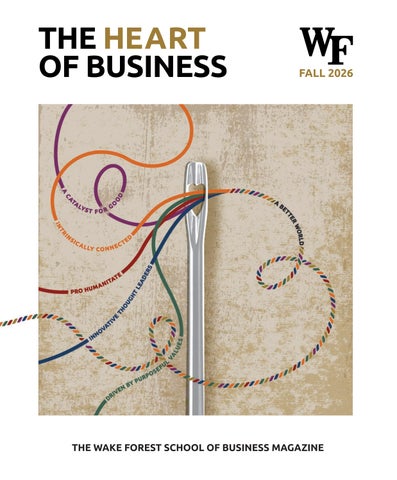
FALL 2026
THE WAKE FOREST SCHOOL OF BUSINESS MAGAZINE
FROM THE DEAN’S DESK
It is a privilege to write to you as the Dean of the Wake Forest University School of Business. While this role represents a new chapter in my service to the School, I first became part of the Wake Forest community 16 years ago when I joined the faculty as an assistant professor of accounting. Since then, I’ve taught generations of students, collaborated with extraordinary colleagues, and served in leadership roles that have given me a deep appreciation for the people, purpose, and values that make Wake Forest Business distinctive. I am honored to serve the School in this new capacity. Throughout my time at Wake Forest, one thing has remained constant: the strength of this community. Our greatest asset is the people who make the School what it is — faculty who are committed not only to advancing knowledge, but also to developing students as thoughtful and principled leaders, staff members who create exceptional experiences every day, students who bring curiosity and a commitment to making a difference into our classrooms, and alumni who carry the Wake Forest spirit into organizations and communities around the world. As I begin this new role, my focus is on building upon our School’s strong foundation. We will continue to advance our commitment to academic excellence, innovative teaching and research, meaningful partnerships, and the personal connections that define the Wake Forest experience. At a time when business is being transformed by rapid technological change, evolving societal expectations, and new opportunities for innovation, our responsibility is to prepare graduates who can adapt, lead, and create meaningful impact. Most of all, we will remain dedicated to developing individuals who combine business knowledge with empathy, ethical reasoning, and a desire to create a better world. At the Heart of Business is more than a tagline; it reflects what has always been central to our identity: the belief that business is not simply about creating value for organizations, but about creating value for people and society. Rooted in Pro Humanitate, this philosophy shapes the way our students learn, our faculty teach and conduct research, and our alumni lead. I am especially grateful for the opportunity to serve a community that has given me so much. I look forward to listening, learning, and working alongside our faculty, staff, students, alumni, and corporate and community partners as we continue building on the School’s momentum and shaping the future of business education together. Thank you for your continued support of Wake Forest Business and for the many ways you help strengthen our community. Whether through mentorship, partnership, philanthropy, or advocacy, your engagement plays an essential role in advancing our mission and preparing the next generation of leaders. With gratitude,
Norma R. Montague, Ph.D.
Interim Dean Sisel Distinguished Dean of Business
Learn more about Norma's new role
“Our greatest asset is the people who make the School what it is…” NORMA MONTAGUE
THE HEART OF BUSINESS The Wake Forest School of Business Magazine
FALL 2026
04
24
Living at the Heart of Business
A Conversation with Norma Montague
Carrying Wake Forest's vision for business and humanity to a national stage
Our new Interim Dean shares her Wake Forest journey and outlines how she envisions the School for the future
08
28
A Legacy of Light
High Tech, High Touch
How Anil Rai Gupta (MBA ‘ 92, LLD ‘17, WFU Trustee) exemplifies Pro Humanitate through corporate social responsibility and humanitarian work around the globe
Continuous communication and thoughtful engagement guide Michael Boone (MSM ‘14) as he works to ensure transparency and responsibility in AI
14
32
Reducing Hunger by the Numbers
Harnessing the Power of AI for Financial Success
Pelin Pekgun’s research confronts the profound societal challenge of food insecurity and the operational inefficiencies within the national food bank system
Both in the classroom and in a new book, Mark Johnson explores how AI can be a valuable financial tool
18
34
The New Minor with Major Upside
Student Life
Wake Forest's new Minor in Business was crafted by an uncommon cross-campus collaboration between liberal arts and business
Step into the shoes of business students navigating life on and off campus
22
36
The School of Business Receives Global AACSB Award
From Pupil to Peer
The Association to Advance Collegiate Schools of Business selects Wake Forest for its inaugural Global Impact Award
Paul Griggs (‘96, MSA ‘97) highlights how a foundation of community is an essential guide in navigating a career with integrity and leadership
38
54
Empowering Entrepreneurship
Commencement and Hooding
Brittany Coleman (MSM ‘16) ensures women's voices are reflected in outdoor apparel with her woman-owned brand ToughCutie
The School of Business celebrates the journey and accomplishments of members of the Class of 2026
42
56
Someone Who Asks is Never Lost
School of Business Awards
From Nigeria to India to Wake Forest, Alli Ajagbe (MSBA, ‘26) traces a journey fueled by bridge building and inquisitive flexibility
Highlighting students, alumni, and faculty making a difference at the School and in the wider community
44
60
Living Pro Humanitate
Alumni News
Joe Parry (MBA, ‘10) shares how the principle of Pro Humanitate enriched his professional path and pursuit of a life of service to others
Discover Alumni Spotlights and how our network is staying connected
46
62
Investing in Others
Discover More Faculty Focus
Wake's BUS 111 Professional Life Skills course not only prepares students for career practicalities, but also teaches the essential nature of generosity
Learn more about groundbreaking innovations in academia and research by the School of Business's faculty
48
64
A Growing Family and A Global Network
School of Business Rankings
Lawrence Watkins (MSA ‘17) explains how the Alumni Council connects students, graduates, and the School to one another and to the broader business landscape
Our world-class programs are routinely recognized in major national and international rankings
50 Our Vision in Action Selected highlights of Wake Forest Business living out its vision to "Help Businesses and Organizations Create a Better World"
We welcome feedback from readers: sbmarket@wfu.edu © 2026 Wake Forest University School of Business The School of Business is accredited by the Association to Advance Collegiate Schools of Business (AACSB International). The School of Business’ Accountancy Program attained the supplemental accounting accreditation.
EXECUTIVE EDITOR Sylvia Green, Chief Marketing Officer MANAGING EDITOR Michael Lamphier, Executive Director, Marketing & Communication
CONTRIBUTORS Justin Scism Julie Palm Jennifer Bringle
DESIGN Alyson Gronewoller John Murph PHOTOGRAPHY Melanie Porter Red Cardinal Studios
Wake Forest University is accredited by the Southern Association of Colleges and Schools Commission on Colleges (SACSCOC) to award baccalaureate, masters, and doctorate degrees. Wake Forest University also may offer credentials such as certificates and diplomas at approved degree levels. Questions about the accreditation of Wake Forest University may be directed in writing to the Southern Association of Colleges and Schools Commission on Colleges at 1866 Southern Lane, Decatur, GA 30033-4097, by calling (404) 679-4500, or by using information available on SACSCOC’s website.
AT THE HEART OF BUSINESS: SHARING WHAT DEFINES WAKE FOREST BUSINESS WITH THE WORLD For more than 75 years, Wake Forest University School of Business has developed leaders who understand that business is about more than transactions. It is about people, purpose, and impact. As the School continues to evolve and expand its global reach, it is sharing a clearer expression of what has long defined the Wake Forest experience. That expression came to life through the national launch of At the Heart of Business, bringing the School’s distinctive approach to business education to a broader audience and building momentum for the future. Rooted in the School’s vision and mission, At the Heart of Business reflects the values that have shaped Wake Forest Business for generations. Built around a single guiding idea, helping businesses and organizations create a better world, it captures the School’s distinctive approach to developing graduates who combine analytical excellence with empathy, character, and a sense of responsibility. The idea behind At the Heart of Business is far from new. The words Pro Humanitate first appeared on Wake Forest’s seal in 1908, and the purpose behind them has shaped the University’s culture since its founding in 1834. At the Heart of Business gives that enduring commitment a modern expression, reflecting the School’s role in preparing leaders who use business as a means to create meaningful impact.
4
More Than a Tagline “At the Heart of Business is more than a tagline; it's a philosophy, a way of learning, and a way of leading," says Sylvia Green, Chief Marketing Officer for the School of Business. "Anchored in the University's Pro Humanitate mission, the School inspires students, faculty, and alumni to apply business knowledge with purpose, creativity, and care, shaping solutions that improve lives, strengthen communities, and advance society.” Sylvia Green Chief Marketing Officer; Wake Forest School of Business
BUSINESS.WFU.EDU
That philosophy comes to life through four commitments that shape the School’s culture and experience: Nurturing a Community of Learning, where every voice is heard and every perspective is valued. Fostering a Community of Inquiry, led by innovative, faculty-driven, interdisciplinary, collaborative research. Cultivating a Community of Engaged Partnerships, building bridges between knowledge and practice with industry leaders and academic collaborators. Pursuing Organizational Excellence, where collaboration, open communication, and continuous improvement guide daily practice. In action, these commitments shape the experiences that define Wake Forest Business. Students and alumni design sustainable business models and launch ventures aimed at addressing complex challenges, viewing success as both an achievement and an opportunity to create positive impact. Faculty research moves beyond academic journals into classrooms, consulting projects, and industry partnerships where students can see ideas translated into practice. And a connected community of faculty, students, and alumni extends the School’s reach well beyond campus, transforming relationships into meaningful opportunities.
AT THE HEART OF BUSINESS
National campaign brings our differentiators to life:
A Catalyst for Good
Intrinsically Connected
Students are encouraged to discover their unique talents and use them to make a tangible difference. From designing sustainable business models to launching ventures that serve underserved communities, Wake Forest develops changemakers who see success as both achievement and opportunity.
Connections define the Wake Forest experience. Faculty collaborate across disciplines and communities on research and projects that advance knowledge and improve lives. Students work alongside peers on real-world business challenges, applying skills to meaningful outcomes. Alumni serve as advisors, collaborators, and advocates, extending the School’s impact far beyond campus. These relationships go beyond networking; they spark innovation, open opportunities, and create lasting value in both business and society.
Innovative Thought Leaders Wake Forest is home to ideas that drive change. Faculty research, from advanced analytics to global strategy, shapes practice, informs policy, and creates measurable impact. Students engage directly with this work, translating insights into action in the classroom, through consulting projects, and in industry collaborations. Curiosity, rigor, and creativity are at the core of the School experience.
Driven by Purposeful Values Integrity, empathy, and character guide every interaction at Wake Forest. Students are challenged to approach problems with both ambition and conscience, balancing results with responsibility. Alumni carry these lessons into their careers, shaping organizations, communities, and industries in ways that reflect their purpose and values.
BUSINESS.WFU.EDU
5
Bringing the Story to Life Turning that philosophy into a national campaign required more than a new tagline. Wake Forest partnered with higher education agency Ologie to translate the School’s differentiators into language and imagery that could resonate with audiences across the country. Through months of collaboration and refinement, the team ensured that every element authentically reflected what makes Wake Forest Business distinctive. Today, that story appears in places where future students, business leaders, alumni, and academic peers encounter Wake Forest in new ways. A city skyline billboard reads simply: More than a network. A catalyst for good. In airport terminals, travelers pass beneath displays featuring Unrivaled Connections, highlighting the relationships that define the Wake Forest experience. Digital outreach introduces faculty such as Julie Wayne with the message, When work-life balance is a priority, people thrive, connecting research insights with real-world relevance. Elsewhere, the campaign captures the School’s philosophy in a simple contrast: Knowing what sells. That’s good business. Knowing what matters. That’s business driven by heart. At this year’s AACSB International Conference in Seattle, the annual gathering of business school deans and leaders from around the world, Wake Forest brought At the Heart of Business to life in a significant way. The School introduced its new national presence to peers while showcasing its AACSB Global Impact Award recognition. Photos and videos from the activation extended the story across social media channels, creating additional visibility for the School’s message and mission.
6
“The launch of our refreshed brand identity gave us a real foundation to introduce the School of Business to the world in exciting new ways,” says Green. “The campaign carried our At the Heart of Business story into new markets through specific messages and placements across the country, helping people encountering us for the first time understand what makes this School different. That work continues.” Either way, the message is the same: at Wake Forest, business and humanity aren't separate pursuits.
At the Heart of It For alumni, the campaign offers an opportunity to see the values they experienced at Wake Forest reflected on a national stage. The same integrity, empathy, and rigor they carried with them from Winston-Salem, Charlotte, or our online community, now shape how Wake Forest Business introduces itself to the rest of the country. For prospective students and industry partners encountering the School for the first time, it provides a window into what has made Wake Forest Business distinctive for more than 75 years. At its core, the message is simple: at Wake Forest, business and humanity are not separate pursuits. They are part of the same commitment to lead with purpose, create meaningful impact, and keep people at the heart of business.
The inaugural issue of The Heart of Business magazine is available here
7
8
BUSINESS.WFU.EDU
BUSINESS.WFU.EDU
9
“Success is not just about financial return. It is about the legacy you build, the lives you touch, and the opportunities you create for others.” Anil Rai Gupta
AT THE HEART OF BUSINESS AND HUMANITY A LEGACY OF LIGHT Across homes, schools, and workplaces around the world, millions of people rely on products designed and manufactured by Havells India Limited: lighting that brightens classrooms, fans that cool homes, appliances that simplify daily life, and electrical systems that quietly power modern buildings. Few pause to consider the global enterprise behind those everyday essentials. Even fewer realize that the philosophy guiding that company is rooted in a belief that business should serve something larger than itself. For Anil Rai Gupta (MBA ‘92, LLD ‘17), Chairman of Havells and a member of the Wake Forest Board of Trustees, leadership begins with a simple question: How can the work we do improve people’s lives? “Business has the power to change lives,” Gupta says. “Not only through innovation and growth, but through the values that guide our decisions and the responsibility we carry toward society.” That conviction traces back to two formative influences: his father, whose entrepreneurial vision built Havells on principles of integrity and responsibility, and his time at Wake Forest University, where he discovered a philosophy that gave those values a broader purpose. At Wake Forest, the University’s motto, Pro Humanitate, “for humanity,” calls leaders to use their knowledge and talents in service of others. For Gupta, it affirmed the principles he had seen modeled at home and shaped how he would lead for decades to come.
Building a Global Enterprise When Gupta returned to India after completing his MBA at Wake Forest, Havells was a growing electrical equipment company
10
BUSINESS.WFU.EDU
with a strong domestic reputation. Over the next three decades, he transformed it into one of India’s leading fast-moving electrical goods companies and a global house of brands. Today, Havells manufactures a wide range of products for residential, commercial, and industrial use. Its portfolio includes Havells, Lloyd, Havells Crabtree, Standard Electricals, and REO, supported by 15 advanced manufacturing plants across India and a workforce of more than 6,700 professionals across 48 global offices. Yet, Gupta believes the company’s greatest strength lies not in scale, but in its culture. “When people see the Havells name, I want it to represent sincerity and trust,” he says. “It should reflect confidence not only in the product, but in the values of the people behind it.” Those values, including integrity, collaboration, and responsibility, shape everything from manufacturing standards to workplace culture. Havells has repeatedly been recognized as a "Great Place to Work," reflecting Gupta’s commitment to building an organization where employees are empowered, inspired, and proud to contribute.
Business as a Catalyst for Good For Gupta, the purpose of business extends far beyond the company’s walls. Across India, Havells’ social initiatives reflect its belief that businesses should invest in the communities they serve. One of the most impactful began with a simple realization: children cannot learn if they are hungry. Today, a mid-day meal initiative supported by Havells provides hot lunches to approximately 70,000 schoolchildren every day across more than 700 schools, helping students stay in the classroom and focus on learning. Havells’ commitment to community wellbeing also includes programs addressing public health and environmental sustainability. The company has planted tens of thousands
of trees near its manufacturing facilities and implemented initiatives in renewable energy, waste reduction, and environmental conservation. These efforts have earned international recognition, including inclusion in the Dow Jones Sustainability Index and an ‘A’ MSCI ESG rating.
will shape nearly every aspect of our lives,” he says, “but those leading that future must also understand the human impact of their work.”
Gupta has also championed cultural preservation. Havells contributed to the restoration of Humayun’s Tomb, the UNESCO World Heritage site in Delhi, revitalizing both the landmark and the surrounding community while increasing annual visitors from 100,000 to nearly two million. “Giving back to society has always been the guiding light behind my work,” Gupta says. “Success is not just about financial return. It is about the legacy you build, the lives you touch, and the opportunities you create for others.”
Investing in Education If business can change lives, Gupta believes education multiplies that impact. His philanthropic focus reflects a conviction that institutions must evolve alongside the world they serve; blending intellectual curiosity, technological fluency, and a deep sense of responsibility to society. As an early founder of Ashoka University, one of India’s first liberal arts and sciences universities, Gupta helped shape an environment where students are encouraged to think independently, question assumptions, and develop a genuine love of learning. He later supported the creation of Plaksha University, a next-generation technology and research institution that integrates engineering, data science, entrepreneurship, and the humanities to address complex global challenges. Together, these efforts reflect Gupta’s belief that future leaders must pair technical expertise with human insight. “Technology
BUSINESS.WFU.EDU
His commitment to expanding opportunity also extends back to Wake Forest. Through the Havells Family Scholarship, Gupta supports students from both Ashoka and Plaksha in pursuing graduate business education at the School of Business, creating a bridge between these institutions and amplifying their global impact. “The Scholarships enable talented students access to transformative learning experiences and global opportunities,” he says. “It’s one of the most meaningful investments we can make. When education changes one life, it often influences hundreds more,” he added.
11
A Legacy of Purpose The School of Business often speaks about placing humanity “At the Heart of Business.” Commerce exists to serve people, their aspirations, their wellbeing, and the communities they shape.
A
O CL
SER LO
O
K
Through his leadership at Havells, his investments in education, and his commitment to societal progress, Gupta has spent decades demonstrating what that principle looks like in action. The products that Havells manufactures power homes, schools, and businesses across the globe. Yet the deeper influence of Gupta’s leadership is measured in something far more enduring: the lives illuminated through opportunity, learning, and service. Three decades after discovering the alignment between his family’s values and Wake Forest’s guiding principle, Gupta continues to carry that lesson forward. Because when business places humanity at its center, its influence extends far beyond the marketplace. It becomes a catalyst that powers possibilities for generations to come.
“When education changes one life, it often influences hundreds more.” Anil Rai Gupta
12
Founded by Anil Rai Gupta, CEO of Havells India and member of the Wake Forest University Board of Trustees, the Havells Family Scholarship reflects a vision of combining academic excellence with social impact. The scholarship provides full funding for two graduates annually from Indian institutions, Ashoka University and Plaksha University, to pursue advanced degrees at the Wake Forest School of Business. Beyond tuition, it covers living expenses, books, and international travel, enabling students to focus fully on their studies and leadership development. “We want students not just to succeed academically, but to use their skills and knowledge to make a real difference in the world,” says Gupta. More than financial support, the scholarship is rooted in the philosophy of Pro Humanitate, which holds that one’s education and skills should be used to improve the lives of others. Scholars are chosen not only for academic achievement and financial need, but for leadership, ethical character, and a commitment to contributing meaningfully to their communities. By linking emerging talent from India with Wake Forest’s faculty, mentorship, and vibrant student community, the scholarship ensures that recipients have the tools, guidance, and opportunity to create impact, both immediately and long into the future.
The Havells Scholars in Action What begins as an investment in education can become something far greater: an engine for opportunity, leadership, and impact that extends well beyond a single classroom or career. Through the Havells Family Scholarship, students from leading Indian institutions gain access to a Wake Forest education grounded not only in analytical rigor but also in a deeper sense of purpose. Supported by faculty mentorship and a close-knit community, these scholars are challenged to do more than succeed; they are expected to contribute, lead, and create meaningful change. Though just a few years apart, these scholars illustrate the same truth: when talent meets opportunity and is guided by purpose, its impact is immediate and far-reaching.
BUSINESS.WFU.EDU
Abhishek “Abhi” Nayak (MSM ‘24) Setting the Standard
Deekshanya Roy (MSBA ‘25) A Global Path, Grounded in Purpose
When Abhi Nayak arrived at Wake Forest as the first Havells Family Scholarship recipient, he stepped into a role defined by both opportunity and responsibility.
Deekshanya Roy’s journey spans countries and disciplines, from the U.S. to India and from psychology and philosophy at Ashoka University to business analytics at Wake Forest.
“Being the first scholar was an honor,” he said. “But it also meant setting the tone, for what this could become, and for those who would follow.”
“I wanted to take the way I think about people and decisions and pair it with skills I could apply in the real world,” Roy said.
After studying economics and finance at Ashoka University, Nayak found both rigor and belonging at Wake Forest.
As a Havells Family Scholar, she connected human behavior with data-driven decision-making while taking on leadership roles across the program.
“From the first day, I felt like I belonged,” he said. “The support from faculty, the relationships with classmates, it’s not just a university, it’s a family.” His advice: “bring both excellence and intention.”
“The commitment of the Wake Forest alumni network is exceptional,” Roy said. “This collective drive to see everyone succeed sets the institution apart; the community wants everybody to get to the next step, to be better. It’s incredible.”
Now a fixed-income analyst at Stephens Inc., Nayak applies his skills to investment decisions that consider both financial returns and community impact, reflecting Wake Forest’s Pro Humanitate ethos.
Now a credit risk analyst at Global Lending Services, Roy uses analytics to create meaningful impact and better the lives of others.
“This collective drive to see everyone succeed sets the institution apart; the community wants everybody to get to the next step, to be better. It’s incredible.” Deekshanya Roy MSBA ‘25
Vikas Kumar (MSBA ‘26) Building What’s Next For Vikas Kumar, pursuing business analytics meant strengthening the link between technical expertise and real-world decision-making. “I realized I needed a stronger business context and more strategic perspective,” he said. “I wanted to work at the intersection of analytics and decision-making.” Through the Havells Family Scholarship and Wake Forest’s MSBA program, Kumar gained both. During a practicum, his team placed second in the East Region of the Data4Good Analytics Competition, developing a solution to detect AI-generated misinformation. “It wasn’t just about building something that works,” Kumar said. “It was about building something useful, something that could actually help address a real problem.” Vikas is now translating these insights into action as a founding full-stack engineer at The M.A.P., generating solutions for the independent live music sector.
Shrradaa Ramesh (MSM ‘26) Leading Transformation Shrradaa Ramesh, from Visakhapatnam, India, came to Wake Forest to build her business and leadership skills after studying psychology at Ashoka University. “The Wake Forest MSM program has taught me that I can lead transformation at any organization I am part of,” she said. “The curriculum helps you develop a diverse skill set essential for navigating a changing economy, while also instilling personal and professional discipline.” Through graduate consulting projects, she has applied classroom learning to real-world challenges while strengthening her professional path. “What I love most about Wake Forest is the people and the values,” she added. “It’s a place where you feel welcomed, challenged, and supported at every step. Wake hasn’t just prepared me for a career in the U.S.; it’s helped me become the best version of myself.”
BUSINESS.WFU.EDU
13
14
BUSINESS.WFU.EDU
REDUCING HUNGER BY THE
“I am grateful for the opportunity to support a Pro Humanitate mission I care so deeply about. My research and engagement with food banks have always reflected my passion for supporting their fight against hunger and their mission towards building food-secure, healthy communities.” Pelin Pekgun, Ph.D. Department Chair for Business Analytics, Information Systems, Management, Marketing, & Operations Management; Thomas H. Davis Professor in Business; Professor of Analytics
15
operations research, they developed an integer programming optimization model designed to identify the most efficient way to use HHFB’s limited resources, including its operating budget, human capital, and equipment, to maximize the food and monetary donations generated through promotional events.
APPLYING ANALYTICS TO COMBAT FOOD WASTE AND HUNGER
Pelin Pekgun, the Thomas H. Davis Professor in Business and Professor of Business Analytics at the Wake Forest School of Business, is putting theory into practice by bridging the gap between academia and real-world needs. Focusing on humanitarian and non-profit operations, her research confronts the profound societal challenge of food insecurity and the operational inefficiencies within the national food bank system. Her research addresses a staggering reality: while nearly 40 percent of the U.S. food supply goes uneaten, millions of Americans struggle with hunger. According to Pekgun, who also serves as the Department Chair for Business Analytics, Information Systems, Management, Marketing & Operations Management, reducing this national food waste by just 15 percent could provide sustenance for over 25 million people annually. “Food banks play a pivotal role by capturing surplus food that would otherwise go to waste and directing it to those in need,” says Pekgun. “Their work not only alleviates food insecurity but also helps mitigate the broader social, economic, and environmental costs of food waste.”
The result of this work was transformative: the model’s recommended strategy created an avenue for HHFB to provide 1.72 million additional meals per year from these events, translating to a remarkable 41% increase in meal yield. The significance of this work, which was published in the INFORMS Journal on Applied Analytics, prompted HHFB to integrate the model into its annual strategic planning of promotional events and the allocation of resources. Over the years, Pekgun’s research has expanded to target broader operational issues that food banks face, such as food waste, labor mix, fundraising productivity, SNAP outreach, and operational resilience. Seeking to improve operational effectiveness, her recent work, published in Production and Operations Management, studies how distribution strategies can reduce food waste. “Even within food banks, food waste can occur due to operational and distribution challenges. The unpredictable nature of in-kind donations makes it difficult to align supply with demand. Most donations arrive close to their expiration dates, leaving food banks with little time to sort, inspect, and distribute them. These uncertainties place significant strain on already limited resources and can lead to waste during the distribution process. Addressing this internal waste is critical not only to improving food banks’ efficiency, but also to fulfilling their mission of serving those experiencing food insecurity.”
Pekgun’s commitment to advancing humanitarian operations through analytics began with a collaboration with Harvest Hope Food Bank (HHFB). While teaching at the University of South Carolina, she and a colleague partnered with HHFB, which serves 20 counties in South Carolina and, at the time, was meeting only about 40% of the annual meal gap in its service area. Applying their expertise in analytics and
16
BUSINESS.WFU.EDU
Beyond academic work, Pekgun extends her research into direct service within the local community. She recently accepted an invitation to serve on the inaugural Advisory Council for Second Harvest Food Bank of Northwest NC, where her professional expertise and analytical insights will help support the food bank’s strategic thinking, planning, and operations. “I am grateful for the opportunity to support a Pro Humanitate mission I care so deeply about,” says Pekgun. “My research and engagement with food banks have always reflected my passion for supporting their fight against hunger and their mission towards building food-secure, healthy communities.” With national implications and significant potential for immediate impact in food-insecure areas like Winston-Salem, Pekgun’s research is driving meaningful change concerning one of the most pressing issues facing society today.
“What excites me most about the humanitarian operations domain is that it allows me to apply analytical tools and operational concepts to make a difference at a societal level, reflecting my passion for leveraging analytics to drive better, smarter decisions for a more equitable world.” Pelin Pekgun
]=x 1
p + .. . + x ₙ p ₙ | p 1+ x 2 2 MS
E=
bia
s2
+v
ar
ia nc
e Av
1x 1+
|
θ 2x 2+
.
..
| xₙ θₙ
E[X
)|
g ar
ma
xθ ∏
n f(x ;θ) | h i θ (x)
= a r g m a xθ ∏ n f ( θ MLE xi ; θ
=θ
v |
0 +θ
=λ
= E
h
+θ
ε
0
θ
|
)=
θM
L
θ (x
BUSINESS.WFU.EDU
17
1+ 1x
+.. x2 θ2
. θₙ
x ₙ | J(
c , µ) = ∑ m I I x ( 1 ) -µ I 2 c I
|Y =
a+
bX
+
MINORING IN BUSINESS AT WAKE FOREST
18
THE This fall, Wake Forest University is launching a new business minor open to students from any major, creating an integrated pathway where business fluency and the liberal arts education Wake Forest is known for, thrive together.
MINOR WITH
UPSIDE
This offering emerged from the School’s connectivity and insights into today’s workplace: organizations increasingly want graduates who bring the critical thinking of a liberal arts education as well as real business fluency. Universities are being asked to make that fluency accessible without forcing students to choose between their passions and their practical future. Wake Forest’s answer is a minor built as a genuine partnership between the College of Arts and Sciences and the School of Business, rather than as a handful of outside electives added on to an existing major. “We thought a lot about how this could partner with strengths in the College,” says Amanda Griffith, Senior Associate Dean for Academic Planning and Professor of Economics in the College of Arts and Sciences. Griffith offers an example of how that partnership plays out for students: a student who wants to run an art studio one day still needs a business background, yet doesn’t want to give up an art degree to get it. “We worked with College departments to think about the different courses they either already offer or could offer that would still build those foundational business skills,” she says. While the prospect of a business minor had previously been discussed at Wake Forest, it gained real traction more recently, as demand for business literacy grew.
BUSINESS.WFU.EDU
19
Bringing the minor to life involved the work of two distinct task forces. The first, made up of business faculty, built a competency-based framework for what the program should teach. The second was co-led by the deans of both the College and the School of Business, but the day-to-day work fell to Norma Montague, then Senior Associate Dean for Academic Affairs and Innovation at the School of Business, and Griffith, who spent a year working with departments across the College and the School of Business to shape that framework into something that would actually work in practice. Over the past academic year, Montague and Griffith turned their attention to the details: what Montague calls “putting meat on the bones,” making sure the minor leveraged Wake Forest’s unique strengths.
A True Partnership What sets the program apart from similar offerings at peer institutions is how deep the collaboration runs. Rather than simply opening outside electives to non-business majors, the Wake Forest minor is oriented around three competency areas, built on a foundation of Introduction to Economics and Introduction to Business coursework:
MANAGEMENT ESSENTIALS 1
Developing capabilities for managing organizations and people.
DIGITAL SKILLS FOR THE WORKPLACE 2
Focusing on analytics, data visualization, and digital tools.
LEADERSHIP, CHARACTER, AND BUSINESS LIFE SKILLS 3
Cultivating ethical decision-making and professional readiness.
20
BUSINESS.WFU.EDU
Griffith describes the middle of the minor as a “choose your own adventure” track of study. Notably, there are often more courses available within the College to satisfy these competencies than there are in the School of Business itself. Montague calls this dynamic the “magic” of the collaboration, since it lets students customize the minor around their own major rather than fitting their coursework into a rigid slate of classes. The program concludes with a Business Simulation Capstone, where students apply what they've learned through experiential simulations that call upon real judgment and decision-making – skillsets vital to organizational success.
What Success Looks Like For Montague and Griffith, the minor is more than a new line in the course catalog, it's “a great example of Wake Forest doing what we say we do,” Griffith says, pointing to the University's strategic framework. “It provides a true liberal arts experience paired with business.” By fostering deeper collaboration between the College and the School of Business, Wake Forest created something Montague sees as a win for everyone involved: students who get to keep their primary passions intact; parents and employers who want graduates who are both well-rounded and job-ready; and a University delivering on the kind of interdisciplinary promise that is core to its identity.
It's “a great example of Wake Forest doing what we say we do. It provides a true liberal arts experience paired with business.” Amanda Griffith, Ph.D. Senior Associate Dean for Academic Planning; Professor of Economics
21
2026 GLOBAL IMPACT AWARD WINNER
SCHOOL OF BUSINESS AWARDED FOR TEACHING & LEARNING EXCELLENCE IN BUILDING AI FLUENCY
22
BUSINESS.WFU.EDU
Wake Forest School of Business has been recognized as a winner of the Association to Advance Collegiate Schools of Business International’s (AACSB) inaugural Global Impact Award for the School’s creative and effective use of generative artificial intelligence (AI) in teaching and learning. The Global Impact Awards honor individuals and institutions whose initiatives exemplify innovation, leadership, and measurable impact in business education and society. Grounded in AACSB’s Global Standards for Business Education™, the awards highlight contributions from across the global business education community.
“We’ve learned that AI fluency isn’t really a technical skill; it’s a judgment skill. We want graduates who know when to use AI, when to push back, and when not to use it. Employers are desperate for that kind of discernment, and it has to be built in the classroom, not assumed at graduation,” said Shannon McKeen, Co-Director for the AI Impact Lab Pilot Initiative (WFU) and Professor of the Practice for Business Analytics. McKeen spearheaded the initiative alongside John Montana, an Executive Director who supported the School’s AI efforts as part of its strategic initiatives group.
“We’ve learned that AI fluency isn’t really a Wake Forest School of Business was recognized in the category of Teaching and technical skill; Learning Excellence for its “Building AI Fluency” initiative, a multiphase program it’s a judgment that accelerates the responsible integration of generative AI into faculty workflows and skill. We want student curricula. graduates who “We are grateful to AACSB for this recognition, which celebrates the know when to collaborative spirit within our school and affirms our strategic commitment use AI, when to embracing emerging and future technologies. The ‘Building AI Fluency’ to push back, initiative turned the uncertainty of new technology into a shared learning and when not experience for our faculty and staff. to use it.” This honor serves as evidence of our commitment to provide high-impact learning experiences that prepare our students for a competitive, global market,” said Norma Montague, Interim Dean of the School of Business.
Shannon McKeen Co-Director AI Impact Lab Pilot Initiative (WFU); Professor of the Practice for Business Analytics
The School’s “Building AI Fluency” initiative was designed to meet the immediate urgency created by the release of ChatGPT in late 2022. The grassroots program moved from initial exploration to structured learning opportunities and classroom application.
The impact of the initiative is measurable. A reported 68 percent of business faculty now use generative AI on a weekly or daily basis, more than double the national average of approximately 30 percent for higher education faculty. These efforts have resulted in classroom innovations, including the use of custom GPTs for business simulations and AI-enhanced feedback mechanisms. Faculty are also utilizing pedagogical tools to generate practice problems and provide students with additional tutoring support. The 2026 Global Impact Award honorees include 27 individuals and institutions from 16 countries, selected from a highly competitive pool of submissions. Award recipients are recognized for shaping future-ready business schools through strategic leadership, translating faculty research into meaningful impact, fostering inclusive social and economic growth, integrating emerging technologies into learning experiences, and supporting the AACSB community through dedicated service.
“The Global Impact Awards underscore Wake Forest University’s commitment to creating meaningful impact through business education,” said Lily Bi, president and CEO of AACSB.” Their work sets a powerful example for the future of business education, and we look forward to its continued growth and influence.”
23
A
WITH
24
BUSINESS.WFU.EDU
What led you to accounting and ultimately to higher education?
FROM TEACHERSCHOLAR TO INTERIM DEAN, A CAREER ROOTED IN LEARNING, LEADERSHIP, AND COMMUNITY When Norma Montague joined the Wake Forest University School of Business 16 years ago as an assistant professor of accounting, she could not have known then how many different perspectives she would eventually bring to the School’s leadership. Over the years, she has been a faculty member, teacher, researcher, mentor, and academic leader, working with students and colleagues across the School while also building relationships with alumni, business leaders, and the broader academic community. Now, as Interim Dean, Montague brings a deep understanding of what makes Wake Forest Business distinctive, and a belief that the best path forward begins by building on the School’s strengths.
I actually thought I was going to become a lawyer until I took my first accounting course. I was immediately drawn to the way accounting fit together like a puzzle. It was systematic and analytical, but it was also a way of telling the story of an organization through its financial information. After earning my bachelor’s and master’s degrees in accounting from North Carolina State University, I joined a public accounting firm. I enjoyed the work, but I found myself looking forward most to our Friday “Lunch and Learn” sessions, particularly when I had the opportunity to lead them. I realized that what energized me most was helping others learn. That led me to a faculty position at a community college, where I spent nine years, including three as department chair. I taught accounting to a wide range of students, including at a correctional institution through a college partnership. Those experiences reinforced my belief that education can transform lives, regardless of where a student’s journey begins. Eventually, I pursued a Ph.D. in Business Administration with a concentration in Accounting at the University of South Florida, which ultimately brought me to Wake Forest.
What has kept you at Wake Forest for 16 years? When I was exploring faculty opportunities, I was looking for a place where I could fully embrace both teaching and scholarship. Wake Forest immediately stood out because of its commitment to the teacher-scholar ideal.
25
What I could not fully appreciate until I arrived was just how special the people are. I have watched faculty go above and beyond to mentor students, staff create exceptional experiences, alumni remain engaged long after graduation, and students continually inspire us with their curiosity, sense of purpose, and desire to make a positive impact. What has kept me here is that sense of community. Wake Forest is a place where people genuinely care about one another, where collaboration is valued, and where our commitment to our University motto Pro Humanitate (for humanity) is reflected in the way we teach, lead, and serve. I have also been fortunate to grow professionally without having to leave to find new challenges. I have taught across undergraduate and graduate programs, conducted research and served in a variety of leadership roles, within the School and across the University. Sixteen years later, I still feel excited to come to work each day. That says a great deal about this community.
Your scholarship has evolved from auditing and professional decision-making to accounting education and emerging technologies. What connects those areas? I have always been fascinated by how people make decisions. My early research focused on professional decision-making in auditing, including how people evaluate complex information, how cognitive biases can influence decisions, and how guidance and disclosures affect auditors and investors. Over time, that interest expanded into accounting education. I became increasingly interested in how students learn, including the effects of cognitive bias, innovative teaching approaches, and ways to create more inclusive learning environments. More recently, I have begun studying how emerging technologies, including artificial intelligence (AI), and changing work environments are shaping how professionals think, work, and collaborate.
26
Although those projects may seem different, they are connected by a common question: How can we help people make better decisions? That question influences not only my research, but also how I teach, mentor students, and approach leadership. I believe research has its greatest impact when it advances knowledge while also helping people address meaningful, real-world problems.
You have also held leadership roles beyond Wake Forest. What have those experiences taught you? My first leadership experience came at a community college, where I learned the importance of access, opportunity, and meeting students where they are. I was born in Puerto Rico and moved to Florida as a child. At the time, I spoke only Spanish, so I had to learn a new language while also adjusting to a new environment and culture. That experience gave me an early appreciation for what it means to enter an unfamiliar setting, learn from people whose experiences may be different from your own, and find your place within a community. That perspective has stayed with me and continues to influence how I think about education, relationships, and leadership. I have also had the opportunity to serve in leadership positions with the American Accounting Association, including as Vice President of Engagement, Access, and Community and previously as President of the Association’s diversity section. Working with faculty and academic leaders from universities across the country and around the world broadened my perspective on higher education and reinforced the value of bringing people with different experiences together to address complex challenges. My work in research, textbook authorship, and partnerships with industry has also helped me stay connected to the evolving needs of business and the profession.
“We have an opportunity to continue demonstrating what it means to be at the heart of business preparing capable professionals and principled leaders who use their knowledge and skills to make a positive impact on society.”
Together, these experiences have shaped how I approach leadership and reinforced the importance of service, collaboration and continuous learning.
What do you see as some of the greatest opportunities for Wake Forest Business? We have a strong foundation and a clear sense of who we are. I see tremendous opportunity to build on that foundation while continuing to evolve in ways that serve our students and the broader business community. One opportunity is to further strengthen the connections between business and the liberal arts. The complex challenges facing organizations today do not fit neatly within a single discipline. Students benefit from learning to approach problems from multiple perspectives, communicate effectively, think critically, and consider the broader impact of their decisions. I also see opportunities to expand experiential learning and deepen our partnerships with alumni and the business community. Consulting projects, internships, global experiences, and executive engagement help students apply what they learn while developing the adaptability they will need throughout their careers. Most importantly, we have an opportunity to continue demonstrating what it means to be at the heart of business preparing capable professionals and principled leaders who use their knowledge and skills to make a positive impact on society.
How do you see business education changing as AI and other technologies transform the workplace? AI is changing how organizations operate, how decisions are made, and even how work itself is defined. Our responsibility is to prepare students not just for today’s jobs, but for careers that will continue to evolve. Paradoxically, I believe the rise of AI makes a liberal arts education even more valuable. As technology becomes increasingly capable of analyzing information and automating routine tasks, qualities such as curiosity, critical thinking, creativity, ethical reasoning, communication and empathy become even more important.
Technical fluency matters, too. Our students need to understand how to work alongside AI, ask better questions, evaluate information thoughtfully, and recognize both its opportunities and limitations. Wake Forest is well positioned for that future because our business programs are grounded in the liberal arts and guided by Pro Humanitate. That combination prepares students not only to adapt to change, but to lead it with integrity and an understanding of the people their decisions affect.
What can the Wake Forest Business community expect from you as Interim Dean? One of the most valuable lessons I have learned is that leadership begins with listening. The best ideas rarely come from one person. They emerge when people with different experiences and perspectives come together around a shared purpose. I have seen firsthand how much our faculty, staff, students, alumni, and corporate partners care about this School. My role is to bring those voices together, build trust, and help move us forward. As Interim Dean, I hope to lead with transparency, humility, and a genuine commitment to serving others. Leadership is less about having all the answers and more about creating the conditions for people to do their best work together.
And finally, what might surprise people about you? Probably my musical background. Growing up, I learned to play more than a dozen instruments, including the accordion, clarinet, keyboard, harp, steel drums, marimba, handbells, and percussion. I played the accordion for nearly 10 years, which usually gets the biggest reaction! Looking back, music influenced me more than I realized at the time. It taught me discipline and patience, but also the importance of listening, collaboration, and finding harmony among many different parts. Those lessons have stayed with me throughout my career and continue to shape how I approach leadership.
27
TECH
INSIDE MICHAEL BOONE’S HUMAN-CENTERED AI LEADERSHIP
28
BUSINESS.WFU.EDU
29
“There's an opportunity here for us to use technology to serve others, to empower others, to lift others' voices.”
As manager of Trustworthy AI Product at NVIDIA, Michael Boone (MSM ‘14) works at the vanguard of advanced technology and artificial intelligence. But throughout his work, Boone keeps his focus on people: the people NVIDIA’s products serve and the people he leads at the Santa Clara, California-based company.
Blending a passion for technology with a deep concern for people is at the core of who Boone is. He has a passion for high-performance automobiles, but he also took time to become certified in Mental Health First Aid through the National Council for Mental Well-being. He’s a civil engineer who shaped safer, more efficient state transportation networks. He also creates online content to encourage people to think differently as they develop their careers.
Michael Boone MSM ‘14, Manager of Trustworthy AI Product, NVIDIA
At NVIDIA, he’s working on projects like Sign, an AI language platform that uses a 3D avatar to demonstrate signs for learners of American Sign Language and provide feedback as they practice. High tech. High touch. At NVIDIA, Boone has a couple of different roles. He oversees the team that performs transparency reviews of the company’s software releases. That documentation isn’t just important from a compliance standpoint, he says. “It’s how we build trust and earn the trust of customers and stakeholders across the AI value chain. … It’s kind of like a nutritional label that says, ‘Here is
30
BUSINESS.WFU.EDU
including coursework on ethics and leadership, which asked students how they wanted to be defined. “I return to that once a year, sometimes twice a year: What are those hallmarks, what are those distinctions you want to be known for?” Boone says. Boone wants to be known as someone who shows up for others. exactly what you’re getting, this is what you can expect to be able to do with it, here are the limitations, here are the risks and here’s more information if you want to do more of a technical deep dive into it.’ ” He is also involved in product design, developing and refining projects like the company’s model card generator and bias assessment tools. “I love being able to work with folks around what’s next. What does it mean to take our actual product to the next level?” he says. “A critical part of what I do is think of the future: What does it mean to bedrock new standards and measures of trustworthiness for products, whether that’s for our standalone (existing) tools like the model card generator or our new and upcoming tools like Sign?” Some tech firms espouse a “move fast and break things” mentality, but Boone rejects the idea that ethics and speed are tradeoffs. “Think about high-performance sports cars. One of the things that they do really, really well is take the curves, and part of the reason they can take curves well is because they have a certain level of testing that's been done beforehand.” Companies can and should build AI tools with that same commitment to rigorous testing, he says. Boone acknowledges he’s not “your typical AI manager.” Part of that is being raised by a father in the Army who taught him the importance of a good structure to drive results. Part of that is his education at the Wake Forest University School of Business,
As a leader, he says, “I think your presence oftentimes is the biggest gift that you give people. That’s one of the things I’m most proud about the way that I show up on a daily basis and be someone that people know is here and who also cares beyond the work.” Boone considers himself a “ruthless prioritizer” and sometimes that means stepping away from his own work to help others get things done in a crunch. “I think it’s important to not only unblock others that are working alongside you, but also to make sure they get the proper recognition and feel appreciated, like they want to come to work.” “I think it's important to have a mindset that it's not all about you. It’s frequently never about you,” he continues. “I think there's an opportunity here for us to use technology to serve others, to empower others, to lift others' voices. But we’re also here to involve others. One of the things that I’ve really wanted to do is to be a champion for inviting others into the conversation who may have not been involved previously, whether that means working with some of our employee resource groups or whether it’s taking some of our newer college grads and helping introduce them to some of the work that we're doing. That’s super exciting to me.”
THE
POWER OF
FOR
32
In a world where artificial intelligence (AI) has become widely used for everything from social media trends to weather forecasting, the applications and implications of its use can sometimes be overwhelming and confusing. Mark Johnson, Faculty Fellow in Investments and Portfolio Management and Teaching Professor of Finance, aims to alleviate some of that confusion while exploring how AI can be a valuable financial tool in his new book, “Invest Smarter with AI: A Practical Guide to Long-Term Investing, Financial Planning, and Building Wealth.” The book outlines how AI can help guide investors, from the novice just getting started to the experienced financial planner. “As AI became more and more mainstream and I increasingly saw people using it for more things, I started exploring what it could do as it pertains to investing,” Johnson says. Johnson experimented with using AI tools such as ChatGPT, Claude, and Microsoft Copilot, inputting prompts that could guide a potential investor, such as “What is an ETF?” or “How much do I need to save to reach my goal?” And he says the AI tools gave answers that could be useful to investors, making financial planning more accessible to a wider audience of consumers.
to get a second, third or fourth opinion to reach the best possible and most accurate conclusion as verified by trusted sources. “You can type one prompt in Claude and the same one in ChatGPT, and you can see where they’re similar and where they’re different,” he says. “I show students how to check the output and then cross reference and ask for citations and sources that you use to independently verify the information.” With the proliferation of AI use in business, Johnson says it’s critical for his students to enter the workforce with not only a strong understanding of how the technology works, but also how to use it effectively to enhance existing tools. “Employers are expecting AI literacy from our graduates,” he says. “Increasingly, the feedback we’re getting from the marketplace is that AI literacy is now akin to being able to use any other software such as Excel.”
“Increasingly, the feedback “I found that it could be a resource for we’re getting from people who cannot afford a financial advisor or maybe want more financial the marketplace is education and literacy, but in a more approachable way,” he says. “There’s that AI literacy is research that shows people aren’t afraid of being embarrassed when they’re typing a now akin to being prompt into their phone or computer in the way they might be speaking one-on-one to able to use any a financial advisor for the first time.” other software In his book, Johnson offers a structured, evidence-based system for enhancing such as Excel.” established investment principles with
Part of that literacy includes understanding the drawbacks of AI usage, particularly inconsistencies in the information the technology can provide. Johnson says that AI gets better and more accurate every day, but it’s important to remember that “machine learning” is just that, a machine constantly learning to improve while making mistakes along the way.
AI. But he cautions both readers and his students that AI should never be a crutch or a replacement for those fundamentals, it’s simply another tool to complement realworld knowledge and expertise.
Johnson says that while there’s AI backlash and concern over its place in society, he believes the technology has an important role in business, and he hopes to see it become another tool that improves efficiency and accessibility.
Mark Johnson, Ph.D. Vice Department Chair for Law, Economics, Accounting & Finance; Faculty Fellow in Investments and Portfolio Management; Teaching Professor of Finance
“We all have access to things like calculators that make it a little more efficient for us to do calculations,” he says. “This is similar; it’s a way to supplement good decisions, good information and to ask basic questions in a free and nonjudgmental way.” Johnson also says it’s important to view AI tools holistically rather than relying on a specific one for all the answers. He suggests that potential investors, as well as his students, treat AI tools sort of like doctors – it’s OK
“Like any tool, whether it’s something at Home Depot or a new technology, it’s not perfect,” he says. “So it’s important to remind users that even though it sounds confident at times and looks good, that doesn’t mean it’s right. In the classroom, we go over how to spot-check it and verify based on our own research.”
“I see it being an assistant, not replacing but supplementing, like a vitamin,” he says. “You want to eat a balanced diet, but if you don’t get enough fruit and veggies, you can take a multivitamin to supplement. It’s the same concept with AI, we need to know those basic rules of good financial habits, and AI can be there to supplement that core knowledge.”
BUSINESS.WFU.EDU
33
MIKKEL KING
ROHAN PATEL LOUIS RUSCONI A passion for analytical thinking, adaptability and solving complex problems helped shape Louis Rusconi’s journey at the Wake Forest School of Business. Through the B.S. in Decision Analytics degree, Louis combined quantitative analysis with business strategy, developing the technical and critical thinking skills needed to approach challenges from multiple perspectives. Louis took the next step in his professional journey working in capital markets for JPMorgan in New York City.
Drawn to finance early on, Rohan Patel found his path at the Wake Forest School of Business through handson coursework, analytical problem-solving and exposure to real-world financial concepts that connected classroom learning to global markets. As a Finance major, he developed a deeper understanding of how capital flows, investment decisions and risk management shape business outcomes. Along the way, Rohan embraced opportunities to grow beyond the classroom, building technical skills while also strengthening the communication and teamwork abilities essential to a career in finance. Rohan entered the world of finance, stepping into a fastpaced role as an investment banking analyst in New York City with Jefferies.
34
CHRISTINE TURNBULL Christine Turnbull had an exceptional journey as a Double-Deac in our Master of Science in Business Analytics (MSBA) program. As a driven business student, Christine filled her days with engaging classes, collaborative group work, student leadership meetings, and making time to recharge with peers. Follow along for Christine’s example of a dynamic day in the life of an MSBA student.
Meet Mikkel King, a proud Business & Enterprise Management Major, who made the most of his Fall Semester by studying abroad in the stunning city of Florence, Italy. From diving into classes like Marketing, Supply & Production Management, Italian, and Philosophy, to soaking in the rich culture and history of Italy, Mikkel embraced every moment of this transformative experience. At the Wake Forest School of Business, we believe in shaping globally minded business leaders, and study abroad opportunities like this are a cornerstone of that mission. These experiences broaden perspectives, deepen cultural understanding, and prepare our students to lead with purpose in an interconnected world.
Step into the shoes of business students navigating life on and off campus
CHRISTOPHER DICKERSON JANE BOSTICK From New Orleans to the South of France, Jane Bostick’s journey at the Wake Forest School of Business has been defined by exploration, creativity and finding the confidence to chart her own path. Originally drawn to Wake Forest for its nationally recognized accounting program, Jane discovered through hands-on learning and mentorship that her passions aligned more closely with the Business and Enterprise Management degree, where she created a custom concentration in merchandise planning, buying, and allocation. Bostick launched her career in the buying industry, where she’ll help predict trends, understand consumer behavior and connect brands with customers in meaningful ways.
Meet Christopher Dickerson, a standout student in the MSA program, who specialized in Financial Markets and Transactions.
NATE DEIULIIS A passion for problem-solving, curiosity and a drive to keep learning helped shape Nate Deiuliis’ journey at the Wake Forest School of Business. Originally drawn to math and science, Nate discovered his path in accountancy after realizing accounting was more than numbers. It was a way to understand how businesses operate, make decisions and navigate challenges.
Between attending classes led by our exceptional Wake Forest School of Business faculty, tutoring athletes, and exploring innovative projects at Waker Space, Christopher kept a full and dynamic schedule. Beyond the classroom, he served as Co-Chair of the MSA Student Engagement Council, creating meaningful opportunities for his peers to connect and grow.
This summer, Nate continued at Wake Forest in the Master of Science in Accountancy program and will begin his career in financial services auditing with EY in Charlotte.
GRACYN COKER Meet Gracyn Coker, a dynamic student from our MSM program and self-proclaimed foodie thriving in the heart of Winston-Salem. Her days in Farrell Hall represented a perfect blend of productivity and passion: starting strong at the gym, diving into her studies with talented peers and worldclass faculty, gaining hands-on experience through her parttime job, and indulging in the city’s vibrant culinary scene. Gracyn’s journey is all about embracing opportunities, and her favorite part has been gaining knowledge across different areas of business while building meaningful connections with those around her.
THINK STRATEGICALLY ACT PRACTICALLY LEAD ETHICALLY BUSINESS.WFU.EDU
35
F R O M
T O
CHAMPIONING LIFELONG RELATIONSHIPS This environment of high expectations, sometimes affectionately referred to as “Work Forest” by students and alumni, was not just about academics, but about the people who supported students through it. Paul Griggs (‘96, MSA ‘97) still remembers his first visit to campus: the blue sky over Wait Chapel, the flowers, the athletes walking to practice. While it was enough to draw him in, he soon discovered a far more transformative aspect to life at Wake Forest: a community built on lasting connections. For Griggs, now the US Senior Partner and CEO at PwC, the transition to Wake Forest was a humbling one. He recalls arriving on campus thinking he was “pretty smart,” only to have his confidence shaken by the discipline required in his early coursework. “I’m not going to tell you the grade that I made on that first test,” he admits, reflecting on an early biology course, “but I quickly realized that it was going to require discipline, hard work, and commitment.”
36
The heart of Griggs’ introspective look at his time at Wake Forest centers on the faculty who became more than just teachers. He vividly remembers the constructive criticism he received from professors such as Tom Taylor, Dale Martin, Jack Wilkerson, Jon Duchac, and Doug Beets. He views these interactions as defining moments because the pressure they applied came from a place of deep belief in his potential. “They wouldn’t have said it to me if they didn’t believe in me, but they were saying it as a big brother or a mentor or father figure,” Griggs explains. “They were saying it to help me go and figure out the things that I was struggling with.” Rather than providing simple
BUSINESS.WFU.EDU
Wake Forest still is a place where you find “informal coaches, those informal mentors, those informal champions" who stay in your life and help you navigate a career that never stops moving. Paul Griggs ‘96, MSA ‘97; US Senior Partner & CEO, PwC
answers, these professors gave Griggs the tools and encouragement to tackle problems that didn't always have a clear solution. “You’re gonna have to go figure out how to solve the problem,” they would tell him. This problem-solving skill set, forged through group projects and one-on-one engagement, became a permanent part of his character and a habit of mind Griggs still leans on as a leader today. Jon Duchac, Associate Dean of Accountancy Programs and Delmer P. Hylton Accounting Professor, taught Griggs during his time at Wake Forest and says the approach was intentional. “What we were really trying to develop was the ability to think clearly under pressure, exercise sound judgment, and solve difficult problems,”Duchac says. “When I look at Paul and his classmates today, I see partners, CEOs, entrepreneurs, and leaders across the profession. Those lessons have lasted a lot longer than any single exam.” Once he entered the workforce, Griggs found that the preparation Wake Forest gave him held up anywhere. Wake Forest graduates, he says, are especially well-prepared because the School expects the whole person to show up to every challenge, not just the technical skills.
That belief is part of why Griggs keeps coming back, most recently returning to campus as the featured speaker in the School’s Hylton Lecture series where he was able to reconnect with former mentors and forge new connections with students during a special session. He’s spent years returning to Wake Forest to recruit directly, making sure the next generation of students has access to the same high academic standards and life-changing mentors who shaped his own path. That path, he notes, is a continuation of the rigorous problem-solving, character-building, and deep personal relationships that first started in a classroom in the School of Business. As artificial intelligence (AI) and new technology continue to reshape business, Griggs and alumni like him keep returning to the same foundation: the relationships built at Wake Forest. The tools of the profession will keep changing. What he says has stayed constant is the bond between faculty and students, and the judgment and integrity that bond is built to develop. For Griggs, that’s what Wake Forest still is: a place where you find “informal coaches, those informal mentors, those informal champions” who stay in your life and help you navigate a career that never stops moving.
Jon Duchac and Paul Griggs reconnect following Griggs' delivery of the School's Hylton Lecture
BUSINESS.WFU.EDU
37
38
BUSINESS.WFU.EDU
“We exist to stand up for women, and to provide agency to individuals that have felt powerless. We code switch on our own terms and leverage the power that comes with being different. We’re tough, we’re cute and make the best damn hiking socks around.” Brittany Coleman MSM ‘16 Founder & CEO, Tough Cutie
39
“For me it was about finding a factory where I felt like any economic value I was generating was putting more money in the hands of women.” Brittany Coleman
40
The genesis of ToughCutie, a women-owned outdoor brand that specializes in making socks for women, sprang from founder Brittany Coleman’s (MSM ‘16) sheer frustration with the lack of female representation in product development for items intended for women. Having worked in corporate apparel, Coleman observed a prevailing business view that positioned women in relation to a man rather than a whole individual deserving of their own quality gear. Determined to build what she wanted to see while ensuring women’s voices were reflected, Coleman decided to do it herself. The brand identity itself is deeply intentional. ToughCutie challenges the notion that women must choose between strength and femininity. According to Coleman, this approach centers women not just in the product but in the entire value chain, driven by the belief that women deserve to have their power recognized and to be in control of their lives. Coleman’s foundation for entrepreneurial success was cemented during her time at the Wake Forest School of Business. She attended the Masters in Management (MSM) program, which she found appealing for people like herself who were transitioning into business from different backgrounds. She specifically recalled the value of teamwork and competitive atmosphere, including her team winning the Graduate Consulting Project, which involved pitching a marketing concept to Cigna.
“That experience provided a lot of fundamental knowledge from just having to present a business idea,” said Coleman. “Getting in front of people and having to convince them of how you should be talking about your company and what we believe is going to resonate with an audience.”
Coleman legally incorporated the company in 2019. For a long time, she was still working other full-time jobs, handling the startup efforts during nights and weekends and using her vacation days to attend trade shows and network. A major turning point for her was winning a pitch competition hosted by the retailer Title Nine, which became ToughCutie’s first official customer. The prize included distribution and a purchase order for a year. However, at that point, she only had a prototype, lacking essentials like packaging, UPCs, and other logistical requirements. Hustling to get the product market-ready, she deliberately sought a women-owned, US-based factory, even though it was more expensive than sourcing overseas. “For me, it was about finding a factory where I felt like any economic value I was generating was putting more money in the hands of women,” said Coleman. With a product that was ready to be taken to the next level, ToughCutie’s next break came in 2025 when Coleman appeared on ABC’s Shark Tank, ultimately securing a deal with real estate mogul and business powerhouse Barbara Corcoran. “I’m so grateful for this point in my journey,” said Coleman. “There’s before Shark Tank and there’s after Shark Tank. I’m so excited to see what comes next.” After earning exposure on Shark Tank and seeing an influx of website traffic and orders, Coleman still handles most fulfillment herself. Looking forward, Coleman aims to diversify the brand beyond socks, supporting women “from head to toe” and building a company that champions inclusivity and diversity in the outdoors.
41
Alli Ajagbe’s journey from Nigeria to the United States is a narrative of bridge-building, namely the bridge between complex technical data and strategic business action. Originally from Nigeria, Alli’s academic path first took him to India, where he pursued an undergraduate degree in data science, economics, and business at Plaksha University. The spark for Alli’s move to the United States came during his internships in New York and India. While he excelled at developing highlevel technical solutions, he realized he lacked the ability to translate technical insights into actionable feedback for business stakeholders.
Wiseman Scholarship, a full-ride scholarship awarded within the business analytics graduate program that paved the way for his arrival to Wake Forest in 2025. In spite of the scholarship, Alli’s graduate experience began with a unique challenge: a visa delay forced him to complete his entire summer semester online from thousands of miles away. The hospitality from his newfound Wake Forest community, however, helped bridge the distance. Professors held virtual office hours every Wednesday, often checking on his personal well-being rather than just his coursework. When he finally arrived on campus in August, his cohort welcomed him immediately, helping him settle into the community as if he had already been there for months.
“…one thing that I've really gained from this [MSBA] program A defining highlight of his time in the program would be was the analytics challenge, where Alli This realization led him asking and his team spent to research the Master combined hours of Science in Business yourself why 60training machine Analytics (MSBA) program models. The the audience learning at Wake Forest University, true learning, however, a decision solidified after occurred in the should care meeting representatives presentation phase. He John White, Executive found himself constantly about this Director of Enrollment shifting between the role Management Recruiting, data …” of a technical person and Sylvia Green, Chief “Across all of these internships, while I was able to develop really good technical solutions, I realized that I was lacking in being able to translate a lot of the technical insight that I was able to develop into action-ready statements,” he said.
Marketing Officer, during his second year of undergraduate studies.
Alli Ajagbe MSBA ‘26
“I remember John and Sylvia came to the university, and then talking to us about the MSBA program at Wake Forest. So prior to graduation, I was actually already thinking about applying for the opportunity when it came up.” And that opportunity certainly found Alli, as he soon became a recipient of the prestigious
BUSINESS.WFU.EDU
and a business person, asking himself what the judges and stakeholders truly cared about. This grew into a broader professional philosophy at Wake Forest: the “So what?” mindset. “I think one thing that I’ve really gained from this program would be asking yourself why the audience should care about this data and what they should do following the data,” he said.
42
Through “fire sessions” and memos addressed to non-technical audiences, Alli learned to ensure every data point served a clear business purpose. Another cornerstone of Alli’s experience has been the integration of artificial intelligence (AI) within the MSBA curriculum, noting that professors are very intentional about AI, often starting classes with “AI in the news” slides to spark discussion on current trends.
WHO
IS
“By talking about AI regularly and then having it help simplify workflows for us right inside of the classroom, everyone is being kept on their toes when it comes to discussions around AI,” he said. Case in point: students are encouraged to complete tasks manually and then ask AI to perform the same task to compare results and find efficiencies. This approach ensures students are informed and engaged regarding AI’s ability to automate intensive workflows like stepwise regression or VBA coding. Through all the unique challenges and learning opportunities, Alli’s journey has been defined by being flexible, a skill tested during his practicum project with a furniture company in Winston-Salem. When the project scope shifted mid-semester, his team’s ability to adapt proved that real-world data work is rarely straightforward. “Despite the fact that we had to shift the scope of work later in the semester, being flexible allowed us to still be able to transfer some of the skills from working on the first project to working on the second without having us feel as if we're starting an entirely new project,” he said. “In the real world, where things won't always be fixed in place, you have to expect things like this to happen and be adaptable.” As he prepares to enter the job market as a potential data scientist or AI engineer, Alli relies on the wisdom of his home culture: “someone who asks never gets lost.” By combining his technical expertise with a newly refined business perspective, he is ready to translate the data of tomorrow into the decisions of today by always remaining inquisitive and, yes, flexible.
BUSINESS.WFU.EDU
43
44
BUSINESS.WFU.EDU
JOE PARRY'S PATH FROM WAKE FOREST TO APPLE
I want to be collaborating with that person and for us all to be invested in each other's success.”
Joe Parry’s (MBA ‘10) path to Wake Forest started with a decision to teach. After college, he set aside plans for law school to join Teach for America, educating middle school students. The experience confirmed something he’d carry into every career decision since: he wanted his work to include a service component. “That really was the beginning of my pivot, of understanding what’s important and wanting to spend my time in ways that would contribute,” he says.
At Wake, Parry got involved with student government, serving as class president during his second year. In that role, he had the opportunity to work closely with Steve Reinemund, then Dean of the School of Business and former CEO of PepsiCo. It was a mentorship experience that instilled in him a profound appreciation for the power of Pro Humanitate and a clear understanding of how leadership can be used to serve others. “What really stuck with me was how Steve led, how he talked about mentorship and how he wanted to engage with students,” Parry says.
“At Wake, there aren’t a lot of sharp elbows like I saw at some schools. I don’t want to be From there, Parry joined a finance In the years since graduating, Parry has kept startup in Charlotte, working first on the that commitment to service active, from competing with company’s law team before moving into volunteering with the Wake Forest Alumni the person next a cross-functional business role spanning Council to serving on local school boards in finance, marketing, real estate, and law. his community. That exposure sparked a realization. “I was to me . I want to That same spirit shows up at work, too. For enjoying this awakening of my desire to the past 16 years, Parry has built his career be collaborating help and thinking about the impact I could at Apple across a variety of roles, and along have from a business perspective,” he says. with that person the way, mentorship has become one of the That epiphany led him to Wake Forest of how he leads. “I love coaching and for us all to be throughlines School of Business to pursue his MBA. and mentoring,” he says. “I've gotten to spend Parry knew he’d made the right choice time with, teach and really get to know so invested in each the moment he stepped onto campus for many folks at Apple, and I love to see them Admitted Students Weekend. “I had a blossoming and doing great things.” other’s success.” tremendous experience visiting campus and engaging with some of the other students,” he says. “I quickly fell in love with Wake Joe Parry and its community. And I met one of my MBA ‘10; Director, US Carrier Sales, Apple dearest friends during the program.”
Once he arrived, it was the community itself, shaped by Pro Humanitate, that left the deepest mark. “Because there was such a strong community with such a collaborative nature, I felt really fortunate,” Parry says. “At Wake, there aren’t a lot of sharp elbows like I saw at some schools. I don't want to be competing with the person next to me.
For Parry, that instinct traces directly back to Wake Forest. His ongoing relationship with the School, he says, continues to inspire him to live out the Pro Humanitate spirit, not as something he left on campus, but as a principle he carries with him at one of the world’s most recognized companies. “My experience with Wake has stayed with me, and a lot of the seeds planted there have resonated with me throughout my career and life,” he says
BUSINESS.WFU.EDU
45
HOW BUS 111 PREPARES STUDENTS TO THRIVE Most students leave college having never balanced a budget, filed a tax return, or shopped for insurance, regardless of their major. For students outside the School of Business, those gaps can feel especially wide: the average classroom rarely touches personal finance at all. Norma Montague, Interim Dean and Sisel Distinguished Dean of Business, saw an opportunity to close that distance for exactly these students. To that end, she helped shape BUS 111: Professional Life Skills, a 1.5-credithour course at Wake Forest open to nonbusiness majors, which is designed to give students the foundational tools for financial independence and personal well-being as they prepare to launch their careers and lives after college.
From Checklist to Curriculum While BUS 111 covers the basics of personal banking, budgeting, taxes, and insurance, Montague’s vision for the class goes far beyond. Originally structured around a series of guest speakers, Montague evolved it into a course that explores the intersection of financial health and psychological well-being. “The course was designed to help students feel more prepared for life after college,” Montague says. “We talk about the things they'll face almost immediately after graduation: managing money, building credit, understanding benefits, saving for retirement,
46
THE
BAL ANCE and making informed financial decisions. Those are skills they'll use for the rest of their lives.” “I wanted to add something that would help students connect what they were learning to their own lives. It’s one thing to hear about these concepts in class; it’s another to actually apply them. That’s when students really begin to see why this matters.” To help students recognize the psychological patterns that shape financial decisions, even for people who understand the math perfectly well, Montague introduces concepts like procrastination bias, where people delay retirement savings in favor of immediate expenses, and risk aversion, which can quietly limit long-term investment growth. Lessons on the “overconfidence heuristic” and “anchoring and adjustment” bias, including common pitfalls in negotiations like buying a car, give students language for instincts most people have but rarely examine.
BUSINESS.WFU.EDU
“I wanted to add something that would help students connect what they were learning to their own lives. It's one thing to hear about these concepts in class; it's another to actually apply them.” Norma Montague, Ph.D. Interim Dean; Sisel Distinguished Dean of Business
“Even people who know what they should do don’t always do it, and I wanted students to recognize those tendencies before they develop lifelong habits. From day one, we know we’re going to talk about money, but we’re also going to talk about what research tells us about happiness and well-being, and how the two are connected,” Montague says.
Redefining What Wealth Means One of the course’s most thought-provoking lessons explores the empirical relationship between money and happiness. Students learn that while higher income can increase wellbeing, the greatest gains come from achieving financial security; beyond that, additional income generally yields smaller improvements in day-to-day happiness. The lesson reframes the goal into not maximizing wealth, but using money intentionally to support health, wellbeing, and the life they want to build.
BUSINESS.WFU.EDU
Montague even brings in a modern tool as an emotional check: artificial intelligence (AI). Because an AI system has no attachment to, say, a specific car someone's fallen in love with, it can offer objective data to support a more rational decision. "Use AI to help you get to a better answer, because AI is not in love with the red car," she explains. "AI is going to tell you the right price to pay."
Investing in Others Perhaps the most meaningful component of BUS 111 is the “Investing in Others” assignment. Rooted in the University’s motto, Pro Humanitate, the assignment draws on research showing that generosity and service are strongly linked to purpose and life satisfaction. Students commit time to an activity that benefits someone else mentoring, community service, or direct care, and come away having learned that investing in others is, in its own way, an investment in their own well-being. One student spent time caring for a bedridden client by cleaning, helping with small daily tasks, and simply talking with the client and her husband. The experience left the student reflecting on the importance of not taking life for granted and being grateful for the reminder of “how much I love doing what I do, which is to help, no matter who it is.” Another student volunteered at Second Harvest Food Bank in Winston-Salem, sorting food and grading eggs. After helping package more than 6,000 pounds of food for families in need, the student came away with what they described as “a lot more empathy,” along with a genuine desire to keep volunteering. Through BUS 111, Montague has built a course that prepares students for the financial realities of life after graduation while anchoring them in empathy and service. It’s a course built on a simple premise: business fluency and a well-lived life aren't separate goals, and Wake Forest wants graduates to be equipped with both.
47
F A M I LY AND
NETWORK
48
ALUMNI COUNCIL STRENGTHENS CONNECTION, SERVICE, AND IMPACT ACROSS THE BUSINESS COMMUNITY
Council members serve as ambassadors and connectors, creating opportunities for alumni to engage in ways that are both personally meaningful and professionally valuable. They facilitate conversations, mentorship, and introductions that extend well beyond a single interaction, bridging generations, industries, and geographies across the Wake Forest network. This work comes to life through thoughtfully organized gatherings in key cities across the country. Council-supported events this spring brought alumni together in Denver, San Francisco, Atlanta, Seattle, as well as closer to home in Raleigh and Charlotte. These gatherings are designed not simply as social touchpoints, but as opportunities to strengthen relationships, expand networks, and reinforce the shared values of the Wake Forest community.
The enduring spirit of Wake Forest, once described as a “family reunion, only the guest list keeps growing” by longtime Professor of English and Provost Emeritus Ed Wilson, comes to life through the work of the School of Business Alumni Council. More than a network, the Council “Wake Forest’s strength has always been the depth of its relationships,” serves as a global connector, linking alumni to one another, to current Watkins adds. “By coming together, we keep that legacy strong students, and to the School in meaningful and lasting ways. and thriving.” At its core, the Council is grounded in service. Members are selected not only for their professional accomplishments, but for their commitment to giving back, strengthening the School, and supporting the broader Biz Deac community. Through ongoing engagement, including virtual collaboration and in-person meetings at Farrell Hall and the Wake Forest Charlotte campus, Council members contribute strategic insight, regional perspective, and industry expertise to help advance the School’s mission.
Alumni can engage with the School in many meaningful ways beyond attending regional events. Opportunities include connecting with current students, serving as guest speakers in the classroom, and participating in lifelong learning programs that support continued growth at every stage of a career. These efforts, led by the School’s Alumni Engagement team under Executive Director Stacy Owen, reflect a shared commitment to keeping alumni connected, informed, and inspired.
“Our Council is dedicated to service and tradition – energizing our alumni base and uplifting the entire Wake Forest community,” says Lawrence Watkins (MSA ‘17), former Council Chair. “We take pride in strengthening ties with the School of Business and ensuring alumni can give back and grow, whether through in-person, virtual, or community led events.”
The Council also serves as a strategic partner to the Alumni Engagement team, offering real-time feedback, identifying emerging opportunities, and helping shape programs that reflect the evolving needs of the alumni community. Their involvement ensures that engagement efforts remain relevant, impactful, and aligned with the values that define the School of Business. In a world where professional networks can often feel transactional, the Alumni Council stands apart, championing a model rooted in service, authenticity, and lifelong connection. Through this work, the Wake Forest “family reunion” continues to grow, not just in size, but in strength, purpose, and global reach.
BUSINESS.WFU.EDU
School of Business alumni are encouraged to stay engaged through the School’s monthly newsletter, which highlights upcoming events, programs, and opportunities to get involved. If you’re not currently receiving it, be sure to update your information in the Wake Network (Wake Forest’s alumni directory).
49
IN ACTION
Sponsored by the Allegacy Financial Center for Leadership & Character at the Wake Forest University School of Business, The Program for Leadership and Character at Wake Forest University, and made possible by the generous support of Peter and Susan Brockway, Tyler emphasized the importance of courage and doing what’s right, especially when it’s hard.
THERANOS WHISTLEBLOWER DISCUSSES THE IMPORTANCE OF ETHICAL LEADERSHIP, CHARACTER, AND COURAGE
“Wake Forest offers us so much to learn outside the classroom, and I think it helps us to become better individuals, long term, to see different perspectives and to take advantage of the lives that other people have lived,” shared MSA student Will DeMore.
For the 14th year, the Allegacy Financial Center for Leadership and Character sponsored five undergraduate students to attend leadership conferences held at the U.S. Naval Academy, the U.S. Air Force Academy and the U.S. Military Academy. While these students are selected for their existing passion for leadership and strong values, Patrick Sweeney, Professor of the Practice of Management & Executive Director, Allegacy Center for Leadership and Character, emphasizes that the program is designed to be a truly transformational experience that fundamentally changes how students perceive leadership.
During a recent visit to Wake Forest University, corporate whistleblower Tyler Shultz shared powerful reflections on his journey exposing the Theranos fraud and the invaluable lessons he’s learned about ethical leadership, defining personal values, and living with integrity in all aspects of life. Despite family pressure, legal threats, and being followed by private investigators hired by Theranos, Shultz, then 22 years old, played a pivotal role in exposing one of the most significant corporate frauds in Silicon Valley history.
According to Sweeney, the program goes far beyond traditional classroom learning by immersing students in the daily lives of cadets and midshipmen, including staying in the barracks and participating in daily physical training, to build deep, personal networks.
Speaking to a standing-room only crowd in Farrell Hall’s Broyhill Auditorium, Shultz also connected one-on-one with students in a separate student-only panel. “The biggest insight that I learned was just to stay grounded in your values, even when the cost feels overwhelming,” remarked attendee and MSM student Sailor Troutman. “Maintaining that integrity within yourself and within your values has a lasting impact beyond the organization and beyond the company.”
50
ALLEGACY FINANCIAL CENTER FOR LEADERSHIP AND CHARACTER SENDS STUDENTS TO ATTEND LEADERSHIP CONFERENCES AT US SERVICE ACADEMIES
BUSINESS.WFU.EDU
This immersion, combined with high-level breakout groups with students from around the world, is intended to transform the way students think about leadership by exposing
them to ethical leadership designed for a global audience. Isabella Orlando (‘26, Business and Enterprise Management) and Ben Strasser (‘26, Business and Enterprise Management), attended the National Character & Leadership Symposium at the Air Force Academy. The theme was “Courage to Lead in the Profession of Arms: Combat & CrisisTested Character.” Orlando was profoundly influenced by guest speaker Lt. Col. Nichole Ayers who spoke of the challenges she faced rising to meet her goals. Turned down by NASA twice, she persevered and went on to serve as the pilot of NASA’s SpaceX Crew-10 mission. She also spent 146 days as a flight engineer during two expeditions and completed one spacewalk lasting more than five hours. From her lecture, Orlando says he learned that, “no matter how many times you’re told no, you’ll never know if you don’t keep trying.” Strasser spoke of Chairman of the Joint Chiefs of Staff General Dan Caine’s influence. He said, “I wasn’t expecting to have such a high level representative military and government there to speak.” Strasser said he learned the importance of developing trust and relationships as a leader so that even
lower level leaders are ready to step up when needed. Caroline Wood (‘26, Accountancy) attended the McDonald Conference for Leaders of Character at the U.S. Military Academy at West Point. The event aims to strengthen leadership skills, critical thinking, and collaboration while exploring ways to address pressing global challenges. “Holly Ridings, Chief Flight Operations Director at NASA, taught me to ‘prepare, prepare, prepare,’ and to always have a goal in mind.” Wood said the experience shaped her leadership style by teaching her to have a “greater sense of humility in being a leader.” Sweeney also notes that this experience helps ensure that students understand leadership not just as a military concept, but as a multifaceted discipline capable of addressing pressing global challenges.
WAKE FOREST RESEARCHERS BRIDGE BUSINESS AND MEDICINE TO DELIVER REAL-WORLD IMPACT The intersection of healthcare and business is a rapidly evolving frontier, where collaboration is unlocking groundbreaking advancements that address complex challenges. At Wake Forest University, this intersection isn’t just theoretical – it’s a thriving reality. Through a growing partnership between the School of Business and the School of Medicine, business acumen bonds with clinical expertise to cultivate cutting-edge research and drive real impact in how healthcare is delivered to patients across the country. BUSINESS.WFU.EDU
These collaborative, life-changing healthcare solutions are the result of a recently assembled, multidisciplinary collective of faculty members from all areas of medicine and business. The collective is spearheading projects drawing on areas as diverse as operations, organizational behavior, information systems, strategic management and more across multiple healthcare domains to tackle some of the most pressing issues in healthcare today. Examples of these cross-disciplinary efforts include: A collaborative study led by researchers from the Wake Forest School of Business (Jennifer Claggett, Amol Joshi, and Stacie Petter) and School of Medicine (Eric Kirkendall) and the University of Tennessee’s Research Foundation (Todd Ponzio) proposes a comprehensive framework to strengthen the design and delivery of remote patient monitoring (RPM) programs – from secure data collection to producing actionable insights for clinicians. In another new study, Claggett and Elena Karahanna (University of Georgia) identify specific ways hospital technologies can better support timely, effective teamwork, especially in fast-paced environments like emergency rooms. Electronic health records (EHRs) were created to store patient data, but how and when they’re accessed by healthcare professionals make them well-positioned to impact coordination. Catalyzed by a shared spirit of collaboration and striving to create a better world, these and other ongoing studies are offering a framework to address pressing issues impacting healthcare systems that will ultimately help enable safer, more efficient care today and in the future.
51
WAKE FOREST BUSINESS RELOCATES TO CHARLOTTE’S INNOVATION DISTRICT For more than a quarter-century, Wake Forest has maintained a substantial and evolving presence in Charlotte, primarily through its graduate and professional programs. Now, the University is dramatically increasing its impact by developing the new Wake Forest Charlotte Campus in The Pearl, Charlotte’s fastemerging innovation district. The new home for Wake Forest business education in the city is anchored alongside the Wake Forest University School of Medicine and School of Professional Studies. This move marks a pivotal moment for both the University and Charlotte, as integrating business programs within a healthcare innovation district is expected to spark new ventures and foster entrepreneurship in health technology and life sciences. “By co-locating with the School of Medicine and the School of Professional Studies,
52
we are creating a dynamic ecosystem for cross-disciplinary collaboration,” said Norma Montague, Interim Dean and Sisel Distinguished Dean of Business. “Immersing our business curriculum within this healthcare innovation district allows us to fuel the creation of new ventures and champion entrepreneurial spirit in new, exciting ways.” The School of Professional Studies currently offers graduate programs 100% online. As the
campus expands, additional formats may be introduced. In-person executive education courses, as well as student and alumni community events, could be hosted at the Wake Forest Charlotte Campus. “Leveraging strong partnerships with Charlotte’s leading industries, including healthcare and financial services, Wake Forest programs connect academic coursework with real-world applications, preparing students for successful careers,”
IN ACTION
said Charles Iacovou, vice provost, Charlotte programs, and dean of the School of Professional Studies. Over the next 15 years, the district is projected to generate more than 5,500 onsite jobs and more than 11,500 total jobs across the region, positioning The Pearl as a powerful engine of economic growth and opportunity. This integration will enhance the student experience and strengthen Wake Forest’s role as a key contributor to Charlotte’s dynamic economy, aligning educational offerings with the region’s most forward-looking sectors. The Pearl will also be home to the North American headquarters of IRCAD, the French-based research and training institute for the world’s finest surgeons. IRCAD North America will act as a “super magnet,” attracting businesses, physicians, and surgeons to train and collaborate in the latest surgical techniques.
SCHOOL OF BUSINESS FACULTY EARN $20,000 WFU GRANT TO STUDY AI USE AND MENTAL HEALTH Three School of Business faculty members, Jennifer Claggett, Zlatana Nenova, and Victoria Reibenspiess, along with Counseling Department colleague Erin Binkley, have been awarded a $20,000 pilot grant from Wake Forest University’s AI and Related Emerging Technologies program, administered through AI Compass and the Provost’s Office. Their funded project, “From Support to Substitution: Understanding the Benefits and Risks of Using AI for Mental Health,” examines why people turn to AI for emotional support and when that use complements, rather than replaces, human relationships and professional care. The team will apply a novel human-and-AI qualitative coding approach to a corpus of roughly 2.7 million online posts, with findings laying the groundwork for a planned National Science Foundation proposal.
Jennifer Claggett, Ph.D. Benson Pruitt Professor in Business; Associate Professor of Management Information Systems
Zlatana Nenova, Ph.D. Assistant Professor of Business Analytics
Victoria Reibenspiess, Ph.D. Assistant Professor of Management Information Systems
BUSINESS.WFU.EDU
53
SCHOOL
BUSINESS GRADUATES
A total of 438 graduate students from the Wake Forest University School of Business celebrated the culmination of their academic journeys on Saturday, May 16, during a hooding ceremony at Wait Chapel on the University’s Reynolda Campus. The ceremony recognized students from the business administration, accountancy, business analytics, and management programs. The hooding ceremony signifies the completion of an advanced degree. Each master’s degree recipient is recognized and hooded within their respective program. Graduate business students who were invested with the hood in academic year 2025-26 include:
184
Master of Business Administration graduates
102
Master of Science in Accountancy graduates
92
Master of Science in Business Analytics graduates
60
Master of Science in Management graduates
Global business executive Marybeth Torbet Hays delivered the keynote address. With more than 25 years of experience shaping strategy at major corporations like Walmart and Hanesbrands, Hays is highly recognized as a product and consumer expert. During her tenure at Walmart, she held various leadership roles, including serving as the expatriate Chief Merchandising, Marketing, and Supply Chain Officer for Walmart China, and later as Executive Vice President of Consumables and Health & Wellness for Walmart U.S. Additionally, Hays is one of the first 50 women to receive both a bachelor’s degree and an MBA from Wake Forest. To honor her contributions in business and her commitment to modeling Pro Humanitate, the University awarded Hays an honorary Doctor of Business Administration degree. During her keynote, Hays shared advice for achieving business success by highlighting a principle from former Walmart CEO Mike Duke: “Get results. Do it the right way.”
“Business leadership is not just about delivering outcomes. How you do it matters; how you recover from setbacks, how you make decisions, how you treat people, how you lift people, how you bring out the best in humanity at a time when it has never mattered more.” Marybeth Torbet Hays ‘90, MBA ‘94, DBA ‘26
54
BUSINESS.WFU.EDU
HOODING CEREMONY “Now I know this might sound like advice from an analog era. My message to you today is that these words are timeless. They are more applicable today than ever, and with your Wake Forest master’s in business, there is no group better prepared to live them than you,” Hays said.
“Business leadership is not just about delivering outcomes. How you do it matters; how you recover from setbacks, how you make decisions, how you treat people, how you lift people, how you bring out the best in humanity at a time when it has never mattered more. Get results. And do it the right way,” she urged.
She expressed to graduates that tools like artificial intelligence are important to master, but the “doing it the right way” part of success in business is the human and leadership element.
Closing her address, Hays underscored the significance of resilience and reflected on her own career disruptions and personal challenges, explaining that true leadership involves how one recovers from setbacks and uplifts others.
“The great irony of AI is this: while it may reduce the burden of human labor, it increases the need for human discernment; for judgment, for critical thinking, for the ability to find clarity in ambiguity. These are the very hallmarks of the liberal arts approach to business education that has shaped your experience here,” she said.
“Lift as you rise,” she said, calling on graduates to help expand access to future generations of Deacons.
Hays continued by discussing the importance of personal leadership, in addition to leading others and organizations.
Learn more about Marybeth Torbet Hays's career story
Watch a video of this year's Commencement Ceremony
55
BUSINESS GRADUATES HONORED FOR OUTSTANDING LEADERSHIP AND ACADEMIC SUCCESS
Jordan Rill Levar Hairston Courage Award This award recognizes a student who has displayed courage in the pursuit of his or her degree.
ANNUAL AWARDS
Meghan O'Shaughnessy Delmer P. Hylton Accountancy Award This award recognizes outstanding academic achievement in accounting.
Jane Bostick & Carter Kowalski Lura Baker Paden Award This award recognizes a student who has displayed courage in the pursuit of his or her degree.
Rohan Patel Patel Prize in Finance Award This award recognizes a student who demonstrates exemplary academic performance in finance and outstanding contributions to the School of Business community.
Louis Rusconi Academic Excellence in Mathematical Business This award recognizes outstanding academic performance in mathematical business, dedication, and talent.
Claire Scarcella Academic Excellence in Finance This award recognizes outstanding academic performance in finance.
56
PROGRAM LEADERSHIP AWARDS Eleven graduate students were presented with the program-specific Student Leadership Award for outstanding leadership, scholastic performance, and integrity:
MBA Winston-Salem Evening (May)
Rory Douglas
Darcelle Lee Spirit of Wayne Calloway Award This award recognizes a student who exemplifies high personal and professional integrity, a strong sense of personal responsibility, personal and professional growth, uncommon dedication, and talent.
MBA Charlotte Evening (May)
Alexander Bernauer
MBA Online (May)
Steven Easter
MSBA (May)
Jack Halpern
MSBA Online (August)
Calvin Gardner
MSA
Gabriel Salinas
MBA Online (August)
Michael Burnside
Devin Bateman & Nina Millender Scarritt Family Pro Humanitate Award This award recognizes students who demonstrate a commitment to others as a student and emerging professional.
MBA Online (December)
Jamie Wright
MSM
James Alexander Vick
Outstanding Graduate Award in Tax Consulting
Wade Reese Todd
Outstanding Graduate Award in Assurance Services
Christos Koumpotis
Outstanding Graduate Award in Financial Markets & Transactions
Emma Chang
BUSINESS.WFU.EDU
57
ALUMNI AWARDS Four School of Business alumni were recognized for outstanding leadership, service, and impact at the annual Alumni Awards Reception.
Amy Reynolds (MBA ‘19)
Senior Vice President of Marketing and Customer Engagement; Flow Automotive Companies
Winner of the Allegacy Center for Leadership and Character Excellence in Leadership Alumni Award
Amy Reynolds is recognized as a recipient of the alumni award for Leadership & Character Excellence, honoring her as a person of profound integrity and service. In her current role at Flow Automotive, she leads a large team and serves as a dedicated mentor to professionals across multiple levels of the organization. A steadfast supporter of her alma mater, she has served as a graduation speaker for the MBA program, a frequent guest speaker for business courses, and a consistent advocate for Wake Forest students in the professional workplace. Beyond her corporate achievements, Amy is a beacon of Pro Humanitate within the Winston-Salem community. Her civic leadership includes serving on several local boards focused on human rights, the arts, and animal welfare. Additionally, she contributes to the well-being of the local community as the co-owner of a Winston-Salem cyclery business.
Deekshanya Roy (MSBA ‘25)
Business Analyst of Credit Risk; Global Lending Services, LLC
Winner of the Center for Analytics Impact Alumni Award
Deekshanya Roy is recognized for her exceptional ability to harness data analytics for significant social and business impact, namely her innovative approach to credit risk and her dedication to making essential services more accessible. During her time at Wake Forest, Deekshanya distinguished herself by integrating her interdisciplinary background in psychology and philosophy with complex analytical challenges. Currently, as a Business Analyst on the Credit Risk team at Global Lending Services (GLS), Deekshanya has already made a profound mark on the industry. Her groundbreaking analysis of the relationship between dealership characteristics and loan default rates allowed GLS to refine its risk assessment models to better serve non-prime borrowers. This work led to measurable success, including a 15% relative interest rate reduction for 40% of target customers and a 12% increase in loan bookings within that segment.
Christopher Steighner (MBA ‘10)
Project Leader; MITRE Corporation
Winner of the Judson D. DeRamus Distinguished Alumni Award
Christopher Steighner is the recipient of the 2026 Judson D. DeRamus Distinguished Alumni Award, an honor recognizing his extraordinary dedication to service, leadership, and the Wake Forest community. A highly decorated veteran, Christopher has spent over two decades in service to his country, including deployments to Iraq, Afghanistan, Turkey, Saudi Arabia, and Germany. He is a two-time recipient of the Bronze Star for honor and valor in combat and currently serves as a Colonel in the U.S. Army Reserves. His leadership capabilities were further highlighted by his selection as the Executive Officer to a U.S. EUCOM Two-Star General and his recent command of a Maryland-based battalion of over 800 soldiers. In his civilian career, Christopher is a senior leader at the MITRE Corporation, where he specializes in strategic policy and intelligence. His professional background also includes significant roles at Bank of America, where he developed a leadership training program that integrated military strategy and remains in use today.
Lauren Lamb (‘22, MSM ‘23)
Lead Manager of Investment Planning; Reynolds American
Winner of the inaugural Heart of Business Alumni Award
Lauren Lamb, a proud “Double Deac,” is the recipient of the Heart of Business Award, recognized for her unwavering commitment to the values of the Wake Forest community. In the short time since her graduation, Lauren has established herself as an ethical and high-achieving leader, rapidly advancing from her tenure at EY to her current role as Lead Manager of Investment Planning at Reynolds American. Lauren’s impact on the School began during her time as a student, where she served as a Career Peer Coach and Teaching Assistant. This dedication has only grown since she joined the alumni ranks, where she consistently returns to campus multiple times a year to mentor current students, providing them with the real-world perspective necessary to bridge the gap between academic study and professional success.
58
BUSINESS.WFU.EDU
FACULTY/STAFF AWARDS & RECOGNITION
2025-2026 Faculty Awards
Teaching Awards
Horace Kelly Alumni Teaching Award
Winston-Salem Evening MBA Teaching Award
John Sumanth Based on nominations from the 10th Anniversary Class to recognize outstanding contribution to the education and personal development of our undergraduate and MSA alumni who graduated 10 years ago
Spirit Award
Michelle Steward Recognizes a faculty member who displays good citizenship and a positive attitude and inspires other faculty to high achievement
Service MVP Award
Jennifer Claggett Recognizes outstanding service to the School, above and beyond administrative duties
High Impact Scholarship Award
Devon Jefferson Recognizes a faculty member for his or her significant influence on business practice or pedagogy
Ya-wen Yang Charlotte Hybrid MBA Teaching Award
Ya-wen Yang Charlotte Evening MBA Teaching Award
Mark Johnson
Staff Employee of the Year
Stephen Smulowitz Awarded Tenure and Promoted to Associate Professor of Strategic Management
John Karabelas Promoted to Associate Professor of the Practice in Management Information Systems
Aric LaBarr Promoted to Teaching Professor of Business Analytics
Online MBA Teaching Award
Gavin Warner In recognition of outstanding service to the School
Amy Wallis MSA Class Teaching Award
Honoring our Retirees
Jim Willis MSBA Class Teaching Award
Aric LaBarr MSM Class Teaching Award
T.B. Rose Fellowship in Business Award
Chris Smith
Jeff Camm, Aric LaBarr, Justin Martin, Shannon McKeen, Elizabeth Ricks, & Scott Shafer
Senior Class Teaching Award
Recognizes a notable innovation or initiative related to instruction in our undergraduate or graduate programs
Faculty Promotions & Tenure:
Tilan Tang Recognizing outstanding contributions to student education and personal development.
Pat H. Dickson, Ph.D.
Jonathan P. Pinder, Ph.D.
Timothy R. Janke, JD, LLM, MBA
Dale & Karen Sisel Professor of Strategic Management
Associate Professor of Business Analytics/ Quantitative Methods
Professor of the Practice for Business Law
19 years of service
35 years of service
18 years of service
Cowan Faculty Research Award
Pelin Pekgün Recognizes a faculty member who represents the highest standards of scholarship
Kienzle Alumni Teaching Award
Sherry Moss Voted upon by our MBA, MSM, MSBA and online alumni three years post graduation for outstanding contribution to the education and personal development of our graduate program alumni BUSINESS.WFU.EDU
59
SPOTLIGHTS SAMUEL NORRIS
CHRISTIAN HARRY
(MBA ‘24), Senior Vice President, Commercial & Middle Market Banking, First Bank, & Owner/Operator, Posh Potty & Events LLC
(‘09, MSM ‘10), Senior Manager, Talent Assessment & Acceleration, DoorDash
There will be doubts, but you have to take the leap. The flexibility of the MBA program helps you pivot when needed, and the Wake Forest team really works with you to understand your unique scenario. Lifelong learning is crucial, and the MBA gives you depth and breadth in so many areas – marketing, finance, strategy and leadership. You walk away well-grounded for success in any career or business.
JULIE COREY HUBELL
KATE HUSSMANN
(‘93), Chief Operating Officer, Bloomberg Index Services
(MBA ‘17), Chief Strategy Officer, Buffalo Bills
Everyone has something unique to give back. Pro Humanitate can mean so many different things to different people. When I was a new working mother, my preferences for giving back were much different than they are today. Thankfully, now I have the time and experience to be able to give back in meaningful ways. I’ve always been drawn to helping others.
The sports industry continues to evolve. I think analytics will continue to drive and shape the business in a way that it hasn’t historically, particularly now with the barriers to entry for analyzing large data sets becoming lower. I believe it will further democratize data and allow for more datadriven decision-making. And, we will continue to see demand for a live event experience grow, which is exciting to be a part of.
LUCAS PRILLAMAN
SUNITA UTHRA
(MSA ‘17), Chief Operating Officer, Broward Grove
(MBA ‘93), Vice President, Enterprise Technology, National Council for Mental Well-being
After graduating from the MSA program, I worked at PwC for three years in their tax group. While I may not have realized it then, the biggest piece of advice I can share now is to stay curious. I’m always looking to understand how curious a candidate is and make sure they’re not afraid to ask questions of both themselves and others.
60
Jon Pinder’s Business Analytics class was the one that taught me to truly understand data and use Excel in a way that’s useful and not just functional. That skill set has guided me through every role, allowing me to pull insights out of messy information and translate them into something other people can act on.
BUSINESS.WFU.EDU
Technology has the potential to transform how we approach mental well-being not just for individuals seeking support, but also for those delivering it. As mental health continues to be recognized as an essential part of holistic health, we’ll see more integrated, tech-enabled solutions that bridge gaps in access, personalization and continuity of care.
WAKE FOREST SCHOOL OF BUSINESS AI LEADERSHIP SERIES How AI is Rewriting the Marketing Playbook: Lessons from an Agency Executive
A Conversation with Ged King, former CEO of Sales Factory Professor of Practice and Academic Director Digital Marketing and AI, Wake Forest School of Professional Studies TWO NIGHT EVENT
TUE OCT
WED OCT
The Pearl Charlotte
Farrell Hall Winston-Salem
06 07 REGISTER
TO ATTEND
REGISTER
TO ATTEND
JOIN THE SCHOOL OF BUSINESS LINKEDIN GROUP
Networking Reception 5:30-6:20pm Event from 6:30-7:30pm
Read the latest news and network with School of Business alumni, students, faculty, and staff
go.wfu.edu/WFUSBConnect
61
F E AT U R E D Ali Zeytoon-Nejad, Associate Teaching Professor of Business Economics
Jenelle Conaway, McNicholas-Lightcap Faculty Fellow; Assistant Professor of Accountancy
Academic Dishonesty in Online Accounting Assessments – Evidence on the Use of Academic Resource Sites
The Quantitative Comparative Economics: Indices of Similarity to Economic Systems Conventional approaches in comparative economics often rely on ad hoc and categorical classifications, leading to subjective judgments and disregarding the continuous nature of the spectrum of economic systems. To overcome these shortcomings, the present paper proposes distance-based indices for objective categorization, considering economic foundations and using hard data.
As accounting programs increase their online offerings, understanding the challenges of maintaining academic integrity online is crucial. This study documents an emerging method of online academic dishonesty – ondemand services from academic resource sites (ARS) such as Chegg.com. Conaway, Jenelle and Wiesen, Taylor. (2023). Academic Dishonesty in Online Accounting Assessments – Evidence on the Use of Academic Resource Sites. Issues in Accounting Education. 38. 1-16.
Zeytoon-Nejad, A. (2025). The Quantitative Comparative Economics: indices of similarity to economic systems. International Economics & Economic Policy 22, 39.
Pelin Pekgun, Department Chair for Business Analytics, Information Systems, Management, Marketing & Operations Management; Thomas H. Davis Professor in Business; Professor of Business Analytics
Ajay Patel, Thomas S. Goho Chair in Finance; Professor in Finance
In-Kind Government Assistance and Crowd-Out of Charitable Services: Evidence From Free School Meals
Effects of Bank Capital and Lending on Leverage, Risk, and Growth of Nonfinancial Firms Focusing on lenders and commercial borrowers from 2000 to 2019, this study offers new insights into how bank capital structure policies influence the financial structure of nonfinancial firms and contributes to the broader debate on the spillover effects of risk-reduction measures in the financial sector, such as capital regulation, on the real economy. Baran, L., A. Patel, and N. Sorokina. 2025. Effects of Bank Capital and Lending on Leverage, Risk, and Growth of Nonfinancial Firms. Financial Management 54, no. 4: 703–717.
This joint work with economics colleagues Orgul Ozturk (University of South Carolina) and Krista Ruffini (Georgetown University) explores how greater access to federal nutrition assistance through schoolwide free meal programs impacts food bank use within the largest food bank network in the U.S. Ruffini, Krista & Öztürk, Orgül & Pekgun, Pelin. (2025). In-kind government assistance and crowdout of charitable services: Evidence from free school meals. Journal of Public Economics. 248.
Jennifer Claggett, Benson Pruitt Professor in Business; Associate Professor of Information Systems
Stephen Smulowitz, Dale and Karen Sisel Professor; Associate Professor of Strategic Management
Understanding the Role of Technology in Coordination Through Affordance Configurations
More Risk-Averse or More Innovative? The Effect of Women Board Membership and Aspirations on Patent Activity Do women directors make firms more risk-averse or more innovative? The researchers examine this question by predicting and showing that the effect of increasing women directors on the board on firm innovation output depends on the firm's performance relative to aspirations. Smulowitz, Stephen & Smulowitz, Malgorzata & Cossin, Didier. (2025). More risk-averse or more innovative? The effect of women board membership and aspirations on patent activity. Research Policy. 54.
62
This study identifies seven technology-enabled coordination affordances that facilitate enactment of coordination episodes. Given that coordination episodes often involve combinations of these affordances, Qualitative Comparative Analysis is used to identify affordance configurations associated with successful coordination. Claggett, Jennifer & Karahanna, Elena. (2025). Understanding the Role of Technology in Coordination Through Affordance Configurations. Journal of Management Information Systems. 42. 599-632.
BUSINESS.WFU.EDU
Michelle Steward, Hendley-Lightcap Faculty Fellow in Free Enterprise & Entrepreneurship; Vice Department Chair for Business Analytics, Information Systems, Management, Marketing & Operations Management; Associate Professor of Marketing
Patiently Winning Through Virtuous Leadership: The Impact of Virtuous Leadership Behavior on Employee Engagement Across Time The authors examine how employees’ perceptions of virtuous leadership behaviors shape employee engagement. Specifically, this research bridges virtuous leadership theory with employee engagement theory, explicitly focusing on the attitudinal change in employees as they witness leaders intentionally incorporating the classic virtues in workplace interactions. Steward, M. D., Brower, H. H., & Rea, P. (2024). Patiently winning through virtuous leadership: The impact of virtuous leadership behavior on employee engagement across time. Journal of General Management.
Jia Li, John B. McKinnon Professor; Associate Professor of Marketing
Heterogeneous Fare Sensitivity in Microtransit: Evidence From a Natural Experiment Can raising fares help microtransit systems become financially sustainable without undermining access? The scholars use detailed rider data from Wilson, North Carolina, one of the first U.S. cities to replace its traditional bus network with citywide on-demand microtransit, to find that traditional “one-size-fits-all” fare policies may be inefficient for modern transit systems. Li, Jia & Moul, Chuck, 2026. Heterogeneous fare sensitivity in microtransit: evidence from a natural experiment. Transportation Research Part A: Policy and Practice, Elsevier, vol. 204(C).
Lisa Dragoni, Caron-Lightcap Faculty Fellow; Associate Professor of Management
Devon Jefferson, Assistant Professor of Accountancy
Walking Our Evidence-Based Talk: The Case of Leadership Development in Business Schools
Managing Busy Season Fatigue: The Power of Microbreaks and Supervisory Support This paper summarizes a three-part study that examines two practical strategies (microbreaks and supervisory support) to reduce auditors’ fatigue and improve audit quality during busy season. Collectively, the study’s results suggest that practical solutions exist to combat the effects of mental fatigue on audit quality during that time of year. Jefferson, Devon & Andiola, Lindsay & Hurley, Patrick. (2025). Managing Busy Season Fatigue: The Power of Microbreaks and Supervisory Support. Current Issues in Auditing. 1-12.
Academics have lamented that practitioners do not always adopt scientific evidence in practice, yet while academics preach evidencebased management (EBM), they do not always practice it. This paper extends prior literature on difficulties to engage in EBM with insights from behavioral integrity (i.e., the study of what makes individuals and collectives walk their talk). Leroy, H. L., Anisman-Razin, M., Avolio, B. J., Bresman, H., Stuart Bunderson, J., Burris, E. R., Claeys, J., Detert, J. R., Dragoni, L., Giessner, S. R., Kniffin, K. M., Kolditz, T., Petriglieri, G., Pettit, N. C., Sitkin, S. B., Van Quaquebeke, N., & Vongswasdi, P. (2022). Walking Our Evidence-Based Talk: The Case of Leadership Development in Business Schools. Journal of Leadership & Organizational Studies, 29(1), 5-32.
We will create a vibrant culture of inquiry, embracing interdisciplinary and discipline-based research and providing thought leadership to address business and organizational issues and key societal challenges. Wake Forest School of Business Strategic Framework
Thematic Goal #2: Community of Inquiry
Peer-Reviewed Journal Articles
273 Premier Journal Articles
72
5 YEAR WINDOW
BUSINESS.WFU.EDU
63
& HONOR ARY TITLES: H O N O R A R Y
64
T I T L E
A W A R D E D
T O
Sisel Distinguished Dean of Business
Norma Montague
F.M. Kirby Foundation Chair in Business Excellence
Annette Ranft
J. Tylee Wilson Chair in Business Ethics
Sean Hannah
Thomas S. Goho Chair in Finance
Ajay Patel
GMAC Insurance Chair in Finance
Kathy Kahle
Thomas W. Smith Presidential Chair
Rob Nash
David C. Darnell Presidential Chair in Principled Leadership
Julie Wayne
Inmar Presidential Chair in Analytics
Jeff Camm
Thomas H. Davis Professor in Business
Pelin Pekgün
Thomas K. Hearn, Jr. Professor
Greg Stewart
Delmer P. Hylton Accounting Professor
Jon Duchac
D. Wayne Calloway Professor
Tom Canace
Dale K. Cline Department Chair for Accountancy
Mark Evans
John B. McKinnon Professor
Jia Li
Dale and Karen Sisel Professor
Stephen Smulowitz
Kemper Professor of Business
Kline Harrison
Benson Pruitt Professor in Business
Jennifer Claggett
Joseph M. Bryan, Jr. Faculty Fellow in Banking and Finance
Philip Howard
Board of Visitors Faculty Fellow in Marketing
Kenny Herbst
L. Glenn Orr Faculty Fellow of Financial Services
Deon Strickland
PWC Faculty Fellow for Teaching Excellence
Whitney Simpson
James Farr Faculty Fellow in Leadership and Organizational Development
John Sumanth
Wall Street Partners Faculty Fellow
Bill Marcum
Faculty Fellow in Investments and Portfolio Management
Mark Johnson
AT&T Faculty Fellow
Justin Martin
Thomas C. Taylor Faculty Fellow
Anna Cianci
Exxon-Calloway Faculty Fellow
Matthew Phillips
Dr. Dale Martin Faculty Fellow
Jim Willis
Caron-Lightcap Faculty Fellow
Lisa Dragoni
Robinson-Lightcap Faculty Fellow
Yeongin Kim
Nunnenkamp-Cinelli Faculty Fellow
Chris Smith
Hendley-Lightcap Faculty Fellow in Free Enterprise & Entrepreneurship
Michelle Steward
McNicholas-Lightcap Faculty Fellow
Jenelle Conaway
Iglehart-Lightcap Faculty Fellow
Emma Best
T.B. Rose, Jr. Faculty Fellow
John Karabelas
BUSINESS.WFU.EDU
N E W F A C U LT Y Gabriela (Gaby) Baldeon Calisto, Ph.D.
Assistant Teaching Professor Business Analytics
Kaveh Moradi Dezfouli, Ph.D.
Associate Teaching Professor Finance
Karen Gaskill, DBA
“Business is not simply about creating value for organizations, but about creating value for people and society.” Norma Montague
Associate Professor of the Practice Accountancy
Kathleen (Kathy) Kahle, Ph.D. Professor Finance
Nikita (Nik) Lopatin, Ph.D.
Associate Teaching Professor Finance
65
SCHOOL OF BUSINESS OUR WORLD-CLASS PROGRAMS ARE CONSISTENTLY RECOGNIZED IN MAJOR NATIONAL AND INTERNATIONAL RANKINGS.
2026 RANKINGS As part of an ongoing effort to rank academic programs across multiple disciplines in America, U.S. News & World Report publishes annual scores for the best business schools in the country.
#1
Part-time MBA Program in NC
TOP 30
Part-time MBA Program in the USA
Since 2016, Poets & Quants has compiled rankings of the best business schools in the USA across a variety of metrics. They seek to enable students and parents to make comprehensive, informed career decisions.
TOP 15
Online MBA Program in the USA
TOP 15
Undergraduate Business Overall
#2
TechGuide helps students and professionals make confident, data-driven decisions about analytics and computer science education and careers and publishing annual rankings of MSBA programs in the U.S.
#2
MSBA Program in the USA
Undergraduate Business Teaching Quality
#6
Top Colleges for Undergraduate Business
66
#2
Undergraduate Business Preparing Students for Desired Outcomes Undergraduate Business Career Advising
TOP 10
Undergraduate Business Effectiveness in Preparing Students for the Workforce
#1 IN BIG 4 RECRUITING
Highest percentage of graduates in the Big 4
MSM Program in the USA
#5
MSM Program for Career Opportunities
The National Association of State Boards of Accountancy serves as a forum for the U.S.’s 55 state boards of accountancy. This includes sharing metrics on the Uniform CPA Examination.
#1 CPA PASS RATE
#2
TOP 10 LinkedIn is a social networking platform that connects the world’s professionals to make them more productive and successful. Annually, they rank the 50 best colleges for long-term career success in the U.S.
A globally respected publication known for its insightful analysis across finance, global affairs, and management, The Economist has published graduate school rankings that evaluate business programs using a mix of quantitative data ranging from salaries and employment outcomes to career impact and networking potential.
In its effort to deliver news, rankings, thought leadership, and analysis for accounting professionals across America, Accounting Today reports on the top performing accountancy programs and their impact on graduates’ careers.
Based on ratings solicited from 170,000 real students across the country, the Princeton Review compiles an annual ranking of the best colleges in the country. Their surveys evaluate everything from financial aid and career services to sustainability and quality of life.
#13
Best Private School for Internships
More often than any other school in the past 25 years
The QS World University Rankings is an annual list of the top universities worldwide compiled by Quacquarelli Symonds, a higher education analytics firm, based on factors like academic reputation, employability, and international opportunities.
TOP 10
Undergraduate Business Career Outcomes
TO OUR E-NEWSLETTER
PULSE CHECK FROM THE HEART OF BUSINESS Q U A R T E R LY L E A R N I N G S R E P O R T
Pulse Check from the Heart of Business is a thought-leadership newsletter that highlights groundbreaking research, distinguished achievements, and insightful articles from our esteemed faculty showcasing their commitment to creating meaningful impact and advancing the greater good. Explore how the Wake Forest School of Business continues to inspire excellence, foster innovation, and shape the future of business leadership.
SUBSCRIBE TODAY TO FOLLOW US BUSINESS.WFU.EDU
67
PO Box 7897 Winston-Salem, NC 27109-7897 HELPING BUSINESSES AND ORGANIZATIONS CREATE A BETTER WORLD
BUSINESS.WFU.EDU