SPRING 2022
FROM THE CENTER FOR ORAL SURGERY & DENTAL IMPLANTS 4
6
Spreading the Word on Antibiotic Stewardship
Inducted into the ACS: A First in the State for Dr. Noordhoek
7
8
Non-Opioid Pain Management: An Evidence-Based Approach
We’re an All-on-4 Center of Excellence!
Our surgeons, from left: Roseanna P. Noordhoek, DDS, FACS; Emily J. Van Heukelom, DDS; Richard W. Panek, DDS; and Mark N. Grinzinger, DDS, MD.
COMMITTED TO EXCELLENCE Welcome to the third issue of our clinical update newsletter! We hope you find it helpful and invite you to suggest any topics you’d like to see covered (just give us a call to request). We welcome referrals from colleagues and invite you to speak to any of our surgeons to discuss the needs of your patients. Informal inquiries are welcome. We look forward to hearing from you! Warm regards, Richard W. Panek, DDS Emily J. Van Heukelom, DDS Roseanna P. Noordhoek, DDS, FACS Mark N. Grinzinger, DDS, MD Contact one of our surgeons at 616-361-7327. OUR OFFICES
4349 Sawkaw Drive NE Grand Rapids, MI 49525
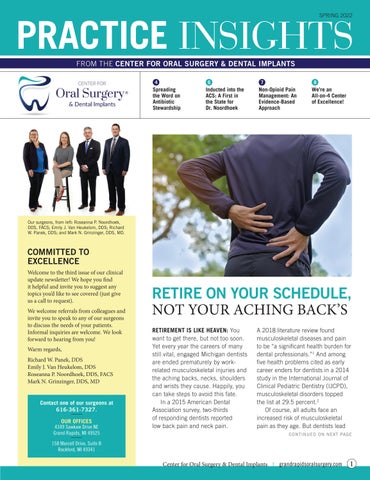
RETIRE ON YOUR SCHEDULE, NOT YOUR ACHING BACK’S RETIREMENT IS LIKE HEAVEN: You want to get there, but not too soon. Yet every year the careers of many still vital, engaged Michigan dentists are ended prematurely by workrelated musculoskeletal injuries and the aching backs, necks, shoulders and wrists they cause. Happily, you can take steps to avoid this fate. In a 2015 American Dental Association survey, two-thirds of responding dentists reported low back pain and neck pain.
A 2018 literature review found musculoskeletal diseases and pain to be “a significant health burden for dental professionals.”1 And among five health problems cited as early career enders for dentists in a 2014 study in the International Journal of Clinical Pediatric Dentistry (IJCPD), musculoskeletal disorders topped the list at 29.5 percent.2 Of course, all adults face an increased risk of musculoskeletal pain as they age. But dentists lead CONTINUED ON NEXT PAGE
158 Marcell Drive, Suite B Rockford, MI 49341
Center for Oral Surgery & Dental Implants | grandrapidsoralsurgery.com
COS_Newsletter_Spr22_Rev1.indd 1
1
2/8/22 10:59 AM
CONTINUED FROM PREVIOUS PAGE
RETIRE ON YOUR SCHEDULE,
NOT YOUR ACHING BACK’S
2
Cervical retraction
Shoulder-blade pinch
this parade. (See “Treating Dental Patients Can Be a Pain in the Neck,” next page.) According to the IJCPD study report: “A dentist can spend up to 60,000 hours in a lifetime working in tense and distorted positions, with consequent musculoskeletal problems. Dentistry does not lend itself to good posture; however, it is possible with instruction and practice to correct harmful postural habits that may be the cause of such stress and pain.” For a rundown of such instruction, we turned to physical therapist Chris Nawrocki, MSPT, OCS, CEO of the Grand Rapids-based Center for Physical Rehabilitation. He helps dentists take care of themselves so that they can retire when they’re ready, not just when they hurt too much to go on. Awkward positions. “The most common problem we see in dentistry is what we call postural syndrome,”
2 PRACTICE INSIGHTS | COS_Newsletter_Spr22_Rev1.indd 2
says Nawrocki. “It comes from the repetitive stress of being in a headforward, rounded-shoulder posture over and over again for sustained periods.” Minimize this stress if you can, even if it means reequipping your office with new exam chairs, stools and side tables that reflect the principles of ergonomics— the science of adapting work tools and processes to the worker’s natural positions and movements. The Center for Oral Surgery and Dental Implants recently purchased new ergonomic patient chairs made in Germany by Brumaba. They’re more expensive than normal oral surgery chairs, says the practice’s Emily Van Heukelom, DDS, but they’re worth it. “The contour of the shoulder support is tapered so that the surgeon can move in closer and needn’t reach as far— and thus doesn’t have to maintain an awkward position,” she explains. “And
3
PHOTOGRAPHER: CONOR REGAN
1
Hand clasp with deep breathing
the chairs can tilt from side to side like a banking airplane, so that the surgeon can keep his or her neck and torso upright for less cumulative strain.” Keep upright as much as you can, work as close to your body as you can, and limit sustained, extended stretching of arms, shoulders or wrists. Such stretching, says Nawrocki, “can create an imbalance in your musculoskeletal system that causes pain—the body’s way of telling you you’re imposing a pattern on it that it doesn’t like.” Workday solutions. You can’t focus all day on your spine, shoulders, neck and wrists. But you can form good habits that become second nature. The interval is up to you—hourly on the hour, say, or before seeing each patient. But when that moment arrives, it’s your cue to take a break and do three quick exercises:
SPRING 2022
2/8/22 10:59 AM
which Nawrocki alternately calls the chin tuck or the “reverse funky chicken,” you stand erect, eyes facing forward, and pull back your head and neck as far as you can about 10 times in quick succession. This helps realign the facet joints, which connect the bones of the spine. (You can Google this exercise to find illustrative videos.) 2 Shoulder-blade pinch. To open up your pectoral muscles, pull your shoulders back as if trying to make them meet. 3 Hand clasp with deep breathing. Clasp your hands together behind your back, lift them upward and take 10 deep breaths, counting them one by one. In addition, if you can take a lunchtime break for a brief walk outdoors in nature and fresh air, so much the better. Off-duty exercises. Buy a long foam roller, and when you’re home and ready to chill, lie back on that foam roller—head even, knees bent. Breathe deeply for 30 to 60 seconds, and then rotate your head from side to side. “That stretches the whole spine out,” says Nawrocki. Or, try extending your arms outward. (Search “foam roller opening” and “foam-roll pec stretch” on YouTube.) Nawrocki says clients tell him: “I come home at night and lie on that for one minute after work and my day resets. I release all the stress and tension.” Of course, proper nutrition is also part of taking care of yourself, as is regular hydration throughout the day— and sufficient good-quality sleep. No magic can keep the years from taking their toll, and the occasional musculoskeletal problem does demand not just better posture and targeted exercise, but treatment by a medical specialist. Still, these healthy habits
TREATING DENTAL PATIENTS CAN BE A PAIN IN THE NECK Bending over your patients to provide dental treatment, “often leads to an unnatural, harmful posture that negatively impacts the dentist’s health,” says the FDI World Dental Federation. Especially when good ergonomic principles are disregarded, says the federation, this phenomenon can mean “potential career-shortening, and in the worst case, possible career-ending injuries.” How extensive is the problem? As these pie charts show, neck pain and lower back pain are fairly common in the general population—but vastly more frequent among dentists.
PREVALENCE, BY PERCENTAGE ADULTS IN THE U.S.
80
DENTISTS IN THE U.S.
70 67%
65%
60 50 40 30 20 PERCENT
1 Cervical retraction. In this maneuver,
26.8%
10
13.8%
0 LOWER BACK PAIN
NECK PAIN
Source: “Ergonomics and Posture Guidelines for Oral Health Professionals,” FDI World Dental Federation, Geneva, Switzerland, 2021, based on the National Center for Health Statistics National Interview Survey, 2012 (U.S. adults) and the American Dental Association 2015 Dentist Well-Being Survey report, 2017 (U.S. dentists).
can better your chances of avoiding a musculoskeletal injury that ends your career prematurely. Advises Dr. Van Heukelom: “Ergonomics should be built into your everyday practice from the beginning because once you start to experience the symptoms of repetitive-stress injuries, it can be really hard to get your body to heal and to make
enough changes fast enough.” REFERENCES 1. A merican Association of Oral and Maxillofacial Surgeons. AAOMS Today. May– June 2021 (19:3):8–17. 2. G upta A, Bhat M, Mohammed T, Bansal N, Gupta G. Ergonomics in Dentistry. Int J Clin Pediatr Dent. 2014 Jan;7(1):30-4. https://www.ncbi.nlm.nih.gov/pmc/articles/ PMC4144062/. Accessed February 1, 2022.
Center for Oral Surgery & Dental Implants | grandrapidsoralsurgery.com
COS_Newsletter_Spr22_Rev1.indd 3
3
2/8/22 10:59 AM
SPREADING THE WORD ON
ANTIBIOTIC STEWARDSHIP IN THE KITCHEN, the toaster gives off sparks and begins to smoke. What’s your first move? “It isn’t to call the fire department,” says Emily Van Heukelom, DDS, of The Center for Oral Surgery and Dental Implants (COSDI). “You unplug the toaster, turn on the vent fan and open a window. And you turn off the smoke detector.” That’s the vivid analogy that Dr. Van Heukelom uses with some patients to explain why it often makes sense not to prescribe antibiotics—or to prescribe them for a shorter term than expected, or for use only if things don’t improve without them. In some instances, she suggests,
4 PRACTICE INSIGHTS | COS_Newsletter_Spr22_Rev1.indd 4
an antibiotic—or too much of an antibiotic, too soon—can be an overreaction, like a fire hose that needlessly floods the floor. Of course, every medication is a risk/benefit trade-off, and science has learned in recent decades that antibiotics carry risks that outweigh their benefits more often than we once knew. They may lose effectiveness through antibiotic resistance—an estimated 2 million antibiotic-resistant infections in the U.S. each year cause some 23,000 deaths and cost the healthcare system $20 billion to $35 billion. There’s also the danger of side
effects, particularly the notorious Clostridiodes difficile, which can trigger severe and recurrent diarrhea and exacts an annual economic price estimated as high as $5.4 billion. (Clindamyacin, once used widely in dentistry, is a frequent culprit.) Yet some dental patients, particularly those who haven’t kept up with recent discoveries, habitually consider a prescription for antibiotics an indispensable element of good dental care whenever pain, swelling or a possible infection is involved— and old habits die hard. Says Dr. Van Heukelom: “I try to help patients understand and think to
SPRING 2022
2/8/22 10:59 AM
themselves, ‘OK, I have this problem with my tooth. The solution is really to take the tooth out, or get a root canal or whatever. But meanwhile, my body can handle it. I don’t need to call the fire department yet.’”
THE COMMUNICATIONS CHALLENGE
These days, most hospitals have antibiotic “stewardship” programs, which require that antibiotics be prescribed only after the need for them has been carefully assessed. They seek to ensure that prescriptions are given only for “the right drug, dose and duration,” in the
words of Elaine M. Bailey, PharmD, and Marie T. Fluent, DDS, co-authors of three recent articles on antibiotics in the Journal of the Michigan Dental Association. 1 But such programs haven’t yet reached all smaller outpatient treatment facilities— particularly in dentistry, where 10 percent of antibiotics nationally are prescribed. 2 That means Michigan dentists today are called on to carry the message of antibiotic stewardship to patients, explaining that “the historical paradigm has shifted from ‘prescribe just in case’ to ‘prescribe only when necessary.’” “Traditionally, dentists prescribed 10 days of antibiotics for an infection,” says Dr. Bailey. “And most dental software is still coded for a 10-day dispense. We tend to treat by football scores—10 days, seven days, 14 days—without really a lot of scientific support.” That said, the Bailey–Fluent articles are good resources. They’re available online at the website (mi-marr.org) of the Michigan Antibiotic Resistance Reduction (MARR) coalition, which for 25 years has sought to reduce unnecessary antibiotic prescribing. Dr. Bailey, MARR’s executive director, says the group also offers free explanatory brochures for patients and a “provider commitment poster” for an office wall that can be personalized with the name of your practice. 3 Dr. Bailey tells a cautionary tale about c. difficile, and it’s at least as potent as the fire-department example. It’s the true story of the late Peggy Lillis, who in 2011 was a 56-year-old kindergarten teacher in Brooklyn. She was prescribed clindamycin while being treated for a dental abscess—and died seven days later. Her autopsy listed “manner of death” as “therapeutic complication.” Today the New York-based Peggy
Lillis Foundation created in her memory strives to “build a nationwide c. diff awareness movement by educating the public, empowering advocates and shaping policy.”4 The point is not to scare patients, but to establish that medications—including antibiotics—have risks. Antibiotics ought not to be prescribed or taken “just in case,” as one carries an umbrella on a grey day.
DENTISTRY’S RESPONSE
In November 2019, the American Dental Association Center for Evidence-Based Dentistry released new clinical practice guidelines on antibiotic use in the management of oral infections with pain and swelling, guidelines in the spirit of MARR’s effort. 5 But it turned out to be a tough time for anyone in healthcare to disseminate a national message not related to masking and handwashing. Because of the COVID-19 pandemic that soon followed, says Dr. Bailey, “the guidelines have had a slow uptick in the dental community. There’s been a lack of awareness.” The pandemic is a reminder of an obstacle facing dentists as communicators: a growing mistrust of science. “In the amount of time I have to spend talking to most of my patients, I don’t usually get that far,” confesses Dr. Van Heukelom. “If I hit on that, I say, ‘It’s good for your family and friends and neighbors that we decrease the amount of antibiotics out there.’” But even in our COVID-distracted era, dentists are working every day to improve antibiotic stewardship and spread the word. And one technique many use—described in the third Bailey-Fluent article—is “delayed prescribing,” in which they give the patient a prescription, but ask him or her to wait a few days before filling it to see if it’s truly needed. Research has shown that such delays
Center for Oral Surgery & Dental Implants | grandrapidsoralsurgery.com
COS_Newsletter_Spr22_Rev1.indd 5
5
2/8/22 11:00 AM
can reduce antibiotic use with no decline in symptom control or patient satisfaction.6 “I’ll say on a Tuesday, ‘In case your symptoms don’t improve by Thursday or Friday, here’s a prescription for some amoxicillin— five days to start,” says Dr. Van Heukelom. “But if you believe then that you need to start taking it, please call me and let me know, because I may want to see you back.” REFERENCES: 1. B ailey EA, Fluent MT. Antibiotic stewardship in dentistry: opportunities and challenges. Journal of the Michigan Dental Association. October 2019:40. 2. R oberts RM, et al. Antibiotic prescribing by general dentists in the United States, 2013. Journal of the American Dental Association. March 2017:172–178. Accessed February 1, 2022 at https:// www.ncbi.nlm.nih.gov/pmc/articles/ PMC6814255/.
3. T he Bailey–Fluent Journal of the Michigan Dental Association articles are in the issues of October 2019:40–44; August 2020:28– 38; and February 2021:42–44. Accessed February 1, 2022 at https://mi-marr.org/ dental-provider.php. A fourth Bailey–Fluent article coming March 2022 offers a tool for prescribing for patients who are, or believe they are, allergic to penicillin. 4. W ebsite of the Peggy Lillis Foundation. Accessed February 1, 2022 at https:// www.peggyfoundation.org. 5. A merican Dental Association. Evidencebased clinical practice guideline on antibiotic use for the urgent management of pulpal- and periapical-related dental pain and intraoral swelling. Journal of the American Dental Association. November 2019:906–921. Accessed February 1, 2022 at https://pubmed.ncbi. nlm.nih.gov/31668170/. 6. B ailey EA, Fluent MT. Delayed antibiotic prescribing: a simple strategy to promote antibiotic stewardship. Journal of the Michigan Dental Association. February 2021:42–44. 7. G ross AE, Hanna D, Rowan SA, Bleasdale SC, Suda K. Successful implementation
REDUCING ANTIBIOTIC USE: A SUCCESS STORY The University of Illinois– Chicago tried an all-handson-deck approach to cut needless antibiotic prescribing in its dental offices, educating providers and patients, promulgating guidelines and doing “before and after” tracking. Result: From September 2017 to May 2018, antibiotic prescribing dropped 72.9 percent.7
of an antibiotic stewardship program in an academic dental practice. Open Forum Infectious Diseases. 6(3) March 2019. Accessed February 1, 2022 at https://doi.org/10.1093/ofid/ofz067.
A FIRST IN THE STATE FOR
DR. NOORDHOEK WE WANT TO OFFER a huge congratulations to Dr. Rosie Noordhoek on being inducted into the American College of Surgeons (ACS)! She will be the first female oral and maxillofacial surgeon in Michigan to be accepted by the ACS. The ACS was established in 1913 to “Improve the quality of care for the surgical patient by setting high standards for surgical education and practice.” Being an ACS Fellow means Dr. Noordhoek’s education, training, professional qualifications, surgical competence and ethical conduct have passed a rigorous evaluation and been found to be consistent with the high standards demanded by the College.
6 PRACTICE INSIGHTS | COS_Newsletter_Spr22_Rev1.indd 6
The ACS leads national and international initiatives to improve quality in hospitals, as well as in the more specific fields of trauma, cancer and surgical care. The organization’s enduring commitment to quality is reflected in the many initiatives that it has developed. These initiatives have measurably improved surgical quality and have prevented complications, reduced costs and saved lives. Dr. Noordhoek is excited to join her medical colleagues to advance the surgical specialty and to be a voice for the oral and maxillofacial surgery community. Congratulations again, Dr. Noordhoek, DDS, FACS!
SPRING 2022
2/8/22 11:00 AM
NON-OPIOID PAIN MANAGEMENT: AN EVIDENCE-BASED APPROACH OVER-PRESCRIPTION of opioids after dental and other types of surgery fueled the opioid epidemic in the United States, leading to 49,860 overdose deaths in 2019 alone, according to the Centers for Disease Control and Prevention (CDC). In dentistry, nearly 1 in 3 opioids (29.6%) were prescribed for pain that was expected to be mild and 29.3% of prescriptions exceeded the recommended dose, according to an analysis of 542,958 U.S. dental visits between 2011 and 2015 within the Truven Health MarketScan Research Databases.1 More than half of the visits (53%) were for oral and maxillofacial surgery.
EVIDENCE-BASED PAIN MANAGEMENT
Using an evidence-based, multi-modal approach, The Center for Oral Surgery and Dental Implants (COSDI) cares for most surgical patients with non-opioid pain management. “We now have many non-opioid alternatives for pain management both during and after surgical procedures, and patients and families of patients are happy to hear that they will not be at risk of opioid habituation,” says Rosie Noordhoek, DDS, an oral surgeon at COSDI. For pain management, Dr. Noordhoek and our other oral surgeons follow the evidence-based guidelines, best practices and recommendations of the: • American Dental Association (ADA) •C enters for Disease Control and Prevention (CDC)
• Michigan Opioid Prescribing Engagement Network • Michigan Prescription Drug & Opioid Abuse Commission. They also comply with Michigan state regulations and complete continuing education in prescribing opioids and other controlled substances.
LONG-LASTING PAIN CONTROL
The evidence-based, multi-modal approach at COSDI starts with planning for postoperative pain management. Our oral surgeons screen patients for risky substance-use behaviors and provide counseling about the benefits and drawbacks of opioids. Techniques for long-lasting pain control used during surgery include EXPAREL, Sockit Gel and Ketorolac. EXPAREL (bupivacaine liposome injectable suspension) is a single-dose, local anesthetic infiltration that provides significant pain control for the first few postoperative days while reducing opioid use.2 3 4 Sockit Gel is an all-natural, FDAapproved treatment that accelerates healing of oral wounds. The NSAID Ketorolac is administered intravenously or intramuscularly and replaces the first few doses of oral NSAIDS. Post-surgery, ibuprofen and/or acetaminophen are the first-line painmanagement treatments for our patients. Effective non-medication measures include rest, heat, ice, stretching, good hygiene, hydration and mindfulness practices such as meditation.
LOW-DOSE, SHORT-TERM OPIOIDS
For breakthrough or severe pain, our oral surgeons prescribe the lowest effective opioid dose for no more than seven days, as per the ADA and CDC recommendations and guidelines. They educate patients on how to taper opioids as their pain resolves and how to store, monitor and dispose of unused medication at home. COSDI oral surgeons electronically report prescription of opioids on the Michigan Automated Prescription System, the state’s prescription drug monitoring program. REFERENCES 1. Suda KD, Zhou J, Woman SA, et al. Overprescribing of opioids to adults by dentists in the U.S., 2011–2015. Am J Preventive Med. 2020; 58(4): 473-486. Accessed 1/10/22. 2. Mont MA, Beaver WB, Dysart SH, Barrington JW, Del Gaizo DJ. Local infiltration analgesia with liposomal bupivacaine improves pain scores and reduces opioid use after total knee arthroplasty: results of a randomized controlled trial. J Arthroplasty. 2018;33(1):90-96. doi:10.1016/j.arth.2017.07.024. 3. Gorfine SR, Onel E, Patou G, Krivokapic ZV. Bupivacaine extended-release liposome injection for prolonged postsurgical analgesia in patients undergoing hemorrhoidectomy: a multicenter, randomized, double-blind, placebo-controlled trial. Dis Colon & Rectum. 2011;54(12):1552-1559. 4. Data on File. 2857. Parsippany, NJ: Pacira Pharmaceuticals, Inc.; June 2017.
For more information about non-opioid pain management at The Center for Oral Surgery and Dental Implants, CALL 616-361-7327.
Center for Oral Surgery & Dental Implants | grandrapidsoralsurgery.com
COS_Newsletter_Spr22_Rev1.indd 7
7
2/8/22 11:00 AM
PRESORTED FIRST CLASS U.S. POSTAGE PAID WILLIAMSPORT, PA PERMIT No. 33
4349 Sawkaw Drive NE Grand Rapids, MI 49525
All-on-4 treatment requires no grafting and is a costeffective implant solution for many patients.
long-term clinical outcomes and high patient satisfaction. “Overall, we’ve found that patients are quite pleased with the experience and outcomes made possible with this treatment,” says Richard Panek, DDS, a surgeon at The Center for Oral Surgery and Dental Implants. All-on-4 treatment provides full-arch rehabilitation without bone grafting using only four implants per arch: two axial anterior implants and two implants tilted up at 45 degrees in the posterior. The final prosthesis can contain up to 12 teeth. For patients who meet the criteria for immediate loading of implants, a fixed acrylic bridge provides immediate function.
PATIENTS WHO MIGHT BENEFIT
WE’RE AN ALL-ON-4 CENTER OF EXCELLENCE! THE CENTER FOR Oral Surgery and Dental Implants is now a certified Center of Excellence for the All-on-4 treatment concept, one of only three oral surgery practices in Michigan to have achieved this recognition. It means that our surgeons have undertaken extensive training and have the necessary surgical experience with this technique to provide the best possible care for your patients. All-on-4 treatment requires no grafting and is a costeffective implant solution for patients with failing dentition and for many with edentulism. The latest research shows good
COS_Newsletter_Spr22_Rev1.indd 8
To determine eligibility for All-on-4 treatment for each prospective patient, our surgeons perform a thorough evaluation, consisting of: • MEDICAL HISTORY, including any conditions that might affect the treatment outcome or the patient’s ability to have oral surgery, such as conditions or habits that could interfere with healing (diabetes, smoking). • DENTAL HISTORY, including periodontal disease and habits such as clenching and bruxing that can impact long-term outcomes. • RADIOGRAPHIC ANALYSIS, initially with a panoramic radiograph, and usually followed by a full-mouth periapical series, a CT scan or a cone-beam CT analysis. • INTRA- AND EXTRAORAL EXAMINATION to evaluate the remaining teeth and soft tissue. Most reasonably healthy patients are excellent candidates for All-on-4 treatment. If you or any of your patients would like to learn more about AO4 procedures, please visit: www.nobelbiocare.com/en-us/find-all-on-4-center.
2/8/22 11:00 AM