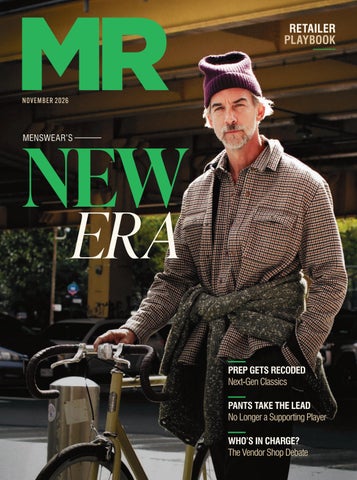
RETAILER PLAYBOOK
NOVEMBER 2026
NEW MENSWEAR’S
ERA
PREP GETS RECODED Next-Gen Classics PANTS TAKE THE LEAD No Longer a Supporting Player WHO’S IN CHARGE? The Vendor Shop Debate
26_11_Cover_final.indd 1
10/20/26 4:07 PM
DISCOVER MORE AT HARTSCHAFFNERMARX.COM
F26_MRAd_NOV_Print.indd 2
10/21/26 10:19 AM
VISIT US AT TALLIA.COM
F26_MRAd_NOV_Print.indd 1
10/21/26 10:20 AM
CONTENTS
DEPARTMENTS 6
EDITOR’S LETTER Welcome to a New Era of MR
8
SIGNALS Prep Was Never Gone. It Just Got Recoded.
12
LEGAL MATTERS Hitting Reset
2027 RETAILER PLAYBOOK 14
WHO’S IN CHARGE? The Vendor Shop Debate
19
DOWN A SIZE, UP A WARDROBE GLP-1s Impact on Retail
22
THE NEW SALES FLOOR Content Creators as Educators
25
SOUND CHECK The Importance of Store Playlists
27
PANTS TAKE THE LEAD No Longer a Supporting Player
30
RETAIL RADAR Modern Heritage
FEATURES 34
A NEW DAY AT DLS John Totolis Takes Over
37
MADE IN ITALY A Conversation with ITA’s Alessio Nanni
38
FASHION Twisted Tradition
48
THE LAST WORD My Closet is My Store
On the Cover: Hat: Trip In A Bag, Shirt: Vintage & Black, Sweater: Far Afield, Pants: Far Afield, Shoes: Gola Model: William Jude Above: Shirt: Untuckit, Rugby: Abercrombie & Fitch, Sweater: Barbour, Jacket: Front General Store, Belt & Bag: Beorma, Jeans: Trip In A Bag, Shoes: Mix No. 6 Producer: Michael Fisher Stylist: Jahn Hall Photographer: Marko Kalfa
2
MR: MENSWEAR RETAILING NOVEMBER 2026
26_11_TOC_Final_r3.indd 2
10/20/26 4:06 PM
MR NOV 2026.indd 3
10/20/26 10:36 AM
MASTHEAD
THE MENSWEAR INDUSTRY’S MAGAZINE
EDITORIAL EDITORIAL DIRECTOR MICHAEL FISHER EDITOR-AT-LARGE KAREN ALBERG GROSSMAN WEB & CONTENT EDITOR BRETT EDWARD STOUT ART DIRECTOR MIKE STEVEN FRANÇOIS CONTRIBUTING EDITORS ADAM MANSUROGLU / TIM CONLIN CONTRIBUTING CREATIVE DIRECTORS NANCY CAMPBELL / TREVETT MCCANDLISS
ADVERTISING GROUP PUBLISHER LIZETTE CHIN PUBLISHER CHARLES GARONE
PRODUCTION PRODUCTION MANAGER LAURIE GUPTILL MARKETING & PRODUCTION SPECIALIST CATHERINE ROSARIO OFFICE MANAGER KRIS PEPPER ACCOUNTING KASIE CARLETON / URZULA JANECZKO / NATALIA RAMIREZ
WAINSCOT MEDIA CHAIRMAN CARROLL V. DOWDEN PRESIDENT & CEO MARK DOWDEN SENIOR VICE PRESIDENTS LIZETTE CHIN / RITA GUARNA/ ED BURNS CHIEF FINANCIAL OFFICER/VICE PRESIDENT STEVEN RESNICK VICE PRESIDENTS NIGEL EDELSHAIN / THOMAS FLANNERY NOELLE HEFFERNAN / MARIA REGAN
CORPORATE OFFICE ONE MAYNARD DRIVE, PARK RIDGE, NJ 07656 WWW.MR-MAG.COM • WWW.WAINSCOTMEDIA.COM
MR MAGAZINE (ISSN 1049-6726) IS PUBLISHED BY WAINSCOT MEDIA, 1 MAYNARD DRIVE, PARK RIDGE, NJ 07656. SUBSCRIPTION SERVICES: TO CHANGE AN ADDRESS OR REQUEST A SUBSCRIPTION, WRITE TO: SUBSCRIPTIONS, MR MAGAZINE, 1 MAYNARD DRIVE, PARK RIDGE, NJ 07656; TELEPHONE: 201-573-5541. ADVERTISING INQUIRIES: CONTACT CHARLES GARONE AT 917.515.4531 OR CHARLES.GARONE@WAINSCOTMEDIA.COM. COPYRIGHT © 2026 BY WAINSCOT MEDIA, LLC. ALL RIGHTS RESERVED. PRINTED IN THE U.S.A. VOLUME 36, ISSUE 6.
4
MR: MENSWEAR RETAILING NOVEMBER 2026
26_11_Masthead_Final_r1.indd 4
10/19/26 2:37 PM
Dallas Men’s Show
Chicago Collective
80 W. 40th St., 2nd Floor, NY, NY 10018 (212) 997-2355 bugatti@modextil.com
MR NOV 2026.indd 5
10/20/26 10:37 AM
EDITOR’S LETTER
WELCOME TO A
NOVEMBER
SHOW +
NEW ERA OF MR TELL W
hen I stepped into the role of editorial director this June, I did what any former buyer would do: I hit the market. I spent the summer meeting so many of you, walking your stores and hearing the real stories (and challenges) behind your businesses. One theme came up again and again. This industry needs to think outside the box and, in some cases, rewrite the rules of traditional menswear altogether. Here’s what I find interesting. Karen Alberg Grossman’s very first editor’s letter, in MR’s inaugural issue in May 1990, ran under the theme “Menswear’s New Mission,” and she was making the same case: take more risks, build more partnerships. Thirty-six years later, that message still lands. Our industry never stops craving newness, whether through unexpected merchandising, a little whimsy or collaborations that keep shoppers coming back. I also know Karen—who steps into her editor-at-large role this month—would agree that one of the biggest problems facing our business is stores that all look the same. She tackles exactly that in this month’s Retailer Playbook. Speaking of rewriting the rules, I just learned that Pitti Uomo’s theme for January is “Wild,” a rebellion against clichés. According to the show, going wild means dressing not to fit a category, but to express a style that’s constantly evolving. I’d take it a step further: it isn’t only about how we dress, but how we do business, and resisting the hive mind that makes so much of retail feel interchangeable. I saw that willingness to experiment firsthand in the retailers featured in this month’s Modern Heritage story. James Scully of Jamestown Hudson told me he strives “to take [his customers] just slightly out of their comfort zone without intimidating them.” So let’s push menswear a little off center and make our customers braver along the way. Fred Derring of DLS Apparel Group has long preached the importance of discovery in the market. He and iconic merchants like Tom Kalenderian, for whom I worked at Barneys New York, required their buyers to set aside time every season for exploration, curation and, yes, curiosity. In my 17 years as a trend forecaster and consultant, curiosity was my most essential skill. As Jeff Staple put it at this year’s MR Awards, it’s about always hunting for the truffle: that one unexpected find no one else has noticed yet. That’s the spirit of our new era — giving yourself the time to be both inspired and informed. In every issue, you’ll find stories that push us to look at the business differently, from prep getting recoded to content creators becoming an extension of your selling floor. And we’ll always answer the why: why it matters to retailers, and what it means for all of us going forward. My promise is to keep building the community MR has always been known for and starting the conversations that matter. I want to hear from you, too: if something exciting is happening in your store, or you’re hearing things from customers or vendors that deserve a bigger stage, email me at michael.fisher@wainscotmedia.com, and follow us on Instagram @mrmagonline. The rules of menswear were never written in stone. They were just waiting for someone bold enough to rewrite them. Thirty-six years ago, MR set out on a new mission, and now our new era builds on that same spirit. Stay curious!
Two things I’m obsessed with, and why you should be too.
01/
Eugene Rabkin’s sharp, unapologetic take on how fashion traded creativity for logos and spectacle is the wake-up call our industry needs, and a reminder that the most exciting work always comes from taking real risks.
02/
Tweed and Italian lakeside tailoring: Guy Ritchie’s The Gentlemen is back on Netflix, and with Theo James dressed to kill (sometimes literally), it’s hands down the best menswear on TV right now.
MICHAEL FISHER EDITORIAL DIRECTOR
6
MR: MENSWEAR RETAILING NOVEMBER 2026
26_11_Editors_Letter_Final.indd 6
10/20/26 1:28 PM
TEXAS SPIRIT. GLOBAL STYLE.
JANUARY 23 - 25, 2027 WORLD TRADE CENTER PREVIEW DAY JANUARY 22, NOON - 6PM
MR NOV 2026.indd 7
10/15/26 10:32 AM
SIGNALS
PREP WAS
NEVER GONE. It Just got
RECODED. Welcome to Signals, a monthly column on the consumer shifts, cultural currents and emerging behaviors shaping how men dress, shop and live. By Michael Fisher
E
very few seasons somebody announces that prep is back, and every few seasons I want to ask the obvious follow-up: back from where? Prep never left. It went to work, paid a mortgage, kept buying oxford cloth button-downs, and quietly outlasted every trend that was supposed to bury it. Jack Carlson, now creative director and president of J. Press, put it about as plainly as it can be put: “It’s not something that goes in and out of fashion.” It just is. So let’s retire the comeback narrative. What’s happening in menswear right now isn’t a revival. I think it’s a transfer of ownership. For most of its life, prep came with a gatekeeper. The polo shirt, the navy blazer, the chino, the loafer: these weren’t just garments, they were credentials for a lifestyle. They told you where a guy summered, what his father did, and which quad he’d walked across. The clothes were the easy part and the membership was the point. I’m happy to say that the gate keeping others out has been yanked down. The codes have been fully decoupled from the class signals that used to enforce them, and what’s left is a wardrobe available to anyone who finds solace and joy in the classics. That’s the single most important thing happening here, and it’s the reason the numbers look the way they do.
8
Aime Leon Dore
Lyst has recorded more than a 200 percent increase in searches for the preppy aesthetic since the start of 2026. On Pinterest, searches for “polo shirt” are up 120 percent this year alone, “sweater and tie” up 120 percent, “loafers and jeans outfit” up 115 percent, and “boat shoe outfit” up 142 percent. Depop’s most recent recap clocked a 411 percent jump in searches for academia as an aesthetic. New generations are breathing life into classic 20th-century styles, and they are not asking permission first. You can see it on the P&L at iconic brands like Ralph Lauren, which reported in May that FY2026 revenue rose 15 percent to $8.1 billion, with global direct-to-consumer comparable store sales up 13 percent for the full year and North America up 9 percent, on notably strong full-price selling. In August, Q1 FY2027 revenue was up another 14 percent, with global DTC comps in the low double digits, and the company pointed to stronger-than-expected demand as the driver. Ralph’s Fall 2026 and Spring 2027 collections leaned explicitly into a reimagined preppy spirit, classic Polo codes cut with looser proportions and modern styling. Here’s why I think those two collections have been among the brand’s best in years. Ralph isn’t selling nostalgia. He’s showing guys how they actually want to dress right now, which is a half-haphazard mash-up of gorpcore outdoorsiness and Ivy League uniform: a barn coat over a rugby
MR: MENSWEAR RETAILING NOVEMBER 2026
26_11_Signals_Final_r2.indd 8
10/20/26 1:31 PM
SIGNALS
shirt, a tie with a high pile fleece, loafers with technical trousers. That collision would have been a category error twenty years ago. Today it’s the whole idea. But Ralph isn’t the only one making this argument, and the contrast is what I find most interesting. The industry has taken to calling brands like Aimé Leon Dore and Noah “moodboard brands,” which is meant as a slight and honestly, it shouldn’t be. These labels are competing for the same customer as Ralph, particularly among younger millennials and Gen Z, and they’re doing it using the tools Ralph invented — world-building for traditional menswear.
“
There’s a third model working alongside both of those, and it may be the most instructive one for a retailer. Brands like Alex Mill, Percival, and Hanover have built entire businesses on the classic uniform, and they aren’t reinventing a single silhouette. The oxford is still an oxford. The polo is still a polo. What they’ve done is move the newness out of the cut and into color and fabric. Percival, whose stated project is subverting the classics, has made the knitted polo a signature and runs a performance line underneath the main collection. Alex Mill keeps returning to the same small vocabulary of American workwear basics and rotates the palette instead of the pattern.
...the gate keeping others out has been yanked down.
THE NUMBERS BEHIND
THE NEW PREP +
Male preppy style Pinterest
+
Hanover works the made-in-USA essentials lane with a similar discipline. What links them is a willingness to put a familiar garment in an unfamiliar color, or cut it in something that stretches and dries, and call that the story. I’d argue this is the clearest evidence that the silhouette conversation is over. Prep’s silhouettes and styles are settled, agreed upon, no longer up for negotiation. Once the shape is fixed, color and hand are the only variables left, which is a gift for a buyer. It means the classics become reorderable season after season without relitigating fit every time. The customer already knows what the garment is. What he wants to know is what’s different about this one. I’ve been calling the product side of this Timeworn and Trusted. It’s a shift that pays homage to true classics without sacrificing their heartiness, character, and charm. Heritage workwear, academia, and countryside outdoor apparel have been rolled into a single look. Fabrics stay heavy, durable, and full of high-pile texture. Silhouettes get gently updated to move across the increasingly permeable line between casual and formal. Functional detailing is left alone or improved by inches, not overhauled. These garments stay true to their identity while being introduced to a generation of men seeking something that feels fresh even when it isn’t.
411%
Academia searches Depop
+
393%
Polo-striped shirt outfit Pinterest
+ What’s changed is the provenance. Ralph built an aristocracy that never existed and invited you to join it, a fantasy assembled out of Newport lawns and Adirondack camps by a kid from the Bronx. Teddy Santis built Aimé Leon Dore out of Queens: his family, the basketball court, the Greek diner, a Mediterranean summer. Brendon Babenzien built Noah out of skate and surf, and attached a set of stated ethics to it. The rugby shirt and the OCBD show up in all three. Only the origin story is different, and the origin story is now the product. The retail matters as much as the clothes. Both brands put their shops in a clubby, deliberately insular atmosphere — the coffee counter, the seating, the sense that you’ve walked into a room with its own rules. It’s a private club aesthetic stripped of the actual private club, which is the neatest trick in modern menswear. It delivers the feeling of belonging without any of the credentialing that used to gatekeep it. That’s the rebellious spin. Not a rejection of traditional menswear but an insistence on entering it from a different door. Worth noting for anyone tracking the talent: Babenzien exited J.Crew in February to re-focus on Noah full time, and that shop remains one of my absolute favorites in NYC for the joy seen in its assortment.
3,973%
320%
Nerd outfits men Pinterest
+
200%
Preppy aesthetic Lyst
+
142%
Boat-shoe outfit Pinterest
+
120%
Polo shirt Pinterest
+
120%
Sweater and tie Pinterest
+
115%
Loafers and jeans outfit Pinterest
NOVEMBER 2026 MR: MENSWEAR RETAILING
26_11_Signals_Final_r2.indd 9
9
10/20/26 1:31 PM
SIGNALS
Ralph Lauren, FW 26
Running alongside it is what I’d call New Trad: slightly more contemporary revision to the head-to-toe look. A trouser done in leather for the guy who wants an immediately noticeable jolt. An illusory change in a tweed weave or a marginally slimmer fit for the guy who wants a gentler nudge. The core identity has to survive the edit. Men return to tried-and-true garments because of their reliability and their quiet sense of class, but they’re increasingly clear that reliability alone isn’t enough. Then there’s Adaptable Academia, which has evolved well past novelty micro-trends like Grandpacore into something more authentic: preppy ‘60s collegiate style as a distinguished lane rather than a costume. Classically tailored sport coats, buttoned-up cardigans, dapper trousers. Brands like Drake’s that never abandoned this are seeing lift not only from older customers but from younger men graduating out of the streetwear that got them into clothing in the first place. That pattern, younger consumers taking their cues from older influencers and past eras, has been building for years. Watch golf if you want the clearest cultural read. Adults 18 to 34 are now the largest cohort of on-course golfers in the U.S. at roughly 6.3 million players, and 57 percent of all on-course
10
golfers are under 50. A wave of new brands is dressing them with a deliberately irreverent take on club attire. Blue-blooded sport, fused with the outdoors, fused with collegiate prep, is the post-pandemic leisure wardrobe. Retailers are seeing the pieces before they’d think to call it prep. Look at what’s actually populating purchase orders across the market: ties, OCBDs, knitwear, loafers, relaxed tailoring, heritage fabrics, layering, and a renewed appetite for clothes that feel lasting instead of disposable. At Pitti Uomo 109, more than 180 people joined a Suit Walk through Florence, sartorial menswear on full display as a communal gesture toward classic dressing. Gary Drinkwater and Teresa Borges of Drinkwater’s in Cambridge framed it for us this way: “For Fall ‘26, we stayed focused on collections that emphasize texture, fabric, and subtle detail, elevated, but still very wearable. It was encouraging to see a continued emphasis on classics done well rather than anything overly trend-driven. This aligns closely with how we think about the business and how our customers shop.” My advice to anyone buying into this neo preppy aesthetic is to ease in rather than reinvent. Make subtle tweaks to heritage classics and protect what makes them work: practicality,
J. Press, FW 26
reliability, quality. Reimagine traditional prints and patterns, because a contemporary spin on a countryside check signals creativity where a faithful reproduction just signals the archive. And keep things hearty. Heavyweight materials read as trustworthy, and trustworthy is what “made to last” actually means to this customer. We lived through quiet luxury and then the age of average. What consumers want now is a little classic quirk, evidence of personality and personal preference in a wardrobe. That’s why “prep is back” is too simplistic a read. Prep isn’t back. Prep has been recoded. The return of prep isn’t really a return to prep at all. It’s a return to the idea of dressing. Jeffrey Banks said it earlier this year: “Preppy has an ironclad identity, its stylistic markers the stuff of legend.” Isn’t it something to have a steadfast identity in a moment of global upheaval? Maybe that’s what this revival is really about. These are comfort clothes, full of romance, storytelling, and historic charm. In a world that keeps rewriting itself, there’s real reassurance in getting dressed in something that already knows who it is.
MR: MENSWEAR RETAILING NOVEMBER 2026
26_11_Signals_Final_r2.indd 10
10/20/26 1:32 PM
SIGNALS
EIGHT DECADES OF
1945 – 1959 THE COLLISION
Stood for: earned belonging. Post-war uniforms meet academic classics. GI Bill veterans arrive on campus in service-issue khakis and layer them under tweed. The Ivy League look isn’t styled, it’s assembled out of what’s already in the footlocker.
1960 – 1969 PEAK IVY
Stood for: consensus.
A timeline of what prep meant, and who it belonged to
The soft-shouldered sack suit, the repp tie, the natural-shoulder blazer. Kennedy in the White House, Miles Davis at the Vanguard, and in 1965 the Japanese photo book Take Ivy exports the entire grammar overseas, seeding what becomes Ametora.
1970 – 1979 THE WILDERNESS YEARS
Stood for: nothing, briefly.
Wide lapels, polyester, disco. Prep goes dormant in the culture but never actually stops selling in the stores. This is the era that proves the point: it doesn’t leave, it just stops being interesting to the press.
1980 – 1989 THE ASPIRATION
Stood for: the lifestyle, purchasable. The Official Preppy Handbook (1980) hands the world a manual, half instruction and half parody. Ralph Lauren turns a wardrobe into a world. For the first time, you can buy your way into the look without having been born into it, which is precisely the appeal and precisely the anxiety.
1990 – 1999 THE APPROPRIATION
Stood for: the code, seized.
Hip-hop takes prep’s most exclusionary signals and wears them louder than the original owners ever dared. Logos scale up. Colorways go electric. The gate isn’t opened, it’s climbed over.
2000 – 2009 MALL PREP
Stood for: mass access.
The hyper-preppy maximalism look goes national and mid-priced thanks to A&F. Volume, logos, and a whiff of costume. Prep becomes something you’re sold rather than something you inherit.
2010 – 2019 THE ARCHIVE ERA
Stood for: connoisseurship.
Menswear blogs, the Take Ivy reissue, and a generation of guys learning stitch counts on the internet. Prep gets studied, catalogued, and revered. Correctness matters more than joy.
2020 – NOW QUIRKY COMFORT
Stands for: the remix, no credentials required. Ivy meets gorpcore meets golf meets denim. TikTok replaces the club as the distribution channel. Aimé Leon Dore and Noah rebuild the clubhouse feeling without the club. The pieces are the same, the rules are gone, and the point is personality rather than provenance.
NOVEMBER 2026 MR: MENSWEAR RETAILING
26_11_Signals_Final_r2.indd 11
11
10/20/26 1:32 PM
LEGAL MATTERS
HITTING $ RESET: M&A and IPO Activity in the Fashion Industry
1B
By Douglas Hand
LEE ACQUISITION
The corporate deals keep coming. The fashion industry is undergoing a structural
AUTHENTIC BRANDS GROUP $750 MILLION AND UP TO $250 MILLION EARN OUT.
transformation, shifting away from the fragmentation of the past decade toward a landscape dominated by platform scaling and strategic resets. Confronted with macroeconomic headwinds, shifting tariff policies and cooling inflation, brands are moving cautiously. Yet, deep-pocketed corporate aggregators and public markets are sparking a pragmatic rebound in dealmaking.
12
THE M&A LANDSCAPE: RISE OF THE AGGREGATORS
IPO MARKETS: A TEPID BUT TURNING TIDE
Mergers and acquisitions are currently defined by fewer but vastly more strategic transactions. Traditional private equity buyouts have certainly cooled down. In their place, brand management giants are aggressively consolidating their market position by absorbing legacy labels onto unified operational platforms to cut overhead and mitigate inventory risk. Industry powerhouse Authentic Brands Group has continued its expansion, recently cutting a deal to acquire the Lee denim brand for $1 billion ($750 million and up to $250 million earn out). More recently, WHP Global joined forces with G-III Apparel Group to finalize a $925 million acquisition of Marc Jacobs. Luxury heritage houses are also reaching pivotal inflection points. Following the passing of its legendary founder, the Armani Group is navigating strict timelines stipulated in his will, actively exploring a 15% stake sale or public listing. It will be interesting to see who the acquirer is (though Mr. Armani’s will stipulates priority to existing commercial partners and existing luxury conglomerates).
Speaking of the public markets, after a multiyear chill the IPO market is seeing signs of life, albeit under a rigorous regime of valuation resets. The most anticipated public debut belongs to ultra-fast-fashion titan Shein. After years of regulatory standoffs in New York and London, Shein successfully executed a $1.74 billion IPO on the Hong Kong Stock Exchange. However, trading down more than 20% from its initial offer price, the debut reflects investor anxiety over cooling sales growth and changing U.S. tariff exemptions. Meanwhile, contemporary and sustainable labels are demonstrating healthier public momentum. Sustainable fashion brand Reformation successfully debuted on the New York Stock Exchange, raising over $210 million. Could this be the beginning of a pipeline of consumer favorites like Skims, Alo Yoga, or Quince to announce public debuts? Douglas Hand, chairman of the FIT board and a fashion law professor at NYU and Cardozo, is one of the country’s leading fashion lawyers. Reach him at dhand@hballp.com.
$
925M
MARC JACOBS ACQUISITION WHP GLOBAL + G-III APPAREL GROUP
1.74B
$
SHEIN IPO
HONG KONG STOCK EXCHANGE
MR: MENSWEAR RETAILING NOVEMBER 2026
26_11_Legal_Matters_Final.indd 12
10/19/26 2:19 PM
MEN’S EDITION
WOMEN’S EDITION
JAN 30 - FEB 2, 2027
FEB 28 - MAR 2, 2027
THE MART, CHICAGO • FLOORS 4 & 7
THE MART, CHICAGO • FLOOR 7
SHOW HOURS: SATURDAY PREVIEW DAY: 12:00 - 6:00 PM SUNDAY: 8:00 AM - 6:00 PM MONDAY: 8:00 AM - 6:00 PM TUESDAY: 8:00 AM - 3:00 PM
SHOW HOURS: SUNDAY: 9:00 AM - 6:00 PM MONDAY: 9:00 AM - 6:00 PM TUESDAY: 9:00 AM - 3:00 PM
chicagocollective.com Where style, brands, and the industry come together.
MR NOV 2026.indd 13
10/21/26 10:24 AM
PB RETAILER PLAYBOOK
MR
RETAILER
PLAYBOOK
14
MR: MENSWEAR RETAILING NOVEMBER 2026
26_11_Who’s in Charge_Final.indd 14
10/20/26 1:25 PM
B
Who’s in
Charge? By Karen Alberg Grossman
As more brands launch vendor shops in independent stores, do retailers risk losing control?
26_11_Who’s in Charge_Final.indd 15
RETAILER PLAYBOOK
Isaia shop at MartinPatrick 3
Retailers agree: a well merchandised selling floor is key to success in menswear. Unfortunately, there’s no consensus on what makes a well merchandised floor. Some merchants arrange by vendor, others by category. Some prefer lifestyle presentations, mixing categories and brands, while others group by size or fit. Whichever the approach, a well-designed floor these days will likely include vendor shops. Depending on the relationship, the cost of building and managing these shops is either split between the store and the brand, or else covered by one or the other. There are of course minimum order requirements and consistent replenishment commitments. While most retailers believe that a vendor-supported shop can elevate presentation, some fear that dedicating valuable real estate to a single brand can limit their ability to react when business changes. In a few stores, a handful of luxury brands already drive a large percent of their menswear volume. As one merchant explains it, “Our vendor shops look beautiful, but they leave little space or dollars to test the new exciting stuff we find in the market or at trade shows. Luxury brands that install and pay for these shops obligate us to buy every category: even ones we don’t like, even ones we’d never choose on our own.” Retailers acknowledge that certain vendors with shops are demanding more control — of the product, the sellers, the overall aesthetic, and the marketing message. “When vendors dictate, the store buyer becomes less relevant,” says one upscale merchant. “The good news: my average ticket is increasing. The bad? Some of these companies are opening their own single-brand stores nearby. I can’t say I blame them, but it’s becoming an issue.”
NOVEMBER 2026 MR: MENSWEAR RETAILING
15
10/20/26 1:26 PM
RETAILER PLAYBOOK
“
We consider brands as part of our store vision, rather than our store as part of the brand’s vision. — Brian Cohen, Harpers
”
Barbour display at Harpers
Not all merchants see a need for single-brand shops. In the opinion of New Jersey store owner Nick Hilton from Hiltons Princeton, a store’s aesthetic should be apparent as soon as the customer walks through the door. “This is why vendor shops don’t really work for us. We prefer to express our own aesthetic, not the vendors’. We stand for taste and style which our assortments reflect throughout the store. We can’t work with vendors who introduce a look one day and abandon it the next.” Instead, Hilton merchandises brands that belong together: a Calder sweater with Meyer trousers, a John Smedley polo with Zins trousers. He sees no reason to let a vendor’s vision dominate his mix. Nor are vendor shops part of the plan for Jack Madda of J3 Clothing Company in Cleveland, who believes men’s fashion is less about individual brands than about how the store puts them together to create a signature look. “Our guys don’t shop by brand,” he asserts. “We help them mix vendors. During market weeks, I look at everything, always seeking product that pushes the envelope. Nothing
16
makes me happier than a customer telling me he received compliments on a new outfit…” And rather than wait for customers to walk through the door, Madda employs a “by-appointment” strategy. “After 47 years, I have a long client list. I know what they want. So instead of making them shop a 7,000 square foot store, I boil it down to two tables. I know their fit, their taste level and their lifestyle.” Trey Gonzales, co-owner of Smiths Men’s Store in Lake Forest and Winnetka, Illinois, believes a store’s overall aesthetic can include vendor shops. “We certainly want each brand to have an identity within the store, but we also want the overall presentation to feel unmistakably like Smith’s. Our point of view as a specialty store is ultimately what ties everything together.” Gonzales cites the advantages of vendor shops. “They can elevate the aesthetic of the selling floor, create a very clean presentation, and give customers an immediate understanding of the brand and its story. But the tradeoff is flexibility. Once you dedicate a permanent
footprint to a brand, you’ve made a significant commitment not only in square footage, but also in inventory. That space needs to remain properly stocked throughout the season, so you must be very strategic about which brands justify that commitment based on sales, turn, margin, and productivity per square foot. “Then there’s the larger question of store identity,” Gonzales continues. “If too many brands have individual shops, a specialty store begins to feel like a mini-department store. At Smith’s, our aesthetic is part of our brand. I never want customers to feel like they’re walking from one vendor environment into another.” Brian Cohen, owner of Harpers in State College, Pa. and celebrating 100 years in business, agrees. “We don’t do vendor shops,” explains Cohen, whose 8,000 square foot store is 80 percent men’s and collegiate apparel. “We buy from way too many vendors so we never have too much of any single look. We might start out with strong displays from key vendors, but we ultimately break up the offerings into multi-brand lifestyle vignettes. For example, our mannequins are currently dressed in shades of brown and fall neutrals from Barbour, Bugatchi, Sand, Stenstroms and others. It’s a mix that reflects trends in the luxury market. “Peter Millar is probably our #1 brand with its own area on the selling floor. But it’s not a vendor-supported shop. Although we present their product cohesively when deliveries are fresh, we ultimately break it apart to communicate our overall vision for the season. At Harpers, we view the brands as part of our store vision, rather than our store as part of the brand’s vision. And since few of our male shoppers are eager to put together outfits, we’re happy to do it for them.” Toward this end, window displays are key, and Cohen delegates this task to his 20-person team. “At Harpers, the mannequins in our
MR: MENSWEAR RETAILING NOVEMBER 2026
26_11_Who’s in Charge_Final.indd 16
10/20/26 1:26 PM
RETAILER PLAYBOOK
Window Wizard
WISDOM T
Johnnie-O shop at Darien Sport Shop
dad taught me to invest in partnerships, “ My rather than just bringing in a rack of this or that. Create a multi-brand selling floor and make a statement within each brand. ” — Gina Zangrillo, Darien Sport Shop
windows are updated every 7-10 days. We get lots of foot traffic so changing our window mannequins gives shoppers new reasons to come into the store. I’m very impressed these days with the creative window displays our young employees are coming up with.” In Carmel’s upscale shopping area, home to Tiffany, Bottega and Cucinelli, Jim and Connie Ockert from Khakis are not huge fans of vendor shops. “First of all, our mix is mostly private label, crafted in workshops in Italy,” says Ockert. “Second, we have great relationships with our suppliers and strong marketing support, mostly because we pay our bills early. We don’t demand much from our vendors except great product delivered on time. If it’s late I can’t sell it, no matter how well priced it is…” Khakis is famous for its dozens of store windows and in-store mannequins, reimagined on a regular basis. The store’s high ceilings and exclusive fixtures also set it apart, as do Ockert’s famous videos, in which he discusses fabrics, fits, colors, and trends. “I don’t push, and I’m careful not to talk down to anyone. I simply share information in a concise way. My sellers are trained to do the same, explaining how the product is made and what makes each item special.” James Bower of The Clothing Commission believes in mixing brands. “By blending on-trend items, we can sell a Bugatchi shirt with a Borgo sweater and Brax pants. For us, it’s about partnerships: if we strongly believe in
a brand, a vendor shop makes sense. The negatives are competition among the vendor shops, and the strong loyalty guys feel for brands they know will fit them.” Bower overhauls his selling floor every two weeks, moving merchandise, changing displays and making everything look fresh and new. “But at the end of the day, with or without vendor shops, our sellers are the ones people come in to see. Presentation is critical but personal guidance trumps all.” Gina Zangrillo, president of Darien Sport Shop in Connecticut, is a strong believer in vendor shops. “My dad taught me to invest in partnerships, rather than just bringing in a rack of this or that. Create a multi-brand selling floor and make a statement within each brand. Presentation is too important to just pile up the denim jeans or khaki pants. For impact, you need to show a cohesive look, knowing that guys are not prone to matching things themselves…” Asked about the financial parameters of vendor shops, Zangrillo explains that it varies. “Sometimes the cost of the shop is split with the vendor; sometimes I pay for it all. If I really want a particular brand, I won’t let the expense stop me…” What determines if a brand stays or goes? “We judge by performance: sales per square foot. I’m not unduly strict but two backto-back seasons of under-performance means one more to go before reducing space or moving from a shop to a wall or floating fixture.”
om Beebe knows more about how men shop than just about anyone. His resume includes designing 14 store windows for 14 years at Paul Stuart on Madison Avenue (under the exacting standards of Mr. Cliff Grodd), not to mention another three years at Bergdorf Goodman, seven years at Neiman Marcus and 10 years as Men’s Creative Director at Fairchild Publications (DNR). Through these years, Tom has mastered not just design and presentation but also the mindset of how men shop. Here, the Window Wizard’s advice to retailers, and the lessons behind it. “My advice to retailers: If you have windows, use them to entice shoppers into your kingdom. Let them wander in the magic; reward them with a guided tour. May your well-dressed mannequins inspire, and may this inspiration drive sales! “I learned so much while working for Cliff Grodd at Paul Stuart. We observed that men prefer to shop by category and that they want options within each category. So each of our storefront windows would portray a single category that offered multiple options within each. There was a window of our most beautiful sweaters, of our finest socks, of our most distinguished ties. And as crazy as it sounds, customers would come into the store and insist on buying their item of choice directly from the window display, declining the exact same item from our in-store inventory. (I spent a lot of time back then climbing in and out of windows…) “The magic of Bergdorf’s men’s store has always been not treating it like a women’s store. Unfortunately, few stores merchandise by category these days! There’s so much sameness in the men’s business now. Just look at The New York Times style magazine’s most recent (Fall 2026) Men’s Fashion issue: page after page of ads feature a single model standing against a blank wall. Where’s the creativity in that? The only breath of fresh air is a witty Paul Smith ad with the model’s sport coat flashed open to reveal an array of watches pinned to the lining. A semblance of humor indeed!”
NOVEMBER 2026 MR: MENSWEAR RETAILING
26_11_Who’s in Charge_Final.indd 17
17
10/20/26 1:26 PM
RETAILER PLAYBOOK
“
Instead of making customers shop 7,000 square feet of selling space, we boil it down to two tables.
”
— Jack Madda, J3 Clothing Company, Cleveland
At MP3 Minneapolis, founders Greg Walsh and Dana Swindler are strong believers in branded shops, but under store control. “Vendors over the years have offered to build shops for us, sometimes involving a threeor four-year obligation,” says Swindler. “We once agreed to try it with a major brand and waited seven months for their architect to come up with a plan, which wasn’t nearly as good as what we could do ourselves. So now, Greg designs shops that we build, pay for and control internally. No vendors rearranging things: we design it, we pay for it, we control it. Fortunately, we have the capability to do the job internally from conception to installation.” “We realize that we’re unique,” says Walsh. “Too many retailers struggle to properly represent upscale brands in their stores, but peeling paint and worn carpets destroy the upscale aura. Another issue is regionality: cookie-cutter shops that work in one part of the country might not work in other parts. We love to mix brands and accessories to offer elements of surprise and to stimulate the customer’s sense of discovery. Too formulaic means too boring.” From a more mainstream perspective, John Tighe of Tailored Brands shares a totally different view. “We don’t arrange selling floors by brand or by classification. What we’ve learned from a 7,000-person survey is that our customers want to shop by fit, particularly when it comes to tailored clothing. So we feature five fits: Skinny, Slim, Modern, Classic, and Executive. In addition to ensuring that customers of all sizes get the fit they need, this system allows customers to serve themselves while waiting for a busy salesperson or tailor. “Of course, thanks to numerous weight-loss drugs, many guys have changed sizes which is clearly driving traffic. We don’t take this as a passing trend: my cardiologist believes that very soon, everyone will be on a drug for weight loss and/or cholesterol.”
18
“
Martin Patrick 3 - 212 N 3rd Ave
We believe that formulaic single-brand shops can kill the customer’s sense of discovery.
— Greg and Dana, MartinPatrick 3
”
BEFORE YOU SIGN: 6 Questions to Ask About a Vendor Shop
01 02 03 04 05 06
Who pays, and for how long? Costs may be split, vendor-funded or store-funded. Know whether the deal locks you into a multi-year obligation. What are you committing to buy? Minimums and replenishment requirements can force you into categories you’d never choose on your own. How much open-to-buy is left? If one brand’s shop eats your budget, what’s left to test new resources from market week? Who controls the floor? Clarify who decides on fixtures, layout, staffing and visual merchandising before the shop goes in. How will you measure it? Set the yardstick up front: sales per square foot, turn, margin. Also decide how many soft seasons you’ll tolerate before reducing the space. Does it still look like your store? Too many branded shops can turn a specialty store into a mini-department store. Make sure your point of view ties the floor together.
MR: MENSWEAR RETAILING NOVEMBER 2026
26_11_Who’s in Charge_Final.indd 18
10/20/26 1:27 PM
SIZE,
DOWN A
RETAILER PLAYBOOK
UP A WARDROBE GLP-1 medications are changing men’s bodies, and new research suggests they are changing how men shop. For specialty stores built on fit, the disruption is starting to look a lot like opportunity. By Michael Fisher
F
or decades, retailers have built merchandising, marketing and returns strategies around a settled assumption: women generate most apparel returns. New research suggests GLP-1 medications may be rewriting that playbook, with men at the center of the shift. Earlier this summer, returns management firm ReturnPro surveyed 1500 U.S. adults who are taking, or have taken within the past year, Ozempic, Wegovy, Mounjaro or Zepbound. Among those users, men outpaced women on nearly every behavior associated with the traditional high-return shopper. Twenty percent of men said they frequently bracket, buying the same item in several sizes with plans to send back what doesn’t fit, compared with 12 percent of women. Nearly half of the men (49 percent) said they are returning apparel more often since starting treatment, versus 39 percent of women. Men were also more likely to say they had significantly increased their spending on premium apparel. It’s becoming clear this is far from a niche customer. According to Numerator’s quarterly tracker, 22 percent of U.S. households now include a current GLP-1 user, double the share in October 2023, and weight-loss-only use now exceeds diabetes use for the first time. A PwC analysis of Numerator data found usage is nearly equal between men and women, and that apparel spending among users rises nearly 10 percent after six to eight months on the medication. The timing compounds the effect. Many men were already rebuilding their wardrobes as return-to-office mandates took hold, or they had a more pronounced focus on sport and fitness overall, and weight loss has given that reinvestment fresh urgency.
A MEDIUM ISN’T A MEDIUM On the selling floor, the returns picture looks different. The more telling shift is in the size curve. James Bower Jr., president of The Clothing Commission, Ltd., which operates R. Coffee Ltd., Davidsons, S.H. Franklin, Winston James and B. Jordan Menswear in Virginia, says returns have never been a significant issue for his stores because his team fits each garment to the client. A customer who has lost weight may occasionally need a re-cut, “but it isn’t as much as you would think,” he says. What has changed is his buy: he is ordering more smalls and mediums relative to extra-large. The fitting room has changed, too. In his stores, clients rarely purchase multiple sizes, but they try on far more of them to land the right fit. “When I first started in the industry, a medium was a medium,” Bower says. “Now you have both ends of the spectrum that can fit in a medium.” At Jos. A. Bank, size medium now represents a larger share of sales in sportswear and casual, a trend the team expects to continue, and pant customers are migrating from Classic Fit toward Modern and Slim fits. The retailer stops short of attributing the move to GLP-1s, but Kelly Adams-Browning, SVP and chief merchant, points out the irony. “What’s particularly interesting is that this is essentially the reverse of what we saw coming out of the pandemic, when many customers moved toward roomier fits,” she says. “In both cases, though, changes in fit have prompted customers to update their wardrobes to better reflect their changing body types, which has been a nice driver for our pants business.”
NOVEMBER 2026 MR: MENSWEAR RETAILING
26_11_GLP-1_Final.indd 19
19
10/20/26 7:01 AM
RETAILER PLAYBOOK
“
When I first started in the industry, a medium was a medium. Now you have both ends of the spectrum that can fit in a medium.
”
— James Bower Jr., The Clothing Commission, Ltd.
20
Brands MR spoke with confirm the pattern, reporting purchase orders shifting toward the left side of the size scale, especially in tailored clothing and bottoms. At the other end of the spectrum, big and tall specialist Destination XL Group has addressed the trend directly in recent earnings reports, noting that a meaningful portion of its customers use GLP-1 medications. The company is broadening select assortments in smaller sizes and describes the shift as “both a near-term challenge and a longterm opportunity” — some customers pause purchases during periods of rapid size change, but many say they intend to return once their size stabilizes.
THE FITTING ROOM ADVANTAGE The ReturnPro data also complicates the idea that weight loss alone drives returns. Among GLP-1 users who buy multiple sizes, half cite brand-to-brand sizing inconsistency as the primary reason, while a much smaller share points to a rapidly changing size. In the report’s words, GLP-1 weight loss has “exposed and amplified” a problem that has always existed. That is where specialty stores hold the edge. Sixty-nine percent of GLP-1 users say sizing
uncertainty makes them more likely to shop in-store, and the share climbs with spending: 83 percent among those who have meaningfully increased premium apparel purchases, and 91 percent among those who have increased them significantly. The customer most likely to walk through the door is also the one spending the most. Bob Mitchell, co-CEO of Mitchell Stores, sees it regularly. “Lots of clients are coming in jokingly saying they’ve lost lots of weight and need more wardrobes,” he says. “Sometimes they are hesitant to tell us the reason, but hint that they simply need some better-fitting things, and then it goes from there.” Mitchell’s stores are seeing the strongest reinvestment in suits, denim and casual pants, categories that are harder to alter, along with an uptick in accessories to finish the new looks. Mitchell also notes, with a laugh, that men tend to follow the lead of the women in their lives, so rising GLP-1 use and appearance spending among men comes as no surprise. Customers came out of the pandemic wanting more fun and versatility from their clothes, he says, and losing weight is simply a catalyst to lean further into that shift.
MR: MENSWEAR RETAILING NOVEMBER 2026
26_11_GLP-1_Final.indd 20
10/19/26 2:35 PM
RETAILER PLAYBOOK
Men Behaving
01 FREQUENTLY BUY MULTIPLE SIZES
20% 12% WOMEN
MEN
02 RETURN APPAREL MORE OFTEN
49
since starting treatment
% 39% WOMEN
MEN
Like
High-
03 SIGNIFICANTLY INCREASED PREMIUM APPAREL PURCHASES
Return
18% 13% WOMEN
MEN
04 WOULD PAY FOR A SIZE EXCHANGE PROGRAM
64 MEN
% 53% WOMEN
Shoppers
ReturnPro
THE ONCE-IN-A-CAREER CUSTOMER A man replacing an entire wardrobe, from tailored clothing to shoes and belts, represents a rare transaction, and retailers are building around it. The Clothing Commission offers wardrobe overhaul packages at different price points, which Bower says have driven a significant increase in business. The goal, he says, is making the client comfortable in his skin at any
“
weight loss, but several customers have come in recently to reload their closets after losing significant weight in a short period. Some bring in pants, sport coats and suits bought at the store to be taken in, a service Darien provides free for the life of the garment, and one that hasn’t strained the tailor shop. The store’s newest tool may prove the most useful. Earlier this year, Darien Sport Shop introduced an AI-integrated made-to-measure
This is essentially the reverse of what we saw coming out of the pandemic, when many customers moved toward roomier fits. — Kelly Adams-Browning, Jos. A. Bank
size, and sometimes that means tailoring older garments rather than selling new ones. “They realize we are not just selling to sell,” he says. Darien Sport Shop in Connecticut has seen a similar dynamic. General manager Doug Reiley reports no noticeable uptick in returns tied to
”
platform. “Made-to-measure is great for the customer that may have a unique build and has struggled to find something that fits well off the rack, but it is also proving to be a nice option for the customer that has lost a lot of weight in a short amount of time and wants
to batch order new clothing that they know will fit their current build,” Reiley says. Long term, he sees a growing MTM business as a way to reduce the store’s alterations workload.
A SIZE CURVE IN MOTION For retailers, the lesson may be less about bracing for returns and more about building flexibility. ReturnPro found that 58 percent of GLP-1 users, and 64 percent of men, would pay a small fee for a program guaranteeing one free size exchange within six months of purchase. Specialty stores offering lifetime alterations, re-cuts and made-to-measure are already delivering a version of that promise. Flexibility matters because the size curve may not move in only one direction. Numerator notes that rapid adoption is being matched by rapid churn, with nearly two-thirds of former users stopping treatment within six months. Some customers sizing down today may be sizing back up tomorrow. Either way, the man in the fitting room trying on three different mediums is not a returns problem. He’s a customer looking for someone who knows how to fit him, at this size and whatever size comes next.
NOVEMBER 2026 MR: MENSWEAR RETAILING
26_11_GLP-1_Final.indd 21
21
10/19/26 2:35 PM
RETAILER PLAYBOOK
THE NEW
SALES
“
FLOOR Menswear’s new guard of creators is driving sales. Here’s what brands and retailers can learn from them.
If you’re going to do this for a long time, you want to be able to look back on your body of work and feel good about what you did.
— Derek Guy
”
By Adam Mansuroglu
P
ower doesn’t always translate to influence. Consider the menswear institutions that once single-handedly set the trends of the moment. These players, editors and buyers among them, haven’t lost all their cards. But social media is now an accepted and powerful medium for menswear content, and a growing field of independent voices has been dealt into the game. Many appear to be holding a winning hand. According to Deloitte’s Fall 2026 Digital Media Trends survey of U.S. consumers, roughly 60% of creator-engaged shoppers made a purchase in the prior six months primarily because of a creator’s recommendation. About 70% regularly return to content from the same individual creators. This isn’t the highly curated, aspirational OOTD (“Outfit of the Day”) feed of the male influencer a decade ago. Today’s menswear creators trade polish for depth. They post unfiltered, show-and-tell content built on style tips, menswear history, brand discovery, and trend tracking, with enough entertainment to stop the scroll and earn the like, comment, and save. The most significant action they drive happens beyond the feed, right at the register (or the e-cart). For brands and retailers, this rapid influx of disruptors calls for a crash course in the new
22
menswear ecosystem. MR spoke with several creators about how they keep the attention of devoted followers even with paid partnerships in the mix. They also described untapped opportunities for the industry to build relationships that pay off for both sides.
CREATORS BY THE DOZEN Feeling creator fatigue? There’s a reason. TikTok’s post-pandemic boom was the primary catalyst for today’s democratization of menswear voices. The platform’s For You Page rewarded engagement and watch time over follower count, so everyday users had a real shot at going viral. That fueled the rise of “Menswear TikTok” in 2021 and 2022. “When I got on TikTok during the pandemic, I found myself watching creators like Edgy Albert and Ethan Glenn, guys who were on that wave super early and seemed like regular, real guys talking about menswear,” says Xander Torres, a Portland-based menswear and lifestyle creator with more than 262,000 TikTok followers and 191,000 on Instagram. “They were a breath of fresh air. I was really into clothes, and I thought, I could do that.” His breakout came with a series of fit-check videos featuring his daughter. “My account went from 700 followers to 10,000 overnight,” he says. “Because of one of those videos, I just kept going.”
Torres is no anomaly. Most of the creators MR spoke with started on TikTok well before 2024. One is Sunny Bali, a Houston-based physical therapist who shares menswear brand and trend recommendations with more than 164,000 followers across TikTok and Instagram. “I married a man who had style and loved fashion but needed someone to filter through all the options and curate his wardrobe,” says Bali. “Then one day I had one too many martinis and decided to talk about it on the internet. That’s how I got started.” Instagram soon followed TikTok’s discovery-first playbook. It added algorithmic recommendations to users’ feeds, and in 2024 it changed its ranking system to favor original content from smaller creators. This new generation could then build audiences on both platforms at once. The result was a wave of microtrends and a fractured culture. That upended the traditional trend cycle and the monoculture that powered the big institutions. Today, shares and saves sit at the top of Instagram’s engagement hierarchy, so niche educational and explainer content is more valuable than ever. If you think the creator bubble is bound to burst, think again. Alex Finn, a former investment banker and tech professional turned fulltime men’s lifestyle creator, has gained roughly
MR: MENSWEAR RETAILING NOVEMBER 2026
26_11_The_New_Sales_Floor_Final.indd 22
10/19/26 6:07 PM
RETAILER PLAYBOOK
@AlexFinn
@XanderTorres
89,000 Instagram followers in less than eight months. His formats are built for discovery on the Explore page: straightforward green-screen videos and Canva-designed carousels. Their clear text hooks and inspiration imagery tell the user (and the algorithm) exactly what the post is about before anyone taps in. “The average guy sees a photo of someone like Jacob Elordi, who has great style, and it piques his interest, but he’s not going to go down the rabbit hole to figure out exactly what he’s wearing or how to get a similar look,” says Finn, who uses AI tools for both market research and content optimization. “I used Claude Code to build a dashboard that pulls insights from my Meta Business Suite to analyze which posts convert to followers and which ones people engage with most. I keep working on it, but it gives me a lot of insight.” Many of Finn’s followers DM him Pinterest images, asking him to identify a brand or find an affordable alternative. That matches Pinterest’s 2026 men’s trend report, The Intentional Man: searches by Gen Z men rose 17% year over year and now account for more than 62% of male monthly searches. The influence reaches the industry, too. A couple of retailers MR spoke with admitted, somewhat sheepishly, that their buying teams increasingly rely on Instagram and TikTok to track trends and discover new brands, work
that once had to happen in person. Some go beyond the posts themselves, reading the comments on well-known creators’ content to see how followers are reacting to emerging trends.
CONTENT & CREDIBILITY Scroll a menswear fan’s Instagram Explore page and you’ll find a mix of content from legacy publishers and many unknown talking heads. The page has no hierarchy of authority. The algorithm simply prioritizes whatever keeps users on the app. With trust in institutions low and media literacy lagging, how much lasting authority can a creator have when his or her content is shaped by monetization? Derek Guy knows this question well. He is a writer and editor at Put This On, known to many as “the menswear guy” on X and to longtime readers by the name of his former blog, Die, Workwear! “In 2005 and 2006, people started blogs on Blogspot and WordPress, and alongside them came the growth of forums, all of which felt very exciting, partly because it felt like a democratization of fashion media,” he says. Guy went from industry outsider to one of menswear’s most influential voices, with an audience of roughly 2.5 million across Instagram, Bluesky, Threads, and Substack. Most new creators would envy that path, but he stays modest about it. “I generally don’t know
why people follow me,” he says. “I’d like to think some people follow me because I talk about clothing in a way that makes it more relatable. I’ll take the topic of the day, say what it means, and how to think about it in the context of menswear.” His early path looks much like that of today’s newest creators. He read legacy menswear publications in the early aughts, but their coverage didn’t always reflect his life, and he was skeptical of advertisers’ influence over glossy print. Instead, he spent his time on long-form forums that explored the history and cultural significance of niche styles and taught him a great deal about bespoke tailoring. For visual inspiration, the street photographs of real people on Scott Schuman’s The Sartorialist appealed to him more than the models in magazine editorials. Guy also got an algorithmic boost in late 2022, though he had been writing for more than a decade by then. The biggest difference between Guy and many of today’s creators? He avoids brand freebies, and he prefers to build relationships with the craftspeople who hold the technical knowledge rather than with brand publicists. “I just think we’re polluting the water with a bunch of people singing the praises of a brand just because they received a $900 sweater, which was the original complaint about fashion media in the early 2000s,” he says.
BY THE NUMBERS The Creator Effect
(Deloitte, Fall 2026 Digital Media Trends)
65%
of U.S. consumers engage with creators or creator-led content
~60%
of creator-engaged consumers made a purchase in the past six months based primarily on a creator’s recommendation.
70%
~75%
regularly return to the same creators
Gen Z and millennials purchased through creator influence.
Gen Z and millennials averaged three creator-influenced purchases each
How Men Find Products YouGov Profiles, 2026 Friends, family, or colleagues
47%
Search engines (vs. 38% of women)
44%
Influencers or bloggers (vs. 29% of women)
23%
Don’t mind paying more for quality
67%
NOVEMBER 2026 MR: MENSWEAR RETAILING
26_11_The_New_Sales_Floor_Final.indd 23
23
10/19/26 6:07 PM
RETAILER PLAYBOOK
His advice to independent creators is to define their own code of conduct. “There are people in that space who I think do a good job of creating honest content, introducing people to new brands, telling stories, whatever their audience cares about,” says Guy. “Some people care about construction details, some don’t. Your job is to communicate the things that resonate with your audience and their values. If you’re going to do this for a long time, you want to be able to look back on your body of work and feel good about what you did.” Guy acknowledges that because of the cost of living, paid partnerships are nearly unavoidable for full-time creators who need time to research and produce thoughtful work. Most creators MR spoke with work with talent managers to find partnerships with brands they already admire and cover organically. That way the content still feels authentic, whether or not money changes hands. For Bali, who keeps a full-time job, these decisions are even simpler. “If I haven’t heard of your brand or had hands-on experience with your product, I’m sorry, but I just can’t make content about it,” she says. “I can’t just look at your brand’s aesthetic online and assume it’s good quality. I’ll accept gifting and try it out. If I like it, then I’ll talk about your brand.”
WHAT A GUY WANTS, WHAT CREATORS NEED
educational content reaches more than 800,000 followers across TikTok and Instagram. “Find a partner whose voice is close enough to what you actually want published, and use them wisely. Just using someone who’s popular might not create the desired outcome.” When a creator shows early promise, give them the access the industry has long given editors and buyers: factory tours, studio visits, and a seat at industry events. “I would love to go to fashion shows, but honestly, trade shows are [even more] interesting,” says Bali. “Runway trends are hard to dissect if you don’t have the eye for it, but trade shows are very cut and dry. When I attended Project in Las Vegas, I was thrilled to meet all these brands and have insightful discussions, and I walked away with contacts that led to amazing partnerships. Seeing individual pieces from a wide range of labels made it much easier to spot recurring themes and trends I know my followers get excited about.” For established creators, think beyond the one-off post, with capsule collaborations or styling roles. “Having a background as not only a stylist but also an editor at a retailer puts me in close proximity to trends as they emerge and develop,” says Tyler Lee Sparling, a creator with traditional industry credentials who shares standout fashion finds and the latest menswear trends with a savvy, style-literate audience. “Being able to track the full life cycle of a trend, from the first rumblings on the runway to its emergence on the street, lets me engage with trends in so many different ways.” Most important, when you hire top talent for a paid partnership, don’t micromanage. Let creators do what they do best. “The tough thing about a good video, a good piece of content, is that it’s lightning in a bottle,” says Muzquiz,
@SunnyBali
talking about the problems with one-off deals arranged through influencer marketing agencies. “If anybody is telling these brands ‘we know how it works, we know how to make the perfect viral video,’ they’re obviously full of it, because nobody really knows.” Deloitte’s research supports this, finding that brands may get more from sustained creator partnerships than from one-time campaigns. Muzquiz now focuses more on his YouTube channel and works on product with brands he admires, such as Knickerbocker and Grease Point Workwear, even when they don’t have the biggest influencer budgets. “We can actually partner up and do a project over the course of several months,” he says, “and it also lets me live a dream of mine, which is getting to make clothes and content.”
Look through the fashion pages of a menswear magazine from 20 years ago and you’ll find many of the topics today’s creators do well with, from “The Best Stores in America” to the season’s must-haves to “How to Pull Off a Tweed Blazer.” The difference is the medium and how much room it gives for context, depth, and personality. Print had limited space, so the old guard’s guidance often read like a list of rules to follow without question. Today’s creators can cover the same topics in many formats. They can grab attention, teach more than a How retailers can partner with content creators, straight from the people who make it work. snappy 60-character blurb allows, and start conversations that 01 Match the voice, not the follower count. 04 Think beyond the post.
THE CREATOR PLAYBOOK
build community. “The creator gives you license to showcase your brand in a way that’s maybe not in the native vocabulary of your brand,” says Albert Muzquiz, better known as Edgy Albert. He is one of the leading voices of the Menswear TikTok boom, and his
24
Pick creators whose tone and values fit your customer.
Bring established creators in for capsule collaborations or styling work.
in early. 02 Get Find promising voices before they break out,
over the keys. 05 Hand Don’t micromanage. Nobody
them like editors. 03 Educate Offer factory tours, store previews,
the gifting rule. 06 Respect Many creators will only feature
and build the relationship from the start.
studio visits, and trade show access.
has a formula for viral content.
products they’ve tried and like.
MR: MENSWEAR RETAILING NOVEMBER 2026
26_11_The_New_Sales_Floor_Final.indd 24
10/19/26 6:08 PM
RETAILER PLAYBOOK
SOUND CHECK By Michael Fisher
I
walked into a store recently that had everything going for it: great assortment, beautiful fixtures, a wall of denim I wanted to unfold. And then there was absolute silence. Not quiet, silence. I could hear my own shoes. Within ninety seconds I was back on the sidewalk having bought nothing. I’ve been thinking about that store since our MRX conference in July, where music kept elbowing its way into a panel that was supposed to be about hospitality. Turns out you can’t separate the two. “I hate my store if music isn’t playing,” said Gary Flynn of M. Dumas, whose Charleston store sits on a stretch that delivers a nonstop parade of strangers. His whole challenge is converting traffic into time spent, and his tools are small and cumulative: offer a drink, keep the restrooms clean, keep the music right. His programming shifts by day and by hour. The longer they linger, he said, the more likely they are to buy. Ken Giddon of Rothmans made a related point about staying true to a store’s DNA rather than importing someone else’s polish. Anyone can copy your window. Nobody can copy how your store feels at 4 PM on a Saturday.
Your playlist is doing more work than you think. Stop treating it like background noise.
84
%
OF SHOPPERS NOTICE THE MUSIC PLAYING IN A STORE Luminate
NOVEMBER 2026 MR: MENSWEAR RETAILING
26_11_Sound Check_Final_r1.indd 25
25
10/19/26 6:09 PM
RETAILER PLAYBOOK
The data we found backs them up. Last year, The University of Bath’s School of Management found in a study that curated background music produced a measurable sales lift, especially on weekdays where people are more task-oriented versus weekend leisurely shopping habits. Luminate, a global entertainment data and analytics company, found that 84 percent of shoppers notice the music playing in a store, which should end the “it’s just background noise” argument on the spot. Gant reported customers spending roughly 42 percent more time in store with music on, and sales rising an average of 37 percent when the music was matched to the brand instead of chosen at random. In a recent Soundtrack survey, 91 percent of business leaders said music can make or break the customer experience. The best answer I got from a retailer came from Nick Hilton at Hilton’s in Princeton. “Primarily we switch on ‘sophista-pop,’” he told me. “It has soft jazz, Brazilian, bossa nova influences.” Sometimes he’ll swing toward mellow classic rock — Clapton, Steely Dan, some 80s soft rock. His governing rule is the one I’d tattoo on every store manager: “We like music with a beat that’s not loud enough or stressed out enough to offend anybody. We have music on constantly that just kind of goes with our vibe.” Others are still hunting. “We currently have SiriusXM, but we want to replace it with something that better fits the mood of the store,” said Mitch Larson at On Deck Clothing Co. in Wisconsin. I suspect a lot of you are right there with him. Here’s the humbling part. Ask people where they hear the best in-store music and a startling number will say the grocery store. Spend thirty seconds on TikTok and you’ll find them singing in the produce aisle. A supermarket has solved a customer experience problem that plenty of stores selling $900 sport coats haven’t. That should bother us more than it does. If there’s one shift I’d push for, it’s this: program a channel, don’t hit shuffle. John Mayer builds his satellite radio channel on SiriusXM to carry you from morning to night, and that’s the right instinct for a store. What you want at 10 AM, when someone’s picking up an alteration, is not what you want at 5 PM on a Friday. Match the sound to the assortment, too. Emerging global brands? Let the music travel. Heavy suiting business? Jazz has never let anyone down. Denim and flannel? Folk rock is right there waiting. And if your floor runs to knitwear, chinos and a certain easy Americana, yacht rock has quietly become one of the most useful genres in retail. Nobody dislikes it, nobody turns it off, and it sounds like money without announcing itself. Volume deserves its own audit. If your associates are shouting sizes across the floor, your music isn’t ambiance, it’s an obstacle. In an era of hyper-curation, your point of view has to be felt in everything from scent to sound. Throwing on a random station is a decision, whether you meant it to be or not. Speaking of which: we built MR’s Ultimate Men’s Store Playlist for exactly this purpose. Scan the code and steal it shamelessly.
PLAYLIST Curated by MR, this playlist is built for the sales floor: bossa nova for the open, yacht rock for the browse, classic rock for the afternoon, soul and indie for the close. Classic yet cool, never polarizing. Play it start to finish, morning to night.
26
Ten artists that belong on almost any men’s store playlist.
01 02 03 04 05 06 07 08 09 10
ULTIMATE MENSWEAR
Have a store soundtrack we should know about? Tell us, and we may add it to MR’s Ultimate Playlist.
HEAVY ROTATION
Scan & Play
BRUCE SPRINGSTEEN The consensus pick among the retailers we heard from. Works in denim, works in tailoring.
TOM PETTY Sounds like driving with the windows down. Nobody has ever been annoyed by Tom Petty.
FLEETWOOD MAC Classic and current at once, thanks to a decade of TikTok introducing them to a new generation. “Dreams” is like a glass of bourbon for your customer.
STEELY DAN The sophisticated choice, and the one your best-dressed customer will notice.
LEON BRIDGES Warm, unhurried, impossible to dislike. Ideal for the morning shift.
SADE For the store that wants to feel expensive without trying.
MARVIN GAYE Soul is the safest genre in retail and Marvin is its center of gravity.
TALKING HEADS Your high-energy pick, and great for a store with a design point of view.
KHRUANGBIN The modern entry. Instrumental, so it never competes with a conversation.
JOHN MAYER Blues chops, pop instincts, and plays equally well to the 30-year-old and his father.
Two things to handle with care: holiday music before Thanksgiving, and anything currently in the top 10. One can age you and the other quickly dates you.
MR: MENSWEAR RETAILING NOVEMBER 2026
26_11_Sound Check_Final_r1.indd 26
10/19/26 6:09 PM
RETAILER PLAYBOOK
No Apologies:
PANTS TAKE THE By Michael Fisher
LEAD
Once the dependable supporting player, the trouser is becoming the piece men shop for first. Brands and retailers weigh in on the details, fabrics and fits driving the shift.
W
alk into enough showroom appointments in a single season and a pattern starts to emerge. During spring/ summer appointments this past season, the conversation kept circling back to one category, and it wasn’t the one anyone expected. Pants, long the reliable supporting player in a man’s wardrobe and on the retail floor, were suddenly what everyone wanted to talk about. The shift is showing up in the details. Men are gravitating toward vintage-inspired touches like side-tab closures and subtle pleats, as well as casual five-pocket styles that move between the office and the weekend without feeling like a compromise in either setting. As men settle into post-pandemic work routines, retailers say the customer wants something casual but still polished, relaxed but still tailored. None of this is simple, because pants have always carried a particular kind of anxiety for men. It’s why a guy who finds a brand and model that works for him tends to stick with them for years. He wants a tailored fit with a soft hand. He wants details that feel special to him and still earn their keep. When a category that personal starts to change, it’s worth paying attention. Rian Gardiner of Triluxe, which represents Berwich, admitted to MR at a recent showroom preview that he has a “passion for pants.” He’s not alone, and he’s not embarrassed about it either. That’s the thread running through nearly every conversation for this story: brands and retailers are done apologizing for bringing fashion to the category.
FROM SUPPORTING PLAYER TO FOUNDATION
Berwich
For years, pants were what a man bought to go with the jacket or the sweater. Gardiner sees that changing as silhouettes evolve. “Trousers have become a centerpiece of the wardrobe,” he says, pointing to pleats, side tabs, cuffs, smarter fabrics, and greater comfort as reasons consumers are rethinking the category. As sport jackets, outerwear and sportswear have grown more relaxed season after season, trousers have followed and, in his words, “in many ways, are leading the trend.” Younger customers in particular are looking for something different, he adds, and this new aesthetic speaks to them.
NOVEMBER 2026 MR: MENSWEAR RETAILING
26_11_PantsTaketheLead_Final.indd 27
27
10/19/26 2:38 PM
RETAILER PLAYBOOK
share of the store’s dress pant business, along with high-end casual styles like elastic-waist five-pockets. Mitchell believes the store has done a strong job winning the casual pant customer, a shopper many luxury retailers are chasing as tailored clients look for comfort without giving up polish.
THE FLIP
At HILTL, Manuela Pabst, senior marketing and PR manager, describes the trouser as having moved “from supporting player to foundation piece.” Her customer wants comfort, polish and versatility, and she notes a lean toward chinos over five-pockets, with many shoppers associating HILTL with go-to chino models for both business and casual wear. Retailers confirm the category’s staying power. At Harry Rosen, Shannon Stewart, EVP and chief merchandising officer, calls casual pants “one of our most consistent businesses, both in sales and in turn.” The Canadian retailer works with a roster of specialists across price points: Brax for dressy five-pockets, Briglia for its flat-front fit, and Jacob Cohën and Pescarolo at the luxury end. This season it added Berwich, focusing on a single-pleat model in dressy cottons and wool flannel. In Dallas, the energy is visible on the floor at Stanley Korshak. Walking the store with the team, Bob Mitchell pointed to pants as the category generating a noticeable uptick, much of it centered on a dedicated Marco Pescarolo room. The brand has captured a significant
“
28
Andrew Weisbrot, co-founder and co-owner of Malcom, sees a customer who has simply had enough of one silhouette. “There are a lot of guys out there that are over five-pockets,” he says. “They have endless amounts of them in their wardrobes. It is time for a change.” In his view, men are realizing that a great-fitting trouser in an exceptional fabric can be more comfortable than the five-pocket they’ve been living in, and he sees “a clear return to Malcom a more formal mindset.” He describes the shift as a reversal. For years, the new way of dressing was a tailored sport coat paired with a five-pocket. Now, with luxury makers such as Manto, Fedeli and Baldassari producing relaxed, soft jackets, those jackets are increasingly worn with
a split waistband, fully tailorable construction and let-out, offered in fabrics from an in-stock natural bi-stretch wool to 100 percent cashmere. The goal is the comfort and versatility of a five-pocket with the construction of a tailored trouser. Gardiner says the fit and construction, more than any single fabric, represent the brand’s biggest innovation. Stewart’s view from the sales floor is a reminder that the jacket still matters. “A large share of our pants are bought to wear with a jacket, either tailored or soft-constructed,” she says, which is why Harry Rosen stocks a wide range of fabrics suited to jacket dressing.
FABRIC WITH A POINT OF VIEW Ask about fabric innovation and the answers split along two lines. For HILTL, the story is what Pabst calls “performance luxury” — refined fabrics with stretch, recovery, breathability and wrinkle resistance that perform all day without looking technical. For Weisbrot, the most significant development is fashion sensibility itself. Color, unusual fabrics and pattern make the difference, and while every wardrobe needs its core solids, they don’t give anyone a reason to walk into a store. “Men are looking for something different,” he says. “Malcom makes beautiful trousers. We do not apologize for the category by being all basic.” That point of view has helped the brand grow quickly. Malcom has established 90 retail
What is exciting about solid black, grey, and navy trousers? Yes, we all need them in the wardrobe, but are they exciting, do they drive people into a store? Certainly not. Andrew Weisbrot, Malcom
a refined trouser. “The look has been flipflopped,” Weisbrot says. Berwich is working both sides of that equation. For fall 2026, the brand launched a pure wool bi-stretch fabric in trousers alongside its new Tailored 5-Pocket, which Gardiner calls a “sartorial five-pocket” — a five-pocket with
”
accounts in four years, recently launched its own website and leans on lifestyle campaigns to reach a luxury customer. Retail prices start at $450 to $550, and the brand’s emphasis on color and playful models is designed to get men genuinely interested in pants.
MR: MENSWEAR RETAILING NOVEMBER 2026
26_11_PantsTaketheLead_Final.indd 28
10/19/26 2:39 PM
RETAIL PLAYBOOK
“
When a customer is buying a sport jacket for $1,500 to $1,995 (or more), a trouser for $395 to $495+ makes sense. Rian Gardiner, Triluxe
HILTL
THE DETAILS THAT ARE ACTUALLY SELLING Higher rises, pleats, side tabs, fuller legs — the runway has embraced all of them. The question for retailers is which ones translate. Pleats lead. Pabst says pleats and slightly higher rises are becoming “very real” for HILTL’s customer, while side tabs appeal to the more style-conscious man. Weisbrot reports a significant increase in single pleats and side tabs, with the sometimes polarizing detail strong for both fall and spring. Malcom’s standout this season was the Penne, a single-pleat luxury trouser with a higher rise, adjustable side tabs and classic Italian tailoring. Berwich offers a pleated side-tab trouser in its never-out-of-stock program, which Gardiner says lets a retailer introduce a new silhouette “with relatively little risk.” Even at Harry Rosen, where flat fronts and five-pockets still dominate, Stewart sees openness to a single pleat in a slightly more relaxed fit. Other runway ideas have been slower to land. Pabst says HILTL customers still see extremely wide legs as “more runway than reality.” Weisbrot says Malcom has begun offering a longer rise with a bit more room, but so far it has met with minimal interest. Most of the brand’s models are built on a modern silhouette, neither slim nor full. “Malcom is focused on the mainstream consumer who does not
He frames it in the context of the whole outfit — a man spending $1,500 or more on a sport jacket can see the logic in a trouser at $395 to $495 and up. Price value remains the key, he adds, noting that Berwich is family owned and 100 percent made in Italy. Weisbrot agrees that prices have risen significantly in recent years and that customers who want better are prepared to pay for it. Wary of how loosely the word luxury gets used, he describes Malcom as “honest luxury,” made entirely in Italy with Italian fabrics and findings. “A consumer that can see and feel quality is willing to invest in quality,” he says. Pabst puts it simply: “A gentleman will pay more when he feels the difference.” That may be the clearest sign of how far the category has come. The pant that used to be an afterthought is now the piece a man notices, feels and returns to. For retailers, the opportunity lies in giving him a reason to try something new, whether that’s a single pleat, a retro-inspired detail or a color beyond navy, while respecting the fit loyalty that makes pants such a dependable business. The supporting player, it turns out, was ready for a bigger role all along.
want to focus on a trend,” he says, “just a trouser that they can count on day in and day out.”
FIT WITHOUT ALIENATION That tension, between moving the customer forward and losing the guy who has worn a slim fit for a decade, is where fit becomes the whole conversation. “Relaxed does not mean oversized,” Pabst says. For HILTL, it means more comfort throughout the pant while keeping a clean, tailored line, which customers often describe as a “gentleman’s fit.” Gardiner takes a more direct view of the retailer’s role. “We are in the fashion business,” he says, “and it is important to evolve and lead the customer.” Loyalty cuts both ways. Once a man finds a fit he trusts, he’s reluctant to leave it, but he’ll reward it. Stewart says that when Harry Rosen clients find a fit and fabric they love, they buy it in several colors, which is why the store presents its pants as programs that are easy to shop.
”
THE PRICE OF A GREAT PAIR Pants have long been a price-sensitive category, but that’s loosening as the trouser moves to the center of the wardrobe. Gardiner says there are customers at opening, mid and luxury price points, and as trousers take on a bigger role, men are willing to pay for higher quality, distinctive fabrics and details that set them apart.
Berwich
NOVEMBER 2026 MR: MENSWEAR RETAILING
26_11_PantsTaketheLead_Final.indd 29
29
10/19/26 2:39 PM
RETAILER PLAYBOOK
RETAIL RADAR
MODERN
HERITAGE From Bedford to Chicago, a group of independents is mixing Japanese denim, European knits, vintage, books and objects into something decisive. The common thread: a point of view you can read from the sidewalk.
By Michael Fisher
H
eritage used to be menswear cosplay. In the right independent shop in 2026, it reads more like a sentence: a Japanese patchwork jacket beside an Italian umbrella, a Navy CPO shirt cut in English wool, selvedge jeans hemmed while you wait, a dog in the window and a candle burning near the register. Call it modern heritage. The brands come from Japan, Denmark, Sweden, Italy and the Hudson Valley. Workwear shares a rack with tailoring, vintage hangs next to new product, and books and objects fill in what the clothes leave unsaid. The mix is novel, but it is never random.
What unites the stores on these pages is conviction. Each is edited by someone willing to say no, whether to a charming designer, a synthetic parka, a raw hem or a brand that marks down too often. Each understands that a store’s job now is to tell its story clearly enough that the right customer recognizes himself in it and the wrong one keeps walking. And each has built a following that drives, flies or rolls in with a suitcase to hear that story in person. Here’s how they do it.
HUDSON, NY
JAMESTOWN HUDSON Classics With a Sense of Humor Opened
Size
Owner
2024
1,500 sq. ft.
James Scully
Top brands RRL, FOB Factory, Freenote Cloth, RTH, Transnomadic
Instagram @jamestown__hudson
James Scully built Jamestown Hudson out of his own closet, literally. He went to the brands he wore and asked if they would sell to him. Every one said yes. The rule that started the store still runs it: “I only carry things in the store that I would personally wear.” A line that is money in the bank elsewhere won’t make his floor if it isn’t in his rotation, though he makes sure the categories that pay the bills are covered within that mix. What he passes on is just as telling: brands with big direct-to-consumer businesses and heavy promotions. “Men come to me for things they don’t see everywhere,” he says. His newest addition is Khoki, a Japanese label built on small production, handwork and patchwork, already a store signature. It is the most expensive thing he carries, and for the
customers who get it, “there is no price resistance, so I can make brave choices with it.” The same rule governs the books and home accessories from Olivier Gustav. Scully stocks only what he has in his own home, and he sells out. It also gives the customer who isn’t shopping for clothes something to leave with. The experience starts at the window, where his dog greets visitors, the music is up and candles are burning. The clothes are classics pushed slightly off center through an unexpected fabric or color. “To take them just slightly out of their comfort zone without intimidating them gives them a different confidence,” Scully says. Customers arrive from the Hudson Valley, the Berkshires and Boston, return from Brooklyn and Philadelphia, and buy steadily over Instagram. Not every bet lands. Scully loves C.P. Company, but couldn’t move it. Customers asked for Drake’s, then passed it over when it arrived. “They would still look perfect in the store,” he says. That’s the trade-off of a store with a strong point of view: “The store is either for you or not.”
“
MEN COME TO ME FOR THINGS THEY DON’T SEE EVERYWHERE.
— James Scully
”
STEAL THIS Push classics slightly off center to make customers braver.
30
MR: MENSWEAR RETAILING NOVEMBER 2026
26_11_RetailRadar_Final_r1.indd 30
10/20/26 1:23 PM
RETAILER PLAYBOOK
BEDFORD, NY
RIVAY
Make It, Sell It, Hear It
Opened
Size
Owners
2023
700 sq. ft.
Jon Ruti and Katie Boiano
@rivaynyc
Most shops on this list edit other people’s work. Rivay, the men’s shop Jon Ruti and Katie Boiano run in Bedford Village, edits its own. Everything on the floor is Rivay label with the exception of some accessories, so the product, the store and the presentation all answer to one point of view. “We’re not buying into someone else’s seasonal collection and trying to make it fit within ours,” Boiano says. If the couple wants a Navy CPO shirt in Fox Brothers wool or an Italian suede Type II jacket, they make it and build the season around it. They also set their own clock. A six-month lead time, versus the year-plus wholesale calendar, means coats arrive when it actually gets cold, not in July. Boiano, who worked under Mickey Drexler and Todd Snyder at J.Crew, still hears Drexler’s “less is more” when she builds each season’s line plan. “Every product has to earn its place in the
“
EVERY PRODUCT HAS TO EARN ITS PLACE IN THE COLLECTION.
— Katie Boiano
collection,” she says. “If we’re not excited about something, we don’t produce it.” The sales floor works as a daily fit session. Ruti hears it in comments about the rise on a pant or a shirt that’s too trim through the chest, and sees it in what gets tried on and left behind. For more than five years, the Slub Pocket Tee carried a signature raw hem. This year they dropped it, and the tee sold faster than expected. “The raw hem wasn’t what made it a great T-shirt,” Boiano says. “Listening to our customers helped us make a better one.” That instinct predates the store. When the website alone wasn’t finding customers, Ruti sold clothes out of the back of his Land Rover Defender and a matching military trailer. The first Bedford shop was about 150 square feet. The playbook hasn’t changed: “Make something good. Get it in front of people. Listen carefully.”
”
Bedford’s slower pace, with espresso, long tryons and customers known by name and by closet, gives the shop a destination quality, while Instagram reaches the guy in Brooklyn or London who walks in months later. Collaborations stretch that reach further. Rivay has teamed up repeatedly with A Continuous Lean, Michael Williams’s longtime menswear site, on projects rooted in a shared love of classic American sportswear, military and workwear. In October, the partners brought Alden into the mix for Rivay’s first three-way collaboration, a natural next step with a brand all three hold in high regard. “The best collaborations give us a reason to make something we might not have made on our own,” Ruti says.
STEAL THIS Treat the sales floor as a fit session.
NOVEMBER 2026 MR: MENSWEAR RETAILING
26_11_RetailRadar_Final_r1.indd 31
31
10/20/26 1:23 PM
RETAILER PLAYBOOK
OLD TOWN, CHICAGO, AND GLENCOE, IL
FORD GENERAL Stubborn by Design Opened
Size
Owner
Top brands
2021
1,800 sq. ft. (Chicago) 800 sq. ft. (Glencoe)
Patrick Ford
Hansen Garments, Omotodenim, Indigofera, Fleurs de Bagne, Merz b. Schwanen
@ford_general
Patrick Ford runs his two Chicago-area shops as a select shop that stretches from denim workwear to tailored pieces, nearly all of it in natural fibers. He says no shop in North America carries more menswear made in the U.S., Europe and Japan. The mix pairs hard-to-find European heritage labels and Japanese denim with American brands that had never been stocked in a physical store before. His no’s are firm. Synthetic outerwear was non-negotiable this season. A harder call was a Western designer producing in Japan who reached out with a handwritten note. The dyeing was great, Ford says, but the silhouettes weren’t enticing enough and the line felt duplicative of the Japanese brands he already tells stories for. “It was hard to tell this designer no,” he says. What he says yes to often defies the math. “Our store might be a higher percentage non-commercial than commercial,” Ford admits. “We’re just stubborn and nuts like that.” When he found Hul Le Kes at Pitti Uomo, his associate Ray warned him about the price and complexity for a Midwest store. The wool uppers have done very well. This season’s newcomers, Motiv Mfg, Maru Sankaku
Peke and Cottle, are artisanal and pricey for the market, and Ford expects them to take several seasons to sell through. “That’s just how we operate, on a different timeline.” The dynamic has also flipped. Ford no longer chases brands as much; designers approach him, as Gajiroc did before he saw the collection in Paris. He has lost lines to the territorial tensions running through the independent scene and accepts it. “The whole point of indie shops is that we carry stuff you cannot find anywhere,” he says. “Oversaturation is not good for anyone.” The store itself is the argument. Ford notes the financially prudent move would be an appointment-only loft and a web focus. Instead he keeps a street-level floor for the spontaneity: New Yorkers rolling in with suitcases straight from the airport, a high schooler from Southern Illinois spending his birthday crawling Chicago’s denim shops, customers styling one another. With 30-plus artisan brands, a 90-minute try-on produces combinations no feed would suggest, “so much better than looking like the algorithm dressed you.”
“
SO MUCH BETTER THAN LOOKING LIKE THE ALGORITHM DRESSED YOU.
”
— Patrick Ford
STEAL THIS Give a risky brand more than one season to find its customer.
32
MR: MENSWEAR RETAILING NOVEMBER 2026
26_11_RetailRadar_Final_r1.indd 32
10/20/26 1:24 PM
RETAILER PLAYBOOK
CHICAGO
MILDBLEND SUPPLY CO. Built to Wear In Opened
Size
Owner
Top brands
2009
4,500 sq. ft.
Luke Cho, president
Iron Heart, Hiroshi Kato, Freenote Cloth, Nudie Jeans, Samurai Jeans
@mildblendsupplyco
“
”
I DON’T HATE THEM FOR GETTING SUCCESSFUL.
— Luke Cho
Mildblend is the veteran of the group, and Luke Cho, in retail since 1990, runs it with a veteran’s clarity. The 4,500-square-foot Chicago shop is known for premium Japanese denim, heritage menswear and womenswear, footwear, and denim repair. The brands differ in philosophy but share a priority: craftsmanship, materials and long-term wear over trend. The goal is clothes that develop character rather than simply wear out. Cho buys according to a formula. Half the stock is core and restockable. A quarter is what customers have asked for, which can shift season to season. The last quarter is product the store wants customers to try. This fall’s tests are East Harbour Surplus, a
Florence label blending vintage military and workwear with Italian tailoring and Japanese and Korean influences, and John Lofgren Bootmaker, which pairs old-school American work-boot design with meticulous Japanese craftsmanship. The passes are practical. Chicago’s milder winters have softened demand for heavy coats, and slim trousers have been fading for a while. “I don’t see any change soon,” Cho says. Bags and boots from the U.S. and Japan, meanwhile, account for about 20 percent of sales and complete the look. Mildblend is a destination, drawing customers from Wisconsin, Indiana, Ohio and Michigan, and many are surprised by the depth. Less than
half the inventory ever goes online. In the store, customers can touch and try everything and get complimentary hemming on the spot, so a trip for boots easily becomes boots, denim and a jacket. Cho prefers partnerships to simply being a stockist, and after decades of discovering brands first, he has lost his share as they grew. He takes it in stride. “It’s actually gratifying to see small start-up brands make it,” he says. “I don’t hate them for getting successful.”
STEAL THIS Reserve a quarter of the buy for experiments.
NOVEMBER 2026 MR: MENSWEAR RETAILING
26_11_RetailRadar_Final_r1.indd 33
33
10/20/26 1:24 PM
FEATURE
A NEW DAY AT DLS By Michael Fisher market. Think of having documents at your fingertips of all the available NOS / basics by brand and category, seasonal must-have key items organized by price, & a tutorial of how to categorically strategize your season.
MR: Where’s the growth for your retailers? JT: There’s an emerging group of sportswear brands with a “Relaxed Heritage” look — classic DNA with cooler, mostly looser styling, somewhere between preppy and designer, all in natural fibers. It’s the exact
MR: Barneys built its business on a point
A
John and his family
t the end of July, John Totolis took over ownership of DLS Apparel Group from Fred Derring and Virginia Sandquist, taking the reins of the buying office that has long served as the market’s eyes and ears for independent menswear stores. With a résumé that runs through Barneys New York, Ralph Lauren, Zegna and The Gap, Totolis has a clear view of where specialty retail is headed, and how DLS plans to get its members there. MR: Picture a member store owner three
years from now. What are they getting from DLS that they can’t get anywhere else today? JT: DLS has always been about being a true partner in the marketplace, finding interesting product that turns into new, profitable opportunities—that will never change. What will change is the speed that we get the stores this information. Many stores do not go to Europe at the beginning of the season, or even premarket in NY. If we can get them a brand’s information in “real-time” before they start their own buying cycle, that can be extremely advantageous. Then what’s next is a portal that simplifies the entire men’s
34
of view customers trusted more than any single brand. What transfers to a store doing a few million a year? JT: Focus. Because of open-to-buy and floor space, smaller stores have to be far more focused than we were. Where we maybe had 15 clothing vendors, most can carry two to five. But they usually have a loyal, tight-knit clientele, so they need constant newness to keep customers coming back: a new brand, classification or style.
opposite of the technical-fabric brands that have become the New York finance uniform. The other big opportunity is beautiful accessories. Most stores should add bags, small leather goods, unique gifts and candles, at least for Father’s Day and holiday. And stores (with our help) need to keep reaching customers through every marketing channel. The more they share what they’re up to, the more community they build, and community makes shopping comfortable.
MR: As a previous DMM, which discipline
MR: Does the next generation of store
do independent retailers most need and least have? JT: Most don’t have negotiating power at their volume, but they can work on exclusive styles and share risk with vendors. If a customer loves a product in a color they can only get at your store, they’re going to buy it. Stores also need to know what to buy six units of a style versus 40. When they go big, partner with the vendor to back up units. Then market the heck out of it: website, social, direct mail, windows. MR: What’s the problem you most want to
take on, the one that’s actually solvable?
owners buy differently? JT: Young people have so many career
options that if they choose this business, they’re passionate about style. They make tailored clothing look cool, like denim shirts and retro knits with softer sport coats, and they’re more fluent in sportswear, so they’re keen to try new brands. MR: Tell me about your family, John. JT: I’m lucky to have a great wife and two great kids just north of the city in Westchester. My wife is the general manager of Cadillac of Manhattan, so I know nothing about her business and vice versa, which is nice.
JT: Technology is consistently changing at a
rapid pace; we can’t change that. It is our goal at DLS to keep the stores not only updated, but organize information on what can be advantageous to business versus what is fluff. Right now we are working with one group that has a great CRM platform that can reach singular or multiple clients in record time to inform them on whatever is happening in the store. Another group can transform newly arrived outfits onto an AI generated replica of a client, and send him images in minutes.
MR: What are you streaming? JT: My wife and I just finished The Gentlemen; I love anything by Guy Ritchie. Before that, Ted Lasso, which is a feelgood show. We need more people who stay positive and think of others first. And I binged Reacher. I’d like to be the Jack Reacher for DLS stores. I’m not beating anyone up, but I’m out there working hard for the smaller independents.
MR: MENSWEAR RETAILING NOVEMBER 2026
26_11_NewDayDLS_Final_r1.indd 34
10/20/26 11:14 AM
Harmony_FP_MR_1126_REV.indd MR NOV 2026.indd 35 1
10/19/26 10/20/26 11:53 4:37 PM AM
PARTNER CONTENT
MR NOV 2026.indd 36
10/20/26 4:37 PM
FEATURE
MADE IN
ITALY, One Generation to the Next
Our Conversation with ITA’s Alessio Nanni By Michael Fisher
A
t the most recent Chicago Collective, Italian Trade Agency’s Alessio Nanni talked with MR about the artisan shortage, what happens when a family line ends, traceability, and pushing legacy brands toward faster storytelling.
Photo: Cameron Captures
different codes, and we are part of that. Narrating something classic in a modern way is our mission. Social is sourcing for retailers now, so we have to make it bigger and louder. MR: Some of these businesses are third or even fifth generation.
MR: Artisanship is central to nearly every Italian brand here.
What does the handwork actually look like on the ground, and how many of these houses are training a next generation? AN: Artisanship is the common ground of our companies, and it is the true added value of Made in Italy. It starts at the beginning of the chain, with the yarn and the textile. Our one problem is that we are lacking artisans, because that quality has to be preserved. Even the most luxurious brands are training a new generation of tailors, and we are seeing a return of tailoring, blended with sportswear and with made-to-measure. Bringing those masters into U.S. showrooms and training them in Italy is one of the strongest trends right now.
What happens when that line breaks and no one in the family wants the business? AN: We can monitor the trend of the industry, but we cannot get inside a family business. What we can do is [provide] training, and motivate these historic families to preserve the heritage they have, and prepare them for the market. The shortage is the real problem. The scenario will change. Even the biggest, most famous brands have been merged and absorbed. It would be a loss for us. Let’s hope it doesn’t happen. MR: What’s one specific thing happening in Italian tailoring or
fabric that retailers may not know yet? MR: Fast fashion turned craftsmanship intro a marketing word.
AN: This edition we focused on yacht club and Mediterranean style.
How does ITA help American consumers know that a Made in Italy label means so much more than a buzz phrase? AN: Made in Italy is far more than a label. It is woven into our social and economic fabric, a cultural fact on top of an economic one. Part of that work now is technology, traceability and blockchain, and those are real costs for companies that are very small realities. That is exactly what makes this industry special. They are not huge. They produce personalized garments, and the whole value of the supply chain sits there. It costs more. It is quality over quantity.
After the shows in Paris and London, that relaxed Mediterranean look is confirmed, and everyone likes it. You see it in the colors, in the lightness, in a relaxed linen blazer worn with a premium sneaker, in neat polo shirts and camp collar shirts. For spring and summer, it is the Italian Riviera, or business attire with a sense of Italian ease.
MR: The ITA has pushed legacy brands toward video and content
creators. How do you go faster without flattening the slower generational story behind the craft? AN: It is a balance, and it is challenging. We work with content creators because trust matters, and because people want a story and an experience. The harder part is telling the story of something with those roots to a Gen Z and Gen Alpha audience drawn to streetwear. But I think both can coexist. We want the loose outfit, we want
MR: Proudest accomplishment of 2026, and where does ITA
go in 2027? AN: It was a tough year, but a good one. For four days we turned
our NYC office into a live exhibition with 200 companies across design, fashion and food, so visitors could see it and smell it, a full sensorial journey through the Italian lifestyle. In June we partnered with Miami Swim Week for the first time and put a runway on the calendar, which gave our brands another platform. We will continue with Coterie and with a specialty area dedicated to niche perfumery, which is performing very well. We never stop. We are relentless.
NOVEMBER 2026 MR: MENSWEAR RETAILING
26_11_ITA Feature_Final.indd 37
37
10/19/26 2:32 PM
Full looks by Corridor. Will (left) Weatherproof shoes; Neil (right) Andre Assous shoes.
38
MR fashion FINAL.indd 38
10/17/26 7:41 AM
MR-fashion-FINAL-opener-out.indd 39
10/17/26 10:10 AM
Darius (left): shirt by Weatherproof shirt,Vintage & Black anorak, Abercrombie sweater.Will (center): Weatherproof shirt and sweater, Duck Head vest and pants, Front Street General bag. Neil (right): Charles & Keith bag, Paisley & Gray shirt, Front Street General tie, Paisley & Gray sweater, Les Deux shirt jacket.
40
MR fashion FINAL.indd 40
10/17/26 7:41 AM
41
MR fashion FINAL.indd 41
10/17/26 7:42 AM
Will (on bicycle, left): Trip In A Bag hat,Vintage & Black shirt and overshirt, Far Afield sweater and pants, Gola shoes. Neil (on bicycle, right): Trip In A Bag jacket, bag and pants, Ben Sherman shirt and sweater, Andre Assous shoes. Ted (holding pizza): Paisley & Gray shirt, Front General tie, Untuckit zip sweatshirt, Bugatchi coat and pants, Weatherproof boots.Darius (in red hat): Barbour hat, Untuckit henley, Barbour jacket and scarf, Vintage & Black pants.
42
MR fashion FINAL.indd 42
10/17/26 7:42 AM
Will (at ATM): Weatherproof shirt and sweater, Duck Head vest and pants, Front Street General bag. Ted (at food truck, left): Paisley & Gray shirt and tie, Abercrombie & Fitch X Club Deportivo Guadalajara hoodie, Hart Schaffner Marx suit, Sachraga bag, Alden shoes.Darius (at food truck, right): Corridor hat, Paisley & Gray shirt, Front General Store vest, Bugatchi jacket,Weatherproof pants, Beorma bag, Alden shoes.
MR fashion FINAL.indd 43
43
10/17/26 7:42 AM
44
MR fashion FINAL.indd 44
10/17/26 7:42 AM
Neil (left): Weatherproof henley, Far Afield anorak, Vintage & Black jacket, Front General vest, Abercrombie & Fitch sweats, Bruno Magli shoes. Neil (right): Paisley & Gray shirt and tie, Weatherproof rugby, Paisley & Gray suit, Pietro NYC bag.
MR fashion FINAL.indd 45
10/17/26 7:43 AM
(left to right) Will: Trip In A Bag hat,Vintage & Black shirt and overshirt, Far Afield sweater and pants, Gola shoes. Ted: Untuckit shirt, Abercrombie & Fitch rugby, Barbour sweater, Front General Store jacket, Beorma belt and bag, Trip In A Bag jeans, Mix No. 6 shoes. Darius: Untuckit shirt, Paisley & Gray tie, Far Afield sweater vest, vintage jacket, Abercrombie & Fitch jeans, Doc Martens shoes. Neil: Trip In A Bag jacket, pants and bag, Ben Sherman shirt and sweater, Andre Assous shoes.
46
MR fashion FINAL.indd 46
10/17/26 7:43 AM
Ted: Barbour hat,Weatherproof shirt,Tommy Hilfiger suit, model’s own tie and pocket square. Producer: Michael Fisher Photography: Marko Kalfa Casting, Styling & Production: Jahn Hall Styling Assistant: Quinn MacLachlan Production Assistant: Vinnie Pike Photography Assistant: Eriko Andres Models: Darius@ State, Neil @ Major, Teddy @ Hefner, Will @ Society
MR fashion FINAL.indd 47
10/17/26 7:43 AM
THE LAST WORD
MY CLOSET IS MY STORE By Tim Conlin
M
y wife and I built our house in Dallas six years ago, and if you’d asked the architect what mattered most to me, the answer wasn’t the kitchen or the primary suite. It was the closets. Thirty years designing apparel for brands like Champion, Lee Jeans, and several golf labels will do that to a man. I’ve spent my career thinking about how clothes are merchandised, how a rack is built to make you want to reach for something. So when it came time to design my own space, I couldn’t help but build a store. It just happens to be mine alone. People who follow my Instagram and TikTok have watched this closet evolve through dozens of reels. What started as “let me show you my sweater wall” turned into something closer to a case study in why presentation matters. I fold, I face out, I color-block. I treat my shelves the way a good visual merchandiser treats a flagship window: nothing in there by accident. Here’s the thing nobody tells you about a career in design: you start seeing every space as a selling environment, whether you want to or not. I can’t walk past a messy shelf without mentally refolding it. So my closet became the one place I could build the store I’d want to
48
shop in every single day. Every hang, every fold, every stack of chinos organized by shade is retail theory applied to a room nobody but me technically has to see. But I do see it. Every morning. That’s really the heart of it. A cluttered closet gives you decision fatigue before 8 a.m. An organized one gives you options. When my knits are stacked by weight and color, when my jackets are spaced so I can actually see the shoulder line, when my shoes are lined up like they’re waiting for a customer, I’m not just tidying up. I’m setting a display that’s going to inspire what I put on my body that day. Half the “looks” I’ve shared in my reels started because something on the shelf caught my eye the way a well-merchandised display is supposed to. There’s sentimental value in there too, don’t get me wrong. Pieces with history, things I picked up on trips, garments that remind me of a specific job or a specific decade of my life. But even the sentimental stuff earns its spot through presentation. If it’s not displayed with the same care as everything else, it gets lost. I learned a long time ago in this industry that even a great garment dies on a bad rack. So yes, I put absurd effort into a closet nobody’s grading me on. But I think that’s exactly the point. Dressing well isn’t just about what you buy. It’s about how you see it, every morning, before you’ve had coffee. Build the environment right, and the outfit practically builds itself. I didn’t set out to turn a walk-in closet into a retail floor. But thirty years in this business will turn anyone into a merchandiser, even at 6 a.m., even for an audience of one. Tim Conlin has spent nearly three decades designing apparel for brands like Champion, Lee, and Under Armour. Now based in Dallas, he channels that industry insight into @tim.conlin, a menswear account with 140K+ Instagram followers built around classic American style and preppy staples.
MR: MENSWEAR RETAILING NOVEMBER 2026
26_11_The Last Word_Final.indd 48
10/20/26 6:52 AM
SAVE THE DATE
AWARDS
2027 The 20 Anniversary Reunion th
MONDAY, JULY 19, 2027 | GOTHAM HALL NYC
FOR INQUIRIES; Lizette.Chin@wainscotmedia.com Charles.Garone@wainscotmedia.com
MR-MAG.COM
MRAwards_FP_MR_1126_CVR_v3.indd MR NOV 2026.indd 3 1
10/20/26 2:06 3:49 PM
MR NOV 2026.indd 4
10/20/26 10:41 AM