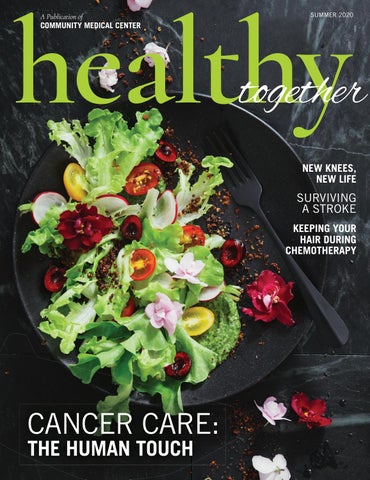
together healthy A Publication of
SUMMER 2020
COMMUNITY MEDICAL CENTER
NEW KNEES, NEW LIFE
SURVIVING A STROKE KEEPING YOUR HAIR DURING CHEMOTHERAPY
CANCER CARE: THE HUMAN TOUCH CMC_Cover_Sum20_Final.indd 1
7/30/20 6:59 AM
A MESSAGE FROM LEADERSHIP
New Ways to Care
A
t RWJBarnabas Health, in addition to treating medical conditions, we actively engage on a variety of levels to promote the health and well-being of our communities. That outreach takes many shapes, including healthy living classes, educational programs for seniors, partnerships with local arts organizations, providing healthy food and much more. Social distancing and other pandemic-related restrictions haven’t stopped these efforts, only changed their form. We’re providing virtual support for all kinds of needs, including breastfeeding, perinatal mood and anxiety disorders, arthritis, addiction recovery and more. People who want to learn about wellness techniques, such as guided relaxation or chair yoga, can find what they need through our online programs. For a full list, visit www.rwjbh.org/events. Meanwhile, we are creatively retooling signature events such as runs, walks and galas to include virtual participation. Our annual Running with the Devils 5K will be going virtual as well (learn more at rwjbh.org/runningwiththedevils). Our partners are also creating new events, such as the Somerset Patriots, who hosted sold-out drive-in movies at TD Bank Ballpark with proceeds going to the RWJBarnabas Health Emergency Response Fund to help local healthcare workers. To make a donation to the fund, visit www.rwjbh.org/give. At Community Medical Center, we witnessed, and continue to receive, an incredible outpouring of love and support from our community. The kindness and generosity you have shown to all of our healthcare heroes will always be remembered and make us even more committed to providing you with the highest quality care you deserve. We are finding new and innovative ways to help you access services, just as you found creative ways to support us during the height of the pandemic. How we meet the needs of our diverse communities will continue to evolve, but our commitment to providing a broad range of culturally competent care for our communities hasn’t changed—and never will. Yours in good health,
BARRY H. OSTROWSKY
PATRICK AHEARN
PRESIDENT AND CHIEF EXECUTIVE OFFICER RWJBARNABAS HEALTH
CHIEF EXECUTIVE OFFICER COMMUNITY MEDICAL CENTER
HEALTH NEWS RECOGNIZING TOP-NOTCH CARE Community Medical Center (CMC) recently earned recognition for its stroke and joint replacement care. After two onsite surveys, the hospital received The Joint Commission’s Gold Seal of Approval for its Stroke Program and Joint Replacement–Hip and Knee program. These accreditations indicate a hospital’s commitment to providing high-quality care with excellent patient outcomes. Hip and knee program surveyors noted that CMC staff members “show a tremendous amount of enthusiasm and commitment to their patients.” Stroke care surveyors were impressed by the CMC team’s deep knowledge of stroke patients, hospital-wide education efforts and investment in increasing stroke awareness in the community. “Accreditation from The Joint Commission for these programs demonstrates our commitment to our patients and community,” says Patrick Ahearn, Chief Executive Officer of CMC. “It supports our mission to advance the quality of life and health of our community. These certifications are a testament to the high quality and compassionate care provided by our physicians, nurses and staff.”
WALK YOUR HEART OUT On Sunday, October 25, the American Heart Association (AHA) will hold the Virtual Shoreline Heart Walk to raise $175,000 for cardiovascular research. Among the goals: to prevent strokes, correct heart defects in babies and find better ways to treat high blood pressure. This year, RWJBarnabas Health Southern Region President Bill Arnold, MHA, will chair the walk, which will be virtual to ensure the health and safety of all participants. Anyone can participate in the event by walking in their neighborhood or engaging in a physical activity of their choice at home. The AHA encourages participants to create their own fundraising web pages to request donations from friends and family. To register for the Virtual Shoreline Heart Walk, visit www.shorelineheartwalk.org.
99 Highway 37 West, Toms River, NJ 08755 732.557.8000
CONNECT WITH US ON @CommunityMedical RWJBarnabas Health @CommunityMedNJ Community Medical Center complies with applicable Federal civil rights laws and does not discriminate on the basis of race, color, national origin, age, disability, or sex. For more information, see link on our home page at www.rwjbh.org/community. Community Medical Center cumple con las leyes federales de derechos civiles aplicables y no discrimina por motivos de raza, color, nacionalidad, edad, discapacidad o sexo. ATENCIÓN: Si usted habla español, servicios de asistencia lingüística, de forma gratuita, están disponibles para usted. Llame al 732.557.8000. Community Medical Center konfòm ak lwa sou dwa sivil Federal ki aplikab yo e li pa fè diskriminasyon sou baz ras, koulè, peyi orijin, laj, enfimite oswa sèks. ATANSYON: Si w pale Kreyòl Ayisyen, gen sèvis èd pou lang ki disponib gratis pou ou. Rele 732.557.8000.
Healthy Together
| 2 |
2 CMC_Memo_Sum20_Final.indd 2
Summer 2020
7/30/20 7:01 AM
together healthy contents SUMMER 2020
6 2. WELCOME LETTER. A community update from our CEOs.
9
4. A YOUNG LIFE SAVED. Thanks to fast action by EMS workers and the Emergency Department team, an 18-year-old has recovered from a stroke. 6. STAYING POSITIVE. How one patient kept her hair—and part of her identity— during chemotherapy treatments. 8. LIVING YOUR BEST LIFE. A palliative care physician offers advice for patients and families who are confronting serious illness.
9. YOUR HEALTH, AT YOUR FINGERTIPS. Now you can manage your healthcare from an app on your iPhone. 10. CANCER CARE: THE HUMAN TOUCH. How oncology nurse navigators help patients.
4
8
20
17
22
11. ‘THE SKY’S THE LIMIT.’ Intense physical therapy helps a teenager move again after a traumatic neck injury.
17. COULD YOU HAVE COVID-19? Thanks to a unique partnership, Ocean County residents have access to drive-through testing.
12. SUPPORTING ARTS FOR THE HEALTH OF IT. Partnerships with local arts organizations promote the well-being of communities.
18. FIGHTING CANCER FATIGUE. An innovative program is helping patients regain their energy.
14. A HIGH-TECH LOOK AT THE HEART. Artificial intelligence powers a noninvasive, highly accurate test for coronary artery disease. 16. MIND, BODY AND HEALTH. Why caring for the whole person is the future of healthcare.
20. BACK TO THE GARDEN. Fresh fruits and vegetables can give your health a boost. 21. GOING ABOVE AND BEYOND. The Foundation has raised critical funds through recent events. 22. STANDING STRONG. Rehabilitation helped one patient recover from a double knee replacement.
Community Medical Center
CMC_TOC_Sum2020_Final.indd 3
|
RWJBH.ORG/COMMUNITY
3
7/30/20 7:06 AM
A YOUNG LIFE SAVED THANKS TO FAST ACTION BY EMS WORKERS AND THE EMERGENCY DEPARTMENT TEAM, AN 18-YEAR-OLD HAS RECOVERED FROM A STROKE.
T
racy Thompson, of Beachwood, was working at her job as a dental assistant on November 20, 2018, when she received the type of call every mother dreads: Her 18-year-old daughter, Sydney, appeared to be having a stroke. Sydney, who is pursuing makeup artistry, had been out to lunch with a friend when the right side of her face began to droop and she was unable to move her right arm and leg or to talk. Emergency Medical Services (EMS) workers, who had recently received training in stroke awareness from Community Medical Center (CMC), immediately suspected a stroke and whisked her to the hospital. When a stroke occurs, time is critical. Every minute that passes, the patient’s chances of suffering irreparable brain damage increases. Sydney’s experience is an example of what happens when everything goes right. From early recognition of stroke symptoms by EMS workers to the fast action of providers at CMC’s Primary Stroke Center in the Emergency Department, her experience exemplifies the best in stroke care.
QUICK TREATMENT EMS workers radioed ahead, notifying CMC’s Emergency Department that a possible stroke patient was on the way. By the time Sydney arrived, the stroke team was ready. They quickly took her medical history and performed blood and imaging tests to confirm she was experiencing a stroke. Testing determined that Sydney had had an ischemic stroke, which occurs when SUMUL RAVAL, MD
Healthy Together
| 4 |
CMC_YoungStroke_Sum20_Final.indd 4
a blood clot blocks the flow of blood in the brain. Without blood supply, the brain doesn’t receive the oxygen and nutrients it needs. If the blood supply is cut off for more than a few hours, permanent damage can occur. Doctors feared the worst—that Sydney might die or suffer permanent paralysis, unable to walk without assistance or talk. “She was so young,” recalls Sumul Raval, MD, the first neurologist to see her. Her mother, Tracy, recalls, “The medical team was preparing me for the possible consequences, but I never lost hope.” The size of the clot in Sydney’s brain was troubling, but time was on her side. Because she reached the hospital so quickly after her symptoms began, she was eligible for treatment with a clotbusting drug known as recombinant tissue plasminogen activator, or tPA. It must be administered within three to four-and-ahalf hours of the onset of symptoms to be effective. “The standard is to give tPA within 60 minutes of hospital arrival,” says Lindsey M. Smith, BSN, RN, SCRN, Stroke Program Coordinator. “We gave it to Sydney in about 55 minutes.” Sydney’s family noticed an improvement almost as soon as tPA was administered, recalls Tracy. But the clot in her brain still needed to be removed. Fortunately, there was no bleeding, so Sydney was a candidate for a mechanical thrombectomy, in which a clot is removed. This involves threading a catheter through an artery in the groin up to the blockage, inserting a stent and retrieving the clot. The procedure was successful and blood flow to Sydney’s brain was restored. Sydney was taken to the intensive care unit to recover. Unfortunately, she developed a complication: When the catheter in Sydney’s groin was removed, a
new blood clot formed in her leg, stopping blood flow. Nurses were unable to detect a pulse, so Sydney was airlifted to Robert Wood Johnson University Hospital in New Brunswick, also an RWJBarnabas Health facility. Fortunately, the clot resolved on its own.
A REMARKABLE RECOVERY Sydney spent four weeks at an inpatient rehabilitation facility. There, she received therapy to improve movement on her right side, which would help her walk and move her arm. Another goal was to tackle her speech condition, called expressive aphasia—the inability to produce language, which is common when a stroke occurs in the left hemisphere of the brain. Sydney has made great progress. “She’s able to walk without support,” says Dr. Raval. “In addition, she’s experienced significant improvement in her aphasia. She actually has close-to-normal speech.” Smith credits Sydney’s successful recovery in part to the hospital’s commitment to being a High Reliability Organization (HRO). That means it employs standardized procedures aimed at reducing medical errors and ensuring patient safety. The group conducts “safety huddles” to discuss safety concerns and celebrates “good catches,” such as the discovery that Sydney didn’t have a pulse in her leg. “If something’s not right, we speak up about it,” says Smith. “At the end of the day, a patient’s life is in our hands.” The Primary Stroke Center’s community outreach efforts—for instance, teaching EMS personnel to recognize the signs of stroke and act quickly—also played a role in Sydney’s successful outcome. Tracy is grateful. “The hospital saved my daughter’s life,” she says.
Summer 2020
7/30/20 7:10 AM
Sydney Thompson, who is pursuing makeup artistry, has made great progress in her recovery from a stroke.
For more information, visit www.rwjbh.org/neuroscience or call 888.724.7123.
Community Medical Center
CMC_YoungStroke_Sum20_Final.indd 5
|
RWJBH.ORG/COMMUNITY
5
7/30/20 7:10 AM
Breast cancer patient Sherri Itte with her daughter, Jaclyn, who accompanied her to her chemotherapy sessions.
RWJBarnabas Health and Community Medical Center, in partnership with Rutgers Cancer Institute of New Jersey—the state’s only NCI-Designated Comprehensive Cancer Center—provide close-to-home access to the most advanced treatment options. Call 844.CANCERNJ or visit www.rwjbh.org/beatcancer.
Healthy Together
| 6 |
CMC_CoolingCaps_Sum20_Final.indd 6
Summer 2020
7/30/20 7:13 AM
STAYING POSITIVE HOW ONE BREAST CANCER PATIENT KEPT HER HAIR— AND PART OF HER IDENTITY—DURING CHEMOTHERAPY TREATMENTS.
I
n January, Sherri Itte of Lacey Township was diagnosed with breast cancer. She had triple positive invasive ductal carcinoma, which meant the cancer’s growth was fueled by hormones. “I was in shock,” says Sherri, 50, a nurse at Easterseals New Jersey, a program for people with disabilities. “I thought, ‘I’ll do whatever I have to do to get rid of it.’” Fortunately, the cancer was caught early; it was considered Stage II. One week later, Sherri had a lumpectomy to remove the tumor, which had been hidden in dense breast tissue. She needed chemotherapy and radiation, so her breast surgeon recommended several oncologists. Sherri chose Jessica Taff, MD, a hematologist/oncologist at Community Medical Center (CMC). “She made me feel optimistic,” says Sherri. “She said, ‘We’ve got this. Everything is going to be okay.’”
MINIMIZING HAIR LOSS During Sherri’s first appointment, Dr. Taff described her treatment plan in great detail, even using diagrams to illustrate her approach. “I felt confident I had chosen the right doctor,” recalls Sherri. “I’m a religious person, and I felt that God had sent me to Dr. Taff.” Sherri knew she could lose her hair during treatment, and she told Dr. Taff that keeping it was important to her. “I didn’t want pity,” she says. “I wanted people to be strong for me.” Dr. Taff explained that Sherri could use a device known as a “cooling cap,” which cools the scalp and minimizes hair loss during treatment. “Losing your hair is one of the most emotional aspects of cancer treatment,” says Dr. Taff. “Sherri has a full head of beautiful blonde hair, and it’s part of her identity.” Chemotherapy drugs work by destroying rapidly JESSICA TAFF, MD dividing cells in
the body, including hair follicles. Lowering the temperature of the scalp through a cooling cap reduces blood flow to hair follicles, resulting in less exposure to the chemotherapy drugs. This prevents or minimizes hair loss. Sherri needed six chemotherapy treatments three weeks apart, along with immune-based therapy, which would target a specific part of her cancer cells. Sherri would be the first CMC patient to use the Paxman cooling cap system. “I’ve used similar technologies since I was in training, and this is the best system I’ve seen,” says Dr. Taff.
Sherri Itte wore the cooling cap during each of her six chemotherapy sessions.
“I FELT LIKE MYSELF” Sherri started chemotherapy on March 27, just as the pandemic was beginning. “It was scary because I had a weakened immune system, but I had to start treatment quickly to improve my chances of success,” she says. “Fortunately, I felt very safe at CMC.” On the first day of treatment, Sherri put on the cooling cap, which resembles a bike helmet, at the same time she received medications that are given at the start of each chemotherapy session to reduce the side effects. She dampened her hair, then slathered on conditioner to prevent the cap from sticking to her hair. “It felt like I had ice packs on my head,” recalls Sherri. “It was like the feeling you get when you enter a pool and the water is cold. After about 10 minutes, I got used to the temperature. It wasn’t uncomfortable.” After each seven-hour treatment session, Sherri kept the cap on her head for an additional hour and a half. Sherri was able to wash her hair, but she was advised to use chemical-free shampoos (the cap’s manufacturer sent her special shampoo and conditioner). She washed her hair once every three days. “My hair became thinner, but no
one knew it aside from the people close to me,” she says. “I felt like myself, and people didn’t know I had cancer.” Luckily, Sherri didn’t experience many side effects from chemotherapy. “I was tired, and my appetite was off on the days I had treatments,” she says. “I also had some nausea, but I only vomited twice.” Still, she was able to play basketball, cornhole and Wii with her kids, and she took walks. In July, Sherri completed chemotherapy. Afterward, she began seven weeks of radiation treatments. The cooling cap costs about $1,600, but it’s not routinely covered by insurance companies. Fortunately, the CMC Foundation covers part of the cost, and HairToStay, a nonprofit organization, provides financial assistance for patients who qualify. Sherri paid only $500 for the treatment. “It was well worth it,” she says. “Any wig would have cost at least that.” Dr. Taff was pleased with Sherri’s response. “Sherri is a great example of how patients can take back some control during a frightening cancer diagnosis, starting with hair preservation,” she says.
To learn more about cooling caps, ask your physician or visit www.cmccancer.org.
Community Medical Center
CMC_CoolingCaps_Sum20_Final.indd 7
|
RWJBH.ORG/COMMUNITY
7
7/30/20 7:13 AM
Q&A
ASK THE DOCTOR
LIVING YOUR BEST LIFE
MARIANNE HOLLER, DO
A PALLIATIVE CARE PHYSICIAN OFFERS ADVICE FOR PATIENTS AND FAMILIES WHO ARE CONFRONTING SERIOUS ILLNESS.
I
f you or a loved one has a serious illness like COVID-19, it’s important to control symptoms and, when appropriate, create a plan for end-oflife care. Marianne Holler, MSW, DO, FAAHPM, a palliative care physician at Community Medical Center (CMC) and Chief Medical Officer of VNA Health Group, explains the benefits of palliative care.
What is palliative care? The goal is to support patients and families coping with advanced, lifelimiting illnesses. Some people confuse palliative care with hospice care. Hospice refers to palliative care in the last six months of life. With palliative care, we discuss the effects an illness is having on a patient’s quality of life and his or her family. We also talk about his or her goals. If we can control symptoms, we can keep patients out of the hospital and help them live their best life.
being in the Intensive Care Unit (ICU) or on life support? What level of pain is acceptable? Palliative care physicians usually have these conversations with patients and families in person. Due to the pandemic, meetings are being conducted virtually.
How can you talk about palliative care with a loved one? Patients are taught that if they have a certain diagnosis, they should pursue a particular treatment. But what is the goal? Will a medical intervention rob you of your quality of life or help you? I always tell patients, “Your goal is to live as long as you can, but if things don’t go as you hope, there has to be a road map.” Ask your loved one: “Do you have a living will? Have you appointed a healthcare proxy?”
What are practitioner orders and how do they differ from advance directives? If you or a loved one is seriously ill, you should have Practitioner Orders for Life-Sustaining Treatment (POLST), a form that specifies the treatment a patient wants for his or her medical condition. It’s signed by a physician and can be enforced in the absence of a family member. An advance directive, on the other hand, is a legal document that outlines the treatments a patient wants if he or she becomes ill. The patient also designates a person to make healthcare decisions for him or her if he or she is unable to do so. The document must be included in the medical record.
What’s the best time to start the conversation? A patient or family member should, ideally, begin discussing palliative care when he or she is diagnosed with an illness. If the conversation is started too late, it becomes a discussion about hospice care. The benefit of starting the conversation earlier is that patients and their families can determine what’s an acceptable quality of life. For instance, how does a patient feel about
Healthy Together
| 8 |
Summer 2020
CMC_PalliativeCare_Spring20_Final.indd 8
7/30/20 7:15 AM
YOUR HEALTH, AT YOUR FINGERTIPS Now you can manage your healthcare right from the Apple Health app on your iPhone. You can easily keep track of allergies, conditions, immunizations, vitals and more, and consolidate your health records in a timeline—all in one place. Here’s how:
1
If you don’t have one yet, create a username and password for the RWJBarnabas Health Patient Portal (www.rwjbh.org/patientportalenroll).
2
Download the Apple Health app from the Apple Store. (You’ll need an iPhone running iOS 11.3 or later.)
3
Be sure your iPhone is passwordprotected, ideally with two-factor authentication.
4
Go to the Health Records section of the Health app, search for RWJBarnabas Health, and log in.
5
After you log in once, your health records will start to appear in the Health app, and will update automatically.
Download the Apple Health app at the Apple Store and access your RWJBarnabas Health medical records at www.rwjbh.org/patientportalenroll.
RWJBarnabas Health
System_AppleHealth_Sum20_REV1.indd 9
|
RWJBH.ORG
| 9
7/30/20 12:09 PM
RWJBarnabas Health, together with Rutgers Cancer Institute of New Jersey—the state’s only NCI-Designated Comprehensive Cancer Center—provides close-to-home access to the latest treatment options. For more information, call 844.CANCERNJ or visit www.rwjbh.org/beatcancer.
CANCER CARE: THE HUMAN TOUCH HOW ONCOLOGY NURSE NAVIGATORS HELP PATIENTS
P
social or medical—the navigator can help the patient get the benefit of resources from throughout the health system.” When a patient makes an appointment with an RWJBH cancer provider, the oncology nurse navigator will follow up with the patient the next day. “The navigator asks if there are any questions about the upcoming appointment and goes through some of the specifics of what will happen,” Silva says. That’s just the beginning. Oncology nurse navigators, who are located at each RWJBH facility, also do the following: Identify possible barriers to treatment. Does the patient have financial or insurance concerns? Does the patient have family or friends who can provide support? Is there a transportation issue? The nurse navigator can identify and help with these problems right away. “In one case, we were able to get a patient to To contact the Oncology Access Center, see a specialist located 70 miles call 844.CANCERNJ (844.226.2376). away from the
atients who seek care through the RWJBarnabas Health (RWJBH) Oncology Access Center have a big advantage: They get connected to an oncology nurse navigator who acts as their problem-solver and supporter before, during and after treatment. The oncology nurse navigator becomes an important member of the patient’s healthcare team and serves as his or her advocate while compassionately supporting their physical, emotional and spiritual needs from diagnosis through survivorship. “When you choose RWJBarnabas Health for your cancer care, you’re not only getting quality care, but someone to walk beside you on your treatment journey,” explains Jeanne Silva, RN, Director, Nurse Navigation, Oncology Services at RWJBH. “Moreover, we coordinate all of our resources, so that if a patient has a problem—be it financial,
Healthy Together
| 10 |
System_OncologyNav_Sum20_Final.indd 10
patient’s home,” Silva says. Communicate constantly. This is essential in two ways. First, the nurse navigator is the central clearinghouse for information provided from the many specialists on a cancer patient’s care team—medical oncologists, radiation oncologists, surgical oncologists, social workers, nutritionists and more. The navigator can ensure that no aspects of treatment fall through the cracks and that the patient receives the highest quality of care. Second, the navigator can follow up to be sure a patient understands what’s happening. “Doctors do a great job of explaining, but often you can see the patient’s mind drift off as the person starts to worry about things like, ‘Who’s going to pick my kids up from school?’” Silva explains. “A navigator can talk to the patient later about what he or she understood and relay the necessary information over again in smaller bits so it’s easier to process.” Set priorities. “Sometimes what feels urgent to a patient is not clinically urgent, but our nurse navigators have the ability to know what is truly time-sensitive,” Silva explains. “For example, recently a young man needed to see a specialist as soon as possible. Based on the navigator’s intervention, he was able to get in to see the doctor in one day.” Save time. Often, a patient needs several medical procedures—for example, an echocardiogram and a port insertion before chemotherapy treatment can begin. A nurse navigator can arrange for multiple appointments to be scheduled at the same facility on the same day. “A navigator is key to making sure all the pieces fit together and to minimizing the time a patient needs to spend at a facility,” Silva says. “An oncology nurse navigator is a critical part of a patient’s cancer care team,” she continues. “He or she is the kind of person who can anticipate what’s needed and make it happen—and who has a relentless desire to help patients.”
Summer 2020
7/29/20 3:00 PM
Sam Jarmer made remarkable progress at Children’s Specialized Hospital and continues doing well with outpatient therapy.
‘THE SKY’S THE LIMIT’ AFTER A TRAUMATIC NECK INJURY, INTENSE PHYSICAL THERAPY HELPS A TEENAGER MOVE AGAIN.
J
uly 24, 2019: a grayish, unremarkable day on the beach at Ocean Grove. Lifeguard Sam Jarmer, 16, dives into the water to cool down, but hits a hidden sandbar. Soon after, Sam’s mom, Jessica, sitting on the beach several blocks away, sees a call from Sam’s boss come in on her phone. “I immediately knew not only that he was injured; I could feel that it was bad,” she remembers. When he hit the sandbar, Sam suffered a burst fracture in the C6 vertebra near the base of the neck and lost the ability to move his arms and legs. A fellow lifeguard jumped in to lift his head above the water, and a trauma team was dispatched from a nearby hospital. Sam was strapped to a backboard, and six of his fellow lifeguards carried him to a waiting ambulance. “He kept saying, ‘I’m so sorry, Mom,’ because we were supposed to go on vacation the next day,” Jessica remembers. Sam was in surgery for six hours while the burst vertebra was replaced with a titanium cage. He spent the next five days
An RWJBarnabas Health facility recovering at the hospital. At that point, he could occasionally raise his arms a bit, but nothing more. It was time for intensive inpatient rehabilitation and therapy at Children’s Specialized Hospital (CSH) in New Brunswick. “I remember feeling that this would be the place that would make it all better,” Jessica says.
MAKING PROGRESS The first piece of good news came from Michele Fantasia, MD, Director of the Spinal Cord Injury Program at CSH. Her evaluation determined that Sam’s injury was “incomplete,” meaning that Sam still had some motor and sensory function below the level of injury. “As I say with all incomplete injuries, ‘The sky’s the limit,’” Dr. Fantasia told Jessica. Four months of recreational, physical and occupational therapies followed. “The occupational therapists made modifications
for everything,” Jessica remembers. “They kept constructing things in some kind of magical workshop they had.” There was a special fork to help Sam relearn how to feed himself, a device to help him brush his teeth and more. “Everyone at Children’s really helped me when I was at one of the lowest points in my life with my injury,” says Sam. “They just showed compassion in all of the support and love that they gave me.” On November 19, Sam was discharged from CSH. Today, Sam continues with a rigorous program of outpatient physical therapy. During the COVID-19 lockdown, he did his exercises via telemedicine for a few weeks. His older brother, home from college, was there to help. Sam continues to work on his core muscles, arms and fingers. He now has muscle control in all parts of his legs and continues to work on walking independently. “I’m staying positive,” he says. “I know it will take time and I’ll be back to where I was, but for now I’ve just got to keep pushing forward.” To learn more about Children’s Specialized Hospital, call 888.244.5373 or visit www.childrens-specialized.org.
At Children’s Specialized Hospital, we provide world-class care for children and young adults who face special health challenges across the state of New Jersey and beyond. Our locations in Bayonne, Clifton, East Brunswick, Egg Harbor Township, Hamilton, Jersey City, Mountainside, New Brunswick, Newark, Toms River and Warren treat everything from chronic illnesses and complex physical disabilities like brain and spinal cord injuries to developmental and behavioral issues like autism and mental health.
RWJBarnabas Health
System_CSH_Sum20_Final.REV1.indd 11
|
RWJBH.ORG
| 11
7/30/20 2:07 PM
[ANYTOWN]
A musical with a mission: “Anytown,” an original educational musical, tells the story of Hope, a high-achieving high school student who becomes addicted to opioids after a soccer injury. The show has toured middle and high schools in New Jersey and was developed through a partnership with George Street Playhouse in New Brunswick, RWJBH and the Horizon Foundation of New Jersey.
[BEAT BUS] They’ve got the beat: Students in Long Branch, Asbury Park and Neptune have experienced a state-of-the-art mobile recording studio to create their own music thanks to the Beat Bus, a collaboration between Lakehouse Music Academy and the Asbury Park Music Foundation that is supported in part by RWJBH. In addition to providing a means of creative expression and new ways to collaborate, the Beat Bus helps prepare students for success in the digital age. Healthy Together
| 12 |
System_Arts_Sum20_Final.indd 12
Summer 2020
7/29/20 3:04 PM
[ASBURY PARK MUSIC + FILM FESTIVAL]
Making (sound) waves: The Asbury Park Music + Film Festival, of which RWJBH is a Founding Partner, celebrates the role of music in film, as well as the shore town’s long history as an incubator of great music. It benefits underserved children in Asbury Park and surrounding areas by providing music education, instruments and social connection opportunities. Note: All photos on these pages were taken before the COVID-19 pandemic and social distancing guidelines.
SUPPORTING ARTS FOR THE HEALTH OF IT
PARTNERSHIPS WITH LOCAL ARTS GROUPS HELP PROMOTE THE WELL-BEING OF COMMUNITIES.
R
esearch has shown that the arts stimulate creativity, ease stress, promote joy, improve memory and enhance education. That’s why RWJBarnabas Health (RWJBH), with its strong commitment to creating and sustaining healthy communities, partners with local arts organizations. “We understand the clear and beneficial impact that taking part in the arts has on health and well-being,” says Michael Knecht, Senior Vice President of Strategic Marketing and Communications for RWJBH. “These partnerships are an important way for us to help people in our communities and also support local grassroots organizations.” RWJBH supports a broad range of arts events. Music, dance and film are high on the list: RWJBH has sponsored the Asbury Park Music + Film Festival; the Bridge Arts Festival
in Bayonne; the Montclair Jazz Festival; the Central Jersey Jazz Festival; Maplewoodstock Music & Art Festival; the “Sounds of the City” free outdoor concerts presented by the New Jersey Performing Arts Center in Newark; and the SOMA Film Festival in South Orange and Maplewood. Drama has a place as well. RWJBH is a sponsor of the New Jersey Repertory Company, a professional nonprofit theater in Long Branch with a mission to develop and present new plays. And in a proactive move to help stem the opioid epidemic among young people, RWJBH has partnered with the George Street Playhouse in New
Brunswick and the Horizon Foundation of New Jersey to create “Anytown,” a one-hour musical that demonstrates how addiction can happen to anyone. The show has toured to schools throughout the state, followed by Q&A discussions with students. “These partnerships are all part of the RWJBarnabas Health commitment to reaching out beyond the walls of our medical centers to help people get and stay healthy in all kinds of ways,” says Knecht. “And they’re wonderful examples of how meaningful collaboration with local organizations can make an impact throughout the state.”
To learn more about RWJBarnabas Health corporate partnerships, visit www.rwjbh.org/corporatepartners.
RWJBarnabas Health
System_Arts_Sum20_Final.indd 13
|
RWJBH.ORG
| 13
7/29/20 3:04 PM
The Heartflow Analysis FFR-CT software generates a 3D color-coded image of a patient’s heart and arteries, indicating the location and degree of artery blockages.
A HIGH-TECH LOOK
AT THE HEART DOCTORS CAN NOW USE ARTIFICIAL INTELLIGENCE FOR A NONINVASIVE, HIGHLY ACCURATE TEST FOR CORONARY ARTERY DISEASE.
Healthy Together
| 14 |
System_FFR_Sum20_Final.indd 14
Summer 2020
7/29/20 3:06 PM
“A
fter the test, they told me I was a walking time bomb,” says Ray Duarte, 50. As the Regional Director of Information Technology at Monmouth Medical Center Southern Campus and at Monmouth Medical Center, Ray had volunteered to be among the first for an advanced noninvasive technology known as Fractional Flow Reserve Computed Tomography (FFR-CT). This test evaluates how well blood flows through a patient’s heart arteries and determines whether— and where—blockages exist. “I had upper back pain on and off, for which I was seeing a chiropractor with no relief,” says Ray. “I did have high cholesterol, which I was addressing with improved diet and exercise, and a family history of heart disease. “However, due to my active lifestyle and symptoms that were not typical for heart disease, my primary care doctor told me he would never have recommended so much as a stress test for me,” Ray recalls. But the FFR-CT test showed that Ray’s right coronary artery was 99 percent blocked. Without the test and subsequent treatment, such a blockage could have led to a heart attack at any time.
FINDING THE BLOCKAGES The powerful, artificial intelligence-based FFR-CT test is used to diagnose coronary artery disease (CAD)—blockages in the blood vessels supplying the heart. CAD is a leading cause of death in the U.S., accounting for 600,000 to 700,000 deaths per year. It can cause shortness of breath, chest pain (typical and atypical) and heart attack, and can lead to death. When a patient has chest pain or suspicious symptoms, the usual RAJESH MOHAN, MD
noninvasive ways of detecting inadequate blood flow include an electrocardiogram (ECG), which uses electrical signals; a stress test, in which blood flow is tested while a patient exercises, via ECG or an echocardiogram (ECHO), which uses ultrasound waves; or a nuclear stress test, which uses radioactive dye and an imaging machine. In addition, a computed tomography (CT) scan can show calcium deposits that could narrow arteries. Prior to FFR-CT technology, however, the only way physicians could see for certain whether coronary arteries were blocked was to do an invasive procedure, known as cardiac catheterization and angiogram. In this procedure, a special dye is injected through a long, thin, flexible tube (catheter) that is threaded through an artery in the leg up to the arteries of the heart. If a blockage is found, the cardiologist can decide whether to correct it during the angiogram—for example, by inserting a small tube (stent) to keep the artery open— or to send the patient for bypass surgery.
ARTIFICIAL INTELLIGENCE While a crucial and sometimes lifesaving technology, an angiogram often shows no significant blockages, according to Rajesh Mohan, MD, MBA, FACC, FSCAI, an interventional cardiologist and Chief Medical Officer at Monmouth Medical Center Southern Campus (MMCSC). That’s where noninvasive FFR-CT comes in. Using “machine learning,” an application of artificial intelligence, the software compares images from existing CT scans of a patient’s heart to an evergrowing database of tens of thousands of other CT images. This large database helps physicians analyze the likelihood that any specific blockage could cause harm and also provides direction about treatment. “The FFR-CT technology creates a three-dimensional image of blood vessels and color-codes them based on
the severity of the blockage,” says Dr. Mohan. “It then also shows how each blockage impacts blood flow to the heart.” Armed with this knowledge, a physician can decide whether lifestyle changes, medication, a stent or surgery is the best course of action. “With this information, we can give our patients a more definite diagnosis and have confidence in the best treatment plan without putting them through unnecessary invasive procedures,” says Dr. Mohan. “Its accuracy is unlike that of any other noninvasive tests available to us.”
IS FFR-CT FOR YOU? Since CAD is a common type of heart disease, many patients can benefit from this advanced technology. However, FFR-CT is not available everywhere. Specialists at MMCSC are among the first in the state to use it, and MMCSC is the earliest hospital in the state to utilize it in the Emergency Department and throughout the hospital, as well as for outpatients. “The test needs to be done appropriately, according to criteria set by the American College of Cardiology,” says Dr. Mohan. “Patients need to have symptoms—for example, chest pain or shortness of breath on exertion, which a lot of people actually disregard. “If these exist in association with some of the coronary risk factors like smoking, hypertension, diabetes, high cholesterol and family history, then I think that patient is an ideal candidate for this study.” As for Ray Duarte, a stent procedure opened his blocked artery, his back pain has resolved and medication is controlling his cholesterol. He is back to an active lifestyle. Says Dr. Mohan, “We at Monmouth Medical Center Southern Campus are excited and privileged to introduce such a cutting-edge, revolutionary technology.”
Your heart doesn’t beat just for you. Get it checked. To learn more about FFR-CT or to find a cardiac specialist, call 888.724.7123 or visit www.rwjbh.org/heart.
RWJBarnabas Health
System_FFR_Sum20_REV1.indd 15
|
RWJBH.ORG
| 15
7/30/20 12:11 PM
BO DY
MIN D
MIND, BODY
AND HEALTH
WHY CARING FOR THE WHOLE PERSON IS THE FUTURE OF HEALTHCARE
A
t his yearly physical, a patient is found to be 35 pounds over ideal body weight. He has hypertension, and his lab results indicate prediabetes. His doctor urges him to change his diet, be more active and lose the extra weight to reduce his risk for stroke, heart disease and diabetes. The patient acknowledges that he should. But at his next yearly physical, he’s still 35 pounds overweight. In that all-toocommon scenario lies the possibility for a new approach FRANK A. GHINASSI, PHD to healthcare,
one that simultaneously provides help for behavioral as well as physical issues. “The goal is to help people make better choices—about things like what they eat, how they exercise and about alcohol and nicotine—and thereby avoid many chronic health disorders,” says Frank A. Ghinassi, PhD, ABBP, Senior Vice President, Behavioral Health and Addiction at RWJBarnabas Health (RWJBH), and President and CEO of Rutgers University Behavioral Health Care. “Through integrated care delivery, we want to treat both body and mind, preferably in the same location and during the same healthcare visit,” he says. In the case of the overweight patient, for example, the primary care provider will look to determine the cause of the
For help accessing mental health services, call the RWJBarnabas Health Access Center at 800.300.0628.
Healthy Together
| 16 |
patient’s inability to lose weight. “Is the issue genetic? Does the patient have a low metabolism?” asks Dr. Ghinassi. “Or is there a mood disorder that’s affecting energy level and motivation?” Once barriers to a healthier lifestyle are identified, doctors and behavioral health specialists can work together to develop solutions tailored to the patient’s specific needs.
AN INTEGRATED APPROACH “Often, people with behavioral and addiction disorders are treated ‘from the neck up’ and are referred to dedicated behavioral health offices,” says Dr. Ghinassi. But that approach can create roadblocks. “Maybe the patient can’t get an appointment for three weeks, or he doesn’t like the idea of walking into a building that says ‘counseling services’ or ‘psychiatry’ on the sign,” he explains. To provide coordinated care, RWJBH and Rutgers University Behavioral Health Care are bringing services closer together. “At many of our primary care and pediatric delivery sites, primary care physicians work with psychologists or social workers who are located in the same office suite or in the same building,” says Dr. Ghinassi. “A patient can be offered a chance to meet the physician’s behavioral health colleague even before leaving the initial appointment, find out what might be possible and perhaps find it easier to commit to following up with a subsequent call or visit.” The next evolution of care at RWJBH and Rutgers University Behavioral Health Care will be to have a clinical social worker or psychologist located right in the same office space as the primary care provider. Integrated healthcare is the future, Dr. Ghinassi believes. “People tend to come to a healthcare system when they’re in crisis—they need coronary artery surgery, for example, or their depression makes them unable to function in daily life. Of course, we’ll always be there for those people,” he says. “However, we’re evolving to an equal focus on early screening and intervention. Together, RWJBarnabas Health and Rutgers University Behavioral Health Care are on a mission to improve the health and life satisfaction of patients and families throughout New Jersey.”
Summer 2020
System_BehavorialHealth_Sum20_Final.indd 16
7/29/20 3:08 PM
Area residents who have a prescription from their physician can receive COVID-19 testing at Ocean County College.
COULD YOU HAVE
COVID-19?
THANKS TO A UNIQUE PARTNERSHIP, OCEAN COUNTY RESIDENTS HAVE ACCESS TO CONVENIENT DRIVE-THROUGH TESTING.
I
n late March, the Ocean County Health Department (OCHD), Community Medical Center (CMC) and three other hospitals teamed up to offer convenient, drive-through COVID-19 testing at Ocean County College. More than 50 people were involved in running the site, including CMC nurses, who performed the testing. The OCHD had administrative and clinical oversight of the facility and provided personal protective equipment. The County of Ocean secured the testing contract with BioReference Laboratories, the company that provided the test kits and performed the analyses. Also involved were the Ocean County Sheriff’s Department, which provided security and traffic control, and the Ocean County Office of Emergency Management, which oversaw the security detail of the testing
site. “Despite our different backgrounds, we came together seamlessly,” says Teri Kubiel, DNP, MSN, NE-BC, Vice President of Patient Experience and Community Affairs at CMC. Tents have been set up outside the College and people remain in their cars for testing, which is performed via nasal swab. Ocean County residents are eligible for testing, as well as first responders and healthcare providers. OCHD employees call each patient to deliver his or her test results, which are also faxed to the patient’s physician.
test to the N.J. Department of Health Communicable Disease Reporting and Surveillance System, which tracks COVID-19 cases. If a person tests positive, he or she is contacted by a disease investigator, who conducts an interview, speaks to his or her physician and obtains his or her medical record. The disease investigator determines who the person has been in contact with, then a contact tracer reaches out to those contacts. The OCHD hired nearly 70 seasonal employees—nurses who work at schools and physician practices—to assist with contact tracing. More than 9,000 cases have been traced to date. If a person has been exposed to COVID-19, he or she must quarantine for 14 days and watch for symptoms. “The goal is to help mitigate transmission of the disease,” says Daniel Regenye, MHA, Public Health Coordinator/Health Officer at the OCHD. At press time, more than 5,000 tests had been performed since March. The number of positive cases has dropped dramatically. At the end of March, 41 percent of patients tested positive for the virus. In June, less than 5 percent of tests were positive. If you experience signs of the virus (fever, fatigue, a dry cough and shortness of breath) or have been exposed to someone who has been diagnosed with it, contact your physician to find out if you should be tested.
STOPPING THE SPREAD The lab sends the results of each
To learn more about COVID-19 testing, call the Ocean County Department of Health’s 24-hour Coronavirus Hotline at 732.341.9700, ext. 7411 or visit the website: www.ochd.org.
Community Medical Center
Covid-19Testing_Sum20_Final.indd 17
|
RWJBH.ORG/COMMUNITY
17
7/30/20 7:16 AM
Exercise has helped Louise Lago recover from her breast cancer treatment.
RWJBarnabas Health and Community Medical Center, in partnership with Rutgers Cancer Institute of New Jersey—the state’s only NCI-Designated Comprehensive Cancer Center—provide close-tohome access to the most advanced treatment options. Call 844.CANCERNJ or visit www.rwjbh.org/beatcancer.
FIGHTING
CANCER
FATIGUE AN INNOVATIVE COMMUNITY MEDICAL CENTER PROGRAM IS HELPING PATIENTS REGAIN THEIR ENERGY. Healthy Together
| 18 |
CMC_CancerFatigue_Sum20_Final.indd 18
A
fter receiving a breast cancer diagnosis in 2018, Louise Lago underwent surgery, chemotherapy and radiation therapy. Louise, 71, felt drained when her treatment finished in January 2019, and she thought her energy would return once the drugs left her body. But months later, she still felt worn down. Exhaustion interfered with her daily activities, including preparing meals and washing up after dinner. “I didn’t have the energy I wanted,” she says.
Summer 2020
7/30/20 7:19 AM
Louise’s physician, Gurpreet Lamba, MD, a hematologist/oncologist at Community Medical Center (CMC), referred her to the Rehabilitation Department, which offers a Cancer Fatigue Program. The program is designed to help patients struggling with a lack of energy due to cancer and its treatment. It includes fitness activities and lifestyle strategies focused on helping patients regain their energy. “The program works,” says Dr. Lamba. “It helps patients recover from chemotherapy more quickly.”
A LINGERING SIDE EFFECT The Rehabilitation Department created the Cancer Fatigue Program after reviewing the results of the Distress Thermometer, an evaluation tool patients fill out to describe their physical, emotional and social challenges. When Dale Ofei-Ayisi, LCSW, a social worker at CMC, analyzed two years’ worth of Distress Thermometer results, she discovered that fatigue was the No. 1 problem for the hospital’s cancer patients. These findings were brought to the CMC Cancer Committee and soon after, plans for a Cancer Fatigue Program began taking shape. Committee members researched other cancer fatigue programs around the country and created a program customized for CMC patients.
A FOCUS ON EXERCISE Activity is the centerpiece of the Cancer Fatigue Program. “It seems counterintuitive, but one of the best ways to treat fatigue is exercise,” says Raymond Howard, PT, DPT, OCS, Regional Director of Rehabilitation Services at CMC. Exercise strengthens muscles weakened by inactivity during cancer treatment, and it helps to increase energy and boost mood in people affected by cancer-related anxiety and depression, which can also contribute to fatigue. Louise, a GURPREET LAMBA, MD
retired teacher who lives in Toms River, began participating in the program in October 2019. Two or three times a week, she lifted weights, stretched, worked out on an elliptical trainer and performed strength-building exercises, such as squats and heel lifts. The exercises improved her fatigue as well as her peripheral neuropathy symptoms (weakness, numbness and pain related to nerve damage caused by the cancer treatment). The program also includes education about how to conserve energy and manage fatigue. “I do a little bit of activity, then I sit down for a while,” says Louise. The Cancer Fatigue Program addresses each patient’s unique needs, according to Howard. “We individualize the program and modify it as needed,” he says. Although the program is designed for two or three visits per week for six weeks, a customized plan can be arranged for patients who have trouble fitting appointments into their schedules. Beyond alleviating fatigue, the program, which is supervised by licensed physical therapists, is designed to increase strength, build stamina, boost functional mobility, improve quality of life, prevent falls and make it easier for patients to move around and participate in the activities that matter to them. The program also teaches breathing and relaxation techniques that can help patients cope with some of the emotional challenges of cancer treatment and survivorship. “Patients have said it gives them some sense of control over their lives,” says Howard. Participating patients may also receive referrals for other services that address their fatigue, such as nutritional counseling and occupational therapy. So far, the program appears to lift patients’ spirits. “It instills hope because it shows patients that they can get back some of the life cancer deprived them of,” says Howard. As for Louise, she’s “really benefited from the program,” says
WHY IS CANCER SO TIRING? According to the National Cancer Institute (NCI), fatigue affects up to 96 percent of cancer patients during treatment and as many as 82 percent of patients after treatment. It can be caused by the disease itself or by treatments, such as chemotherapy, radiation and immunotherapy. Although the fatigue usually decreases after treatment ends, it may linger for months or even years. “Cancer fatigue, unlike other types of fatigue, is not relieved by rest,” says Raymond Howard, PT, DPT, OCS, Regional Director of Rehabilitation Services at CMC. “It’s a quality-of-life issue that prevents patients from getting back to the activities they enjoy.”
Dr. Lamba. “I don’t think she could have tolerated the chemotherapy without it.” Louise achieved her goals and was discharged from the program in January. She purchased a recumbent bike and is exercising at home. “I’m less fatigued,” she says. “I can do the simple things in life, like go to church, prepare food and do the dishes. My nerve-related symptoms have improved so I can walk without a walker or cane. Things are coming around.”
For a referral to the Cancer Fatigue Program, ask your physician or call 732.557.8046.
Community Medical Center
CMC_CancerFatigue_Sum20_Final.indd 19
|
RWJBH.ORG/COMMUNITY
19
7/30/20 7:19 AM
WHAT TO PLANT NOW If you didn’t plant your garden in the spring or if you have extra space now, consider purchasing transplants at your local garden center, advises Terri Risley, a Registered Dietitian at Community Medical Center. Beet, cauliflower, carrot, cabbage, broccoli, spinach and lettuce transplants can be planted in September. They will be ready for harvesting in October and early November.
BACK TO THE
GARDEN GROWING—AND EATING—FRESH FRUITS AND VEGETABLES CAN GIVE YOUR HEALTH A BOOST.
W
ith summer comes a crop of fresh produce—corn, beans, cucumbers and tomatoes, to name a few. Not only is it an ideal time to frequent your local farmer’s market, but it’s also a great time to plant your own garden. Eating fresh vegetables and fruits is, of course, good for you—and the simple act of gardening carries its own health benefits. Terri Risley, a Registered Dietitian at Community Medical Center, explains some of the surprising ways gardening can improve your health:
• Jump-starts weight loss Preparing the soil, planting seeds and watering plants burns calories. In addition, if you grow your own fruits and vegetables, you’ll be more likely to eat them. Produce is more nutrient-dense and lower in calories than other foods. A study shows that those who participate in community gardening lower their risk of becoming overweight or obese.
• Protects against illness Fruits and vegetables contain many beneficial nutrients, such as vitamins A, C and E, folic acid, zinc and magnesium. They may protect against heart disease, cancer and other illnesses.
• Reduces stress Studies show that gardening reduces stress more effectively than other hobbies—possibly because it involves spending time outdoors.
• Improves heart health Since gardening is a physical activity, it may lower blood pressure, manage weight and decrease stress. This may reduce the risk of heart disease.
• Decreases the risk of dementia Physical activity, particularly gardening, may reduce the risk of dementia.
For information on Community Medical Center’s Outpatient Nutrition Counseling Service, call 732.557.8000, ext. 11484.
Healthy Together
| 20 |
CMC_Nutrition_Spr20_Final.indd 20
GUIDE TO SHOPPING LOCALLY There are many benefits to shopping at local farmers’ markets.“Shopping locally supports our farmers and economy,” says Thomas Yanisko, Administrative Director of Hospitality Services and Executive Chef at Community Medical Center (CMC). It also provides the greatest value for your shopping dollar. When you purchase seasonal produce, you’ll get the best quality at the lowest price. Furthermore, when produce is picked close to the time of purchase, it will be fresher and richer in vitamins and minerals, says Terri Risley, a Registered Dietitian at CMC. When shopping at a farmer’s market, ask where the produce is from and when it was picked, advises Risley. During the late summer and early fall, you’re likely to find beans, corn, cucumbers, onions, squash, tomatoes, peaches, plums and apples.
COLORFUL STRAWBERRY ARUGULA SALAD Serves 8 SALAD INGREDIENTS • 5 cups arugula and 5 cups romaine, chopped • ½ cup chopped fresh basil • 1 pound strawberries, thinly sliced • ¾ cup finely chopped red onion • 4 ounces crumbled feta cheese • ½ cup chopped walnuts • ½ cup halved and thinly sliced radishes • 1 cup mandarin oranges • 8 asparagus spears, gently blanched and sliced diagonally On a large serving platter, layer the ingredients as listed. When you’re ready to serve the salad, drizzle the dressing on top and toss to combine. Serve promptly. DRESSING INGREDIENTS • ¼ cup extra virgin olive oil • 1 ½ tablespoon balsamic vinegar • 1 tablespoon Dijon mustard • ½ tablespoon honey • 1 clove garlic, minced • Pinch of fine sea salt • Freshly ground black pepper, to taste In a liquid measuring cup or small bowl, combine all ingredients and whisk until fully blended.
Summer 2020
7/30/20 7:36 AM
GOING ABOVE AND BEYOND
At left: Patrick Ahearn, Chief Executive Officer of CMC; John Sarris, MD; Steve Green; and Peter Van Dyke, Chair, CMC Foundation, at the Winter Ball. Note: This photo was taken before mask and social distancing recommendations were in place. Above: CMC staff members and the manager of The Office Restaurant & Lounge greet customers at the final Thank You Thursdays event in July.
THE COMMUNITY MEDICAL CENTER FOUNDATION HAS RAISED CRITICAL FUNDS THROUGH THE WINTER BALL AND A PARTNERSHIP WITH LOCAL RESTAURANTS.
O
n January 25, the Community Medical Center (CMC) Foundation presented the Physician of Distinction and Emerging Leader awards at the Mardi Gras-themed Winter Ball. The awards recognize individuals who have demonstrated extraordinary dedication to the hospital. The Physician of Distinction Award, created in 2011, celebrates a physician leader with more than 25 years of service to the hospital. The Emerging Leader Award, given for the first time last year, recognizes an active member of the community and supporter of the hospital. “The success of events like the Winter Ball, which raised over $75,000 for the hospital, is only possible with the support of the medical staff, the employees, the community and generous donors,” says Peter Van Dyke, Chair, CMC Foundation. This year’s Physician of Distinction recipient is John Sarris, MD, who joined CMC in 1993 as a neurosurgeon. In 2010, after being diagnosed with Parkinson’s disease—a nervous system disorder that causes tremors, particularly in the hands— he began practicing neurocritical care. He treats patients who have suffered stroke, head injuries and, of course, Parkinson’s disease. “I never want my patients to feel rushed,” says Dr. Sarris, who’s made it his
mission to spend time with patients. When asked what he enjoys most about being a physician, he says, “I like knowing I’ve helped someone in a time of need.” The Emerging Leader Award was given to Steve Green, president of Green Label Title, a title insurance and settlement company in Manasquan. Green has been involved with CMC since 2015 as a member of the hospital’s Foundation Board and Vice Chair of the Council of Emerging Leaders, a group of young professionals who raise funds for the hospital. Steve is also involved in many local organizations—Vice Chair of Big Brothers Big Sisters and Second Vice Chair of the Toms River Chamber of Commerce. “I like giving back to the community to make a difference,” he says. More than 250 people attended the black-tie event at Caesars Palace in Atlantic City. Patrick Ahearn, Chief Executive Officer of CMC, says, “We’re fortunate that individuals like John and Steve are willing to commit their time and talent to CMC to make the community a better place.”
THANK YOU THURSDAYS Due to COVID-19, the Foundation was unable to hold the traditional “Red, White and Brew” wine tasting supporting highquality care and services at the J. Phillip Citta Regional Cancer Center. Instead,
community members were encouraged to donate the cost of their ticket to the Foundation and order take-out meals from local restaurants to support a new fundraiser called “Thank You Thursdays.” Partner restaurants agreed to donate a portion of the proceeds to the Cancer Center on six Thursdays between May 28 and July 2. Participants were Artisan’s in Toms River, Klee’s Bar & Grill in Seaside Heights, Capone’s Gourmet Pizza & Pasta in Toms River, Ohana Grill in Lavallette, Stone Fire Grille in Beachwood and The Office Restaurant & Lounge in Toms River. In June, the Garden State Distillery Company offered “to-go” cocktails, with $1 from every purchase donated to the Cancer Center. At press time, the promotion had raised nearly $35,000 for cancer services. “We’ve had an incredible outpouring of support from the community,” says Jennifer Shufran, Vice President of the CMC Foundation. The fundraiser resulted in unexpected contributions. The owner of Freehold Ford, a friend of a restaurant owner, donated $2,000 to the Foundation in June. “It’s important to support CMC now to meet both existing and emergent health needs of our community,” says Shufran. “Donations support critical services like cancer care, emergency medicine and community health screenings and education.”
To support Community Medical Center, visit www.cmcgiving.org or call 732.557.8131.
Community Medical Center
CMC_Foundation_Sum20_Final.indd 21
|
RWJBH.ORG/COMMUNITY
21
7/30/20 7:45 AM
Lillian Smalls was able to stand up and give sermons at her church after a double knee replacement.
Healthy Together
| 22 |
CMC_KneeReplace_Sum20_Final.indd 22
Summer 2020
7/30/20 7:48 AM
STANDING
STRONG
COMMUNITY MEDICAL CENTER’S TRANSITIONAL CARE UNIT HELPED ONE PATIENT FIND HER FOOTING AFTER A DOUBLE KNEE REPLACEMENT.
I
n 2012, Lillian Smalls of Manchester Township was involved in a car accident in which she tore the ligaments in her right knee. “My doctors said I’d eventually need a knee replacement,” she says. Over the next seven years, she favored her injured knee and gradually stressed and damaged her left one. By the summer of 2019, Lillian was barely mobile. “I couldn’t walk very far, and I couldn’t go to the supermarket,” recalls the travel agent. “I love to dance, and I couldn’t dance, either.” Eager to reclaim her life, she decided to have a double knee replacement. Lillian had the surgery on August 13, 2019, at Community Medical Center (CMC). It was performed by orthopedic surgeon Karl Blum, MD. Three days later, she was sent to CMC’s Transitional Care Unit (TCU) to regain her strength and mobility. The TCU staff, which includes physicians, nurses, rehabilitation therapists and social workers, helps patients transition back to their homes to live independently or with assistance. The unit has a five-star quality rating from the Centers for Medicare & Medicaid Services.
KARL BLUM, MD
NAGEHAN UZUN, DO
THE ROAD TO RECOVERY When Lillian arrived at the TCU, she was anxious. “She didn’t want to move because she was in pain,” says Susan Castor, RN, MSN, Director of the TCU. Lillian remembers her fear well. “The staff wanted me to get on a scale before I entered my room,” she recalls. “I was like, ‘I can’t even stand up! How am I going to get on a scale?’ But the staff kept saying, ‘It’s okay, you’re going to be okay.’ They were amazing.’” With their encouragement, Lillian managed to stand up and be weighed. The next morning, Lillian began an eight-day program. First, she shared her goals with TCU staff members. “I told them I wanted to dance again, play with my grandchildren, stand up and give a sermon at my church, and walk around Costco or go shopping at the mall,” she says. “So that’s what they focused on.” Twice daily, Lillian participated in an hour of physical therapy. About 30 minutes before the sessions, Lillian received pain medication. “These medications enable patients to do the exercises,” says Nagehan Uzun, DO, a rehabilitation physician. Lillian performed workouts aimed at strengthening muscles involved in walking, such as the quadriceps, hamstrings and gluteus. Dr. Uzun taught Lillian isometric exercises, which involve building strength and muscle without actually moving. She also gave Lillian exercises to improve her balance. In addition, Lillian had occupational therapy to help her perform the tasks of daily living. “We help patients care for
themselves—such as move from their bed to a chair and get dressed—so that they can be independent when they go home,” says Dr. Uzun. As Lillian made progress in her therapy sessions, she gained confidence. By the third day of rehab, she was walking around the ward. Soon, she began navigating stairs and getting in and out of a car. “In my mind, I said, ‘I only have eight days to accomplish what I want to do,’” she recalls. Lillian encouraged fellow patient Kerry O’Brien, who’d had a bilateral knee replacement the day before Lillian did. “I would run into Lillian at physical therapy, and we’d start talking,” says Kerry. “I’d say, ‘Oh, you seem to be walking better than I am right now,’ and she’d reassure me that everyone is different. She’d also say, ‘Hang in there.’” The two have remained friends since leaving the TCU. “We call each other once a week, and we’ve gone out to dinner with our husbands,” says Kerry.
BACK IN ACTION Today, Lillian is living an active life. She’s delivering virtual sermons for her church, the New Hope Deliverance Center, in Manchester, and enjoys spending time with her 2-year-old grandson. She’s even grateful to be able to walk the aisles of Costco. Last November, she volunteered at RWJBarnabas Health’s annual Running With the Devils charity 5K and manned one of the tables. Lillian credits the TCU staff with her recovery. “They helped me achieve my goals,” she says. “They talked to me, motivated me and listened to me. I’m so glad I chose the CMC Transitional Care Unit for my care.”
For more information on how Community Medical Center’s Transitional Care short-term rehabilitation program can help you reach your goals, please call 732.557.2270. For a referral to an orthopedic surgeon, call 888.724.7123.
Community Medical Center
CMC_KneeReplace_Sum20_Final.indd 23
|
RWJBH.ORG/COMMUNITY
23
7/30/20 7:48 AM
NONPROFIT
U.S. POSTAGE PAID Lebanon Junction, KY
99 Highway 37 West, Toms River, NJ 08755
PERMIT #799
Your heart doesn’t beat just for you. Get it checked.
It beats for your husband or wife, your children and grandchildren.
It beats for your brothers and sisters, your friends and lovers. It beats for everyone who cares deeply about you. So please, get your heart checked. For them. For you. For more information and to make an appointment with one of New Jersey’s top cardiac specialists, visit rwjbh.org/heart
We’ve taken every precaution to keep you safe. So if you’ve put off cardiac care due to COVID-19, please don’t delay it any longer.
CMC_BackCover_Sum20_Final.indd 24
7/30/20 7:51 AM