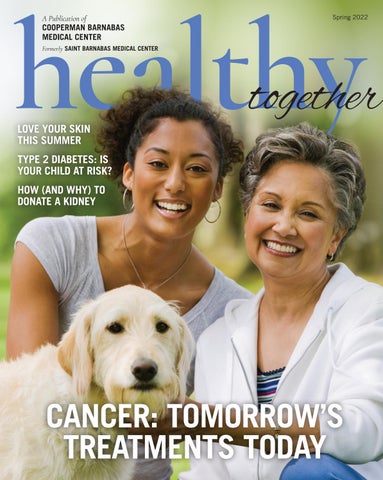
healthy together A Publication of
Spring 2022
COOPERMAN BARNABAS MEDICAL CENTER
Formerly SAINT BARNABAS MEDICAL CENTER
LOVE YOUR SKIN THIS SUMMER
TYPE 2 DIABETES: IS YOUR CHILD AT RISK? HOW (AND WHY) TO DONATE A KIDNEY
CANCER: TOMORROW’S TREATMENTS TODAY CBMC_Cover_Spring22_final_10.5.indd 1
3/4/22 12:18 PM
MESSAGES FROM LEADERSHIP “During the recent omicron surge, our healthcare workers went above and beyond during an extraordinarily difficult time. Their commitment to their patients and the community was incredibly gratifying and is representative of the extraordinary dedication of our RWJBarnabas Health workforce.” BARRY H. OSTROWSKY CHIEF EXECUTIVE OFFICER, RWJBARNABAS HEALTH
“At Cooperman Barnabas Medical Center, our mission is to provide compassionate care, healthcare excellence and superior service to our patients and their families. Our staff works tirelessly to deliver on that commitment. I am proud and grateful for their expertise, caring and devotion to our community.” RICHARD L. DAVIS PRESIDENT AND CHIEF EXECUTIVE OFFICER, COOPERMAN BARNABAS MEDICAL CENTER
COOPERMAN BARNABAS MEDICAL CENTER BOARD OF TRUSTEES OFFICERS Bruce Schonbraun, Chairman Richard L. Davis, President and Chief Executive Officer MEMBERS Michael Addis, MD Joseph Bier Thomas Chen Celia Colbert Alan Garten, MD Stuart Geffner, MD Gregg Gottsegen Alison Grann, MD Jeffrey Kigner Russell Langan, MD Michael Marano, MD Robert Marcus Joseph Mauriello Andrea Melchiorre Barry Ostrowsky Rahul V. Pawar, MD Evan Ratner Michael Rekoon Richard Ritholz Elena Santoro Ryan Schinman David Sidman Cori Wilf Anthony Wolk Kathryn Zizza Richard J. Kogan, Chairman Emeritus
HEALTH NEWS 94 Old Short Hills Rd., Livingston, NJ 07039 973.322.5000 | www.rwjbh.org/coopermanbarnabas
CONNECT WITH US ON @CoopermanBarnabasMedicalCenter @CMBCNJ RWJBarnabas Health @CoopermanBarnabas
Cooperman Barnabas Medical Center complies with applicable federal civil rights laws and does not discriminate on the basis of race, color, national origin, age, disability or sex. For more information, see link on our home page at www.rwjbh.org/coopermanbarnabas. Cooperman Barnabas Medical Center cumple con las leyes federales de derechos civiles aplicables y no discrimina por motivos de raza, color, nacionalidad, edad, discapacidad o sexo. ATENCIÓN: Si usted habla español, servicios de asistencia lingüística, de forma gratuita, están disponibles para usted. Llame al 973.322.5000. Cooperman Barnabas Medical Center konfòm ak lwa sou dwa sivil federal ki aplikab yo e li pa fè diskriminasyon sou baz ras, koulè, peyi orijin, laj, enfimite oswa sèks. ATANSYON: Si w pale Kreyòl Ayisyen, gen sèvis èd pou lang ki disponib gratis pou ou. Rele 973.322.5000.
For issues regarding delivery of Healthy Together, please write to HTcirculation@wainscotmedia.com.
Healthy Together
| 2 |
CBMC_Memo_Spring22_final_10.5.indd 2
NEW TECHNOLOGY BREAKS DOWN LANGUAGE BARRIERS
A new technology introduced at RWJBarnabas Health breaks down language barriers, eases communication between patients, families and providers, and furthers the health system’s mission to overcome health disparities. Known as MARTTI (My Accessible RealTime Trusted Interpreter), it provides 24/7 access to certified medical interpreters in more than 250 languages. MARTTI devices resemble IV carts with 12-inch tablets attached and are easily wheeled anywhere they’re needed. MARTTI can help limited English-proficient patients as soon as they enter Cooperman Barnabas Medical Center. The patient or a family member can point out their country of origin on the MARTTI screen and choose from a list of languages. An interpreter will then communicate with the individual in the language of their choice. For deaf or hard of hearing patients, an ASL medical interpreter is readily available.
Spring 2022
3/4/22 12:21 PM
together healthy contents SPRING 2022
6 2. WELCOME LETTER. A community update from our CEOs. 4. DON’T TAKE YOUR HANDS FOR GRANTED. Three tips for healthy hands and wrists.
10
4
17
20
22
6. FRIENDS FOR LIFE. How two gentlemen from Verona keep their hearts healthy.
12. T HE FREEDOM TO BREATHE. With a double lung transplant, a local hero gets his life back.
18. IS YOUR CHILD AT RISK FOR TYPE 2 DIABETES? How to help kids avoid high blood sugar.
9. 3 FAST FACTS ABOUT CANCER CLINICAL TRIALS. Where to find the latest treatments.
15. A BOLD VISION. Children’s Specialized Hospital aims to help all kids reach their full potential.
20. K EEPING AN EYE ON PANCREATIC CYSTS. An innovative program may prevent cancer.
16. T OBACCO RECOVERY AT YOUR FINGERTIPS. A new service provides customized support.
22. H OW (AND WHY) TO DONATE A KIDNEY. Your questions, answered.
Cooperman Barnabas Medical Center
CBMC_TOC_Spring22_final_10.5.indd 3
17. W ORLD-CLASS CARE FOR EAR, NOSE, THROAT AND MORE. A powerful partnership for otolaryngology patients.
10. L ISTENING TO YOUR HEART. What a digital device can tell you about your health.
14. O VERCOMING EATING DISORDERS. Why cases are on the rise in teens.
5. LOVE YOUR SKIN THIS SUMMER. Stay safe with simple habits.
8. A LOOK DEEP INSIDE THE LUNGS. New, advanced technology.
18
|
RWJBH.ORG/COOPERMANBARNABAS
3
3/4/22 12:24 PM
Loosen up wrists before you load them with weight by doing wrist circles—one minute in one direction, one minute in the reverse. “For fingers, extend them and flex them, bending backward and then forward,” Dr. Lopez says. “Thirty seconds should be enough.”
DON’T TAKE YOUR HANDS FOR GRANTED
SPEAKING YOUR LANGUAGE “I can’t stress enough how important it is to have a healthcare provider who can speak the language that you speak,” says orthopedic surgeon Nicole Lopez, MD, who is fluent in Spanish. “I see patients coming in with sons, daughters or even very young grandchildren functioning as interpreters, but often the message being sent is not the one being received.
AN ORTHOPEDIC SURGEON SHARES THREE SIMPLE WAYS TO KEEP HANDS AND WRISTS HEALTHY.
“For example, the patient may say, ‘I have knee pain at the end of the day, especially when I go up and down the stairs,’” she says. “While translating, the relative may generalize that the person is always complaining about knee pain. That could be the difference between a diagnosis of inflammatory arthritis vs. osteoarthritis.”
“B
ecause our fingers and hands are always in motion, we tend to take them for granted,” says Nicole Lopez, MD, an orthopedic surgeon at Cooperman Barnabas Medical Center who specializes in hand, wrist and elbow surgery and is a member of RWJBarnabas Health Medical Group. “The good news is that there are simple steps that anyone can take to keep their hands safe and healthy.” Her advice:
If patients don’t have access to a physician who speaks their language, they can ask for a trained medical interpreter. In addition, any family member who accompanies a patient to a doctor visit should be thoroughly informed about the patient’s medical history.
1
Warm up wrists and fingers before a workout. “Injuries often occur after people begin yoga or a new workout routine,” says Dr. Lopez. “We’re used to the idea of stretching and warming up knees and shoulders, but we don’t do the same for wrists and hands. Then a new workout can cause minor wrist and finger sprains that keep getting re-sprained and turn into a longer-term issue.”
Cooperman Barnabas Medical Center provides free language assistance services to people whose primary language is not English.
3
To avoid overuse injuries, pay attention to pain as it occurs. An overuse injury is any type of muscle or joint injury, such as a stress fracture or tendinitis (inflammation of a Wear sunscreen on the back tendon), caused by repetitive demand. of hands. “As a hand surgeon, I Most of us have heard about overuse injuries to the hand and frequently see that people have sunspots wrist based on extensive use of computers, smartphones and other [small, flat brownish spots] on the back devices. Office workers and retail workers who need to pick things of their hands, which are exposed to the up frequently are at risk of tennis elbow, a type of tendinitis caused sun constantly but rarely get sunscreen,” by repeating the same motions over and over. says Dr. Lopez. While sunspots are not “People usually find a way to work around these pains by making skin cancer, they should be monitored. adjustments,” Dr. Lopez says, such as changing the height of a Rapid changes in a sunspot may indicate keyboard, taking a brief rest or using a different arm to lift things. NICOLE LOPEZ, MD it should be checked by a doctor. The idea is to be mindful of a pain while it is occurring, instead of just powering through it. “Modify your activity while it’s happening, or stop doing what you’re doing,” says Dr. Lopez. To learn more about orthopedics and care for your hands at Cooperman “That’s much easier than dealing with an issue Barnabas Medical Center, call 973.322.7005 or visit www.rwjbh.org/ortho. after it has become a problem.”
2
Healthy Together
| 4 |
CBMC_Ortho_Spring22_final_10.5.indd 4
Spring 2022
3/4/22 12:26 PM
LOVE YOUR SKIN THIS SUMMER
SLATHER ON SUNSCREEN.
Use it even on slightly cloudy or cool days. It contains chemicals that scatter sunlight’s UV rays. Apply 30 minutes before you go outside. A Sun Protection Factor (SPF) of 30 is sufficient as long as the sunscreen is reapplied every two hours.
SIMPLE HABITS CAN DRASTICALLY REDUCE YOUR SKIN CANCER RISK.
H FRANZ SMITH, MD
ow can you protect your skin from the sun’s harmful rays? Franz Smith, MD, a surgical oncologist with a clinical trial and research specialty in skin cancers at Cooperman Barnabas Medical Center and a member of RWJBarnabas Health Medical Group, shares his best advice.
DRESS FOR SUCCESS.
That includes wearing a hat with a brim that shades your face, ears and the back of your neck; loose-fitting, long-sleeved, tightly woven shirts; and long pants. Wear a T-shirt on the beach whenever you aren’t in the water. Look for fabrics that have an Ultraviolet Protection Factor (UPF) to guard against UV rays.
KEEP AN EYE ON YOUR EYES.
CHECK IT OUT.
Wraparound sunglasses are a great choice to protect eyes and skin around the eyes from UV rays.
SHUN THE BRIGHTEST SUN.
WATCH THE KIDS.
Regularly examine your skin for changes in moles during showers and in the mirror. Ask someone to check your back and neck, and if your hair is thinning, be sure to check your scalp as well.
When you’re outside between 10 a.m. and 4 p.m., reduce your risk of skin damage by seeking shade under an umbrella, a tree or other shelter.
The vast majority of sun exposure occurs before age 18, so help your children take the necessary sun protection steps and let them see you doing the same.
RWJBarnabas Health and the Cancer Center at Cooperman Barnabas Medical Center, together with Rutgers Cancer Institute of New Jersey—the state’s only NCI-Designated Comprehensive Cancer Center—provide close-to-home access to the latest treatment options. To learn more, call 844.CANCERNJ or visit www.rwjbh.org/beatcancer.
To learn more about skin cancer prevention and treatment at Cooperman Barnabas Medical Center, call 844.CANCERNJ (844.226.2376) or visit www.rwjbh.org/beatcancer.
Cooperman Barnabas Medical Center
CBMC_SunSafety_Spr22_final_10.5.indd 5
|
RWJBH.ORG/COOPERMANBARNABAS
5
3/4/22 12:28 PM
Friends Joe Galasso, 83, at left, and Marty Rubin, 92, both former cardiac patients, walk and work out together regularly.
FRIENDS FOR LIFE HOW TWO GENTLEMEN FROM VERONA ARE STAYING HEALTHY TOGETHER
Healthy Together
| 6 |
T
hough you wouldn’t know it by their energy and fit physiques, friends Marty Rubin, 92, and Joe Galasso, 83, both required lifesaving heart procedures at Cooperman Barnabas Medical Center (CBMC). Their health and vigor are a testament to their dedication to taking care of themselves, says the cardiologist who treated them both, Gary Rogal, MD,
Medical Director for RWJBarnabas Health Cardiovascular Services and a member of RWJBarnabas Health Medical Group. “I tell all of my patients that 50 percent of keeping you healthy is me, but the other half is you,” says Dr. Rogal. “These two really listen to the advice we’ve given them and are active participants in keeping themselves healthy.”
Spring 2022
CBMC_Cardiac_Spring22_final_10.5.indd 6
3/4/22 12:30 PM
STAYING FIT TOGETHER
Marty and Joe, who are residents of a condominium complex in Verona, first met 15 years ago when Joe and his wife, Becky, moved into the complex. (Marty and his wife, Marilyn, have lived there since 1980.) “We met down at the pool,” Joe recalls. “I saw this guy swimming, and he just swam and swam and never stopped. I was amazed and we started talking, and we became really good friends.” The two bonded over their shared memories of growing up in Newark. Joe started doing laps regularly too, and the two began supporting each other during their workouts. “Even though we do our laps at different times, we like to watch each other swim and help the other person count laps,” says Marty. “Joe is a lovely, reliable, smart and wonderful person.” Joe also has lots of praise for Marty: “Here’s a guy in his 90s who does 40 laps a day, is in remarkable shape, reads four books a week and even mentors young people,” he says.
LIFESAVING HEART CARE
Marty’s heart issues surfaced around 15 years ago, when he experienced a two-day episode of fatigue. At the recommendation of his internist, Marty made an appointment with Dr. Rogal. Marty’s heart was beating too slowly, Dr. Rogal found, and he would require a pacemaker—a small device surgically implanted in the chest that helps regulate heartbeat by sending electrical signals. “After receiving my pacemaker, I got my energy back right away,” Marty recalls. In 2008, Marty required another procedure at CBMC (then known as Saint Barnabas Medical Center)—coronary
GARY ROGAL, MD
ARASH SALEMI, MD.
bypass surgery due to four clogged arteries. Patients who undergo bypass surgery at CBMC are often discharged from the hospital in less than a week, though a full recovery can take a few months. “Once I recuperated, I got back to my routine and to swimming and exercising” says Marty. In November of 2019, Marty needed a third heart surgery, this time for aortic stenosis, a narrowing of the heart valve. He underwent a minimally invasive surgery called transcatheter aortic valve replacement (TAVR), in which a catheter is inserted into the leg or chest and guided to the heart. The procedure was performed by Arash Salemi, MD, Clinical Chairman of Cardiothoracic Surgery at RWJBarnabas Health, Professor of Surgery at Rutgers New Jersey Medical School and a member of RWJBarnabas Health Medical Group. Marty was able to go home the next day. “I felt fine and there was no recuperation time at all,” he says. Coincidentally, Joe also had heart valve issues and required surgery for aortic stenosis. However, because of the large size of his aorta, he wasn’t a candidate for the TAVR method. In August 2020, Joe underwent open aortic valve replacement, in which the valve is replaced through open heart surgery, performed by Dr. Salemi. Joe was also experiencing atrial fibrillation (AFib), an irregular heartbeat that can lead to serious complications such as stroke. During the valve surgery, a surgical device called an AtriClip to “clip,” or close, his atrial appendage to prevent blood flow there, was implanted. This allowed him to stop taking blood thinners. Joe’s surgery was also a success. He was discharged in less than a week and says he felt back to normal within a month. “The experiencs these two men had are a perfect example of our approach at Cooperman Barnabas,” says Dr. Salemi. “We treat every patient as an individual, so they receive care that is specifically tailored to their needs.” Age is no barrier. “You’re never too old to receive advanced cardiac care that will greatly enhance your quality of life,” says Dr. Salemi.
THINK POSITIVE FOR HEART HEALTH Research has found a clear link between a positive attitude and a healthier heart. One study showed this finding is even true for people with a family history of heart disease; another, that it’s true for people with risk factors such as high blood pressure and high cholesterol. Consciously practice gratitude to develop a healthier outlook, advises the American Heart Association. Take at least five minutes daily to consider all your body does for you, the food you’ve eaten to nourish yourself, the activity you enjoyed that day, the people you look forward to connecting with and the gift of time.
ENJOYING LIFE
Today, Marty and Joe continue to stay active and refuse to let age slow them down. When not swimming or working out in the building’s gym (Marty likes the treadmill and Joe prefers the elliptical), the pals enjoy going out to dinner with their wives and having parties and barbecues with friends. Marty also loves taking vacations to Martha’s Vineyard with his large family, including nine great-grandchildren, while Joe and his wife like to take cruises around the world. “Some people give up on life and healthy existence at a certain point in time, and these two guys have not done that,” says Dr. Rogal. “They’re social, active and live life to its fullest.”
Whoever your heart beats for, our hearts beat for you. To connect with a top cardiovascular specialist at Cooperman Barnabas Medical Center, call 888.724.7123 or visit www.rwjbh.org/heart.
Cooperman Barnabas Medical Center
CBMC_Cardiac_Spring22_final_10.5.indd 7
|
RWJBH.ORG/COOPERMANBARNABAS
7
3/4/22 12:31 PM
Left: Killol Patel, MD, and Kristin Fless, MD, with CBMC’s new robotic bronchoscope. Below: Computer illustration showing a small, solid nodular mass located in the upper lobe of the right lung.
A LOOK DEEP INSIDE THE LUNGS ADVANCED TECHNOLOGY ALLOWS FOR EARLIER DIAGNOSIS OF LUNG CANCER.
L
ung cancer is the leading cause of cancer death worldwide. More than 90 percent of people diagnosed with it don’t survive because the disease isn’t found until it’s at an advanced stage. At Cooperman Barnabas Medical Center (CBMC), new robotic bronchoscopy technology known as the Monarch Platform is offering physicians an unprecedented view of the inside of the lungs, as well as the ability to obtain tissue samples for biopsy from hard-toreach nodules. “Because the Monarch Platform provides improved reach, vision and control for bronchoscopic procedures, it holds the potential to help us to make a diagnosis earlier,” says Killol Patel, MD, Medical Director of the Lung Nodule Program and Director of Interventional Pulmonology at CBMC and a member
RWJBarnabas Health and the Cancer Center at Cooperman Barnabas Medical Center, together with Rutgers Cancer Institute of New Jersey—the state’s only NCI-Designated Comprehensive Cancer Center—provide close-to-home access to the latest treatment options. To learn more, call 844.CANCERNJ or visit www.rwjbh.org/beatcancer.
of RWJBarnabas Health Medical Group. “We are excited about the promise of this technology to offer a more hopeful future for our patients with lung cancer.”
IN SEARCH OF A NODULE
During a bronchoscopy procedure, a thin, flexible tube is passed through the nose or mouth and down the throat in order to give the doctor a view of a patient’s lungs and air passages. Because lung nodules are small and tend to be located deep within the lung, they can be hard to see during traditional bronchoscopy. The Monarch Platform enables a physician to use robotic technology, manipulating a controller to “drive” a bronchoscope deep within the lungs and into the small branches of the bronchial tree. An integrated camera on the bronchoscope allows the doctor a crisp,
WHAT IS A LUNG NODULE? • A small abnormal growth that forms in the lung. • Often found as part of a CT screening of the chest. • Usually benign, resulting from old infections, scar tissue or other causes. • Will be checked via repeat scan to see if it’s growing, which could be a sign of cancer.
3D view of the patient’s lung anatomy. When a nodule is reached, the flexible bronchoscope can be “parked” and remain stable while the doctor performs any needed interventions. In addition to the Monarch Platform, CBMC has an Incidental Lung Nodule Program to catch lung cancer in its earliest stages. If a lung nodule is picked up during any CT scan at CBMC or the Barnabas Health Ambulatory Care Center, a software system will alert the lung nodule team. A letter will be sent to both the ordering provider and the patient, offering an opportunity to follow up at the Lung Nodule Clinic. Says Dr. Patel, “With early detection, we have a better opportunity of curing this disease.”
For more information on lung cancer diagnosis and treatment at Cooperman Barnabas Medical Center, call 844.CANCERNJ or visit www.rwjbh.org/cbmclung.
Healthy Together
| 8 |
Spring 2022
CBMC_Bronchoscope_Spr22_final_10.5.indd 8
3/4/22 12:33 PM
For example, Rutgers Cancer Institute: • Was the first to offer trials with specific immunotherapy drugs that worked for many skin cancers, especially Merkel cell carcinoma. • Participated in a trial for a firstline colon cancer treatment that led to excellent responses for a number of patients, making them eligible for potentially curative surgery. • Has pioneered immunotherapy treatments resulting in better management of many cancers, including renal cell cancer and bladder cancer. “When I started out treating colon cancer 25 years ago, we had only one drug available, RWJBarnabas Health, together and it dated back to with Rutgers Cancer Institute of New the 1960s,” says Dr. Jersey—the state’s only NCI-Designated Hochster. “Since Comprehensive Cancer Center—provides that time, we’ve close-to-home access to the latest developed three new treatment options. To learn more, call chemotherapy drugs 844.CANCERNJ or visit and five new targeted www.rwjbh.org/beatcancer. drugs for colon cancer, and all of them were developed through clinical HOW RWJBARNABAS HEALTH AND RUTGERS CANCER INSTITUTE trials. Now people are living with OF NEW JERSEY OFFER TOMORROW’S TREATMENTS TODAY colon cancer, on average, four times as long as they used to.” ancer clinical trials often save elsewhere. FACT #3 Clinical trials are not a lives. If you or a loved one needs Patients may participate in a clinical treatment for cancer, here’s what last resort. trial either at an RWJBH hospital near “It’s important for people to understand you should know: where they live or at Rutgers Cancer Institute. that enrolling in a clinical trial is FACT #1 You don’t have to travel “We’ve integrated cancer care so that often an option for a first-line or early to a nearby city, such as New York or treatment,” says Dr. Hochster. “These we’re putting the standards and expertise Philadelphia, to access a clinical trial. trials are a way for us to give patients of an NCI-Designated Comprehensive As New Jersey’s only National Cancer Cancer Center, as well as clinical the latest treatments before they’re Institute-Designated Comprehensive trials, in all 12 hospitals in the RWJBH widely available. They offer tomorrow’s Cancer Center, system,” says Howard Hochster, MD, treatments today.” Rutgers Cancer FACP, Director, Oncology Research for To determine whether a patient Institute of New RWJBH, and Associate Director, Clinical would be best suited for a clinical trial Jersey, together Research, for Rutgers Cancer Institute. or for standard care, each individual with RWJBarnabas case is evaluated by a multidisciplinary FACT #2 Clinical trials have led to Health (RWJBH), team of cancer experts from throughout offers a wide range significant advances in treatment. RWJBH and Rutgers Cancer Institute. Treatments developed through these of clinical trials, Rutgers Cancer Institute and many of which trials have helped tens of thousands of RWJBH currently offer approximately aren’t available patients. 270 different clinical trials. HOWARD HOCHSTER, MD
3
FAST FACTS ABOUT CANCER CLINICAL TRIALS
C
To learn more about clinical trials at RWJBarnabas Health and Rutgers Cancer Institute of New Jersey, call 844.CANCERNJ or visit www.cinj.org/clinical_trials.
RWJBarnabas Health
System_Cancer_Spr22_final_10.5.indd 9
|
RWJBH.ORG
| 9
3/4/22 3:18 PM
LISTENING TO YOUR
HEART WHAT CAN A DIGITAL CARDIAC DEVICE TELL YOU ABOUT YOUR HEART’S RHYTHM?
“C
all your doctor,” said the message on the 87-year-old woman’s Apple Watch. A regular walker and exerciser, the woman wasn’t feeling right, so she’d
PARTHO SENGUPTA, MD
Healthy Together
GARY ROGAL, MD
| 10 |
checked the Heart Rate app. It showed that her heart rate was significantly slower than normal. Her son took her to the emergency department, where an electrocardiogram determined that there was a problem with the electrical signals in her heart. The next morning, doctors implanted a pacemaker. “Her diagnosis was clearly aided by her having an Apple Watch,” says the woman’s cardiologist, Gary Rogal, MD, Medical Director for RWJBarnabas Health Cardiovascular Services and a member of RWJBarnabas Health Medical Group. “I believe wearable digital devices
that measure heart rhythm will become a major addition to the diagnostic tool kit for cardiologists.” Who should wear one of these devices? The short answer: people whose doctors recommend it. “Wearable cardiac devices are very handy tools, but you have to be selective about how you use them,” says Dr. Rogal.
THE HEART’S RHYTHM
The main value of wearable cardiac technology lies in its ability to detect cardiac arrhythmias, or irregular heartbeats, Dr. Rogal explains. These
Spring 2022
System_CardiacWearables_Spr22_final_10.5.indd 10
3/4/22 3:21 PM
condition that’s anywhere from harmless to life-threatening. “If I’m concerned about arrhythmia based on what the patient is telling me, but just can’t nail down the diagnosis, I might suggest that a patient use a wearable cardiac device,” says Dr. Rogal. “The decision should be made along with a physical exam and a knowledge of the patient’s medical history and symptoms. If there’s no real reason to have one, wearing the device could do nothing more than make a patient anxious.”
NEW TOOLS
An early form of wearable cardiac technology, the Holter “FOR THE FUTURE OF CARDIOLOGY, monitor, has been OUR OVERALL CONCEPT IS THAT CARE around for decades. This STARTS IN THE PATIENT’S HOME AND device uses electrodes (small, plastic patches ENDS AT HOME, WITH THE HOSPITAL on the skin) to record the AND THE CLINIC ONLY POINTS electrical activity of the heart. ALONG THE WAY.” “A patient can wear a Holter monitor for 24 to 48 hours or even Partho Sengupta, MD longer,” Dr. Rogal explains. “The reality is, though, that some patients have arrhythmias once every few weeks or even every few months, and a Holter monitor could miss that,” he says. “That’s the type of thing a smartwatch would pick up.” Dozens of wearable devices are on the market today. Examples include: KardiaMobile, a pocket-sized portable EKG machine that allows patients to put their fingers on sensors and share the results with their doctor. The MCOT Patch System, which monitors the heart rhythm for two weeks occur when the electrical signals that via a sensor on the patient’s chest. coordinate the heart’s beats don’t work Other digital cardiac devices, which properly. In turn, the heart can’t pump must be implanted by a physician, are blood effectively. also coming into wider use. Examples Symptoms of arrhythmia include include: a fluttering in the chest, shortness of A device called CardioMEMS, which breath, fainting, dizziness or a feeling monitors pulmonary artery pressure and that the heart is racing or beating too sends the results to a team of clinicians. slowly. The symptoms may be brief or A loop recorder, a device smaller long-lasting, and they can indicate a than a USB flash drive, that’s placed just
underneath the skin near the breastbone. It can continuously record a patient’s heart rhythm for up to three years. “If a patient calls me and says, ‘Hey, I’m feeling funny, a little lightheaded,’ I can interrogate the loop recorder and see what the heart rhythm was during that symptom,” says Dr. Rogal.
ARTIFICIAL INTELLIGENCE
The key to the success of these technologies lies in artificial intelligence (AI)—the ability of a computer to compare an individual’s data against that of thousands of other patients and flag information that may be significant. “AI allows information to be provided to the care team in a very nuanced way,” says Partho Sengupta, MD, Chief of the Cardiology Service Line at Robert Wood Johnson University Hospital (RWJUH) and Chief of the Division of Cardiology at Robert Wood Johnson Medical School. “The device will only send an alert if it thinks the data is moving in the wrong direction and the patient is not doing well, as opposed to a steady stream of data, which can be overwhelming.” The cardiology team at RWJUH meets regularly with doctors in the community to discuss the digital transformation of cardiology and consider innovations for treatment. Dr. Sengupta and his colleagues are conducting several clinical trials, including one for an armband that can monitor multiple physiological signals and offer personalized recommendations for a patient’s care. “For the future of cardiology, our overall concept is that care starts in the patient’s home and ends at home, with the hospital and the clinic only points along the way,” Dr. Sengupta says. “In order for us to connect the whole journey, we need to have the ability to continuously monitor a patient’s health. “It’s like how we use a GPS to help us on a road journey,” he says. “Now it’s time to take that approach and apply it to our health journeys.”
Whoever your heart beats for, our hearts beat for you. To connect with a top cardiovascular specialist at RWJBarnabas Health, call 888.724.7123 or visit www.rwjbh.org/heart.
RWJBarnabas Health
System_CardiacWearables_Spr22_final_10.5.indd 11
|
RWJBH.ORG
| 11
3/4/22 3:21 PM
Two decades after 9/11, double lung transplant recipient Tony Moyet visits the NY Waterway ferry.
THE FREEDOM TO BREATHE WITH A DOUBLE LUNG TRANSPLANT, A BLOOMFIELD MAN IS REBORN ON THE FOURTH OF JULY.
O
n Sept. 11, 2001, Tony Moyet began his workday the same way as he had for the previous five years, by transporting about 300 commuters per trip from Hoboken to the World Financial Center in Manhattan on a NY Waterway ferry. “That morning, though, when I dropped off a set of passengers, I saw the gaping hole in the North Tower, with flames coming out of it,” Moyet recalls. “I radioed [then NY Waterway port captain] Michael McPhillips and told him to send boats THIRUVENGADAM JESUS GOMEZ-ABRAHAM, down in case we ANANDARANGAM, MD MD Healthy Together
| 12 |
needed to help people evacuate.” That was after the first plane hit the World Trade Center. When the second one hit, crowds of people looked frantically for a way out of lower Manhattan. “We were the first boat to start evacuating,” Moyet recalls. “We were facing a stampede.” He worked until 3 a.m. the next day, transporting people away from danger. For the next year and a half, he continued to work in the Ground Zero area, shuttling federal agents, policemen, firemen and workers from throughout the country to lower Manhattan. Some two decades later, Moyet himself needed help. In January 2018, he sought care for what he thought was a severe cold with a cough that wouldn’t stop. “My doctor told me it was COPD [chronic obstructive pulmonary disease],” he says. Longterm lung problems are an unfortunate reality for many 9/11 first responders, who breathed in massive amounts of smoke, dust and fumes.
Spring 2022
System_LungTransplant_Spr22_final_10.5.indd 12
3/4/22 3:25 PM
FINDING A MATCH
Once Moyet received his COPD diagnosis, his lung function deteriorated rapidly. By spring 2020, he had developed endstage COPD/emphysema and end-stage advanced pulmonary disease. He needed inhaled oxygen 24 hours a day; he couldn’t climb stairs or sleep without it. “He told me, ‘Doc, I just need two more years to see my daughter graduate from high school,’” says pulmonologist Thiruvengadam Anandarangam, MD, Division Chief, Pulmonary and Critical Care Medicine at Newark Beth Israel Medical Center (NBI). “I told him that we’re hoping we can give him enough time to see her graduate and also to walk her down the aisle someday.” Moyet’s best hope to extend his life was a double lung transplant. “At the time, he was on 17 medications and medical management wasn’t providing any more relief,” says transplant surgeon Jesus Gomez-Abraham, MD, Associate Surgical Director of Lung Transplantation at NBI and a member of RWJBarnabas Health Medical Group. Dr. Gomez-Abraham added Moyet to the lung transplant database on Friday, July 2. While the average lung transplant patient waits four months for a match, and even longer when a double lung transplant is required, Moyet’s care team found his match the very next day. “That was amazing— very unusual,” Dr. Anandarangam says. “He was listed on Friday. On Saturday, we found a donor in a neighboring state. I traveled there to look at the organs, and they matched Tony’s size and blood type perfectly.” On Sunday, July 4, Dr. Gomez-Abraham performed the double lung transplant. Eighteen days later, Moyet returned home.
BREATHING EASIER
His fast recovery, say his doctors, was driven by his determination to get better. “When I saw him just before the transplant, he was already in better shape than the last time I had seen him,” Dr. Gomez-Abraham says. “He had done what he needed to do to improve his nutrition, and was doing pulmonary rehabilitation and physical therapy to increase his chance of better results.” Moyet credits his caregivers at NBI for their guidance and persistence. “After the transplant, I had to learn to walk and move all over again,” he says. “My nurses pushed me to keep going, even on days I didn’t want to walk. They were dressed in blue; I called them my Blue Angels. They’re the sweetest people in the world.” Just two months after his double lung transplant, Moyet, 65, was taking walks again with his wife, Arlene, and 15-yearold daughter, Sophia. “I don’t need oxygen, and my lungs are working great,” he says. He commemorated the 20th anniversary of 9/11 by joining a group chat hosted by the World Trade Center Health Program. And he’s planning for a bright future, including a possible trip to Europe. “My doctors are great people—miracle workers,” Moyet says. “They cared so much and saw me in the hospital every day. It was a great team that put me all back together again.”
Tony Moyet with his family at NBI’s cardiothoracic ICU, several days after his lifesaving lung transplant surgery.
SPECIAL CARE FOR SERIOUS LUNG PROBLEMS People with the most complex lung conditions rely on the Advanced Lung Disease and Transplant Program at Newark Beth Israel Medical Center (NBI), the only lung transplant program in New Jersey. Who is a candidate for a lung transplant? “The majority of patients have end-stage COPD and emphysema,” says Jesus Gomez-Abraham, MD. “Other possible candidates are those with cystic fibrosis or pulmonary fibrosis as well as those with certain congenital cardiac diseases.” Candidates at NBI are evaluated through a multidisciplinary approach that includes surgeons, pulmonologists, cardiologists, gastroenterologists and others. What is life like after a lung transplant? “Patients will increase their lung function capacity up to 60 to 90 percent,” says Dr. Gomez-Abraham. “Once the transplant has settled in, the majority of patients do not need oxygen. They can go to the mall, go to the beach, go to the family reunion, go back to work. The lung transplantation gives them the freedom to develop a normal life.”
To learn more about transplant services at Newark Beth Israel Medical Center, call 888.724.7123 or visit www.rwjbh.org/lungtransplant.
RWJBarnabas Health
System_LungTransplant_Spr22_final_10.5.indd 13
|
RWJBH.ORG
| 13
3/4/22 3:25 PM
COPING WITH EATING DISORDERS: TIPS FOR FAMILIES • Express honest affection, verbally and physically.
OVERCOMING
EATING DISORDERS CASES HAVE BEEN ON THE RISE DURING THE PANDEMIC, ESPECIALLY AMONG TEENS.
B
eing quarantined at home, not being in school for extended periods, not seeing friends or playing organized sports: The restrictions of the pandemic have been keenly felt by adolescents. Pandemic-related stressors seem to be behind a recent dramatic increase in reported symptoms of eating disorders— binging, purging, drastically reduced caloric intake—as well as a doubling of hospitalizations for those issues. “The kids we’re seeing are much more medically compromised and much more entrenched in the behaviors than we’ve seen in the past,” says Lynn Corey, LCSW, CEDS/S, CETP, Clinical Manager of Behavioral Health Outpatient Services at Robert Wood Johnson University Hospital (RWJUH) Somerset. “The pandemic has made the eating disorders worse, because so much of teens’ lives feels out of their control,”
• Teach children to communicate with assertiveness so they can resist inappropriate messages from their peers, the media and others about weight. • Do not demand weight gain or berate a family member. • Develop a dialogue about personal issues other than food and weight. • Get support and educate yourself through books, professional help and talking with other families.
equipped to assess potential medical complications in a patient—a critical point, because eating disorders can cause harm to every organ system in the body. Initial tests may include blood work, an electrocardiogram and more. The patient will also undergo a psychiatric evaluation to determine whether he or she is a candidate for one of the program’s levels of treatment: • Inpatient treatment in a 14-bed unit that offers psychological, medical, nursing and nutritional care. GETTING HELP • Partial hospitalization, up to five If a parent is worried about a child’s days a week, with three hours of therapy eating habits, a trip to the primary care per day. provider is a good first step, Corey says. • Intensive outpatient services, up to “If the pediatrician feels things aren’t three days a week, with three hours of looking good, that can open the door for therapy per day. parents to set up an evaluation with our The program offers weekly support program.” groups for patients and for family Thanks to its hospital affiliation, and friends. “Our programs are inthe RWJUH Somerset program is person, not virtual, because that human interaction is so important in connecting with patients,” To learn more about RWJUH Somerset’s nationally recognized Eating Disorders Corey says. “So many people tell us, ‘I just don’t want to talk to a Program, call 800.300.0628 or visit www.rwjbh.org/eatingdisorders. computer screen.’” Healthy Together
| 14 |
explains Corey, who works with the RWJUH Somerset Eating Disorders Program. “An eating disorder is really not about food; it’s a maladapted coping mechanism. Food becomes used as a means of giving themselves power over their lives. “Moreover,” Corey continues, “when teens aren’t in school, there are fewer eyes on them—school nurses, guidance counselors and teachers—to notice changes and collaborate with parents.”
Spring 2022
System_Behavioral_Spr22_final_10.5.indd 14
3/4/22 3:28 PM
Professional third baseman Todd Frazier—a local hero since his role on the Toms River 1998 Little League World Series Championship team—and his wife, Jackie, have stepped up to the plate for CSH. Above, the Fraziers with Mark Montenero and Ed McKenna, co-chairs of the Transforming Lives 2.0 campaign.
A BOLD VISION FOR CHILDREN AN AMBITIOUS CAPITAL CAMPAIGN AIMS TO ENSURE THAT ALL CHILDREN CAN REACH THEIR FULL POTENTIAL.
W
hen the youngest son of Todd and Jackie Frazier was hospitalized briefly, his parents got a window into what parents of patients at Children’s Specialized Hospital (CSH) go through. “We understand that every day your child is not well, you’re waiting for that bit of good news, for your child to make progress from the day before,” says Todd, a local Toms River legend and Major League Baseball All-Star. “When we visited Children’s Specialized, we were able to see that everyone on the staff at the hospital is so passionate about caring for these children.” “The whole vibe was so loving and positive,” says Jackie Frazier. “Everyone
An RWJBarnabas Health facility needs to know that this place provides the absolute best care for kids living with special needs.” So when the Fraziers were asked to team with the CSH Foundation to help raise $45 million in support of the Transforming Lives 2.0 capital campaign, they readily stepped up. “We want everyone to know that each and every one of us can make a difference for kids living with special needs right here in New Jersey by supporting the expansion of Children’s Specialized through this campaign,” says Todd.
MAJOR INVESTMENTS
The Transforming Lives 2.0 campaign aims to do nothing less than design the next generation of care through major investments in both inpatient and outpatient resources. Improvements
will include new technologies, such as artificial intelligence, and expansion to new locations. A particular focus is on care for patients with autism, including sophisticated new technologies for screening, assessment, intervention and caretaker training. The Transforming Lives 2.0 campaign is co-led by community leaders and members of the CSH Foundation Board of Trustees Mark Montenero, President of Autoland Toyota, Jeep, Chrysler, Dodge, and Ram Trucks in Springfield, and Ed McKenna, Esq., Senior Partner at McKenna, Dupont, Stone and Washburne, and former mayor of Red Bank. “This campaign will enable us to increase access to CSH’s essential and innovative programs and services,” says Matthew B. McDonald III, MD, President and CEO of CSH. “With every new patient we meet through this period of expansion and enhancement, we get one step closer to realizing our vision of a world where every child can reach their full potential. Having the Fraziers on board, as well as the other esteemed cabinet members, makes me confident that we will reach our goal.” To learn more or make a donation to enhance the future for New Jersey’s children living with special healthcare needs, visit www.childrens-specialized.org/ transforminglives or write to foundation@childrens-specialized.org.
At Children’s Specialized Hospital, we provide world-class care for children and young adults who face special health challenges across the state of New Jersey and beyond. We treat everything from chronic illnesses and complex physical disabilities, like brain and spinal cord injuries, to a full scope of developmental, behavioral and mental health concerns. We have convenient locations throughout the state: Bayonne, Clifton, East Brunswick, Egg Harbor Township, Hamilton, Jersey City, Monmouth, New Brunswick, Newark, Somerset, Toms River, Union and West Orange.
RWJBarnabas Health
System_CSH_Spring22_final_10.5.indd 15
|
RWJBH.ORG
| 15
3/4/22 3:35 PM
TOBACCO RECOVERY AT YOUR FINGERTIPS
a number of keywords such as “craving,” “mood,” “relax” or “meet.” Responses might include motivational messaging or a link to login information for IFPR Zoom meetings. A chat feature is also available through a HIPAA-secure portal. The program, which began in July 2021, has served more than 200 people so far and gets about 30 new signups each month, Hanna says. Quitting nicotine can be as hard as quitting heroin or cocaine, research shows. On average, people try to quit smoking five to seven times before they quit for good. “Our goal is to break down the stigma of nicotine addiction. Even healthcare providers too often regard it as a bad habit,” Hanna says. “Instead, we approach it the same way we would treat a chronic disease such as diabetes or heart failure. We help patients deal with the physiological effects. And we know that when we combine that approach with counseling, a person’s chances of success are much greater. No one should feel like they have to make this journey alone.”
A NEW SERVICE PROVIDES CUSTOMIZED SUPPORT.
Y
ou’re trying to quit smoking. You really want a cigarette. What do you do? Pills, medications and patches can help a person overcome a nicotine addiction. But equally important is to have support from the people in your life—loved ones, colleagues, healthcare providers—and from trained counselors who understand just how challenging the journey can be. The free Nicotine and Tobacco Recovery Program offered by the RWJBarnabas Health Institute for Prevention and Recovery (IFPR) employs a full range of tools to quit smoking, including counseling and support groups. Last summer, the program unveiled a new support option: a text-based service known as the Tobacco Recovery Concierge. The service offers real-time support via texting for moments when triggers or cravings are strong. “In these cases, we can offer tips for a behavior change that they can make to help the craving subside, such as going Healthy Together
| 16 |
System_Tobacco_Spr22_final_10.5.indd 16
for a walk, having a drink of water or doing breathing and relaxation exercises,” explains Monica Hanna, MPH, CHES, NCTTP, Assistant Director of the Nicotine and Tobacco Recovery Program. “Research has shown that cessation counseling and support can double a person’s chances of success when quitting nicotine,” she says. “This new service allows us to tailor messages to patients for whatever they’re going through at the moment.”
NOT JUST A HABIT
Powered by GoMo Health, the Tobacco Recovery Concierge provides regular motivational and educational messages based on where a person is in his or her quit journey. These scheduled messages might include a link to a website where people share their stories, or to a calculator for figuring out exactly how much a person will save by quitting nicotine. For times when participants need immediate support, they can text one of
YOU CAN QUIT.
WE CAN HELP.
The Nicotine and Tobacco Recovery Program includes nicotine replacement therapies, recommendations on prescription smoking medication, and individual and group counseling. The program, funded by the New Jersey Department of Health Office of Tobacco Control, Nutrition and Fitness, is offered free of charge by the RWJBarnabas Health Institute for Prevention and Recovery in Essex, Mercer, Middlesex, Monmouth, Ocean, Somerset and Union counties. To learn more, call 833.795.QUIT (7848), email quitcenter@rwjbh.org or visit www.rwjbh.org/nicotinerecovery.
Spring 2022
3/4/22 3:39 PM
place at these institutions, which we at Cooperman Barnabas can apply directly to treatments.” ENTA patients can be referred to a CBMC surgeon through a HIPAAcompliant method of sharing medical records. If a patient needs the highly complex care CBMC can provide, he or she will be seen by a specialist within 48 hours.
A TEAM OF SPECIALISTS
WORLD-CLASS CARE FOR EAR, NOSE, THROAT AND MORE A PARTNERSHIP PROVIDES OTOLARYNGOLOGY PATIENTS WITH TOP TREATMENTS.
C
ooperman Barnabas Medical Center (CBMC) and ENT and Allergy Associates (ENTA) have joined forces to provide convenient and seamless services to patients through a wide range of otolaryngology and ear, nose and throat specialties. Now, ENTA patients in New Jersey who need advanced treatments don’t have to travel far from home to receive world-class care. “Research has shown that if you do head and neck surgery in a place that’s close to the patient’s home, where they can have chemotherapy or any other treatments in JEAN ELOY, MD
the same system, the patient has a better outcome,” says Jean Eloy, MD, Chair of the Otolaryngology–Head and Neck Surgery Department at CBMC. “The patient is less likely to miss appointments and more likely to be compliant with his plan of care. It’s much easier on the patient as well as the family. Proximity matters.” Most important, patients of ENTA and CBMC will receive the highest level of care. “We have world-class expertise, here at Cooperman Barnabas Medical Center and through our affiliation with Rutgers New Jersey Medical School and Rutgers Cancer Institute,” says Dr. Eloy, who is also Vice Chair and Professor of Otolaryngology at Rutgers New Jersey Medical School. “Our expertise is second to none. Our patients benefit from the cutting-edge research taking
The CBMC otolaryngology team is equipped to handle a wide range of conditions, Dr. Eloy explains. “We can surgically treat advanced sinus disease, which can be very debilitating for a patient,” he says. “We are experts at treating sinus cancer, as well as the whole range of head and neck cancers. “In the past, patients had to endure a craniotomy—a removal of part of the bone from the skull—in order to have a pituitary tumor removed,” he says. “Now we can go through the nose, and the patient can go home the next day. We have many cases in which our advanced techniques and technology allow us to do minimally invasive surgery and spare patients prolonged stays in the hospital.” Endoscopic skull base surgery is a special focus for the CBMC group. This form of minimally invasive surgery allows surgeons to diagnose and treat growths located in the complicated and crowded area under the brain. The delicate surgery requires a multidisciplinary team of trained surgeons and sophisticated image guidance. In addition to Dr. Eloy, the CBMC team includes skull base neurosurgeon James K. Liu, MD; sinus surgeon Wayne Hseuh, MD; and ophthalmic plastic and reconstructive surgeons Paul D. Langer, MD, and Roger E. Turbin, MD. “There’s nothing comparable to our team in the state of New Jersey,” says Dr. Eloy, “and our services are equal to or better than any in New York.”
To learn more about ENT and Allergy Associates and its partnership with Cooperman Barnabas Medical Center, call 855.ENTA.DOC or visit www.entandallergy.com/about/cbmc.
Cooperman Barnabas Medical Center
CBMC_ENT_Spr22_final_10.5.indd 17
|
RWJBH.ORG/COOPERMANBARNABAS
17
3/4/22 12:35 PM
IS YOUR CHILD AT RISK FOR
TYPE 2 DIABETES? HOW PARENTS AND CAREGIVERS CAN HELP KIDS AVOID HIGH BLOOD SUGAR
Healthy Together
| 18 |
Spring 2022
CBMC_KidsDiabetes_Spr22_final_10.5.indd 18
3/4/22 12:37 PM
N
ot long ago, Type 2 diabetes—the form of diabetes that is diet-related and develops over time—was rare in children. Now the number of children with Type 2 diabetes is rising, an issue that’s closely linked to the rise in the number of overweight children and teens. “Type 2 diabetes has the potential for long-term consequences related to the heart, kidneys, eyes and circulation,” says pediatric endocrinologist Dennis Brenner, MD, Chair of the Department of Pediatrics at Cooperman Barnabas Medical Center and a member of RWJBarnabas Health Medical Group. “However, parents and caregivers should know that it can be prevented, and sometimes even cured, by lifestyle changes.”
What are the symptoms?
• OVERWEIGHT: Children’s weight is evaluated based on their BMI (body mass index)—a ratio of weight to height—which is then compared with the average weight range in their age group. Children whose weight is in the 95th percentile or above are considered obese and are at greater risk for developing diabetes. • FREQUENT URINATION: The child’s body may be trying to get rid of extra blood sugar by passing it out in urine. • THIRST: The child’s body craves fluids to make up for the frequent urination. • FATIGUE: The child is often tired because the body can’t process sugar for energy. • THICK OR DARK PATCHES IN THE SKIN: An elevated insulin level may cause this condition, especially in the folds or creases of skin. If one or more of these conditions is present, the pediatrician may order a test to measure the levels of glucose in the child’s blood and may make a referral to a pediatric endocrinologist.
How is Type 2 diabetes in children treated?
• WITH HEALTHY EATING: “That means eating fewer carbohydrates—things like pasta, rice, bread and desserts—and more vegetables, fruits and proteins,” says Dr. Brenner. “Avoid sugary drinks and high-calorie snacks. If a young patient or their family needs help in adjusting their diet, registered dietitians at Cooperman Barnabas Medical Center can help.” • WITH PHYSICAL ACTIVITY: Exercise and movement allow the body to use insulin more efficiently. • WITH MEDICATION: “If healthy eating and activity don’t control blood sugar, Type 2 diabetes is typically treated with metformin, the same drug that adults use,” says Dr. Brenner. “Insulin or other, newer medications may be used as well.” • WITH EDUCATION: “As kids develop and grow, learning about proper nutrition is just as important as learning about math and reading or other school subjects,” he says. “Let’s teach our children how to take care of their bodies DENNIS BRENNER, MD before problems develop.”
KEEP KIDS HEALTHY AND ACTIVE Today’s busy families often have an uphill battle when it comes to making sure children eat well and move enough, says Deanna Schweighardt, RDN, CDCES, Nutrition Counseling at Cooperman Barnabas Medical Center. Her advice: • When there’s no time to cook, take advantage of prepared foods at the supermarket—cut-up vegetables, bagged salads, rotisserie (not fried) chicken. • Keep healthy snacks in the house, including fruit cups without added sugar, whole-grain crackers with cheese or with peanut butter or almond butter, hummus on a tortilla and low-fat yogurt with fruit. • At meals, aim to have everyone fill half their plate with vegetables, a quarter with whole grains and a quarter with protein. Fruit makes for a sweet dessert. • After school, have children drink eight ounces of water, eat a healthy snack and move around to “get the wiggles out” for at least 20 minutes before doing homework. • Reduce or cut out sugary beverages, including juice. “Water is the healthiest option and can be infused with fruits for a hint of flavor,” Schweighardt says.“Naturally flavored seltzers can be a good alternative for soda. Fruit juices, even the 100 percent fruit kind, are high in natural sugars. If your child is going to drink juice, dilute it by adding water.” • For healthy, kid-friendly recipes, such as chicken fingers and raspberry smoothie pops, Schweighardt recommends the American Diabetes Association’s website www.diabetesfoodhub.org.
WHAT IS TYPE 2 DIABETES? A KID-FRIENDLY EXPLANATION • When you eat food, you get glucose, a sugar that is a source of fuel for your body. • Your pancreas (a small gland behind the stomach) produces a hormone called insulin to help the body use the glucose. • When a person has Type 2 diabetes, the pancreas can’t produce enough insulin to process the glucose. • Levels of sugar in the body become too high. This can cause a person to be tired and can lead to damage to other parts of the body. • The good news is that Type 2 diabetes can be treated with a healthy diet and physical activity.
To find a pediatrician at Cooperman Barnabas Medical Center, call 888.724.7123 or visit www.rwjbh.org/doctors.
Cooperman Barnabas Medical Center
CBMC_KidsDiabetes_Spr22_final_10.5.indd 19
|
RWJBH.ORG/COOPERMANBARNABAS
19
3/4/22 12:37 PM
KEEPING A CLOSE EYE ON PANCREATIC CYSTS AN INNOVATIVE PROGRAM IDENTIFIES CYSTS ON THE PANCREAS BEFORE THEY CAN DEVELOP INTO CANCER.
A
pproximately 15 percent of people in the U.S. are believed to have a cyst—a small, fluidfilled pocket—within their pancreas. While most pancreatic cysts are benign, some have the potential to progress to pancreatic cancer over time—and pancreatic cysts are the most identifiable Healthy Together
| 20 |
CBMC_Pancreatic_Spr22_final_10.5.indd 20
precursor to pancreas cancer. Although there’s no sure way to prevent pancreatic cancer, identifying and monitoring pancreatic cysts can help physicians detect precancerous changes or pancreatic cancer at an earlier stage, when it is operable. To do this, Cooperman Barnabas Medical Center (CBMC) has pioneered a Pancreatic Cyst RUSSELL C. LANGAN, MD Surveillance
Program, one of the first cloud-based data management platforms in the nation to identify, track and monitor patients with pancreatic cysts. Russell C. Langan, MD, a Director of Surgical Oncology for RWJBarnabas Health/Rutgers Cancer Institute of New Jersey and the Chief of Surgical Oncology and Hepatopancreatobiliary Surgery at CBMC, explains.
Why is pancreatic cancer awareness important?
Unfortunately, many pancreas cancers are diagnosed late and have either
Spring 2022
3/4/22 12:39 PM
already spread or are not technically able to be removed. We believe it WHAT IS THE PANCREAS? is exceedingly important to have • A gland located deep in the abdomen, heightened awareness of pancreas cancer between the stomach and the spine. and its precursors to attempt to identify • In adults, it’s about six inches long and under cancers at earlier stages or even in the two inches wide. precancerous stage. • This important organ produces enzymes that The practice of preventive medicine help digest food and secretes hormones— in the setting of pancreas cancer can such as insulin—that help regulate greatly impact the development of the metabolism. cancer and potentially even prevent its development. I have no doubt that our surveillance program RWJBarnabas Health and will change the pancreas cysts are the Cancer Center at Cooperman RISK FACTORS FOR landscape for patients the most common Barnabas Medical Center, together PANCREATIC CANCER with Rutgers Cancer Institute of New with pancreatic cysts identifiable Jersey—the state’s only NCI-Designated and tumors and precursor of a Risk factors that can be changed: Comprehensive Cancer Center—provide have a true impact pancreas cancer. close-to-home access to the latest on survival from That’s why • Smoking. treatment options. To learn more, call pancreatic-related surveillance is so • Being very overweight. 844.CANCERNJ or visit diseases. essential. www.rwjbh.org/beatcancer.
How are pancreatic cysts found?
Pancreatic cysts typically have no symptoms. The great majority of them are found incidentally on imaging studies that have been ordered for other reasons. In fact, it’s been reported that up to 19 percent of MRIs will incidentally identify a pancreatic cyst. In coordination with the Rutgers Cancer Institute of New Jersey, the Pancreatic Cyst Surveillance Program at CBMC is a new, novel program helping people who are at risk. We have partnered with Eon, a healthcare technology company, to build and roll out the country’s first pancreatic cyst surveillance artificial intelligence platform. Our new cloud-based system uses computational linguistics models to automatically flag patients when scans discover pancreatic cysts so at-risk people can be contacted for potential follow-up. It’s widely believed that in patients with certain pancreatic cysts, such as intraductal papillary mucinous neoplasms (IPMN), the risk of developing a pancreas cancer is not only within the cyst but within the entire gland. In fact, mucinous
• Type 2 diabetes.
What should patients look for when seeking care for pancreatic cancer?
Once pancreatic cancer is identified, it is of utmost importance that the patient be seen by a pancreatic expert and evaluated at a high-volume pancreatic center. CBMC, RWJBarnabas Health and Rutgers Cancer Institute of New Jersey—the state’s only National Cancer Institute-Designated Comprehensive Cancer Center, with which we have a partnership—meet those criteria. We have dedicated pancreas care teams set up for pancreatic cyst patients. Our pancreas surgeons treat the highest volume of cases in the state of New Jersey, and we hold a weekly pancreas multidisciplinary team conference. Pancreas cysts can be nuanced and should only be cared for by individuals focused within this field. Once a cyst is identified, we encourage patients and doctors to refer to multidisciplinary pancreatic care teams. They can assess the characteristics of the cyst, the pancreas, the patient’s family history and other possible risk factors.
• Heavy alcohol use, which is often linked to chronic pancreatitis, a long-term inflammation. • Heavy workplace exposure to chemicals used in dry cleaning and metalworking. Risk factors that can’t be changed: • Age: almost all patients are older than 45. • Gender and race: men and Black Americans are slightly more likely to develop pancreatic cancer. • Family history: Although 90 percent of pancreatic cancers are sporadic, 10 percent do have a genetic component. Patients who have a BRCA mutation, for instance, are at higher risk of developing pancreatic cancer and require surveillance. Additionally, if a patient has two first-degree family members with pancreatic cancer, there is a 10 percent lifetime risk they will develop pancreatic cancer, and they are encouraged to seek surveillance as well.
To learn more about the Pancreatic Cyst Surveillance Program at Cooperman Barnabas Medical Center, call 844.226.2376 or visit www.rwjbh.org/beatcancer.
Cooperman Barnabas Medical Center
CBMC_Pancreatic_Spr22_final_10.5.indd 21
|
RWJBH.ORG/COOPERMANBARNABAS
21
3/4/22 12:39 PM
TOP 4 REASONS TO DONATE A KIDNEY • The recipient has an enhanced quality of life after receiving a live donor kidney transplant.
HOW (AND WHY) TO
DONATE A KIDNEY AS THE NUMBER OF “LIVING DONORS” INCREASES, TECHNOLOGY IS STREAMLINING THE PROCESS—AND SAVING LIVES.
A
bout 1,500 patients with endstage kidney disease are on the waiting list for a kidney transplant at the Renal and Pancreas Transplant Division at Cooperman Barnabas Medical Center (CBMC). Nationwide, the number of patients on kidney transplant waiting lists is around 100,000. The average wait time is three to five years. It’s a challenging time for patients in need, but there’s one bright spot: an increase in the number of living donor kidney transplants, in which healthy people donate one of their kidneys, either to a loved one or to a stranger. As awareness of living kidney donation rises, so does the number of inquiries about it. Now the Living Donor Institute (LDI) at CBMC—the only organization of its kind in New Jersey—
has implemented an innovative program, known as BREEZE TRANSPLANT, an online questionnaire that immediately moves the process forward for interested potential donors.
AN EFFICIENT APPROACH
“We receive more than 100 donor referrals each month, and we don’t want people to have to wait for answers,” explains Katie Szucs, MSN, APN-C, CCTC, Clinical Manager of the LDI. Based on demographic information and other algorithms, the BREEZE program will create a customized questionnaire for a potential donor. Once it’s filled out, the living donor team can review the questionnaire and develop a plan for each potential donor. “For example, if the person seems to be a good candidate, we can ask them
To learn more about transplantation programs at Cooperman Barnabas Medical Center, visit www.rwjbh.org/kidneytransplant.
Healthy Together
| 22 |
CBMC_Kidney_Spr22_final_10.5.indd 22
• A live donor kidney can last about twice as long, on average, as a deceased donor kidney. • A willing donor receives tremendous emotional benefit by fulfilling their wish to donate. • The gift of a live donor kidney allows the recipient to come off the transplant waiting list, thereby allowing someone else to receive a deceased donor kidney.
if they’d like to schedule a discussion with our team to learn more, or set up an evaluation,” Szucs explains. “If we’re already in the process of working with a donor for the patient they wish to donate to, we let them know that they are a backup donor and will be contacted if the current donor cannot proceed. “And if for some reason they aren’t qualified to be a donor, we can tell them why—for example, they may need to lose a certain amount of weight—or empower them to help find other potential donors.” Filling out a questionnaire carries no commitment and it’s kept confidential, Szucs emphasizes. “Completing a living donor questionnaire enables the living donor team to contact the person and provide more information about the living donation process. If the person is interested in proceeding, we can guide the potential donor through the evaluation. We make sure that the donation is the right thing, medically and psychosocially, for everybody involved.”
Spring 2022
3/4/22 12:41 PM
Create a healthy tomorrow by leaving a lasting legacy today. Help ensure that the next generation has easy access to extraordinary health care by including Cooperman Barnabas Medical Center in your estate plans. You can create your legacy today by including the medical center as a partial beneficiary of your will or retirement account. It’s simple. It’s impactful. It’s lasting. For more information, please contact Deana Cynar at 973-322-4330. Information is also available online by visiting cbmcplannedgiving.plannedgiving.org
CBMC_FP_Ad_Spr22_final_10.5.indd 23 23164148 CBMC Planned Giving Print Ad_8.375x10.875_m3.indd 1
3/4/22 12:43 PM 2/18/22 9:34 AM
94 Old Short Hills Rd., Livingston, NJ 07039
NON PROFIT U.S. POSTAGE PAID Harrisburg, PA Permit #324
Tranplanting kidneys, transforming lives. “With my new kidney, I’m still here, and I’m stronger than ever.” - Kristen, Charlotte, NC When you need a kidney transplant, the right treatment can help restore the quality of life you had before. As the tri-state area’s largest kidney transplant center, Cooperman Barnabas Medical Center is at the forefront of kidney transplants. We created New Jersey’s first and only Living Donor Institute, and our living donor program is one of the nation’s largest. From creative donor matching to outstanding patient care, our comprehensive approach is designed to get you back to the life you should be living. Learn more at rwjbh.org/kidneytransplant
CBMC_BackCover_Spring22_final_10.5.indd 24 RWJ-145 CBMC Kidney_KRISTEN_8.375x7.29.indd 1
3/4/22 12:45 PM 1/24/22 10:09 AM