EXPLORING FORGIVENESS A NEW ANTHOLOGY FROM MIAMI AUTHORS
Nestled along the tree-lined streets of Coral Gables, Ponce Park presents an intimate collection of 58 residences, ranging from two to ve bedrooms. Each home is curated by the acclaimed Meyer Davis, blending contemporary luxury with classic charm to create a re ned sense of place.
Project Address: 3000 Ponce de Leon Blvd, Coral Gables, FL 33134
Sales Gallery: 203 University Drive, Coral Gables, FL 33134
MichaelMartinezrealtor1 @ michaelmartinezrealtor
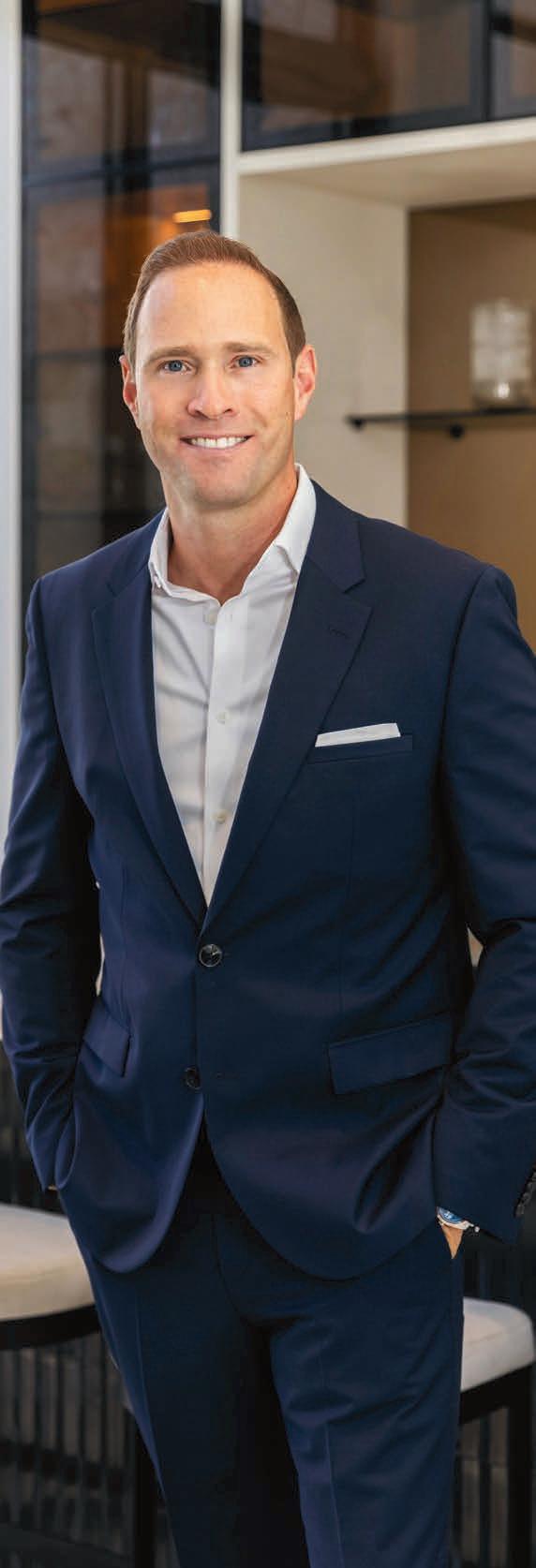
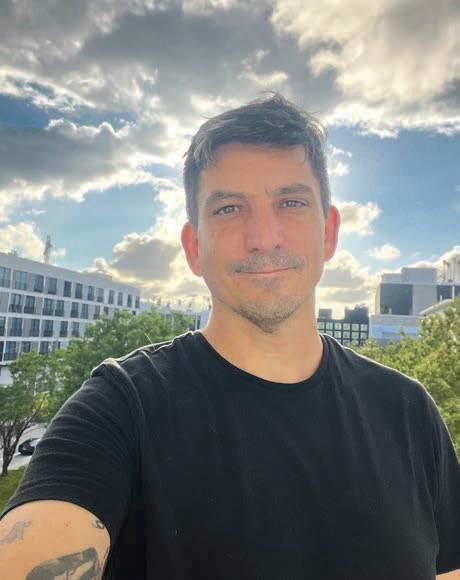
Michael J. Martinez
Escanilla is
to rock n’ roll all night and transform patients’ lives every day.
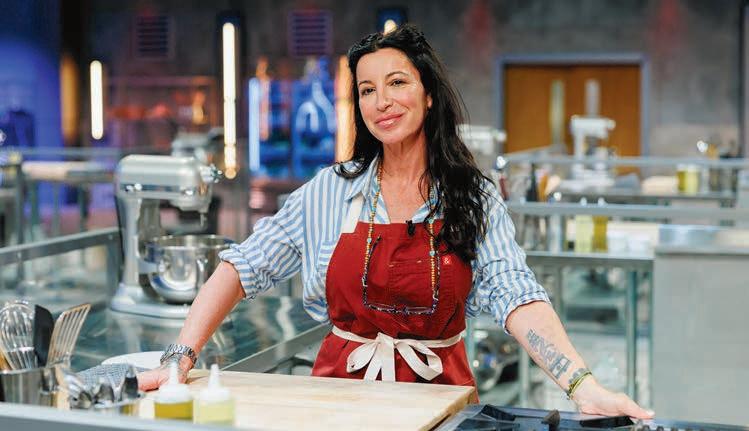
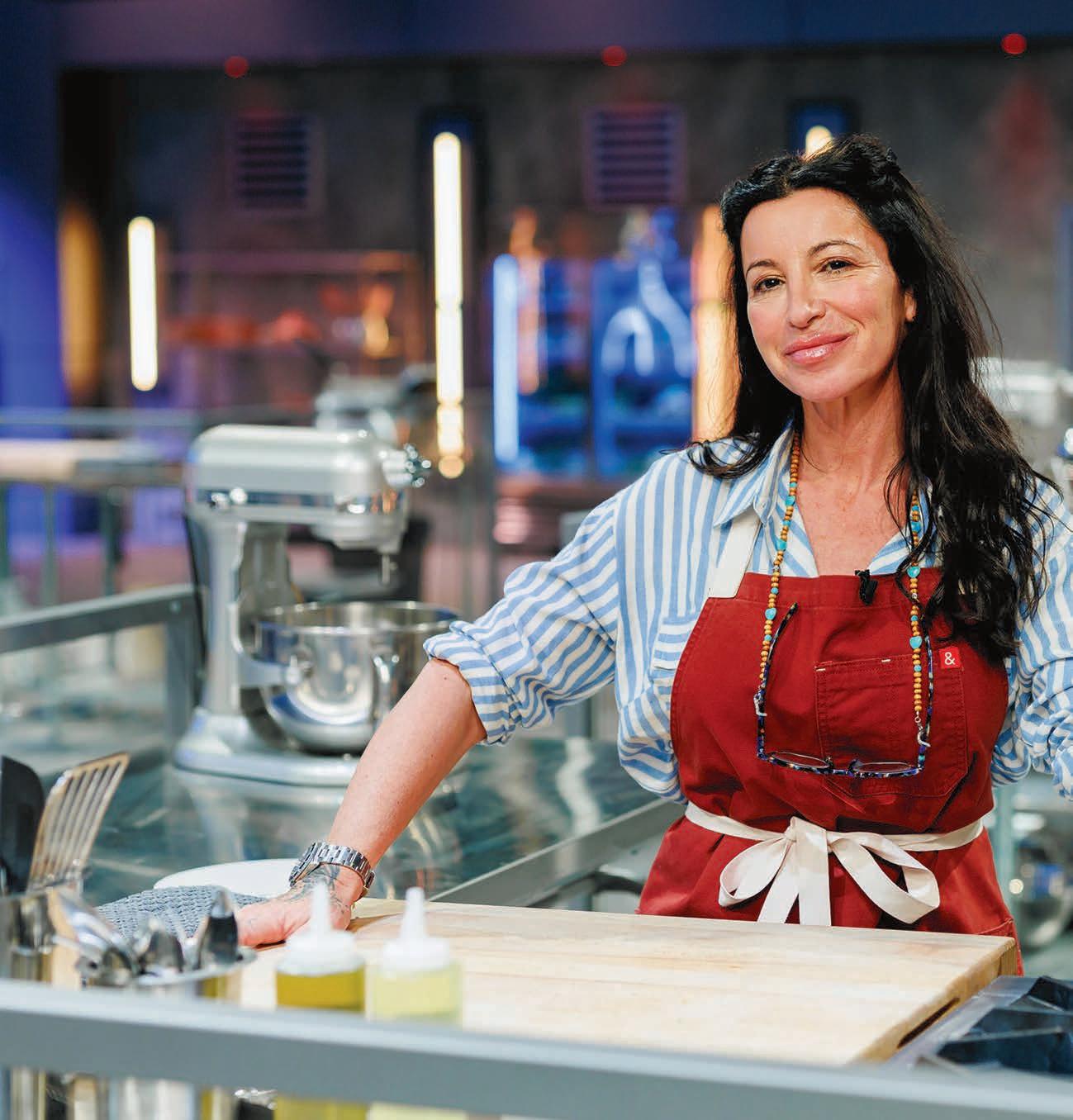
Miami chef and restaurateur Olivia Ostrow joins the cast of 24 in 24: Last Chef
BACK ON TOP
THAT’S LIFE — that’s what all the people say You’re ridin’ high in April, shot down in May
But I know I’m gonna change that tune When I’m back on top, back on top in June
FFRANK SINATRA released That’s Life exactly 60 years ago, but the classics never quite go out of style, do they? Though uncertainty about how a given cultural, political, economic, or personal moment will unfold always makes our current time feel wholly unprecedented and unique, it’s worth remembering our forebearers have faced—and overcome—similar or thornier challenges.
“Paradoxically, 1966 has been by far the most prosperous year in U.S. history,” a Time magazine cover story from December of that year began, “yet has produced considerable concern about the future of business.” Sound familiar?
In our personal lives, we must avoid succumbing to the weirdly comforting logical fallacy that the future is simply an inflated version of the past. Which means, as we reach the halfway mark of 2026, if things are going well, don’t be complacent. Bear down. If the year hasn’t stacked up quite the way you hoped, don’t despair. Change that tune. (This issue has many options to help you do that from rock n’ roll therapy, women’s community building events, and serving the less fortunate, forgiving past transgressions, and singing your heart out at an open mic.)
In other words, if you got shot down in May, being back on top in June will be all the sweeter. If that schedule worked for Ol’ Blue Eyes, it can work for the rest of us. Let us know how it works out for you.
Shawn Macomber Editor
@aqua_miami_mag aquamiamimag.com
Advertising Director
Daisy Abreu
daisy.abreu@wainscotmedia.com
Creative Director
Kijoo Kim
Editor
Shawn Macomber
shawn.macomber@wainscotmedia.com
Contributors
Gerry Barker
Rochelle B. Weinstein
Photographer April Nicole
WAINSCOT MEDIA
Chairman Carroll V. Dowden
President and CEO
Mark Dowden
SVP, Group Publisher
Thomas Flannery
VP, Content Strategy
Maria Regan
Associate Editor Sophia Carlisle
Art Director
Rosemary O’Connell
Advertising Services Director Jacquelynn Fischer
Operations Director
Catherine Rosario
Production Designer Chris Ferrante
Print Production Manager Fern Meshulam
Advertising Production Associate Griff Dowden
Have a story idea? Email the editor: Shawn.Macomber@wainscotmedia.com
AQUA Miami magazine is published by Wainscot Media. Serving residents of Pinecrest and surrounding areas of South Florida, the magazine is distributed monthly via U.S. mail. Articles and advertisements contained herein do not necessarily reflect the opinions of the publishers. Copyright 2026 by Wainscot Media LLC. No portion of this magazine may be reproduced in any form without written consent.
Honing His Soul Craft
Luiz Cruz is sharing his art with the world. And he wants to make sure you do, too.
BY SHAWN MACOMBER
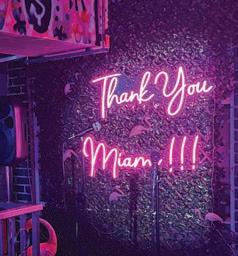
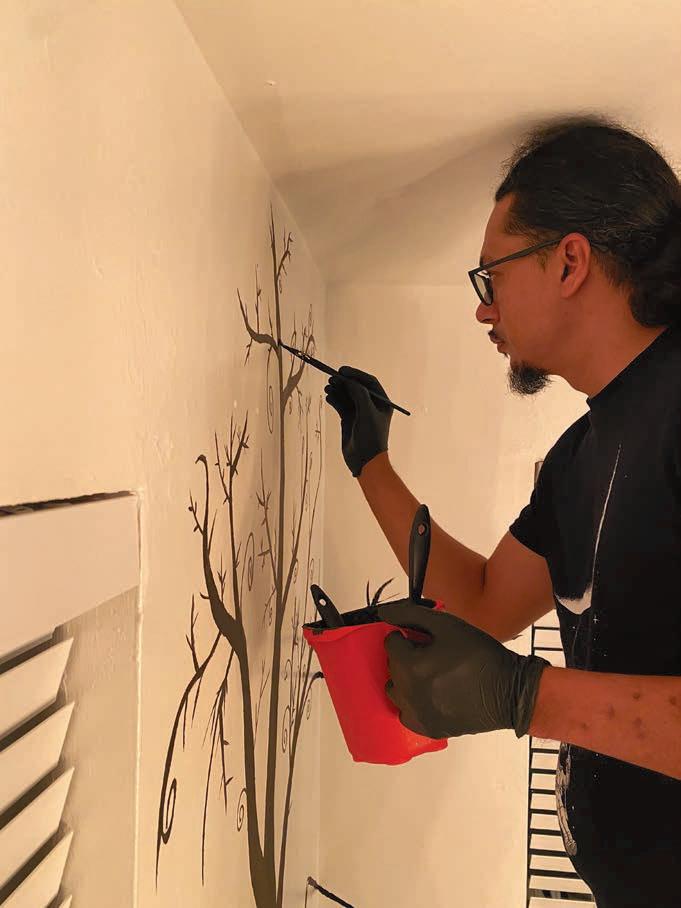
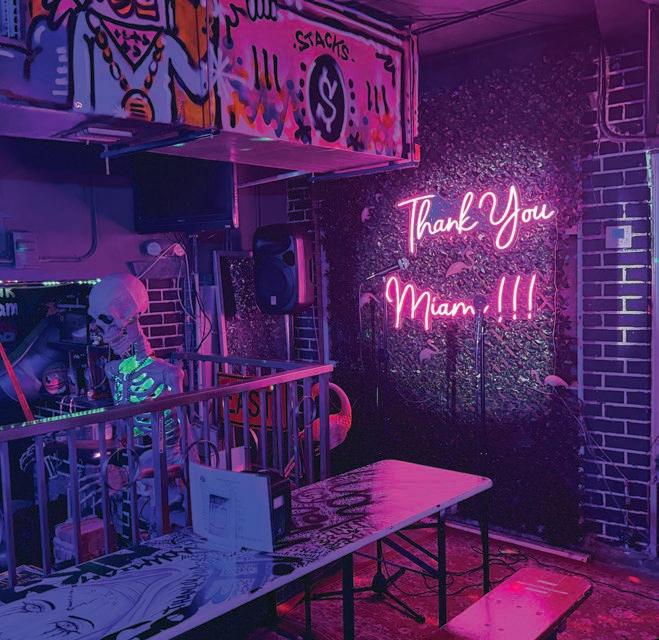
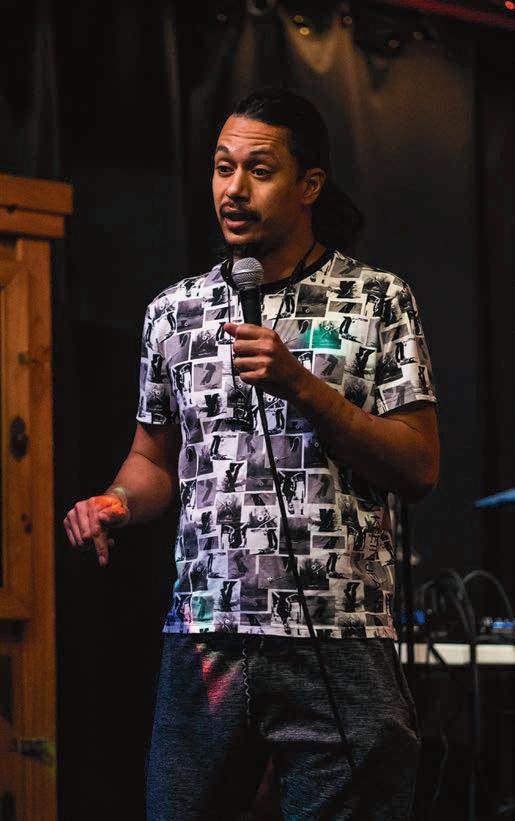
“IF YOU BUILD IT, they will come” isn’t just for Iowa cornfields filled with baseball-playing ghosts. Just ask Miami legend-in-the-making Luiz Cruz, aka Trikstah123. As the host of the eclectic and welcoming Wednesday open mic nights at the wonderful Thank You Miami Cocina & Beerhouse, he not only serves up his own incisive spoken word poetry, unorthodox R&B singing, and heartfelt bite-sized pep talks on the transformative power of arts, but he also has quickly become one of the most inspiring and original figures to the fledgling next generation of performers and artists in the Magic City music scene.
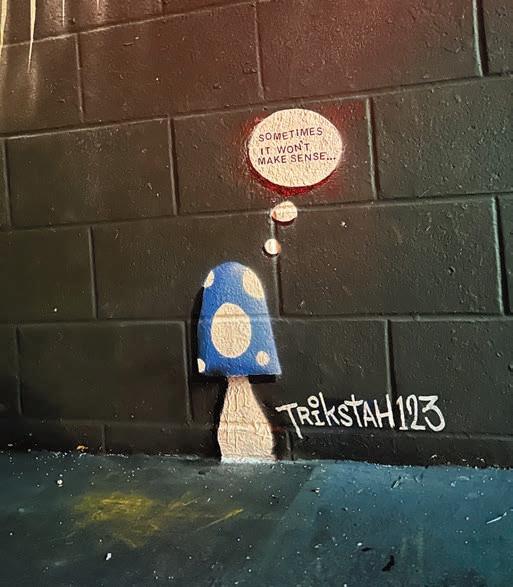
Now, as his own first single “You Say” drops—a slinky, cool, instantly unforgettable earworm featuring his partner Angie Q and multi-instrumentalist Cristal Fire—and his signature mushroom paintings and murals begin popping up all across the city, Cruz was kind enough to take some time out of his busy schedule to speak with AQUA Miami about his evolution as an artist, the empowering nature of open mics, why he views a philosophy of inclusivity and expression as more vital for community than ever, and how showing up for art taught him how to show up for life.
Tell me a little bit about your background. How did you get into music/art?
I was born in Boston, raised in Lawrence, and moved to Miami as a teenager. Creativity has been a throughline my whole life. I studied chorus and mixed vocal ensemble starting in fourth grade, began writing poetry in fifth grade thanks to a teacher who saw something in me, started breakdancing at 16, and got into graffiti and painting as a teenager. My mushroom art came later, but it grew from the same place. To me, poetry, music, movement, and visual art are all part of one ecosystem.
Is there a particular moment you decided to go from observer to participant?
Open mics were that turning point. I
had been writing for years, but mostly in private. About seven years ago, I started sharing publicly and realized creativity changes when you bring it into community. That was the shift—from creating in isolation to participating in culture. I found my voice by risking being heard.
You seem to create a lot despite having a full-time career outside of art. What is your secret to making time for your soulcraft?
I believe in devotion through small acts. Creativity isn’t something I wait to have time for—it’s woven into how I live. A line of poetry, a mural concept, a conversation that sparks a song...it all counts. Open mics also taught me consistency. Showing up for art taught me how to show up for life.
What do you think it is about Thank You Miami as a venue that makes those nights so profoundly special?
I’ve been hosting open mics and events for about three and a half years, and it’s been one of the biggest artistic growth experiences of my life. At first, I had to grow into the role: I didn’t realize how much shyness I was carrying until I started hosting. But over time, I realized hosting is really about holding space. That’s what makes nights at Thank You Miami so special. There’s a real openness there—people arrive as strangers and leave feeling part of something. It feels like a creative refuge.
Has hosting the open mic inspired and/or helped evolve your own creativity?
Without question. Hosting has expanded my artistry. Being surrounded by poets, musicians, and first-time performers keeps me experimenting and growing. It reminds me that art is alive. I’ve felt my own music deepen through those nights.
Community has been one of my greatest creative teachers.
What would you say to someone on the fence about attending or performing at an open mic?
Go. Even if you just listen. Open mics can be transformational because they remind people their voice matters. For me, they helped move me through shyness and into greater confidence and consistency. Sometimes stepping up to a mic doesn’t just change your relationship with art—it changes your relationship.
What’s next for you?
I want to keep expanding the worlds
I’m building—through music, public mushroom art, collaboration, and community-driven experiences. I’m interested in creating not just projects, but living art spaces where people can participate, connect, and be inspired.
To keep up with all things Cruz, follow him on Instagram at @Trickstah123
Providing Sustenance
Valentina Sabalza is on a mission to end food scarcity in Miami— while fostering connection, creativity, and collective care.
BY SHAWN MACOMBER
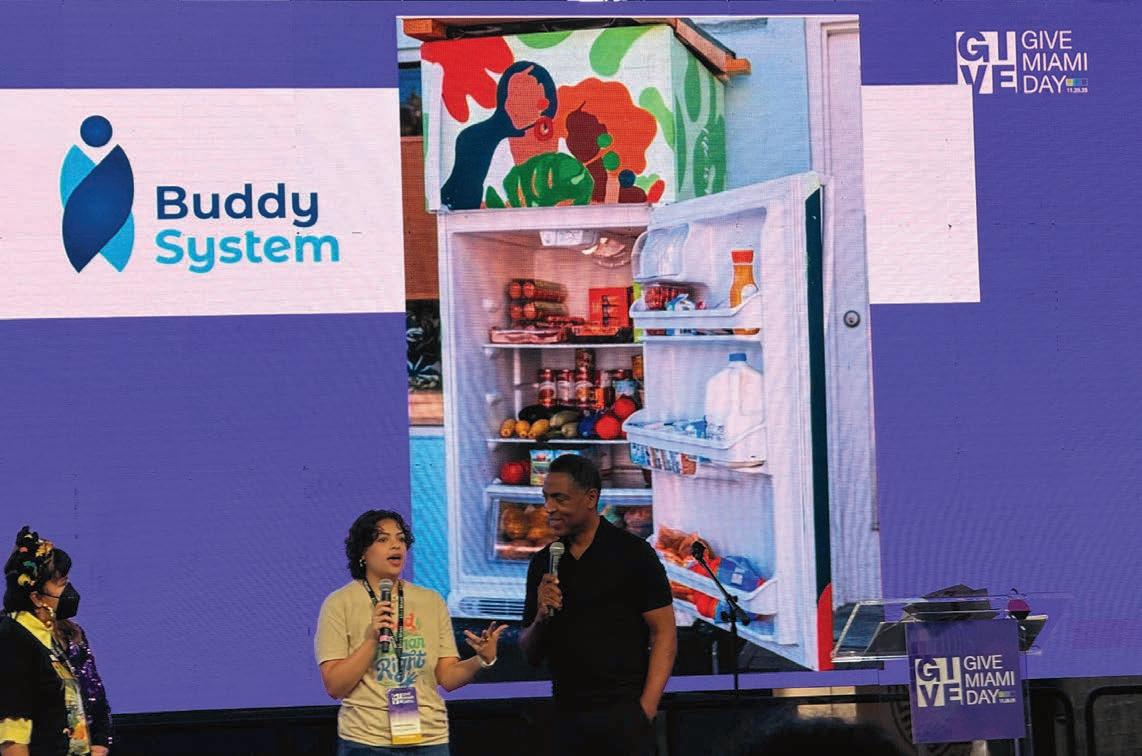
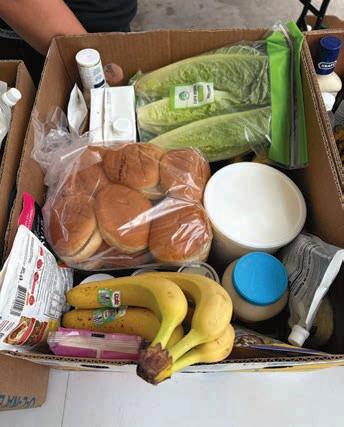
FOUNDED TO COMBAT rising food insecurity during the COVID pandemic, Buddy System MIA has since grown into a “diverse county-wide nonprofit serving over 5,000 people with access to free, healthy food” via its volunteer-powered Homebound Food Access Program deliveries, a signature network of strategically placed Community Fridges lovingly painted by local artists, and the Emergency Food Access Program pantry.
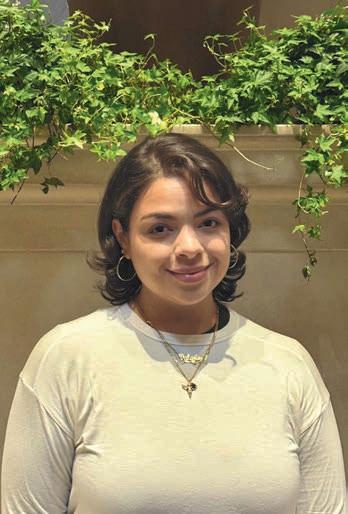
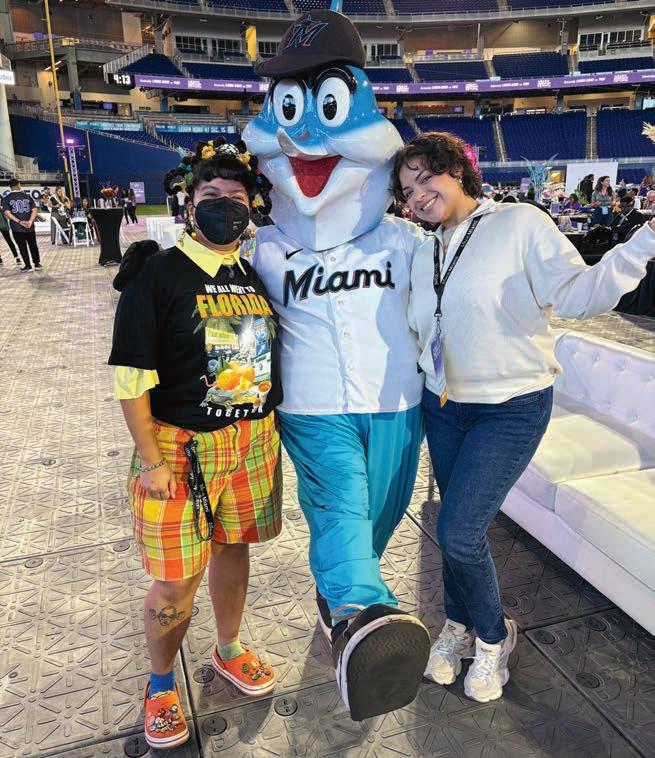
AQUA Miami recently spoke with Buddy System MIA’s incredible new Executive Director, Valentina Sabalza, about the humanist values a hardscrabble-yet-love-andlight-filled Magic City childhood instilled in her, the career in urban agriculture and nonprofit leadership it inspired her to pursue, and how “what started as a job” at Buddy System MIA “quickly became a personal mission: supporting neighbors and building systems that meet real needs.”
Tell me a little bit about your background growing up in Miami— the beauty and the challenges. Growing up in Miami with a single mother meant that life was constantly shifting. We moved around a lot, and at one point even spent two years living in other states before eventually finding our way back home. During that time, I got to experience many different neighborhoods across the city before we finally settled in Wynwood—the place I still consider my true home.
There were certainly difficult moments growing up, but my mother always made it a point to show me the beauty of Miami. She was intentional about it. Whether it was a simple beach day, trying a new local restaurant, or spending time at places that felt like Miami staples—like Sunset Place or Bayside—she made sure we celebrated where we lived. Even when things were tight, she wanted me to appreciate the culture, the energy, and the diversity that make this city so special.
In high school, my family faced a hardship so difficult that, at the time, I
couldn’t see the light at the end of the tunnel. There were moments when putting food on the table required desperate measures. It was an experience that opened my eyes to the realities that many families in our community quietly face every day. Looking back, those moments didn’t just shape my understanding of struggle. They planted the seed for the work I do now, ensuring that others in our city don’t have to face those same choices alone.
How did you end up involved with Buddy System?
I like to say Buddy System found me. I had just left a job in indoor farming and wanted to do work that directly served the community. A friend sent me an Instagram post about a Programming Coordinator role, and it felt like the perfect fit. I officially joined in August 2023, and what started as a job quickly became a personal mission: supporting neighbors and building systems that meet real needs.
It seems to me, from the outside, that Buddy System is so effective and adaptable, at least in part, because it has developed so organically and operates on a very granular, people-helpingpeople level. Is that how you see it? Yes. I’ve been inspired by how many people quietly dedicate their time to the community. Buddy System grew from neighbors helping neighbors, and that grassroots spirit keeps the organization flexible and responsive. As we expand, maintaining that ethos is essential. Scaling our work isn’t just about serving more people. It’s about keeping the heart of mutual care at the center. That’s also what guides my vision for our community center: a place where food, art, and gardens bring people together, co-creating support and abundance.
I love how the announcement of your promotion says food is about more than survival. In my opinion, one of the keys to eliminating scarcity—maybe paradoxically?—is that it has to be tied more deeply to an evolving culture. Food brings people to the table, but community keeps them there. Food is connection, creativity, and culture. My vision is to make food part of daily life, not just a resource: growing it, cooking it, sharing
it. At our future community center, urban gardens, art, and communal meals will make abundance something we actively create together. When food becomes cultural and communal, scarcity loses its power, and thriving becomes possible.
What do you hope to accomplish with your tenure?
I hope to expand Buddy System’s reach by building systems that help more people without losing the personal, neighbor-toneighbor care that defines us. I also want to create a community space where food, art, and urban gardening come together. A place that fosters connection, creativity, and collective care. Ultimately, I want our work to show that thriving communities aren’t just about meeting basic needs, but about cultivating abundance, culture, and opportunity for everyone.
Finally, I assume it must be meaningful to you to do this work in your hometown—to keep faith with and give back to your community?
Absolutely! Doing this work here allows me to give back to the community that shaped
me by creating opportunities, support systems, and spaces that I wish had existed when I was younger. It’s deeply personal because this is and always will be my home. I want to show up for my city in the same way it has always been here for me.
To get involved, visit buddysystemmia.com.
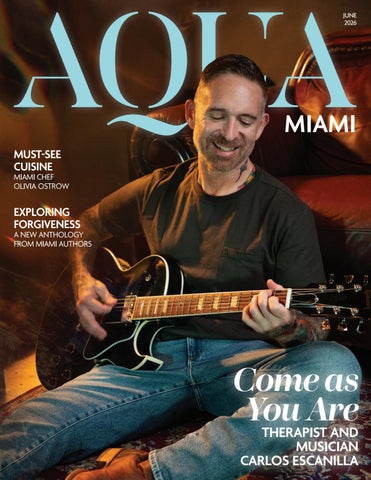
COME AS YOU ARE
Coral Gables therapist and musician
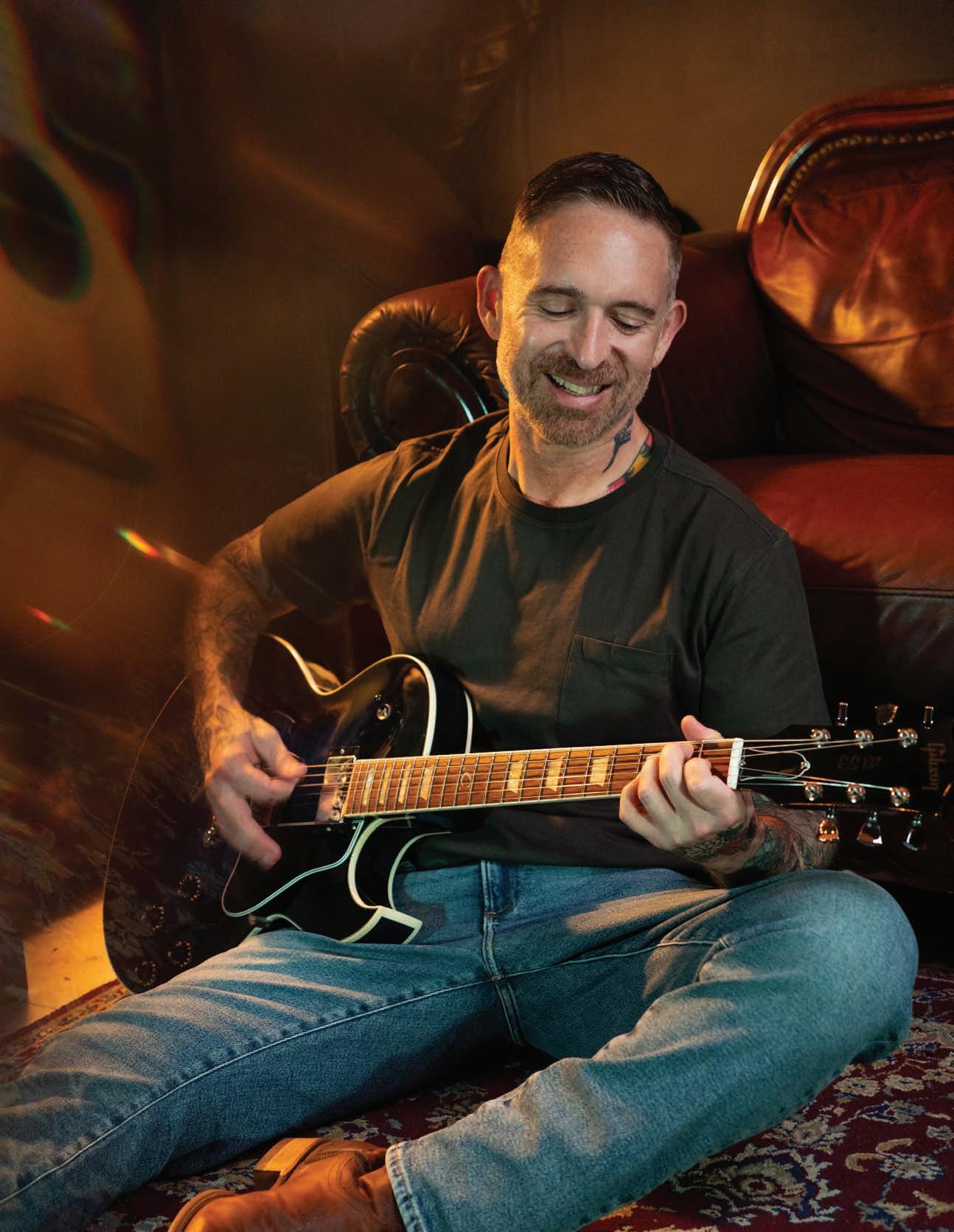
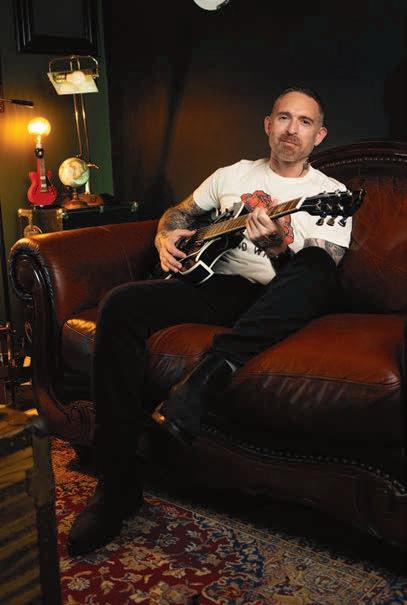
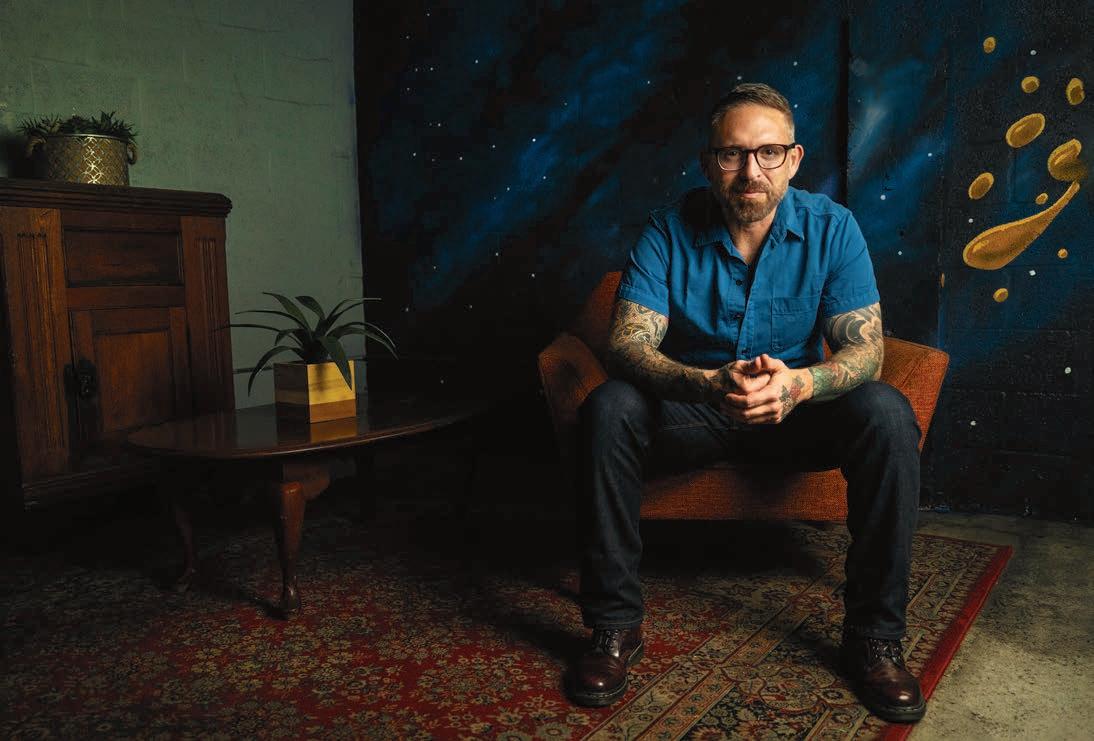
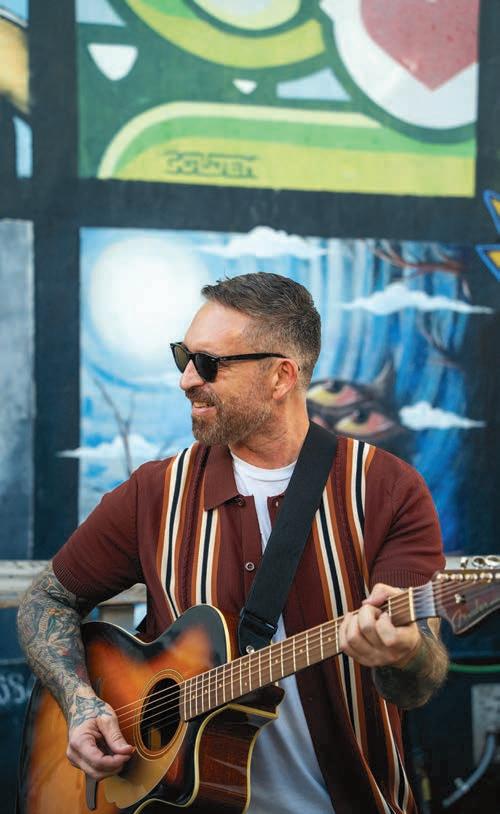
Carlos Escanilla is here to rock n’ roll all night and transform patients’ lives every day.
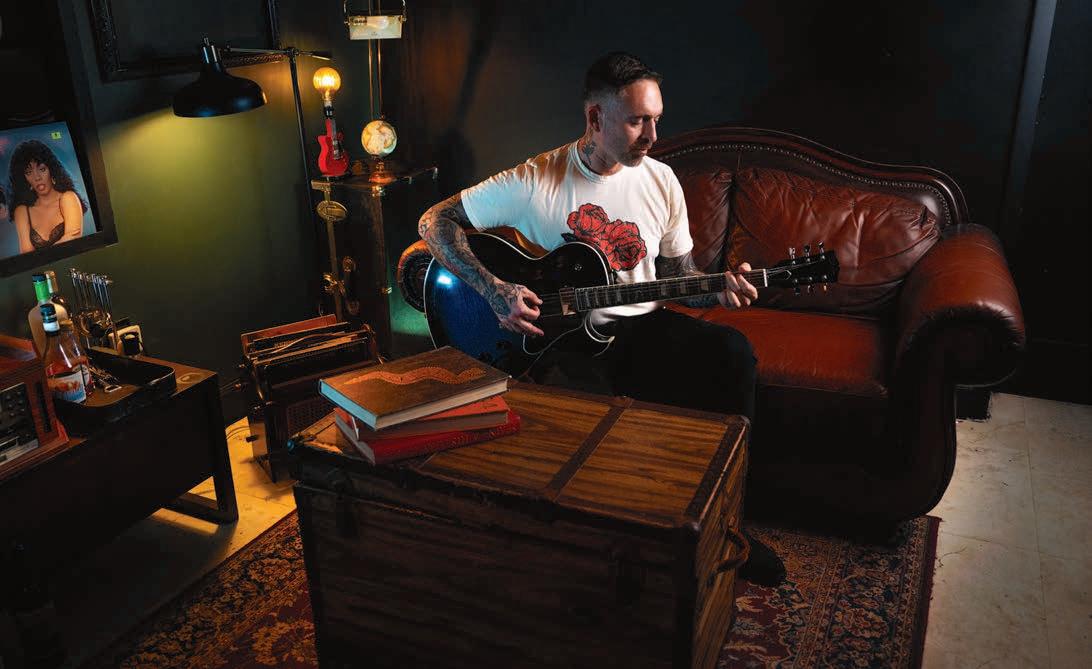
cCARLOS ESCANILLA MET his first true love as a preschooler while bouncing around in the back of his father’s car. The object of his affection? The sounds coming out of the radio— Motown soul, Donna Summers, Michael Jackson, the Bee Gees.
“I’ve been practicing my falsetto since I was five years old,” he tells AQUA Miami with a laugh. And as anyone who has seen his ecstatic, extraordinarily versatile, life-affirming performances—either solo or with his bands Tremora and Sunset Dreams— can attest, that is no idle boast: Now in his late forties, Escanilla carries himself with the ease and assuredness of a frontman who shepherded many a
glowing bar and club crowd to closing time.
But unlike Kiss—the arena glam rockers who a half century ago paired “I wanna rock n’ roll all night” with “and party every day”—Escanilla follows a very different ethos, rising early to go to his office at Coral Gables Counseling Center, where he is a licensed therapist working with young adults and couples. The two callings, Escanilla insists, are not as separate as one might presume.
“When we have a great show, something shifts in the air,” Escanilla says. “It feels almost as if everyone is ready to unite on a different, more transcendent level.”
OPENING CHORDS
For Escanilla, moving between worlds is nothing new. He was born in Chile, moved to Miami when he was one year-old, and then headed back to Chile at age ten. It was there, during these formative years, Escanilla found himself standing around a bonfire, watching people pass a guitar around, sharing songs.
“I need to learn to play guitar,” Escanilla said to himself—and, truth be told, he took to it quickly. He followed his own eclectic tastes and ear, wearing out cassettes by everyone from Hendrix to D.C. punk stalwarts Fugazi, dropping the needle about one million times on his burgeoning collection of Motown vinyl.
At 13, Escanilla returned to Miami. A cousin five years his senior took him to see Pearl Jam at the Cameo Theater. It proved to be a watershed moment. “It blew my mind,” he says. And though Escanilla’s love affair with grunge was not a particularly long one, what stuck with him was the fact that the old rules no longer applied. Authenticity, regardless of subgenre, was its own powerful currency.
“That scene, which kind of famously
buried hair metal, just felt very organic and real,” he recalls. “People weren’t trying to impress anyone. They weren’t trying to be something they’re not. It inspired me. I wanted to give people that experience.”
Escanilla did his best to do just that, dabbling in high school bands, playing talent shows, hitting the stage solo. But like many children of immigrants, only child Escanilla felt the need to “put childish things away” when his high school years came to an end. At Florida International University, Escanilla thought he might pursue a fledgling interest in psychology. Ultimately, though, he chose to—at least temporarily—serve others’ hopes and dreams rather than his own.
“For my parents’ generation, saying you were going to study psychology was tantamount to declaring you were going to major in witchcraft,” Escanilla says with a chuckle. “You know, just the typical immigrant story. ‘We didn’t bring you to play music or talk to people about their problems; we brought you to this country to become a doctor or a lawyer.’ Everything was scarcity-based.
Everything was fear-based.
“My parents always supported my talent,” he adds, “but were—understandably—afraid to support it to the point where I might go all-in.”
MUSIC SAVES THE DAY
Escanilla majored in business. Graduated in 2003. Got married. Worked a bunch of sales jobs. He bought his first house right in the middle of the housing crisis. Had a kid. Then, in 2007, his then-wife was pregnant with their second son. Money was uncomfortably tight. Hail Mary time upon him, Escanilla considered his options. “I was like, ‘Well, I know one thing I can do,’” he says. “And I picked the guitar up again. It was one of those things where desperation forces you to be creative—and music was where my creative voice lay.”
Escanilla went to Bougainvillea’s Old Florida Tavern in South Miami—aka Bougies— and badgered the skeptical manager into letting him play a few songs on a Sunday night. By the time the last chord of the third song rang out, a crowd had gathered. “You got the
CARLOS ESCANILLA’S PROCESS FOR REGULATING NEGATIVE EMOTIONS
1. Name it. “Get specific about what you’re feeling,” Escanilla says, “instead of just saying, ‘I’m fine.’”
2. Allow it. “You do not have to like the feeling, but resisting it often makes it louder.”
3. Respond to it. “Ask what you need in the moment: rest, boundaries, support, movement, or space.”
crowd,” the manager said. “Keep going.” At the end of the night, the manager gave him a hundred bucks—a life preserver in the form of cash, essentially. “Can you come back next Sunday?”
Soon, Escanilla put together Miller Road with some old friends, the band that would become the popular local cover institution Sunset Dreams. Returning to music did more than provide a much-needed side hustle. It convinced Escanilla of the power of actualizing your true dreams. Just before the birth of his second son, he went back to school, earning a Master’s in Mental Health Counseling from Nova Southeastern University. The final year of the program was an unpaid practicum. Once again, music filled the financial breach.
When he began his career in therapy in 2011, working with children affected by abuse, neglect, and divorce, however, Escanilla realized music had transmogrified from a life preserver into a ship: It wasn’t just there to keep him and his family afloat—it was a vessel
to move his ambitions and soul forward.
Simultaneous to this epiphany, the boys of Sunset Dreams were getting busy with their own careers and families and did not want to gig as much as Escanilla. So, he began putting together Tremora, a brass rock band that offers up a high-octane blend of rock, soul, and blues at its most combustible and mesmerizing. “I wanted to write songs that could’ve come out in 1967 but have a modern edge,” Escanilla says, describing the recent single (aptly) as something that “sounds like a car chase scene from Shaft.”
During one early show at Jada Coles on Coral Way, Escanilla saw a man in a business suit on the dance floor, completely absorbed in the music, letting loose.
“It hit me all at once,” Escanilla says. “I wasn’t the only one who needed this. We all need this.”
WORLDS COLLIDE
There are layers and dimensions to the way Escanilla’s therapy practice and music career
intertwine and find synergy. “First of all,” he says, “when you’re doing the things in life you want to do, you can show up more fully for yourself and the people in your life. So, the inner peace I get from performing as a musician helps me as a clinician to show up so much better for my patients.”
There are more practical benefits as well: “Singing for up to six or eight hours a week, managing the diaphragm, managing breath— I’ve gotten really good at circular breathing and can hold a note for, like, 45 seconds—is almost meditative in a way,” Escanilla says. “The nights I sing? Man, the quality of sleep I get is beautiful.”
It’s a gift, really—the transcendent nature of art. And Escanilla doesn’t want to keep it to himself. He wants everyone to have access, from patients and children in public schools to adults trying to get closer to their most authentic selves.
“The thing with art is, when you trigger the ability to create something seemingly out of nothing for someone, that is probably one of
the most empowering experiences a person can have,” Escanilla says. “It is not only about creativity. It can help so much with mental and emotional health because so much of both are contingent on our empowerment.”
Creating music or art also offers lessons in how to navigate the distance between abstract thought and concrete reaction.
“Cognitive behavioral therapy is all about helping people create an internal language for reframing experiences into something that better serves them,” Escanilla says. “It’s not about tricking the brain, which is what a lot of anti-therapy people will say. There are, in fact, different ways to look at things. You could run with a negative thought that leaves you anxious, stressed, sad, or angry. Or, if you’ve trained your mind with art or therapy or both, when that negative thought is triggered, your subconscious can say, ‘Well, don’t worry, ‘cause you can create something out of nothing.’ I mean, it’s a superpower.”
Like everything, it’s also a process. As Escanilla admits, he still has moments of
imposter syndrome; dark nights of the soul where he looks over at his guitar and thinks, “Should I still be doing this at 46 years old?”
But then he takes his own advice. He looks to his own kids stepping into adulthood and thinks about how he would want them to view their own dreams and potential. (One son actually gigs around Miami in his own bands— the circle of rock n’ roll life!) His parents have even come around to celebrate their son’s somewhat unorthodox path.
“I’m just enjoying it at all to the max while always making sure that I don’t lose sight of the ‘why,’” Escanilla says. “For me, that’s creating an atmosphere for connection. It’s bigger than me, or Tremora, or Sunset Dreams. Some people look at the frontman and assume it’s all about attention-seeking and personal validation. I can promise you, my goal is to be there for the person who walks into a bar because they had a bad week, or a stressful week, or are just generally overloaded and caught in a spiral of overthinking—to be there with a rhythm or melody to help them disconnect and regain
some peace and perspective so that when they leave the show they can have that vulnerable conversation, cope with all the stressors in their lives in a healthy way, filter out the noise from the constant stimulation of technology.”
Imagine, Escanilla says, you are born with a blank canvas that is your life. You are painting it how you want and something comes along and splatters some unwanted paint on it. “I don’t want people to think, ‘Oh, well—the whole thing is ruined now,’” he says. “I want people to realize that’s still your canvas—you can work with it, create something new and beautiful out of it. If I didn’t believe that, I wouldn’t still be playing music, and I wouldn’t have this crazy life I love so much. Every song I write, every song I sing, I want to be an inspiration to people to paint the life they want, no matter the twists and turns it takes.”
For more information on both Escanilla’s music and therapy practice, follow him on Instagram at @thecarlosescanilla
MUST-SEE CUISINE
Miami chef and restaurateur Olivia Ostrow joins the cast of 24 in 24: Last Chef Standing.
BY SHAWN MACOMBER
wWHILE OLIVIA OSTROW was on set as a contestant filming the third season of the popular cooking show 24 in 24: Last Chef Standing, the Miami chef and restaurateur didn’t have much bandwidth to consider the impact of the show beyond the bright lights, camera lenses, and the bustling competitors around her. “I’m thinking: ‘Don’t overcook the fish…Don’t burn the sauce…Move faster’,” Ostrow tells AQUA Miami. “It’s survival mode.”
By the time she reached the premiere episode viewing party in late April at her acclaimed kosher FrenchMediterranean North Bay Village spot Maison Ostrow—complete with Champagne, live music, and a special sharing menu—the potential for impact is starting to hit home. “If someone out there sees a French, kosher, slightly sarcastic woman doing her thing without fitting into a box,” Ostrow says, “maybe they’ll realize they don’t have to fit into one either.”
STEPPING INTO THE KITCHEN
In some ways, Ostrow’s path to the kitchen seemed foreordained. In others…not so much. “My father was in restaurants, so food was always there—loud, alive, a little chaotic,” she says of her Parisian childhood. “I grew up around it. [My interest in food] wasn’t some romantic a-ha! moment accompanied by a soufflé rising in the oven. What I remember more is the feeling: the energy of a dining room, the rhythm of a kitchen.”
Still, there were neither visions of sugar plums nor rising soufflés dancing in her childhood head. “The ambition came later,” Ostrow says. “I didn’t wake up one day and say, ‘I want to be a chef.’ I kind of walked into it...and then realized I was very good at it. And once I know I’m good at something,
I don’t do it halfway.”
The world has taken notice of Ostrow’s talent and drive. Aside from preparing dishes for a diverse array of high-profile diners ranging from Andrea Bocelli, Liev Schreiber, and Ziggy Marley to Romero Britto, DJ Irie, and Alonzo Mourning, she has garnered raves from Forbes, NBC, Us Weekly, New York Post, and more.
Then, of course, the casting department of Food Network 24 in 24: Last Chef Standing came calling, inviting Ostrow to leap from the kitchen frying pan into the reality television fire alongside “24 talented and fearless chefs taking on 24 challenges over the course of 24 straight hours” for a potential $100,000 prize.
“I got cast because I’m not standard,” Ostrow says, describing the filming
experience as intense, fast, and fun. “I don’t cook like everyone else, and I definitely don’t behave like everyone else…I don’t get intimidated by TV. It’s entertainment, not open-heart surgery. Some people train for months like they’re going to war. And still lose. I showed up, cooked, and enjoyed it.”
Ostrow brought two major advantages with her to the Last Chef Standing stage: First, her unique “kosher but make it couture” approach to FrenchMediterranean cuisine. “There’s technique, there’s identity, there’s restriction, but also creativity,” she says. “You can’t hide behind butter, so your food better be good.” And second, her time in the crucible that is the Magic City dining scene. “Miami prepares you for chaos—and I mean that in the best way,” Ostrow adds. “You’re dealing with
high expectations, diverse clients, intense seasonality, and people who have eaten everywhere. It forces you to be sharp, fast, and adaptable…Also, Miami diners don’t care about your story—they care about what’s on the plate right now. That mentality translates perfectly to competition cooking.”
Those who joined the viewing party— co-hosted by Miami Food Yenta—enjoyed fire-grilled brioche, beef kefta, tuna skewers, pulled brisket, warm hummus with smoked paprika, and house-made chocolate mousse to finish as well as live music and were treated to a very chill Ostrow.
“The show is one thing, but watching it live, in my restaurant, with my guests, my team, good food, Champagne, music... that’s my world,” she says. “That’s where I’m actually comfortable. It turns it into a moment, not just TV, but an experience.
And if I’m going to watch myself on screen, I’d rather do it with a full room, a drink in hand, and great energy.”
LOOKING AHEAD
As for the future, Ostrow has perhaps predictably big plans. “[Maison Ostrow] is more than a restaurant, it’s a lifestyle brand,” she says. “I see us expanding into France, London, Vegas, Dubai, Panama—the world is our kosher oyster. Think chef-driven dining, celebrity tables, art, and design, all under one unapologetic French umbrella.”
Quite ambitions. But if the flagship 3,500 square-foot space in North Bay Village boasting a terrace overlooking Biscayne Bay—decorated with art from Ostrow’s personal collection, no less—doesn’t make you a believer (spoiler alert: it will), then the chef’s tasting menu featuring five to seven courses with seasonal pairings designed to
bring “haute cuisine to the kosher world” likely will. Then there is the curated kosher wine list, live French cabaret music every Sunday night, a “bright, elegant” brunch spread that “pairs French comfort with Miami sunshine, featuring crisp salads, shareable signatures, and pâtisserie-inspired touches,” Thursday specials (classic South of France fish stew with rouille and baguette; Hachis Parmentier, i.e. French shepherd’s pie), and more. “This is a place where you can come in more than once a week for a family meal, a night of cocktails and jazz, or a once-in-a-lifetime culinary experience,” Ostrow says.
And if a reality television competition helps place the spotlight on such an amazing institution, all the better.
For more information and reservations, visit maisonostrow.com.
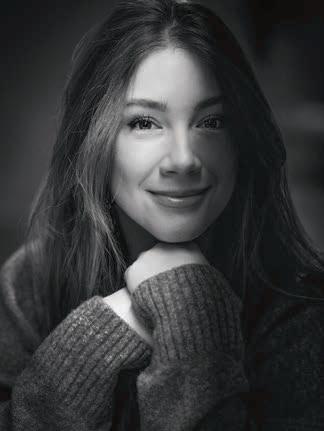
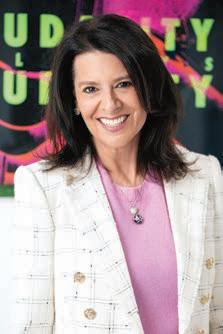
Celia Shaw
Set You Free
A new anthology from Miami-based publisher Life to Paper reminds us that forgiveness is a gift we give ourselves.
BY SHAWN MACOMBER
FFORGIVENESS. It is one of the most basic, foundational pieces of guidance common to virtually all philosophy, religion, therapy, life coaching…yet we struggle so mightily to follow it.
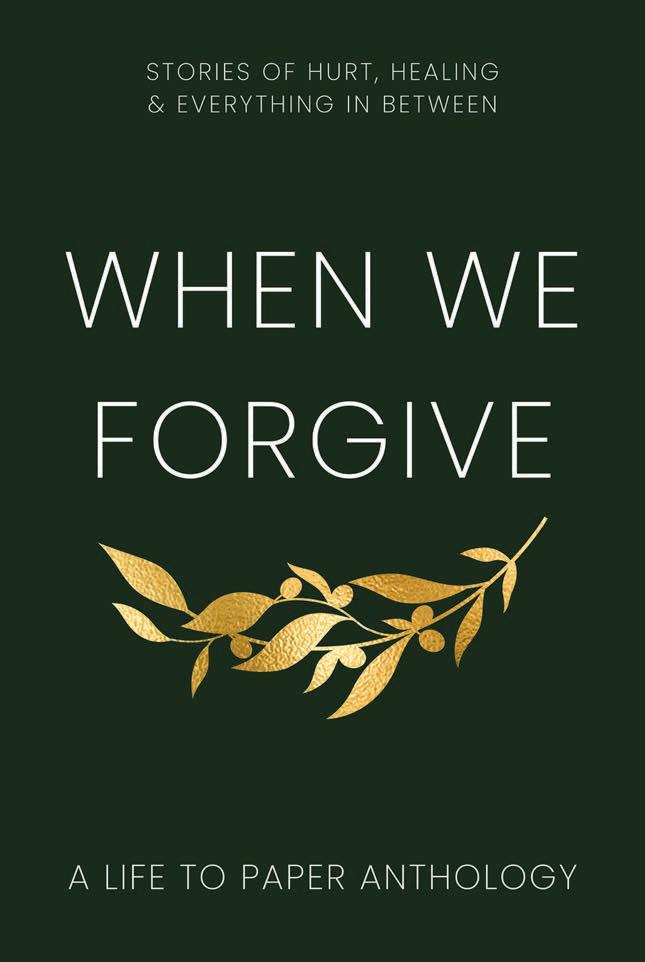
The recent comforting, empowering, and revelatory anthology from Miami/ Toronto publisher Life to Paper When We Forgive: Stories of Hurt, Healing & Everything in Between seeks to remedy this with stories from 15 writers sharing their own journeys to mercy and grace. It is, as accompanying press materials note, written “for those who feel forgiveness may be out of reach, this collection offers lived experiences not as answers, but as a reminder that even in the most difficult circumstances, change is possible.”
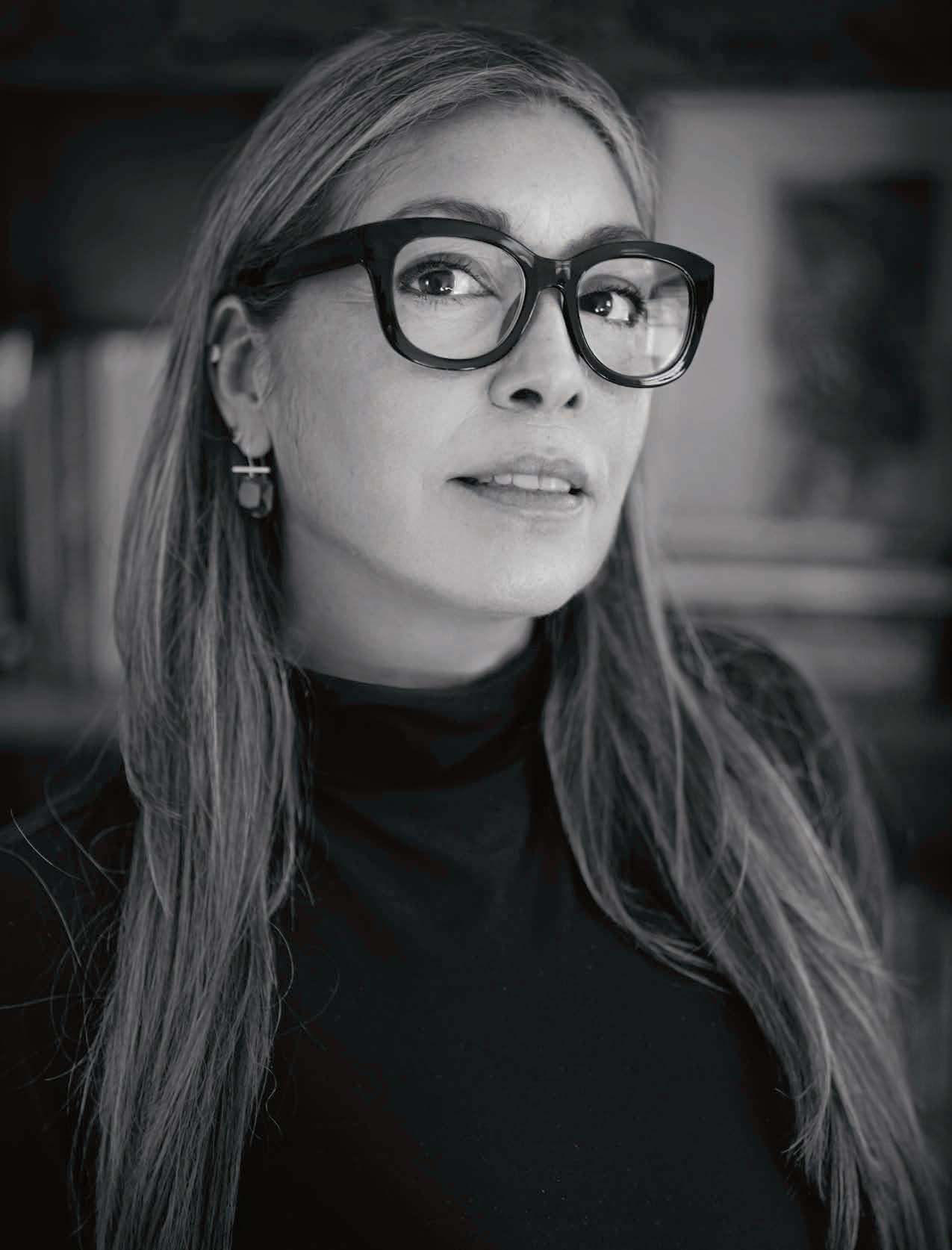
AQUA Miami convened a roundtable of two of the anthology’s Miamian contributors—Life to Paper Founder/ Publisher Tabitha Rose and writer C.V. Shaw—for a discussion about the volume, the challenges of sharing such personal stories, and the benefits of walking through the fire to the other side.
Was it nerve-wracking at all to share such sensitive and vulnerable details publicly?
Celia Shaw (CS): When I first considered writing a story for When We Forgive, I figured I would have to scratch beneath the surface and I would ultimately have to forgive whomever I was writing about as part of the process and that felt intimidating in itself; however, I never imagined I would be swimming into a riptide that would drag me into such depth that felt like I would drown in my own tears. Then, there was the shame. What would people think of me as I exposed some of my defensive behaviors? But I did it anyway, because it
was for me as well as for the readers. As it turned out, I wasn’t drowning; instead, I was unconsciously diving for a hidden treasure— and found it.
Tabitha Rose (TR): While I hold the role of publisher, I’m also a contributor in the book—and writing my own chapter was still a vulnerable experience. It’s one thing to hold space for others to tell their stories, and another to step into that same space yourself. Especially when the story is still alive and evolving. So yes, there was a level of vulnerability in sharing it—but also a sense of responsibility. If I’m asking others to go there, I have to be willing to go there too.
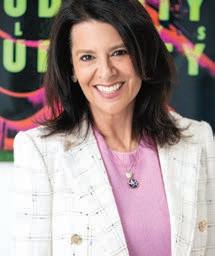
Tabitha Rose Shaw
How have you come to define forgiveness?
TR: I don’t see forgiveness as absolute anymore. I used to think it meant a clean slate—that everything was fully resolved, fully let go. But my experience has been different. Forgiveness, for me, is more of a spectrum. It’s not about saying what happened was okay, and it’s not dependent on receiving an apology. In my case, I had to forgive without one. It became something I had to do in order to live—to get well. I was told very clearly in early recovery: if you want to move forward, you have to let go, you have to forgive, and you have to make your own amends. So, I did.
CS: Forgiveness is allowing peace back into your life. Resentment and peace cannot reside together in the same place and at the same time. You do it for yourself.
TR: And what I found was a kind of freedom—not perfection, not a fixed or “healed” relationship—but a lightness. A shift in how I carry it. I often say now, I’m as free as I need to be.
Writing is processing. Did you learn anything new about your decision to forgive or the person you chose to extend forgiveness to by writing your way deeper into the situation?
CS: I came to realize that there was so much more to a situation than how it was originally perceived. Once out of the state of emotion, I was able to understand the narrative from their perspective as well as mine from the version of who I was. I was also able to see how my belief systems back then shaped my way of thinking moving forward. In writing Self-Flagellation, I discovered hidden meanings that I could not fathom at that time. That discovery set a whole new tone for my selfawareness, as well as how I now understand those I forgave.
Forgiveness is allowing peace back into your life. Resentment and peace cannot reside together in the same place and at the same time. You do it for yourself.
TR: Yes, writing it deepened my understanding in a way I didn’t fully expect. I had already experienced a moment of forgiveness in my life. But putting it into words helped me see what actually made that possible. It wasn’t time, and it wasn’t the other person changing—it was understanding. When I recognized that I had lived a version of what my father had lived, something shifted. Writing that out made it undeniable. It also helped me accept that forgiveness didn’t fix everything. The relationship is still complex. There are still moments that are difficult. But the way I carry it is different. There’s less resentment, more acceptance, and clearer boundaries.
Did reading others’ stories in the anthology surprise you at all?
CS: It did. In our self-involvement and valid victimhood mentality, we fail to see how so many other people are also living or have lived through tough situations, much tougher than mine. So many of us are walking around with deep wounds that others would never imagine. And it’s always deeper than it seems to the person holding it.
TR: What struck me most was how different each story was—and yet how connected they all felt. Forgiveness doesn’t look the same for any two people. Some stories are about reconciliation, others about letting go without ever reconnecting, and some about forgiving oneself. What surprised me was the nuance. It’s not simple, and it’s not always clean. And I think that’s what makes this collection so meaningful—it shows that there isn’t one “right” way to forgive. There’s a lot of space within it.
What do you hope readers take away from both your story and the anthology as a whole?
TR: I think all of us in this book, myself
included, set out to tell stories of finding forgiveness when it was incredibly hard, when it maybe even felt impossible for a long time. We shared these stories because we wanted others who feel that way to know that they can find their way there, too. Not perfectly, not all at once—but in a way that brings some kind of freedom.
CS: I hope readers find a safe space within themselves to dig a little deeper in hopes to understand all sides, as both sides of the wound hurt even if it’s hard to imagine. Unhealed people hurt people. At some level, the aggressor is also the victim. As hard as it may be to accept that when one is hurting, it can provide some sense of freedom, and liberating yourself will bring peace. I feel that is what forgiveness is all about. And that includes forgiving yourself.
TR: Many of these stories exist in really complex spaces—mental health, addiction, trauma, abuse, complicated family dynamics. These aren’t simple situations, and forgiveness in those contexts isn’t simple either. So, I hope readers take away a sense that there is a path forward, even in the hardest circumstances. That they don’t have to wait for everything to be resolved, or for someone else to change, in order to begin. If this book can help someone feel less alone or help them take even one step toward their own version of forgiveness, then it’s done what it was meant to do.
All proceeds from When We Forgive will go to support the Life to Paper Foundation, a nonprofit dedicated to helping individuals impacted by mental health and addiction experience the therapeutic power of storytelling.
For more information or to order the book, visit lifetopaper.com.
The Case for Estate Planning Today
Don’t wait until it’s too late.
BY ALINA F. NUÑEZ, ESQ., ESTATE PLANNING AND PROBATE ATTORNEY
THERE IS A QUIET assumption many of us carry that estate planning is something we’ll get to eventually. After the next milestone. After things settle down. After we have more time. But time, as any seasoned estate attorney will tell you, has a way of running out without warning. We never know what tomorrow will bring.
Estate planning is not simply the act of drafting a will. It is a comprehensive framework that determines how your assets are protected, managed, and transferred and it extends far beyond what happens after you are gone. It also plans for the present and the unexpected issues that can arise and who will help make critical decisions for you when you cannot. A thoughtfully constructed estate plan addresses your wishes during your lifetime as well, including decisions about your medical care, financial management, and the continued well-being of the people who depend on you most.
At its core, a complete estate plan typically includes a last will and testament, a revocable living trust, durable power of attorney, a healthcare directive, and beneficiary designations that are reviewed and kept current. Each component plays a specific and irreplaceable role. Without them, your estate may be subject to the lengthy and costly probate process, your assets may not reach the people you intended, and critical decisions about your care could fall to a court rather than the individuals you trust.
For families with significant assets, business interests, or complex financial portfolios, the stakes are even higher. Improper planning or the absence of planning altogether can expose an estate to unnecessary tax liability, legal disputes among heirs, court involvement and delays that impact the financial security of surviving family members. These are not abstract risks. They are outcomes that play out in courtrooms and family conversations every single day.
This is precisely why working with a qualified estate planning attorney is not optional, it is essential. Online templates and generic documents cannot account for the nuances of your specific situation, the laws of your state, or the strategic opportunities available to you. A knowledgeable attorney brings expertise in tax
law, asset protection, trust structures, and family dynamics that generic solutions simply cannot replicate.
The right time to put your estate plan in place is not when illness strikes or circumstances force the issue. It is now, while you have full capacity, full choice, and peace of mind that comes from knowing those you love are protected. Your legacy is worth the conversation.
Alina F. Nuñez, Esq. is the principal attorney at Nunez Estate Law & Title, a Miami-based law firm devoted to helping families safeguard their wealth and smoothly transfer it to the next generation.
Schedule Your Consultation – “Protect your family today—your legacy depends on it” | 305-962-5929 | nunezlawfl.com
Sun-Kissed Stories
Bestselling local author Rochelle B. Weinstein returns to our pages with some reads perfect for the lazy and hazy days of summer.
SUMMER’S HERE, which means sun-soaked days and breezy nights. Time to lather on the sunscreen, sink your toes in the sand, and get lost between the pages of a great book. Whether you’re tucked under an umbrella or on a hammock beneath the stars, this month’s picks are what everyone’s talking about, the page turners that will linger long after the last chapter.
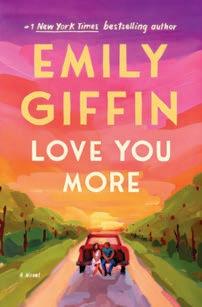
LOVE YOU MORE EMILY GIFFIN
No one writes nostalgic love stories like Giffin, rooting us in memory and the burning flame of first love. In Love You More, Billie’s a small-town girl living big dreams in New York City with fiancé Dean. But when a shocking phone call from the past lures her home to the boy she never forgot, everything changes. Giffin tackles the messiness of life with her signature emotional depth, and fans will devour this heartbreaking (and heartwarming) second-chance romance.
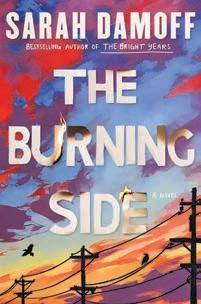
THE BURNING SIDE
SARAH DAMOFF
They’re calling it the book of the year… for good reason. If you read and loved Damoff’s The Bright Years, be sure to pack The Burning Side in your beach bag and hunker down for an unforgettable journey. With their marriage on the brink, Leo and April wake up to a devastating fire that destroys their home. The couple and their two young children escape to April’s family home desperate to salvage what’s been lost. A big, brimming story of family and forgiveness, triumphs and tragedies, the novel will break your heart into a million pieces and beautifully put it back together.
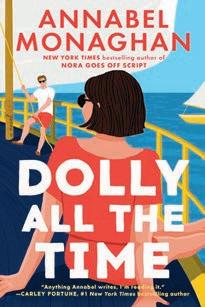
DOLLY ALL THE TIME
ANNABEL MONAGHAN
I could write a short paragraph about the merits of this book, but why not take the author’s word for it? In a recent chat with Annabel, here’s what she had to say about Dolly All The Time: “Dolly’s the story of a single mom with a full-time job and three side hustles who stumbles into a fake-dating situation with an equally hardworking heir to a big fortune. It’s Pretty Woman, but she doesn’t have to give him a bath or anything weird.” And if that doesn’t hook you, Annabel says, “It’s the most romantic of my books for sure.”
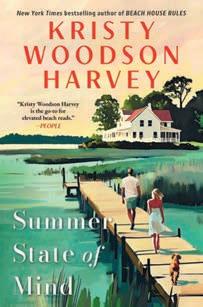
SUMMER STATE OF MIND
KRISTY WOODSON HARVEY
What better way to kick off summer than in a summer state of mind? Meet Daisy Stevens, a burnt-out NICU nurse who escapes to coastal Cape Carolina after the worst day of her career. But on the first day of her less stressful job, Mason arrives toting an abandoned baby, setting off a ripple effect throughout the tightknit town. Woodson Harvey brilliantly tackles the tough questions with layered depth—the intricacies of families and the decisions we make—all concluding with that tissue-worthy ending. Kristy has earned her title as “Queen of the Beach Read.”
Find these gems at bookshop.org or stop by our favorite indie bookseller Books & Books.
Rochelle B. Weinstein is the USA Today and Amazon bestselling author of eight contemporary fiction novels. A former entertainment industry executive, she splits her time between Miami and the mountains of North Carolina. When she’s not writing, she’s speaking about writing, teaching workshops at Nova Southeastern University’s Alvin Sherman Library, reading, and plotting out future stories. Her ninth novel releases April 2027.
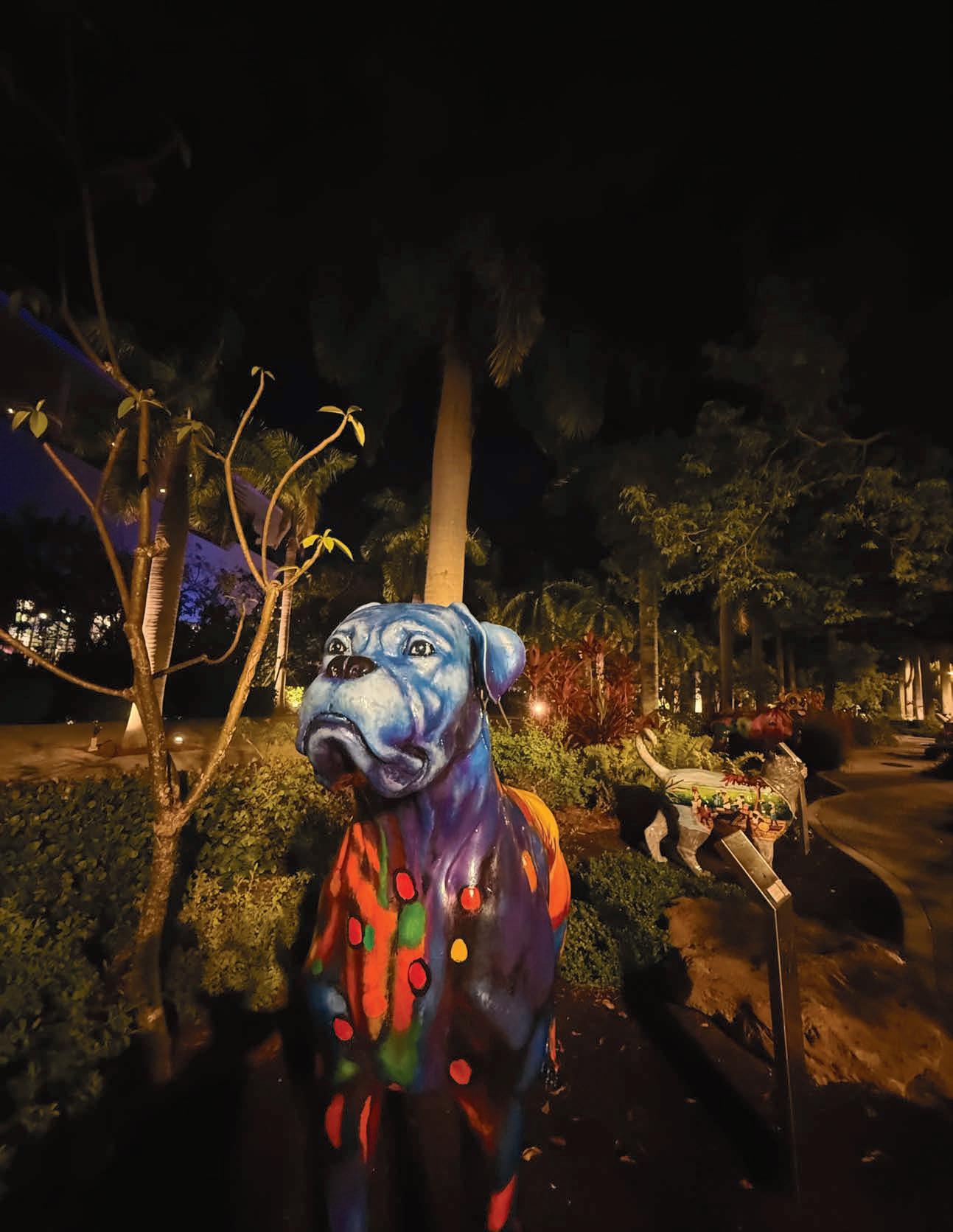
THOUGH THE DOGS and Cats Walkway & Sculpture Gardens in Downtown Miami’s Maurice A. Ferré Park is a delight at any hour, this free art installation featuring more than 50 large aluminum sculptures eclectically painted by local artists is especially breathtaking at night. Have a great image for Photo Op?
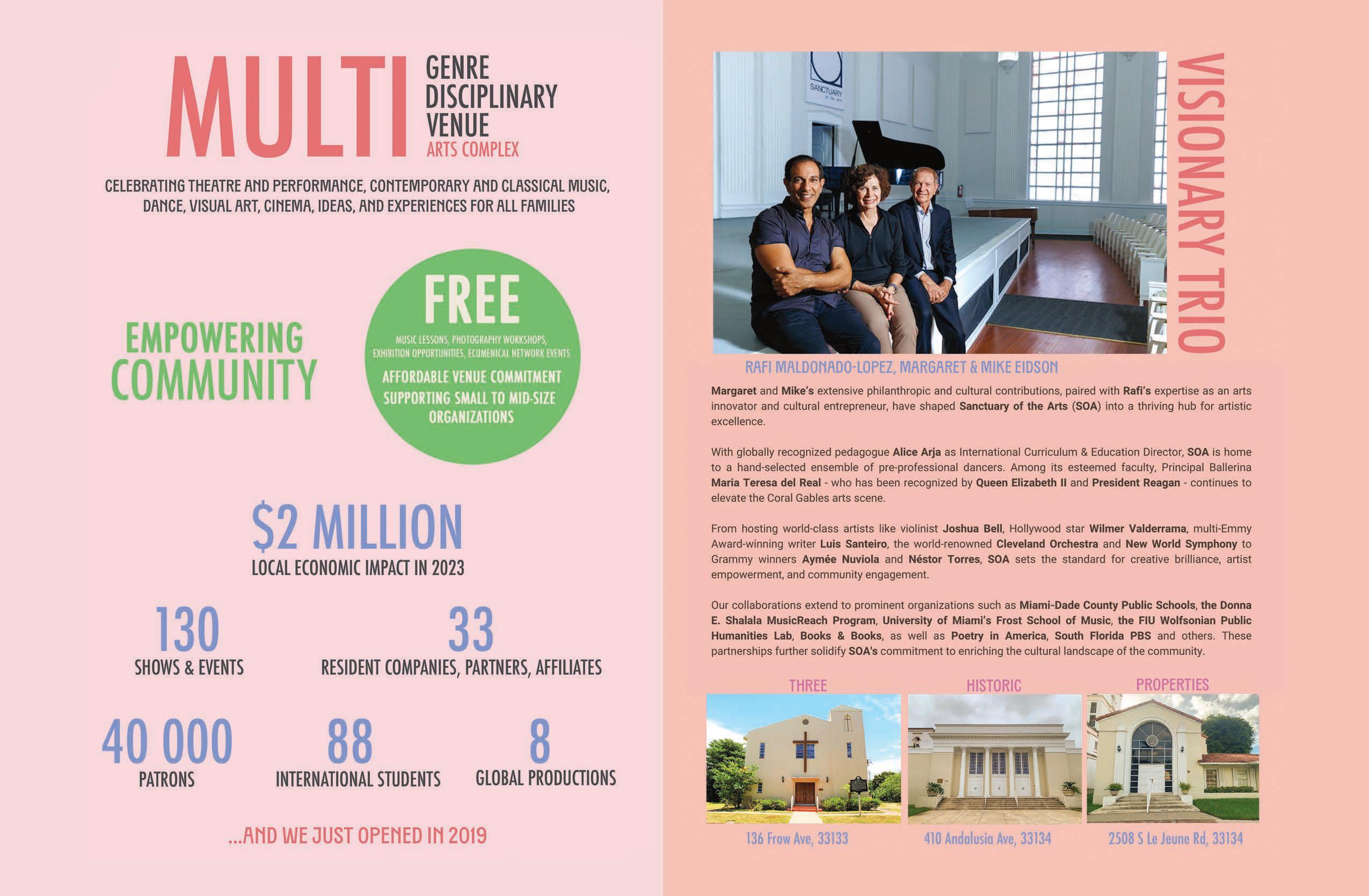
www.sanctuaryofthearts.org
Undeterred by the challenges the arts community has been facing, our season unfolds across a spectrum of experiences ~ productions for all ages, groundbreaking dance, powerful music, thought-provoking conversations, and site-specific works that close the gap between art and audiences.
From global collaborations to intimate gatherings, our stages and spaces celebrate creativity in its many forms ~ led by artists, inspired by community, and driven by innovation.
Sanctuary of the Arts is your "go-to” place for the best in entertainment! Come and enjoy global, national, and local renowned and award-winning artists!
DOWNTOWN CAMPUS ST. MARY CAMPUS 410 ANDALUSIA AVENUE, CORAL GABLES, FL 33134