WUR from within: straight, sharp, transparent
JUNE ❷⓿❷❻ VOLUME ❷⓿
Organ grandma at AID party
Collaboration Principles not changing
The journalism magazine for all at Wageningen University & Research
WUR ‘excels’ in fake references
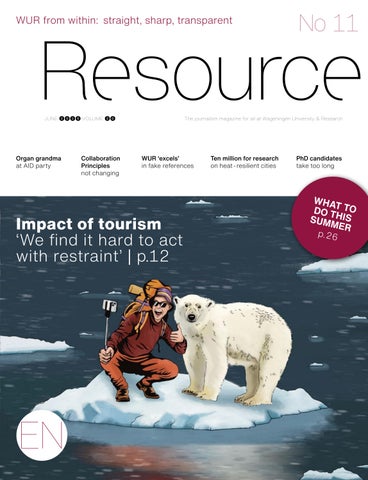
Impact of tourism ‘We find it hard to act with restraint’ | p.12
EN
No 11
Ten million for research on heat-resilient cities
PhD candidates take too long
WHA T DO T TO SUMMHIS ER p.26
Contents
FOREWORD
NO ❶❶ VOLUME ❷⓿
14
How to make ice cream healthier
20
Fewer and fewer students from Africa
23
Nearly 70 small courses to be axed
4 Help for Iranian students 6 Letter to the editor: ‘Modelling is an essential skill’ 8 Live & Learn: ‘It was lonely work’
30 Fifty years at WUR 33 Thesis life: ‘In the end, nothing was done with my thesis’
Read the latest news and background stories at resource-online.nl
Tips for the summer No one really seems to know where the cuts in research and education will be made (page 16). Fewer and fewer African students and PhD candidates are coming to Wageningen (page 20). And nearly 70 ‘small courses’ may have to go (page 23). The final Resource of this academic year covers some difficult topics people are discussing over coffee and in board rooms. WUR is facing major challenges, as they say. Of course, uncertain times are nothing new. Ask either of the two WUR employees we interviewed (page 30) who are retiring after 50 years working for the organization. One had ten different bosses and seven management teams and ‘survived’ various reorganizations. The other had to give up her research on roses when the funding dried up. So it wasn’t always fun, but they both still made their golden jubilee. While finalizing this final print issue of Resource, we are also preparing the AID issue that will be handed out to the firstyears who start in August. And on 10 September the first issue of the new academic year will appear in the magazine racks. If you have tips for topics we should cover, send us an email at resource@wur.nl. All that remains for us is to wish everyone a great holiday. And if you’re not yet sure how to spend it, see our summer tips on page 26.
Willem Andrée Editor-in-chief
MYSTERY SOLVED Little heads made of clay suddenly appeared around Atlas, Omnia and the bicycle storage area in early June. Two weeks later, the mystery was solved. Food System Governance & Resilience researcher Tossa Harding told Resource that she and some colleagues had made the clay heads during the launch of the Wageningen Transformation Initiative. To symbolize their engagement, the participants had made clay heads which were then supposed to be put outside as ephemeral objects. But that wasn’t allowed. The building managers rejected the idea, so Harding had to go round collecting them all. She kept one. ‘I’ve put it in the office. No one can tell me that’s not allowed.’ wa Photo Tossa Harding
NEWS
PhD candidates take too long Nearly half of PhD candidates take five years or more to complete their PhD, even though it is supposed to take four years and they only get funding for four years. WUR plans to look into the reasons for the delays, says Dean of Research Edith Feskens. The figures on the delays come from an internal evaluation of the PhD programme. The delay is measured based on the date of the defence. The thesis (and therefore the work) was usually completed about four months earlier. Even so, the delay is still a cause for concern, says Feskens. It should be noted that WUR’s figures are no different from the rest of the Netherlands. The delay mainly has financial consequences. ‘Chair groups differ in how they deal with that problem. Sometimes the PhD candidate is expected to complete the PhD in their own time. So the
PhD candidates claim unemployment benefit but aren’t actually available for work. We shouldn’t be doing that as an organization; it isn’t good employment practice.’
Fund
The financial consequences of the delays mainly affect PhD candidates in the ‘poorer’ chair groups. Feskens: ‘Those groups want to be good employers but sometimes they don’t have the money to extend a PhD project.’ According to Feskens, one solution could therefore be to set up a fund to cover the extra costs. There are many reasons why PhD candidates might not finish on time, says the Dean of Research. ‘Illness, for example, or fieldwork that takes longer due to setbacks or a licence not being given for animal research. But it can partly be the culture in a particular chair group
Photo Guy Ackermans
– a supervisor insisting on yet another paper, for example. But we don’t know exactly what is going on, which is why we want to investigate the problem.’ rk
Resource
02•07•2026 PAGE 4
Iranian students with money problems to get help Iranian students in Wageningen were not just worried about their families and friends during the war. They were concerned about the inflation back home and whether they would be able to pay their tuition fees. Now the Executive Board has approved a proposal to help students in similar situations.
for students who get into financial trouble through no fault of their own. But the fund is too small and can only help one
‘When I came here, I had enough savings for two years of tuition fees,’ an Iranian student told Resource last March. ‘Now, because of the inflation, I’m afraid I won’t be able to afford it next year. That would be a nightmare.’ The students approached the student counsellors for help, who referred them to the Louise O. Fresco Fund. It is intended
or two people, so the Iranian students got turned down. That is why WUR is now working on a package of possible measures, says Dean of Education Dick de Ridder. It is intended to help the Iranian students but has been formulated more broadly, he explains. ‘The idea is that we should be able to offer some assistance to all
‘Because of the inflation, I’m afraid I won’t be able to afford it next year’
students who get into severe financial difficulties through geopolitical developments such as wars.’
Tailored solutions De Ridder advises students in this situation to make a new appointment with their student counsellor, who will now have more options for offering assistance. ‘The counsellor will look at what the student needs and what the possibilities are with this new package of measures. We consider the individual student’s situation and try to offer tailored solutions given the available margin.’ At least 19 of the 33 Iranian students in Wageningen are thought to be in acute financial trouble due to the war. lz
rk
During AID, the introductory week for first-years, new students get to know the town, the university and one another. This year, AID will be from 14 to 19 August. A few changes have been made to the regular programme. The traditional barbecue on the study day is being replaced by a food-truck festival. There will also be a kind of pub crawl along the student societies. And Dutch music’s latest sensation, Organ Joke (Joke being a woman’s name in the Netherlands!), has been booked for the final party. ‘When this 76-year-old woman starts playing covers on her organ, mosh pits spontaneously appear,’ says AID committee chair Marieke Nijland. Organ Joke has already performed at Dutch festivals such as Zwarte Cross. lz
No implementation yet of advised changes to Principles No major changes are planned to the Principles of Collaborations and the support for staff in applying them, even though the WUR Council gave the Executive Board (unsolicited) advice to do so. The outgoing WUR Council will therefore hand over this issue to the new one. The WUR Council doesn’t often give unsolicited advice. It did so this time because of worrying signals from staff. One problem is that the Principles put the responsibility for assessing a collaboration on the individual scientists. Even leaving aside the principled objections to this — surely WUR has a certain institutional responsibility in this regard? — individual responsibility is only tenable if WUR offers sufficient support, says the Council. And the Council sees room for improvement in that support. In addition, the WUR Council recommends mainly assessing potential partners rather than individual projects, as
happens in the decision framework for the fossil industry. ‘Let’s say a mafia organization turns up tomorrow with what looks at first sight like a “pure” research question about soil remediation. They would be welcomed with open arms under the current Principles,’ says Council member Livio Carlucci. However, the Executive Board only wants to consider changes after the evaluation of the fossil industry decision framework.
Disappointment
Apart from making sure information about the Principles is easier to find, the unsolicited advice has not yet led to any tangible follow-up steps. The WUR Council finds that disappointing, according to the Council’s response to the letter from the Executive Board. ‘We had hoped for more,’ says Carlucci, who was re-elected as a staff representative and will therefore also be in the new WUR Council. It will start operat-
The Executive Board will only consider changes to the Principles of Collaboration after the evaluation of the fossil industry decision framework. Illustration Marly Hendricks
ing on 1 September. ‘We will definitely be handing over this matter. It is important for both WUR and individual employees that we get an assessment framework that lets collaborations be checked properly from a professional and moral perspective.’ me
02•07•2026 PAGE 5
A total of 1,808 species were spotted on WUR grounds during the 2026 BioBlitz. The event started in April and ended this week. In what is becoming a tradition, WUR came second behind the University of Leuven. Plants head the list with 510 species, followed by moths (269), beetles (201) and flies (174).
Resource
1,808
Organ grandma booked for AID
NEWS
Letter to the editor
Modelling is an essential skill and key to WUR’s future success
S
mall courses face losing funding because of austerity measures. Some of those courses can be classified as modelling or quantitative courses – a field already under pressure in degree programme redesigns. These are courses that teach students essential quantitative skills to address the challenges that are central to the WUR domain. By cutting courses based on student numbers alone, we believe WUR will be weakened and less attractive compared to other technical universities, both for education and for research. We face unprecedented societal challenges that require responsible change makers with command of proper quantitative methodologies to describe intricate complexities, i.e. modelling skills. Modelling enables system exploration from the subcellular scale, to (electro)chemical systems and bioreactors, farms, food systems and supply chains, to ecology and population studies, to economic markets, to climate studies, and to help us understand our universe. Modelling is the bridge between data, mechanistic knowledge, designing experiments and predicting future scenarios.
Nitrogen plan Last Friday, Agriculture Minister Jaimie van Essen announced the package of measures that the coalition government hopes will end the nitrogen deadlock. It contains a lot of ideas that Wageningen
We see modelling is a fundamental 21st-century skill. All students should learn to interpret and communicate model outputs in relation to data. Modelling education needs to be more visible and connected across WUR. Integrating modelling into data-generating courses is crucial to complete research or design cycles. If our students lose the ability to create, simplify, evaluate and analyse models of complex interconnected systems, that will limit the research and careers of our future graduates. This is even more urgent in this automated, postChatGPT world where systems thinking and models will be the blocks that research, politics and economics stand on. We call on WUR to find a way to strategically evaluate how small courses contribute to a well-rounded curriculum. The loss of education is the first step to losing expertise. Rob Smith, Lecturer in Systems & Synthetic Biology, on behalf of the Math@WUR modelling teacher community. Thirteen others have also endorsed the contents of this letter. Find out who they are at resource-online.nl.
researchers have been advocating in recent years, says professor of Integrated Nitrogen Analysis Wim de Vries. ‘It’s great to see the Minister explicitly mentioning our last report.’ See resource-online.nl for De Vries’s comments on the package. He is basically positive. ‘I am impressed by how inte-
grated a plan it is. The nature restoration measures look solid too, with 2.2 billion euros earmarked for that. A lot of details still need to be worked out, but I find it very comprehensive as a start: it mentions all the aspects,’ concludes De Vries. More at resource-online.nl. me
Advert
Resource
02•07•2026 PAGE 6
1
WEEKLY UPDATES ON STUDENT LIFE AND WORKING AT WUR? Go to resource-online.nl (Subscription page) and subscribe to our digital newsletter.
WUR from within: straight, sharp, transparent
SIGN UP
02•07•2026 PAGE 7
TEMPERATURES OF UP TO 35 DEGREES INDOORS The heatwave affecting the Netherlands and Europe last week not only made conditions outside in the blazing sun unbearable; temperatures indoors rose too. Associate professor of Meteorology & Air Quality Gert-Jan Steeneveld is studying how hot it gets in living rooms and bedrooms in about 100 homes in Amsterdam. ‘It’s shocking what you see in some rooms,’ says the researcher after conducting measurements on Wednesday last week. ‘We found temperatures of over 35 degrees, especially in small attic rooms.’ Smart sensors were placed in the Amsterdam homes in 2022 to take measurements every five minutes of the temperature, humidity, CO2 and noise levels. Steeneveld’s own model study shows that indoor temperatures stayed the same from 1951 to 1990 but have been clearly rising since then. ‘We have seen average summer temperatures in rooms increasing substantially from the 1990s.’ People can suffer headaches, fatigue and sleeplessness when temperatures get above 26 degrees, the WHO threshold for substantial harm to health. The risks are even greater for vulnerable groups. At the same time, the Netherlands lacks standards for existing homes, as there are far fewer rules than for new builds. The research has a practical side ‘Many people air the place at the wrong time of day,’ says Steeneveld. ‘If you open all the windows during a hot afternoon, you are actually letting the heat in.’ Over the next few years, the researchers want to keep their network of sensors to get a better understanding of how Dutch homes heat up in a changing climate. wa
Calculated indoor temperatures for summers from 1951 to 2025.
Resource
SCIENCE
WUR ‘excels’ in fake references Of all Dutch universities, WUR’s researchers are most likely to cite non-existing sources in their scientific articles. This finding comes from a study by the weekly magazine De Groene Amsterdammer and Utrecht University’s Data School. According to the study, fake references could be ‘signs of using AI’. In the study, over 136,000 peer-reviewed scientific articles by authors at Dutch universities were checked for fake references. One or more fake references were found in 1 in every 200 papers published this year. The proportion is increasing: three
Fake references could be ‘signs of using AI’
years ago, only 1 in 1,400 papers had fake references. Non-existent sources were most likely in social science research. Fake references can arise when scientists use AI to compile a literature list. There is a risk that the AI ‘hallucinates’ extra references. Scientists are supposed to check their sources, but apparently they don’t always. The journals the articles are
published in are clearly also not doing their job. Most of the articles appeared in respected journals.
Shocked
According to the investigation by De Groene Amsterdammer, WUR did the worst of all the universities. Commenting on the study, the Executive Board says it is shocked by the results. ‘We will of course discuss this internally to see how and where our guidelines and checking mechanisms need refining in this regard.’ WUR has not been able to see the research data and therefore doesn’t know the names of the researchers who made these errors. The Executive Board does point out that responsibility for checking references lies above all with the author. The journal that publishes the articles also has an important role in flagging errors. rk
Live&Learn A botched experiment, a rejected paper… such things are soon labelled failures in academia. As for talking about them — not done! But that is just what WUR scientists do in this column. Because failure has its uses. This time, we hear from Inês Marcelino, a PhD candidate in Infectious Disease Epidemiology. Text Nicole van ’t Wout Hofland | Illustration Mathijs Megens/ SeaBlueBird Studio
Resource
02•07•2026 PAGE 8
‘With a one-metre-squared piece of white cloth trailing behind me, I walked through the Oostvaardersplassen nature reserve. Every ten metres, I stopped to inspect the sheet. I was looking for ticks, with a special focus on the ornate cow tick, which is relatively uncommon in the Netherlands. For my PhD research, I want to see if this tick is found in the Oostvaardersplassen and which diseases ticks in that area carry. ‘I divided the area according to habitat types, such as woodland, grassland and transitional zones. In each habitat, I planned 100-metre transects to compare abundance between areas. It was a systematic, carefully designed plan. For weeks, I dragged the cloth through a part of the reserve closed to the public. It felt rather lonely. Every few metres, I inspected the cloth. I found ‘common’ sheep ticks, but hardly any ornate cow ticks. With each inspection, my disappointment grew. Eventually, I became discouraged. To detect pathogens I needed at least 1000 ticks. Without them, I could not run any analyses.
‘Gradually, a pattern emerged: in wooded areas I found ticks, while in other habitats I didn’t. I decided to abandon my original plan. Instead of sampling all
‘For weeks, I dragged the cloth through a part of the reserve closed to the public’ habitats equally, I mainly focused on woodland areas. Less elegant methodologically, but necessary to collect enough material for analysis. It worked. ‘Looking back, I think I should have asked for more help, for example from entomologists at Wageningen, who are based in the same building as my research group. But I thought: it is my project, I have to solve this myself. Part of that is cultural. I am from Portugal, where hierarchies tend to be more rigid. As a result, I was reluctant to approach researchers from another group as a PhD candidate. Now, I am more accustomed to the Dutch way of working, and I would be quicker to reach out.’
Wellbeing depends on definition of ‘city’ Large cities have relatively more people who smoke, feel lonely or struggle financially. But these associations are only found if an appropriate definition of ‘city’ is used. This finding comes from a study by Mirjam van Hemmen, a PhD candidate in the Geo-information Science & Remote Sensing chair group. She analysed data for 12 indicators in the Dutch Health Monitor, using four different commonly used definitions of a city. That led to very different impressions of the wellbeing of residents. It all started with the basic question Van Hemmen asked herself: what is a city. It turned out there wasn’t a standard answer. For example, one definition only includes city centres whereas another includes the commuter belt and surrounding villages. In the Netherlands, that leads to population densities ranging from 3,000 people per km2 (the city centre definition) to only 650 people per km2 (the broader definition).
City size When Van Hemmen used the DEGURBA urban classification method (developed by the EU and OECD) and looked at places with at least 50,000 inhabitants and a population density of at least 1,500 people per km2, she saw a superlinear relationship between city size and smoking, loneliness and financial difficulties. The bigger the city, the higher the proportion of people who smoke, feel lonely or struggle financially. That same analysis showed a sublinear relationship with voluntary work and family-based care: the bigger the city, the smaller the proportion of volunteers and informal caregivers. These associations were not nearly as clear in analyses based on different definitions of what a city is. Van Hemmen says these findings show how important it is to use a definition that is appropriate for the research question and available data, especially if the results will be used as the basis for policy. ‘In research looking at infectious diseases, what happens outside the city centre is also relevant,’ she says. ‘But for other research questions, data on the suburbs could distort the true picture of urban issues.’ ME
HEAT-RESILIENT CITIES
A new European consortium will be investigating how European cities and regions can become more heat-resilient. WUR researcher Dragan Milošević will be heading up the project, which secured a grant of 10 million euros last week. Text Anne van Kessel
‘W
e are not very well prepared for heat here in Europe,’ says Urban Hydrometeorology researcher Dragan Milošević. ‘I’m sitting here in my air-conditioned office, but many people don’t have that luxury.’ Europe is highly vulnerable to heat-related mortality. In the summer of 2022, scientists estimated that more than 61,000 Europeans died because of heat. The researcher wants to tackle the underlying inequality. The project was given the name EUROASIS deliberately: ‘I want to turn European cities and regions into oases for everyone, not just people able to afford air conditioning. I will consider our project a success if the number of heat-related hospitalizations and fatalities decline over the next few years.’ The project, which will be starting on 1 October, involves 29 organizations from 14 countries. They include universities, municipal councils and the Red Cross. ‘They know who the most vulnerable people are in the city.’ During the four years of the project, the researchers plan to try out 24 innovations in four cities: Amsterdam, Athens, Zaragoza and Reggio Emilia. ‘We wanted a mix of cities in terms of location, climate and size,’ says Milošević.
Unintended consequences
The selected innovations vary a lot, from more greenery and water in urban areas to apps indicating cooler spots, such as libraries, parks or gardens with a lot of shade that private individuals open up to local residents. Another idea is temporary sun screens at bus stops, where people sometimes have to wait in the
In Athens, the consortium wants to test an app that lets employers change the schedules of outdoor workers depending on the heat forecasts Photo Shutterstock
blazing sun. But structures offering shade can also end up trapping air pollution from traffic. That is why the researchers will first test each innovation in digital twins of the four cities. Digital twins are computer models that replicate all or part of a city. ‘That lets us see with the proposed solution really has a cooling effect and we can also check for unintended consequences,’ says Milošević. If a sun screen does trap smog, the researchers can then make adjustments to the design before the municipalities invest time and money on implementing it.
Own experience
In Athens, the consortium wants to test an app that lets employers change the schedules of outdoor workers depending on heat forecasts. If a particular
district is going to be too hot, the workers can be sent to work somewhere else. The idea is also that they wear a watch that sends an alert if their body temperature gets too high. ‘Sometimes you need to postpone the work for a few days,’ says Milošević. ‘A person’s life is more important than mending a hole in the road.’ He knows from his own experience what heat does to a body. At the age of 12, he had to work all day on a farm harvesting tobacco and maize. ‘Because of the war in Yugoslavia, my family had to flee Croatia for Serbia with almost nothing.’ He suffered several episodes of heat exhaustion. ‘I was young so I could take it. But that’s an experience I’ll never forget.’
02•07•2026 PAGE 9
Ten million euros for research on
Resource
SCIENCE
SCIENCE
PhD theses
in a nutshell
Bushmeat How likely are you to fall ill from eating wild game meat in a city like Nairobi? Research by Sherril Phyllis Masudi shows that the risk for consumers is not as great as you might think. However, when handling game, both hunters and traders run a significant risk of becoming infected with Shiga toxin-producing E. coli bacteria. This is mainly because they work unhygienically (as they may or may not realize): they don’t wash their hands and they slaughter animals on the ground using unsterilized knives. rk Wild meat in the city, health risks and implications. Sherril Phyllis Masudi Supervisor Frank van Langevelde
Reverse drainage A third of the agricultural land in the Netherlands is drained. A system of underground pipes drains away excess water. You can also use that system in reverse to supply water during periods of drought. Janine de Wit carried out trials with this underground drainage system at four locations. Spare water is stored in an underground reservoir. Her conclusion: it is a promising solution, provided (of course) that the local environment can manage without the water that is stored. rk Managing water excess and deficit in agriculture. Janine de Wit Supervisors Ruud Bartholomeus and Coen Ritsema
THE PROPOSITION
Resource
02•07•2026 PAGE 10
PhD candidates explain the most thought-provoking proposition in their thesis. This time it’s Stijn van den Bergh, who defended his PhD on 18 May. His research was on enhancing the atmospheric methane uptake of soil through sustainable agricultural strategies like the use of organic compost. Text Ning Fan
Framing A picture is worth a thousand words. That also applies to the acceptance of genetic engineering technology such as CRISPR-Cas, argues Eduardo Rojas Padilla from Costa Rica. He investigated how the presentation of CRISPR-Cas in Twitter posts affects the public and political debate. Is CRISPRCas the sophisticated genetic scissors that make precise (and therefore safe) interventions in the genome possible? Or is it diabolical technology that is drawing us ever closer to GMO babies? His message: underestimating the power of imagery is a fatal mistake. rk Picture This. Eduardo Rojas Padilla Supervisors Tamara Metze, Katrien Termeer and Art Dewulf
‘AFC Ajax fundamentally shaped modern football through the philosophy of Total Football.’ ‘My family originates from Amsterdam. When I was a young boy, I often went to Ajax games with my grandfather and father. Like many kids in the Netherlands, that’s how I grew up supporting Ajax. ‘Historically, football was very static, with players staying in fixed positions. In the late 1960s, this changed when Ajax coach Rinus Michels introduced a dynamic system in which players often switched positions and moved freely across the field. This approach became known as “Total Football”. It helped Ajax become the best club in the world in the early 1970s. Today, modern high-pressing, attacking football from world-leading clubs such as Manchester City, Bayern Munich and FC Barcelona all build on this philosophy. ‘The game dynamic in Total Football is
very adaptable. I recognize a similar concept in my own research. In microbial and soil ecology, everything is connected: one biotic or abiotic factor can affect the composition and functioning of the whole soil microbiome, and when one microbial community member disappears, others can take over its function. ‘Beyond its relevance to my research, I had a great time during my PhD discussing football with my supervisor. He is a big football fan too and supports Roda JC Kerkrade, a club that has not played in the top league for quite some years. We discussed football in almost every weekly meeting, poking fun at each other when the other’s club had a bad result. It was therefore only fitting to include a proposition about Ajax in my PhD thesis.’
COLUMN
Nutrition based on muscle mass better for ICU patients Michelle Paulus (Human Nutrition & Health) will get her PhD in September for her research on improving protein strategies for patients in intensive care units (ICU). ‘We can deliver better care if we key into individual requirements.’ Patients in intensive care lose muscle mass rapidly. ‘To help prevent that, most hospitals give ICU patients 1.3 grams of protein for every kilogram of body weight per day, which is what the guidelines say. But every patient has a different body make-up and therefore different protein requirements,’ explains Paulus. ‘At present, two patients with the same body weight get the same amount of protein, even if one patient is obese and the other is a bodybuilder. The first patient will have more fat mass and the second more muscle mass. It would then be more logical to base the protein dosage on the fat-free mass, i.e. everything in your body except for the body fat.’ Paulus compared two patient groups: ‘One group of patients fed based on their total body weight, and one fed based on the fatfree mass.’
Overfed There was no effect on the patients’ survival rates, but the group who got their protein in amounts based on the fat-free mass had shorter stays in intensive care, needed ventilators for a shorter period and suffered less loss of fat-free mass, says Paulus. ‘We saw benefits in women in particular, probably because women generally have less muscle mass than men. We suspect they are more likely to be overfed when the dosage is based on the overall body weight.’ ‘Research is increasingly showing that both too much protein and too little protein can harm the patient,’ continues Paulus. ‘Dosages based on the fat-free mass could help in achieving a more personalized approach.’ Paulus’s study was recently published in Critical Care. dv
At your own risk The safety of cyclists on campus is an important topic. While pedestrians and cyclists generally have the right of way at intersections on campus, safety remains a problem. Although road markings and bicycle signage are clearly displayed, there are several dangerous intersections, both on campus and at its exits. These locations continue to pose significant safety risks to cyclists and pedestrians. About three years ago, cyclist safety on campus was rated seven out of ten by the Cyclists Union, which made recommendations for improved safety measures on campus and in its surrounding areas. Has there been any change since then? The most accurate answer is that there has been ‘no significant change’ as incidents involving cyclists still occur from time to time. Furthermore, the new developments mushrooming on campus create new, bigger safety problems. On the western side of the campus, the new access road for cars next to Dijkgraaf is likely to introduce additional safety issues. For many years, this route was reserved for buses and emergency vehicles. Another emerging concern is the soonto-be-completed Idealis housing development on Mansholtlaan, east of the campus, which will provide more than 200 housing units for WUR students. Particular
attention should be given to the design of cycling routes that allow safe access in and out of campus while crossing the busy Mansholtlaan. These concerns should be addressed as a matter of priority. On campus, warning lights with
‘Various places on campus pose significant safety risks to cyclists and pedestrians’ integrated flashing signals should be installed to improve the visibility of ‘give way’ markings or signposts at each bus lane crossing. In addition, the university should collaborate with the relevant stakeholders, including the Cyclists’ Union and the municipality, to create a speed-restricted zone (not exceeding 40km/h) from the Atlas/Omnia intersection along Mansholtlaan, through Nijenoord Allee and up to Dijkgraaf bus stop. Finally, routine safety awareness campaigns should be conducted throughout the year to promote safe road use. These efforts would help create a safer campus and surrounding area for everyone. That too is a task for WUR. Making safety a key performance indicator is essential to achieving this goal.
Joshua Wambugu Joshua Wambugu (43), from Kenya, is a PhD candidate in the Marine Animal Ecology and Environmental Policy groups. He loves cooking, hiking and birdwatching.
INTERVIEW
OUR LOVE OF TRAVEL ISN’T GOOD FOR THE PLANET Will it be a staycation this summer, or trekking in Nepal after all? Machiel Lamers, professor of Tourism & Environmental Change in the Environmental Policy group, studies an issue that is becoming more urgent worldwide. One that many Wageningen folk also wonder about: can we really reconcile our Wanderlust with preservation of the planet? Resource spoke to him just before the summer holidays. Text Marieke Enter Illustration Valerie Geelen
Increasingly, people are seeing travel as something they can’t do without. Almost anything can be put on the back burner to make sure we can go on holiday every year. ‘Which is logical enough, as travelling gives people lots of positive experiences. My field focuses primarily on the associated environmental impact. In large parts of the world, a neoliberal assumption prevails that people are capable of making their own decisions sensibly and the market will sort things out. But in many consumer fields – take food, for instance – you see that people aren’t actually very good at it. That certainly applies in the case of tourism. As travellers, we find it very difficult to act with restraint.’
Resource
02•07•2026 PAGE 12
Nobody’s talking about flight shame or staycations anymore?
In some destinations, domestic tourism was also encouraged more as a response to the pandemic. That’s positive, in a way, but the tourist pressure has gone up a lot now that the international travellers have reappeared.’
So it needs to be controlled? ‘In all sorts of sectors, it’s self-evident you need guidance and policy. Tourism’s no different, I think. It’s just a bit more complex than with other human activities because tourism is transnational, involving numerous governments and levels of administration in the same process. What’s more, the various bodies often fail to coordinate with one another. But that was another interesting aspect of the pandemic: it suddenly became clear that governments are capable of curbing people’s travel behaviour.’
‘There were some interesting developments around the pandemic. Like the build back better idea, for example: how the travel industry that could emerge in the wake of the pandemic might be one that helps to protect nature and tackle social problems such as inequality and poverty. In practice, precious little came of that. There was even talk of revenge tourism: people catching up on trips they’d put on hold because of Covid. I’m seeing it too in certain areas that my own research is about, such as Antarctica. After the pandemic, tourism there shot through the roof.
Does tourism inevitably have more disadvantages than advantages for a destination?
‘YOU CAN’T SOLVE THE MAJOR GLOBAL ISSUES WITHOUT UNDERSTANDING TOURISM AND MOBILITY’
Is tourism something you should even want, given the huge impact?
‘There are destinations and types of tourism that are specifically aimed at certain social objectives, such as nature conservation and support for the communities within whose territory the tourist activities take place. This is sometimes called regenerative tourism or conservation tourism. The goals and ideals are often admirable and I’ve looked into cases where serious attempts have been made to make this work. But it often doesn’t work out so well in practice, though.’
‘That’s a good question. But there are lots of countries and destinations that don’t have many other options. Take a Caribbean island that basically only has a choice between oil refining and tourism… well, let’s go for tour-
Resource 02•07•2026 PAGE 13
ism then, as long as it’s properly regulated. Sometimes the alternative is worse. But in general, it’s a decision that requires much more care. Not enough thought is being given to the impacts of tourism on nature and the environment and on local communities.’
‘SOMETIMES THE ALTERNATIVE IS WORSE’
Is there too much of a focus on economic value?
for the new generation of students. Which hasn’t exactly helped make our Bachelor’s course popular.’
‘Tourism is still not sufficiently recognized or acknowledged as a critical issue, even though sectors such as agriculture, infrastructure and water supplies are affected by it significantly. I’d argue that we should take a more holistic view of tourism – or rather, of mobility as a whole. In my research, as well as through the recently established Wageningen Centre of Expertise for Transformative Mobilities, we are increasingly focusing on mobility in the broader sense, including migration and business travel. They’re often interlinked, of course.’
There is less interest among students and the Bachelor’s degree in Tourism is under pressure. What’s your view of that? ‘It’s a paradoxical development. Tourism is becoming increasingly dominant worldwide, generating some clear points of friction and major issues. But while the scope of the profession is expanding significantly, interest in tourism degrees is actually waning — throughout the Netherlands. When I was young, you picked this field because of the adventure it offered. For me too. I wanted to travel and discover the world, so I picked a degree that would guarantee I could do just that. But it’s no longer such a big factor
Fairly disappointing for a newly appointed professor, presumably? ‘Things are always going to change. For years, we’ve been in a pretty privileged position, with our own Bachelor’s degree programme. But I can also see a bright future for a broader undergraduate programme in which mobility and tourism play a prominent role. There are an incredible number of common threads with the Wageningen themes. If you look carefully at what is happening with climate change, biodiversity, the global food system, water issues or the circular economy, for example, there are almost always links with tourism and mobility too. You can’t solve the major global issues without understanding them. I see it as my role as a professor to emph asize that link more strongly.’ ■ Go to resource-online.nl to find out about Lamers’ own holiday plans and whether he thinks we should all be choosing a staycation.
SCIENCE
HEALTHIER ICE CREAM IS COMPLICATED Ice cream isn’t much more than sugar and fat but it is surprisingly complex. The two main ingredients determine not only the flavour but also the texture. Physical chemist Elke Scholten is investigating whether they can be replaced. Will we be eating healthier ice cream in the future? Text Anne van Kessel Photo Shutterstock
Y
Resource
02•07•2026 PAGE 14
ou lean forward slightly. A sweetish, strawberry aroma wafts towards you. A lick. Soft, full and creamy. You relish the moment as your tongue runs over it once more. The pink stuff is starting to dribble. Your fingers get sticky. The sun is beating down on your face. Just one nibble. A shiver runs through your body. The flavour, mouthfeel, texture and even the moment when the ice cream begins to melt are determined by a complex interplay of ice crystals, air bubbles, fat droplets and sugar syrup. Fat and sugar are the crucial ingredients in ice cream. What happens if you try to replace them to make healthier ice cream? Physical chemist Elke Scholten is studying that. ‘Ice cream is a very interesting product,’ says the professor. Behind her on the wall is a picture of penguins on ice floes, but that’s not the kind of ice she’s talking about right now. ‘Most products are either an emul-
‘WITHOUT THE SUGAR, YOU JUST GET AN ICE CUBE’
sion, a foam or a gel, but ice cream is all three at once.’ This is because the ingredients (just a small number: the basis is fat, sugar and milk) determine the texture as well as the flavour.
Ice cube Scholten had been teaching a course about ice cream for several years when a Chinese company asked her to see if the sugar and fat in ice cream could be replaced. That might seem like a simple question, but the dual role played by the ingredients means it’s not straightforward. The sugar is the biggest challenge, explains Scholten. ‘Without the sugar, you get an ice cube.’ That’s because sugar lowers the freezing point, determining how many ice crystals form. ‘It works the same way as the salt on the roads in winter.’ That property determines not only how hard the ice cream feels but also how quickly it melts. When you make ice cream, a quarter of the mixture is sugar and about 60 per cent of the liquid is frozen when it’s in the freezer, explains Scholten. The sugar concentrates in the remaining 40 per cent, making a thick syrup. The viscosity of the liquid surrounding the ice crystals is what determines how long it takes before the ice cream melts, Scholten showed last year. Fats serve mainly to give the creaminess. ‘It makes the ice cream slide smoothly through your mouth.’ That creaminess is hard to replace. In addition, fat plays a crucial role in the stability of the ice cream. The fat makes a thin layer around the air bubbles. ‘It makes sure that air can get into the ice cream and that it stays there.’ On top of that, the fat globules clump together to form a network.
Resource
Xylitol Scholten investigated whether she could replace the sugar with xylitol, a substance that is sometimes used in ice cream. ‘That works well enough: in terms of behaviour and structure, xylitol is similar to sugar.’ There’s a problem, though: xylitol can have a laxative effect. ‘That’s not something you want.’ So Scholten investigated whether protein hydrolysates – small fragments of proteins – could replace the sugar. This let her remove some of the sugar without altering the structure. But a new problem arose: the protein hydrolysates are bitter. ‘So then you have to counteract that bitterness. It seems there’s always something wrong.’ She was more successful tackling the fat. In March, Scholten demonstrated that the fat can easily be
replaced by protein powder made from soya husks, an agricultural by-product that is usually discarded. Like the fat, soya proteins form a network in the ice cream. Test subjects thought that this low-fat, protein-enriched ice cream was almost as creamy and smooth as the highfat version. And the taste of beans? ‘You can hide that with vanilla or strawberry flavouring,’ says Scholten. In a country where the estimate by the National Institute for Public Health is that 64 per cent of the population will be overweight in 24 years’ time, healthier ice cream with less sugar and no fat seems like a good idea. But isn’t it a question of finding a balance and enjoying the occasional tasty, unhealthy ice cream? Scholten thinks that’s a fair point. ‘Ice cream is never going to be really healthy; if you want that, you’re better off eating broccoli and carrots.’ That oversized mouthful is still lingering inside you. You drop your arm at just a bit of an angle. With a soft splat, the rest of the treat falls onto the grass. ■
‘ICE CREAM IS NEVER GOING TO BE HEALTHY’
02•07•2026 PAGE 15
Together, the ice crystals and the fat network keep the structure together. ‘The network stops the structure collapsing when the first ice crystals start to melt.’ That’s why an ice lolly or sorbet melts faster than an ice cream, explains Scholten. It’s also why the water-based products feel colder, even if they are taken from the same freezer as the ice cream. ‘An ice lolly melts faster and so it draws heat from your mouth more quickly.’
ORGANIZATION
Cuts to education and research
Where will the axe fall? WUR will need to have cut its annual expenditure by 80 million euros by the end of 2028. Cuts of 35 million have already been made in the central staff units. Now it is the turn of the ‘primary process’, research and education. But there are still no real concrete plans. Text Willem Andrée
W
Resource
02•07•2026 PAGE 16
orking out the specifics turns out to be tricky. Wageningen Research (WR) depends on contracts from clients, with the Ministry of Agriculture, Fisheries, Food Security and Nature as by far the most important client. The projects it gets depend on political policy choices, and those have not been clear for the last few years. Wageningen University (WU) gets funding based on student numbers and research funding from the Dutch Research Council, the EU and private parties. Both are seeing falling success rates. But WUR can only make adjustments internally once clients and funding organizations make their position clear. The aim is to make permanent savings of 45 million euros in education and research. That amount is based on WUR’s prediction that income will be 10 per cent less from 1 January 2028. We are now 18 months from that deadline. Unlike the corporate staff directors, who have already had to implement reorganizations, the directors and group managers have not been given an explicit target for the cuts. Peter Ploegsma, the member of the
‘We will get fewer students, which has consequences for courses and degrees’
Executive Board responsible for finances, wrote on the intranet that WUR ‘is perfectly capable of adapting to the scope offered by the market’. How does that fit with the task of finding savings of 45 million in 18 months? Will the problem solve itself? Ploegsma has sent an email in response to questions from Resource: ‘We have been working for a year now on the cutbacks in research and education. We have saved four million euros through the reorganizations at Wageningen Food & Biobased Research and the Wageningen Centre for Development Innovation. At the same time, fewer hours are available for assignments for the government (Ministry of Agriculture) due to inflation and falling subsidies. Fewer students are coming to WU, with a fall of 11 per cent through to 2028. That will have consequences for courses and degree programmes. The Ministry of Education is also giving us less money per student and for research. Unfortunately, the new government’s investments in research and education will not resolve that issue.’
Blow Animal Sciences director (ASG) Ernst van den Ende says the task of finding savings isn’t something imposed ‘top-down’. It started with working groups formulating proposals in January last year. The inter-
Resource 02•07•2026 PAGE 17
It is not clear where WUR will be making the cuts in research and education before the deadline of 1 January 2028. Photo Guy Ackermans
nal agreement was to find savings of about 5 per cent each year, adding up to 15 per cent over three years. ‘That is just normal business operations for us,’ he says. According to the director, the uncertainty is not about how much needs to be saved but where the axe will fall. ‘Imagine that all students decide not to study Animal Sciences. Then we’d have a major problem.’ The same applies for research funding. ‘If the government decides to tackle the nitrogen problem by buying out farmers and doesn’t offer support for the remaining farmers to make the necessary innovations, that will affect our research portfolio.’ Some science groups found out early on what the consequences would be, such as Wageningen Food & Biobased Research (WFBR) and Wageningen Social & Economic Research (WSER) (see inset). ASG is doing well at the moment and Van den Ende doesn’t expect any reorganizations next year. But he adds: ‘We’re expecting things to become tougher in the longer term. We don’t yet know what will happen then.’ There is a multifaceted strategy for dealing with the problems. Weaker groups within a department can be absorbed by groups that are flourishing. It’s sometimes possible to exchange staff between institutes. But that doesn’t work if the blow is too big. ‘Then you’re talking about expertise
that is difficult to transfer elsewhere,’ says Van den Ende. Measures are already being taken to implement cuts in teaching (see also page 23). Small courses with fewer than 20 students will no longer qualify for basic funding. Courses will need to merge or change their setup. There are also discussions about the broad portfolio of Bachelor’s programmes: should the university still be offering 21 separate BSc degrees? Two programmes have been terminated and seven are looking at options for combining. It doesn’t look as if there will be any more specific plans for the time being, and no major cuts are expected in research and education. The ‘primary process’ is still in the waiting room. ■
Birgit Loos, director of Wageningen Food Safety Research (WFSR), says she agrees with what Ploegsma had to say and that WFSR, which carries out statutory research tasks, doesn’t see any indications at present that the work it is being assigned will decline. Richard Harrison, the Plant Sciences Group director, and André van Lammeren, the Environmental Sciences Group director, have nothing to add to Ploegsma’s words. Directors Gerda Feunekes and Joost de Laat already spoke to Resource about the reorganizations and cuts at WFBR and WSER (see resource-online.nl: How two institutes are having to take the lead.)
Resource
02•07•2026 PAGE 18
PICTURE
Resource 02•07•2026 PAGE 19
NIGHT OWLS The Netherlands against Tunisia World Cup match was obviously going to be a late night, with a kickoff at 1 a.m. Even so, members of KSV Franciscus decided to stay up through to the small hours to watch the Dutch team’s last group stage match. Fortunately for the night owls, the Dutch won 3-1. That meant they witnessed the final victory for the lads in orange at this World Cup. The Dutch lost the next match, in the first knock-out round, against Morocco on penalties. PSV player Ismael Saibari scored the winning penalty. lz Photo Ruben Eshuis
FEATURE
WUR is losing Africa Fewer and fewer African students and PhD candidates are coming to Wageningen. WUR’s influence is waning. Three experts on Africa are sounding the alarm.
Resource
02•07•2026 PAGE 20
F
or the first time in years, the influx of international students into the Netherlands is falling. The numbers coming from outside Europe, in particular, are stalling. And the drop is biggest at WUR, according to the latest figures from Nuffic, the Dutch organization for internationalization in education. At the moment, it is mainly Chinese students who have stopped coming. The downward trend in students coming from Africa has been going on for much longer. Five years ago, there were 130 African Master’s students studying in Wageningen, but that number has now more than halved. Ten years ago, WUR had 290 PhD candidates from Africa, but there are only 210 now. And that number is falling too. Why? The underlying reason is money. Money and a lack of vision and policy, say Ken Giller (emeritus professor of Plant Production Systems) and Ellen Mangnus (a public administration expert). Giller is an authority on sub-Saharan African agriculture. Mangnus is a postdoc, studying change processes in food systems in Africa. They are extremely worried about WUR’s fading relationship with Africa. The fall in African student numbers is closely linked to the Dutch government’s cuts to development cooperation. ‘A large proportion of the scholarships for African students comes from development cooperation,’ says WUR’s Africa coordinator, Jennie van der Mheen. ‘In the Netherlands, that was mainly the Nuffic programme. There’s the Anne van der Ban Fund too, but that only covers a few students each year. There are hardly any funds available within Africa itself for students who want to study abroad. Such scholarships as there are, are for studying in your own country. You can’t expect
Text Roelof Kleis
funding from the governments of African countries. They’re just glad that they can keep their own universities running. Africa’s population is growing rapidly. All those young people need education and jobs. The available funding is being used internally. Only the lucky few can still study here.’
Enrichment The way the funding is drying up is also reflected in the slow but steady decline in the number of African PhD candidates in Wageningen. ‘For a long time, we were the world’s leading provider of PhD education for African students,’ says Van der Mheen. ‘But that’s not the case any longer.’ Shrinking scholarships and funding are playing a role in that too. As a result, African students and PhD candidates are looking elsewhere. WUR is consequently losing Africa, slowly but surely. Which Giller, Mangnus and Van der Mheen think is a bad thing. Per-
‘It’s important to have expertise from a wide range of countries. Africa is the future’ ‘A lot of the children of my African colleagues are now going to China’
Resource 02•07•2026 PAGE 21
Africa coordinator Jennie van der Mheen: ‘We keep thinking that those students will turn up because they can’t manage without us. But we’re already beyond that. We’re being overtaken by other countries – left, right and centre.’ Photo Guy Ackermans
haps first and foremost, for the education at WUR. ‘We always had a lot of Master’s students from Africa,’ says Giller. ‘That’s important, for plant sciences in particular. When you’re talking about the global food system, it’s important to draw on expertise from lots of different countries. Africa is the future: by 2050, a quarter of all humanity will be living in Africa. Students from Africa and other non-Western countries enrich the education system. Certainly as far as the Dutch students are concerned: they often come into contact with people from completely different backgrounds for the first time while at university. They learn a huge amount from that.’ That ‘international classroom’ is a major selling point for study at Wageningen. So what does it mean if an entire continent is missing? ‘A lot of the children of my African colleagues are now going to China,’ says Giller. Which takes him to a second point. He is afraid of the consequences of China’s ever-increasing influence in Africa. ‘Do we want to watch while a new China is projected onto Africa? We’ve built up a long tradition in Africa, based on bottom-up cooperation and participation. We try to draw on local African knowledge and build on it.
That’s diametrically opposite to what the Chinese are doing. The Chinese model is enormously top-down. My big worry is that China is currently practising a new form of colonialism.’
Gulf states Van der Mheen also refers to that waning Western influence in Africa. ‘At the moment, we’ve still got a whole generation of Africans who were educated in Europe – many of them in Wageningen. The generations coming through now, though, have been educated in the Gulf states, China, India and Turkey.’ In that context, Giller also points to the closure last year of the WCDI, the Wageningen Centre for Development Innovation. ‘People from all over the world came to Wageningen to take short courses there. They didn’t just learn: they built up lasting networks in the process. When you consider just how important that was for WUR’s influence on development in those countries... I’ve visited government ministries in African countries so many times, and it’s always a case of, “Oh, Wageningen – I went on a course there.” That really helped me in my work.’ ‘I’ve supervised over 50 African PhD students,’ continues Giller. ‘I could list all sorts of people who’ve risen to high positions in their own countries. A network like that is pure gold, even if – like the Dutch government – you
FEATURE
‘It’s important to maintain your networks, particularly when the world is falling apart’
prioritize trade over aid. Africa is an important market for Dutch seed and potato companies. If you want it to stay that way, a network like that is absolutely essential. But you have to invest in it.’ And that’s why Van der Mheen, Mangnus and Giller are sounding the alarm. ‘Wageningen: what role do you want to have in Africa and how?’ is how Van der Mheen sums up her warning. ‘What relationship do we want to have with Africa? This is all ongoing – so what’s going to happen to our relationship now? We keep thinking that those students will turn up because they can’t manage without us. But we’re already beyond that. They’re educating their own people. And we’re being overtaken by other countries – left, right and centre. How will we then be able to ensure that student exchanges take place?’
Van der Mheen mentions a programme with the Mastercard Foundation and the African university umbrella organization RUFORUM. ‘For AI in Agrifood as a theme, I’m hoping to secure funding for a few EngD students before the end of this year.’ Nice, but in the long run it is just a drop in the ocean, as she herself admits. ‘In five years’ time, this kind of thing will be history and they’ll have enough in-house expertise.’ For a structural approach, Mangnus and Giller are looking to The Hague in particular. ‘Having D66 in the coalition has put education back on the political agenda,’ says Mangnus. ‘We at WUR should be making the most of that. The world is becoming increasingly fragmented, and that’s exactly when it’s important to maintain your networks. It’s really important that we have all the alarm bells ringing in The Hague. Anyone who wants to remain a world leader will really have to look beyond the dykes. We need a plan for new collaborations with African institutions and researchers.’ A plan like that requires a vision, though. Giller: ‘And that vision starts by asking if Africa is important to Wageningen.’ For Van der Mheen, the answer is a resounding yes. The WUR Strategic Plan leaves no room for doubt on that point. ‘The only question is what the Executive Board is doing to reverse the trend and make it a reality.’ ■
Drop by drop ‘If you really see yourself as a global leader in food, life sciences and agriculture, you absolutely have to know about Africa,’ says Mangnus. Money is required to turn the tide. Her view is that WUR should look for new funding and new ways of collaborating with African research institutions and universities. This could also be in collaboration with other European partners, but African-led. As a minor example of such a new partnership,
African students per academic year MSc
PhD 290 261
254
250
235
219
216
217
224
218
210
200 150 110
130 106
108 82
72
58
58
5
94
106
20 25 -2 02
93
100 50
6
4
20 24 -2 02
3
20 23 -2 02
20 22 -2 02
22 20 20 21 -
20 21 20 20 -
20 20 20 19 -
01 9 -2 20 18
01 8 20 17 -2
01 7 -2 20 16
01 6
0 -2
Number of students
268
20 15
Resource
02•07•2026 PAGE 22
300
NEARLY 70 COURSES TO BE CUT, BUT AT WHAT PRICE? Courses that have fewer than 20 students for three years in a row will lose their basic funding. This was announced in a letter that Dean of Education Dick de Ridder sent to chair-holders at the start of June and that has been seen by Resource. Nearly 70 courses are affected. Three programme directors and De Ridder comment on the decision. Text Luuk Zegers and Willem Andrée
T
he measure is part of the programme of cutbacks aiming to save 35 million euros. It will come into effect in the 2027-28 academic year, says the letter sent to all professors with chair groups. The Executive Board and WUR Council have given their consent for the measure. It doesn’t apply to all small courses: exceptions will be made for compulsory courses in degrees with small student numbers, courses that started less than three years ago and courses in joint degrees with other universities. In total, 68 of the 1,100 courses are affected. ‘It doesn’t mean those 68 courses will
definitely have to stop,’ explains Dean of Education Dick de Ridder. ‘What it does mean is that the basic funding for these courses will end if nothing changes.’ The basic funding is the money the chair groups get to teach the course. ‘The amount depends on the nature of the course but it’s often roughly 20,000 to 25,000 euros.’ So the small courses will no longer have that basic funding. De Ridder: ‘If you have a course with five or ten students, that funding works out at 2,000 to 5,000 euros per student. That’s not sustainable.’ In addition to the basic funding, the chair groups get a payment per student taking the course. That will still be available, says De Ridder. ‘Like the basic funding, the size of the payment depends on the nature of the course. If it’s lectures, you get a small payment; if it’s practicals with intensive supervision, you get a larger amount.’ In practice, the amount per student isn’t enough to cover the costs of courses without the basic funding, says De Ridder. ‘We therefore don’t recommend continuing to offer the exact same
‘THIS IS NOT UNEXPECTED, BUT IT’S STILL A BIG BLOW’ courses without that funding as we think the workload will become too much.’
Combining for a future It might be possible to combine courses or make changes to attract more students, says De Ridder. ‘If that is the case, they can continue in changed form.’ The measure will become a
02•07•2026 PAGE 23
End to basic funding for ‘small courses’
Resource
EDUCATION
EDUCATION
Resource
02•07•2026 PAGE 24
Seaweed Value Chains is one of the 68 courses on the list of small courses that will lose their basic funding if nothing changes. Photo Shutterstock
permanent policy, says De Ridder. ‘We will work the policy out in more detail over the summer. We’ll also consider how to resume the basic funding to courses that continue anyway and then do manage to attract more than 20 students.’ The Dean of Education hopes the cuts will help improve the efficiency of teaching at Wageningen. ‘Many other universities are wrestling with the problem of falling student numbers and they’re introducing similar measures.’
Shot up The number of courses has shot up at WUR over the years, says De Ridder. ‘Extra money was available for a while.
In that kind of situation, degree organizers tend to say: it’s great we have a shared course with other degree programmes, but we’d really like our own course with more focus on examples relevant to our degree. That’s understandable, but in the past ten years we have grown as a result from 900 courses to more than 1,100. Now that student numbers are declining, we’re trying to cut back a bit on the number of courses.’ The measure means there will soon be fewer small, specialist courses. Won’t that endanger the small-scale, personal approach to teaching that WUR is famous for? ‘Small-scale education isn’t necessarily the same as small courses,’ says De Ridder. ‘We have courses with big student numbers but still a lot of personal attention for individual students.’ Even so, both students
and teachers will find the measure painful, thinks De Ridder. ‘It’s not nice if your favourite topic gets less attention or is no longer taught.’
Degree programme directors Wilko van Loon, Molecular Life Sciences degree programme director, says more than half his Master’s courses are at risk. ‘We are the most fundamental programme at Wageningen, combining physics, chemistry and biology. You need those basics for your research and to teach future researchers.’ His programme has about 40 Master’s students, which means specialist courses often have fewer than 20 students. ‘This measure is not unexpected, but it’s still a big blow.’ Van Loon understands cuts are necessary, but he is concerned that there seems to be no sense of direction. ‘I am not seeing clear policy choices. What I’m afraid of is that we end up implicitly going in a certain direction that we didn’t anticipate.’ He points to the broader consequences: the
Exceptions are possible, according to De Ridder’s letter. Van Loon will definitely be asking for exceptions to be made, but he doesn’t know if that will be sufficient. ‘Time will tell whether it will be enough to keep the entire programme going.’ Grus is somewhat more hopeful about the scope at present: there is still time before the cuts have to be made systematically. ‘We can still make adjustments and come up with innovative solutions, for example by combining overlapping courses. So we shouldn’t simply write off the lot but ask ourselves what we find really important. I also think perhaps we have lived beyond our means in recent years and it’s never a bad idea to get rid of the dead wood now and then.’ Van Loon acknowledges this, but he still thinks there needs to be an answer to the fundamental question of what kind of university WUR wants to be. ‘Now is the moment to really think hard about that. There could be a policy decision saying “we want to just be a university for applied sciences”, similar to the Dutch vocational universities. But I don’t think that would be a good idea.’ ■
‘SOMETIMES A COURSE IS IMPORTANT BUT NOT POPULAR WITH STUDENTS. THAT’S A DILEMMA’ ‘IT IS NEVER A BAD IDEA TO GET RID OF THE DEAD WOOD IN THE DEGREE COURSES NOW AND THEN’
02•07•2026 PAGE 25
advanced Master’s courses in maths, physics and chemistry are at risk of being lost. ‘Can you still call yourself a technical university then? I think that a university needs the fundamental science. That’s a prerequisite for academic research. And if those subjects attract fewer students, well, you just have to live with it.’ Lukasz Grus, director of the Data Sciences programmes at WUR, shares these concerns. He thinks there should have been a substantive consideration beforehand of which courses and topics are strategically important, even if they are small or still growing. ‘This approach to making cuts is too simplistic. You draw a line and everything below the threshold has to go. But what is important for Wageningen’s vision? The Executive Board needs to answer that question.’ Jenneke Heising, the director responsible for all the Food Science programmes, places the measure in a broader context and is milder in her assessment. ‘We will probably lose one or two courses per programme. That’s realistic if you need to make savings, and it still offers opportunities.’ She mentions the possibility of combining small courses for different programmes taught by the same chair group. ‘There are tensions too. Sometimes a course can be very important, but that doesn’t mean it is popular with students. That’s a dilemma.’
Advanced Business Research (ABR) Advanced Data Analysis Advanced Food Business Mgmt Advanced Hydrological Systems Advanced Model Based Control Advanced Soft Matter Advances in Food Processing Advances in Magnetic Resonance Agrobiodiversity Applications in Soil & Water Behavioral Insights for Sustainability Bio-organic Chemistry at Surfaces Biobased & Circular Business Biological Discovery through Comp. Biophysical Imaging Biophotonics and Photosynthesis Capacity Building for Sustainable Dev. Communication, Culture & Change Complex Systems Quantified Computer Modelling of Biomolecules Concepts and Methods in Epidemiology Consumer Behaviour in Food Markets Contaminant Hydrogeology Control Methods for Biosystems Data Science Applications for Food Data Science for Food & Consumer Data Science for Health Promotion Data Science for Healthy Lifestyles Data Science for Nutritional Epidem. Data Types for Health Promotion Data Types for Signal Processing Decision making in Global One Health Designing Sustainable Food Guidelines Doing Fieldwork under Pressure Economics of Democracy & Dictatorship Environmental Organic Chemistry Food Data Science Food Retail Marketing & Supply Chain Functional Zoology Global Mobilities & Climate Change Governance of Tourism & Resources Guest Lectures & Events Food Science Information Systems International Env. Policy Consultancy Introduction to Global One Health Law of Marine Environments Lectures and Excursion Management & Economics of Healthcare Microeconomics for Development Modelling Infectious Diseases Natural Resource Economics Philosophical Skills Physical Modelling Politics of Knowledge & Innovation Practical Tools in Molecular Nutrition Quantitative Veterinary Epidemiology Research Methods BioNanoTechnology Research Methods in Organic Chem. Seaweed Value Chains Sociological Perspectives Statistics for Tourism & Society Sustainable Operations & Logistics Sustainable Technology in Society The 4th Dimension in Earth Sciences The Economics of Agriculture & Policy Transformative Encounters Trending Topics in Biology & Chemistry Water Delivery
Resource
The list of 68 small courses
TIPS
How to enjoy the summer The summer holidays are here. This is the break we have been longing for – time to travel abroad or relax at home, time for an adventure or simply to do nothing. And if you aren’t sure what to do with all that free time, here are some tips from the Resource editors! Have a great holiday! Text Resource editors Illustrations Marly Hendricks
1
Resource
02•07•2026 PAGE 26
ISIS
When doing the Humanitarian Aid & Reconstruction course, I got a tip from lecturer Bram Jansen to listen to the BBC podcast I’m not a monster. In the first season, journalist Josh Baker reports on Sam from America, who went to Syria with her family to join ISIS. Sam wants to return to America with her children. She says she was duped and ended up in that situation against her will. In the podcast, it becomes clear she asked for help from her relatives and American government organizations multiple times. Josh follows Sam to Syria, speaks to her personally and interviews others to find out whether she is telling the truth. I found the podcast so thrilling that I was almost addicted. Josh takes listeners with him on his journey and you discover the facts with him. Like with a good book where you just have to start the next chapter, I couldn’t stop myself from clicking the next episode every time in Spotify. machteld van kempen
2
Sound and vision
Even though I live in Bennekom, it took 16 years before I got round to visiting the local Sound & Vision museum (Kijk- en Luistermuseum). And even then it was only to tick it off the list. How wrong I was! You won’t be able to believe your eyes and ears with what they have in their museum on Kerkstraat. The building has 200 mechanical musical instruments, machines that played music before the days of Spotify, CD players or record players. Music boxes, pianolas, street organs – anything that produces music mechanically. There’s no electricity; it is purely driven by fascinating mechanisms with ingenious craftsmanship. Everything was lovingly collected and restored in the 1950s, 60s and 70s by Bennekom resident Ferrand Moltzer. After his death, the museum took over the collection and added to it. I’ve rarely seen a museum that lived up to its name so well: everything in it is a marvel to look at and listen to. roelof kleis Kijk- en Luistermuseum, Kerkstraat 1, Bennekom Opening hours: Tue to Sat, 14:00-17:00 Admission 8 euros.
02•07•2026 PAGE 27
4
Resource
3
Fennel ice cream
Since culinary columnist Joël Broekaert shared the recipe years ago in the NRC newspaper, I have spent every summer hunting for fennel leaves. Because this is the tastiest ice cream ever. But fennel leaves are really difficult to get hold of, so you will either need to grow your own fennel or have friends who do. Forget the bulbs, it’s the feathery foliage you need. You also need an ice cream maker. The simplest model will do, and they are available on Marktplaats for about 20 euros if you haggle. Collect a paper bag’s worth of fennel leaves. Chop them fine and mix with one litre of yoghurt and 300 grams of white caster sugar. Mix together in a mixer or by hand until the sugar has dissolved. Pour everything into an ice cream maker and set it running until the mixture has reached the right, ice-cream-like texture. Freeze it in a container for two hours in the freezer. Phone your fennel-loving friends and cry tears of joy as you all savour this delicacy. marieke enter
Citron pressé
Once, during a heatwave, I heard a student on campus say ‘hydration is domination’. I don’t know who he was or what he was studying but he was definitely an absolute genius. When it comes to hydration, there are loads of fancy drinks available in the shops but none is as refreshing, tasty or effective as a citron pressé. You squeeze a lemon and put the juice in a glass. Add cold water, sugar or honey to taste, and ice cubes if you want. Give it a stir and there you have it: the tastiest, most refreshing drink you will have all summer. If it’s too sour, add more sugar. If it’s too sweet, add more lemon. Make that drink yours! luuk zegers
5
Sunrise over the Rhine
One of the big pluses of living in Wageningen is being so close to the Rhine. The floodplains and little beaches are great, but in the summer they are often full of screaming crowds, jet skis and litter louts. But not if you go early in the morning. And I mean early. Set your alarm for before sunrise (or go after a party) and cycle to the Rhine. The beaches near the Lexkesveer ferry dock have a good view of the river. Get comfortable with a thermos flask and a blanket, then wait. Watch the sky slowly change colour and the sun rise over the sparkling water, and enjoy the silence. coretta jongeling
6
Nostalgia
In an age when one search command will reveal the whole world on your screen, you can easily forget that it once took a lot of effort to gather knowledge. If you want to be reminded how that felt, you should read Andrea Wulf’s biography of Alexander von Humboldt during the holiday. The Prussian scientist was a kind of nineteenth-century rock star: he climbed the Andes, sailed up the Orinoco and was the first person to realize that humans can mess up the climate. Goethe loved him. And yet the founding father of ecology has largely been forgotten. Wulf brings him to life and vividly describes his adventures. It certainly gave me a feeling of anemoia, nostalgia for a time I never experienced. A time without lightning-quick internet searches. The Invention of Nature: Alexander von Humboldt's New World. willem andrée
BOOK
Everything is nature Landscape architect and WUR guest lecturer and researcher Paul Roncken has written the ultimate self-help book, one with only questions and no answers. Those questions are about our relationship with nature. Text Roelof Kleis
Resource
02•07•2026 PAGE 28
N
ature is changing rapidly. Not only nature, but how we think about it too. Paul Roncken, under recently director of nature education institute Natuurcollege, wrote his book Natuur is te-veel mens (‘Nature is too much human’) to get readers thinking about their relationship with nature. The provocative starting point is the claim that we are nature. His struggle with that claim (which is the motto of the NatuurCollege’s founder, the Dutch king’s aunt Princess Irene) was what sparked the decision to write the book, explains Roncken. ‘I find the assertion that we are just a small part of nature quite problematic. It’s a new form of romanticism. It’s what we wish the world was like. But it’s an interesting position if you then look at humans and everything they do as if that too was nature. For example, the economy, war and artificial intelligence. If we are nature, all that must be part of nature too.’ In the book, Roncken asks 16 simple questions. ‘When you think of nature,
what is the first image that comes to mind?’ Or ‘How does the news affect your ideas about nature?’ In the accompanying chapters, Roncken gives philosophical reflections, covering numerous thinkers and their books. It is demanding material, but presented in easy-to-understand language. Readers are challenged to come up with their own answers.
What do you want to achieve with this book? ‘It is aimed at people in their twenties or thirties who are interested in poetry and philosophy. That is a growing, culturally diverse group. They focus on precise language and difficult philosophers, who they want to read. This new generation wants deep dives rather than superficial conversations. They want to discuss the things that matter. The language is straightforward, but the ideas are deep. You ought to take your time for that, which I did. There are also contradictions, but that’s OK. The essence of philosophy is not-knowing, questioning. We’re too good at giving answers.’
You don’t actually like the word ‘nature’. Why do you call on readers to think up alternative words? ‘Nature is a fairly recent philosophical concept. You need to approach it through philosophy because you are trying to
describe things you can’t see: life, patterns, evolution. But by pointing at it so precisely, you kill off something that was always there. Indigenous peoples don’t have the concept of nature. They appear to know something we have forgotten. They talk about something that we translate as nature, but that’s not what they call it. The big difference is that we see nature from the outside looking in, whereas they are in the middle of it. We need to relearn that, in a way. We can learn to become indigenous.’
In one of your reflections, you have a go at Darwin. Scarcity and the struggle for life are not the driving forces of evolution. Can you explain? ‘Darwin couldn’t really explain what he saw. Around that time, Malthus came up with his economic theory in which
‘I’m a fan of humans’
Resource 02•07•2026 PAGE 29
‘The idea that we are just a small part of nature is a new form of romanticism’ the Earth’s atmosphere. It will take a lot of effort to remove the too-much human from those other forms of nature. We have never been as interconnected with nature as we are now.’ Bomba, illustration by Erik Odijk from the book Natuur is te-veel mens.
scarcity plays an important role. Darwin adopted that concept as an explanation for evolution. But is that really the case? Many evolutionary biologists don’t see that fighting for scarce resources in, for example, the social relationships between plants, fungi and animal groups. It does happen, but it’s not the guiding principle of evolution. Nature is actually generous and abundant.’
ing new approaches, new techniques. We’re incredibly good at that. I’m a fan of humans. Not the ones who make a mess of things, but humans as creatures. Nature conservationists assume humans are bad, but I disagree. I stand up for humans.’
What is so wrong with Darwin’s explanation?
‘Humans are too dominant in nature. Our microplastics and PFAS are all over nature. The ice caps are melting due to us. Our space rubbish is found outside
‘If something is scarce, you get competition and conflict. Scarcity justifies the use of violence. Humans, as part of nature, are empathic creatures who are smart enough to avoid the problem of scarcity. We are capable of develop-
The book’s title translates as ‘nature is too-much human’. What do you mean by that?
Nature has never been so burdened by us. ‘That’s not a burden, it’s evolution. That is precisely the step I am trying to take. We can’t leave nature alone because we are nature.’ ■
FREE-RANGING BOOK Part of the book’s print run will be going on tour. Thanks to crowdfunding, Roncken will be able to give 300 copies of the book away for free this summer at festivals and events. The idea is that you pass on these books after reading them. ‘Feel free to write down or draw your answers to the questions and then hand it on.’ The campaign site and other social media channels of the publisher Noordboek (www.noordboek.nl/natuuris-te-veel-mens) have 16 short clips in which people in the street give their own answers.
ORGANIZATION
THE CONTROLLER’S MEMORY Over the past 50 years, Chris Nab has worked for ten bosses, been part of seven management teams and moved office on campus about ten times. He has been through various reorganizations and ‘survived’ them. He has also been the interim manager for Finance & Control twice. When he lists it all like that, it almost sounds like a statistic, he says. ‘But it’s my life.’ Photos Guy Ackermans
Resource
02•07•2026 PAGE 30
‘I
k ‘I started on 1 August 1976. I was 17, had just finished secondary school and didn’t really have any idea what I wanted to do. There was no such thing as a gap year back then. You either went to university or you started work. I lived in Ederveen, just over ten kilometres from here, and I ended up via the job centre at the Soil Mapping Foundation, where I started in the post and archives department. Not very exciting, if we’re being honest. But it got better as time went by. I worked in financial administration, then moved to corporate and economic affairs, and eventually became a business controller. I took evening classes and got my qualifications. Not because I had to, but because I wanted to progress. ‘When I started, I used to fill in the forms by hand – in block letters, one by one – to transcribe the monthly payslips for a hundred employees. It took hours, every single month. Those forms were then sent to a data centre run by the ministry in The Hague. Nowadays, staff fill in their own weekly timesheets and nobody else needs to be involved.
‘Automation is one of the biggest changes I’ve been through’
The automation is one of the biggest changes I’ve been through.’ ‘The last 25 years were the best for me. I worked closely with professors and gave advice about projects, investments and staffing. Professors aren’t financial controllers. Their expertise is in other areas, but they’re still expected to make decisions. And that’s where you can help: I’ll have the figures at my fingertips in no time and will be able to tell what’s possible and what isn’t. The appreciation you receive in return gives you energy. My colleagues are already saying that they’ll be losing a great deal of their collective memory once I’m gone. ‘Did Wageningen shape me? I guess so. I was 17 when I started here. What do you know about the world at that age? I don’t think I’d be concerned about the climate if I hadn’t worked here. You never can tell, though. But I suspect it has influenced my views on society and the world, in fact. ‘I won’t miss having to do some things. But the work itself is something I’ve always enjoyed. Which is all that really matters, I think. And what next? Nothing special. My wife will be retiring next year; we have six grandchildren and a holiday home in Limburg. I’ll enjoy myself all right.’ wa
H
er life at WUR began with an internship for the horticultural college in Rijswijk. This was the Institute for Improving Horticultural Crops (IVT), which was later absorbed into WUR. Horticulture was in fact second choice. ‘I wanted to go to the sports academy and teach children with disabilities. But the sports academy in The Hague was an elite lot; you needed influential connections to get in. Which I didn’t have. I considered biology or chemistry briefly, but in the end it was horticulture.’ Her internship at the IVT led to a permanent job in rose research. Dubois has more than a hundred scientific publications to her name as a researcher. Together with a colleague, she developed roses with names such as Golden Evolution, Sprinter and Pizza. ‘And the Golf, which you can still get in the shops. There’s a flowerbed by the cemetery near my house. And I’ve still got the Hockey in my garden.’ In her spare time, she acts as a judge at the international rose competition held at the Westbroek Park Rosarium in The Hague. Nevertheless, she bid farewell to her career as a rose researcher. She had to. The research funding dried up when the IVT was privatized. Dubois decided on a radical career change and went to study law. ‘I wanted to specialize in rights and patent for plant breeders, but you had to complete the full law degree to do that. So
‘I actually wanted to teach children with disabilities’’ I did. In the evenings, alongside my normal work. I was allowed to take up to nine years, but I finished in six.’ That was in 1996. As a brand-new lawyer, Dubois was thrown in at the deep end. ‘They told me to set up a legal department at Plant Breeding. Which I did.’ Her practical experience in plant breeding proved very useful for that. ‘I was able to join the conversation with people in the business. I knew what I was talking about.’ She tackled all aspects of law, from liability to employment law and from contractual work to privacy legislation. And of course intellectual property law, including plant breeder’s rights. Plus international laws and regulations, in particular the Nagoya Protocol governing the use of plant and animal material. ‘Interesting but complicated. Every country has its own rules.’ She’s not afraid of having time to kill now. ‘The house needs renovating. It’s got to be painted and a new floor will be put in. I’ll be doing all that myself – I enjoy DIY.’ And she’ll watch plenty of sport. ‘I’m fanatical about sports. I’ve already seen quite a lot of football. The Tour de France and Wimbledon are next.’ rk
02•07•2026 PAGE 31
It still feels a bit weird, says Lidwien Dubois. ‘As if I should be doing something.’ But after 50 years working at WUR, she is finally retiring at the age of 71, having put it off for five extra years. ‘I’d have liked to keep going, but you can only defer your pension for a maximum of five years.’
Resource
A LIFE AMONG ROSES AND LAW BOOKS
Limelight A party without alcohol, without mobile phones and without chatting to the people around you. It might not sound hugely festive at first, but it is actually just what a lot of people are looking for. Sober partying is a global trend. On 5 September, Ekstasis Wageningen will be hosting its second dance night at the Junushoff, aiming to combine the best of ecstatic dance with a rave. Text Coretta Jongeling
SAT 05-09-26 Junushoff 13:30-17:00
Admission 20.99 euros for students 29.99 euros normal
Ecstatic Rave Ecstatic dance evenings vary greatly in terms of music and format, but they have some things in common: you dance barefoot, you don’t talk to each another and you don’t drink alcohol or take drugs. And your phone stays in your bag or pocket. Climate Studies Master’s student Marte van der Veen, one of the co-organizers, reckons this gives you a chance to lose yourself completely in the music. ‘Having a nice chat with someone
on the dance floor is fun too, but sometimes I just want to close my eyes and let myself go with the music. When I can lose myself like that, I can dance freely without caring what others think. That gives me a natural high.’ Van der Veen is happy to admit that it can take some getting used to. ‘Everyone feels
a bit awkward at the start. Lots of people have a busy working life where they spend the whole day thinking hard. You then need a bit of time to relax into it and let yourself get carried away by the music.’ On 5 September, DJ Laura and DJ Ruby are on the programme, along with live music. ‘This time, we’re building up gradually from deep electronic sounds to energetic drum ‘n’ bass and techno.’ The event is during the day. ‘That’s part of sober partying too. You get the energy from within yourself, from the music and from the dancing. Afterwards, I feel relaxed, clear-headed and energized, whereas a normal night out often leaves me feeling tired. Here I actually go home feeling re-energized.’ TIPS Sunday 5 July Street theatre everywhere in the town centre
Resource
02•07•2026 PAGE 32
Tuesdays in July and August Yoga In Pluktuin de Bosrand Sunday 12 July Sunday Salsa Loburg Photo Ekstasis Wageningen
Text Eva Hamers
What was your thesis about? ‘Initially it was about a mould called Aspergillus that causes a potentially fatal condition when inhaled. It flourishes in manure that has been stored and is a danger to field workers. Then I discovered there wasn’t an overview of all the studies and experiments that had ever been
Flavours of WUR
Pasta e Ceci ‘Pasta e Ceci is a traditional Italian dish and one of my all-time favourites. I learned this recipe from my father and so far it has conquered the hearts of everyone who has tried it. Made with just a few simple ingredients, it’s full of flavour. It is a vegan recipe, but I like to add guanciale (cured pork cheek, ed.) for an extra twist. And the best thing is that it’s a one-pot recipe—perfect for students!’
done in the Mycology group. My supervisor had the idea of developing a method to make the
1 If using dried chickpeas, soak for at
Mycology data more FAIR – findable, accessible,
least 12 hours with a tablespoon of
interoperable and reusable. So my thesis became
baking soda, then boil for at least 2
about developing a strategy for this and testing
hours. Otherwise use a tin or jar of
it for Mycology. But there was resistance: when I pitched my proposal to the group, their first reaction was to ask why we needed it.’
How did that friction make you feel?
pre-cooked chickpeas.
Ingredients (for two large portions): • • • • • • • • • • • • •
240g short pasta 200g chickpeas Extra-virgin olive oil 50g cherry tomatoes 2 cloves of garlic 80g guanciale (optional) Salt Pepper Chilli flakes Fresh parsley 80 ml white wine Sprig of rosemary 2 sage leaves (optional)
2 Cut the guanciale into small pieces and fry over medium heat until crispy. 3 Once the guanciale is cooked, set
9 Serve topped with the crispy
‘It was a stressful time for me. Many aspects of
it aside, leaving the rendered fat in
guanciale, freshly ground black
my thesis were vague. I developed some software,
the pan. Add garlic, halved cherry
pepper and a drizzle of extra-vir-
which was easy enough for me. But my supervi-
tomatoes and a few sprigs of parsley.
gin olive oil.
sor and I struggled with a sociological question:
Season with salt, black pepper and
why don’t the researchers want to use this meth-
chilli flakes.
od? How can you persuade researchers to use it
4 After about 3 minutes, gently crush
after all? But then it becomes a design project
the cherry tomatoes with a fork to
and not so scientific.
release their juices. Increase the heat
‘My thesis eventually became something that was
and pour in the wine.
about both genetics and informatics, but I think a
5 Once the alcohol has evaporated,
standard biology thesis would have looked better
add the chickpeas, followed by the
on my CV. Now it looks like I’m too multidiscipli-
rosemary and sage. Cook for about
nary, which could make it harder to find a job. In
10 minutes, adding a little water and
the end, nothing was done with my thesis. That didn’t feel great, even if I got a good grade and my
olive oil as needed. 6 Lightly mash some of the chickpeas
supervisors always backed me. Providing access to
with a fork to create a creamy texture.
your data means giving up a little bit of power. And
7 Add the pasta, pour in enough water
you become easier to replace if the research process
to cover it, season with a little salt,
is entirely transparent. I’ve realized how hard it is to
and cook until the pasta is al dente.
analyse scientific processes and structures critical-
8 Finely chop the remaining parsley
ly because of the many interests that are at stake.’
and stir it in just before serving.
Luca Ferreri International Development Master's student
Scan the QR code to watch the cookery video of Luca.
02•07•2026 PAGE 33
Every year, about 3,500 students get their Bachelor’s or Master’s degree from Wageningen. In Thesis Life, they talk about this particular milestone — the content and the ups and downs. This time, it’s recent Bioinformatics MSc graduate Sibbe Bakker.
You find all the flavours of the world in Wageningen. Luca Ferreri, an International Development Master’s student from Italy, shares a recipe for Pasta e Ceci (pasta with chickpeas).
Resource
Thesis Life
Meanwhile in… Rome – Pope Leo on AI Hundreds of internationals work and study at WUR. In the Meanwhile in column, we ask one of them to comment on events in their home country. This time, Elisabetta Lannutti from Rome, who studied Resilient Farming at WUR, shares her thoughts on Pope Leo’s recent statement on AI in his 2026 encyclical* Magnifica Humanitas. Text Ananya Beura
‘I must say I agree quite a lot with what Pope Leo says. I do see the risk of using AI in wars and in situations where people might lose their jobs or be displaced. AI is not neutral; it’s a tool that can be moulded to the wishes of whoever develops and uses it. What is very interesting for me as well is the stance AI companies are taking in terms of supporting the military. ‘I feel the danger of letting AI make more decisions in business and society. The Pope says we need to differentiate between humans and machines. Machines can help us be efficient and reduce repetitive tasks, but at the end of the day the people should be at the centre of it all, especially in the decision-making process. ‘The Pope and the Catholic Church as an institution have had a say in geopolitics for centuries. The encyclical is of course a
Christian perspective, but I believe that at its core it is also a message for universal peace and putting humanity first. I think it’s good that the Pope uses his influence and reach to spread these kinds of messages. ‘Pope Leo’s other statements, such as against war and against Trump, are also well supported by the Italian people and government. In general, Italians tend to support the Pope and are quite patriotic about him. Christian students definitely listen to what he has to say, especially if they go to church here. For other students, other topics such as gay marriage are usually the centre of attention. The Pope is quite outspoken about protecting the Earth, which is definitely relevant for my studies in Resilient Farming and my current work as a sustainability analyst.’ *Encyclical: letter in which the Pope sets out the point of view of the Catholic Church on matters relating to religion and morality.
Column Willy Contreras-Avilés
Resource
02•07•2026 PAGE 34
The end of a journey Last week, I defended my PhD thesis, the culmination of my adventure in the Netherlands. This is a good moment to reflect on my journey. It was August 2020, right at the beginning of the COVID-19 pandemic, when I began my adventure in Wageningen. I had a clear goal: doing a Master’s and a PhD. I never thought that I would be confronted with the fact that I am an immigrant. Leaving Panama has been the most enriching journey I’ve ever experienced, yet it has made me realize that my whole existence has become a bridge between cultures, and that the concept of ‘home’ is pretty much what I carry with me in my mind and heart. I struggled with the cultural shock. I missed the tropical fruits, and nothing ever tasted the same. My body was not
prepared for the low temperatures or the scarcity of sunlight hours. I was certainly not used to scheduling things in advance, but I soon realized the perks of great planning and organization: it gave so much relief to my life, to the point where I felt I had more time for myself. Having a bike and being able to be at any place within five to ten minutes is the most precious gift (I guess this is also the magic of a small city like Wageningen). Critical thinking is not a given nor granted just by being intelligent; it is built upon open, honest and respectful discussions. Today, I reflect about everything I lived through during almost six years and I can’t help but think: ‘It has all has been worth the effort’. If you are struggling as an international, I can assure you that if you open your
heart and mind to new perspectives and emotions, your journey too can become a memorable adventure.
Willy Contreras-Avilés (36) from Panama obtained his PhD on 25 June for his research on medicinal cannabis (biochemistry). He likes to dance (perreo), cook Italian food and swim.
Resource
Follow us on Facebook,Instragram, LinkedIn and Bluesky for the latest news,photos,videos and more. wur.resource
resourcewur
resource_wur
resourcewur
resource-wur
WUR from within: straight, sharp, transparent
#
Colophon Resource is the independent medium for students and staff at Wageningen University & Research. Resource reports and interprets the news and gives the context. New articles are posted daily on resource-online.nl. The magazine is published once a month on a Thursday. Contact Questions and comments for the editors: resource@wur.nl | resource-online.nl Editorial staff Willem Andrée (editor-in-chief), Helene Seevinck (managing editor), Roelof Kleis (editor), Luuk Zegers (editor), Marieke Enter (editor), Coretta Jongeling (online coordinator), Dominique Vrouwenvelder (editor), Anne van Kessel (editor). Translations Tessera Translations S.L. Design Alfred Heikamp, Larissa Mulder Overall design Marinka Reuten Cover illustration Valerie Geelen Printing Damen Drukkers BV, Werkendam Subscription A subscription to the magazine for one academic year costs 59 euros (135 euros if abroad). Cancellations before 1 August. ISSN 1874-3625 Publisher Corporate Communications & Marketing, Wageningen University & Research
02•07•2026 PAGE 35
DAILY UPDATES ON STUDENT LIFE AND WORKING AT WUR?
[SERIOUSLY?]
Kooky news
Illustration Shutterstock/National Archive
STAY COOL BY WATCHING ICE SKATING Wageningen meteorologists have found a simple way of dealing with the heat: watch cool stuff. Or better, cold stuff.
S
ometimes the answer is so obvious you fail to see it. But Gert Heus in ’t Veld excels in seeing the blindingly obvious. The Wageningen meteorologist realized that if you want to fight heat, you need ice. Not ice in your drink but ice on your TV screen. To any Dutchman worth his salt, ice means the famous Elfstedentocht, the Eleven Towns skating race. Heus in ’t Veld had the idea during the most recent heatwave. While fun-surfing at his desk in Lumen, his feet dangling in a bowl of tepid water, he came across images of the Eleven Towns race of January 1963. ‘A shiver ran down my back, all the way to my bum. A wonderful sensation.’ Eyewitnesses report he then jumped up, shouted ‘Eureka!’ and ran hot-foot down the corridor. Heus in ’t Veld spent the rest of the heatwave doing experiments. He let groups of students look at pictures and watch films where ice plays a key role. Sensors were used to measure their body temperature and the room temperature. Not surprisingly, skating races were most effective at cooling the Dutch students. Ice hockey worked best on the Canadians and the original Ice Age on everyone else. ‘The temperature in the lab fell by 5 degrees on average,’
says Heus in ’t Veld ‘The video of the 1963 enthusiastically, ‘with Eleven Towns ice-skatan outlier during a ing race made temperanews report of the tures drop by 8 degrees’ 1963 Eleven Towns race, where temperatures plummeted by 8 degrees.’ The Winter Olympics were another effective coolant. ‘Except for curling,’ says Heus in ’t Veld. ‘Various test subjects got hot under the collar when we made them watch that.’ Heus in ’t Veld has sent a list of recommendations to the Executive Board. He recommends videos of Eleven Towns races on all narrowcasting screens during heatwaves. Images of glaciers are preferred for the lecture halls as they are less distracting. Inspired by Heus in ’t Veld’s research, scientists in the Health & Society group are now studying the effects of ‘linguistic use of cold-related terms’. What does talking about breaking the ice or a chilly reception do to you when it’s hot outside? Heus in ’t Veld seems to have discovered a whole new field of research. He remains unfazed. In fact, you could say he’s as cool as a cucumber.