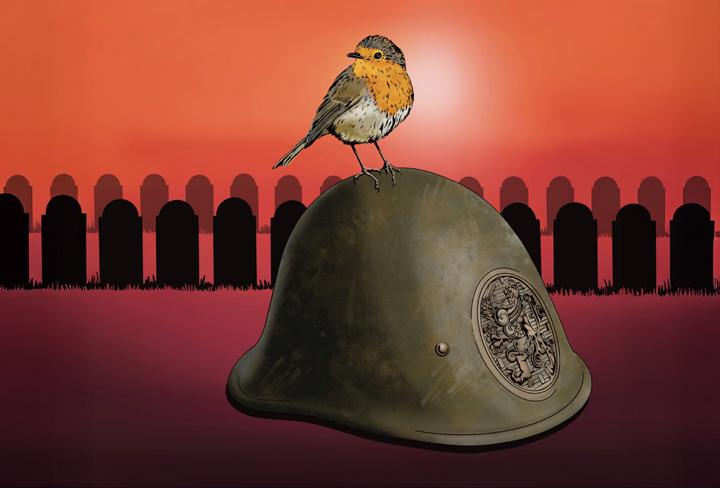
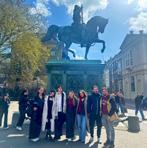
Students Sybrand and Johan killed in May 1940 p.12
Then, now and soon
This issue of Resource travels back in time. We delved into the impressive and sad stories of Agricultural College students Sybrand and Johan, who were killed when the Nazis invaded the Netherlands in May 1940. We also look back on a century of Entomology (page 30) and 100 years of Ceres in Villa Veluvia (page 23). It’s great to see those black-and-white photos with the neatly dressed Ceres members.
Returning to the present, conflicts are still raging around the world. We comment on WUR’s stubbornness in its response to the wars in the Middle East (page 4). Fortunately, there are always people who want to make the world a better place. Master’s student Xenia Minnaert went into politics, became chair of the local branch of the Party for the Animals and is now in the municipal council. She talks about her experiences on page 26. Looking to the future, each issue of the magazine (page 15) will consider the impact of AI on work, teaching and study. Then there is the futuristic article about the holy grail of synthetic biology: creating a living cell from non-living material. WUR is involved in this major challenge (page 20).
And back to the present. More and more students and staff are coming to us with their stories or opinions (page 28). Please continue — we love hearing from you: resource@wur.nl. We take all ideas equally seriously.
Willem Andrée Editor-in-chief
LET'S GO OUTDOORS!
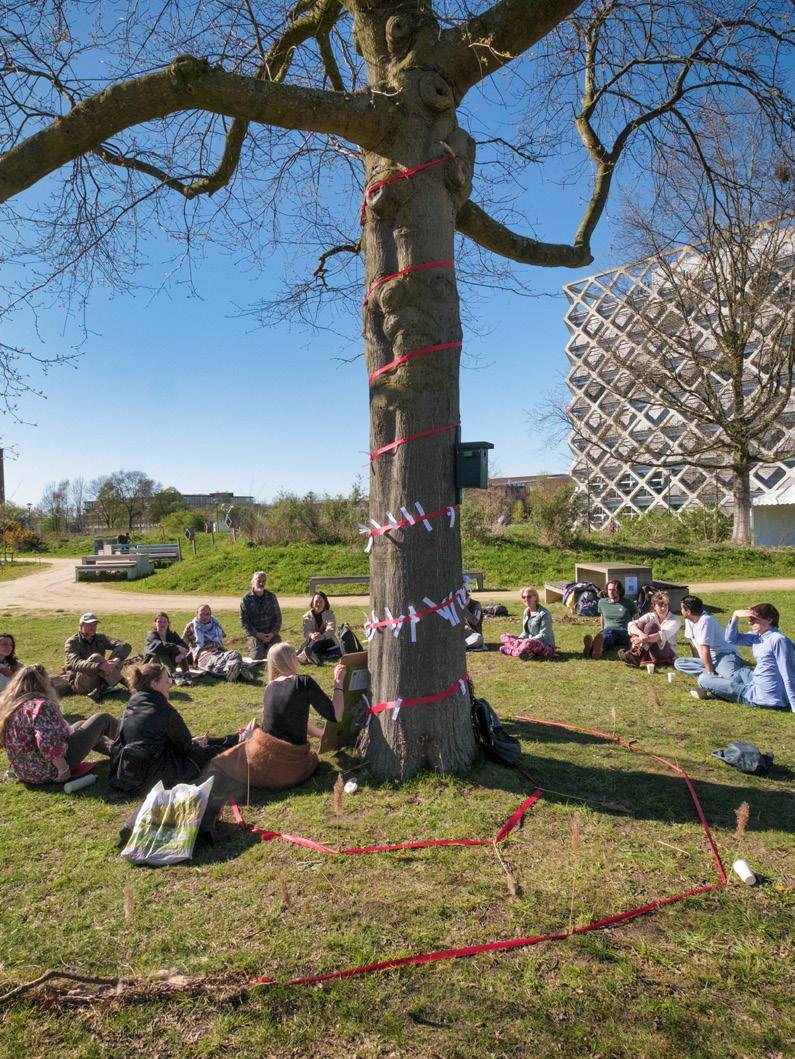
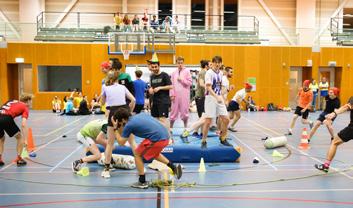
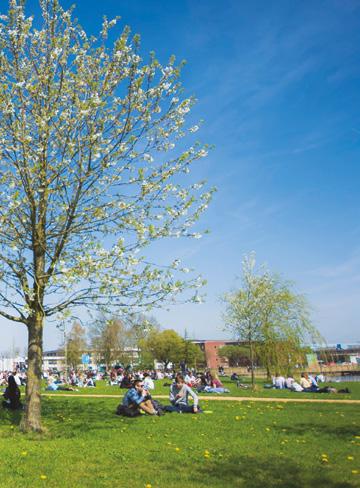
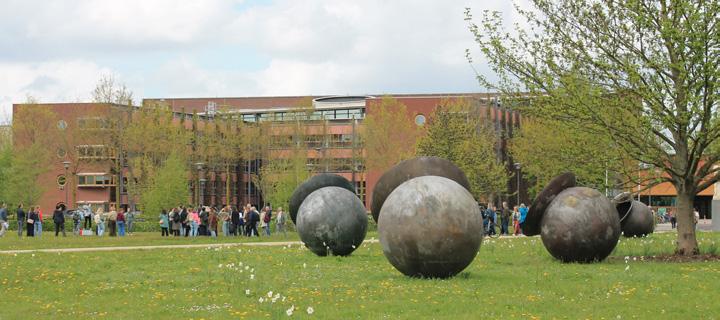
As of the start of April, three outdoor locations on campus can be booked as ‘lecture rooms’. They are the amphitheatre behind Impulse, the nature garden behind Atlas (in the photo) and the spot behind Wageningen Student Farm (where tree trunks have been placed as seating). Mats to sit on can be obtained in Forum if the grass is wet. When booking an outdoor location, lecturers also book a classroom as a backup so lectures don’t get cancelled due to bad weather. lz
Photo Guy Ackermans
How much longer?
Students and staff organized a protest for Lebanon last week, calling on the Executive Board to revise its position on Israel. That position is fixed and unyielding, as is known. WUR says it does not want to get involved in geopolitical issues and will therefore not break its links with Israel. There is something to say for that position. Science should be above party political factions and it is not the university’s task to make political statements. Also, where would it end, when there is so much injustice in the world? Communication is better than isolation. The arguments are well known. But how long can this position hold?
There is a danger that it all starts to seem normal and you become desensitized. After Israel’s crimes against the Palestinians in Gaza, you are no longer surprised by the violence against the Lebanese and it was only to be expected that Israel would join the attacks on Iran, plunging the world into crisis. The discovery that Israeli soldiers are even torturing children* may do no more than make you frown.
WUR’s position can be defended on a rational basis, but emotions need to be expressed too. The emotions that drove the protesters to take action and are shared by a lot of staff and students — the feeling that enough is enough. There is a limit to the impartiality of science, which WUR is stubbornly sticking to. Each new act of violence violates that limit. It is good that the protesters continue to challenge the Board, as it forces the Board to keep reviewing its own stance. And opinions can change if the circumstances demand that. To change your stance takes courage, the courage to get a better understanding of the situation and say that enough is enough.
*Source: Save the Children
This Comment presents the views and analyses of the editorial board, formulated following a discussion among the editors.
Asserpark renovation
Asserpark has had scaffolding since the summer. The block of flats, built in 1969, is being renovated to give it a new lease of life. It will be much more sustainable and have more common areas for residents to get together. When the work finishes in mid-August, the building will have 350 student rooms and nine studios for PhD candidates. lz/cj Photo ResouRce
New place for students to meet
Nexus will get a new space where students on campus can meet up. It is currently home to student accommodation provider Idealis and the Student Medical Centre, among others, but these organizations are due to move to other premises.
According to Kai van Middelkoop of the Student Council, they are working with an architect to see how Nexus can become a place where study associations can have drinks receptions, student orchestras can rehearse and activist societies can hold meetings. ‘The ground floor will become available first. We should be able to take over that in about a year’s time. Idealis, which is on the first floor, will move out in two years’ time, so that part of the building will become available later.’ lz
West entrance for all WUR staff
The new access road on the west side of the campus can be used by all WUR employees, as long as they have registered. Initially, the plan was to restrict the road to staff from the west of Wageningen. ‘That was indeed the idea,’ explains project manager Lex Roders. ‘But in the end we decided all employees can register to get access.’ Based on calculations, the expectation is there will be up to 1,400 ‘vehicle movements’ (700 cars going in both directions) per day on the new road. Eventually, the employees of companies based on campus will also be allowed to use the road in addition to WUR staff. rk
More photos on resource-online.nl
1
Nutritional Epidemiology & Public Health
Master’s student Joanne van Lieshout (23) came first in the European judo championships in Georgia in the under 63kg category. She beat Manon Deketer from France in the final. That puts Van Lieshout in a select group of eight Dutch judokas who have been both world champion and European champion, including Anton Geesink and Edith Bosch. lz
Employee Monitor
One place for digital services
About 300 WUR employees will transfer to a new organization with the working title DIS (Data & Digital Information Services). Most of them currently work in Facilities & Services. The transfer mainly concerns specialists in IT, data, information, privacy and security. The idea is that DIS will implement WUR’s digital strategy. That covers issues such as the responsible use of AI, compliance with cyber legislation, digitalization in education, data management and digital autonomy. The new organization will include Information Technology, the library, WDCC, Information Management, the archives and privacy & security officers. Nearly everyone will continue working in the same physical location. The reorganization will not involve any redundancies. DIS will start operating after the summer. rk
Satisfied despite everything
The pressure of work is too high, there is too much inappropriate behaviour and the workload is unbalanced. Despite all this, WUR staff give work a respectable score of 7.7 out of 10. These findings come from the two-yearly Employee Monitor, WUR’s staff survey, and ‘thermometer’.
The satisfaction score is almost the same as in the previous survey. That is perhaps the most striking result, says Johan Kanis, Recruitment manager and head of the monitor project. ‘There is pressure on WUR because of the cuts, yet we don’t see big changes in the scores compared with two years ago. People are proud of their work. That apparently doesn’t change easily.’ One in five employees have experienced inappropriate behaviour themselves and others have seen it happen to other people. Gossiping and abuse of power are the most common forms of inappropriate behaviour. A manager is the culprit in one in three cases. Inappropriate behaviour occurs throughout the organization, but Wageningen Food Safety Research (formerly Rikilt) scores worse in almost all categories of inappropriate behaviour.
Confront
one another
Despite all the publicity around this issue, over half the victims (and the witnesses) don’t take action. ‘You would like that number to be smaller,’ comments Social Safety Programme Manager Joyce van der Velde. ‘You hope people would con-
front one another about undesirable situations. If people are comfortable doing that, you create a safe environment. Our task is to achieve that culture.’
The pressure of work at WUR has fallen slightly. Four in ten employees find the pressure too high. Half of all employees work five hours extra per week on average. Remarkably, one in ten employees say they have an average of eight hours a week less work than their scheduled hours. So they have nothing to do one day in the week. It is not known what the reason is for this. rk
Illustration Shutterstock
New minor to boost board year take-up
The Student Council is looking into the possibility of a minor specifically for students who want to do a full-time board or committee year, where they have courses on topics such as personal development, leadership and bookkeeping alongside their committee work. ‘They will then get more out of their committee experience and earn credits,’ says Student Council chair Laurien Elion.
Many student societies, study associations and sports clubs have difficulty recruiting enough students for their boards and committees. The Student Council has been looking into how to make committee work more attractive for a while. For instance, in 2023 the university increased the financial support for full-time committee members to make it more doable financially for students. Now the Student Council is looking at the option of offering courses, says Elion. ‘The idea is to let students on boards and committees take courses that key into their committee work, for example reflections on leadership. If you can also earn credits in the optional section, that means you won’t get so far behind in your studies.’ Other universities also have plans for similar programmes, says Elion. ‘Groningen is currently developing a programme and Twente already has one. We want to see what we can learn from them. Perhaps we could offer a minor in part-
Wageningen Student Cup on campus
Every year, the Wageningen student cycling club Hellingproof organizes a competition for student cyclists from other towns and cities. This Student Cup, as it is called, is being held on campus for the first time this year (on 31 May). Non-students can also take part, for example in the WUR cycling championship event.
The Student Cup race will start behind the Zodiac building. The cyclists then go past Aurora, turn left towards De Elst, then left again at the Bornse Weilanden towards the Vijfde Polder for the starting and finishing straight. Each lap is 740 metres. In addition to the Student Cup races, there are also races for beginners where guides cycle alongside you.
At the start of the afternoon, there will be a relay race for non-students: ‘a serious race but with a carnival vibe.’ Then at the end of the day there will be the WUR cycling championship, open ‘to anyone with a WUR pass.’ dv
nership with Twente, where you do the courses there online. Or could we use their minor programme as a template.’
It will be a while before the minor is available, explains Elion. ‘Of course, as students we don’t have experience developing a teaching programme. We have had a positive response to our idea but who should develop the minor? What modules and training courses does WUR already have that could be relevant? We are now looking into this.’
The Student Council is inviting everyone to contribute their own thoughts on this. ‘If you have ideas that can help us further with our plan, please let us know!’ lz
Open Access may get much pricier
The Dutch Tax Administration is allowed to impose VAT at 21 per cent on open access publication charges. This is the court ruling in a lawsuit brought by IT cooperative SURF (on behalf of the universities) against the tax authority. Up to now, the low VAT rate of 9 per cent applied to journal subscriptions. It is not yet clear who will bear the burden of the extra costs, says Forum library director Martine Pronk. In 2020, higher education institutions paid 62 million euros for subscriptions and access rights. rk
Also student sports clubs have difficulty recruiting enough students for their boards and committees. Photo Guy Ackermans
USING WIPES TO DETECT ANTIBIOTICS
Antibiotic use on livestock farms can be detected effectively in samples taken by rubbing the farm animal with a moist cloth. This was demonstrated in a Wageningen trial on Dutch farms rearing veal calves. Text Marieke Enter
The method also works on pigs, sheep, chickens and horses, and is suitable for checking for antibiotic residues in barns. There are strict rules in the Netherlands about using antibiotics in livestock farming. Using antibiotics excessively or incorrectly can encourage resistance in bacteria. This is a growing health risk worldwide for animals and humans.
One problem, though, in monitoring the use of antibiotics was that it was difficult to detect in living animals. The supervisory authority NVWA therefore currently mainly carries out tests on slaughtered animals. One disadvantage of this is that the ‘detection window’ for meat — the period during which a substance can be detected — is quite short. What is more, the method can’t be used on living animals.
Hairs and feathers
That is why Wageningen Food Safety Research (WFSR) has been investigating alternative methods in living animals at the request of the Ministry of Agriculture and the NVWA.
The focus initially was on hairs and feathers, as antibiotics persist there longer than in the meat and the samples can be taken while the animal is still alive. This detection method was shown to be effective but not feasible in practice.
WFSR carried out the applied experiment on 98 Dutch farms rearing calves
for veal. ‘Veal calves can be quite lively — it isn’t always easy to grab hold of them and take a hair sample,’ explains Milou van de Schans, Animal Drug Research expert at WFSR. ‘The clippers also have to be cleaned thoroughly after
The method sounds too simple to be true: taking a sample by wiping a damp cloth over the animal
shaving hair from each calf to prevent cross-contamination between samples. In addition, hair is quite a time-consuming and complex type of sample to analyse in the lab.’
Wipes
That was why Van de Schans and her colleagues decided to investigate a different method, one that seemed too simple to be true: sampling by wiping a damp cloth over the animal. The ‘wipe method’ is already used to detect certain bacteria in barns. Van de Schans: ‘According to the scientific literature, it can also be used for other substances
such as plant protection products, so we thought perhaps it could work for antibiotics too.’
There is nothing particularly special about the wipes. Van de Schans: ‘Think of baby wipes or wipes for removing make-up. The ones we use contain a small amount of alcohol, but it also works with water.’
After the wipe has been rubbed over the animal, it is stored in a clean tube and analysed in the lab. ‘That’s where we perform an extraction on the wipe, using a solvent to separate out any antibiotic residues. Next, we purify the sample and analyse it using LC-MS (liquid chromatography mass spectrometry), a method that lets you detect substances down to the molecular level,’ explains Van de Schans.
The researcher says the wipes method is more pleasant for the animals, the sampling staff and the lab workers. An added advantage is that the same method can be used to determine whether the barn has antibiotic residues, and if so which.
Live&Learn
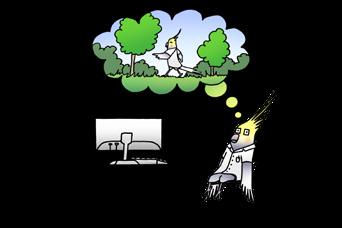
A botched experiment, a rejected paper: such things are soon labelled as failures in academia. As for talking about them — not done! But that is just what WUR scientists do in this column. Because failure has its uses. This time, it’s Annemieke Drost, now a PhD candidate at the Institute of Ecology.
Text
Nicole van ’t Wout Hofland Illustration Mathijs Megens/ SeaBlueBird Studio
‘You only ever do one PhD project, so you need to finish it. At least, that is what I thought when I started my PhD research four years ago. My research was on biodiversity restoration. I could already see myself standing in a field with my hands covered in soil. I enthusiastically worked out a plan for field trials and presented it to my supervisors. They said we wouldn’t be doing that: it was a theoretical project with computer work and there was no budget for experiments. I was surprised by that because I hadn’t realized it from the advert for the post.
‘We continued to have our differences in the months that followed. My supervisors had their own ideas about the project and had a particular direction in mind. Partly because of that, I wanted to meet up frequently for brief discussions, but they wanted longer, less frequent meetings. Both reasonable options, maybe, but we just weren’t on the same page. We were continually diverging. So how would it work out when I started writing articles or my thesis?
I found it all more and more of a struggle.
In the weekends, I would collapse on
the sofa. The final straw was a meeting where I presented my project to stakeholders. My supervisors criticized my idea in front of everyone. I felt abandoned. We were supposed to be on the same side, but now we were opponents. Two weeks
‘We were on opposite sides. Two weeks later, I took the decision to stop.’
later, I took the decision to stop. ‘That felt awful, as if I was demonstrating I wasn’t up to it. I also thought I’d blown my only chance at a PhD, because who would take on someone who has already given up once before? Fortunately, I was wrong. I applied for a new PhD position and was accepted. I’ve learned to be explicit about my expectations, safeguard my boundaries and ask more questions before starting on something. Now I’m three years into my PhD research and I know I am up to it after all.’
‘TASTY’
IS KEY ASPECT IN NEW WHEEL OF FIVE
The Netherlands Nutrition Centre recently launched an updated version of its dietary guide, the Wheel of Five. It incorporates the Health Council’s latest Good Nutrition guidelines, and changes have been made in the communication. Various WUR people were involved.
Behavioural scientist Sanne Raghoebar was one of the people allowed to see the last draft of the Wheel of Five in February and make suggestions for any final adjustments. She discussed the question of how to get as many people as possible eating in line with the Wheel of Five without the guidelines putting people off.
‘Unfortunately, a lot of people assume healthy and sustainable food doesn’t taste nice by definition, which is quite wrong of course,’ says Raghoebar. ‘That is why people’s experiences with the Wheel of Five need to be positive. Our research shows that rewarding food experiences are a good indicator of future choices. So the recipes published by the Nutrition Centre all need to be really tasty. That way, the Wheel of Five can help the Dutch adopt a healthy and sustainable diet.’
‘People want food that tastes nice because that offers an immediate reward’
Focus on tasty
Tasty food should also be a key element in the communication, thought Raghoebar. ‘The slogan used to be “A healthy and sustainable diet with the Wheel of Five”,’ she says, ‘but along with a number of fellow scientists, I urged the Nutrition Centre to change its slogan to one that focuses on “tasty”. For many people, healthy and sustainable are not deciding factors when choosing what to eat. We also know from research that these factors don’t offer an immediate reward. People want food that tastes nice because that does offer an immediate reward.’ Fortunately, the Nutrition Centre realized this too and they changed the slogan to ‘Tasty food every day with the Wheel of Five’. dv
‘INSECTS’ VULNERABILITY IS STILL UNDERESTIMATED’
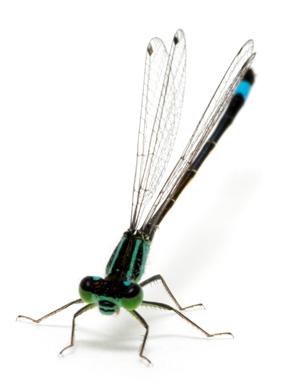
WUR acquired a new ‘butterfly professor’ at the start of this month: Roy van Grunsven. He is a professor by special appointment, funded by the Dutch Butterfly Foundation, and will spend the next five years researching the ‘effects of climate change on insect populations’. The focus will be on butterflies and dragonflies. Text Roelof Kleis Photo Shutterstock
‘Extinction takes time’
Insect numbers are falling rapidly and climate change is often blamed. ‘But that is a broad concept,’ says Van Grunsven. ‘Often, the reason why populations are decimated is something minor, such as two days of extreme heat in August killing lots of insects, or a downpour in July waterlogging the fields so that all the caterpillars drown.’ ‘In nature management, we often look back at how things used to be,’ says Van Grunsven. ‘The idea is that everything will recover if you can recreate that former situation. But the past is history and won’t be coming back. The rules of the game have changed, in part due to climate change. If you want to protect nature effectively, you have to allow for that.’ Van Grunsven wants to investigate how sensitive various species are to such changes. ‘Once you know that sensitivity, you can plan your nature management accordingly. If a heatwave in heathland now has a bigger impact than in the past, the shade of a tree can mat-
ter much more. Twenty years ago, that tree might have been irrelevant for the survival of a particular species whereas now it could be crucial.’
Dragonflies
One good example of such sensitivity is the dragonflies in bog pools.
Van Grunsven says their numbers are declining ‘at lightning speed’. ‘A lack of oxygen seems to be playing a key role. Warmer water contains less oxygen. But the insects’ aquatic nymphs are more active during warm weather and therefore need more oxygen. Oxygen that isn’t available.’
start a trial doing that. We want to set up and manage the landscape in a way that leaves insects less vulnerable to climate change.’
The lack of oxygen is because rotting plant matter on the bog pool bed uses up the oxygen in a process that speeds up in warm weather. Van Grunsven says the effect of the lack of oxygen can be seen by looking at the places that do still have dragonflies. ‘They’re still found in places where the cooler groundwater gets into the bog pool, or where the wind creates circulation in the water, which clears the pool bed and therefore leads to more oxygen.’
That insight can be used to design solutions. ‘For example, you could remove the sludge, which would leave more oxygen in the water. You can also improve the hydrology by channelling rainwater towards the pool. We plan to
‘Often, the reason why populations are decimated is something minor’
And that is an urgent task. Van Grunsven says many people still underestimate the impact of climate change. ‘That is partly because we aren’t yet seeing all the effects. There is a lag between the climate change we’re already seeing and the impact on the ground.
Extinction takes time. Long-lived species will be around for a while yet, even after the conditions in the Netherlands are no longer suitable for settling here.’
PhD theses in a nutshell
Apple juice
Pectin is an important thickener. This polysaccharide is found in large quantities in apples. Dazhi Liu (from China) studied the pectin from dozens of apple varieties. It turns out that there is considerable variation in the structure of the polymer and this is a determining factor for the yield and quality of the apple juice. Liu was able to find an association between those properties and the pectin structure. This knowledge will help juice manufacturers select and grow the right apples. rk
Characterisation of apple pectin structure in relation to apple fruit processability Dazhi Liu Supervisor Henk Schols
Improved mowing
Mild winters are bad news for biodiversity in verges as a small group of grasses then outcompetes everything else. Can you do anything about this? Yes, according to research by Wiene Bakker. Adjustments to the mowing schedule can help restore order. That means mowing twice a year rather than once, the second time in late autumn. But it also depends on the soil type. Bakker incorporated his results in a ready-made mowing recommendation for all the verges along main roads in the Netherlands. rk
Adapting to climate change, does it work? Wiene Bakker Supervisor David Kleijn
THE PROPOSITION
PhD candidates explain their most thought-provoking propositions. This time, it’s Rutger Brouwer, who received his PhD in December for research on the juiciness of meat substitutes. Text Dominique Vrouwenvelder
Duck vaccine
The Tembusu virus (TMUV) can hit duck breeders hard, as an outbreak in 2010 in China showed. The virus is now also affecting chickens and geese. Luzhao Li (from China) discovered which protein is crucial in the infection: one of the envelope proteins around the virus. A small change (just a single amino acid) in this protein makes infection impossible. The mechanism also works on other viruses from the same family. Li used that knowledge to develop a duck vaccine to protect against the West Nile virus. The vaccine (a variant of the virus) activates the duck’s immune system without making it sick. Impressive work. rk
Flavivirus infections in poultry Luzhao Li Supervisors Monique van Oers, Gorben Pijlman and Zejun Li (CAAS, China)
‘Fibre deficiency is the silent crisis behind the protein hype’
‘Because adverts and supermarkets focus so much on protein — it even has a dedicated shelf in the supermarket — consumers assume they must not be getting enough protein. In fact, studies show that protein deficiency is extremely rare in the West. In principle, people who only play sports at a normal level don’t need extra protein. Of course some groups of people need more protein than average, for example the elderly, people with certain health conditions and professional athletes. They may benefit from protein supplements, but that’s not necessary for most people.
‘At the same time, a lot of consumers aren’t getting enough dietary fibre. But that problem gets far less attention so it’s not on people’s radar: it’s a silent crisis. Yet fibre has a wide range of
health effects. Dietary fibre plays a key role in regulating blood sugar levels, and it makes you feel full and helps ensure healthy bowel movements. Low fibre intake is also a risk factor for bowel cancer.
‘So advertisers and supermarkets should shift their focus to dietary fibre. People can only process a certain number of messages at any given time. If they’re constantly being confronted with the protein hype, there isn’t much room for other, more important messages. Protein has an appealing image in marketing terms as it is associated with sports and muscle strength. Dietary fibre is less sexy from a marketing perspective, but it’s a much more relevant issue for public health.’
NATURE ARTICLE ON CUTTING CANCER CELLS
New research by John van der Oost on using CRISPR-Cas to treat cancer was published in mid-April in the scientific journal Nature. In this article, co-authored with American researchers, he describes how the ThermoCas9 enzyme can cut and disable cancer cell DNA in a targeted way.
In January, the emeritus professor of Microbiology received a Proof of Concept grant from the European Research Council (ERC) for this area of research. Together with American scientists, he had discovered that the ThermoCas9 enzyme can be used for gene therapy in patients with liver cancer. Now they have described the technique used for these genetic scissors in an article in Nature
‘This is the first CRISPR variant to respond to differences in methylation’
At the time, Van der Oost explained:
‘The enzyme can’t make cuts in healthy cells because there is a methyl group at the binding site, but that methyl group is missing in a certain type of liver cancer. That means our CRISPR enzyme can cut the DNA of those cancer cells apart, which will hopefully kill off that type of cancer cell.’ He now adds: ‘That makes this CRISPR variant the first to respond to differences in methylation. That means we have a system we can direct specifically at tumour cells.’
DISRUPTOR
There is now no doubt that the enzyme can cut the DNA apart. The next step is to damage the DNA in tumour cells to such an extent that the cell dies off. ‘That is a case of disrupting essential genes so that the tumour cell can no longer function and survive,’ explains the microbiologist. That is what Van der Oost and postdoc Christian Südfeld are now investigating with the funding from the Proof of Concept grant. They want to disable cancer cells while leaving the healthy cells intact. The ultimate aim is to develop a new kind of cancer therapy. dv
Incorrect rejection
I recently received a rejection from WUR regarding a job application. I had applied for a role that I thought was a perfect match for my experience and ambitions. Apparently, I didn’t fit the target profile, but the puzzling part was that it said I ‘unfortunately did not belong to the target group of candidates’. I was very surprised by this argument and I started wondering about the possible criteria. What defined whether you belonged to the target group? Where had I fallen short in my experience and background when I was convinced it was a perfect match? A few days later, I received a second email with the subject line ‘incorrect rejection’. While the recruitment process continues to be competitive due to the massive outflow of graduates and limited job opportunities because of the unstable global economic and geopolitical situation, some responses are beginning to sound familiar as time goes on. This could be because of the prevailing use of generic artificial intelligent tools in this high-pressure, rapidly changing world. However, occasionally a response — like ‘incorrect rejection’ — stands out not for its encouragement, but for its ambiguity and puzzling nature. In the end, I was invited to a brief introductory chat with
Joshua Wambugu
the department’s director, who expressed appreciation for my interest in the position and acknowledged my experience. Despite this, I did not progress to the next round. As my job search
‘How can institutions like WUR better safeguard their communication, particularly at highstakes moments such as recruitment?’
continues, both within WUR and beyond, I remain motivated and open to new opportunities. Reflecting on this episode, though, reminded me of my education and research journey within WUR over the past decade, where I was actively engaged in policy spanning education, research, diversity and inclusion, sustainability and mental wellbeing. Much has improved, yet one question lingers: how can institutions like WUR better safeguard their communication processes, particularly at high-stakes moments such as recruitment, to prevent such back-office errors and conflicting messages?
Joshua Wambugu (43) from Kenya, is a PhD candidate in the Marine Animal Ecology and Environmental Policy groups. He loves cooking, hiking and birdwatching.
Wageningen students died ‘serving their fatherland’
SYBRAND AND JOHAN
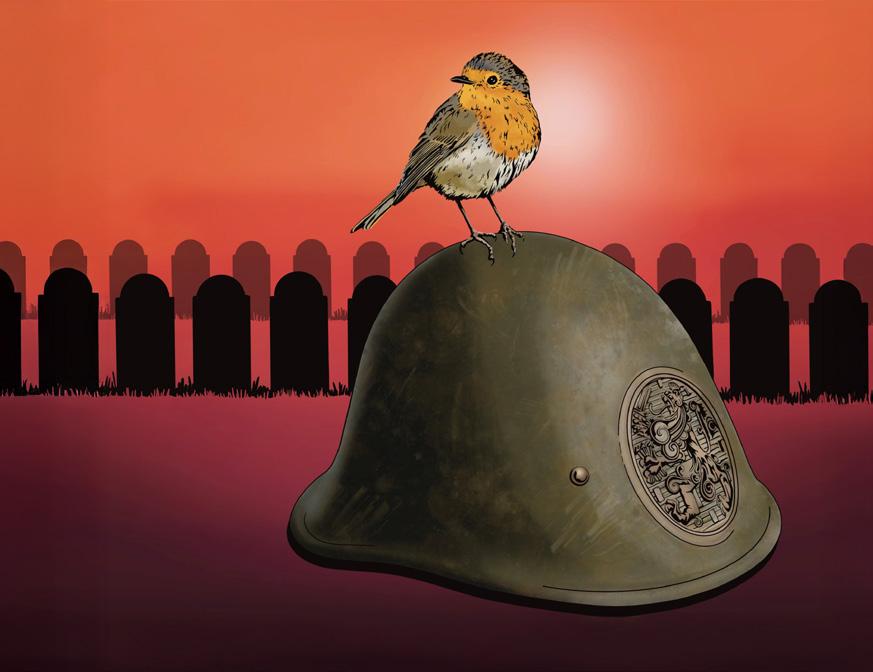
In two weeks’ time, on 4 May, the Netherlands will commemorate the victims of the Second World War. Two of them were studying at what was then the Agricultural College in Wageningen. They were the only Wageningen students to be killed as soldiers when the Nazis invaded in May 1940. Text Willem Andrée Illustration Valerie Geelen
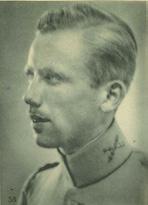
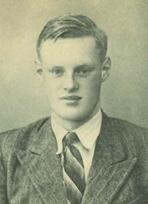
The entry on page 43 of the Wageningen Student almanac for 1941 is brief and almost offhand: ‘The students Sybrand Jan Boddé and Johan Jacob Lodewijk Geel were killed serving their country.' But when you leaf through the yellowing pages, you realize that is not actually the case. The young men ‘who were taken from us’ are mentioned in various places. There is a personal item dedicated to Sybrand Boddé in the 253-page almanac that speaks of ‘a warm tribute’ to ‘a friend of all of us’ who ‘gave his life, so full of promise’ and ‘had represented the society in athletics so often and so impressively.’ The motor sports society WSMC wrote of Johan: ‘We lost a sporting chum.’ Further along in the almanac, there are obituaries for the two lads accompanied by portrait photos. These four pages bring the students to life. Sybrand gives the camera a friendly, sharp look. He has a haircut that is still fashionable today and is wearing a jacket and tie. Johan, in uniform, has been photographed side on. They both look very young.
Sybrand
Sybrand Jan Boddé was born on 8 March 1918 in Rijssen. He did national service as a sergeant, completing his training at the Royal Military Academy in Breda. On 1 May 1940, nine days before the Nazis invaded, he was transferred to the I-8 Infantry Regiment as an artilleryman and stationed on the Grebbeberg hill in the second line of defence. This was familiar territory for Sybrand. His brother Eduard Boddé wrote a letter to the war historian E.H. Brongers in 1979: ‘My brother knew the hill
well because he was a student in Wageningen. The men fighting alongside him didn’t know him well because he had only joined them on 1 May.’ He added ‘As a rookie’ in brackets. A newcomer, in other words. Twelve days later, Sybrand was dead. Eduard also wrote: ‘These people fought in hell, as it were.’
Grebbeberg
Even today, it is not clear exactly how he died. On 13 May 1940, the student’s corpse was discovered in the garden of Villa Wilhelmina, along with around ten other soldiers from the 8th Company. Nearly all their bodies were in the same position: on their stomachs with their hands above their heads. Earlier that morning, they had left their posts after they ran out of munitions and their officers were eliminated. They were seeking shelter in the villa. The most likely explanation seems to be that they were shot dead in cold blood by German SS troops. The witness Cor van Zand, who was the only soldier to survive the attack — with bullets in his arms and stomach — stated that the group had been captured that morning and shot dead shortly afterwards. But his verbal
Johan Jacob Lodewijk Geel Sybrand Jan Boddé
‘My father suffered greatly from Sybrand’s death’
statement was never verified. In 2011, a Dutch veteran called Will Hulscher, aged 95 by then, gave his account in the veterans magazine Checkpoint. He too was nearly executed that day in that same house. He saw how a group of Dutch soldiers were stood against the wall of a house with a fence. He later heard from the German corporal who saved his life – a nursing officer – that the men had been shot, having been accused of firing at vehicles transporting wounded men. Hulscher didn’t know whether the accusation was correct. But when he was shown photos of the garden — photos he had never seen before — he recognized the unusual garden fence immediately. The interview had to be paused.
Nephew
The son of Eduard, the brother who wrote the letter, is named after Sybrand. He tells Resource that his father was preoccupied with finding out the truth about Sybrand’s death ‘day in, day out’, down to the smallest details. ‘He suffered hugely from the death of his brother and had an entire room full of books and
documentation about the war and that period,’ says Sybrand’s nephew now. ‘There was a rumour that the boys — so that’s including my uncle — were trying to desert and had therefore been executed by their own army. My father said that didn’t fit at all with his brother’s character.’ The younger Sybrand now confirms that his father also came to the conclusion that the young men must have been killed by SS soldiers, shot execution-style. ‘Some had gunshot wounds in the backs of their heads.’ His father would attend the remembrance ceremony on Grebbeberg every year and kept in contact with veterans. ‘He drew comfort from that.’ Sybrand is buried in the Grebbeberg Military War Cemetery in row 1, grave 20. He died aged 22.
About Johan
Johan Jacob Lodewijk Geel was born in Bemmel on 11 May 1916. He died in Dordrecht on 10 May 1940, one day before his 24th birthday. His mother Gerritje Geel-Van der Worp later recorded in writing what happened. ‘In the early morning of 10 May, Johan and three of his men tried to fetch munitions from a school that was being used for storage because the group had run out of cartridges by daybreak. German
‘For you, the helmet is an ornament; for me, in its weathered condition it is still the helmet my son wore’
parachutists started shooting at them. All four died.’ The war in the Netherlands had barely begun.
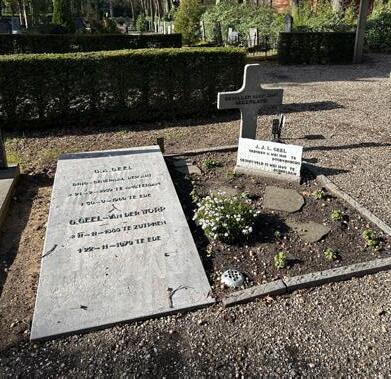
Johan was initially buried in a temporary grave and then transferred to the Public Cemetery in Ede. The grave was purchased by his mother.
All this information can be found in the National Archives, which contain not just the administrative records relating to the grave but also the correspondence from a family doing everything they could to keep their son’s memory alive. In 1955, his father Brigadier-General G.A. Geel received a letter from the Netherlands War Graves Foundation (which maintains over 50,000 Dutch war graves around the world) informing him that the gravestone was showing signs of ‘rainwater dripping from a weeping birch’ and that Johan’s helmet would have to be painted back onto the cross. The letter was dated 11 May, his deceased son’s birthday and one week after Remembrance Day.
Geel senior was furious and found the timing of the letter extremely inconsiderate. He wrote that the Foundation’s officials had clearly not contacted the cemetery supervisor, who had been maintaining the grave properly for years in consultation with the family, doing it up every year around Christmas and just before 4 May. It isn’t hard to see the anger, despite the father’s polite words. ‘Regarding the repainting of the helmet, I beg to differ with you. For you, the helmet is an ornament on the cross that should be painted to look attractive; for me, the helmet in its weathered condition is still the helmet my son wore.’ He then asked to be spared any such letters in future. There is no record in the archives of the Foundation’s reply.
Flowers
Johan’s father died suddenly on 30 September 1960, leaving his mother a widow with no surviving children. Soon after the death of her husband, she sent a postcard to the War Graves Foundation asking them to continue sending correspondence to her regarding her son’s grave. In 1966, she officially transferred the grave to the Foundation, on the explicit condition that no one else
should be buried there. Her final resting place was to be with her husband in that grave, next to their only child. In December 1973, she sent one last letter to the Foundation. She was no longer able to pay the financial contribution for maintaining the grave. She had considerable expenses due to illnesses she had contracted during the war, she wrote. She passed away on 22 November 1979. In 1992, the Netherlands War Graves Foundation considered transferring Johan’s body to the Military Cemetery on the Grebbeberg. The then mayor of Ede wrote in reply that while he understood the argument, he believed the family’s wishes should take precedence. He also wrote that every year on 4 May, a delegation from the municipal executive laid flowers on the grave. The Parks Department kept the monument clean. So Johan stayed in Ede, next to his parents. ■
Johan buried next to his parents in the public cemetery in Ede (Asakkerweg), in accordance with his mother’s wishes. It is not known when the helmet was removed from the grave. Photo Resource
GAMIFIED LEARNING (SHEEP BREEDING)
How do you demonstrate how much fun Animal Breeding & Genetics can be at an open day for prospective BSc students. ‘Hmm,’ thought teacher Pascal Duenk. ‘there’s a lot of statistics and data analysis in our degree programme. How do you make that appealing?’ He came up with a clever solution: the Fluffy Sheep Breeder. This game, created by AI, shows in simple terms how animal breeding works. Text Roelof Kleis
Pascal Duenk was fascinated by ChatGPT from the start when it appeared out of the blue a few years ago. ‘I’m a teacher and researcher and I wondered what impact it would have on my work. It kept me awake at night.’
He kept a close eye on the developments
‘The idea of the game is to breed sheep to get wool that is both longer and curlier’
and soon found like-minded people within WUR. That recently led to the creation of the Gen AI Teachers Community, which he coordinates together with Renate Winkels (Human Nutrition & Health). ‘We organize about ten sessions a year to share our experiences.’
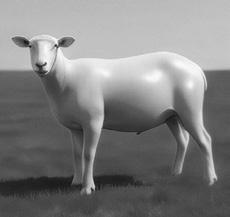
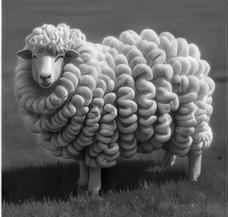
The latest session was about vibe coding, the technology that makes it easy for non-coders to develop games. The sheep game is a good example. ‘The idea behind the game is that you breed sheep to get animals with wool that is both longer and curlier. However, those two
characteristics are negatively correlated: the longer the strands of wool are, the less they curl. If you want to improve both aspects, you have to find the right balance: an optimum.’
Curls
In the game, you select rams and ewes to breed the next generation of sheep. The start is crucial. The smaller the group, the bigger the risk of problems due to inbreeding. Then you determine the breeding objective. Do you go for wool length, curliness or a mix of the two, and if so how much? The game consists of five breeding rounds. Graphs show the results of each round and the size of the inbreeding risk. A sheep that is displayed at the top left of the screen starts out short-haired and grows more woolly and fluffy with each generation. If you make the right choices, that is.
The added value of the game is obvious. Duenk: ‘I can explain this idea of finding a balance between two characteristics with slides and graphs, but a game brings it to life. If students play this game, they
AI seems unstoppable in research and education. Every month, we show here how teachers and researchers are exploring its possibilities.
are much more likely to remember the idea. That’s the big benefit.’ That doesn’t just apply to students. Last week, Duenk made a game for a colleague who wanted to explain to farmers in Ethiopia what the effect would be of crossing their local breeds of cow with European breeds like the Holstein.
Making them think
Duenk is a pioneer in the use of AI. He used an Education Innovation Grant he received last year to develop ChatABG, a chatbot that supports students doing the Animal Breeding & Genetics course. ‘The app doesn’t give direct answers; it uses the Socratic approach of asking questions of its own to make students think. I’ve tested it this past year. Some students love it, while others find the chatbot’s questions really irritating. They’ve already thought about the issue and just want an answer!’ ■
Two sides
Is ‘No Meat Week’ replacement toothless?
National No Meat Week (Week Zonder Vlees) returned in a new guise this week: the How About A Change (Wissel ‘ns Wat) campaign will highlight plant-based alternatives throughout the year. Do such regular, gentle nudges work better, as behavioural psychologist Professor Harm Veling (Consumption & Healthy Lifestyles) says? Or has it become a toothless campaign, as consumption sociologist Hans Dagevos (Consumer Research) claims? Text Dominique Vrouwenvelder Photos Guy Ackermans
Veling: ‘I think it’s good that this new campaign is telling consumers what they should do rather than what they should not do. Behavioural change starts when you have new positive experiences. How About A Change gives people a feeling of autonomy: they can choose to eat something different occasionally.’
Dagevos: ‘I am surprised the tone is so moderate, precisely now that the Vegetarian Society has taken over the campaign from the National No Meat Week Foundation. I miss the activism that is typical of many NGOs. A campaign like this could give the impression that a dramatic reduction in meat consumption is no longer needed.’
Veling: ‘That’s the dilemma we are in. We know we need to eat less meat, but the question is how to achieve it.’
Dagevos: ‘I get that, but reassuring words from organizations like the Vegetarian Society and critical researchers won’t help. We urgently need to start
eating far less animal-based food and we won’t get there if we only take small steps. I feel there’s no urgency in the language used and the tone of the campaign.’
Veling: ‘We need to weigh up using an activist approach that triggers aggressive pushback versus giving consumers nudges for shifting in the right direction. After all, you want to get people to accept the new narrative of a climate-friendly diet, but it mustn’t only arouse negative emotions and therefore resistance – people complaining we’re already no longer supposed to vape, smoke and eat sugar, and now they even want us to stop eating meat.’
Dagevos: ‘Even so, this campaign feels as if we’re abandoning the science. I’d like to see these kinds of campaigns
‘If people are not allowed to do something, they lose interest’
Harm Veling, Behavioural psychologist in Consumption & Healthy Lifestyles
‘This campaign feels as if we are abandoning the science’
Consumption sociologist Hans Dagevos in Consumer Research
reflecting the current state of scientific knowledge as set out by EAT-Lancet, the Health Council of the Netherlands and countless studies. We should be clear about the underlying problem we want to tackle.’
Veling: ‘It should indeed be made crystal clear that science isn’t suddenly saying we’re allowed to eat more meat. At the same time, there really is scientific evidence that small steps help achieve lasting changes in behaviour. If people are told something’s no longer allowed, they lose interest or decide in advance they won’t cooperate. We need to avoid that happening.’
Dagevos: ‘That can be one argument, but I’ve read newspaper articles saying that this new, gentler approach was in response to critical voices in society. Populists were exploiting the issue. I wonder whether we shouldn’t actually crank the campaign up a notch in such a situation, rather than moderating it. Perhaps we should be bolder, to find out what kind of resistance there is, how persistent it is and whether it disappears of its own accord after a while.’
Veling: ‘We shouldn’t forget that not everyone has grown up in a culture where eating vegetarian or vegan food is common. We should show empathy and not lose sight of other people’s perspectives. We need to give some consumers
more of a helping hand, for example with vegetarian recipes for Christmas. How About A Change feels more friendly for them than the No Meat Week.’
Dagevos: ‘I still find it a pretty lame effort. The nice thing about the No Meat Week was that you couldn’t ignore it: it was prominent both online and offline. It was a week when supermarkets would promote their meat substitutes and pulses as alternatives to meat. I think they have a key role, as do restaurants and all the other parties in the food system.’
Veling: ‘A systems approach is important. How we deal with food is deeply rooted in our food system. The Netherlands Nutrition Centre recently launched the Food Pestering campaign to highlight how the food environment is continually pestering consumers to eat certain things.’
Dagevos: ‘Perhaps we need to work on a Meat Pestering campaign to make consumers aware of how meat is a prominent presence everywhere.’
Veling: ‘I think we need to make sure people feel an urge to change their behaviour: for example, to get dyed-inthe-wool carnivores going from eating meat seven days a week to five days a week. At the same time, we mustn’t forget the ultimate goal and we should
listen to science telling us we need to eat far more plant-based food. A campaign like this — with a positive narrative — can encourage consumers to try something plant-based without making it a big thing.’ ■
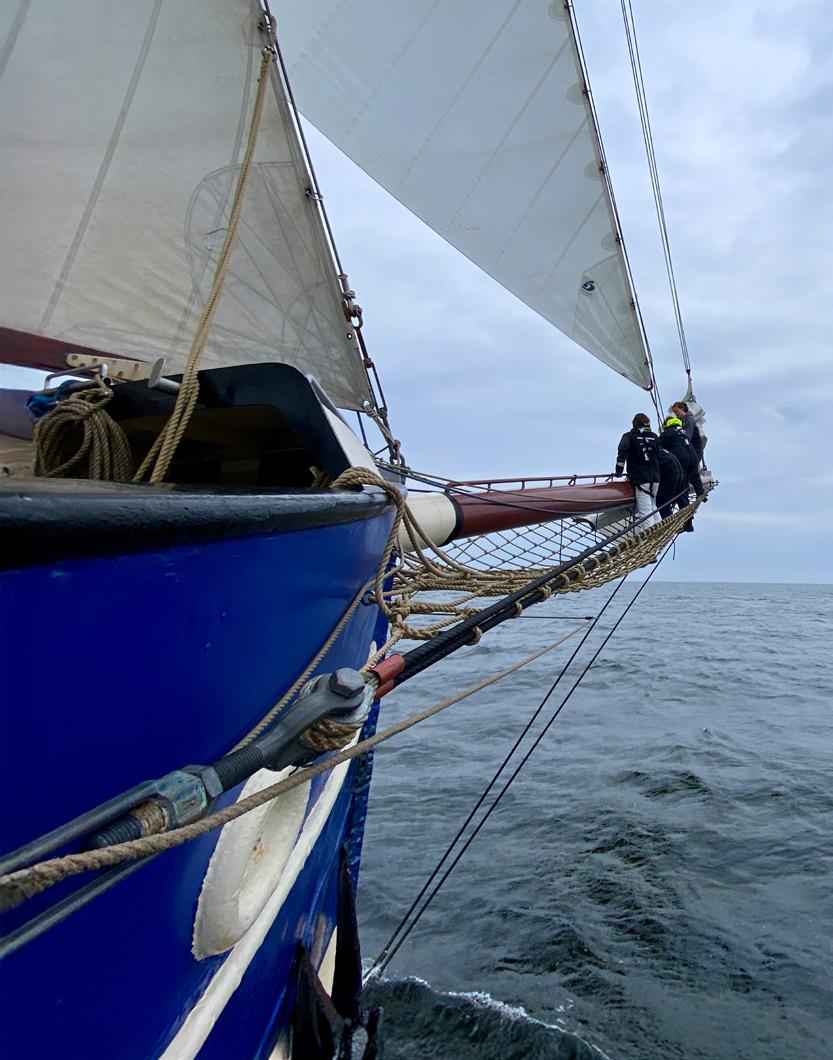
CLASSIC SAILING
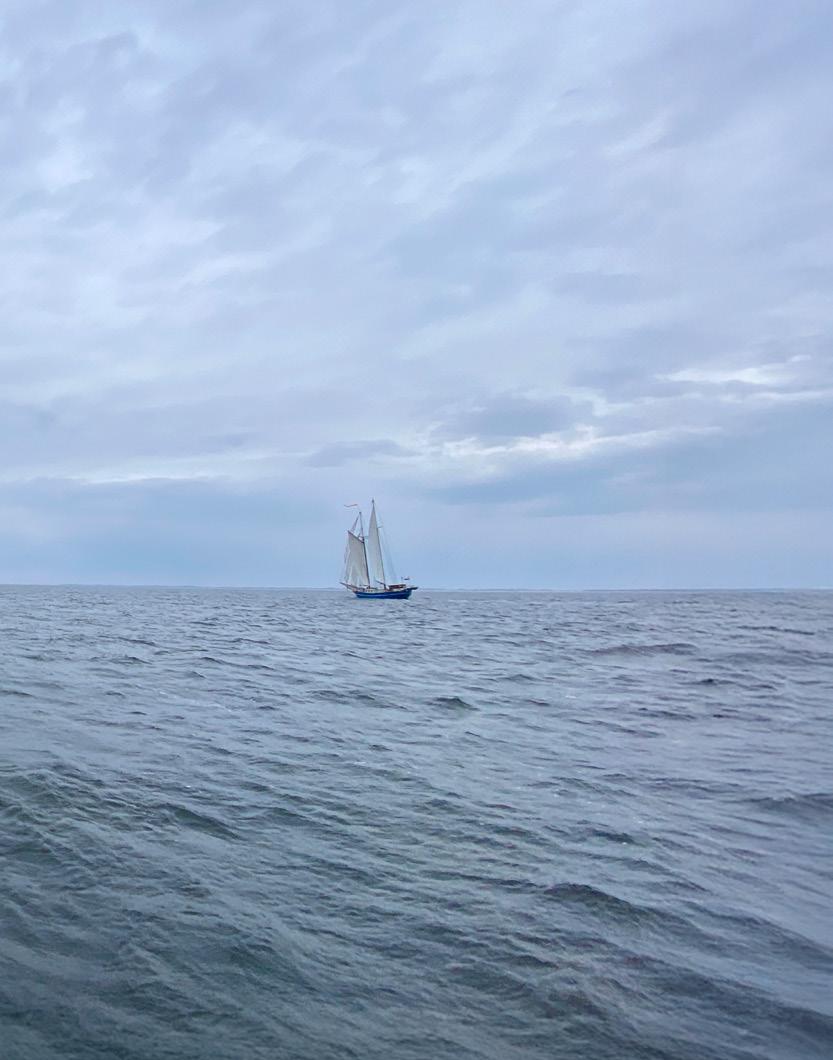
Last week, over 20 WUR students took part in the Race of the Classics, a sailing competition aimed at preserving the legacy of historical Dutch sailing ships. The Wageningen participants sailed on the Oban, a ship 39 metres long and 7 metres wide. No previous experience was required despite the many masts, ropes and sails, as the navigating officers explained everything. The photo shows the crew lowering the headsail. It needs to be folded or rolled up tightly so that it can be raised again quickly when needed. The jib net was a popular place to chill out during the voyage. dv
Read more about the sailing adventures on resource-online.nl
Own photo
HOW TO CREATE LIFE (MAYBE)
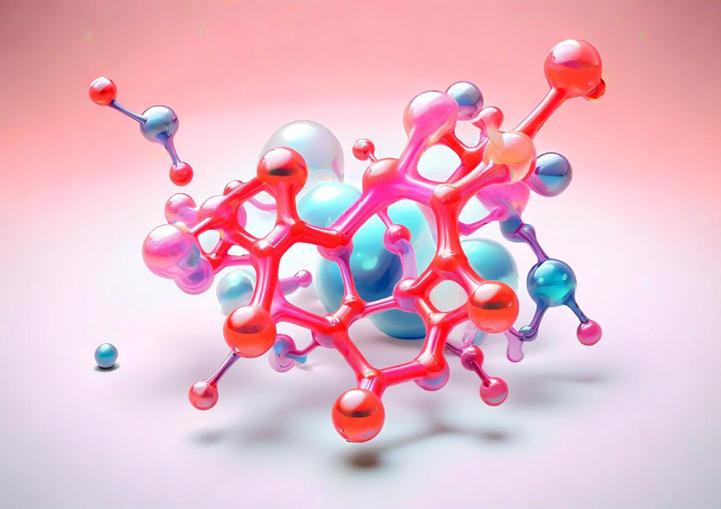
Creating life is the holy grail of synthetic biology. Wageningen scientists are involved in a major project aimed at doing precisely that.
pretty ambitious. In a review in Nature Reviews: Bioengineering, Koster, her co-author Henrique da Costa Oliveira and their Wageningen colleagues summarized what is needed to build life.
Creating life starts with the question of what life is. How do you define life?
EVOLF — Evolving life from nonlife — is the name of the ten-year project (which started in 2024), funded by the Dutch Research Council. Creating life from non-living material — you don’t get more science fiction than that, and it soon evokes images from horror films. But Charlotte Koster, one of the WUR participants, is no Dr Frankenstein, if only because the aims of EVOLF are much more modest than creating human life. As she explains, even a single-celled microorganism that divides once would be an amazing achievement.
Koster has experience with this topic. As a PhD candidate in Delft, she was involved in BaSyC, a predecessor of EVOLF that had a similar aim, making a synthetic cell. ‘We were mainly interested in finding out how many different ways there are to create life and how many components you need.’ That too is
‘Replication is one prerequisite for life. In this project, we define a cell as “alive” if it can split into two at least once independently. There is even a big discussion within the consortium about the concept of doing so “independently”. One side thinks that if you provide the building blocks for replication and the cell is capable of using them to replicate, that counts as independently. Whereas I think the cell should make those building blocks itself. The ability to do that plus a metabolism are the main prerequisites for life.’
Biotechnologists have been turning cells into mini-factories with useful applications for a while. What would be the added value of an artificial cell?
‘There are always by-products in the industrial use of microorganisms. In theory, a synthetic cell would be like a clean slate that you can program to do exactly what you want. You could think up all kinds of futuristic applications, but we are a long way off that yet. We don’t yet have a full understanding of the biology of cells because they are incredibly complex. A major reason I wanted to
‘OF COURSE, THERE IS A CERTAIN SCIENTIFIC ARROGANCE TO THIS PROJECT’
Text Roelof Kleis
get involved was to develop fundamental knowledge. This project is a kind of carte blanche to investigate how cells work. We will learn a huge amount from it. I enjoy figuring out the difficult stuff. We’ll be delighted if we have one tiny bubble in ten years’ time that can divide itself into two even once.’
Wageningen’s contribution to the project is in composing the cell’s genome. What is the minimum number of genes for the genome?
‘Years ago, scientists made a synthetic cell by stripping down an existing cell. In other words, they removed as many non-essential pieces of DNA from the genome as possible. That minimalist cell, the symbiont JCVI-syn3.0 (after JCVI, the J. Craig Venter Institute),
‘WE DON’T YET FULLY UNDERSTAND THE BIOLOGY OF CELLS BECAUSE THEY ARE INCREDIBLY COMPLEX’
contained just 438 genes. Those genes comprised a total of 530,000 base pairs, the code letters for DNA. The question, of course, is which of those 438 genes are essential – we don’t know the precise functions of a third to a quarter of them, so we don’t really know if they are absolutely necessary.’
What is your role in the synthetic cell?
‘I work on the regulation of protein expression: how to make sure proteins are produced at the right moments. The regulation has start and stop signals in the DNA, before and after the gene that
is to be read. We used to think that the stop signals worked because the DNA forms a loop at that point, which stops the reading process, but in fact it seems to work quite differently. Changing just a single base pair in the stop signal –one letter of the DNA code – can double
Illustration EVOLF
the gene’s expression. So stopping has nothing to do with that loop. We now suspect other proteins are involved in the process. That knowledge is crucial if you want to build a cell.’
You are assuming that the genome is a rational structure. You’re putting genes that belong together functionally near to one another, which is efficient in terms of control. But the structure of genomes in nature is the result of millions of years of evolution and seems more chaotic than rational. So will this rational approach work?
‘There’s no reason why it shouldn’t work. We’ll see. That’s what I find so exciting.’
How can you test a genome if you don’t yet have a synthetic cell to put it in?
‘The consortium’s ultimate goal is to put a cell together from the bottom up. But we’re not that far yet. If you do
‘I ENJOY FIGURING OUT THE DIFFICULT STUFF’
everything in vitro, in a test tube, you get completely different results from what you see in a living cell. A test tube is like a massive swimming pool compared to a cell measuring two cubic micrometres, with thousands of proteins, DNA and other substances packed tight together. To test the DNA we’re making, we use existing cells in which we replace the genetic material with synthetic DNA.’
Constructed genomes are subject to evolution just like natural genomes are. Will such a genome stay pristine or will chaos erupt so that it no longer works?
‘Evolutionary change would be a real problem for the industrial use of such synthetic cells, of course. But evolution requires the presence of certain proteins, for example to repair genes. If you don’t add those proteins, you won’t get evolution. On the other hand, change due to evolution is fantastic if you want to understand how life works. We can learn a lot from that. That is the duality of this project. We want to work towards a goal – making a synthetic cell – but we can also learn a lot from everything that happens on the way.’
So the project can’t be a failure?
‘That depends on who you ask. Of course, there is a certain scientific arrogance to this project, saying we’ll improve on what billions of years of evolution produced. To be honest, I don’t believe in that. We have no idea whether there is a reason for how the genes are ordered in the genome or whether it is purely the result of chance. At present, we definitely don’t know enough about how it all works. We have known what DNA looks like since the 1950s. The translation of DNA into
Summit
EVOLF is one of the five big projects in the Dutch Research Council’s Summit programme. Researchers from Delft, Wageningen, Nijmegen, Groningen, VU University Amsterdam, AMOLF and the Hubrecht Institute collaborate in EVOLF. One hundred PhD candidates, postdocs and technicians will be working through to 2034 on the task of building a synthetic cell. WUR currently has three PhD candidates, three postdocs, one associate professor and three professors on the project. EVOLF has funding of 40 million euros. Researchers elsewhere in the world are working on similar projects. In Europe, they are united in Syncell.
Ethical issues
EVOLF is tinkering with life and that raises ethical issues. That is why philosophers (from Delft) are also involved in the project. ‘They consider the ethical aspects of what is possible and desirable,’ says Koster. ‘For example, you could include amino acids in the synthetic cell that are not found in natural proteins.’ That could have safety benefits because a cell with an ‘unnatural’ protein won’t survive in the outside world.
proteins has been known for a long time too. But there’s so much involved in the intermediate steps that we still don’t understand. It would take another five consortium projects of this size for us to make a fully functional synthetic cell with industrial applications.’ ■
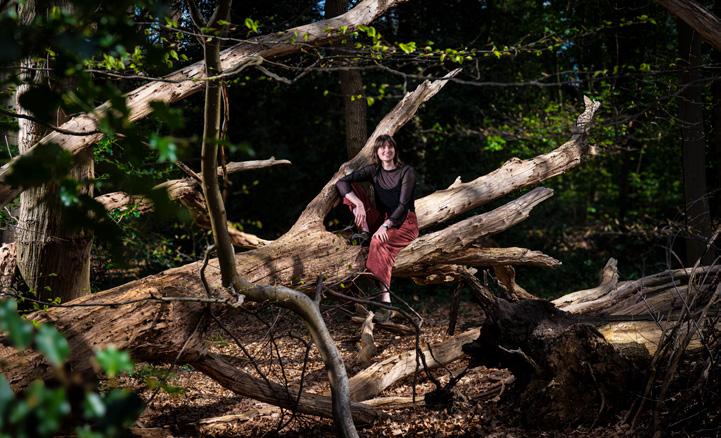
Charlotte Koster Photo Roy Borghouts
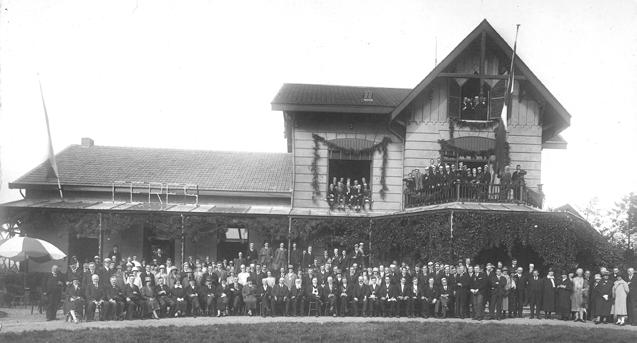
100 years of Ceres clubhouse Villa Veluvia
‘Hard times bring members together’
This year, Wageningen student society Ceres celebrates 100 years in its clubhouse on Generaal Foulkesweg. Municipal archivist Bob Kernkamp and Ceres member Vincent Ruegg take Resource on a voyage back in time, from when Ceres moved into the house in 1926, followed by the wartime years, the merger with the ‘women’s society’, a disastrous fire and finally the COVID period. Text Luuk Zegers
Bob Kernkamp started his internship at the Wageningen municipal archives in 1989. His task was to catalogue the Ceres archive. ‘The period from 1878 to 1942, to be precise.’ Ceres member Vincent Ruegg delved into the history of the society and its clubhouse for an anniversary celebration.
Villa Veluvia
‘Villa Veluvia was built in 1879. It was originally a family home,’ says Kernkamp. Since being taken over by Ceres in 1926, it has been extended to include a
pub, a clubroom and a theatre.
The Ceres Agricultural Society was founded on 20 October 1878, two years after the start of the State Agricultural School. The society moved around regularly during its first few decades. ‘They met up in hotels or pubs and briefly even in the Junushoff Club, which is now the theatre. Then they had their own premises on Boterstraat from 1908 to 1926.’ In 1910, Ceres adopted the name Wageningsch Studenten Corps (WSC).
The number of female students in Wageningen started to grow from around that time. In 1917, 11 women
Moving into Villa Veluvia in 1926 Photo Ceres archive
founded WVSV, a society for female students at Wageningen. It would merge with WSC in 1970. From 1924 to 1941, WVSV had a club room in the main building of the Agricultural College.
The interwar period
As member numbers grew, the clubhouse on Boterstraat became too small and WSC needed to look for new premises. ‘In 1925, the society bought Villa Veluvia from the municipality,’ explains Kernkamp. ‘They added a pub room, a bar and more toilets, and expanded the kitchen.’
On 30 April 1926, the villa was renamed Sociëteit Ceres and the society moved in officially on 16 September.
Student numbers fell temporarily during the economic crisis of the 1930s, but picked up again at the end of that decade and new expansion plans were made. But those plans got overtaken by events. On 10 May 1940, the Nazis invaded the Netherlands. Wageningen was briefly evacuated but two weeks after the surrender on 15 May, teaching resumed at the Agricultural College.
‘In 1941, the occupying Nazis decided Jews could no
longer be members of societies,’ says Kernkamp, ‘so nearly all the Wageningen student societies stopped their activities. Only Unitas stayed open. The clubhouse was essentially empty from that point on.’ Most of the building’s contents were given to Ceres members to store.
Students in the resistance
In 1943, four Wageningen resistance fighters, including two students, stole the register of residents. ‘The Nazis were furious,’ says Kernkamp. ‘They imprisoned 20 students in Amersfoort Camp. One of them died there from an infection.’ After the attempted assassination in The Hague of the collaborating Dutch general Seyffard, students were once again rounded up arbitrarily, including 43 students in Wageningen.
That same year, the Nazis ordered students to sign a declaration of loyalty, says Kernkamp. ‘If you signed, you could carry on studying. If you refused to sign, you would be sent to Germany to work.’ Only 18 per cent signed. Many students went into hiding.
‘In 1944, the clubhouse was briefly turned into an emergency hospital,’ continues Kernkamp. ‘That happened after the British bombed Wageningen by mistake at the start of Operation Market Garden.’ But it was never used as a hospital, as all the wounded could be cared for in the regular hospital. The German forces in the Netherlands surrendered on 4 May 1945. Since then, Ceres has always been involved in the remembrance activities on 4 May and the celebration of freedom on 5 May.
Bowling alley
WSC got the keys to its clubhouse back on 25 August 1945. The restart was quite a challenge, says Ceres member Ruegg. ‘The society had been dormant for several years during the war. So all the people who would have joined in 1942, 1943 or 1944 now became members in 1945.’ Ceres had 450 new members that year, which is still the record for the biggest intake.
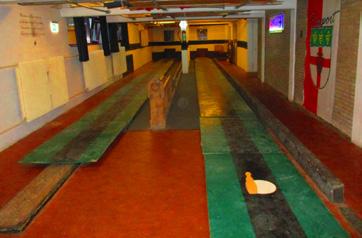
The WVSV women also needed to find a clubhouse after the war due to rising numbers. On 27 November 1947, the women’s club opened at what is now Niemijerstraat 35. Member numbers continued to rise and further extensions were required to the premises. ‘A new dining room, a billiard room and party basement Nolleke Prop were added in 1961 and 1962,’ says Ruegg. They also acquired an old bowling alley from the Junushoff for the symbolic amount of one guilder. The Junushoff felt the bowling alley was not appropriate for a theatre. Tradition has it
‘In 1944, the clubhouse was briefly turned into an emergency hospital’
The bowling alley Photo Pim van Tend
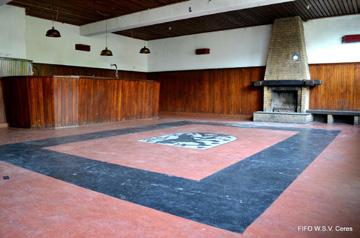
The gentlemen’s clubroom in Villa Veluvia Photo Fifo
that the bowling alley was built and installed by Gustav Kaupe in 1883; he owned a butcher’s shop in Wageningen and a café, where Ceres members used to meet from 1884 to 1886. That would make it the oldest bowling alley in the Benelux. From 1962, the Ceres bowling association (the Omsmijters, founded in 1895) were therefore able to go bowling in the basement of their own clubhouse. WVSV was also growing substantially, reaching about 200 members in 1960. The Niemijerstraat premises were extended.
Love and marriage
The relationship between WSC and WVSV intensified over the years. They had joint first-year parties and joint special-interest associations. The strict separation of the sexes in men-only or women-only societies was also starting to feel old-fashioned. When the municipality told WVSV it would have to vacate its clubhouse because of plans for new housing, a working group was set up to see whether WSC and WVSV could ‘cohabit’ in the Ceres clubhouse.
The two societies merged on 15 August 1970 to form Wageningse Studenten Vereniging (WSV) Ceres. There was supposed to be a trial period of four years in which the merger could be reversed, but it all went so well that they decided to make the merger permanent in 1971.
‘Our front garden has two trees of historical significance,’ says Ruegg. ‘We planted the chestnut tree when the clubhouse opened in 1926. The magnolia was planted to celebrate the merger in 1970. The trees symbolize how long we have been in this building and how the society has grown.’
Fire
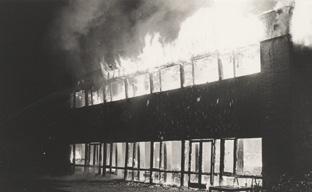
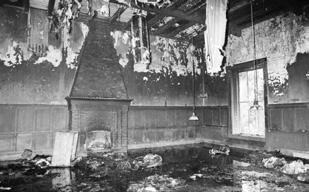
On Saturday 10 May 1980, a short circuit caused a devastating fire. Over 20 fire officers doused the entire building in 20,000 litres of water. The dining room and conservatory were ruined beyond repair. The next day, members turned up en masse to help restrict the damage caused by the water.
‘I find this one of the most impressive stories,’ says Ruegg. ‘It is precisely when times are hard or when
‘The magnolia was planted to celebrate the merger with the women’s society in 1970’
disaster strikes, like this awful fire, that members bond together.’ It was no longer possible to cook meals in the clubhouse. ‘So our members cooked food at home and brought it to the clubhouse to continue the ritual of eating together.’
The years following the fire were all about rebuilding the place. ‘Lots of members helped out.’ The clubhouse reopened in 1982.
Like the old days
The 1990s were a tough time for the Agricultural University. Falling student numbers affected the societies too. ‘Lots of roles and committees were scrapped then.’
In 2003, the canteen was abolished too. ‘There weren’t enough members to keep it going.’
But the university got a new lease of life. Student numbers increased again to reach a peak of 13,450 students in the academic year 2021-22. In that year — still in the Covid period — 165 new students joined Ceres.
The pandemic had a huge impact on life at the Ceres clubhouse, with facemasks, maximum visitor numbers and a minimum distance of 1.5 metres. Most of the Covid restrictions were lifted on 25 February 2022.
‘After two years of Covid, we will once again be experiencing the society of old,’ said then chair Sil Penders.
‘I can hardly believe it.’
Now there are worries once again about falling student numbers. The society’s history offers hope, though, says Ruegg. ‘Like Wageningen, the university and student life, we too will continue to adapt to the evolving situation.’ ■
The fire destroyed the conservatory and dining room Photo Cord Otting
The fire on 10 May 1980 was caused by a short circuit Photo Cord Otting
Party for the Animals pioneer Xenia Minnaert gets seat on council
‘WE WON’T MINCE WORDS’
Resilient Farming & Food Systems Master’s student Xenia Minnaert (26) founded the Wageningen branch of the Party for the Animals (Partij voor de Dieren in Dutch), which now has two seats on the municipal council. She talks about campaigning, persuading people, death threats and justice. ‘Our voice is needed.’
Minnaert joined PINK!, the Party for the Animals youth section, when she was aged 19. Later, she worked as a support officer for the Utrecht branch, focusing on housing and diversity & inclusion, among other things. ‘I worked on a just and fair policy on squats and gave input for the nature-inclusive development of an area adjoining a garden centre.’
Minnaert did a Bachelor’s degree in Biology, Nutrition & Health at Aeres University of Applied Sciences in Almere. That included a minor in Wageningen. ‘I loved it here and stayed for my internship and Bachelor’s thesis. Later, I started my Master’s here.’
She put her political ambitions to one side, but soon felt the urge to get involved again. ‘I want to make the world a better place and I thought it was weird that Wageningen didn’t yet have a Party for the Animals branch. So last year I took the initiative to set up a local branch.’
Why should Wageningen have a Party for the Animals branch?
‘We’re a party that wants radical equality and takes a holistic approach to the rela-
tionship between humans and animals and nature. A lot of people in Wageningen can relate to that. Our party belongs in Wageningen. The election results show that people want our voice to be heard: our party came fourth in terms of votes and we have two seats on the council. It’s great that I can take on this role together with Jenna (Forest & Nature Conservation Master’s student Jenna van Vulpen, ed.).’
Is it true you will be in the opposition?
‘That looks likely at the moment. In the exploratory discussions, we said we’d be willing to join the coalition but the person managing the process recommended having PRO (what used to be GreenLeft and the Labour Party) talk to the City Party about forming a coalition first. That partnership isn’t what we would prefer. Whatever happens, we are an energetic party with stamina. Even if we end up in the opposition, we’ll do everything we can to make Wageningen climate-neutral sooner, protect nature better and give animals a better position in our municipality.’
Text Luuk Zegers
How did you find the campaign?
‘It was a lovely period. You spend every day on your ideals and you work with an amazing group of people who share your vision. Every week, we had a stall at the market and we had discussions with people you wouldn’t normally end up talking to. You can persuade some of them of your views, others don’t agree with you, and that’s fine. Getting involved in local politics makes you much more aware of the community and gives you a different picture of the town.
‘It was also a very intense period. You’re always busy. It was a real rollercoaster experience.’
You campaigned to stop angling. That led to death threats.
‘Our guiding principle is that we want animals to suffer less. Everyone is opposed to animal suffering, but people also see angling as normal. We want to challenge that viewpoint.
‘There are a lot of things we used to think normal but don’t any more. Smoking, for example, used to be allowed indoors but not these days. People might
find it hard to get used to, especially if it’s something they enjoy doing. A certain amount of friction is OK. We had some really good discussions with people at the market, including anglers who also don’t want animals to suffer. You look each other in the eye and you have a proper talk. Then De Gelderlander posted a news item about our protest and shared it on Facebook, which led to a lot of impassioned comments.’
Someone said you should get 100 grams of lead in the back of your head and another person suggested the Party for the Animals hunting season had started. How does that affect you?
‘I’m pretty used to hateful comments. Facebook doesn’t bring out the best in people. I know it’s part of the deal and it
says more about the other person than me. I don’t think they are necessarily mean or bad people. I do think they might feel their views are ignored and they then use Facebook to vent their anger, forgetting that they’re talking about real people.
‘At the same time, I’m aware of how vulnerable I am as a person and a politician. You only need one person who genuinely wants to do harm. So after consulting the mayor, we called in the police. It seems as if hate speech and threats on the internet are almost accepted as normal, especially where female politicians are concerned. But this isn’t normal and we need speak out against it.’
‘THREATS SEEM ALMOST NORMAL, ESPECIALLY WHERE FEMALE POLITICIANS ARE CONCERNED’
How will you combine your council duties with your studies?
‘It will be a balancing act. I hope to finish my degree in 18 months’ time. But it’s OK if it takes longer. I don’t want it to be at the expense of my mental or physical wellbeing.’
What would make your time on the council a success, in your eyes?
‘If we take steps in tackling the climate crisis and always choose justice for humans and animals. The town could also benefit from less brick and more greenery. We are an activist party, so we won’t mince our words and will raise issues that other parties might find uncomfortable, such as justice for Palestine and the role of large companies in Wageningen. We also want an end to animal experiments.
‘Over the next four years, we plan to go to local neighbourhoods and get talking to people who don’t really trust us. Not to change their views but so we can listen to one another. Hopefully that will lead to more mutual understanding.’ ■
Xenia Minnaert: ‘The election results show that people want our voice to be heard: our party came fourth in terms of votes and we have two seats on the council.’
Photo Ruben Eshuis
Students should be capable of promoting D&I: YES/NO
In recent months, Resource has seen a debate among lecturers about the BSc learning skill that requires students to be ‘ready to promote social equality and respect for diversity’ by the time they finish their degree (see inset). How do students themselves feel about this? Text Philip Timmers Illustration Shutterstock
Dick de Ridder Dean of Education
‘The Diversity & Inclusivity skill is indeed value-related and is aligned with WUR’s values. We want WUR to offer all students and staff an environment in which these values take pride of place. We therefore ask students to behave in accordance with these values while at university, even if they don’t subscribe to them fully.
‘Incidentally, not all teachers need to be involved in teaching all skills. The skill may not be relevant in their subject or be taught elsewhere, or they may not feel competent to teach a certain skill. If a teacher genuinely disagrees with a certain educational task, that task can be transferred to colleagues, after consultations.
‘It is up to the degree programme organizers to decide whether to assess the skills, and if so how and at what level. If value-related skills are assessed, it will be mainly about learning from them rather than judging them, for example as part of the reflection on group work.’
Merel
(23)*
Environmental Sciences Master’s student
‘I don’t think you should judge people on how diverse or inclusive they are, but I do think it’s valuable and educational to get students from different ethnic and cultural backgrounds working together to arrive at new understandings. It’s very important to promote diversity and inclusion, but quantifying this learning objective is really hard. If you assess it, you give students an incentive to fake diversity rather than embracing it, just to get a higher grade.’
Federico Clemente (25)
Biobased Sciences Master’s student
‘For me, it is important for WUR to be a diverse and inclusive place. But I don’t think that D&I should be part of the learning goals of a course. I get the point that a diverse group of students is more effective, but it is not something that can be tested on Bachelor students. These values are to a certain extent intrinsic. They can be taught, but I don’t think it is something you can get tested on.
‘For me, it is also not clearly defined what is meant by D&I. I think that if you take D&I to extremes, that inclusivity can be an excuse to be tolerant of all opinions, and that gives people the opportunity to do whatever they want. The problem with this is that my freedom ends where your freedom starts.’
Students should be ‘ready to promote social equality and respect for diversity’ after graduating, according to the new WUR policy document BSc Skills Learning Outcomes. A debate started in Resource about this Diversity & Inclusion skill. Maths lecturer Hans van den Heuvel argued that D&I is a normative policy framework and therefore a political aspect: ‘Including D&I as a skill impedes students’ freedom to form their own political opinions independently and is incompatible with academic freedom. Stop politicizing education.’ This prompted a response from a group of teachers headed by Ben Auxier, assistant professor in the Laboratory of Genetics. They argue that universities cannot be separated from values. ‘Nearly every course and study programme reflects normative commitments such as scientific integrity, non-discrimination and public responsibility. Recognizing diversity and inclusion as a skill therefore does not introduce politics into education; it is only an additional component of how we situate students in the society in which science operates.’
Thijs (23)*
Earth System Sciences Master’s student
‘There is a big difference between D&I as a value and as an instrument. That is why people often talk at cross purposes. Van den Heuvel sees D&I as a value and thinks it’s odd to impose a value on students. Auxier sees D&I more as an instrument that bolsters science. I have no doubt the latter aspect is a positive thing. But I do have my doubts about WUR imposing diversity as a value on students; it’s also good for students to form their own opinions.
‘I read an earlier version of the policy document on BSc skills and the way it came across to me was that it seemed to expect students to promote D&I actively. D&I is presented as a value there and I do agree with that value, but I can understand academics thinking you shouldn’t be imposing values on students given the need for objectivity in science.’
Caleb Turner (20) Soil, Water, Atmosphere
Bachelor’s student and chair of the Sustainability & Integration Student Council party
‘I think that diversity and inclusivity are incredibly important in academia. I also agree WUR needs to teach students to think for themselves, rather than what to think. However, diversity and inclusion encourages students to think critically and actually doesn’t teach them what to think. Diversity and inclusivity is a baseline for academia, and it increases the students’ ability to think critically, because they have to deal with different perspectives.
‘I don’t fully understand the meaning of the BSc Skill in this document; however I would be in favour of D&I becoming one if it entails inclusive classrooms and the teaching of diverse perspectives.’
Liza Mientjes & Maarle Bolder (both 20)
International Development Studies Bachelor’s students
‘We think you shouldn’t force students to hold a certain opinion, but this issue is so important that we feel it should be documented in the BSc Skills Learning Outcomes. Objectivity is virtually impossible, even in science. Most subjects and study programmes reflect certain norms and values, which isn’t really being objective. We definitely see the importance of this D&I skill. It’s similar to the debate about freedom of speech versus racism.
‘However, our experience in our study programme is that it’s more of a guideline than a strict requirement. If WUR started assessing whether students were doing enough to promote D&I, that would be going too far.’
* Name known to the editors
A century of Entomology
The Entomology chair group was founded 100 years ago. Its centenary will be celebrated over the next month with exhibitions, an art market, talks, a reunion and a nature film. We asked emeritus professor Marcel Dicke to give five highlights from a century of Entomology in Wageningen. Text Roelof Kleis
Malaria
Any list of Entomology highlights will have to include the malaria research of Professor Willem Takken. ‘He wanted to understand how malaria mosquitoes find humans and whether we can use that information to combat malaria,’ explains Dicke. ‘He did a lot of research on why mosquitoes go for some people and not others.’ The keys to that are sweat and CO2. The research resulted in a mix of aromas that mosquitoes find attractive and that was added to traps. In a proof-of-principle trial of this pesticide-free method for combating malaria, traps were set up on the Kenyan island of Rusinga (in Lake Victoria). ‘Each of the 4,300 homes on the island got a trap, a ventilator and a solar panel.’ The results made the news worldwide ten years ago. The mosquito population fell by an impressive 70 per cent and the number of new malaria cases dropped by 30 per cent. ‘It shows that if you understand an insect’s biology, you can look for its Achilles heel. Of course, this hasn’t eradicated malaria, but it proves there are good alternatives to pesticides.’
Biological pest control
Alternatives to pesticides are a recurring theme in entomology research at Wageningen. Professor Jan de Wilde introduced that approach in the 1950s. Dicke: ‘He realized that large-scale use of pesticides would cause huge ecological problems. He wanted to develop systems that didn’t rule out pesticides but did see them as the last option. That meant understanding the interactions between pests, the plants they feed on and their natural enemies so that you can take measures, for example by applying biological pest control or adjusting cultivation methods. That work was continued by his successor Joop van Lenteren and expanded during my time.’ Dicke himself made his reputation with his research on the chemical communication between plants and insects. As a PhD candidate, he showed that plants plagued by the red spider mite deliberately secrete aromas that attract predatory mites, which then eat the red spider mites. Dicke received a Spinoza award (WUR’s first) for his research on the interaction between plants, pests and their natural enemies. According to Dicke, an understanding of ecological relationships in nature is at the basis of everything. ‘It all starts with fundamental research. Applications develop later. De Wilde started this approach, which later became known as the Wageningen Approach. Once you have a solid basis of fundamental knowledge, you know what will happen when you make adjustments.’
City of Insects
Everyone has an opinion about insects. That was evident from the City of Insects festival that took over Wageningen in September 2006. This one-off festival attracted 20,000 visitors and made Dicke a known name around the world. It won the Entomology group the Annual Academic Prize for introducing pioneering scientific research to the general public. ‘We’d just published some articles in Science and Nature, and Arnold van Huis (see the Yum, insects section) was getting attention for his work on insects as food. To close the festival, we made an attempt to set the world record for eating insects, with as many people as possible eating insects simultaneously in the same place. The Guinness Book of Records wasn’t interested though, as they said it couldn’t be checked. Nonsense. But it didn’t matter. Images of that event found their way everywhere via Reuters. We got messages from our students all over the world saying we were on their prime-time TV.’
Small brains
Yum, insects
You can eat insects. Some, at any rate. Insect protein can be produced more sustainably than meat protein. Professor Arnold van Huis became famous internationally for his FAO study Edible Insects, Future Prospects for Food and Feed Security (2013), the WUR report with by far the greatest reach at more than seven million downloads. Van Huis was also the man behind the Insect Cookbook. ‘We presented the first copy to Queen Máxima, paid a visit to the then UN secretary-general Kofi Annan and I was invited to talk about it at TED Global,’ says Dicke. ‘Things moved quickly and now there is a whole industry. Dozens of groups within WUR are working on insects.’
Are insects smart? That is a point for discussion. They definitely have brains. Not large ones, but they do have a capacity to learn. Research on parasitic wasps shows that the ability to learn remains, no matter how small the wasps are. ‘We don’t know how they continue to learn.’ Research on insects’ brains could shed light on how our own brains work, even though ours are much more complex. ‘The basic processes are the same.’ He immediately turns to the topic of pesticides. ‘Most pesticides affect insects’ brains. When you realize that some of those substances are now also being found in human brains, why is nobody sounding the alarm?’
Limelight
Photographer and filmmaker Hans Smid normally makes short videos to accompany scientific articles and practicals. He spent years studying parasitic wasps, insects that lay their eggs inside caterpillars. In his first full-length documentary RUPS, largely filmed in his own living room, the caterpillar takes centre stage. ‘I suddenly thought I should turn it around and tell the story from the point of view of the prey, not the predator.’ Text Coretta Jongeling
Caterpillar hits the big screen
The prey has quite a hard time of it, a drama that most gardeners are completely unaware of. The film starts with the cabbage white butterfly laying its eggs specifically on cabbage plants. The caterpillar then uses the plant’s toxins as a weapon to protect it from birds that like to eat caterpillars. There are other dangers too. Parasitic wasps lay their eggs in the caterpillar’s blood. The eggs hatch into larvae that crawl out of the caterpillar while it is still alive, even manipulating the host’s behaviour to get it to protect the larvae against hyperparasites. That all happens even before the caterpillar undergoes metamorphosis and turns into a butterfly.
It is almost impossible to film this in nature, so Smid shot nearly all the footage in his own home. ‘You need to be ready at the right moment, when the parasitic wasp larva emerges from the egg, for example. You might think you could set the camera going with the light on and come back later, but that doesn’t work. Parasitic wasps don’t like the light, so they emerge from the opposite side. You need a lot of patience, but I have filmed things even fellow entomologists didn’t know.’ Smid hopes the film will generate a bit more affection for caterpillars. ‘Everyone loves butterflies, but nobody thinks of
WED
29-04-26
Visum Mundi 20:00
Tickets 11 euros
the caterpillars. It’s bizarre how people plant flowers in their garden to attract butterflies, but then get rid of the weeds that the caterpillars need. We can’t pick and choose which creatures we want and which we don’t, because they are all interconnected.’
The film will premiere during the week celebrating the Entomology centenary. Smid will be at the screening for a Q&A session. The film is narrated in Dutch by Louise Vet, professor of Ecology and former director of the Netherlands Institute of Ecology; it has English subtitles.
To buy tickets, go to the Visum Mundi website:
TIPS
Saturday 25 April
Revenge of the Synth (Star Wars/electro/rock) Astrant Ede
Friday 1 and Saturday 2 May Makers Market (creative workshops, market) NuDeToekomst
Wednesday 20 May
Brouw House Jams
Artist not yet confirmed Stadsbrouwerij
Every year, about 3,500 students get their Bachelor’s or Master’s degree from Wageningen. In Thesis Life, they talk about this particular milestone — the content and the ups and downs. This time, it is Resilient Farming & Food Systems Master’s student Iacopo Bernava. Text Eva Hamers
Your thesis in 40 words?
‘I investigated the potential carbon sequestration through afforestation in the Netherlands if a switch in diet made more land available for this. I researched the link between land availability and diet, comparing a flexitarian, vegan and baseline (average Dutch) diets.’
Why this topic?
‘For mitigating climate change, it is extremely important to switch to a plant-based diet. No other simple lifestyle change (such as stopping daily use of the car) has as big an impact as this.’
What was most difficult?
‘I didn’t have much experience with fieldwork. Setting up my own research project was hard, and the literature research took a lot of time. After I had finally defined the methodology, it went better. I had to work flat out in the final month, even though I had mentally had enough of the thesis. After submitting it, I went for a walk in the forest to relax and I started to cry out of mental exhaustion.’
Any tips for other thesis students?
‘Don't think that what you’re doing is insignificant or stupid. Trust yourself and your capabilities. You have learned a lot already. So don’t overestimate it; that was very valuable advice for me. Students tend to get overwhelmed by the idea of writing a thesis.’
What did you learn from writing your thesis?
‘Because our food comes from all over the world, it is almost impossible to trace the land used for the diet of one Dutch person. Also, a change in diet in the Netherlands does not necessarily mean less land use in the Netherlands. I also have doubts whether largescale afforestation in the Netherlands would be a great mitigation measure. The Netherlands has a lot of fertile agricultural land, so it could be better to stop the import of crops, and export crops to places with biodiverse forests or lower crop yields, to reduce the land use there.’
You find all the flavours of the world in Wageningen. Resilient Farming & Food Systems Master’s student Zofia Świątkowska, from Poland, shares a recipe for blueberry cake.
Flavours of WUR
Tort jagodowy – Blueberry cake (vegan)
‘My grandma is an amazing cook. Every year during blueberry season, she would make delicious cakes. Is this recipe from my grandma? Not really, but it is the vegan version of the cake I remember from my childhood. It is easy to make, looks beautiful, and tastes like summer and celebrations. It also makes a great birthday cake!’
1 Preheat the oven to 180°C.
2 Line a cake tin (20cm diameter) with baking paper or grease it.
3 In a large bowl, mix all the dry ingredients together.
4 In a separate bowl, mix all the liquid ingredients together.
5 Add the liquid ingredients to the dry ingredients and mix with a spatula.
6 Transfer the cake batter to the cake tin and bake for 30-40 minutes.
7 Leave to cool.
8 Blend the (defrosted) blueberries.
9 Put the blended blueberries in a pan with the sugar and cornflour. Boil for a couple of minutes until it thickens.
10 Let it cool completely.
11 Whisk the blueberry puree with the cream cheese and icing sugar.
The cake
1 Make sure the cake is at room temperature or colder!
2 Cut the cake into two horizontally.
Ingredients (for 8 portions):
• 220g white flour
• 150g white sugar
• 1.5 tsp baking soda
• Pinch of salt
• Pinch of cinnamon (optional)
• Pinch of cardamom (optional)
Liquid ingredients:
• 240ml soy or oat milk
• 80ml oil
• 1 tsp vanilla extract
• 1.5 tbsp white vinegar
Blueberry cream:
• 200g blueberries (fresh or frozen)
• 1 tbsp sugar
• 2 tsp cornflour
• 150g vegan cream cheese
• 30g icing sugar
3 Spread half of the cream on the bottom layer, put back the top layer and spread the remaining cream on top.
4 Make it pretty! Decorate it with fresh blueberries, mint leaves or edible flowers.
Zofia Świątkowska Resilient Farming and Food Systems Master's student
Meanwhile in… Hungary – Orbán voted out
WUR is incredibly diverse, with hundreds of internationals working and studying here. In the Meanwhile In column, we ask one of them to comment on events in their home country. This time, Bioinformatics Master’s student Szonja Lippert (25) shares her views on the elections in Hungary on 12 April.
Text Philip Timmers
‘For the first time in 16 years, the opposition has won the national elections. Together with four other Hungarians from Wageningen, I travelled to The Hague on Sunday 12 April to vote at the Hungarian embassy. Normally, the Hungarians living abroad don’t have such a high turnout; however, this time the turnout was way higher than usual since so much depended on these elections. The Hague even had one of the highest turnouts internationally. That is also why we had to wake up at 6 am to make sure that we would be among the first people in the queue.
‘I would love for people to see Hungary as more than the horrible politics’
‘The politics in Hungary really have divided the country. Because most of the main news platforms, such as the TV and
newspapers, are controlled by Orbán’s party and much of what they publish is propaganda in favour of Orbán, many of the people who rely on those sources will vote for Orbán. This often leads to polarization within families, since older people tend to be reliant on these sources, while younger people find ways around them.
‘Within my own family, you can see the same. My parents and I left Hungary 13 years ago because of the worsening political situation — like many other Hungarians. However, my grandparents still live there and they support Orbán. When politics comes up at the dinner table, it is not a pleasant conversation, so we often avoid the topic or when we do talk about it, it feels like we are talking at cross purposes. They watch a lot of propaganda and at their old age it is hard to change their minds.
‘I hope in the future we can look back on this small positive revolution and see it changed people's image of Hungary in a positive way. I would love for people to see Hungary as more than the horrible politics, because the country is so much more than that.’
Advert
WEEKLY UPDATES ON STUDENT LIFE AND WORKING AT WUR?
Go to resource-online.nl
(Subscription page) and subscribe to our digital newsletter.
SIGN UP
WUR from within: straight, sharp, transparent
Colophon
Resource is the independent medium for students and staff at Wageningen University & Research. Resource reports and interprets the news and gives the context. New articles are posted daily on resource-online.nl. The magazine is published once a month on a Thursday.
Contact Questions and comments for the editors: resource@wur.nl | resource-online.nl
Editorial staff Willem Andrée (editor-in-chief), Helene Seevinck (managing editor), Roelof Kleis (editor), Luuk Zegers (editor), Marieke Enter (editor), Coretta Jongeling (online coordinator), Dominique Vrouwenvelder (editor).
Translations Tessera Translations S.L.
Design Alfred Heikamp, Larissa Mulder
Overall design Marinka Reuten
Cover illustration Valerie Geelen
Printing Damen Drukkers BV, Werkendam
Subscription A subscription to the magazine for one academic year costs 59 euros (135 euros if abroad). Cancellations before 1 August.
ISSN 1874-3625
Publisher Corporate Communications & Marketing, Wageningen University & Research
BOARD MEETINGS NOW OUTDOORS
It isn’t only education at WUR that is looking outwards, the Executive Board is following suit. Outdoor Governance is the name of the project initiated by Houkje Sjeimovaara, Caroline Cruise and Peter Poenema.
As of next Tuesday, the Board will be holding its meetings outdoors, in amongst the Dancing Cauldrons next to Atlas. Everyone is welcome to come along. The Board hopes this project will fire up WUR’s much-vaunted but as yet unrealized goal of openness and transparency. Sjeimovaara says this will be a breath of fresh air that will take the Board to the next level. ‘If you are going to take nature-based decisions, outdoors is the logical place.’
The Board’s nature-inclusive meetings also key into the Outdoor Classroom initiative, which started this month.
Three spots on campus have been designated as outdoor classrooms. A location in amongst the Cauldrons was selected for the Outdoor Governance project. The steel structures form a natural sounding board and will help the message resonate even with lots of noisy spectators.
Outdoor Classroom activist Louise van der Stok is delighted to see this follow-up to her own initiative. ‘Loads of studies show people relax when they’re outdoors in nature. Stress levels plummet and it becomes easier to focus on what is truly important.’ She points to the positive effect of
sunlight on your mood and on vitamin D and C levels.
The pilot project with outdoor meetings will continue until the summer holidays. Regardless of the weather, confirms the Executive Board spokesperson. ‘There is no such thing as bad weather, only bad clothes choices.’ The Executive Board hopes that other groups will adopt this new approach for their meetings, such as the WUR Council, the Student Council and the programme directors.
The carillon will be used to announce the Board’s outdoor meetings. A quarter of an hour before the meeting starts, it will chime the tune of the nursery rhyme ‘Girls and boys come out to play’. ‘That was my idea,’ Poenema adds proudly. ‘We have been practising it internally both as a canon and a capella. Houkje starts, Caroline does the second part and I do the bass.’
If you too want to join in the singing, here is the text (slightly modified for the WUR context):
Girls and boys come out to play, Lumen is shining bright as day, Leave your lab and leave your sleep, and come with your colleagues into the street.