No 02
WUR from within: straight, sharp, transparent
OCTOBER ❷⓿❷❻ VOLUME ❷❶
Investigation into fake references
NEW IST: MN COLU gala Man as Sriniv p.11
EN
1128 students vote for TOTY longlist
The journalism magazine for all at Wageningen University & Research
Letter to the editor: ‘Stand united’
Supervisory Board ‘not transparent’
Babies’ guts in the lab
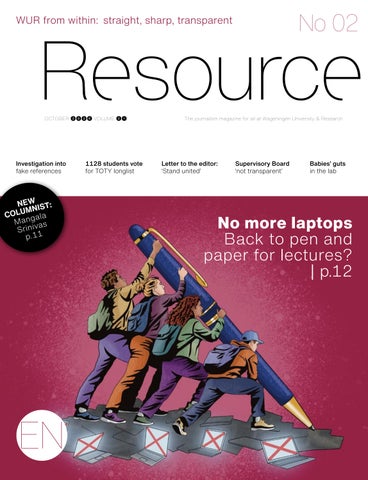
No more laptops Back to pen and paper for lectures? | p.12
Contents
FOREWORD
NO ❷ VOLUME ❷❶
14
Aircraft to nibble on
20
Bettina Bock on the farmers’ protests
24
Hear the plant calling!
5 Turnitin wants to train AI on students’ work 6 Food tech under one roof 8 Live & Learn: ‘Quite embarrassing’
33 Thesis life: herbivores in French woods 34 Meanwhile in Spain: Maricarmen as housing crisis symbol Read the latest news and background stories at resource-online.nl
Interpreting Searching for the truth based on facts, being independent, balanced and transparent — put like that, our work is not particularly different to what researchers do every day. This time, for example, we have the report by our editor Luuk Zegers on the overhaul of the Bachelor’s programmes, the revamp of the degree portfolio. When that portfolio analysis landed on our desk, we read it and formulated questions. Then we interviewed people. Seven people involved in the process are quoted in this article (page 26). It is an informative report that interprets what is going on and identifies concerns. Similar concerns also aired in the new Q&Council feature, which also wonders what consequences merging degrees will have for the study associations and whether WUR has thought about this (page 34). Our job is to keep a close eye on the world around us. For example, what do students and lecturers think of the University of Amsterdam’s plan to ban laptops, phones and tablets in certain lectures (page 12)? Their responses make you think. Now the recently published AI implementation strategy and the Executive Board’s plan for tackling fake references have landed on our desk. Once again, we will read them, interview people and interpret what is going on. To be continued.
Willem Andrée Editor-in-chief
SOIL DRILLING The annual Soil-drilling Championship took place on the evening of Wednesday 7 October on Haarweg. The theme this year was Drill House Rock. In addition to the drilling competition and the creative costumes, there were performances by local bands such as the Waga Collective (whose oeuvre includes the song Grondboor Drillrap). lz Photo Maren Heikamp
NEWS
MPs question nitrogen symposium cancellation The Royal Netherlands Society of Engineers (KIVI) cancelled the symposium on nitrogen and nature policy due to take place on 13 October. Apparently, this was partly because WUR President and KIVI member Sjoukje Heimovaara had expressed doubts. The symposium, entitled ‘From Habitats Directive to targeted nature management’, was an initiative of former WUR researcher Henri Prins. The speakers included Wim de Vries, Han van Dobben and Wouter de Heij. After current affairs platform Wynia’s Week reported on the role played by Heimovaara, MPs Mona Keijzer (independent) and Peter van Duijvenvoorde (FvD) submitted Parliamentary questions about the ‘possible interference’ by the WUR President. A WUR spokesperson confirms that Heimovaara voiced reservations but stresses that she did not ask for the event to be cancelled. ‘She was acting not as WUR President but as a KIVI member. She thinks it is important that what happens in KIVI’s name is trustworthy.’ According to the spokesperson, Heimovaara had not expected the symposium to be cancelled. ‘And that was certainly not her intention.’ After internal deliberations, KIVI decided ‘independently’ not to go ahead with the symposium, explains the spokesperson. ‘That was because the event setup would lead to a one-sided perspective on a complex issue. There were no safeguards for a sound scientific debate at this symposium.’
Resource
15•10•2026 PAGE 4
Uncomfortable
Nitrogen researcher Wim de Vries, who was scheduled to talk about the consequences of nitrogen deposition, finds the cancellation and Parliamentary questions ‘very unfortunate’. ‘You feel as if you are being pushed into a certain faction. That feels uncomfortable.’ He calls the cancellation ‘going a bit far’. ‘Over the past 40 years, I have always kept a dialogue going with people who take a different view of the problem. I think it’s an admission of weakness if you get a chance to give your account and you then say no. There’s no point talking to people who are in denial, but I didn’t feel that was the case here.’ According to De Vries, Prins had done his best to let ecologists speak too. ‘If both sides get a chance to say their bit and you get a candid discussion, that should be allowed.’ wa
Gift of hundreds of drawings Hundreds of pen-and-ink drawings by the botanical artist Mariet de Geus have been donated to the Library’s Special Collections. She presented the drawings during the official opening of an exhibition of her work, Mariet de Geus, Drawn with Passion, in Impulse. De Geus (92) worked at WUR from 1970 to 1985. The drawings are the originals that were used in a reference work on deciduous trees by D.E Boeijink and B. Schalk (see also p. 30). rk
First proposals announced for new degrees The first proposals have been announced for new BSc degrees in the effort to reduce the 21 Bachelor’s programmes to between 12 and 16 by 2030. The plan for the new BSc with the working title Behaviour, Economics & Business involves merging the current programmes for Economics & Policy and Business and Consumer Studies plus elements of Communication & Life Sciences. The other new BSc, Planetary Change & Development, is based on International Development Studies and Tourism, again with elements from Communication & Life Sciences. The aim is for the two new degrees to start in September 2028. There was no room for the Health & Society degree in the proposals in this round, even though that was the original intention. It will now be considered in the Food Nutrition & Health subset. The Communication & Life Sciences degree will become a new minor in Communications. lz Read more on page 26
TOTY nominees announced The Teacher of the Year (TOTY) longlist has been announced. In July, 1128 students voted for their favourite teacher. A student jury will now interview the nine teachers on the longlist and select the top five candidates. That shortlist is expected to be published in November. The eventual winner will be announced in Orion on Tuesday 8 December — Teachers’ Day. lz The longlist (in alphabetical order of first names) is Carlos Serrano Fajardo, Hannie van der Honing, Jan den Ouden, Julia Diederen, Nicolo Alvisi, Nina Fatouros, Roel Dijksma, Tijs Ketelaar, Wim Bosschaart.
lz
Investigation into fake references Dean of Research Edith Feskens has announced an investigation into fake references in papers by WUR researchers. Fake references are when scientific articles refer to non-existent studies and/or scientists who don’t exist. They are mainly due to shoddy use of AI. The investigation was prompted by an article in the weekly magazine De Groene Amsterdammer about this phenomenon, in which WUR headed the list of ‘culprits’. According to Feskens, the ‘I don’t think investigation it’s deliberate; will be limitit’s people ed in scope being naïve’ and is mainly about getting a better picture of the phenomenon. She stresses that it is not about naming and shaming individual scientists. ‘We want to get a better understanding of how severe the situation is: how often it happens and whether it is most common among certain groups of researchers, certain nationalities or certain disciplines.’
To undo the damage caused by ‘contaminated’ papers, one option is ‘to ask everyone to check the papers they have published in recent years,’ says Dean of Research Edith Feskens. Photo Shutterstock
Feskens assumes that the main reason for the fake references is naïve use of AI. ‘I don’t think it’s deliberate; it’s people being naïve. Even so, it’s a violation of the academic code, which says you need to be meticulous when referencing other people’s work. So we will definitely be talking to scientists who do it. We want to point out to them that they have done something that is not allowed and they should make sure they don’t do it again.’ The approach that will be taken to identify
cases of fake references is not yet clear. The details will be determined in consultation with information specialists from the Library. In addition to this investigation, they will be considering the best way of undoing the damage caused by ‘contaminated papers’. ‘One option is to ask everyone to check the papers they have published in recent years. If any references are fake, they can then amend them or withdraw the article.’ rk
15•10•2026 PAGE 5
At the start of October, the Student Council handed out an estimated 120 cookies in Forum as part of their new Cookie for your Thought event. The council members wanted students to know where they can turn to with any questions, worries or problems. There were a few cookies left after the event, but it is not known what happened to them.
Turnitin, the plagiarism detection application used by WUR, wants to improve the performance of its AI detection software by using students’ work as training material. The plan comes from the company’s American branch, says André Groenewoud, who is responsible for the online learning environment at WUR’s Teaching & Learning Centre. ‘Turnitin Europe was not consulted beforehand. The plan caused so much commotion that the intended amendment to the user agreement in Europe has now been postponed until 1 September 2027. Incidentally, WUR does not permit the use of student data without our explicit consent. We need to take a decision internally first on whether to allow that.’ A new tendering process has started this year for plagiarism detection. WUR is including explicit requirements on AI in the specifications, says Groenewoud. lz
Resource
120
Turnitin wants to train AI detection model on students’ work
NEWS
Letter to the editor
‘We jointly call for respect on campus’
D
ear fellow WUR folk, On Thursday 1 October, a large group of us decided to leave our desks, interrupt our lunch breaks and stand together to send a clear message that you are safe and welcome here, whoever you are. The reason was less positive: a group had gathered in the Campus Plaza who were not welcome there. A group of men had come to demonstrate against women’s right to self-determination and were spreading disinformation about abortion. What is more, they started homophobic chants. We won’t accept this in Wageningen. That’s why we stood there in large numbers making lots of noise. We put up spirited and determined opposition to a group who want to restrict the rights of women — and the LGBTQIA+ community — and gave a show of support for everyone who felt unsafe with this group on campus. Now, we want to thank the townspeople, staff and students who turned up to join us. Our campus should be a safe and accessible place regardless of your gender or background or who you love. By standing there, with or without a placard, silent or shouting, you all showed how impor-
Advertisment
MCB-34303: Commodity Futures & Options Markets
Resource
15•10•2026 PAGE 6
Always wondered about what is happening at the trading floor of exchanges like the ones in Amsterdam, Paris, Frankfurt, London and Chicago? Wondered about how (agribusiness) companies manage their risks and improve their financial performance using commodity futures and options markets? Wondered about how it would be if you were trading commodity futures in Amsterdam, Chicago, London, Frankfurt and Paris? The Marketing & Consumer Behavior Group organizes a unique course that will introduce students to commodity futures and options markets. Students will develop an understanding of the markets and how they work, gain knowledge about the theory behind futures and options markets, identify their economic functions, and develop an analytical capability to evaluate their economic usefulness. This course is taught by Prof. dr ir Joost M.E. Pennings (Marketing & Consumer Behavior Group, Wageningen University). There are only 40 seats available. If you are interested in taking this course (3 Credits) please register in Osiris or contact Ellen Vossen, e-mail: Ellen.Vossen@wur.nl, tel. 0317-483385. Lectures are on Fridays in period 5 (one lecture is on Thursday), 0.5 day a week, please check schedule in TimeEdit for time and location. Prerequisites: None.
tant we find this, here in Wageningen. We now call upon you to continue standing up for people’s rights. Don’t let yourself be swayed by the movement to restrict human rights. The rights we enjoy now are not a given, and equality is not achieved without effort. Let’s continue to treat women, LGBTQIA+ people, refugees and people of colour with respect. Let’s speak out when we see discrimination and hate, and take action together for a respectful society. Let us stand united, supporting one another and not yielding. Unwanted or unintended pregnancy? You can find independent information at fiom.nl With love from WUR Action Team, Dolle Mina Wageningen, Wageningen Environmental Platform, Thalia, Feminist Collective, Otherwise, The Jester, OR-CS+, Veste, S&I, W.S.R. Argo, SSR-W and the trade unions AOb, CNV, FNV Education & Research, CMHF-Public Sector and VCPS. Want to comment? Go to resource-online.nl
Food tech under one roof The food technology branch of Wageningen Food & Biobased Research now has its own home on campus. The new building is called Cibia, derived from the Latin word for food. ‘We now have all the disciplines and approaches relating to food innovation and product development in one place,’ says Food Technology research manager Rianne Ruijschop. Third parties as well as WUR researchers can make use of the centre’s expertise. The building has kitchens, bakeries, laboratories and food processing halls. Cibia also has extensive facilities for sensory and consumer research, which is something new. Ruijschop: ‘In the past, we brought in outside organizations for this, but that’s not practical from a logistical perspective. Also, testing new products out on consumers is so important.’ Cibia is located behind Axis.
Polaris There are also plans for a new building for Polaris, the Radix ‘freezer’. The current building has closed, with containers being used as a temporary solution. The new Polaris will be about the same size (240 m2). It will be designed so as to be movable and extendable in view of possible building work on Radix itself. Polaris is expected to be complete at the start of next year. rk
Citizens’ initiatives for urban agriculture could serve as valuable testing grounds for new approaches to spatial planning. But in practice, it is disappointing how little municipal bodies learn from such innovative initiatives. Text Marieke Enter
T
hat is the conclusion from Paul de Graaf, whose PhD research (supervised by Rural Sociology professor Han Wiskerke) looked at how Rotterdam municipality treated citizens’ urban agriculture initiatives between 2006 and 2018. He obtained a picture of the development of ten urban agriculture projects in that period. To do this, he held interviews with the initiators, municipal officials and other stakeholders, and analysed project plans, policy documents, local news reports and other data sources. According to De Graaf, the period 2008 to 2014 was particularly interesting as Rotterdam had a lot of temporarily unused plots of land due to the financial crisis. It meant that there was more scope for local residents to put their ideas for urban agriculture initiatives into practice. Their ideas for the design and use of space in the city were new, different and diverse. That encouraged municipal policymakers to develop a vision on urban agriculture.
Involvement
De Graaf’s analysis reveals an interesting paradox: municipal involvement both boosted and impeded the innovative nature of the urban agriculture projects. The initiatives that got municipal support used a less innovative planning process. That was because, over time, the initiators were more or less compelled to adopt the usual municipal approach to planning. Although the municipality wanted to allow more leeway for citizens’ initiatives, the existing municipal rules and procedures were largely left unchanged. The initiatives
Vredestuin Pompenburg garden in central Rotterdam, where local residents grow vegetables with help from the GroenGoed cooperative. Photo Paul de Graaf
that got support therefore became the exceptions that proved the rules. That led to what De Graaf calls a parallel planning reality in his doctoral thesis: an experimental approach alongside the usual approach in which initiators and municipal officials tried out different ways of working. However, the lessons from that approach were barely taken on board by the municipality as a whole or incorporated in the long-term policy.
No interference
The PhD candidate believes urban agriculture can be a valuable testing ground for new forms of spatial planning, precisely because of the varied nature of the initiatives. To make better use of that potential, he advocates more ‘prefigurative planning’, in which alternative solutions are trialled in practice to find out what works and to learn from the experience. De Graaf says
municipal officials should be given explicit authority and time to operate outside the customary framework. However, they should also refrain from interfering in citizens’ initiatives, given that too much municipal intervention runs the risk of stifling the experimental nature. De Graaf, who studied architecture in Delft, is very familiar with the Rotterdam urban agriculture scene. He was one of the founders of the Edible Rotterdam expertise group in 2007, which has promoted urban agriculture in the port city. He has his own design and research firm and still works in this field. De Graaf obtained his doctorate in September.
15•10•2026 PAGE 7
Lessons from urban agriculture in Rotterdam
Resource
SCIENCE
Live&Learn A botched experiment, a rejected paper… such things are soon labelled as failures in academia. As for talking about them — not done! But that is just what WUR scientists do in this column. Because failure has its uses. This time, we hear from plastics researcher and associate professor Tim van Emmerik (37). Text Willem Andrée Illustration Mathijs Megens/ SeaBlueBird Studio
Resource
15•10•2026 PAGE 8
‘In 2018, I set off for the Ocean Clean-up in Vietnam, full of enthusiasm. My task was to measure the plastic in rivers. There was hardly any knowledge about this so I had to figure out what to do. I had a team of 10 researchers and students. I had drawn up a measurement plan and I had a special net for fishing the plastic out of the water. When we arrived, we discovered the current in Saigon River kept changing direction, so we had to do measurements on both sides of the bridge. Getting to the other side meant either a one-kilometre walk or running with your net in between the trucks tearing along. Tides can make a river flow in two directions, so I should have thought of that as a hydrologist. ‘Things went wrong again a bit later. My net got caught up in some water hyacinths, a fast-growing invasive plant. So that measurement failed. There I stood, with 10 people waiting for my instructions. It was quite embarrassing. Some team members were angry and thought we hadn’t prepared properly. I let them blow off steam but I also made it clear we needed to com-
plete our task. ‘I had seen that most of the plastic was getting caught in the plants. We started counting plastic items from a bridge and measuring the flow speed. Later, I saw an aerial photo of
‘There I stood, with 10 people waiting for my instructions’ a green carpet in a brown river full of plastic: clusters of water hyacinths get so large that you can see them from space. Could we use them to monitor the plastic? That led to a new field of research. And because the government is removing the hyacinths as an invasive species, we are now working on a method for removing both the plants and the plastic at the same time. ‘My fieldwork checklist now has extra items: what are the currents, is there a dam, is the river used for navigation or fishing, and how does it relate to the city? Things can still go wrong, but even a failed measurement can produce results.’
Babies’ intestines in the lab WUR researchers are creating miniature replicas of babies’ intestines in the lab to study the impact of nutrition. WUR researchers Tamara Hoppenbrouwers and Marit Keuper-Navis (Food Quality & Design) are using a new gut model that is unique in the world to investigate the impact of nutrition on the various types of cell in a baby’s intestines. To make the neonate mini intestines, the researchers use stem cells made in a lab. To make the stem cells, scientists take a human skin cell, for example, and reset the cell with a sophisticated cocktail of compounds. Genetic programmes are switched off and signals that tell the cell it’s a skin cell are deleted. That turns the skin cell into a stem cell, which has the potential to grow into any kind of cell.
Almost identical ‘We know the properties of a healthy baby’s intestines thanks to previous research,’ says Keuper-Navis. ‘For example, which genes are expressed. Modifying the culture conditions in the lab lets us steer the development of the stem cells towards producing a baby’s gut cells and immune cells.’ Hoppenbrouwers: ‘You never get a 100 per cent match, but our immune cells are functionally almost identical to those in a real baby’s intestines.’ Now they want ‘Our immune cells to know whether are functionally there are compoalmost identical to nents in breast those in a baby’s milk that have intestines’ a direct effect on the various intestinal cells, or whether everything has to be digested by the microbiome first. Keuper-Navis: ‘That’s why we have separate experiments where we look at the effects of the milk on the microbiome. We can then add the substances produced by those bacteria to our mini intestines.’ Hoppenbrouwers expects the model to be finished by the end of 2026 or early 2027. Then the researchers plan a publication on the model together with the initial results on the effects of milk on the intestinal cells. avk
Drones find it difficult to land in rough terrain, and even more so when the surface is moving a lot. But bees have no problem doing that. Time to learn from nature. In other words, how exactly does a bumble bee land on a flower that is blowing in the wind? PhD candidate Chenyao Wang found out. Text Roelof Kleis Photo Shutterstock
W
ang started by taking a very good look, not just with the naked eye but also by examining slow-motion images from a high-speed camera that records 5,000 images per second. The camera filmed bumble bees landing on a (vertically positioned) flower in a studio. A dummy was used for the flower; it was set to move back and forth by 2.5 centimetres twice a second. Three high-speed cameras recorded the bee’s movements from different angles. Wang and his colleagues recorded 48 successful bee landings. The videos show clearly how the insects manage it. The bumble bees match the zigzagging movement of the flower as closely as possible and then land gently. They can never imitate it precisely as the flower is always just ahead of the bee. The bee is about 100 milliseconds behind, according to the measurements.
Helicopter
Wang split the bee’s movements into a sideways acceleration and one at right angles to that, directed towards the
their best to reduce that speed to zero, in other words to get the image to stop moving in their field of vision.’ flower. ‘That’s because we are mainly interested in the lateral movement that it needs to make if it is to be able to land.’ He says that this lateral movement is comparable to how a helicopter manoeuvres. ‘The bee rolls around its lengthwise axis to accelerate side‘We are trying ways. To achieve to get drones the forward motion, to fly similarly it changes the to bees’ vertical angle of its body. It does both these things by altering the angle of its wings slightly, like a helicopter does with its rotor blades.’ What is striking is how the bee steers those movements. In particular, the optic flow is important. That is the movement of the flower (in this case) across the bee’s retina. Wang: ‘When we humans follow a moving object with our eyes, we use its angular velocity. Bumble bees don’t use that information; they just use the optic flow speed. They do
Blinking
Of course, they can never stop it moving completely because there is always a delay between what the bee sees and its motor response. The model developed by Wang shows that the internal processing of the visual stimulus to produce an action takes about 52 milliseconds. For comparison: that is five times faster than us blinking our eyes. Wang’s research is part of a collaboration between WUR and Delft University of Technology, aimed at making better drones. ‘We are trying to get drones to fly similarly to bees.’ That has benefits in both directions, says Wang. ‘We will then be able to use those drones to get a better understanding of the mechanics of bees. The drone will be a physical model of a bee.’
15•10•2026 PAGE 9
DRONE LEARNS FROM BEE
Resource
SCIENCE
SCIENCE
PhD theses
in a nutshell
Stigma Gastric bypass surgery is often a last resort for people with extreme obesity. Patients who have such surgery often feel stigmatized because stomach reduction is seen as an easy way out, something for weak people. Franshelis Garcia (Dominican Republic) studied these preconceptions among patients, the general public and healthcare professionals. She concludes that there is substantial room for improvement. Overweight is still associated with the stigma of a lack of willpower, motivation and perseverance. People who undergo gastric bypass surgery could do with more support. rk The social weight of surgery. Franshelis Garcia Supervisors Kirsten Verkooijen, Annemarie Wagemakers and Eric Hazebroek
Model tomato Vertical farming uses artificial light, which costs a lot of energy. New kinds of plants are needed to maximize the use of that energy. Michele Butturini (Italy) developed a model for a new variety of dwarf tomato that would do precisely that. This idealized plant would have leaves that point upwards. The bunches of tomatoes could be positioned at the bottom of the stalk for mechanized harvesting, or at the top of the plant for harvesting by a robot. The model tomato is only a virtual plant as yet, but it shows plant breeders what direction they should take. rk Vertical Farming: beyond the hype, towards the ideotype. Michele Butturini Supervisor Leo Marcelis
THE PROPOSITION
Resource
15•10•2026 PAGE 10
PhD candidates explain the most thought-provoking proposition in their thesis. This time it’s Julian Engelhardt, who got his PhD in May for research on the development of salt-water-soluble plastics.
Intensive care Surviving a stay in an intensive care unit (ICU) is a real challenge for the body. It is crucial that patients get enough to eat, but that often doesn’t happen. Some patients lose up to a fifth of their muscle mass in the first ten days in an ICU. Michelle Carmen Paulus researched how to prevent that. Personalized nutrition is the answer, as no two people are the same. But how much is enough? Her research shows that it is better to tailor the protein dosage to the fat-free body mass rather than the overall body weight. That is a game changer that could enable shorter stays in the ICU. rk Strategies to optimise personalised nutrition in critical illness and convalescence. Michelle Carmen Paulus Supervisor Arthur van Zanten
The scientific publishing system is one of the most bizarre business models in human history ‘You spend two or three years working on a research project and then write a paper. You submit it to a journal, and you may have to pay a substantial fee to get it published. The paper is reviewed by reviewers who work as volunteers and are not employed by the journal. When you think about it, the role of the journal seems quite limited. ‘What strikes me most is the economic aspect. When research is funded by taxpayers, the public pays for the research to be done. Researchers then publish their findings, but the public may have to pay again to read the articles. In a way, they are paying twice. Isn’t this system rather bizarre? ‘The pressure to “publish or perish” makes publications important for a scientist’s credibility. If publishing in
prestigious journals becomes expensive, it can create inequality. Two groups may produce equally good research, but one may have more money to publish in prestigious journals, which can affect their reach drastically. If you cannot publish in these strong journals, you may have more difficulty getting grants, finding collaborators and securing funding in the future. ‘In my opinion, in an ideal world scientific research should be publicly available, and institutions should be responsible for evaluating its quality. The peer review process is essential for checking and verifying scientific work. However, I think reviewers should receive much more recognition and perhaps more financial compensation for their contribution.’
COLUMN
Thermal cameras spot falling birds
Unplanned encounter
Getting a picture of wind turbine victims on land is not a problem, but it is hard at sea because they disappear into the water. That is why estimates of victims at sea are mainly guesswork at present, says animal ecologist Karen Krijgsvel. Thermal cameras are set to change that.
As a PhD candidate, my institute had an old library: white marble floors, dark wood shelves, old books and dim nooks. My favourite spot was a deserted corner with a desk by a heater. I would take my lab timer and sneak in a nap during incubation steps. Later, that library became Gotham City’s prison in The Dark Knight. So I can truthfully say I was in Batman’s prison! While a prison is an unusual use for a campus library, academic libraries have long stopped being places where we go to find papers. We can access such resources from an office, sofa or train. So what is the purpose of the library today? At WUR, the answer seems to be a quiet place to study. Students need places to work. In our headlong rush towards digitization and efficiency, I wonder if we have lost something important: the unplanned encounter, in other words bumping into someone from another department, having a conversation without an agenda, or simply having somewhere to contemplate? That matters because new ideas do not emerge on schedule. Often they need boredom, wandering, conversation and time. In an academic world dominated by deadlines, metrics and over-
In a project commissioned by the power supplier Vattenfall, the company Wildlife Imaging Systems fitted a series of 16 thermal cameras to a turbine on the edge of a wind farm in the North Sea. Twelve cameras were pointed towards the sea to record anything falling into it. Four were pointed upwards to record anything flying or colliding with the blades. The scientists ended up with nine months’ worth of video images, which they analysed using AI. This It might not be identified 782 necessary to turn possible incithe turbines off dents. Following at night during a manual check, migration periods they narrowed that down to 22 incidents involving birds being struck. Some of the birds in question were probably songbirds because they migrate mainly at night and that was when the collisions took place. Most of the other potential incidents turned out to be insects.
Songbird migration The system works, concludes Krijgsman. ‘We can count the collisions, which is a big improvement. Now we’re working with TNO to measure songbirds’ migration at night with this equipment. Taking measurements at several locations in the wind farm will let us relate this to the bird migration.’ The relationship with songbird migration is important. At present, the turbines are turned off at night during the peak migration period, but that might not be necessary. Some of the collisions happened outside the migration period. The collisions during migration were mainly when it was very windy. It is possible that the risks for songbirds are quite low when conditions are good. rk
flowing calendars, there is little space for thought. Meanwhile, more academic life is moving online; we no longer need to be on campus for much of our work. This raises a question: where are the physical spaces in a modern university like WUR that allow space for contemplation, and for serendipity?
‘New ideas often need boredom’ Universities need quiet spaces for concentrated work, but also spaces for conversation, serendipity and intellectual community. One should not replace the other. As information becomes accessible almost everywhere, the value of physical academic spaces may lie not in access to knowledge, but in bringing together the people who create, question and share it. Universities are not simply collections of laboratories, offices, lecture halls and databases. They are first and foremost communities of people, and sometimes the most interesting things happen in the spaces between them.
Mangala Srinivas Mangala Srinivas is Professor of Cell Biology & Immunology in the Animal Sciences Group, and Deputy Chair of the Group of Chief Scientific Advisors to the European Commission. She has recently taken up the cello.
OPINIIONS
BACK TO PEN AND PAPER? YES/NO At the University of Amsterdam, students doing Interdisciplinary Social Sciences are no longer allowed to use laptops, phones or tablets during lectures. Should Wageningen also enforce a return to pen and paper? Text Resource editors Illustration Valerie Geelen
Inspiration
Youssef el Khattabi, International Land & Water Management Master’s student ‘My first thought was what does the University of Amsterdam actually want to achieve with this rule? Shouldn’t you be pleased students are still going to lectures? Shouldn’t you look at how to make the lecture so interesting that students close their laptops? Many lectures are three hours long. Of course each subject is different, but in my experience lectures become interesting when the lecturer starts a discussion with the students. That’s why I think banning laptops is a big restriction. I often use my laptop to get inspiration by looking up things that are relevant to the topic of the lecture. I also wonder what skills you’d be learning if you no longer have a laptop with you. Will you get better at writing?’ lh
Confronting students
Resource
15•10•2026 PAGE 12
Hannie van der Honing, lecturer in Cell & Developmental Biology ‘I was recently in a packed theatre while a colleague was giving a lecture and I saw that one student was watching the series Suits on Netflix. He had the lecture slides showing on the other side of his laptop screen. I usually confront students who aren’t concentrating during the break because this kind of thing can be distracting for other students. I think a lot of students get distracted by everything their screens have to offer. At the same time, laptops and tablets are good for taking notes, so I’m not sure how I feel about banning them outright. I prefer to invest my energy in ensuring an enthusiastic and clear lecture rather than enforcing a ban.’ lz
Frame
Sjoerd Brandsma, lecturer in Landscape Architecture & Spatial Planning ‘You learn about all kinds of interesting approaches to teaching during the training courses for lecturers. The focus is not on giving lectures but on encouraging creativity, interaction between students and making optimum use of the space. You can play with these teaching methods and tailor them to your own requirements. That makes the lectures more interactive, educational and fun. In workshops, students learn from and with one another and they refine each other’s ideas. No one is looking at their phone then. So we shouldn’t be thinking in terms of bans, we should frame the challenge differently. How can we give more scope for creativity? Let’s free up our education budgets and spaces and redesign them to allow experimentation and creative approaches to teaching.’ lz
Resource 15•10•2026 PAGE 13
Adults
Yijun Zhu, Sustainable Supply Chain Analytics Master’s student ‘I do understand why lecturers would consider a ban on laptops and other devices, but personally I don’t support it. I’m used to studying with my laptop or iPad. It makes it easier for me to follow the lecture, because I can see the slides the way I want and l can look things up if I need to check anything. Also, most of us will get a job after university, and we can’t work without electronic devices. Learning to focus while using electronic devices is also important. A ban doesn't help with that. And besides, university students are adults. We’re not in school anymore. Of course, if I spend a lecture watching YouTube or social media, I won’t learn a lot. But ultimately that is my own decision and my own responsibility.’ me
Distracted
Eva Hamers, Forest & Nature Conservation Bachelor’s student ‘I actually see a lot of advantages to a laptop ban. When I’m in lectures, I often see students doing all kinds of things on their laptops that have nothing to do with the lecture. I’m also more easily distracted than I want to be, even though I’m strict with myself. I’ve taken notes on paper for years and I know I remember things better that way. You can’t write down much when you are listening, so that forces you to summarize and identify the essence. If I was a lecturer, I’d probably tell students to put away those screens. Even so, a ban doesn’t feel right. Sometimes a lecture is boring, or you lose track and then you want to do something else for a while. I like to be able to determine for myself whether I do that. I’d find it a problem to be deprived of that freedom.’ me
We asked our followers on Instagram whether they thought it was a good idea to ban laptops and phones in lecture rooms. Yes: 46 votes No: 50 votes Depends on the course: 55 votes
Boring
Ananya Beura, Environmental Sciences Master’s student ‘During my Bachelor, I actually used pen and paper for all my notes. I had lots of courses then where I really needed to listen, otherwise I’d lose the whole point of the lecture, for example, courses like maths, physics and hydrology. For me, taking notes like that only works if the lecture is really interactive and interesting. ‘I find that lectures are often quite slow; they're not really engaging enough for you to fully focus on them. Often, the course material is easy to understand once you have access to the slides. Sometimes I even feel like I’m wasting my time being at the lecture. In that case, I prefer to work on something else on my laptop. So I wouldn’t like rules about laptop use to be enforced.’ cj
SCIENCE
Edible aircraft for disaster areas Wageningen researchers are developing edible robots with a surprisingly wide range of applications — such as mobile fish feed and a glider that can be eaten after its flight. Text Anne van Kessel
A
flood tore through remote villages in Nepal, destroying villages, bridges, water systems and power stations. More than a thousand people died and thousands more are still missing weeks later. Some survivors were without food for days because aid workers couldn’t reach the area. Edible drones and miniature gliders may not be able to prevent disasters like this, but if researchers in the Food Process Engineering department have their way, in a few years’ time these devices will be able to get clean drinking water and food to survivors in disaster areas much more quickly. It might sound like science fiction, but the first edible glider has already flown across the campus: PhD candidate Ruihao Zhu sent it gliding from the second floor of the Aeres building. ‘It was amazing to see it working,’ he says.
Resource
15•10•2026 PAGE 14
Wheat starch layers Zhu built the aircraft using a 3D printer. The printer stacked layer upon layer of wheat starch in a unique pattern. Then the glider was freeze-dried to keep its shape. And finally, a coating of edible paper was added. The overall wingspan is about one metre. The structure’s design means that the glider won’t break if it knocks into something, explains Zhu, who has a background in mechatronics, a combination of mechanical engineering and electrical engineering. He received his
doctorate for this research on 11 September. ‘I didn’t know anything about food technology, but I found the project fascinating from the start.’ The entire glider is edible. In its current state, it would provide about 300 calories, says Zhu. But that could easily be increased in future, for example by adding sugars. The glider can also transport small amounts of food and water, but that too could easily be scaled up according to Zhu. Meanwhile, WUR scientists are also working on edible drones where even the electronics can be eaten. ‘Their big advantage is that they have a greater range than gliders,’ explains professor of Food Process Engineering Remco Boom. In fact, they can travel much further than regular drones because they don’t have to make the return journey.
Crazy research Boom started this line of research a few years ago after a Swiss robot scientist came along who wanted to make robots more sustainable. ‘He had wondered about using edible materials and that’s how he came to us. We said yes because I thought it was a crazy idea and a great one too.’ Boom thinks scientists should do that more often. ‘We’ve ended up with some wonderful applications and this research has taught us a lot about food, but anyway doing something because it’s crazy should be what a university is all about.’
Resource 15•10•2026 PAGE 15
Test flight with edible glider made from layers of wheat starch using a 3D printer. Still from a video (available in the article at resource-online.nl).
The research into edible robotics covers both robots that you can eat and food that can move like a robot, explains Boom. ‘An example of the latter is pasta than unfolds of its own accord, a bit like those flowering tea bundles that open up when steeped in hot water.’ He says small children who have trouble eating solids might be encouraged to eat if given mobile food. ‘They have yet to develop the cultural aversion we have in the West to food that moves.’ But according to Boom, mobile food is not just potentially an attractive option for children; it can have practical benefits for adults too. Boom: ‘Parkinson’s patients often have difficulty swallowing and end up only eating liquid food. But that is not necessarily a good thing. Solids that move of their own accord down the oesophagus could help.’
Mobile fish feed Mobile food could have uses beyond the domain of human nutrition. As part of his PhD research, Zhu studied how robot feed — mobile fish feed — could help farmed salmon replicate their natural eating behaviour. ‘Salmon are predatory fish,’ explains Boom. ‘At present, they are often given pellets, but salmon actually want to hunt. So they don’t eat all of their feed, and those leftovers sink to the seabed and cause pollution.’
Edible robotics covers both robots that you can eat and food that can move like a robot What is more, vaccines can be incorporated into the moving feed. That could be useful to salmon farms as salmon are very susceptible to infections and it is difficult to vaccinate tens of thousands of fish in one go. Boom: ‘It would be much easier with mobile fish feed.’ At the moment, this fish feed is too expensive compared to regular feed, says Boom. But Zhu hopes his nutritional gliders will be available for use on a large scale in as little as one to five years. ‘The production really isn’t that difficult.’ They are also quite tasty, he adds. ‘Like a cracker.’ ■
Resource
15•10•2026 PAGE 18
PICTURE
Resource 15•10•2026 PAGE 19
UNDERWATER DRONE Wageningen Marine Research is exploring the possibility of using uncrewed underwater drones for research. The scientists are looking at where they can be deployed, the manoeuvrability, and the quality of the ecological data collected by the drones. Their robustness is also important. Project manager Enzo Kingma: ‘The North Sea is one of the roughest seas in the world. You won’t get away with a drone of Intertoys quality.’ The photo shows an ‘autonomous underwater vehicle’, a drone where the route is preprogrammed. ‘You lower them into the water and then they execute their program autonomously. This drone, the Lobster Scout, can measure as much in one day as a diver in a week.’ me Use the QR code to access the full article Photos Oscar Bos
SCIENCE
POLITICS OF EMPTY PROMISES Anthropologist Martijn Koster has been visiting the favelas of Recife in Brazil for 23 years, studying how local residents experience politics. He wrote a book about this, with a key role for the typical Brazilian concept of enrolação.
Resource
15•10•2026 PAGE 16
E
nrolação literally means ‘wrap someone or something up’. In the political context in which Koster heard the term in Brazil, it basically means ‘make empty promises’. Koster, who returned to WUR in 2024 as an associate professor in the Sociology of Development & Change chair group, first came across the word during his very first spell in Recife as a PhD candidate in 2003. He was doing fieldwork among people living in deprived neighbourhoods — they prefer not to use the word ‘favela’ because of the stigma — looking at how they experience politics and what their relationship is with the government. In the introduction to his book, he describes how he accompanied local residents to a meeting about a prestigious urban renewal project. The municipality told the residents their self-built houses along the river would be demolished and replaced by better housing. Antônio, a secondary school teacher, was unconvinced by the fine words. ‘I let them talk but I’m not that stupid. It’s all enrolação,’ he is quoted as saying in Koster’s book. The other residents
Text Marieke Enter
agree. And yet, as they walk home, they discuss the project full of enthusiasm and hope.
Not naive That ambiguity typifies the political experience in Brazil’s urban periphery, concludes Koster after many years studying this issue and a total of 25 months spent doing fieldwork. Enrolação is not about gullible residents who are constantly being duped by fine words; the neighbourhood residents can see perfectly well that they are being sold empty promises. The fact that they remain hopeful is not because they are naive, emphasizes Koster. ‘They know full well how the game of politics works and they realize whatever they vote for or support probably won’t lead to improvements any more than it did in the past. They are also aware that they can’t change the rules of the game. That is why they always cherish the hope that this time will be different, that this politician won’t let them down.’ For a long while, Koster tried to understand this surprising mix of hope and distrust and arrive at a synthesis, but without success. ‘Western social theory
tends to assume people are coherent and consistent in their views, whereas in fact there is incoherence and inconsistency everywhere,’ he says now. A key factor in Koster’s acceptance of that duality was the point of view he adopted for his fieldwork. He studied the political dynamics not from the perspective of what is considered ‘normal’ in a Western governance framework but from the perspective of the people living in the periphery. That changed how he saw things. ‘It was important to accept the ambiguity of the real world and no longer consider it a contradiction that needed resolving,’ he says.
Sitting president That same ambiguity in attitudes to politics helps understand the current election campaign in Brazil, says Koster. It is a contest between the sitting left-wing
Book Martijn Koster’s new book will be published on 20 October. Its title is Politics of the Periphery: Governance and Elections in Brazil’s Urban Margins. Use the code KOSTER20 to order it with a 20 per cent discount from Stanford University Press.
Resource
Favelas in Recife. Photo Shutterstock
Normalized hate Who becomes president does matter to Koster, however. ‘As a researcher, I always try to remain neutral, but I have a definite preference in this election and I make no secret of that,’ he says. ‘What I find very worrying about Bolsonaro’s politics is that it normalizes various forms
of discrimination. You can see the effects of that in the neighbourhoods. His father normalized racism and hatred of sexual and gender diversity, and was disparaging about the unemployed. Flávio Bolsonaro strikes a more moderate tone, but his election manifesto is similar. So yes, I hope Lula wins, even if that is starting to look very difficult.’ ■
PRESIDENTIAL ELECTIONS Compulsory voting applies for most Brazilians. Nearly 159 million people in Brazil have the right to vote, in a total population of over 213 million. The first round in the presidential election, with 12 candidates, took place on 4 October. Nobody won an absolute majority so there will be a second round on 25 October. The contest will be between the two candidates who got the most votes in the first round: Flávio Bolsonaro (47.03 per cent) and Lula da Silva (45.16 per cent).
15•10•2026 PAGE 17
president Lula da Silva and the rightwing challenger Flávio Bolsonaro — son of the Bolsonaro who was convicted for leading an attempted coup after he lost the presidential election in 2022. The fact that it has become such a close race doesn’t necessarily mean voters are now leaning to the right or that they have accepted the dictatorial characteristics of Bolsonaro senior, according to Koster. ‘It’s partly driven by disappointment with whoever is currently in power. If you constantly feel you’re being deceived by the existing political system, eventually you may look for an alternative,’ he says, explaining their reasoning. ‘Perhaps this Bolsonaro won’t let you down.’ Another factor is that for many people living in the periphery, the impact of the two political factions on their daily lives is not as different as their clashing ideologies might suggest, he adds.
‘Municipal policy always has a very clear impact on the neighbourhoods, but that is less so for federal policy — with the exception of the benefit for people on very low incomes, the Bolsa Família. President Bolsonaro wanted to abolish this benefit but he knew it would cost him a lot of votes, so he replaced it with something different for about the same amount of money. The Bolsa Família was reintroduced under Lula. Many people in low-income neighbourhoods don’t really care who becomes president. If the benefit they receive remains more or less the same, they will hardly notice the difference, they say.’
FEATURE
‘The Netherlands has an agricultural policy, not a rural policy’
Taking action or taking away? ‘Both are true’ There are makeshift signs all over the Dutch countryside protesting against the government’s proposed measures to tackle the nitrogen problem — and they are not only being put up by farmers. Resource asked professor of Inclusive Rural Development Bettina Bock to explain what is going on. Text and photo Marieke Enter
Resource
15•10•2026 PAGE 20
‘F
OR SALE’, it says in large letters on the signs that are becoming so common in rural areas. ‘Estate agent Van Essen’ (Minister of Agriculture Jaimi van Essen) is selling off the countryside ‘for a country full of worries’. It is noticeable that the protest signs are not just to be found on farms; they are displayed by local cheese shops and vets’ practices, for example, as well. It seems the farmers are not the only ones who are worried. Professor of Inclusive Rural Development Bettina Bock is prepared to talk to Resource about her view of the situation, but adds immediately ‘I haven’t done any research on the issue’. She also stresses the importance of balanced, respectful reporting. ‘Because I totally understand the farmers’ concerns, and it is important not to encourage further polarization.’ According to Bock, the proposed decision by the provincial authority of Noord-Brabant to withdraw the licences for five poultry farms (see inset) has had a particularly big impact. ‘Everyone
knows that something needs to be done to tackle the nitrogen problem. But discovering that the state could just pull the rug from under a business, even though it had a licence, caused a major shock — and not just among farmers. A lot of other people were stunned too: is that how the state treats businesspeople?’ She is not in any doubt that action is needed. ‘The Netherlands has been beating about the bush for ages, but that isn’t going to resolve the nitrogen issue. But tough measures without offering genuine prospects won’t solve anything either,’ she says. That is precisely the problem with the Brabant approach. Bock: ‘Some will see revoking the licences as “taking action” whereas others will see it as “taking something away”. And both are true.’
Growing divisions It will only be possible to develop a future-proof approach if that is done in consultation with the farming sector, argues Bock. ‘But that means the sector
also needs to want to change and not just dig their heels in,’ she adds. She believes that willingness is there to an increasing degree. ‘I sense growing divisions among farmers. It is partly an aversion to the more radical elements in the farmers’ protests, such as that abhorrent action with the Jewish Star of David. But it’s also because a growing group of farmers are desperate for an end to the uncertainty so that they can start planning for the future again.’ Bock says that applies in particular to young farmers. ‘They aren’t fighting to keep the status quo, but to keep some prospect of a future.’ If the discussions were to adopt their point of view more, she thinks the Netherlands might find it easier to end the deadlock. ‘Firstly because people are more prepared to make compromises if that benefits their children. And farmers in particular are
Resource
Social cohesion There is a pressing need for a broad perspective that takes the long view, thinks Bock. Big changes in agriculture also have consequences for the landscape and social structures, as farmers are constantly emphasizing in their protests. Bock acknowledges this, but thinks the social role should not be overstated. ‘The number of farmers has been declining for years. It is not as if clubs and associations are now about to
die out in rural areas. To be sure, farmers own the land where Easter bonfires and village fetes are held, and they have the machinery needed to enable such large-scale events. But more and more rural residents don’t work in agriculture and they organize things too.’ Bock can understand why many non-farmers show their support for the farmers’ protests. ‘The farmers are their neighbours, with links going back generations in some cases. And you stand together as a community. So it’s not surprising that they support the farmers. They would probably do the same
for their bakers if the country’s bakers felt under threat.’ Bock sees another factor at play too — a shared sense of loss. ‘Many rural people feel that politicians and civil servants in The Hague don’t really understand what it is they
Fake For Sale signs from ‘Van Essen estate agents’ (Van Essen is the Minister of Agriculture), designed by protesting farmers.
15•10•2026 PAGE 21
used to taking a long-term, multi-generational view of their business. They want to be able to pass on what they inherited from their parents. Farmers who are fixated on their own interests are, to a certain extent, standing in the way of younger farmers who want a future.’
‘More and more rural residents don’t work in farming, yet they organize things too’
FEATURE
‘A lot of people were stunned: is that how the state treats businesspeople?’ up, that land becomes available for another farmer. If one farmer decides to grow lilies, what options does that leave the neighbouring farmer? Everything has an effect on the rest.’ find important. It’s not just about agriculture but also about the countryside’s traditions, customs and self-reliance. Rural people like that way of life and are proud of it. Farmers are very much part of that, so they can count on the community’s support.’ That solidarity does not mean the countryside is unanimous in its views, nuances the professor. Rural communities vary a lot and there are conflicts too, for example over the health risks from goat farms (Bock: ‘Q fever is a big source of disputes locally’), the smell from pig farms or the large-scale use of pesticides for some crops. It is not only ‘outsiders’ who complain about such things. ‘Agricultural organizations try to present a united front, but farmers don’t all have the same interests. If one farmer gives
Resource
15•10•2026 PAGE 22
‘Farmers don’t all have the same interests’
Loss and gain Incidentally, changes in agriculture do not just signify a loss, says Bock. She was involved in the former area plans for Overijssel — before the previous government put an end to the National Programme for Rural Areas. ‘Those plans showed clearly that you gain something too. For example, there is more room for nature, which offers opportunities for tourism. Or scope is created for farmers who want to do things differently, with more diversification or genuine agrarian nature management. That leads to something new that can also be valuable.’ Is that a plea to revive the area processes in which farmers and other rural residents jointly consider the future for their local area? ‘Yes and no,’ replies Bock. ‘You can’t just tell farmers and other countryside dwellers to sort out their local area on their own. There’s too much at stake for that. All the rules and preconditions would need to be in order, including for the longer term.’
LICENCES IN BRABANT The proposed decision to revoke the licences for the five Brabant poultry farms was prompted by a lawsuit instigated against Noord-Brabant province (and won) by the environmental organization MOB. The court ruled that the provincial authority had to ensure a ‘lasting and substantial’ reduction in the nitrogen deposition around various Natura2000 areas. The provincial authority concluded revoking the licences is the only way to achieve that. The Council of State has given the province until early February to take a decision. The nitrogen emergency act that Minister of Agriculture Van Essen has said he wants to submit to Parliament at the end of the month may offer a way out for Brabant. Van Essen has said ‘everything possible’ should be done to prevent the withdrawal of the licences.
She emphasizes that a process like this requires an awful lot of trust from all stakeholders — and certainly from farmers. ‘Giving up farming is a oncein-a-lifetime thing, so that is a really major decision. It also gets really difficult if farmers feel the government could turn around and say: no, we’re going to do something different after all. It is crucial to have a sound longterm policy, not just for agriculture but for the countryside as well. And that’s precisely what the Netherlands doesn’t do. We have an agricultural policy, but not a rural policy.’ ■
Critics say the appointment of Marloes Roetgerink, financial director of the feed company ForFarmers, as WUR Supervisory Board’s newest member shows the board is leaning too much towards the private sector. Governance expert Harry de Boer from the University of Twente has a different concern: no one really knows what the Supervisory Board does. Text Willem Andrée Illustration Shutterstock
D
e Boer has spent years researching university supervisory boards. Resource asked him to look at the composition of Wageningen’s board. ‘I don’t think it is unbalanced. You have members from academia who know about science and education. Then you have two from agricultural companies and you have the nature side with the WWF. I don’t think two members out of six from the private sector is excessive.’ According to De Boer, boards always look for that one multi-talented individual. Unlike in some other countries, Dutch supervisory boards consist entirely of people from outside the organization, chosen for their expertise rather than as representatives of the university community. ‘WUR is a university with a clear connection with the world of business, so it’s not that surprising.’ The only way students or employees who are unhappy with the composition can have a say is through the WUR Council’s right to be consulted on the profile of new members.
Secrecy According to De Boer, the real problem is the secrecy. ‘We don’t know much about how supervisory boards function. It’s hard to find out what they discuss and what the division of roles is.’ As a researcher, he once
sent questionnaires to supervisory directors, but he didn’t get any responses. ‘It’s fairly opaque.’ In Wageningen, the Supervisory Board meeting minutes are not made public. The board gives an account of its activities in the WUR annual report. In 2025, the board met 12 times, of which six were behind closed doors. The topics it discussed included the cuts, the falling intake of Bachelor’s students and AI. Does that make the ‘It is fairly situation any less opaque? Not opaque’ really, says De Boer. ‘The report sums up what was discussed but not what positions the Supervisory Board took or where they wanted the Executive Board to make changes.’ Over the past eight years, Resource has made several requests for an interview with the supervisory directors, but they invariably referred us to the Executive Board. ‘That doesn’t surprise me,’ says De Boer. He suspects it stems from risk aversion: ‘They might feel they don’t have sufficient expertise to talk to the academic community.’ But that secrecy fuels distrust. ‘Is it an old boys’ network? Do they side with the Executive Board rather than the broader university community? We can’t answer yes or no because we simply don’t know.’
More transparency According to De Boer, WUR has made good arrangements on paper. ‘The question is whether that also applies in practice.’ His advice: ‘Supervisory boards can prevent this kind of criticism by being more transparent. ‘Perhaps they’re doing an excellent job but nobody knows.’ ■ Read the full article at resource-online.nl
15•10•2026 PAGE 23
‘Supervisory Board not very transparent’
Resource
ORGANIZATION
SCIENCE
Hear the call of the plant! Plants produce sounds, and we can make use of that. The sounds give us information about the plant’s inner well-being. In the case of chrysanthemums, they tell us how much longer the flowers will stay fresh in the vase. Illustration Sharath Malleshaiah
Text Roelof Kleis
Resource
15•10•2026 PAGE 24
I
t has been known for ten years or so that plants make sounds. The sound is generated by processes in the water-conducting xylem vessels, for instance when gas bubbles are formed and move. It consists of short pulses inaudible to the human ear; the frequency is in the ultrasonic range, about 20 kHz. But sensitive microphones can pick it up. Scientists didn’t know what to do with this data until recently. OK, so plants produce sound and you can measure it. ‘But no one knew how you could use that information,’ says Sharath Malleshaiah of the Horticulture & Product Physiology chair group. This has now changed. Malleshaiah and his colleagues developed a method that relates the sound produced by a chrysanthemum to the plant’s physiological condition. More specifically, the data can be used to predict the remaining vase life, the time until the flower wilts. The vase life is a key indicator in the cut flower industry as consumers want flowers that stay fresh for as long as possible. That is quite a challenge for flowers that are transported long distances. They are put into a kind of physiological sleep by being stored in cool, dry condi-
tions in the dark. When they arrive at their destination, they are woken up by being put in water. That is when activity resumes in the flower’s stem.
Depressed Traditionally, vase life is measured by making observations of external characteristics of wilting. The method developed by Malleshaiah and his team is based on internal physiological processes within the cut stem. The sound pulses are a sign of the changes taking place. ‘The plants signal what is going on before the external symptoms appear. They’re feeling a bit depressed, but aren’t crying yet,’ he explains poetically. The method is not based on the volume of the sound produced by the plant but on the features of the individual pulse — how long it lasts and what frequencies are involved. The data is used to calculate the ‘acoustic radius’
SENSITIVE The pulse method is surprisingly sensitive. Sharath Malleshaiah subjected six varieties of Deliflor chrysanthemums to his test. The method hears not only the differences between the varieties but also differences in the cultivation conditions: 74 plants per square metre (in summer) or 54 (in winter). Differences in plant density affect the availability of light and nutrients per plant. The fewer plants, the better. That precision does have a disadvantage though, as a different calibration is needed for each species and variety. There is no ‘one size fits all’.
Resource 15•10•2026 PAGE 25
of the xylem vessels. Fun fact: the formula that is used treats the xylem vessel like an organ pipe. It turns out the estimated radius is closely associated with the vase life. ‘This is the first time anyone has shown that you can quantify the sound and use that data to determine the vase life,’ says Malleshaiah with justifiable pride. The method, which was developed in partnership with Delft University of Technology and Deliflor Chrysanten, has now been patented. Malleshaiah works for both WUR and Delifor. Engineers at Delft are currently working on incorporating the method in a physical device. There are various options for this. One is a handheld device that could be used by florists to give a simple estimate of the remaining vase life of their flowers. ‘Then there are the growers who serve the cut flower market. They currently have to wait weeks for vase life measurements on a new variety, but that would be done much faster with this method.’ In industrial settings, the method could be used for large-scale measurements of flowers on the conveyor belt.
Market ‘It is an exciting development,’ says Malleshaiah. But he also thinks the market is not quite ready for it. ‘Not yet, at least. More research is needed. Our results are a proof of principle, showing that it works in certain conditions with a particular plant species. The next
‘Plant sounds are cries for help’ step is to test the method in different contexts. That means using different plant species and different stressors.’ The stressors are what make the method particularly interesting. Plants don’t only make sounds when they experience drought stress. In principle, the sound signal is produced in any situation that affects the xylem vessels and surrounding tissue. Disease is one such example. ‘Infectious bacteria and fungi definitely have that effect,’ says Malleshaiah. ‘They disrupt the flow through the xylem vessels, which could alter the number of air bubbles, the frequency spectrum and the pulse duration.’ In developing this method, Malleshaiah has essentially opened up an entirely new field of research. ‘Plant sounds are a sign that something is wrong. In fact, they are cries for help that carry a message. It is a secondary effect that can be measured before any external symptoms appear. The plant is in distress, and we can listen to it to understand what is going on.’ ■
EDUCATION
New BSc degrees
CREATIVE CHALLENGE The major revamp of WUR’s entire assortment of Bachelor’s programmes is gaining momentum. Everyone agrees on the need for change, but they have different opinions on the approach taken to bring it about.
Resource
15•10•2026 PAGE 26
I
n view of falling student numbers, increasing competition and a rapidly changing world, the Executive Board has decided that the number of Bachelor’s programmes should be reduced from 21 to between 12 and 16 broader degree programmes by 2030. To achieve this, the current degrees have been categorized into five themed groups known as ‘subsets’ (see inset). The degree programme organizers in each subset look at where there is overlap, where the programmes could enhance one another and whether they could be merged. The six degrees in the first subset — Sustainable Transitions for Society & Business — started on this assignment in December 2025. At the end of September, the Dean of Education, Dick de Ridder, and managing director of the Social Sciences Group, Joost de Laat, presented the results of that process.
The key conclusions were: • The two degrees Business and consumer Studies and Economics & Policy will merge to create a new degree with the working title Behaviour, Economics & Business. It will also include elements from Communication & Life Sciences. • International Development Studies will form the basis for a new BSc degree with the working title of Planetary Change & Development. It will include elements from the Tourism programme. • Health & Society will be discussed further in the Food, Nutrition & Health subset. • There will be a new minor in Communications.
Necessary step Frans Verhees (programme director for both Business and Consumer Studies and Economics & Policy) is pleased with the plan for the broader degree Behaviour, Economics & Business. ‘Both my programmes saw a further decline in the intake last year. Everyone involved realizes that something has got to be done, and the merger is a necessary step.’ Feedback from school leavers played an important role in coming up with this
Text Luuk Zegers
proposal, says Verhees. ‘That matters, because no matter what we do, at the end of the day we need school leavers to be enthusiastic about what we are offering.’ Future employers were also involved. ‘I’ll want even more input from them when we start working out the details of the curriculum. We want students to get the education that employers want to see.’ The Netherlands doesn’t have a shortage of degrees in economics and business
‘The merger is a necessary step’ ‘We want students to get the education employers say they need’
Resource 15•10•2026 PAGE 27
Marine Sciences is one of the degrees in the second round of the BSc portfolio redesign. The photo shows research on heat stress in coral reefs in Kenya by WUR scientist Ewout Knoester. Photo Marine Animal Ecology Group
studies, says Verhees. ‘To stand out, we need to make more use of the unique knowledge Wageningen has, for example in sustainability, the environment and agriculture. What we are good at is connecting the social sciences to the WUR domain. This proposal offers lots of scope for that.’
Right direction The need for an overhaul had been felt for a while in the International Development Studies programme too. ‘We had already got quite far with redesigning our programme when this portfolio process started,’ says associate professor Sietze Vellema (chair of the programme committee until recently). ‘I see the plan for Planetary Change & Development as confirmation that we chose the right direction.’ The current programme committee chair, student Isa van Luijk, also sees potential in the plans. ‘I am pleased people have recognized the importance and relevance of development studies,
process will become more transparent and the main focus will be on the quality of the programmes.’ both for WUR and society at large. The proposal has some strong points, such as the interdisciplinary character, the global perspective and the focus on making an impact.’ Even so, they both have criticisms. ‘There is still a lot of uncertainty about what the new Bachelor’s degree will look like in practice,’ says Van Luijk. ‘There’s a lot of focus at present on student numbers but how much room is there for didactic innovation?’ Vellema has similar questions. ‘All the attention is going on how to market the new degree, which means there’s less scope for thinking about innovation and the content.’ Van Luijk also feels that so far the programme committees and students have not been involved in the process as much as they should be. ‘The Bachelor’s programme committees have a really good idea of the degrees’ strengths and weaknesses. I hope that the working groups will engage these parties more, that the
Bouquet of flowers Vellema compares WUR’s offering of Bachelor degrees to a bouquet of flowers. ‘At present, each subset is making its own plans. That will undoubtedly result in lots of lovely individual flowers, but you don’t yet know whether it will work once they are combined into a bouquet. I think it would be a good idea to start thinking about that bouquet already.’ He also doubts whether a minimum intake of 80 students per degree is feasible. ‘That is currently a fairly strict target. Which is understandable from a financial perspective, but what if you don’t get that
EDUCATION
number? Will they keep those degrees if they play an important role in the bouquet, or will they be scrapped?’
Second round The plans for the revamped degrees in Subset 1 will be worked out into Bachelor’s programmes that can start in September 2028. Meanwhile, the second subset — Earth & Environmental Sciences, with seven degrees — kicked off in September. Like Vellema, the programme directors in this subset see the risk of developing separate plans per subset. Karen Fortuin, for example, says Marine Sciences doesn’t really belong in any single subset. ‘This degree programme combines environmental sciences, life sciences and social sciences, tackling the themes of nature, food and society.’ That university-wide approach works, she says. ‘In each of the past four years, we had an intake of more than 100 students.’
Broad programmes
Resource
15•10•2026 PAGE 28
Programme director Marjo Lexmond of Environmental Sciences thinks it is a pity that her degree wasn’t included in the first subset. ‘We have a strong social science side. Now that we’ve been assigned to the Earth & Environmental Sciences subset, there’s a risk other subsets will come up with something we’re already doing, or vice versa.’ She would also like to be in the Technology & Engineering subset.
Environmental Sciences has just completed a redesign process in which the entire programme was reviewed, explains Lexmond. ‘I’m pleased with the result. The students are enthusiastic and there are signs the intake is growing. I hope this portfolio process will confirm that we are going in the right direction.’ She thinks it is important that the university regularly evaluates the assortment of degrees it offers. ‘But we need to be careful not to force all the programmes into the same format. There should still be room for broad interdisciplinary degrees such as Environmental Sciences and Marine Sciences.’ Bert Bruins of International Land & Water Management wants to safeguard that too. ‘The danger of this stepwise approach is that it might not do justice to the interdisciplinary degree programmes. That is definitely a risk.’
SUBSETS The first subset, Sustainable Transitions for Society & Business, covers six degrees: International Development Studies, Tourism, Communication & Life Sciences, Health & Society, Business and consumer Studies, and Economics & Policy. The second subset, Earth & Environmental Sciences, started the process in September. It has seven degrees: Environmental Sciences, International Land & Water Management, Forest and Nature Conservation, Marine Sciences, Earth System Sciences, Tourism and Landscape Architecture & Spatial Planning. If all goes according to plan, the third subset (Technology & Engineering) will kick off in January 2027, followed by the fourth (Food, Nutrition & Health) in June 2027 and the fifth (Biological Sciences) in January 2028. You can find an overview of which degrees are in each subset in the online version of this article at www. resource-online.nl.
Logistical impossibility Dean of Education Dick de Ridder is aware of the concerns about the subset-based approach. ‘One risk of a stepwise approach is that something may be thought up in one subset that already exists in another subset. But tackling all 21 degrees at the same time is a logistical impossibility. To minimize that risk, the subsets aren’t working in isolation. If there is overlap between topics, the same people are assigned to multiple subsets. They can point out any problems. And some degrees are in more than one subset.’ De Ridder is heading up the Portfolio Redesign steering group. ‘It is responsible for alignment and coordination between the subsets. It maintains an overview of the whole bouquet of flowers, as it were.’ De Ridder says a lot has been done to make sure everyone’s voice is heard.
‘We need to be careful not to force all the programmes into the same format’
‘For example, we have workshops with everyone who is affected, including programme committees and students. The questionnaire for school leavers about possible new degrees was also sent to our own students and the steering group’s provisional recommendations were shared with the programme committees for feedback. There are students in the Portfolio Redesign steering group and in the subset working groups.’ There was a lot of interest in the workshops, says the Dean of Education. ‘To keep things manageable, we invited one or two people from each chair group or programme committee to take part. We understand that there may be a need for even broader contact and input, but a process of this nature needs to be workable and must generate results.’ ■ The working group in Subset 2 aims to report back with its proposals in March 2027. In May, the Portfolio Redesign steering group will send its recommendations to the Executive Board.
Molecular Life Sciences Bachelor’s student Malik Zafar got into basketball as a child through a Japanese anime series. Last month, as the country’s assistant head coach, he helped the Dutch women’s team win bronze in the wheelchair basketball World Championship in Canada. Text Luuk Zegers Photo Luc Reuvers
How did you end up in wheelchair basketball? ‘I started playing basketball when I was 16. I got really into that sport through a Japanese anime series I used to watch as a kid. I started coaching when I was 18. My first experience of wheelchair basketball was as a referee in 2019. I thought it was amazing how these players could score points in a standard basket using a standard ball, even though they were in wheelchairs. The game basically has the same rules, but the tactics are different. For example, positioning is more important because a wheelchair takes up more space. What I find so inspiring about Paralympic athletes is that they don’t let themselves be restricted by what their bodies can’t do but instead focus on what they can still do.’
What does an assistant national coach do? ‘I’m a kind of data analyst, so I collect data during or after a competition that the head coach or first assistant can use to analyse the opponent. For example, I look at how many shots come from a certain side of the field, where there is a lot of space or where ‘I needed a there are a lot of players. You tactical plan can then take advantage of for my studies’ that during a game. You can use similar data to analyse your next opponent, as part of the preparations. I also play a role in the team process by encouraging the players and making sure they feel seen and heard.’
ity in their studies, but as far as I’m aware there are no such schemes for national coaches.’
Do you still have time for your studies?
Do you see your future in molecular life sciences or in basketball?
‘I started as second assistant at the end of April and we had the World Championships in Canada in September. At one point, the team was training three or four times a week at Papendal. I wanted to be there as much as possible, but I didn’t want to neglect my studies. So I needed to be tactical in planning my course year. For example, I started my thesis early. It was tough because I still had a couple of resits. Students who compete as top athletes have options for more flexibil-
How did you find the World Championships? ‘It was enjoyable, but we were going for gold. We lost to the hosts, Canada, in the semis. They have a strong team, so it’s nothing to be ashamed of. One of the nicest aspects was getting to know the other countries and cultures. For instance, I chatted to the Chinese and Japanese coaches. If they were ever to ask me to coach there, I would seriously consider it, but the Dutch team is the priority for me,’
‘If they renew my contract with the national team, I will give my all for them. My ultimate goal is to become the national coach, either of a wheelchair basketball team or in regular basketball. Once I’m finished with that, I’ll look for a job in my subject.’ ■
15•10•2026 PAGE 29
FROM ANIME TO ASSISTANT NATIONAL COACH
Resource
STUDENT
FEATURE
PASSIONATE WOODSWOMAN Half a century ago, Mariet de Geus (now 92) was working for WUR as a botanical illustrator. Now Impulse has an exhibition of some of her drawings. ‘When I was about ten, I was given a sketchbook and some oil paints.’ Text Roelof Kleis
Resource
15•10•2026 PAGE 30
I
t is not easy to find her if you don’t know where to look. Mariet de Geus lives hidden in the Buunderkamp woods near Wolfheze. A narrow, winding path leads to a cosy green, wood-built cottage. A sign on the side of the house says ‘De Wolf Studio’. The sign used to be on the roadside. ‘But I got too many complete strangers turning up who thought there would be something to see here.’ Mariet de Geus is a former botanical illustrator. That she is now retired is not surprising for a 92-year-old, but it is not actually because of her age. ‘I reckon I could still do it; everything is still in working order,’ she laughs, holding both her arms out in front to prove it. There is no sign of any tremors. No, it’s not her age – it’s her garden. ‘I just don’t get round to it because I’m always busy with the garden. You need to keep physically active when you get older.’ The garden consists of almost one
She has never lost that love of flowers. Indeed, she turned it into her career. The several dozen watercolours in Impulse are a small sample of her production as a botanical artist. A self-made artist, moreover, as she never went to college. ‘This is nearly a century ago, after all. My mother died when I was ten so I had to help in the home. I learned everything on the job.’ hectare of woodland surrounding her cottage. It is a paradise that requires a lot of upkeep. Mariet de Geus was born in Heerhugowaard in 1934. Her father was a market gardener. ‘We grew cabbages — red and white cabbages.’ There was a lot of cabbage on the menu at home. Does she like the taste? ‘Well... it’s supposed to be healthy. Perhaps that’s why I have lived so long.’ Her childhood in West Friesland laid the basis for her career as an artist. ‘My father painted landscapes in his free time, so I got my artistic side from him. I’d always join him in making drawings. When I was about ten, I was given a sketchbook and some oil paints. So I grew up with this.’ She found her love of nature at an early age too. ‘I remember when I was about five I had a board game with pictures of wild plants. Then I discovered those plants were growing in the grass around our home. That was a real revelation.’
Wallpaper factory Mariet de Geus started her career as a creative worker at a factory in Ede that made wallpaper rolls. She designed the patterns. ‘Then someone at my art club told me they were looking for someone who could draw at Wageningen. I applied for that job.’ In the Plant Taxonomy chair group, she learned how to draw plants using the ‘dotted’ method: drawings without lines, built up from
‘My husband used to call me Dotty Spot’ ‘I got my artistic side from my father’
Resource
the living room. ‘I did those with large brushes. It was a kind of reaction to all that precise dotting.’ De Geus worked for Wageningen Agricultural College from 1970 to 1985. Her time there came to an abrupt end when the money stopped. ‘I was working in Wageningen but was paid by TNO. There came a point when all the TNO
workers had to go. I was 50. Then I started painting porcelain. I did that for another ten years. That vase over there is an example. Each vase is unique. I’ve got a complete dinner set with roses in the garden hut.’ She used to get a lot of assignments around that time for Dutch gardening magazines. ‘I’ve never been so busy as I was then.’
Sunflowers A painting of sunflowers hangs above the sofa. ‘I was googling my name one day and I saw this painting on Marktplaats. I recognized it at once as one of mine. I’d sold it at the time for 800 euros and now I could buy it back for 50 euros. So it’s back home.’ Her paintings are ‘her babies’. ‘I remember that as a child I did an oil painting of a windmill with a little house. My father wanted me to give it to great-uncle Hendrik. I did as asked, but I felt very sad about parting with it.’ Then she laughs. ‘But later I inherited it from him.’ These days, she only paints in her head. ‘Outdoors, when I see a nice composition. I am always thinking about that.’ There are plenty of fine compositions in her large woodland garden. ‘People often ask me whether I mind living here all alone. What do you mean, alone? I know every single tree. I grew up in the open countryside but I have become a real woodland person. I know I get foxes and pine martens from the wildlife camera. And from the droppings. I’ve even spotted wolf droppings in my garden. Isn’t that amazing! Scared? No way — you shouldn’t believe those fairy tales.’ ■
Mariet de Geus: Drawn with Passion
Open on weekdays from 08.30 to 18.00 Impulse | Free admission
15•10•2026 PAGE 31
thousands of dots. ‘I taught myself how to do this,’ she says. ‘First, you make a sketch in pencil and then you start with the dots. It’s delicate, precise work. You couldn’t make any mistakes because you couldn’t rub anything out. My husband used to call me Dotty Spot.’ She laughs. Large oil paintings with colourful flowers can be seen in the corner of
Limelight On 29 October, you will be able to enjoy bands at 16 venues in Wageningen town centre, from cafe to cinema and record shop, during the Popronde event. Some 30 new acts will be performing that evening, and it’s all free. Text Coretta Jongeling
THU 29-10-26
Wageningen town centre from 19:30 Free admission
Popronde Each autumn, Popronde tours Dutch towns and cities offering a spot on stage to bands who are starting out, to show what they can do. Selecting the acts starts long before then, says Popronde Wageningen coordinator Myrthe van Dok. ‘All the bands who were interested applied at the start of the year, about 1,400 in total. A team of professionals from across the country who work in the cultural sector selected 100 acts from among the applicants.’ The list of 100 acts is the starting point for the city coordinators, who have the difficult task of deciding which act is best suited for which venue.
Two of this year’s 16 venues have been used before, namely Theater de Wilde Wereld and Caffè Tola. ‘There are always big crowds for the Popronde so if you really want to see a band, you need to get there in time,’ advises Van Dok. ‘Especially in Tola, which is a tiny venue. So be there in good time and buy a drink or two, as that way you are indirectly supporting the cultural sector. Popronde is free, but the cash for it needs to come from somewhere.’
If you find it hard to choose, volunteers at the Popronde info stall in the market square will give you personal tips based on your taste in music. The Popronde app has a schedule to help you plan your evening. Van Dok has some recommendations of her own: ‘I think Angelo Benson is really fab, a bit poppy but very energetic. In Good Spirit at Rad van Wageningen is folk, but warm and with multiple vocals. Inoyson in Visum Mundi has accompanying visuals on a big screen behind the stage. And Mahala in Theater de Wilde Wereld is pretty cool. They are difficult to categorize, a bit like Altın Gün. I really want to see them.’ Popronde is always on the lookout for volunteers willing to lend a hand during the evening. Email wageningen@popronde.nl for more info. TIPS Sunday 25 October Tea garden on Sunday (music and exhibition) Tea Dome on Wallenpad
Resource
15•10•2026 PAGE 32
Sunday 1 November Fiesta Latina x Dia de Los Muertos (dinner and DJ) Restaurant de Blaauwe Kamer
ANDRO in the bblthk during a previous Popronde. Photo Jessie Kamp
Thursday 5 November Room service (student room festival) Throughout Wageningen
Your thesis in 40 words? ‘I looked at the impact of herbivores in a nature area in the Drôme, France, in partnership with Rewilding France. I compared different evaluation methods, such as measuring the number of tree seedlings, the number of tree tops and damage to bark.’
What aspect did you enjoy? ‘I was in a beautiful place, in a village called Die. The family I was staying with were friendly and we often ate together. I also enjoyed writing the introduction as a way of exploring the framework for my topic. My study can contribute to the current research, if I know all about the academic debate on this topic.’
How did you get on with the locals? ‘There wasn’t much interaction. My fieldwork was in nature, so it wasn’t very sociable. My fellow intern was the only person I spent much time with. However, I did see red deer, roe deer, black woodpeckers and griffon vultures.’
What did you find difficult? ‘Often, I wasn’t sure whether I was on the right track. I don’t mind working hard, but I found those doubts difficult. I probably don’t ask for help enough. I tend to think it’s too late and that I have to figure things out on my own. But it is never too late and I’d advise everyone to ask for help if they need it. I’ve noticed that people are encouraged to ask questions in the Dutch education system. That’s different in Belgium, where I come from. It was also hard to adjust when I got back after the fieldwork. I had a good time in France with great food, and then I had to say goodbye to all that. But I am pleased with my study. And I finished in time so I could go on holiday.’
Flavours of WUR
Pad Kapraow ‘Pad Kapraow is a super popular dish in Thailand. It’s a minced meat stir-fry with basil leaves, topped with a crispy sunny-side-up egg. It is a very hearty meal with a little bit of spice. Its ingredients can be found almost anywhere, and it’s filling and packed with protein. The ingredients are also easily substitutable, so I’ve been able to make this dish anywhere I go — and now, right here in Wageningen.’ 1 Cook the rice and set aside. 2 Mince garlic, slice the fresh chilli and add to a pan with medium-hot oil. 3 Immediately add the minced meat. 4 Stir until fully cooked, and lower heat. 5 Add 2 tablespoons of soy sauce and 2 tablespoons of oyster sauce (or as much as you want). Stir until meat is evenly coated. Turn off the heat. 6 Sprinkle in basil leaves and continue to stir until the leaves wilt. 7 In a separate pan, heat oil over medium heat until visibly hot, and crack an egg into it. 8 Wait for edges to crisp up. Turn off heat. 9 Ladle a few spoons of hot oil over the yolk to transform it from yellow to a very light pink. 10 Assemble meat on rice, and top with egg.
Ingredients (for 1 serving): • Minced pork/beef/ chicken or vegetarian — as long as it can be stir-fried • At least 2 garlic cloves • 1 to 2 fresh Thai chillis, or chilli flakes • Basil leaves (holy or sweet basil) • Rice for one person • 1 egg • Soy sauce (for most authentic flavour: Thai Golden Mountain Seasoning Soy Sauce found in Indrani, or Maggi soy sauce) • Oyster sauce • Sunflower oil
Nat Yuan
Scan the QR code for Nat’s cookery video.
15•10•2023 PAGE 33
Every year, about 3,500 students get their Bachelor’s or Master’s degrees from Wageningen. In Thesis Life, they talk about this milestone — the content and the ups and downs. This time it’s Tuur Portier, a Forest & Nature Conservation Master’s student from Belgium. Text Eva Hamers
You find all the flavours of the world in Wageningen. Nat Yuan, a Plant Biotechnology Master’s student from Thailand, shares a classic Thai dish that is easy to make.
Resource
Thesis Life
Meanwhile in… Spain – Eviction
Q&COUNCIL
Resource
15•10•2026 PAGE 34
In the regular feature Q&Council, Resource talks to the WUR Council or Student Council about key issues and developments at WUR. This time, Student Council vice chair Chloe Cassens (26) talks about the new policy on AI and the portfolio analysis for the Bachelor’s degrees.
Q We aren’t hearing anything about the AI policy. What is the status? C ‘Things are further than we realized: the AI implementation strategy has now been published. They didn’t involve the Councils.’ Q Were there students in the working group? C ‘No. And I think that’s a real shame, because the plans affect all students. Younger generations are particularly critical of AI. Those young, critical voices should have had a place at the table. Other Dutch universities started on this two years ago, so the topic is not new. It’s a huge missed opportunity. We are now looking into whether we can use our right of initiative or right to give unsolicited advice to make proposals that will let students have a genuine say in this development.’ Q The second round in the revision of the BSc portfolio has now started (see also p. 26). What does the Student Council think of the approach? C ‘One aspect is that degree programmes are being merged. We are worried about what that will mean for the study
associations. Merging these associations is expensive and a complex legal process, but WUR doesn’t seem to have thought of this. It is also not clear why a decision has been postponed on whether to merge or discontinue some degree programmes. Health & Society was supposed to be considered in the first round but now it won’t be examined until later. That adds to the uncertainty for students
Merging associations is expensive and legally complex, but WUR doesn’t seem to have thought of this and staff. If programmes are abolished, there needs to be safeguards for the continuity of the education. The biggest lesson from the first round was that the communication needs to improve. We were promised a newsletter but we still don’t know where to find it or how often it will be published.’ wa
Hundreds of internationals work and study at WUR. In the Meanwhile in column, we ask one of them to comment on events in their home country. This time, Ángeles Pérez Ros (24), a Food Technology Master’s student from Córdoba in Spain, shares her thoughts on the protests following the eviction last September of 87-year-old Maricarmen in Madrid. Text Ananya Beura ‘Maricarmen was 87 and had lived in the centre of Madrid her whole life. She inherited her contract for her apartment in the 1950s and had lived in that building for 70 years. The building was bought by an investment firm that wanted her out. After many attempts, they carried out the eviction at the end of September. But Maricarmen could no longer walk and had to be carried out on a stretcher. How can you kick out a woman of that age and offer her nothing else? Sadly, Maricarmen passed away two weeks after her eviction, but she has become a symbol of Spain’s housing crisis: there are many cases like her. People took to the streets in Madrid to protest against her eviction, and the protests have spread to other cities. ‘I’m happy that the government is trying to introduce two new laws. But I think it’s a quick fix for the symptoms, not the root cause. Internationally, prime minister Pedro Sánchez portrays himself as a liberal leader, but left-wing people are not happy with him because he's still not doing anything for the people. Housing has become a business and it shouldn't be. It's a human right, but the regulations protect those who buy properties, not those who live in them. Many buildings belong to big, often international, investment companies. My previous landlord when I was at university in Madrid kept 900 euros from our deposit over a missing piece of the washing machine. We're students, we just want to live and have the chance to study in a good city. 'Here in the Netherlands, young people work ten hours a week and can pay for housing. In Spain, people in their thirties still live at home. We really like our culture and we really like Spain, but when you see that the system doesn't work and doesn't favour you in any way, you have to look for hope somewhere else, in another country.’
Resource
Go to resource-online.nl (Subscription page) and subscribe to our digital newsletter.
15•10•2026 PAGE 35
WEEKLY UPDATES ON STUDENT LIFE AND WORKING AT WUR? 1 1
SIGN UP
WUR from within: straight, sharp, transparent
Colophon Resource is the independent medium for students and staff at Wageningen University & Research. Resource reports and interprets the news and gives the context. New articles are posted daily on resource-online.nl. The magazine is published once a month on a Thursday. Contact Questions and comments for the editors: resource@wur.nl | resource-online.nl Editorial staff Willem Andrée (editor-in-chief), Helene Seevinck (managing editor), Roelof Kleis (editor), Luuk Zegers (editor), Marieke Enter (editor), Coretta Jongeling (online coordinator), Dominique Vrouwenvelder (editor). Translations Tessera Translations S.L. Design Alfred Heikamp, Paul Gerlach Overall design Marinka Reuten Cover illustration Valerie Geelen Printing Damen Drukkers BV, Werkendam Subscription A subscription to the magazine for one academic year costs 59 euros (135 euros if abroad). Cancellations before 1 August. ISSN 1874-3625 Publisher Corporate Communications & Marketing, Wageningen University & Research
[SERIOUSLY?]
Kooky news
Photo Shutterstock
SUSTAINABLE TOILET ROLL HOLDER COUNTS WHAT YOU USE The toilet paper dispensers on Wageningen campus are set to be replaced in the coming months. Not only are the new loo roll holders and toilet paper made of more sustainable material, the dispensers will also have a smart function that promotes responsible use.
T
he smart dispenser will count the number of sheets of toilet paper per user and pass that data on to the building manager in real time. This will give management information per building, floor or chair group on the average number of sheets per bum wipe. This innovation has been proven to reduce toilet paper consumption, says professor of Sustainable Highly Innovative Toilet Solutions Simon Sidebottom. ‘Many people have no idea how much paper they use in the course of a year in their visits to the loo. Research shows that the Dutch use an average of nine sheets per toilet activity and go to the toilet on average 6.8 times a day.’ That adds up to a substantial burden on the environment, says Sidebottom. ‘The Executive Board asked me to analyse the toilet paper usage at WUR and the results are quite shocking. After factoring in the various diets, the proportion of students who skip lectures and work-from-home patterns among employees, I got a figure of almost 136 million sheets of WC paper per year. For the new rolls WUR will be using, that adds up to 279,230 rolls per year.’
‘Number one: people use much more toilet paper if they think no one is checking up on them,’ explains Sidebottom. ‘Number two: experiments show that people think twice before giving an extra wipe if they know someone is keeping count of their toilet paper usage.’ That is why he is pleased with the new smart dispensers. ‘This is a simple way of improving sustainability. It will also cost less to spend a penny.’ Rector magnificus Kroezalina Caro is pleased with the innovative solution. ‘This will make WUR stand out even more in terms of sustainability. It will give each and every one of us an opportunity to reflect several times a day on how we are truly responsible changemakers.’ As extra encouragement for efficient toilet paper use, a prize will be awarded at the New Year's reception to the chair group with the most environmentally aware toilet performance. ‘The winners will get a brown-coloured WUR sweater.’ ‘People use much more toilet paper if they think no one is checking’