No 01
WUR from within: straight, sharp, transparent
SEPTEMBER ❷⓿❷❻ VOLUME ❷❶
Quarter of academics get depressed
Letter: is WUR losing Indonesian PhD students?
The journalism magazine for all at Wageningen University & Research
Sharks cope with power cables
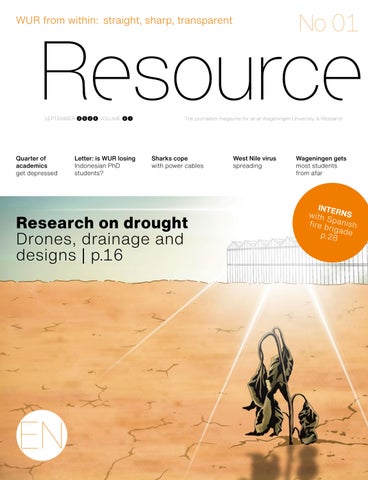
Research on drought Drones, drainage and designs | p.16
EN
West Nile virus spreading
Wageningen gets most students from afar
INTE w i t h RNS S fire b panish riga p.28 de
Contents
FOREWORD
NO ❶ VOLUME ❷⓿
12
Not all PhD candidates stay the course
24
Menstruating in Malawi
30
A taste of research at Lowlands
4 Fun with underpants 9 Mosquitoes are unusual 15 AI and double standards
20 Students who teach 34 NEW Q&A with central councils
Read the latest news and background stories at resource-online.nl
Unprecedented A temperature of 25 degrees and precipitation of 0.0. That was the weather when the Resource editors met up in the office on Monday 10 August to discuss this edition of the magazine. We had soon made our decision: we could not ignore the summer we had been through and were still experiencing, a summer of extreme heat, low water levels in rivers and huge wildfires across Europe. What WUR research projects are addressing these problems? What effect did the summer have on the campus and the trial fields? You could call this issue of Resource ‘dry as dust’ with six pages on droughts, drones and drainage (page 16) plus drought stress here on campus (page 26). Then there are the three students who had to keep a cool head while fires raged in Spain (page 28). Another tip: WUR seems such a PhD factory that it’s easy to forget about the PhD candidates who are struggling and eventually decide to stop. See page 12 for their tales of doubts, frustration and relief. There is also advice for other PhD candidates on how to cope. That plus all the usual WUR news, science and opinions in this first issue of the new academic year. If you have ideas for future issues or comments about this magazine, send an email to resource@wur.nl.
Willem Andrée Editor-in-chief
INDELIBLE New friendships, indelible memories, partying until deep in the night, followed by days spent sleeping and recovering... It was another unforgettable AID week. From burning heat on the opening day to a deluge after the sing-along, from dining with thousands of people on the dyke to the Ceres pool party and from painting LPs at the common ground fair to dancing the night away at the festival. If you want to relive those moments or see the photos, go to our website, resource-online.nl. wa Photo Marieke Enter
NEWS
Resource
21•05•2026 PAGE 4
L
Comment Time to speak out
ast week, the opening of WUR’s academic year took place in Omnia. The theme was topical: how can humans and wild animals (like wolves and beavers) live alongside one another? It was an interesting and bold subject, but anyone hoping to hear more about the major issues facing our own organization would have been disappointed. The cuts, Wageningen’s international position, the policy on AI, how to tackle fake references — just some of the ‘difficult’ topics that didn’t get a mention during the opening ceremony. This is despite the fact that the official start of the academic year is the ideal occasion for stating your position and what course you plan to take in the coming year —ask Education minister Rianne Letschert, who did use the occasion to stress the importance of the freedom to study what you want. What was left unsaid by WUR is still having an effect. The university has until the end of next year to find savings of 45 million euros, and the impact is being felt — for example, in smaller reimbursements for student thesis supervision and tighter margins in nearly all chair groups and business units. At present, the news about this reaches the Resource journalists sporadically, through the occasional letter or announcement. The policy on AI is another topic where silence reigns. When we make inquiries, we are told WUR is working on it. But once again, not a word on this issue during what is surely the ideal moment for the board to clarify its position and views on AI. Of course, not every plan has been worked out in detail and some issues can’t be dealt with quickly. But there is a particular need for a clear course and unambiguous communication in these uncertain times. Staff can cope with the message that tough times are ahead or that some choices still have to be made. But it is harder to deal with the uncertainty when the underlying vision and policies are never explained. Governing is more than pointing people to the strategic plan. This Comment presents the views and analyses of the editorial board, formulated following a discussion among the editors.
Internationals boost Dutch finances More and more international students stay on in the Netherlands after graduating. They live and work here — and pay taxes. That revenue comfortably compensates for the costs to the state of their education and student grants, shows an analysis by the Bureau for Economic Policy Analysis (CPB). This is the case for European and non-European students, at both academic and applied universities. About one in five European students are still in the Netherlands five years after graduating, and about two in five non-Europeans. The CPB analysis took account of expenditure on health and social security, and the probability of students staying in the Netherlands. hop
WUR alumnus wins Ig Nobel Prize Life underground is incredibly diverse. Professor Marcel van der Heijden, a WUR alumnus, demonstrated that by burying 1,000 pairs of cotton underpants in 25 different countries. Two months later, the underpants were dug up and analysed. That won him an Ig Nobel Prize, the award for research that seems ridiculous but has a serious undertone. The 36th awards ceremony took place in Zurich, the first time it was held outside the US. The jury said this was because the state of science in the US was no laughing matter anymore. rk
Möbius strip A new artwork is on display next to the entrance to the library in Forum. It is an untitled work by Hans Ittman that used to be in the Maths Building on the Dreijen site. The curved aluminium sculpture is reminiscent of the Möbius strip, the famous three-dimensional shape with only one surface and one edge. The sculpture had been in storage and recently underwent a thorough restoration. rk Photo Resource
lz
Quarter of all academics are depressed or anxious A quarter of all academics in the Netherlands experience feelings of depression and/or anxiety, according to a study by the Young Academy, an association of relatively young leading scholars. Almost 2,000 academics ranging from PhD candidates to professors filled in an anonymous questionnaire. About 25 per cent experienced moderate to severe depression, and almost as many suffered from anxiety. ‘We already knew there is a lot of pressure on the mental health of academics, especially PhD candidates,’ says Joeri Tijdink, a psychiatrist and researcher at Amsterdam medical centre and one of the report’s authors. ‘But postdocs and assistant professors seem vulnerable too.’ People have been talking about the mental health problems of academics for a while now. What makes the issue so
intransigent? Tijdink: ‘It’s related to the research climate. In science, we have created a culture of hypercompetition. That encourages a tendency to work long hours, especially if your manager or supervisor does that too. It soon gets seen as normal.’ When asked what needs to change to tackle the problem effectively, he says: ‘You can always say more money needs to be spent on science, but the idea that more money will solve all problems is an illusion. There are other changes that could make a difference. For example, ensure a safe, pleasurable research culture and invest in good leadership.’ Despite the stress and mental problems, academics are generally happy at work and over half the respondents say they have the most wonderful job in the world. ‘We often talk about how tough a career in academia is, but we pay far less attention to what makes people
Illustration Valerie Geelen
happy at work,’ says Tijdink. ‘Of course there is a real issue here, but working in academia is also amazing. Scientists feel they are helping to resolve the problems facing society. That makes their work meaningful and inspiring. We should focus more on that.’ hop
21•05•2026 PAGE 5
That is how many new WUR students took part in AID (annual introduction days) this year. 1,085 had Dutch nationality. Other relatively common nationalities were German (63), American (49), Indian (39), Italian (35), Greek (30) and Spanish (24). The most common names were Anna (13 attendees) and Thomas (11 attendees). The oldest participant was born in 1974, the youngest in 2009.
As of April, WUR has three outdoor locations on campus that can be booked as ‘lecture rooms’. An initial evaluation shows that many teachers are using the locations, with some 40 bookings in just three months. Teacher Lian Kasper, who wants to encourage more outdoor teaching, says: ‘A variety of departments already use the outdoor locations. That shows this is a broader trend, not just something restricted to the in-crowd that are campaigning for more outdoor classes.’ Courses on nature-inclusive education are being offered for teachers who want to take the class outside but don’t know how to go about this. The outdoor locations can be timetabled during the autumn too, says Kasper. ‘A backup classroom is always booked at the same time so you don’t run the risk of the lesson not going ahead due to bad weather.’ lz
Resource
1,634
Dozens of bookings for outdoor teaching locations
NEWS
Letter to the editor
After Africa, will WUR also lose Indonesian PhD candidates?
A
Resource article on declining African enrolment at WUR raises a question about whether Indonesia could be facing a similar trajectory. For years, WUR has been a key destination for scholarship awardees of Indonesia’s Endowment Fund for Education (Lembaga Pengelola Dana Pendidikan, LPDP), reinforced by WUR’s ranking as number one for Agriculture and Forestry in the QS World University Rankings. This standing supported a long history of good cooperation with LPDP, under which WUR became the only university that directly administers living allowances for LPDP-funded Master’s students along with research budgets for PhD candidates — a role left to LPDP at other partner universities. Around 700 Indonesian students study at WUR, with around 60 PhD candidates, most funded through LPDP. However, that number appears to be declining following new Dutch immigration rules raising minimum income thresholds for PhD candidates, thresholds that can change every six months. These shifting requirements prompted WUR to tighten funding conditions for externally funded scholarship PhD candidates, which clashes with LPDP’s fixed funding structures. The inevitable consequences
followed, as WUR was temporarily dropped from LPDP’s university list in 2025 after several awardees faced postponed enrolment. Although WUR was put back on the list in 2026, it was with fewer eligible programmes, and LPDP further limited which WUR PhD programmes could be applied to. As a result, only five candidates with WUR acceptance letters received LPDP awards in the first 2026 intake. Applicants are now being pointed towards Australia, Japan and competitive Chinese universities offering more accessible pathways. Looking ahead, though WUR has made some initial efforts, this situation requires a more institutionalized solution rather than case-by-case fixes. It is hoped that WUR and LPDP can reconcile these challenges, ensuring Indonesian PhD talent can keep contributing to Indonesia’s development. Edwin M.M. Ramadhan, a PhD candidate in the Public Administration & Policy Group and a LPDP awardee To reader the longer version of this letter and post comments, go to resource-online.nl
Advertisment
MCB-34303: Commodity Futures & Options Markets
Resource
21•05•2026 PAGE 6
Always wondered about what is happening at the trading floor of exchanges like the ones in Amsterdam, Paris, Frankfurt, London and Chicago? Wondered about how (agribusiness) companies manage their risks and improve their financial performance using commodity futures and options markets? Wondered about how it would be if you were trading commodity futures in Amsterdam, Chicago, London, Frankfurt and Paris? The Marketing & Consumer Behavior Group organizes a unique course that will introduce students to commodity futures and options markets. Students will develop an understanding of the markets and how they work, gain knowledge about the theory behind futures and options markets, identify their economic functions, and develop an analytical capability to evaluate their economic usefulness. This course is taught by Prof. dr ir Joost M.E. Pennings (Marketing & Consumer Behavior Group, Wageningen University). There are only 40 seats available. If you are interested in taking this course (3 Credits) please register in Osiris or contact Ellen Vossen, e-mail: Ellen.Vossen@wur.nl, tel. 0317-483385. Lectures are on Fridays in period 5 (one lecture is on Thursday), 0.5 day a week, please check schedule in TimeEdit for time and location. Prerequisites: None.
Wageningen gets most students from far away Last year, nearly 32,000 young people aged 17 to 22 (mostly students) left home to move to a university town, according to Statistics Netherlands (CBS). That was 4,000 fewer than in previous years. Students are more likely to continue living with their parents, probably because of the housing shortages and rising rents, suspects CBS. ‘Most do move out eventually during their time at university,’ says a spokesperson. ‘However, nowadays they are more likely to do so in the second or third year.’ The statisticians also looked at where the youngsters moved from. Most came from the local region, but there were exceptions. Wageningen had the most young people moving there from all over the country. Maastricht was the university town that attracted the most women and Delft the most men. The proportions in Wageningen were 57 per cent women and 43 per cent men. The CBS analysis did not include international students, who make up 17 per cent of all university students. hop
The species of shark and ray found in the vicinity of wind farms in the North Sea are not adversely affected by the cables transporting electricity from the wind farms to the mainland. There are subtle behavioural effects, however. Text Marieke Enter
T
his is the conclusion marine ecologist Annemiek Hermans reaches in her PhD research. Sharks and rays have an extra sense, the ampullae of Lorenzini, that let them perceive electrical signals. They use this sense for navigation and when foraging, for instance. It was not known whether these fish would be disturbed by the electromagnetic fields of the cables that transport electricity generated at sea to the mainland. A proper understanding of this is becoming more and more important as the Netherlands increases the amount of wind power it generates in the North Sea. The aim is to reach 21 gigawatts by the end of 2032, 75 per cent of the country’s total electricity consumption today. First, Hermans’ research confirmed that rays and sharks really are to be found in and around the wind farms in the North Sea. Using eDNA measurements at four operational wind farms, she found evidence of the presence of five species in the subclass Elasmobranchii: the starry smooth-hound, basking shark, thornback ray, blonde ray and spotted ray.
rays and dogfish in a large aquarium. However, Hermans did find subtle behavioural effects that depended on the context and varied according to the stage of life, species and sex. For example, adult dogfish swam faster, but not for as long, when exposed to a direct current field. The fact that the acute behavioural effects are subtle doesn’t mean they are insignificant, warns Hermans. The electromagnetic fields are a chronic stress factor. Small individual changes caused by the electromagnetic fields can add up over time to an ecologically relevant impact on the already vulnerable ray and shark populations in the North Sea, especially in combination with other human-induced factors putting pressure on these populations. She recommends more research into the long-term effects.
Another recommendation in her thesis is to include an obligation to carry out studies of the electromagnetic fields in the environmental impact assessment. She also points to the options of choosing cable routes that avoid important spawning and nursery areas and of combining cable routes.
DC versus AC Hermans’ research shows that the range of the electromagnetic fields depends on factors such as the type of cable, how it is laid and how much power it is transporting. At present, wind farms in the North Sea are connected using alternating current (AC) cables. From 2027, the larger wind farms that are further out to sea will be connected using direct current (DC) cables because there is then less transport loss. That will allow a big increase in the transport capacity, from 700 megawatts at present to 2 gigawatts with the new standard. ■
Subtle but significant This means that the electromagnetic fields have not led to a major loss of habitat for the species in question. Nor do they cause a strong acute stress response or prevent the fish from crossing the cables, as was demonstrated in experiments with adult thornback
Laying cables to transport electricity from the offshore wind energy area Hollandse Kust to the mainland. Photo TenneT
21•05•2026 PAGE 7
Sharks and rays not put off by wind farm power cables
Resource
SCIENCE
NEWS
West Nile virus spreading So far this year, the West Nile virus has been detected in nine people, five horses, six birds and two mosquitoes in the Netherlands. WUR experts Heather Graham and Sander Koenraadt on the impact of the virus in the Netherlands. Text Anne van Kessel
T
he West Nile virus has been circulating in the Netherlands for a few years now. The common house mosquito transmits it to horses and humans. When Sanquin Research found the virus in a blood donor in Utrecht this summer, it was the first infection of a human since 2020. It has since become clear that the person who received the blood did not become infected. At the end of August, the National Institute for Public Health (RIVM) announced that a person in Utrecht province (not the blood donor) had died after becoming infected with the West Nile virus in the Netherlands. The virus has also been detected in five horses. ‘I’m not ruling out more infections,’ says Heather Graham of Wageningen Bioveterinary Research.
Resource
21•05•2026 PAGE 8
Lab tests
WUR and other institutes have been monitoring the infections since 2020. To do this, they catch mosquitoes and birds and test them in the lab to see if they have the virus. That was how the infected birds and mosquitoes were found this year. The West Nile virus is a flavivirus, like yellow fever, Zika and dengue. The main culprit in spreading the virus is the common house mosquito. Mosquitoes become infected by biting an infected bird and then transmit the virus to humans and horses. Birds don’t transmit the virus to one another. Researchers have now found the virus in a range of bird species in the Netherlands. Horses and humans are dead-end hosts: they can’t pass the virus on to mosquitoes. Most people do not notice any symptoms — other than a mosquito bite that itches.
Nineteen per cent get minor flu-like symptoms such as a fever, muscle ache and a headache. About one per cent become severely ill and end up in hospital, which is why scientists estimate that the true number of infections is much higher than the official figure. Horses mostly only experience mild symptoms, but about 10 per cent have severe neurological symptoms such as quivering or a gait like a drunkard. Just over a third of the horses in this group die or have to be put down. There is no vaccine for humans. Two candidate vaccines were announced in 2014, but they were not developed further due to a lack of funding. There is an effective vaccine available for horses, but it is not used much. ‘Vaccination is expensive and
I think a lot of horse owners still see the disease as something remote and exotic,’ says Graham. Everyone can do their bit to stop the virus spreading. The common house mosquito lays its eggs in stagnant water, so closing off water butts and empty watering cans helps remove potential breeding ‘I’m not ruling grounds. Sander out more Koenraadt, proinfections’ fessor of Ecology and Control of Disease Vectors, says the virus isn’t yet having a big impact on public health, but diseases that can be transmitted by mosquitoes are becoming much more prevalent. ‘Southern Europe is already experiencing major outbreaks,’ he says, ‘and we may soon have a similar climate to them in the Netherlands.’
Stagnant water is an ideal breeding ground for mosquitoes. Professor Sander Koenraadt: ‘Because it’s so dry, people put a tray of water out to help the birds, but that also helps the mosquitoes.’ Photo Unsplash/Vincent Etter
T
his finding comes from research by the group headed by Experimental Zoology professor Florian Muijres. Muijres is fascinated by flies — not so much the insects themselves as how they move. And in particular the Diptera (with two wings). ‘Their flight is really interesting. In addition to the two wings, they have two halteres, rear wings that have developed into extremely effective sensory organs. They are gyroscopes that accurately measure rotation, which allows the insects to manoeuvre and fly exceptionally well.’ Muijres got a Vidi grant to study the flight behaviour of flies. He measured the bodies and wings of 133 species, mainly collected in and around Wageningen. The flight of 46 species was filmed using three high-speed cameras, and the images analysed to figure out the aerodynamics of the insects. Muijres says his colleagues Camille le Roy and Ilam Bharathi, who were hired specifically for this project, deserve all the credit for that work.
Flight blueprint
Muijres says the 46 species are representative of the 160,000 (!) identified fly species. They make up 15 per cent of all animal species. Muijres: ‘In evolutionary terms, flies are among the most successful groups on the planet. Flying is a
very energy-intensive form of locomotion but it also has the massive advantage of letting you cover big distances fast.’ Despite the great diversity among flies,
Mosquitoes have a very fast wingbeat, making their flight less efficient than that of many flies the flight movements were surprisingly similar. ‘The consensus in evolutionary biology is that behaviour is more malleable than form,’ says Muijres to explain why this is surprising. ‘It’s easier to change your behaviour than your shape. But our results show that isn’t the case for flies. There’s really only one blueprint for the flight behaviour and underlying aerodynamics.’ That’s an important point: the aerodynamics mean that there are only a few possible flight actions that efficiently generate enough force to stay in the air. But mosquitoes are the exception. Their wingbeat is extremely rapid, which makes their flight up to three times less
efficient than that of a fruit fly of the same dimensions. And that has to do with sex.
Big lab
Mosquitoes mate in swarms. The males use their wings to find fertile females in the swarm, explains Muijres. ‘The males have antennae that let them perceive the overtones of interference between their wingbeat sound and that of a female. The faster wingbeat you need for that uses three times as much energy as a normal wingbeat. But not every male is equally good at that. The females pick out the best males.’ The observations made by Muijres and his team are consistent with this theory, but they still need to provide real proof. ‘That means detecting the interactions between males and females in a swarm. We’ve set up a big lab within the Entomology chair group that will let us form and film swarms. Then we’ll be able to study this in more detail.’
21•05•2026 PAGE 9
Mosquitoes, midges and similar insects flap their wings at an extremely high frequency, which demands a lot of energy. That inefficiency is partly connected to sex. Text Roelof Kleis Illustration Marly Hendricks
Resource
MOSQUITOES ARE UNUSUAL
SCIENCE
PhD theses
in a nutshell
Daily brew People with bowel cancer who drink coffee should continue doing so. Preferably four cups a day. That significantly increases their chances of survival, shows research by Abisola Oyelere, from Nigeria. The association is evident but not the underlying mechanism. Oyelere did find substances in the blood that could play a role, but their functions are still not clear. rk Brewing the Evidence. Abisola Oyelere Supervisor Ellen Kampman
Soil patients Antibiotics used in livestock farming end up in the soil through the manure. What effect does that have on soil life? PhD candidate Zhongchen Yang from China focused on the impact on microbes involved in the nitrogen cycle. Antibiotics do affect these ‘unintended patients’ but it is hard to determine that effect because of the complex ecology of the soil environment. Yang’s advice is to reduce antibiotic use as a precaution, just to be on the safe side. rk The unintended patient. Zhongchen Yang Supervisors Gerlinde de Deyn and Jan Willem van Groenigen
THE PROPOSITION
Resource
21•05•2026 PAGE 10
PhD candidates explain the most thought-provoking proposition in their thesis. This time it’s Elena Vincenzi, who defended her PhD in May. She looked at how tomato plants respond to far-red light with the goal of optimizing lighting for greenhouse tomato cultivation. Text Ning Fan
In control The hormone auxin controls numerous genes that play a key role in the development of plants. It doesn’t do this directly: it exerts its influence via the transcription protein ARF, which switches genes on and off. Of course, the amount of that protein is also controlled. Martijn de Roij showed how the control of that transcription protein works. That’s an impressive step towards a better understanding of action and reaction in plant life. rk Auxin Response Factor proteolysis. Martijn de Roij Supervisor Dolf Weijers
‘Networking skills in academia are at least as important as any technical skill’ ‘Towards the end of my PhD, especially when I started thinking about life after graduation, I began to realize how important the skill of networking really is. ‘A PhD requires a broad set of skills, but networking and communicating your work in a clear and engaging way are often not given enough attention. Yet networking skills will be useful to you throughout your career. A strong network also makes it easier to share your results, get feedback and explore new opportunities. However, building such a network takes time, so it is important to start developing it early in the PhD journey. ‘There is no single right way to network. People build relationships in different ways. Some prefer in-person interactions,
such as attending conferences or informal coffee meetings, while others may feel more comfortable connecting online and sharing their work through digital platforms. Networking can also happen in smaller academic settings, such as giving presentations to other research groups or participating in seminars. ‘Because people have different personalities, networking does not work the same way for everyone. What works for one person may not work for another. Personally, I am still trying different ways of networking and gradually finding out what works best for me.’
COLUMN Worryingly little genetic diversity in Borneo elephants It was recently confirmed that the Asian elephants on the island of Borneo are a separate subspecies, but now it turns out that there is so much inbreeding that an intervention is needed. Jeroen Kappelhof, a PhD candidate in the Animal Breeding & Genomics chair group, confirmed three years ago that the elephants on Borneo are a separate subspecies. This Elephas maximus borneensis was officially recognized in 2024. Now Kappelhof has published a new paper based on the analysis of 81 DNA samples, which has alarming findings about precisely that subspecies. A key element in that paper is the ‘runs of homozygosity’ (ROH), an indicator of the level of inbreeding. ROHs are lengths The inbreeding of genetic material dates from the last where both chrofew generations mosome copies are virtually identical, i.e. homozygous. The percentage of the genome present as ROH in the Borneo elephants was 65 per cent. ‘You rarely see such a high percentage and it is definitely worrying,’ explains the animal scientist.
The good news The runs of homozygosity that Kappelhof found in the Borneo DNA samples were also relatively long, which suggests that the inbreeding dates from the last few generations. The good news is that the genetic load isn’t much higher than that of other subspecies: the analysis didn’t reveal more harmful genetic mutations for that group. The researcher also did not find indications that the lack of genetic diversity was leading to problems with health or fertility. ‘At least, not as far as we know,’ nuances Kappelhof, who is director of Conservation & Science at Blijdorp zoo as well as a PhD candidate. ‘It’s difficult to get a good picture of that in the wild, of course. But we haven’t seen anything unusual in the Borneo elephants in European zoos. They are reproducing well.’ Nevertheless, his research team recommend considering an intervention to introduce genetic material from other subspecies. me
AI curiosity A big welcome to all you firstyears, and welcome back to returning students! I hope you all have an amazing year at your wonderful university. Your humble columnist has enjoyed his holiday and is starting the academic year full of energy, with a new course, young researchers bursting with ideas and — inevitably — a couple of weeks with grant rejections. Now that AI is evolving at lightning speed and OpenAI agents are teaming up like digital termites to hack HuggingFace, one could wonder whether the human race still has a function. More specifically, do universities still have a purpose? Why should we learn how to write well, do statistics or brainstorm if AI can do it all faster and often better? A lot of what you learn and practise here will be taken over by AI in the future or will already be out of date by the time you get your degree. I too have wondered whether my research still matters. And if it will stay relevant. The answer came when I delved into the figures on diabetes with NRC newspaper columnist Dr Rosanne Hertzberger. We found that earlier long-term forecasts for diabetes did not match the actual incidence later on. But this only became clear after old-school puzzling and curiosity, combining datasets and consulting experts.
Was this my core expertise? No. Could AI have written it up faster? Definitely. But it started with curiosity and ended with us drawing meaningful associations. Precisely the kind of things that are not easily automated. It’s true that AI will take over a lot of tasks. But critical thinking,
‘I too have wondered whether my research still matters and will stay relevant’
asking questions and knowing the context will remain human tasks — and essential for life if you want to understand what’s going on. Fortunately, those are things you still learn here, whether you are a student or a teacher. I wish you success this year, and fun too. And don’t forget to ask yourself interesting questions from time to time — before ChatGPT gives you the answers. To comment, go to resource-online.nl
Guido Camps Guido Camps (43) is a vet and researcher at Human Nutrition and OnePlanet. He enjoys baking, beekeeping and unusual animals.
ORGANIZATION
Quitting your PhD
Not easy, but brave Hora Finita. Each year, about 300 Wageningen PhD candidates successfully defend their theses. In fact, WUR sometimes seems like a PhD factory. But what about all those candidates who quit before the end? We learn about their doubts, frustrations and relief. Text Nicole van ’t Woud Hofland
Resource
10•09•2026 PAGE 12
P
aris, 2014. It’s a fine spring day, but the bright sunny weather is in sharp contrast to my mood. Six months into my PhD research project, I am feeling very down. I have to force myself to get out of bed every morning and drag myself to the lab. In fact, I am completely fed up. A former colleague is sitting opposite me at the cafe. I say it out loud for the first time: I want to quit. ‘You can’t do that,’ he says. ‘No one will ever hire you again.’ Most people who embark on a PhD are full of enthusiasm at first. Koen* also remembers that initial buzz all too well. ‘It feels like a honeymoon to begin with — you’re euphoric. Someone has given you an opportunity to change your career, your life.’ But Koen soon came down to earth with a bump. He was working closely with another PhD candidate, but they had very different approaches. She wanted to perform every step perfectly in great detail whereas he preferred to prioritize and use his time efficiently. ‘I knew from previous projects that not everything has to be perfect. There isn’t the time or money for that.’ The different styles of working led to
growing frustration. She thought he wasn’t doing his best, whereas he felt inhibited. The situation began to gnaw at him. Having doubts during your PhD isn’t unusual, says Nicole Rodenburg. As a PhD adviser for the graduate school WIAS, she talks to PhD candidates who run into problems with their research, supervisors or personal circumstances. ‘We offer confidential advice, coaching and support.’ It’s not just Wageningen; PhD candidates elsewhere have doubts too. A national survey revealed that as many as 41.6 per cent of Dutch PhD candidates have considered quitting. Six per cent have such thoughts regularly. That doesn’t mean they will actually abandon their PhD. But about 25 per cent of all Dutch PhD candidates do quit. The figure for WUR is significantly lower at 14 per cent. ‘Every PhD candidate has the occasional dip,’ says Rodenburg. ‘But they differ in how long it lasts and what caused it. Is someone unhappy for a short while after an experiment fails for the third time? Or did they stop enjoying their work months
ago? Above all, can they do anything to change the situation?’ Rodenburg often sees adjustments being made to projects after the start. For example, if the candidate finds the project too theoretical, they can discuss ways of making it more applied with the supervisor.
Imposter syndrome But not all problems can be resolved, as Alyssia* discovered. Her supervisor was constantly checking up on her and remarked after three months that she hadn’t done many experiments. That put pressure on her. ‘I felt as if I had to justify myself constantly.’ When she had her evaluation, she was mainly told about things she needed to improve, such as reading more literature. ‘My first reaction was aargh, negative feedback,’ recalls Alyssia. The comments felt like a judgement on her performance. ‘I got the idea that they didn’t think I was good enough but were letting me continue out of the kindness of their heart.’ That fuelled the insecurity she had felt for some time. ‘I had always thought you had to be a genius to do a PhD. Which I’m not.’ She is hard on herself
Resource 10•09•2026 PAGE 13
Mirjam Hemelaar had ‘doubts from day one’ as to whether PhD research suited her. She now works at Delft University of Technology as a course coordinator and secretary of the examining board for the Aerospace Engineering faculty. Photo Sam Rentmeester
‘If I have to keep this up for another 18 months, there will be nothing left of me’
by nature and all that emphasis on her shortcomings wasn’t helping. ‘Occasionally, you want to hear what is going well.’ Yvan’s* doubts had a different cause. In 2017, he started on a cancer project with a highly regarded research group. It looked like a smart choice for his career. But when Yvan delved deeper into the research, he discovered the project was less innovative than he had initially thought. A lot of the work was basically repetition of existing studies. ‘I had doubts as to whether
my supervisors had thought the project through properly, but when I queried this, they brushed me off.’
Mismatch Sometimes, the problem is not the project or the supervision. Mirjam realized that she didn’t feel energized by doing research. ‘I had doubts from day one.’ She didn’t enjoy the long, unpredictable process of experiments and not being sure whether it would lead to any meaningful results at all. The penny dropped when she attended a career course. One of her key values is service: she feels energized from mentoring people and helping them. ‘There was almost nothing I could link to my PhD research.’ Fabian discovered that a PhD isn’t always worth the sacrifices you
have to make. He felt homesick and his girlfriend was living at the other end of the country. The solution was a lot simpler for him than for many others: he returned home. Rodenburg doesn’t try to persuade every PhD candidate with doubts to keep going at all costs. Sometimes, a change of supervisor or taking the research in a different direction can be all that’s needed. Sometimes, the candidate simply has to get through a tough period. But if they are no longer getting any enjoyment out of the work, the consideration changes. Then it’s not about how the candidate can finish the PhD but whether it’s worth
ORGANIZATION
their while continuing. ‘And stopping can then be a justified and accepted option,’ says Rodenburg.
Deciding to quit
Resource
10•09•2026 PAGE 14
Koen only reached that point in his third year. He was still finding the collaboration with his fellow PhD candidate hard going. ‘She was outspoken in her opinions and I was becoming more and more self-effacing,’ he explains. He was gradually losing his self-confidence. ‘With everything I did, whether it was a complex data analysis or typing a simple e-mail, I wondered whether I was doing it correctly.’ In the end, he decided to quit. ‘I thought, if I have to keep this up for another 18 months, there will be nothing left of me.’ To his surprise, his supervisors showed relief when he told them. Not because they wanted him gone as a researcher but because they had seen they were losing him as a person. Yvan spent months in denial doing his cancer research. By then, he had discovered that on average researchers at the institute took seven years to complete their PhD. Colleagues dismissed the huge pressure as a normal part of doing a PhD. ‘They asked: “If you stop here, where will you go? There’s nowhere better than here.” The fact that they saw the situation as normal was actually the sign for me to quit.’ Alyssia found her work-life balance was getting completely out of kilter. ‘I was permanently stressed because of the work, from six in the morning until I went to bed.’ A colleague said something that made her think: a lot of PhD candidates probably want to stop but don’t dare. So perhaps quitting is actually the brave choice rather than the easy way out.
Just a job That notion is the exact opposite of the widely held idea that completing a PhD is a question of perseverance. If you quit, you didn’t make it. Koen: ‘I saw stopping as the same as failing.’ Then there is the worry about what other people will think. ‘I was afraid it would be seen as a sign
Six tips
from former PhD candidates 1
A temporary dip is normal but persevering isn’t always the right solution.
2
hD research doesn’t suit everyone. That doesn’t mean you are a failure. It’s P OK to discover while doing your PhD that the academic world, research or this approach to work doesn’t suit you.
3
alk about your doubts before you take your decision. A PhD adviser can T help you figure out what exactly is causing the problem and what changes you could make. The adviser knows all about the PhD process and isn’t as close to you as your family, friends or colleagues.
4
on’t wait until you have lost all your self-confidence. Problems don’t get any D smaller if you don’t discuss them with anyone. Talk to your supervisor or someone you trust, even if you are afraid this will make it seem like you can’t cope.
5
topping doesn’t mean your PhD years were worthless. Even without the S title of Doctor, you still have the knowledge, research experience and skills you acquired. You will be able to put them to good use in your next job.
6
I t is not a cowardly choice. There are probably a lot of PhD candidates who want to stop but don’t dare. So perhaps quitting is actually the brave choice rather than the easy way out.
Every PhD project has ups and downs, but keeping going and completing the PhD at all costs isn’t the right choice for everyone. Life is short and work should be enjoyable too.
that I can’t cope with setbacks,’ explains another former PhD candidate. Rodenburg acknowledges that. ‘It’s weird really. We find it perfectly normal to change jobs if a job doesn’t suit us. And a PhD is essentially just a job. Quitting doesn’t mean you can’t do something, it means you discovered that this particular work or this environment doesn’t suit you.’ Anyway, when you stop you still have that experience. Doing research, writing, analysing data, drawing up plans, collaborating with others are all skills you take with you, even if you don’t complete that thesis. What happens next depends on the person. Koen stayed on in the department in a support role for a while and is now working abroad, outside academia. Alyssia went travelling, then found a
varied research job and discovered she still enjoyed lab work, as long as it wasn’t taking over her life. Yvan started a different PhD project, this time in Wageningen, and now he is completing it. What about me? I decided to ignore the advice I got in Paris and I resigned from my PhD position. Of course, if you quit there are things you lose: a qualification, a completed project, a glossy thesis and sometimes the prospect of a comfortable career path. But the stories of Koen, Alyssia, Yvan, Fabian and Mirjam show what you might gain instead: more space for yourself, a better job, less stress. Or even a second chance at that PhD. ■ *The interviewees in this article did not all want to use their real or full names. Their names are known to the editors.
AI, WHAT’S NEW
DOUBLE STANDARDS It’s impossible to imagine education anymore without the use of AI, yet AI has its problematic aspects, says Environmental Sciences Master’s student Anita Fiorini. In her thesis ‘Imagining Education in Times of AI’, she highlights some of the issues. Text Roelof Kleis For her research, Fiorini spoke to students and senior WUR figures in the field of education about AI. Broadly speaking, there was a consensus that AI is inevitable and transformative, and we need to use it responsibly. Privacy and sustainability are key aspects of responsible use.
Do lecturers and students differ in their views on AI in education? ‘When I asked students what they thought about AI, sustainability was one of the first topics they mentioned. Academic staff focused on privacy and ethics. WUR presents itself as the world’s most sustainable university, but that entails extra responsibility and tighter standards. WUR must demonstrate that it is aware of the impact of AI on the environment.’
AI seems unstoppable in research and education. Every month, we show here how teachers and researchers are exploring its possibilities.
AI is developing at breakneck speed. Are specific guidelines even possible? ‘You can be very specific about security and privacy – what you can and can’t upload, for example. When it comes to activities, it’s trickier. There’s a grey area where you have to make choices on a caseby-case basis. We need to discuss this with one another; otherwise, we won’t know what’s going on.’
You’ve observed a double standard in the use of AI. If lecturers do it, it’s fine; if students do it, they’re cheating. ‘The underlying idea is that lecturers are experienced and know what they’re doing. But when it comes to AI, we’re all equally inexperienced. Research shows that most students don’t want to cheat just to get a higher mark. That double standard is unfair. Why aren’t there any AI guidelines for lecturers? If students have to show how they’ve used AI, then so should lecturers. As a student, I want to know whether feedback on an assignment comes from the
lecturer or from AI, and whether my work was uploaded for that purpose.’
Did you use AI for this thesis? ‘Yes, I used it at the start and later on to rephrase sentences. Initially, I didn’t tell my supervisors. That’s interesting. I knew the guidelines and I was confident that what I was doing was allowed. Yet it felt like a taboo, as if I was doing something wrong. It was as if I hadn’t done all the work myself. Yet I know it’s my work. AI played a part, but just as a supporting tool. That was an important realization for me.’
You’re calling for a major AI survey among students. ‘I think it’s good to know what students think and want. One such survey was carried out a few years ago, but in the age of AI, that feels like an eternity.’ ■
Guidelines for researchers were introduced this summer and they now have to look at how their use of AI relates to WUR’s energy transition. Is that enough? ‘No, it’s not enough and it’s not specific enough. This just creates uncertainty. As a researcher, you still don’t know what you’re supposed to do. With guidelines like this, you’re missing an opportunity to be more open about the use of AI. And openness and communication are precisely what’s needed.’
‘When I asked students what they thought about AI, sustainability was one of the first topics they mentioned.’ Photo Shutterstock
SCIENCE
The dry, hot summer of 2026
A drop in the ocean The summer was long, hot and dry. What can science do to limit the adverse effects? Three PhD candidates are getting doctorates for their solutions: spotting stress in crops sooner, keeping the soil wet, and making urban heat more bearable. It’s a drop in the ocean, but better than nothing. Text Roelof Kleis Illustration Valerie Geelen
Resource
10•09•2026 PAGE 16
Spotting drought stress with drones
You can see when a plant is stressed because of drought: the leaves are limp and the plant appears to be wilting. But drought stress has reached an advanced stage by then. What you can’t see with the naked eye is when the process starts. But drones with thermal infrared cameras can see that. PhD candidate Quanxing Wan refined the technique to make the measurements more reliable. Thirsty plants with water stress close their stomata, explains Wan. That prevents evaporation and further water loss. As a result, the plant’s temperature rises. And you can measure that. The thermal infrared cameras spot the plant’s thirst long before it shows visible signs of water stress. At least, that’s the theory. In practice, it isn’t quite that simple. Getting a drone that is flying overhead to take the plant’s temperature is far from straightforward. ‘The relationship between what the sensor measures and the plant’s actual temperature is complex,’ says Wan. ‘You have to take a lot of factors in the field environment into account. In my research, I was aiming to get closer to the plant’s actual temperature.’ Wan did field trials with plots of maize near Nergena. The resulting temperature maps showed big differences between the strips of maize. ‘A map like that with the relative differences in temperature is the first step. Comparing those temperatures against suitable reference conditions lets you derive indices for the degree of drought stress experienced by the plant.’
The ultimate aim is to be able to support precision irrigation and save on water consumption — you irrigate where and when it’s needed rather than spraying the plants randomly. And preferably to also provide data that the farmer can use in real time to take decisions.
Irrigating and draining
Converting existing drainage systems to allow underground irrigation sounds like the perfect solution. After all, a third of the farmland by area in the Netherlands currently has drainage systems, and subirrigation is less effort than spraying water. Janine de Wit recently got her doctorate for a study of this phenomenon. Not much is needed in the way of materials to make drainage systems suitable for underground irrigation. A collector pipe and modest basin for storing rainwater are enough, with a ballcock for regulating the level. Then the water in the reservoir has to be distributed, of course. De Wit tested the system in Stegeren, Lieshout, Haaksbergen and America (NL), higher-lying land with sandy soil, and a variety of soil profiles and geohydrological properties. She measured the effects and modelled the impact of the overall water system on the experimental fields and surroundings. That led to several conclusions on how to apply subirrigation successfully on a larger scale. ‘The soil composition is important,’ says De Wit. ‘The subsoil must have some impermeability, for example with layers of loam, as otherwise the water will seep
Resource
A cliff-like wall
There are various nifty (and expensive) structures available on the market for green facades. Maricruz Solera Jimenez developed Plant Pixel as a sustainable system made from recycled waste. Plant Pixel consists of modular components that you can combine to create your own facade. The squares of recycled hard PVC vary in depth, which adds relief to the wall. The concept was inspired by the way in which plants grow on the irregular surface of a cliff, says Solera Jimenez. ‘The uneven surface with cavities creates
a variety of microclimates. That’s what we have tried to replicate. Nature often offers the best example.’ A crucial aspect of the design is the solution for getting water to the plants. In a cliff, the cavities retain the water in little puddles. ‘In my design, I replicated that by having the square elements at a slight angle of 15 degrees,’ explains Solera Jimenez. ‘The inside of the element is covered with recycled textile that retains the water.’. She has tested the system extensively in partnership with ZinCo, a German manufacturer of green roofs. Various designs were constructed on the wall of a container and measurements taken. She used 22 different species of plants for the greenery. On a hot summer’s day, the green facade reduced the temperature close to the wall (10 cm away) by 2.5 degrees. The difference was as much as 5.5 degrees during a heatwave, and 3.3 degrees somewhat further away from the wall (40 cm). ‘This is just a small prototype,’ says Solera Jimenez. ‘A larger surface area would probably have a different effect. But cooling the air temperature is only one aspect. Green facades also keep the building cooler inside as it’s an extra insulation layer. Also, the plants partly protrude out of the squares and create shade. And they add to the biodiversity, of course.’ ■
10•09•2026 PAGE 17
away like in a sandpit. Collaboration with the water boards is also crucial. It’s hard to raise groundwater levels if water levels in the ditches stay low. And the quality and availability of the water are also key factors, of course. Not everywhere has sufficient water available for subirrigation.’ De Wit still thinks subirrigation has potential, but she is not advocating the construction of dual-purpose drainage systems everywhere. ‘This is an interim solution that works best for lower-lying land with drainage, relatively high groundwater levels and a plentiful supply of water. In the longer term, it would be better to change how the land is used, for example by growing crops in dry soil that can cope with those conditions.’
Resource
10•09•2026 PAGE 18
PICTURE
Resource 10•09•2026 PAGE 19
CRAZY WAGENINGEN! August isn’t the best month to go worm charming, especially after such a hot, dry summer. However, the annual Worm Charming competition was moved from the spring to late summer to coincide with the International Symposium on Earthworm Ecology, which was held in Wageningen for the first time. It was a light-hearted break from the scientific seriousness, to see who could catch the most worms using the most original approach. The costumes were just as crazy and the methods just as unusual as ever. The contestants in the photo have gone for space hoppers. An original idea, if not a winning formula. rk Photo Guy Ackermans
EDUCATION
Students become teachers
IN AT THE DEEP END The Education minor has long been WUR’s most popular minor; last year, it got a record number of students. Instead of being taught courses, the students doing this minor spend half a year as teachers themselves, in secondary schools. Two students talk about their experiences. Text Luuk Zegers
‘Hard work’
Resource
10•09•2026 PAGE 20
Femke Boersma (22), International Land & Water Management Bachelor’s student, is teaching geography at the Pantarijn school in Wageningen. ‘Is teaching something I could do? I’d been considering that question for ages, and I decided to do this minor to get an answer. You’re thrown in at the deep end and are soon standing in front of the class. It was hard work at first: I mainly noticed what I wasn’t yet so good at. But you get a lot of supervision and you’re working on your development, so you learn an awful lot in a short time. It’s a milestone for me that I taught kids for nearly six months. I’ve seen a transformation in how I take the lessons. ‘I went to the Pantarijn as a kid. It’s a good school with a friendly atmosphere and dedicated teachers. I got my school leaving certificate four years ago. It’s weird to experience the school now from a different perspective. I used to talk in class quite a lot, but now I realize how irritating that is.
‘I used to talk in class a lot, but now I realize how irritating that is.’
‘I teach three days a week. I’m free on Thursdays, so that’s when I prepare my lessons. On Mondays, all the minor students meet up at the university. It’s interesting to hear everyone’s stories and experiences. We also work on assignments and reflect on our development. That’s a lot on top of the teaching. ‘Teaching is a craft. This minor means you’re qualified to teach in schools. But it’s like driving: even when you’ve got your driving licence, that doesn’t make you a brilliant driver. It’s a steep learning curve, you make mistakes and you have to learn to live with them. It feels great when you’ve given a good lesson, but you don’t have long to enjoy that feeling because you need to perform again in the next lesson. ‘I recently got feedback from my pupils. They feel I’m noticing them, and they
like the atmosphere in the class and my sense of humour. I’m proud of that. So is teaching right for me? I can’t answer that question yet. It’s hard work, you need to be switched on all day and I’m not yet sure whether I have the potential to be a really good teacher. After I’ve had a tough day, I think the answer’s no, but after a good day with proper conversations with the kids I can imagine doing it. Perhaps I could teach part-time in combination with another job. One thing I know for sure: I now have a lot of respect for teachers.’
Resource 10•09•2026 PAGE 21
The new group of students doing the Education minor. Photo Guy Ackermans
EDUCATION
‘I now have a lot of respect for teachers’
‘In front of the class straight away’
Biobased Sciences Master’s student Thijs Beekman (23) is teaching economics at the Pantarijn school in Wageningen. ‘When I heard about this minor, I thought: that’s my chance to discover whether teaching is for me. You get a kind of crash course in teaching at uni in the first week. After that, you spend most of your time at your internship school. First you watch how the real teachers do it, but even in the first week I had to stand up in front of
the class to explain things. That was nice because the longer you wait before doing it, the more nerve-racking it becomes. ‘I teach 14 to 15-year-olds in the streams for vocational training and university. In the vocational MAVO stream, it’s about economics in society, such as how an insurance policy works. In the top, pre-university stream, there’s more maths. You’re working with numbers and drawing supply-and-demand curves. ‘Teaching is a learning process. At first, I wanted to use economic examples from the news to explain stuff so that the students would see the relevance. But it turned out that my students hardly follow the news, so that didn’t work. At univer-
sity, we like to make things more complex than they really are. That doesn’t work at all in the MAVO class, so I try to simplify everything and explain it in everyday language they can understand. Otherwise you’ve lost the kids. ‘You keep a portfolio throughout where you track your development in terms of skills and qualities. That works well, but eventually you get a bit tired of all that reflection. All in all, it’s an awful lot of work. ‘I can definitely recommend this minor if you’re interested in teaching and want to see if it’s really your thing. But I wouldn’t recommend it otherwise because an ordinary minor is much easier than teaching at a secondary school. ‘I don’t want to go into teaching full-time after my Master’s, but I can see myself doing it part-time.’ ■
Resource
10•09•2026 PAGE 22
A minor as training Piety Runhaar is one of the driving forces behind WUR’s teacher training programme. The Education minor was recognized as an official training programme by the Board two years ago. ‘That’s only right given the number of students, the demands made by the minor and the fact that we are training teachers,’ she says. Students doing the minor teach classes at a secondary school and also have various other modules, explains Runhaar. They normally get 30 to 35 students doing the minor each semester. In fact, it has been the most popular minor in Wageningen for several years running. ‘We even had 45 students last semester,’ says Runhaar. ‘That brought the total to 80 students last academic year, a new record.’ It’s good news for secondary schools because they have long been struggling with staffing shortages, especially in the sciences, says Runhaar. ‘In maths, physics and chemistry, for example. Whereas a lot of students in Wageningen study those subjects. This minor lets them find out whether teaching is for them and they earn the qualification they need to teach in schools.’
Secondary school
Students who complete the minor get a ‘grade two qualification’. This allows them to teach the younger years
in secondary schools, including the exam class in the MAVO vocational stream. Other universities also offer programmes for the ‘grade one qualification’, which lets you teach all the secondary school years and streams. ‘We currently have a partnership with Radboud University for Molecular Life Sciences and Environmental Sciences Master’s students. We want to see whether we can offer that to other students too.’
Portfolio
Students have to keep a portfolio during the minor and they have practical assignments. For example, the students have to consider what is termed the escalation ladder. Runhaar: ‘How will you maintain order, what’s the first warning and when should you take measures such as sending someone out of the classroom?’
Motivation
Students who do the minor get a lot of responsibility. That is why the intake is such a serious affair, explains Runhaar. ‘You need to be motivated because you will be teaching actual kids.’ A few students discover during the minor that teaching is definitely not for them. ‘But most by far pass and get the qualification.’
I
f you want to fit a wolf with a collar containing a transmitter, you first need to catch your wolf. The tally so far is one wolf. Once it had its transmitter, it immediately set off in the direction of Drenthe, came back and joined a pack on the Utrechtse Heuvelrug. That was at the start of the year. The transmitter and associated wolf have disappeared off the radar since then. And no new wolves have been caught. ‘Catching them takes an awful lot of time, which we hadn’t really appreciated beforehand,’ says professor of Wildlife Ecology & Conservation Frank van Langevelde. One factor is the legal restrictions. When a wolf is being fitted with a transmitter, a vet has to anaesthetize it with a tranquillizer dart. This has to be done from a distance of less than 25 metres.
Sheep as bait
But it’s not easy to get that close to a wolf. ‘The gamekeepers at De Hoge Veluwe know the park very well and have a good idea of where the animals hide out. But even with that know-how, the vet has only seen a wolf
Wolves are very smart and very cautious a few times. And the wolf was only within the required shooting range once or twice.’ Plan B was to use cages, but that too has not yet got results. One of the cages has bait. Van Langevelde: ‘The cage measures about 20 by 20 metres and it contains a second cage with sheep. The sheep are bait: they are supposed to tempt the wolves to enter the cage. This method is allowed by the permit.’ If that happens, the cage door shuts, a silent alarm is set off and the capture team springs into action. Infrared cameras around the cage record what animal has entered to prevent any false alarms. But wolves don’t let themselves be trapped so easily. ‘They are really
Wolf track on the Veluwe. Photo Shutterstock
smart and very cautious,’ says Van Langevelde. ‘When they first spot the cage, they approach it up to about five metres. Then you don’t see them for a couple of days. The next time, they get a bit closer.’ The researchers nearly caught one once. Until the camera took a photo; the wolf turned around and fled. ‘Maybe it felt the warmth of the camera’s infrared sensor. Or perhaps it heard the camera make a sound that we don’t hear.’
Plane
There is still that one transmitter that did collect data for a few months. The transmitter has still not been found, despite serious searching. Even a small plane that flew over the Heuvelrug and Veluwe at the end of August was unable to find anything. ‘We were able to detect the red deer with transmitters on the Veluwe. We could spot them from a distance of 15 kilometres.’ ■
10•09•2026 PAGE 23
WUR researchers have been trying to fit wolves in the Hoge Veluwe National Park with transmitters for nearly a year now. The idea is to use the transmitters to track the wolves’ movements and in particular to see how they interact with humans and other large mammals. But fitting the transmitters is proving difficult. Text Roelof Kleis
Resource
Wolves are difficult to catch
SCIENCE
Menstruating in Malawi Menstruation is still a taboo topic in Malawi, but researcher Kesso Gabrielle van Zutphen was able to spend months collecting used sanitary pads from hundreds of girls to measure blood loss and the link with iron deficiency. ‘It was the biggest adventure of my life.’ Text Anne van Kessel
Resource
10•09•2026 PAGE 24
‘M
y student and I walked along the dark corridors of the boarding school, carrying a cool box. It was six in the morning and we were on our way to collect the first used sanitary pads from the toilets. We looked at one another in a state of subdued panic and I said: now we’ve begun.’ After a year spent preparing, Kesso Gabrielle van Zutphen was starting her PhD study on iron deficiency among 300 girls aged between 15 and 20. Iron deficiency can lead to anaemia (see inset), which is a risk during pregnancy, explains Van Zutphen. It can lead to heavy blood loss during childbirth, for example. ‘In low-income countries, severe blood loss during childbirth is a key cause of mortality in women.’ It is estimated that a third of young women in Malawi have anaemia, says the Wageningen researcher, speaking from her home in Montreux, Switzerland, the country where she grew up. That is not always because of an iron deficiency, but that is one of the main causes, along-
side malaria, for example. ‘You get iron through the food you eat, but people in Malawi eat a lot of nsima, a kind of maize porridge that is rich in calories but contains a lot of phytates, which inhibit the uptake of plant-based iron.’ Malawians also don’t eat much meat, which is rich in iron. Another major cause of iron deficiency is heavy menstruation. That gave Van Zutphen the idea of trying to determine how much blood young women lose during menstruation and what that means in terms of iron loss.
Free phone But how do you do that in a country where even the word ‘menstruation’ is taboo? The researcher spent a year talking to various stakeholders to try and convince them of the need for the study. They ranged from staff at the district health centres and the hospital that would have to analyse the sanitary pads to the directors at nine boarding schools, village chiefs and of course the parents and girls in question. ‘Sometimes I still can’t believe that we managed it. You are talking about children and about blood loss, which is such a big
taboo.’ She credits the amazing local team. Another possible factor was that every girl who took part in the study got a smartphone, laughs Van Zutphen. The original plan was for the participants to use the phone to record where they were in their cycle, what sanitary pads they used and how full the pads were, using pictograms. This was on the condition that they didn’t use the phone for anything else, because phones were banned at the boarding schools. ‘In retrospect, we could have guessed what would happen. The first
Iron
Iron is essential for haemoglobin in red blood cells, the protein that takes oxygen to the cells in the body. Iron is also important in brain functions, the production of energy in cells and muscle strength. Low iron levels can lead to a range of complaints. Severe iron deficiency can cause anaemia, where haemoglobin levels are too low. The availability of iron in the body is determined by measuring the ferritin concentration in the blood. This is a protein that stores iron in the body. When iron reserves have become depleted, the haemoglobin level starts to fall.
Resource 10•09•2026 PAGE 25
Selfie by researcher Kesso Gabrielle with her team of nurses in the background. They helped her pack the sanitary pads and distribute them at the schools.
girl to be given a phone put a SIM card in it and starting making phone calls. So we decided to hand out the phones as a token of our gratitude at the end of the study, and we gave the girls notebooks to record all those details.’
‘I travelled all over the country to collect used sanitary pads’
Cool box full of pads All the participants were given sanitary pads just before their menstruation was due. A cool box was placed in each girls’ toilet in the nine boarding schools. ‘We wanted to use boarding schools because the girls live there full-time.’ Every time a girl changed her pad, she put the used pad in an opaque numbered plastic bag, which she put in the cool box. Once a day, the school nurse brought the cool boxes to the lab for analysis. ‘I like the fact that the lab work was done by men,’ says the researcher. ‘They could see how important the study was for their wives and daughters.’ In the laboratory, the sanitary pads were rinsed off with sodium hydroxide solution. Then the blood was examined in a spectrophotometer to determine the haemoglobin level (haemoglobin is a protein that plays a key role in the iron metabolism). The lab workers also determined the blood loss and the amount of ferritin, another important protein (see inset).
Van Zutphen had said beforehand that the study could take place any time of the year, except in the summer when the schools close for seven weeks. ‘But the preparation took so long that we eventually started just before the summer holiday.’ That led to some unusual moments. ‘Some girls were away on holiday, so I travelled all over the country picking up used sanitary pads. The longest trip took nearly a whole day. It was hard work seven days a week, but I wouldn’t have missed it for the world. It was the biggest adventure of my life.’ At present, she is working on the analyses in Switzerland. She can’t say anything about the results until they are published. Then she wants to return to Malawi to share the results with the par-
ticipants, she says, full of emotion. She explains that many researchers forget that final important step. They do their analyses, publish a paper and move onto the next study. ‘But these girls have given us so much,’ she says, ‘both their bodies and their time. We owe them that.’ ■
Pregnancy
During pregnancy, a lot of iron is needed for the growth of the baby and the placenta, and because the volume of blood in the mother increases. Anaemia during pregnancy increases the risk of a premature birth, a baby with a low birth weight, developmental disorders in the baby and severe loss of blood during childbirth. In the Netherlands, six per cent of births are accompanied by a severe loss of blood, but the women receive blood transfusions to make sure they survive. In low-income countries, it is the main cause of death in childbirth.
SCIENCE
The dry, hot summer of 2026
Stressed fields The dry conditions have ravaged WUR’s trial fields. Not even irrigation has managed to prevent poor harvests this year. Text and photo Roelof Kleis
Resource
10•09•2026 PAGE 26
T
alis Bosma plunges his hands into the soil. We are into the third week of August and after three days of rain, a top layer barely ten centimetres thick has turned dark and moist, but the soil below is dry and dusty. He pulls up a small, red spud the size of a baby potato. They won’t grow any bigger now. ‘The tops have already been mown in preparation for the harvest.’ One month earlier than normal. The Unifarm manager takes your reporter on a tour of the fields to show the results of the long, dry summer. To be sure, we’ve had rain for a couple of days now. About ten millimetres. That’s nowhere near enough to undo all the damage from the drought. Damage you can see clearly even in the plot of elephant grass behind Unifarm. ‘That’s a crop from the African savannah,’ says Bosma. ‘Look, the top is completely brown. These plants can put down roots to depths of two metres, so in theory they should never have a problem with drought in the Netherlands. But it seems groundwater levels are so low that even this incredibly robust plant is suffering from the dry conditions.’ Unnaturally early harvests, as was the case with the potatoes, are a recurring theme in this tour. Whether the crop is cereals, field beans or pumpkins, the drought has made them all ripen early. Emergency ripening, Bosma calls it. ‘The ripening started too early. There were fewer growing days because of the dry weather. That affects both the quality and the
yield. In cereals, that means fewer grains that are a bit shrivelled. Even pumpkins, which can withstand dry conditions relatively well, are ripening earlier than they would normally. They normally ripen in autumn, and you see the leaves changing colour in September. Now, it’s mid-August and you can already see that happening.’ Didn’t Bosma and his team irrigate the fields? Oh yes, they irrigated all right. ‘Virtually non-stop in July. We had four irrigation machines working day and night on all the Wageningen trial fields to get them wet at the right time of day. It was like a travelling circus,’ he says. They were incredibly busy making sure the trials didn’t fail. ‘I think we’ve enabled most of the trials to survive, even if some hard choices had to be made at times about which experiment to prioritize. Especially once temperatures got up towards 40 degrees.’ WUR has 225 hectares of farmland in Wageningen that is managed by Unifarm. Each year, about 20 to
Harvest
The harvested crops from the WUR fields are sold to commercial organizations. The cereals go to Rijnvallei in Wageningen, the potatoes go to Avebe and the sugar beets to Cosun. Organic lupin gets sold to Lekkerlupine and organic oats to De Halm. Grass and maize go to livestock farmers in exchange for manure. The annual revenue is around 300,000 to 400,000 euros.
Resource 10•09•2026 PAGE 27
‘In theory, elephant grass should never have a problem with drought here’
40 hectares are used for experiments. The rest of the land is used to grow crops for sale. It’s essential to have all that extra land. ‘A farmer can’t grow the same crop in the same field year after year. You need crop rotation, including in trial fields. Plus the treatment applied in a trial field will often affect the crop that’s grown the following year. You need at least four years after an experiment to level out the soil. Another issue is that trials often require a specific soil type. That is why we need a lot of varied plots to be able to run the experiments.’
Pumpkins The trial fields are irrigated, but not the other fields. The effect is clearly visible in the pumpkins grown in both field categories: the pumpkins that didn’t get any irrigation are much smaller. Even so, the irrigation was not enough to prevent drought stress. Whether that means trials have failed is difficult to say, says Bosma. ‘It’s normal for farmers to have to deal with fluctuations in the weather. It also depends what the aim of the experiment is.’ The drought has certainly had some striking effects, such as the complete absence of the notorious potato disease Phytophthora. The dry conditions kept the fungus at bay. However, there were a lot more Colorado beetles than normal. ‘They like dry, hot weather and reproduce quickly in those conditions. They ate a lot of foliage. That loss of foliage combined with the extreme heat had a big effect on the crop.’ Extreme weather is increasingly becoming the new normal. Two drought-related experiments in anticipation of this development are taking place in a field at the end of the Bornsesteeg. Onions, sugar beets and potatoes are growing in polytunnels (frames covered with plastic foil). ‘Extreme weather conditions are simulated in the tunnels,’ explains Bosma. ‘Some plots get very little irrigation while others are kept extremely wet. We look at what effect that has on farm crops.’ Cauliflowers are growing nearby. At night, they
Unifarm manager Talis Bosma shows how small the potatoes are due to the drought.
get a kind of mobile climate chamber with heating to keep the night-time temperatures artificially high. Bosma: ‘Warm nights have a big effect on the growth of cauliflowers. We are simulating a situation in which it’s 10 degrees warmer than normal at night to see what happens. Researchers take samples all through the night to find out what occurs in the plant at the molecular level. But it was so hot at times this year that we didn’t even need the climate chambers.’ ■
SCIENCE
The dry, hot summer of 2026
ON FIRE The persistent dry conditions and extreme heat led to an exceptional number of wildfires in southern Europe this year. Three Earth System Sciences* Master’s students from Wageningen helped keep the fires in Spain under control with their weather forecasts. ‘If the wind changes direction, that can have a big effect.’ Text Luuk Zegers
Resource
10•09•2026 PAGE 28
W
hile Spain was experiencing its biggest wildfires ever, the three Wageningen students were required to keep calm. They are specialized in meteorology and share a particular interest in wildfires. On 6 June, Nora Schreuder (24), Tom Roukema (23) and Jonathan Eyken (22) started their internship at the Catalan Fire and Rescue Services, the branch of the fire brigade responsible for tackling wildfires. They talk about their experiences in a Teams call from an office in the fire station in Bellaterra, near Barcelona. ‘We produce a lot of weather forecasts,’ explains Roukema. ‘We give an update every morning so that the firefighters know what they can expect. Then at the end of the day, we produce a prediction for the next day. If there’s a fire somewhere, we zoom in on the local processes in that area, such as where the wind is coming from and whether it could suddenly change direction. The firefighters want to know all the possible scenarios. I was used to only predicting the most likely scenario, but here it’s important to know what happens if the wind changes direction even if that isn’t very likely, because it can have such a big impact.’ * What used to be the Earth & Environment Master’s
Once a week, the students make a video showing the weather for the coming week. Eyken: ‘We are also all three working on our own individual projects. I’m working on a model for the plume of smoke above a fire.’ Roukema is trying to get a better understanding of how onshore winds behave. And Schreuder is collaborating on a database for predicting forest fires based on historic data. ‘Then you will be able to say: given this weather forecast and this data from the past, you can expect this kind of fire.’
National emergency ‘It has been an intense wildfire season,’ says Schreuder. ‘Catalonia regularly gets wildfires; that’s nothing special for this region. But at one point this summer, we were getting a new and challenging fire somewhere every day. Our colleagues say it’s rare to have so many. Fortu-
nately, the fires were of a size that was reasonably easy to keep under control.’ Things became calmer in Catalonia towards the end of July, says Eyken. ‘But then the situation escalated near Valencia and Madrid.’ The fires there were so fierce that they were declared a national emergency. ‘Crews from our region were sent there to help,’ says Schreuder. ‘Then we had to incorporate those regions in our tasks too. A room was set up with extra screens so we could help the firefighters there. We kept them informed of the weather predictions and what that would imply for the fires. It’s so valuable to be able to help in this difficult situation.’ The students mainly work on their forecasts in the fire station in Bellaterra, explains Schreuder. ‘All the region’s specialist units are clustered together in the sala central. Our forecasting team is here, but so is the air resources team that manages the firefighting planes and helicopters. It’s a bit like the scene in films where they are about to launch a rocket. It’s a room full of screens with images of smoke, tables showing the available teams and news updates.’ If the situation is threatening to get out of hand, the fire brigade may set up local
Resource
Storm The students made the occasional mistake at the start of the internship, says Roukema. ‘Fortunately, they weren’t yet listening to us,’ he laughs. The firefighters started to take their forecasts more seriously as they got to know the local conditions and weather phenomena better. Eyken: ‘Storms have a big influence on fires. Recently, I predicted that a storm had passed and there was no more risk of lightning. Then I heard they had withdrawn all their staff from
that area based on my forecast. I felt a bit nervous about that, but fortunately it all went well.’ There was recently a fire in a location in the Pyrenees that was difficult to reach, says Schreuder. ‘Firemen were dropped from helicopters because they couldn’t get there over land. But a storm was approaching and I had to say when it would start. That was important information because you want the firefighters to spend as long
as possible putting out the fire before they have to leave. But you also want them to get away on time because once the storm arrives, the fire will burn faster and the helicopters won’t be able to get there. For that task, I worked closely with the officer who decides when the firefighters leave. So those kinds of decisions are now also being taken partly on the basis of our predictions.’ ■ The internship is until 30 September. In their final month, the students are touring fire stations in the region to give courses in meteorology for the fire brigades.
‘WE GIVE AN UPDATE EVERY MORNING SO THAT THE FIREFIGHTERS KNOW WHAT THEY CAN EXPECT’
From left to right: Jonathan Eyken, Tom Roukema and Nora Schreuder. They produced weather forecasts for firefighters during their internship with the Catalan Fire and Rescue Services. Photo Edgar Nebot
10•09•2026 PAGE 29
command posts. For example, for one fire they operated from a local sports hall, says Schreuder. ‘The firefighters will then go on patrol from there. When they return, they give us information, for example that it’s under control here but going faster than expected there.’ When they’re in the command post, the students can see at first hand how the fires develop, says Eyken. ‘You see the plumes of smoke and how they behave. That’s quite a different experience to sitting at the computer in the fire station.’
SCIENCE
THE TASTE OF LOWLANDS About 20 festival-goers hold their noses closed and concentrate hard as they taste a fruity sweet. What does it taste of? Lemon, cherry, orange? They all look sheepish because they haven’t got a clue. They only realize when they can let go of their noses — oh, it’s strawberry! Text and photo Marieke Enter
Resource
10•09•2026 PAGE 30
T
he experiment is the start of a mini-lecture on taste by assistant professor Arianne van Eck (Food Quality & Design and Sensory Science & Eating Behaviour). The location is Lowlands Science, the area dedicated to science at the Lowlands Festival. Van Eck’s examples show how complex ‘taste’ is, involving multiple senses — not just your nose and taste buds but also your eyes and ears. She lets the attendees taste three sauces, coloured light yellow, orange and dark red. They taste differences in spiciness, but that is purely because of the colour as the sauces are identical. And why does one tuna salad taste fresher than the other one? It is Van Eck’s Lowlands variant of the Sounds of the Sea dish, an Oxford experiment where test subjects found oysters much tastier when they could hear the sound of the sea in the background. But Van Eck is mainly came to Lowlands to do research, together with Meinou Corstens (Food Process Engineering), Roelant Hilgers (Food Chemistry) and Marlou Lasschuijt (Sensory Science & Eating Behaviour). They are studying how texture, fat content and taste influence how people perceive snacks. The idea is to find ways of making snacks healthier without adversely affecting the taste and overall experience.
‘IT’S ETHICALLY TRICKY TO DO RESEARCH WITH TEST SUBJECTS WHO ARE UNDER THE INFLUENCE. BUT A LOT OF PEOPLE ARE ALREADY IN THAT STATE AT LOWLANDS’ The study is taking place in a converted sea container, which is serving as a research lab and kitchen over the festival weekend. It has four snack-vending walls. Study participants can take four snacks according to a carefully randomized schedule. Some are disappointed at first when they discover the vending machines don’t have croquettes or similar snacks. ‘We did consider offering deep-fried snacks, but it was too difficult logistically to make sure everything was standardized, for example in terms of serving temperature,’ explains Van Eck.
The snacks the researchers decided on in the end are baguette slices or crackers with a dip. They differ in texture, fat content and taste. The mouthfeel of a freshly sliced baguette is quite different to that of the ready-made crackers. There is variation in the dips too. They are ‘ordinary’ supermarket mayonnaise (‘Handy from a food safety perspective,’ says Van Eck) with 70 per cent or 29 per cent fat. The researchers have added flavourings — lemon, basil or fried onions — to some batches to test whether a fresh or savoury flavour affects how greasy they taste. ‘We were up late the previous evening mixing the flavourings into the mayo,’ she says.
Taste of cleaning products Most of the study participants in the container are taking the taste test very seriously. Concentrating hard, they sniff,
Resource 10•09•2026 PAGE 31
subjects who are under the influence. But a lot of people are already in that state at Lowlands.’ In this setting, you can obtain such data ethically, with a research protocol that has been assessed and approved by WUR’s Ethical Research Committee.
The zero crowd
‘Keep blowing until the beep stops,’ explain the researchers, dressed as police officers, who are administering the breathalyser tests.
examine and savour the snacks. ‘This tastes nice and refreshing! Oh, hang on... now it’s starting to taste more like a cleaning product,’ says one test subject. They also laugh and joke a lot, especially later on in the afternoon when the breathalysers show more and more spikes. Because the festival-goers taking part in the taste experiment don’t merely have to fill in a questionnaire asking what alcohol and drugs they consumed in the last 24 hours; they also have to blow into a breathalyser. That is connected to Wageningen’s second research question for Lowlands Science: are people less able to distinguish differences in taste when they are under the influence, and do their
taste preferences change then? There is plenty of anecdotal evidence for this — such as the familiar desire for a greasy snack after a night on the town. But do people really have a stronger preference for fatty food after drinking alcohol, and does a soft texture feel nicer if your mouth is dry from doing drugs? Lowlands is the perfect setting for precisely those kinds of questions, explains Van Eck. ‘It’s often ethically tricky to do research with test
The breathalyser is an unexpected draw (‘Oh what fun, I’ve never been breathalysed before!’). There are plenty of people who score zero among the 850plus Lowlands visitors who take part in the research during the weekend. But the most exuberant response is always when the device shows a value comfortably above the limit at which a new driver is allowed to get behind the wheel. The dubious honour of the weekend’s top score fell to a participant who had an alcohol level of 0.18 per cent on the Friday. Van Eck expects to have done the analysis and obtained some preliminary results from the Lowlands study by the end of the year. However, before then she will be doing another tasting experiment — with a different research question and therefore different samples — at the Betweter Festival at the end of the month, which is being organized jointly with Utrecht University. Lowlands researcher Marlou Lasschuijt (Sensory Science & Eating Behaviour) recently showed that the texture of ultra-processed food has a big impact on how fast people eat the products and therefore how much they eat. Test subjects on a diet of food they could eat quickly ate 369 calories per day more on average than the other test subjects. In snack terms, that’s about five bitterballen a day. ■ Doing research at Lowlands is great fun, of course, but does it also deliver scientifically relevant results? Spoiler alert: yes! Find out at resource-online.nl
Limelight It is not uncommon to see a queue of people outside the second-hand shop Emmaus, waiting for it to open. On the third Saturday in September, that queue turns into a crowd jostling for a good position at the front. That is the day when Emmaus sells the stand-out items it has received over the past year. You need to make a real effort if you want to get there on time. Text Coretta Jongeling
The annual Emmaus fair Designer furniture, fashion-label clothes, unusual LPs and antique cameras are put aside throughout the year, explains Food Technology student Luna Sartori, who is a volunteer in the clothing department. ‘I spend one day a week helping sort the clothes we get. A lot of it isn’t sellable and gets discarded. Things that are clean and could be worn again are taken to the shop. We keep the special items — such as genuine cashmere coats, designer clothing in good condition, or vintage
clothes with nice fabrics — in the attic for the annual fair. For example — spoiler alert — I put aside a lovely pashmina shawl with gold thread.’ The annual fair is the highlight of the year, says Emmaus employee Fiona van Schoonhoven. ‘We are currently busy picking out what to sell and deciding on the price.’ It’s all hands on deck for the
SAT 19-09-26
Herenstraat 9 Wageningen 12:00-16:00
big day itself. ‘We have about 40 volunteers and they all help with the build-up, sales and so on. The first helpers turn up at six in the morning to assemble the stalls. Everything needs to be ready by midday.’ At two o’clock, volunteers will exhibit the most impressive outfits during a drag/ fashion show with music by MiniCulture DJ Loeka Prak. Food and drink will be provided by Vreemde Streken, and Manu Arend will be on hand with upcycling items for clothing. Emmaus Wageningen started 45 years ago and the annual fair has been a tradition since the start. The proceeds from the fair go to various charities such as bike ambulances in Malawi and activities for people with functional disabilities. TIPS Saturday 12 September Molenmarkt (market, music) Windkorenmolen De Vlijt, Harnjesweg
Resource
10•09•2026 PAGE 32
Saturday 19 September Symbiotic Resistance Festival (workshops, music, art market) Clockhouse (Generaal Foulkesweg 37) Friday 25 September InDiePub with One Straw Revolution (Indie) Café Rad van Wageningen
Participants in last year’s fashion show Own photo
Your thesis in 35 words? ‘I looked at losses in seaweed grown on ropes using the direct-seeded method. It is anew method and 90 per cent of the material that is sown falls into the sea.’
What problems did you encounter?
Flavours of WUR
Mirza Ghasemi ‘This is a vegetarian recipe from northern Iran. The ingredients are simple and easy to find. The grilled aubergine and tomatoes give the dish a lovely smoky flavour. Mirza Ghasemi can be served either as the main dish or as a starter. As we say in Farsi: ‘Noosh-ejaan!’’
‘It was a pioneering study and lots of the things I planned went differently in practice. For example, my seaweed died unexpectedly. That made it hard for me to
Preparation time: 30 minutes
write my thesis because I hadn’t been able to measure any seaweed loss (because there was no seaweed left). Then you end up drawing a false conclusion (there was no loss) if you base it on your data. ‘Then I wanted to know why the seaweed was dying. That was probably due to nutrient deficiencies. In retrospect, I hadn’t given the seaweed enough food. I discussed this at length in my report, but it wasn’t actually an answer to my research question.’
Any tips for other thesis students? ‘It’s not a disaster if something goes wrong — that can happen to anyone. If you’re a researcher, you can redo the experiment, but that’s not really an option with a Master’s thesis as you only have six months. I’d also recommend staying within the scope of the thesis. It’s understandable if you get side-tracked, but sometimes you have to be firm on yourself. I was still in the lab the week before my deadline trying to figure out why my seaweed had died.’
What’s next? ‘I want to work with seaweed, but preferably more applied than scientific research. My thesis was about a practical problem that’s a small part of a bigger whole. I now want to work on a smaller scale, for example a seaweed farm that tries out new techniques, so that I’m also involved in the outcome.’
Ingredients (For 1 to 2 servings): • 3 aubergines • 2 tomatoes • 3 large cloves of garlic • salt and pepper to taste • 1 tbsp oil • 1 tsp butter • 1-2 eggs
1 Grill the aubergines and tomatoes over charcoal, or use a gas burner, until the skin is charred all over. 2 Let the vegetables cool and then remove the skin. 3 Chop the aubergines and tomatoes roughly. 4 Mince the garlic and fry in oil in a frying pan over medium heat. Once the garlic has turned golden, add the aubergines. 5 Stir for 1 minute, then add salt, pepper and the tomatoes. 6 Stir for 5 minutes, then cover the pan, lower the heat, and let the mixture cook for 10-15 minutes. 7 Make shallow wells for the eggs. Crack the eggs into the mix, add the butter and stir until the eggs are done. We usually eat this dish with bread (sangak is the best option) or rice and fresh herbs like basil. If you are vegan, you can use scrambled tofu instead of the eggs.
Yasamin Saberzadeh Ardestani Animal Science Master’s student
Scan the QR code for Yasamin’s video.
10•09•2026 PAGE 33
Every year, about 3,500 students get their Bachelor’s or Master’s degree from Wageningen. In Thesis Life, they talk about this particular milestone — the content and the ups and downs. This time, it’s Bram de Quartel, who just got his Master’s in Aquaculture & Marine Resources. Text Eva Hamers
You find all the flavours of the world in Wageningen. Yasamin Saberzadeh Ardestani, an Animal Sciences Master’s student from Iran, shares a recipe for a simple but tasty dish.
Resource
Thesis Life
Meanwhile in… India, the Cockroach protests
Q&COUNCIL
Resource
10•09•2026 PAGE 34
In the new regular feature Q&Council, Resource talks to the central participatory councils (the WUR Council or Student Council) about what they are dealing with at WUR. Whether it’s the cutbacks, the policy on AI or recent developments on the education side, this Q&A will bring you up to date. This time, we talk to WUR Council member Blair van Pelt.
Q This is the first edition of this feature. What stage are you at? C ‘The onboarding for the WUR Council members for the coming year was last week. Our first meeting is on 16 September. We build on the collective memory of the veteran members but you still largely start from scratch when you have a lot of new members.’ Q So the Board has free rein... C ‘That’s not how it works. We take our time to delve into the various topics. The former members made sure we could get off to a running start, and the first few meetings are with an interim executive committee ensure continuity.’ Q What is on the agenda? C ‘In October, there's the “Article 24 – Course of Affairs” meeting, a legally required meeting twice a year in which the Executive Board discusses the general state of affairs and tells us which preliminary decisions we can expect to recieve in the next six months. The AI policy is a key topic for the coming year. And in November, the Student Staff Council (SSC) will be looking at the University budget for 2027.’ Q Why only Wageningen University and not Wageningen Research? C ‘The SSC has the right of approval on the main lines of the University budget, based on the
Higher Education and Research Act. If you want to know the situation for Wageningen Research, you should ask the next Central Works Council chair.’ Q What’s happening with the cutbacks in research and education, the target of 45 million by 2028? We aren’t hearing anything. C ‘Well before the summer, the WUR Council produced its advice on the implementation plans for WUR’s 2025-2027 Austerity Plan, including for Education & Student Affairs (ESA). They are now being carried out, an example being the slightly lower reimbursement for student thesis supervision that the chair groups were told about recently. We see tighter margins everywhere. That means making difficult choices: can we keep doing the same with less? Probably not in the long run because it could lead to an unhealthy workload. That’s why we need to keep discussing this with management at all levels.’ Q Can the target of 45 million euros be achieved with only a year to go? C ‘The WUR Council has regular meetings with the Executive Board about the course of affairs. That includes keeping an eye on the organization’s financial situation. To be continued.’
Hundreds of internationals work and study at WUR. In the Meanwhile in column, we ask one of them to comment on events back home. This time, an Indian student explains the background to the Cockroach protests. She wishes to remain anonymous for fear of the consequences of talking about the issue publicly. Text Marieke Enter ‘The Cockroach movement is actually a very patriotic movement that started out of love for our country and founding values. The major thing is accountability from our leaders. Indians want a better future, better infrastructure, and a government that is not treating our lives as some dispensable entity. ‘The movement took off after the Chief Justice compared young people to cockroaches. Initially, the movement consisted of youngsters. Soon, lots of others joined who also felt let down by the government. ‘It started with the National Eligibility Entrance Test, an exam for students who want to get into medical college. It is very, very competitive, with only a few seats and hundreds of thousands of people sitting the exam every year. Paper leaks are a recurring problem, but this year, the exam results were cancelled because of a leak. For the participating students, that was disastrous. Some of them had been preparing for years. All their efforts went to waste and there was no guarantee that next time they would get the same position. Some even committed suicide. ‘The Cockroach movement is supported by various prominent Indians, including the scientist Sonam Wangchuk. In July, the Delhi police violently removed him from the protest site. That image of him being picked up mobilized a lot more people. For a lot of Indians, Wangchuk is one of the science heroes that we look up to. Besides developing numerous technologies, such as a solar-heated tent for the Indian Army, he has done a lot for children's education. He shows how science can be used for the good of humanity. ‘The protests have been called off for now, but their impact is really, really huge. The feeling is: we don’t care whether it’s the opposition or the ruling party, but if you are going to be playing with our futures, we are not going to sit silently anymore.’ Photo Shutterstock
WEEKLY UPDATES ON STUDENT LIFE AND WORKING AT WUR? Go to resource-online.nl (Subscription page) and subscribe to our digital newsletter.
1 1
SIGN UP
WUR from within: straight, sharp, transparent
Colophon Resource is the independent medium for students and staff at Wageningen University & Research. Resource reports and interprets the news and gives the context. New articles are posted daily on resource-online.nl. The magazine is published once a month on a Thursday. Contact Questions and comments for the editors: resource@wur.nl | resource-online.nl Editorial staff Willem Andrée (editor-in-chief), Helene Seevinck (managing editor), Roelof Kleis (editor), Luuk Zegers (editor), Marieke Enter (editor), Coretta Jongeling (online coordinator), Dominique Vrouwenvelder (editor), Anne van Kessel (editor). Translations Tessera Translations S.L. Design Alfred Heikamp, Paul Gerlach Overall design Marinka Reuten Cover illustration Valerie Geelen Printing Damen Drukkers BV, Werkendam Subscription A subscription to the magazine for one academic year costs 59 euros (135 euros if abroad). Cancellations before 1 August. ISSN 1874-3625 Publisher Corporate Communications & Marketing, Wageningen University & Research
[SERIOUSLY?]
Kooky news
THOMAS HAS BEEN EATING FOR FREE FOR WEEKS First-year student Thomas (18) hasn’t had to buy any groceries since AID week.
‘P
yrus on Monday, a talk on biodiversity policy followed by sandwiches on Tuesday, a thesis presentation in Zodiac with free soup on Wednesday. I basically survive on policy documents and PowerPoint presentations,’ he concludes proudly. His friends agree he’s a smart cookie, but ‘he’s not exactly fun to be with’. ‘Thomas never asks “what’ll we eat tonight?” It’s always “which society has an event with catering at five today?”’ He admits he joined three study associations without any intention of turning up regularly, but ‘purely for the lunches’. A university spokesperson confirms that it was never the intention to allow students to source their food requirements entirely from free information events on nitrogen policy. ‘Our aim is to share knowledge, not function as a soup kitchen.’ Thomas denies having a problem. ‘I’ve simply devised an efficient system, with the help of my AI assistant.’ The assistant is a chatbot he built himself that scans all the calendars of university organizations and societies for the word ‘free’ and then automatically generates an ICS file. ‘It’s starting to recognize synonyms as well,’ explains
Thomas, salivating enthusiastically at the thought. ‘For example, “introduction, refreshments included”, “informal drinks” and “leaving do for our co-worker X” all trigger an alert now.’ His housemates recently discovered that the bot even replies on Thomas’s behalf, which is how he ended up on the guest list of a Facilities & Services worker’s retirement party, even though he had never met the guy. ‘True,’ says Thomas, ‘but they had cake’. The chatbot can hallucinate, though. Thomas’s housemates were surprised to find unused flyers from the Vegan Student Association. ‘I’d picked them up for a lunch,’ explains Thomas, ‘but that turned out to be a lecture on insect protein, with no actual food. I haven’t forgiven the association for that.’ His study adviser, who also got fooled into giving him free sandwiches during their introductory chat in Orion, warns other first-years against copying Thomas’s freeloading approach. ‘It gives a dangerously unrealistic impression of adult life. He’s riding the gravy train now, but there’s no such thing as a free lunch once you graduate. That realization will be a worse blow than failing statistics 101.’