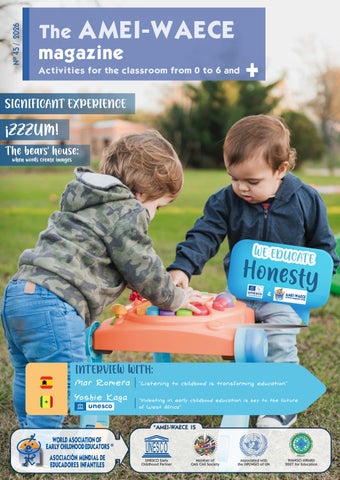
Nº 45 / 2026
The AMEI-WAECE magazine Activities for the classroom from 0 to 6 and
SIGNIFICANT EXPERIENCE
¡ZZZUM!
´
The bears' house: when words create images
&
INTERVIEW WITH: Mar Romera Yoshie Kaga
“Listening to childhood is transforming education” “Investing in early childhood education is key to the future of West Africa”
UNESCO Early Childhood Partner
Member of OAS Civil Society
Associated with the DPI/NGO of UN
WANGO AWARD 2007 for Education
BECOME A MEMBER BEING A MEMBER OF AMEI-WAECE HAS MANY ADVANTAGES DO YOU NOT THINK WE SHOULD SUPPORT AN NGO THAT DEFENDS EARLY CHILDHOOD EDUCATION? did you know it has been serving early childhood education and its professionals for over 30 years? YOU WILL BE ABLE TO CREATE THE BEST EARLY CHILDHOOD EDUCATION LIBRARY. We give you a book every month.
GREAT DISCOUNTS on our CONFERENCES and WEBINARS. Training is the key to success.
RECOMMENDED CENTER DIPLOMA AND PROMOTION of your Early Childhood Education center on Social Media to differentiate your center from the competition.
Do you want your EDUCATIONAL CENTER to have its own personalized magazine for parents?
SYLLABUS for the SPECIALIST TECHNICIAN in early childhood education COMPETITIVE EXAMS. competition.
AWARENESS CAMPAIGNS. The early childhood stage is the most important.
You will have at your disposal a large quantity of MANUALS, DOCUMENTATION, and EDUCATIONAL RESOURCES for the classroom and/or the center.
"NETFLIX" OF PRESENTATIONS with the BEST EXPERTS, because an Instagram or TikTok story is not enough to learn something.
JOB BOARD, both in Educational Centers and for childcare while you prepare for competitive exams or look for work.
PARENTS' SCHOOL, a program that helps you CONNECT WITH and RETAIN the parents of your (future) students.
Thanks to your membership fee, we will be able to maintain several SOLIDARITY PROJECTS in Nigeria.
You will be supporting an independent organization whose objective is to DEFEND THE INTERESTS OF THE CHILD above political or social considerations.
IT ALL ADDS UP. If you also ask "those in charge" to support and value the early childhood stage and to legislate with the child's development and what teachers really need in mind then you need to be part of AMEI-WAECE. BECOME A MEMBER!
UNESCO Early Childhood Partner
Member of OAS Civil Society
Associated with the DPI/NGO of UN
WANGO AWARD 2007 for Education
CONTENTS 01 RESEARCH 02 INTERVIEW WITH: 03 04
SIGNED BY Jorge Paredes Dear families
Mar Romera
SIGNIFICANT EXPERIENCES: ¡ZZZUM!
05
ENVIRONMENTAL EDUCATION ACTIVITIES
06 EDUCATIONAL 07 RESOURCES LET’S REFLECT
04 06
08
SIGNIFICANT EXPERIENCES:
22
09
INTERVIEW WITH:
27
10
EDUCATING TO LIVE TOGETHER IN PEACE:
33
08
10
16 20 06
FROM THE ERASMUS+ PROJECT “ME, MYSELF & I” ARE NOW AVAILABLE - SUPPORTING CHILDREN TO BETTER UNDERSTAND THEIR MINDS AND BOOST THEIR POTENTIAL (MMI)
The bears' house: when words create images
Yoshie Kaga
WE EDUCATE HONESTY
11 SCHOOL DAYS. 12
Editorial Staff: Pedagogical Team of the Association (revista@waece.org) Editorial and Advertising: Elvira Sánchez (comunicacion@waece.org) Graphic Design: Argenis Apostol (disenador@waece.org) The World Association of Early Childhood Educators (AMEI-WAECE) is a movement for the pedagogical renewal of early childhood education, registered in the Registry of Associations of the Government of Spain on May 20, 1991, obtaining registration number 109.157. It is a non-governmental, non-profit organization that is totally and absolutely independent of any political, religious, or economic group, and is participatory and democratic, serving educators of the world's youngest children to provide them with elements that are proving to be best suited for their interests and development.
35 36
AND TO FINISH A STORY.
LOS SALTOS DE LEO.
Legal Deposit: M-25536-2019 ISSN: 2659-9759
5
SIGNED BY... "There are letters that are easy to write and others that are a bit more difficult. This one belongs to the latter. When we talk about an educational strike, questions, concerns, and even anger arise. We know that reorganizing schedules, modifying work shifts, or finding someone to look after your children is not easy. We truly know this. And precisely for that reason, we feel the need to address these words to you with honesty."
We share with you something immensely important: the care and education of your sons and daughters. In recent years, society has placed a growing amount of responsibility on educational centers. It is no longer just about teaching math or science. We also educate on equality, coexistence, sustainability, emotional education, responsible use of social media... However, it is paradoxical that, while schools are expected to provide solutions to problems affecting society as a whole, recognition of teaching work is decreasing while constant questioning of our work increases. Added to this are increasingly frequent situations of lack of respect and even verbal aggression towards education professionals. This reductionist vision of our work contrasts with the daily reality of classrooms, where educational work far transcends the mere transmission of basic knowledge. Those of us who work in classrooms do not see students as numbers. We know them by their names, by their concerns, by their strengths and difficulties. We know who needs more time, who is going through Este artículoimpossible. está dedicado a todas las personas que nos complicated moments, or who celebrates with a smile an achievement that seemed tendieron su mano y siguen acompañándonos tras la
DANA. Porque en momentos difíciles comprendimos LThe school is full of invisible gestures. It does not only teach: itlos also accompanies, cares que el pueblo salva al pueblo. Gracias de corazón por for, and sustains part of the daily balance of thousands of homes.
vuestro apoyo, compromiso y humanidad. That is why we understand that many families ask themselves: how can a protest that involves the interruption of classes benefit children?
It is a legitimate question and deserves a sincere answer. School is not built solely on vocation. Vocation exists and is enormous, but it does not replace the necessary resources. It does not reduce high ratios, it does not multiply the time to attend individually to those who need it most, nor does it replace the professionals who are missing. There comes a time when personal effort is no longer enough. Perhaps the question s hould n ot o nly be why p art o f the teaching staff i s going o n strike, b ut also what i s happening in educational centers that makes many professionals feel the need to raise their voices. Imagine a classroom with too many students for a single teacher. Imagine trying to teach, accompany, attend to specific needs, mediate conflicts, evaluate, coordinate with families, and respond to an increasingly extensive bureaucracy. Imagine wanting to do it well and ending the day with the feeling of not having been able to dedicate the attention every child deserves to each one. This reality exists. And it happens more often than we would like to admit. When teachers demand lower ratios, more specialists, better resources, more emotional support, or better conditions for teaching and learning, they are not only thinking about themselves. They are thinking about the education their students deserve. Because we are talking about the future of public school. And talking about public school is talking about equal opportunities, social cohesion, and coexistence. It is talking about the space where children of different origins, realities, and circumstances live together. It is talking about one of the most valuable tools for building a fairer society. Some people will think that missing class days does not help either. And they are right about one thing: every day matters. For us, it also matters. A lot. No one who loves this profession leaves a classroom without feeling a deep commitment to those who remain in it. Those
4
who participate in a strike also assume personal and financial sacrifices because they consider that the problem deserves to be made visible. Because, sometimes, continuing as if nothing is happening can be more harmful in the long term. Sometimes stopping is a way of saying that something needs to be addressed before the deterioration becomes greater. A tired school ends up limiting opportunities; a cared-for school multiplies them. We would like you to imagine the school we desire for your sons and daughters: a school where every student feels seen and heard; where there is time to accompany, detect difficulties in time, and awaken curiosity for learning; where emotional well-being has a real space, and where no one is left behind for lack of resources. That school is not a utopia; however, it requires investment, institutional support, and the commitment of the entire educational community. And here is something fundamental: families, you are not on the other side. We are not opposing sides; we need each other. Education works better when family and school walk together. When there is trust, dialogue, and collaboration, extraordinary things happen. That is why this letter does not intend to tell anyone what they should think. It only wants to show a reality that often remains invisible behind the daily effort of thousands of professionals.
Thanks to the mobilization, a necessary debate has been opened regarding ratios, inclusion, infrastructure, attention to diversity, and educational resources. We have returned to asking ourselves what kind of school we want for future generations. Behind every demand, there are teachers who continue to arrive home thinking a bout how to better help their students. People who continue training, looking for new strategies, and celebrating every small advance of their students. And precisely because they believe deeply in education, they sometimes feel the responsibility to raise their voice—not against families, not against the students, but for them. Hopefully, there would be no need for strikes. Hopefully, the needs of the school would be heard before reaching this point. Meanwhile, we only want to ask you one thing: conversation. Ask us and listen to us; let us share concerns and also hopes. Because when a family asks what the school needs to better take care of their son or daughter, we are already taking an important step. In the end, we want the same thing: for our children to learn happily, to feel safe, to have opportunities, and to find adults who believe in them. And to achieve this, sometimes we also have to defend the school they deserve.
With respect, affection, and hope, A teacher and director who continues to believe deeply in public education and who enters the classrooms and office every morning with the same purpose: to help each student find their place in the world. P.S. Articles 1 and 2 of the LOE/LOMLOE set out the principles and aims of our educational system; reading them can help us better understand what education we want to build together. Jorge Paredes Giménez is a Primary and Early Childhood Education teacher, with specializations in Physical Education and Therapeutic Pedagogy; he is also the director of the CEIP Rosa Serrano in Paiporta, a school awarded various national educational prizes. This teacher holds a doctorate in school coexistence and belongs to the Laboratory of Studies on Coexistence and Violence Prevention (LAECOVI). In short, a teacher with a vocation in search of an active education in which everyone has a voice and participates. What do you prefer: to live or to survive? Dare.
5
H C R A E S E R
READING CAN MAKE A REAL DIFFERENCE Different scientific studies have analyzed what happens when a child becomes familiar with books from a very young age. And the results point in the same direction: early contact with reading is related to better cognitive and emotional development. A study by the University of Cambridge, "Childhood Reading Habits Boost Brain and Mental Health in Teens," makes clear the relationship between the habit of reading from a young age and better cognitive development: children who read for pleasure from an early age tend to show, even in adolescence, better indicators of cognitive performance and also more balanced mental health. We are not talking about getting outstanding grades in everything, but about skills like concentration,
6
comprehension, or manage emotions.
the
ability
to
Therefore, instilling in them the habit of reading builds connections in a brain that is in the middle of the formation process. The study's researchers explain that creating a language-rich environment is fundamental. And that does not depend solely on school. It depends, in large part, on what happens at home. A child who grows up surrounded by books, who sees their parents reading, who hears stories frequently, understands that reading is part of daily life and is something natural. In the end, reading is not just an academic tool. It is a way of understanding the world.
Source: Cambridge Research.
TEN-MONTH-OLD BABIES ARE ALREADY CAPABLE OF UNDERSTANDING THEIR PARENTS' BEHAVIOR AND DEVELOPING DIFFERENT TACTICS TO DECEIVE THEM
A study from the University of Bristol has shown that children under one year old are capable of deceiving their parents and the adults who look after them. The main novelty of this research is that, unlike previous studies, it focuses on deception techniques that do not require solid linguistic skills, including those that can be performed with simple gestures. This study was carried out through interviews with 750 parents from the United Kingdom, the United States, Canada, and Australia, who were asked about the behavior and development of their children. Among the responses, 130 parents claimed to have detected up to 16 different types of deception in their children under 4 years old. Some of them stated they had detected a first attempt at manipulation at eight months, an attitude that was perfected and became more frequent over time. Researchers were able to determine that a quarter of 10-month-old babies had made some attempt at deception, such as hiding forbidden food, pretending not to hear their parents, or exaggerating their reaction.
WHY DO CHILDREN BEHAVE WORSE WITH THEIR PARENTS THAN WITH OTHER ADULTS? The first time a study was conducted on this subject was in the late sixties, when psychologist Mary Ainsworth, known as the mother of attachment theory, launched an experiment in 1969 titled "Strange Situation," in which more than 100 families from the United States with babies between 12 and 18 months participated. The procedure allowed them to check how they reacted to separation and reunion with their attachment figure, through brief sequences of the caregiver's presence and absence and a stranger's. It was then verified that babies react differently. With adults outside their attachment circle, they tend to contain themselves, following social norms; whereas with their mother, they feel secure to show what they feel and how they act more freely. Although there is no reliable research that says children behave worse with their mother, what there is, is solid theoretical and empirical evidence on how the secure bond allows them to show their emotions more freely with their attachment figures, be it the mother, the father, the grandparents... The culprit for that is attachment. In addition to attachment and the need for emotional containment, there may be a third motivation for that bad behavior. Over time, the child learns that there are codes and norms to follow to adapt to the environment. At home, "they are in emotional mode, which implies connecting with the bond of trust and letting go of authenticity before the attachment figure". This does not mean that the child is faking or manipulating at home, but that they have acquired resources to regulate themselves and behave differently depending on the context and the people they are with.
Children from the age of two have been shown to be capable of carrying out slightly more complex deceptions, such as shaking their head "no" when asked if they had eaten chocolate when they just had, or pretending not to hear their parents when they told them they had to tidy up their toys. Therefore, the study has shown that this ability is perfected as the little one learns and develops their personality. Researchers warn that these are quite common behaviors during the development and learning process of children and explain that these "first forms do not necessarily imply total deception. It is probably more about getting their own way or obtaining additional rewards".
Source: Cognitive Development.
Fuente: Varios.
7
INTERVIEW WITH: We talk with
Mar Romera
“Listening to childhood is transforming education” Mar Romera, president of the Francesco Tonucci Pedagogical Association, is a teacher, pedagogue, and educational psychologist. Her work has focused for over thirty years on promoting a vision of education based on deep respect for the developmental stages and the uniqueness of each child. 1. In many of your interventions you state that “emotional education is life”. What should change in classrooms for children aged 0 to 6 for this statement to become a daily reality? I don’t like making generalizations. Every early childhood school is a world, a reality, a network of affections and bonds that make them different. This means that in some schools nothing would need to “change” and in others it would be necessary to “change a lot”.
satisfaction, better “effort-sacrifice”.
results,
with
less
Each early childhood center needs to start the transformation from a different place. Sometimes it is the spaces, other times the roles, the materials, the schedules, the groupings... “Educate with 3 Cs” provides the frame so that each educational center can design its embroidery.
Keeping in mind that “the door to change always opens from within”; generally, I would like to say that the most urgent thing would be to work “towards emotional excellence” of the educators who act as role models and as elements of connection with the little ones.
2. You defend the “Educate with 3 Cs: Capacities (Capacidades), Competencies (Competencias), and Heart (Corazón)” model. How can this approach be applied in early childhood education in a concrete and practical way? It is fundamental to understand that the “3 Cs” is not a methodology nor a closed recipe, but a comprehensive educational model that involves all agents: the home, the early childhood school, and the city-community. Being a model of thinking and looking, all methodologies fit into it as long as they respect childhood and put the little ones at the center of the process. Furthermore, this approach is deeply human because the “3 Cs” do not refer only to students, but also to educators and families. Applying the 3 Cs to the early childhood school (0-6 years) is to initiate processes of transformation of the school in our century from the perspective of childhood and keeping in mind that to transform is more than to “innovate”. To transform “education” is not to add, it is to modify what exists to obtain more
8
3. You insist a lot on the need to listen to children. How can an early childhood school give a true voice to childhood? Listening is not just hearing what they say; it is observing what they do. You listen with your eyes, with your hands, with your nose... In the early childhood classroom, sometimes there are gazes that call out to you and not a single sound comes from their lips. Knowing how to listen to tears is of utmost importance; there are usually no two identical tears. Giving a voice is allowing the little ones to participate in the organization of the classroom, to choose their materials, and for their real interests to be present in the projects. A school that gives a voice is one where the silence of the adult allows the child’s language to emerge (in all its forms: drawing, movement, play).
4. What is the importance of play, wonder, and creativity in the holistic development of the child at a time when haste and overstimulation seem to prevail? They are vital. Play is the language of childhood; if a child does not play, they do not grow up healthy. Wonder is the spark of science and creativity is the tool for solving problems. It is the way to provide basic coverage for human survival emotions: curiosity and admiration. Haste kills childhood because it does not consider it, and what is not considered and not named does not exist. Boys and girls need slowness, high-quality stimuli but few of them, less color and more wood, fewer slides and more trees; more free play and fewer recreational activities.
5. How should family and school collaborate to build a coherent and emotionally healthy education from the early years? Collaboration must be based on mutual trust, not on oversight. Family and school must be a "tribe" that speaks the same language of respect for every boy and girl. Coherence is not doing the same thing, but sharing the same values: that every little one is the center and that both environments are safe emotional refuges.
6. Currently, there is a lot of talk about educational innovation. What is the difference between truly innovating and simply introducing superficial novelties in the classroom? Novelty is cosmetic (buying tablets, painting walls, or removing books); innovation is deep and born from a change in the teacher's perspective. Truly innovating is asking oneself "Why am I doing this?" and being capable of transforming the pedagogical relationship so that the boy and girl are the real protagonists, not the recipient of a modern method. Transforming "education" is not adding; it is modifying what exists to obtain more satisfaction, better results, with less "effort-sacrifice". Schools truly change when they transform, not "when they innovate".
7. What advice would you give to early childhood educators who feel that bureaucracy and external demands distance them from the essence of educating?
focus on the eyes of their children. Their work is to be "trainers of hope". Bureaucracy is a procedure, but the encounter with the little ones is a sacred event that must not be contaminated. Sometimes we can make bureaucracy as functional as possible for our service and also keep in mind that sometimes the regulation helps us protect childhood, which is not always protected. I would tell them that the regulation that must truly always be present is: United Nations Organization. (1989). Convention on the Rights of the Child. Adopted and opened for signature, ratification, and accession by the General Assembly in its resolution 44/25, of November 20, 1989. We should know this document by heart, we should know its interpretation, and it should always be on our desk and, in case of doubt, always remember: Article 3: 1. In all actions concerning children, whether undertaken by public or private social welfare institutions, courts of law, administrative authorities, or legislative bodies, the best interests of the child shall be a primary consideration. 2. States Parties undertake to ensure the child such protection and care as is necessary for his or her well-being, taking into account the rights and duties of his or her parents, legal guardians, or other individuals legally responsible for him or her, and, to this end, shall take all appropriate legislative and administrative measures. 3. States Parties shall ensure that the institutions, services, and facilities responsible for the care or protection of children shall conform with the standards established by competent authorities, particularly in the areas of safety, health, number, and competence of their staff, as well as competent supervision.
8. If you could ask for one urgent transformation to improve early childhood education today, what would it be and why? I would ask for the real value of this stage to be recognized. Along with this, the "professionalism of its educators" must be recognized. This means a social recognition that does not exist. It also means different initial and ongoing training.
I would tell them that papers do not educate; people do. That when they close the classroom door, they should forget about bureaucracy and
9
SIGNIFICANT AUTHOR: Laura Díaz Boluda
CENTER: CEIP Vicent Ricart i Bonillo, Carrer el Palleter, 9, 46910 Benetússer – València, Valencian Community, Spain. EARLY CHILDHOOD EDUCATION CYCLE (0-3)
¡ZZZUM! Foundation As an Early Childhood Education teacher, I firmly believe in the need to bring children closer to the natural environment through wonder, respect, and emotion. The learning situation starts from the picture book "Honeybee" (Mi vida de abeja), and it is born as an opportunity to look at the world with curious, small, and attentive eyes, like those of a bee that travels through flowers discovering their importance.
Through this story, the classroom is transformed into a space to observe, ask, imagine, and care. Bees and flowers stop being distant elements to become close protagonists, awakening in the students the desire to understand nature and to feel part of it. The activities that arise from the story invite them to explore, create, and experiment, respecting the individual rhythms of 4-year-old children. This proposal does not only seek to learn content but to sow something deeper: love for living things, curiosity for what surrounds us, and the commitment, from a young age, to care for our environment. Because to educate is also to teach how to look at the world with sensitivity
The story: "Honeybee" (Mi vida de abeja), by Kirsten Hall, illustrated by Isabelle Arsenault, narrates the life cycle of bees over the course of a year, from one spring to the next. With simple and poetic language, the text shows the different stages of nectar collection and honey production. Its rhythm, close to that of a song, transmits the constant energy and ceaseless movement of the hive, bringing the youngest readers closer to this fascinating world in an attractive and sensory way. A story that combines knowledge and beauty, ideal for awakening curiosity about nature.
Context: The present proposal is developed at the CEIP Vicent Ricart i Bonillo, in a 4-year-old Early Childhood Education classroom, coinciding with the arrival of spring, a particularly propitious moment for the discovery of the natural environment. The learning situation arises spontaneously from a significant experience in the classroom: the finding of a small honeycomb, which was brought to class. This fact immediately awakened the students' curiosity, generating questions, hypotheses, and interest in understanding what it was, where it came from, and who had built it. Starting from this starting point, and taking advantage of this genuine interest, the story
10
"Honeybee" is introduced as a guiding thread for learning. In this way, a proposal is built that is born from direct experience, from wonder, and from the need to respond to the students' concerns, giving rise to a set of globalized activities that favor exploration, respect for nature, and understanding of the environment.
Challenge/final product: The students face the challenge of discovering and understanding what bees are, how they live, and why they are important for our environment, starting from their own questions and hypotheses that arose after the discovery of the honeycomb. Throughout the proposal, they will have to investigate, observe, and experiment to answer their concerns and learn to care for and respect nature. As a culmination of the project, we will create a small "bee corner" or exhibition in the classroom, where they will share what they have learned through artistic productions, murals, small performances, and elements related to bees and flowers. This space will serve to explain to other classes or to families how bees live and why it is important to protect them.
EXPERIENCES EXPERIENCESS Simple programming: Areas, specific competencies, evaluation criteria, basic knowledge or contents, methodology SPECIFIC COMPETENCIES
EVALUATION CRITERIA
Area 1: GROWTH IN HARMONY Linked specific competencies and evaluation criteria
▪
▪ ▪ ▪
Explore and experiment with the possibilities of one's own body through movement in different spaces. Identify body parts in a global way. Adopt basic habits related to well-being, hygiene, and personal care. Develop attitudes of respect towards oneself, others, and the environment.
▪ ▪ ▪ ▪
Participate in motor activities showing security and confidence. Recognize some parts of their body on themselves and on others. Show progressive autonomy in hygiene, order, and routine habits. Adopt appropriate behaviors related to personal and environmental care.
Area 2: DISCOVERY AND EXPLORATION OF THE ENVIRONMENT ▪ ▪ ▪ ▪
Identify basic characteristics of elements of the natural environment (bees, flowers, honeycomb). Establish simple relationships between living beings and their environment. Conduct small investigations based on observation and curiosity. Develop attitudes of respect and care towards the natural environment.
▪ ▪ ▪ ▪
Show curiosity for the natural environment by formulating questions and hypotheses. Recognize basic elements related to bees and flowers. Participate in exploration and experimentation activities. Identify actions related to the care and respect of the environment.
Area 3: COMMUNICATION AND REPRESENTATION OF REALITY ▪ ▪ ▪ ▪
Use oral language to express ideas, emotions, and discoveries. Explore different languages (artistic, bodily, musical) to represent reality. Understand simple messages related to their experience. Participate in basic communicative situations respecting norms.
▪ ▪ ▪ ▪
Express ideas and experiences related to the story and activities. Participate in conversations and listen to others. Create artistic productions related to the project. Use different forms of expression to communicate what they have learned.
Basic Knowledge / Contents
Methodology:
▪ ▪ ▪
The proposal is based on a globalized, active, and experiential approach, starting from the students' interest after finding the honeycomb. Significant learning is prioritized through experimentation, direct observation, play, and manipulation.
▪ ▪ ▪ ▪ ▪
Bees: basic characteristics and way of life. Flowers and nature in spring. Relationship between bees and flowers (pollination in a simple way). Observation, exploration, and experimentation of the environment. Oral language: expression of ideas, questions, and experiences. Artistic expression: drawing, painting, artistic creations. Values: respect, care for the environment and living beings.
The story "Honeybee" (Mi vida de abeja) acts as a motivating axis that guides activities, fostering curiosity, participation, and expression in different languages. Individual rhythms are respected, promoting an affectionate and trusting climate where students are the protagonists of their own learning.
11
Didactic sequence or development of the learning situation HOW DOES THIS LEARNING SITUATION ARISE? A beehive appears in class! And this creates curiosity about bees; we want to know where they live, what they eat, how they make honey... BUT... WHAT DO WE KNOW ABOUT BEES? We start from the students' prior knowledge, making hypotheses and posing questions that spark their curiosity and interest. Through the assembly, we share experiences, ideas, and knowledge we already have about bees, valuing everything the group contributes. From there, we build a space for dialogue where new doubts arise: where do they live?, how do they make honey?, why are they so important?, what function do they have in nature?. These questions invite us to investigate, observe, contrast information, and learn in a meaningful way. REFERENCE BOOKS AND THE STORY "HONEYBEE" (Mi vida de abeja) PTo investigate and learn about the characteristics of bees, we borrow books about bees from the Municipal Library. First, we read the book "Honeybee" (Mi vida de abeja), and from there, we start investigating them. Reference books are part of our research corner and we can look at them whenever we need to.
DEVELOPMENT OF THE LEARNING SITUATION We explore the morphology of bees in detail, analyzing the different parts that make up their body. Through guided observation, we discover that they are structured in three main parts: head, thorax, and abdomen, understanding the basic function of each one. In addition, we identify other fundamental structures such as the eyes, antennae, legs, wings, and stinger, relating each of them to their utility within the life of the bee and its adaptation to the environment. To reinforce this learning, we carry out observation, representation, and manipulation activities, in which the students draw, build, and organize the parts of the bee's body, thus favoring visual understanding and meaningful learning through experimentation. In this way, knowledge is not acquired by rote memorization, but through active exploration, direct observation, and creative expression.
12
We learn that not all bees are the same and we discover the different types that exist within the hive. Through research, we identify the worker bee, the queen bee, and the drone, understanding the characteristics of each and the fundamental role they play in the functioning and balance of the hive. Likewise, we awaken great curiosity to know the life cycle of bees, exploring their different stages of development. For this, we symbolically delve into the hive through observation and experimentation, using magnifying glasses and microscopes that allow us to expand our view and discover surprising details. And surprise! We observe remains of eggs and larvae, which helps us understand that bees go through different phases before becoming adults, thus approaching their growth and development process in an experiential way. We stop to observe with attention the shape of the hive and each of its cells, discovering that their structure reminds us of a very particular geometric figure. After exploration and dialogue, we arrive at a conclusion: it is a hexagon! Starting from this finding, we ask ourselves why it receives that name and we analyze its characteristics. We count its sides and vertices, verifying that it is formed by six sides, which helps us to strengthen its identification and understanding in a manipulative and significant way. Once this new geometric shape is internalized, we expand our view to the school environment and carry out an active search through the different spaces. With great surprise, we discover that hexagons are more present than we imagined, finding them in objects, structures, and everyday elements, which allows us to connect mathematics with the reality that surrounds us.
We have already discovered many things about bees, but a great mystery still remains that awakens our curiosity: how do they make honey? To answer this question, we begin an investigation process in which we discover that bees make honey from the nectar they collect from flowers. We learn, step by step, how they transform it inside the hive until it becomes that sweet and characteristic food. In addition, we learn about the figure of the beekeeper, the person in charge of caring for and protecting the bees, as well as collecting honey responsibly, thus understanding the importance of their work. Given the great interest generated, we decide to get even closer to this natural product by holding a honey tasting, exploring its texture, its aroma, and its flavor, thus connecting learning with a significant and motivating sensory experience.
13
Following the discovery that bees make honey from flower nectar, a new interest arises in getting to know them better. Furthermore, curiosity also emerges because different types of flowers appear in the story “My Life as a Bee.” We observed and analyzed the flowers, discovering their shapes, colors, scents, and textures, turning them into a learning resource by using them for various creative proposals. We extracted natural dyes from the petals, experimented with stamping, and explored their artistic possibilities, thus experiencing learning in a hands-on, sensory, and meaningful way. To conclude the project, we observed and learned that bees mainly use wax to build hive cells—hexagonal structures where they store honey and pollen, and where the queen lays her eggs to give rise to new bees. We also discovered that the wax serves to seal these cells and protect their contents. Through direct manipulation, we touched and explored the beeswax, investigating its characteristics and uses. We discovered that, in addition to its function in the hive, it is also used for making candles. As a closing to the project, we made our own beeswax candle, living a hands-on and meaningful experience that brought us even closer to the world of bees. All that remains for us now is to create the covers for our learning situation and continue enjoying the different proposals related to bees, through which we continue working on different concepts and areas in a playful and comprehensive way.
PROPOSALS
Conclusions In short, the natural environment is not only an educational resource, but an authentic space for life and learning where students discover, experiment, and feel. Through curiosity and exploration, meaningful knowledge is built that goes beyond the classroom, connecting the child with their environment in a conscious and respectful way. This project allows us to sow small seeds of responsibility, sensitivity, and commitment to nature, fostering attitudes that will last over time and contribute to the formation of more conscious and supportive citizens regarding their environment. Because only what is known is valued; and only what is valued is protected. “Taking care of nature is not an option: it is the most authentic way to take care of our future.”
14
If you would like us to publish your center’s experience, send an email to revista@waece.org
WOULD YOU LIKE TO HAVE THIS
ON THE FACADE OF
YOUR CENTER?
2027
THIS EDUCATIONAL CENTER
by:
IS RECOMMENDED UNESCO Early Childhood Partner
Member of OAS Civil Society
Associated with the DPI/NGO of UN
WANGO AWARD 2007 for Education
MORE INFORMATION: consultas@waece.org
EDUCATION FOR SUSTAINABLE DEVELOPMENT We cannot understand environmental education unless it is parallel and simultaneous to what we traditionally know as EDUCATION IN VALUES. It is difficult for a child to care for the environment if they do not care for themselves; it is difficult for them to respect the environment if they do not respect themselves and others. It is clear that we must educate to share, respect, love, believe, etc.
MINI-LIVING FOREST Children create a "mini living forest" inside a large box or tray, using real natural elements. The activity combines sensory exploration, care for the environment, and symbolic play.
The objectives are the following: • • • •
Develop respect for nature from an early age. Stimulate the senses (touch, smell, sight). Promote free play and creativity. Introduce the idea of simple ecosystems (plants, soil, water, insects).
The materials we need are: • • • • • • •
A large box or shallow tray (cardboard or plastic type). Soil or sand. Dry leaves, twigs, small stones, pinecones. Cotton or moss (optional). Spray water or a dropper. Small animal figures (optional) or made with modeling clay. Toy magnifying glasses (optional).
Development of the activity The first activity is called "Nature Explorers." Children go out to the patio or garden to collect small natural elements: leaves,
stones, little sticks... Important rule: only pick up things from the ground, never pull out plants. In the event that the center cannot provide the children with this type of resource, they can bring them from home. Once we have the natural elements, it is time to "Create the forest." In groups, they build the forest inside the box: The soil is the "forest floor," the stones are mountains or paths, the leaves are fallen trees or ground cover, the sticks form trunks or bridges... The teacher guides them by asking a series of questions, such as: "Where would an insect live?", "What does this living forest need?". "Secret life of the forest." Small animals or figures are added: Ants, birds, snails...
14 16
"Magic rain." With a water spray, they simulate rain over the forest, and the children can observe how the soil and leaves change. Here, the idea that water is necessary for life is introduced. We encourage children to invent stories and foster dialogue: "Who lives here?", "What do the animals eat?", "Is it cold or hot?", "Do the animals get along when they have to share the space?", "What does our forest like?", "What would not hurt it?", "Do we make it dirty?"... We end the activity with a key idea: "Nature is a home that we must take care of".
"MY PLANT, MY GROWTH" We begin a new school year, and each child plants a seed or a small plant that they will care for throughout the year. The plant will be their "growth companion," symbolizing how they also grow, learn, and change during the year.
The objectives are the following: • • • •
Promote responsibility and the care of living beings. Develop patience and the observation of natural growth. Connect the plant's growth with the child's personal growth. Introduce basic habits of caring for the environment.
The ideal choice is a hardy plant with visible growth that is easy to care for during the school year: • • • •
Lentils or chickpeas sprouted (quick start). Sunflower (very symbolic: it grows tall like them). Green bean (quick and visible growth). Spearmint or mint (hardy and aromatic).
We will need the following materials: Small pots or recycled cups, soil, seeds (sunflower, bean, or lentil), a small watering can or spray bottle, wooden sticks, and markers or stickers to personalize the pot.
Development of the activity "We choose our plant friend." Each child receives their pot and decorates it with their name and drawings. The teacher must remind them that "This plant is going to grow with you all year long". "We plant life." The teacher guides the process: fill the pot with soil, make a small hole, place the seed, and cover it carefully. "The first watering." Each child waters their plant for the first time, and we take advantage of the moment to introduce the idea: "Without water, the plant cannot live". "Our commitment." Each child says or repeats a simple commitment: "I am going to take care of you," "I am going to give you water," "I am going to watch you grow". This can be accompanied by a symbolic gesture (hand over heart or on the pot). Routine of care during the school year: Every week or every two weeks: Water, observe changes, measure growth with small sticks, a ruler, or tape, and draw the plant in a "growth diary" notebook. In parallel, we talk about how "I also grow." Once a month, the children draw themselves and compare: "my plant grows / I grow". At the end of the school year: They compare the plant from September with the current one and will be able to reflect: "We have grown together". They can take the plant home as a souvenir.
Find more activities in the Planet Earth Caretaker Children's Club, an environmental education program based on education in values, developed by AMEI-WAECE in collaboration with UNESCO. You can find more activities at: https://www.waece.org/clubninyos/principal.php
15
EDUCATIONAL RESOURCES FROM THE
ERASMUS + PROJECT“ME, MYSELF & I”ARE NOW AVAILABLE - SUPPORTING CHILDREN TO BETTER UNDERSTAND THEIR MINDS AND BOOST THEIR POTENTIAL (MMI)
Available in ENGLISH, SPANISH, German, and Hungarian at https://www.worldhappinesslessons.com/mmi/ Whose goal is to help raise a generation that better understands itself as human beings and is capable of self-regulation and healthy interaction with others so that, together, they can face the challenges of the 21st century as active and responsible citizens.
18
The activities proposed in this program are designed to be flexible and adaptable to the specific context of each classroom and the individual needs of each child. Available in ENGLISH, SPANISH, German, and Hungarian at https://www.worldhappinesslessons.com/mmi/ The MMI Project: Me, Myself and I, under the Erasmus+ KA2 framework (Project Number: A210-BE-24-24-246459), aims to empower children by helping them to better understand their minds and unlock their full potential. By integrating Social and Emotional Learning (SEL) principles into educational practices, the project equips young learners with essential emotional intelligence and resilience skills. These efforts foster holistic development and promote well-being, creating a strong foundation for future personal and academic success.
PARTNERS: Germany JOHANNITER-UNFALL-HILFE EV
–
Spain – INNOPARES CONSULTORES Y FORMADORES S.L. Spain Spain – Asociación Mundial de Educadores Infantiles (AMEI-WAECE) Hungary – The World is Better With You Foundation (The Happiness Lesson Integrated Programmes) Project Number: A210-BE-24-24-246459
Funded by the European Union. Views and opinions expressed are however those of the author(s) only and do not necessarily reflect those of the European Union or the European Education and Culture Executive Agency (EACEA). Neither the European Union nor EACEA can be held responsible for them.
19
LET’S REFLECT...
This section has been produced in collaboration with the European partners of the Erasmus+ project ‘Me, Myself and I – supporting children to better understand their minds and boost their potential’ (MMI).
Further information about the project can be found at https://www.worldhappinesslessons.com/mmi/
SIGNIFICANT “T he bears' house:
when words create images” Foundation
AUTHOR: Aidé Carolina Barbosa Cruz CENTER: CEIP Nuestra Señora de la Asunción en Valladolid Oaxaca - Mexico SECOND CYCLE OF EARLY CHILDHOOD EDUCATION (3-6)
The story, as a pedagogical tool in Early Childhood Education, constitutes the central axis of this learning situation, as it not only fosters listening and imagination, but also drives the reconstruction of events, their interpretation, and the meaning they acquire within children's development and learning processes. Through the story of "The Three Bears," students will begin to understand that words allow them to name the world, remember what they have lived, and express what they imagine, feel, and internalize.
In this sense, this didactic proposal places the development of written language, narration, and description as fundamental elements, considering that narrating implies ordering experience by establishing sequences, while describing involves looking with greater attention, selecting words, and precisely defining what one wishes to communicate. In this way, writing and representing words linked to the story cease to be a copying exercise to become a process of constructing meaning. This process is enriched through the incorporation of technology as an educational resource, present in the children's daily environment, but approached from a conscious, ethical, and formative perspective. In this proposal, artificial intelligence is not presented as an end in itself, but as content that allows understanding how words can be transformed into images, evidencing the direct relationship between language and representation. Thus, students discover that technology does not replace thinking, creativity, or effort, but can be put at the service of learning when used meaningfully. Thus, through the shared reading of the story—which acts as a connecting thread—students select significant words, construct oral and written descriptions, and, with adult mediation and family support, observe how these descriptions are transformed into images through instructions directed at a digital generation tool. In this process, they understand that the greater the clarity and precision in their words, the more faithful the obtained representation, recognizing that language not only communicates, but also creates. In this way, the story ceases to be only a heard story to become a creation born from the imagination and one's own gaze. Through their words, images, and stories, students not only reconstruct the facts, but also take ownership of them from their context, strengthening their communicative competence as they approach digital innovation from a responsible perspective. Thus, they discover that words can build worlds, stories, and experiences in which learning and being happily form part of the same story.
The Story: THE THREE BEARS In a small house in the woods lived three bears: Papa Bear, Mama Bear, and Baby Bear. One sunny day they prepared their breakfast: three bowls of oatmeal, and since it was too hot to eat, they decided to go for a walk while it cooled down. While they were out, a girl who was walking through the woods found the house, and seeing the door ajar, entered with curiosity. On the table, there were three bowls of oatmeal and she first tried Papa Bear's large bowl, but it was too hot; then she tried Mama Bear's, which was too cold,
22
and finally she tried Baby Bear's small bowl, which was just to her liking... and ate it all up. After eating, the girl saw three chairs. She sat in Papa Bear's big chair, but it was too hard for her; she tried Mama Bear's, which was too soft, and finally she sat in Baby Bear's small chair, which seemed perfect... but upon moving a little, the chair broke. The girl decided to go up to the bedroom. There, she found three beds. She lay down in Papa Bear's big bed, but it was too hard. She tried Mama Bear's, which was too soft. Finally, she lay down in
EXPERIENCES Baby Bear's small bed, which was just right, and fell fast asleep. When the three bears returned home, they noticed someone had been there; Papa Bear saw that his bowl had been tasted, Mama Bear noticed it too, and Baby Bear discovered that someone had eaten everything he had, which made him very sad. Then they saw that the chairs had also been used, and Baby Bear, upon seeing his broken chair, began to cry. Upon going up to the bedroom, Papa Bear said that someone had been in his bed, Mama Bear also noticed her unmade bed, and Baby Bear discovered the girl sleeping in his bed. At that moment, the girl woke up, saw the three bears looking at her, and, very frightened, ran out of the house and the woods, leaving the bears surprised by her unexpected visit. The End.
Reference for the story
The Three Bears is a traditional story of British origin whose first written version was published by Robert Southey in 1837. Over time, the story has been adapted into multiple versions for children's literature. The account included in this proposal corresponds to a pedagogical adaptation of the traditional story, carried out for educational purposes to facilitate its comprehension and its use in Early Childhood Education learning activities.
Context: This learning situation is aimed at Early Childhood Education students, in a group of approximately 5 to 10 children who are 5 years old. The group is characterized by being at a stage where oral language acquires special relevance, as students show interest in narrating experiences, describing their environment, and expressing ideas through drawing and emergent written language. The context in which the proposal is developed considers the participation of families, who accompany the students in certain activities carried out at home, especially in the use of digital tools. There are no technological devices available in the classroom, so the work with artificial intelligence is carried out with family mediation, strengthening the link between school and home. The proposal is organized in small groups, favoring participation, oral expression, and the collective construction of learning, in an environment where the story, language, and creativity become the axes of the educational process.
Challenge/Final Product: Students are challenged to create their own story based on the tale of The Three Bears, using their words to describe characters, objects, and scenes that will subsequently be transformed into images. Through this process, students must select significant words (represented in a "word keychain") to construct descriptions and organize their ideas to achieve coherent representations, understanding that clarity in language directly influences the obtained result.
The final product will consist of the creation of an illustrated mini-book, created from images generated based on their own descriptions, in which each student will narrate their version of the story, integrating words, images, and narrative sequence as a meaningful personal production.
Simple Syllabus: Areas: • • •
Language and communication Creative thinking Personal and social development
Specific Competencies: • • • •
Express ideas, experiences, and emotions through oral language. Describe people, objects, and situations using increasingly precise words. Begin the construction of written language based on significant words. Use tools and resources from their environment to create and communicate ideas.
Evaluation Criteria: • • • • •
Participates in the narration of the story, respecting the sequence of events. Describes characters and scenes using significant words. Selects and uses words from the keychain to represent ideas. Relates their descriptions with the generated images. Constructs their own production (mini-book) with meaning and coherence.
23
Basic Knowledge / Contents • • • • •
Storytelling and story reconstruction. Description of characters, objects, and settings. Relationship between word, image, and meaning. Writing meaningful words. Formative use of digital tools for creating images from language.
Methodology The work is carried out through active, student-centered methodologies that favor participation, exploration, and creation. The proposal integrates individual and collective work, as well as family mediation, promoting students to build their own learning based on language and experience.
1. Building Meaning from the Word
The use of digital tools is incorporated in a guided manner, allowing students to understand their function as a resource for representing ideas based on their own descriptions.
Based on this observation, they discuss how to describe a house so that everyone imagines it in the same way. They propose characteristics such as color, number of windows, or roof shape. The teacher records these ideas, and the students make a second drawing based on the agreements they made. When comparing both productions, they recognize that when the instructions are clearer, the representations become more alike.
Didactic Sequence or Development of the Learning Situation ◦
Initial Meeting with Families
Before starting the learning situation, a meeting will be held with parents to present the educational proposal and establish participation agreements. This meeting will address four fundamental aspects: •
•
•
•
Objective of the learning situation: To explain that the proposal seeks to strengthen oral and written language through narration, description, and the creation of images based on instructions created by the children themselves. Pedagogical justification: To clarify that the use of digital tools has a formative approach and is used so that students understand the relationship between the words they use and the representations generated from them. Ethical issues: To point out that technology does not replace the child's thought or creativity, but is used as a learning resource under the responsible mediation of adults. Understanding the technological process (version for adults): To explain to parents the basic functioning of image generation tools and the concept of a "prompt," so that they can support their children by writing the instructions that the children describe orally.
This initial moment allows for establishing a framework of collaboration between school and family and ensures that the use of the technological tool maintains a clear educational purpose. ◦
Exploration of Prior Knowledge
The teacher begins a dialogue with the students
24
about the use they give to computers at home. Based on their participation, she recovers experiences related to creation, such as drawing, viewing images, or building something of their own. Based on these ideas, they reflect on how a computer can help us create when we have an idea and know how to indicate what we want; in this way, a first link is established between thought, language, and technology, motivating students to use it as a medium to make their own creations a reality.
The teacher writes the word "HOUSE" (CASA) on the board and asks the students to draw a house freely and write its concept in their notebook. When comparing the results, the children observe differences in shape, color, and size.
This allows them to understand that language guides what one wants to represent. 2. Introduction to the Story and Narrative Reconstruction The teacher brings back the idea of the house and presents the story "The Three Bears," inviting students to enter the story. During the reading, students identify characters, objects, and spaces. At the end, they recount what happened in their own words, while the teacher accompanies them in organizing the sequence. This moment strengthens oral language, memory, and narrative comprehension. 3. Building Vocabulary from the Story Based on the story, meaningful words are recovered such as GIRL, HOUSE, DADDY BEAR, MOMMY BEAR, BABY BEAR, SUN, CUP, CHAIR, and BED. Students make cards with these words and illustrate them, building a "word keychain" that will serve as support for later activities. 4. Building Descriptions from the Character The teacher focuses attention on the girl from the story. Based on guiding questions, the students describe her characteristics. As they express their ideas, the teacher draws on the board following
their instructions. Upon observing the result, the children understand that words allow them to guide the representation of an image. Subsequently, each student makes their own drawing and writes the word. 5. Construction of story scenes Based on the story of The Three Bears, the teacher proposes that the students create a collective story by revisiting the main scenes. To do this, she presents different base scenes from the story and allows each student to choose the one they wish to represent.
Base scenes of the story ▪ ▪ ▪ ▪ ▪ ▪ ▪ ▪ ▪
Papa bear, mama bear, and baby bear leave their house to go for a walk in the forest. It is a sunny day. A girl arrives at the bears' house. The girl in the house observes the table with three bowls. The girl eats from the small bowl that is on the table. Upon sitting on the small chair, the girl breaks it. The girl observes three beds: one large, one medium, and one small. The girl falls asleep in the small bed. The three bears see the girl sleeping. The girl runs away from the house.
With the teacher's support, the children orally construct a description of their scene, considering elements such as characters, objects, colors, actions, and the environment. Subsequently, using their word keyrings, students select the terms they will use to represent their scene, such as sun, house, girl, bear, among others, and write them in their notebooks as the basis for their idea. The children supplement their scene description orally, defining details that will later be revisited at home with family support. In this way, students prepare their ideas to be represented, strengthening narration, description, and the relationship between word and image. 6. Transformation of ideas into images (use of the prompt) Building on the work done, the teacher explains that the descriptions the students have constructed can be used to generate images with a digital tool. She points out that these instructions are called "prompts," understood as the way to tell the computer how we want an image to be. At home, with the support of their families, students share the scene they chose, the words they wrote, and the ideas they described orally. Based on this, the adult writes the "prompt" in the digital tool, respecting the child's instructions. The generated image is printed and brought to the classroom to continue the work. 7. Analysis and adjustment of generated images Upon returning to the classroom, students present the obtained images and share the description they previously made. Based on this exchange, the words used are compared with the generated results, encouraging children to recognize the relationship between what they said and the image obtained. The teacher guides the reflection through questions such as: What did you say?, what appeared?, what could you change or add? This moment allows students to understand that the clearer and more detailed the description, the more precise the image will be, favoring the adjustment of their ideas and learning through trial and error. 8. Story construction and creation of the mini-book Based on the generated images, students organize their scenes and build their own story. Although they revisit elements from The Three Bears story, each child interprets and narrates the events from their own experience. With the teacher's support, students arrange their images, integrate them into a small book, and tell their story, establishing a coherent sequence. The mini-book becomes a personal creation that integrates words, images, and narration, allowing students to recognize that their ideas can be transformed into their own meaningful productions.
25
◦
Adaptations for the diversity of the context
The current proposal considers the diversity of classroom contexts; therefore, in cases where digital tools are not available at home, the images can be created manually with family support, based on the description and narration performed by the students. In this way, the participation of all children is guaranteed, prioritizing the development of language, imagination, and the construction of meaning over the technological resource used.
CONCLUSIONS The current learning situation allows us to recognize that the story, beyond being a narrative resource, can become a central axis that articulates the development of language, creativity, and the construction of meaning in children. Through narration and description, students not only reconstruct a story but also learn to organize their ideas, select words, and express what they imagine with greater clarity. In this process, writing ceases to be a mechanical exercise and becomes a meaningful tool. The incorporation of technology, and particularly artificial intelligence, is approached from a formative perspective, in which children understand that their words have a real impact on what is created. Thus, they discover that language not only communicates but also transforms and constructs. The mini-book created as a final product reflects this process by integrating narration, image, and personal experience, allowing each student to recognize themselves as the creator of their own story. Overall, this proposal fosters meaningful learning in which students participate actively, think, imagine, and create, understanding that their ideas have value and that, through words, they can shape their own world.
If you would like us to publish your classroom experience, write to revista@waece.org. Remember to publish points for competitive exams and merit-based contests.
26
INTERVIEW WITH: We talk with
Yoshie Kaga
“Investing in early childhood education is key to the future of West Africa” Yoshie Kaga is an Education Programme Specialist for UNESCO, based at the Multisectoral Regional Office for West Africa in Dakar, Senegal. Having worked for many years at UNESCO Headquarters in Paris, what differences have you observed, and what are the main challenges and opportunities of leading the West Africa Office? Having worked at UNESCO Headquarters in Paris and now leading the work on early childhood education, education for peace and sustainable development and education in emergencies from UNESCO Regional Office for West Africa, one of the most striking differences I have observed in my work is the proximity to countries and communities. In the field, there are far more opportunities to engage directly with national and local stakeholders, to listen to their experiences, and to understand first-hand the realities, priorities and constraints that shape education policies and programmes. This direct interaction provides invaluable insights into the diverse needs, contexts and approaches that exist across countries. At Headquarters, our role was often to develop global guidance and recommendations that could resonate across regions and support a broad range of countries. While this global perspective is essential, it inevitably requires a certain level of generalisation. Working in the Regional Office for West Africa has reinforced the importance of context. Here, we are able to provide more nuanced analyses and tailored recommendations that take into account local realities, cultural specificities, institutional capacities and socio-economic conditions. This makes our support more relevant and often more actionable for policymakers and practitioners.
Perhaps one of the most important realizations I have had is the nature of countries’ expectations towards UNESCO. In the field, I feel much more strongly that countries do not expect international organizations to bring ready-made solutions. Rather, they expect us to work alongside them in co-constructing solutions that are adapted to their realities, priorities and capacities. They also expect support that delivers tangible results—support that creates meaningful and sustainable change for children, families and communities. This has deepened my conviction that our work should be guided by a programmatic and long-term approach. While individual projects can be useful, lasting impact requires sustained engagement, capacity development and policy support that continue beyond the lifecycle of a single grant or funding cycle. The real measure of success is whether improvements can be maintained and scaled after external funding has ended. For me, therefore, the current work in West Africa is both a responsibility and an opportunity. The challenge is to support countries in addressing complex and interconnected development issues while ensuring that our interventions are locally owned, sustainable and responsive to diverse contexts. The opportunity is to accompany a region that possesses extraordinary human capital, cultural richness and innovative potential. By combining UNESCO’s global expertise with locally grounded solutions and by fostering learning and cooperation among countries of the region, we can help accelerate progress towards quality and equitable education for all children.
Another important lesson has been the rich diversity of West Africa. Before coming to the region, I was aware of its complexity, but I did not fully appreciate the richness that exists in terms of population size, languages, cultures and education systems. I have also learned that countries often find it more meaningful to learn from experiences within their own region—experiences that share similar cultural, linguistic or socio-economic characteristics—than from examples drawn from entirely different contexts. This has reinforced my belief in the value of regional cooperation and South-South learning, which UNESCO is well positioned to facilitate.
27
Why is early childhood education, from birth to age 6, so important for children's development, and what are the main challenges in ensuring access to quality services in West Africa? Early childhood education is one of the most important investments a society can make because it lays the foundation for lifelong learning, well-being and development. The period from birth to age six is a unique window of opportunity when children's brains develop at an extraordinary pace. It is a time of discovery, curiosity and meaning-making, when children are naturally eager to learn, explore their environment and build relationships with others. These formative years shape not only cognitive development, but also social and emotional well-being. They are also the ideal stage to nurture the values and competencies that our societies need for the present and the future, including learning to live together in peace, respect for diversity, environmental stewardship and climate literacy. Evidence shows that children who benefit from quality early childhood education are more likely to succeed in school, remain in education longer and enjoy better health and employment outcomes later in life. At the same time, ensuring optimal early child development remains a major challenge in West Africa. Many countries continue to face structural constraints such as poverty, inequality and insecurity, which affect young children's development and limit families' access to essential services. According to the Countdown to 2030 data, the mortality rate for children under the age of 5 for West Africa is 91 out of 1000 children, which is the highest of all African regions. Within early childhood education itself, access remains both low and inequitable. While participation rates vary significantly across countries, pre-primary enrolment in West Africa was 22% in 2024 (or closest years) according to the data from the UNESCO Institute for Statistics, which is among the lowest in Africa. Rural children, children from poorer households, and children affected by conflict or displacement are particularly disadvantaged. A second major challenge concerns the workforce. Many countries face shortages of qualified early childhood educators and limited opportunities for continuous professional development. Yet the quality of interactions between teachers and young children is one of the most important determinants of children's learning and development outcomes. Financing is a critical issue. Across Africa, governments dedicate on average only about 2.6% of their education budgets to pre-primary education, and many countries allocate even less (Razquin and Neuman, 2025). This creates a significant gap between ambitious early childhood policies and the resources available to implement them at scale. Finally, there is a persistent challenge related to data and evidence. Many countries still lack timely, reliable and disaggregated data on participation, quality, workforce development and learning environments. Without robust data systems, it is difficult to target investments effectively, monitor progress and ensure accountability. Strengthening information systems is therefore essential for evidence-based policy-making and implementation. Indeed, these challenges emerged clearly during the Expert Meeting on Early Childhood Education and Development in West Africa, under the auspices of the Ministry of National Education of Senegal and supported by UNESCO, the African Early Childhood Network (AfECN), the World Health Organization (WHO), and the West African Health Organization (WAHO). The meeting brought together policymakers, researchers, practitioners and development partners from across the region, who identified a common set of priorities, including expanding equitable access to quality services, strengthening the workforce, increasing and better targeting financing, improving data and monitoring systems, and promoting stronger intersectoral coordination among education, health, nutrition and child protection sectors. The discussions reaffirmed that achieving lasting progress in early childhood development requires holistic, evidence-based and sustainably financed approaches that place young children and their families at the centre of national development agendas. Despite these challenges, there are many reasons for optimism. West Africa is one of the youngest regions in the world, with extraordinary human potential. Governments are increasingly recognizing the importance of investing in the early years, and there is growing momentum for expanding access, strengthening the workforce and improving financing. If we can translate this commitment into sustained investment and action, we can ensure that every child has the opportunity to thrive, learn and contribute to the future development of the region.
28
What are the main educational challenges currently facing countries in West Africa, and how is UNESCO helping to address them? As mentioned earlier, West Africa is a region of tremendous potential. It has one of the youngest populations in the world and a remarkable wealth of cultural, linguistic and human diversity. At the same time, countries across the region face a number of interconnected educational challenges that are slowing progress towards SDG 4 and broader sustainable development goals. These include persistent inequalities in access to quality education, low learning outcomes, teacher shortages, the impacts of poverty, climate change and conflict, as well as the challenge of ensuring that education equips young people with the skills, values and competencies needed to thrive in the 21st century. One of UNESCO's priorities is strengthening education systems and the teaching profession. For example, through the EU-funded Improving Education in the Sahel Region project, UNESCO has supported Burkina Faso, Mali, Mauritania, Niger and Chad in strengthening teacher governance, developing professional standards, modernizing teacher training institutions and enhancing continuous professional development for teachers. UNESCO is also supporting countries in addressing issues that affect learners' health, well-being and educational attainment. Through its flagship Our Rights, Our Lives, Our Future (O3) programme, implemented in partnership with ministries of education and health across sub-Saharan Africa, UNESCO promotes quality comprehensive sexuality education and safe learning environments. The programme helps equip adolescents and young people with the knowledge, skills and values needed to make informed decisions about their health and well-being, while contributing to the prevention of early and unintended pregnancies, HIV infections, gender-based violence and school-related gender-based violence. Another major challenge in West Africa is ensuring that education and training are better aligned with labour market opportunities. UNESCO is therefore supporting countries to strengthen technical and vocational education and training (TVET) and skills development systems. A good example is the European Union-funded DIRECT – Development, Integration and Strengthening of Technical Competencies project in Guinea-Bissau. Launched in 2025 and implemented by UNESCO over five years, the project seeks to address structural challenges in the country's TVET sector, including youth unemployment, skills shortages and the mismatch between training provision and labour market needs. Through institutional strengthening, partnerships with the private sector and improved alignment of training with economic opportunities, DIRECT aims to enhance youth employability, particularly for young women, and contribute to sustainable economic development. The project represents a €10 million investment and
reflects UNESCO's commitment to helping countries build inclusive, employment-oriented skills systems. UNESCO also promotes education as a driver of peace and social cohesion. Across the region, we support initiatives on education for peace, global citizenship education, media and information literacy, and the prevention of violent extremism. In contexts affected by insecurity and social tensions, education has a critical role to play in fostering dialogue, tolerance, mutual understanding and resilience among young people. An important example of this work is UNESCO's support for the integration of the General History of Africa into education systems across the continent, including in West Africa. Through curriculum development, teacher training and the production of educational resources, UNESCO works with Member States to ensure that learners gain a more accurate, balanced and inclusive understanding of Africa's history, civilizations, scientific achievements and contributions to humanity. By strengthening historical knowledge and cultural awareness, this initiative contributes to building self-confidence, mutual respect and a shared sense of belonging among young Africans. It also supports citizenship education by helping learners challenge stereotypes, appreciate the continent's diversity and better understand the common historical experiences that connect African societies. In short, UNESCO is helping countries address educational challenges in a lifelong learning perspective through policy support, teacher development, comprehensive sexuality education, skills development, digital transformation, and education for peace and inclusion.
29
How can education contribute to reducing inequalities, especially for girls and women, and promote sustainable development in the region? Education is one of the most powerful tools we have for reducing inequalities and advancing sustainable development. In West Africa, where many countries face persistent challenges related to poverty, gender disparities, exclusion and vulnerability, education has the potential to be a strong equalizer. It can expand opportunities, strengthen social cohesion, empower individuals and communities, and support more inclusive and sustainable development pathways. The journey toward greater equality begins in the earliest years of life. Expanding access to quality early childhood care and education, particularly for the most vulnerable and disadvantaged children, is one of the most effective ways to reduce inequalities before they become entrenched. When young children have access to nurturing and stimulating learning environments, they are more likely to thrive throughout their education and later in life. Early childhood services also generate important benefits for girls and women. When affordable and accessible childcare and pre-primary education are available, mothers and older siblings—especially girls, who often bear caregiving responsibilities—are better able to continue their education, participate in income-generating activities and enter the labour market. By supporting a strong start in life, early childhood education contributes both to educational equity and to women's empowerment. Education also enables individuals to acquire the knowledge, skills and competencies needed to participate meaningfully in economic, social and community life. It promotes social mobility and helps break intergenerational cycles of poverty. By equipping learners with relevant skills for employment, entrepreneurship and lifelong learning, education can reduce income inequalities and improve livelihoods. This is particularly important in West Africa, where the region's large and dynamic youth population represents both a challenge and an extraordinary opportunity for development. UNESCO Regional Office for West Africa therefore places strong emphasis on skills development, technical and vocational education and training (TVET), and lifelong learning pathways that respond to the needs of changing labour markets and support inclusive economic growth.
30
Education is equally important in promoting gender equality. While significant progress has been made, girls and young women still face barriers to educational participation and achievement in many contexts. UNESCO supports countries in creating more inclusive and gender-responsive education systems, including through initiatives such as O3 Programme mentioned earlier, and those encouraging girls' participation in science, technology, engineering and mathematics (STEM). We know that girls are just as capable as boys of excelling in scientific and technical fields, but their aspirations are often influenced by social norms and expectations. This is why it is important that teachers, counsellors, parents and communities actively encourage girls to pursue scientific learning and careers in these fields. Approaches such as gender-responsive teacher training, mentorship programmes and girls' science clubs can help challenge stereotypes, build confidence and expand opportunities for young women to become the scientists, engineers and innovators of tomorrow. Reducing inequalities also requires ensuring that education systems are inclusive and leave no one behind. Children and youth with disabilities, learners living in remote areas, displaced populations and other marginalized groups often face significant barriers to education. Schools and learning environments must be designed to accommodate diversity and support the participation and success of all learners. Beyond access, education plays a vital role in nurturing values such as respect for diversity, cooperation, empathy, gender equality and human rights. Education is also fundamental to achieving sustainable development. Today's learners must be prepared not only for the labour market but also for the complex environmental, social and economic challenges facing our societies. Education for Sustainable Development equips learners with the knowledge, skills, values and
attitudes needed to become responsible citizens and agents of change. These include critical thinking, systems thinking, problem-solving, cooperation, resilience, communication and a sense of responsibility towards others and the planet. UNESCO promotes educational approaches that go beyond knowledge acquisition and encourage learners to take action in their communities, whether by addressing environmental issues, promoting inclusion or contributing to local development. In this sense, education should be transformative—it should empower learners not only to adapt to change, but also to shape it.
What strategies is UNESCO promoting to improve learning quality, including the integration of digital technologies in schools? Improving learning quality is at the heart of UNESCO's work in West Africa. Children and young people must acquire the knowledge, skills, values and competencies they need to thrive in rapidly changing societies and economies. Indeed, the Regional Strategy of the UNESCO Multisectoral Office for West Africa (2025–2029) emphasizes that improving quality requires action across several dimensions: strengthening teachers, modernizing curricula, promoting inclusive and learner-centred pedagogies, improving education governance, and harnessing the potential of digital technologies. Teachers are the foundation of quality education. UNESCO therefore places particular emphasis on strengthening teacher policies, teacher training and continuous professional development. Across the region, UNESCO supports countries in modernizing teacher education programmes, developing professional standards and equipping educators with innovative pedagogical approaches. For example, through the European Union-funded Improving Education in the Sahel Region project, UNESCO has supported countries including Burkina Faso, Mali, Mauritania, Niger and Chad in strengthening teacher governance systems, modernizing teacher training institutions and building communities of practice among educators. These efforts help ensure that teachers are well prepared to foster meaningful learning and support learners in diverse contexts. Another key strategy is the promotion of competency-based and learner-centred approaches to teaching and learning. UNESCO supports curriculum reforms that move beyond the transmission of knowledge and help learners develop critical thinking, problem-solving, creativity, collaboration and communication skills. These competencies are essential not only for employment, but also for active citizenship, social cohesion and sustainable development. UNESCO also promotes bilingual and multilingual education approaches that better reflect learners' linguistic realities and improve learning outcomes, particularly in the early grades. The integration of digital technologies is another major priority. UNESCO views digital transformation not as an objective in itself, but as a tool to improve equity, quality and efficiency in education. Across West Africa, UNESCO supports Member States in developing policies and strategies for the digital transformation of education and skills development systems. This includes strengthening digital infrastructure, supporting the creation of digital learning resources, promoting digital literacy and equipping teachers to effectively use technology in teaching and learning. UNESCO has also supported the development of national digitalization strategies for Technical and Vocational Education and Training (TVET) in several African countries and contributed to broader initiatives aimed at modernizing education systems through technology. Furthermore, UNESCO promotes the use of evidence and data to improve learning outcomes. Strengthening education management information systems, learning assessments and policy monitoring allows governments to make informed decisions and target resources more effectively. Quality improvement requires continuous monitoring of what learners are actually learning and identifying where additional support is needed. In short, UNESCO's strategy for improving learning quality in West Africa combines investments in teachers, curriculum reform, inclusive education, evidence-based policymaking and the meaningful integration of digital technologies. By ensuring that technology serves pedagogy—and that pedagogy serves the needs of all learners—we can build education systems that are more equitable, resilient and capable of preparing young people for the opportunities and challenges of the twenty-first century.
How can education systems balance innovation with the preservation of local languages, cultures, and identities? One of the key lessons that UNESCO has learned from its work in West Africa is that innovation and cultural preservation are not competing objectives—they can and should reinforce one another. The Office, through its regional strategy, recognizes that education systems must equip learners with the competencies needed for the future while remaining deeply rooted in the linguistic, cultural and historical realities of their societies. In a rapidly changing world shaped by digital transformation, artificial intelligence and globalization, it is essential that learners develop critical thinking, creativity, communication, collaboration and digital skills. However, these competencies are most meaningful when they are built upon a strong sense of identity and belonging. Education should prepare young people not only to participate in a globalized world, but also to understand who they are, where they come from and the rich cultural heritage they carry forward.
31
knowledge from teachers to students. But the most powerful education is one that enables young people to question, explore, create and contribute. Young people bring fresh perspectives, creativity and energy. They are often the first to identify emerging challenges in their communities and the first to imagine innovative solutions. They serve as a bridge between the realities of everyday life and what is taught in classrooms. This is why their voices matter in shaping education policies and practices. This is why UNESCO promotes mother tongue-based education and multilingual education across West Africa. Many children begin school in a language that is not spoken at home, which can create barriers to learning and contribute to poor learning outcomes. UNESCO supports bilingual and multilingual education approaches that integrate national and local languages into teaching and learning. By valuing learners' mother tongues and linguistic diversity, education becomes more inclusive, more relevant and more effective. At the same time, students continue to acquire the languages that enable them to participate in broader social, economic and academic opportunities. Another important example is UNESCO's support for the integration of the General History of Africa into education systems across the continent. For many years, African history was often presented through incomplete or externally derived perspectives. Through curriculum reform, teacher training and the development of educational resources, UNESCO works with Member States to ensure that learners gain an inclusive understanding of Africa's civilizations, scientific achievements, intellectual traditions and contributions to humanity. The objective is not simply to teach history, but to strengthen self-esteem, cultural awareness, mutual respect and a deeper understanding of the shared experiences that connect African societies. UNESCO is using innovative approaches to bring this heritage to younger generations. To complement the integration of the General History of Africa into curricula, UNESCO has developed the educational video game "African Heroes", which presents content from the General History of Africa in a fun and interactive way. Through digital storytelling and gameplay, young learners can discover important African historical figures and better understand the contributions of African peoples to the progress of humanity. This initiative demonstrates that technology can be used not only to modernize education but also to strengthen cultural identity and pride. What message would you like to share with young people about the transformative power of education for their future and their communities? A message that I would like to convey to young people is that education is not something that happens to you—it is something you help shape. Education becomes truly transformative when it is designed with learners, not only for them. Young people should not be seen merely as beneficiaries of education systems; they should be recognized as partners, co-creators and leaders of change. Too often, we think of education as the transmission of
32
I encourage young people to see themselves as agents of transformation. Observe the world around you. Be curious. Ask questions. Analyze critically. Explore different perspectives. Share your ideas and do not be afraid to experiment. Education is not only about finding answers; it is also about developing the confidence to ask the right questions. Young people are also powerful communicators. Today, you have access to tools and platforms that previous generations could only dream of. Through art, music, storytelling, digital media, social networks, entrepreneurship, science and civic engagement, you can influence conversations far beyond your immediate surroundings. Your voice can inspire others, challenge inequalities, promote inclusion and advocate for quality education for all. In this sense, you are not only participants in the transformation agenda—you are its owners and multipliers. Young people are also the generation that will live most directly with the consequences of today's environmental choices. In this sense, they are not only beneficiaries of sustainable development, climate adaptation and mitigation—they are its most important stewards. The decisions they make, the innovations they create, and the actions they take in their schools, communities and online spaces will help determine the future well-being of both humanity and the planet. Education therefore has a critical role in helping young people understand environmental and climate challenges, develop systems thinking, resilience and problem-solving skills, and cultivate values such as responsibility, solidarity and care for nature. At the same time, we are living through a period of unprecedented technological change. Smartphones, social media and artificial intelligence are creating extraordinary opportunities for learning, communication and innovation. But with these opportunities come responsibilities. Education must help young people develop the knowledge, skills and ethical values needed to navigate the digital world safely and responsibly. This means learning how to recognize and challenge misinformation and disinformation, understanding the consequences of cyberbullying, respecting the dignity and rights of others online, and using artificial intelligence in an ethical and responsible manner. Technology should be a tool for connecting people, expanding knowledge and solving problems—not for causing harm, deepening divisions or spreading falsehoods. In a world increasingly shaped by AI, critical thinking and ethical judgment will become just as important as technical skills.
We educate
H�nesty
EDUCATING TO LIVE TOGETHER IN PEACE
in the tw� cycles of early childh�od educati�n
26 32
Educating in values from early childhood is not just a matter of "good manners," but an investment in the child's brain and emotional architecture. During the first six years of life, the brain has astonishing plasticity, which means that the behavioral patterns established now will serve as the foundation for their entire adult life.
1. The Box of Truth Objective: To learn to tell the truth and express what they feel. Materials: A decorated box and cards with simple situations drawn on them. Development: The children sit in a circle. Each child draws a card from the box. The teacher reads the situation (for example: "A glass fell and no one saw who did it"). Other examples can be:
Situations related to the classroom • • •
• • • • •
You accidentally broke a classroom pencil. A box of crayons fell and no one saw you. You took a toy that was put away when the teacher said it wasn't the time to use it. You spilled water on the table. You painted a little on the wall while drawing. You found an eraser on the floor. You took a classmate's pencil by mistake. You were the one who left the books messy.
Situations related to classmates • • • • •
You accidentally pushed a friend while playing. You took a toy from another child because you wanted to use it. You said something that made a classmate feel sad. You found a jacket that isn't yours. You know who did something naughty, but your friend asked you not to tell.
Situations related to the family • • • • •
A glass fell while you were helping set the table. You ate a cookie before dinner when you were told to wait. You left toys out without picking them up. You spilled juice on the kitchen floor. You accidentally tore a page in a storybook.
Positive situations to reinforce honesty • • • • •
You found a coin in the playground. You were given more stickers than you were supposed to get. You won a game because another child didn't see an important rule. You found a lost toy belonging to a classmate. The teacher thinks you did something very nice, but in reality, another friend helped you.
33
The children discuss what they would do and why it is important to tell the truth. Honest responses are reinforced with positive praise. Final reflection: "Honesty does not only consist of telling the truth, but also of taking responsibility for one's own actions and acting fairly toward others. When we tell the truth, others can trust us."
2. Honesty Detectives Objective: Identify honest behaviors in daily life. Materials: "Honesty Detective" badges. Images or photographs of everyday situations. Development: The children become detectives. The teacher shows different images:
The children raise a green card if they see honest behavior and a red one if it is not. They explain why. Closing: Each child shares an occasion when they were honest at home or at school.
A project of
&
“Section developed in collaboration with the 'Project for a Better World', a joint initiative of the World Association of Early Childhood Educators (AMEI-WAECE) and the UNESCO Chair in Education for Peace and International Understanding.
33 31
SCHOOL DAYS INTERNATIONAL DAYS, KNOWN AND NOT SO KNOWN... TO CELEBRATE AND/OR REFLECT UPON IN THE CLASSROOM. International days serve to make information available to the general public on topics of interest, mobilize political will and resources to address global problems, and celebrate and reinforce the achievements of humanity.
lbre6 abieribmer 3Sesept1ptem International Literacy Day (Read)
emiebmerbre7 ptpt 7Sese International Day of Clean Air for blue skies
emiebmerbre8 ptpt 8Sese International Literacy Day (UNESCO 14 C/Resolution 1.441)
September 23 International Day of Sign Languages
September 29 International Day of Awareness of Food Loss and Waste
October 2 International Day of Non-Violence
9 emiebmerbre ptpt 12Sese International Day to Protect Education from Attack
15 emiebmerbre sept 16Sept International Day of Democracy
16 emiebmerbre sept 16Sept International Day for the Preservation of the Ozone Layer
20 mbre ptieber seem Sept 16 World Railway Day
September 21 International Day of Peace
(Birthday of M a h a t m a Gandhi, in honor of the leader of the Indian independence movement and pioneer of the philosophy of non-violence).
October 4 World Astronomy Day
October 5 World Teachers' Day (UNESCO)
October 9 World Post Day
October 11 International Day of the Girl Child
October 15 International Day of Rural Women
October 16
November 16 International Day for Tolerance
November 18
World Food Day
World Philosophy Day
(Behind our food, there is always someone who produced, planted, harvested, caught, or transported it.)
November 19
October 18 International Day for the Eradication of Poverty (The United Nations alerts us that the eradication of poverty is not a matter of charity, but of justice.)
October 29 World Internet Day
October 31 World Cities Day
lbre4 em abieribmer 3Nosev1pt World Candy Day
lbre8 em abieribmer 3Nosev1pt World Wi-Fi Day
November 15 World Writing Day
World Toilet Day
November 20 World Children's Day
November 21 World Television Day
December 3 International Day of Persons with Disabilities
December 10 Human Rights Day
December 11 International Mountain Day
December 20 International Human Solidarity Day
December 21 World Basketball Day
35
AND TO FINISH... A STORY.
LEO'S JUMPS. Author: Sandra Dorado Moreno
This is Leo. And I don't know if you've noticed, but... Leo is a kangaroo! He is a very tiny kangaroo, so tiny that his mom always carries him in her pouch everywhere. They eat together, they sleep together, they play together... they are inseparable. That is how all their days went by until Leo grew up. He grew so much that when one day Leo tried to get into mom's pouch, he couldn't. Leo tried trying sideways, he tried trying headfirst, with his feet up, but nothing worked. No matter how he tried, Leo wouldn't fit; every time his mom jumped, he would fall out. Poor Leo started to cry. -"Mom, what's happening?" -"What's happening, Leo, is that you are growing, you are getting bigger!" -"But I can't be in your pouch anymore," said Leo very sadly. -"Well... maybe you aren't in my pouch anymore, but you will always be in my heart." -"And... what does that mean?" -"It means that even if we don't go everywhere together, I will always be with you. It means that even if I can't carry you in my pouch, you will always be able to count on me when you need me." Leo wiped his tears and looked at his mom. It was true, he no longer fit in her pouch, but that didn't mean he was alone. Then, his mom smiled at him and said: -"Besides, now that you are bigger, you can jump by yourself and discover the world on your own." Leo looked around. The field was enormous, full of trees, flowers, and other kangaroos jumping happily. He took a deep breath and, a little bit afraid, he took his first big jump. It was a small jump at first, but then he tried another, and another one after that.
36
-"Mom, look! I'm jumping!" he shouted excitedly. His mom watched him with pride. -"You're doing it very well, Leo! I will always be here to watch you and cheer you on". Leo understood that, even if he wasn't inside his mom's pouch, her love a n d support would never disappear. And so, with each jump, he went on discovering new adventures, always with his heart full of his mom's love. RELATED AREAS
•
• •
•
Growth in harmony. Communication and representation of reality.
Variants: jumping alone, in pairs, following music, or through an obstacle course. Benefit: Reinforces motor development and confidence in movement.
ASSOCIATED COMPETENCIES
2. Symbolic Play: "Mommy Kangaroo's Pouch"
• •
• • •
Competence in linguistic communication. Personal, social, and learning-to-learn competence.
SUGGESTIONS FOR THE DESIGN OF LEARNING SITUATIONS Learning situation: "Leo's Jumps" Level: 2-3 years old Context of the Learning Situation In the classroom, we have observed that some children experience anxiety due to separation from their families upon arrival in the morning or from their educators when they distance themselves. Justification
3. Artistic Expression: "We Paint Leo" • • •
Separation from their primary caregivers (family, educators) can generate insecurity. Through Leo, the children will understand that growing up does not mean losing the bond with the people who care for them, but rather developing self-confidence.
• •
We want the children to:
•
• • • • • • • • •
Express and recognize emotions linked to attachment and autonomy. Experience movement as a way to discover their surroundings. Feel secure when taking small steps toward independence. Learn experientially through symbolic play, exploration, and artistic expression. Benefits of working on this LS (Learning Situation) Strengthening self-esteem: children understand that growing up is positive. Development of gross motor skills: through jumping games. Early emotional management: identification of basic emotions. Fostering the affective bond: emotional security in the transition toward autonomy. Motor game: "We jump like Leo"
• • •
Objective: Develop gross motor skills and coordination. Material: Hoops or footprints on the floor. Development: The children imitate Leo by jumping from one place to another."
Objective: To encourage creativity and the expression of emotions. Materials: Paper, crayons, sponges, finger paint. Development: Silhouettes of Leo are distributed, and the children paint them freely. Optional: Use sponges to stamp "jump" prints. Benefit: Free expression and development of fine motor skills.
4. "My First Big Leap" (Emotional Reinforcement) • •
•
Objective: To recognize personal achievements and reinforce self-esteem. Materials: Cardstock in the shape of a footprint or a kangaroo. Development: Each child will decorate their footprint or kangaroo and choose a photo that we will take of them doing something they already know how to do on their own (eating, washing their hands, etc.). It is placed on a mural with the phrase "Every day I take a big leap." Benefit: Helps children feel proud of their progress.
5. "The Hug Corner" (Closing Activity) • • •
Activities 1.
Objective: To work on attachment and emotional security. Materials: Small cloth bags and small stuffed animals. Development: Each child receives a little bag with a "baby kangaroo." They play at putting it inside, taking it out, and caring for it. There is a conversation about what makes us feel safe, just as Mommy Kangaroo takes care of Leo. Benefit: Reinforces the emotional bond and the transition to autonomy.
•
Objective: To convey security and affection. Materials: A space with cushions and stuffed animals. Development: The phrase from the story is remembered: "Even if you are not in my pouch, you will always be in my heart." Children are invited to hug a stuffed animal or a classmate, reinforcing love and support. Benefit: Provides a positive and relaxing emotional closure.
DO YOU WANT US TO PUBLISH YOUR STORY? Send it to us at revista@waece.org and we will do our best to get it published. IF YOU WANT, we could make you a certificate, and remember that publications carry "great weight" on a CV.
35