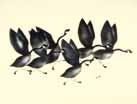
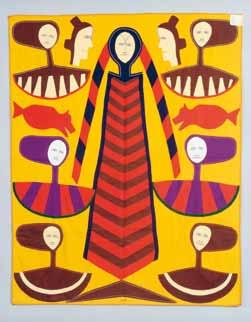
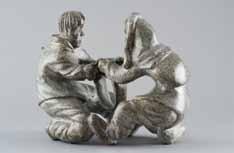
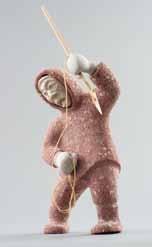
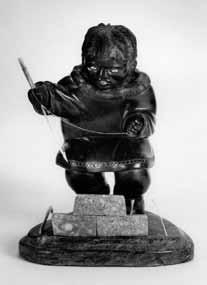
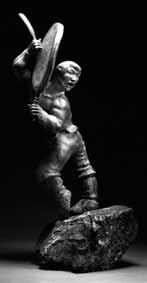
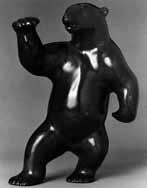
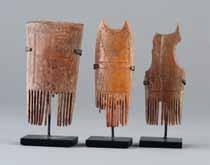
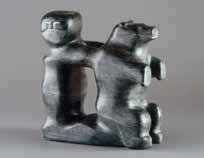
Every e≠ort has been made to seek permission to reproduce those images for which SPRI and NIAEF do not hold copyright, and we are grateful to individuals, institutions and Co-operatives in assisting us. Any omissions are entirely unintentional, and corrections should be addressed to the editors.
ISBN 978-1-906593-42-1 (softback)
ISBN 978-1-906593-59-9 (hardback)
British Library cataloguing-in-publication data: a catalogue record for this book is available from the British Library.
All rights reserved. Except for the purpose of review, no part of this book may be reproduced, stored in a retrieval system, or transmitted, in any form or by any means, electronic, mechanical, photocopying, recording or otherwise, without the prior permission of the publishers.
Edited by Heather Lane
Design and typesetting by E&P Design, Bath
Printed by HSW Print Ltd, Tonypandy, Rhondda
Foreword | 7
Rt. Hon. Jean Chrétien
Preface | 9
Jonathan King
Acknowledgements | 10
Ken Mantel
Introduction | 16
Heather Lane
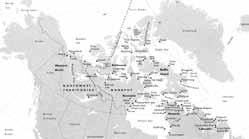
Map of Arctic communities | 20
Inuit art in Britain 1953–2010 | 22 Ken Mantel
Changing of the guard | 74 Pat Feheley
Chance and aggression | 86 John Westren
The search for Sananguaq | 102 Norman Zepp
Reflections from inside the Co-operative | 128 Heather Beecroft
Joe’s Boat and other stories | 144 Duncan McLean
The French perspective | 172 Cécile Pelaudeix
Inuit art in the Johnstone collection | 184 Nicholas Usherwood
Inuit art in the twenty-first century | 216 Misha Mantel
These words in our national anthem denote one of the distinguishing features we Canadians proudly state as part of our identity: the North. Although most Canadians live within 160 kilometres of the USA border, we see ourselves as a northern people. I have been in politics for over 40 years and one of the privileges of that long public life has been my extensive travels to every corner of our great country. My travels to the North are some of my fondest memories.
I was Minister of Indian and Northern A≠airs for just over six years and I enjoyed every moment. I loved meeting the people who inhabit the wide expanses of territory north of 60 degrees. The indigenous people – the first Canadians – have taught us much about survival in di∞cult conditions. Despite the Arctic climate they have shown us a thriving culture underscored by the importance of family, community and interdependence.
I also discovered a people with an amazing story to tell and I discovered these stories in their art and sculpture. As Minister at the time, I was so impressed by the talent of the Inuit and uniqueness of their art that I wanted to share it with as many people as possible. The problem the Inuit faced was how to get their art and sculpture to the southern market. Thus was born the Co-operatives and distribution system which still exists to this day.
As Prime Minister the North was very important to me. I introduced its beauty and people to other world leaders such as German Chancellor Helmut Kohl and French President Jacques Chirac. Chancellor Kohl’s visit influenced Europe’s policies and perceptions of Arctic life; and President Chirac who is known as
a native art specialist adorned his Élysée o∞ce with several soapstone carvings and a narwhal tusk.
The Inuit hold a special place in my heart. My personal collection of carvings at my home and o∞ce remind me of the people of the North who have made a di≠erence in my life.
This book tells the story why the Inuit and their art are so special and their importance to the Canadian identity. When you finish this book you will feel di≠erently about Canada and its inhabitants of the North. I thank Ken Mantel and his team for writing this book. This is an important story to share.
the right honourable jean chrétien Prime Minister of Canada, 1993–2003
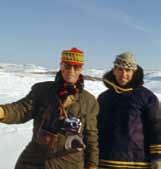
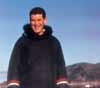
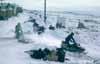
fig. 2
Charles Gimpel and Terry Ryan near Kinngait Mountain, Cape Dorset, c.1961
Photograph by Charles Gimpel
pre FA ce
T HIS vOLUME OF ESSAyS TELLS THE STORy OF Inuit art not only in Canada, but also comprehensively for the first time in the United Kingdom. Assembled by Ken Mantel to celebrate the reopening of the Museum at the Scott Polar Research Institute, this collection celebrates the aspiring national collection of Inuit art. Through donations Charles Gimpel and other generous farsighted individuals created this collection primarily in the 1960s to complement the work and archival collections of SPRI. A recent grant from the Heritage Lottery fund has enabled renewed development and display of the collection to take place.
Exceptional technical ecological knowledge, extraordinary imagination and exceptional skills provide the context for this art. Inuit themselves, as Marybelle Myers and Nelson Graburn put it in the 1980s, and Norman Zepp expands on in this book, refer to an art object as ‘something that is made as an imitation’, sananguagak, and handicrafts as ‘little imitation things’, pinguak. At a third level Inuit art sits at the centre of a modernist movement which brought together changing economic and political conditions, extraordinary talent, and outsiders who act as catalysts for innovation in the mid-twentieth century. Inuit art, like other twentiethcentury traditions, provides income and identity. James Houston (1921–2005), arriving at Cape Dorset in the late 1940s, played a similar creative role for Inuit as other visionaries in their respective areas of influence. These include Ulli and Georgina Beier in Papua New Guinea and Nigeria, Frank McEwen (1907–1994) and Shona sculpture in Zimbabwe, Michael Cardew (1901–1983) and pottery in Abuja, Ramses Wissa Wassef (1911–1974) and tapestries
in Egypt, with William Spratling (1900–1967) and Mexican silver at Taxco, and Geo≠rey Bardon (1940–2003) in the 1970s, with aboriginal painting of Australia’s Western Desert.
Inuit art led the way in providing a central narrative for this story, creating a means to visualise, and communicate traditional values and beliefs. Sculpture and prints record permanently Inuit ideas of landscape and animals, stories and belief, providing a world view which communicates Inuit values to southern populations, and are seen here through the eyes of a group of devoted southerners who have in most cases spent a lifetime absorbing and presenting their passion to that wider world.
jonathan king Keeper, Department of Africa Oceania and the Americas, The British Museum
A ckno W ledge M ents
I T HAS BEEN A LITTLE Ov ER 60 y EARS SINCE James Houston first brought Eskimo (later Inuit) art from Arctic Canada to Montreal and sold his entire initial consignment to an enthusiastic but unwitting audience through the auspices of an equally unknowing and naïve Canadian Guild of Handicrafts, subsequently documented in a myriad of publications whether in magazines such as The Beaver, Inuit Art Quarterly or the rich wealth of specialised books written by the cognoscenti of the Inuit art world. As they say, the rest is history, but this for me was just the start of a journey in which many colleagues and devotees of Inuit art have willingly and gladly contributed.
Since Ian Lindsey, documented in print as the ‘First Passionate Collector’, purchased from that initial consignment brought down by Houston, it has been this very passion that binds together the community of individuals who have made their mark on the development of Inuit art. Whilst undoubtedly James Houston was significant in sowing the seed for a ‘new’ art form, it is the dedication and passion of those that followed that has led to the status of Inuit art in the modern and environmentally conscious twentieth century.
Although I have been involved in collecting or dealing in Inuit art for only the second half of its contemporary existence, it has been a privilege and pleasure to have known and met many of the characters who have helped to shape the history of Inuit art, mostly in Canada but also in the USA, Europe and of course my own homeland Britain. I apologize in advance to any of you we have not mentioned in either the detail of the book or in this passing acknowledgement.
The next to be mentioned after James Houston and Ian Lindsey is the late Charles Gimpel who saw Inuit art as representing the cutting edge of modernism. He had the courage of his convictions and showed an exhibition of this little-known art form as part of the 1953 Coronation celebrations of H.M. Queen Elizabeth II. I am indebted to members of the Gimpel family, particularly René, for allowing me to look at Charles’s archives in researching part of this book, and allowing the use of personal images. I have also made use of the archives and collection at the Scott Polar Research Institute in Cambridge which houses those pieces donated by Charles Gimpel in 1966 as part of their permanent collection.
From the small acorn sown by Houston, the sapling oak was nurtured and matured under the guidance of Houston’s protégé T ERRy RyAN. I was delighted when, in 1999 as a part of the celebrations to mark the formation of Nunavut, Terry accepted the invitation of the Narwhal Inuit Art Education Foundation (NIAEF), a British registered charity set up to raise the awareness of the Inuit through their art, to become our honorary Patron, a position he still holds. He, together with his wife L ESLIE BOy D RyAN, has not only contributed by writing a very personal afterword for this book, but also helped to secure the required copyright permission for using Cape Dorset images, both sculpture and graphics, on a much appreciated ‘pro bono’ basis.
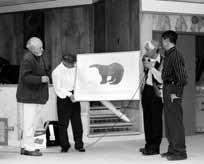
In Cape Dorset in spring 2009, Terry Ryan attended a party to celebrate his o∞cial retirement and accept the title of Director Emeritus after more than 50 years associated with Inuit art, most of it as head of the West Ba∞n Co-operative. In some sense coming full circle, when Terry was asked
what memento he would appreciate as a gift, he chose a copy of the 1961 image entitled Large Bear by Lucy Qinnuayauk. As I discuss in the chapter on the history of Inuit art in Britain, a copy of that very image and the stone block from which it was produced are currently held at the Tate in London, having also been donated by Charles Gimpel, with whom Terry spent much time in the late 1950s and 1960s out on the land on Ba∞n Island. It is therefore a fitting homage to Terry as another of Inuit art’s legends who first went north to Clyde River in 1956 before arriving in Cape Dorset in 1958, and like so many was bitten by a most peculiar bug that resulted in a hitherto unplanned career and lifestyle on taking over from James Houston in 1961. In honour of his services to the Inuit of Cape Dorset, he was given the C.M. (Member of the Order of Canada) in 1983.
In order not of seniority, but timing, perhaps the next most important figure influencing my own appreciation of Inuit art was Professor George Swinton. Although I met him on only one occasion it had quite a profound e≠ect. Undoubtedly his frequently reprinted book, originally entitled Sculpture of the Eskimo later renamed and added to as Sculpture of the Inuit, remains a seminal reference for anyone interested in Inuit art. It was his dogmatic approach with many Canadian museums that ensured that institutions such as the Winnipeg Art Gallery, Art Gallery of Ontario, Royal Ontario Museum and many others across Canada now have a significant permanent collection of Inuit art in the public domain. Despite earlier e≠orts in 1987 by the Museum of Mankind, part of the British Museum in London, a serious attempt to develop a permanent British public domain collection of Inuit art has only emerged very
recently with the opening in 2010 of the expanded permanent collection at the Scott Polar Research Institute. This will be augmented by a touring exhibition supported by loans from British collectors. Although Britain has lagged somewhat behind Canadian museums, I am nevertheless sure George Swinton would have been delighted at the fact that we now have a permanent venue for a British national collection of Inuit art at SPRI. This venture, under the stewardship of their current director, Professor Julian Dowdeswell, is to be applauded.
The world of Inuit art is a small and interwoven network of people whether collectors, gallery owners, art consultants, working in the Co-operative system or the secondary market, and it is therefore not surprising that the career paths of each of the contributors have crossed. HEATHER BEECROFT started her career as a teacher and first worked in Inuit art at ACL/Canadian Arctic Producers in Winnipeg in 1988 where we first met, maintaining close contact with George Swinton through the Winnipeg Art Gallery where she managed their shop on a volunteer basis, before re-joining and then moving to the CAP’s wholesale outlet in Toronto, where she was responsible for the marketing of their graphic base stretching from Holman Island and Baker Lake in the Western Arctic to Pangnirtung and Clyde River on the east coast of Ba∞n Island. Recent retirement from Inuit art did not last long and Heather came out of retirement to return to CAP where she still actively works with their print inventory as well as promoting textile wallhangings. She is on the board of the Women’s Art Association of Canada, and along with her Toronto manager at CAP, R.J. Ramrattan, who we also first met in Winnipeg, she must be thanked for collating copyright clearance on
images used throughout this book from several Arctic communities that CAP represents.
JOHN W ESTREN as an aspiring artist in his youth, but inevitably needing part-time work to supplement a meagre income, first assisted gallery owner Avrom Isaacs in Toronto in the late 1970s, where he became exposed not only to commercial mainstream fine art but also Inuit art. It was thus, in John’s own words, serendipity and economics that persuaded him to join the wholesale environment of Dorset Fine Arts, when o≠ered a full-time position in 1985 under the management and guidance of Terry Ryan where he has spent his subsequent career. Coming from this background, working closely with Terry and his wife Leslie and meeting up on a regular basis with all the major gallery owners from around the world, it is not surprising that he became not only immersed in Inuit art, but also an authority on Cape Dorset art production. He has developed a close relationship with many of their artists and made many trips to the community.
NORMAN ZEPP and I met many years ago at the bi-annual Waddington’s auctions in Toronto and, having read many of his articles on the Keewatin Masters, it was a great pleasure to listen to someone who has such a detailed understanding of how the artists produce their pieces and what constitutes a good piece, particularly when dealing with objects where the terms ‘expressionist’, ‘abstract’ and ‘minimalist’ are so readily bandied around. His lifelong love a≠air with Inuit art began with the purchase of his first piece of sculpture in 1969 and he started his career at the Mackenzie Art gallery in Regina organising the exhibition ‘Pure v ision: The Keewatin Spirit’. Now an Inuit art consultant based back in his native
Saskatchewan, Norman continued his career at the Winnipeg Art Gallery and was also a postgraduate under Professor George Swinton before becoming curator of Inuit art at the Art Gallery of Ontario (AGO) in Toronto. During this time he had the pleasure of meeting Prince Charles and discussing the merits of Inuit art with someone who includes Inuit art among his myriad of interests. His Arctic research included time spent in the early 1980s in Repulse Bay. It was appropriate that he has chosen to use that community to highlight his contribution to this book. It was at that same auction house that I first met the owner, Ron Maclean who, having bought Waddington’s, was later joined in the business by his three sons. One of them, DUNCAN Mc LEAN, shared his father’s interest in Inuit art that Ron had first auctioned in 1978. Duncan soon took over the reins, having been given a grounding in the pronunciation of artists’ names before being allowed to take up the gavel. Duncan has since become the leading authority in what has become a burgeoning secondary market, but not without a little help from at least two other contributors, Terry Ryan and Pat Feheley, who would often sit together late into the evening and establish provenance on pieces hitherto consigned as unknown artists. Duncan’s contribution was augmented by his major supporter and wife Tessa. For some, entry into the world of Inuit art happened the old-fashioned way: they were born into it. Such is the case with PATRICIA F EHELE y, Canadian art dealer and art historian. Pat became immersed in Inuit art and northern travel at the side of her father, the late M.F. (Budd) Feheley, who was
an early enthusiast of the subject. Pat’s first memories of the north coincide with a period of dramatic change, as settlement life replaced nomadic existence. On her first trip to Cape Dorset in 1969, Pat began her lifelong enthusiasm and commitment to the Arctic and Inuit art. Pat has gone on to champion senior and emerging contemporary Inuit artists as the Director of Feheley Fine Arts, her Toronto commercial gallery devoted to Inuit art, where no trip over the many years is ever complete without a get-together at one of her openings. She is the past president of the Art Dealers Association of Canada, served on the Eskimo Arts Council and is a prolific writer and noted authority on the subject of contemporary Inuit art.
Last but not least of the Canadian contributors is the R IGHT HONOURABLE JEAN CHRÉTIEN, former Prime Minister of Canada (1993–2003), to whom I am extremely grateful for penning the foreword to this book. He started his political career in 1960, becoming Minister for Indian A≠airs and Northern Development, 1968–74 (now known as INAC – Indian and Northern A≠airs Canada) and in that position showed much empathy with native First Nation Canadians. He introduced many wellknown publications detailing those early days of Inuit art.
The European contribution commences with a preface from JONATHAN K ING, Keeper, Department of Africa Oceania and the Americas, The British Museum. I have had the pleasure of knowing Jonathan since my earliest days of association with Inuit art in Britain, and his authoritative historical knowledge of the Inuit has been of great value to me, whether for research or simply support over the years.
CÉCILE PELAUDEI x approached us as an art historian built on a strong PhD and post-doctorate gained in both her native Paris, France and in Canada. Her research on Inuit art comes from fieldwork travelling across Ba∞n Island, and visits to many of the communities interviewing artists. This included Cape Dorset where she was further assisted by Terry Ryan. Cécile has reached other career heights including the South Summit of Mount Everest, but it was her French perspective on Inuit art that provided an interesting comparison with the British Inuit art scene. She wanted to focus on Claude Baud’s gallery, L’Iglou Art Esquimau based in Douai, a gallery I have visited and followed with extreme interest since starting my own. It seemed a perfect choice to add an extra dimension to this project, alongside additional material through her association with the Musée des Confluences, in Lyon where she acts as scientific advisor. Both organizations must be thanked for providing images for Cécile’s article.
NICHOLAS USHERWOOD has for many years followed the progress of Inuit art in Britain, and draws on a long career in art history and writing including regular editorials for the publication Galleries, as well as spending some time as a museum educator at the British Museum in the 1970s. His empathy with Inuit art and the world of art in Britain, together with his regular contact with collectors, gallery owners and book publishers including Sansom & Company, made him the obvious choice of non-Inuit specialist to collate the article on the Bill Johnstone collection, the largest and most representative private collection of Inuit art in Britain. Bill has kindly contributed several objects to the exhibition programme at SPRI.
MISHA M ANTEL , although just 25 years old, has been exposed to Inuit art since birth, having grown up around the Narwhal Gallery and been coerced, along with his siblings, into helping run it, curate exhibitions and contemporary art fairs. Whilst enjoying the Canadian buying trips and meeting most of the contributors, he also interviewed many of them and major collectors in order to produce his thesis for his degree in History of Art. It was his course tutor who, although minimally aware of Inuit art, pointed him in the direction of Nelson Graburn’s publication Ethnic and Tourist Arts: Cultural Expressions from the Fourth World that motivated Misha into becoming involved in Inuit art and contributing an article to the book.
No collection of contributions such as this could be put together without an editor and it was a pleasure to have HEATHER L ANE , Librarian and Keeper of Collections at SPRI, taking on this role. Her professional background and long association with the collection, including the Inuit art at SPRI, brought a solid overview to the project. With the grant of the Collecting Cultures award by the Heritage Lottery Funding for the acquisition of Inuit art, Heather became pivotal in delivering what might now be claimed as the foundation of a British national collection of Inuit art at SPRI. Heather also assisted in compiling the artist biography section of the book written by her colleague, Mark Gilbert. The continuing prosperity and future for Inuit art will become reliant on the younger generation, whether in the commercial or academic field and the inclusion of Mark, Cécile and Misha as contributors ensures that young blood now courses through the veins of this specialized industry. This in turn
gives a fresh impetus to the new generation of Inuit artists, knowing that the elders both in the Arctic communities and in the wider world, whilst being respected, are being replaced by the young.
I came to Inuit art through my earlier geology career travelling in the western Canadian Arctic in the petroleum industry. Serendipity played its part in explaining why a scientist should have crossed the line into the art world. In common with many of the great collectors of Inuit art and early gallery owners, it was initially working in the North that led me to Inuit art, sadly too late to find those early examples of the great master carvers. After living in Canada in the late 1970s and early 1980s, on returning to London being a collector evolved in 1982 into running the Narwhal Inuit Art Gallery, and geologist evolved into Inuit art aficionado. More like desperado, as in common with any such new and niche area in the established British art world, my two disparate careers needed to run in parallel for nearly 20 years. In 1999, to celebrate the emergence of Nunavut, together with a dedicated core of trustees we set up a British registered charity to promote and raise awareness of the Inuit, their traditions, culture and beliefs through their art, for whom I am chairman.
The Trustees of NIAEF (Narwhal Inuit Art Education Foundation) must be especially thanked for unanimously agreeing to support financially the publication of this book, along with an enthusiastic group of British Inuit art collectors who made charitable donations without which this project would not have been possible. My thanks also go to SPRI, whose success in gaining funding for exhibitions and acquisitions from the Heritage Lottery Fund was the catalyst for this book, and
who were instrumental in the commissioning of the majority of the images from the renowned Arctic expedition photographer Martin Hartley. Other images were gratefully received with all fees waived from contributors, Co-operatives, museums and the Royal Collection.
I would finally like to add my personal thanks to all the contributors who made this book possible, without taking financial remuneration, as a result of their own passion and willingness to support the project; our publisher John Sansom and his team for their understanding and support; my old M.A. tutor Professor Eric Moody along with Prof. Julian Dowdeswell and Heather Lane at SPRI for reading and commenting on the final manuscript, my medical team, and last but not least my wife, family and friends who have stood by with encouragement and positivity throughout.
ken mantel London, April 2010
I ntroduct I on
Heather Lane
T HIS BOOK , LIKE SO MAN y PROJECTS
surrounding the development of Inuit art, is the result of a combination of circumstance, opportunity, cooperation and determination. It was devised as a way of highlighting collections which have developed and flourished beyond the shores of North America and, in particular, those of British collectors.
Tuvaq, literally translated from Inuktitut is ‘landfast sea ice’. For Inuit communities, most of whom live along the shoreline, this title has been chosen to reflect the impact of environmental change on their way of life. Nothing stands still in the Arctic; the sea ice is not permanent. The Inuit adapt to the modern world and their art provides a window through which their responses to a changing world can be viewed.
Inuit art has been a small but distinctive feature of the art scene in Britain since it was first shown as part of the Coronation celebrations by the Gimpel Fils Gallery in 1953, and has had a continuous presence since, now represented by the Narwhal Inuit Art Gallery in London. During that same period many public domain museums around Britain from the Shetland Islands to the Channel Islands have either held touring exhibitions of Inuit art or acquired small collections.
The most significant of these collections is that held by the Scott Polar Research Institute (SPRI) in Cambridge. SPRI’s Polar Museum is unique in Britain in representing historical exploration, travel and science in both the Arctic and Antarctic. Although it had acquired artefacts and early historical objects from Arctic peoples, it was only as recently as 1966 that a significant collection of contemporary Inuit art objects and some graphics were displayed at the museum, solely as a result of a donation made by the
late Charles Gimpel. Despite being a museum dedicated to Polar themes, SPRI for long did not have a collecting policy that specifically highlighted contemporary Inuit art, rather an ad hoc collection determined by sporadic donation of material.
Although shown as part of the permanent display exhibited at SPRI alongside their other Polar objects, the development of the Inuit art collection lacked a clear direction or forward policy. Its significance was poorly understood and was virtually frozen into its own mid-twentieth century niche. This was to change in 2007 when the Heritage Lottery Fund invited applications under the Collecting Cultures scheme, with the intention of investing £3 million to fund programmes of strategic acquisition to develop existing museums and gallery collections for public use, and to enhance professional knowledge and skills. Grants of between £50,000 and £200,000 were available to all museums and galleries in the MLA Registration/Accreditation Scheme through a single round of applications.
As the Keeper of Collections at SPRI, I recognized this as an opportunity to extend and contemporise their Inuit art collection. A bid entitled Arctic Visions: Inuit Art and Material Culture was prepared and in 2008 the museum was awarded the highest available grant, to be divided between acquisitions and a programme of exhibitions, research and outreach. The grant would enable a marked improvement, through purchase, in the quality and range of the collection, underpin the research required to appropriately document and interpret it and provide the means for an extensive series of public outreach activities, including permanent and temporary exhibitions, events, workshops and courses.
The Polar Museum planned to develop its collection of contemporary Inuit art with particular emphasis on works from Canada. Its aim was to engage audiences with the culture of Arctic peoples, using their art as a powerful visual means to illustrate their everyday life, their relationships with the natural world and their spiritual beliefs. The existing collection was one of the most extensive on public display in the United Kingdom and had already benefited from detailed cataloguing by Judith Hall, an expert curator from the Canadian Museum of Civilization, undertaken with a grant from the Arts and Humanities Research Council. However, this work highlighted both the scope of the further research required and most significantly, gaps in the collection.
It was apparent that SPRI did not cover the spectrum of pieces from any one Inuit cultural area su∞cient to interpret that culture to a British audience. The Museum wished to acquire a representative collection of Inuit art, building upon the basis of its already extensive holdings, and concentrating in the main upon sculptural pieces from 1950 to 2000, wherever possible by established artists. By enhancing and reinterpreting this publicly accessible collection, SPRI aimed to stimulate interest in the culture of the Arctic peoples of North America and Greenland.
T RADITIONALLy, THE INUIT WERE DEPENDENT on the hunting of whales, walrus, seals and caribou, as well as fishing. They shared certain cultural elements, such as the kayak and umiaq (both types of boat), dog sleds, toggling harpoon heads, the ulu (woman’s knife), seal oil lamps, and double-layer skin clothing, as well as certain hunting and fishing techniques,
and some religious beliefs and practices. All of these are now represented in the SPRI collection through their art, whether from the historical contact or contemporary periods, including clothing, artifacts such as snow goggles made from caribou antler and tools used to make clothing. However, there were considerable di≠erences between cultures. Not all Inuit lived in snow houses, even seasonally, for example. This common stereotype was mainly informed by the accounts of explorers, who, in their search for a Northwest Passage, came into contact with Canadian Inuit. Today, there are about 130,000 indigenous people living in the North American Arctic and Greenland. In Canada (Nunavut) and Greenland, they have attained some degree of self-government. In Alaska, native corporations hold much economic and political power. A small group of Inuit still survive and live in eastern Siberia.
The small but significant range of Inuit artworks already in the collection at SPRI included sculptures and works on paper, dating from the early days of Inuit art, although many were by unnamed artists. Particularly as a result of the Charles Gimpel donation, many prominent artists including Akeeaktashuk, Davidee Itulu, Kapik Kolola, Shuvigar, Tudlik, Henry Evaluardjuk, Kaka Ashoona, Lucy Qinnuayuak, Parr and Pitseolak Ashoona are now represented in the collection and are highlighted herein in the article entitled Inuit Art in Britain 1953–2010. A new acquisition policy was developed to enhance the collection with works from the period 1950–2000. As HLF funding specifically excluded acquisition of material less than ten years old, exhibiting a truly contemporary collection would therefore rely upon finding pieces which private collectors from the
United Kingdom were willing to lend. With help and advice from the Narwhal Inuit Art Education Foundation (NIAEF), selection criteria were established. Acquisitions would be focused on sculpture and graphic art and would concentrate on representative pieces, wherever possible by established artists, with works from a wider range of communities and styles than had hitherto been represented. The wish was particularly to improve the holdings of early stonecut prints and more recent works that reflect an Inuit culture in transition. Selection was based on thorough research, with an emphasis on acquiring materials for which narrative description was already provided in the Co-operatives’ catalogues, creating a balance between sculpture and art on paper (stonecuts, lithographs, stencils, paintings and drawings).
With a limited budget and a time constraint of two years, acquisition would be focused on finding the best available examples, with an emphasis on established artists, to complement those already represented in the collections. This was an ambitious project, in view of the fact that many private collectors in Britain and elsewhere have spent decades building their collections. SPRI also wished to extend holdings from a wider range of Canadian communities than were currently represented (predominantly Cape Dorset and other Ba∞n Island communities). With their educational remit in mind, also on the list of priorities were a range of tactile sculptural pieces suitable for work with the visually impaired, illustrative examples of Greenlandic tupilaks and transformation pieces and works from across the region illustrating transport, games and daily life, legends and stories.
NATIONALLy, THERE ARE NO MUSEUMS or public galleries other than SPRI that hold really substantial collections of Inuit art from the late twentieth century. While there are a few items in the UK scattered in collections, it is vital to place Inuit art back into the mainstream, to redress the fact that there is no consensus, no e≠ective collecting policy, nor real focus for academic research into this area of material culture. As holders of the largest public collection in Britain, SPRI was given an opportunity to take the lead, to enhance and add to its collection, and to become the major institutional advocate in Britain for Inuit art. A shift in policy would enable the Museum to engage with Arctic communities and to provide an opportunity for the public to look at the polar world from the viewpoint of those who live there. This was an opportunity to recognise Inuit art alongside other contemporary art. Previously treated as merely ‘tribal’ craft, rather than ‘art’, by displaying and incorporating Inuit art alongside its world-class collections of British polar art, SPRI could redress the balance and provide access to and interpretation of its Inuit art collection in a modern context. Although the iconography of Inuit art is unique, contemporary Inuit art has developed as the result of encounters between many cultures. The Inuit, whilst gaining economically, have established an art-making tradition that has enabled them to express ideas and feelings about their traditional culture and beliefs to new audiences in an active way over which they have control. In addition, at the simplest level, the art is visually appealing, acclaimed for its striking imagery and exquisite beauty. In a range of remarkable works, the animals of the Arctic, the Inuit and their unique way of life, traditional myths and beliefs, the real and
the supernatural, spring vividly to life.
Academic e≠ort in Britain has until now been di≠use and limited, with focus restricted to ethnographic or anthropological interest. Shifting that focus to historical and art historical approaches, with a detailed programme of research has already been of benefit. Having seen the consequences of its own inaction, SPRI wanted to counter the perceived failure of museums either to start or keep their Inuit collections updated, or to benefit from existing networks and bring items and expertise together. The intent was that SPRI should be the meeting point for various collections, perhaps made available online as a national catalogue and displayed in exhibitions, both permanent and travelling. SPRI could take the lead in building the profile of Inuit art and the artists involved.
Inuit art, as with many other forms of graphic print art and sculpture, is visually immediate and therefore an accessible entry point to art in the general sense, even for audiences who have not previously had opportunities to engage with art. Inuit art taps into a rich vein of oral and graphic description of the social and historical contexts of production. Inuit art, as any contemporary art, is both deeply reflective of tradition as well as a response to a rapidly changing world. The artists respond to environments in which external economic and political influences play as great a part as climate change in crafting a visual language of participation within a contemporary culture and the gaze of a modern audience.
CONTEMPORARy INUIT ART EMERGED IN the late 1940s through the agency of committed individuals and organisations. Inspired by this
interest and support, Inuit artists threw themselves into a creative passion, producing a stunning array of work and they have continued to refine and develop their art over the past 60 years. For its continued vitality, organisational support is still needed. HLF funding has ensured that the history of modern Inuit art, as well as its ongoing relevance to British cultural exchange, will be represented within the UK museums’ community, and has significantly improved SPRI’s ability to provide more comprehensive and interpretative histories of a rapidly changing polar world, into the future.
Such a project could not be undertaken without external assistance. As a result SPRI turned to the public domain and in particular to the Narwhal Inuit Art Gallery and its associated educational and charitable wing NIAEF, who had already assisted in supporting the HLF application. Early in the development of the project an exhibition catalogue for the planned permanent and temporary exhibitions was discussed by all the parties involved. SPRI was about to undergo a major renovation of its museum display space and all available funds were channelled in that direction with no funds at that point available for publications. In parallel, NIAEF were similarly interested in a publication but with a wider remit and potential audience to include contributors from across the spectrum of Inuit art, not just in Britain but also from Canada and France. The idea of an anthology was born, and a co-venture between NIAEF as primary sponsors was created with SPRI, with support from the HLF.
M A p o F A rct I c
co MM un I t I es
The traditional Inuit place names used throughout Nunavut are indigenous and meaningful. Arctic communities are now slowly reclaiming their original names in preference over the names given by nonnatives during the nineteenth and twentieth century, names that honoured European explorers, royalty etc. Recognition of native community names in preference to non-native names began in the 1950s
when Tuktoyaktuk replaced Port Brabant. In 1979 and 1980 it was decided that the actual names and the Romanised spellings used by native people in their own communities should take precedence. The following year Canada Post agreed to change its postal designations to conform to local preferences. For example, Frobisher Bay o∞cially became Iqaluit in 1987.
english indigenous translation Ivujivik
Arctic Bay Ikpiarjuk
Baker Lake Qamani’tuaq
Bathurst Inlet Qingaq
Belcher Islands Sanikiluaq
Broughton Island Qikiqtarjuaq
Cambridge Bay Iqaluktuutiak
Cape Dorset Kinngait
Chesterfield Inlet Igluligaarjuk
Clyde River Kanngiqtugaapik
Coppermine Kugluktuk
Coral Harbour Salliq
Eskimo Point Arviat
Frobisher Bay Iqaluit (capital of Nunavut)
Gjoa Haven Uqsuqtuuq
Grise Fiord Aujuittuq
Hall Beach Sanirajak
Holman Ulukhaktok
Igloolik Iglulik
Lake Harbour Kimmirut
Pangnirtung Pangniqtuuq
Payne Bay Kangirsuk
Pelly Bay Kugaaruk
Pond Inlet Mittimatalik
Port Harrison Inukjuak
Povungnituk Puvirnituq
Rankin Inlet Kangiqiniq
Repulse Bay Naujaat
Resolute Qausuittuq
Spence Bay Taloyoak
Sugluk Salluit
Tuktoyaktuk Port Brabant
Wakeham Bay Kangiqsujuaq
Whale Cove Tikiraqjuaq
Place where ice accumulates because of strong currents
Pocket (refers to its location, surrounded by hills)
Big lake joined by a river at both ends
Nose (refers to a hill behind the community)
Named after an Inuk who lived nearby
Big island
Fair fishing place
Tip of the island
Place with few houses
Nice little inlet
Place of moving water
Large, flat island in front of the mainland
Bowhead whale
Place of many fish
Place of plenty blubber
Place that never thaws
Shoreline
The place where ulu (woman’s knife) parts are found
Place where there is a house
Heel
Place of the bull caribou
The bay
Place with lots of bowhead whales
Place where Mittiima is buried
The giant
Place where there is a smell of rotten meat
Deep bay
Seagulls nesting/resting place
Place with no dawn
Stone corral for trapping caribou
The thin ones (describing local people during a time of famine)
It looks like a caribou
The large bay
Long point
FIG 3
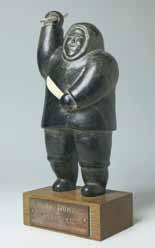
isah koperqualluk Hunter
c.1954 | soapstone | 18 cm puvirnituq (povungnituk)
DESPITE ITS TITLE , THIS CHAPTER IS NOT AN attempt to log the precise chronology of every event surrounding the presentation of Inuit art here in Britain. Rather it uses those events as a framework to introduce the reader to the erratic path of Inuit art played out in Britain from its introduction to its current position in the public and private domains. In so doing it is often a very personal account which digresses into areas which it is hoped will be both interesting and stimulate discussion, whilst not always answering the questions posed, nor focusing exclusively on Britain.
The first international exhibition of Inuit art to be held outside its native Canada was shown in London by the Gimpel Fils Gallery to coincide with the 1953 Coronation. It was referred to in newspaper articles of the time – London Art News and Manchester Guardian – and subsequently in Inuit Art Quarterly as ‘the Halcyon Days of Inuit Art’.
Whilst 1953 somewhat anachronistically saw the introduction of Inuit art to an unsuspecting British audience, 2010 is perhaps a more momentous year, heralding a renaissance with the launch of the first truly public British collection of Inuit art based at the recently renovated museum at the Scott Polar Research Institute (SPRI) in Cambridge.
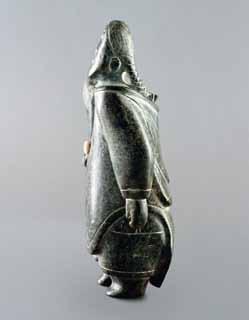
It is notable that one of the earliest contemporary pieces acquired directly by SPRI and now a part of the national collection is by Koperqualluk (Koperkoolik), sitting proudly in the o∞ce of the current Director, Professor Julian Dowdeswell (fig. 3). This was quite possibly the very artist who inspired James Houston (1921–2005) to believe in the commercial potential for Inuit (then Eskimo) art, as it emerged into the dull but optimistic light of the post-war era.
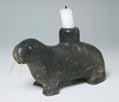
Houston, funded in the late 1940s by the Canadian Guild of Handicrafts in Quebec, could quite easily have reported back from his travels to Inukjuak (formerly Port Harrison) in Arctic Quebec, expressing doubts that a market for this new art form could ever be sustained. ‘He [Koperkoolik] o≠ered me the most perfect stone carving of a walrus that I had ever seen, I praised it and asked if he would make another. After a perplexed silence he said: “ you see that I can carve the likeness of a walrus. Why would you want another?” However, he was excited about the idea of making a caribou and went out immediately to find the stone’. 1
Most publications dealing with the subject portray Houston as the founding father of contemporary Inuit art (fig. 4). Here, as with many subjects around which a romantic mist hangs, there is some doubt, for in reality the emergence of Inuit stone carvings, like many other non-traditional ‘ethnic’ arts, is somewhat cloudy and controversial. 2 Evidence of stone carving in the years immediately prior to Houston can be found across the Arctic (fig. 6), but it cannot be denied that Houston was the right person, in the right place, at the right time.
Records and collections of objects show that in the mid-eighteenth century the Moravian missionaries along the Ungava Peninsular of Arctic Quebec (now Nunavik) and Labrador coastline, encouraged a barter trade in small, mostly figurative and animal-based (fig. 5), often incised ivory pieces. This precursor of the ultimate establishment of Eskimo art ceased in that area when the Moravians abandoned their last mission in 1955. This was one of many involvements by various missionaries throughout the Arctic to involve the Inuit in carving predominantly ivory objects. Part of the earliest collection of contemporary objects at SPRI from the late 1920s reflects this historic period on Ba∞n Island (fig. 7).
Britain acquired what is probably the oldest connection to Inuit art when in 1738 Alexander Light of the Hudson’s Bay Company collected ivories including birds and a comb in Hudson Strait. They went to Hans Sloane, and on his death in 1753 to the British Museum where they went on display, as indeed they are today.
unknown artist
Umiak with people
c.1000 ad (late Dorset/early Thule period) | ivory | 6 cm sivuqaq (st lawrence island)
unknown artist Game (ring and pin)
c.1934 | ivory | 7 cm
The venerable Hudson’s Bay Company (established by Charles II through Royal Charter in 1670), played a vital role, supporting the emergence of the art form
Bill Johnstone Collection (photograph Martin Hartley)
(fig. 9). It was then further delayed whilst the world went to war.
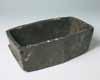
It would be wrong to conclude that the contemporary period of Inuit art is part of an evolutionary trend. On the contrary it was actually deliberate policy to create a new means to sustain the Inuit economy. Having said that, it is undeniable that throughout the history of the Eskimoan cultures across the entire Arctic region magico-religious symbolism was fundamental; and the manual dexterity required to fashion tools and exist in the harsh environment was essential to survival. Decoration on such pieces is regarded as primordial, but there was no concept of art as we in western society perceive it (fig. 11). The artifacts discovered were made from materials that were readily available, namely marine ivory and bone, with only rare examples from wood and bare essentials such as cooking pots from stone (fig. 12).
The evolution in what is today Arctic Canada is quite structured. The initial period identified is the pre-Dorset (c.2500 bc–800 bc), probably evolving from Siberia across a land bridge to Alaska as part of an easterly migration of the people at least 5000 years ago. This in turn gave way to the Dorset period (c.800 bc –1000 ad) (fig. 10), the Thule period (1000 ad –c.1600 ad) (fig. 8) and finally, during and probably resulting from, the last major climactic change in the region, the current period commonly divided into historic (c.1600 ad –c.1930s) (fig. 13) and contemporary (1948–present) (fig. 14). These dates are given as guidelines only as there are several regional variations and anthropological interpretations.
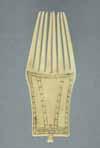
unknown artist Comb from 2nd Parry expedition c.1822 decorated ivory | 6.5 cm iglulingmiut (iglulik inuit)
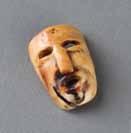
This is certainly the Canadian model and the late Professor George Swinton (1906–2002) and art historians who have followed him are in no doubt that these periods are quite distinct, and that objects taken from each period can be readily identified ‘by their own clearly definable stylistic characteristics’ (fig. 16). It is only the contemporary period that has seen a true art form flourish, and then, as already discussed, by design and deliberate encouragement. Some of the most ornate objects in the historic period were probably boxes from Greenland (fig. 15), and the many notable masks that were also prevalent across the Arctic (fig. 18). Although highly decorative they were not created as works of art but as functional or shamanic artefacts. Therefore if we follow the reasoning of Charles Martijn in his analysis of the function of Inuit art 4 the origin of contemporary Inuit art was indeed entirely economic.
Even during its emergence, the wish to show a new art form in Britain, imported directly from the Canadian Arctic, met with scepticism by some authors. Edmund Carpenter, in Eskimo Realities 5 questioned whether this commercial art form was Eskimo Art at all. ‘Its roots are western: so is its audience. Some artists have been directly trained by Houston, others follow a Government manual’.
A decade after the establishment of a market for Inuit art carving, Houston returned to Cape Dorset following a trip to Japan in 1958 to investigate and then introduce printmaking. Not only was this undeniably rooted in the outside world, but the hand of Houston could be noted in some of the earliest works, when comparing his own work with artists such as Niviaxie. The image of Niviaxie’s seal hunter (fig. 19) may well be the most expensive print yet sold
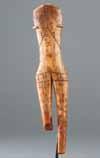
FIG 16 unknown artist
Standing figure
c.1000 ad (Dorset Culture) | bone | 12 cm
dorset site
Bill Johnstone Collection (photograph Martin Hartley)
at auction (Waddington’s, Toronto, November 2008), but was it actually a co-operation between teacher (fig. 20) and student?
By 1962 Terry Ryan had taken over the running of the Cape Dorset print studio, but with a distinct change in style and direction. This was indicated by the emergence of a stable of artists following their own instincts and with less direct artistic guidance from non-Inuit sources (fig. 21).
Irrespective of whether the early history of this contemporary art form was a blend of tradition and introduced features, 6 could it be argued that the development of Inuit art collections in Britain is merely a result of serendipity? In some quarters, Britain has been regarded in Inuit art terms as a backwater, but this is misleading. We should examine the role of the late Charles Gimpel in bringing Inuit art to Britain in 1953 and the part played by those who have succeeded him in maintaining its presence here, despite a lack of commercial success. Charles Gimpel (fig. 17) was the first of a small group of people to present Inuit art in Britain, just a few years after opening his mainstream London gallery in 1946. Coming from a family background connected to the art dealer Lord Duveen, he was also later responsible for the first exhibitions of Inuit art in Paris and Zurich. This article is intended only as a brief synopsis of that history, and does not try to emulate the excellent and detailed work by Richard Crandall in Inuit Art: A History
Theo Waddington, along with his business manager Barry Cronin, also took an interest in Inuit art in the 1960s both through his gallery in Cork Street, London and his galleries in Canada and the USA. Whilst Theo must undoubtedly be given a certain degree
FIG . 18 tunuumiit (east greenlanders)
Mask from the BAARE Expedition c.1930 | wood | 20 cm
of credit for introducing the early period of emerging Western Arctic art particularly from the Keewatin, and including communities such as Baker Lake (fig. 24), Rankin Inlet and other nearby communities (fig. 27), his entry into the graphic field was perhaps more circumspect.
From 1969 until 1973 a private London art dealer Frederick Mulder also avidly started a collection of primarily Keewatin Masters, alongside a selection of graphics and drawings from Baker Lake and Holman Island to Cape Dorset. Unlike Charles Gimpel and Theo Waddington, Fred’s interest in Inuit art remained personal, and he neither expanded his mainstream activities in European printmaking between 1460–1960 into a commercial outlet for Inuit art, nor continued to contemporise his early Inuit art interest. His collection, however, remains of importance covering that period of the presence of Inuit art in Britain. Important examples of work by artists such at Tiktak (fig. 23) whom Dr Mulder met on his Arctic travels, and Luke Iksiktaaryuk (fig. 25), alongside a strong presence of Parr drawings and prints (fig. 22), form the backbone of his collection, much of which was influenced by collectors and curators including Peter Millard and Norman Zepp.
Aside from a franchised dalliance in Harrods in the mid-1980s lasting just a few months entitled ‘Spirit in the Stone’, and a couple of exhibitions at Fortnum & Mason in early 2000 supported by the Canadian High Commission in London, the only other known entry into the commercial marketing of Inuit (then Eskimo) art was by the Anthropos Gallery in central London in 1973. They were the first British gallery not to develop from mainstream art, but to be rooted in ethnographic (or as it was
FIG 17
Charles Gimpel (self portrait), 1968 Courtesy of
19
FIG
niviaxie
Man Hunting at a Seal Hole in the Ice
1959 | stencil | 57 x 43 cm kinngait (cape dorset)
c.1969 | British Columbian serpentine | 40 cm kangiqliniq (rankin inlet)
Courtesy of Dr Frederick Mulder
FIG 24
marie kuunuaq Family Group
c.1964 | serpentine | 42 cm qamani’tuaq (baker lake)
Bill Johnstone Collection (photograph Martin Hartley)
luke iksiktaaryuk
Drummer and Dancers
c.1971 | caribou horn | 14 cm qamani’tuaq (baker lake)
Courtesy of Dr Frederick Mulder
more often perceived ‘tribal’) works from around the world, including a prominent section for Inuit art. Records indicate that around the UK various galleries would from time to time acquire examples of Inuit art, although primarily for exhibition rather than commercial purposes. A gallery on the Thames Embankment in London was one such venue in 1978, along with more recent graphic exhibitions in Dundee, Scotland, a town with many historical Canadian contacts.
For completeness it should be recorded that the Hudson’s Bay Company had for decades traded furs in London from their warehouse on the Thames by the Tower of London. In 1984 one of their managers, David Liney – an Inuit art enthusiast – chose to emulate in a small way the Co-operative wholesale outlet format established many years earlier in Canada. In so doing he persuaded HBC to ship several hundred pieces of sculpture mostly from Ba∞n Island communities to their showroom in London. The idea was to provide a venue to which European galleries could come and select pieces without having to travel to Canada or the Arctic.
Although HBC made small injections of new stock over the next two years, there was insu∞cient demand from the few interested European galleries. Following the buy-out of HBC the remaining stock was sold o≠ and the brief period of wholesale trading for Inuit art in Britain ended.
The final – and only remaining – entry in the gallery history of Inuit art in Britain is my own contribution through the Narwhal Inuit Art Gallery, started in 1982. Our approach was completely di≠erent from that of any preceding gallery. We have attempted to build a foundation for a more a≠ordable
art form, rather than simply presenting an often high-end financial product, irrespective of whether it was indeed fine art (fig. 26). I believe that the experience of the Narwhal Gallery helps to explain why the art form had originally struggled to find a larger core of collectors in Britain.
It was during one of my many visits to Canada in the late 1980s that I found myself at the Art Gallery of Ontario (AGO) attending a lecture by the eminent and respected art historian Professor George Swinton. George had just made a donation from his private collection of Inuit art to AGO. He was asked how he could defend small pieces of abstract artwork with plastic beads around the head as being a part of the collection, and whether this was not in fact demeaning to the image of Inuit art.
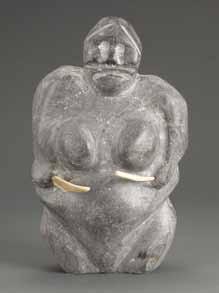
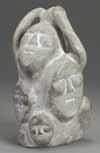
The piece in question was by Lucy Tasseor Tutsweetok from Arviat (formerly Eskimo Point). Swinton dismissed the question by simply stating that if Inuit art was looked at structurally as a pyramid, then such pieces formed an essential base to the structure without which an apex of fine art could not be sustained. In retrospect it can be seen that despite noble e≠orts by the likes of Charles Gimpel and others, this base was poorly if at all represented in Britain because of the high cost of importing and exhibiting art works in a central London location where earlier purchase tax constraints and exchange controls were restrictive.
Ironically some of these same ‘primitive’ examples of Inuit art prompted the comment in the Indian and Northern A≠airs Canada (INAC) government Canadian Eskimo Sculpture publication, ‘Depending on your point of view, this sculpture from Arviat may appear primitive and crude, or amazingly modern
FIG 25
FIG 26
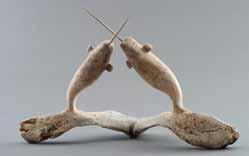
nick sikkuark
Two Narwhals
1987 | relic whalebone | 27 cm
arviliqjuaq (pelly bay)
Narwhal Gallery Collection (photograph Martin Hartley)
and abstract’ (fig. 28).
Meanwhile Charles Gimpel had befriended both James Houston and his successor Terry Ryan during his many trips to the Arctic. His gallery became the only British outlet for the annual Cape Dorset graphic collection (fig. 29) from its earliest days, until some time after Charles’ death in 1973. During this time other members of the Gimpel family showed only a modest interest in presenting Inuit art, mostly under the guidance of a long-standing employee, Derek Keen. With Derek’s passing in 1993 Inuit art activities e≠ectively ceased at the Gimpel Fils Gallery after an adventurous run of 40 years.
Theo Waddington meanwhile was either unable or unwilling to take a second set of the prestigious annual print release and sought an alternative. Instead, he commissioned two portfolios of Cape Dorset lithographs in the early 1980s. His involvement in Inuit art continued only spasmodically in Britain and Ireland into the 1990s although he remained active as an art consultant in North America.
Britain may be something of a commercial backwater for Inuit art, but we are not lagging when it comes to the quality of work to be found in this country. It is well documented that this began with Charles Gimpel in 1953 and after more than 55 years in the dark 2010 will see a permanent display of Inuit art at the Scott Polar Research Institute in Cambridge, a project partly funded by the Heritage Lottery Fund Collecting Cultures programme, and partly by individual donations and participation from both the public and private domains.
In 1966 a significant but until recently barely recognized donation by Charles Gimpel was made to SPRI. It included significant works by early carvers
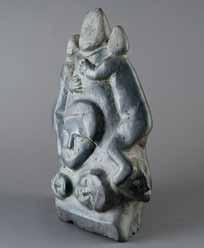
Bust/Self Portrait
c.1961 | metamorphic stone | 13 cm
arviat (eskimo point)
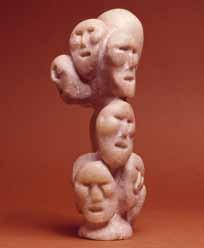
lucy tasseor tutsweetok
Many Heads
1988 | metabasic stone | 23 cm
arviat (eskimo point)
Bill
FIG 28
Johnstone Collection (photograph Martin Hartley)
FIG 27
elizabeth aulatjut nutaraluk
Bill Johnstone Collection (photograph Martin Hartley)
including Akeeaktashuk, Simeonie Davidee, Davidee Itulu, Kapik Kolola, Eelee Shuvigar, Eegyvudluk Pootoogook, Tudlik, Henry Evaluardjuk and Kaka Ashoona and graphic artists Lucy Qinnuayuak, Parr and Pitseolak Ashoona. Together with the recent HLF-funded acquisitions programme at SPRI these important early pieces have now taken their rightful place in the history of Inuit art in Britain (figs 30–34).
This collaboration to gather what it is hoped will be recognized as the British National Collection of Inuit Art, was announced in Inuit Art Quarterly magazine (IAQ) by SPRI and will be completed in mid-2010. Whilst reference to this most encouraging development is extensive, I wish also to focus on why it has taken nearly 60 years to revisit those ‘halcyon’ days of Inuit art. What follows is an insight into some of the problems we have faced and continue to face in promoting Inuit art not just commercially but as an art rather than craft form.
The promotion of Inuit art in Britain has essentially either been the result of individual passion for the work and generally philanthropic in the true v ictorian sense, or a purely entrepreneurial dalliance by major retail institutions that has failed to leave a lasting demand for Inuit art. Jonathan King, then Assistant Keeper at the Museum of Mankind now Keeper of the Department of Africa Oceania and the Americas, back at the British Museum, not only pointed to the problems in the 1991 special edition of IAQ, but also in personal communication with me, described our own e≠orts as being a labour of love. On the positive side this has ensured that Inuit art continues in the UK, but on the negative side it has taken over 55 years before the semblance of a National
Collection has finally been assembled, thanks largely to the initiative of the Heritage Lottery Fund and SPRI.
I will not dwell further on these issues which the interested reader can see developed more fully in my paper published in the European Review of Native American Studies. 9 It is however worth reiterating the great disappointment felt by many that the special 1991 IAQ edition ‘Inuit Art World’, which covered the emergence and treatment of Inuit art around the world, should choose on the page devoted to Great Britain not to show an Inuit art piece, but a photographic image of an ice sculpture created by the contemporary English artist Andy Goldsworthy on one of his trips to Grise Fiord in the Canadian Arctic. There was no explanation as to why this was relevant in any way to Inuit art beyond the pure visual imagery of a snowy scene.
Whilst Goldsworthy might indeed have been at the cutting edge of his own specific art form at that time, and whilst to show an image of his may have been a compliment, one might question the point in showing this work. I suspect that, as had happened so many times in the history of Inuit art in Britain since Gimpel Fils and beyond, the writer needed to justify addressing Inuit art as an art form, and by making references to works and artists in the mainstream rather than treating Inuit art as a stand-alone art form.
Stereotyping of ethnographic art forms was inherently a part of the relationship between the British art critic and his public, and a way for the good and the great of the art world to hide their ignorance of Inuit art. To make comparisons with mainstream and well-known artists lent credibility
FIG 29
Iyola Kingwatsiak at the Gimpel Fils Gallery, London, 1972 8
FIG . 30
davidee itulu Engraved scene
c.1961 | walrus tusk on steatite base | 42 cm kimmirut (lake harbour)
not only to their own writings but e≠ectively enabled them to distance themselves from the subject matter. This was certainly my own experience when the now distinguished art critic Waldemar Januszczak in his early days writing for the Guardian was heavily critical of our presence at a contemporary art fair at Olympia London in 1984. Perhaps 25 years on he might have been better informed!
An art writer such as my colleague Philip vann, whilst well-meaning in his writing on Inuit art, nevertheless still chose when addressing the historical link between early Eskimo artefacts and contemporary work to highlight its resemblance to ‘atavistic-looking twentieth century sculptures of artists like Brancusi’. 10 A generous observation but was it in order to lend credibility to the subject thereby making it ‘safer’?
Whilst Swinton, regarded as probably the first and greatest published proponent of Inuit art, pro≠ers the importance of Eskimo Art as the ‘compelling individuality of the artist’ he nevertheless goes on to justify its authenticity within the art world by quoting Picasso. 11 Interestingly Hessel in his 1998 book Inuit Art an Introduction similarly referred to Picasso but in this instance as a direct quote by the graphic artist Pitaloosie Saila. When questioned on the likeness of her image Eskimo Leader to Picasso’s imagery, she stated ‘I didn’t know Picasso myself’. 12 It was a simple response with a wonderful degree of naïvety and honesty.
Similarly, the main British auction market also struggled to give more than short-term support to Inuit art, eventually no longer providing a Britishbased service but advising customers to utilize their USA outlets. As late as the early 1980s auction
john tiktak
Bending Figure
c.1969 | metabasic stone | 18 cm kangiqliniq (rankin inlet)
FIG 35
Courtesy of Dr Frederick Mulder
houses such as Bonham’s held specialized auctions for Eskimo Carving, Paintings and Prints, although the latter were often lots selling British and American artists’ works bearing little or no relevance to the mainstay of the auction. 13
Any doubt as to the quantity and quality of works in particular by the Keewatin Masters present in Britain at that Bonham’s auction, would be dispelled by the statistics: of 150 Inuit art lots, 65 represented the three prestigious Rankin Inlet artists Toona Erkilik, Tiktak (fig. 35) and Kavik. Were these to feature in a modern Toronto auction this would be regarded as a major sale, and yet ironically the auction house showed their lack of understanding of the art form not only by o≠ering a lot by ‘Dimu – signed and dated ’63’, but also indicating an estimated sale price at least three times greater than the Rankin pieces. They were clearly unaware of the existence of a facsimile market in both resin and stone from outside the Arctic, of which Dimu was just one of many examples. This lack of understanding continues, with websites such as eBay flooded with replicas, particularly ‘Wolf Originals’ often being o≠ered as original Inuit art.
Following the success of Waddington’s Toronto auction house entering the auction market for Inuit art in 1978 with the o≠ering of the well-known William Eccles collection, by 1979 two further major London auction houses, Christie’s and Sotheby’s, chose to highlight Inuit or Tribal arts. This gave a certain degree of credibility to the presence of Inuit art in Britain at that time. It must however be said that in those early auction days even Waddington’s often sold ‘trays’ of Keewatin pieces. The collector had not yet seen the rising prices of such pieces with artists such as Andy Miki (fig. 36), now leading the
FIG 36 andy miki Bear Spirit
c.1979 | metabasic stone | 15 cm
arviat (eskimo point)
Bill Johnstone Collection (photograph Martin Hartley)
auction market.
In 1992/93 Canada House put on an exhibition of Henri Matisse’s works entitled ‘Matisse – the Inuit face’ in which the curator Michael Regan showed that Matisse was certainly influenced by a visit to the Arctic region and was inspired by the Inuit woman’s hairstyle and particularly the ‘top knot’ (figs 38 and 39) which he later portrayed in many of his drawings, and in a 1905 painting of his wife Amélie entitled Green Stripe (Madame Matisse), housed in the Royal Museum of Fine Arts, Copenhagen.
Earlier in Antiques & Art Weekly 14 in an article on Eskimo Art then being featured at the Anthropos Gallery in London, the author and gallery owner Satish Kapoor showed an unusual but profound foresight: ‘On the west coast (of Hudson’s Bay) the most influential artist is Kavik [fig. 37], the patriarch of Rankin Inlet, who was sculpting “expressionistic” figures before the expressionistic movement arose in the Western world’. He was however less than optimistic about the future for Inuit art and specifically those artists with a ‘very minor talent’ which ‘has no intrinsic claim to greatness and will perish within a generation or so’. Opening at the end of 1973, ostensibly to fill the gap in aesthetic qualities of ethnic arts, the gallery existed only briefly and itself perished long before the art forms it represented. It also continued the practice of o≠ering highly priced objects that were not within the range of the general public.
In Ethnic and Tourist Arts: Cultural expressions from the Fourth World, edited by the anthropologist Nelson Graburn in 1976, it was suggested that the terminology in use including ‘folk’ and ‘primitive’ had outlived its usefulness and was ‘inadequate or
john kavik
Mother and Child
c.1990 | metabasic stone | 17 cm kangiqiniq (rankin inlet)
unknown artist
Woman with top knot
c.1989 | soapstone | 15 cm
west greenland
Private collection (photograph Martin Hartley)
FIG 38
FIG 37
Bill Johnstone Collection (photograph Martin Hartley)
FIG 39 unknown artist Man and woman
c.1930 | ivory on stone base | 8 cm maniitsoq (sukertoppen)
detrimental for contemporary art analyses’. Graburn went on to say that the art form was so distinctive that the Canadian Government gave the Queen an Inuit art carving as a coronation gift, a convention of giving dignitaries pieces of Inuit art that continues to this day.
In talking to Charles Gimpel’s son René, it becomes clear that it was almost certainly the inspirational work of the Inuit that attracted Charles to the art form even though it bore a likeness to many of the modern British sculptors that his gallery was also showing at the time. This was Charles probably being opportunistic rather than exploitative. What is certain is that although Charles had become interested in ‘Eskimo’ art on seeing an early Houston publication in 1951, his original idea to go to the Arctic was prompted by his passion for photography, and an early agreement with HBC to produce a photographic portfolio of native peoples.
Terry Ryan who spent some time with Charles during his Arctic trips concluded that Charles was a consummate dealer. During his lifetime Charles interested himself in several eclectic areas, and to his family the trips to the Arctic and his love for Inuit art were not a surprise. His interest was tolerated by the gallery which put on regular exhibitions of Inuit work, as well as being supported by his late wife Kay, from whom I received one of the pieces Charles gave her in the early days. It still has the original sale price of Canadian $12.00 (about £3 at that time) pencilled on it (fig. 40).
Charles’s fascination with Inuit life and traditions extended to simple but often traditional objects such as the Inuit Inukshuk or beacon, 15 to the extent that as with many Inuit he felt that his life could not pass
FIG 40
unknown artist Hunter
c.1958 | dark soapstone with cream filler decoration | 19 cm
inukjuak (port harrison)
Narwhal Gallery Collection (photograph Martin Hartley)
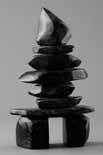
without his constructing his own Inukshuk. He did so in the garden of the family home in Su≠olk (fig. 41). Following his death it was donated by the family to the Museum of the Scott Polar Research Institute in Cambridge where it was housed until 2008 outside the main entrance. It has now been moved and will be reconstructed as part of the latest renovations to the museum to mark the acquisition of a significant new collection of Inuit art which will go back on public display in 2010.
Charles went to the Arctic a total of six times from 1958 when he first met Houston and was given the name Gimpel Ukjuk or ‘bearded seal’ because of his sideburns. 16 This was the year that Terry Ryan visited Cape Dorset, and Avrom Isaacs started to sell Inuit art alongside mainstream art in his gallery in Toronto. Charles visited the Arctic regularly over the next 10 years, continuing not only to collect art work, but building a collection of photographs which later formed the basis for Maria Tippett’s 1994 publication, Between Two Cultures. In memory of Charles’s deep interest in photography the original negatives for this publication were given to a Canadian archive.
British collecting has been hindered by the lack of a≠ordable Inuit art presented over the years here in the UK, an inability to recognise and market the di≠erence on the spectrum (Swinton’s pyramid), between fine art and craft, and the initial import constraints, whether faced by Charles Gimpel in 1953 or ourselves. As late as the 1980s we still came across customs o∞cials on entry into the UK, who cited ‘Eskimo Art’ as a specific exclusion from the art market, thus ensuring they continued to extract import revenue. This practice of charging duty based on the objects being craft items made of stone also
FIG 41
Inukshuk, Canadian stone, c.160 cm, at Charles Gimpel’s Su≠olk home, c.1966
Photograph: René Gimpel, gifted to Scott Polar Research Institute, 2010
prevailed in the USA in the early days of export to the extent that o∞cials would want to take samples from the objects to establish the material for tax purposes!
Perhaps most importantly the high retail price of even fairly ‘ordinary’ pieces over the first 30 years and the intimidation felt by the customer who would have to cross the threshold into the perceived world of fine art cognoscenti in a central London gallery environment were part of the reason that no foothold was gained. For the gallery, importing Inuit art required a heavy investment for such a peripheral and unknown art form. To this day new galleries –irrespective of the economic climate – are unprepared to make such a commitment in an area outside their comfort zone, where consignment, rather than purchase, is not an option. A fundamental factor, of course, is that Inuit art is not an indigenous British art form and is not present in the public consciousness as it is in Canada and Greenland.
What is important to remember is that Inuit art survives and forms a major contribution to the economy of the people. Much of this is down to factors including the goodwill of the gallery in investing cash flow in storing several hundred pieces which may or may not sell in months or sometimes years, whilst the artists – cocooned from the normal commercial artist/gallery relationship – collect their remuneration at point of contact with the Co-operative within a few hours or days of finishing the object.
To the best of my knowledge this is an almost unique system (although I believe it is also common practice among the hill people of the Philippines) and if it is to continue and Inuit art is to be shown in national collections around the world then INAC and its associates need to find a way to present the artists
to their public that allows the commercial world to conduct its business in a more sensible manner.
I fully understand the process and its history, and support it to a great degree, but here in the UK the burden put on the dealer certainly was an obstacle to expansion and competition, even in those early days when the work was significantly less expensive than today.
It should be remembered that here in the UK Inuit art competes with many other art forms for a place in the home or corporate boardroom. Although Canada may well have been part of the old Empire, their Inuit are not an indigenous group with whom we have any real a∞liation; simply curiosity, which the gallery and museum are attempting to satisfy through education.
I feel aggrieved that after being responsible for developing a system of registering each Inuit individual with a social security ‘disc’ number, the very same government department that created what is now perceived as intrusion into privacy, should choose to withdraw the information nearly 60 years later when it became convenient to be concerned by privacy laws. Ironically in the burgeoning and commercial secondary art market it is often this ‘E’ disc number etched onto the carving that has provided the industry with valuable provenance and credibility. I side with Pat Feheley entirely when she was quoted in the IAQ in 2006 saying ‘If you don’t have Inuit artists’ biographies, then you’re back to dealing with the faceless Inuit artist, the way it was in the 1950s and 1960s, when people didn’t pay that much attention to the individual’.
Here in the UK that was something of an understatement as the art form was e≠ectively generic and even the idea of community styles, let alone the concept of an individual artist, was not conceded,
FIG 42
shaqu mannumi Mother and Child
serpentine | c.35 cm kinngait (cape dorset)
Photograph by Bert Beaver, National Film Board of Canada. 17
Presented to H.R.H. Princess Elizabeth, 1951
and yet that very individual often signed their work whether in syllabics, roman script or more often than not their disc number. Even in 1976 Kapoor stated ‘the need therefore is to abandon the facile habit of referring to an undi≠erentiated art form produced by an anonymous group of primitive people’.
The marketing of Inuit art in Britain is further held back by the complexity of Canadian copyright laws, which whilst honourable in their intention and to be applauded in relation to assisting the artists whether living or through their estates, is di∞cult to adhere to because of the remoteness of the enduser gallery from the producer. There is an irony in another area of potential income for the artist that many countries, including Britain, have signed up to a code of conduct which ensures the producer receives a small percentage of any secondary sales over a basic minimum sale price. This is particularly aimed at the auction house and the dealer/gallery, and yet the substantial majority of secondary sales take place in Canada or the USA, where neither of these nations has agreed to participate in this Artist’s Resale Right (Droite de Suite).
This shows the continuing disparity between the way fine art is perceived on either side of the Atlantic. In Britain, Inuit art was not seen in mainstream galleries for so long due to a combination of establishment elitism and colonial acculturation. Meanwhile in North America it is seen as more immediate and entrepreneurial without the same depth or intensity of artistic appreciation. This is not necessarily a criticism but a personal observation.
London, Paris and Milan are instantly recognized as established centres for fashion as well as fine art, but sadly this elitist label has if anything hindered
the commercial development of Inuit art in these centres of artistic excellence. Rents and other running expenses are far higher in London, than say Toronto or Montreal, and the additional cost of transporting often heavy and always fragile items across the Atlantic from the suppliers is a major contributory cause of higher costs at the point of sale. This combination of factors masks the sad fact that all the early sellers of Inuit art in Britain, whether central London galleries or major retail outlets (including Harrods and Fortnum & Mason), were not prepared to make the art form a≠ordable because price point was inevitably of greater concern than altruism.
The Royal Family have received many gifts of Inuit art objects, probably starting in 1951 when the Queen, then Princess Elizabeth, received a mother and child stone sculpture by Shaqu Mannumi during a visit to Halifax, Nova Scotia (fig. 42). This is probably the best-known piece particularly because it is featured in Houston’s Canadian Eskimo Art published by the Canadian Department of Northern A≠airs in 1955, which was reprinted at least six times and is an essential reference for examples of early pieces. The sculpture was subsequently loaned to Gimpel Fils in 1953 for the opening of their Inuit art exhibition. Her Majesty has been presented over the years at various ceremonies with many more sculptures, graphics and wall hangings. The first recorded print with which she was presented was in 1959 when a stencil by Iyola Kingwatsiak from Cape Dorset entitled Canada Geese Taking O≠ (fig. 43) was pulled in an edition of 30. Out of respect to Her Majesty the remaining 29 were withheld and remain unsold in the West Ba∞n Co-operative archives. Iyola was in 1972 the first Cape Dorset visiting artist at an
FIG 43
iyola kingwatsiak
Canada Geese Taking O≠ 1959 | stencil | 63 x 48 cm kinngait (cape dorset)
exhibition held at Gimpel Fils Gallery in London. Most recently featured during the summer opening of Buckingham Palace in 2009 was the Jessie Oonark wallhanging presented to Her Majesty in 1994 (fig. 44).
Prince Charles and other members of the Royal Family, as well as travelling extensively over the years in Arctic Canada, have also a personal interest in Inuit art and particularly whalebone carvings. It is unsurprising that the Prince of Wales Heritage Centre in yellowknife bears his name. The late Canadian Prime Minister, Pierre Trudeau, presented Prince Charles and Princess Diana with a copy of the 1983 print Five Geese by Holman Island artist Agnes Nanogak. 18 This tradition of presenting Inuit art objects has continued, with a wallhanging Brother and Sister of the Moon by Arviat artist Joy Aniksak Suluk, which was presented to Prince Charles and the Duchess of Cornwall during their latest Canadian tour in November 2009.
Pieces in Royal collections represent only a small proportion of the Inuit art known to be in Britain. It is perhaps surprising, given the low profile and minimal documented exposure here in Britain, that a substantial amount of quality objects and graphics representing the apex of Swinton’s pyramid exists in both the public domain and more especially in private homes. Whilst some are more famous than others, they represent a combined collection of which we as a nation can be proud.
The most substantial is undoubtedly that collected over the past 30 years by Bill Johnstone which has for the first time been documented in this book and represents a magnificent spectrum of the greatest of the early carvers across Alaska, the Canadian Arctic and Greenland. It has to be said, however, that in
comparison to the well-documented collections in North America such as those of Ian Lindsay (The First Passionate Collector), Faye Settler and others including Dan Albrecht and Sam Wagonfeld – whose collections are so large that they will inevitably form the backbone of museums devoted to them – British collections appear small and inconsequential. Similarly when comparing the great Canadian national collections in museums such as AGO, Toronto, the Museum of Man in Hull, Quebec, Winnipeg Art Gallery or the corporately held collection of the Toronto Dominion Bank with institutional collections here in Britain it does indeed appear that we are a backwater. Unlike North America – whose indigenous art form we should not forget this is – we do not have a body of known collectors who compete with each other for the biggest and best collections, nor the large private homes in which to exhibit the objects.
However on closer inspection if we look at both the public and private domain across Britain what is certain is that examples of major and many less-wellknown artists throughout the history of contemporary Inuit art are represented, just a few of which are illustrated (figs 45 and 46). Among many desired objects by well-known artists is Pauta Saila’s dancing bear. This appears to be a must-have for most collectors and institutions so how does Britain match up against this standard? Well, actually quite well. Whilst our corporate atriums may not boast examples, in the private domain several examples are known including not only within Bill Johnstone’s collection but many others. Unsurprisingly the Canadian High Commissioner’s residence in London has a fine example alongside other British collectors including one investor who has at least five.
FIG . 44
jessie oonark Woman with Braids and Ulus Wool with felt appliqué wall hanging qamani’tuaq (baker lake)
2005 | pink erratic stone, white stone and cream inset | 22 cm
uqsuqtuuq (gjoa haven)
FIG 46
Narwhal Gallery Collection (photograph Martin Hartley)
Similarly high-profile examples by many of the best artists are to be found around the country in private homes, both small and relatively larger pieces by renowned artists such as Nuna Parr (fig. 50), Aqjangajuk Shaa, Mikisiti Saila (fig. 49), Henry Evaluardjuk, Latcholassie Akesuk, Davie Atchealak (fig. 51), Oviloo Tunnilee, Charlie Ugyuk and representing the graphics, Lucy Qinnuayuak (figs 52 and 53), Ashevak Kenojuak (fig. 48), Jessie Oonark, Parr and the latest contemporary works by Suvinai Ashoona and Annie Pootogook (fig. 47). It may not be a surprise therefore that notable examples including a print of Lucy’s 1961 Large Bear should be housed in the Tate, but perhaps more surprisingly is that the stonecut of the image should also be there, donated by Charles Gimpel in the late 1960s.
It was the fact that so many significant pieces donated by Charles Gimpel were both on display at SPRI and in storage, that prompted the current Keeper of Collections, Heather Lane and her team to consider the need for expanding our knowledge base. This has culminated in bringing a more complete collection to the attention of the British public both through a permanent display and through a planned touring exhibition with access to many pieces from across the private and public domain.
Once again critics could say that this does not compare with the great tour in 1971/73 of ‘Sculpture of the Inuit: Masterworks of the Canadian Arctic’ which under the management and guidance of James Houston and George Swinton, and with considerable Canadian Government funding, after opening in vancouver toured prestigious institutes in Europe including the Museum of Mankind in London, The Hermitage in St. Petersburg (formerly Leningrad),
annie pootoogook
Kijjautiik (Scissors)
2007 | lithograph | 39 x 56 cm kinngait (cape dorset)
1990 | steatite and horn | 31 cm (without antlers)
kinngait (cape dorset)
Bill Johnstone Collection (photograph Martin Hartley)
and the Pushkin in Moscow. Outside North America it was only really the Russian venues that attracted significant interest where 100,000 attended each venue compared with just 25,000 in London and Le Grand Palais in Paris, and a mere 9,000 in Copenhagen. 19
This may be linked to national identity and cultural awareness and although triggering debate and discussion by art historians it once again shows that the opportunity to see superior collections has been a≠orded to Britain only rarely and briefly. Hence on closer inspection what we now have here in Britain may not represent quantity but through the pages of this book we have hopefully shown the quality of pieces in British collections.
In returning briefly to Jonathan King’s critique first brought to light in IAQ, 20 I expanded on this in my own paper in 2005 when reviewing the ‘low level of commercial activity which may have been the result of the relative poverty and conservatism of British collectors’. I identified a number of linked factors that had contributed to the failure to develop this potential body of collectors including:
• An initial introduction of Inuit art through galleries linked to modern art.
• The di≠use nature of the academic e≠ort in relation to ethnographic art; and the related failure of museums to either start or keep collections updated or to exploit existing collections to promote Inuit art.
• The development of a perception of ethnographic and tribal arts, including Inuit art, as ‘craft’ rather than ‘art’.
• No institutional interest in Inuit art.
• The pricing of Inuit art and competitive products.
Resulting from my close involvement in SPRI’s programme of acquisitions, public outreach and exhibitions starting in 2008, enabled by the Heritage Lottery Fund Collecting Cultures scheme – and with the benefit of hindsight, much of this criticism has been countered and a much more constructive debate has evolved. Given this latest SPRI initiative, no longer can it be said that there is a failure to update collections or that there is no institutional interest in Inuit art. In concert with this, the project also opened my eyes to the nature and diversity of objects actually housed in Britain beyond the separately documented Bill Johnstone collection. During the photography of collections and discussions with the core collectors I became more fully aware of the nature of Inuit art collecting here in Britain. My earlier list of major artists that exist in these private collections from the second half of the contemporary period, together with many of the illustrations that accompany this article, are not intended simply to prove a point and fill the book with excellent images, but highlight how great art – even if emanating from a highly specialized ‘foreign’ niche market – can find its way into the hearts and minds of the British public (figs 54 and 56).
There may historically have been few commercial outlets here in Britain for Inuit art – and currently there is only the Narwhal Inuit Art Gallery – but those collectors that have allowed their objects to be photographed and who have been prepared to make loans from their collections to the SPRI temporary exhibition programme, have shown that their collecting policy, whilst appearing entirely random, was indeed driven by their discerning eye. Between them the collections were sourced from the entire available spectrum of outlets, ranging from
– but not limited to – the top galleries in vancouver and Toronto, more recently with advice and guidance from Waddington’s auction house in Toronto and from each of the galleries that over the years o≠ered Inuit art in Britain. The emergence in particular over the last decade of a substantial and strong secondary market has not excluded either the British private market or more recently SPRI from securing objects at the upper end of that market (fig. 58).
Similarly in looking at this variety of collections – again with the exception of the very deliberate policy of collecting taken by Bill Johnstone – it is my observation that every collector has settled on their selection of objects based on personal interest, the environment into which the object is placed, but in an artistic not decorative framework, and their own well-developed eyes for art. Whilst this may reflect a British interest in naturalistic stone sculpture centred on polar bears and birds, illustrated examples of which I do not apologise for including (fig. 60), it also clearly shows both the interest here in Britain for other media, including relic whalebone, caribou and musk ox horn and including ivory from across the Arctic region (within CITES regulations as appropriate) (figs 55, 57 and 59).
At the same time they also encompass a perhaps surprising interest in the more challenging demonic and shamanic images from the less-well-known and artistically demanding communities such as Gjoa Haven (fig. 61) and Taloyoak (fig. 62). Perhaps the inclusion of images of this genre would be seen as commonplace in Canada but in Britain it often took an act of faith on the part of the gallery and the selfbelief of the purchaser. There is a significant di≠erence between the two nations. In Britain there is no demand
unknown artist
Miniature Billikens
1988 | mammoth ivory | 2 cm
magadan, siberia
Woman with ulu and walrus head
c.1982 | soapstone | 30 cm
inukjuak (port harrison)
FIG 56
abraham pov
Bill Johnstone Collection (photograph Martin Hartley)
FIG 55
NIAEF Collection (photograph Martin Hartley)
through peer pressure or collector envy to buy known names, it is the artistic eye of the collector that prevails and a knowledge of the individual artist, although increasingly important, is usually secondary.
The Narwhal Inuit Art Gallery has over the past 25 years given the collector a chance to see the entire spectrum of Swinton’s pyramid, and the emergence over the same period of contemporary art fairs in Britain and Europe has given the gallery the hitherto unavailable opportunity to present Inuit art to a much larger public than would ever cross the threshold of an art gallery or formal museum exhibition.
venues such as the A≠ordable Art Fair in London, now celebrating more than 10 years of bi-annual exhibitions, have ensured that hundreds of thousands of people have had the opportunity to call at a gallery exhibiting Inuit art, and as a result a considerable new group of collectors has been made aware of Inuit art without the need to travel to Canada. It is a sign of the times that despite economic gloom, the last fair, over five days in the spring of 2010, attracted as many visitors as the Museum of Mankind did when the Masterworks of the Canadian Arctic exhibition was seen there in 1972.
Not everyone may be in a position to acquire a Pauta bear or Kenojuak Enchanted Owl print, but they can aspire to enjoying a hitherto poorly represented art form in Britain, and realise that they are not in quite such a minority group as it might first have appeared.
The average British collector, if such a person exists, appears to perceive Inuit art in a very di≠erent way from their North American counterpart: not just in the potential size of the collection, but in the nature of that collection. Whilst there is a small group of
collectors who also see themselves as investors and who buy in the secondary auction market in the hope that the recent increase in value of many artists will continue, by and large the British collector follows his or her own desire for an object that strikes a personal chord. This is often an adjunct to an already held hobby, the most popular of which in Britain is ornithology, followed closely by an awareness of global climate change that has indeed ensured that the polar bear, even in a dark green serpentine rather than white marble, remains a popular, and often first acquisition.
Although, as I have said, some objects are collected purely for their aesthetic value, and Inuit art is still often seen as a generic art form, there are signs that collectors are increasingly demanding a greater knowledge of the individual artist. Although that might lead to name dropping, it does perhaps show an increasing awareness of the potential of an individual artist to attract collectors. This concept of collecting harkens back to the notion put forward in an article by Ian Lindsay in the first ever issue of Inuit Art Quarterly in 1986: ‘buy quickly and do not intellectualise, since first impressions are usually right, and intuition is the collector’s primary resource’.
As mentioned earlier, to a surprising extent there is also an interest in the shamanic and demonic, and although early artists from Gjoa Haven such as Karoo Ashevak, Judas Ullulaq and Uriash Puqiqnak are sparingly represented in British collections, younger artists carving in the same tradition such as Uriash’s son Wayne Puqiqnak are clearly and increasingly being admired and purchased by a British audience. The abstract and more primitive-appearing figurative lines of Kavik, Tiktak, Anowtalik, Pangnark,
FIG 59
gabe utak
Tupilak Spirit
FIG 60
ashevak tunnillie
Prowling Polar Bear
2007 | steatite | 27 cm
kinngait (cape dorset)
Private collection (photograph Martin Hartley)
FIG 61
wayne puqiqnak Shaman Drummer
2007 | serpentine | 20 cm
uqsuqtuuq (gjoa haven)
Private collection (photograph Martin Hartley)
FIG 62
samuel nahaulaituq
Hooded Hunter
c.1987 | serpentine | 14 cm
taloyoak (spence bay)
Private collection (photograph Martin Hartley)
FIG 63
luke anowtalik
Mother and child
1989 | metabasic stone | 14 cm
arviat (eskimo point)
Bill Johnstone Collection (photograph Martin Hartley)
Tutsweetok and other Keewatin artists of the past and present will almost certainly continue to spark interest with their apparent heritage in that part of modernism that first attracted Charles Gimpel (fig. 63). At the same time, the wider spectrum remains both accessible to and in demand by a curious but increasingly knowledgeable British audience.
There is a tenable argument that the new generation of Inuit artists should either deal directly with the public, or wait to be paid until the gallery sells the object as is the case in the mainstream art world, but I don’t seriously see this idea garnering INAC or wider support in an industry that is such an important regular cash source for its artists and remains geographically so remote. It’s sadly an ageold battle between sense and sensibility, and if there is a genuine wish to see Inuit art proliferate and for the older pieces to be taken seriously in view of the early profound statement that they were at the ‘cutting edge of Modernism’, then less administration and more realisation is required.
The contemporary history of Inuit art has throughout been a roller-coaster of potential doom, gloom and demise of the art – whether self-critically by Swinton and others who as early as 1957 predicted the end of Eskimo art ‘within this generation’, 21 Kapoor’s pessimistic remarks here in Britain, in Antiques and Arts Weekly, or when discussing the latest o≠erings at the Waddington’s Inuit art auctions (fig. 64), our regular concern with the health and prospects of the industry.
Despite these observations and a cautionary note that all things evolve, Inuit art is surviving in the twenty-first century. I was delighted to see that Terry Ryan, whom I would like personally to
thank for his e≠orts as honorary patron of NIAEF, including writing the afterword for this book, showed his optimism for the future when in his foreword in ‘Celebrating 50 years’ the most recent Cape Dorset annual print catalogue he said, ‘the Kinngait Studios, with their future stable of artists and dedicated sta≠ will still be here in another 50 years. What a relief!
I will be very proud when the aspiring British National Collection opens in 2010 at SPRI, not because I was a part of it, but because we will have been able to step back from bureaucracy and entrepreneurship, and maintain those great v ictorian philosophies: philanthropy and education.
FIG 64
Kenojuak Ashevak signing alongside her stone bird at Waddington’s, Toronto, 2005, with Tanja, Ken and Misha Mantel
FIG 65
annie pootoogook
Watching Dr. Phil
2005 | pencil crayon | 38 x 51 cm kinngait (cape dorset)
Courtesy of Feheley Fine Arts
ch A ng I ng o F
the gu A rd
Recollections from the field
Patricia Feheley
For the past four decades, I have worked in front of, and behind, the curtain of the Inuit art scene. My recollections reflect not scientific pursuits but rather a personal journey. Sometimes, I am amazed to gaze back at the path I have walked beside these artists and marvel at the distance we have covered. Such was my feeling in 2007, as I stood at Art Basel in Switzerland with Cape Dorset artist Annie Pootoogook. She had recently become the first Inuk to win a prestigious Canadian contemporary art award and she was riding the wave of media adulation that followed. Looking at the petite woman standing quietly beside me, I realized that a mere ten years earlier her unique style of drawing had been considered unmarketable by many in her home community. As her dealer, I felt immense pride of my role in bringing her to the attention of the contemporary art world, mixed with apprehension for this woman thrust abruptly into the glare of the spotlight. We were both a long way from home, and, in some ways, this moment was the culmination of forty years of e≠ort on my part (fig. 66).
foundaT ions
As a young teenager I went on my first trip to Cape Dorset with my father, M.F. Feheley (but always just ‘Budd’ to any who knew him). While I might have preferred a school break trip to warmer climes, it was time for me to see this northern community. After all, I had grown up surrounded by Inuit art because of my father, and his fascination with all things Inuit that had absorbed him since the 1950s. My home was a stopping-o≠ point for many of the characters associated with Inuit art as they passed
through on their way to or from Arctic travels with my father: Jim and Alma Houston, George Swinton, Terry Ryan and a whole cast of Eskimo Arts Council 1 members. We often spent Sundays on the road to the Hamilton Sanatorium, delivering supplies and gifts to tuberculosis patients from the North.
And so, in 1969, I found myself on a plane with my parents, landing on skis on the frozen ice of the Cape Dorset harbour. We were met by a large gathering of parka-clad figures, in a scene reminiscent of many archival photographs. At this time Inuit artists were referred to not so much as individuals, but as a collective entity – ‘Eskimos’. Last names were not used; I met Kenojuak, Pitseolak, Pudlo, Kiakshuk, and Pauta. I was thrilled when Terry Ryan, our host and the general manager of the West Ba∞n Eskimo Co-operative (WBEC), asked the renowned artist Pauta Saila to give me a tour of the island by skidoo (fig. 67).
One day early in this visit, a very good-looking Inuit man entered the Co-op where I stood with Budd. Seeing my father, the stranger smiled widely and growled, ‘Garbage!’ My father returned the greeting without hesitation; they hugged. Thus I met Kananginak Pootoogook: artist, founding member of the WBEC, and son of one of the respected local camp leaders.
Eventually, I was let in on the joke, which referred to a 1963 boat trip that Terry, Budd and Kananginak had taken along the Ba∞n coast. In a particularly remote location, the boat motor had sputtered to a halt. Staring down into the guts of the machinery, and relatively certain of his impending demise of exposure on the Arctic seas, Budd had pointed to the engine and announced in his typically curt manner,
‘Garbage.’ It became a mantra for the group over the next 24 hours until they were rescued. Lifetime friendships were cemented; a catch phrase was born. years later, in the mid-1970s, I organised a large exhibition on Inuit technology and culture for the Ontario Science Centre. I invited Kananginak to Toronto to provide printmaking demonstrations as part of a contemporary art focus during the exhibit. There, I took the opportunity to try inking and pulling my first stonecut print. As I revealed a barely-visible image on the page, Kananginak quickly and loudly pronounced his verdict: ‘Garbage.’ And, to this day, my phone conversations to the Co-op in Cape Dorset will often be interrupted. ‘Someone here needs to speak to you,’ I am told. Then, a pause, then the gru≠ voice saying, ‘Garbage.’ Hello, Kananginak. The greeting coined in 1963 surfaced as recently as October 2009 when we met in Toronto at celebrations marking the fiftieth anniversary of the Kinngait Studios. Sadly, Budd was no longer with us to join in the merry-making. One generation passes, and another clambers upward.
The fact that Annie Pootoogook is the niece of Kananginak is one of those lovely convergences that pepper the field of Inuit art. In a small community such as Cape Dorset, it is ultimately unsurprising that many of the artists are related. While my father was initially captivated by the drawings of Pitseolak Ashoona in the 1960s, I now find myself endorsing the equally distinctive graphic art of her granddaughters, including Shuvinai Ashoona and Annie Pootoogook. Today, artists whom Budd championed forty years ago, such as Kananginak Pootoogook and Kenojuak Ashevak, are shown in my gallery, Feheley Fine Arts, alongside their progeny. At the best of
times – as was the case with Arnaqu and Adamie Ashevak and their mother Kenojuak Ashevak –I have been able to highlight the extraordinary art of two generations concurrently (fig. 68). 2
During the forty years since my first visit to Cape Dorset, much has changed. I find myself now in the eye of a hurricane: creativity and transformation among northern artists, and a southern audience who have finally begun to recognize Inuit artists, with surnames firmly attached, as individual artists among their contemporary Canadian peers.
e arly sT ruggles for a ppreciaT ion I was very fortunate to grow up in a home where international and Canadian modernist art, Group of Seven and Inuit art, all rubbed shoulders. As a result, it never occurred to me that Inuit art could be perceived as inferior to the others, until I found myself at the University of Toronto in the early 1970s where I was told that Inuit art was not a suitable topic for my Master’s thesis in Fine Art. The art that had garnered international attention in exhibitions in France, Russia, the United States and Britain faced a more unappreciative audience on home ground. Contemporary Inuit art was viewed as either an anthropological curiosity, or worse, a purely commercial craft which, having lost its cultural roots, did not qualify as fine art. The perception was pervasive among the Canadian cultural elite of the day, including a number of major public art galleries. However, Inuit art was not totally ignored. The Toronto Dominion Bank became a trendsetter when it developed the first major corporate collection of contemporary Inuit art as a Centennial project,
FIG 66
Annie Pootoogook and Pat Feheley at Art Basel, Switzerland, 2007
Courtesy of Pat Feheley
FIG 67
Pauta Saila and Pat Feheley, Cape Dorset, 1969
Courtesy of Pat Feheley
leading up to Canadian celebrations in 1967. This corporate decision was as original as the selection of architect Mies van der Rohe for the design of the new TD corporate headquarters. The Inuit collection went on public view in 1967, and, over the next decade, the Bank toured small exhibitions in Canada and the United States. Simultaneously, contemporary Inuit art was garnering acclaim in other travelling exhibitions, such as one assembled by the Eskimo Arts Council that travelled internationally to Paris, London, Copenhagen, Moscow, Leningrad and Philadelphia. Documented with a fine catalogue, the exhibition was met with rave reviews in the press at all its venues. 3
In 1969 the WBEC released its tenth anniversary collection of prints, and printmaking experiments expanded to other Inuit communities. In Arctic Quebec, Puvirnituq had been producing prints since 1961. In Holman, prints were released beginning in 1964. In 1969, Sheila Butler and Jack Butler were on their way to Baker Lake to assist the amazing artists of this community in the release of the first of many superb annual collections of prints. Finally, Pangnirtung released its first collection in 1972. An infrastructure developed as the Co-operatives set up studio spaces with materials and equipment available for interested artists. They also o≠ered a revolving group of southern artists, and northern sta≠ trained as print assistants. Sadly, of all these early initiatives, only Cape Dorset managed to support their studios consistently, releasing print collections to the present day. In no small part, this was due to the nurturing presence of Terry Ryan, the longest-standing southern art advisor to work in a northern settlement. One part businessman and one part visionary, Terry
championed many new artistic endeavours in Cape Dorset to stimulate the artists: painting was introduced, as was drawing and jewellery making, lithography and typography. 4
The 1970s were truly a transitional time for Inuit art. The artists of the 1960s had been the advance guard: creative individuals who were able, for the first time, to support their families by exercising artistic talent. Although the artistic impulse had been evident in Inuit material culture long before the settlement period, finally during the second half of the twentieth century there was both the time and financial nourishment to develop latent artistic instincts. By the 1970s, breakthroughs were happening in the size, style, and choice of media in works made by these now-established artists.
I travelled extensively in the Arctic during the 1970s, where I experienced first-hand the art communities in the Canadian north (fig. 69). There was a great energy and experimentation was evident: Cape Dorset had expanded their studios to include lithography in the annual collections; Pangnirtung was well on its way to a new weaving studio; in Taloyoak, a group worked to produce natural dyes from the tundra for clothing design. Artists and technicians from the south travelled north to introduce new media, constrained only by budgets. As the decade drew to a close, I recall a real spirit of change in the communities I visited. In Arviat, the Inuit Cultural Institute worked to study and preserve Inuit culture. In Igloolik, where the use of dog teams was continuous, the settlement refused to allow television as only English programming was available and an active programme taught younger generations techniques of traditional hunting and
FIG 68
Kenojuak Ashevak and her sons Adamie and Arnaqu, 2004
Photograph by John Reeves
FIG 69
Pat Feheley, Wallace Brannen and Michael Ryan in the Kinngait Studios, Cape Dorset, 1975
Photograph by Gordon Wilson
clothing making, providing an alternative (fig. 70). Some settlements had decided to become ‘dry’, banning the alcohol that had proven to create problems. Land claims negotiations were ongoing and in Ottawa associations were formed to protect Inuit culture and language; ‘Inuit’, the Inuktitut word for ‘the people’ replaced ‘Eskimo’ in common parlance.
This was also the decade when a divide opened between two ends of the spectrum of Inuit art making. Many individuals with some technical skills produced quantities of sculpture for the tourist market. These repetitive and derivative works still find a place in the commercial market today. While they are very important to the northern economy, these works cannot be considered fine art. At the opposite end of the spectrum, those artists who were truly inspired embraced new possibilities, exploring their talent and the limits of their imagination. One has only to look at the distinctive style of Karoo Ashevak, the minimalism of John Tiktak, the abstracted animal forms of Pauta Saila, or the iconic colourful images of Jessie Oonark, to recognize the quality of these artworks and their stylistic parallels to broader contemporary international art. From the 1960s onward, commercial galleries such as the Isaacs Gallery (later known as the Isaacs/Innuit Gallery) championed these works, presenting them together with the work of southern artists.
All of this change was received with varying reactions in the south. Bluntly, the art market did not always ‘get it’. The bright and colourful prints that emerged from the new lithography studio in Dorset were fabulous; a group of graphic artists embraced this new technology and fully exploited the potential for more painterly, brightly coloured images. In the
south however, the lithographs took a long time to find a receptive audience. They did not resemble the iconic prints of the first years of Inuit printmaking. Similarly, there was no significant commercial success for other media such as acrylic painting, jewellery-making and ceramics. Much of the southern market had developed its own concept of ‘authentic’ Inuit art. New works were measured against the yardstick of the entrenched perception of this ‘uniquely Canadian’ art form.
In my early business life, I spent much of my time consulting for Canadian corporations about contemporary Inuit art, advising on purchases or providing written materials. I battled against a growing sentiment that the artistic peak had passed; that only the early works created pre-1970 were good and that Inuit art was e≠ectively ‘dead’. In fact, Inuit art was in peril of becoming a victim of its own success in Canada. The market preferred stereotypical works, and artists responded in kind: naturalistic depictions of traditional (pre-settlement) life and the wildlife of the Arctic were abiding themes. Many sculptures of walruses, bears, birds, and hunters were gifted and received.
Thankfully, in Europe and the United States, a di≠erent opinion of Inuit art prevailed, one which recognized those artists who were truly creating original work. In the early 1980s, the Smithsonian Institute organised ‘By the Light of the Qulliq’, 5 a large catalogued exhibition of Inuit art which travelled for two years throughout the United States. Due to growing interest in the topic, I was asked to put together an exhibition of contemporary Inuit art for a museum in Stockholm, Sweden. 6 Also during this period, Theo Waddington, the prominent
FIG 70
Budd and Pat Feheley outside Igloolik, 1976
Photograph by Gordon Wilson
London art dealer, readily mixed fine Inuit art with international artists in his galleries in Montreal, Toronto, and New york.
In Toronto, the market slowly began to respond. 1978 saw the first of the Inuit art auctions that became an annual event at Waddington’s Auction House, under the devoted direction of Duncan McLean. The e≠ect was significant: auction provided a third-party endorsement for Inuit art values, thus adding stability to the market. Early modern Inuit sculptures and graphics found an eager audience in a growing pool of international collectors. Prices for individual works of art by top artists began to rise. Over the following decades, the success of auction results and the consistency of those events gradually attracted a wide international market.
Throughout the 1980s, changes took hold in Canada. New books and catalogues documented individual artists or regional styles. The Art Gallery of Ontario accepted the donation of a superb private collection of contemporary Inuit sculpture and graphics from the Klamer Family, resulting in the substantial exhibition, ‘Grasp Tight the Old Ways’. 7 This marked the beginning of a huge period of growth in the AGO collection, including the donation of the renowned Sarick collection. By the end of the decade, the National Gallery of Canada in Ottawa added an Inuit art curator to the sta≠ after it had agreed to receive two major donations of Inuit sculpture to complement their holdings in graphics: one collection came from Dorothy Stillwell, a highly respected Montreal collector of Inuit art; the other was from my father. The TD opened the Toronto Dominion Bank Gallery of Inuit Art in 1985, the result of two years of work by myself and Bruce Hunter, then Chief Interior
Designer for the Bank. It was the first public museum dedicated entirely to Inuit art. Times were changing.
The new MoMen T uM
In another example of the passing of the generational torch, I became a member of the Eskimo Arts Council in the 1980s. Budd had been on the first council in 1961, and I served until the last council in 1989. As an advisory body, the Council had had a strong role over the years, particularly in setting some of the stringent international rules governing best practices for the production and marketing of Inuit prints. As northern artist groups became more familiar with the southern market, the need for the Council was reduced, and it was disbanded. In its place, the Inuit Art Foundation was established with the mandate to help Inuit artists and encourage a broader understanding of their art. The Foundation began publishing the Inuit Art Quarterly in 1986, which focussed on contemporary Inuit art and tracked developments in the field. I began contributing commentary and articles to this publication in 1987, and continue to do so to this day.
I took over what had been Budd’s private consulting company, Feheley Fine Arts, in the early 1990s. When we first applied to become a member of the Art Dealers Association of Canada, it became evident that there was disagreement among the membership regarding the validity of Inuit art as the preoccupation of a reputable commercial gallery. At the time, the Isaacs/ Innuit Gallery, a strong force at the forefront of the contemporary art movement in Canada, was the only dealer member that showed Inuit art. I am eternally grateful for the foresight and determination of Av Isaacs, a fellow Arctic traveller and Eskimo Arts
Council member, who championed Inuit art at every opportunity. Feheley Fine Arts was ultimately accepted into the ADAC.
The quest which has monopolized me for the better part of the past two decades at Feheley Fine Arts is simple: to champion the finest in contemporary Inuit art. I adopted the standards of professional contemporary art galleries everywhere: regular solo and group exhibitions augmented by scholarly catalogues, and artists in attendance at exhibition openings to build connection between creators and collectors. I strive to represent Inuit as no di≠erent than other contemporary artists. My position on this is clear; however, changing others’ perceptions has not always been easy.
At Feheley Fine Arts, contemporary exhibitions alternate with presentations of the finest in earlier works; we have documented and presented many exquisite private collections of 1950s and 1960s art. yet our focus returns always to the contemporary, to the immediacy of the exciting works of today. Travel from the Canadian Arctic has become easier, but remains prohibitively expensive and so it is still very di∞cult to bring the artists south to meet their audience. The role of the Inuit art dealer, therefore, is significant and delicate, in that we often speak on behalf of the artists. I rely heavily on my annual trips to the Arctic to look at new work, interview creators, and obtain artist statements.
On my regular visits to Cape Dorset throughout the 1990s, an almost electric charge of energy was building in the community. The Kinngait Studios continued their practice of constantly introducing new technologies and workshops. v isitors like Paul Machnik, a Montreal-based master-printer, brought
new ideas and fresh creative possibilities to Cape Dorset printmaking. Concurrently, there was an influx of artists in the Studios, some young, but some of the older generation who, for whatever reason, had not previously joined in the art programmes.
One such elder was the source of an ‘eureka!’ moment for me in the late 1990s. While at the Studios, I always took time to look through the archive of original drawings. Inuit drawings had still not achieved appropriate market values, despite the concerted e≠orts of a handful of enthusiasts, myself included. In the history of Cape Dorset graphic art, Inuit drawings had been considered primarily as source material for the print programme, and were rarely marketed on their own merits. This led to the market peculiarity that an original drawing often sells for much less than a print from an edition of fifty! Since drawings have always been my favourite art form, providing such direct access to the hand and mind of the artist, it was natural that I sought them out whenever possible.
Poring over the works on paper in the Co-op one day, I encountered a stack of drawings by Sheojuk Etidlooie, an elder in her sixties, who had only recently begun working at the Studio. Her bold, colourful images were included in the Cape Dorset print collections of the mid-1990s, and had found an immediate audience. However, Sheojuk’s drawings were of an entirely di≠erent spirit: whimsical to be certain, but more delicate and featuring a brilliant economy of colour and line. I was stunned. I immediately arranged for an interview with the artist, followed by a solo exhibition at Feheley Fine Arts in November 1998, introducing her original drawings. 8
Sheojuk’s exhibition opened on the weekend of
the Waddington’s auction in Toronto. Serious Inuit art collectors swarmed the city in anticipation of the mid-twentieth century sculptures and prints scheduled to trade hands at auction. I invited Sheojuk to attend the opening; her experience of the south was minimal. She brought with her fresh muktuk (whale blubber) from recent whale hunts in Cape Dorset, and prepared it to be served at the reception. We each shared a taste. She coughed out rumbly laughter as she described having seen the Santa Claus parade. We were mutually captivated. Truthfully, I did not anticipate a great market response to Sheojuk’s drawing show, both because of market resistance to Inuit drawings and also because these images were so di≠erent from the artist’s popular prints. To my amazement and the delight of both Sheojuk and myself, the exhibition was a huge success. In my estimation, this marked the arrival of a new era in Inuit art, concurrent with the dawn of the twentyfirst century. Di≠erent, unusual, and traditionally unconventional works of art from the north were finally resonating in the south. This was confirmed when our second exhibition of work by Sheojuk was eagerly anticipated by collectors. Regrettably, this became a memorial project due to Sheojuk’s early death.9 The exhibit included a handful of glorious and confident oil stick paintings on board (fig. 71). These were the first of a new wave of creativity in oil stick that has become a celebrated art form for several Cape Dorset artists in recent years. 10
The Sheojuk moment was a watershed for me. For the first time, I found genuine enthusiasm in the south for a relatively unprecedented drawing style by an emerging artist, hitherto known only for her prints. It was a precursor to the astounding
developments of the next ten years.
When I first saw drawings by Annie Pootoogook, I had neither met her nor been aware of her work. Daughter of two graphic artists, Napachie and Eegyvudluk Pootoogook, Annie had been making drawings for the Co-op for a short time. Her style was unique, very simple and direct and her subject matter surprising: daily life in the modern Arctic (figs 65 and 74). She filled her drawings with meticulously observed interiors of Cape Dorset homes, complete with televisions tracking the U.S. war in Iraq, snap-shots of domestic violence, or visits to the frozen food aisle of the community grocery store. These drawings remained in the Co-op and no prints had yet been made of her images. In fact, local opinion seemed to suggest that her imagery was far too unusual and modern to be marketable.
I placed several drawings by Annie in a group exhibition held at Feheley Fine Arts in 2001; they garnered immediate attention, all of it positive. Her solo exhibition in 2003 was a remarkable success and the rest, as the saying goes, is history. Honours followed quickly: a catalogued exhibition at Toronto’s Power Plant Gallery, the local bastion of contemporary art; an artist-residency in Scotland; the Sobey Award in 2006, Canada’s premiere contemporary art prize; participation in the 2007 ‘Documenta x II’ in Germany, the prestigious invitational contemporary art exhibition. As is often the case, Annie’s international success has created an entirely fresh market and critical endorsement at home for art made by Inuit. In 2009, her travelling exhibition brought a rave review in the New York Times 11
The success of Annie Pootoogook, who drew in her own unique style regardless of tradition, has
FIG 71
sheojuk etidlooie Composition
1999 | oil stick on board | 51 x 25 cm kinngait (cape dorset)
Courtesy of Feheley Fine Arts
encouraged many in the modern north to create from their hearts and imaginations. Other Inuit artists have met with great success in the contemporary art world. Suvinai Ashoona, granddaughter of Pitseolak Ashoona, is one of these. Although she has been creating drawings for many years now, Suvinai’s earlier style of detailed monochrome drawings of landscape has given way to an outpouring of confident images in bold colours and large scale, fed by her unique visual imagination (fig. 73). Suvinai’s work garnered curatorial interest in 2007 after a solo exhibition at Feheley Fine Arts and her inclusion in our booth at ‘Art Toronto 2009’ (Toronto International Art Fair) (fig. 72). Soon, Shuvinai had an exhibition in Berlin and a major commission for an installation in Basel, Switzerland. 12 In Britain, works by both of these ‘cutting edge’ artists along with those by Sheojuk Etidlooie were introduced by London’s Narwhal Gallery to an enthusiastic audience and a small but important market was established. The trend for the international market to recognize the talents of contemporary Canadian Inuit artists had been confirmed.
The energy in the Cape Dorset Studios is palpable now. Under the inspired encouragement of artist and lithographer Bill Ritchie, it emanates from the drawing room and radiates into the print shops. young and old artists work side by side: Shuvinai Ashoona, Oqutaq Mikkigak, Tim Pitsiulak, Itee Pootoogook are all drawing together. While there has been much change in Cape Dorset in recent years, the future remains bright. It is not just the infrastructure there that has enabled innovation, it is also the dedication and continuity of a team of dedicated people, from Leslie Boyd Ryan to so
many others, both Inuit and southern, who provide the training, expertise, support and management required for an ongoing successful operation. The remarkable stewardship of Terry Ryan, who nurtured the Kinngait studios through four decades until his recent retirement, has left a strong footprint; the team that moves forward has matters well in hand. I was privileged to attend Terry’s retirement celebrations in Cape Dorset in June 2009, and to speak at the community tribute on behalf of those of us in the south who have been so enriched by the results of his vision and leadership.
But innovation and experimentation are by no means limited to Cape Dorset. William Noah, a leading graphic artist in Baker Lake has worked in di≠erent media for many years; his acrylic landscape paintings and recent large-scale drawings attest to his artistic exploration. Noah is also part of the artist collective, Art and Cold Cash, whose work has been exhibited in major southern contemporary art venues. His work is also the subject of a recently published book. 13 Under the able guidance of Sheila Butler, printmaking in Baker Lake has been revived and a number of new younger artists, such as Tony Anguhadluq, are emerging. The groundbreaking work in film that had its start in Igloolik finally achieved the attention it deserved through the acclaim accorded to the award-winning film Atanarjuat, by Zacharias Kunuk. Isuma Productions, Kunuk’s production company, continues to encourage experimentation in video production.
Sculpture is a solo pursuit that does not require the studio infrastructure, yet it too is undergoing changes. Fresh styles and images are emerging, from the unique and sometimes controversial sculptures
FIG 72
Suvinai Ashoona, Feheley Fine Arts booth, Art Toronto, 2009
Courtesy of Pat Feheley
Composition
2008 | pencil crayon and ink | 122 x 241 cm
FIG 73
suvinai ashoona
kinngait (cape dorset)
Courtesy of Feheley Fine Arts
FIG 74
annie pootoogook Man Abusing His Partner
2003 | pencil crayon and ink | 51 x 66 cm kinngait (cape dorset)
Courtesy of Feheley Fine Arts
Missionary Man
2007 | stone, antler and fur | 23 cm kinngait
of Samonie Toonoo (fig. 75) and his siblings Jutai Toonoo and Oviloo Tunnillie to Jamesie Pitseolak’s quirky subject matter, Michael Massie’s exquisite multi-media works, and the innovative styles of Inuit artists who choose to live and work in the south are all finding a place on the contemporary art stage.
The annual Cape Dorset print collection celebrated its 50th anniversary in the fall of 2009, making it by far the longest-running print studio in Canada. There have been exhibitions and festivities in the north and south to mark the occasion. 14 The annual print release from Dorset continues to excite collectors and generate line-ups pleasantly reminiscent of those first exhibits of Inuit sculpture in Montreal that caught my father’s eye sixty years ago.
On a personal note, it has been a decade of great satisfaction for me. In 2004 I was elected President of the Board of the Art Dealers Association of Canada. (This was truly sweet vindication, fifteen years after our tentative courtship dance.) My northern travels continue, as do my duties accompanying Inuit artists to an increasing number of international events and honours. I enjoy my time both with the young artists and the senior generations. I was proud and humbled to introduce Kenojuak Ashevak at Rideau Hall in Ottawa as she accepted the Governor General’s award in v isual Art in 2008 (fig. 76). I have also recently had the privilege of successfully nominating Kananginak Pootoogook for the National Aboriginal Achievement Award. I will be there this spring when he receives his award for v isual Art, and I will anticipate his greeting of ‘Garbage!’
In the past year I have been saddened to say farewell to elders like Pauta Saila, but most significantly for me, I have had to memorialize my father, whose boundless
energy and enthusiasm instilled in me and in others a love for all good things. He will be missed. Despite this, just as Inuit artists turn their artistic eye toward the modern world, I now stand looking forward at the road ahead with enthusiasm. There are generations on the rise, and I will continue my work to ensure that the finest among them receive the respect and recognition due as members of the vital contemporary Canadian art scene.
FIG 76
(left to right) Pat Feheley, Jimmy Manning, Silaaqqi Ashoona and (seated) Kenojuak Ashevak, at Rideau Hall for the Governor General’s Awards, ottawa, 2008
Courtesy of Pat Feheley
FIG 75
samonie toonoo
(cape dorset)
Courtesy of Feheley Fine Arts
FIG 77
Cape Dorset with Kinngait Mountain in the background
Photograph by John Westren
ch A nce A nd A ggress I on
Reflections on Dorset Fine Arts and the West Baffin Eskimo Co-op
John Westren
W HEN I WAS A yOUNG MAN GROWING UP IN Toronto I used to collect exotic words from faraway places. For instance, the Tahitians have a word called mehameha which they use to describe the eerie sensations felt in the presence of the supernatural. Mokita is a Papuan word meaning, ‘what we know but dare not say.’ Ichschmerz is a German word meaning, ‘self loathing’ and is best enunciated following a mouthful of vinegary sauerkraut. Another word I liked was shartaluk, an old Eskimo word meaning the feeling of going somewhere you will never arrive. I wrote this word in my notebook because it seemed such an appropriate metaphor for life – a sort of existential crisis of the soul.
Many years later while on a visit to Cape Dorset, in Canada’s most northern territory, Nunavut, I decided to get up early one summer morning and go for a walk to a place called Fish Lakes. It was only about one and a half inches on the map – a mere stroll so I thought. After fourteen hours of continuous walking as I crossed over one hill and each time another hill loomed ahead of me I began to realize that Shartaluk is not a metaphor at all but a very real experience.
Nunavut is a vast territory. It is roughly 8½ times the size of the United Kingdom with a population of not more than 26,000 people spread out through a dozen or so coastal hamlets. The distance from the city of Toronto to Cape Dorset, on the southern tip of Ba Yn Island is about the same as between London and Moscow. If you can make all three connections and the weather is right you can get from Toronto to Cape Dorset in the same day.
Iqaluit is the capital of Nunavut and the hub to flights elsewhere in the territory. The first time I stepped o≠ the plane in Iqaluit I saw an all-terrain
vehicle drive into the parking lot with a personalized license plate that read 2COLD. It can be shockingly cold up there – so cold I didn’t know the human body could register such cold. It is almost completely dark in the winter and in the summer the sun never sets. In the autumn the strong winds can blow you sideways and in the spring the sun reflects hard o≠ the bright white snow (fig. 77) and the hunters return from a weekend on the land with suntans so dark they look as if they’ve come back from a two-week fishing vacation in the Caribbean.
The Canadian Arctic is a harsh, foreboding and monotonous land but it has rare and illusive treasures of wonderment and beauty beyond one’s imagination. The silent opera of the sky in bloom at the peak of the Northern Lights, the pastel hues of snow melting on the open tundra on a sunny afternoon, the Technicolor blue water of the Arctic Ocean in summer, the sight of a galloping caribou, a seal surfacing or a polar bear lumbering across the ice. We get a sense of this beauty even in the titles of fine art prints created in this region such as The Enchanted Owl, Woman and Snow Bird (fig. 78), Field of Verse (fig. 79), Celestial Reflections. For the greatest treasures of all are found in the spirit, the hospitality and the talented hands of the people of Nunavut.
It is in spite of, or maybe even because of, the combination of hardship, beauty and a dynamic spirit that from this small group of people have emerged some of the most successful and prolific art communities in the world.
T HE NATI v E PEOPLES OF THE FAR NORTH have been making artworks out of bone, stone or
ivory for thousands of years. Most of the earliest carvings were of utilitarian objects and tools that were decorated and often embellished with figurative imagery. Later the Inuit began trading small carvings of animals and other representational pieces with European whalers and other travellers. It wasn’t until the late 1940s, following the impetus of James Houston, that Inuit art began to be encouraged as a commercial enterprise. By 1959 the first Co-ops were introduced and established across the north to assist in the distribution of carvings and limited edition prints to a rapidly growing audience.
A Co-operative is an enterprise that is jointly owned by the members who use its services. Membership is open and voluntary. At the end of each year dividend shares are distributed to each member according to their patronage.
One of the most successful Arctic Co-ops still operating today is the West Ba Yn Eskimo Co-op in Cape Dorset (fig. 81). James Houston was instrumental in setting the foundations for a successful arts community and the stories of his exploits in the 1950s and 1960s are as legendary as the tales of Inuit lore. Terry Ryan, whose tenure as general manager of the Co-op spanned 40 years following James Houston’s departure from Cape Dorset ensured the continued success of the arts programme and its financial viability by diversifying the consumer division to include a retail store selling groceries and hardware, a yamaha dealership and the procurement of various municipal utilities contracts. At the same time he expanded the producer division by adding new print studios devoted to etching and lithography, encouraging stone sculpture and by opening a showroom and marketing o Y ce in Toronto.
James Houston and Terry Ryan both had important roles to play in the development of art in Cape Dorset but another name that should be mentioned is that of Avrom Isaacs. Av Isaacs is a man of boundless energy, an insatiable appetite for knowledge and a honed instinct for spotting artistic talent. For 30 years Av ran the Isaacs Gallery on busy yonge Street in midtown Toronto. In the 1960s and ’70s the Isaacs Gallery was the epicentre of the so-called avant-garde (a term that at the time was actually still in vogue). Av’s stable include most of the prominent names in Canadian art and his gallery was host to the likes of Claes Oldenburg, Donald Judd, Charles Olsen, John Cage, Marcel Duchamp and numerous other international luminaries. It was a happening place so, when in 1970 Av opened the Isaacs Innuit Gallery a few blocks away, Inuit art gained instant credibility and –by association – a significantly enhanced marketability. There were relatively few private art galleries in Toronto in the early 1970s. The Isaacs Gallery was one of the few galleries around where a young scru ≠ y, paint-spattered art student could walk through the threshold without sensing that at any moment someone was going to lift him by the britches and heave him back onto the street. Av always welcomed students and young artists to his gallery and over the years he hired dozens of young creative types to work for him part-time. I was fortunate to be one of them. On more than one occasion a propitious call from Av asking me to help out with an installation or a framing job would mean a few weeks respite from the rent collector and some heartier meals than the usual baked rutabagas (swedes) and garlic soup.
Av’s interests spanned the globe and his famous basement on yonge Street was a treasure trove of
eclectic delights. It was always a special treat to be dispatched down to the basement to fetch a screwdriver and to meander back through a labyrinth of Berber tent rugs from Tunisia, Indian miniatures, New Guinea masks, Kurelek paintings and hundreds and hundreds of Inuit carvings.
With so much richness in abundance I was rather indi≠erent to Inuit art until one morning in April of 1982 I received a call from a distinctly agitated Mr Isaacs beseeching me to come at once to his Inuit gallery. Av is not one to hide his emotions. An itinerant roustabout residing in the rooming house next door had set his mattress on fire causing extensive smoke damage to each of the 1500 or so carvings stored in the gallery basement. For two weeks I sat at a bench with Reese, a young unemployed clown, and we cleaned each soot-covered carving with toothbrushes, mild detergent and wads of paper towels. This was my strange but fortuitous introduction to Inuit art. It was hard work but I can’t imagine a better way to truly understand and appreciate this art form than to spend two weeks cleaning and bu Yng every square inch of 1500 carvings… in the company of a clown.
A lot of shows were mounted every year at the Isaacs gallery so every three or four weeks I would get a call to repaint the walls and display stands. I really hated painting walls so I always made a concerted e≠ort to get the job over and done with as soon as possible. To alleviate the boredom I made a game of it by trying each time to beat my previous time as if it were some bizarre endurance contest. Av was so impressed at how fast I could paint his gallery that I soon developed a reputation as the fastest gallery painter in town. When Terry Ryan
asked Av if he happened to know someone who could do a quick paint I began my association with Terry Ryan and full-time employment with Dorset Fine Arts, the Toronto Marketing Division of the West Ba Yn Eskimo Co-op.
C APE DORSET, ROUGHLy THE SIZE OF THE fictional village of Agatha Christies’ St Mary Mead, is the cultural capital of the north. Fully a quarter of the adult population is employed in the arts, a percentage far higher than any other community in Canada. Every year the Co-op buys up to 2000 stone carvings from a roster of 60 or 70 artists. The print studios, the longest running studios in the country, have pulled together a collection of 30 or more limitededition prints every year for the past 50 years. Over 120,000 original drawings and hundreds of unreleased editions fill the archival shelves.
James Houston’s infectious enthusiasm and unflagging optimism was the catalyst that germinated the great wealth of dormant talent that belongs to the people of Cape Dorset. Terry Ryan, a rare blend of artist and administrator, sustained, nurtured and propagated this native talent into a flourishing and vibrant art community but what about the artists themselves? There had to be something latent within them to make it all happen. As the old cowboy saying goes, ‘ you can’t put a boot in the oven and have it come out a biscuit.’
How was it then that this small community of 1300 people had in its midst such a disproportionate potential of artistic excellence?
Some say it is because the people of Cape Dorset are more naturally aggressive than elsewhere in
the north. This is certainly true. Cape Dorset does have this reputation. Among other communities in Nunavut, Cape Dorset is often referred to as Cape Fear. Their hockey team is notoriously intimidating. There is a high crime rate. As Terry Ryan once so delicately put it, ‘In Clyde River, the people in Cape Dorset were known as a rather cantankerous lot.’
These are all negative connotations of aggression that would have no influence in visual art but a positive use of aggression can bring with it greater confidence and self-assurance, a ‘We can do that’ ¹ attitude, a willingness to cross the comfortable threshold and explore unknown realms and to knock down walls of resistance. Perhaps their success is from a little of that and perhaps it’s a little bit of coincidence as well – that unpredictable but often wonderful concurrence of circumstances meeting at the corner of place and time.
T HE EARLIEST WORK IN THE CONTEMPORARy period of Inuit art that attracted great excitement was in the discipline of sculpture. Today artists in Cape Dorset work primarily with a regional stone called serpentine, a metamorphic rock perfectly suited for carving the naturalistic forms and extravagant compositions that are so indicative of the Cape Dorset style (fig. 80).
This wonderful green stone that ranges from a pale-putty green to bluish-green grey to almost black is quarried at Korak Inlet and Markham Bay, about 200 miles down the coast. In any given year as much as 40 tons of rock is quarried and hauled up to Cape Dorset by boat or snowmobile.
James Houston once quipped that in his zeal to
Field of Verse
2004 | lithograph | 35 x 35 cm kinngait (cape dorset)
encourage artists to reach their maximum potential he perhaps went too far in suggesting that before they begin carving they ‘look for the life in the stone.’ It was an overstated comment for sure but then again stones no better than these have been used throughout history for tools, weapons, shelters, monuments, graves, altars and even gods. Stones, held together by crystals, are the first and simplest reproduction techniques of life: a latticed, geometrical form with hidden and even in some cases mild electrical properties all held together by a mysterious ordering principle. Thus the simple dull-looking rock that an artist contemplates before him does indeed have some life within it.
yOU CAN USUALLy TELL A CARv ER’S HOME By the greenish-grey dust of the front yard. The artist, if he or she (mostly he) is working outside, might be covered in so much of that same dust he resembles one of those Chinese terracotta warriors unearthed a few years ago. Many artists use an upturned cable spool as a work bench for bigger pieces or they sit on a slab of cardboard or plywood on the ground to work on smaller pieces.
Traditionally the artist begins by chipping the stone with a hatchet or a small axe but nowadays most artists rough out the desired shape of their carving with electric grinders and dremels. When the shape has been determined with the power tools the artist then uses rasps and files to further define the subject and to add critical details. He might then use an awl or just a nail to incise fine lines. When everything is complete he will finish the carving by smoothing the surface with decreasing grades
of sandpaper. Finally he will rub a little wax or oil all over the stone and bu ≠ it to a nice shine.
When the carving is all done the artist will typically look for a buyer right away. On a Friday afternoon, minutes before closing time, there is always a rush to get carvings sold to the Co-op in time for the weekend. Sometimes you’ll see young artists furiously finishing the last touches of a piece while they’re still waiting in line and when they present their carving to the buyer it’s as hot as a baked potato.
Most of the artists show up at the Co-op buying room with their carving wrapped in a towel or an old jacket and then unveil it on the well-worn buyer’s desk. The older, well established artists are selfassured and nonchalantly talk to the next in line while confidently waiting for a good o≠er while the younger, untried artists sit compliantly at the desk fidgeting nervously while awaiting the verdict. The buyer doesn’t make it easy for them. He scrupulously examines all sides of the carving, checks for a signature, leans back in his chair, raps his pencil on the desk a few times, all the while never taking his discerning eye o≠ the piece. Then, just as the tension mounts to a silent crescendo, he will announce the price he is willing to pay. If the artist doesn’t agree that the price is fair he will wrap up his carving and take it to another wholesaler. If he accepts the o≠er, his member number is entered in the ledger along with a sequential inventory number, a price and a brief description of the piece. The carving is placed on a shelf (later to be packed to be sent to Dorset Fine Arts) and the artist is handed a chit with the amount owing which he can take to the Co-op store to be exchanged for cash. Cape Dorset is a cash society and a well-known artist can sometimes walk out of the Co-op store with so
FIG . 80
Etidloie Petaulassie carving a loon, 1995
Photograph by John Westren
much money sticking out of his pockets he looks as if he’s just robbed the place.
FOR CENTURIES ART HISTORIANS HAv E amused themselves by speculating as to the identity of Leonardo da v inci’s Gioconda, or Mona Lisa. However, many artists will tell you that although Leonardo may have begun with a model sitting before him the final portrait probably was of Leonardo himself. Leonardo was more interested in a general enquiry into beauty and the human form than in the depiction of an actual subject and he probably defaulted to the closest model at hand – himself and a good mirror – to study the e≠ects of soft evening light on the features and volumes of human anatomy. All artists seem to have an ideal archetype of the human face that tends to resemble themselves not so much from vanity or pride but because it is the face they are most familiar with.
Cape Dorset artists frequently resemble the features in their own carving of human figures. Kovianatoliak Tapaungai has a face as long and lyrical as his name, like the twisted curving planes we see in his hunters and drum dancers. Aqjangajuk Shaa has a round face and a broad smile that he mimics in his sculpture. I’ve noticed this phenomenon of physiological similarities in a lot of artists’ work but nothing prepared me for the day I met Mikisiti Saila, a tall, lean long-necked man bent over in the unmistakable shape of one of his famous loons.
C APE DORSET ARTISTS RARELy USE THE term sculpture to describe the three-dimensional
representational objects they make. They prefer the term ‘carving’ and perhaps rightly so. There is a direct and immediate bond between the medium of expression, the environment they live in and the history and development of their culture. Carving is a direct extension of the skills developed through centuries of fashioning and manipulating tools and implements by hand. Oviloo Tunnillie has said that when she can’t think of anything else to carve she carves head or feet.² Hands and feet are the physical extensions of our mind and determine our fate. Many artists and writers have featured the human hand as a prime subject in their work. Albrecht Durer’s famous engraving of praying hands is a skilful portrait of devotion, hope and resilience. Guy de Maupassant wrote a masterful and haunting short story titled simply ‘The Hand’ about an eccentric Englishman who is strangled by a ghastly severed hand that scuttles o≠ into the night like some supernatural five-legged spider and in ‘The Hands’ by Sherwood Anderson hands are revealed as a medium of expression with tragic consequences.
In Inuit cultures along the coastal areas hands are given prominence through the story of Sedna or Tallelayu, a legendary sea goddess whose lopped-o≠ fingers have fallen into the sea and become all the various sea mammals the Inuit require for sustenance (fig. 82).
Cape Dorset artist Tukiki Manumee uses the basic shapes of hands, claws and antlers as his motif, carving each appendage that extends from the base into di≠erent animal heads (fig. 83). Recently he has continued this theme while carving the forms into elaborate, complex totems that often expand in all directions with quirky animal heads and limbs
FIG . 81
Cape Dorset with West Ba∞n Eskimo Co-op buildings in the foreground
Photograph by John Westren
jutting out and sometimes returning back to the source. His latest work now includes not only animals but human beings as part of his vision of man in harmony with the natural world.
Hands are used not just for manipulating but to touch and feel. Inuit carvings have a very tactile quality. There was once a blind man who used to frequent the Isaacs Innuit Gallery. He would slowly navigate through the gallery very gently feeling each carving and I sensed he got much the same stimulus from touch as we would from vision. I was pleasantly surprised to learn one day that his favourite carving by touch was also my favourite by sight – a large black Baker Lake musk ox.
A MONG DEALERS AND COLLECTORS, INUIT
carving has its own vague but discernible aesthetic vernacular, echoing in some respect the inherent loquaciousness of many of its creators. A well-done carving should have good movement, nice balance, strong expression, good finish etc. Most of the artists themselves cite modest and unspecific objectives. Ohito Ashoona has said:
I make what I enjoy making and I really like polar bears so I often make them. The polar bear is my inspiration. It is the most powerful animal in the area and I like the way it moves.³
Inuit art is for the most part fairly simple. Most of the work done today has little dialogue with the intellectual values of their southern (or European) contemporaries. It is rather an art form that appeals primarily to the senses. It is this tactile, visceral and purely visual experience that is part of their universal
appeal and though it may appear somewhat banal on the surface I can’t help thinking that if Tolstoy, that stern and moral critic of art, were alive today he would no doubt approve of, endorse and applaud the Inuit artist.
One of the greatest proponents of this particular aesthetic was the late Osuitok Ipeelee. very few would argue that Osuitok remains one of the greatest carvers in Cape Dorset’s history. His carvings have a loftiness and buoyancy about them. His flamboyant owls, his galloping caribous, his spooky spirits and triumphant fisherwomen are all rendered until an almost perceptible illusion of colour and movement is achieved. In his later years, as old age encroached on his creative energies, his motor skills nevertheless remained superb and he did numerous variations of sleek, graceful caribous reducing the girth of body and limbs to almost impossible proportions (fig. 84). At the very pinnacle of his endeavours he carved a prancing caribou with long spindly legs so delicate and fragile that it remains to this day in a locked cupboard at the Co-op because it was believed that no mortal could pack it without breaking it into a dozen pieces.
Osuitok’s aim was never to fashion a realistic caribou but to express the grace, agility and elegance of this majestic and noble beast. In fact the lean body and spindly Giacometti legs of an Osuitok caribou would never sustain any animal in such a rugged terrain. yet Osuitok’s carvings have to some eyes become so synonymous with what a caribou should look like that carvings by other artists that represent the animal as anatomically correct are often rejected because they are perceived to be disproportionate. On one of my trips to Cape Dorset I made plans
FIG . 82
nooveeya ipellie
Sedna
1981 | green steatite | 22 cm iqaluit (frobisher bay)
Private collection (photograph Martin Hartley)
to meet with Osuitok, ostensibly to request that he submit a carving to a gallery that was working on a show of the theme of Sedna. In Inuit society elders are (or are expected to be) deferred to with respect. Therefore one does not simply saunter over to the home of someone of the distinction and status of Osuitok and start making requests. A certain protocol must be followed. So after an appropriate period of time had elapsed, a translator was procured to make the necessary arrangements and I was eventually granted an ‘audience’ with the great artist.
Osuitok’s house was a notorious eyesore in Cape Dorset with wooden skids, plywood slabs, boxes, machine parts all stacked on his front ‘lawn’ as high as his roof. Entering his home I was therefore surprised at how sparse it looked. There were only some modest furnishings all of a practical nature with no pretence to décor evident anywhere. The entire interior of his home was illuminated by a few dim bulbs. I then realised I was standing in what was basically a wooden igloo. Osuitok had at that time enough money to buy anything he wanted – he was carving a caribou a day – but he chose to use his money for purposes other than to increase the resale value of his home.
Sitting on a wooden chair, Osuitok, dressed in beige pants with yellow suspenders, a checkered bu ≠ shirt and a navy blue ascot around his neck, had a look of sartorial elegance. He was rather gaunt and had a world-weary demeanour and a downward gaze of quiet contemplation. He seemed to appreciate my rather exaggerated gestures of obeisance and fully played his role in the conversation. In the end he agreed to carve a Sedna for the show and he delivered a fine piece to the Co-op within a matter of days but the whole experience was as I imagine it would be
like for a young man calling on the Don of a small town in Sicily to start up a bakery.
IN 1985 THERE APPEARED ON THE SCENE A young artist who seemed destined to take over from Osuitok the title of greatest sculptor of Cape Dorset. His name was Tutuiya Ikkidluak. He had one solo show in 1987 at the Isaacs Innuit Gallery. The title of the show was ‘Aggression’. In his succinct foreword to the catalogue, John Bell described his work as, ‘shorn of sentiment, frank and honest, aggressive in style and content…’ All of Tutuiya’s carvings are like three-dimensional photographs of animal or human conflicts captured at the precise decisive moment that their future fate will be determined. Looking back at the catalogue images you can see there is palpable tension as a startled hare spots a predator. A caribou rears upward in a desperate move to shake loose two voracious wolves. A starving Ethiopian child clings to an empty bowl.
Tutuiya was an artist who took the physical material of stone to its furthest limits. It is di Y cult to conceive of any part of his work where he could have gone any further or done any better. The show sold out in a matter of hours.
In the catalogue there is a photograph of Tutuiya, looking confident and serene with his attractive wife Martha Tunnillie at his side and a gleeful and energetic three-year-old son Mathew between them. It is a charming photograph of a beautiful, happy and healthy-looking family perfect for a Christmas card. One year later Tutuiya killed himself. No one knows why. He was only 27 years old.
Twenty years later his son Mathew (who took his
FIG 83
tukiki manomie Composition Spirit Figure
2005 | dark green steatite | 18 cm kinngait (cape dorset)
Courtesy of L’iglou Art Esquimau, France
mother’s name Tunnillie) began carving seriously and I was fascinated and thrilled to see him developing a style that was uncannily similar to that of his father with complex, ambitious compositions and painstaking details. It was obvious that Mathew was destined to recapture the memory of his father. Then at age 25, Mathew, at almost the same age as his father, inexplicably committed suicide. No one knows why.
ON THE ROAD TO THE DUMP yOU PASS THE whitewashed Anglican church. Beside the church is a cemetery and behind the cemetery is a big boulder full of red garnets. Beyond this is Pauta’s house and the beginning of rock formations leading to Kinngait Mountain. There is a cave nearby that Omaluk Oshutsiaq once told me contained ancient spirits. Around and about are strange cracks and fissures and sinuous veins in the rocks. Looking long and hard at these rocks and outcrops one can see how maybe, just maybe, these strange random features might enter the unconscious mind to emerge as fantastic beings and mythical beasts in a pentimento of the spirit that would eventually manifest itself in the great drawings and prints of the 1960s.
K ENOJUAK A SHE vAK IS WITHOUT A DOUBT the most renowned graphic artist in Cape Dorset. Her house is fairly ordinary on the outside but inside it’s like a fantasy fairyland. Glass shelves are filled with trinkets and tchotchkes along with coloured beads and ‘Enchanted Owl’ tributes on pebbles and tea cosies from well-meaning fans. On the walls hang her Order of Canada medal, her Governor General
Award, her honorary degrees and other awards of merit with homilies of ‘Home Sweet Home’, family photographs, children’s drawings and cutouts from magazines (fig. 85).
Even when she is relaxing in her favourite chair, Kenojuak has a look of intense awareness. When she is drawing, she is so attentively focused on her work she resembles the Dalai Lama in a purple dress. Hunched over her kitchen table with a gaggle of grandchildren slobbering all over her she draws carefully and methodically the outlines of wonderful birds of joy and exultation that have become her trademark.
GRAPHITE , COLOURED PENCILS AND PENTEL pens are the preferred medium for drawing. They are clean, dry mediums that an artist can use at her kitchen table and still make sandwiches for the kids. Most artists still use what’s left of the 20 x 26 inch Ragston SN book paper that was shipped to Cape Dorset from Scotland in the 1970s for a typography programme that never quite took o≠. It is a good versatile paper well suited to pencils and pen.
Most drawing artists work at home but occasionally drawing workshops are held in the studios. It was during one of these workshops that the idea of working on bigger-size papers was inspired when Mayoreak Ashoona, drawing with abandon with sweeping exuberant gestures, could not contain her expression within the confines of a 20 x 26 inch limitation and her pencil zoomed o≠ the paper and over the table and on to the drawing of Kakalu Saggiak who was sitting beside her. Today you can walk in the studio and see Suvenai Ashoona sprawled
across an eight-foot sheet of paper working on one of the panoptic peregrinations of her restless mind. Or it could be the cool and meticulous Itee Pootoogook using up to three blue pencils to fill in the sky along a five-foot banner. Maybe Jutai Toonoo will be in the midst of a rant on paper or kind old Ohotok Mikkigak, the retired school janitor will be drawing in the deep green waves of a long-ago voyage at sea.
IN THE STONECUT SHOP THE LOCAL RADIO is on all day long. It is part of the ambience – an audible fixture as essential as the counter on which the printmakers cut the stone and mix their ink. The radio station is also a part of the communal spirit of life in Cape Dorset. An eclectic mix of music ranging from country to hip hop is interspersed with announcements of upcoming committee meetings, reports of notable newcomers just o≠ the plane or long-distant telephone calls from homesick neighbours telling all about the wonders and woes of life in the big city. The stonecutters tend to be by nature an introverted lot. Without the constant companion of the radio the studio would be deadly quiet with just the slick, slurpy sound of rollers rolling ink or the distinctive crisp warbling sound of Japanese Washi paper being pulled from stone.
IN THE ExISTENTIAL PLEASURES OF ENGINEERING, author Samuel C. Florman talks about the beauty of machines not just as subject matter for poets and artists but in and of themselves. My first impression upon entering the litho shop was of the sheer beauty of the Charles Brand presses that are predominate
in the main printing room. With their long sleek beds and black-painted legs and wheels and coils and levers they are things of rapturous beauty as alluring as a black roaring steam engine or a soaring suspension bridge in a Hitchcock film. In the litho studio, artists work directly on the plate or stone and then the printmakers, the machines and the very best French paper combine to make prints of richness and vitality.
DORSET F INE A RTS IS THE MARKETING
division of the West Ba Yn Eskimo Co-op. Located in downtown Toronto it is where all the carvings and prints and drawings are sent to be catalogued, displayed, priced and marketed to galleries around the world. The showroom is situated on the third floor of a refurbished late-nineteenth-century industrial building. The thick pine floors and 14-inch vertical beams of sturdy old-growth wood provide good support for the prolific output of Cape Dorset art.
An old freight elevator resembling a nightmarish prison cell whines its way up from the loading dock. The elevator is a museum of scars and contusions, turn-of-the-century gra Yti and peeling paint revealing half a dozen colour choices spanning almost 120 years. A mysterious oil leaks from a bolt on the top of the carriage like a weeping Madonna and the elevator has the unfortunate distinction of being the unintended abode of a fondly remembered UPS driver who got locked inside on an Easter Monday a few years ago. This elevator is why we are here – to haul up and to ship out tons and tons of carvings and drawings and prints.
Carvings packed in Cape Dorset are normally packed in sti≠ triple-wall boxes and then each box is weighed on an industrial scale. This helps us know what to expect when a shipment arrives. One day there arrived at the showroom a huge wooden crate of indeterminate weight beyond the capacity of the scale to measure. I thought for a moment the old work-horse elevator was going to sink to the basement like that scene of the crippled submarine in the movie Das Boot, but with divine help from the weeping bolt we managed to coax it up to the third floor. With brute force and some excellent engineering borrowed from the Egyptian pyramid builders, we managed to extricate the enormous piece from the crate and hoist it on to a well-fortified base specifically positioned in the middle of the showroom for maximum theatrical e≠ect. It was a sculpture of a musk ox by Mathew Sheviakju – a behemoth of a piece, stunning and glorious in a beautiful pale green stone.
No sooner had we time to step back to admire this tour-de-force than in walked a certain dealer who had to have it, ‘Right away!’ This particular dealer who is no longer active drove a big conspicuous American car and had a similarly configured wife to go with it. Together we managed to cantilever the big musk ox into one side of the back seat, whereupon the whole car shifted at a 30-degree angle. Even with the wife unceremoniously perched behind the driver to distribute the weight I noticed a perceptible tilt in favour of the musk ox as the car slowly drove away.
ON THE WHOLE , INUIT ART DEALERS ARE good people. Most are in the business through a
osuitok ipeelee
Standing Caribou – detail 1990 | marbled green steatite | 48 cm kinngait (cape dorset)
Bill Johnstone Collection (photograph Martin Hartley)
FIG 84
genuine love and commitment for the art and they conduct themselves with honesty and integrity. Perhaps no dealer exemplifies those traits more than Ken Mantel of the Narwhal Gallery. For over 20 years Ken Mantel, despite modest expectations, has nevertheless made his annual trips to Canada as much to acquire new work as to kibitz and confer with like-minded souls. To see this big garrulous man walk through the door in his track pants and slippers with his ‘finger in a light socket hairstyle’ and to hear his Long John Baldry baritone voice is to know that the Waddington’s auction festivities have o Y cially commenced. He and I share tales even more perilous than that of the gigantic musk ox but Ken Mantel is a reminder of why we do what we do. For without dealers like Ken, there simply wouldn’t be much Inuit art.
People assume that the showroom is a placid, genteel working environment but it can be a rough place. Over the years my colleagues and I have respectively fallen o≠ the loading dock, fallen o≠ ladders, pulled back muscles, shoulder muscles and stomach muscles, cut ourselves with paper, knives, broken carvings, shattered glass and on two occasions we have been stabbed by anti-social narwhal carvings. In our packing room, right above the tools is a drawer full of enough bandages, gauze and analgesics to stock a small town clinic.
Here, too, like the stone cut shop up in Cape Dorset, the radio is on eight hours a day but rather than the local station it is tuned to CBC Radio 1, spanning the scope of the nation. The showroom is a busy, bustling place and if you close your eyes for just one moment you will hear overlaying the radio station that promotes the culture of our nation,
the blunt snap of straps being cut from incoming boxes, the Macaw-like sounds of a peeling tape gun, the electronic rataplan of keyboards typing, lively banter and plenty of laugher.
A S WE CELEBRATE THE 50TH ANNI v ERSARy of the West Ba Yn Eskimo Co-op it seems appropriate that we celebrate as well another chapter of Inuit art in the United Kingdom. It was equal measures of chance and aggression that brought me to Dorset Fine Arts and it was the propitious confluence of events together with the vigour and enthusiasm of a unique people that started the contemporary era of Inuit art. It therefore seems fitting and perhaps coincidental as well that a lottery grant and an aggressive dealer would somehow combine to create a new collection for the Scott Polar Research Institute and possibly a new legacy of Inuit art for the good citizens of the United Kingdom.
FIG 85
Kenojuak Ashevak drawing in the studios, 2003
Photograph by Bill Ritchie
FIG 86
Naujaat (Repulse Bay), March 1982
Photograph by Norman Zepp
th e se A rch
F or sA n A ngu A q
Norman Zepp
The Inuktitut word used for both carving and art is Sananguaq (or Sananguagaq) which has significant etymological derivations: sana- refers to ‘making’, and – nquaq to the idea of model, imitation or likeness… In Inuktitut there are several related words which use the su∞x –nguaq to express a diminutive-likenessimitation-model-play connotation… The Sananguaq concept also entails, albeit tacitly, a notion of reality in the sense that ‘likeness’ is achieved as a ‘replica of reality’ – both actual and imagined – not beautiful but well made.1 George Swinton, 1978
This account is primarily based on a seminal journey to Repulse Bay in 1982 which provided the foundation for much of my subsequent research and writing on the art of the Inuit. At the time, I was completing a Masters degree under the supervision of George Swinton (1917–2002) at Carleton University in Ottawa , the noted authority in this field, who provided the inspiration for my own search for Sananguaq (fig. 88). I have largely drawn upon a crude journal written at that time where I noted my initial observations and impressions. Thoughts and insights gained on this first visit to the North have been reinforced and at other times modified by my experiences on subsequent journeys to other parts of the Arctic.
I ARRI v ED AT R EPULSE BAy (NOW CALLED Naujaat by the Inuit inhabitants) in the dead of winter in late February. There was no airport building of any kind, just a snow-covered gravel strip located practically in the middle of town, a hundred metres from the imposing two-story Catholic mission that was to be home for some two weeks. Pre-fab
bungalows, home to a few hundred Inuit and a dozen or so Qablunat (white men), spread out along the bay in both directions. The centre of town was defined by the Co-op, the hamlet’s large storage shed that housed the all-important snowplough and water truck and, nearer the bay, the Hudson Bay store. Further along the main road was the school. Every building was surrounded by large windswept formations of snow. Despite relentless winds and frigid temperatures, there was a sense of lively activity as people shu ±ed between their homes and the Co-op, the Bay, the school, health clinic and the two churches. Seal hunters on snowmobiles, rifles strapped to their traditional sleds, the komatik, set out each day across the bay to the flow-edge, weather permitting (fig. 87).
Shortly after arriving, I turned my back on the activity of this small community and strode inland. Walking across wind-hardened snowdrifts in -35 degree Celsius temperatures created a medley of squeaks and groans such as I have only heard on the coldest days of a Saskatchewan winter. In a few minutes, less than a kilometre from town, I came face to face with inuksuit. These were not the contrived modern beacons constructed to resemble people standing on two legs, arms outstretched, but a pile of jagged stone with only a hint of anthropomorphic reference. These ancient markers were perched atop one of the endless rock-strewn and snow-swept hills stretching away as far as one could see. Gazing on the impossibly vast expanse I was entranced by the sense of infinity, of timelessness and knew then the spiritual power the Land held for those so long dependent upon it (fig. 86).
Another form of spirituality was also at play. Owing to what Swinton referred to as ‘the Catholic
connection’, I was staying at the Catholic Mission. Missionaries are to be found in practically all northern communities and as such I was a ≠orded first-hand opportunity to better appreciate the role of one of the strongest, though not the earliest, acculturative forces in the north – Christianity. For many Inuit, including those of the Repulse Bay area, the first interaction with the south began with nineteenth-century whaling fleets. In the early part of the twentieth century, contact accelerated owing first and foremost to fur trading, followed by missionaries and the Royal Canadian Mounted Police. After World War Two, the forces of acculturation became especially intense. By the 1960s, practically all Inuit were living in settlement communities although hunting and trapping excursions and summer camping on the land continued for many. Today, forays onto the land last only a few days and camping is largely restricted to good weather.
My host, the intense and dedicated Father Rogatien Papion, was a strong defender of the Inuit and of their traditional way of life. And, like many other dedicated and well-meaning missionaries I met, he was capable of double think: on the one hand the clergy were at the forefront of change to a centuries’ old traditional belief system; on the other, the loss of the Inuit’s traditional values and way of life was lamented:
[In the past] you see the young people, the young boys, especially the boys, they could do what they want. But by the time they are 8 or 9 years old, they have to travel with the father and quickly they learn by life, from the life and then he has to listen to his father to understand how to fish, how to hunt. Now ... when they are growing up they are not
getting that kind of education, I mean from the life. They are getting some kind of education from the books or from the TV and that is not a good one.2
I was struck by the complete devotion many of those living in the community displayed towards the church and the strong sense of belief in its teachings. This was demonstrated not only in their active participation in Mass, but in the reverence shown towards Father Papion. I will always remember him taking me into a small room at the mission to proudly show a touching and evocative stone nativity scene by Madeleine Isserkut; an expression utterly convincing. Such works, however, proved to be singular. Despite the strong presence of the Church, I found Christian subject-matter to be rare, consistent with the southern market’s demand for traditional themes. A notable exception was the renowned Mark Tungilik who carved crucifixes, angels and busts of Jesus as early as 1945, three years before James Houston’s recorded introduction of carving to the Inuit of the Eastern Arctic.
Also rare were interpretations of the traditional belief system based on Shamanism.
Over the past century, the Aivilingmuit of the Repulse Bay area had some of the most intense exposure to southerners of any Inuit. Jean Blodgett writes that this nearly continuous contact appears to have inhibited overt expressions of traditional beliefs, as such practices were not encouraged and often ridiculed. She quotes Knud Rasmusen’s observations from 1921:
Moreover, apart from this innate reluctance to speak of such things as life itself and the purpose of life, and its guiding
FIG 87
Naujaat (Repulse Bay), March 1982
Photograph by Norman Zepp
FIG 88
Norman Zepp and George Swinton, Winnipeg, c.1998
Courtesy of Norman Zepp
powers, the Eskimo of these regions were extremely cautious in expressing their views at all when dealing with white men… all white men looked with supreme disdain on the system of taboo by which the balance of the Eskimo community was maintained.3
The art of this region continues to reflect, almost exclusively, realities of traditional every day life (consistent with the demands of the market for a demonstrable level of ‘Inuitness’). One of the few exceptions can be seen with the art of Augustine Annaituq from another central Arctic community, Kugaaruk (Pelly Bay). Whether or not the influence comes from the Kitikmeot region further west, Shamanic references are not uncommon in Annaituq’s ivory and whalebone sculpture (fig. 90).
S WINTON’S LECTURES AT C ARLETON University were always visual feasts during which he would implore ‘just look at the art’! At the Repulse Bay Co-op, faced by shelf after shelf containing the hundreds of works brought in for sale to the south, I did just that. Compositions of camp and hunting-scenes, dog teams and kayaks lay alongside depictions of animals and humans. Unfortunately, the overwhelming impression of this myriad of pieces representing dozens of artists was one of sameness in style and subject-matter. Without labels identification of the individual maker, if possible at all, could only be accomplished by noting such subtleties as the details of the face, a particular rendering of a parka edge or a gesture or specific combination of subject-matter and materials (fig. 89).
annaituq Spirits
c.1960s | ivory and stone | 7.5 cm
kugaaruk (pelly bay)
Private collection
FIG 89
Ivory sculpture at Naujaat Co-op March 1982
Photograph by Norman Zepp
FIG 90
augustine
FIG . 91
madeleine isserkut kringayark Birds with Fish prior to 1971 | stone, ivory and baleen | 5.5 cm naujaat (repulse bay)
The composite nature of the art resulted in further complications. Figures of people, birds and animals once pegged to a base often came loose and, consequently, became mixed-up. The attitude of the buyer at the Co-op was essentially practical. After all, did it really matter who made the seal found loose and now pegged in front of the hunter? The di∞culty of assessing work from this area was compounded by the large percentage of works which, because they had been separated from their identifying tags, lay on the shelves with no artist attribution though they may have been purchased directly from the artist only days earlier. Being accustomed to confidently identifying the sculpture of individual artists from communities like Arviat, Baker Lake and Cape Dorset, I now felt confronted more by a collective than a personal vision. Trained in the Western art-historical tradition with its emphasis on individual genius and masterworks, my reaction was to counter this impression of homogeneity by seeking out those artists who had achieved some reputation even within the relative anonymity of Repulse. To be sure, the distinctive work of Mark Tungilik and John Kaunak was apparent, as were the trademark narwhals of Nicholas Kringayark, but these were the exceptions. Moreover, when compared to the ivories I had just seen at the Eskimo Museum at Churchill or those in the Jerry Twomey collection at the Winnipeg Art Gallery, much of this recent work appeared to be uninspired and, largely repetitive. Admittedly the former had the advantage of careful selection and presentation (figs 91 and 92).
Almost from the inception of the contemporary period of Inuit art, many have variously praised and lamented the influence the Co-op and Bay managers,
the craft o∞cers and the many and varied promoters in the south have had on the kind and quality of the art produced. One such individual of note was Gabe Gely who had spent much time in the north and was already a legend for his work in the Keewatin region. He was admired for his success in stimulating the artists to produce more meaningful work by encouraging them to draw upon their own instincts and experiences much as they had done with past work. Swinton has said of Gely: ‘the other great influence of course, was Gely actually in three places, Gely’s influence in Baker Lake, in Repulse Bay to a certain extent, for one year anyhow, and in Eskimo Point it was considerable. He had a considerable understanding of this art.’ 4
It was therefore a happy coincidence that Gely was again in Repulse charged by the territorial government with the task of reinvigorating a moribund art scene. I considered myself quite fortunate to have been able to accompany him on several visits to artists’ homes to hear first-hand of their concerns and to witness Gely’s ways. Through interviews with many artists and southerners living and working in Repulse, I began to appreciate the complex and multifaceted nature of the production and promotion of the art of the Inuit.
At the home of Lucy Angalakte and Jean Mapsalak, Gely demonstrated his approach which was to make suggestions and create situations for the artists to consider in order to elicit collaboration and participation:
Now we try to find out how I can help them. Find out from them what we could do for them. And soon there will be a meeting of all the carvers if they want to come to help us to
lucie angalakte mapsalak Man and Woman on Shore watch Kayaker and Bear prior to 1971 | stone and ivory | 5.5 cm naujaat (repulse bay )
FIG . 93
madeleine isserkut kringayark Caribou
c.1970 | stone and antler | 15 cm naujaat (repulse bay)
Private collection
find ways to improve the pricing and soapstone supplies or things that they want us to help them with… We have already finished a very, very nice place to show the carvings so that we can sell many to the visitors here… I have done this work in Baker Lake, in Alaska, in Eskimo Point for many years and I am happy to be doing this work here in Repulse.5
A major part of Gely’s time was taken up with a project at the Co-op designed to inspire the artists to create more imaginative and better quality pieces. Gely had started to hold back what he felt were the better pieces to come into the Co-op rather than immediately shipping them south as was the usual practice. Rather, he put them on display in a gallery setting for all to see. As there was a dearth of younger artists, he particularly hoped that seeing works on display in their own community would inspire the youth to participate (fig. 94).
The creation of the gallery was also to address a major concern raised by the artists, namely, better prices. Although the Co-op was to continue its policy of buying every work o≠ered, giving a very low price was designed to discourage large-scale production of inferior work. Gely arranged to pay more for the pieces that would be put on display to demonstrate a direct link between better work and better prices. It was hoped that such pieces would inspire heightened creativity in terms of subject-matter and interpretation as well as more time spent in the execution of the piece.
TODAy, THROUGH COUNTLESS ARTICLES in southern journals such as the Inuit Art Quarterly, many readers are aware of the artists’ focus on
Mother and child at the Naujaat Co-op Art Gallery, 1982
Photograph by Norman Zepp
materials and of the ease or di∞culty of the sculpting process itself. During Gabe’s and my visits to the artists, in every instance, the first concern they expressed was about the supply and nature of the carving stone, even ahead of complaints about the prices paid for the finished work. We were informed that the great cost and e≠ort to procure stone from the nearly exhausted local quarry meant that it was sometimes more feasible to import stone. Buying stone, however, was an option open only to the better-known artists who could a ≠ord the initial investment and were willing to gamble that the piece would sell quickly.
Madeleine Isserkut Kringayark, for example, informed us that she had recently purchased some Rankin Inlet stone from the Co-op. It came in a squarish block and had the desired hardness –neither too hard to make cutting and filing di∞cult, nor too soft to hold an edge. In addition, the stone’s shape lent itself to a variety of interpretations and its size (some 25 x 25 centimetres) was ideal in terms of a potential price for the finished work. Isserkut had used this block to carve an image of a woman bent at the waist nursing a child standing before her. The subject-matter proved to be most popular and she had little di∞culty selling it to nurse Mary Lee Powell who was then building one of the largest private collections of Repulse sculpture. Emboldened by this success, Isserkut had then acquired a second piece of similar stone. During our visit, we had watched her energetically at work creating an image of a woman holding a child. A few days later we learned from the disconsolate artist that she was unable to sell this piece apparently because, in an e≠ort not to be repetitive, this time the child was not nursing! 6 (fig. 95)
alice utakralak
Kayaker with Beluga c.1975 | ivory | 4.5 cm naujaat (repulse bay)
FIG 96
nanorak
Private collection
FIG 95
Madeleine Isserkut Kringayark carving at her home, Naujaat, 1982
Photograph by Norman Zepp
FIG 97
unknown artist Hunter with Polar Bear and Dog c.1960s | ivory and antler | 15 cm naujaat (repulse bay)
Private collection
FIG 99
unknown artist
Bear c.1960s | stone and ivory | 6.5 cm
naujaat (repulse bay)
Private collection
c.1975 | ivory and antler | 11 cm
naujaat (repulse bay)
Ivory (obtained from the tusk of the walrus which congregate nearby in large numbers) has for centuries been this region’s primary source of carving material. Since the 1950s, a large number of carvers have also utilized a light greyish serpentine quarried nearby. When polished and oiled, this material is transformed into the mottled green stone which typifies Repulse stone sculpture. I had always been struck at how Repulse Bay works in stone, with their gently rounded flowing forms, smooth finish and smallness are so in keeping with those rendered in ivory. At their best, works in both mediums are precious, sensual and expressive (figs 96–100).
It was through discussions with the artists that I became aware that the local stone precluded a form of expression at great variance in size and style to that seen in ivory. Apparently, owing to its granular makeup, this material is characterized by a maze of tiny cracks and fissures. This results in its quarrying out in small pieces only; and even then it has a tendency to crumble, quite unlike the fibrous serpentine of south Ba ∞n, for example. Cape Dorset masters such as Osuitok Ipeelee and Aqjangajuk Shaa lauded their serpentine for its semi-hardness, uniformity and long parallel grain which allows for large-scale virtuoso carvings often characterized by extremely thin forms thrusting dramatically outwards (fig. 101).
The limitations that the Repulse material imposed came through in interview after interview. After being shown photographs of sculpture from other communities, Lucie Angalakte responded:
I’m not able to carve two objects in one piece. If the stone was soft I could probably do a thing like that. But if the stone is quite hard, it’s impossible. I like making figures
FIG 100 therese paolak tugumiar Mother Carrying Bucket 1963 | stone | 10.5 cm naujaat (repulse bay)
c.1990 | green steatite | 13 cm (25 cm including antlers)
kinngait (cape dorset)
Bill Johnstone Collection (photograph Martin Hartley)
of people. But I am having a hard time because of the fact that there’s not enough stone in town... if they get a piece of rock that’s about this big [8 or 10 inches] it would be easier to make the figures and everything else. And it’s much more di∞cult to make a person when it’s small size… It seems that it’s quite hard to say what to carve next… Because of the small amount of available soapstone the only thing you can probably make out of it is a little small whale or a bird, that’s why we just end up making those things, because of the stone, the availability of the stone.7
Jean Mapsalak stressed the sheer e≠ort and even danger required in the search for carving stone:
Sometimes the stone is so hard that the sparks are coming o≠ when you are working with an axe or with a knife. Around Gore Bay, there’s soapstone. But it’s quite hard to get it in wintertime because of the cli≠, the stone is falling, rolling down. But it’s possible to get it in the summertime. It’s much easier. Although some part of it is okay, to get soapstone it’s still quite a dangerous place. I was hammering away and heard this sudden noise from above and I just ran and I was holding the tools that I had and a huge piece of rock just fell right where I was.
My PRIMARy GOAL HAS LONG BEEN TO GAIN insight into the creative process by determining why the artist worked in the style they did. The generally held belief of those of us in the ‘art for art’s sake’ camp was that the best artists left to their own devices and inclinations would surely eschew the vacuous and repetitive naturalism favoured by the broader marketing network of wholesalers and dealers. In the 1960s, certainly, Repulse Bay artists
like Mariano Aupilardjuk and John Kaunak were renowned for unique and expressive creations featuring flowing lines and pure forms untrammelled by overt naturalism (fig. 102). More recent works by Kaunak and Aupilardjuk, however, feature highly naturalistic proportions and detailing. A telling interview with Kaunak provided insight into the factors that determine the nature of Inuit art. Gabe was most chagrined to hear from Kaunak that a predecessor of Father Papion, Father Joannes Revoir, had encouraged a style that featured more naturalism and detail. An artist himself (as were so many who went to the north), Gabe championed the notion of artistic freedom:
A man has to draw from his own people’s experiences or happenings in his daily routine, draw from that. I don’t want people to tell me to do it like this or like that because it gets me nervous… Because he tells me to do it that way then comes and tells me that way, I don’t know. I am confused, perplexed, you hear his stories, you start to lose your footing, you see. When somebody asks me, I always say do what you like but do it the best you can… If you do something like this and you enjoy doing it I want to know about it and I will help Elroy [the Co-op manager] understand so that you will get a better price.... Because if you are always doing the same thing soon you are very tired and you do it and you do it and you go crazy… I am a painter. I do what I like not what he says what I like and if you do what you like best you are going to be in a better position because if you do not do that in a year there will be no money for carvings. Do you think so? There will be no money, only birds, birds, birds.8
When we discussed how Kaunak’s work had changed, he made it clear that this is the way he preferred his
FIG 102
john kaunak
Stalking Polar Bear 1963 | stone | 8 cm naujaat (repulse bay)
work to be. Clearly, Gely’s pains were not universally appreciated. I was reminded of Matthew Aqigaaq’s assessment of Gely’s e≠orts as the crafts o∞cer in Baker Lake in the early 1960s:
Gabe Gely was the one that wanted the carvings that weren’t finished at all. Like the ones that you probably like but I myself like a polished finish. A lot of the carvings that Gely ordered or got them to send out to Ontario, they were returned and most of it was put in the garbage because nobody wanted them.9
I recalled that some of the earlier Repulse pieces from the 1960s were rendered in an unpolished grey stone. Since then however, practically all works featured highly-polished and oiled surfaces; as Gely said, ‘this has been the law for here.’ 10 When interviewing Therese Poalak Tugumiar, I mentioned that I personally liked stone sculpture both polished and unpolished. She smiled and shook her head at my eccentricity. When I asked if she ever considered not polishing her pieces she replied that she would be unable to sell them. I then o≠ered to acquire a work completely carved, but not yet polished. This proposal was met with incredulity (fig. 103).
DESPITE WHAT WE ‘ART LOv ERS’ (AS L ETIA
Itidluie of Cape Dorset called the likes of Swinton, Gely and myself) hope to believe, most indications are that the ‘normal’ progression of the artists as they master the technical demands of their craft is indeed towards heightened naturalism, greater detailing, high polish and the use of various substances to darken the piece. And, they do
so because they actually prefer them this way. It was quite clear to me that Kaunak was proud of the illustrative accuracy of his recent pieces and the skill they took, for these works not only appealed to the broadest market in the South but sheer virtuosity of technique assured his reputation in his own community as one of Repulse Bay’s best carvers. When Gely made his quality assessment or encouraged a certain direction, it was patently obvious that he was operating from a position somewhat beyond the percipience of most and that was as connoisseur/critic/collector in the tradition of Swinton, Peter Millard and Ian Lindsay. Language itself was not the greatest barrier as I observed that it was also the Co-op and Bay managers and buyers, Inuit and southerners alike, and not just the artists, who failed to grasp the qualitative distinctions being made by Gely. This leads me to suspect that this schism owes less to inherent cultural di≠erences than it does to the learning and personal inclinations of the individuals.
During my discussions with the older artists, in particular, it was apparent that just because they produced objects which at times were stunning in terms of cultural significance, visual impact and formal success, this did not mean that the artist was capable of, let alone even interested in, a deep artistic dialogue. I was struck by the similarity in the responses by many Inuit to that of ‘naïve’ or ‘folk’ artists in the south who produce an art from the heart in a straight-forward unselfconscious manner. It appears that the art world will have their say and the artist will produce that which they will. Both are aware that there is a communication chasm; the former is largely unable to bridge it, the latter, for
FIG 103
Gabe Gely and Therese Paolak Tugumiar, Naujaat (Repulse Bay), March 1982
Photograph by Norman Zepp
the most part, is not inclined to. During our interview with Kaunak, Gely told of the time Kaunak visited him in Ottawa and Gely took him to Swinton’s place. I told Kaunak that George was a friend of mine and that I studied with him. I then asked what he thought of George, Kaunak replied, ‘Oh, George talked and talked!’
Although such setbacks were the rule, on occasion I had the strong impression that certain artists sensed what I was getting at even though learning, language, and background di≠ered. In Cape Dorset I had a most revealing interview with Kiawak Ashoona. Our discussion started with Kiawak telling of how in the 1950s he watched for hours Osuitok carving and how later on in the ’60s he would be carving right beside Osuitok ‘and I would be taking little looks at Osuitok’s carvings so I could learn more’ 11 (fig. 104). Kiawak expressed utmost admiration for Osuitok’s ability to confidently push his material to its full potential, excavating freely to create works often precariously balanced but highly refined and elegant. Therefore, when I then asked who else in Dorset he particularly liked his response was unexpected and gave me pause (fig. 106):
I love and like Latcholassie’s carvings. I really love them because I know that’s all he can do, they can’t get any better, like they’re already old. The very top carvings are the kind of carving that I like and the very low quality type like Latcholassie’s carvings. They never change like Osuitok was saying… That’s the way he carves. That’s his way of carving. He can’t get any better even if he was younger he would still be like that. They look like distorted drawings, like some drawings are not as real as some other drawings. To me that’s what Latcholassie’s carvings look like. You can’t
FIG 104
osuitok Ipeelee carving outside his home, Kinngait (Cape Dorset), May 1991
Photograph by Norman Zepp
parr
Two Caribou
c.1962 | pencil on paper | 35 x 45 cm
kinngait (cape dorset)
get any better. No matter what Latcholassie does to his carvings they would still be like that.
I was unsure if Kiawak actually appreciated Latcholassie for the character of his work, or because of respect for another, particularly an elder. Reversing our roles, Kiawak then asked me if I had ever seen Parr’s drawings (fig. 105)? When I replied that I had, he continued:
Exactly the same thing… I really like Parr’s drawings. Although you can tell what they are, they’re not so real. The buyers don’t really see it as art maybe because they are in the younger generation. To me that’s understandable… The highest carvers, I really like that. The ones in between, they are just going up and down. But the top carver is always on top and the poorest carver is always there and it never changes.
When asked about Pauta, another of the older carvers, Kiawak said he also liked Pauta’s carvings, ‘although I know he can carve other animals but if I were a wealthy man and a collector of carvings I would buy Latcholassie carvings and Pauta’s carving right away with no hesitation.’
The work of artists like Latcholassie and Parr is often referred to as primitive owing to its immediacy and directness and lack of convincing realism. Or, as Swinton preferred, these are artists concerned with ‘forms that are primary.... Primary is that you can’t state it in a more simple fashion. Primitive means that it is untutored, unskilled and primary means a distillation, it is the utmost.’ 12
c.1993 | white banded marble | 66 cm
kinngait (cape dorset)
FIG 106
latcholassie akesuk
Standing Owl
Bill Johnstone Collection (photograph Martin Hartley)
FIG . 105
FIG 107
john pangnark
Figure
c.1968 | stone | 10 cm
arviat (eskimo point)
IN TERMS OF PRIMARy FORM (FIG. 107), SOME of the most challenging sculpture produced by Inuit comes from the South Keewatin region. Now admired and much sought-after by collectors, this was not always the case. In 1982 few buyers appreciated the challenging surfaces, rudimentary form and minimal sensibility. This point was graphically illustrated by an experience I had during my Rankin Inlet stopover on my way to Repulse. On the morning after my arrival, I visited the Rankin Hotel which at that time featured a large selection of sculpture for sale including many by Kavik. As I prepared to leave the hotel, I glimpsed an elderly man sitting quietly and alone in the manager’s o∞ce. At that time I had never seen his picture but he had been masterfully described by the eloquent Robert Williamson. There was no doubt, it must be the Kavik (fig. 109). This was confirmed by one of the hotel sta ≠, along with the information that Kavik came in to sell his sculpture so often that they had too many and were not interested in more. As he had been waiting for some time, I was further disturbed when told, ‘Oh, he will eventually get tired of waiting and leave.’ Some opportunities are worth waiting for and I loitered in the entrance till at last Kavik accepted that he would not be seeing the manager that day. As he shu ±ed past, my attempts at sign language was su ∞cient to indicate to Kavik that I would like to see the sculptures which had been on the o∞ce desk but now were in various pockets of his parka. Kavik dutifully lined them up on the foyer’s heat register for my consideration.
I spent most of the next day at the home of Kavik’s son, Thomas Ugjuk. When I arrived, I was shown to Kavik’s bedroom where I watched him pull
john kavik
Figure with Upraised Arms
1972 | stone | 26 cm kangiqliniq (rankin inlet)
FIG 108
out a battered suitcase from his closet. He opened it to reveal his tools and various carving materials. I was flabbergasted. This was exactly as I had witnessed with our prairie folk artists! I watched Kavik variously saw, chop, file and sand till several individual figures emerged. Kavik ceased working and proceeded to rock his arms then pointed to the distinctive over-sized hood of one of the pieces. Clearly this feature alone was all that was needed to signify mother and child.
When interviewing Lucy Angalakte in Repulse the following week, I showed her one of the small figures by Kavik which I had acquired. Had she known Kavik, out of respect for the individual, her response would no doubt have been non-committal. However, artists from di≠ering regions almost never know of each other. Laughing, she said, ‘When I first started carving I used to make something like that except that they were a little bit worse than that carving.’ I cannot but underline the level of amazement and even consternation virtually every artist in all communities displayed when asked about artists such as Kavik. The usual assumption was that they must be very young artists (or that people like me were unsound).
Some years later on a memorable 1992 trip to Arviat, I showed Andy Miki’s wife, Mary, photographs of his carvings and asked why Miki carved the things he did. She replied that she doesn’t really know, ‘but I know that he always does the same carvings, almost similar carvings… cause I know that my husband never used to make figures that are more like a person, so all he knows how to do is carvings like this, so that’s as far as he can go with the carving.’ 13
Another notable Arviat artist, Lucy Tasseor Tutsweetok, informed me that John Pangnark never
FIG 109
John Kavik carving at his home, Kangiqliniq (Rankin Inlet), February 1982
Photograph by Norman Zepp
used to explain his carvings even though they had often carved side by side. ‘Pangnark and I used to make our carvings at the same time and finish about the same time and brought them to sell at the same time and we used to laugh at each other because of our carvings.’ When asked if she talked to Miki about his carvings, Tasseor answered: ‘I asked him about his birds. He said that birds aren’t really like that [fig. 110].’ 14
When visiting the artists of Arviat I was often accompanied by Mark Kalluak. Upon visiting Elizabeth Nutaraluk at her home (fig. 113) we found her outside attempting to do a bit of carving. She lamented that she was finding it more and more di∞cult to do as she was getting weak and her muscles ached. Also, her ‘eyes are in such very bad shape that I have to feel the carvings when I polish them. I have to feel them out, feel the rough edges and polish them out.’ 15 She informed us that now she was teaching her adopted son, Joe Aulatjut, and some of her grandchildren to carve. I was reminded of my Cape Dorset visit two years earlier when I had been able to observe Latcholassie carve. He too roughed out the general shape of the piece but had di∞culty with the arduous polishing. Because of this, his sons often helped with this final stage, just as Joe Aulatjut was at times doing for Nutaraluk. This is a process that continues today with many of the older carvers, of which Lucy Tasseor Tutsweetok and Barnabus Arnasungaaq are just two examples. One of the most animated and enjoyable interviews took place in the home of the delightful Eva Talooki Aliktiluk, renowned for her beaded work. I had long admired the work of Susan Ootnooyuk, one of the first artists I was aware of to incorporate beads into her stone sculpture. I found out that the
FIG 111
Lucy Tasseor Tutsweetok in front of her home, Arviat, April 1985
Photograph by Norman Zepp
FIG 110
andy miki Loon and Young
c.1968 | stone | 15 cm arviat (eskimo point)
Private collection
use of beads was very much a family tradition as Ootnooyuk was Talooki’s aunt, and Annie Okalik was her sister-in-law. When asked when she first started putting beads on her works she replied: ‘I remember distinctly because before Nick Lebessis’s time I tried to think how my carvings could be attractive, so I put something that I had made, beaded work, and included it with my carving to make it look more attractive [fig. 112].’ 16
Talooki informed us that her multiple-headed works were usually made ‘with the idea of a family. Like when there’s a series of formations on the stone, sometimes I’ll begin to see other people, recognize other peoples’ faces… Sometimes I create carvings that I think look like somebody. I remember taking a piece to Northern [previously The Bay]. When I looked at it I sort of giggled because the piece looked like [Mark] Alikaswa.’
Attempting to explore Talooki’s strong design and colour sense, I asked how she decided on which colours to use when the beads are added. I was taken aback by her reply: ‘I have no problem at all starting the beadwork. It’s actually quite simple, really, it’s still the same number of beads for each colour like I did. you would just count, count each bead as you go along.’ I attempted a second time: ‘and how do you decide what colours to use, like red or yellow…?’ Talooki laughingly replied:
I find it very amusing that you asked the question that you are asking. I have no di∞culty at all trying to decide which colour goes where, because as a child my parents used to make me little wrist bands with them and from that point on I myself started working with beads and I don’t have any problem determining which colour goes first or goes with the cloth.
Mother and Child
stone, beads and thread | 10 cm
FIG 113
Elizabeth Aulatjut Nutaraluk in front of her home, Arviat, August 1992
Photograph by Norman Zepp
FIG 112
eva talooki aliktiluk
arviat (eskimo point)
Private collection
c.1960s | ivory and thread | 1.5 cm kugaaruk (pelly bay) Private collection
Ever the formalist, I persisted, explaining that I had asked the question because there are so many di≠erent colours being used, all attractive, and, after all, there were so many combinations. She patiently and kindly replied that she simply ‘looked at a piece or beads and just determined which colour goes at the top or which comes or which follows when you get to the bottom.’
ONE OF THE REWARDING ASPECTS OF DIRECT contact with the artists is the opportunity to get to know their personalities and to appreciate them as individuals. Some years earlier I had met Judas Ullulaq (fig. 114) in New york. The occasion was somewhat formal and his broad open smile was my only hint of his expansive personality. In Gjoa Haven in 1990 at a summer camp some 30 kilometres to the west of town his warm and generous nature was fully revealed. The camp was located on a beach littered with rocks of all sizes. In front of the tents set up some 50 metres from the shore were two large stone sculptures in various states of completion. They immediately caught my attention. The subject-matter of the one Ullulaq was then filing looked suspiciously familiar. Judas explained that he was asked, by someone in the south, to make a dancing bear à la Pauta and this was his version.
The Kitikmeot region is well known for sculpture that is highly exotic, charged by a sense of the fantastic and characterized by distortion and exaggeration in the tradition of Karoo Ashevak. Talking to Judas, I was somewhat surprised to find that even though Kitikmeot artists happily produced these fantastic images they were nevertheless, in part, acquiescing to market demands. Their stated
FIG 114
Judas ullulaq, uqsuqtuuq (Gjoa Haven), July 1990
Photograph by Norman Zepp
FIG . 115 unknown artist Dog Team
preference was actually for works characterized by realism, recognizable content and a high finish. When asked about the sculpture of Karoo, Ullulaq responded:
He’s my nephew so when he first started carving I didn’t even think that they were that good because they had no legs and they were not like humans… That time I was thinking that nobody would buy them, but right now for myself I think that he’s quite famous… I enjoy looking at them and when I heard that they [Karoo’s sculpture] were all bought I really like them now and I enjoy looking at them.17
Judas was clearly admired by a large extended family which he supported freely. His generosity was also demonstrated by his willingness to teach others, particularly young people. His influence on others was at once a source of pride and regret for he found his work often copied:
I take young people that have no carvings and are asking and I help them out. A lot of young people don’t care about carving or anything. I try to help out a lot… A lot of people that didn’t carve before started carving after they saw me getting a lot of things, a lot of skidoos, a lot of useful things just from my carvings and that is why a lot of people in town are doing a lot of carving. There were hardly any carvers before… I don’t like the idea of people trying to copy my carvings… It’s a bad idea, people copying other people’s carving.
IF AN y ARTIST E x EMPLIFIES THE KIND OF art associated with an entire region, then it is Mark Tungilik. Much of Repulse Bay’s recent art reflects the
continuity of a tradition that originated in the Historic Period when finely-carved depictions of traditional activities and models of implements or the animals were prized by whalers, traders and missionaries. Tungilik carried on this tradition with his own impossibly small and fine miniatures. Augustine Anaittuq, of Pelly Bay where Tungilik was born, spoke of his fame telling how ‘Tungilik could put ten carvings into one empty .22 shell cartridge.’ 18 At the Co-op I had purchased a small piece by Tungilik featuring four tiny men and was curious as to what tools could be used to make such tiny figures. During an interview at his home, Tungilik proceeded to pull out a handful of quite small files explaining, ‘I use all sorts of files… I use these for miniature carving but I would like to even get smaller files than these because when I use them to make miniature carvings even these tools are too big.’ 19 When I asked how he made the figures so small he showed us a selection of minute animals. ‘I use these tools to make these little things. But it is kind of hard on my fingers because my nails are worn out and it would be better if my nails could hold on to it but now it’s my flesh that has to hold on to them.’ Tungilik then took a small vice grip and proceeded to hold a small ivory piece and began filing. He continued, ‘I use the vice grips when it’s just forming. But after it’s formed I take it with my fingers and I have to carve it with my hands.’ Tungilik spoke of his early prowess:
The very first carvings which I was working on were figures about two inches [5 cm] and it was usually a figure holding a harpoon and it was made out of ivory… I was making figures of tools and bows and arrows, those things. And dog teams. But I don’t make any dogs any more. It’s quite
di∞cult making dog teams now. I used to make it out of ivory but I used to have to cut it in order to make the traces going to the dogs from the Komatik. The little lines, I would have to saw it then work on it with a file and then try and make it sort of flexible by working on it for a long time and then when it sort of becomes flexible I had to make a little knot but afterwards it would just crack up so that’s why I’ve given up on those totally today [fig. 116].
I must confess that when I first heard Tungilik tell about carving ‘traces’ in ivory which were then ‘knotted’ I thought that he was either exaggerating or else it was a communication breakdown with the translator. However, in an interview with Cape Dorset’s finest artist and craftsman, Osuitok Ipeelee, I learned that when fresh ivory was filed extremely thin, it did indeed become highly flexible.
One of Tungilik’s sculptures featured two larger figures in front of two smaller ones (fig. 118). I was told that the size di≠erence meant the smaller people were further away. When asked about what appeared to be gaping mouths and extremely large noses on the two figures in the forefront, Tungilik explained that the two little guys were Inuit and the two larger ones were white men because they are always talking and have big noses. This was said in a most guileless manner as this was, after all, the way things were.
I found Tungilik to be kind and most gentle, with an air of vulnerability. He sat on his couch, hands clasped, looking up through spectacles which truly appeared to have coke-bottle bottoms for lenses. I was informed that he was saved from near blindness by an operation and thus was able to resume the art-making which was clearly important to him. He recalled:
Figures with Packs
c.1982 | stone and ivory | 2 cm
FIG 116
mark tungilik
naujaat (repulse bay)
Private collection
FIG 117
Mark Tungilik at his home, Naujaat (Repulse Bay), March 1982
Photograph by Norman Zepp
I started carving when I was a very young person and now I have come to the point where I am quite old and I’m still carving.... I have to be occupied with something to do all the time because I am not going out hunting as often as I used to so when I am at home I have to be doing something. I enjoy carving and it keeps me happy at times when I am sick, that’s the only time I cannot really do any carving. But I do it out of enjoyment.
Probing the matter of artistic pride, I asked Tungilik if he knew where all his carvings went and he replied he didn’t have any idea where they go. I then asked if he doesn’t care where they ended up and was immediately rebu ≠ed. ‘ yes, I definitely like to know exactly who they go to and where they are going.’ When I asked if he was aware of his being well known down south, he replied, ‘I know that the white people are aware, and most of them in other settlements as well.’ He added that he was very happy when people requested a carving and volunteered that, because of his art, he has been ‘to Europe and Russia, beyond Greenland.’ I thought of another elderly artist whom I had met a few days earlier who also in part defined his sense of self-worth through his art-making. This was the old man who had pulled his sculpture out of his parka, tapped himself vigorously on the chest and declared ‘Kavik’ (fig. 119).
Qablunaat and Inuit
c.1982 | stone and ivory | 3 cm
IN E v ERy NORTHERN COMMUNIT y I WAS TO visit, even to Repulse Bay, today still one of the more remote, the reality of intensive acculturation was undeniable. Just as undeniable, and perhaps of even greater consequence, was the strong sense that an undercurrent ran beneath all declaring insistently
FIG 118
mark tungilik
naujaat (repulse bay)
Private collection
FIG 119
John Kavik at his home, Kangiqliniq (Rankin Inlet), July 1985
Photograph by Norman Zepp
that much remained that was essentially and uniquely Inuit. What appeared to be parallel, if not contradictory, realities were clearly co-existing. A trip to the Arctic in 1991 was to provide lasting illustrations of this duality. During a visit to the homes of two of Baker Lake’s most noted artists, I was confronted with two provocative images as potent today as they were then. The first is of the venerable George Tataniq sitting in his living room surrounded by black velvet images of Christianity (fig. 121). Here sat the man noted for works of such refined elegance and purity of form that they helped inspire the 1986 exhibition ‘Pure v ision: The Keewatin Spirit’. No preconception, no assumption was now secure. I asked about Tataniq’s magnificent renderings of the musk ox (fig. 122), that shaggy member of the sheep family which he so convincingly transformed into a noble beast imbued with a sense of the prehistoric so tangible that the caves of Altamira and Lascaux were evoked. That I was nonplussed by his response is an understatement:
I didn’t know what musk ox look like, but people always want me to carve musk ox. So I would just try and imagine what they were like because they had big lumps on their backs and long hair and I used to see pictures of them… The only time I ever saw a musk ox was when it was dead, not up close because my older brother had caught a musk ox and I didn’t know it. I was hunting caribou instead, making caches… my older brother got it and it was already butchered by the time I got there.20
The second sight was one of terrible beauty. Several recently killed and skinned caribou in various states of dismemberment lay out in front of the modern
bungalow of Barnabas Arnasungaaq (fig. 120). This Goyaesque image was at once primordial and yet so utterly of today.
To reconcile such dichotomy has been my goal throughout some 40 years of collecting/studying/ writing and presenting the art of the Inuit. I therefore continue to find it helpful to visualize the e±orescence of early Contemporary Period Inuit art as a result of a spark generated at the point of interface of the two cultural planes: that of the traditional Inuit and the modern Euro-American. And, rather than considering the two cultures as mutually exclusive or somehow in conflict, it was much more appropriate to see the overlapping forces as contributing to the modern Arctic’s inter-cultural reality. This approach allows one to accept the art of the modern Inuit as a natural and fortuitous artistic phenomenon consistent with, and reflecting, changing circumstances. The basis of this insight, like much of our appreciation and understanding of the art of the Inuit produced between 1950 and 1990, owes much to George Swinton: ‘Contemporary Eskimo sculpture has indeed become a new art form. It is the art of the new Eskimo… Still, although they have changed, the Eskimo and his art are intrinsically and uniquely Eskimoan.’ 21
FIG 120
Caribou carcasses outside home of Barnabas Arnasungaaq, qamani’tuaq (Baker Lake), April 1991
Photograph by Norman Zepp
FIG 121
George Tataniq at his home, qamani’tuaq (Baker Lake), April 1991
Photograph by Norman Zepp
FIG 122
george tataniq Musk ox stone | 11.5 cm qamani’tuaq (baker lake)
My JOURNE y WITH INUIT A RT IS T y PICALLy Canadian. It began as a small child in Fergus, Southern Ontario when, with my parents I became aware of the art form because a friend of theirs was an adventurer who travelled in the Canadian Arctic in the 1950s. As a family we were invited to view ‘carvings’ as the boxes were opened in Guelph, Ontario. I was taken to art shows, including the first Cape Dorset print show in Stratford in 1959 (fig. 123). Our Expo ’67 in Montreal showcased Inuit art and brought it into the mainstream of our Canadian consciousness.
In 1969, my husband took a summer job with the Federal Government to provide dental service in the small communities along the James and Hudson Bay. As a school teacher, I could join him for July and August and spent my summer time in northern Ontario in Moose Factory, James Bay visiting and ‘hanging out’ at the TB treatment hospital with the Inuit who were sent down from their communities in the Arctic for treatment. I loved the jovial fun that the women shared so easily with me as they sewed and created clothing for their families and to sell to the ‘ kabloona’ (Inuktitut for - white, European, southerner), in other words, me. The men carved in a basement work room and sold to anyone passing through the hospital. I listened to their stories and admired their sculpture. For me the language of art is silent and personal. The Inuit are often silent as they concentrate on a particular stone and form their markings into it.
Moving to Winnipeg, Manitoba in 1981, I soon became immersed in the community of the arts. I was invited to participate at the Winnipeg Art Gallery (WAG), Gallery Shoppes and became the buyer of
Inuit art for the Shoppes as well as serving on the board for many years through the 1980s and 1990s. I was working as a volunteer in the vaults of the Inuit Department and learned about the sculpture, prints and wallhangings as they were acquired by the gallery. Winnipeg was a centre for all the arts and much of the interest in Inuit sculpture was nurtured through the Manitoba Guild Shop in the early days of sculpture arriving from northern communities, particularly from the Keewatin region. Along the way I became a close friend of George Swinton (fig. 124), Professor of Fine Art at the University of Manitoba, who alongside the Director of the WAG, Ferdinand Eckhart, two European scholars, influenced the way the WAG collected and acquired monumental works of Inuit art for the growing collection. The Winnipeg Art Gallery has become the largest public collection of Inuit sculpture in Canada.
It was from George that I learned about the early days of struggling to have Inuit art accepted as an art form worthy of study at university level. George acted as advocate for the individual artist through scholarship and publication, and in his personal choice of sculpture, prints and artefacts. His personal taste is well documented in both the Winnipeg Art Gallery Collection and the Art Gallery of Ontario. George gave a collection of 139 pieces to the WAG in 1960 and in 1976 and then again in 1987. He wrote as an art critic for various newspapers throughout his career, Saskatoon Star Phoenix, The Winnipeg Free Press, and later often contributing in the Inuit Art Quarterly In 1970 he organised the first solo show for an Inuit artist, John Tiktak from Rankin Inlet at the WAG. His book Sculpture of the Eskimo was reprinted and updated many times and is regarded as one of the
seminal publications on Inuit art. It remains the best source of documentation for early works by Inuit. He was proud of his influence in developing the interest in Inuit art through his lectures, writings and personal contacts. He was never more at ease than when he was ‘teaching’ a young collector how to look and observe newly arrived artwork.
In 1988, I went to work in the Print Department of Canadian Arctic Producers, a division of Arctic Co-operatives Ltd, and have been employed o≠ and on over the past 20 years as a promoter of the talented Inuit artists of our Canadian north. Marketing their art is my strong personal passion, partly derived from George’s understanding of the need to sell good art to the art collector, not trinkets to tourists. He always urged me to keep the artists enthused about quality before quantity. The marketing industry has sometimes gone haywire over the quantity and when that happens the quality inevitably su≠ered.
At Canadian Arctic Producers we often think of him as we open the boxes arriving from a community and when we see a fresh approach by an artist will say, ‘That is a George sculpture!’ Nothing pleased George more than arriving at the Co-op o∞ces in Winnipeg and seeing a new shipment being opened and documented.
One of my most memorable trips to the communities in the Arctic was with George Swinton. We travelled together to the Keewatin district and the communities of Baker Lake, Arviat (formerly Eskimo Point) and Repulse Bay, in 1996. George had showed slides of their work to the artists, 20 years earlier when he had travelled into each of the communities. At that time he was researching and writing one of his many books on their work now updated as
Sculpture of the Inuit. The elders were very pleased to share with George and appreciated that he would return to their communities to assist them in continuing to develop their market in the south. They knew of his influence in the museums and fine art departments of universities across Canada. George was a most persuasive and gentle giant with many connections in the universities (fig. 125).
It is the wholesale art marketing arm of the Arctic Co-op movement which has been promoting member-produced art for forty-five years. Twelve small locally owned and controlled Co-operatives came together with the Government of Canada in 1965 to incorporate an art marketing organization. This was an historic step for the small Co-ops that had been in business for only a few years. In fact, 2009 was the 50th anniversary of the incorporation of the first community-based Co-op in the Canadian Arctic, the West Ba∞n Co-operative in Cape Dorset.
The Arctic of the 1950s and ’60s was a very di≠erent place from that of today. Many communities were just developing as the settlement programme emerged. Prior to this people had lived a very traditional life style. They hunted and fished for food and the necessities of life in a hunter-gatherer society. As the small communities developed, the Inuit and also Dene first nation people of what was then the entire Northwest Territories continued to work together. They helped each other, they shared facilities and worked to build their communities.
When community residents began to provide themselves with services and start small businesses the concept of developing community-owned and controlled businesses was considered. The logical progression was to develop community-owned
FIG 124
George Swinton in his o∞ce, Carleton university c.1985
Photograph by Norman Zepp
Co-ops consistent with the traditional way of life. The sale and marketing of member-produced art was the basis upon which many Co-ops were founded. The revenue generated from the sale of art that depicted the Inuit way of life provided individuals with a small income and some capital to help develop essential services for their communities. very early on members saw the benefits to their communities when people worked together. They realized that they could expand their ideals to other communities. This success led to the idea of working together on a larger scale. The early challenges faced by the Co-ops were immense. The communities were isolated with limited communications and contact with other parts of the country. However, Co-op leaders remained committed to spreading the idea of working together.
Nineteen sixty-five was the first example of such co-operative e≠ort. This was the initial birth of Canadian Arctic Producers and its role was to promote and market arts and crafts from the north. These struggling Co-ops had very little money. However, in partnership with the Government of Canada, CAP was incorporated as a limited company. Alma Houston had earlier spent much time with Inuit artists and was then working in Ottawa to encourage government leaders to promote Inuit art nationally and internationally.
The outcome was the development of a remarkable network of community-owned and controlled businesses in the Arctic. For the record, I present the order of events that led to the establishment of the current Co-op system at CAP commencing in 1972 with the creation of a service federation, The Canadian Arctic Co-operative Federation Limited
(CACFL). The first art retail store, Northern Images art retail store was incorporated in yellowknife that same year.
CAP was restructured as a Co-operative in 1979 and in 1982, CAP and CACFL came together as one organization when they amalgamated as Arctic Cooperatives Limited (ACL), whilst the Co-op system’s financial arm, Arctic Co-op Development Fund was incorporated in 1986. The Co-op system has grown and prospered, with a sound financial base and more than 20,000 individual owner members across the Canadian north representing a majority of Canada’s adult Inuit population.
Art marketing has been an essential part of the growth and development of the Co-op network in the Arctic. Co-ops are not just fair-weather participants or opportunists in marketing of Inuit art. The community-based Co-ops in the north and Canadian Arctic Producers, Dorset Fine Arts (West Ba∞n Cooperative), La Federation des Cooperatives du Nouveau Quebec, Northwest (formerly Hudson’s Bay Co-op) have all stood the test of time. They remain consistent, active participants and leaders in the market place. The recent investment in renovations at the CAP wholesale showroom in Toronto is testament to the long-standing commitment and dedication of the Co-ops to assist and promote member art to the world.
While working at CAP, I was privileged to assist in the marketing of the annual prints collections from the communities of Pangnirtung, Holman and Baker Lake, located in the former Northwest Territories, after 1 April 1999 becoming the new Federal Territory of Nunavut. Clyde River, Ba∞n Island had also experimented with printmaking for a few years in
FIG 125
George Swinton with collection c.1998
Photograph by Norman Zepp
marion tuu’luq
The Journey South
1971 | wall hanging: felt, embroidery, floss and thread on stroud | 87 x 51 cm qamani’tuaq (baker lake)
the 1980s, and we always sold a few of their prints. Unfortunately the funding for the print studio ceased in the early 1990s in Pangnirtung and similarly in Baker Lake. The local Co-op (Sanavik) was unable to continue supporting their print studios in the 90s as the cost of production was prohibitive, and these were tough economic times. Holman struggled to carry on longer, but was overshadowed by economics and the strong marketing of Cape Dorset prints. Keeping a constant arts advisor was always a financial and logistical problem. Bad weather could sometimes abort visits to the north, where travel is always long, unpredictable and precarious. Alongside my interests and responsibility for the printmaking projects under the guidance and supervision of CAPs, I also had the opportunity and pleasure of promoting textile wallhangings, primarily from Baker Lake. As with the prints, many of the ladies derived their inspiration for both mediums from their sewing skills, and artists such as Jessie Oonark were a dominant force and highly prominent in both artistic forms. During a visit to Baker Lake in 1994 I spent some time with another well known wallhanging artist, Irene Avaalaaqiaq (fig. 127) encouraging her to produce what continues to be a successful career.
Although I am conscious that it is a large (4 x 6 m) Oonark wallhanging that holds the auction record at Waddington’s, and that a well documented piece by her can be found in the British Royal Collection, for me one of the most interesting stories surrounds the creation of a wallhanging by one of the elders, Marion Tuu’luq. The piece is now in the Art Gallery of Ontario and when Tuu’luq was asked what it represented was able to recount her story of being
medically evacuated as a result of illness from her Baker Lake home to a hospital down south.
The panel is divided into three strategic areas, bears, faces and an earthy tone circular pattern. It traced her journey through Churchill where she first saw polar bears and the white-faced and coated medical sta≠ who examined her that she then depicted in the central third of the wallhanging. On flying further south to southern Manitoba she watched from the window a strange brown environment opening up below her as she flew across the vast ripening crop (wheat) fields of the prairies. This was a journey that she had never made before and wanted to mark it for posterity (fig. 126).
My favourite community has always been Baker Lake as the people are tough and create very personal images, which often relate to their own vision of life, as seen in much of Jessie Oonark’s graphic work, and particularly Giver of Life (fig. 128), a print of which was later presented to Pope John Paul II. This was of great significance as Jessie was a devout Christian throughout her life as are her children, v ictoria Mamnguqsualuk and William Noah.
Jessie was a strong influence for all the Baker Lake artists and her prints have realized very high auction prices throughout the 1990s and into the new millennium. Her iconography has often concentrated on strong female depictions. She had a way of combining symbols of the woman, such as tattooing, alongside strong colour choices. Her sense of design was influenced by the sewing of skins and later coloured cloth for the clothing of her children.
In the print Two Rooms Inside the Iglu (fig. 129) Jessie shows her early traditional life and how people used to live, whilst her strength of line, colour and
FIG 127
Irene Avaalaaqiaq at home in qamani’tuaq (Baker Lake), 1994
Photograph by Heather Beecroft
FIG . 126
jessie oonark
Giver of Life
1984 | stonecut | 63 x 72 cm qamani’tuaq (baker lake)
design can be seen in her 1985 vivid depiction of Racing Kayaks (fig. 130). In keeping with his mother’s depiction of Inuit life, William Noah’s imagery focuses on hunter-gatherer themes which have sustained the people of Baker Lake. Perhaps his strongest and most recognised image was featured on the front cover of the 1971 annual print catalogue, Wolf Man (fig. 132). The Skeletoned Caribou (fig. 131) by comparison shows the great respect that Inuit have for the animals that sustain them and the great understanding they have of them in life and in death. Traditional roles in their communities featured strongly in most Baker Lake imagery, for example, Luke Anguhadluq’s print, Man and Wife (fig. 133). In the old days, it was easier to know who did what in the family. Anguhadluq (Marion Tuu’luq’s husband), has represented heads in many multiples such as in the print The Young and the Old (fig. 134) where we see the repetitive pattern in a highly developed lithograph/stencil.
In Holman there were several early artists of renown and I am particularly pleased to see prints of Helen Kalvak and Mark Emerak included in British collections as well as here in Canada. Kalvak produced the largest body of graphic works of any Holman artist. By comparison to Cape Dorset it was much more of a struggle to build up the print shop in Holman, with far less investment in facilities and a more austere environment, and it was a credit to the strong essentially black and white stark imagery of the two elder artists Helen and Mark that Holman prospered and a further group of artists took up the challenge. In Helen’s prints Making an Atigi (fig. 135) and The Power of Amulets (fig. 136) (from the memorial portfolio) we see the traditional female roles of caring
FIG 133
luke anguhadluq Man and Wife
FIG 134
luke anguhadluq
The Young and the Old 1977 | stonecut and stencil | 62 x 98 cm qamani’tuaq (baker lake)
Scott Polar Research Institute y: 2010/10/37 (photograph SPRI).
for the family and the importance of shamanism to Kalvak. Mark Emerak, having started drawing late, concentrated on hunting and also had time for thought and for religion, similar to Baker Lake artists, and chose to portray the scene of carrying the cross in his image Simon of Cyrene (fig. 138). It typified his spatial style where boundaries were unimportant. Their friend and neighbour Agnes Nanogak, as well as being a wonderful storyteller, created the pivotal stencil print Landmark of the North (fig. 137) encompassing so much of what was then, and still is, an essential part of Inuit life. Other artists in Holman continue the path set by these great pioneer artists into the present day experimenting more with colour but exhibiting the distinct style of the community. This exposure over my years of collecting and marketing Inuit art has brought me great pleasure. I have been blessed to know so many of the artists, and also Inuit art curators and collectors who continue to keep the market strong for work of exceptional quality. My only regret is that I cannot mention them all or show all their magnificent work, but simply give a very personal glimpse of what they have given to our Canadian cultural heritage and to the world of art.
138
mark emerak Simon of Cyrene
1983 | lithograph | 42 x 56 cm ulukhaktok (holman)
joe talirunili Migration Boat with animals stone | 30 cm puvirnituq (povungnituq)
Courtesy of Waddington’s
J o e’s bo At A nd other stor I es
30 years of Inuit art at auction Duncan McLean
9:30 PM, 24 A PRIL 2006
Waddington’s Auction House, Toronto Auctioneer Duncan McLean:
‘Next is lot 236 – certainly the highlight of the evening – a wonderfully whimsical version of Joe Talirunili’s famous Migration [figs 139 nd 140].
‘As you can see it’s crewed by rabbits, a dog and captained by an owl.
‘Do I have an opening bid of $25,000 for this unique and important piece?
‘25 – thank you. $30,000 on my right. 35 where I’m pointing. A new bidder, 40 at the back – there are hands up everywhere!
‘Now 45 on the phone – thank you. $45,000, 50, 55, 60… I‘ve got $60,000 in the room. 70 on the phone: now 75, 80, 85… I now have eighty-five thousand dollars.
‘90 anywhere? 90 on the phone, 95. One hundred thousand dollars… I have $100,000; 110, 120, 130… One hundred and thirty thousand dollars! It’s just between two phone bidders now.
‘This is a unique piece, you‘ll never see another like it – do I have 130? 140, 150, 160, 170. Two hundred thousand dollars… We have 200,000. Is there any interest from the floor? 210?
‘Back to the phone table – 210, 220, 230, 240, 250… I have two hundred and fifty thousand dollars. 260, 270… Ladies and gentlemen two hundred and eighty thousand dollars!
‘I have 280,000, 280, two hundred and eighty thousand dollars on the telephone. Going for 280,000 dollars, 280… Are we all finished at $280,000?
‘Sold for $280,000!’
I T HAD BEEN A LONG PADDLE FOR JOE Talirunili’s little soapstone boat. The days when small stone seals and little bone birds lined the shelves of gift and craft shops and established Canadian art collectors made easy jokes about ‘airport art’ were definitely over. The little stone umiak carrying nine rabbits, a dog and an owl had not only broken all price records for a piece by an Inuit artist but also set a new high for an original piece of sculpture by any Canadian artist. Two wealthy collectors – one
FIG . 140
Joe Talirunili (1893–1976)
Courtesy of Waddington’s
Shaman transformation
c.1968 | antler and ivory | 15 cm naujaat (repulse bay)
Courtesy of Waddington’s
American, one domestic – had battled it out over the phones. In the end the Canadian won and Joe’s little boat stayed at home.
In the late 1970s, Bill Eccles, one of Canada’s first dealers in Inuit art, died. Eskimo House, his tourist souvenir and art shop under Toronto’s Royal york Hotel, had long been a reliable source of fine Inuit carvings for serious collectors. Eccles was a somewhat eccentric businessman with strong opinions to match his very discerning taste: the calibre of the pieces he was willing to sell to collectors depended on his opinion of them, not everyone was allowed access to his backroom where the best pieces were kept. With his estate in disarray the provincial public trustee decided that the remaining stock of Eskimo House as well as Eccles’ personal collection should go on the auction block. In what was to be a pivotal opportunity for me, Waddington’s was appointed to do the job.
I had just started working at Waddington’s a few months earlier and was for the most part measuring rugs and taking paintings o V walls for my father as he went about his appraisals. I wondered ‘how am I ever going to learn enough about all this’? Taking into consideration my interest in anthropology and native cultures, my father saw the Eccles estate as perhaps a niche I could make my own. It was while compiling the Eccles inventory prior to the auction that I began to understand the connection between the art, the culture, the environment and the way of life that, though intrinsically Canadian, seemed impossibly exotic to a southerner. It didn’t take long for me to fall in love with it all.
As I knew basically nothing about Inuit art, my father contacted John Robertson, a seasoned Arctic traveller, a respected Ottawa Inuit art dealer and a
Canadian Eskimo Arts Council member, to advise me. I spent many hours with John in Waddington’s basement selecting pieces from more than 2,000 before me that would become the core of the Eccles Collection auction.
The circle with John would be completed 30 years later when some wonderful early pieces from his estate were highlights of a Waddington’s auction. Through the initial research stage, it became quickly apparent that at that time George Swinton, author of Sculpture of the Eskimo, was the most noted scholar and recognized name in Inuit art. I approached him to write a foreword for the catalogue which, as a close friend of Eccles, Swinton was pleased to do. When the question of a fee was discussed, George suggested that he would write the foreword in exchange for a piece in the auction that had been illustrated in his book. Such was George’s passion for the art (fig. 141).
ON 23 F EBRUARy 1978, WADDINGTON’S conducted the auction of the William Eccles Collection of Eskimo Art. With over 400 lots it was the first large-scale catalogue auction devoted exclusively to Inuit art to be presented anywhere in the world. The response was overwhelming, with 350 people registered as bidders and some 500 people in attendance forcing us to open up anterooms where the bidding was conducted remotely. The catalogue cover image and the highlight of the auction was lot 154, Manno’s stone sculpture of a polar bear observing his reflection in the melting ice (fig. 142) which was bid up to $7,000 by Eccles’ old business partner. The piece had gained fame after being featured in Time Magazine’s report on the famous
FIG 142 manno Bear and his reflection
c.1967 | stone | 30 cm
iqaluit (frobisher bay)
Courtesy of Waddington’s
travelling ‘Masterworks’ exhibition and illustrated in Swinton’s Sculpture of the Eskimo. Interestingly, Eccles had originally purchased the piece from my father in 1967 for $28 at one of Waddington’s general auctions. It had been consigned with a few other carvings and some fishing equipment to cover unpaid storage fees. The sculpture now resides in the permanent collection of the National Gallery of Canada in Ottawa.
If Waddington’s fledgling Inuit art department was going to get o V the ground it was vital to maintain the momentum generated by this highly successful first auction. The next Inuit art collection came to us in large part as a result of a column written by Irv Lutsky, a Toronto Star newspaper reporter, who had covered the Eccles Inuit art auction.
Shortly after the Lutsky article was published, I received a phone call from the mother of an infamous Arctic pioneer and businessman. She had read the report on the success of the Eccles auction and as she was anxious to get her son’s collection of Inuit sculpture out of her suburban Toronto basement, the idea of consigning it to auction appealed to her. Her son, Fred Coman, was a well-known Iqaluit-based entrepreneur and a colourful Arctic character.
Fred was a small town boy from northern Ontario with a grade eight education who had gone to the Arctic in the early 1960s. He remained there for the next 36 years pursuing various business ventures, developing the local economy and building community and social services. His various enterprises included the introduction of vending machines to the north, opening and operating a movie theatre, recycling abandoned U.S. Air Force base buildings and the launch of the first Arctic taxi company (Polar Taxi)
in a community with only seven kilometres of road.
Fred was always looking for opportunities, and when his mother traded in her Cadillac, he had the old one shipped north in the belly of a Nordair jet. It became Iqaluit’s only limousine, which he rented out for v IP visits. With the advent of v HS he obtained the local distribution rights for the video players and rented out movies taped for him by his friends in the south. He also founded Coman Arctic Ltd to coordinate and execute the annual federal government supply sealift to Ba Yn Island. In addition to selling the Inuit art that had accumulated in his mother’s basement, Fred became a key ongoing source of art for Waddington’s. I always looked forward to receiving Fred’s shipments; the crates of sculpture were often accompanied by big waxed cardboard boxes full of large frozen Arctic char, which would be distributed to various McLean family freezers.
Fred Coman was an Arctic original, he became a great friend and was truly instrumental in making my first auctions successful. When Fred died of a brain tumour in 1998 many Ba Yn Island carvers came to sit side by side with his family at the funeral. Iqaluit city council immortalized him with a street named after him in honour of the profound impact he’d had on the community (fig. 143).
Fred’s support of the local artists was reflected, in his sizeable personal collection which was made up predominantly of works by Iqaluit artists – Nooveya Ipellie, Seepee Ipellie, Towatuga Saguak and of course, Henry Evaluardjuk. Henry’s graceful and life-like polar bears (fig. 144) were prominently featured in Waddington’s second auction and through Fred’s connection Henry’s bears would continue to rule our auctions for most of the early 1980s. I began regularly
FIG 143
Fred Coman Street, Iqaluit (Frobisher Bay)
Photograph by Duncan McLean
FIG 144
henry evaluardjuk
Polar bear
c.1980 | stone | 30 cm
iqaluit (frobisher bay)
Courtesy of Waddington’s
flying north to obtain pieces and soon established a relationship with Fred that ensured a steady and exclusive supply of Henry’s bears and Nooveya’s musk oxen. The demand by collectors at that time to own a Henry bear had almost reached a frenzy. It was not uncommon for collectors to mail Henry an envelope of cash as a down-payment on a bear commission, but as far as I know no bears or refunds were ever delivered in return.
By the late 1980s I knew the jig was up for the dominance of Henry bears at auction. While visiting a dealer in Montreal I saw a group of Henry bears lined up like the Rockettes on a shelf behind his desk. I later remarked to Fred about Henry being stuck in this polar bear mode. The next shipment south was entirely ptarmigan, geese, foxes and wolverines – no bears. I realized that you had to be careful with what you said. Henry’s bears at that time had attained an arguably unrealistically high price level. Combined with a gradual shift in collector focus, this has since resulted in their being perhaps among the few pieces of high-quality Inuit art from that period not to have dramatically appreciated in the auction room. However, following his recent death the demand for Henry’s high quality, innately lifelike work is returning.
A LTHOUGH THE MARKET WAS DE v ELOPING rapidly it had not yet achieved a level of maturity or sophistication that encouraged appreciation of works depicting less recognizable Arctic subject matter. For example, at that time the minimalist works created in the hard, grey Keewatin stone by artists such as John Pangnark, John Kavik and Andy Miki among
others, were often o V ered in groups in order to be economical. I often heard disparaging remarks and jokes about the Keewatin carving style. It was clearly easier to enjoy the beautiful colour and texture of Ba Yn Island stone and iconic polar bear images than to appreciate the less obvious stark beauty of the minimal works from the Keewatin.
Significantly, my second auction, although built around Coman’s collection and the remaining Eccles’ pieces, also contained many works from a number of other new consignors. Waddington’s newest department had taken hold and was growing and also discovering how little research data was available for artist identification, market results, and so on. It was clear that indeed there was a niche to be filled. Here was the opportunity to establish a venue servicing the secondary market of Inuit art. A place to trade fine Inuit art, a place where both established and new collectors could divest or build their collections.
A LARGE PART OF M y ENJOy MENT AND fascination with being involved in the Inuit art world has come from the people I have met. One such character was the Chinese/Canadian entrepreneur Raymond Lam. After moving from Shanghai to Canada as a young man in the mid-1970s, Lam found work as a dishwasher in a vancouver restaurant. Always restless and driven, Lam eventually moved to yellowknife, capital of Canada’s Northwest Territories, where he worked in the airport cafeteria. Within a few short years he established a framing business in his basement that soon developed into the Toachen Art Gallery. Lam began to encourage promising local Inuit artists, giving them shelter,
tools and materials in return for the rights to market their carvings.
I got to know Raymond in the mid-1980s and began making yearly visits to yellowknife. I would fly up via Winnipeg or Edmonton on an old surplus USAF four-engine propeller plane using tickets comped to me through one of Raymond’s contacts. It was through Raymond that I first met Charlie Ugyuk who at that time was carving detailed, highly realistic Inuit figures that were known for their ingenious revolving heads and hands (fig. 145). Watching Charlie work I was amazed that all the tools he used to create these intricate pieces were stored in a six-quart berry basket. His ‘studio’ was the bathroom in his little apartment: his ‘workbench’ was a tiny patch of floor between the toilet and the tub where he worked sitting with his back to the wall.
On a subsequent visit Charlie came by with a brown paper sandwich bag containing a grey stone carving of a running polar bear (fig. 147). I suggested through Raymond that perhaps some inlay detail might be added, as that was what my clients specifically enjoyed about Charlie’s work. The next day I shared a lunch at a small yellowknife diner with Raymond, Charlie and their wives. Charlie ordered his favourite, an open faced roast beef sandwich smothered in gravy. He’d arrived with the same brown sandwich bag but the ‘plain’ bear inside now had inset ivory eyes, teeth and claws. The bright red tongue in its mouth had been carved from the handle of a plastic toothbrush.
Over that lunch I told a story that turned out to be yet another lesson in being careful what you said to Inuit artists. Raymond’s wife spoke an Eastern dialect of Inuktitut and Charlie spoke a Western
FIG . 145
charlie ugyuk
Hunter with revolving head and hand
c.1980 | stone and ivory | 46 cm taloyoak (spence bay)
Courtesy of Waddington’s
dialect, but his wife spoke both. I would speak to Raymond’s wife in English, she would then translate it into Eastern dialect, which Charlie’s wife would then translate into Western for Charlie. In this manner I told a story about Henry Evaluardjuk carving a drunken polar bear (fig. 148). One of the first shipments of bears that Fred Coman sent down for auction had included a dark stone bear standing on its hind legs with its front paw raised as if waving, its tongue drooping out of its mouth. The piece had originally been carved as a drunk dancing polar bear with a whisky bottle in its raised paw but Fred had asked Henry to carve o V the bottle thinking this would increase its saleability. Charlie found this tale unbearably funny and he had a great laugh. Some time later I got a call from a friend in Edmonton who advised me to pick up the latest issue of a certain Inuit art magazine because its cover featured a new Charlie Ugyuk carving of great cultural importance. The cover piece turned out to be a drunken polar bear dancing with a whisky bottle in his hand!
T HROUGHOUT THE 1980S INUIT ART AT auction saw a slow but consistent increase in value and a market expansion that was due in large part to Waddington’s providing a steady stream of collections that fed a growing level of interest and demand. Collectors soon knew that every November they would have a chance to add to their collections. This steady supply of ‘fresh to the market’ pieces achieving increasingly higher price levels was a key ingredient at a critical period when Inuit art was struggling to realise market acceptance and respect. There always seemed to be another collection to build an auction
FIG . 146
davie atchealak Drummer
1974 | whalebone and stone | 67 cm kinngait (cape dorset)
Courtesy of Waddington’s
FIG . 147
charlie ugyuk
Prowling polar bear
c.1980 | stone and ivory | 23 cm
taloyoak (spence bay)
Courtesy of Waddington’s
FIG 148
henry evaluardjuk
Dancing (drunk) polar bear
c.1978 | stone | 28 cm
iqaluit (frobisher bay)
Courtesy of Waddington’s
c.1970 | stone | 28 cm kangiqiniq (rankin inlet)
Courtesy of Waddington’s
around. It was always exciting to be interrupted during the day’s routine and told that a new shipment had arrived. I’d slowly and carefully unpack a collection of pieces from some Arctic old-timer. They’d seldom have tags or documentation so it was always a challenge to identify the artists on the basis of well-worn disc numbers, almost indecipherable syllabics, stylistic considerations or the local stone types. Every now and then I’d make a discovery. ‘Wow, it’s an early George Tataniq!’ I’d make calls to experts to confirm my best guesses and occasionally travel north to walk around Cape Dorset with a fistful of photographs asking elders if they remembered certain carvings.
The 1980s had seen steady growth in the market and an increasing sophistication on the part of the buyers. The decade ended with a terrific auction in May 1989. Earlier that year a prominent Montreal collector, who, aided by art expert Theo Waddington, had assembled a large investment collection of very desirable pieces, decided it was time to ‘cash in’.
I hired a truck and driver and with a sta V member set o V on the long winter drive to Quebec where we worked a long, hard day packing the collection. I wanted to treat the guys to a good and hearty dinner so we went to the Boulevard Café on St Laurent Street for some fine French dining. It was the ’80s, the food was delicious but the portions were tiny so the rest of the evening was spent filling up on frites washed down with Calvados. We headed back to Toronto in a snowstorm late the next day.
The big old diesel truck had a broken heater in the cab and its fresh-air vents were rusted open so the three of us drove late into the night, hunkered down and wrapped in furniture blankets for the six-hour journey back to Toronto. The wind howled, there
c.1975 | stone | 25 cm arviat (eskimo point)
FIG 150 andy miki Rabbit
Courtesy of Waddington’s
FIG . 149
john kavik Inak
was a blizzard and snow swirled around in the cab. We nearly froze to death on that long bleak run. Was it worth the e V ort? That extensive collection featured four exceptional Karoo Ashevaks, four pieces from the ‘Masterworks’ show and nine from Swinton’s book, Sculpture of the Eskimo. A bone carving of a drum dancer by Davie Atchealak was hammered down for an unprecedented $45,000 and is now in the collection of the National Gallery of Canada (fig. 146).
These impressive auction results started to have an impact on the Canadian art market. Established art collectors who had previously looked imperiously down from their racks of ‘Group of Seven’ paintings now began to take notice. The best Inuit art was becoming collectable and new competition for Canadian collectors was looming on the horizon.
IN THE EARLy ’90S I SAW THAT ANOTHER audience had begun to pay attention. With each passing year more American collectors were discovering Inuit art and by the end of the decade a dedicated group of serious US-based collectors was making the pilgrimage to Toronto to attend Waddington’s Inuit art previews and auctions. The Americans were aggressive bidders who had the benefit of a strong dollar, and when shipping they paid no taxes – an advantage of some 50% over our Canadian collectors. They quickly learned what pieces represented the best quality. I remember much grumbling from Canadian collectors about this invasion from the south but in hindsight, while I could see that the art form was doing very well, it was still grossly undervalued. A price level correction was long overdue. I also recall that several of my main
FIG 151 john pangnark Face
c.1975 | stone | 20 cm
arviat (eskimo point)
Courtesy of Waddington’s
Canadian collectors who were telling me they could not a V ord Inuit art over $10,000 were often back in our rooms at other auctions buying a vase, a painting or some other purely decorative item for well over $10,000. Clearly it wasn’t a case of not being able to a V ord the new price levels for Inuit art – it was just adjusting to them. However, there were two sides of the equation for Canadians. They had to be more aggressive if they wanted to buy in order to expand and improve their own collections. But on the other hand, if they wanted to downsize or sell, as vendors they enjoyed a more vibrant market that provided them with greater returns. As most of the vendors then were the primary owners who had purchased not for investment but as early Arctic pioneers through opportunity and foresight, I believe it was very appropriate. These new higher prices also helped coax more pieces out into the market, keeping things ‘happening’.
In the mid-1990s vancouver, with its active and aggressive retail gallery operations, was ground zero for Inuit art. I met with Pat Feheley of Feheley Fine Art and we decided to collaboratively attempt to wrestle that distinction back to Eastern Canada. This type of co-operation between auctioneers and retailers in the highly competitive art world was unusual, especially as both of us were largely fishing in the same pond. Our challenge was how to best leverage the Inuit art auction’s ability to draw most of the Inuit art world to Toronto for the same three days. Our strategy was to develop the Inuit art auction weekends into events not to be missed. Pat has always been a leader in the highly important aspect of a retail art gallery’s role – the development of new artistic talent. The weekend was enhanced
c.1972 | stone | 30 cm kangiqiniq (rankin inlet)
FIG 152 john tiktak Heads
Courtesy of Waddington’s
Left to right
FIG 153
kenojuak ashevak
c.1954 | decorated cloth doll | 36 cm
kinngait (cape dorset)
Courtesy of Waddington’s
FIG 154
unknown artist
Mother and Child
c.1950 | stone | 16 cm
inukjuak (port harrison)
Courtesy of Waddington’s
with the inclusion of show openings at Feheley Fine Art that showcased contemporary Inuit artists as a compliment to the older pieces o V ered at Waddington’s. We developed the Sunday evening preceding the auction into a social and educational event for everyone interested in Inuit art and culture. Knowledgeable curators, writers, anthropologists and old Arctic veterans came to give talks, show slides and screen films and the Inuit themselves came to tell their own stories. We have held celebratory dinners of maktak, arctic char and caribou. The Waddington’s Inuit auction weekend has evolved into an important cultural and business networking event which now attracts clients from several countries.
The Inuit art-at-auction story of the late 1990s was the emergence of the Keewatin artists and the recognition by collectors that their simple yet sophisticated style of work brilliantly reflected the harsh Arctic region it emerged from. While the realist artists continued to be popular, one could detect a growing interest in the more minimalist styles of Keewatin artists like Andy Miki (fig. 150), John Pangnark (fig. 151), John Kavik (fig. 149) and of course John Tiktak (fig. 152). Pieces that 15 years earlier had been the butt of jokes and that I had been forced to o V er in groups which sold for such little money, were now routinely achieving prices in the many thousands of dollars. It is interesting to note that recent postauction analysis shows that the Keewatin artists collectively can achieve higher totals than those from Ba Yn Island.
Ev ERy NOW AND THEN I HAv E BEEN ASKED TO disperse a collection of great interest and importance, resulting in yet another milestone auction. Typically,
the most compelling material comes to me from the homes of old Arctic hands. Two such collections formed the core of my November 1999 auction.
The first came from the estate of Harold Pfei V er (1908–98). His mother had been an enthusiastic supporter of Sir Wilfred Grenville’s mission among the Inuu in Labrador. From the late nineteenth century through to the 1930s Grenville had worked in the region setting up hospitals, schools and nursing stations. His public lectures to promote and fundraise had attracted Pfei V er and his mother. young Pfei V er was inspired by this vision of a heroic life in the North. With encouragement from his friend James Houston, Pfei V er eventually joined the Federal Department of Northern A V airs in order to provide occupational therapy for the many Inuit hospitalized with tuberculosis and other diseases. He hoped that the crafts they learned would mitigate their lonely stays in southern hospitals, as well as provide them with marketable skills when they returned north (fig. 156). As an accomplished sculptor of portrait busts himself (fig. 154), Pfei V er had a good eye and collected well whenever the opportunity presented itself. Among the pieces he left were a couple of elaborate dolls sewn by Kenojuak Ashevak while she was recuperating in a Quebec City tuberculosis hospital during the mid-1950s (fig. 153), as well as a large number of early stone carvings by various artists.
The auction also featured a number of Pfei V er’s large bronze portraits of various Inuit subjects, including Kenojuak (fig. 155).
The second was the collection gathered by Arctic nurse Arden Barnes. Arden was the daughter of a fur buyer who had travelled alone by dog sled to
Left to right
FIG 155
harold pfeiffer
Kenojuak Ashevak
1968 | bronze | 28 cm Courtesy of Waddington’s
FIG 156
Harold Pfei≠er, 1955
Courtesy of Waddington’s
FIG 157
joe talirunili
Migration Boat (owls)
c.1965 | stone, hide and antler | 25 cm puvirnituq (povungnituq)
Courtesy of Waddington’s
Left to right
FIG 158 paulassie pootoogook
Tommy Hunter
c.1990 | stone and antler | 44 cm kinngait (cape dorset)
FIG 159
unknown artist Woman on Ulu
c.1950 | stone | 13 cm inukjuak (port harrison)
Both images courtesy of Waddington’s
Churchill, Manitoba in the early 1900s to visit trappers. In 1960 Arden took the train up to Northern Manitoba to retrace her father’s route. While in Churchill she purchased a small carving of a bird that had been made in Povungnituk. The following year she flew to Povungnituk out of curiosity and fell in love with the settlement and its people. Through the ’60s she returned yearly, staying at first in the mission house with Father Steinman and later in an old, eight-foot-square plywood doghouse that she purchased from artist Joe Talirunili. She lined the interior of it with aluminum foil to reflect back heat and skinned the outside with bright orange canvas purchased from the Hudson Bay Company store. Arden told me it was so clearly visible that it came to perform double-duty as a beacon in bad weather for pilots seeking to land. As Joe was her closest neighbour, he soon became a good friend. One day Joe arrived at her door with a present. Already famous for his ‘Migration’ carvings based on a rescue mission of his youth, Joe had carved a special one for Arden. Knowing she liked owls, he had crewed the boat with owls and a dog. This whimsical carving became the centrepiece of the November 2009 auction and was hammered down for $44,000 (fig. 157).
T HE NEW CENTURy USHERED IN SIGNIFICANT changes in our auctions and the market. Many of the old Arctic hands were gone as was the first generation of artists. The sources for Inuit works at auction increasingly came from retiring southern collectors rather than northern pioneers. As Waddington’s database grew so did the knowledge of both
prospective vendors and buyers, who had all now developed a keen sense of the market value of their holdings. It was no longer easy to thrill vendors by suggesting a piece might sell for a little and then subsequently shocking them with a cheque for a lot. Building a collection now requires a serious financial commitment that will only increase along with the steadily climbing prices. Competition for the best pieces had already dramatically increased years earlier with the new American interest and a burgeoning international market continues the upward trend. Waddington’s now has active collector clients in several countries including Britain, France, Sweden and Germany. Our Inuit websites (waddingtons.ca/ inuit and katilvik.com) have been accessed by people from over 30 di V erent countries. This international recognition is something Canada’s traditional and more established art disciplines have yet to achieve.
It had also become clear throughout the auctions that the profoundly pure and powerful works from the 1950s and early ’60s have established a classic period of Inuit art-making. One phenomenon of this time is the high value placed on anonymous works in a world where in mainstream art the artist’s name is intrinsic to its value. This has been demonstrated time and again when the highest price paid for a piece in our auction might be one I simply catalogued as ‘Unidentified, circa 1950’ (fig. 159). The works from this early era best illustrate the una V ected genius of Inuit art.
Along with pieces dealing with the familiar themes that one has come to expect from Inuit art (animals, hunters, Sedna and other mythical beings), carvings and drawings devoted to more contemporary subjects were starting to emerge. Sheojuk Etidlooie’s coloured
pencil drawing of a big tin kettle boiling on a stove, Paulassie Pootoogook’s carving of the Canadian country and western musician Tommy Hunter playing guitar and singing into a microphone (fig. 158), along with Ovilu Tunnillie’s stone Inuk playing soccer are all reflections of today’s Arctic. The appearance of these pieces at auction anticipated an ongoing shift towards contemporary subject matter that collectors would soon have to recognize and appreciate. Increasingly, Inuit art of this new century that depicts contemporary Arctic life is becoming the new iconography. In the 1970s the majority of the Inuit population had been born out on the land. By now probably half the population of Nunavut has only ever known settlement life. A new cultural era was dawning in the Arctic.
WADDINGTON’S NEW MILLENNIUM BEGAN
with strong material from several collections sourced outside Canada. It was apparent there had been a degree of international interest long before it arrived in our auction room.
Elizabeth Hite Jennings, a resident of a wealthy enclave on the American eastern seaboard, had frequently accompanied her husband Bill Jennings, who owned the New york Rangers hockey team, on his trips to Montreal for National Hockey League expansion meetings during the late 1960s. While her husband was locked away in negotiations, she used these trips to familiarize herself with Inuit art and, following the advice of her friend James Houston, built a collection that was consigned to Waddington’s following her death. Also an avid collector of early American needlework samplers, Mrs Jennings had
reproduced in needlepoint many of the great earlyCape Dorset graphic images. I specifically remember the Enchanted Owl enhancing the piano stool and a Reluctant Wife cushion in an armchair.
Across the Atlantic, a German collector amassed his collection from over 20 years of visiting North America as an American Studies professor at the University of Wurzburg. His collection was responsible for the shortest trans-Atlantic excursion of my life. Travelling with only a carry-on, I flew to Frankfurt, caught a train to Heidelberg, met the clients to discuss their collection, enjoyed a short drive to a German vineyard, shared a delicious German dinner (my first taste of spätzle) in old town Heidelberg and returned home, all in two and a half days.
Josef Antonitsch, after a successful career introducing contemporary Inuit art to German collectors through his Inuit art gallery in Mannheim, Germany, had decided to retire. My wife Tess and I flew there to ‘make the deal’ for the stock of his gallery, then piled into Josef’s station wagon and set o V through Austria, Slovenia, down Croatia’s Dalmatian coast to Split. From Split we travelled by ferry to Hvar, an old-world gem set in the sparkling Adriatic Sea. Hvar had been a playground for wealthy venetians in the fifteenth and sixteenth centuries and its culture and architecture reflects the early Italian influence. Ancient palaces in various stages of renovation give Hvar its rich atmosphere and Josef had converted several of these beautiful buildings into holiday apartments. Unwilling to totally divorce himself from the art form he loved, the apartments were decorated with graphic works by leading Inuit artists and titled: the Tookoome apartment, the Pudlo apartment, the Pitseolak apartment, the Anguhadluq apartment etc.
FIG
Courtesy of Duncan
T HE y EAR 2003 MARKED THE 25TH THAT I HAD been running the Inuit department at Waddington’s and I was finding that my duties as president of our company in a rapidly changing and challenging market were taking more and more of my time. Christa Ouimet had started working with me around this time which would prove to be a great boon not only to me but to our company as she quickly gained an impressive level of knowledge and understanding, and soon assumed responsibility for the Inuit art department. It was also wonderful for me to have a partner in the department who had the same ‘eye’ as I did; someone to share my excitement when yet another great piece was consigned.
Christa took over the reins in a much more di Y cult environment than when I first started (fig. 160). The internet has forever altered how consumers gather information. Knowledge and price data are now readily accessible to all. However, the maxim ‘a little knowledge can be dangerous’ has proven to be true. Potential vendors have keener insight, but often elevated conceptions of what prices their pieces should achieve. The availability of market information together with Inuit art’s new higher profile and a large influx of online dealers with varying degrees of expertise has also dramatically increased their options. While none of this makes the job easier, we still receive an enormous volume of inquiries from people seeking our advice.
After each auction we continued to face the usual challenge – finding great material for the next one. The auctions had grown to include hundreds of pieces and our regular collectors express disappointment if we do not o V er at least several masterpieces in each catalogue. By contrast, a retail gallery may o V er one
Left to right
FIG 161
ennutsiak
Bible Class
c.1960 | stone and ivory | 23 cm
iqaluit (frobisher bay)
FIG 162
sarah aupalurtaq
Woman
c.1960 | stone | 33 cm
salluit (sugluk)
This piece arrived in a shopping bag carried by an elderly woman who hoped it would provide enough money to get to her daughter’s wedding in Australia
or two shows of high-calibre early material per year for a total of only 20 or 30 pieces. yet somehow, year after year, we managed to meet our clients’ expectations. While some auctions have been stronger than others there have always been o Verings of interesting collector pieces. Each auction has had its own character: some were strong on Dorset, the strength of others was the Keewatin, while several have o V ered outstanding collections of graphics. Auctions have varied in focus in the same way the collections that made them up did: each one to some degree reflecting the original collectors themselves.
The great pieces have almost always been discovered quite innocently. I have many stories of those I have met who were not so much seasoned collectors but who, by being in the Arctic in those early years, had the opportunity to acquire special pieces. The ordinary people who somehow have acquired extra-ordinary Inuit art. I think of the elderly gentleman, unsure of what he has, who brings in a carving he won in a 1957 card game when he was a radio operator passing through Arctic Quebec. Or he may have bought it directly from the artist in 1966 and paid only $3.00 for it. After all, Parr was known to trade his pencil drawings for cigarettes! The magic comes from explaining that his small stone bear is now worth many times what he originally paid. This profession has provided many extraordinary moments of discovery, walking into the downstairs den of an old Arctic hand’s home to be surrounded by early, previously unseen works, or when someone comes into our gallery unannounced, reaches into a battered cardboard box and pulls away layers of yellowed newspaper to reveal a minor masterpiece (figs 162 and 169).
Both images courtesy of Waddington’s
Once while I was doing an estate inventory in a small house on Lake Erie with no expectation of seeing anything but household e V ects, I entered the kitchen and noticed a small cabinet filled with great pieces by Ennutsiak – bible classes (fig. 161), birth scenes, etc. There was even a super 8 movie of Ennutsiak at work carving which we sold in the same auction. It turned out the fellow had travelled to Iqaluit in the early 1960s and become friends with the artist.
I recall the Montreal home of a couple who had collected to the point of bursting with hundreds of pieces covering every flat surface. Then, there behind glass in a china cabinet I saw a small appliqué hide bag (fig. 166). It was obvious it had been made by Kenojuak and was very similar to the one she had created many years before, decorated with a rabbit eating seaweed, that had started her illustrious career.
Today these discoveries often arrive courtesy of modern technology. Much of our business is now carried out via the internet with clients sending us images of everything from jewellery and furniture to art. I received such an email at the end of 2009 only three days before the Inuit art catalogue deadline. As I quickly scrolled down the 30 or so images of paintings and furniture etc, that had been photographed in a small Ottawa apartment, I saw little of any great value until the glimmer of something flashing by on my screen caught my eye. When I scrolled back I found the familiar face of a stunning Karoo Ashevak staring back at me from its place on a sideboard (fig. 165). It was the only piece of Inuit art this fellow owned. A deal was quickly done, the piece was couriered to us and it appeared in the 2009 auction.
T HE MAINSTREAM ART COLLECTOR MIGHT have to be forgiven for lamenting the predictability of much of the imagery in Inuit art. However it has all served a purpose. James Houston had spoken of a ‘northern carving industry’ and without question many a humble and uninspired seal carving had fed a family. There was, and still is, immense value in keeping a memory of the old ways alive – of celebrating a culture that thrived in one of the most inhospitable environments on the planet. A culture composed of, at most, 40,000 people has proved to be astonishingly talented, productive and creative. What small population anywhere else on the planet could have in just two short generations produced Akeeaktashuk, Johnny Inukpuk, Joe Talirunili, Davidialuk Amittu, Kenojuak Ashevak, the Ashoona clan, Pudlo Pudlat, Parr, Karoo Ashevak, Charlie Ugyuk, Luke Iksiktaaryuk, Osuitok Ipeelee, John Kavik, Jessie Oonark, Luke Anguhadluq and so many others. Amazing!
Among all those seals and bears, hunters, transforming shaman and mothers with child there is always the evidence of sharp observation, formal invention, critical thinking, imagination, as well as unexpected humour. Waddington’s auction catalogues serve to record all the varied expressions of Inuit culture: George Tataniq’s depiction of a shaman transforming into a wolf (fig. 164); Charlie Ugyuk’s outrageous carving of a wild-eyed shaman holding the cross of Calvary; Tudlik’s complex diagram Division of Meat (fig. 167); Thomassie Kudluk’s stone cartoons (fig. 163) which often bordered on the obscene, as well as the pure and powerful early ’50s sculptures from Inukjuak (Port Harrison) artists (fig. 169).
FIG 168
charlie ugyuk Shaman holding Cross
c.1989 | stone and bone | 58 cm
taloyoak (spence bay)
Courtesy of Waddington’s
FIG . 169
piliposi novalinga Bird and Face scene stone and ivory | c.1950 | 24 cm inukjuak (port harrison)
Courtesy of Waddington’s
What is certain is that the long and highly successful run of Inuit art auctions presented by Waddington’s has validated Inuit art as a whole. And while this secondary market does not directly put money in the pockets of living artists it certainly has had an important role in establishing the foundation for new and ongoing creative production. It has also had an important role in the development of a local economy in Arctic settlements. Moreover, it has captured a ‘picture’ of the Inuit culture at a certain point of time for the rest of Canada and the world. Now essential for most Inuit art enthusiasts’ libraries, the Waddington’s auction catalogues document a complete cross-section of the Inuit art produced in all the Canadian Arctic settlements. They provide a useful source of data to help them build and manage their collections.
L OOKING BACK I NOW SEE HOW FORTUNATE
I was to have had the cataloguing and selling of Inuit art fall into my lap when it did. I was meeting artists and admiring their art just a couple of decades after significant contact and the beginnings of culture change in Canada’s Arctic. Certain elements had to come together to create this magic. In an alien and unforgiving environment that demanded a total focus on survival, this highly creative and resourceful people who, with no written language and limited ways for creative expression, had verbally preserved their culture for a millennium. Suddenly the Inuit had the opportunity to draw, sculpt, sing and even take photographs. The pent-up talent of countless generations was released. I see it as like being able to catalogue art during the High Renaissance and
work with the Raphaels, Michelangelos and da v incis of the times. The Canadian Arctic has been my northern Italy and Cape Dorset my Florence.
T HIRT y y EARS OF INUIT ART AT AUCTION:
• Over 25,000 lots sold
• Over Canadian $25 million in sales
• Kenojuak’s Enchanted Owls sold – 8
• Joe Talirunili Migration (boats) depictions sold – 9
• Karoo Ashevak pieces sold – 44
• John Tiktak pieces sold – 132
• Pieces from ‘Masterworks Show’/Sculpture of the Eskimo, Swinton – 38
• Inuit art auctions – 53
FIG 170
david ruben piqtoukun Spirit Man on the Moon 2009 | serpentine | 38 cm paulatuk (resides Toronto)
Courtsey of L’Iglou Art Esquimau
t he F rench perspect I ve
Two major contemporary Inuit art collections in France
Cécile
Pelaudeix
CONTEMPORARy INUIT ART IN F RANCE OWES its current status to two major collections: one private, that of Claude Baud and the other, the Musée des Confluences collection. After modern artists such as André Breton valued ‘Eskimo’ art and collected masks from Alaska, the interest in France for the art of the High North can be traced back to the 1969 exhibition ‘Masterpieces of Indian and Eskimo Art from Canada’ held at the Musée de l’Homme in Paris and which then went to the National Gallery of Canada. It was the fourth exhibition in a series held at the Musée de l’Homme in the 1960s and dedicated to nonWestern arts: ‘Chefs d’œuvres du Musée de l’Homme’ (‘Masterpieces of the Musée de l’Homme’) in 1965 , ‘Tischman Collection, Arts connus et méconnus d’Afrique’ in 1966 , ‘Arts Primitifs dans les ateliers d’artistes’ (‘Primitive Arts in the Artists’ studios’) in 1967 and ‘Masterpieces of Indian and Eskimo Art From Canada’ in 1969 . This exhibition displayed 186 pieces divided into four sections: the Eskimos, the Indians of the Northwest Coast, the Indians of the Plains, and the Indians of the Eastern Region.
‘Masterpieces of Indian and Eskimo Art from Canada’ marked the transition from ethnographic exhibitions, where objects were used to create an ‘ambiance’ or at best as ethnographic documentation to primitive art exhibitions. It focused on the aesthetic dimension to promote a new vision of non-Western arts. But whereas West Coast art pieces displayed dated from the nineteenth century, works from the Eastern areas were from the seventeenth century and Inuit pieces were prehistoric. In the text of the catalogue, curator Marcel Evrard valued contemporary works, which presented ‘unquestionable gifts’, but he preferred to show the ‘rigour’ of what he considered
to be the more ‘condensed’ works of the prehistoric period. This preference for pre-contact works was not uncommon in Europe and Canada.
This restricted notion of authenticity was challenged only two years later by a Canadian exhibition, ‘Sculpture of the Inuit: Masterworks of the Canadian Arctic’. This exhibition went on an international tour, being shown in Paris at Le Grand Palais, in 1972 where it stayed for three months. It was prepared by James Houston and George Swinton who insisted on the necessity of considering Inuit artists as ‘true’ artists.
yet what was described as the ‘spring of primitive arts’ at the Musée d l’Homme didn’t last for ever, and in 1988, for the France-Denmark year, the exhibition ‘Chez les Eskimo de la côte est du Groenland avec Paul Émile v ictor et Robert Gessain’ (‘Among the Eskimos of the East coast of Greenland with Paul Émile victor and Robert Gessain’) was an ethnographic exhibition. Contemporary Inuit art did not really emerge as such in France until two initiatives changed the Inuit art landscape in France and promoted what we can now consider as a contemporary approach: a major collection, that of Claude Baud, recently joined by the new Musée des Confluences collection in Lyon.
Claude Baud and Michel Jacot have been collecting Inuit art works for more than thirty years. Baud’s collection started in 1976 when Claude Baud, Professor of Cardiology at Laval University, bought his first piece: a dark little bear, ‘the only sculpture I could a≠ord then’. Since then, the collection has never stopped growing. L’Iglou Art Esquimau, founded by Baud, functions as a private gallery and organises exhibitions in Europe. Since Michel Jacot joined Claude Baud in managing the collection in 1985,
they have assembled more than 400 works, sculptures and prints. Michel Jacot’s background in the art field helped to make this collection a more refined selection of artworks. Baud’s collection has been shown in 151 exhibitions, 28 of them in museums. Some of them can be considered as important milestones.
In 1989, the exhibition ‘Magiciens de la terre’ at the National Museum of Modern Art in Paris intended to show that non-Western arts were still alive and had not been destroyed by modernity. It caused surprise by the ambition of its purpose: displaying arts from all continents in a temple of modern art, the Centre Georges Pompidou, with an additional venue, la v illette. For the first time Inuit sculptures were displayed in a French museum of modern art: six fossilized whale-bone sculptures made by Paulosee Kuniliusee, from Broughton Island, in the Canadian Arctic (fig. 171). The selection was made from Baud’s collection, and it was a judicious choice: the material of the pieces looked new at that time, compared to more common steatite pieces, and the powerful imagination of the artist, his sense of volume to represent complex forms of Inuit cosmology, definitely made a break with the usual perception of Inuit art.
In 1996, the Fondation Cartier pour l’art contemporain opened a large exhibition ‘Comme un oiseau’ dedicated to the bird, which belonged to what was considered ‘the visible, the real and the wonderful’. Works from every period of art history and from every continent were assembled, from Mexican anthropomorphic sculptures to Durer’s prints, Dutch paintings and modern artists such as Magritte, Basquiat and Calder. Claude Baud presented one of his masterpieces, The Great Raven, by Johanassie Illauq (fig. 172). This sculpture is
FIG 171
paulosee kuniliusee Men and Animals
1982 | relic whalebone | 75 cm
qikiqtarjuaq (broughton island)
Courtsey of L’Iglou Art Esquimau
the most impressive Inuit art work I have ever seen. Made out of fossilized whale bone, a great raven of huge proportions stands up, almost one-metre wide, its wings unfolded, staring at you with an intense look which reinforces the shape of its body, ready to expand. Not only does the artist use the texture of the material to suggest naturalistic details such as feathers, but he also carves the material to create white dots and lines, a process that is, even today, rarely attempted in such a fragile material as fossilized whale bone. The Great Raven looks as if it were bursting out of its mythological story. The bird, in Inuit thought, is often associated with profane dreams and with shamanism, a≠ording access to the invisible reality of the spirit world. But the great raven has his own myth. When the world was still plunged in darkness, animals figured largely in the formation of natural phenomena: in Inuit mythology, light was created out of a confrontation between a great raven and a fox. The great raven, then still a white animal and a carrion eater, needs light to find its prey: it exclaims ‘Qauq, qauq, qauq’ (daylight), to which the white fox, which needs the darkness to hunt, answers ‘ Taaq, taaq, taaq’ (darkness). The two words balance each other, and thus the day alternates with the night.
The Great Raven is not only responsible for the arrival of the light (qau), but he also brings more than that: qau means light but also ‘knowledge’, which heightens the extraordinary fascination of the mythical creature. Baud and Jacot were lucky enough to buy several other sculptures by Johanassie Illauq, such as Dancing Walrus (fig. 173), and the Seal Spirit, all of them in fossilized whale bone Baud and Jacot value works expressing the Inuit mythology,
172
johanassie illauq
The Great Raven
1988 | relic whalebone | 70 cm kangiqtugaapik (clyde river)
shamanism and works where the artist has conveyed ‘strength and intensity’. They have been early buyers of Tukiki Manomee sculptures (fig. 178), and Baud’s collection includes works by Barnabus Arnasungaaq, Lucy Tasseor Tutsweetok, Toonoo Sharky (fig. 179), Mattiusie Iyaituk, George Arlook and David Ruben Piqtoukun (fig. 170).
Prints have been an important medium for Baud and Jacot, and the collection they have assembled is remarkable. They have been buying prints for many years. Baud’s collection includes prints by Kenojuak Ashevak, Pitseolak Ashoona, Pudlo Pudlat, Pitaloosie Saila, Lucy Qinnuayuak, Kakulu Saggiatok, Napatchie Pootoogook, Josie Papialuk and Agnes Nanogak amongst many others (figs 174–177). The collection of Kenojuak Ashevak’s work is outstanding. It includes thirty-three prints and six drawings. Born in 1927, Kenojuak Ashevak has known the semi-nomadic life of the Arctic. She started to carve and draw when she was about thirty, while living in the camp of Keakto, in the south west of Ba∞n Island. She settled in the community of Kinngait (Cape Dorset) in 1966 with her husband Johnniebo so that their children could attend school. She sketches scenes of female figures (human or animal) in which she reveals the intensity of being through the graphic processes of deployment and symmetry. Kenojuak’s drawings are generally organised around a central motif, which spreads in a powerful radiating movement, or around the almost symmetric interlacing of animal and vegetable figures (fig.180). They push to a highly e≠ective degree the concepts of Inuit balance, by the juxtaposition of opposites and an e≠ect of symmetry, as well as the concepts of intensity of spirit or soul, by the prolongation of the figures beyond their figurative
2003 | etching and aquatint | 40 x 44 cm kinngait (cape dorset)
limits. ‘Make something beautiful, that’s all.’ This formula that Kenojuak used to explain her work extends beyond formalism to mean that a whole world must be organised and controlled to reach a balance. Inuit women mostly choosing to express themselves by drawing, rather than sculpting, the display of Baud’s collection permits an extensive overview of Inuit creativity to be more widely known and better understood.
Baud and Jacot’s attachment to this new medium has led them to take part in di≠erent projects, some rather unusual. In 1995, Claude Baud helped to organise collaboration between Inuit and French artists for the project ‘Pierres à Images’. Kenojuak Ashevak and Kakulu Saggiaktok made six original drawings to be printed in France by Patrick Dupuis, who previously met Kenojuak Ashevak in Kinngait, and by Marina Bernardin. The prints were made in the renowned Atelier Adrien Maeght, in Paris, which released a limited edition of prints on that occasion after receiving the approval of the two Inuit artists. The prints were kept out of the trade-circuit. A collection of prints, assembled by Claude Baud, was displayed the same year at the Château de Champs sur Marne: the exhibition showed Kenojuak Ashevak and Kakulu Saggiaktok prints made in Kinngait, and two prints by Patrick Dupuis and Marina Bernardin. In 2001, L’iglou organised an exhibition ‘L’estampe inuit Cape Dorset 1960–2000’, in Maubeuge, with the release of a catalogue, and in 2009 for the 50th anniversary of Canadian Inuit prints, in the Musée de Gravelines in Maubeuge, a complementary catalogue was published, including prints from several communities: Kinngait, Pangnirtung, Povungnituq, Baker Lake, Holman, all from Baud’s collection.
FIG 177
kakulu saggiatok Whirl
Birds and Shaman Composition
c.1990 | jadeite serpentine | 18 cm kinngait (cape dorset)
Besides having a good eye for choosing powerful pieces, Baud and Jacot have no preconceived notion of what should or shouldn’t be Inuit art. They have recently bought a sculpture by Abraham Anghik, Couple, which could hardly be defined as an Inuit sculpture at first glance. Discreet and e∞cient ambassadors of Inuit artists, Baud and Jacot are not considering terminating the process of collecting, in spite of the reduced space available in their flat in the medieval town of Douai, in the north-east of France. Here –thousands of miles away from the Arctic, on the top floor of a building flooded by day-light, in an extraordinary setting of modern art works and architecture, with an astonishing tree growing in the middle – in the midst of all this lives Baud’s collection, ready to welcome new works of a living art.
T HE MUSÉE DES CONFLUENCES, IN
LyON, formerly the Museum of Natural History, is the first French museum to collect Inuit contemporary art. This initiative is due to its director, Michel Côté, from Quebec, where he was formerly director of the Musée de la Civilisation. The contemporary collection has been developing from ancient collections of the Polar Circle including Greenland, Siberia, Alaska and Hudson Bay, part of the Museum since the nineteenth century and originating from several donations (Adsersen, Martin, Missionary pontifical mission donations). As Côté indicates, societies are dynamic and evolve: it is to give an account of the process of evolution that the Museum takes an interest in their contemporary expression. The Museum started its collection of Inuit
FIG 180
akpaliapik manasie
Shaman Spirit
1994 | relic whalebone | 47 cm
arctic bay
(resides Toronto)
Courtesy of L’Iglou Art Esquimau
contemporary works in 2000. Now the collection contains more than sixty pieces, which include several large sculptures. The Creation of the World, by Manasie Akpaliapik (c. 1990) is one of them. 148 cm high, and almost one metre wide, this large sculpture made of fossilized whale bone not only surprises by its size, but also by the way the artist has interpreted the theme of the creation of the world. No literal interpretation of Inuit mythology is to be found in this sculpture: instead, Manasie associates di≠erent elements of mythology with his own history. The character of the shaman is of great importance to Manasie, who values his capacity to maintain balance in the world. Under his authority and with the help of a drum, a whole world develops: at least twelve human heads or faces appear in relief or carved in intaglio, fishes, an owl, a bear, and in the centre of the sculpture, nestled in a niche, lies a foetus in red alabaster. This figure, which is unusual in an Inuit sculpture, inevitably evokes the important myth of Arnaqtaaqtuq, a foetus that successively takes the form of several animals, in order to be able to face the diversity of the world. The multiple faces covering the sculpture are very likely linked to Manasie’s own history. He started to make sculptures after his wife and children died in a fire which destroyed their house, and he says he very often sees faces in the natural world, on the sides of mountains, and that they take form in his sculptures as well.
More discreet, but innovative in many respects, is Phoenix Rising (fig. 181) by David Ruben Piqtoukun. This sculpture of a bird head, massive and elegant, probably a black-throated diver, is made out of Brazilian steatite, nearly 60 cm high. The contours are linear, the plumage suggested by fine incisions,
the face of the bird erased in the prolongation of the bill.
The Inuit believed the black-throated diver could announce storms, and depending on the way it lands on water and agitates its legs, it could indicate the proximity of caribou. The black-throated diver appears in many tales and the myth of Lumaaq where, thanks to him, a young blind boy recovers his sight and can thus avenge a cruel mother. Like many marine birds (fulmars, geese), it is closely associated with the shaman because it dominates the ground, the sea and the sky.
Phoenix Rising intrigues by its visual aesthetic, strongly evoking motifs of the West coast, motifs that are not foreign to the artist who lived in vancouver and who was initiated into sculpture by his brother, Abraham Anghik, who has frequent recourse to the aesthetics of the Haida native people. Moreover, the title Phoenix Rising refers to Greek and Egyptian mythologies to indicate the idea of a rebirth.
If the black-throated diver is frequently sculpted in Inuit art, the representation of the sole head of a bird is quite rare. There is a sculpture very similar to that of Piqtoukun: the Head of Bird of Samwillie Amidlak (1897–1961), carved in 1954 in Inukjuak, and reproduced in the catalogues of two exhibitions: Arctic Vision and Grasp tight the old ways. David Ruben Piqtoukun indicates he has taken these as a starting point for Phoenix Rising. The Head of Bird has itself been connected to a bone sculpture of a bird beak, from the Ipiutak culture of the western coast of Alaska (200 to 600 bc), also reproduced in Arctic Vision. With his contemporary sculpture, David Ruben Piqtoukun is building links between past and present.
FIG 182 george arlook Shaman
2007 | dark serpentine | 25 cm arviat (eskimo point)
Musée des Confluences, Lyon (photograph Patrick Ageneau)
Out from the night
2000 | etching and aquatint | 100 x 108 cm kinngait (cape dorset)
Another sculpture of the collection of the Musée des Confluences deals with history in a singular way: Mattiusi Iyaituk’s work entitled Fight. This sculpture doesn’t deal with art history or a personal history, but with social history. Mattiusi Iyaituk comes from the area of Nunavik where he spent his childhood living a semi-nomadic life under the igloo and the tent. He is very concerned with cultural and environmental issues. This sculpture by Mattiusi, made up of stone faces, represents two opponents, assembled on two large bodies suggested by caribou antlers. Typical of the innovative characteristic of Mattiusi who uses materials not necessarily specific to the Arctic, and deviating from the one-block carving of classic sculpture, this work also surprises by its subject. The inscription I found under the base reads: ‘1940s. Ivujivik and Kinngait walrus. Hunters engaged in a wrestling match’. The artist probably refers to a conflict between the hunters of the communities of Ivujivik and Cape Dorset during the 1940s and this reference leads us towards unknown chapters of Inuit history.
Mattiusi surprises once again with a sculpture of the sea spirit, Sedna, which is more often represented as a frightening figure, or a generous figure with rounded forms. Here, in this sculpture entitled Mermaid One, there is no steatite, serpentine, even marble, all stones usually used in Inuit sculptures, but limestone that the artist leaves unpolished, together with a tail suggested by caribou antler. The interpretation of the sea spirit is astonishing: Mattiusi invites the visitor to look at the spirit of the sea, one of the most important spirits in Inuit mythology, with a renewed eye.
very di≠erent is the same spirit imagined by
FIG 183
kenojuak ashevak
sculptor George Arlook. The sculptor, who has imposed a semi-abstract style, presents the spirit of the sea surrounded by the marine animals it created. He doesn’t need to represent the whole body of the spirit: instead he focuses on the movment of creation itself: by exploring concave and convex forms, Arlook makes the shapes emerging from the same mass undulate. He gives rhythm to its composition with several heads of marine animals emerging from the block, and light incisions marking the features of its characters. Arlook brought along this sculpture uncompleted to Lyon, and on the occasion of a special cooperative workshop, he completed it with the enthusiastic help of blind children who smoothed the stone and, so doing, could read and write the story of the spirit of the sea, and represents a departure from his multiple heads imagery (fig. 182).
In 2009, to complement a collection that includes sculptures by John Kavik and David Ruben Piqtoukun, prints were introduced, to form part of the collection. A selection of Kenojuak’s prints was acquired including: Out from the night (fig. 183), Evitaruit, Owls together, Birds woman transformation and Quivering Seagulls
A first exhibition ‘Inuit, quand la parole prend forme’ (‘Inuit, when the word took shape’) took place in 2002 in the old Museum of Natural History in Lyon: it then went to Paris and Quebec City. Since the building of the Musée des Confluences is not yet finished, exhibitions are taking place in di≠erent venues, such as ‘Grand nord Grand sud Artistes inuit et aborigènes’ (11 May–28 November 2010) in the Abbaye de Daoulas in Finistère, Brittany, displaying the collection of the Musée des Confluences and
selections of private or public collections, including Baud’s collection.
T HESE TWO COLLECTIONS DIFF ER IN THEIR conception: Baud’s is entirely thought out regarding personal choices, while the collection of the Musée des Confluences endeavours to represent aesthetic as well as thematic dimensions of Inuit art. Nevertheless, these two major French collections of Inuit contemporary art give access to almost a century of art history of the Canadian Arctic. One can be sure the attention both collections focus on current Inuit creation is a guarantee that contemporary Inuit artists, who are actively taking part in their art history, have here persuasive and entirely meritorious ambassadors.
FIG 184
mary apak Seal
c.1970 | dark serpentine | 9 cm kanngiqtugaapik (clyde river)
I nu It A rt I n the J o hnstone collect I on
Nicholas Usherwood
I T IS A SURE SIGN OF THE REAL vALUE AND significance of a collection (and a major collector) when it completely alters our feelings, perceptions and enthusiasm about the school or form of art with which it is centrally concerned. Collectors come first too, in providing that essentially passionate, idiosyncratic eye through which we come to look at and discover the individual artists or workshops that give it its true character. Most great museum collections, on the other hand, whether the British Museum or National Gallery, are, at heart, collections of collections, the curators and scholars who run them engaged a great deal of the time in that necessary process of scholarly ‘infill’ and objective structuring by which the art is firmly established and fully evaluated in time and place but seldom, if ever, involved in that first crucial process of leading contemporary taste towards something previously either disregarded or misunderstood. The appreciation of much of late nineteenth- and twentieth-century Western Art, for example, is unthinkable without its collectors’ original courage. Nearer our own time and closer to the particular subject of this essay, there is the marvellous example of Sir Robert and Lady Sainsbury’s extraordinary and extensive collecting, largely side by side, of post-war Modernism – Giacometti, Epstein, Picasso, Bacon and Henry Moore in particular – and world art from West Africa to the Pacific, the Arctic to the tip of South America and over a 5000-year period, all now housed and shown together in the magnificent Sainsbury Centre in Norwich. There is no question in anyone’s mind that this act of brave and inspired collecting has done a huge amount to enrich and enhance our understandings of both subjects and achieved it,
moreover, in a fashion that would never have occurred to – or even been deemed acceptable within the more structured and dispassionate confines of – a major museum institution.
Thus, in the year celebrating the establishment of what is potentially the National Collection of Inuit Art at the Scott Polar Research Institute in Cambridge, there comes the revelation – through a substantial loan of items to its opening exhibition – of the Bill Johnstone Collection, without question the largest and most significant of its kind in the country. At some 200 items in all, it cannot pretend to be on anything like the scale of the Sainsbury Collections of course but, in terms of context and intention, it bears some interesting likenesses to it – and some important di≠erences – while the undoubted quality of the works from the Bill Johnstone Collection that form such a significant element of the first exhibition in Cambridge, should do much to help shift public perceptions as to Inuit art’s immense artistic and cultural importance.
A S WITH ALL SUCH PRI vATELy FORMED collections it is perhaps important to know something of the background and character of the person who formed it – how it first came into existence and what considerations of personality and interests first helped to shape it. In the case of Bill Johnstone rdi, more than most, this is a story of very particular interest and relevance. Of Scottish background (born in Forfar), Bill Johnstone gave up an architectural degree course to study textile design at the Scottish College of Textiles in Galashiels, Scotland’s leading school in this subject area, before pursuing a career
in the textile industry. For over twenty years he was managing director and designer at Neill of Langholm, who were part of a large textile group. As design director to the group and international design consultant, he organised a design postgraduate programme that employed two young designers from British art colleges each year to promote original textile design. Eventually he established in 1986 his own design, manufacturing and consultancy business, Neil Johnstone Limited. Since selling his interest in the mill in 2008, he has taken up painting again – his studio is full of work in progress and finished – and has also returned to art-school, this time to study for a BA in drawing. Meanwhile, for much of the last 40 years or more, collecting has been a growing passion and while Inuit art has, in terms of numbers and focus, been at the heart of these activities, his collections of Scottish twentiethcentury art – Joan Eardley, Anne Redpath and Sir William Mactaggart among them – and Zimbabwean stone sculpture, are full of quite marvellous things.
It is a life-story of some relevance to the formation of his Inuit art collection in a whole variety of ways. Firstly through the fact that, in the course of his work as a design consultant and producer of fashion textiles, there was a huge amount of foreign travel involved, most particularly of course to North America, both to New york and Canada and it was there, rather than in the UK, that he first encountered Inuit art. If that was to provide the opportunity, it was the lifelong interest in art and design (his brother John is a well-regarded Scottish painter) that was really to shape the very distinctive direction it was eventually to take, the well-developed instinct for form and shape gained through his art-
Two geese
c.1976 | bone on horn | 5 cm kugaaruk (pelly bay)
school training, then honed by the intense process of looking and learning that is involved in forming a collection, means that the visual always wins out against the stamp-collector tendency of one of every well-known name, however average!
His art school background can also be seen as having a great deal to do with one other key motivation that lies behind the huge sense of purposefulness so apparent in his collecting of Inuit art, that of philanthropic motivation and the strong desire to help people at an early stage in their careers. As with the young graduates he employed in his mill and the younger Scottish artists he was also collecting, Bill Johnstone clearly understood the parallel situation of Inuit art and artists, the contemporary movement having really been going for just 25 years or so when he started collecting it seriously in the mid-1970s –and he understood well the vital importance of early support to the development of any serious artist’s career. And moreover, as with anyone who buys young artists’ work, you don’t ever really do it for investment while, as far as Inuit art was concerned in this country in the late 1970s to the late 1990s, there really was not a significant market for it here at this time. Aesthetic enjoyment for Bill Johnstone was, and remains to this day, the beginning and end of it.
The beginnings of the collection were, as Bill Johnstone readily admits, modest, a soapstone seal (fig. 184) by Mary Apak (Clyde River – Ba ∞n Island, not the one just up the road!), bought from a shop in the hotel in Montreal where he was staying while on a business trip sometime in the early 1970s. Latterly a meticulous record-keeper, all the purchase details for it have subsequently gone missing apart from the words ‘Mary Apak’ and ‘Clyde’ etched on its
FIG 185
sophie arnaqtaasaq kakiarniut
nalenik temela
Narwhal
1981 | brown/green serpentine | 13 cm kimmirut (lake karbour)
underside. By the time he’d gone on to purchase, soon after, a whalebone walrus and two ivory geese (fig. 185), he confidently thought ‘Well, I’ve got it all now!’ and the pace of collecting did not really begin to pick up until the early 1980s, initially through finding his way (via another shop, in New york’s Dorset Hotel) to Bob Eisner’s Arctic Showcase, a warehouse in White Plains outside New york, where he literally would take a shopping trolley and lift things o≠ the shelves straight into it. There was no real quality control there however and Bill, as he himself says, having no real knowledge of the subject as yet, was just going on instinct.
That would seem to have served him well enough though it wasn’t until later in the decade, perhaps, that the very best things started to enter the collection. A combination of chance encounters and particular circumstances he feels certainly assisted this process, much of his early education in Inuit art coming through a friendship with Kathy Stobo of the Gallerie d’Art Esquimaux in Montreal who took him around to other sources in Canada, notably in Toronto.
L’Oiseau Blanche in Montreal’s Queen Elizabeth Hotel was another (there he saw Nalenik Temela’s soapstone Narwhal (fig. 186) in a box and found himself saying to himself ‘I must have that!’), though it was walking down Madison Avenue sometime in the early 1990s and coming across Jack Bryan’s shop, now ‘Alaska on Madison’ that seems to have really set things in motion. His taste and judgement came to impress Bill, his access to, and knowledge of, some of the first great collections of Inuit art that were just then beginning to come on to the market proving of huge significance to the way that the collection was now to develop, above all in terms of a focus on an
george kopak tayarak
Two bears playing
c.1969 | grey-green soapstone | 15 cm salluit (sugluk)
ever increasing quality. The other significant event in the shaping of his taste around this time was the famous touring exhibition ‘Sculpture of the Inuit – Masterworks of the Canadian Arctic’ – specifically the image in the exhibition catalogue along with the same image in Cottie Burland’s 1973 book Eskimo Art of Manno’s celebrated sculpture of a bear looking at its reflection in the ice, part of the Eccles Collection at the time and now in the National Gallery Collection in Ottawa, Canada (fig. 142). It was an image that was to haunt him, its quality a mark of the kind of work he was now to seek with an ever-increasing determination to add to his always perceptive aesthetic judgement. Meanwhile the nearest he could immediately get to owning this piece, or something that would remind him of it formally, was the delightful small soapstone piece by George Kopak Tayarak of Two Bears Playing (fig. 187).
He was meanwhile further encouraged in this more focussed search for the very best works of Inuit art by a meeting at the Glasgow Art Fair in the mid1990s with Ken Mantel of the Narwhal Inuit Art Gallery in London. At that time his enthusiasm for Inuit art was one he could share with few people in this country other than family and friends. Now with a knowledgeable fellow enthusiast in the same country he was able to take a closer, more considered look at his collection, with Ken’s help identifying some hitherto anonymous pieces and then, through his introduction to Waddington’s auction house in Toronto, starting to fill in some of the gaps in it, Ken often representing him at auction there. It was through this means for example that he did finally acquire three other fine Mannos, the most outstanding example of which is perhaps the almost
FIG 186
FIG 187
Men and dogs
1961 | pencil drawing | 50 x 65 cm kinngait (cape dorset)
Two bears fighting over a walrus c.1965 | translucent grey green serpentine | 14 cm iqaluit (frobisher bay)
FIG 189 manno
FIG 188 parr
1958 | stonecut | 18 x 33 cm
translucent serpentine piece Two Bears fighting over a Walrus (fig. 189).
It was around this time also that, with this increased knowledge of and research into the broader scope of Inuit art, Bill Johnstone began to consider Inuit graphic art more thoroughly, becoming particularly interested in one of the earliest and best known exponents of the drawing medium, Parr, resulting in the purchase, not long after, of a classic Parr drawing (fig. 186) and, while Inuit graphic art cannot be said to occupy anything like the same place within the collection as the sculpture, there are nonetheless some nice examples in it, such as the Kenojuak stencil of a Shorebird (fig. 191), very much not a popularist piece but something rather that really took his eye. In the same way, the collection also contains a particularly fine early (1958) Cape Dorset print of Caribou by Kananginak (fig. 190).
The other significant initiative which came out of association with Ken Mantel was about the ways in which Bill Johnstone’s collection could be made to reach a wider audience, a discussion which took on particular significance when the current Scott Polar initiative emerged. Ken Mantel’s suggestion that the loan of a substantial part of his collection could be pivotal in its final realisation has, of course, resulted in this key moment in the story of Inuit art in this country with the first exhibition at SPRI and this major publication on the subject. The story of the collection has come almost full circle. It is worth reiterating in this context that, given the time-frame in which Bill has been forming this collection, some of the major figures from the very early years of modern Inuit art had already either died or, through age, largely ceased to practise and, given Bill’s
kenojuak ashevak
Levilevilaa (Shorebird)
1994 | stencil | 44 x 59 cm kinngait (cape dorset)
FIG 192
johnny inukpuk
A True Story of Johnny Being Attacked by Three Polar Bears While in His Igloo
absolute insistence on quality rather than just ‘names’, this has meant that the collection is, on occasion, left without a particular major figure. Thus Johnny Inukpuk, for example, is represented here by a solitary print (fig. 192) because, although Bill is looking to add a good one to his collection, the problems of finding a well-carved example of one of the artist’s classic Mother and Children subjects (with characteristic ‘cleft mouth’ detail of course!) have, so far, proved insurmountable. At the same time the short-lived Ashevak Karoo is represented only by a comparative small, though nonetheless typically haunting and powerful, piece, Bust of a Shaman (fig. 193). Even so the collection, at something over 160 pieces in all, gives a remarkably powerful overview of the subject, one which, in my position principally as an art critic and historian of twentiethcentury European art, I have found quite revelatory.
Firstly there is the quite remarkable degree to which the collection gives a sense of the historical context within which modern Inuit art developed, namely the 40 or so items from the Prehistoric and Historic periods (figs 194–198), which trace, in pieces of the most stunning workmanship and acute observation of their natural world, the development of an, in truth, quite intensely visual culture over a period of at least 2500 years. Take the two ivory needle-cases, for example, one from c.100-600 bc, the other from c.1850 (fig. 197), separated by at least 2000 years of history but quite inextricably linked by intuitive, shared attitudes of seeing and the reality and truth their observation of nature and astoundingly delicate technical skill embodies. It demolishes too, at a stroke, all those critical arguments which seek to diminish modern Inuit
FIG 193
karoo ashevak
Bust of a Shaman
c.1973 | brown serpentine | 12 cm taloyoak (spence bay)
FIG 196 Fertility doll
250 bc–150 ad | relic (walrus) ivory | 25 cm okvik culture, alaska
FIG 194 Head
600–1200 ad | relic ivory | 4.5 cm punuk culture
FIG 195 Torso
600–1200 ad | relic ivory | 15 cm punuk culture (bering sea, alaska)
FIG 198
Three combs
c.1000 ad | relic bone | 8 cm thule culture (st lawrence island, alaska)
FIG 197
Needle case
c. 1850 | relic ivory and skin | 15 cm nunuak island, alaska
. 199
john pangnark
Crouching Hunter
c.1965 | dark grey metabasic stone | 18 cm
arviat (eskimo point)
art by seeing it simply as an ‘introduced’ Western form that is in some way alien to or inexpressive of Inuit culture. Here is the clearest evidence of that long and well-embedded way of seeing and expressing the world on which the ‘introduced’ formula of the post-1948 contemporary movement was in fact able to build so e≠ectively, such arguments being revealed for the glib and somewhat patronising attitudes they really represent.
Even if there were any lingering doubts about any of this, an appreciation of the richness and diversity of visual expression immediately apparent in encountering the main body of the Johnstone Collection, of Inuit art from c.1949 onwards, soon dispels them. Indeed, given the huge diversity of the di≠erent artistic communities’ output, and the surprisingly wide range of very di≠erent stone and other materials available to Inuit artists, this is never a simple task. It is somewhat surprising perhaps, considering his own painterly interests, the lesser interest Bill had for Inuit graphic art. Perhaps because of it? He does have a small number of prints of some quality but owns to some personal reservations about it generally, though he would have still liked to have bought more original Inuit drawings if that should have proved possible.
L OOKING AT THE WORK AS REGIONAL groups, it is hard not to detect a certain innate sympathy in Bill’s tastes towards the artists of the Keewatin/Western Hudson Bay communities – Arviat (Eskimo Point), Rankin Inlet, Whale Cove and Baker Lake – where artists like John Pangnark, John Tiktak (fig. 202), Peter Sevoga, Lucy Tasseor
john pangnark
Mother and Child
c.1964 | grey green serpentine | 14 cm
arviat (eskimo point)
FIG
FIG 200
FIG 201
george arlook
Bear and Man
c.1970 | grey serpentine | 25 cm
arviat (eskimo point)
Tutsweetok, Joe Angaktaayuaq, John Kavik and one of Bill’s favourite’s George Arlook (fig. 201), wrestling with the often extremely hard-to-work local stone available to them, come up with artistic solutions of the most startling formal and powerfully expressive character. There are, for example, four pieces from the extra-ordinary Arviat-based artist John Pangnark in the collection and, while each, in its intensely minimalist approach, is recognisably by the same hand, each of them also represents a rather di≠erent formal solution to the subject in hand – a crouching hunter, a spirit figure and two mothers and children – and the material available to work in. In Crouching Hunter (fig. 199), for example, the real concern is for the stripped away, underlying geometry of the poised, tense figure, the roughly carved stone seemingly bursting with barely controlled human energy. There is, by comparison, a rather more appropriately gentle feeling to the more polished stone form of the large Mother and Child (fig. 200), the forms wrapping and enveloping them-selves massively round each other.
Of the other two smaller pieces by Pangnark, the most remarkable perhaps is Spirit Figure, a small, thin slip of stone with the most rudimentary of faces depicted on one of the thin edges, a work quietly haunting out of all proportion to its tiny scale. As fellow Arviat sculptor Lucy Tasseor Tutsweetok once put it so succinctly ‘It is the imagination of the shape that I like.’
Not dissimilar in terms of the fierceness and directness of their execution, if not their degree of abstraction, are two groups of three pieces each by two notable Rankin Inlet artists, John Tiktak and John Kavik. The former’s Standing Inuk (Man) (fig. 202) may be no more than 23 cm tall but in terms of formidable presence he certainly seems a
FIG 202
john tiktak
Standing Inuk (Man)
c.1965 | grey serpentine | 23 cm kangiqiniq (rankin inlet)
FIG 203
john kavik Mother and child
c.1960 | grey metabasic stone | 40 cm
kangiqiniq (rankin inlet)
lot bigger than that, full of swagger and self-confidence, while the latter’s much larger and apparently very early stone piece , Mother and Child (fig. 203) has a rough monumentality and quiet dignity about it that is very moving.
Moving on to the Baker Lake group of works within the Keewatin district, one becomes aware of a rather gentler, less extreme approach to the sculptural process, depictions of the human figure now taking their place alongside animal subjects, often imbued with a nice degree of detailed, humorous observation thrown in as well. Thus v ital Makpaaq’s Musk Ox and Weasel (fig. 205) shows a tiny, delicately carved weasel sni∞ng around (and attached to) the ox’s seated rear end, much to the irritation of the larger animal who turns round to see what’s going on! The same artist also plays witty games with our imagination in Hunter crouched over seal hole (fig. 204) – no ice-hole but the precision and weighty concentration of the pose makes that a matter of absolutely no importance! Other pieces of note here are two of Matthew Aqigaaq’s warmly observed figure pieces, Mother and Child (fig. 206) and Standing Man and Joe Angaktaaryuaq’s (later living in and influenced by Rankin Inlet’s style) comparatively roughly worked but enormously tender and moving Mother and Child (fig. 208). Lastly mention must be made here of two pieces, both of musk ox, by one of the finest of this community’s animal artists Barnabus Arnasungaaq, one a large and impressive piece in white soapstone, the other smaller, in a darker, more simply worked serpentine (fig. 207) which, in the gesture of its massive gently turning head, seems, very personally speaking, to have a more powerful sense of truth and reality about it.
c.1975 | dark grey metabasic stone | 16 cm kangiqliniq (rankin inlet)
Turning now to the Ba ∞n Island and particularly the Cape Dorset works in the collection, numerically and in terms of quality very much the equal of the Keewatin group, one is immediately made aware of the very di≠erent sensibility of the artists from this region, and the degree to which they took advantage of the much wider range of finer, more easily carvable stone, whalebone and caribou antler available to them to experiment and innovate with an ambitious range of mythological and animal subjects, in an often intensely personal style. The tone is set by two quite large and memorable mythological pieces, the anonymous serpentine piece, Old Man and Sedna (fig. 209), and Abraham Etungat’s greenstone Welcome to the Birds of Spring (fig. 210); the former is an intensely poetic and immensely moving physical embodiment of the great Inuit founding legend, the unmistakable lithe, animal fish-iness of the Sedna figure and the tender depiction of age and infirmity of the old man, as fine an embodiment of the Inuit term sulijuk – truth and reality – as you could wish to find, while the Etungat is correspondingly full of a profound sense of burgeoning life and energy, the vivid composition of the man and two birds closely linked by a sense of overriding emotion and optimism.
Turning to the rather more straightforwardly animal subjects, the Cape Dorset group is dominated by three wonderful pieces by the artist regarded by many as one of the finest of all Inuit carvers, Osuitok Ipeelee, Standing Caribou (fig. 211), Seated Caribou and Caribou Walking. Of these the first named, in green steatite and caribou antler, is perhaps the finest, a piece of exquisite grace, fragility and refinement, full of a poetic truthfulness that only a lifetime’s (he was
already in his late 60s when he made it) study of both the animal’s anatomy and spirit could bring about – that famous story of James and Alma Houston’s visit to his igloo in 1951 and finding its ceiling plastered with animal and bird illustrations out of books makes absolute sense in the face of this piece. Meanwhile other notable groups of work include three pieces by Latcholassie Akesuk that include an unusually large and formally highly simplified marble Owl and an almost equally impressive green steatite Spirit Bird (fig. 213), two bird sculptures by Shorty Kiliktee, of which the most impressive perhaps is the green steatite Hawk (fig. 212), its wings raised vertically in a dramatic and aggressively spirited pose, a wonderfully lithe and classic Walking Bear (fig. 214) by Henry Evaluardjuk along with four other sculptures which are among Bill’s favourites (fig. 215) and, finally two characteristically lively Pauta Saila polar bears, of which the smaller dark serpentine piece of a Dancing Bear (fig. 216), balanced, in virtuoso fashion on just one foot, is perhaps a personal favourite, its inserted ivory teeth giving it a disconcertingly human expression! Not for nothing did he once observe that ‘Polar bears are just like people. They can do many things humans can do. They can stand, or sit, just like us. They look around just as we do.’
An account of the Johnstone Collection’s holdings of work from this region would not, of course, be complete without mention of the small but nonetheless very strong representation of pieces in relic whalebone, most of them from the Clyde River settlement on the north-western shore of Ba ∞n Island which includes a large and complex Bear and Owl Transformation by Angutikjuak Ikoo, a delicate Bird by Johnny Jonas and two hugely vigorous and
FIG . 209
unknown artist
Old Man and Sedna c.1965 | dark green serpentine | 34 cm south baffin island
FIG 210
abraham etungat Welcome to the Birds of Spring c.1978 | green steatite | 35 cm kinngait (cape dorset)
FIG 211
osuitok ipeelee
Standing Caribou
1990 | marbled green steatite and horn | 48 cm kinngait (cape dorset)
c.1980 | dark green serpentine | 18 cm kinngait (cape dorset)
FIG 214
henry evaluardjuk
Walking Bear
c.1979 | marbled green serpentine | 10 cm iqaluit (frobisher bay)
FIG 215
henry evaluardjuk
Young hunter and bear
c.1978 | green steatite and wood | 12 cm iqaluit (frobisher bay)
FIG
FIG 216
pauta saila
Dancing Bear c.1975 | black
serpentine | 30 cm kinngait (cape dorset)
FIG 217
piungituk qillaq
Drum Dancer
1980 | relic whalebone | 48 cm kangiqtugaapik (clyde river)
FIG 218
george kopak tayarak Bear and Hunter
c.1965 | grey serpentine | 24 cm
salluit (sugluk)
technically remarkable Drum Dancer by Piungituk Qillaq (fig. 217).
Finally, though possibly representing the smallest group numerically (perhaps partly because of the fact that this was the region both first developed and collected in the very early days of modern Inuit art and many of the best pieces are now within permanent museum collections), the Nunavik communities including Inukjuak and Povungnituq sculptures within the Johnstone Collection nonetheless contain a very high proportion of extraordinarily fine and representative (of their region) pieces. As in writing about the other regions one is constantly aware of all the superb things one does not have the space to write about and the invidious choices involved in deciding what there is room to illustrate here! As with Ba ∞n Island, the artists in this region had access to some beautiful and comparatively easily carved stone, though their choice of subject matter and their treatment of it is, as commentators have frequently observed, notably di≠erent in general character, more concerned with a traditional, realistic rendering of events from everyday life and from Inuit oral history. There are a number of fine examples of the former here particularly; the two compositionally complex pieces by the Salluit-based artist George Kopak Tayarak, Bear and Hunter and Two Bears Playing which make the most imaginative use of negative space to create a powerful moment of dramatic incident. The former most notable and instantly recognisable as a companion piece to that featured on the cover of Sculpture of the Eskimo by Swinton (1972) (fig. 218). Meanwhile a strong sense of the Inuit’s nicely developed sense of humour is very evident in Samwillie Amidlak’s beautifully observed
FIG 219
samwillie amidlak Hunter over seal hole
c.1969 | grey soapstone | 28 cm inukjuak (port harrison)
FIG 220 unknown artist
Two men building an igloo
c.1960 | dark green soapstone | 19 cm inukjuak (port harrison)
joe talirunili
Hunter harpooning walrus
c.1962 | dark grey serpentine | 13 cm
puvirnituq (povungnituk)
FIG 222
joe talirunili
Hunter and walrus scene
c.1962 | grey black serpentine | 12 cm
puvirnituq (povungnituk)
FIG 221
FIG 223 unknown artist Woman in Amauti with ivory amulet
c.1959 | green brown serpentine | 23 cm south baffin island
FIG 224
mattiusie iyaituk
Woman carrying a bearded sealskin on a drying rack
c.1979 | dark grey serpentine and inlaid bone | 33 cm ivujivik
FIG 225
paula lou kunnuk
Bird and animals 1989 | relic whalebone | 27 cm
iglulik (igloolik)
FIG 226
judas ullulaq
Musk Ox throwing Shaman Hunter
1990 | dark green serpentine | 28 cm
uqsuqtuuq (gjoa haven)
1990 | blue grey serpentine | 11 cm uqsuqtuuq (gjoa haven)
and economically rendered Hunter over seal hole (fig. 219), the seal’s face, whiskers and all bobbing up very dubiously into the hole as the hunter stoically waits, ivory harpoon at the ready. Other particularly notable pieces within this group are Joe Talirunili’s vividly-rendered little Walrus Hunting Scenes Tableau I & II (figs 221 and 222), two acutely observed and vigorously rendered working-scenes, Two men Building an Igloo (fig. 220) and Two Men Flay a Walrus, both by unidentified artists and finally two handsome single figure pieces, Mattiusie Iyaituk’s Woman carrying a bearded seal skin on a drying rack (fig. 224) with its haunting inlaid white face and costume decoration giving it such a completely unforgettable presence, and the Woman in Amauti with ivory Amulet (fig. 223), again by an unidentified South Ba ∞n Island artist, that, in its implicit sense of monumental dignity and quiet humanity, has quite rightly been chosen to illustrate the front cover of this volume.
As far as sculptural work in the collection is concerned mention should perhaps finally be made of the comparatively small but still excellent-quality group of pieces from the more remote and scattered regions of the North Central Arctic around Spence Bay (Taloyoak), Gjoa Haven and Igloolik, an area famous for the classical shamanic character of the work, and a reflection of the strong ritualistic beliefs of the area. The great Karoo Ashevak, already referred to earlier in the text, and represented here by a small but typically powerful and disturbing Bust of a Shaman, is perhaps the key piece but other notable items include Judas Ullulaq’s Man over a Musk Ox (fig. 226), which, with the distinctly startled expression of the shaman hunter as he falls head first over the animal’s back, is a nice example of the strongly developed
Inuit sense of humour! Other notably strong pieces from this region include Igloolik-based Paula Lou Kunnuk’s whalebone piece Bird (fig. 225), the natural character of the material being used to imbue the creature with a wonderful sense of lively physical movement, and Gjoa Haven-based Joseph Suqslaq’s massive and solidly stoical Musk Ox (fig. 227).
A FTER A BROAD -RANGING SURv E y LIKE THIS it is perhaps, finally, worth emphasising once again the point made at the beginning of this essay, namely that, while it is unquestionably the pre-eminent body of Inuit art in this country at the present moment and directly comparable in quality to many of the major private and public collections in Canada, the overriding strength and interest of the Bill Johnstone Collection lies not simply in any sense of final academic completeness (as has been mentioned it is still very much a work in progress, of course, with key items from the Early Modern period being added to all the time as and when they become available, mostly through the secondary market), but rather in the powerful and intensely moving sense of a living, visual unity that it conveys. An artist himself, Bill Johnstone has responded to art and culture of the Inuit peoples with his eyes and his heart quite as much as with his reason and intellect and that makes it, quite simply, the very best kind of collection one could hope for.
All photography in this chapter was by Martin Hartley. Courtesy of Bill Johnstone
FIG 227
joseph suqslaq
Musk ox
| metabasic stone | 15 cm arviat
FIG 228
lucy tasseor tutsweetok Family
c.1989
(eskimo point)
Bill Johnstone Collection (photograph Martin Hartley)
I nu It A rt I n the
t W enty- FI rst century
Misha Mantel
I HAv E BEEN SURROUNDED By INUIT ART ALL my life. A primary school teacher once asked why I finished every drawing and painting in my early art classes with a crude black frame; a childish response to the numerous framed prints I had seen hanging in the gallery at home. I could not understand why the other children in my class did not do the same.
As with any skill, hobby, vested interest or sport, exposure from an early age, in my case rather unbeknown, can work in several ways. There are those inherent skills and passions that we are born with, some that we achieve through lifelong learning and education, and others that – in the well-worn phrase – are thrust upon us. With a stone zoo of birds, bears and other mystical objects adorned with various tusks and teeth just two floors beneath my bedroom, there was only one direction my career and ultimately passion could take me – to the basement gallery. It is from here that I write this article, surrounded by the same cold stone and bone creatures that I grew up with, and grew to understand.
Although my pencil and paintbrush skills were good enough to get me through my early art classes, it was the history of art that particularly captured my interest, and which I went on to read with English Literature at the University of Leeds in the summer of 2003. Whilst my art history syllabus covered just about everything from seventeenth-century Flemish portraiture to African art and textiles, it was in my final year that I was given the opportunity to write about a truly personal a≠air that started back in childhood, an a≠ection that persists to this day. My thesis, entitled ‘A Perspective of Canadian Inuit Art in the Modern Marketplace’, ultimately sowed the seed for my entry into the world of Inuit art.
This thesis – dealing with an unfamiliar subject matter – was met with somewhat mixed reviews. In fact, at every stage of my and my older siblings’ education, those charged with educating us in the arts often penalized us for the advantage we had by having a gallery at home. A very ‘British’ need to judge that which we know very little about by that which we do, resulted in a thesis marked not on the merits of Inuit art, but on more generic criteria, more akin to African and Oriental art; a stereotypical label or ethnic stigmatism that has attached itself to Inuit art in Great Britain to this day.
A LTHOUGH MUCH HAS BEEN WRITTEN about the history of Inuit art, both in its native lands and further afield, what can be said for the future of this little-known art form and its even lesser known artists? What can we do as collectors, dealers, teachers and students to ensure that not only the art form, but the rich and varied customs and beliefs that accompany it, do not simply slip into a dark corner of museums and libraries like so many before it, long forgotten before it was ever fully appreciated? I believe that many of the answers lie within the very same, often archaic institutions in Britain that have for so long attempted to o≠er some sort of comprehensive understanding, yet have consistently fallen short, either because of a continual modification of the education curriculum or simply from a lack of collecting policy. I will go on, however, to show that through the current collecting culture at the Scott Polar Research Institute (SPRI) in Cambridge, policy and attitude can be and is being changed for the better.
The Inuit art market in Britain has always been extremely specialized. We must not forget that Inuit art is, after all, indigenous to the Polar Regions, including my area of greatest knowledge and artistic diversity, Arctic Canada. It is not a prominent feature of our immediate British cultural psyche. Whilst there are a number of enthusiastic collectors here in Britain, whether their interest is of an anthropological, aesthetic or simply personal a∞liation with the Arctic, how can this passion be transferred to the next generation of collectors and students? It is the view of the latter that I will ultimately become responsible for, as I immerse myself deeper into the Narwhal Inuit Art Gallery, which has already been so much a part of my life. Although education, experience and familiarity have taught me much about the gallery and the market for Inuit art in Britain, the future poses the hardest questions, and o≠ers the fewest answers.
Since Charles Gimpel (fig. 229) first brought Inuit art to Britain in 1953, with subsequent attempts by numerous auction houses and galleries to reinvigorate a declining interest, Inuit art has continually su≠ered from a distinct lack of involvement by some of the major institutions here in Britain, whose very mission statements involve promoting and preserving the cultures, beliefs and arts of ‘indigenous’, ‘tribal’ or ‘native’ people.
We have, however, seen at art fairs and galleries across Europe how Inuit art is reaching a far wider and more diverse audience than the early artists could ever have imagined, or their mentors ever have predicted. In 2010, almost as many people passed through the A≠ordable Art Fair in London in just five days as live in the entire Canadian Arctic (fig. 230). The scale of this exposure in recent years has done
much to raise awareness and understanding of the Inuit and their art. However, in order to build upon this foundation and the initiative taken by an institution like SPRI, a great deal more assistance is needed to further develop the potential. Certainly much can be done by galleries, ensuring only the best art is shown, promoting young, emerging artists to a new and contemporary audience. However, support is also required from the government, the media, museums, schools and universities to encourage and educate people in the merits of Inuit art, their heritage and their customs. Education is paramount in raising awareness of not just Inuit art, but other cultures in general. It is here in schools and government that we must challenge misconceptions and prejudices. Art is simply one facet of the rich and varied culture of the Inuit that we must all attempt to preserve. It is not simply a case of artistic appreciation or recognition; it is a social, cultural and moral responsibility. This forms the central part of the mission statement for the Narwhal Inuit Art Education Foundation (NIAEF) which, as a British registered charity, is the primary instigator of this publication.
INUIT ART IS UNDERGOING A PERIOD OF transition, not just as the older generation of artists give way to the new, and traditional Inuit life collides with modern (Canadian) society, but also in the attitudes of collectors, dealers and students alike. We live in an age of political correctness, so why do ethnic stereo-types still abound in the world of indigenous arts? Whilst this is certainly far less true of the North American attitude towards Inuit art, it is a sad reflection of contemporary British society
FIG 229
Charles Gimpel (self portrait), Point Enusko, NWT, 1968
Courtesy of the Estate of Charles Gimpel
that the term ‘Eskimo’ is still widely used today. One would expect the younger generation in Britain to have benefited from years of politically correct education. Many people are familiar with (some of) the customs of the Inuit – what they eat, where they live and what they wear, but few are aware of their art or the reality of the contemporary world to which many of them now struggle to adapt. Media attention has often had a detrimental e≠ect, serving only to further compound such stereotypes. Whatever the reason, we are all partly to blame for this cultural ‘black-out’, especially if we do nothing to ensure that future generations are made aware of the art and culture of the Inuit.
A S I SIT AND WRITE , SURROUNDED By WORKS of Inuit art spanning six decades, it is the advent of modernism, in particular the last 10 years, that has most profoundly a≠ected me. Whilst I will always respect and admire the primitive nature and raw style of the 1950s and ’60s, of artists such as John Tiktak, John Kavik (fig. 231) and Lucy Tasseor Tutsweetook (fig. 228), it is with great anticipation and optimism that I look to the future, at the works of artists such as Jamasie Pitseolak, Suvinai Ashoona and Annie Pootoogook. The way in which this small but growing core of Inuit artists have either very deliberately or more subtly attempted to evolve a contemporary and ‘southern’ aspect to their art, can be shown by a few examples of this emerging genre. In some cases it remains a direct reflection of old stories and traditions, whilst in others it is portrayed through the immediacy of access to the Internet and satellite television. The influence extending into the Arctic
FIG 230
Misha Mantel, A≠ordable Art Fair, London, 2010
Photograph by Neil Mills
FIG 231
John Kavik, at home, Arviat (Eskimo Point) c.1969
Photograph by Michael Mitchell
Flowers in vase
2006 | steatite, jadeite and horn | 16 cm
kinngait (cape dorset)
through such media is exemplified by dramatic images from an outside world, including the recording of events such as the attack on the twin towers in New york by Qavavauw, and the more recent pencil and crayon portrayal of the Tsunami by Annie Pootoogook in 2006 (fig. 234). So far this evolution has been in the work of mature individuals, generally with a family history of elder artists, rather than a new generation of very young artists. In his contemporary subjects and themes, the work of Cape Dorset artist Jamasie Pitseolak not only displays an intricate skill and understanding of the techniques and materials involved in carving, but the whimsical and almost child-like objects he depicts – bicycles (fig. 232), diggers, snowmobiles and tanks – reflect the impact of modern society on Inuit life. His carvings are an immediate response to his surroundings. Industry, technology and popular culture feature strongly in his work, replacing the more traditional, naturalistic and animalistic themes that western audiences have become accustomed to and identify more readily with. Having experimented with still life work, presenting scenes of tables and chairs intricately carved on a small scale, Pitseolak went on to produce a series of mixed stone and horn flowers in vases (fig. 233), influenced by seeing such formal presentation in western art publications, before evolving his now well-known depictions of transport. In one piece in particular, the entire spectrum of storytelling over the generations is portrayed. In Martin Frobisher (fig. 235), at first glance the excavation digger appears to be a very well constructed addition to his transport theme, but on looking into the detail of the contents of the bucket attachment, one finds that Pitseolak has filled it with small pieces of iron pyrites.
FIG 232
jamasie pitseolak
Vintage Bike
2005 | mixed green steatite | 12 cm kinngait (cape dorset)
This is a subtle comment on an event that happened over 400 years ago. The British Elizabethan explorer Martin Frobisher – after whom the current community of Iqaluit was for so long named – not just once, but twice shipped back hundreds of tons of ‘gold’ ore to Britain. On closer examination, this bounty turned out to be ‘fool’s gold’ or iron pyrites and hornblende. Together with the apparently poor relationship he had with the local Inuit, who are reported to have kidnapped some of his men, this story was clearly passed down through the generations long before the Inuit had a written language. The irony was not lost with Pitseolak’s resurrection of the story in a modern sculpture. In leaping forward into the twenty-first century, Pitseolak shows how he was influenced by watching the Iraq war on television and for the first time seeing a completely alien transport object, a tank, which he named ‘Sherman’s Sister’ (fig. 236).
Other artists, such as Jaw Pootoogook, may not have made such dramatic points or giant artistic leaps, but nonetheless evolved a distinctive contemporary style. Coming from a Cape Dorset family of two brothers and a father who were all master artists in the traditional manner, Pootoogook has generally followed this style. He creates mostly traditional animal images which often depict their violent natural lives, such as the caribou throwing the wolf (fig. 237), but also a piece which on inspection is very much a departure from this type of work. Charlie Adams (fig. 238) is a complex portrayal of a local modern folksinging legend complete with guitar and harmonica. It is a total departure from the traditional and often stereotypical imagery of the Inuit drum dancer. As has happened throughout the history of Inuit art, regional, then local and then individual styles
2009 | dark green steatite | 48 cm kinngait (cape dorset)
develop based on the response of the market. Like so many of his peers, another Cape Dorset artist –a self-taught furniture maker, Peter Kooyoo – turned to showing his skills through small and larger scale perfectly balanced and proportioned serpentine diving and dancing bears. As a skilled tradesman, though, he felt that this was simply proving a point, and as good as the pieces were, he was not developing artistic expression but simply carrying on the tradition of established Inuit art. Consequently, in one piece, Moon Spirit (fig. 239), Kooyoo creates a very contemporary stylization in order to challenge himself and his audience whilst still drawing on Inuit lifestyle and traditions. This piece represents a combination of his ability to balance objects with the theme of the drum dancer and the stories passed down about the importance of the moon in Inuit culture. As with the piece by Jaw Pootoogook is this simply a subtle evolution or, perhaps, a move into the unknown?
By comparison, one of the most contemporary graphic artists to emerge recently, again from Cape Dorset, is Suvinai Ashoona. Ashoona’s parents are well known for their contributions to the arts in Cape Dorset. She began drawing in 1993, working primarily in pen and ink with a particular sensibility for the landscape around her community. Her work – very personal, meticulously detailed and precise – was first included in the Cape Dorset annual print collection in 1997, with two small dry-point etchings, one of which, Interior, is illustrated (fig. 245).
Although not a radical departure from the more traditional imagery style of Cape Dorset, Ashoona’s work has attracted the attention of several notable private galleries and public institutions. She was featured along with her aunt, Napachie Pootoogook
and her grandmother, the late Pitseolak Ashoona, in the McMichael Canadian Collection’s 1999 exhibition ‘Three Women, Three Generations’. Since then, she has become a committed and prolific graphic artist producing primarily lithographs which blend a very contemporary style with objects and elements from her traditional Inuit heritage.
Although Inuit artists rarely comment on individual pieces, Ashoona explained during an interview the inspiration for one such print, entitled Egg (fig. 240). The idea of the tools in the egg came from a dream (or vision) she had of a pickup truck filled with tools and eggs. She went on to describe how she had combined the two because both are symbols of the creative process: the eggs in nature, the tools with man. By comparison, many of her drawings are self-explanatory.
Annie Pootoogook is another contemporary graphic artist from Cape Dorset who has gone on to win much critical acclaim and commercial success for her drawings, etchings and lithographs of modernday Inuit life. Her first solo exhibition, ‘Moving Forward: Works on Paper by Annie Pootoogook’ came in 2003 at Feheley Fine Arts in Toronto. She was presented with the prestigious Sobey Art Award in October 2006, following a prolific year in which she also held a solo exhibition at the Power Plant Gallery in Toronto, as well as spending much of the summer as artist-in-residence at the Glenfiddich Distillery ‘Spirit of Creativity’ programme in Du≠town, Scotland. She has since held exhibitions at prominent art fairs and galleries across Europe and North America, most notably at the 2007 ‘Documenta’ exhibition, a contemporary art and culture exposition held every five years in Kassel, Germany.
Pootoogook depicts traditional Inuit life in all its banality. This introverted view of modern society is as much a comment on contemporary culture as it is on the Inuit way of life. Her subject material is entirely modern, as in her treatment of the war in Iraq and Jerry Springer. Her very first print, entitled Interior and Exterior (fig. 243), depicts an ordinary, domestic setting. However, one is immediately reminded of the harsh realities of everyday Inuit life, symbolised by the snowmobile and footprints inviting the viewer into the scene. There is a definite feeling of pride, sensitivity and a≠ection in her work, showing the warmth of the family unit juxtaposed with the harsh environs of the Canadian Arctic. Pootoogook seamlessly blends the mixture of old and new, the impact of the modern world on traditional Inuit life. Other drawings are more personal and abstract, illustrating an emotional landscape of mental anguish, such as Sadness and Relief for My Brother (fig. 242), and the austere but compelling still life of the artist’s prescription-medicine bottle, cup and a single dangling key in Composition (Annie’s Tylenol) (fig. 244).
It is worth stressing just how ‘cutting edge’ Pootoogook has become in what has hitherto been a very traditional field, helped by her mentor Pat Feheley at Feheley Fine Arts Gallery in Toronto. Pootoogook first came to my attention in Toronto in late 2005, when, accompanying my father on a buying trip, we took time out to visit the Toronto Contemporary Art Fair. The idea of such a fair in North America was still comparatively new and, for Feheley Fine Arts, was an entry by a wholly Inuit art establishment into a mainstream market. It was, however, a perfect opportunity to blend traditional with emerging modern Inuit art, an area that Feheley was heavily
FIG 241
annie pootoogook
FIG 242
annie pootoogook
Sadness and relief for my brother 2003 | crayon drawing | 50 x 41 cm kinngait (cape dorset)
Courtesy of Feheley Fine Arts
annie pootoogook
Interior and Exterior
2003 | etching and aquatint | 40 x 84 cm kinngait (cape dorset)
2003 | crayon drawing | 55 x 41 cm kinngait (cape dorset)
FIG 244
annie pootoogook
Courtesy of Feheley Fine Arts
promoting through educating her already knowledgeable client base.
I vividly recall my first encounter of such contemporary work with a mix of delight and embarrassment. On observing one such piece, entitled Briefcase (fig. 241), a lithograph showing twelve pairs of men’s patterned underpants, I sarcastically asked an older gentleman standing next to me who on earth, looking at an Inuit art gallery, would choose to purchase such a piece. Without glancing away from the print, he happily and casually announced that he had done so. After an awkward silence, my father introduced me to the collector, whom I discovered was one of Feheley’s top Inuit art collectors. He was prepared to be educated and felt it important to follow the modern movement then emerging with artists such as Pootoogook. It turns out that over a dozen of the edition of fifty were sold at the event and all the rest by other galleries across Canada in a short space of time. What was interesting about the sales made by Feheley was that, with the exception of the collector in front of whom I had committed my faux pas, the other purchasers were all new customers looking at the piece not as Inuit art, but as a contemporary image.
It is a great pleasure to report that the few works of Pootoogook’s we have brought to Britain, exhibiting them at contemporary London art fairs, have all sold – not to existing customers but to younger contemporary art collectors, thereby reflecting the experience seen in Toronto. Annie Pootoogook is a shining example of an Inuit artist producing contemporary Canadian art, but whether it is the future path for all Inuit art remains doubtful.
1997 | etching | 23 x 27 cm kinngait (cape dorset)
M AN y PEOPLE IN BRITAIN STILL HOLD A romanticised view of the Arctic. They would like to think of the Inuit as living in igloos and travelling on dog sleds. The reality, as portrayed by Jamasie Pitseolak and Annie Pootoogook in particular, is very di≠erent indeed. The socio-economic trends of the last 50 years have had a profound impact on the Inuit, and subsequently on their art. Snowmobiles and All Terrain vehicles (AT vs) have replaced dog sleds, people now live in pre-fabricated houses in small communities rather than igloos and camp settlements, and the term ‘Inuit’ has long since replaced the derogatory term, ‘Eskimo’, particularly in Canada. Sadly, however, many of these (ethnic) stereotypes still remain. It is these myths that we must first dispel before we can truly appreciate contemporary Inuit works of art and understand how and why artists are now carving airplanes and racing cars, rather than polar bears and birds.
For many Inuit artists, this struggle can have dire consequences. Many artists travel south in search of greater employment opportunities; however, the reality and struggle to make a living and be socially accepted can often be just as bad in southern towns and cities. Sadly, social problems including alcoholism, drug abuse, violent crime and suicide are rife amongst the Inuit, serving as harsh reminders of what happens when two unfamiliar cultures come into contact with one another. Ironically, it is this very same relationship that holds the key to the future of Inuit art and its artists. The Inuit have a proud culture; proud of their illustrious heritage, their customs and their art. However, as the opportunities for employment worsen, art slowly gives way to more pressing needs; commercialism replaces authenticity. Will simply
being ‘Inuit’ become a commodity in itself, selling not just Inuit art, but the whole notion of ‘Inuit-ness’?
Whilst the contemporary subject matter that many Inuit artists now depict may be an acquired taste for an audience used to the more traditional themes of Inuit life, the artist is nonetheless being true to himself, true to his materials, and true to Inuit life – the same traditional values that their predecessors practised and passed down 50 years earlier. This said, contemporary Inuit artists are not simply attempting to emulate the great artists of the 1950s and ’60s, nor are they trying to evangelise traditional Inuit life. They are generally endeavouring to break free from the cultural and ethnographic stereotypes that have for so long defined them, yet at the same time to preserve those values, while keeping one eye on the commercial benefits that Inuit art can bring. The next generation of Inuit artists do not wish to ride the crest of the wave left behind by the older generation. They are at the forefront of a contemporary movement in Inuit art. Aware of their audience, contemporary artists wish to be appreciated as artists in their own right. Art for art’s sake.
Although their work is sometimes regarded as controversial, their aim is not to shock. Inuit art is an art form completely devoid of pretence. Deriving inspiration from personal experience, it exists entirely from observations and realities; those that British audiences are often unaware are changing, or that even exist. It is completely detrimental to base our comparative judgments on ‘western’ (‘southern’) criteria; Inuit art cannot be defined by British culture. This decontextualising of Inuit art was nowhere more apparent than in a conversation I had with a visitor to one of our more prestigious recent art fairs in
FIG 246
peter parr
Polar Bear (dancing)
2006 | dark green steatite | 49 cm
kinngait (cape dorset)
London last year. Dismissive of a sculpture of a dancing polar bear by Peter Parr (fig. 246), the lady was reminded of the brown bears she had seen on the news years earlier in Russia, shackled and forced to perform. In actual fact, the reason the Inuit carve polar bears and walruses in this posture is a whimsical reaction to the beast of the land and sea. By mocking these fierce creatures, they no longer fear them. Utterly unimpressed, the lady walked away. In Britain, most customers favour polar bears and birds over transport-themed or shamanic sculptures, yet it is important to display both, in order to nurture traditional taste, and showcase future talent. Although it may not prove to be commercially astute for the gallery, the responsibility to highlight the full spectrum of Inuit art remains. Art and art styles are iterative, a constant work in progress, needing to adapt and change in response to the ever-changing tastes and attitudes of their audience. The second you stand still, art becomes stagnant. Contemporary Inuit art requires a contemporary attitude. It is too easy to continue living in the golden era of Inuit art, showing only the good and the great from those halcyon days of the 1950s and ’60s.
A S LONG AS CONTEMPORARy INUIT ARTISTS continue to create great art, there is no reason why it should not prosper and flourish. As with anything in life, however, the odd bad egg can spoil an omelette. This responsibility of ensuring only the best art is displayed lies not just with the dealer, but also at point of purchase by the Co-operatives and the system they promote. They must continue to maintain high standards of quality control in order to preserve and
encourage young, emerging artists, helping to sustain a healthy market for Inuit art. Feedback on particular trends in the marketplace is essential in ensuring Inuit artists continue to create great art, and provides a necessary opportunity for regular employment. The Canadian government, particularly in backing the continuing use of the igloo tag and sticker to guarantee authenticity, must be ever more vigilant in its own awareness of the di≠erence between craft and art, as this is not always a distinction the buyer can easily make in today’s burgeoning marketplace. Whilst the themes and subjects of Inuit art and culture have been brought into the twenty-first century, there is also the necessity to contemporise the commercial nature of this art form; one cannot read what is old with a modern tongue, and vice versa. This said, it is important that we do not lose what gave Inuit art its greatest appeal more than 60 years ago: a raw and inherent skill for carving and print-making. There remain to this day few art institutions or opportunities for artistic training available in the Arctic. Nuuk, in Greenland, is a notable exception. These essentially instinctive values are intrinsic to the meaning of Inuit art; their art is inconsequential without this innate ‘Inuit-ness’. One cannot simply ignore the cultural, environmental and socio-economic context from which it arises. you can certainly take the art out of the Inuit, but you cannot take the Inuit out of the art. No matter the subject matter or the surrounding and setting, their art will always contain or highlight a distinct ‘otherness’ when viewed by curious Western eyes. Sadly, however, curiosity is often a poor substitute for knowledge, but I am confident that time will correct this. In further supporting this ambition,
the Narwhal Inuit Art Education Foundation (NIAEF) was established in 1999. A charitable arm of the Narwhal Gallery, NIAEF was set up with the sole objective to ‘raise awareness of the Inuit, their culture and religion, through their art’. An objective this book, and hopefully this essay, is maintaining. At the time of writing, the vancouver Winter Olympics are underway, yet very little has been mentioned of these games in Britain. Our television coverage of the games started just two weeks before the event (a sharp but unsurprising contrast to the rather closer to home events of London 2012!), with even less noise made about the symbol that accompanies those five famed rings. A lone ‘Inukshuk’, perhaps the most immediately recognizable symbol of modern Canada has been chosen as the emblem of the games, yet how many people in this country would correctly identify one or notice it in the emblematic advertising?
Literally translated as ‘in the form of a man’, Inukshuks were used as food cairns or landmark beacons, constructed from local stone, and traditionally used to guide hunters and wanderers on journeys (fig. 247). In recent times, their purpose has become more decorative, and in 1999 they became the central symbol of the newly designed flag of Nunavut. Leading up to and during the games, this symbol will be used to sell everything from cuddly toys to hotdogs. Canny salesmen will market just about anything and everything they can with this ‘authentic’ logo. It will become a commercial cash cow for many Canadians. The question is, will enough people see this Olympic emblem as more than simply a marketing tool? Will it do enough to raise the awareness of Inuit art, and if so, how will this new-
2008 | dark green steatite | 41 cm
kinngait (cape dorset)
FIG 247
qavavau shaa
Inukshuk
Narwhal Gallery Collection
found interest translate internationally, particularly to Britain and more specifically, to our schools, universities, galleries, other museums, television sets and general consciousness? How many will make a visit to the permanent collection of Inuit art at the Scott Polar Research Institute in Cambridge? Will Inuit art become fashionable for these brief hours and weeks while the public’s interest is engrossed in their television sets? More importantly and particularly for the very people from whom the Inukshuk logo was ‘borrowed’, will its ‘legacy’ outlive that of the games? I hope so – at the very least, to ensure that the next generation of Inuit artists do not face the same problems as did many of their forefathers.
W HETHER yOU HAv E A PASSION FOR
ornithology, Arctic exploration, or simply appreciate the varied colours and textures of the numerous stones and bones or visual stimulation o≠ered by the graphics, Inuit art speaks to the student, the collector and the philanthropist in everyone. We have seen at many art fairs across Europe, the delight and pleasure that Inuit carvings and prints bring to people; often the mysticism, the exotic ‘otherness’, the anecdotal, the expressive, the whimsical, the deeply magicoreligious. Inuit art is a wonderfully emotive art form, consisting of myth, skill and imagination. When all of these elements combine the aesthetic shines out.
We are extremely fortunate that 2010 will indeed see the opening of the first permanent and aspiring national collection of Inuit art in Great Britain in the public domain, housed at the Scott Polar Research Institute in Cambridge. Together with all those who
helped SPRI to achieve their goals, this collection will display traditional Inuit art from the 1950s, through to the contemporary era, showcasing the full spectrum of artists, communities and art styles from across the Arctic. In contemporising Inuit art, SPRI have shown that they can lay claim to have their permanent collection designated as ‘The British National Collection of Inuit Art’. I sincerely believe that, together with this book, SPRI’s collection will do a great deal in raising the profile of Inuit art, creating a greater awareness for the culture and art of the Inuit, and sustaining a market for the next generation of artists, collectors and dealers.
bI ogr A ph I es
A selection of artists in the collection
Mark Gilbert and Heather Lane
W E CANNOT HOPE TO PROv IDE A COMPLETE overview of all of the significant artists working in the Canadian Arctic or Greenland (indeed, many of the higher-profile artists are notable by their absence). Rather, the aim is to o≠er brief notes on a representative selection of those artists of whose work the Scott Polar Research Institute has examples, in either the permanent collection or on long-term loan. This gives a flavour of some of the individuals from di≠erent regions, their styles, subjects and techniques. Artists are given in alphabetical order, and no preference or hierarchy is intended. These brief glimpses into the lives of the artists are intended to contextualise some of the work from an art historical (rather than ethnographic) perspective. For the reader wishing to do more research into the artists present in (or absent from) this selection, more information can be found on various websites but particularly the Inuit art site www.katilvik.com and Canadian government site www.ainc-inac.gc.ca
laTcholassie akesuk (1919–2000)
kinngait (cape dorset)
Photograph by Norman Zepp, 1991
The son of legendary carver Tudlik (noted for his small owls), Latcholassie is best known for his much bolder, larger and abstracted carvings of owls, other birds, humans and mythical pieces. These pieces have a very distinctive style, being rendered with minimal impact on the stone. When carving birds the only incision tends to be in the beaks and the extraordinarily expressive eyes.
His birds often have a joyful quality, with the artist’s enthusiasm and sense of humour shining through. They tend to have a strong sense of mass – the large forms requiring little working to create a remarkably expressive e≠ect.
The simplicity of his repertoire and technique belies a great degree of variation between individual works. His pieces have genuine personality exuding from the stone, taking on all manner of characteristics. With subtle variations in the incision, angle and poise, these birds can be inquisitive, angry, nervous or sad.
Latcholassie started to gain international recognition after his work was exhibited in London at an exhibition to celebrate the Queen’s coronation. Perhaps the greatest compliment paid to his work was that of fellow artist Kiawak Ashoona who said, when interviewed by Norman Zepp in 1991, ‘you can’t get any better’.
The son of a shaman, Mark was born in Manitoba, near the border with the previously designated Northwest Territories (now Nunavut). He lived in various settlements along the western shore of Hudson’s Bay including Whale Cove and Rankin Inlet. However, it was his time in Arviat that saw him develop into a truly great artist, working alongside other notable artists from that community. He began carving in 1967 and concentrated primarily on human figures, using the local grey stone that he occasionally complemented with caribou antler. The mother and child is a recurring motif in his work, with the facial features being more prominently developed and worked than the detail of the body. Evidence of the tool-marks in the stone give the work a directness and honesty, and imbue them with a certain ancient, timeless quality. Despite the obvious stylistic resonance of the Keewatin in his work, the discerning collector quickly learns to identify his distinctive and more massive style.
Mark’s wife, Simone Kaslak Alikaswa, is also a carver, and they have seven children including Mary Ann, a wallhanging artist.
FIG 248
FIG 249
M ark alikaswa (1928–2008)
arviat (eskimo point)
Photograph by Norman Zepp, 1992
luke anguhadluQ (1895–1982)
qamani’tuaq (baker lake)
Photograph by Jack Butler/ACL/Canadian Arctic Producers, c.1985
Formerly a camp leader, Luke grew up near Chantrey Inlet. His attachment to the land was such that he continued living in tents and igloos for several years after moving to Baker Lake in 1961, after a lifetime’s hunting. It was only then that he began to experiment with carving, before dedicating himself to drawing from 1968. Over the next few years he cemented his place as one of Baker Lake’s most important artists, his works being included in the community’s print collection every year from 1970 until his death.
His favoured subjects – along with many of his Baker Lake contemporaries – reflect the life of the inland, rather than coastal, Inuit. Consequently, musk oxen and caribou frequently appear in his highly individualised hunting scenes, alongside images of traditional drum dancers, kayaks and child-like human figures. He mixes perspectives, allowing the viewer to see elements that would otherwise be hidden, creating a multi-dimensional e≠ect. The principal subject is often in the centre of the work, whilst other actors and elements, often in repetition, circle around this central element. He is not afraid to leave large, stark, white spaces on the paper.
Luke was one of the last of the legendary minimalist sculptors to come out of the Keewatin area of Nunavut. He was born in a camp next to Ennadai Lake on the Kazan River, inland from Baker Lake. As young children, Luke and his siblings were orphaned and later fostered by a family in Churchill, Manitoba. After several years, Luke left Churchill by dog sled and went north in search of his Inuit homeland and eventually came across the family who were to adopt him. His new stepsister, Mary, later became his wife; a marriage which she was forced to accept by her father. Nonetheless, it proved to be a happy and fruitful union.
The couple began carving in the 1950s, working closely together and influencing each other’s styles. Much of their work consists of abstracted compositions of multiple heads and faces, hewn in relief from the stone. Luke is well known for his carvings, not only in the hard Arviat stone, but also in caribou horn, a material that he particularly liked to work with. Towards the end of his life he also took up drawing.
FIG 250
FIG 251
luke anow Talik (1932–2006)
arviat (eskimo point)
Photograph by Norman Zepp, 1991
george arlook (1949–)
arviat (eskimo point)
Photograph by Norman Zepp, 1985
Currently the most prominent of the living Baker Lake carvers, Mathew was born near Kazan River Falls where his family hunted and traded furs with the Hudson Bay Company. In his twenties he began carving, producing pieces for HBC employees, and, after moving to Baker Lake, he was sent south for treatment for tuberculosis. The disease left him unable to hunt, so upon his return to the Arctic he worked as a carpenter for two years – a skill which stood him in good stead as he continued his development as a carver.
Mathew uses hand tools (axes, sandpaper and files) in preference to power tools in his depiction of his favourite subject, the human figure, predominantly mother and child. This he renders in a confident, solid manner, the forms having a great sense of volume, roundness and mass. Undoubtedly this is influenced by a lifetime’s proximity to another Baker Lake legend, the ageing Barnabus Arnasungaaq, though Mathew has his own distinctive style. Mathew is married to Marjorie Agluvak, a successful textile artist.
George is regarded as one of the second generation of professional carvers from the Keewatin region. The area was renowned for its highly stylized, semi-abstract carvings, which sought to reduce the elements of the subject to the absolute essence. This was developed by the first generation carvers such as Miki, Tiktak, Pangnark and Kavik, who were a great source of inspiration for George. He worked alongside many of them and their influence was inevitable –but George was more than a mimic. He progressed from the minimal Keewatin style into something fresh – and distinctly modern – working the roughly hewn edges of his Keewatin forebears to a smooth, curvaceous, polished look.
The undulating nature of his style lends itself naturally to his favourite animal, the musk ox, with its strongly defined torso and shoulder hump. Drum-dancers, mother and child scenes, hunters and shaman also receive the sophisticated Arlook treatment.
Another distinctive feature of Arlook’s work is the addition of holes, carved straight through the stone, seemingly without reason. George explains that this is simply because he feels uncomfortable with large, empty spaces.
FIG 253
FIG 252
MaT hew aQigaaQ (1940–) qamani’tuaq (baker lake)
Photograph by Norman Zepp, 1991
qamani’tuaq (baker lake)
1991
Barnabus is an elder statesman of the Baker Lake community, a highly experienced carver, influential and much respected. He has been working in the hard, local metabasic serpentine stone for over half a century, developing a style quite unique among his contemporaries. His ability to imbue such an unyielding material with a soft, delicate quality is remarkable; all the more so as he carves almost exclusively with hand tools (as opposed to electric tools).
Barnabus came to prominence in 1964, when his work was displayed as part of the first major exhibition of art from the Keewatin area, held in the Winnipeg Art Gallery, where his work has since been frequently exhibited. He has also had solo and group exhibitions throughout North America and Europe.
Some of his most enduring and popular pieces have been musk oxen, a theme to which he has returned repeatedly since the early 1960s. Though massive and physically dominating in form, his objects have a very gentle nature, carved with great sensitivity in restful, poignant stances.
kinngait (cape dorset)
Kenojuak is one of Canada’s most renowned artists and a recipient of countless awards, including Canada’s highest honour, the Companion of the Order of Canada.
Born into the traditional Inuit life, Kenojuak experienced its great hardships. As a child she lost her father and many relatives – victims of hunting accidents and of tuberculosis, which plagued the Arctic. Having herself contracted the disease, she spent time in a Quebec sanatorium. Upon returning north in the 1950s she began drawing, encouraged by James Houston – a fellow left-handed artist. In the following five decades she has created thousands of drawings and hundreds of prints.
Despite the loss of her husband and several children, it is the joy in her life, not the darkness, that radiates from her work. This is manifested in her bright, elaborate images of birds, fish and people, all imbued with a quality of magical realism. Her elaborate patterns, symmetry and preoccupation with colour and design, rather than an illustrative style, may be a result of her early experience as an accomplished seamstress. Her pieces do not tell stories; rather they capture and distil her exuberance for life through colour and form. Appropriately, Kenojuak was the first Inuit artist to be invited to design a stained-glass window, for the John Bell Chapel at Appleby College in Oakville, Ontario.
FIG 254
Barna Bus arnasungaaQ (1924–)
Photograph by Norman Zepp,
FIG 255
k enojuak ashe Vak (1927–)
Photograph by Ken Mantel, 2005
kinngait (cape dorset)
Photograph 2009 (courtesy of Pat Feheley)
Patriarch of Cape Dorset’s Ashoona dynasty of artists, Kiawak is a highly respected sculptor in his own right. Like his late mother, the graphic artist Pitseolak Ashoona, his works have an intense emotional resonance, though their themes, styles and favoured media are very di≠erent.
Well-known for his demonic figures, his work is perhaps closer to that of the Gjoa Haven style than that of his Cape Dorset contemporaries. His carvings have a marked degree of humour. Aside from the macabre demons, he also produces birds; their shamanic, primordial quality exuding from the sharply defined stone.
One of Kiawak’s works (a sculpture of the sea goddess Sedna) graced a Canadian postage stamp in 1980, and in 1987 one of his carvings was presented to US President Ronald Regan. His sculpture was selected as the cover image for the catalogue of the famous 1971–73 exhibition ‘Sculpture of the Inuit: Masterworks of the Canadian Arctic’. He was appointed to the Order of Canada in 2000 and elected to the Royal Canadian Academy in 2003.
Suvinai is part of the first generation of Inuit artists born in the settlements, not on the land. Her parents, Kiuga Ashoona and Sorosilutu, were also Cape Dorset artists; however, she didn’t begin to work as an artist herself until 1995, when she was in her thirties. She quickly developed a reputation as an original and insightful graphic artist, creating detailed pictures of life in the Cape Dorset area.
Two of her prints were included in the 1997 Cape Dorset annual collection, and in 1999 she was exhibited alongside her aunt, Napachie Pootoogook, and grandmother, Pitseolak Ashoona, in the McMichael Canadian Collection’s exhibition ‘Three Women, Three Generations’.
Her work tends to focus upon her own experiences, ideas and dreams, and – like many Inuit artists –Suvinai is reticent to speak about its meaning. However, in the case of her print Egg (2006), she says that the idea came from a vision of a pick-up truck filled with tools and eggs; she combined the two because they are both symbols of the creative process (the egg in nature and the tool in the human world).
FIG 257
su V inai ashoona (1961–)
FIG 256 k iawak ashoona (1933–)
kinngait (cape dorset)
Photograph by Norman Zepp, 1991
kinngait (cape dorset)
by Ken Mantel, 1987
Davie was born in Ikirasaq on the southern tip of Ba∞n Island (as was Kenojuak), and has lived in Cape Dorset, Pangnirtung and Iqaluit. His sculptures depict a wide variety of themes, including shamanism, hunting and family scenes. His works came directly from what he observed in his life in the Arctic. As diverse as his subjects are, they are united by a bold, masculine rendering; Davie was a powerfully built man, who made powerful art. Though common to many Ba∞n Island carvers, this focus on masculinity is particularly noteworthy in Davie’s work.
Exaggerated heroic proportioning of figures with overly pronounced muscle tone and animated, even wild, facial expressions are the predominant characteristics of Davie’s distinctive depictions of people and of animals. The rich, highly polished surfaces of the dark stone further emphasise the virile urgency of his sculptures.
His works are technical triumphs, with large masses of stone balanced gracefully on a single point. In 1981, Davie’s Drum Dance fetched Can $41,000 at auction, a record for Inuit carving at the time. He was one of the early artists to travel internationally; including a workshop stay in Britain in 1987. Here he demonstrated his innate ability to bring the stone to life, with intense concentration, but (to the amazement of British sculptors working alongside him) no apparent preparation or sketches.
Mark Emerak did not pick up a pencil and begin drawing until he was in his sixties, encouraged by the then resident missionary, Father Henri Tardy. Alongside Helen Kalvak, he emerged as one of Holman’s most influential and important artists. Over the next two decades he went on to produce over 900 drawings, forty-one of which were included in Holman’s annual print collections from 1966 to 1982.
Emerak chose drawing as the medium to record the world that he knew best; the traditional, nomadic way of life of the Copper Inuit. His drawings concentrate on the hunt, traditional games and competitions (including the contests of strength in which the young Emerak himself forfeited his first wife to a stronger man).
His designs could be straight and angular, reflecting the traditional Copper Inuit style of clothing design, or else filled with spiralling circular patterns to denote igloos, lakes and other features. The rudimentary nature of early Holman printing equipment also influenced the Holman ‘look’: simple, black and white designs, whilst images such as Whirlpool pointed to Mark’s later reflection on life.
FIG 258
daV ie aTchealak (1947–2007)
Photograph
FIG 259 M ark eMerak (1901–1983)
ulukhaktok (holman)
Photograph c.1979 (ACL/Canadian Arctic Producers)
kinngait (cape dorset)
Photograph by Norman Zepp, 1991
In 1884, Captain Gustav Holm reached Ammassalik on the east coast of Greenland, the first European to discover this and other nearby Greenlandic Eskimo communities. Curious to know more about the infamous tupilak (a psychic weapon in the shape of a ‘demon’ for attacking one’s enemies), he asked the local people in surrounding communities to describe one to him. Finding it di∞cult to sketch such a threedimensional object, one was carved as an example. Since then the tradition of the contemporary tupilak has spread throughout the Ammassalik region.
The tupilak can be totemic, shamanic or naturalistic. Whilst their origins lie in human bones, they were best known as ivory pieces, carved in whale teeth. With the introduction of the CITES restrictions in ivory, the local communities increasingly took to carving tupilaks from caribou horn – an inherently sustainable resource, as the caribou shed these each year.
Several families in the area produce tupilaks for an essentially tourist trade, including the Kilimies, Pipps and – as pictured – one of the elders, vitus Ignatusen. For these individuals, families and communities, tupilak sales are a vital part of the local economy.
Osuitok (formerly known as Oshaweetok B) was born at Neeouleeutalik camp and lived on the land until 1956, when he moved into nearby Cape Dorset. He began carving at 13, learning by careful observation of his father carving models for visiting sailors. As a youth, his small-scale models were highly prized by missionaries and RCMP o∞cers. By the time he met James Houston in 1951, he was already an accomplished carver.
After a brief period of printmaking (notably Four Musk Oxen, 1959), Osuitok returned to carving as his preferred medium, principally in serpentine and ivory, embellished with a variety of materials including wood, bone, copper, antler and horn. He is known for his elegant and delicate caribou carvings, though his work encompasses a range of subjects, commonly embodying the essence of what Osuitok himself described as ‘angutiisiaq’ – the compelling urge to ‘do the simplest thing as perfectly as can be done’. 1
One of his most notable works was a carving of H.R.H. Queen Elizabeth II, presented to her on a visit to Canada. He also carved the decorative work on the ceremonial mace for the Northwest Territories.
FIG 261
osui Tok ipeelee (1922–2005)
FIG 260
Vi T us ignaT usen (1940–)
kulusuk, east greenland
Photograph by Johann, 2008
ulukhaktok (holman)
Photograph c.1970 (ACL/Canadian Arctic Producers)
‘The doyenne of Holman graphic art’, 2 Helen Kalvak’s work epitomises the sensibilities of Holman’s first generation of printmakers: unadorned clarity and directness.
Kalvak lived in the traditional Inuit way for most of her life, moving into the settlement of Holman only in later years, where in 1966 she also began drawing and printmaking. In her early life she was a shaman with both facial and hand tattoos, and though she later became a Christian, this shamanic experience is reflected in her supernatural imagery.
Her other principal preoccupation was portraying memories and stories of her youth. A prolific artist, she produced over 1800 drawings, 176 of which were transformed into prints for the annual Holman collections, the largest portfolio of any Holman artist. Sadly, she had to stop drawing with the onset of Parkinson’s Disease.
One of her prints, The Dance, featured on a Canadian postage stamp in 1979. She was a member of the Canadian Royal Academy of Arts (1975) and was awarded the Order of Canada (1979). To honour the importance of her contribution to the community a memorial portfolio of her work (along with Mark Emerak’s) was published in 1987.
Initially, Kavik had di∞culty selling his work through the Rankin Inlet Co-operative in the early 1980s, it being deemed too crude by the manager. Consequently he spent many hours waiting in Rankin Inlet’s hotel, hoping to attract private buyers.
Later critics realised the value in Kavik’s work: his extraordinary understanding of form, and ability to translate this into beautifully expressive carvings with minimal impact on the stone. In the secondary market, Kavik’s pieces – now documented as ‘expressionist’ – are in very high demand.
Kavik is now regarded as one of the great Keewatin masters, even his smallest works have a monumental quality, brought about by the bold, robust mass and chiselled, unrefined quality of his carving. The human figure – so popular amongst Rankin Inlet artists –is frequently explored through the mother and child theme in his work. Through his career this developed into a blocky, abstracted and minimal form. Though typical of the Keewatin masters, Kavik’s work exhibited an even greater sense of direct forcefulness than his peers such as Tiktak and Andy Miki. There is a visceral honesty in his refusal to hide the chisel, file and saw marks in the roughly hewn stone: we can see the creative process in every inch of his work.
FIG 262
helen kalVak (1901–1984)
FIG 263
john kaV ik (1897–1993)
kangiqiniq (rankin inlet)
Photograph by Michael Mitchell, c.1990
(1893–1969)
kinngait (cape dorset)
Photograph c.1967 (West Ban Cooperative)
Jessie was born near the Back River, and lived on the land until moving to Baker Lake in 1958. Some years later, at the age of 54, she turned to art, and over the next twenty years produced a vast body of drawings, prints and wallhangings.
Her work exhibits great craftsmanship and a wonderful understanding of colour and form, no doubt inspired by her years as a seamstress whilst living the nomadic Inuit life. Her artistic world is inhabited by mystical creatures, stylised Inuit in distinctive amauti hoods and frequently the ulu, the woman’s crescent-shaped knife. Jessie uses the ulu to represent many elements, including hands, fish, hoods and boats.
She was elected to the Royal Canadian Academy of Arts in 1975, and named an O∞cer of the Order of Canada in 1984. A copy of her depiction of the Crucifixion, Giver of Life, was presented to Pope John Paul II in 1983, a true reflection of her deep Christian beliefs. One of her large (4 x 6 m) wallhangings still holds the auction record (Waddington’s, 2004) for the most expensive two-dimensional Inuit artwork. In 1992, the Jessie Oonark Arts and Crafts Center in Baker Lake was named in her honour.
Parr was one of the last generation of traditional Inuit hunters who had lived a full life on the land, before moving to the newly developed settlements in the 1950s and 60s. Indeed, he was one of the last to leave the land, only moving to Cape Dorset when forced by ill-health in 1961.
There he met Terry Ryan, who encouraged him to record his memories of the land on paper. Principally using pencil, crayon, felt-tip and pastel, Parr, then aged 68, spent the next few years drawing with enthusiasm; chronicling the last days of the old way of hunting; a world which largely died with himself and his contemporaries. Although he composed over 2000 drawings, only 34 prints were released in the annual Cape Dorset collections.
As an untrained artist, his work displays a raw, naive sensibility, with little respect for western conventions of perspective, or of detail. Regarded as rather crude during his lifetime, his work was not greatly appreciated or recognized outside his own community until after his death. One of his prints, Hunters of Old was featured on a Canadian Postage stamp, and his work is now found in all significant collections of Inuit art.
FIG 265 parr
FIG 264
jessie oonark (1906–1985)
qamani’tuaq (baker lake)
Photograph c.1984 (ACL/Canadian Arctic Producers)
a nnie pooToogook (1969–)
kinngait (cape dorset)
Annie is one of the most important of the younger generation of Inuit graphic artists. Her grandmother, Pitseolak Ashoona, and mother, Napachie Pootoogook, are both well-respected artists. Each has presented a highly personalised view of Cape Dorset life through the years. Annie’s work records a wide variety of the themes so familiar to her; some mundane, some celebratory, some traumatic. She acutely observes domestic scenes and everyday items (scissors, spectacles, underwear) in her detailed pieces, as well as reflecting on the world beyond the Arctic, for example the war in Iraq, the Asian Tsunami, and other closer to home domestic events including the trauma of losing her brother, Nujalia.
She began drawing in 1997, quickly establishing a reputation as one of Cape Dorset’s most exciting and highly contemporary graphic artists. She received the Can $50,000 Sobey Art Award in 2006, and was the first Inuk artist to have a major exhibition in a mainstream contemporary gallery that year – at the Power Plant, Toronto.
Her fresh, contemporary approach has been mentored and supported by Pat Feheley, who promoted her work at the Documenta exhibition in Germany, one of Europe’s most important contemporary art events. She is also one of the few Inuit artists to have travelled to the UK to as artist-in-residence at the Glenfiddich distillery in Scotland.
Pudlo was born at Ilupirulik camp in South Ba∞n Island, and began drawing for the Cape Dorset print studio in 1959, whilst in his forties. He finally settled in Cape Dorset in 1964, going on to produce a prolific portfolio of over 4500 graphic works.
Pudlo’s favourite and recurring subjects were helicopters and musk oxen, neither of which were particularly familiar sights to the artist (musk oxen not being native to Pudlo’s Ba∞n Island). Indeed, it is this very lack of familiarity that most inspired him. His boats, planes, birds and townscapes are imbued with a dream-like, visionary, even quasi-religious quality.
Pudlo’s keenness to embrace innovation extended to the techniques with which he worked. He enjoyed the introduction of both acrylics and lithography to Cape Dorset in the 1970s. The potential of both to increase the range of colour and shade were appreciated by an artist whose works had such a joyous, vibrant quality.
He was the first Inuk to have a solo exhibition in the National Gallery of Canada, in 1990. His works have graced UNICEF greeting cards and postage stamps, and he has featured in countless group and solo exhibitions.
FIG 266
Photograph 2006 (courtesy of Pat Feheley)
FIG 267
pudlo pudlaT (1916–1992)
kinngait (cape dorset)
Photograph c.1979 (West Ba∞n Co-operative)
kinngait (cape dorset)
Cape Dorset-born carver Palaya Qiatsuq began carving as a young teenager, learning from his own father, Lukta Qiatsuq, whose artistic sensibility was in turn inspired by his father, the legendary hunter and graphic artist Kiakshuk.
Palaya’s work is finely detailed and frequently highly polished. His subjects are diverse, but he is particularly known for his birds and animals. His dancing owls are bold, delicate and striking, their spread wings sweeping up high above their compact bodies, creating a great sense of drama, undoubtedly influenced by his father’s own graphic portrayal of owls. He is a prolific sculptor who challenges himself constantly to produce increasingly dramatic pieces.
Aside from carving, Palaya is currently the buying manager for the West Ba ∞n Co-operative in Cape Dorset, and also a Community Police O∞cer. He is keen to teach Inuit youth about their past and their cultural identity, and his carvings are a medium for this expression.
Palaya has travelled extensively overseas including to the UK, where his work has been widely exhibited, and throughout North America.
kinngait (cape dorset)
Photograph c.1980 (West Ba∞n Co-operative)
Born in Salluit, Arctic Quebec, Lucy began drawing in the 1950s, whilst still living on the land. Moving to Cape Dorset, she became one of the leading figures in the print studios, where she exhibited every year (bar one) from 1961 until her death in 1982.
She concentrated almost exclusively on drawings, with only two engravings, and no known carvings. Within this medium, Lucy created an entire world of colour, shape and form, most notably manifested in her legendary owls.
Instantly recognisable by their hypnotic, saucerlike eyes, these colourful creatures give her work a joyous quality. Sometimes they are alone, but in many prints they fill the page, rendered in infinite variations of texture and pattern. They have an undeniably unearthly quality, though not from Inuit myth or legend; rather they are entirely the product of Lucy’s imagination.
A print of one of her most famous pieces, Large Bear (1961), together with the stone from which it was pulled, were donated to the Tate by British art dealer Charles Gimpel.
FIG 269
lucy Qinnuayuak (1915–1982)
FIG 268
palaya QiaTsuQ (1965–)
Photograph by Ken Mantel, 2004
kinngait (cape dorset)
by Norman Zepp, 1991
Pauta grew up on the land and began carving as a teenager, inspired by his father, a hunter who supplemented his income by carving.
He has become an Inuit art legend, internationally famous for his dancing bears, expertly combining mass and grace to stunning e≠ect. Pauta became so adept at rendering the bear that he could make a substantial mass of stone balance gracefully – even daintily – on one leg. However, it would be a mistake to see his bears simply as clever formal tricks. They are imbued with great energy and a naturalism born of close observation – despite their unlikely pose.
In 2003 he was made a member of the Canadian Academy of Arts. Corporate Canada long recognised the artistic value of his work: Pauta bears were commissioned as an essential statement for many multi-national company headquarters.
Pauta also carved dancing seals, again with a gracefulness which belies their bulk. Although contributing over forty prints to the annual Cape Dorset collections, it is for his magnificent bears that he will be best remembered.
kinngait (cape dorset)
As a child, Pitaloosie lived in Hamilton, Ontario, where she spent seven years hospitalised for tuberculosis. Here she learned English, one of the few of her generation to speak both English and Inuktitut fluently. Returning north, she found a culture in transition, as the population moved o≠ the land and into communities such as Cape Dorset, where she was to live. Pitaloosie has been vocal in highlighting the social and cultural problems that have developed in the wake of this massive change.
Pitaloosie’s graphic style, themes and forms constantly evolve, and she is not an easy artist to compartmentalise. A graphic artist, her drawings cover various subjects including individuals, animals and mother and child scenes. Observation of her work suggests she follows a reductive principle, focusing upon the essential qualities of her subject, at the expense of the superfluous.
Her first prints were included in the annual Cape Dorset print release of 1968, with regular contributions since. One of her works, Fisherman’s Dream, was depicted on a Canadian postage stamp in 1977. In 2003, she was inaugurated into the Royal Canadian Academy of arts, along with her husband Pauta.
FIG 270
pau Ta saila (1917–2009)
Photograph
FIG 271 pi Taloosie saila (1942–)
Photograph by Norman Zepp, 1991
kinngait (cape dorset)
by Norman Zepp, 1991
The grandson of legendary hunter and artist Kiakshuk, Aqjangajuk was born at Shartoweektok Camp, near Cape Dorset. Aqjangajuk began carving at the age of seventeen, and after a brief period of experimentation with printmaking (resulting in one print for the Cape Dorset annual collection in 1961), he has focused entirely on carving. His work was included in the touring exhibition ‘Sculpture of the Inuit: Masterworks of the Canadian Arctic’ in the early 1970s, and he has since exhibited widely.
One of his favourite themes is the dancing animal, where his understanding of balance and the innate elegance of his style are evident. Owls, walruses and caribou are animated and imbued with a strong sense of bulk and motion.
In 2000, one of Aqjangajuk’s dancing walrus sculptures was given to the Australian people and parliament to celebrate sixty years of diplomatic relations between the two nations. He was elected to the Royal Canadian Academy in 2003, and his works feature in major Inuit (and mainstream) art collections throughout the world, often alongside his sculptor sons, Pudlalik, Qiatsuq, Alariaq and the late Qavavau, all of whom he taught to carve.
qamani’tuaq (baker lake)
Photograph by Norman Zepp, 1991
George Tataniq was born into the traditional Inuit way of life, near the Kazan River. Much later he moved, along with many of his group, to the rapidly expanding settlement of Baker Lake, where he became one of the key members of the first generation of artists in the area.
His work covered a range of subjects including animals, birds, people and shamanic transformation pieces carved in the distinctive local hard green-black stone. The musk ox was an important theme for George, rendered with a great elegance, despite its monumental size. He was, ironically, principally a caribou hunter; the musk ox was quite alien to his experience as he had never seen one alive.
He has been compared to Brancusi, 3 and is known for the purity of form that his work exhibits. He was a man of deep religious convictions, despite the shamanic nature of much of his work.
FIG 273
george TaTaniQ (1910–1991)
FIG 272
aQ jangajuk shaa (1937–)
Photograph
john T ik Tak (1916–1981)
kangiqiniq (rankin inlet)
Photograph c.1979 (Waddington’s/Katilvik)
Tiktak, born in Gjoa Haven, later moved to Baker Lake, where he began carving after a serious hip injury cut short his career in Rankin Inlet’s nickel mine. He concentrated on specific themes: the mother and child, single seated and standing figures and disembodied heads. Later, he developed his unique form: the head cluster, incorporating many heads carved into a single piece of stone.
As the years progressed, Tiktak’s work developed a rougher, more primal quality and, along with his fellow Keewatin artist Kavik, he examined the balance between mass and form with increasing scrutiny. In this regard he had a strong a ∞nity with – though no knowledge of – the modernist movement, and was greatly admired by fellow sculptor Henry Moore.
His works are immediately recognisable by the lack of hands and the lively yet simple facial expressions rendered through a minimal number of incisions into the stone. Over time, these incisions became deeper and deeper.
Tiktak has become another of the first generation of Canadian Inuit carving legends. He was a member of the Royal Canadian Academy of Arts, and his works can be found in every major public and private collection of Inuit art around the world.
Lucy was born in Northern Manitoba, and after the death of her father she lived with her grandparents in Churchill. Her grandfather – a major influence upon her life – made sand-drawings of faces for her when she was young and this later inspired her to develop her highly original and abstract carving style; with faces incised into or protruding from the surface of stone, often defining the edge of the piece.
She began carving when she moved to Arviat, quickly gaining a substantial reputation as one of the community’s finest carvers.
From the austere, monumental slabs of stone emerge sparing groups of faces. These, she tells us, represent close and distant family members, and other individuals, each piece with a highly personal story attached. She works the stone in a minimal style; not working every inch of the surface, but rather only breaking up the surface at key points with both faces and her trademark line engraved (apparently randomly) across larger spaces. The result is a form of sculpture with an almost Neolithic quality.
Lucy is a prolific carver, and remains one of Canada’s most important artists.
FIG 274
FIG 275
lucy Tasseor T u TsweeTok (1934–)
arviat (eskimo point)
Photograph by Norman Zepp, 1985
re F erences
General note: unless otherwise stated, all images are copyright to the Scott Polar Research Institute, University of Cambridge. Our thanks extend to Martin Hartley and Don Manning for their assistance with the photography.
inui T arT in Bri Tain 1953–2010
1 Houston, 1955, p. 33; and Mantel, European Review of Native American Studies, vol. 19, no. 1, 2005
2 Graburn, 1976, p. 42
3 Swinton, 1972, p. 111
4 Charles Martijn in his analysis of the function of Inuit art , 1964, p. 557–58
5 Edmund Carpenter, Eskimo Realities , 1973, p. 194–95
6 Graburn, 1976, p. 55
7 Original photograph appears in Tippett, 1994, p. 14
8 Original photograph appears in Tippett, 1994, p. 172
9 European Review of Native American Studies, vol. 19, no. 1, 2005
10 Resurgence, vol 206, no. 38, 2001
11 Sculpture of the Eskimo, 1972, vol. 16
12 Leroux et al, 1994, p. 169
13 For example, Friday 14 December 1979, lots 149–155
14 14 February 1976, vol. 22, no. 6
15 Hallendy, Inuksuit: A Silent Messenger
16 Houston, 1998, vol. 19
17 Original photograph appears in Houston, 1955, p. 2
18 Crandall, p. 256
19 Crandall, p. 191
20 IAQ, special issue, vol. 5, no. 4, 1990/91
21 Swinton , 1972, p. 107
changing of T he guard
1 The Eskimo Arts Council, originally called the Eskimo Arts Committee, was founded in 1961 at the request of the West Ba∞n Eskimo Cooperative to advise regarding the new printmaking programme in Cape Dorset
2 Generations: Kenojuak and Onward (exhibition catalogue), Feheley Fine Arts, Toronto, 2004
3 Sculpture/Inuit, Masterworks of the Canadian Arctic (exhibition catalogue), Eskimo Arts Council/University of Toronto Press, Toronto, 1971
4 For more information see: Patricia Feheley, IAQ, vol. 24, nos 1 and 2, 2009.
5 Wendy Adler Jordan, By the Light of the Qulliq (exhibition catalogue), Smithsonian Institution, 1979
6 Inuitkonst fran Kanada (exhibition catalogue), Millesgarden, Stockholm,
1987
7 Jean Blodgett, Grasp Tight the Old Ways (exhibition catalogue), Art Gallery of Ontario , Toronto, 1983
9 Transformed: The Last Works of Sheojuk Etidlooie (exhibition catalogue), Feheley Fine Arts, Toronto, 1999
10 For more information see: Michelle Lewin, ‘Focus on Breaking Ground: Oil Stick Drawings from Cape Dorset’, IAQ, vol. 24, no. 1; and Breaking Ground: New Oil Stick Drawings from Cape Dorset (exhibition catalogue), Feheley Fine Arts, Toronto, 2008
11 Holland Cotter, ‘Postcards from Canada’s “New North”’, New York Times, 23 July 2009
12 Statdhimmel (public art installation by Suvinai Ashoona in collaboration with John Noestheden), Basel Art Fair, Basel, 2008 and Earth and Sky (public art installation by Suvinai Ashoona in collaboration with John Noestheden), Nuite Blanche, Toronto, 2008. Both curated by Wayne Baerwaldt
13 Ruby Arngna’naaq, Jack Butler, and the Art and Cold Cash Collective (eds), Art and Cold Cash, yy Z Books, Toronto, 2010
14 For more information see: Leslie Boyd Ryan (ed), Cape Dorset Prints: A Retrospective, Pomegranate, San Francisco, 2007; and Christine Lalonde and Leslie Boyd Ryan, Uuturautiit: Cape Dorset Celebrates 50 Years of Printmaking, National Gallery of Canada, Ottawa, 2009
chance and aggression
1 Osuitok Ipeelee’s enthusiastic response after James Houston explained to him the principles of printmaking
2 ‘When I can’t think of a particular experience, I like to carve hands and feet. Hands and feet have a lot of power.’ Oviloo Tunnille in Northern Rock, Contemporary Inuit Stone Sculpture, Sue Gustavison
3 Conversation with Ohito Ashoona, Cape Dorset, May 1997 (interviewer Penny Williams)
The search for sananguaQ
General note: The interviews quoted were conducted by Norman Zepp. In the case of Inuit informants, the assistance of translators living in the communities was invaluable
1 George Swinton, 1978, p. 80
2 Interview with Father Papion at the Catholic Mission, Repulse Bay, 29 February 1982
3 Blodgett, 1978, p. 38
4 Interview with George Swinton, Winnipeg, September 1990
5 Interview with Gabe Gely, Jean Mapsalak and Lucy Angalakte, Repulse
Bay, 4 March 1982 (trans. Madeleine Natok Anderson)
6 Interview with Madeleine Isserkut and Nicholas Kringayark, Repulse Bay, 3 March 1982 (trans. Simone Kringayark)
7 Interview with Lucy Angalakte, Repulse Bay, 4 March 1982 (trans. Madeleine Natok Anderson)
8 Interview with Gabe Gely and John Kaunak, Repulse Bay, 3 March 1982
9 Interview with Matthew Aqigaaq, Baker Lake, 10 April 1991 (trans. Rosie Anguhadluq)
10 Interview with Gabe Gely and Theresa Paolak Tugumiar, Repulse Bay, 8 March 1982 (trans. Tugumiar’s daughter)
11 Interview with Kiawak Ashoona, Cape Dorset, 12 May 1991 (trans. Letia Etidlooie)
12 Interview with George Swinton, Winnipeg, March 1990
13 Interview with Mary Miki, Arviat, 6 August 1992 (trans. Susan Pameok)
14 Interview with Lucy Tasseor, Arviat, 9 August 1992 (trans. Darleen Gibbons)
15 Interview with Elizabeth Nutaraluk, Arviat, 7 August 1992 (trans. Mark Kalluak)
16 Interview with Eva Talooki Aliktiluk, Arviat, 7 August 1992 (trans. Mark Kalluak)
17 Interview with Judas Ullulaq, Gjoa Haven, 11 July 1990 (trans. Simioni Takkiruq and Rebecca Ukpik)
18 Interview with Augustin Anaittuq, Pelly Bay, 15 July 1990 (trans. John Ningark)
19 Interview with Mark Tungilik and Louise Anguatsiark, Repulse Bay, 1 March 1982 (trans. Madeleine Natok Anderson)
20 Interview with George Tataniq, Baker Lake, 13 April 1991 (trans. Rosie Anguhadluq)
21 Swinton, 1972, p. 135
Biographies
1 Hallendy, 2007
2 Hessel, 1998
3 Zepp, Pure Vision: The Keewatin Spirit
selecTed references
Baud, Claude, et al. (2006), Art Inuit: La sculpture et l’estampe contemporaines des Esquimaux du Canada (Contemporary sculpture and print of the Canadian Inuit), Fragments Edition
Blodgett, Jean (1978), Repulse Bay Sculpture (exhibition catalogue), Winnipeg Art Gallery, Winnipeg Canadian Eskimo Arts Council (1971), Sculpture of the Inuit: Masterworks of the Canadian Arctic, A. Ellis, London Carpenter, Edmund Snow (1973), Eskimo realities, Holt, Rinehart and Winston, New york
Crandall, Richard C. (2005), Inuit Art: A history, McFarland and Company
Graburn, Nelson H.H. (1977), Ethnic and Tourist Arts: Cultural expressions from the fourth world, University of California Press, Berkeley
Hessel, Ingo (2002), Inuit Art: An Introduction, Douglas & McIntyre
Houston, James A (1955), Canadian Eskimo Art, Department of Northern A≠airs and National Resources, Ottawa
Houston, Alma (1988), Inuit Art: An anthology (Winnipeg, Manitoba, Watson & Dwyer Publishers).
Lamour, W.T. (1967), Innunit: The art of the Canadian Eskimo (L’art des Esquimaux du Canada), Queen’s Printer, Deptartment of Indian A≠airs and Northern Development, Ottawa
Lindsay, I., Butler, S. and Wight, D. (1991), The First Passionate Collector: The Ian Lindsay Collection of Inuit Art, Winnipeg Art Gallery
Martijn, Charles A. (1964), ‘Canadian Inuit Art in Historical Perspective’, Anthropos, vol. 59, St Paul, Switzerland
National Museum of Man (1977), The Inuit print: A travelling exhibition, National Museums of Canada/Department of Indian and Northern A≠airs
Ryan, Lelsey Boyd (2007), Cape Dorset Prints, A Retrospective: 50 years of printmaking at Kinngait Studios, Pomegranate, 2007
Swinton, George (1978) ‘Touch and the Real: Contemporary Inuit
Aesthetics – theory, usage and relevance,’ Art and Society, Duckworth, London
Swinton, George (1972) Sculpture of the Eskimo (later revisions as Sculpture of the Inuit), McClelland and Stewart, Toronto
Tippett, Maria (1994), Between Two Culture: Photographer among the Inuit, Charles Gimpel, Hamish Hamilton Ltd
Zepp, Norman (1986), Pure Vision: The Keewatin spirit (exhibition catalogue), Mackenzie Art Gallery, Regina
Zepp, Norman (2003) An Arctic Odyssey: Vision and form (exhibition catalogue) Pure vision Arts/Marion Scott Gallery, vancouver
c.1969 serpentine 14 cm pangniqtuuq (pangnirtung)
Courtesy of NIAEF Collection
FIG 277
Terry Ryan (far left) being presented with Lucy qinnuayuak’s Large Bear on the occasion of his retirement, Kinngait (Cape Dorset), June 2009
Photograph by Leslie Boyd Ryan
A F ter W ord
I T IS WITH PLEASURE THAT I PUT TO PAPER my support and appreciation for the work that Ken Mantel and the Narwhal Inuit Art Education Foundation have accomplished over the years. Ken’s e≠orts – and that of his trustees, family members and volunteer sta≠ – have impressed me with the dedication they have exhibited in bringing the awareness of contemporary Inuit art to Britain and beyond. He follows in the footsteps of other admirers of Inuit art, including several well-known London galleries and collectors.
Ken’s enthusiasm matches that of the late Charles Gimpel, art dealer extraordinaire and a London dealer of world renown. Charles arrived in the eastern Arctic in the summer of 1958, stepping o≠ the Hudson’s Bay Company’s annual re-supply ship. He came ashore burdened with his array of cameras to see for himself this unique land of the Inuit. While he did not stay on that occasion beyond the few days that the ship sat in the harbour o±oading the year’s supply of food and myriad other items, he did return several times over the next ten years with ever increasing enthusiasm to witness for himself the sculpture being created, and to take his many photos of a place and people he had grown to love.
While he stayed in warmth and comfort with us during these visits, he and I on several occasions travelled together by dog team to visit his new friends and to bring them small gifts and copies of previously taken photographs (fig. 2). This put him in good stead with our Inuit hosts, as few others who snapped their pictures bothered to provide copies for them. I came to know Charles more personally during those tentbound days when we waited out the weather. While he was not one to volunteer details about his past
history, direct questions from his Inuit hosts as to his life experience prompted him to respond candidly. Both to their fascination – and my own.
Charles had a sincere interest in the art of the Inuit and he spent many hours in the studios looking through both the sculpture and the many drawings that fascinated him. He would leave on a small plane burdened with boxes and tubes containing prints and drawings to show in his London Gallery and beyond. This collection, still partly intact at the Gimpel Fils gallery in the early 1980s, spawned the interest and admiration of Ken Mantel. After many years of promoting the art of the north in London, throughout Britain and beyond, Ken supported the Scott Polar Research Institute’s resurgent contemporary Inuit art interest first shown in Cambridge, following a significant donation of objects from Charles Gimpel in the 1960s. This publication highlights many of those exhibits alongside articles by many of my Inuit art colleagues here in Canada through the initial e≠orts and collaboration with NIAEF. It is a valuable addition to the world of Inuit art.
For one who has maintained more than a passing interest in the lives and art of the Inuit these past 50 years, I am particularly hopeful that this combined venture will allow you the viewer to see what gave us – advisor, dealer, collector and aficionado – so much pleasure in the association we have had with Inuit artists and their admirers.