COMMUNITY family; a part of himself and of the original team that brought them to life on the page. “One of the interesting things, I think, about Daredevil is that everyone who’s worked on it has a sense of ownership. I’ve spoken to other people who have subsequently worked on it and we all feel the same way. They say, ‘This is my character.’ And I laugh because I think to myself, ‘You’re a fool. This is MY character!’ “I’ve worked on Superman or SpiderMan or other characters – I don’t feel that way about them. Daredevil I definitely do.” The legend of Klaus Janson begins when he came to the US from Germany at the age of five. “Of course, I couldn’t speak English or read it, and during the course of that summer I’d discovered comic books at a little five and dime store. I was able to begin to understand the language and learn how to read by putting the words together with the pictures. I was able to understand what the pictures meant and by default put together what the language was. So I learned to read and speak English through comic books. That, without a doubt, had a very big impact on me.” Growing up, he’d read somewhere – probably in a comic book – that DC Comics gave tours every Friday. So off he traveled, to Manhattan from Connecticut … “I think I was 17, I was still in high school, and I showed up and was told, well, DC doesn’t do tours anymore. And I remember saying to the receptionist, ‘But … but … I’’M WEARING A TIE!’ I’m not sure if I started to cry, but I got weepy, and so she said, ‘Calm down, calm down, I’ll see what I can do.’ “She brought out one of the editors and they were kind enough to take me on a tour. On that day I met Dick Giordano, who was the editor in chief of DC Comics at the time. He had come from Derby Connecticut, where he had run a small publishing house called Charlton Comics, and as a kid I used to write letters to Charlton saying things like, ‘I love the Blue Beetle and Captain Atom’ or whoever. “I was introduced to him and he looked at me and said, ‘I know you.’ I kind of got freaked out. Is my picture on the post office wall or something? But he’d remembered my name and we struck up a casual friendship. “I told him, ‘I want to be an artist’ and he said, ‘Come by, show me your work.’ So I adopted him. He became my mentor and my surrogate dad and I did apprentice work for him for about a year, then took off on my own. He was one of those people who really change the course of your life.
“Comics are so diverse right now and going through an incredible renaissance. They’re probably the best they’ve ever been.” He taught me a lot about the technique and the approach to work, but most importantly what he taught me was how to be a professional and how to meet your deadlines. “They say in comics that you need two out of three things in order to succeed. You need to be nice – you can’t be a jerk; you need to be talented; and you need to be on time.” He laughs: “I’ve always prided myself in thinking I have all three.” He always thought he’d do the comic
DIGITAL EDITION
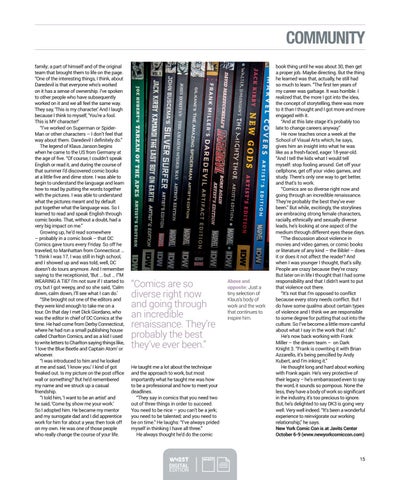
Above and opposite: Just a tiny selection of Klaus’s body of work and the work that continues to inspire him.
book thing until he was about 30, then get a proper job. Maybe directing. But the thing he learned was that, actually, he still had so much to learn. “The first ten years of my career was garbage. It was horrible. I realized that, the more I got into the idea, the concept of storytelling, there was more to it than I thought and I got more and more engaged with it. “And at this late stage it’s probably too late to change careers anyway.” He now teaches once a week at the School of Visual Arts which, he says, gives him an insight into what he was like as a fresh-faced, eager 18-year-old. “And I tell the kids what I would tell myself: stop fooling around. Get off your cellphone, get off your video games, and study. There’s only one way to get better, and that’s to work. “Comics are so diverse right now and going through an incredible renaissance. They’re probably the best they’ve ever been.” But while, excitingly, the storylines are embracing strong female characters, racially, ethnically and sexually diverse leads, he’s looking at one aspect of the medium through different eyes these days. “The discussion about violence in movies and video games, or comic books or literature of any kind – the Bible! – does it or does it not affect the reader? And when I was younger I thought, that’s silly. People are crazy because they’re crazy. But later on in life I thought that I had some responsibility and that I didn’t want to put that violence out there. “It’s not that I’m opposed to conflict because every story needs conflict. But I do have some qualms about certain types of violence and I think we are responsible to some degree for putting that out into the culture. So I’ve become a little more careful about what I say in the work that I do.” He’s now back working with Frank Miller – the dream team – on Dark Knight 3. “Frank is cowriting it with Brian Azzarello, it’s being pencilled by Andy Kubert, and I’m inking it.” He thought long and hard about working with Frank again. He’s very protective of their legacy – he’s embarrassed even to say the word, it sounds so pompous. None the less, they have a body of work so significant in the industry, it’s too precious to ignore. But, he’s delighted to say DK3 is going very well. Very well indeed. “It’s been a wonderful experience to reinvigorate our working relationship,” he says. New York Comic Con is at Javits Center October 6-9 (www.newyorkcomiccon.com)
15