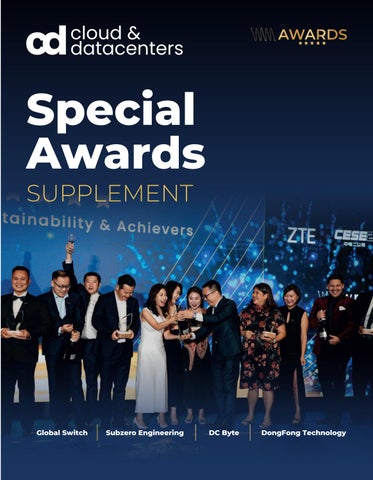
Special Awards SUPPLEMENT
Global Switch
Subzero Engineering
DC Byte
DongFong Technology
SUPPLEMENT
Driving the industry forward Every year w.media recognizes the exceptional work done by the data center industry.
T
he Awards are categorized broadly into “Projects,” “Planet,” and “People,” each of which contains between five and six subcategories. Entries are painstakingly reviewed by a panel of judges, themselves experts from the industry with decades of combined experience. The objective is simple: to find and recognize groundbreaking projects or initiatives that we might otherwise never know about. In a sector that often operates behind closed doors, the Awards shine a light on the teams and companies pushing boundaries for us
28
|
Cloud & Datacenters Magazine |
The objective is simple: to find and recognize groundbreaking projects or initiatives that we might otherwise never know about.
Issue 11
to celebrate as an industry. This ties back to the founding ethos of the w.media platform. We want to bring together data center and cloud professionals from both mature and
SUPPLEMENT
emerging markets, to share ideas, do business, and learn from one another. In this supplement, some of the winners of the w.media Asia Awards 2025 present their work and outlook. These partner features offer a closer look at the strategies and solutions behind their success, from containment and cooling innovations to AI infrastructure design and market intelligence.
How CRESS Programme Works? National Grid (TNB Grid System)
Corporate Consumer (Green Consumer)
Renewable Energy Developer (RED)
Environmental Impact + ESG Reporting
Generate green electricity external to company
1 1
21
RED
Key Players
Transmits electricity via open access
Builds and operates solar plants
Pays for electricity + RECs
31
TNB GRID Acts as the transmission backbone under ThirdParty Access (TPA)
41
Corporate Consumer Buys green electricity directly, bypassing traditional utility monopolies
Energy Commission Regulates the process and ensures compliance
Issue 11 |
The Race to 600kW |
29
ADVERTORIAL
Future-proofing through flexible data centres For Global Switch, the flexibility of its data centers is central to capturing opportunities in a booming industry.
I
n the rapidly evolving data center industry, data center solutions pioneer Global Switch believes there are five measures that can futureproof data centers for the years ahead: carrier and cloud neutral flexible infrastructure to enable a variety of hardware and cooling solutions, long-term sustainability in building design, operational excellence, and the use of automation and artificial intelligence. The firm is currently focused on the redevelopment and densification of its sites, transforming them into highly flexible data centers capable of handling the most demanding AI and HPC workloads. Its redevelopment and densification programme is being carried out globally, creating hundreds of jobs in construction and associated fields, and billions in local economic impact.
A look inside Global Switch’s liquid cooling suite in London
Global Switch is laser focused on the flexibility it believes is key to its continued leadership in the industry. This flexibility allows them to accommodate all customer demands and serve the complete breadth of the market, enabling customers to deploy whatever hardware they require and with any method of cooling.
Global Switch is laser focused on the flexibility it believes is key to its continued leadership in the industry. At the same time, the company already has an in-built advantage through its strategic locations in the heart of key cities in markets around the world. This allows Global Switch’s data centers to benefit from the exceptional connectivity and low latency. The company also utilizes AI for predictive maintenance, automating resource management, and optimizing cooling and energy use. For example, AI helps streamline security by detecting threats and triggering automated responses.
30
|
Cloud & Datacenters Magazine |
Issue 11
ADVERTORIAL
To build future resilience, Global Switch always ensures it stays ahead of the regulatory curve. heat from data centers back into the community. This benefits both the environment and the people of Paris. To build future resilience, Global Switch always ensures it stays ahead of the regulatory curve. A recent example was the EU Code of Conduct on Energy Efficiency for data centres, a voluntary initiative for which the company’s data centers have now been officially approved. European practices are considered best in class, and these principles and best practices are also being rolled out across its data centers in Singapore and Hong Kong. Global Switch is well placed to face the future, in an industry still attracting a huge amount of capital as companies push for compute in the AI revolution. The pace of change shows no sign of letting up and Global Switch is primed and ready to capture the many opportunities available – all powered by its agile management and flexibility-focused strategy.
These innovations reduce manual intervention, accelerate provisioning, and minimize downtime, allowing teams to focus on strategic priorities. By embedding AI across workflows, Global Switch ensures operational excellence, sustainability, and readiness for future demands. When it comes to futureproofing, sustainability is always front of mind. In 2025, Global Switch undertook a Renewable Energy PPA program, contracting directly with renewable projects, including wind and solar, and supporting new developments. This will help the company meet its 100 per cent renewable energy target in addition to procuring renewable energy certificates to match the consumption of electricity in its data centers. It currently operates using 90.6 per cent renewable electricity. Another project that the company has committed to is heat offtake agreements in France: recycling excess
Designed for scale and adaptability
Issue 11 |
The Race to 600kW |
31
ADVERTORIAL
Latest advancements in containment for data centers Data Center containment can save 30% energy
A
s liquid cooling adoption grows from increased demands, the accompanying technologies that enhance energy savings are seeing a high takeup rate as well. One of the technologies is containment which is quickly becoming a necessity in advanced technologies required in modern data center facilities. Containment, briefly, is the engineered separation of hot exhaust air from cold supply air in the data hall. When these airflows are prevented from mixing, cooling systems operate far more efficiently, therefore reducing wasted energy, stabilizing intake temperatures, and supporting higher rack densities. In traditional facilities, speed
of deployment is the biggest advancement in containment technology. Real world performance of Subzero Engineering’s systems shows deployment is about 40 percent faster than traditional methods, thus reducing labour costs and accelerating time to revenue. The biggest advantage in containment isn’t just speed, but also substantial energy savings. Subzero Engineering’s containment typically delivers around 30 per cent cooling energy savings over the system’s life, directly lowering PUE and reducing long-term operating costs. Although there are alternatives to containment, such as in-row cooling or raised-floor tuning, they may offer partial benefits and can rarely match containment’s scalability, predictability
Subzero Engineering Strengthens Global Reach with Launch of New Vietnam Facility
32
|
Cloud & Datacenters Magazine |
Issue 11
Source: Subzero Engineering
or energy impact. Containment works with existing cooling infrastructure and does not require replacing systems. Skipping containment often locks in a higher PUE floor and reduces flexibility as densities increase. For organizations serious about efficiency and resilience, engineered containment remains the most proven path, working in both new builds and retrofits. Subzero’s systems are purposebuilt, engineered, and tested offsite to eliminate fitting issues, reduce on-site rework, and maintain predictable timelines. The firm has improved sealing for high-humidity climates, standardized core components for
The biggest advantage in containment isn’t just speed, but also substantial energy savings.
ADVERTORIAL
consistent manufacturing quality, and made reconfiguration simpler to support evolving layouts. It has already deployed proven hybrid cooling solutions while others are still evaluating options. These improvements are already proven across APAC deployments. The containment systems are designed to integrate with hybrid cooling strategies and feature flexible configurations that accommodate evolving layouts. With its adaptive design, the system supports rack densities from 10 kW to well beyond 50 kW (to support AI workloads), without overhauling existing infrastructure, and protecting the customer’s long-term investment. But to obtain full benefits from containment, it requires early coordination with facility layout and cooling design to ensure proper integration and disciplined airflow management. In mature APAC markets such as Singapore, Japan and Australia, containment is now standard in new hyperscale and enterprise builds. In emerging markets, operators are skipping legacy designs entirely and adopting containment from day one. The real differentiator is not whether containment is used, but how well it is engineered and integrated. “At Subzero Engineering, we solve thermal challenges at the source. Besides engaging with customers and strategic partners, we build our containment solutions locally in APAC. The result is a containment solution that is fast, future-ready and built for
Source: Subzero Engineering
The containment systems are designed to integrate with hybrid cooling strategies and feature flexible configurations that accommodate evolving layouts. what is next,” said Midge Pan, General Manager, APAC region of Subzero Engineering. HCMC – strategic alignment with APAC Subzero Engineering recently announced the launch of a new manufacturing and R&D facility in Ho Chi Minh City. “The Ho Chi Minh City facility is a cornerstone of our APAC strategy. It’s not about lowering cost; it’s about aligning with APAC’s rapid
expansion,” says Midge Pan, explaining the firm’s debut into Vietnam. He adds that having a local manufacturing facility such as the one in HCMC, cuts lead times by up to 50 per cent, reduces supply-chain risk, and ensures consistent quality. “With engineering and production in-region, we adapt quickly to local operating conditions - from Indonesia’s humidity to Japan’s climate-driven design requirements and Australia’s green-grid mandates. It delivers local responsiveness at global scale,” notes Pan. “Because we are co-located with fast-moving markets, we can turn customer insights into refined engineering within weeks, not quarters. As AI and sustainability demands accelerate, this agility ensures APAC does not just adopt global standards. It helps define them,” the Subzero General Manager, APAC concludes.
Source: Subzero Engineering
Issue 11 |
The Race to 600kW |
33
ADVERTORIAL
How AI is Reshaping APAC Data Centers APAC’s Data Center Boom: On the Ground with DC Byte
T
he data center industry has shifted dramatically over the last few years, observed James Murphy, Managing Director at data center intelligence firm DC Byte. When Murphy started the firm’s Asia Pacific (APAC) office in 2021, a 20-megawatt facility was seen as fairly large, and a 50MW data center was considered huge. Today, 50MW is practically a minimum requirement as the world races to build more data centers. Part of this could probably be attributed to the initial surge in digital infrastructure in the immediate aftermath of COVID. Then the release of ChatGPT and the subsequent race to build massive AI data centers cemented it. But just how much growth has happened, and what is the state of the data center markets in APAC today? The race for power and new markets It used to be that data centers were clustered around a few key markets in APAC. Today, there are probably 20 to APAC Team
A-Flow ML1 Site Tour (Philippines)
To reduce building shaking during earthquakes, tuned viscous or mass dampers, and viscoelastic couplers are typically used. 25 markets across the region growing more or less concurrently, says Murphy. Markets like Johor, Melbourne, and Bangkok are seeing rapid growth, with several hundred megawatts being deployed in a very short period – despite
Gaw Capital Partners Golden Digital Gateway Site Tour (Batam)
34
|
Cloud & Datacenters Magazine |
Issue 11
the fact that some were relatively small or, as in the case of Johor, had close to zero data centers five years ago. According to Murphy, this is a trend across the board: development happens a lot quicker than in previous years. “Once the market decides that a location is a good place to develop, we’re seeing a huge amount of momentum behind these markets, and we’re seeing them grow at a much faster pace than we would have seen the established markets a decade or so ago.” While the cloud continues to drive significant organic demand, AI is influencing the geography of this growth. It is well known that power is the limiting factor for data centers. Murphy noted that AI deployments have a unique advantage: they don’t always face the same strict location constraints as traditional cloud infrastructure, which must be deployed closer to users. “AI facilities are much better placed to really chase the power. It’s not really the cloud facilities that are in a
ADVERTORIAL
APAC Team
YTL Green Data Centre Park Site Tour (Johor)
To reduce building shaking during earthquakes, tuned viscous or mass dampers, and viscoelastic couplers are typically used. position to do this, but some of the AI deployments are, because they’re not tied to the same strict architecture,” said Murphy. The truth about timelines A common misconception is the belief that all data centers are built at the same speed and with the same considerations. “People think that once a shovel is in the ground, all of a sudden you’re going to have a fully built-out facility with customers inside and fully committed in 24 months. The reality is… it’s certainly taken much, much longer.” Murphy noted that some highprofile hyperscalers do have longer construction periods, and historical data shows they often take more than two years to build out full facilities. There are several reasons for that, ranging from approvals and regulatory hurdles in mature markets, complex engineering for multi-story data centers in locations with land constraints, delays stemming from utility upgrades, or manpower
limitations. Ultimately, no two construction projects are the same, which means not all data center developments will follow a straight line to completion. While traditional hyperscale data center builds can take time to complete, a new wave of AI-driven projects is changing the industry as it shrinks timeframes in the rush to bring more capacity online faster. In addition, Chinese operators expanding into Southeast Asia are leveraging their extensive knowhow and capabilities to build entire campuses in one go – a shift from how facilities are usually built over several phases. Separating hype from ground reality Because what is publicly announced typically describes a project in its final stages or at completion, the result is often a skewed picture of the market. This is where DC Byte comes in, providing market intelligence that cuts through the hype to show what’s actually happening. Among other things, it helps close the gap between announcements and groundbreaking ceremonies on one hand, and actual delivery timelines on the other. The discrepancies can be substantial. Some announced projects
show little progress on the ground, while unlisted ones are moving fast. This is particularly true with private operators, who often keep their projects tightly sealed and have no requirement to make public disclosures – even when building significant capacity. To address this, DC Byte tracks both publicly announced projects and these underthe-radar operators. Beyond desk research, the data is verified through site visits to confirm what’s being built versus what’s announced. The full pipeline of data centers is tracked: planned, under construction, and operational facilities. “Every year, or certainly for the last three or four years since we’ve been in APAC, we’ve visited hundreds of sites. So the team now is at a stage where they can accurately determine how far a specific project is along in its development cycle,” explained Murphy. For now, Murphy expects new markets in APAC to continue opening up over the next 12 months, with Bangkok and India seeing major growth. Cloud expansion also remains strong, with potential new cloud regions in Manila and Ho Chi Minh City. The takeaway: growth will continue and will be felt across a broader region than ever before. Worried your market analysis relies on inaccurate data? Connect with the DC Byte team for verified market intelligence. STT GDC Jakarta 1 Site Tour (Jakarta)
STT GDC Fairview 1 Site Tour (Philippines)
Issue 11 |
The Race to 600kW |
35
ADVERTORIAL
Why DongFong Technology takes an integrated approach to AI deployments High-density AI environments call for a fundamentally different approach to data center design.
D
riven by rising AI rack densities, data centers are slowly but surely shifting to liquid cooling as standard. And with power availability increasingly becoming the primary constraint for site selection, data center operators are also integrating renewable energy and Battery Energy Storage Systems (BESS) into their facilities. As data centers evolve to accommodate these new realities, their design and operational strategies must change with the times, too. This shift demands a more integrated approach, one that treats power, cooling, and infrastructure not as separate concerns but as interdependent systems that must be planned together from the outset.
36
|
Cloud & Datacenters Magazine |
Beyond conventional design New operators frequently underestimate the operational complexity of high-density GPU environments, treating an AI deployment as simply a scaled-up version of a conventional facility. In practice, AI hardware represents a fundamentally different type of infrastructure that necessitates a distinct design and operational approach. Power density, cooling architecture, structural capacity, and operational resilience are deeply interconnected and must be designed as an integrated system. Projects that fail to address this holistically often encounter challenges during deployment or expansion. For instance, designs are often drawn up based on theoretical
Issue 11
New operators frequently underestimate the operational complexity of high-density GPU environments, treating an AI deployment as simply a scaled-up version of a conventional facility. peak power ratings rather than real-world load behavior. This means transient spikes and uneven thermal distribution are typically not taken into consideration, which can be a serious issue given the high power draw of GPUs. Inadequate attention to upstream electrical redundancy, voltage stability, floor loading, and serviceability can also significantly impact long-term reliability and scalability. In the same vein, liquid cooling is often evaluated primarily on thermal performance, while longterm operational factors receive less attention. Yet considerations such as coolant quality management, leak detection strategies, maintenance workflows, and compatibility with existing facility standards are critical to ensuring reliability over time. Without proper planning for these lifecycle factors, liquid cooling can introduce operational risk instead of delivering its intended benefits. Integration over isolation Within a high-density data center, performance and efficiency are driven by system-level integration, not individual components. Electrical infrastructure, cooling systems, control logic, and monitoring platforms must be engineered to operate as a unified ecosystem rather than as discrete systems.
ADVERTORIAL
Consider the deployment of the Nvidia GB300. With racks that can exceed 70–120kW, cooling is critical. Yet high-density fiber optics can create thermal zoning and layout constraints that are often overlooked in initial planning. Direct-to-chip cooling also demands treated coolant, dual-loop redundancy, and strict operational control. Each of these elements must work in concert; optimizing one in isolation can undermine the others. This interconnectedness makes it essential to begin with a clear understanding of target workloads and growth trajectories. Unlike traditional data center environments that remain relatively static, AI compute platforms evolve rapidly, often outpacing typical retrofit timeframes. What works today may be inadequate within a few years as rack densities increase and cooling requirements shift. Operators who recognize this can design infrastructure with builtin adaptability, whether through modular power distribution, flexible cooling pathways, or spatial layouts that anticipate higher densities. This approach helps avoid costly overhauls and maintains the flexibility to accommodate next-generation hardware. In AI environments, future-proofing is not optional; it is foundational to long-term success. Staying ahead The AI landscape is evolving at a relentless pace. New GPU architectures, shifting power requirements, and
advances in cooling technology mean that best practices today may be outdated within months. For operators and designers, staying current is not just advantageous; it is essential to delivering infrastructure that remains viable over its intended lifespan. Equally important is the recognition that successful AI deployments are the result of early, coordinated collaboration across disciplines. When electrical, mechanical, and structural teams work in silos, inefficiencies and design conflicts are almost inevitable. A more integrated approach, where stakeholders align from the outset, leads to facilities that are more resilient, efficient, and adaptable. This philosophy underpins how DongFong Technology approaches every project, whether data center design and construction, GB300 AI deployments, or national-level integration initiatives. To ensure its consultants and designers stay at the
For instance, designs are often drawn up based on theoretical peak power ratings rather than realworld load behavior. forefront, the company maintains monthly internal reviews of the latest GPU developments while collaborating directly with Nvidia ecosystem partners. With operational data centers in Taipei and Taichung delivering colocation, dark fiber, and enterprise network services, DongFong Technology offers end-to-end AI and data center engineering, from design and construction through to commissioning and operations. Planning your next infrastructure project? A conversation with DongFong Technology may be the place to start.
Issue 11 |
The Race to 600kW |
37
Special Awards
SUPPLEMENT