GY
NE
T ce c
a
Vasc O ul ar
N
A
LO s O s
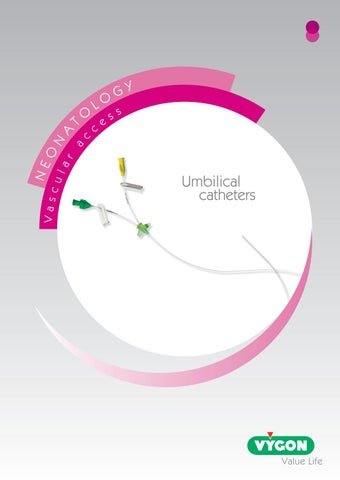
Umbilical catheters
Single-lumen umbilical catheters Umbilical arterial catheters are used for:
Umbilical venous catheters are used for:
Arterial blood sampling Arterial pressure measurement Blood pH and blood gas analysis Fluids and drugs administration
PVC
PUR
Parenteral nutrition & fluid administration Drugs administration Venous blood sampling Transfusion of blood or blood products Exchange transfusion
Luer-lock connector Efficient connection
Code
Size
Length
Flow rate
1270.02
2.5Fr
30 cm
> 3 ml/min
1270.03
3.5Fr
40 cm
> 10 ml/min
1270.04
4Fr
40 cm
> 10 ml/min
1270.05
5Fr
40 cm
> 23 ml/min
1270.08
8Fr
40 cm
> 100 ml/min
270.03
3.5Fr
37 cm
> 6 ml/min
270.04
4Fr
37 cm
> 16 ml/min
270.05
5Fr
37 cm
> 31 ml/min
270.06
6Fr
37 cm
> 52 ml/min
270.07
7Fr
37 cm
> 80 ml/min
270.08
8Fr
37 cm
> 106 ml/min
Radiopaque catheter Control of catheter positioning under X-ray
Numerical marking every cm Easy check of the length of catheter inserted
Blunt distal tip Atraumatic insertion Preservation of the vein
Double-lumen umbilical catheters Infusion of incompatible drugs Infusion of medication and nutrition at the same time Reduces the need for additional access
PUR
Colour-coded hubs Easy identification and safety
Code
Size
1272.14
4Fr
1274.14
4Fr
1274.17
5Fr
1272.04
4Fr
Neonatal clamps Rounded and light
One lateral One distal Two distal
Length
Priming volume
Flow rate
20 cm
2 x 0.19 ml
11 & 12 ml/min
40 cm
2 x 0.27 ml
6 & 7 ml/min
40 cm
2 x 0.26 ml
7 & 9 ml/min
20 cm
2 x 0.19 ml
2 x11 ml/min
Blunt distal tip Atraumatic insertion Preservation of the vein
PUR catheter Good haemocompatibility Reduced risk of thrombosis Numerical marking every cm Easy check of the length of catheter inserted
2
Exit points
All radiopaque catheter Control of catheter positioning under X-ray
Umbilical catheters
Triple-lumen umbilical catheter Colour coded hubs Easy identification and safety
• Extremely premature baby born around 24 weeks (to avoid multiple access and maintain continuous administration) • Small-for-Gestational-Age (SGA) infant •T erm infant suffering from Persistant pulmonary hypertension (PPHN) •N ewborn suffering from Hypoplastic Left Heart Syndrome (HLHS)
All radiopaque catheter Control of catheter positioning under X-ray
Neonatal clamps Rounded and light 23G
PUR
Catheter Fr Length Ext. Ø
Distal lumen Medial lumen G Flow Prim. G Flow Prim. vol. vol. rate rate
Proximal lumen G Flow Prim. vol. rate
4.5
20
23
20
1.5
ml/min
ml
7.4
0.20
23
ml/min
ml
2
0.17
ml/min
ml
2.1
0.17
Insertion technique 1. U se strict aseptic technique, disinfect the abdominal wall and cord stump. Place a sterile drape with central opening. 2. Loosely tie an umbilical tape around the cord stump to control bleeding. Cut the umbilical cord horizontally 1 cm above the skin, remove any clots which may obstruct the vessel lumen. 3. I dentify the vessels: arteries are small, thick walled spiralling vessels and vein is larger and thin walled. 4. Prime the catheter and if required dilate the vessel using iris forceps. 5. Advance the catheter using short, smooth strokes. 6. Use the cm markings on the catheter to note the length of catheter inserted. 7. Place a suture in the wall of the cord taking care not to puncture the catheter. 8. Dress the catheter according to your local policies.
Positioning:
24G
Blunt distal tip Atraumatic insertion Preservation of the vein
mm
V02127315
24G
20G
Separated exit points One distal, two lateral exit points Prevent incompatible drug mixing
Code
23G
Catheter Iris Forceps Vein
Artery
Ribbon Cauze
Ductus arteriosus
Superior vena cava UVC Positioning T9-T10
T6-T9
UAC High Positioning
Inferior
Always check the location of the catheter by radiography. vena cava For arterial catheterization: Umbilical arterial catheter can be sited either in the high position or the low position though the higher position is associated with lower complication Portal vein rates (1,2,3). Use of high positioning of umbilical arterial catheter is recommended (4). For venous catheterization, the catheter tip should be placed beyond the ductus Umbilical vein venosus in the central venous system (inferior vena cava). In emergency situations, the Umbilical catheter can be inserted 2-3 cm (until blood is returned) and emergency meds can be arteries given. The catheter should not be left in this location and should be removed after giving emergency medications.
Ductus venosus Abdominal aorta
L4
UAC Low Positioning
3
Umbilical Placement Set The umbilical placement set is a procedure pack containing all the necessary material to place an umbilical catheter • Save time and money by reducing preparation time / Improving stock management/ Reducing waste • Increase safety by reducing the risk of infection / Simplifying procedure / Traceability • I nstruments dedicated to neonates: Neonatal tourniquet designed to reduce skin trauma / Non adhesive drapes respectful of the fragile skin of newborns.
Code 80199.695
18 G hypodermic safety needle 20 G hypodermic safety needle Scalpel Drapes without adhesive 40x40cm fenestrated transparent drape with “Easy-peel” Drape towels 1 pair of suture scissors 10 swabs 10 x 10, 8-ply 10 swabs 5 x 5, 8-ply 1 transparent gallipot 60 ml
1 red gallipot 60 ml Outer wrap Instructions for use Umbilical tape Measuring guide Mosquito haemostat curved Mosquito haemostat ,straight Iris forceps, “full curved” Iris forceps, half curve Iris forceps, straight Iris forceps, straight with teeth
Needle holder Measuring tape 1 ml syringe 3 ml syringe 5 ml syringe Vessel dilator probe 3.0 silk suture with curved cutting needle Tray 20 x 15 x 4 cm 2 fixation strips
Bibliography 1. Sawyer, T.L. (2011) Umbilical Arterial Catheterization Accessed 2. Kuschel, C. (2011) Newborn Services Clinical Guideline Umbilical Artery and Vein Catheterisation 3. McCormick, P.C. Stein, B.M. (1990) Functional anatomy of the spinal cord and related structure, Journal of Neurosurgery,Vol 1, pp:469-89 4.Kaleidoscope Hunter Children’s health Network, Guideline Umbilical Arterial Catheter in NICU August 2009
OBSTETRICS NEONATOLOGY ENTERAL DB NEON 11 129E - 10/19
For further information, please contact: questions@vygon.com The specifications given in this brochure are for information only and are not, under any circumstances, of a contractual nature.
Vygon – 5, rue Adeline • 95440 ECOUEN • FRANCE Reception: +33 (0)1.39.92.63.63 – Service clients France: +33 (0)1.39.92.63.81 Export customer service: +33 (0)1.39.92.64.15 Fax: +33 (0)1.39.92.64.44 • www.vygon.com
www.vygon.com