Credits: @marlene.puericulture
NEONATOLOGY
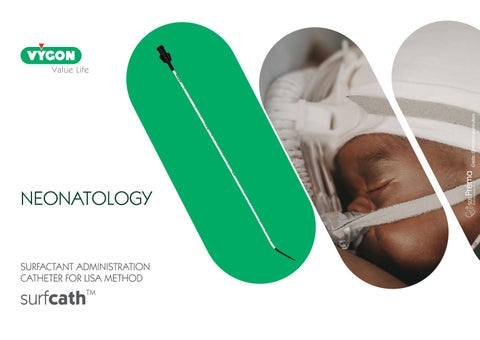
SURFACTANT ADMINISTRATION CATHETER FOR LISA METHOD
surfcath
TM
Newborns & Respiratory Distress Syndrome (RDS)1
surfcath
≈ 50%
SURFACTANT
RDS is caused by pulmonary immaturity & surfactant deficiency, resulting in respiratory insufficiency from soon after birth
“Surfactant therapy improves survival and [...] plays an essential role in management of RDS”
≈ 50% of all babies born between 22 & 32 weeks receive surfactant, according to European data from 2014 to 2016
For the treatment of newborns with surfactant injection, there is 2 methods under non-invasive ventilation:
INSURE
INtubation SURfactant Extubation
The IN-SUR-E technique consists of intubating the baby, then “surfactant bolus administration followed by brief bag ventilation and rapid extubation without ongoing ventilation”
LISA METHOD
Less Invasive Surfactant Administration LISA method consists in “using a thin catheter for surfactant administration and avoid “bagging” completely, allowing the infant to maintain spontaneous breathing on CPAP while surfactant is gradually instilled in small aliquots.”
TM
European Consensus Guidelines on the management of RDS1 • “Non-invasive ventilation with early rescue surfactant by LISA technique is considered optimal management for babies with RDS” • “Preterm infants should be managed without mechanical ventilation where possible” • “LISA is the preferred mode of surfactant administration for spontaneously breathing babies on CPAP” • “LISA [...] results in less need for mechanical ventilation (MV) and a reduction in the combined outcome of death or Bronchopulmonary dysplasia (BPD) as well as reduction in IntraVentricular Hemorrhage (IVH) [...] in head-to-head comparisons with IN-SUR-E” Based on these European Consensus Guidelines LISA is the preferred method for surfactant administration
LISA method in the Literature2
surfcath
TM
In the current literature, many studies focus on the LISA method. We chose to focus on the systematic review and meta-analysis Abdel-Latif et al. Cochrane 2021 which includes 18 publications gathering 2164 newborns.
Objective COMPARE: LISA METHOD VS INSURE
Results
Conclusion
S-ETT (INSURE)
S-TC (LISA)
In the literature, several acronyms may be used to describe the same essence of the LISA method:
• MIST - Minimally Invasive Surfactant Therapy • SurE - Surfactant without endotracheal tube • MISA - Minimally Invasive Surfactant Administration • NISA - Non-Invasive Surfactant Administration
Based on these results,
LISA METHOD Death during 1 hospitalization
rst
Severe IVH*
is associated with: Ô Reduction of mortality during 1rst hospitalization Ô Lowered risk of death or BPD Ô Decreased BPD among survivors Ô Decreased need for assisted breathing in the first 72h of life Ô Lessened severe brain bleeding
In the review, the authors choose to not use any of these terms to describe LISA method in preference to others and use:
S-TC (Surfactant administration via Thin Catheter) Death or BPD*
BPD in survivors to 36 weeks’ PMA*
Need for intubation within the first 72h
Need for intubation at any time
In the review, the INSURE method is referred as:
S-ETT (Surfactant administration through an EndoTracheal Tube)
IVH: IntraVentricular Hemorrhage - BPD: Bronchopulmonary dysplasia - PMA: Post Menstrual Age 4
LISA method in the Literature Focus on...
surfcath
“
“
“Infants who received MIST had lower rates of adverse respiratory outcomes during their first 2 years of life”4
“The available long-term* outcome studies show promise for improved neurodevelopmental outcomes with LISA”5
*Assessed at 2 years
LONG-TERM EFFECTS ON EXTREMELY PRETERM INFANTS
“Infants born at 25 and 26 weeks showed improved neurodevelopment* after less invasive surfactant application (LISA).”6
“Infants born at 23 and 24 weeks showed improved psychomotor development* after LISA.”6 *Assessed at 2 years
MIST - Minimally Invasive Surfactant Therapy
”
EXTREMELY PRETERM INFANTS “LISA is associated with increased survival in extremely preterm infants”3
“LISA is safe based on 2-year outcome [...] a better prognostic outcome was observed in the subgroup of infants with a gestational age of 25 and 26 weeks.”6
“Intriguingly, the beneficial effects of LISA, such as the reduction of severe IVH, were predominately observed in extremely immature infants”7
“[...] The high rate of survival without severe complication is particularly remarkable as one in three infants were born at less than 24 weeks.”7
”
Credits: @marlene.puericulture
LONG-TERM EFFECTS
TM
surfcathTM - Catheter for surfactant administration with LISA method FEATURES & BENEFITS
surfcath
WHAT LENGTH SHOULD YOU INSERT?8 25 / 26 weeks 1 cm
27 / 28 weeks 1.5 cm
29 / >32 weeks 2 cm
•
DISTAL TIP
BENDABLE •
Thermosensitive material allowing the TM physician to curve surfcath prior to using it
SEMI-RIGID •
No need of Magill forceps
•
High maneuverability
•
Visual mark to address the inserted length
Avoids kinking
•
Minimizes tracheal lesion risk
Eases the passage between the vocal cords
•
Check that surfcath stays in place
TM
Eases manipulation of the surfactant syringe, away from the patient head
6 FR
CURVED
•
Indicates the inserted length
•
•
Follows the airway anatomy
•
20 CM LENGTH
DOUBLE SOFTNESS
•
Visualization of the surfactant
CENTIMETRIC MARKINGS
2 CM BLACK TIP
MADE OF PEBA
TRANSPARENT
30°
ExtraSoft tip Soft tip
•
Less invasive
•
No obstruction of the airways
•
Allowing spontaneous breathing
•
Low dead space (0.2 mL)
Co-invented with Dr. Kribs from University Hospital of Cologne (Uniklinik Köln)
TM
surfcath
TM
Technical features Designation & Code
Length (cm)
External diameter (Fr)
Dead volume (mL)
Quantity box/case
surfcathTM 5590.106
20
6
0.21
10/200
Reminder Don’t forget, we also have an endotracheal tube with a secondary lumen, specifically dedicated to surfactant administration when the baby is under invasive ventilation. 5520.XX Code
Tube
Secondary lumen
Distal tip marking
Quantity
Standard tube
Soft tube
Length (cm)
Ext. Ø (Fr)
Int. Ø (Fr)
Fr
Int. Ø (mm)
Flow rate (mL/min)
Length (mm)
Box/case
5516.20
5520.20
165
3.4
2.0
10
0.5
2.15
15
20/240
5516.25
5520.25
165
4.1
2.5
12
0.5
3.35
17.5
20/240
5516.30
5520.30
165
4.6
3.0
14
0.5
5
20
20/240
5516.35
5520.35
165
5.2
3.5
15
0.7
15
25
20/240
5516.40
5520.40
230
5.7
4.0
17
0.7
35
25
20/160
5516.45
5520.45
230
6.2
4.5
18
0.7
80
25
20/160
5516.XX
surfcath References 1. S weet DG, Carnielli VP, Greisen G, Hallman M, Klebermass-Schrehof K, Ozek E, Te Pas A, Plavka R, Roehr CC, Saugstad OD, Simeoni U, Speer CP,Vento M,Visser GHA, Halliday HL. European Consensus Guidelines on the Management of Respiratory Distress Syndrome: 2022 Update. Neonatology. 2023;120(1):3-23. doi: 10.1159/000528914. Epub 2023 Feb 15. PMID: 36863329; PMCID: PMC10064400. 2. Abdel-Latif ME, Davis PG, Wheeler KI, De Paoli AG, Dargaville PA. Surfactant therapy via thin catheter in preterm infants with or at risk of respiratory distress syndrome. Cochrane Database of Systematic Reviews 2021, Issue 5. Art. No.: CD011672. DOI: 10.1002/14651858.CD011672.pub2. 3. H ärtel C, Herting E, Humberg A, Hanke K, Mehler K, Keller T, Mauer I, Frieauff E, Meyer S, Thome UH, Wieg C, Schmidtke S, Kribs A, Göpel W; German Neonatal Network. Association of Administration of Surfactant Using Less Invasive Methods With Outcomes in Extremely Preterm Infants Less Than 27 Weeks of Gestation. JAMA Netw Open. 2022 Aug 1;5(8):e2225810. doi: 10.1001/jamanetworkopen.2022.25810. Erratum in: JAMA Netw Open. 2023 Apr 3;6(4):e2312619. doi: 10.1001/ jamanetworkopen.2023.12619. PMID: 35943742; PMCID: PMC9364126. 4. D argaville PA, Kamlin COF, Orsini F, Wang X, De Paoli AG, Kanmaz Kutman HG, Cetinkaya M, Kornhauser-Cerar L, Derrick M, Özkan H, Hulzebos CV, Schmölzer GM, Aiyappan A, Lemyre B, Kuo S, Rajadurai VS, O’Shea J, Biniwale M, Ramanathan R, Kushnir A, Bader D, Thomas MR, Chakraborty M, Buksh MJ, Bhatia R, Sullivan CL, Shinwell ES, Dyson A, Barker DP, Kugelman A, Donovan TJ, Goss KCW, Tauscher MK, Murthy V, Ali SKM, Clark HW, Soll RF, Johnson S, Cheong JLY, Carlin JB, Davis PG; OPTIMIST-A Trial Investigators. Two-Year Outcomes After Minimally Invasive Surfactant Therapy in Preterm Infants: Follow-Up of the OPTIMIST-A Randomized Clinical Trial. JAMA. 2023 Sep 19;330(11):1054-1063. doi: 10.1001/ jama.2023.15694. PMID: 37695601; PMCID: PMC10495923. 5. K akkilaya V, Gautham KS. Should less invasive surfactant administration (LISA) become routine practice in US neonatal units? Pediatr Res. 2023 Apr;93(5):1188-1198. doi: 10.1038/ s41390-022-02265-8. Epub 2022 Aug 19. PMID: 35986148; PMCID: PMC9389478. 6. M ehler K, Broer A, Roll C, Göpel W, Wieg C, Jahn P, Teig N, Höhn T, Welzing L,Vochem M, Hoppenz M, Bührer C, Franklin J, Roth B, Herting E, Kribs A. Developmental outcome of extremely preterm infants is improved after less invasive surfactant application: Developmental outcome after LISA. Acta Paediatr. 2021 Mar;110(3):818-825. doi: 10.1111/apa.15565. Epub 2020 Sep 25. PMID: 32892376. 7. K lein R, Fastnacht L, Kribs A, Kuehne B, Mehler K. LISA Eligibility and LISA Success in Extremely Preterm Infants: A Single-Center Experience. Neonatology. 2024;121(4):530-535. doi: 10.1159/000537904. Epub 2024 Apr 10. PMID: 38599191; PMCID: PMC11318578. 8. D argaville PA, Aiyappan A, De Paoli AG, Kuschel CA, Kamlin CO, Carlin JB, Davis PG. Minimally-invasive surfactant therapy in preterm infants on continuous positive airway pressure. Arch Dis Child Fetal Neonatal Ed. 2013 Mar;98(2):F122-6. doi: 10.1136/archdischild-2011-301314. Epub 2012 Jun 9. PMID: 22684154.
TM
12/2024 - DBRESP19505E
FOR FURTHER INFORMATION, PLEASE CONTACT: questions@vygon.com
The specification shown in this leaflet are for information only and are not, under any circumstances, of a contractual nature. VYGON – 5, RUE ADELINE - 95440 ECOUEN - FRANCE RECEPTION: +33 (0)1 39 92 63 63 – SERVICE CLIENTS FRANCE: +33 (0)1 39 92 63 81 EXPORT CUSTOMER SERVICE: +33 (0)1 39 92 64 15
www.vygon.com