e
c
L
c
ss
NEO
N
V a s c AT ul ar a
O
O
G
Y
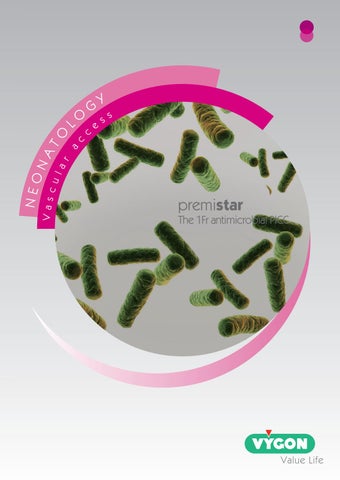
premistar
The 1Fr antimicrobial PICC
Catheter-Related Bloodstream Infections (CRBSI) A global challenge
“
M
ore than one million neonatal deaths every year in the world are attributable to infection. In Neonatal Intensive Care Units (NICUs) the reported [infection] incidence is 7-24.5%, and up to 40% in newborns with birth weight less than 1000 g or gestational age at birth <28 weeks(1).
”
Infections
Others
Bloodstream Infections
52,6%
73%
Others
Bloodstream infections(2)
Catheter-Related Bloodstream Infections(3)
The rates of CRBSI range from 6.4 to 8.3 episodes per 1,000 patient days in the NICU(4).
Risk Factors(5) Low birth weight
Refusal to feed
Lethargy and hypotonia Hyperglycemia
TPN
Metabolic acidosis
Conseq
Dwell time
Increased respiratory support
Increasing apnoea
s uence
Tachycardia / Bradycardia
Death
,8) (3,6,7
5% 1%
The mean additional length of hospital stay in neonates with HAI is 24 days. The mean extra charges for patients with a HAI is 11 750 €(9).
22%
Accomodation Pharmaceuticals
72%
Repartition of additional costs due to BSI in NICU
2
Ancillary items Extra charges
premistar
premistar premistar is the only impregnated 1Fr PICC, especially developed to fight against CBRSI in NICU. The Star Technology is the innovative combination of two active substances, Rifampicin and Miconazole, chosen for their synergic properties: - overlapping spectrum of efficacy on gram+, gram- & fungi(10, 11), - multiple level of action on the bacteria, - low risk of bacterial resistance development(11).
Miconazole
+ Rifampicin
Thanks to the very high concentration in small quantities of the two substances, the Star Technology ensures a strong local action at the catheter’s surface. The induction of resistant micro-organisms is therefore improbable(11).
Combined antimicrobial effect Miconazole • Synthetic antifungal with low toxicity • Mechanical action: damages cell wall and inhibits peroxide degradation
+
Rifampicin • High efficacy against fast growing and resting bacteria in biofilm • Mechanical action: inhibits RNA synthesis
Miconazole disrupts the cell enabling Rifampicin to enter
Clinical trial(12) To determine the effect of the antimicrobial coated catheter premistar on catheter colonisation and secondary sepsis on preterm infants. Pilot study in two hospitals, Munich (Germany) & Bozen (Italy). 83 preterm infants : 43 with Premistar & 40 with Premicath (standard PUR catheter).
The complications; colonisation, infection & sepsis, were divided by 4 thanks to the use of premistar and NO SEPSIS occurred among the preterm’s.
Results 30
28.5
25 % bacterial-related complications
Objective & Settings
20 15 10
7.7
5 0
premicath premistar
Sepsis
Infection
Colonisation
3
Recommendations(3, 13, 14)
“
Preventive strategies to reduce infections in these infants (VLBW) should be prioritized Journal of hospital infection, 2008
The most promising options for reducing catheter-related blood stream infection are […] antibiotic-impregnated central venous catheters Current Opinion in Infectious diseases, 2008
CVC supersaturated with Miconazole and Rifampicin were associated with significantly lower risk for catheter colonisation and catheter-related infections compared to standard catheters
”
Journal of Antimicrobial Chemotherapy, 2004
Technical features Code
Catheter
Introducer
Length (cm)
Ext. Ø (mm)
Fr
Flow rate (ml/min)
Prim.Vol (ml)
6261.20
20
0.35
1
0.7
0.09
6261.203
20
0.35
1
0.7
0.09
6261.206
20
0.35
1
0.7
0.09
Breakaway Needle Breakaway Needle -
6261.306
30
0.35
1
0.6
0.11
-
Type
Stylet
Length (mm)
Ext. Ø (mm)
G
19
0.7
24
No
19
0.7
24
Yes
-
-
-
Yes
-
-
-
Yes
Bibliography 2 S ohn AH et al. Prevalence of nosocomial infections in neonatal intensive care unit patients: results from the first national point-prevalence survey The Journal of pediatrics. 2001/12; 139(6) : 821-827. 3C . Geffers et al. Incidence of healthcare-associated infections in high-risk neonates: results from the German surveillance system for very-lowbirthweight infants. Journal Hosp Infect. 2008 Mar;68(3):214-21. 4 L ee JH. Catheter-related bloodstream infections in neonatal intensive care units. Korean J. Pediatr. 2011 Sep;54(9):363-7. 5 I nfect Control Hosp Epidemiol. 2011 Jan;32(1):42-9. Epub 2010 Dec 1. Individualized catheter surveillance among neonates: a prospective, 8-year, single-center experience. Zingg W, Posfay-Barbe KM, Pfister RE, Touveneau S, Pittet D. University of Geneva Hospitals and Faculty of Medicine, Geneva, Switzerland 6K anti Mallicki. A Prospective Study of Nosocomial Infection in a Neonatal ICU (NICU). Pediatrics. 2015 Feb;135 Suppl 1:S8-9. doi: 10.1542/ peds.2014-3330N. 7W McGuire et al. Infection in the preterm infant. BMJ. 2004 Nov 27; 329(7477): 1277–1280.
8 S toll BJ et al. Late-onset sepsis in very low birth weight neonates: the experience of the NICHD Neonatal Research Network. Pediatrics. 2002 Aug;110(2 Pt 1):285-91. 9 Additional hospital stay and charges due to hospital-acquired infections in a neonatal intensive care unit. J Hosp Infect. 2001 Mar;47(3):223-9. Mahieu LM1, Buitenweg N, Beutels P, De Dooy JJ. 10 S chierholz JM. et al. Antimicrobial Central Venous Catheters in Oncology: Efficacy of a Rifampicin-Miconazole-releasing Catheter. Anticancer research 30: 1353-1358. 2010. 11 R ump et al. Pharmacokinetics of antimicrobial agents rifampicin and miconazole released from a loaded central venous catheter. Journal of Hospital Infection. 53; 129-135, 2003. 12 P ectin-abstract 31 1 2016 AS-2 13 G ilbert RE, Harden M. Effectiveness of impregnated central venous catheters for catheter related blood stream infection: a systematic review. Curr Opin Infect Dis. 2008 Jun;21(3):235-45. 14 Y ucel et al. Reduced colonisation and infection with Miconazole Rifampicin modified central venous catheters: a randomised controlled clinical trial (Journal of Antimicrobial Chemotherapy– 2004). DB NEON 16 325 E - 10/17
1 S tronati et al. Neonatal sepsis: new preventive strategies. Minerva Pediatr. 2013 Feb;65(1):103-10.
OBSTETRICS NEONATOLOGY ENTERAL For further information, please contact: questions@vygon.com The specifications given in this brochure are for information only and are not, under any circumstances, of a contractual nature.
Vygon – 5, rue Adeline • 95440 ECOUEN • FRANCE Reception: +33 (0)1.39.92.63.63 – Service clients France: +33 (0)1.39.92.63.81 Export customer service: +33 (0)1.39.92.64.15 Fax: +33 (0)1.39.92.64.44 • www.vygon.com
www.vygon.com