LO
GY
Acc NEO es so NA ri
O T s e
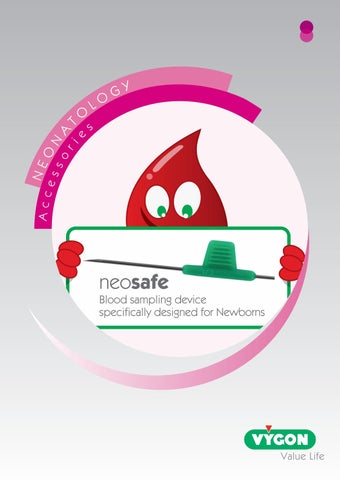
neosafe
Blood sampling device specifically designed for Newborns
neosafe neosafe: simple venipuncture
Why
safe
?
neosafe, an effective blood sampling device specifically designed for Newborns
Comparison neosafe vs. other devices (broken needle, venous cannula, butterfly...)
(1)
neosafe provides paediatric and neonatal units with the opportunity to reduce the number of failed venipunctures and the unnecessary scarring that results from repeated venipunctures.
No modification needed • No creation of an extra sharp end compared to a broken needle • No tubing to cut
No tubing / No hub / No cannula
Single wing
Developed from an idea of Dr. Roy Philip , Consultant Neonatologi st, University H ospital Limerick (Ire land)
• Good handling • Easy to identify in the cot • Color-coded needle size • Maximised needle stability (no wing recoil)
• Unimpeded blood flow • No possible clotting in the hub • Low dead space • Only the necessary blood sample taken • No possible kinking of the cannula
No double winged needle
Sharp bevel
• Less restriction to rotational movement • Prevention of wing recoil
• Easy venous puncture • Perfectly aligned with wing (bevel guide)
No use of syringe
Efficient blood collection
• No potential collapsed vein
• Unimpeded blood flow • No extra sharp end •D irect blood collection in container
No heel prick • Less painful (2, 3) • Reduced risk of a haemolyzed or clotted sample (3) • More effective (2)
“ 2
World Health Organization Guidelines Venipuncture is the preferred method of blood sampling for neonates and causes less pain than heel pricks (4)
”
Safer for baby • Less painful than heel lance • Reduces the risk of needle loss in the cot • Increases the success of venipuncture • Reduces the risk of transfixation due to wing recoil • Promotes the good practices due to the use of unmodified product
Safer for user • Safer to hold and use than broken needles • Avoids product modifications*, which standardizes the method of venipuncture • Reduces the risk of needle loss in the cot * (e.g. breaking needle hub or cutting the tubing of a Butterfly® scalp vein set)
3
Instructions for use
1 Insert neosafe into the vein,
2 On flashback, hold the infant’s
3 To encourage blood to
using the wing as a guide to indicate the direction of the needle bevel.
hand steady and orientate the collecting container below the proximal end of neosafe to collect the sample.
flow, angle the proximal end of neosafe downwards. Avoid «milking» to collect the sample.
Ordering information Code
Gauge
Wing’s color
Length
214.06
23 G
17 mm
214.07
22 G
22 mm
214.08
21 G
22 mm
Packaging
50/box
References
DB NEON 14 256 E - 11/17
1 Roy K Philip, Maire Beckett. Journal of neonatal nursing. Volume 6 Issue 3 2000. 2000 2 Ogawa S, Ogihara T, E Fujiwara. Archives of Disease in Childhood Fetal and Neonatal. 2005 3 Vibhuti S Shah, Arne Ohlsson. The Cochrane Library. Issue 10, 2011 4 WHO Guidelines on Drawing blood: best practices in phlebotomy. World Health Organization. 2010
OBSTETRICS NEONATOLOGY ENTERAL For further information, please contact: questions@vygon.com The specifications shown in this leaflet are for information only and are not, under any circumstances, of a contractual nature.
Vygon – 5, rue Adeline • 95440 ECOUEN • FRANCE Reception: +33 (0)1.39.92.63.63 – Service clients France: +33 (0)1.39.92.63.81 Export customer service: +33 (0)1.39.92.64.15 Fax.: +33 (0)1.39.92.64.44 • www.vygon.com
www.vygon.com