c
L
In
U ti
c
SC
o
rp
atheters C d te a or
Antib
io
VA
A
R
AC
SS E C
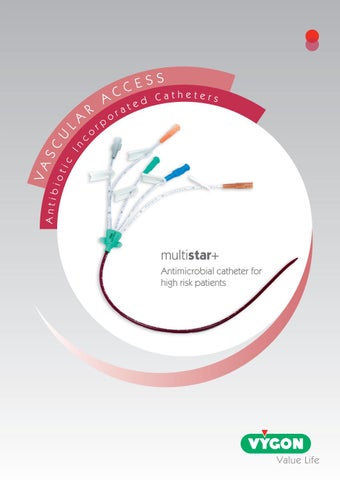
multistar+ Antimicrobial catheter for high risk patients
Benefits of multistar+ multistar+
• Biocompatible and safe
• Clinically proven to reduce colonisation and catheter-related infection (CRI) (10)
• Effective broad spectrum activity against bacteria and fungi • Long lasting protection for the life of the catheter
Echogenic Puncture Needle with Bloodless system (BLS valve)
• Ergonomic hub • Smooth insertion • Naturally echogenic
• Ergonomic, design, no change in placement technique.
multistar+ safe range Teflon-coated nitinol ‘J’ guidewire seldisafe "Sharp Safe" Low friction, Anti-kink Teflon coated Nitinol guidewire for trouble free insertion & removal
Protect yourself and others from the risk of accidental needle stick injury
Safety scalpel
Pack advantages & Benefits The Vygon CVC insertion pack fulfills the current CDC guidelines offering a large sterile base and patient drape to minimize the risk of accidental catheter contamination.
All the components you need in one convenient pack Reduces set up time and is cost effective 180
Adhesive fenestrated window Prevents drape movement during placement and risk of bacteria migration to the insertion site
Peelable edge Facilitates the removal of the drape with the CVC in place
60
Large transparent window Allows patient observation during CVC insertion
Absorbent non-woven material Provides great absorption of liquid
300
Polyethylene coating on the patient side Protects the patient from liquids
Full body drape Maximum barrier to reduce risks of nosocomial infections No desterilization of the guidewire
Ultrasound probe cover with gel
Skin preparation
Disposafe – needle protector
Gown
Ordering code: 80199.2213 Minimum order: 6 units
Tray
Pre-filled syringes with saline
5ml Luer slip syringe
Quantity: 6 units per box Pack size: 39 x 27 x 11 cm
Swabs 10 x 10 cm
Needles
Drape + table cover 75 x 90 cm
multistar+
Clinical Trial Results • Objective
• Microbiological Methods
To determine the efficacy of catheters coated with Miconazole and Rifampicin in preventing catheter-related colonisation and bloodstream infections.
Catheters were removed aseptically, the catheter segments were semi-quantitatively cultivated by the roll plate method and then quantitatively cultured by using the sonication method. Modified Kirby-Bauer technique was used for determination of the antimicrobial activity of the incorporated catheters.
• Design Multicentre, randomised prospective clinical trial.
• Conclusion
• Setting Two University Hospitals, Cologne and Aachen, Germany.
• Patients
In this multicentre, randomised trial, catheters incorporated on both the internal and external surfaces with Miconazole and Rifampicin were associated with lower rates of colonisation and and catheter-related infection (CRI).(10)
223 hospitalised patients, age 18 to 80.
In vitro antimicrobial activity of coated catheters Organism
Zone of Inhibition (mm) Rifampicin-Miconazole
CSS Catheter
S. epidermidis (n = 106)
33.0 ± 6.0
16.1 ± 1.5
S. aureus (n = 15)
26.0 ± 3.1
13.0 ± 1.2
E. faecalis (n = 8)
17.0 ± 3.5
7.0 ± 3
P. aeruginosa (n = 8)
10.9 ± 4
3.0 ± 2
E. coli (n = 3)
14.5 ± 3.2
11.0 ± 3.1
Enterobacter sp. (n = 2)
11.0 ± 3
5.3 ± 1.2
C. albicans (n = 3)
14.0 ± 3.1
6.9 ± 2.1
The mean zones of inhibition were compared with catheters coated with chloarhexidine and silver sulphadiazine (CSS).
References 1. Guidelines for the prevention of intravascular catheter-related infections. O’Grady et al. Pediatrics, Nov 2002,Vol 110 No 5 pp.e51. 2. S ilver coating of medical devices for catheter-associated infections. Schierholz JM, Beuth J, Pulverer G. The American Journal of Medicine, July 1999,Vol 107, No. 1. 3. C entral venous catheters coated with miconazole and rifampin for the prevention of catheter-related colonization and blood-stream infections results of the pilot part of an ongoing clinical trial.Yücel N, Max M, Rossaint R, Schwarz R, Beuth J, Bach A, Schierholz JM, Pulverer G, Neugebauer E. 5th Annual Joint Conference on Surgical Research (Springer-Verlag 2001/Langenbeck’s Arch Surg (2001) 386). 4. The Use of Rifampicin-Miconazole–Impregnated Catheters Reduces the Incidence of Femoral and Jugular Catheter-Related Bacteremia. Clin Infect Dis. 2008 Nov 1;47(9):1171-5. 5. N ew choices for central venous catheters. Potential financial implications. Chorr AF, Humpreys CW, Helman DL. Chest July 2002 vol 124 No 1 275-284. 6 Novel Strategies to prevent catheter-associated infections in oncology patients. Schierholz JM, Beuth J, Rump A, König DP, Pulverer G. Journal of Chemotherapy,Vol 13 - Special issue no. 1 (239-259) - 2001. 7. P ratt R. J, et al. epic2: National evidence-based guidelines for preventing healthcare-associated infections in NHS hospitals in England. Journal of Hospital, 2007, 65S, S33. 8. D epartment of Health. Saving Lives: High Impact Intervention No 1. Preventing the risk of microbial contamination. A delivery programme to reduce Healthcare Associated Infection including MRSA. 2005. 9. Antimicrobial Central Venous Catheters in Oncology : Efficacy of a Rifampicin-Micanozole-releasing Catheter. Jörg Michael Schierholz, Klaus Nagelschmidt, Manfred Nagelschmidt, Rolf Lefering, Nedim Yücel and Joseph Beuth – ANTICANCER RESEARCH 30 : 1353-1358 (2010) 10. R educed colonization and infection with miconazole-rifampicin modified central venous catheters: a randomized controlled clinical trial. Nedim Yücel, Rolf Lefering, Marc Maegele, Martin Max, Rolf Rossaint, Andrea Koch,Rosemarie Schwarz, Michael Korenkov, Josef Beuth, Alfons Bach, Jörg Schierholz, Gerhard Pulverer and Edmund A. M. NeugebauerJournal of Antimicrobial Chemotherapy (2004) 54, 1109–1115 11. R ump et al. Pharmacokinetics of antimicrobial agents rifampicin and miconazole released from a loaded central venous catheter. Journal of Hospital Infection. 53; 129-135, 2003.
multistar+
Antimicrobial catheters Breakthrough in antimicrobial technology
“ Rifampicin-Miconazole supersaturated CVCs have demonstrated the potential to prevent catheterassociated colonization, local infection and bloodstream infection even in long-term application.” (3) The combination of Rifampicin and Miconazole leads to protection against a broad spectrum of microorganisms such as Staphylococci, Enterobacterial and Candida. “ The use of a rifampicin-miconazole-impregnated catheter (RM-C) has been suggested to have the greatest benefit in femoral access.” (4)
multistar is the innovative combination of two active ingredients: Rifampicin and Miconazole, chosen for their synergic properties: • Efficacy on a large spectrum of microorganisms (9) • Low risk of bacterial resistance development (9) • High physico-chemical compatibility with polyurethanes (11)
Miconazole • Synthetic antifungal • Wide spectrum of antimicrobial activity • Low toxicity • Mechanical action : weakens the bacterial membrane
Miconazole
+
Rifampicin
Rifampicin • Highly effective against gram-positive as well as gram-negative microorganisms • Mechanical action : inhibits RNA synthesis
Bacterial resistance to antibiotics ? A pharmacokinetic analysis conducted by Rump concluded that “Maximal concentrations of Rifampicin or Miconazole resulting from the insertion of a polyurethane catheter loaded with these antibiotics are therefore, far below the concentrations resulting from a systemic therapy with the same antimicrobial agents. Even in the worst case, the danger of selecting resistant bacterial strains seems remote because the systemic drug levels are magnitudes of order below subinhibitory concentrations.” (5)
To order multistar+ Catheter Code Fr Ø
Ext. Ø (mm)
16
7.5
20
6155.307 6158.167
Length Lumen (cm)
Flow rate (ml/min) Priming volume (ml)
Lumen (gauge)
Dist.
Med 1
Med 2
Med 3
Prox
2.7
14
18
-
-
7.5
2.7
14
18
-
30
7.5
2.7
14
18
16
8.5
2.8
16
20
8.5
2.8
6158.307
30
8.5
6159.167
16
6155.167 6155.207
6158.207
6159.207
3
4
5
6159.307
Dist.
Med 1
Med 2
Med 3
18
63 0.38
34 0.33
-
-
18
60 0.45
30 0.34
-
-
18
50 0.49
14
18
-
18
16
14
18
-
2.8
16
14
18
9.5
3.15
16
14
20
9.5
3.15
16
30
9.5
3.15
16
Guidewire Quantity box/ case
Prox.
Length (cm)
Ø (mm)
-
36 0.38
60
0.88
5/45
-
-
30 0.36
60
0.88
5/45
18 0.40
-
-
20 0.50
70
0.88
5/45
61 0.38
100 0.49
17 0.29
-
22 0.33
60
0.88
5/45
18
56 0.38
100 0.54
15 0.53
-
14 0.36
60
0.88
5/45
-
18
43 0.50
80 0.70
12 0.30
-
10 0.30
70
0.88
5/45
18
18
18
57 0.43
84 0.57
15 0.36
16 0.36
18 0.42
60
0.88
5/45
14
18
18
18
55 0.47
80 0.60
15 0.39
12 0.38
17 0.43
60
0.88
5/45
14
18
18
18
38 0.51
68 0.65
7.8 0.40
8.4 0.42
9.4 0.45
70
0.88
5/45
multistar+ safe Catheter Code
Flow rate (ml/min)
Lumen (gauge)
Length Lumen Fr Ø (cm)
Ext. Ø (mm)
20
7.5
6155.370
30
6158.270
Dist.
Med 1
Med 2
Med 3
Prox
2.7
14
18
-
-
7.5
2.7
14
18
-
20
8.5
2.8
16
14
6158.370
30
8.5
2.8
16
6159.270
20
9.5
3.15
30
9.5
3.15
6155.270
Guidewire
Priming volume (ml) Dist.
Med 1
Med 2
Med 3
18
60 0.45
30 0.34
-
-
18
50 0.49
18 0.40
18
-
18
56 0.38
14
18
-
18
16
14
18
18
16
14
18
18
Quantity box/ case
Prox.
Length (cm)
Ø (mm)
-
30 0.36
60
0.88
5/45
-
-
20 0.50
70
0.88
5/45
100 0.54
15 0.53
-
14 0.36
60
0.88
5/45
43 0.50
80 0.70
12 0.30
-
10 0.30
70
0.88
5/45
18
55 0.47
80 0.60
15 0.39
12 0.38
17 0.43
60
0.88
5/45
18
38 0.51
68 0.65
7.8 0.40
8.4 0.42
9.4 0.45
70
0.88
5/45
3
4
5 6159.370
10/17 - DB CATH 16 326 E
CRITICAL CARE For further information, please contact: questions@vygon.com The specifications shown in this leaflet are for information only and are not, under any circumstances, of a contractual nature.
Vygon – 5, rue Adeline • 95440 ECOUEN • FRANCE Reception: +33 (0)1.39.92.63.63 – Service clients France: +33 (0)1.39.92.63.81 Export customer service: +33 (0)1.39.92.64.15 Fax.: +33 (0)1.39.92.64.44 • www.vygon.com
www.vygon.com