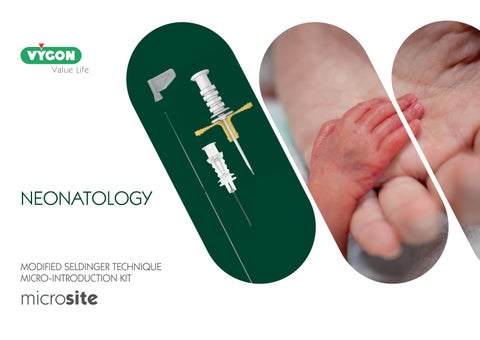
NEONATOLOGY
MODIFIED SELDINGER TECHNIQUE MICRO-INTRODUCTION KIT
microsite
MST: MODIFIED SELDINGER TECHNIQUE
microsite
MINIMIZE VENOUS TRAUMA AND INCREASE THE RATE OF SUCCESSFUL INSERTION using the modified seldinger technique. Procedure
International guidelines & recommendations
2
1 Needle puncture
3
4 Sheath dilator insertion thanks to the aid
Needle removal
5
6 Sheath dilator introduction
Guidewire insertion aid removal
The Journal of The Association for Vascular Access – 20092 “Advantages of MST include increased success rates of PICC insertion, less venous trauma and decreased insertion complications such as nerve injury and inadvertent arterial puncture”
8
7 Guidewire and dilator removal
PICCs : Guideline for Practice, 4th edition – NANN – 20221 “MST can be cost effective and reduce CLABSI* when used appropriately” “Using MST, also referred to as micropuncture, allows a smaller introducer to be used” “This method […] reduces the amount of trauma to the vein” “MST provides a needed solution for some neonates”
Guidewire insertion
Catheter insertion
*CLABSI: Central Line Associated BloodStream Infections
WHAT DOES THE LITERATURE SAY?
microsite
CLINICAL STUDY 1: microsite VS microflash3 Objective
Results
This study aims to compare the success rates and cost of Modified Seldinger Technique (MST, microsite) vs. Split Needle Technique (SNT, microflash). A retrospective study at St Micheal’s Neonatal Unit, Bristol, UK on routinely documented data of 1Fr and 2Fr catheters insertion.
Comparison of the insertion success rate between MST and SNT for patients of all GA 80%
72%
Method Percentage
53% 40% 26%
≥ 35 weeks GA
All Gestational ages (GA)
Sub-group • 12 MST • 12 SNT
• 32 MST • 25 SNT Why was a subgroup created? Confirmation of the results as birthweight and gestational age were lower in MST group
MST SNT
0%
Sucessful insertion
First-pass success
A trend towards increased first-pass and overall success with MST in neonates 35weeks GA has been observed.
Conclusion Based on these results, the suggested benefits are the following:
• Reduction of pain, discomfort, time without central access and adequate nutrition • With every venepuncture, there’s a +16% risk of developing a CLABSI* Less venepunctures = reduced risk of CLABSI
Fewer venepunctures per successful insertion for MST Significant higher successful insertion and first-pass success with MST Similar cost per successful insertion *CLABSI: Central Line Associated BloodStream Infections
WHAT DOES THE LITERATURE SAY?
microsite
CLINICAL STUDY 2: microsite VS conventional introducer4 Results
Objective This study aims to assess the comparative effectiveness of a conventional splitting needle or a peelable cannula vs. the modified Seldinger technique (MST) by utilizing a dedicated micro-insertion kit across various clinically significant metrics, including insertion success, complications, and catheterrelated infections.
Success rate
Complications count
95% 40
39 Count
Percentage
91%
88%
Method The study population included all neonates admitted to the NICU requiring a PICC for IV fluids. 112 beds – 1 445 catheters included in the analysis over the course of 3 years
8 70%
0
MST Conventional method
Improve first attempt success rate Reduced catheter-related complications Fewer incidences of catheter-related bloodstream infections (CLABSI)
Conclusion The study highlights the viability of using an all-in-one micro kit for neonatal PICC insertion facilitated by the MST technique. When performed by skilled and trained inserters, this approach is associated with improved first-attempt success rates, reduced catheter-related complications, and fewer incidences of catheter-related bloodstream infections (CLABSI).
microsite INSERTION KIT
t
n al d ia m
0.55 mm
Transparent hub: Clear view of blood flashback
Symmetrical Nitinol guidewire - 20 cm Black marking: Corresponds to the length of the 24 G puncture needle
Funnel entry: Easy insertion of a catheter up to 2 Fr
24 G needle: To puncture small vein and to minimize trauma
15° bevel tip: Good skin penetration and correct orientation of the bevel when the notch of the hub is on the top
Funnel entry: Easy insertion of the guidewire
Sheath dilator for 1 Fr & 2 Fr catheters - 18 mm / 20 G
er
ex
er
et
Puncture needle - 19 mm / 24 G
microsite
Symmetrical tips: The guidewire can be used either side
Ergonomic handle: Manipulation with only one hand
Tapered tip: Good skin penetration Peelable sheath: Easy removal
Guidewire insertion aid
Funnel shape: Ease the insertion of the sheath dilator over the guidewire Flexible tip with 0.3 mm ball head: Atraumatic to vein endothelium
Nitinol: Minimizes the risk of kinking
microsite
Technical features Size Designation & Code Puncture needle
Indication
Compatible with
Quantity
For the insertion of 1 Fr & 2 Fr catheters
premistar premicath epicutaneo cave epicutaneo2 nutriline nutriline twinflo
10/box
Peelable sheath
External diameter microsite 1147.02
0.55 mm
1.1 mm
Internal diameter 0.4 mm
0.7 mm
References 1. NANN. Peripherally Inserted Central Catheters: Guideline for Practice, 4th Edition, 2022 2. Modified Seldinger Technique with Ultrasound for PICC Placement in the Pediatric Patient: A Precise Advantage. Darcy Doellman et al. JAVA (2009) 14 (2): 93–99. 3. Gibb JJ, MacLeod R, Mahoney L, Elanjikal Z. Modified Seldinger technique for neonatal epicutaneo-caval catheter insertion: A non-randomised retrospective study. J Vasc Access. 2021 Nov 11:11297298211054637. doi: 10.1177/11297298211054637 4. Matheus F. P. T. van Rens, et al. Comparing conventional and modified Seldinger techniques using a micro-insertion kit for PICC placement in neonates: a retrospective cohort study PMID: 38756973 PMCID: PMC11096449 DOI: 10.3389/fped.2024.1395395
12/2024 - DB NEON 14 255 E
FOR FURTHER INFORMATION, PLEASE CONTACT: questions@vygon.com
The specification shown in this leaflet are for information only and are not, under any circumstances, of a contractual nature. VYGON – 5, RUE ADELINE - 95440 ECOUEN - FRANCE RECEPTION: +33 (0)1 39 92 63 63 – SERVICE CLIENTS FRANCE: +33 (0)1 39 92 63 81 EXPORT CUSTOMER SERVICE: +33 (0)1 39 92 64 15
www.vygon.com