s
V
e
n
A ou
ete rizat h t io Ca n
Cent ra l
AR
TE
RI
L
A
C
SS E C
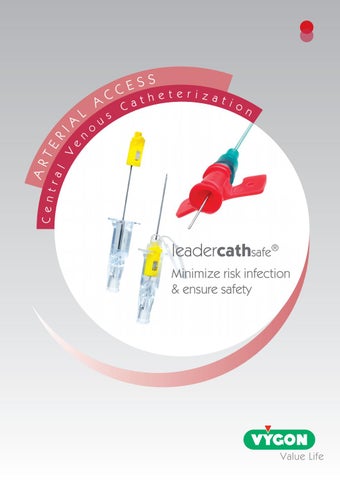
leadercathsafeÂŽ risk infection multicath 7Minimize S & ensure safety Reducing the risk of infusion error
Needlestick injuries Risks
Consequences
Needlestick injuries (NSI) from blood-filled needles are among the greatest dangers faced by all employees in the healthcare sector due to the risk of infection with life-threatening diseases (see Figures 1 and 2)(1).
More than one million needlestick injuries are estimated to occur in the EU each year.(4)
Another risk of infection also stems from blood splashes on mucous membranes or unprotected skin.
In Germany alone, 500,000 needlestick injuries account for annual costs of €47 million (€23 million from non-reported injuries and €24 million from reported injuries).(2) A reported needlestick injury costs €480 on average.(2)
Figure 1 Devices that have caused sharps injuries
Note: Experts note that tiny and even undetected needlestick injuries can lead to infections. A typical needlestick transfers 1 μl of blood. More than 30 potentially dangerous pathogens can be transmitted by a needlestick injury.(4) Hohlnadeln Indivisible quantities of blood are enough to cause an Scharfe Gegenstände infection! Andere unbekannte Gegenstände Glasof transmission from needlestick injuries(3) Risk
Hollow needles Sharp objects Other unknown devices Glass
Hepatitis B virus - Hepatitis C virus - HIV -
300 out of 1,000 cases 30 out of 1,000 cases 3 out of 1,000 cases
Figure 2 Employee groups that are particularly at risk from blood and bodily fluids in the event of sharps injuries
Pflegepersonal Ärzte Techniker Andere
Nursing staff Doctors Technicians Others
Literature: (1) Centers for Disease Control and Prevention. Workbook for Designing, Implementing, and Evaluating a Sharps Injury Prevention Program 2008. On the Internet: www.cdc.gov/sharpssafety/pdf/sharpsworkbook_2008.pdf; accessed on: 28/04/2014 (2) Wittmann A. Kosten durch Nadelstichverletzungen [Costs of needlestick injuries]. ErgoMed / Prakt. Arb.med. 3/ 2011; 35:8–12 (3) Wittmann, A. Safety First. On the Internet: http://www.nadelstichverletzung.de; accessed on: 28/04/2014 (4) Prevention of sharps injuries in the hospital and healthcare sector. Implementation guidance for the EU Framework agreement. Biosafety network; 2010
2
Radial arterial catheter leadercathsafe® Designed for radial arterial catheterisation with seldisafe® safety needle The best possible protection for users against accidental needlestick injuries and the associated risk of infection is provided by using sharp safe devices.(4) Set contents: l eadercath® catheter s eldisafe® safety needle Guidewire with straight, flexible tip o ctopus® extension tube with arterial autoflush®
octopus® extension tube with arterial autoflush® Pressure-resistant, low volume tubing with autoflush® reduces the risk of vessel wall injuries through displacement of the manipulation site farther away from the catheter insertion point. a utoflush® is a closed connection system that protects against the risk of infection and provides blood free connections when changing lines.
3
seldisafeÂŽ With safety there's no risk! seldisafeÂŽ - safety needle for the Seldinger technique to protect users from accidental needlestick injuries and the associated risk of infection.
Wing design ergonomic wing design for easy advancement of the needle
Needle tip sharp, naturally echogenic needle tip
Activation strap allows users to retain existing insertion technique
Passive safety system The needle tip is sheathed by advancing the activation strap Users are protected from needlestick injury and blood splashes
4
Radial arterial catheter
Tapered hub aids guidewire insertion
1
2
mooth-operating S safety system low slide resistance ensures smooth activation of needle protection
3
SAFETY
5
griplokÂŽ Fixation dressing with Velcro closure SIMPLE Velcro closure provides simple, quick and secure fixation.
SAFE
RELIABLE
Sterile latex-free designed for use at the insertion point. Both the catheter wing and hub are safely secured within the dressing to minimise catheter movement at the insertion site.
C onsistent and reliable catheter fixation is achieved by using a high strength, hypoallergenic adhesive, to minimise movement and prevent accidental catheter fall out. g riplok is designed to provide suture free catheter security.
Catheter fixation T he velcro and adhesive combination provide strength and stability to minimise catheter movement and to prevent accidental catheter fall out
Dressing material F lexible dressing material moulds to the skin
6
Velcro closure S imply open and close for line change management
Radial arterial catheter Ordering & Specifications • leadercathsafe® Catheter
Guide
Insertion needle
Ø mm
G
Length cm
Ø mm
Length cm
Ø mm
G
Length mm
0.6 x 0.9
20
8
0.5
20
0.9
20
38
Code
Units per pack
115.598
20
Composition of the set on page 3
SAFETY
Description
Code
Units per pack
griplok®
5804.17
100
griplok® is also available as part of a range of convenient procedure packs. Please contact Vygon for more information.
SAFETY
7
DB CATH 14 250 E - 06/2020
CRITICAL CARE For further information, please contact: questions@vygon.com The specifications shown in this leaflet are for information only and are not, under any circumstances, of a contractual nature.
Vygon – 5, rue Adeline • 95440 ECOUEN • FRANCE Reception: +33 (0)1.39.92.63.63 – Service clients France: +33 (0)1.39.92.63.81 Export customer service: +33 (0)1.39.92.64.15 Fax: +33 (0)1.39.92.64.44 • www.vygon.com
www.vygon.com