SPECTRUM VILNIUS UNIVERSIT Y P OPUL AR SCIENCE MAGA ZINE 2( 44)/2026
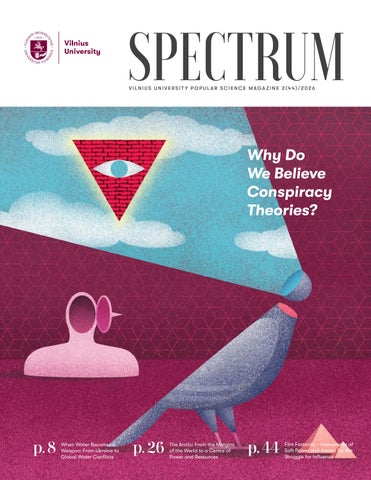
Why Do We Believe Conspiracy Theories?
p. 8
When Water Becomes a Weapon: From Ukraine to Global Water Conflicts
p. 26
The Arctic: From the Margins of the World to a Centre of Power and Resources
p. 44
Film Festivals – Instruments of Soft Power and Arenas for the Struggle for Influence
1
TABLE OF CONTENTS
2
The Paradox of Vilnius Public Spaces: Less Order, More Life
8
When Water Becomes a Weapon: From Ukraine to Global Water Conflicts
14
What Can Your Smartwatch Tell Doctors About Your Health?
20
Reptilians Run the US and Birds Aren’t Real: Why Do We Believe Conspiracy Theories?
26
The Arctic: From the Margins of the World to a Centre of Power and Resources
32
How Did Myths About Homosexuality Take Shape in Lithuania?
38
Semen Allergy: Rare Yet Potentially Life-Threatening
44
Film Festivals – Instruments of Soft Power and Arenas for the Struggle for Influence
52
Hunting Invisible Viruses: Threats to Humans Lurking in the Animal Kingdom
58
Modern Soundscape: Do We Live in a State of Auditory Overload?
66
Can Malfunctions in Our Immune Systems Change Our Personalities?
72
The Effects of Advertising, or Why Smart People Make Poor Financial Decisions
78
Who Gets a Voice in Abortion Coverage? Study Examines International News
84
We Are Becoming Financially Literate, But Can We Stay Safe Online?
90
A Quick Answer from AI Is Not Necessarily a Good Legal Solution 1
VILNIUS PUBLIC SPACES
The Paradox of Vilnius Public Spaces: Less Order, More Life Dr Veronika Urbonaitė-Barkauskienė Faculty of Philosophy, Vilnius University
Passers-by afraid to step onto the grass, people hula-hooping beside memorials, dogs being groomed in public, a homeless woman watering flowers, people sitting glued to their phones, and others celebrating life by dancing on the foundations of a Soviet monument – all this is part of everyday life in Vilnius public spaces. It also reveals a broader context: when public spaces are redeveloped, not only does their appearance change, but so do the ways in which people interact, the activities they engage in, and their relationship with these places. This is precisely the conclusion reached by researchers who spent more than a year studying public spaces in Vilnius. Although renovated squares and parks may look more aesthetically pleasing and orderly, they become less socially diverse and leave less room for spontaneous life. Spaces that have retained their authenticity, meanwhile, remain livelier, more diverse, and, it seems, increasingly valued by city residents themselves.
2
3
Renovation transforms spaces and their visitors The study examined five public spaces in the historic centre of Vilnius – the Bernardine Garden, Reformation Park, Lukiškių Square, Sapiegų Park, and Petras Cvirka Square. These are some of the capital’s most prominent public spaces, whose (non-)redevelopment has fuelled public debate for years and become a battleground for different visions of the city. We wanted to understand how these spaces function in everyday life: who visits them, what people do there, and how renovation has changed the way they are used. The Bernardine Garden was reconstructed in 2013, Lukiškių Square – in 2017, Reformation Park – in 2021, while Sapiegų Park and Petras Cvirka Square have avoided radical redesign since Lithuania regained independence. From spring 2025 to spring 2026, 64 long-term ethnographic observation sessions were conducted across these five public spaces; 56 visitors were interviewed; and the study also drew on earlier sociological, anthropological, and historical research into these sites. The study of public spaces was conducted by Dr Veronika Urbonaitė-Barkauskienė from the Faculty of Philosophy, sociology students Aistė Puidokaitė, Miglė Marščionkaitė, and Orinta Našlėnaitė, and a Faculty of History student Miglė Lipinskaitė. The observations revealed a clear difference between radically renewed spaces and those that have avoided comprehensive reconstruction during the period of the country’s independence. Our observations showed that renovated spaces attract a considerably less socially diverse range of visitors. Before renovation, Sereikiškės Park (the former name of the Bernardine Garden), Reformation Park, and Lukiškių Square were frequented by a very colourful range of members of society, who coexisted in these spaces. They were never short of young people from different subcultures or residents of the surrounding neighbourhoods from the highest to the very lowest social classes, while the age profile of visitors was equally diverse. We still observe this diversity in Sapiegų Park and Petras Cvirka Square, but the renovated spaces present a different picture. The renewed parks and squares have acquired not only a different aesthetic character but also a kind of social filter. It feels as though an invisible yet very clearly perceivable form of ‘face control’ were at work. These spaces now tend to attract mainly people from the upper social classes, youth, and young families with children, while members of subcultures and lower-income residents are gradually withdrawing from places gleaming with newness and order. Or they find their own ways of taming them. How do the ‘excluded’ adapt? We observed that ‘excluded individuals’ employ certain tactics to adapt to the changed environment. Some visit the renewed public spaces only after dusk or early in the morning (except for the Bernardine Garden, which is locked 4
at night). Others choose more secluded corners, not as polished or shrouded in greenery, where it feels cosier to settle in. Yet another adaptation tactic is the radical opposite of hiding – boldly standing out from the crowd and emphasising one’s social and aesthetic difference from the majority of park visitors. The clearest example of this tactic is a homeless woman often seen in Reformation Park, called ‘Ivan’s Granny’ (Ivano močiutė in Lithuanian) by some visitors, whose appearance and behaviour are eccentric. She sleeps while sitting under a large parasol, collects deposit-return containers, talks to herself, waters the flowers, and tells fortunes with tarot cards. Her daily activities seem like a kind of performance – a way of distancing herself from the narrative of poverty and social exclusion. She seems to construct a different image of herself – not that of a victim, but of a park character, a spirit of the place, and a participant in a theatrical performance watched by a diverse range of park visitors. Such changes among visitors also occur because a public space under renovation is, for a period – often even several years – fenced off and inaccessible to its former visitors. Once it reopens, it has to rediscover and reconnect with its own community all over again. Following radical renewal, transformed public spaces often feel alien to their former regular visitors: for some, the spaces are no longer comfortable or aesthetically acceptable. The formation of a new community of regular visitors and the emergence of new rituals and new relationships with the place are slow processes. Sometimes this bond remains disrupted for a long time or is never re-established at all.
The renewed parks and squares have acquired not only a different aesthetic character but also a kind of social filter.
Lukiškių Square in Transition
The space dictates how to behave This is revealed by the radically different practices of using space we have observed in renovated and non-renovated public spaces. The newly renovated spaces – Lukiškių Square, the Bernardine Garden, and Reformation Park – together with their renewed infrastructure, seem to suggest specific ways of using the space, which most visitors follow. These practices, inscribed in the space itself, become clearly defined – people sit on benches, walk along paths designed for that purpose, children play in designated playgrounds, visitors play chess, pétanque, and permanent games incorporated into the parks, watch the fountains and admire the greenery, have fun by the water, and visit the cafés operating there. Such spaces not only create conditions for certain activities but also subtly indicate which patterns of behaviour are considered appropriate within them. Visitors to Lukiškių Square adhere most closely to the planners’ ideas about how to use the space and what to do there. Here, visitor behaviour appears most predictable and regulated: there is a great deal of transit movement – people often just pass through the square without lingering, there is a lot of cyclical movement – walking or wheeling baby carriages around, and a great deal of passive time spent using mobile phones.
The greatest degree of spontaneity and playfulness here, of course, comes from children riding their bicycles through the fountains. Among older visitors, however, we observed considerably fewer creative ways of using the space. Among the other spaces studied, Lukiškių Square also stands out because visitors are more reluctant to step onto the grass here than elsewhere. It seems that the only ‘legal’ way to tread on the grass is while walking or training a dog. Of course, this does not mean that no one has picnics or sits on the grass in the square, but such practices are quite rare. The space itself retains a rather cold, formal atmosphere – perhaps this is because of the complicated history of the square and the abundance of memorials surrounding it. Even in such a more strictly defined space, however, there are people who interpret it in their own way. Just as Reformation Park has its own distinctive character, we also encountered a striking personality in Lukiškių Square. Against the backdrop of an event commemorating Lithuania’s accession to NATO, a colourfully dressed man was hula-hooping. When we spoke to him, he told us that he was born and raised in the US and that Lukiškių Square reminded him of Washington Square in New York. Now living in Vilnius, he tries to promote a more playful culture in public spaces, although, according to him, shy Lithuanians rarely accept his invitation to celebrate the city together. 5
Visitors to the Bernardine Garden and Reformation Park are bolder In the Bernardine Garden and Reformation Park, visitors proved somewhat bolder – they do not always accept all the rules of being and behaving proposed by the designers, and actively negotiate for the right to tame the space in their own way. These negotiations take place not through words, but through everyday actions. Their most striking manifestation is the reclaiming of the lawns and the rejection of the idea that they are meant only to be admired rather than actively used. As one study participant put it: ‘At the Bernardine Garden, people were quite quick to climb over the barriers and step onto the grass... and thank God we can do that – people tamed the [renewed] park themselves.’ Visitors to the Bernardine Garden also rejected the cycling ban that was attempted to be imposed after the reconstruction. A similar process took place in Reformation Park. Although the park’s renovators envisaged the meadow on the site of the former cemetery as a historical and aesthetic space first and foremost, visitors rejected this proposed use and turned it into an active site of everyday life. Contrary to what the park’s renovators intended, people walk freely across the meadow and use it extensively: they train dogs, create shortcuts, have picnics, and let their children play there. This mismatch between the designers’ ideas and the everyday needs of those who use the space is especially evident
in Reformation Park. It is revealed not only by the ethnographic observations but also by an online survey of Reformation Park visitors, commissioned by the Vilnius City Municipality in 2024. Although the majority of respondents (76% of the 302 surveyed) knew about the historic cemetery in the park, 68% rated walking in this space as appropriate or highly appropriate; 52% viewed picnicking positively, and 43% felt the same about dog walking. Petras Cvirka Square encourages creativity A quite different picture emerged at Petras Cvirka Square. In its unrenovated areas, the infrastructure offers far fewer activities, leaving visitors to engage in creative interpretation of the space. For instance, there are no playgrounds in Petras Cvirka Square, so children visiting here inevitably have to invent their own games in a space not designed for that purpose. They climb on supporting structures and steps, and play on the ‘stage’ where the monument to Petras Cvirka once stood. The character of the square is shaped by its terrain – a steep slope and steps without ramps, which not only dictate but also constrain certain ways of using the space, and exclude visitors such as those pushing baby strollers, people with disabilities, cyclists, scooter riders, and joggers. Perhaps this is why the square is visited by those who are comfortable with such ‘harshness’ – the bohemian clientele of the ‘CVI parkas’ bar, members of youth subcultures, older
Compared with the carefully renovated spaces in the city centre, the Sapiegų park has the calm, unhurried feel of a neighbourhood space
6
Visitors to Lukiškių Square adhere most closely to the planners’ ideas about how to use the space and what to do there.
people, and, more generally, visitors from a wider range of social backgrounds. As one interviewee put it: ‘All sorts of people come here – musicians, down-and-outs, construction workers. Nobody gets in anybody’s way here.’ The atmosphere in Petras Cvirka Square is free and relaxed. In the corners of the square, sheltered by trees, even unusual and almost intimate practices occur – ones tied less to a sense of a public space than to a sense of home. For example, two dogs were groomed in public in this part of the square. Yet such practices in Petras Cvirka Square do not seem ostentatious or intended to provoke. On the contrary – they do not stand out from the overall atmosphere of the space – this kind of eccentricity is seamlessly woven into the general mood of Petras Cvirka Square and reflects its relaxed atmosphere and informality rather than social tensions or the breaking of established norms. A fridge for those in need in Sapiegų Park Sapiegų Park stands out among the other spaces studied because of its reconstruction history. In 2017, a reconstruction project for the park was drawn up with the aim of restoring its Baroque design: it envisaged rearranging the greenery, removing some mature trees, and installing lighting, paths, an irrigation system, a fountain, benches and bins. But the local community strongly opposed these plans, so the reconstruction was halted, and to this day, the park has retained a rather chaotic appearance in terms of its design. Despite this, Sapiegų Park is marked by an especially wide range of activities and functions: it has a large children’s playground, table-tennis tables, a community garden with a large greenhouse, and a community fridge where food can be left for those in need. The buildings within the park also house several cafés, a private school, a kindergarten, the Antakalnis Eldership, and numerous startups that form part of the Tech Zity business complex. This whole diversity of functions attracts people of different ages, professions, and social groups, creating an especially vibrant everyday life in the park. Compared with
the carefully renovated spaces in the city centre, the park has the calm, unhurried feel of a neighbourhood space. As in Petras Cvirka Square, there is less formal order in Sapiegų Park, yet greater social diversity, a more relaxed pace, and more spontaneous community life. How is the notion of a ‘good park’ changing in Vilnius? Radical renovation undoubtedly improves the physical condition of public spaces – they become tidier, more aesthetically pleasing, and more functional. At the same time, however, they are standardised. Invisible norms of behaviour emerge, and social diversity and spontaneity decline. Spaces that have been only partially renewed or left essentially unchanged, meanwhile, often look less presentable, but retain more everyday life, unpredictability, and social variety. This raises the question: are we witnessing a certain turning point in Vilnius today? After two decades in which newness, order, and representativeness were held to be the highest ideal for public spaces, are residents’ expectations of parks beginning to shift? Perhaps it is not sterile but lively spaces that are becoming increasingly valued – spaces with imperfections, wild nature, layers of urban memory, and unpredictable everyday life. As visitors reflect on the physical and social changes that renovated parks have already undergone, they seek to tame them as much as possible by ‘climbing over the barriers and getting onto the grass’. Lukiškių Square, however, remains an exception for now. As for public spaces that have escaped paving blocks, Baroque design, and radical redevelopment, the question arises – could their slightly grubby, not-quite-tidy, and untamed, yet socially vibrant and authentic atmosphere gradually be becoming the new ideal for Vilnius public spaces? Because, in the end, a public space is not merely what the city builds. It is also what people create within it, and how they feel there. 7
WATER AS A WEAPON
When Water Becomes a Weapon: From Ukraine to Global Water Conflicts Dr Gintarė Bidlauskienė Vilnius University
Wars reshape more than national borders and urban landscapes. They also transform what often goes unnoticed – water systems. Destroyed dams, damaged infrastructure, contaminated groundwater, disrupted drinking water supplies, and the migration of millions of people can have consequences that last for decades after military operations have ended. This is especially evident in Ukraine, where war-driven internal migration has placed such pressure on water systems in some regions that infrastructure has struggled to keep up with the sudden increase in demand. In places, declining water reserves have already been recorded. These developments show that water infrastructure is increasingly becoming a strategic military target and that the impact of armed conflict on the hydrosphere is now regarded not only as an environmental issue but also as a security concern. Assoc. Prof. Vytautas Samalavičius, a hydrogeologist from the Faculty of Chemistry and Geosciences of Vilnius University, investigates how armed conflicts affect groundwater resources and how these changes can be monitored using satellite data and artificial intelligence (AI). His research focuses on groundwater resilience and changes in Ukraine’s border regions.
8
9
Water as a tool of geopolitical power ‘Water is one of the most essential resources for human survival. While societies can often cope with disruptions to energy supplies for quite some time, any disruption to water access becomes critical very quickly. For this reason, control over water can serve as a tool of geopolitical power,’ said the researcher. According to him, water conflicts are not a new phenomenon. Many rivers and groundwater bodies extend across the territories of several countries, meaning that decisions made by one state inevitably affect its neighbours. Some countries control the upper reaches of rivers, while others share the same groundwater aquifers. In such cases, water can become more than a shared natural resource – it can also serve as a means of political pressure.
driven by natural factors and how much resulted from war-induced migration. ‘We can see that water reserves have declined in some regions because of climate change, but migration has also emerged as a significant factor. We are currently trying to distinguish between the effects of these processes,’ noted Assoc. Prof. Samalavičius. During wartime, managing the consequences is difficult – and so is documenting them. With monitoring networks out of operation and inaccessible territories, part of the war’s impact on water systems will only be assessed once active hostilities have ceased. ‘At the moment, the top priority is defence, so many environmental studies have been postponed until a later stage,’ added the researcher. Gravity reveals what monitoring stations cannot see
War reshapes cities – and water systems, too The armed conflict in Ukraine has become one of the most pertinent examples in recent years. In Assoc. Prof. Samalavičius’ view, the war has demonstrated just how quickly an entire region’s water supply system can be disrupted and how closely natural and social processes are intertwined. The destruction of the Kakhovka Dam attracted global attention. Its consequences extended far beyond flooding and damage to infrastructure: the disaster altered the region’s hydrological regime, inundated settlements, and released pollutants that had accumulated in bottom sediments over many years. ‘When a dam is destroyed, bottom sediments are disturbed, and they may contain a wide range of accumulated pollutants. Under normal conditions, they remain isolated, but an extreme event can release them back into the environment,’ the hydrogeologist explained. The impact of war on water resources is not always direct. As millions of Ukrainians relocated to safer parts of the country, pressure on local water systems increased dramatically. Researchers are now working to determine how much of the observed change in water resources was
In wartime, environmental research faces a very practical challenge: in many areas, it is simply impossible to take direct measurements. Some monitoring stations are destroyed, others stop functioning due to infrastructure damage, while certain territories become inaccessible to researchers. Scientists are therefore relying more heavily on remote methods of monitoring environmental change. Under normal conditions, water resources are assessed using monitoring stations, boreholes, and other direct measurements. However, during a war, some of this infrastructure becomes inaccessible or ceases to operate altogether. In such circumstances, satellite data often becomes the only means of tracking long-term changes. One such method relies on the GRACE and GRACE-FO satellites, which measure gravity anomalies. These missions, operated by NASA and the German Aerospace Centre (DLR), make it possible to track changes in mass across the Earth – and water is a highly significant contributor to such changes. ‘Our planet is not static. Mass is constantly being redistributed across it, and one of the fastest-changing factors is water. When the amount of water in a particular region
‘When a dam is destroyed, bottom sediments are disturbed, and they may contain a wide range of accumulated pollutants. 10
11
changes, so does its gravitational field. These are precisely the changes recorded by the satellites,’ explained Assoc. Prof. Samalavičius. This data can be used to monitor what is known as total terrestrial water storage – the total amount of water held in surface water bodies, soil, and underground layers. Although satellites cannot directly ‘see’ groundwater, changes in gravity allow scientists to estimate how these reserves vary spatially and over time. The researcher highlights that among the method’s greatest advantages is that it is not constrained by political or military circumstances: ‘National borders are no barrier to satellite observation. Even when no monitoring is being conducted in an area, or the data is not publicly available, we can still observe overall trends and assess changes in water resources.’ AI helps bridge data gaps Satellite observations, however, cannot provide the full picture on their own. A key challenge is their spatial resolution. Gravity measurements are well suited to analysing large regions, but more detailed data is needed to understand what is happening in a specific location. This is where AI comes in. ‘Raw data often covers very large areas. Our goal is to downscale it so that we can obtain a more detailed view. To achieve this, we use additional satellite and environmental data together with AI models,’ observed the researcher. One of the key tasks of such models is to improve the spatial resolution of the data; in other words, to extract far more detailed information about conditions in specific areas from a broad regional picture. Yet AI is not limited to assessing the current situation. By combining climate, hydrological, social, and demographic data, researchers can develop scenarios to predict future changes. This is particularly important in regions affected simultaneously by climate change and geopolitical instability. ‘Unlike conventional physical models, AI can evaluate numerous factors at once – from climate conditions to population migration. This allows us to make more datadriven decisions,’ Assoc. Prof. Samalavičius remarked. In his view, a major advantage of AI is its ability to integrate very different types of information into a single model. In addition to climate and hydrological data, researchers can incorporate social, economic, and migration indicators to determine which factors exert the strongest influence on changes in water resources in a given situation. Why are water-related conflicts on the rise? The data gathered by researchers and international organisations indicates that conflicts involving water resources and infrastructure are becoming more frequent world12
Ensuring water resources and security is not merely an environmental issue but also a matter of national security.
wide. This rise is driven by two interconnected factors – climate change and growing geopolitical tensions. Of particular concern is the increasingly common use of water resources as a weapon, a means of exerting pressure, or a pretext for military action or terrorism. In some regions, water supplies are declining as glaciers melt and periods of drought grow longer. Among the most frequently cited examples is the Himalayan region, which plays a crucial role in regulating the flow of Asia’s major rivers. Their basins are home to hundreds of millions of people, while countries such as China, India, and Pakistan have competing interests over the use of these shared water resources.
Water resources as a national security concern Although most water-related conflicts today occur in regions outside Europe, the researcher stresses that water security is also highly relevant to European countries. The GRANDE-U project (Groundwater Resilience Assessment through Integrated Data Exploration for Ukraine) examines the areas along the Ukrainian–Polish border, where shared groundwater systems can be analysed and methods developed for application in other countries. Similar models are already being used in Lithuania to assess changes in karst areas and groundwater resources.
Another example is the Nubian aquifer in North Africa, shared by Egypt, Libya, Sudan, and Chad. It is one of the world’s largest groundwater reserves, yet it is effectively non-renewable. According to the researcher, it has become clear over time that water extraction by one country affects the resources of its neighbours, creating a need for joint monitoring systems and data exchange. This case aptly illustrates an issue that may become ever more pressing in the future: water does not respect political borders, yet its management still depends on national decisions.
Assoc. Prof. Samalavičius asserts that the key lesson from Ukraine is that water must be treated as critical infrastructure in both wartime and peacetime. Threats may arise not only from physical attacks but also from cyberattacks or even temporary supply disruptions. Modern water supply systems are becoming ever more digitalised and are therefore vulnerable to more than just physical damage. Some processes are controlled remotely, making water infrastructure a potential target for malicious cyber interference as well. Ensuring water resources and security in the future will consequently depend on both technical solutions and greater attention to infrastructure protection.
As Assoc. Prof. Samalavičius explains, water is increasingly becoming not only a cause of conflict but also a tool for waging it: ‘We are seeing a new trend – water infrastructure is being used as a strategic target or a means of exerting pressure. Such actions may have lasting consequences for both the environment and societal stability.’
‘Consider what would happen in any city if the taps ran dry for two or three days. We would very quickly realise just how heavily our daily lives depend on water. It is becoming ever clearer that water security is not merely an environmental issue but also a matter of national security,’ concluded the hydrogeologist. 13
VIRTUAL HOSPITALS
What Can Your Smartwatch Tell Doctors About Your Health? Benita Kaselytė Vilnius University
For many people, a smartwatch has become an integral part of daily life. It tracks steps and heart rate, reminds users to get moving, shows how long they have slept, and sometimes alerts them when their activity levels decline. For many, it is a convenient tool for monitoring their well-being and maintaining healthier habits. In medicine, however, such data can offer far more than personal statistics on a smartphone screen. ‘Every minute of every day, a person takes a certain number of breaths, their heart beats at a particular rate, they move, and their body temperature changes. We can track these measurements and respond accordingly. This is particularly important in medicine, as it allows us to act on changes proactively and immediately,’ said Assoc. Prof. Audrius Dulskas of the Faculty of Medicine at Vilnius University.
14
15
The ‘virtual ward’: keeping a close eye on the patient’s condition Surgeon Audrius Dulskas and his team are conducting a clinical study to explore how data collected by wearable smart devices could enable safer monitoring of patients after treatment or surgery. Study participants wear smartwatches and other sensors that transmit the data they collect to a dedicated platform where doctors can track changes in each patient’s condition. The study is not primarily concerned with the technology itself, but rather with how it could transform patient care once a person is well enough to return home but still requires close monitoring. In surgery, the postoperative period is particularly critical, as this is when fever, infection, sepsis, wound reopening (dehiscence), and other complications may occur. Because of these risks, patients are often hospitalised for longer, even though their stay does not necessarily involve active treatment. ‘Keeping a patient in hospital is not always justified in itself. What matters most is detecting any deterioration in their condition early enough,’ noted Assoc. Prof. Dulskas. According to him, this is where the concept of the ‘virtual ward’, or ‘hospital-at-home’, comes in. While the patient remains at home, healthcare professionals continue to monitor their vital signs and activity levels. This could allow patients to leave hospital sooner, with doctors still able to detect any significant changes in their condition. ‘The aim of our clinical study is to provide patients with smart devices and discharge them so they can recover at home. They then receive care through what is known as
16
a virtual ward – in other words, a hospital-at-home. We can access the data collected passively by their devices and receive an alert whenever any reading falls outside the normal range,’ explained the Associate Professor. The study currently involves 110 participants. Their data is helping researchers understand which changes may be clinically significant and which are merely temporary and harmless bodily responses. This is crucial for ensuring that, in future, the system does more than just gather information: it should also help doctors recognise when intervention is necessary. What is a digital phenotype? In medicine, profiling all the information reflecting a patient’s condition is known as digital phenotyping. In simple terms, a digital phenotype is a collection of data that provides insight into how a person’s body functions and how they behave in everyday life – not only when they visit a doctor or receive inpatient care. ‘A digital phenotype is first and foremost about data and numbers. Essentially, this data is not all that different from the information we use routinely in medicine. The main difference is that passively collected data can be viewed in real time,’ remarked Assoc. Prof. Dulskas. This, according to the surgeon, is where the most important shift lies: instead of seeing only an isolated measurement, doctors can observe how a patient’s condition evolves over time. ‘Normally, when a patient visits a doctor or is admitted into hospital, unless they are in an intensive care unit, their
In some cases, the risk of a complication can be noticed around six to twelve hours before it develops.
vital signs and other health indicators are measured only at specific intervals: once a day, once a week, or only during the appointment itself. The central innovation of our clinical study is that we can monitor this passively collected data continuously,’ the researcher explained. Therefore, the value of a digital phenotype lies not in any single measurement but in the wider context in which it appears. Doctors need to understand whether a change is temporary or persistent and whether it coincides with changes in other indicators. A one-off increase in heart rate may result from physical activity or emotional arousal, whereas a deviation that persists over a longer period may signal that the patient’s condition requires closer attention. When data warns of a problem before symptoms appear One of the study’s key goals is to determine when data collected by smart devices goes beyond mere statistics and begins to serve as an early warning. This is particularly important after surgery: complications often develop gradually, and the body may begin to signal a problem before it becomes apparent. ‘For instance, a patient develops a fever, their heart rate increases, and their blood pressure falls. As soon as any reading moves outside the normal range, we receive an alert. We can then check the platform to see whether it was an isolated, very brief change, or whether it has persisted for longer – let’s say, for several hours,’ explained the researcher. Such alerts are valuable in medicine because they can give doctors more time to respond. The earlier a potential risk is identified, the greater the opportunity to assess the situation, contact the patient, or decide whether additional care is needed.
elevated heart rate in one of his patients. Yet what mattered most was not simply the number displayed on the platform, but how long the increase lasted and what the patient himself reported. ‘I received an alert that one patient’s heart rate had been elevated for about half an hour. I called him, and he said, “I feel fine, I don’t have a fever, and I checked my blood pressure – everything’s fine”. It turned out that he’d had a panic attack. He was actually doing breathing exercises at the time, trying to calm himself, and I could see on our platform that his heart rate was gradually returning to normal.’ This example shows that a digital phenotype cannot replace a doctor’s clinical judgement. Instead, it provides an additional layer of information by helping medical professionals detect a change, assess how long it lasts, compare several indicators, and contact the patient if necessary. What can your step count reveal? When we think about health monitoring, the first things that usually come to mind are heart rate, blood pressure, and temperature. However, Assoc. Prof. Dulskas emphasises that a seemingly straightforward measure – the number of steps taken – can also provide valuable insights. The first phase of the study involved patients undergoing radiotherapy for brain tumours or metastases. The researchers assessed how active each patient was: how much time they spent using their mobile phone, how much they moved, and how many steps they took. ‘We found a very strong correlation between reduced mobile phone use, a lower step count, and the patient’s prognosis. Patients whose activity levels declined tended to have worse outcomes.’
‘In some cases, the risk of a complication can be noticed around six to twelve hours before it develops. By the time a complication actually occurs, it is, in a sense, already too late – somewhere along the way, we have failed to detect a change in one of the patient’s readings,’ said the surgeon.
This example shows that changes in health do not necessarily begin with an obvious symptom. Sometimes the first sign may be far more ordinary: a person walks less or is less active, gets tired more quickly, or their daily routine begins to change. The individual may not notice such a subtle shift, but it becomes apparent in the data.
However, an alert is not in itself a diagnosis. Assoc. Prof. Dulskas recalls a case in which the system flagged an
‘This brings us back to the vast amounts of passively collected information and AI models that rely heavily on 17
such data. With sufficient information, we can predict certain changes before they occur,’ noted the surgeon. According to him, the value of such data is not limited to identifying signs of disease. It can also provide insight into an individual’s personal rhythm – what is normal for a particular patient and what may already indicate a change. ‘A digital phenotype allows us to observe a patient’s usual individual pattern of daily life – how their heart beats, how many steps they take, and their level of physical fitness. That’s why we have also adopted certain practices from professional sport,’ explained Assoc. Prof. Dulskas. The Vilnius University researchers also intend to incorporate step-count data into patients’ medical records. Doctors would then be able to view both laboratory test results and a report on the patient’s physical activity. ‘We are becoming one of the first teams in Lithuania – and perhaps even worldwide – to incorporate this kind of activity data into medical records. They will contain a step-count report, just as they currently contain laboratory test results.’ Treatment as a marathon
‘We are becoming one of the first teams in Lithuania – and perhaps even worldwide – to incorporate this kind of activity data into medical records.
According to the researcher, surgery is not merely an isolated event in the operating theatre – it places considerable demands on the body and requires preparation. The better doctors understand a patient’s physical capacity, the more accurately they can determine what support the patient will need before and after treatment. ‘In some respects, treatment – particularly surgery – is like running a marathon. You need to be ready for it. Once we have established the patient’s baseline – their usual step count, heart rate, blood pressure, and physical capacity – we can tailor physical activity or exercise to their individual needs,’ explained the Associate Professor. This means that a digital phenotype may be useful not only when a patient’s condition is deteriorating; it can also help patients actively prepare for treatment by building endurance, strengthening cardiovascular and respiratory function, and lowering the risk of complications. ‘In this way, we can increase patients’ endurance and improve their respiratory and cardiovascular capacity, reduce the number of postoperative complications, and prolong survival,’ said the doctor. Thus, seemingly simple data – how much a person moves, how their heart rate changes, and their level of physical fitness – can become part of both monitoring and clinical decision-making. Rather than presenting doctors with isolated measurements, the data helps them build a fuller picture of the patient as an individual, with their own habits, physical capacity, and specific risks. Data must be collected – and validated One question frequently raised about smart devices is whether the data they collect is accurate enough to be
18
used in medicine. Assoc. Prof. Dulskas acknowledges that every device has a margin of error. The study, therefore, combines monitoring with calibration of the measurements.
– the surgeon repeatedly comes back to the fundamentals we are familiar with: physical activity, sleep, fitness, and prevention.
‘Every device still has some degree of inaccuracy. That’s why we also carry out calibration. Even when measuring blood pressure or temperature, it is important to recognise that temperature readings, in particular, can vary considerably depending on where and under what conditions they are taken,’ the researcher observed.
He describes physical activity as one of the most accessible ways to take care of our health. It calls for neither expensive equipment nor complicated solutions, although it does require consistency: ‘Physical activity is available to everyone and costs nothing – apart from willpower, which is probably the most costly part.’
In the study, readings from patients’ own devices are compared with standardised measurements. This helps the researchers establish how closely each reading reflects the actual physiological parameter.
The doctor notes that the importance of physical activity is becoming increasingly evident even in cancer care: ‘A study in oncology involving patients who had undergone surgery and chemotherapy was published very recently. Among those who remained physically active, survival improved by around 10%. That is a very substantial difference.’
‘At certain intervals, we sent patients reminders to measure their blood pressure or temperature using a different standardised device. We could then calculate the relevant correction factors. One of the most important aspects of our study was determining coefficients that could be used to calculate the patient’s actual temperature, blood pressure, and other measurements.’ In medicine, the aim is not merely to gather as much data as possible, but to understand what the data actually means. A smartwatch is not a diagnostic device in itself; nevertheless, once its data has been properly validated and interpreted, it can offer medical staff valuable additional insight. Technology brings us back to basics Although the study conducted by Assoc. Prof. Dulskas and his team explores the future of medicine – virtual hospitals, passively collected data, and early-warning systems
A digital phenotype is therefore about more than technology alone. It demonstrates that everyday factors – the number of steps taken, a decline in activity, sleep, and overall physical fitness – can become medically meaningful signals. In some cases, they help doctors identify risks sooner; in others, they help patients prepare better for treatment; while for a healthy person, they can serve as a reminder that good health often begins with small daily actions. ‘If you notice that you never get enough sleep, start by going to bed ten minutes earlier the next day. The same principle applies to your step count: if you are currently taking 2,000 or 3,000 steps a day, do not immediately jump to 10,000, as this would place stress on your body. Start by adding just another thousand,’ Assoc. Prof. Dulskas advised. 19
CONSPIRACY THEORIES
Reptilians Run the US and Birds Aren’t Real: Why Do We Believe Conspiracy Theories? Gretė Gerulaitytė Vilnius University
You may have heard that the United States is secretly run by shape-shifting reptiles, or that the Earth is actually flat. Or that a number of world-famous singers and actors are already dead, and have been replaced by nearidentical doubles. These and many other conspiracy theories are actively discussed on social media, in dedicated forums, and in other online spaces by communities of believers around the world. But why are some people inclined to believe such theories in the first place? How can conspiracy theories be unpacked? What consequences can they have? These questions are explored by Dr Vytautas Jurkuvėnas, a psychologist at the Faculty of Philosophy of Vilnius University.
20
21
How do conspiracy theories come about? Conspiracy theories are usually attempts to explain an event or situation by assuming that a secret plot lies behind it – one involving powerful hidden forces or groups of people pursuing their own goals. According to the psychologist, people may find such narratives easier to believe because of certain historical events. ‘There have been real cases of conspiracy in the past. The best-known examples are probably the Molotov–Ribbentrop Pact and the Central Intelligence Agency (CIA) secret prison in Lithuania, which were in fact secret arrangements serving particular interests. But once such cases come to light, we tend to treat them as part of history or as current affairs reported in the news,’ said Dr Jurkuvėnas. Still, conspiracy-style interpretations sometimes arise even in situations that have already been clarified and do not necessarily resemble a conspiracy theory. Such explanations are often much simpler than evidence-based reasoning, making them easier to believe. ‘For example, when a plane crashes or some other disaster happens, it may sound strange, but psychologically, people often feel safer if they can assign responsibility to someone – as though someone had done it intentionally. This gives people a sense of control, because it feels safer to believe such an explanation than to admit that what happened may have been an accident, someone’s mistake, or mere incompetence,’ the researcher explained, adding that the need for safety is just one of several factors that can make people more susceptible to believing conspiracy theories. Do IQ and education affect susceptibility to conspiracy theories? According to Dr Jurkuvėnas, the factors underlying belief in conspiracy theories can be grouped into three fundamental human needs: the need for clarity, the previously discussed need for safety, and the need for social identity: ‘People like clarity and simplicity. Our minds are not naturally inclined to seek complex explanations; thus, chaotic, non-linear systems are genuinely difficult to grasp. Yet that is exactly what our world is like – complex and chaotic. When we watch films with superheroes, clear storylines, and answers to every question, we start to want the same clarity in real life, which is why simpler explanations are so appealing to us. That’s why, when a very straightforward explanation is offered for a highly complex situation, it’s worth asking whether it can really be true.’ Alongside clarity and safety is the need for social identity, which may involve a desire to belong to a community or a group of like-minded people, or, conversely, wanting to stand out from the majority and be seen as someone who thinks differently. ‘We often hear one group of people calling another ‘sheep’ because they supposedly fail to understand some hidden links or connections, while believing they understand these 22
When a very straightforward explanation is offered for a highly complex situation, it’s worth asking whether it can really be true.
things gives others a sense of moral superiority and satisfies their need to feel special. On the other hand, it’s very difficult for us to hold beliefs that differ from those closest to us – family, friends, or a wider group of like-minded people – which is why our social bubbles have such a powerful influence,’ said the researcher at Vilnius University. Although conspiracy theories are not a new phenomenon, they – much like fake news – attracted particular attention worldwide during the COVID-19 pandemic, when researchers began asking what other factors might influence the psychological needs that conspiracy theories fulfil. ‘Educational attainment and IQ were among the first factors researchers investigated when trying to understand belief in conspiracy theories, but no clear link was found. Today, attention has shifted to other indicators, such as analytical thinking or scepticism. But even here, criticism persists because these constructs inherently involve elements of conspiratorial thinking. This makes it difficult to explain the issue objectively and scientifically,’ Dr Jurkuvėnas noted.
Conspiracy theories can threaten national security Rather than trying to untangle complex social, cultural, or economic phenomena, it is often easier to recognise a conspiracy theory by the narrative it uses to explain events. Supporters of conspiracy theories have often already settled on a particular interpretation of a situation or a series of events in advance, without really attempting to question or disprove it. ‘The logic goes: if I don’t know something, or if there’s no evidence, then the doubts being raised must be true. However, in essence, this is simply poor reasoning. That is what sets conspiracy theories apart: the aim is not to seek the truth as such, but to look for arguments that support the theory in question. In this way, a very clear storyline is constructed, with some heroes and villains, where no one ever makes mistakes, and secret groups flawlessly carry out their plans as intended,’ said the psychologist. He adds that conspiracy theories often seek to discredit institutions while also warning that representatives or
Why are people drawn to conspiracy theories?
Diagram created by Dr Vytautas Jurkuvėnas, adapted from Douglas, K. M., Sutton, R. M., & Cichocka, A. (2017). The Psychology of Conspiracy Theories. Current Directions in Psychological Science, 26(6), 538–542
23
supporters of those institutions will try to convince people to accept their version of the truth: ‘The argument is that this, too, is part of a larger conspiracy, that institutions may be controlled by or connected to those powerful groups. They supposedly seek to deceive people, which is why it is important to stand firm and resist them.’ Such narratives undermine trust in institutions and erode confidence in their work, thereby threatening both national security and the healthcare system. For instance, myths and conspiracy theories surrounding vaccine safety have been linked to the resurgence of diseases that had long been eradicated.
We all believe different theories
‘Some may begin as humorous stories, created to parody or mock those who believe them. That’s why, in research, participants are often asked to classify theories as plausible or implausible. It is important to note that people inclined to believe conspiracy theories are rarely drawn to a single theory – they are likely to believe more than one. So, while every person believes in at least one theory, there are also groups of people who believe many. A growing body of evidence suggests that belief in conspiracy theories is, more broadly, a particular way of thinking and a personality trait,’ said Dr Jurkuvėnas.
The researcher noted that some studies suggest that every person believes in at least one conspiracy theory. ‘This does not necessarily mean believing in something extreme. Some people, for instance, may believe that the influence of powerful groups determined the victory of a particular political party, because the explanations offered by political scientists or sociologists are often quite complex. Others believe that deceased celebrities are still alive and simply hiding from the public, or conversely, that doubles or looka-
Belief in conspiracy theories does not usually begin with the most extreme ideas, such as the claim that the United States is run by reptiles. Rather, people tend to adopt such beliefs gradually, influenced by various life circumstances. It has been observed that those who have gone through certain personal crises are more likely to believe several highly implausible conspiracy theories. In some cases, they may even begin to shape their lives around these narratives and become part of social circles of like-minded believers.
‘In extreme cases, a conspiracy theory can become part of a person’s identity and way of life. There are clear parallels here with involvement in cults – a phenomenon explored by other academic disciplines. But the most dangerous conspiracy theories are those related to health, politics, or targeted at particular social groups,’ warned Dr Jurkuvėnas.
24
likes have secretly replaced them.’ For people who believe one or several conspiracy theories, such beliefs often become integrated into their social lives and may be linked to a deep distrust of institutions. At the same time, some conspiracy theories sound more like the plot of a science-fiction movie – for example, the claim that birds do not actually exist and are all just covert spy cameras. There are also theories alleging that those in power in the United States are reptiles in disguise. Interestingly, not all such theories originate with conspiracy theorists themselves.
‘Nowadays, in particular, there are cases where people simply fall into an online group or forum where conspiracy theories are put forward, discussed, and analysed obsessively. That represents a completely different level of commitment, one that can sometimes even lead to action. A clear example would be the storming of the Capitol in Washington on 6 January 2021, when some protesters, influenced by conspiracy theories claiming that the 2020 US election had been rigged, broke into the US Congress and sparked violent unrest,’ the psychologist pointed out. Why some theories resonate in Lithuania People’s susceptibility to specific conspiracy theories may be shaped not only by personal factors but also by characteristics rooted in a nation’s collective mindset. For example,
like other countries occupied by the Soviet regime, Lithuania experienced severe repression and an oppressive system of control that relied heavily on self-censorship. This left a deep mark on society’s collective consciousness. ‘That’s why many people – myself included – once believed that the Russian security services possessed almost god-like powers when carrying out operations. Later, especially in the wake of Alexei Navalny’s case and after Russia launched its war against Ukraine, we saw just how much incompetence there was, which changed that earlier perception. But previously, it was difficult to grasp and accept that we had been occupied by a deeply incompetent state on the verge of collapse, and that such a profound impact on the country could have come not from a great power but from an occupying regime that managed to survive for so long only because of a series of coincidences and favourable circumstances. These are particularly sensitive issues when it comes to the persecution of people, the Holocaust, and similar historical atrocities,’ said Dr Jurkuvėnas. Because of the sensitivity of the subject matter – and because people may be deeply convinced that they are right – the psychologist at Vilnius University advises speaking respectfully to those who believe conspiracy theories, without mocking them, as ridicule can only make the situation worse. Conspiracy theories often offer simple explanations for complex events; that is why it is important not only to examine them critically but also to ask whether such a simple explanation can really reflect the full complexity of reality.
Belief in conspiracy theories is, more broadly, a particular way of thinking and a personality trait.
‘First of all, when speaking to friends or family, we should sincerely tell them that our intention is not to offend them. Let’s face it: people opposed to vaccination are often met with ridicule. But perhaps it is worth asking whether the pharmaceutical industry, if it really were so powerful, wouldn’t find other ways to persuade people or influence the decisions people make – ways that wouldn’t be so easy to ‘expose’? In any discussion, it is important to acknowledge that there may indeed be real problems in a given area. But perhaps those problems are rooted in a brutal capitalist system and simple human greed, rather than in the actions of some hidden powerful forces?’ suggested the researcher. It is crucial to approach such conversations without being confrontational or applying pressure: ‘If we want to avoid even greater division and the formation of increasingly separate social bubbles, we should try to understand why people believe one explanation or another. Some of their arguments may be logical and valid, and often we ourselves don’t know all the answers or understand all the explanations – for instance, how modern vaccines are actually developed and produced. Sometimes a general understanding of the basic principles is not enough for an informed discussion, which is why it is important to acknowledge that, in a sense, we only have part of the picture. The world is far more complex than it may seem at first glance,’ Dr Jurkuvėnas concluded. 25
THE ARCTIC
The Arctic: From the Margins of the World to a Centre of Power and Resources Vytas Navickas Faculty of History, Vilnius University
For centuries, the Arctic seemed like a distant, inaccessible, and almost mythical edge of the world. In the late 19th and early 20th centuries, it captured the imagination of explorers, travellers, governments, and the wider public as terra incognita – an unknown land to be reached, documented, crossed by sea, or flown over. Today, the Arctic is increasingly viewed not as a realm of adventure and exploration, but as a region defined by climate change, natural resources, emerging maritime passages, and geopolitical competition. In this article, Associate Professor Kęstutis Kilinskas from the Faculty of History of Vilnius University discusses how the Arctic region was understood during the interwar period, why it fascinated Lithuanian society, how its significance has changed, and why this remote northern region should matter to Lithuania and NATO today.
26
27
Explorers and accounts of the Arctic in textbooks and the press For a long time, little was known about the Arctic. It was a harsh, inaccessible, and dangerous place that had yet to be fully mapped. It held a particular allure as a geographical mystery – a place where one could still discover, reach, and demonstrate the capabilities of humankind and technology. During the 19th and early 20th centuries, the Arctic was increasingly explored and reached by ship, hot-air balloon, airship, or aeroplane. According to military historian Assoc. Prof. Kilinskas, even the North Pole itself was not crossed by air until 1926. During the interwar period, the Arctic was more than a distant edge on the map – it was a symbolic boundary between the known and unknown worlds. Among the most prominent stories of this kind were the expeditions of Italian explorer and airship designer Umberto Nobile. The attention they attracted in Lithuania was one of the factors that inspired Assoc. Prof. Kilinskas to take an interest in the Arctic and begin researching it. ‘Nobile took part in two major flights to the Arctic. The 1926 flight was successful: the airship flew over the North Pole. It marked a significant moment in technological development, geographical ambition, and political prestige. However, the Italian polar expedition of 1928 ended in disaster. The airship crashed in the Arctic Ocean region, and the rescue of the survivors became an international operation that brought several countries together. Polar exploration was therefore not only a story of triumph, but also one of risk. The Arctic promised glory, financial rewards, and national prestige, but it could also cost human lives. The surviving members
28
of the expedition were rescued by the Soviet icebreaker Krasin, and the rescue operation was later also used for propaganda purposes,’ the historian explained. The Arctic was not a direct geopolitical interest for Lithuania during the interwar period. The country had no access to the region, took no part in polar expeditions, and made no attempt to gain a foothold there. Yet this did not mean that Lithuanians knew nothing about the Arctic. According to Assoc. Prof. Kilinskas, Lithuanian society learnt about the Far North primarily through school textbooks on geography and natural science. These books described polar expeditions and geographical discoveries, journeys to the North and South Poles, as well as famous travellers and explorers. The press played an equally important role in educating the public about the Arctic. The historian notes that, during the interwar period, Lithuanian newspapers reported extensively on Arctic expeditions, presenting them as inspiring adventure stories. Such accounts were full of stories of human courage, technological progress, the struggle against a harsh natural environment, and journeys to remote and still largely unexplored parts of the world. Although Lithuanians themselves rarely participated in such expeditions, they followed their progress and read about polar discoveries, thereby becoming part of the wider European fascination with the Arctic. Military operations in the Arctic before the Cold War The strategic importance of the Arctic and the Far North had already become apparent long before the Cold War. Assoc. Prof. Kilinskas points out that large-scale military operations were already taking place in the North in the early 19th
century, during the Russo-Swedish War, while during the Crimean War, British and French ships reached the Arctic Ocean, blockaded Arkhangelsk, and attacked Russia’s northern positions. However, the full strategic significance of the region did not become apparent until World War I. After Germany blockaded the Baltic Sea, Russia was forced to seek alternative routes for maintaining contact with its Western Allies. The ports of Murmansk and Arkhangelsk consequently became vital transport arteries for cargo and troops. The North – long regarded as a remote periphery of the empire – became an important link with the outside world. Another significant chapter in the history of the Arctic and the Far North was the Winter War of 1939–1940, in which Finland resisted the Soviet Union. According to the historian, it was one of the most notable modern military conflicts to take place under Arctic conditions. It demonstrated that the outcome of warfare in the North depends not only on weapons, the size of the armed forces, or military equipment, but also on the ability to adapt to the cold, snow, forests, polar night, difficult terrain, and limited transport links. ‘In Lithuania, people admired the Finns for their resilience, modesty, national unity, and ability to fight in conditions where nature itself could become an additional front. This image also had practical consequences. The example set by Finnish ski troops encouraged the Lithuanian military to take a greater interest in skiing, organise long-distance marches, and train soldiers to operate in winter conditions,’ said the military historian. Russia’s interests in the Arctic and its nuclear graveyard Russia is one of the most active powers in the Arctic and poses the greatest strategic challenge to Lithuania and NATO in the region. Assoc. Prof. Kilinskas explains that Russia views the Arctic as an area where it has traditionally sought to establish its dominance and demonstrate its political and military power. This ambition has deep historical roots but became particularly pronounced in the 20th century. The historian highlights several reasons why the Arctic remains strategically important to Russia.
The North – long regarded as a remote periphery of the empire – became an important link with the outside world.
‘The region holds vast oil and gas reserves, some of which are becoming more accessible as the ice melts. This encourages Russia to secure access to these resources and strengthen its position in the region,’ noted Assoc. Prof. Kilinskas. In addition to its natural resources, the Arctic is crucial to Russia as a maritime route and a strategic gateway to the wider world. During World War I, when Germany blockaded the Baltic Sea, the northern ports became a vital link with Russia’s allies. The region was later militarised even further, emerging as one of the principal centres of Soviet military power. Military infrastructure is another key factor: ‘The Northern Fleet, submarines, nuclear arsenal, Murmansk, Severod29
vinsk, and Arkhangelsk all attest to the region’s military importance. Since 2014, Russia has operated the Joint Strategic Command ‘North’, responsible for the forces deployed in the Arctic, and over the past decade, it has steadily expanded its military capabilities in the region,’ the historian added.
The region holds vast oil and gas reserves, some of which are becoming more accessible as the ice melts.
According to Assoc. Prof. Kilinskas, the Northern Fleet became one of the Soviet Union’s principal instruments of military power during the Cold War. The fjords of the Kola Peninsula, which remain ice-free throughout the year because of the Gulf Stream, became home to submarine bases, supply infrastructure, military settlements, and shipyards. Diesel-powered and nuclear-powered submarines were built in Severodvinsk, while the entire region gradually developed into a closed military enclave. As the historian notes, however, this expansion of military power was not matched by sufficient attention to environmental protection or the safe management of nuclear waste. ‘The Soviet Union devoted considerable attention to submarine numbers and the arms race, but far less to the infrastructure required for their safe operation, maintenance, and decommissioning. As a result, the Kola Peninsula became one of the world’s largest centres for the concentration of nuclear reactors and nuclear fuel.’ According to Assoc. Prof. Kilinskas, this issue remains relevant today, as the Arctic is often imagined as a pristine and untouched wilderness. In reality, it is also a region where decommissioned vessels, spent nuclear fuel, unfinished storage facilities, and reactors dumped at sea reveal another dimension of its past: the history of the Arctic is also a history of nuclear danger. Melting ice opens up new opportunities The strategic significance of the Arctic changed dramatically during the 20th century, particularly over the course of the Cold War. Assoc. Prof. Kilinskas explains that the Arctic then became one of the key areas of strategic confrontation between the West and the Soviet Union. A new phase of geopolitical rivalry began after 1945: the Soviet Union militarised its northern regions, Norway joined NATO, while Finland and Sweden remained formally neutral for many years. By the 1940s, the Arctic had already emerged as an important arena of competition between NATO and the Soviet Union. Today, climate change is once again drawing attention to the region’s strategic importance. As Arctic ice melts, new maritime routes are opening up, and natural resources are becoming easier to access, while competition between states for influence in the region is also intensifying. The historian identifies three main shipping routes: the Northeast Passage, also known as the Northern Sea Route, which runs along the Russian coast; the Northwest Passage through the Canadian Arctic Archipelago; and the Transpolar Sea Route, which could eventually run through the area around the North Pole.
30
‘These routes have considerable economic potential, as passage through the Arctic could significantly shorten transport links between Europe and Asia. However, shipping in the region requires icebreakers, reliable infrastructure, and security guarantees, while the risks and costs remain high. Thus, the Arctic offers new opportunities today, but it remains a complex and dangerous region,’ remarked Assoc. Prof. Kilinskas. A chessboard amid melting ice In recent years, the Arctic has once again become a focus of military infrastructure and strategic calculation. Russian policy documents describe the Northern Sea Route as one of the country’s key national interests, while the presence of NATO and the United States in the region is often framed as a threat to Russia’s position. Against the backdrop of Russia’s aggression against Ukraine, this discourse has become even more radical and taken on a stronger military tone. ‘The Kola Peninsula remains the main base for Russian forces in the North. It is home to the Northern Fleet, as well as ground forces, naval infantry, air defence units, and air force structures. Russian bases and radar systems are positioned along the Northern Sea Route, stretching from the Kola Peninsula to Novaya Zemlya, Franz Josef Land, the New Siberian Islands, and Wrangel Island,’ the military historian noted. Lithuania is not an Arctic state, and the region has never historically been a direct geopolitical concern for the country. However, Assoc. Prof. Kilinskas emphasises that Lithuania is now a member of NATO, while the Arctic is becoming an increasingly important area of transatlantic security. ‘Its importance has grown further since Finland and Sweden
joined NATO. The Alliance is strengthening its military presence in the North, restoring Cold War-era infrastructure, conducting exercises, and seeking ways to respond more rapidly to the challenges posed by Russia. Bases, airfields, ports, and training centres in northern Norway and Finland that once seemed to reflect the security priorities of a bygone era are now being reactivated.’ According to Assoc. Prof. Kilinskas, warfare in the Arctic has its own distinctive features. It is complicated by extremely low temperatures, polar nights, difficult terrain, vast distances, and logistical challenges. Direct military operations in the region are therefore difficult to envisage, but this does not make the Arctic any less significant from a military perspective. For Lithuania, the Arctic matters not because of any direct involvement in the region, but because it is becoming part of a broader security architecture. Climate change, Russia’s militarisation, new shipping routes, and resource policies are altering the balance of power in the North, inevitably affecting NATO and, through the Alliance, Lithuania. Assoc. Prof. Kilinskas’s research into the history of the Arctic shows how rapidly the significance of a region can change. The Arctic was once an unknown land – a realm of geographical discovery and daring expeditions. In interwar Lithuania, it appeared in geography textbooks, newspaper articles, and stories about travellers, airships, dog sleds, and humanity’s efforts to conquer nature. Today, it is becoming a region where climate change, economic interests, natural resources, military power, the nuclear legacy, and international law intersect. Although geographically distant, the Arctic is moving ever closer to Lithuania’s political and security horizon. 31
HOMOPHOBIA IN LITHUANIA
How Did Myths About Homosexuality Take Shape in Lithuania? Dr Rasa Navickaitė Institute of International Relations and Political Science, Vilnius University
In 1993, Lithuania decriminalised homosexual relations between men; however, public attitudes changed far more slowly than the legal framework. For a long time afterwards, homosexuality continued to be associated with crime, illness, moral decline, and an alleged threat to children. It could be argued that, during the early years of the country’s independence, the press shaped the norms for discussing homosexuality. Some of the myths and stereotypes that took root at the time continue to surface in politics today, hindering the advancement of human rights in Lithuania.
32
33
An object of curiosity During the Soviet period, homosexuality was rarely mentioned in Lithuanian public discourse and was almost always portrayed negatively – as a pathology, a crime, or a character flaw. It was only after the restoration of independence, when the media gained more freedom, that a more diverse discourse on same-sex attraction began to emerge. However, the tabloid press always feeds on scandal. Coupled with the media’s weak ethical self-regulation, this meant that professional boundaries were often crossed in the pursuit of readers’ attention. LGBT people – lesbians, gay men, bisexual and transgender people – were depicted through entrenched stereotypes and sensational stories, many of which were fabricated. The 1990s were a contradictory period: beliefs inherited from the Soviet era, new ideas arriving from the West, as well as genuine curiosity and openness towards sexual minorities all coexisted. The Lithuanian press frequently featured prominent LGBT figures from abroad, including Elton John, Ellen DeGeneres, Martina Navratilova, George Michael, and Dana International. There were debates about whether same-sex marriage and gender-affirming surgery for transgender people should be permitted, while daily newspapers readily published photographs of Pride marches and the first officially recognised same-sex wedding ceremonies held abroad.
Dr Rasa Navickaitė. Photo from personal archive
34
In 1995, the daily newspaper Lietuvos rytas published Lithuania’s first coming-out story featuring a gay male couple: Vladimir Simonko and Eduardas Platovas, the founders of the Lithuanian Gay League (LGL), spoke publicly about their relationship. The country’s first lesbian couple also came out publicly that same year. In 1997, ornithologist Algirdas Knystautas and his partner held an unofficial wedding ceremony at Vilnius Cathedral Basilica. Even the daily newspaper Respublika (which later became infamous for homophobic articles) covered the event in relatively neutral terms, although it placed the word ‘wedding’ in quotation marks. The alleged threat to children Despite positive representations of homosexuality, which played an important role in LGBT people’s self-understanding and in educating the wider public, the press continued to reproduce many harmful stereotypes inherited from the Soviet era. Numerous articles depicted sexual minorities – with coverage focusing primarily on gay men – as inseparable from secret double lives, the criminal underworld, sexually transmitted diseases (particularly AIDS), and the sexual abuse of minors, or paedophilia. This last stereotype was perhaps the most damaging and remains deeply rooted in the thinking of some sections of society. It also continues to fuel fears about children being raised by same-sex couples. Such fears are still exploited by homophobic movements. One example is the ‘Great Family
Defence March’, held in Lithuania in 2021, which framed its activities as a defence of children and the traditional family against LGBT ‘ideology’. How this homophobic stereotype of gay people as an alleged threat to children became entrenched during the post-Soviet period – and where it originated historically – can be traced through material collected from LGL’s archive of press clippings, dating from 1994 onwards, other archival sources, and historical research on the Eastern European region. The ‘p-word’ In Soviet Lithuania, Article 122 of the Criminal Code, which criminalised sexual relations between men, made no distinction between consensual sexual relations between two adults, coercive sexual acts, and violence against minors. Introduced in 1934 during the Stalinist repression, the article remained widely used to persecute gay men until the collapse of the Soviet regime. Research by historian Dan Healey has shown that, as early as the period of the Russian Empire, the word ‘pederast’ – borrowed from ancient Greek and originally referring to relations between an adult man and an adolescent boy – became synonymous with homosexuality. Over time, the word and its various abbreviated forms evolved beyond derogatory labels, becoming embedded in the internal hierarchy of Soviet prisons and entering the vocabulary of the KGB and the militia, including in Lithuania. Like the aforementioned Stalinist law, this terminology helped reinforce the false association between homosexuality and the sexual abuse of children – an association that persisted even after Lithuania regained its independence. Even the 2001 edition of the Tarptautinių žodžių žodynas (Dictionary of International Words) still listed two meanings for ‘pederast’: its ancient sense, described above, and a supposedly neutral term for a homosexual man. It was not until 2021 that the State Commission of the Lithuanian Language formally classified the word as derogatory and advised against its use. In Soviet pseudoscientific discourse about gay men, homosexuality was closely linked with the sexual exploitation of young people. This false conflation persisted for many years, particularly among people with medical and legal training. In 1989, the magazine Mokslas ir gyvenimas (Science and Life) published what was probably one of the first supposedly ‘educational’ articles on homosexuality. In the article, entitled ‘The Same Sex’, venereologist Jonas Lelis made the unfounded claim that ‘approximately 30–40% of homosexuals exhibit a deeply troubling trait – sexual attraction to children and adolescents, which is known as pederasty.’ Today, mental health professionals agree that sexual orientation – whether homosexuality, bisexuality, or heterosexuality – is unrelated to sexual attraction to children,
During the Soviet period, homosexuality was almost always portrayed negatively – as a pathology, a crime, or a character flaw.
or paedophilia, and that violence of any kind cannot be equated with sexual orientation. The continuation of stereotypes It is hardly surprising that the false equation of homosexuality with paedophilia, firmly entrenched during the Soviet era, continued to shape public discourse in the early years of Lithuanian independence. Throughout the 1990s, the Lithuanian press often treated the two concepts as interchangeable. In 1995, for instance, the newspaper Sargyba published an article about a man’s sexual abuse of minors under the headline ‘HOMO...’. That same year, Lithuania was shaken by revelations that the Catholic priest A. V., who served in Šiauliai, had sexually abused minors in his care. Articles in Lietuvos rytas described the priest’s actions as ‘homosexual relations’. This careless use of terminology gave the impression that homosexuality was inherently linked to the abuse of minors. The stereotype was further reinforced by conspiracy theories circulating in the media about the alleged moral threat posed to Lithuanian youth by foreigners: examples included articles entitled ‘Foreigners Search the Baltic States for 35
Cheap Boys’ and ‘Recordings of Young Men Engaging in Sexual Acts Were Sent Abroad’. One particularly striking example was a 1994 article in Respublika about the death of a young Lithuanian man in London. Although the journalist provided no evidence linking the young man’s tragedy to the sexual orientation of the British man from whom he had rented a room, even such a detail as a bed decorated in light blue was presented as ‘proof’ of homosexuality and sexual exploitation, since that colour had been associated with homosexuality during the Soviet period. The recurring motif of the ‘decadent West’ undoubtedly originated in the ideological rhetoric of the Soviet Union, which sought to portray the communist system as morally upright while depicting capitalist Western Europe and the United States as dangerous places marked by moral decay. Although the imagined West became a political and cultural ideal in independent Lithuania, some of these old-standing stereotypes persisted even after the country began integrating into the European Union. The hunt for gay men While the Lithuanian press had not yet divided into clearly defined camps on LGBT issues during the 1990s, the situation changed in the new millennium, when the Respublika Media Group emerged as a leading platform for homophobic rhetoric. In January 2000, the tabloid newspaper Vakaro žinios launched a targeted campaign against an imagined ‘secret gay world’. Drawing on rumours and speculation, an article entitled ‘The Gay Mafia’ described an alleged system of patronage within the media and ‘the highest government institutions: municipalities, ministries, and the Seimas’, supposedly created by gay men in influential positions. In a reversal of the actual power dynamics typical of conspiratorial thinking, a vulnerable social group was portrayed as a powerful elite posing a threat to the majority. Following this article, over the course of three weeks, Vakaro žinios published a series of articles under the title ‘Gays’ (later renamed ‘People Call Them Gay’), which identified 13 prominent men as allegedly homosexual. This witch-hunt sparked a public debate about the limits of media freedom, while one of the men who had been ‘outed’ successfully pursued legal action over the violation of his privacy. Having discovered that controversy boosted sales, however, the Respublika Media Group continued to escalate the issue over the following years, resorting to increasingly aggressive rhetoric, degrading illustrations, and conspiracy theories. Despite more than two decades of such coverage, the media group has never been held accountable for inciting hatred against gay people. Moral panic Starting with 2000, as Lithuania embarked on the process of joining the EU, claims about the supposed political influence of LGBT organisations became increasingly wide36
Homosexuality was inherently linked to the abuse of minors.
The first article in a series published by Vakaro žinios that sought to forcibly out gay men, 2000.
The controversial article by Respublika editor Vitas Tomkus about the alleged political influence of Jewish and gay people, 2003.
An article about Amsterdamas, the first gay club in Vilnius, published in the newspaper Lietuvos sveikata, 1995.
Photo by the author of the article and from the archives of the Lithuanian Gay League
spread in public discourse. Lietuvos rytas suggested that EU membership would entail requirements to legalise samesex marriage. Kauno diena, meanwhile, portrayed EU financial support for LGBT organisations as the ‘promotion of homosexuality’, supposedly incompatible with Lithuania’s national values.
otypes in the press of independent Lithuania can be seen as precursors to the amendments to the Law on the Protection of Minors adopted in 2009. This notorious legislation, modelled on Russia’s ‘gay propaganda’ law, effectively enabled objective information relating to LGBT people to be censored in Lithuania for more than 14 years.
The new Criminal Code, which entered into force in 2003, provoked particularly intense moral panic; by repealing Article 122(2), it established the same age of consent for both heterosexual and homosexual relations. The Respublika Media Group used the opportunity to revive conspiracy theories portraying gay men as sexual predators. The newspaper Vakaro žinios published an article entitled ‘A Government Gift to Child Molesters’, with the subheading ‘Gay Men in Lithuania Can Now Have Sex with Minors and Go Unpunished’. The Catholic Church also contributed to this manufactured scandal, increasingly presenting itself in the press as a moral authority on such matters. In 2004, the Lithuanian Bishops’ Conference issued a statement urging politicians to ‘do everything possible to prevent Lithuania from becoming a magnet for paedophiles, people of ‘non-traditional’ sexual orientation and ‘sex tourists’’. This further blurred the distinctions between these concepts.
The portrayal of LGBT people as a threat to children is also characteristic of the far-right anti-gender movement that has emerged in many European countries over recent decades. Having replaced openly homophobic rhetoric with more abstract references to ‘gender ideology’, this movement reached Lithuania after 2010 and became established as part of civil society, most often drawing on the authority of the Catholic Church. As in other Eastern European countries, the anti-gender narrative promoted in Lithuania rests on the claim that LGBT rights have supposedly been imposed by ‘Western liberal elites’ and are incompatible with the local national culture.
The recurring portrayal of homosexual people as paedophiles, warnings about LGBT organisations that supposedly ‘promote’ homosexuality using EU funds and wield considerable political influence, and similar harmful stere-
The combination of Soviet-era stereotypes and more recent opposition to Western values, repeatedly expressed in public discourse since the restoration of Lithuania’s independence, appears to have contributed to the persistently negative attitudes of a large proportion of society towards same-sex partnerships, marriage, and parenting. This partly explains why the situation regarding LGBT rights in Lithuania remains among the least favourable in Europe. 37
SEMEN ALLERGY
Semen Allergy: Rare Yet Potentially Life-Threatening Greta Zulonaitė Vilnius University
Most people are familiar with allergies to food, pollen, or animals, but far rarer forms of allergy also exist. One of these is human seminal plasma allergy, commonly referred to as semen allergy – an allergic reaction to certain proteins found in seminal plasma, the liquid part of semen. Although fewer than 100 cases have been reported in the scientific literature worldwide, specialists believe the true number is likely to be considerably higher. According to Gabija Didžiokaitė, a doctoral researcher at the Faculty of Medicine of Vilnius University and an obstetrician-gynaecologist, if left untreated, semen allergy may not only cause unpleasant symptoms but also have a potentially negative impact on fertility and, in some cases, pose a life-threatening risk.
38
39
Rare and often overlooked Semen allergy is most commonly triggered by a protein found in seminal fluid, known as prostate-specific antigen (PSA). This rare allergy is most often diagnosed in women aged 20–30. It may develop as early as the second exposure to semen, since the first contact sensitises the immune system without causing any symptoms. However, semen allergy can also develop later in life. So, how can it be recognised? According to Didžiokaitė, contact with semen may cause pain, itching, burning, or swelling (oedema) of the vagina, vulva, or potentially any other tissue exposed to semen. Other symptoms of this allergic reaction may include watery eyes, eyelid puffiness, respiratory symptoms (shortness of breath, wheezing, sneezing, nasal congestion), as well as gastrointestinal complaints. Some people may also develop widespread hives (urticaria), deep tissue swelling (angioedema), itching affecting the whole body, and – in rare cases – a life-threatening anaphylactic reaction. ‘Most women with symptoms of semen allergy initially consult an obstetrician-gynaecologist. However, limited awareness of this condition among healthcare professionals means that it often remains undiagnosed for a long time. In such cases, the symptoms are frequently mistaken for local inflammation of the vagina or vulva, irritation caused by intimate hygiene products, or simply chafing, especially if the symptoms remain localised,’ the doctor explained. As a result, patients are often not referred to an allergist-immunologist for further assessment, do not undergo targeted diagnostic tests, and may continue to experience recurring symptoms for years without receiving appropriate treatment. The doctoral researcher notes that one of the key indicators of semen allergy is that symptoms occur after unprotected sexual intercourse but are absent when barrier contraception is used. ‘With this allergy, symptoms develop after every direct exposure to semen rather than occurring sporadically. In most cases, the reaction occurs regardless of the male partner because it is triggered by common components present in all seminal fluid, most often PSA.’ The circumstances in which symptoms occur matter Didžiokaitė advises that suspected semen allergy should be assessed by an allergist-immunologist or another specialist with expertise in this field, while an obstetrician-gynaecologist should also be involved in the differential diagnosis. Semen allergy is usually diagnosed based on the patient’s medical history and confirmed by a skin prick test using fresh seminal fluid from the patient’s partner. ‘When diagnosing semen allergy, it is important to determine whether symptoms occur only after unprotected sexual intercourse or other direct contact with semen, or whether 40
Limited awareness of this condition among healthcare professionals means that it often remains undiagnosed for a long time.
they also occur when a condom is used. If symptoms occur only when a condom is used, other causes, such as latex allergy, are more likely. Lubricants, spermicides, or other products may also be responsible for the reaction rather than the semen itself,’ the doctoral researcher remarked. A comprehensive gynaecological examination is also necessary to rule out other possible causes, whether gynaecological or allergic in origin. The scientific literature also describes blood tests that can detect specific antibodies to seminal plasma proteins; however, such tests have not yet been widely validated. In some cases, when a cross-reactive allergic response is suspected, more extensive allergy blood tests may be carried out to help determine whether the immune system is reacting to allergens with a similar structure that, despite their different origins, trigger the same allergic symptoms. Can a semen allergy be treated? Discussing the available treatment options for semen allergy, doctoral researcher Didžiokaitė notes that they are used only in exceptional cases in clinical practice, as the condition itself is diagnosed very rarely. One possible treatment is desensitisation, where the immune system is
gradually trained to stop reacting so strongly to a particular antigen. ‘Desensitisation is carried out by exposing the body to progressively increasing doses of the allergen. This is a well-established procedure in clinical allergology, but its use in the treatment of semen allergy has not yet been fully developed. The medical literature currently describes two possible approaches to desensitisation: intravaginal and subcutaneous,’ she said. The literature also describes another extremely rare treatment option that can only be used as part of assisted reproduction procedures. In this method, spermatozoids are carefully washed before the procedure to remove the liquid component of semen. This is thought to help prevent an allergic reaction because the allergy is triggered by components found in the seminal fluid rather than by the spermatozoids themselves. ‘Barrier contraception, such as condoms, can be used to manage symptoms, though it cannot treat the underlying condition. They physically prevent semen from coming into contact with a woman’s tissues, thereby preventing an allergic reaction. However, this method is not suitable for couples trying to conceive. Additionally, to reduce
41
allergy symptoms, antihistamines may also be taken 30–60 minutes before sexual intercourse as a preventive measure,’ added the doctor. If left untreated, the allergy can becomelife-threatening According to Didžiokaitė, untreated semen allergy can cause both local and systemic symptoms that may interfere with sexual activity. In some cases, it can also become life-threatening if it triggers an anaphylactic reaction. ‘It is important to note that anaphylaxis caused by semen allergy is extremely rare: since the first reported case in 1958, only around 30 such cases have been described in the medical literature,’ the doctoral researcher emphasised. In addition, there is a hypothesis that untreated, recurrent allergic reactions in the reproductive tract may promote chronic inflammation. This may create unfavourable conditions for fertilisation and embryo implantation, which is why semen allergy has been linked to a possible impact 42
on fertility. However, the doctor stresses that there is no clear evidence that the condition directly causes infertility. Whether a woman develops a semen allergy depends on her individual predisposition to allergic reactions. As the doctoral researcher explains, some people’s immune systems are naturally more prone to reacting strongly to certain stimuli, known as antigens. If the immune system recognises a component of seminal fluid, such as PSA, as ‘foreign’ and potentially harmful, it triggers an allergic reaction. ‘Some women may develop a semen allergy later in life if they are allergic to Can f 5, which is found in the urine of male dogs. Such a reaction can occur because of cross-reactivity, where the immune system mistakes structurally similar allergens for one another. Can f 5 closely resembles the PSA found in seminal fluid, so an immune system already sensitised to Can f 5 may also begin reacting to PSA,’ noted Didžiokaitė. However, she adds that an allergic reaction following contact with semen may also be triggered by other
substances present in it. ‘The medical literature describes several cases in which women experienced allergic, or even life-threatening, reactions to substances present in their partner’s semen. These include traces of medications, such as penicillin, vinblastine, or thioridazine, as well as foods such as nuts – to which the women were already allergic,’ explained the doctor. It can affect men too Asked whether this type of allergy can resolve on its own, the doctoral researcher says that, while this is theoretically possible, such cases are extremely rare in practice. According to her, some allergies may resolve as children grow older or as a result of changes in the immune system, for example, during pregnancy, when hormonal changes occur. ‘There are no documented cases of semen allergy ‘disappearing’ on its own. However, since the treatment method – desensitisation – works by gradually exposing the body to increasing concentrations of the allergen, it is theoretically possible that the immune system could adapt naturally over time if it were continuously exposed to progressively higher levels of the allergen and steadily became less reactive to it,’ she said. Didžiokaitė observes that the scientific literature also contains isolated reports of an even rarer phenomenon – allergic reactions in men to their own semen. Although evidence remains very limited, the reported cases suggest that such reactions may also occur in men. ‘For example, a study published in 2011 examined men with post-orgasmic illness syndrome (POIS). It described a group of 45 men who, within 30 minutes of ejaculation, developed symptoms affecting the eyes, nose, and throat that resembled either semen allergy or influenza, as well as fatigue and difficulty concentrating. Some of these men also tested positive in skin prick tests using their own semen. However, more detailed studies have shown that similar reactions may also occur in healthy men, highlighting the need for further research in this area,’ the doctor pointed out. Didžiokaitė concludes that semen allergy can present in many different and often unexpected ways and significantly affect people’s quality of life. Yet information about this condition remains limited, as it is diagnosed far less frequently than it is likely to occur. ‘I encourage anyone experiencing symptoms that could indicate a semen allergy not to suffer in silence, but to seek advice from an allergist-immunologist or an obstetrician-gynaecologist specialising in this field and undergo the necessary diagnostic tests. Not only will this help improve your well-being, but it will also contribute to a better scientific understanding of this condition.’
Whether a woman develops a semen allergy depends on her individual predisposition to allergic reactions.
43
CINEMA AS POWER
Film Festivals – Instruments of Soft Power and Arenas for the Struggle for Influence Dr Renata Šukaitytė-Coenen Faculty of Communication, Vilnius University
When the Palme d’Or is presented on the red carpet at the Cannes Film Festival and the filmmaker delivers their speech, it can seem as though auteur cinema alone is at the centre of attention. But behind the film premieres and award ceremonies lies far more than meets the eye. Contemporary prestigious film festivals have become not only cultural events but also spaces where art, diplomacy, and politics meet. Events such as the Berlin, Cannes, Toronto, and Venice film festivals have become instruments of soft power, helping states and filmmakers shape their image, compete for influence, promote their values, and amplify or mute certain voices on the international stage.
44
45
What shapes the world film canon? The power of film festivals and film awards lies primarily in the decisions that determine which films and filmmakers will be remembered. Prestigious festivals discover new ‘stars’, and shape both global film history and national cinema canons. Their winners find their way into film encyclopaedias and film studies curricula, film library catalogues, and archival collections. Most of the world’s prestigious international film festivals – Venice, Cannes, Berlin, Toronto, and Sundance among them – have historically taken place in economically strong Western countries. For a long time, this meant that a Western outlook determined what counted as the benchmark of global auteur cinema. Although recent years have brought growing attention to the decolonisation of cinema and to the representation of different world regions, progress remains slow. This is also reflected in the list of the world’s most significant film festivals compiled by the International Federation of Film Producers Associations (FIAPF), which is dominated by festivals held in economically strong countries. The Tallinn Black Nights Film Festival is currently the only festival from the Baltic states included on the list. Film festival researchers Greg de Cuir Jr, Lindiwe Dovey, and Estrella Sendra point out that major festivals still too often view cinema through a hierarchical ‘the West and the
46
rest’ lens. And yet the ‘decolonisation’ of festival programming already began back in the 1960s, when the top prize of the 1966 Venice Film Festival, the Golden Lion, went to The Battle of Algiers (La battaglia di Algeri), a feature film directed by the left-wing Italian director Gillo Pontecorvo, which openly voiced criticism of French colonial policy. It was soon nominated for the Academy Award for Best Foreign Language Film, and a year later, it was shown at the New York Film Festival and made its way into cinemas across the country. Although the film was banned in France, it won international acclaim and became a symbolic example of how film festivals can ‘empower’ formerly colonised nations and ‘disarm’ France by dealing a heavy blow to its image. This case is regarded as the first proof that film festivals can function not only as platforms for culture but also for global politics and cultural diplomacy. Equality challenges on the red carpet Another important way in which film festivals exercise power is by shaping standards of diversity and equality within the film industry. Although cinema is an important form of public discourse, allowing filmmakers to convey their ideas and values, the major European festivals, such as Cannes, Berlin, and Venice, have long faced criticism over the underrepresentation of films directed by women in
their competition programmes, as well as over the composition of their juries. It is no coincidence that in 2015–2016, European audiovisual policymakers began promoting gender balance in national audiovisual media, and the Swedish Film Institute introduced its 50/50 policy, the implementation of which proved that greater diversity and gender equality do not diminish the artistic quality of films. In 2018, the French group of film and television professionals Le Collectif 50/50 called for a commitment to the principles of gender and racial equality at the Cannes Film Festival, but in practice such changes are coming slowly. In 2019, for example, women-directed films accounted for only four of the 19 films selected for the Cannes competition, and just two of 21 at Venice – and this decision, coming after a year in which only one film directed by a woman had been selected for competition, was criticised as a deliberate provocation. That same year, a discussion broke out in Venice over Roman Polanski, charged with raping a 13-year-old girl in 1977, and Nate Parker, who had faced rape allegations while at university. During the festival, some members of the film community raised questions about festival organisers’ responsibility when it comes to judging art within a broader social context. This year’s Cannes Film Festival competition line-up, which includes only five women-directed films out of 22, further demonstrates that gender balance in the film industry remains a problem. The Hollywood Reporter assessed this situation as a sign that women directors still face a ‘glass ceiling’ in their pursuit of equal opportunities in the film industry. Festivals – not just culture, but business too
For a long time, a Western outlook determined what counted as the benchmark of global auteur cinema.
Another important form of power exercised by prestigious international film festivals is their economic impact, which encompasses not only the growth of tourism in the cities where they are held, but also the film industries of those countries, the global film market, and the global marketing of the brands that sponsor the festivals. Film critic and curator Mark Peranson has aptly captured the relationship between festivals and power: ‘First you get the power, then you get the money.’ In analysing film festivals, he distinguishes between two models: industry-oriented events (business festivals) and audience-oriented events (audience festivals). Events such as the Cannes and Venice film festivals function, first and foremost, as platforms for the international film market, where distribution deals are made, financing is sought, professional connections are forged, and prestige is conferred on films and their makers. Audience-oriented festivals, meanwhile, aim mainly to cultivate film culture, encourage public participation, and develop local film communities. Some of the major festivals, such as Berlin and Toronto, combine both models, thereby becoming 47
spaces where both symbolic and economic film capital are generated. Film festivals and politics The third expression of festival power is political, linked to cultural diplomacy and advocacy. Joseph Nye described this as ‘soft power’ – the ability to pursue political goals through influence, image, and values, rather than military or physical force. International sporting and arts events and awards, including film festivals, become especially important for exercising this kind of power. The history of film festivals shows that they have been bound up with politics from the very start. The first international film festival – the Venice Film Festival – was founded in 1932 in fascist Italy as part of the Venice Biennale. A special festival prize, the ‘Mussolini Cup,’ was also established to build a positive image of the country and to enlist members of the film industry and cinema itself in the pursuit of political goals. A few years later, in response to this festival’s politicisation, the Cannes Festival emerged in France, seeking to promote cinema that was more independent of ideological control. The Berlin Film Festival, founded in 1951 in the context of the Cold War, likewise had a political mission – to become a symbol of Western democracy in a divided city. Dina Iordanova, who has studied international film festivals for decades, says they can no longer be understood simply as spaces for screening films. They have clearly become ‘battlegrounds of a divided world’ and places where different political, cultural, and geopolitical narratives collide. At the 2026 Berlin Film Festival, the tension between cinema and politics surfaced once again: jury president Wim Wenders, when asked whether the German government’s support for Israel had influenced the festival’s stance on Gaza, said that cinema should remain outside politics. But some industry representatives disagreed, stressing that filmmakers and their work are inevitably linked to social and political issues. The debate continued throughout the festival, overshadowing Berlinale director Tricia Tuttle’s efforts to ease tensions. After the festival, discussions took place within the German government over the director’s future in the post. Following the support expressed by the local and international film communities, she remained in her position. Similar tensions linked to the situation in the Middle East played out at other international festivals, too. In 2025, the International Documentary Film Festival Amsterdam (IDFA) decided not to include films backed by the Israeli government in its programmes, while in 2024, its audience award went to No Other Land, a joint work by the Israeli and Palestinian filmmakers Basel Adra, Yuval Abraham, Hamdan Ballal, and Rachel Szor, which looks at the Palestinian situation from the perspective of those with 48
International film festivals and awards are not politically neutral cultural spaces – they have become instruments of soft power.
less power. The film premiered at the Berlinale, where it received the Documentary Award and the Panorama Dokumente Audience Award, before going on to win the European Film Award and the Oscar for Best Documentary Feature. The cases described here show that international film festivals have become spaces where cultural diplomacy, political positions, and human rights advocacy intertwine. Ukraine’s voice at international festivals Following Russia’s invasion of Ukraine in 2022, the Berlin and Cannes film festivals actively supported Ukrainian filmmakers and restricted Russian state representation. Addressing the opening ceremony of the 75th Cannes Film Festival via video, Ukrainian President Volodymyr Zelensky invoked Charlie Chaplin’s famous satire on fascism, The Great Dictator (1940), and urged cinema not to turn away from war and human rights issues. He also posed the question: ‘Will cinema stay silent, or will it talk about it? If there is a dictator, if there is a war for freedom, again, it all depends on our unity. Can cinema stay out of this unity? We need a new Chaplin who will prove that, in our time, cinema is not silent.’ This position was reinforced by films about the war in Ukraine that were screened and awarded at festivals – among them Mariupolis 2 (2022), directed by Mantas Kvedaravičius and Hanna Bilobrova. Kvedaravičius was killed by separatists in Mariupol while filming it. The film received a Special Jury Prize for documentary film at Cannes and went on to win the European Documentary Award at the European Film Awards. Another harrowing film about the siege of Mariupol – Mstyslav Chernov’s
Oscar-winning documentary 20 Days in Mariupol (2023) – was shown at major international festivals, where it won jury, audience, and press prizes. It is worth noting that the Lithuanian film community has consistently supported Ukraine and its filmmakers – including Ukrainian films in festival and cinema lineups, making films on the theme of Russia’s war against Ukraine, supporting Ukrainian-Lithuanian co-productions, and raising and delivering aid. One of the most recent co-productions is the dystopian drama To the Victory! (2025), directed by Valentyn Vasyanovych and co-produced by Marija Razgutė through the studio ‘M-Films’. The film won the Platform Award at the Toronto International Film Festival. Russia, meanwhile, in seeking to maintain international visibility, has tried to get around these restrictions and ‘whitewash’ its image by working through neutral countries or Russian filmmakers living in the West. One such example is the documentary Russians at War (2024), shown at the Venice and Toronto festivals. The film prompted a wave of criticism and protests, with critics accusing the Toronto International Film Festival of contributing to the ‘whitewashing’ of Russia. Its scheduled public screenings were temporarily suspended. This situation prompted broader discussions about the use of Canadian public funds to finance film production and about the responsibility of international film festivals during armed conflicts. These examples show that international film festivals and awards are not politically neutral cultural spaces – they have become instruments of soft power that can strengthen or weaken the international visibility of states and societies. 49
Vilnius University Press recommends
Pamiršti javai. Istorijos ir skoniai [The Forgotten Crops. Histories and Tastes] Rimvydas Laužikas, Giedrė Motuzaitė Matuzevičiūtė A collection of texts and recipes grounded in historical data and ethnographic material, intended to introduce readers to grains and wild cereal plants once eaten in Lithuania and neighbouring regions but forgotten today: common millet, camelina (false flax), sweet-grass, brome, lentils, hemp, foxtail millet, and chickpeas. The book describes various ways of preparing these grains, drawing on sources ranging from ancient authors to recipe books and ethnographic material published in Lithuania between the 17th and 20th centuries. Some of the dishes described remain popular to this day. Žvilgsnis į Gorgonę. Liudijimo literatūros aktualumas žmogaus teisių sampratai [A Glance at the Gorgon. The Relevance of Witness Literature to the Concept of Human Rights] Milda Baltrimienė The monograph seeks to address the problem of the nature of human rights through a new approach – literature. Witness literature is particularly closely connected with issues of human rights, conveying the experiences of participants in historical events – their efforts to survive persecution, terror, discrimination, or imprisonment – while also bearing witness on behalf of those who perished. These works raise fundamental questions about the nature of human rights: can a person lose their dignity? Is dignity an innate human value, or rather a person’s legal status upheld by certain social practices? 50
Tikimybės modeliai ir statistiniai sprendimai [Probability Models and Statistical Solutions] Alfredas Račkauskas This textbook synthesises lecture courses on probability theory, stochastic processes, asymptotic statistics, and functional data analysis that the author has taught at Vilnius University over many years. It can be used in teaching probability theory and its applications in Bachelor and Master study programmes, as well as for other Master or Doctoral disciplines, including biochemistry, biomedicine, mathematical biology, environmental science, and public health. Laisvė ir dialogas mokykloje [Freedom and Dialogue in School] Algis Mickūnas, Žilvinas Svigaris, Pasvalys Petras Vileišis Gymnasium, Biržai ‘Saulė’ Gymnasium, Kaunas International Gymnasium, and Panevėžys Training Center The book continues the discussions developed during philosophy conferences held at Pasvalys Petras Vileišis Gymnasium, where secondary-school students freely and openly shared their insights and reflected on questions that mattered to them. Lively conversations between students and teachers merge here into a continuous narrative. The book shows that open dialogue about community life, social values, and questions of being can take place in any school. Terpių teorija. Filosofija, aplinkodaira, ugdymas [A Theory of Milieus. Philosophy, Environmental Awareness, Education] Sandra Kairė, Audrius Pocius, Kristupas Sabolius, Rūta Simutytė, Edvardas Šumila This monograph is one of the few attempts to offer guidelines for a new philosophy of education with the idea of milieu at its centre. The book presents the genesis of the idea of milieu, explains its role across various theoretical, scientific, and educational fields, rethinks its meaning in the light of critical theory, and also offers examples of specific educational practices, providing a basis for considering how the concept of milieu might be applied as an idea for environmentally aware education. One of the book’s central proposals is to reject critically the idea of ‘environment’, offering in its place an alternative concept of ‘milieu’, on the basis of which learning would be understood as a strategy for overcoming estrangement from the world, grounded in principles of relationshipbuilding and negotiation.
Antano Vienuolio asmeninė ir tarnybinė korespondencija: šaltinių publikacija. Pirmas tomas, Antanas Vienuolis ir amžininkai: laiškų dialogai [The Personal and Official Correspondence of Antanas Vienuolis: An Edition of Sources. Volume One, Antanas Vienuolis and His Contemporaries: Epistolary Dialogues] Compiled and prepared by Inga Liepaitė and Antanas Verbickas The volume brings together not only all of the writer’s letters known and accessible today – both previously unpublished and already published – but also correspondence with his contemporaries. The epistolary legacy of Antanas Vienuolis and his contemporaries, published in the first volume of this source edition, comprises a total of 726 items (585 of them by Antanas Vienuolis) – letters, postcards, money-order postcards, telegrams, notes, and greeting cards – spanning the years 1907 to 1957. The letters have been gathered from the holdings and collections of various Lithuanian memory institutions, as well as from private archives. Gyvūnų samprata etninėje kultūroje [The Concept of Animals in Ethnic Culture] Birutė Jasiūnaitė This book is devoted to uncovering the concept of animals in traditional Lithuanian rural culture. It surveys a wide range of animals: domestic livestock, wild beasts, wild and domestic birds, insects, fish, reptiles, and amphibians. Perceptions of these animals are reflected through linguistic stereotypes – above all in traditional similes – and in popular folklore genres: songs, fairy tales, mythological tales, proverbs, riddles, traditional beliefs, imitations of animal calls, weather predictions, and situational sayings. The book’s final chapter is devoted to animal motifs in folk art. Daktare, kas toliau? Gyvenimas po insulto [Doctor, What’s Next? Life After a Stroke]
Tarp Nomos ir Ius: būtiškieji profiliai [Between Nomos and Ius: Ontological Profiles] Rita Šerpytytė The monograph examines the category of law (Nomos, Gesetz, legge) through a philosophical and ontological lens, revealing the fundamental connection between the nature of law and being. Developing this idea theoretically draws attention to a conception of law (Nomos) and Law (Ius) that, although treated as almost synonymous, remains theoretically undefined. In contemporary discourse, these two terms, whenever questions are raised about their ‘foundations’, their meaning, or the very concepts underlying them, are all too often separated only by a comma. The one thing that tends to be remembered from a historical perspective is that ‘even the Greeks’ already thought about law (Nomos), while Law (Ius) is regarded as a legacy of the Romans. That much is perfectly true. But hidden within such a superficial ‘reminder’ is the assumption that ‘true’ law (Nomos) is a matter for philosophy to ponder, while Law (Ius) is the object of a legal ‘science’, however theoretical that science may be. This is a clear assumption, and not an easy one to refute. But a comma between the two terms is of no help at all if we are talking about the philosophy of law. Dialogo galia [The Power of Dialogue] Algis Mickūnas, Darius Kuolys, Naglis Kardelis The book was born out of the ‘Mokytojų Santara’ (‘Teachers’ Unity’) meetings, where discussions grew from teachers’ real-life experiences, expectations, and everyday challenges. It presents education as a concern and responsibility shared by the whole community. At the same time, it points to a painful truth: teachers often feel left on their own, and behind that feeling lies a deeper problem – a lack of recognition and respectful gratitude. These pages, therefore, seek to create a space in which people can speak openly, listen, and be heard.
Aleksandra Ekkert, Gintarė Vaitkienė, Aušra Bagdonaitė, Oksana Misiūnienė, Eglė Viduta, Dalius Jatužis This book is the first work of popular science literature aimed at people who have experienced a stroke, their families, and healthcare professionals. It covers the whole process – from the causes and prevention of the disease to treatment, rehabilitation, psychological support, and the management of the consequences of stroke. The book explains what a stroke is, what types of stroke exist, and how they develop. 51
VIRUS RESEARCH
Hunting Invisible Viruses: Threats to Humans Lurking in the Animal Kingdom Sonata Kuncė Vilnius University
Viruses are the most abundant biological entities on Earth. Scientists estimate that more than 99% of them remain undescribed. Some of these invisible pathogens live in wild animals and often do not cause serious illness or pose a major threat to humans. Occasionally, however, viruses cross the species barrier and give rise to new diseases. One such example is the Nipah virus outbreak in Malaysia. The virus passed from fruit bats to pigs and subsequently infected humans, claiming more than 100 lives. To understand how such viruses emerge and evolve, Dr Milda Norkienė, a researcher at the Life Sciences Center of Vilnius University, and her colleagues are studying the diversity and evolution of polyomaviruses found in animals, as well as their potential threat to human health.
52
53
Viruses that live among us Viruses are often associated with disease, but most of them are not actually dangerous to humans. ‘There is an enormous diversity of viruses in nature, and we encounter them constantly without even noticing. For example, when we eat plants, we also ingest plant viruses, while the bacteria living in our gut are infected by viruses of their own – bacteriophages. Yet this doesn’t mean that all of them are dangerous to us. Most are highly ‘selective’ and can reproduce only in a particular host,’ said VU researcher Dr Norkienė. The same is true of polyomaviruses. Many of us were probably infected with at least one of them in childhood without ever realising it, as the infection usually causes no symptoms. These viruses can remain in the body for many years and become active only under exceptional circumstances. Although the polyomavirus family is relatively small, research into these viruses has profoundly influenced biology and medicine. By analysing how they take over cellular machinery and force cells to copy viral genetic material, researchers have gained a better understanding of cell division, DNA replication, and even the development of certain tumours. This is why the search for new polyomaviruses continues to this day.
Most of these viruses are harmless to humans. However, when the immune system is weakened some polyomaviruses can reactivate and cause serious health problems.
‘Polyomaviruses are found in a wide range of animals, from mammals to fish. Although few people have heard of them, scientists have already identified 16 polyomavirus species associated with humans, most of them only in the past two decades,’ explained Dr Norkienė, whose research focuses on these viruses. Most of these viruses are harmless to humans. However, when the immune system is weakened or a person is taking immunosuppressive medication, some polyomaviruses can reactivate and cause serious health problems. For instance, the BK virus is one of the polyomaviruses found in humans. Most people become infected with it in childhood, but the infection generally produces no symptoms. Following a kidney transplant, however, the virus can cause inflammation and damage the transplanted organ. The Merkel cell polyomavirus, meanwhile, is associated with a rare but highly aggressive form of skin cancer. Thus, it is important for researchers not only to discover new viruses but also to understand the circumstances under which they become dangerous. Discovering a new virus from a barely visible trace When we think of new virus discoveries, we tend to picture sophisticated laboratory equipment or major scientific breakthroughs. Yet the first step is often far less spectacular. It usually begins in the laboratory, with researchers analysing animal samples. The first indication of a potentially new virus may be nothing more than a barely visible DNA band on a gel. 54
Picture 1. DNA gel electrophoresis. The first lane on the left contains a DNA size marker; the second shows a positive signal – a DNA fragment; while the third and fourth show negative results. Photo credit: doctoral researcher Monika Repšytė
Picture 2. A European hamster in its natural habitat
At first glance, such a band may seem unremarkable, but it can provide the first clue to a previously unknown virus. When examining animal samples, researchers look for genetic traces of viruses. Any positive result from an animal species that has not previously been studied immediately raises a question: is this a known virus, or something that no one has ever described before? This is where the real detective work begins. ‘Is it really a virus? Could it be laboratory contamination? Does the virus actually live in this animal?’ These are just some of the questions that researchers must answer. They reconstruct the virus’s entire genetic sequence, compare it with data stored in international databases, and check whether the same virus has ever been detected before. A single finding is generally not enough: researchers
need to establish that it is not merely a chance occurrence. That is why they need to detect a similar virus in more than one animal of the same species and, ideally, across different geographical locations. Even then, however, there are usually more questions than answers. One of the most important is whether the scientists have identified a genuinely new virus or simply one that had previously gone unnoticed. New or just newly discovered? News of a newly discovered virus often sounds alarming. However, ‘new’ does not necessarily mean ‘recently emerged’. More often, it means something quite different: researchers have detected and comprehensively described the virus for the first time. In fact, most viruses being discov-
Most viruses being discovered today are not new to nature – they are new only to science. 55
Picture 3. Laboratory image taken under fluorescent light The multifunctional Agno protein of a rodent polyomavirus is shown in green within the host cell; cell nuclei are stained blue and cell membranes red. Photo credit: Emilija Vasiliūnaitė. The specific antibodies used in this study were developed at the Department of Immunology, Institute of Biotechnology, Life Sciences Center, Vilnius University
ered today are not new to nature – they are new only to science. Many of the polyomaviruses now being identified in animals have probably been around for thousands, if not millions, of years, but have simply never been studied before.
More than 70% of emerging infectious diseases in humans are zoonoses – diseases caused by pathogens transmitted from animals. This is why virologists ask not only ‘What virus have we found?’ but also ‘Could it adapt to a new host?’
Nevertheless, new discoveries sometimes raise more complex questions. If a virus causes unusually severe disease in its host, researchers begin to consider whether it has truly been adapted to that species for a long time. In such cases, they seek to answer one crucial question: could the virus have recently crossed over into a new host?
How, then, can scientists test something that has not yet occurred in nature?
Could a virus cross the species barrier?
If a pseudovirus enters a cell, researchers can detect it using a specialised microscope. In other words, they can observe the initial interactions between the virus and the cell and safely investigate whether the virus could theoretically take the first step towards infecting a new host.
‘Our immune system has evolved to cope with constant exposure to viruses, but sometimes the slightest vulnerability is all a virus needs. Some viruses become a threat when they cross the species barrier – that is, when they are transmitted from animals to humans. The diseases they cause are known as zoonoses. Others, including polyomaviruses, are often already present in our bodies and may lie dormant and undetected for years, until a weakened immune system gives them an opportunity to reactivate and cause disease,’ 56
explained VU researcher Dr Norkienė.
To do so, they use pseudoviruses – safe surrogates that mimic real viruses. Their viral genetic material is replaced with a fluorescent marker, which means that they cannot replicate or cause disease, even though their outer structure resembles that of a real virus.
Of course, this does not necessarily mean that the virus will infect a new species in nature. Many factors influence whether this happens – from the host’s immune system to environmental conditions. Such experiments can nevertheless provide initial evidence for or against the hypothe-
sis that a virus may be capable of adapting to a new host. Experiments of this kind help scientists better understand how viruses recognise cells and which factors determine their ability to infect different hosts. Although this technology remains relatively uncommon worldwide, Vilnius University researchers are among those using polyomavirus pseudoviruses in their studies.
Even yeast cells can recognise that a viral protein may be pathogenic and send a warning signal to surrounding cells
In collaboration with Dr Christopher B. Buck, a virologist at the US National Cancer Institute, they have developed a rodent polyomavirus pseudovirus technology, enabling safe investigation of how viruses might adapt to new hosts. When even brewer’s yeast can recognise a viral protein Sometimes the most fascinating discoveries emerge where they are least expected: during one experiment, researchers found that the major capsid protein of a polyomavirus triggered a strong stress response even in brewer’s yeast. Brewer’s yeast is one of the simplest eukaryotic organisms, therefore, the finding was particularly surprising. As the yeast cells synthesised the polyomavirus protein, they began to cluster into clumps visible to the naked eye – a mechanism that helps them protect themselves against adverse conditions. ‘Even yeast cells can recognise that a viral protein may be pathogenic and send a warning signal to surrounding cells; thus, we had to work out how to switch off that signal,’ said Dr Norkienė. Such unexpected observations shed light on how viruses affect living cells and why some of them are so successful at adapting to very different organisms. Why look for these viruses now? The search for new viruses is driven by more than scientific curiosity. Climate change, human mobility, growing contact between animals and humans, changing ecosystems, and the increasing number of people with impaired immune systems are all creating new opportunities for viruses to spread. The more we know today about the viruses circulating in nature, the better prepared we will be to face tomorrow’s challenges. The Vilnius University polyomavirus research group, funded by the Research Council of Lithuania, has already identified several new polyomaviruses that infect animals, although none have been found to pose a threat to humans. Most viruses discovered today are unlikely ever to harm us. Yet this is precisely why it is important to study them before they ever have the chance to become a threat.
Picture 4. Flocculating yeast. Photo credit: Dr Milda Norkienė
Scientists do not know how many such viruses remain hidden in nature. However, each new discovery brings us closer to understanding the invisible world that surrounds us. 57
THE SOUNDSCAPE OF VILNIUS
Modern Soundscape: Do We Live in a State of Auditory Overload? Assoc. Prof. Giedrė Balčytytė Faculty of Philology, Vilnius University
Lect. Simona Žalytė-Linkuvienė Šiauliai Academy, Vilnius University
The abundance of sounds in a person’s living environment forms an integral part of it, yet we rarely consider how consciously listening to, perceiving, and interpreting sounds enriches our daily experience. In most cases, we perceive ambient sounds as a continuous background, and, in urban spaces, simply as general noise. However, the city is a particularly rich and dynamic landscape of distinct sounds. The bustle of the streets, the hum of traffic, human voices, echoes of cultural life, signals generated by public spaces and technology, as well as natural and ambient sounds all intertwine, reflecting the rhythm and change of the modern city. Each city has its own unique acoustic portrait – a distinctive soundscape shaped by its urban structure, cultural life, social processes, and the daily habits of its residents. Today, the soundscapes of the world’s major cities are an important subject of interdisciplinary research. Scientists are increasingly analysing how the sonic environment affects people’s well-being, attention, and relationship with their surroundings – whether urban sounds help them feel at ease or, on the contrary, become a constant source of irritation. What acoustic portrait does the Lithuanian capital present today? Does the soundscape of Vilnius create acoustic comfort, or is it increasingly characterised by auditory overload? 58
59
What shapes the soundscape of a city? To better understand the soundscape of a city, it is first worth looking at what it consists of. The acoustic environment of a city is made up of many sounds of various origins: the roar of traffic, the sounds of people and their daily activities, the signals emitted by electronic devices, and the sounds produced by natural elements such as weather phenomena, water, or fauna. The urban soundscape also includes acoustic phenomena generated by technology and infrastructure: sounds from construction, repair work, industrial activity, utility systems, or building equipment. Cultural-acoustic events such as concerts, church bells, celebrations, or other sounds from public spaces are an equally important part of the acoustic character of a city. City sounds rarely exist in isolation from each other. They merge, overlap, and together create an acoustic profile specific to each urban space, which, over time, becomes not only part of a city as a physical environment but also an independent research object. The Canadian composer, educator, and environmental sound researcher Raymond Murray Schafer, who initiated the World Soundscape Project in the late 1960s, is considered one of the key pioneers of contemporary soundscape research. This project has fundamentally changed the perception of the sonic environment of a city. Sounds are viewed not only as a source of noise but also as part of a city’s identity, conveying important cultural, social, historical, and ecological information.
60
Sounds are viewed as part of a city’s identity, conveying important cultural, social, historical, and ecological information.
Today, soundscape research is carried out in many cities around the world. Sound archives are created, disappearing acoustic phenomena are documented, changes in city sounds are recorded, and sonic heritage collections are created. Such research is carried out in Vilnius, too. However, in the capital, the main focus so far has been on environmental noise monitoring – the impact of traffic noise and strategic noise mapping. Nevertheless, Vilnius is interesting not only as a subject of noise measurement. The acoustic character of the city is formed by the rather rare intersection of different urban layers: a compact historical centre, busy transport arteries, large residential areas, abundant green spaces, and rapidly changing modern public spaces. This acoustic diversity is complemented by artistic and cultural initiatives that have been growing in number in recent years, inviting us to explore Vilnius not only by sight but also by sound. Sound walks are organised, sound art projects are implemented, listening workshops and various experimental forms of city experience are developed, which encourage experiencing familiar spaces in new ways and noticing sounds that reveal so much about the environment. Conscious listening reveals more
The ability to notice, recognise, and interpret ambient sounds fosters a sense of belonging to a place.
Perhaps even more importantly, such initiatives bring back into the spotlight one of the crucial yet increasingly overlooked processes in the modern city – conscious listening. Unlike hearing, which is a physiological and mostly passive process, listening requires active focus, the selection of acoustic information, its interpretation, and the construction of meaning. In other words, a person not only registers the sounds in the environment, but also consciously decides which of them are worth focusing on. International initiatives also promote a culture of conscious listening. Celebrated every year on 18 July, World Listening Day marks the birthday of Raymond Murray Schafer, a pioneer of soundscape research. It invites people to stop, pay attention to ambient sounds, and rediscover the everyday sonic world. The ability to notice, recognise, and interpret ambient sounds fosters a sense of belonging to a place and helps to recognise the rhythm of the city and its cultural identity. When the city becomes too loud Unfortunately, people’s ability to listen consciously has its limits. Like attention or visual systems, hearing is not designed to process an unlimited amount of information either, so if there are too many sound stimuli in the environment, they may become an additional burden in the long run. This phenomenon is called auditory overload. Auditory overload is not always related to an excessively high intensity of sound. It may also manifest itself in situations where a person is exposed to several competing, 61
unexpected, unwanted, or unpredictable sounds at the same time. Such environments can make it hard to concentrate and can even hinder communication. In the modern city, the rapid growth of technology-generated sounds is also contributing to the rise in auditory overload. Warning signals, notifications, sounds from electronic devices, and constantly operating infrastructure have become relatively new elements in people’s sonic environment, significantly transforming the daily listening experience. Therefore, the question of where the threshold for auditory overload lies is increasingly linked today not only to environmental noise measurements but also to the daily experiences of city residents. It is becoming increasingly important to understand how people hear, perceive, and evaluate the sonic environment around them, how they feel in public spaces, and how much effort even the simplest everyday activities – such as focusing, communicating, or simply being in the city – require. What do residents of Vilnius hear?
Residents of Vilnius do not expect silence in cafés, but they do expect to be able to communicate without raising their voices.
A study carried out by Vilnius University researchers in 2026 sheds light on how changes in the sonic environment are reflected in the experiences of present-day residents of Vilnius. It involved 282 residents of the capital who were surveyed about their sonic experiences and well-being in several public spaces in the city: public transport, railway and bus stations, cafés, bars, restaurants, parks, as well as cultural and leisure venues. The study aimed to uncover how the soundscapes of these spaces affect the residents’ emotional well-being, focus, communication, experiences of auditory overload, perception of acoustic comfort, and conscious listening practices. One of the most striking findings was that residents of Vilnius are quite sensitive to the sonic environment around them. Almost half of the respondents indicated that ambient sounds often attract their attention, even if they are focused on something else at the time, such as work, reading, chatting, or resting. Nevertheless, the majority of the respondents see Vilnius as relatively calm rather than noisy. However, this does not mean that the city’s sonic environment always meets their expectations. What matters to residents of Vilnius is not so much the number of sounds as their nature – whether they are appropriate to a specific place or situation and whether they interfere with communication, relaxation, and concentration. Café bustle does not always create a cosy atmosphere The importance of the sonic environment is particularly pronounced in cafés, bars, and restaurants – places that are usually associated not only with food but also with rest, meetings, and conversations. More than half of the respondents (56%) consider that acoustic comfort is not given enough attention in these locations. The most
62
commonly mentioned issues included music that was either too loud or unsuitable for the place, a general buzz or echo, conversations among other customers or staff, exacerbated by sometimes poorly considered spatial layouts, phone calls, remote meetings, and unwelcome noise caused by children. In other words, residents of Vilnius do not expect silence in cafés, but they do expect to be able to communicate without raising their voices and to relax as part of the environment rather than having to fight against it. The sonic environment on public transport is the most bothersome Travelling by public transport and the sonic environment at railway and bus stations drew more criticism. A large proportion of the respondents reported a lack of clearer, higher-quality, and more up-to-date passenger information announcements, with appropriate sound clarity and volume. Even more comments were made about rail travel outside the city, but a more common point was the behaviour of fellow passengers rather than the dissemination of information, i.e. respect for the acoustic comfort of other passengers.
As many as 79% of the respondents indicated that at least occasionally, they find it difficult to concentrate, rest, or shut out environmental stimuli while travelling. The most common types of disturbances were loud phone calls, conversations on the loudspeaker, audio played on mobile phones or tablets without headphones, games, and other content from personal devices, unwittingly becoming the centre of everyone’s attention. Meanwhile, city buses and trolleybuses were relatively well regarded, with only around 30% of the respondents indicating they frequently experienced significant acoustic disturbances. Green spaces – oases of tranquillity in the city A completely different side of Vilnius can be experienced in parks and green spaces. Here, the respondents mostly mention birdsong, the rustling of trees, and the sounds of wind and water. As many as 43% of those surveyed identified these as the most noticeable and pleasant sounds, while 78% described the sonic environment of Vilnius city parks as tranquil or mostly tranquil. Interestingly, Vilnius residents seek not only visual but also auditory respite in parks and green spaces. These 63
64
places offer a brief escape from the city’s more intense sonic environment. However, tranquillity in parks does not equal silence for residents. More often, it is an opportunity to listen more consciously to the environment and hear different kinds of sounds – more natural, less intrusive. The study showed that for residents of Vilnius, such conscious listening to the environment is not a common practice. When asked how often they consciously listen to ambient sounds, more than half of the respondents (56%) replied that they do so only occasionally, most often when the environment is peaceful or certain sounds are particularly appealing to them. Sounds from cultural spaces enrich experiences
Residents of Vilnius do not usually associate auditory overload with a single noise source.
In the study, residents of Vilnius viewed the sonic environment of museums, galleries, and theatres favourably. As many as 58% of the respondents described these spaces as calm, conducive to concentration, and enriching the visitor experience. However, it is curious that only a small proportion of the respondents (20%) pointed out how sound is used in these spaces, including their acoustics, sound effects, background sounds, or the artistic value they create. This suggests that the invitation to conscious listening in cultural spaces often goes unnoticed. It shapes the visitor experience, yet rarely becomes the centre of attention itself. The sensation of auditory overload is growing stronger Meanwhile, auditory overload is becoming an increasingly familiar part of daily life for Vilnius residents. As many as 41% of the respondents reported experiencing it occasionally, particularly in busier urban areas or during peak times, while another 34% said they experienced it in certain situations. Importantly, residents of Vilnius do not usually associate auditory overload with a single noise source, but rather with situations in which too many different sounds demand attention simultaneously. This can be a combination of various sources – traffic noise, conversations, signals from technological devices, or audible content in public spaces. The results of the study suggest that the sounds of a modern city are often related not so much to the city’s infrastructure or the design of its public spaces, but rather to changing patterns of behaviour in public spaces, the use of technology, and decreasing sensitivity to general acoustic comfort. Each time we choose how loudly to speak, whether to use our phone’s loudspeaker in a public space, and whether to leave room not just for our own listening experience but also for that of others, we each contribute to creating a pleasant urban sound culture based on mutual respect. 65
THE IMMUNE SYSTEM AND THE BRAIN
Can Malfunctions in Our Immune Systems Change Our Personalities? Liudmila Januškevičienė Vilnius University
Could our personalities, emotions, or even our perception of reality be altered not by psychological factors or mental disorders, but by our own immune system? Although we usually think of the immune system as the body’s reliable defender, it can sometimes malfunction and start attacking the brain itself. In such cases, autoimmune encephalitis may develop – a disease in which the immune system mistakenly attacks its own cells rather than foreign invaders, disrupting the connections between them. As a result, the brain’s ability to process information changes, along with the way a person feels, thinks, and behaves. ‘When brain function is disrupted, even minor damage can fundamentally change a person – their personality, independence, and ability to remain who they were before,’ said Nataša Giedraitienė, Associate Professor at the Faculty of Medicine of Vilnius University. She added that the disease often begins with changes in behaviour or mental state. If the condition goes unrecognised and treatment is not started in time, the brain may suffer irreversible damage within weeks or months.
66
67
It can resemble a mental illness Science still has no definitive answer to the question of why our immune system, which is meant to protect us, begins attacking the body’s own cells: ‘There are certain theories and risk factors, but why it happens at all, and why it happens to a particular person, remains a major question. Whoever finds the answer will deserve a Nobel Prize,’ noted the neurologist. It is believed that previous infections, genetic predisposition, or other factors that disrupt normal immune function may contribute to the disease. Across Europe, the incidence of all types of encephalitis (brain inflammation) ranges from 1.5 to 7 cases per 100,000 people per year. Approximately 40% of encephalitis cases are infectious, and around one-fifth are autoimmune in origin. However, in as many as 40% of cases, the cause of encephalitis is never identified. According to Assoc. Prof. Giedraitienė, infectious encephalitis is more often associated with fever and severe headaches, whereas autoimmune encephalitis more commonly causes seizures, speech disturbances, behavioural changes, or other disruptions in brain function. ‘Two decades ago, many such patients went undiagnosed and were essentially doomed to die because their symptoms were predominantly psychiatric. They were treated by psychiatrists and regarded as patients with mental disorders. Today, we recognise and successfully treat the majority of autoimmune encephalitis cases.’ In autoimmune encephalitis, the immune system mistakes certain brain proteins for enemies. ‘It recognises a protein in the brain as a foreign invader, and the body begins producing large amounts of substances to block it; as a result, proper signal transmission between different brain areas is disrupted. In a sense, normal neuronal ‘communication’ breaks down,’ explained the expert. If left untreated, the disorder gradually spreads throughout larger areas of the brain and can damage structures involved in speech, memory, emotions, behaviour, and social interaction. ‘Brain function encompasses not only the ability to speak or understand others, but also emotional regulation, social behaviour, decision-making, and the ability to respond appropriately to a given moment or to sustain a conversation. When these signals are disrupted, a person’s behaviour and perception can change profoundly,’ said the researcher. Even severe cases can be successfully treated As the neurologist explains, autoimmune encephalitis is not a single disease but a whole group of disorders in which the immune system begins attacking certain brain proteins. The type of disease, its symptoms, course, and prognosis all depend on which protein becomes the target and which brain function is affected. According to Dr Giedraitienė, medical professionals can often suspect a specific type of encephalitis based solely 68
When brain function is disrupted, even minor damage can fundamentally change a person and their personality.
on the clinical picture or symptoms. ‘For example, a patient may arrive fully conscious but experiencing seizures or involuntary twitching in certain parts of the body – say, persistent twitching in one arm. In such cases, the symptoms alone may already point us towards one particular type of encephalitis. By contrast, anti-NMDA encephalitis often presents much more severely: patients may arrive with impaired speech and consciousness, it can be difficult to communicate with them, and from their medical history we know that they have previously experienced hallucinations.’ Anti-NMDA receptor encephalitis is one of the most common and best-studied conditions in this group. In this disease, the immune system begins producing antibodies against NMDA receptors located on the surface of brain neurons. ‘There is a high concentration of NMDA receptors in certain brain structures responsible for our behaviour, emotions, learning, and memory. When these structures are affected, the first signs may be unusual behaviour, irritability, or mood changes, followed later by speech disturbances, impaired consciousness, and hallucinations,’ said Dr Giedraitienė. If left untreated, the disease can progress to severe neurological complications; however, when recognised in time, it can often be cured. The neurologist recalls what still seems like a miraculous case: ‘For two years, a 19-year-old woman was treated by psychiatrists and given various medications, often in high doses, yet she experienced no improvement during that time. Her only symptoms were hallucinations, delusions, and perceptual disturbances, with no other clear physical signs that might have pointed to a neurological disorder. Once autoimmune encephalitis was finally diagnosed and the appropriate treatment was started, she made a full recovery. Today, she is completely cured. She has finished
school, is now pursuing her studies and has returned to her normal life.’ As Assoc. Prof. Giedraitienė emphasises, recovery in such cases usually takes time – from six months to a year – but many people do eventually return to a full life. Easily mistaken for other illnesses Autoimmune encephalitis usually does not begin suddenly or dramatically. In around half of patients, the first symptoms are non-specific and may even resemble a viral infection, including fever, headache, nausea, or general weakness. As a result, this stage often goes unrecognised as a neurological illness. Later, after a week or two, a more pronounced phase begins, marked by behavioural and mental changes: anxiety, insomnia, hallucinations, delusions, unusual behaviour, and memory issues. At this stage, the disease is often mistaken for a psychiatric disorder because the clinical picture closely resembles that of psychosis. As the disease progresses, clear neurological symptoms begin to appear, including epileptic seizures, movement disorders, involuntary facial or body movements, and muscle stiffness. In more severe cases, patients may develop impaired consciousness, while the autonomic nervous system may also be affected, leading to problems with blood pressure, heart rhythm, or breathing. Such patients sometimes require intensive care and life-support measures. Eventually, as nerve signals are blocked and normal impulse transmission is disrupted, brain function gradually deteriorates – and without treatment, this process can become irreversible.
69
No single test can confirm the diagnosis Today, diagnosing autoimmune encephalitis relies on a combination of several tests, as the disease can mimic both psychiatric disorders and other neurological conditions. The first step is brain imaging, most commonly an MRI (magnetic resonance imaging) scan. However, the neurologist points out that in many cases (around 60–70% of patients), the MRI results are completely normal or show only non-specific changes. In some cases, however, certain signal abnormalities can be seen in deep brain structures such as the hippocampus or the basal ganglia. Another very important part of the diagnostic process, according to the doctor, is cerebrospinal fluid analysis, performed during a lumbar puncture. This often reveals signs of inflammation, indicating immune activity in the central nervous system. A third important method is electroencephalography (EEG), which measures the brain’s electrical activity. In most patients, EEG shows slowed or disorganised activity; in some cases, epileptic discharges or specific signs characteristic of encephalitis may also be detected. The final diagnosis is confirmed by immunological tests that detect antibodies in both blood and cerebrospinal fluid, although the latter is considered the more reliable source. As the neurologist emphasises, ‘we often combine the two and look at both, because the distribution of antibodies can vary depending on the type of disease.’ Assoc. Prof. Giedraitienė adds that even a patient’s age and sex can sometimes provide an additional diagnostic clue: if we see a young woman (under 45), we think of one 70
group of encephalitis types, whereas in an older man with certain neurological symptoms, we may suspect a different group. For example, one of the most common forms – anti-NMDA receptor encephalitis – occurs more often in women, especially younger ones. Meanwhile, other autoimmune encephalitides (such as LGI1 or CASPR2 encephalitis) are more common in older adults and are seen more often in men. ‘Overall, though, autoimmune encephalitis is slightly more common in women.’ How is brain inflammation linked to tumours? Searching for tumours is a crucial part of diagnosing autoimmune encephalitis, as some forms of the disease are closely associated with the development of certain cancers, particularly ovarian teratomas and breast or ovarian tumours, which are most often found in young women. In rarer cases, doctors also look for other forms of cancer, such as lung, testicular, or thymic tumours, as well as lymphomas, which are more common in men and older patients. In some cases, the autoimmune process may also develop after an infection caused by the herpes simplex virus. If a patient’s condition worsens after viral encephalitis, it is essential to investigate a possible autoimmune process – such as NMDA receptor encephalitis – without delay, because in such cases the patient needs immunosuppressive rather than antiviral treatment. Yet it is important to note that not all cases of autoimmune encephalitis are linked to cancer: some may develop without any clear oncological cause. However, according to the neurologist, when a tumour is a contributing factor,
it can act as a ‘trigger’: ‘As the immune system responds to tumour tissue, it may mistakenly begin attacking brain tissue, because similar protein structures are present in both. In this way, what begins as a defensive process extends to the nervous system.’ For this reason, when certain forms of autoimmune encephalitis are diagnosed, clinicians actively search for a possible tumour. As the neurologist emphasises, in some cases – particularly in young women of childbearing age – looking for and removing an ovarian teratoma becomes a key part of treatment, as patients often do not improve until the tumour is removed. In these cases, diagnosing and treating the tumour becomes an essential part of the patient’s overall care. Two key factors for successful treatment
Two decades ago, many such patients went undiagnosed and were essentially doomed to die.
Treatment for autoimmune encephalitis is primarily aimed at suppressing or resetting the immune system. The main goal is to stop the process in which the immune system mistakenly attacks the brain. ‘We try to suppress the immune system – to put out the fire, so to speak,’ Dr Giedraitienė explained. The first step is what is known as first-line treatment: corticosteroids, plasmapheresis – a blood-filtering procedure used to remove harmful antibodies – or intravenous immunoglobulins. ‘Steroids put out the fire in the brain, while blood filtration removes the antibodies.’ If this is not enough, stronger immunosuppressants or biological therapies are used. When the disease is linked to a tumour, removing it is crucial, as the tumour may be sustaining the immune response. ‘We then coordinate treatment with oncologists – they remove the tumour, and we choose the safest way to suppress the immune system,’ said the doctor. With early diagnosis, the prognosis is generally favourable: ‘The earlier we start treatment, the better the recovery,’ the neurologist emphasised. About half of patients improve within the first month, and most can return to a full life within a few years. However, delayed cases can have serious consequences. If left untreated for too long, the disease can cause irreversible brain damage. ‘Once the process has been allowed to progress, the brain may already be severely damaged, and it is not always possible to restore its function.’ Overall, two factors play a key role in determining the course of the disease and its prognosis: early treatment and the patient’s age. Younger patients usually recover better because their brains are more plastic, whereas older people face a higher risk of residual symptoms. ‘In general, younger people recover more successfully. At an older age, recovery is slower and lasting effects are more common,’ remarked Dr Giedraitienė. 71
THE IMPACT OF ADVERTISING
The Effects of Advertising, or Why Smart People Make Poor Financial Decisions Viltė Lubytė-Sinkevičienė Assoc. Prof. Giedrius Romeika Kaunas Faculty, Vilnius University
After a long day, you come home tired, sink into the sofa, and start scrolling mindlessly on your phone. Suddenly, an ad pops up: ‘Start investing today – put your money to work and earn more than you would at the bank’ or ‘Withdraw your pension savings and start living now!’ The advertisement features success stories, attractive rates of return, and promises that investing takes just a few taps. Had you seen the same offer that morning, you would probably have viewed it critically. But now, when you are tired, it seems surprisingly tempting. A few taps are all it takes – and the decision is made. You are an intelligent person – you usually compare prices before making an expensive purchase and believe that you are immune to marketing ploys. Yet even rational, well-educated people may suddenly stop contributing to their pension fund, invest in dubious schemes, or buy a third pair of trainers they clearly do not need. The reason for such behaviour lies not in our intelligence, but in our state of mind. When we are tired, rushed, or stressed, our decisions are increasingly shaped by emotions and automatic responses. This is precisely what advertising exploits: it triggers our fear of missing out and draws us in with the promise of an immediate reward.
72
73
The illusion of rationality in financial decision-making We tend to associate financial decisions with rationality. Money seems to be all about numbers, interest rates, returns, calculated risks, and the cool-headed logic needed to manage them wisely. In reality, however, many such decisions are not based on careful calculation or analysis of the facts. They are made under very different circumstances – when we are tired, in a hurry, scrolling on our phones, or trying to ease our anxiety about the future, if only for a moment. At such times, our choices are more likely to be guided by emotion than by reason. Research supports this: people acknowledge that around 60–70% of their everyday purchasing decisions are at least partly influenced by emotions. In some cases, as many as 95% of decisions are made quickly and subconsciously, before any rational, conscious assessment has even begun. Today, advertising increasingly seeks to trigger these emotions. On social media, news websites, and other digital platforms, we encounter more than specific offers to buy something. We also see messages that skilfully exploit our vulnerabilities: the fear of losing out on a bargain, the desire to improve our financial position quickly, and the urge to make the ‘smart’ choice before anyone else does. Once these feelings have been aroused, the boundary between a considered action and an impulsive choice becomes difficult to discern.
In some cases, as many as 95% of decisions are made quickly and subconsciously
The belief that poor financial decisions are made only by inexperienced, less educated, or financially illiterate people remains widespread. However, research reveals a far more uncomfortable reality: victims of investment scams are often individuals with higher education, substantial savings, and strong confidence in their ability to assess risk. In other words, neither a university degree nor financial literacy protects us from emotional influence. On the contrary, excessive confidence in our own rationality can sometimes lower our guard and make us less cautious. People are predictably irrational For a long time, economic theory was dominated by the model of the rational individual. According to this model, people gather information, compare alternatives, weigh up the potential benefits and risks, and then choose the best option. However, a growing body of research in behavioural economics suggests that this is often not how we behave in real life. Rather than carefully calculating every decision, we frequently rely on mental shortcuts, intuition, the way information is presented, authority figures, promises, and other signals that allow us to decide more quickly, though not necessarily more wisely. As Nobel Prize laureate Daniel Kahneman emphasised, human choices are not necessarily irrational; rather, people are simply not well described by the rational-agent model. In other words, the mistakes we make are not random. They 74
Illustration generated by ChatGPT
stem from recurring patterns of thought that can be anticipated – and therefore exploited. This is precisely why advertising in the financial services sector is so effective: it does more than provide information – it also triggers predictable human responses. Fear as one of the strongest drivers of financial behaviour Fear is an ancient and evolutionarily useful emotion. It helps us recognise threats and protect ourselves against them. In the context of financial decision-making, the threat is generally not physical: it may involve the fear of losing one’s savings, missing an opportunity, failing to keep pace with inflation, or not doing enough to secure one’s future. Crucially, fear is not triggered only by a real danger – the mere perception of it is enough. If we sense that our financial security may be at risk, the body reacts as though disaster were already just around the corner. In digital advertising, fear is often activated not through overt scare tactics but through constant reminders that we may be running out of time. The FOMO effect – the fear of missing out – is particularly common in this context. Interestingly, such decisions can be prompted by both negative and positive emotions. Research shows that around 50% of impulsive purchases are linked to stress, while almost as many are driven by excitement or joy. ‘Today only’, ‘Last chance’, and ‘If you do not act now, it will be too late’ – messages such as these are intended less to inform than to create a sense of urgency and discomfort. And in financial matters, urgency almost always encourages impulsiveness rather than careful and well-reasoned decision-making. Researchers distinguish between two processes that can be triggered by fear. The first is danger control. It occurs when
a person recognises a threat but also sees a clear, reliable, and understandable way of reducing it. In such cases, fear can become constructive, prompting rational and purposeful action. The second is fear control. It begins when the threat appears serious, while the proposed solution seems vague, unreliable, or too complex. Instead of seeking a way to address the problem, individuals begin to defend themselves against the unpleasant emotion itself. Responses in such situations tend to be highly emotional and lack any clear reasoning: ‘They are all fraudsters’, ‘I would rather do nothing’, or ‘It sounds too good to be true.’ How does greed narrow our perspective? In public discourse, greed is often treated as a moral failing. From a psychological perspective, however, it can be understood in more neutral terms – as a strong desire to gain more, improve one’s situation, or achieve better results. In the realm of personal finance, this desire is neither inherently bad nor dangerous. Without such motivation, there would probably be no investment, entrepreneurship, or effort to build a better future. The problem arises when the desire to improve one’s current circumstances begins to outweigh the ability to assess risk. Empirical research shows that such emotions have a very tangible effect on behaviour: around 74% of people admit that emotional influences lead them to spend more than they had planned, while a significant proportion subsequently regret or question their decision. In other words, emotions help us decide more quickly, but do not always lead to better outcomes. Financial services advertising uses this mechanism with striking efficiency. High percentage figures, promises of rapid returns and effortless investing, ‘algorithms that will 75
do everything for you’, images of success, and the prospect of quickly attaining financial freedom influence more than just our judgement. They inspire hope. And in the world of financial promises, expectations fuelled by hope can become a powerful driving force. Instead of considering what might happen in the worst-case scenario, people begin to imagine what their lives might look like if these promises were fulfilled. In this situation, greed acts as a mechanism that narrows our focus. We become preoccupied with the potential reward and less alert to anything that does not fit the ‘success scenario’, overlooking an unprofessional tone, inadequate explanations, illogical figures, and other warning signs. As a result, the benefits promised in an advertisement often carry more weight than factual arguments. In other words, people begin to believe not what the evidence suggests, but what they desperately want to be true. When fear and greed work together At first glance, fear and greed may seem like opposing emotions. One holds us back from making a decision, while the other pushes us to act. In advertising, however, they often work together: first, the audience is presented with a problem or threat (‘if you do nothing, you will lose out’), followed immediately by a solution (‘if you choose us, you will gain’). Fear creates tension, while greed offers an emotionally appealing way out that appears ‘easy and rewarding’. It is precisely this mechanism that makes the combination so powerful and effective. Research points to a clear relationship: the more tension
76
an advertisement creates, the stronger the opposite reaction – distrust – may become. If the promised return seems too high, the tone too urgent, and the arguments fail to explain where the proposed benefit comes from, people stop considering whether the offer is worthwhile. Instead, they begin to suspect that they are being taken advantage of. In such situations, advertising often loses its impact: not only does it cease to persuade, but it provokes (and promotes!) a defensive response. Distrust is more powerful than trust It is often assumed that not trusting someone simply reflects a low level of trust in that person. However, behavioural research shows that trust and distrust are not at opposite ends of a single continuum. Low trust implies caution and uncertainty about how to interpret a particular situation. Distrust, by contrast, involves an active expectation or belief that the other party to a transaction may act harmfully, dishonestly, or deceptively. It is a far stronger and qualitatively different state. For this reason, advertising may not only fail to persuade but may actually deepen distrust. When advertising claims are overly aggressive, the arguments vague, and the communication signals unprofessional, people stop asking, ‘Is this right for me?’ and instead begin to wonder, ‘Are they trying to deceive me?’ At this point, advertising no longer builds trust – it activates distrust. In the financial services sector, distrust generally exerts a much stronger influence than trust, as it protects against impulsive, emotionally driven action, even when an offer might theoretically be worth considering.
How to recognise the influence of emotions Emotion-driven states usually have very clear signs. Some are purely physical: an increased heart rate, a sense of urgency, and a desire to act as quickly as possible. Others are cognitive: people begin to justify things that would have seemed suspicious only moments earlier, e.g. ‘The website looks odd because they are probably new to the business’; ‘The returns are high because this is a truly unique and exceptional opportunity’; or ‘There are few terms and conditions because everything is transparent, clear, and straightforward.’ The central issue in such situations is not simply that people make mistakes. It is that they begin to justify those mistakes before they have even made them.
In digital advertising, fear is often activated not through overt scare tactics but through constant reminders that we may be running out of time.
This is where rationalisation often comes into play: people attempt to provide a rational explanation for a decision that was emotionally driven from the outset (research shows that most consumers experience some degree of regret, doubt, or disappointment after making an impulsive purchase). This state is particularly dangerous because it rarely feels like a loss of control. Quite the opposite: people may believe that they have simply spotted an opportunity before everyone else and gained the privilege of taking advantage of it. This is precisely why financial knowledge alone is not enough to make sound decisions. It is also important to recognise and manage our own reactions during the decision-making process – particularly when an offer seems so attractive that critical questions begin to feel irritating and obstructive rather than helpful. How can we take back control from advertising? One of the most important skills today is knowing when to pause. If an advertisement creates a sense of urgency, it is worth stepping away for a while and trying to assess the situation from an outside perspective. Sometimes a few hours are enough; at other times, it takes a night – hence the expression ‘to sleep on it’ – for the sense of urgency to subside and reveal what our emotions initially prevented us from seeing. It is worth examining both the promise itself and its source: the arguments presented, the provider’s reputation, the terms and conditions, and the level of professionalism. These details often reveal more than the advertising message itself. Finally, another simple and effective technique is known as a ‘self-distancing’ test. Imagine that someone close to you has received exactly the same financial offer and asks you to assess it as an expert. Would you really advise them to act as quickly as you are tempted to? We are often far more rational when assessing other people’s decisions than when evaluating our own behaviour. This thought experiment helps us step back from our emotions and return to a more rational assessment. 77
FRAMING ABORTION IN THE NEWS
Who Gets a Voice in Abortion Coverage? Study Examines International News Assoc. Prof. Liudmila Arcimavičienė Dr Silvia Peterssen Fernandez Faculty of Philology, Vilnius University
Dr Saulius Preidys Faculty of Communication, Vilnius University
Every day, we read dozens of headlines, yet rarely stop to consider that they do more than convey information: they also influence the way we perceive the world. This is particularly evident in coverage of sensitive issues such as war, economic uncertainty, and abortion, where the way a story is told can affect how readers understand the issue. Articles may appear to differ only in the details they present. However, our judgements are also shaped by whose perspective is represented, whose voice is cited, and how abortion is portrayed. Although abortion is often discussed in the public sphere as a moral, legal, or medical debate, media reports also construct a hierarchy of social roles. Some actors are given an authoritative voice, some are represented through personal experience, and others are positioned as having the power to interpret, regulate, or decide. Our analysis of abortion coverage across leading international news outlets shows which social actors most often take centre stage and whose voices are presented as carrying the greatest weight. 78
79
How is abortion covered in the international media? News is an integral part of our daily lives. Although formats, genres, consumption habits, and distribution channels continue to evolve, the constant flow of information remains one of the main ways of making sense of the world. On social media, readers often go no further than the headline, opening a short summary only when a story catches their attention. Such concise texts may appear factual and neutral, particularly amid information overload and algorithm-driven feeds, where people increasingly encounter content that confirms their existing views. News, however, is never entirely neutral. It contributes to the construction of social reality, shapes attitudes towards different social groups, and may reinforce stereotypes and power relations. This becomes especially apparent in coverage of sensitive and divisive topics such as abortion. To investigate how abortion-related news represents different social actors, we analysed 1,357 English-language articles from five major international news outlets: BBC, The Guardian, Reuters, Euronews, and Politico. The corpus comprised articles published between 2020 and 2025, selected using keywords related to abortion and reproductive health. The social actors identified in each article were coded into five groups: women, political actors, legal representatives, medical representatives, and religious representatives. The analysis revealed which actors feature most prominently in abortion-related news coverage and whose voices are given the greatest weight. Abortion in the news: whose voice matters most? Across the media outlets analysed, abortion is most often framed around two principal groups of social actors: women
and political actors. The analysis shows that these two categories are represented in almost equal proportions and together account for approximately 69% of all dominant social actors identified in the articles. This means that women and political actors most frequently take centre stage in news reporting on abortion. Legal representatives appear less frequently, making up less than one-fifth of all dominant social actors, while medical representatives account for around one-tenth. Religious representatives remain on the margins, comprising only a few per cent of the total. This suggests that major international news outlets publishing in English primarily frame abortion as an issue of women’s experience and political decision-making, while the legal, medical, and religious dimensions remain secondary. The trend becomes even more pronounced when the media outlets are considered individually. Their approaches to abortion vary: some adopt a more institutional perspective, while others place greater emphasis on women’s experience, giving the coverage a more human focus. Politico and Reuters tend to institutionalise the subject of abortion, with political actors and legal representatives occupying a clearly dominant position. In Politico articles, political actors account for 65% of dominant social actors, whereas Reuters is notable not only for its high proportion of political actors (44%) but also for featuring the largest share of legal actors, 25% of the total (see Figure 1). This indicates that both outlets primarily frame abortion as a matter of political and legal regulation. By contrast, the BBC and The Guardian devote more attention to women’s experiences. In BBC coverage, women account for almost half of the dominant social actors, while
70 65 60 50 44
40
45
41 39
36 32
30 20
22
24 21
25 15
15 10 6 0
1 Politico Women
9 5 Reuters Political actors
9 6 4
10 4
6 3
Euronews
The Guardian
BBC
Legal representatives
Medical representatives
Religious representatives
Figure 1. Percentage distribution of dominant social actors in abortion coverage across media outlets. Compiled by the researchers
80
Actor group
Dominant in the articles
Times quoted
Ratio
Women
470
416
1.13
Political actors
463
446
1.04
Legal representatives
240
242
0.99
Medical representatives
107
157
0.68
Religious representatives
51
55
0.93
Table 1. Ratio of dominant roles to quoted voices among social actors. A ratio above 1 indicates that an actor category is more often the subject of the article than it is quoted; a ratio below 1 indicates that it is more often cited as a voice than positioned as the dominant actor. Compiled by the researchers
in The Guardian, they make up slightly more than one-third. These outlets are more likely to approach abortion through personal stories and the human consequences of reproductive regulation. Euronews falls between these two approaches: political actors and women are represented in almost equal proportions, each accounting for roughly 40% of the dominant social actors. Thus, what counts as an important actor in abortion-related news depends not only on the topic itselfbut also on each outlet’s editorial profile and journalistic genre. Some outlets foreground institutional actors, especially political actors and legal representatives, while others give more prominence to women’s experience. Key actors in abortion coverage Equally important is the question of whose voice is actually heard in these reports. To explore this, the analysis compared the visibility of different social actors in news articles with how frequently they were quoted. Quotations serve not only an informative function, but also an important interpretative one: they allow social actors to express their views publicly while shaping which explanations are presented as authoritative. In this way, news coverage helps establish a hierarchy of social roles.
News, however, is never entirely neutral.
The findings revealed a clear distinction between who occupies the main focus of an article and which groups emerge as the principal quoted voices (see Table 1). Women and political actors most often appear as the main figures in news reports, yet their quotation patterns differ. Women are more likely to be the subject of the story than to speak directly for themselves, meaning that their experiences are often conveyed through other voices. Medi81
Women and political actors most frequently take centre stage in news reporting on abortion.
cal representatives show the opposite pattern: they rarely occupy the central role in an article but are frequently quoted as experts. Political actors are represented almost evenly as both dominant figures and quoted voices, simultaneously serving as the subject of the news and as a principal source of public interpretation. This means that while women often occupy a central position in abortion coverage, they are less frequently heard as the principal quoted voice than their prominence in the articles might suggest. Political actors and, in particular, medical representatives are more often positioned as authoritative commentators. Legal and religious representatives occupy a more peripheral position in this context. This tendency becomes even clearer when examining the pairs of actors who most often appear together in the articles. Abortion coverage is multivocal: on average, each article features more than two groups of cited social actors. This multiplicity, however, follows a clear structure. Women and political actors are the most frequently co-cited pair, followed by women and medi-
cal representatives, political actors and medical representatives, political actors and legal representatives, and women and legal representatives (see Table 2). This indicates that women’s experiences are rarely presented in isolation, but are frequently interpreted through political, medical, legal, and social contexts. In Politico, women’s decisions are represented through political regulation, with authorities offering ‘women money not to abort’ and proposed laws that would ‘force women to listen to a fetus’ heartbeat before aborting’ (Politico, 18 April 2024). In The Guardian, abortion restrictions are linked to medical risk, with bans said to place ‘the health of pregnant people at significant risk’ (The Guardian, 1 December 2021). In Euronews, access to abortion is connected to socioeconomic conditions, as working-class women are described as being disproportionately affected and as needing time for appointments ‘without losing their shift payments or having to book excess childcare’ (Euronews, 13 July 2022). In Reuters, political and medical actors converge in a meeting with ‘doctors, lawmakers and White House officials’ about access to abor-
Pair
Number of articles
Interpretation
Women + political actors
684
Women’s experiences are linked to political conflict, decision-making, or regulation.
Women + medical representatives
408
Medical representatives provide an expert voice that accompanies, explains, or contextualises women’s experiences.
Political actors + medical representatives
346
Political decisions are discussed through questions of healthcare and access to abortion.
Political actors + legal representatives
342
Abortion is framed as an issue at the intersection of law, politics, and regulation.
Women + legal representatives
295
Personal experiences are linked to institutional systems of control and legality.
Table 2. The most common pairs of social actors cited in abortion coverage. Compiled by the researchers
82
tion and penalties for ‘doctors and nurses’ (Reuters, 4 October 2022). In BBC coverage, abortion is framed through legal regulation, with the US Supreme Court ruling that a Louisiana restriction placed an ‘undue burden on women’ (BBC, 29 June 2020). These examples show that women are portrayed as affected actors whose agency and power to make decisions are constrained by regulation, institutional authority, medical access and socioeconomic conditions. At the same time, the examples implicitly connect women’s experiences with reproductive and care-related roles.
Women and political actors most often appear as the main figures in news reports, yet their quotation patterns differ.
The power pyramid in abortion coverage The hierarchy of social actors in abortion-related news is shaped not only by quotations and the distribution of topics, but also by lexical choices – that is, the language used to describe different actor groups. Women are generally represented through terms related to experience, embodiment, pregnancy, care and patienthood, such as patients, pregnant women, and expectant mothers. Notably, some articles use the neutral term ‘parents’ instead of referring specifically to women, reflecting broader trends towards inclusive language. Political actors are usually identified through institutional and decision-making roles such as governments, lawmakers, ministers, governors, presidents, parliaments, administrations, and states. Legal representatives are described through the language of law, courts, and enforcement: courts, judges, justices, attorneys general, prosecutors, the police, and supreme courts. Medical representatives are associated with expertise, care and professional authority: doctors, nurses, clinics, hospitals, researchers, obstetrician-gynaecologists, and professional medical organisations. Religious representatives are most often identified through institutional or denominational references such as churches, bishops, priests, the Catholic Church, and religious groups. These lexical patterns show that news reports do more than merely name the actors involved in abortion-related debates: they also assign each group a different discursive role, producing what may be described as a power pyramid. Political actors and legal representatives operate at the institutional level, most closely related to the distribution of power, including decision-making, regulation, interpretation of the law, and enforcement. The expert level is occupied by medical representatives, who are more often positioned as sources of explanation, evidence, validation, and professional authority. At the experiential level are women, who are central to the issue being reported but are frequently represented through their personal experiences, bodily condition, or access to care. They experience the consequences of political, legal, and medical decisions. Religious representatives do not occupy a distinct level in this three-part structure. They appear comparatively infrequently in the corpus and occupy a peripheral moral-institutional position. The analysis therefore suggests that abortion-related news is not only about who appears in the media, but also about what kind of authority each actor category is given. Abortion-related news is therefore more than simply reporting on a sensitive issue. It reveals how media coverage organises social actors into different positions of authority, in which political actors and legal representatives make decisions and regulate, medical representatives provide expertise and interpretation, religious representatives make moral or institutional claims, and women experience the consequences. When some actors are consistently given a voice while others are portrayed primarily through their experiences, news coverage does more than reflect reality: it also structures it and shapes it according to a clear logic of power. 83
RISK LITERACY
We Are Becoming Financially Literate, But Can We Stay Safe Online? Dr Santautė Venslavienė and Dr Julija Gavėnaitė-Sirvydienė Vilnius University Business School
Paying bills through a smartphone, investing with a few clicks, shopping online, using e-government platforms, storing personal information in the cloud – for millions of people, this is now everyday life. Digital technologies have made financial services faster, easier, and more accessible than ever before. But this convenience comes at a hidden cost: individuals are increasingly expected to protect themselves from both financial mistakes and cyber threats. In the past, many risks were managed primarily by banks, institutions, or governments. Today, a growing share of responsibility has shifted to ordinary citizens. People must not only understand loans, investments, and financial offers but also recognise scams, protect personal data, and respond to suspicious online activity. This raises an important question: are people truly prepared to navigate this new digital reality? A recent study on risk literacy suggests the answer is more complicated than it may seem.
84
85
Beyond financial literacy: a new type of competence For years, financial literacy has been treated as one of the most important skills in modern society. Governments, schools, and international organisations have invested heavily in teaching people how to manage money, spend and save responsibly, make informed financial decisions. But digitalisation has changed the rules. Today, financial decisions are deeply connected with technology. Online banking, fintech platforms, digital investments, cryptocurrency services, and e-commerce systems all operate within digital ecosystems that expose users to cyber risks. Knowing how interest rates work is no longer enough if a person cannot recognise a phishing email. Even the best budgeting skills matter less if a person’s financial data can be stolen with a single careless click. The study argues that financial literacy and cyber literacy can no longer be treated separately. Instead, they should be understood together as part of a broader concept: risk literacy. Risk literacy refers to a person’s ability to understand, evaluate, and manage risks in uncertain situations. In the digital era, this means combining financial understanding with cyber awareness. Measuring risk literacy To better understand how prepared people are for modern digital risks, a composite Risk Literacy Index was developed. The index combines two main dimensions: financial risk literacy and cyber risk literacy. Participants were asked to assess how confident they felt in dealing with financial and cyber risks. Financial risk literacy dimension considered how respondents understand risks in everyday financial decisions, recognise risks before making financial decisions and evaluate whether a financial offer is risky. On the other hand, cyber risk literacy dimension includes recognising online scams or fraud, protecting personal data, and knowing how to respond to suspicious situations. The indicators were standardised and combined into a single index that allowed to compare individuals and identify patterns across social groups. The results reveal a society that seems confident on the surface but is marked by deep inequalities underneath. High average scores – but hidden vulnerabilities At first glance, the findings look optimistic. The average risk literacy score reached just over 61%, suggesting that respondents generally perceive themselves as capable of managing financial and cyber risks. Although many respondents fall into the high-risk literacy category, the presence of nearly 40% in the low and medium groups indicates that a substantial share of individuals may still 86
People are more confident in their financial literacy than in their cyber literacy.
Risk literacy encompasses the ability to understand, assess, and manage threats arising in uncertain situations.
Figure 1. Distribution of study participants by level of risk literacy. Compiled by the authors of the study
lack sufficient competencies. This suggests that a significant share of people may struggle to use digital financial services safely. High average scores can create an illusion of preparedness, hiding important vulnerabilities beneath the surface. Cyber skills lag behind financial skills One of the key findings of the study is that cyber risk literacy remains weaker than financial literacy. Respondents generally felt more confident evaluating financial risks than dealing with cyber threats. This gap reflects a broader challenge for society. Financial education has existed for decades and is increasingly integrated into schools, public policy, and media discussions. Cybersecurity awareness, however, is still developing. Meanwhile, cyber threats evolve rapidly, becoming more sophisticated and more difficult for ordinary users to identify. As digital fraud, phishing attacks, fake investment schemes, and data breaches become more
common, this imbalance creates growing risks for individuals. Many people may understand financial products but still remain vulnerable online. When financial decisions become cyber decisions This imbalance becomes especially visible in everyday situations. A person may know that an investment promising unusually high returns is risky but still fail to notice that the website is fake. Another may understand the importance of saving yet share bank card details after receiving a convincing message that appears to come from a delivery company or a public institution. In such cases, the problem is not simply a lack of financial knowledge or a lack of digital skills. It is the gap between the two. Digital financial decisions increasingly happen under pressure: a limited-time offer, an urgent message, a suspicious payment request, or a link that looks trustworthy at first 87
Figure 2. Distribution of risk literacy gaps among respondents. Compiled by the authors of the study
glance. These situations require more than knowing financial concepts. They require the ability to pause, question, verify and assess risk across both financial and digital contexts. This is why cyber risk literacy is becoming a crucial part of financial resilience. The ‘double gap’ problem Perhaps the most alarming finding of the study is the existence of what researchers call the ‘double gap’. More than one-fifth of respondents demonstrated low competencies in both financial and cyber domains simultaneously. This group faces compounded vulnerability. A person who struggles to evaluate financial offers and also lacks cybersecurity awareness becomes especially exposed to scams, fraud, misinformation, and risky financial decisions. The study suggests that these overlapping weaknesses are not isolated problems. Instead, they reinforce one another and limit individuals’ ability to participate safely and confidently in digital society. The ‘double gap’ highlights a growing social inequality in the digital age. While some people adapt successfully to increasingly complex financial technologies, others risk being excluded or exploited. Age does not tell the whole story The research also challenges common stereotypes about age and digital competence. 88
Younger respondents were often expected to perform best because they grew up surrounded by technology. However, the findings show that digital familiarity does not automatically translate into risk literacy. Many younger participants belong to the ‘double gap’ category, lacking both financial and cyber competencies. This suggests that being active online is not the same as understanding online risks. Meanwhile, older respondents more frequently demonstrated financial gaps, reflecting traditional challenges linked to financial knowledge and confidence. The study shows that vulnerabilities differ across age groups rather than follow a simple pattern. This has important implications for public policy: one-sizefits-all educational strategies are unlikely to work. Why this matters for society The importance of risk literacy extends far beyond individual behaviour. As societies become increasingly digitalised, participation in economic and social life increasingly depends on the ability to navigate digital risks. People who lack these competencies may avoid online services, struggle with digital financial systems, or become more vulnerable to fraud and manipulation. This creates new forms of inequality. Risk literacy therefore becomes not only an educational issue but also a question of social inclusion, resilience, and economic security. The study argues that governments,
educational institutions, and policymakers must rethink how risk literacy is approached in the digital era. Financial literacy alone is no longer sufficient. Modern citizens need more than simply just financial knowledge; they need a combination of financial understanding, digital skills, cybersecurity awareness, critical thinking and the ability to assess risk. Without this package of knowledge, societies may become increasingly digital, but not necessarily safer. A new direction for education and policy The findings point toward the need for targeted and integrated interventions. Rather than focusing only on improving average literacy levels, policymakers should concentrate on reducing overlapping vulnerabilities – especially in cyber awareness. Educational systems may need to move beyond traditional financial education models and include practical cybersecurity training directly connected to financial decision-making. This could involve recognising online fraud, understanding digital privacy, evaluating financial offers online, responding to suspicious digital activity, or building critical awareness of technological risks.
Traditional precautions are not always enough to deal with these new types of risk.
The study also emphasises that risk literacy should not be treated solely as an individual responsibility. Digital finance is not just a matter of individual behaviour. Banks, platforms, regulators and the wider business sector all shape the risks people face online. That is why responsibility for reducing risk does not fall only on individuals. Governments and businesses also have a role to play in building safer digital financial ecosystems. The future requires risk literacy The digital economy is expanding rapidly. Artificial intelligence, fintech, digital banking, automated investments, and online platforms are becoming part of everyday life. As this transformation accelerates, the ability to understand and manage risk may become one of the defining skills of the 21st century. The study’s proposed Risk Literacy Index offers a way to assess how prepared societies really are for this future. Its message is clear: digital participation without risk literacy can create new vulnerabilities, deepen inequalities, and leave some groups more exposed than others. In a world where financial decisions increasingly take place online, understanding money is no longer enough. People also need to understand the risks that come with digital systems. The future may belong not simply to those who are digitally connected, but to those who are digitally resilient. 89
ARTIFICIAL INTELLIGENCE IN LAW
A Quick Answer from AI Is Not Necessarily a Good Legal Solution Dr Julija Kalpokienė Faculty of Law, Vilnius University
Generative artificial intelligence (AI) creates the impression that professional knowledge, including legal expertise, has become accessible to everyone. All you have to do is ask, and a draft claim, a lease agreement, or an answer to whether your employer had the right to dismiss you appears on the screen. It may seem as though we have a fast, pro bono adviser in our pockets on matters we do not fully understand. However, in many cases, the answers provided by artificial intelligence to legal questions cannot replace consulting a lawyer, especially when important personal or business decisions are at stake.
90
91
AI is transforming professions The increasing availability of AI, where technology supports not only mechanical but also creative and analytical tasks previously attributed to humans, is inevitably transforming the labour market and the demand for services. There is growing recognition that AI will redefine the boundaries of many professions, and that the most valuable skill will not be the information itself, which is now relatively accessible, but rather the ability to critically assess and adapt it. Within the legal community, AI tools are predicted to automate much of the routine work of legal research, reviewing documents, and drafting initial legal documents. This will free up time for more complex tasks or tasks that can only be handled by a human: client communication, case strategy, and negotiations. In any case, the availability of AI is reshaping the legal market and creating demand for new skills necessary for lawyers. These changes also affect those seeking legal assistance. Increasingly, people conduct their initial search for information independently. There are even instances where a lawyer is no longer asked to draw up a contract but simply to review and revise a document already generated by AI. It is therefore hardly surprising that some people think AI will soon be able to replace lawyers. Cases that never were An increasing number of media reports show that AI can mislead even experienced professionals. Even established international law firms are not immune to such mistakes, as their lawyers sometimes place too much trust in AI-generated content. One of the first high-profile examples of this was the 2023 New York case Mata v. Avianca, Inc. In this case, two lawyers submitted a court filing citing six legal precedents that were particularly favourable to their client. However, it turned out that none of the cases actually existed – all of them had been fabricated by ChatGPT, yet appeared credible and sounded entirely convincing. It later emerged that the lawyers had used the AI tool not only to search for case law but also to verify it, relying on the same AI tool instead of searching for the cases themselves. When one of the lawyers asked the chatbot whether the cases were genuine, it confirmed they were. As a result, the lawyers and their law firm were fined for failing to verify the information properly and for relying on non-existent cases. The case became one of the first widely publicised warnings about the risks of placing blind trust in generative artificial intelligence. The Mata case was not the only one from which the legal community could have learned valuable lessons to prevent such mistakes from recurring. Such stories are becoming increasingly common. French researcher Damien Charlotin has compiled them in a publicly accessible database of legal decisions related to AI hallucinations – as of June 2026, more than 1,500 such cases had been recorded. AI hallucinations refer to situations where an AI model produces incorrect or fabricated information but does so with such a high degree of persuasiveness that readers readily accept it as true. For this reason, smooth wording and confident presentation alone do not guarantee that the information is accurate. 92
Within the legal community, AI tools are predicted to automate much of the routine work of legal.
A lawyer, owing to their practical experience and professional knowledge, is more likely to spot AI hallucinations.
No one is immune to AI hallucinations. While AI can be an excellent tool for performing some tasks more efficiently or speeding up work, human oversight is essential. In areas such as legal advice, lawyers with professional knowledge and experience are far better equipped to spot AI hallucinations. Similar signs have already emerged in Lithuania. On 6 March 2025, the Supreme Court of Lithuania issued a separate ruling in a civil case, addressing a possible infringement of the Republic of Lithuania Law on the Bar and the Code of Ethics for Advocates. Although the ruling does not mention AI, it does address the need to inform the Council of the Lithuanian Bar of any potential breaches of professional ethics. It is stated that the cassation appeal relied on non-existent case law, citing references to non-existent Supreme Court rulings. Given the examples from other countries, the appeal might have been drafted with the help of AI.
used in preparing the document and require the signatory to carefully review the document in its entirety.
Shortly after the ruling, the Supreme Court issued updated recommendations for parties lodging cassation appeals and submitting other procedural documents. The recommendations advise parties to clearly state whether AI was
To someone without legal training, an AI-generated text may appear convincing and credible, both when it is factually correct and when it is entirely fabricated. Research conducted abroad shows that the less experience a person
This naturally raises the question: if an experienced lawyer can make a mistake, what distinguishes a lawyer from someone who chooses to represent themselves relying solely on AI? What does a lawyer have that an algorithm does not? The first difference lies in professional knowledge and practical experience. As a result, a lawyer, owing to their practical experience and professional knowledge, is more likely to spot AI hallucinations by recognising a case number that does not conform to the standard, a legal provision from the wrong jurisdiction, an outdated legal rule, or a precedent that should not be applied in a specific case.
93
has in a given field, the more likely they are to rely on AI-generated responses. The second difference, which is perhaps the most important, is responsibility and ethics. Qualified practising lawyers are bound by the requirements of professional ethics laid down in the Code of Ethics for Advocates in Lithuania. They are obliged to continuously improve their qualifications, act in the best interests of the client, and protect the client’s confidentiality. AI has no such obligations. It may have been trained on outdated data, presenting inaccurate or no longer relevant information as true and correct. Furthermore, information provided to a chatbot, even if it relates to a legal dispute or issue, is not automatically treated as private client information and is therefore not kept confidential. Depending on the AI tool used and its settings, the data provided by the user and the generated responses may not only be used to improve the model, but may in certain cases also be disclosed to third parties or the authorities if, for example, the service provider would be obliged to provide this data to the law enforcement authorities. Qualified practising lawyers must act with due care and professionalism, protect client confidentiality, and decline instructions when they know they cannot carry them out within the required timeframe or in an appropriate manner because of insufficient professional experience, a heavy workload, or other reasons. These obligations do not disap94
pear, regardless of the tool used: if the appeal was prepared by AI rather than by the lawyer, it is still the lawyer who remains responsible for the quality of the final document. The chatbot often fails to assess the reliability of its own response and does not acknowledge that it may lack sufficient information to provide a correct or appropriate one. If the information it provides misleads someone, AI itself bears no responsibility and is not subject to disciplinary proceedings. Moreover, even the provider of the AI tool is often not liable for the consequences of such errors. Of course, professionals also make mistakes, as evidenced by the cases mentioned above. At the same time, the technology is spreading faster than bar associations and courts can issue clear guidelines for the use of AI, making transitional challenges inevitable, as with any innovation. However, AI is only a tool, the benefits of which depend on how it is used: its output must be subject to critical review and verification. A tool is only as good as its user This is not to say that AI poses a threat to the legal profession of a magnitude that would justify avoiding it altogether. On the contrary, in the hands of a qualified professional, AI becomes a powerful tool: it can quickly analyse hundreds of documents, speed up tasks that would otherwise take a lawyer hours to carry out, and spot details or inaccuracies that a tired professional eye might miss. However, the
proper use of AI still requires professional knowledge – the kind that makes it possible to distinguish valuable output from persuasively worded but false information. The 2026 Stanford University study on AI hallucinations illustrates this problem well: even specialised AI tools for lawyers, based on real legal databases, still fabricated facts or provided incorrect information – in one case, in more than a third of the questions. This shows that even the most reliable tool does not eliminate the need for human oversight in the final decision-making process and in taking responsibility for quality. AI can speed up and facilitate a lawyer’s work, but cannot take that work over or replace professional judgement. AI is a tool, not an adviser Nevertheless, AI can significantly increase access to legal knowledge and information. It can help reduce the cost of certain legal services, provide people with initial guidance or explain complex concepts, and help them understand, for example, a specific contractual clause or legal claim set out in a formal notice. This can be particularly useful when consulting a lawyer seems too expensive, inconvenient, or premature. However, this can in no way replace the professional legal advice that only a lawyer can provide. Although AI is not a substitute for legal assistance, it is transforming the legal profession: increasingly, lawyers are incorporating AI into their daily practice – not to replace themselves but to provide legal services that are even better, faster, more efficient, and of higher quality, while representing the interests of their clients more effectively.
The less experience a person has in a given field, the more likely they are to rely on AI-generated responses.
Still, it is essential for both lawyers and all those using AI to understand that AI does not grasp context in the same way humans do. It bases its output solely on the information provided to it, how it was trained, and on the exact wording of the user’s prompt. As a result, an incorrect question can lead to a precise answer – just one that is not relevant to the problem that actually needs to be addressed. In law, it is often more important to recognise that the real problem lies somewhere quite different from where the client initially believed it to be than simply to answer the question they originally posed. An experienced lawyer is able to ask the right questions to identify the real issue, assess the context of the situation, and notice important nuances that were never included in the prompt given to the chatbot. The answer to whether we still need lawyers in the age of AI is therefore not straightforward: sometimes AI can help by directing people to the right source or by clarifying a legal concept. However, where genuine professional legal assistance is needed, a lawyer remains indispensable. The legal professional may also use AI, but they will remain responsible for the legal advice they provide, while AI will simply remain a tool, not an independent adviser capable of replacing professional judgement. 95
SPECTRUM, October 2026, No. 2 (44) Published by the Vilnius University Communication and Marketing Division Content editors: Liudmila Januškevičienė, Dr Gintarė Bidlauskienė Language editor: Hannah Shipman-Gricienė Designers: Tadas Razmas, Ramunė Umbrasaitė Art editor: Domas Ignatavičius Photographers: Ugnius Bagdonavičius, Tomas Laurinavičius Illustrator: Marija Benetytė English translators and editors: Andrius Orliukas, Karolina Gimževskienė The cover features a stylised human figure gazing through an optical device at the sky, where an eye-like symbol appears, surrounded by elements of an esoteric still life – a robotic bird, a birch stump and Masonic symbolism – conveying the conspiracy-theory notion that people are constantly being watched. Illustration by Marija Benetytė Some of the photographs used in the journal are sourced from Wikimedia Commons, Shutterstock, and Magnific, while others are AI-generated Address: SPECTRUM, Communication and Marketing Division, Vilnius University, Universiteto g. 3, LT-01513 Vilnius Phone: (+370 5) 236 6053, https://www.vu.lt/en/news For publication enquiries, please contact spectrum@cr.vu.lt The publication is distributed free of charge Printed by ‘BALTO print’ UAB Circulation: 500 copies. ISSN 3120-9661 © VILNIUS UNIVERSITY, 2026 When reproducing material from this publication, SPECTRUM must be acknowledged as the source. 96
98