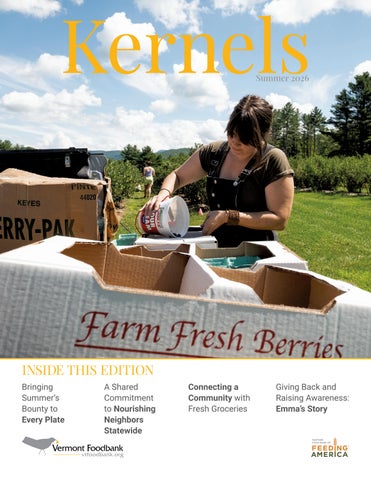
Kernels Summer 2026
INSIDE THIS EDITION Bringing Summer’s Bounty to Every Plate
A Shared Commitment to Nourishing Neighbors Statewide vtfoodbank.org
Connecting a Community with Fresh Groceries
Giving Back and Raising Awareness: Emma’s Story
Bringing Summer’s Bounty to
EVERY PLATE
Seeds were lovingly planted. Sprouts were carefully tended. Now, Vermont’s farms and gardens are finally bursting with fresh, ripe fruits and veggies. Every plate should be a rainbow of color and flavor! Yet thousands of Vermont neighbors lack enough money to buy all the food they need, in any season, as it becomes increasingly difficult to meet the basic needs of life today. Families, individuals, and older adults on fixed incomes all tell us that when budgets are stretched, food is usually a place to scrimp. And often, more affordable means not so fresh, not so colorful. Your Foodbank is here to improve access to that rainbow of color and flavor for neighbors facing hunger, in every season.
In this issue of Kernels you’ll read about the seeds Vermont Foodbank is sowing, resulting in local food shelf partners sprouting creative ideas that, carefully tended, bloom into innovative solutions to address food insecurity. The fruit of that work is, of course, neighbors who are well-fed, healthier, and happier. Your support feeds people, nurtures hope, facilitates healing, and builds community. Together, we are nourishing Vermont!
John Sayles CEO
A Shared Commitment to Nourishing Neighbors Statewide Eight food access partners recently met to discuss their growth over the past year. This cohort has collaborated, shared learnings, and invested in their organizations’ capacity through a Vermont Foodbank grant made possible by your support. The eight organizations vary in size, age, and geography. Three run food shelves, one runs a food shelf and meal site, and four provide other services in addition to food access.
“Ultimately, we aim to design a food program that not only feeds our guests, but also builds connection, agency, community, and pathways to opportunity.” - Good Samaritan Haven “We go beyond traditional food assistance by investing in relationships … our pantries provide both nourishment and a place where people feel seen and respected …. Our staff understands that isolation and hardship often accompany food insecurity, and we work to make our pantries a place of connection and trust.” - Hardwick Area Food Pantry
Group discussion revealed that even with Hardwick Area Food Pantry this diversity, they have strengths and values Family Center of in common. Sustained Washington County community support from volunteers, Good Samaritan Haven donors, and partners are foundational strengths. All eight organizations are Bethel Area Food Shelf deeply committed to Upper Valley Haven welcoming neighbors without judgment, offering choices, and minimizing stigma. They believe that Putney Foodshelf Greater Bennington nourishment is essential Community Services for health and agree that without reliable access to Saint Brigid’s Kitchen & Pantry food, overcoming other destabilizing challenges is impossible. Most of all, these partners cite relationships and community as critical for individuals building stability for themselves:
With the help of grant funds the Foodbank was able to award thanks to donors like you, this cohort has made investments in staff and board development, as well as systems for organizing volunteers, fundraising, and managing inventory. One food shelf had been relying on informal, pencil-and-paper systems and moved to digital tools. Another, whose meal program is one component of a larger set of services, rebuilt their food program entirely. A participant representing the Family Center of Washington County offered that the time shared with peers provided her “‘The Little Engine That Could’ energy … it’s great to be with a group of people who are all in the same boat.”
3
CONNECTING A COMMUNITY
with Fresh Groceries
You’re connecting partners like Cindy and Bethel Area Food Shelf with local supermarkets, and neighbors with fresh food.
For Bethel Area Food Shelf, a local partnership that redirects fresh groceries to neighbors facing hunger has helped address rising community need. Now, they’re thinking creatively toward long-term food security. Emphasis on community is woven throughout the efforts of Bethel Area Food Shelf (BAFS)—a Vermont Foodbank partner—and it’s clear the moment you enter. An engraved wooden sign made by students marks shelves of fresh produce. Portraits of community members, taken by a local photographer, hang in one corner. Another sign, embodying the food shelf ’s distribution approach, reads “Please, take enough for your family. Leave enough for your neighbors.” BAFS has existed for over 40 years, and its use has grown nearly tenfold since COVID-19, from around 30 unique families each year to over 280 and still rising. About 60 volunteers—some 4
who use the food shelf—fill shifts to keep food regularly available for neighbors in the five towns they serve. And residents have shown support by voting to include BAFS funding in town budgets. Cindy, BAFS’s president, has played a central role in expanding community involvement. “When people bring their skills together around a shared purpose, something powerful happens,” Cindy says. “When I feel myself burning out, I spend time here with the people doing this work, and it restores me. I want this community to be resilient. BAFS is helping do that. I want people to understand that compassion is one of our greatest strengths.”
BAFS partners with their local Shaw’s grocery store through a Foodbank program called Fresh Rescue—supported by donors like you. Since August 2024, this partnership has supplied nourishing food that is removed from store shelves early to make room for new inventory, and remains fresh, safe, and good to eat. Shaw’s has become a reliable source of produce, protein, prepared meals, and bread. The partnership came about when BAFS was struggling to keep up with need and facing cuts to food offerings. The positive impact on food quality and quantity was immediate. “This program literally saved BAFS at a time when we were spending nearly $9,000 per month on food,” Cindy says. “We’ve now reduced those costs to about $4,000 per month, and there’s always a wonderful surprise.” This might be a big box of fresh oranges, or an unexpectedly large supply of milk or other essentials. “Participating in Fresh Rescue … allows us to be better stewards of our resources,” says Cindy. “It’s equally meaningful to see food that would otherwise be discarded instead nourishing our neighbors. It reflects a shared sense of care and responsibility, and shows how
local partnerships can make a real, tangible difference.” “It’s not just about calories. It’s about dignity, comfort, and the feeling that someone cares,” she adds. As operations have stabilized, Cindy and BAFS’s management team have had space to explore what’s behind rising need, and how to support long-term food security. Through community conversations and surveys, they identified gaps in information about and access to existing resources. As part of a Foodbank partner cohort (which you can read more about on page 3), they’ve begun visioning a hub to centralize services and resource coordination. “It’s an exciting opportunity to build a more sustainable, connected community support system,” says Cindy. By helping connect excess groceries from local stores directly with food shelves, you’re supporting strong community food access today and a food-secure tomorrow.
The Fresh Rescue Program connects grocery retailers with pre-approved food shelves and meal sites, to pick up food items daily for immediate distribution or use. Donations consist of perishable and non-perishable items. 5
Friends like you and Emma are helping ensure people have nourishing food every day, especially when times are tough.
Giving Back & Raising Awareness: Emma’s Story When an injury left Emma out of work without medical leave, she needed help affording groceries—so she got in touch with Vermont Foodbank. Now, Emma’s sharing her experience to make sure people are aware that food help is available when someone needs it.
6
Summer in Vermont lends itself to Emma’s favorite pastimes: walking her dog, being outdoors, kayaking, and spending time with friends and family. “I love a good barbecue with local meat and fresh, seasonal vegetables,” shares Emma.
high cost of living outpaces wages in Vermont. And it’s becoming more difficult for many of us to afford basic needs like food, health care, and housing. Fortunately, thanks to donors like you, Vermont Foodbank is here to help people navigate these challenges.
Emma, 35, lives in Moretown and works as a licensed acupuncturist. Last year, she suffered a serious knee injury that required surgery. “I was unable to work for six weeks. Because I was employed by a small business, I did not have access to paid medical leave. This created significant financial stress, including difficulty affording food during nearly two months without income,” Emma explains.
“When I was navigating my upcoming surgery and finances, a friend encouraged me to apply for food assistance,” says Emma. So, she got in touch with the Foodbank and connected with Ari. Ari is part of the dedicated team that works statewide to offer one-on-one assistance with the 3SquaresVT application process. Also known as SNAP, or “food stamps,” 3SquaresVT is a federally funded program that provides money for income-eligible people to purchase groceries.
Tradeoffs like these are all too familiar, as the
“My biggest takeaway is to reach out and ask
questions,” says Emma. “I had no idea I could receive temporary assistance …. Without the support of Ari on the Vermont Foodbank’s 3SquaresVT team, I would not have been able to afford groceries while I was out of work. Their guidance and support were invaluable during a very stressful time.” Your support for services like 3SquaresVT outreach has helped countless individuals and families access food resources and budget support. For Emma, 3SquaresVT benefits made it possible to purchase the foods she prefers and enjoys. “Without this assistance, it would have been very challenging to buy the healthy foods I needed to support my recovery,” she says. “Receiving food assistance while I was recovering from surgery and unable to work is something I will always be grateful for. It was incredibly helpful and allowed me to focus on healing and nourishing my body.” Food assistance means more than just calories on a plate. It’s holistic nourishment for mind, body, and even heart. It enables connection, like enjoying that summer barbecue with your loved ones.
Today, Emma’s sharing her experience so that people throughout Vermont know that food help is there if they need it. “I am so glad I can give back by sharing my story,” she says. “I hope to raise awareness for others who may not realize they are eligible for support during challenging times … I didn’t think I would qualify, but that support during my time out of work was invaluable.” Emma says high grocery prices and other living costs have added another layer of financial stress for many people she cares about. Personally, she’s finding it harder to consistently afford to eat the way she wants to—prioritizing fresh, organic fruits and vegetables. “It’s important to recognize that these programs exist to support people during times of need. Food insecurity can happen to anyone, especially during unexpected life events, and these resources can make a meaningful difference.” Photo and name substituted to protect privacy. If you’re interested in sharing your story, please visit vtfoodbank.org/share-your-story.
Meet 3SquaresVT Team Member Ari “My team’s work is increasingly important as 3SquaresVT policies continue to change. We can play a critical role in the approval process—prioritizing assistance with medical and personal barrier exemption forms for folks who are subject to, but cannot currently meet, the work requirement. “It is tender and humbling to connect with neighbors, to support people during hard life moments, and witness how financial hardship can touch anyone’s life. I recognize myself, my family, and my community reflected in the people I work with.” The Foodbank’s 3SquaresVT assistance team can answer questions, help fill out applications, and support people through the process of applying for food benefits. To learn more about 3SquaresVT, visit vtfoodbank.org/3squaresvt. 7
Cultivating a Future in Which Everyone Thrives 2026 is Vermont Foodbank’s 40th anniversary. Your support is what keeps our shelves stocked, our trucks on the road, and our staff and network ready and available for neighbors facing hunger—in every county in Vermont. Thank you. Neighbor relationships are an essential part of what makes communities strong, as the stories in this issue demonstrate. And right now, as low-income households lose federal assistance they depend on, local connections and support systems are more important than ever. August is Make-A-Will Month. As someone who has shown a commitment to keeping our communities well-nourished, we hope you’ll consider how you can create lasting impact for generations to come. A planned gift (also known as a legacy gift or bequest) allows you to make sure that nourishing food and services are available for Vermont neighbors beyond your lifetime. And you don’t have to be wealthy to do it! Planned gifts can be made by anyone, in any amount.
vtfoodbank.org
Most planned gifts are designated in a will or trust. There are also some options that offer tax savings that can benefit you while nourishing neighbors, and are as simple as designating the Foodbank as a beneficiary on your: • Individual Retirement Accounts • Donor-Advised Funds • Insurance Policies We don’t know what the future holds, but we do know that hunger is not a short-term problem. With a little bit of planning today, you can help neighbors facing hunger tomorrow, and for years to come. To learn more, contact Lindsey Harty at lharty@vtfoodbank.org or 802-279-1650, or visit vtfoodbank.org/donate/planned-giving. If you or someone you know could use help accessing food, please be in touch. Our contact information is below, and our website is available in many languages spoken in Vermont.
33 Parker Road, Barre, VT 05641 800-585-2265 | info@vtfoodbank.org