2026-2027 MRA President’s Letter ..................................................................................................................04
Mary Wall
Welcome from MRA Today Editor .....................................................................................................................05
Susan Flis
Update from the 2027 MRA Conference Chair...............................................................................................06
Susan Flis
FEATURED ARTICLE
Learning from History: A Literacy Specialist’s Reflection on History, Literacy, and Educational Futures .....................................................................................................................................................................08
Ashley Houston-King
CHILDREN’S BOOK REVIEW
Using Picture Book Biographies to Recognize Overlooked Heroes: Book Reviews and Teaching Strategies .................................................................................................................................................................16
William Bintz
TEACHING IN ACTION
Apprenticing Young Learners in Disciplinary Literacy Through Expert Interviews ..........................30
Gaming as a Literacy Learning Opportunity Beyond the Classroom ....................................................46
Abdul Siddiqui
From Screen to Page: Using Familiar Characters to Support Early Literacy .......................................54
Jennifer Wallace Jacoby
Dear MRA Friends,
Following the success of the Massachusetts Reading Association’s 55th Annual Conference, Literacy and Learning: Connecting Classrooms and Communities, I am excited to continue the conversation through this issue of MRA Today. The thoughtful articles shared by talented educators throughout these pages reflect the passion, innovation, and dedication that define our literacy community.
Our conference served as a powerful reminder that literacy does not exist in isolation. It flourishes through meaningful relationships — between educators and students, schools and families, classrooms and communities. When we work together, we create opportunities for all learners to grow, connect, and succeed.
MRA remains committed to supporting literacy professionals across the Commonwealth through collaboration, professional learning, research, and advocacy. Whether through our committees, professional development opportunities, publications, or local council events, there are countless ways to become involved and make an impact. We continue to welcome new members who are interested in participating on committees such as Adolescent Literacy, Multilingual Learners, and Professional Development.
In addition, our local councils are being revitalized with exciting offerings across the state, providing educators with more opportunities to connect, learn, and lead within their own communities.
Thank you for your continued dedication to literacy and for being part of the Massachusetts Reading Association. Together, we will continue building strong connections that inspire readers, writers, and lifelong learners.
Warm regards,
Mary Mary Wall
MRA President 2026 Conference Chair
Dear MRA Community,
Welcome to the 2026 edition of MRA Today! I am proud to share our latest practitioner journal. In this issue you will find inspiring research by one of our board members; a review of some wonderful children’s books; and practical ways that scholars and teachers are supporting literacy development in classrooms.
In my role as the editor for the MRA publications, I have the privilege of reading about the amazing things literacy educators are doing and how their instruction is evolving. These articles give me hope during a time when education is under attack. Our work goes far beyond the teaching of reading and writing. Transformative literacy is about fostering critical thinking and challenging the status quo. As educators, we must constantly reflect and evolve to meet the ever-changing needs of our students and communities. A part of this is to recognize that there is not just one way to support literacy development. Literacy instruction needs to be responsive to all learners and their identities.
I hope you enjoy reading this volume of the MRA Today and I look forward to seeing you all in March at our next conference.
Sincerely,
Susan Flis, Ph.D. President-Elect, MRA 2026-2027
2027 MRA Conference Chair Editor of the MRA Beacon & MRA Today
Dear MRA Community,
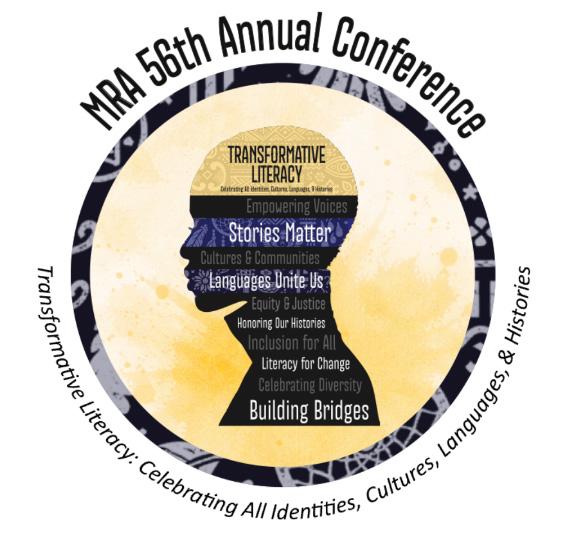
I am so excited to provide you with an update on our plans for the 56th Annual MRA Conference! The 2027 theme, Transformative Literacy: Celebrating All Identities, Cultures, Languages, & Histories, invites a powerful reimagining of literacy—not just as the ability to read and write, but as a dynamic tool for empowerment, inclusion, and social change. Here’s a breakdown of what this theme conveys:
Transformative Literacy
• Beyond basic skills: Literacy here is viewed as a force that transforms individuals and communities. It includes critical thinking, cultural awareness, and the ability to engage meaningfully with diverse perspectives.
• Empowerment through education: It emphasizes how literacy can challenge inequities, amplify marginalized voices, and foster agency in learners of all backgrounds.
Celebrating All Identities
• Inclusive representation: The theme champions the idea that every learner’s identity—be it racial, gender, linguistic, religious, or otherwise—deserves recognition and respect in educational spaces.
• Affirmation and belonging: It calls for learning environments where students see themselves reflected in the curriculum and feel valued for who they are.
Cultures, Languages, & Histories
• Multicultural literacy: Encourages the integration of diverse cultural narratives, multilingual resources, and historical truths into teaching practices.
• Decolonizing education: Promotes the inclusion of Indigenous knowledge systems, diasporic histories, and non-Western perspectives that have often been excluded or misrepresented.
• Language justice: Recognizes the importance of preserving and honoring students’ home languages and dialects as assets, not barriers.
This theme is a call to action for educators, scholars, and communities to embrace literacy as a transformative practice—one that uplifts diversity, fosters equity, and builds bridges across differences. It is about creating learning spaces where every story matters and every voice is heard. Keep an eye out for more updates as our planning evolves!
Sincerely,
Susan Flis, Ph.D. President-Elect, MRA 2026-2027
2027 MRA Conference Chair Editor of the MRA Beacon & MRA Today
FEATURED ARTICLE
Learning from History: A Literacy Specialist’s Reflection on History, Literacy, and Educational Futures
Ashley Houston-King
Joy, justice, and love are values that I aspire to embody and uphold as I navigate what it means to be a lifelong learner, teacher, and researcher. I am currently a Ph.D. candidate in Language and Literacy in Education at Boston University and a public-school educator with over a decade of experience in literacy education. As a literacy specialist working with students in grades 4-6, I have the joy of reading, writing, and learning alongside young people daily. My professional and research commitments center on supporting learners who experience difficulties with literacy, strengthening their reading, writing, and self-efficacy, and disrupting deficit-based perspectives about literacy learning. My research interests also include teacher education, with a particular focus on supporting pre-service, master’s, and doctoral students in literacy instruction, curriculum, assessment, and equitable pedagogical practice.
Broadly, my research interests explore literacy, race, and educational justice, with particular attention to how anti-Blackness shapes literacy policies, reading instruction, curricula, and schooling experiences. I am interested in the historical (and contemporary) restrictions of literacy access and the ways African American communities, educators, and young people have (and continue to) used literacy as a site of resistance, imagination, and liberation. I study inand out-of-school literacy spaces to better understand how youth navigate injustice and work toward collective liberation. I strive to support asset-based literacy learning and teaching, understanding that students already possess rich knowledge and experiences that should be affirmed, honored, and sustained within our schools (Ladson-Billings, 1995; Gonzalez et al., 2005; Paris, 2012). In addition to working with youth to unpack our multiple identities, literacies, languages, and histories, I hope to bring my experiences with young people and teachers into conversations with educational policymakers to work toward a more just educational system.
My research is deeply connected to my ancestors, both biologically and spiritually. I am the daughter of a brilliant African American southern mother who grew up on a farm in Alabama. I am also the daughter of a Boston Irish Catholic father, whom I have never had a relationship with. I grew up with just my mom and I, in a home where Black ways of knowing and being were loved and celebrated. My mom is my favorite person in the world and is my rock. She continuously reminds me that we come from a lineage of brilliant Black people who engaged in a variety of literacy practices.
I have spent the last five years studying historical African American women educators, Black education, and learning about what it has historically meant to work towards collective liberation. Although we are separated by decades and centuries, I draw wisdom, empowerment,
and inspiration from my historical ancestors, building on their wisdom to guide my work with youth today. Below, I will briefly share some of my work, including the life’s work of a 19th-century African American woman, Susan Paul. Then, I share preliminary findings from my dissertation research study that centers Black girls’ literacy practices and lived experiences in 2026.
A Reflection on a 19th-Century African American Educator
Contextualizing 19th Century Beacon Hill
Beacon Hill is one of Boston’s oldest neighborhoods and one of my favorite places in the city. It wasn’t until I read Bettina Love’s (2019) Abolitionist Teaching that I was exposed to the Black history of Boston, particularly in 19th-century Beacon Hill. Love (2019) introduced me to the profound abolitionist work taking place at the top of the hill, prompting me to begin a new journey of understanding what education in the 19th century looked like for Black children.
After the second year of my Ph.D. program, I serendipitously met a modern-day changemaker and educational trailblazer, Dr. Denise Patmon, at the airport on my way to the National Council of Teachers of English (NCTE). After our encounter, I joined her research team at the William Monroe Trotter Center at the University of Massachusetts Boston, where, through federally funded research initiatives, we center the lives and legacies of historical Black figures whose work has shaped educational justice in the United States and beyond.
For the past three years, I have had the pleasure of working with Dr. Patmon and a multigenerational community of learners (including middle and high school students, teachers, doctoral students, parents, and community members) who meet monthly to study the history of 19th-century Black Boston. This collaborative work culminated in September 2025, when our full research team (including students and parents) traveled to Japan to present our research at an international conference! Below, I want to highlight one 19th-century African American educator whose work exemplifies the historical literacy practices that inspire my work today.
Susan Paul (1809-1841)
Susan Paul was a 19th-century Boston educator whose legacy should be known, shared, and celebrated in classrooms, teacher education programs, and beyond. Susan was an African American woman who wore many hats: a teacher, an aunt-turned-mom, an abolitionist, and a fighter for educational rights. She used her platform to center the voices of Black children during a time when, most frequently, Black children (and people) were denied access to literacy and education across the country.
Susan was born in 1809 to Reverend Thomas Paul, a Baptist minister who became the first pastor of the First African American Church in Boston (now called the African Meeting House), and to Catherine Waterhouse Paul, a school principal and teacher (Brown, 2002). Her parents were prominent figures within Boston’s Black community during the antebellum period and were deeply involved with the anti-slavery movement. Due to her parents’ advocacy, Susan was surrounded by brilliant abolitionists and thinkers working towards spreading awareness of the institution of slavery to Northerners, as well as calling out the inequitable and segregated policies and practices that continued to exist in Boston (Brown, 2002; Baumgartner, 2019). Susan’s presence in these spaces likely profoundly influenced her educational contributions in Boston. Despite living in a time when women were often discouraged or prohibited from speaking publicly, she carved out spaces to advocate for abolition, educational equity, and civil rights, helping to create new possibilities for Black children in Boston and beyond (Brown, 2002; Willis, 2023).
Susan made numerous contributions during her lifetime, including authoring one of the first biographies of an African American child and establishing the Juvenile Choir. In 1833, Susan Paul published The Memoir of James Jackson: The Attentive and Obedient Scholar, Who Died in Boston, October 31, 1833. This biography shares the life of a young Black boy living in Boston, who died of an illness at the age of 6 years old and 11 months. In this text, Paul shares the life of her student, James Jackson, whom she describes as one of her most brilliant students, filled with “goodness” and obedience. She writes about how he lived out the moral teachings he was learning at home and in school, the ways he persevered, and the ways he served as a role model for other children worldwide. This text disrupts dominant deficit narratives about Black children in the 19th century by offering a counternarrative that centers the complexity, humanity, and lived experiences of Black youth.
Another of Susan’s leading legacies is her creation of the Juvenile Choir. The Juvenile Choir included children from ages 3-10 who sang songs about the anti-slavery movement, racial discrimination in Boston, and the joys of being Black children to a mixed-race audience (something that was rare for this time). Through Susan’s connections with abolitionist networks across the city, she and the children used songs and performances as vehicles to communicate messages about abolition, educational justice, and civil rights.
With this knowledge and guidance from historical figures such as Susan Paul, I have become empowered to build upon historical ways of knowing, doing, and being that affirm and sustain Black children’s identities and literacy practices inside and out of school. As I reflect on my own lived experiences and the new historical knowledge I am acquiring, I am left with new perspectives, more questions, and a deep curiosity about what is next. What literacy practices
are young people engaging in and outside of schools today? What types of spaces cultivate students’ brilliance? How can I work with young people to create spaces where literacy practices are authentically embedded for both individual and collective liberation?
With these big questions in mind, I knew I had to start somewhere, so I created a plan to lead an after-school program for middle-grade Black girls, received Institution Review Board (IRB) approval, received the Sylvia Brown Scholarship from the Massachusetts Reading Association (MRA), and found a partnering school to work with.
Dissertation Study
Pilot Study
In January 2025, I led a literacy group for Black girls in grades 4-6 as part of a pilot study in an after-school program. Although I went in with a plan for the girls and I to read, write, discuss, and explore historical and contemporary Black women and girls, I quickly realized that I had to approach our time together more openly, flexibly, and creatively. Over the course of six months, I spent time getting to know the girls and building relationships with them, allowing them to learn about me and ask any questions they had. I learned about their interests, literacy practices, and activities they enjoy doing both inside and outside of school. We did A LOT of art-making (e.g., vision boarding, bracelet-making, slime, etc.), and the girls LOVED listening to music and dancing together, particularly by playing popular TikTok trends, dances, and songs. Ultimately, the girls also LOVED having the freedom to be.
For this pilot study, I am especially grateful for the love and support of the Massachusetts Reading Association (MRA), as I received the Sylvia Brown Scholarship in the spring of 2024. It was the $1,000 scholarship that allowed me to purchase art supplies, writing materials, books, and snacks for our afterschool group! With the funds to buy art supplies, I was able to build authentic relationships with students in a low-stakes environment.
Dissertation Study
During the 2025-2026 academic year, I had the joy of conducting a second iteration of this study. The purpose of this ethnographic study was to examine the literacy practices and lived experiences of middle-grade Black girls living in contemporary Boston. Building on what I learned from the pilot, I allowed the girls to take the lead as they continued shaping the afterschool experience into a space where they felt they belonged and could be their
authentic selves. Together, we engaged in a wide range of literacy practices, including reading, writing, creating speeches and videos, debating topics, listening to music, and creating art, among many other activities. I collected observational data, interviews, and artifact data to understand how Black girls use literacy for self-exploration, self-expression, and collective liberation. Although I am still in the preliminary stages of data analysis, I have some important findings with implications for educators committed to loving, affirming, and supporting all students, especially Black girls, in and beyond their classrooms.
The Importance of Relationship & Trust Building
Establishing relationships with the girls developed over months and years of being in community together, including getting to know one another, learning who we each were, and clarifying our shared purposes within the space. Building these relationships required ongoing self-reflection on my part, prompting questions such as: Who am I in this space? How do I want to navigate my role? Do I want to be perceived as an authoritative figure, or as an adult committed to supporting the girls’ minds, ideas, and growth? How will I respond to challenges as they arise?
When I speak about trust, I refer to multiple interconnected layers: the trust girls built with one another (both same-age peers and across grade levels), the trust they built with me (who is this adult? Can I trust her? Is she consistent in her words and actions? Does she follow through on her commitments?), and trust in the space itself (how do we collectively use and care for this space? How do we share materials, responsibilities, and resources, such as food?).
Literacy for Joy: Girls’ Self-Initiated Reading, Writing, and Meaning-Making
One of the most significant findings from this afterschool space was the extent to which the girls were already actively engaged in reading, writing, and a wide range of literacy practices driven by their own interests and for their own enjoyment. Importantly, these literacy practices extended beyond adult-created or school-sanctioned spaces, prompting me to think of deeper questions: What are the girls choosing to read and write about? What topics spark their curiosity, creativity, and connection?
I found that the girls were deeply engaged with popular culture, anime, and multimodal texts (e.g., mini food-cooking videos, music videos, and dance video trends). They gravitated towards videos, celebrities, and animated characters with whom they felt a sense of connection, using these texts as avenues for self-expression and social connection. Writing, in particular, emerged as a highly collaborative and joyful practice. For example, a group of sixth-grade
girls co-authored an ongoing story, with each girl assigned a different character and writing responsibilities. During lunch and recess, they exchanged notebooks, assigned new roles, and set deadlines to continue developing the narrative together. I also observed girls using writing journals to compose poetry collaboratively and write diary entries that captured their thoughts, dreams, and anxieties. These moments revealed that literacy was not merely an academic task, but a meaningful social, creative, and emotional practice woven into the girls’ everyday lives.
The Importance of Play
Play emerged as an essential and meaningful finding within this afterschool space. The girls wanted the opportunity to simply be- to play, laugh, create, and exist without judgment or the pressures often placed upon them in more structured learning environments. Each week, I intentionally invited the girls to shape the space by asking for their input on everything, including food and drinks, art supplies, board games, and activities they wanted to explore. Their responses were always thoughtful, creative, and centered around the community, often suggesting projects that multiple people could participate in.
These moments allowed me to realize that play was far more than a break from learning; it could be a means of learning. It was a meaningful form of connection, creativity, community, and emotional release. Through laughter, crafting, playing games, and shared joy, the girls built relationships with one another, expressed themselves freely, and cultivated a sense of belonging within the space. Play became an important reminder that creating affirming environments for girls also means making room for joy, imagination, and simply being young.
Conclusion
In conclusion, my dissertation study has taught me so much about young girls, their identities (who they are), their relationships, and the rich ways that they engage in literacy practices throughout their daily lives. As I continue engaging in data analysis, I am also imagining what future afterschool spaces we might continue to co-create together. Already, the sixth-graders are asking how our girl group might continue next year, even as they transition from elementary school to different high schools across the city. While no decisions have been finalized, I envision possibilities such as monthly gatherings at local museums, libraries, learning together, and deepening our understanding of ourselves and one another. I am also considering how this space might continue to evolve for the current fourth- and fifth-graders, who may take on increasing leadership roles as older participants and mentors, particularly as younger girls may join the group in Spring 2027. This creates exciting possibilities for intergenerational mentorship, community-building, and sustained literacy engagement.
Finally, this work prompts me to think beyond the girls who participated in this study, and towards the students who were not able to take part this time, including many of the boys in the after-school program. Each week I arrived, several boys would ask when I would create a space for them to engage in similar experiences. Their questions have pushed me to consider what it might look like to design similarly affirming spaces that center their lived experiences, identities, and literacy practices. How might educators intentionally design environments where all young people have opportunities to engage in meaningful, joyful, and humanizing literacy experiences? Although this iteration of the study is concluding, the relationships, questions, and possibilities continue to grow and evolve. My hope is that this work serves as an invitation to imagine more expansive, joyful, and sustaining spaces where young people’s literacies, identities, and dreams are deeply nurtured.
References
Baumgartner, K., JSTOR, & JSTOR. (2019). In pursuit of knowledge : Black women and educational activism in antebellum America. New York University Press. Brown, L. (2002). Out of the Mouths of Babes: The Abolitionist Campaign of Susan Paul and the Juvenile Choir of Boston. The New England Quarterly, 75(1), 52–79. Gonzalez, N., Moll, L. C., & Amanti, C. (2005). Funds of knowledge : theorizing practice in households, communities, and classrooms (1st ed.). L. Erlbaum Associates. https://doi.org/10.4324/9781410613462
Ladson-Billings, G. (1995). Toward a theory of culturally relevant pedagogy. American Educational Research Journal, 32(3), 465–491. https://doi.org/10.3102/00028312032003465 https://doi.org/10.2307/1559881
Paris, D. (2012). Culturally Sustaining Pedagogy: A Needed Change in Stance, Terminology, and Practice. Educational Researcher, 41(3), 93–97. https://doi.org/10.3102/0013189X12441244
Willis, A. I. (2023). Anti-black literacy laws and policies. Routledge, Taylor & Francis Group.
ABOUT THE AUTHOR
Ashley Houston-King is a Ph.D. student at Boston University studying Language and Literacy in Education. Ashley is a reading specialist in a K-6 Boston Public School and a former classroom teacher.
CHILDREN’S BOOK REVIEW
Using Picture Book Biographies to Recognize Overlooked Heroes: Book Reviews and Teaching Strategies
William Bintz, Ph.D.
“The value of learning about people who have achieved something extraordinary is immeasurable. Children need to find heroes and role models who can inspire and motivate them” (Morgan & Collett, 2018, p. 14).
This column shares reviews of high-quality picture book biographies that recognize overlooked heroes. These heroes include Fauja Singh, Nichelle Nichols, Charles Drew, and Augusta Baker. Individually and collectively, these historical figures have lived extraordinary lives and made significant contributions to their respective professional fields.
This column also shares reader response instructional strategies. Teachers can use these strategies not only with picture book biographies, but also with many other literary genres. Individually and collectively, these strategies allow readers to make their thinking visible to themselves, as well as to share and discuss their visible thinking with others in literature circles. This discussion allows all readers to hear, see, and understand multiple perspectives of a shared text.
My hope is that this column will inform, motivate, and inspire readers of all ages. More specifically, I hope readers will gain new information about each of these historical figures. I also hope readers will feel motivated to explore the lives of other accomplished people who deserve to be famous but are not. Lastly, my hope is that readers will be inspired by one or all these historical figures to also live accomplished lives.
I begin with some professional background. This background describes my motivation and inspiration for using picture book biographies to illuminate the lives, times, and accomplishments of historical figures who should be famous, or at least more famous, but are not. Next, I highlight each historical figure, share a precis of the picture book biography about each character, and describe the reader response instructional strategy. I end with suggestions for further reading.
Professional Background
I am a professor of literacy education at a public university in a large midwestern state. My personal interests, teaching topics, and research interests focus on using reading and writing
as instructional tools to teach important content area information across the curriculum K-12, often referred to as Reading and Writing across the Content Areas. Specifically, I use picture books, especially award-winning picture books, in my classes to teach standards-based, content-area themes and topics across English Language Arts, Social Studies, Mathematics, and Science.
I use a variety of professional resources to find, read, and use high-quality and awardwinning picture books. As a literacy educator, I use the National Council of Teachers of English (NCTE) website to view picture books that have won awards like The Orbis Pictus Award and the Charlotte Huck Award. For social studies, I use the National Council of Social Studies (NCSS) website to view picture books that have won the Notable Social Studies Book Award and the Carter G. Woodson Book Award. For mathematics, I use the National Council of Teachers of Mathematics (NCTM) to view picture books that have won The Mathical Book Prize. For science, I use the National Science Teachers Association (NSTA) to view the columns Teaching Science Through Trade Books and Outstanding Science Trade Books for students K 12.
I particularly enjoy finding and reading picture book biographies of historical figures who should be famous but are not. I enjoy these biographies for two reasons. First, I am inspired by accomplished people who have been overlooked, if not ignored for some reason, by history. Second, I enjoy student responses to the picture books. After reading aloud these picture books in class, students often make comments like, “This person was fascinating and highly accomplished. Why didn’t we learn about him/her before now?” I do not have a good response, so I usually shrug my shoulders and say, “I don’t know, but at least you now know about this person.”
Introduction
In general, the marathon is a long-distance foot race over 26.2 miles. The race is physically grueling and tests the stamina and endurance of every runner. Competitive runners complete
Historical Figure #1
Fauja Singh Keeps Going: The True Story of the Oldest Person to Ever Run a Marathon
the marathon on average in approximately 3 hours, and recreational runners complete it on average in 5 hours. The best age to run a marathon is when individuals are 25-35 years old.
And yet, many older adults have run and completed the marathon. For example, in a recent New York City Marathon, “there were 253 runners between the ages of 70 to 74, 63 runners between 75 to 79, and 13 runners between 80 to 89” (Jones, 2024). The presence of older adults running the marathon is not new. Meet Fauja Singh.
Picture Book Biography
Fauja Singh Keeps Going: The True Story of the Oldest Person to Ever Run a Marathon, was expertly written by Simran Jeet Singh (2020) and beautifully illustrated by Baljinder Kaur. It is a fascinating picture book biography that describes the life and times of Fauja Singh, a marathon runner who should be famous but is not. That is, until now.
Fauja Singh was born in Punjab, India. He wanted to walk and play as a child but had very weak legs. He practiced walking. Finally, he began to walk at the age of five. School was too far for him to walk, so he worked on the family farm. He worked and walked. At 15 years old, he could walk a mile. He was determined to keep going.
Over time, Fauja got married, started a family, and bought a farm. At 81, he was alone. His wife died and children moved away. He was determined to keep going.
Fauja flew to England to live with family but soon felt bored and miserable. One day, he watched people running a marathon and the runners were all smiling. He wanted to run a marathon, too.
He ran every day. He hired an experienced marathon runner as a trainer. Finally, he was ready. At 89 years old, Fauja became one of the oldest people to ever complete the London Marathon. In fact, he completed this marathon five more times. He became famous. He was determined to keep going.
At 93 years old, Fauja ran in the New York City Marathon. People were worried. Was he too old to run 26.2 miles? In the end, Fauja completed the race but at a cost. He limped to the finish line, exhausted, and collapsed. Eventually, he recovered with the friendship of his trainer and the support of his family. He was determined to keep going.
Fauja decided to be the first 100-year-old person to ever run a marathon. It was the Toronto Waterfront Marathon. He completed the race in approximately 8 hours. In the end, he kept his promise to his mother that he would always “keep going.”
This is an endearing and inspirational picture book that will delight readers of all ages. In addition to the story, the picture book includes a biography of Fauja Singh and a description of his world records. Readers should not be surprised if they feel highly motivated to complete a challenge, not necessarily to run a marathon, but just to “keep going.”
Instructional Strategy
Character Wheel is an effective strategy to use with biography (see, Figure 2).
Reflections:
Procedure
I distribute a copy of Character Wheel strategy to each student. Next, I start to read aloud the picture book biography, pausing at episodic changes in the story. These changes could include the
introduction of a new problem or character, a different setting, a change in time, etc. I pause at each episodic change for about 30 seconds to 1 minute and then invite students to start to complete the Character Wheel. After reading, I organize students in small literature circles to share and discuss their responses with others. As a culminating event, I invite students to write and share personal reflections on the whole experience.
Suggestions for Further Reading
For those interested in reading more about Fauja Singh, I recommend Fauja Singh – The marathon man: Lessons in perseverance and progress for educators worldwide (Bhinder, 2025), and Turbaned tornado: The oldest marathon runner Fauja Singh (Singh, 2011).
Literature cited
Singh, S.J. (2020). Fauja Singh keeps going: The true story of the oldest person to ever run a marathon. Kokila.
Jones, H. (2024). History of the Marathon. https://aims-worldrunning.org/articles/427-history-of-the-marathon.html.
Historical Figure #2
Nichelle Nichols: The Actress Who Played Lieutenant Uhura on Star Trek
Introduction
As a child and throughout adolescence, I enjoyed reading science fiction books and watching science fiction shows and movies. Some of my favorite science fiction writers included Isaac Asimov, Arthur C. Clarke, Robert A. Heinlein, and Ursula K. Le Guin. I also enjoyed watching science fiction movies like 20,000 Leagues Under the Sea, Journey to the Center of the Earth, and Around the World in 80 Days all by Jules Verne and The Time Machine by H.G. Wells.
In addition, I liked to watch science fiction shows on television. My absolute favorite television show was Star Trek. I was mesmerized by this show. It focused on the imaginative adventures of the crew of the starship USS Enterprise. Some crew members’ names included Captain James T. Kirk, half-human and half-Vulcan Mr. Spock, Dr. “Bones” McCoy, Lieutenant Hikaru Sulu, and Lieutenant Nyota Uhura. These cast members confronted strange aliens and explored unknown worlds, making it one of the most popular and entertaining televisions show in television history, even though it only ran as a TV series from 1966-1969.
These cast members were, of course, real people. Here, I highlight one cast member, namely, Lieutenant Uhura. Her real name was Nichelle Nichols, and she is the subject of a wonderful picture book biography about her extraordinary life on and off the screen.
Picture Book Biography
To Boldly Go: How Nichelle Nichols and Star Trek Helped Advance Civil Rights, written by Angela Dalton (2023) and illustrated by Lauren Semmer, is an informative picture book that describes the life and times of Nichelle Nichols. It focuses not on her as Lieutenant Nyota fighting alien creatures, but on her as a courageous activist helping advance civil rights.
Many families loved watching Star Trek on TV at night for multiple reasons. For families who identified as Black, an important reason was to watch Lieutenant Uhura, played by Nichelle Nichols. She was their favorite character because she was a smart character and a talented actor, but mostly Lieutenant Uhura looked like them.
America was amid marches for civil rights when Star Trek first appeared on television. Nichelle worked hard to bring her character to life as a Starship officer who solved problems on board the starship. She personally identified with the character. Lieutenant Uhura was strong, independent, and equal, just like Nichelle wanted to be. Moreover, the word uhuru means “freedom” in Swahili, just like Nichelle wanted all Black Americans to be.
Unfortunately, racism was pervasive across the United States. Nichelle became a ballet dancer, but received racists comments by people who believed Black people could not dance ballet. Growing older, Nichelle became a performing artist, singing and dancing with many historic musicians including Duke Ellington. She became an actress and befriended celebrities like Maya Angelou and Sidney Poitier.
Once Star Trek started, Nichelle did not have positive experiences with her role on the show. She was treated unfairly and threatened to quit. The next evening at a fundraiser Nichelle met Dr. Martin Luther King, Jr. He was a fan of Lieutenant Uhuru. Dr. King persuaded Nichelle not to quit. He explained how her character was a role model for all Black Americans and a catalyst for change. In the immortal words of Star Trek, Nichelle was “To Boldly Go…” to make the future better for everyone.
This picture book also includes an author’s note at the end of the story and an informational section on Nichelle Nichols beyond Star Trek.
Instructional Strategy
Character Hot Seat (Mills, 2009) is an effective strategy to use with this picture book biography and many other literary genres. This strategy promotes discussion and comprehension of a main character from the perspectives of other book characters.
Procedure
First, I organize students in small groups of four. Next, I share some background information about the Star Trek television series, movie, books, etc. Often, I read selected excerpts from books and show short clips from the television show and movie to build up students’ background knowledge about the nature of the series and the names and roles of major characters. I focus on four major characters: Captain Kirk, Spock, Mister McCoy, and Lieutenant Uhura.
Then, I invite the four students in each group to select the character they will play in this strategy. Before selecting, I remind students that Uhura will be the character in the hot seat. Afterwards, I display the directions and purpose of the Character Hot Seat strategy on the white board or on a PowerPoint slide and discuss it as a class.
I start to read aloud the picture book biography, pausing at episodic changes in the story. These changes could include the introduction of a new problem or character, a different setting, a change in time, etc. We pause at each episodic change for about 3-5 minutes for students to develop interview questions that their character wants to ask Uhura.
After reading, students in character use their interview questions to have a conversation with Uhura. The conversation should focus on identifying the character’s emotions, personalities, motivations, etc. It can also focus on identifying important events in the story and generating different perspectives on those events. Afterwards, each group shares an example of their conversation with the whole class. As a culminating event, students write and share personal reflections on the whole experience.
Suggestions for Further Reading
For those interested in reading more about Nichelle Nichols, I recommend Biography of Nichelle Nichols (Dawson, 2022), Biography of Nichelle Nichols: The Death of Popular Nisha Nichols of Star Trek (Neil, 2022), and Who is the great Nichelle Nichols (Selby, 2017).
Literature Cited
Dalton, A. (2023). To boldly go: How Nichelle Nichols and Star Trek helped advance civil rights. Harper.
References
Mills, K.A. (2009). Floating on a sea of talk: Reading comprehension through speaking and listening. The Reading Teacher, 63(4), 325-329.
Historical Figure #3
Charles Drew: Father of the Blood Bank
Introduction
My wife is one of approximately seven million people around the world who donate blood every year. She donates blood so that blood is available for blood transfusions to people who need them, and the need is great. It is estimated that every two seconds somebody in the United States needs blood and 4.5 Americans will require blood transfusions each year. For many people, a blood transfusion can mean the difference between life and death. Thus, blood banking is important and so is its history.
Many famous people have been involved in the history of blood banking. For example, in 1628, Dr. William Harvey discovered the system of blood circulation. In 1818, Dr. James Blundell conducted the first successful blood transfusion. In 1932, the first blood bank was established at Leningrad Hospital. In 1937, Dr. Bernard Fantus opened the first blood bank in the United States, and in 1947 The American Association of Blood Banks was founded, (Storey, 2024).
Dr. Charles R. Drew was another important person in the history of the blood bank. He was a Black American surgeon and researcher who earned himself the nickname “Father of the Blood Bank.” A new picture book beautifully tells his story.
Picture Book Biography
Charles Drew: The Innovator of the Blood Bank (Talley, 2023) is a new picture book biography that recognizes and celebrates the life and times of Dr. Charles Drew. Born in 1904 in Washington, D.C., he was the oldest of four siblings. He was also ambitious, hard-working, and a superstar athlete. His sister died young from tuberculosis. It inspired him to become a doctor.
After graduating from college, Charles went to medical school and became a surgeon. His area of expertise was blood transfusions. Charles, now Dr. Drew, went right to work at different universities. Over time, he dedicated himself to make blood banks better and more efficient. In the end he started his own blood bank. Soon, the American Red Cross asked him to set up a national blood bank.
After his death, Dr. Charles Drew left an amazing legacy. Today, there are over 50 Health centers and medical schools named after him across the United States. Most notably, he is known as the innovator of the Blood Bank.
Instructional Strategy
Written Conversations (Harste, Short, & Burke, 1995), also known as Talking on Paper, is an effective strategy teachers can use with many different literary genres. This strategy promotes personal and meaningful written responses to a shared text. It also supports student writing to real audiences, e.g. each other, and promotes multiple interpretations of a shared text. It is an informal, and a non-threatening way to encourage written conversation about books.
Procedure
Before implementing this strategy in class, I create Written Conversations booklets. I create one booklet for each pair of students. I take three blank sheets of 8 ½ X 11 paper and fold them as one in half. I staple the edge. I write Written Conversation on the front cover to finish the booklet.
In class, I organize students into pairs. Next, I distribute one Written Conversation booklet and one pencil or pen to each pair of students. Then, I display the directions for the Written Conversation strategy on the white board or a PowerPoint slide and discuss it as a class. Here are my directions.
1. I will read this book aloud and pause for 3-4 minutes at different places in the story.
2. When I pause, you and your partner have a silent conversation about the book by writing back and forth to each other.
3. No talking is allowed. I want you to really LISTEN to your partner as you write back and forth to each other.
4. After I finish reading, you and your partner can share your written conversation by reading it aloud to the class.
5. Afterwards, you and your partner can flip to the back of the booklet where each of you can write and share your personal reflections on the whole experience.
Suggestions for Further Reading
For those interested in reading more about Ruth Handler, I recommend Charles Drew: Black Pioneer in Blood Plasma. (Carter, 2025), Charles Drew (Eugene, 2023), Charles Drew (Mahone-Lonesome, 1990), Charles Drew: Pioneer in Medicine (Purdle, 2006), Charles Drew’s Blood Bank: The Science that Saved Millions (Robinson, 2025), Dr. Charles Drew: Blood Bank Innovator (Schaff, 2003), Dr. Charles Drew (Shoecraft, 1994), and Charles Drew: Doctor Who Got the World Pumped Up to Donate Blood (Venezia, 2009).
Literature Cited
Talley, A. (2023). Charles Drew: The innovator of the blood bank. Children’s Press.
References
Short, K., Harste, J., and Burke, C. (1995). Creating classrooms for authors and inquirers. Heinemann.
Storey, C. (2024). A brief history of blood banking. Helmer Scientific https://blog.helmerinc.com/blood-bank-history
Historical Figure #4
Augusta Baker: African American Librarian and Master Storyteller
Introduction
In the world of library science, there is a long list of famous Black American librarians. Among others, these librarians include Clara Stanton Jones, Effie Lee Morris, Virginia Proctor Powell Florence, Dorothy B. Porter, Carla Hayden, and Belle da Costa Greene.
Clara Stanton Jones became the first Black American woman to serve as director of a major library system in the United States in 1970. Effie Lee Morris was a children’s librarian who pioneered services for minorities and people with visual impairments and became the first Black American woman elected president of the Public Library Association in 1971. Virginia Proctor Powell Florence was the first Black woman in the U.S. to receive a library science degree, which she earned at Pittsburgh Carnegie Library School in 1923. Dorothy B. Porter became the first Black American to earn a master’s in library science from Columbia University. Carla Hayden was the first Black American woman to be sworn in as librarian of Congress. Belle da Costa Greene was Director of the Morgan Library & Museum and widely recognized as one of the most prominent librarians in American history.
This is a short list of Black American librarians that are famous and deservedly so. Unfortunately, the name of one Black American woman librarian rarely, if ever at all, makes the list. Her name is Augusta Baker. She should be recognized as a famous Black American librarian and master storyteller but is not, that is, not until now.
Picture Book Biography
Go Forth and Tell: The Life of Augusta Baker, Librarian and Master Storyteller is artfully written by Brianna J. McDaniel (2024) and beautifully illustrated by April Harrison. It is an informational picture book biography about the life and times of Augusta Baker. As a child, she grew up listening to stories told by her grandmother. The stories introduced Augusta to an imaginative world of fictional characters that included Br’er Rabbit, King Arthur, and a variety of heroes who slayed dragons and rescued damsels in distress. Augusta wanted to be a storyteller just like her grandmother.
As a young woman, Augusta wanted to share her grandmother’s stories with other children. She enrolled in a teacher’s college in Albany, New York. She also became a children’s librarian at the New York public library in Harlem. The library served mostly Black American children, however, there were very few books with Black characters in them. Augusta read stories about famous Black Americans to children, including James Baldwin and Audre Lorde. She also read stories to children about Black heroes who rose up, resisted inequality, and looked and talked just like them. She soon realized, however, that more stories and resources were needed.
She created the James Weldon Johnson memorial collection at the library to promote exemplary Black American literary figures. Among others, this list included Carter G Woodson, John Steptoe, Virginia Hamilton, and Walter Dean Myers. Then, she was appointed the coordinator of children’s services in all the New York public library branches. Lastly, she accepted a job created just for her as the master storyteller in residence at the university of South Carolina.
In the end, this new picture book tells the story of a master storyteller. It also includes a timeline of information about major events in the life of Augusta Baker, an author’s note, and citations for further reading. Finally, this new picture book allows Augusta Baker to take her rightful place as a famous Black American librarian and master storyteller.
Instructional Strategy
Storybook Plan (see Figure 1) is an effective strategy to use with biography and other literary genres (Short, Harste, and Burke, 1995).
STORYBOOK PLAN
TITLE
CHARACTERS
PLACE
TIME
PROBLEM
SOLUTION
MOOD
Typically, I display the strategy on the white board or on a PowerPoint slide and discuss it as a class. Next, I start to read aloud the picture book biography, pausing at episodic changes in the story. These changes could include the introduction of a new problem or character, a different setting, a change in time, etc. I pause at each episodic change for about 1-2 minutes for students to make comments and ask questions. After reading, I organize students in literature circles and invite them to share their storybook plan with others. As a culminating event, I invite students to write personal reflections on the whole experience.
Literature Cited
McDaniel, B.J. (2024). Go forth and tell: The life of Augusta Baker, librarian and master storyteller. Dial Books for Young Readers.
References
Short, K., Harste, J., and Burke, C. (1995). Creating classrooms for authors and inquirers. Heinemann.
ABOUT THE AUTHOR
Dr. William P. Bintz is Professor of Literacy Education in the School of Teaching, Learning, and Curriculum, College of Education, Kent State University, Kent, Ohio.
Apprenticing
Young Learners in Disciplinary Literacy Through Expert Interviews
Marlene Correia, Ed.D., Michaela Brouwer, Laura Danehy, & Kasey Donahue
“I want to be an engineer! I want to be a doctor! I’m going to be a chef!” Elementary students dream big about their futures, and their curiosity about how the world works provides a powerful opportunity for authentic learning. Disciplinary literacy instruction allows teachers to build on these passions by helping students think, read, and communicate like professionals in various fields.
In this article, three co-authors—graduate students enrolled in a disciplinary literacy course—share how they implemented these practices in their classrooms, guided by the final author. Together, we highlight examples of how teachers can engage students through authentic disciplinary literacy experiences grounded in STEM fields. Although these are elementary-aged students, the work of preparing them for more advanced disciplinary literacy starts now.
Recent research emphasizes the potential of disciplinary literacy to transform classroom learning (Dobbs, Ippolito, & Charner-Laird, 2016; Gabriel & Wenz, 2017; Shanahan (as cited in Sawchuk, 2024). Gabriel (2023) defines it as “instruction that highlights and explicitly teaches students how to create and use texts that are specialized for a given purpose or audience” (p. 5). Unlike traditional content-area reading, disciplinary literacy invites students to adopt the language, reasoning, and communication practices of experts. By apprenticing students into authentic disciplinary work, teachers nurture motivation, deepen content knowledge, and expand students’ pathways to literacy and academic success.
The Literacy and Inquiry Action Project
The Literacy Inquiry and Action Project is an assignment built into the graduate course on disciplinary literacy. The objective of the assignment is to engage teachers in discovering and incorporating the specific strategies needed to comprehend complex text within a particular discipline. The central question is: How do experts in this field read, write, and communicate? Additionally, how can I incorporate those skills into my teaching? The steps to the project are briefly outlined below:
Step 1: To begin, each teacher chose a discipline to focus on that aligned with their grade-level curriculum and applicable literacy and content standards. They researched the topic by gathering, reading, and synthesizing professional articles and multimedia sources.
Step 2: Use the “Expert Interview” process outlined by Gabriel in her text, Doing Disciplinary Literacy (2023). They found one “expert” in the field to interview, aiming to identify the text types, purposes, and processes for reading and writing associated with their discipline outside of school.
Step 3: Using the information they gathered, the teachers worked with a grade-level colleague and identified an upcoming topic of study (related to the standards) in their discipline. They created a text set of at least 4 short nonfiction texts or excerpts of nonfiction texts. For this step, they were guided by the work of Cappiello and Dawes (2021) in designing text sets and by Stewart & Correia (2021), as they incorporated at least two of the five kinds of nonfiction. Based on the background and foundational knowledge they acquired about how experts communicate in this discipline; they wrote and implemented 2 standards-based literacy activities using the texts to improve comprehension of the content.
Step 4: As a final step, the teachers and their colleagues reflected on the learning outcomes of the work, using student samples to support their reflections.
In the next section of this article, the teachers share an overview of their specific Disciplinary Literacy Inquiry and Action Project work with their elementary students.
Environmental Engineers in Kindergarten (Author-Laura)
This project focused on developing my kindergarten students’ literacy within the field of STEM. I developed students’ STEM disciplinary literacy by consulting with an environmental water engineer and designing a lesson that provided students with a window into the world of water engineering, exposing them to and engaging them in the engineering design process. The main objective was to build students’ background knowledge through texts and videos and then have them collaborate with peers to preview materials to construct a ‘water piping system’, first creating a sketch of their model, then building and testing it.
The Expert Interview. My expert interview was with a trained environmental engineer working as a water engineer. The question-and-answer session helped paint a picture of the types of literacy required in this engineer’s role. A few sample interview questions and answers are below:
Q: What is a habit or routine you do as part of your everyday job?
A: I go to the office and I meet with members of my team and talk about goals for the day. A goal could be building a report for clients regarding water main infrastructure.
Q: What types of text do you use in your everyday work? Or when do you write things down or read things as part of your everyday work?
A: Formal emails, personal notes all day- usually deadlines & meeting information, report writing, reading water quality reports.
Q: What formats do you use to keep track of or share information?
A: Notes, bulleted lists, technical memos, and collaborative sketches with my team.
Q: How do you practice, or engage with this topic and these texts?
A: We summarize texts to figure out what we need to display to our client most efficiently. This means translating formal texts into language our clients can understand.
Into the Classroom. I used this engineer’s insights on water main infrastructure and on the need for proper sketches and planning to present ideas to improve water tower efficiency. These insights helped shape my idea to have my students learn about water main infrastructure, processes that go into designing and building them, and why efficient infrastructures help to save water and positively support the environment. One of the content standards I was covering from the MA Curriculum Frameworks was to “communicate solutions to reduce the amount of natural resources an individual uses.”
I had students engage with nonfiction texts that helped them understand the processes of getting water from a source to a home or school. My students and I looked at different types of water main infrastructures, and then we learned about prototypes, and drafted through drawing our ‘infrastructures.’ Students then used various materials we had available (ex: plastic straws, plastic cups, hole punches, model magic, tape, building blocks) to build a model of their prototype drawing. Then, we poured water through the models to test the efficiency and stability of the students’ water main.
Text Set. To help my students meet their ELA standards, I selected a variety of nonfiction texts for my text set.
We Are Water Protectors by Carole Lindstrom
How Did That Get to My House? Water by Nancy Robinson Masters
A Drop Around the World by Barbara McKinney
Be a Water Scientist by Ruth Owen.
Reflection. This was a very advanced project for my kindergartners. Still, if we continue to challenge young learners to engage in routines that require them to use the design process in engineering, the result would be increased familiarity with designing projects based on inquiry questions across various disciplines. I learned a lot about the capabilities of young learners to engage with concepts and problems that professionals work on as part of their job. Young children love to engage with the world around them and learn in this way.
Meteorologists and Pilots in Grade Three (Author-Kasey)
This project focused on developing my third graders’ understanding of weather and climate while engaging in the authentic reading and writing practices of a pilot. The objective was twofold: to help students engage deeply with scientific concepts and to show them how literacy, through reading, writing, and speaking, supports real-world problem solving in science.
The Expert Interview. To ground the study in real-world practice, I interviewed a pilot. I chose this expert because pilots rely heavily on weather data and climate knowledge to make safe, informed decisions every day, showing students how science literacy directly impacts lives.A few sample interview questions and answers are below:
Q: What kinds of weather information do you check before flying?
A: “I check wind speed, visibility, cloud cover, precipitation, and temperature changes. Each of these can impact takeoff, landing, or the flight path.”
Q: How do you read and use that data?
A: “I interpret graphs, radar images, and charts. It’s not just about reading numbers; it’s about making sense of patterns and predicting what could happen.”
Q: Why is climate knowledge important for you as a pilot?
A: “Climate helps me anticipate long-term patterns, like knowing which areas often have storms during certain months. It shapes planning beyond just one flight.”
These insights emphasized to students that literacy in science extends beyond the classroom; it is part of everyday decision-making in critical professions.
Into the Classroom. Using the pilot’s insights, I designed lessons that let students “step into the shoes” of scientists and pilots. Students analyzed real weather graphs and compared the climates of different regions, just as a pilot would when planning a flight. They also created visual data displays, such as charts, diagrams, and weather maps, to present and share orally with their peers.
During their presentations, students introduced the region they studied, summarized the informational texts they read, and explained key weather patterns, including average temperatures, precipitation levels, and seasonal changes. They displayed and interpreted the bar graphs and line charts they had created. Originally, students were going to record their presentations on slides, but due to technical difficulties, they ended up standing at the front of the class and presenting. This turned into a powerful shift: presenting live built student confidence in public speaking, reinforced their comprehension, and made the project more authentic.
Text Set. A carefully curated text set supported student exploration of weather and climate:
What Will the Weather Be? by Lynda
The Meteorologist in Me by Brittney
DeWitt
Shipp
Weather Words and What They Mean by Gail Gibbons
On the Same Day in March by Marilyn Singer
Reflection. The student work samples, such as weather graphs, climate comparisons, and oral presentations, demonstrated that even young learners can analyze and communicate scientific ideas when given the right tools. Students learned not only content knowledge about weather and climate but also how scientists and pilots rely on multiple forms of literacy in their work. Next time, I would expand by incorporating digital tools for graphing and recording, ensuring students experience both live and multimedia presentation formats. When students see themselves as readers, writers, and scientists at the same time, their engagement and understanding grow exponentially.
Robotics Engineers in Grade Three
This project was a cohesive entanglement of reading, writing, speaking, and listening, specifically in the field of mathematics, employing niche vocabulary and literacy habits of mind from the occupation of an Engineer working in a robotics lab. The focus was on third graders learning about and using liquid volume measurements.
The Expert Interview. My expert is an Engineer at a pharmaceutical company. Her job entails working with scientists at the company to program robots and other equipment to measure and dispense various liquid pharmaceuticals. The process involves a scientist creating a “ticket” for the engineer. She then reads the problem and decides how to solve it by programming a robot to fulfill the scientist’s order. I hoped that by using the math and science disciplines and a robotics expert, I would create some intrinsic motivation for my students in the unit on liquid volume. A few sample interview questions and answers are below:
Q: How does your work relate to math?
A: I use multiplication daily. As the engineer, I have to do the math to determine the volume needed for a well. A well is a small space on a PCR plate where you put liquid. I have to decide on the depth to use and whether to use a circular or a square well and make sure I get the right volume so it doesn’t overflow. I look at the type of liquid, the shape of the well, and how fast I want to pipette to ensure the liquid doesn’t stick to the sides or bubble. I mass-produce or batch-produce the same thing at once. To make all these batches, I need to multiply to figure out the total volume.
Q: What types of texts do you use in your everyday work?
A: I read manuals explaining how the equipment works, and I use writing when brainstorming a method for the robot to use. If something goes wrong, I observe the robot and take notes, then review manuals, think, and sketch to solve the problem.
Q: What formats do you use to keep track of or share information? What counts as texts for you?
A: The scientists and engineers use Smart Sheets, Outlook, Excel, and Miro Board. I often use a Miro Board (an online whiteboard) to collaboratively brainstorm with colleagues by writing notes and equations, drawing ideas, and identifying problems and possible solutions.
Into the Classroom. Using what I learned from the experts, I designed a mini unit on liquid volume that also incorporated our school’s iReady math curriculum. Students began by exploring different tools for measuring liquid volume and evaluating their efficiency for various tasks. They defended their reasoning through writing and speaking using comparison vocabulary. Our classroom transformed into a mini engineering lab inspired by our expert’s workspace. Students watched a video of a nurse measuring medication and then made personal connections to the experience and to the nonfiction text about June Almeida, a scientist who helped discover COVID. Students then took on an engineering challenge: solving math word problems involving liquid volume. For example, “A scientist has 8 mL of medicine and needs to fill wells that hold 2 mL each. How many wells will the robots need?” Once they solved all the problems correctly, they unlocked a video showing the expert’s robot dispensing liquid to fill the wells, followed by a live demonstration.
Text Set. A carefully curated text set supported student exploration of liquid volume.
Room For Ripley by Stuart J. Ripley
Pastry School in Paris by Cindy Neuschwander
How Much Does It Hold? by Brian Sargent
June Almedia: Virus Detective by Suzanne Slade
Reflection. This project was an outlet to help my students dream and strive for any job that piques their interest. Interviewing the expert and learning how she communicates, learns, and works were integral to the project and very enlightening. When teaching this lesson, I told the students that if they know how to fill a syringe and read volume, they already have one skill needed to be a nurse or an engineer (two professions many of my students expressed interest in). An unexpected positive outcome was that students used extensive domainspecific terminology and were highly engaged while doing so. In my class, engagement looked different. The student I thought wasn’t paying attention was actually the one who surprised me mid-lesson with a beautiful addition to our discussion. Disciplinary literacy is magic!
All three teachers/authors highlighted in this article reported positive outcomes from using the expert interview to bring disciplinary literacy practices specifically into their classrooms. While elementary-aged students are still developing the foundational skills to implement disciplinary literacy practices, it’s never too early to apprentice our young learners in the literacy “tools” of the trade. These engaging mini-units motivated the children, sparked their curiosity, and enhanced their literacy and STEM skills in numerous ways. In short, to
reiterate what teacher/author Kelsey said, engagement with DL looks different in the classroom. “Disciplinary literacy is magic!
References
Cappiello, M. A. & Dawes, E.T. (2021). Text sets in action: Pathways through content area literacy. Stenhouse Publishers.
Dobbs, C.L., Ippolito, J. & Charner-Laird, M. (2016). Layering intermediate and disciplinary literacy work: Lessons learned from a secondary social studies teacher team. Journal of Adolescent & Adult Literacy, 60 (2), 131-139.
Gabriel, R. (2023). Doing disciplinary literacy: Teaching reading and writing across the content areas. Teachers College Press.
Gabriel, R. & Wenz, C. (2017). Three directions for disciplinary literacy. Educational Leadership, 74. Retrieved November 1, 2025, from https://www.researchgate.net/publication/316926851 Three_Directions_for_Disciplinary_Literacy
Sawchuk, S. (2024, October 28). What is disciplinary literacy? Education Week. https://www.edweek. org/teaching-learning/what-is-disciplinary-literacy/2024/10
Stewart, M. & Correia, M. (2021). 5 kinds of nonfiction: Enriching reading and writing instruction with children’s books. Stenhouse Publishers.
Literature Cited
DeWitt, Linda. (1991). What will the weather be? HarperCollins.
Gibbons, Gail. (1990). Weather words and what they mean. Holiday House.
Lindstrom, Carol. (2020). We are water protectors. Macmillan.
Masters, Nancy R. (2010). How did that get to my house? Water. Cherry Lake Publishing.
McKinney, Barbara. (1998). A drop around the world: The science of water cycles on planet Earth for kids. Dawn publications.
Murphy, S. J. (1999). Room for Ripley. Harper Collins.
Neuschwander, C., & Langdo, B. (2009). Pastry school in Paris: An adventure in capacity. Henry Holt.
Sargent, B. (2006). How much does it hold? Scholastic.
Owen, Ruth. (2024). Be a water scientist. Ruby Tuesday Books.
Shipp, Brittney. (2016). The meteorologist in me. The Power of Love Books Publisher.
Singer, Marilyn. (2000). On the same day in March: A tour of the world’s weather. Harper Collins.
Slade, S., & Paganelli, E. (2021). June Almeida, virus detective! : The woman who discovered the first human coronavirus. Sleeping Bear Press.
ABOUT THE AUTHOR
Marlene Correia is an Associate Professor of Literacy and Chair of the Graduate Programs in Reading at Bridgewater State University. She is a past president of MRA and current President of the MA Association of College and University Reading Educators.
Michaela, Laura, and Kasey are early-career public school teachers and graduate students at BSU pursuing a degree in Reading leading to licensure as a reading specialist.
Award-Winning K-12 Learning Solutions Built to Engage Students
Grades K–5
Grades 6–12
Transform student achievement with myView® Literacy’s proven model grounded in the Science of Reading.
• A clear path to building knowledge
• Daily explicit foundational skills instruction
• Evidence-based reading and writing instruction
• Engaging literature and storytelling
• Diagnostic tools bolster differentiation
• Ample practice for skills mastery
myPerspectives® is a powerful, next generation literacy program that places students at the center of learning and gives teachers the right tools and resources, researchbased guidance, and autonomy to do what they do best to support each unique learner.
• Bring Students In with relevant and engaging content
• Get Students Going with support and scaffolding for ALL learners
• Keep Students on Track with built-in formative assessments and progress monitoring
• Let Students Explore, Share, and Grow with collaborative experiences that hone writing, speaking, and listening skills
ALL GREEN: Read about myView Literacy on Edreports.org.
ALL GREEN: Read about myPerspectives on Edreports.org.
ACTION
Introduction
Perspective
Peg Grafwallner
As we end one school year and look forward to the next one, I would like to recommend a first lesson for the social studies classroom in September - a mere three months away! Consider this a multi-day lesson, depending on your schedule, and one that can be adapted for all grade levels. However, for this particular lesson plan, I will focus on middle/high school social studies students.
This lesson consists of three distinct parts: vocabulary acquisition, application, and reflection. First, in determining that all students are utilizing the same vocabulary throughout the lesson - the very cornerstone of intelligent discussion - the chance for misunderstandings or miscommunications will be eliminated. Next, during the application process, students are able to apply this new vocabulary to explicit content to determine their perception and that of the author in recognizing a credible source. Finally, reflection offers students and their peers the opportunity to dive more deeply into their own bias and stereotypes based on their perspective. In other words, students can ask themselves, has my perspective, based on bias and stereotype, clouded my judgement of, or toward, a source?
Background - Day One
Introduce the lesson with the definition of the word “perspective” where students can see it and refer to it throughout the lesson, maybe on a piece of poster paper taped to the wall, or by giving each student a copy of the definition. According to Dictionary.com, perspective means “the proper or accurate point of view or the ability to see it; objectivity.” Explain to students that “perspective” is critical in understanding the purpose of social studies and how perspective can often lead to bias and stereotyping. In addition, explain that perspective is also determined by our own background knowledge, our traditions, our values, and our culture. How we judge situations, experiences, and people or, how our point of view or the ability to see something, can often cloud our own judgement and objectivity of those situations, experiences, and people.
Next, make sure the purpose of social studies as defined by the National Council for the Social Studies (2023, November 8) is on the board. That purpose states, “Using an inquiry-
based approach, social studies helps students examine vast human experiences through the generation of questions, collection and analysis of evidence from credible sources, consideration of multiple perspectives, and the application of social studies knowledge and disciplinary skills.” This is a multi-laden purpose, all of which is critically important beyond the subject of social studies.
As you read the purpose to your students, underline the components: “inquiry-based approach,” “examine vast human experiences,” “evidence from credible sources,” and “multiple perspectives.” These topics are vague, meant to give the teacher creative flexibility in teaching the content in an engaging and entertaining way. Instead of the teacher taking over that task, give that task to the students. Keep the purpose on the board as you begin the lesson.
Vocabulary Acquisition
After you have defined perspective and explained the purpose of social studies, give students one of the random components from the purpose of social studies on a piece of paper. As an example, there are four components; therefore, you will have several students with the same component. That is okay - you want as many possible explanations, questions, and thoughts generated by that component.
Ask the student to free-write their perspective of the component: what is their view of the component? Is their view “proper” or “accurate”? Are they able to see the component with objectivity? What questions do they have about the component?
Give them the flexibility to write whatever they think about the component. Students have three minutes. As an example, for “inquiry-based approach,” a student might ask what “inquiry” means, or might already know that definition, and explain why asking questions in a democratic society is important or how in asking questions we might learn about other people, cultures, and traditions.
Second, collect each piece of paper, shuffle, and distribute again asking students to add on what has already been written; this time students have two minutes. Repeat this process again, giving students only one minute to write after they have read the two previous entries. Return the original papers to their respective owners.
Third, create four google documents - each one with the component on a separate
google doc. Choose one of the components in which to demonstrate. Let’s say you choose “evidence from credible resources” as your demonstration. First, ask students to share in a large group some of the language they wrote or what their peers wrote for this component. Perhaps students have tried to define credible sources by stating “a credible source is one that is factual,” or shared questions like “what makes a credible source?” or given their opinion of a source stating “in the world of AI, nothing is credible anymore.”
Now, ask students to open up the google doc and type their responses under the respective component. As students share their language, walk around the classroom and read what your students are typing. Offer comments as students share their definitions, questions, opinions, and ideas of these components. Once completed, you and your students have living documents that can be applied to perception.
Applying Perspective - Day Two
Review the lesson with the definition of perspective and social studies. Once again, make sure those definitions are nearby. Next, give your students time to finish typing their definitions, questions, opinions, and ideas of the four components on the google docs.
When students have completed that work, give them a chance to pair with a partner and choose a component. Then, ask the partners to discuss the component: what is the definition of the component created by their peers? What questions about the component have been asked? What are the opinions about the component, and finally, discuss any ideas about the component. Students might need 10 minutes or so to have this conversation.
Now distribute to students the following author, book, and publisher information. Please keep in mind you can use any author, book or publisher depending upon your unit or lesson. Keep those google docs available for reference, as well:
Gunther K. Koschorrek was a machine gunner on the Russian front in WWII. In 2011, he wrote Blood Red Snow: Memoirs of a German Soldier on the Eastern Front which was published by Frontline Publishing which, according to its website, publishes “the finest military history publications across all eras and subjects, from Ancient Greece and Rome to the two world wars and the conflicts of the twenty-first century.”
As students read this information, ask them to write down their “perspective” of the author, the book, and the publisher. Encourage students to utilize the components from the google docs to respond to some of these questions, as well.
Here are some possible questions:
• What is your perspective of this author? Is your perspective accurate? Why or why not?
o What is your perspective, or point of view, of his book? Is your perspective accurate? Why or why not?
o What is your perspective, or point of view, of this publisher? Is your perspective accurate? Why or why not?
• What, do you think, is the “inquiry-based approach” the author used for his book?
o What, do you think, is the “inquiry-based approach” the publisher used in publishing this book?
• What, do you think, is the “vast human experience” the author brings to his book?
o What, do you think, is the “vast human experience” the publisher brings in publishing this book?
• What, do you think, is the “evidence” that makes this author credible?
o What, do you think, is the “evidence” that makes this publisher credible?
• What, do you think, are the “multiple perspectives” the author used when writing his book?
o What do you think are the “multiple perspectives” that give the publisher credibility?
Remind students there are no “right” answers. You want them to utilize their own background knowledge along with the component notes to answer these questions to the best of their ability. Give students an opportunity to share their responses aloud during this process. When we give students time and opportunity to verbalize their responses, we also give them an opportunity to change their mind and become more open to others’ ideas and suggestions.
Reflection - Day Three
As you wrap up the lesson, the goal is reflection. Determine how you want students to answer these questions; it might be best to share a google doc and ask students to respond. In that way, they will have all of their responses readily available for further discussion and use.
After a brief review of definitions, and a review of yesterday’s responses, give students time to quietly process all of this information. They have been given explicit definitions of the word “perspective” along with the purpose of social studies. They have been asked to apply perspective and the purpose of social studies to a specific author, book, and publisher. Now, we are asking for their reflection in sorting all of this information; being able to properly or accurately determine their own point of view or the ability to see their own point of view objectively. That is a daunting task for any individual.
Ask your students to look at the definition of perception again and respond to the following questions:
• What is your perspective of the author now?
o What is your perspective of the book now?
o What is your perspective of the publisher now?
• Did you have any subtle or unintentional microaggressions toward the author? Why or why not?
o Did you have any subtle or unintentional microaggressions toward the book? Why or why not?
o Did you have any subtle or unintentional microaggressions toward the publisher? Why or why not?
• Did your perspective of the author change? Why did it change? What made it change?
o Did your perspective of the book change? Why did it change? What made it change?
o Did your perspective of the publisher change? Why did it change? What made it change?
All of the student responses, from their initial responses to the perspective of the social studies components, to their perspective of the source based on the components, to their own personal perspectives of the source are valuable because they illustrate students’ critical thinking process. These responses demonstrate students’ actively analyzing the information provided and evaluating that information for credibility. Most important, however, these responses require students to synthesize all of the information into a cohesive whole that they can utilize.
In addition, these responses reveal students’ background knowledge and their own hidden bias and stereotypes. Students are able to take this information, study it and perhaps
use it to guide them toward a new belief system and ultimately toward personal action.
As you get ready to teach that first chapter of social studies, ask students about their perspective of the authors listed as sources, or the validity of the evidence in the chapter or the credibility of the pictures in the book. Use the bulleted list of questions throughout this article as a basis for your class discussion. As students begin reading the chapter, ask if they see any subtle or unintentional microaggressions that might have contributed to the way the chapter was written.
This lesson can be adapted to younger grades by focusing on perspective only, offering examples, and omitting one or two of the components in the purpose of social studies. It is never too early to teach perspective to our students and to give them the chance to be critical and constructive readers by encouraging them to ask and answer the uncomfortable questions.
References
Koschorrek, G. K. (2011). Blood Red Snow: Memoirs of a German Soldier on the Eastern Front. Frontline Publishing.
Lindsey, J. (2023, Nov. 8) “New Definition of Social Studies Approved,” National Council for the Social Studies. https://www.socialstudies.org/media-information/definition-social-studiesnov2023.
“Perspective,” Dictionary.com (2026, May 11). https://www.dictionary.com/browse/perspective
ABOUT THE AUTHOR
Peg Grafwallner, M.Ed., is an Instructional Coach/Reading Specialist in Milwaukee, Wisconsin, with nearly 33 years of experience. As an English teacher, at-risk educator, instructional coach and reading specialist, she has taught advanced English and developing readers. Currently, Peg collaborates with teachers to seamlessly embed literacy (reading, writing, speaking, and listening) into their discipline without disrupting the integrity of the content.
Gaming as a Literacy Learning Opportunity Beyond the Classroom
Abdul Siddiqui
ABSTRACT
Gaming is one of the most accessible activities that our students engage in, yet it is also one of the most complex and ignored in academia. Gaming has inspired participants to play competitively, share videos with each other, create fanfiction, provide feedback to one another and engage in a host of literacies around something they are passionate about (Black, 2009; Gee, 2017). Through advances in technology, access to multiple tools and highly specialized knowledge of specific subjects, youth can now create communities in online spaces where they can engage in complex activities with their friends and fellow gamers beyond the walls of the classroom. Schools, while an important part of learning, account for just a fraction of youths’ time spent and do not account for many of the literacies and social practices they engage in when involved in these self-selected spaces. This article highlights some of this research with a discussion on how this has the potential to provide value for our students’ literacy learning in out-of-school spaces.
One of the ways that literacy learning can be extended beyond the classroom and into the community at large is via one of the most popular and accessible activities that our students already take part in: gaming. By leveraging the students’ interest in self-selected games and providing spaces for them to engage with the complex literacy practices that are inspired directly by gaming, educators can help students engage with a wide variety of literacies that are not easily replicable within the confines of the classroom.
Gaming should not be looked at as just an activity around playing games. Instead, consider gaming to be a host of activities that is inspired by a participant’s passion for sharing and creating content related to a specific intellectual property or type of game, or what Gee (2017) calls a larger “ecology” (p. 65) of activities that come about because of gaming. Playergenerated guides, video tutorials for sharing gameplay strategies, online forum posts to debate other players, websites for curating fan content, social media interactions with fellow fans and debates via chatting groups are just some of the very text-heavy activities inspired by gaming, which serves as the primordial material for many forms of engagement with text and complex learning outside of the classroom.
Consider the example of a 15-year-old named Alex, as narrated by Gee (2015). Alex is a high
school student who plays The Sims. The Sims is a life simulation game series where players are tasked with controlling the lives of the game’s virtual population, the Sims. The game emphasizes great freedom in the lives of Sims and allows players to assign the characters vastly distinct roles in their fictional society. With the narrative freedom The Sims allows, Alex, the 15-year-old, used the game to create her own stories that she then shared with other fans. Alex took screenshots while playing the game and used them to author her fanfiction online. Gee noted that this process requires that Alex uses both in-game tools and external software like Adobe Photoshop to create the visuals for her fanfiction. Alex wrote scripts for her stories and used the game to generate the desired images to accompany the story. She also maintained a website where she shared her content with a sizable fanbase. Alex leveraged social media platforms to provide updates to her fans, who eagerly awaited her fanfiction. She wrote fanfiction in both graphic and narrative genres. She even received feedback from fans and edited the story with them collaboratively.
Consider all the complex roles Alex performed and types of literacy Alex engaged in while engaging in the fandom of The Sims. When using Photoshop to edit screenshots of the game, she was a graphic designer. When using those photos to support her fanfiction, she was a writer. When engaging with fans online, she was a social media manager. When receiving suggestions from fans and making appropriate edits, she was a marketing researcher. When contributing to a forum dedicated to the game, she was a poster. Alex occupied many roles, and she was not even the sole inhabitant of this space she had created. When reading Alex’s work, her audience members were readers, critics, and editors. Similarly, on the forums she visited, there were other creators like her, who made content to share with others. This was a space operating on a shared affinity for The Sims, and many people participated in varied and evolving roles. All these actions required knowledge of complex technical tools and engagement with literacy and social skills, and Alex found a space for them while playing The Sims.
Another example of the rich literacy practices inspired by fan spaces is noted by Black (2009), who studied how three multilingual students developed a writing community around fanfiction for the Japanese media property and card game Yu-Gi-Oh. In a three-year ethnographic study, Black used discourse analytic methods to explore the literacy and social practices of three adolescent English language learners that take part in an online anime fanfiction community. These three students, all multilingual learners, shared a common affinity for Yu-Gi-Oh, a Japanese card game, comic, and television series.
Black’s purpose was to investigate the youth’s engagement with language, use of global
and local resources and the formation of their online identities and relationships as part of the fanfiction community. The student authors created a space where they could receive critique to improve their writing in a healthy manner. One writer, for example, prefaced her story with the claim, “HiyahHiyah! Please Keep in mind this is my very very FIRST Fanfiction in the Yuugiou Section ^__^; Please Be Gentle?!” (Black 2009, p. 412). Through statements where they explicitly asked other writers for gentle feedback, the authors positioned themselves as novices to successfully mitigate criticism and create an environment where they felt comfortable sharing while still receiving feedback. The multilingual adolescents also incorporated their native languages to create stories, which is not an opportunity always present in monolingual classrooms. The characters of the fanfiction, originally of Japanese and Egyptian descent in the comic, would use Spanish phrases in the fanfiction stories, as per the primary language of the authors. The freedom to create stories as they wished allowed students to utilize the entirety of their linguistic repertoire. Finally, the writers used their social connections extensively to review and revise stories. They reached out to each other, posted on common forums, and engaged in collaborative writing and editing.
In both examples, the students used something they liked as primordial material to create something new when they created multilingual fanfiction around the series. These are just a few examples of the many complex interactions with text and technology that are allowing students like ours to engage in modern literacies in fandoms outside of school spaces through the central medium of gaming.
In both cases, students went outside of the traditional classroom, found an activity they were interested in, and then used their language and technology skills to engage with many text-transformation activities. Assuming the roles of editors, publishers and writers, the students engaged with literacy practices in their own terms. This is also not exclusive to those that go out of their way to create content outside of the game itself: gaming alone is complex enough to inspire collaboration that leads to engagement with many modern texts and tools.
League of Legends is an immensely popular multiplayer fantasy action game, yet it is also extremely complex (Lee & Ramler, 2017). League is built around the idea that players must embrace the philosophy of varied and complex ways in which they can be a part of this space. Any given game can have a team of multiple players attempt to achieve a singular objective. Within this team, there will be multiple roles. A tank, which is a special position for a character that can withstand substantial amounts of damage while being weak in offense or speed, is responsible for withstanding the worst of the enemies’ attacks while other team members with
stronger offensive abilities are responsible for destroying the opposition. A tank’s role is hugely different from other positions like an initiator, enchanter or snowballer. As the creators of the game note, “exact parity at all points in the game isn’t something we strive for...advantages and disadvantages in power at different times make for a wider range of decisions and strategic elements to consider” (Leung Harrison et al., 2021). As such, players are required to make detailed strategies, share them with others, and use community resources to learn about complex game structures through videos, texts, and conversation. League, like many other games, is designed around the concept of no one category being invincible and cooperation and strategizing with other players being mandatory. This is distinct from conventional schooling, which regularly creates inequitable contexts where learners are required to compete with one another, and learning is treated as an individual process based entirely in the singular learner’s mind.
In playing a truly complex game where they are genuinely passionate about getting better, players are required to not only specialize in their own category but also interact with other “experts” of their relative category to succeed. Even without doing any of the additional activities that gamers like Alex do with fanfiction and The Sims, just the “space” of playing a game allows gamers to engage with many complex social and literacy practices that involve reading, chatting, strategizing and even creating new content in the form of text or video tutorials. With these, the host of literacies around the game allows players to become a resource for the community and get better while also making others better at the game.
This complex network of social and literacy interaction is not simply reserved for highly technical video games. While League may emphasize group work and learning to specialize in particular skills, the card game Yu-Gi-Oh emphasizes the need for community resources (Gee, 2018). In this card game based on the popular Japanese graphic novel, the game’s rulebooks have become lengthier with each iteration and the game in its current state is far more complex than it initially was at the time of release. The game also has an active community of gamers dedicated to collaboratively improving. There are forums, online tutorials and extensive literature created by players built entirely around sharing information and strategies in a constantly expanding list of tactics. As a result, complex, game-changing functions such as a “Synchro Summon” (a move where players can summon incredibly strong cards to defeat their opponent through a complex series of steps involving a particular combination of cards) have not only been understood by young gamers but also published, taught and even learned as part of players’ ever growing repertoires (Gee, 2018). These are not guides created by official sources or dictated by companies; these are guides fans choose to create as they craft their own space around teaching and learning the game they choose to play. It is also no coincidence that this
card game is the same media property that inspired the multilingual fanfiction in the earlier example—as is the case with the sheer complexity of modern gaming and the multimedia it inspires, the fabric of literacy is so rich that every kind of student can take part in some capacity according to their interests.
All of these examples—whether they are to teach the game, share content made from the game or creating fiction about the game—allow students unique opportunities to discuss, write and read about new technologies in spaces outside the classroom—all elements of modern literacy practices that schooling should encourage. These are literacy practices happening outside the classroom that students can use to engage with a host of skills that are not easily replicable in the context of the classroom.
With the sheer complexity of the texts, tools and community interactions that now accompany gaming, many scholars are now exploring the value of gaming within the context of our educational system. There have been studies, for example, that have attempted to bring video games to teach learners the biological impact of cancer (Beale et al., 2006), military tactics (Sparrow et al., 2018) and English language acquisition (Jalalian, 2018). Even teaching more complex tasks, such as narrative writing (Listyani, 2019) or civic design (Yang, 2012), has been attempted using video games. There are even scholars who emphasize that gaming is particularly well-suited to helping meet the needs of the modern work force in ways traditional education cannot. In the post-industrial economy, the expectations of the workplace have shifted from the traditional emphasis on production and sale of material artifacts to valuing workers capable of providing a host of services, constantly acquiring new skills, engaging in collective participation, and collaborating with those of varied skill sets (Lankshear & Knobel, 2007). Increasingly, the workplace has also valued cross-functional teams working together towards a common endeavor, and participants are expected to take ownership of sharing and distributing knowledge to achieve goals impossible for experts of a singular field (Gee, 2005). All of these are skills that are practiced in modern gaming spaces but are difficult to reflect in the classroom, both because of curricular requirements and because classrooms will invariably have some content that, while necessary for students to learn, may not be something they are as engaged in as their own self-selected video games.
None of this is to say that gaming should replace classwork in pursuit of these outof-school literacies. Instead, it is simply to suggest that there are ways we can leverage this opportunity provided by modern gaming media to further enrich our students’ engagement with complex texts and modern tools of communication with others. In my own study in 2024,
conducted with four former students who had recently graduated high school, I observed these players as they took part in a Dungeons and Dragons club that was started in their schooling days. While watching them play games, I saw students collaboratively design complete stories around plot scenarios provided by the games’ lore books. I watched as students debated what it meant to “cut someone out of the action” in a text, brainstorm ideas for how to proceed when a new challenge came up and even find ways to incorporate the fact that there was always a teacher-like figure watching and silently following them without consistently interacting within the story (I became a monk who goes on long periods of meditation and is simply being carried by the group on a donkey cart). This was a level of creativity that was inspired by hundreds of pages of text around the lore of a complex game, and it was all done outside of the classroom.
Gaming should not be seen as a replacement for traditional texts in the classroom; teachers should not even be expected or required to use it to complement learning within the classroom. Instead, gaming is simply one of many modern tools that we have at our disposal in all out-of-school spaces to allow students to learn many of the prerequisite skills necessary for the modern era, both for the workforce and in participating in social discourses. Gaming is a fun activity that can appeal to a variety of students with varied linguistic, economic, and social backgrounds; it is also, by design, made to be accessible so that gamers can learn it and get better with time and patience. If the students’ home and afterschool communities can embrace these tools, we may be able to offer the youth opportunities to engage with modern texts, tools and literacy skills in a way that may never be practical—or even possible—in the classroom.
References
Beale, I. L., Marín-Bowling, V. M., Guthrie, N., & Kato, P. M. (2006). Young cancer patients’ perceptions of a video game used to promote self care. International Electronic Journal of Health Education, 9, 202–212. https://doi.org.proxy.wexler.hunter.cuny.edu/https://member.aahperd.org/iejhe/ template.cfm?template=currentIssue.cfm#volume9
Black, R. W. (2009). Online fan fiction, global identities, and imagination. Research in the Teaching of English, 43(4), 397–425. https://doi-org.proxy.wexler.hunter.cuny.edu/https://www.ncte.org/ journals/rte/issues/v43-4
Gee, J. P. (2005). Good video games and good learning. Phi Kappa Phi Forum, 85(2), 33-37.
Gee, J. P. (2015). The New Literacy Studies. In Roswell, J., & Pahl, K. (Eds.), The Routledge Handbook of Literacy Studies (pp. 35-48). Routledge. https://doi.org/10.4324/9781315717647
Gee, J. P. (2017). Teaching, learning, literacy in our high-risk high-tech world: A framework for becoming human. Teachers College Press.
Gee, J. P. (2018). Affinity spaces: How young people live and learn online and out of school. Phi Delta Kappan, 99(6), 8–13. https://doi.org/10.1177/0031721718762416
Jalalian, F. (2018). Study on the role of video educational games with a linguistic approach in English language education of the 2nd grade high school students. Advances in Language and Literary Studies, 9(2), 59-. https://doi.org/10.7575/aiac.alls.v.9n.2p.59
Lankshear, C., & Knobel, M. (2007). Researching new literacies: Web 2.0 practices and insider perspectives. E-Learning, 4(3), 224–240. https://doi.org.proxy.wexler.hunter.cuny.edu/10.2304/ elea.2007.4.3.224
Lee, C., & Ramler, I. (2017). Identifying and evaluating successful non-meta strategies in league of legends. In Proceedings of the 12th International Conference on the Foundations of Digital Games (FDG) 2017. https://doi.org/10.1145/3102071.3102081
Leung-Harrison, M., Moormann, J., & Frank, J. (2021). Ask riot: Where’s rod of ages?. League of Legends. https://na.leagueoflegends.com/en-us/news/dev/ask-riot-where-s-rod-of-ages/
Listyani, L. (2019). The use of a visual image to promote narrative writing ability and creativity. Eurasian Journal of Educational Research, 19(80), 1–32. https://doi.org/10.14689/ejer.2019.80.10
Sparrow, R., Harrison, R., Oakley, J., & Keogh, B. (2018). Playing for fun, training for war: can popular claims about recreational video gaming and military simulations be reconciled?. Games and Culture, 13(2), 174–192. https://doi.org/10.1177/1555412015615025
Yang, Y.-T. C. (2012). Building virtual cities, inspiring intelligent citizens: Digital games for developing students’ problem solving and learning motivation. Computers & Education, 59(2), 365–377. https://doi.org.proxy.wexler.hunter.cuny.edu/10.1016/j.compedu.2012.01.012
ABOUT THE AUTHOR
Dr. Siddiqui is a Data Specialist and Special Education educator with the NYCDOE. He studies literacy and social practices in spaces outside the classroom.
TEACHING IN ACTION
From Screen to Page: Using Familiar Characters to Support Early Literacy
Jennifer Wallace Jacoby
Have you never had a young child show up to school in a Halloween costume in February— or do your students strictly adhere to grown-up rules about the calendar? I have known more than a few kindergarteners (as well as a few offspring in my own household) who insisted on wearing Cinderella dresses over sweatpants, Spiderman suits under white school uniform shirts, and Minions pajama bottoms poking out from under a navy-blue school jumper.
Ask any parent or teacher of young children and they will confirm that the allure of popular media characters—whether encountered on screens or through peers—is undeniable. And while these characters can be highly motivating for young children and often influence which books they are most eager to pick up, this enthusiasm can create tension for families and teachers who would prefer to steer children toward what they consider higher-quality literature, or books that don’t seem to distract from the job at hand: the shared work of reading and being read to. Additionally, some educators and families express concern that popular media characters may reinforce negative behaviors, including gendered ways of acting and being—for example, by limiting girls’ exploration in play to domestic or passive behaviors while promoting fighting or violent play among boys. For these reasons, popular media characters are not often found in the curriculum and lesson plans of early childhood educators, despite the intense interest their young students might show in them. But one wonders: is there a way to leverage children’s interest in these characters toward a more synergistic, educational goal?
Instead of viewing these characters as distractions, educators could recognize them as highinterest entry points that can serve as a crucial bridge to more sophisticated literacy skills, ranging from print awareness to critical thinking. Exploring high-interest texts that feature popular media characters, and investigating the narrative arcs of the movies and TV shows they inhabit alongside teachers and other adult guides, could be a productive way to support student’s developing literacy skills.
Research Foundation
As a former K-2 teacher and a current teacher educator for undergraduates pursuing teacher licensure in Massachusetts, I have spent close to three decades thinking about teaching methods for early literacy. I have watched countless children fall in love with the rich illustrations and beautifully constructed stories in Caldecott Medal winning children’s books. And I have observed just as many children, if not more, rush to the book corner to be the first one to get their hands on the coveted copy of Disney’s “Beauty and the Beast” book, or the ever-popular “Power Rangers” story.
Empirical Case Study 1:
In my role as a professor at Mount Holyoke College, I was persuaded by two undergraduate research assistants to look into the appeal of popular media characters among preschool and PreK children in earnest. Together with my former student, Karen Edlefsen, we explored the book selection preferences of young children in collaboration with a private preschool program and a racially- and linguistically-diverse Head Start program (Jacoby & Edlefsen, 2019). In this study, we offered the pre-readers a curated selection of books spanning multiple topics and genres, displayed on a sturdy wooden bookshelf. The children were prompted to choose the book they most wanted to read, asked a few short questions about how and why they chose that specific book, and then given the option of having a friendly college student read it to them.
We found that preschool children overwhelmingly preferred books that featured popular media characters on the cover (80% of the sample). This preference was driven primarily by familiarity and interest, regardless of prior reading history with the specific book. We concluded that this finding demonstrates the high-interest appeal of media characters like the Paw Patrol pups and Doc McStuffins (two of the most frequently selected books in our study), and that recognition of these characters lowered the barrier to print engagement for young children. Furthermore, this pattern held regardless of the child’s race/ethnicity, home language, or the amount of media exposure parents reported at home, suggesting the broad reach of these characters’ appeal.
Empirical Case Study 2:
Like Paw Patrol and Doc McStuffins, the Disney Princesses have inspired devotion from legions of young children, spanning several decades. As the foundation of her undergraduate thesis project, Julia Golden and I combined observations of preschool girls’ pretend princess play with semi-structured interviews and parent questionnaires to understand how 3- to 5-year-old girls interpreted gender stereotypes in Disney Princess media (Golden & Jacoby, 2017). The Golden and Jacoby study found that girls generally did not break from predetermined gendered narratives when engaging in free play when they had access to Disney princess costumes. Instead, they were observed focusing on four highly gendered themes in their play: beauty, focus on clothing and accessories, princess body movements (e.g., twirling, hand posing), and the exclusion of boys.
Although the princesses are highly appealing to young children, the nature and content of this specific genre of popular children’s media, which often reflects limited and highly-gendered roles for its female characters, highlights why adult guidance when interacting with this media may
be beneficial. Based on our research findings, we did not conclude that young children should be barred from engaging with princess media; rather, teachers and other adult caregivers can support children’s critical engagement with this genre by modeling and supporting critical thinking and more complex questioning.
The social cognitive theory of gender development provides a framework for understanding how children acquire gendered beliefs and behaviors by observing others, interpreting social feedback, and regulating their own behavior in response to perceived norms and expectations (Bussey & Bandura, 1999). The girls in our study used the princess characters as a template to develop modeled behaviors, which were often constricting and stereotypical. Unlike some earlier studies (e.g., Wohlwend, 2009), the girls we observed did not expand their play to incorporate more active roles for the princesses, suggesting that passive, stereotypical ideas about princesses shaped their play. This does not mean they were incapable of imagining alternatives; rather, it underscores how essential it is for adults to actively teach and model critical literacy, so children learn to question and reinterpret the stories they encounter.
Media characters are powerful motivators for engagement, offering educators opportunities to build print skills while also supporting critical media literacy, particularly in light of evidence that children’s media preferences often differ by gender and may reinforce limiting stereotypes. Building on findings from our prior research, the instructional suggestions that follow outline ways educators can strategically leverage children’s interest in popular media characters to promote reading engagement in classroom contexts.
Early Childhood Classroom Applications and Literacy Learning Activities
1) Domain: Print Awareness and Decoding
Leverage young children’s interest in popular media characters by allowing these characters to serve as high-interest entry points to literacy for children who may not yet read independently but nonetheless recognize them and know their “stories” by sight and by heart.
(Themed Writing Center) Stock the writing center with materials depicting high-interest media characters, such as stencils, stamps, and stickers. Encourage emerging writers to “write a letter to Chase from Paw Patrol” or label their block buildings with signs like, “Elsa’s Castle.” Emergent writing and invented spelling can be promoted and encouraged through high-interest activities.
(Environmental Print: Character Call-Outs) Use familiar images, objects, and text from popular media as environmental print to support emerging readers. One approach is to create a book children can “read” by printing out and pasting images of familiar characters, their names, and associated objects—such as Doc McStuffin’s stethoscope—into a class book. The character and show names can function as sight words, providing early readers with recognizable entry points.
2) Domain: Narrative, Comprehension, and Story Structure
(Narrative Reconstruction and Expansion: “What if?”) Take a familiar storyline from a TV episode or movie and intentionally change one element to prompt prediction, creative exploration in play, and extended thinking and narrative storytelling. For example, “What if Moana lost the heart of Te Fiti on the playground instead of in the ocean?” Teachers and other adults play a key role in helping children engage through retelling, rewriting, expanding, and extending play narratives to include broader ideas about characters’ roles, for example, by expanding gendered roles beyond the potentially restrictive ones evident in the original storylines. These “what if” prompts could be the foundation of a group writing or shared pen activity, an independent writing prompt, or as a way to shape group play in the dramatic play center, the block center, or on the playground. In addition to allowing children to explore new roles for familiar characters, this approach supports them in practicing how to construct a narrative, develop a story arc, and create interesting characters and plots.
3) Domain: Critical Literacy and Media Analysis (Higher-Order, Critical Thinking)
(Character Trait Analysis) Lead a discussion using a simple graphic organizer (like a T-chart) to analyze a character’s strengths, or how the character is portrayed. For example, teachers could pose the questions: “When does this princess do things by herself? When does she ask for help from others?” This activity encourages a critical reading of the media by prompting children to ask questions of the text and develop their own analyses and conclusions about the characters, rather than accepting media portrayals uncritically. These conversations can also be intentionally constructed to draw attention away from the physical markers of attractiveness that the preschoolers in our prior study (Golden & Jacoby, 2017) frequently referenced in their discussion of Disney princesses, and toward other traits like strength, intelligence, ingenuity, and persistence.
Conclusion
When educators validate children’s interests, they create powerful, voluntary pathways into literacy. By meeting children where they are, educators provide a familiar platform where young learners
can safely practice the difficult work of questioning narratives and deconstructing stereotypes.
Integrating popular media into the classroom is like using scaffolding on a building. The characters serve as temporary supports that allow children to reach higher, more complex levels of literacy and critical thinking that they might not yet be able to access on their own. Once the “structure” of their critical literacy is strong enough, they can eventually stand independently, but the initial support of familiar characters made that construction possible.
I encourage you, as educators, to conduct your own character audits in the classroom to identify the dominant high-interest media currently captivating your students (Bluey, anyone?), and to consider intentionally integrating these characters into your literacy plans.
References
Bussey, K., & Bandura, A. (1999). Social cognitive theory of gender development and differentiation. Psychological Review, 106(4), 676–713. https://doi.org/10.1037/0033-295X.106.4.676
Golden, J., & Jacoby, J. W. (2017). Playing princess: Preschool girls’ interpretation of gender stereotypes in Disney princess media. Sex Roles, 79, 299-313. https://doi.org/10.1007/s11199-017-0773-8
Jacoby, J. W., & Edlefsen, K. (2019). “I love Paw Patrol!”: Book selection and the allure of popular media characters among preschoolers. Journal of Research in Childhood Education https://doi.org/ 10.1080/02568543.2019.1677826
Wohlwend, K. E. (2009). Damsels in discourse: Girls consuming and producing identity texts through Disney princess play. Reading Research Quarterly, 44(1), 57–83. https://doi.org/10.1598/ RRQ.44.1.3
ABOUT THE AUTHOR
Jennifer Wallace Jacoby is a former K-2 teacher and a current teacher educator for undergraduates pursuing teacher licensure in Massachusetts. She teaches and researches at Mount Holyoke College in beautiful Western Massachusetts.
MRA values what you do and encourages your involvement! We welcome you to submit a proposal for our 56th Annual Conference to be held at the Boston Marriott Newton Hotel in Newton, Massachusetts March 4th & 5th, with a Pre-conference Institute on the 3rd. Share your best practices, new techniques, current research, and innovative ideas with MRA in ways that platform literacy as transformation.
Who Can Present?
• Teachers (PreK-12)
• Literacy Specialists/Coaches
• Administrators
• Consultants
• Media Specialists
• Researchers/Scholars
The MRA 2027 conference, Transformative Literacy: Celebrating All Identities, Cultures, Languages, & Histories, invites a powerful reimagining of literacy—not just as the ability to read and write, but as a dynamic tool for empowerment, inclusion, and social change. This theme is a call to action for educators, scholars, and communities to embrace literacy as a transformative practice—one that uplifts diversity, fosters equity, and builds bridges across differences. It’s about creating learning spaces where every story matters and every voice is heard. We invite you to share your experience, research, best practices and ideas with MRA by submitting your proposal. We look forward to learning more from you!
The online Proposal Form will be available after 6/1/26 on our website: www.massreading.org and proposals are due by 9/30/26.
CALL FOR SUBMISSIONS MRA BEACON 2026
The MRA Beacon: Journal of Literacy Learning & Research is seeking research or articles about transformative literacy practices. This includes how scholars and educators reimagine literacy as a dynamic tool for empowerment, inclusion, and social change. The deadline to submit for the December 2026 edition is October 1, 2026. The editors seek research-based feature articles. These articles are full-length papers, discussing research studies or presenting theoretical arguments. Word count: 5,000-6,000.
Please note that your manuscript should be carefully edited before submission and follow the American Psychological Association (APA, 7th edition) publication guidelines. Direct quotes within the manuscript must include a page or paragraph number in the citation. Citations must be used within the text, and a reference list must be included at the end of the manuscript.
Please include a two-to-three sentence author biography with your manuscript.