Consider Framingham State University’s Master of Education with a concentration in Literacy and Language
The Master of Education with a concentration in Literacy and Language, plus a supervised practicum, enables candidates to meet the requirements for Initial Licensure in Massachusetts as a Specialist Teacher: Reading. Licensure qualifies the recipient to work in the area of reading and language arts with students at all age and grade levels.
The Master of Education with a concentration in Literacy and Language also enables candidates holding an Initial License in Elementary, Early Childhood Education, English, or Teacher of Students with Moderate Disabilities to meet the requirements for Professional Licensure in Elementary, Early Childhood Education, English, or Teacher of Students with Moderate Disabilities. The additional supervised practicum is not required for candidates seeking Professional License in these four fields.
A Letter From the Editor
Dear MRA Members,
Now that our long-awaited summer has arrived, we invite you to de-stress and delve into our June edition of the MRA Primer journal Teaching Literacy Today: Relating Research to Practice. MRA continues to support research and promote best practices as the need for quality literacy instruction is critical for student progress. We hope these articles and our Book Review columns will provide some new insights into a variety of topics to enhance your teaching repertoire.
We encourage you to think about your own experiences and teaching triumphs and hope you’ll consider submitting them to one of our upcoming editions of the Primer. The theme for the next Primer calendar is Literacy Instruction: Sharing Strategies for Success. The next Primer journal will focus on Looking Back and Looking Forward and will be released to coincide with our 50th Anniversary Conference. For those who teach in higher education, the Primer is an ideal forum for your students to present their work. We urge you to consider sharing our Call for Manuscripts (page 6) with them.
Once again a sincere thank you to Publications Chair Nancy Verdolino and the Review Board. Their thoughtful input is greatly appreciated. Thank you also to Mela Ottaiano and Melinda Belter, whose assistance is appreciated in producing this publication.
Warm wishes for a wonderful summer!
Jo Ann Thompson Hopkinton Public Schools
Primer 2018 Editorial Review Board
The Primer is a peer-reviewed journal published by the Massachusetts Reading Association, an affiliate of the International Literacy Association. The purpose of this publication is to disseminate research, share innovative teaching ideas, and reflect on literacy teaching and learning. Its content does not necessarily reflect or imply endorsement by the Association or its officers or members.
Martha Adams Colwell Framingham State University
Katharine Covino Fitchburg State University
Mary Fischer
Education Consultant
Pattie Kelley Milford Public Schools
Terrie Marr Westfield State University
Cynthia Rizzo Retired, Massachusetts Department of Education
Joan Tuttle
Education Consultant
Nancy Verdolino
Hopedale Public Schools
Jo Ann Thompson
A Message From the MRA President
Dear MRA Colleagues,
We welcome you to enjoy this expert issue of the MRA Primer. The Massachusetts Reading Association is committed to offering outstanding professional articles that inform, engage, and validate what educators do everyday. The articles in this issue do not disappoint! Classroom instruction is covered with Mary Ellen Shields’ and Amanda Fallon’s article, “What Matters Most: Engaging and Empowering Readers.” Family connections are also highlighted in Laurie Higgins’ and Kathleen Monahan’s “ Family Engagement: A Historical Perspective.” There is even a global application in the excellent article by Elise Regan, “Reading and Writing to Change the World: How Global Citizenship and Student Leadership Can Transform Your Classroom, Community, and the World.” These are just a few of the outstanding pieces authors have contributed. In addition, you can prepare your summer reading booklist by perusing the recommendations given by Lisa Maucione in her professional book review column, or find new children’s books to share with your own family or students with Mary Shorey’s children’s literature review column. The talented authors in this journal have offered a balance of research and practice that is vital to keeping literacy instruction grounded in proven theory, while innovative in classroom application
I would like to thank everyone who served as a reviewer for the articles in this edition. I’d especially like to express gratitude to the Primer Editor Jo Ann Thompson and Publications Chair Nancy Verdolino for organizing this project so expertly. We encourage all readers to sit, relax, and enjoy!
Sincerely,
Marlene Correia, EdD
Do you have a special interest in the area of literacy? Do you long to work with likeminded professionals on special subjects? Are you brimming with ideas and enthusiasm for special projects? If so, consider joining one of the many MRA committees. Log on to www. massreading.org and search for Committees to find choices and information. If you’d like to join as an active participant, or initially as an observer, contact Holly Banusiewicz at hbanusiewiczmra@gmail.com.
mArlene CorreiA
Don’t miss out! Visit the MRA website to stay informed of MRA events, find out about local council programs, and more. We also encourage you to participate in our social media sites!
We invite you to consider submitting an article for publication in one of our upcoming editions of the Primer. The next issue, our Primer calendar, will focus on Literacy Instruction: Sharing Strategies for Success. The theme for the next Primer journal will be Looking Back and Looking Forward, to be released to coincide with our 50th Anniversary Conference. The Massachusetts Reading Association welcomes original contributions to the Primer on all facets of reading, language arts, and literacy education. Topics for either edition may include, but are not limited to, cultural literacy, visual literacy, critical literacy, and disciplinary literacy. Manuscripts may be sent to jothompson25@comcast.net.
PUBLICATION Calendar Journal
DEADLINE FOR SUBMISSION September 1, 2018 December 15 , 2018
TOTAL WORD COUNT (including references and other materials, such as tables, charts, and so on)
650–750 words 6,000 words
General Manuscript Submission Guidelines
• Set manuscripts in 12-point font, with double-spaced lines.
• Save manuscript files as Microsoft Word documents.
• Prepare manuscripts according to the style specified by the most recent edition of the Publication Manual of the American Psychological Association (APA).
• Each manuscript must include a cover sheet containing (a) the manuscript title, (b) the author’s name, affiliation, position, (c) the author’s preferred mailing address, email address, telephone number(s), and fax number. No identifying information should appear elsewhere in the manuscript
Digital Authorship: Issues and Implications for Educators
by Renee Hobbs and Lourdes Smith
Renee Hobbs, EdD, is a professor and director of the Media Education Lab at the University of Rhode Island’s Harrington School of Communication. A leading researcher in digital and media literacy, she offers professional development and curriculum resources for K–12 educators and is the author of eight books and over 150 articles. With her URI colleague Julie Coiro, she co-directs the Graduate Certificate in Digital Literacy.
Althoughmany learners use Instagram, Snapchat, Twitter, and Facebook, we wonder: Do they see themselves as digital authors when they make a post or tweet? Do they recognize their own abilities to remix and reuse materials found online? Do they think of themselves as digital authors? Because we teach current and future teachers, we also wonder: How do current and future teachers use and explore usergenerated content in their own classrooms? How will they help learners to create using language, images, sound, and multimedia?
Historically, the concept of authorship includes at least three meanings: an author can be understood as a text originator, as a concept or idea creator, and even as a publisher. Today these meanings are conflated in the online environment. With the rise of publishing platforms like WordPress and YouTube, people now have the access to digital tools that enable them to create and publish content themselves. Sometimes this work may attract large audiences and even rival professional productions.
Text is no longer just words on paper. Text can be audio, video, images, interactive games, interactive websites, digital environments, software applications, and social media (Woodard & Coppola, 2018). These changes bring about many needs for ourselves as teachers, for our schools and standards, and most importantly, for our students. The nature of authorship is changing because of the ways that technology is changing the
Lourdes Smith, PhD, is a recent graduate of the Reading Education doctoral program at the University of Central Florida and has taught and worked in K–20 education since 1999. She completed the Certificate in Digital Literacy in 2017 at the University of Rhode Island and is currently working on a book related to digital literacy and learning.
practice of reading and writing (Leu, Kinzer, Coiro, & Cammack, 2004).
Digital authorship can also be understood as an extension of community arts practice, where the creative process of constructing media creates high levels of engagement that lead to personal and social empowerment (Cruz & Thornham, 2015). Ito et al. (2008) documented the many informal learning contexts in which young people are creating media in ways that support interest-driven learning. For these reasons, it’s no surprise that many middle-school and high school students aspire to become YouTubers when they grow up!
Recent shifts in education have heightened the importance of digital materials, digital literacies, and technology use in the classroom. The Common Core State Standards (CCSS), the College and Career Readiness skills, and specific English Language Arts (ELA) Writing Anchor Standards all address the need for students to use technology to produce and publish writing while also interacting and collaborating with others. Typically, these practices enable learners to gain experience gathering information using multiple print and digital sources and then integrating these ideas into their writing. By offering students a way to research, analyze, and create products and materials on subjects and topics they find authentic and interesting, engagement is increased and learners retain more information and increase their comprehension and understanding (Corio, Castek, & Quinn, 2016).
The International Society for Technology in Education updated their student standards that are designed to demonstrate the roles students need to practice within the classroom (ISTE, 2016). Included in the standards are specific criteria and abilities students should have in order to become successful in the 21st century. These include students becoming competent with the roles of being empowered learners, digital citizens, innovative designers, creative communicators, global collaborators, knowledge constructors, and computational thinkers (ISTE, 2016). Typically, these practices are defined in relationship to students as designers who identify and solve problems, practice communications skills, and express themselves clearly for a variety of purposes. Of course, educators and students must also be aware of the assortment of digital platforms, tools, styles, formats, and types of digital media available to them. As students learn to use these digital tools to broaden their viewpoints, they increase their understandings by collaborating with others both locally and worldwide.
Both of these frameworks and educational standards reflect at least the beginning of understanding the ever-changing aspects of literacy development and literacy instruction. Although writing teachers have long embraced digital authorship as a dimension of composition (Hicks & Turner, 2013) and the concept of multimodality has become more well-understood in the context of literary learning (National Council of Teachers of English, 2013) the concept of participatory culture has dominated the academic discourse on digital media and learning. Some scholars have framed user behavior in online spaces in ways that privilege the out-of-school and largely social dimensions of communication but sometimes overlook both the connection to academic school content as well as the creativity, risk-taking, and careful attention to strategy and design that digital authorship entails.
In this essay, we reflect on two critical issues that seem to us to be important but sometimes overlooked features of digital literacy in relation to the pedagogical practices of digital authorship. Teachers who are advancing literacy in the context of digital authorship: (1) are attentive to the different stages of the creative process and (2) have a solid understanding of the use of mentor texts and remix practices in relation to the law
of copyright and fair use. We consider how these issues apply in the context of digital storytelling and show how a variety of hands-on pedagogical practices and digital platforms support students’ identities as digital authors. We acknowledge the need for teachers to demonstrate tenacity in the face of some particular delights and tribulations of digital authorship as it occurs in the institutional context of schools and schooling. But before exploring these issues, we first address the use of the term digital authorship in relation to literacy learning.
Why Digital Authorship?
The term digital authorship is a concept that is used to describe the knowledge and competencies required to engage in the practice of creating media in a wide variety of forms as a way to learn. It incorporates both critical and creative processes and is combined with systematic reflection on the ethical, social, and civic responsibilities of authorship (Hobbs, 2017).
The root word of authorship is the same as in the word authority and the concepts have been profoundly linked since antiquity. In ancient Rome, the term auctoritas was used to describe people (both men and women) who possessed social power. The root word, augeo- means to augment or enrich. Literary theorists have noted that although storytelling and reporting are as old as time, the concept of the author is a modern figure, emerging from the Middle Ages and developing during the Enlightenment as people “discovered the prestige of the individual” through the publication of written expression (Barthes, 1978, p. 142–143). Thus, authors have social power and authority by virtue of taking risks to express themselves and communicate to a public audience.
Today, we have all become public communicators as we participate in digital culture. Developing and extending her work in media literacy education, Hobbs (2017) develops the argument that making media is a pedagogical practice that advances digital authorship. In Create to Learn (2017), Hobbs identifies nine different digital forms of expression and communication that can be productively used by learners to create and share meaning: blogs and websites, digital audio and podcasting, images, infographics and data visualizations, vlogs and screencasts, video production, animation,
remix production, and social media.
With its focus on creating real-world media messages for authentic audiences, the term digital authorship is aligned with but slightly broader than the term digital writing, which is generally defined “as compositions created with, and oftentimes for reading or viewing on, a computer or other device that is connected to the Internet” (DeVoss, Eiman-Aadahl, & Hicks, 2010, p. 7). Digital writing pedagogies are often collaborative and multimodal but they generally center on written language. Digital authorship may involve writing but it’s also possible that a composition may be fully nonverbal, as in the use of images or animation. Digital authorship also includes the creation of media forms that are expressive and performative, as with vlogs and screencasts. While digital writing embraces its disciplinary roots in writing and rhetoric, digital authorship approaches the practice of media creation from the professional practice of public communication.
The term digital authorship is aligned with but not synonymous with digital literacy, which is defined as an expanded conceptualization of literacy that is responsive to the ongoing changes in information and communication technologies that are part of everyday life (Hobbs & Coiro, 2016). Digital literacy involves a set of literacy competencies connected to reading, critical analysis, and authorship situated in a classroom culture of teaching practices that value, model, scaffold, and facilitate aspects of inquiry, analysis, collaboration, creation, reflection, and social action (Hobbs & Coiro, 2016). By drawing from a multidisciplinary theoretical lineage in education, communication, social sciences, and the humanities, digital literacy helps educators develop the skills, competencies, and habits of mind that enable them and their students to use digital media texts, tools, and technologies for inquiry learning.
When using digital media in the classroom for reading and writing, teachers and students can sometimes become overly focused on tool use. Teachers may seek to use Google Classroom, Flipgrid, or Google Docs as a result of curiosity as well as school administrator or social pressure. As teacher educators, we have encountered many teachers who want to use digital tools and platforms but who lack a good understanding of why it matters to their personal and professional
lives. While the use of digital tools is important, it is the motivations, instructional processes, and dispositions cultivated by digital learning that should receive the most attention.
Digital authorship facilitates a deep understanding of the creative process and it also enables significant opportunities for collaboration. Many technologies and platforms are conducive to collaboration and enable learners to gain different perspectives to support creativity. Hicks (2009) notes the need for a change of mindset from a focus on the sole author to an appreciation for the full potential of collaboration. After all, creativity does not occur in a vacuum. As we are a product of the environment and the life we lead, so are our ideas and how we come up with new and inventive designs, products, and processes. When we have experiences, partake in new tasks, and come across problems or puzzles, our background knowledge and new understandings can lead to creativity. In the classroom we provide projects and tasks for students to complete in order to learn and create. The instruction and time we offer our students allow for the possibility of creativity to ensue and flourish. As we create scaffolding opportunities for digital writers we must consider the stages allotted for creativity.
Finally, digital authorship also explores the ethics of representation in relation to social power. An author shapes reality through representation. When students create media, they must consider the complex power relationship that exists between themselves as authors, the subject they depict in their creative work, and the audience who receives the message. For example, when a young learner selects an unflattering photo of a parent for use in a digital storytelling activity, issues of representation arise. Why was that photo used? How will the parent respond to this particular choice? Explicit discussion of the power of the author to shape perceptions of reality helps support students as digital authors and allows them to have a voice about what is important to them while providing a vehicle for empowerment, social responsibility, and critical inquiry. For these reasons, digital authorship emphasizes media creation as a pedagogy for learning where the creation of digital content is a “creative and collaborative process that involves experimentation and risk-taking” (Hobbs, 2016, p. 63).
The Creative Process Matters
Although there are many components for providing support for students as digital authors, creativity is one that rises to the top of the pile. A good understanding of the creative process is important for educators who are interested in advancing students’ identities as digital authors.
When we think about creativity, we may think of it as a property of a work product. Anything from an idea to a product or even a process can be deemed “creative.” Some people think that creativity is something you are born with, believing that the criteria for calling something creative varies from person to person. But creativity is not a property of a work product, a glorified opinion, nor is it a personality trait. Actually, in the context of teaching and learning, these beliefs are problematic and actually distort the real complexity of understanding creativity as a learning process.
Psychologist and researchers have considered how to define creativity for many generations. Csikszentmihalyi (1996, p. 27) defined creativity as a process “that changes an existing domain or that transforms an existing domain into a new one.” A key feature of the creative process has been called negative capability. This phrase was used by the British Romantic poet John Keats in 1817 when he explained how the writers like William Shakespeare were able to pursue a vision of artistic beauty even when it leads them into intellectual confusion and uncertainty (Hebron, 2014). The creative process occurs as people enlarge their capacity to explore a problem, chase down ideas, and not follow a prescribed series of familiar steps.
With young learners in the context of a public school classroom, this may take the form of messy engagement, the chaos that comes from creative projects that tap into students’ engagement with digital media, popular culture, and mass media (Hobbs & Moore, 2013). Media literacy pedagogy creates high levels of motivation and engagement as students make connections between the classroom and the culture. But it also disrupts traditional school hierarchies that position the teacher as the sage of the stage. Talking about mass media in school, for example, raises issues about what’s appropriate for children and young people of different ages. The best media literacy instruction occurs when
teachers use inquiry with authentic, current issues that are occurring in the community and happening on the popular culture radar screen right now. This often creates unpredictable situations that require a teacher be able to use improvisational teaching techniques, akin to a jazz performance. As teachers play in harmony with student voices, they can trust the creative process and use their perspectives to deepen knowledge and skills in a climate of mutual trust and respect.
For these reasons, it’s important to resist the tendency to impose or follow rules and create rigid norms and expectations when creating to learn, which is why experts describe the development of truly creative work as involving “cycles of excitement and despair” (PBS Studios, 2013).
Teachers who gain insight into the stages of creativity can design learning experiences that enable it to flourish. Wallas (1926) proposed a four-stage theory of the creative process that gives insight on how creativity can flourish when the learner is given time for preparation, incubation, illumination, and verification. Each stage of the creative process are described in Table 1, with a suggested pedagogical application to the practice of digital authorship appropriate for secondary education contexts.
By understanding the four stages of the creative process, teachers can learn to allocate instructional time and scaffolding to allow learners to expand their creative side for tasks involved with digital authorship. Through awareness of the creative process, teachers can support students as they learn how to access information, explore ideas, ask questions, interpret, and create.
Specific to digital creation, we must also reflect on how elements of website, audio, video, and presentation designs, along with the texts that accompany them, are part of the digital author’s choice for expression. Elements like typography, underlying layers, sound, colors, angles, and voice-over represent an allowance for how the digital author wants to present his or her voice, ideas, and points-of-view. Digital authors can use many types of digital tools to express themselves through the creation of blogs, vlogs, video production, photography, graphic design, social media, to name just a few. These tools change and improve regularly, but the underlying creative process remains consistent over time.
Creative Process Description Pedagogical Example
Preparation
Incubation
Illumination
The problem is investigated in detail. Information and resources are collected and interpreted, while the creator remains open to possibilities and ideas.
No active engagement is made to solve the problem or accomplish the task as unconscious processing is occurring without specific effort.
As a deadline looms, the pressure to create enables ideas to arise. Sometimes there is a “eureka” moment with a flash of ingenuity regarding the problem or task.
A problem is introduced. After wondering and discussing, learners develop a question and use various search strategies to gather, comprehend, and analyze relevant materials. Time for collaboration and messy engagement enables the capacity to develop original ideas. Learners use digital annotation to document key ideas as they gain knowledge.
Work on the project is stopped for a period of time and learners turn to other topics or issues.
Verification
Through analysis, the creator reflects on the quality of the work, making revisions or changes as needed, or changing course altogether.
Creative task introduced: express the knowledge acquired in the preparation stage to a defined target audience by creating a multimedia composition involving some form of digital media. Instructor supports student engagement without overstructuring the task. Students have choices as they design their work. Opportunities are provided for dialogue and discussion of possibilities for how to express and share ideas. Students learn digital platforms and tools on an as-needed basis.
Learners receive warm and cool feedback from members of the class and the instructor, who offer their insight on how the creative work is understood and interpreted. Learner revises work based on feedback. An opportunity is provided for the multimedia composition to be shared with authentic audience and social reflection on the learning experience occurs.
Mentor Texts, Remixing, Copyright, and Fair Use
As learners compose, they may benefit from having access to models that they study and analyze. Using mentor texts in the classroom offers students experiences with different kinds of texts and allows them the opportunity to study how other authors selected word choice, layout, meaning, and overall communicated information. Mentor texts are used to provide structure or support to a learner as they create their own texts (Dorfman & Cappelli, 2007). But all across the lifespan, authors use mentor texts when they are developing content and expressing ideas in new formats. Your first resume was likely modeled on an example that someone provided to you. If you ever had to write a
press release, you probably studied an example carefully to identify the formal conventions of the genre. Similarly, if you’ve created a video public service announcement (PSA), you probably viewed examples of PSAs to understand how to use images, language, and sound to hold attention, engage emotion, and convey important ideas persuasively in just 30 seconds. Among literacy educators, mentor texts are often described in relation to print media: book, newspaper article, poem, or even a travel brochure. Digital mentor texts are now increasingly used in elementary and secondary education as well as in higher education settings. Blogs, digital audio, video, image, or websites serve as mentor texts because “in terms of new literacies, digital literacies, and media literacies, we must help students read like writers by exploring these new
texts and analyzing them with the eyes of those who construct such texts” (Gainer, 2013, p. 17).
As authors compose, they also depend upon access to other copyrighted content that needs to be incorporated into their own work (Hobbs, 2010). For simplicity’s sake, we will call this practice remix. It’s a time honored academic tradition. For example, to write a academic essay about Harper Lee’s To Kill a Mockingbird, a writer needs to be able to read, select, and quote passages from the book as she develops an argument and analyzes literature. To create a podcast review that critically analyzes the 2018 film Black Panther, authors may need to use some music, sound, and dialogue from the film. To comment on recurring tropes in the Star Wars films, a digital author will need to use quotes or excerpts to illustrate her ideas and that author is completely free to choose any medium to express these ideas: print, video, image, or multimedia.
As learners compose and create media, they have the legal right to use, quote from, or excerpt the work of other authors in their own creative work. Without the right to use bits of other people’s work in our own expressions, creativity and innovation would be stifled (Aufderheide & Jaszi, 2011). For this reason, the doctrine of fair use is an essential balance that protects the rights of users of copyrighted material.
It’s important to note that, in the United States, mentor texts and remixes are both highly protected under copyright law. Users have strong rights to select and use copyrighted content. Any copyrighted materials can be legally used in the classroom and no payment or permission is required as long as the material has been legally acquired. A copy from a library or one purchased from Walmart is a legally acquired copy. A digital e-book or a film downloaded from BitTorrent or Pirate Bay is not a legal copy.
There are three elements of copyright law that protect the use of mentor texts and remixes by educators and learners:
• Section 110(a) of the Copyright Act of 1976 enables educators to use any copyrighted content in face-to-face teaching and learning contexts and even empowers them to make copies for classroom use.
• Section 107 of the Copyright Act of 1976 (the doctrine of fair use) enables creative people to use copyrighted content in their own creative work if they meet the fair use standard applying a four-factor analysis, considering the author’s purpose in using the copyrighted material, the nature of the copyrighted work, the amount used, and the potential effect of the particular use on the market.
• Section 1201 of the Digital Millennium Copyright Act of 1998 specifies that college faculty as well as kindergarten through Grade 12 teachers may “rip” video from copy-protected DVDs or works distributed by online services for purposes of comment or criticism in non-commercial videos, documentary films, nonfiction multimedia e-books offering film analysis, and for certain educational uses. K–12 students may also legally create copies of copy-protected works using screen-capture technology.
Educators and learners have broad rights to use copyrighted content for educational purposes, but for many, the topic of copyright is “scary” and often, it simply comes from not knowing their rights and responsibilities under the law. Copyright is an important topic for learners to understand as they engage in writing and digital authorship. Authors have the legal right to quote or excerpt the work of other authors without payment or permission under the doctrine of fair use (Audferheide & Jaszi, 2011; Hobbs, 2018). When students use images, words, music, sound effects, or other copyrighted content in their own compositions, they can do so legally if they determine that their work qualifies as a fair use. Generally speaking, an author can make a fair use determination by using reasoning in response to two questions: (1) Did my use of the copyrighted work “transform” the original by using it for a new purpose or in a new context? (2) Did I use only the amount needed to accomplish my purpose in ways that could not be a substitute for the original?
Mentor texts can support a writer’s skills by allowing opportunity for careful analysis and close imitation of the text. As learners study the text, they “try it out” by modeling their creative work upon the work of the author. For example, a learner may focus on a genre
like “blackout poetry,” reading the poetry of Austin Kleon, who creates poems by taking newspaper articles and removing words using a black magic marker. The words he does not erase become poetic expression (Hobbs, 2017). By copying this approach to composing poetry, students can create original work. For some learners in some contexts, a mentor text can also become the inspiration for a larger inquiry.
Remixes (sometimes called mashups) are creative works that are assembled from the appropriation and reuse of other creative work (Jenkins, 2013). By combining elements of other people’s works in order to create new ones, remix challenges the ideology that suggests that creative work emerges from the independent mind of the artist. When Kembrew McLeod (2016) deconstructs the work of J.J. Abrams, he uses bits and pieces of his many films to illustrate the filmmaker’s re-purposing of older stories. As a type of filmic literary analysis, McLeod relies on the ability to select, edit, and juxtapose bits of film scenes in order to develop his argument.
Some teachers immediately jump to the word plagiarism when they encounter remix practices and research has shown that many teachers wrongly conflate the meanings of copyright and plagiarism (Hobbs, Jaszi, & Aufderheide, 2007). Long considered an evil in the cultural world, and derived from a Latin noun designating kidnapping, plagiarism is considered to be the wrongful “appropriation, close imitation, or purloining and publication, of another author’s language, thoughts, ideas, or expressions, and the representation of them as one’s own original work” (Gunkel, 2012, p. 85).
But great thinkers and writers throughout history have long acknowledged their debts to the authors who preceded them. For example in Ralph Waldo Emerson’s (1868, p. 543) essay, “Originality and Quotation,” he writes,
Our debt to tradition through reading and conversation is so massive . . . that, in a large sense, one would say there is no pure originality. All minds quote. Old and new make the warp and woof of every moment. There is no thread that is not a twist of these two strands. By necessity, by proclivity and by delight, we all quote. We quote not only books and proverbs, but arts, sciences,
religion, customs and laws; nay, we quote temples and houses, tables and chairs by imitation.
We are coming to understand authorship in a digital age as deeply connected to cultural environment. In a world of ideas, authors use existing ideas. In reworking them, they stumble upon or discover new ideas. In a world saturated with media messages, including thousands of books and magazines, 500 cable television channels and millions of websites, images, and videos, it is natural and appropriate to use these resources in commenting upon and creating new works.
In digital storytelling, it is easy to see the important function of mentor texts and remix content. When elementary or secondary teachers begin a digital storytelling project, they generally select a mentor text to analyze. This helps students understand the nature of the genre of digital storytelling. As Table 2 shows, a mentor text can help students analyze the relationship between the content of a story and its form and structure. As students prepare to create their digital stories, they collect digital resources for potential use in their creative work. When work on the project begins in earnest, additional study of mentor texts may be needed to “solve” certain problems that emerge during production. Careful arrangement and sequencing of images is needed in order for a digital story to be effective. In the verification stage, a teacher may even choose to use a student work as a mentor text, identifying exemplary qualities and thus inspiring learners and helping them develop a clear understanding of expectations for their work. For this reason, providing authentic feedback is a critical part of the creative process (Halverson, Gibbons, Copeland, Andrews, Llorens, & Bass, 2012). In Table 2, we offer examples of how digital authorship involves the use of digital platforms and copyrighted material as mentor texts and for remix purposes throughout the creative process.
In addition to incorporating digital mentor texts as a way to scaffold writing and provide a quality model to students, we also must support the ongoing process of students developing their creativity. While digital texts offer students a specific example based on the needs of both the students and the curriculum, we do not want the use of mentor texts to have students creating only cookie-cutter or formulaic products. The focus of using
Creative Process Mentor Text Remix
Preparation
To understand the genre of digital storytelling, a teacher uses a podcast from The Moth and as students listen, they outline the story elements to identify characters, setting, rising action, conflict, resolution using Google Docs. She downloads a digital file to enable ease of use of the artifact.
As students plan their own digital stories, they select images to accompany their narrative work, storing the works in a digital file folder to enable them to access and use images.
Incubation No focus on digital storytelling during incubation No focus on digital storytelling during incubation
Illumination
Verification
As a deadline looms, students listen to another digital story from The Moth collection to examine strategies for increasing dramatic tension and suspense.
Teacher selects one example of student work and offers warm and cool feedback. These comments help to create a list of desirable features that emerge as a grading rubric. Students then revise their work in relation to the rubric.
digital mentor texts should be as a way to scaffold good writing, digital literacy skills, and creativity.
Finally, digital authorship can transform classroom learning spaces. In learning to incorporate digital composition practices into the elementary-level classroom, Mills and Exley (2014) point out that the physical arrangement of the classroom itself gets reconfigured. With the use of cameras, audio and video recording devices, learners begin to feel like digital authors, and act like them too. They gain authority and they start to think about themselves and their audiences in new ways.
Conclusion
The writing process can be magical: through it, we discover our thoughts and gain confidence in self-expression. When using language, image, sound, and multimedia to express ideas, it is the process of
Students write their scripts and practice them. They create PPTs using a variety of images sequenced to carefully align with their stories. They use Screencasto-Matic to perform their stories while displaying the PPT slides.
Learners select different digital images after reflecting on their work and also add bits of sound and music as transition devices.
manipulating and engaging with ideas and symbols that helps us express and share meaning.
As teachers of 21st century learners, we must understand how the teaching of the writing process works. The use of digital mentor texts and remixing practices allow for learners to comment upon and reshape the many forms of media that are already available to us. These are important ideas as we scaffold instruction to support all students in becoming digital authors.
Students of all grade levels now come into contact with a multitude of digital materials at a greater rate than generations before them, beginning in the earliest months of life. No longer just receivers of information, today’s learners are creators, producers, and writers of meaningful, multimodal texts. So, while many elements of good writing instruction may remain the same, there is room for change and thoughtful considerations when it comes to supporting students with authentic writing and authorship in today’s elementary classrooms.
References
Aufderheide P., & Jaszi, P. (2011). Reclaiming fair use: How to put balance back in copyright. Chicago, IL: The University of Chicago Press.
Barthes, R. (1978). Image, music, text. Trans. Stephen Heath. New York, NY: Hill and Wang.
Coiro, J., Castek, J., & Quinn, K. (2016). Personal inquiry and online research: Connecting learners in ways that matter. The Reading Teacher, 69(5), 483–492.
Cruz, E. G., & Thornham, H. (2015). ‘Raw talent in the making’ Imaginary journeys, authorship and the discourses of expertise. Convergence, 21(3), 314–327.
Csikszentmihalyi, M. (1996). Creativity: Flow and the psychology of discovery and invention. New York, NY: Harper Collins.
DeVoss, D. N., Eidman-Aadahl, E., & Hicks, T. (2010). Because digital writing matters. San Francisco, CA: Jossey-Bass.
Dorfman, L. R., & Cappelli, R. (2007). Mentor texts: Teaching writing through children’s literature, K–6. Portland, ME: Stenhouse Publishers.
Emerson. R. W. (1868). The complete works of Ralph Waldo Emerson. University of Michigan. Retrieved from https://quod.lib.umich.edu/e/emerson/ Gainer, J. (2013). 21st-century mentor texts: Developing critical literacies in the information age. Journal of Adolescent & Adult Literacy 57(1), 16–19.
Gunkel, D. J. (2012). What does it matter who is speaking? Authorship, authority, and the mashup. Popular Music and Society, 35(1), 71–91.
Halverson, E. R., Gibbons, D., Copeland, S., Andrews, A., Llorens, B. H., & Bass, M. B. (2012). What makes a youth-produced film good? The youth audience perspective. Learning, Media and Technology, 39(3), 386–403.
Hebron, S. (2014). John Keats and negative capability. British literature: Romantics and Victorians. Retrieved from https://www.bl.uk/romantics-and-victorians/ articles/john-keats-and-negative-capability Hicks, T. (2009). The digital writing workshop Portsmouth, NH: Heinemann.
Hicks, T., & Turner, K. H. (2013). No longer a luxury: Digital literacy can’t wait. English Journal, 58–65.
Hobbs, R. (2010). Copyright clarity: How fair use supports digital learning. Beverly Hills, CA: Corwin/ Sage.
Hobbs, R. (2013). Improvization and strategic risk taking in informal learning with digital media literacy. Learning, Media and Technology, 38(2), 182–197.
Hobbs, R. (2016). Lessons in copyright activism: K–12 education and the DMCA 1201 exemption rulemaking process. International Journal of Information and Communication Technology Education 12(1), 50-63. doi:10.4018/IJICTE.2016010105
Hobbs, R. (2017). Create to learn: Introduction to digital literacy. New York, NY: Wiley.
Hobbs, R. (2018). The Routledge companion on media education, copyright, and fair use. New York, NY: Routledge.
Hobbs, R., & Coiro, J. (2016). Everyone learns from everyone: Collaborative and interdisciplinary professional development in digital literacy. Journal of Adolescent and Adult Literacy, 50(2), 1–7. doi:10.1002/jaal.502
Hobbs, R., Jaszi, P., & Aufderheide, P. (2007). The cost of copyright confusion for media literacy education. Center for Social Media: Washington, DC.
Hobbs, R., & Moore, D. C. (2013). Discovering media literacy: Digital media and popular culture in elementary school. Thousand Oaks, CA: Corwin/Sage. International Reading Association. (2002). Integrating literacy and technology in the curriculum. Retrieved from https://www.literacyworldwide.org/docs/ default-source/where-we-stand/technologyposition-statement.pdf
International Society for Technology in Education. (2016). ISTE student standards. Retrieved from https://www.iste.org/docs/pdfs/20-14_ISTE_ Standards-S_PDF.pdf
Ito, M., Horst, H., Bittanti, M., boyd, d., HerrStephenson, B., Lange, P. G., Pascoe, C. J., &
Robinson, L. (2008). Living and learning with new media: Summary of findings from the digital youth project. The John D. and Catherine T. MacArthur Foundation Reports on Digital Media and Learning. Cambridge, MA: MIT Press.
Jenkins, H. (2013). Reading in a participatory culture: Remixing Moby Dick in the English classroom. New York, NY: Teachers College Press.
Leu, D. J., Jr., Kinzer, C. K., Coiro, J., & Cammack, D. (2004). Toward a theory of new literacies emerging from the Internet and other ICT. In R.B. Ruddell & N. Unrau (Eds.), Theoretical models and processes of reading, 5th ed. (1568–1611). Newark, DE: International Reading Association. McLeod, K. (2016). Everything is a Remix. Video. Retrieved from https://youtu.be/PKvsc6a03Es
Mills, K., & Exley, B. (2014). Time, space, and text in the elementary school digital writing classroom. Written Communication, 31(4), 434–464. National Council of Teachers of English. (2008). The NCTE definition of 21st century literacies. Retrieved from http://www2.ncte.org/ statement/21stcentdefinition/ PBS Digital Studios (2013). How to be creative. Off Book. Video. Retrieved from https://youtu.be/ weIQIthC3Ks
Wallas, G. (1926). The art of thought. New York, NY: Harcourt Brace.
Woodard, R., & Coppola, R. (2018). More than words: Student writers realizing possibilities through spoken word poetry. English Journal, 107(3), 62–67.
Bridgewater State University
PROGRAM OVERVIEW
Our Certificate of Advanced Graduate Study (CAGS) and Master of Education (MEd) in Reading programs are built on a 50+ year legacy of providing professional development and intellectual growth to practicing educators. These programs will prepare you for new roles in education through challenging curricula (33 and 30 credits, respectively) that bridge theory and practice while fostering diversity, and advancing professionalism and ethical behavior. Literacy development, assessment, and expanding programmatic uses of resources and technologies in the instruction of students with diverse learning and literacy needs are featured.
PROGRAM HIGHLIGHTS
Our graduate reading programs offer: 177 years of teacher preparation
· Diverse faculty with extensive teaching experience and ongoing scholarly research
Compliance with all recommended professional and ethical standards
Cohort model of learning with fellow professionals
· Personalized instruction in small classroom settings
Affordable tuition for in-state and out-of-state students
Scaffolding Teacher Independence: Using Voice-Overs as a Coaching Technique
by Adam Ulenski
Adam Ulenski, EdD, is an assistant professor at Bridgewater State University. He recently received his doctorate in education from the University of Central Florida. His current research interests include investigating methods and approaches that prepare literacy coaches.
Role of a Literacy Coach
In many schools across the United States, teachers are taking on the role of a literacy coach. This came as response to No Child Left Behind (NCLB) and a renewed focused on quality literacy education (Dean, Dyal, Wright, Carpenter, & Austin, 2010). The position of a teacher as a literacy coach was designed to support and train classroom teachers with regard to best practices in literacy instruction (International Literacy Association, 2010).
As a former elementary literacy coach, the challenge was maintaining focus on the actual coaching aspect and not letting other assignments that could be considered administrative interfere with the coaching work I was doing with teachers. This is a challenge for many literacy coaches as research has noted the varying use of literacy coaches across the United States (Blachowiz, Buhle, Ogle, Frost, Correa, & Kinner, 2010; Dean et al., 2010; DiMeglio & Mangin, 2010; Henson, 2001; Kissel, Mraz, Algozzine, & Stover, 2011; Matsumura, Garnier, & Spybrook, 2012; Poglinco, Bach, Hovde, Rosenblum, Saunders, & Supovitz, 2003; Rainville & Jones, 2008; Walpole & Blamey, 2008). Walpole and Blamey (2008) explained that literacy coaches have reported spending a large percentage of their time on tasks unrelated to their role as a literacy coach. The International Literacy Association (ILA) clarified the role of a literacy coach through the reading professional standards that were released in 2010 and are currently being revised and updated.
In 2010, ILA noted that the role of the literacy coach includes
• conducting professional development with the employees at the school-site based on their needs for professional literacy growth;
• modeling and demonstrating lessons and best literacy instructional practices for teachers and administrators; and
• providing various levels of on-going support for classroom teachers in order to improve literacy instruction and eventually increase literacy performance of students on federal, state, and local assessments.
As teachers take on the role of a literacy coach in various school settings, the ILA standards for the position of the literacy coach should provide a backbone to the daily work literacy coaches take on in their schools. Recently, in a survey of 102 literacy coaches in central Florida, 44 percent indicated they have never received any training about the ILA standards for literacy coaches (Ulenski, 2017). Cantrell et al. (2015) concluded that there is a need to understand the forces, such as inadequate or lack of training, that influence a literacy coach’s work. The purpose of this article is to describe an effective coaching technique that allows strong collaboration between the coach and the classroom teacher. This technique is part of a larger framework that gradually releases responsibility from the coach and increases teacher responsibility. Literacy coaches that use this technique are incorporating the ILA standards into their practice by working and collaborating with classroom teachers to enhance literacy instruction. This coaching technique was introduced to the author during a literacy coaching training at Teachers College Reading and Writing Project (TCRWP).
Instructional Coaching Model
Fisher and Frey (2008) have written on numerous occasions about the gradual release of responsibility model. In this model, the teacher is instructing students. The teacher begins the lesson with an “I do”
example, moves into a “we do,” followed by a “you do it together,” and ends the lessons with a “you do it alone.” As Fisher and Frey (2008) explained, the teacher should model and think aloud what it is the students should do (the “I do”). Then, as a class they do it together with teacher support (the “we do”). The students get additional practice by doing it again with peers (“you do it together”). Finally, the students transfer what they learned into independent work for the teacher to provide feedback and support (“you do it alone”). In 2012, Collet released a similar model for instructional coaches working with classroom teachers. This model is called the gradual increase of responsibility (Collet, 2012). In this model, the instructional coach begins by modeling the instructional moves the coach wants the teacher to replicate. According to Collet (2012), as the coach continues to work with the teacher, the coach is gradually increasing the teacher’s responsibility for including what was modeled. Within the gradual increase of responsibility model there is a set progression for literacy coaches to follow. It begins with providing recommendations to the teacher, collaboratively questioning practice, providing affirmation of the teacher’s progress, and eventually praise in the use of the new instructional practice.
Although Collet offers this framework for instructional coaches to support the literacy professional development of classroom teachers, some practical application is missing. The literacy coaching technique, voice-overs (Calkins, 2010), from TCRWP provides the practical application to Collet’s gradual increase of responsibility framework. Combining Collet’s research on the gradual increase of responsibility and TCRWP’s technique offers insight as to why voice-overs are effective in developing classroom teacher literacy practices.
The Voice-overs Technique
Voice-overs is a coaching technique where the literacy coach takes full control of teaching the lesson while the classroom teacher observes. This could be considered the “I do” of the coaching framework. The literacy coach explicitly states the purpose for modeling the lesson and hits on the purpose several times during the lesson. A literacy coach using this technique would stop at various points in the lesson to explain a part of an instructional design. While the literacy coach pauses
a lesson, the coach voice-overs the students and communicates to the classroom teacher his or her thinking. “Voice-overs” allows the coach to explain and expand on the instructional technique that the coach is modeling. In a game-like fashion, students “freeze” when a coach does a voice-over to communicate information to the observing teacher. The voice-overs include discussion on instructional moves that relate to the purpose for modeling and the instructional design that the literacy coach wants the classroom teacher to replicate in future lessons. Planning and implementing voice-overs includes several steps, such as
1 pre-observation meeting with the teacher to plan and discuss the purpose of the observation lesson,
2 planning a literacy lesson together,
3 discussing the teacher’s needs,
4 modeling the lesson using the voice-over technique with an emphasis in the voice-overs on the purpose established in the pre-conference meeting,
5 teacher taking notes during the observed lesson, and
6 a post-observation meeting to discuss what was observed and the notes the teacher took during the observation.
The following scenario (the teacher’s name has been changed) gives an example of a literacy coach using voice-overs in classroom practice.
Before going in to teach the lesson, the literacy coach and classroom teacher have planned the entire lesson and the purpose for the literacy coach modeling the lesson. In this example, Mrs. R is a second-grade teacher and wanted to learn more about how to incorporate mini-lessons into her literacy instruction. The literacy coach and Mrs. R planned a mini-lesson for second graders about recounting a fable to help determine the central message. While planning the lesson, Mrs. R discussed that she wanted help in using common teacher language found in a typical mini-lesson routine. While the literacy coach taught the lesson to the second graders, the literacy coach paused the lesson at several critical times to introduce common mini-lesson language to Mrs. R by using the coaching technique, voice-over.
During the modeled lesson, the literacy coach gathered the second graders on the carpet in rows for a reading mini-lesson. On the chart paper next to the literacy coach and the students was written the teaching point, “Readers notice the beats in poems to help them understand the message of that poem.” The literacy coach starts off teaching the second graders,
“Yesterday we were working on recounting fables to help up determine the central message. Today, we will be doing similar work with a different type of writing called poetry. Poems, have a beat and sometimes the beat helps us understand the meaning of the poem.”
As the literacy coach points to the teaching point on the anchor chart he continues,
“I want to teach you that readers can determine the beat of the poem and ask themselves, what is this poem trying to say to me?”
The literacy coach explains to the students,
“We do this to help us figure out the meaning of the poem.”
This first part of the mini-lesson took 3–4 minutes of instructional time. Then, the literacy coach paused the instruction and asked the second graders to sit still.
As the second graders sat motionless on the carpet, the literacy coach voiced-over the students to the observing teacher sitting behind the students. The literacy coach explained to the teacher,
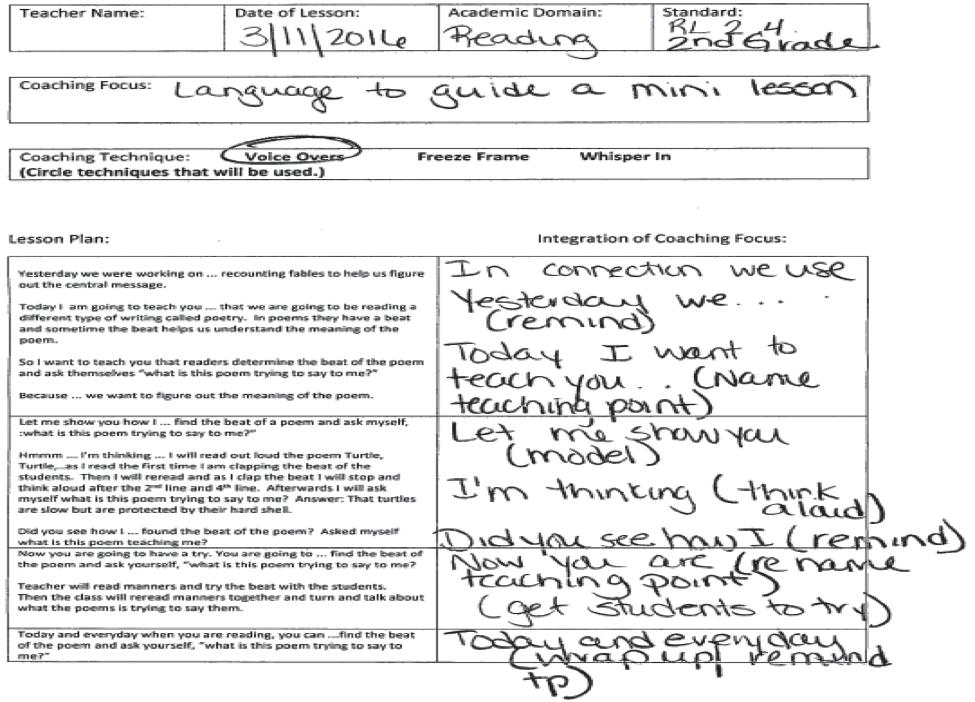
“In this first part of the mini-lesson called the connection, I started off by saying, ‘Yesterday we . . .’ I did this to remind the students of what we have been working on. Then I said, ‘Today I want to teach you . . .’ I did this to name specifically what we would be working on as a class. Also, this shows them how today’s lesson is connected to yesterday’s lesson.”
As the literacy coach is voicing-over the students to the observing teacher, the teacher was recording notes on the lesson plan that the literacy coach and Mrs. R developed before the lesson was modeled by the literacy coach. (See Figure 1. Classroom Teacher Notes.)
The literacy coach motioned back to the students that they would continue the lesson, then moved into the second part of the mini-lesson: the teaching point.
“Let me show you how I find the beat of a poem and ask myself, what is this poem trying to say to me? I will read out loud the poem ‘Turtle, Turtle’ and as I am reading I’ll start tapping the beat of the poem.”
The literacy coach proceeded to read the poem and tap on his leg.
“I am going to reread the poem and tap the beat. I will stop and think, what is the poem trying to say to me?”
The literacy coach reread the poem while tapping, this time pausing at certain beats to figure out what the poem is trying to say to him and communicating his thinking to the students. Meanwhile the teacher and the students are watching the literacy coach try out this new reading strategy.
The literacy coach continued,
“I am thinking that the poem is trying to tell me that turtles are slow and are protected by their hard shell.”
Many of the students nodded their heads as the literacy coach was wrapping up the second part of the lesson,
“Did you see how I found the beat of the poem?”
The students responded in unison with a “yes.” The literacy coach continued,
“Did you see how I asked myself, what is this poem teaching me and I used the beat to figure it out?”
Again, the students responded in unison, “yes.”
As the literacy coach wrapped up the second part of a mini-lesson, he asked the students to pause a second time. He proceeded to conduct another voice-over to the classroom teacher. Again, explaining teacher language in this second part of the mini-lesson.
“In this second part of the mini-lesson I started by saying, ‘Let me show you . . .’ and I modeled my teaching point. Then I said, ‘I’m thinking . . .’ and I thought out loud how to figure out what the poem is telling me by using the beat. Finally, I ended this part of the mini-lesson by asking questions to the class using the sentence stem, ‘Did you see how I . . .?’
I asked those questions to get students to notice the steps I took as a reader to figure out what the poem is telling me as a reader.”
The literacy coach continued on with the rest of the lesson and voiced-over two more times to highlight teacher language in each part of the mini-lesson for the teacher in observance. In Figure 1, the observing teacher took notes during each voice-over about teacher language during a mini-lesson. A post-observation discussion occurred between the classroom
1
Classroom
Teacher Notes
teacher and the literacy coach discussing how the observed lesson informed the classroom teacher’s literacy practices. In addition, the discussion led to setting up a plan for how the teacher would incorporate the language of a mini-lesson in future lessons and dates for additional lessons to be modeled by the literacy coach.
FIGURE
Summary
As literacy coaches continue to collaborate with scores of teachers across the United States and use the ILA standards to guide their interactions, they need specific techniques to support classroom teacher learning with regard to literacy best practices. Both Collet and TCRWP offer suggestions, but combined they provide the foundational framework for the type of coaching that is effective in a classroom setting for teacher learning. Literacy coaches using voice-overs provide
concrete models and explanations of what and how best practices in literacy instruction look and sound like in a classroom setting with students. Voice-overs require the literacy coach to initially be completely responsible for the “I do” component by delivering the information and teaching the lesson. When the voice-over technique begins, the classroom teacher has no other responsibility than to watch and take notes for later discussion. Over time the responsibility should shift to the classroom teacher as roles are reversed.
References
Blachowiz, C. L. Z., Buhle, R., Ogle, D., Frost, S., Correa, A., & Kinner, J. D. (2010). Hit the ground running: Ten ideas for preparing and supporting urban literacy coaches. The Reading Teacher, 63(5), 348‒359. doi:10.1598/RT.63.5.1
Cantrell, S. C., Madden, A., Rintamaa, M., Almasi, J. F., & Carter, J. C. (2015). The development of literacy coaches’ self-efficacy beliefs in a dual-role position. Journal of School Leadership, 25(4), 562–591. Calkins, L. (2010, January). Literacy coaching techniques. Teachers College Reading and Writing Project. Presented at the Literacy Coaching and Whole-School Reform Institute, New York, NY.
Collet, V. (2012). The gradual increase of responsibility model: Coaching for teacher change. Literacy Research and Instruction, 51(1), 27‒47.
Dean, M. J., Dyal, A., Wright, J. V., Carpenter, L. B., & Austin, S. (2010). Principals’ perceptions of the effectiveness and necessity of reading coaches within elementary schools. Reading Improvement, 49(2), 38‒51.
DiMeglio, R. A., & Mangin, M. M. (2010). Setting the standards: Role definition for a secondary literacy coach. Educational Leadership, 13(2), 5‒12. Fisher, D., & Frey, N. (2008). Better learning through structured teaching: A framework for the gradual release of responsibility. Alexandria, VA: Association for Supervision and Curriculum Development. Henson, R. K. (2001). Teacher self-efficacy: Substantive implications and measurement dilemmas. Paper presented at the annual meeting of the Educational Research Exchange, Texas A&M University, College Station, TX.
International Literacy Association. (2010). Standards 2010: Reading specialist/literacy coach. Retrieved from http://www.reading.org/General/Current Research/Standards/ProfessionalStandards2010/ ProfessionalStandards2010_Role5.aspx
Kissel, B., Mraz, M., Algozzine, B., & Stover, K. (2011). Early childhood literacy coaches’ role perceptions and recommendations for change. Journal of Research in Childhood Education, 25(3), 288‒303.
Matsumura, L. C., Garnier, H. E., & Spybrook, J. (2012). Literacy coaching to improve student reading achievement: A multi-level mediation model. Learning and Instruction, 25, 35‒48.
Poglinco, S. M., Bach, A. J., Hovde, K., Rosenblum, S., Saunders, M., Supovitz, J. A., & Consortium for Policy Research in Education. (2003). The heart of the matter: The coaching model in America’s choice schools. CPRE Research Reports. Retrieved from https://repository.upenn.edu/cpre_ researchreports/35
Rainville, K. N., & Jones, S. (2008). Situated identities: Power and positioning in the work of a literacy coach. The Reading Teacher, 61(6), 440‒448. Ulenski, A. (2017). Developing and validating the elementary literacy coach self efficacy survey (Unpublished doctoral dissertation). University of Central Florida, Orlando, FL.
Walpole, S. & Blamey, K. (2008). Elementary reading coaches: The reality of the dual roles. The Reading Teacher, 62(3), 222‒231. doi:10.1598/RT.62.3.4
When Accommodating Accommodations
Feels Overwhelming: Using Routines to Increase Literacy Learning in Elementary Classrooms
by Leigh Rohde and Cami Condie
Leigh Rohde, PhD, is an assistant professor in the School of Education at Salem State University. She coordinates the Master’s program in Special Education and the Graduate Certificate in the Autism Spectrum Disorders Program. Dr. Rohde teaches undergraduate and graduate courses that both use and teach about UDL strategies.
Every year, elementary teachers are required to meet the needs of an increasingly diverse group of students. The two most common categories of students who require targeted attention and accommodations are students with disabilities and those who are learning English as non-native speakers. Very often classrooms also have students who do not have diagnosed disabilities or identified language proficiency needs yet struggle with reading and writing. Meeting the needs of students with disabilities, English learners, and other readers and writers who are struggling requires increased planning and accommodations.
Teachers have long understood that they must shift their teaching practices to meet various needs of their students (Cormo, 2008). They know that their students may need to approach learning through a variety of methods in order for new content to make sense (Athanases, Bennett, & Wahleithner, 2015). Universal Design for Learning (UDL) principles carry this premise from teaching into learning by recognizing that just as students benefit from adaptive teaching, they also benefit from demonstrating their learning beyond traditional means (Gronneberg & Johnston, 2015). Requisite to this adaptive teaching is approaching assessing, planning, teaching, and checking for understanding in deliberate—and sometimes new—ways. Although there is no magic solution, well-taught routines can meet many of the diverse needs of learners. Many students (and teachers!) benefit from the predictability and structure of routines in the classroom
Cami Condie, EdD, is an assistant professor of Childhood Education & Care at Salem State University, where she is also the School of Education Program Coordinator. In addition, she is the coordinator of the Massachusetts Book Award. Cami is the cochair of the Exemplary Reading Committee for the Massachusetts Reading Association.
(Conroy, Sutherland, Snyder, & Marsh, 2008). Research suggests that teachers are more likely to continue using routines when they are seen as beneficial to the entire class, as well as the students who particularly benefit (Denning & Moody, 2013). These routines can vary from understanding expectations during independent reading to processes and schedules within writer’s workshop. Routines related to literacy practices can provide the same support for many students who benefit from knowing exactly what is expected of them (Reutzel & Clark, 2011). As students are held accountable for routines, they become more autonomous, learning how to self-regulate and advocate for themselves and their needs.
Routines in Action
For the last ten years, we have been learning from Mr. Paul (all names have been changed), a primary-grade teacher in New England, observing his literacy instruction over several long-term projects. Throughout this article, his effective classroom routines and purposeful literacy instruction are highlighted because of his ability to adapt and to include students with unique needs. Although this article deliberately focuses on his literacy routines and practices, the principles behind his routines and structures carried over into all aspects of his instruction and curriculum. The children described are composite profiles, but represent the learners in his classroom.
It’s November in Mr. Paul’s first-grade classroom. Misa is one of the first to arrive and grabs what she needs for breakfast and independent reading. After choosing a book from her browsing box, she takes a pencil from the table cup and writes the title on the next line. Tommy watches carefully as she writes. Although Misa is quiet, she smiles and points to the title of her book and then to her book journal where she wrote the corresponding title. She then takes a whisper phone from a bin on the class shelf, and begins to eat her breakfast while she whisper reads her leveled book. Tommy also chooses a book, writes his book title on the line following Misa’s example, and then heads to a rocking chair near the classroom library to read.
Because students know and understand the routine of independent reading during breakfast time, the morning begins smoothly in Mr. Paul’s room. Most students can follow the routine with minimal assistance, allowing Mr. Paul the time to greet everyone individually and manage any issues that need his attention. Misa is an English learner, and Tommy is identified as a student with a language processing disability. Like their classmates, they know their jobs as readers and go about their tasks before the school’s morning announcements.
Why Routines Work (and the Research That Supports Them)
We know routines help all students. Research suggests that students learn best when three conditions are met, specifically when students know and have available appropriate supports, when students are provided multiple means of demonstrating learning, and when students understand the clear expectations around systematic routines (CAST, 2018).
Students’ learning is increased when they know supports are available.
In Mr. Paul’s classroom, students are expected to return their books to their browsing boxes and gather at the rug for morning meeting. Rather than calling out these steps each day, students are explicitly taught so when the daily helper flicks the lights, they chorally sing, “Chairs pushed under. Books away. We are ready to meet today.” Tommy also has a picture card with each step next to his name tag for reference.
Mr. Paul frequently uses role play to model both an example and a non-example of the transition from independent reading to morning meeting. Some days he enthusiastically leads the song. Other days he might wander around looking confused. The children take great delight in reminding him of the routine as he “performs” the non-example behavior!
Mr. Paul has used many instructional supports to help his learners. Misa benefits from the role playing when he acts out the routines of the classroom. The non-examples, showing the “wrong way” helps her really understand the nuances of the routine that, due to her limited language, she may find confusing. The visual examples allow her to learn what to do and how to do it without having to rely solely on verbal descriptions (Wright, 2015). Although she nods and participates in all classroom activities, she often watches her classmates to cue where she should be or how to engage. Tommy knows what to do when the lights flick and uses the song and his picture card to remind him what he needs to do during this transition. Tommy’s picture card and the posted daily agenda feature real photographs of the class in each setting. For example, the reference for art class is a photo of the actual art room. By using real photos, students can see themselves (or former students) engaged in context minimizing the need to transfer or infer settings or behaviors. Although these supports specifically benefit Misa and Tommy, the picture supports allow the less proficient readers access to the information, and all students benefit from the reminders found in the transition song.
Like many teachers, Mr. Paul also has supports in his classroom to help students monitor and regulate their emotions. An inviting “Take a Break Space” is often a special chair looking out a window, as in Mr. Paul’s classroom, or is tucked in a quiet book area where students can take a deep breath, consider options for responses, or deescalate intense feelings. For many children, the idea of “taking charge” of their emotions, rather than their emotions controlling them, is both incredibly powerful and intimidating. Explicit instruction about recognizing changes in their emotions (e.g., when they are getting agitated or fearful) is an important first step in children learning to monitor their behavior. The Turtle Technique (Lentini, Vaughn, & Fox, 2005) teaches children to stop, breathe, and think about
positive responses to anger or frustration in a childfriendly way. Even very young children can learn to “tuck inside their shell” to take some deep breaths and consider their options when responding to a difficult situation. Routines that address emotional needs help young children self-regulate, teaching them important strategies they can use throughout their lives.
Students thrive when they have many ways to show their learning, particularly using nonstandard methods.
Often routines are the structures and formats that make learning smooth and seamless in terms of movement, finding supplies, or engaging in different parts of the day. Other routines can include the choices students have to demonstrate their learning, determined early in a teacher’s planning process. Planning to meet the academic needs of learners like Misa and Tommy actually begins during the lesson planning phase rather than just at the implementation of the lesson. The seeds of UDL were planted in architecture when builders recognized that planning accessible buildings (with ramps instead of stairs) was easier and more efficient than trying to find a place for a ramp after the building was completed. The same holds true in creating lessons. By considering from the start the many ways that students can demonstrate their understanding, accommodations are built into the lesson rather than as an extra step after the lesson is planned. Moving toward accommodations as the foundation of the lesson, rather than adding them as an afterthought or extension, becomes a way of approaching instruction that begins with the goal of meeting the needs of all learners.
Adding a few deliberate “routine steps” to the planning routine may help teachers be more cognizant of learners like Misa and Tommy. Misa needs language and content supports. Tommy needs cues and modification of his performance outcomes. Misa is benefitted by written steps with visual cues. Prior to the lesson, anchor charts used in mini-lessons can be created with text and picture supports. Photographs can also illustrate example and non-example routine behaviors on these charts. All of these supports benefit Misa as well as Tommy.
Although Tommy’s specific needs are unique, similar processing difficulties are common in many classrooms. Meeting Tommy’s needs begins at the
planning stage when setting the purpose of the lesson. Starting from a teacher’s clear goal, many students will demonstrate met objectives if they can show their learning from an array of choices. If the goal of the lesson is reading comprehension, teachers can plan for students to show understanding by acting out parts of the text to a classmate, drawing the problem and solution in the text, retelling important facts learned, or writing about reading. Initially, the menu of comprehension activities may contain a limited number of choices with more options added as students (and teachers) become more comfortable with these creative options. These choices allow Tommy, as well as other classmates, the opportunity to show what he knows.
Accommodations for Tommy and other students with similar needs in writing may require additional supports. If the goal of the mini-lesson is for students to brainstorm ideas, Tommy can use pencil and paper, type on a keyboard, dictate using voice-to-text software, or create and then group word cards by characteristics or commonalities. Although not the typical brainstorming web or circle map, these options allow Tommy and other learners the opportunity to participate in ways in which they will be successful. As a second writing example, if students are asked to demonstrate understanding of sequential order, non-standard options may include sequencing pictures in order, creating a how-to book only with illustrations, or orally using targeted transition words as sequenced pictures are described. Particularly for students with learning disabilities, outcome performance may be modified but the objective and goal for the lesson is the same as their peers. If students show their learning in the same way, teachers may see an incomplete view of what all students can achieve. The more we allow for a variety of ways of expressing learning and understanding, the more we will see what students are actually capable of accomplishing and demonstrating.
Students thrive when they have clear and consistent expectations as well as known standards for meeting expectations (Kearney, Smith, & Maika, 2016).
When students understand how and when routines are used, in what manner a task should be performed, and why the practice will improve their learning, they are
more likely to incorporate the practice independently (Bryk, 2010). Not surprisingly, when learning environments are structured, including reinforced expectations through rules and routines, there is a reduction in challenging behavior and increased engagement of students (Turner & Patrick, 2004).
Mr. Paul’s students know how and when to perform various tasks. We can imply that students also know why they are using the supports because they use them deliberately, such as when Misa grabbed her own whisper phone when she needed it during independent reading. The results of clear, well-known, understood guidelines are students who are more adept and flexible problem-solvers. Yet even when routines are successfully in place, Mr. Paul will still need to quietly remind individual students about his expectations. Clearly, it takes effort and patience to provide reminders over and over again.
Gentle nudges toward the available supports and acceptable expectations help students take steps toward more autonomy and self-advocacy.
After reading the Morning Message with students, Mr. Paul pulls two “random” browsing boxes off the shelf to begin his brief review of the quantity of books in their browsing box. He begins by making a puzzled expression as his eyes travel from the boxes to the children, and asks,
“What do you notice about these two browsing boxes?”
Julie raises her hand and identifies that one is nearly empty and one is overflowing. Pointing to the list of browsing box “rules” posted on the shelf, she reads the rule that is accompanied by two pictures of a browsing box—one overflowing with a red X over it and the other picture with the number five and a smiley face next to the picture of a browsing box with five books. Mr. Paul continues,
“Why is having at least five books in our browsing box important?”
Misa cautiously raises her hand and says she always likes having more choices and to reread books after guided reading.
Tommy asks how many books he can put in his box.
Mr. Paul winks at Tommy and holds the overflowing browsing box. While thinking aloud, Mr. Paul says,
“It’s hard for me to take a book out of my box today. And, I’ve read these two books so many times I don’t have to think about them when I read. I can switch them for a new book that will help me use my strategies and get better at reading. I want to have at least five books, but I know it is too many books if it is hard to take one out of my box.”
Tommy smiles and gives Mr. Paul a thumbs up.
Mr. Paul continues,
“First-grade readers, at least how many books should be in our browsing box? And, where can we look to remind us if we forget?”
The class chorally says, “Five” and points toward the chart on the shelf.
Mr. Paul’s quick review of his expectations both reminds and re-teaches students how to check their browsing boxes, what an appropriate number of books is, and why the browsing boxes are used. This review also reminded Tommy where the rules were posted with visual clues related to the browsing boxes. In a matter of minutes the what, how, and why were reviewed. An important part of this review will be Mr. Paul’s checking on students’ boxes later that day and praising or nudging individual students to remember what they reviewed that morning.
First Steps in Creating Routines
There are a multitude of daily tasks that are critical to every classroom. Books are finished and need to be exchanged in the classroom library, pencils break or need sharpening during writing, materials for lessons need to be distributed throughout the day. With the quantity of structures and routines students engage in every week, there will be times when some routines are simply not working effectively. This may be due to the lack of necessary supports for some students. Other times, the routine does not match the needs of the task or situation. Examining data during times when an activity is not running smoothly may point to the cause and a potential solution.
Collecting classroom data
It is recommended that teachers begin by identifying two or three times in the day where there is a disruption in the flow or learning and collect data on what they observe. To examine what is happening during these instances, collecting data in small time increments can provide insight into what students are doing and for whom the current routine is (or is not) working (Park, St John, Datnow, & Choi, 2017). Admittedly, we use data in a broad sense including informal, classroom-level observation (which we argue is the most important and valuable kind of data!). Serravallo (2014) suggests creating a table with students’ names down the left and five- to ten-minute time increments listed across the top. At each point, the teacher notes particular students’ engagement in the activity. Notes during independent reading time may include engagement and distraction data, such as (R)eading, (I)nteracting with text, e.g., sticky notes, (L)ooking out window, (S)witching texts, (T)alking to classmate, or (O)ut of seat. During writer’s workshop, notes may include: (W)riting, (R)eading own written text, (L)ooking at classmates, (O)ut of seat, (P)eer conferencing with classmate, or (U)sing resources, e.g., editing checklist. Looking for patterns or individual needs that emerged from the collected data is the next step.
Identifying the need for a new routine
The collected data can help identify where a routine is needed and can reinforce or negate assumptions. It may be quiet during writing workshop, leading a teacher to believe all students are busy and engaged. In Mr. Paul’s classroom, we might see many students who appear to be on task, yet the data can add insight revealing that some students are looking at a blank page without a pencil in their hand. Closer inspection could show that Misa has been quietly looking at neighbors for cues as to what she is supposed to be doing, and Tommy has asked to use the bathroom, something he is doing daily during independent writing. The patterns from the collected data can identify disruptions, delayed engagement, or hidden disengagement.
Data can also identify the barriers that are keeping students from participating in group or individualized lessons, such as not knowing where to find more paper or who to partner with during Turn and Talks. Data
can also alert teachers to deeper issues that need closer inspection: Why might students not be engaged in reading or writing? Is a mini-lesson needed to remind students about whisper phones and other reading tools? As a specific example, when teachers notice a lack of student engagement during instruction, they can evaluate the resources and students’ access to these resources in their classrooms. The answers may lead to instructional changes regarding the environmental supports available within the classroom:
• Do students know where the resources (e.g., pencils, whisper phones, classroom library sign-out sheet) are in the room? Do they know when to use them?
• Do students know how to use the resources (e.g., logging onto the computer, managing their own browsing box)?
• Are the available resources helpful (e.g., anchor charts, picture steps on a browsing box)? Are there too many resources so students don’t know when to use each one (sensory and option overload)?
• Is the organization of the classroom working? Are resources returned to their proper place? Are there bottlenecks or long wait times?
• When do students ask questions about process, content, or expectations? Could a mini-lesson be taught (or retaught) to address frequent questions?
• Are there routines in place for peer interaction, particularly for learners who may be new to the school culture or are more hesitant speakers?
• Are students matched in strategic ways for turn and talk and elbow-to-elbow/ knee-to-knee reading (e.g., partnering English learners with deliberate partners)?
Establishing a New Routine
Beginning a new routine takes time and explicit language and instruction, particularly for students like Tommy who may need additional time to process new information. Careful consideration of how much new information to share at once is warranted to ensure that students are not overwhelmed. Rolling out one routine and establishing its use in the classroom before
introducing another is far more successful than instituting many changes at once.
Mr. Paul introduces and reviews routines in the same sequence every time. (Even his instruction is “routined!”) To begin, he posts a T-chart with one side reading “What it looks like” with an eye icon. The other side is labeled “What it sounds like” with an ear icon. The “looks like” instruction includes 1) describing why the routine needs to be followed (or refined), 2) modeling the routine with actual students, 3) oral descriptions of behaviors, and 4) written words and quick sketches recorded on the T-chart to become an anchor chart until the routine is well-established.
The “sounds like” instruction explicitly refers to a class Noise-O-Meter that indicates the volume of voices used in the classroom for various activities. The NoiseO-Meter ranges from soft to medium loud. Colors and words are used for each sound level. Red indicates silent voices like during independent reading. Orange reminds students to use whisper voices with a partner. Yellow indicates group voices to be heard only at the group’s table, not across the room. And finally, green suggests inside, “lab” voices. This Noise-O-Meter was explicitly taught and practiced beginning the first day of school and is used during every routine explanation. It also serves as a reminder. Simply holding up the meter as he approaches a partner team is a nonverbal reminder to students that Mr. Paul would like them to check their voices and adjust their volume to the appropriate level. Explicitly teaching students the “sounds like” expectation and how it changes for different activities and routines allows students to self-regulate according to Mr. Paul’s and the class’ established expectations. Mr. Paul’s T-Chart makes his expectations clear and known. Following the same instructional sequence every time he teaches or reteaches a routine allows students to focus on little changes because the sequence is consistent and familiar. Posting the T-Chart temporarily as an anchor chart provides students with reminders as necessary.
After teaching a routine, Mr. Paul uses peer mentors to teach other students their classroom routines and expectations.
One Monday morning Tommy approaches Mr. Paul and asks what his job is that day. Mr. Paul kindly asks, “Where do we check for our jobs?”
Tommy thinks for a second, looks around, and then points to the job chart. Antonio comes over to assist Tommy in his new job. As this week’s lunch counter (and buddy), they know where to find their supplies— the lunch count form and a pencil, check the count with Mr. Paul, and return from the cafeteria quickly, ready to grab their own browsing boxes and begin independent reading.
Importantly, Mr. Paul prompts rather than telling Tommy the routine. He uses questions to direct Tommy’s attention to supports. Mr. Paul also knows that the best indicator that a routine is working is if students can teach each other what, how, and why a routine or structure is in place. Students can, and should, be included in establishing new routines and reviewing those structures and expectations that need fine-tuning. Using students as mentors builds autonomy, responsibility, and community in the classroom and ensures that the routines are continued by those who need them the most.
Helping students anticipate changes to routines
Routines are particularly helpful and important for those students who thrive on consistency and knowing what comes next. Once routines are in place, these learners can turn their full attention to the work at hand rather than becoming anxious because they do not know what to expect. Yet, despite all of our good intentions in providing a dependable environment, change happens. A whole school assembly, a forgotten backpack, an absent friend, indoor recess, even school vacations can wreak havoc on our students who depend heavily on schedules and consistency.
On Friday morning, Mr. Paul learns that the class volunteer who comes each Friday to read with children is sick. He anticipates that this change will impact many of his students and announces this change to his students by saying, “First graders, we have a ziggle zaggle today!”
He then explains how reading workshop will proceed that day without their volunteer reader.
Ziggle zaggle, a term often used in the autism community, refers to a bump or shift in schedules or expectations. The purpose of the term “ziggle zaggle” is to use a consistent phrase to let students know that a change is coming and that everything will be okay. Teachers indicate that there is a ziggle zaggle—usually communicated in an upbeat voice, paired with “and that’s okay”—to signify that changes are inevitable and learning can still happen. Teachers can use the phrase during a more significant mishap (computer crash or loss of the power) or to describe a slight shift, as when a lesson goes longer than usual or a visitor enters the classroom.
Principles to remember when teaching routines
Using routines in the elementary classroom can build a more autonomous and resourceful group of learners. Harmony prevails when students know what is expected of them and can access the necessary supports to carry out those expectations. The following principles can help ensure that the established routines in your classroom are successful.
Routines need to be taught and retaught. It’s easy to fall into the comfortable assumption that students know what you want them to do. As mentioned, the specific steps must be clearly identified and articulated. Role playing examples and nonexamples (using humor!) and using peers as mentors are particularly effective. Reviewing, or even reteaching, routines is likely to be necessary after even the smallest breaks in the schedule. This may mean reviewing the class rules every Monday morning, after a school vacation, or when a child has missed several days of school due to illness.
Consistent practice is necessary in developing routines (Lally, van Jaarsveld, Potts, & Wardle, 2010). Using multiple modalities in the supports (e.g., visuals
on anchor charts or oral rhymes) can reinforce the routine more quickly and easily. As Mr. Paul demonstrated, teachers can use a mini-lesson format of dedicating five minutes to rehearse a routine that has become stale or adding some nuance to one that needs full-class attention.
Routines will evolve over time as students gain independence and autonomy.
As routines become well-known to students, they will be able to manage more responsibility for their actions and behaviors. The complexity of expectations can, and should, increase over the course of an academic year as well as across grade levels. Mr. Paul started the school year with logistical literacy routines, like teaching his young students where to put their browsing box, how to transition to morning meeting, and when to continue a written piece on a new sheet of paper. Yet as the school year progresses, the goal is for students to do more and more with appropriate teacher supports. For example, Mr. Paul’s reminders related to routines may transition from whole group review to whispered prompts as we saw in the earlier example with Tommy. Increasing student responsibility may include working with students to set individual goals for smoother transitions with browsing boxes or more time on task during writing workshop. Students may also participate in “rating” their individual performance during a routine or engagement during independent writing with a simple thumbs up for meeting criteria, thumbs to the side for okay, but inconsistent performance, or thumbs down for needs improvement. All “rating” opportunities should be followed by a discussion of what the “thumbs up” goal looks like and ways to achieve the high mark next time. This conversation allows students to self-evaluate their role as a learner and participant and to articulate what they understand the expectations to be. It also reinforces the targeted routine and encourages students to set individual goals for next time.
Routines need to make sense.
Teachers must make decisions carefully about routines that will actually enhance the learning in their classroom. Routines work best when they are carefully constructed to address a need in the classroom (Denning & Moody, 2013). It is important to create routines that
can be followed and that make the classroom run more smoothly or they are sure to be abandoned or ignored. Some barriers to ensuring routines work are logical: If students cannot reach the top shelf, materials they are expected to use should not be stored there. Other barriers may be less noticeable until there is conflict: there is sure to be disharmony in a classroom that has limited resources and no structure to make sure the items are shared equitably. Barriers may be anticipated or gleaned from data collection, yet often surprise us as teachers and require in-the-moment decision making.
Routines need to support all learners and work for those with specific needs. Teachers can address barriers and provide better access to content when they consider the factors that inhibit their students with exceptional learning needs from learning or demonstrating their learning (Willner & Monroe, 2016). Students who need explicit instruction, practice, or a longer time to process are accommodated within the structure of the classroom through the process of developing and teaching routines. For students who need extra practice, teachers can use those children as the role play models. Students who need processing time can be the ones to point to the steps on an anchor chart. Wait time is one of the easiest and most effective ways to support exceptional learners in the classroom (Rowe, 1987). An extra two to three seconds allows students to formulate their responses, call on their courage, or pay attention to not blurting out an answer. By including wait time in the routine of whole group
responding, students learn that everyone can contribute, not only the ones who can answer quickly.
The Possibilities
The heart of teaching is meeting learners’ needs and teaching students to become lifelong learners. For many teachers, this desire to move every learner forward can feel overwhelming when there are so many learners and so many ways they need supports. Importantly, carefully chosen and taught routines can be the difference between struggle and success for our young learners (Simonson, Fairbanks, Briesch, Myers, & Sugai, 2008). Routines around finding supplies and using supports build autonomy and develop student-driven problem solving. Routines around movement and expectations ensure that transitions are smooth and timely and reduce the time a teacher needs to spend giving (and repeating) directions. Routines describing expectations and acceptable performance allow students to understand the criteria for participation and engage in learning with confidence. Routines in instructional sequences enable learners to focus on little changes or nuances. Routinely planning for learners to demonstrate learning in a variety of ways provides space for teachers to teach sophisticated thinking while allowing performance to be differentiated. Planning for the accommodations that students need and using routines to develop self-selected accommodations can decrease the class’ reliance on the teacher and encourage more autonomy in the classroom.
References
Athanases, S. Z., Bennett, L. H., & Wahleithner, J. M. (2015). Adaptive teaching for English language arts: Following the pathway of classroom data in preservice teacher inquiry. Journal of Literacy Research, 47(1), 83‒114.
Bryk, A. S. (2010). Organizing schools for improvement. Phi Delta Kappan, 97(7), 23‒30.
CAST. (2018). Universal design for learning guidelines version 2.2. Retrieved from http://udlguidelines.cast.org
Conroy, M. A., Sutherland, K. S., Snyder, A. L., & Marsh, S. (2008). Classwide interventions. Teaching Exceptional Children, 40(6), 24‒30.
Cormo, L. (2008). On teaching adaptively. Educational Psychologist, 43(3), 161‒173.
Denning, C. B., & Moody, A. K. (2013). Supporting students with autism spectrum disorder in inclusive setting: Rethinking instruction and design. Electronic Journal for Inclusive Education, 3(1), 1‒22.
Gronneberg, J., & Johnston, S. (2015). 7 things you should know about universal design for learning [Brief]. Educause Learning Initiative. Retrieved from http://www.educause.edu/library/resources/7things-you-should-know-about-universal-designlearning
Kearney, W. S., Smith, P., & Maika, S. (2016). Asking students their opinions of the learning environment: An empirical analysis of elementary classroom climate. Educational Psychology in Practice, 32(3), 310‒320.
Lally, P., van Jaarsveld, C., Potts, H., & Wardle, J. (2010). How habits are formed: Modelling habit formation in the real world. European Journal of Social Psychology, 40(6), 998‒1009.
Lentini, R., Vaughn, B. J., & Fox, L. (2005). Teaching tools for young children with challenging behavior. Tampa, FL: University of South Florida, Early Intervention Positive Behavior Support.
Park, V., St John, E., Datnow, A., & Choi, B., (2017). The balancing act: Student classroom placement routines and the uses of data in elementary schools. Journal of Educational Administration, 55(4), 390‒406.
Reutzel, D. R., & Clark, S. (2011). Organizing literacy classrooms for effective instruction. Reading Teacher, 65(2), 96‒109.
Rowe, M. B. (1987). Wait time: Slowing down may be a way of speeding up. American Educator, 11, 38‒43.
Serravallo, J. (2014). The literacy teacher’s playbook, grades K‒2. Portsmouth, NH: Heinemann.
Simonson, B., Fairbanks, S., Briesch, A., Myers, D., & Sugai, G. (2008). Evidence-based practices in classroom management: Considerations for research to practice. Education and Treatment of Children, 31(3), 351‒380.
Turner, J. C., & Patrick, H. (2004). Motivational influences on student participation in classroom learning activities. Teachers College Record, 106, 1759‒1785.
Willner, L. S., & Monroe, M. (2016). Using a “Can Do” approach to ensure differentiated instruction intentionally supports the needs of language learners. Retrieved from http://www.colorincolorado. org/article/using-can-do-approach-ensure-differentiated-instruction-intentionally-supports-needs
Wright, W. (2015). Foundations for teaching English language learners: Research, theory, policy, and practice (2nd ed.). Philadelphia, PA: Caslon.
Rhetorical Listening: The Role of Silence in the Teaching of Writing
by Eamon Cunningham
Eamon Cunningham is the English Department Chair at Milford High School and a member of the English Department at Framingham State University. He has written a textbook on rhetoric and composition, Understanding Rhetoric: Argumentation, that is forthcoming in late 2018.
Arguing for the role of silence in writing instruction is a tall task. To even imagine a rhetoric of silence at all might seem peculiar to many in our culture, given the American tendency to overvalue speech and laud those who “speak from the heart” and “say what’s on their mind” (Glenn, 2009, p. 263). Culture aside, there also exists a deep human element to “keep things moving in a class,” a deeply held social pressure that puts speech and dialogue—the perceived engine of any good classroom—front and center. What’s more, the delicacy of conversations with students surrounding something as personal as writing can quickly give way to feelings of exposure and vulnerability, just the thing to make even the best classrooms collapse down into the wrong kind of silence. Despite these challenges, strategically-placed silence can “just as a blurted-out statement or an alleged misstatement can reveal us positively or negatively, so can our silence, whether controlled, instinctive, or imposed. Just as we use words to obfuscate meaning or to buy time, we use silence, sometimes productively, sometimes not—just the way we use speech” (Glenn, 2009, p. 263). The focus of this article is to describe the conditions that promote a generative and purpose-driven silence in the classroom—rhetorical listening—that promotes effective cognition and (strange though it may sound) communication during the process of writing instruction. That is, if properly presented, rhetorical listening can help to transform the “I don’t knows” into worthwhile and meaningful discourse.
First, a bit of background. A few years ago, I decided
to conduct one-on-one writing conferences with my senior students for a paper on Sophocles’ Antigone (442 B.C.) One of my students, “Angela,” an English language learner, had a number of issues that made both reading and writing laborious for her. She had mentioned earlier in the year that her immigration to the United States had sapped her confidence as a student especially in her English class. Since enrolling at my high school, she rarely spoke in any of her classes, despised reading, and really despised writing about those readings. (This is on top of the general intimidation Angela faced surrounded by confident, native-speaking students). All these pressures came to a choke point in our conference session; she seemed terrified by the prospect of sitting down and talking about her writing in a one-on-one environment where there was nowhere to hide. I asked Angela to discuss her work with me, which she did with noticeable reluctance, straining to explain her thinking in the same broken flow as her writing. Noticing her reticence, I began to fear for the health of the session and I broke the growing silence with a well-intentioned, but misguided, explanation of my desire to help her confront and overcome her reservations to speak, to which she responded with a mix of exasperation and misery. The session continued. I spoke more; she spoke less. The dead air void was filled by chatter; I spoke, but really said nothing. By the time we ended, it was less of a conference and more a barrage of teacher-led chatter that shut Angela off from any type of meaningful role in the dialogue.
What went wrong? My understanding of silenceas-failure reflects prevailing assumptions in education that privilege vocal participation and interpret student silence as a sign of disengagement to be somehow conquered by the teacher. For most teachers, there is a strong tendency to internalize student silence as a mark of their own failure. For most administrators, there is an inordinate fixation on silence as the students’ failure
to meet our expectations since “inevitably someone must be held accountable for the perceived failure that is marked by silence” (Reda, 2009, p. 6). This is what I failed to realize at the time: “The stupendous reality is that language itself cannot be understood unless we begin by observing that speech consists most of all in silences. In The World of Silence, Max Picard asks us to educate ourselves to the fact that silence and language work together, each shaping and generating the other in a natural dynamism of meaning-making” (Glenn, 2009, p. 263). However, the contemporary emphasis on voice and vocal participation in student-centered pedagogies blind its adherents to the potential of silence as “the space, the energy, and the mindfulness of mental engagement” (Reda, 2009, p. 158). In many cases, the real work in the writing process takes place in the silences between the speech, and it’s important to remember that “silence is not, in itself, necessarily a sign of powerlessness or emptiness; it is not the same as absence; and silencing for that matter, is not the same as erasing. Like the zero in mathematics, silence is an absence with a function” (Glenn, 2009, p. 263). If only I had given Angela some silent space, things may have turned out quite differently.
The practice of “rhetorical listening”—a concept outlined by the work of Cheryl Glenn and Krista Ratcliffe—has encouraged me to examine my attitudes towards student silence in the context of the writing instruction space and to debunk the equation of silenceas-failure in lieu of silence-as-discovery. It’s important to be explicit about one thing at this point: all silence is not worthwhile. To be sure, sometimes a lingering silence can impede progress and sap energy from a class session in a way that over-speaking never could. With meaningful silence—rhetorical listening—“the question is not whether speech or silence is more productive, more effective, more appropriate; rather, it is one of a rhetoricity of purposeful silence when it is self-selected or when it is imposed. When silence is our rhetorical choice, we can use it purposefully and productively—but when it is not our choice, but someone else’s for us, it can be insidious, particularly when someone else’s choice for us comes in the shape of institutional structure” (Glenn, 2009, pp. 263‒264). So, how can teachers of writing create a situation where rhetorical listening is appropriate and functional?
Rhetorical listening lends itself very well to moments in student work where the conceptual and abstract components of their diction stumbles and falls; that is, questions posed by the teacher that have an inferential or synthetic component to them are prime ground for productive questioning that requires focused wait time. As a teacher, “building processing time into lessons has long been the standard in special needs classrooms, but every student, regardless of learning pace, benefits from think time” (Roake, 2013, p. 1) and expecting a quick answer to a question that requires time to process (i.e. a question about an abstract concept or underlying assumption to an argument) is not entirely realistic if one expects an answer that will lead somewhere worthwhile. As Kenneth Tobin (1987) notes, “in order for teacher discourse to influence student learning, the information contained in the discourse must be cognitively processed by the learner. As a consequence, the rate at which information is presented should be matched with the cognitive processing capabilities of students. Processing time for cognitively complex discourse is expected to be greater than the time required to process less complex information” (p. 69). Easier said than done. So how might you do this?
In my experience, the best student yield in “wait time” scenarios come from questions that begin with some concrete place in the text—in order to provide the student with some point of orientation—that eventually shift into more generative realms of abstraction and synthesis. In the context of writing instruction, rhetorical listening begins by posing reflective questions that are initially tied to the text. To find these places, teachers may first ask the student to read their own work and mark out passages that seem to be problematic (or “not flow” in student-speak), for some reason, even if they are not entirely sure why at the moment. This type of self-reflective analysis has a two-fold benefit for the student. First, the student will feel as if they have some control over error-identification process, which should help to lessen feelings of vulnerability and exposure since they, not the teacher, are the one identifying the initial starting points. Second, the subsequent discussion and dialogue should be seen as an outgrowth of the place the students themselves have chosen where they can throw their thoughts and experience into the mix with more confidence and ease. (If the student is
Quote From Student Work Procedure of Questioning
Changing our living habits, high standards of life and tissue engineering has increased our life spans and some day we may become immortal species. But I believe if we are willing to live a long time, we must carry our capacities to be able to maximize the efficiency of this opportunity
“WHERE” COMPONENT: As we read the work together, we identified two problematic phrases in the paper’s argument (underlined) the concrete “our capacities” and “maximize the efficiency of this opportunity.” This was the starting point that was rooted in the text.
“WHY” COMPONENT: After these words/phrases were identified, I posed the reflective question of “what capacities are you referring to, but (more importantly) how would this change what it means to be human? Let me think about this for a minute as well.”
WAIT TIME: I allowed a few minutes to think about this issue. But to minimize the pressure, I also participated in the reflective process. Afterwards, we discussed each of our answers and we dialogued about the pros and cons of our responses, which were then folded back into the argument.
especially deficient at identifying shortcomings in their own writing, this may be a place for the teacher to read the paper and model, by narrating their thinking outloud, why a particular passage may not function properly). Once a few starting points have been identified as potential passages for revision, the teacher may then want to think about what type of questions they are going to ask to elicit the most productive response from the student.
Questions that foster rhetorical listening should have a few ready-made components to them. Each question should to have two parts: a “where” part (where explicitly in the text is the problem area?) and a “why” part (why has the author done this and can this purpose be clarified?). Most places where think time is needed result from vagaries in student writing, things they may have written down before they have given the idea its due consideration. Figures 1 and 2 contain snippets from student writing for a research project in an advanced level composition class. Selections from the student paper appear in the left-hand column and an explanation of the “where/why” questioning dichotomy in the right-hand column. The questions begin in the concrete before moving to the abstract and the conceptual. Following this two-pronged strategy is
an explanation of how a wait time period allows for thought, reflection, and introspection in order to strengthen student writing.
I do not wish to present these two examples as definitive proof that trying to pose questions with an attention to rhetorical listening will be successful in all cases, scenarios, and contexts. But, this practice will help students take a few confident steps forward to becoming the writer who attends to the specific and concrete; who notices the small details of what he is discussing; who notices which points in his argument need to come first; who knows how to seize the reader’s attention; who clears away trash; who states his thesis explicitly. When teachers assume that student silence always signals reticence or a failure to communicate, they unfairly discount the productive, engaged silences that many students prefer. Further, they overlook opportunities to engage students in all the ways productive silences can deepen their understanding of the material, make them better listeners, and, ultimately, make them self-sufficient writers who take the time to craft their responses carefully while examining their own positions and underlying assumptions to those positions. Teachers attuned to these concerns can play an active role in teaching this: those who “seriously engage with
2
Quote From Student Work Procedure of Questioning
Apple Company is a well know corporation that has been giving out new devices almost twice a year since 2007. Many of Apple’s inventions became popular right after they were released to the Market. Same thing happened to its latest products iPhone 5S and 5C. The innovation that was put into new iPhone is the fingerprint scanner that can scan the owner’s finger pattern and unlock the device without entering a 4 digit pass code. Casey Newton in TheVerge.com wrote that, “era of one-tap authentication is about to begin,” (Sep. 24 update). But along with this new property has risen many questions that may or may not be answered.
“WHERE” COMPONENT: Unlike the previous excerpt, the explicit issue (underlined) was marked out in the professor commentary with the word “unclear” written in the margins. In essence, the student didn’t have to find the problem area; it was found for them. Nonetheless, our line of questioning began at the level of explicit.
“WHY” COMPONENT: I noticed the student had an iPad so I asked a personal question, “Do you think convenience is a trade-off for potential misuse of personal data? Think about it for a second while I take a look at some of the other paragraphs.” In essence, I was asking the student to clarify an ambiguity in the statement or argument. In doing so, he would need to analyze his own assumptions on the issue. Once settled on, this would ultimately help to clarify the paper’s argument.
WAIT TIME: The wait time here was constructed under the guise of me, the teacher, needing to take time to perform another task while the student thought about the posed question. As it looked like I was performing another task, the student had no choice but to mull over the question I posed to them a few minutes earlier.
their own acts of listening, figuring out just what kinds of listening are at work in their tutoring, move from resisting theory to theorizing for themselves” (Bokser, 2005, p. 47). While it is true that teachers have a responsibility to sometimes provide direct instruction in the teaching of writing, there often exists a greater charge; that is, it is the teacher’s duty to help all students to function in an environment where their own silence and meditation are put to use in productive ways. After all this, I’m brought back to Angela. Were I to do it all over again, I would certainly be glad that the
clarity and precision of her writing improved somewhat over the course of the semester, but if I had a chance for a second time around, I would remove myself a little more from the equation in order for her to become comfortable with and learn to enjoy the conversation going on inside her head that silent, wait time provides room for. I would hope that Angela would learn to see her silence differently—to see it as a space of opportunity and potential and not as a sign something has broken down along the way. In retrospect, I know that I have.
References
Bokser, J. (2005). Pedagogies of belonging: Listening to students and peers. The Writing Center Journal, 25(1), 43‒60.
Glenn, C. (2009). Silence: A rhetorical art for resisting disciplines. JAC Journal, 22(2), 261‒291. Ratcliffe, K. (1999). Rhetorical listening: A trope for interpretive invention and a code of cross-cultural conduct. College Composition and Communication, 51(2), 195‒224. Reda, M. M. (2009). Between speaking and silence. New York, NY: SUNY Press. Roake, J. (2013). Planning for processing time yields deeper learning. Education Update, 55(8), 1‒6. Tobin, K. (1987). The role of wait time in higher cognitive level learning. Review of Educational Research, 57(1), 69‒95.
Reading a Book and Riding a Bike. Both Require Automaticity: Action Research Conducive to Automaticity for Learning
Abstract Words in K–2
by Marlene Custodio
Marlene Custodio earned a Masters as Consulting Teacher of Reading from Framingham State University. In 2017, she received the Sylvia D. Brown Scholarship from the Massachusetts Reading Association to pursue action research entitled H.E.A.L., Help Ease Abstract Learning. Marlene teaches second grade in the historical small town of Sherborn, MA.
Canyou imagine reading a book or engaging in conversation without using the many irregular words in our language like a, is, the, when, if, or and ? How clear would our language and conversations be if these irregular words were not a part of our language? How well does a student comprehend when they struggle with these irregular words? Many reading programs and instructors label these words as functional, irregular, trigger words, or Red Words, Trick Words, or Ring Words. Mr. Edward Dolch himself evaluated thousands of words and narrowed them down to a 220word selection that we know as the Dolch Word List (Dolch, 1942). Any way they are labeled, most of these trigger words (Davis, 1994, p. 20) are abstract in definition as well as readability. Irregular words comprise 60 percent of the words found in student texts. Instant recognition is essential for students to become fluent readers (Falcon & Simms, 1985). Irregular or “abstract words” have little or no meaning and are very difficult to read, comprehend, and remember and yet our language requires the use of the words as the glue that holds all our other words together for comprehension. Abstract words are functional words necessary to complete our thoughts and sentences in speech and in text. Ronald Davis (1994, p. 22) explains that when a student with dyslexia reads the first word /The/ (in a sentence), the mental imagery goes blank, because there is no picture for it. By the time an individual with
dyslexia struggles with the same word three times, his or her focus, attention, and interest have dissolved. As the student continues to read, the text loses meaning to the reader. The reader will continue to make reading errors through omissions and substitutions. Comprehension will diminish or the facts in the story will be missed, distorted, or rearranged. Eventually, the reader will lose all interest in reading any material. Davis makes the observation regarding the student, “He is now expending a tremendous amount of effort and energy on concentrating, just to continue” (1994, pp. 23–24). In the end, the student feels dizzy and the words appear to be swimming on the page. The student is exhausted and internally frustrated and has no interest to read any more. The student is “just thankful that he survived the ordeal of reading out loud” (Davis, 1994, p. 24).
A similar comparison made by Lyon (1997, p. 18) is a student with dyslexia learning to read is comparable to a child learning to ride a bike knowing he must hold the handle bars with both hands and push the pedals with both his feet to obtain speed and balance the bike all while keeping his head up and looking around so as not to crash into anything or anyone. Reading fluency can never be mastered when students must stop, think, decode, and make connections without automaticity in the same manner that riding a bike cannot be successful with only one variable in place.
How often do we instruct our students to create an image in their head to accompany their reading or listening? Students are instructed to use rules of phonics and segmentation of words. Decoding and encoding is successful when each and every letter makes a sound. Students with reading disabilities use these phonetic rules to sound out unknown words. And even though letter-sound relations will become concrete to the students with dyslexia over time, phonological processing is difficult for them (Davis, 1994, pp. 39–40). So, when abstract words appear in text, the difficulty and
frustration students experience is because there is no imagery for many abstract words and these words cannot always be read using phonics. Many abstract words have no spelling strategies or phonological rules other than to memorize the letters within the word.
Students are unable to make any visual connection to abstract words as a memory tool. Interactive and sensory spelling strategies are often used by students and instructors to secure the spelling of words that cannot be phonetically spelled.
Students can trace an abstract word over and over and over again without ever understanding the meaning of the word. Teachers can drill students every day of the week without the students ever demonstrating success in reading the words in text. There is no rhyme or reason behind these letters that together do not phonetically sound like anything nor can a student define or visualize the word. The student with reading difficulties experiences play in the sand box, magic on the gel board, and flipping cards on a ring to always encounter words that are abstract in understanding.
Students struggling with reading, especially those with dyslexia, experience and demonstrate their biggest struggle learning the abstract words. These meaningless unphonetic words are so difficult to decipher that they get confused and lack interest in reading. Struggling readers enter a downhill slide of reading and comprehension. The difficulty students with reading disabilities often experience when reading begins slowly but overtime becomes cumulative until there is total confusion and zero comprehension (Davis, 1994). Davis reported stages of reading for a child with dyslexia that range from a combination of concentration and forging forward, to doubling concentration and developing confusion, to reaching a threshold of confusion, and finally omitting the words and potentially blanking out. Davis observed that students who continue to read will continue to increase their effort in concentration. They will become disoriented and students with reading difficulties will use substitutions and omissions in their reading. They will no longer have an accurate perception of words. Any comprehension will be unrelated to the text. “When dyslexics intensely concentrate in order to read, they experience a hypnotic state that adds to the difficulty of understanding the material read, as well as the time
required to comprehend it” (Davis, 1994, p. 26). How can we help the struggling reader become an able, confident, and persistent reader by using what they do naturally and with what they know?
What if we temporarily remove the abstract words from the text and use only the illustrations and pictures, and the words that can be read using phonic rules, as well as generate talk between teacher and student as the tools for improving fluency and comprehension in preparation to reading text. After all, our talk requires hundreds of abstract words. The words are a part of our conversations and are naturally used in order for others to understand our conversations. As long as the student understands the English language and can maintain a clear conversation, then the abstract words happen naturally between all the other words.
The right hemisphere’s special skill in making such distant and inferential connections is just what the individuals with dyslexia need when reading and listening (Eide & Eide, 2011). However, as an integral part of improved reading fluency and comprehension, what if the strength of the right hemisphere’s ability to infer is used as the tool to read abstract words. If the right hemisphere gives the individual the ability to infer, then omitting abstract words from a text for the purpose of learning the other words phonetically and making predictions using illustrations would allow for the individual to read the text in entirety by making inferences based on spoken language. When the full text is exposed, the reader will naturally infer the abstract words into the text.
Try reading the passage in Figure 1. Are you able to infer the missing abstract words?
All the blanks represent abstract words that typically cannot be sounded phonetically. These words in isolation have no meaning or lend themselves to understanding and comprehension. Through a variety of strategies, students with reading disabilities are often taught to memorize these words based on daily lessons taught by teachers. Through skywriting, raised letters, salt, or dry erase, when words have no meaning and are just letters coming together, students experience confusion thus often increasing their frustration. Even if a teacher spent weeks on one trick word, a student may never grasp the spelling, reading, or use of that one word. However, if you introduce a word to a student
Sample Passage With Missing Abstract Words
___ ___ friend is a ___ ___ ___ ___ good reader. She ___ ___ ___ ___ ___ read from ___ ___ ___ front to ___ ___ ___ back ___ ___ ___ ___ ___ book.
She closed book. “Thank for being a good reader,”
___ ___ friend ___ ___ ___ ___
friend is a good reader. She read from front to back book.
She closed ___ ___ ___ book. “Thank ___ ___ ___ for being a good reader,” ___ ___ friend ___ ___ ___ ___ M y v e r y c o u l d t h e t h e o f t h e
and let him figure out how to use it through his understanding of the spoken language, he will store the word in his memory in a way that works best for him. Each time a student sees the word in text, he will have developed his own way of retrieving the word.
Decoding problems often make it hard for individuals with dyslexia to identify printed words, and problems distinguishing closely related words can cause similar difficulties with listening. As a result, individuals with dyslexia must often use contextual clues to fill in parts of messages they’ve missed. This is just what the right hemisphere is so good at. Rather than causing reading and listening problems, the dyslexia-associated increase in reliance in right-hemisphere processing is actually an ideal compensation for individuals who are struggling to process language at its most basic levels. (Eide & Eide, 2011, p. 36)
Students will use the strength of the right hemisphere’s ability to infer to master their ability to read abstract words.
In 1988, Bruce Harris presented a paper at the Annual Convention of the California Educational
Research Association in San Diego, California, which suggested presenting 3‒6 irregular words within the context of a sentence in a five-step process. Recent action research, H. E. A. L., Help Ease Abstract Learning (Custodio, 2017), does the opposite by omitting three or more abstract words through a fivestep process with gradual exposure to the abstract words within the context of a sentence. The steps presented by Harris continued with modeling, reading, memorizing, and visualizing. The fifth and final step Harris describes requires students to visualize the word and are asked to write the word after visualizing it in their minds. This is a tremendous challenge for children with dyslexia. There is no visual for the irregular words. He or she cannot visualize /the/ but will visualize the word that follows /the/. What does /the/ look like? It might look like a dog if the sentence said, The dog barked. In contrast, H.E.A.L. omits all abstract words from the text. H.E.A.L. begins with a “cold” read of a complete leveled reader. A coldread demonstrates how many words in the text the student reads correctly in one minute. There are no illustrations or pictures and no teacher assistance. Next, only the abstract words are covered up in the leveled reader. These are the words that glue all the other words together to form sentences and ensure
comprehension is met. The leveled book is read using the illustrations, exposed phonetic words, and with teacher assistance the student makes predictions. Next, the student reads the text (the actual book) with no word cover-ups and with full illustrations. Along with teacher direction, it is at this point the inferencing ability of the right hemisphere kicks in and the reader naturally reads the complete sentences. Finally, a “hot” read is completed. This is the same text read in the cold-read. The number of words in the text the student reads correctly in one minute is recorded on a bar graph next to the cold-read score. Each subsequent session begins with a “repeat” read of the cold/ hot read completed at the previous session and also recorded on the bar graph. The bar graph is a way the student owns their progress and growth. The following four weeks uses leveled books and follows the same pattern of learning. Comprehension skills are met as well through follow-up questions. At the end of the six-week time frame, the student rereads each of the four texts. There is also an interactive reading/ writing component visited in week 5 incorporating writing and spelling abstract words.
Current action research is fresh and on-going but 2017‒2018 preliminary results indicate consistent improved reading fluency with K‒2 students. Overall, the cold-read scores are consistently the same for each new book introduced while hot-read scores typically doubled the cold-read score. The reread-score remained similar (+/– 5-word score) to the hot-read score.
“While the ability to read words accurately is a necessary skill in learning to read, the speed at which this is done becomes a critical factor in ensuring that children understand what they read” (Lyon, 1997, p. 18). As we know from our childhood, if you don’t pedal fast enough you’ll fall off your bike. Likewise, if the reader does not recognize words quickly enough, the meaning will be lost.
Although the initial stages of reading for many students requires the sequential learning of phoneme awareness and phonics principles, substantial practice of those skills, and continual application of those skills, fluency and automaticity in decoding and word recognition must be acquired as well. Consider that a young reader (and even older readers for that matter) has only so much attentional capacity and cognitive energy to devote to a particular task. If the reading of the words on the page is slow and labored, the reader simply cannot remember what they have read, much less relate the ideas they have read about to their own background knowledge. (Lyon, 1997)
Automaticity is the ability to recognize words rapidly and is essential to comprehension. As educators, we must approach the automaticity necessary to read and comprehend similar to how one learns to ride a bicycle. “The more we can help our students become free to go off, holding them upright just long enough for them to get their balance, the better we can attain our goals, which should be their goals too” (Blum, 2013, para. 18). As Lyon also compared learning to read to learning to ride a bike, a child who gives up on riding his new bicycle because he cannot focus on his hands, feet, body, and eyes at the same time was not given the opportunity to gain the necessary confidence through a step-by-step process. Reading abstract words within text can be taught in a step-by-step natural process to improve self-confidence and prevent students from losing interest in reading, learning, and growing their minds. Our goal as educators is to elevate our students’ confidence and self-esteem and watch them proudly ride (read) off into the sunset.
References
Blum, S. D. (2013, January 7). Like riding a bicycle: If learned, it cannot be forgotten. And it might as well not be tested. Huffpost: The Blog. Retrieved from https://www.huffingtonpost.com/susan-d-blum/ like-riding-a-bicycle-if-_b_2420815.html
Davis, R., & Braun, E. (1994). The gift of dyslexia New York, NY: Penguin Group.
Dolch, E. W. (1942). Dolch basic sight words list. Champaign, IL: Garrad.
Eide, B., & Eide, F. (2011). The dyslexic advantage. New York, NY: Penguin Group.
Falcon, S., & Simms, R. (1985). A word-category
approach to teaching sight words. Reading Improvement, 22, 126‒131.
Harris, B., & Von Harrison, G. (1988). Teaching a core vocabulary of high-frequency irregular words to beginning readers. San Diego, California: Annual Convention of the California Educational Research Association.
Lyon, G. R. (1997). Hearing on literacy: Why kids can’t read. Washington, DC: Child Development and Behavior Branch National Institute of Child Health and Human Development Committee on Education and the Workforce U.S. House of Representatives.
What Matters Most: Engaging and Empowering Readers
by Mary Ellen Shields and Amanda Fallon
Overview
Mary Ellen Shields (left) and Amanda Fallon (right) are both literacy specialists and adjunct professors, Mary Ellen at American International College and Amanda at Fitchburg State University. Mary Ellen has presented at the MRA Annual Conference and is an active board member of the Central Mass Reading Council. Amanda works with kindergarten through fifthgrade students in Berlin, MA.
Many types of readers walk through the doors of our classrooms: Non-readers, struggling readers, reluctant readers, proficient readers, and advanced readers. Regardless of how different they are, we have the same goal for each one: To become lifelong lovers of reading! The International Literacy Association January/February 2018 issue of Literacy Today, states: “Strategies for Differentiating Instruction ranks among the top 5 hottest and most important topics in Literacy education today.”
So, how do we differentiate instruction for all readers and motivate them to move forward? Where do we begin? Jennifer Serravallo, author of many literacy resources, including The Reading Strategies Book, The Writing Strategies Book, and Understanding Texts and Readers, says to start by teaching Reading Engagement. Why? “Without Engagement you have nothing” (Serravallo, 2010). Students will not learn if they’re not actively doing the work. Richard Allington reminds us, “You could be the most eloquent teacher, the best strategy group facilitator, the most insightful conferrer, but if you send your students back for independent reading and they don’t read, they won’t make the progress you are hoping for” (Allington, 2011). All students need to be empowered, motivated, and engaged in order to make more than adequate progress. Knowing the research is not enough, educators need to apply the research to best practices.
Teaching Reading Engagement Is a Process
Learn about your students
In addition to students’ assessment data, learn about their interests, hopes, and dreams via interest inventories. Interest inventories help you to learn more about your students both inside and outside of school and, in turn, your students are learning more about themselves as readers. Questions on the inventory should focus on what students like to do outside of school: hobbies, favorite movies, and television shows just to name a few.
Another tool to help educators monitor outside school reading are reading logs. Teachers, along with parents, can use data from reading logs to reveal the student’s reading life. Having this information equips educators to match students to books and differentiate instructional practices.
Meet readers where they are
The NRP (National Reading Panel 2000) recognized that children need to read for varied purposes and read texts at various levels of difficulty. Book reading has been correlated with vocabulary growth and subsequent academic achievement. Anderson, Wilson, and Fielding (1988) studied fifth-grade students’ outside of school reading habits over several months. (See Table 1.) They estimated how many words these students read per year based on the percentage of time spent reading independently. Research states, Independent
From Anderson, R. C., Wilson, P. T., & Fielding, L. G. (1988). Growth in reading and how children spend their time outside school. Reading Research Quarterly, 23, 285–303; reprinted by permission.
Wide Reading emerges as the major source of vocabulary development with many indications that the best way to learn words is to read and read widely. Outside of school reading is a powerful predictor of vocabulary and knowledge (Cunningham & Stanovich, 1991).
How do educators apply these findings? By allowing students to choose books that are easy, they can read and laugh with, and slowly increase the challenge. “Students learn best when instruction provides multiple opportunities for engagement and is culturally connected to the real world” (Chiariello, 2018, p. 24). Below are a list of websites to use when matching books to students’ interests.
Big Universe (online library): www.biguniverse.com
Epic! (online library): www.getepic.com
High Noon Books: www.highnoonbooks.com/ index-hnb
Scholastic Book Wizard: www.scholastic.com/ bookwizard
Symbaloo (app that allows users to organize and categorize web links for teachers and students): www. symbaloo.com/home
Praise: Growth mindset
All people enjoy hearing compliments from others, so naturally, students would benefit from hearing phrases such as, “You never gave up, even when it was hard,” or “You have really improved on ______.” Carol Dweck conducts her growth mindset research regarding motivation, personality, and development. Dweck states that, “in a fixed mindset students believe their basic abilities, their intelligence, their talents, are just fixed traits. They have a certain amount and that’s that. Their goal then becomes to look smart all the time. In a growth mindset students understand that their talents and abilities can be developed through effort and persistence.” This is significant because people with a growth mindset are more apt to persevere despite setbacks. Once we get to know our students, we can help them get to know themselves. As a result, they will be empowered to “own” their learning. Educators must feel empowered to make students’ strengths, interests, and overall learning style clear to them by praising their efforts through growth mindset prompts. (See Figure 1.) Similar to how we speak to children, this dialogue becomes their inner talk. Students who hear growth mindset prompts develop
growth mindset inner talk. Dweck points out that when we praise the process and effort, we encourage the idea that we primarily learn through hard work. Involve students in establishing goals by using assessments and work samples to guide the conversation during a one-on-one conference. Conversation guides, like the one in Figure 2, can be used to track your conferences.
1
Growth Mindset Prompts
Start Saying...
1. You tried really hard on that.
2. You never gave up, even when it was hard.
3. You have such a positive attitude.
4. You have really improved on _________ .
5. What a creative solution to that problem!
6. You work very well with your classmates.
7. What a great friend you are!
8. I love how you took ownership of that!
9. That was a very responsible thing you did.
10. I like the way you are doing _________ .
11. I admire the way you _________ .
12. You really handled that situation well, because _________ .
13. It was brave of you to _________ .
14. I love that you are always prepared for class.
15. You did a great job of helping _________ with his/her assignment.
www.schoolhousedivas.blogspot.com
16. You have taken great care of your desk/locker/book.
17. You remembered to bring _________ to class! Great job!
18. I know I can trust you because _________ .
19. I can tell you studied very hard!
20. I appreciate how helpful you were when you _________ .
21. You did a great job of participating today!
22. I could tell you worked well with your group because _________ .
23. It is so nice that you value other people’s opinions.
24. I can tell you tried your very best because _________ .
25. You really encouraged your classmates today when you _________ .
26. What a creative way to solve that problem!
27. You are not afraid of a challenge! I like that!
28. You thought of that all by yourself!
29. You remembered to _________ (specific skill)! Great thinking!
30. I am so proud that you made that choice.
FIGURE
Date Compliments I Could Give the Reader
Strategies I Could Teach the Reader
Strategies for Engagement
To reiterate, if students aren’t engaged, self-motivated and taking ownership of their learning they cannot intrinsically gain knowledge. Jennifer Serravallo’s The Reading Strategies Book has a plethora of strategies for educators to utilize in order to engage and empower students.
One of her strategies entitled “A Perfect Reading Spot” involves teaching students to have the ability to know themselves well enough to choose a spot that will allow him/her to remain focused, build stamina, and engage in their text. Students are asked to reflect on whether they enjoy reading in bright light, dim light, noisy spaces, quiet spaces, sitting on a hard surface, sitting on a soft surface, sitting up, or laying back. Most students in schools today need support on how to choose a good spot. By providing choice and allowing students to get to know themselves, they’ll be more engaged in their reading.
Engagement inventories, like the one in Figure 3, allow teachers to record reading behaviors. These behaviors reveal so much more than test scores. What a child is doing while reading or not reading can determine goals. As Fountas and Pinnell say, “The closer and more often you observe, the better you will understand what a child knows and can do as a reader.” By
utilizing an engagement inventory, you can monitor the number of times each student is engaged in reading, talking, smiling, switching books, looking at the teacher, looking out the window, or zoning out (Fountas & Pinnell, 2017).
Another strategy entitled “Keep Your Eyes and Mind in the Book” focuses on metacognition: students’ understanding that their mind, along with their eyes, must be on the text. Readers must be aware of their attention shifting and when it does, hone it in, back up, and reread. This strategy helps students monitor their attention to text and if it shifts often, they should consider if the book is a good fit or if something in their environment is disrupting them. A third strategy, “Read With a Focus to Focus,” teaches students to have a choice in what to read, and what to work on while reading. They think about their own self-selected goals and how they will reach them. Goals could include reading for fifteen minutes to build stamina, and then “stop and jot” your thinking. Part of this strategy is knowing when to stop and monitor how well you are doing in working towards your goal. Serravallo describes this strategy as each student being their own reading boss. Who doesn’t like being the boss of themselves?
Book challenges, like the one in Figure 4, empower students to make enriching choices across multiple genres. As they read from all of the different genres, they will also learn more about themselves as readers. They will be even more empowered to share their reading life with others, while also reflecting on their own reading skills. Once students meet the 20 Book Challenge, they are encouraged to do another to keep on reading! In addition, book talks are utilized in order to empower students’ voice and to feel success with texts. After reading a book of their choice, students become
experts on that book, sharing a detailed summary, a quote from the text, something else unique they’d like people to know about that book, and finally, whether or not they recommend it to their peers. See Book Talk Planning in Figure 5.
In the article “5 Creative Ways to Engage Readers With Books” (2017), Juan Gonzalez reminds educators that there are many ways to engage and motivate readers. Gonzalez includes book talks, book displays, treating books like royalty (which they are), tracking class read alouds, and creating anticipation around books.
Topic: What is your book about? Please be sure to explain the main idea of the book and give lots of interesting details about the beginning, middle, and ending of your book.
Read Aloud: Choose an interesting quote from the book to read to the class. Try to choose something that would make someone else want to read your book.
Would you recommend this book? Why or why not? Please give specific reasons for your choice.
What else would you like us to know about your book?
Final Thought
“Engagement is everything. Research has shown that the amount of time students spend on task, practicing, with eyes on print, makes the biggest difference to their success as readers, and across content areas” (Allington, 2011; Anderson, Wilson, & Fielding, 1988; Cunningham & Stanovich, 1991; Krashen, 2004; Pressley et al., 2000; Stanovich & Cunningham, 1993; Taylor, Frye, & Maruyama, 1990). Use every bit of information you can to learn about your students to engage, motivate, and differentiate instruction. Some of this information can be obtained through reading interest inventories/surveys, engagement inventories, reading logs, and conversation guides. Use the growth mindset language and terminology when speaking with students, so this becomes their inner dialog and learning voice. Warrant students to take ownership of their learning and encourage them to be metacognitive of
themselves as readers. In The Reading Strategies Book, Serravallo, has a “Self-Reflection Tool for Finding Goals.” This strategy is ideal for students to employ as they take ownership of their reading skills as well as the others mentioned above: “Perfect Reading Spot,” “Keep Your Eyes and Mind in the Book,” and “Read With a Focus to Focus.”
Several strategies for empowering are book challenges, book talks, treating books like royalty, tracking class read alouds, and creating anticipation and excitement around books.
It is with urgency that we must engage our students to read widely both inside and outside of the school day to increase their vocabulary development, empower themselves as readers, and increase academic achievement in all curriculum areas. Remember what Jennifer Serravallo said, “Without Engagement you have nothing.”
References
Allington, R. L. (2011). What really matters for struggling readers: Designing research-based programs. New York, NY: Pearson.
Anderson, R. C., Wilson, P. T., & Fielding, L. G. (1988). Growth in reading and how children spend their time outside of school. Reading Research Quarterly, 23, 285–303.
Birsh, J. R. (2011). Multisensory teaching of basic language skills. Baltimore, MD: Brookes.
Chiarello, E. (2018). What matters in literacy education: Emerging priorities for 2018. Literacy Today, 35(4), 23‒28.
Cunningham, A. E., & Stanovich, K. E. (1991). Tracking the unique effects of print exposure in children: Associations with vocabulary, general knowledge, and spelling. Journal of Educational Psychology, 83, 264–274.
Dweck, C. https://en.wikipedia.org/wiki/Carol_ Dweck
Fountas, I. C., & Pinnell, G. S. (personal communication, September 8, 2017). “The closer and more often you observe, the better you will understand what a child knows and can do as a reader.”
Gonzalez, J. (2017, August 14). 5 creative ways to engage readers with books. Retrieved from https://www.scholastic.com/teachers/blogposts/juan-gonzales/17-18/5-Creative-Ways-toEngage-Readers-with-Books/
Krashen, S. (2004). The power of reading: Insights from the research (2nd ed). Englewood, CO: Libraries Unlimited.
Miller, D. (2009). The book whisperer. Hoboken, NJ: Jossey-Bass.
Pressley, M., Wharton-McDonald, R., Allington, R., Block, C., Morrow, L., Tracey, D., Baker, K., Brooks, G., Cronin, J., Nelson, E., & Woo, D. (2000). A study of effective first-grade reading instruction. Scientific Studies of Reading, 5, 35–38 Schoolhouse Diva. www.schoolhousedivas. blogspot.com
Serravallo, J. (2010). Teaching reading in small groups: Differentiated instruction for building strategic, independent readers. Portsmouth, NH: Heinemann.
Serravallo, J. (2014). The literacy teacher’s playbook, grades 3–6. Portsmouth, NH: Heinemann. Serravallo, J. (2015). The reading strategies book. Portsmouth, NH: Heinemann.
Stanovich, K. E., & Cunningham, A. E. (1993). Where does knowledge come from? Specific associations between print exposure and information acquisition. Journal of Educational Psychology, 85(2), 211–229.
Taylor, B. M., Frye, B. J., & Maruyama, G. M. (1990). Time spent reading and reading growth. American Educational Research Journal, 27(2), 351–362.
Reading and Writing to Change the World: How Global Citizenship and Student Leadership Can Transform Your Classroom, Community, and the World
by Elise S. Regan
Elise Regan is a 10-year veteran teacher in Quincy, MA. She teaches grade 8 English Language Arts and has a Masters Degree in Middle and Secondary Education from University of Massachusetts Boston. She is a member of her school’s Professional Development, Community Outreach and Inclusion team.
Overview
Strong critical thinking, literacy, and communication skills are vital in today’s world. So, how do we, the educators, move our instruction beyond guiding students through literature with an anticipation of an expected conclusion? How do we engage students in reading and writing in a way that inspires creativity, problem-solving, innovation, empathy, and other 21st century skills? The answer is to inundate them with interesting, meaningful opportunities to read and write as citizens and leaders who want to craft a better world with their thoughts and pens.
Adolescence is an inherently confusing time, especially for those students who struggle beyond the normal hormonal changes, brain development, and identity exploration. Yet, adolescents have the capacity to be passionate and compassionate. They can be innovators and problem-solvers. When provided with leadership opportunities, they can engage in issues beyond themselves (Agee, 2000).
When students see themselves as leaders and agents of change, their motivation to read and write increases because they come to view reading, research, and writing as forms of communication with authentic, real-world application. If we develop or use existing English Language Arts (ELA) curriculum rooted in global citizenship, students will learn about world issues, sustainability, and leadership—and be better prepared to confront and change issues they find compelling. This type of curriculum provides platforms for
students to share their thinking through writing and literature discussion.
Teaching literature from the lens of social issues is powerful in fostering a growth mindset as students are more likely to overcome challenging texts if they are interested and focused in the subject matter and feel they have a purpose in uncovering greater meaning in the text (Wilson & Conyers, 2015).
Teaching Global Citizenship and Student Leadership
Increased motivation through socially relevant topics
Topics such as race, gender, socioeconomic status, or ability are often uncomfortable for adults to confront, but they are inherently interesting for teenagers in their current stage of development (Hobson, 2014; Somerville, 2013). For example: Students who are just engaging in conversation about race and becoming aware of lasting injustices may feel angry or hopeless, but if they recognize how these issues of race are present in their local community, they may feel empowered to work for change. To shift those emotions of anger or hopelessness into something constructive, teachers should connect students to civic engagement and community service opportunities. “‘If you can find some nugget that’s connected to what’s happening in the city, the town, in which you are teaching,’ [Kathyrn] Short says, ‘students will see they have real power to take action’” (Shafer, 2017).
Snapshot of an effective curriculum
It is challenging to find curriculum that centers on global citizenship and student leadership, uses authentic writing opportunities and rich, inviting literature, meets Common Core State Standards for ELA, and aligns with district guidelines. An example of a
curriculum that meets this criteria and has been successful in my 8th grade classroom is Girl Rising.
Girl Rising is “a global campaign for girls’ education and empowerment” (www.girlrising.com). The organization uses storytelling in various forms—such as a documentary film—“to change the way the world values girls and to ensure that girls everywhere can be full and equal participants in society,” according to its stated mission.
As a middle school teacher, I have taught Girl Rising to approximately 80 students for three consecutive years (Girl Rising Full Curriculum). My students viewed the documentary Girl Rising, participated in several close reading lessons of TED Talk transcripts, and read Girl Rising: Changing the World One Girl at a Time (Stone, 2017). During the unit students responded in writing to the documentary, both pre-viewing and post-viewing, then discussed how their writing evolved from their initial understanding of the topic. Students transformed as writers and leaders by contextualizing the girls’ stories with regard to their own lives and their privileges as students in a country that has free public education.
Platforms for student voices
This program worked for my students by actively engaging them in the curriculum. First, I created a blog for students to share their work with other students across our district. This collaborative writing assignment provided students with an authentic audience and online presence so they could reflect upon and construct their voice as local leaders and global citizens. Second, the culminating project of this unit had students research global issues and create a work of art that centered on their research. Although it could be visual, spoken, media, narrative, or an innovation, it had to provide insight into a global issue and summarize their research. Students demonstrated their interest and creativity. Several scripted awareness campaigns about gender inequality. One student group created a robot with a bride that popped out of it 13 times every 30 seconds to demonstrate a statistic from the documentary: “Every 30 seconds 13 girls under the age of 18 are married,” they created. Some students created poems about the power of education and its effects and interconnections with public health. All students wrote
narratives about how their perception of education had changed over the course of this unit.
Perhaps what was most rewarding to witness as a teacher was how my students were prompted and motivated to read, write, and create because they had the opportunity to exercise their power as community leaders. Formerly reluctant learners were reading about child marriage, cultural barriers, and access to education—sometimes talking about the issues in the halls and at lunch, or coming to school early to discuss with me what they had learned.
Recently, I surveyed some of my former students— now freshman and sophomores in high school—to provide feedback regarding the Girl Rising Curriculum. To the prompt, “How has the Girl Rising experience inspired you to be more active in your community?” a sample of responses include
“Girls Rising inspired me to be more active in my community because I want to help anyone who is going through what any of those girls went through or are still going through.”
“I have started tutoring younger students and helping around my school.”
“It has very much inspired me to be more active in my community.”
“I started working with younger girls in a youth athletics program.”
Encouraging empathetic, empowered student leaders who care about the world and want to change our world for the better should be at the very center of what we do as educators, how we do it and why we do it.
Leadership Skills and Global Citizenship Through Reading and Writing
The results I have seen after having students read and write through a leadership lens has transformed the way that I teach. In fact, having students read about ways to be better citizens and leaders is a great way to frame the ELA curriculum. For example, while reading The Boy in the Striped Pajamas and Diary of Anne Frank, students learned about the power of human connections, the health effects of loneliness, impact vs.
intent, conflict resolution, bullying/the bystander effect, and research that supports how acts of kindness can enhance health and academic achievement. Students participated in Mix It Up Lunch, an initiative set up by Teaching Tolerance (www.tolerance.org). They wrote letters home to parents/guardians explaining that they were learning about the Holocaust in ELA class through fiction and nonfiction narratives and that this relates to bullying, which they may see or experience themselves, a form of dehumanization. Furthermore, students rewrote the end of Jacqueline Woodson’s Each Kindness wherein the fictional narrator Chloe had leadership training and chose not to be complicit in Maya’s bullying.
When students see themselves as agents of change in their school community, they are excited to engage
in reading and writing. When reading and writing are framed as leadership tools for improving the world for everyone, they are more likely to engage. Even students who are typically reluctant to participate will soften and come out of their shells when motivated by emotional reactions to texts prompted by the social issue content.
Revamping Reading and Writing
There is much potential in developing citizenship-oriented literacy lessons and curricula. Choosing texts and implementing lessons that center around current social issues is an emerging trend. When paired with this kind of multicultural curriculum, opportunities for exploring global citizenship, student leadership, and community involvement will generate lifelong learners, readers, writers, and socially conscious students.
References
Agee, J. (2000). What is effective literature instruction? A study of experienced high school English teachers in differing grade- and ability-level classes. Journal of Literacy Research, 32(3), 303‒348. doi:10.1080/10862960009548084
Boyne, J. (2006). The boy in the striped pajamas: A fable. New York, NY: David Fickling. Girl Rising. (n.d.). Retrieved January 06, 2018, from https://globaled.gse.harvard.edu/girl-rising Girl Rising Full Curriculum. (n.d.). Retrieved January 07, 2018, from https://www.girlrising.com/full -curriculum/
Frank, A. (1995). The diary of a young girl: The definitive edition. New York, NY: Doubleday. Hobson, M. (2014, March 14). Color blind or color brave? Retrieved January 06, 2018, from https://www.ted.com/talks/mellody_hobson_ color_blind_or_color_brave
Schafer, L. (2017, April 20). Talking about race in mostly white schools. Retrieved January 06, 2018, from https://www.gse.harvard.edu/news/uk/17/04/ talking-about-race-mostly-white-schools
Somerville, L. H. (2013, April 01). Special issue on the teenage brain: Sensitivity to social evaluation. Retrieved January 06, 2018, from https://www.ncbi. nlm.nih.gov/pmc/articles/PMC3992953/ Stone, T. L . (2017). Girl rising: Changing the world one girl at a time. New York, NY: Wendy Lamb. Teaching Tolerance. https://www.tolerance.org Wilson, D., & Conyers, M. (2015, January 06). Strategies for getting and keeping the brain’s attention. Retrieved January 06, 2018, from https://www.edutopia.org/blog/strategiesgetting-keeping-brains-attention-donnawilson-marcus-conyers
Woodson, J., & Lewis, E. B. (2012). Each kindness New York, NY: Nancy Paulsen.
Family Engagement: A Historical Perspective
by Laurie Higgins and Kathleen Monahan
FLaurie Higgins is co-chair of the Studies and Research Committee for the Massachusetts Reading Association. She is a reading specialist with the Stoughton, MA, public schools.
amily engagement is a hot topic in education right now, and the feelings that these two basic words elicit are varied depending on who is part of the discussion. For many educators, family engagement is synonymous with home–school communication. Teachers often think of parent volunteers, fundraising, and homework support when thinking about family engagement. On the other hand, administrators often think about school–community events such as back to school night and parent–teacher conferences, and the attendance of such events, when measuring their success at engaging families. While neither of the above parties has a complete understanding of the complexity and scope of family engagement, perhaps the most confused party in our equation is the family itself. Many parents are unsure of the role they play in their own child’s education. So, where is the break down, what can be done to bridge the gaps, and when did this concept become so murky?
Engagement Defined
To begin, let’s look at the basic meaning of family engagement, as defined by the U.S. Department of Health and Human Services. According to this agency,
Family engagement is the process used to build genuine relationships with families. Relationships with families support overall family well-being and children’s healthy development. When families are engaged,
Kathleen Monahan is a co-chair of the Studies and Research Committee for the Massachusetts Reading Association. She is a third-grade teacher with the Stoughton, MA, public schools.
partnerships are created that have a common focus—helping children grow and thrive. (childwelfare.gov)
Even more specifically, in terms of education, the Centers for Disease Control and Prevention defines family engagement this way:
Family engagement in schools is defined as parents and school personnel working together at the classroom, local, and system level to support and improve the learning, development, and health of children and adolescents. Family engagement in schools is a shared responsibility in which schools and other community agencies and organizations are committed to reaching out to engage parents in meaningful ways, and the parents are committed to actively supporting their children’s and adolescents’ learning and development. (cdc.gov, 2015)
The No Child Left Behind Act of 2010 (NCLB) has provided an even clearer definition of family engagement:
Parental involvement in education is the participation of parents in regular, two-way, and meaningful communication involving students’ academic learning and other school activities. Parental involvement helps ensure that the following occur:
• Parents play an integral role in assisting their children’s learning.
• Parents are encouraged to be actively involved in their children’s education at school.
• Parents are full partners in their children’s education and are included, as appropriate, in decision-making and on advisory committees to assist in their children’s education. (NCLB, 2010)
Historical Perspective
The importance of family engagement cannot be denied. Its importance was validated with the development of Federal policy. Title I of ESEA (Elementary and Secondary Education Act), requires that Title I schools develop parental involvement policies and “school–family compacts” that outline how the two stakeholder groups will work together to boost student achievement (Mapp, 2011). As of January 2010, 39 states and the District of Columbia had enacted laws calling for the implementation of family engagement policies (Belway, et al., 2010). Going one step further, in 2012, Massachusetts was one of several states to integrate family engagement into its educator evaluation system, making “family and community engagement” one of the four pillars of its rubric for evaluating teachers and administrators (Massachusetts Department of Elementary and Secondary Education, 2012).
While family engagement is currently a popular topic in education, its roots span decades. Recognizing the importance of family involvement and the development of children dates back at least 30 years (Dokken & Ahmann, 2006). In the 1970s, Ira Gordon heralded the term, “parent-as-teacher.” His objective was to raise awareness of the importance of parental involvement and academic success among students and to encourage more positive home–school connections. Gordon posited that teachers had as much to learn from parents as parents did from teachers. This idea of collaboration between the home and school was a new paradigm shift (Price-Mitchell, 2011). M.F. Trotman concurs with this idea of family engagement, suggesting that parent involvement should be a partnership allowing for increased collaboration between the school and home. Parent involvement was intended to improve the
school’s understanding and appreciation of the cultural values and belief systems of the families in an effort to be more effective in meeting the needs of its students (Trotman, 2001). The aforementioned policies are based on the belief that there are significant benefits of parental involvement and family–school partnerships.
The Breakdown
While there is no denying the benefits of a strong home–school connection, there has been a disparity between this goal and the reality of what has happened. For the past several decades, parent engagement has been equated with specialized programs for parents rather than parent–school collaboration. Initially, parent engagement focused on educational programming for parents. This grew to encompass the encouragement of more family involvement in the schools such as parent volunteering, fundraising, and participating in school governance. Recently, there has been a greater emphasis on improving academic outcomes of children of low socioeconomic backgrounds, and how family involvement impacts this. The success of most programs continues to be measured by standardized test scores, and there is evidence that, in isolation, many programs have been successful. However, transference of this success from one school to another has been difficult (Price-Mitchell, 2011). Given current trends, some would argue that based on the original ideals of parent involvement and family engagement, its success has yet to be achieved.
Others suggest that limited success lies in the flawed assumption that all parties have a shared vision. Administrators and teachers often receive limited or little training on engaging families. Educators have reported feeling under-prepared even though they value positive relationships with families (Caspe, et al., 2011). Frustration among parties continues when initiatives such as back to school night and parent–teacher conferences are poorly attended (Gill Kressley, 2008), or when students continue to come to school unprepared and unmotivated to learn.
Parents also feel ill equipped, and therefore unable, to properly support their child. Stressors include limited funds, limited knowledge, and limited time (Bolivar & Chrispeels, 2010). Many parents today are among the
first generation of parents who came from households where parents were not home after school. Many parents were “latch key kids” or participated in daycare services after school in their youth. Unlike previous generations where the role of the mother was to care for the children of the family, more modern dynamics encourage or require women to pursue a career or vocation. It begs the question, do parents today simply lack the modeling of what engaged parenting means? It may not be that simplistic, but it certainly could be a factor. Many parents have also adopted the attitude of “education is your job,” in regard to their interactions with a school. This “hand washing” undermines the old adage, “it takes a village.” And we all know, that when trying to educate today’s youth, this is truer now more than ever before.
Important Now More Than Ever
To understand how important family engagement is (now more than ever) all one has to do is walk into an elementary classroom. Students in grades K‒5 are engaged in reading, writing, and conversing about complex topics using complex vocabulary. While much of the instruction required to advance these students is done within the classroom, educators are discovering the absolute importance of a solid foundation; background knowledge and continued growth in vocabulary that comes from the home. David Berliner posits, “what happens before and after school can be as important as what happens during the school day. Even the most promising reforms can be reversed by family, negated by neighborhoods and might well be subverted or minimized by what happens to children outside of school” (2005). The family excursions and discussions at the dinner table are the basis of this foundation. We realize that time for working parents is of the essence, and that the Norman Rockwell image of family dinners might be a thing of the past. But, this does not minimize the importance of experiences and interactions on a child’s schema and vocabulary. It is our job as teachers to figure out how to help our families be a part of the educational team.
The expectations of the elementary classroom demand that students enter school with a broad set of experiences that they can draw from in order to understand what they are learning. This has been said to be
the basis for whether a child is able to learn new material as they progress through the grades. According to Robert Marzano, “What students already know about the content is one of the strongest indicators of how well they will learn new information relative to the content” (2004, p. 1). The background knowledge a child brings to the classroom also determines the depth a teacher can go with new information and experiences. Children who spend time outside of school engaging in opportunities that enrich their knowledge base are more likely to store these experiences in their long term memory; thereby making the connections and transference of information required for learning. When the classroom, then, delves into reading and discussing events of history and science concepts, the students are prepared to learn. In the classroom where students have not developed a broad base of background experiences and knowledge, students are at an immediate disadvantage. It the teacher does not, or cannot, remediate and fill in the gaps, these children will continue to struggle and perform below more advantaged grade level peers. Vocabulary gaps may also need backfilling within the classroom. Children who enter school with a store of vocabulary have an easier time learning to read as compared to those entering with a narrower scope of words. When a child is sounding out words that they have heard before, they are more likely to call up the word from the visual and auditory clues. A strong vocabulary also allows children to comprehend increasingly complex texts by connecting, questioning and inferring in order to gain understanding of more sophisticated messages and complicated concepts. We no longer rely on memorization of lists of vocabulary words. It is much more effective for students to interact with, and explore, words within authentic contexts. Robust conversations about books, topics, and experiences are engaging ways for students to develop the rich vocabulary stores that will help them successfully navigate learning as they progress in school.
What Does It Look Like?
As stated previously, family engagement is not new. What is new, however, is the model. What was once an invitation for stay-at-home mothers to volunteer at school functions, chaperone field trips, and organize
bake sales has evolved to a call to action for families to become partners in the education of their children. This new role of the engaged family sees different members involved in a significant job that has a profound impact on a child’s education. Teachers count on families to engage with the school in order to support and, in some cases, supplement the learning.
David Osborne (2015) writes in an op-ed piece for U.S. News & World Report,
Involvement in a PTA or potluck dinner at school is relatively unimportant. Instead, there are five key roles families play: “communicating high expectations and the value of learning to their individual child, monitoring progress and holding them accountable, supporting learning at home, advocating for them and guiding the major decisions to college or career.”
Teachers must find ways that help families assume these roles.
Where Do We Go From Here?
Travel across a district within or close to an urban area and you will find schools with vibrant immigrant populations, schools with varying socio-economic populations, schools with diverse family situations. For many of these schools, engaging families is a prime topic of discussion in the break room. Debating resources and structures that will best serve the families of the schools is a topic that takes much thought (and some trial and error). Consideration of language barriers, work schedules, transportation, and child care
are paramount. Perhaps more important, is the creation of an environment that is non-threatening and comfortable for the potentially nervous parent.
From these educators’ past experience, one particularly successful event was known as Books Before Bed. Dressed in pajamas, teachers and students with their families came back to the school after dinner to share in the reading of a bedtime story. By being seen in pajamas, teachers were able to show their vulnerability, and the playing field was equalized. This simple, yet effective, approach immediately eased any tensions or apprehensions among parents. Teachers modeled an interactive read aloud and offered suggestions on how to talk about the elements of the story, while the families sat on sleeping bags and cuddled together. Due to a large Portuguese population, and to allow for maximum access, The Mitten by Jan Brett was read in their home language. All students left the event with a brand new hardcover picture book of their choice to start their own home library. Bookmarks with detailed descriptions of the strategies modeled during the evening were also handed out so parents could refer to them when reading to their children at home. All of the bookmarks were available in the families’ home languages.
Regardless of what parent engagement looks like now, in the past, or in the future, it is important to acknowledge the implications of forging positive home–school relationships. It is imperative that all parties’ perspectives be taken into consideration and that roles are not only clearly defined, but also articulately communicated.
References
Belway, S., Durán, M., & Spielberg, L. (2010). State laws on family engagement in education: National PTA reference guide. National PTA. Berliner, D. C. (2005, August 2). Our impoverished view of educational reform. Retrieved from http:// www.tcrecord.org/content.asp?contentid=121
Bolivar, J. M., & Chrispeels, J. H. (2010). Enhancing parent leadership through building social and intellectual capital. American Educational Research Journal, 48(1), 4–38.
Brett, J. (1990). The mitten. New York, NY: Scholastic. Caspe, M., Lopez, M. E., Chu, A., & Weiss, H. B. (2011). Teaching the teachers: Preparing educators to engage families for student achievement [Issue Brief]. Cambridge, MA: Harvard Family Research Project and Alexandria, VA: National PTA. Centers for Disease Control and Prevention (2015). Parent Engagement. Retrieved from https:// www.cdc.gov/healthyyouth/protective/parent_ engagement.htm
Epstein, J. L. (1988). How do we improve programs for parental involvement? Educational Horizons, 66, 58‒59.
Gill Kressley, K. (2008, August). Breaking new ground: Seeding proven practices into proven programs. Paper presented at the 2008 National PIRC Conference, Baltimore, MD.
Gordon, I. R. (1977). Parent education and parent involvement: Retrospect and prospect. Childhood Education, 54, 71‒79.
Hess, F. M., & Kelly, A. P. (2005). Learning to lead? What gets taught in principal preparation programs. Program on Education Policy and Governance at Harvard University.
Mapp, K. (2011). Title I and parent involvement: Lessons from the past, recommendations for the future. Conference paper prepared for “Tightening Up Title I” symposium, Center for American Progress and the American Enterprise Institute.
Markow, D., & Pieters, A. (2009). The MetLife survey of the American teacher: Collaborating for student success. New York, NY: MetLife.
Marzano, R. (2004). Building background knowledge for academic achievement. Alexandria, VA: ASCD.
Massachusetts Department of Elementary and Secondary Education. (2012). Massachusetts model system for educator evaluation: Part III: Guide to rubrics and model rubrics for superintendent, administrator, and teacher. Author.
No Child Left Behind Act of 2010, 20 U.S.C. §9101 (32) (2002); U.S. Department of Education. (2010). Elementary & secondary education. Retrieved from http://www2.ed.gov/policy/elsec/leg/esea02/index. html
Osborne, D. (2015, November 30). Engaging families to help students succeed. Retrieved from https://www. usnews.com/opinion/knowledge-bank/2015/11/30/ engaging-families-is-key-to-improving-studentachievement-in-school
Price-Mitchell, M. (2011, November 8). Parent engagement: A paradigm shift. Retrieved January 21, 2018, from https://www.rootsofaction.com/ parent-engagement-a-paradigm-shift/
Trotman, M. F. (2001). Involving African American parents: Recommendations to increase the level of parent involvement with African American families. The Journal of Negro Education, 70, 275‒285.
U.S. Department of Health and Human Services. (n.d.). Definitions of family engagement. Retrieved January 22, 2018, from https://www.childwelfare. gov/fei/definition/
Wehlburg, C. (1996). The future of high school: The importance of parent involvement programs. The High School Journal, 79(2), 125‒128.
A Sense of Place in Books of New England
By Mary E. Shorey
TheMary E. Shorey, PhD, is a professor of elementary and early childhood education at Bridgewater State University. A former classroom teacher, educational consultant, and director of library media, she teaches courses in language arts and reading. She has had a longtime interest in children’s literature.
lakes, the islands, the ocean, the forests, all contribute to define New England. Whether in contemporary fiction or historical fiction, the rugged landscape develops into a character in many stories that are set in New England. This holds true with the selection of books I’ve chosen for this issue’s children’s book review column.
• • •
Beyond the Bright Sea (2017) is a historical fiction novel set off the coast of Cape Cod in the Elizabeth Islands in 1925. A contender for the 2018 Newbery award and the winner of the 2018 Scott O’Dell Award (for historical fiction), this book by Newbery Honor–winning author, Lauren Wolk, of Cape Cod is the story of an orphan who is taken in by a reclusive artist (Osh) after she has been washed ashore on the island he inhabits. He names the child, Crow, from her crying when they first meet. The story of Crow develops when, at 12 years old, Crow begins wondering about her roots. It is believed that she has come from Penikese Island, the island on which a leper hospital stood. Because of this, and because of her dark complexion, nearby island residents, except for Miss Maggie, one of Osh’s friends, avoid her. Crow convinces Miss Maggie and Osh to help her find out about her birth parents. Here, the adventure begins. There is mystery and suspense in this journey. Not only is there mystery around her identity, but also with a buried treasure and a villain determined to find it. In the end, the treasure is found and Crow finds her identity and the true meaning of “family.” Wolk has created strong and complex characters in
Crow, Osh, and Miss Maggie, and, although less so, in her secondary characters. The reader will also recognize the rugged location, the natural world, as a character that takes on its own personality as place is woven into all aspects of Crow’s story. From Crow’s stark island home to the bleak deserted island of Penikese, the places and their environment become a vital part of her life. Although the island on which Crow and Osh live is fictional, other islands in the story are not. Penikese did house a leper hospital and Cuttyhunk was littered with shipwrecks. Crow visits New Bedford to ask about her brother and finds a bustling seaport with people from many cultures, reminiscent of the early and mid-1900s. The connection with familiar places in this story makes this an inviting reading experience, and one that teachers could take advantage of when focusing on the history of New England.
In the recent contemporary fiction of New England that I have come across for this review column, islands and the sea or ponds near to the sea set the stage for adventure and mystery and coming-of-age. Three books by three New England authors tell the stories of loners who learn more about themselves as they interact with the natural world and those individuals close to that world. Two of the next three books deal, in part, with the relationship between locals and summer visitors in a pond or lake setting, both hidden and overgrown.
Of the selections of all the books I read, the one that was most haunting and memorable to me was Quicksand Pond (2017), an appropriate title for a story with a character stuck and sinking in a life that is difficult and unpredictable, at best. The story centers around two girls—Rhode Island summer visitor, Jessie, and local, Terri, and their adventures on a raft in a pond by the sea. Terri is wise to the world and independent (often avoiding her abusive father), traits Jessie admires until events turn sour and Jessie begins to trust her own inner compass more than Terri’s decisions for the girls.
This is not a warm and fuzzy story. What begins as a carefree summer for Jessie spending time with a new friend as they refurbish an old raft turns into a confusing experience where she must confront the effects of poverty and prejudice on her friend, and make decisions for herself. Terri’s family’s troubles and the prejudices against them began years ago when a local murder, that of the wealthy Cuttings of Providence who have a summer home on the pond, was pinned on her great-grandfather. From that point on, the family was labelled as “no good.” The daughter of the murdered couple, Miss Henrietta Cutting, now an elderly woman who goes in and out of reality, is the only one who knows the truth about the murders. Eventually, her voice is heard but only after Terri has been accused of other delinquent acts and is never given the benefit of the doubt by adults. At times, while reading this book, I thought, “maybe too realistic and dark for a middle grade reader,” but finished reading with a “wow.” The twist at the end of the story makes you proud of Jessie, and hoping that young readers will think about how their own actions may affect others. The story leaves the reader up in the air about the futures of Miss Cutting and Terri, but the message is clear. Kudos to author Janet Taylor Lisle for presenting a story of complex families, judgment, effects of prejudice, and comingof-age. Still, I’d recommend this one for older middle childhood, those students in grades five or six.
A run-down house on an overgrown island called “Beyond” in a lake called “Nevermore” in the state of Maine where Martin Hart is spending the summer against his will (at least for the first few weeks of his vacation) is the setting for The Island of Beyond (2016) by Elizabeth Atkinson. The author introduces us to video-game-playing, shy, introverted, 11-yearold Martin, who prefers to be alone in his room in Delaware with its imaginary town and little stuffed toy mouse. His father has planned a summer for Martin with Great-aunt Lenore, the same aunt he had visited in his youth. What his father so fondly remembers about the island and his experience of long ago is quite different from present day reality. The island house and the property around it is in great need of repair, and Great-aunt Lenore is no longer the aunt Martin’s father remembers. As Martin explores the island, he meets a
local “wild child,” Samuel, or Solo, as he prefers to be called. No mother or father, Solo is cared for, on occasion, by his reclusive artist great-grandfather (a conscientious objector during the Vietnam War who has a same sex partner), but mostly he is on his own, self-sufficient and responsible. Martin seems to be just the opposite. After the initial distressing realization that he is stuck on an island in unfamiliar surroundings with unfamiliar people, Martin begins to grow to enjoy his predicament and develops an affection for the island and the people on it. The story is woven around the growing friendship of Martin and Solo, with Solo teaching Martin about the natural world and independence through the adventures they undertake. Other characters; Great-aunt Lenore (who is much more attune to her surroundings than she lets on), Uncle Ned (who encourages Martin to delve into painting), and housekeeper Tess (who assigns chores to Martin), all contribute to Martin’s coming-of-age and his wider understanding of the world and of himself.
On an island off the coast of Maine, we find Jubilee (2016) in this novel of the same name by Patricia Reilly Giff. Judith, called Jubilee by the aunt who is raising her, has been mute since the day she was abandoned by her mother. Jubilee wants to know why her mother disappeared when she was a toddler and assumes it was something that she had done to cause her mother to leave her with Aunt Cora. Lonely and without friends, Jubilee explores the island when one day she sees a dog being thrown overboard and rescues him. A strong bond develops between the two and “Dog” becomes a support for Jubilee. At about the same time, school is starting. Jubilee is being mainstreamed into a fifth grade classroom and wants to fit in with the others. Unfortunately, the only time she speaks is when she is alone and looking into a mirror in an abandoned cottage on the island, so Jubilee struggles as an outcast. However, in the class is another loner, Mason, who appreciates nature and the mysteries of the island as Jubilee does. The new teacher notices their similar interests and pairs the two for projects to observe wildlife on the island. A friendship develops and Mason, Jubilee, and Dog become inseparable. Still, Jubilee wonders about her mother. When Aunt Cora receives a letter from Jubilee’s mother, and Jubilee finds out that
her mother is living close by on the mainland, Jubilee leaves the island. She finds her mother and realizes that the abandonment wasn’t her fault. She returns to the island with a happy ending and just may speak again. Once again, a strong sense of place is experienced while reading this story.
Going from the oceans and lakes to the small towns and maple forests of Vermont, we find Robinson and her grandfather sharing life together in Just Like Jackie (2018) by Lindsey Stoddard. Named after Jackie Robinson, Robbie is quick-tempered at school when teased about not having a mother and about her African-American grandfather. She is eager to find out about her mother, who died soon after she was born, but Grandpa refuses to talk about her. Robbie knows that Grandpa’s memory is losing much of what she wants to know and anxiously helps Grandpa navigate through the days as his memory is beginning to dull with Alzheimer’s. She and Grandpa love each other and she is happiest when she is with him while they collect sap for maple syrup or when she is helping him fix cars in his garage with his mechanic, Harold. The tensions at school boil over when a family tree project uncovers all she doesn’t know about her family. She finds that other children, even the bully who is always teasing her, are unhappy about the project because it raises questions about their troubled and disjointed families. This novel addresses a number of difficult topics in a sensitive, yet honest manner. Many present-day issues are touched upon: divorce, mixed-race families, same sex partners, Alzheimer’s, bullying, and adoption. Again, the definition of “family” is at the forefront. This is a touching portrayal of an intergenerational relationship and what makes a family a family.
The rugged New England landscape and diverse characters also grace the pages of A Handful of Stars (2015). This is a story of friendship and awakenings between Lily and Salma, the daughter of Latino migrant workers who come to Downeast Maine to work on the blueberry barrens. Lily lives with her French Canadian grandparents and her blind dog above the general store they own. Lily’s mother is absent in her life and this causes some anxiety for Lily. The girls form a friendship over her dog and soon find that although they are
different they are also very much alike. Lily is trying to make money by painting and selling bee houses to pay for an operation to restore her dog, Lucky’s sight. Salma joins in and encourages Lily to use her imagination and not be afraid to express her individuality. The girls learn from each other and their friendship grows until Salma decides to enter the Blueberry Queen pageant. Lily questions Selma’s eligibility as an outsider and exhibits some prejudice against her. Salma’s strength and determination and way of viewing the world causes Lily to take a close look at herself and address her fears and frustrations. A beautifully written story by award-winning writer, Cynthia Lord deals with building friendships and sometimes letting go, coming-of-age, creativity and identity, and once again, family structure.
As I read these books, I made connections and saw patterns. I was searching for books with similar settings, but found many commonalities in the themes and topics addressed in these stories of New England. All six have what we used to call “nontraditional” families: adoptive father (Osh) and friend (Miss Maggie) and Crow (orphan); Terri (motherless) and her abusive father; Solo (orphan) and Great Grandfather (peripheral, at best); Robinson (orphan) and Grandfather; Aunt Cora (caretaker) and Jubilee (abandoned child); and Memere and Pepere (grandparents) and Lily (abandoned child). In all these cases, others care about these child characters. Still, there is an undercurrent and the need for them to make it on their own in one way or another. The theme is as much survival as it is family, in the larger sense. One way or another we can make it through. A good message for these times. We can’t go it alone.
Another pattern that was noticeable in three of the six books was the depiction of the elderly and their various stages of dementia. Great-aunt Lenore in The Island of Beyond may have been pretending some of her senility to find out what others in her house were planning, but she was still portrayed as old and feeble-minded. Henrietta Cutting in Quicksand Pond was delusional, always shifting her reality from present to past. And Grandpa in Just Like Jackie became more forgetful as the story progressed. What is the message? Are all old people going to lose their memories and say strange things? If these authors are going to portray the
elderly as such, teachers need to be well-prepared to discuss these portrayals with their students.
One of the two nonfiction books on my list is by Massachusetts Reading Association favorite, Martin W. Sandler. A finalist for the 2018 YALSA Nonfiction Award, The Whydah: A Pirate Ship, Feared, Wrecked, and Found (2017) is an encyclopedia of pirating facts. A few years ago Sandler wrote a short article for the MRA calendar titled, “It’s All About the Research,” outlining the research process. His research abilities are definitely evident in this book. Although the book covers the history of the sunken pirate ship, Whydah and its subsequent discovery in 1985, it also addresses much of the lore that has surrounded pirates and pirating over time. Sandler explores the reasons for pirating and the lifestyle of pirates in realistic terms as well as tells the story of the treasure hunters who found the sunken Whydah off the Cape Cod coast and, for 30 years, have been retrieving artifacts from it. Martin W. Sandler has written over 70 nonfiction books to much acclaim, and he continues this record of excellence with each new book published.
Some Writer! The Story of E.B. White (2016) by Melissa Sweet is a glorious tribute to a writer that
has brought much joy to generations of children. This amazing collage of primary source materials and Sweet’s illustrations of E.B. White’s life is a treasure for those who love White’s three books for children: Stuart Little (1945), Charlotte’s Web (1952), and The Trumpet of the Swan (1970). The reader follows White’s life (1899-1985) through his early years as a “scrawny” kid to his years writing for The New Yorker magazine to his retirement in Maine. Appropriately, the books is organized around White’s writing of his three children’s books. Facsimiles of handwritten drafts of Charlotte’s Web and Stuart Little will give students a look at the writing process of a published author. Bright, cheery, full of little-known facts about the writer and photographs of White through the years, this well-designed biography (complete with numerous text features) will be a book that should engage students and teachers, alike.
Other books with New England settings to consider: The Sugar Mountain Snow Ball (2015) by Elizabeth Atkinson
The Penderwicks at Last (2018) by Jeanne Birdsall The Full Cicada Moon (2015) by Marilyn Hilton Azalea, Unschooled (2015) by Lisa Kleinman
Bibliography
Atkinson, E. (2016). The Island of Beyond. Minneapolis, MN: Carolrhoda. 288 pp. Fiction. Ages 8–12.
Giff, P. R. (2016). Jubilee. New York, NY: Random House Children’s Books. 160 pp. Fiction. Ages 8–12.
Lisle, J. T. (2017). Quicksand pond. New York, NY: Atheneum. 256 pp. Fiction. Ages 10–up.
Lord, C. (2015). A handful of stars. New York, NY: Scholastic Press. 1192 pp. Fiction. Ages 8–12.
Sandler, M. W. (2017). The Whydah: A pirate ship feared, wrecked, and found. Somerville, MA:
Candlewick Press. 176 pp. Nonfiction. Ages 10–up. Stoddard, L. (2018). Just like Jackie. New York, NY: HarperCollins Publishers. 256 pp. Fiction. Ages 10–up.
Sweet, M. (2016). Some writer! The story of E.B. White. New York, NY: Houghton Mifflin Harcourt. 176 pp. Nonfiction. Ages 7–up.
Wolk, L. (2017). Beyond the bright sea. New York, NY: Dutton Books for Young Reader. 304 pp. Fiction. Ages 10–up.
Expanding Our Knowledge to Enhance Literary Learning
by Lisa Maucione
Lisa Maucione, EdD, is a literacy specialist in Dartmouth, MA. She is a member of the Massachusetts Reading Association’s Publicity Committee.
Educators often look to professional texts to expand their knowledge of pedagogical practices that will help to advance students’ literacy learning. There is an abundance of professional books for educators to choose from if they desire to enhance their expertise. Professional books, anchored in research, can provide educators with an understanding of what works to promote literacy learning and guide educators as they make decisions to ensure that their instruction is effective for a variety of literacy learners. The three professional books reviewed in this column are research-based, providing educators with insight into how research related to literacy and the teaching of literacy can translate into instructional practices that foster students’ literacy achievement at both the classroom and school level. Each of these professional books has been published in 2016 or 2017.
Teaching Advanced Literacy Skills: A Guide for Leaders in Linguistically Diverse Schools (Lesaux, Galloway, & Marietta, 2016) is a practical, researchbased book for those in literacy leadership roles, such as principals, curriculum coordinators, and literacy coaches, who would like to guide school-wide change to improve literacy instruction. The authors’ purpose is to provide literacy leaders with a model for implementing literacy instruction that will serve the needs of all learners, including those who are English Learners and language minority learners, so they can be active and successful participants in a society that demands the use of complex literacy skills.
Lesaux, Galloway, and Marietta (2016) begin Part 1
of the book with a discussion of the need to rethink literacy instruction to ensure that it is designed to promote the learning of the advanced literacy skills that students will need to read, write, and communicate effectively in the 21st century. They point out that literacy is used in more diverse and sophisticated ways than ever before in our society and all students, especially those who are linguistically diverse, should be provided the instruction to meet these demands and, also, be held to the high expectation that they can acquire the necessary skills.
In Chapters 2 and 3, Lesaux, Galloway, and Marietta (2016) further explain their definition of advanced literacy skills and the characteristics of an instructional model that promotes these skills. In Chapter 2, they make the distinction between component skills, foundational skills necessary to master decoding, encoding, and basic communication, and composite skills, the use of component skills combined with higher-order skills that are essential for advanced literacies. This chapter also includes a discussion of four competencies that students must acquire to be literate: academic language skills, content and conceptual knowledge, critical interpretation skills, and argumentation skills (Lesaux, Galloway, & Marietta, 2016). In Chapter 3, Lesaux, Galloway, and Marietta (2016) introduce key shifts, practices that when implemented at the schoolwide level will promote advanced literacy learning.
Part Two of the book consists of four chapters, each detailing one of the four key shifts that will enhance instruction and learning at the school level so that students are equipped to be literate in the 21st century.
The key shifts that Lesaux, Galloway, and Marietta (2016) discuss include strengthening the instructional core, using data effectively, implementing a shared curriculum, and providing professional development for teachers that is targeted and relevant to the teaching of advanced literacy skills. The authors explain each of these shifts, provide practical steps for implementation, and give examples from a case school to show what the shifts would look like in context.
In Part Three, Lesaux, Galloway, and Marietta (2016) discuss the underlying understandings that literacy leaders need to implement a school-wide model focused on the teaching and learning of complex and varied literacy skills that will yield success in our schools that are becoming increasingly more diverse. This last part of the book is meant to provide literacy leaders with the knowledge and strategies that will be useful to begin to make effective change within their schools. In addition, the example from a case study also illustrates how the model described throughout the book can be implemented within a school with a linguistically diverse population.
This book is a useful and practical guide that is relevant for literacy leaders who are working to promote literacy within the linguistically diverse schools that exist today (Lesaux, Galloway, & Marietta, 2016). Because the authors have partnered with school districts and worked with many school leaders, putting research into practice, they offer insight into literacy instruction and school improvement that is based on real-life experiences.
The Reading Mind: A Cognitive Approach to Understanding How the Mind Reads (Willingham, 2017) explores the process of reading from a cognitive perspective. Throughout the chapters of the book, Willingham (2017) unveils a scientific model of the reading process and provides some insights into the implications cognitive research has for the learning and teaching of reading.
In the introduction to the book, Willingham (2017) explains the challenges in attempting to describe the processes that the mind undertakes during a task that is as complex as reading, but also states that, in spite of the complexity of the task, delving into the reading process is worthwhile because of its importance in our lives. Willingham (2017) begins his exploration of the cognitive process of reading by analyzing the functions of writing to show the purpose of reading, revealing that the basis for this complex task is the decoding of written language.
Chapters 2 and 3 highlight the importance of learning the code of written language in order to learn to read and describe the cognitive process the mind engages in so that decoding a text is possible. In Chapter 2,
Willingham (2017) discusses three aspects of decoding necessary for reading: 1) recognizing letters, 2) hearing the sounds in words, and 3) mapping sounds to letters. There are varying levels of challenges associated with each of these aspects, but Willingham (2017) makes the case that difficulty with hearing speech sounds is related to struggles with learning to read. Chapter 3 further explores the cognitive processes of decoding with a focus on the role that orthographic knowledge plays in developing automaticity when reading.
Willingham’s (2017) discussion of the reading process moves beyond the processes that facilitate the decoding of text to a discussion of how the mind extracts meaning from the written word within the next two chapters of the book. In Chapter 4, Willingham (2017) explains how words are organized in the mind so that readers know the meaning of words when reading, the role reading plays in learning new words, and the importance of having word knowledge that encompasses both breadth and depth. Willingham (2017) further expands upon the meaning-making process with a discussion of the processes involved in comprehension in Chapter 5. Comprehension is described as a process of extracting and connecting ideas that heavily relies on the use of background knowledge.
In Chapter 6, Willingham (2017) explores the motivational aspect of becoming a reader. He points out that, in addition to having positive attitudes about reading, readers must also choose to read in order to become better readers. The explanation of reading attitude and self-concept and its influence on motivation give insight into how the environment can be shaped to increase reading behavior.
Digital technologies and their impact on reading are examined in Chapter 7 (Willingham, 2017). This chapter includes a discussion of the research on the use of digital tools in learning to read, which leads Willingham (2017) to conclude that these tools have not yielded the gains that many have expected. He also discusses the myth that digital technologies are causing challenges with concentration and gives a rationale for why this isn’t the case.
At the end of each chapter of the book, Willingham (2017) provides implications that the science of reading, as he has described, has for learning to read and for reading instruction. In the Conclusion of the
book, he also explains how knowledge of the cognitive process of reading can inform the work of educators and policymakers. This book delves into the complex process of reading and offers understandings that can serve as foundational knowledge for literacy educators.
• • •
Visible Learning for Literacy: Implementing the Practices That Work Best to Accelerate Student Learning (Fisher, Frey, & Hattie, 2016) is a researchbased professional resource that offers practical suggestions for advancing students’ literacy achievement. The foundation for this book is the synthesis of research presented by John Hattie in his book Visible Learning (2009). Using the knowledge gained through Hattie’s work, the authors’ purpose is to provide educators with an understanding of the practices that will have the greatest impact on students’ literacy learning (Fisher, Frey, & Hattie, 2016).
In Chapter 1, Fisher, Frey, & Hattie (2016) provide a rationale for why educators should not only look to the research to determine the instructional practices that impact student learning, but also consider the instructional context within which those practices work best. The remainder of the chapter provides an explanation of impactful instructional practices for education, in general, and aspects of instruction that should be in place when teaching literacy.
Each of the next three chapters is devoted to each of the phases of learning in which teachers engage students so they can expand upon their literacy knowledge. These three phases of learning are surface learning, deep learning, and transfer of learning (Fisher, Frey, & Hattie, 2016). Within each chapter, Fisher, Frey, and Hattie (2016) explain the purpose of the phase of learning, providing insight into the need to engage students
in varying instructional contexts depending on the goal for students’ learning. There is also a description of a number of instructional practices that would be most effective in supporting students’ learning at each phase. In addition, the authors provide vignettes that show what each practice would look like when implemented in the classroom.
Fisher, Frey, and Hattie (2016) point out the importance of determining the impact instructional practices have on student learning in Chapter 5. They explain a procedure that teachers can employ to determine their effectiveness. In addition, this chapter includes a discussion of Response to Intervention, which is suggested for supporting students who have not positively responded to instruction. The chapter closes with an explanation of various practices for which there is little or no evidence of their effectiveness, further establishing the need to consider the impact of instruction to ensure that students are engaged in learning that will serve to advance their achievement.
Throughout the book, there are QR codes that link to videos of teachers discussing ideas presented in the book and sharing their classroom experiences. This book provides knowledge of practices that have been determined through research to be effective and can serve as a guide for educators as they make decisions about their instructional practice.
The three professional books reviewed in this column provide educators with knowledge of research related to the teaching of literacy and strategies for supporting students’ literacy learning based on this research. These professional books will enhance educators’ pedagogical knowledge while, also, providing an understanding of how research can inform practice.
References
Hattie, J. (2009). Visible learning: A synthesis of over 800 meta-analyses relating to achievement. New York, NY: Routledge.
Professional Books
Fisher, D., Frey, N., & Hattie, J. (2016). Visible learning for literacy: Implementing the practices that work best to accelerate student learning. Thousand
Oaks, CA: Corwin Literacy.
Lesaux, N. K., Galloway, E. P., & Marietta, S. H. (2016). Teaching advanced literacy skills: A guide for leaders in linguistically diverse schools. New York, NY: The Guilford Press.
Willingham, D. T. (2017). The reading mind: A cognitive approach to understanding how the mind reads. San Francisco, CA: Jossey-Bass.
ONLINE / HYBRID
Special Education Graduate Programs PROGRAMS FEATURE:
Online delivery, with limited Saturday sessions for select classes designed to facilitate interaction and collaboration
Licensure and non-licensure degree and certificate options
24/7 technical support
Fully accredited, DESE approved
Programs Offered
• M.Ed. in Special Education: Moderate Disabilities (Initial Licensure)
• M.Ed. in Special Education: Severe Disabilities (Initial Licensure)
• M.Ed. in Special Education: Reading Specialist (Initial & Non-licensure)
• M.Ed. in Special Education: Guided Studies (Professional & Non-licensure)
• M.Ed. in Special Education: Guided Studies, Dyslexia Specialist Concentration (Non-licensure)