ConneCtIng IndIa wIth Its dIaspora
vol 3 Issue 6 June 2010
PRAVA SI BHARATIYA
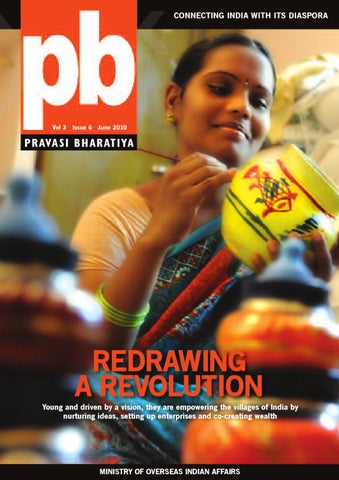
redrawIng a revolutIon Young and driven by a vision, they are empowering the villages of India by nurturing ideas, setting up enterprises and co-creating wealth
MInIstrY of overseas IndIan affaIrs
izoklh Hkkjrh; dk;Z ea=ky; Ministry of Overseas Indian Affairs
GlOBAl-INDIAN NETwORk OF kNOwlEDGE AN INITIATIVE OF THE MINISTRY OF OVERSEAS INDIAN AFFAIRS
The Overseas Indian Facilitation Centre (OIFC) has partnered with Tata Consultancy Services (TCS) to develop the Global-INK framework. An online web portal, it is powered by SupportCentral, a next generation knowledge management, collaboration and business solutions platform. The communities will also provide an array of collaboration tools: an Expert ● Document management and sharing ● Online resource databases
● Blogs ● Forums ● Ask
CONNECTING INDIA wITH ITS DIASpORA
Vol 3 Issue 6 June 2010
PRAVA SI BHARATIYA
lR;eso t;rs
izoklh Hkkjrh; dk;Z ea=ky;
Ministry of Overseas Indian Affairs www.overseasindian.in
*'
--/"
C
/)"
*/)$ )! !,&0") 2 0&-&*) .%"2 ," "(+*1",&)$ .%" 0&'' $"- *# )!& )/,./,&)$ &!" - -"..&)$ /+ ").",+,&-"- )! * ," .&)$ 1" '.%
2
Printed and Published by Mithlesh Kumar on behalf of the Ministry of Overseas Indian Affairs Akbar Bhavan, Chanakyapuri, New Delhi — 110021 Website: http://moia.gov.in www.overseasindian.in Consulting Editor K.G. Sreenivas Pravasi Bharatiya is a monthly publication. The views expressed in this journal are those of the contributors and do not necessarily reflect the views of the Ministry of Overseas Indian Affairs (MOIA). All rights reserved. No part of this journal may be produced, stored, or transmitted in any form or by any means — electronic, mechanical, photocopying, recording, or otherwise, without the permission of MOIA. Editorial correspondence and manuscripts can be addressed to pravasi.bharatiya@gmail.com Designed and produced by IANS (www.ianspublishing.com) on behalf of the Ministry of Overseas Indian Affairs. Printed at Anit Printers 1811, Gyani Bazar, Opp. D-56 N.D.S.E Part -1, Kotla Mubarkpur, New Delhi -110003
izoklh Hkkjrh; dk;Z ea=ky;
Ministry of Overseas Indian Affairs www.overseasindian.in
ollaboration is all. This is the story of a bunch of young men and women, driven by a vision. A vision of bringing about a quiet revolution on the margins as it were. “There is no better way of industrialising the villages of India than the spinning wheel...”, said Gandhi. As a development metaphor, there couldn’t have been a more powerful messaging. The spinning wheel may not represent the formidable wheels of large-scale industrialisation. Yet, it ably represents the power of scalability, sustainability and self-reliance. The three today stand at a critical crossroads globally, in particular, for the developing world. The debate has deepened in philosophical force and intensity given the increasing fragility of the world’s economic and eco-systems which directly impacts millions of lives and livelihoods across the world. First principles can neither be cast in stone nor can they be sacrosanct. Hence the necessity of revisiting received wisdom as regards the founding principles of development and equity. However, the spinning wheel doesn’t call for a reinvention, it calls for adaptation and scalability. Gandhi says further: “The charkha is intended to realise the essential and living oneness of interest among India’s myriads...” To accommodate “India’s myriads” would mean revisiting the constituencies of development and national priority. Hence the deepening dialogue on inclusive development and equity. Which is where we go back to our original proposition of the essence of collaboration. In dozens of villages in Tamil Nadu, a handful of young men and women are recasting the rules of development. Rather, they are rewriting the first principles of development in an idiom bearing close affinity to the soil of native genius. Sreejith who heads ROPE, or Rural Opportunities Production Enterprise, aims to “bring manufacturing opportunities to rural India and create employment opportunities for the rural unorganised sector workers through a replicable, scalable and commercially viable ICT-enabled rural distributed manufacturing model”. Saloni Malhotra, who founded DesiCrew, a rural BPO, believes, “In a rural context, the money would be distributed locally, supporting the local economy and generating incomes.” Only a block away is Paul Basil whose Villgro is nurturing an ecosystem to incubate ideas and innovations in rural India. “I was convinced that innovation and enterprise could address the rural poor, specifically, the small and marginal farming communities,” says Paul. There is a link running through the stories of the three “rural visionaries”. Dr. Ashok Jhunjhunwala who at IIT Madras leads an iconic institution, the Rural Technology and Business Incubator. Ashok helps incubate ideas and develop full-fledged, self-sustaining rural enterprises. “Until then (1990s) the whole idea of incubation was urban-centric. At the end of the 20th century, there was refocusing... away from urban India to rural India. It was also around the time that India began to make rapid strides in technologydriven development. But again it was rather urban-focused. In a democratic environment it was bound to create tensions. We decided that technology people should focus on rural India.” This issue of Pravasi Bharatiya brings to you this story being written on the margins. You will also read about another collaboration, this time between academia and industry. Industry often needs to go back to the drawing board for better results while researchers need to closely interact with industry to get to know as to what is it that the community as consumer wants in terms of better drugs, machines or technology. Read about it all and more in the subsequent pages. —K.G. Sreenivas
from the editor’s desk
contents
10 Cover story
revolUtion on the PeriPhery
They are young and driven by a vision to empower rural India by setting up enterprises in the villages of the country
6
24
US President Barack Obama emphasises how important India is to the US at the Indo-US strategic summit that concluded recently
eConomy
18
The Indian bureaucracy is in introspection mode. A mindset change is needed to attract private investment, government officials said at a recent meet
the Power of two
Collaboration between academia and industry is key to applied research and development that makes a difference to society
news
28
diasPora
Kamla Persad-Bissessar creates history as she becomes the first woman Prime Minister of Indian origin of Trinidad and Tobago
36
38
42
44
Mango lends its delectable flavour to anything it melds with. Take stock of some yummy mango recipes to please any palate
Debabrata Bhattacharjee travels through Dhaka and Bikramhati, exploring his childhood jaunts and memories...
The 11th International Indian Film Academy weekend saw a fashion show, celebrity cricket match and a ritzy awards ceremony...
Sudhir Sharma jots down his thoughts and emotions about his life in prison in Toote Armano Ki Aawaz
CUisine
travel
Cinema
books
news
Proud to be in India: Obama
US President Barack Obama once again emphasised how important India is to the US at the Indo-US strategic summit that concluded recently, reports Arun Kumar
U
S President Barack Obama has said he plans to visit India in November to together make “history and progress that will be treasured by generations to come”, as he described Indo-US ties as “one of the defining partnerships of the 21st century”. “Our relations with India are at the highest of priorities for my administration and for me personally as president of the United States,” Obama said at a reception on June 4 at the State Department hosted by Secretary of State Hillary Clinton for her Indian counterpart S.M. Krishna after the inaugural US-India Strategic Dialogue. “I am delighted to announce tonight that I plan to visit India in early November,” he said. “When it comes to building a future of greater prosperity, opportunity and security for people, there is no doubt I have to go to India, but even more I am proud to go to India.” The rare gesture of attending a reception at the State department was seen as a way to ease India’s concerns that the US views ties with New Delhi through the prism of Pakistan and Afghanistan or a rising China. Obama called India “a responsible global power” and said the “unprecedented” US-India relationship “will be a defining partnership of the 21st century”. “We value our partnership... because of I am proud to go to India, and I look forward what we share and where we can go toto the history that we will make together, progress gether,” he said, adding that the two counthat will be treasured not just by this generation tries share a vision of the future built on but by generations to come “security and prosperity”. Obama said he has to go to India to experience “all that India and its people and its incredible ancient culture have to offer”. “Whatever sphere of the human mind you may select for your special study, whether it be language or religion or mythology or philosophy, whether it be law or customs, primitive art, or science, you have to go to India, because some of the most valuable and instructive material of the history of man are treasured up in India, and India only,” he said while citing a quote from an European scholar who travelled to India over 100 years back. “So I look forward to advancing our partnership, to experiencing all that India and its people and its incredible ancient culture have to offer. So when it comes to building a future of greater prosperity, opportunity and security for our people, there is no doubt, I have to go India. “But even more, I am proud to go to India, and I look forward to the history that we will make together, progress that will be treasured not just by this generation but by generations to come.” Krishna, too, stressed the importance of the US-India relationship, saying New Delhi can be a “dependable anchor of the region’s growth.” 6 Pravasi Bharatiya June 2010
nO cHarges fOr Old PassPOrt sUbmIssIOn The government has acceded to the demands of Persons of Indian Origin (PIOs) and has issued a clarification saying that PIOs will not have to pay “renunciation charges” while submitting old passports. Similarly, the government has also waived the penalty charges for retaining a passport despite acquiring foreign citizenship for over three years. PIOs had begun an online petition to protest against a notification by the Ministry of External Affairs (MEA) issued on May 13 that mandated that PIOs who had acquired citizenship of other countries would have to surrender their old passports and there would be a penalty of Rs 10,000 for retaining the passport for above three years. The government has now issued a clarification that PIOs will not be asked to pay any renunciation charges.
fUnd fOr dIstressed wOrKers abrOad set UP Setting up a fund for distressed Indian workers abroad and a global network of Indian origin people were among the important achievements of the United Progressive Alliance (UPA) government in extending its hand of help to the diaspora during the first year of its second term. In his report card to the people, Prime Minister Dr. Manmohan Singh noted that his government in March last year approved the setting up of the Indian Community Welfare Fund in 17 Indian missions, mainly in the Gulf and the Maldives. Besides, a body of prominent members of the Indian diaspora — the PM’s Global Advisory Council of Overseas Indians — was set up and held its first meeting on January 7 this year.
UK HealtH OffIce nO tO HIrIng IndIan dOctOrs Britain wants to recruit junior doctors from India after their exodus from the country due to tightened immigration rules caused a shortage, but the Home Office is not in agreement. The National Health Service (NHS) is reported to have interviewed doctors from India and even sought the help of the British Association of Physicians of Indian Origin (BAPIO) in its recruitment drive. The BAPIO stipulated that the doctors should be allowed to stay and get training for between three and four years, rather than the two-year limit currently in place. But the British Home Office said no, pouring cold water on the NHS drive. The Home Office is the lead government department for immigration and passports, drugs policy, crime, counter-terrorism and police. June 2010 Pravasi Bharatiya 7
news
India, south africa ink three accords India and South Africa signed three pacts and agreed to jointly promote investments in Africa during President Zuma’s visit to India recently, reports Manish Chand
I
ndia and South Africa inked three accords during the visit of the South African President Jacob Zuma to India recently and agreed to work jointly to promote Africa as a global investment destination, and decided to call for reforms of the United Nations. Prime Minister Dr. Manmohan Singh and South African President Jacob Zuma, who was on his first visit to an Asian country, held talks covering a wide swathe of bilateral and global issues, including intensification of economic ties and closer coordination over global issues. Setting a target of $10 billion bilateral trade by 2012, they also focused on jointly working to promote and develop Africa as the next global investment destination. “Today, President Zuma and I have decided to impart a forward-looking character to these ties, and to further broadbase our cooperation,” said Dr. Singh. “We have agreed to focus on the expansion of our economic, trade and investment relationship,” he said, while underlining South Africa’s “influential role in world affairs.” “The discussions were held in an atmosphere reflective of the fraternal warmth, affection and strategic partnership that characterise the bilateral relations,” the external affairs ministry said in a statement. Acknowledging the rising global clout of the two countries, Dr. Singh and Zuma called for speeding up reform of the UN and international decision-making institutions to reflect contemporary realities. The two countries support each other's bid for a non-permanent seat in the UN Security Council. “We agreed to support each other's candidature for the non-permanent seat for the 2011-12 term,” the prime minister said. while describing Zuma’s maiden visit to India as “a milestone in India’s relations with South Africa.” 8 Pravasi Bharatiya June 2010
ceOs’ fOrUm laUncHed India and South Africa have launched an India-South Africa CEOs’ Forum. India’s Commerce and Industry Minister Anand Sharma and the visiting South African President Jacob Zuma formally inaugurated the forum on June 3. Addressing top businessmen from the two countries, Sharma said the forum would provide a platform for sustained business interaction and guide policy issues. Sharma listed several potential areas of bilateral cooperation. These include infrastructure, manufacturing, energy, mines and minerals, oil and natural gas, banking and financial services, tourism, information technology, pharmaceuticals, automobiles and auto components. “The much anticipated India-SACU (Southern African Customs Union) preferential trade agreement will eventually lead to a free trade agreement between India, SACU and MERCOSUR (South American Trading Bloc). An Agreement for Reciprocal Promotion and Protection of Investments is also waiting to be concluded.
IndIa sUPPOrts canada, Oz On banK tax Coming out in support of developing countries and Australia and Canada, India’s Finance Minister Pranab Mukherjee told his counterparts during the G-20 meeting in Busan, South Korea that India does not favour taxing banks to create a corpus for future bailouts and that more importance should be given to regulations to detect and contain any deviation in the functioning of financial institutions. Finance Minister Pranab Mukherjee made this clear during talks with Sakong Il, chairman of the presidential committee for G-20 finance ministers meeting, in the South Korean city of Busan. The levy idea is backed by the United States and Europe. Developing nations plus Australia and Canada oppose it, saying their banks did not trigger the 2008-9 financial crisis and should not have to pay for cleaning up the mess. Mukherjee said India’s banking system could withstand the trouble, mainly because of well-placed regulations. Indian banks had largely remained unaffected during the global financial crisis, which saw many large banks based in the US and Europe go under or seek state help to stay afloat.
IndIa, seycHelles sIgn twO agreements
Us-IndIa trade bOdy starts edUcatIOn Plan
IndIan-amerIcan smes Plan $320-m It facIlIty
India and the Seychelles signed two economic agreements in New Delhi during the visit of the Indian Ocean nation’s President James Michel in the first week of June 2010. The Seychelles president held formal talks with Indian Prime Minister Dr. Manmohan Singh after which they signed two deals. Michel arrived on June 2 on a three-day state visit. “We have signed the Non Double Taxation Agreements with several countries. We have also today signed a Bilateral Investment Promotion and Protection Agreement with India,” Michel said at an interaction with captains of Indian industry. Delineating the areas of possible economic cooperation, Michel listed industrial fishing, renewable energy, ecotourism projects in outer islands, retail sector and Information Technology. But he urged that more linkages be established between Seychelles’ capital Victoria and Indian cities. He said that negotiations will take place for a Bilateral Air Services Agreement later this month, which will “surely open the window to increase in exchanges.”
Looking ahead to global economy of the future, the US-India Business Council (USIBC) has launched a new education initiative aimed at strengthening institutional linkages between academia, industry and NGOs focusing on the elementary, vocational and higher education. “The US and India must be committed partners in building the workforce of tomorrow, a partnership that will unleash opportunity, spur growth and sustain prosperity not just in our countries but across the global community,” said Harold McGraw III, new president of the trade promotion body representing 300 US companies in India. “To do this, we must focus on strengthening our educational ties at every level. By working together, our two countries can equip the next generation with the education and skills necessary to compete and win in the global economy,” the chairman, president and CEO of The McGraw-Hill Companies said while addressing the USIBC 35th anniversary meeting on June3, coinciding with the Indo-US summit.
Small and medium enterprises owned by Indian-Americans plan to set up an IT incubation facility in Hyderabad with an investment of Rs.1,500 crore ($320 million). Small and Medium Enterprises Consortium (SMEC) made the announcement when Andhra Pradesh Minister for IT, K. Venkat Reddy, currently on a visit to the US, met CEOs of SMEs. According to an official statement issued on June 1, SMEC chairman Mahender Musuku told the minister that SMEs would invest Rs.1,500 crore in three phases. The CEOs expressed keen interest in making Hyderabad the first choice for their operations provided they get equal playing field, incentives in taxation and infrastructure. An incubation centre, to be set up in two years for administrative and front offices, is expected to provide employment to 2,000 people. While the centre will be set up in a leased facility in Hitec City, a permanent campus would be set up later with an investment of Rs.1,500 crore. This will create 10,000 direct and 40,000 indirect jobs. June 2010 Pravasi Bharatiya 9
revisioning india
cover story
revolution on the PeriPhery
They are young and driven by a vision. Of empowering rural India by incubating ideas, setting up enterprises, generating employment and co-creating wealth in the villages of the country, says K. G. Sreenivas
s
reejith, Saloni and Paul are driven by a shared vision. Sreejith N.N. heads ROPE International, Saloni Malhotra leads DesiCrew while Paul Basil steers Villgro. ROPE, or Rural Opportunities Production Enterprise, co-founded by Sreejith and Patrick Fischer, aims to “bring manufacturing opportunities to rural India and create employment opportunities for the rural unorganised sector workers through a replicable, scalable and commercially viable ICT-enabled rural distributed manufacturing model,” says Sreejith. In the mid-2000s, the BPO rush began in India. Saloni observed that though it offered an amazing rush of jobs and seemed to be an attractive financial proposition for freshers, salaries were still small and attrition was high. “It would be more useful and productive to take jobs where it would be closer to people’s homes. Also, in a rural context, the money would be distributed locally, supporting the local economy and generating incomes,” said Saloni whose DesiCrew today is quietly ushering in a backend services-driven BPO market in the rural environs of Tamil Nadu. On the other hand is Paul who through Villgro is forging an ecosystem to incubate ideas and innovations, like ROPE and DesiCrew, to fuel development in rural India. “Villgro stands for growth of villages. The dream of a prosperous rural India is what set me on this journey a decade ago. I was convinced that innovation and enterprise could address the rural poor, specifically, the small and marginal farming communities,” says Paul. 10 Pravasi Bharatiya June 2010
Sreejith has set up a network of rural production centres in a host of villages in Erode, Madurai, Thanjavur, Theni and Thiruvalluvar in Tamil Nadu where artisans use locally available and environment-friendly materials, such as banana fibre, elephant grass, korai and sisal (types of reed) to craft custom designed complimentary and lifestyle products. Sreejith’s ROPE, which sub-supplies to global furniture maker IKEA, today services top clients like AIIMS, FabIndia, Industree Crafts and Mihika besides a number of overseas customers. How did Sreejith tap the social, economic and commercial context while setting up ROPE? “Inspired by the success of outsourcing from the West to the East in creating large-scale job opportunities in Indian cities and inspired by attempts at setting up BPO centres in smaller Indian towns to bring further shift of jobs from cities to semi-urban and rural areas, a small group at the TeNeT (Telecommunications and Computer Networks) of IIT Madras thought about a similar model to bring manufacturing opportunities to Indian villages. Thus ROPE was born initially as Rural Outsourced Production Enterprise in January 2007. ROPE found rural India needs more manufacturing opportunities (as it cannot any longer depend on agriculture alone) and rural India has the potential to do large-scale manufacturing.” A distributed production system, however, would be key to the entire process. “ROPE decided to focus on a distributed production system in the form of networked small-scale production units as
the most scalable, environment-friendly, sustainable approach to a rural manufacturing model. Globally, too, the concept of distributed production systems is gaining ground as opposed to large industrial set-ups,” Sreejith says. “Distributed production systems are more flexible, more economically resilient, less environmentally polluting, can lead to more efficient use and value addition of local resources, creates more equitable growth, helps greater diversity in products and lead to greater team spirit and more product and process innovations within small units,” he adds. A similar paradigm was also central to Saloni’s model. “The question was how you could demonstrate a successful commercial model in smaller towns? Why or how cannot, for example, an insurance company set up back-up operations in a small village? Of course, BPOs are about economies of scale and dollar convergence. But our attempt was to work a smaller but scalable model, say about a 25-30 seater BPO,” says Saloni. The engineering and success of a vision is dependent on goalsetting. What were Sreejith’s immediate and long-term goals? “The immediate goal was to identify and focus on a suitable market or a dedicated buy-back partner in the form of an established industry, set up the first few distributed rural production centres and develop the required IT-based systems and processes for production and supply chain management. The long-term goal was to pioneer this manufacturing model and establish a large
number of such networked rural production centres catering to the demands of a number of industries, both inside and outside India.” As far as Paul was concerned, envisioning and goal-setting was a drawn-out process and work in progress. “The vision evolved over time. While the dream was to create a prosperous rural India, the vision was to use innovation and enterprise for that and the mission was to enable innovations to reach the markets. Over time, we realised that our vision should be much broader, that is, creating an eco-system that favoured innovation and enterprise,” says Paul. (see interview) ideation and turning Point Dr. Ashok Jhunjhunwala, a much decorated and distinguished grassroots visionary, and who heads the Electrical Engineering Department at IIT-Madras and is also Chairman of the Board of Directors of what is now an iconic institution, the Rural Technology and Business Incubator (RTBI), has been a common link among Sreejith, Saloni and Paul. The catchline of the institution is emblematic: incubate... ideate... innovate. Asked about what was perhaps RTBI’s most outstanding success thus far, Prof Jhunjhunwala said, “We would rather see it in terms of having brought in a culture of entrepreneurship into rural India; of having helped in forging an academia-industry relationship; and, of positioning technology to play a key role in the life of the deprived.” (see interview) June 2010 Pravasi Bharatiya 11 24
revisioning india
cover story
Referring to the process and time taken to incubate an idea, Prof Jhunjhunwala says, “Typically in a rural setting handholding is longer while in urban centers it is shorter. It is self-explanatory. The environments are different, rural India has far more complex problems. DesiCrew, for example, took two years. Other mentors come in, funders come in and a lot of new ideas too come in. Ideas come in, especially from three sources: experienced industry persons; faculty with wide knowledge; and, youngsters, who have just joined a company and come up with crazy ideas. They have the ability to plunge into ideas.” Sreejith corroborates: “Our evolution was a result of continuous discussions held by Patrick Fischer, another co-founder of the company, and I with Dr. Ashok Jhunjhunwala and Dr. Aarti Kawlra, another board member of ROPE, who is an expert in design and crafts and was also a consultant to TeNeT at that time. The acceptance of our model by Dr. Jhunjhunwala and his Rural Technology and Business Incubator (IIT Madras); support from Villgro Innovations Foundation, Chennai; investment by National Research Development Corporation (NRDC); my meeting Fischer who joined us as my partner and co-founder of the company; and our chancing upon Industree Crafts’ bulk raw material requirement through the efforts of Dr. Aarti Kawlra were all critical turning points for the company.” Saloni says: “Prof Jhunjhunwala helped us in setting up DesiCrew. We had three options — Rural Technologies, Rural Edu12 Pravasi Bharatiya June 2010
the roPe market j The Global home decor and furnishings market is worth $1.2 trillion, including kitchen, housewares, furniture, home textiles, appliances, outdoor living, art/wall decor and lighting. The US market alone is worth $270 billion j The global home furnishings market size is $70 billion, growing at an average of 5 percent per annum. High-value Indian exports in this is $1.2bn/annum, growing at 30 pc j Though the specific market size for eco-friendly natural products in the above segments is not available, a significant percentage is available for natural products and that market is growing at a faster pace j The current Indian exports of specifically non-cotton, non-silk, non-wool natural fibre based home decorative accessories is estimated at just $25 million growing at 20pc per annum j Dry flower exports from India is approximately $100 million and is another target segment of ROPE j New and unconventional demand for natural fibre uses are also emerging like paper manufacturing, use in veneers, packaging, wall panels, etc. Some of ROPE’s existing customers are in these segments
“
this opened our eyes to the richness and diversity of eco-friendly, renewable natural fibre resources of our villages. as the world moves towards ‘green’ natural products, roPe decided that the use of renewable, environment-friendly natural fibres, together with locally available skills to manufacture custom designed products for buyers, as the best fit for a distributed manufacturing model.
“
—sreejith n.n.
cation and Rural BPO. He advised us to look at the rural BPO sector. IIT Madras does a lot of work in rural areas of the country. They helped us understand the nuances of development, particularly rural development. They also helped us network with a wide variety of people and resource persons.” Paul acknowledges the importance of ‘ecosystem’ and symbiosis (between Villgro and IIT-Madras), ideas Prof Jhunjhunwala says are crucial to incubation. “We have now set ourselves in that direction [innovation and enterprise]. This explains why we are located at the fabulous IIT-Madras Research Park, an eco-system of technology-based institutions,” says Paul. Putting vision into action Social entrepreneurship needs to be commercially viable too, to be of credible benefit for all stakeholders, particularly for those at the bottom of the pyramid who form the heart of the system. Sreejith elaborates: “The search for a commercially viable business model using distributed and networked production centres led ROPE to think that we should look into the sustainable and competitive advantages or strengths of our villages while looking for suitable sectors to enter. “At the same time, a Bangalore-based organisation called Industree Crafts approached us to set up banana fibre rope production centres to meet the growing demand for this raw material which is used to manufacture natural products. This
Relationships matter a great deal in growing, scaling and diversifying the business module that Sreejith’s ROPE International (far left) and Saloni’s DesiCrew (above) follow.
opened our eyes to the richness and diversity of eco-friendly, renewable natural fibre resources of our villages. Each and every village in India has certain natural fibre resource available and there is great diversity and uniqueness in these renewable fibres available in each region. As the world moves towards ‘green’ natural products, ROPE decided that the use of renewable, environment-friendly natural fibres, together with locally available skills to manufacture custom designed products for buyers, as the best fit for a distributed manufacturing model. With this business model, ROPE was incorporated as a private limited company in December 2007 and soon ROPE’s expansion was changed into Rural Opportunities Production Enterprise (ROPE) to represent June 2010 Pravasi Bharatiya 13
revisioning india
cover story
IntERvIEw / Paul BaSIl
For an eco-system oF innovation and enterPrise Founding vision of villgro… Villgro stands for growth of villages. I was fairly convinced that innovation and enterprise could address the rural poor, specifically, the small and marginal farming communities. The vision evolved over time. It was to use innovation and enterprise for that and the mission was to enable innovations to reach the markets. Over time we realised that our vision should be much broader, that is, creating an eco-system that favoured innovation and enterprise. As we were incubating innovations, we found a few pressing challenges. The first being last-mile access to the end customers of ours, the rural poor. All entrepreneurs that we were incubating had to set up
their own marketing channels. Imagine the cost and time it would take to build channels among the poor. Thus came the vision of Villgro Innovation Marketing Private Limited, a forprofit chain of stores in villages, supported by a network of village level entrepreneurs. Incubation is a very timeconsuming, costly and risky activity. We realised that to nurture this model, we need to partner with other players. And thus was born our co-incubation approach to incubate more and more enterprises. Coincubation is nothing but two incubators coming together to offer services to the same incubatee. This way we leverage each other’s strengths and make the best use of each
a broader approach to huge opportunities presented by the unique strengths of our villages.” Leveraging the strengths of the rural local communities obviously is of the essence. Saloni says, “As a business, the BPOs are a proven model across the world. It is scalable too. We have at the moment around 170 people, we now plan to scale up to 1,000 to 2,000 in the next couple of years. Till last year, we had operations in Tamil Nadu alone but this year we are looking at Andhra Pradesh and Karnataka. Tamil Nadu is progressive, has excellent infrastructure, good literacy and internet penetration up to the taluka level. Even in rural areas, people understand English, they may not be proficient but they can communicate.” In fact, Saloni makes a deeper sociological point, which is also critical to the success of the idea of rural entrepreneurship. “People in small rural communities are committed. They may be lacking in communication skills and exposure that urban youngsters have in abundance. Traditionally, BPOs are well established, 14 Pravasi Bharatiya June 2010
other’s geographical locations while serving incubatees. Around 2004, after C.K. Prahalad had written The Fortune at the Bottom of the Pyramid and at a time when micro-finance had really matured, a number of social venture funds were set up. However, few could fund in the range of $50k-150k. This seed capital was necessary to kick-start these enterprises. Our vision was to set up the Villgro Fund for Innovation and Rural Enterprise. Putting together the human and financial resources… The start is a point of challenge for any organisation — limited resources and blurred vision. With regard to financial resources, Villgro was fortunate to
have a two-year funding support of Impact Partners and lots of personal support from its founder Deval Sanghavi. Subsequently, we attracted grants from foundations in India and the US. The new entities in the form of Villgro Marketing Pvt Ltd and Villgro Fund will attract patient commercial capital in the years to come. Our formative years were chaotic. Serving the rural poor through innovation and enterprise is not something that has been clearly structured in terms of formal training, though there are rural marketing courses. This need motivated us to inspire IIT-Madras to set up a credit course on Innovation and Social Entrepreneurship for its undergraduate students. We also
mostly run like factory floors. We decided to do it differently. We help establish a certain comfort level for our employees, especially socially and culturally. Team leaders or managers go out and build relationships with the local community.” Obviously, relationships matter a great deal in growing, scaling and diversifying a business model that Sreejith, Saloni and Paul have embraced and are nurturing. Saloni elaborates: “In rural communities, for example the micro-finance model has worked exceedingly well. Repayments are as much 99 percent as opposed to urban credit card payments where default is very high. There are strong moral and social sanctions that bind the communities together. So, people take pride in their work and are conscious about how they are seen by the community.” Social commitment and commercial viability are no contradiction in terms. Sreejith says: “Our philosophy for social impact is to maximise rural employment in our villages through our distributed production centres instead of the ‘maximising profit’ motive of nor-
villgro seeks to adapt technology-based innovations to offer new solutions to an existing problem or an existing solution to a new problem. left: various villgro rural enterprises.
helped IIT-Madras to set up a new Centre for Social Innovation and Entrepreneurship with the objective of increasing research and education in the field of innovation and social entrepreneurship. on the “innovations” route… Technologies and technologybased innovations have always changed lives, impacted millions, such as mobile phones to ATMs to credit cards. However, when it comes to those who can’t afford them, we keep away from even attempting to develop market-based solutions. Innovations like micro-finance have made millions bankable and have transformed their lives. In the initial years we were focused on product innova-
tions, we still continue to do so. But increasingly we have started pilots with services, innovations around business models. Innovations challenge the status quo, new solutions to an existing problem or an existing solution to a new problem — both ways, opportunities are plenty. one defining characteristic of incubatees… Our incubatees are committed and visionary innovators and entrepreneurs whose ideas are compelling and can impact the rural poor in a commercially viable manner and have the potential to scale. The markets that they have chosen to serve, perseverance in doing so, the ability to embrace uncertainty makes them unique. Incuba-
mal private enterprises. At the same time to be commercially viable we focus on being competitive in servicing our customers in terms of our pricing and consistently achieving quality and quantity targets. Marrying these two objectives, we are targeting high volume-manufacturing opportunities for large key account customers. These high volume-manufacturing opportunities will not give us high margins as we are competing with manufacturers from China, Thailand, Vietnam and other South Asian countries. So we target a commercially viable margin and maximise our returns and rural impact by the scale or volume of the units manufactured.” Putting it all together Resourcing is key — seed capital, human resources and training. At DesiCrew, Saloni says she made a modest start but went on to expand. “As far as funding was concerned, I put in some of my personal funds while Prof Ashok’s Rural Technology and Busi-
tees are both urban and rural. Example of a rural entrepreneur is P.Vivekanandan of Vivega Engineering Works who has developed the Pin Pulveriser. scouting for innovators… Scouting is through multiple means. Wantrapreneur, our annual business plan competition, discovers innovative entrepreneurs. We sponsor other business plan competitions such as Sankalp and Genesis. Our team reviews the patent applications and discovers compelling ideas from that pool. Our partnership with the Agri-Business Incubator and ten other leading research institutions under the Indian Council for Agricultural Research gives us access to hundreds of new product ideas. We provide
seed funding, networking, mentoring, talent, go-to-market services etc. We exit when the incubatees have a good management team, sales turnovers look poised for growth and they have raised the first round of institutional investments. a new idiom? The poor have problems and these problems bring with it opportunities for solutions. The poor do not need charity. They need access to affordable and reliable products and services. By incubating such innovations, we bring to rural India a new wave of social capital, products/services, talent and an eco-system that furthers innovation and enterprise leading to rural prosperity.
ness Incubator (RTBI) at Madras IIT helped us with the rest. Then in mid-2008, we had an angel investor in Rajiv Kochhar, an exInfoscion, who came on board. We now run on our own revenues.” Eventually, running on one’s own steam would be critical to any self-sustaining venture. Serendipity could help occasionally, but there is little substitute for hard planning, envisioning and the right mix of people and resources. Sreejith elaborates on ROPE: “Patrick and I became co-founders and the senior management team. Dr. Aarti Kawlra was another promoter-director of the company. Patrick also invested in the company and apart from that we received an initial debt funding from LRAMP, which was an innovation nurturing and development programme founded by IIT Madras and Villgro Innovations Foundation with support from Lemelson Foundation, US.” Referring to the management side of it and oversight, Sreejith says, “We set up a Board of Directors comprising Kunal R Sachdev, Founder and Managing Director of Caravan Crafts Pvt. June 2010 Pravasi Bharatiya 15
revisioning india
cover story
IntERvIEw / aShOk JhunJhunwala
shiFting services and manuFacturing to rural india Would Be the most deFining idea oF the Future PB: When did the idea of “incubation” strike you? What was the founding vision of rural technology & Business incubator? The idea of incubation began forming around the mid-80s. I had joined IIT and had also begun consulting with industry who would often come to us with questions on machinery and technology. Could we fix this part of a machinery or could we fine-tune this part of a technology? Such were the queries. I found that generally innovation was missing in Indian industry.
We then thought we could perhaps tap our alumni who could devise and design products as solutions to questions industry often posed. They even set up two companies Benchmark Systems and Comportex Electronics geared towards innovations. Towards the mid-1990s, we set up Midas Communications to devise wireless (local loop) systems at a considerably lower cost. Subsequently, we helped incubate as many as 12 companies. Until then the whole idea of incubation was urban-centric.
Ltd., Bangalore, who came on board as a representative of NRDC and who was previously CEO of the famous leather accessories brand Hidesign — apart from Dr. Aarti Kawlra, Patrick and me. Dr. Ashok Jhunjhunwala and Paul Basil, Founder and CEO of Villgro, comprise the advisory committee and they both are permanent invitees to the board. Using the investments we received from Patrick, NRDC and Villgro and under the guidance of the Board and advisory committee the management team hired the other required human resources.” training For success on the ground, training is critical. Saloni keeps it simple, effective and customer/product oriented. “Our training is spread across three months. We have modules in English, Mathematics and Analytical Skills. We also impart training in manage16 Pravasi Bharatiya June 2010
At the end of the 20th century, there was refocusing... away from urban India to rural India. As of now, we have incubated 30 companies, 15 urban and 15 rural. It was also around the time that India began to make rapid strides in technology-driven development. But again it was rather urban-focused. In a democratic environment it was bound to create tensions. We decided, therefore, that technology people should focus on rural India and its concerns in a serious manner.
PB: the single most defining feature of the proposals you have received and incubated? The key focus was to significantly reduce cost price. The price point needs to be right for customers to be able to afford technology or innovation. The order of magnitude was key. For example, telephony cost Rs. 40,000 in the 1990s, we innovated and made it available at Rs. 10,000. An ATM typically then cost Rs. 500,000. We devised one called ‘Gramateller’ for Vortex Engineering Pvt Ltd
ment, essentially in acquiring a client perspective and knowledge about product management. Their competition is with BPO markets like Vietnam and Philippines,” Saloni says. At ROPE, Sreejith has outlined essentially two main types of training. It is interesting to note that again the training is customer oriented and order specific. Much if it is also gained on the job itself. “One for existing artisans like handloom weavers where it is mainly product specific and order specific training during which we educate them on the particular design and quality requirements of a product. A major portion of this training will be on the job itself,” Sreejith says. A second area of training focuses on unskilled workers, mostly for hand-driven production skills like crochet or basket weaving. Classical assembly-line principles also come into play. “We have arranged professional trainers and conduct
“
We would rather see it (successes of incubation) in terms of having brought in a culture of entrepreneurship into rural india; of having helped in forging an academia-industry relationship; and, of positioning technology to play a key role in the life of the deprived
“
—ashok Jhunjhunwala
at below Rs. 100,000. In terms of vision, DesiCrew and ROPE, for example, wanted to create and sustain employment in rural India. So we went from telecom to education to energy and so on. Today, as you see development has rapidly moved from the West to the East. Similarly, we should be able to shift services from urban to rural India. PB: typically, how long is the guiding, funding and handholding stage of the incubatee? Typically in a rural setting hand-
holding is longer while in urban centers it is shorter. It is self-explanatory. The environments are different, rural India has far more complex problems. DesiCrew, for example, took two years. Other mentors come in, funders come in and a lot of new ideas too come in. Ideas come in, especially from three sources: experienced industry persons; faculty with wide knowledge; and, youngsters, who come up with crazy ideas. They have the ability to plunge into ideas.
classroom/formal training sessions. Later, they will be engaged to work on simple designs, gradually increasing the complexity of the product and their skill levels. In most of the orders for handmade products we adopt an assembly-line system through division of labour so that productivity is enhanced by specialisation while reducing the level of skill required by the worker/artisan.” Have these rural entrepreneurs developed or evolved a new management idiom or a new management philosophy? Sreejith invokes C.K. Prahalad. “We believe we have not developed any new management idiom or philosophy. It was already identified by many that rural areas present unique opportunities for businesses. Prof. Prahalad visualised the potential of the bottom of the pyramid primarily as a big market. At the same time many others were considering
PB: What have been some of the most outstanding successes you have helped forge? We would rather see it in terms of having brought in a culture of entrepreneurship into rural India; of having helped in forging an academia-industry relationship; and, of positioning technology to play a key role in the life of the deprived. PB: on auditing projects and re-engineering project models… We meet every month to evaluate these projects. The general
success rate has been 10 to 15 percent. We plan to raise it to 25 percent. However, newer business models and newer business leaders emerge. So, there are a slew of ideas. PB: the defining ideas for the future, with reference to rural enterprise, innovation and development… Shifting services and manufacturing to villages would be the most defining idea of the future. The direction of DesiCrew and ROPE is one such.
the bottom of the pyramid as possible supply sources for the urban market or for urban industrial companies. We were a bunch of people interested in the idea of wealth generation in rural areas and developing supply bases in rural areas for urban markets. Then found that given the enormity and diversity of our rural areas a decentralised approach suits it best.” Paul puts it rather evocatively: “The poor have problems and these problems bring with it opportunities for solutions. The poor do not need charity. They need access to affordable and reliable products and services. “By incubating such innovations, we bring to rural India a new wave of social capital, products, services, talent and an eco-system that furthers innovation and enterprise leading to rural prosperity.” June 2010 Pravasi Bharatiya 17
econoMy / inFrasTrucTure
Mindset Matters The Indian bureaucracy is in introspection mode. A mindset change is needed to attract private investment and bridge the infrastructure gap, senior government officials concluded at a recent seminar, reports Arjun Sen
T
his is constructive self-criticism at its best. The biggest hurdle standing in the way of rapid development of infrastructure is the “incumbent mindset of government institutions and officials” which tends to discourage private investment, senior government officials concurred at a recent conference in the national capital. In the conference Infra Vision 2020 jointly organised by the Union Ministry of Road Transport and Highways and the Indian Chamber of Commerce, the common refrain of almost all the speakers was that rapid infrastructure development is not possible without massive private sector investment and this in turn is not possible unless the existing “statist”mindset of government institutions and officials change. The speakers included the Road Transport Minister Kamal Nath, Minister of State for Planning and Parliamentary Affairs V. Narayanasamy and several senior serving or retired public servants. “Just look at the documentation and red tape involved in exporting from India. Most exporters will simply give up given the time he has to spend running from pillar to post to get his work done,” said the Minister of State for Planning and Parliamentary Affairs V. Narayanasamy. “We have to speed up government work,” he declared. Road transport minister Kamal Nath explained the numerous steps the government has taken during the one year that it has been in power after being re-elected to a second term in office. He said as a result of these steps, the private sector is now showing increasingly greater interest in road and highway development projects. 18 Pravasi Bharatiya June 2010
“The average subsidy sought by private developers has come down to only 19 percent of total project cost against the currently permissible 40 percent,” Kamal Nath said, adding that for projects awarded to private bidders so far in 2009-10 and 2010-11, “as much as 25 percent of the bids needed no government funding at all which proves that the sector is now very attractive for private investors.” This is also reflected in the fact that the average number of bidders for road projects has again begun to pick up while more and more bidders are now opting for revenue sharing arrangements with government rather than seeking government grants as viability gap funding.
For projects awarded to private bidders so far in 2009-10 and 2010-11, as much as 25 percent of the bids needed no government funding at all which proves that the sector is now very attractive for private investors Both these developments — a realisation not only at the highest echelons of government but also now trickling down to relatively lower level officials that attracting private sector investment, especially foreign direct investment, is the only way to speed up infrastructure development, and the fact that effective steps have already been taken to make at least the road sector attractive to private investment — auger well for the country. The road transport minister and other ministry officials are at least very confident. “We will meet our target of building
20 kms of roads a day,” said Kamal Nath while the Director General (Road Development) and Special Secretary Ministry of Road Transport and Highways, A.V. Sinha declared “We have now created a perfect launch pad for PPP projects to take off in a big way,” Most speakers at the conference, whose objective was to deliberate on implementation bottlenecks in infrastructure development, however, admitted things were not so hunky dory in other areas such as the railways and port and airport development. Referring to the telecom revolution in
India, Member, Planning Commission B.K. Chaturvedi, said: “In the telecom sector, 85 percent of the investment has come from the private sector whereas private sector contribution in the Railways is only about 4 percent.” He felt that unless efforts were made to attract private sector investment in the Railways, it would continue to lag behind in development work. Incidentally, the current policy framework for road and highway development is largely based on the recommendations of the B K Chaturvedi-led Committee which was formed by the government in 2009 to identify and resolve procedural and regulatory issues that were holding up the National Highway Development Programme (NHDP). “In the port sector too, the Eleventh Plan target was to increase port capacity to 1500 million tonnes, but so far additional capacity has been created only in the minor ports that have come up on pri-
vate investment,” Chaturvedi said. He pointed out that under the Eleventh Plan, major ports, which are all in the public sector, were supposed to increase capacity from 730 million tonnes to about 1200 million tonnes while minor ports were supposed to add another 300 million tonnes. But so far it is only the private sector funded minor ports that have been able to add about 330 million tonnes during the Eleventh Plan while the major ports are still working out public private partnership projects for port development, he said. Apparently, however, policies, procedures and rules and regulations have been tweaked to make port development through the PPP route attractive to private investors. “Investors are showing a lot of interest for PPP projects,” said K. Mohandas, Secretary in the Ministry of Shipping. The Secretary, Ministry of Road Transport and Highways, Brahm Dutt,
also seemed quite clear that attracting private sector investment was the only way out. “We plan to spend $75 billion in the seven phases of the NHDP. Of this we are expecting $30 billion to come from the private sector while the balance $45 billion will come from the government, market borrowings etc.,” he said. “To achieve this level of private investment we have to provide a more stable regime so that the risks and uncertainties associated with road development are mitigated as much as possible,” Dutt said. The government’s willingness to change policy to suit private investors has led to the current framework. Even now the government is mulling a few additional changes to remove the remaining irritants. In fact, one road transport ministry official said during the seminar that the road transport minister has famously said: “Except for the Bible and the Gita everything else can be changed.” June 2010 Pravasi Bharatiya 19
econoMy / indusTry
nano revs up Tata’s new Sanand plant for making the world’s cheapest car goes on stream, reports R.K. Mishra
T
ata Motors’ new manufacturing facility for the Nano, the world’s most inexpensive car, opened in Sanand on June 2, nearly two years after the company was forced to shift out of Singur in West Bengal over a land row. The new plant was inaugurated by Gujarat Chief Minister Narendra Modi and Tata Group Chairman Ratan Tata, who seven years ago had dreamt of making the affordable family car. “We belong to Gujarat and are happy to return to Gujarat,” said Tata. “I am glad that we will now be able to manufacture the Nano across the country.” Spread over 1,100 acres, the Sanand plant has been created at an investment of about Rs.2,000 crore. Speaking on the occasion, Modi said every middle-class family’s dream to own a car was being fulfilled with the in-
20 Pravasi Bharatiya June 2010
auguration of the Nano plant. “The revolution brought by Ford in the early 20th century with its small car is being replicated now by Ratan Tata with his Nano,” he added. The new plant will deliver 250,000 Nanos a year. Tata had to find a new home for his Nano plant after Tata Motors was forced out of Singur in 2008 by a campaign led by Mamata Banerjee and her Trinamool Congress. They alleged that farmers were being forced to surrender their land at unfair rates by the Left Front government for the car plant. A company spokesman said deliveries from the plant, including BS4 Tata Nanos, will begin later this month. The output, supplemented by the facility at Pantnagar in Uttarakhand, will complete pending orders from the booking process of 2009. Built in a record time
of 14 months starting November 2008, the integrated facility comprises Tata Motors’ own plant spread over 725 acres and an adjacent vendor park spread over 375 acres to house key component manufactures for the Nano. The plant has state-of-the-art equipment. These include sophisticated robotics and high speed production lines. Conscious of the critical need for environmental protection, the plant has energy-efficient motors, variable frequency drives and systems to measure and monitor carbon levels. These are supplemented with extensive tree plantation, sustainable water sourcing and harnessing solar energy for illumination. The plant has already directly employed 2,400 people and on capacity expansion may eventually generate about 10,000 direct and indirect jobs.
….To drive into Taiwan
“
every middle-class family’s dream to own a car was being fulfilled with the inauguration of the nano plant. The revolution brought by Ford in the early 20th century with its small car is being replicated now by ratan Tata with his nano
Tata Nano, the world’s cheapest car made by India’s Tata Motors, is set to drive in to Taiwan, a manufacturing hub of iPods and green technologies, later this year. Theodore Huang, chairman of Taiwan’s TECO group, is upbeat about the prospects of the Tata Nano in the Taiwan market, but says it may have to be modified to suit the island’s high environmental standards. Huang, who visited New Delhi in January and went on a test drive in a spanking new Tata Nano, said he was impressed by the small car and found the ride “comfortable and satisfactory”. It accelerates smoothly and can exceed speed of 100 km per hour, he said. Huang’s company is interested in becoming Tata Motors’ agent in Taiwan and selling the Nano car in the prosperous island, the world’s 17th largest economy that has identified India as a focus market. The prospects of Tata Nano in the Taiwan market are bright, Pradeep
Kumar Rawat, director-general of India-Taipei Association that serves as India’s consular office in the Taiwanese capital, told IANS. Taiwan, the self-ruled democratic island claimed by China, boasts of $17,000 per capita income, but has a burgeoning middle class that is stuck to scooters and now wants to move on to economy cars. Tagged as the “people’s car”, the basic Nano model costs around $2,500. Tata Motors is eying a global market and planning a new model for the European market to satisfy its stringent emission standards. Huang, however, feels that price alone would not guarantee Nano’s success in Taiwan and said that the TECO Group, better known for its industrial motors and home appliances, will only sell the car if its specifications conform to Taiwan’s regulations. TECO has provided Tata Motors with Taiwan’s automobile safety requirements.
June 2010 Pravasi Bharatiya 21
“
econoMy / invesTMenTs
Kannada khazana
Investors have signed MoUs worth $85 billion during the second Global Investors’ Meet in Karnataka, reports Fakir Balaji
K
arnataka has managed to reap a bonanza with investors inking agreements to implement 400 projects in the state during the next four-five years at a total cost of $85 billion. The Memoranda of Understanding (MoUs) for these projects were signed during the two-day Global Investors’ Meet (GIM 2010) held in the state capital Bengaluru on June 3-4. The projects are expected to generate employment for about 865,000 people. The mega event, held for the second time after a decade, witnessed agreements being signed even at the valedictory function by seven firms and 20 state-run and private banks with the state government committing funds for infrastructure. On the first day itself, MoUs for 208 projects were signed involving a total investment of about Rs.3.29 trillion ($70.2 billion), while the balance 192 projects worth a total investment of about $15 billion were signed on the second day. The iron & steel sector attracted 38 proposals worth Rs.2.21 trillion ($47 billion), followed by the cement sector with nine projects worth Rs.36,991 crore ($7.9 billion) and energy sector with eight projects worth Rs.25,214 crore ($5.4 billion). Among the major steel projects are those of ArcelorMittal, Posco and Bramhani Karnataka Ltd, which have proposed to set up six mtpa plants each at an estimated cost of Rs.30,000-36,000 crore in Bellary and Bagalkote districts. ArcelorMittal chief executive Lakshmi N. Mittal said he will give priority to its Karnataka steel project, as its two other similar projects in Jharkhand and Orissa are bogged down by land issues and other approvals. The GIM was inaugu22 Pravasi Bharatiya June 2010
invesTMenTs galore Brahmani steels
36,000 Posco
32,336 arcelorMittal
30,000
Bhusan steel
27,928
Mangalore refinery
15,798 JsW steel
15,131 aditya Birla group
8,500 infosys
2,250 Company l Investment (in Rs Cr) l
(Top) Karnataka Chief Minister B.S. Yeddiurappa addressing delegates at the second Global Investors’ Meet, 2010 in Bengaluru on June 3. (Above) ArcelorMittal Chairman Laxmi Ratan Mittal shares a light moment with Wipro Chairman Azim Premji during the meet.
rated by senior Bharatiya Janata Party leader and Leader of Opposition in the Rajya Sabha Arun Jaitley in the presence of Chief Minister B.S.Yeddyurappa, his cabinet colleagues, central ministers M.Veerappa Moily and Subodh Kant Sahay and a galaxy of high profile investors. The GIM, twice postponed — once in view of the global economic slowdown and the second time following the devastating flood in October-November last
year in large parts of north Karnataka — has been inspired by the success of Gujarat in snapping up Rs.7 trillion ($149 billion) investments in 2009. During the meet, state government officials announced that the government had received 88 fresh proposals worth Rs.90,000 crore in the infrastructure sector under the public-private partnership (PPP) mode. These proposals are now being processed, they said.
stake surge The Finance Ministry’s new public holding norms will see 183 companies raise $32 billion in the next few years, says Arjun Sen
n
ew Finance Ministry guidelines requiring all listedcompanies to maintain a public shareholding of at least 25 percent will lead to stake sales by 183 companies to raise an expected $32-billion, according to research done by Delhi-based sharebroking firm SMC Capitals Ltd. “There are 183 listed companies with public shareholding less than 25 percent. Hence, the new guidelines will trigger a host of stake sales through various routes such as follow-on public offers (FPOs), qualified institutional placements (QIPs) and open market sale by promoters,” said Jagannadham Thunuguntla, equity head of SMC Capitals, the country’s fourth-largest sharebroking firm. Of the 183 companies, 148 companies are from the private sector, while the remaining 35 are public sector undertakings (PSUs), Thunuguntla told IANS. “Of the total amount that is ex-
aMounT To Be raised in $Bn no of comp
Total
yr 1
year 2
year 3
year 4
year 5
Psu
35
$26.5
$9.38
$8
$4.79
$2.44
$2
Private
148
$5.5
$3.65
$1.31
$423 mn
$94 mn
$45 mn
Total
183
$32
$13
$10
$5
$2.5
$1.94
pected to be raised through these stake sales, the 35 PSUs will raise the bulk of the amount, $26.5 billion or 83 percent of the total, while the private sector will raise about $5.5 billion or 17 percent of the total,” he said. Further, as the requirement is that every year there is at least 5 percent dilution, the total stake sale would be phased out and will be $13 billion (between June 2010 to June 2011), $10 billion (between June 2011 to June 2012), $5 billion (between June 2012 to June 2013), $2.5 billion (between June 2013 to June 2014) and $9.14 billion (between June 2014 to June 2015), he said.
Some of the prominent PSUs that will need to come out with stake sales are Hindustan Copper, MMTC, Neyveli Lignite, NMDC, Engineers India, NTPC, NHPC, and SAIL. In the private sector, companies like DLF, Wipro, Reliance Power, Godrej Properties, Jaypee Infratech, Jet Airways will have to offload their stakes. “The companies, of course, may adopt alternate modes of increasing their public, but Indian markets should get bombarded with a series of stake sales. One may call the first half of the coming decade of the Indian captial markets as the “Era of FPOs”, he said.
June 2010 Pravasi Bharatiya 23
collAborATion
The PoWer of TWo Collaboration between academia and industry is key to applied research and development that makes a difference to society besides translating it into commercially viable and sustainable products, be it better drugs, machines or technology, for consumers, says K. G. Sreenivas
W
from industry to academia in 1996 and had been funding such riting in EduTech recently, Dr. Ganesh Natarajan, projects when at BHP. At Deakin we took the model a step further Vice-Chairman and CEO of Zensar Technologies, by really creating a culture of applied research linked to industry says, “...there is a considerable gap between the that was underpinned by high quality fundamental research. For quality of students graduating and the kind of talent industry not only were they getting solutions to problems but they that industry needs. As businesses propose to double and treble were also training high potential students in their business and gentheir workforce and Indian companies strive to maintain their eral industry needs.” position in the global marketplace, it has become imperative to Referring to the principles underpinprepare and plan for a world-class, skilled, ning Deakin’s initiative in forging vital competent, and innovative workforce.” relationship, he says, “Australia went In India, thus many public-private partthrough a change process from the early nerships have been forged to advance 1990s to now. Generally, Australia outperclose collaboration between industry and forms most developed nations on a per academic institutions. The Confederation of Indian Industry (CII) has launched capita basis for fundamental/discovery reAt Deakin, we have a tradition initiatives to promote industry-academia search in the basic sciences. However, the of research collaboration with collaboration by identifying four key translation of this into economic and soindustry, businesses and areas of cooperation: developing new cial outcomes has not been as strong. A governments, with the knowledge as a long-term investment; number of initiatives were thus developed underlying philosophy that helping faculty upgrade knowledge, to encourage industry and academia to these partnerships will result preferably in an industry environment; work together. A key element was to have in research that makes a fostering Centres of Excellence to make research students focused on more final-semester students industry-ready; applied research where they would have difference in communities and, deepening the involvement of techdirect contact with industry.” nology in the pedagogies of Indian colleges and universities. Prof. Lee Astheimer, Deputy Vice-Chancellor, Deakin University, Australia’s Deakin University too has been forging such reciprowho was also on a visit to India with Hodgson, adds, “At Deakin, cal research and educational partnerships with industry majors we have a very strong tradition of research collaboration with and academic institutions in India. In an interaction with Pravasi industry, businesses and governments, with the underlying philosophy that these partnerships will result in research that Bharatiya, Prof. Peter Hodgson, who heads the university’s Instimakes a difference in communities — at local, national and tute for Technology Research and Innovation, says, “I moved 24 Pravasi Bharatiya June 2010
“
“
international levels. The kinds of difference that we are talking about are really diverse. For example, research on novel metal composites and carbon fibre will create materials that will reduce the weight of planes and cars and be used in wind turbine blades, with potentially large contributions to global energy savings. Our new research in bionanotechnology has great implications for enhanced agricultural production and targeted drug delivery...” (see interview) The inDiA engAgemenT The India story took shape when Hodgson was collaborating with some of the IITs and was encouraging interns to come to Australia. In fact, he was “also looking for future PhDs to come to Australia as we have a great shortage in metallurgy, materials science and engineering”. The process gave him insights into “some of the issues that would exist with such an education system”. He began visiting and interacting with Indian. It became evident to him that “there was an enormous gulf between the two sides — even greater than what existed in Australia”. It struck Hodgson that he could possibly “tweak some of the Australian models”, particularly those that involved students being placed in industry for research. The incentive? “We also committed significant funds to make it attractive,” says Hodgson, adding that, “in our development of research partners we have wanted to always work
with the best as that provides the best chance for success”. However, it also called for establishing specific R&D strategies for different clients to make it work, examples being Indian Oil Corporation and life-sciences major Bicon. “This again was a rather slow and careful process where we had numerous visits and interactions to assess where were the best matches. Some of it was also serendipity! It was not an overnight success for it took almost three years before we got our first research collaborations nailed down and with students in place,” says Hodgson.
innovative leader... Professor Hodgson, currently head of Deakin University's Institute for Technology Research and Innovation, is a globally acknowledged expert in innovative lightweight metals and advanced materials, especially for the automotive and aerospace industries. His core work around innovative process technologies and product approaches aim to minimise the environmental impacts of both production and application of metals. Hodgson’s research, which will help develop new metal manufacturing processes and products, will contribute to a more sustainable metal industry. In 2009, he was appointed to the highly prestigious position of Australian Laureate. More recently, he was appointed to the Australian Government's Green Car Innovation Committee of Innovation Australia.
June 2010 Pravasi Bharatiya 25
collAborATion
Australia’s Deakin University has been forging reciprocal research and educational partnerships with industry majors and academic institutions in India. (Above) Prof. Hodgson with researchers at Deakin University.
‘inDiA is so increDibly enTrePreneuriAl’
iDenTifying The gAPs across the full research continHodgson’s client-partners cut across sectors — from TATA Steel, Prof. Lee Astheimer, Deputy uum, from highly applied, SAIL and General Motors to Bhaba Atomic Research Centre, Vice-Chancellor, Deakin commercial research through to Centre for Cellular and Molecular Biology and TERI to National University, Australia blue-sky discovery, within our inAerospace Laboratories. How did he identify the need gap in stitution, within our research different industry segments? on the philosophy that centres and even within the re“The gaps in many industries are common around the world underpins the initiative… search portfolio of individuals. but in India there are some interesting local dynamics. One is Australia unfortunately doesn’t We really try to identify and rethat a large proportion of engineering students have been drawn have a strong company-based cruit people who can think and to the IT sector and so other sections of industry have suffered. R&D tradition in its home-based work across the full spectrum of This has impacted manufacturing and infrastructure developindustries, but as a nation we research. Professor Hodgson is a ment projects. In biotech, India is moving from a producer of have been very proactive in eswonderful example of someone cheap generics to developing their own drugs. However, this tablishing incentives for industry who has this unique ability. This change requires a large number of highly skilled scientists. It to engage with researchers in would not be unrealistic to suggest that India will need between universities. Deakin University has philosophy also underpins our undergraduate teaching pro1,000 and 2,000 Ph.D graduates as a minimum each year in the really embraced this approach to grammes at Deakin University in related fields and it also takes some time to build the capacity to research in all discipline areas — terms of producing graduates produce them (i.e. academic supervisors and infrastructure).” but it’s not just about contributwho are both job-ready and inAs far as Indian Oil was concerned, Hodgson sees a number ing to applied research — novative thinkers, so I hope that of potential areas. “I have visited their laboratories a number of Deakin professors and their stuthere will be more people with a times and we will be hosting a team from there in the next few dents are also conducting cutseamless approach to research months. While we have started with lubricant development we ting-edge discovery research. innovation in the upcoming can see this broadening into other areas The difference is that we support generation! around nanotechnology and biofuels too.” and encourage connections Hodgson, however, has a different model for R&D organisations. “India has excellent research facilities and top reinternational supervisory team. One searchers. In this case we are looking at difference in Australia is that there is no probably more fundamental research that What i dream about is a model coursework and so we are often looking builds on the strength of the two where we can have a seamless for candidates for the India-based PhDs partners. For the students there is again pipeline of ideas and research who have prior research experience — the potential to be awarded an overseas flowing between the countries and we must say we are extremely imPhD and as part of this spend a signifithrough such a venture. We pressed and happy with the quality of cant time in Australia. In the longer term can help make the connections students who have been attracted to this we aim to develop larger collaborative between leading technology programme.” The programme has an inresearch programmes. For example, we duction phase “where the student benow have four large projects under the companies in Australia and comes familiar with the field and Australian — India Scientific Research global producers in india company/institution followed by a critical Fund (AISRF).” review of the literature followed by the research. We have a Referring to how Deakin structures and plan R&D work to be formal meeting of students and all supervisors regularly using carried out in India by students enrolled at Deakin, Hodgson Skype or other communication media. Students are encouraged says, “A Ph.D programme in India with Deakin is the same as a to write papers and to present their work at national and PhD programme in Australia. There is the same level of academic international conferences. Our Ph.Ds are examined by an rigour but the real difference is that each student will have an
“
“
26 Pravasi Bharatiya June 2010
Deputy Vice-Chancellor (Research), Deakin University, Prof. Lee Astheimer, and Dr. R.K. Malhotra, Executive Director, Indian Oil R&D, sign the research protocol.
evaluating the indian market in terms of commercialisation of r&D collaborations… One of the great attractions of conducting innovative research in India is that India is so incredibly entrepreneurial and is growing at such a rapid rate that there is real interest in and potentially rapid uptake of innovation. It is a really exciting time for new and even for old established markets, and India represents a really new approach. Look at pharmaceuticals for example — there are huge changes in the market forces globally as well as in ethical approaches to drug availability that are likely to seriously reconstruct the industry landscape in the next five years. Deakin has only really been actively engaged in research with
Indian industry for the past 2-3 years though, so at present most of our research is pre-commercial. This is certainly a very attractive aspect of our collaborations and one that our industry partners are very interested in.
The way forward… Deakin’s partnerships with Indian institutes and industries are all based on interpersonal interactions, discussion and real understanding of the synergies and contributions the parties each brings to the relationship. There has been a great deal of interest in our ideas about industry-university collaboration, but not all companies immediately see the benefit of conducting collaborative R&D. I think once we have some real success stories, our
international panel of three experts in the field — there is no assessment by the local or Deakin supervisor ensuring that all work is at a truly international level in the field.” What of collaborations with academic institutions? “Academic collaborations are based around more fundamental topics of mutual interest. However, to promote this we have recently established with a number of IITs and NITK a model based around the M.Tech thesis. We identify around two topics of mutual interest and during the M.Tech thesis component (i.e. 1 yr). The students will spend 50 percent of their time in India and 50 percent in Australia. Again our focus is on good papers. Where possible we encourage the academic supervisors to travel to Australia and support their local costs while their institution covers the airfare.” Asked about the commercial viability of R&D tie-ups with industry partners, Hodgson hastens to say that “as a university our priority is not on commercial outcomes but on research training and the quality of the research we undertake. Our focus
Ph.D students graduate and the value of their research is realised, further opportunities for industry-university R&D will only grow. We have based a lot of collaborative activity around Ph.D student-based projects. I think this is a great way to develop international understanding and research collaborations that can become deeper in the future, especially as our Ph.D graduates take up leadership positions with Indian companies and in government. It’s about building cultural understanding as well as scientific and research connections and Deakin is making the investment for the long term.
on cross-cultural learnings and defining differentiations… I guess that one of the things I
have been impressed by personally in almost all the interactions I have had with leaders and researchers in industry, institutes and universities in India has been their serious and very personal sense of responsibility for making India a better place for its people — in terms of health, education, lifestyle and environment. This sort of national ‘duty of care’ at such a personal level is very heart warming and humanist. It certainly places a sense of urgency and significance on the research that is being done to achieve these improvements, but also a sense of making an important contribution. For Deakin University it really fits into our philosophy of doing research that makes a difference.
is on research that makes a difference in both countries. This is a long-term partnership and there is no better way to demonstrate this than through research.” However, he wants to go beyond what he calls “the simple academic realms” and “think about broader collaborations”. Hodgson says, “Australia is renowned for discovery science and even applied research up to the point of commercialisation. But we don’t often go that next step — sometimes because our local market is small or the investment is not there.” In the context, he says giving a free flow to ideas is of the essence. “What I dream about is a model where we can have a seamless pipeline of ideas and research flowing between the countries through such a venture. We can help make the connections between leading technology companies in Australia and global producers in India. Our university is named after one of the fathers of our Federation — Alfred Deakin — and he had a strong belief in connecting with India.” June 2010 Pravasi Bharatiya 27
diaspora
historic arrival Her victory marks the beginning of a new era... Kamla Persad-Bissessar creates history as she becomes the first woman Prime Minister of Indian origin of Trinidad and Tobago, says Paras Ramoutar
K
amla Persad-Bissessar, a descendent of an indentured labourer, broke the glass ceiling when she became the first woman Prime Minister of Trinidad and Tobago. The leader of the United National Congress, Persad-Bissessar led her People’s Partnership to win 29 out of the 41 parliamentary seats in the elections held on May 24 and ended the ruling party’s 43 years in power. She was sworn in as the prime minister on May 26 by President George Maxwell Richards. Persad-Bissessar, 58, a grandmother of two and a devout Hindu, said: “I am grateful for the immense support from women and women’s groups across the country and to the extent that this helps to break the barriers so many competent women face. I celebrate this victory on their behalf. But the picture is much larger than any single group and those very women would be the first to acknowledge that.” Persad-Bissessar, who was born on April 22, 1952, was a topper in law school and did her masters in business administration and diploma in education from the University of the West Indies. She was the first woman attorney-general and also served as minister of legal affairs as well as minister of education. Her forefathers belonged to the first wave of indentured labourers brought into Trinidad in the mid 19th century. Persad-Bissessar, who has represented her Siparia constituency for 15 years, had held the reins of power during the absence of then prime minister Basdeo Panday. She has become the first woman to lead any political party in oil-rich Trinidad and Tobago. Her meteoric rise began on January 24 last year when she 28 Pravasi Bharatiya June 2010
Celebrating the first footfall Various social, cultural and religious functions on May 30 marked the 165th Indian Arrival Day, the day when 238 people first came in Trinidad and Tobago from India to work on the plantations, with Prime Minister Kamla Persad-Bissessar calling it a journey that has taken “us all centuries to arrive at”. She said that observance of the Indian Arrival Day must be an active reaffirmation of the government’s commitment to ensure that every creed and race found an
successfully challenged her mentor, Basdeo Panday, for the leadership of the United National Congress which he had founded 20 years ago. Incumbent Prime Minister Patrick Manning broke with tradition and dissolved the 41-seat parliament April and called for general elections May 24, some 30 months before it was due constitutionally. For the first time since independence in August 1962, a coalition of four other parties joined to confront the ruling People’s National Movement which has been in power for 43 years.
equal place. To mark the occasion, she has renamed the Ministry of Arts and Culture as the Ministry of Arts and Multiculturalism. Talking about the time when over 148,000 Indians were brought from Uttar Pradesh and Bihar between 1845 to 1917 to work on sugar plantations, Persad-Bissessar, said: “It’s a journey that has taken us all centuries to arrive at, and still the journey continues as we steadily improve the means by which we travel to the destination of our
The five parties are Persad-Bissessar’s United National Congress, Congress of the People (COP), the National Joint Action Committee, Tobago Organisation of Peoples, and the Movement for Social Change. These parties came under the banner of the “People’s Partnership”, with each party maintaining its own symbol on the ballot paper. The election was fought on several issues, including corruption, lack of medical facilities, breakdown in the infrastructural capacity and mismanagement. Rising crime with over 3,000 people being murdered
indian origin pMs across the diasporic world
sir seewoosagur ramgoolam (september 18, 1900 — december 15, 1985) Known as the ‘Father of the Nation’, Seewoosagur Ramgoolam was the first prime minister of Mauritius from 1968 until 1982. He was an Indo-Mauritian of Bihari descent. navin ramgoolam (born July 14, 1947) Son of the late Sir Seewoosagur Ramgoolam, Navin Ramgoolam is the current Prime Minister of Mauritius. He became the prime minister for the first time from 1995 to 2000, and was reappointed in 2005. He won the 2010 election to resume the post for a consecutive second term. Mahendra pal Chaudhry (born february 9, 1942) A Fijian politician and the leader of the Fiji Labour Party, Mahendra Pal Chaudhry became the first Indian origin prime minister of Fiji from May 19, 1999 to May 27, 2000. Chaudhry has his ancestral ties to the Indian state of Haryana.
“
basdeo panday (born May 25, 1933) Basdeo Panday was the fifth prime minister of Trinidad and Tobago from 1995 to 2001. He was born to Harry “Chote” Sookchand and Kissoondaye Panday — both first-generation East Indian Arrivants to Trinidad. He was conferred the Pravasi Bharatiya Samman in 2006.
i am grateful for the immense support from women and women’s groups across the country and to the extent that this helps to break the barriers so many competent women face. i celebrate this victory on their behalf. but the picture is much larger than any single group and those very women would be the first to acknowledge that
“
—Kamla persad-bissessar
nationhood.” Trinidad and Tobago President George Maxwell Richards, in his message to mark the occasion which has become a national holiday since 1994, said: “Their stake in this country is undeniable and, while the circumstances of their progenitor’s arrival were less than noble, history has not stood in the way of progress.” Winston Dookeran, MP for Tunapuna and finance minister in the new govern-
Top: The Dharmveer Sewdass Sadhu Memorial statue was installed to commemorate the 150th anniversary of Indian arrival to Trinidad Right: Kamla Persad-Bissessar offers ablutions to the Shiva Lingam in observance of the Maha Shiv Ratri at the Patiram Trace Mandir, Penal, on February 13, 2010
over the last eight years was also an issue. COP chief Winston Dookeran said: “Everyone who wants a change, wants a better Trinidad and Tobago is welcome in the People’s Partnership”. “Today, we begin the business of government as we build a partnership of interests on a wide range of national issues-safety and
ment, said that Indian Arrival Day is a statement that “this nation is the home of people from all parts of the world”. “T&T is the micrcosm of the wider world. And all of us must work to protect each other’s cultural and religious capacities. The new government aims to enrich the social and cultural stock of all the people, which in turn could be the unifying force, a model nation, an open society,” Dookeran said.
security, economic development, justice and the well-being of our citizens, and introduce a new face of governance for our beloved country.” A former Spanish colony, Trinidad and Tobago is an archipelagic state in the southern Caribbean, lying northeast of the South American country of Venezuela and south of Grenada in the Lesser Antilles. It is mainly made up of two major islands — Trinidad and Tobago — and covers over 5,120 sq km. Nearly 44 percent of the country’s 1.3 million population is of Indian origin. June 2010 Pravasi Bharatiya 29
diaspora / roots
interview
reliving heritage
Nalini Elvino de Sousa, a Goan origin Portuguese filmmaker, chronicles the rich history, cultural heritage and tradition of Goa in a docu-series
b
orn to parents of Goan descent in Lisbon, Nalini Elvino de Sousa is the director and anchor of the third series ‘Contacto — Goa’, a popular docu-series in Portugal’s leading public broadcasting channel Rádio e Televisão de Portugal(RTPi). It is a series about the heritage of Goa — a beautiful blend of Portugese legacy and the centuries-old cultural tradition of Goa. In 1998, she fulfilled her dream to come back and settle in the land of her roots. Married to a Goan doctor, she also runs a language centre in Panaji called ‘Communicare’, which offers classes in Portuguese, Spanish, Russian, Italian and other regional languages. Nalini founded a Portuguese-language kindergarten in Porvorim. She has also organised at least three workshops in Portuguese language for children in Fundação Oriente, Goa. Nalini Elvino de Sousa spoke to L. Jyotimala about her ties with Goa and Portugal. Excerpts: goa, once a portuguese colony, is the land of beaches, fun, vibrant night life... more than that what does goa mean to you? how does it feel to be a goan and a portuguese at once? Goa is my home. It is the epitome of fun, the land of beaches, magnificent churches, tall palms, exotic food and feni, and it flaunts a colourful life. But Goa is beyond that. It’s here, on the soil of Goa, that old culture and tradition of Goa blended with that of Portugal and gave birth to a new rich and vibrant culture. Goa was a Por-
30 Pravasi Bharatiya June 2010
tuguese colony for nearly 450 years. The rich heritage inherited from centuries past is marvelous. The cultural heritage, its history is beautiful. I am a Portuguese citizen of Goan origin as well as a Goan, and it’s a wonderful feeling and am really proud of my identity. I would say that I am a hybrid plant — with Indian roots and Portuguese stem, which blossoms IndoPortuguese flowers.
2
1
Years ago, your ancestors left india for portugal, made home of an unknown land... and you spent your childhood there... what has brought you back to the land of your roots? When I was a child, I used to dream about Goa, I dreamt of coming back to the place which my parents had left years ago. I never thought of working here or marrying a Goan. All these didn’t matter to me at that point of time. But, I always felt the connection that I have with this place. I knew, I would one day come back to settle here and quench my desire to live here. You must have been told of goa, when you were a child... and you must have pictured goa in your mind. how did you feel when you saw the real goa for the first time? Goa was never new and unknown to me. I was only 6 months old when I landed at my dream place for the first time ever. Obviously, I don’t remember anything about my first trip but I used to visit Goa every two years with my parents. And, when I turned 17, I started traveling to Goa on my own during my August/September summer vacations. I remember how I used to divide time between my two ancestral homes — Aldona, the village where my father belongs and Sinquerim, my mother’s place. Apart from these places, I used to visit Panjim, to see our other relatives. Goa has always been close to my heart. So, it was not a new feeling when I came back to Goa in 1998 and settled. I felt as if I was coming to my own native land. any plans to go and settle back in portugal? I havn’t thought of going back to Portugal and settle there, but I can never say never. Because nobody knows what the future holds. At the moment, we have no intention or plan to leave Goa.
3
4
1. Nuno on camera and Nalini as the anchor of ‘Contacto Goa’; 2. Picture taken during the shooting of the series; 3. Nalini with her daughter Maya in Portugal; 4. Nalini with her team members — (from left to right) translator Darryl Pereira, Producer Rohit Phalgaonkar, Nalini, Editor Prasheela Achrekar, and cameramen Jude Santos Fernandes and Ricardo Estanislau.
what is ‘Contacto – goa’ all about? ‘Contacto Goa’ is about the history, tradition, folk dance and music, the exotic food and wine, and culture of Goa. It’s an effort to explore and re-introduce Goa. ‘Contacto Goa’ is part of a bigger series called ‘Contacto’ that is shown on RTPi, a Portuguese channel. There are 14 contactos all together featuring other countries like: ‘Contacto Canada’, ‘Contacto Brasil’, ‘Contacto France’ etc. These ‘Contactos’ talk about the life of immigrants in these countries. The series tell the stories of the immigrants, the stories of their struggles and success. In our case, it’s different because there are a few Portuguese in Goa. So our programme ‘Contacto Goa’ talks about the Portuguese influence in Goa, in its architecture, gastronomy, festivals, as well as highlighting certain socio-cultural aspects of life in Goa. in ‘Contacto – goa’, how have you managed to blend the flavours of goa and portugal?
India and Portugal are two different countries with their own distinct culture and tradition. But when it comes to Goa, the scenario is different. You will get the feel of Portugal everywhere in everything that we do in our daily life — in the food we eat, the dress we wear, our behaviour, and in our language. You will find a number of Portuguese words like pao, mesa, vestido etc in Konkani language. The ‘flavours’ are already there, we only had to capture it on camera. how and when did you become a part of the series? I was approached to do the series by the Portuguese Consulate in Goa. It was in 2005, that Pedro Adão, a very dynamic consul, called me. He told me that RTPi was interested in featuring Goa and was looking for someone who could help producing such a docu-series and he thought of me. After all, I am a product of Goan culture! This is how I got the privilege to become a part of ‘Contacto Goa’. June 2010 Pravasi Bharatiya 31
diaspora / food
Left: Shovan Das, Coex Intercontinental’s Chef de Partie
desi tadka in seoul
With Indian food gaining popularity, as many as 300 restaurants in South Korea now offer tandoori items and other Indian delicacies, says Venkatachari Jagannathan
i
f you feel like tucking into some tandoori chicken or aloo gobi while traversing the lanes of the South Korean capital, walk right into one of the many Indian restaurants that are a hit with not only tourists but also locals. North Indian cuisine, especially Punjabi dishes, is fast making inroads in South Korea, with the country boasting of at least 300 Indian restaurants, of which around 50 are in the capital city alone. “Lots of restaurants serving Indian dishes have come up in South Korea, more so in Seoul. There are around 50 Indian restaurants in Seoul,” Shrestha Rajesh, president of Mount Fishtail that serves Indian and Nepali cuisine told IANS. Besides stand-alone restaurants, there 32 Pravasi Bharatiya June 2010
are also chains of Indian restaurants in South Korea. Interestingly, the restaurants are owned by enterprising Nepalis like Rajesh as well as locals — and not necessarily people of Indian origin. “The demand is good as there are many Indians in South Korea. Also the Koreans are developing a liking for Punjabi cuisine,” Rajesh said. He said Koreans and other international travellers prefer tandoori items like naan — the regular variety as well as flavoured with butter-garlic, roti and lassi. Other items like aloo gobi, daal and tandoori chicken also find favour. Adds Shovan Das, Coex Intercontinental’s Chef de Partie: “The South Koreans prefer Indian dishes less spicy. For the Indian taste buds it will be bland.”
He said for Indian diners, the items are made as per their request and there is a good demand for Indian chefs in South Korea. According to him, Indian dishes are more pocket-friendly compared to Korean food and there are around 300 restaurants in South Korea serving Indian dishes. “We require more Indian chefs to cater to the needs of not only tourists but also local Indians and Koreans. The pay packet is around $6,000 per annum,” he added. There are an estimated 6,000 Indians in South Korea who include businessmen, software engineers, scientists, research fellows, workers and students. There are many Indian companies in South Korea like Tata Motors, L&T Infotech, Mahin-
hot and spiCY in istanbul
dra Satyam, Indian Overseas Bank, Tata Consultancy Services, Jindal Stainless Steel, Nucleus Software Solutions and Wipro Technologies. And their employees often make for eager customers for the Indian restaurants. According to the Indian embassy in South Korea, the number of Indian students in Korean universities, mostly in scientific fields, is on the rise. Rajesh said business prospects were good and he is planning to set up more restaurants. “The investment is quite high. One needs around 100 million Korean wons ($86,950) to set up a restaurant,” he added. Chef Alex of the Ashoka chain of restaurants predicts a busy season ahead. “Indian cuisine business will be good during winter,” he said.
Chicken curry, papad, dal tadka, gajar ka halwa.... all this and more was churned out at an Indian restaurant in the heart of Istanbul to cater to Abhishek Bachchan and others shooting in Turkey’s commercial capital and most important city for a Bollywood film. Imran M. Rana, the affable owner of Musafir Indian Restaurant, located in Talimhane in Taxim, says he was excited when two Indians, members of the film crew, approached him for the food meant for a 15-member team this month. They were reportedly shooting for the movie, Dum Maro Dum. But this was not the first time Rana was taking orders for an Indian film crew. “During the shooting of Guru too, we catered for Abhishek Bachchan and the rest of the crew,” Rana told IANS, referring to the 2007 film directed by Mani Ratnam. “Some of the scenes of Guru were shot in Istanbul,” he said. Born and brought up in Manchester, Britain, Rana has deeprooted links with India and Pakistan. His father’s side came from Jodhpur and his mother is from Lahore, Pakistan. For Indians keen to get a taste of their food, Musafir has an array of dishes on offer — poppadums (papad), phirni, chana masala, paneer makhani, naan, tadka masoor dal, matar paneer shahi, butter chicken, chicken korma, chicken tikka, and the works. The colours of the Indian flag form a prominent border around his restaurant façade. The décor is Indian too — table cloths made of patchwork and sequins, Indian folk art decorations inside the restaurant and a wide television screen showing the latest Bollywood hit songs. His grandfather had moved to England
Top: Imran Rana with wife Ezgi outside Musafir Bottom: People enjoying their meals at Musafir
in 1939. Rana, in his early 30s, opened Musafir more than five years ago. He has one Indian cook, one Pakistani cook and four-five helpers. One of them is Gurpreet, who is from Punjab. Rana’s wife Ezgi is Turkish. She helps him out at the restaurant. He has applied for Turkish nationality and is hoping to get it soon. He arrived in Istanbul to study American literature at Istanbul University, from where he graduated in 2000. While he was teaching American literature and English language at Istanbul University, Rana started the restaurant in 2004. Ranjana Narayan/Istanbul
June 2010 Pravasi Bharatiya 33
diaspora
spelling queen
Kshemendra appointed to key us intelligence position Indian-American Kshemendra Paul is all set to lead the U.S. terror information sharing agency. He will take over Thomas McNamara, who retired from the position in July 2009, as the new Programme Manager of the Information Sharing Environment (PM-ISE). Paul, whose parents migrated from Punjab in 1950s, moves to the new position after spending the last three years as the chief architect of the Office of Management and Budget. The agency that Paul would head has assumed a major role as the Obama administration is focused on organising and streamlining the huge terrorism related data available with various agencies and departments of the U.S. government. Kshemendra paul’s As the PM-ISE, Paul will work in the top priorities include not Office of the Director for National Intelonly short-term solutions, ligence, and will be the co-chairman of such as interoperability of interagency meetings with the National multiple government Security staff, to better align and intenetworks, but also working with the intelligence grate the office of the PM-ISE with the community, law enforcement White House. He will be responsible for and homeland security developing standards, policies and communities to develop a processes to improve how the federal long-term strategic vision government shares terrorist information with state and local law enforcement agencies.
Mankind gets its first artificial life Three Indian-origin scientists are part of a team that has for the first time created a synthetic cell, controlled by man-made genetic instructions, which can also reproduce itself. The 24-member team included Sanjay Vashee, Radha Krishnakumar and Prashanth P. Parmar. “We call it the first synthetic cell,” said genomics pioneer Craig Venter, who oversaw the project. “These are very much real cells.” Developed at a cost of $30 million by the researchers at J. Craig Venter Institute, the experimental one-cell organism opens the way to manipulation of life on a previously unattainable scale, the Wall Street Journal reported.
34 Pravasi Bharatiya June 2010
Spelling ‘juvia’ and ‘stromuhr’ correctly, Indian American Anamika Veeramani has won the 2010 Scripps National Spelling Bee crown to retain the honour for the ‘desis’ for the third year in a row. “I’m really, really happy. This is one of the best moments of my life,” said the 14-year-old from North Royalton, Ohio, who defeated another Indian American, Shantanu Srivatsa of West Fargo, North Dakota in the nationally televised final round on June 4 to become the bee’s 83rd champion. Her win earns a $30,000 cash prize and engraved trophy from the event’s sponsor, The E.W. Scripps Co., along with a $2,500 U.S. savings bond and a complete reference library from Merriam-Webster, a $5,000 scholarship from the Sigma Phi Epsilon Educational Foundation and a package from Encyclopaedia Britannica totalling $3,499. The final rounds began with 10 contestants, who were eliminated one by one by words such as ochidore, a shore crab, and terribilita, a term applied typically to the art of Michelangelo describing the power and grandeur of his work. For the most part, this year’s spellers proved to be intrepid. The semi-finals were supposed to last three hours covering two rounds. But the contest was extended to a sixth round because too many spellers — 19 — were still on board to qualify for the finals, usually limited to 15 or less. Anamika Veeramani
Diaspora
quiz How well do we know each other? What do we know about each other’s music, culture, books, country, history and leaders... What are those memories and connections we share... In our effort to understand the Diaspora better, we bring you the second part of the Diaspora quiz. The answers are given at the bottom of the page. You can also write in with little-known facts about the Diaspora Community. Let us begin a journey of learning more about each other...
q1. What was Kangani? q2. What is a Maldivian Buggalow? q3. Who built the Jama Masjid in Durban -- the largest mosque in South Africa, in 1884. q4. A number of turbaned Pathans, originated from Punjab, Sind, Baluchistan and Afganistan, arrived in Australia in the 1860s. They were employed as ‘cameleers’ (camel drivers). In Australia they were officially classified as _____? q5. Which year marked the arrival of first Indian students in America? q6. The Indian sailors, employed on European ships from the 16th century until the beginning of the 20th century, were hired mainly from Gujarat, Assam, and Bengal. In course of time, the sailors became an integral part of commercial shipping. They were known as ______. q7. He is regarded as the father of modern Mauritius. He was the Deputy Prime Minister, Minister of Housing, and Minister of Social Security as well. Who was he and where was he born? q8. On May 23, 1914, a ship arrived at Vancouver and anchored in Burrard Inlet. She carried 376 Indians, who had come to make a new life in Canada. After being sent back from Canada, 21 of the immigrants were killed and many hanged by the British police. Regarded as a disgrace, Canada apologised to India. Name the Japanese steamship after which the incident is named? q9. During the 1930s, which community dominated trade in Maldives? q10. Who was Cheddi Bharat Jagan?
answers 1. Derived from the Tamil kankani, Kangani means foreman or overseer. Kangani emigration prevailed in the recruitment of labour to be sent to Ceylon (Sri Lanka) and Malaya. 2. During the colonial period, the Maldivian ‘Buggalow’ drove trade in the archipelago. An inter-island vessel, it even sailed as far as Sri Lanka. 3. Memon traders 4. Indians 5. 1901 6. Lascars 7. Sir Abdool Razack Mohamed, Calcutta 8. The Komagata Maru 9. Bohra Merchants. The foreign mercantile community comprised 250 Bohras, originating from western India, 50 Mopplas from Malabar and 50 Ceylonese Moors. 10. The son of Indian sugar plantation workers, Cheddi Bharat Jagan was a Guyanese politician who became Chief Minister of British Guiana (before independence); later President of Guyana from 1992 to 1997.
cuisinE
Mango Delights The juicy fruit lends its delectable flavour to anything it melds with. From sweet to spicy, starters to curries, Kamini Kumari explores some yummy mango recipes to please any palate and suit every mood
T
he best thing about summers is the fact that the succulent juicy and the thousand-flavoured mango is the season’s essence. And because they are in such demand during this time, most regions have specialised recipes for not just desserts, but also main courses. One of the most delicious fruits, the exotic flavour of mango appeals to just about everyone. A tropical fruit, it comes in as many as 1,000 different varieties, each of them utterly delectable. The fruit traces its roots to Southeast Asia — specifically India — it is now also grown in Central and South America, Africa, and the Arabian Peninsula. Originally from the Indian sub-continent, it has been established that mangoes have been around for over 4,000 years. Legend has it that Lord Buddha found peace in a mango grove. Considered a symbol of life and prosperity, mangoes form a part of our lives on most auspicious occasions. 36 Pravasi Bharatiya June 2010
EaT MangoEs, sTay young The king of all fruits has many nutritional benefits and is an excellent cooling agent. It contains a powerful antioxidant — phenols — that helps to unblock the clogged pores of our skin. During summers, we tend to sweat a lot, which causes dirt and pollution to accumulate on our skin, resulting in blocked pores. Therefore, contrary to popular belief that consuming more mangoes results in pimples and breakouts, this one-seed fruit keeps your skin healthy. An enzyme found in mango soothes the stomach and helps treat acidity and poor digestion. The ‘Maharaja of Fruits’ is rich in iron, carbohydrate and magnesium, making it a fruit with wholesome goodness. So make mango a part of your daily diet during summer and stay healthy. Welcome the ensuing summer season with a wide range of mangoes including Dusshehri, Hapoos, Banarasi, Choosa, Lucknawi, Alphonso, Sindhu, Badami, to name a few.
chicKEn saLaD wiTh Mango The most delicious starter you could ever have, this light on the stomach dish is perfect for the summers.
and vepampoo. Sauté until it splutters. Add the sauteed ingredients to the mango mixture and mix well. Garnish with curry and coriander leaves.
ingredients 1 big size Mango (diced) 1/4 cup Mayonnaise 2 tbsp Mango chutney 1/4 cup Lettuce leaves (chopped) 500 gm skinless, boneless Chicken breast halves 1/4 cup Coriander leaves (chopped) 3 Celery stalks (thinly sliced) 1/3 cup Curd 2 tbsp roasted Almonds (sliced) 2 tbsp Lemon juice 1/4 tsp Black Pepper (ground) 1 tsp Curry powder
Dhaniya MangoDi A popular Rajasthani dish, this is made with some thick gravy and is best enjoyed with rice.
Method Take one tsp salt, and enough water to cover the chicken by one inch in a saucepan. Add chicken and salt, and boil over high flame heat. Reduce heat to low, simmer (boil slowly at low temperature) for 8-10 minutes, or until cooked. Cool for about 30 minutes. Mix curry powder, curd, mayonnaise, chutney, lemon juice, pepper, and half tsp salt separately in a bowl for dressing. Drain chicken and slice it into bitesized pieces. Toss chicken, mango, celery, and coriander with dressing. Line platter with lettuce. Top it with roasted almonds and serve. Mangai VEPaMPoo PachaDi Popular in South India, this fairly easy to make dish is a must for April, when the mangoes are still raw. ingredients 1 raw Mango (medium size) 3 Green Chillies (sliced) 1/2 tsp Jaggery (crushed) 1/2 tsp Mustard seeds 1 tsp Vepampoo (neem flower), optional 1 tsp Oil 4-5 Curry leaves 2 tsp Coriander leaves (chopped) Salt to taste Method Chop the mango into big cubes. Boil the mango cubes with green chillies and salt for seven to eight minutes, until cooked. Add the jaggery, stir well and heat for a couple of minutes. Heat oil in a pan, add the mustard seeds
Each Mango wEighing 100 gm contains calories - 107 Protein - 0.84 g carbohydrate - 28 g Total Fat - 0.45 g Fibre - 3 g Vitamin a - 6425 iu Vitamin c - 45.7mg Magnesium - 18 mg Potassium - 300 mg calcium - 20 g cholesterol - 0 g saturated Fat - 0 g Traces of manganese, selenium, iron, sodium and phosphorus
ingredients 200 gms Mangodi (Mango) 1/2 tsp Cumin seeds 1/4 tsp Asafoetida 1/4 tsp Turmeric powder 1/2 tsp Red Chilli powder 1/2 tsp Coriander powder 1/2 cup Coriander leaves (chopped) Salt to taste Oil for frying Method Fry mango in oil till it becomes golden brown. Mix turmeric, chilli and coriander powder, salt and water, to make a paste. Heat oil in a kadhai, temper cumin and add asafoetida. Add the spices paste, and cook till the masala leaves oil. Add the mango to the gravy and cook for 15 minutes. Add coriander leaves and serve hot with rice. FRoZEn Mango yoguRT Treat yourself with a tangy, chilled dessert that would simply melt in mouth. ingredients 2 Mangoes (medium-size) 2 cups unflavoured Yogurt 2-3 tbsp Honey 2 tsp fresh Ginger (chopped) 1 Egg (separated) Pinch of salt Pinch of cream of Tartar 2 tbsp Sugar Method Peel, pit and chop mango. Puree with honey and ginger in blender or food processor. Bring puree to boil in a saucepan. Gradually whisk in beaten egg yolk, then set aside to cool. Beat egg whites with salt and cream of tartar until soft peaks form. Gradually beat in sugar until stiff peaks form. Stir yogurt into mango mixture then fold in egg whites. Spoon into a shallow metal pan and freeze until firm, stirring occasionally. June 2010 Pravasi Bharatiya 37
Travel
Footsteps along pukurpar Revisiting his birthplace, Debabrata Bhattacharjee travels through Dhaka and Bikramhati, exploring his childhood jaunts and memories...
“
The entire village of Bikramhati turned up at our house. Some were descendents of the people we used to know and some came to quench their curiosity about the ‘returning relatives from India’
“
38 Pravasi Bharatiya June 2010
Photographs: Sulakshana Bhattacharya
I
t was the year 1950... I was studying in St. Gregory’s High School in the eighth grade and lived in Dhaka, in an area called Malitola. Political unrest and communal riots had forced me to leave my beloved homeland and settle in Calcutta (now Kolkata) with my family... With the passing of the years, my family settled in Shantiniketan, East Pakistan became Bangladesh and I moved to the U.S. I never thought I will get to visit Bangladesh again since I hadn’t even visited India in 30 years. However, after retiring in 2009, I decided to visit my family in India and planned a trip to Bangladesh. We landed in Dhaka after a very short flight from Kolkata. The shared cultural and linguistic heritage of the two cities meant that they felt quite the same but with one stark difference — Dhaka was cleaner. After many years of political unrest, the country was now experiencing stability. The Dhaka I grew up was now in Old Dhaka and the paddy fields of our childhood were now thriving with commerce and busy streets. The new Dhaka looked just like any other large South Asian city — with shopping malls, hotels, banks, multistoried office buildings, highways, flyovers... However, as I entered Old Dhaka, my heartbeat quickened, my home was beckoning me. The affectionately named “City of Rickshaws” felt familiar, yet so different. I felt like the errant son, returning home for some good-old scolding. When I hopped on to a cycle rickshaw, it suddenly struck me, I was home. There are probably millions of rickshaws in Dhaka. In fact it appears to be a safer option of travelling on the streets than walking. Even though the sight of the rickshaw didn’t surprise me, the unique character and ornate décor intrigued me. Covered in tinsel, paintings of popular images from local and Indian films and coloured plastic sheets, they looked like little girls, dressed up as brides! Weaving through the bustling mass of people, rickshaws, two-wheelers, four wheelers and the occasional three-wheeler, we reached Sadarghat. Dhaka is located on the banks of Buriganga river. When I was a child, Sadarghat was a beautiful riverside promenade where people used to picnic with families, shelling peanuts and eating ice cream. Now, the promenade has disappeared, and so have
They say that you can never go home, No matter how long you did roam. There’s no way things will be the same, Having been gone so long, you must take the blame. Where are all the people I once knew? Are they in another city alone and blue? We must make an effort to come home once more, To visit and be among the people we love and adore. A few have been faithful to our home town, They remained here long after the cap and gown. Listen quietly, there’s a voice from the past, Hauntingly asking, ‘Are you coming home at last?’ Lynn B. Glover, Poems from the Heart
Nostalgic moments: (Above) Debabrata with old village acquaintances and descendents at the house at Bikramhati. Debabrata (left) with one of his younger brothers at St. Gregory’s old school building. (Top) The pukurpar (pond-side) at the Bikramhati village.
June 2010 Pravasi Bharatiya 39
Travel
The unused restroom of the Bikramhati house which has now decayed gracefully into an old nostalgic relic and has become part of the shrubbery.
peanuts and ice cream. Buildings have risen on the banks of the river and there are vendors and hawkers selling all kinds of goods on both sides of the street. The river still serves as the means of mass transportation but the lazy days of watching the boats and steamers passing by were gone. Exploring the city based on 60-year-old memories, I tracked down the location of my old school, St. Gregory’s. Sadly, the old school building was no longer in use except the church. But the inside looked the same except that there were many more pictures of principals on the wall. The school had grown a lot in the last 60 years. It now has a huge new school building with modern facilities and a students’ hostel. Thankfully the students still use the same football field that I used to play in. Next I visited Jagannath College, where my father was a lecturer. I remember going to the staff hostel, where many of my father’s colleagues used to live, and being treated to snacks or candy. 40 Pravasi Bharatiya June 2010
The next day we went to the village of Bikramhati in the Tangail region. Bikramhati is our ancestral village, where my family has lived for the last three hundred years. Even today, the house is owned and occupied by the family. Upon arrival in Bikramhati, it was an emotional experience as we started walking along the “pukurpar” (pond-side) to our old house. We came upon the old, now unused, restroom of the house. This building was as old as the house itself. Trees have struck roots deep within the brickwork and the building has decayed gracefully into an old nostalgic relic. The veranda is now covered with rows of cauliflower and cabbage fields. Walking around the property, seeing the places where as a child, some 60 years ago, I used to play, fish and climb trees to get fresh mangoes, I felt a wave of nostalgia engulf me. As we arrived, the entire village turned up at our house. Some were descendents of the people we used to know and
leavIng home It was 10.30 in the morning of Friday, February 10, 1950. My brother Sunil and I were in school — St. Gregory’s — when the alarm sounded, asking us to flee home. Hindu-Muslim riots had broken out in Dhaka. We reached home in Malitola at around 2 p.m., having dodged various rioting groups on the way. All afternoon we could hear the sounds of screams, gunfire and bombs. Scores were getting slaughtered everywhere. By night, some 200 people from our neighbourhood had taken refuge at our home. The next morning, we left home with only a gathri (cloth bundle). A Bengali military officer assisted us and sent two jawans with Baba to retrieve few more possessions. We were escorted till the High Commission of India. However, even though we got shelter, there was no food there. Baba, Sunil and I went in search of food. That was the day, we discovered what true hunger was. We went to Dipu Mama, who lived nearby. There he gave us some bashi (stale) pulao, but for us it was amrit (nectar). After a few days, one of Baba’s friends offered us his house, as they were leaving for Calcutta. Soon, a Muslim barrister from West Pakistan came to our house and requested shelter for his family. Baba agreed to rent them the upstairs apartment, in turn for protection, since a Hindu household was never safe. During this period, we went back to our Malitola house once, where a rude shock awaited us. Our house was taken over and turned into ‘Aliah Hotel’. The owner told us that they had kept our possessions in a room and we could take them. After two months of ordeal, on March 23 we left Dhaka forever and came to Calcutta.
The old and the new: Dhaka’s old world charm, such as its street-side sweetmeats (right) and ornate rickshaws (below) exist side by side with seven storied malls (bottom).
some came to quench their curiosity about the “returning relatives from India”. The afternoon was spent sharing stories of the last 60 years, dining and forging new memories and bonds. It was a wonderful experience and I cherished every moment of it. While I was nostalgic about the old times, it was very refreshing to see the progress the village had made during the years. The village now has electricity and permanent houses, which we could not even think of during our time; and most of all, there is an overall sense of prosperity and economic progress. Neither was the Bikramhati of today the one which we had left behind, nor was Dhaka. Even though Dhaka suffers from common urban problems such as pollution, congestion, and lack of adequate services due to the rising population, it remains the same in essence — the delicious food, mainly the ilish mach (Hilsa), the sweetmeats and above all the warmth of its people, irrespective of religion or nationality. June 2010 Pravasi Bharatiya 41
Cinema
Cricket, fashion & awards
The 11th International Indian Film Academy weekend was a milieu of fashion show, film festival, cricket and ritzy awards ceremony...
a
amir Khan’s 3 Idiots swept the 11th edition of the International Indian Film Academy (IIFA) Awards that was recently held in Colombo in June. The three-day extravaganza included a fashion show, celebrity cricket match and the main awards event. The ritzy grand finale’s highpoint was Hrithik Roshan’s mindblowing livewire performance where he not only danced but wowed the audience by singing as well. The other highlight was the compering by Lara Dutta along with Boman Irani-Riteish Deshmukh, who once again enthralled the audience with their excellent chemistry on an extravagant set. But then, there were the low points too — for instance, Bipasha Basu’s performance on 42 Pravasi Bharatiya June 2010
the awards night and the humid weather. The Bollywood flag flew high with the likes of the glamour quotient of Salman Khan, Sanjay Dutt, Anil Kapoor, Saif Ali Khan, Kareena Kapoor, Hrithik Roshan and Bipasha Basu. Sri Lankan President Mahinda Rajapaksa was ecstatic about hosting the awards ceremony in his country. “Thank you IIFA for choosing my country as the venue for this extravagant event. It will help us in bridging the gap between the two nations in a simple manner,” Rajapaksa said. The grand finale apart, there was much more to the three-day event. On the first day, the IIFA Fashion Extravaganza saw the participation of many Bollywood actors and Sri Lankan cricketer Kumar
Sangakkara, who walked the ramp for leading Indian and Sri Lankan designers. This was backed by a live musical performance by composers Salim-Suleiman and singers Kailash Kher and Anushka Manchanda. A charity cricket match was organised the next day between the Sangakkara XI, boasting of some Sri Lankan greats and two teams comprising Bollywood stars and led by Suniel Shetty and Hrithik Roshan. The former, quite naturally, knocked out the Bollywood heroes. The sixth edition of the FICCI-IIFA Global Business Forum, focused on various strategies to explore and boost business opportunities between India and Sri Lanka. The theme this year was “India
When Salman, anil danced to Boman's tunes
Clockwise from left: Actors Sohail Khan and Aftab Shivadasani celebrate during a cricket match between Bollywood actors and Sri Lankan cricketers; actors Salman Khan and Seema Khan display designs at IIFA Rocks; Khan and Jacqueline Fernandez attend a "Habitat for Humanity" initiative event for villagers; and actors Kareena Kapoor and Saif Ali Khan arrive at the hotel lobby in Colombo to attend the 11th IIFA Awards weekend.
— Sri Lanka Partnership: The Way forward”, with some key speakers being President Rajapaksa and former Indian junior foreign minister Shashi Tharoor. The first look of movies like Dabaang, Lamhaa and Knockout were also showcased at the event, as was a sneak peek into the multi-million project — Kingdom of Dreams — a mega entertainment destination slated to open in Gurgaon ahead of the Commonwealth Games in October. The green carpet of the IIFA sported dresses, train gowns, saris and black suits. Just like previous years, most of the Bollywood beauties stuck to gowns and dresses while men chose to play it safe with black. 3 Idiots walked away with 11 trophies,
being declared the Best Film, while the Best Director award went to Rajkumar Hirani and the Best Actress award to Kareena Kapoor for the same movie. Kareena shared the award with Vidya Balan, who was honoured for her role in Paa of a single mother whose son is suffering from progeria. Sanjay Dutt walked away with the Best Comic Actor trophy for his rib-tickling performance in All The Best, while Boman Irani received the Best Actor in A Negative Role honour for his brilliant portrayal of an eccentric professor in 3 Idiots. Sharman Joshi won the Best Supporting Actor award, while Divya Dutta received Best Supporting Actress honour for her performance in Delhi 6.
Versatile actor Boman Irani showed a different side of his personality as he played the guitar and sang a song at the IIFA Awards. And two people who enjoyed his performance to the hilt were actors Salman Khan and Anil Kapoor. Boman sang Give me some sunshine at the event and both Salman and Anil supported him throughout by doing some dance moves from where they were standing and tried to motivate the audience too. After seeing Salman and Anil’s enthusiasm, the audiences joined in and soon the venue was abuzz with claps and people singing along with Boman.
When Riteish embarrassed neil Riteish Deshmukh, who is known to play pranks, embarrassed Neil Nitin Mukesh when he showed his semi-nude picture from the movie Jail and asked why he was exposing so much. An embarrassed Neil said: “The director of the movie wanted me to do this and hence I did it.” But Riteish wasn’t done with pulling Neil’s leg and said: “Abhi aisa kar rahein ho to aage kya karoge?” Neil blushed and couldn’t find words to match witty Riteish.
June 2010 Pravasi Bharatiya 43
books
imprisoned dreams Sudhir Sharma jots down his thoughts and emotions about his life in prison in Toote Armano Ki Aawaz. Vishal Gulati takes a peep into his transformational journey
T
he play, Toote Armano Ki Aawaz, was staged by eight local artistes on June 4 with the active participation of the Himachal Pradesh government, the Delhi-based NGO Delhi Kala Karam and the National School of Drama. “A collection of 153 poems which Sudhir Sharma penned during his condemnation has been put into dramatic form and was staged at Gaiety Theatre on June 4,” Saroj Vasishth, Delhi Kala Karam general secretary, told IANS. She said the play was an effort to portray the mental frame of a prisoner during his sentence and his transformation if corrective measures are adopted by the prison authorities. Sharma, 29, was convicted in 2000 for raping a woman. He received a nine-year prison sentence and was discharged from Kanda prison, on the outskirts of Shimla town, in February 2009. He has got married now and does farming in his ancestral village near Solan town. Sharma said: “My initial years in jail were quite worrisome. But when I started penning poems, I learnt how to live in a different way. Now, I am trying to reorient other prisoners so that they come out of prison as better people.” While in prison, the Class 12 dropout also maintained a daily personal diary. “I have also jotted down the hidden details of prison life... the way the jail staff violates quarantine procedures and promotes drugs and triggers circumstances that convert an ordinary prisoner into a hardcore one,” said Sharma. Vasishth, 77, popularly known as ‘mom’ among the prisoners, said: “He used to give us a few stanzas of poem penned on a piece of paper when we visited the jail during reformatory programmes being run by our NGO for prisoners.” “In fact, when we met him during his initial years of the sentence, he was under frustration and deep mental disorder. We
4 2
FicTion
Photo courtesy: Kumar Lalit
motivated him and transformed his restlessness into black and white,” she said. Vasishth, who is also a former All India Radio (AIR) broadcaster, said Sharma’s poems were compiled into a Hindi book titled Toote Armano Ki Aawaz — the same as the play. The 66-page book was also released on June 4. “Several copies of the book have been procured by the NGO and will be distributed in other prisons across the country to motivate other inmates,” she said. Vasishth was associated with reforms at Tihar Jail in Delhi for a long time and later shifted to Shimla to continue her prisoner reform programmes in the hill state. By staging plays and other correctional programmes, her NGO re-integrates non-violent offenders into society.
3
1
The Immortals of Meluha Author: Amish Publisher: Tara Press Price: Rs. 295
Sudhir Sharma exhibits the book of poems he wrote in prison
And Thereby Hangs a Tale Author: Jeffrey Archer Publisher: Pan Books Price: Rs. 253
44 Pravasi Bharatiya June 2010
Theodore Author: John Grisham Publisher: Hachette India Price: Rs.199
5
Deliver Us from Evil Author: David Baldacci Publisher: Macmillan Price: Rs. 433
One Amazing Thing Author: Chitra Banerjee Divakaruni Publisher: Penguin Books Price: Rs. 450
Top 10 be
new releases puffin lives: akbar: The Mighty emperor By Kavitha Mandana In this story of Akbar’s life, as exciting and thrilling as any adventure tale, the author describes Akbar’s rough, difficult childhood spent on the run; his consolidation of the empire through war and diplomacy; the myriad interesting and entertaining people who made up his court; the strong women of the Mughal household; and finally, the intriguing circumstances under which the crown passed on to his son, Jahangir. Accompanied by many vignettes of information about the Mughal empire, this book is a fascinating introduction to the life and times of a ruler who still rules our imagination. The life and Times of baba ramdev By Ashok Raj The continuing saga of a contemporary mass leader who sought out a vision and a method to amalgamate yoga and healthcare into the mainstream consciousness.... Baba Ramdev’s emergence as the new ideologue of a national and global spiritual resurgence is considered by many as a curious phenomenon. This work is a study on the making of the Ramdev spectacle with all its inescapable assertiveness, and mass enthusiasm. leela: a patchwork life By Leela Naidu, Jerry Pinto A Patchwork Life is a memoir that is charming, idiosyncratic and a window to a world of Chopin, red elephants, lampshades made of human skin, moss gardens and much more: a world where a naked Russian count turns up in a French garden, plush hotels offer porcupine quills as toothpicks and an assistant director sends his female lead an inflatable rubber bra. Leela’s life was about ‘staying in the moment’. Everyone who met her has a Leela Naidu story. This is her version.
Book: “We, The Children Of India”; Author: Leila Seth; Publisher: Puffin; Price: Rs.150
preamble turns storybook What’s the most important book of India? It’s the Constitution, silly, and its goals are contained in the first long sentence, the Preamble. Any child who has gone through super grandmom and former chief justice Leila Seth’s latest offering can tell you that. Seth, the first woman to be chief justice in an Indian state, who has also penned her autobiography, acknowledges that she has written this time with the help of her five- and eight-year-old granddaughters. And it shows. Not only does she break down every single big word — Sovereign, Socialist, Secular, Democratic Republic — to its simplest meaning but also, through trivia, photographs and drawings, turns the Preamble into a storybook. “On 9 December 1946, about eight months before India became independent, a group of men and women met in a beautifully decorated hall in New Delhi, which is now known as the central hall of Parliament House. They were to discuss their ideas and write the Constitution...” And thus the golden book came to be written. In “We, The Children Of India”, the words as well as pictures do the talking. Starting with B&W photos of Gandhi and Nehru in action and on to pages from the Constitution, the book is a feast for the eyes. The drawings by Bindia Thapar will hook children from the start. The back cover simply says the book is for seven-plus readers. But this tome should make it to junior school curriculum and to bookshelves at home, for adults to refresh long forgotten pledges. Paloma Ganguly
3
1
4
5
2
Songs of Blood and Sword Author: Fatima Bhutto Publisher: Penguin Viking Price: Rs. 699
Gandhi: Naked Ambition Author: Jad Adams Publisher: Quercus Price: Rs. 699
The Difficulty of Being Good Author: Gurcharan Das Publisher: Penguin/Allen Lane Price: Rs. 699
Jangalnama — Travels In A Maoist Guerilla Zone Author: Satnam Publisher: Penguin Books Price: Rs. 250
Becoming Indian Author: Pavan K. Verma Publisher: Penguin/Allen Lane Price: Rs. 499
June 2010 Pravasi Bharatiya 45
non-FicTion
sTsellers
dIAsPoRA / newsmAkeRs Left: Ananda Krishnan ranked second with with a net worth of $8.1 billion; Right: A.K. Nathan placed 24th.
A spot on the Richie Rich list Two persons of Indian origin figured among Forbes’ list of Malaysia’s 40 richest as the rebounding Malaysian economy expanded 10 percent in the first quarter of 2010, its highest growth rate in a decade. Malaysia’s 40 wealthiest are worth a total of $51 billion, up from $36 billion a year ago and even higher than the $46 billion they were collectively worth in 2008, the U.S. business magazine noted. Indian origin Ananda Krishnan with a net worth of $8.1 billion retained his second place after Malaysian Chinese Robert Kuok. They are worth a combined $20.1 billion, or 40 percent of the top 40’s wealth. The country’s 10 billionaires are worth $30 billion, accounting for 59 percent of the total.
The 72-year-old former oil trader Krishnan’s most valuable asset is Maxis Communications, Malaysia’s largest cellphone service provider, which went public in November, raising $3.4 billion in Malaysia’s largest-ever IPO. Krishnan’s telecom interests in Indonesia and India are still privately held and he plans to take his satellite TV broadcaster, Astro All Asia Networks, private. Newcomers include another person of Indian origin — self-made building contractor A.K. Nathan, 54, placed 24th with a net worth of $250 million. He owns and runs Eversendai, a Kuala Lumpur contractor that fabricates, designs and erects the steel frames for buildings.
Peerage for Indian tycoon Dolar Popat, who worked as a waiter after arriving in England in 1971 and later became a self-made multi-millionaire, will be nominated for a British peerage by Prime Minister David Cameron. The Ugandan-born Indian business tycoon, who gave the Conservatives over £200,000 in donations, will get a seat in the House of Lords. He has an estimated fortune of £42 million, Daily Mail reported on May 27. Popat's family fled from Idi Amin’s regime; when he arrived from Uganda as a 17-year-old in 1971, he had just £10 in his pocket. He has helped bankroll Tory frontbenchers, including International Development Secretary Andrew Mitchell and Cabinet Minister Baroness Sayeeda Warsi. Popat, 55, has also made a string of donations to fellow Ugandanborn MP Shailesh Vara’s constituency.
IndIAns RAnk fouRth In AustRALIA’s mIgRAnt communIty the India-born population in Australia rose from 110,563 in 2002 to 239,295 in 2008 | In 2007-08 alone, the number of Indian-born people in Australia grew by 39,529 | In 2008-09, for the seventh year in a row, India was the biggest source of permanent settlers in Victoria Courtesy: The Age
Limca moment for Veena Rao US-based Veena Rao, who recently entered the Limca Book of Records as the first NRI woman to edit and publish a newspaper outside India, hails from Mangalore and is the editor and publisher of NRI Pulse. Launched in 2006, NRI Pulse is a free monthly newspaper that serves the Indian-American and other South Asian communities of Georgia and other southeastern states of the U.S. “It is important that people know what’s happening in their community, and the country they live in. It is important that they stay abreast of happenings in India. This is vital for the socio-economic and cultural growth of the community as a whole,” a statement quoted Rao as saying. Rao has a masters’ diploma in journalism and communication from India’s Symbiosis International University. 46 Pravasi Bharatiya May 2010
— PB Desk
Making investment in India easier for overseas Indians.
For details contact: Shefali Chaturvedi Chief Executive Officer, OIFC & Director, CII 249-F, Sector 18, Udyog Vihar, Phase IV Gurgaon - 122 015, Haryana, INDIA Tel: +91-124-4014060-67 / 4014071 Fax: +91-124-4014070 Website: www.oifc.in
lR;eso t;rs
Ministry of Overseas Indian Affairs
Confederation of Indian Industry
Home is Hodka Located in Kutch in Gujarat, this small village called Hodka is rich in traditional art and craft, and culture. The village beckons you with its sand dunes, mud houses, mural paintings and has emerged as an important rural tourist destination. Once in Hodka, you will be mesmerised by the sparkling clean and naturally cooled circular mud houses called bhungas. The women folk have mastered the art of mural painting — the art of using dung, natural dyes and pieces of glass, to decorate the interiors of their huts. The camel is the most preferred mode of transport if you want to go strolling in the desert. The villagers play the perfect host treating you to their very own diet of ‘bajre ki roti’ along with curd made of camel’s milk. Hodka is home to a variety of birds, including the rare to spot black-necked stork. You can also witness some fine embroidery and leatherwork of the region. Hodka’s colours and culture are what lures the tourists most. Allow the community to host you in the style they are used to — plying you with food, sharing their art and music and showcasing their craft.
lR;eso t;rs
Ministry of Overseas Indian Affairs www.moia.gov.in www.overseasindian.in