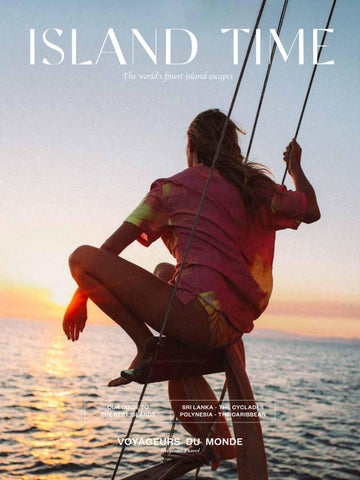
ISLAND TIME The world's finest island escapes
OUR GUIDE TO THE BEST ISLANDS
SRI LANKA - THE CYCLADES POLYNESIA - THE CARIBBEAN
Original Travel
Cover shot by Terence Connors Communications Director: Nathalie Belloir Artistic Directors: Morgane Legall and Olivier Romano Editors: Tom Barber and Ella Mawson Copy Editor: Kate Robinson Production Coordinator: Isabelle Sire Photo Manager: Marie Champenois Picture Research: Daria Nikitina
VOYAGEURS DU MONDE 111 Upper Richmond Road London SW15 2TL +44 (0) 20 3911 5900 Find all our travel ideas on voyageursdumonde.co.uk
EDITOR’S LETTER I first came across the concept of ‘island time’ in the Maldives, where the arrival is famously theatrical: a seaplane flight over atolls scattered like gems across a deep blue sea, before landing in the lagoon at your own island idyll. Our host, dressed head to toe in immaculately pressed white linen, explained that we would need to adjust our watches to island time. The logic is disarmingly simple: the Maldives straddles the equator, where the sun sets with bureaucratic punctuality at six. Nudge the island’s clocks an hour ahead of the rest of the country, and sundown is deferred to a more civilised seven, restoring the evening to its proper length. On an island, it seems, time bends to you rather than the other way around. But even if your island keeps standard time, there’s something special about being surrounded by water – at once bounded and adrift – that makes the rest of the world feel comfortably far away. That’s the beauty of islands: you have to cast off before you can be cast away. TOM BARBER,
Voyageurs du Monde (formerly Original Travel)
CONTENTS The world’s finest island escapes
4 OUR SERVICES Expert guides, local Concierges, detailed Dossiers and more.
6
ISLAND CALENDAR
8
BEST ISLAND HOTELS
24
MEDITERRANEAN
50
ATLANTIC OCEAN
26 32 44 46
52
A year of island escapes, from the legendary to the lesser known.
Cast away in style.
Balearic Islands The Cyclades Italian islands Sicily
The Azores
© Cap Juluca/Belmond Hotel/Anguilla
62
PACIFIC OCEAN
88
CARIBBEAN SEA
102
INDIAN OCEAN
64 72 74 96
© Daria Klet/Pexels
90 96 98
104 106 108 116
French Polynesia South Pacific islands Indonesia Thailand
Caribbean islands Barbados vs Grenada The Secret Caribbean
Mauritius vs Reunion East African islands Sri Lanka Madagascar
OUR SERVICES The details that make the difference
LOCAL HEROES
ZERO CARBON
LIKE A LOCAL
The Concierge in your destination(s) can fulfil any request, from the simplest to the strangest, be it booking a last-minute activity or sourcing the perfect souvenir. Super-responsive and chosen for their initiative, these local heroes are just a text or call away.
We absorb 100% of the carbon footprint generated by our clients’ flights, train and car journeys through our financing of large reforestation projects around the world.
Take an informal stroll (tailored to your personal interests) with a local resident who’ll share insights into the destination’s culture and society, giving you a genuine understanding of local life. An enriching and original experience.
LEAVE WITH EASE
DIVE IN!
AIRPORT FAST-TRACK
When you fly, we’ll always prebook your airline seats, check you in and process your boarding passes, and can even arrange an airport transfer. Anything and everything to make flying a breeze.
We think diving is one of the great travel experiences, and our dedicated dive division can tailor-make snorkelling and diving holidays around the world, including beginner courses.
We can arrange for you to skip the queue with access to a dedicated Fast Track Security line, or have a member of our team meet you earlier in the departure hall to help fast-track you through both check-in and security.
4
WELCOME
PROTECTED
RESERVED
Whether it’s an early morning arrival or a late departure, we can arrange for you to check-in/out of your accommodation at a time that’s convenient to you. We can also arrange a room for the day on certain stopovers.
With ATOL and ABTA, you can sleep easy knowing that your holiday is fully protected. You’ll be entitled to a refund if you are yet to travel, and to the costs of hotels and flights home if you are already abroad.
We are constantly revisiting our favourite destinations and trying out new restaurants. We’ll always recommend the best places in town and can make sure they are pre-reserved long before you even travel.
APPY DAYS
DETAILED DOSSIERS
LOUNGE ACCESS
Our handy app gives you access to your day-by-day itinerary and documents; important contact information (including our local Concierge) and a Dossier (next slide) of destination intel, visible on a GPS map within the app.
Available on our app and in your documents, our detailed Dossiers of recommended restaurants, shops, museums and more (all tested by the team) are constantly updated and will be your trusted travel companion.
We can arrange complimentary drinks and snacks in the comfort of a lounge before you make your way to your flight.
WI-FI WHEREVER
24/7 ASSISTANCE
Stay connected on the move. In certain destinations, we can provide a mini Wi-Fi router or an eSIM, letting you connect up to five devices (1GB/day included) and avoid significant mobile roaming costs. Coverage depends on local networks.
Our Concierges and emergency contacts are reachable 24/7, no matter the time zone, to provide peace of mind and find solutions to any snags that might arise.
These are just some of our exclusive services, all of which help us stand out from the crowd. To learn more, speak to one of our expert consultants. +44 (0) 20 3911 5900 voyageursdumonde.co.uk
5
island CALENDAR
© Grant Harder/Kintzing
A year of island escapes, from the legendary to the lesser known.
6
January
May
September
MEDITERRANEAN
MEDITERRANEAN
MEDITERRANEAN
Malta
ATLANTIC Canary Islands
PACIFIC Okinawa Hawaii Galapagos Islands
CARIBBEAN St Lucia Jamaica
INDIAN OCEAN The Maldives Andaman Islands
February CARIBBEAN Dominica Saint Vincent & the Grenadines
Ionian Islands Sicily
CARIBBEAN Guadeloupe The Bahamas
PACIFIC Indonesia Malaysia (islands)
June MEDITERRANEAN Dodecanese Islands Aeolian Islands
INDIAN OCEAN
The Seychelles
March ATLANTIC Madeira
CARIBBEAN Antigua Anguilla Grenada
PACIFIC New Zealand
April
October MEDITERRANEAN The Cyclades Capri Cyprus
INDIAN OCEAN Reunion
CARIBBEAN Barbados Martinique
PACIFIC French Polynesia Indonesia
PACIFIC The Philippines
Balearic Islands Crete Sardinia Aeolian Islands Corsica Sporades Islands
July MEDITERRANEAN Ponza Tremiti Islands
PACIFIC Fiji
November INDIAN OCEAN Rodrigues
December INDIAN OCEAN The Maldives Mauritius Thailand
ATLANTIC Fernando de Noronha
August INDIAN OCEAN Sri Lanka (west coast) Madagascar
ATLANTIC
The Azores
CARIBBEAN British Virgin Islands The Cayes, Belize
7
THE BEST ISLAND HOTELS Some hotels are reason enough to travel. Whether you’re seeking a romantic hideaway, a family-friendly base or a serene solo retreat, these island boltholes combine comfort, character and charm. It’s time to cast away in style. 8
© Lucy Laucht © Claire Guarry
Mallorca, Balearic Islands CORAZON
© Hotel Corazón
Where: a finca (farmhouse) sitting between the Tramuntana mountains and the sea, halfway between Deia and Soller. Style: beautiful interiors inspired by 1970s organic architecture, with fluid, curved spaces and earthy materials. Each room has its own unique style and views of the mountains or grounds. Highlight: the gardens and orchards around this restored farmhouse are once again producing fresh vegetables, fruits and herbs, this time for the seasonal, sun-infused cuisine served at the onsite restaurant. Made for: artists and dreamers. Motto: simple luxury.
© Hotel Signum
Mediterranean
Salina, Aeolian Islands SIGNUM
Where: in a tiny village near the Santa Marina harbour, a haven of coastal calm in a secret corner of Sicily. Style: created by a local couple who moved back to the island, the hotel is a love letter to their village: white-washed exteriors; abundant bougainvillea; terraces with wonderful views of Stromboli’s smoking volcano; and hydrotherapy pools, all just a few steps from the sea. Highlight: the spa is open in the evenings for candlelit treatments under the olive trees. Made for: those seeking coastal calm. Motto: sun, sea and serenity.
Ibiza, Balearic Islands © Carlota del Sol/ Los Enamorados
LO S E N A M O R A D O S
Where: on the island’s north coast, cradled between a beach and a fishing port, surrounded by fragrant maquis scrubland and fringed by emerald coves. Style: a hippy haven, drenched with colour and decorated with vintage treasures collected by the owners over years of travelling. There are nine cosy rooms, as well as a restaurant, yoga studio, massage room and boutique. Highlight: while you can’t buy love, you can buy everything in this hotel, from the chairs to the fireplace. Made for: travelling lovebirds. Motto: dream in colour.
11
© Buenavista Lanzarote
Lanzarote, Canary Islands B U E N AV I S TA
Where: on the edge of the volcanic Timanfaya National Park, where the black earth crunches under your feet and ocean waves crash just beyond the craters. Style: a restored finca made of sunbleached, cubic structures. The minimalist interiors feature natural materials and colours that chime with Lanzarote’s lunar landscapes. Highlights: the bathrooms, with concrete tubs overlooking the lava fields; the delicious breakfast made with local produce. Made for: stargazers, with clear night skies perfect for celestial spotting. Motto: fly me to the moon.
Funchal, Madeira
© Reid’s Palace/Belmond Hotel
R E I D ’ S PA L A C E
12
Where: in the south of Madeira, on a cliff overlooking the Atlantic. Style: this luxurious hotel, now part of the Belmond brand, was dreamt up by a Scotsman who acquired the land in the late 19th century. Illustrious guests have included Winston Churchill and assorted European royals, and the property is just as glamorous today. Highlights: the balconies and terraces overlooking the ocean; the Michelin-starred restaurant. Made for: those who prefer luxury without the bling; foodies in search of a stellar experience. Motto: fashion changes, but style endures.
CA SA M O N T E LO N G O
© Casa Montelongo
Where: the charming village of La Oliva, which sits pretty at the base of the Arena volcano in the island’s interior. Style: a minimalist, light-filled retreat that has been featured in design and architecture publications. All-white interiors are set against green doors, stone arches, designer furniture and bright pops of colour. Highlights: the light-flooded spaces and private courtyard pool. Made for: creative minds in search of calm. Motto: less is more.
Atlantic Ocean
Fuerteventura, Canary Islands
Big Island, Hawaii Where: a stretch of ocean-facing lava rock in Big Island’s Kahuwai Bay, wherePolynesian sailors settled centuries before Captain Cook’s arrival. Style: the newly renovated waterfront bungalows blend wood, wicker and woven palm leaves for a sleek, mid-century take on Hawaiian style. Highlights: the sound of lapping waves; outdoor showers; cocktails on the terrace. Made for: barefoot adventurers. Motto: malama i ka ‘aina (take care of the earth).
14
© Rosewood Kona Village Resort
KO N A V IL L AGE , A RO S E WO O D R ES O RT
Tetiaroa, French Polynesia THE BRANDO
Pacific Ocean
© The Brando
Where: a legendary property perched on Onetahi, a private motu (atoll rim island) north of Tahiti which was once owned by actor Marlon Brando. Style: a pristine oasis with 35 sustainably-built villas tucked into the treeline, just steps from the shore. Highlights: learning about the environmental research and wildlife preservation that takes place at the resort’s EcoStation; cocktails at Bob’s Bar; holistic treatments at Fare Manu (the bird house), a treehouse treatment room for two perched in the trees. Made for: eco-conscious hedonists. Motto: leave nothing but footprints.
15
Anambas, Indonesia BAWAH RESERVE RESORT
© Bawah Reserve Resort
Where: in the Anambas archipelago, within a 2,470acre marine reserve encompassing six unspoiled islands between the Malaysian peninsula and Borneo. Style: overwater bungalows, treehouse lodges, glamorous tented suites and thatched-roof restaurants and bars, constructed out of local, sustainable materials and designed to blend into the natural environment. Highlights: ample activities, from diving and boating to film nights on the beach and batik cloth-dying workshops. Made for: castaway couples. Motto: born to be wild.
16
Yao Noi, Thailand
© Six Senses Yao Noi
SIX SENSES
Where: overlooking the dramatic limestone karst landscape of Phang Nga Bay, east of Phuket. Style: a cluster of thatched-roof villas perched on a hillside with views over the bay or forest. The tropical interiors feature teak and bamboo cladding, and dreamy driftwood bedposts Highlights: the spa, where treatments are prepared using ingredients from the garden; the out-of-this-world sunsets. Made for: honeymooners at heart. Motto: pinch me, I’m dreaming.
17
Langkawi, Malaysia T H E D ATA I
Where: in the heart of the rainforest, in the northwest corner of the island, overlooking a perfect crescent of white sand. Style: a romantic resort cocooned in dense jungle canopy. Created by late Australian architect Kerry Hill, and restored in 2018 by his associate Didier Lefort, it remains a sustainable must-stay. Highlights: the Datai Pledge, an environmental conservation and education fund; forest bathing and wildlife walks with naturalist guides. Made for: total relaxation. Motto: between rainforest and reef.
Sumba, Indonesia
© Cap Karoso
Where: on a remote stretch of shoreline in western Sumba, an hour’s flight from Bali. Style: a tasteful blend of craft heritage and contemporary design. Highlights: the hotel’s commitment to creating connections between the local community and a burgeoning tourism industry; the permaculture farm which supplies ingredients for meals and spa treatments. Made for: reconnecting with the natural world. Motto: the wild, wild east.
© The Datai Langkawi
CAP KAROSO
18
Havelock, Andaman Islands
© Jalakara
JALAKARA
Where: tucked away in old-growth rainforest, a short scooter ride from the white sands of Radhanagar Beach. Style: a small boutique hotel with just three rooms, three suites and one villa. The interiors blend contemporary architecture with natural materials, Karnataka moulded tiles and vintage furniture, complementing the tropical views over banana and palm trees. Highlights: the infinity pool surrounded by lush vegetation; massages to a soundtrack of chattering birds and rustling palm trees. Made for: nature lovers seeking a stylish escape. Motto: where the jungle does the talking.
19
Caribbean Portsmouth, Dominica
20
© Secret Bay
Where: on a lush clifftop promontory in Dominica’s picturesque northwest, just south of the town of Portsmouth. Style: luxurious tree-house style villas built from sustainably-sourced Guyanese hardwood. Each comes with a private plunge pool, al fresco living areas and terraces with ocean or jungle views. Highlights: yoga sessions in the open-air wellness pavilion; borrowing a stand-up paddle board to explore the bay; massages with locally-blended oils at the treetop spa. Made for: those who prefer birdsong to bustling resorts. Motto: nature keeps the best secrets.
Caraïbes
S E C R E T B AY
Holbox, Mexico NOMADE
© Nomade Holbox
Where: steps from the sea on the serene western point of Holbox Island, in a prime spot for enjoying the sunset. Style: stilted treehouses and ocean-front suites made of latticed local wood and designed to sit in harmony with the natural beauty of the shoreline; bohemian decor with canvas walls, earthy toned linens and buttery-soft bedlinens. Highlights: eco-friendly design; holistic practices; the restaurant's innovative Japanese-Peruvian fusion menu. Made for: yogis seeking R&R. Motto: namaste.
21
© Voaara
Indian Ocean
Sainte-Marie, Madagascar VOAARA
Where: beside a stretch of white sand beach on a quiet island off the east coast of Madagascar. Style: barefoot luxury at its best: earthy tones, palm frond roofs and driftwood details. The rooms are oriented to perfectly frame views over the turquoise sea and jewel-toned jungle. Highlights: dinners on the beach; thatchedroof massage rooms facing the water; the feeling of being (almost) totally alone. Made for: barefoot travellers. Motto: out of office.
Kunfunadhoo, Maldives S O N E VA F U S H I
© Soneva Fushi
Where: a private retreat blanketed in forest and fringed with powder-soft sand, one of the 1,200 tiny islands in the archipelago. Style: a laid-back beach resort with family-friendly villas suspended above the sea or tucked into lush greenery. Highlights: the private pools and waterslides; overwater villa roofs that open to starry skies; cooking classes, nature walks and hands-on workshops for young travellers. Made for: families looking to slow down and reconnect. Motto: Maldivian Family Robinson.
22
Denis Island, The Seychelles
© Vanessa Martin
D E N I S P R I VAT E I S L A N D
Where: a private coral islet at the edge of the Seychelles bank, north of Mahe island. Style: colonial-style cottages and villas with shaded verandas, garden courtyards and wooden furnishings crafted at the island’s carpentry workshop. Highlights: 375 acres to explore, none of it off-limits; snorkelling in a sea turtle sanctuary; meeting the island’s venerable giant tortoises; encountering rare endemic birds like magpie robins and paradise flycatchers in the protected forests. Made for: conservation-conscious travellers. Motto: an island of your own.
MEDITERRANEAN
BALEARIC ISLANDS • CYCLADES • AEOLIAN ISLANDS • SARDINIA • SICILY
25
S PA I N
BALEARICS: THE FAB FOUR Sun-drenched, steeped in natural beauty and host to myriad fiestas and cultural events, the four inhabited islands of the Balearic archipelago have been working their magic since the dawn of time. Each one has its own distinctive identity – an island for every occasion. MALLORCA: ART HOTSPOT The largest of the Balearic Islands, Mallorca strikes a savvy balance with its cosmopolitan capital, untamed mountains and beautiful countryside. Echoes of the island’s dense history linger in its architecture, from the Royal Palace of La Almudaina – once a Moorish alcazar (fortified palace) and today the summer residence of the Spanish royal family – to Palma’s great Gothic cathedral, La Seu, which has dominated the waterfront since 1229. Antoni Gaudi reworked the interior in the early 20th century, and from April to October you can climb to its terraces for sweeping views over the city and the bay. Another must-see historical landmark, Can Vivot, is an exquisitely preserved manor house dating from the 14th century. Also in Palma, the Es Baluard Museu d’Art Contemporani symbolises the unbreakable ties forged between heritage and art on the island. The city hosts major events throughout the year, including Nit de l’Art in September, Art Palma Brunch in spring and an eclectic array of music festivals. Aptly, Palma is slated to become a European Capital of Culture in 2031.
ries, and much like Miro, many European artists and intellectuals have been captivated by Mallorca’s natural beauty. Perhaps the island’s most striking feature is the Serra de Tramuntana mountain range, which forms the northern backbone of the island. Then there’s the terraced farmland that carved a foothold on the mountains’ sheer slopes thanks to ingenious irrigation systems. Here, centuries-old olive groves flourish, their liquid gold extracted by several estates in the region, including Son Moragues, where visitors can savour pa amb oli (bread with oil) in the shade of the ancient olive groves. The estate once belonged to Archduke Ludwig Salvator of Austria, a man to whom Mallorca owes much. He settled here in 1867 and spent decades documenting the island and buying up swathes of the Tramuntana coast, which he protected from development – preserving the landscape that would later draw the first travellers, and everyone since. Memorable early tourists included Polish composer Frederic Chopin and English poet Robert Graves, who was so fond of the island that he asked to be buried in the mountain village of Deia.
The draw at the Fundacio Pilar i Joan Miro is the artist’s actual studio, left much as Miro had it: half-finished canvases on easels, half-squeezed tubes of paint on palettes, the whole room poised as though he’d only popped out and might be back any minute, despite his death in 1983. Over the centu-
These days the appeal is as much in where you stay: old buildings given over to local architects and designers, abandoned farmhouses reimagined as rustic retreats complete with whitewashed walls, city townhouses lovingly restored with snug, soulful interiors. Fortunately even the most modern
26
© Faustine Poidevin-Gros
28
© Carlota del Sol
© Carlota del Sol/La Residencia/Belmond
© Faustine Poidevin-Gros
© Finca Son Ru
S PA I N
visionaries abide by the same unspoken commitment to preserving Mallorca heritage. MENORCA: LOW-KEY CHARM Known for championing simpler pleasures than its neighbours, Menorca has mastered the art of staying out of the spotlight. UNESCO declared the entire island a biosphere reserve in 1993, and 85 percent of its marine environment is also protected. Life on the island is relaxed and unhurried: black Menorquin horses still prance through the crowded alleys of Ciutadella during the Festes de Sant Joan, fishermen mend their nets in small fishing villages and, during the hottest afternoon hours, hamlets still shut down for a siesta. The culinary scene is similarly laid back, championing local ingredients and homegrown talent, whether it’s a lunch of traditional lobster stew in the fishing village of Fornells or a dinner tasting menu prepared by a young up-and-coming chef. The few roads connecting Mahon and Ciutadella – Menorca’s present and former capitals – wind between low drystone walls and past wheat fields and olive groves. Amid the patchwork of farmland, renovated fincas (farmhouses) house small art galleries, ceramics workshops and wellness retreats, where participants perform asanas surrounded by vineyards and tuck into homecooked meals made from local produce. At the entrance to Mahon harbour, the islet of Illa del Rei best embodies this blend of heritage and contemporary flair: the international art-world heavyweight Hauser & Wirth has turned a former military hospital into a contemporary art hub, with an excellent restaurant attached. Back on Menorca’s south coast, mule trails cut through pine forests on their way to sandy beaches, while in the north, the s’Albufera des Grau Nature Park – a sanctuary for migratory birds – is a reminder of the fragile balance the island seeks to protect. Little here is new, and that is precisely Menorca’s appeal: the gallery owners, designers and chefs who come here are inspired by the traditions, landscapes and way of life that have endured for generations. IBIZA: THE HIDDEN SIDE Away from its glitzy clubs, Ibiza moves to a slower rhythm; one set by hidden coves, fragrant pine forests and soil the colour of burnt sienna. Over the centuries the island – once known as Ibossim, thought to mean ‘island of the god Bes’ in Phoenician – has been many things to many people: a prize for the Phoenicians and Carthaginians, a source of
inspiration for painters and writers at the turn of the 20th century, a utopian refuge for hippies in the 1960s, a haven for clubbers since the 1990s. Its beaches still draw Europeans, along with growing numbers of Americans and South Koreans (who come to tie the knot), but the island’s heart lies elsewhere. Beyond the waves and the revellers, Ibiza has a long and intriguing history: visit the fortified church of Puig de Missa and the necropolis of Puig des Molins, one of the largest and best-preserved Punic burial grounds in the Mediterranean; journey to the north, where farmlands have been carefully tended since the 14th century; and feast on farm-fresh meals at fincas enclosed by olive and almond groves. And on the west coast, small beaches like Sa Caleta, Es Xarco and Sa Pedrera prove the island still has a slower, softer side. FORMENTERA: SIMPLE BEAUTY The smallest of the inhabited islands, Formentera is just half an hour by boat from Ibiza. The Aquabus docks amid the sailboats at La Savina, and from there a path between low walls leads to Sant Francesc Xavier, a white-walled town whose church square is ringed with cafes and bookshops. Life unfolds between chiringuitos (beach kiosks), beachside retreats and architect-designed villas. The wilder eastern end, La Mola, is reached by bike, while other trails drop down to the beaches at Migjorn, in the south, and Ses Illetes, on the northern spit. The landscapes steal the limelight here: lagoons shimmer in the distance, whitewashed houses with flat roofs keep a low profile and old mills and the modest boat sheds known as varaderos hint at how little the island cares for show. •
TO DO LIST Mallorca: stop by Studio Weil in Port d’Andratx, dedicated to paintings and sculptures by the late American artist Barbara Weil; take a dip in the coves at Punta Negra; sip your way around the wine cellars in Binissalem; visit the Museu Sa Bassa Blanca, a castellated Moorish-Spanish masterpiece by legendary Egyptian architect Hassan Farhy; enjoy a ‘gin tonic’ in the Nobis Hotel’s handsome cocktail bar. Menorca: travel back to the 19th century at the splendid Ca n’Oliver and Torre Saura palaces, and even further at the island’s cyclopean prehistoric sites; stop by a farm and sample the island’s famous Mahon cheese; lunch on the rooftop of the Cap Menorca hotel; stargaze with zero light pollution. Ibiza: have a mud bath on the beach at Es Bol Nou, then a swim in the crystal-clear waters of Cala Mastella; enjoy a lunch in the gorgeous garden at Can Mussonet; celebrate diversity at Ibiza Pride. Formentera: picnic under the pines at Sa Platgeta; go hiking near Barbaria and try to spot the house designed by Philippe Starck; sip a mojito in a chiringuito on one of Migjorn’s beaches. Contact one of our Spain specialists on +44 (0) 20 3911 5900
29
Other travel ideas in the Balearic Islands Secret Menorca
Remote coves and inland stays Port Mahon/Alaior First stop: Mahon, the island’s laid-back capital. Wander along the narrow cobbled streets of the Old Town and people watch in small squares lined with bustling tapas restaurants. Then it’s off to a lovely finca perched between countryside and sea, where you’ll have to make a difficult choice: explore the coast and inland regions, or idle the days away in blissful Mediterranean style? Decisions, decisions.
A greener Mallorca
Off-season Ibiza
From the hinterland to the coast, take your time discovering Mallorca’s lovely landscapes and meet the local producers and craftspeople committed to protecting them. You’ll travel by electric car, stay in eco-friendly hotels, dine at farm-to-table restaurants and hike winding coastal paths with a local guide.
Outside the summer months, Ibiza dials down the glitz and glamour, settling into a more peaceful rhythm. Inland, behind Santa Eulalia, pine and olive groves climb the hills to whitewashed hilltop churches, with quiet villages tucked in between. The walking and cycling here come into their own, and the beaches are all but empty.
Wild coast, fincas and conservation Campanet/Capdepera
Quiet countryside and bohemian fincas Saint Eulalia
Balearics island-hopping
Farmhouse stays on Mallorca & Menorca Maria de la Salut/Alaior Discover the rugged inland regions of these sister islands. Take in the scenery with strolls through fragrant pine forests between sleepy villages, and experience each island’s hidden side while staying in tastefully restored farmhouses, where seasonal cuisine and sustainable agriculture come together in authentic agroturismo (farm stay) retreats.
Mallorca for families
Ibiza’s hippy heritage
Start in Palma, where a local guide leads the family well off the tourist trail into the old town’s quiet corners, with a rooftop pool back at the hotel for cooling off. Then head inland to a finca among the olive groves, with bikes for the flat country lanes and kayaking into coves no boat can reach.
Ibiza’s hippy culture, born in the 1960s and 70s, when creatives and free spirits fleeing political oppression settled on the island, remains an important part of its identity today. For those in the know, a handful of secluded fincas, boutique retreats and countryside hideaways still offer a taste of Ibiza’s original spirit. Enjoy stress-free living, garden-grown dishes and the art of farniente – the sweetness of doing nothing.
Secret spots in Palma and the hinterland Palma/inland Mallorca
Back to basics Santa Eulalia/Portinatx
FOR MORE HOLIDAY IDEAS, VISIT VOYAGEURSDUMONDE.CO.UK 30
© Alex Reyto/Kintzing
© Olivier Romano
GREECE
THE SECRET CYCLADES
The Cyclades are the archetypal Aegean islands, with Mykonos and Santorini attracting the bulk of the visitors. Of the twenty-odd other islands, some are now surging in popularity while others remain resolutely under the radar. 33
When it comes to the Cyclades, the same islands crop up time and again. The one your friends go to every autumn. The one everyone talked about this summer. The one your neighbour dreams of retiring to one day. Everyone has reasons to love a particular island. One has been all over social media, another boasts the best ferry connections, a third tops a list of Mediterranean hotspots. But which spots are best suited to travellers seeking uncrowded beaches, spontaneous days and a slower rhythm more in sync with the people who live there yearround? Thankfully the Cyclades still offer that. Not everywhere, but often. The secret lies in knowing where to look: little-known or overlooked islands considered too remote, too underdeveloped or simply harder to reach. These are the Cyclades that belonged first to the Greeks, and only then to visitors. They are places to retreat to, where time stretches out languidly, indifferent to schedules and timetables, luring those wishing to slow down. Each is different, yet all have preserved the calm and authenticity of an archipelago that continues to surprise and enchant. 34
Syros
Kythnos
Kea
GREECE
ATHENS: GATEWAY TO THE CYCLADES The best planned Greek getaways begin on the mainland. Athens is worth lingering in, no matter the season. There is the Acropolis, of course, and its remarkable museum which houses thousands of ancient artefacts. Then there are the neighbourhoods where contemporary Athens comes alive: Metaxourgeio, Kypseli, Exarcheia and Pangrati, with their independent bookshops, authentic markets, leafy corners and colourful graffiti. Simply settling into the rhythm of Greek life, fuelled by strong elliniko coffee and sesame-coated koulouri (bread rings), is reason enough to visit. Before long, the sea beckons, but there’s no need to venture far. Paradoxically, some of the islands closest to Athens are the ones that have escaped mass tourism. Make your way to the seaside town of Lavrio and you’ll find a small harbour that is far quieter than Athens’ sea port of Piraeus. Travelling by ferry is a Greek experience in its own right. The islands are unreachable without these maritime lifelines, which operate on a timetable that adapts daily to the weather.
35
© Olivier Romano (x 4)
© Nurial Val/Coke Bartrina
GREECE
Along country lanes bordered by dry-stone walls, the scent of thyme and clary sage drifts on the breeze, and there’s a quiet hum of bees at work among the flowers, producing one of the island’s local treasures: maquis honey.
KEA: WHERE ATHENIANS ESCAPE TO Ahead lies the harbour of Kea, loved by Athenians for an obvious reason – the island is just an hour’s ferry ride from the capital. There are advantages and drawbacks to this. Weekends can be busy, but because many visitors are from the capital – and often own second homes on the island – Kea has escaped the excesses that come with international tourism. Step foot on the island and you’ll be met with mountainous landscapes and a gentler pace: this is the real Cyclades. For a true taste of island life, stay at a hotel in the interior, perched high above the coast with sweeping views across the Aegean. Drive with the windows down, let the fragrant breeze drift in, and hop from one beach to the next: Koundouros, Otzias, Gialiskari, Pisses and Liparo; Kea has no shortage of sandy coves where you can unfurl your towel in the shade of a tamarisk tree and finally open the book that has been gathering dust on your bedside table. Life here revolves around simple pleasures, and thanks to the island’s discerning clientele, there are excellent restaurants and good wine everywhere.
Walking is the perfect counterpoint to lazy beach days. The island’s paths wind over hills and through valleys fragrant with pine resin, myrtle, rosemary and wild lavender, leading to ancient sites like the acropolis of Karthea. A more recent relic is the Britannic, sister ship of the Titanic, which sank in Kea’s waters in 1916 while serving as a hospital ship during WWI. For now, only experienced divers can explore the wreck. Continue your exploring by e-bike, discovering quiet chapels, picturesque harbours and a historic lighthouse. As evening draws in, find a spot to watch the sun go down. Sunsets here transcend cliche, setting the sky ablaze with colour. UNTAMED BEAUTY IN KYTHNOS Return to the harbour, this time at sunset. Another hour at sea, and a second island refuge comes into view. Kythnos has kept to itself. For generations, its shallow waters kept larger vessels from mooring, which slowed the arrival of tourism. The delay has worked in the island’s favour and there is something refreshingly untamed about Kythnos. That said, for centuries Kythnos was renowned for the quality of its grain and exported much of the barley that sup37
© Roberta Sant-Anna/Unsplash
© Olivier Romano
plied Athens’s breweries. The landscape still bears witness to that past, with terraced fields that have been cultivated for generations. Settle into a hotel on the island’s west coast, just a short stroll from the beach and with beautiful views over a sheltered bay. Cool off in the infinity pool, which, from certain angles, is separated from the sea only by the slightest shift in blue. Then, as the day cools, swap sandals for walking shoes and amble along paths that lead to an acropolis, an aqueduct and sanctuaries dedicated to Apollo, Aphrodite and Asclepius – a reminder that antiquity left a lasting mark on Kythnos. In the distance, Kolona beach comes into view, its twin bays linked by a slender ribbon of sand. If elegance were a beach, this would be it. Along country lanes bordered by dry-stone 38
walls, the scent of thyme and clary sage drifts on the breeze, and there’s a quiet hum of bees at work among the flowers, producing one of the island’s local treasures: maquis honey. When Apokrousi, Kythnos’s largest beach, comes into view, it’s time for a swim. As evening draws in, head to the village of Dryopida to wander along cobbled streets, past ceramic workshops and houses draped with bougainvillea. Then end the day with dinner in Chora. Sample the island’s speciality courgette flowers, marathopita (a spinach and fennel-filled pastry) and slow-cooked kotsi (braised pork shank) in one of the village’s quintessentially Cycladic alleyways. A FINAL SLICE OF ISLAND LIFE IN SYROS The harbour beckons once again. Your final destination is Syros, the administrative capital of the Cyclades. On paper, not such a draw, but Syros is arguably the most authentic of
© Olivier Romano
© Pagostas Patmos
GREECE
© Leonovo/Adobe Stock
Syros is unmistakably Greek. Stroll along whitewashed streets, past buttery-hued buildings with blue shutters flung open. Lazy cats bask in the sunshine while mopeds buzz past.
the Cyclades islands. Stroll along whitewashed streets past buttery-hued buildings with blue shutters flung open. Lazy cats bask in the sunshine while mopeds buzz past. The island also has delightful beaches – Galissas, Kini and Finikas among them – and the small city of Ermoupoli with its neoclassical architecture, student buzz and hilltop churches. Stay by the harbour and watch as island life unfolds around you. Nearby, the Apollo Theatre, modelled on Milan’s La Scala, stands as a legacy of the economic boom that transformed Syros in the 19th century. There is also the island’s famous loukoumi, or Turkish delight, brought here during the 19th-century Greek War of Independence when refugees from Chios and the eastern Aegean found sanctuary on Syros. Away from the bustle you’ll find warm seas, beautiful beaches and winding walking trails. This is the truly secret Cyclades. •
NEED TO KNOW Getting there: fly direct to Athens, then continue by ferry to each of the three islands. When to go: spring and autumn are ideal for discovering a quieter side of the Cyclades, offering opportunities to rub shoulders with locals and gain a deeper understanding of island life. Duration: three days on each island. Extend your stay: linger a little longer in Athens at the start or end of your trip. Alternatively, stay in island mode with a quick hop from Syros to Tinos, a tiny island with a big gourmet reputation. Budget: from £3,900 per person, including return flights, ferry crossings, private transfers, accommodation and signature experiences on each island. Contact one of our Greece specialists on +44 (0) 20 3911 5900
41
Other travel ideas in the Greek islands Foodie farm stays on Crete Countryside and coastal living Vlatos/Kissamos/Angeliana/Kapetaniana
The Cretan lifestyle is best enjoyed with a chilled glass of local organic wine in hand and a view of shimmering turquoise waters. Savour the bounty of the island’s coasts, mountains and countryside at restored farms and field-to-fork restaurants – a feast for all the senses.
Hidden Cyclades
Summer in the Sporades Islands
The Cyclades are an Aegean archetype – lemon orchards, white-walled villages reflecting the sun, picturesque churches, peaceful beaches and coves, and small ports dotted with caiques (traditional fishing boats). Sifnos and Milos, two of the archipelago’s most secluded islands, offer all this and more.
The Sporades are a collection of 24 rugged islands – only four of which are inhabited – scattered off Greece’s east coast. Less developed than their neighbours in the Aegean Sea, the Sporades boast pine forests and olive groves, ancient monasteries and castles, and impressive rock formations.
Whitewashed villages and Olympian calm Sifnos/Milos
Sea swims and Byzantine heritage Skopelos/Alonissos/Skiathos
Off-season Crete
Iconic sites without the crowds Heraklion/Rethymno/Chania Most travellers flock to Crete in the summer, but visit in the spring or autumn and you’ll be rewarded with mild temperatures and a fraction of the crowds. This trip focuses on three historic coastal cities – Heraklion, Rethymno and Chania – introducing you to the island’s rich history, authentic food and beautiful landscapes.
Secluded Ionian Islands
An unhurried island-hopping escape Kefalonia/Ithaca Discover two of the most captivating destinations in the Ionian Sea. Start in Kefalonia, a scenic island of forested mountains, spectacular cliffs and cave-pocked coves where loggerhead sea turtles still nest. Then hop over to peaceful Ithaca, home to lemon orchards, olive-scented air and quiet beaches. Explore the hinterland’s historical heritage on foot, taste local wines and sail along the beautiful coastline.
Greece & Turkey combo
Beaches, palaces and citrus orchards Chios/Rhodes/Alacati From windsurfing off the coast of Turkey to wandering the orchards of Chios and the ramparts of Rhodes, experience the best of the Eastern Mediterranean during a two-week stay. Stroll along paths bright with bougainvillea and fragrant with citrus orchards, swim in crystal waters and enjoy some R&R in elegant accommodation.
FOR MORE HOLIDAY IDEAS, VISIT VOYAGEURSDUMONDE.CO.UK 42
A Cycladic triad FOLEGANDROS A south-westerly Cycladic island, Folegandros keeps a low profile. Hike dusty trails to secluded beaches, browse boutiques in the chora (main town) and watch the sun set from the hilltop Church of Panagia. NAXOS Naxos is the largest and most fertile of the Cyclades Islands and consequently a foodie haven. With a guide at your side, sample locally produced cheeses, honey and citron liqueur.
© Parocks Luxury Hotel and Spa
SIFNOS With its thyme-scented valleys, sugar cube villages and serene sandy coves, Sifnos is the quintessential Greek getaway. Explore by e-bike, following mule tracks along craggy clifftops to whitewashed chapels.
I TA LY
ISOLE PARADISO ITALY HAS AROUND 450 ISLANDS TO CHOOSE FROM, AND THEY COME IN ALL SHAPES, SIZES AND STYLES. STAY ON THE SIDE OF A VOLCANO, VISIT GREEK TEMPLES OLDER THAN ROME OR WATCH THE WORLD GO BY IN A CHARMING FISHING VILLAGE. NO TWO ITALIAN ISLANDS FEEL ALIKE, WHICH IS THE WHOLE APPEAL.
Capri
Ischia
Where: off the Sorrento peninsula, a short boat ride from the mainland by hydrofoil or ferry. What: a stylish seaside resort that has inspired writers since the 19 th century. We love: sailing between the towering Faraglioni rock formations; climbing up the Punta Massullo cliff to admire the redbrick Casa Malaparte, built in 1937 and made famous by French New Wave filmmaker Jean-Luc Godard; savouring a pizzetta at Ciro Oliva; and sipping limoncello and dancing until dawn at Taverna Anema e Core. When to go: early autumn, when the tourists have left and life returns to a slower rhythm. Travel with: oversized sunglasses and a laid-back attitude.
Where: an hour’s ferry ride from Naples, at the northern end of the gulf. What: a volcanic island of hills, olive trees and fishing villages, with thermal waters that have been celebrated since Antiquity. We love: wandering among the magnolias and sitting in on a summer concert in the lush Giardini della Mortella botanical park; relaxing in the Sorgeto hot springs; sailing out to Castello Aragonese, built on a tidal island in 474 BCE; sipping a glass of local Frassitelli white wine and watching the fumaroles steam. When to go: in spring, when the island is at its most fragrant. Travel with: a copy of Elena Ferrante’s novel My Brilliant Friend.
44
Ponza
Pantelleria
Where: in the Tyrrhenian Sea, equidistant from Rome and Naples. What: the largest of the Pontine Islands, a crescent of volcanic tuff rock dotted with brightly coloured buildings; one of Italy’s best-kept secrets. We love: the view of the port as the ferry docks; the scent of sfogliatella (a shell-shaped pastry from Campania); dawn hikes to hidden coves; exploring history and mythology at the Grotte di Pilato, a maze of man-made sea caves from the Roman era; and raising a glass of Fieno di Ponza white to the deities Dionysus and Circe. When to go: in late summer, when the crowds have thinned but the sun still warms the cliffs. Travel with: light layers for breezy evenings by the water.
Where: south of Sicily and closer to Tunisia than to Italy. What: the Med’s ‘Black Pearl’, a rugged volcanic island, 80% protected as a national park; a retreat for creative souls. We love: the untamed beauty of the island’s volcanic hills; the elegance of renovated dammusi (traditional stone dwellings); the shimmering turquoise water at Specchio di Venere (‘mirror of Venus’); and the biodiversity along the broom- and honeysuckled-lined Khamma Trail. When to go: in May, when the bougainvillea are in bloom and the heat and wind isn’t yet oppressive. Travel with: a leather-bound journal or sketchbook for when inspiration strikes.
The Aeolian Islands
Tremiti
Where: north of Sicily, in the Tyrrhenian Sea. What: a string of seven dramatic volcanic islands ringed with lush vegetation, which inspired Roman myths and films by Italian director Nanni Moretti. We love: island-hopping; waiting for Stromboli’s active volcano to light up the night sky; swimming in fumaroles on Vulcano; wandering the narrow streets of Panarea; and devouring pasta con le sarde (made with anchovies, sardines, pine nuts and fennel) on Salina. When to go: in the middle of summer for island-hopping or in autumn for the Malvasia grape harvest on Salina. Travel with: your special someone.
Where: off the coast of Puglia, in its own marine reserve. What: five islands scattered across the Adriatic Sea; a nature refuge where pine forests and limestone cliffs tower over unspoiled seabeds. We love: diving off the coast of Capraia; playing Robinson Crusoe on San Domino and admiring the Byzantine mosaics in the Abbey of Santa Maria a Mara on San Nicola. When to go: in June, before the crowds arrive and when the underwater visibility is measured in dozens of metres. Travel with: your diving certificate and a sense of adventure.
45
SICILY: BEACHES TO BOOKMARK 46
SURROUNDED BY THREE SEAS (THE IONIAN, TYRRHENIAN AND MEDITERRANEAN), 900 MILES OF COASTLINE AND SOME 20 ISLANDS (INCLUDING THE AEOLIAN AND AEGADIAN ISLANDS), SICILY HAS NO SHORTAGE OF BEAUTIFUL BEACHES.
City comfort meets seaside serenity at Sicily’s many beach clubs (called lidos by the locals). In Mondello, north of Palermo, Art Nouveau villas line a long sliver of sand adorned with neat rows of sunloungers. In a similar style, the parasols of Cefalu flutter beneath the city’s historic facades, and in San Vito Lo Capo, near Trapani, Monte Monaco soars behind a two-mile-long stretch of white sand which could be mistaken for Rio’s Copacabana with its palm trees, beachside vendors and granita stands. Sicily also has a wild side. In the northwest, crystal-clear coves await at the end of trails that wind through lush vegetation and along craggy cliffs in the Riserva Naturale dello Zingaro. In this unspoiled corner of the north-west coast, Scopello is Sicily at its most beguiling – a huddle of sea stacks and a former tuna fishery around one idyllic cove. On the long sandy ribbon of Sicily’s south coast, near Agrigento, the Torre Salsa natural reserve is among the peaceful hideaways shared by locals and loggerhead sea turtles. The same rules apply in the east: to soak up the sun in peace, even in summer, be prepared to walk. Take a picnic, lots of water and a pair of good shoes, and set out for Timpa, a promontory north of Catania created by repeated volcanic eruptions, or Randello, a protected nature reserve west of Syracuse. One thing’s for sure: Sicily’s spiaggia (shoreline) is anything but flat and monotonous. There are dramatic natural theatres carved into the rock, like the striking Scala dei Turchi (Stair of the Turks), located between Realmonte and Porto Empedocle, a series of enormous white limestone steps sculpted by the sea and the wind that descend into emerald waters. On Pantelleria, forget white sand altogether: at the small bay of Cala Tramontana, and at Cala Cinque Denti, reachable only by sea, the volcanic seabed makes for extraordinary snorkelling. Over on Favignana, largest of the Aegadian Islands, Bue Marino proves a petite pebble cove can be every bit as enticing as a broad sweep of sand.
47
Other travel ideas on islands in the Mediterranean Secret Sicily
The island’s hidden side Palermo/Pantelleria/Trapani Combine the street food stalls of Palermo and the volcanic Aeolian islands with a trip to Pantelleria – a black lump of lava closer to Tunisia than to Sicily. Here, the wind barely lets up, which is how the island got the name ‘Daughter of the Winds’, and why the vines grow in pits rather than trellises. Expect dramatic black sand beaches, a thermal lake in an old crater, and capers and passito wine well worth the ferry ride.
Corsica from north to south
Volcanic Italy
Corsica has more mountains along its coastline than anywhere else in the Med. Even in June, snow lingers on Monte Cinto, just an hour from beaches that rival those in the Caribbean. Drive the island’s winding roads with the windows down (Napoleon reckoned he could smell the island’s aromatic plants from out at sea) and enjoy a boat trip into the volcanic Scandola reserve, now UNESCO-listed, to discover why they call this the ‘Isle of Beauty’.
Complex and impulsive; sluggish and explosive: teens and volcanoes have a lot in common. Summit Italy’s legendary volcanoes, from Vesuvius to Etna, alongside private vulcanologist guides; pay a visit to Negombo, a hydrothermal park on Ischia with an impresive 13 thermal pools of varying temperatures; and trade in staring at screens for gazing at stars.
Terroir, maquis and local specialities Calvi/Corte/Piana/Ajaccio/Levie/Bonifacio
Hot springs and craters with teens Ischia/Naples/Stromboli/Etna
Sicily & the Aegadian Islands A trio of sun-drenched islets Favignana/Agrigento/Palermo
Explore Sicily’s other island idylls: the Aegadians. Set just west of Trapani, the tiny trio of Favignana, Levanzo and Marettimo feel like they’ve been plucked from a postcard. Hike wind-swept mountain paths, swim in secret coves and sip a spritz in one of the many cobblestoned villages.
Secret Sardinia
The slow life in Malta
The south of Sardinia is the bit the crowds skip, a place of white sand coves and small beachfront boltholes. Begin in Cagliari, a capital fought over by everyone from the Phoenicians to the Aragonese, and finish in Ogliastra, one of the few places on earth where living past a hundred is unremarkable. In between, eat bluefin tuna in San Pietro and pecorino the local way (drizzled with honey), and take a boat trip to see Cala Goloritze’s limestone spire.
Malta sits in the middle of the Mediterranean, and yet is often overlooked. For a country you can drive across in an hour, the weight of history is almost absurd. The capital Valletta has the highest concentration of UNESCO World Heritage sites on the planet, and the Romans, Moors, French and British have all left their mark. Add the beaches and dive sites of Gozo across the water, and this is a pocket rocket of a country.
The south coast Cagliari/Portoscuso/Santa Maria Navarrese
Palaces, ports and golden sands Valetta/Gozo
FOR MORE HOLIDAY IDEAS, VISIT VOYAGEURSDUMONDE.CO.UK 48
MEDITERRANEAN • INSPIRATION • MEDITERRANEAN • INSPIRATION • MEDITERRANEAN
Beach
CORSICA Landscapes
VS
Maquis and granite monoliths Sea Hidden coves and clear water These mountainous CORSE History islands have never Napoleon, honourable bandits Paysages Maquis et granit abrupt quite belonged to the Architecture Mer cachées Stone villages Criques and red-tiled roofs countries that govern Mémoire Napoléon, bandits d’honneur Cuisine them (France Charcuterie, cheeses, Architecture Villages de pierre sombre and Greece). aromatic wines Gastronomie The similarities run Charcuterie, fromages, vins discrets Music deep, butMusique in the detail Polyphonies rugueuses Polyphonic singing they diverge. Culture Culture Identité farouche, insoumise A fierce sense of identity, rebellious
reads
CRETE Landscapes Olive groves and arid hills Sea Sweeping bays, long horizons History CRÈTE Zeus, the Minotaur, Knossos Palace Oliviers et reliefs arides Architecture Plages généreuses Whitewashed houses, Venetian heritage Zeus, Minotaure, palais de Cnossos Cuisine Maisons blanches, héritage vénitien Olive oil, Mediterranean diet Huile d’olive, diète méditerranéenne Music Lyraand et danses The lyra radiantsolaires folk dances Culture Hospitalité ritualisée (Philoxenia) Ritualised hospitality (Philoxenia)
The Island by Victoria Hislop (Headline Review) A sweeping historical drama following four generations of a family tied to Spinalonga – Greece’s former leper colony. Bitter Lemons by Lawrence Durrell (Faber & Faber) Living in Cyprus from 1953 to 1956, the author recounts his colourful experiences. The Art of Joy by Goliarda Sapienza (Penguin Classics) This sweeping historical novel recounts a Sicilian woman’s audacious life in Mussolini’s Italy.
Cyprus
Underrated beauty Covering barely 6,000 square miles, Cyprus is a tapestry of mountains, valleys, vineyards, villages and ancient ruins that have inspired many a myth. The goddess of love is said to have risen from the volcanic pebbles and turquoise waters of Aphrodite Beach; the seaside Paphos archaeological site features mosaics from ancient palaces; and the Troodos mountains and Mount Olympus are home to majestic cedar and black pine forests, and Venetian ruins. This is an island where beauty is celebrated at every turn.
Top ten
Island combos 1
6
Capri & Ischia Double dolce vita
Rhodes & Symi The Dodecanese at ease
2
7
Corsica & Sardinia Maquis and gelati
Serifos, Folegandros & Milos Simplicity in the Cyclades
3 Salina, Lipari & Stromboli Volcanoes and views
The inside scoop Menorca
Seafood lovers should head to Fornells. This charming fishing village is the best place on the island to sample Menorcan lobster. And if you’re ever in the market for a winning wine, plump for anything by the excellent local winery Binifadet – these pair perfectly with an evening whiled away under a canopy of olive trees.
4 Maddalena & Les Lavezzi Tiny jewels
5 Ponza & Ventotene Ruins and slow living
8 Mallorca & Menorca Combine major and minor islands
9 Malta, Gozo & Comino Baroque, beaches and blue lagoons
10 Crete & Cythera White mountains and Aphrodite’s garden
49
ATLANTIC OCEAN
C A N A R Y I S L A N D S • T H E A Z O R E S • M A D E I R A
51
PORTUGAL
THE COLOURS OF THE AZORES
Scattered across the Atlantic between Europe and the Americas, the islands of the dramatic Azores archipelago are alive with the power of nature. Journey to their shores and you’ll find volcanic crater lakes, ancient forests, spectacular diving and more. 52
© Jérôme Galland
Sao Miguel
Terceira
Pico
Faial
PORTUGAL
F
and Porto do Comprido, rocky basalt basins capture waves in natural pools to the delight of bathers. And on the slopes of Cabeco Gordo, which rises to over 3,400ft (the highest point of the island) Mother Nature shows off some of her finest work. Here, lush vegetation encircles an otherworldly caldera evoking a time before humans reached the Azores.
Horta’s seafront is a short lesson in local history. Churches with names as long as beaded rosaries are the legacy of colonial-era Portugal’s religious fervour, and the nearby Museu da Horta occupies the former Jesuit college. For those not planning on climbing a ship’s mast, the summit of Monte da Guia – two overlapping craters that open onto the bay of Porto Pim – offers a laudable view of the city. The white sands of Praia do Porto Pim glisten in the sun, while the black sands of nearby Praia do Almoxarife are a reminder of the island’s fiery, volcanic temperament. After a good night’s sleep in a quinta (country villa), Faial’s nickname – ‘the Blue Island’ – begins to make sense: the roads are lined with thickets of azure hydrangeas. In Varadouro
PICO: THE BLACK ISLAND After anchoring in the archipelago in the spring of 1791, French writer and politician Francois-Rene Chateaubriand wrote in his Memoirs from Beyond the Grave: ‘In the background, the volcanic cone of Pico, planted on a cupola of clouds, pierced the aerial perspective beyond Graciosa.’ This waypoint in the Atlantic – ‘a vain beacon by night, an unseen landmark by day’ – is reached by boat from Faial. The commanding volcano soars to 7,713ft, claiming its status as the roof of the Azores, and Portugal. Naturally, its host island took the name. While the boldest hikers set out to conquer this giant, other travellers are content to drive, cruising 11 miles along the EN3. Others follow the Caminhos de Santa Luzia trails and try to spot rilheiros, ruts in the lava made by carts weighed down with wine. Turning water into wine may be a well-known miracle, but so is transforming land bristling with basalt into fertile vineyards: in Criacao Velha, low, dark stone walls enclose rows of bright green vines, protecting them from the wind and ocean. Within this volcanic landscape, old scarlet-painted windmills, reminders of the island’s agricultural past, stand like single poppies, their blades ready to harness the island’s fickle winds.
AIAL: THE BLUE ISLAND Fly into Horta on a clear day and you’ll glimpse the Horta Marina from above as the plane makes its final approach. For centuries, this haven – the world’s fourth busiest harbour – has been the ‘land ahoy’ that intrepid sailors keep their eyes peeled for on Atlantic crossings. After mooring up, salty sea dogs partake in two local customs: adding to the artwork that adorns the seawall, and savouring a drink at Peter Cafe Sport, which has been serving sailors since opening its doors in 1918. Here, curious visitors mingle with sailors, against a backdrop of flags and pennant-plastered walls. After swilling a Gin do Mar, patrons climb the stairs to inspect the small Scrimshaw Museum, where a few skilfully engraved whalebones are on display.
54
55
© Andreas Hub/LAIF-REA, Traveldia/Adobe Stock, Jessica Sample, Michael Amme/LAIF-REA
© Nadia Cammelli/Unsplash
© Emmanuel Cassar/Unsplash
PORTUGAL
Out to sea, passengers on tourist boats wait for whales. If they are lucky, the first sign is a tall plume of breath and spray rising 30ft or more above the surface – a blue whale coming up for air. There is no better way to meet the largest animal that has ever lived. Spotted dolphins are the more dependable sighting, bow-riding alongside the boat and breaking the surface of the water in quick, showy runs. When the boats finally turn back for Madalena, the passengers are still watching the sea. TERCEIRA: THE LILAC ISLAND Seventy nautical miles away lies the island of Terceira. The name means ‘third’ in Portuguese, and the island was the third in the archipelago to be discovered by early navigators. The city of Angra do Heroismo, on the south coast of what is also known as ‘Lilac Island’, makes for an ideal base camp. ‘Heroism Cove’ earned UNESCO recognition for its rich maritime history and important role in the era of European exploration. Between 1766 and 1832, the city was the capital of the Azores. Its port hosted caravels and galleons – ships overflowing with silk, spices and gold that the empire’s powerful military infrastructure was tasked
with protecting. The impenetrable fort of Sao Joao Baptista still overlooks the ocean, and behind its stone ramparts lies a checkerboard city of 16th- and 17th-century structures: the city hall, Sao Francisco convent, cathedral and various palaces all deserve a visit. Terceira is home to natural treasures too. At the island’s heart, Algar do Carvao, a lava tube formed by an eruption over 2,000 years ago, allows visitors to journey 300ft beneath the Earth’s surface. When the tunnel was first discovered, only the most adventurous souls dared make the descent by rope. Now, the crater is open and accessible to the public. After descending the roughly 300 steps, amateur speleologists will find themselves in a milky-white cave veined with minerals. Rainwater drips through the lushly carpeted cave mouth, forming stalactites and feeding the underground lake below. After emerging from the underworld, visit one of the island’s imperios; these small, colourful chapels were first built by sailors praying for safe passage onwards from the Azores. 57
Sao Miguel is the largest island in the Azores. Its diverse landscapes and temperate climate make this 287-square-mile volcanic hotspot the logical finale to any trip.
SAO MIGUEL: THE GREEN ISLAND Sao Miguel is the largest island in the Azores. Its diverse landscapes and temperate climate make this 287-squaremile volcanic hotspot the logical finale to any trip. Half a mile off the coast, the distinctive curves of the islet of Vila Franca do Campo rise out of the water – the visible remains of an otherwise submerged volcano. Lush green cliffs almost totally encircle the calm azure pool of the islet’s crater. Furnas, on the other hand, is another story. There, the earth simmers and scorches. You’d have to be crazy – or Azorean – to venture too close. Each day, local restaurant owners flock to the fumaroles, where steam and gas hiss up through cracks in the rock, and help each other haul heavy pots from the ground. After simmering in the volcano’s vapours for about six hours, the cozido das Furnas stew, the island’s signature dish, is ready to eat. After feasting, diners head for a post-prandial soak in the Terra Nostra botanical garden. Behind giant ferns and topiaries shaped like animals lies a thermal pool fed by rust-coloured, mineral-rich spring water and celebrated for its rejuvenating properties and hot-tub temperatures (42°C). In the 18th century, the upper classes indulged in these hot baths, and some people even built small changing cabins. Linger a little longer on Sao Miguel and you’ll discover that there’s much more to experience on this dramatic island. The breaking waves off Praia de Santa Barbara attract surfers, and dense tea plantations grow practically to the sea’s edge in neatly planted rows. The tea produced 58
here is the only large scale operation in Europe, alongside huge numbers of pineapples that are harvested from local plantations, scenting the air and flavouring the dishes served in Ponta Delgada’s downtown restaurants. On the south-east coast, water cascades through the forest canopy at the slender but powerful Salto do Prego waterfall. The endless mist of water vapour sustains moss colonies on the surrounding rock faces. On the shores of Lagoa das Sete Cidades, said to be filled with the tears of a princess kept apart from her shepherd lover, departing visitors may feel a sadness of their own – softened by gratitude at having seen somewhere so beautiful. • NEED TO KNOW Getting there: fly to Faial via Lisbon, then take an inter-island ferry (between Faial and Pico) or a flight (for Terceira and Sao Miguel). Departures from Ponta Delgada. The best time to go: summer, but winter reveals a completely different side of the archipelago. Either way, be prepared to experience all four seasons in any given day. Duration: two or three days is enough for a taste of each island. Stay on if you want to dig a little deeper. Budget: from £3,300 per person for 12 days, covering flights, accommodation, rental cars and activities on and around each island. Contact one of our Portugal specialists on +44 (0) 20 3911 5900
59
© Pexels/Pawelkalisinski, Vera Gorbunova/Ave Calvar/Unsplash,Jérôme Galland, Tiago Miguel Pereira/Unsplash
Other travel ideas on islands in the Atlantic From the Azores to the Alentejo
Natural wonders and family adventures Nordeste/Ponta Delgada/Sagres/ Vila Nova de Milfontes/Palmela Experience nature in all its glory on this ‘Triple-A trip’. First, explore the lush temperate rainforests of Sao Miguel in the Azores, then head for the Algarve region in mainland Portugal, with its rugged limestone cliffs and surfer-friendly beaches. From there, head north through the beautiful Vicentine Coast Natural Park to the unspoiled Alentejo region.
Family fun in the Canaries
Tenerife & El Hierro
Lanzarote’s lunar landscapes Macher/San Bartolome
Eco-friendly refuges Garachico/San Cristobal de La Laguna
With direct flights from the UK and a bounty of beautiful beaches, families are well catered for in Lanzarote. Discover dramatic lava fields in the Timanfaya National Park, walk wild coast paths to caves where locals once sheltered from pirates and enjoy stays in a finca estate and a country home surrounded by orchards.
Tenerife, the largest of the Canary Islands, is the first stop of this two-island trip. Highlights here include hiking in the UNESCO-listed Teide National Park and a visit to the coastal town of Garachico. Next, it’s on to El Hierro, a UNESCO Biosphere Reserve in its entirety and, since 2014, an island run almost entirely on renewable energy.
Madeira’s gardens & trade winds A quinta among the flowers Funchal
Towering camphor trees frame the entrance to a quinta, a winemaking estate nestled in a garden just outside Funchal, Madeira’s capital. This will be your base on the island, a refined setting complete with Venetian chandeliers and tapestries. By day, explore the local market and the tropical garden at Monte Palace, then return for al fresco dinners on the terrace and a private wine tasting.
Canaries combo
Madeira with teens
See two sides of the Canaries in popular Tenerife and under-the-radar La Gomera. In the former, step off the tourist trail with visits to peaceful towns, untamed volcanic landscapes and authentic fishing villages accompanied by local guides. In the latter, experience rural life with hikes in pristine parks, lazy beach days and a stay in a beautiful hilltop hotel.
Answer the call of the wild in Madeira with hiking, kayaking and swimming in volcanic pools. For adrenaline-loving teens, the Ribeira das Cales canyoning trail is sure to hit the mark. Also on the agenda: a whale and dolphin watching cruise, with up to 28 species of cetaceans to spot thanks to the island’s location on a migratory route.
From Tenerife to La Gomera Garachico/San Sebastian
Call of the wild Funchal/Porto Moniz/Camara de Lobos
FOR MORE HOLIDAY IDEAS, VISIT VOYAGEURSDUMONDE.CO.UK 60
ATLANTIC
•
INSPIRATION
•
ATLANTIC
THE AZORES Landscapes Native laurel forests, crater lakes, waterfalls Coastline Roiling waves, black sand coves Flora & Fauna Whales, seabirds, blue hortensias Architecture Baroque buildings, red-roofed seaside villages Music Island fado, ocean-inspired saudade Climate Four seasons in one day Active Pursuits Hiking on levada aqueduct trails, diving Best Time to Go June to September
VS They may share the same Atlantic Ocean setting and Portuguese colonial heritage, but in other ways these two are very different.
•
INSPIRATION
One of the lesser-known Canary Islands, La Palma is nicknamed ‘Isla Bonita’ (Beautiful Isle). Base yourself in the capital, Santa Cruz, wandering its colourful streets and sunlit squares before rooftop aperitifs overlooking the Atlantic. Then head to the hamlet of Las Tricias, where a trail winds through dense dragon-tree woods to caves adorned with Benahoarite petroglyphs. In the Aridane valley, climb the ash slopes of Tajogaite – the volcano whose 2021 eruption sent lava all the way down to the sea.
The inside scoop
Diving in the Azores Thanks to its clear waters, dramatic volcanic pinnacles and gatherings of ocean giants, the Azores is building a reputation as Europe’s premier diving destination. Deep-water seamounts are accessible for advanced divers in the summer months, and the reward is squadrons of mobula rays wheeling overhead and close encounters with curious blue sharks.
ATLANTIC
Beach
MADEIRA Landscapes Volcanic peaks, cloud forests, ravines Coastline Pebbly and black sand beaches, 22°C water Flora & Fauna Whales, dolphins, monk seals, laurel trees Architecture Portuguese colonial styles, Santana houses Music Folklore music, birthplace of the ukulele Climate Mild temperatures, stable seasons Active Pursuits Trail running, hiking, windsurfing Best Time to Go April to October
reads
The Tenth Island by Diana Marcum (Little A) A Pulitzer Prizewinning writer escapes to the Azores with her labrador in tow. New Year by Juli Zeh (World Editions) In this psychological drama, a man holidaying on the island of Lanzarote takes stock of his life while cycling up the steep path to Femes.
Top ten
La Palma
The beautiful one
•
Most beautiful beaches in the Canary Islands 1
6
Playa de Papagayo, Lanzarote A jade pool surrounded by cliffs
Playa de las Conchas, La Graciosa A long ribbon of sugary sand
2
7
Playa el Bollullo, Tenerife Black sand and untamed rollers
Playa Nogales, La Palma A dramatic dark-sand beach
3
8
Playa de Cofete, Fuerteventura A nine-mile strip at the base of the Jandia Mountains
Playa de la Tejita, Tenerife A half mile of soft sand with the Montana Roja in the distance
4 Playa Montana, La Graciosa A secluded stretch of sand below the ‘Yellow Mountain’
5 Famara, Lanzarote Surf spots for all levels, with a dramatic backdrop
9 Playa del Cabezo, Tenerife Kitesurfing hotspot
10 Playa de la Caldera, Fuerteventura The quintessential Canary Island lagoon, on Isla de Lobos
61
PACIFIC OCEAN
FRENCH POLYNESIA • THE PHILIPPINES INDONESIA • THAILAND • HAWAII
•
FIJI
63
POLYNESIA: PICK YOUR PARADISE French Polynesia is made up of some 100 islands and atolls strewn across a stretch of the South Pacific. The difficulty is choosing which to visit. Green volcanic peaks with their summits peeping through marshmallow cloud, or flat coral atolls with nothing above the waterline but palm trees – it’s a hard hundred to whittle down, so we’ve done it for you. Here are our delightful dozen. TAHITI: ESSENTIAL Tahiti is often mistaken for the whole of French Polynesia – or at least for the Society Islands, the archipelago it belongs to. There’s some truth to the confusion: every international traveller flying into the Society Islands lands at Tahiti’s airport first. The island’s energy can be felt in its lively market, where mangoes and pineapples scent the air and freshly caught fish are laid out in neat rows. The island is proud of its strong cultural heritage, with traditional dance performances, art exhibitions and film festivals staged throughout the year. Far from buzzy Papeete, Tahiti’s peninsula reveals another side of the island: deep valleys, thundering waterfalls, black-sand beaches and Teahupo’o, a gnarly break beloved of pro surfers. Tahiti is definitely worth more than a stopover. MOOREA: LOCALS’ RETREAT Tahiti’s sister island is a green, trident-shaped oasis 17 miles from Papeete. Tahitians flock there on Sundays, travelling by ferry (or by plane if they’re pressed for 64
time – which isn’t often in paradise). On the island’s north coast, Cook’s Bay sits in the shadow of Mount Rotui (meaning ‘octopus’ in Tahitian); further west, Opunohu Bay, its turquoise waters teeming with life, unfurls at the foot of the thickly forested Mount Rotui. Lush slopes rise from the lagoon surrounded by a barrier reef, where 12 channels carved into the coral offer myriad possibilities for snorkelling, kayaking or, better yet, coral restoration. Moorea’s proximity to Tahiti makes it one of the Society Islands’ most popular places to unwind or seek adventure. BORA BORA: IDYLLIC ISLE Nicknamed the ‘Pearl of the Pacific’, Bora Bora is the quintessential Polynesian paradise. Dreamy overwater bungalows, fiery sunsets, azure waters and fine sandy beaches make it the ideal honeymoon spot. But that’s only half the story. At the foot of the Otemanu volcano, the island reveals its quieter side: intimate guesthouses, picnics on idyllic motus (reef islands) and snorkelling sessions with manta rays.
© The Brando
© Nukutepipi/LM Chabot
© Britney Gill
RANGIROA: PEARLS & PASSES An hour’s flight north of Papeete, the Tuamotu Archipelago rises from the South Pacific – though that may be an overstatement for a chain of islands with an average altitude of six feet. From above, Rangiroa resembles a whale, with two natural openings – the Avatoru and Tiputa passes – connecting the Pacific Ocean to the world’s second-largest lagoon. These coral channels are incredible dive spots, teeming with manta rays, dolphins, humphead wrasse and sharks. More water than land, Rangiroa is a true tropical aquarium. Make sure to try the locally produced Blanc de Corail wine, which pairs perfectly with a sunlounger overlooking the pink-sand beach, and visit the island’s black pearl farm, where you can learn how they are cultivated and purchase any pearls that catch your eye. FAKARAVA: DIVER’S DELIGHT Declared a UNESCO Biosphere Reserve in 2016, this atoll in the Tuamotu Islands is one of the most unspoiled in Polynesia and the second largest after Rangiroa. It’s home to the archipelago’s 1,000 residents, most of whom live in 66
Rotoava – a collection of a dozen or so fares (houses), a post office and a few shops. Underwater, things are livelier: schools of kaleidoscopic fish, walls of sharks, shoals of groupers and a vortex of barracudas. The big fish call the shots down here, and memorable sightings are all but guaranteed in the Garuae and Tumakohua passes. In this 380-squaremile lagoon, with just nine miles of exposed land, the best way to travel between the atolls is by boat. TAHA’A: VANILLA ISLAND Life is sweet on ‘Vanilla Island’. Surrounded by a string of motu islets, this flower-shaped island in the heart of the Leeward Islands produces 80% of Polynesian vanilla, on family-owned plantations (hence the nickname). There are several beautiful walking trails that wind up gentle hills and through well-preserved vegetation where the scent of vanilla hangs thick. Take your time exploring; the island is better suited to slow strolls than high-energy hikes. Even life in the lagoon moves at a lazy pace: in the densely populated waters, humphead wrasse, loggerhead sea turtles and spotted eagle rays glide by in slow motion. Time passes differently here.
© Nora Bibel/LAIF-REA
© Jessica Sample
RAIATEA: CRADLE OF POLYNESIAN CULTURE This is the island to aim for if you’re seeking an immersion in Polynesian history. The cradle of the Ma’ohi civilisation, Raiatea is home to many marae – sacred sites where religious ceremonies were once carried out. These are carefully arranged between Mount Temehani and the coral reef, making for a beautiful backdrop. The Taputapuatea complex, now a UNESCO World Heritage site, is well worth a visit and while touring with a guide, you’ll learn about how Raiatea was once at the heart of Polynesian expansion, with skilled sailors travelling as far as Hawaii and New Zealand. Other reasons to come include paddleboarding down the river, strolling through the botanical garden and hiking the extinct volcano. TETIAROA: SUSTAINABLE LUXURY ‘More gorgeous than anything I had anticipated’: Marlon Brando’s words, written in 1994, capture the atoll’s allure. The actor happened upon Tetiaroa in 1960, while scouting locations for the movie Mutiny on the Bounty, and was so taken with the smattering of islands
that he returned six years later to buy them. Now back in Polynesian hands, Tetiaroa maintains its Hollywood heritage at The Brando, a property opened in 2014 and considered one of the world’s most exclusive hotels. Besides championing sustainable luxury, the threesquare-mile atoll is an important refuge for birds. Surrounded by a coral reef with no passes, Tetiaroa is the perfect place to unwind completely. RURUTU: WHALE ISLAND Located an hour and a half by plane from Tahiti, Rurutu is the cornerstone of the Austral Islands. The landscapes here are dramatically different, from the extinct volcano which stands like a fortress to the maze of underground caves. Inland, the land is a grid of taro fields criss-crossed with paths and irrigation canals. From July to October, the island witnesses the arrival of hundreds of humpback whales from Antarctica to give birth in milder waters. This spectacle can be viewed while snorkelling, with strict regulations in place to minimise impact. 67
68
© Paulina Cadoret/Unsplash
© Jessica Sample (x2)
RAIVAVAE: EMERALD OUTLIER A bottle-green oasis 400 miles south of Tahiti, Raivavae is a quintessential Polynesian paradise. The cooler climate here is ideal for market gardens, vegetables and lychees. Days glide by as effortlessly as va’a (outrigger canoes), and traditional music rings out across the hills. Hike to the summit of Mount Hiro for panoramic views of the island, then return to sea level to soak in the silence at sacred marae sites. Our favourite islet, Vaiamanu, wears its nickname well: the string of islets in this ‘swimming pool’ motu, accessible by boat or kayak, form a stretch of sandy shoreline wrapped around a warm lagoon.
HIVA OA: ISLAND OF ARTISTS Paul Gauguin came here in search of impossible colours, and Belgian singer Jacques Brel spent his last days in this peaceful haven. Both are buried in the shade of the striking red-orange flame trees in Calvary Cemetery. Hiva Oa begins to work its magic the moment visitors disembark at Atuona. The Aranui, a mixed passenger and cargo ship, unloads freight and travellers in a joyous cacophony of song and bustle. Hiking is a popular pastime here, with trails winding through beautiful valleys. You’ll soon understand why the island is nicknamed the ‘Garden of the Marquesas’. • TO DO LIST
NUKU HIVA: ROOTED IN TRADITION The largest of the Marquesas Islands, Nuku Hiva is also home to the capital. This spectacular scrap of land offers jagged cliffs, steep jungles and cobalt-blue bays lined with soft sandy beaches. The best way to explore is by car, cruising along winding roads with incredible views. Boats are also a nifty way to see the sights, including the Vaipo waterfall – the highest in Polynesia at over 1,000ft – which requires a boat ride and a three-mile walk inland. The island’s cultural heritage is more accessible: 700 petroglyphs, sacred tohua (gathering place) sites that still vibrate with song and dance, and tikis (ancestor carvings) sculpted from stone and wood. On Nuku Hiva, ancient Polynesian culture comes to life.
Tahiti: wander the market in Papeete, venture inland to valleys and learn to make monoi, a traditional Tahitian beauty oil. Moorea: glide in a traditional va’a canoe at dawn, cycle around the bays, hike up forest paths and snorkel over the coral reef. Fakarava: dive in the Garuae Pass, walk along pristine beaches and visit a pearl farm to learn the secrets of cultivation. Nuku Hiva: explore paepae (stone platforms), tohua and petroglyphs from another time, hike through wild forests to waterfalls, and listen to legends. Hiva Oa: walk in the footsteps of Paul Gauguin and Jacques Brel, wake to birdsong in deep valleys, hike to clifftop viewpoints and savour the silence. Rurutu: see mirgrating humpback whales, visit local caves and try your hand at basket weaving using pandanus leaves. Contact one of our French Polynesia specialists on +44 (0) 20 3911 5900
69
Other travel ideas in French Polynesia
A grand tour of Polynesia
Archipelago hopping Tahiti/Mangareva/Moorea/Mataiva/Hiva Oa If you have the gift of time, spend a few weeks hopping from one archipelago to the next rather than restricting yourself to just a handful of islands. It’s the best way to take in the region’s diversity in a single voyage – and to meet the locals, swim with stingrays and wander through teak and mahogany forests.
Family fun in Polynesia
Island hop aboard a private catamaran
It may be a long haul, but taking your children to French Polynesia is well worth the journey; precisely because it’s so far from the familiar. They’ll have the chance to care for sea turtles and the natural world in Tahiti, paddle on Moorea’s lagoons, and snorkel in Bora Bora’s bluer-than-blue waters in the company of technicoloured tropical fish.
After dipping your toes into Tahiti and Moorea, head out on the cerulean waters of the Pacific Ocean aboard your floating home, a crewed luxury catamaran. You’ll visit Raiatea, in the Society Islands, then Bora Bora, the so-called ‘Pearl of the Pacific’. As you sail from one paradise to the next, feast your eyes on emerald palm trees and tropical white-sand beaches, and drop anchor for a kitesurfing lesson and to snorkel over coral gardens.
Reefs and motus (reef islands) Tahiti/Moorea/Bora Bora/Taha’a
Adventure and idyllic lagoons Tahiti/Moorea/Taha’a/Raiatea/Bora Bora
Polynesia’s finest hotel hideaways Boat trips and beach days Tahiti/Moorea/Taha’a
Stay in one of the most coveted hotels in Papeete, complete with pool, spa and excellent restaurants; then, in Moorea, in an authentic fare (traditional guesthouse) on the edge of the lagoon. Your trip winds down on Taha’a, where there’s just one hotel – yours. It doesn’t come much more exclusive than this.
Moorea to the Society Islands Waterside guesthouses Papeete/Moorea/Huahine/Raiatea
In Polynesia, the flower garland presented on arrival is no affectation – it’s the expression of a deep-rooted culture of hospitality. The best way to experience this is with a stay in an authentic guesthouse. After swimming in azure waters, gliding the lagoon in an outrigger canoe and strolling through watermelon fields, relax in your home-away-from-home on each island paradise.
The Marquesas to Bora Bora
Cruising on the Aranui 5 Tahiti/Fakarava/Nuku Hiva/Ua Pou/Ua Huka/Fatu Hiva/ Rangiroa/Bora Bora Certain vessels carry legends as well as cargo. So it is with the Aranui 5, which has been a lifeline between the Marquesa Islands and the rest of the world for 40 years. Onboard amenities now include berths for a small number of passengers who have access to a pool, restaurant and massage service. The more modern Aranoa, a mixed passenger/cargo ship, will serve the most remote Austral Islands from 2027.
FOR MORE HOLIDAY IDEAS, VISIT VOYAGEURSDUMONDE.CO.UK 70
© Maddie Alohilani
DIVE THE SOUTH PACIFIC SPANNING THOUSANDS OF ISLANDS, THIS VAST SUBTROPICAL REGION IS A DREAMSCAPE FOR DIVERS, WITH PRISTINE CORAL REEFS, HISTORIC WRECKS AND EXCEPTIONAL MARINE BIODIVERSITY.
Fiji
Palau
Where: between Australia and Hawaii, around 1,300 miles north of New Zealand. What: the soft coral capital of the world; an archipelagic nation with some 330 tropical islands fringed by palm-lined beaches and lapped by clear cerulean waters. We love: diving the famous Somosomo Strait, home to some of the best soft coral gardens in the world, including the Rainbow Reef and Great White Wall; encountering reefs sharks, turtles and manta rays in Beqa Lagoon; helping a team of marine biologists build coral highways in the Yasawa Islands. When to go: May to October, during the dry season, for calm seas and excellent visibility. Travel with: a willingness to slow down – Fiji operates at its own gentle pace.
Where: a scatter of islands some 500 miles east of the Philippines and a world away from anywhere. What: a volcanic archipelago famous for its world-class diving and (non-stinging) golden jellyfish. We love: diving Mandarinfish Lake at dusk for the chance to photograph mating Mandarinfish; spotting nudibranchs around the Jake Seaplane Wreck, a Japanese Armed Forces plane from World War II; experiencing a red snapper spawning event during a full moon; night diving around Peleliu Island to spot post-larval fish, squid, jellyfish and more; watching vast aggregations of sharks, rays and schooling fish at Blue Corner, Palau’s most famous dive site. When to go: November to May for peak pelagic action. Travel with: reef-safe suncream, a legal requirement in Palau to preserve the underwater world.
72
Papua New Guinea
Micronesia
Where: in the southwestern Pacific Ocean, just north of Australia. What: an off-the-beaten-path island nation with pristine coral reefs and the largest area of intact rainforest outside of the Amazon. We love: spotting mimic octopus and frogfish in the volcanic sands of Milne Bay, the birthplace of muck diving; visiting the Dei Dei hot spring on Fergusson Island; photographing swirling schools of barracuda at Bradford Shoals; venturing into the rainforest with local guides to learn about bush medicines, fire-making and traditional tattooing. When to go: year-round, although visibility in Milne Bay is best between October and March. Travel with: a logbook with plenty of blank pages.
Where: just north of the equator in the western Pacific. What: a country made up of four island states (Pohnpei, Kosrae, Chuuk and Yap); a remote archipelago offering exceptional diving without the crowds. We love: setting sail on a luxurious liveaboard to discover the sunken warships, submarines and aircraft in the shallow waters of Chuuk Lagoon, the world’s best wreck diving destination; meeting the resident population of manta rays at Yap; journeying to the remote Kosrae island, home to more than 150 species of coral, 250 species of fish and very few tourists. When to go: December to April for visibility of up to 40m. Travel with: a torch for peering into wartime wrecks and reef crevices.
73
© Dan Eckstein/Gallery Stock
INDONESIA
BALI ANDBEYOND
With more than 16,000 islands, Indonesia is the largest archipelago in the world, but even so, visitors tend to congregate on a handful of iconic islands like Java and Bali. Luckily, even on these busier islands you can still find peace and quiet in more remote corners – at the foot of volcanoes, beside paddy fields and on warm sandy beaches. 75
T
ouching down in Denpasar, a visitor’s vision of Bali collides with the reality of bumper-to-bumper traffic and streets crammed with flashing signs. But after crawling through the city’s main arteries, you are abruptly free from the frenzy and on to a smaller road headed east, with the first meru (temples) starting to appear above the houses and warungs (small restaurants). This is the only Hindu-majority island in a country with the largest Muslim population on earth, and its temples are tiered towers of black sugar-palm thatch, the maximum of 11 tiers reserved for the most important Hindu gods. The road from Denpasar curves north through a blanket of green; the first stop is Bangli, an inland village where life unfolds to a slow, simple rhythm. Rice fields stretch to the horizon, where they meet the imposing Mount Agung, an active volcano believed by the Balinese people to be the home of the gods. Here, luxury is measured in privacy, calm – now a rarity on the island – and the chance to connect with local life. The latter is best experienced at the market, which is also the best place to identify the flavours to come: there’s rice, of course, but also rambutan (a fruit similar to lychee), coconut, mangosteen, jackfruit, papaya and pineapples – all of which grow locally. Balinese people tend to cook dishes using recipes passed down through generations. They are happy to share the ingredients for a fragrant meal flavoured with lemongrass, peanuts and tamarin; or the secret to making canang sari, a daily offering consisting of a small basket woven from palm or banana leaves and filled with fresh flowers, incense and sweets. Wander around Bangli and gaze up at ancient temples like the 800-year-old Pura Kehen, built on a landscape of
76
Karimunjawa Islands
Magelang
Yogyakarta
Munduk
Amed
Bangli
INDONESIA
ancient terraces. Climbing its steps is like making a pilgrimage in the company of stone elephants, dragons and turtles. Altars to Brahma, Vishnu and Shiva adorn the interior courtyards. Time your walk with the end of the school day, when you’ll see children flood the streets and run through the fields flying kites shaped like birds and dragons. At dusk, the rice paddies are bathed in soft amber light before cicadas strike up their evening chorus. IN THE SHADOW OF MOUNT AGUNG The road to the coast, lined with family-owned warungs, moss-covered temples and blossoming trees, hugs the base of Mount Agung. The local farmers seem to be able to conjure life from every square inch of land. This abundance continues all the way to the black-sand beaches of Amed, a laid-back coastal village and one of the island’s best diving spots. Rows of colourful jungkungs (traditional boats) line the sand, and local children splash in the waves. Beneath the ocean’s surface lies a real-life aquarium home to turtles, sharks, octopus, starfish, sponges and manta rays. Further out lies the submerged wreck of the USS Liberty, an American cargo ship, which is home to even more aquatic life. It’s easy to lose an entire day simply swimming and snorkelling. At sunset, fishermen head out to sea while, on the beach, the day’s catch sizzles on fires in anticipation of a candlelit dinner under the stars. The quiet mountain town of Munduk is several hours away by car. Stop offs along the way provide opportunities to try more local foods – nasi goreng, tempeh, sate skewers and peanut gado gado sauce. Perched at an altitude of 3,200ft, the village offers sweeping views of fertile valleys striped with rice fields and forest. The nearby lakes and waterfalls are reached by the same paths used by farmers
© Jérôme Galland
78
© Martin Westlake/Gallery Stock, Anna Pihan/Kintzing, Julien Capmeil/Gallery Stock, Martin Westlake/Gallery Stock
Time your walk with the end of the school day, when you’ll see children flood the streets and run through the fields flying kites shaped like birds and dragons. At dusk, the rice paddies are bathed in soft amber light before cicadas strike up their evening chorus.
tending to their crops and children going to school. After wandering, while away a few hours reading or performing sun salutations. Then, when late afternoon comes, head to a water temple tucked among the trees to experience a purification ritual, where the body and mind are cleansed to a soothing soundtrack of trickling water, chanted mantras and distant bird calls. Then head back to the airport in Denpasar for the flight to another side of Indonesia: Java. JAVA’S HEARTLAND Yogyakarta is Java’s cultural capital. Here, traditions are woven into the fabric of modern life, the Javanese language is ever-present, the arts are alive and spirituality takes elaborate forms. ‘Yogya’ is still governed by a sultan, and his sumptuous palace, a city within the city built in 1755, is open to visitors. In the morning, the stalls in Pasar Kranggan market overflow with garments, fruits and spices, and roving jajan (street food) vendors hawk sweet treats made from sticky rice, sugar and shredded coconut. Jalan Malioboro, the city’s bustling main street, is lined with shops and never sleeps. In the surrounding streets, food carts sell the famously fiery local coffee, served with hot charcoal dropped straight in. Supposedly detoxifying, it is nothing if not memorable. The tenth-century Prambana Temple, dedicated to Shiva; the Sonobudoyo Museum and its incredible
collection of Javanese art and Taman Sari, or ‘water castle’, are a short becak (cycle rickshaw) ride away. The route is dotted with hip bars, fine restaurants and restored colonial architecture that has stood the test of time. The road to Magelang, at the very heart of the island, acts as a transition from one world to another. Mount Merbabu, a dormant volcano whose name means ‘mountain of ash’, and Mount Sumbing, an active volcano (but one that hasn’t erupted since 1730), overlook lush forests of lanky teak and palm trees that are wreathed in mist each morning. Here and there, a few joglos (traditional homes with pointed roofs) peek from among the trees. Some have been converted into cosy hotels. Just steps from a field planted with neat rows of coffee bushes stands the largest Buddhist complex in the world – and one of the most beautiful. Borobudur, built between the eighth and ninth centuries, was designed to resemble a giant mandala (sacred circle). The path to the top, where the central stupa rises skyward, mirrors the path to enlightenment: each terrace represents a step further toward Nirvana. They are lavishly decorated with more than 2,600 bas-reliefs and nearly 500 statues recounting the life and teachings of Buddha. The sculptors’ breathtaking talent is part of what makes the pilgrimage so unforgettable. A short drive away lies Candi Umbul, a historic hot spring temple. Visitors are welcome to cool off in the two large, 79
Indonesian
island escapes LOMBOK Bali’s sister island has much to discover: plantations and rice fields, waterfalls and forests, temples and palaces. Inland, Sasak villages produce beautiful pottery and textiles while the coast is a paradise for surfers and divers. FLORES Experience the natural beauty of Indonesia in Flores’s wild landscapes: forbidding slopes, verdant forests, vibrant crater lakes and caves that humans have been exploring for thousands of years. After hiking up a craggy volcano, cool off in turquoise waters. SUMBA Largely untouched by mass tourism, Sumba is home to ancestral villages with conical roofs where traditional ikat textiles are still woven by hand. Resident sandalwood ponies, named after the fragrant sandalwood trees that grow on the island, gallop in herds along deserted beaches with perfect surf breaks offshore. SUMBAWA Three times the size of Lombok, Sumbawa is a dramatic mix of volcanoes, jungle, valleys and white-sand beaches. In 1815, Mount Tambora, still active today, reminded the island’s inhabitants that nature has no master. The surfers who line up to ride the waves at Hu’u beach don’t seem to mind. ROTE Life on the more southerly Rote revolves around the sea. Fishing and harvesting seaweed are important sources of sustenance, while surfing is the best way to unwind. Days unfold at an unhurried pace punctuated by swims and sunsets, while Bajau ‘Sea Nomads’ freedive for fish.
© Reezky/Adobe Stock
KOMODO The name evokes the famous ‘dragon’, a monitor lizard that can grow to nearly ten feet long and swallow a deer. It lives among rocky hills and dry savannah – a hostile habitat in stark contrast to the incredible whiteand pink-sand beaches, fertile mangroves and snug bays on the rest of the island.
© Faustine Poidevin-Gros
Perched at an altitude of 3,200ft, the village offers sweeping views of fertile valleys striped with rice fields and forest. The nearby lakes and waterfalls are reached by the same paths used by farmers tending to their crops and children going to school.
stone bathing pools fed by a natural spring, as Hindu monarchs from the Mataram kingdom would have done over a thousand years ago (albeit with a bit more ceremony). Local plants thrive in the vicinity, making any walk a lesson in tropical botany: clusters of red-orange flowers on the evergreen ixora javanica, the heady fragrance of santal wood, and fragile wild orchid blossoms all vie for attention. KARIMUNJAWA: UNTOUCHED ISLANDS Instead of beachtime on the Javanese coast, head for the Karimunjawa Islands, a well-kept secret about an hour’s boat ride from the port city of Semarang, an important centre of trade during the Dutch colonial era. Only seven of the archipelago’s 27 islands are inhabited, so to really feel far from the beaten path, check into a hotel on one of the smallest – a sun-drenched dot of sand surrounded by aquamarine waters. While it’s all too tempting to while away your days relaxing under the palm trees, it’s worth setting out to discover the wonders of Karimunjawa National Park. It forms part of a biosphere reserve that encompasses a diverse marine ecosystem and numerous sea turtle nesting sites, as well as mangroves, forests and coral reefs. Hiking, kayaking, snorkelling and diving are the best ways to experience this tropical Eden and encounter the wildlife that calls it home.
Island hop between Katang, Burung, Bengkoang and Menjangan, keeping an eye out for blacktip reef sharks, hawksbill sea turtles and crocodilefish. It’s hard to leave paradise behind, but there’s some comfort to be had in the knowledge that Indonesia has yet to be tamed, it’s landscapes beyond the tourist trails still wild and wonderful. • NEED TO KNOW Getting there: fly to Yogyakarta with a stopover in Singapore to discover the fascinating city-state. Fly home from Jakarta. Best time to go: May, June or September, to avoid the rainy season – and the crowds. Duration: 16 days (including travel). Budget: from £5,500 per person, including flights, accommodation, air-conditioned transfers and private activities. Extend your trip: at the beginning or end of the trip, Bawah Island is well worth a detour. Six islands and three lagoons in the Anambas archipelago make up a single resort and the perfect hideaway. Contact one of our Indonesia specialists on +44 (0) 20 3911 5900
81
Other travel ideas in Indonesia Hidden Bali & beyond
Quiet villages and unspoiled islands Belimbing/Munduk/Sidemen/Gili Asahan/Lombok Bali may be one of Indonesia’s most sought-after destinations, but there are still a few places hidden among plantations, waterfalls and terraced rice fields where life moves at a slower pace. From the quiet rural villages of Munduk and Sidemen to the tropical splendour of Gili Asahan and Lombok, prepare to step well off the tourist trail.
Indonesia with teens
Toraja & Sulawesi
Bali has something to delight travellers of all ages: a rich cultural heritage, a tropical climate and enchanting landscapes dotted with stylish villas. The first part of your trip introduces you to peaceful rice terraces, sleepy fishing villages and top-notch surf spots. Then hop over to Java for a trek up Mount Ijen, an active stratovolcano with a bright turquoise crater lake.
Sulawesi (or Celebes), east of Borneo, is probably the least explored of the larger Indonesian islands. A kaleidoscope of landscapes awaits, from jungle-covered peaks to coral-fringed beaches. Trek through the mountainous Toraja country, encountering traditional Tongkonan houses with unique saddleback roofs and meeting local communities.
Volcanoes and private villas Ubud/Belimbing/Java/Amed/Sidemen/Jimbaran
Mountains and underwater Edens Makassar/Rantepao/Tana Toraja/Manado
A cruise across Raja Ampat Diving and hiking Sorong/Raja Ampat/Birie Island
The remote Raja Ampat archipelago, part of the Coral Triangle, is one of the most biodiverse marine regions on Earth. Aboard a traditional phinisi liveaboard boat, drift between islands, spending your days diving with a certified instructor or hiking to panoramic viewpoints. End your adventure on remote Birie Island for forest walks, snorkelling and fresh seafood dinners beneath starry skies.
Java, Bali & Flores for couples
The secrets of Sumba
For all their popularity, the Indonesian islands still have quiet corners for couples. Settle into a hideaway on the forest’s edge, climb a volcano and snorkel the reefs offshore, then experience the local culture in two ways – at a Balinese gamelan musical performance and among the stupas of Borobudur, Java’s great Buddhist monument, at dawn.
Located in the Lesser Sunda archipelago, Sumba has thus far managed to avoid mass tourism. There’s a peacefulness to the pristine beaches, small villages and savannah, where wild horses gallop. Visit a traditional ikat weaving workshop and snorkel the coast before heading to Bali.
Easy living in the tropics Semarang/Magelang/Ubud/Sidemen/Labuan Bajo
Ikat, island savannahs and turquoise waters Sidemen/Sumba/Jimbaran
FOR MORE HOLIDAY IDEAS, VISIT VOYAGEURSDUMONDE.CO.UK 82
© Sophie Knight/Kintzing
THAILAND: BEACHES TO BOOKMARK 84
EVERYONE ARRIVES IN THAILAND HUNTING FOR THEIR VERSION OF A FICTIONAL BEACH – A FLAWLESS, SANDY STRIPE OF PALM-FRINGED PERFECTION – BUT THE HAPPY TRUTH IS THAT THE COUNTRY HAS HUNDREDS OF CONTENDERS.
Thailand’s beaches are more than just places to laze in the sun; they’re lively theatres of daily life, where fishermen repair nets and cast off in their longtail boats, massages take place in the shade of swaying palms and children play sepak takraw, a cross between football and kung fu. At Sunrise Beach on Koh Lipe, the pale sand looks all the more perfect against a pastel-hued sky – an idyllic spot to start the day with a dip in the Andaman Sea. Little ones are spoiled for choice in Thailand, where beaches with gentle slopes, silky sands and water temperatures around 26°C are essentially giant sandpits. For parents after a bit of peace, Laem Tong on Koh Phi Phi Don’s north coast is a calmer prospect – a remote sweep of sand set apart from the busier beaches that draw the island’s crowds. The same is true of Chaweng Noi, on Koh Samui, which is suitable for swimmers of all ages. Those who like their sand as white as coconut milk are sure to fall in love with Koh Chang’s White Sand Beach, which is wonderfully laid back and has beach huts serving pad thai to go. For those who crave an experience closer to nature, the country still has a few secret spots, like Ao Khao Kwai (aka Buffalo Bay), in the remote north of Koh Phayam, on the border with Myanmar. A similar ambiance can be found among the boulders at Tanote Bay, on Koh Tao, in the Gulf of Thailand. Khlong Han Beach, on Koh Yao Yai, is also wild at heart: the approach through a tropical forest, with a stop at the Khlong Chao waterfall, is worth the trip alone. And if we had to choose one spot for a lovers’ getaway, it would be Koh Jum, a romantic island north of Koh Lanta. Or perhaps Hat Farang on Koh Mook, tucked away behind a curtain of coconut palms. There’s only one reason to leave these sandy Edens: a plunge in the turquoise waters. But competition is fierce between the reefs at Koh Nang Yuan and Aow Leuk (on Koh Tao) and the limpid waters of Ko Poda, in Hat Noppharat Thara-Mu Koh Phi Phi National Park. So which beach deserves top spot? We say: just enjoy the research.
85
Other travel ideas on islands in the Pacific The Philippines in style
Island Life in Palawan Manila/Sabang/Flower Island/El Nido Ringed by sheer limestone towers that soar from the sea, Palawan is the Philippines’ densely forested and sparsely populated last frontier. Discover it in three stages: cruise the emerald river that runs underground through the caves at Sabang, swim off a private coral islet at Flower Island, then island-hop by outrigger at El Nido.
An intro to Okinawa
Galapagos getaway
Discover Japan’s subtropical side in Okinawa, an archipelago closer to Taiwan than Tokyo. Each island moves to its own rhythm. There’s Okinawa Island, birthplace of karate, and Miyakojima, a string of islets with remarkable reefs and marine life. Then there’s Ishigaki, with its sandy beaches and pineapple farms; Iriomote, with its rainforests and mangroves; and tiny Taketomijima, home to buffalo-drawn carts and coral stone walls.
Charles Darwin’s five-week visit to the Galapagos in 1835 was the inspiration for his theory of evolution, and this living museum continues to captivate travellers today. Walk (slowly) with giant tortoises in El Chato Reserve, snorkel with stingrays and manta rays around neighbouring Santa Fe Island and discover the lava tunnels of Cabo Rosa by boat.
Japan’s subtropical corner Naha/Miyakojima/Iriomote/Taketomijima/Ishigaki
A trio of islands Quito/Santa Cruz/Isabela/San Cristobal
New Zealand & Fiji combo
Adventure and relaxation in the Pacific Queenstown/Tongariro National Park/Matamanoa Active New Zealand and laid-back Fiji are the perfect pairing. Spend a week exploring glaciers, fjords and geothermal wonders on the North and South Islands, followed by a few days of total relaxation on Fiji’s Matamanoa Island, where days blur together as you snorkel over coral reefs and sip cocktails beneath swaying palms.
Island-hopping in Hawaii
Reefs, swells and volcanoes Honolulu/Kapa’a/Kona/Volcanoes National Park/Hana/ Ka’anapali The adventure begins in Honolulu, Hawaii’s laid-back capital where surfers stroll about with sandy feet and bars serve Mai Tais past midnight. On Kauai, the ‘Garden Isle’, things take a wild turn with a helicopter flight over Na Pali’s soaring cliffs. Then it’s over to the Big Island and finally Maui for wilderness hikes and world-class surfing.
Ultimate Papua New Guinea Reefs, wrecks and marine life Milne Bay/New Britain/Tufi
Papua New Guinea offers a rare glimpse of the Pacific as it once was – wild, remote and remarkably pristine. Discover three of its best diving destinations: Milne Bay with its extraordinary reef structures and muck diving sites; New Britain with its swirling schools of barracuda; and Tufi with its deserted reefs and beautiful topside scenery.
FOR MORE HOLIDAY IDEAS, VISIT VOYAGEURSDUMONDE.CO.UK 86
PAC I F I C
•
I N S P I R AT I O N
•
PAC I F I C
MAUI
•
I N S P I R AT I O N
VS
In the water Snorkelling in the Molokini Crater, surfing, kitesurfing, whale watching On land Hiking at Haleakala National Park, the scenic Road to Hana, golf Culture Contemporary art in Makawao and Paia, paniolo (Hawaiian cowboys), hula dancing
A 40-minute flight apart, these rhyming islands show very different – but equally beautiful – sides of Hawaii. One is known for its accessible beaches and luxury accommodations while the other is a nature lover’s paradise.
Who Adventurous families, couples seeking beaches and comfort
Galapagos Islands
In Darwin’s footsteps Strewn across the Pacific 600 miles off the coast of Ecuador, the Galapagos are an open-air laboratory. Charles Darwin explored them aboard the HMS Beagle in 1835, finding in this volcanic archipelago the beginnings of his theory of evolution. Marine iguanas, giant tortoises, blue-footed boobies – here the animals rule, indifferent to the humans stepping around them. Each island is its own world of black lava, emerald shallows, tangled mangroves and active volcanos. Nowhere else has evolution been left so completely to its own devices – and nowhere else lets you walk straight into the middle of it.
The inside scoop
Solomon Islands diving The Solomon Islands sit deep in the Coral Triangle, yet remain one of the least dived regions on earth. Expect dramatic walls, pristine coral gardens, caverns and wrecks – including WWII ships and planes from the Battle of Guadalcanal, now carpeted in coral. Marine life ranges from pygmy seahorses to manta rays and pilot whales. Best explored by liveaboard.
PAC I F I C
Beach
KAUAI
Atmosphere Sleeping volcanoes, desert, tropical jungle, varied coastline Beaches Long ribbons of black, white or red sand, easy to access, world-class surfing
•
reads
Atmosphere Deep valleys, inland mountains, sheer slopes plunging to the sea Beaches Isolated and unspoiled, sometimes difficult to access but always rewarding In the water Kayaking on the Wailua River, surfing, cruising beside Na Pali Coast State Park On land Waimea Canyon, Wailua Falls, helicopter tours Culture The historic city of Waimea; sacred and ancestral sites; painters, sculptors, artisans and art galleries in Hanapepe Who Nature lovers in search of peace and quiet
Breadfruit by Celestine Vaite (Back Bay Books) A charming tale about life and love in contemporary Tahiti. Man Tiger by Eka Kurniawan (Verso Books) A mystical murder mystery from a rising star of Indonesian fiction. The Bone People by Keri Hulme (Picador) New Zealand’s South Island takes centre stage in this award-winning novel.
Top ten
Surf spots in the Pacific Ocean 1
6
Waikiki Beach (Oahu, Hawaii) Historic, great for beginners
Macaronis (Mentawai, Indonesia) Perfect tubes, dream setting
2
7
Teahupo’o (Tahiti, Polynesia) Infamous, with a sharp reef just a few feet below the surface
Stimpy’s (Siargao, Philippines) A long left break, more forgiving than Cloud 9
3
8
Impossibles (Bali, Indonesia) A fast, crowded right break, but not impossible to surf
Occy’s Left (Sumba, Indonesia) A rugged wave on a still-peaceful island
4
Hickory Bay (Akaroa, New Zealand) Dramatic setting, black-sand beach, cliffs and seals
Greenmount (Gold Coast, Australia) Kirra Beach is an alternative for intermediate surfers
5 Natadola Beach (Tavarua, Fiji) A world-famous left reef pass, powerful and challenging
9
10 Pea (Easter Island, Chile) Surf under the watchful gaze of the moai stone heads
87
CARIBBEAN SEA
BAHAMAS • GRENADA • BARBADOS • JAMAICA • ANTIGUA
89
CARIBBEAN CALLING In 1947, Patrick Leigh Fermor, one of the great British travel writers, worked his way up the island chain from Trinidad to Cuba. He came home unable to generalise about the Caribbean. ‘Each island is a distinct and idiosyncratic entity,’ he wrote later in The Traveller’s Tree. Nearly 80 years on, his observation still holds. The white sand and turquoise water might be the main draw, but the region richly rewards anyone who sees past the sea. BRITISH VIRGIN ISLANDS: LAID-BACK LUXURY Christopher Columbus arrived at these islands dreaming of gold. Instead, he found riches of another kind: Tortola’s dense green forests, Virgin Gorda’s turquoise pools, and Beef Island’s lush mangroves. Today, the British Virgin Islands offers luxury (private yachts and sumptuous villas) with a side of simple living (driftwood cabins and remote beaches). Add tales of legendary pirates like Blackbeard, the taste of butternut and grilled red snapper, and a dash of Creole rhythm and you have all the makings of a tropical paradise. ST LUCIA: A FEAST FOR THE SENSES Mother Nature shows off some of her finest work on St Lucia: the towering peaks of Gros Piton and Petit Piton, black- and white-sand beaches along the coast, and a verdant interior that supplies markets with mountains of spices and heaps of green figs, papayas and pineapples. In 90
the towns, colonial architecture reflects St Lucia’s complex history as a colony of both Britain and France, while Creole cottages display nifty design details such as louvered shutters for natural ventilation. Spend a few hours trekking up Gros Piton for views across the whole island, followed by a mud bath – the ultimate indulgence after a hike. Or journey east, where you’ll find swatches of unspoiled rainforests and beaches where turtles nest. Along the way, make sure to sample plenty of local specialities, from grilled lambi (Caribbean conch) and creole bread to jerk chicken and breadfruit. And if you visit during carnival in June and July, you’ll experience the island’s livelier side with street parties, concerts and parades. ANTIGUA: CREOLE ENERGY AND BRITISH TRADITION Antigua’s tag line – a beach for every day of the year – might involve some creative accounting, but there’s no doubting the beauty of the island’s beaches. Along Antigua’s
© Haydon Perrior/Kintzing
© GoldenEye/Brie Williams
© Sugar Beach/A Viceroy Resort
90-mile-long coastline, you can sunbathe on silky sands in Galley Bay, swim in the blue calm of Half Moon Bay, surf the rollers of Turtle Bay, dine out at Dickenson Bay and marvel at the wild beauty of Rendezvous Bay. The island’s Creole and British heritage comes through in a pleasant mix of colourful carnivals, pastel cottages, cricket matches and old-fashioned pubs. In St John’s, a museum recounts the history of the island and its neighbour, the wilder Barbuda, which together form a single country. And in Shirley Heights, a historic military outlook, you can enjoy Sunday night calypso parties and incredible views of distant Guadeloupe. MARTINIQUE: ISLAND OF FLOWERS Nicknamed the ‘Island of Flowers’, Martinique is a blend of untamed nature and rich history. Its tropical hinterlands are home to the beaches of Anse Madame, Petit Macabou, Baie Coco and Diamant, as well as dense forests and Mount Pelee (the volcano that reduced Saint-Pierre to ashes in 1902). The island is still governed by France but has Creole 92
culture at its heart, from zouk dance rhythms to fragrant dishes seasoned with piment (hot pepper). The Jardin de Balata, a seven-acre botanical garden, offers a snapshot of the island’s biodiversity in its craggy bays, black- and white-sand beaches and flourishing sea beds. Martinique’s milder south is lined with fishing villages and tropical gardens. TURKS & CAICOS: PETITE PARADISE The private jets and famous faces land on the island of Providenciales and tend to stay put, but away from Provo oases of calm await: North Caicos, Middle Caicos and South Caicos are home to pristine beaches lined with mangroves, bountiful coral reefs and hidden coves. The remote islets of Three Mary Cays are perfect for picnicking away from the world, and the Conch Bar caves, sculpted by erosion, are the largest dry cave system in the Turks & Caicos. Beneath the waves, the Ts&Cs are surrounded by one of the planet’s most extensive coral reef systems, which means world-class diving just a few minutes from the beach and snorkelling in the shallows.
© Cotton House
© Philip Lee Harvey/Gallery Stock
ST VINCENT & THE GRENADINES: CARIBBEAN ICONS Mountains, sea and sky meet in St Vincent & the Grenadines, an archipelago of 32 islands and islets scattered in the turquoise waters of the Caribbean Sea. On the main island, a pelt of forest clings to the slopes of La Soufriere, an active stratovolcano that rises to over 4,000ft. To the south, Kingstown boasts one of the oldest botanical gardens in the tropics, while the Montreal Gardens, carpeted with lush flowers, includes a series of sun-drenched, half-wild green spaces. To the south lie the Grenadines, home to some of the finest islands in the Caribbean. There’s Bequia, with its fantastic local restaurants and old-age charm; Mustique, with its glitzy villas and celebrity clientele; and Petit Saint-Vincent with its private cottages and low-key luxury. Union Island attracts kitesurfers; then there’s tiny, timeless Mayreau, the smallest inhabited island in the Grenadines; and the Tobago Cays, a marine sanctuary where corals, sea turtles and mangroves thrive. •
TO DO LIST British Virgin Islands: climb up Tortola’s Mount Sage, follow the turtles along Anegada’s Loblolly Beach and loaf about in Virgin Gorda’s Little Dix Bay. St Lucia: ride through the hills, kitesurf on Savannes Bay, savour the spices at the Castries Market and sip a glass of rum on Anse Cochon. Antigua: comb the beaches, meet the Rastafarian community, climb Boggy Peak (briefly Mount Obama) and drift from spa session to yoga class. Martinique: visit rum distilleries, explore the Domaine d’Emeraude botanical gardens and sail off the coast of Le Diamant. Turks & Caicos: live the high life in Parrot Cay, journey to far flung dive sites by liveaboard and discover the coral reefs of Northwest Point Marine National Park. St Vincent & the Grenadines: admire ancient rock art sites, discover black coral at Achor Reef, island-hop in the Tobago Cays and hike into the rainforest. Contact one of our Caribbean specialists on +44 (0) 20 3911 5900
93
Caribbean classics Dominica adventure From rainforest to reef Dominica
Adventurous travellers are sure to feel right at home in Dominica, a small island nation in the eastern Caribbean Sea. Hike into the interior to discover the UNESCO listed Boiling Lake, the second-largest hot lake in the world; see fan corals, turtles and tropical fish while snorkelling at Champagne Reef; and visit the Kalinago territory, home to Dominica’s indigenous communities.
Turks & Caicos
Martinique for families
Rest and relaxation Parrot Cay
Private villa and a catamaran cruise Le Diamant/Le Marin
An idyllic island-hotel spanning 1,000 unspoilt acres, Parrot Cay by COMO is the perfect place to maroon yourself. Spend your days diving over pristine reefs; kayaking into the island’s mangrove forest, home to turtles, herons and egrets; and exploring the waters around the island by catamaran.
Begin your Martinique escape in a villa with a pool tucked into the hills of Le Diamant, then set sail from the bustling town of Le Marin. Climb aboard a private catamaran and spend a few days exploring the west coast as a family, with plenty of stops to snorkel alongside sea turtles, kaleidoscopic reef fish and other colourful sea life.
Foodie Anguilla
The Leeward Island larder Anguilla The northernmost of the Leeward Islands, Anguilla (a British Overseas Territory) is the self-styled culinary capital of the Caribbean. There are more than 100 restaurants on an island you can drive across in half an hour, from barefoot beach shacks serving grilled crayfish (Scilly Cay) and award-winners like Blanchards or Veya. Don’t miss the culinary festival in May.
Family Guadeloupe
Serenity in St Barths
Fun in the tropics Le Moule/Vieux-Habitants
Slow days by the sea Grand-Cul-de-Sac
Guadeloupe’s natural assets are easily accessible, making the island an attractive destination for family holidays. With an easy connecting flight from Antigua, and a hire car and Concierge service all arranged, the only thing to focus on is making memories as a family. Snorkel in the Cousteau reserve, make your own chocolate at the Gwakako cocoa plantation and explore Les Saintes by electric buggy.
In the north of beautiful St Barths, Grand-Cul-de-Sac is a picture-perfect postcard snap – the kind you’d send home in the hope that a little sun, and the scent of bougainvillea and hibiscus, might reach the recipient. Harder to put into words is the vibe of this stretch of coast, and the languid comfort of a sea-facing hotel where luxury never feels like it’s trying too hard.
FOR MORE HOLIDAY IDEAS, VISIT VOYAGEURSDUMONDE.CO.UK 94
© Victor Stonem
Landscape/ Nature
On the beach and in the water
Culture/ Architecture
Mostly flat, and dominated by beaches and tropical gardens, Barbados has contrasting coasts: turquoise waters lap its western shores, while in the east, surfers jostle for position on the barrelling windward waves of Bathsheba’s Soup Bowl. Inland, the island is home to natural wonders at the Harrison caves and the Andromeda botanical gardens – the only place the tropical flora has been tamed.
Soft white sands await at Carlisle Bay, where there are several shipwrecks – ideal for any divers in your party. A little further south, the calm waters of Worthing and Rockley are perfect for splashing about in. Barbados’s beaches are also frequented by nesting sea turtles. The Atlantic side has rougher seas than the protected coral reefs on the Caribbean coast.
Traces of the island’s colonial past remain in the coral-stone buildings and Anglican churches of historic Bridgetown, a UNESCO World Heritage site. Barbados once produced sugar and rum on its many plantations, including Mount Gay, the world’s oldest rum distillery. Bajan culture thrives in games of cricket, the national sport, and the Crop Over carnival, an annual highlight.
Grenada
96
Barbados
THIS BRACE OF BRILLIANT ISLANDS OFFERS TRAVELLERS TWIN PERSPECTIVES ON THE CARIBBEAN: ONE IS FLAT, FRINGED WITH CORAL REEFS AND STEEPED IN WEST AFRICAN AND BRITISH CULTURE; THE OTHER IS VOLCANIC, RIPPLING WITH JUNGLE AND SCENTED WITH SPICES.
Landscape/ Nature
On the beach and in the water
Culture/ Architecture
Grenada is distinguished by its rugged volcanic terrain cloaked in rainforest. Surrounded by jungle, the waters of the Grand Etang crater lake reflect the lush vegetation, while the Annandale and Concord waterfalls flow into pools of bracingly cold water. Mount Saint Catherine towers over the island, adding to the majesty of the wild, unspoiled landscape. .
Postcard-perfect Grande Anse is Grenada’s main resort destination. But more remote and less frequented beaches, such as at Levera, offer laid-back opportunities to observe island wildlife. At the underwater sculpture park in the Molinere Beausejour Marine Protected Area, a collection of submerged life-size statues have been colonised by fish and coral: sea turtles, stingrays and schools of tropical fish complete the vibrant tapestry.
A hillside of brightly coloured houses with red tiled roofs rises from St George’s Bay, where colonial-era forts still keep watch over the harbour. Markets overflowing with spices – nutmeg, cinnamon, cloves – flavour both regional cuisine and cultural identity. The annual carnival, with a soundtrack of soca and steelbands, embodies the island’s Creole heritage.
97
© Faustine Poidevin-Gros
98
MANY PEOPLE THINK OF THE CARIBBEAN AS A HOMOGENOUS ENTITY, BUT WITH OVER 700 ISLANDS, THERE’S MUCH MORE TO EXPLORE THAN PALM-LINED SHORES, AND SEVERAL WONDERFUL ISLANDS CONTINUE TO FLY UNDER THE RADAR.
THE SECRET CARIBBEAN
In the southern Caribbean, between Grenada and St Vincent, Mayreau – the smallest inhabited island of the Grenadines – shimmers like a tiny pearl. Though it has just one village and a church overlooking the sea, the island is worth a stop for a dip in the turquoise waters of Salt Whistle Bay, a coveted kitesurfing spot. On neighbouring Bequia, once a whaling stronghold, the colourful capital city of Port Elizabeth is home to a quaint cluster of shops, restaurants and bars near the lovely Princess Margaret beach, plus a small number of hotels that master the art of quiet retreat. Between Mar tinique and Guadeloupe lies Dominica, where rainforests cover 60% of its mountainous surface. Biodiversity thrives in the shelter of the canopy, while obsidian sands make the island’s beaches, particularly Rosalie Bay, some of the most beautiful in the Caribbean. South of Guadeloupe lies Les Saintes, a small archipelago that embodies Caribbean elegance. The island of Terre-de-Haut is particularly pretty, with colourful boats bobbing in the cove at Pain de Sucre Beach – one the world’s most beautiful stretches of sand – beneath the watchful gaze of Fort Napoleon. Nearby Marie-Galante, nicknamed ‘The Island of a Hundred Windmills’ for the 106 windmills that were used to grind sugarcane here in the 18th and 19th centuries, is home to historic rum distilleries, sugarcane fields and the pearly sands of Feuillere Beach. The warm waters of the lagoon and the famous trade winds make it ideal for first-time wing-foilers. East of Grande-Terre, the desert plateau on La Desirade stretches to the endless unspoiled sands of BaieMahault. Further north, in the British Virgin Islands, Anegada contrasts with the surrounding volcanic landscape: a flat coral atoll with a transparent lagoon, where fresh lobster is served on the beach. Several nautical miles away, an eco-lodge tucked between the sandy beaches and rolling hills of Cooper Island incarnates barefoot luxury. Finally, Andros, the Bahamas’s forgotten island, despite its size, is home to mangroves and legendary blue holes – water-filled limestone sinkholes that draw freedivers from around the world.
99
Caribbean combos
Martinique & St Lucia
Pitons, pristine beaches and heavenly hotels Sainte-Anne/Anse Cochon These two charming islands in the Antilles both offer exquisite accommodation. In Martinique, stay in a guesthouse with Creole design details and a breathtaking view. On St Lucia, settle into a colourful cottage where a hammock sways lazily on the terrace and an excellent restaurant and spa await.
Barbados & Grenada
St Lucia & Bequia
A romantic escape for two Barbados/Grenada
Laid-back luxury Anse Cochon/Bequia
Barbados and Grenada are the perfect island duo for a romantic getaway. Spend your days swimming in azure waters, hiking to waterfalls, touring former plantations and sampling rum from local distilleries before bedding down in secluded hotels. This is a trip for two that you won’t want to come home from.
St Lucia has it all: pristine beaches, lush flora and fauna, luxury amenities and excellent cuisine. But understated Bequia offers a kind of laid-back luxury that only off-the-beaten-track islands can offer. Its blissful beaches and lush rolling hills are one of the best-kept secrets in the Caribbean.
Guadeloupe & Marie-Galante Creole charm and blue lagoons Petit-Bourg/Marie-Galante/Sainte-Anne
With its unspoiled white sand beaches, sugar fields and old windmills, the island of Marie-Galante moves to a gentle rhythm. From this laid-back base, discover the two sides of Guadeloupe: Basse-Terre, home to mangroves, waterfalls and Art Deco villas; and Grande Terre, known for its flourishing sea beds, kite-surfing spots and beachside massages.
Miami & Jamaica
Dominica & Antigua
Kick things off with a stylish stay in Miami. Explore Little Havana and the artsy Wynwood neighbourhood, admire Art Deco facades and head to a hip rooftop bar at sunset. Then make your way to Jamaica. It’s in the same time zone, but the vibe is more ‘don’t worry, be happy’. You’ll feel it on the beach at Ocho Rios, where scenes from some of the James Bond films were shot, and in the lush forests of the Blue Mountains.
One trip, two unspoiled islands. Dominica, where the mountains, old-growth forests and waters teem with life; and Antigua, a paradise of palm trees and small fishing villages. Stay in a luxurious mountain villa, then in a serene hotel by the sea.
Tropical nights and reggae vibes Miami/Ocho Rios/Blue Mountains
Tropical beauty and serene stays Portsmouth/Antigua
FOR MORE HOLIDAY IDEAS, VISIT VOYAGEURSDUMONDE.CO.UK 100
CARIBBEAN
•
INSPIRATION
ANTIGUA Landscapes Quiet beaches, coral reefs, arid hills and views of English Harbour Beaches & Underwater Easy snorkelling in sheltered lagoons, a beach for every day of the year Culture & Architecture British heritage in Nelson’s Dockyard, forts, cricket, carnival
•
CARIBBEAN
VS
Sunny Antigua, a coral gem, and St Lucia, a landscape sculpted by volcanic peaks and rainforests, offer two different versions of Caribbean bliss.
•
INSPIRATION
ST LUCIA
reads
Landscapes Dramatic volcanic features, pitons rising from the sea Beaches & Underwater Golden- or black-sand beaches, diving in the shadow of mountains, sea turtles and coral Culture & Architecture French-British influence, Creole markets, ancient aqueducts, Jazz & Arts Festival
1
6
Guana Island & Virgin Gorda Private retreat and natural granite pools
St Lucia & St Vincent Twin peaks and sailing around the archipelago
2
7
Tortola & Jost Van Dyke Lush mountains and buzzy beaches
Turks & Caicos & Exuma (Bahamas) Pristine beaches and shimmering shoals
3
Beyond the beachside resorts and cocktail bars that draw the A-listers, the real Bahamas belongs to sharks. Protected since 2011, its waters promise reliable encounters with more than 40 species. Kneel among big tiger sharks at Tiger Beach off Grand Bahama, watch great hammerheads materialise out of the blue at Bimini, and drift with oceanic whitetips off Cat Island.
Thunderball by Ian Fleming (Ian Fleming Publications) James Bond is dispatched to the Bahamas in the ninth instalment of the 007 series.
Island combos
Martinique & Dominique Active volcanoes and pristine nature
Diving in the Bahamas
Creole Folktales by Patrick Chamoiseau (The New Press) The Martinican author recounts the colonial history of the Antilles.
Top ten
on a private catamaran
The inside scoop
CARIBBEAN
Beach
Sailing the Caribbean
Discover the British Virgin Islands on a five-day trip. First, spend two days on beautiful Guana Island – just enough time to visit its secret beaches – then drift over to Jost Van Dyke, once a pirates’ lair, before exploring the caves on Norman Island and the towering granite boulders at Baths National Park on Virgin Gorda. Enjoy the freedom that comes with island-hopping: scenic crossings, snorkelling and grilled lobster on the beach. We can adapt the experience to your crew, whether you’re travelling with a band of little buccaneers or a group of friends.
•
4 Guadeloupe & Les Saintes Colonial architecture and idyllic coves
5 St Barths & St Martin Quiet luxury and French-Creole culture
8 Grenada & Carriacou Spices, gardens and calm islets
9 Grand Cayman & Little Cayman Twin dive destinations
10 Barbados & St Lucia Coral beaches and craggy landscapes
101
INDIAN OCEAN
MAURITIUS • RODRIGUES • REUNION ISLAND • SEYCHELLES MALDIVES
•
SRI
LANKA
•
MADAGASCAR
103
104
© Ludovic Jacome
Nature/ Landscape
On the beach and in the water
Mauritius unfolds in a gentle landscape of timeworn peaks, sugarcane plantations and ebony forests. Chamarel’s Seven Coloured Earths Geopark is home to a striking geological formation that tells the story of the island’s volcanic past.
Mauritius is known for its variety of long sandy beaches, many in the shelter of coral reefs, from classics like Mont Choisy and Trou aux Biches, in the north, to lesser-known Palmar, in the east. Le Morne is one of the world’s best kitesurfing spots, while the Tamarin River is ideal for kayaking.
Culture/Cuisine Cultural and religious diversity is visible in the many Hindu, Chinese and Muslim festivals celebrated on the island. Sega and Bhojpuri folk songs are sung in the same breath; Mauritian Creole incorporates a French lilt and a smattering of English words; and Indian, African and Chinese influences combine in dishes like biryani, mine frit (fried noodles) and dholl puri (stuffed flatbread).
Mauritius
Reunion
THEY MAY LOOK LIKE TWINS ON THE MAP, BUT THESE ISLANDS IN THE INDIAN OCEAN DIFFER IN ALMOST EVERY WAY. ONE IS HOME TO AN ACTIVE VOLCANO WHILE THE OTHER DRAWS BEACHCOMBERS TO ITS CALM SHORES. WHAT DO THEY HAVE IN COMMON? SWEET SUGARCANE AND A HISTORY OF RUM PRODUCTION.
Nature/ Landscapes
On the beach and in the water
Reunion is a brooding land of fire, made for hiking, canyoning and paragliding. The soaring slopes of the island’s vertiginous volcanic cirques – Cilaos, Mafate, Salazie – are swathed in old-growth forests while further south the Piton de la Fournaise volcano is still very much active.
The coast unfolds in rocky coves, black or white sand beaches, and a handful of sheltered lagoons. The island offers dramatic diving opportunities along stony drop-offs and the unforgettable sight of migrating humpback whales from June to October. Skilled surfers are well catered for too, with world-class reef breaks.
Culture/Cuisine Cultures mingle here in music and food. The Reunion Creole language speaks of the island’s sulphurous landscape, towering heights and history of struggle and resistance, also reflected in the rhythms of Maloya songs. A welcoming aroma rises from simmering pots of cari (curry), rougail (stew) and other spiced dishes. The sacred is ever-present as well, in kabare ceremonies, Catholic processions, Malbar and Malgache rites and rituals, and folk beliefs.
105
EAST AFRICAN ISLANDS EVERYONE HAS HEARD OF ZANZIBAR. FAR FEWER COULD INDENTIFY THE OTHER ISLANDS SCATTERED ALONG THE SAME COASTLINE – OFF TANZANIA, MOZAMBIQUE AND KENYA – WHERE YOU'LL FIND BAREFOOT LUXURY LODGES, UNSPOILED REEFS AND A DHOW SAILING BOAT OR TWO ON THE HORIZON.
Pemba Island, Tanzania
Fanjove Island, Tanzania
Where: off the coast of East Africa, in Tanzania’s Zanzibar Archipelago. What: a pristine paradise coated with forests, and ringed with mangrove swamps and lagoons; a designated Important Bird Area; an under-the-radar destination largely untouched by mass tourism. We love: drifting along the island’s coastline on a sunset dhow cruise; visiting crumbling ancient mosques and tombs, remnants of 17th-century Arab rule; diving over the shallow reefs and deep-water drop-offs without another dive boat in sight; learning about Pemba’s clove production during a tour of a spice farm; staying in an eco-lodge carved out of the jungle and only accessible by boat. When to go: July to October, during the cool, dry season when the humidity is lower and underwater visibility often exceeds 30m. Travel with: your dive logbook.
Where: 30 miles off the coast of Tanzania. What: the smallest of the six islands that form the Songo Songo Archipelago, one of Africa’s most beautiful and untouched island chains; a private island home to a stylish eco lodge. We love: living out castaway fantasies while lazing under a palm tree on the soft sandy beach; staying in the island’s authentic villas, built with janvi (dried palm frond) walls, makuti thatched roofs and sustainably sourced teak furnishings; sipping sundowners in the island’s lighthouse, reimagined as a restaurant and bar; dining on fresh, organic produce grown by small local farms; snorkelling over cabbage coral gardens and underwater pinnacles in the warm waters. When to go: June to October during the dry season. Travel with: a field notebook to log migratory bird sightings.
106
Benguerra Island, Mozambique
Manda Island, Kenya
Where: off the southern coast of Mozambique, part of the protected Bazaruto Archipelago National Park. What: the second-largest island in the Bazaruto Archipelago; a tropical paradise with warm waters, pristine coral reefs and idyllic white sand beaches shaded by coconut palms. We love: arriving by helicopter, coming in to land over the island’s beautiful bay; cruising by catamaran to the deserted Pansy Island for a romantic castaway picnic; spotting tropical fish, sea turtles, dolphins and dugongs while diving over the famous Two Mile Reef; exploring the forests and beaches on a riding safari; watching the sun slip over the horizon on an evening cruise aboard a traditional dhow. When to go: May to October, when the ocean is calm and underwater visibility at Two Mile Reef is at its best. Travel with: an appreciation for deserted beaches and no fixed plans.
Where: in the heart of Kenya’s Lamu Archipelago, just across the narrow channel from Lamu Island. What: a serene, carfree paradise; the perfect R&R retreat after a safari adventure in mainland Kenya. We love: snorkelling in the bay, spotting swirling shoals of Moorish idols in the clear waters; boating out to a mangrove island to see the flocks of carmine bee-eaters that fly in from the mainland; discovering the ruins of coral buildings hidden among baobab trees and acacia woodland, remnants of an ancient human settlement; meeting the island’s resident buffalos, dwarf mongooses and vervet monkeys; enjoying a game of beach croquet. When to go: in January or February for a safari combo; June to December for beach holidays. Travel with: light linen and binos.
107
© Mathieu Richer Mamousse
SRI LANKA & THE MALDIVES
TWO SIDES OF PARADISE
Sitting pretty at the southern tip of India, the teardropshaped island of Sri Lanka is a small country with big appeal. Ancient ruins, fragrant tea fields and gold leaf Buddhas compete for your attention – and it’s tempting to cram every day from sunrise to sunset. But every trip needs some downtime. The solution? An hour or so’s f light away lie the Maldives, a chain of coral islands, each one a tiny slice of paradise. 109
M
The Maldives
Arugam Bay
Kandy
Polonnaruwa
Kandalama
Dambulla
Colombo
SRI LANKA
ost trips start as a negotiation. One of you wants to surf, explore ancient ruins half-swallowed by jungle, and track wild animals. The other just wants a good book and an empty beach. Sri Lanka caters for the first list almost item for item – centuries-old temples, safaris, a train that runs through tea plantations – and then plays its trump card: it’s right next door to the Maldives.
About 20 minutes away, on the shores of Kandalama Lake, sits Heritance Kandalama, an austere jungle palace designed by Geoffrey Bawa (yes, him again). This architectural masterpiece, built into a cliffside, incorporates elements of the natural environment such as rocky outcrops, climbing vines and mango trees dripping with fruit. The result is a building that seems to grow organically from the landscape itself, and you’ll likely see monkeys clambering up columns and swifts nesting in the corridors.
SRI LANKA PAST AND PRESENT Most flights to Sri Lanka land in Colombo, capital of the country that was called Ceylon until 1972. On disembarking from the plane the first thing you’ll notice is the heat and humidity. For anyone with an interest in architecture, the place to stay in Colombo is the pied-à-terre of the late Geoffrey Bawa, the Sri Lankan architect who was at the forefront of tropical modernism.
Sri Lanka’s mountainous interior is an area rich in history. Begin at the Rangiri Dambulla Cave Temple, a complex of Buddhist cave shrines carved into the granite cliff face and dating back to the first century BCE. Take your shoes off at the entrance, cover your shoulders and then ascend the stone stairs polished by over 2,000 years of shuffling pilgrims’ feet.
Many visitors skip the capital entirely, but those who decide to stay will find plenty of interest here. First impressions might be of streets crowded with tuk-tuks and colourful buses, but your expert local guide, responding to what interests you, will curate a trip behind the scenes in Colombo. Stroll around the historic Fort district and hear the stories behind its colonial-era buildings. Then, when your feet need a rest, find a place to perch on the sea front, surrounded by locals. The surf is hard to hear over the rhythmic clinking of metal spatulas on hot plates, as chefs prepare kottu roti, the ultimate Sri Lankan street food, made with strips of bread, diced vegetables and egg. After Colombo, head to Dambulla, built in the shadow of a towering granite outcrop in Sri Lanka’s Central Province. 110
From here, jump forward to the fifth century, when King Kashyapa, having murdered his father and seized the throne, built a fortress on top of Sigiriya, or Lion Rock, 590ft above the plain. Six hundred steps up, the view stretches out over the jungle towards the distant foothills of Sri Pada, also known as Adam’s Peak. The next historical stepping stone is the 11th century Polonnaruwa, the capital of Sri Lanka after the fall of Anuradhapura. Visit the rooms of the royal palace – all 50 of them – along with the incredible Buddhas standing, sitting and reclining in the rock temple of Gal Vihara, all brought vividly to life by your expert guide. FROM LEAF TO CUP Next comes Sri Lanka’s tea-growing region. In the early morning, long ribbons of fog hug the hills, brightly dressed
© Hein Van Tonder/Adobe Stock
112
© Chris Schalkx (x3), Krivinis/Getty Images/iStockphoto
In the early morning, long ribbons of fog hug the hills, brightly dressed tea pickers work in the fields and the Knuckles Mountain Range ripples on the horizon. At these higher altitudes the island’s beloved elephants make way for deer and black eagles, species more suited to the habitat.
tea pickers work in the fields, and the Knuckles Mountain Range ripples on the horizon. At these higher altitudes the island’s beloved elephants make way for deer and black eagles, species more suited to the habitat, and a naturalist guide can help point out yellow-eared bulbuls, Layard’s parakeets and mouse deer. Then it’s teatime. Head to one of the small tea factories for a tour that begins with an introduction to the meticulous art of preparing tea leaves, and ends with a cup of the island’s signature black brew. After that, it’s back down the mountain for the train to Kandy. The jaw-dropping journey through the tea plantations is as enticing as the Temple of the Sacred Tooth Relic waiting at the other end. Buddha’s canine was supposedly brought to the temple concealed in the hair of a princess, and has earned the city a religious standing reflected in the temple’s impressive ceremonies, performed to rhythmic drumming in clouds of incense. South of Kandy, you are back in the elephants’ stomping ground again. In Yala National Park the herds move in tight formation, protecting newborns, their ears and
trunks flapping wildly. The Indian Ocean is never far away in Sri Lanka, though most visitors save their beach time for the Maldives leg of the trip. That’s not to say the coast here isn’t worth a look – it’s just better suited to surfing than swimming. The palm-lined beach at Arugam Bay is often bathed in golden light and lapped by long, regular rollers sculpted by trade winds. In the village itself, colourful cafes and swaying hammocks evoke the laid-back spirit of the Californian coast. Further north, the resort town of Uppuveli is no less attractive. Nearby, a short boat ride from Nilaveli, Pigeon Island Marine National Park teems with sea turtles, blacktip reef sharks and 300 species of fish, trailed by curious snorkellers. For divers, the wait is nearly over… MALDIVES IDLENESS After a short flight over sparkling turquoise waters, the Maldives come into view: a string of 1,200 coral islands that seem to float in the Indian Ocean. Hundreds of years ago, Arab dhows (sailing boats) dropped anchor here on their way to the Malacca Strait or Kerala, stocking up on fruit and fresh water. The archipelago was a refuge long 113
© Carlota Weber Mazuecos
© Chris Schalkx
before it made its way into the pages of glossy magazines. Today, many of the islands are home to a single hotel dedicated to the wellbeing of a handful of lucky visitors. Banyan trees and thatched roofs provide welcome shade, and long piers run out into shallow lagoons. White sand, glittering blue sea and vibrant green foliage are a given on any Maldives itinerary. Out here in the middle of the Indian Ocean, the days reduce to a simple existence of reading, daydreaming and indulging – though the water beneath the surface has other plans. The Maldives’ lagoons are made for snorkellers: warm, shallow and clear, with reef life visible metres from the shore. Venture further out and the diving is world-class – manta rays, whale sharks and reef sharks all frequent these waters, drawn by nutrient-rich currents that funnel through the atolls. Above, a few dhoni sailboats recall the little-known ancient civilisation that once occupied these islands. Afternoons are for massages, more swimming and a cocktail in the shade of coconut palms. The only real 114
decision is whether to relax by the pool or head down to the beach. Either way, a cooling dip sets you up for something more active – windsurfing, wakeboarding and kayaking are all on offer for anyone who can't sit still. Equally valid: a beach towel, a good book, and an afternoon siesta. Whatever you choose to do, island life in the Maldives weaves a kind of magic that means your mind will linger long after your body has returned home. • NEED TO KNOW Getting there: fly ten-and-a-half hours from London to Sri Lanka, then take a one-hour-and-15-minute flight between Colombo and Male, capital of the Maldives. From there, it’s a seaplane or boat ride to your private island hotel. Best time to go: December to March, during the dry season, when you’ll see the most sun in the Maldives. In Sri Lanka, this period coincides with summer in the west and south, and in the mountains. Duration: seven days in Sri Lanka, four days in the Maldives. Budget: from £5,800 per person for a 13-day trip, covering flights, accommodation, and private drivers and guides in Sri Lanka. Contact one of our Asia specialists on +44 (0) 20 3911 5900
© Jérôme Galland
MADAGASCAR THE ISLAND OF ISLANDS
CLUSTERED AROUND THE ‘GREAT RED ISLAND’ LIKE PLANETS AROUND A STAR, THE ISLANDS OF MADAGASCAR ARE LITTLE WORLDS UNTO THEMSELVES. SOME ARE CRESCENTS OF WILDERNESS, OTHERS TINY PARADISES. SWAP SHOES FOR BARE FEET AND PREPARE TO CASTAWAY.
The most famous Nosy Be
The most peaceful Nosy Boraha
Where: about five miles off the north-west coast of Madagascar. What: the largest of the country’s smaller islands, Nosy Be (the name means ‘Big Island’) is the unofficial capital of the archipelago of the same name, with caramel-coloured beaches, sleeping volcanoes and fragrant vanilla and ylang-ylang plantations. We love: watching the sun set over the port of Andoany, diving with whale sharks, encountering lemurs in the Parc National Lokobe nature reserve. When to go: April to November, during the dry season, when the sea is as smooth as a looking glass. Travel with: binoculars for wildlife sightings on land and out to sea.
Where: off the east coast of Madagascar, across from the harbour town of Soanierana Ivongo. What: once a pirate’s hideout, today the waters around the island are a sanctuary for humpback whales. We love: exploring the ship graveyard in the Baie des Forbans (Pirate Bay), watching whales breaching from July to September and wandering the coves of the glorious beach retreat, Ile aux Nattes. When to go: between July and October, during whale migration season. Travel with: an old novel by Robert Louis Stevenson or Herman Melville for a taste of the swashbuckling life.
116
The most protected Nosy Tanikely The most unspoiled Nosy Komba Where: about six miles from Nosy Be. What: this microscopic island is home to a protected marine reserve, a natural aquarium in the Mozambique Channel and an underwater marine sanctuary. There are no hotels or villages, just a handful of paths and a lagoon. We love: diving into the gin-clear waters, walking along pristine beaches lined with mangroves and picnicking at the foot of the century-old lighthouse. When to go: year-round, but underwater visibility is best from October to December. Travel with: a mask, snorkel and a reverence for coral.
Where: off the coast of Antsiranana (also known as Diego-Suarez), a ten-minute boat ride from Nosy Be. What: a dome-shaped volcanic relic nicknamed ‘Lemur Island’; the highest point, at 2,040ft, is Antaninaomby mountain. We love: the car-free fishing villages, the pirogues (traditional canoes) beached on the sand and the climb to the top of Antaninaomby for a view of the entire archipelago. When to go: year-round, although shoulder season (April and May) is more laid-back. Travel with: young fans of the Madagascar movies.
The most exotic Nosy Sakatia
The most idyllic Nosy Iranja
Where: just across from Nosy Be, about ten minutes by boat. What: a low-key, unspoiled island blanketed in wild orchids, lemon trees and eucalyptus. We love: blending in like the local chameleons, swimming with green turtles in the sea grass beds, exploring walking trails until the sun goes down and relaxing in villages that move at a slower pace. When to go: year-round, and whenever you need some quiet time away from the hustle and bustle of Nosy Be. Travel with: a willingness to develop a taste for the barefoot life.
Where: about 30 miles southwest of Nosy Be. What: remote, twin islands linked by a one-mile-long sand bar that disappears at high tide. We love: walking on the sand bar at low tide, watching dolphins swimming alongside pirogues out to sea and observing sea turtles lay their eggs in the sand at night. When to go: April to November, when the sea is at its clearest. Travel with: a waterproof camera, an essential even for those packing light.
117
Other travel ideas in the Indian Ocean Reunion’s high points
Volcano hikes, paragliding and a cliffside stay Saint Anne/Grande Anse/Saint Leu Live the high life in Reunion while exploring the island from east to west. Spend a day hiking to the highest point of the Piton de la Fournaise volcano with an expert private guide, see the island from the air on a tandem paragliding flight, and stay in a cliffside hotel above the beautiful Grande Anse Beach. Whether you prefer your thrills adrenaline-fuelled or unhurried, Reunion caters for those with a head for heights.
A tropical trip to Mauritius
A Seychelles triptych
Mauritius is more than just a beach destination. The ocean offers a smorgasbord of activities, from harvesting sea urchins to stellar snorkelling in clear waters. And on land we can arrange for you to join a cooking class with a local chef to learn how to make flavourful local dishes like gateaux piment (chilli fritters) and boulettes (inspired by Chinese dim sum dumplings).
The Seychelles are made up of 115 islands, and this escape introduces you to three of the finest. Your journey begins in Silhouette, home to charming Creole houses and lush landscapes, followed by a hop across to Praslin and a soundtrack of black parrot calls and lapping waves. End your trip in style on the small private island of Felicite, where your days will be dedicated to lazing on the beach, cycling shady paths and snorkelling along the house reef.
Snorkelling and cooking classes Poste Lafayette
Beach days and birdsong Silhouette/Praslin/Felicite
Southern India in winter
Urban energy and coastal calm Mumbai/the Andaman Islands Treat yourself to a dose of winter warmth in Southern India. Begin with a tour of Mumbai with a private driver at your disposal. From your hotel in a former colonial home, set out for the soaring Gateway of India arch, Victoria Station and the arty Kala Ghoda neighbourhood. Then head for a secluded hotel tucked in the tropical forests of the Andaman Islands. Spend your days snorkelling, hiking and exploring – all at your own pace.
Your own slice of the Maldives
Madagascar for families
I f you thought the Mald ive s was on ly for honeymooners, think again. Round up your favourite travelling companions and escape to a private island resort surrounded by coral reefs and accessible by seaplane. Then chase the horizon aboard a private dhoni, a traditional sailing vessel. Hopping between idyllic islands with a private chef at your disposal, this is barefoot luxury at its finest.
This island nation knows how to entertain little ones. From flying kites on the beach to kayaking through baobab groves and observing lemurs up close, Madagascar can feel like one big playground. Wrap things up with a hike through the Lokobe Reserve, a preserved primitive forest home to chameleons, geckos, frogs and more.
Island hideaways and a private cruise The Maldives
The wonders of the north Tananarive/Antsiranana/Andrafiamena/Ankarana/Nosy Be
FOR MORE HOLIDAY IDEAS, VISIT VOYAGEURSDUMONDE.CO.UK 118
INDIAN OCEAN
•
INSPIRATION
•
INDIAN OCEAN
• INSPIRATION
•
INDIAN OCEAN
Beach
The Andaman Islands
reads
The ultimate paradise
In the middle of the Bay of Bengal, between the east coast of India and the Burmese coast, the peaks of a submerged mountain range rise to form the Andaman Islands. This remote archipelago offers Indian culture, secluded beaches and wondrous wildlife encounters. Havelock Island, reachable only by ferry or seaplane, is the main draw. Here, women in colourful saris browse the small market and oldgrowth rainforest runs all the way to the sand, calm water reflecting the emerald canopy. Skip the beach hotels altogether: stay in a private villa deep in that jungle, a short walk from near-empty beaches, with nothing but birdsong for company and the whole place to yourselves.
A Passage to the North by Anuk Arudpragasam (Hogarth Press) A journey into the heart of contemporary Sri Lanka, exploring its civil war and its beauty. Silent Winds, Dry Seas by Vinod Busjeet, (Doubleday Books) From post-colonial poverty to modern success, this multi-generational saga chronicles a Mauritian family’s journey.
Island life
Home from home Ocean views, generous indoor-outdoor living and private suites for each guest: private houses offer the perfect balance of hotel hospitality and home comforts. We offer this solution for families and groups of friends in most of our Indian Ocean destinations. Each property is chosen for its location and its architecture, and most come with the services of a luxury hotel – private chef, cooking classes, spa access, activities to keep children busy – while remaining exclusively yours.
The inside scoop The Maldives
The Maldives can look deceptively uniform – swaying palms, powder-white sand, turquoise lagoons. But look closer and the differences are stark: barefoot luxury versus full-on bling, postagestamp islets versus island resorts you can properly walk round, spa-and-yoga retreats versus serious dive hubs, prices from sensible to eye-watering. We've visited over 40 ourselves, so our experts don't just book you a beautiful island – they match you to the right one.
Perfect pairings Country/city + an island
1
5
Mumbai & Andamans Art Deco in Kala Ghoda and virgin rainforest in Havelock
Kerala & The Maldives Quiet backwaters and island life
2
Sri Lanka & The Maldives Buddhist art and castaway fantasies
Cape Town & Mauritius Table Mountain and Morne Lagoon
3 Oman & The Maldives The palaces and dunes of Sharqiyah Sands, and a dreamy atoll
4 Tanzania & Mauritius Safari thrills and kitesurfing fun
6
7 Kenya & Seychelles Legendary nature reserves and granitebouldered beaches
8 Paris & Reunion From the Eiffel Tower to volcanic peaks
119
DESERT ISLAND FLICKS C A S T YO U R E Y E S O V E R T H E S E I S L A N D C L A S S I C S T O P U T YO U R S E L F I N A H O L I D AY F R A M E O F M I N D .
© Amanda Villarosa / Kintzing
Mamma Mia! (2008) was filmed on the Greek islands of Skopelos and Skiathos. The boxoffice-topping musical (and ultimate guilty pleasure) follows a bride-to-be on the hunt for her father; expect golden beaches, whitewashed chapels and plenty of ABBA singalongs. Il Postino (1994) is another seminal Mediterranean film, set on Salina in the Aeolians. The film follows a shy postman whose only customer is the exiled poet Pablo Neruda. Swiss Family Robinson (1960) is Disney’s adaptation of the classic novel, in which a shipwrecked family turn an uncharted tropical island into a home, complete with a gloriously Heath Robinson (no relation) treehouse. And finally, Moana (2016) is a family-friendly musical adventure celebrating Polynesia’s mythology and wayfinding traditions, led by one of Disney’s most memorable heroines.
120
CBP036733
By using Carbon Balanced Paper for this magazine Voyageurs du Monde has balanced the equivalent of 2,807kgs of carbon dioxide. This support will enable World Land Trust to protect and restore critically threatened land and habitats. Certificate number CBP036733.
Photo Credits: Esra Geziyor/Pexels, Terence Connors, Lucy Laucht (p. 25) ; Faustine Poidevin-Gros, Cecilia Renard, Les Terrasses, Lucy Laucht, Salva Lopez (p. 30) ; Jessica Sample, Laura Adai/Unsplash, Coco-Mat Eco Residences, F Zeen Boutique Hotel, Umit Okan/Unsplash, Random Institute/Unsplash (p. 42) ; Lucy Laucht, Roberta Sant-Anna/Unsplash, Jérôme Galland, Terence Connors, Cristian/Adobe Stock (pp. 44-45) ; Lucy Laucht, Jackie Cole, Faustine Poidevin-Gros, Esra Geziyor/Pexels, Dabobabo/Adobe Stock, Cecilia Renard (pp. 46-47) ; Jaquis1/Wirestock Creators/Adobe Stock, Dave G Kelly/Getty Images, Terence Connors, Glenn Souer/ Unpslash, Rosella Degori, Regos Kornyei/Unsplash (p. 48) ; Andrane de Barry, Vera Gorbunova/Unsplash, Mark Olsen/Unsplash (p. 51) ; Silvia Gil Rolda/Kintzing, Salva Lopez, Jessica Sample, Valdemaras/Pexels.com, Morgane Le Gall; Reid’s Palace/Belmond Hotel (p. 60) ; Jake Irish/ Unsplash, Jessica Sample, Ave Calvar/Unsplash (p. 63) ; AdobeStock/ 188361182, Damien Gobron/Adobe Stock, Hans Isaacson/Unsplash, Jerome Maas/ Unsplash, Britney Gill, Jessica Sample (p. 70) ; Jordan/ Adobe Stock,Borchee/Getty image, BlueOrange Studio/stock.adobe.com, Philip Lee Harvey / Gallery Stock (pp. 72-73) ; Carlota Weber Mazuecos, Crispin Jones/ Unsplash, Don Chansiriwong/Adobe Stock, Oke/Unsplash, Cap Karoso (p. 82) ; Ave Calvar/Unsplash, Alexander Kaufmann/Unsplash, Yannick Apollon/Unsplash, Faustine Poidevin-Gros, Jerome Maas/ Unsplash, Colin Meg/Unsplash, Shantihesse/Fotolia, Olivier Romano (pp. 84-85) ; Romain Laprade, The Datai Langkawi, Anson Smart/BG Collection/Gallery Stock, Jess Loiterton/Pexels, Terence Connors, Steve Woods Photography/Getty Images (p. 86) ; Faustine Poidevin-Gros, Morgane Le Gall (p. 89) ; Andrea Illan, Natalia Blauth/Unsplash, Marcello Aquino/Unsplash, Philip Lee Harvey/Gallery Stock,Trinh Minh/Unsplash, Bernd/Adobe Stock (p. 94) ; Vanessa Martin, Hans Isaacson/Unsplash, Philip Lee Harvey/Gallery Stock, Carlota Weber Mazuecos, Ivana Cajina/ Unsplash, Faustine Poidevin-Gros, Steve Simonsen/The New York Times/ REDUX-REA, Jonathan Pozniak/Gallery Stock, Fellipe Ditad/Unsplash (pp. 98-99) ; Claire Guarry, Marcus Nilsson/Gallery Stock, Gabrielle Maurer/Unsplash, Faustine Poidevin-Gros, Isaw Company/Unsplash (p. 100) ; Bruno Martins/Unsplash (p. 101) ; Chris Schalkx, Ave Calvar/ Unsplash (p. 103) ; The Aiyana, Taryn Elliott/Pexels, Pie Aerts, Darren Lawrence/pexels (pp.106-107) ; Chris Schalkx, Time + Tide Tsara Komba, Konstantin Kalishko/Adoobe Stock, Pierre-Yves Babelon/Stock Adobe, Tim Bennett/Getty Images, David Bruyndonckx/Unsplash (pp. 116-117) ; LUX* Le Morne, Ludovic Jacome, Franck Grimm/Gallery Stock, Claire Guarry, Carlota Weber Mazuecos, Adobe Hotel/Koumudi Chouhan (p. 118).
Contact us on +44 (0) 20 3911 5900 Find all our travel ideas on voyageursdumonde.co.uk
Original Travel
SHARE YOUR LOVE OF TRAVEL Scan and we'll send a copy to your friend. If you enjoyed this brochure, we can send a copy to your friends and family. Scan the QR code to provide us with their details, and we'll send them a copy of this brochure with a personal note letting them know it came from you.
PA S S M E O N O R R E C YC L E M E
+44 (0) 20 3911 5900 • voyageursdumonde.co.uk