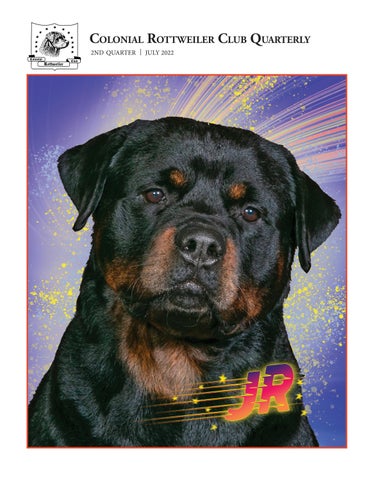
Colonial Rottweiler Club Quarterly 2ND QUARTER | JULY 2022
2
COLONIAL ROTTWEILER CLUB | 2ND QUARTER |JULY 2022
CONTENTS
Club Officers
Club Officers and Contacts..............................................................3 Advertising Information....................................................................4 President’s Message.............................................................................5 CRC Medallion Recipients................................................................6 Article: “Competition Training Through Games”...........................7 Connecticut Working Group Shows.............................................10 Article: “Understanding Your Pet’s Blood, Tissue Results”....... 13 Have You Herd? Terminology (I-W) ...............................................16 Membership Application.................................................................17 Code of Ethics.................................................................................18
ADVERTISERS Janner, Sarah..........................................................Inside Back Cover LaBombard, Jodi................................................................Back Cover Luhrs, Doreen.....................................................Front/Inside Cover Sabalos, Sharon..................................................................................8 FRONT AND BACK COVER RESERVATIONS ADVERTISERS WHO PURCHASE EITHER THE FRONT OR BACK COVERS ALSO RECEIVE THE INSIDE COVERS AT NO EXTRA COST.
3rd Quarter 2022 Issue 4th Quarter 2022 Issue 1st Quarter 2023 Issue 2nd Quarter 2023 Issue
*RESERVED* SPECIALTY ISSUE Available Available Available
GREETINGS CRC MEMBERS! In this issue, we’re including coverage of the CRC-sponsored Connecticut
Working Group shows held in early March. Thanks to Maureen Sullivan and her roving reporter Parker for the great write-up and photos. We all know Parker is notorious for his creative photo ops! The Rottweiler entry was the largest of all the working breeds. This issue concludes our coverage of herding terminology. Terminology is helpful when first starting to herd, but the real deal is just getting out there and working your dog. When I first became involved with herding in the early 90s, I found it remarkable how most Rottweilers instinctively knew what they were to do with stock. Some dogs more so than others. Normally most sheep were reasonable, but I did have a training session with what is termed a “bad sheep” where this one sheep quickly turned to the dog and rammed his head into the dog’s side. The dog was not impressed, and the sheep didn’t try it again. Another memorable moment was during an indoor training session in late winter. The facility floor was covered with a mix of scattered hay and of course, some sheep dung. In a quick turn to signal the dog, my foot hit a pile - I slipped, landing directly on the pile. Needless to say, it was “fragrant” trip home! :-) Enjoy your summer and make each day count! Liz
WWW.COLONIALROTTCLUB.ORG | LIKE US ON FACEBOOK | FOLLOW US ON TWITTER @CRCROTTIE
and contacts
President: Doreen Luhrs 802 North Main GQ St. Granite Quarry, NC 28146 dluhrscrc@gmail.com Vice President: Maureen Sullivan 34 Crestwood Rd. Leicester, MA 01524 sulliv91@yahoo.com Secretary: Sarah Janner 256 Kasson La. Bethlehem, CT 06751 isengard3@aol.com Treasurer: Jodi LaBombard 5580 Burgess Falls Rd Sparta, TN 38583 jodilabombard@gmail.com Director: Tammy Murray 132 Pinewood Knoll La. Sudlersville, MD 21668 schipnrotts@gmail.com Director: Susan Cohen 85 Timber Dr. E Longmeadow, MA 01628 mosescohen@aol.com Director: Hollee Russell 108 Duncan Street Jeannette, PA 15644 Newsletter Editor: Liz Wertz P.O. Box 391 Chesterland, OH 44026 liz@vonwertz.com Achievement Awards/Medallions: Julie McLain 1085 Hebron Valley Road, Madison, VA 22727-9337 juliemclain@vabb.com Webmaster/Social Media: Denise Gross 25 Honey Locust Dr. Mills River, NC 28759 ddgcrc@gmail.com Archivist: Coleen Hann 614 SE 36 Street Cape Coral, FL 33904 cthann27@gmail.com Membership Chair: Patricia Wicks P.O. Box 749 Plaistow, NH 03865 nhrotties@yahoo.com Health Committee: Sue Cohen mosescohen@aol.com
3
Quarterly Publication Dates & Deadlines Newsletter 1st Quarter 2nd Quarter *3rd Quarter 4th Quarter
Deadline Feb 15 May 15 July 15 Sept 15
Publication April July Sept Dec
*3rd Quarter is the Specialty Issue
ADVERTISING POLICIES The opinions expressed by the contributors to this newsletter may not represent the official opinion of the Colonial Rottweiler Club. For updated news and information, visit the Colonial Rottweiler Club website: www.colonialrottclub.org. Articles in this newsletter may only be reprinted with the explicit consent of each individual author/source. The newsletter is distributed free to all members. Individual subscriptions are available to non-members at $30/year.
Always color, front cover size: 7.5”x 8.75” inside front cover size: 7.5”x10”
The front and back covers are available on a first come first served basis. *The covers for the 3rd Quarter issue are reserved for the Specialty Winners and are printed at the club’s expense as a news item. Paid ads are also accepted for the Specialty Issue.
Back cover (includes inside back cover)................................$160
•
Advertising Rates
Front cover (includes inside front cover)............................... $170
Always color, both pages: 7.5”x10”
Full page color............................................................$120 Full page size: 7.5”x10”
Half page color.............................................................$60 Half page size horizontal: 7.5”x5” or vertical: 3.75”x10”
Quarter page color........................................................$30
•
Quarter page size is 3.75”x5”
Specialty issue quarter page..........................................$20 Photo, dog and owner’s names & win
•
Member brags.............................................................. Free Member litter listings, older pups/adults................... Free Commercial ads......................................... Contact Editor
Camera Ready Ad Specs All ads must be 300dpi and are preferred in CMYK. JPGs and flattened PDF’s are accepted (please embed fonts in pdfs). All full page “camera ready” ads must have a 7.5”x 10” image area, no bleed or trim. The front cover has an image area of 7.5”x 8.75”also with no bleed or trim. E-mail Liz Wertz (liz@ vonwertz.com) with questions on ad formats. If you cannot supply a camera ready ad, a simple ad can be set up free of charge by the editor. Contact Editor with the copy and photo(s) for your ad. If you prefer a more extravagent ad, arrangements can be made with a graphic designer to create an ad to your specifics at an additional charge. Payment must accompany your ad. You may pay by check or money order made out to CRC and send to: Treasurer, Jodi LaBombard 5580 Burgess Falls Rd Sparta, TN 38583 Alternatively, you can pay via PayPal. Simply search for “Colonial Rottweiler Club” and be sure to note payment is for a newsletter ad. 4
• •
•
• • •
Litter listings and listings for older dogs and puppies will be accepted from CRC members only. Each CRC member will be allowed two free litter listings per calendar year. A $5.00 fee will be charged for additional listings. Litter listings, and all advertisements must include hip evaluation number (OFA, Penn Hip or foreign registry). CRC members may advertise accomplishments of dogs bred by them, but not necessarily owned by them. The name of the owner may be listed but not his address or phone number unless he too is a CRC member. CRC members may advertise stud dogs and brood bitches, expected litters and/or accomplishments of dogs directly owned or co-owned by them. The name of the co-owner and or the handler may be listed but not his address or phone number unless he too is a CRC member. No unsigned letters will be printed in the newsletter. Letters from CRC members will be printed at the discretion of the Board. CRC will not accept advertising that is a statement for or against any controversial topic. (E.g. docked vs. undocked tails). This does not include member’s letters to the Editor or statements of the Club’s position on behalf of the members to any other organization (e.g. Parent Club, AVMA). The Newsletter Editor shall forward to the CRC Board for approval/rejection any ad that does not appear to adhere to this requirement. CRC will not accept advertising that does not include the identity of the individual(s) (member or non-member), or company purchasing the advertisement. Generic group names will not be accepted. All advertisements concerning Rottweiler and educational activities from other clubs shall be included once free of charge. Contact the editor for more information. Please note that photos taken off the Internet will rarely print well. A photo will NOT print better than it appears on your computer screen, but most likely will print worse Colors may also vary between computer screens and print. Please scan photos at the highest quality/resolution possible. If a photo’s quality is too poor it may be rejected.
COLONIAL ROTTWEILER CLUB | 2ND QUARTER |JULY 2022
PRESIDENT’S MESSAGE Happy Summer All! It’s the time of year to enjoy all sorts of fun outdoor activities with your dogs but, remember to keep yourselves and your pets safe. Driveways and parking lots are hot on unprotected feet as well as the danger of over heating in cars. Bring lots of water on your hikes and take breaks when needed to cool off and have life vests for your dogs while swimming. The river that looks so inviting can present a wealth of troubles if you are not careful. Fireworks can also present all sorts of challenges. If you have a dog who is reactive be extra careful when opening doors because a spooked dog will look for any opportunity to bolt past you. So enjoy the season, just keep your 4-legged friends safe and sound. I would also like to take a moment to thank everyone who helped to make our specialty shows another success. I will cover more of that in the next newsletter which will be dedicated purely to the 3 specialties. Congratulations to all the winners!! AKC has changed the rules pertaining to specialties and regional clubs. We can now have 4 days of specialties. This gives us a chance to change the schedule to a more desirable layout as well as HOPEFULLY have another, smaller specialty in the fall. We are still trying to work out the details. Stay tuned for more information on that. Try and stay cool and safe this summer and I hope to see you at the shows!
Doreen
COLONIAL ROTTWEILER CLUB MEMBERSHIP UPDATES
Make any objections to the proposed members in writing to CRC Secretary, Sarah Janner 256 Kasson Road, Bethlehem, CT 06751-1505 PROPOSED MEMBERS Beard Brian & Janna
415 25th St NW
Cleveland
TN
37311
423-595-6241
bruni9191@yahoo.com
SPONSORS S. Janner, M. Sullivan
Caporusso
Joe & Nancy
120 Joann St
Shonola
PA
18458
845-699-6931
joe@joecaporusso.com
M. Sullivan, P. Wicks
Nobliln
Caitlin
8767 White Swan Dr, Unit 201 Jerry & Sherry 23346 Ironwood Dr
Tampa
FL
33614
813-924-3484
cnoblin29@hotmail.com
J. Dyar, J. Shaver
Elkhart
IN
46516
574-524-6660 (J) steadfast.roberts@aol.com 574-524-6870 (S)
Linda and Joe Panaro
Greely
ONT. K4P168 613-889-3140 (L) CAN. 613-809-0842 (J)
Roberts Thompson
1491 Scottanne St
nexuslakies@gmail.com, josephpanaro@gmail.com
J. McClain, P. Wicks S. Cohen, C. Costa
WELCOME NEW MEMBERS Amerlinq Deborah 400 W Ghent Rd
Hudson
NY
12534
518-929-0946
deborahamerling@gmail.com
Holden
Kristin
102 Hebb Rd
Hagerstown
MA
21740
240-313-0231
stonefarmrottweilers@gmail.com M. Sullivan, P. Wicks
Timonte
Terry
551 Park Ave
Shavertown
PA
18708
570-406-1684
hppx2@aol.com
WWW.COLONIALROTTCLUB.ORG | LIKE US ON FACEBOOK | FOLLOW US ON TWITTER @CRCROTTIE
SPONSORS M. Sullivan, P. Wicks
J. Archer, D. Worthington
5
COLONIAL ROTTWEILER CLUB MEDALLIONS CRC Medallion Policy
Medallions will be awarded for all AKC titles. All requests must be supported by a copy of the AKC title certificate, which can either be snail mailed or emailed. All titles for which a medallion is awarded must be earned while the dog is owned by a CRC member in good standing. To receive a medallion, all requests must be sent to the Medallion Chairman within 12 months of the title being earned. Send medallion info to Julie McLain 1085 Hebron Valley Road Madison, VA 22727 Email: juliemclain@vabb.com Congratulations to all who earned new titles! The newly earned titles (since January 3, 2022) are listed in bold and are underlined.
GCH CH Woodrott’s Stars and Stripes TT THDA CGCA CGC TKN (Owners: Kelly & Anthony Skiptunas) GCH CH Von Marc’s Life In The Fast Lane CGC TKN ATT (Owners: Kelly and Anthony Skiptunas) Maverick’s Shining Star V. Youngkin OM3 UDX3 UDX2 UD VER CDX CD CI CS TKA TKI TKN CGCA CGC (Owner: Vera Bincarousky) GCH CH Starz Medicine Man Of The Sky CGC (Owner: Doreen Zimmerman) Eis Haus Ruby and Roses RN (Owner: Althea Stowe) Rose Red’s Devine Citrine CGC, TKN (Owner: Dee Landis) V1 INT’L/UKC/AKC CH Braesides Worth The Wait CD RE TDX TKP FDC CGCU CGCA BH IGP1 IGP2 IGP3 FH TT (Owner: Gina DeAlmeida) Winning Hand Pathway To The Starz BN RI RN NJP CGC (Owner: Diane Noe Gilliam) AGCH MACH5 PACH Woodrott’s Love At First Site RI MXG2 MJS3 MXP3 MXPB MJP3 MJPB PDSP PJSP MFC TQX MFPS TQXP T2B5 T2BP5 PAX CGC TKA (Owner: Paula Miloglav-Recco) Amelyns Dreams Do Come True PCD BN RM2 RAE SCN SIN SEN SWN SBN SHDN CGCA TKE VHMA VSWI VSWE (Owner: Sharon Saballos) Prince Axl The Great RI SCN SBN TKA (Owner: Anne-Marie Frano)
6
COLONIAL ROTTWEILER CLUB | 2ND QUARTER |JULY 2022
JOANNE’S WORKSHOP
COMPETITION TRAINING THROUGH GAMES By JoAnne Brettschneider
The following article first appeared in the August 2020 issue of the Doberman Network. Many thanks to Editor Amy Tourand for allowing CRC to reprint it.
We just got a new puppy and have so many questions. • When do we start training her? • How long should our training session last? • Do I let my puppy “be a puppy” and start training at six months? • I want my puppy to show. When do I start teaching obedience? • How do I continue to play games for advanced training? Let’s start. From the moment a new puppy is in my house, she is on a leash until I can be quite comfortable that she understands the rules. Her learning starts immediately, and she “trains” consistently. Everything we do should be fun for the puppy, so she learns how to learn. If we “let puppies be puppies” and then at 6 months decide it is time for structure and enforcing what we ask, we are met with a very unruly puppy, who has had no limits and will be rebellious about having to do anything she or he doesn’t want to. Teaching a puppy how to learn while she is having fun learning is something that not only starts lifelong obedience games, it reinforces that learning is fun, not a restriction, but a game that we play with our owners. Puppies run around and investigate. They steal things, and try to run with their prizes so no one else can steal from them. They are so proud with what they stole that it is hard to tell them they can’t have something. So, when the puppy grabs the sock and takes off, instead of chasing the puppy, which is a game they love, we just talk to the puppy, “What do you have?” “Can I see?” Of course, have some-
thing ready for the puppy when we have to take that prize away. A “thank you” is what I do, and hand the puppy something she can have, her own toy or a treat. So, what is the objective of not running and taking away that which they cannot have?
(Dad takes off collar, and says to “take to mom.”) Yes, they need help at first, but we make games out of everything they pick up as puppies, and I have little trouble when it comes to retrieving anything for competition.
Another game we play is “who gets the treat?” I will have the puppy on a leash, and hand a treat to the older dog, while saying the dog’s name. Then I will hand a treat to the puppy, saying the puppy’s name. I will do this back and forth, and if the puppy dives at the older dog’s treat, she will get an Teaching a puppy how to “uh-uh” from me, with a reinforced, learn while she is having fun “this is Fido’s treat, not yours.” Soon learning is something that not I will have her easily sitting, and waiting for her turn. This happens in my only starts lifelong house within the first few days of havobedience games, it ing the puppy at home, and it works reinforces that learning is fun, really fast. The feeding time is the not a restriction... same. Fido’s bowl is put down first, with his name, then the puppy’s food bowl with her name. Of course, they are about 6 feet apart, and the puppy is being scolded for being curious. is on a leash. I do not feed in a crate We told her that putting something as I begin teaching as soon as puppy in her mouth is wrong. She continues is home. The older dog already knows to investigate, but next time she tries he cannot come over and try to get the harder to keep it from us, or she starts puppy’s food. And the puppy learns to eat it so we can’t have it. Or, being the super sensitive dog, she learns that quickly her spot to get fed. she cannot put things in her mouth, Within a week, usually sooner, the unless it is her own personal toy. puppy, at feeding time, will run to her What happens later on when we intro- spot. She is not off leash until she will do this and not try to get into the other duce the dumbbell? She has learned dogs’ food. I have had four bitches at that she is not to put foreign items in one time eating all at their own spots, her mouth, so we have a really hard and have never had an issue with food time getting her to take a dumbbell. or feeding. When it is feeding time, all My puppies learn from the beginning dogs immediately go to the spot they to take things between my husband get fed in. and myself. We trade items, and objects early on. They will take the mail from mom to dad. They will bring their collars to me to put away. Cont’d Think of it from the puppy’s point. She (or he) just found something very exciting. We come into the picture and scold the puppy. What have we just done? We have told her that she
WWW.COLONIALROTTCLUB.ORG | LIKE US ON FACEBOOK | FOLLOW US ON TWITTER @CRCROTTIE
7
8
COLONIAL ROTTWEILER CLUB | 2ND QUARTER |JULY 2022
Competition Training (Cont’d) Now, moving on and using these games that will lead to future behaviors. Instead of just handing the puppy the treat, a treat is tossed, and I will say one name, of the dog that is to get the treat. So, the treat is tossed about a foot from the dog that is to get it, complete with the name. The “other” dog must sit until the first dog comes back to a sit. To make it simpler to understand, Tesa and Vira are both on a sit stay. I say “Tesa” and toss her treat towards her. She gets up, gets her treat, and must sit again before I say “Vira” and toss hers. This continues until I can toss a treat a distance, and only release one dog to go get it. Moving onto the toys. Possession is 9/10 of the law, correct? I am fairly sure we have all heard that expression. However, our dogs think it is 100%, with no exceptions. We bring home that new puppy, and managing the toys becomes a chore. We don’t want the puppy to infringe on our older dogs’ toys, and we don’t want the older dogs to get so possessive that we have to worry about our little one getting into an argument with our older dogs. So how do we handle this? Puppy does not get to take a toy from the other dog, unless the dog drops it and walks away. So, a toy is tossed, “Tesa” and Tesa can go get the toy. Vira must wait for her name. Her toy is tossed, and I say her name. She has then been released to the toy. I continue until I have both dogs bringing back their own toys, and when I throw, they can only get their own toy. There is no arguing over toys at all. I have had four of my own dogs at the same time playing fetch, and each bringing back their own toy for me to throw. If you do the work, it is really fun to play this way. This also helps when you are working your dog in the vicinity of others working their dogs. Your dog will not be so interested in another dog chasing a toy.
What else does this lead to later on? I can put both of my dogs on a stay, and send one over a jump, and then the other. I can run both of my dogs on a short agility sequence with both dogs in the weaves at the same time. I can have two toys at the end of the sequence, and each dog will run the sequence, grabbing her own toy at the end.
directed jumping, and directed retrieve becomes easy. Another game is to send the dog through a tunnel to get a dumbbell. This really gets dogs exited and they have fun learning. I will also throw a dumbbell, and send the dog through weave poles.
To accomplish all of these tasks, you must have complete dedication to what your dog is doing at all times. Without the dedication to training these behaviors, you will not get them. You must have rules that you stand by. No dog is allowed to take a toy away from another dog. No dog is allowed to chase the toy I threw for another dog. These puppy “games” are taught, and reinforced, and monitored throughout the lifetime of the dogs. As the dog enters adolescence, I have very little to do in the way of managing who gets what and when. By this time, my puppies have no problem retrieving anything, and when we start real competition sequences, they already know most of it. I have a game that I play in preparation for the Utility directed retrieve (gloves). I put several different objects in a circle, and send my dog (yes on leash) to each one. The highest value is the last, so perhaps her favorite toy will be at the last spot. Items can be an old cell phone (with nice leather case for easier pick up), a glove, treats in one of the spots, a rope toy, a favorite toy, an old shoe, etc. Use your imagination. The last item is the one we play with. The dog, through a simple game is learning to take direction and also retrieve anything. Another game is to hide treats all over. With your dog on a leash, send to one of the hidden spots. If the dog veers off, bring him back to you and start again. Make it short and simple to start. Soon the dog is heading in the direction you sent him to get the treat. Voila,
WWW.COLONIALROTTCLUB.ORG | LIKE US ON FACEBOOK | FOLLOW US ON TWITTER @CRCROTTIE
Revving up retrieves and also gearing towards fast “go outs” for the directed jumping exercise is planting a toy at the end of your yard. Send your dog, and when he gets the toy, you have one waiting for him in your hands, and you call him back and let him get the second toy. As he gets more confident, you can ask him to sit instead of grabbing the first toy, and then call him back to you for the one you are holding. The dog does not know he is being prepped for the “go outs” for directed jumping. These are all simple dog games that dogs love to play. Doing this also teaches the dog before he realizes he is learning. If you can keep making your dog believe he is playing, while he is really learning, you have conquered that gap between play and work. It can be all one and the same. Cont’d on page 13 9
Connecticut River Working Group CRC Supported Shows, March 2022
For the first time in two years, we were finally able to come together again for the Connecticut River Working Group (CRWG) weekend of shows located in Springfield, MA. This wonderful set of shows is held in conjunction with the 2 all-breed shows hosted by the First Governor’s Footguard Association. The show weekend never leaves for a dull moment in New England during the season of the frozen tundra. CRWG is a group of shows where the working breeds come together each year on the first weekend in March. At these shows, the Colonial Rottweiler Club supports the Rottweiler entry (as well as puppy and veteran sweepstakes) for two days. Our breed drew the largest breed entry in all breeds, and our entry included some of the top dogs in the country. It was a weekend filled with beautiful dogs and fabulous friends. These are a unique group of shows. Many of our New England members and breeders not only come out to show but graciously donate items and funds making the prizes truly something you hope to win. Not only does the show offer a unique assortment of prizes but it also comes with it’s very own Rotti reporter Parker Sullivan (if you’re on Facebook I’m sure you have seen his smiling face). Parker comes to the shows to partake in photo ops, collecting donations, soliciting new members, promote ring side camaraderie and sometimes is a fancy show dog himself! If you are so inclined to brave the New England weather in March, why not join us next year. You can enter 4 shows (2 All-Breed shows, 2 limited Breed shows) and 2 sweeps - perfect if you have a Rottweiler youngin’ or one in their golden years. I can assure you, you will not only find a lovely group of dogs to observe but also a lovely group of people to hang ringside with and enjoy the shows. - Maureen Sullivan
10
COLONIAL ROTTWEILER CLUB | 2ND QUARTER |JULY 2022
WWW.COLONIALROTTCLUB.ORG | LIKE US ON FACEBOOK | FOLLOW US ON TWITTER @CRCROTTIE
11
Hope to see you next year! 12
COLONIAL ROTTWEILER CLUB | 2ND QUARTER |JULY 2022
Competition Training (Cont’d) Another “game” that is something I recently learned on the drop on recall exercise is to teach the drop going away from you, rather than towards you. What a concept! Everyone that does obedience knows how that drop on recall slows a dog’s recall down, correct? What if you are sending your dog to a toy, and drop him on the way to that toy? You must begin on a leash, with your dog motivated to get the toy, and you drop him, then send him. Soon, on a longer line, you get him excited for the toy, send and drop him at a half way point. The leash must be managed correctly so when you tell him to drop, you are ready with the leash. When he drops, release him. Using two toys is a concept I have recently learned, and I am still teaching this to my dogs. Dogs like to be possessive with their toys, yes? Then let’s allow them to create this desire that makes them want to work for the second toy. When they have mastered this, it creates an intensity that you have to experience to understand. The work ethic moves from have to, to want to, to intense desire to. It is fun and it is a road to travel that I have yet to fully experience, but loving the journey. This two-toy experience actually can keep the dog from mouthing a dumbbell, from chewing on the gloves, and also speeds up the retrieve! There are so many games we can play with our dogs, that I can’t even begin to scratch the surface of what we can do. So, from puppy to adult, play with your dog. Playing is what gets the connection and the intense work ethic. Playing is what keeps our dogs happy, and us young!
UNDERSTANDING YOUR PET’S BLOOD, TISSUE & URINE RESULTS By Jean Dodds DVM Blood and urine tests help determine causes of illness accurately, safely, and quickly allow us to monitor the progress of case management and medical treatments.
Hemoglobin (HGB) and mean corpuscular hemoglobin concentration (MCHC) measures the oxygen-carrying pigments of red blood cells.
COMPLETE BLOOD COUNT (CBC) A CBC gives information on hydration status, anemia, infection, the blood’s clotting ability (platelet count), and the ability of the immune system (white blood cells) to respond to a stress or other disease event. This test is important for pets with fevers, vomiting, weakness, pale gums, or loss of appetite. If your pet needs surgery, a CBC may detect a potential bleeding disorder or other unseen abnormalities.
Platelet count measures the tiny cells that help form blood clots.
White blood cell (WBC) or leukocyte This guide can help you understand count measures the body’s ability to your pet’s laboratory diagnostic test respond to stress or a variety of condiresults. Proper communication with tions. Increases or decreases indicate your veterinarian is essential regarding certain diseases or infections. interpretation of any lab results. Normal reference laboratory ranges are Granulocytes (neutrophils; PMNs), not provided here, as these may vary lymphocytes and monocytes are spedepending upon the type of instrumen- cific types of white blood cells. tation and reagents used. Each veterinary diagnostic laboratory or in-clinic Eosinophils are another specific type diagnostic test machine comes with its of white blood cell that may indicate own normal reference ranges. allergic or parasitic conditions.
Reticulocytes and nucleated red blood cells are immature red blood cells. High levels indicate a regenerative anemia.
SERUM BLOOD CHEMISTRIES These tests evaluate organ function, electrolyte status, and hormone levels. They also give barometers of adrenal function and other diseases. We use these tests for base lines as pets age, Hematocrit (HCT, PCV) measures pre-anesthetic evaluation, monitoring the percentage of red blood cells in the long term medications, as well as evalsample to detect conditions such as uating sick animals. anemia and dehydration.
WWW.COLONIALROTTCLUB.ORG | LIKE US ON FACEBOOK | FOLLOW US ON TWITTER @CRCROTTIE
13
Understanding Your Pet’s Blood (Cont’d) Albumin (ALB) is an important serum protein that helps evaluate hydration, presence of blood loss from hemorrhage, and intestinal, liver, and kidney disease. It maintains the oncotic pressure that keeps the fluid within the blood vessels rather than allowing it to leak out into the tissues, Alkaline phosphatase (ALK P) elevations may indicate liver damage, Cushing’s disease (overactive adrenal function), and active bone growth in young pets. Levels rise slightly as animals age. This test is especially significant in cats as even slight elevations may indicate of liver disease. Alanine aminotransferase (ALT, SGPT) is an indicator of active liver cell damage but does not identify the underlying cause. Liver cleansing herbs such as milk thistle are used along with a grain-free liver sparing diet, once more definitive diagnostics are completed. Amylase (AMYL) elevations show pancreatitis, when the serum lipase is also high, or become increased in the presence of kidney disease. Aspartate aminotransferase (AST, SGOT) increases may indicate liver, heart, or skeletal muscle damage, but this is an enzyme released from many injured cells. Blood urea nitrogen (BUN) indicates the amount of protein nitrogen in the blood and usually reflects kidney function. An increased blood level is called azotemia and may be caused by kidney, liver, heart disease, urethral obstruction, shock, dehydration, impaired intestinal food absorption, or an intestinal or stomach foreign body. A low BUN may indicate a cirrhotic liver or portal caval liver shunt. It can be elevated normally as a result of eating a raw diet. 14
Calcium (CA) deviations may indicate a variety of diseases. Cancers, kidney disease, hyperparathyroidism, and anal gland tumor, are just a few of the diseases that alter calcium levels. In dogs, but not cats, the calcium concentration is corrected upwards when the albumin level is below 3.5 mg/dl. The result is the corrected calcium.
mation and certain diseases such as feline infectious peritonitis (FIP). Low levels are seen in the very young and in immune deficiency states,
Cholesterol (CHOL) may be altered in hypothyroidism, liver disease, Cushing’s disease, high fat diets, and diabetes mellitus.
Potassium (K) is an electrolyte lost with vomiting, diarrhea, or excessive urination. Increased levels may indicate kidney failure, Addison’s disease, dehydration, and urethral obstruction. High levels are normal in the Japanese dog breeds because of their unique red blood cell membrane. In disease states, high levels can lead to cardiac arrest. Low levels may occur with loss of appetite especially in cats.
Chloride (CL) is an electrolyte often lost with vomiting and in Addison’s disease (underactive adrenal function). Elevations may indicate dehydration. Cortisol is a hormone released in pulsatile fashion from the adrenal glands in response to stress or certain adrenal diseases. More specific, dynamic diagnostic tests of adrenal function (ACTH stimulation test, low-dose dexamethasone suppression test, and urine cortisol-creatinine ratio). Creatinine level reflects kidney function. This test helps distinguish between kidney (renal) and non-renal causes of an elevated BUN. Gamma glutamyl transferase (GGPT) is an enzyme that specifically measures bile flow through the liver. Stasis of bile flow is seen in liver or gall bladder disease and in corticosteroid excess. Globulin level reflects all the blood proteins other than albumin, and typically increases with chronic inflam-
Glucose is a blood sugar. Elevated levels may indicate diabetes mellitus (cats, dogs). Low levels can cause fainting, collapse, seizures, or coma.
Lipase is an enzyme that may indicate pancreatitis, when the serum amylase is also elevated. Sodium (NA) is an electrolyte lost with vomiting, diarrhea, kidney disorders, and Addison’s disease. This test helps indicate hydration status. Phosphorus (Phos) elevations are often associated with kidney disease, hyperthyroidism, and some bleeding disorders. Bilirubin elevations may indicate liver, gall bladder, or hemolytic diseases. Total protein indicates hydration status and provides additional information about the liver, intestine, kidney, and presence of infection.
Cont’d on page 15
COLONIAL ROTTWEILER CLUB | 2ND QUARTER |JULY 2022
Understanding Your Pet’s Blood (Cont’d) Thyroid tests (T4, FreeT4, T3, FreeT3, TSH, and TgAA) are performed to measure thyroid function. A complete thyroid antibody profile id much preferred over a simple total T4 test, which can be misleading. Age- and breed-specific normal ranges should be taken into account. Genetic screening of dogs intended for breeding is important, as up to 90% of canine thyroid disease is due to heritable autoimmune thyroiditis. Dogs testing positive for this heritable disorder need to be treated with thyroid hormone and should not be used for breeding purposes. Decreased levels may signal hypothyroidism, non-thyroidal illness or use of certain drugs, while high levels indicate hyperthyroidism in older cats, may also occur from eating the throat or gullet part of red raw meat and in thyroid tumors. TLI, B12, Folate are intestinal tests to indicate malfunction of the digestive tract of cats and dogs.
Cytology is performed by a pathologist looking at a tissue or body fluid sample for evidence of any abnormality. Culture and Sensitivity is measured on a body discharge or urine sample to determine the type of bacteria or fungus present, and the best antibiotic or antifungal drug to treat the condition. Biopsy is a sample of tissue sent to a pathology laboratory for analysis. Histopathology is performed on specially prepared stained or frozen sections of the tissue to identify any abnormality. W. Jean Dodds, DVM Hemopet / NutriScan 11561 Salinaz Avenue Garden Grove, CA 92843
results. The club covers the cost of featuring all top winners with a photo (if a photo was taken). If you would like to place an the deadline is July 15; publication late August.
Kenzie McAvoy On Friday May 6, we lost one of our own. Kenzie McAvoy was struck and killed by a distracted driver. She was 19 years old. Kenzie will be remembered by us as a loving, caring, and supportive friend and exhibitor. She lit up every room she walked in.
Fecal exams analyze for intestinal parasites of various types.
Urine-Cortisol Creatinine Ratio (UCCR) is a simple screening test for Cushing’s disease. Must be performed on urine collected at home, first thing in the morning and before exercise.
Three days of shows - three days of
individual ad about your special win,
Bile Acids are measured as a specific test for liver function, including congenital liver shunts (portacaval shunts, microvascular dysplasia), cirrhosis, and active liver disease. They can also be measured in urine.
URINALYSIS (UA) Evaluates kidney function, bladder pathology including tumors, urinary tract infections, urine concentration, presence of bladder stones and crystals.
“ROTTWEILER CAMP” 2022 CRC Specialty Newsletter Is Coming!
As we commence our CRC speciality, might we all remember to clap a little louder, hug a little tighter, and appreciate our time together. Life is so fragile, let’s make our days here count. Our thoughts and prayers go out to Kenzie’s family and friends. She will forever be in our hearts.
Urine-Protein Creatinine Ratio (UPCR) measures kidney function and is abnormal in kidney failure. WWW.COLONIALROTTCLUB.ORG | LIKE US ON FACEBOOK | FOLLOW US ON TWITTER @CRCROTTIE
15
Have You HERD? Glossary of Herding Terms (I - W) Inside Flanks: When the dog is asked to come between the stock and his handler. Lift: When the dog approaches the sheep to move them forward. The period immediately after the dog has reached the maximum extent of its outrun and starts to move the sheep in the intended direction. This is very important because it gives the sheep their first impression of the dog. See also Outrun. Light Sheep: Free-moving sheep that can controlled from a distance; the opposite of heavy sheep. Loose-eyed: A dog which does not show an intense gaze at all times on the stock. Such dogs may glance around or at the handler from time to time, and tend to take in a view of the whole group of animals. Usually upright body posture is displayed. Medium-eyed: Showing eye, but in a less intense form and usually with a more upright body posture. Off Contact: When the dog loses control of the stock, either by being too far away or by losing concentration. Outrun: When the dog runs out around the sheep to gather them prior to bringing them to the handler; the course taken by the dog in gathering its sheep. The ideal shape for an outrun in a trial is that of a pear, with the handler at the narrow end of the pear and the sheep at the widest point. See also Lift. Pen: A small enclosure with or without a gate, into which sheep are driven near the conclusion of a trial, without being touched by hand or by a dog. Power: Strong, self-confidence; a dog with power can move stubborn or fighting animals, often without nipping. Ram: An intact male sheep. Read: The ability of the handler to understand and anticipate the thoughts of the stock and/or the dog in order to maintain control over both. The ability of the dog to anticipate the behavior of the stock. Setout Dog: Dog that is used to sort and setout stock at trials. Shed or Shedding: Sorting off one or more specific sheep from the rest and driving it or them away from the other sheep. Single or Singling: Shedding or separating only one sheep. Strong Dog: All references to strength and power reflect solely on the dog’s attitude toward the sheep; they have nothing to do with physical characteristics of the dog. A strong dog comes up to its sheep confidently and bodly and does not give ground if attacked. The sheep are able to sense the determination of this type of dog and more readily give ground to it. Strong-Eyed: Showing all the characteristics of eye to a marked degree. A dog with overly strong eye may remain in place, staring intently, rather than move the sheep; sometimes referred to as sticky-eyed. Take Time or Steady: A command to the dog to slow down and approach the sheep quietly. That Will Do: The command releasing the dog from his work. Walk Up: A command for the dog to walk toward the sheep. Way To Me: The usual, traditional Scottish command for sending the dog around the sheep in a counterclockwise direction. Weak Dog: The opposire of a strong dog. Weak dogs turn tail if the sheep show fight. A weak dog may flank back and forth rather than walk straight in toward the sheep. Wearing: (1) The side-to-side movement of the dog to keep the livestock grouped. (2) Also, when the dog moves the stock to the handler, as in the fetch. (3) When sheep are shed or singled, those held back are said to be worn by the dog. Wether: A neutered male sheep. Wide-Running: A dog who makes wide passes around the stock, naturally keeping a distance away from it. Wool-Pulling: Nipping or gripping at the bodies of sheep, marking the flesh by tearing out hunks of wool (called body biting on cattle). Biting at the body of any type of stock is a fault.
16
COLONIAL ROTTWEILER CLUB | 2ND QUARTER |JULY 2022
2022
MEMBERSHIP RENEWAL
Colonial Rottweiler Club Your renewal is due January 1, 2022 Members who fail to renew by January 1, 2022 will have no voting privileges for the year Renewals received after January 31st will incur a $10.00 late fee. 1. Fill out the renewal form completely. Please be sure your e-mail address is legible. 2. Check appropriate box for membership type. 3. If you wish to make a fund donation to support rescue, health and/or the trophy fund, please enter the amount on the appropriate line. You may Pay your dues via PayPal through the CRC website at: http://www.colonialrottclub.org/membership.html Please e-mail your PayPal receipt to Jodi LaBombard at jodilabombard@gmail.com Name (member #1) _____________________________________
Name (member #2) _______________________________________
Address____________________________________________
Address______________________________________________
City_________________________ State _____ Zip ________
City__________________________ State______Zip_________
E-mail_____________________________________________
E-mail_______________________________________________
Phone _____________________________________________
Phone _______________________________________________
Please let the membership chairperson know if you do not want your e-mail and/or phone number published on our membership list. The list is only used by the club. CRC uses the membership email list to send notices of CRC events and club business to members. In the event you have a family membership, we request the e-mail addresses of both members to enable each of you to respond to member surveys that will be e-mailed occasionally. We will not send you these e-mails if you have opted out. We will not share, sell, rent, swap or authorize any third party to use your email address for any purpose without your permission. If you feel you have received an e-mail from us in error, please contact ddgcrc@gmail.com.
*EFFECTIVE 01/2022 THE NEWSLETTER WILL BE SENT ELECTRONICALLY TO YOUR EMAIL ON FILE. THERE WILL BE A $20.00 ANNUAL SURCHARGE FOR A PRINTED NEWSLETTER When renewing by mail, please return this form with your check or money order made payable to CRC to: Patricia Wicks P.O. Box 749 Plaistow, NH 03865-0749
Select membership type: Individual ............................................. $35.00 Joint (2 adults in same household) ....... $45.00 Junior (under 18 years of age) .............. $20.00 Senior Individual (over 65 yrs of age and who has been a member at least 10 yrs) .......... $20.00 Senior Joint (one is over 65 yrs and both have been a member at least 10 yrs) ............. $30.00
Questions: Contact Patti at 978-273-5396 or via e-mail at nhrotties@yahoo.com
Printed Newsletter Surcharge ……….
By renewing your membership, you accept and agree to abide by the current CRC Code of Ethics. Thank you for renewing your CRC membership for 2022! WWW.COLONIALROTTCLUB.ORG | LIKE US ON FACEBOOK | FOLLOW US ON TWITTER @CRCROTTIE
$20.00
Fund Donations: Rescue Fund Donation............................ $ _______ Rottweiler Health Foundation.................$ ................................................................... _______ Trophy Fund............................................ $ _______ Total Payment
$ Rev10/2022 17
COLONIAL ROTTWEILER CLUB CODE OF ETHICS I.
II.
III.
A. 1.
PURPOSE In Rottweiler breeding, the emphasis shall be placed on working ability and other outstanding qualities of character of this breed, as well as upon appearance. It is mandatory that a Code of Ethics be subscribed to by those who are concerned with the propagation of physically, mentally and temperamentally sound Rottweilers of proper breed type. Measures should be taken to acquaint the general public with the contents of this Code so that they might not become innocent partners in improper breeding practices. Consistent with the above, I will agree to breed discriminately and only upon strong evidence of finding suitable homes for the resulting puppies. I understand that to breed inadvisably may lead to over‐population and contribute to the deterioration of the Rottweiler breed. RECORDS: If I breed my bitch or use my stud dog in service, I agree to keep accurate records of stock, matings and pedigrees, and to register my breeding stock with the American Kennel Club BREEDING: I agree to use for breeding only those Rottweilers which have no disqualifying faults and no radical departures from the official AKC Rottweiler standard. I agree NOT to use for breeding monorchid or cryptorchid dogs, or Dogs/Bitches with any of the following: undershot or overshot bites, more than one non‐eruptive or missing adult tooth (unless the Dog/Bitch has an OFA Dentition certification at the time of breeding); ectropion or entropion; long or curly coats; unsound temperament such as extreme shyness, nervousness or viciousness; excessive white markings as described in the Standard; incorrect or very pale markings. Further, if to the best of my knowledge I should breed from lines in which any of the above occurs, I will disclose this to my buyers. Dogs/Bitches Born in the United States HIPS Hip evaluations are to be done at 24 months of age or older. Dogs/Bitches used for breeding must have an OFA Normal certification number or, if utilizing PennHip, be in the 60th percentile or better (for both hips), for the current calendar (Jan 1‐Dec 31) year. Breeders are required to keep PennHip assessments and produce the documents upon request. CARDIAC a. Dogs/Bitches to be used for breeding and born after January 1, 2016 must be OFA Cardiac Normal at 24 months of age or older with the evaluation performed by a Board Certified Cardiologist. b. Dogs/Bitches to be used for breeding and born between January 1, 2009 and December 31, 2015 must be cardiac “normal” at 24 months of age or older with the evaluation performed by a Board Certified Cardiologist. c. Dogs/Bitches to be used for breeding and born prior to January 1, 2009 must be cardiac “normal”. This does not apply to Dogs that have passed away and were collected prior to January 1, 2009. d. Any Dog/Bitch born prior to December 31, 2015 that has had cardiac screening, must have an OFA Cardiac Normal at 24 months of age or older with the evaluation performed by a Board Certified Cardiologist prior to being bred . This does not apply to Dogs that have passed away and were collected prior to January 1, 2009. It is strongly recommended that Dogs/Bitches to be used for breeding be screened via Echocardiogram by a Board Certified Cardiologist. B. Dogs/Bitches Not Born in the United States 1. Imported Dogs/Bitches may be used for breeding for the first six months they are in the United States if they meet the following criteria. a. Hips: Hips have been x‐rayed and certified HD Free by the appropriate Certifying Organization in the country of origin at 24 months of age or older AND b. Cardiac: Have a cardiac “clear” reading from a Board Certified Cardiologist in their country of origin. After six months in the United States the Dog/Bitch must meet the same Hip and Cardiac requirements as Dogs/Bitches born in the United States.
18
2. Dogs/Bitches residing outside the United States and being used for breeding via natural, fresh or frozen semen must have certified Hips and Hearts at 24 months of age or older, with said certifications performed by the appropriate Certifying Organizations in their country of residence. C. CHIC: It is strongly recommended that Dogs/Bitches to be used for breeding have an OFA CHIC certificate which provides a source of health information for owners, breeders and scientists that will assist in breeding healthy VI. dogs. CHIC is intended to encourage health testing and sharing of all results, normal and abnormal, so that more informed breeding decisions can be made. D. BITCH OWNERS: As the owner of a Bitch, I will breed only to normal, healthy, mature dogs which have met the VII. required health certifications. I will not permit my Bitch to produce litters in more than three consecutive seasons. I will place on limited AKC registration any puppy with a non‐life‐threatening medical deformity or other substantial deviation from the AKC Rottweiler Standard, and require spay/neuter of said puppy at an appropriate age. E. STUD DOG OWNERS: As the owner of a Stud Dog, I will breed only to normal, healthy, mature bitches which have met the required health certifications. I will refuse stud service to any Bitch that does not meet the required health certifications, has disqualifying faults, or which I consider to be in poor health. When a Bitch has failed to conceive after being bred to my Stud Dog, I will allow one repeat service, at such time and place as are mutually agreed to by the owner of the Bitch and myself, provided that the Stud Dog is still in good health and condition. IV. HEALTH: I agree to maintain good standards of health and care for my dogs, including proper veterinary care. I further agree that proper health includes regular contact VIII. with people and exposure to the outside world. V. SALES: I will refuse to recommend or sell to breeders who do not conform to this code or to dog wholesalers and retailers. I will not donate a Rottweiler for raffle purposes or sell to any home if I have reason to believe that the puppy or dog will not receive proper care. I will use a written sales contract with any sale or purchase involving a dog. To the best of my ability, I will state clearly to a buyer whether the puppy or dog being sold is potentially a show or pet type. I will not release puppies before they are seven weeks of age and only with full knowledge that they are healthy and have had the required medical inoculations and care. I will give buyers of puppies or adult dogs accurate health, breeding and registration records and at least a four generation pedigree. Full AKC Registration papers may be withheld on a dog which is suspected of carrying a serious fault that would make it unsuitable for breeding purposes, until the dog has been proven otherwise or rendered in capable of reproducing. Proof required with a veterinarian’s letter. I will adhere to the terms of my written sales contract with the buyer(s), following the general practice of breeders that any puppy sold as a show prospect, which subsequently develops hip dysplasia or a disqualifying defect shall be: (1) replaced by the breeder with another show prospect puppy or (2) returned to the breeder who will then refund the sales price or (3) retained by the buyer, with the buyer’s money being refunded by the breeder to the extent of the difference between price paid and the price of pet puppies sold from the same or similar litters, after the breeder has received veterinarian’s certification that the dog has been rendered incapable of reproducing or (4) any other mutually agreeable alternative made between the buyer and breeder.
I will recommend to my puppy purchasers that they render incapable of reproducing any dog which has developed disqualifying or serious faults. As a breeder, I recognize that I have a lifetime responsibility to ensure that every dog I place has a safe home and will be provided proper care for life. Unless required by law, no CRC member will allow their puppies or dogs to be disposed of in an animal shelter or allowed to remain in or be rehomed by a rescue organization ADVERTISING: : I agree that my advertising, both oral and written, shall be factual and not worded as to attract undesirable buyers or to encourage the raising of Rottweilers as any easy money scheme. No price shall be given in public advertising of Rottweilers GENERAL CONDUCT AND SPORTSMANSHIP: I shall conduct myself at all times in a manner which will reflect credit upon me and the breed, regardless of the location, circumstances or medium, especially when attending dog shows or trials whether as an exhibitor or spectator. I agree that I will not co‐own a dog or participate in the breeding of said dog with a person who does not subscribe to and support this Code. I agree that I will not have members of my household or immediate family participating in activities that are contradictory to the principles set forth in this Code. If I should become aware of the mistreatment, misuse or need for relocation of any Rottweiler, I will notify any or all of the following for resolution to the problem: a member of the Board of Directors, the current authorities in my area, the breeder or Rottweiler Rescue. VIOLATIONS AND RECOURSE COMMITTEE: The incoming Board of Directors shall appoint, at its first Board meeting, a three member Violations and Recourse Committee and one alternate member, for a two year term. Written charges of this Code by a member may be sent to any member of the Board of Directors. The Board member will send the allegations to the Committee within two weeks of receipt. The Committee will investigate and report its findings to the Board of Directors within 60 days from receipt of the charges and may recommend any or all of the following levels of discipline. Following receipt of the Committee’s report and recommendation, the Board of Directors (BOD) will proceed as described in the CRC By‐Laws: A. Warning: A member may not receive more than one warning in a year’s period without incurring further disciplinary action. B. Fine: A monetary fine which shall be awarded to either the Rottweiler Rescue Foundation or Rottweiler Health Foundation at the discretion of the BOD C. Action: As described in the CRC By‐Laws, Article VII. A fifty dollar fee will be required from any person bringing charges. If the charges are upheld, the fee will be refunded. If the charges are dismissed, the money will be retained by the CRC. If a member has special problems or circumstances or if through no fault of his own is in violation of any of the provisions of this Code, he may have the Committee review the matter and make recommendations
If, after charges have been filed and a decision has been made, either of the parties discloses the information regarding the charges and discusses same with the general public including any form of social media, the BOD reserves the right to publish the charges, information garnered, and reason(s) for the decision(s) Revised August 2015
I will urge my puppy purchasers to provide obedience training at the proper age.
COLONIAL ROTTWEILER CLUB | 2ND QUARTER |JULY 2022
WWW.COLONIALROTTCLUB.ORG | LIKE US ON FACEBOOK | FOLLOW US ON TWITTER @CRCROTTIE
19