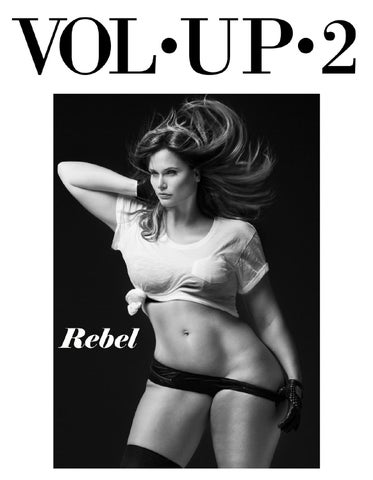
1 VOL•UP•2 REBEL
VOL•UP•2 REBEL 2
3 VOL•UP•2 REBEL
VOL•UP•2 REBEL 4
VO L• U P•2 | R E B E L I S S U E
5 VOL•UP•2 REBEL
VO L• U P•2 | R E B E L I S S U E
Welcome to VOLUP2’s REBEL issue! I have to admit from the get go that it isn’t as REBEL as I would like it to be and sincerely that is due to a genuine lack of Rebellious clothes, particularly available here in Paris for plus sizes. So its a rather ladylike rebellion if you will. We have such a plethora of amazing and diverse Beauty being served up to you, you are guaranteed to enjoy! Revel in our Rebellion! XO Velvet d’Amour. Bienvenue dans ce nouveau numéro de VOLUP 2, REBELLE! Je dois admettre que ce numéro n’est pas aussi REBELLE que ce à quoi je m’attendais et ce à quoi je voulais que ça ressemble, et je pense que c’est surtout dû au manque de vêtements Rebelles, surtout ici, à Paris, et en grande taille. Du coup, c’est plutôt une sorte de Rébellion féminine si vous voulez. Nous avons une telle quantité de beautés diverses et merveilleuses qui vous serons servies, vous allez adorer ! Découvrez notre Rébellion ! XO Velvet D’amour
VOL•UP•2 REBEL 6
7 VOL•UP•2 REBEL
VOL•UP•2 REBEL 8
9 VOL•UP•2 REBEL
VOL•UP•2 REBEL 10
VELVET D AMOUR
Editor, Creator, Art Director + Photographer
ALAN J. THATCHER
Graphic Design/Magazine Layout a|anjthatcher.com
DANIELLE SIDHU Editorial Assistant
CLAIRE BRIGHT BRENNA PAXTON
WebBlogging Designer Intern & Advisor
BRENNA PAXTON Web Designer & Advisor SPECIAL THANKS TO / MERCI BEAUCOUP: Rachel Williamson, Grace Teshima, Georgina Cox, Shawna Farmer, Lyndi Vinson, Doman, SPECIAL THANKS TO Janet / MERCI BEAUCOUP: The Wests, Yanderis Lodos, Elgharbi, Parry, Rachel Williamson, Wendy DraganJamel Stambolija, andChristopher Mounira Boughanem. Chin, and Grace Teshima Cree par Velvet d’Amour, premier mannequin grande-talle a avoir infiltre le monde elitiste parisien de la Haute Couture,VOL•UP•2 veut encourager ses lectrices (et ses ecteurs) a se reveler dans toute leur imperfection et a devenir fibres de leur corps dans sa magnifique integralite! Velvet a longtemps combattu la vision etriquee que la societe a des criteres de beauty, en essayant de mettre a l’honneur, le plus possible, des femmes de gabarits et d’ages differents. Ce magazine est le fruit de ce travail, a savoir une celebration visuelle de la beauty ronde, associe a une volonte de renforcer l’estime de soi e ses lectrices. La premier numero de VOL•UP•2 sortira le jour de la Saint Valentin et aura pour theme: “l’extase”. Autre exemple de theme dans les numeros suivants: la feminite a se faire connaitre aupres de Velvet apres la lancee du premier numero. Elle leur fournira alors des directives editoriales et la liste des themes qu’elle voudra aborder dans les numeros suivants. Created by supermodel Velvet d’Amour, the first supersize-plus model to infiltrate the elite world of Parisian couture, VOL .UP.2 encourages readers to revel in their every *imperfection* and celebrate their bodies in their glorious entirety. Born out of Ms. d’Amour’s work to expand soci-ety’s limited notion of beauty by building awareness about women of every size an shape, the magazine is a visual celebration of full-figured beauty, combined with a self-affirming message of inspiration. Future issues will feature themes such as Femininity and Zest. Contributors of photographic work and essays are invited to submit work for consideration. Submission guidelines are available on our website: volup2.com For more information, advertising informations, submission guidelines and opportunities, please contact: voluptwo@yahoo.com © 2015 Velvet d’Amour TOUS DROITS RESERVES AUCUNE PARTIE DE CETTE PUBLICATION NE PEUT ETRE REPRODUITE, UTILISEE SOUS AUCUNES FORMES OU PAR QUELQUE PROCEDE QUE SE SOIT, ELECTRONIQUE OU MECANIQUE, MISE EN MEMOIR NI TRANSMISE SOUS QUELQUE FORME OU PAR QUELQUE PROCEDE QUE CE SOIT: ELECTRO-NIQUE, MECANIQUE, PAR PHOTOCOPIE OU AUTRE, SANS AUTORISATION PREALABLE ECRITE DU REDAC-TEUR EN CHEF. TOUS LES ARTICLES ET LES PUBLICITES INCLUS DANS CETTE PUBLICATION EXPRIMENT LES OPINIONS DE LEURS AUTEURS RESPECTIFS, ET NE SONT PAS FORCEMENT PARTAGEES PAR LE RE-DACTEUR EN CHEF ET/OU L’EDITEUR. NO PART OF THIS PUBLICATION MAY BE REPRODUCED, SHARED, STORED, OR TRANSMITTED BY ANY METHOD OR MEANS WITHOUT WRITTEN PERMISSION FROM THE EDITOR. ALL ARTICLES, AND ADVER-TISING INCLUDED IN THIS PUBLICATION REFLECTS THE VIEWS OF THEIR RESPECTIVE AUTHORS AND NOT NECESSARILY THOSE OF THE EDITOR/PUBLISHER.
11 VOL•UP•2 REBEL
CONTENT S ON THE COVER
FRONT COVER
BACK COVER
Photographer • Maxime Thibodeau
Photographer • Velvet d’Amour
Model • Joby Bach
Model • Harnaam Kaur
Montage Models/Ford Models Miami Stylist • Melanie Brisson
Stylist • Ashley Collis
Makeup • Susan Morale
Hair Creations/stylist • Rachel Williamson Makeup • Hannah Brewin-Smith
ARTITORIALS
ARTICLES
Toni Tails
Bearded Lady
Tormented Sugar
Rain Dove
The Cotton Floozey
Melodyawesoamazing
Dada Dreams
She rock’s Plus trans model
Murder of Goths
Fanny Sosa
Rachele
Raven April Flores
PHOTO EDITORIALS
Decolonizing Fat
Bearded Lady
Fierce Females
Don’t think of you at all
Queer Rebels
Wildflower
50 Shades of Rebel
The Power is You
The Skin We Live in
Sophisticated Rebellion
Janet Doman
Bond Girls are Forever
Vivaldi’s Women
Rebel Chic
Fattitude
Wild at Heart
#Imnomodeleither
Dirty Halo
Ashley Faye Daniels
Rebel with Color Rules don’t know me
EXTRAS!
I aim to Misbehave
Tess Holiday PAPERDOLL
Nevermore
Models for Velvet
Never guilty about Pleasure Braving the storm
VOL•UP•2 REBEL 12
CONTRIBUTORS
CONTRIBUTORS
REBEL ISSUE 13 VOL•UP•2 REBEL
CONTRIBUTORS
DANIELLE SIDHU /// Editorial Assistant • • • • • • • • • • • • • • • • • • • • • • • • • Danielle Sidhu is a current student at the University of Minnesota Twin Cities pursuing a degree in theatre arts, and hopes to eventually work in the field of theatrical makeup design. She has a strong interest in fashion, beauty, and creative writing and believes strongly in self-love and body positivity. She is an avid fan of science fiction, red lipstick, and winged eyeliner.
ALAN J. THATCHER /// Graphic Designer & Magazine Layout • • • • • • • • • • • • • • • • • • • • • • • • • Alan is a Canadian Graphic Designer with a BDes from OCAD U. Between Editorial, Web Site and Tee-Shirt design Alan keeps himself busy freelancing 8 days a week. To see more of Alan’s work visit alanjthatcher.com
PORTIA EDIONSERI /// Writer • • • • • • • • • • • • • • • • • • • • • • • • • I am detailed writer, and thinker with a flare for visualizing fashionable outfits . I am beautiful by nature and I have a way with words that will make you think.
AMANDA RICHARDS /// Writer • • • • • • • • • • • • • • • • • • • • • • • • • Amanda Richards is a fashion and beauty writer in New York City. Reconciling that with her radical feminist politics is a welcome challenge.
VOL•UP•2 REBEL 14
CONTRIBUTORS GENEVIEVE SHOUFF /// Feature Writer • • • • • • • • • • • • • • • • • • • • • • • • • Genevieve, raised in a small coinmunity in Northern California, headed south after high school, attending college in Monterey, San Luis Ubispo, San Diego, eventually landing in Preston, England, where she earned her Master’s degree in Psychology from the University of Central Lancashire. Genevieve enjoys working with children, disabled folks or advocating for other vulnerable and/ or bi-lingual populations. She hopes to bring empathy and understanding towards people who are different|y-abled or uniquely challenged @Volup2 com and http //beautifulchallenge blogspot com/.
RACHEL OTIS /// Writer (bio photo by Sada Reed) • • • • • • • • • • • • • • • • • • • • • • • • • Rachel Otis is an Oakland, California based Queer, Feminist Writer, by way of New England, and serves as the Senior Columnist, as well as a Photographer at Wear Your Voice Magazine. She is the founder of the social media campaign #FuckFatPhobia which promotes body positivity while challenging societal standards of body and beauty norms. Currently studying to become a Somatic Psychotherapist at the California Institute of Integral Studies in San Francisco, Rachel enjoys anything high-tide and full moon related, as well as spending time adventuring with her wonderful partner, Sada. Connect with her Rachel on Instagram @somewhere_under_the_rainbow (https://instagram.com/somewhere_under_the_rainbow/ ), Facebook (https://www.facebook.com/rachel.otis.5 ), & Twitter (https://twitter.com/rachelmaryotis)
SARENA TIEN /// Translator • • • • • • • • • • • • • • • • • • • • • • • • • A hopeful tri-lingualist who spend a year abroad in Nice, France, Sarena Tien is currently working toward a BA in French at Randolph-Macon College. When she’s not reading or writing, she can often be found folding far too many origami stars.
DIANA GAITIRIRA /// Writer •
•
•
•
•
•
•
•
•
•
•
•
•
•
•
•
•
•
•
•
•
•
•
•
•
Diana Gaitirira is a SAG-AFTRA actress, producer, and American Sign Language Interpreter. She is continuously showcasing her talents in film and television, proving she is an ambitious woman paving her way to success. Diana has also served as a former model for highly acclaimed plus-size runway shows such as Full Figured Fashion Week (FFFWeek) in Los Angeles, Tropical Divas at Sea in Bahamas, and Steve Harvey’s Hoodie Awards Fashion Show in Las Vegas and modeled for innovative retailers such as Big Luv Denim, Qristyl Frazier, and Junonia. She has co-produced and costarred in the SAG short film, Not On Board , which made its debut at the 2011 Albuquerque Film Festival. Also she recently booked a Guest Star role on NBC’s new medical show The Night Shift SUZANNE CARMINA /// Writer • • • • • • • • • •
•
•
•
•
•
•
•
•
•
•
•
•
•
•
•
Suzanne Carmina is a plus model, opera singer, actress and academic based in Buffalo NY after working for 5 years in London, the UK and around Europe. She was the main Event Manger for the seminal London plus show Curves in Couture, and is a passionate advocate of body diversity, health and self-love! http://www.modelmayhem.com/1304751, https://www.facebook.com/carmina.plusmodel.
15 VOL•UP•2 REBEL
CONTRIBUTORS LIZ ANDERSON /// Translator • • • • • • • • • • • • • • • • • • • • • • • • • Liz Anderson is a senior at the University of Vermont, where she is pursuing a degree in French language and Community Entrepreneurship. She recently completed a 6 month study abroad program at the University of Grenoble, Grenoble France. In her free time, Liz enjoys travel, yoga, hiking and generally being outdoors.
GISELLE LEAL KRISCHNEGG /// Writer • • • • • • • • • • • •
•
•
•
•
•
•
•
•
•
•
•
•
•
•
A Brazilian iournalist, Giselle works for as an institutional publicist, in part for the city hall of ltajai, in Santa Catarina-Brazil. She is a lover of photography and plastic arts, likes to talk to people, listen to stories and portraitthem She loves make up and what she calls “the good side of fashion” the artistic and creative aspect, always exchanging experiences and learning from photographers. Her recent interest in the Plus Size world ties in with her belief in the importance of diversity and respect kindness and education. Nothing is more beautiful than to be authentic” is her slogan As a part of her passion to work in the world of Plus Size fashion, she is an aspiring plus size model and is not afraid of any challenges.
Samantha Studio & Heather Borovy /// Photographer • • • • • • • • • • • • • • • • • • • • • • • • • Samantha Figueroa, better known as SamanathaStudio, is a fashion photographer born and raised in Puerto Rico. She has recently relocated to New York City, focusing on fashion photography of straight and plus sizes. Heather Borovy is an up and coming fashion photographer whose roots lie in Southern California. Currently, she calls Los Angeles home, where she uses muses of all sizes.
ASHLEE BORUFF /// Writer • • • • • • • • • • • • • • • • • • • • • • • • • Ashlee Boruff is a Midwest living wife, mother, railroader, and writer. She is passionate about being body positive, tattoos, travel and good hair.
LAURA HU /// Writer • • • • • • • • • • • • • • • • • • • • • • • • • Hi! I’m Laura Hu and I’m a junior at Willamette University majoring in English Literature with a minor in French & Francophone studies. During my free time, I enjoy reading, hanging out with friends, watching movies, playing Ping-Pong, and tossing a Frisbee around or going for a jog on the occasional but rare sunny Oregon day.
VOL•UP•2 REBEL 16
CONTRIBUTORS FLEUR ARTAUD /// Translator • • • • • • • • • • • • • • • • • A 34 years old fashion victim, factivist, single mom and feminist.
•
•
•
•
•
•
•
•
EREC SMITH /// Writer • • • • • • • • • • • • • • • • • • • • • • • • • Erec Smith has a Ph.D. in rhetoric and teaches at York College of Pennsylvania. He has published scholarly articles and written blog posts on fat studies and the size acceptance movement. He is currently writing a book on the confluence of aesthetics, academia, and activism in the size acceptance movement.
EMMANUEL KINGUE /// Translator • • • • • • • • • • • • • • • • • • • • • • • • • I am a magazine blogger and writer, born and raised in Cameroon West Africa in 1992. Completed a two years college program in Land Surveyor, and wrote several articles about my country and Africa issues in general all in French (my native language); such as homophobia among Africans and its death sentence or imprisonment of gay people, struggles of young graduate students on their professional development and future. Worked as freelance blogger for the conception of a Cameroonian magazine named MINes NOIRes that should be on the market within the beginning of the next year 2016.
SARAH ELSA PINON /// Translator • • • • • • • • • • • • • • • • • • • • • • • • • Sarah Elsa Pinon was born and raised in France and she now lives in Seattle, WA. She is a freelance translator, a writer, and a music lover. She is fascinated by languages and linguistics.
AMANDA (AMA) SCRIVER /// Writer • • • • • • • • • • • • • • • • • • • • • • • • • Amanda (Ama) Scriver is the ‘head bee in charge’ of the food, fat and feminism blog, Fat Girl Food Squad. She has serious feels for all things coffee, hip-hop, drag, reality TV and Doritos.
17 VOL•UP•2 REBEL
CONTRIBUTORS CHLOE LLENE /// Intern • • • • • • • • • • • • • • • • • • • • • • • • • Chloë Ilene is a current student of Anthropology and French, with a minor in Dance. Dance and choreography are her passion, writing is her biggest hobby, and traveling and experiences other cultures first hand is a must-do in life. She is very interested in issues of identity and self-perception, in particular those of women, and strives to promote positive ideas of self and the construction of new narratives in society that will challenge and change current ideologies.
NATASHA SAEDNEJAD /// Translator • • • • • • • • • • • • • • • • • • • • • • • • • Natasha Saednejad is a graduate of French & Hispanic studies living in London, with a keen interest in translation of both languages. For more information or translation work, please contact natasha_saednejad@live.co.uk
PIA SCHIAVO-CAMPO /// Contributing Writer • • • • • • • • • • • • • • • • • • • • • • • • • Pia Schiavo-Campo is a Los Angeles based size acceptance activist, writer, actress, improvisor and plus size model. She loves challenging the media’s narrow definition of beauty through her work, and is living her dreams every day. Her website is www. mixedfatchick.com www.cun/ysexychiccom hfiD1/cunlysexychicblogspotcom/
MAXIME THIBODEAU /// Photographer • • • • • • • • • • • • • • • • • • • • • • • • • In his creative approach, Maxime Thibodeau tries to bring his imagination to life through various themes, such as fashion, fantasy and extravagance. Personally attracted to beauty, Maxime considers beauty to be found first and foremost in differences, not in perfection.
NIKKI GOMEZ /// Photographer • • • • • • • • • • • • • • • • • • • • • • • • • Nikki Gomez is a New York based natural light photographer. Nikki is best known for her acclaimed work with plus size models, magazines and brands. She brings her extensive knowledge of the fashion industry to every photoshoot and makes sure all of her clients get quality memorable images.
VOL•UP•2 REBEL 18
19 VOL•UP•2 REBEL
VOL•UP•2 REBEL 20
21 VOL•UP•2 REBEL
VOL•UP•2 REBEL 22
23 VOL•UP•2 REBEL
VOL•UP•2 REBEL 24
25 VOL•UP•2 REBEL
VOL•UP•2 REBEL 26
27 VOL•UP•2 REBEL
VOL•UP•2 REBEL 28
29 VOL•UP•2 REBEL
VOL•UP•2 REBEL 30
VO L• U P•2 | R E B E L I S S U E
Love My Lady Beard •••
J’aime être une Femme Barbue Article by / Article par Rachel Otis Translated by / Traduit par Sarah Pinon Photography by / Photographie par Velvet d’Amour
You may already be familiar with the beautiful bearded women who is challenging social norms left and right, and recently whose wildflower wedding inspired images have gone viral. Here at Volup2, the radiantly brilliant Harnaam Kaur has been on our radar for quite some time. Honestly, with a powerful statement like hers, how could she not be?! Harnaam truly is an inspiring representation of self-confidence and respect that resonates deeply with our magazine’s mission, as well as our reader’s body positive beliefs. As a Queer Intersectional Feminist, Body Positive Fat Activist, and Chronic Illness Warrior myself, I was honored to be asked to conduct this interview with a truth-speaking activist who embodies so much of what I stand for, in her own brave and unique way. Without further adieu, I present you with more insight and wisdom than you may have been privy to for quite some time, in the form of Harnaam’s authenticity; supporting the setting-aside of societally created shame in service of self-love. 31 VOL•UP•2 REBEL
VO L• U P•2 | R E B E L I S S U E
VOL•UP•2 REBEL 32
“
VO L• U P•2 | R E B E L I S S U E
Love Yourself, You Are The Only You That You Have.” How did your radical self-love journey begin in the face of what we know to be such a ‘body negative’ and gender normed society? I am A British born Female living in Slough. I am a little different from the women in society, I have a Beard and anyone who knows me will tell you that I absolutely love my Lady Beard; I take great pride in her. I had a pretty great upbringing. I had loving parents who provided me with essentials as a growing young girl, and most of all I had the most amazing brother who now at the age of 20 years is still my best friend to whom I owe my whole heart to. On the other side of happy families, I remember being severely bullied in primary school starting from nursery, and even getting beaten up as the bullying lasted until late secondary school days. Due to being bullied day in and day out I became very aggressively suicidal and I even resorted to self harm. I stopped as I realised that I was just causing myself more emotional pain and physical pain. Self harm and suicide is not an easy way out, I found it to just cause me more pain. At the age of 16 I hit my biggest low. I had been suicidal all year due to immense bullying from school and people in society. I hid away and did not want to venture out into the public. My bedroom was my home, it was my heaven and it was my tomb; my safe haven. Due to being very suicidal I was hugely depressed. I remember sitting on my bed and thinking about my life. It takes a lot of guts and strength and energy for someone to actually want to end their life and think about it too. I sat on my bed and counselled myself. I told myself; “the energy you are putting into ending your life, put all that energy into turning your life around and doing something better.” At that point I decided I wanted to be me, So I fought back against society’s definition of what women should be and look like. I grew my beard out at the sensitive
33 VOL•UP•2 REBEL
VO L• U P•2 | R E B E L I S S U E
age of 16 and stepped forward against society’s expectations of what a woman should look like. Today, I am not suicidal and I do not self harm. Today, I am happy living as a young beautiful bearded woman. Your happiness certainly shines from the inside out and is both infectious and inspiring. What would you say your ultimate body positive message is for anyone who may present uniquely in this world? I was diagnosed with Polycystic Ovary Syndrome (PCOS) from a really young age; around the time I hit puberty. PCOS is a condition in which there is an imbalance in hormones within the female body. This has led me to have more male hormones than female hormones, and it is also the reason to why I have a beard. I used to remove my facial hair every other day by travelling to beauty salons. I had to have my face waxed two to three times a week, and on the days I couldn’t bear the pain I would simply shave. I was tormented by bullies for having facial hair, and one day when I hit my lowest point in life due to suicidal thoughts and self harming incidents, I decided I wanted to become a happier person. We need to realise that every one of us is different. We are all imperfectly perfect. I wanted to show society that beauty isn’t just about looking a certain way, we are all so different and we should all celebrate out individuality. I used to keep my beard for religious reasons but I am more of a spiritual person now, and I feel that my life does not need to be lived in regards to religious rules and regulations. I keep my hair not for religious reasons but to show the world a different, confident, diverse and strong image of a woman. I love my beard, it has become a part of my body and I do not want to remove it. We love your beard too, and are grateful for the reminder you allow it to serve for all humyns to love and honor all parts of their bodies! After experiencing so much physically and emotionally painful bullying, internalizing that, and then eventually allowing yourself to heal, do you have any advice for those who may be getting bullied just for being different? Love yourself, YOU are the only YOU that YOU have. I went through a rough time with my body. I have always been a chubby child, and then my body was diagnosed with PCOS. Having this medical condition allowed me to put on a lot of weight. Losing weight with a hormonal imbalance is tough for me. I have realised that this body is mine, I own it, I do not have any other body to live in so I may as well love it unconditionally. I stopped self harming my body years ago, I have now fallen in love with the elements on my body that people may call “flaws.” I love my beard, my stretch marks, my scars, these elements make me who I am now, they make me whole, they make me complete. I am content with my body. My beard has 100% become a part of my body; It is the source of my strength and confidence. People just see the beard as hair, but my beard for me is much more than that. My beard gives me comfort as a woman, I look at it and is it a sign to me that we are all different and none of us are born the same. I love my lady beard and I will forever cherish it. I always say to both men and women to love themselves and accept any quirks that they may have. We all deserve to celebrate our bodies, we are all beautiful. Growing my beard has taught me that as humans we are all so different in our own wonderful ways. Our bodies are diverse, beautifully perfect and amazing in their own ways. Every person living on this earth right now is different from the next. I have learnt that there is no such thing as being “normal” or “normality.” We have learnt to accept our bodies for the way that it has grown and shaped, we have learnt to love myself unconditionally. Life is so precious, we should live it the way we want to and happily. We couldn’t agree with you more, Harnaam, thank you for your brilliance, bravery, and resonance! Aside from being an activist, who has quickly become an important public figure of our time and creator of another chapter for the Herstory books, what are your favorite things to do aside from your work for fun? My favourite things to do are watch movies...I love all paranormal horror stories, they keep me on my toes and I love how they create suspense. The paranormal true stories always get my heart racing, and I look for that buzz! I also love socialising with my circle of
friends. We tend to get together for BBQ’s, go shopping, go to restaurants for good food (I love Italian and Mexican food). I guess I love all simple things in life such as walking barefooted on the beach at night; walking through some greenery amongst flowers. I do love nature. I resonate with that love of nature as well, it is actually one force that has helped to support my own self-love journey - along with a balance of fashion freedom, which it is apparent you appreciate as well. How do your sense of self-love and your fashion sense relate to one another? My sense of self love and style compliment each other in many ways. I guess my personality can be seen through the types of clothes that I wear. When I went through dark times I remember my outfits being very dark and overly baggy, but now that I celebrate my femininity and I have love for the woman that I am today, I tend to wear bright colours, floral tops, dresses and skirts. I love celebrating who i am today and i can say that my dress sense compliments that. That leads me to a fitting final question, one of my personal favorites from writing and photographing with Wear Your Voice Magazine, where we celebrate authentic self-expression in all forms; what does “Wearing Your Voice” mean to you? To me, the phrase wearing your voice means to be openly expressive. I wear my voice through my appearance, through my walk and through the spirit that I carry. Through my walk people can see that I am confident to walk in the streets as a bearded lady, and through my spirit and personality people can see that I am warm hearted. I feel that when people look at me they see empowerment and self confidence. Sometimes I feel that my presence in itself shouts a million words without me even having to open my mouth. I will forever aim to inspire and help people in every day I have on this earth. It makes me happy to know that I am making a difference in people’s lives, and I know that carrying on with this work will allow me to pass away happily. If I had to go through all the bullying again to get a good message across to one person, I would do it a million times over. I have real passion for people and for helping them change their lives. Another shared passion - thank you for collaborating with us on our co-created vision to bring positive change and inspiration into the lives of our readers and the world as a whole! *For even more inspiration, please check out Harnaam’s personal social media sites where you can find her photos, writing, and any future work she participates in. K.I.T. Instagram: @harnaamkaur facebook.com/harnaaamk
/
Facebook:
VOL•UP•2 REBEL 34
www.
“
VO L• U P•2 | R E B E L I S S U E
Peutêtre avez vous entendu parler de la magnifique femme à barbe qui défie les normes sociales de toutes parts, et dont les photos de mariage sur le thème des fleurs sauvages ont conquis la toile. Ici à Volup2, nous avons repéré la brillante et radieuse Harnaam Kaur depuis un bon moment .Son message est si puissant , il nous est impossible de le laisser de côté. Harnaam inspire la confiance en soi et le respect qui correspond à la mission de notre magazine, et à l’image positive que notre lecteur se doit d’avoir de son corps. En tant que queer, féministe intersectionelle, activiste pour l’image positive du corps et l’acceptation des gros, et guerrière des maladies chroniques, je suis honorée que l’on m’est demandé de conduire cet interview avec une activiste à qui la vérité ne fait pas peur et qui personnifie tout ce que en quoi je crois d’une manière unique et brave. Sans plus attendre, je vous présente Harnaam, authentique et pleine de sagesse, qui se moque de la honte provoqué par les normes de la société et qui se bat en faveur de l’amour propre Comment as tu débuter ton aventure radicale en direction de l’amour propre dans une société basée sur la notion genre et dont les normes provoquent l’insatisfaction corporelle? Je suis Anglaise et j’habite a Slough. Je diffère un peu des autres femmes dans la société, j’ai une barbe, et tous ceux qui me connaissent pourrons vous dire que je l’adore et que j’en suis très fière. Mon enfance c’est très bien passée. Quand j’étais adolescente mes parents étaient très aimant et je n’ai jamais manqué de rien. Et par dessus tout j’ai le plus merveilleux des frère qui est aujourd’hui âgé de 20 ans et qui est mon meilleur ami. Je l’aime de tous mon coeur. Loin de mon heureuse vie de famille, je me souviens être sévèrement maltraitée a l’école primaire. Les violences ont commencé au jardin d’enfant et ont continué jusqu’au collège où j’ai même été physiquement agressée. Due à ces violences que je subissais tous les jours,je suis devenue très suicidaire et j’ai tenté de me faire du mal. j’ai arrêté en réalisant que ne faisais qu’ajouter à mon mal être en me faisant du mal psychologiquement et physiquement. Le suicide, et le fait de s’infliger de la souffrance ne sont pas des solutions faciles. Cela ne faisait qu’empirer ma peine. A l’âge de seize ans je me sentais au plus bas. J’étais suicidaire depuis un bon moment a cause des violences à l’école et en société. Je me retirais du monde et refusais de me montrer en public. Ma chambre étais mon refuge, mon paradis et mon cercueil. À cause de mes tendances suicidaires je me sentais extrêmement déprimée. Je me souviens être assise sur mon lit et penser a ma vie. Cela demande beaucoup de courage et d’énergie de penser à finir sa vie et à comment y procéder. Assise sur mon lit, je me suis donnée des conseils a moi même. Je me suis dit: ‘’ l’énergie que tu dépenses a penser a comment te suicider, dépenses la a essayer de changer ta vie pour le mieux’’ 35 VOL•UP•2 REBEL
AIMES TOI TOI MÊME, TU NE POSSÈDES QU’UNE SEULE VERSION DE TOI.”
À ce moment là, j’ai décidé que je voulais être moi même. J’ai commencé a me battre contre la définition de la femme diffusée par la société. Je laissé pousser ma barbe a l’âge compliqué de 16 ans. Je me suis rebellée contre les normes que la société impose aux femmes. À ce jour, je ne suis pas suicidaire et j’ai arrêté de me faire du mal. Aujourd’hui je suis une jeune femme a barbe, belle et heureuse. Ton bonheur est lumineux et contagieux. Tu brilles de l’intérieur et l’extérieur. Quelle est le message que tu veux faire passer a toutes les personnes uniques de ce monde pour l’acceptation du corps et l’acceptation de soi?
VO L• U P•2 | R E B E L I S S U E
J’ai été diagnostiquée avec le Syndrome de SteinLeventhal a un très jeune âge, quand je commençait juste ma puberté. Le Syndrome de SteinLeventhal se traduit par un déséquilibre hormonal chez les femmes. Mon corps contient plus d’hormones masculines que d’hormones féminines, c’est pour cette raison que j’ai une barbe. Avant, j’allais chez l’esthéticienne un jour sur deux pour me débarrasser de mes poils aux visage. je devais m’épiler le visage deux ou trois fois par semaine et quand je ne pouvais pas supporter la douleur je me rasais. Les gens se moquaient de moi a cause de mes poils aux visage. Un jour, Quand j’étais aux plus bas a cause de mes pensées suicidaires,j’ai décidé que je voulais être enfin heureuse. Nous devons nous rendre compte que nous sommes tous différent. Nous sommes tous parfait avec nos imperfections. Je voulais montrer à la société que la beauté n’est pas seulement correspondre a un critère. Nous sommes tous différent et nous devons le célébrer. Avant, je gardais ma barbe pour des raisons religieuses, mais maintenant c’est pour des raisons spirituels. Ma vie n’a pas besoin d’être conduite par les règles de la religion. je ne garde pas mes poils pour des raisons religieuses mais pour montrer au monde l’image d’une femme différente, forte et confidente. J’ai ma barbe, elle fait partie de moi et je ne veux pas m’en séparer. Nous aussi nous aimons ta barbe, et nous te remercions pour remémorer a tous les êtres humains d’aimer et d’honorer toutes les parties de leurs corps! après avoir vécu autant de violences physique et émotionnelle, t’imprégner de tous ce qu’il t’es arrivé, et éventuellement soigner tes propres blessures , quels sont tes conseils pour ceux qui sont les victimes de violences a cause de différences? Aimes TOI toi même, tu ne possèdes qu’une seule version de TOI. J’ai traversé des moments difficiles avec mon corps. Quand j’étais enfant, j’ai toujours été un peu ronde et plus tard j’ai été diagnostiquée avec le syndrome de SteinLeventhal. La maladie m’a fait prendre beaucoup de poids. Il m’est très difficile de perdre du poids à cause de mes problèmes hormonaux. Je me suis rendu compte que mon corps m’appartient, il est en ma possession , je n’en ai pas d’autre et je me dois de l’aimer de façon inconditionnelle. Cela fait des années que j’ai arrêté de me faire du mal, je suis tomber amoureuse de toutes les parties de mon corps qui possèdent ce que d’autres appellent ‘’imperfections’’.J’aime ma barbe, mes vergetures et mes cicatrices, ces choses qui font que je suis qui je suis. Ces imperfections font de moi un être a part entier. je suis satisfaite de mon corps. Ma barbe fait a cent pour cent partie de moi. Elle est la source de ma force et de ma confidence. La seule chose que certains voient en ma barbe ce sont des poils, mais pour moi c’est bien plus que ça. Ma barbe me réconforte en tant que femme, je la regarde et je vois un signe que nous sommes toute
différents et que nous sommes tous nés différents. J’aime ma barbe et je l’aimerai pour toujours. Je dis à tout le monde, hommes et femmes, de s’aimer et d’accepter toutes leurs imperfections. Faire pousser ma barbe m’a appris qu’en tant que humains nous sommes tous différents d’une très belle façon. Nos corps ont des aspects divers, ils sont beaux et parfait d’une manière unique. Chaque être humain vivant sur la terre à ce jour est diffèrent du prochain. j’ai appris qu’être “normal” n’existe pas. Nous devons apprendre a accepter nos corps comme ils sont, nous devons apprendre a nous aimer nous même de manière inconditionnelle. la vie est précieuse, nous devons la vivre comme il nous chante tout en étant heureux. Harnaam , nous sommes entièrement d’accord avec toi. Merci pour ton intelligence et ta bravoure. En dehors d’être une militante devenue très importante pour l’époque dans laquelle nous vivons et qui écrit un nouveau chapitre dans l’histoire des femmes, quelles sont tes activités favorites? Regarder des films est une de mes activités favorites…. J’adore les histoires d’horreur surnaturelles, elle me tiennent sur mes gardes. J’aime le suspense. Les histoires surnaturelles inspirées de fait réels font battre mon coeur à cent à l’heure et c’est ce que je recherche. J’adore passer du temps avec mes amis. On se réunit souvent autour d’un barbecue, ou on va faire les magasins ou manger au restaurant. J’adore la cuisine italienne et la cuisine mexicaine. J’aime les choses simples de la vie, comme marcher pieds nus à la plage le soir ou traverser un parc rempli de fleurs. J’aime la nature. Moi aussi j’aime la nature, cela m’a beaucoup aider dans mon chemin vers l’acceptation de soi. Une complète liberté en matière de mode m’a aussi beaucoup aidée. De quelle façon ton sens de la mode est il lier a ta confidence? Ma confidence et mon style sont complémentaires de plusieurs manières. On peut voir ma personnalité a travers les vêtements que je porte. Dans les moments difficiles je me souviens être habillée en noir et porter des vêtements très large. Maintenant que je célèbre ma féminité et que j’aime la femme que je suis j’ai tendance à porter des vêtements de couleurs vives, des hauts a fleurs, des jupes et des robes. j’aime célébrer qui je suis et je cela ce ressent sur ma garde robe. Cela m’amène a ma dernière question, ce que préfère en tant que journaliste et photographe pour Wear Your Voice ( Portes Ta Voix), un magazine où l’on célèbre l’expression de soi avec authenticité et sous toutes ces formes. Qu’est ce que la phrase “portes ta voix” veut dire pour toi? Pour moi, la phrase “portes ta voix” veut dire s’exprimer ouvertement. Je porte ma voix a travers mon apparence , a travers ma façon de marcher et a travers l’esprit que je porte en moi. A travers ma façon de marcher les gens peuvent voir que j’ai confiance en moi, et a travers mon esprit et ma personnalité ils peuvent voir que j’ai bon coeur. j’ai l’impression que quand les gens me regarde ils peuvent voir que j’ai pris le dessus et que j’ai confiance en moi. J’ai le sentiment que ma présence parle d’elle même, je n’ai pas besoin de parler. Mon désir d’inspirer et d’aider restera présent chaque jour que serais de ce monde. Cela me rend heureuse d’avoir un impact positif sur la vie des autres et je suis certaine que continuer ainsi me permettra de quitter ce monde heureuse. Si je devais à nouveau vivre les violences que j’ai subi pour faire passer mon message, je n’hésiterai pas une seule seconde si cela peut me permettre d’aider au moins une personne. je suis passionnée par les êtres humains et j’aime les aider a changer leurs vies. Une autre passion que nous partageons. Merci beaucoup pour collaborer à l’inspiration et aux changements dans la vie de nos lecteurs et dans le monde entier. * Pour encore plus d’inspiration, allez voir les sites internet d’Harnaam où vous pouvez découvrir ses photos, ses écrits et tous ses projets en cours . K.I.T. Instagram: @harnaamkaur / Facebook: www.facebook.com/harnaaamk. VOL•UP•2 REBEL 36
37 VOL•UP•2 REBEL
VOL•UP•2 REBEL 38
39 VOL•UP•2 REBEL
VOL•UP•2 REBEL 40
41 VOL•UP•2 REBEL
VOL•UP•2 REBEL 42
43 VOL•UP•2 REBEL
VOL•UP•2 REBEL 44
45 VOL•UP•2 REBEL
VOL•UP•2 REBEL 46
47 VOL•UP•2 REBEL
VOL•UP•2 REBEL 48
49 VOL•UP•2 REBEL
VOL•UP•2 REBEL 50
VO L• U P•2 | R E B E L I S S U E
RAIN DOVE Article by / Article par Portia Edionseri Translated by / Traduit par Lyndi Vinson Photography by / Photographie par Bryant Norman (bryantnorman.com)
Uniqueness is widely proclaimed but is never fully put into usage. It is a rarity that someone would make a disclaimer of themselves such as “ I am unique” or “ I am not like everyone else, I just do my own thing and I don’t follow the crowd, I make it” and actually follow through with living and portraying themselves in such a manner for longer than a day before reverting back to who they truly are. However, there is a special someone who is not only spectacular in her delivery but does so in an effortless birth given trait way, that has people interested and intrigued to be dazzled by each and every turn she makes. This person is named Rain Dove. After reading about Rain Dove I had to know more than just her FaceBook “About Me” section. This led to an in depth interview that tells the world who Rain Dove is with a lasting message that still leaves the key in her hand but gives longer than a peak into her world. The world of Rain Dove the true uniqueness that is missing in a world that screams for Eternal Peace(Rain Dove).
Who is Rain Dove?, what brought about the name Rain Dove? Rain Dove is a human who enjoys manual labor, activism, art, cupcakes and more. The name was given to me at birth by a woman named Whispering wind and my mother Dawn of the Flower. It is Native American (Abenaki) and essentially means Eternal Peace. What made you want to be identified as not defining your gender? Well simply because I personally can’t define it in any particular way solidly. Gender is a social construct- not to be confused with sex. It doesn’t truly exist. I believe all definitions are forms of language that helps us organize and comprehend the world around us. Why complicate things? Is my personal relationship to myself and the world around me anyone else’s business really? Will it shift or alter my ability to do good or function healthily? In a world of 7 billion people and a lot of complicated factors... I want to just live as simply and as efficiently as possible so I can be the best person I can be for the world as simply and as efficiently as possible. How does someone reading about you find who they truly are? There’s no right way to find WHO you are. There’s nothing to find. Every second you exist... you ARE. Every evolution of ourselves is just another evolution of YOU ARE. Everything that we have been has been a form of YOU ARE. The question I believe you are truly trying to ask is... How can we be content with ourselves. 51 VOL•UP•2 REBEL
VO L• U P•2 | R E B E L I S S U E
What is your true story that hasn’t been completely told ever before? Take me to coffee to find out :) Do you find certain difficulties with the outside world fully understanding you gender neutral definition? Of course whenever there is misunderstanding there will always be potential for emotional, verbal, and physical aggression. But it hasn’t been difficult to deal with because I feel much more fear living in a state of depression over being inauthentic with myself- than I do living in a world where not everyone likes me right off the bat.
What makes you different from other androgynous models who have come before and will come after you? I’m Rain Dove. What makes me different is that all humans are different and therefore I’m not the same as any other that has ever been or ever will be. Also, one notable factor is that I am “masculine” of center but I will still wear a dress, makeup free, with muscle tone. I’m not interested in “gender bending” by “morphing into” or “reflecting” societal norms for the cultural cues we have created for the sexes. I love the idea of a dress short “military” styled hair, muscles, thick eyebrows, and no makeup. I love being in a suit with “too much” lipstick, a pink manicure, and light up Dora the Explorer sneakers. My goal is not just to break the binary expectations but social expectations. We should wear what we want and not be ridicules for it. We should be free to love what we love. Lastly, what is the impact you would like to leave in the modeling industry, to your audience and in life? You are a human capable of beautiful and great things! Capability is the new era. Rain Dove understands herself fully and intimately as a person that no one can her who she is, ever. We all like to make up little names for ourselves and speak differently to seem profound and filled with depth. However, Rain Dove embodies true beauty with a name that seems made up , which it is with the beauty of her heritage and background. Her deepness comes from a strong sense of self that should be spread to the world. Her momentum has gain light years of speed that is being shared throughout, reaching wherever dark shadows are casted, generating a resonating light that will shine for ever. The opposite of darkness is love, we can always have love, make as much a we want. Always think of love when you hear the name Rain Dove. Links for contact Instagram: http://www.instagram.com/raindovemodel Facebook: https://www.facebook.com/raindovemodel VOL•UP•2 REBEL 52
“
VO L• U P•2 | R E B E L I S S U E
ON EST HUMAIN CAPABLE DE FAIRE DES CHOSES GRANDES ET BELLES!” L’unicité est proclamée mais qui n’ont jamais été véritablement activés. C’est rare que quelqu’un va dire « je suis unique » ou « je ne suis pas comme des autres, je ne suivis pas la foule, » et respecte l’engagement de vivre et se poser d’une manière pour plus d’un jour avant revenir à leur identité réel. Cependant, il y a quelqu’un qui n’est pas que spéciale pour ses réalisations mais il fait comme c’est naturel. Les gens s’intéressent et sont intrigués à éblouir par ce qu’elle fait. Il s’appelle Rain Dove. Après lisant de Rain Dove, j’avais hâte de savoir plus de son page de Facebook. Puis, j’ai fait une interview en profondeur avec Rain Dove qui montre le monde qui il est. Cette interview donne un message durable qui laisse la clé dans sa main mais ouvre la porte un peu dans son monde. Le monde de Rain Dove, l’unicité pure qui manque dans le monde et qui crie pour la paix éternelle (Rain Dove). Qui est Rain Dove ? Qu’est-ce qui a influencé le nom Rain Dove ? Rain Dove est quelqu’un qui aime le travail manuel, l’activisme, l’art, les petits gâteaux et plus. « Mon nom m’a été donné à la naissance par une femme qui s’appelle Whispering Wind (les murmures du vent) et ma mère Dawn of the Flower (l’aube de la fleur). » Il est d’origine d’autochtones d’Amérique (Abenaki) et essentiellement il veut dire la paix éternelle. Qu’est-ce qui vous a fait ne pas vouloir définir votre genre ? Bref, je ne peux pas le définir concrètement d’une façon particulière. Le genre est un construit social – il ne doit pas être confondu avec le sexe. Il n’existe pas véritablement. Je crois toutes les définitions sont des formes de la langue qui nous aident organiser et comprendre le monde autour de nous. Pourquoi faire compliqué ? Est-ce que mon rapport personnel à moi-même et le monde autour de moi, l’affaire de quelqu’un d’autre ? Est-ce qu’il va changer ma capacité à faire le bien ou être en pleine forme ? Dans un monde de 7 milliards de personnes et beaucoup de facteurs compliqués…je veux vivre simplement et le plus efficacement possible donc je peux être la meilleure personne pour le monde simplement et efficacement que possible. Après quelqu’un lit au sujet de vous, comment peut-il se découvrir ? Il n’a pas une façon « correcte » pour SE découvrir. Il n’y a rien à trouver. Chaque seconde qu’on existe…on EST. Chaque évolution de soi-même est juste un autre évolution de ON EST. Tous qu’on a déjà, est une forme de ON EST. Je crois que la vraie question que vous m’avez demandé est…Comment peut-on être content avec soi-même ?
Qu’est-ce que c’est votre vraie histoire qui n’a jamais été raconté ? Invitez-moi à prendre un café pour la savoir. :) Avez-vous remarqué certaines difficultés avec la compréhension de votre définition de la neutralité des genres de l’opinion publique ? Bien sur quand il y a un malentendu, il y sera toujours la possibilité de l’agression émotionnelle, verbale et physique. Ce n’était pas difficile pour faire face parce que j’ai plus de la peur quand j’habite dans un état de la dépression et quand je suis inauthentique avec moi-même—que vivant dans un monde où pas tout le monde m’aime d’entrée de jeu. 53 VOL•UP•2 REBEL
VO L• U P•2 | R E B E L I S S U E
Qu’est-ce qui vous sépare d’autres modèles androgynes qui vous a précédés et qui viendra après vous ? Je suis Rain Dove. Ce qui me fait différent est que tous les êtres humains sont différents. Alors, je ne suis pas pareil de quelqu’un qui n’ait jamais été ou ne sera jamais. Aussi, un facteur important est que je suis d’origine « masculine » mais je porte des robes, sans le maquillage, avec le tonus musculaire. « Le pliage du genre » ne m’intéresse pas par « le mutation constante » ou « la réflexion » des normes sociales pour des signaux culturels que transmet la société pour les sexes. J’aime l’idée d’une robe, un coup de cheveux court et d’un style militaire, des muscles, sourcils épais et sans le maquillage. J’aime s’habiller dans un costume avec trop de rouge à lèvres, une manucure rose, et des baskets qui s’allument de Dora l’Exploratrice. Mon but n’est pas que briser les attentes binaires, mais les attentes sociales. Nous devrions porter ce que nous voulons et ne pas être ridiculisés pour cela. Nous devrions être libres d’aimer ce que nous aimons.
Enfin, qu’est-ce que c’est l’impact que vous voudriez laisser dans l’industrie de la mode, à votre public et dans la vie ? « On est humain capable de faire des choses grandes et belles ! » La capacité est la nouvelle ère. Rain Dove se comprend complètement et intimement comme une personne donc personne ne peut se faire mal, jamais. Tout le monde aime inventer des noms pour soi-même et parle dans une autre manière pour avoir l’air plus profond. Cependant, Rain Dove incarne la vraie beauté avec un nom qui a l’air inventer, où il a été créé avec la beauté de son héritage et son histoire. Sa profondeur vient d’un sentiment solide de connaissance de soi qui devrait lancer au monde. Son élan augmente et est partagé partout, pour atteindre partout où il y a les ombres, générant une lumière résonnance qui brillera pour toujours. L’amour est le contraire de l’obscurité, on peut toujours avoir l’amour, faire le plus possible. Il faut toujours penser de l’amour quand on entend le nom, Rain Dove.
VOL•UP•2 REBEL 54
55 VOL•UP•2 REBEL
VOL•UP•2 REBEL 56
57 VOL•UP•2 REBEL
VOL•UP•2 REBEL 58
59 VOL•UP•2 REBEL
VOL•UP•2 REBEL 60
61 VOL•UP•2 REBEL
VOL•UP•2 REBEL 62
63 VOL•UP•2 REBEL
VOL•UP•2 REBEL 64
VO L• U P•2 | R E B E L I S S U E
AWESOMAZING! Article by / Article par Amanda (Ama) Scriver Translated by / Traduit par Sarah Pinon Photography by / Photographie par Eric Sellers
65 VOL•UP•2 REBEL
VO L• U P•2 | R E B E L I S S U E
It is a common misconception that genderqueer and genderfuck performers rarely exist in the drag community, but they do and the art is flourishing in the likes of people such as Melody Awesomazing of Portland, Oregon who is not only a drag and performance artist but stand-up comedian and makeup artist. From their small-town upbringing, Melody has always felt like a bit of a rebel, giving a huge middle finger to societal norms. During their teen years, when their friends outed and ostracized them from their community, Melody decided to stay strong and use this to opportunity to become open-minded to other lifestyles and learning more about how to break down the dominant paradigm as a guiding principal. Not quite fitting into what society and massmedia deemed as “acceptable”, Melody explained to me that “I never truly fit into gender stereotypes,” so it was from here that Melody decided to accept and present as genderqueer. By definition, genderqueer (gender nonbinary) is term for individuals who feel that terms like man and woman or male and female are insufficient to describe the way they feel about their gender and/or the way they outwardly present it. In the media, we’re seeing more people come out as genderqueer (gender non-binary) which Melody thinks is great telling me, “It honestly feels both empowering and vulnerable to not fit into traditional gender norms. I found my upbringing as a female assigned at birth person very restricting and I have always rebelled against the conditioning that told me how I was supposed to look or act.” Getting into the drag community though was quite an accident for Melody but a decision that has not once been regretted for a moment. Asked to fill in for another performance artist during a CJ and the Dolls show, the performance surrounded sexualized androids and included a robot dolls scene. Melody explains that, “the performance scene here in Portland that I am involved in is very artistic and non-traditional” sharing that beyond her genderqueer performances Melody also performs in king and queen acts along with what they describe as in-between looks, “I was in a competition once dancing as a giant vagina. The biggest reaction I can remember getting is when I pulled out a bunch of bloody tampons out of my underwear while parodying dear friend and performer, Carla Rossi. My performances have kind-of taken off from there.” A lot of things beyond performance must be considered as a drag artist including look and aesthetic and for Melody this was something she has been crafting since high-school sharing, “A lot came from my past and I don’t feel that I have changed my style drastically since high school,” an aesthetic which Melody describes as a cross between punk-rock and riot-grrrl. For years, the punk community and the drag community have intersected and had deep-roots. During the sixties, it was not only an act of bravery to leave your house in drag or in gender nonconforming clothes but it was a political statement for artists
such as Stonewall Riots veteran, Jayne County, theater troupe The Cockettes or Divine, star of films by noted filmmaker John Waters. Melody tells me, “A lot of my drag influences come from the people I have been performing with and other genderqueer performers who have beards and body hair but I am drawn to anything outside the mainstream.” A lot of queer spaces are recognizing more and more genderqueer and genderfuck artists who are gaining speed and momentum in the drag community. Melody explains to me, “drag performers can be very powerful in their expressions of gender and what they are getting across to an audience.” Because of this people have felt a kindred connection to the drag performers they have seen live. “It’s empowering for people to express themselves in what they wear and how they act and drag performers are a great example of this.” Like with all performance art, drag means different thing to different people and thus, the art of drag is not monolithic, it’s ever growing and changing and not quite one thing. In Portland, Melody Awesomazing regularly performs with Dungeons & Drag Queens and is the producer of the comedy show, Totes Hilar. For Melody, putting together a quality show is of the utmost importance explaining, “I always try to keep the audience in mind and I try to perform material that focuses on anti-oppression.” During any of Melody’s show (in stand-up and drag), they make it a point to not use body image as a trope. This commitment to creating a safe space (for queers, marginalized people and allies) has gained Melody a reputation for being a charismatic star that commands attention and awe. “The most important thing for me with shows is the audience can feel better about seeing comedy.” Although Melody doesn’t know what the future holds for their drag career, she’s hoping to inspire more in her community and beyond to bring different kinds of performers to the stage, “I know that people may see me as a non-traditional drag performer of size and I hope that inspires others to get on stage and make their own art.” VOL•UP•2 REBEL 66
VO L• U P•2 | R E B E L I S S U E
67 VOL•UP•2 REBEL
VO L• U P•2 | R E B E L I S S U E
VOL•UP•2 REBEL 68
VO L• U P•2 | R E B E L I S S U E
Il est commun de penser que les artistes genderqueer et genderfuck n’existe pas dans la communauté drag,mais c’est une erreur. Ils sont de plus en plus présent, comme Melody Awesomazing de Portland en Oregon qui est non seulement une artiste drag, mais aussi une comique et une artiste maquilleuse. Grandissant dans une petite ville, Melody c’est toujours sentie un peu rebelle, faisant un doigt d’honneur aux normes de la société. Quand elle était adolescente et que certain de ses amis ont commencés à la rejeter, Melody décida de rester forte et d’utiliser cette opportunité pour s’ouvrir l’esprit sur des styles de vie différents. Ne correspondant à aucune catégorie que la société juge acceptable, Melody m’explique qu’elle n’a “jamais vraiment correspondu a un stéréotype de genre”. Melody a donc décidé de s’identifier et de se présenter comme “genderqueer”. Le terme ”genderqueer “( genre nonbinaire) est une expression pour des individus qui pense que les mots “homme”et “femme” sont insuffisant pour décrire la façon dont ils se sentent et se présentent. Dans les médias on peut voir de plus en plus d’individus se reconnaissant comme genderqueer. Melody pense que c’est une très bonne chose, “honnêtement, parce que je ne correspond à aucun genre imposé par les normes de la société, je me sens à la fois émancipée et vulnérable. Le fait d’avoir grandi en étant associer au sexe féminin est très restreignant et je me suis toujours rebellée contre le conditionnement qui veut nous pousser à ressembler et agir d’une certaine manière.” Melody a atterri dans la communauté drag par hasard mais n’a jamais regrettée sa décision. Durant un spectacle de CJ and the dolls, Melody remplace un acteur absent, et en conséquence apparaît dans un spectacle incluant des androïdes sexy et des robots poupées. Melody explique “la scène de performance dont je fait parti a Portland est très artistique et nontraditionelle”. En plus de ses performances dans des dragshows, Melody participe à des “king and queen acts” ,“un jour je me suis retrouvée dans une compétition de danse personnifiant un vagin géant. J’ai fait beaucoup réagir en retirant des tampons imbibés de sang de mes sous vêtements tout en imitant ma chère amie et artiste Carla Rossi. Mes performances ont commencées à avoir du succès à partir de ce moment la.” En tant que drag, il n’y a pas que la performance en soi a prendre en considération, il faut aussi inclure le look et l’esthétique. Pour Melody, ce sont des choses qu’elle a raffinés depuis le lycée.” J’ai gardé beaucoup de choses qui viennent de mon passé, je ne pense pas avoir beaucoup changé depuis le lycée”. Melody décrit son esthétique comme étant un mélange de punk et du mouvement Riot Grrrl. La communauté drag et la communauté punk se côtoient et ont des racines en commun. Pendant les années soixante, quitter sa maison en tant que drag ou porter des vêtements hors normes était un acte de bravoure. Pour des artistes comme Stonewall Riots veteran, Jayne county, la troupe de théâtre The Cockettes,ou encore Divine,la star 69 VOL•UP•2 REBEL
des films de John waters,c’était un acte politique. Melody explique, “une grande partie mon inspiration drag vient des artistes genderqueer qui portent la barbe et qui ont des poils sur le corps avec qui j’ai collaboré. Tout ce qui sort de la norme m’attire.” Beaucoup d’espace queer reconnaissent de plus en plus d’artistes genderqueer et genderfuck gagnant de l’importance dans communauté drag. Melody explique,” les artistes drag peuvent être très puissants dans leurs expressions du genre et dans ce qu’ils font passer a l’audience.” Le public ressent une connections avec les artistes drag qu’il voit en live. “Pour certains individus, s’exprimer à travers les vêtements qu’ils portent est une émancipation, et les artistes drag en sont un parfait exemple.” Comme avec toutes sortes de performances, “drag” exprime quelque chose différent pour chacun, et de ce fait, l’art drag n’est pas monolithique, c’est un art en constante évolution. À Portland, Melody Awesomazing joue régulièrement avec la troupe de Dungeons & Drag Queens . Melody dirige également le spectacle Totes Hilar. Pour Melody, diriger des spectacles de qualité est de la plus grande importance,” j’essaye toujours de faire attention a mon audience et j’essaye de mettre en scène des actes contre l’oppression.” Durant chacun de ses spectacles (standup et drag), Melody fait particulièrement attention a ne pas utiliser le corps comme une métaphore. l’engagement de Melody a créer un espace sécurisé (pour les queers, les marginaux et leurs alliés) lui a apporté une réputation de star charismatique qui inspire le respect. “Ce qui est le plus important pour moi avec le spectacle, c’est que l’audience peut se sentir mieux en regardant une comédie”. Même si Melody n’est pas certaine du futur de sa carrière de drag, elle espère inspirer sa communauté,et au delà. Elle veut apporter toutes sortes de différents artistes sur scène,”je sais que les gens ne me vois pas comme un artiste drag traditionnel, j’espère que cela inspire d’autres artistes a créer et a monter sur scène.”
VO L• U P•2 | R E B E L I S S U E
VOL•UP•2 REBEL 70
71 VOL•UP•2 REBEL
VOL•UP•2 REBEL 72
73 VOL•UP•2 REBEL
VOL•UP•2 REBEL 74
75 VOL•UP•2 REBEL
VOL•UP•2 REBEL 76
77 VOL•UP•2 REBEL
VOL•UP•2 REBEL 78
79 VOL•UP•2 REBEL
VOL•UP•2 REBEL 80
81 VOL•UP•2 REBEL
VOL•UP•2 REBEL 82
83 VOL•UP•2 REBEL
VOL•UP•2 REBEL 84
VO L• U P•2 | R E B E L I S S U E
SHE ROCKS!
THE WORLDS FIRST TRANSEXUAL PLUS MODEL •••
ELLE ASSURE! LE PREMIERE MANNEQUIN TRANSEXUAL GRANDE TAILLE Revealed at the Brazilian Plus Size Fashion Week, Renata Albuquerque Montezine is the transsexual plus sized model who is “breaking on the barrels barriers of the fashion market. Plus size modeling is already a consolidated market, but it is also awakening love and hate all around the world. Some people defend the democratization of beauty, especially in the fashion world, whilst others say that fat women can’t be considered professional models. Now, can you imagine how people would react to a plus sized transsexual model? When the famous Brazilian transsexual model Lea T was discovered by the fashion world, it was kind of a “frisson”, but she always use to say that “it wasn’t easy to get there” and she leads all kinds of motion to try put an end into prejudice against transgender people. During the last Brazilian Plus Size Fashion Week, another transsexual arrived in the fashion world: Renata Albuquerque Montezine. A brunette beauty, 24 years old, 170 cm (5’7”) with sparkling brown eyes, she is the kind of woman who “does not go unnoticed”. She has a look that seduces anyone who is gazing at her. Since she was very young, her parents realized that she was ‘different’. “I used to prefer to play with dolls rather than playing soccer, things like that”, she explains. By the age of 13, she started to take medical treatments with hormones and today she hopes to have the surgery in order to change her genitals -”I feel like I am a woman that was born in a man’s body, so I want to have the surgery as soon as I can, to feel complete”. The love of her parents was, and remains, really important for her growth, “it is essential, they are my basis, I am grateful because I had so much affection and care to allow me become who I am”. She also says the fact hat her parents don’t have any formal education doesn’t means that they didn’t know how to deal with her - “I think they always knew that I was born a woman”, she says. The Brazilian Plus Size Fashion Week took place on July, 25, at Frei Caneca’s Convention Center, in the city of São Paulo, and two clothes brands hired Renata to show their work on the catwalk: ‘Chica Bolacha’ and ‘Vislumbre Moda Íntima’. Thayná Candido, the name behind the brand ‘Chica Bolacha’ says that when Renata was introduced to her as a transsexual plus size model, it was just exciting: “We believe in a democratic fashion world, with no labels, we support the gender equality and we consider ourselves a feminist brand. We create every collection in a wide range of sizes (from 6 to 28) because we don’t feel that it’s right to limit people’s right to choose based on a mannequin size”, explains the business woman. Cassiana Dallagnol, designer and associate owner of the underwear 85 VOL•UP•2 REBEL
brand ‘Vislumbre Moda Íntima, which also produces plus sizes, says that “we are open to diversity, and working with afro-descendants and plus sized models in our catalogue”. With regards to the relationship with Thayná and Cassiana, Renata states - “They never talked to me as a transgender, but as a professional. This is just a beginning of my career, I may not please everyone, but I am really happy that they just trusted me and that I have done my best”. Concerning the invitation for an interview for the Rebel Issue of VOLUP2, Renata tells us smiling - “I see myself as a rebel because I always liked challenges and I’d like to show everyone that I can do anything I want to, as long as I strive for it”. After making an excellent debut, she was made to feel very welcome and began her professional career, with the impetus of the businesswoman Renata Poskus, one of the organizers of the Brazilian Plus Size Fashion Week, who introduced Renata Albuquerque Montezine to the companies that simply hired her without questioning her gender status. Renata also made a special photo essay for this edition showing all her potential and rebelliousness, spreading all her seductiveness and glow, through the lens of the great photographer Thiago Granda, stylist of the Brazilian Plus Size Fashion Week. “It was an honor to do this work”, she says. Finally, she leaves this message for the VOLUP2 readers: “The world needs love, that’s what I’d like to say. There will always be prejudice, but we are all humans, we have feelings, we get up every morning to work like anyone else, so let’s put an end to all of this hate, please, so the world will be a better place to live!”, concludes the first transsexual plus sized model from Brazil.
VO L• U P•2 | R E B E L I S S U E
VOL•UP•2 REBEL 86
VO L• U P•2 | R E B E L I S S U E
87 VOL•UP•2 REBEL
VO L• U P•2 | R E B E L I S S U E
VOL•UP•2 REBEL 88
VO L• U P•2 | R E B E L I S S U E
Révélé à la Semaine de la Mode Grande Taille Brésilienne, Renata Albuquerque Montezine est le mannequin grande taille transsexuel qui «brise les barrières » du marché de mode. Le mannequinat grande taille est déjà un marché consolidé, mais il aussi s’éveille l’amour et la haine partout le monde. D’aucuns défendent la démocratisation de la beauté, surtout dans le monde de la mode, tandis que d’autres disent qu’on ne peut pas considérer les femmes grosses comme des mannequins professionnels. Alors, imagine comment les gens réagiraient face à un mannequin grande taille transsexuelle ? Quand le célébré mannequin transsexuel Lea T était découverte par le monde de la mode, c’était une sorte de frisson, mais elle toujours disait que « Ce n’était pas facile d’y arriver » et elle dirige toutes sortes d’action pour essayer de mettre fin au préjugé contre les transgenres. Pendant la dernière Semaine de La Mode Grande Taille Brésilienne, autre transsexuel est arrivé au monde de la mode : Renate Albuquerque Montezine. Une beauté brune, 24 ans, 170cm (5’7”) avec des yeux marron étincelants, elle est la sorte de femme qui « ne reste pas inaperçue ». Elle a un air qui séduit tous ceux qui lui regardent. Depuis qu’elle était très jeune, ses parents avaient rendu compte qu’elle était ‘différente’. « Je préférais jouer avec des poupées que jouer au foot, et choses comme ça » elle explique. A l’âge de 13, elle avait commencé à prendre des traitements médicaux avec des hormones, et aujourd’hui elle espère avoir l’opération pour changer ses organes génitaux – « Je me sens que je suis née une femme dans le corps d’un homme, donc je voudrais avoir l’opération dès que possible, pour me sentir complète. » L’amour de ses parents était, et reste, très importante pour son développement ; « C’est essentiel, ils sont ma base, je suis reconnaissante parce que j’avais tant d’affection et soin que me permettaient de devenir la personne que je suis aujourd’hui. Elle dit aussi que leur manque de l’éducation classique ne signifie pas que ses parents ne savent pas comment s’occuper d’elle – « Je pense qu’ils toujours savaient que je suis née une femme » dit elle. La Semaine de la Mode Grande Taille Brésilienne s’est déroulé le 25 juillet, à la salle des conférences de Frei et Caneca, à Sao Paulo, et deux marques de vêtements ont embauché Renata pour montrer son travail au podium : ‘Chica Bolacha’ et ‘Vislumbre Moda Intima’. Thayná Candido, le nom derrière le marque ‘Chica Bolacha’ dit que quand Renata lui était présenté comme un mannequin grande taille transsexuel, c’était simplement génial : « Nous croyons en un monde de mode démocratique, sans des étiquettes, nous soutenons l’égalité de genres, et nous nous considérons un marque féministe. Nous fabriquons une grande gamme des tailles (6-28) pour chaque collection que nous créons, parce que nous nous sentons que ce n’est pas juste de limiter le droit des gens de choisir à cause de la taille d’un mannequin. » explique la femme d’affaires. Cassiana Dallagnol, designer et propriétaire conjointe de 89 VOL•UP•2 REBEL
la marque des sous-vêtements ‘Vislumbre Moda Intima’, qui fabrique des sous-vêtements de grande taille, dit que « Nous sommes ouverts à la diversité, la collaboration avec des descendants africains, et les mannequins grande taille dans notre catalogue. » A propos de sa relation avec Thayná et Cassiana, Renata déclare « Elles ne me parlaient jamais comme un transgenre, mais comme une professionnelle. C’est juste le début de ma carrière, il se pourrait que je ne satisfasse pas a tous, mais je suis très contente qu’elles m’ont fait confiance, et j’ai fait mon mieux. » A propos de l’invitation pour faire un entretien pour l’issue ‘Rebelle’ de VOLUP2, Renata nous dit, en souriant, « Je me considère comme une rebelle parce que j’ai toujours aimé les défis and je voudrais montrer à tout le monde que je peux faire toutes les choses que je veux, pourvu que je le vise. » Apres avoir fait un début excellent, elle était vraiment bienvenue, et elle a commencé sa carrière professionnelle, avec l’impulsion de la femme d’affaires Renata Poskus, une des organisatrices de la Semaine de La Mode Grande Taille Brésilienne, qui a introduit Renata Albuquerque Montezine aux entreprises qui ont simplement l’embauchaient sans questionner son genre. Renata a aussi fait une rédaction photographique pour cette édition, qui montre tout son potentiel et sa rébellion, en répandant toute sa nature séductrice et sa lueur, par le moyen de la lentille du photographe Thiago Granda, le styliste de la Semaine de La Mode Grande Taille Brésilienne, « C’était une honneur de faire ce travail » elle dit. Finalement, elle laisse cette message pour les lecteurs de VOLUP2 : « Le monde a besoin d’amour, ça c’est ce que je voudrais dire. Il y aura toujours le préjugé, mais nous sommes tous des humains, nous ont tous des sentiments, nous nous levons chaque matin pour travailler comme tout le monde, donc mettrions fin a toute cette haine, s’il vous plait, pour que le monde soit un meilleur endroit de vivre ! » conclut la premier mannequin grande taille transsexuel de Brésil.
VO L• U P•2 | R E B E L I S S U E
VOL•UP•2 REBEL 90
91 VOL•UP•2 REBEL
VOL•UP•2 REBEL 92
93 VOL•UP•2 REBEL
VOL•UP•2 REBEL 94
95 VOL•UP•2 REBEL
VOL•UP•2 REBEL 96
97 VOL•UP•2 REBEL
VOL•UP•2 REBEL 98
99 VOL•UP•2 REBEL
VOL•UP•2 REBEL 100
101 VOL•UP•2 REBEL
VOL•UP•2 REBEL 102
VO L• U P•2 | R E B E L I S S U E
Photo by Camille Mcouat
Fannie Sosa Article by / Article par Amanda Richards Translated by / Traduit par Natasha Saednejad
103 VOL•UP•2 REBEL
“
VO L• U P•2 | R E B E L I S S U E
Rebellion Takes Twerk: How Activist Fannie Sosa Is Teaching People To Transcend White Supremacy By Harnessing The Power Of The Pussy All I knew about Fannie Sosa was her name. I’d agreed to interview her with no real idea of who she was, or why she was chosen for the REBEL issue of this magazine. However, as I rifled through information about Sosa, I liked what the Argentinian-Brazilian activist, artist, and twerk educator had to say about feminism, her body, and how her ass powerfully shook inside its leotard. I also liked that she writes “khunt,” an alternative spelling that captures the depth and robustness of the pussy without going into much further detail. With Fannie’s khunt in mind, I contacted her to find out what makes her a rebel – and more importantly, how twerk powers her rebellion. A miscommunication and a time zone difference meant we only had about 20 minutes to talk, which left me hoping that I’d be alert enough to quickly access the more enlightened, khunty parts of my brain at seven in the morning. Speaking with Sosa felt like a brief glimpse into something much larger. Our conversation hovered somewhere near the center of the vaginal canal, but Fannie’s work happens in the violently pulsating ectoplasm of the womb. In other words, she said some interesting shit that implied there’s more to her than the joyful vibration of two ass cheeks. “Having an orgasm, an honest orgasm, is the most rebellious thing I’ve done,” said Sosa. “It’s your body resonating with pleasure. And it’s not this hedonistic thing, it’s about turning pain into pleasure.” The transformative process that takes pain to pleasure is a recurring theme in Sosa’s work and message. She told i-D magazine that “Being a woman is to be in pain, be it losing your ‘virginity’, having your period, giving birth, being ‘beautiful’, being feminine/visible in public. There is a widespread campaign of disinformation that pain is totally normal and doesn’t need to be checked when you are a woman.” Given that perspective, Sosa says her orgasms, both spiritual and sexual, are an act of survival and resistance, meant to reroute the persistent pain of existing as a woman in a male-dominated society into pleasure. “The “rebel” label is a difficult one for me,” she said. “If it’s a hashtag, no, that’s not me. If [rebel] has a relationship to exploring things that are assassinated in our reality, yes.” Still, Sosa is keenly positioned to kick against consensus: she knows exactly where she is and what she’s doing. “I think I’m situating myself at the borderlines of counterculture,” she said. “But I’m also inscribed within a capitalist system. We all are. “
Having An Orgasm, An Honest Orgasm, Is The Most Rebellious Thing I’ve Done,”
So what exactly occurs in that place at the margins where Sosa lives? Twerkshops. Among other work, Sosa leads community members across Europe and South America in a spiritual plunge into twerking. She first arrived at the idea of twerking as resistance after traveling to New Orleans and meeting Katey Red, the reigning queen of bounce. At the time she was doing a master’s in Performance Art, focusing on scandal. After her friends showed her how to twerk, she realized that she had been doing it for her entire life: She just didn’t have a word for it until then. The realization propelled her to spread the message that it’s possible to remove the act of twerking, literally bouncing your ass up and down, from the sexualization assigned to it by the male gaze and white supremacy. “What [Twerkshops] teach us is how to rethink our bodies, to decolonize. It’s figurative, to stand up, speak up, and move your ass. It links the bodily function of moving your ass to the function of moving your body and mind.” The day of our interview, Sosa was getting ready to give a Twerkshop in a Barcelona community center. The attendees were girls between the ages of 13-15. “Twerkshops are open to everyone,” she said. “As long as there is consent, respect, and passion.” The workshop was held in a gentrified neighborhood of the city, but Sosa said the young people in attendance were all youths of color and children of migrant workers. Race is a huge part of Sosa’s message and identity, and figuring out her own identity within the context of race has influenced her work greatly. “I was born in Argentina, I’m mixed race, I had no narrative of blackness or mixed raceness,” Sosa said. “It was an alienating experience. When I was 18 I found the African diaspora, and I moved to Europe. [Before that] whiteness was a default setting, and when whiteness is a default setting, you don’t interrogate it. It made me understand the feeling of marginality I have.” Sosa will continue to travel between countries, leading Twerkshops, and sharing her message, leading the same kind of rebellion of the women and educators she admires. “I seek to be tightly woven into a net of amazing subjectivities and sisters,” she said. “I get inspiration from sisters acting on the margins.” You can follow Fannie Sosa on Twitter @FannieSosaLove VOL•UP•2 REBEL 104
“
VO L• U P•2 | R E B E L I S S U E
AVOIR UN ORGASME, UN ORGASME HONNÊTE, C’EST LA CHOSE PLUS REBELLE QUE J’AVAIS FAIT.”
Photo by Valerie Archeno
105 VOL•UP•2 REBEL
VO L• U P•2 | R E B E L I S S U E
La rébellion demande ‘twerk’: L’histoire de comment l’activiste Fannie Sosa enseigne les gens à transcender la suprématie blanche en maîtrisant la pouvoir de la chatte Tout ce que je savais de Fannie Sosa était son nom. J’avais accepté de l’interviewer sans une idée concrète de la personne qu’elle était, ou pourquoi elle était choisie pour l’issue ‘Rebelle’ du magazine. Cependant, au fur et à mesure que je fouillai dans des informations sur Sosa, j’aimai ce que l’activiste, l’artiste, et l’enseignant de ‘twerk’, Argentine-Brésilienne dit sur la féminisme, son corps, et comment son derrière secouait puissamment dans son justaucorps. J’aimai aussi qu’elle écrit ‘khunt’, une orthographe alternative que saisit la profondeur et la robustesse de la chatte sans rentrer trop dans les détailles. Avec la ‘khunt’ de Frannie à l’esprit, je la contactai pour découvrir ce que lui rend une ‘rebelle’ – et plus important encore, comment le ‘twerk’ alimente sa rébellion. Un malentendu et une différence de fuseau horaire signifièrent qu’nous avions seulement environ 20 minutes pour parler, ce que m’a laissé avec l’espoir d’être suffisamment alerte pour accéder aux parties plus éclairées et ‘khunty’ de mon esprit à sept heures du matin. Mon entretien avec Sosa avait l’air d’un bref aperçu de quelque chose beaucoup plus grande. Notre conversation voltigeait quelque part près du centre du canal vaginal, mais le travail de Fannie se passe dans de l’ectoplasme du ventre qui bat violemment. Autrement dit, elle dit des choses de la bonne qu’insinuaient qu’il y a plus à elle que la vibration joyeuse de ses fesses. « Avoir un orgasme, un orgasme honnête, c’est la chose plus rebelle que j’avais fait » dit Sosa. « C’est son corps quand il résonne avec plaisir. Et ca n ‘est pas un truc hédoniste, il traite de transformer la douleur en plaisir » Le processus transformatrice qui transforme la douleur en plaisir est un thème récurrent dan le travail et le discours de Sosa. Elle a raconté à i-D magazine que « Etre une femme, c’est la douleur, que ce soit perdre sa ‘virginité’, avoir ses règles, accoucher, être ‘belle’, ou être féminin/visible en public. Il y a une campagne étendue de désinformation que la douleur est complètement normal, et qu’elle n’a pas besoin d’être vérifiée quand on est une femme » Etant donné cette perspective, Sosa dit que ses orgasmes, à la fois spirituels et sexuels, sont une acte de survie et de résistance, qui devaient rediriger la douleur persistante d’exister comme une femme dans un société majoritairement masculin en plaisir. « L’étiquette de ‘rebelle’ ca pose de problèmes pour moi’, » elle dit. « Si c’est un hashtag, non, ce n’est pas moi. Si (rebelle) a un rapport avec l’exploration des choses qui sont assassinées dans notre réalité, oui. » Toutefois, Sosa est ardemment positionnée pour se rebeller contre le consensus : elle sait exactement où elle est, et ce qu’elle fait. « Je pense que je me situe à la limite de la contre-culture », dit elle. « Mais je suis inscrite aussi dans un système capitaliste. Nous le sommes tous. » Donc qu’est-ce que se passe dans cet endroit aux marges où vit Sosa ? Des Twerkshops. Au milieu d’autre travail, Sosa dirige des membres des communautés a travers de l’Europe et l’Amérique de sud dans un plongeon spirituel dans ‘twerking’. Elle est arrivée premièrement à l’idée de ‘twerking’ comme une forme de résistance après avoir visité la Nouvelle-Orléans où elle a rencontré Katey Red, la reine régnant de ‘bounce’. A cette époque-là elle faisait son master en performance artistique, avec un accent sur le scandale. Apres ses amis lui ont montrés l’art de ‘twerking’ elle s’est rendue compte qu’elle l’avait fait toute sa vie. C’est seulement qu’elle n’avait pas un mot pour cela jusqu’alors. Cette réalisation l’a propulsé à propager le message que c’est possible d’enlever l’acte de ‘twerking’, littéralement le rebondissement de son boule, de la sexualisation que le regard fixe masculin et la suprématie blanche l’ont assigné. « (Les Twerkshops) nous enseignent à repenser nos corps, à décoloniser. C’est figuratif, de se lever, de parler franchement, et de bouger ton boule. Ca relie la fonction
Photo by School of No Big Deal
physique de bouger ton boule à la fonction de bouger ton corps et ton esprit.» Le jour de notre entretien, Sosa se préparait pour donner un ‘Twerkshop’ dans une maison de quartier à Barcelona. Les participants étaient des filles de 13 – 15 ans. « Les Twerkshops sont ouverts à tous” elle a dit. “Pourvu qu’il y ait de consentement, le respect et la passion. » L’atelier prit place dans un quartier embourgeoisé de la ville, mais Sosa dit que les jeunes participants étaient tous de jeunes de couleur et des enfants des travailleurs itinérants. La race est une grande partie du discours et de l ‘identité de Sosa, et la compréhension de sa propre identité, dans le sens de race, a profondément influencé son travail. «Je suis née en Argentine, je suis métisse, je n’avais aucun récit de noirceur ou de la race mixte » dit Sosa. « C’était une expérience aliénante. Quand j’avais 18 ans, j’ai découvert la diaspora africaine, et j’ai déménagé à l’Europe. (Avant cela) être ‘blanc’ était le réglage par défaut, et quand ca c’est un réglage par défaut, on ne l’interroge pas. Ca m’a fait comprendre le sentiment de marginalité que je possède. » Sosa continuera à voyager entre pays, diriger des ‘Twerkshops, et partager sa message, en dirigeant la même sorte de rébellion que les femmes et les enseignants qu’elle admire ont mené. « Je voudrais être tissée fermement dans un filet de subjectivités extraordinaires et de sœurs » elle dit. « Je gagne l’inspiration des sœurs qui fonctionnent aux marges. » On peut suivre Fannie Sosa à Twitter @FannieSosaLove VOL•UP•2 REBEL 106
VO L• U P•2 | R E B E L I S S U E
Rebel
RAVEN ••• Rebelle
CORBEAU Article by / Article par Genevieve Shouff Translated by / Traduit par Lys Destruction Styling and H/MU by “Queens of Vintage”
If you are going to stand out, you mind as well stand for something. I found a quote, author unknown, when thinking about this issue and my new accomplice Raven Price, who defies convention, “She couldn’t be anything else but a rebel, it pulsed in her blood”. I see myself as a Rebel. I’ve always had a very strong sense of justice and freedom, standing up for the underdog and speaking my mind. A vegetarian at 9 protesting the circus, volunteering at the animal shelter, Special Olympics and talking back to authority. Mind you, this was all before I grew to be a giantess of a teenager, and eventually, a giantess of a woman. Never able to fit into my friend’s clothes, into shoes at any department store (a women’s 13!) or be involved in a hunched-over secret circle-talk with my friends in Jr. High, I stood out. It might have taken me 25+ years but in defiance of societal norms, I now stand tall. Raven’s body is in rebellion of her mind. She has Cerebral Palsy, which affects her motor skills, the result of a high fever as a baby. Her limbs resist her direction constantly, jerking around, refusing to comply with her mental desire to be still and calm. Her tongue is also defiant, making her speech slow, focused requiring an incredible amount of her energy and attention. Her intellectual mind is intact, with an above average IQ she told me. I did it too, I realize looking back and listening to our interview. I babied her a little, asked her if she needed help, if she was tired, ok. When asked what she would like everyone to know about her, she responded, “I AM NOT FIVE”. Raven is a rebel against the expectations of society and bold and creative with her style. I’m not surprised she wears black leather and has donned a green Mohawk. Though only 30 years old, she has lived a profound life. Her style is a visual communication of how she feels, she is not a fragile, innocent child, she is not your typical anything. 107 VOL•UP•2 REBEL
VO L• U P•2 | R E B E L I S S U E
So, your brain works so much faster than you can form words; how do you slow down your brain to catch up to your mouth when speaking? I’ve got different techniques but I can’t a lot of time do it. I think of key words to say, instead of a whole sentence in my head, that helps me. And some words are easier to say. So, you need to slow down your thinking enough for your mouth to slowly form words, without losing your train of thought, while all around you your body is moving around so quickly! Yes. Are your movements involuntary or does it make you feel good to move like that? Usually they’re involuntary. And your foot wants to do that, curl your toes down and fold under. Yeah, my foot wants to do that. Can you move your ankle and spread your toes out so they don’t curl under? No.
“
Your foot doesn’t listen to what you tell it to do? No, it doesn’t listen to me.
The theme of this particular issue is Rebel. I’ve seen you around and have always been curious; always with quite a sense of style. Yeah, fashion has always been a really great interest of mine, for sure. Did you grow up here in Ukiah? I grew up all over Northern California, I got here when I was in the 8th grade and I’ve been here ever since. And I see you use a walker to get around your living room? Yes, I have Cerebral Palsy. What does that mean? Means that my brain has some misfiring’s that don’t connect and so my motor skills are less. When I was six months old, I got Conjunctive Encephalitis. Encephalitis is inflammation of the brain? Yeah. I was a healthy baby then my brain completely boiled itself. I had a fever of 106 and through that I got the brain damage, which is what Cerebral Palsy is. Where else do you have symptoms of CP? Well my speech of course and my motor skills.. but intellectually I’m fine. Like a lot of people with CP, motor skills are impaired but their intellectual side is fine. Wow, that must be INCREDIBLY frustrating..! Yeah, it is, it is.
...PAIN IS A CONSTANT BATTLE FOR ME.”
If you concentrate really, REALLY hard, can you flex your toes back like this? (9 seconds pause in the recording) Wow, you can with an incredible amount of concentration! Now does it just wanna go back if you let go? Did that hurt? No, well.. pain is just a constant, pain is a constant battle for me. What kind of pain? Usually this kind of pain happens whenever I move my joints. A burning pain? It’s more like an ache, a deep ache. VOL•UP•2 REBEL 108
VO L• U P•2 | R E B E L I S S U E
Whenever you move your joints, like right now moving all around? But, many of your movements are involuntary. Yes. Most of my joints have pain except my shoulders, my elbows and ….my face. But my hips, my back.. Your knees hurt.. My hands.
“
FASHION HAS ALWAYS BEEN A REALLY GREAT INTEREST OF MINE.”
Do you ever get massages? No, they set off my involuntary movements. During the massage? No, they set off after. For how long after? Maybe two days.
What makes you feel better? Heat makes it better, cold makes it more jerky, more painful. Have you tried cannabis oil? Do you smoke pot? I don’t smoke pot but I eat it. It makes me feel yucky if I smoke it, foggy, gross. But if I eat it helps me feel better, ‘cause you can get lots of it by eating. Does it help slow your movements? No, but it helps me sleep. I eat some of it before I go to bed at night. Do you get seizures? No. I do take muscle relaxers. How often? Four times a day. And I take pain medication. If you don’t is the pain just unbearable? Yeah, it’s pretty bad. My joints are worn out. I have arthritis. And if you don’t take the muscle relaxers? Then my body would be much more jerky, more painful. You have many scars on your knees. I’ve had many different surgeries all over my legs. Because of the way I walk, my feet are deformed. They weren’t before but have become deformed over time. Many surgeries were trying to fix that. How many surgeries have you had on just your legs. 1..,7, 8? Maybe 9? Have you had other surgeries? I have an implant in my abdomen.
Like on a piano keeping time, a.. Metronome. See that wire. (She points to her chest) That’s the wire?! Can I touch it? Does it hurt? No. If you press on it does it hurt? No. Do you have to get it.. maintained? I go to Stanford once every 6 months and they make sure it’s working, make sure it’s on. Do they recharge the batteries. I recharge the batteries, every other day. How? It’s like a disc I charge first, then I put on me and it charges it through my skin.
An implant? A battery pack. It goes in here, through here, up here, through here into my brain. (points)
And you had brain surgery.. They put 4 electrodes and they each go down into the part that is for motor control.
A what?! A battery pack, it sends electrical signals to my brain all day long, constantly and that helps my brain from misfiring.
That helps? Yes but very subtly. But if I was to turn it off my movements would be much jerkier.
109 VOL•UP•2 REBEL
“
VO L• U P•2 | R E B E L I S S U E
I LOVE TO DANCE.”
Would you speak this well? It’s much harder because of my tongue moving so much more. Is that why it’s hard for you to talk? That’s part of the reason why.. Does your mouth salivate enough? Too much actually. My tongue is not working right. Hard to eat? It’s a challenge to eat. I drink a lot more then I eat for sure. Like protein shakes.. Is it hard to keep on weight? I’m always trying to gain weight.. In school were you in special classes? They wanted to but my mom, she’s an amazing woman, she wouldn’t. She had me go to a special preschool and they taught me how to fall correctly because they knew I would fall a lot. So I wouldn’t hurt myself. Where you teased a lot in school? Yeah. Called stupid and dumb and that “duhh..” sound People can be so cruel. They were really unhappy. When people first meet you.. They think I’m 4 years old! Does that make you mad? A little irritated but mostly I just shrug it off. People come up to me and are like, “so.. how are you doing today..?” (she imitates with a sappy sweet and loud voice) I’m like, I’m great.. thanks. People talk down to you, talk loud? Sometimes, yeah.. (laughter). How did you get to be so strong with all the challenges you have to face, everyday? I kind of had to be strong there is nothing else I could do. You could grow bitter, tune out, start doing drugs.. I did start taking drugs. I would take my pain medicine wrong. Then I went up to heroin. I’m all clean now. How did you stop? A good friend took me in and said, ok your gonna stop now and I said ok. Do you think about it still? Every once in a while I get a craving
Is it easy to say no? No, not really especially when I have a whole bottle of pain pills. When do you feel the best? When I’m with my mom and my boyfriend. You work as a peer support counselor at Manzanita Services, a day program for mental health patients. How did you find your job? It found me. The founder of it, he sought me out and said, hey can you come work for me. I was excited about the way that I can help people. People need to talk and if I can be a sounding board for them, that’s great for me. I’m a listener. Because it’s hard for you to talk, you think? Could be. How long have you worked there? About 10 years. When did an interest in mental health begin? When I was 17 I was diagnosed with Bipolar disorder and that’s when I became interested. With Bipolar syndrome, you go back and forth a lot with bouts of depression and bouts of mania? I go back and forth quite a bit. I can go back and forth 5 or 6 times during the week. Does your body move faster when you are manic? It can sometimes or I can have a tic. Just for a day or so? Yeah but I take Haldol which is a pretty powerful antipsychotic. Do you hear voices too? Yes, I am Bipolar with psychotic features. VOL•UP•2 REBEL 110
VO L• U P•2 | R E B E L I S S U E
Does the Haldol prevent the voices? It quiets it. But you still have them.. It’s much easier to handle but it’s still there.
So when someone comes up to you and talks loud and condescending how do you feel about that, do you get angry? I used to be a lot more but I had to get over that or it would consume me. I’m a smoker and sometimes when someone talks to me like that I’ll take one out and light it and say fine how are you. And that kind of messes with their head a little bit.
Do you feel dulled by all the medication you take? Most of the time. I feel depressed.
So, smoking makes you feel rebellious. It does, yeah.
Is that why you did that on your arm? (points to scars resembling a cuff bracelet) Yeah, I used to be a cutter. So I have a lot of scars on my arm.
Did you get teased a lot? Quite a bit, junior high, high school.
Just the one arm? What did you use? Just the one. A razor. Because you are right handed. That must have been hard holding the razor so precise. When was this? I started when I was like 14, 15. One at a time? No, usually 3 or 4 at a time. How did you hide them? I wore long sleeves; I wore a wristband or something. Why did you do it; I’ve read different reasons about control over feeling and for control over self. It felt good, really good.. It releases endorphins that act kind of like a body booster, makes you feel ok. Causes you to feel this joyous.. It didn’t hurt? You know.. not really. Did your mom flip out? She didn’t flip out, she was calm and said, are you doing this and I said yeah and she said ok lets get you some help. She was really good about it. Ok, Raven. Sometimes the rebels are the ones who don’t fit in. You’ve got a sweet Harley Davidson vest, that’s associated with rebellion. Do you relate to being a rebel? I like leather and it feels like it’s a part of me.I feel like it because I am so different then everyone else that I can’t help but be rebellious. That’s what rebellion is, it’s being different. I’ve been told all kinds of things I wasn’t gonna do, first I was told I wouldn’t walk. And now I can walk on my own. And then I was told I wouldn’t be able to walk long and I would have to use a wheelchair. And you use a walker? My Cadillac. 111 VOL•UP•2 REBEL
Have your movements gotten better or worse since high school? Better. Since the battery pack. CP doesn’t get worse with age? No Good! Thank god
“
VO L• U P•2 | R E B E L I S S U E
EVERY MOVEMENT I HAVE CAUSES PAIN. SO EVERYTHING IS A CHALLENGE.”
Could your body handle that? ‘Cause then you weigh so much more.. Yeah. You know, I just wanna be happy. If you could change something what would you change? Oh wow, one thing.. Like an ability? Like be able to help people more, be able to make their problems go away.
Do you believe in a God? No
The people you work with? Yeah, in Mental health. It’s a really hard problem
Are you angry that this happened to you? Yeah, I mean, who wouldn’t be?
The biggest part of the problem? Self doubt and self hatred.
Is that why you don’t believe in God? No, not really.
What do you want people to know? That it’s ok. Whatever it is, it is ok. In life.
When you get angry what do you do? I smoke.
Diagnosed with Cerebral Palsy? Ok.
Do you drink? I don’t drink.
Mad at the world? You’re ok.
Does that make your balance even worse? No, it’s more fun actually. No, uh.. it can make it worse makes the speech worse. It calms me down which is a good thing. But I think I have a high tolerance for everything.
Everything for you is a challenge, eating, walking, you wake groggy from your necessary, constant, chronic pain.. Every day is a challenge. If I have to get up and walk, every movement I have, causes pain. So everything is a challenge.
Because of all your body has been through. Traveled around much? I have through much of the states with my boyfriend in his tour bus. He was in a band. Did people ever tell you wouldn’t have a relationship, that you couldn’t? I don’t know if they thought that but I always thought that they did. What kind of music did he play. Acoustic-pop-folk. You like to dance? I love to dance Are your movements smoother when you dance? No, they’re just as jerky but I don’t care! I love funk. It doesn’t calm my movements but it calms my mind. Do you feel like a rule breaker? Yeah You were told you would have a life. Now you do. A good one Life goals? I want to have a child Have you been told you can’t have children? I’ve been told that it wouldn’t be easy. I want to be a mother. I would adopt, I would have a child, I would foster.
Anything else you want people to know so they stop asking you all the time? You know I’m not five! Have you ever felt like you were just about to explode from it all? Yes.. and I don’t want to be like that again. I’m very determined not to go back there anymore. What keeps you going? What keeps you from doing that? A lot of therapy. My job, my friends, my boyfriend, my mom.. everything that I have. When I asked your one wish, you didn’t wish CP away, you wanted other people’s problems to go away. Makes me sad when people complain. You feel like if you didn’t have CP, you would be a different person? Yeah, I do. That’s kind of why I didn’t want it to go away, I mean, Of course I want it to go away but I’m ok with it because of ..who I am. That’s perfect, thank you. VOL•UP•2 REBEL 112
VO L• U P•2 | R E B E L I S S U E
batifolant de partout, refusant de se conformer à rester droit et calme selon son désire mental. Sa langue est aussi lourde, engendrant donc une lenteur à ses discours, nécessitant une concentration avec une énorme quantité de son énergie et d’attention. Sa mémoire intellectuelle est intacte, avec une moyenne supérieure à IQ d’après ce qu’elle m’a dit. Et je l’ai même aussi fait. Je me rends compte en rentrant un peu plus en arrière et en écoutant notre interview que je l’ai un peu dorloté, en lui demandant si elle avait besoin d’aide ou si elle était fatiguée, ok. Lorsqu’on lui a même demandé ce qu’elle aimerait tout savoir sur elle, elle a répondu: “JE N’AI PAS CINQ ANS”. Raven est une rebelle créative en son genre contre les attentes de la société. Je ne suis pas surprise qu’elle porte une jacket en cuire noir et qu’elle aie enfilé sur sa tête une perruque à crête vert. Seulement âgée de 30 ans, elle vit une vie pleine. Son style a elle est une communication visuelle de la façon dont elle se sent. Elle n’est pas cette fille innocente et fragile, elle n’est donc pas votre ce cas typique pour vous. ---Le thème de ce problème particulier est la Rébellion. Je vous ai toujours vu aux environs et j’ai toujours été curieuse de vous aborder, toujours avec ce sens de style. Oui, la mode a toujours été d’un très grand intérêt pour moi, pour de vrai. Avez-vous grandi ici à Ukiah? J’ai grandi en Californie du Nord, je suis arrivée ici quand je faisais la classe de 5ème, et depuis j’ai vécu ici. Et je constate que vous utilisez une baladeuse pour accéder aux alentours de votre maison? Oui, j’ai une Paralysie Cérébrale.
J’ai trouvé une quotte, un auteur inconnu qui dit “votre esprit ne se dresse pour quelque chose que si vous êtes en mesure de vous démarquer”. Lorsque vous pensez à cette question et à mon nouvel accomplissement sur le prix de Raven, qui défie les conventions, “elle ne pouvait être autre chose plutôt qu’une rebelle, cela m’a pompé le sang”. Moi même je me vois comme une Rebelle. J’ai toujours eu un très fort sentiment de justice et de liberté, dressée pour l’oppression et communiquer à mon esprit. Végétarienne à 9 ans protestant contre le cirque, le bénévolat au refuge pour animaux, les spéciaux jeux olympiques et voire répondre à l’autorité. Rappelez-vous que tout cela était bien avant que je ne grandisse, au point à en être une des adolescentes, et éventuellement une des géantes femmes. Je n’ai jamais été en mesure de suffire à un des vêtements de mon amie, ni même aux chaussures dans tous les magasins (magasin de femme de 13 ans), ou soi impliquée autour d’une bande de cercle d’amis du lycée, donc je me suis retirée. Il m’aurait pris plus de 25 ans, mais au mépris des normes sociales, d’être de hauteur à m’assumer dorénavant. Le corps de Raven est en rébellion dans sa tête. Elle souffre de Paralysie Cérébrale, qui affecte ses activités motrices qui lui procuraient une forte fièvre lorsqu’elle était bébé. Ses membres résistent constamment à la direction qu’elle les attribue, 113 VOL•UP•2 REBEL
Qu’est-ce que cela signifie? Cela signifie que mon système nerveux détient une faille à transmettre des charge électrique au moment approprié et donc mes réactions motrices sont minimes. Quand j’avais six mois, j’ai eu ce qu’on appelle l’encéphalite conjonctive. l’encéphalite c’est l’inflammation du cerveau? Oui. J’étais un bébé en pleine santé quand du coup mon cerveau a commencé à chauffer. J’ai eu une fièvre de 106 degré à travers laquelle j’ai eu un dommage du cerveau qui n’est autre que la Paralysie Cérébrale. Où également avez-vous les symptômes de la PC? Bien évidemment dans mon dialogue et mes mouvements moteurs… Mais intellectuellement je vais bien. Comme bon nombre de personnes avec la PC, les mouvements moteurs sont endommagés mais leur coté intellectuel se porte bien.
VO L• U P•2 | R E B E L I S S U E
Si vous vous concentrées sérieusement, pouvez-vous fléchir vous orteils en arrière comme ceci? 9 secondes de pause pendant l’enregistrement? Wow, vous le pouvez avec un incroyable nombre de temps de concentration! Maintenant veut-il rentrer si vous le laissez partir? Cela vous a t-il fait mal? Non, quoi que… la douleur soit juste constante. C’est une bataille constant pour me. Quel genre de douleur? D’habitude ce genre de douleurs m’arrive lorsque je bouge mes articulations. Une douleur brulante? C’est plus comme un mal, un mal profond. Lorsque vous bougez vos articulations, comme se déplacer aux alentours en ce moment? Mais, beaucoup De vos mouvements sont involontaire. Oui. La majorité de mes articulations ont mal à l’exception de mes épaules, mes coudes et … ma face. Mais mes lèvres, mon dos… Vos genoux vous font-ils mal… Mes mains. Wow, ca doit être vraiment frustrant…! Oui, ça l’est, ça l’est.
Recevez-vous des massages? Non, ils amorcent mes mouvements involontaires.
Alors, votre cerveau fonctionne plus rapidement que vous en pouvez former les mots; comment est-ce que vous ralentissez permettant de connecter votre cerveau et votre bouche quand vous vous exprimez? J’ai eu des techniques différentes, mais je ne peux pas le faire longtemps. Je pense aux mots clé dans ma tête au lieu de toute une phrase, ca m’aide. Et certains mots sont faciles à prononcer.
Pendant le massage? Non, après.
Donc, vous prenez la peine de ralentir votre pensée pour que votre bouche puisse lentement former le mots, sans aliéner votre train de penser, tandis que tout autour de vous votre corps se déplace si vite ? Oui Vos mouvements sont-ils involontaires ou bien cela vous fait-il plaisir de vous déplacer de la sorte? D’habitude ils sont involontaires. Et votre pied veut faire cela, détendre vos orteils et les replier. Ouais, mon pied veut ça. Pouvez-vous déplacer votre cheville et étaler vos orteils de telle sorte qu’ils ne se replient pas? Non. Votre pied n’écoute pas ce que vous lui demandez de faire? Non, ca ne m’écoute pas.
Pendant combien de temps? Deux jours peut-être. Qu’est-ce qui vous fait vous sentir mieux? La chaleur les allège, lorsqu’il fait froid c’est encore plus atroce, plus douloureux. Avez-vous essayer l’huile de cannabis? Fumez-vous de l’herbe? Je ne fume pas de l’herbe mais je la mange. Ca me fait me sentir dégoutante si je la fume, confuse et dégueu. Par contre si je la mange, ca m’aide à me sentir mieux, parce que vous pouvez en trier profit en la mangeant. Cela vous aide t-il à ralentir vos mouvements? Non, mais ça m’aide à dormir. J’en mange un peu avant d’aller me coucher la nuit. Avez-vous des crises? Non, je prends des relaxants musculaires. Combien de fois? VOL•UP•2 REBEL 114
VO L• U P•2 | R E B E L I S S U E
Quatre fois par jour, et je prend aussi des médicaments contre la douleur. La douleur est-elle insupportable Si vous ne les prenez pas? Oui, c’est tellement atroce. Mes articulations sont usées, je souffre d’arthrite. Et si vous ne prenez pas des relaxants musculaires? Alors mon corps irait de plus en plus en vrille, et plus douloureux. Vous avez des cicatrices sur vos genoux. J’ai eu différentes chirurgies partout sur mes jambes. La manière dont je marche, c’est parce que mes pieds ont été déformés. Ils ne l’étaient pas avant, mais s’en sont déformés dans le temps. Plusieurs opérations chirurgicales étaient destinées à les fixer. Combien d’opérations chirurgicales aviez-vous eu juste sur vos jambes? 1…7, 8, Voire 9? Avez-vous eu d’autres opérations? J’ai un implant au niveau de l’abdomen. Un implant? J’ai un pack de batterie. Ç’est passé à ce niveau, par là, là au dessus, à travers mon cerveau. (Elle montre) Un quoi?! Un pack de batterie, ca envoie constamment des signaux électriques à mon cerveau toute en longueur de journée, prévenant ainsi à mon cerveau des lacunes. Comme un piano maintenant le temps, une… Métronome. Regardez ce fil. (Elle montrait du doigt sa poitrine) Ça c’est du fil? Puis-je toucher? Cela fait mal? Non. Si vous le presses cela fait-il mal? Non. Etes-vous obligée de l’avoir maintenu de la sorte? Je vais à Stanford une fois chaque 6 mois d’où ils se rassurent que ça fonctionne et que c’est activé. Est-ce qu’ils rechargent les batteries? Je recharge les batteries chaque jour suivant. Comment? C’est comme le disque que je charge en premier, ensuite je le place sur moi et ça le charge à travers ma peau. Et vous avez eu une chirurgie du cerveau… Ils ont mis 4 électrodes et elles sont descendues chacune dans la partie qui est pour le contrôle du moteur. Ça aide? Oui mais très subtilement. Par contre, si je l’éteignais, mes mouvements seraient encore plus débiles. Parleriez-vous mieux qu’actuellement? 115 VOL•UP•2 REBEL
C’est plus difficile à cause de ma langue qui bouge énormément. Est-ce le pourquoi il est difficile pour vous de parler? C’est l’une partie des raisons. Votre bouche salive t-elle beaucoup? Tellement beaucoup actuellement. Ma fonctionne pas bien.
langue
ne
Difficile de manger? C’est un chalenge pour manger. Plus précisément Je bois beaucoup plus que je ne mange. Comme les protéines sont instables, est-il difficile de garder le poids? J’essaye toujours de prendre du poids. Etiez vous dans une classe spéciale à l’école? Ils l’ont voulu, mais ma mère, c’est une femme formidable, elle n’a pas voulu. Elle m’avait envoyé dans une crèche spéciale et là-bas, ils m’ont appris comment tomber correctement parce qu’ils savaient que je tomberais beaucoup. Et donc je ne me blesserait pas. Etiez-vous beaucoup taquinée à l’école? Oui. Je me faisais appeler de bête et maladroite et ce “duhh” son.
VO L• U P•2 | R E B E L I S S U E
Les gens peuvent être cruels Ils étaient vraiment malheureux. Quand les gens vous voient pour la première fois… Ils pensent que j’ai 4 ans. Cela vous énerve t-il? Je suis un peu fâchée mais je digère le plus. Les gens viennent vers moi et sont du genre, “alors, comment vas-tu aujourd’hui…?” (Elle imite avec une drôle douce et haute voix) et je suis du genre, je vais bien merci.
Parfois ca peut, ou je peux avoir un déclic. Juste pour une journée ou bien? Oui mais je prends de l’Aldol, qui est un antipsychotique assez puissant. Attendez-vous aussi des voix? Oui, je suis bipolaire avec des troubles psychiques L’Aldol vous prévient-il de ces voix? Ca les calme.
Les gens vous parlent-ils à voix haute? Oui, parfois… (Rire).
Mais vous continuez à les avoir… C’est beaucoup plus facile à gérer mais c’est toujours là.
Comment avez-vous fait d’être si forte avec tous ces défis que vous devez endurer tous les jours? J’avais soi-disant à être forte là, il n’y a rien d’autre que je puisse faire.
Vous sentez-vous étourdie par tous ces médicaments que vous prenez? La plupart du temps. Je me sens déprimée.
Vous pouviez grandir morose, vous ficher des gens, utiliser des drogues… J’avais commencé à me droguer. Je prenais les médicaments contre mon mal, alors je suis allée à la drogue. Mais je suis sobre maintenant.
Est-ce le pourquoi vous avez fait ceci sur votre bras? (Des points à cicatrices ressemblant à une manchette de bracelet) Oui, je m’entaillais les poignets, je détiens donc assez de cicatrices sur mon bras.
Comment avez-vous arrêté? Un bon ami m’a pris en charge et m’a dit, ok je dois cesser maintenant et j’ai dis ok. Continuez-vous à penser à ça? J’en ai envie des fois. Est-il facile de dire non? Non, pas réellement. Surtout lorsque j’ai toute une bouteille de médicaments contre la douleur. Quand est-ce que vous sentez-vous mieux? Quand je suis avec ma mère et mon petit ami. Vous travaillez comme conseillère de support aux Services Manzanita, un programme pour les patients de santé mentale. Comment avez-vous trouvé votre emploi? Ça m’a trouvé. Son fondateur, il m’a vu à l’extérieur et m’a dit, hey peux-tu venir travailler pour moi. J’étais excitée du fait que je puisse aider les gens. Les gens ont besoin de parler et si je peux être leur conseillère, ce qui est chouette pour moi, je suis à l’écoute. Pensez-vous parce qu’il est difficile pour vous de parler? Ca peut l’être. Combien d’années avez vous là-bas? Il y a de cela 10 ans. A quand cet intérêt de travailler sur la santé mentale a t-il commencé? J’ai été diagnostiquée avec un trouble bipolaire quand j’étais âgée de 17 ans et c’est a ce moment que je me suis penchée sur ca. Ayant le syndrome de bipolarité, faites-vous marche arrière avec énormément d’épisodes de difficultés et de mouvements étranges? Je reviens un peu en arrière, je peux faire de aller et retour 5 ou 6 fois dans la semaine. Votre corps bouge t-il plus vite quand vous faites marche arrière?
Juste un bras? Qu’utilisiez-vous? Juste une. Une lame. Parce que vous êtes droitière. Cela a dû être difficile de tenir la lame plus précise. À quand cela date-il? J’ai commencé quand j’avais à peu près 14,15 ans. Une à la fois? Non, habituellement 3 ou 4 à la fois. Comment les aviez-vous cachées? Je portais des longues manches. Je mettais des bracelets or quelque chose Pourquoi l’aviez vous fait, j’ai lu des différentes raisons à propos du control sur les sentiments et le contre sur soi-même? C’était bien, tellement bien… Ca libère les endorphines qui agissent un peu comme un fortifiant, ça fait vous vous sentez mieux. Ca vous mène à vous sentir tellement joyeux... Ça ne vous a pas fait mal? Pas vraiment vous savez. //Votre mère a t-elle paniqué? Elle n’a pas paniqué. Elle était calme et a dit, est-tu entrain de le faire et j’ai di oui, et elle a di ok allons chercher de l’aide. Elle était cool à propos de ça. Ok, Raven. Parfois, les rebelles sont ceux qui ne VOL•UP•2 REBEL 116
VO L• U P•2 | R E B E L I S S U E
correspondent pas. Vous avez une douce veste Harley Davidson, qui est associé à la rébellion. Etes-vous liées d’en être une rebelle? J’aime le cuire et c’est comme une partie de moi. Je me sens ainsi parce que je suis si différente de toute le monde que je ne peux rien mais qu’être une rebelle. C’est ce qu’est la rébellion, c’est d’être différente. Il m’a été dit des choses que je n’allais pas faire, premièrement il m’a été dit que je ne pourrais pas être en mesure de marcher. Et maintenant je peux marcher moi même. Ensuite, il m’a été dit que ne pourrais marcher pendant longtemps et que j’utiliserais une chaise roulante. Et vous utilisez une baladeuse? Ma Cadillac. Alors, quand quelqu’un vient à vous et parle fort et de façon condescendante comment vous sentez-vous à ce sujet, vous mettez-vous en colère? Je l’étais même beaucoup plus, mais je eu à surpasser ca ou cela me consommerait. Je suis une fumeuse de cigarette, et parfois quand quelqu’un me parle comme ça, je m’en vais prendre une et l’éclaire et je dis bien comment allez-vous. Donc, fumer vous fait vous sentir rebelle. Oui. Vous êtes-vous fait taquiner beaucoup? Un peu au premier et second cycle du lycée. Vos mouvements se sont-ils améliorés en mieux ou en pire depuis le lycée? En mieux. Depuis le pack de batterie la CP ne s’accentue pas avec l’âge? Non. Bien! Merci à Dieu Croyez-vous en Dieu? Non. Etes-vous en colère que cela vous arrive? Oui, je veux dire, qui ne le serait pas? Est-ce le pourquoi vous ne croyez pas en Dieu? Non, pas vraiment. Lorsque vous vous mettez en colère que faites-vous? Je fume. Vous buvez de l’alcool? Non je ne bois pas d’alcool. 117 VOL•UP•2 REBEL
“ VO L• U P•2 | R E B E L I S S U E
Cela rend t-il votre équilibre plus pire? Non, c’est plus amusant au contraire. Non, hum… ca peut le rendre plus pire, même la façon de parler. Cela me calme, ce qui est une bonne chose mais je pense que j’ai surtout une grande tolérance sur toute chose.
CA M’ATTRISTE QUAND LES GENS SE PLAIGNENT.
À cause de ce que tout votre a dû subir. Avez-vous beaucoup voyagé? J’ai voyagé en bus dans beaucoup d’Etats avec mon petit ami dans sa tournée. Il était dans un groupe de musique. Les gens vous ont-ils dis que vous ne devriez pas être en relation amoureuse? Je ne sais pas s’ils ont pensé à ça mais j’ai toujours pensé qu’ils l’ont fait. Quel genre de musique jouait-il? Acoustique-pop-folk. Aimez-vous danser? J’adore danser.
La plus grande partie du problème? Doute envers et haine envers soi-même.
Que voulez-vous que les gens sachent? Que tout va bien. Quelque soit que cela soit, tout va bien. Dans la vie.
Vos mouvements sont-ils plus lestes quand vous dansez? Non, ils sont toujours aussi débiles mais je m’en fous! J’aime le funk. Ça ne calme pas mes mouvements mais ca calme mon esprit.
Diagnostiquée avec une paralysie Cérébrale? Ok.
Vous sentez-vous quand vous transgressez la loi? Oui.
Tout est un défis pour vous, manger, marcher, étourdie, douleur constante et chroniques, chaque jour est un défis. Si je dois me lever et marcher à chaque moment que je dois le faire, ca me cause une douleur. Donc toute chose que je fais est un défi.
Vous aviez dit dis que vous auriez une vie. Et maintenant vous l’avez. Une très bonne vie. Les buts dans la vie? J’aimerai avoir un enfant. Vous a t-on dit que vous ne pouvez pas avoir d’enfants? On m’a dit que ce ne serait pas facile. Je veux être mère. J’adopterais, j’aurais un enfant, je serai mère adoptive. Votre corps pourrait-il le gérer? Parce que vous prendrez d’avantage du poids.. Oui. Vous savez, je veux juste être heureuse. Si vous pouviez changer quelque chose, que changeriez vous ? Oh wow, comme une habileté? Comme être capable d’aider au plus des gens, être capable d’alléger leur problème. Les gens pour qui vous travaillez? Oui, au centre de santé mentale. C’est vraiment un problème difficile.
En voulez-vous au monde? Je suis ok.
Autre chose à faire savoir aux gens pour qu’ils arrêtent de vous poser des questions tout le temps? Je n’ai pas 5 ans vous savez! Vous êtes-vous jamais senti comme si vous étiez sur le point d’exploser de tout ceci? Oui. Et je ne veux plus être comme ca. Je suis déterminée de ne plus faire retour en arrière. Qu’est-ce vous fait aller de l’avant? Qu’est-ce qui vous préserve t-il de tout ca? Beaucoup de thérapie, mon travail, mes amis, mon petit ami, ma mère… tout ce dont j’ai. Quand je vous ai demandé votre seul souhait, vous n’avez pas souhaité d’en être guéri de la Paralysie Cérébrale, mais vous vouliez que les problèmes des autres s’en aillent définitivement. Ca m’attriste quand les gens se plaignent. Croyez-vous que si vous n’étiez pas atteinte de cette maladie, seriez-vous une personne différente? Oui je le serais. C’est le pourquoi je ne souhaitais pas en m’en débarrasser, je veux dire, bien sure que je veux que ca s’en aille mais je suis ok avec parce que… c’est qui je suis. C’est parfait, merci. VOL•UP•2 REBEL 118
119 VOL•UP•2 REBEL
VOL•UP•2 REBEL 120
121 VOL•UP•2 REBEL
VOL•UP•2 REBEL 122
123 VOL•UP•2 REBEL
VOL•UP•2 REBEL 124
125 VOL•UP•2 REBEL
VOL•UP•2 REBEL 126
127 VOL•UP•2 REBEL
VOL•UP•2 REBEL 128
129 VOL•UP•2 REBEL
VOL•UP•2 REBEL 130
131 VOL•UP•2 REBEL
VOL•UP•2 REBEL 132
133 VOL•UP•2 REBEL
VOL•UP•2 REBEL 134
VO L• U P•2 | R E B E L I S S U E
135 VOL•UP•2 REBEL
VO L• U P•2 | R E B E L I S S U E
The “Rebellistic” April Flores •••
April Flores, La Rebelle Article by / Article par Erec Smith Translated by / Traduit par Lyndi Vinson Photography by / Photographie par Cynthia Patterson
This issue of Volup2 Magazine has “the rebel” as its running theme. Although one can make the argument that all people of size in the fashion industry are rebels, some may shine brighter than others. Enter April Flores, a renaissance woman of size acceptance, if there ever was one. She is an activist, a writer, and, most famously, a prolific porn star. Volup2 Magazine had the honor of conversing with her on the porn industry, size acceptance, and what it takes to be April Flores.
VOL•UP•2 REBEL 136
VO L• U P•2 | R E B E L I S S U E
“
HOW LONG DO YOU PLAN ON DOING THIS? FOREVER.”
You seem to be a Renaissance woman of size activism; you do it all. What brought you to this activism and how did you get involved in so many variations of it? What brought me to the activism was probably, well, the decision that if I was going to continue doing adult work, I needed a reason behind the paycheck and indulging my exhibitionist tendencies. I know that my work will be out there forever and I wanted to have a reason behind exposing myself in such a way, and I thought it would be a good thing to use my work and my body to empower other plus-sized women. When I started 10 years ago, there was a lack of examples of fat women who are “out there.” What’s still lacking is the representation of fat women as sexual beings. That doesn’t really exist in media. My goal is to try to implement that into the mainstream. I feel like in mainstream media, we are still considered the joke—you know, the silly friend that’s going to do whatever gross thing—but we are sexual people and we need to be portrayed that way. Was breaking into industry difficult? No, I didn’t find it difficult. It was accidental, really. I worked a lot with my late husband, who did a lot of directing. I was his muse and worked closely with him. I lived in L.A. and have a circle of friends who were performers, directors, and photographers [in the porn industry]. They were my peers. It wasn’t hard for me. I didn’t wake up one day and say “I want to work in pornography” or “I want to be a porn star.” I just kind of slowly evolved into what I’m doing. I’m blessed because I got to take my own pace with it. So you started with porn first? You wanted to use something pleasurable to empower other people? 137 VOL•UP•2 REBEL
Yeah, because I felt like performing in porn felt so good to me. I love to perform, I love being in front of a camera and I love to be watched and I love to have sex and get paid—all these cool things. But I needed a more concrete reason to stand behind, to propel me to keep doing this. My intentions behind my work have made it possible to stay in this industry for 10 years. That reminds me of another question. On the HBO series Sex and the City, the character Carrie Bradshaw once said, “One woman’s pornographer is another woman’s spiritual leader.” How do you feel about that idea? Do you think it is more relevant to women of size? Wow. Well, it’s all about beauty being in the eye of the beholder. If something moves you—and this is the whole thing about art—something can be garbage to one person and art to the next. Whether something speaks to you or offends you, it gets a reaction. The spiritual leader aspect is much more powerful, of course. Well, when I read that statement, I think back to your activism. If you are a role model, you are, in essence, a leader. You are doing this because you enjoy it and you want it to be meaningful, but you’re a bit of a hero in
VO L• U P•2 | R E B E L I S S U E
that sense. Does that make you feel uncomfortable? It doesn’t make me uncomfortable. I’m just super humble. It’s very cool. When I receive emails from women that say reading an article about me makes them feel better about themselves . . . . I mean, many of my fans have never seen my porn; they just read my articles. That really blows my mind. My words are really having an effect with a person across the globe. I’m very lucky. Let’s talk about your writing. In Your essay “Being Fatty D: Size, Beauty, and Embodiment in the Adult Industry” in The Feminist Porn Book, you say that you avoid the moniker “Big, Beautiful Women” (BBW) due to its negative contemporary connotations. How has this affected your career? Has it sent a strong message to the porn industry? I guess in being a person who expresses herself, sometimes, you are able to change your mind. Back then when I wrote that—I think it was 2010—I did have that feeling about BBW, but it has since changed a little; I see as a descriptive word now. A word only has the power that is meant behind the word, so BBW is just a description. Pornography is a business and [BBW] is just a word they need to categorize the films it’s selling. In the foreword to Rachel Kramer Bussel’s Curvy Girls: Erotic for Women,You write of you and your fellow women of size, “We are worthy of worship.” Can you elaborate on that? Fat women are worthy of worship means that we are always made to feel like we’re not. We are made to feel like we are unworthy of everything, including love, sex, happiness, and worship. Worship is mainly given to very thin, white people. That’s not the case for everyone. I think that should be talked about. Excellent. I have to ask: what is most fun about your work? (Laughs) Having sex. Alright. Stupid question. I just thought I’d throw that in there. It’s not a stupid question at all. There is so much fun stuff about it, but basics are basics and fucking is fucking. Indeed. I can’t wait to quote you on that one. Moving on, what separates your success? I don’t know. It’s hard for me to look at myself from an outside perspective. I can’t be critical of other women’s success and my success. I can’t weigh those against each other. I am concerned with my life and myself, and I don’t really think about anybody else. Especially now since I’m a widow, my whole life is about survival, and I’m just only concerned with myself. Let’s talk about you, more. What else is going on in your life besides writing and activism and pornography? What are your hobbies? Hobbies? I do photography. I like to travel. I love spending time with my family. I have a very close circle of friends. I like to go to the bar, drink, dance; I am very social. I am rediscovering —it sounds cheesy—but I am rediscovering me because I was in a 13 year partnership, a really intense, wonderful partnership and that is suddenly gone. I have taken this time to focus on myself. I have been super-selfish and I feel bad about that sometimes, but it is about survival. I think we can all stand to be a little more selfish. Sometimes we need it to get by. I am sorry for your loss. I think sometimes selfishness is necessary. I just have a different perspective after losing my partner and best friend: some shit is not a big fucking deal. Get some perspective. I don’t really worry about anything anymore. I just have this attitude, like “Fuck It.” And, yeah, I feel bad because I am selfish—I never was—but, like you said, it’s a way to get by and to focus on my life, myself and my growth is the way I need to be about that.
Did your husband’s death effect your work and activism? Well, my husband passed away about a year and a half ago, so it is very recent in my life. We worked together. I was doing the activism, the writing, everything. He directed me in a lot of the films. It was work with did while together. One of the main reasons I choose to continue in this is to honor his work and his legacy. You are a very interesting person and you’ve taken tragic aspects in your life and turned them into inspiration for others. Let’s talk about the people you are inspiring. What advice do you have for women of size who are thinking about breaking into porn? I am the last person to ask about this because I broke into this industry in such a roundabout way. My standard answer is you should know that you have the right to say no to anything you don’t want to do. You should do research because the industry is not like it was ten years ago. It’s not this thing you enter where you make all kinds of money and leave rich. It’s not easy money. It’s hard work. The internet changed everything about the world and the way people receive their entertainment. Porn was hit. Rates are lower. There are fewer jobs. I feel like if you really want to do porn, you have to REALLY want to do it, these days. Also, once you are in, once you book a shoot, you have to be professional. Yes, you fuck on film and get paid; that’s great. But you have to be courteous, you have to have a good attitude, you have to be on time, you have to be professional. Don’t forget the basics of having a job, being an adult and interacting with people. It’s something you have to keep in mind. Do you have tips for self-acceptance during sex? The only tip I have is that confidence is the most attractive thing about anybody. I would place more value on your confidence than your giggly thighs or cellulite or whatever. On top of that, if you already have a partner that is going to fuck you, fuckin’ enjoy it. They know what you look like. They know your size. You’re not an invisible person. You don’t have to have the lights off. This person wants to fuck you and finds you attractive. Don’t over think it or you will miss out on a good experience. How long do you plan on doing this. Forever. Really? Even after I’m dead, I want my work to live on after me. So, yes, forever. Age is not an issue? Age is not an issue for me. It’s interesting because the VOL•UP•2 REBEL 138
VO L• U P•2 | R E B E L I S S U E
BBW genre doesn’t really age out performers. We have one category: BBW. I’ve seen the entire spectrum of ages, and that’s cool. Do you have any advice about dealing with “fatphobia” in society? Well, when I kind of stopped caring about my weight was in my 20s. I’ve always been a bigger girl, but when I became skinny, I was still pretty damned unhappy. I was a friend with a guy at this time and he would say that happiness is a choice. So when I was skinny and still unhappy, I said “Oh shit, the problem is not with my size or the scale. It’s in my head.” So that’s when that happens. Sometimes I feel weird saying these statements, like “Rah Rah,” “Be happy,” especially since I’m in grief, but it’s the truth. Beyond porn and activism, do you have any aspirations? I was kind of joking when I said forever with porn. Do I want to do other things? I don’t know. I just go with the flow in my life. There might be a day when I don’t get turned on physically or mentally by porn. I will stop doing it at the point. But, do I have other goals? Yeah. Right now, I’ve started to direct. I want to be proficient in directing and editing. I want to continue writing. I just want to continue as a person trying to express myself and really add value to society and challenge myself. I want to add value to me as an individual. I didn’t know you were directing. I’ve been directing sex scenes for a website coming out called Fat Girl Fantasies. Yeah, I just feel like my whole career has been a natural progression from one thing to the next and the next step is to move from in front of the camera to behind the camera. I have about 10 years of experience performing as an adult. I have my own perspective I can add to this industry. Well, you are a very interesting person. I am serious when I call you a renaissance women. You do some many different things and they all culminate into one point: fat is beautiful. Is there anything else you want to share? Thank you. I don’t really take moments to reflect back—I feel weird doing that-- but I feel good when people acknowledge our work. My website is coming out this summer: Fat Girl Fantasies. It is a collaboration between me and Courtney Trouble and it will involve hot, plus-size porn. Good the world needs more of that. Do you consider yourself a rebel? I think using my body to make a statement about sexuality, beauty, and the standards that currently exist is “rebellistic”—is that a word? You have earned the right to coin a phrase. I may name this article that: The rebellistic April Flores. 139 VOL•UP•2 REBEL
VO L• U P•2 | R E B E L I S S U E
Cette publication de Volup2 Magazine a « la rebelle » comme thème récurrente. Bien qu’on puisse faire l’argument que tous les gens de taille dans l’industrie de la mode sont des rebelles, certains brillent plus que les autres. Voilà April Flores, une femme renaissance de l’acceptation de taille, si jamais il y avait un. Elle est activiste, écrivaine, et, plus connue, un star du porno prolifique. Volup2 Magazine avait la possibilité d’écouter et d’échanger avec elle sur l’industrie du porno, l’acceptation de taille, et ce qu’il faut pour être April Flores. Vous avez l’air d’être une femme renaissance d’activisme de taille ; vous faites tous. Comment êtes-vous arrivée à cet activisme et comment vous êtes-vous impliquée dans autant de variations d’activisme ? Je me suis impliquée dans l’activisme parce que, bon, la décision si je devais continuer à faire des pornos, j’avais besoin d’une raison derrière le cheque de paie et donnant mes tendances exhibitionniste. Je sais que mon travail sera là toujours et je voulais avoir une raison derrière m’exposer de manière, et j’ai pensé que ce serait une bonne chose d’utiliser mon travail et mon corps pour habiliter les autres femmes de grande taille. Quand j’ai commencé, il y a 10 ans, il y avait un manque d’exemples de grosses femmes qui sont « out there. » Ce qui manque encore est la représentation de grosses femmes en tant qu’être sexuées. Cela n’existe pas dans les médias. Mon but est d’essayer de mettre en œuvre dans les médias. Il me semble que les médias grand public, nous sommes toujours considérées comme la plaisanterie—vous savez, l’amie bête qui va faire quelque chose de brut—mais nous sommes des gens sexuels et nous devons être représentées comme cela. Avez-vous trouvé difficile de pénétrer cette industrie ? Non, je n’avais pas du mal à faire entrer l’industrie. C’était accidentel, vraiment. Je travaillais beaucoup avec mon mari défunt, qui a beaucoup réalisé. J’étais sa muse et je travaillais étroitement avec lui. J’habitais à Los Angeles et j’avais un cercle d’amis qui étaient artistes, directeurs, et photographes (dans l’industrie du porno). Ils étaient mes pairs. Ce n’était pas difficile pour moi. Je ne me suis pas réveillée et a dit « Je veux travailler dans la pornographie » ou « Je veux être un star du porno. » J’ai lentement évolué vers ce que je fais. Je suis bienheureuse parce que j’avais la chance d’aller à mon propre rythme. Donc vous avez commencé dans l’industrie du porno ? Voulais-vous utiliser quelque chose très agréable pour habiliter des gens ? Oui, parce que je me suis sentie bien de jouer dans la pornographie. J’aime jouer, j’aime être devant une caméra, et j’aime être regardée. J’aime avoir des rapports sexuels, et être payée—toutes ces choses cool. Mais j’avais besoin une raison concrète pour continuer avec ce métier. Mes intentions derrière mon travail ont permis de faire rester dans cette industrie pour 10 ans. Ça me fait penser d’une autre question. Sur la série de HBO Sex and the City, le personnage Carrie Bradshaw a dit, « Une pornographe d’une femme est le chef spirituel d’une autre femme. » Que pensez-vous de cette idée ? Croyez-vous que cette citation est plus relevant aux femmes de taille ? Wow. L’idée est que la beauté naît dans l’œil de celui qui la découvre. Si quelque chose se touche—cela est l’idée de l’art—quelque chose peut être ordures à quelqu’un et l’art à quelqu’un d’autres. Si quelque chose se parle ou s’offense, il obtient une réaction. L’aspect spirituel est beaucoup plus puissant, bien sûr. Alors, quand je lis cette phrase, je réfléchis à votre activisme. Si vous êtes un bon modèle, vous êtes, en essence, un leader. Vous faites cela parce que il vous plaît et vous voulez cela d’être significative. Mais vous êtes héroïne dans ce sens. Cela vous fait sentir mal à l’aise ? Il ne me fait pas sentir mal à l’aise. Je suis super modeste. C’est trop cool. Quand je reçois des emails de femmes qui disent quand elles lisent un article sur moi, cela les fait se sentir mieux dans leur peau…Je veux dire, beaucoup de mes fans n’ont jamais vu mes pornos ; ils
lisent mes articles. Cela me dépasse. Mes phrases peuvent avoir un effet sur quelqu’un partout dans le monde. J’ai la chance. Parlons de votre écriture. Dans votre essai « Being Fatty D : Size, Beauty, and Embodiment in the Adult Industry » dans The Feminist Porn Book, vous dites que vous évitez le sobriquet « Big, Beautiful Women » (BBW) à cause de ses connotations négatives contemporaines. Comment cela a-t-il affecté votre carrière ? Est-ce qu’il y a un message fort envers l’industrie du porno ? Je suppose que d’être une personne qui se déclare ellemême, parfois, on est capable de changer d’avis. A l’époque quand j’ai écrit que—c’était 2010—j’ai eu ce sentiment au sujet de BBW, mais depuis il a changé un peu ; je le vois maintenant comme un terme descriptif. Un mot n’a que le pouvoir qu’on donne, donc BBW n’est qu’une description. La pornographie est une affaire et BBW n’est qu’un mot dont il a besoin pour catégoriser les films pour vendre. Dans l’avant-propos de Curvy Girl : Erotic for Women de Rachel Kramer Bussel, vous écrivez de vous et vos sœurs de taille, « Nous sommes dignes de l’adoration. » Pouvez-vous élaborer ? Les grosses femmes sont dignes de l’adoration, ça veut dire, nous sommes toujours fait nous sentir comme nous ne sommes pas. Nous sommes fait nous sentir comme nous ne sommes pas digne de tout, qui inclut l’amour, les relations sexuelles, le bonheur, et l’adoration. L’adoration soit remise aux petits gens blancs. Cela n’est pas le cas pour tout le monde. Je crois qu’il faut parler de ce sujet. Excellente. Il doit vous demander : Qu’est-ce que c’est le truc le plus amusant de votre travail ? (Elle rit.) Avoir des relations sexuelles. Bon. Question bête. Je viens de penser de cette question. Elle n’est pas une question bête, pas du tout. Il y a bien trop de choses amusantes avec mon travail, mais des bases sont des bases et baiser est baiser. Certainement. Je suis content de vous citer. Alors, qu’est-ce qui sépare votre succès ? Je ne sais pas. C’est difficile à me regarder d’un point de vue externe. Je ne peux pas critiquer le succès des autres femmes ni mon succès. Je ne peux pas comparer les deux. Je m’occupe de ma vie et moi-même, et pas de quelqu’un d’autre. Surtout maintenant que je suis veuve, ma vie entière se concentre sur la survie, et je m’occupe de moi. Parlons plus au sujet de vous. En plus de votre écriture, votre activisme et votre pornographie, que se passe-t-il d’autre dans votre vie ? Quels sont vos passe-temps favoris ? Mes passe-temps favoris ? Je fais de la photographie. J’aime voyager. J’adore passer le temps avec ma famille. VOL•UP•2 REBEL 140
“
VO L• U P•2 | R E B E L I S S U E
COMBIEN DE TEMPS AVEZ-VOUS L’INTENTION DE RESTER DANS CETTE INDUSTRIE? POUR TOUJOURS.
Avez-vous des conseils pour l’acceptation de soi au cours du rapport sexuel ? La confiance est le plus attractive. Je mets plus de valeur sur la confiance que les cuisses qui frottent ou la cellulite ou n’importe quoi. En plus, si on a déjà un partenariat qui va se baiser, on peut profiter. Il sait déjà le look de son partenariat. Il sait sa taille. On n’est pas invisible. Il ne faut pas éteindre la lumière. Cette personne veut se baiser et se trouve attractive. Il ne faut pas réfléchir trop ou on va rater une bonne expérience. Combien de temps avez-vous l’intention de rester dans cette industrie ? Pour toujours. Ah bon ? Même après je meurs, je veux mon œuvre à continuer à se perpétuer à travers toutes les vies qu’il touche. Donc, oui, pour toujours.
J’ai un cercle des amis intimes. J’aime aller en boite, boire, danser ; je suis très sociale. Je redécouvre, je me redécouvre parce que j’étais dans un partenariat de 13 ans, un partenariat très intense et formidable et soudain il n’est plus. J’avais pris le temps pour me concentrer sur mes besoins. J’ai été très égoïste et je me sens mal parfois, mais il s’agit de survie.
L’âge n’est pas un problème ? L’âge n’est pas un problème pour moi. C’est intéressant parce que le genre de BBW ne vieillit pas les artistes. On a une catégorie : BBW. J’ai vu toute la gamme des âges, et c’est cool.
Je pense que nous pouvons être un peu plus égoïste de temps en temps. Parfois nous avons besoin de cela. Je suis désolé pour votre perte. Je pense parfois l’égoïsme est nécessaire. J’ai un perspective diffèrent après la perte de mon partenariat et meilleur ami : Certaines choses ne sont pas graves. Il faut remettre nos problèmes en perspective. Je ne m’inquiète plus de rien. J’ai une attitude, dire « fuck » et tout le reste ira de soit finalement. Oui, je me sens mal parce que je suis égoïste—je ne l’étais jamais—mais, comme vous avez dit, c’est comment je survis et me concentre sur ma vie, moi-même et mon développement.
Avez-vous des conseils pour faire face au terme « fatphobia » dans la société ? J’ai arrêté de me soucier de mon poids durant ma vingtaine. J’ai toujours été une grande fille, mais quand je suis devenue mince, j’étais encore malheureuse. Mon ami m’a dit que le bonheur est un choix. Donc quand j’étais mince et encore malcontente, j’ai dit « Merde, le problème n’est pas ma taille ou la balance. C’est dans ma tête. » Donc ça c’est quand ça se passe. Parfois je me sens bizarre quand je dis ces phrases, comme « rah rah, » « Sois heureuse, » surtout que j’ai du chagrin, mais c’est la vérité.
Est-ce que la mort de votre mari affecte votre travail et votre activisme ? Mon mari est mort, il y a un an et demi, donc son mort est assez récent dans ma vie. Nous travaillons ensemble. Je faisais l’activisme, l’écriture, tous. Il a réalisé beaucoup de nos films. C’était le travail que nous avons fait ensemble. Une raison principale, je choisis de continuer dans cette industrie pour honorer son travail et son legs. Vous êtes une femme très intéressante. Vous avez pris des aspects tragiques dans votre vie et vous les avez transformé en inspirations pour d’autres personnes. Parlons au sujet des gens qui vous inspirez. Quels conseils pouvez-vous donner aux grosses femmes qui envisagent de participer à l’industrie du porno ? Je ne suis pas la personne à demander, parce que j’ai commencé par une façon détournée. Je dis qu’on a le droit de dire non à n’importe quoi qu’on ne veut pas faire. On doit faire des recherches parce que l’industrie a beaucoup changé en 10 ans. Ce n’est pas un job qu’on commence et part très riche. Ce n’est pas l’argent facile. C’est le travail dur. L’internet a changé tous dans le monde surtout comment les gens reçoivent leurs divertissements. La pornographie était durement touchée. Les taux sont moins élevés. Il y a moins de travaux. Si on veut oeuvrer au sein de cette industrie, il faut être passionner au sujet de travailler en porno ces jours-ci. Aussi, lorsque on commence l’industrie, il faut être professionnel. Oui, on baise en film et on est payé ; c’est formidable. Mais il faut être courtois, avoir une bonne attitude, être à l’heure, et être professionnel. On ne peut pas oublier les bases d’un job, les responsabilités de la vie d’un adulte et les interactions avec les gens. 141 VOL•UP•2 REBEL
Au-delà de la pornographie et l’activisme, avez-vous des aspirations ? J’ai dit pour plaisanter quand j’ai dit « toujours » avec la pornographie. Est-ce que je veux faire d’autres choses ? Je ne sais pas. Je suivis plutôt le courant dans ma vie. Peut-être un jour, je ne m’exciterai pas physiquement ou mentalement par la pornographie. J’arrêterai quand ça se passe. Mais, j’ai d’autres buts ? Ouais. A ce moment, j’ai commencé à réaliser. Je veux être compétente dans la réalisation et le montage. Je veux continuer à écrire. Je veux continuer comme une personne essayant de m’exprimer et ajouter de la valeur à la société et me dépasser un peu. Je veux ajouter de la valeur pour moi comme un individu. Je ne savais pas que vous réalisez. Je réalise des scènes sexuelles pour un nouveau site-web qui s’appelle Fat Girl Fantasies. Je crois que toute ma carrière a été une progression naturelle d’une chose à
VO L• U P•2 | R E B E L I S S U E
l’autre et le prochain pas est de me rendre derrière la caméra. J’ai 10 ans d’expérience de scène à l’âge adulte. J’ai ma propre perspective d’ajouter à cette industrie. Vous êtes une personne très intéressante. Je suis sérieux quand je vous appelle une femme renaissance. Vous faites beaucoup de différentes choses et toutes culminent en un point : Le gras est beau. Aimeriezvous ajouter quelque chose dont nous n’avons pas déjà parlé ? Merci, je ne prends pas du temps pour réfléchir—je me
sens bizarre quand je réfléchis—mais c’est formidable quand d’autres reconnaissent nos travail. Mon site-web sera lancé cet été : Fat Girl Fantasies. Il est une collaboration entre moi et Courtney Trouble. Elle comportera la pornographie de grandes femmes sexy. Bon, le monde en a besoin plus de ça. Considérez-vous une rebelle ? Je pense d’utiliser mon corps à faire des déclarations à propos de la sexualité, la beauté, et les normes qui existent actuellement, tous sont « rebellistic » -est-il un mot ? Vous avez gagné le droit d’inventer un idiotisme. Je peux nommer cet article : The rebellistic April Flores. VOL•UP•2 REBEL 142
143 VOL•UP•2 REBEL
VOL•UP•2 REBEL 144
145 VOL•UP•2 REBEL
VOL•UP•2 REBEL 146
147 VOL•UP•2 REBEL
VOL•UP•2 REBEL 148
149 VOL•UP•2 REBEL
VOL•UP•2 REBEL 150
151 VOL•UP•2 REBEL
VOL•UP•2 REBEL 152
153 VOL•UP•2 REBEL
VOL•UP•2 REBEL 154
VO L• U P•2 | R E B E L I S S U E
DECOLONIZING THE FAT AND RACIALIZED BODY ••• LA DÉCOLONISATION DES GROS CORPS RACIALISÉS Article by / Article par Pia Schiavo-Campo :: www.mixedfatchick.com Translated by / Traduit par Natasha Saednejad
In April 2015, Carrie Fuentes, Asam Ahmad, and Meicka Clear sat in a classroom on the campus of York University in Toronto, amped and ready to facilitate a roundtable discussion called “Decolonizing the Fat and Racialized Body,” for the annual Critical Ethnic Studies Conference (CES). But no one showed up. I interviewed Carrie Fuentes and Meicka Clear, and this is the story of how the voices of fat people of color consistently remain silenced, even in so called “safe spaces.” Below is the Critical Ethnic Studies Conference statement on accessibility: Our conference strives to be an accessible and inclusive space and to work against the social and structural barriers that prevent Indigenous and racialized people with disabilities, chronic illness and other health challenges, as well as parents with young children, and caregivers, from participating in social, cultural, and academic spaces. We ask that conference attendees help us keep this space accessible by arriving to the conference fragrance free, and by respecting and accommodating individual’s accessibility needs. When Carrie, Asam, and Meicka arrived at the conference, they were more than disappointed with actual level of accessibility for fat folks. “The seats were very small and had side arms in the conference rooms (not comfortable for large bodies); The York University Campus in Toronto is really spread out and hard to navigate when you have 10 minutes to get from one workshop to another AND you’re fat,” said Carrie Fuentes, who was frustrated by these structural barriers that the conference boasted to having addressed. Apparently the conference had even had the forethought to assign an Accessibilities Coordinator, who offered to move some chairs so that Carrie and Meicka could sit in non-arm rest chairs for parts of the conference. “But that meant moving all sorts of chairs at the VERY FRONT OF THE ROOM. I was tired of feeling like a fat asshole and didn’t feel like embarrassing ourselves by bringing attention to us by moving stuff around,” exclaimed Carrie. A bell went off for me when Carrie talked about the chairs not being appropriate. This is something so many fat folks encounter, and should really be a part of 155 VOL•UP•2 REBEL
trainings for all people who do event planning, particularly for marginalized populations. Further disappointment and frustration was felt by Carrie and her colleagues when no one showed up to their roundtable discussion. Carrie explains her emotions the day of: “One the day of the roundtable I was really excited and pretty nervous. We had some trouble trying to find the room, but [eventually] found it. We set up for our informal roundtable rather than a formal speech, as we wanted this to be completely accessible for everyone. We had one thin white appearing woman in the room. We thought that it would be only a matter of time for others to show. The day prior, we all had lots of folks tell us how interested [they were in our panel] and how it really stood out in the program as being so different from the other panels. I put my contact information on the chalkboard thinking someone may want to contact me. After waiting for almost half an hour we realized no one was coming.” When I asked why she thought no one came to the discussion, Carrie said that perhaps some of the other concurrent sessions that were queer specific had captured their audience. And she also felt that their topic was perhaps too scary a topic for folks to talk about. But when I prodded further, Carrie said this: “I thought that our panel was chosen because the CES committee wanted to help us spread our message. After all the money spent, the hard work, the fundraiser, the international travel for
VO L• U P•2 | R E B E L I S S U E
two fat, black and brown women which is always stressful, to only have one person arrive, was upsetting. I was pissed that no one wanted to listen to us. Here we were in a venue designed to bring down the walls of higher education, elitism, white supremacy and no one wanted to actually participate.” It is no wonder that issues affecting fat people, especially those of color, are not being legitimized. If in a conference designed for marginalized people, you have zero support, how do you move forward and find the strength to keep moving on? “I was hoping that by attending the conference and speaking that I would be able to network and possibly get some other speaking engagement opportunities. Maybe even paid ones!” Fuentes confessed. To add to the heaviness of their disappointment, during the planning stages of the conference, someone from the Fat Femme Community -- which Carrie belongs to -- took her own life. She was a queer, fat, black woman who many, including Fuentes, described as a “pillar of our community…She had this ultra-cool, super woman kind of way about her. She was an amazing, beautiful woman.” The story helped inform how Fuentes planned to explain the nuances of living in a White supremacist society. “I felt that we could shed some light to other white fat [folks]/allies about how important the intersection of being fat and black/ a person of color (POC) is,” she explained. But she never had the chance. If she’d had the chance to present, these are the issues Meikca planned to address: You use terms like “ big bodied” to refer to your body and as an identity marker, because while you are shameless about your fatness, the word fat is not colorful enough and too generic. Kind of like the words short and tall. Language that resonates is key. Where I grew up, in East Dallas, “big bodies” are mostly large 4-door sedans. Large and fly. Cars like Crown Victoria’s, Lincoln, and Impala were coveted by my community. We referred to them as “big bodies”. Those same cars were targeted by the police with the added criminalization of those of us that drove these cars. It is that mix of celebration and covetousness with policing that made me decide to use this term in reference to myself. I like and appreciate the community I grew up in. As a hood alchemist, I take every opportunity to lift up the technology and brilliance of my people. Being raised in the hood is complicated. But it is not absent of creativity and magic. This to me is one of the origins of my decolonization practices. You see wellness as an everyday lived out enactment that reaches past medicalization. In other words, you do not solely entrust the doctors, pharmaceutical companies, mental health clinicians and the like to dictate what is and isn’t healthy. Instead of going to the doctor with the assumption that I am not well due to my size, I practice listening to my body and communicating to any health practitioner my needs. I had to realize I am not defined by my medical history/status. That health is mind, body, and spirit. That this is how we measure health in indigenous African cultures. You dress and adorn your body in ways that celebrate and communicate your image of yourself. Then, you find and insert yourself into space and places with Black folks that move similarly! One of the biggest places of decolonizing my body for me started back in 2004 when I allowed the perm/relaxer (hate that word, like my hair is tense or something) to grow and fall off of my hair and begin to wear my hair in it’s natural state. I received a lot of flack from other folks with internalized colonization but, I had compassion for that. I know what that’s like. I adorn my face with dots and lines similar to images from indigenous African cultures, I wear what I want and look in the mirror to see If i enjoy it on my body,rather than if it fits some “wear this for your shape and size rule” and I have purposely surrounded myself with not only other fat non-poc and fat pocs, but I have been very strategic and intentional about surrounding myself with fat Black femmes and non femmes.
Based on her experiences, it’s clear that Meicka had much to share about her lived experiences in trying to decolonize her fat, black body. It’s infuriating that she and her panel mates experienced resistance from their own ethnic groups in what should have been a safe and transparent space. At the intersections of race, gender and body size, much is lost in translation. Marginalized people don’t always see the oppression in other marginalized groups, or where intersections even occur. The fact that no one showed up to learn more about the oppression of fat bodies suggests that even people in the movement have lots to learn. As a fat woman of color, I very much empathize with Carrie, Meicka, and Asam. They spent lots of time preparing for an open discussion on a difficult topic, only to be met with resistance in the form of no shows and inaccessible spaces. And as we all know, actions speak louder than words. “I’m not sure people are as radical freethinkers as they think they are. Here we had a Chicana, a Black woman, and a Muslim man, all fat, all talking about what life is like in our lived experience — what truths our bodies are saying and how we navigate in a thin, white supremacists world,” said Fuentes. Disheartened by their story, I wondered what lessons Carrie had learned from this experience. “These conferences are not a measure of your talent or worth. Yes, it can be an honor to be invited but don’t hang your self-esteem hat on it. I learned that you have to ask multiple questions at the onset of the conference regarding accessibility even if the conference is built on decolonization theories.” And on the brighter side, “You know, even though no one showed up and I felt super fucking awful, I also came away with getting to know these two beautiful people. Meick, Asam, and I spent that night having a lavish dinner and then sitting in the park until late just talking about our lives. It was so incredibly fantastic to be with two people who are different but so in tune with each other. I can’t really describe it without sounding hokey, but it’s true.” Though no one showed up for their presentation that day, I hope this article will lift up the issue of fat oppression as a social issue that requires understanding and legitimacy on the spectrum of oppression. And so it becomes ever clearer that fat people of color must create their own spaces in which to unpack their oppression and teach others how to be allies in the movement. We must stop asking permission and claim the space we deserve — physically, emotionally, and politically. Carrie Fuentes is a queer, Chicana college student at Portland State University, studying social science with a focus on Critical Ethnic Studies and Queer studies. Meicka Clear is a Black, queer, life and relationship coach, her website is http://www.clear-understandings.com/. Asam Ahmad is a queer, fat, Muslim, and cofounder of the “It Gets Fatter” project http://itgetsfatter.tumblr.com/ VOL•UP•2 REBEL 156
VO L• U P•2 | R E B E L I S S U E
En avril 2015, Carrie Fuentes, Asam Ahmad et Meicka Clear s’étaient assis dans une salle de classe à la campus de York University à Toronto, survoltés et prêts à faciliter une discussion en table ronde qui s’appelait ‘La Décolonisation du gros corps racialisé’ pour La Conférence Annuelle des Etudes Ethniques Cruciales (CES). Mais personne ne s’est pointé. Je interviewai Carrie Fuentes, et cet article est l’histoire de comment les voix des personnes grosses restent constamment muettes, même dans des prétendus ‘endroits sûrs’. Ci-dessus est la déclaration de La Conférence Annuelle des Etudes Ethniques Cruciales sur l’accessibilité : Notre conférence fait tout son possible pour être une espace accessible et inclusive et pour lutter contre les barrières sociales et structurales qui empêchent les gens indigènes et racialisés avec des incapacités, des maladies chroniques et d’autre défis de sante, ainsi que les parents avec des jeunes enfants, et les aidants, de participer dans des espaces sociales, culturelles et académiques. Nous demandons que les participants de la conférence nous aident à maintenir une espace accessible en arrivant sans parfum, et qu’ils respectent et qu’ils subviennent aux besoins d’accessibilité de chaque individu. Quand Carrie, Asam et Meicka sont arrivés à la conférence, ils étaient vraiment déçus à cause du niveau réel d’accessibilité for les gens gros. « Les sièges étaient très petits, et ils avaient des accoudoirs dans les salles des conférence (pas confortables for les corps grands). Le campus de York University a Toronto est très éparpillé et c’est difficile de se frayer un chemin quand on a seulement 10 minutes pour aller d’un atelier a l’autre ET on est gros 157 VOL•UP•2 REBEL
VO L• U P•2 | R E B E L I S S U E
» dit Carrie Fuentes, qui était frustrée par ces barrières structurelles que la conférence se vantait d’avoir adressé. Apparemment la conférence a même eu la prévoyance d’assigner un Coordinateur d’Accessibilités, qui a proposé de déplacer quelques sièges pour que Carrie et Meicka pussent s’asseoir dans des sièges sans accoudoirs pour quelques parties de la conférence. « Mais ca signifiait la déplacement d’un nombre des sièges AU DEVANT MEME DE LA SALLE. J’en avais marre de me sentir comme un gros trou de cul et je ne me voudrais pas nous mettre dans l’embarras en nous attirant l’attention avec cette déplacement des choses » exclamât Carrie. La lumière se fit pour moi quand Carrie parlât du manque d’a propos des sièges. C’est un problème pour plein des gens gros, et il devait être partie de la formation de tout le monde qui s’occupe de la préparation des évènements, surtout pour les populations marginalisées. Carrie et ses collègues se sont sentis plus de déception et frustration quand personne ne s’est pointé à leur discussion en table ronde. Carrie explique ses émotions ce jour-la : « Le jour de la table ronde, j’étais enthousiaste et assez nerveuse. Nous avions des difficultés à trouver la salle, mais (éventuellement) nous l’avons trouvée. Nous nous sommes préparés pour une table ronde informelle plutôt qu’une parole formelle, parce que nous voudrions qu’elle reste complètement accessible pour tout le monde. Il y avait une seule, maigre femme blanche dans la salle. Nous pensions que c’était seulement une question de temps avant que tout le reste soit arrivé. La veille, plein de gens nous avons dit qu’ils s’intéressaient beaucoup (à notre panel) et comment il ressort du programme comme vraiment diffèrent des autres panels. J’ai mis mes coordonnées sur le tableau noir avec l’idée qu’il se pourrait que quelqu’un veuille me contacter. Apres avoir attendue pour presque une demie heure, nous nous somme rendu compte que personne ne va pas se pointer. » Quand je demandai ce qu’elle pense étaient les raisons pour lesquelles personne ne s’est pointé à la discussion, Carrie dit que peut-être d’autres séances concomitants qui étaient spécifique aux thèmes ‘queer’ ont attiré l’attention de l’audience. En plus, elle se sentit que leur thème était peut-être trop effrayant pour les gens d’en parler. Mais, quand j’en plongeai plus profondement, Carrie dit : « Je pensais que notre panel était choisi parce que la commission de CES voulait nous aider à propager notre message. Apres tout l’argent dépensé, le travail acharné, la collecte de fonds, le voyage international pour deux femmes grosses, noire et marron, qui est toujours stressant, la présence d’une seule personne était perturbante. Là-bas nous étions dans une espace destinée à la destruction des barrières de l’éducation supérieure, l’élitisme, la suprématie blanche, et personne ne voulait vraiment participer. » Pas étonnant que les problèmes qu’affectent les personnes grosses, surtout celles de couleur, ne soient pas légitimés. Si à une conférence destinée aux gens marginalisés, on a le soutien de zéro, comment peut-on progresser et avoir la force de continuer ? « J’espérais que ma présence a la conférence et ma parole m’aideraient à me faire des relations et de gagner d’autres engagements parlants. Peut-être même des engagements payés ! » Fuentes confia. Pour ajouter a la lourdeur de leur déception, pendant des étapes de préparation pour la conférence, quelqu’un de la communauté de Femme Grosse – q’y appartient Carrie – s’est ôté la vie. Elle était une femme queer, grosse et noire, qui plein de personnes, y compris Carrie, décrivait comme « un piller de la communauté …elle avait l’air d’une femme super cool, d’une Super Woman. Elle était une femme géniale et belle. » L’histoire a façonné comment Carrie avait l’intention d’expliquer les nuances de la vie dans une société de suprématie blanche. « Je me sentais que nous pouvais éclairer l’importance de l’intersection d’être une personne grosse ainsi qu’une personne noire/de couleur pour d’autre gros (gens)/alliés blancs » elle expliqua. Mais elle n’a jamais eu la chance. A l’intersection de la race, le genre et la taille du corps, on perd beaucoup à la traduction. Les gens marginalisés ne se rendent pas compte toujours de l’oppression dans d’autres groupes marginalisés, ou ils n’y s’identifient pas. Le fait que personne ne s’est
pointé pour apprendre plus sur l’oppression des gros corps suggère que même les personnes dans le mouvement ont beaucoup à apprendre. Comme une grosse femme de couleur, je comprends Carrie, Meicka et Asam. Ils sont passés beaucoup de temps à préparer une discussion ouverte sur un thème difficile, pour être accueillis avec résistance dans la forme de non-présentations et des espaces inaccessibles. Comme tout le monde sait, les actes sont plus éloquents que les mots. « Je ne suis pas sur que les gens sont des libre penseurs assez radicaux qu’ils le pensent. Ici il y avait une mexicaine-américaine, une femme noire, et un homme musulman, tous gros, qui tous parlent de ce qu’est la vie dans notre expérience vécue – les vérités que nos corps disent, et comment nous nous frayons un chemin dans le monde d’un maigre suprématiste blanc » dit Fuentes. Attristée à cause de leur histoire, je me demandai quelles leçons Carrie a appris de cette expérience. «Ces conférences ne sont pas une mesure de votre talent ou votre valeur. Oui, ca peut être un honneur d’y être invité mais n’y accroche pas votre chapeau d’amour propre. J’ai appris qu’on doit demander plein de questions sur l’accessibilité dès le début de la conférence, même si la conférence se fond sur les théories de décolonisation. » Du bon côté « Vous savez quelque chose ? Bien que personne ne se soit pointé, et je me sente vraiment atroce de merde, je suis aussi sortie avec la connaissance de ces deux belles personnes. Meicka, Asam et moi, nous sommes passés cette nuit avec un dîner plantureux, et après nous nous sommes assis dans le parc, où nous parlions jusqu’à tard de nos vies. C’était très incroyablement fantastique d ‘être avec deux personnes qui sont différents mais qui sont vraiment en harmonie, l’un avec l’autre. Je ne peux pas vraiment le décrire sans me sembler gnangnan, mais c’est vrai. » Bien que personne ne se soit pointé pour leur présentation ce jour-là, j’espère que cet article mettra l’accent sur le problème de l’oppression des gens gros comme un problème social, qui a besoin de la compréhension et de légitimité dans le spectre d’oppression. Et bon, il se décante de plus en plus que les gros gens de couleur doivent créer leur propre espace dans laquelle ils peuvent défaire leur oppression, et enseigner aux autres à être des alliés dans le mouvement. Nous devons cesser de demander la permission, et nous devons revendiquer l’espace que nous méritons – physiquement, affectivement et politiquement. Carrie Fuentes est une étudiante queer, mexicaine-américaine à Portland State Université, qui étudie les sciences humaines et sociales, avec un accent sur Les Etudes Ethniques Cruciales et les Etudes Queer. Meicka Clear est une femme noire et queer, qui est formateur en relations humaines, et son site web est : http://www.clearunderstandings.com/. Asam Ahmad est un gros musulman queer, et le cofondateur du projet ‘It Gets Fatter’. VOL•UP•2 REBEL 158
159 VOL•UP•2 REBEL
VOL•UP•2 REBEL 160
161 VOL•UP•2 REBEL
VOL•UP•2 REBEL 162
VO L• U P•2 | R E B E L I S S U E
FIERCE FEMALES •••
LES FEMMES FÉROCES Article by / Article par Diana “Dia” Gaitirira Translated by / Traduit par Laura Hu
“Sheroes” of the Millennium are vast and come in different shapes, sizes, ethnicities, and work in various occupations. I am thankful to live in an age where social media and technology are avenues for powerful women to share their words and art with the world instantly. It always amazes me that their fearlessness is able to stretch across the world and speak to me through the tiny screen of my iPad. There are two magnificent women that I am digging right now and they are award winning investigative journalist Monica Villamizar and writer, artist, and activist Josefina Lopez. Although I have recently discovered Villamizar, I have been a long time fan of Lopez. It is 4am, June 20th 2015. While I am lying in a cushy bed enjoying a deep slumber in an air conditioned room, investigative journalist Monica Villamizar stands in the sweltering heat on the border between Haiti and the Dominican Republic. She is doing a series for one of my favorite news outlets, Vice News, “Haiti: Dominican Deadlock.” I wake up several hours later and see the headlines on social media regarding Law 169-14 which involves the mass deportation of over 200,000 Dominicans with Haitian descent from the Dominican Republic. Within 18 seconds of watching “Haiti: Dominican Deadlock (Dispatch 3)” on YouTube I see a bold woman arguing with a Dominican guard because he refuses to allow her access to the detention center where some Haitians were being held. Who is this gutsy woman? I had to know so I watched the previous two videos of her hard-nosed reporting in the Dominican Republic and fell in love with her intense dedication to seek out facts regardless of any elements of danger. She was also present at the Baltimore protests 2 months ago, The Arab Spring in The Middle East and North Africa, Haiti after the 2010 earthquake, the Fukushima nuclear disaster and more. 163 VOL•UP•2 REBEL
VO L• U P•2 | R E B E L I S S U E
Photography by / Photographie par Shane Soto Photograpy
Monica Villamizar is American born of Columbian heritage and is fluent in five languages (English, Spanish, French, Italian, and Japanese). She is a freelance journalist who you may have seen on Aljazeera English, Univision, ABC News, and more. I admire her because she is courageous and while others flee, in search of safety, she races towards the scene, confronting issues head on to cover all perspectives of an incident giving us a wellrounded and hard-edged story. To my extreme delight, while recently surfing the net, I came across a familiar name on IMDB.com (Internet Movie Database)--Josefina Lopez! I was immediately transported back to 2003, an ancient time and place where I still owned a very active Blockbuster account, and in a spirit of procrastination from avoiding writing a term paper I rented “Real Women Have Curves.” I was drawn to the box cover featuring a fuller-figured America Ferrera along with the title. I thought to myself,”heck I am a real woman, I have curves, and this movie was made just for me!” I watched Lopez’s movie and it is was truly superb. The main character is a feisty first generation MexicanAmerican girl named Ana, who despite growing up in a traditional Mexican household, chooses to follow the passions of her heart while simultaneously respecting her cultural background. This story also touches on themes regarding body image and a woman’s role in society. I have watched this movie several times and I am super excited to know that Lopez is currently writing “Real Women Have Curves” the musical and I am already saving up and plan to have a front row seat on opening night when this masterpiece is complete. Josefina Lopez was born in San Luis Potosi, Mexico and is an award winning writer and sought after activist. Her lecture series includes topics such as Chicano Theater, Women’s History Issues, Minority Representation in Cinema, and more. Her stories are impactful yet witty and she writes with passion. I am deeply inspired by these confident rebels whose wondrous works resonate globally. Your hard work is greatly appreciated! Follow Monica on Twitter- @monica_vv & Instagram- @monicavillamizar Follow Josefina Lopez on Twitter- @JosefinaLopez
Photography by / Photographie par Al Jazeera Media Network
By Diana “Dia” Gaitirira. SAG-AFTRA Actress. Model. Sign Language Interpreter. Producer http://www.imdb.me/dianagaitirira VOL•UP•2 REBEL 164
VO L• U P•2 | R E B E L I S S U E
Il est 4 h du matin, le 20 juin 2015. Pendant que je m’allonge dans un lit peinard en jouissant le sommeil profond dans une salle climatisée, Monica Villamizar, un journaliste d’investigation est debout dans la chaleur étouffante sur la frontière entre Haïti et La République dominicaine. Elle est en train de faire une série pour une de mes favorites chaines des informations, « Vice News », « Haïti : L’impasse dominicaine ». Je me réveille un peu plus tard et je vois les manchettes sur les médias sociaux en regardant le Loi 169-14 qui a impliqué l’expulsion de masse de plusieurs 200,000 dominicaines de la souche haïtienne de République dominicaine. Dans 18 secondes de regarder « « Haïti : L’impasse dominicaine (Le troisième envoi) » sur YouTube, je vois une femme effrontée se dispute avec un garde dominicain parce qu’il refuse de la permettre l’accès au centre de détention où quelque haïtiens sont détenus. Qui est cette femme courageuse ? J’ai besoin de savoir alors j’ai regardé les deux vidéos précédentes de ses reportages pragmatiques en République dominicaine et je suis amoureuse de son dévouement intense à chercher les faits à tout prix même en face du péril. Elle était présente aussi aux manifestations à Baltimore il y a deux mois, Le printemps arabe dans le Moyen Est et l’Afrique du Nord, Haïti après le tremblement de terre en 2010, et le désastre nucléaire de Fukushima et plus.
Photography by / Photographie par Shane Soto Photograpy
Les « Sheroes » du millenium sont vastes et elles viennent dans les formes, les tailles et les origines ethniques différentes et travaillent aux métiers divers. Je suis très reconnaissante pour vivre dans une époque où les médias sociaux et la technologie sont les moyens pour les femmes puissantes de partager leurs mots et leur art avec le monde immédiatement. Ça me fascine toujours que leur courage peut se détendre le monde entier et me dit par l’écran petit de mon iPad. Il y a deux femmes formidables que j’aime maintenant et elle est la journaliste d’investigation récompensées Monica Villamizar et écrivaine, artiste et activiste, Josefina Lopez. Bien que j’aie découvert Villamizar, j’ai été un partisan longtemps de Lopez. 165 VOL•UP•2 REBEL
Photography by / Photographie par Al Jazeera Media Network
VO L• U P•2 | R E B E L I S S U E
elle choisit de suivre ses passions de son cœur tout en respectant son milieu culturel. Cette histoire parle aussi des thèmes en regardant l’image corporelle et le rôle de femme. J’avais regardé ce film beaucoup de temps et je suis vraiment passionnée à savoir que Lopez est en train d’écrire « Real Women Have Curves », la comédie musicale et j’économise déjà et j’ai l’intention d’avoir un siège audevant du théâtre à la première quand ce chef-d’œuvre est complet. Josefina Lopez est née en San Luis Potosi du Mexique et elle est écrivaine récompensée et une activiste très recherchées. Sa série de la conférence inclut les sujets comme Le Théâtre Mexico-américain, Les Problèmes de Femmes en L’Histoire, Les Représentations de Minorités Ethniques du Cinéma, et plus. Ses histoires sont pleines d’impacts encore amusantes et elle écrit avec la passion. Je suis profondément inspire par ces rebelles confidentes dont les travaux résonnent mondialement. Vos travaux durs sont grandement appréciés. Suive Monica sur Twitter-@moinca_vv & Instagram -@ monicavillamizar
Photography by / Photographie par Al Jazeera Media Network
Monica Villamizar est une Américaine née du patrimoine colombien et elle parle cinques langues couramment (l’anglais, l’espagnol, le français, l’italien et le japonais). Elle est journaliste qui vous peut-être voir sur Aljazeera English, Univision, ABC News, et plus. Je l’admire parce qu’elle est courageuse tandis que les autres fuient, en cherchant la sécurité, elle court vers la scène, et confronte les problèmes de front pour que toutes les perspectives d’un incident en nous donnant une conte complet et borduré. À mon extrême ravis, pendant que je surf sur Internet, je tombe sur un nom familier sur IMDB.com (Internet Movie Database) —Josefina Lopez ! Je suis immédiatement transporté en 2003, un temps ancien et un lieu où j’ai possède un compte très actif de Blockbuster et dans l’esprit de la procrastination pour éviter d’écrire une dissertation, j’ai louée « Real Women Have Curves ». J’étais attirée de la couverture en présentant America Ferrera qui a une forme plus pleine avec le titre. J’ai pensé à moi-même, « Mais bon ! Je suis une femme vraie, j’ai les courbes et ce film était fait pour moi ! » J’ai regardé le film de Lopez et il était vraiment superbe. Le protagoniste est une fille mexicaine-américaine fougueuse d’issu de la première génération qui s’appelle Ana, qui en dépit de son éducation dans une famille mexicaine traditionnelle,
Suive Josefina Lopez sur Twitter-@JosefinaLopez Par Diana «Dia » Gaitirira L’actrice SAG-AFTRA. Modèle. L’interprète de langage des signes. Productrice http://www.imdb.me/dianagaitirira
Photography by / Photographie par Shane Soto Photograpy
VOL•UP•2 REBEL 166
167 VOL•UP•2 REBEL
VOL•UP•2 REBEL 168
169 VOL•UP•2 REBEL
VOL•UP•2 REBEL 170
171 VOL•UP•2 REBEL
VOL•UP•2 REBEL 172
173 VOL•UP•2 REBEL
VOL•UP•2 REBEL 174
175 VOL•UP•2 REBEL
VOL•UP•2 REBEL 176
177 VOL•UP•2 REBEL
VOL•UP•2 REBEL 178
179 VOL•UP•2 REBEL
VOL•UP•2 REBEL 180
181 VOL•UP•2 REBEL
VOL•UP•2 REBEL 182
183 VOL•UP•2 REBEL
VOL•UP•2 REBEL 184
VO L• U P•2 | R E B E L I S S U E
Queer Rebel
PRODUCTION Article by / Article par Rachel Otis Translated by / Traduit par Emmanuel Kingue
Living in the Bay Area has provided me with more intersectional Queer connections than I ever knew possible, especially having been able to wear my voice as a Writer, Photographer, and Feminist giving me the opportunity to cross paths with others whose activism has long preceded mine - whose insight and wisdom we all have so much to learn from. One such soul over the past year has been the eloquent Celeste Chan, co-founder and co-director of Queer Rebel Productions, whose mission is to showcase queer artists of color. The other half of this creative genius team is the inspiring KB Boyce, and together, they have created and run the organization since 2008. Recently, I had the opportunity and honor of speaking with the duo, where we discussed the history of Queer Rebels, building artistic space for Queer and Trans artists of color, what QTPOC liberation looks like, and how this creative movement along with #BlackLivesMatter are resonant worldwide. Rachel/Volup2: I’m realizing your title already gives away so many of the amazing ingredients to your righteous success - but aside from the glorious given of one part Queer and one part Rebel, what else does this name mean, and how does it speak to the roots of your formation as an organization? We formed with the goal of building artistic space for Queer and Trans artists of color, and conceived Queer Rebels in 2008 to break down doors for Queer and Trans artists of color, connect generations, and honor our histories with art for the future. We saw friends not getting paying gigs, nor the visibility and respect that they deserve. We are part of a larger QTPOC (Queer and Trans People of Color Movement). We are asking questions such as — Who is honoring our queer ancestors? Who is creating and showcasing new work by and for QTPOC? Who has artistic freedom, voice, and legacy? Whose history gets recorded? What are the official vs. unofficial or hidden histories? Right the fuck on. This is exactly the type of work this world needs, our Queer creative souls are craving it, so thank you for honoring it and for raising such important questions through visual and verbal resonance. Was there one specific performance that inspired Queer Rebels Productions more fully into existence? 185 VOL•UP•2 REBEL
VO L• U P•2 | R E B E L I S S U E
More concretely, Queer Rebels emerged from KB Boyce’s performances as TuffNStuff, a cross-dressing musician. We both saw a need to create dedicated space for Queer artists of color. As James Baldwin said; “The place in which I’ll fit will not exist until I make it.” No one was going to do it for us. We launched with a $500 Queer Cultural Center grant, where we organized/curated Queer Rebels of the Harlem Renaissance for the National Queer Arts Festival. The result was a standing-room only, enthusiastic evening. We couldn’t leave it at just one event. We honor elder generations, those who paved the way for our creative, sexual, and intellectual freedom today. We want to break down doors for queer artists of color now, to amplify our collective voices and visions. So much about my own personal creative aesthetic is about honoring my past (including my ancestors) in service of my present, as a gateway to my future, so I’m grateful that you speak to honoring our greater community in this way. It seems like Queer Rebels Fest is another major way that these authenticities become performed and witnessed. How did it come into creation? QUEER REBELS FEST is about acknowledging our histories, celebrating our resilience, and building power. It is timely, we think. We’re in a state of emergency with race in this country [America]. We’ve seen the deadliness of anti-Black racism – it’s not as though Civil Rights ended and now we’re all good. We want to excavate QTPOC history, despite living in a climate of racial/historical amnesia and the long, unaddressed collective trauma of slavery. We see the racial projections on Blacks and Asians – i.e. the “vocal/bad minority” vs. the “model minority,” and how this plays out in community. We have different histories within this country we are oppressed in different ways. Which brings us to questions of – what makes community? What makes for QTPOC community? Now is the time to build power, to build QTPOC collective power that addresses anti-Blackness, that helps us all move forward with liberation. Essentially, Queer Rebels Fest then highlights the Queer art of these radical individuals unapologetically performing their truths in various ways? And beyond Queer art, can you expand a bit on exploring the intersectional truth that it is crucial to retaining QTPOC spaces? Queer art = life giving. It keeps queer/trans histories alive. Helps us to create our own myths. Artmaking, art-witnessing, can be more powerful and accessible than listening to a lecture. Why is it crucial to hold on to QTPOC art spaces? So many people can’t afford to live here anymore, they’re getting pushed out. SF has a long history of freaky artists – and they are the people who built this city! We need these QTPOC spaces to say that we exist, we’re here on our own terms, we’re not waiting around for the colonial gaze to acknowledge us. In so many spaces, we are pushed out, marginalized – but actually, really, we have a lot of collective power! VOL•UP•2 REBEL 186
VO L• U P•2 | R E B E L I S S U E
How does this artistic vision support what QTPOC liberation looks like to you? It looks like ART! It looks like the stage, it looks like that queer autonomous zone of the theater. It look like Persia, 6”6 in heels, screaming “Stop being poor” to a San Francisco museum audience. It looks KB Boyce, a Black Two-spirit performer singing and strumming on their guitar, “some say it’s the end of the world, but it’s a brand new day to be….and I howl cuz I feel free.” It looks like Wizard Apprentice, rainbow and multiplied, singing in front of silver sparkle screen: “There’s so many realities…..to navigate. If you’re not oriented towards choosing one, you could be ripped apart.” It looks like Lares Feliciano’s LAND. A genderqueer traverses the post-apocalypse land. “My only fear now is that of isolation. This is our time to reconnect.” QTPOC Liberation – is growing work outside of the mainstream, knowing that experimentation is our birthright, that art feeds communities and communities nourish artists. I know QTPOC Liberation sounds abstract – but really, it’s about GETTING FREE AND BEING IN COMMUNITY. I was disappointed to not be able to physically attend Queer Rebels Fest myself this year, although I am more excited than ever for next year. In your own words, what would your hope be for the biggest take-away or learning experience at the hands (minds, bodies, hearts, spirits, and souls) of those in attendance? We hope our audience gets inspired! We hope our audience wants more – more new QTPOC art, more spaces of celebration, more artistic history, more dedicated spaces for our communities. We hope attendees get energized, excited, and want to build. We want to build with you. WE CAN’T WAIT! WE CAN’T WAIT EITHER - thank you for your powerfully important work! Speaking of powerfully important work; can Queer Rebels speak to the #BlackLivesMatter movement in America, and how imperative it is to highlight worldwide, as well as how your work can resonate globally outside of the radical Bay Area we currently live in? We’re definitely interested in this question, making a connection to Queer/Trans and POC audiences internationally. We’re interested in perspectives that are outside the American mainstream. We have screened our film programs in Berlin, Glasgow, Korea, Paris, Vancouver BC, with upcoming screening in Mexico. We support the #BlackLivesMatter movement in our role as arts-organizers and artists. We’re promoting work such as SPULU’s dance piece about Ferguson and Mike Brown’s murder; we’re promoting Lisa Evans, writing about #SayHerName and Libby Schaff’s valuing of property over Black people. We’re about elevating the voices of Black Queer and Trans artists, and other artists of color.
Lastly, given Herstory in the making of late, what is Queer Rebels stance on the recent nationwide legalization of gay marriage in America? We’re excited to see the national legalization of gay marriage - AND that’s not the only social justice issue impacting our community. We’re truly glad for this step forward - now let’s make some progress on pressing issues, such as institutional racism, anti-Black racism and police brutality. There’s violence against trans people of color, displacement and gentrification (particularly in San Francisco), QTPOC experiences of poverty, and beyond! I personally couldn’t agree with you more - thank you for offering your simultaneously unique and shared perspective on the work of Queer Rebels, as well as the current state of affairs for our QTPOC family worldwide. I know myself, as well as our Volup2 readers are looking forward to future projects - bring on the rebellion! -Rachel Otis Senior Columnist & Photographer at Wear Your Voice Magazine, Founder of #FuckFatPhobia campaign Wear Your Voice, redefining women in the media 187 VOL•UP•2 REBEL
VO L• U P•2 | R E B E L I S S U E
Vivre dans la région de la Baie m’a attribué autant de connections inter sectionnelles avec des liaisons LGBT que j’aurai jamais su possible, autant plus qu’avoir été capable de porter ma voix en tant qu’écrivain, photographe et féministe me donnant l’opportunité de traverser l’enclos avec les autres dont l’activisme a longtemps précédé la mienne - d’où la perspicacité et la sagesse dont nous avons tous à apprendre. Une âme pareille au cours de l’année écoulée a été l’éloquent Céleste Chan, co-fondateur et co-directeur des Productions Gays Rebel, dont la mission est de mettre en valeur les artistes de couleur Gays. L’autre moitié de cette ingénieuse équipe créative est l’inspirateur KB Boyce, et ensemble, ils ont crée et dirigée l’organisation depuis 2008. Récemment, j’ai eu l’opportunité et l’honneur de parler avec le duo, où nous discutions sur l’histoire des Gays Rebel, bâtissant un espace artistique pour les artistes gays et transsexuels de couleur, sur quoi libération QTPOC ressemble, et comment ce mouvement créatif ensemble avec #BlackLives Matter se font résonné à l’échelle mondiale. Je me rends compte votre titre donne déjà assez d’ingrédients incroyables à votre irréprochable succès – mais hors mis de la glorieuse attribuée d’une partie queer et une partie Rebel, quoi d’autre signifie ce nom et comment est-ce qu’il s’adresse aux racines de votre formation en tant qu’organisation? On s’est formé avec pour but de bâtir un espace artistique pour des artistes gays et Transsexuels de couleur, et avions conçu Queer Rebels en 2008 pour briser les portes des artistes gays et Transsexuels de couleur, connecter des générations et honorer nos histoires avec l’art pour le future. Nous avons vu des amis ne pas être payé, ni même s’attribuer la visibilité et le respect qu’ils méritaient. Nous faisons partie d’un large QTPOC (Mouvement des personnes de couleurs Gay et Transe). Nous posons des questions telles que – Qui honore la mémoire de nos ancêtres Gays? Qui crée et met en valeur New York par et pour le QTPOC? Qui possède la liberté artistique, la voix, et l’héritage? Qui dont l’histoire est enregistrée? Quelles sont les histoires officielles voire non-officielles ou bien cachées? Exactement. C’est exactement le genre de travail ce monde a besoin, nos âmes créatives gays en meurt d’envie, donc merci de l’honorer et d’élever tant d’importantes questions au travers d’une résonnance visuelle et verbale. Y avait-il une représentation spécifique qui a inspiré Queer Rebel Productions plus pleinement dans son existence? Plus concrètement, Queer Rebel a émergé des performances de KB Boyce en tant que TuffNstuff, une musicienne travestie. Nous avons tous les deux perçu une envie de créer un espace dédié pour les artistes de couleur Gays. Comme James Baldwin disait: ‘‘La place dans laquelle je suffirait n’existera pas jusqu’à ce que je la fasse.’’ Personne n’allait la faire pour nous. Nous avons démarré avec un Centre Culturel Gay de 500 Dollars de subvention, où nous organiVOL•UP•2 REBEL 188
VO L• U P•2 | R E B E L I S S U E
sions/sélectionnions queer Rebels de la renaissance de Harlem pour le Festival National des Arts Gays. Le résultat était “standing-room” seulement, soirée enthousiaste. Nous honorons les générations les plus âgées, ceux qui ont ouvert la voie pour notre liberté créative, sexuelle et intellectuelle aujourd’hui. Nous voulons briser les portes pour les artistes de couleur dorénavant, pour amplifier les voix et visions collectives. Au tant de ma propre esthétique créative personnelle est d’honorer mon passé (y compris mes ancêtres) au service de mon présent, et comme une passerelle vers mon avenir, alors j’en suis reconnaissante que vous parler à honorer notre grande communauté de cette manière. Il semble que le Festival Queer Rebel est un autre moyen important que ces authenticités en deviennent effectuées et témoignées. Comment est-il venu dans la création? LE FESTIVAL QUEER REBELS est sujet de connaitre nos histoires, célébrer notre résilience, et de bâtir une puissance. Il est opportun, je pense. Nous sommes dans un état d’urgence en course avec ce pays [l’Amérique]. Nous avons vu le parricide du racisme anti-Noir – Ce n’est pas comme si les Droits Civils s’étaient dissipés et que maintenant nous allons tous bien. Nous voulons creuser l’histoire du QTPOC, malgré le fait de vivre dans un climat racial/d’amnésie historique et le long traumatisme collectif sans réponse de l’esclavage. Nous voyons les projections raciales sur les Blacks et les Asiatiques – ex: “la vocale/mauvaise minorité” vs. “La minorité modèle” et de la manière dont ca joue dans la communauté. Nous avons des histoires différentes dans ce pays – nous sommes opprimés de différentes manières. Ce que qui nous renvoie aux questions telles que – Qu’est-ce qui fait une communauté? Qu’est-ce qui est fait pour la communauté QTPOC? Désormais il est temps de construire une puissance, de bâtir une puissance collective QTPOC qui aborde l’anti-noirceur, qui nous aide tous à aller de l’avant pour la libération. Essentiellement, le Festival Queer Rebel par la suite met en évidence l’Art des Gays de ces individuels radicaux présentant inexcusablement les vérités de différentes manières? Et au delà de l’Art Gay, pouvez-vous développer un peu l’exploration de la vérité inter sectionnelle qui en est cruciale au maintien des espaces QTPOC? l’Art Gay est vivifiante. Il garde en vie les histoires des Gays/transsexuels. Il nous aide à créer nos propres mythes. L’Art de création, l’Art de confession, peuvent être plus puissante et accessible que écouter à une lecture. Pourquoi est-il essentiel de s’accrocher sur les espaces d’art du QTPOC? Plusieurs personnes ne peuvent plus se permettre de vivre ici, ils sont entrain d’être expulsées. SF a une longue histoire d’artistes bizarres – et ce sont les gens qui ont bâtis cette ville! Nous avons besoin de ces espaces QTPOC pour dire que nous, nous sommes ici sur nos propres termes, nous n’attendons le regard colonial pour nous admettre la vérité. Dans plusieurs espaces, nous sommes expulsés, marginalisés – mais en fait, vraiment, nous avons énormément de puissance collective.
Comment est-ce que cette vision artistique supporte ce que la libération QTPOC parait chez vous? Ca ressemble à l’Art. Ca ressemble à la scène, à cette zone autonome du théâtre gay.Ca ressemble à Persia, 198.12cm en talons, hurlant: “Stop being poor” à un public du musée de San Francisco. Il me semble que KB Boyce, un groupe de Black Two-Spirit chantant et jouant leur guitare, “certains se dissent que c’est la fin du monde, mais c’est un jour nouveau pour l’être… et je sais que je hurle parce que je me sens libre.” C’est comme un apprenti sorcier d’arc en ciel, et multiplié chantant au devant d’un écran en argent: “Il y en a tellement de réalités. Pour s’orienter. Si vous ne l’êtes pas au moment d’en faire un choix, vous serriez foutus.” “Ma seule frayeur dorénavant est cette isolation. C’est le moment de se reconnecter.” Libération QTPOC – a emmagasiné un travail énorme à l’extérieur, sachant que cette expérience est notre droit d’ainesse, cet art nourrit les communautés et les communautés nourrissent les artistes. Je sais que QTPOC Libération semble abstrait – mais vraiment, c’est juste le fait d’être libre et d’être en communauté. 189 VOL•UP•2 REBEL
VO L• U P•2 | R E B E L I S S U E
J’ai été déçu de n’avoir pas été en mesure d’y participer moi même au Festival Queer Rebels cette année, autant plus que je suis plus excitée que jamais pour l’année prochaine ! Que serait de vos propres mots, votre soi disant espérance pour la plus grande emportée ou expérience d’apprentissage aux mains de ceux dans la présentation (pensées, corps, coeur, esprits, et âmes)? Nous espérons que notre public s’inspire! Nous espérons qu’il en demande d’avantage – d’avantage nouvel art du QTPOC, d’avantage d’espace de célébration, de l’historique artistique, et d’avantages espaces dédiés à nos communautés. Nous espérons que les participants soient énergisés, surexcités, et veulent reconstruire. Car nous voulons reconstruire avec vous. ON S’IMPATIENTE! ON S’IMPATIENTE AUSSI – merci pour votre travail extrêmement important! Parlant de travail extrêmement important, peut Queer Rebels parler au mouvement #BlackLivesMatter en Amérique, et comment est-il impératif de mettre en évidence le monde entier, de façon que votre travail peut raisonner mondialement hors mis de la radicale région de la baie où nous vivons actuellement? Nous sommes définitivement intéressés à cette question, d’établir un lien Gay/Transsexuel et des publics POC à l’international. Nous sommes intéressés par les perspectives qui sont à l’écart du mouvement dominant Américain. Nous avons passé à l’écran nos programmes de film à Berlin, Glasgow, Corée, Paris, Vancouver BC, avec un prochain filmage au Mexique. Nous soutenons le mouvement #BlackLivesMatter dans nos rôles d’Artistes et organisateurs d’Art. Nous faisons la promotion des travaux tels que la pièce de dance de SPULU sur le cas de Ferguson et l’assassinat de Mike Brown, nous faisons la promotion de Lisa Evans écrivant au sujet de #SayHerName et la valorisation de la propriété sur les personnes noires de Libby Schaff. Nous sommes sur le point d’augmenter les voix des artistes gays noirs et transe, et ainsi que d’autres artistes de couleur. Enfin, compte tenu de son histoire dans cette fin tant attendue, quelle est la position de Queer Rebel sur la récente légalisation du mariage homosexuel à l’échelle nationale en Amérique? Nous sommes ravis de voir la légalisation nationale du mariage homosexuel – Et ceci n’est pas la seule préoccupante justice sociale affectant notre communauté. Nous sommes vraiment fiers de ce pas en avant – maintenant faisons quelque progrès sur les questions urgentes telles que le racisme institutionnel, le racisme anti-noir et la brutalité de la police. Il y en a de la violence contre les transsexuels de couleurs, le déplacement et la pétrification (particulièrement à San Francisco), les expériences de la pauvreté du QTPOC et bien au delà! Personnellement je ne peux qu’être d’accord de plus avec vous – merci de nous offrir votre simultané, unique et partagé point de vue sur le travail de Queer Rebel, ainsi que l’état actuel des réalités pour notre famille de QTPOC dans le monde entier. Je sais moi même que nos lecteurs de Volup2 sont impatients des projets futurs – En avant la rébellion. VOL•UP•2 REBEL 190
191 VOL•UP•2 REBEL
VOL•UP•2 REBEL 192
193 VOL•UP•2 REBEL
VOL•UP•2 REBEL 194
195 VOL•UP•2 REBEL
VOL•UP•2 REBEL 196
197 VOL•UP•2 REBEL
VOL•UP•2 REBEL 198
199 VOL•UP•2 REBEL
VOL•UP•2 REBEL 200
201 VOL•UP•2 REBEL
VOL•UP•2 REBEL 202
VO L• U P•2 | R E B E L I S S U E
50 SHADES OF REBEL
•••
50 SHADES DE REBEL Article by / Article par Summer Weber Translated by / Traduit par Sarena Tien
203 VOL•UP•2 REBEL
FACTS
1. Wilson was born in Sydney, New South Wales, Australia. 2. Wilson’s first career choice was mathematics. 3. Wilson studied at the Australian Theatre for Young People. 4. In 2003 Wilson moved to New York after winning the ATYP International scholarship, which was funded by Nicole Kidman. 5. In Australia, Wilson is most known for her roles as Toula on the Special Broadcasting Service (SBS) comedy series Pizza and as various characters including Lucy, Fat Mandi and Karla Bangs on the sketch comedy series The Wedge. 6. After a successful stage and television career in Australia, this writer/actress/producer now focuses on feature film projects in the United States. 7. For her role in Pitch Perfect, Wilson received various award nominations, including Best Supporting Actress from the San Diego Film Critics Society and Best Actress in a Comedy from the Broadcast Film Critics Association. 8. Wilson won the MTV Movie Award for Best Breakthrough Performance and shared the Best Musical Moment award with her Pitch Perfect co-stars. Wilson was also nominated for Best Female Performance. 9. Wilson won the Choice Movie Actress: Comedy award for Pitch Perfect at the 2013 Teen Choice Awards. 10. As of September 2012, Wilson and her Bridesmaids co-star Matt Lucas moved in together in West Hollywood. 11. Wilson is a distant relative of Walt Disney, through Walt’s wife, Lillian Disney. 12. Wilson is a former Youth Ambassador for Australia. She was based in Southern Africa. 13. She has a law degree from the prestigious University of New South Wales, graduating in 2009. 14. Wilson enjoys rap music and used to compete with her sister Liberty in music competitions when they were younger. 15. Wilson likes to wear track suits and dress for comfort. 16. Wilson is left handed. 17. Wilson’s biggest comedic influences are Jennifer Saunders, who plays Edina on English sitcom “Absolutely Fabulous,” and Tina Fey. 18. Wilson has a rap star alter ego called Rebelicious. 19. Wilson has a women’s clothing line with Torrid that features strategically-placed pictures of food. 20. Wilson perfected her American accent for Bachelorette by watching TLC’s Here Comes Honey Boo Boo. 21. She is a Jenny Craig spokeswoman in Australia. 22. She decided to become an actress after contracting malaria which caused her to experience a fever-induced vision of herself as an Oscar winning actress. 23. Her parents named her after a girl they met on their wedding day. 24. Her family shows dogs professionally. 25. Rebel Wilson was born on February 3, 1986. This means that she’s an Aquarius. 26. Variety named Rebel as one of their “Top Ten Comics to Watch for 2011″. 27. Rebel Wilson has joined the voice cast for Kung Fu Panda 3, which will be released on 25 December 2015. 28. Rebel has three sisters called Liberty, Ryot and Annachi.
VO L• U P•2 | R E B E L I S S U E
29. Liberty and Ryot were contestants on The Amazing Race Australia. 30. She hosted the MTV Movie Awards and performed in Bondage gear. 31. Between 2011-2012 she starred in nine movies. 32. She is a distant relative of Walt Disney. Her great aunt married him! 33. She nearly died in high school, while performing in “Fiddler on the Roof.” Rebel was supposed to come down from the ceiling in a coffin, but technical difficulties stopped it from descending all the way. From the inside she couldn’t tell that she hadn’t reached the ground, and ever the professional, she jumped on cue -- while 2 stories high! 34. She’s said people confuse her for Adele. 35. She loves chicken flavored chips. 36. She bought a $US2.2 million house in the Hollywood Hills. 37. Jennifer Lawrence is her neighbor and they are friends. 38. She wants to build her own amusement park. 39. She used to work at Greater Union in Sydney’s Castle Hill. 40. She has sponsored a child from Tanzania, 17-year-old Winnie, for eight years. 41. In her audition piece for Pitch Perfect, she sang an explosive version of Lady Gaga’s Edge Of Glory that instantly convinced casting directors she was right for the role. 42. A shower scene between Rebel Wilson and Adam DeVine got cut from the Pitch Perfect. 43. In 2008 Wilson created, wrote, produced and starred in the musical comedy series Bogan Pride on SBS One and also starred in the improvisational Nine Network series Monster House. 44. In 2009 Wilson won the Tropfest Best Actress award for her role in the film Bargain. 45. Wilson signed to talent and literary agents William Morris Endeavor. 46. Wilson then appeared in the CBS sitcom Rules of Engagement and on the Comedy Central series, Workaholics. 47. Wilson will appear in the action comedy Grimsby and a remake of Private Benjamin. 48. Wilson has been cast in The Social Life alongside Amanda Seyfried, and the ensemble comedy How to Be Single. 49. Wilson first came to the public’s attention in 2002 with her stage musical The Westie Monologues, which she wrote, starred in and produced in Sydney. 50. In 2012, Wilson had a role in the ensemble comedy What to Expect When You’re Expecting, as Janice, and co-starred in the indie film Struck By Lightning.
QUOTES
Work hard to achieve integrity in your work and your relationships with the people you work with. There are so many glamorous actresses, but you know what? In the real world, nobody looks like that. In comedy, it’s not the glamorous, beautiful people that are great at comedy. They’re either every man or every woman, they’re either quite tall and lanky or shorter and fatter or have a big nose. They have something physically about them that makes them into a comic stereotype. My family keeps me pretty grounded. Like if I try anything diva, they’re like, ‘Oh shut up. Go and do the dishwasher.’ As a kid, I never thought I’d be an actress. Never, ever, ever, no way. I was really shy - bordering on social disorder shy - and I was really academic. VOL•UP•2 REBEL 204
VO L• U P•2 | R E B E L I S S U E
FAITS:
1. Wilson a été née à Sydney, Nouvelle-Galles du Sud, Australie. 2. Son premier choix de carrière était les mathématiques. 3. Elle a étudié à l’Australian Theatre for Young People. 4. En 2003, elle a déménagé à New York après avoir gagné la bourse d’ATYP International, qui a été financé par Nicole Kidman. 5. En Australie, Wilson est connue pour ses rôles comme Toula dans Pizza, la série comédie de Special Broadcasting Service (SBS), et comme des divers personnages y compris Lucy, Fat Mandi et Karla Bangs sur la série de sketch comique The Wedge. 6. Après une carrière à succès au théâtre et à la télévision, cet écrivain/actrice/ productrice se concentre maintenant sur des projets de long métrage aux ÉtatsUnis. 7. Pour son rôle dans Pitch Perfect, Wilson a reçu plusieurs nominations pour des prix, notamment Meilleure actrice de soutien de San Diego Film Critics Society et Meilleure actrice dans une comédie de Broadcast Film Critics Association. 8. MTV Movie Award l’a décernée Best Breakthrough Performance. De plus, Wilson a partagé le prix pour Best Musical Moment avec ses partenaires de Pitch Perfect. Elle a été nominée pour Best Female Performance. 9. Pendant les Teen Choice Awards de 2013, elle a remporté Choice Movie Actress : prix de comédie pour Pitch Perfect. 10. À partir de septembre 2012, Wilson et Matt Lucas, son partenaire de Bridesmaids, ont emménagé à West Hollywood. 11. Elle est une relative éloignée de Walt Disney, par sa femme, Lillian Disney. 12. Ancien ambassadeur de la jeunesse pour l’Australie, Wilson a été basée en Afrique australe. 13. Diplômée en 2009, elle a une licence de droit de la prestigieuse Université de New South Wales. 14. Wilson apprécie la musique rap et quand elle était jeune, elle se battait avec sa sœur Liberty dans des compétitions de musique. 15. Elle préfère de s’habiller confortablement et elle aime porter des survêtements. 16. Elle est gauchère. 17. Ses plus grandes influences comiques sont Jennifer Saunders, qui joue Edina dans le sitcom anglais « Absolutely Fabulous, » et Tina Fey. 18. Wilson a un alter ego, un star du rap appelé Rebelicious. 19. Elle a une ligne de vêtement pour des femmes avec Torrid qui utilise des images de nourriture placées stratégiquement. 20. Elle a parfait son accent américain pour Bachelorette en regardant Here Comes Honey Boo Boo de TLC. 21. En Australie, elle est une porte-parole pour Jenny Craig. 22. Elle a décidé de devenir une actrice après avoir contracté la malaria. La maladie a provoqué une vision causée par une fièvre d’elle-même comme une actrice oscarisée. 23. Les parents de Wilson lui ont donnée le prénom d’une fille qu’ils ont rencontrée le jour de leur mariage. 24. Sa famille participe professionnellement dans des concours canins. 25. Rebel Wilson est née le 3 février 1986 et donc elle est du signe du Verseau. 26. Variety a nommé Wilson comme l’un des leurs « Top Ten Comics to Watch for 2011. » 27. Elle est devenue membre du casting vocal pour Kung Fu Panda 3, qui sortira le 25 décembre 2015. 28. Willson a trois soeurs, Liberty, Ryot et Annachi. 29. Liberty et Ryot ont été des concurrentes dans The Amazing Race Australia. 30. Wilson a reçu les MTV Movie Awards et elle a joué dans l’équipement de bondage. 31. Entre 2011 et 2012, elle a joué dans neuf films. 205 VOL•UP•2 REBEL
VO L• U P•2 | R E B E L I S S U E
32. Elle est une relative éloignée de Walt Disney. Sa grand-tante l’a épousé ! 33. Elle est presque morte pendant le lycée quand elle a joué dans « Fiddler on the Roof. » Elle était censée descendre du plafond dans un cercueil, mais à cause des difficultés techniques, il n’est pas descendu complètement. Dans le cercueil, Willson ne pouvait pas voir qu’il n’est pas sur le sol et toujours le professionnel, elle a sauté à point nommé – pendant qu’elle est 2 étages au-dessus du sol ! 34. Elle a dit que des gens l’ont confondue avec Adele. 35. Elle adore des chips goût poulet. 36. Elle a acheté une maison dans les collines de Hollywood pour $US2.2 millions. 37. Jennifer Lawrence est sa voisine et son amie. 38. Wilson veut construire son propre parc d’attractions. 39. Elle travaillait à Greater Union à Castle Hill dans Sydney. 40. Pendant huit ans, elle a parrainé un enfant de Tanzanie, Winnie, qui a 17 ans. 41. Pendant sa pièce d’audition pour Pitch Perfect, elle a chanté une version explosive d’Edge of Glory de Lady Gaga. Les directeurs de casting sont instamment convaincus qu’elle était parfaite pour le rôle. 42. Une scène de douche entre Rebel Wilson et Adam DeVine a été coupée de Pitch Perfect. 43. En 2008, Wilson a créé, écrit, réalisé et joué dans la série de comédie musicale Bogan Pride sur SBS One. De plus, elle a joué dans Monster House, la série improvisée de Nine Network. 44. En 2009, elle a remporté le prix pour Tropfest Best Actress pour son rôle dans le film Bargain. 45. William Morris Endeavor, des agents littéraires et de talents, a engagé Wilson. 46. Puis, Wilson a apparu dans le sitcom de CBS Rules of Engagement et dans la série de Comedy Central, Workaholics. 47. Elle apparaîtra dans la comédie d’action Grimsby et dans un remake de Private Benjamin. 48. Elle a été choisie pour jouer dans The Social Life aux côtés d’Amanda Seyfried ainsi que la comédie chorale How to Be Single. 49. Le public a remarqué Wilson pour la première fois en 2002, quand elle a écrit, joué et réalisé sa comédie musicale The Westie Monlogues à Sydney. 50. En 2012, elle a joué le rôle de Janice dans la comédie chorale What to Expect When You’re Expecting et elle a joué dans le film indépendant Struck by Lightning.
CITATIONS Travailler dur pour atteindre l’intégrité dans votre travail et dans vos relations avec les gens avec qui vous travaillez. Il y a tellement d’actrices glamour, mais savez-vous quelque chose ? Dans le monde réel, personne ne ressemble à cela. Dans la comédie, ce ne sont pas les beaux gens glamour qui sont grands à la comédie. Ils sont soit chaque homme, soit chaque femme, soit franchement grands et dégingandes, soit plus petits et plus gros, ou ils ont un grand nez. Ils ont quelque chose de physique qui les rend à un stéréotype comique. Ma famille me tient très à la terre. Si j’essaie de faire quelque chose diva, ils disent, « Oh, tais-toi. Allez faire le lave-vaisselle. » Quand j’étais jeune, je n’ai jamais pensé que je serais une actrice. Jamais, jamais, jamais, aucune chance. J’étais très timide – presque désordre social timide - et j’étais très académique. VOL•UP•2 REBEL 206
VO L• U P•2 | R E B E L I S S U E
THE SKIN WE LIVE IN •••
VIVRE DANS SA PEAU Article by / Article par Ashlee Boruff Translated by / Traduit par Liz Anderson
207 VOL•UP•2 REBEL
VO L• U P•2 | R E B E L I S S U E
Tattoos are commonplace and more accepted anymore, but what about our skin? Stretch marks, cellulite, scars, birthmarks, or skin color, we all have skin that makes us unique. Some see tattoos as an extension of skin, just another type of mark. Another quality adding to one’s uniqueness. Tattoo artist Nick Barbarian of Precisions Body Arts in Nashua, NH has seen a lot of skin. From light to dark, thin to fat, old and young, he’s really seen it all and there’s no one he’d turn anyone away based on physical appearance. “I tattoo over scars fairly often. It usually ain’t a problem but it depends on how bad the scar is. Any texture on the skin, whether it’s scars, stretch marks, cellulite, or whatever, will be visible in the tattoo and will affect the look of the design. If you paint a picture on a brick wall, you’re still gonna see the bricks. That doesn’t make it any less beautiful. It’s just on another surface,” Nick said. Breast cancer survivor Melissa Shelley, 44, of Phoenix, Arizona knows exactly what it’s like to get tattooed over scars. She had a double mastectomy a month after finding out she had breast cancer. Her breasts were taken from her but not her confidence. Even after enduring chemotherapy for 18 straight weeks Melissa still feels sexy in her skin and hopes other women can have an equally positive experience even after such trauma. “I’m confident because I’m hoping that by me showing other women my scars and tattoo, breast cancer does not steal their beauty. It’s very empowering to show the world that I’m still beautiful with or without breasts and scars,” Melissa said. In regards to choosing to get her new breasts tattoo, Melissa simply went with what made her feel best. She was already a fan of tattoos, having 16 at the time, but she wanted something even more unique to display on her chest. “I knew I never wanted nipple tattoos once breast cancer took mine. I have not worn a bra since and missed having sexy lingerie so I thought why not tattoo a bra. I got in contact with an artist who was in NYC at the time but was from AZ and he hand drew my tattoo on me, it was complete trust on my part. My artist Rebellious Tony at Damaged Ink did an amazing job and I was thrilled with it,” Melissa explained about choosing a bra to be tattooed on her. Melissa has been through an extreme journey, but it’s one she would never change. As women we see our bodies change through the years. As we have children, grow older, thinner or bigger our skin changes with us. Adding tattoos is a way to heighten those changes to some. Whether it be to cover scars or enhance those you proudly have, tattoos can change one’s skin greatly. “I want my bra tattoo to be seen everywhere so women can know that they are beautiful no matter what their body looks like, scars and all,” Melissa said. So ladies and gentlemen alike let’s embrace ourselves, skin and all. Show off what you’ve got if that makes you feel good. Get tattooed if that’s your thing, the bottom line is be yourself and rock it! No matter if you are short or tall, freckled or fluffy, do what makes you smile. And if you are really feeling feisty go see Nick for a sexy booty tattoo because he an ass tattoo expert who will appreciate your body no matter what it looks like. “It’s always fucking awesome to see these goddesses rock their curves and get the artwork they want, not what society deems appropriate,” Nick says about tattooing all shapes and sizes of women. VOL•UP•2 REBEL 208
VO L• U P•2 | R E B E L I S S U E
Aujourd’hui les tatouages sont ordinaires et acceptés, mais les imperfections naturelles sur la peau sont elles autant acceptées ? Que ce soit les vergetures, la cellulite, les cicatrices, les taches de naissance, ou la couleur de peau, nous avons tous une peau qui nous distingue et qui nous rend unique. Certains gens voient les tatouages comme une trace supplémentaire qui contribue à notre unicité. Tatoueur, Nick Barbarian, de Precisions Body Arts, un salon de tatouage, à Nashua, New Hampshire aux États-Unis, a vu beaucoup de peaux. La peau claire et noire, svelte et grosse, jeune et vieille, il a tout vu, et il ne refoulerait jamais quelqu’un à cause de son apparence. “Je tatoue sur les cicatrices assez souvent. Normalement ce n’est pas un problème mais ça dépend de la sévérité de la cicatrice. N’importe quelle texture de la peau, qu’il s’agisse de cicatrices, de vergetures, de cellulite etc…, va être visible dans le tatouage et va affecter l’aspect du tatouage. Si vous faites de la peinture sur un mur en briques vous allez encore voir les briques. Ça ne le rends pas moins beau, c’est seulement sur une autre surface” dit Nick. Melissa Shelley,44 ans, survivante de cancer du sein, de Phoenix, Arizona connaît bien l’expérience de se tatouer sur les cicatrices. Elle a reçu une double mammectomie un mois après qu’elle ait appris son cancer du sein. Elle a perdu 209 VOL•UP•2 REBEL
VO L• U P•2 | R E B E L I S S U E
ses seins mais elle a gardé sa confiance en soi. Même après avoir enduré la chimiothérapie pendant 18 semaines, Melissa se sent encore sexy dans sa peau et elle souhaite que les autres femmes puissent voir les aspects positifs d’un traumatisme comme elle l’a fait. “Je suis confiante parce que j’espère qu’en montrant mes cicatrices et mes tatouages aux autres femmes, je leur permettrai que le cancer du sein ne leur vole pas leur beauté. C’est très encourageant de montrer au monde que je suis encore belle avec ou sans seins et avec des cicatrices” dit Melissa. A propos du choix de ses nouveaux tatouages pour ses seins, Melissa a simplement choisi ce qui l’a rendait heureuse. Elle était déjà fan des tatouages, à 16 ans, mais elle a voulu avoir un tatouage encore plus unique à montrer sur sa poitrine. “Je n’ai jamais eu envie de me faire tatouer les tétons après que le cancer a pris les miens. Je ne porte pas de soutien-gorge depuis la mammectomie, mais la lingerie sexy m’a manqué, alors j’ai décidé de me faire tatouer un soutien-gorge. J’ai contacté une artiste qui habitait à NYC en ce temps-là mais qui venait de Arizona et il a dessiné mon tatouage à la main, J’avais totalement confiance en lui. L’artiste, Rebellious Tony à Damaged Ink l’a fait parfaitement et j’étais très contente avec le tatouage.” dit Melissa en racontant sa décision de se faire tatouer un soutiengorge. Melissa ne regrette rien de son expérience avec le cancer du sein et elle ne changerait rien. En tant que femmes, nous voyons une transformation de nos corps tant au long de nos vies. Quand nous avons des enfants, quand on maigrit, quand on grossit et vieillit notre peau se transforme avec nous. Pour certains ajouter un tatouage augmente ces changements. Que ce soit pour couvrir des cicatrices ou améliorer ceux que vous avez fièrement, les tatouages peuvent changer considérablement la peau. “Je veux que tout le monde voit mon soutiengorge pour montrer que les femmes sont belle, peu importe leurs cicatrices” dit Melissa. Alors, Mesdames et Messieurs, acceptez vous, que ce soit pour la peau ou pour le reste. Faites vous tatouer si vous en avez envie. L’important est d’etre soit même et de se faire plaisir ! Peu importe que vous soyez grand ou petit, maigre ou gros, faites ce qui vous fait sourire. Et si vous vous sentez vraiment prêts, allez voire Nick pour un tatouage sexy car c’est un expert qui saura apprécier votre corps. “C’est toujours super de voir ces beautés qui sont fières de leur corps et qu’elles n’hésitent pas à se faire tatouer quand elles en ont envie, même si la société dit que ce n’est pas approprié” dit Nick lorsqu’il parle de tatouer toutes et toutes les sortes des femmes et toutes leur formes. VOL•UP•2 REBEL 210
211 VOL•UP•2 REBEL
VOL•UP•2 REBEL 212
213 VOL•UP•2 REBEL
VOL•UP•2 REBEL 214
215 VOL•UP•2 REBEL
VOL•UP•2 REBEL 216
VO L• U P•2 | R E B E L I S S U E
PORTRAIT DE
JANET DOMAN
INTERNATIONAL MAKE UP ARTIST Article by / Article par Velvet D’Amour Translated by / Velvet D’Amour
217 VOL•UP•2 REBEL
VO L• U P•2 | R E B E L I S S U E
We could not miss the opportunity to meet with Janet Doman while in Paris, one the most successful makeup artists of her generation. Janet has collaborated on various issues of VOLUP2 creating high fashion end looks enhancing the beauty of each of our amazing plus size goddesses. Get to know her and her incredible journey! Born in Istanbul from Assyrian-Chaldeean origins and raised in Paris, Janet was first a self-taughed makeup artist. Then she integrated one of the most prestigious makeup schools in Paris, being able to perfect her techniques and very own skills gained in the past years. Perfect light-weight complexion and glamourous glow are her signature looks that come from collecting the best High fashion magazines editorials as a young girl discovering her passion for the world of makeup From there, she started many collaborations with international fashion photographers, models and stylists leading her to expand her career in European cities such as London, Berlin and Milan and Dubai. Since then, she worked with magazines that includes CR Fashion Book, Tape, I’m Image, Volup2, Tropics, Achtung and Vogue Mexico, Vogue Paris, French and many more. She has worked with celebrity clients such as Louise Bourgoin, Lenny Kravitz, Michael Zegen, Clemence Poesy, Mariann Sullivan, Valerie Begue –Miss France 2007- Helena Noguerra and Simone Annicchiarico to name a few. She has collaborated on various fashion shows including Agnes b, Chanel, Marcus Kus Lupfer, Jean-Paul Gaultier, Paul Costelloe, and has also overseen art direction on fashion shows such as Bouchra Jarrar, Dore Design, Alexis Mabille, Alexandre Delima and many more. In addition Janet was involved in numerous Tv shows including The Voice, Dancing with the Stars, The Great Bake Off and was featured as a guest makeup artist such as Oh My Mode TV show and 100% MAG to represent the profession. She has contributed on advertising work for Samsung, Toyota, Cartier, Galeries Lafayette, Louis Vuitton. Janet also works as an international consultant for Motives Cosmetics by Loren Ridinger, expanding their beauty lines and teaching her specific techniques throughout Europe. She currently resides in Paris. What an amazing journey, When did you know a career in beauty was for you? It was one of those things that was kind of always in the back of my mind! When I was younger, I was obsessed with makeup! I couldn’t wait to head down to the beauty store to buy the newest eyeshadow and mascara. But, I never really realized I could actually have a career in beauty! Once I got my first taste of makeup in the “professional world,” during fashion week, I was hooked! What three makeup items should no woman leave home without? Concealer, mascara, cream blush!
You’ve done such beautiful work on many celebrities. Who have you not worked on that you would love to get into your chair? There are SO many! I would love to get my hands on Angelina Jolie! Not only is she absolutely stunning, but she has this incredible confidence and energy! I think we could definitely have some good fun! Your portfolio ranges from Celebrity make-up to Beauty and Editorial. Which is your favourite, and why? I love them all for various reasons but I would have to say beauty is by far my favourite. When it comes to beauty, I can create however I like. I have full artistic freedom with beauty, so I am sure you see why it would be my favorite. How does that feel to work on editorial fashion shoot and how do you prepare for them? It feels amazing, it makes you feel very proud. What I will do is about a week before the shoot I will start reviewing different inspirations I had put aside for my future work and team up with the rest of the crew to see if there is anything I need to be thinking about. What has been the biggest challenge of your career so far? The biggest challenge of my career has been to focus on one aspect of my artistry at a time. I wanted to do EVERYTHING! I know that so many artists feel the same way. It has been a challenge for me to step back, take a moment to breathe and think, and to accept the fact that I obviously just cannot work at every part of our industry.. VOL•UP•2 REBEL 218
VO L• U P•2 | R E B E L I S S U E
219 VOL•UP•2 REBEL
VO L• U P•2 | R E B E L I S S U E
pour Motives Cosmetics by Loren Ridinger à l’expansion de leurs lignes de beauté et l’enseignement de ses techniques spécifiques dans toute l’Europe. Elle réside actuellement à Paris. Quel sublime parcours Janet.. Quand avez-vous su que vous étiez- faite pour une carrière dans la beauté? Cela a toujours été une de ces idées qui vous restent en tête... Quand j’etais jeune, j’étais obsédée et passionnée par le maquillage! Je courais souvent en magasin pour acheter le nouveau fard à paupières et mascara à la mode. Mais, je n’avais jamais vraiment réalisé que je pouvais faire carrière dans la beauté! Une fois ma première expérience professionnelle passée dans le monde du maquillage, pendant la Fashion Week, je suis devenue accro! Quelles sont les trois produits de maquillage à avoir absolument dans son sac beauté? Correcteur, mascara, blush crème! Vous avez travaillé avec de nombreuses célébrités. Avec qui n’avez-vous pas travaillé et que vous aimeriez voir dans votre chaise? Il y en a tellement! Je serais ravie de pouvoir travailler avec Angelina Jolie! Non seulement c’est une femme absolument magnifique, mais elle a cette incroyable confiance et énergie!
Nous ne pouvions pas manquer l’occasion de rencontrer Janet Doman, l’un des make up artists les plus talentueux de sa génération. Janet a collaboré pour diverses series mode de VOLUP2, en rehaussant la beauté de chacune de nos incroyables déesses Plus size. Decouvrez son incroyable parcours. Née à Istanbul d’origine assyro-Chaldeenne, Janet a grandi à Paris. D’abord auto-didacte, elle intègre des années plus tard l’une des plus prestigieuses écoles de maquillage à Paris, pour être en mesure de parfaire ses techniques et compétences acquises tout au long des années passees. Fini parfait, frais et glamour sont sa signature. Des looks récoltés des meilleurs édito magazines de mode étant jeune fille découvrant sa passion pour le monde du maquillage. De là, elle a commencé de nombreuses collaborations avec des photographes de mode internationaux, des modèles et des stylistes qui la poussent à élargir sa carrière dans les villes européennes comme Londres, Berlin et Milan jusqu’à Dubaï. Depuis lors, elle a travaillé avec de grands magazines de mode comme CR Fashion Book, Tape, je suis l’image, Volup2, Tropiques, Achtung et Vogue Mexique, Vogue Paris, The French et bien d’autres encore. Elle a travaillé avec des célébrités telles que Louise Bourgoin, Lenny Kravits, Michael Zegen, Clémence Poésy, Mariann Sullivan, Helena Noguerra de Valérie Bègue -Miss France et Simone Annicchiarico pour en citer quelques-uns. Elle a collaboré pour différents défilés de mode dont Agnès b, Chanel, Marcus Kus Lupfer, Jean-Paul Gaultier, Paul Costelloe, et a également supervisé la direction artistique sur les defiles prestigieux de Bouchra Jarrar, Dore Conception, Alexis Mabille, Alexandre Delima et d’autres encore. De plus, Janet a travaillé dans de nombreuses émissions de télévision, y compris The Voice, Danse avec les stars, Le meilleur patissier et a été l’invitée de l’émission de mode incontournable « Oh My Mode » et 100% MAG pour représenter la profession. Elle a dirigé le pole maquillage dans le cadre des campagnes publicitaires des géants Samsung, Toyota, Cartier, Galeries Lafayette, Louis Vuitton. Janet travaille également comme consultante internationale
Je pense que nous pourrions certainement passer un très bon moment! Votre portfolio est très varié, des célébrités en passant par la beauté et la mode... Quel est votre domaine favori, et pourquoi? Je les aime tous, pour diverses raisons, mais je dois dire que la beauté est de loin mon préféré. Quand je fais de la beauté, je peux créer ce que j’aime. J’accède à la liberté artistique complète avec la beauté, je suis sûre que vous comprenez pourquoi c’est mon domaine chouchou. Vous avez travaillé sur un grand nombre d’éditoriaux, comment ressentez-vous cela et comment vous y préparez-vous? C’est incroyable, je ressens beaucoup de fierté. En général, environ une semaine avant le shooting, je commence à passer en revue différentes inspirations je l’avais mises de côté pour mes futurs travaux et puis je prends contact avec le reste de l’équipe pour voir comment nous pouvons nous accorder. Quel a été le plus grand défi de votre carrière jusqu’à maintenant ? Le plus grand défi de ma carrière a été de me concentrer sur un seul aspect de mon art à la fois. Je voulais tout faire! Je sais que tant d’artistes le ressentent. Cela a été un défi pour moi de prendre du recul, prendre un moment pour respirer et réfléchir, et accepter le fait que je ne peux pas être partout à la fois … VOL•UP•2 REBEL 220
221 VOL•UP•2 REBEL
VOL•UP•2 REBEL 222
223 VOL•UP•2 REBEL
VOL•UP•2 REBEL 224
225 VOL•UP•2 REBEL
VOL•UP•2 REBEL 226
227 VOL•UP•2 REBEL
VOL•UP•2 REBEL 228
229 VOL•UP•2 REBEL
VOL•UP•2 REBEL 230
231 VOL•UP•2 REBEL
VOL•UP•2 REBEL 232
233 VOL•UP•2 REBEL
VOL•UP•2 REBEL 234
235 VOL•UP•2 REBEL
VOL•UP•2 REBEL 236
VO L• U P•2 | R E B E L I S S U E
VIVALDI’S WOMEN ••• LES FEMMES DE VIVALDI Article by / Article par Carmina Suzanne Fatta Translated by / Traduit par Lyndi Vinson
The Girls Behind The Grills: The Rebellion of the Low-Voiced Female… or, Get Your Gender Categories Off My Voice!
MEET MARGARET I invite you to meet Dr. Margaret Jackson-Roberts, one of the lowest known female singers in the world, who can easily go much deeper than many male singers into the depths of the Bass range. Margaret, or MJR as she’s known, has been in documentaries on the BBC and SkyArts about low female voices and is an in-demand Tenor singer in London. But wait… girls don’t have low voices! They have high, pretty voices. Real women are Sopranos. Right?!? I myself sing Baritone and Bass with Margaret in a British group called Vivaldi’s Women, which fights the pervasive stereotype that women only sing high, and that women who do sing low are in some way not real women, or are bad singers. We Low Voiced Females (LVFs) are accused of having hormone disorders, smoking too much, being transgendered, being dykes, growing up near smog, being freaks... anything but accepting the historical, musical and vocal evidence that all sorts of real women have always sung low. Like Sojourner Truth said, “And ain’t I a Woman?!” Did you know that the famous Italian Baroque composer Antonio Vivaldi wrote almost all his choral music for female Tenors and Basses? And that the women in his choirs and orchestras were wards of an ancient Venetian institution named Ospedale della Pietà, a combination of orphanage, school, hospital, rest home and social services? In Vivaldi’s time (the mid-18th century) the musically oriented girls were highly trained to sing or play instruments, and many achieved renown throughout Europe for their excellence. They sang high up above the audience hidden behind grills, but both the beauty of their voices and the glimpses of their bodies through the grills tantalized Europe. In 2007, a British choir named Vivaldi’s Women (I’ve been singing Bass with them since 2009) helped to road test some of the latest discoveries about the Pietà and its musical history. Along the way, we dented the conventional musicological belief of the past 250 years that Vivaldi meant to have men in his choirs. I’ve devoted much of my own opera career to fighting the SAME prejudice we 237 VOL•UP•2 REBEL
battle every day as plus ladies – I am a proud plus-sized model as well. Vivaldi’s Women is world-famous and gets very moving fan mail all the time, which sounds just like the body positive emails that Volup2 readers may receive (or write). I could write a book about fighting prejudice in the industry, and just switch the words “plus model” and “female Bass,” and the entire book would still work. Instead I developed my own pedagogical method for training LVFs and I commission composers to write for my voice type whenever I can. VIVALDI’S WOMEN In the traditional British choral system, most singers have trained in cathedral-style choirs where there is a much-cherished tradition of all-male ensembles; in fact, most male singers in the UK have been Sopranos at some point in their lives. Male Altos or Countertenors are quite common, and enjoy rich performance careers. However, it does not follow that there is an analogous tradition of, or even a tolerance for, all-female choirs or LVF soloists in mixed choirs. Common sense, experience and historical research tell us that there have always been women who can and do sing in the Tenor, Baritone and Bass ranges. Evidence from 18th century Venice, especially the archival records from the Pietà where Vivaldi was maestro del violin and maestro di concerti for 37 years, proves that not only did women sing in the lowest ranges to great international critical acclaim, but Vivaldi intentionally wrote the bulk of his choral music for them. Richard Vendome, the Director of the Oxford Girl’s Choir, formed Vivaldi’s Women (also known as SPAV
VO L• U P•2 | R E B E L I S S U E
or Schola Pietatis Antonio Vivaldi) around 10 years ago to test this evidence. It was all theoretical until he met Margaret… now here was a living example of a true female Bass, which gave lie to the prejudiced assumption that Vivaldi couldn’t possible have composed for Low Voiced Females. Why have scholars passed over this evidence – why are the allfemale choral works of Vivaldi and other composers now sung only in gender-mixed format? Vivaldi’s Women has conducted vocal surveys, which prove that many more women can sing in the Tenor, Baritone and Bass range than ever suspected. And I am one of those women. We inevitably struggle to secure opportunities in the performance world – how do we find our way in a milieu that treats our voices as anomalous, non-normative, ‘freakish’ or threatening? While Vivaldi’s Women has absolutely no feminist manifesto or even political aim, we have provoked reactions as varied as outright adoration, confusion, derision, fear and anger from the musically literate public. We are not trying to “take anything away” from all-male or mixed ensembles, we’re just asking What IF we perform the music the way it was intended to be heard? What if we recreate the all-female sound world for which Vivaldi composed? It shouldn’t be such a rebellious thing. And yet it has rocked the world of classical vocal music. The lowest female voice allowed in the traditional operatic schemata is the Contralto, and yet I personally know many women who can sing a full octave or more lower than your general Contralto. And the few operatic roles that are available for the Contralto are invariably characterized as old, fat, ugly, evil, and servile. Mezzos are scheming, magical and exotic. Sopranos are beautiful, heroic, romantic, tragic and ultimately desirable. The famous quip about Low Voiced Females in opera is that we only get to play Witches, Bitches and Britches. A Contralto never ever plays the heroic love interest. However, lower voices are not only common in pop/ rock, jazz and folk but celebrated; why not in opera and classical?!? Carly Simon, Liliana Buttler, Tanita Tikaram, Tracey Chapman, Toni Braxton… all negotiated their Contralto range to great acclaim, and are (therefore?) seen as strong, sensual women. And this aversion to LFVs in classical music also relates to ethnicity. Ladies with deep voices are considered sexy in the Caribbean, and are highlighted in American Gospel and Jazz. Many LVFs are Slavic; in fact if anyone ever had heard a female Bass before, it was probably in a Ukrainian or Bulgarian choir. So an aversion to a LVF may be purely racist too.
WHAT IT FEELS LIKE FOR A GIRL I’d like to share something of a personal nature. Like most young female singers I was a Soprano for years. I wasn’t that good – I had serious pitch, breathing and technique issues. I knew I had talent, drive, training, intelligence and ambition but something was always wrong with my voice and sound, even though I trained at two of the top conservatories in North America. I could just never put my finger on why. I hated my voice. I thought I really had no talent and compared myself to Salieri in Amadeus – I had just enough talent to know I had not nearly enough talent. Those voices are still in my head and I fight them every day. But when I started singing Alto 10 years ago I noticed a lot of these problems went away. I had thought I was a crappy singer, but it turns out I was a crappy Soprano, a pretty good Alto, and an amazing Baritone. Forcing people to sing outside of their natural range not only is terribly destructive to their vocal imagination and self-esteem, but also causes long term damage of the vocal chords and muscles. I developed a bleat in my sound from being forced to sing too high that took years to fix. Imagine my shock and tears of understanding a few years later when I found this from vocal researcher David L. Jones: “The Contralto voice is one of the most misunderstood because it is so rare. Contralto singers often have been trained as Mezzo-Sopranos or even Sopranos. Many Contraltos suffer from low vocal self-esteem because their voices have not been trained correctly. They, as many singers, begin to think the problems are their fault, or that they are flawed as a singer.” Music critics in international newspapers have asked “Where have all the Contraltos VOL•UP•2 REBEL 238
VO L• U P•2 | R E B E L I S S U E
gone?” We have not disappeared! We have been trained into the ground (or the ceiling) by ignorant teachers, marginalized and ostracized. We have lost the few roles that do exist for us to male Countertenors. We are seen as failed Sopranos, and therefore are FAILED WOMEN. I have been refused to even audition for things as a Baritone merely because I’m female. We are not trying to steal repertoire from men or demand that only female choirs sing Vivaldi. In fact, my whole point is to divorce voice type from gender or body politics, let alone traditional notions of what kind of singing bodies are supposed to produce which kind of sound. Not to do so is outdated at best, and dangerous and prejudicial at worst. And it goes both ways. All the positive thinking on LVFs has come purely from Queer Studies, whereas in reality LVFs are every sexual orientation, size, shape, color, and degree of “feminine” out there. I prefer to examine the issue divorced from gender or orientation issues; musical gender bending is not the exclusive domain of those who self-identify as LGBTQIA. I will not apologize for my voice, or my body, any longer! I REBEL! I could relate dozens of stories Vivaldi’s Women hears from around the world here, sadly they all run the same course. Women who were told they had no talent, sounded ugly, could not sing, SHOULD not sing, all because their voices were “too low.” I’ve meet people (including males who naturally sing in the Soprano range, called Sopranists) whose lives were ruined because their dream of singing was shattered by this ignorance. And it is still happening. Posted on choralnet.org recently: “I am a girl tenor in my high school choir who is looking to continue singing into college, however after many let-downs in competitions and Honors Choir audition rejection, I am starting to wonder if it is even worth it. Many of the judges I have had so far say that I am hurting my voice and that I should just stick to singing Alto instead. My question ultimately is why is it beautiful when a man sings Soprano but if a girl sings Tenor or Bass it is taboo? I guess I do not really have a question, I am just a confused girl who loves my lower range voice and I am in need of advice.” Since live singing and opera are visual as well as audial, the singing body should count… a little. But gender bending, called en travesti, has been around in opera since its very inception over 4 centuries ago, and is still an accepted convention of the genre. So I ask again, in a world that’s crawling with male Countertenors playing female roles, with tons of all-male choirs, why is there no all-female analogue?!? How can we change it? From the book En Travesti, ed. Blackner & Smith: “Fortunately though opera lovers can choose not to let our attention focus on the practical ramifications of the real-world opera stage… We need not even at any given moment compel our attention to focus on the biological sex of the bodies acting out the drama, anymore than on waist lines or bust lines, on innocent blond curls, or prideful false moustaches… on the supposed ethnic and racial identify of a given character, or even on the gender implications of the voice ranges and types 239 VOL•UP•2 REBEL
proscribed by the composer and in most cases responsibly carried out by opera house impressarios and staff.” NOT A REBEL Carmina Suzanne: When and where did you start your musical education? Are you trained vocally? Margaret Jackson-Roberts: I have been a singer since childhood, starting with a local High Church Anglican choir, school choir, and school madrigal group then progressing through seven years at university in London and Birmingham with occasional choir participation in both centres. I have had around 10 years of individual vocal tuition plus numerous singing workshops to date in order to develop vocal technique. CS: What is your range? Since not all of our readers are musicians, can you put that in context for “normative” female vocal ranges? MJR: Taking the “normative“ female vocal range to be Mezzo-soprano with a range of one and a half octaves from B below middle C to the G/A at the top of the stave, I realised from puberty on that my natural voice lay much lower than that. I trained as a Contralto but have sung Tenor in mixed choirs since my undergraduate days and started singing Bass in a previous church choir. My full range lays two octaves on either side of middle C, though as I cannot always get the very low C my lowest regularly functional note is the E below the stave. I doubt that I could get a top C nowadays: fortunately, having never been one of Nature’s Sopranos, I don’t have to. CS: Your professional work is extremely varied! You’re a retired Civil Servant and independent History Researcher with a PhD in Medieval Studies. You worked in the House of Commons Library, have a degree from the prestigious London School of Economics, and even appeared in the Kenneth Branagh film The Magic Flute! Anything I missed?
VO L• U P•2 | R E B E L I S S U E
MJR: I am now principally engaged as an independent history researcher, specialising in medieval monasticism (including Gregorian chant and early polyphony). My natural bent is towards the academic, though I have generally worked in an administrative and policy-making capacity. I also invigilate university exams. CS: You have described yourself as a “radical, feminist, bisexual, intellectual seeker after truth,” and that you found traditional Anglican Christianity to be narrowminded, deeply offensive and patronizing. Do you still rebel against such strictures? MJR: Stereotypes of any kind do not fit me at all, and I have endeavoured throughout my life to counter them. Although I have experimented sexually, inspired initially by being cast as the prophet Tiresias in school productions of the Sophocles plays, I do not identify with any particular category; in fact, I find that monastic celibacy suits me best as minds have always interested me far more than bodies. Any form of traditional religious practice seems to me to be inhibiting. I was brought up Anglo-Catholic but am actually a resting convert to the RC church, though now following a quasi-Buddhist path. I have sung in both RC and Anglican church choirs, and much prefer the Latin church music, but am currently a paid member of a fairly high church Anglican choir in North London. I’d just like to add that I self-describe as a “gender-transcender,” there being, according to St Paul, neither male nor female in Jesus Christ.
CS: A few years ago you were inducted into a very unique society of musicians, can you tell us more about that? MJR: In 2014 I was elected a Fellow of the Academy of St Cecilia, which aims to influence the correct performance of Latin church music. The Academy includes as members some very august proponents of early music (mainly Renaissance polyphony, which is a particular love of mine). So I am entitled to use the letters FASC after my name and to wear a particularly colourful academic hood.
CS: Do you see yourself as a rebel, or is that a label that doesn’t sit well? MJR: I see myself as independent of all conventional labels, as they fix in people’s minds an ineradicable image of a non-existent person. What I rebel against is the excesses to which human nature is prone, including setting stereotypes.
CS: Anything else you’d like the readers of Volup2 to know? MJR: I would like to invite readers, especially females, to break the often self-imposed limitations on how they view themselves and what they can achieve and be in this world.
CS: Nowadays there are vocal pedagogical methods for transgendered singers, but in the past vocalists often had to chose between their gender path and their careers. If the technologies existed today as when you were younger, would you have gone through with the transition?
“Nine-tenths of me, at this age, were the normal, rational characteristics of a well-brought up, bright, good looking girl. But the last tenth was an unknown quantity, a great big powerful something which I vaguely felt, even then, to be the master of all the other tenths, a force which was capable of having its own way with the rest of me if I should ever give it a chance. My voice [was] the agent of this vague power.” Kathleen Howard, Confession of An Opera Singer (1918)
MJR: Although I dislike being cast in the female gender I do not want to transition to being male; societal expectations of both are equally disagreeable and I should hate being driven by sexuality as a male. Males are certainly accorded more respect in our world but older females are often invisible, which has some advantages. Having researched the process of transition it appears that M to F is generally more successful than the converse so I doubt that I would have chosen otherwise in earlier days. I shall just serve my time in purgatory this side of the grave.
To anyone out there who has a unique – or “freak” voice – understand that your voice is actually the agent of a great power, a great change that you can make!
A final note from Carmina, on one of my favorite vocal rebels – Kathleen Howard, the first Contralto ever booked at The Metropolitan Opera in New York:
For more information about Vivaldi’s Women, please visit us at www.spav.co.uk www.youtube.com/user/VivaldisWomen www.facebook.com/pages/Vivaldis-Women/191192901080329 We warmly invite any women who sing to take our Vocal Survey and contribute to the ongoing research into the range of female voices! www.spav.co.uk/SPAVwomentb.html VOL•UP•2 REBEL 240
VO L• U P•2 | R E B E L I S S U E
Les filles derrière les grilles : La rébellion de la femelle à voix basse…Ou bien, ne catégorisez pas ma voix ! RENCONTRER MARGARET Je vous invite rencontrer le docteur Margaret Jackson-Roberts, une des chanteuses connues du monde qui chante à voix basse, qui peut facilement chanter plus bas que beaucoup de chanteurs dans les profondeurs de la gamme des basses. Margaret, ou MJR comme elle est connue, travaillait sur les documentaires sur le BBC et SkyArts au sujet des femmes qui ont des voix basses et elle est chanteuse teneur en demande à Londres. …Mais des femmes n’ont pas des voix basses ! Elles ont des jolies voix aiguës. Des femmes réelles sont sopranos. N’est-ce pas ?!? Moi, je chante baryton et basse avec Margaret dans le groupe britannique qui s’appelle Les femmes de Vivaldi, qui combat le stéréotype omniprésent que les femmes ne chantent que dans les aigus, et que les femmes qui chantent plus grave, elles ne sont pas les femmes réelles, ou mauvaises chanteuses. Nous, les femmes à voix basses ou Low Voiced Females (LVFs), sont accusées d’avoir des troubles hormonaux, de fumer trop, d’être transsexuelles, d’être des gouines, grandir près de smog, d’être des parias…n’importe quoi sauf accepter les preuves historiques et vocales que toutes sortes des femmes réelles chantaient toujours à voix basse. Comme Sojourner Truth a dit, « Et suis-je une femme ?! » Savez-vous que le compositeur italien baroque Antonio Vivaldi a écrit presque toutes ses musiques chorales pour des femmes teneurs et basses ? Les femmes dans ses chorales et ses orchestres étaient des pupilles d’une ancienne institution qui s’appelle Ospedale della Pietà, une combinaison d’un orphelinat, une école, un hôpital, une maison de repos et services sociales ? A l’époque de Vivaldi (au milieu du 18ème siècle) les filles qui étaient axés sur la musique, elles sont très bien entrainées pour chanter et jouer d’un instrument, et beaucoup ont réussi dans toute l’Europe pour leur excellence. Elles ont chanté en hauteur du public, cachés par des grilles, mais la beauté de leurs voix et les aperçus de leurs corps entre les grilles ont intrigués l’Europe. En 2007, une chorale britannique qui s’appelle les femmes de Vivaldi (je chante avec ce groupe depuis 2009) a aidé tester quelques dernières découvertes au sujet de la Pietà et son histoire musicale. Au cours du projet, nous avons ruiné la croyance musicologique et conventionnelle au cours des 250 dernières années que Vivaldi ne voulait que des hommes dans ses chœurs. J’ai consacré une grande partie de ma propre carrière d’opéra dans la lutte contre le même préjugé que nous luttons tous les jours comme les grosses femmes – je suis un fier modèle de grande taille ainsi. Les femmes de Vivaldi est mondialement connues et reçoit du courrier de fan très émouvant tout le temps, qui ressemble les emails de corps positifs que les lecteurs de Volup2 pouvant recevoir (ou écrire). Je pourrais écrire un livre sur la lutte contre les préjugés dans l’industrie et juste changer les mots « 241 VOL•UP•2 REBEL
modèle de grande taille » et « basse femelle » et tout le livre continuerait de fonctionner. Au lieu de cela, j’ai développé ma propre méthode pédagogique pour trainer les LVFs et je commande les compositeurs à écrire pour mon type de voix, dès que je peux. LES FEMMES DE VIVALDI Dans le système traditionnel de la chorale britannique, la plupart des chanteurs ont trainés dans les chorales du style de la cathédrale où il y a une tradition très précieuse des ensembles avec que les hommes ; en fait, la plupart des chanteurs masculins au Royaume-Uni ont été sopranos à un certain moment dans leur vie. Contraltos ou contre-ténors sont très fréquents et profitent des carrières plein des performances riches. Toutefois, il ne soutient pas qu’il existe une tradition analogue, ou même une tolérance, pour les chorales de toutes les femmes ou les solistes de la LVF dans des chorales mixtes. Bon sens, l’expérience et des recherches historiques nous disent qu’il a toujours existé des femmes qui peuvent chanter dans les gammes de ténor, baryton et basse. La preuve du XVIIIe siècle à Venise, surtout les documents d’archives de la Pietà où Vivaldi était maestro del violon et maestro di concerti depuis 37 ans, prouve que non seulement femmes chantent dans les gammes plus basses de grands éloges de la critique internationale, mais Vivaldi a intentionnellement écrit la majeure partie de sa musique chorale pour elles. Richard Vendome, le directeur de la chorale de la fille d’Oxford, formé les femmes de Vivaldi (également connu sous le nom SPAV ou Schola Pietatis Antonio Vivaldi) il y a environ 10 ans pour tester cette preuve. C’est tout théorique jusqu’à ce qu’il a rencontré Margaret... elle était un exemple vivant d’une vraie basse femelle, qui a donné le mensonge à l’hypothèse d’un préjudice que Vivaldi n’a pas pu possible ont
VO L• U P•2 | R E B E L I S S U E
composé pour les voix femelles et basses. Pourquoi les savants ont négligés cette preuve – pourquoi sont les œuvres chorales de toutes-femelles de Vivaldi et d’autres compositeurs maintenant chantés uniquement en format mixte entre les sexes ? Femmes de Vivaldi a mené des enquêtes vocales, qui prouvent que beaucoup plus de femmes peuvent chanter en la gamme de ténor, de baryton et de la basse que jamais prévus. Et je suis une de ces femmes. Inévitablement, nous luttons pour garantir les occasions dans le monde de la performance – comment pouvons-nous trouver notre chemin dans un milieu qui traite nos voix comme anormale, non normatives, « fantasque » ou menaçante ? Tandis que les femmes de Vivaldi n’a absolument aucune manifeste féministe ou même l’objectif politique, nous avons provoqué des réactions aussi variés que l’adoration pure et simple, de confusion, de dérision, de peur et de colère du public alphabétisé musicalement. Nous ne cherchons pas à « enlever quoi que ce soit » de tous les hommes ou ensembles mixtes, nous demandons aux juste que se passe-t-il si nous effectuons la musique de la façon dont il devait être entendu ? Que se passe-t-il si nous recréer l’univers sonore de toute-femelle pour laquelle Vivaldi a composé ? Il ne devrait pas être une chose rebelle. Et pourtant il a secoué le monde de la musique vocale classique. La voix féminine la plus basse autorisée dans les schémas opéras traditionnels est la contralto, et encore, je connais personnellement beaucoup de femmes qui peut chanter une octave complète ou plus inférieur à votre contralto général. Et les quelques rôles d’opéra qui sont disponibles pour le contralto sont invariablement qualifiées de vieilles, grosses, moche, mal et servile. Mezzos sont intrigante, magique et exotique. Sopranos sont belle, romantique, tragique et héroïque finalement souhaitable. La célèbre boutade sur les femmes qui ont des voix basses dans l’opéra, c’est que nous ne réussirons à jouer les sorcières, les putes et les culottes. Une contralto ne joue jamais l’intérêt de l’amour héroïque. Cependant, les voix basses ne sont pas seulement communes dans le pop/le rock, le jazz et le folk mais célèbres ; Pourquoi pas dans l’opéra et le classique ?!? Liliana Buttler, Tanita Tikaram, Tracey Chapman, Carly Simon, Toni Braxton... toutes négociées leurs gammes de contralto avec grand succès et sont (donc?) considérées comme des femmes fortes et sensuelles. Et cette aversion à LFVs dans la musique classique se rapporte également à l’ethnicité. Les dames avec voix basses sont considérées comme sexy dans les Caraïbes et sont soulignées dans le jazz et de gospel américain. Beaucoup de LVFs sont slaves ; en fait, si quelqu’un avait jamais entendu une femme basse, il était probablement dans une chorale ukrainienne ou bulgare. Donc une aversion pour un LVF peut-être est purement raciste aussi.
CE QU’IL RESSENT D’ETRE FILLE Je voudrais partager quelque chose personnelle. Comme la plupart de jeunes chanteuses, j’étais une soprano pour plusieurs d’années. Je n’étais pas très bonne, j’ai eu de problèmes sérieux de tangage, de respiration et de technique. Je savais que j’avais le talent, le désir, la formation, l’intelligence et l’ambition mais quelque chose n’était pas toujours formidable avec ma voix et de sons, même si je me suis entraîné à deux des meilleurs conservatoires en Amérique du Nord. Je ne puisse jamais mettre le doigt dessus. J’ai détesté ma voix. J’ai pensé que j’ai vraiment n’eu aucun talent et moi-même comparativement à Salieri dans Amadeus—j’ai eu juste assez de talent pour que j’avais pas presque assez de talent. Ces voix sont toujours dans ma tête et je les combatte tous les jours. Mais quand j’ai commencé à chanter Alto, il y a 10 ans, j’ai remarqué que beaucoup de ces problèmes s’en alla. Je pensais que j’étais une chanteuse terrible, mais la vérité est que j’ai été une soprano merdique, une alto assez bonne et une barytone incroyable. Forcer les gens à chanter à l’extérieur de leur aire de répartition naturelle, il n’est que destructive terriblement pour leur imagination vocale et l’estime de soi, mais provoque également des dommages à long terme des cordes vocales et des muscles. J’ai développé un bêlement dans mon son d’être contraint à chanter trop haut qui ont eu des années pour résoudre. Imaginez mon choc et les larmes de comprendre quelques années plus tard, quand j’ai trouvé cela d’un chercheur vocal David L Jones : “La voix de contralto est l’une des plus mal compris parce que c’est si rare. Les chanteuses de contralto souvent ont été formées comme mezzo-sopranos ou même sopranos. Beaucoup de contraltos souffrent de faible estime de soi vocal parce que leurs voix n’ont pas été formées correctement. Elles, comme beaucoup de chanteuses, commencent à penser les VOL•UP•2 REBEL 242
VO L• U P•2 | R E B E L I S S U E
problèmes sont de leur faute, ou qu’elles sont imparfaits comme chanteuse. » Les critiques musicaux dans des journaux internationaux ont demandé « Où sont-elles allées toutes les contraltos ? » Nous n’avons pas disparu ! Nous avons été formées par les enseignants ignorants, marginalisées et ostracisées. Nous avons perdu quelques rôles qui existent pour nous aux hommes. Nous sommes considérées comme sopranos échouées et sommes donc des FEMMES ECHOUEES. J’ai été refusée d’audition même pour des choses comme baryton simplement parce que je suis une femme. Nous ne cherchons pas à voler le répertoire d’hommes ou de la demande qui les chorales femelles ne chantent que Vivaldi. En fait, mon point entier est divorcer un type de voix de sexe ou politique de corps, sans parler de notions traditionnelles d’un type de corps que doit produire quel genre de son. Ne pas pour ce faire est au mieux, dépassée et dangereuse et préjudiciable au pire. Et il va dans les deux sens. Toute la pensée positive sur LVFs vient purement des Queer Studies, alors qu’en réalité LVFs sont tous l’orientation sexuelle, la taille, la forme, la couleur et le degré de « féminin » là-bas. Je préfère examiner le problème séparé du genre ou les questions d’orientation ; genre musical de flexion n’est pas l’apanage de ceux qui s’identifient comme LGBTQIA. Je ne m’excuserai pas pour ma voix, ni mon corps, plus longtemps ! JE ME RÉVOLTE ! Je pourrais raconter des dizaines de histoires de femmes de Vivaldi entend partout dans le monde, malheureusement qu’elles ressemblent toutes pareilles. Les femmes qui ont dit qu’elles n’avaient aucun talent, sonnaient laides, ne pouvaient pas chanter, elles ne DOIVENT pas chanter, parce que leurs voix étaient « trop basses ». J’ai rencontré des personnes (y compris les hommes qui chantent naturellement dans la gamme soprano, appelés sopranistes) dont les vies ont été ruinées parce que leur rêve de 243 VOL•UP•2 REBEL
chanter a été brisé par cette ignorance. Et c’est toujours le cas. Vu sur choralnet.org récemment: « je suis une fille qui chante comme ténor dans ma chorale lycéenne qui cherche à poursuivre le chant à l’université, mais après plusieurs déceptions dans les compétitions et rejet d’audition chorale supérieure, je commence à me demander si c’est la même peine. Beaucoup de juges que j’ai eu jusqu’à maintenant disent que je me fais du mal à ma voix et que je dois continuer à chanter alto plutôt. Finalement, ma question est pourquoi est-il beau quand un homme chante soprano mais si une fille chante ténor ou basse c’est tabou ? Je suppose que je n’ai pas vraiment une question, je suis juste une fille confuse qui aime ma voix basse et j’ai besoin de conseils. » Opéra et le chant direct sont visuels et auditifs, le corps de chant devrait avoir une valeur... un peu. Mais le genre de flexion, appelé en travesti, a existé dans l’opéra depuis sa création il y a plus de 4 siècles et est encore une convention acceptée du genre. Alors je vous demande encore une fois, dans un monde qui grouille de contre-ténors masculins jouant des rôles féminins, avec beaucoup de chœurs de tous les hommes, pourquoi n’y a-t-il pas d’analogue féminin?! ? Comment pouvons-nous le changer ? Extrait du livre En Travesti, éd. Blackner & Smith: “Heureusement les amateurs d’opéra peuvent choisir de ne pas laisser notre focalisation de l’attention sur les conséquences pratiques de la scène de l’opéra du monde réel... Nous devons pas même à un moment donné contraindre notre attention de se concentrer sur le sexe biologique des organismes agissant sur le drame, plus que sur les lignes de taille ou des lignes de buste, sur des boucles blondes innocentes, identifient les orgueilleux fausses moustaches... sur l’identité ethniques et raciale d’un caractère donné, ou même sur les conséquences pour les femmes des gammes de voix et types prohibés par le compositeur et le plus souvent responsable réalisée par le personnel et les imprésarios opéra.” NE PAS ETRE UNE REBELLE Carmina Suzanne : Quand et où avez-vous commencé votre éducation musical ? Etes-vous formée vocalement ? Margaret Jackson-Roberts : Je suis chanteuse depuis l’enfance, commençant par une chorale de la haute église anglicane, chorale de l’école et un groupe d’école madrigal puis progresse par le biais de sept ans à l’Université de Londres et Birmingham avec la participation de la chorale occasionnelle dans les deux centres. J’ai eu environ 10 ans des cours particuliers de chant et de nombreux ateliers de chant à ce jour afin de développer la technique vocale. CS: Quelle est votre gamme ? Puisque pas tous nos lecteurs sont musiciens, pouvez-vous mettre cela en contexte pour les gammes vocales féminines « normatives » ?
VO L• U P•2 | R E B E L I S S U E
MJR : Prendre la gamme vocale féminine « normative » d’être Mezzo-soprano avec une gamme d’octaves et demie du B ci-dessous C moyen au G/A en haut de la portée, je me suis rendue compte de la puberté et après que ma voix naturelle est beaucoup plus basse. J’ai formé comme une Contralto mais j’ai chanté ténor dans les chorales mixtes depuis mes jours à l’université et j’ai commencé à chanter Bass dans une chorale de l’église précédente. Ma gamme complète fixe deux octaves de chaque côté du milieu C, bien que je ne peux toujours pas chanter le C très bas, mon plus bas régulièrement note fonctionnelle est la E audessous de la portée. Je doute que je pourrais obtenir un C en haut aujourd’hui : Heureusement, n’ayant jamais été une des grandes Sopranos de la Nature, je ne dois pas. CS: Votre travail professionnel est extrêmement varié ! Vous êtes un fonctionnaire retraité et chercheuse indépendante de l’histoire avec un doctorat en études médiévales. Vous avez travaillé dans la bibliothèque de la Chambre des communes, diplômé de la prestigieuse London School of Economics et même est apparus dans le film de Kenneth Branagh The Magic Flute! Il y a quelque chose que j’ai oublié ? MJR : Je suis maintenant principalement engagé comme chercheuse indépendante de l’histoire, spécialisée en le monachisme médiéval (cela inclut le chant grégorien et polyphonie précoce). Ma disposition naturelle est vers les milieux universitaires, bien que je travaille généralement dans une capacité administrative et politique. J’ai également surveillé examens universitaires. CS: Vous vous décrivez comme une “demandeuse radicale, féministe, bisexuelle et intellectuelle après la vérité”, et que vous avez trouvé le christianisme anglican traditionnel d’être assez étroit, profondément offensant et condescendant. Rebellez-vous encore contre ces sténoses ? MJR : Stéréotypes d’aucune sorte ne me vont pas du tout, et je me suis efforcée tout au long de ma vie pour les contrer. Bien que j’ai expérimenté sexuellement, inspirée initialement après j’ai passé les auditions avec succès pour le prophète Tiresias dans les productions de l’école de les pièces de la Sophocle, je ne m’identifie pas avec n’importe quelle catégorie particulière ; en fait, je trouve que le célibat monastique me convient mieux que les esprits m’ont toujours intéressée beaucoup plus que le corps. Toute forme de pratique religieuse traditionnelle me semble d’être inhiber. J’ai grandi anglo-catholique, mais en fait je suis une convertie à l’église RC, mais maintenant après un chemin quasi bouddhiste. J’ai chanté dans des chorales de RC et de l’église anglicane et beaucoup préfère la musique de l’église latine, mais je suis actuellement un membre payant d’une assez connue église anglican chorale dans le nord de Londres. Je voudrais juste ajouter que je me décris comme un « sexe-transcender,” qu’il y ait, selon Saint-Paul, ni homme ni femme en Jésus-Christ.
CS: Vous voyez-vous comme une rebelle, ou est-elle une étiquette qui ne se repose pas bien ? MJR : je me considère comme indépendante de toutes les étiquettes classiques, lorsqu’elles fixent dans esprits des gens, une image indéracinable d’une personne inexistante. Ce que je me révolte contre est l’excès à la nature humaine qui est stéréotypes de sujets, y compris réglage. CS: Aujourd’hui, il existe des méthodes pédagogiques vocales pour chanteurs transsexuels, mais dans le passé, souvent des chanteuses avaient choisi entre le chemin de leur sexe et de leur carrière. Si les technologies existent aujourd’hui comme quand vous étiez plus jeune, auriez-vous pris la décision sur la transition ? MJR : Bien que je n’aime pas le casting du genre féminin que je reçois, je ne veux pas faire la transition d’être homme ; les attentes sociétales des deux sont tout aussi désagréables et je devrais haïr la motivation par la sexualité comme un homme. Les hommes bénéficient certainement plus de respect dans notre monde, mais les femmes plus âgées sont souvent invisibles, qui a certains avantages. Après avoir étudié le processus de transition, il semble que M à F est généralement plus de succès que l’inverse donc je doute que j’aurais choisi autrement dans les jours précédents. Je vais juste servir mon temps au purgatoire ce côté de la tombe. CS: Il y a quelques années que vous ont été intronisés dans une société tout à fait unique des musiciens, pouvez-vous nous dire plus à ce sujet ? MJR : En 2014, j’ai été élu un Fellow de l’Académie de St. Cecilia, qui vise à influencer l’exécution correcte de la musique de l’église latine. Comme membres, l’Académie comprend certains défenseurs très graves de la musique ancienne (principalement polyphonie de la Renaissance, qui est un amour particulier du mien). Donc j’ai le droit d’utiliser les lettres FASC après mon nom et de porter une capuche académique particulièrement colorée. CS: Il y a d’autre chose que vous souhaitez dire aux lecteurs de Volup2 ? MJR : Je voudrais inviter les lecteurs, surtout les femmes, de briser les limites, souvent auto-infligée, sur comment elles se perçoivent et ce qu’elles peuvent atteindre et être dans ce monde. Une note finale de Carmina, sur l’une de mes rebelles vocales préférées– Kathleen Howard, la première contralto jamais réservée au Metropolitan Opera à New York : “Neuf dixièmes de moi, à cet âge, étaient les caractéristiques normales et rationnels d’une belle fille bien élevée. Mais le dernier dixième était une quantité inconnue, une grande chose puissante que je sentais vaguement, même dans ce cas, d’être le maître de tous les autres dixièmes, une force qui était capable d’avoir sa propre manière avec le reste de moi si je la donne une chance. Ma voix [était] l’agent de cette puissance vague.” Kathleen Howard, Confession d’une chanteuse d’opéra (1918) Quiconque qui a une voix unique – ou « bizarre » – comprendre que votre voix est en fait l’agent d’une grande puissance, un grand changement que vous pouvez faire !
Pour plus d’informations sur les femmes de Vivaldi, s’il vous plaît visitez-nous à www.spav.co.uk www.youtube.com/user/VivaldisWomen www.facebook.com/pages/Vivaldis-Women/191192901080329 Nous invitons chaleureusement toutes les femmes qui chantent pour participer à notre enquête vocale et de contribuer à la recherche en cours dans la gamme des voix féminines ! www.spav.co.uk/SPAVwomentb.html VOL•UP•2 REBEL 244
245 VOL•UP•2 REBEL
VOL•UP•2 REBEL 246
247 VOL•UP•2 REBEL
VOL•UP•2 REBEL 248
249 VOL•UP•2 REBEL
VOL•UP•2 REBEL 250
VO L• U P•2 | R E B E L I S S U E
Fattitude Article by / Article par Portia Edionseri Translated by / Traduit par Laura Hu
Everyone should be heard. Everyone deserves happiness. Everyone should experience their own dream for their life and how they see it going. For some reason, not everyBODY is seen in that same light. It is only what is deemed acceptable BODY can be glorified and worshipped, while the rest are tossed aside. There should be an understanding. The understanding should come from the society that we all inhabit that embraces cultures and what the norm is within that particular culture, is what is acceptable. Two women have come together to bring about a subject that has a revolting stigma stamp reveled in shame and atrosicity because people say so. Now the media may have a problem with weight, but those with weight do not. The chill is not from a cold, frigid shoulder, but from a long overdue attitude, a FATTITUDE. How was Fattitude started? Fattitude was born from a mixture of life experience and need. My film-making partner, Viridiana Lieberman and I went to grad school together and we both studied feminism and how media representations affect cultural understandings of women’s roles. My research in particular was focused on fat bodies and the injustice that fat people experience. Viri’s basically been a film maker since she came out of the womb and we’re both writers and we always daydreamed about making a movie together. The more I studied how culture represents and treats fat bodies, the more I knew that this was the movie we had to make. So, one day I called her and said, “Let’s do it - let’s make a movie about media and fat people” and the rest is history. What does Fattitude mean to you? Do you mean the word, “Fattitude”? I think you do. Like many groups of people who are oppressed - people who are fat are shamed. We are told that we need disappear, that we are unwanted. We are told to be quite and take what we can get - scraps. Not having that. “Fattitude” is a word that counters that. The combination of fat + attitude - this word says, yes, I am fat and yes, my voice, my thoughts, my desires, my dreams, matter. It says, I will not be quite while you shame me. I will not be quite while you make jokes about people like me. I am valuable and worth of your respect. This is what Fattitude means to me. Some others have interpreted the word to mean the attitude we take on when we interact with fat people... as in “adjust your Fattitude” and I think that’s okay too. As long as we are shifting the way people think about fatness, then we are doing the work we intend to do. How do you plan to use Fattitude the movie and Fattitude in general to target your specific audience? I am not 100% sure what you are asking here. We are making Fattitude because we want to relay the complex reality of fat prejudice in Western Culture. Currently, there exists no film that truly examines this issue – an issue that affects not only fat people but also anyone who hates his or her body or anyone who may someday become fat.Ultimately, Fattitude’s goal is to change the international conversation about body image, so that it focuses not only on issues of 251 VOL•UP•2 REBEL
VO L• U P•2 | R E B E L I S S U E
self-acceptance, but also on legitimate questions of systemic cultural prejudice. We also feel that many people will see Fattitude and perhaps start to realized they don’t have to hate themselves. Currently, we work to support many body acceptance communities - and they support us so that is one way that we have grown our audience - but ultimately we will submit Fattitude to film festivals and seek mainstream distribution. We want the whole world to realize that the way fat people are treated by culture is not okay. Is there a particular audience for Fattitude or is it to simply be heard? Um...yeah. Everyone. Is there a particular image that needs to be portrayed in order to be invoked with Fattitude? No. If fact - anyone of any size can have fattitude - it’s a state of mind. a belief that “Every BODY deserves respect” - that’s our tagline.
“
EVERY BODY DESERVES RESPECT” THAT’S OUR TAGLINE.”
Where do you see Fattitude going, is it a movement or a movie? Both. But it is a movie first. Once we have completed the film - we feel that we can use it to help educated people about the respect that fat people deserve and the nature of fat shaming and fat hatred in our culture. So we will definately use the film as the centerpiece for an educational platform. But, we also feel that if we are going to educate people about body positivity and fat hatred, then we are not going to do it alone. So, we maintain a strong social media presence where we curate and disperse all kinds of body positive information and articles. We are currently working on a new website which we hope will be a hub for the body positive community - a place where people can come to find not only information about us but also the many other people who are in our film or part of the community of minds who are trying to heal the brutality that fatness faces. To be clear though our work hinges on the completion of Fattitude and we cannot finish the film without more funds, so if you’re inclined - donate! We accept both US and International donations. What went into making the movie Fattitude happen? Fattitude is still happening. There is a lot that goes into making Fattitude happen - 48 interviews, 100 hours of footage, $44,000 dollars spent, $100,000 dollars to be raised, endless - but inspired - work hours for Viri, me and our amazing team of dedicated interns and volunteers. No one at Fattitude takes a salary. Lastly, when and where can Fattitude the movie be viewed? Right now - that depends on fundraising. We will complete Fattitude - hopefully for premiere at a 2016 film festival - but right now we still need funds to complete postproduction. You can learn more about this by watching this video: https://vimeo. com/129020825 And if you hankering for more from us you can check out our facebook page: www.facebook.com/fattitudethemovie or our vimeo page: www.vimeo.com/ fattitudethemovie There is the alarm being sounded, make haste and reach the hills before dawn there is much work to be done, to undo the damage and scars left by true misunderstanding and guilt. However, by being the change in the world like these two ladies, you will remove the contributor to lead people away from what should not be recognized as a problem and towards a resolution to the cause made from thin air. US DONATIONS: http://fiscal.ifp.org/project.cfm/754/Fattitude/ INTERNATIONAL DONATIONS: http://bit.ly/1HTIZPd VOL•UP•2 REBEL 252
VO L• U P•2 | R E B E L I S S U E
Tout le monde devrait entendre. Tout le monde mérite le bonheur. Tout le monde pourrait exprimer leurs rêves pour leurs vies dans leurs façons de le voir. Pour quelque raison, les corps de tout le monde n’ai pas vu dans la même lumière. C’est seulement les corps qu’on a crus acceptable qui peuvent être glorifiés et adorés, tandis que le reste est ignoré. Il devrait être une compréhension. La compréhension devrait venir de la société que nous habitons qu’est accueillant des cultures différentes. Donc, ce qu’est acceptable devrait être dépendu du norme dans cette société particulière. Deux femmes viennent ensemble pour discuter du sujet qui a une marque d’infamie révoltante, plein de honte et l’atrocité, parce qu’il est ce que les gens disent. Maintenant, les médias peut-être avoir un problème avec être gros, mais les personnes avec la graisse n’ont pas. La froideur n’est pas d’une épaule froide et frigide, mais d’une attitude qui n’a que trop tardé, une « fattitude ». Comment a-t-il commencé « fattitude » ? Fattitude était née d’un mélange des expériences de la vie et le besoin. Mon partenaire de réalisation Viridian Lieberman et moi sommes allées à l’université ensemble et nous avons étudié le féminisme et comment les représentations par les médias affectent les compréhensions culturelles du rôle de femme. Je me concentre ma recherche sur les corps gros et l’injustice que les gens gros sentent. Viri avait été une réalisatrice depuis elle est née et nous sommes les écrivains aussi et nous avons toujours rêvé de faire un film ensemble. 253 VOL•UP•2 REBEL
La plus que j’ai étudié comment la culture représente et traite les personnes grosses, de plus en plus je sais que c’était le film nous avons besoin de faire. Alors, un jour, je l’ai appelé et je l’ai dit, « Faisons-le » faisons un film à ce sujet des médias et les personnes grosses » et on connait la suite ! Pour vous, quelle est la signifiance de « Fattitude » ? Signifiez-vous le mot « Fattitude » ? Je pense que c’est ce que vous signifiez. Comme ces plusieurs groupes de peuple qui sont oppressés. Les personnes grosses ont la honte. Il dirige que nous devrions disparaître que nous ne sommes pas désirés. On nous dit d’être silencieux et prendre les restes. Non ! Nous n’avons pas besoin de le tolérer. « Fattitude » est un mot que l’oppose. La combinaison de « gros » et « l’attitude »-le mot dit, « Oui, je suis gros et oui, ma voix, mes pensées, mes désirs, mes rêves, ont plein de valoir. Il dit je ne serai pas resté passif quand on m’utilise à plaisanter. Je suis de valeur et je mérite votre respect. C’est ce que « Fattitude » me signifie. Les autres interprètent que le mot signifie l’attitude que nous nous comportons quand nous interagissons avec les gens gros…comme « Ajuste ton Fattitude ! » et je pense qu’il est bon aussi. Tant que nous changeons la façon on pense à la graisse, puis, nous faisons le travail que nous avons l’intention de faire. Comment vous voulez utiliser le film « Fattitude » et « Fattitude » en général à cibler votre audience spécifique ? Je ne suis pas vraiment sur ce que vous demandez ici. Nous faisons « Fattitude » parce que nous voulons montrer la réalité complète de la discrimination vers les gens gros dans la culture occidentale. Actuellement, il n’y a pas un film existant qui examine avec la véracité complet. Ce problème-un problème qui n’affecte que les gens gras, mais peut affecter quelqu’un qui déteste son corps physique ou quelqu’un qui deviendra peut-être gros dans l’avenir. À la fin, le but de « Fattitude
“
VO L• U P•2 | R E B E L I S S U E
Une Croyance Que Chacun Vaut Respecter. C’est Notre Slogan.”
» est à changer la conversation internationale d’image physique, pour qu’il ne concentre qu’aux problèmes avec l’acceptation de soi, mais aussi à questions vraies comme la discrimination culturelle du système. Nous avons les sentiments que plusieurs personnes verront « Fattitude » et peut-être commence à découvrir qu’ils n’ont pas besoin de détester eux-mêmes. Au présent, nous travaillons à soutenir beaucoup de communautés de l’acceptation de corps physique-et ils nous soutiennent alors que c’est une façon dont nous grandissons notre audience-mais en fin de compte nous proposons « Fattitude » aux festivals du film et nous cherchons la distribution de masse. Nous voulons le monde entier à réaliser que la façon les gens gros ont traité par la culture ce n’est pas ok. Est-il une audience particulière pour « Fattitude » ou est-il simplement le fait d’être entendu ? Euh…ouais. Tout le monde. Y a-t-il une image particulière qu’a besoin de représenter pour invoquer avec « Fattitude » ? Non. En fait, n’importe qui sans tenir compte de taille peut avoir « Fattitude »-c’est un état d’esprit. Une croyance que chacun vaut respecter. C’est notre slogan. Où verrez-vous « Fattitude » dans l’avenir ? Est-il un mouvement ou seulement un film ? Tous les deux. Mais c’est un film premièrement. Dès que nous finissons le film, nous croyons que nous pouvons l’utiliser à aider à enseigner au sujet du respect dont les gens gros méritent et la nature de l’humiliation de graisse et la haine de graisse dans notre culture. Alors, nous utiliserons certainement le film comme le centre pour une plateforme éducative. Mais, nous pensons aussi que si nous allons éduquer les gens au sujet de la corporelle positive et la haine de graisse, ensuite nous ne faisons pas tout seul. Donc, nous maintenons une présence sociale très forte où nous organisons et disséminons beaucoup de types d’information et les articles au sujet des pensées positives de corps. À ce moment, nous travaillons sur un nouveau site du web que nous espérons devenir un centre pour la communauté de la corporelle positive-un endroit où les personnes peuvent venir à découvrir les informations de nous et de plusieurs d’autres qui étaient dans notre film ou une partie de la communauté d’esprits qui essayent de
soigner la brutalité que la graisse regarde en face. Pour clarifier, notre travail dépend de l’achèvement de « Fattitude » et nous ne pouvons pas le finir sans les fonds additionnels, donc si vous êtes inclinés, faites un don ! Nous acceptons les dons É-U et les dons internationaux. Fattitude n’est pas finie encore. Il y a beaucoup de choses qui font le réaliser-48 entrevues, 100 heures des séquences, $44,000 a dépensé, $100,000 ont besoin de collecter, sans fin-mais inspiré-les heures de travail pour Viri, moi et notre équipe magnifient des volontaires dédiés. Ne personne à « Fattitude » prend le salaire. Enfin, où et quand pouvons-nous regarder « Fattitude » ? Tout de suite-ça dépend de la collecte des fonds. J’espère que nous complétons « Fattitude » pour une première à un festival du film en 2016-mais en ce moment ici, nous avons besoin de plus fonds pour finir l’après-production. Vous pouvez apprendre plus en regardant cette vidéo : https://vimeo.com/129020825. Et si vous voulez voir encore plus de nous, vous pouvez regarder notre page du Facebook : www.facebook.com/fattitudethemovie ou notre page de Vimeo: www.vimeo.com/fattitudethemovie Il y a une alarme a sonné, soyez vite et montez les collines avant que l’aube. Il y a beaucoup de travail à faire pour réparer les dommages et les stigmates ont laissé par le malentendu vrai et le sentiment de la culpabilité. Néanmoins, étant le changement dans le monde comme ces deux femmes, vous enlèverez le contributeur qu’amène les personnes de plus en plus loin de ce que ne devrait pas reconnaitre comme un problème et vers un résolution-à la cause qui a fabriqué de l’air raréfié. Écrit par : Portia Edionseri Les dons É-U http://fiscal.ifp.org/project.cfm/754/Fattitude/ Les dons internationaux http://bit.ly/1HTIZPd
VOL•UP•2 REBEL 254
255 VOL•UP•2 REBEL
VOL•UP•2 REBEL 256
257 VOL•UP•2 REBEL
VOL•UP•2 REBEL 258
259 VOL•UP•2 REBEL
VOL•UP•2 REBEL 260
261 VOL•UP•2 REBEL
VOL•UP•2 REBEL 262
263 VOL•UP•2 REBEL
VOL•UP•2 REBEL 264
265 VOL•UP•2 REBEL
VOL•UP•2 REBEL 266
VO L• U P•2 | R E B E L I S S U E
I’M NOT MODEL EITHER ••• JE NE SUIS PAS UNE MANNEQUIN NON PLUS Article by / Article par Ama Scriver Translated by / Traduit par Lyndi Vinson Photography by / Photographie par Amanda Richards
Body image activism is something that I feel passionately about. The landscape of the body positive community and movement has seen significant changes in the past few years, however with that being said, there is still so much more work to be done. This is where writers like Amanda Richards come into play. Based out of New York, Amanda has spent a lot of time lending her voice to noted publications like XOJane and Bustle. However it has been her frequent and painfully honest critique of the body positive community through her own blog and various publications that has garnered Amanda attention worldwide. Taking on the plus-size and body-image communities, Richards has tried to start a constructive dialogue on how we interact and identify with different brands, models, activists and/or bloggers whom we experience daily in the body positive world explaining, “If critique doesn’t happen, neither does progress. To me, it’s more valuable to get people talking about things they may 267 VOL•UP•2 REBEL
“
VO L• U P•2 | R E B E L I S S U E
or may not feel okay with, than it is to continually reiterate the same ideas over and over again, simply so some people don’t get uncomfortable.” For Amanda, many of her pieces have centered around the simple acknowledgment that brands are now co-opting body positivity for their own campaigns while not having a genuine interest towards the consumers self-love or journey towards body positivity at heart. Recently Amanda set her target on plus-size retailer Lane Bryant and their campaign, #ImNoAngel in April 2015. Lane Bryant’s campaign was originally introduced as a response to the ever-popular Victoria Secret ‘angel’, which Amanda found highly problematic as the retailer was “pitting fat against thin”. Lane Bryant CEO and President Linda Heasley said in a statement, “Our #ImNoAngel campaign is designed to empower ALL women to love every part of herself,” however throughout the entire marketing and advertising campaign, Richards found that of the six women featured, none were very representational of a typical Lane Bryant shopper who on average is a size 20. Amanda explains, “Capitalism basically runs off the idea that the life we buy for ourselves is aspirational – in other words, even if Lane Bryant tells you you’re not an angel, you’re not QUITE there until you buy their lingerie. It’s never enough, because if it were, you’d stop buying. That fundamental idea is damaging for people who are still exploring body positivity and demanding that they be enough as they are right now.” Amanda responded to the campaign in her own way she knew how, taking to her blog and writing a critique explaining, “I think people who have platforms always have a responsibility to their fans and followers, and part of that responsibility is being able to accept critique. I definitely think it’s important to be honest and respectful about that critique, because why not? Why shouldn’t we?” Front and centre in her post, Richards posted various tastefully shot black and white selfies (akin to the Lane Bryant campaign) in her bra and underwear asking women worldwide to hashtag their images #ImNoModelEither via Instagram as a response to the retailer. “I took some pictures in my bedroom, wrote the piece, and I put it on my blog. It got picked up, and that’s great, but I had no clue people would respond to it like they did, or even read it.” Lane Bryant, insisted however that its #ImNoAngel campaign was “diverse and represents the woman who unapologetically celebrates herself,” with the retailer going on the offensive via social media but also one of the campaigns models (Elly Mayday) expressing her displeasure over the HelloGiggles Facebook wall for Amanda’s criticisms. But it was Richards’s blog and images of her standing in solidarity with other women (who are often unrepresented in fashion and media) that earned her international press and garnered over 900 Instagram posts to-date. Always challenging our perception of the industry, this was not the first time Amanda had spoken up about those in the community. At the beginning of
WRITE ABOUT WHAT YOU LOVE...”
2015, Richards wrote a blog titled “#EffYourBeautyStandards...Sort Of” which focused on the message that Tess Holliday (the largest model ever to sign to London-based major agency MiLK Model Management) was sending out to the fans of her campaign. Richards wondered if Tess’s presence challenged predominant beauty standards since her whole brand and campaign had been built around the idea that she has ‘broken the mold by challenging the status quo’. In Amanda’s post she wrote, “She is fat, but she’s also a white woman who is conventionally beautiful. Her appearance tells the story of a person who spends quite a bit of time perfecting traditional beauty standards.” The post created a firestorm in the community for those in defense of Tess and those who applauded Amanda for speaking up. However those in defense of Tess felt that rather than offering a critique, Amanda was deemed a “jealous hater” of Tess’ success and not attempting to try to move the body positivity community forward. Amanda explains “I would say that it’s simply not a comfortable thing to be told that you have privilege when your entire brand is built on the idea that you’ve overcome all the obstacles. I’m guessing that Tess saw it as an affront on her character, instead of a critique on the idea that she wasn’t the ONLY answer to a movement that’s asking a lot of different questions.” When it was just that - Amanda was trying to ask the question to all, we have this person at the forefront of the community and movement - but is it enough? What many failed to realize in Amanda’s original post was that she threw her support behind Tess as an active voice and public figure reiterating that the questions she asked in her post extended far beyond Tess and spoke more to how the public and media perceive fat beauty standards to which Amanda tells me, “Though people would disagree with me, I will always contend that I’ve never been “mean” in anything I’ve written. I’ve taken the time to read my stuff, line by line, and parcel out the pieces for any meanness, and I truly haven’t been able to find any. However, the idea that I’m “mean” in my writing is a criticism, so I’ve taken the time to try and learn from it. I know my intentions, I know who and what I support, and I know that at the end of the day, my opinions don’t stem from a place of unkindness. And so next time, I’ll try to convey that even harder. That’s all I can do.” For Richards, her words have always been the best way to express herself. Being a part of a community that Amanda has felt strongly tied to, she has always felt it was in her vested interest to keep sharing her views, critical or otherwise, not just herself but her fans and followers and the community. She tells me, “I’ve received unkind feedback about being critical before, but none of those people have ever been able to tell me why I shouldn’t be.” For Amanda, she hopes one day that more in the community will feel free from judgement to speak up and share their thoughts and views about what bothers them in the community sharing, “people are really unwilling to come off as critical, because it comes off as a deliberate attempt to kill the “love and support each other always” vibe. I could see that argument more clearly if that were the REAL vibe. People shouldn’t be afraid to speak up about what they don’t like.” For those who have ever thought of writing, Richards feels like your voice is your most valuable asset and offers the advice, “write about what you love, because if you do, your writing will always have your voice.” VOL•UP•2 REBEL 268
VO L• U P•2 | R E B E L I S S U E
L’activisme de l’image corporelle est quelque chose qui me passionne. Le paysage de la communauté et mouvement qui supporte une image corporelle positive, a beaucoup changé au cours des dernières années, mais ceci dit, il y a encore beaucoup de travail qui reste. C’est là qu’on regarde l’écrivain, Amanda Richards. Etabli à New York, Amanda passait beaucoup de temps pour prêter sa voix aux publications distinguées comme XOJane et Bustle. Cependant, c’était sa critique fréquente et franche de la communauté qui supporte une image corporelle positive dans son propre blog et des différentes publications, qui a recueilli l’attention à Amanda partout. Au sujet des communautés des plus grandes femmes et de l’image corporelle, Richards essayait à commencer un dialogue constructif pour comment on interagit et s’identifie avec des différentes marques, des mannequins, des activistes, et/ou bloggeurs ceux qui on est en contact dans le monde de l’image corporelle positive. Ce dialogue souhaite expliquer, « Si la critique n’arrive pas, le progrès n’arrive pas. Moi, c’est plus important de faire parler les gens au sujet des choses qu’ils sont ou ne sont pas d’accord avec, que répéter les mêmes idées, donc certaines personnes se sentent à l’aise. » Pour Amanda, plusieurs de ces articles se concentrent au sujet de la reconnaissance que les marques rallient l’image corporelle positive pour leurs propres campagnes tandis qu’elles ne s’intéressent pas aux cheminements personnels et amour de soi de clients envers l’image corporelle positive. Récemment, Amanda a regardé sur le détaillant des grandes tailles Lane Bryant et leur campagne, #ImNoAngel (Je ne suis pas un ange) en avril 2015. La campagne de Lane Bryant a été introduite comme une réponse à la marque de Victoria Secret ‘angel,’ dont Amanda a jugé problématique parce que le retaillant a mis « les grosses contre les minces. » Le CEO et le président de Lane Bryant, Linda Heasley a dit, « Notre campagne #ImNoAngel est conçue pour habiliter TOUTES les femmes à aimer tous de ses corps, » cependant pendant le marketing et la campagne de publicité, Richards a trouvé que aucune des six femmes dans la campagne était représentative d’un client typique de Lane Bryant qui est d’une taille moyenne de 20 (50, la taille européenne). Amanda explique, « L’idée de la capitalisme est que la vie qu’on achète pour soi même est ambitieuse – en d’autres termes, même si Lane Bryant se dit qu’on n’est pas un ange, on n’est pas avant l’achat de leur lingerie. Ce n’est jamais assez, parce que si c’était, on cesserait acheter. Cette idée principale endommage les gens qui sont en train d’explorer l’image corporelle positive et exigent qu’ils soient assez comme ils sont déjà. » Amanda a répondu à la campagne dans sa propre manière, par son blog. Elle a écrit une critique qui explique, « Je pense les gens qui ont des plateformes ont toujours une responsabilité à leurs fans et leurs suiveurs, et une partie de cette responsabilité est le pouvoir à accepter les critiques. Je pense que c’est important 269 VOL•UP•2 REBEL
d’être honnête et respectueux en réponse de cette critique, parce que pourquoi pas ? » Au centre de son blog, Richards a publié différentes selfies magnifiques en noir et blanc (comparables à la campagne de Lane Bryant) où elle ne porte que son soutien-gorge et son slip et elle demande des femmes partout à écrire le hashtag #ImNoModelEither (Je ne suis pas mannequin non plus) sur leurs photos via Instagram comme réponse au retaillant. « Jai pris des photos dans ma chambre, j’ai écrit, et je l’ai mis sur mon blog. Je n’avais aucune idée que des gens réagiraient comme ils ont réagi, même le lire. » Lane Bryant, cependant, a insisté que sa campagne #ImNoAngel était « diverse et elle représente la femme qui se célèbre sans aucune excuse, » avec le retaillant qui passe à l’offensive via les medias mais aussi un des mannequins de la campagne exprime son mécontentement au sujet du mur de Facebook de HelloGiggles pour les criticismes d’Amanda. Mais c’était le blog de Richards et les images d’elle où elle est débout en solidarité avec des autres femmes (qui sont souvent sous-représentées dans l’industrie de la mode et les medias) qui a gagné la presse internationale et a recueilli plus de 900 poste sur Instagram jusqu’à présent. Par toujours remettre en question notre perception de l’industrie, ce n’était pas la première fois Amanda avait parlé de ceux dans la communauté. Au début de 2015, Richards a écrit un blog qui s’appelle « #EffYourBeautyStandards…SortOf » qui se concentre sur le message que Tess Holliday (le plus grand mannequin qui a signé un contrat avec l’agence londonien MiLk Model Management) essaye de leur faire comprendre aux fans de sa compagne. Richards se demandait si la présence de Tess a contesté les normes de beauté prédominant parce que sa marque et sa campagne ont été créées par l’idée qu’elle « a remis en cause nos certitudes par remettre en question le statut quo. » Dans le post d’Amanda elle a écrit, « Elle est grosse, mais elle est aussi une femme blanche qui est belle ordinairement. Son look raconte l’histoire de quelqu’un qui passe beaucoup de temps
VO L• U P•2 | R E B E L I S S U E
perfectionner les standards de beauté traditionnelle. » Le post a créé une pluie dans la communauté pour des gens en défense de Tess et ceux qui supportent Amanda. Cependant, ceux qui en défense de Tess se sentaient plutôt que d’offrir une critique, Amanda a gagné le titre de quelqu’un qui hait à cause de la jalousie du succès de Tess et elle n’essaye pas avancer la communauté de l’image corporelle positive. Amanda explique, « Je dirais que ce n’est pas simplement une chose confortable à être dit qu’on a le privilège quand sa marque entière crée sur l’idée qu’on a surmonté tous les défis. Je devine que Tess croit que c’était un affront de son caractère, au lieu d’une critique sur l’idée qu’elle n’était pas la SEULE réponse au mouvement qui demande beaucoup de différentes questions. » Quand ce n’était que cela – Amanda essayait demander la question à tous, on a cette personne au centre de la communauté et mouvement – mais c’est assez ? Ce que beaucoup de gens ne se rendent pas compte dans le post original d’Amanda, elle a soutenu Tess comme une voix active et figure publique et répétait que les questions qu’elle a demandé dans son post s’étend bien au-delà de Tess et se concentre plus sur la perception du public et media des normes de grosse beauté. Amanda m’a dit, « Toutefois des gens ne seraient pas d’accord avec moi, j’affirmerai toujours que je n’ai jamais été « méchante » dans tous mes écrits. J’ai pris le temps de lire mes écritures, ligne par ligne, et supprimer ce qui est méchante, et franchement je n’ai trouvé aucune. Cependant, l’idée que je suis « méchante » dans mon écriture est un criticisme, donc j’ai pris le temps d’apprendre de ce criticisme. Je sais mes intentions, je sais ce qui et ce que je soutiens, et je sais que à la fin du jour, mes opinions ne viennent pas d’un endroit de méchanceté. Donc à la prochaine, j’essayerai de transmettre cela plus. C’est tout que je peux faire. » Pour Richards, ses mots est la meilleure méthode pour s’exprimer. Faire partie d’une communauté qu’Amanda avait des liens, elle se sentait toujours qu’elle doit partager ses vues, critique et tous, ne pas que pour soi-même mais pour ses fans et ses suiveurs et la communauté. Elle me dit, « J’ai reçu des commentaires méchants d’être critique, mais aucun d’eux n’a jamais été capable de me dire pourquoi je ne devrait pas être critique. » Pour Amanda, elle espère qu’un jour que plus de la communauté se sentiront libres de parler contre le jugement et partager leurs pensées et vues au sujet de ce qui s’énervent, « des gens refusent d’avoir l’air de critique, parce qu’il semble qu’il essaye de tuer l’ambiance de ‘l’amour et se soutenir toujours.’ Je pourrais voir cet argument plus clair s’il était la VRAIE ambiance. Les gens ne devraient pas avoir peur de parler contre ce qu’ils n’aiment pas. » Pour ceux qui ont déjà pensé d’écrire, Richards se sens que la voix est l’atout le plus important et elle offre le conseil, « écrire au sujet de ce qu’on aime, parce que si on fait, l’écriture aura toujours une voix. »
“ ÉCRIRE AU SUJET DE CE QU’ON AIME...”
VOL•UP•2 REBEL 270
271 VOL•UP•2 REBEL
VOL•UP•2 REBEL 272
273 VOL•UP•2 REBEL
VOL•UP•2 REBEL 274
275 VOL•UP•2 REBEL
VOL•UP•2 REBEL 276
277 VOL•UP•2 REBEL
VOL•UP•2 REBEL 278
279 VOL•UP•2 REBEL
VOL•UP•2 REBEL 280
281 VOL•UP•2 REBEL
VOL•UP•2 REBEL 282
VO L• U P•2 | R E B E L I S S U E
ASHLEE FAYE DANIELS Article by / Article par Ashley Boruff Translated by / Traduit par Fleur Artaud
283 VOL•UP•2 REBEL
VO L• U P•2 | R E B E L I S S U E
Toronto native Faye Daniels, 31, has been in front of the camera for over 10 years. Her body has fluctuated just like many women but she continues to see the beauty in herself and others. That is really what she promotes- that everyone is beautiful no matter your size, color, or shape. Faye doesn’t call herself a model even though she has a large fan base on social media including Instagram and Tumblr. A fan base that has seen her change and grow as a woman loving her body every step of the way. Exploring photography Faye often collaborates with other self portrait artist to make beautiful images. Both behind the camera and in front, Faye’s art comes to life and we are lucky she shares it with us. Her care free attitude and great personality also attract more fans daily. You can see through her art how genuine she is and the passion that goes into it. That along with her gorgeous curves make her one of my personal favorite artists to watch and I know she will continue to surprise me while also inspire me. Thank you Faye for sharing a moment with us. When did you do your first photo shoot? Was it nude or dressed? My first “Set” wasn’t nude. I was a member of SuicideGirls.com and found a private group for Plus Size Women and their admirers within their community. I joined and saw bigger girls posted self-made photoset similar to the Suicide Girls sets within the group. That was the first time in my life I had seen a plus size woman be proud of her body and show it in a sexy/ sensual manner. I instantly wanted everything those women had. I started taking my own sets in my mom’s bathroom. At first I did a strip tease type set however ended up in my underwear. I posted it, got really great feedback and kept working on it from there. The more I posted the more daring I got until I was completely nude. Back then that community gave me so much, having those friends really changed so much of my life. That’s where my self-confidence journey began. I even ended up meeting a boyfriend and an ex-fiancé on that site. In the past you did some erotic nude photos and had a website. What made you change to the style of photos you take now? I wouldn’t really say I did erotic nude photos….maybe I did. I did a couple videos for my old website that were erotic but I think they were only up for a month before I decided that really wasn’t the route I wanted to take and took them down. My website was largely just cute strip tease photo sets. It was very “goofy pin up”. When I first got my website I thought I had to do everything all the other BBW girls did. I think I did two weigh ins, I measured myself once and even tried to do a video where I ate brownies. I remember I was sick after filming that video…I was so naive. I thought I had to fit into the industry was in order to make money. Ultimately that didn’t last too long and I ended up just doing my own thing cute photos. The fetish stuff never felt right to me because I don’t live my life or allow that treatment within my personal relationships. When I started taking photos originally I was taking the photos that I wanted for me. It was about my confidence and it was about creating. I lost that a little when I first had a website but found my way back to it. I think I had my website maybe a year before moving on and there were only 3 months I believe when I was doing that fetish stuff. I also go tired of that type of photography. It was all bright, cheery and cute. I wanted to make sure I had so many pictures of my boobs and so many pictures of my booty for every set. It was all the same, all the time. I got bored and started looking for something else. I ended up finding Katie West and her photography on Tumblr. I became an instant fan - I loved that her photos were honest, sometimes moody, had great lighting and just looked “Real”. I also felt that you got a sense of her while looking at her photographs. I was a HUGE fan pretty much instantly. She followed me one day, joined my website and eventually asked me to shoot one day when she had booked a hotel in downtown Toronto. I was SO nervous but I went and we shot for hours, talked and got to know each other. That day one of the best friendships in my life started. We’re still close and she’s one of my very favourite people to create with. I adore the way she captures me and taking her picture is probably the easier thing ever - she’s that beautiful. How did you have the confidence to do a nude photo shoot in the first place? Some people would be scared out of their minds. VOL•UP•2 REBEL 284
VO L• U P•2 | R E B E L I S S U E
285 VOL•UP•2 REBEL
“ VO L• U P•2 | R E B E L I S S U E
Like I mentioned earlier I worked up to it. Showed a little, showed a little more, ok here boobs….well why not…haha. When I posted my first set it, I wasn’t nude but even that set was super popular within the group itself. I got a lot of great feedback - all positive so it was easy to keep working up to being fully naked. At the same time I was becoming more and more comfortable with my own body and being “plus size”. Once I found the Plus Size Women’s group on SG, I started scouring the web for more content like that. I found forums and pictures galore. I really immersed myself within everything plus size. I see you often shoot with other photographers/models, but a majority of them are thinner than you. Does this make any difference to how you feel about working with them or how your bodies pose together? I’m not sure how to answer this question. I mean I understand size so it’s not that I don’t realize that Katie West of any other of the women I’ve posed with are smaller than I am but it just doesn’t matter. Like I’m not conscious of it every single minute that we shoot. We’re just two babes taking pictures together. I’m very conscious of my own body and by that I mean how I’m positioned. I’ve been doing this for 10 years so there are defiantly positions that I favour and some that are on my no-no list. So when I’m posing with someone I’m conscious of how my body may look within that. That doesn’t always mean that I’m trying to look thinner or elongate myself, sometimes there are photographs/situations where I want to look bigger, weighted etc. I think that most models think like this so I’d assume anyone that I’ve posed with knows their own body in the same way and we’re working together to make a good photograph. I think this also speaks to the type of people that I work with. The majority of the people I work with are models/photographers/ self-portrait artists like myself. We understand all sides of that and most of these women aren’t there to necessarily just “be pretty”. Sometimes when you’re creating art you don’t want to make something pretty because maybe you don’t feel that on that specific day. Everyone I work with is very open, very liberal, very non-judgmental and up for anything. That’s why I love creating with them. How do real life friends and family react to your photos? *shrugs* They don’t? I’m pretty sure all of my friends know that I do this. I only get positive feedback but at the same time unless I’m with other photographers I don’t talk about it excessively. I have friends who don’t have tumblr and IG and thus never see what I do. Not all of my family know what I do because I don’t believe in parading it in their faces. My mom has an idea. When one of my images was featured in a TED talk by Jes Baker I freaked out because I love TED. I called her freaking out - first I had to explain what TED was - and then I showed her the talk and the picture. She said “wow, that’s beautiful - you’re braver than I am!”. I’ve always been the artist, even when I was in art school its as all about women, nudes, the female form. If you told my mom tomor-
I ADORE THE WAY SHE CAPTURES ME AND TAKING HER PICTURE IS PROBABLY THE EASIER THING EVER.”
row I was naked on the internet she’d probably just be like “yea, I could see that.” My brother knows, he follows my IG - he probably knew before that though. I’d say the only people who don’t really know are my grandparents because they’re not big internet users. The thing is though that I don’t hang out with anyone who wouldn’t think what I do is awesome. I don’t hang out with closed minded people or people who aren’t size positive or judgmental in any way. A lot of my girl friends are also naked on the internet, a lot of my friends are photographers, artists, musicians - something, you know? How do you take such magnificent photos of yourself? Have you studied photography? What’s your favorite type of shoots? People ask me this a lot and I used to do youtube tutorials on how I shoot. The biggest thing I had to learn was how to see and use light. That’s huge in creating dramatic photographs. I personally prefer natural light however; there are tons of different lighting solutions that you can use to light your photographs. I’m a bit of a rebel in the way that I shoot actually. I kinda just show up at a place, find where the lighting is best and see what happens. Everything I shoot is very off the cuff. Nothing is really planned; I don’t carry around a ton of equipment. I just shoot, sometimes I have good days and sometimes I have bad days - everyone does. I just pick some light, pick an outfit or go nude, set up my camera on a tripod, grab my remote and start posing. Every once in a while I get up and see what I’m getting and then move things accordingly. Even at this point it’s still a lot of trial and error. What makes you a rebel? I think that there are still people who are surprised to see someone plus size doing what I do. The majority of the other models I know who shoot self portraits are smaller. (What I mean is nude artistic self portraits - there are tons of plus size women who take photos, fatshion stuff etc….I’m not really sure what to call it though?) What’s in the plans next for your photography and modeling? I don’t really feel like I “model” - sometimes I send myself to projects or I trade my modelling for others modeling. Meaning that I’ll model for you if you model for me - haha. That’s how the majority of my photographs come to life. Next? I’m talking to a couple new photographers in London that I hope to shoot with at some time. I have my fingers crossed that some of the travelling models I’ve befriended will find their way through Toronto in 2015 so we can meet and work together. I want to work on more street photography during the summer months. And….Hawaii, we’re there on Dec 26th to January 4th and I cannot wait. I’ll have my camera glued to my hand the entire time. We’re staying at this ranch with an amazing yard and great sunsets. We’re planning on hiking to waterfalls and touring a bunch of different beaches. I simply can’t wait. And if Monif C wants to invite me to model for her site my life would be made completely! She could pay me in dresses, I’m open to that! *lol
fuckyeahfayedaniels.tumblr.com IG - fayedaniels VOL•UP•2 REBEL 286
“
VO L• U P•2 | R E B E L I S S U E
SI ELLE POUVAIT ME PAYER EN ROBES, J’Y SUIS OUVERTE! LOL!”
287 VOL•UP•2 REBEL
VO L• U P•2 | R E B E L I S S U E
Native de Toronto, Faye Daniels , 31 ans , a été devant l’objectif depuis plus de 10 ans . Son corps s’est modifié comme pour de nombreuses femmes mais elle continue a voir la beauté en elle et chez les autres. C’est vraiment ce qu’elle promeut - que tout le monde est beau quel que soit la taille, forme ou couleur. Faye ne se proclame pas modèle même si elle a une grande base de donnée de fans sur les médias sociaux , y compris Instagram et Tumblr. Une base de fans qui l’a vu changer et grandir en tant que femme qui aime son corps à chaque moment. Explorant la photographie, Faye collabore souvent avec d’autres artistes d’autoportraits pour faire des images magnifiques. A la fois derrière et devant l’objectif, l’art de Faye prend vie et nous avons la chance qu’elle le partage avec nous. Son attitude désinvolte et sa personnalité géniale attire aussi plus de fans quotidiennement . On peut voir à travers son art à quel point elle est originale et la passion qu’elle y insuffle. Ceci avec ses courbes magnifiques font d’elle une de mes artistes préférées à voir et je sais qu’elle continuera à me surprendre ainsi qu’à m’inspirer. Merci Faye de partager ce moment avec nous. Quand as tu fait ton premier shooting photo? Était ce nu ou habillé? Ma première “séance” n’était pas nue. J’étais membre de SuicideGirls.com et j’ai trouvé un groupe privé pour les femmes rondes ainsi que leurs admirateurs au sein de cette communauté. Je m’y suis jointe et vu des femmes plus rondes ( que moi) poster des sets de photos faits par elles même, similaires a ceux des suicides girls dans ce groupe . C’était la première fois de ma vie que je voyais une femme ronde être fière de son corps et le montrer de manière sexy/ sensuelle. J’ai instantanément voulu tout ce que ces femmes avaient. J’ai commencé à prendre mes propres sets de photos dans la salle de bain de ma mère. Au départ j’ai fait un set de strip-tease qui toutefois s’est achevée en sous vêtements. Je l’ai posté, ai eu de super retours et j’ai commencé à travailler là dessus depuis la. Plus je postais, plus j’osais, jusqu’à ce que je sois complètement nue. A l’époque la communauté m’a tellement apporté, avoir ces amis à réellement tant changé ma vie. C’est à ce moment que mon voyage vers la confiance en soi a commencé. J’ai même fini par trouver un petit ami et un ex-fiancé sur ce site. Dans le passé vous avez fait des photos de nu érotique et aviez un site web.Qu’est ce qui vous a fait changer pour le style de photos que vous prenez maintenant? Je ne dirais pas vraiment que j’ai fait des photos de nu érotique.... Peut-être l’ai je fait. J’ai fait deux vidéos pour mon ancien site web mais je crois qu’elles n’ont été en ligne que pendant un mois avant que je ne décide que ce n’était pas vraiment le chemin que je voulais prendre et les ai retiré. Mon site web était globalement (constitué) de sets mignons de photos de strip-tease. C’était très “pin-up maladroite”. Quand j’ai eu au départ mon site web je pensais que je devais faire tout ce que les autres femmes BBW* faisaient. Je crois que je me suis pesée deux fois, je me suis mesurée une fois et j’ai même essayé de faire une vidéo où je mangeais des brownies. Je me souviens avoir été malade après avoir filmé cette vidéo ... J’étais si naïve. Je pensais que je devais m’adapter dans ce qu’était l’industrie pour pouvoir me faire de l’argent. Finalement cela n’a pas duré trop longtemps et j’ai fini par faire juste mon propre truc - des photos mignonnes . Les choses fétichistes ne m’ont jamais parues correctes car je ne vis pas ma vie ou n’autorise pas ce traitement dans mes relations personnelles. Quand j’ai commencé à prendre des photos à l’origine je prenais les photos que je voulais pour moi. Il s’agissait de mon assurance et de création. J’ai perdu un peu cela lorsque j’ai eu mon site web au départ mais j’en ai retrouvé le chemin . Je pense que j’ai eu mon site web peut être pendant un an et il y a eu 3 mois je crois pendant lesquels je faisais ces trucs fétichistes. J’en ai aussi eu marre de ce genre de photographie. C’était tout brillant, gai et mignon. Je voulais être sure que j’avais tant de photos de mes seins et tant de photos de mon derrière pour chaque ensemble. J’ai fini par trouver Katie West et ses photographies sur Tumblr. Je suis devenue immédiatement fan - j’aimais le fait que ses photos étaient honnêtes, parfois de mauvaise humeur, qu’elles aient un super éclairage et avaient juste l’air “réelles”. J’ai aussi senti qu’on avait un vrai ressenti d’elle même en regardant ses photographies. J’étais (devenue) une ÉNORME fan pratiquement instantanément. Un jour elle m’a suivi, a rejoins mon site web et m’a proposé éventuellement de faire une séance un jour où elle aurait réservé un hôtel en centre ville de Toronto. J’étais SI nerveuse mais j’y suis allée et on a pris des phoVOL•UP•2 REBEL 288
VO L• U P•2 | R E B E L I S S U E
veut pas toujours dire que j’essaye de paraître plus mince ou de m’allonger, parfois il y a des photos/ situations où j’essaie de paraître plus grosse, lourde etc... Je pense que la plupart des modèles pensent de la même manière donc je suppose que quiconque avec qui j’ai posé connaît son propre corps de la même façon et nous travaillons ensemble de sorte à faire une bonne photographie. Je pense que cela parle aussi au genre de personnes avec qui je travaille. La plupart des gens avec qui je bosse sont des modèles / photographes/ artistes d’autoportraits comme moi. Nous comprenons tous les aspects de la chose et la plupart de ces femmes ne sont pas la nécessairement juste pour être “jolies”. Parfois quand on fait de l’art vous ne souhaitez pas faire quelque chose de joli parce que peut être que vous ne le sentez pas comme ça ce jour là en particulier. Tous ceux avec qui je travaille sont très ouverts d’esprit, très libéraux, ne jugent pas et sont ouverts à tout. C’est pour ça que j’aime créer avec eux.
tos pendant des heures, parlé et fait connaissance. Ce jour là une des meilleures amitiés de ma vie a commencé . Nous sommes encore proches et c’est une des personnes avec qui je préfère vraiment créer . J’adore la façon qu’elle a de me capturer et la prendre en photo est probablement la chose la plus facile au monde - elle est superbe à ce point. Comment avez vous trouvé l’assurance de faire une séance de photos de nu au départ? Certaines personnes auraient été pétrifiées de peur. Comme je l’ai mentionné précédemment j’ai travaillé pour ça. Montré une peu, montré un peu plus, ok la des seins ... Bien pourquoi pas .. Ah ah. Lorsque j’ai posté mon premier album, je n’étais pas nue mais même cet album était super populaire au sein du groupe lui même. J’ai eu plein de super retours - tous positifs donc cela a été facile de continuer a travailler jusqu’à être complètement nue. En même temps je devenais de plus en plus à l’aise avec mon propre corps et le fait d’être “ronde”. Une fois que j’ai trouvé le groupe “Plus Size Women” (ndt “Femmes Rondes”) sur SG, j’ai comment à parcourir le web pour trouver plus de contenu similaire. J’ai trouvé des forums et des galeries photos. Je me suis vraiment immergée dans tout ce qui était “grande taille”. Je vois que tu shoote souvent avec d’autres photographes / modèles, mais la plupart d’entre eux sont plus mince que toi. Est-ce que cela fait une différence dans ton ressenti par rapport au fait de travailler avec eux ou comment vos corps posent ensemble ? Je ne sais pas trop comment répondre à cette question. Je veux dire, je vois la corpulence de sorte que je ce n’est pas que ne me rends pas compte que Katie West ou toute autre femme avec qui j’ai posé sont plus minces que je ne le suis, mais cela n’a juste pas d’importance. Comme si je n’en étais pas consciente à chaque minute où on shoote. Nous sommes juste deux nanas qui posent ensemble. J’ai conscience de mon propre corps et par cela je parle de la façon de me positionner. J’ai fait ça pendant dix ans donc il y a des positions que je préfère largement et d’autres qui sont sur ma liste “non non “ . Donc quand je pose avec quelqu’un je suis consciente de ce à quoi mon corps ressemblera dans ce cadre. Cela ne 289 VOL•UP•2 REBEL
Comment est-ce que vos amis dans la vie réelle et votre famille réagissent à vos photos? [haussement d’épaules] Ils ne le font pas? Je suis parfaitement sûre que tous mes amis savent que je fais ça. Je n’ai que des retours positifs mais en même temps, sauf si je suis avec d’autres photographes, je n’en parle pas beaucoup. J’ai des amis qui n’ont pas Tumblr et iG et qui du coup ne voient jamais ce que je fais. Toute ma famille n’est pas au courant de ce que je fais car je ne me vois pas le leur exposer en pleine face. Ma mère s’en doute. Lorsque l’une de mes images a été diffusée dans une conférence TED par Jes Baker ça m’a rendu dingue car j’adore les TED. Je l’ai appelé complètement dingue - j’ai d abord dû lui expliquer ce qu’était TED - puis je lui ai montré la conférence et la photo. Elle a dit “wow c’est magnifique - tu as plus de courage que moi”. J’ai toujours été l’artiste de la famille, même quand j’ai été à l’école d’art tout était sujet de femmes, nudité, forme féminine. Si vous disiez à ma mère demain que j’étais nue sur internet elle répondrait certainement “ouais, je pourrais voir ça “. Mon frère sais, il est abonné à mon Instagram - il était probablement au courant avant cela, ceci dit. Je dirais que les seules personnes qui ne savent pas vraiment sont mes grand parents parce qu’ils ne sont pas de grands utilisateurs d’Internet. De plus le truc c’est que je ne traînerais pas avec quelqu’un qui ne penserai pas que ce que je fais est génial. Je ne traîne pas avec des gens à l’esprit étroit ou qui ne soient “size positive” ( ndt: acceptant les personnes fortes) ou qui soient du genre à juger de quelque façon que ce soit. Beaucoup de mes amies sont aussi nues sur internet, beaucoup de mes amis sont des photographes, artistes,musiciens - quelque chose, vous voyez? Comment prenez vous de si magnifiques photos de vous même ? Avez vous étudié la photographie ? Quels sont vos types de séances photo préférés ? Les gens me posent souvent cette question et j’ai eu fait des tutoriels YouTube à propos de comment je shoote.
VO L• U P•2 | R E B E L I S S U E
Le plus gros truc que j’ai du apprendre c’est à voir et utiliser la lumière. C’est important pour créer des photos spectaculaires. Je préfère toutefois personnellement la lumière naturelle. Il y a de nombreuses solutions à utiliser pour éclairer vos photographies. Je suis un peu rebelle dans ma façon de prendre des photos en fait. En quelque sorte je me pointe à un endroit, trouve la où la lumière est la meilleure et vois ce qui se passe. Tout ce que je prends en photo est très improvisé. Je ne transporte pas une tonne de matériel. Je prends juste des photos , parfois j’ai de bons jours et parfois des mauvais jours - c’est le cas pour tout le monde. Je choisis juste une lumière , une tenue ou me mets nue, installe mon appareil sur un trépied et commence à poser. De temps en temps je me lève et regarde ce que j’obtiens et bouge les choses en fonction. Même à ce moment il y a encore beaucoup d’essais et d’erreurs. Qu’est ce qui fait de vous une rebelle? Je pense qu’il y a encore des personnes qui sont surprises de voir des personnes fortes faire ce que je fais. La majorité des autres modèles que je connais et qui prennent des photos d’autoportrait sont plus minces ( Je parle d’autoportraits nus artistiques - ils y a des tonnes de femmes rondes qui prennent des photos, trucs de mode etc... Je ne suis pas sûre comment appeler ça d’ailleurs? ) Qu’est ce qu’il y a dans vos cartons pour vos photographies et le mannequinat? Je ne me sens pas réellement comme un “modèle” - parfois je me rends dans des projets ou j’échange du mannequinat avec moi contre du mannequinat avec d’autres . Ce qui veut dire que je pose pour vous si vous posez pour moi - ah ah. C’est ainsi que la plupart de mes photographies prennent vie. Après?
Je parle à quelques nouveaux photographes à Londres avec qui j’espère shooter un jour. Je croise les doigts pour que certaines des modèles itinérantes avec qui je me suis liée d’amitié trouveront leur chemin jusqu’à Toronto en 2015 de sorte qu’on se voie et qu’on travaille ensemble. Je voudrais travailler sur plus de photographies de rue pendant les mois d’été. Et... Hawaï , on y est du 26 décembre au 4 janvier et je suis impatiente. J’aurais mon appareil photo collé à la main tout le temps. Nous logerons dans ce ranch avec un terrain extraordinaire et de magnifiques couchers de soleil. Nous avons prévu de faire des randonnées près des cascades et de faire du tourisme dans plein de plages différentes. Je ne peux juste pas attendre. Et si Monif C veut m’inviter à poser pour son site ma vie serait complètement parfaite. Si elle pouvait me payer en robes, j’y suis ouverte! Lol *Big and Beautiful Women : femmes rondes et magnifiques fuckyeahfayedaniels.tumblr.com IG - fayedaniels VOL•UP•2 REBEL 290
291 VOL•UP•2 REBEL
VOL•UP•2 REBEL 292
293 VOL•UP•2 REBEL
VOL•UP•2 REBEL 294
295 VOL•UP•2 REBEL
VOL•UP•2 REBEL 296
297 VOL•UP•2 REBEL
VOL•UP•2 REBEL 298
299 VOL•UP•2 REBEL
VOL•UP•2 REBEL 300
301 VOL•UP•2 REBEL
VOL•UP•2 REBEL 302
303 VOL•UP•2 REBEL
VOL•UP•2 REBEL 304
305 VOL•UP•2 REBEL
VOL•UP•2 REBEL 306
307 VOL•UP•2 REBEL
VOL•UP•2 REBEL 308
309 VOL•UP•2 REBEL
VOL•UP•2 REBEL 310
311 VOL•UP•2 REBEL
VOL•UP•2 REBEL 312